TINTIN À PÉKIN

Beijing, 14 August 2012

To get to our favourite cafés, my wife and I cross the bridge which spans my piece of canal and then walk all the way down Sanlitun road to the South Village. It’s one of the places in Beijing where many Embassies are located. It’s very green and leafy, quiet, a really pleasant place to walk.

Our usual route takes us past the Belgian Embassy. It has nothing notable about it except for one rather odd thing. Set up outside the Embassy’s perimeter wall, about two metres above the ground and facing the road, lit up at night, is a large picture of Tintin. I tried to take a photo of it for this posting,  but was warned off by the Chinese guard at the gate. So I took a photo in secret, stopping in front of the picture and pretending to take a call but actually clicking a photo! I’m rather pleased with myself even though the photo is skew.
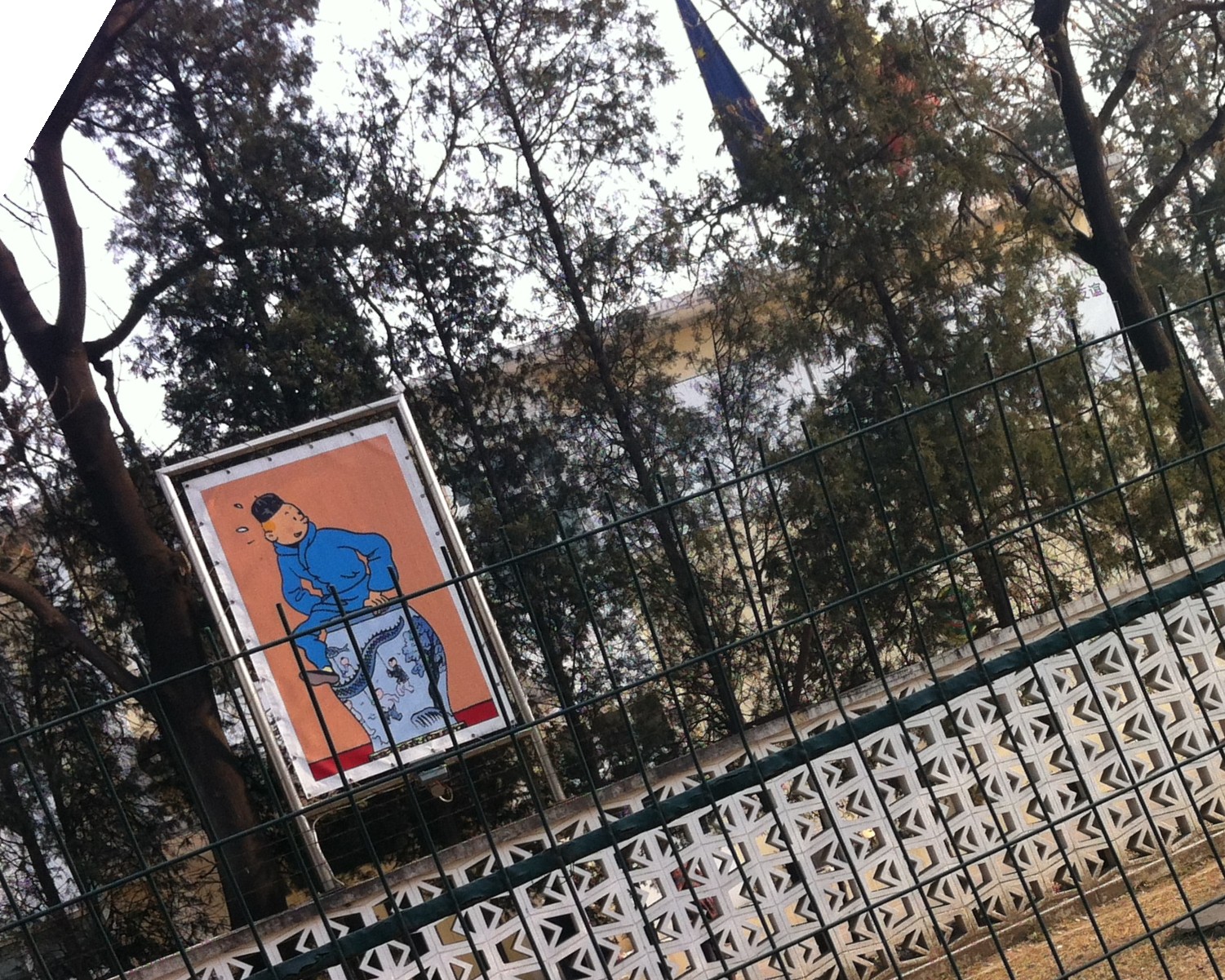
tintin embassy poster 001

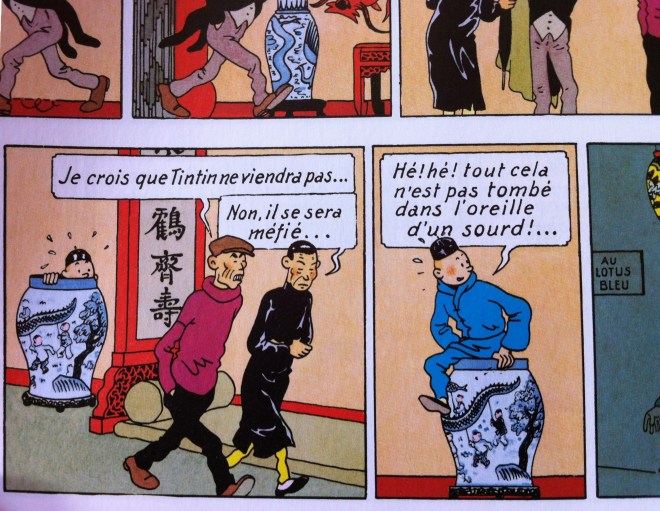
Tintin aficionados will immediately recognise this as a scene from Le Lotus Bleu, the fifth album of the series and first published in 1936. It comes from a moment in the story when Tintin, who has been hiding in an opium den in Shanghai to pick up information on the Japanese villain Mitsuhirato, is making his getaway. It’s quite a cheerful picture; Tintin has a slight smile as he jumps out, and the vase has a design of children carrying a paper dragon through the streets. I show here the original picture in the album.
bande dessine 003

So famous is this picture that it is one of a number of scenes from Tintin which have been turned into collectible statuettes.

tintin from vase 008

As I say, I find it slightly odd that the Belgian Embassy, an institution I would have thought anxious to project a sense of its own importance and probity, should decide to put up a picture from a comics album in so public a fashion.  But if it is going to do it, a picture of Tintin, who was drawn by Hergé, no doubt the best known Belgian in the world, taken from a story that takes place in China, sounds like a good choice.

Apart from smiling at this picture seen in such incongruous surroundings, I was also intrigued by it. Before coming to China, I had checked what books were banned here. I had read that Le Lotus Bleu was one of them because it gave too sympathetic a reading of the Kuomintang. But the Belgian Embassy’s bold move suggested that the ban was no longer in place, if it had ever been. Or perhaps the Chinese Government simply didn’t believe that any Chinese walking by would know the story and so recognise the picture. Which is probably true and to my mind quite sad. The Chinese are missing something.

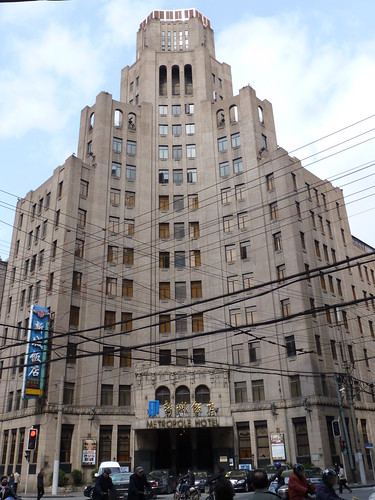
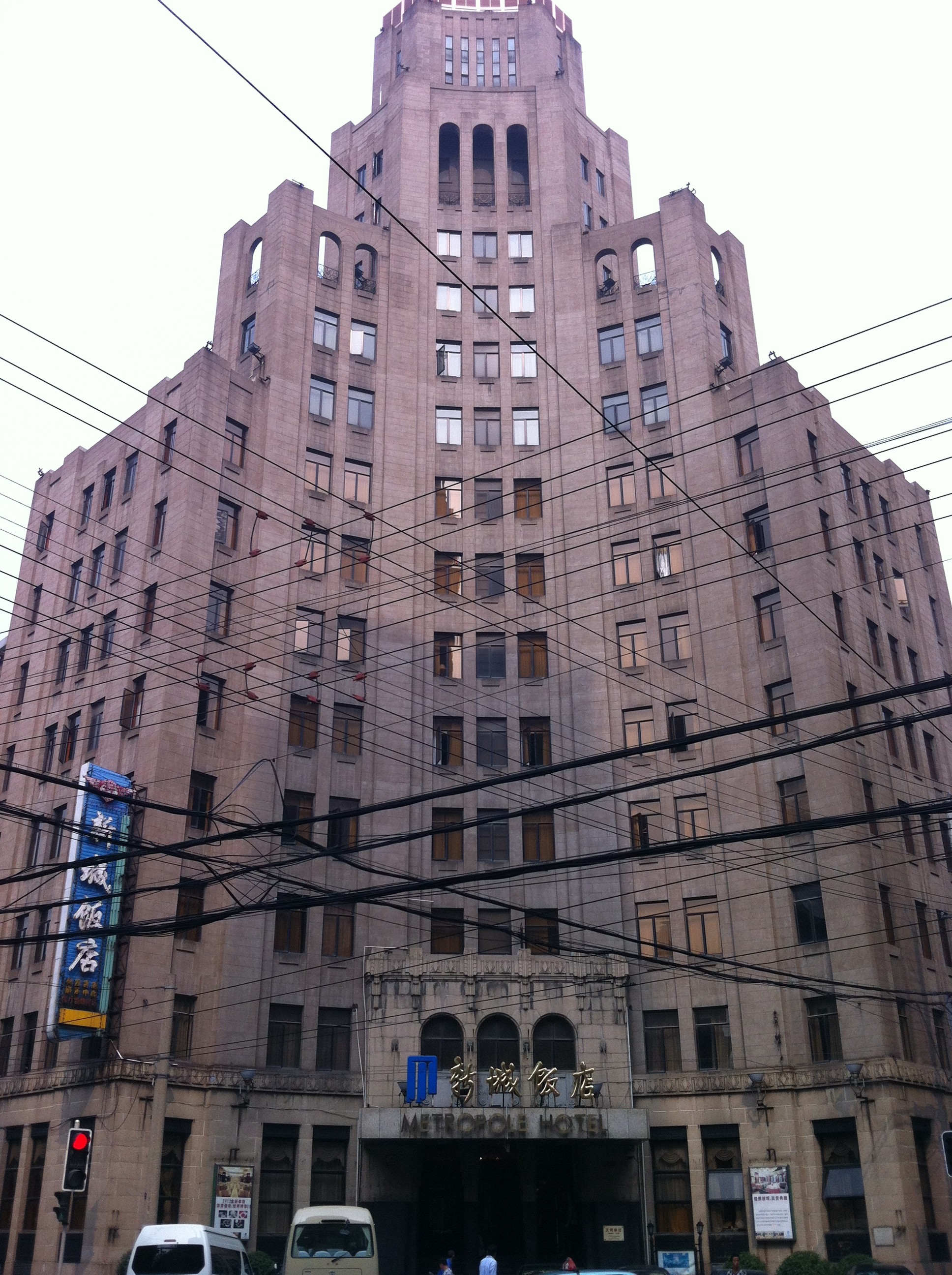
Le Lotus Bleu is of course the most Chinese of Tintin’s adventures, but Tintin en Amérique, first published in 1932, also has strong Chinese echoes for me. The first time my wife and I went to Shanghai, as we walked from the Bund to Renmin Square we found ourselves among buildings from the thirties. And all of a sudden we found ourselves at the crossing of Fuzhou and Sichuan Roads where there are four identical buildings on each corner. This picture is of one of them, the Metropole Hotel:
shanghai-2012 082

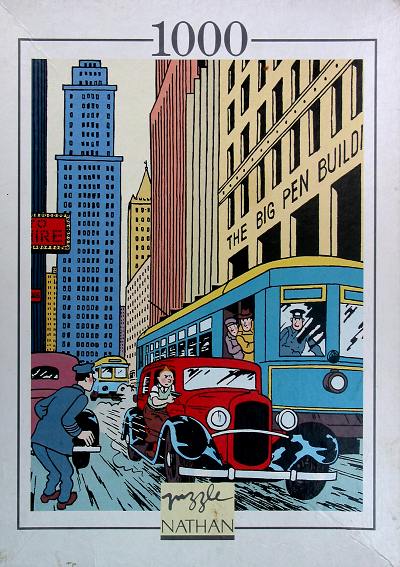
… and suddenly I was in Chicago in 1932, watching Tintin roar by in a Deusenberg, chasing Al Capone’s men!
tintin in chicago 010

Oh no! Just around the corner other members of the gang were waiting to gun him down! …

… I miss my Tintin albums. They are sitting in a packing box in the dark of a warehouse in Vienna, waiting for us to come back to Europe to retrieve them. I’m nearly 60 but I’m not ashamed to say that I always got a lift when I pulled one out of the bookshelf and settled down on the couch for a good read.

And I miss the times on that same couch when I read the albums to my young children, translating as I went along. How they laughed at the Fat Man Full of Soup! A minor character in the earlier parts of L’Oreille Cassée, I should clarify, who was called such by a parrot and who thought it was the carrier of the parrot who had dared so insult him. I miss the simple joys which suffused those years, as we watched our children grow. Perhaps one day I will have grandchildren sitting with me on the couch laughing again at the Fat Man Full of Soup.

__________________
photo credits
Tintin picture outside Embassy: my picture
Scenes from the album: my picture
Tintin coming out of the vase: www.1000-sabords.fr
Hotel Metropole: my photo
Tintin in Chicago: bd-blogeur.blogspot.com

ART FROM THE PEOPLE’S LIBERATION ARMY

9 August 2012

One of the things I love about art is to see how different artists deal with the same theme. Take the Binding of Isaac, the biblical story of Abraham who was ordered by God to sacrifice his son Isaac as a test of his faith. It was a hugely popular subject in Western art.  The scene almost always has Abraham about to sacrifice his son Isaac, who is lying on an altar with a rictus of fear on his face and the knife at his throat, and being stopped at the last second by an angel pointing to a ram as the alternative sacrifice.  The viewer is always led to think, “well, that was a close run thing”. I don’t know how many times the scene was painted over a period of five hundred years; could it be several thousand? Every museum seems to have two or three of these paintings hanging somewhere on its walls.

By now, my eyes glaze over when I see yet another Binding of Isaac. Yet once, several years ago, I was stopped dead in my tracks by a version I came across in the museum of art in Genova. The artist, whom I no longer recall, had caught an expression on the boy’s face that was so … real! The kind of expression you see when a child is on the edges of a “grown-up” discussion between adults, trying to follow, but not wanting to make himself noticed. It was a look I had seen on children’s faces many, many times.  In fact, I saw it again a few weeks ago during a BBC interview in Syria somewhere. The interviewer was talking to some men, and there was a boy hanging around on the visual edge of the camera following the conversation intently. Obviously my painter had decided on another story line, which I read this way. Abraham has solemnly told his boy to come with him, there has been a troubled, silent walk to the place of sacrifice, the boy feeling something serious is up but not knowing what. His father has told him to climb up on that ledge, there’s a good boy, and then suddenly a wonderful stranger appears and is having this serious talk with his father. Still in the act of climbing onto the ledge Isaac is listening intently without really understanding. The painter has stripped all artifice out of the background; no trees, rocks, or far-away hills, just a neutral monochrome backdrop. This could be a scene on any corner of an Italian street. Magic …

Why am I mentioning this? Well, last weekend I was at an art exhibition organized by the People’s Liberation Army, to celebrate the 85th anniversary of the PLA’s founding.  Naturally enough, the vast majority of the many, many – too many – works on show had a military subject. And they nearly all fell within certain clear typologies: battles against the Japanese; romantic visions of PLA’s modern weaponry; members of the Armed Forces on exercise or in training, enjoying every minute of it; the Armed Forces selflessly helping out in various emergencies; retired ex-servicemen and women; takes on the Chinese traditional landscape painting, but with army units being the human element in them; a strange set of paintings of women of the Armed Forces, but in dreamy, quite unmilitary poses; and of course, many featuring Mao and other senior revolutionaries beaming at the viewer.

As with the Binding of Isaac, the manner in which the artists treated these various topics quickly became tediously familiar. But some works arrestingly broke the mould. Consider this painting, part of the “battles against the Japanese” type.

battlefield scene

There are the usual soldiers attacking, the usual smoke of battle, the usual explosions. But our artist has captured beautifully the essential anonymity of battle. These soldiers have no faces, they are just forms looming out of the smoke and haze, a haze perhaps created as much by the fear in the defenders who are waiting with us, the viewers.

What about this one, which I suppose would also be part of the “battles against the Japanese” type.

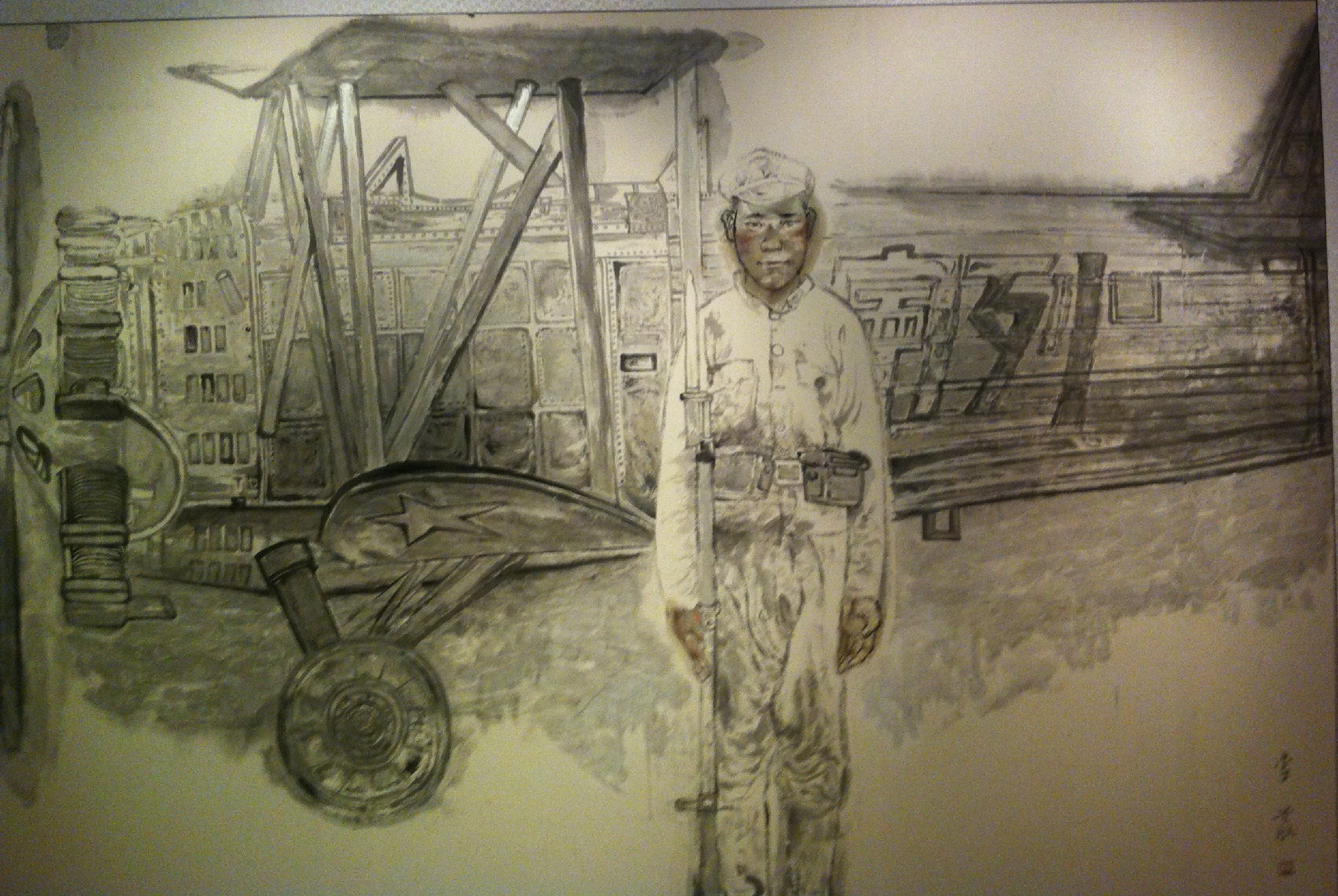
peasant before biplane

Instead of the normal storyline of the romantically rugged peasant joining the army of the people, we see here a young peasant lad like so many I see in Beijing working on the construction sites with the modern label of “migrant worker”. This lad, who probably only the previous day had been planting rice, has now been put into a badly fitting uniform – probably they come in only one size –  and told to stand guard in front of what looks like a rather dicey biplane. So there he stands, stolidly looking out at us, with no sense of military bearing, wondering what time chow will be served.  His modern counterpart is the horde of young migrant workers in badly fitting security staff uniforms who stand guard at the doors and gates of innumerable buildings throughout Beijing, wondering what time they can get off for dinner.

And this one, which again falls in the “battles against the Japanese” type, but is part of a sub-genre which depicts cossack-type soldiers, mounted on horses and wearing vaguely Central Asian looking clothes. I don’t know enough about the heroic struggles of the PLA but I presume they included troops from the Central Asian borderlands of China.

cossacks and horses

It is a wonderful construct of blocks of colour, all black or grey with just a hint of red in the faces of the two riders. It is abstract enough in design that at first glance one doesn’t understand what it is. The viewer has to take several steps back for the painting to resolve itself, and then he finds himself staring upwards at these kindly looking horsemen from the steppes. And the sabre, common to all this genre, becomes simply a wash of black. The only sign of anything military is the barrel of the gun poking up near the face of the second rider.

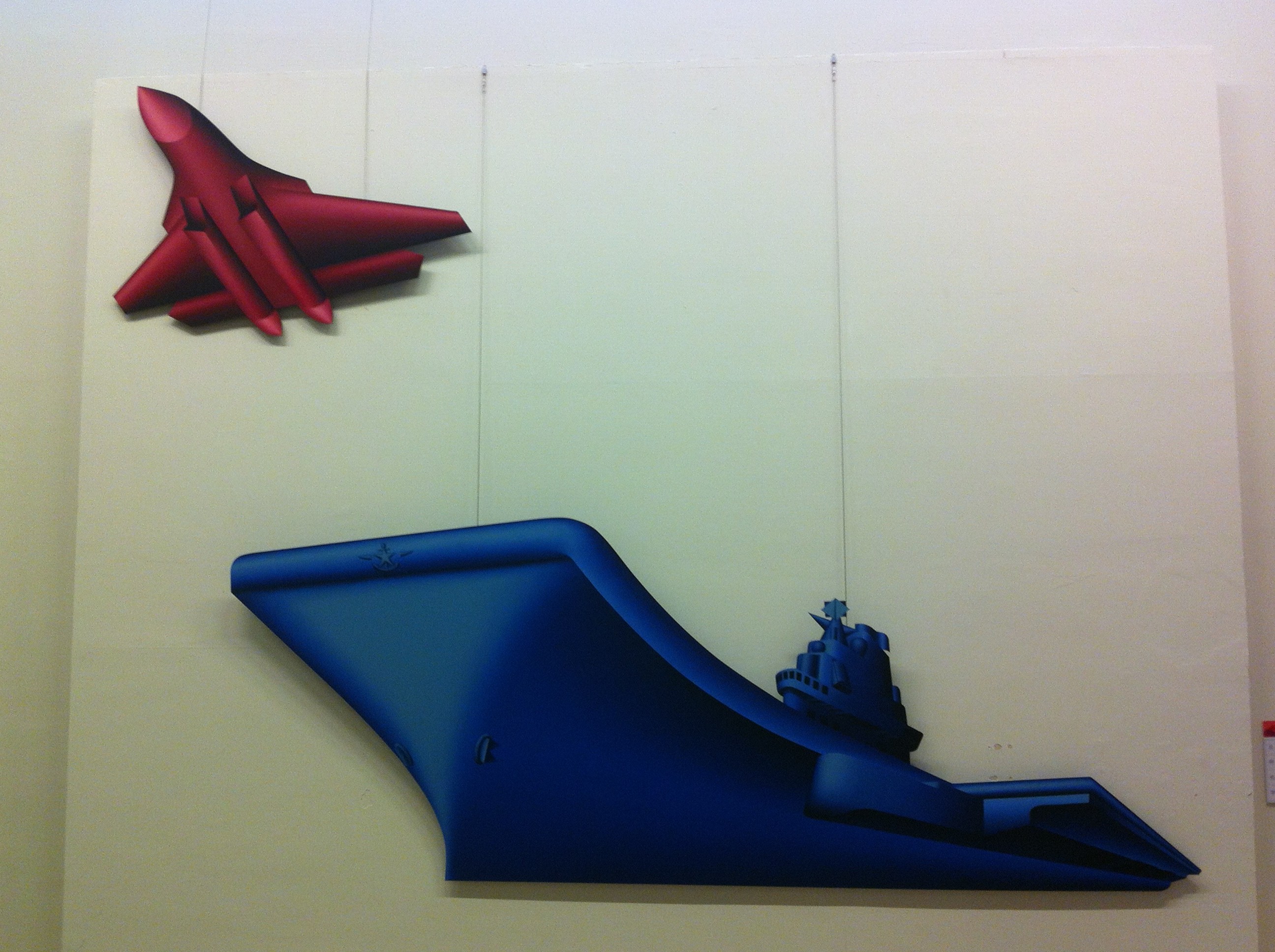
Or take this construction,  a jet taking off from the deck of an aircraft carrier, part of the “modern weaponry of the PLA” type.

ship and jet

The artist has reduced the subject to its essentials – one aircraft carrier, one jet, two colours and shading. No sea, sky, clouds, sailors, or any other clutter usually associated with the type. Just two lovely shapes.

Magic …

______________

Pics: all mine

MY PIECE OF CANAL

Beijing, 31 July 2012

I am lucky enough to live so close to work that I can walk to the office in the mornings and back in the evenings. It’s the first time I’ve been able to do this in the 30-some years I have been working. I can even go home for lunch!

The walk is that much more pleasant because most of it is along a canal. Many of the canals in Beijing are sorry affairs, either dry or filled with pestilential water. This is true for this canal too, except for the stretch I walk along. For some reason, this reach of the canal has been thoughtfully developed. Willows have been planted along the edge, reed beds too; a small reed island has been formed in the middle; during the spring irises, first blue then yellow, come and go; and a bed of lotuses has been planted.

I treasure that morning walk. It puts my heart at peace and allows me to face the slings and arrows of the day with fortitude. And I am not the only one. From spring to autumn, the edges of the canal are sprinkled with fishermen (and sometimes fisherwomen), meditating on the state of the world and catching a small fish from time to time. In summer, some of the older inhabitants from the nearby apartment blocks sally forth and swim slowly up, down, and across the canal.

Two autumns ago, we woke up to find that my piece of the canal was being emptied. After a brief period where mudlarks waded through the resulting black sludge picking up stranded fish and other strange things, excavators arrived, dug a large trench down the middle of the canal’s bottom, and then a swarm of migrant workers appeared to lay down a large plastic pipe – a sewer line, I would guess. What has taken me two lines to recount, it took the pipe layers a dreary six months to accomplish. But finally, the pipe was covered and silence returned. But not the water. And we waited. Another six months passed. I was terribly afraid that the canal would disappear, that they would fill it in and build a road.

But at last the water reappeared. And slowly, the old canal-side rhythms came back, and my walks to and from the office once again soothed my harried soul. But I was worried about the lotuses. I was worried that the long drought would have killed them. When we left for our vacation there was no sign of them. On my first walk to the office after coming back, I looked out anxiously for them. And they were there, flowering already, their delicate pinks and whites standing out against the dark matte green of their leaves. And all was right in the world.

flowering lotus-1

PLANE TREES

Beijing, 30 July 2012

Until a few years ago, plane trees were not high on my list of favourites. The memories of my youth were of leprous-looking trees in a ragged line along anonymous city streets, with long strands of dirty bark peeling off them, a pathetic crown often savagely chopped to allow the passage of telephone and other wires, and every passing dog peeing on them. My grandmother would say that they were used because they were the only trees that could survive in cities. But what a life, I thought. Better no life than this …

plane trees in streets-4

And then one day, on a holiday with my wife in Spain, we were walking through the Jardín del Príncipe in Aranjuez, near Madrid, when we came across a row of absolutely magnificent plane trees, of vast girth, with huge spreading crowns of light green sparkling leaves, and whose bark ranged in colour from pale beige through pale green to ivory white.  Simply ravishing. If we took photos, I have no record of them here. So I insert this picture of a plane tree in these gardens which I found on the web, to give the reader an idea of the beauty of these trees.

plane trees jardin del principe Aranjuez-6

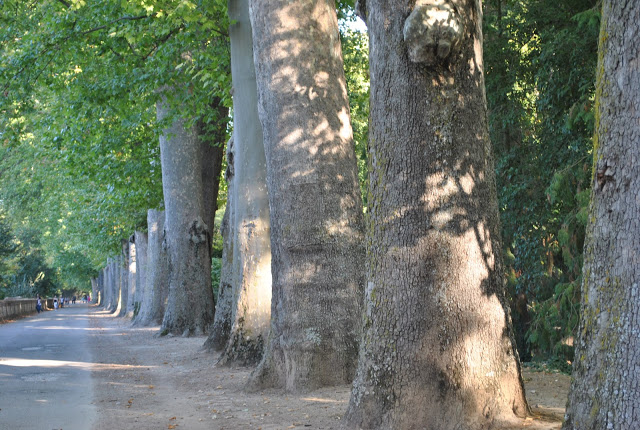
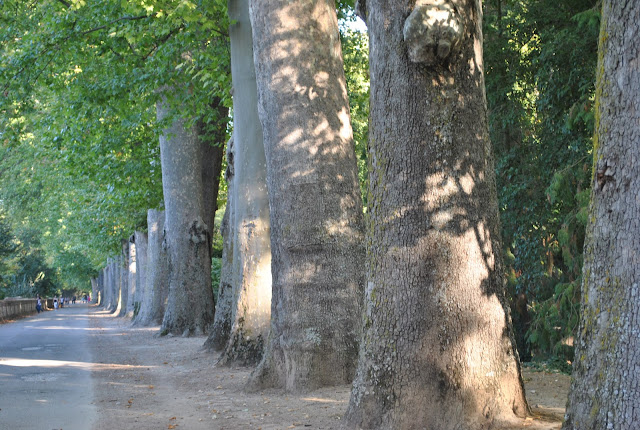
I add this picture of a row of the trees in the gardens to give an idea of their girth.

plane trees jardin del principe Aranjuez-1

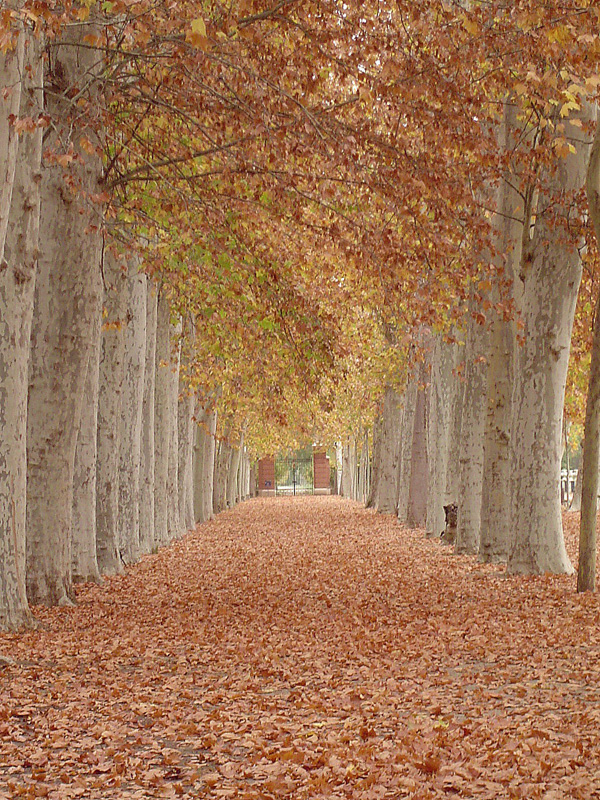
And I add this one simply because I like the colours!

plane trees jardin del principe Aranjuez-4

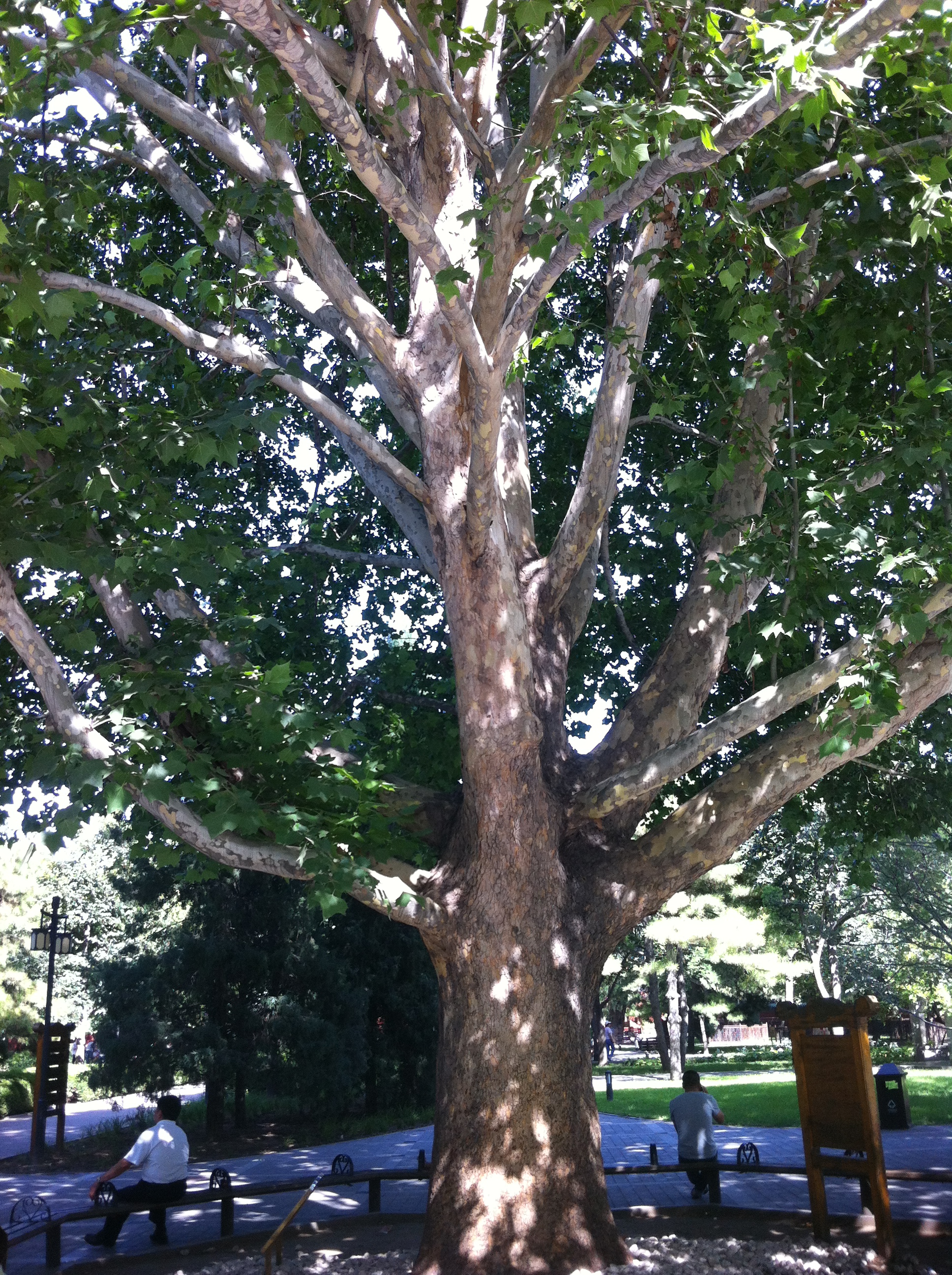
I remembered that glorious moment of discovery yesterday when, visiting Ritan Park in Beijing on a beautiful day with a blue and – that rarest of things in this city – clear sky, we found ourselves sitting in the shade of a lovely plane tree.  It was not as majestic as the specimens we had discovered in Spain, but it was still arresting. It had been manicured so that it grew more regularly in all directions, and a bench had been arranged around it in a wide circle.

ritan park 002

ritan park 003

We just sat there, drinking in the quiet beauty of it all.

POSTCRIPT:

One year on from writing this, I must report the saddest of news. Seventy years ago, US soldiers disembarked in Italy, carrying with them munitions boxes made with wood of the American plane tree. That wood contained a fungus, Ceratocystis platani, unknown to the plane trees in Europe and against which they have no defence. It has left Italy now and is slowly spreading throughout the rest of Europe. Eventually, it will kill millions of plane trees throughout Europe. This was reported by the BBC, where they were saying that the thousands of beautiful plane trees planted along the Canal du Midi

canal du midi plane trees

are becoming infected and will have to be cut down and burned.

Canal du midi plane trees being burned

I fear that the same fate will soon be shared by those lovely old plane trees in the Jardin del Principe. One more tragedy caused by the global movement of goods and people – and bugs that go with them for the ride.

_____________________________
plane trees on a street: http://animestoi.midiblogs.com/media/02/01/2964573664.jpg
photos of the Plane trees in the Jardin del Principe, Aranjuez:
first: http://mw2.google.com/mw-panoramio/photos/medium/14735886.jpg
second: http://2.bp.blogspot.com/-sCRByt2Qd6s/UUsvkfma43I/AAAAAAAAZ10/eTOTJ_kaYxQ/s640/Platanos+de+sombra+Aranjuez+01.JPG
third: http://turismoenaranjuez.com/sites/default/files/otonojardinprincipe_0.jpg
photos of the plane tree in Ritan Park: mine
Canal du Midi: http://news.bbcimg.co.uk/media/images/56128000/jpg/_56128150_canalview624.jpg
Canal du Midi-plane trees being burned: http://4.bp.blogspot.com/-4yIXXHCnDRY/UYN1Ru6K3yI/AAAAAAAAAuM/16Cdm8bNqT4/s1600/Canal+du+midi+abattage+PK+143+%25287%2529.JPG