Milan 31 December, 2024
It is a sad fact of life that most of the time we fail to follow through on our New Year’s resolutions. I am no different. In fact, I have such a dismal track record on this topic that I stopped many years ago making these resolutions – I did not want to add so many paving stones to my private road to Hell.

But there is one end-of-year resolution on which my wife and I seem to be holding the course, one I explained in my first post of this year. Summarizing quickly, the two of us decided that we – and any children or grandchildren who may be visiting – would, for a period of eight years, use the traditional Christmas lunch or dinner to honour our mixed genetic pool: Puglia and Lombardy: the heritage of my wife; Burgundy, England, Scotland and Norway: my heritage; – and, if we are still around, Ireland and the old Pale of Settlement: the heritage of our son-in-law. Specifically, for each of those eight years, we would cook a typical Christmas lunch or dinner from each of these regions. I decided to start at the southern end of the genetic pool and move north, so last year we cooked ourselves a Christmas lunch from Puglia, which we shared with our son.
Contrary to previous attempts, we did not forget this resolution, and so this year now found us cooking a typical Christmas dinner from Lombardy, which we shared again with our son as well as with his girlfriend. I’m so proud that we managed – at least this year – to keep to the resolution, that I’ve decided to share this year’s menu with my readers.
We started with ravioli in brodo. As far as I can make out, each province in Lombardy has its special type of raviolo, but we didn’t get that subtle. We just took a packet of ravioli stuffed with braised meat which was being sold in our local supermarket, and we cooked them in a chicken broth made with cubes. Since we are most definitely not part of the Instagram generation, we have never got into the habit of taking photos of the food we eat. We just wolf it down and then say “damn, we should have taken a photo”. So I throw in a photo I found on the internet to give readers an idea of what we were eating.

Next, as the main dish we had cotechino with lentils and mashed potatoes. I throw in another photo of this dish from the internet.
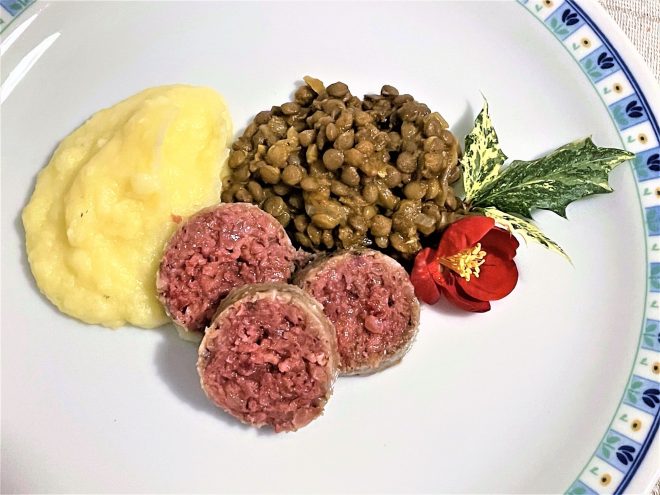
I refer any of my readers who wish to know more about this typical Lombard dish to a post I wrote several years ago, where I go into probably too much detail about it; I have no desire to repeat myself here.
For dessert, we had that great, that splendid, Lombard delicacy, the panettone. I’ve also covered this miracle of Lombard cuisine in an earlier post, so I won’t go into further details here. I just refer my readers to that post and throw in a photo of a slice of panettone. I deliberately chose a photo which shows a large dollop of mascarpone, because for the first time ever, we had our panettone with mascarpone.

We decided to add mascarpone because we read that the Lombards are known to slather this extra bit of yumminess onto their panettone during the Christmas season.
Since I’ve never mentioned mascarpone in any of my previous posts – for the simple reason that we hardly ever eat it – let me use this occasion to say a few words about it. It’s a Lombard cheese, originally from the area around Lodi to the south of Milan. Like cotechino, it used to be made with the left-overs from the production of more remunerative dairy foodstuffs, in this case cheeses. It is a smooth, spreadable cheese, with a an ever so slight sweet taste to it and a hint of the aroma of cream.
Mascarpone is now well-known worldwide because it is one of the main ingredients in the famous tiramisù – which, I was surprised to learn, is a very recent creation, from the 1960s, with its place of birth being somewhere in the Veneto or Friuli-Venezia-Giulia regions of Italy.
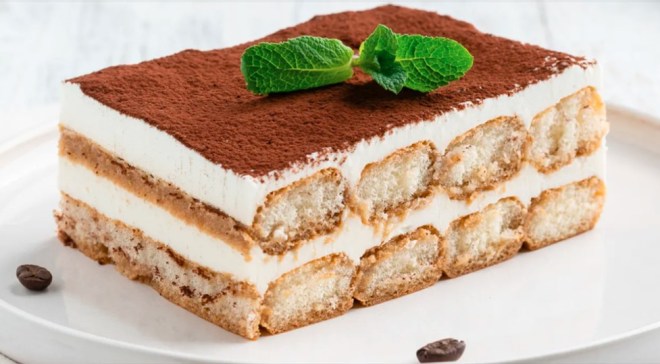
Mascarpone is actually used in tiramisù in the form of crema al mascarpone, which is a mix of a syrup of sugar, egg yolk, and mascarpone. This is but one variant of sweetened mascarpone which Italians have been eating since at least the 1400s and possibly earlier.
If I am dwelling a little on crema al mascarpone it’s because I have a horrible doubt: should we have eaten our panettone with crema al mascarpone rather than just with mascarpone? Both ways are promoted by different sites on the internet. I have to say, my wife and I found that mascarpone alone combined well with panettone. But might crema al mascarpone have combined better? There’s only really one way to find out – make (or buy) crema al mascarpone and slather it on a couple of slices of panettone. Something to work on next year.
Of course, there wasn’t just food. There were wines, too! Staying in theme, we chose two Lombard wines, a red and a white. The red was a Bonarda, one of the sparkling red wines that are common in the north and centre of Italy. This is a topic I’ve covered in an earlier post, so any readers interested to find out more about this intriguing family of sparkling reds can go there. Here, I’ll just insert a photo of some of the vineyards where Bonarda’s grapes are grown.

As for the white wine, we chose a Lugana, whose grapes are grown on the far eastern edges of Lombardy, looking over the southern shores of Lake Garda.

I suppose we could have finished with some digestivi or some grappa made in Lombardy, but we left it at that. Sometimes, especially at our age, one can have too much of a good thing and spend the night regretting it.
So that’s Lombard Christmas dinner done! Next year, we venture into a Burgundian Christmas lunch – or maybe a Beaujolais Christmas lunch, if there is a difference; my mother was specifically from Beaujolais. We shall see, a happy year of research awaits me.
Happy New Year to all my readers! May 2025 bring you and your families peace and happiness.
 the heart thrills