This post is dedicated to my dearest wife,
the most faithful of my readers
Vienna, 4 September 2021
Some months ago, I was asked by the Student Sustainability Committee of a school in Wales which I’m involved with to help them estimate the carbon footprint of the food eaten in the school. In the case of prepared food, which made up a substantial portion of the food consumed at the school, this exercise required me to plough through a lot of recipes to understand what were the raw ingredients of these prepared foodstuffs (so as to calculate the carbon footprint of each ingredient). Apart from this being a hell of a lot of work, as my wife will testify (“have you still not finished that stuff?!”), I discovered with surprise that many, many prepared foodstuffs of the sweet variety (biscuits, cakes, chocolate, and various sundry others) have vanilla extract as one of their ingredients (and as a side note, I was very surprised to see that these sweet foodstuffs made up a large portion of all the food consumed in the school; it didn’t seem to be a very healthy diet).
These constant references to vanilla extract intrigued me, and I decided that one day I would investigate vanilla a bit more. This decision crystallized into action over the last few weeks, because it so happens that my wife is very fond of vanilla. In the Bad Old Days, before we started our rigorous dieting, she consumed a fair amount of vanilla-based ice creams, normally those covered with a chocolate casing (I will not give free publicity to her favourite brand by naming it; I will leave my readers to guess). Now, in these more virtuous times, diet-wise, her vanilla consumption mainly takes the form of vanilla-flavored yogurt, and this only for lunch on our hikes (which these summer days has meant quite frequently). For the sake of complete transparency, I should state that she still consumes a chocolate-covered vanilla ice cream from time to time, whenever a hike is judged to have been particularly strenuous.
The brand of vanilla-flavored yoghurt which my wife generally favours is this one – I should add that she favours it simply because our local supermarket offers it, at a very reasonable price.
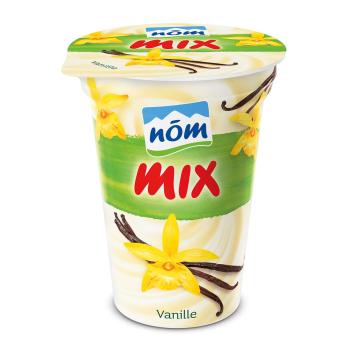
Sharp-eyed readers will have noticed the flower on the tub. This is the vanilla orchid, Vanilla planifolia. Here’s a photo of the Real Thing.

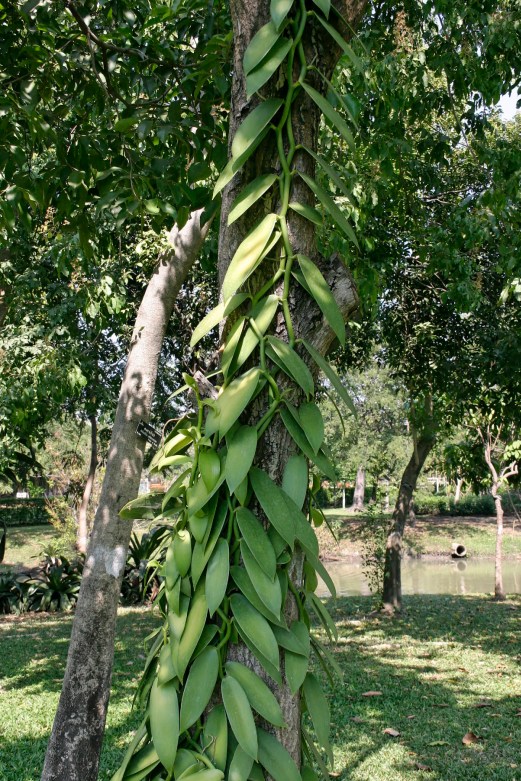
And here is the plant more or less in its natural state (readers will note that this orchid is a type of vine; in Nature it will grow up trees, like the pepper vine).
It’s really a very pretty flower, but it is only of passing interest to the vanilla aficionado. She or he is after the “fruit”, a seed pod really, that the flower creates once it has been pollinated. The three dark-coloured stringy things pictured behind the flower on the yoghurt tub are these seed pods. Again, here is a photo of the Real Thing.

But even the seed pod, if in its natural state, just picked from the vine, does not interest the vanilla aficionado, because it contains very low levels of vanilla flavour and aroma (these, by the way, come mostly from the chemical vanillin, although there are a number of other chemicals present which it is claimed enhance both flavour and aroma). It is only once the seed pod has been cured that the vanilla aficionado becomes interested, because now the levels of vanillin are considerably higher, high enough to add that distinct vanilla flavour and aroma to foods and drinks.
The curing of vanilla seed pods is a rather complicated, months-long process, whose purpose is to bring about an enzymatic reaction in the pods which turns the glucovanillin they contain into vanillin proper (in case any readers were asking themselves, glucovanillin has no flavour or aroma). Curing consists of four basic steps: killing, sweating, slow-drying, and conditioning. In the killing step, the seed pods are generally heated (in hot water or in an oven or by exposing the pods to the sun).

This stops any further vegetative growth in the pods and initiates the necessary enzymatic reactions.
In the sweating step, the pods are kept at temperatures of 45–65°C and at high humidity levels by stacking them densely and insulating them in wool or other cloth. The pods are subjected to this Turkish bath regime for 7 to 10 days, possibly with a daily exposure to the sun or a dip in hot water.

The desired enzymatic reactions love these conditions, so by the end of the sweating step the seed pods have attained much of the desired vanilla flavour and aroma. However, they still have a high moisture content. Which brings us to drying.
To prevent the pods from rotting and to lock in the vanilla aroma, drying is required. And so, over a period of three to four weeks, the pods are exposed to air and to periods of shade and sunlight.
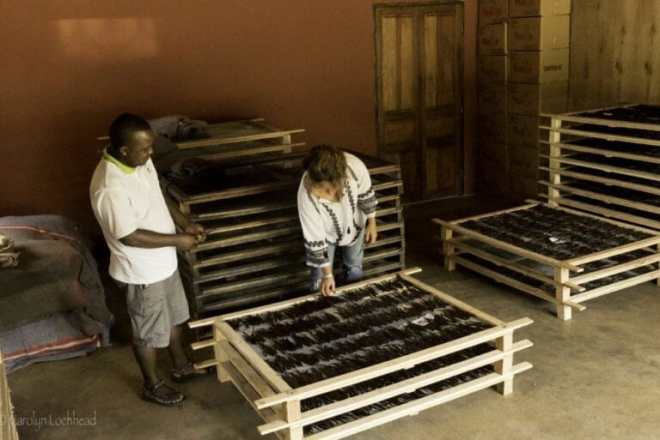
In the final, conditioning step, the dried pods are stored for five to six months in closed boxes, where the fragrance further develops.
The end result looks like this.

This is what vanilla aficionados lust after, what they dream of incorporating into their dishes, from soup to sweet dishes. And they are willing to pay top money. Vanilla is the second most expensive spice, after saffron. Those wrinkled-up beans can set you back anywhere from $50 to $500 per kilogram.
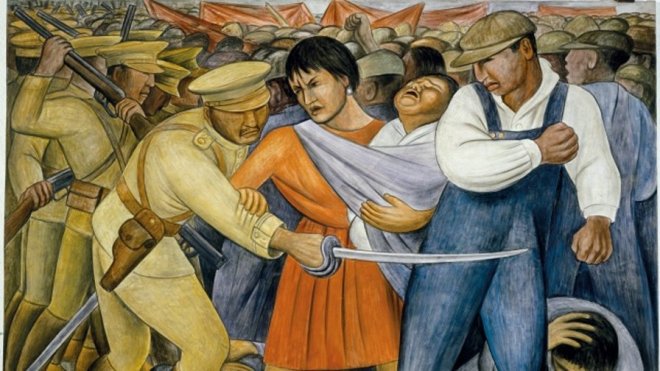
When I look at these kinds of convoluted processes, I always ask myself, “How on earth did anyone discover this process?” I mean, really, how did the first vanilla producers stand in front of those aroma-less and flavour-less seed pods and figure out that this long and complicated process would eventually lead them to seed pods with a wonderful aroma and flavour of vanilla? I would have to ask this question to the ancestors of the Totonacs, an Amerindian people who live on the east coast of Mexico. It was they who first “made” vanilla-flavoured seed pods from the vanilla orchid – the orchid’s natural habitat is in this part of the world. Here, we have Diego Rivera’s take on the Totonacs, as part of one of his murals in the National Palace in Mexico City.

Unfortunately, I’m sure today’s Totonacs have no idea; I just have to accept that the answer is lost in the mists of time.
Readers might think that since the vanilla orchid is natural to Mexico’s eastern seaboard, that country would be a major producer of vanilla. Alas, not so! The reason for that is the great Columbian exchange, that massive movement of plants, animals, humans – and diseases – which took place between the New and Old Worlds after the discovery of the Americas by Christopher Columbus. The vanilla orchid was part of that exchange. The Conquistadors, like the Totonacs (and like the Aztecs) loved the flavour and aroma of vanilla and figured that people back home would love it too. They exported the pods back to Europe, where they caused a sensation, at least among the elites, who had the money to burn on this rare and expensive novelty. They put it in everything, from chocolate (also a product of Mexico) to soup. They adopted the Spanish name for it (vanilla is a corruption of the Spanish vainilla, meaning “little pod”). Other Europeans looked on enviously. Eventually, the French laid their hands on some exemplars of the plant and took them to their colonies which had similar climates to Mexico’s eastern seaboard, namely those in the Caribbean and the Indian Ocean, especially the islands of Madagascar, Réunion, and Mauritius.
For a while, Mexico continued to be the main global producer of vanilla, because this transplant of the vanilla orchid to other places was a failure. The plant flowered alright, but it never produced pods. The reason for this is an exquisite example of specialized evolution: vanilla flowers can only be pollinated by this little critter, Eulaema meriana, one of some 25 species of orchid bees.

No other insect is attracted by the sex pheromones emitted by the flower, nor can any other insect successfully navigate the orchid’s complicated geometry and pollinate the flower along the way.
Once non-Mexican wannabe vanilla producers realized the problem, they tried the obvious thing, which was to transplant the vanilla-pollinating orchid bee along with the orchid. But it didn’t work; the bee couldn’t survive outside of its native habitat. The wannabe vanilla producers were stumped. Until 1841.
In that year, a 12-year old slave called Edmond (no surname, he was a slave), who had been born into slavery on the Island of Réunion, came up with a quick and easy way of pollinating the vanilla orchid flower by hand. He had been lent out by his master to a botanist by the name of Ferreol Bellier-Beaumont, to help him out. Beaumont had shown him how to hand pollinate a watermelon plant and the boy went off and successfully applied his new skills to the vanilla orchid. (For anyone considering hand-pollinating a vanilla orchid flower, here’s what you do: with a small sliver of bamboo or wood (or even a stem of grass), lift the membrane separating the flower’s anther and stigma; then, using your thumb, transfer the pollinia from anther to stigma.)
Edmond never got anything out of his discovery. Who did were all the the slave-owning planters on Réunion who now got into vanilla growing: for a while, Réunion became the world’s largest producer of vanilla. But the French authorities made sure the method was transferred to its other island colonies in the Indian Ocean and in the Caribbean. Since then, Madagascar has dominated world production (Indonesia, which muscled into the market in the 1980s, is now second in the producers’ league table). Mexico, on the other hand, has pretty much vanished from the scene, which is a crying shame.
As for Edmond, seven years after his discovery, at the age of 19, he got his freedom; the French government finally outlawed slavery in its colonies in 1848. He left the world of plantations to work as a kitchen hand in the island’s main city, and adopted the surname Albius, from the Latin alba or white, in reference to the vanilla orchid’s colour. Beaumont tried to get the governor of Réunion to give Edmond a stipend or at least a reward for his great discovery but the governor ignored the petition. No doubt, he didn’t think it was worth spending public monies on a black ex-slave.
Unfortunately, Edmond fell in with a bad crowd in his new life and got involved in a theft of jewelry. He was caught and sentenced to 10 years in jail, which, after an appeal by Beaumont to the governor, was reduced to five. After doing his time, Edmond moved back to a village close to the plantation and got married.
Edmond’s travails were not over. It seems to have been an irritation in certain quarters that where white professional botanists had failed, a black slave, and a child to boot, had succeeded. Some time in 1860s a well-known French botanist and plant collector by the name of Jean Richard claimed that actually, he had come up with this revolutionary pollination method in the late 1830s, that he had taught it to some planters in Réunion, and that Edmond must have sneaked into the meeting and heard his explanation. Luckily, Beaumont and a few others vigorously defended Edmond’s primacy to the discovery, although Richard’s false claim did get some traction for a while. May Richard’s name be damned forever …
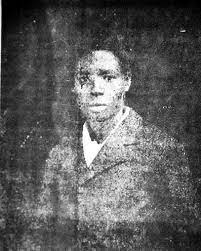
Edmond died in poverty in 1880, at the age of 51. Luckily, he left a physical trace of himself in history, rare for ex-slaves. Here we have a rather grainy photograph of him when young.
And here we have a lithograph of him from a book published in 1863, standing gravely in front of a vanilla orchid vine.

Wonderful story, the vanilla story, no? Except that as far as the vanilla in my wife’s yoghurt is concerned, it is all a big red herring.
I’m afraid to tell her, and any other readers who might be vanilla lovers, that the vast majority of the vanillin used commercially in the world is fake – well, artificial might be a less inflammatory word. Most of the world’s vanillin is produced from crude oil derivatives in chemical plants: benzene is alkylated with propylene to form cumene, which is then oxidized to phenol. Phenol is hydroxylated into catechol, which is further methylated into guaiacol. Finally, guaiacol is reacted with glyoxilic acid by electrophilic aromatic substitution to produce vanillylmandelic acid, which is converted to vanillin by oxidative decarboxylation. The remainder of the world’s artificial vanillin is made from a waste stream generated in the sulphite process to make paper pulp.
Yes, I know, very disappointing. And the worst of it is that when Cooks Illustrated ran some taste tests which pitted natural vanilla against artificial vanillin used in baked goods and other applications, tasters could not tell the difference! Don’t know what the world is coming to … Luckily, the tasters could tell the difference where ice cream was concerned, with natural vanilla winning out; l’onore è salvo, honour has been saved, as my wife might say.






 the heart thrills

