I like writing, but I’ve spent most of my life writing about things that don’t particularly interest me. Finally, as I neared the age of 60, I decided to change that. I wanted to write about things that interested me.
What really interests me is beauty. So I’ve focused this blog on beautiful things. I could be writing about a formally beautiful object in a museum. But it could also be something sitting quietly on a shelf. Or it could be just a fleeting view that's caught my eye, or a momentary splash of colour-on-colour at the turn of the road. Or it could be a piece of music I've just heard. Or a piece of poetry. Or food. And I’m sure I’ve missed things.
But I’ll also write about interesting things that I hear or read about. Isn't there a beauty about things pleasing to the mind?
I started just writing, but my wife quickly persuaded me to include photos. I tried it and I liked it. So my posts are now a mix of words and pictures, most of which I find on the internet.
What else about me?
When I first started this blog, my wife and I lived in Beijing where I was head of the regional office of the UN Agency I worked for. So at the beginning I wrote a lot about things Chinese. Then we moved to Bangkok, where again I headed up my Agency's regional office. So for a period I wrote about Thailand and South-East Asia more generally. But we had lived in Austria for many years before moving to China, and anyway we both come from Europe my wife is Italian while I'm half English, half French - so I often write about things European. Now I'm retired and we've moved back to Europe, so I suppose I will be writing a lot more about the Old Continent, interspersed with posts we have gone to visit.
What else? We have two grown children, who had already left the nest when we moved to China, but they still figure from time to time in my posts. I’ll let my readers figure out more about me from reading what I've written.
As these readers will discover, I really like trees. So I chose a tree - an apple tree, painted by the Austrian painter Gustav Klimt - as my gravatar. And I chose Abellio as my name because he is the Celtic God of the apple tree.
I hope you enjoy my posts.
http://ipaintingsforsale.com/UploadPic/Gustav Klimt/big/Apple Tree I.jpg
We’re off to Los Angeles, to stay with the little family of our daughter and her partner – about to grow by one more child!
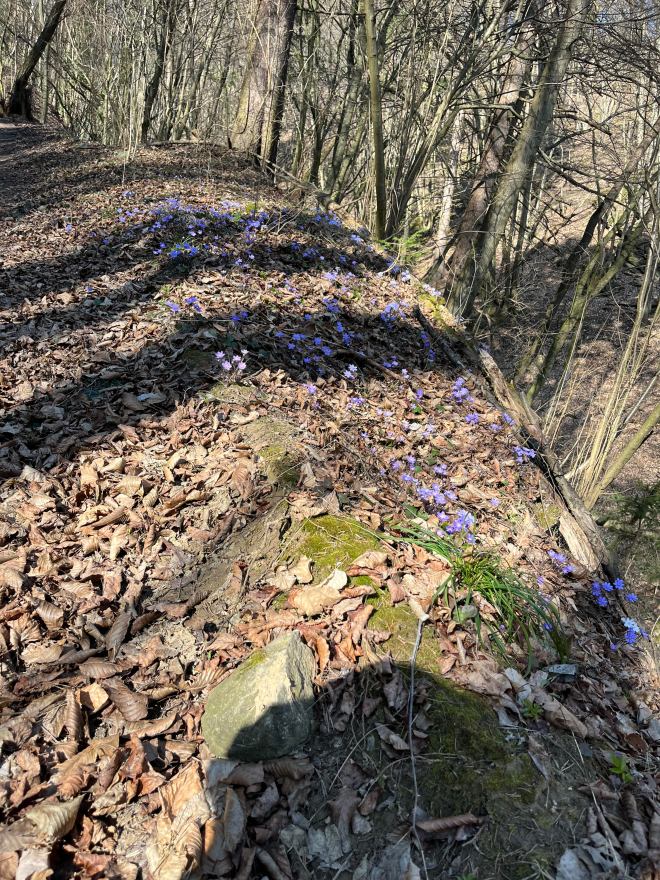
We leave Austria with Spring timidly showing its face. On our last hike in the Wachau, we spied small drifts of pennywort pushing through the forest litter.
My photo
Their light purple petals were almost glowing.
My photo
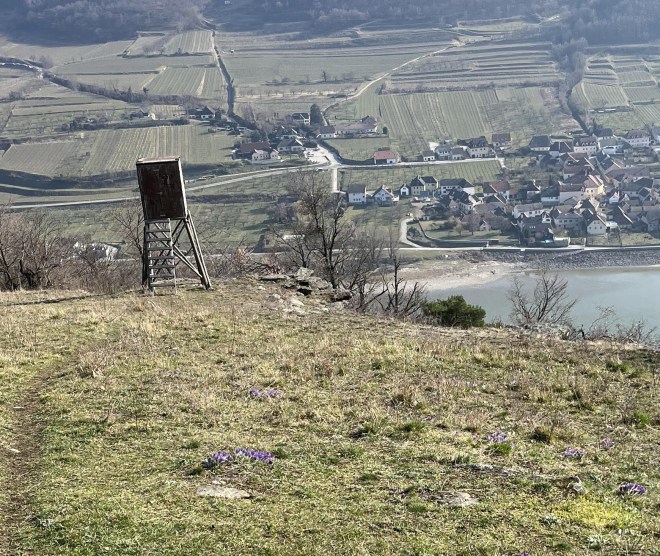
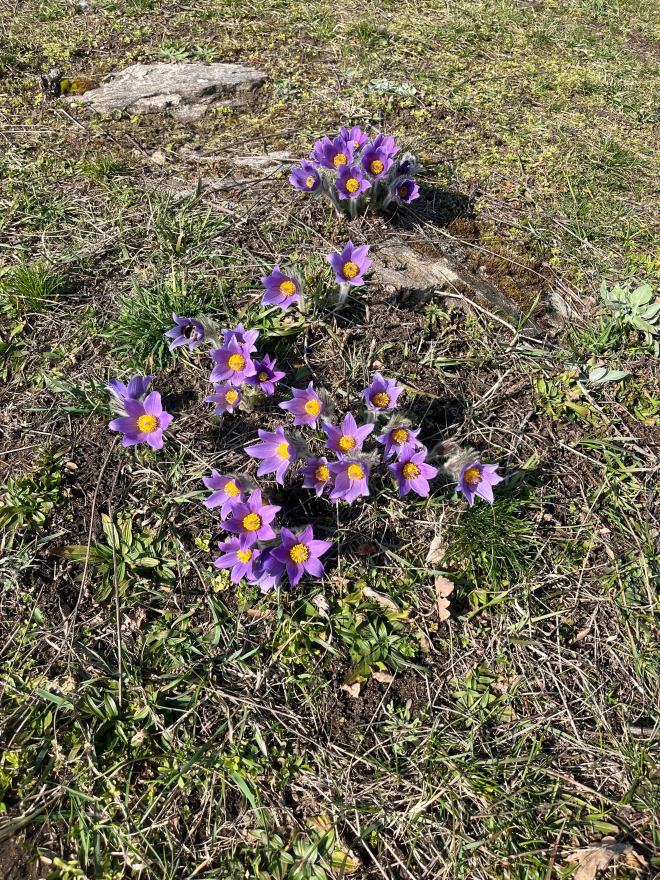
Further on, on a dry, rocky outcrop overlooking the Danube river, we spied a little group of greater pasque flowers – well named, Easter is around the corner.
My photo
Their yellow hearts stood out against the dark purple of the petals.
My photo
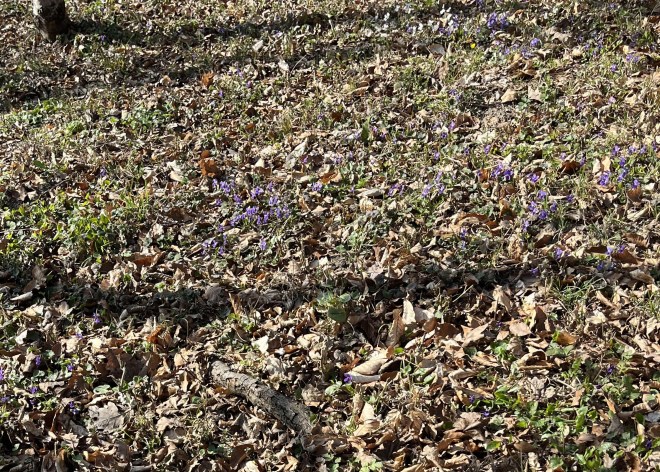
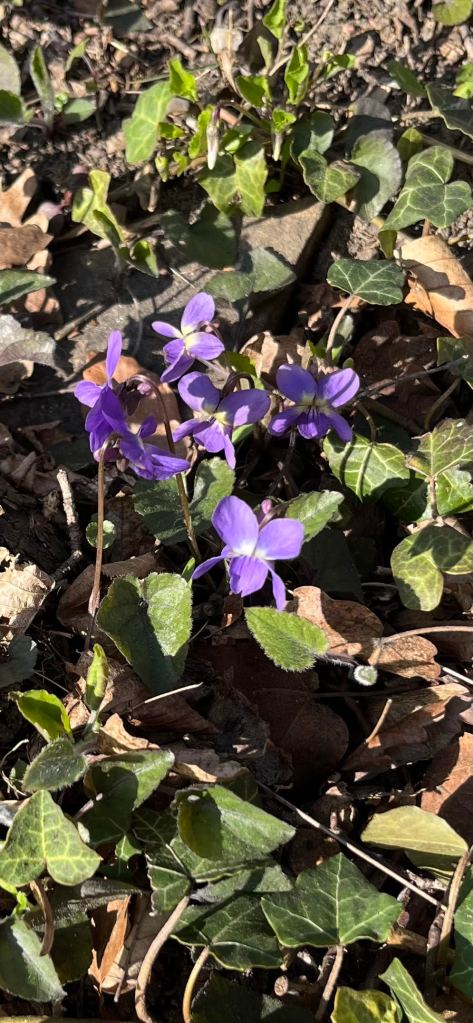
The next day, in the woods covering the hills overlooking Vienna, we bumped into sprays of violets peeping up through the dead leaves.
My photo
So small, so delicate …
My photo
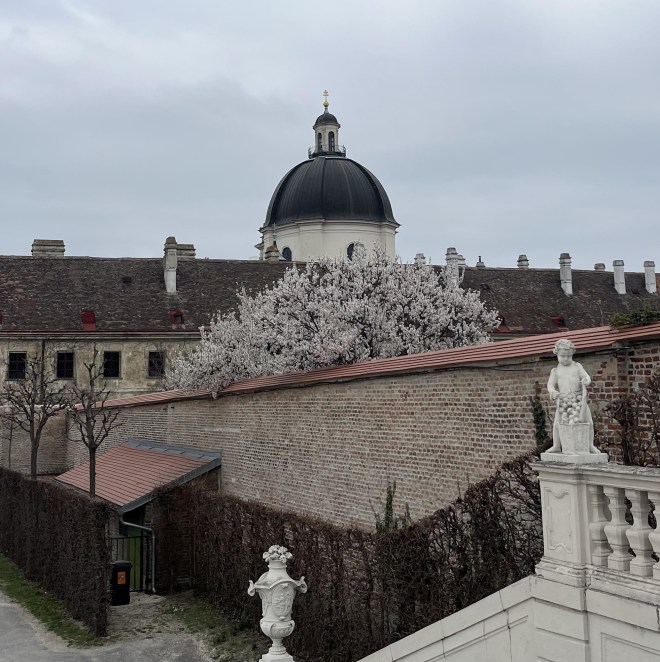
And yesterday, during our last walk around Vienna, which took us through the gardens of the Belvedere Palace, we passed a blooming cherry tree.
My photo
The next time we’re back in Vienna, it will be late summer. Who knows what flowers will greet us then?
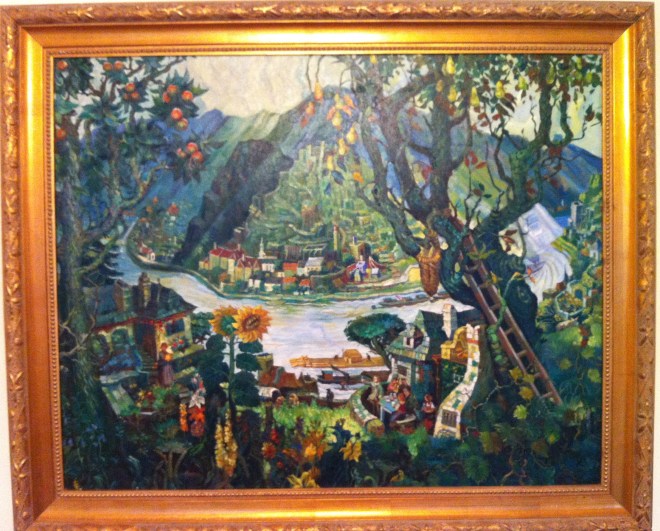
Of my very modest collection of paintings, this is the one I am most fond of.
My photo
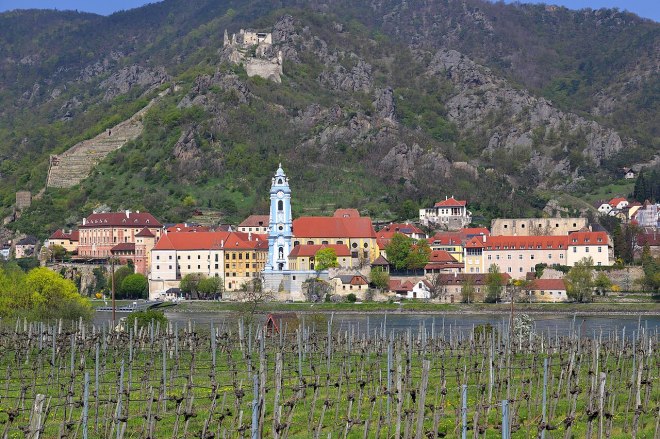
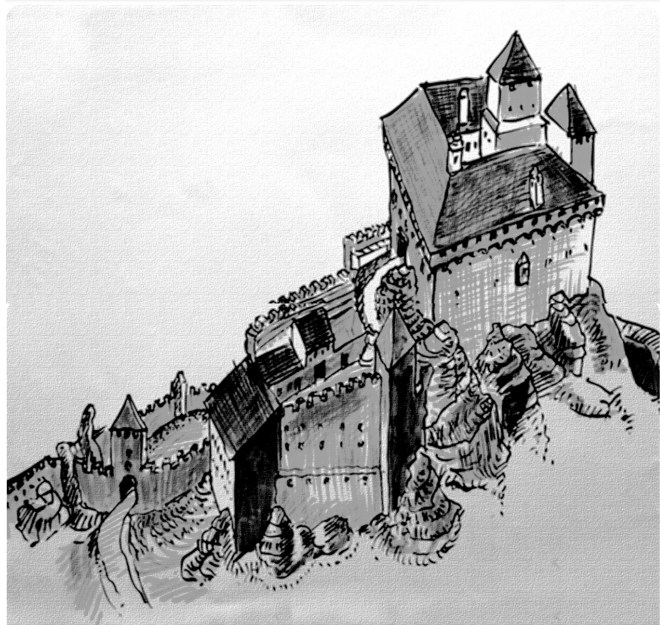
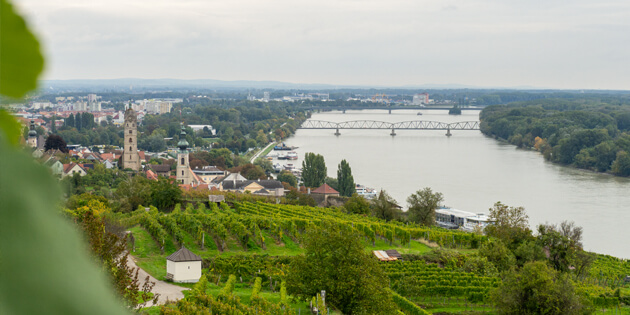
It is a view of the little town and castle of Dürnstein, which sit in a bend of the Danube river some 8 km upstream of the city of Krems. The town lies a little above the waterline, the castle sits atop the dry, rocky hill which rises behind the town. This photo, taken from the other side of the river, shows both the town and the castle very clearly.
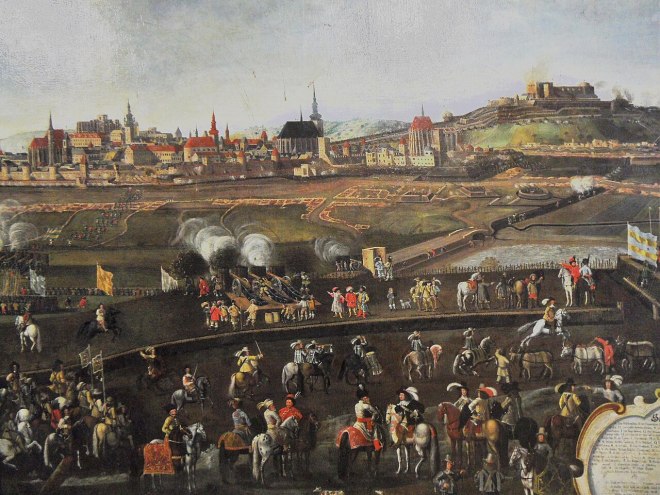
But as the modern photo shows, it is a ruin now. Its downward spiral started in the final years of the Thirty Years’ War, when Swedish troops had captured the castle on their way to trying to take Vienna. That attempt failed and they moved on to Brno, now the capital of Slovakia. The Swedes laid siege to the city.
But that failed, too, and the Swedes retreated back into Bohemia. As they left Dürnstein castle, they partially blew it up to render it unusable. Later owners didn’t bother to patch it up and live there anymore, so it slowly fell to pieces.
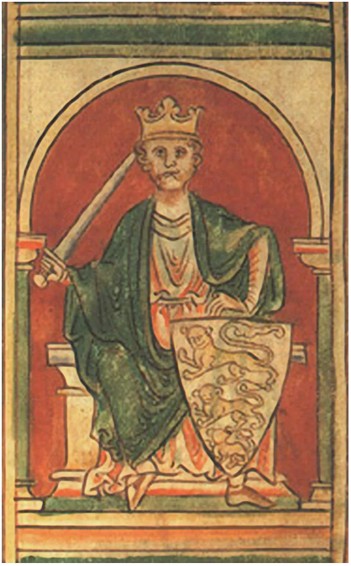
In its early days, though, back in 1192-93, Dürnstein castle became famous throughout Europe as the place where Richard the Lionheart, King of England, was imprisoned.
Source
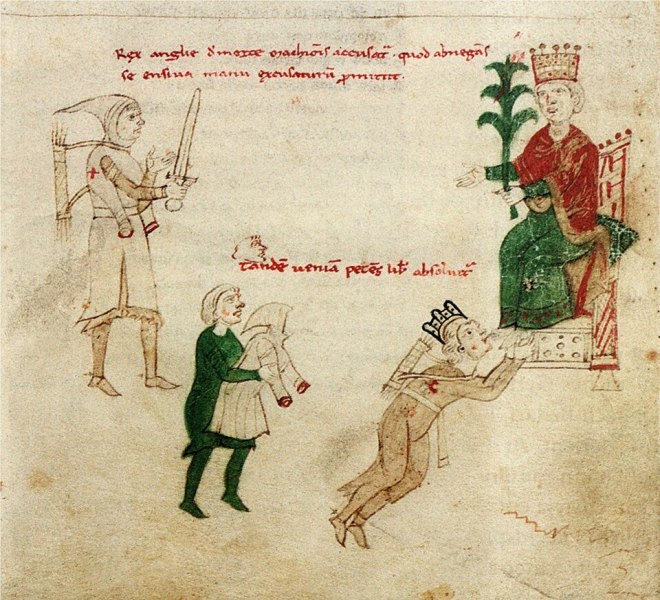
Richard was trying to get back to England from the Crusades. He had made a lot of enemies over the years, who were all intent on capturing him as he crossed their lands to get home. He chose to take a circuitous route, which saw him land on the northern shores of the Adriatic Sea, and then pass through the lands of the count of Gorizia, the Duke of Carinthia, and Leopold V, Duke of Austria – all enemies of his – before making it into Bohemia, whose king was an ally. From there, he planned to go on into Saxony, whose Duke was his brother-in-law, and take a ship over to England. By late December 1192, he had got as far as a village on the outskirts of Vienna, where he decided to hole up to rest for a few days. Unfortunately for him, Duke Leopold’s men got wind of his presence and he was duly arrested. Leopold held him for a few months in Dürnstein castle before passing him on to Henry VI, Holy Roman Emperor, who also had a few axes to grind with Richard. Henry imprisoned him in another castle and demanded a huge ransom for his release. By imposing a ferocious set of taxes on one and all, England’s regents, aided by Richard’s mother, Eleanor of Aquitaine, managed to raise the ransom, and he was duly released. We have here a photo of one of the illustrations in the “Book in honour of the Augustus”, a propaganda piece for Henry VI, showing Richard humbly kissing Henry’s feet.
I’m sure Richard loudly denied that any such humiliating submission had taken place – although he did have himself re-crowned when he got back to England, to wipe away the shame of imprisonment and to counteract any whispers there might have been that his being imprisoned meant he was no longer king.
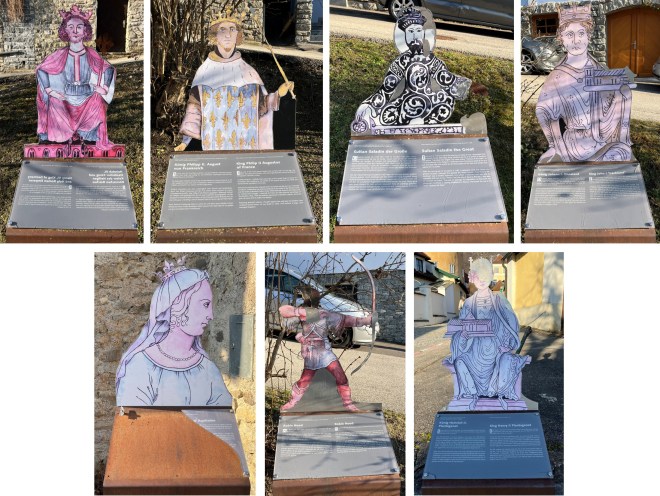
The good citizens of Dürnstein have milked this story for all it’s worth, littering the town with interpretive markers giving information on the main actors in the drama as well as a few more.
My photos
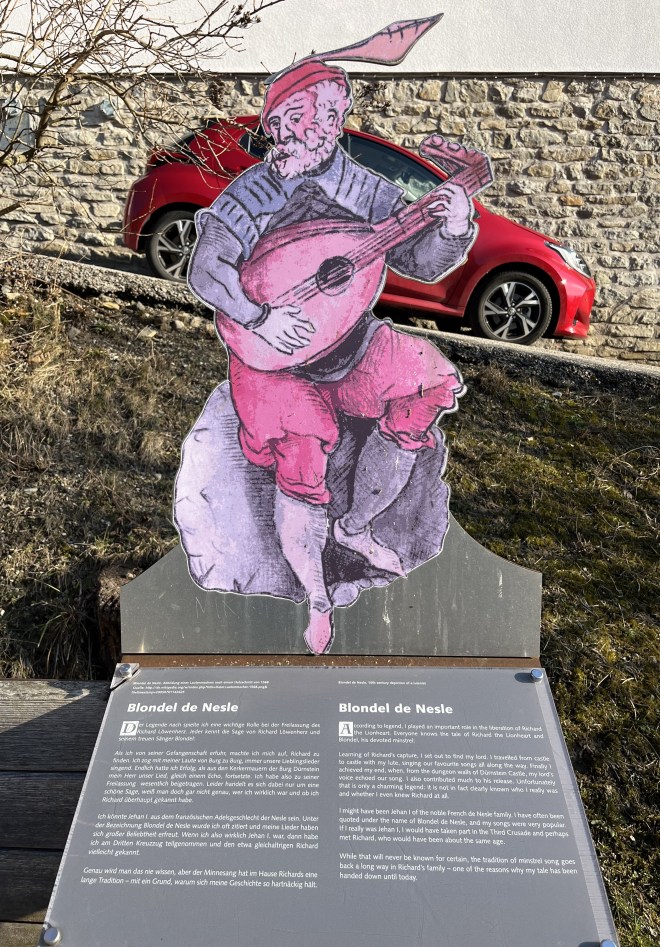
To spice up the tourist experience, they give space to legends as well as to facts. In particular, they have a marker reporting on the minstrel Blondel de Nesle.
My photo
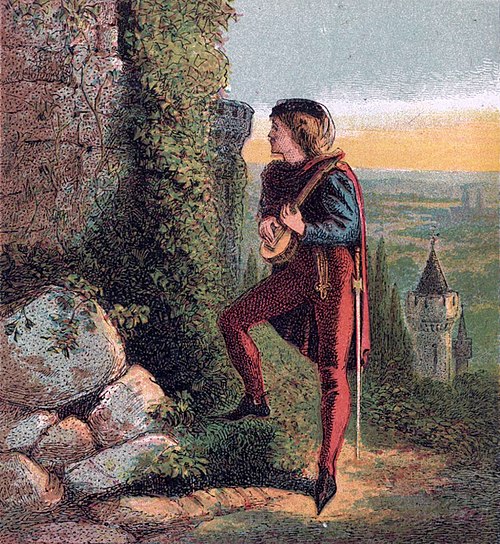
A story was invented in the 18th Century, which went like this: no-one knew in which castle Richard was being kept prisoner, so Blondel, who knew Richard, went from castle to castle singing a song only he and Richard knew. Finally, at Dürnstein Richard sang along with him. At last, Richard had been found! Here’s a coloured lithograph by a certain Joseph Martin Kronheim from the mid-1850s, which has Blondel singing at the foot of the castle’s walls.
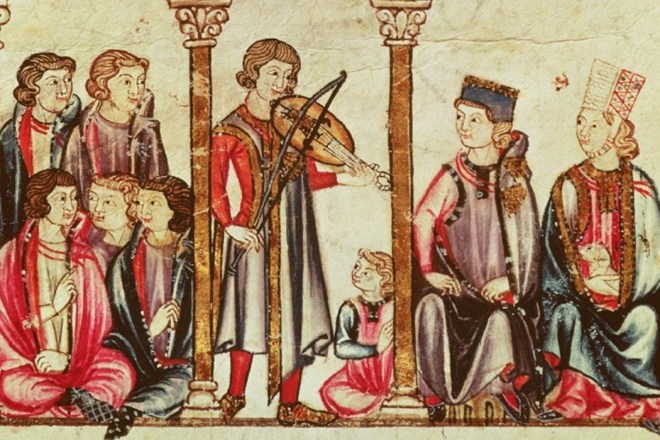
As I say, all invented. But, like all good legends, the story contains a kernel of truth. Richard was brought up in Aquitaine, the beating heart of troubadour culture.
As Duke of Aquitaine, he encouraged and supported the troubadours. He also wrote and sang his own songs, one of which – composed during his imprisonment in Dürnstein – has come down to us. He wrote it in Langue d’Oc, the old language of the south of France. I cite here the first two verses (it’s a bit too long to quote in full).
Ja nuls hom pres non dira sa razon
Adrechament, si com hom dolens non;
Mas per conort deu hom faire canson.
Pro n’ay d’amis, mas paure son li don;
Ancta lur es si, per ma rezenson,
Soi sai dos ivers pres.
Or sapchon ben miei hom e miei baron,
Angles, norman, peitavin e gascon,
Qu’ieu non ay ja si paure companhon
Qu’ieu laissasse, per aver, en preison.
Non ho dic mia per nulla retraison,
Mas anquar soi ieu pres.
Since I presume that, like me, most if not all of my readers do not speak Langue d’Oc, I give here a translation in English of these two verses.
No prisoner can tell his honest thought
Unless he speaks as one who suffers wrong;
But for his comfort as he may make a song.
My friends are many, but their gifts are naught.
Shame will be theirs, if, for my ransom, here
— I lie another year.
They know this well, my barons and my men,
Normandy, England, Gascony, Poitou,
That I had never follower so low
Whom I would leave in prison to my gain.
I say it not for a reproach to them,
— But prisoner I am!
He was clearly trying to guilt trip his vassals into paying the ransom. If any of my readers want to hear the song they can do no worse than go to this link.
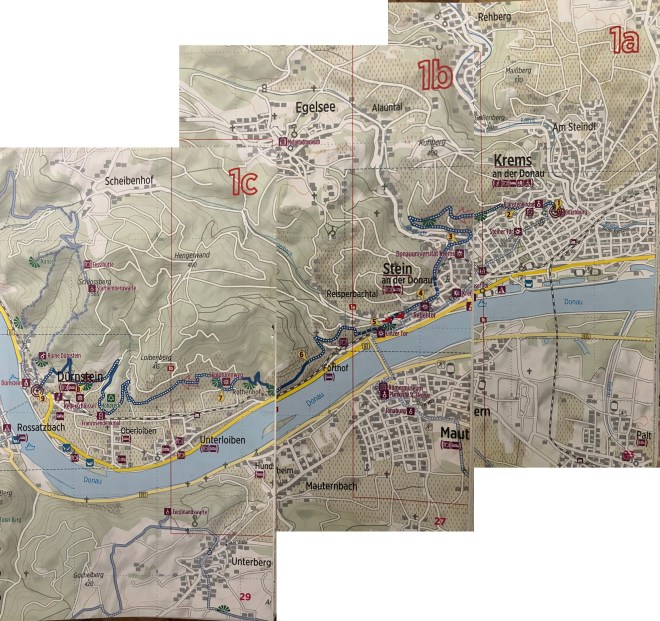
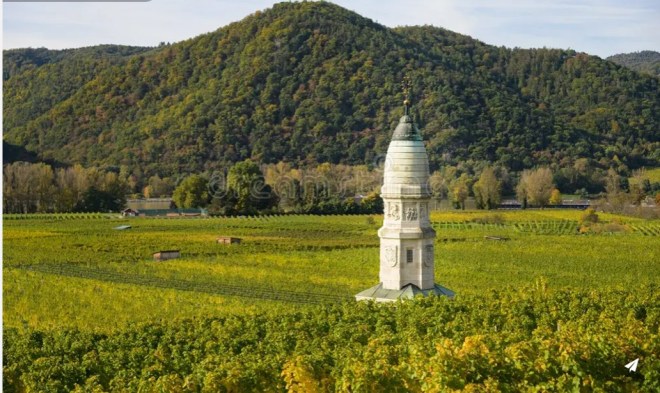
My wife and I pass through Dürnstein at least once a year. There is a hike that goes all the way up the left side of Wachau river valley from Krems to Melk and then back down the other side of the river to Krems. The first stage runs from Krems to Dürnstein. The path hugs the hills between the two places.
My photos
As you amble along, you get beautiful views onto the Danube River flowing below.
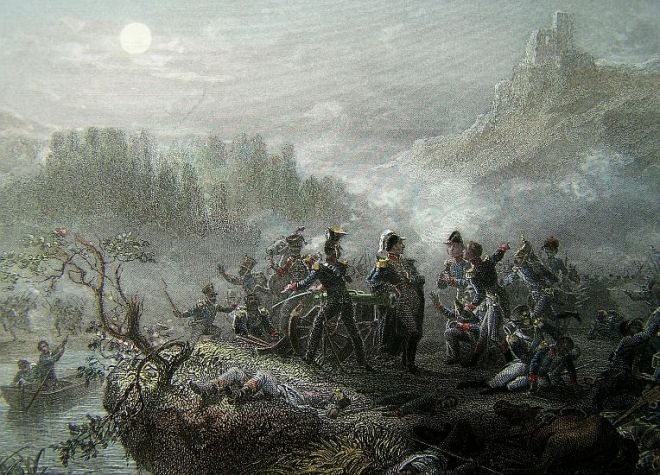
It was built in 1905, to commemorate the 100th anniversary of the battle of Dürnstein-Loiben, one of the many battles of the Napoleonic wars. The fighting took place where those vines now peacefully grow their grapes. It pitched about 7,000 French troops against some 11,000 Russian and Austrian troops. Fighting went on well into the night before it ground to a halt with no obvious winner, although both sides claimed victory. The losses were heavy: about 3,000 men on both sides. This is the only illustration I can find of the battle. I suppose that is meant to be Dürnstein castle in the background.
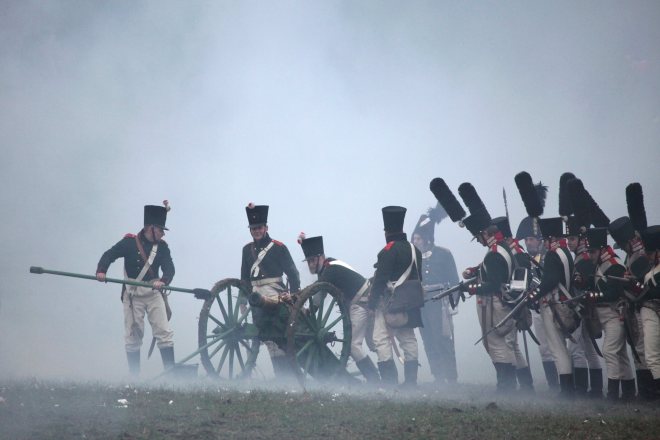
The battle was completely overshadowed by Napoleon’s brilliant victory in the battle at Austerlitz three weeks later. Years ago, a friend of ours took my wife and me to one the annual reenactments of that battle, the one and only time we’ve ever been to a battle reenactment.
But no-one reenacts the battle of Dürnstein-Loiben. It resolved nothing and no-one remembers it anymore. The 6,000 soldiers who lost their lives did so for no good reason.
Ah, this land, steeped in history – and drenched in blood.
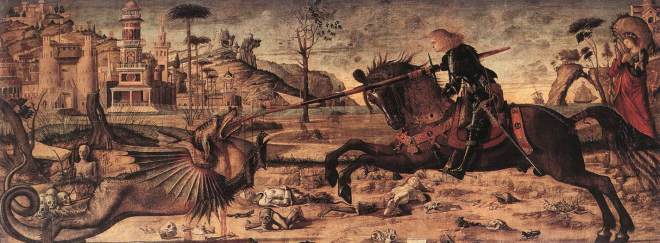
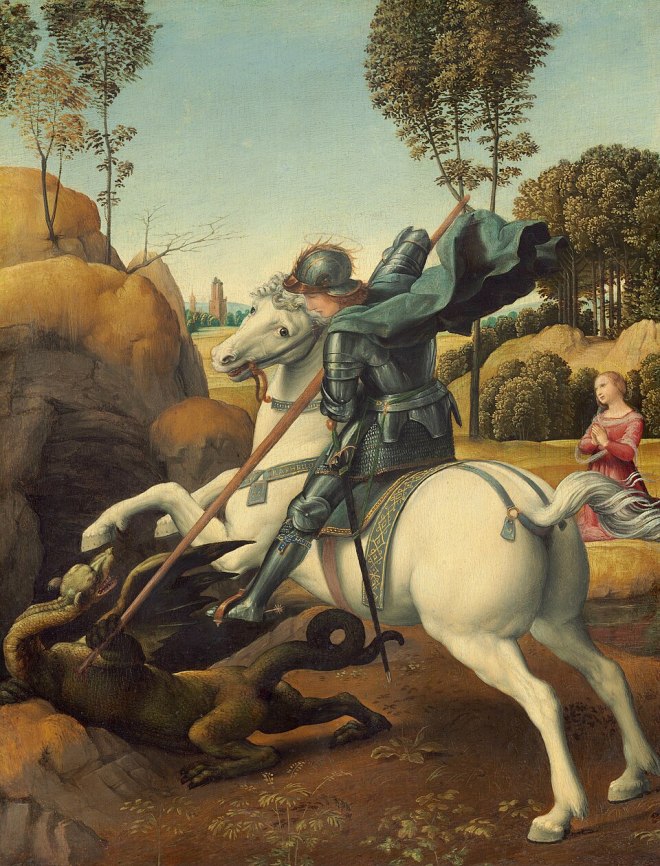
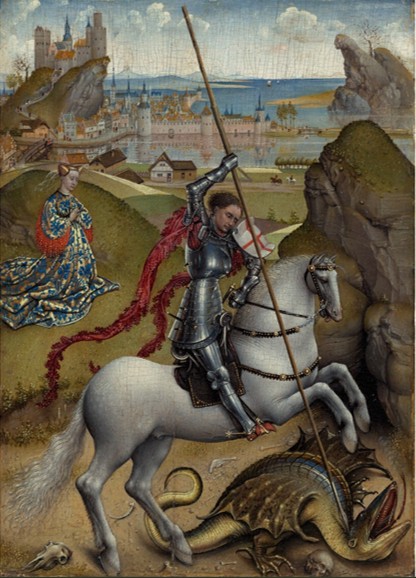
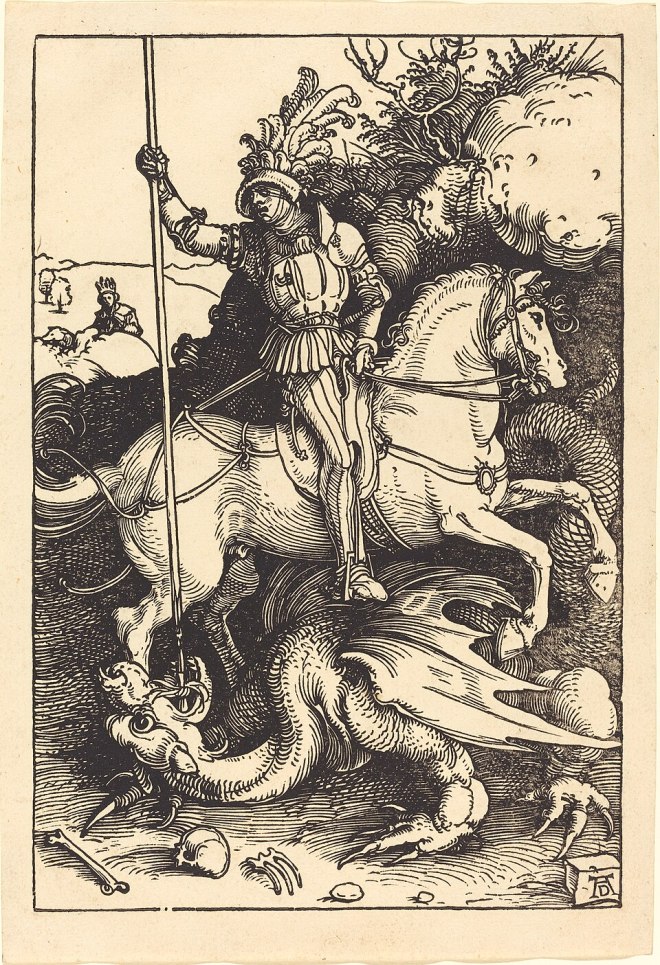
A few weeks ago, when we were down at the seaside, my wife and I went to the Palazzo Reale in Genova to see an exhibition on St. George. The excuse for the exhibition was that he is one of the patron saints of Genova (as he is of England and many other cities, regions, and countries). I’m sure many of my readers are familiar with the most famous story about St. George, his killing of a dragon to save a young woman. But just in case, I cite here the story as told in the Legenda Aurea, a compendium of hagiographies of saints and martyrs, written by one Jacobus de Voragine (who, it so happens, was a bishop of Genova). The original was written in Latin, so I give the 1483 English translation by William Caxton (I’ve cut it a little to focus on the essentials):
By [the city of Silene, in the province of Libya] was a pond like a lake, wherein was a dragon which poisoned all the country. … And when it came nigh the city it poisoned the people with its breath, and therefore the people of the city gave to it every day two sheep for to feed it, because it should do no harm to the people. And when the sheep failed … then was an ordinance made in the town that there should be taken the children and young people of them of the town by lot, and every each one as it fell, were he gentle or poor, should be delivered when the lot fell on him or her.
So it happed that [after] many of them of the town were delivered, … the lot fell upon the king’s daughter, whereof the king … began to weep, and said to his daughter: “Now shall I never see thine espousals.” … Then did the king array his daughter like as she should be wedded, and embraced her, kissed her and gave her his benediction, and after led her to the place where the dragon was.
When she was there St. George passed by, and when he saw the lady he asked her what she made there and … she said to him how she was delivered to the dragon. … Thus as they spake together the dragon appeared and came running to them, and St. George was upon his horse, and drew out his sword and garnished himself with the sign of the cross, and rode hardily against the dragon which came towards him, and smote it with his spear and hurt it sore and threw it to the ground.
And after he said to the maid “Deliver to me your girdle, and bind it about the neck of the dragon and be not afeard.” When she had done so the dragon followed her as it had been a meek beast and debonair. Then she led it into the city, and the people fled by mountains and valleys, and said: “Alas! alas! we shall be all dead.” Then St. George said to them: “Doubt ye no thing, without more, believe ye in God, Jesu Christ, and do ye to be baptized and I shall slay the dragon.”
Then the king was baptized and all his people, and St. George slew the dragon and smote off its head, and commanded that it should be thrown in the fields, and they took four carts with oxen that drew it out of the city.
The story gave great opportunities to numerous painters to strut their stuff. Here is a selection of paintings.
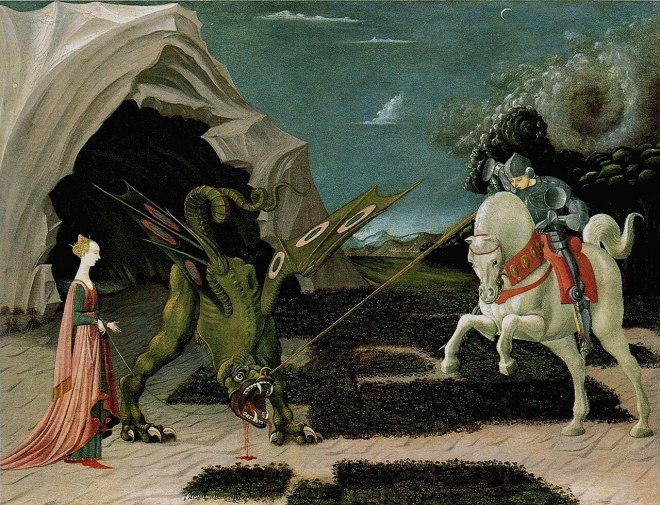
This is probably one of the more famous paintings of the subject, by Paolo Uccello. It has St. George spearing the dragon, but unlike other paintings of the genre is has also included the scene of the young princess’s girdle being tied around the dragon’s neck.
To show that it wasn’t just Italian artists who painted the subject, here’s one from the other side of the Alps, by the Flemish artist Rogier van der Weyden
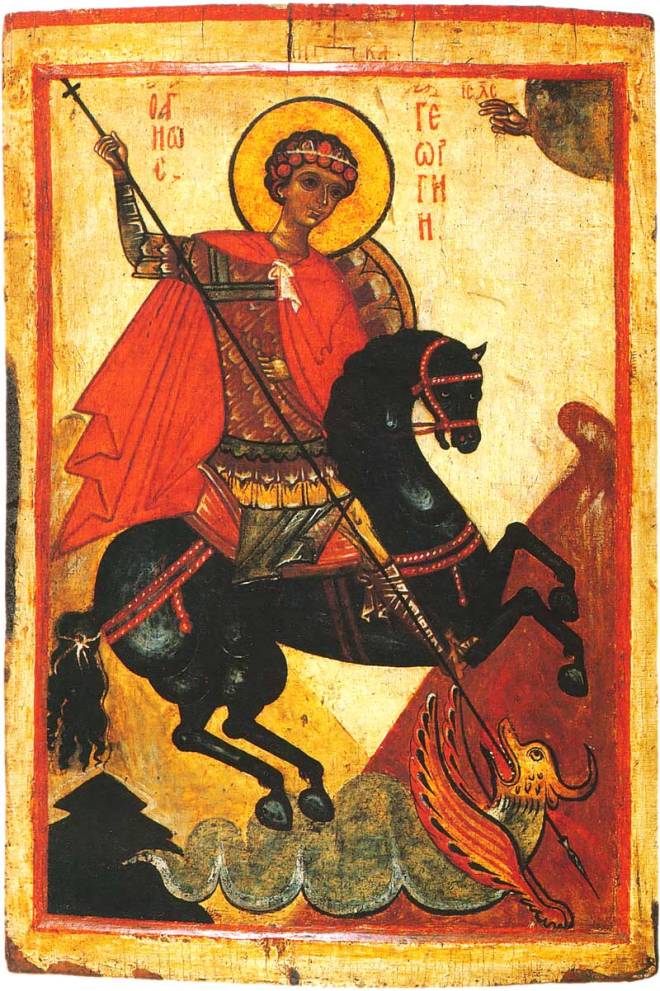
And just to show that St. George was equally popular in Orthodox Christianity, here is a Russian icon of St. George killing the dragon. Here, the damsel in distress has been eliminated; instead, we have the hand of God blessing St. George.
Quite honestly, the dragon is the most interesting part of the story; St. George and the princess are very virtuous and therefore boring. So let’s focus on the dragon. It’s quite obvious from the story that the inhabitants of Medieval Europe considered dragons to be Bad Creatures. And this particular dragon is especially bad. I was much struck by the detail that its breath was so poisonous that it killed people. It strongly reminded me of a boss I once had who had dreadful halitosis; it was dangerous to get too close. He was also quite reptilian in many other ways; I was very relieved when I got another job and left.
This typing by Europeans of dragons as bad has remained unchanged up to the present. The one big addition to their badness is that the pestilential breath became a fiery breath. In that iconic set of books about Harry Potter, for instance, dragons appear several times, and of course they are dangerous, fire-breathing creatures. Dragons grace the cover of at least one of the books.
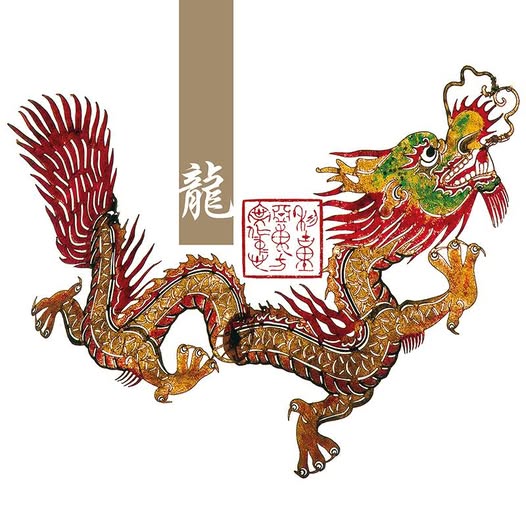
By one of those acts of serendipity that make the world so interesting, while we were watching St. George skewer his dragon in Genova’s Palazzo Reale, up the hill from there – a mere 15 minutes’ walk away – the Museo delle Culture del Mondo was holding an exhibition on Chinese dragons. Here’s a couple of dragons on show there.
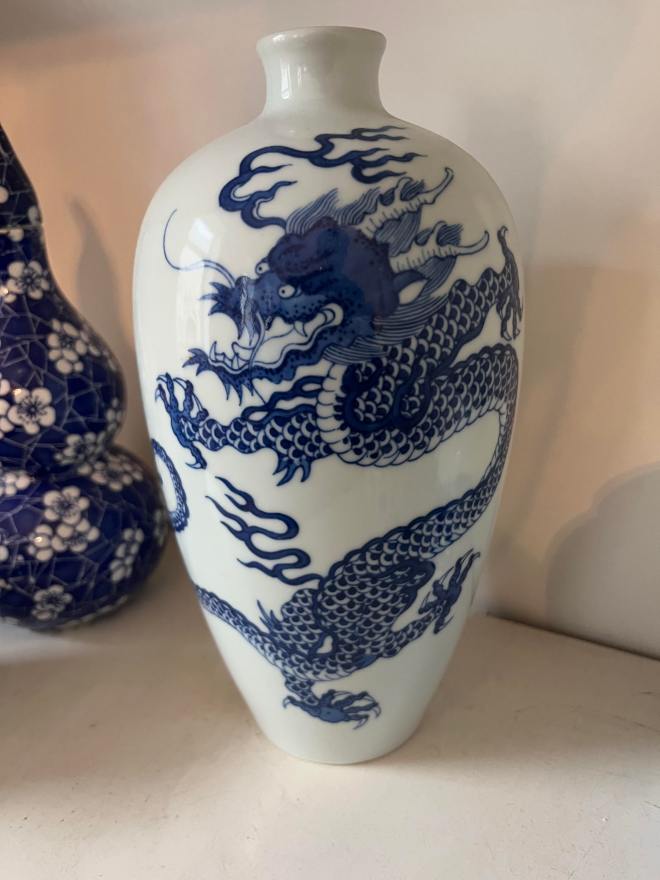
And here are a couple of dragons amongst our possessions.
A vase my wife picked up in Suzhou during our years in China,
My photo
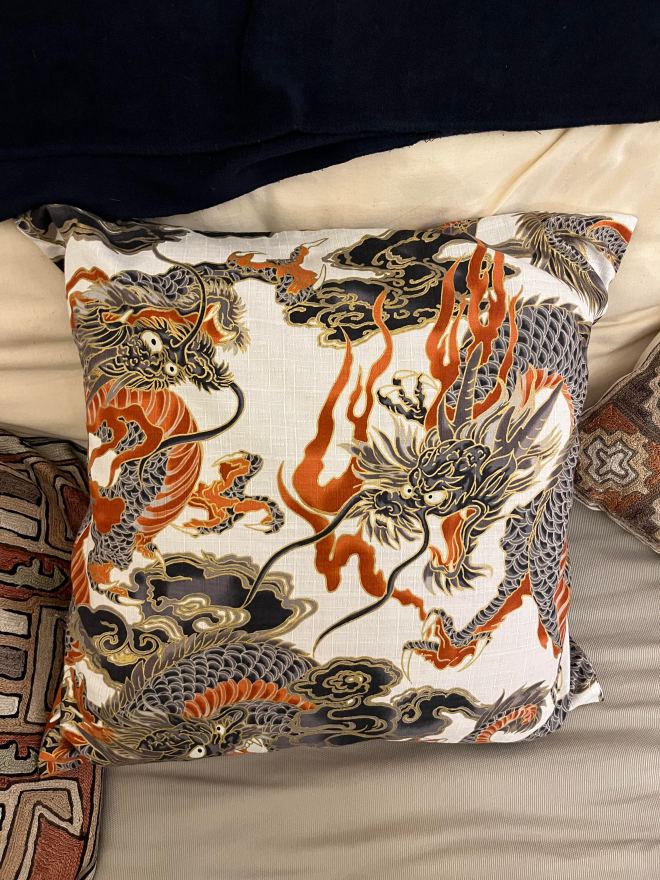
And a cushion cover made with a piece of fabric she picked up on last year’s trip to Kyoto.
My photo
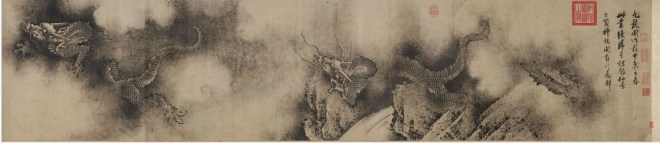
Although Chinese dragons are fearsome-looking, the Chinese consider them to be Nice Creatures. They believe they bring prosperity and good luck. In earlier times, they were also believed to bring rain and were prayed to during droughts. Here are a couple of dragons from a Song dynasty scroll flying through mist and clouds, an early form of cloud seeding as it were.
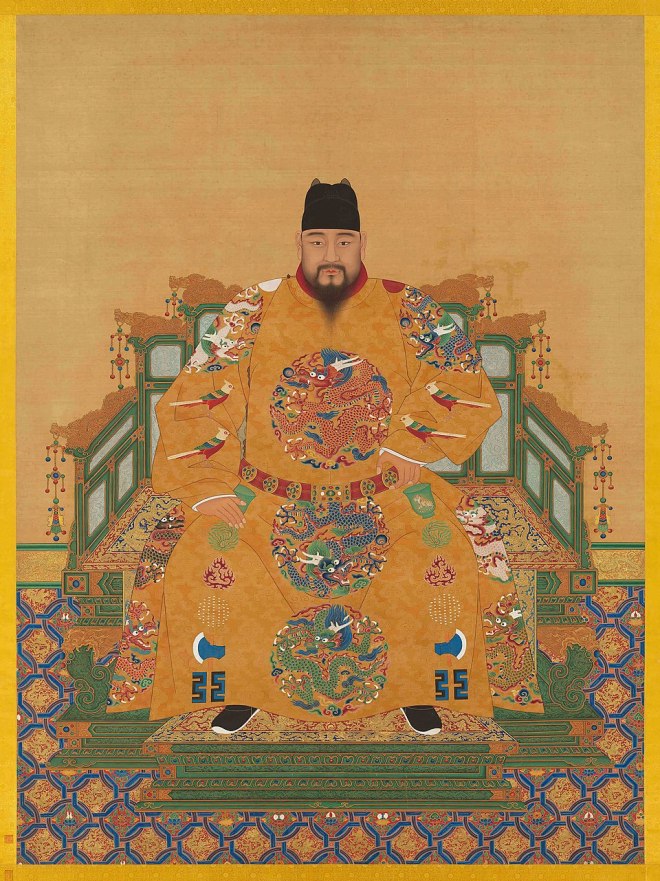
Dragons were considered such Nice Creatures in China that the emperors adopted them as their own. Already 2,000 years ago, during the Han dynasty, the emperors claimed to be sons of dragons. By the time the Ming dynasty rolled around in 1368, the dragon, specifically the five-clawed variety, was strictly reserved for the clothes and accoutrements of the emperor and his family. Anyone who transgressed this rule risked death (along with their whole family). We have here the Emperor Ming Yingzhong wearing his dragon robe.
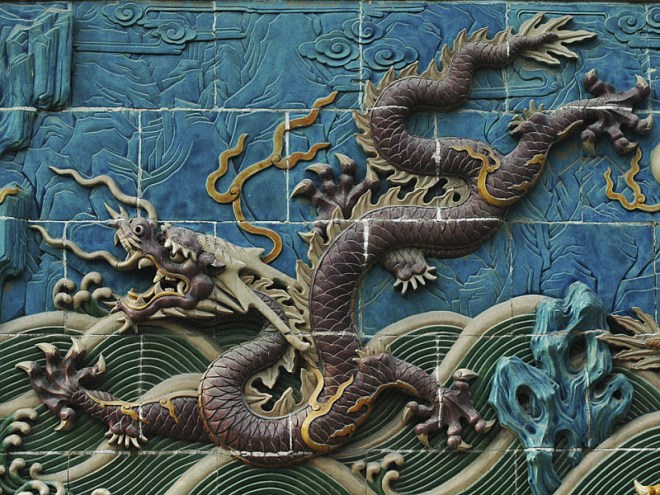
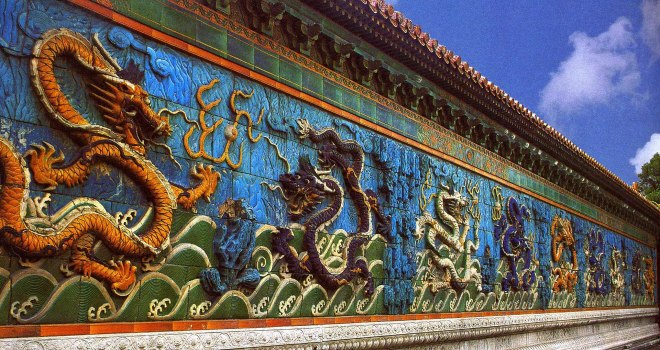
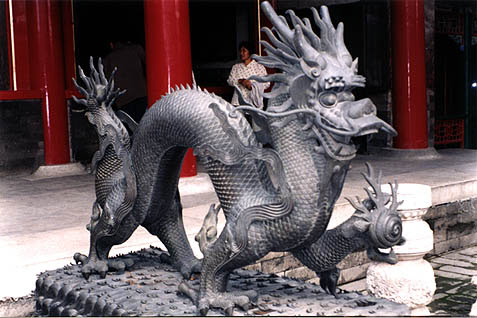
And of course the Forbidden City in Beijing, the centre of later emperors’ power, is littered with dragons. I show here two examples, the first in the Nine Dragon Wall, the second a dragon statue standing guard before one of the temples.
The Emperors graciously allowed their nobles to avail themselves of the lesser four-clawed dragon for their clothes and furnishings, while commoners were allowed to use the vulgar three-clawed dragon (I only notice now that we are guilty of terrible lèse-majesté with our vase, where the dragon in question has five claws, while our cushion cover is within the norm for commoners like us since the dragons have three claws).
So, nice and simpatico, but also very noble, these Chinese dragons.
Well, this is a conundrum! Mad and bad, or nice and noble? Who is right, East or West? Let’s put aside the obvious response, which is that since dragons don’t actually exist the question is irrelevant. That’s just party-pooping. Let’s also ignore the response that it’s all in the wings: European dragons have wings, which makes them bad, while Chinese dragons do not, which make them nice. That’s just silly; wings can’t make such a difference. How about being Solomonic and saying that dragons can actually be both, just like us, depending on which side of the bed they get out of in the morning.
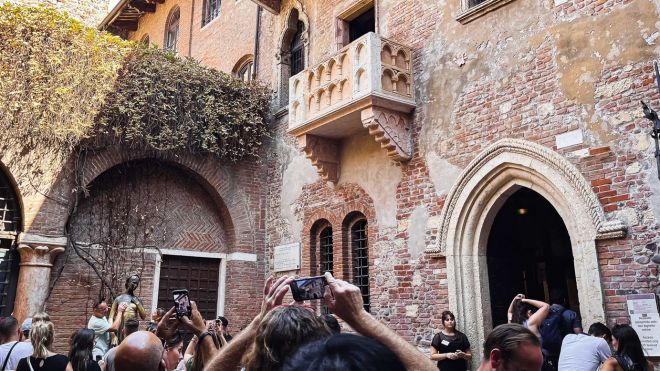
A couple of weeks ago, my wife and I went on a quick three-day trip to Verona. We’d made a lightning visit there a few years ago, when we had a couple of hours to wait at the station for our train connection. I have no memory of that visit other than standing in front of a balcony purported to be the one where Juliet stood while talking to Romeo (“O Romeo, Romeo, wherefore art thou Romeo?” etc.) and wondering what on earth the fuss was about – as far as we could tell, 90% of the tourists flocking to Verona had come to see this.
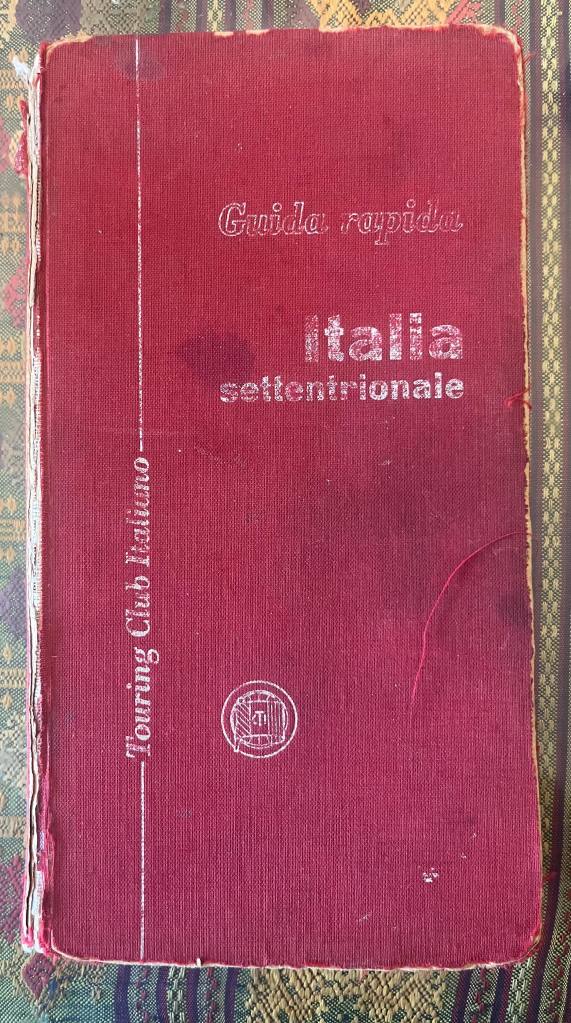
This time, we were determined to keep completely away from anything related to the two “star-cross’d lovers”, and we succeeded admirably. I have to say, we were greatly aided in this by relying on an old and well-thumbed guidebook of the Touring Club Italiano, which my parents-in-law had bought way back when.
my photo
It had been published in 1958, long, long before the current instagram- and TikTok-fuelled hysteria about Romeo and Juliet, and so had not a word to say about them. For the first two days, we faithfully followed the two itineraries suggested in the guide, while we spent the third day visiting a couple of art museums.
So, “let us go and make our visit”, as T.S. Eliot intoned.
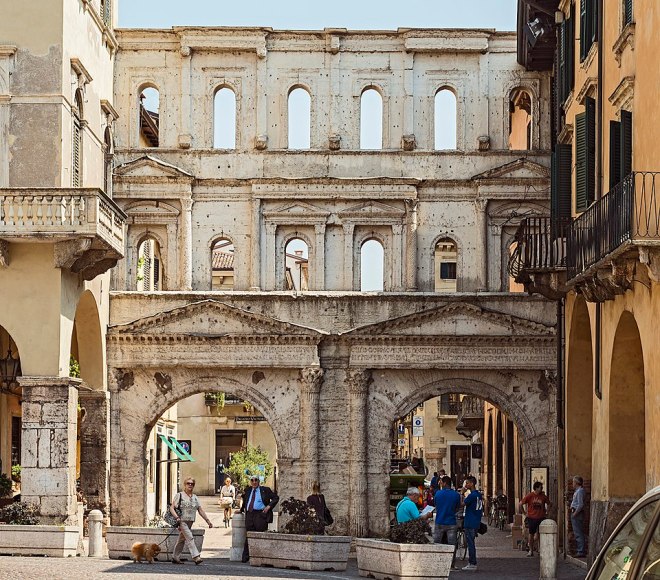
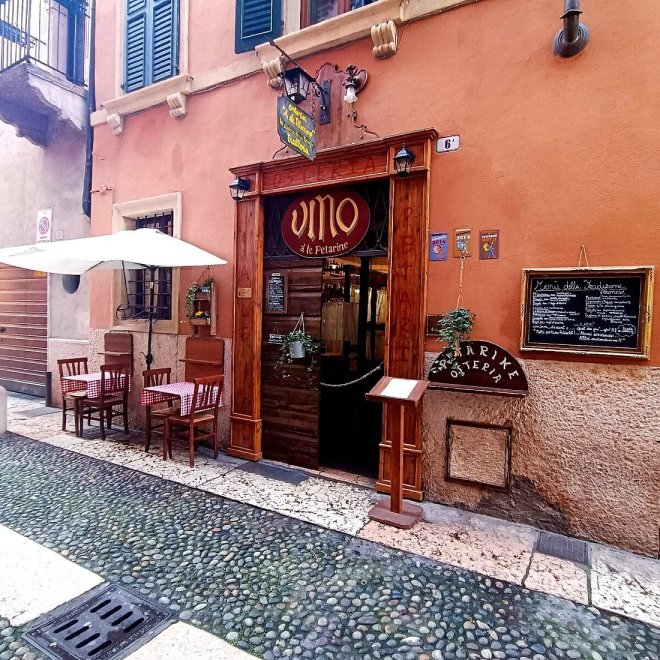
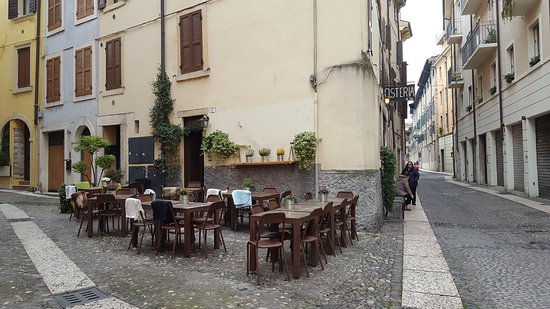
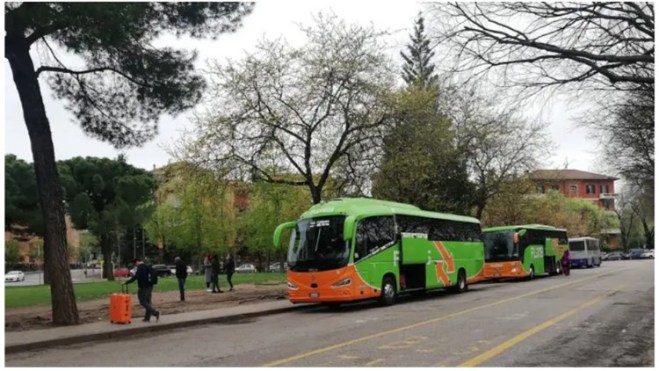
Since our Flixbus from Milan arrived at around lunchtime, we actually started proceedings by going to lunch – always good to start a visit on a full stomach! My wife had identified a trattoria that looked interesting, the Osteria A Le Petarine, at the far end of the old city. To work up an appetite, we walked up there. That took us through Porta Borsari, an ancient city gate that started life as the main gate in the city’s ancient Roman walls.
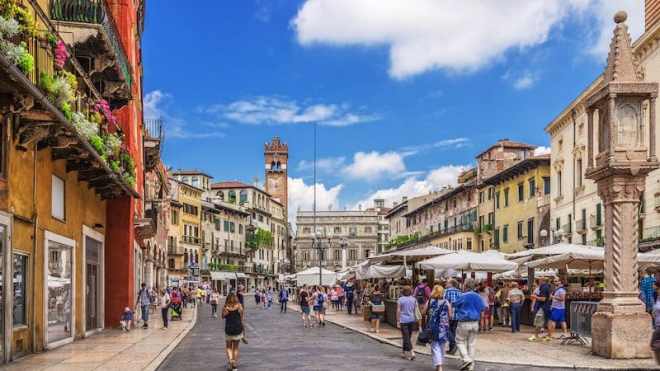
After lunch, we headed over to our hotel, dropped off our bags, and sallied forth on our first itinerary. This took us first to piazza delle Erbe, which has been the centre of Verona’s civic life since Roman times, when this was the forum.
It’s unfortunate that the square has been invaded by stalls selling tourist tat. It’s difficult to get a clear view of the square now.
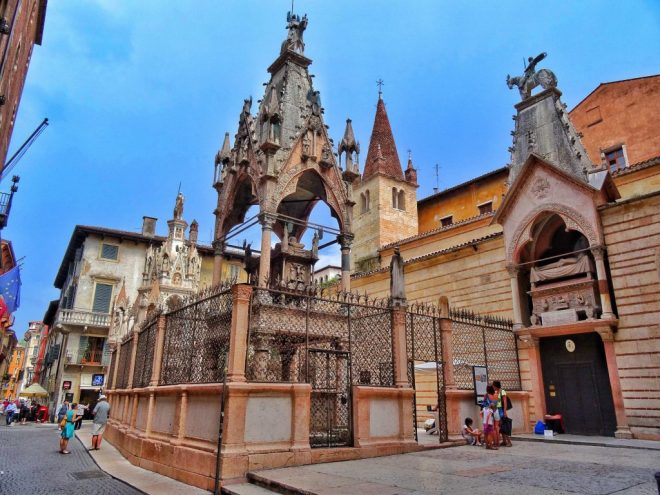
The itinerary instructed us to next take a small street leading off the square, which took us to the Arche Scaligere, the tombs of the Della Scala family, which was Verona’s most famous family, ruling the city in the Middle Ages.
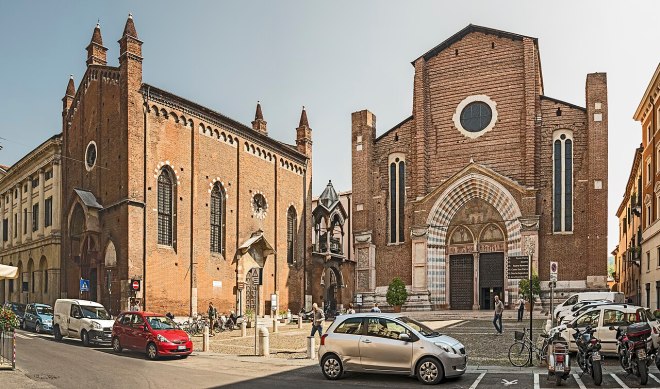
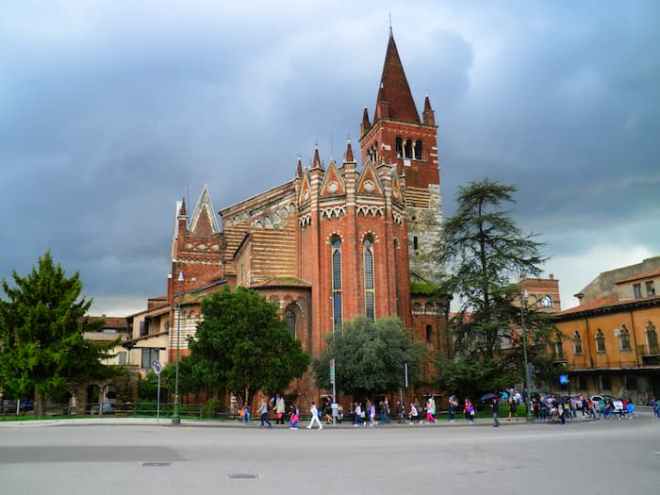
The itinerary then led us to Santa Anastasia, the first of four churches we were to visit. We would have visited a few more churches, but they were closed the day we tried to visit them (I think my wife was quite relieved by that; it is possible to have too much of a good thing).
Santa Anastasia’s facade, the first part of the church we saw, was nothing to write home about, and in fact I later read that it was never completed (a problem in Italy which I’ve complained about in an earlier post).
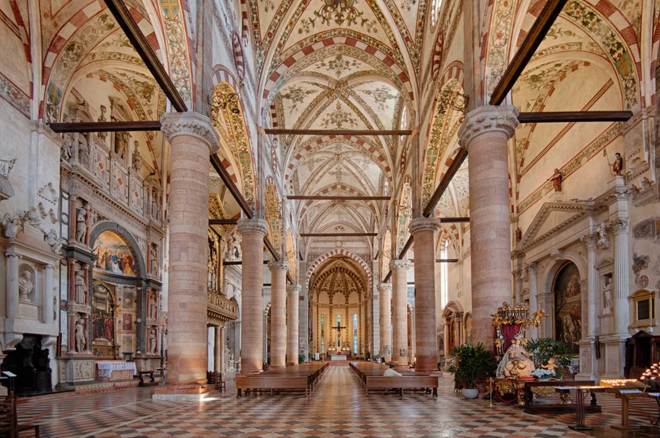
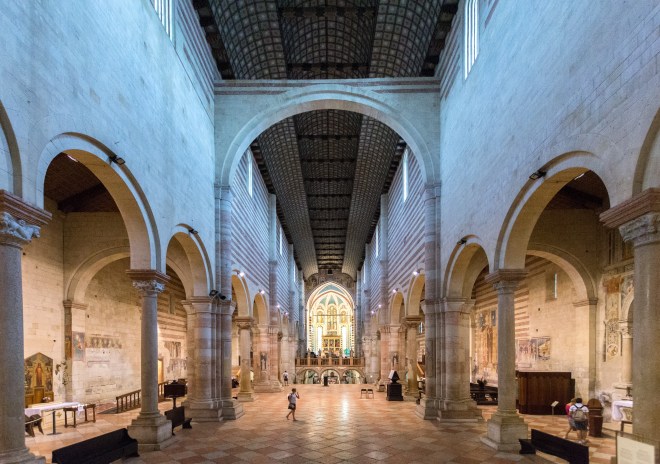
The inside was a different story: tall, airy, and with a ceiling painted with a vegetation motif. It quite put a bounce in my step to see all that exuberance on the ceiling.
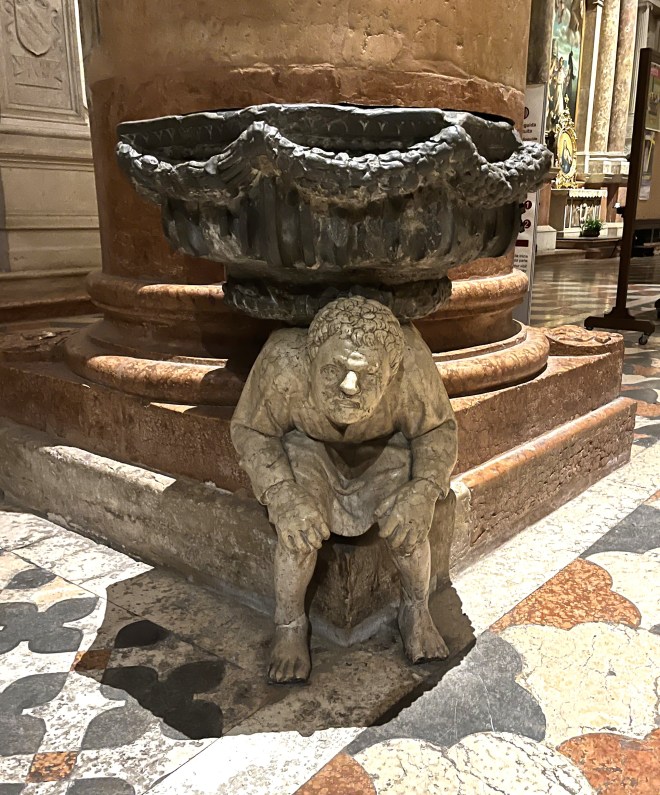
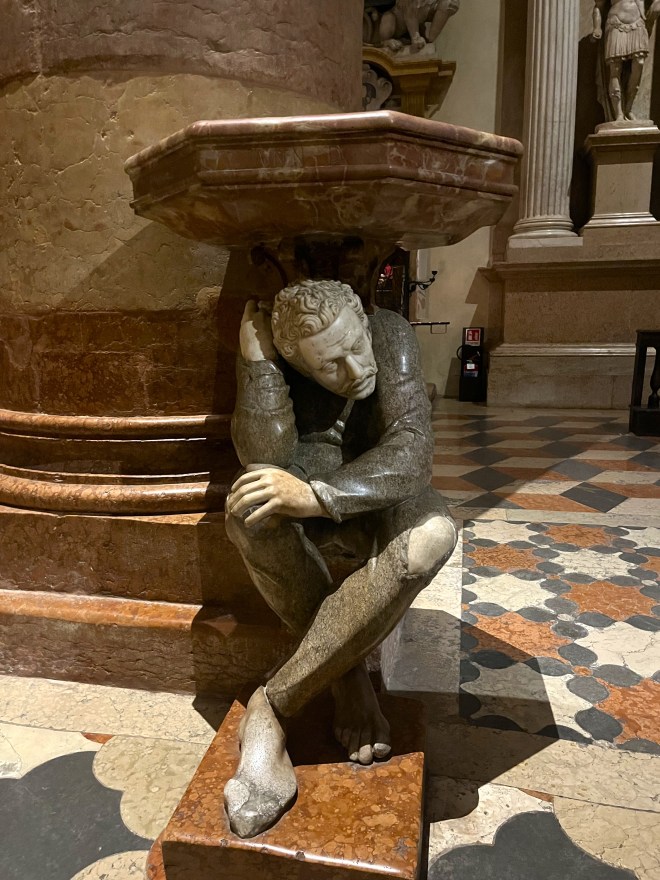
Of the internal details, there were a couple of frescoes and paintings by Worthy Artists, but the one that caught my eye was these two holy water fonts. I’ve never seen any fonts quite like these.
My photoMy photo
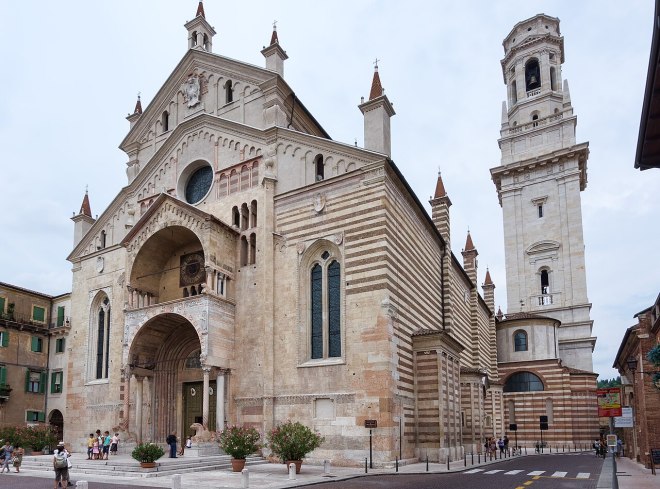
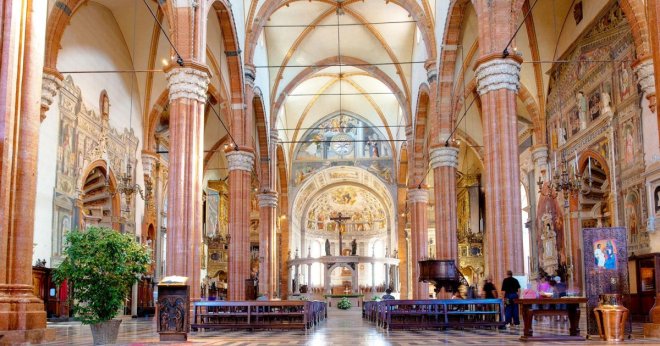
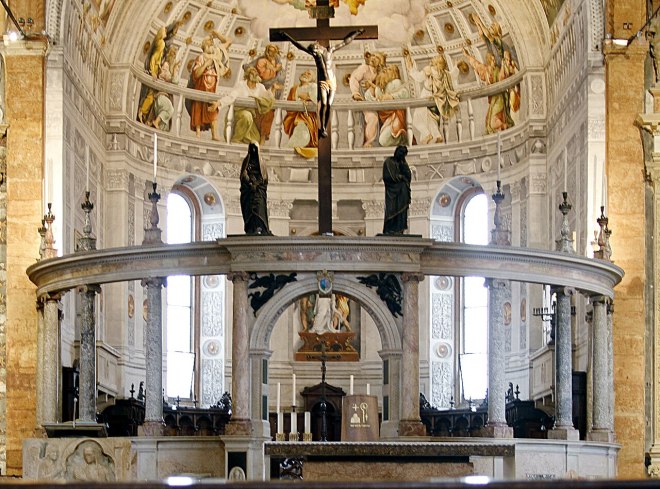
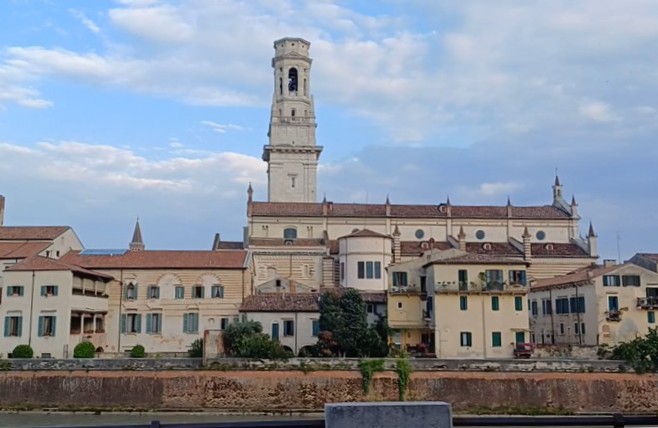
The itinerary next took us to the Duomo. It was early evening by now, so our visit was hampered by a lack of light. Whether it was that or simply that there wasn’t much to see in the Duomo, I have only vague memories of it. Nevertheless, I’ll throw in a few photos from the internet.
The exterior:
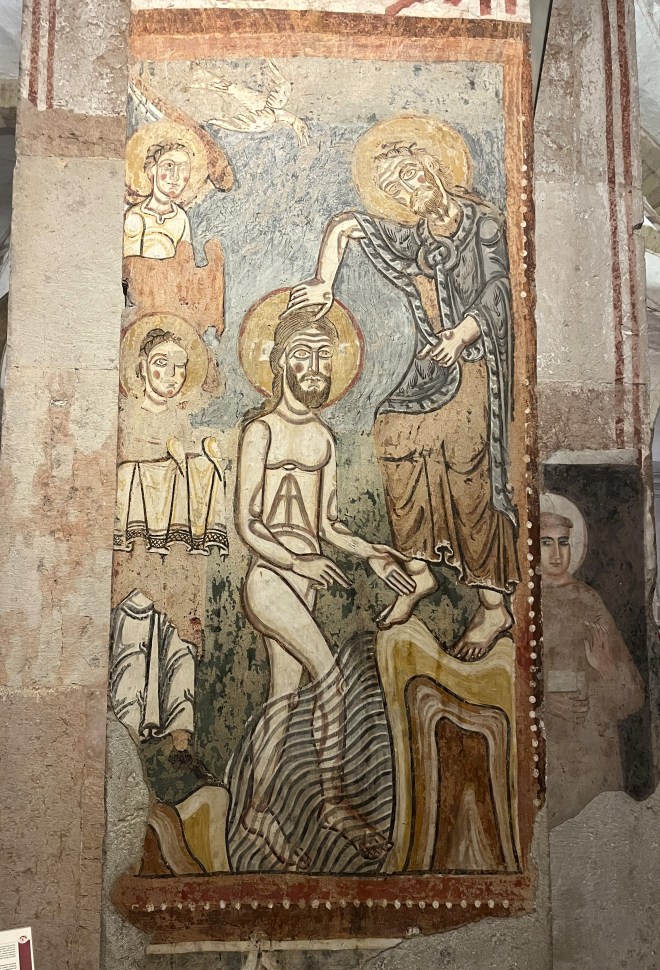
The most interesting detail was the frescoes which decorated many of the pillars. My wife and I agreed that this 11th Century fresco, of the Baptism of Christ, was the most remarkable.
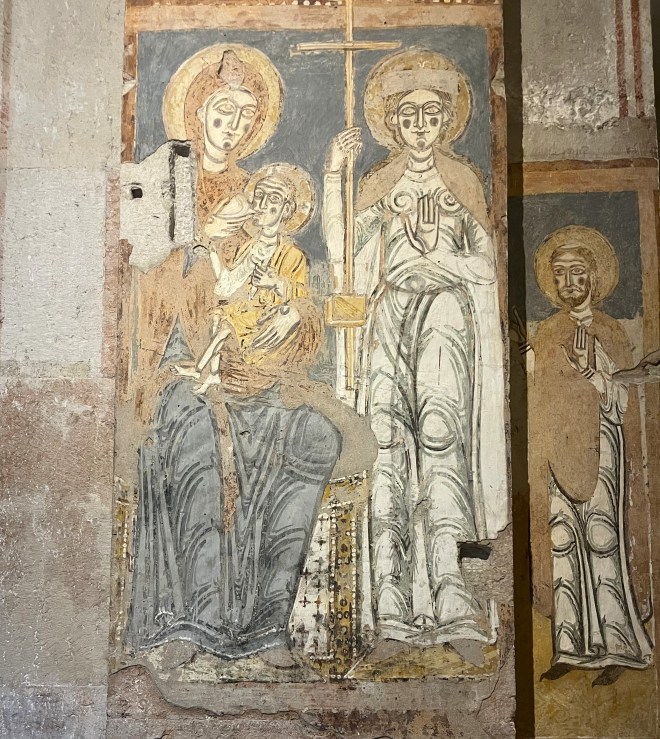
But I also liked this fresco from the same period, of the Virgin Mary breastfeeding the baby Jesus.
My photo
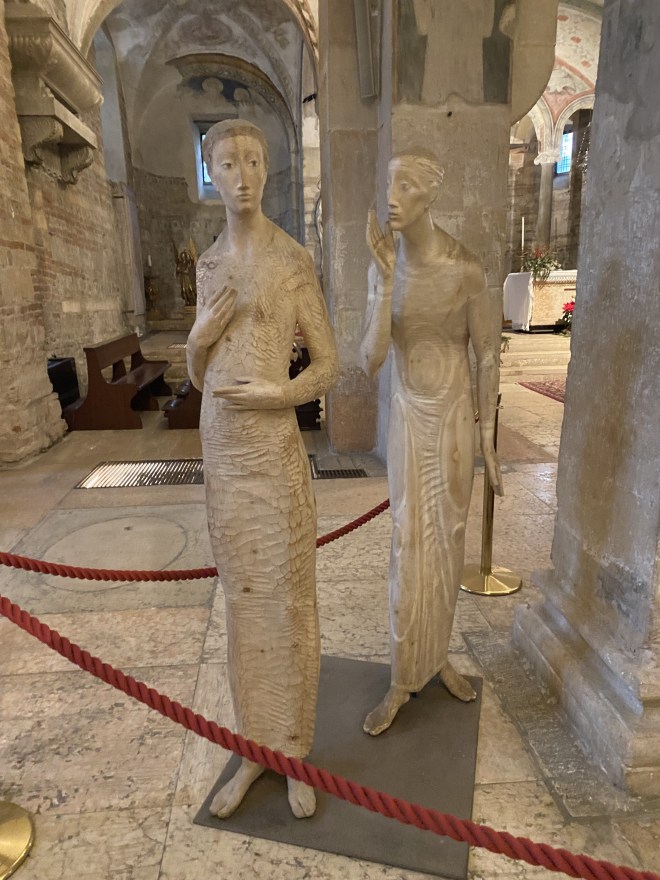
We also agreed that this modern sculpture, of the Annunciation, was wonderful.
My wife’s photo
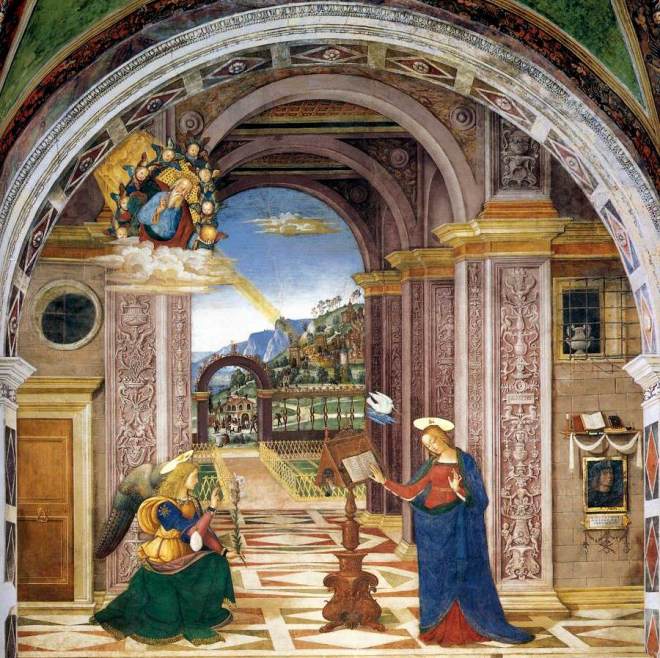
The normal iconography is something along these lines: an angel – obvious because of its wings – on one side, announcing the message, and the Virgin Mary, modestly attired and sitting or standing, reading a book, on the other (I’ve chosen the Annunciation by Pinturicchio as my example).
But here you have what looks like two young women, adolescent girls almost, one, the angel, whispering the message to the other, the Virgin Mary. In case any readers are interested, it is by the South Tyrolian sculptor Hermann Josef Runggaldier.
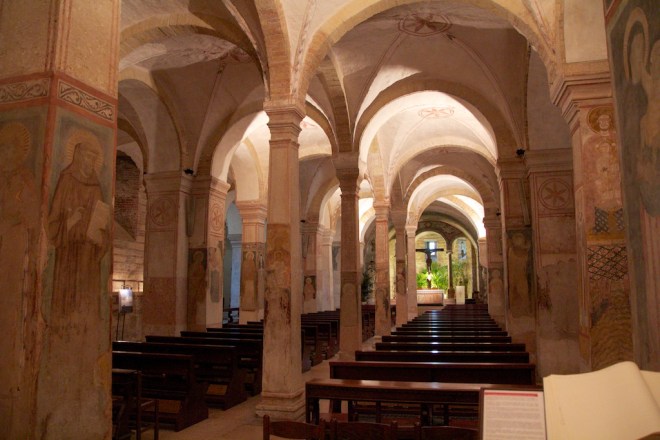
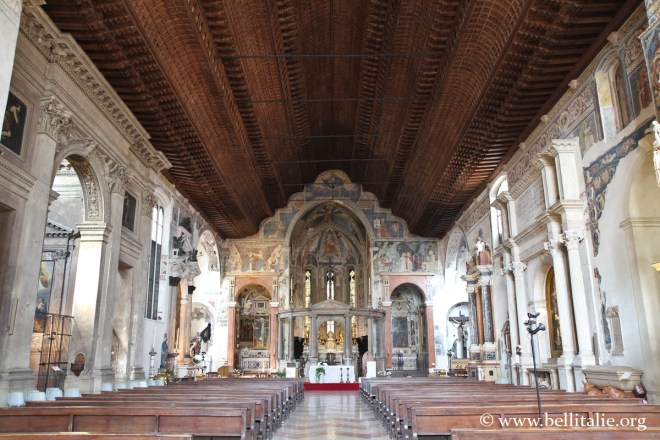
We then climbed the stairs to the upper church. After the intimacy of the lower church, the space felt majestic.
It was built in the first half of the 1300s and by some miracle it has survived until now (I think with melancholy of Notre-Dame Cathedral in Paris, whose centuries-old forest of oak logs in its ceiling caught fire back in 2019 and nearly burned the whole cathedral down).
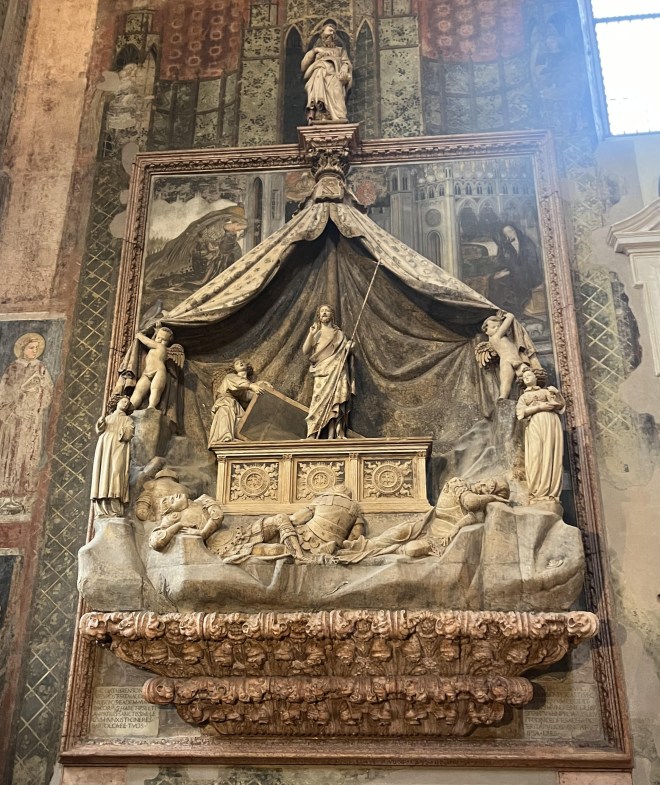
This funerary monument for Niccolò Brenzoni, from the early 1400s, was also arresting.
My photo
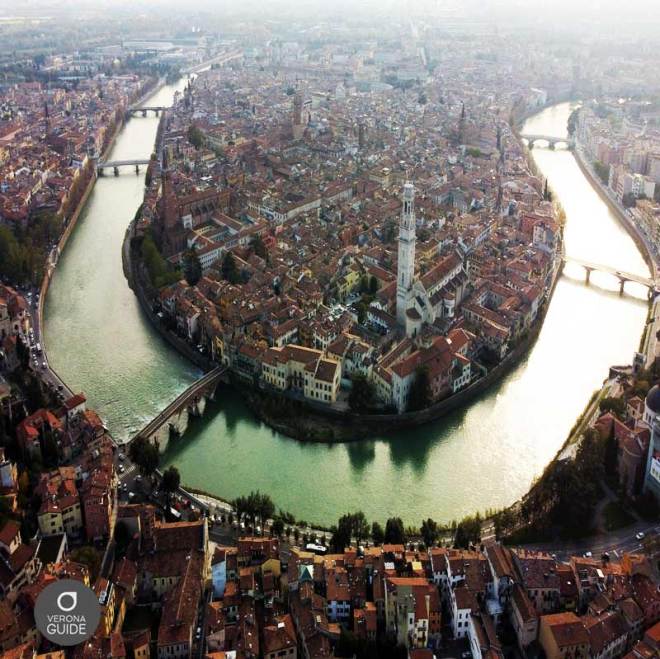
The itinerary now took us to the River Adige, which encloses the old town in a large hairpin bend.
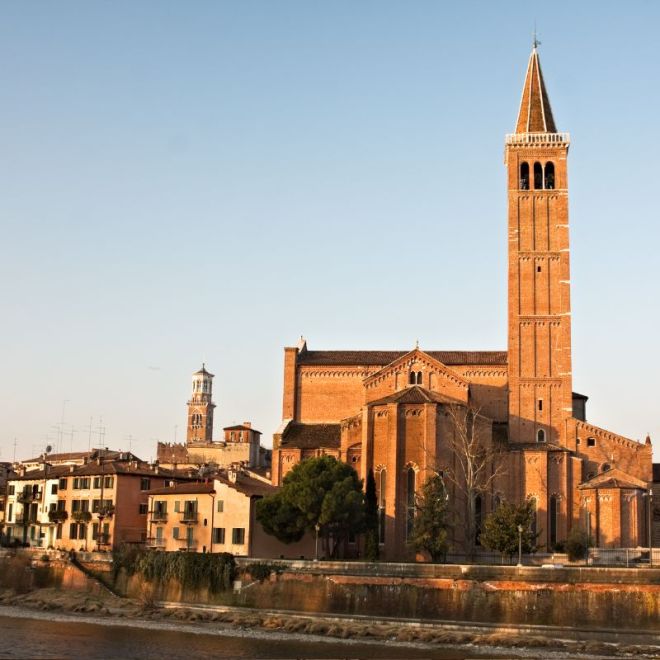
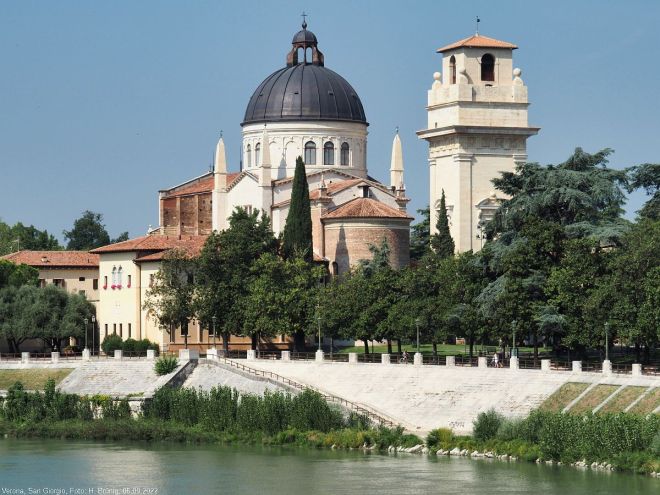
It had us cross the river and walk along its bank. We got to admire the church of Santa Anastasia and its campanile from the back, much nicer than from the front.
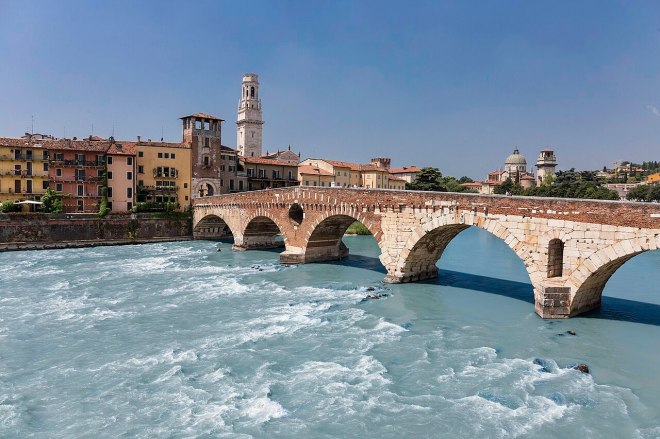
We passed the old Roman bridge, much remodeled over the centuries (and partially destroyed by the Germans, who blew it up when they retreated out of Verona in 1945).
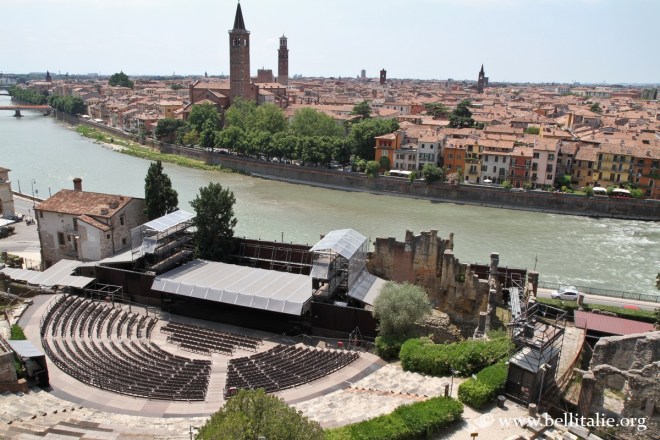
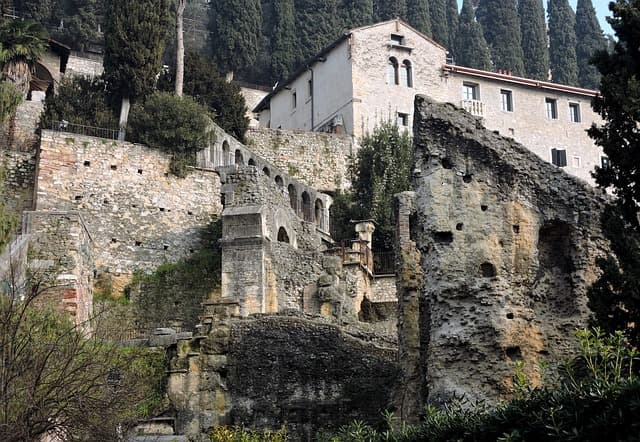
We passed the old Roman theatre which had been carved into the side of the hills running alongside the river. It has been turned into a modern outdoor theater.
And since we were beginning to feel a bit peckish, my wife used this pause to find another trattoria in the vicinity where we could have lunch. She discovered the Osteria A La Carega, located down a small road which we took just after we had recrossed the Adige.
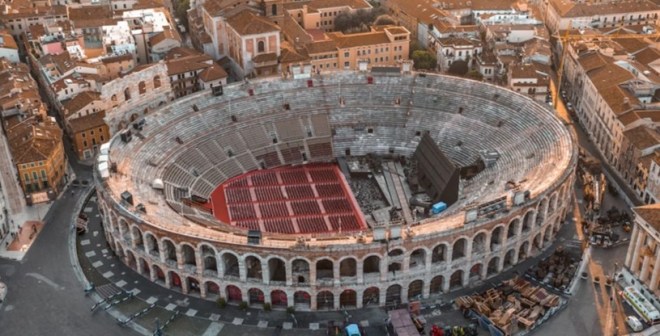
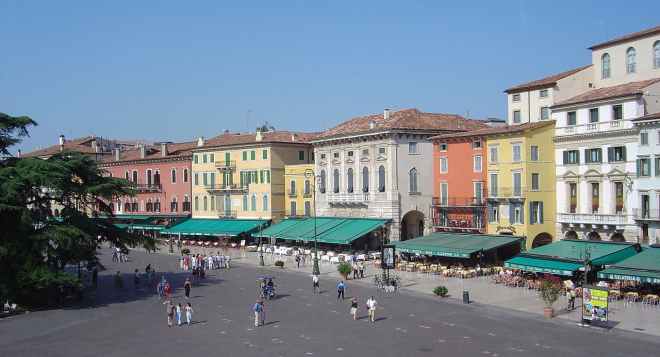
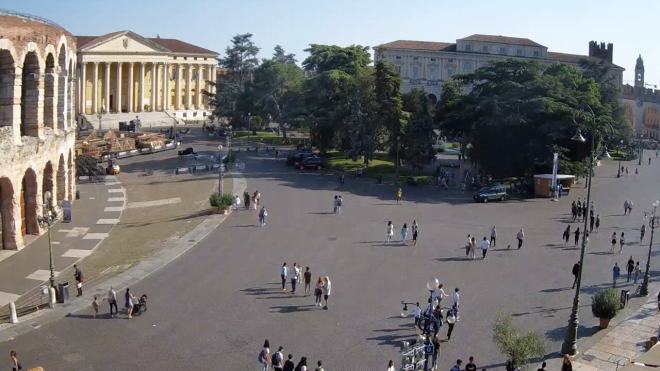
Nourished and refreshed, we picked up the itinerary again. It now took us to piazza Bra, a large square along one side of which stands what is probably Verona’s most well-known monument, the ancient Roman amphitheatre.
We couldn’t actually see much of the amphitheatre since workers were busily getting it ready for the closing ceremony of the Olympic Winter Games. The square itself is very pleasant, with a row of cafes along one side (mostly tourist traps, unfortunately)
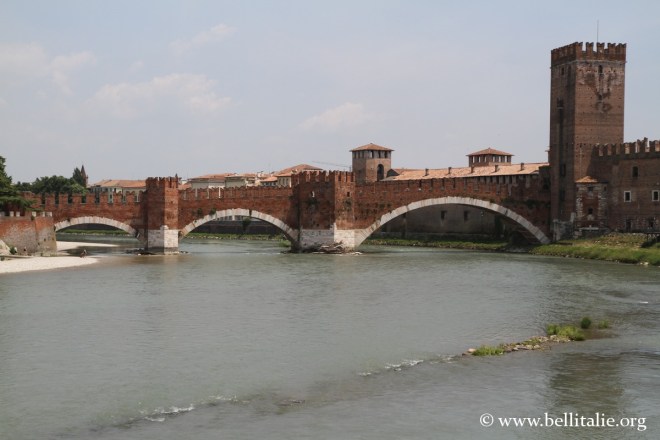
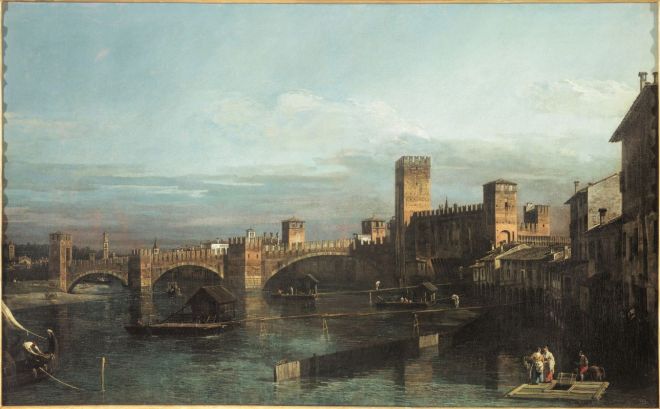
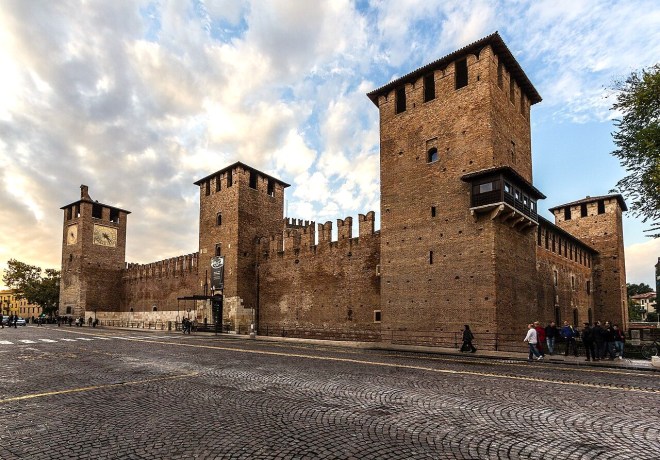
The itinerary now took us back to the river. We skirted the Castelvecchio (we would be visiting its art museum tomorrow) and admired the view of the ponte Scaligero over the River Adige, behind the castle.
Little seems to have changed in the intervening centuries.
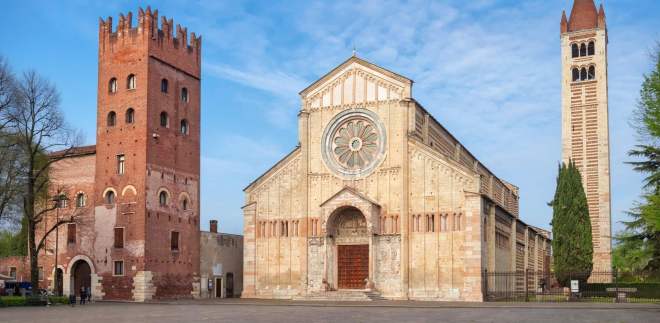
The itinerary drew us along the river and then through a maze of little streets to the church of San Zeno. As we entered into the piazza, this was the view that greeted us.
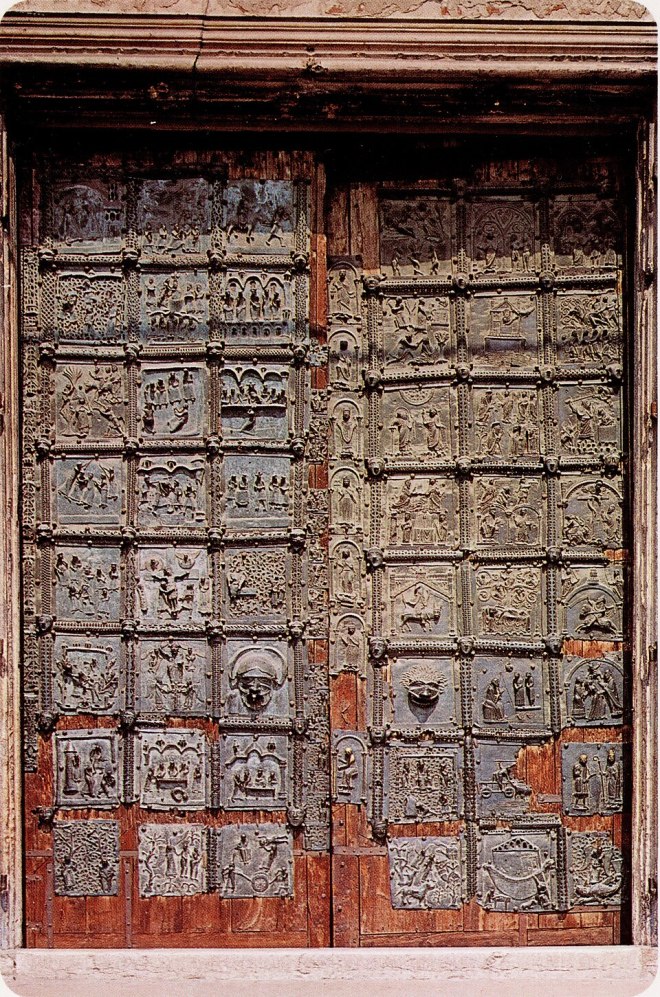
In particular, the main door was fantastic (although you only see it from inside the church). It is made up of 48 bronze tiles, produced in the 11th and 12th Centuries.
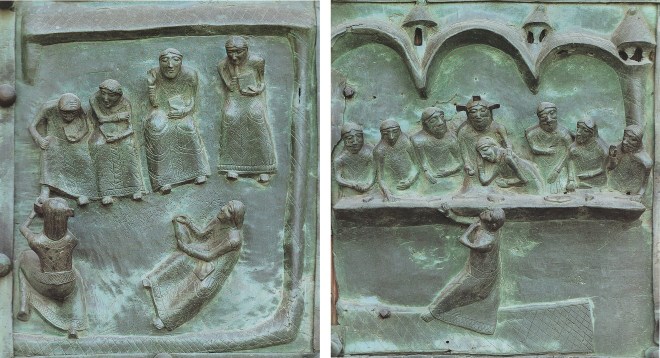
Each tile represents a story about Jesus or, more rarely, Saint Zeno. Here are close-ups of a couple of the tiles, just to whet readers’ appetite. From left to right, they represent the washing of the disciples’ feet by Jesus, and the Last Supper.
It was nice to see this gentle giant again after my sightings of him in one of our hikes in Austria last summer. No doubt he was there to greet pilgrims from Central Europe who had come over the Brenner Pass and walked down the valley of the Adige River, on their way to Rome or Jerusalem.
Our visit to San Zeno brought us to the end of the second itinerary. We celebrated with a nice cup of tea in a bar across from the church, and then slowly made our way back to our hotel.
On our final day in Verona, we visited two museums, both dedicated to Veronese artists. We started with the museum in Castelvecchio, which was once the castle of the Della Vecchia family.
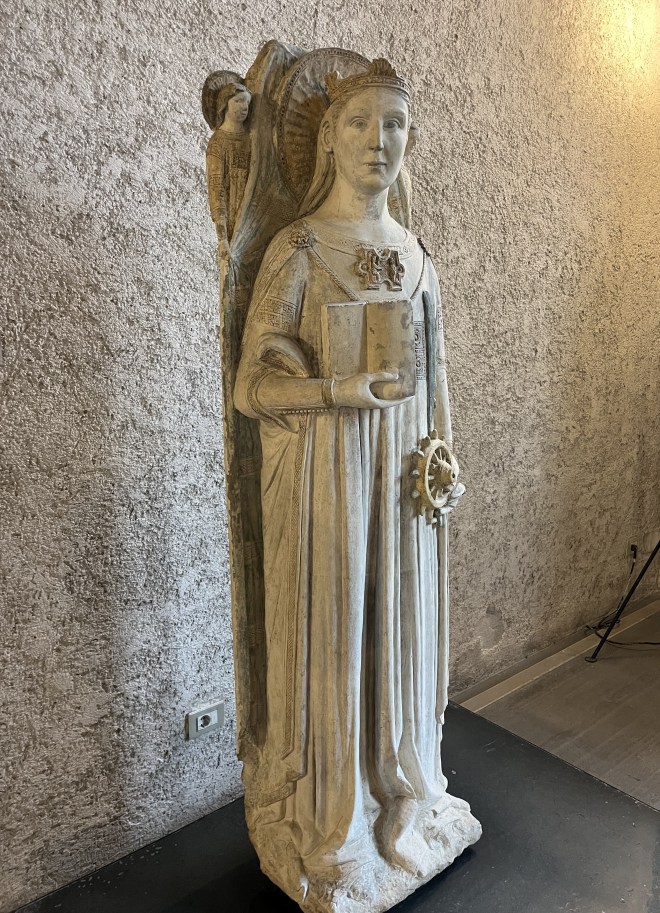
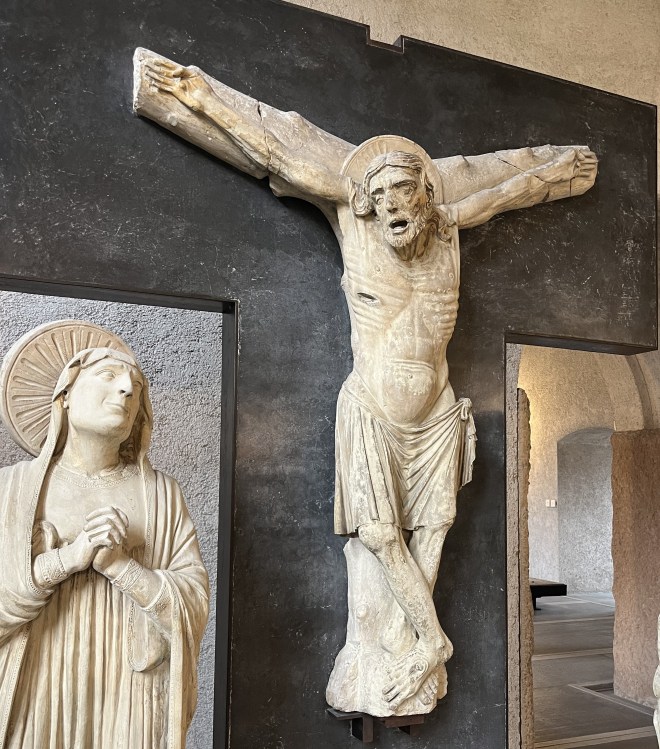
The collection goes from the Middle Ages to the 18th Century. My wife and I both agreed that the statuary from the Middle Ages was the most interesting. Here is a sample:
A most expressive St. Catherine
My photo
I’ve never seen a Medieval statue look at you in that way!
Christ on the cross
My photo
I’ve never seen such a suffering Christ!
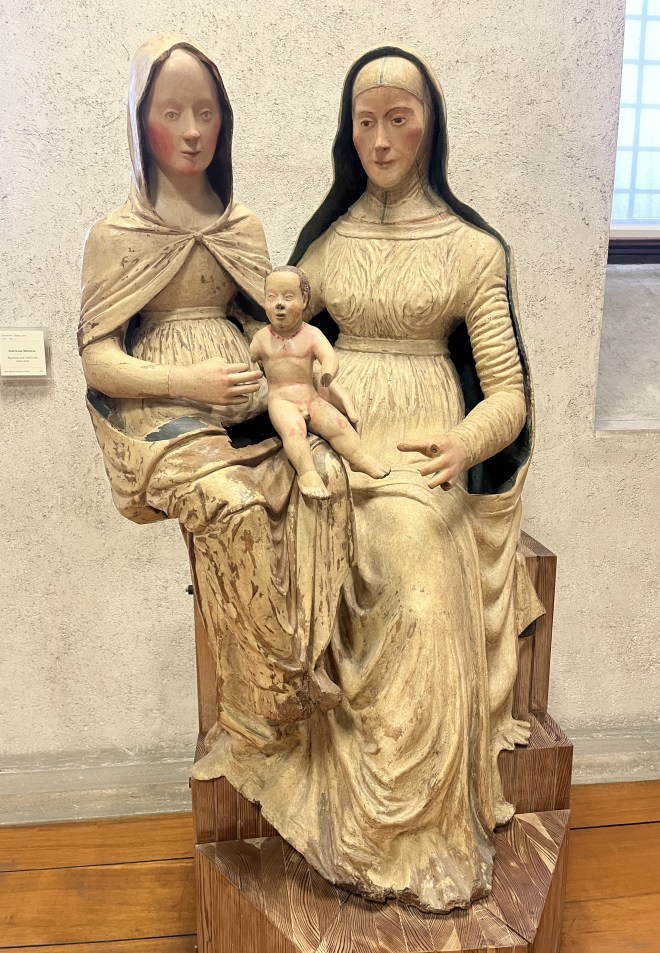
A Sant’Anna Metterza, a formalised composition where the Virgin Mary, holding baby Jesus, sits on the lap of her mother, St. Anne.
My photo
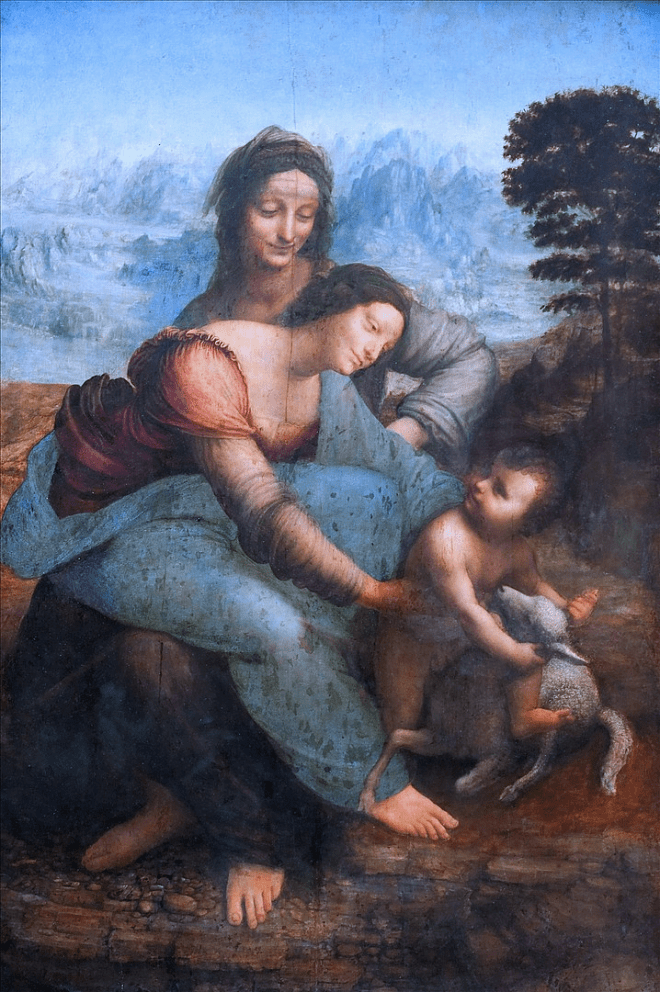
I’ve always found this such an improbable situation: what grown woman would ever sit on the lap of her mother!? But it was a popular subject. Famously, Leonardo da Vinci painted a version.
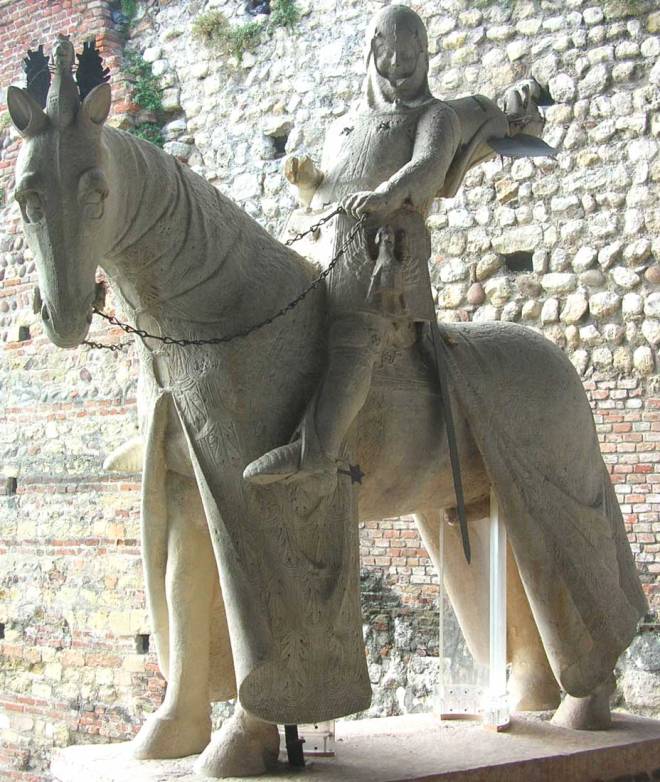
From the broad smile on his face, Cangrande must have been a very merry fellow.
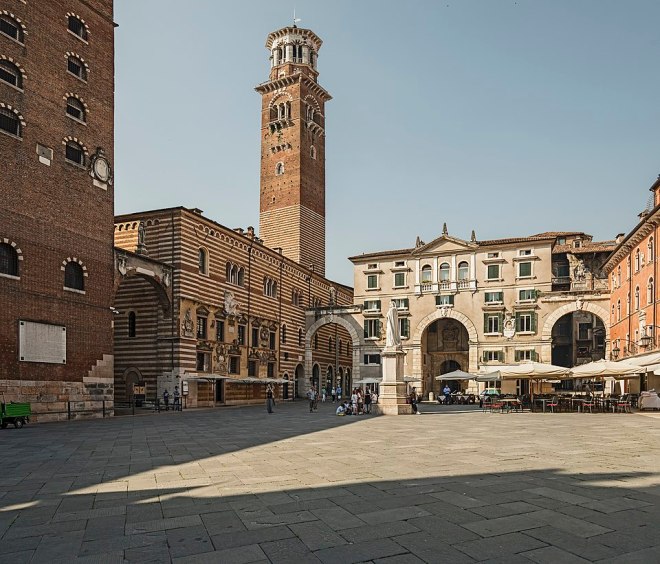
After the visit, it was time for lunch. We chose a restaurant near Castelvecchio, but unfortunately it turned out to be a tourist trap, so I won’t bother to report on what we ate. We then walked back up to the Piazza delle Erbe; the second museum we visited, the Galleria d’Arte Moderna Achille Forti, was installed in the old Palazzo della Ragione, which gives on the square.
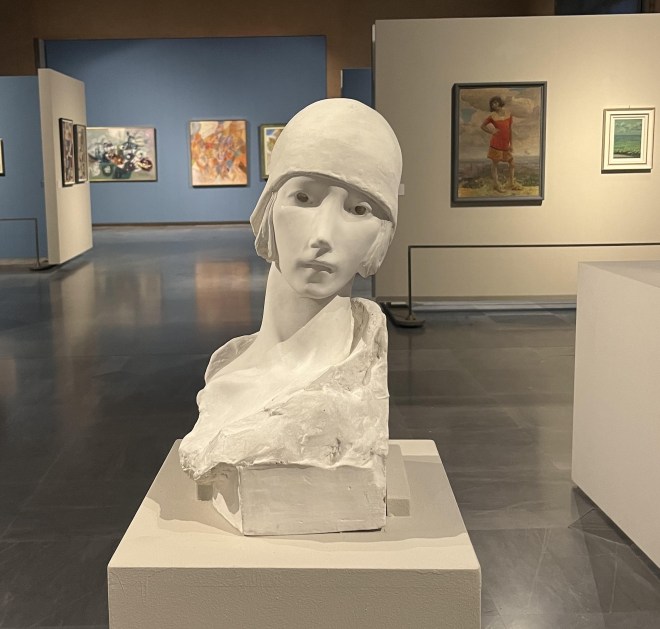
It covered the 19th and the first part of the 20th Centuries. To be frank, there wasn’t much in the collection that struck me. This statue, of a young woman wearing a hat typical of the 1920s, was one of the few pieces that caught my attention.
My photo
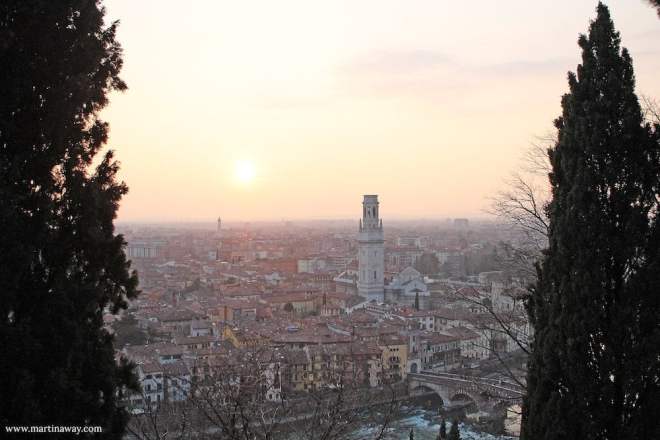
Otherwise, a couple of paintings which showed views of the city from the top of the hills above the old Roman theatre made me regret that our old guidebook hadn’t included an itinerary taking us up into those hills. Here is a view of the city from the top of those hills.
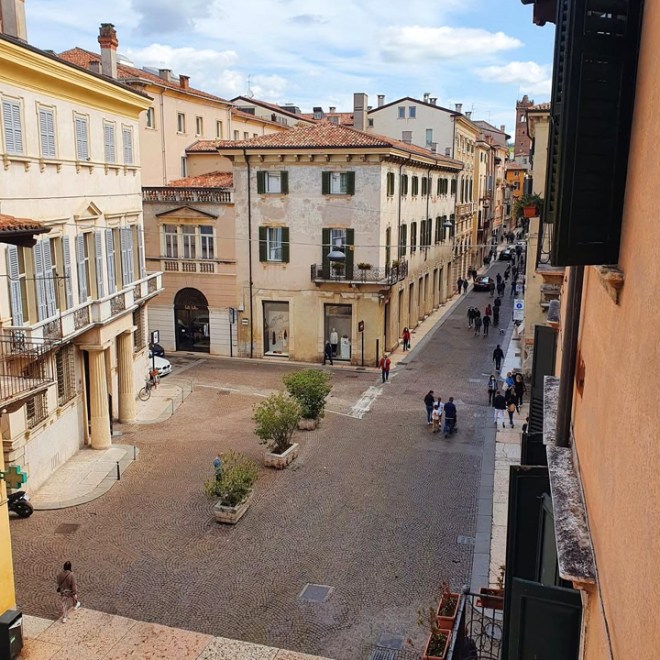
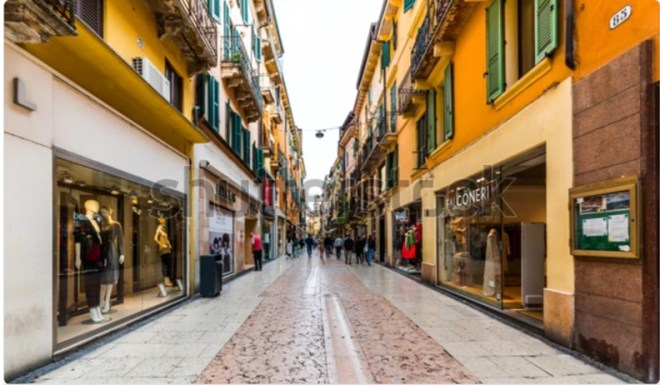
With that, our visit to Verona was over. We walked down another of the city’s very pleasant pedestrianised streets, via Mazzini, which runs from piazza delle Erbe to piazza Bra.
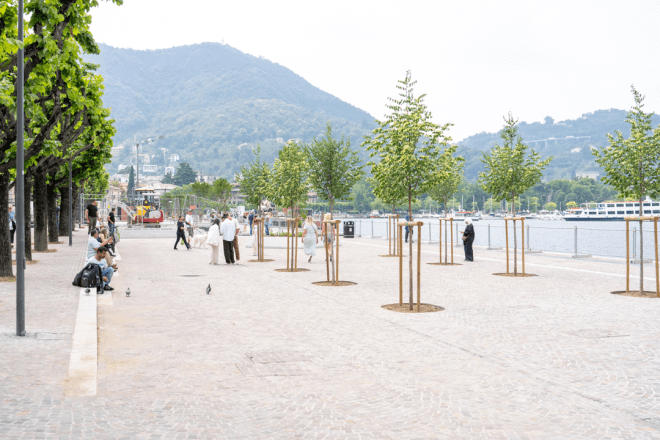
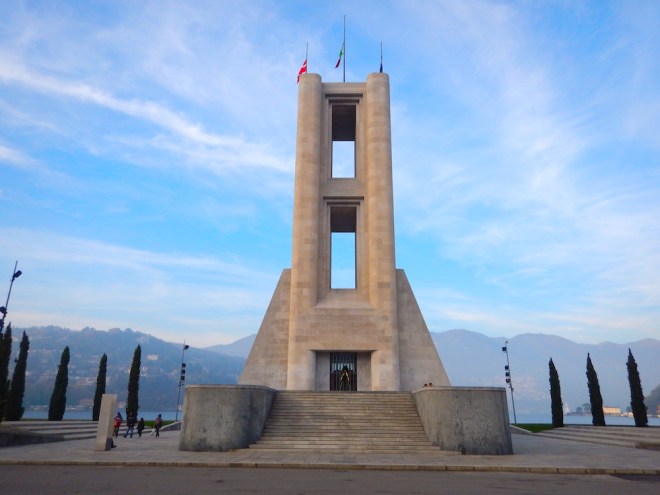
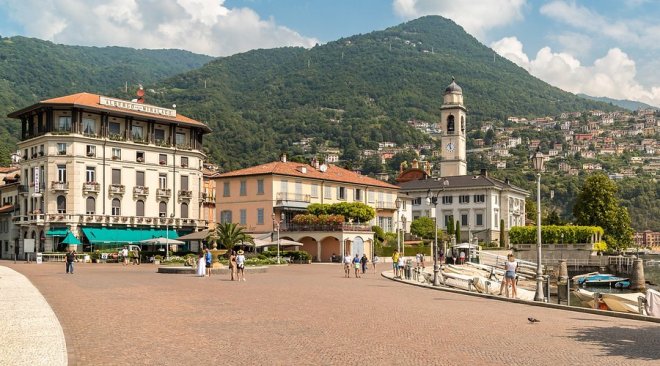
One of the gentler walks my wife and I take from Como is one which takes us along the lakeside all the way to Cernobbio. We choose it when one (or both) of us are feeling tired or have a pain somewhere in our ageing bodies or when it’s really too cold to venture higher up on the hills around the lake.
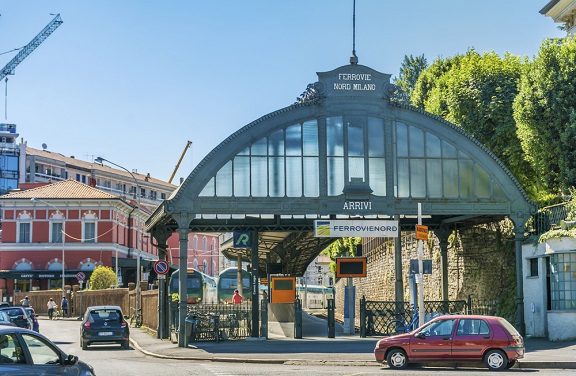
We start at the train station of Como Lago (which is a charming rinky-dink little station with an entrance in Liberty style, much nicer than the rather grim main station at Como).
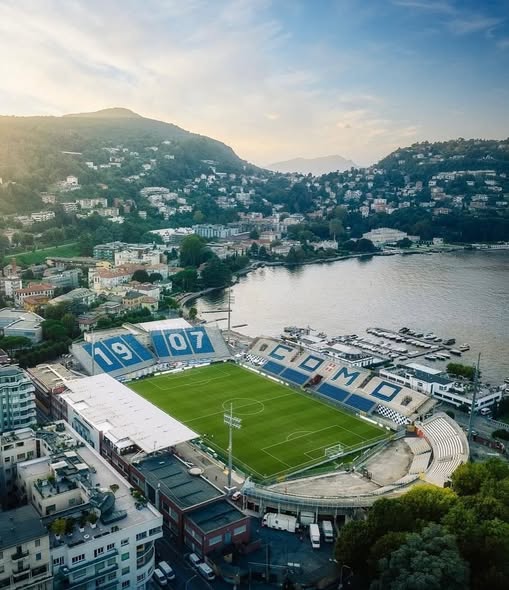
We pass the soccer stadium which is home to the town’s home team, Como 1907 (which looks quite nice in this aerial view, although all we see are the forbidding outer walls).
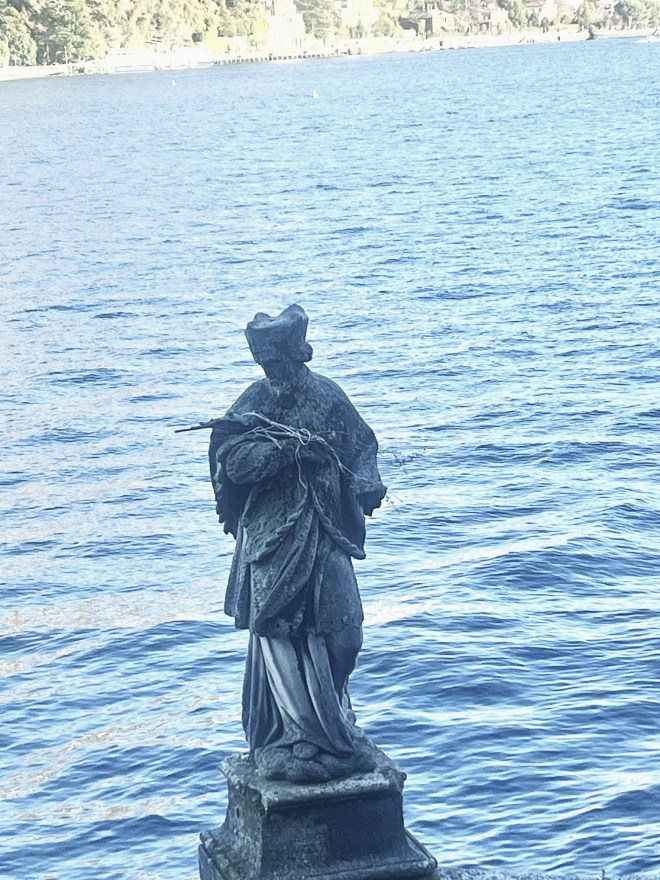
I nod at a statue of our old friend St. John Nepomuk, standing rather forlornly on the lake’s edge.
My photo
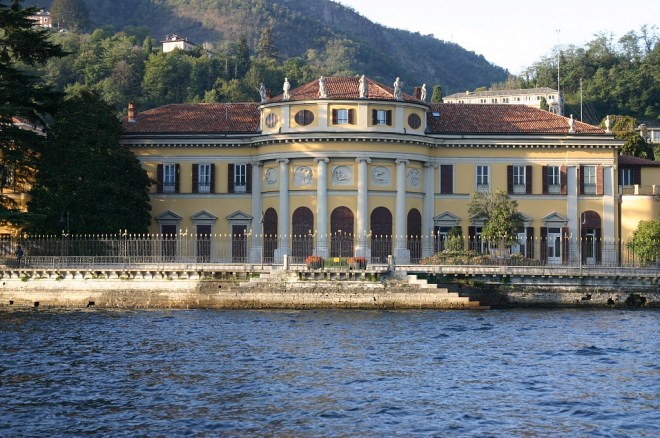
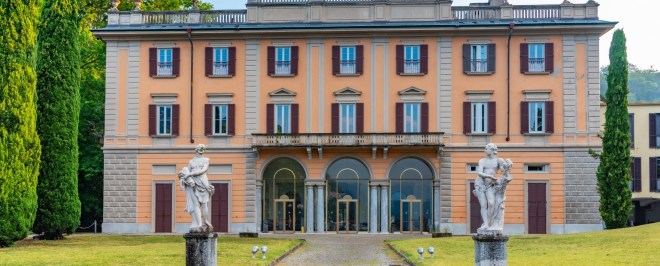
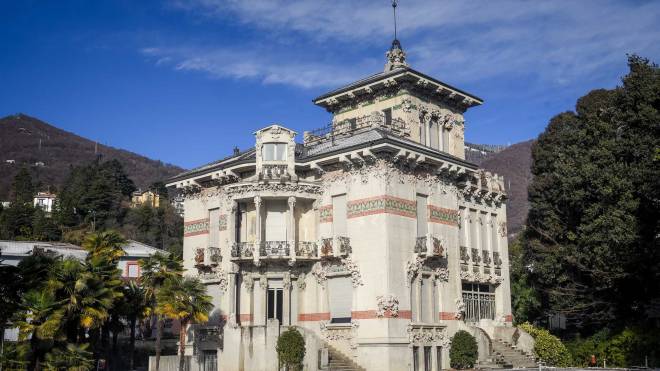
The road brings us to the old village of Tavernola (now a drab suburb of Como), where we branch off along a long straight road that passes the Liberty-style villa Bernasconi, once the property of a rich manufacturer of silk and now a museum.
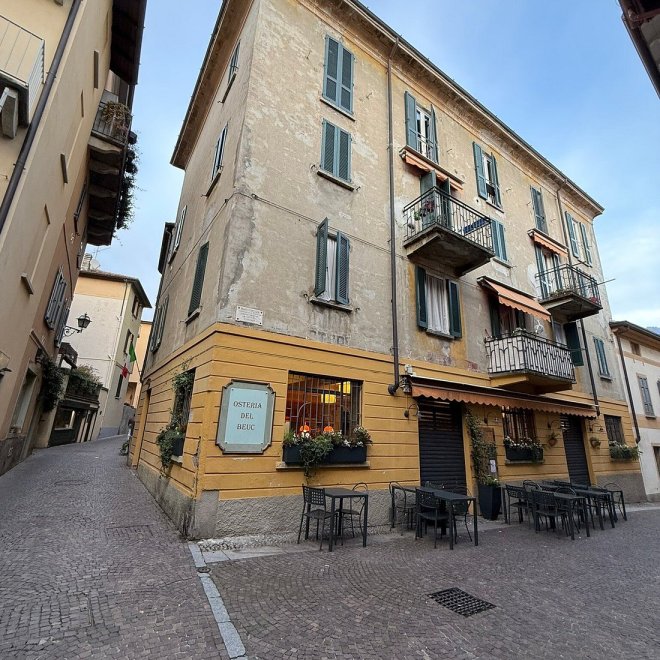
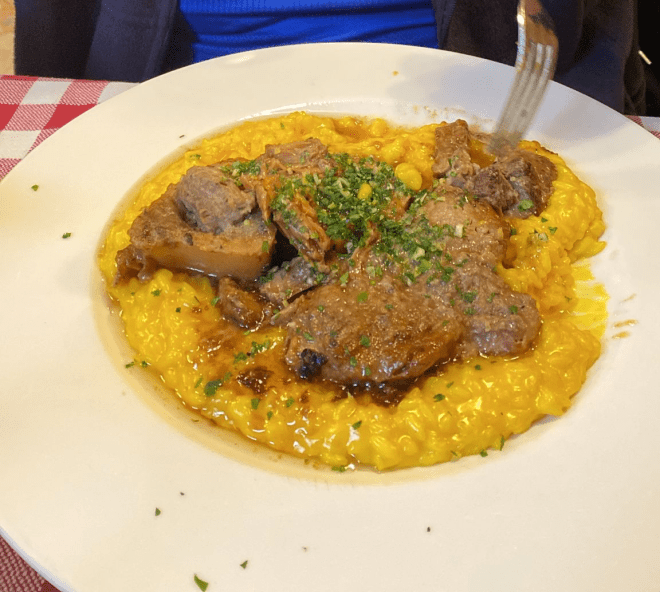
The last time I was there, I had a magnificent osso buco with risotto.
My wife’s photo
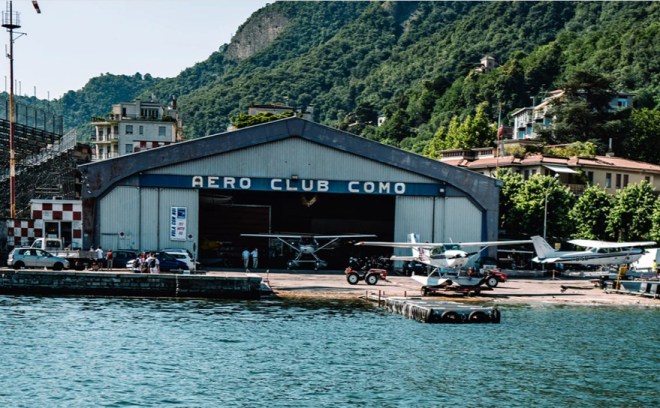
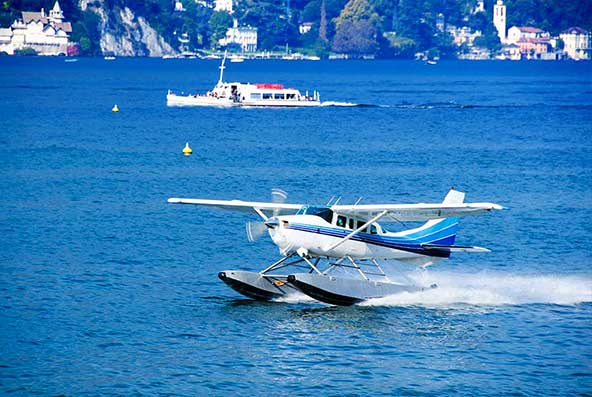
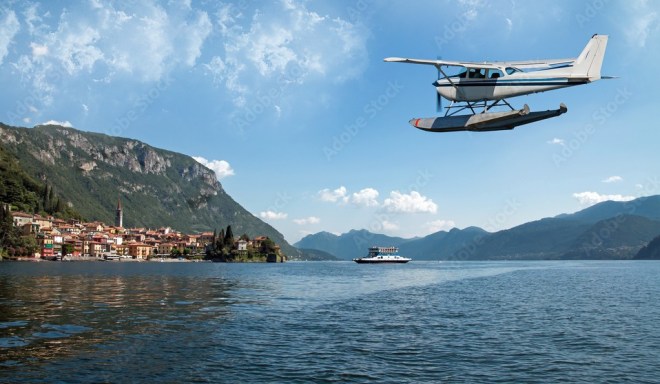
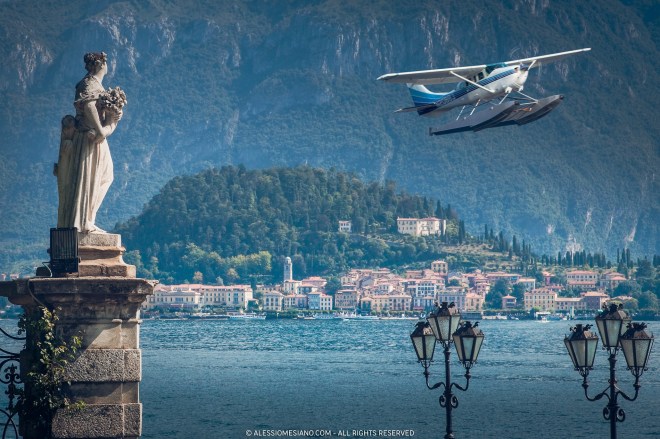
One of the pleasures of the section of the walk along the busy main road (apart from getting to nod hello to a mouldering statue of St. John Nepomuk down by the water’s edge) is watching the seaplanes from Aero Club Como taking off and landing.
I’m very fond of these seaplanes. There’s something quite beautiful about these little planes skimming across the water, their engines at full throttle, finally rising off the water surface and soaring up, up, up
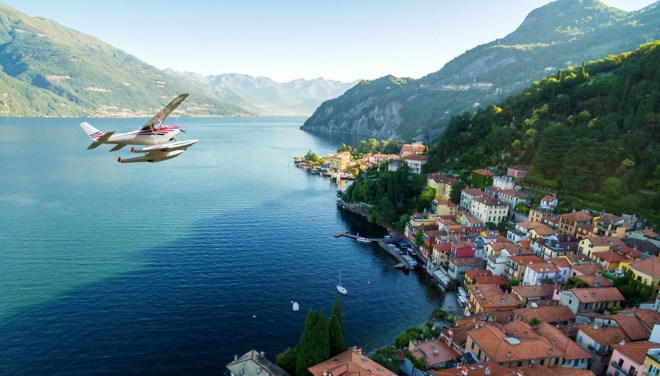
and then banking to fly along the lake, the drone of their engines bouncing off the hills (I love the noise of prop engines, so much nicer than the ear-splitting whine of jet engines).
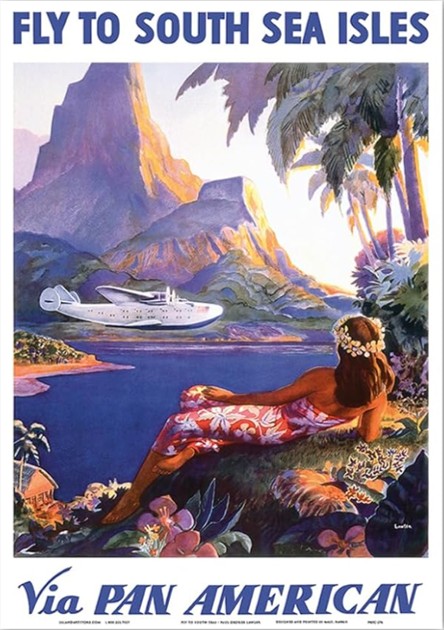
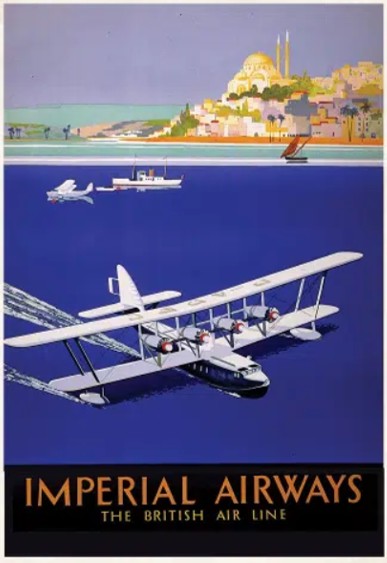
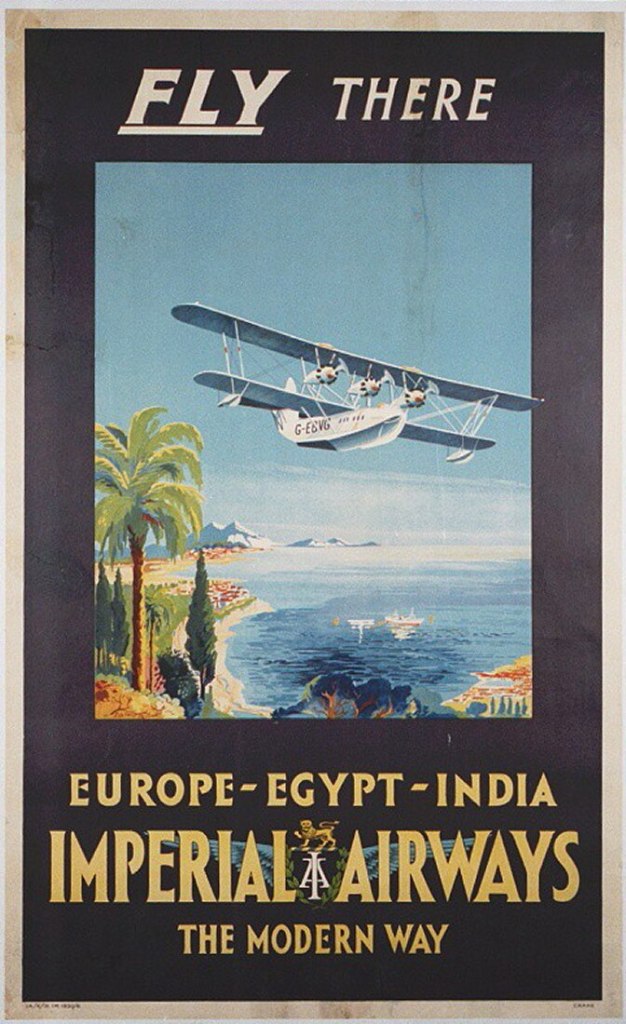
During the years between World Wars I and II, the use of seaplanes flourished: the “airfields” were free, compared to the high cost of building airfields on land. Various commercial lines were established, giving rise to some wonderful poster art.
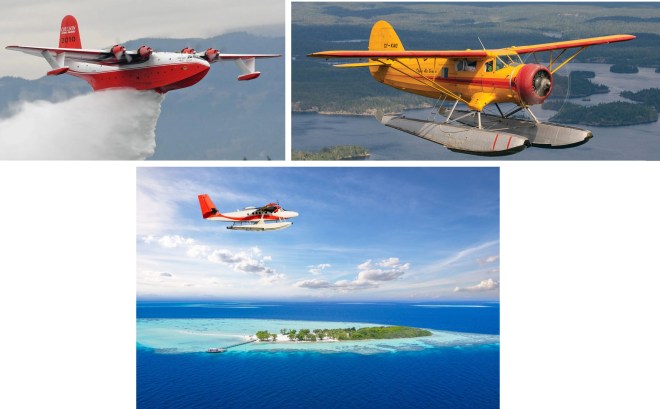
Things changed dramatically after the Second World War. Many of the military airfields which had been built during the war were no longer needed and could be turned over to civilian use. Suddenly, land-based airfields were available cheap, and so the main competitive advantage of seaplanes disappeared. On top of that, land-based planes were much less affected by weather (even small waves could halt seaplane flights) and they flew faster (the aerodynamics of seaplanes are poorer). The result was a swift decline in the use of seaplanes, which are now squeezed into a few niche uses, like aerial firefighting, access to undeveloped or roadless areas which have numerous lakes, air transport around archipelagos …
… as well, of course, as the offering of scenic flights over dramatic lakes.
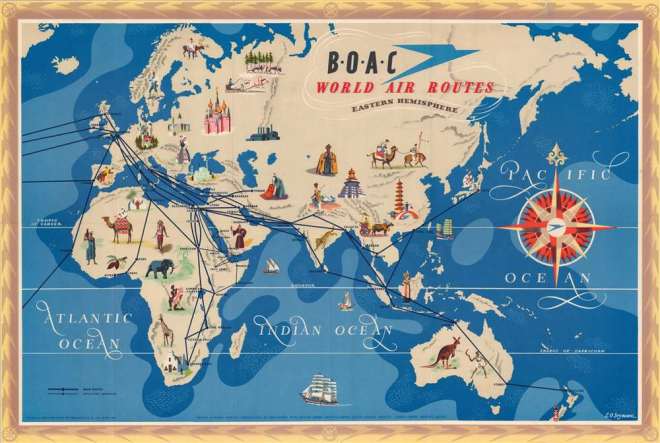
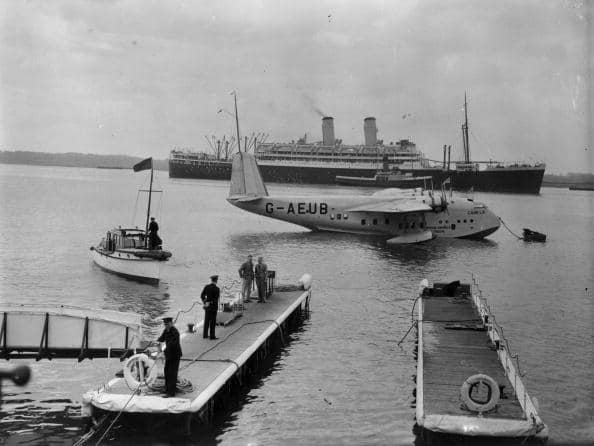
In the late 1940s, 1947 I’m guessing, My parents took what was probably one of the last long-distance seaplane flights offered by BOAC, which ran between Sydney and Southampton. They boarded at Karachi and stopped off at Bahrain, Cairo, Augusta in Sicily, and Marseilles, before arriving in Southampton.
Once, in a moment of madness, as we watched a seaplane gracefully lift off Lake Como, I excitedly suggested to my wife that we take one of the scenic flights offered by the Aereo Club. A check of the prices soon put paid to that idea. Ah well, another experience of my parents which I will never share.
There is an expression in Italian which goes like this: “Whoever does X on the first of the year will do X for the whole of the year”, where X can be anything you would like to do (or should do) throughout the year. Well, it wasn’t the first the year, but it was pretty close when my wife and I visited an art exhibition, hopefully a herald of many more visits to art exhibitions during 2026 .
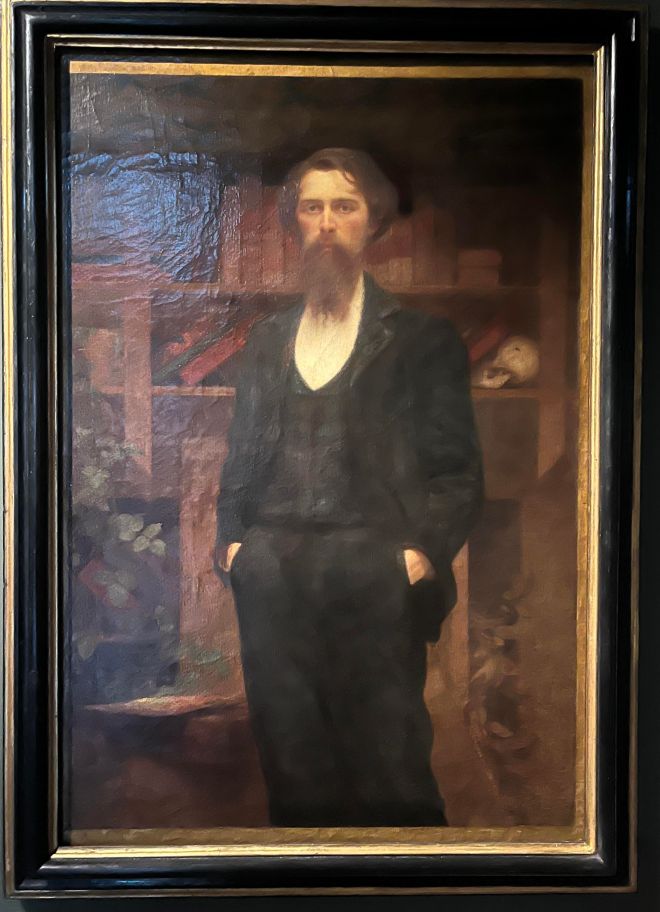
The exhibition in question, at Milan’s Galleria d’Arte Moderna, was not one of those blockbuster affairs covering an incredibly famous artist and attracting droves of visitors. It centred on the Italian artist Giuseppe Pellizza da Volpedo, who was born in 1868 and died in 1907. Here is a self-portrait of the man, a painting which greeted us when we stepped into the first room of the exhibition.
My photo
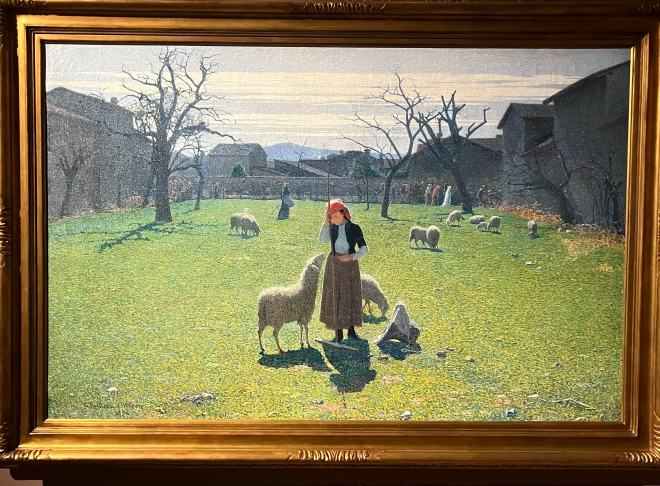
I will perfectly understand if any of my readers confess to never having heard of this artist. I had never heard of him before I came to Italy, and I was to live in Italy quite a number of years before I came across him. If he is known at all, it is because of one, magnificent, painting. It was in the exhibition, but at the very end. So let me first show my readers a selection of his works that my wife and I passed as we wandered along through the exhibition. The paintings were hung in more or less chronological order, so we could appreciate how his style developed over the years.
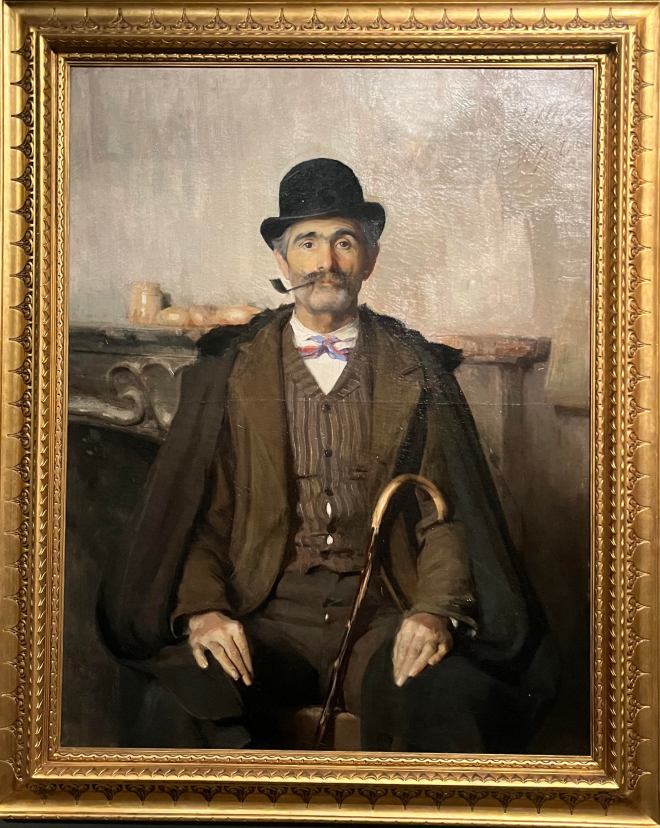
An old man, a certain Signore Giuseppe Giani, staring out at us solemnly.
My photo
Executed in 1891, the painting’s formal title is “Il Mediatore”, which I think would be translated as broker or agent. Not sure what Signor Giani would have brokered: land deals, perhaps? Very classical in its execution, I would say.
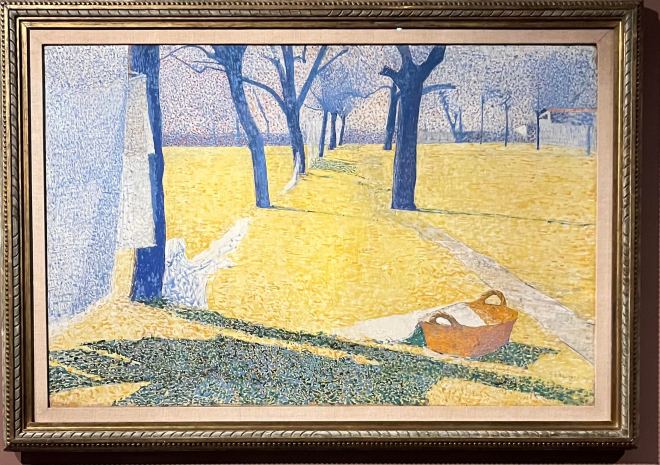
“Panni al Sole”, Washing in the Sun, painted a few years later, in 1894-5, when Pellizza was intensively exploring Divisionism, Italy’s response to Pointillism.
My photo
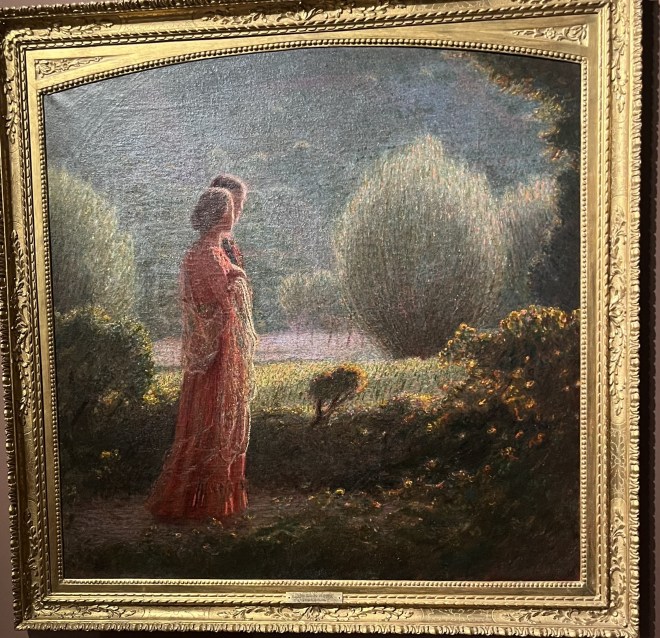
Those predominantly yellow hues in the painting remind me of an exhibition of Dutch pointillists which my wife and I saw a few years ago in Vienna. Unfortunately, although Pellizza used divisionism in all of his paintings from this moment on, he didn’t follow the more modern painters of the age. His subjects always tended to the sucrose. The exhibition notes called this style Symbolism. Maybe they were full of symbolism, but I couldn’t get away from the chocolate-box feeling of his paintings. Here we have “Speranze Deluse”, Dashed Hopes, painted in 1894, so at the same time as “Panni al Sole”.
My photo
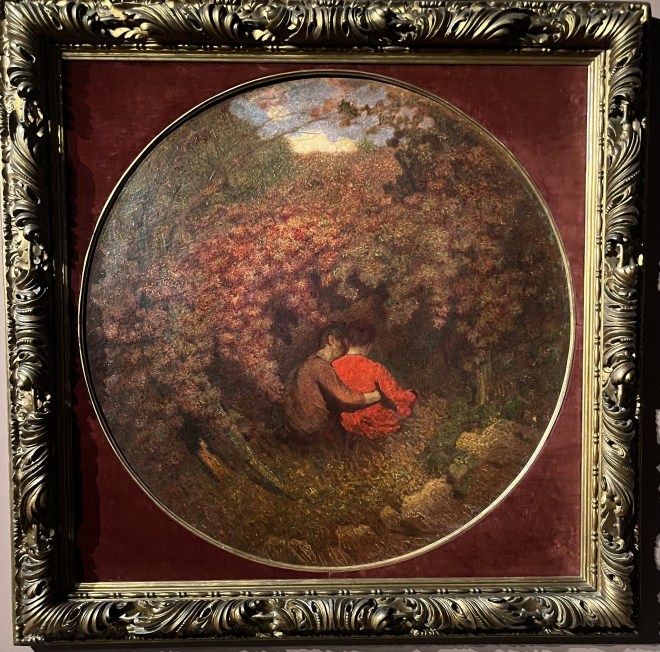
And here we have a series of three paintings , all titled “l’Amore nella Vita”, Love in Life, painted between 1901 and 1903.
The summer of young love, the autumn of middle-aged love, the winter of old love. As I say, rather sucrose – although as a person who is now an oldie I gazed at the old love and saw something I suppose we oldies all fear, the loss of the partner of a lifetime and the loneliness of the last years.
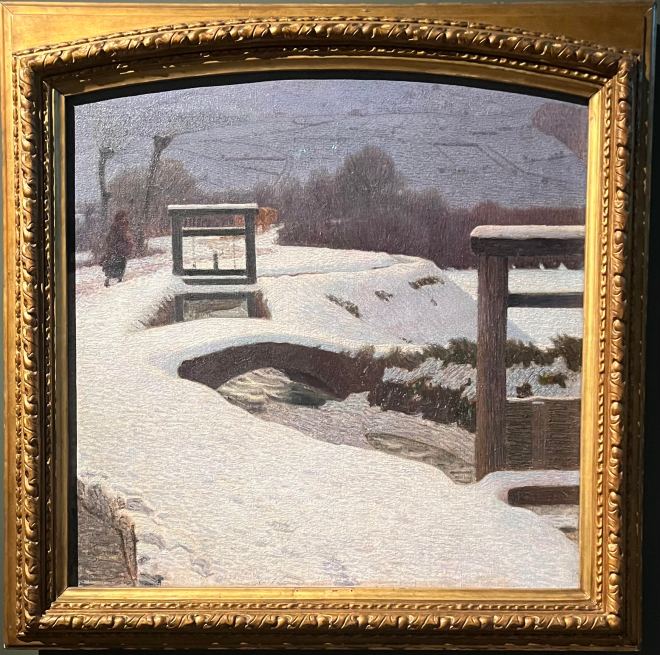
After all the sugar, it was relief to find this painting in the next room, a sober rendition of snow, from 1905-06.
My photo
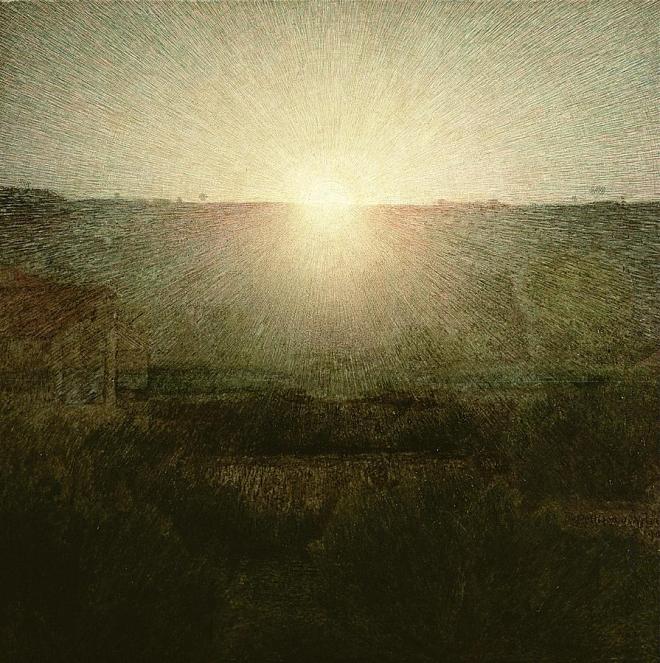
Turning around, this painting from 1904 had me pause. It is of the rising sun, at that moment when it appears over the horizon in a flash of brilliance. I feel Pellizza captured that moment very well (and by the way, his divisionist style is very noticeable in the sun’s rays).
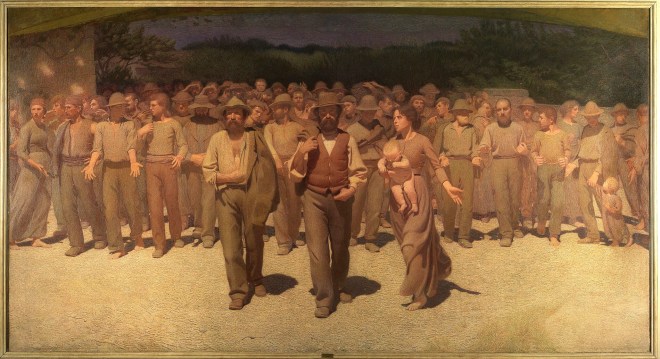
A small photo like this doesn’t do justice to the original, which is 3m high by 5.5m wide. Nevertheless, it will have to do. The painting showcases workers marching, calmly and confidently, for their rights and into a bright future. The title takes up the idea that the proletariat which the Industrial Revolution created had become a fourth estate, adding to the three estates of aristocracy, clergy, and bourgeoisie which existed in pre-revolutionary France.
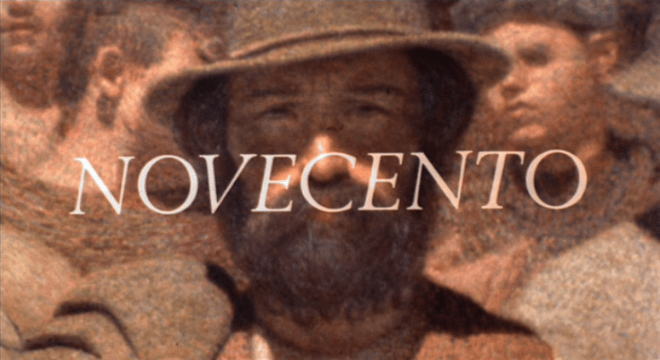
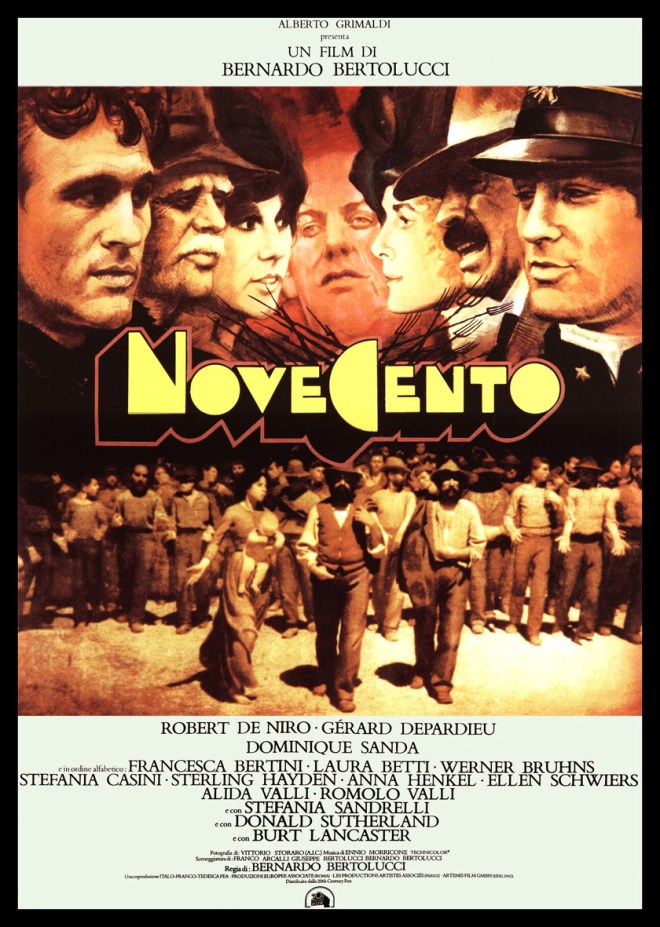
Initially, the painting was ignored. The Italian bourgeois, the ones who went to exhibitions and bought paintings, were turned off by a painting with such obvious socialist connotations. It stayed in the family’s possession. Then, in the early 1920s, at a time when Milan’s municipal government was strongly left-leaning, the government raised money to buy it. It was hung in Milan’s castle, the Castello Sforzesco, for all the world to see. Then, during the Fascist period, when Socialism was a dirty word, it was quietly rolled up and consigned to the castle’s basement, only to be fished out after the war and hung again, this time in Milan’s main municipal office. After which, it became very popular in left-leaning circles. Bernardo Bertolucci, for instance, in his film Novecento, which is a study of the agricultural working class in northern Italy over the first fifty years or so of the 20th Century, used a close-up of the painting as a backdrop for the film’s opening credits
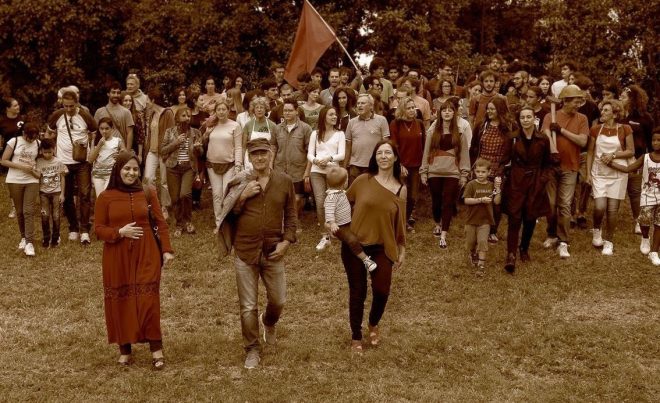
Others on the left used the painting as a template to create their own images. Here is one, a group of people celebrating May 1st. They hold a red flag and have obviously copied the Quarto Stato in their composition.
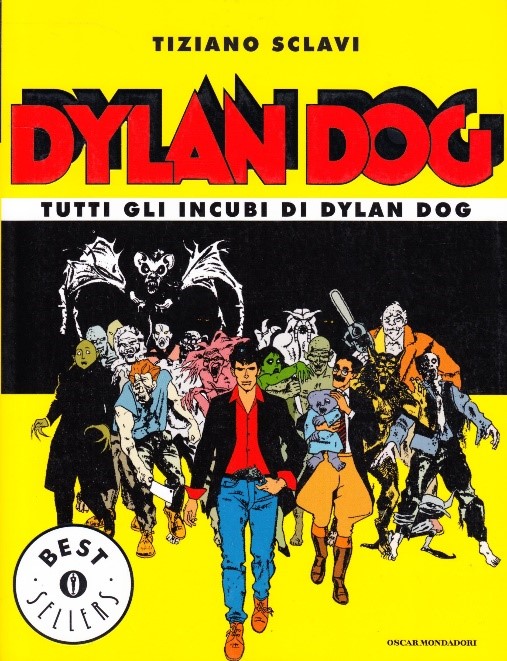
There have also been less serious uses of Quarto Stato. Dylan Dog, for instance, an iconic horror-mystery comics series very popular in Italy, used Quarto Stato’s composition many times over on its covers. Here is one from 1991.
I’m not sure what Pellizza would have thought of these trivialisations of his painting. He was a sincere Socialist. But I suppose all publicity is good publicity.
Just to finish Pellizza’s story. His wife – she is the model for the woman with the baby in the foreground of the painting – died in childbirth in 1907, together with the child. Soon after, Pellizza’s father died. In anguish, Pellizza committed suicide; he was just shy of his 39th birthday. Who knows what paintings he might have gone on to produce?
I’ve seen that Volpedo, the little town where he was born and where he spent much of his time, is quite easy to get to from Milan. One day, when the weather is warmer, I will try to persuade my wife to go there. It’s been crowned as one of Italy’s Most Beautiful Villages. I’m sure we can also find a nice hike to do in the surrounding hills.
In the meantime, we need to keep a weather eye out for other interesting art exhibitions to get us through the cold months.
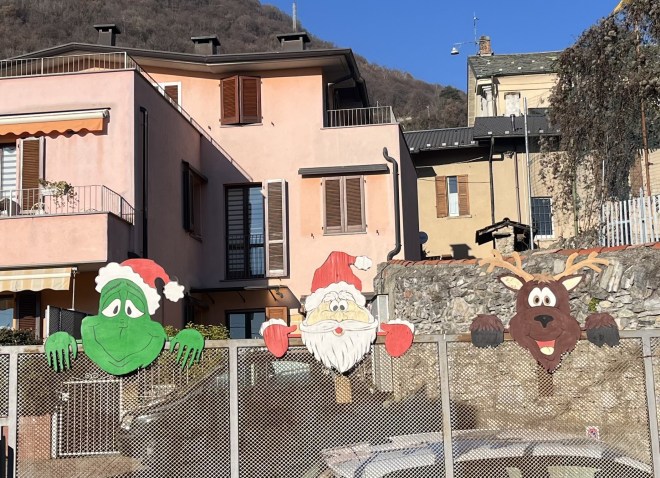
I should have got this message out on Christmas day, but my wife and I were up in the mountains of Alto Adige, celebrating Christmas with our grandson, his parents, and our son. But now they have all left, our son to Morocco with his friends, our daughter, partner and our little grandson back home to Los Angeles. So I take this occasion on the last day of the year to wish all my readers far and wide a happy new year!
My photo
I took this photo in the village of Rovenna, high up above Lake Como, on a hike my wife and I did a few weeks ago – it captures the modern spirit of the season well, I think.
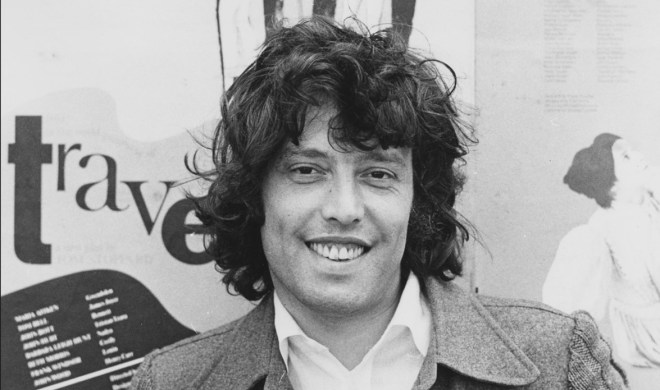
As I appeared bleary-eyed for breakfast a day ago, my wife – who normally gets out of bed before me – announced, “Tom Stoppard is dead”. How old, I asked? 88 she replied. A good age. In my advancing years, I read obituaries more and more frequently (such interesting lives people have lived!), and I have noted that many of those who are graced with an obituary in the newspaper I read shuffle off this mortal coil in their 80s. So, as I say, a good age.
For any of my readers who are not familiar with him, Tom Stoppard was a playwright, primarily for the stage, but also for radio, for TV, and for film (as a screenwriter in this case). Perhaps they will have seen the film Shakespeare in Love, whose screenplay Tom Stoppard co-wrote (and for which he shared a screenwriting Oscar).
Famous playwrights have been popping off, and I’ve never written about them. So if I write a post about Tom Stoppard’s death, it’s because he holds a special place in my heart. Many, many years ago, when I was 17 to be precise, I played a lead role in the play that made Stoppard’s name, “Rosencrantz and Guildenstern are Dead”. I have preciously kept the edition of the play we used as a script. It is now battered and worn from following us around on our countless moves over the intervening decades.
The play is a riff on Shakespeare’s “Hamlet”. Stoppard has taken two very secondary characters from that play, who are friends of Hamlet’s from way back, and has turned them into the protagonists, but of what exactly is never really clear, to them or to the audience. They have been summoned to the court of Denmark by the king, but they don’t know why. Essentially, the whole play is happening in the wings of the play “Hamlet”, with R & G passing the time discussing various topics and waiting for someone to explain to them what is going on; this aspect of the play has strong echoes of Samuel Beckett’s “Waiting for Godot”.
From time to time, apparently to give them the explanations they crave for, scenes from “Hamlet” roll onto the stage and our two hapless friends find themselves taking part in those scenes.
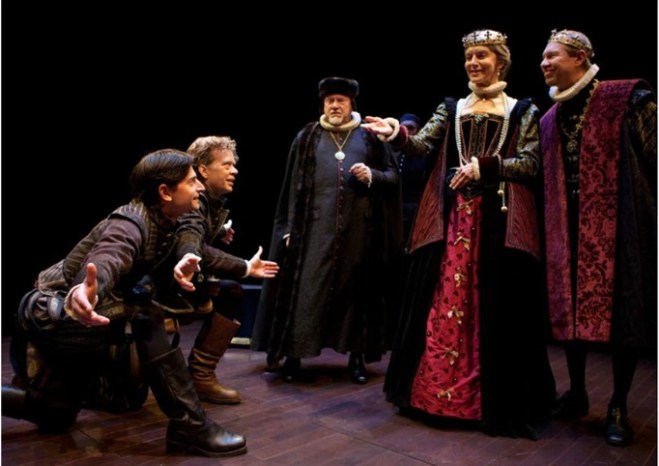
They are such minor characters that the king and queen, as we see in this photo are constantly getting them mixed up. Then the “Hamlet” scenes roll off the stage and R & G find themselves alone again and even more befuddled than before. Eventually, after a hilariously farcical scene on a ship with pirates, and without really understanding why, they die. The dialogue is absolutely scintillating, a hallmark of Stoppard’s. In fact, a common criticism of his plays is that there is too much head and too little heart. Perhaps, but his dialogue is among the best I have ever heard or read.
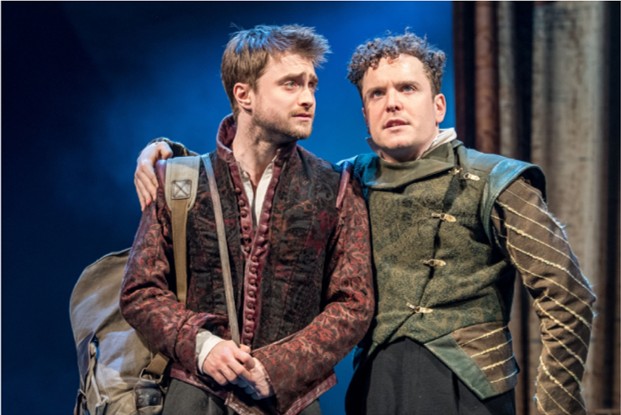
I played Rosencrantz, although I have to say that over the decades my memory faded and, like the king and queen of Denmark, I got confused about who I had played; I had to re-read the script again to be sure. I have no photos of myself, alas, in this performance. I’m sure photos were taken, but they will have remained in one of the albums which littered, and no doubt still litter, the school theatre’s green room. Instead, I’ll throw in some photos of some of the well-known actors who have played R & G, to show what good company I’m in. Here we have Daniel Radcliffe and Joshua McGuire playing the two roles.
Scarborough plays Rosencrantz, I’m pleased to see – my wife and I watched him recently playing a police inspector solving hideous murders.
Looking back, I realise that playing Rosencrantz was the apex of my acting career. I performed it in my last year at school, and my subsequent acting career at university was a relatively swift decline into secondary Rosencrantz-and-Guildenstern-like roles. The fact is, there were much better actors than me at university. I had briefly entertained the idea of becoming a professional actor, but I quickly realised that unless I wanted to spend much of my life out of work I had better find something else to do.
Funnily enough, I have never seen another of Stoppard’s plays in the intervening decades, although I have read a good number – that scintillating dialogue. I have to say, I turned off play-going after I stopped acting; I was spending too much time thinking about how I would have directed the plays I was watching. But maybe I could at least watch on YouTube the one film Stoppard himself directed – which happens to be of “Rosencrantz and Guildenstern are Dead”. That would surely be a fitting way for me to remember this great playwright.
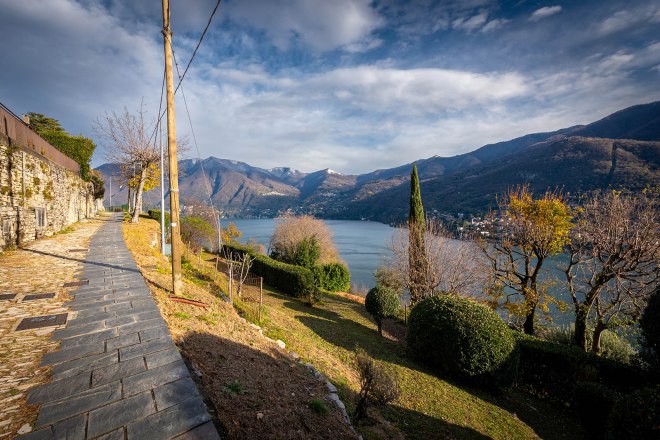
A week or so ago, my wife and I were doing a gentle hike on Lake Como. We’ve both been a bit under the weather, so a hike with none of the brutal climbs required of many of the hikes around Lake Como were just what we needed. We had also done a few other, rougher hikes along the lake in the previous days and had discovered to our dismay that heavy rains back in late September had made a number of them impassable. So as I say, a nice gentle hike along a well-kept path was just what we needed. For any of my readers who might want to know which hike we did, it was the “Via Verde”, which runs between the villages of Moltrasio and Laglio (and is not to be confused with the rival “Green Way”, which runs further north along the same shoreline of the lake). Here is a photo of the typical view one enjoys along this path at this time of the year.
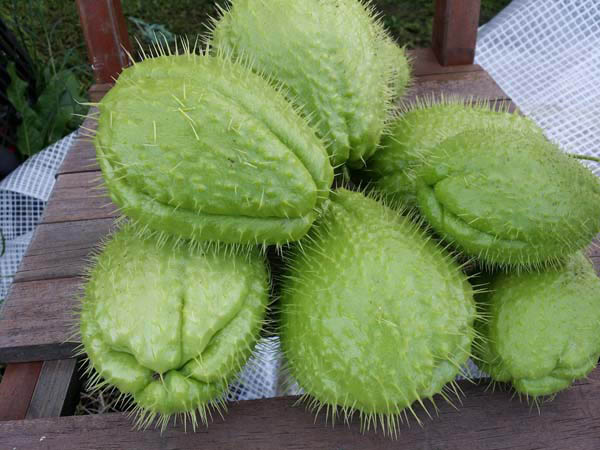
Towards the end, we were walking into the village of Carate Urio when we came across a table set up along the path and on which were placed two crates holding a dozen or so of these strange-looking vegetables – or were they fruits?
My wife trained her iPhone camera on one of these vegetables (or fruits?) and promptly identified it. In Italian, it is called “zucca spinosa”, or spiny pumpkin. They were certainly spiny, but the relationship to pumpkins wasn’t immediately obvious. And being a pumpkin, it’s sort of both a fruit and vegetable: botanically a fruit but culinarily a vegetable given the way it is eaten (as we shall see in a minute). For the purposes of this post, I will henceforth refer to it as a vegetable.
Different parts of the world have different names for this vegetable. It’s called chayote in the US. Here we have a lady from Louisiana showing off two of them (although, reflecting that State’s French heritage, they are often called mirlitons there, as they are in nearby Haiti).
The Americans have actually just borrowed the Spanish name for the vegetable; we’ll come back to the Spanish name in a minute.
It’s called chocho or chuchu or some variant thereof in places as varied as Mauritius, India, Sri Lanka, Brazil, and Jamaica. This is thought to be the Pidgin English version of chayote. Here we have a farmer in Assam with his crop of chocho.
The vegetable is called choko in Cantonese (am I wrong in thinking that this ultimately derives from chocho?), which later became the name used in Australia and New Zealand thanks to the Cantonese who emigrated there in the 19th Century. Here we have an Australian proudly showing off the chokos growing in his garden (note that his variety is without spines).
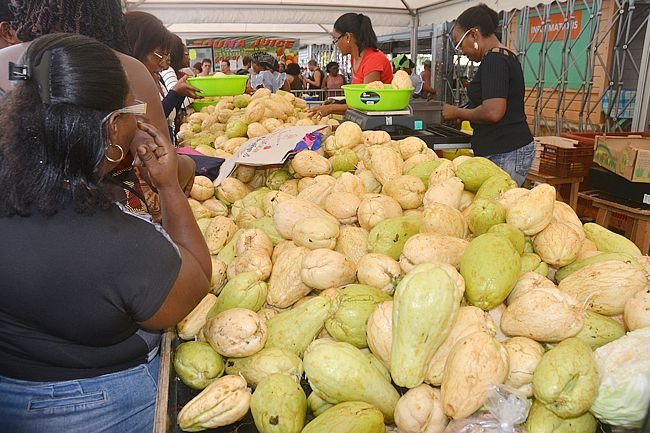
Meanwhile, in the islands of the eastern Caribbean, the vegetable is called christophine or christophene. Here we have early risers in a market in the island of Martinique searching for their choice christophenes.
There are more names used for this spiny pumpkin, but the ones I’ve cited give us an indication of where it originally came from. It is one of those foodstuffs which make up the great Columbian exchange: that massive movement of foodstuffs, people and diseases which occurred after Christopher Columbus stumbled across the Americas. I’ve mentioned this exchange several times already in these posts, when writing about the prickly pear, the Jerusalem artichoke, vanilla, and turkeys. And now I can add to the list the spiny pumpkin, or christophene (which reflects the connection to Christopher Columbus), or chayote, which is a Spanish transliteration of the Nahuatl name chayohtli. In fact, modern studies indicate that the chayote was first cultivated in Mesoamerica, between southern Mexico (in the states of Oaxaca, Puebla, and Veracruz) and Honduras, with the most genetic diversity being present in both Mexico and Guatemala. Here, we have a field of chayote in Mexico.
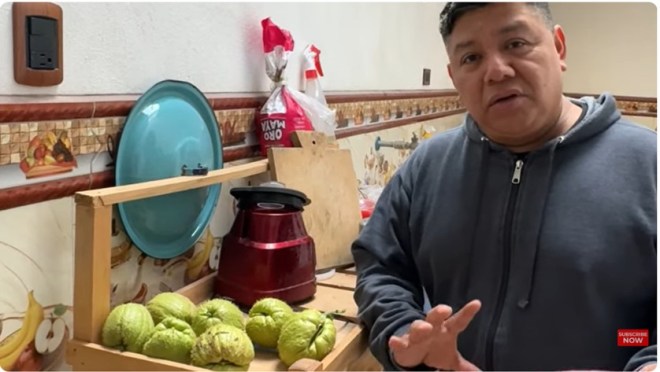
Just to finish my elongated riff on names, another name for the vegetable which is used in Guatemala and El Salvador is güisquil or huisquil, which is derived from another Nahuatl name for it, huitzli. Here we have a Guatemalan singing the praises of the güisquil.
But to come back to my wife and me, standing in front of that table on the Via Verde. The vegetables’ anonymous grower was offering them for free to passers-by. I was hesitant, but my wife was bolder. She reminded me that we were having some old friends over for dinner the next day, why not try the spiny pumpkins out on them? But we don’t know how to prepare them, I objected. My wife waved off that objection, immediately doing a search on the internet. Hey presto, she found what sounded like a pretty easy recipe, explained in a video by a lady from Calabria in southern Italy, who mentioned in passing that the spiny pumpkin was particularly popular in her region – readers should note this link of the spiny pumpkin to Calabria, as we shall come back to it in a minute. My doubts brushed aside, we picked up five of these little spiny pumpkins and loaded them up in our rucksacks.
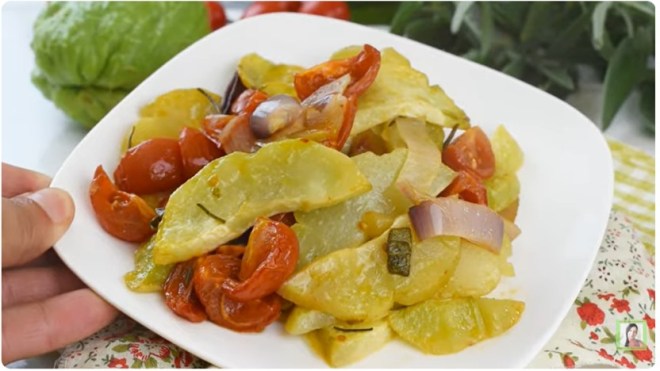
The next day, preparations started early. As recommended by the Calabrian lady, I peeled the pumpkins with a potato peeler – the spines were a little annoying but no more than that. Then I opened them up to take out the stone, after which I cut the halves into thin slices. Then I could start on the other two ingredients, tomatoes and onions. I divided up six large tomatoes, and sliced up one small onion (the recipe called for more but I’m not a fan of onions). At which point, I handed over to my wife, who threw all the ingredients into a big bowl, added the herbs, salt, and oil, and mixed everything up thoroughly. At the right moment, she ladled the mix out into a pan and put it into the oven for 40 minutes at 180 degrees Centigrade. I throw in a photo of what the result looked like – this is actually from the Calabrian lady’s video; we forgot to take a photo since we were so busy with preparations of the dinner.
Because what we had prepared was a side dish. The main course, the pièce de resistance, was cotechino with lentils and mashed potatoes. Like that, if the side dish turned out to be a disaster, we still had the main dish to fall back on. Luckily, it all turned out well. When I carried in the side dish, I explained the whole back-story. None of our guests – three Italians and one American – had ever heard of zucche spinose (in the case of the Italians) or chayote (in the case of the American). We all tried the dish with a little trepidation, but luckily it tasted really good. To me, the spiny pumpkins tasted like a cross between zucchini and cucumber. They went well with the tomatoes.
We didn’t finish the dish, so my wife froze the remains. When we get back from Florence where we are at the moment (to see an exhibition on Fra’ Angelico), we’ll try it out on our son too.
I fear we’ll never make the dish again, unless our anonymous grower on Lake Como is kind enough to make next year’s crop available to passers-by, because you cannot grow spiny pumpkins in the north of Italy (except, as we have seen, in Lake Como’s microclimate). As a result, northern Italians have no culinary experience with it – which is why our three Italian guests, all from Milan, had never heard of it. Of course, we could travel down to Calabria. Because, I discovered, Calabria is a “hot spot” for the growth and consumption in Italy of the spiny pumpkin. This is a consequence of one of the many individual rivulets that made up the giant global flow of plants out of the Americas after the continent’s accidental discovery by Columbus. When, in 1502, the Spaniards took over the Kingdom of Naples, of which Calabria was part, they carried the spiny pumpkin from their new dominions in Mesoamerica to their new dominions in southern Italy. And the plant took particular root in Calabria.
But we can’t go to Calabria just to eat spiny pumpkin! I’ll have to come up with an exciting trip full of new things that we’ve never done before if I’m ever going to persuade my wife. I have one or two things in mind. There’s the Riace Bronzes in Reggio Calabria, which we’ve never seen. There’s some old Christian mosaics in a monastery up in the Calabrian mountains, mentioned by John Julius Norwich in one of his books, which we’ve never seen. I’ve got the whole winter to come up with some more things to see and do …
My wife and I were down in Sicily recently. Our daughter and her partner came over with the grandson and they decided to spend a week down in the very far south of the island, near one of Sicily’s three promontories, Capo Passero (if I mention this detail, it’s because it plays a role later). The house they rented gave directly onto the beach and our grandson spent many happy hours digging holes, making sandcastles, and braving the – relatively small – waves that broke onto the beach.
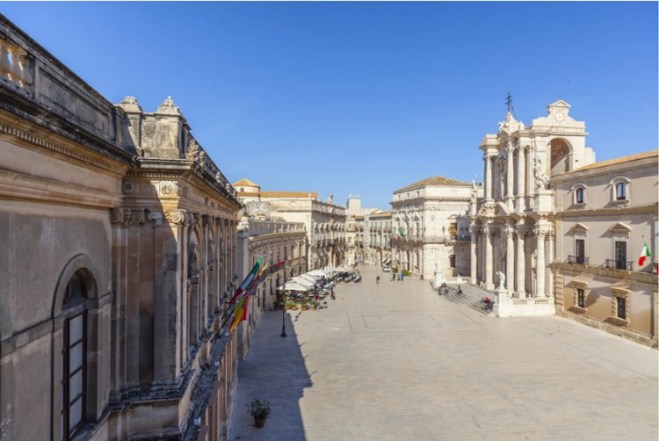
In between these sessions on the beach, we managed to get in brief visits to Noto and Syracuse, both UNESCO World Heritage Sites. Here’s a photo of the cathedral in Noto.
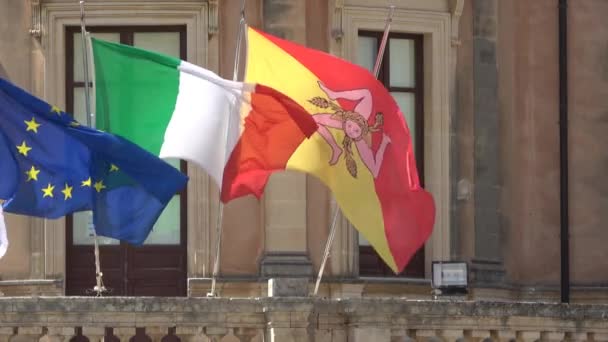
I discovered that it is the official flag of the region of Sicily (which is why I normally saw it flying along with the Italian national flag and the EU flag).
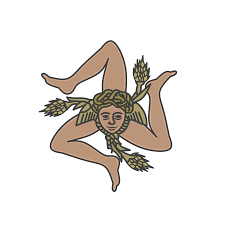
I’m a bit of a flag man – many years ago, quite soon after I started this blog, I wrote a post about what I considered to be the most elegant national flags. So of course I focused in on this flag. What really intrigued me about it was that symbol in the middle: a face from which emanate three legs bent at the knee.
Source
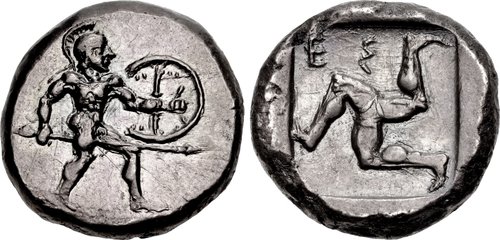
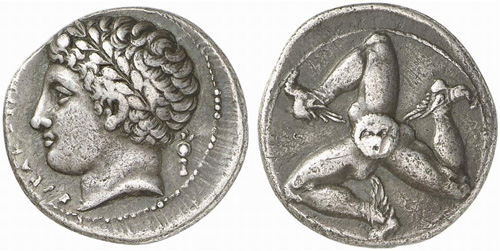
I quickly established that this symbol is called a triskeles, Greek for three-legged. It was a popular symbol on coins. The earliest numismatic representation of it (from around 465 BCE) is on coins from the Greek statelet of Pamphylia, in what is now southern Turkey.
The triskeles was used in varying formats on Greek coins for several centuries thereafter, but it was most closely associated with the coins of Agathocles, Tyrant of Syracuse from 317 BCE, and self-proclaimed king of Sicily from 304 BCE, until his death in 289 BCE. On this coin, it is the main decoration on the reverse side of the coin, because Agathocles adopted it as a personal symbol of his reign.
Agathocles brought an important modification to the design, placing a Gorgon’s head as the central hub from which the legs emanate. He also added wings to the feet.
On this Syracusan coin, instead, it is used as the mint mark.
The Greek name for the island was Trinacria, which means three headlands. The three headlands in question were those at the “corners” of the island: Capo Peloro, to the north of Messina, Capo Passero, all the way down south of Syracuse (and close to where we spent our little Sicilian holiday), and Capo Lilibeo, close to Marsala. The choice by Agathocles of the triskeles as his personal symbol was no doubt meant to underline his ambition – realised in the last years of his life – to be ruler of the whole of Sicily.
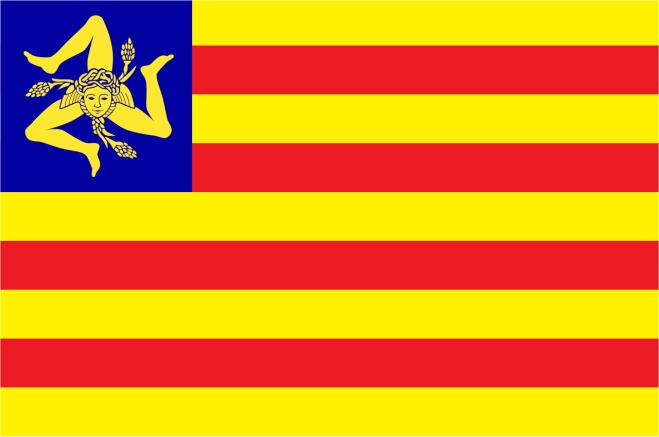
None of Agathocles’s heirs who were still alive when he died managed to succeed him as king of Sicily. In fact, he was formally reviled after his death, with all statues of him throughout Sicily being destroyed. Nevertheless, his triskeles continued to be used as a symbol for the island. After the Romans had turned the island into a province of its Empire, they added three ears of wheat to the Sicilian triskeles, apparently to underline the province’s role as a granary for Rome (and took the wings off the feet).
With the collapse of the Western Roman Empire, the use of the triskeles seems to have disappeared in Sicily. But it came roaring back in 1282, when, in what has become known as the War of Sicilian Vespers, the Sicilians rebelled against their French Angevin overlords and invited the King of Aragon to take their place. The Sicilians created a flag to carry into battle.
It was made up of the red and yellow colours of Aragon (but also the colours of the communes of Palermo and Corleone, where the revolt started) with a triskeles at its centre (where the Roman ears of wheat had disappeared and the wings brought back, but this time attached to the head).
After twenty years, peace was concluded and the House of Aragon ruled Sicily for the next 400 years or so.
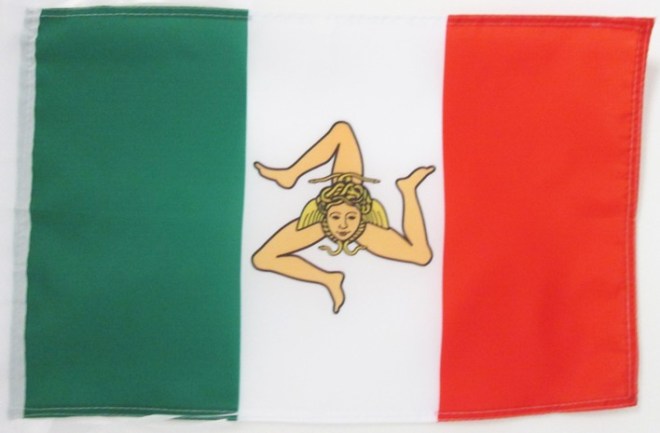
In 1848, some 600 years after that first burst of rebelliousness, and when the whole of Europe was being shaken by revolutionary outbursts, the Sicilians had another bout of rebellion and ousted their Bourbon overlords. The movement of course needed a flag, so the triskeles was rolled out again, but this time it was affixed to the red, white and green tricolour, itself created in 1789 by Italian revolutionaries copying their counterparts in France.
Alas, the revolt, and the flag, lasted only a year, until the Bourbons took back control of the island. But then, a mere ten years or so later, in 1860, when Garibaldi and his thousand volunteers disembarked in Sicily on his way to conquering the island and the boot of Italy, the Sicilian rebels dusted off this flag to fight behind. That rebellion was successful this time. Or maybe it wasn’t, because Sicily shucked off its Bourbon overlords but only to become part of the new Italian State, where national unity was strongly promoted and regional diversity quashed. So of course the triskeles disappeared from the tricolour flag.
Then, at the tail end of the Second World War and after 80 years as part of the new Italian State, separatism reared its head in Sicily. In the chaos created by the Allies’ invasion of Sicily and the collapse of the national government, the Movement for the Independence of Sicily was formed. Of course, it created its own flag which naturally enough sported a triskeles, a bright red one in this case. I’ve no idea why the separatists chose this colour for its triskeles, or the colour of the flag’s background – perhaps simply the red and yellow now traditionally seen as Sicily’s colours?
It was a strange movement, which pulled in people from the left and the right of the political spectrum but also had links with the mafia and the island’s traditional bandits. Indeed, the darker, criminal elements of the movement spawned an armed force, the Volunteer Army for the Independence of Sicily. It, too, created its own, triskeles-bearing, flag.
This “army” attacked Carabinieri barracks and made general mayhem but was eventually crushed. In the meantime, the national government bought off the separatists by promising Sicily a special autonomous status (as it did to other regions on the rim of the country: Sardinia, Val d’Aosta, and Trentino-Alto Adige).
In the decades after the War, Italy’s regions, which had been politically moribund since the country’s unification, slowly clawed back their political importance. Finally, in 1970, the country’s first regional elections took place, while in 2001 a constitutional amendment gave the regions greater say in policy-making.
With the regions’ increasing political importance came the desire to create their own flags, banners, armorial bearings, and so on. Sicily was no different. Its regional parliament approved a first flag in 1995.
Its design explicitly harked back to the flag created by the rebels in 1282 (although the colours of the background were switched around), but instead of the triskeles the region’s coat of arms was placed in the flag’s centre. This did include the triskeles but quartered it with the arms of the Normans, the Swabians, and the Aragonese, who had all been overlords of Sicily at some point.
Finally, in 2000 good sense prevailed and the regional parliament approved today’s flag with only the triskeles in the centre.
So there we are. An ancient symbol created back in the mists of time has managed to survive down through the centuries as a symbol of Sicily’s desire to shake off its overlords and now has been given a new lease of life as a symbol of – hopefully – a vibrant region in a more federalist national state.



















 the heart thrills
.jpg)


.jpg)

