DREAM JOURNEY: PART IV

Bangkok, 22 May 2015

Normally, we would be rather groggy as we drive our MG off the ferry in Bari at 8 am in the morning, coming in from Dürres and the previous post. I certainly would be; I never sleep well on ships. But this is a dream, so I decree that we are bright-eyed and bushy-tailed as we roar off the ferry. Our goal is Otranto, very near the end of Italy’s high heel. We head down the old Via Traiana, now more boringly called the Strada Statale 16, as far as Brindisi. There we take the SS 613, which follows the trace of a previous local Roman road that was too modest to have a name. We pass through Lecce, where we pause. Lecce is known for its plentiful baroque buildings constructed in the 1600s, all using a beautiful local white stone, so I throw in a picture of a square there as a visual memorial to this city.

Lecce

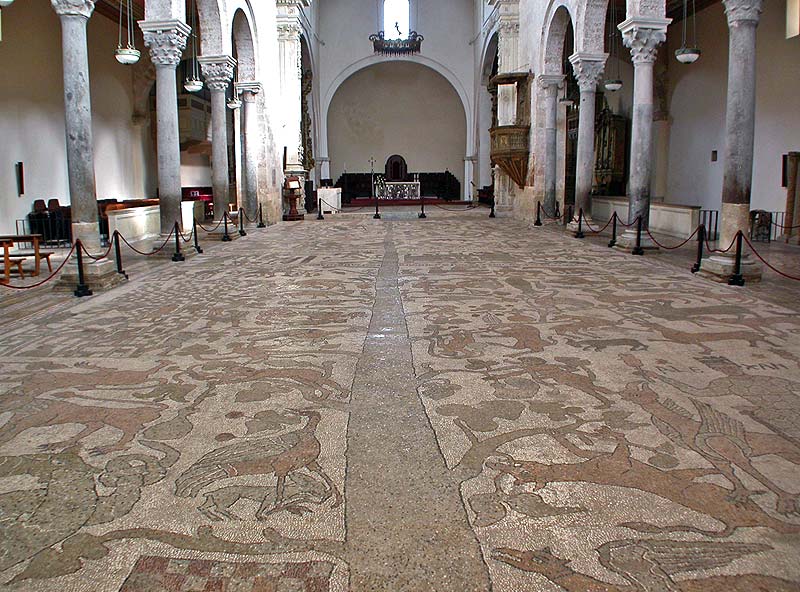
We continue on to Otranto, and drive straight up to the Cathedral. For this is the objective of our visit to Otranto – or rather the floor of the church is. When visitors enter the church, they are greeted by this magnificent floor.
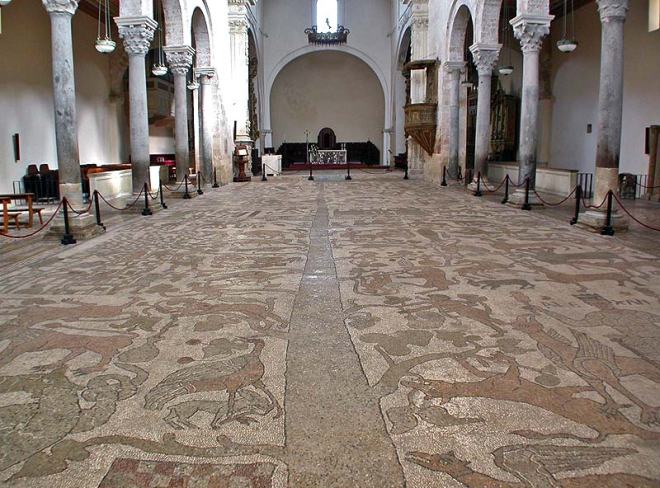
otranto-mosaic-1

It is the largest floor mosaic in Europe. It brings me back to that other floor mosaic which we visited in the first leg of our trip in Aquileia, although eight centuries separate them. Some clever fellow took this photo from the ceiling, showing more or less the full extent of the mosaic.

otranto-mosaic-2

The subject of the mosaic is a Tree of Life, and you can indeed see the trunk of the tree working its way up the nave. Strangely enough, the narrative of this tree flows from the top down, and so near the high altar we have various scenes from the story of Adam and Eve, of which I throw in one photo.
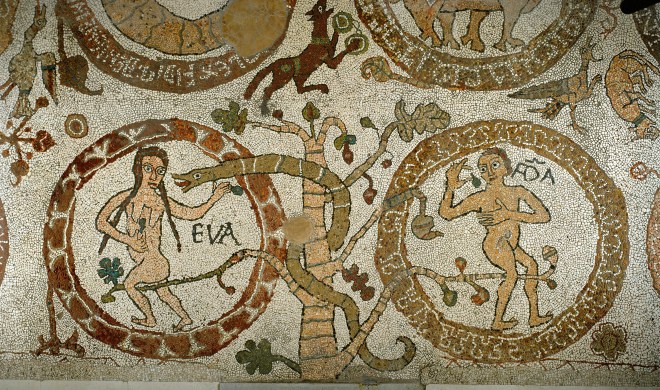
otranto-mosaic-3-adam eve snake

Honestly speaking, the story is difficult to read, so I shall just insert a couple of photos of other parts of the floor. This is King Arthur
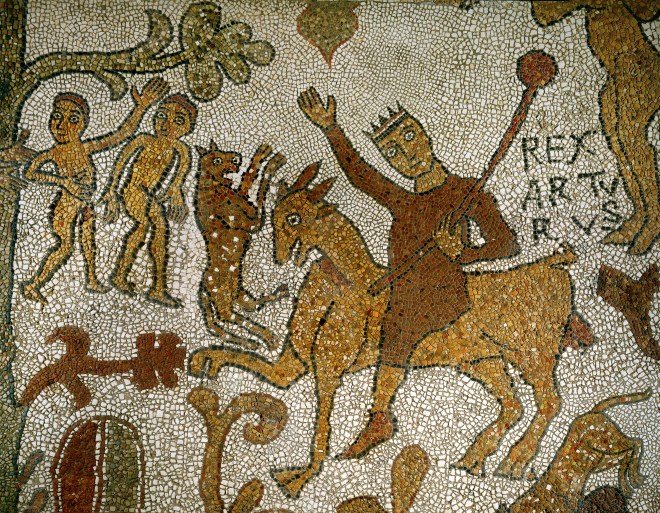
otranto-mosaic-4-King Arthur

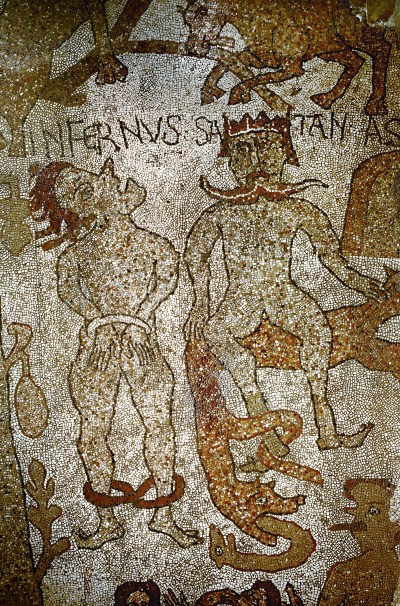
and this, Satan

otranto-mosaic-5-Great Satan

while this is said to be a self-portrait of the floor’s designer, a monk by the name of Pantaleone who hailed from the monastery of San Nicola di Casole, a little to the south of Otranto.

otranto-mosaic-6-Pantaleone_ self-portrait

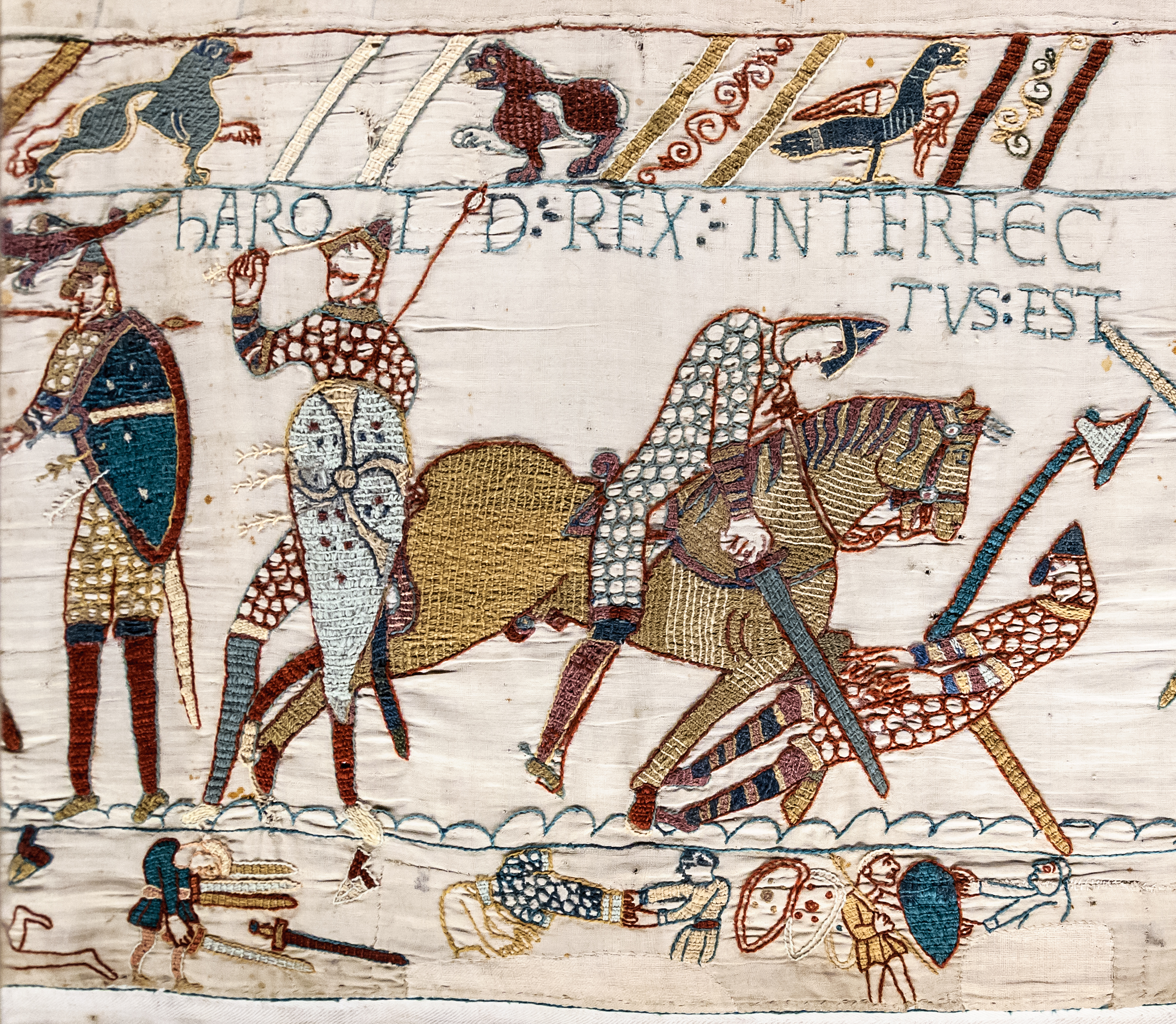
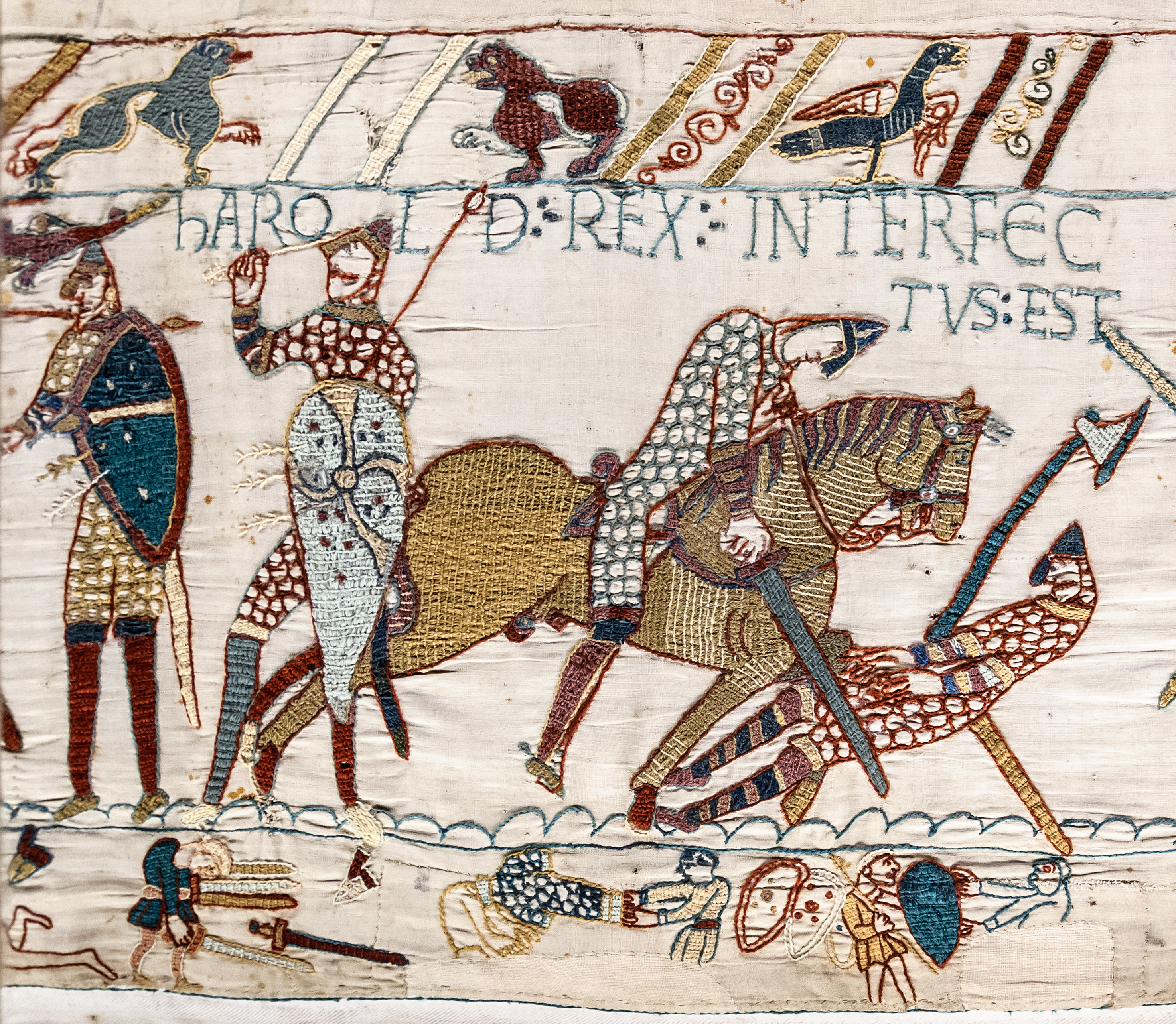
The mosaic was laid down in the 12th Century when this part of Italy was Norman, along with Sicily. In fact, the design of the floor rather reminds me of that other great masterpiece of Norman art, the Bayeux tapestry. I include here one photo of that tapestry, the famous scene where Harold Godwinson is killed by a Norman arrow through his eye.

Tapisserie de Bayeux - Scène 57 : La mort d'Harold

Next stop: Palermo in Sicily. We’ll get there by cutting across Italy’s heel to Taranto and then along the instep and sole of the Italian boot all the way to Reggio Calabria, where we’ll catch the ferry over to Sicily. I take the back roads to get to Taranto, because I want to drive through the small town of Copertino. As far as I know, this town is known for nothing special except a large castle and a saint. But to us, it has a great importance: my wife’s maternal grandfather came from Copertino and so it is the source of one-eighth of my children’s DNA. He emigrated to Milan in the early 1900’s, part of the massive migrations out of the south of Italy at the turn of the 20th Century. In typical migratory fashion, his departure eventually brought all his brothers and sisters up north. Family lore has it that his father ruined the family by taking the new Italian State to court over the expropriation of some of his land. He took the case all the way to the Court of Cassation, where he eventually lost the case, by which time he had also burned through all his money. Even though this is a very modest place with nothing special to write home about, I feel I must throw in a photo to commemorate it.

copertino

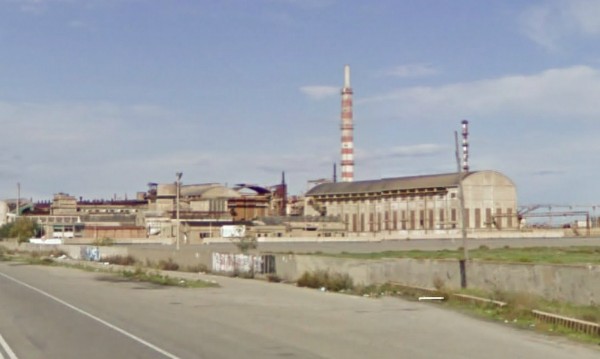
Onwards to Taranto, although in truth as we approach the city we turn our heads away and drive on. Taranto has been devastated by the plans of successive Italian government in the post-war period to develop the south of Italy through the implantation of heavy industry (I’ve already mentioned this in another post on Sicily). What were then the biggest steel works in Europe were plonked down here in the 1960s, and other heavy industry followed. By the 1980s, when my wife and I went to Taranto for the first time, the investment was in trouble. But the government couldn’t let it go down the tubes, it was politically too important. So money – half of it wasted through corruption and graft – was poured in to prop everything up. It’s stayed propped up – just – but in the meantime the industrial complex has poisoned half the population. Talk about sustainable development …

taranto

We are now driving through what was once Magna Graecia, Greater Greece, that string of Greek colonies which dotted the underside of the Italian boot as well as the coasts of Sicily (and even the shin and calf of that shapely Italian boot). The glittering stone in this string of cities was undoubtedly Syracuse in Sicily, where Archimedes – he of the original eureka moment – was born and was killed. But all the cities along here, from Taranto in the East to Selinunte in the West, were once flourishing and prosperous city-states. One of them, Sybaris, even became a byword for self-indulgent opulence – it was said of one of its citizens that he slept on a bed of rose petals, and if even one of them was folded over he could not sleep. The town’s name has entered the English language, a sybarite being a voluptuary or a sensualist. Now, Sybaris lies under four meters of mud. The only claim to fame of the surviving Calabrian towns is that they are infested by the ‘Ndrangheta, Calabria’s answer to Sicily’s mafia. It is said that John Paul Getty III, kidnapped in Rome back in 1973, was kept hidden in these parts. He was returned after his family forked over a ransom of $3 million – paid a good deal reluctantly (his grandfather is reported to have said, “I have 14 grandchildren. If I pay one penny now, I’ll have 14 kidnapped grandchildren”) and only after one of his ears had been cut off and sent to a newspaper. It is whispered that many a new house around here was built with Getty money.

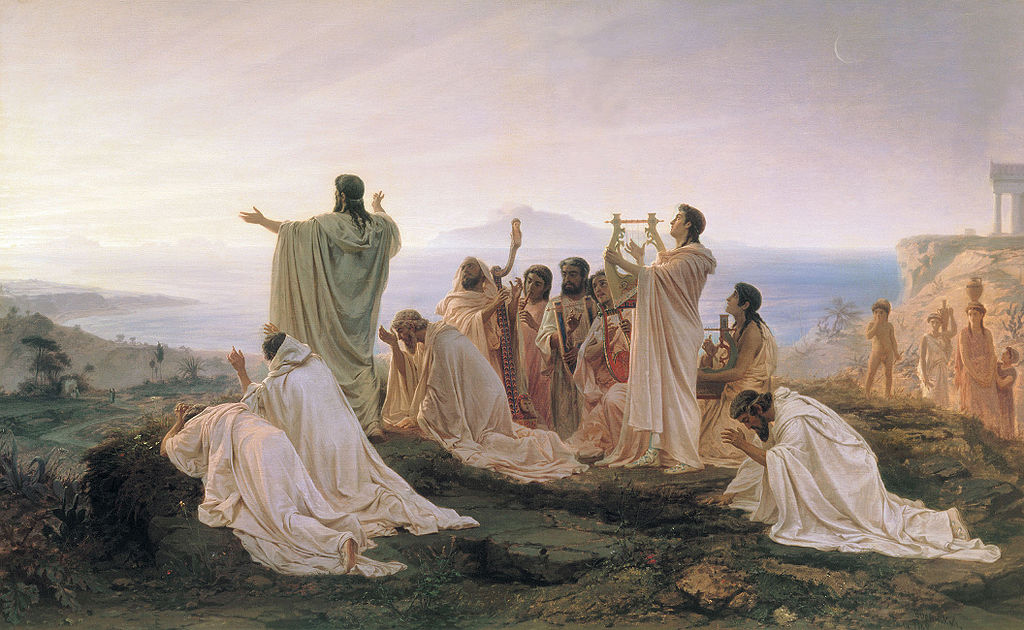
We stop for a moment in Crotone, on the ball of Italy’s foot, not because it’s any less dreary than the other towns we’ve passed through, but because something momentous happened here: Pythagoras set up his first school and came up with all those clever mathematics, among which was his theorem which I, like every child of 11 or so, learned in geometry class: “a2 + b2 = c2“, or in plain English, “in a right triangle, the square of the hypotenuse is equal to the sum of the square of the other two sides”. At least, that’s what I was told by proud Crotonesi when I was here 20 years ago to do an environmental audit. Alas! It was not so. Pythagoras did indeed come to Crotone, but all he did was to set up some sort of mystical, esoteric sect which dabbled in the quasi-magic of whole numbers. It’s very unlikely that he personally came up with any of the mathematical cleverness attributed to him; his disciples did, but later. I think this painting, by a 19th Century Russian painter, captures nicely the strongly mystical (and to my way of thinking, rather weird) overtones of the initial Pythagorean movement.

pythagoreans celebrating sunrise

What Pythagoras and his sect did do in Crotone was to eventually take over the city’s government, and it was during his time in office that Crotone destroyed Sybaris. Several other cities in the area also espoused Pythagorean forms of government, but after a while there was a backlash. Back in Crotone Pythagoras was chased out, to end his days in nearby Metapontum, another city now lying under meters of mud. But Pythagorean schools continued, although they restricted themselves to maths and “natural philosophy” and left politics to others. Probably better that way …

I take one last look at the industrial plant I audited all those years ago – another industrial works plonked down here, and another one that has closed, leaving nothing but bitterness in its wake.

pertusola

It’s time to move on.

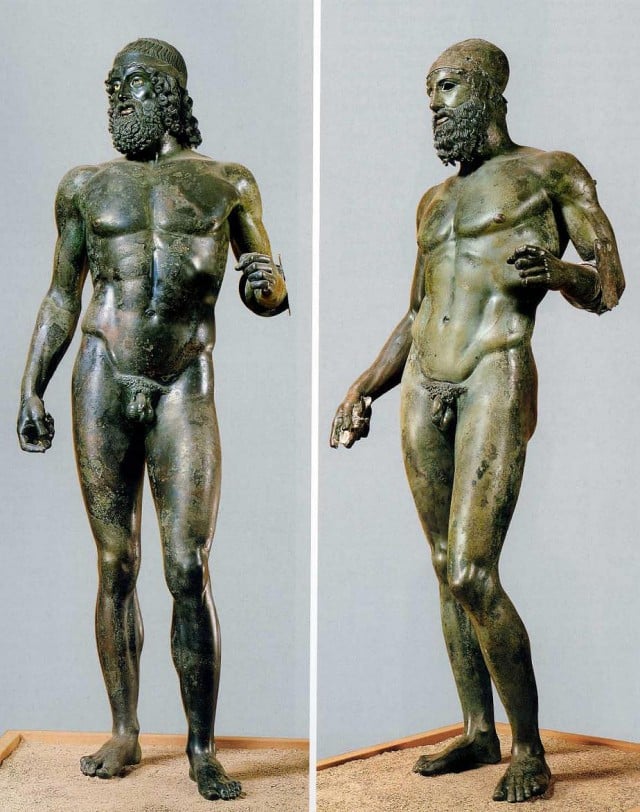
When we reach Reggio Calabria, although my wife is reluctant I insist: we must go to the Museum of Magna Graecia to see the two Bronzes of Riace. Neither of us have ever seen them, and it would be a pity not to take advantage of our passing through Reggio to have a peek. I know the objective of our trip is early Christian mosaics, but other wonders along the way should not be ignored. No sooner said than done! With a click of the mouse, I have us parked in front of the museum and magically transported past the queues of people waiting to enter the climate-controlled, earthquake-proofed room where they stand.
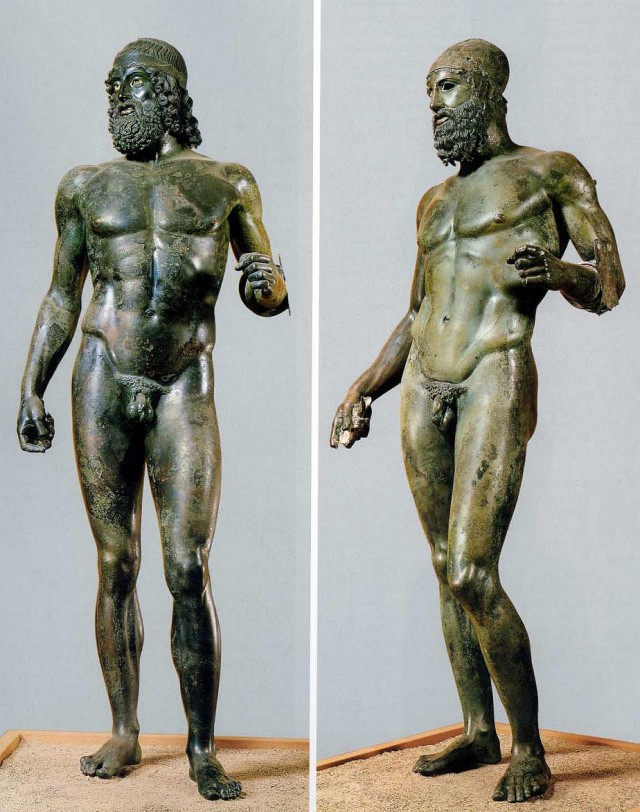
bronzi di riace

What magnificence! And what we see today are stripped down versions of the original. Each would have been coiffed with a Corinthian-style helmet, would have carried a shield on that raised left arm, and would have held a lance in the other. The latest theories hypothesize that they represent two of the Seven Heroes who set off from Argos to fight against Eteocles, king of Thebes and son of Oedipus (he of the complex), and died at the city’s seven gates. One expert suggests that they were originally part of a group of seven statues which stood in the Agora of the city of Argos. How they ended up on the sea bed off the coast of Calabria is anyone’s guess. My guess, for what it’s worth, is that during Roman times Argos was hard up, and rich Romans, avid for Greek art, came along and offered to buy the statues. Why not … In later centuries hard-up Italians sold their Renaissance treasures to rich Englishmen, avid for Italian art, and later still these Englishmen, hard up in their turn, sold these same treasures to rich Americans. In any event, they were being shipped to Rome, but when the ship was off the coast of Calabria a violent storm blew up, and the captain, rather than losing his ship and his life, tossed the heavy stuff overboard.

Time to catch the ferry over to Sicily, home to some of the most beautiful Byzantine-style mosaics still extant, created when the Normans controlled Sicily. The web helpfully informs us that there is a ferry over to Messina every hour or so. In this dream trip, we will not have any difficulty in catching the ferry, unlike real life 30 years ago when my wife and I decided to take her mother to spend Christmas and the New Year in Sicily. We arrived in Reggio Calabria on the evening of 23 December, along with a horde of Sicilian migrant workers returning home from Northern Europe for the holidays. We discovered to our horror that the ferry boat crews had just decided to strike for more pay. Those bastards had chosen this particular time to strike because they knew it put the owners under huge pressure to settle. Settle they did, but not before we had spent a miserable night in the ferry car park. When those ferry boat crews arrive, as they assuredly will one day, before the Pearly Gates, I hope they will be kicked off down to Hell, to roast in its fires for Eternity (anyone curious to know what that might look like can refer back to the posting with which I started this dream journey and study the photo I inserted there from the back wall of the church on the island of Torcello).

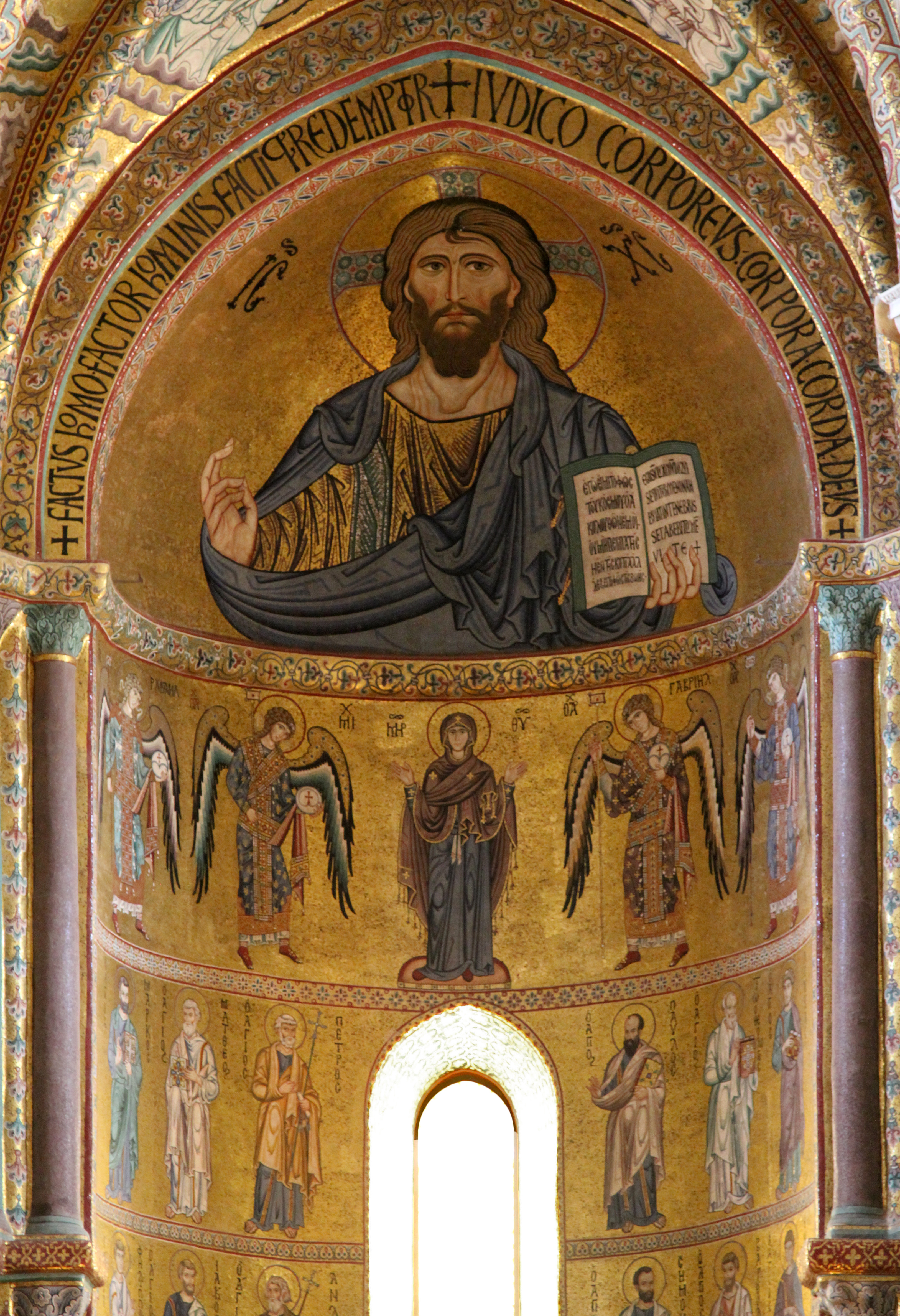
Once on the other side,  we set off for Palermo. I firmly decide that we will take the normal roads to get there. In this dream we’re in no hurry, and I prefer by far the “reeling roads”, the “rolling roads”, that “ramble round the shire”, as G.K. Chesterton wrote in his most famous poem “The Rolling English Road”. Yes, I prefer by far his “merry roads” and his “mazy roads” to the smooth monotony of sterile highways. We pass Milazzo, where you can catch the boat to the Aeolian Islands – a trip for another day – and where I did yet another environmental audit 20 years ago for another struggling industrial complex, which mercifully has not closed – yet. We hum along until we arrive at the small town of Cefalù, nestling under the mighty headland which gives it its (Greek) name. We head, yet again, for the Cathedral, constructed by the Normans in the first half of the 1100s. There, some beautiful mosaics still cling to the apse and the last bay of the choir.

cefalu-duomo-1

The Pantocrator gracing the apse is “for many the greatest portrait of Christ in all Christian art”, in the words of John Julius Norwich (I am quoting from his history of Sicily).

cefalu-duomo-2

The style is clearly mature Byzantine, a style we’ve already seen in Istanbul as well as in the lagoons of Venice, and would have seen in Daphni and Saint Luke in Greece had we made the detour from Thessaloniki. The Normans got Byzantine artists, or artists trained in Byzantine workshops, to make the mosaics.

It’s time to go on to Palermo, which is our final destination on this leg of the journey. We hug the coast, coming into the city on its seaward side. Once we reach the port, we swing up Via Vittorio Emanuele (there’s one of these in every village, town, and city in Italy, along with a Via Garibaldi), which is the main thoroughfare through the city’s old center. When we get near the Martorana church, we miraculously find – free! – parking (this is a dream, after all) for our little MG and head over to the church.

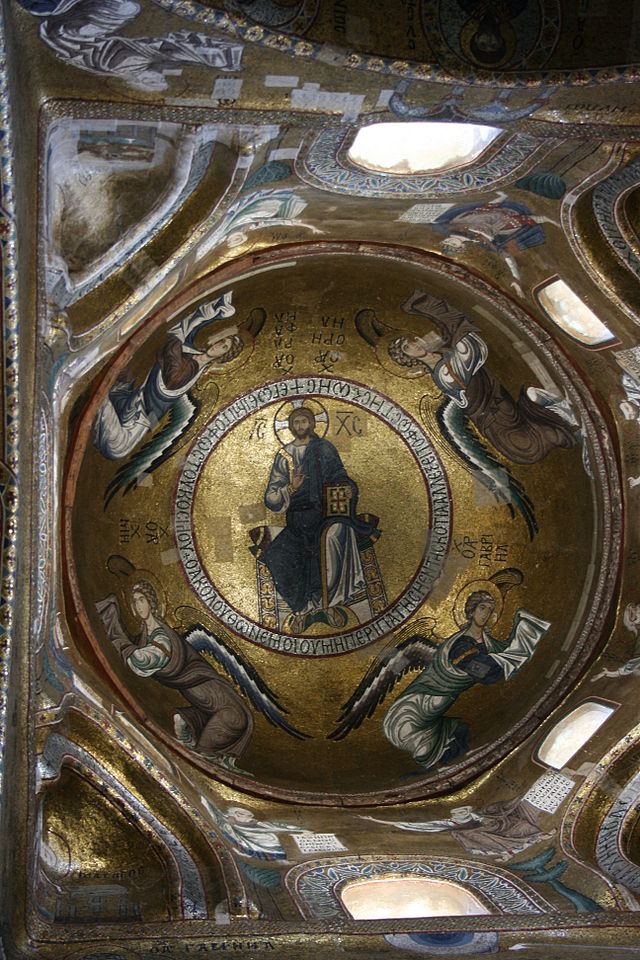
The church has been much modified over the centuries, not least of which by a brutal Baroque make-over in the front part of the nave in the 17th Century. But once we get past these horrors and enter the upper nave, we are greeted by some lovely mosaics: Christ in majesty in the dome of the church

palermo-martorana-1

the annunciation

palermo-martorana-4

the nativity

palerno-martorana-7

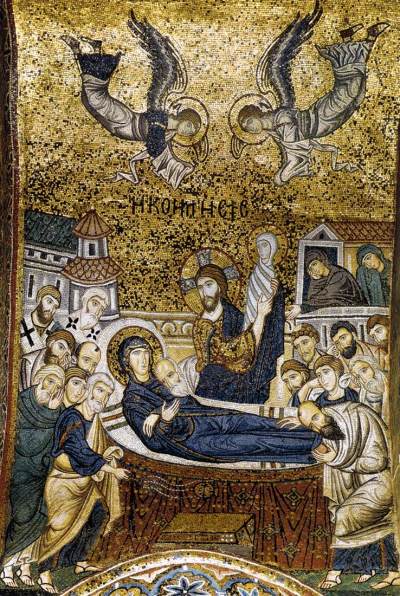
the dormition of the Virgin Mary

palerno-martorana-6

As we leave, I want particularly to see these two mosaics. In this first one, we have the greatest of all the Norman kings of Sicily, Roger II, having himself cheekily crowned by Christ himself, as if he were a Byzantine emperor
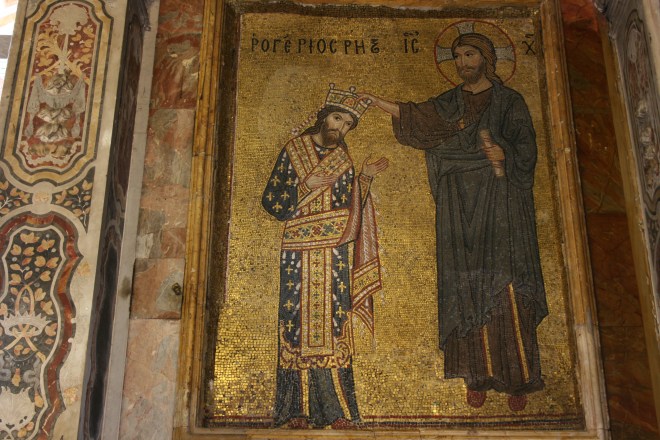
palermo-martorana-2

It was he who first brought this Byzantine art form to Sicily.

And here we have the original donor of the church, George of Antioch, Roger II’s admiral, humbly offering his church to the Virgin Mary (much like we saw in Cariye Kamii in Istanbul)
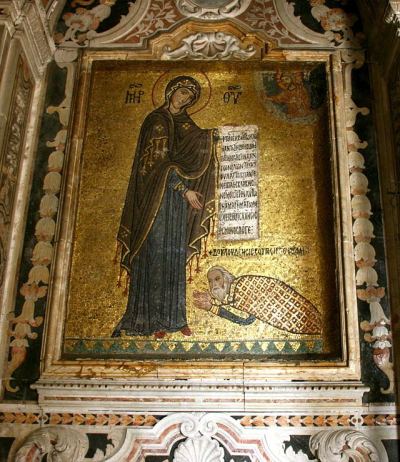
palermo-martorana-5

A final note about this church: it belongs to the Italian-Albanian community in Sicily, the remnants of the Albanians who fled to Italy in the 15th and later Centuries as the Ottomans methodically went about conquering their home country. So it is not just geographical proximity which led the modern Albanians back in late 1990s to escape by their thousands to Italy as Albania imploded after the collapse of Communism (with many of these new arrivals squatting in and around Otranto, as it so happens).

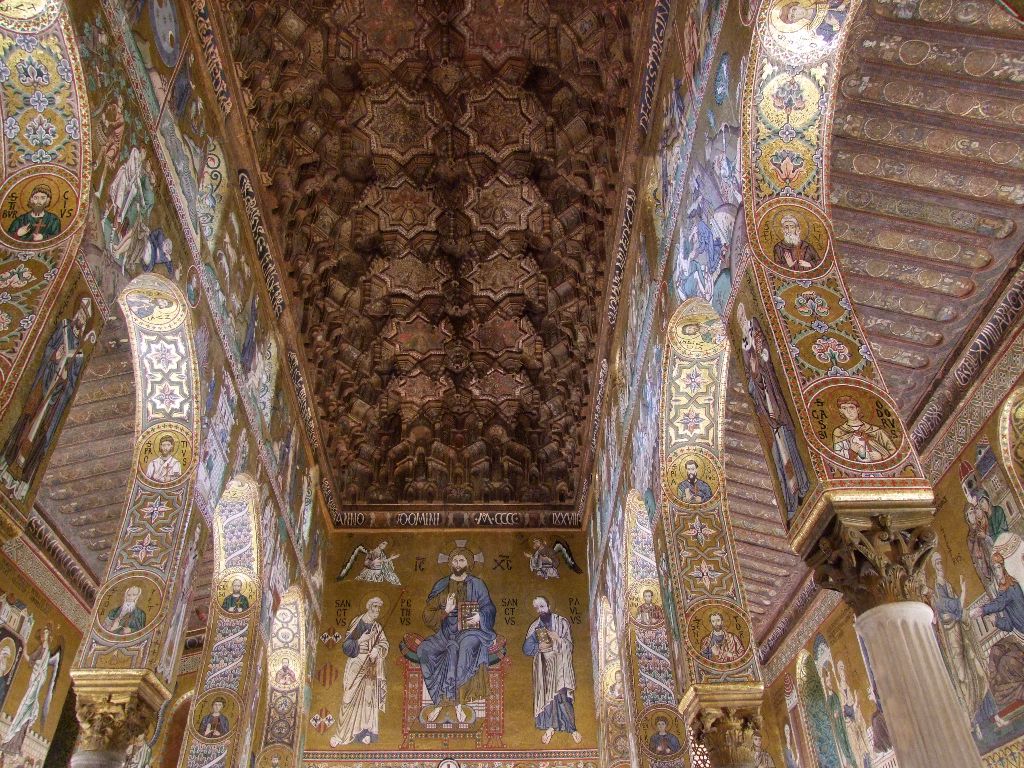
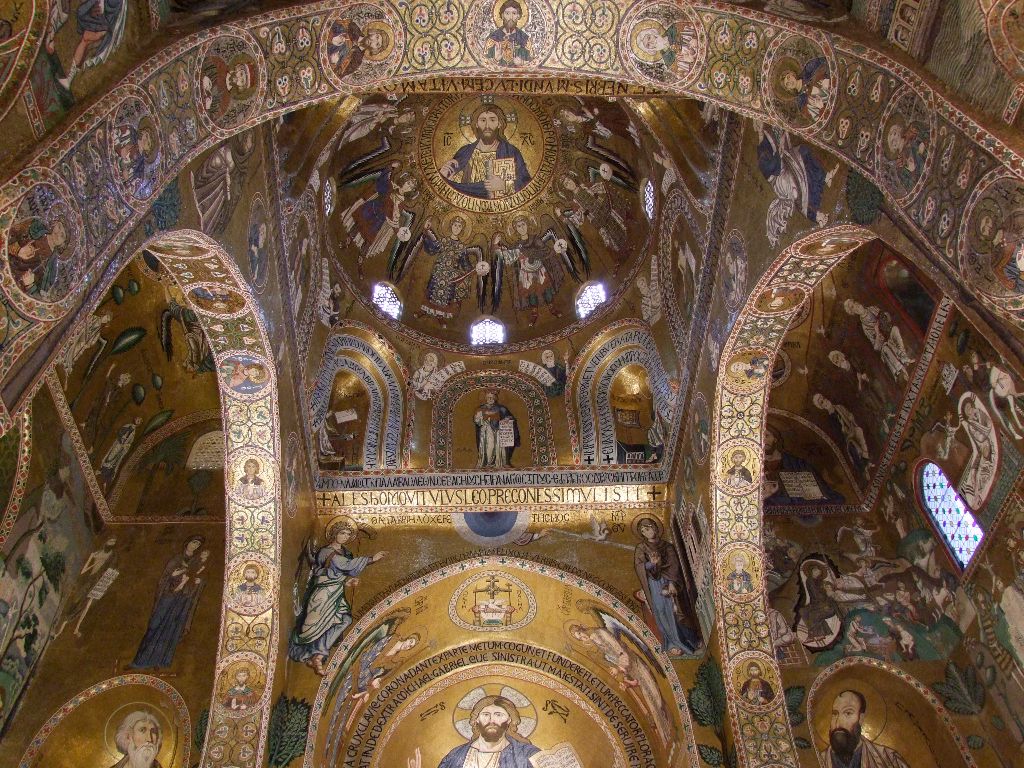
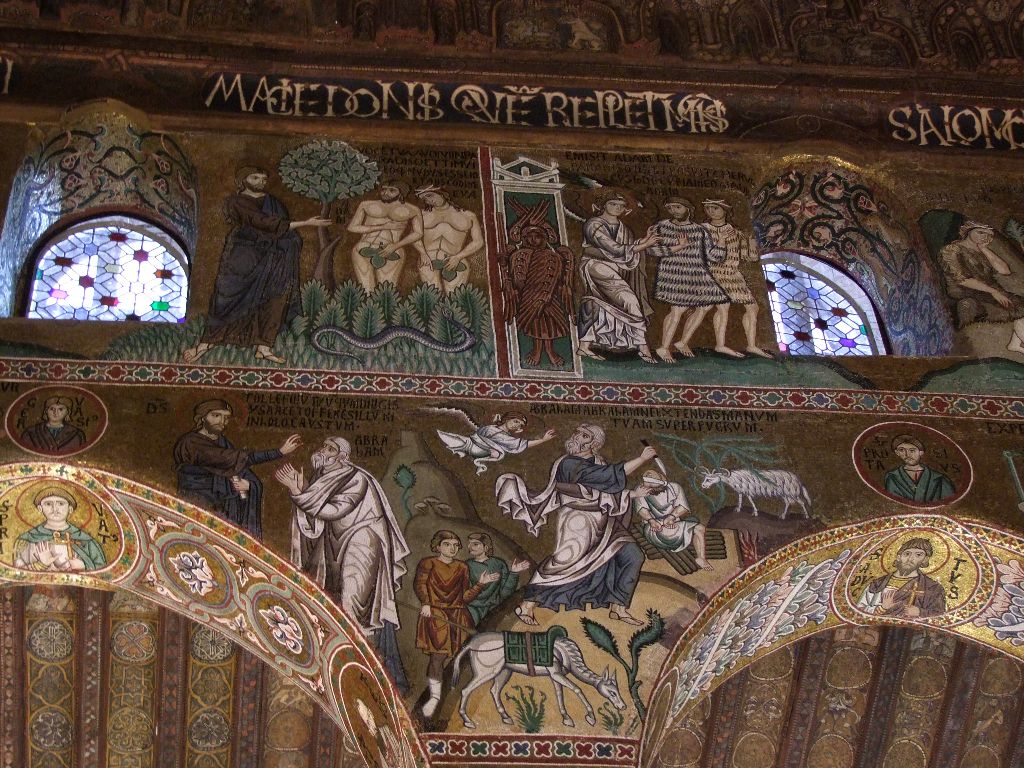
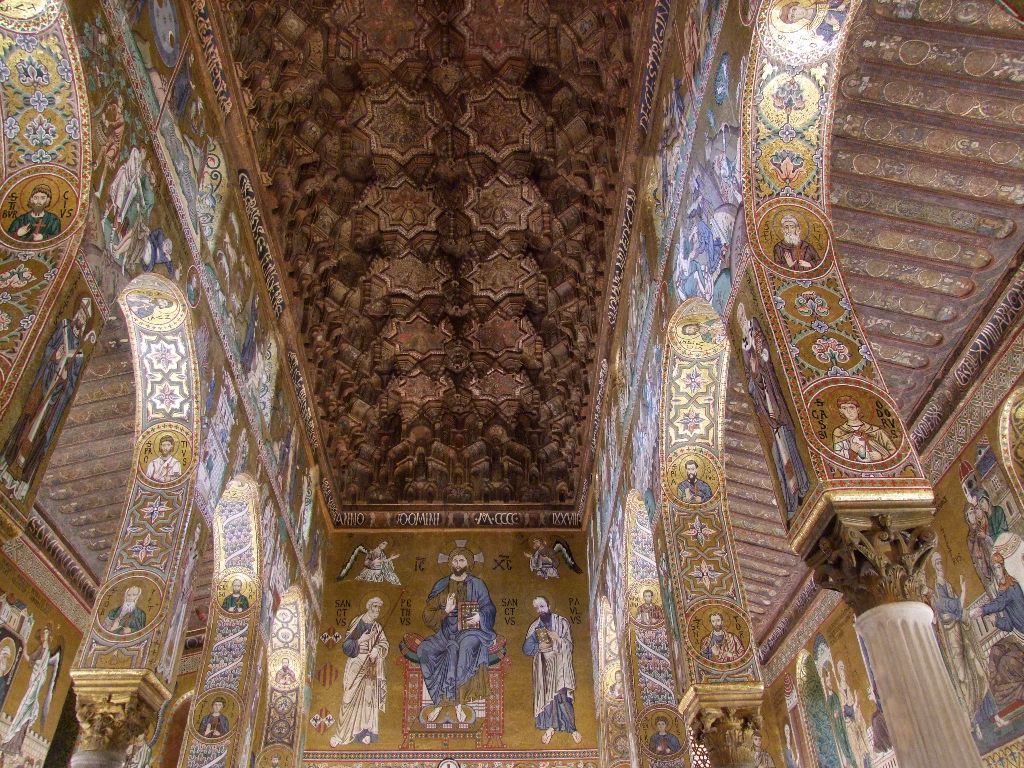
We go back to the car and continue up Via Vittorio Emanuele to the Palazzo dei Normanni, the Palace of the Normans, which actually was originally built by the Arabs. This rather severe building houses the Cappella Palatina, which was built by Roger II as the King’s private chapel. It houses some magnificent 12th Century mosaics.
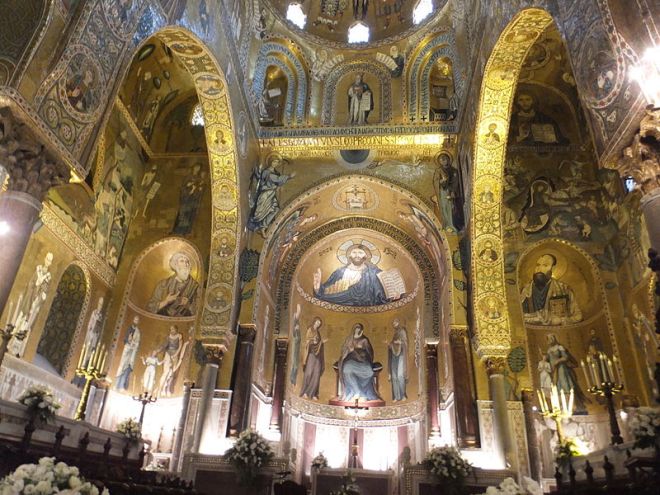
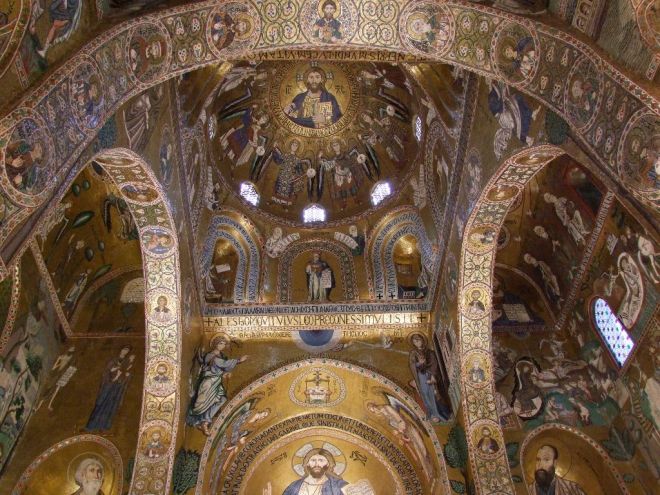
palermo-cap-palatina-1

palermo-cap-palatina-6

palermo-cap-palatina-5

This last one shows also the ceiling, a wonderful piece of Arab carpentry work, an example of which we last saw in the Alhambra palace in Granada.

palermo-cap-palatina-4

Roger II understood that in this island with large Greek and Arab populations, he had to be open to their cultures if he was going to maintain the peace. Indeed, he welcomed this mixing of cultures. It is part of Sicily’s tragedy that later rulers did not continue this practice of toleration and openness.

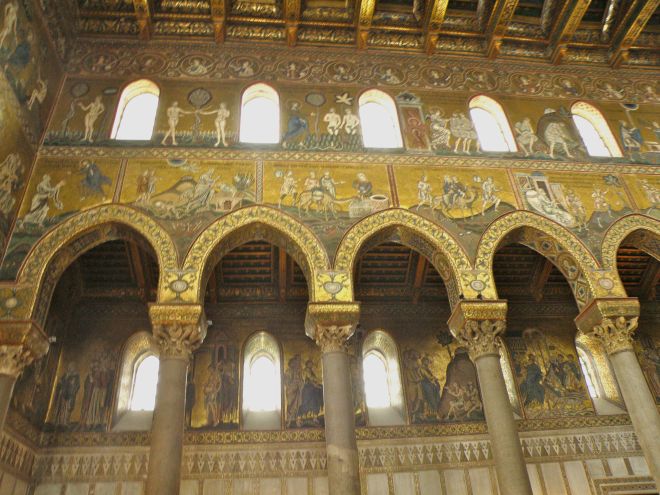
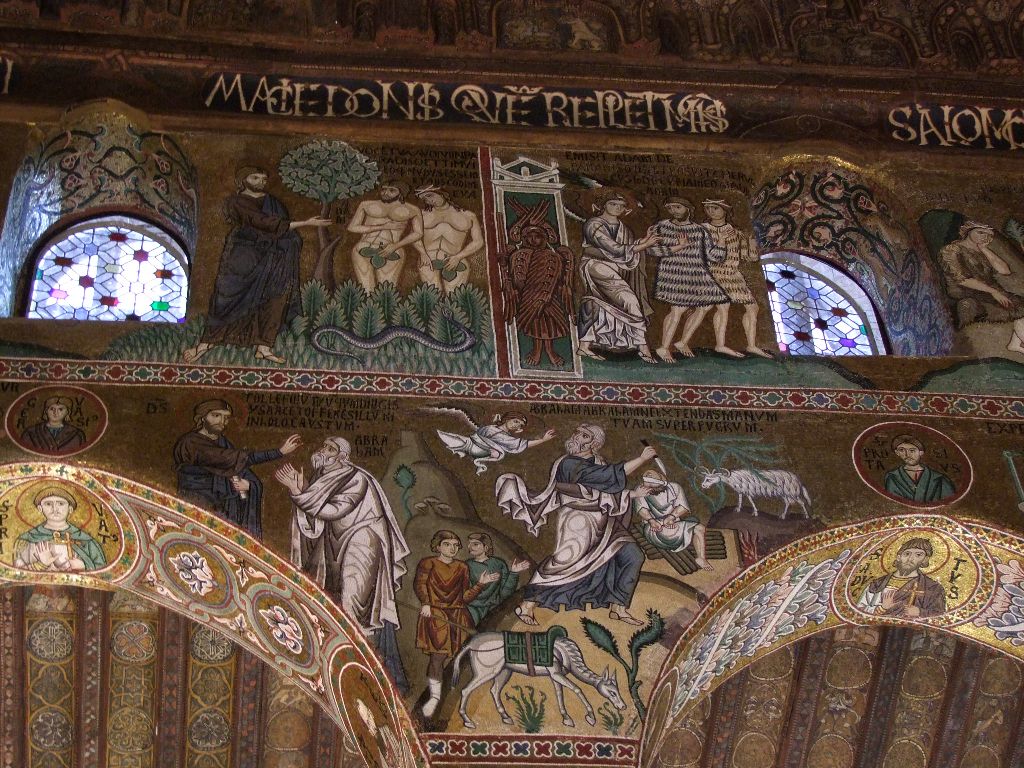
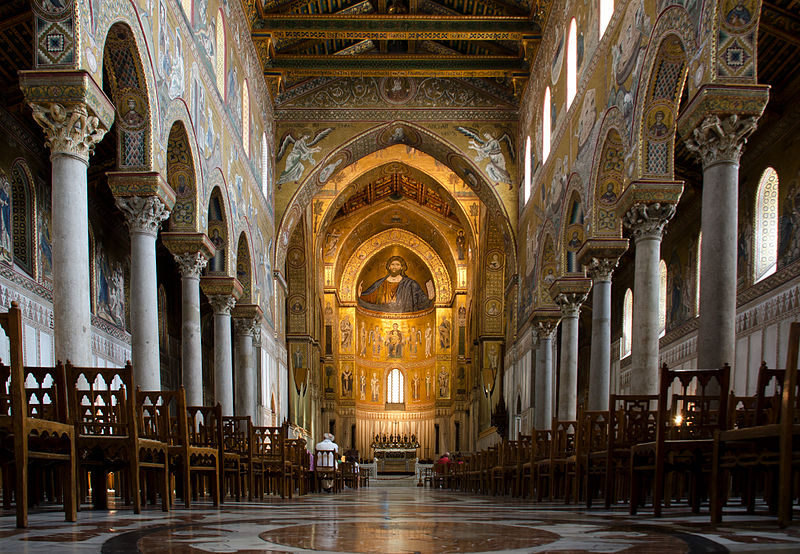
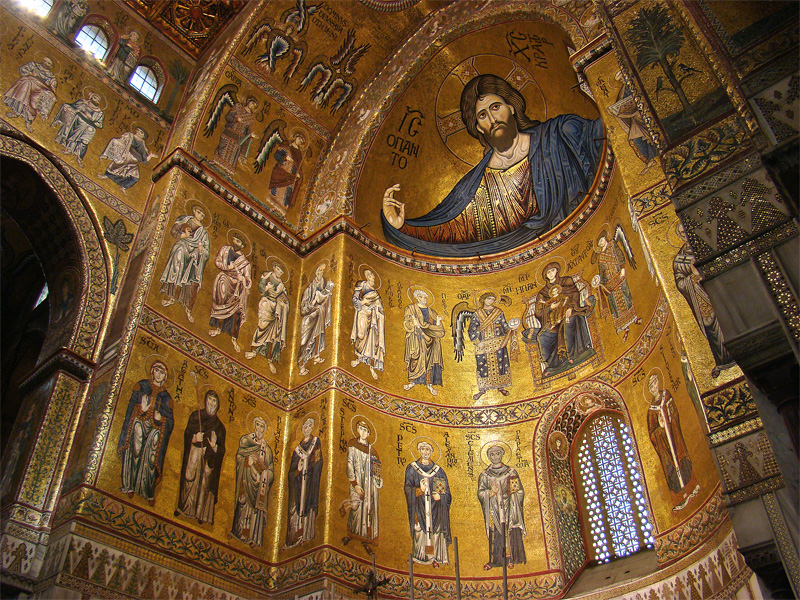
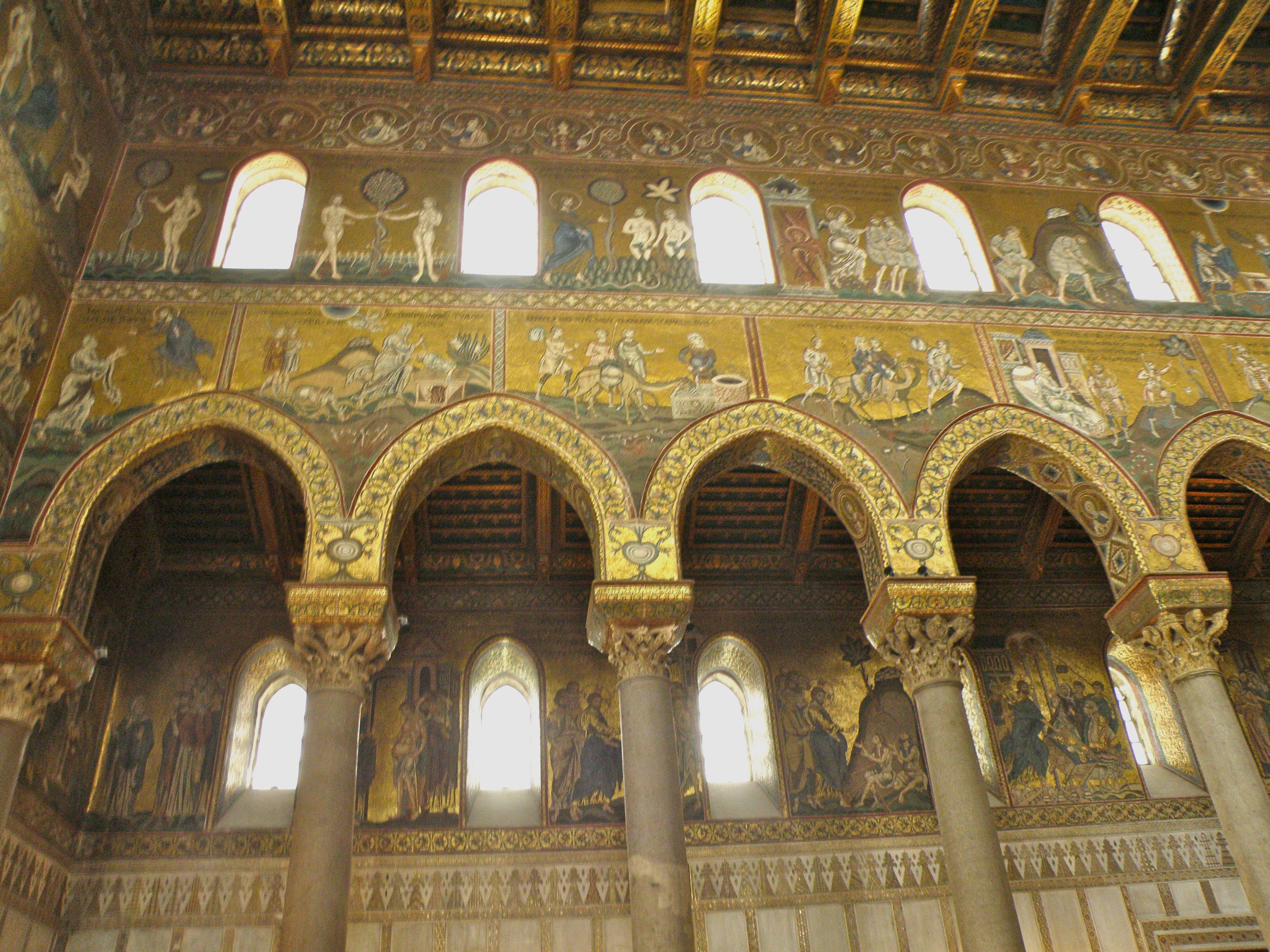
We are not finished yet! We vault into the car (after constant badgering by our children we’ve taken to doing a lot of exercise recently, so I can imagine ourselves vaulting jauntily over the doors and dropping into our seats) and we keep on going up Via Vittorio Emanuele, which has now morphed into Via Calatafimi. We go on and on until we hit the hills behind Palermo, at which point we start climbing and finally find ourselves in Monreale, once a village on the outskirts of Palermo but now a suburb. We head – of course – for the cathedral and casually park the car in front of the cathedral. We walk into this late 12th Century church and I suddenly feel that I am back in the church of Sant’Apollinare in Ravenna, where we started our dream journey.

monreale-duomo-1

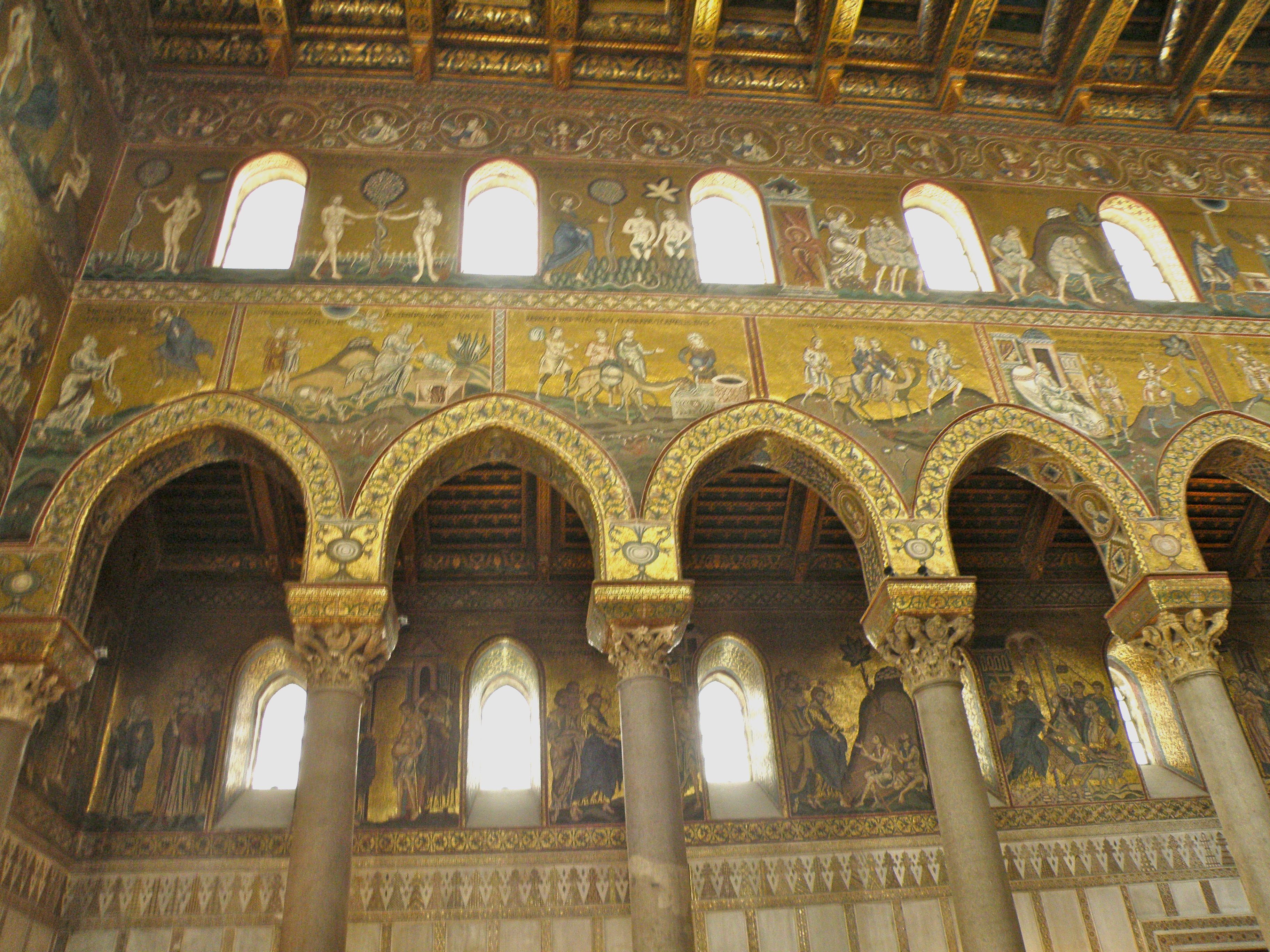
Biblical scenes on fields of gold unfurl along upper tiers of the nave
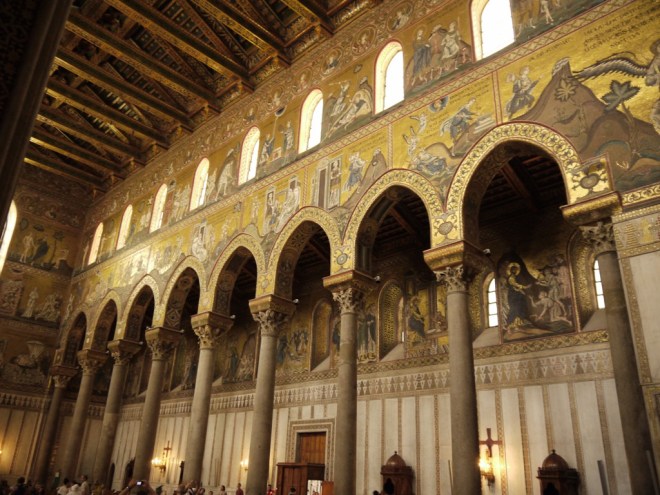
monreale-duomo-6

OLYMPUS DIGITAL CAMERA

to reach the theological high point in the apse, with its assembled saints and angels presided over by a rather severe Pantocrator.

monreale-duomo-2

But how the styles have changed in the intervening six centuries! Then, it was still Roman art, although of a rough-and-ready sort. Now, it is early medieval art in all its stiff, hieratic splendour.

After all that gold, we go up on the roof of the church and drink in the astringent blue of the sky, which is rather like eating a lemon sorbet after a heavy main course so as to cleanse the mouth of all that richness. We gaze out across Palermo and over the “wine-dark” Tyrrhenian Sea beyond (to borrow Homer’s rather strange description of the sea’s colour).
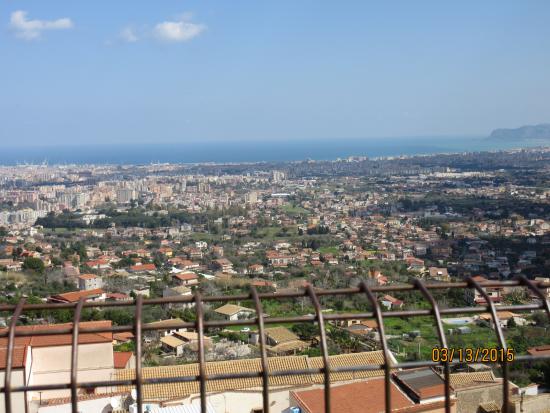
monreale-panoramic-view

Tonight, we will catch the ferry and cross that sea to Naples – another Greek colony long, long ago – and from there drive up to Rome, our last stop on this exhaustive, and mentally exhausting, tour of early Christian mosaics.

_________________

Lecce: https://youthfullyyoursgr.files.wordpress.com/2013/05/lecce-it.jpg (in https://youthfullyyoursgr.wordpress.com/%CF%80%CF%81%CE%BF%CE%B3%CF%81%CE%AC%CE%BC%CE%BC%CE%B1%CF%84%CE%B1/get-up-stand-up-be-healthy-guys-youth-exchange-lecce-%CE%B9%CF%84%CE%B1%CE%BB%CE%AF%CE%B1-22-29072013/)
Otranto-mosaic-1: http://www.paradoxplace.com/Perspectives/Sicily%20&%20S%20Italy/Puglia/Otranto/Cattedrale/Images_Mosaics/800/Mosaic_Floor-Nov06-DC9997sAR800.jpg (in http://www.paradoxplace.com/Perspectives/Sicily%20&%20S%20Italy/Puglia/Otranto/Otranto.htm)
Otranto mosaic-2: http://www.swide.com/wp-content/uploads/2014/06/Reasons-to-travel-puglia-apulia-italy-mosaics-Otranto.jpg (in http://www.swide.com/food-travel/reasons-to-travel-to-puglia-apulia-italy-top-20-things-to-do/2014/06/30)
https://canvas.harvard.edu/courses/305/pages/the-mosaic-of-otranto
Bayeux Tapestry: http://upload.wikimedia.org/wikipedia/commons/b/bb/Bayeux_Tapestry_scene57_Harold_death.jpg (in http://en.wikipedia.org/wiki/Bayeux_Tapestry)
Copertino: http://www.amedeominghi.info/wp-content/uploads/2014/05/PiazzaMazzini.jpg (in http://www.amedeominghi.info/nuovedate/)
Taranto: http://it.wikipedia.org/wiki/Ilva#/media/File:ILVA_-_Unit%C3%A0_produttiva_di_Taranto_-_Italy_-_25_Dec._2007.jpg (in http://it.wikipedia.org/wiki/Ilva#Unit.C3.A0_produttiva_di_Taranto)
“Pythagoreans celebrating the sunrise”, by Fyodor Bronnikov(1827–1902): http://en.wikipedia.org/wiki/Pythagoras#/media/File:Bronnikov_gimnpifagoreizev.jpg (in http://en.wikipedia.org/wiki/Pythagoras)
Pertusola: http://www.ilcirotano.it/wp-content/uploads/2012/06/Ex-Pertusola.jpg (in http://www.ilcirotano.it/2012/10/09/viaggio-nella-pertusola-sud/)
Bronzi di Riace: https://news.artnet.com/wp-content/news-upload/2014/08/Riace-bronzes-e1408562456865.jpg (in https://news.artnet.com/art-world/italy-risks-priceless-riace-bronzes-for-cash-82747)
Cefalù-duomo-1: http://commondatastorage.googleapis.com/static.panoramio.com/photos/original/74677063.jpg (in https://geolocation.ws/v/P/74677063/abside-del-duomo-di-cefal-cristo/en)
Cefalù-duomo-2: http://it.wikipedia.org/wiki/Duomo_di_Cefal%C3%B9#/media/File:Cefalu_Christus_Pantokrator_cropped.jpg (in http://it.wikipedia.org/wiki/Duomo_di_Cefalù)
Palermo-Martorana-1: http://upload.wikimedia.org/wikipedia/commons/thumb/c/c0/Chiesa_della_Martorana_cupola.jpg/640px-Chiesa_della_Martorana_cupola.jpg (in http://en.wikipedia.org/wiki/Martorana#Interior)
Palermo-Martorana-2: http://it.wikipedia.org/wiki/Chiesa_della_Martorana#/media/File:Palerme_Martorana168443.JPG (in http://it.wikipedia.org/wiki/Chiesa_della_Martorana)
Palermo-Martorana-3: https://classconnection.s3.amazonaws.com/848/flashcards/3299848/jpg/palermo_chiesa_20martorana_mosaic_nativity-13F311CF74763DF1FB7.jpg (in https://www.studyblue.com/notes/note/n/ecb-final-review/deck/8598474)
Palermo-Martorana-4: http://www.wga.hu/art/zgothic/mosaics/8/2martor2.jpg (in http://www.wga.hu/html_m/zgothic/mosaics/8/2martor2.html)
Palermo-Martorana-5: http://upload.wikimedia.org/wikipedia/commons/b/b3/Chiesa_della_Martorana_Christus_kr%C3%B6nt_Roger_II.jpg (in http://commons.wikimedia.org/wiki/File:Chiesa_della_Martorana_Christus_kr%C3%B6nt_Roger_II.jpg)
Palermo-Martorana-6: http://it.wikipedia.org/wiki/Chiesa_della_Martorana#/media/File:George_of_Antioch_and_Holy_Virgin_2009.jpg (in http://it.wikipedia.org/wiki/Chiesa_della_Martorana)
Palermo-Cappella Palatina-1: http://en.wikipedia.org/wiki/Cappella_Palatina#/media/File:Cappella_Palatina_in_Palermo_Sicily.JPG (in http://en.wikipedia.org/wiki/Cappella_Palatina)
Palermo-Cappella Palatina-2: http://www.scherminator.com/italy/sicily/cappellaPalatina/cappellaPalatina5.jpg (in http://www.scherminator.com/italy/sicily/cappellaPalatina/cappellaPalatina.html)
Palermo-Cappella Palatina-3: http://www.scherminator.com/italy/sicily/cappellaPalatina/cappellaPalatina0.jpg (in http://www.scherminator.com/italy/sicily/cappellaPalatina/cappellaPalatina.html)
Palermo-Cappella Palatina-4: http://www.scherminator.com/italy/sicily/cappellaPalatina/cappellaPalatina10.jpg (in http://www.scherminator.com/italy/sicily/cappellaPalatina/cappellaPalatina.html)
Monreale-Duomo-1: http://it.wikipedia.org/wiki/Duomo_di_Monreale#/media/File:MonrealeCathedral-pjt1.jpg (in http://it.wikipedia.org/wiki/Duomo_di_Monreale)
Monreale-duomo-2: https://ofsplendourinthegrass.files.wordpress.com/2012/08/p1110054.jpg (in https://ofsplendourinthegrass.wordpress.com/2012/08/30/monreale/)
Monreale-duomo-3: http://giazza.se/wp-content/uploads/2012/05/pal-dome-2.jpg (in http://giazza.se/?p=1506)
Monreale-duomo-4: http://it.wikipedia.org/wiki/Duomo_di_Monreale#/media/File:Sicilia_Monreale2_tango7174.jpg (in http://it.wikipedia.org/wiki/Duomo_di_Monreale)
Monreale-panoramic view: http://media-cdn.tripadvisor.com/media/photo-s/07/87/3f/dc/panoramic-view-from-the.jpg (in http://www.tripadvisor.it/LocationPhotoDirectLink-g666663-d4470498-i126304220-Norman_Cathedral_of_Monreale-Monreale_Province_of_Palermo_Sicily.html)
BEAUTIFUL BRIDGES

Bangkok, 19 March 2015

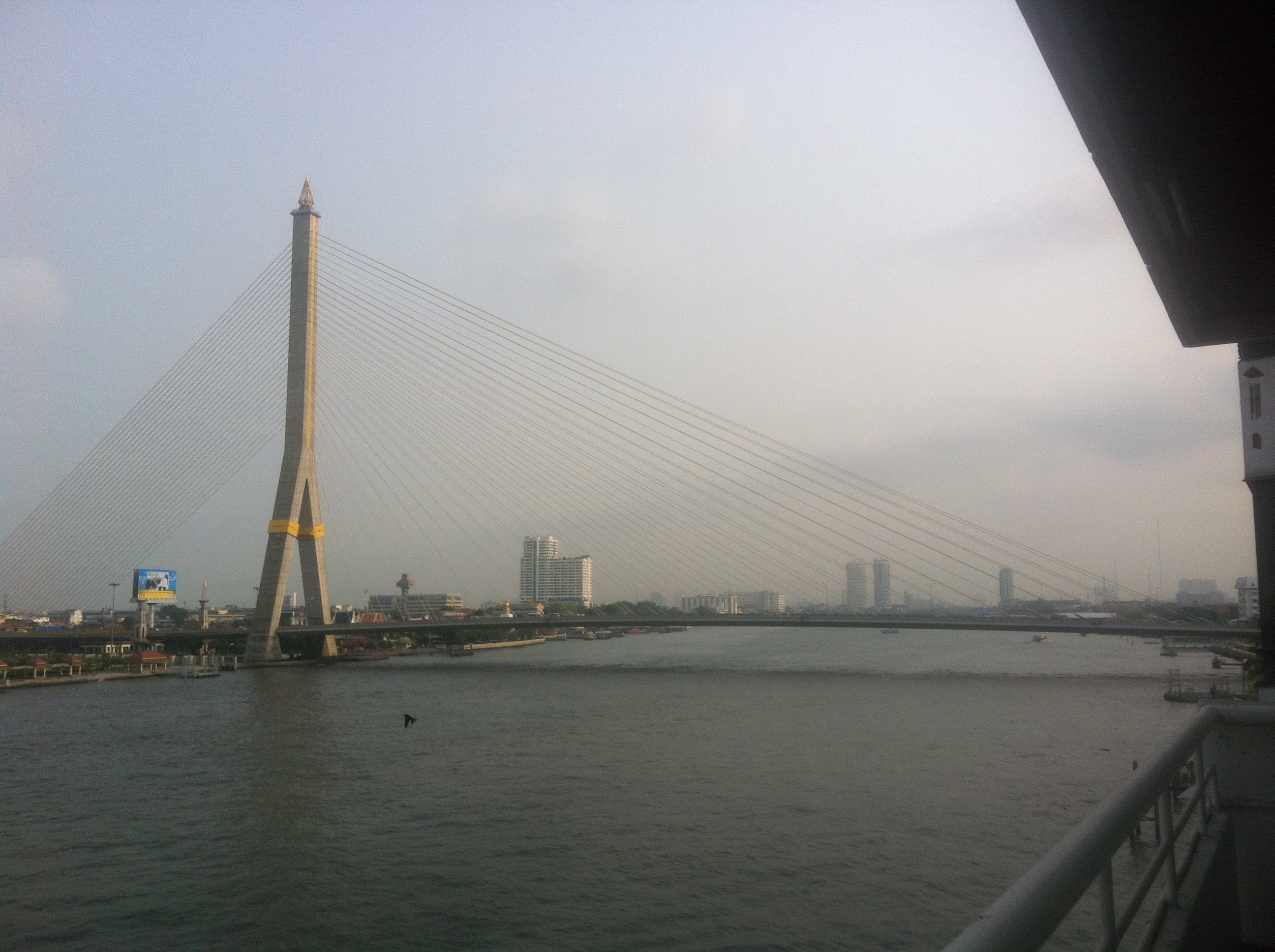
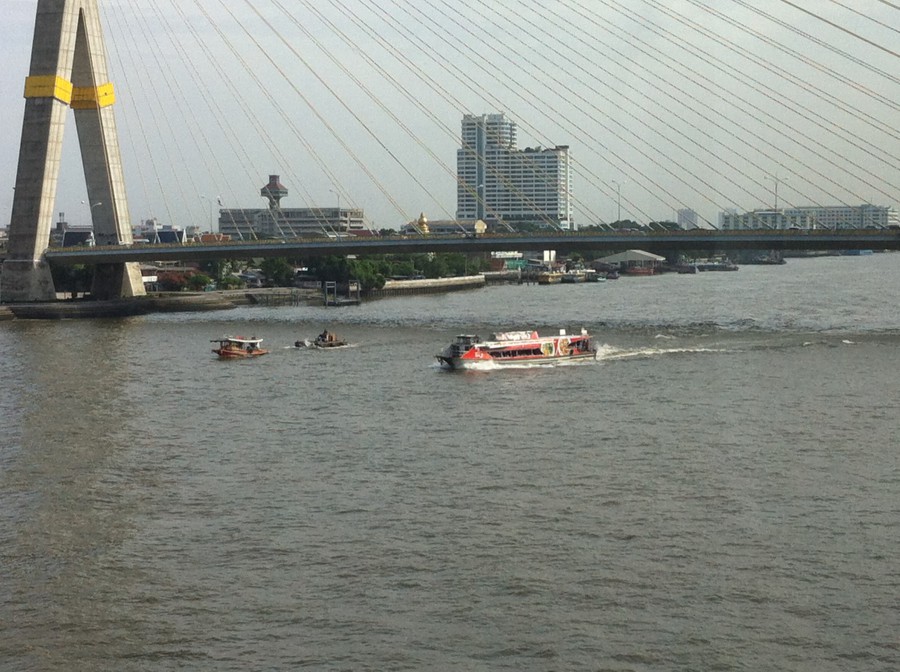
Every morning, when my wife and I have breakfast on the balcony, I am faced with this.

Rama VIII bridge

“This” is Rama VII Bridge, which crosses the Chao Phraya River, linking Thonburi with the more central parts of Bangkok. It was opened in 2002.

I don’t like this bridge. I don’t exactly know why. After discussions with my wife, I have come to the conclusion that I find the number of cables excessive, the colour scheme – sickly yellow on grey concrete – quite off-putting, and that conical thing on top of the bridge’s single pylon – seemingly a lotus bud – faintly ridiculous.

My meditations on what I didn’t like about the bridge led me to ask myself what I did like in bridges. After surfing through any number of sites claiming to list the 10, or 20, or 30, most beautiful bridges in the world, I have concluded that what gets me going in a bridge’s design is the play between simple geometric forms. Not any forms, mind you: the circle – or rather the semicircle – and its interplay with the line, preferably curved, is the best. And balance is required.

Let me start with the semicircle and shallow trianglesemicircle and triangleor shallow parabolasemicircle and wide parabola(Please excuse my rather basic sketches. I’m not an expert in the use of Paint)

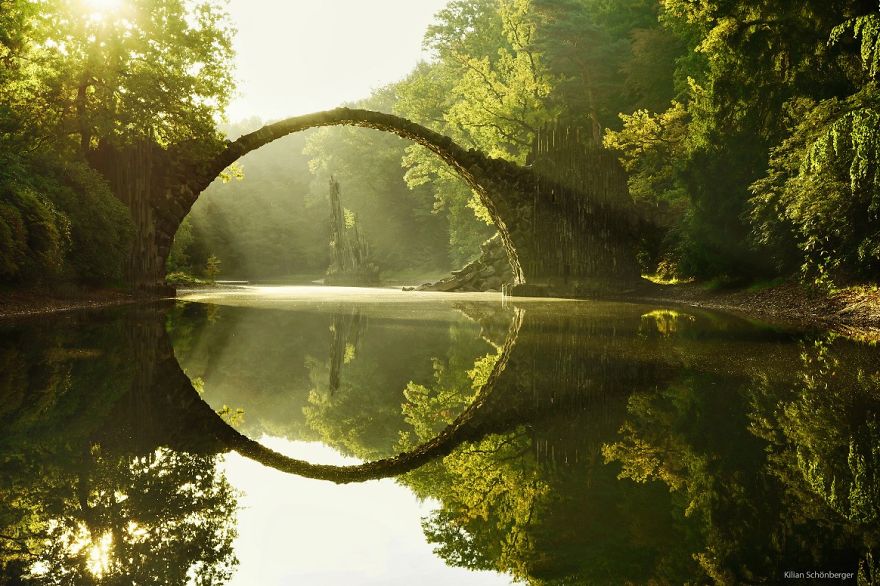
The most beautiful bridge in this class must be the Rakotz Brücke in Germany

rakotz bridge

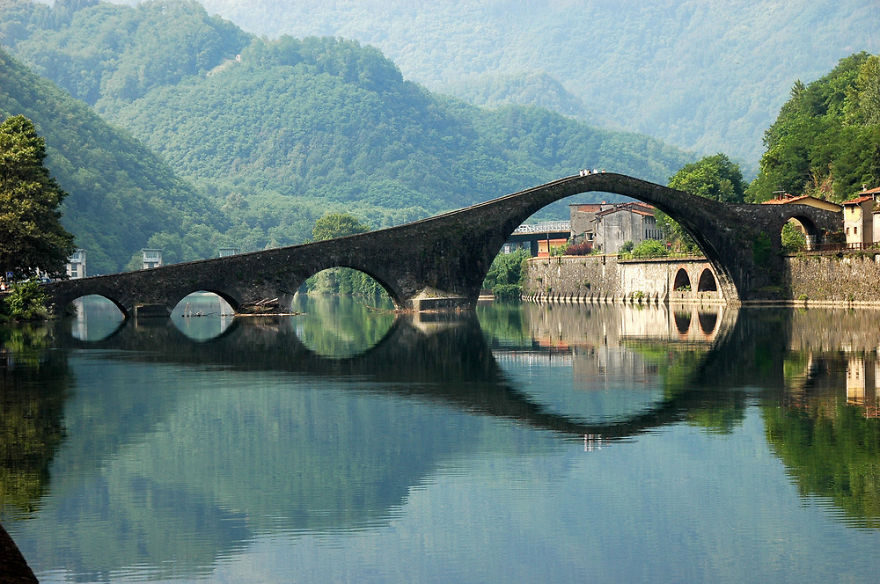
But this bridge, the Ponte della Maddalena in Italy, is a near second.

ponte del diavolo

I particularly like the three little skips which the bridge makes before it makes the final jump across the river. And it’s a real bridge, built to bring people and their goods and animals from one side to the other, rather than the Rackotz Brücke, which was just built for show.

I really feel I should add a picture of the Mostar Bridge.

mostar bridge

It looks a bit heavy, especially because of the building accretions on either end. But the bridge itself is a very nice example of the semi-circle-plus-triangle genre, and the white stone it is made of is really lovely. It’s also highly symbolic of the wars in ex-Yugoslavia. The bridge is in what is now the country of Bosnia-Herzegovina. During the wars, it was fought over repeatedly, and this beautiful bridge was among the many old buildings in the city which were destroyed. After the wars, it was rebuilt exactly as it has been, a triumph of hope over hate.

The Chinese also liked to build such bridges. They call them moon bridges. This one, the Jade Belt Bridge in the Summer Palace Park in Beijing, must be the best-known of this type.

jade belt bridge

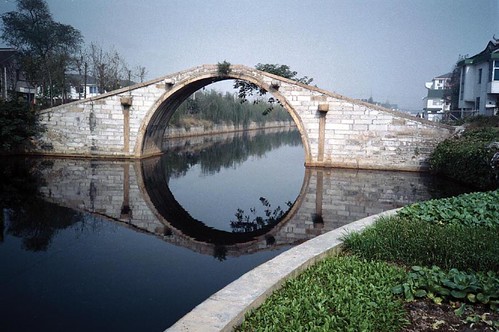
But like the Rakotz Brücke it’s just for show. I prefer this bridge, the Liija Bridge, thrown over a canal in Jiangsu province, because it is a real working bridge – or at least it was.

liija bridge

Alas, in this day and age where the car reigns supreme over our roads, humped bridges like these are not “user friendly”. That curved line needs to be straightened so that cars can cross without a second thought.semicircle and lineA very pretty bridge in this class, opened in 1932, is Bixby Creek Bridge on California State Road 1 through the Big Sur, although the semicircle has become a parabola, no doubt to make the bridge stronger.

Bixby Bridge

I guess we must have passed over it 20 years ago – without a second thought – when we drove down this road from San Francisco to Los Angeles on a wonderful summer holiday we had with the kids … But I digress.

A lovely bridge in the same class, opened only six years ago, is the Hoover Dam Bypass Bridge, which spans the Colorado River.

Hoover Dam bypass bridge

I normally dislike bridges or anything else made of metal trusses. They look so much like the clunky awkward things I used to make with my Meccano set when I was young: all engineering and no beauty. But this train viaduct, the Garabit Viaduct in France, opened in 1884, has great visual appeal.

garabit viaduct

It may come as no surprise to the reader to know that the bridge was built by Gustave Eiffel, he of the Eiffel tower in Paris (I think the family resemblance between the two constructions is obvious).

That straight line sitting atop the parabola can also float downwards and lie across it, like so, with the parabola getting shallower.

parabola cut by lineThis bridge, the Lupu Bridge in Shanghai, is a nice example of the type.

Lupu Bridge

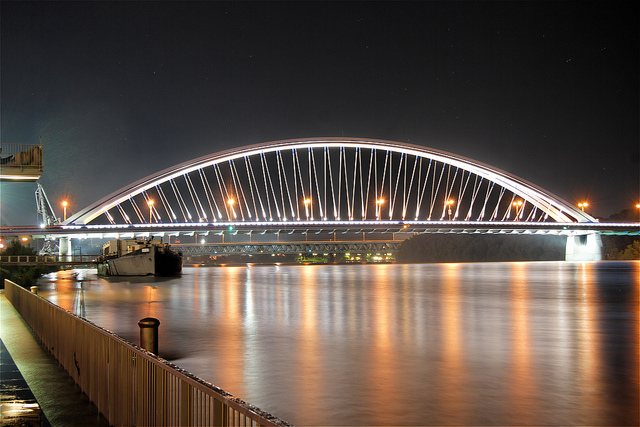
The line can float all the way down

parabola on lineas it has with this bridge, the Apollo Bridge in Slovakia’s capital, Bratislava.

apollo-bridge Bratislava

Now that the line has floated all the way down we can flip the parabola, like so

suspensionand we have the suspension bridge!

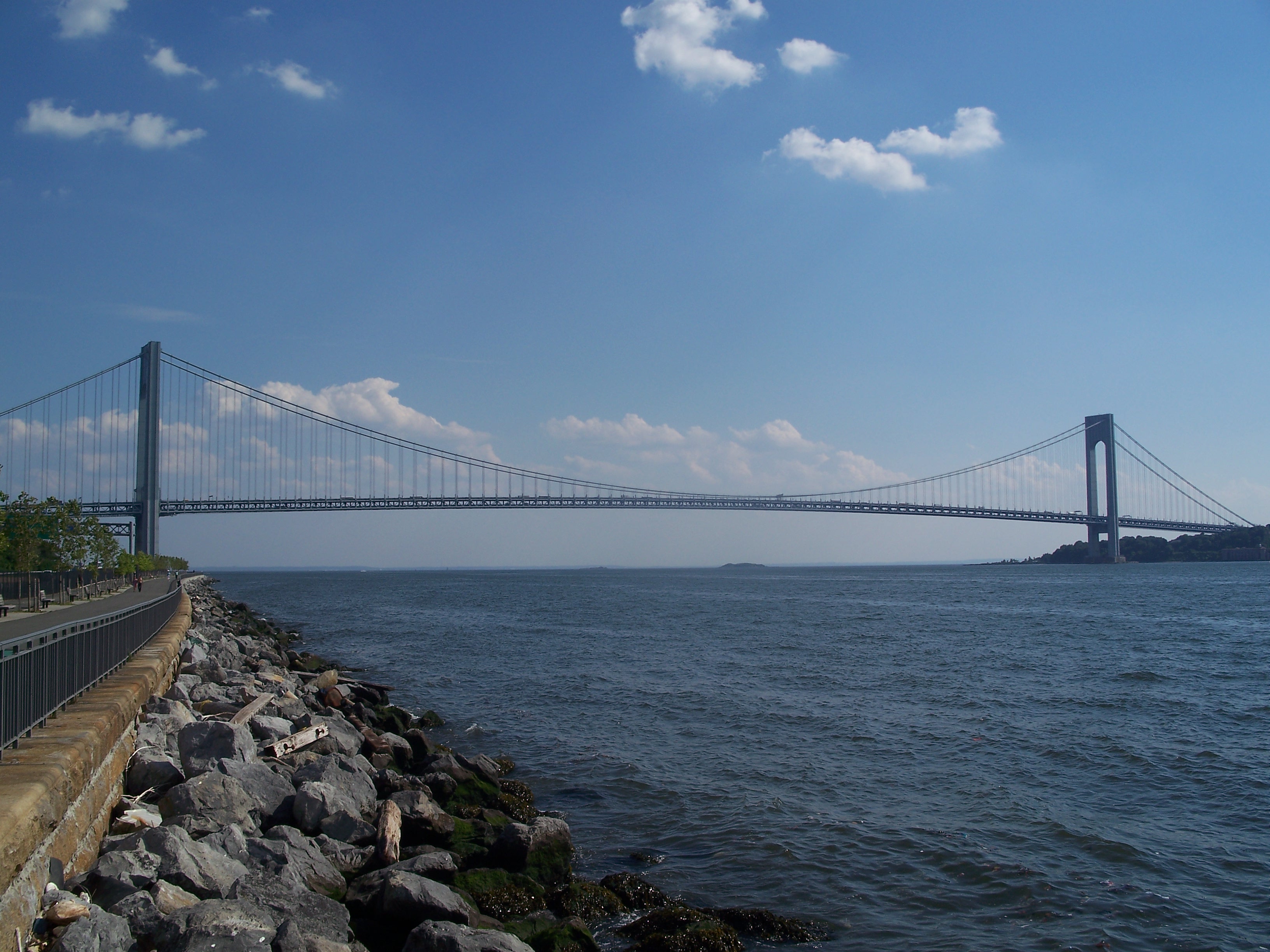
I have a very soft spot for suspension bridges, as I’ve mentioned in a previous post. It has something to do with the sheer etherealness of these bridges, the feeling they give of just a few strands thrown over a wide, empty, normally watery space. My favourite in this class has to be the Verazzano Narrows Bridge in New York.

Verazzano Narrows Bridge

Many people – and many web sites – say the Golden Gate Bridge is a beautiful suspension bridge. But I’ve always found it clunky, and I have to say I dislike its colour scheme.

I also want to throw in a picture of the Humber Bridge in northern England. It seems to be the most stripped down of all suspension-bridge designs I’ve ever seen. I can hardly believe it stays up.

Humber Bridge

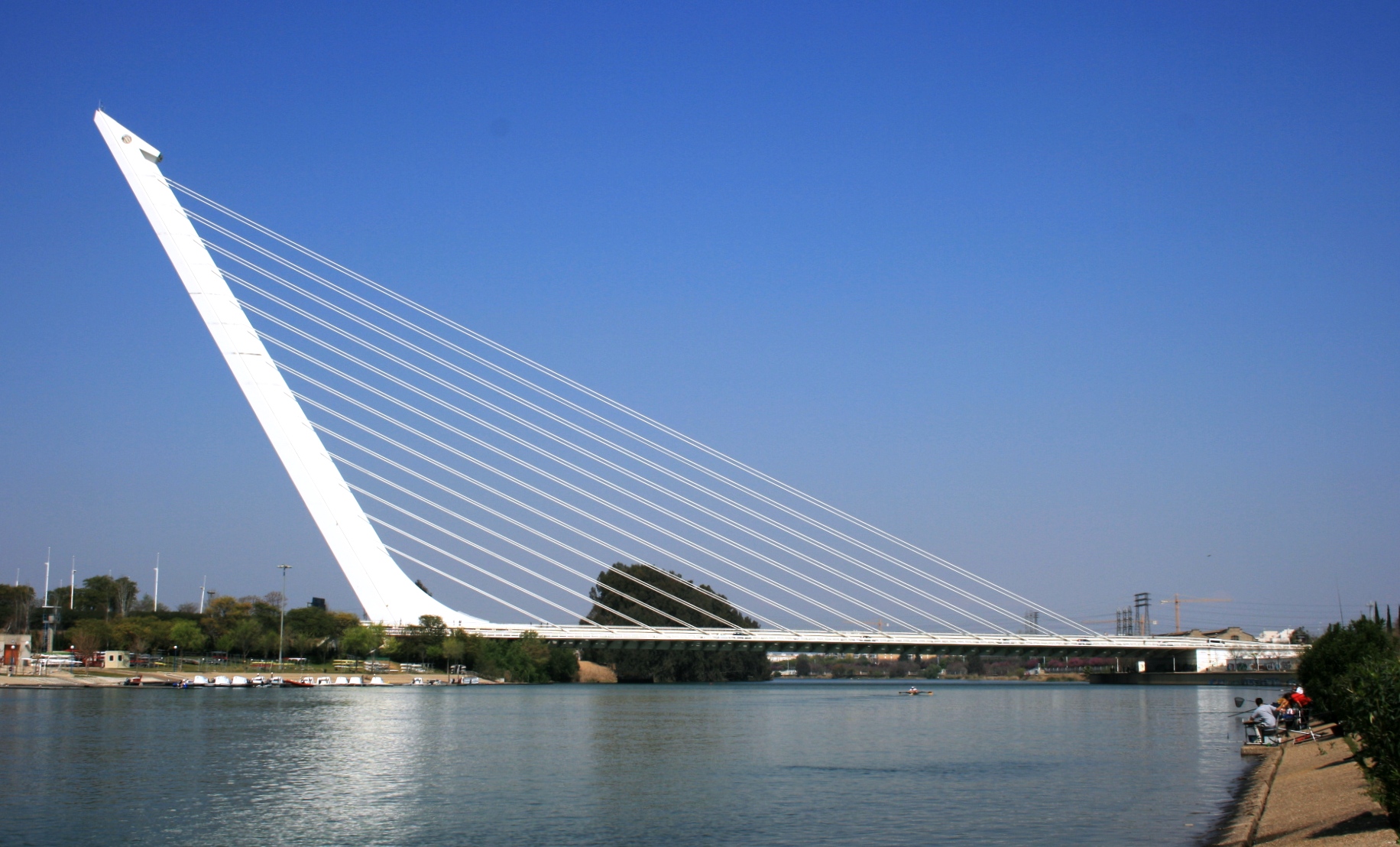
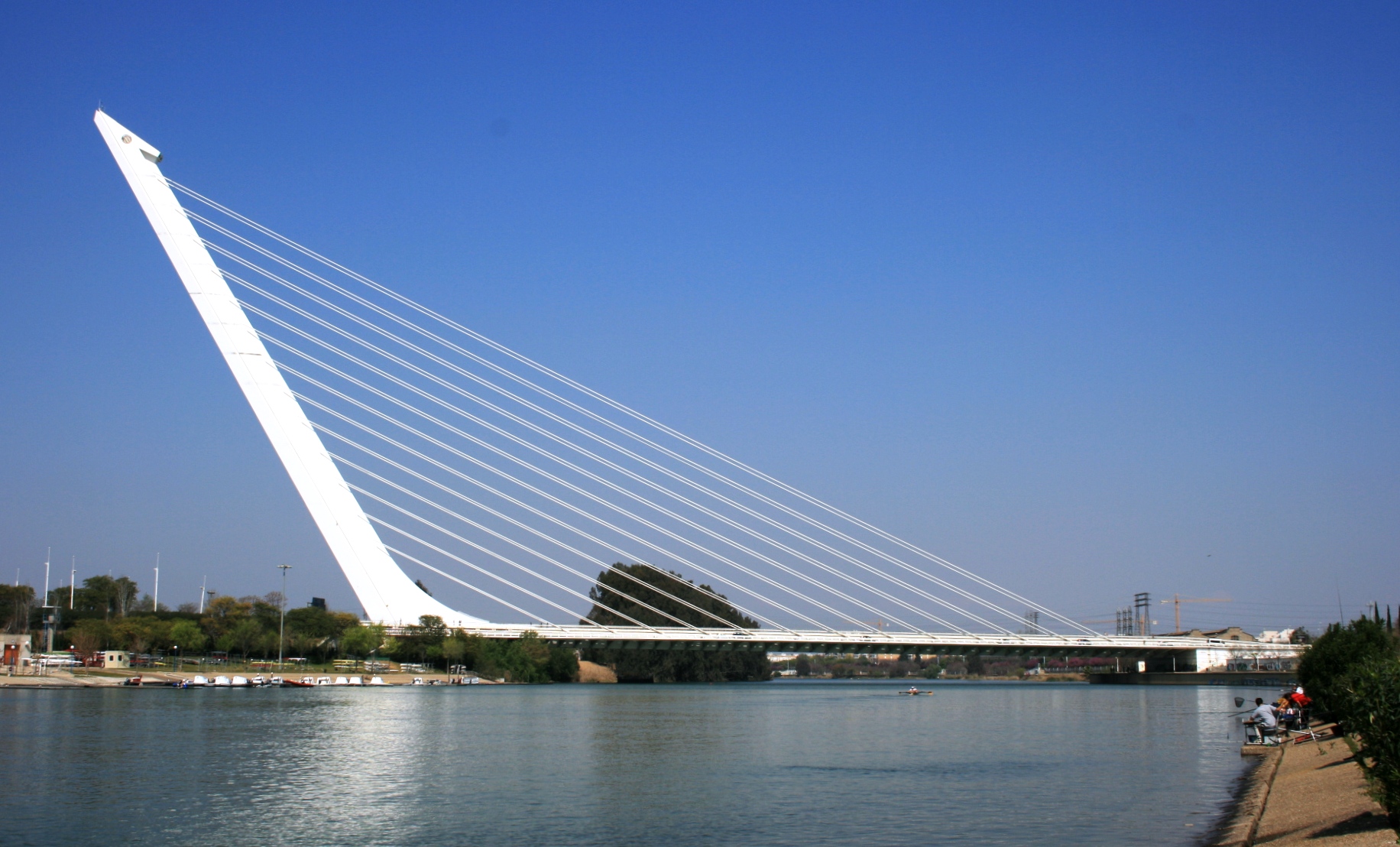
And now I have to come full circle, as it were, back to the King Rama VII Bridge with which I started this post. I’ve learned as I’ve researched on bridges that the fundamentally triangular design of this bridgetrianglesis popular in many modern bridge designs. Studying these, I have grudgingly come to the conclusion that the design is not bad looking as long as equal-sided triangles are used. Looking back at the picture which started this post, the reader will see that in the case of the King Rama VII Bridge, the triangle is not equal-sided, which gives me a displeasing sense of imbalance; I add this to my list of dislikes about the bridge. Imbalance is also the reason why I do not like the Puente del Alamillo in Seville, Spain, even though this is a great favourite in posts dedicated to beautiful bridges.

Puente del Alamillo

All that straining backwards makes me feel quite exhausted.

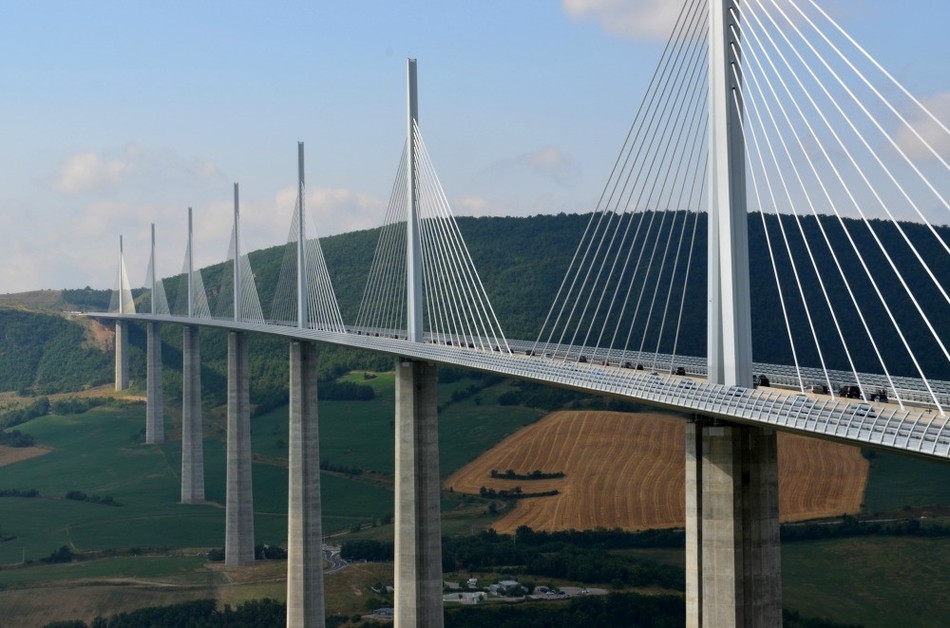
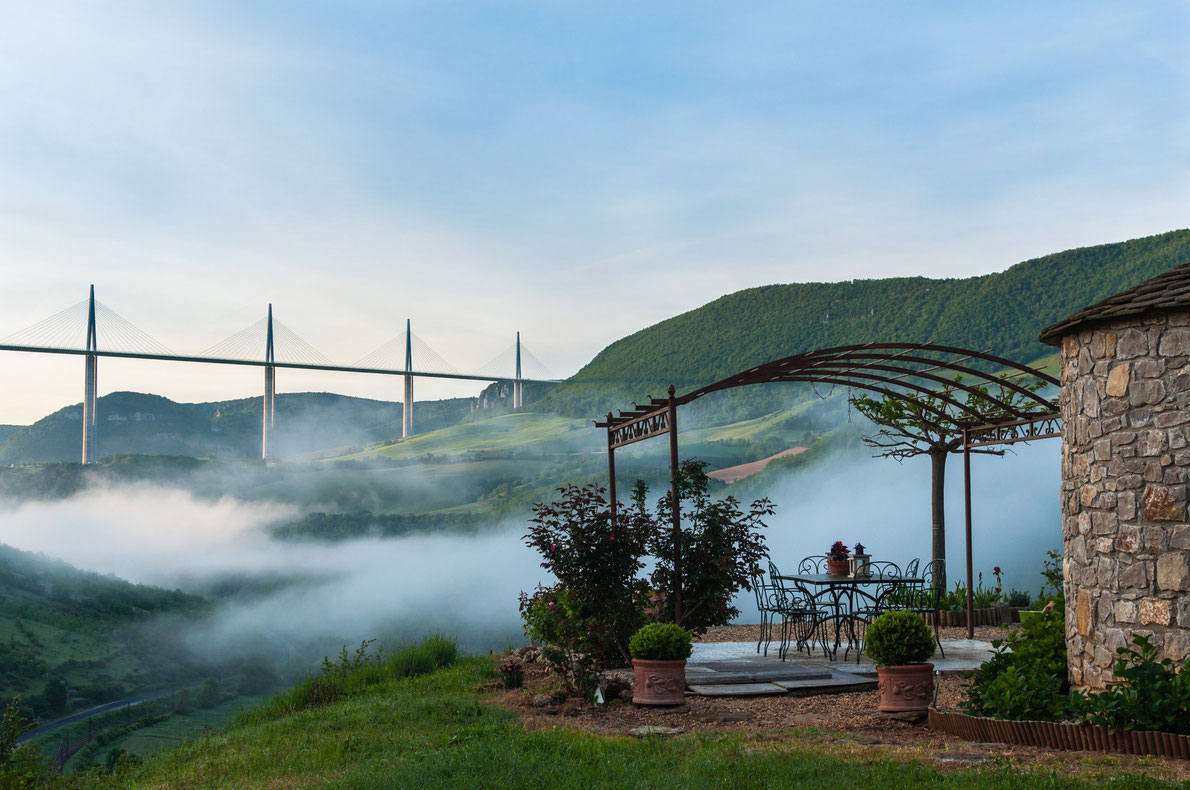
After these harrumphs of disapproval, it’s time for me to throw in a few pictures of bridges that are stars in this class. The Millau viaduct, which soars over the river Tarn in southern France, must surely be the superstar in the category

millau viaduct

but I think this bridge, the Cooper River Bridge in South Carolina, is just as graceful on a more modest scale.

cooper river bridge

Well, that was a pleasant tour of the internet. I must say, it’s nice to see that those painful classes of geometry which I endured when I was young have finally come in useful after 50 years.

____________________

Rakotz Bridge: http://static.boredpanda.com/blog/wp-content/uploads/2014/10/old-bridges-26__880.jpg (in http://www.boredpanda.com/old-mysterious-bridges/#post5)
Ponte della Maddalena: http://static.boredpanda.com/blog/wp-content/uploads/2014/10/Il-Famoso-Ponte-del-Diavolo-Fiume-Serchio-Lucca-a21756847__880.jpg [in http://www.boredpanda.com/ponte-del-diavolo-sul-serchio-garfagnana-italia/%5D
Mostar Bridge: http://9.thumbs.scribol.com/10/sites/default/files/images/800px-StariMost22jpg.jpg?v=1 (in http://scribol.com/anthropology-and-history/13-most-beautiful-bridges-on-earth)
Jade Belt Bridge: http://upload.wikimedia.org/wikipedia/commons/thumb/e/e1/Gaoliang_Bridge.JPG/800px-Gaoliang_Bridge.JPG (in http://en.wikipedia.org/wiki/Jade_Belt_Bridge)
Liija Bridge: https://c1.staticflickr.com/1/107/292647611_8f55820571.jpg (in https://www.flickr.com/photos/bridgink/292647611/)
Bixby Bridge: http://www.scotttanseyphoto.com/img/panorama/cacoastaerialsmanmade/Bixby-Bridge.jpg (in http://www.scotttanseyphoto.com/CalCoastAerialsManmade.html)
Hoover dam bypass bridge: http://www.dealba.net/wp-content/uploads/2012/05/Hoover_C-FHWA-003-1978_cc.jpg (in http://www.dealba.net/industries-served/media-outreach/hoover-dam-bypass-bridge/)
Garabit Viaduct: http://u.jimdo.com/www70/o/sa6549607c78f5c11/img/id3aa3a1f81738f2e/1416666799/std/copyright-whisky-co.jpg (in http://www.europeanbestdestinations.com/top/most-beautiful-bridges-in-europe/)
Lupu Bridge: http://www.globalsalesgrowth.com/wp-content/uploads/2013/02/Lupu-Bridge.jpg (in http://www.globalsalesgrowth.com/shanghais-lupu-bridge)
Apollo Bridge Bratislava: http://www.52insk.com/wp-content/uploads/2011/04/apollo-bridge-by-Karol-Vaclavik.jpg (in http://www.52insk.com/2011/first-slovak-state/)
Verrazano Narrows Bridge: http://michaelminn.net/newyork/infrastructure/verrazanno-narrows_bridge/2008-07-25_16-38-30.jpg (in http://michaelminn.net/newyork/infrastructure/verrazanno-narrows_bridge/)
Humber Bridge: http://upload.wikimedia.org/wikipedia/commons/4/4b/Humber_Bridge.jpg (in http://commons.wikimedia.org/wiki/File:Humber_Bridge.jpg)
Puente del Alamillo: http://upload.wikimedia.org/wikipedia/commons/a/a1/Puente_del_Alamillo_en_Sevilla.jpg (in http://commons.wikimedia.org/wiki/File:Puente_del_Alamillo_en_Sevilla.jpg)
Millau viaduct: http://u.jimdo.com/www70/o/sa6549607c78f5c11/img/i7521c17c35fcc549/1417528244/std/cpakmoi.jpg (in http://www.europeanbestdestinations.com/top/most-beautiful-bridges-in-europe/)
Cooper River bridge: http://library.sc.edu/blogs/mirc/files/2012/07/New-CRB.jpg (in http://library.sc.edu/blogs/mirc/feature-video-july-24th-old-cooper-river-bridge/)
All other photos are mine

MYANMAR: A FOREST OF STUPAS

Bangkok, 8 March 2015

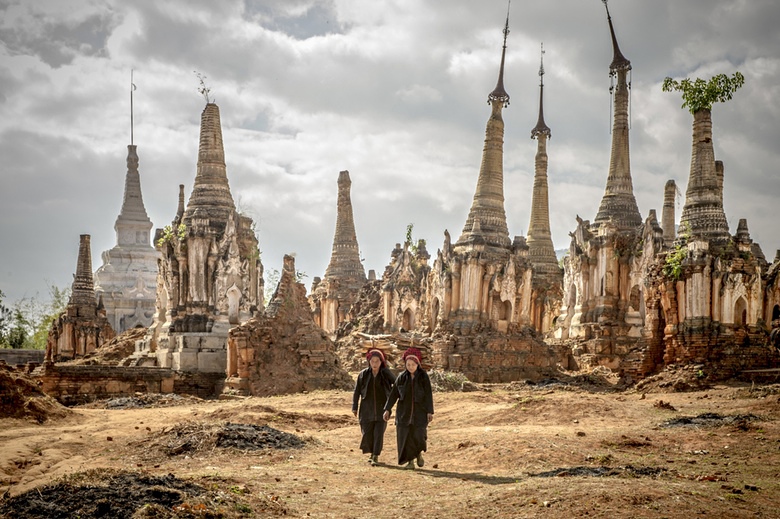
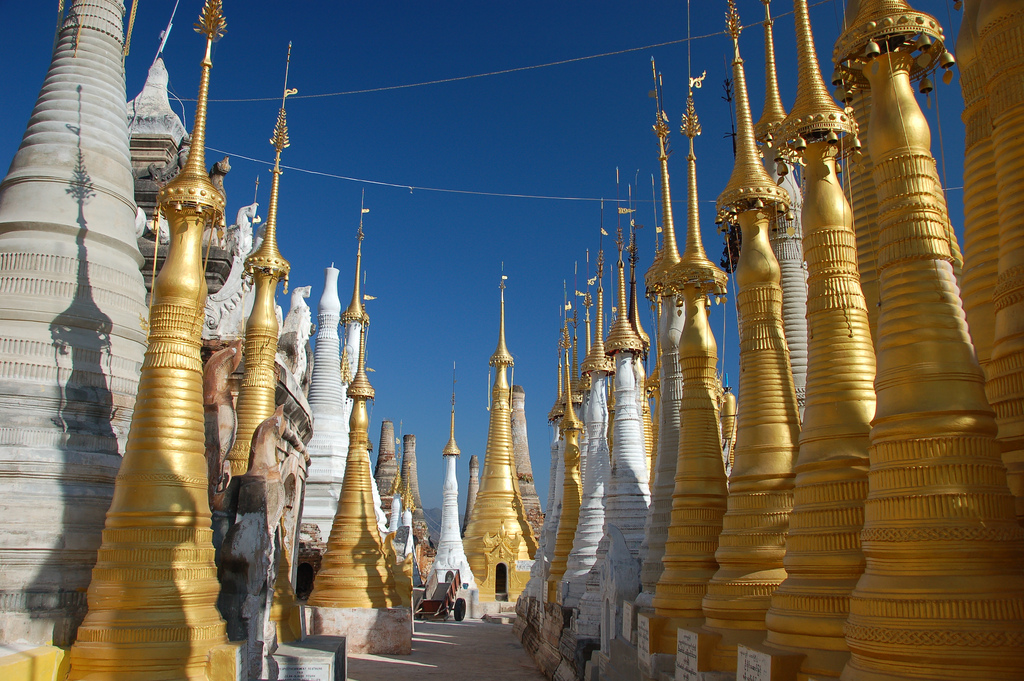
It was this photo that brought us to Myanmar.
Shwe Indein Pagoda, Inle Lake, Burma
My wife said, “We are going to Myanmar, and we are going here!”

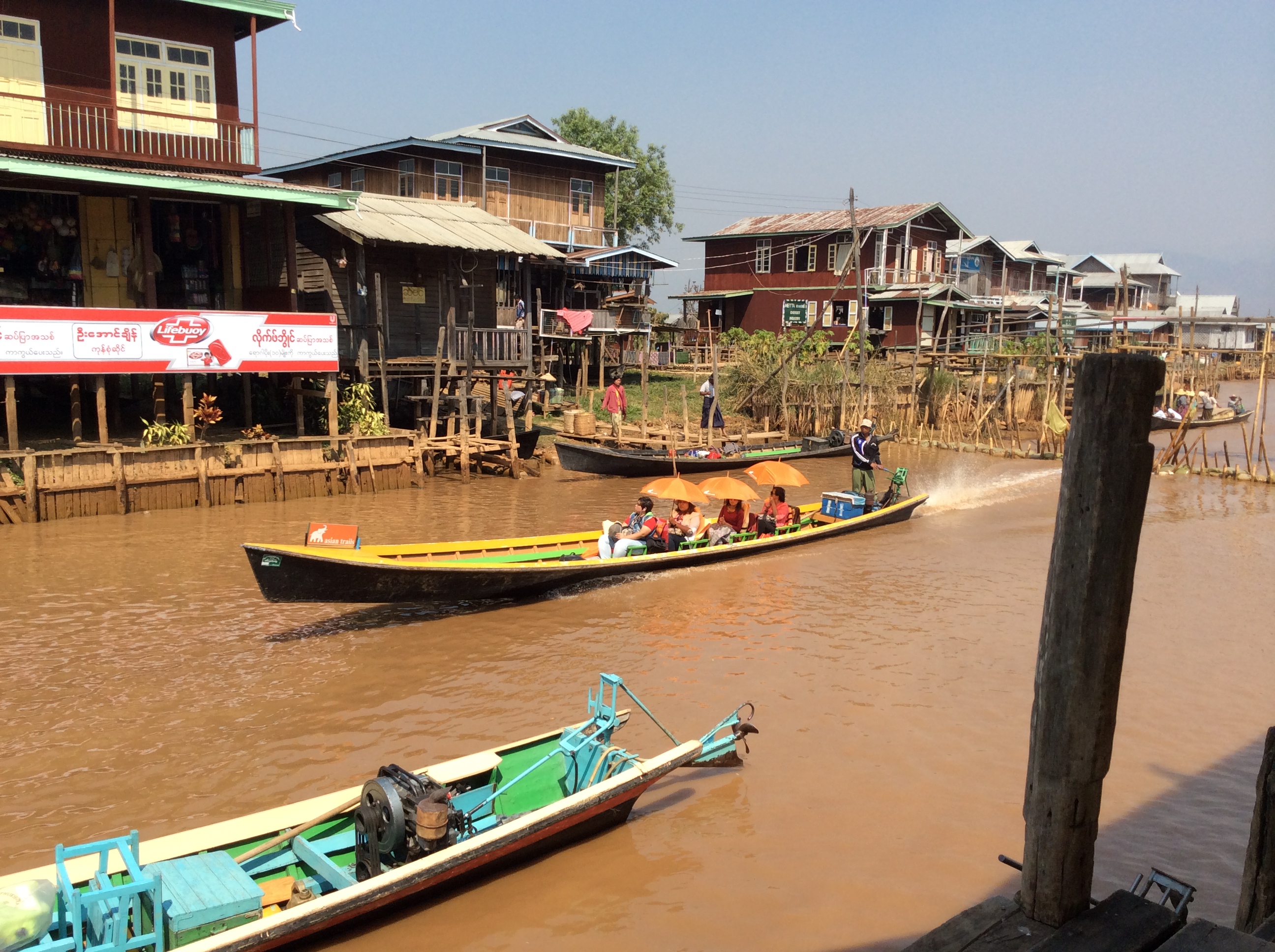
“Here” was Inn Dein, a village on the edge of Inle Lake, in Shan State, which is why we found ourselves staying at a hotel on the lake

06-inle lake-inn dein-flav 003

ready to take one of these boats to the village.
06-inle lake-day 3 006
In truth, our travel was a little different that day, because Inn Dein is actually on the old edge of the lake. Over the last fifty years or so, that edge has been creeping forward as farmers have created floating gardens on the lake’s edge

06-inle lake-day 2-flav 021

which after a while have become solid land, leading the farmers to create yet more floating gardens further out. So to get to Inn Dein, we had to travel up a shallow canal, the artificial continuation of the stream that runs through the village, which meant our travel was more like this.

06-inle lake-day 1 002

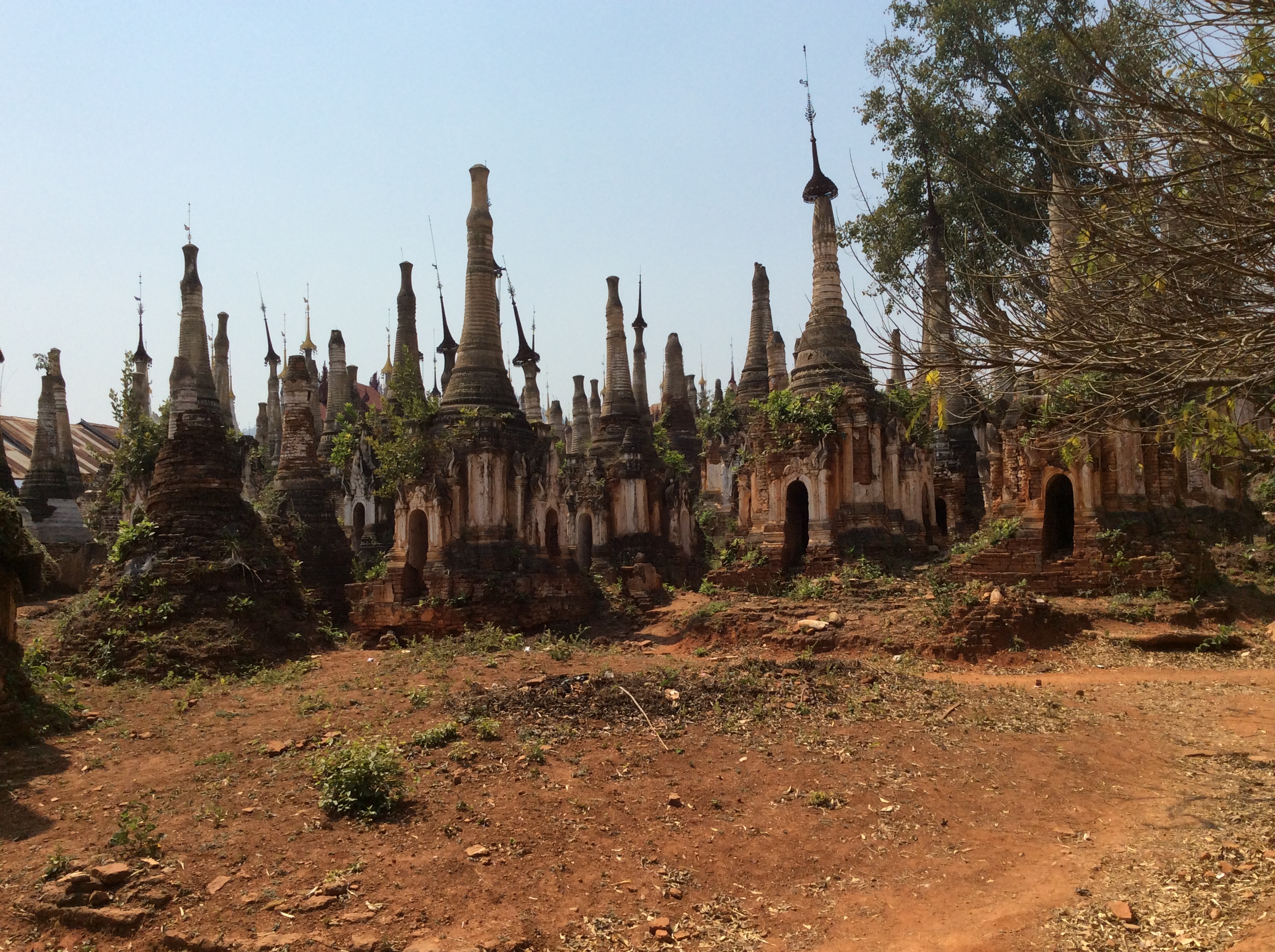
After we disembarked, we crossed Inn Dein’s one and only bridge and soon found ourselves wandering through a field of neglected, mouldering stupas.
06-inle lake-inn dein 007

06-inle lake-inn dein 009

06-inle lake-inn dein-flav 049

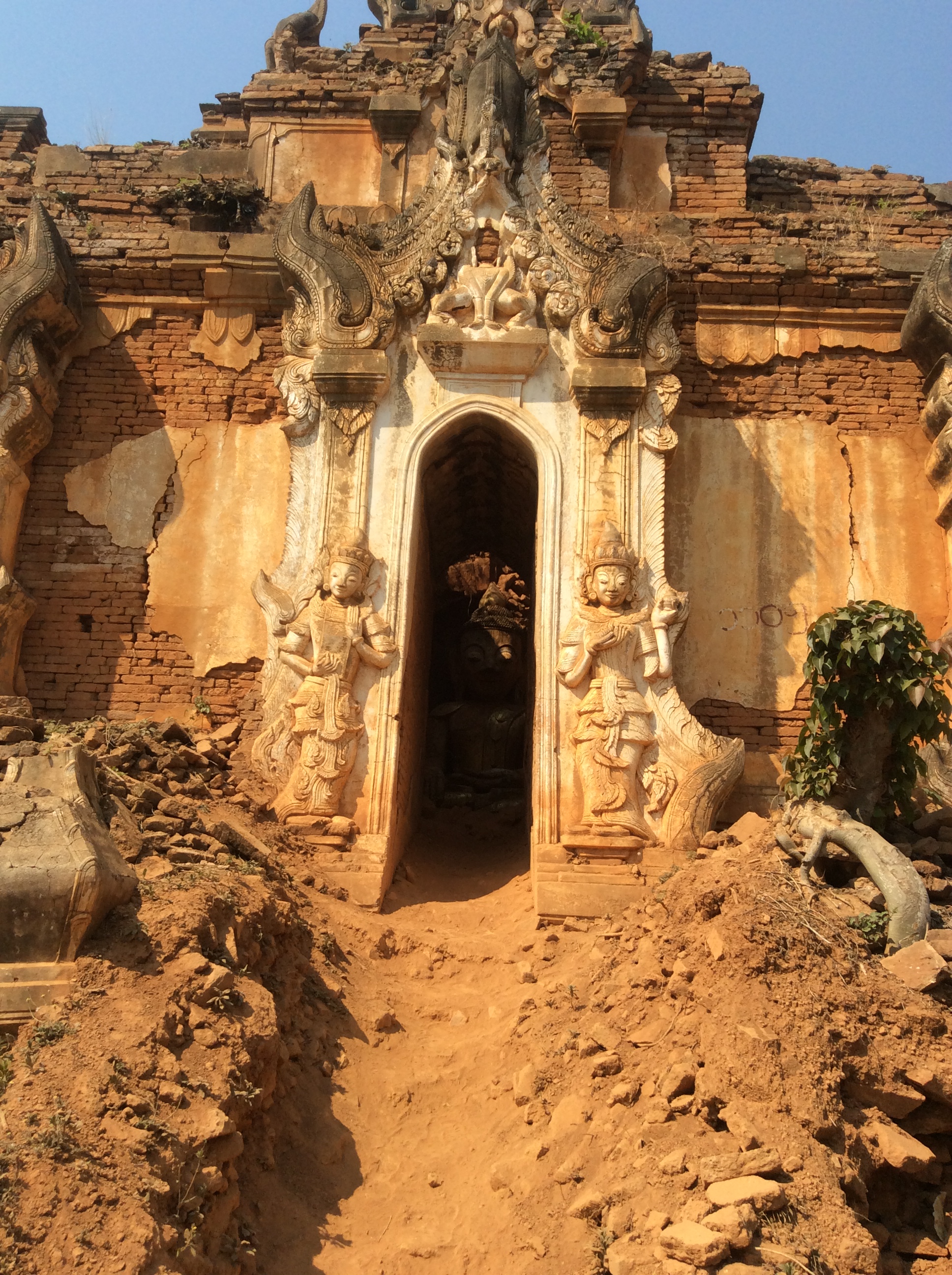
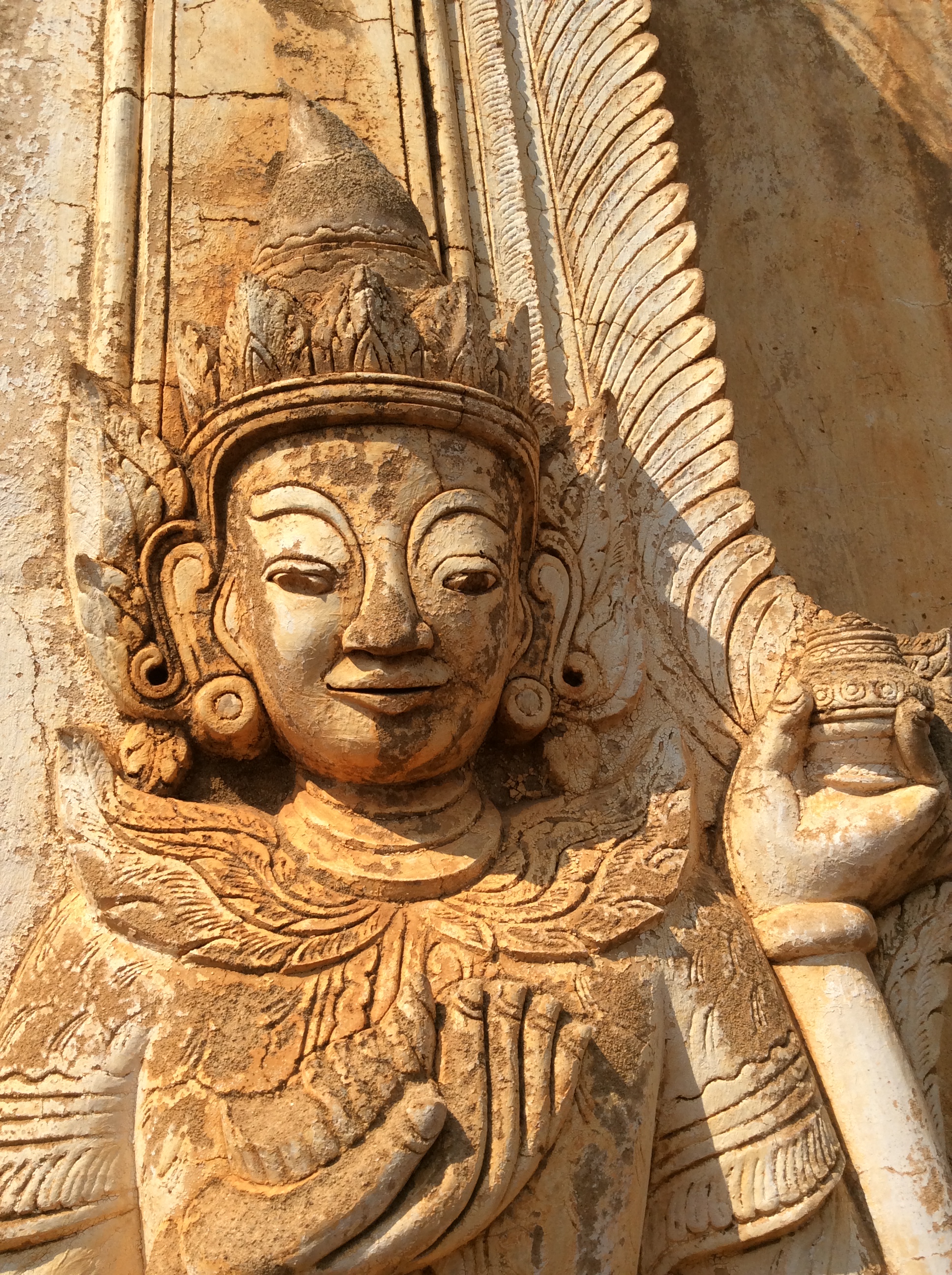
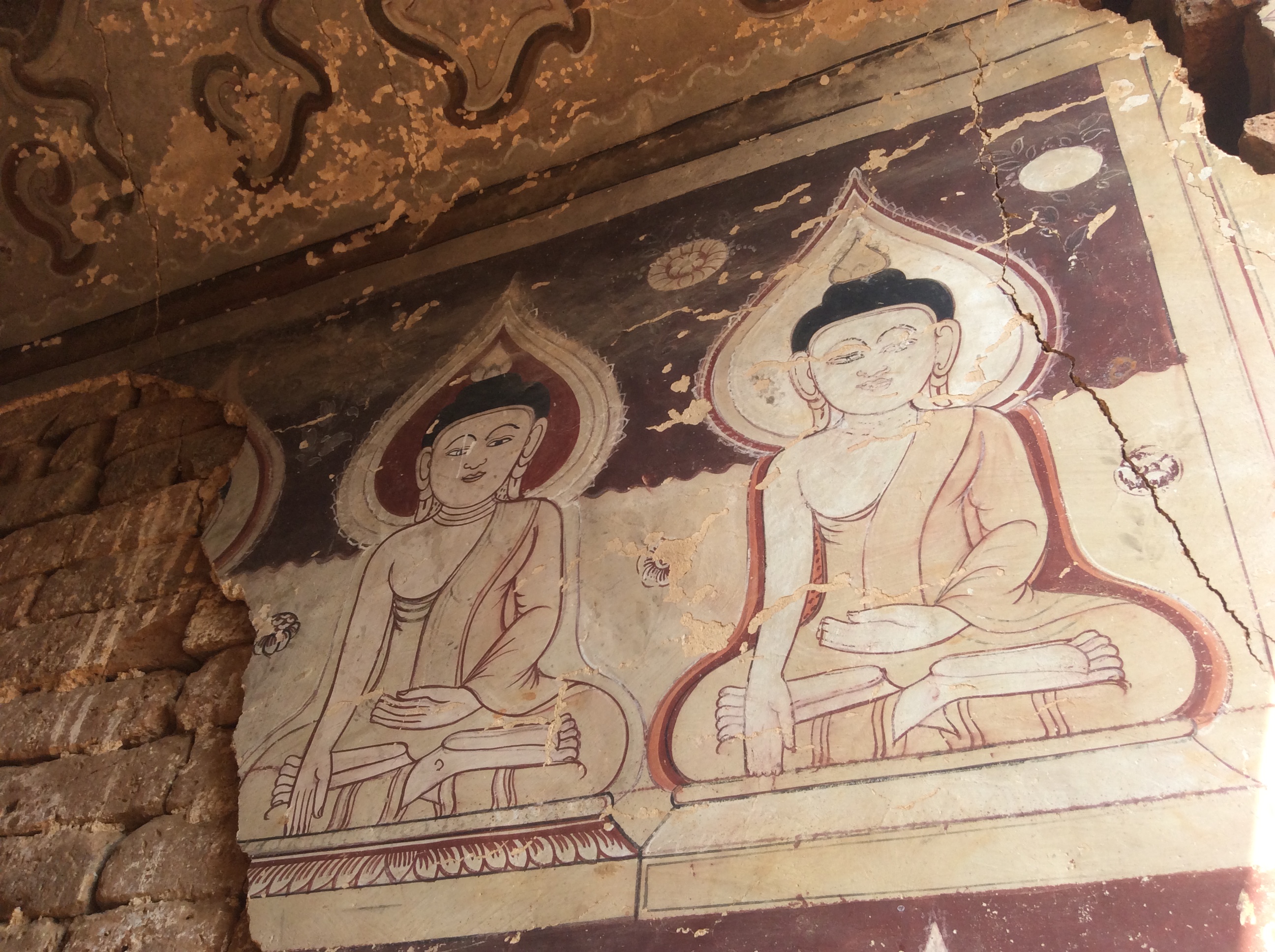
To some still clung fragments of their original ornamentation

06-inle lake-inn dein-flav 041

06-inle lake-inn dein 025

06-inle lake-inn dein-flav 043

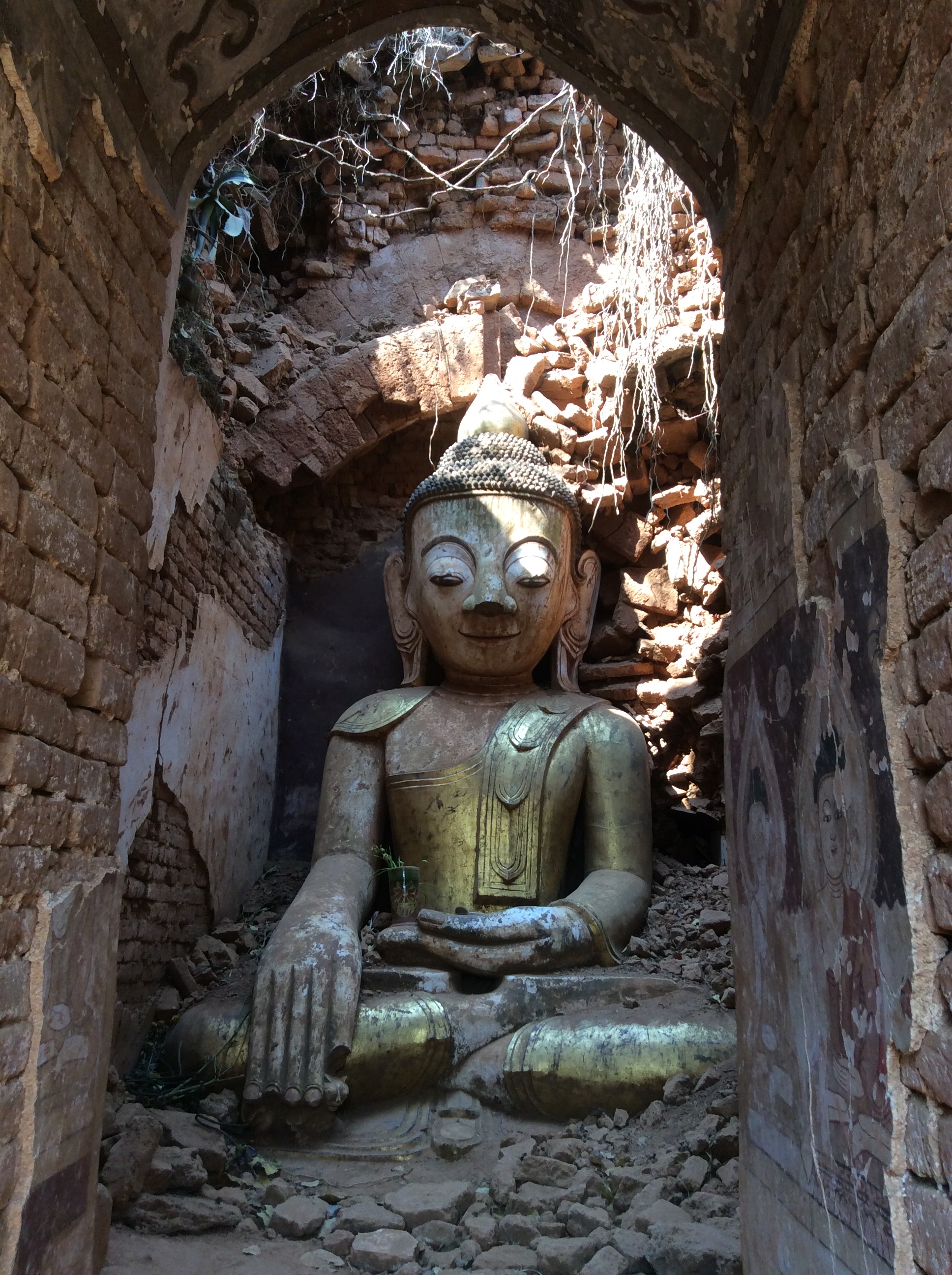
while others housed Buddhas in varying states of repair.

06-inle lake-inn dein-flav 042

06-inle lake-inn dein-flav 052

06-inle lake-inn dein 008

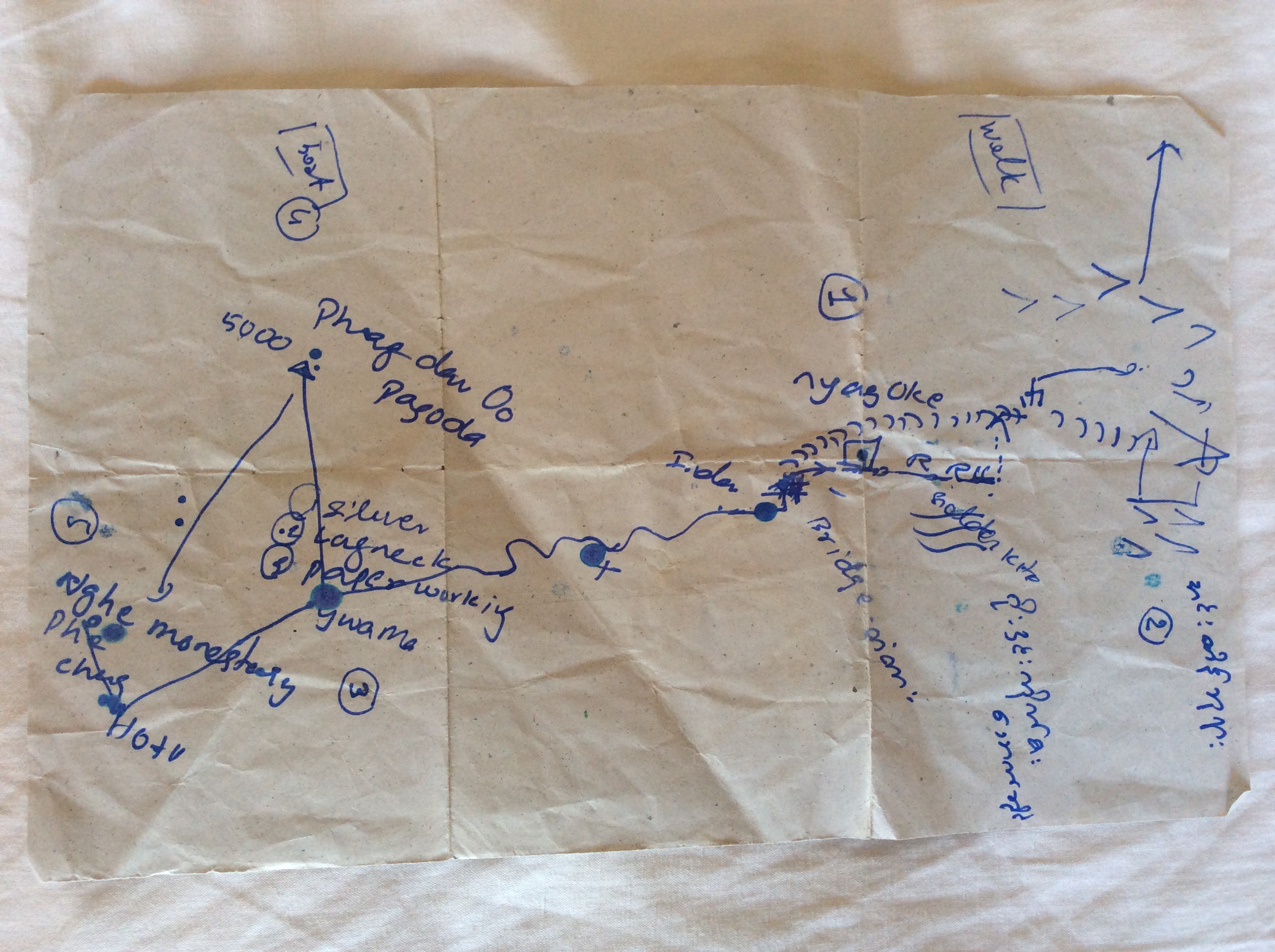
Though beautiful in their neglect, my wife and I agreed that this was not where the photo which had brought us here was taken. So we started walking up the hill behind the village, following the hand-drawn map we had been given at the hotel.
hand drawn map
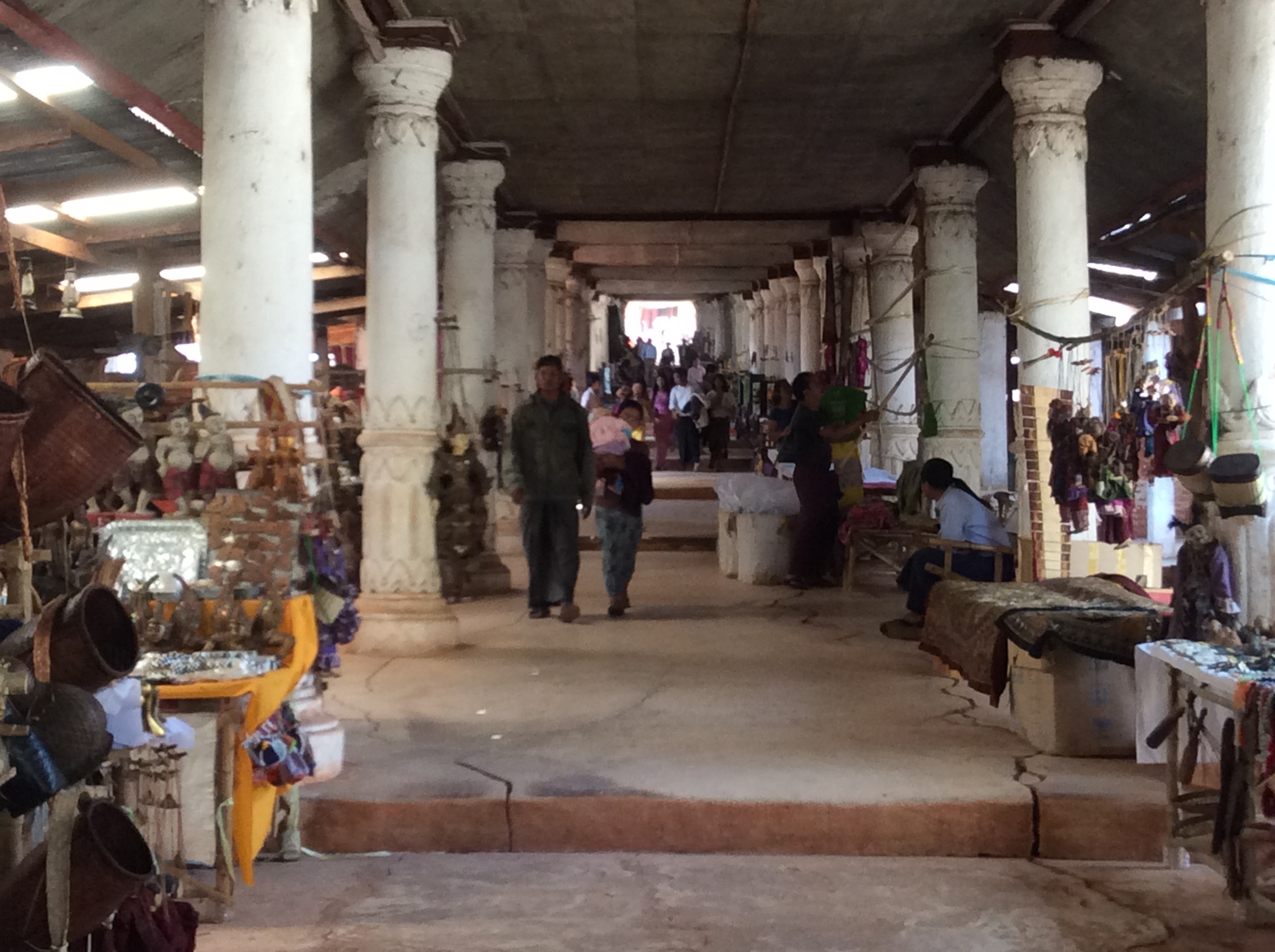
To get out of the sun’s glare, we ducked into a covered walkway that leads up the hill. It was cooler but it exposed us to stall after stall of hideous tourist tat.
06-inle lake-inn dein-flav 058
To console ourselves, I reminded my wife of a similar covered walkway which we had seen in Bologna in Italy, which leads up to the Sanctuary of Saint Luke on a nearby hill.
bologna santuario di S.Luca
No doubt, I told her, when in the old days pilgrims wended their way up the walkway to the Sanctuary (nowadays only tourists do so), there were similar stalls along the side selling hideous religious tat.

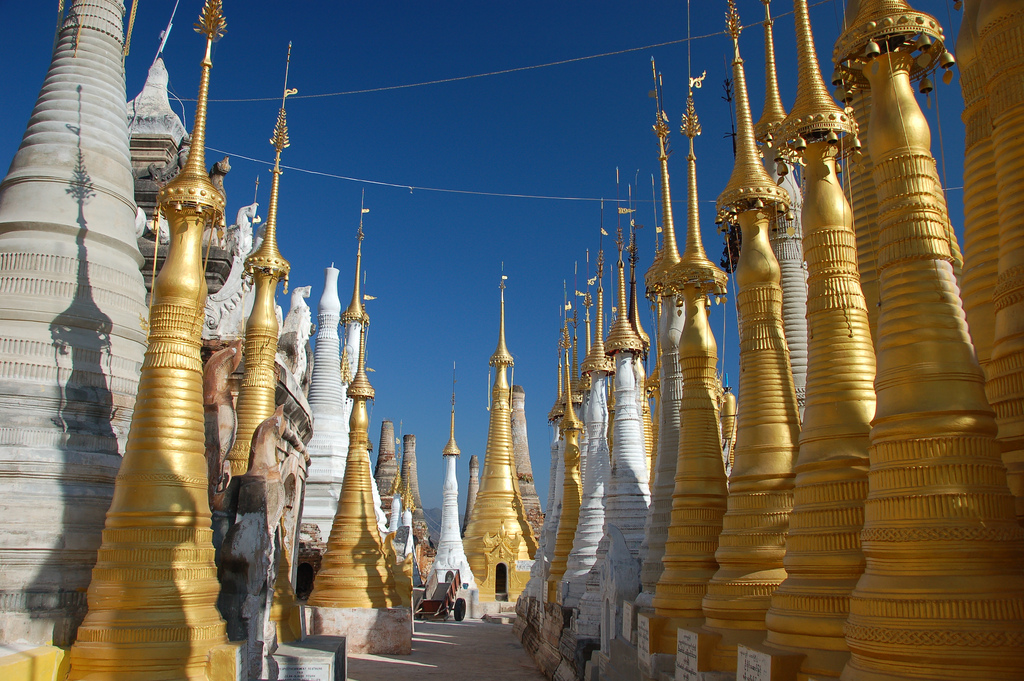
When we reached the top, we were greeted by a veritable forest of stupas.
06-inle lake-inn dein 040
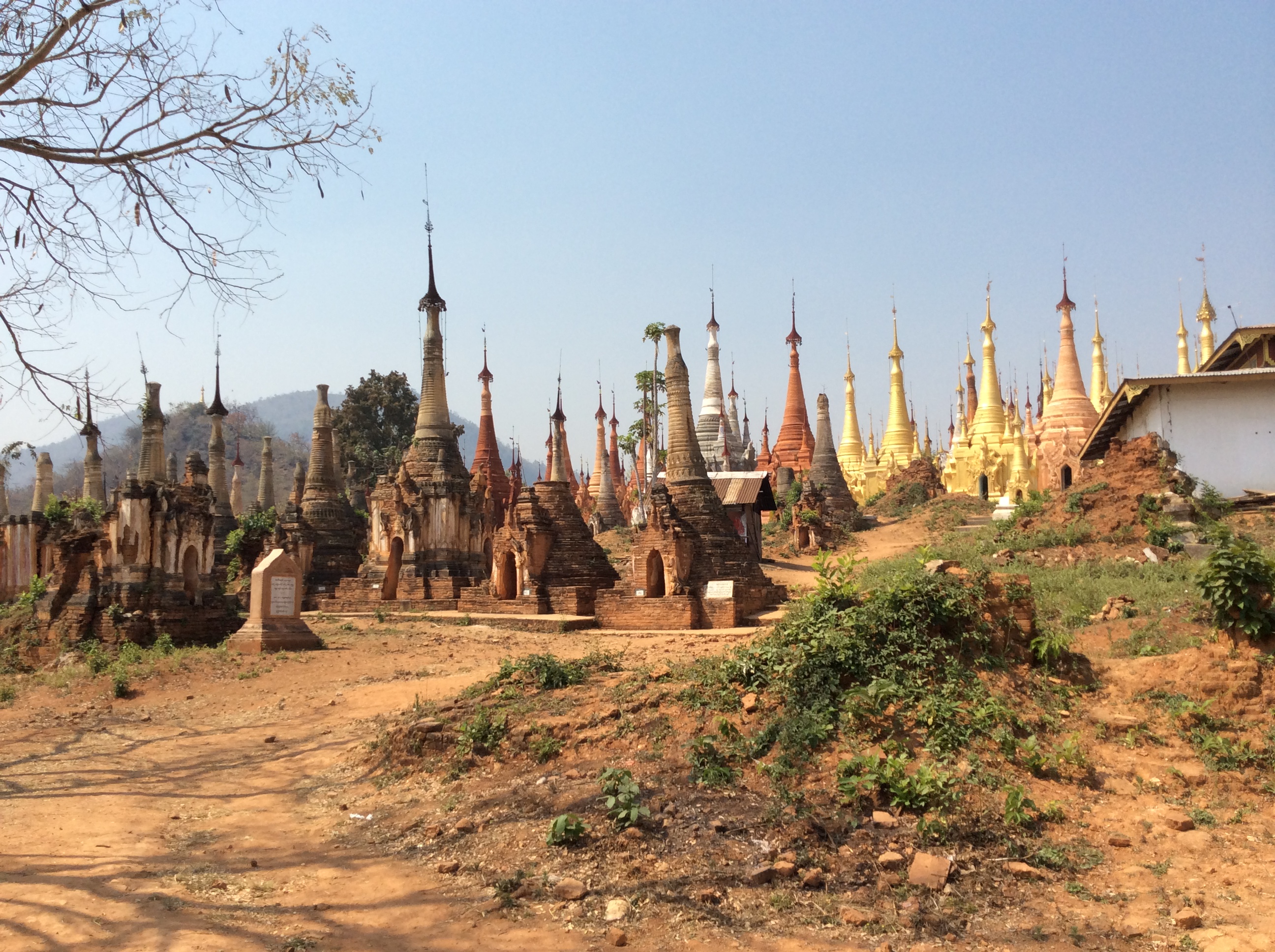
The first were mouldering away as romantically as the ones down the hill
06-inle lake-inn dein-flav 071

06-inle lake-inn dein-flav 069

with some of the decoration clinging on

06-inle lake-inn dein-flav 070
Very beautiful, but not, we agreed once more, the place where the original photo which brought us here had been taken.

We began to walk up the hill, and soon found ourselves only among renovated stupas. My wife and I had mixed feelings about this wave of renovation that had washed over the hill. The decaying stupas are impossibly romantic, but we can understand that to devout Buddhists it must be dismaying to see such neglect. I suppose the only criticism we have (but it is a large criticism) is that it would have been good to renovate the stupas to their original form, something which quite obviously is not the case. We were so unenthusiastic about these renovated stupas that neither of us took a single photo of them, so what follows comes care of the internet.
Shwe Inn Thein stupas at Indein, Inle Lake
After threading our way, disconsolate, through the packed crowd of renovated stupas, we climbed a nearby hill to get an overview of the stupa forest.
06-inle lake-inn dein 070
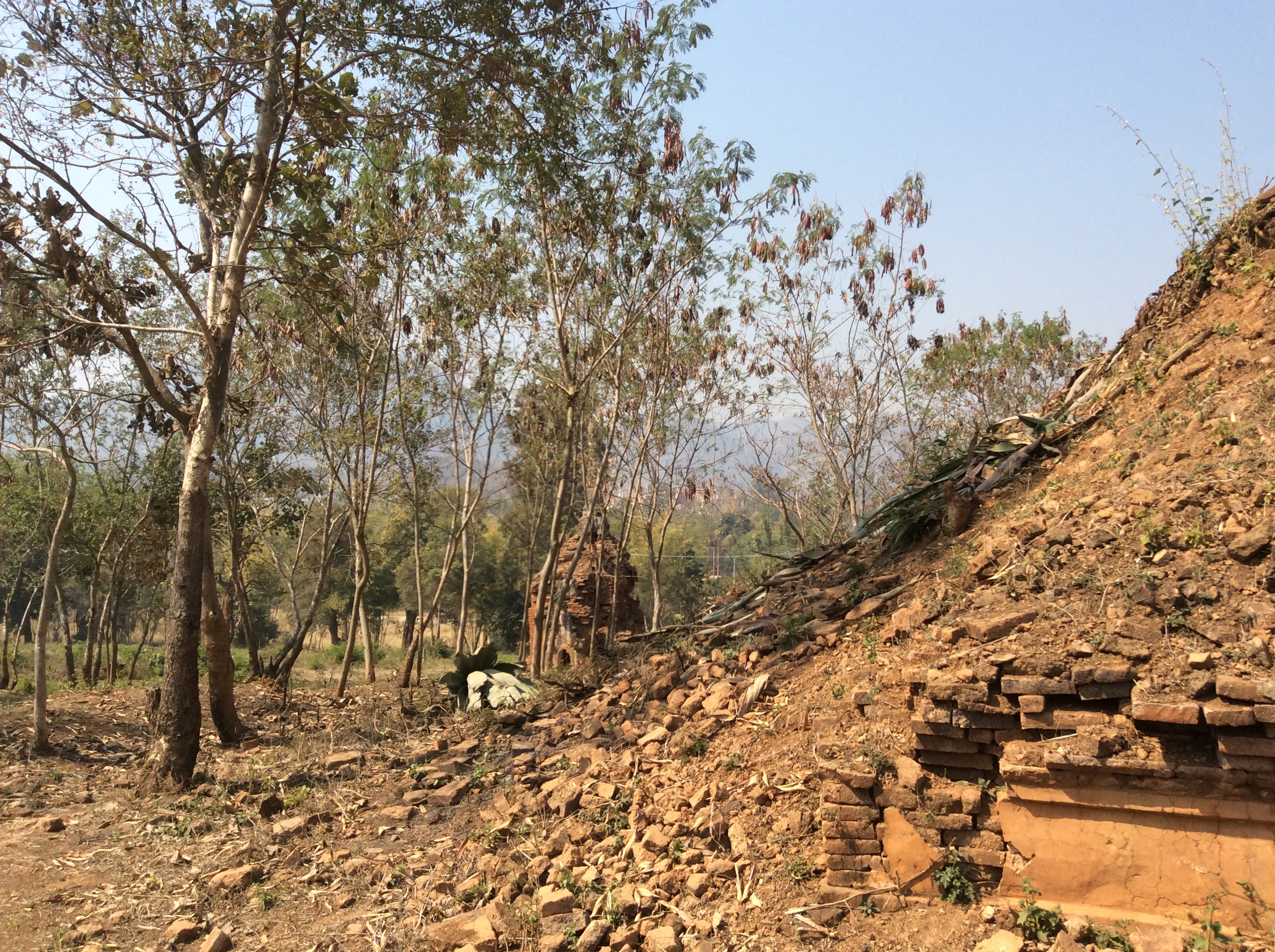
Even from here we could not really understand from where the fateful photo had been taken. So we went back down, walked through the temple at the centre of the forest, and visited the stupas on the other side. These were once again pleasingly decrepit, so we pleasurably ambled our way down the hill through them, picking our way over broken brick and stucco and around bushes and weeds which had taken root in the brick dust.
06-inle lake-inn dein 075
When we broke out of the forest and turned around, there at last we saw the view which had brought us here. Finally …

06-inle lake-inn dein-flav 086a

_____________________

Bologna Santuario san Luca: http://www.laltraitaliatour.it/main2/images/stories/foto_viaggi/centro/tour_cuore_italia/bologna%20santuario%20di%20S.Luca%20panorama%20%28Small%29.jpg (in http://www.laltraitaliatour.it/main2/index.php?option=com_content&view=article&id=100%3Agran-tour-nel-cuore-dellitalia&catid=53%3Aviaggi-centro-italia&lang=en)
Renovated stupas: http://kiplingandclark.com/wp-content/uploads/2014/03/4013943890_7ab483e2b5_b.jpg (in http://kiplingandclark.com/itineraries/myanmar-laos-cambodia-private-tour/)
All other photos: ours

MYANMAR: MRAUK U

Yangon, 7 March 2015

In 1430, King Saw Mon founded a new capital at Mrauk U, in what is now the State of Rakhine, for a Kingdom of Arrakan of which he was the first ruler. Mrauk U lay at the head of several navigable tributaries of the Kaladan River, and so could command the trade routes in the Bay of Bengal, on which the kingdom’s wealth was founded. It became a transit point for goods such as rice, ivory, elephants, tree sap and deer hide from Burma, and of cotton, slaves, horses, cowrie, spices and textiles from Bengal, India, Persia and Arabia. It also lay at the edges of a broad plain, where abundant rice could be grown to feed the city’s population. The area was dotted throughout with hillocks, ideal for capping with splendid pagodas which earned their founders much merit, but also for acting as watchtowers in strong defensive walls which linked hillocks together and could keep the kingdom’s jealous or rapacious neighbours at bay. It was, in all senses, a happy choice for the new kingdom’s capital.

Exactly two hundred years after the city’s founding, a Portuguese monk, Fray Sebastian Manrique, who was to live in India for forty years, visited Mrauk U, as part of an official mission. In a book he wrote about his time in Asia, “Itinerario de las missiones del India Oriental”, he dedicated several chapters to his visit to Mrauk U. “This great city”, he starts, “stands in a lovely valley, some fifteen leagues wide, wholly enclosed by high rocky mountains, which serve as natural fortifications”. The city was bisected by a network of waterways linked to the nearby river, which were “the principal means of traffic, both public and private”. Most of the houses were thatched bamboo and wood structures, held together by “Bengal cane, as we call it in Portugal”. Even the palaces “are made of these reedy materials”. The size and ornamentation of the houses, and not their materials of construction, were what proclaimed the station and wealth of their owners. Inside, wall mats were hung “of the finest texture and of many colours”. No doubt, the richer and more important the owner, the finer and more elaborate the wall mats. The better houses and the palaces also had rooms of wood “ornamented with carving, gilt mouldings, and enamel work in various tints”. Some of the palaces went one further, having rooms of sandalwood and other aromatic woods. One of the richer palaces included a “House of Gold”, a pavilion decorated from floor to ceiling with gold, which housed golden statues, dishes and other vessels. The royal palace boasted a ceremonial hall, with a golden roof “ornamented with flowers of different colours”, supported by thirty gilded wooden pillars. The monks didn’t do too badly for themselves either. A number of the temples and monasteries in which they lived were as sumptuous as the palaces, richly endowed as they were by their wealthy and important founders, who were seeking thereby to gain merit. Most of the temples were “pyramidal in shape”, with a spire that ended in a gilt metal globe on which small bells hung that tinkled in the wind (I presume the good Friar was referring to the stupas, which sit at the centre of temple complexes). The temples’ interiors were decorated with “frescoes done in gold and colours”. Several years later, he again visited Mrauk U on an official mission, and this time he was lucky to be there when the king was crowned. He described in breathless detail all the pomp and ceremony which accompanied the crowning. This print, by the Dutchman Wouter Schouten, gives an idea of what Mrauk U looked like at this time.

mrauk u old print

The happy times did not last. Warfare between the local kingdoms was endemic, as each king tried to grow at the expense of his neighbours. In one of these local wars, King Bodawpaya of the neighbouring kingdom of Burma got the upper hand, helped along, it must be said, by vicious internecine struggles, all worthy of a Shakespearean history play, that were being played out between Arrakanese kings and their impatient heir-apparents, and between them and various usurpers. In 1784, the Burmese army attacked

war elephants

and eventually took the city, razing it to the ground. They took care, though, not to destroy the stupas and associated temples; the soldiers did not want to lose merit. But they stripped them and the rest of the city of all the movable loot they could lay their hands on. What part of the population they did not kill, they enslaved. And so, laden with vast quantities of booty and 20,000 slaves, King Bodawpaya and his army returned home to celebrate, leaving death and desolation behind them. The kingdom of Arrakan and its capital city were no more.

The site was too good to abandon completely. Gradually, people moved back into the city and partially repopulated it. But now it was just a small market town, with the modest lives and modest dreams and modest destiny of such towns. Its citizens lived out their lives in the shadow of monuments from Mrauk U’s royal past, which slowly crumbled away and were overgrown by vegetation.

But Mrauk U’s glorious past was not completely forgotten. Echoes of its history were passed down. Now that Myanmar has come out of its self-imposed isolation from the outside world, and the world has accepted the country back into the community of nations, Mrauk U has become a tourist destination. Not like Bagan, which hosts the ruins of another vanished kingdom, nor like Inle Lake, another popular tourist destination, nor even like the capital Yangon. A much more modest destination, because it has little tourist infrastructure and is hard to get to: seven hours by private boat from Sittwe, several more by the public boat; six hours by car on a spine-crushing road, several more by public bus. But a trickle of tourists do make it through.

We have just been part of that trickle. We hired bicycles, a wonderful way to move around this town whose dimensions are small and whose traffic is contained, and we slowly criss-crossed it, riding down potholed roads, side streets of beaten earth

02-mrauk u-flav 016

half-finished roads on which toiled labour gangs of women

02-mrauk u-flav 059

even across desiccated paddy fields when the half-finished roads were impassible

03-chin villages-flav 001

observing all the very rural life that passed us by. Most of the houses are still made of wood and “reedy materials”

02-mrauk u-flav 050

but from the few modern houses we saw brick and concrete are clearly now the building materials of choice for the wealthy. The network of waterways are still being used, although now sadly choked with plastic and other debris of modern life.

02-mrauk u-flav 052

Bicycles and motor bikes are the mode of transport of choice

02-mrauk u-flav 078

with two-seater bicycle rickshaws playing the role of local taxi

02-mrauk u-flav 067

and ten-seater tuk-tuks playing that of local buses (ten seats is a nominal number; the drivers seemed to be able to squeeze twice that number into them).

03-chin villages-flav 003

As in all ages and in all places, the wealthier disdain these proletarian forms of transport, although they now favour four-wheel drive cars with tinted windows rather than the palanquins and elephants of old. On the edges of town (which were reached after no more than ten minutes by bike from the town centre – and we rode slowly), chickens, pigs, and the odd cow join the human melée. And everywhere, young girls and women (never men and very rarely boys) are walking slowly to or from the wells and reservoirs which dot the town, ferrying the households’ water, no doubt as they had been doing nearly four hundred years ago when Friar Manrique criss-crossed the town – such a waste of women’s time! And the water they were collecting fitted no definition of “drinking water” that I know of.

02-mrauk u-flav 025

The town has schools, but all in a shocking state of decrepitude

02-mrauk u-flav 048

and in any case many children were put to work in various trades: child labour seems the norm here, not the exception. This country’s military dictators have much, much to answer for.

And so it was that we rode and we observed, and we meditated on what we observed, until the next stupa, or temple, or ordination hall from Mrauk U’s past loomed out in front of us. We visited many during our two days, but I will mention only three. The first is Mro U-hnauk Phara
02-mrauk u-flav 037
because it was the first temple we visited, but also because we were intrigued by the very ornate edifice constructed out of galvanized corrugated iron sheets that preceded the ancient stupa.

02-mrauk u-flav 038

The materials of construction may be humble but the designs are really quite complex. We got used to seeing these structures in front of many of the stupas in town. Both my wife and I immediately remarked on how much these constructions reminded us of the stavkirke in Norway.
Borgund_stavkirke
The second site I will mention is Koe Thaung temple, which sits out in the middle of paddy fields a little way out of town.
koe thaung temple
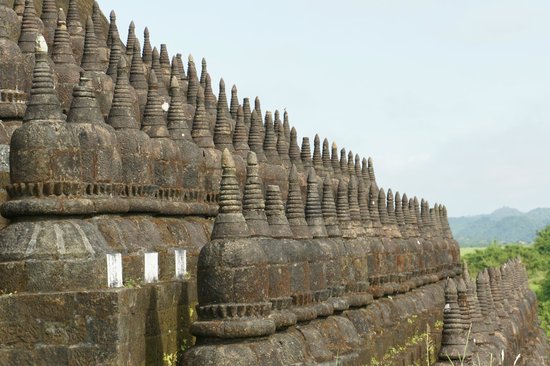
Its design is said to be based on Borobudur in Indonesia. We wouldn’t know, not having been able to visit Borobudur because of a volcanic eruption. But Koe Thaung certainly has charm, what with the serried ranks of stupas lining its terraces

koe-thaung-temple-stupas

and the hundreds of Buddhas, each with a different face, lining the galleries that encircle the edifice.

02-mrauk u-flav 107

When the rice paddies around the temple are planted and green, it must be very beautiful.

The third is actually a grouping of temples and stupas, all situated in a large open space. From the vantage point of the high terrace of one of these, I could see most of the group laid out before me.

02-mrauk u-flav 228

Immediately ahead is the Laymyekhna, with the four Buddhas in its internal gallery facing the four cardinal points, and its attendant Nyidaw Phara. Just behind it the Htukkanthein, a fortress-monastery.  At the base of the hill in the background, is the Shite-thaung temple, the most important religious edifice of the old city and known for its three encircling galleries with Buddhas and friezes.  This is where the coronation during Friar Manrique’s second visit took place. Over to the left is the Ratanabon Temple.

But what also struck me was the apparent indifference of the townsfolk to these venerable monuments. The open space was turned over to the growing of rice and vegetables. There was constant traffic along the roads and tracks which crossed the space as people went about their business. There were goats and cows cropping the grass around the edifices. And I was suddenly reminded of those paintings from the 17th and 18th Centuries, which were also recording the remains of a fallen city, ancient Rome in this case, mouldering slowly away as a new city lived its life around them
Roman forum Claude Lorrain
This particular painting, by Claude Lorrain, is a view of the Forum, with the arch of Septimus Severus in the left foreground, the three remaining columns of the Temple of Castor and Pollux in the middle ground, the arch of Titus in the background, and at the very back the Colosseum. And all around these ruins, the Romans are leading their lives.

Now I don’t want to make too much of a parallel between Rome and Mrauk U. Rome had been a huge city, many times bigger than Mrauk U had ever been. It had also held sway over a much larger territory than Mrauk U had ever done. On the other hand, the collapse of Rome, although over a longer period, was probably as total as Mrauk U’s. Medieval Rome, and perhaps even Baroque Rome, was probably no bigger than Mrauk U is today and just as backward. If it hadn’t been for the Pope, there are good chances that Rome would have disappeared. The Pope kept Europe’s attention on the town, while the pilgrims were a handy source of income, along, later, with the sons of Europe’s aristocracy. They flocked to Rome in the 18th and 19th Centuries because it was the thing for an educated young man to do, and paintings like the one above were produced for them by the hundreds.  Rome was also lucky to have become the capital of the newly unified Italy, which brought it the power (and wealth) of national government. In contrast, Mrauk U seems to have been forgotten by all once its last king fell. If the new government of Myanmar can ensure that Mrauk U shares in the country’s upcoming economic development, then it has the chance to become a prosperous little town.

__________

Mrauk U old print: http://upload.wikimedia.org/wikipedia/commons/0/0c/Vista_de_Mrauk-U,_ou_Arrakan_%28cidade_de_Arrac%C3%A3o%29_no_primeiro_plano_o_bairro_portugu%C3%AAs.jpg (in http://commons.wikimedia.org/wiki/File:Vista_de_Mrauk-U,_ou_Arrakan_%28cidade_de_Arrac%C3%A3o%29_no_primeiro_plano_o_bairro_portugu%C3%AAs.jpg)
War elephants fighting: http://ic2.pbase.com/o6/93/329493/1/131322898.yAQdtZvd.BKKAug10128.jpg (in http://www.alternatehistory.com/discussion/showthread.php?t=240558)
Stavkirke: http://upload.wikimedia.org/wikipedia/commons/b/bb/Borgund_stavkirke.JPG (in http://no.wikipedia.org/wiki/Borgund_stavkirke)
Koe Thaung Temple: http://www.vietnamjettravel.com/images/products/20147141754135.jpg (in http://www.vietnamjettravel.com/voyage-birmanie/a-travers-la-birmanie-de-yangon-a-mrauk-u.79.html)
Koe Thaung temple stupas: http://media-cdn.tripadvisor.com/media/photo-s/04/ab/0c/d1/koe-thaung-temple.jpg (in http://www.tripadvisor.com/LocationPhotoDirectLink-g1390118-d2557685-i78318801-Koe_Thaung_Temple-Mrauk_U_Rakhine_State.html)
Claude Lorrain view of the Roman Forum: http://upload.wikimedia.org/wikipedia/commons/b/ba/Claude_-_The_Campo_Vaccino,_Rome_-_Google_Art_Project.jpg (in http://commons.wikimedia.org/wiki/File:Claude_-_The_Campo_Vaccino,_Rome_-_Google_Art_Project.jpg)
All other photos by my wife

FOUR FACES

Bangkok, 5 December 2014

I’ve just come back from a trip to Phnom Penh. My wife accompanied me, so for a couple of days, while I was doing the official rounds and meeting the official people, she was nosing around the city enjoying herself. She regaled me every evening with her discoveries, making me green with jealousy. But we had decided that I would take a day off at the end of my official rounds and spend a long weekend together being tourists, so I told myself to be patient and bide my time. On Friday, Andy (not his real name, but tour guides in this part of the world will often adopt a Western name to make it easier for us dumb Westerners), Andy as I say, was waiting for for us at the door of the hotel with his tuk-tuk

image

in which he swept us off (well, “swept off” may be exaggerated, given the venerable speed at which tuk-tuks go) for a visit to Oudong, Cambodia’s capital prior to Phnom Penh. After puttering across the flat plain surrounding Phnom Penh for a while, we finally sighted in the distance the phnom (“hill” in Khmer) which had been the centre of Oudong.
image
After some more puttering, we arrived at the base of this hill, and were immediately surrounded by a cloud of boys shouting greetings, asking us where we came from, and directing us to the loo (after nearly two hours of puttering, we were both more than ready to answer calls of nature).

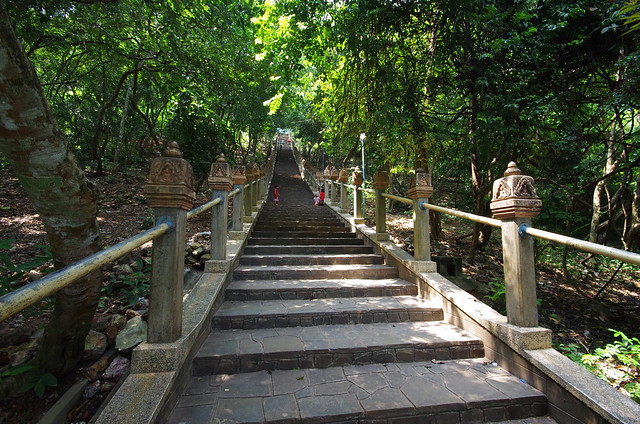
Following this pit stop, we made for the steps which would carry us to the top of the phnom. We huffed and we puffed slowly up the steps – all 509 of themimage
accompanied by a charming little boy, one of the cloud, who went by the name of Monette. His English was approximate, but he used it bravely to explain to us the sights we passed, the first of which was some exceedingly cheeky monkeys who hung around the steps like a pack of bad boys, ready to snatch lotus flowers from the unwary passer-by and snack on their stamens (or do I mean their pistils?)

image

One did just that to a group of young women in front of us, who came running back down the stairs screaming and clutching at each other. I moved forward bravely towards the insolent monkey as he sat on the steps munching the stamens (or do I mean pistils?). He looked me in the eye, and calmly walked off into the surrounding bushes holding his booty and showing me his bum. I mustered as much of my dignity as I could and Carried On.

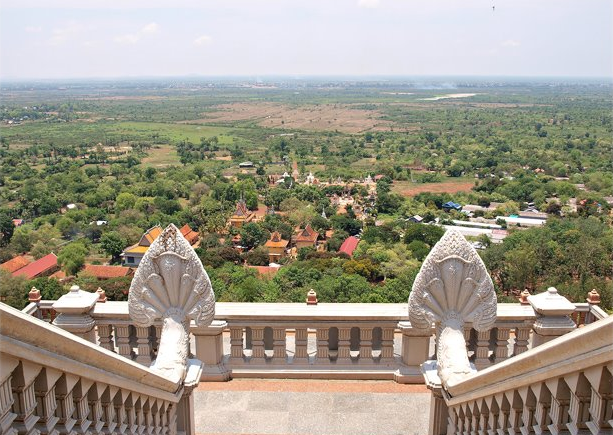
With one final heaving huff and one further ragged puff, we staggered to the top. With the excuse of admiring the view

image
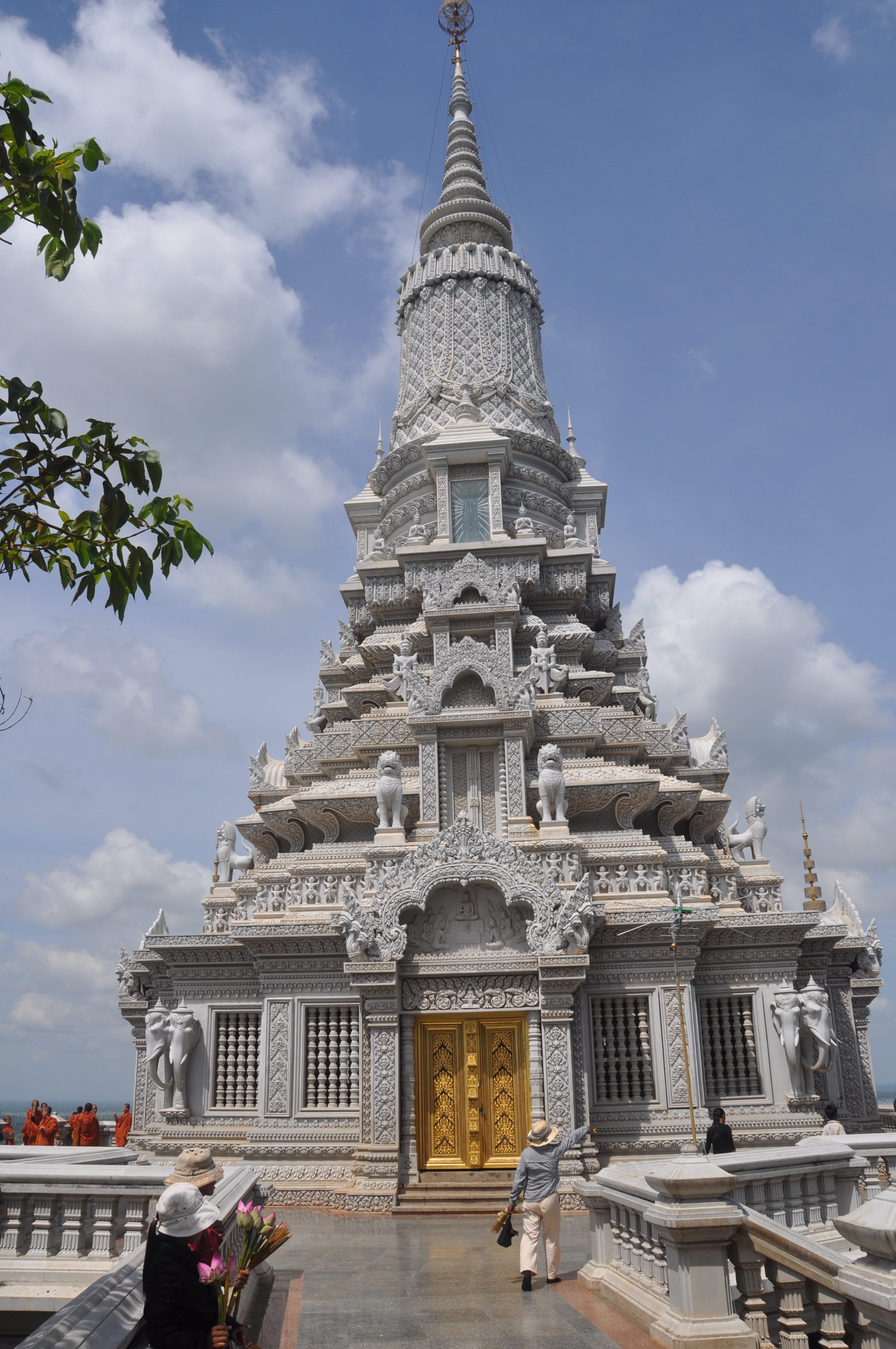
we took a break. But soon we turned around and took in the first of five stupas which crown the hill.

image

After walking around it, we wended our way along the crest, from one stupa to the next, with Monette scampering along and giving us fractured, splintered explanations, until we got to the last, a stupa with four faces.

image

Well! This was a pleasant discovery! Those four faces staring benevolently out to the four cardinal points were intriguing indeed.

image

I must confess, my first – wholly irreverent – thought was that they reminded me of Thomas the Tank Engine of my youth.

image

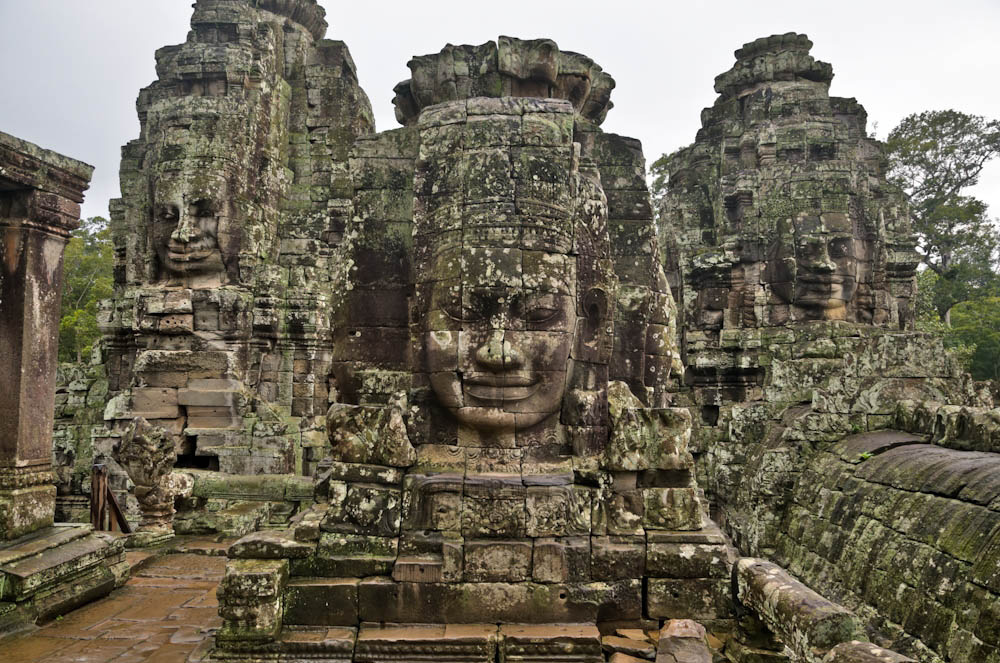
But then another memory floated to the surface, from several years ago when my wife and I visited Angkor Wat, several hundred kilometers upriver from where we were currently standing, on the edges of Tonle Sap lake: Prasat Bayon, the shrine to Mahayana Buddhism, the temple of the 200 faces of Lokesvara, the bodhisattva of compassion. Yes, this must have been the model of the stupa before me.

image

image

image

Ah, what a lovely, lovely temple is Prasat Bayon! The bodhisattva who embodies the compassion of all Buddhas smiling at you wherever you stand, wherever you look. A thousand rays of compassion sweeping us visitors and what had been the surrounding city.

But King Jayavarman VII, who built the temple and who replaced the Khmers’ state religion of Hinduism with Mahayana Buddhism (and whose face, many think, was the model of the bodhisattvas at Prasat Bayon)

image

merely copied from a previous model for his design, that of Brahma, the Hindu god of creation. Brahma is very often represented with four heads, each reading one of the four Vedas. Temples dedicated to him are rare, but there was one close to Angkor Wat, on Phnom Bok. The quadruple-headed bust below, from that temple, is now in the Musée Guimet in Paris, no doubt “taken in for its protection” (or do I mean filched?) by the-then French colonial masters.

image

There is also a regionally famous Brahma-derived statue here in Bangkok, down the road (as it were) from where we live: Phra Phrom (a Thai rendition of Brahma).

image

He is considered the deity of good fortune and protection. Since he has a solid following among the Chinese of Singapore, Hong Kong and Taiwan, and knowing the proclivity of the Chinese to gamble, I rather suspect that Brahma has gone from being the god of creation to the god of gamblers. How the mighty have fallen …

And on this melancholy note, it was time to leave my reveries and move on. My wife and I made our way back down the hill, at the bottom of which we gave Monette 10 dollars for his services, enjoining him to use it for his schooling (he had informed us that he was going to a paying school) but fearing that it might end up instead in the pockets of his “minders”. We picked our way past the rubbish left by previous visitors and a monkey snacking on the boiled rice thrown away by one of them, we climbed into Andy’s tuk-tuk, and we puttered our way back to Phnom Penh.

____________________
Andy’ tuk-tuk: https://www.facebook.com/AndyFriendlyTukTukPhnomPenh/photos/pcb.290625764427281/290625417760649/?type=1&theater (in https://www.facebook.com/AndyFriendlyTukTukPhnomPenh)
Oudong from a distance: http://static.panoramio.com/photos/large/32298005.jpg (in http://www.panoramio.com/m/photo/32298005)
Stairs at Oudong: http://farm3.staticflickr.com/2825/10724616273_e3e9cf04b7_z.jpg (in http://iwandered.net/2013/11/07/day-trip-to-oudong-cambodia/)
Monkey: https://c2.staticflickr.com/8/7420/8993459951_7619376cd4_b.jpg (in https://www.flickr.com/photos/kamimura4401/8993459951/)
View from the top: http://1.bp.blogspot.com/-Yk57J-xzt4Y/UFLx1bIbIrI/AAAAAAAABPA/Mdq0Z5_DBuM/s1600/Oudong6.png (in http://www.camtravel.info/2012/09/oudong-mountain-cambodia.html#.VIB9hGIaySM)
First stupa: http://upload.wikimedia.org/wikipedia/commons/3/30/Sanchak_Mony_Chedei.jpg (in http://en.m.wikipedia.org/wiki/Oudong)
Stupa with faces: https://c2.staticflickr.com/4/3018/3087092115_26ee767788_b.jpg (in https://www.flickr.com/photos/zapata_k/3087092115/)
Stupa with faces – close up: http://1.bp.blogspot.com/-aAJEmmCf6h8/Um5lWw9rdxI/AAAAAAAAxbg/FBPq3MXQ0_U/s1600/23+Close+Up+of+Four-faced+Top+Cambodia+Oudong+Temple+Cycling-358.jpg (in http://jotarofootsteps.blogspot.com/2013/10/sites-oudong-temple-cambodia.html)
Thomas the tank engine: http://3.bp.blogspot.com/-KiFNIBZmqPI/TxKoxis-FrI/AAAAAAAAAJY/sVCzG4VTLd0/s1600/ThomastheTankEngine.jpg (in http://latestnewsfromtpandt.blogspot.com/2012/01/thomas-tank-engine-review.html)
Bayon temple-1: http://www.rickmann-uk.com/wp-content/uploads/Bayon-three-faces.jpg (in http://www.rickmann-uk.com/index.php/2007/06/05/angkor-temples-cambodia/)
Bayon temple-2: http://jcinnamonphotography.files.wordpress.com/2011/10/bayon-temple-faces-2.jpg (in http://jcinnamonphotography.wordpress.com)
Bayon temple-3: http://en.m.wikipedia.org/wiki/Bayon#/image/File:Das_Lächeln_von_Angkor.jpg (in http://en.m.wikipedia.org/wiki/Bayon)
King Jayavarman VII: http://en.m.wikipedia.org/wiki/Bayon#/image/File:JayavarmanVII.jpg (in http://en.m.wikipedia.org/wiki/Bayon)
Brahma: http://en.m.wikipedia.org/wiki/Brahma#/image/File:Brahma_Musée_Guimet_1197_1.jpg (in http://en.m.wikipedia.org/wiki/Brahma#Temples)
Phra Phrom: http://en.m.wikipedia.org/wiki/Brahma#/image/File:Thai_4_Buddies.jpg (in http://en.m.wikipedia.org/wiki/Brahma#Temples)

PEOPLE ON THE MOVE

Bangkok, 27 July 2014

Well, I’ve received my transfer orders. I’m moving to Bangkok to take over our office there. So my wife and I have been down in Bangkok for the last week, looking for a place to stay. For the moment, we’re renting an apartment which we got through AirBnB. It gives right onto the Chao Phraya River, which runs through the middle of the city and around which the city grew. So as we have breakfast in the morning before we go out apartment-hunting we can watch the traffic on the river: the empty barges, riding high

ships on river 002

the full barges, with water to their gunwales

ships on river 005

the express boats crowded with commuters darting in between as they weave their way from bank to bank.

ships on river 001

But what also catches my eye is this temple on the other side of the river

temple across the river 001

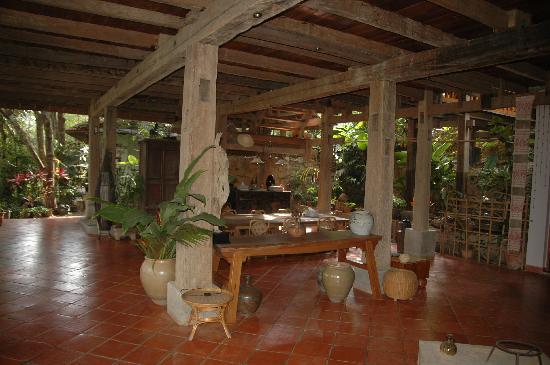
and it always reminds me of … China. Or rather, a certain corner of China, the Xishuangbanna Dai Autonomous Prefecture. This is way down in the south of Yunnan province, squeezed between Laos to the East and Myanmar to the West. A few years back, we spent a Dragon Boat Festival holiday in the prefecture’s main town, Jinghong, in a beautiful house which was built from elements scavenged from traditional houses that were being torn down in China’s rush to modernity.

Yourantai-interior

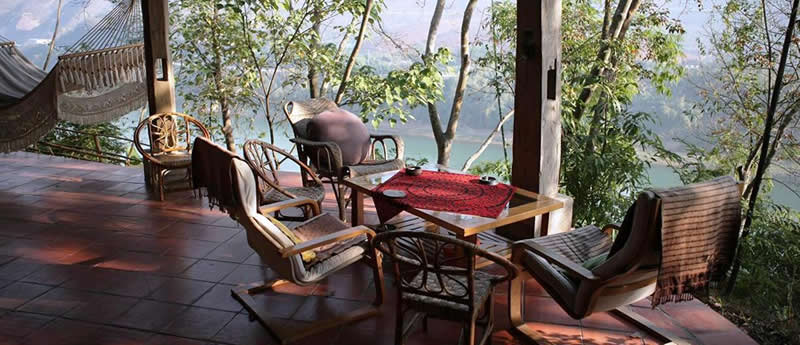
It too gave on a river, the Mekong in this case (although the Chinese don’t call it that; it’s the Lancang River to them), and there too we could gaze down on the river while having our breakfast.

Yourantai-view of the river

The temples in Jinghong are built in the same style as the one I see across my breakfast table, or at least the newer establishments are.

Mange-Buddhist-Temple-Jinghong-XishuangBanna

The older temples in the area are somewhat more sobre.

temple Xishuangbanna

This very obvious echoing of the Thai style has a simple reason. The Thai people (Dai people in this part of the world, hence the name of the prefecture) originally came from southern China. Then, for reasons which may have to do with the southwards migration of the Han Chinese, a portion of them upped sticks in the first millennium AD and started wandering south through Laos and Myanmar until they settled in what is now Thailand. But they left echoes of their culture behind, reflected in the designs of the temples but also in the language – many of the signs in Jinghong are in Thai as well as in Chinese.

The local culture (Thai and non-Thai; the ethnic mix in this part of the world is quite bewildering) is threatened with submersion in the Han culture – recall that this is why the Thais probably originally started migrating southwards. Until the 1950s there were few Han Chinese in this part of Yunnan – they were afraid of the malaria, which was then endemic. But the Chinese communists vigorously promoted programmes which eradicated the malaria. They then brought in poverty-stricken migrants from other parts of China and put them to work cutting down the jungle and planting rubber trees in its place, so now the hills around Jinghong are monotonously covered with acre after acre of rubber trees. These are all clones from the same genetic line. Those who know about these things predict that sooner or later (probably sooner rather than later) a rubber tree virus from Brazil will arrive here and wipe out every single rubber tree: an environmental disaster of epic proportions.

In the meantime, the descendants of the miserably poor Chinese who were sent to Xishuangbanna to plant and tap all those rubber trees still live in miserably poor Chinese villages, scorned and resented by the local populations.

As I look at the temple across the river and reflect on all these historic movements of people, I am reminded of the current tensions in Thailand caused by more recent movements, tensions between migrants from Cambodia, Laos and Myanmar, who do the dirty, poorly paying jobs which the locals no longer want to do, and the Thais, who have conveniently forgotten (if they were ever taught) that they too were once migrants.

“Plus ça change et plus c’est la même chose”, as Jean-Baptiste Karr, a French journalist and novelist, said back in 1849, and as my French grandmother was fond of quoting: the more things change, the more they stay the same. So true.

___________________

Chao Phraya river pics: mine
Yourantai-interior: http://media-cdn.tripadvisor.com/media/photo-s/01/b9/8b/a5/les-repas-dans-un-cadre.jpg [in http://www.tripadvisor.co.uk/LocationPhotoDirectLink-g528741-d1749170-i28937125-Yourantai_B_B-Jinghong_Yunnan.html%5D
Yourantai-river view: http://www.cielyunnan.com/wp-content/uploads/2012/04/Yourantai-24.jpg [in http://www.cielyunnan.com/hotels/hotels-xishuangbanna/xishuangbanna-yourantai-resort/%5D
Buddhist temple Jinghong: http://www.yunnanadventure.com/UploadFiles/Yunnan-Attractions/Xishuangbanna-Attractions/Mange-Buddhist-Temple-Jinghong-XishuangBanna.jpg [in http://www.yunnanadventure.com/attraction-p156-mange-buddhist-temple-jinghong-city
Temple Xishuangbanna: http://www.wildchina.com/blog/wp-content/uploads/2008/08/img_8570.jpg [in http://www.wildchina.com/es/multimedia/wildchina-blog-details/yunnan-hiking-in-xishuangbanna%5D

CAPABILITY BROWN

London, 12 May 2014

When I studied history in primary school, it was still taught the old way, by rote. So one learned royal genealogies by heart (“William the Conqueror, William Rufus, Henry I, Stephen, Henry II, Richard I, John Lackland”, etc.) as well as names of battles and the year they were fought (“Battle of Hastings 1066, Battle of Bannockburn 1314, Battle of Crecy 1346, Battle of Agincourt 1415, Battle of Naseby 1645, Battle of Culloden 1746” etc.). It was all very 1066 And All That, which is why I so dote on that book. One especially tricky set of battles to remember were those won by the Glorious Duke of Marlborough, who really stuck it in the eye of the French King, rah-rah (it was especially trying to be half French in these moments of our history classes when the Brits were triumphing over the French). For those of my readers who might have forgotten these battles (or much more probably have never heard of them), we are talking about the Battles of Blenheim, Ramillies, Oudenaarde, and Malplaquet, fought in the years 1704, 1706, 1708, and 1709. To help us remember the names of these battles and their dates, our history teacher taught us an ingenious mnemonic in the form of a telephone number: BROM-4689 (only British readers as old as me will remember that there was a time when UK telephone numbers were a mix of letters and numbers). So now, for the rest of my life I will remember the dates of these four battles, glorious victories for the British, rah-rah. A quick whip through the internet shows me that my history teacher wasn’t the only one who used this mnemonic, which has somewhat deflated the admiration I have had for him all these years.

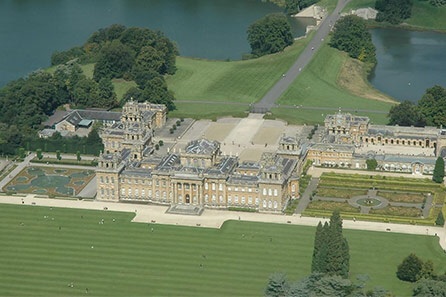
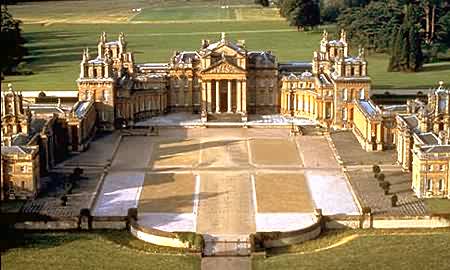
If I am recounting this old story, it is to explain the emotion which I felt when my wife and I visited Blenheim Palace a few days ago. After all those years of having BROM-4689 uselessly rattling around my brain, I could finally see a concrete output of at least one of these battles, the Battle of Blenheim.  For the Duke of Marlborough was given a modest manor and its grounds by a grateful Queen and a promise of funds from “the nation” (i.e., the taxpayer) to knock down the manor and build a grand new home and garden, worthy of the victor of the glorious Battle of Blenheim, rah-rah. In the event, the Duke and Duchess (because she was heavily involved) got little if any funds from the “grateful nation” and the Duke paid for most of the works from his own pocket. The story of the building’s construction is worthy of an opera, but I will skip over that to focus on the end result, here seen in all its glory from the air

image

image

image

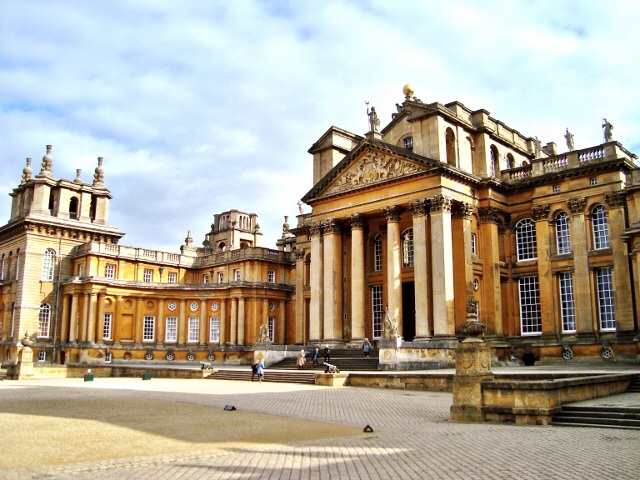
To be honest, I think it’s really only from the air that one can appreciate this ducal pile. My wife and I found that from ground level it’s all rather overpowering. Here’s a shot of the front taken by another visitor. Note the size of the persons compared to the building.

image
We visited the inside, looking respectfully at all the nice things displayed – the portraits of worthy grandees, the tapestries, the long library with its organ, the expensive baubles scattered over various surfaces – but all the time my wife and I kept saying to each other “how did the Dukes keep this place warm and lit?” The bills for the upkeep must have been staggering. And in fact the current Duke has had to do all sorts of things (add a little train, build a butterfly house and a maze) to attract the tourists and get their entry fee. And you can get married there – for a fee. Etc., etc.

What really caught me was the garden. It would, of course. It was designed by Lancelot “Capability” Brown. I love his style, which is so very naturalistic. He creates these undulating fields of grass which sweep up to the house. He scatters clumps or belts of trees, or even individual trees, over these fields. He will often create lakes by invisibly damming small rivers or streams running through the property. His garden at Blenheim Palace has all of these. This is a modern photo

image

But I prefer this old painting

image

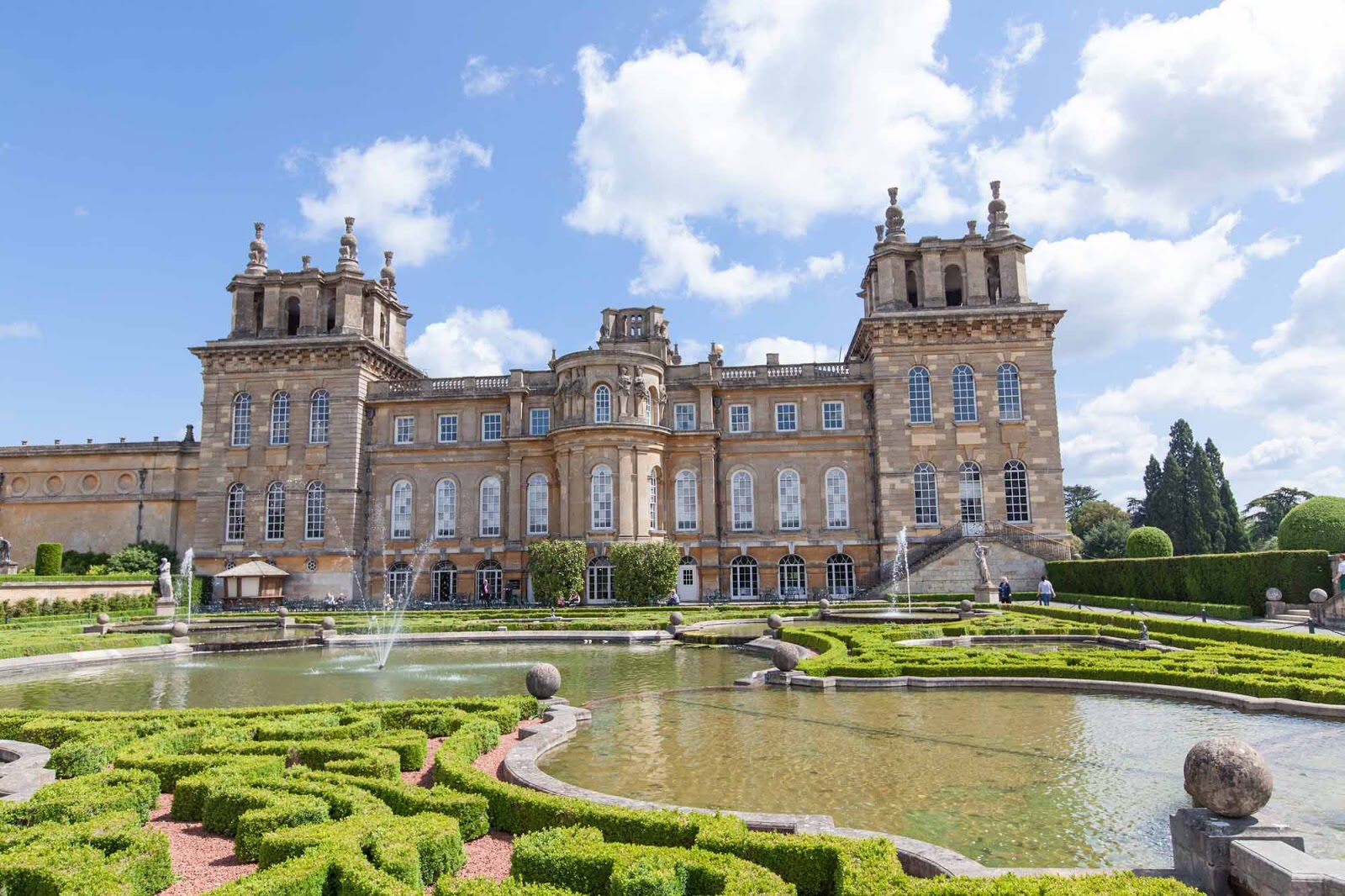
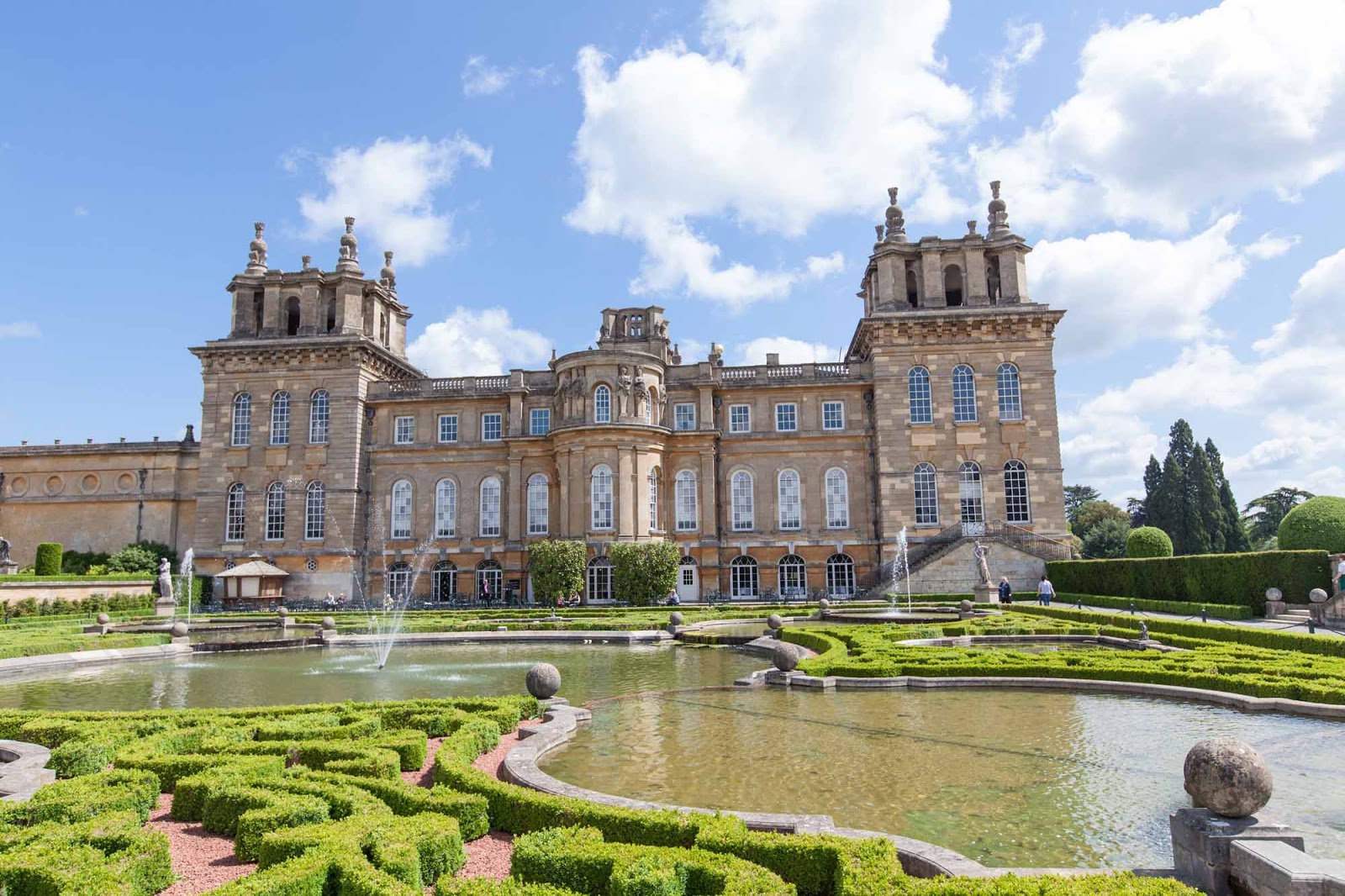
For me, Capability Brown’s gardens are the quintessence of the English garden, preferable by far to the strict and sterile geometry of a French garden, of which Blenheim Palace also has an example.

image

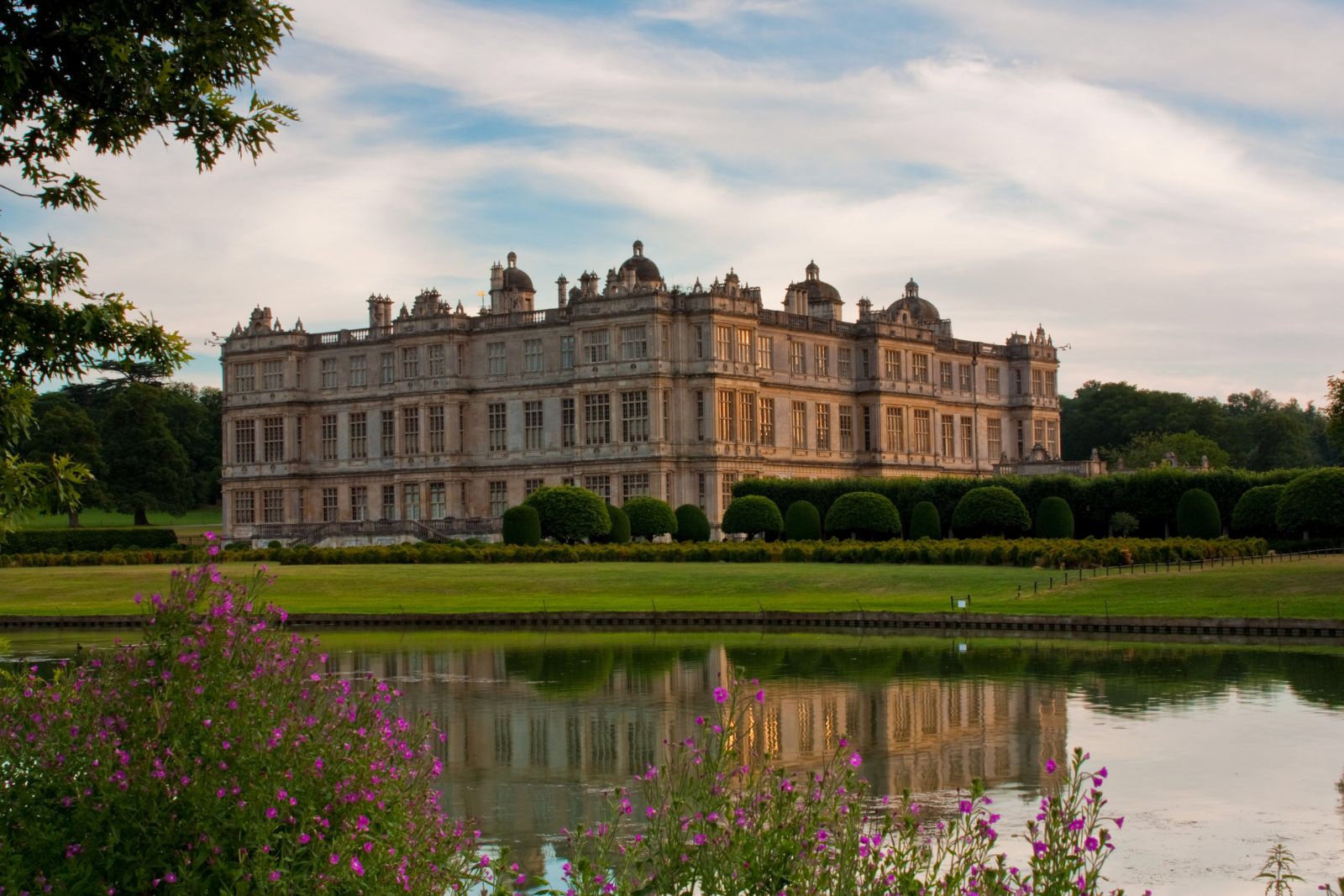
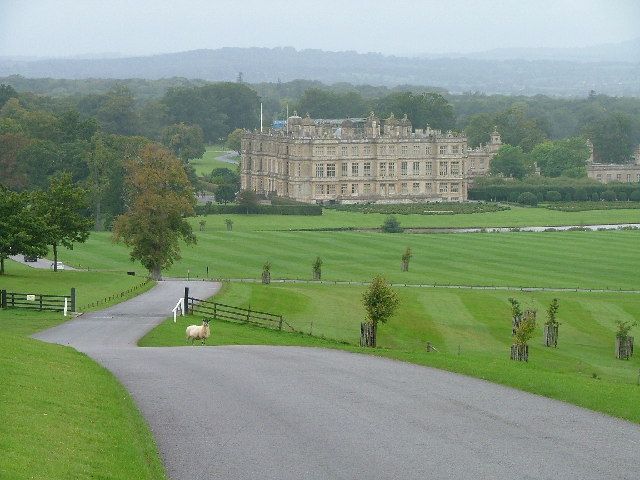
By one of those strange twists of Fate which one’s life is filled with, I had first come across Capability Brown at the same time that I was learning BROM-4689. My grandmother had come down for the weekend to visit me in my primary school and she took me to visit Longleat House, another of those stately homes which dot the English countryside, this time belonging to the Marquesses of Bath.

image

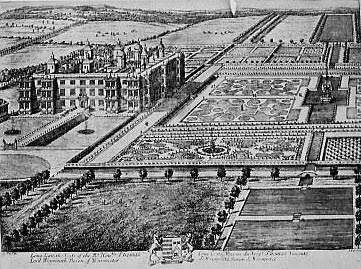
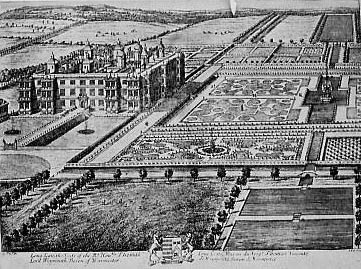
As required by the fashion of the times, Longleat had boasted of a very large, formal French garden

image

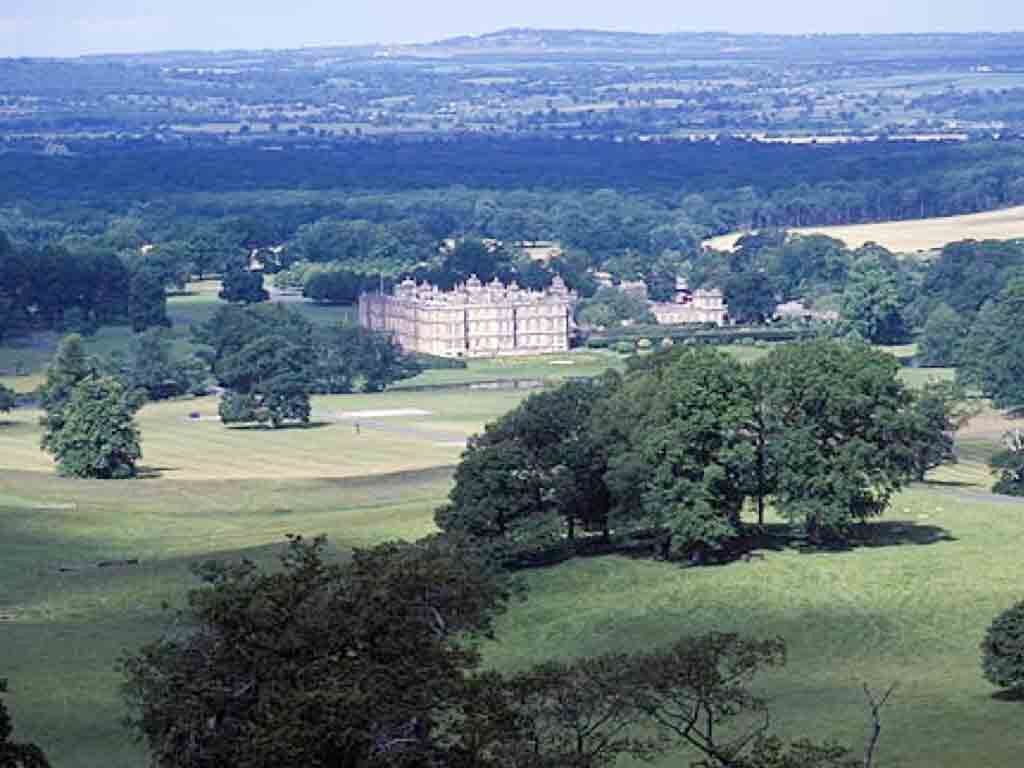
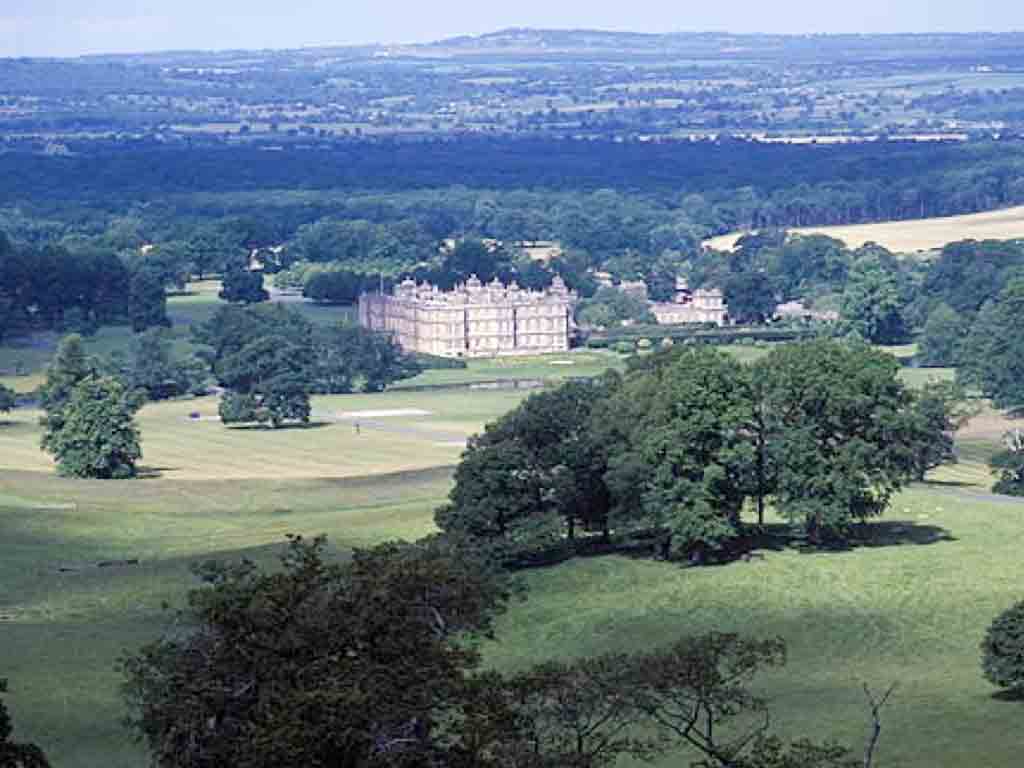
but luckily good sense had prevailed and the 1st Marquess of Bath (they had been mere Viscounts before that …) had hired Capability Brown to replace the formal gardens with one of his creations.

image

See how Brown’s work fits seamlessly into Britain’s natural landscape.

image

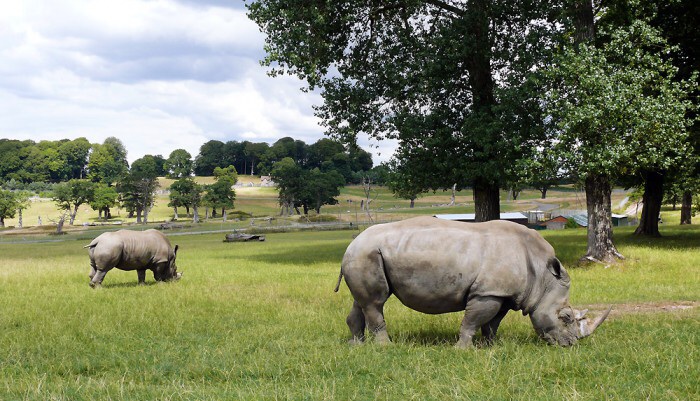
Of course, the Marquesses of Bath have been under the same financial pressure as the Dukes of Marlborough. At Longleat, the Marquesses have adopted the same kind of tourist attractions as the Dukes at Blenheim: little trains, mazes, weddings, and so on. But the Marquesses went one step further and created one of the first Safari Parks in the UK in the grounds of Longleat. So in Capability Brown’s landscape we now find lions, giraffes, zebras, and more.

image

How fallen are the mighty. But what to do, even Dukes and Marquesses (finally) have to make a living like everyone else.

___________________

Blenheim Palace aerial view-1: http://4.bp.blogspot.com/-khCnNCcHPyE/T9bWqchSzrI/AAAAAAABYSY/dPjnMkUU-ME/s1600/011_blenheim-palace_theredlist.jpg (in http://loveisspeed.blogspot.com/2012/06/blenheim-palace-england.html)
Blenheim Palace aerial view-2: http://s1.acorneplc.info/content/img/product/main/visit-to-blenheim-palace-31143824.jpg (in http://www.virginexperiencedays.co.uk/visit-to-blenheim-palace-with-a-deluxe-picnic-for-two)
Blenheim Palace aerial view-3: http://bestvaluetours.co.uk/images/products/gt-bpct-n/xl-p-233-blenheim-palace.jpg (in http://bestvaluetours.co.uk/search-the-cotswolds-and-bleheim-palace-day-tour-129)
Blenheim Palace front door: http://satnavandcider.files.wordpress.com/2012/05/blenheim-palace-front-8973-640×480.jpg (in http://satnavandcider.wordpress.com/2012/05/03/at-blenheim-palace-keep-off-the-gravel/)
Blenheim Palace-gardens-modern photo: https://www.english-heritage.org.uk/content/news/2011/images/blenheim-palace (in https://www.english-heritage.org.uk/about/news/exclusive-members-event-woodstock-literary-festival/)
Blenheim Palace-gardens-old painting: http://upload.wikimedia.org/wikipedia/commons/6/6a/Blenheim_PalaceDE.jpg (in http://en.wikipedia.org/wiki/Blenheim_Palace)
Blenheim Palace-formal gardens: http://3.bp.blogspot.com/-DNgdli09UZA/UQwuWAE-IaI/AAAAAAAAK-s/DfxInZN3z7s/s1600/photo+email.jpg (in http://www.weddingblogdesigner.com/2013/02/bleneim-palace_4.html)
Longleat House: http://www.chch.ox.ac.uk/sites/default/files/images/development/dev2011/longleat-house.jpg (in http://www.chch.ox.ac.uk/development/events/future/2005/7-july-longleat-house-visit)
Longleat old French gardens: http://upload.wikimedia.org/wikipedia/commons/e/e2/Longleat_by_Knyff_edited.JPG (in http://en.wikipedia.org/wiki/Longleat)
Longleat gardens: http://www.writework.com/uploads/3/39734/english-longleat-house-wiltshire-longleat-house-home-lord-ba.jpg (in http://www.writework.com/essay/ao1-investigating-business-actais-and-longleat-aims-and-ob)
Longleat aerial view: http://4.bp.blogspot.com/-MO9gG__FJ7U/T03YIfdx_kI/AAAAAAAAAQc/9U-JgcFxX6Y/s1600/Brown+-+Longleat.001.jpg (in http://www.gardenhistorymatters.com/2012/12/lancelot-brown-is-blogging.html)
Rhinos at Longleat: http://www.millfarmglamping.co.uk/wp-content/uploads/2012/09/longleat-700×401.jpg (in http://www.millfarmglamping.co.uk/in-this-area/longleat/)

WORLD HERITAGE SITES – OUR LIST

Beijing, 9 March 2014

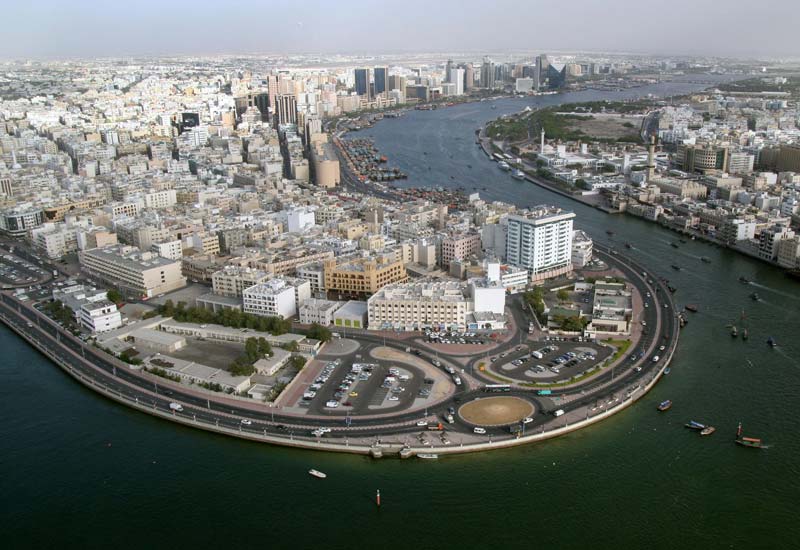
I was recently in Dubai with my wife for a long weekend. If you don’t like shopping, which I fervently do not, if you don’t get much of a kick out of visiting the tallest building in the world, which is definitely my case, if you don’t quite see the point of going skiing in a mall, which I certainly don’t, then your to-do list in Dubai is really quite short. On one side of the saltwater creek which wends its way through the middle of the city

Dubai.creek

you can visit gold and spice souqs of dubious antiquity. On the other side, you can visit a small remnant of the old town, saved, so it seems, from the wrecker’s ball by the intercession of Prince Charles with the Sheikh of Dubai. You can follow this up by a visit to the Dubai Museum, housed underneath a quaint little old fort and filled with a rather pathetic set of dioramas showing the old ways of life in the sheikhdom. A 20 minutes’ walk downcreek will bring you to the Sheikhs’ old residence (or rather, a nearly complete reconstruction of it) filled with some old photos of Dubai. You can cross from one side of the creek to the other in supposedly old wooden boats which ply the waterway. And that’s it. Of the four days that my wife and I spent in Dubai, we actually only needed two to visit the city itself. We used one of the days to visit Abu Dhabi (or rather, the planned eco-city district of Masdar) and while I was sitting in a conference my wife used another to visit Al Ain, an oasis town some two hours’ drive from Dubai.

Now don’t get me wrong, it’s really very pleasant to wander around without haste, poking your nose in here and there, snapping photos of this and that, taking long lunch and coffee breaks, and enjoying mild and sunny weather. But what really got my goat was a small exhibition which we stumbled across somewhere in the souqs, which proudly announced that some time this year Dubai expected UNESCO to nominate the creek and its immediate surroundings as a World Heritage Site. Give – me – a – break! The Dubai creek a World Heritage Site?! That’s ridiculous!! For those readers who may not be familiar with this UN programme, I should explain that it implements an international convention, the Convention concerning the Protection of the World Cultural and Natural Heritage, whose purpose is to protect and conserve for present and future generations cultural heritage (monuments, groups of buildings, sites) or natural heritage (natural features, geological formations, natural sites) of outstanding universal value. Please note: outstanding universal value. Those are big, big words. Put another way, the sites which are nominated as World Heritage Sites should be so fantastic that it would be a crime for me and every other citizen in the world not to do everything in our power to protect them for future generations to marvel at. Does that describe Dubai creek? I – don’t – think – so!

I had first entertained serious doubts about the World Heritage Site listings when we went on a family holiday to Finland some ten years ago. I had seen that a church along our itinerary had been listed. Intrigued, I dragged the somewhat unwilling family to visit it (to this day, my children remind me of this and other churches I forced them to visit in Finland). What we were confronted with was a small, rustic church whose three main claims to fame were (a) that it was quite old, (b) that it was made entirely out of wood, and (c) that no nails had been used to make it … this was “outstanding universal value”?? Puh-lease! My cynicism over World Heritage Site listings only deepened over the following years as everywhere I went I came across really quite ordinary sites which had been listed. UNESCO’s convention has obviously been hijacked by the tourism industry and its hacks in Ministries of Tourism to brand national sites and raise tourism revenues. And no doubt political correctness has reared its head. It won’t do for just a few countries to have all the heritage sites of outstanding universal value, every country should be able to claim at least one …

This debasing of the World Heritage Site brand is a pity, because I think there are a number of places around the world which through some magical combination of geometry, colour, light, and siting really do have an outstanding and universal value to all of us in the world and whose preservation truly deserves the concerted attention of the global community. My wife and I put our heads together, and what follows is our list. Its main weakness is that it is based only on places which we have seen – so much of the world for us still to see …

Since Dubai got me going, I’ll start with cityscapes:

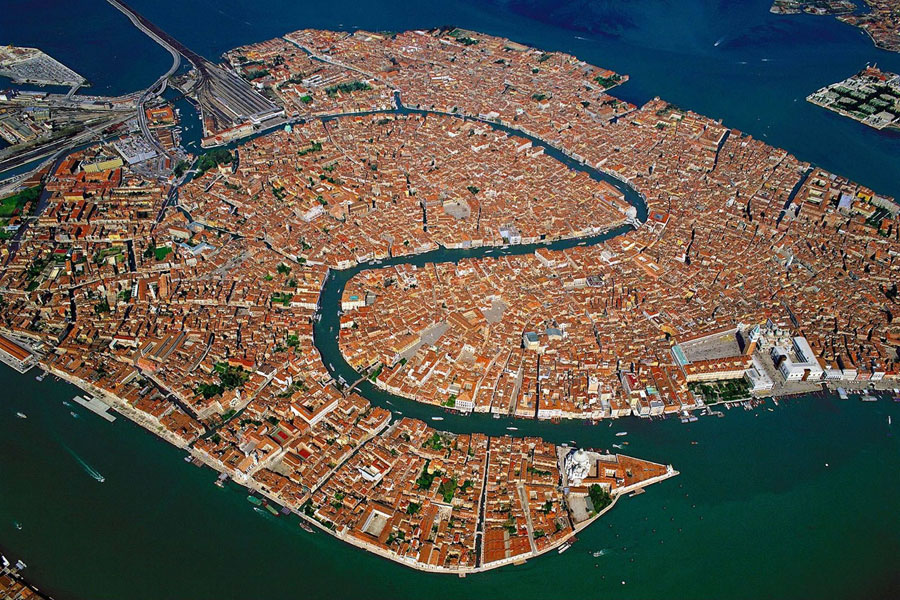
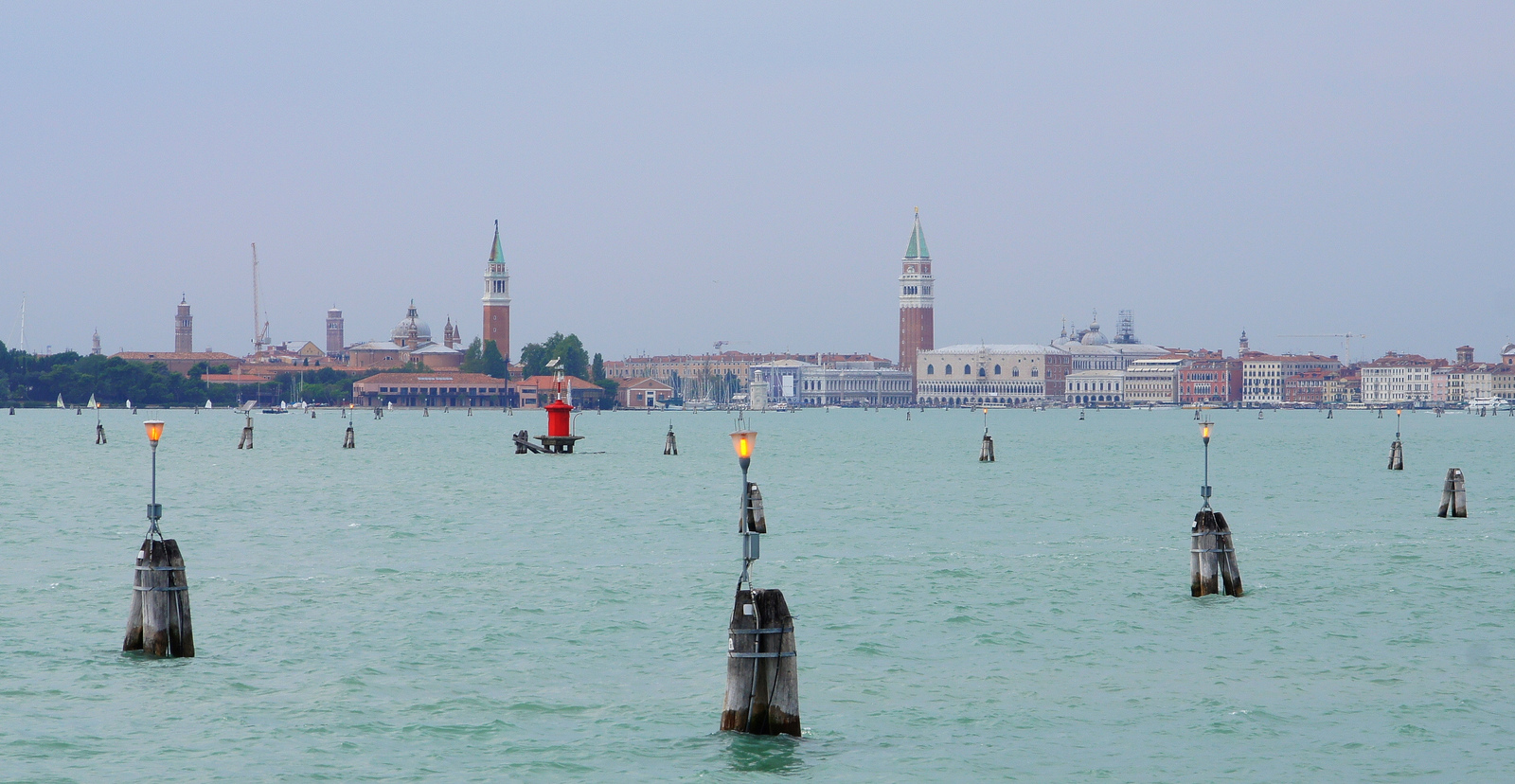
– Venice, which must be the most beautiful city in the world

venice-aerial

view from ferry

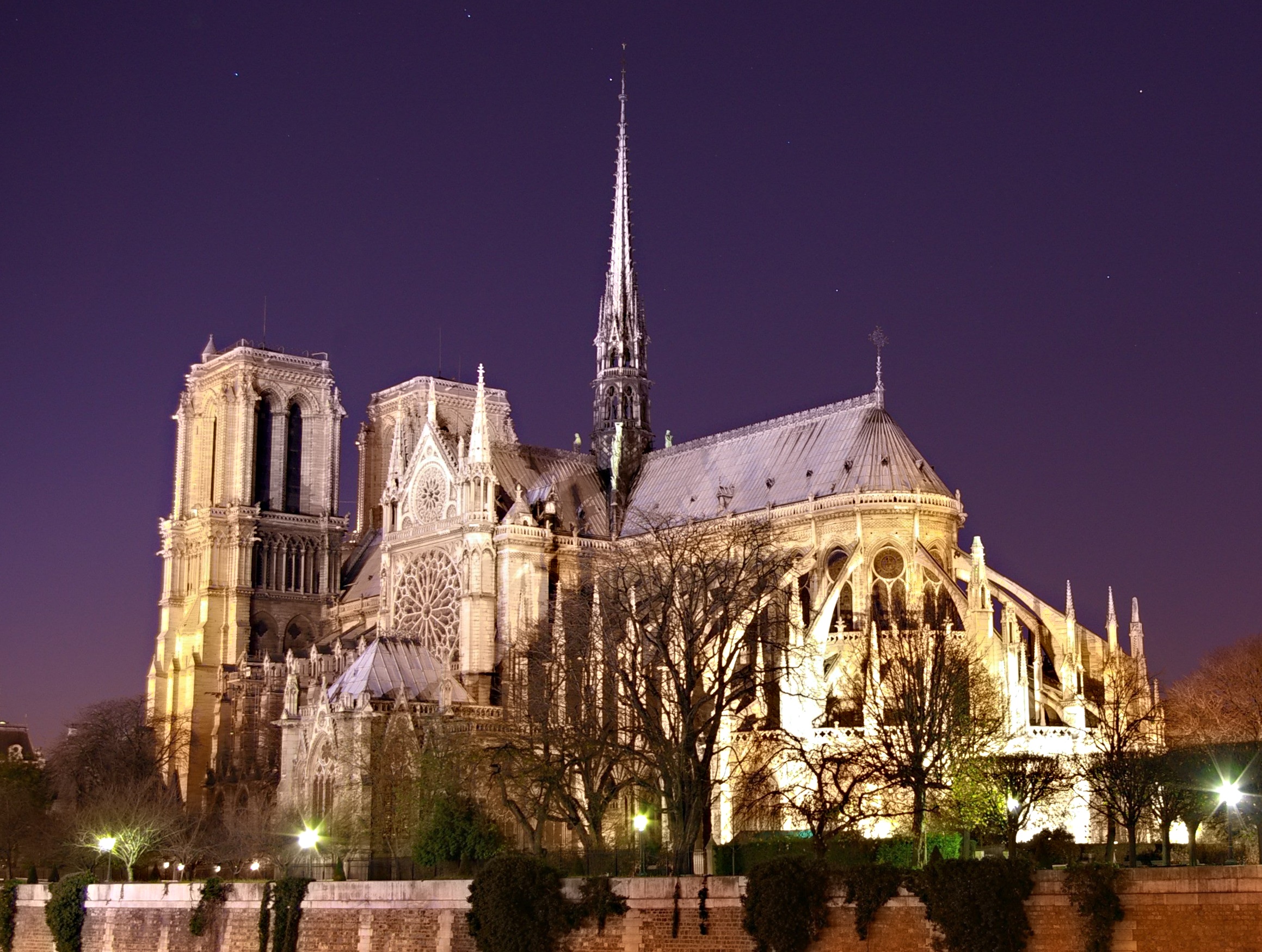
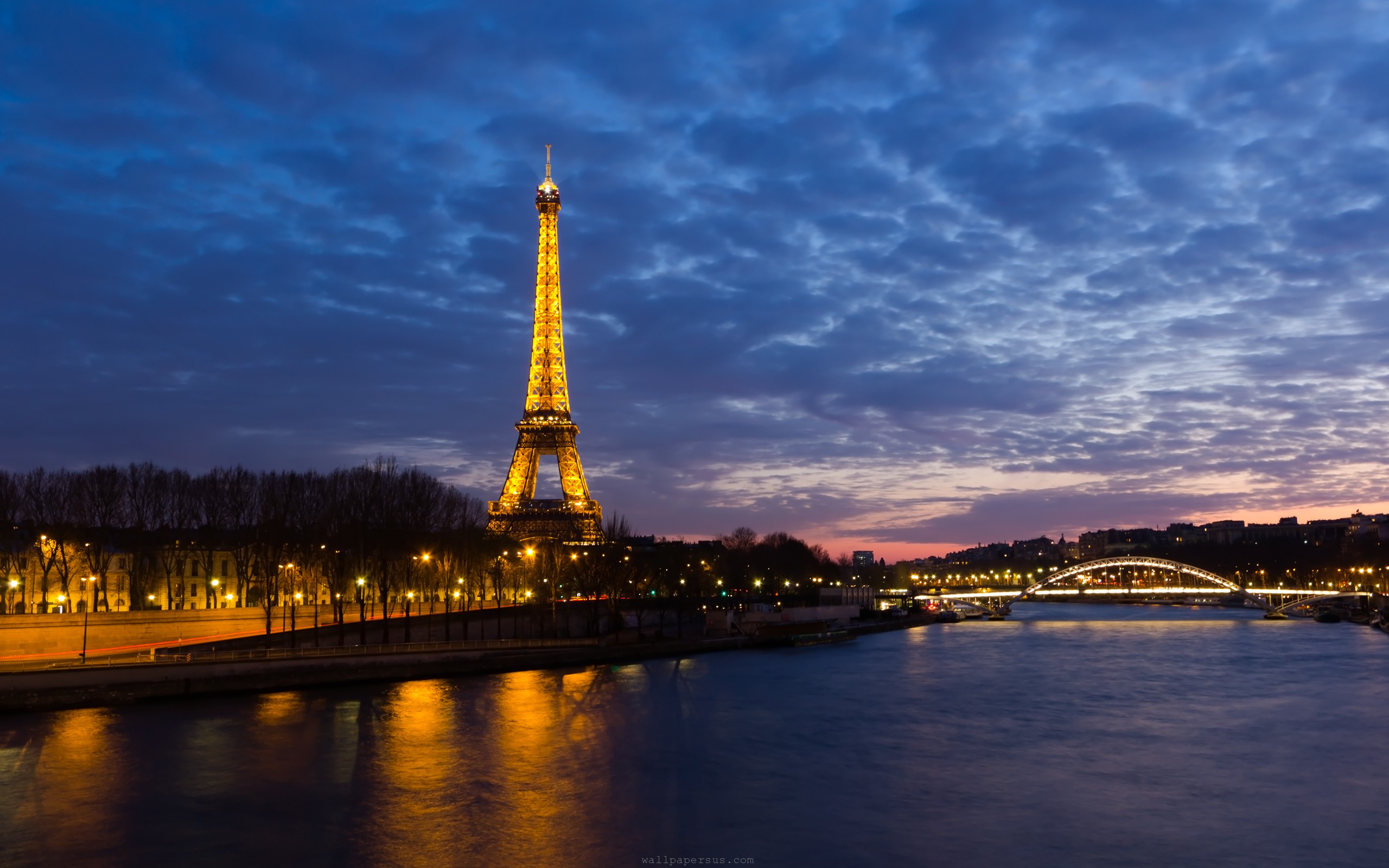
– Paris, especially the part along the banks of the river Seine running from Notre Dame Cathedral to the Eiffel tower

Paris-Notre Dame

Paris-Eiffel tower

(I find Paris to be at its best at night, when all its buildings are lit up like theatre backdrops)

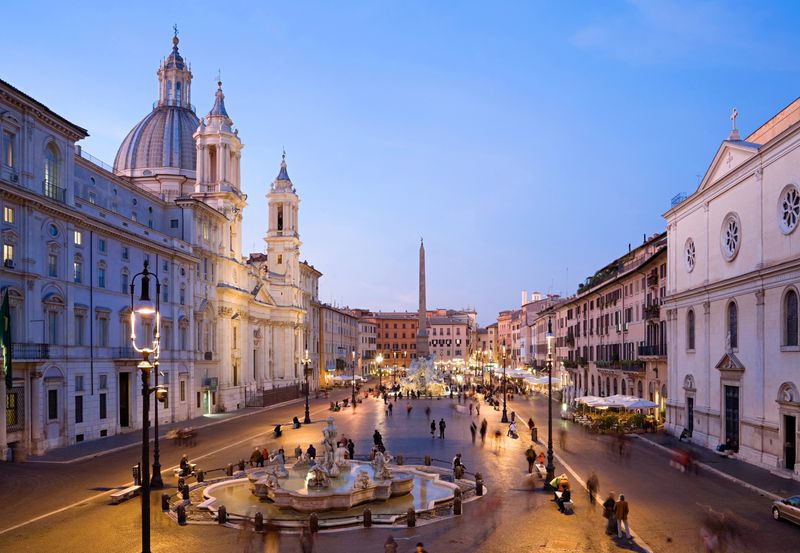
– Rome, especially the Baroque part of the city

Rome Piazza Navona

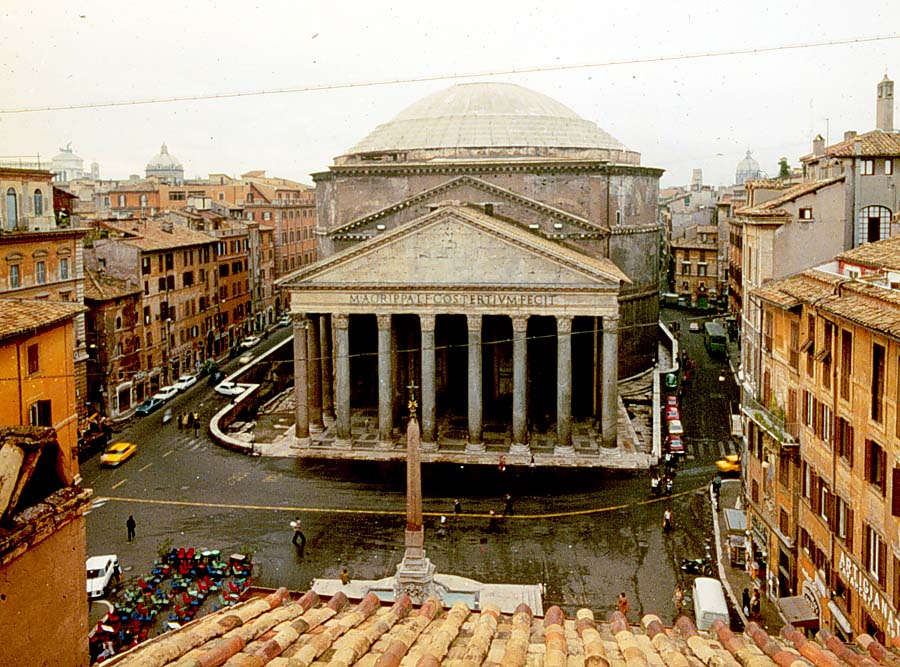
where, though, older Roman urban fabric can poke through

Rome Pantheon

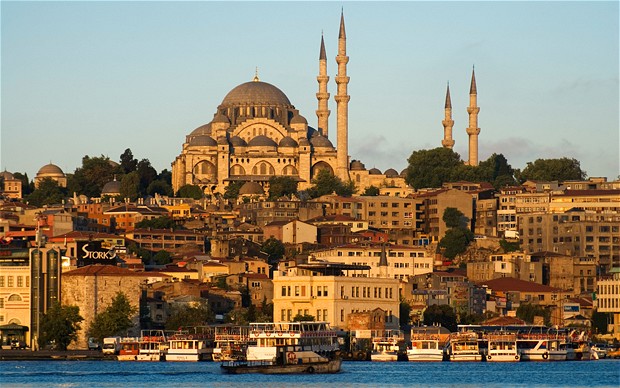
– The historic nucleus of Istanbul, on its peninsula jutting out into the Bosphorus

istanbul

– Old Prague

prague

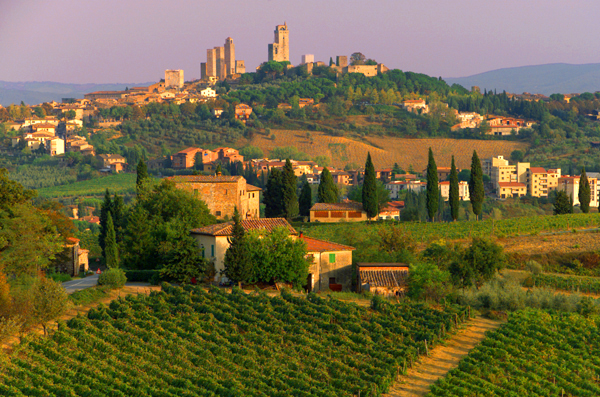
– On a smaller scale, San Gimignano in Tuscany

San Gimignano-1

San Gimignano-2

which can stand for all those wonderful hilltop towns and villages scattered throughout central Italy (Siena, Todi, Gubbio, Assisi, Volterra, Arezzo, Perugia, Urbino, and on and on …)

– I will add Savannah in Georgia. My wife and I stumbled on the city by chance thirty years ago, and we were blown away

Savannah-Georgia

I wonder if I should I add Edinburgh? My wife is doubtful, but the New Town there is really very nice, with a magificent view over the Firth of Forth

edinburgh-3

and there is the dramatic backdrop of Edinburgh castle

edinburgh-2

What about Manhattan?

Manhattan Office Vacancy Rate Drops In Second Quarter

I’m torn. Manhattanites certainly think that the borough has outstanding universal value, non-residents may not be so sure.

After cityscapes we list a series of buildings and complexes that stand out because of the beauty of the buildings themselves, often highlighted by their siting:

– Taj Mahal, which must be one of the most sublime buildings in the world

Taj Mahal

and which can stand in for a series of wonderful Mughal edifices dotted around northern India (Fatehpur Sikri, the Mausoleum of Akbar at Sikandra, the Jama Masjid mosque in Delhi, the mausoleum of Humayun, …)

– Angkor Wat

Angkor-wat-2

with its wonderful faces carved in the temple walls

Angkor-wat-gods

– The rock gardens and temples of Kyoto

Kyoto Tofuukuji rock garden-2

kyoto kinkakuji

kyoto ginkakuji

– The chateaux of the Loire in France, especially Chenonceau

Chateau de Chenonceau

and Azay-le-Rideau

Chateau-Azay-le-Rideau

– The Alhambra palace in Andalusia

SONY DSC

with its typical Arab love of water

Alhambra-2

We don’t just list old buildings. We would add at least two modern buildings:

– the Sydney Opera House

sydney opera house 014

– the east wing of the National Gallery in Washington DC

east wing national gallery

My wife thinks we should also list Labrang, the Tibetan Buddhist monastery-town in Sichuan

labrang

I’m not convinced that it really has outstanding universal value, yet.

I’ll add here a couple of the wonderful garden-parks which were created around some of the grander country houses in the UK in the 18th century.

– Stowe gardens

Stowe-Landscape-Gardens

Stowe gardens-house

– Fountains Abbey and Gardens

fountains abbey

fountains abbey gardens-1

fountains abbey gardens-2

Which brings us naturally to our last list, our choices of natural heritage sites of outstanding universal value. We would start with the canyons in the American west. Rather than list the Grand Canyon, which some might consider the natural choice, we would list some of the smaller canyons:

– Bryce Canyon, especially lovely in winter, which is when we saw it:

bryce canyon

– and Canyon de Chelly

canyon-de-chelly

– We are moved to list here too the Atlas mountains in Morocco. When we first saw them, we were immediately reminded of the canyonlands in the US

Atlas mountains

but what was even better was that the locals were still making their villages from the local clay so that villages seemed to grow out of the landscape

atlas mountains-villages

– From canyons on land to canyons on the sea, and here we found the fjords in New Zealand more striking than those in Norway

New Zealand South Island Fiordland National Park Milford Sound

– From water to none, with the red sand dunes of Namibia

Namibia -Dune 45

– and back to water again, with the Amazon River

Amazon river

– from hotter to cooler, with the high meadows of the Alps in the Trentino in Italy

alps-trentino

– from grass to trees, in this case the truly magnificent sequoias

sequoia-national-park

– and finally back to grass and water, with the Scottish Highlands

scottish-highlands

-o0o-

Well, that’s our list of cultural and natural sites which we would consider to have outstanding universal value. As I said earlier, the list is no doubt incomplete simply because there are still lots of places we haven’t visited. We’d be interested to know how readers feel about this. What sites would they put on their own list?

_______________

Dubai creek: http://www.guiaemdubai.com/wp-content/uploads/2010/07/Dubai.creek_.jpg [in http://www.guiaemdubai.com/dubai-creek/%5D
Venice-aerial view: http://weddinginvenice.net/wp-content/uploads/2008/07/venice.jpg [in http://weddinginvenice.net/blog/aerial-view-of-venice%5D
Venice-worm’s eye view: http://farm9.staticflickr.com/8149/7667954390_2eafc258f6_h.jpg
Paris-Notre Dame: http://upload.wikimedia.org/wikipedia/commons/a/a2/Notre_Dame_de_Paris_by_night_time.jpg [in http://it.wikipedia.org/wiki/Cattedrale_di_Notre-Dame%5D
Paris-Eiffel tower: http://wallpapersus.com/wp-content/uploads/2012/01/eiffel-tower-sunset-architecture-city-cloudy-dusk-famous-river.jpg [in http://wallpapersus.com/eiffel-tower-sunset-architecture-city-cloudy-dusk-famous-river/%5D
Rome Piazza Navona: http://www.bonjouritalie.it/uploaded/images/Piazza_Navona_Evening.jpg [in http://www.bonjouritalie.it/en/news/46/PIAZZA-NAVONA-the-Roman-s-playroom-.html%5D
Rome Pantheon: http://www.dewereldwonderen.nl/wp-content/uploads/2011/09/pantheon-omgeving.jpg [in http://www.dewereldwonderen.nl/andere-wereldwonderen/het-pantheon/%5D
Istanbul: http://i.telegraph.co.uk/multimedia/archive/02012/istanbul-biennial_2012683b.jpg [in http://www.telegraph.co.uk/culture/art/8796386/Istanbul-biennial-art-at-the-crossroads-of-the-world.html%5D
Prague: http://www.discoverwalks.com/prague-walking-tours/wp-content/blogs.dir/5/files/4/not-many-people-can-show-you-this.jpg [in http://www.discoverwalks.com/prague-walking-tours/prague-castle-tour/%5D
San Gimignano-1: http://www.roma-antica.co.uk/custom/San%20Gimignano.jpg
San Gimignano-2: http://www.hotelilponte.com/writable/public/tbl_galleria/grande/v961b38120234375.jpg
Savannah: http://www.shedexpedition.com/wp-content/uploads/2013/06/gingerbread-house-Savannah-Georgia-1899-Carpenter-Gothic.jpg [in http://www.shedexpedition.com/savannah-georgia-best-quality-of-life-and-visitor-experience/%5D
Edinburgh-New Town: http://www.stravaiging.com/photos/albums/places%20in%20Scotland/towns/Edinburgh,%20Midlothian/IMG_9890.jpg [in http://www.stravaiging.com/blog/edinburgh-world-heritage-official-tour/%5D
Edinburgh-castle: http://waimhcongress.org/wp-content/uploads/2013/03/edinburgh_-_calton_hill_nov_12_0.jpg [in http://waimhcongress.org/location/about-edinburgh/%5D
Manhattan: http://www.elikarealestate.com/blog/wp-content/uploads/2014/03/nyc001.jpg [in http://www.elikarealestate.com/blog/manhattan-sales-time-high/%5D
Taj Mahal: http://upload.wikimedia.org/wikipedia/commons/c/c8/Taj_Mahal_in_March_2004.jpg [in http://en.wikipedia.org/wiki/Taj_Mahal%5D
Angkor Wat: http://i.telegraph.co.uk/multimedia/archive/02381/Angkor_wat_2381155b.jpg [in http://www.telegraph.co.uk/news/worldnews/asia/cambodia/9638352/Canals-may-have-sped-up-building-of-wonder-of-the-world-Angkor-Wat.html%5D
Angkor Wat Gods: http://www.urbantravelblog.com/wp-content/uploads/2012/02/Angkor-wat-gods.jpg [in http://www.urbantravelblog.com/photos/angkor-wat%5D
Kyoto Tofukuji rock garden: http://4.bp.blogspot.com/_bWbsTZVSaLw/S8uzFo1o2mI/AAAAAAAAAO4/tq11td38q3I/s1600/april-13+141.jpg [in http://kyotofreeguide-kyotofreeguide.blogspot.com/2010_04_01_archive.html%5D
Kyoto Kinkakuji: http://img.timeinc.net/time/photoessays/2011/travel_kyoto/01_kinkakuji.jpg [in http://content.time.com/time/travel/cityguide/article/0,31489,2049375_2049370_2048907,00.html%5D
Kyoto Gingakuji: http://lookjapan.org/photos/ginkakuji-temple.jpg [in http://lookjapan.org/kyoto.html%5D
Château de Chenonceau: http://upload.wikimedia.org/wikipedia/commons/d/d0/Chateau_de_Chenonceau_2008E.jpg [in http://en.wikipedia.org/wiki/Château_de_Chenonceau%5D
Château Azay-le-Rideau: http://upload.wikimedia.org/wikipedia/commons/thumb/d/d2/Chateau-Azay-le-Rideau-1.jpg/1024px-Chateau-Azay-le-Rudeau-1.jpg [in http://en.wikipedia.org/wiki/Château_d’Azay-le-Rideau%5D
Alhambra: http://upload.wikimedia.org/wikipedia/commons/2/22/Detail_Charles_V_palace_Alhambra_Granada_Spain.jpg [in http://commons.wikimedia.org/wiki/File:Detail_Charles_V_palace_Alhambra_Granada_Spain.jpg%5D
Alhambra-2: http://www.earthalacarte.com/images/destination/1370429824_0!!-!!4.jpg [in http://www.earthalacarte.com/destinations/alhambra/%5D
Sydney Opera House: our photo
East Wing National Gallery: http://www.greatbuildings.com/gbc/images/cid_2880204.jpg [in http://www.greatbuildings.com/buildings/East_Wing_National_Gallery.html
Labrang: http://korihahn.files.wordpress.com/2011/07/dsc_0423.jpg [in http://korihahn.com/2010/11/01/beijing-to-lhasa/%5D
Stowe gardens: http://www.landscapearchitecturedaily.com/wp-content/uploads/2013/04/Stowe-Landscape-Gardens.jpg [in http://www.landscapearchitecturedaily.com/?p=2599%5D
Stowe gardens-House: http://1.bp.blogspot.com/-9CU7qypYuhw/UTi58Pz-zXI/AAAAAAAABjU/t5dzpqANduk/s1600/photo+%286%29.JPG [in http://theelephantandthepirate.blogspot.com/2013/03/day-tripping-stowe-gardens.html%5D
Fountains abbey: http://3.bp.blogspot.com/-yHJdJ-LcSwI/TaSbP30qvOI/AAAAAAAACZQ/Mt-9gkW8Wj4/s1600/Fountains+Abbey+reflected+blg.jpg [in http://saltairedailyphoto.blogspot.com/2011/04/fountains-abbey.html%5D
Fountains abbey gardens-1: http://www.gardenvisit.com/assets/madge/studley_royal_and_fountains_abbey_980_jpg/600x/studley_royal_and_fountains_abbey_980_jpg_600x.jpg -[in http://www.gardenvisit.com/garden/studley_royal_and_fountains_abbey%5D
Fountains abbey gardens-2: http://www.gardenvisit.com/assets/madge/studley_royal_and_fountains_abbey_980a_jpg/600x/studley_royal_and_fountains_abbey_980a_jpg_600x.jpg [in http://www.gardenvisit.com/garden/studley_royal_and_fountains_abbey%5D
Bryce canyon: http://www.mikereyfman.com/Photography-Landscape-Nature/Bryce-Canyon-National-Park-Utah-USA/big/MR0105.jpg [in http://www.mikereyfman.com/photo/photo.php?No=5&Gallery=Bryce-Canyon-National-Park-Utah-USA%5D
Canyon de Chelly: http://believegallup.com/wp-content/uploads/2013/01/canyon-de-chelly.jpg [in http://believegallup.com/canyon-de-chelly/
Atlas Mountains: http://static.panoramio.com/photos/large/81928810.jpg [in http://www.panoramio.com/photo/81928810%5D (Toubkal National Park)
Atlas mountain village: http://www.destinationlemonde.com/images/17/photo1-ag.jpg [in http://www.destinationlemonde.com/images/17/photo1-ag.jpg%5D
Milford Fjord New Zealand: http://globalconnection.com.au/wp-content/uploads/2013/08/Milford_Sound_Fiordland_National_Park_South_Island_New_Zealand.jpg [in http://globalconnection.com.au/product/new-zealand-south-island-post-convention-tour/%5D
Namibia-Dune 45: http://upload.wikimedia.org/wikipedia/commons/5/54/Dune45_Sossusvlei_Namib_Desert_Namibia_Luca_Galuzzi_2004.JPG [in http://en.wikipedia.org/wiki/Dune_45%5D
Amazon River: http://assets.worldwildlife.org/photos/1818/images/story_full_width/meandering_amazon_%28c%29_WWF-Canon__Andre_Bartschi.jpg?1345553423 [in http://worldwildlife.org/tours/the-great-amazon-river-cruise%5D
Alps in Trentino: http://hqscreen.com/wallpapers/l/1280×800/67/alps_italia_italy_trentino_alpi_1280x800_66754.jpg [in http://hqscreen.com/alps-italia-italy-trentino-alpi-wallpaper-66754/%5D
Sequoia national park: https://lh6.googleusercontent.com/-lABhQdL_8II/UwXlmbxPEuI/AAAAAAAArw0/VfGi2Htb0jI/sequoia-national-park2.jpg?imgmax=1600 [in http://www.latheofdreams.com/%5D
Scottish Highlands: http://timeforbritain.files.wordpress.com/2012/01/scottish-highlands1.jpg [in http://timeforbritain.wordpress.com/beautiful-scotland/%5D

INDONESIA – THE TEMPLES: SO NEAR AND YET SO FAR

Beijing, 26 February 2014

A major reason why we came to this part of Indonesia was to visit Borobudur, Prambanan, and other smaller Buddhist and Hindu temples scattered around the Kedu plain, north of Yogyakarta. Well, Mt. Kelud’s eruption put paid to that plan! With equal indifference the volcano covered all temples, Buddhist and Hindu alike, with a layer of ash. Result: all the sites were closed to visitors while clean-up crews moved in to wash off the ash.

What to do, what to do? Well, hope springs eternal, as they say. We kept telling each other that surely they would reopen the temples quickly, within a few days, maximum! I mean, all those disappointed tourists milling around! All their money not being spent on entry tickets and ancillaries! So on the first day, we walked down to Borobudur to check out the situation. Not brilliant.  It would be a long time before the temple itself would be reopened, we were informed, although the grounds might be re-opened in a few days. The locals helpfully guided us to a spot on a side road from which one could see the temple quite well. They were right, with the foreground of tender green rice shoots being particularly appealing.
Borobodur across rice paddies 002
We then decided to go to a hotel abutting the temple grounds to have a late lunch, and discovered to our astonishment an excellent view of the temple from the back of the hotel.
Borobodur from Manohara 002
So, sitting on some steps I read out to my wife a description of all the things we were missing: the 2,760 bas-reliefs, “exquisite, considered to be the most elegant and graceful in the ancient Buddhist world”, as well as the 461 Buddha statues circling the middle and upper levels of the temple. Rather masochistic reading, I grant you, but I wasn’t having me carry that heavy guidebook all the way to Indonesia for nothing. And anyway, we kept telling each other, we might get closer still when they opened the park later in the week.

The next day, a local guide took us up to Dieng Plateau, which was a very pleasant drive up to 2,100m. After visiting a smoking solfatara (the plateau is an ancient volcanic caldera complex) and a volcanic lake, we visited a series of small Hindu temples, “the oldest known standing stone structures in Java”, so the guidebook informed us. Here, Mt. Kelud’s ash had not reached, so we could visit them no problem.

Dieng plateau temples 000
Dieng plateau temples 002

This was the closest we ever got to bas-reliefs

Dieng plateau temples 006

Intriguing. Each temple was rather small, with very dark interiors. It wasn’t clear to us why anyone would expend all that effort and stone for such a small inner space. We had to be missing something, and the heavy guidebook did not enlighten us.

The next day, hope as I say springing eternal, we again walked down to Borobdur, to check if the park was open (yes) and if we could get any closer to the temple (no). Giving up on Borobudur, we went to visit Yogyakarta for the day (where we had the delicious fried chicken I have previously mentioned).

We now put our faith in our local guide, who said that he might, just might, get us into Prambanan. He also said we should have no problem visiting the smaller temples in the surroundings; the guards there were more relaxed. So, with hope springing etc., we set out the next day to visit Prambanan and a series of smaller temples. Alas, our guide was too optimistic. At Prambanan, we could go into the grounds but couldn’t get close at all to the main temples, so we decided to forget it. And as for the other temples, the universal answer was no, we couldn’t enter, the boss might come and it wasn’t worth their while risking it (after hearing this for the fourth time, we started asking ourselves who was this boss who seemed omni-present and ever so fierce?). We contented ourselves with looking at the temples from the fences, except in the case of Prambanan where we sneaked through an open unguarded gate around the back and were rewarded with a great view of the temple ensemble.

So here are the photos we took:

Mendut
Mendut temple 003
Plaosan
Plaosan temple 004
Sewuu
Sewuu temple 001
Prambanan
Prambanan temple 002
Ijo

Ijo temple 001

high, high, on a hill
Ijo temple-view of surroundings
Sari
Sari temple 001
being cleaned by crazy cleaners – no safety harness, no ropes, nothing!

Sari temple 005

Kalasan
Kalasan temple 001
being cleaned by even crazier cleaners

Kalasan temple 009

and finally Sambisari
Sambisari temple 002
an odd temple, this one, seemingly sunken 5m below ground level but actually completely buried long ago during a volcanic eruption. This must have been a Pompeii-like event.

Actually, you know, this wasn’t such a bad way of seeing the temples, just an overview as it were. The drives between the temple alone were worth it – it’s really a lovely part of the world. And seeing all these temples with no other tourists around was definitely a plus. My only regret was not being able to see the bas-reliefs from closer up. But I take the Buddhist precept to heart that desire is the ultimate source of all unhappiness, and I will not let myself desire to see the bas-reliefs. Anyway, I’m sure their pictures are all on the internet …

______________________

All pictures ours, except:

Dieng plateau temples overview: http://allindonesiatravel.com/images/arjuna-temples-dieng-plateau-java-indonesia.jpg [in http://allindonesiatravel.com/dieng-plateau-central-java/%5D

DREAM JOURNEY: PART II

Beijing, 24 November 2013

Back in May, I closed my post Dream Journey: Part I in Aquileia, in North-Eastern Italy. I said then that my wife and I would be continuing the journey.  But somehow, I got distracted by other things.  Now the days are shortening and the cold is beginning to bite …

No matter, let’s continue! Even in late Autumn the Mediterranean is beautiful. But we won’t be following my original plan for the second leg of the trip, which was to drive in our open-topped MG from Aquileia to Istanbul through the Balkans following the trace of the old Roman roads Via Gemina and Via Militaris. It’s too cold for that now.  Instead, we’ll backtrack to Venice airport, drop off the MG in the airport’s parking lot for the next dream travelers to pick up, and take a plane to Istanbul.

No sooner said than done. With a click of the mouse we have arrived in Istanbul!

Wonderful city, Istanbul. Since time immemorial, a place of passage and trade between Asia to the east and Europe to the west, between the Black Sea to the north and the Mediterranean Sea the south. Where Jason and the Argonauts passed on their way north to find the golden fleece. Where the Persian King Darius I crossed his troops to chase after and subdue the pesky Scythian horsemen to the north. Where, more prosaically, grain ships from the northern shores of the Black Sea passed on their way south to bring their cargoes to the Greek city states and later to Rome.  Chosen by Constantine the Great as the seat of his new capital of the Roman Empire. Later, capital only of the Eastern Roman Empire when the Empire’s western portion disintegrated and disappeared, and later still of the renamed Byzantine Empire. Conquered one thousand two hundred years later by the Ottoman Sultan Mehmed II, to become the capital of the Ottoman Empire, a role it played for another five hundred years. Set aside by Kemal Atatürk as capital of the new Turkey in favour of Ankara. In the last several decades, swollen to bursting by millions of impoverished migrants from Turkey’s eastern provinces. But still a lovely, vibrant city.

In this dream trip of mine my wife and I are only here to visit the city’s early christian mosaics, so we’ll ignore the Islamic splendours of the city …

blue mosque Istanbul

the breathtaking views of the Bosphorus …

bosphorus views

the fun of the covered spice bazaar …

spice bazaar istanbul

the culinary delights of its restaurants …

restaurants Istanbul

No, we tell the taxi driver instead to take us straight to Hagia Sophia.

Hagia_Sophia external

The edifice started life as the Basilica of Holy Wisdom in 537, was turned into a mosque when the city fell to the Ottomans in 1453, and finally became a museum in 1935. Other than the four slim minarets, it has remained pretty much the same on the outside over the last millennium and a half. The inside has changed more as the obvious signs of its Christian function were whitewashed over or removed and replaced with Muslim symbols. This process of islamicization, together with those natural processes linked to the passage of time – rot, mould, water ingress, along with an earthquake or two – has meant that most of the glittering mosaics which covered every inch of the vast interior have disappeared.

hagia-sophia-interior

We are left with a few modest shards tucked away in various corners of the interior:

A gentle Madonna in the apse, but so high, so remote:

hagia sophia-1-apse

A stern Christ between Mary and John the Baptist:

hagia sophia-7-deesis

The Emperors Justinian and Constantine humbly offering the Madonna the basilica and the city:

hagia sophia-6-justinian and constantine

The Emperor Comnenus and Empress Irene with the Madonna:

hagia sophia-5-comnenus and irene

The Emperor Constantine Monomacchus and the Empress Zoe with the Christ:

Mosaïque de l'impératrice Zoé, Sainte-Sophie (Istanbul, Turquie)

The Emperor Leo VI prostrate at the feet of the Christ:

hagia sophia-4-Leo VI

And lastly, uncovered just a few years ago, a seraph:

hagia sophia-8-seraphim

(As I look more closely at his face

hagia sophia-9-seraphim-detail

I cannot escape the notion that he is saying, “get me out of this stuff!”)

I cannot avoid a certain melancholy as I survey what is left and think of what it must have been. I am reminded of a story from the time of the Ottomans’ conquest of the city. It is said that when Mehmed II wandered around the Imperial palace originally built by Constantine, now lying ruined and abandoned, he murmured some lines from a famous Persian poet:
“The spider spins his web in the Palace of the Caesars,
An owl hoots in the towers of Afrasiyab”.

Still in a state of melancholy, I click the mouse, and my wife and I are now visiting another, much smaller, church in Istanbul, Kariye Camii (the Church of the Holy Saviour). It still has extensive mosaics, executed in early 1300s. We are entering the twilight age of mosaics; in fact, the church also has extensive frescoes, the medium which eventually triumphed over mosaics. Here are photos of some of the mosaics.
Up in its two small domes:

kariye camii-6-christ cupola

kariye camii-5-virgin genealogy

which give us an idea of what the dome of Hagia Sophia must have looked like.

Scenes of Christ’s Ministry:

kariye camii-7-christs ministry

Scenes from the life of the Virgin:

kariye camii-3-paying tax

And finally the donor, the powerful Byzantine statesman Theodore Metochites, humbly offering his church to Christ:

????????????????

(I like the hat!)

The church also has some wonderful frescoes. This one is my favourite, a fresco of the Resurrection

kariye camii-2-fresco

Such a dynamic Christ! So different from the stiff, awkward, reserved Christs of this period’s mosaics.

We come out into sunlight of the noisy street outside. It’s time to move on.  The next leg of the journey will be in Greece.

____________________

Blue Mosque: http://www.beautifulmosque.com/wp-content/uploads/2013/03/Sultan-Ahmed-Mosque-in-Istanbul-Turkey-1.jpg
Bosphorus views: http://www.wallpapersgalaxy.com/wp-content/uploads/2011/07/suleiman-mosque-in-istanbul-turkey-view-to-bosphorus.jpg
Spice bazaar Istanbul: http://images.fxcuisine.com/blogimages/turkey/istanbul/egyptian-spice-bazar/istanbul-egyptian-bazar-02-1000.jpg
Restaurant Istanbul: http://thumbs.ifood.tv/files/images/editor/images/top%20restaurants%20in%20Istanbul.jpg
Hagia Sophia-exterior: http://upload.wikimedia.org/wikipedia/commons/2/22/Hagia_Sophia_Mars_2013.jpg
Hagia Sophia-interior: http://powertripberkeley.com/wp-content/uploads/hagia-sophia-wallpaperhagia-sophia-interior-by–thesolitary-on-deviantart-cjcwsxkd.jpg
Hagia Sophia-apse: http://www.mosaicartsource.com/Assets/html/artists/lilian/mosaic_hagia_sophia.jpg
Hagia Sophia-Deesis: http://www.gradale.com/Media/Deesis.jpg
Hagia Sophia-Justinian and Constantine: http://upload.wikimedia.org/wikipedia/commons/0/06/Istanbul.Hagia_Sophia075.jpg
Hagia Sophia-Comnenus and Irene: http://www.turkey4travel.com/wp-content/uploads/2009/05/hagia-sofia-mosaic.jpg
Hagia Sophia-Zoe and Constantine Monomacchus: http://upload.wikimedia.org/wikipedia/commons/7/7f/Empress_Zoe_mosaic_Hagia_Sophia.jpg
Hagia Sophia-Leo VI: http://www.cambridge2000.com/gallery/images/P33112366e.jpg
Hagia Sophia-seraph: http://farm5.static.flickr.com/4089/4973697085_028b4ed969.jpg
Hagia Sophia-seraph-detail: http://i.telegraph.co.uk/multimedia/archive/01725/mysteries-2509_1725247c.jpg
Kariye Camii-Christ in the cupola: http://upload.wikimedia.org/wikipedia/commons/thumb/2/2a/Chora_Christ_south_coupole.jpg/800px-Chora_Christ_south_coupole.jpg
Kariye Camii-Virgin Mary in the cupola: http://upload.wikimedia.org/wikipedia/commons/thumb/0/00/HSX_Mary_genealogy.jpg/800px-HSX_Mary_genealogy.jpg
Kariye Camii-Christ’s Ministry: http://farm9.staticflickr.com/8069/8213661931_5653c8fd48_o.jpg
Kariye Camii-paying tax: http://upload.wikimedia.org/wikipedia/commons/a/a6/Meister_der_Kahriye-Cami-Kirche_in_Istanbul_005.jpg
Kariye Camii-theodore metochites: http://www.sacred-destinations.com/turkey/istanbul-kariye-chora-pictures/dedication-theodore-metochites-ccc-access-denied.jpg
Kairye Camii-fresco resurrection: http://www.vikiturkey.com/wp-content/uploads/2012/10/chora-museum.jpg