AMERICA MEETS ITALY

Milan, 31 January 2017

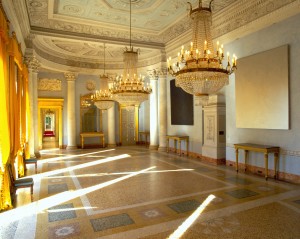
Over the weekend, my wife and I took a train up to Varese, to the north of Milan. The objective of our little trip was the Villa Menafoglio Litta Panza, situated on the hills of Biumo in what were once the outskirts of the city. Built originally in the 1750s and extended in the 1830s, the Villa is a nice example of Baroque with some Rococo thrown in.
img_1765
img_1766
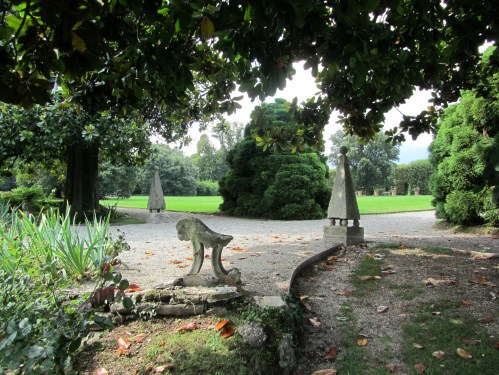
The gardens, formal in design but with a dash of English informality, are very pleasant to walk around, even at this time of the year.
img_1769
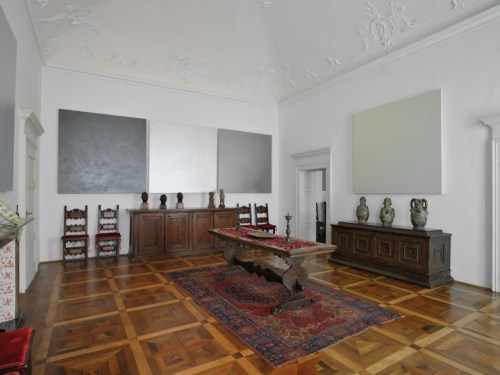
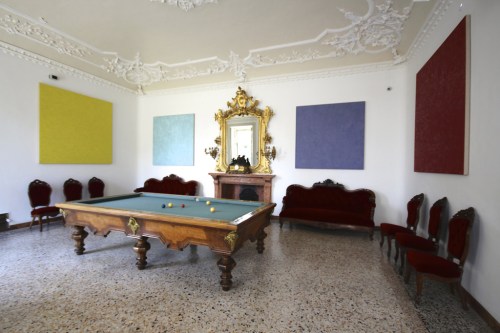
But what had drawn us here was not so much the Villa itself as its collection of American contemporary art. By one of those strange quirks of history which make life so interesting, its last owner, the most Italian Count Giuseppe Panza di Buimo, had developed a passion for contemporary American art, collecting feverishly from the mid-1950s through to the early 2000s. Much of the collection is now dispersed in museums. Many American museums, for instance – notably the Los Angeles Museum of Contemporary Art and the Guggenheim Museum in New York – either bought or were grateful recipients of important chunks of Count Panza’s vast collection.

So here we were, in this Baroque-Rococo setting, taking in pieces from the very latest waves of art. It made for an interesting clash of perspectives.
img_1773
img_1772
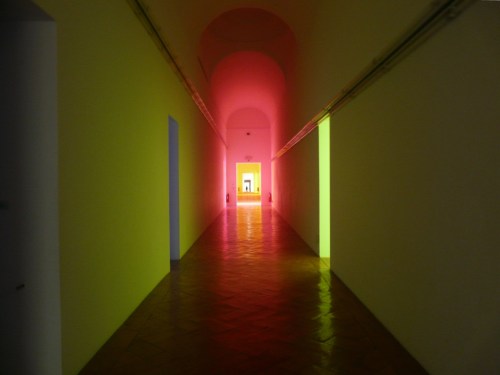
But actually, the most interesting part of the Villa’s collection is housed in what were once the stables and carriage house, a building which has been stripped of any historical context: bare white walls and floors, nothing more. Works by Dan Flavin, famous for his installations made with fluorescent lights, predominate. Walking down the long corridor of this building, we found ourselves awash in the primary colors emanating from the many rooms leading off the corridor.
img_1771
Each room houses one piece, like this one.
img_1770
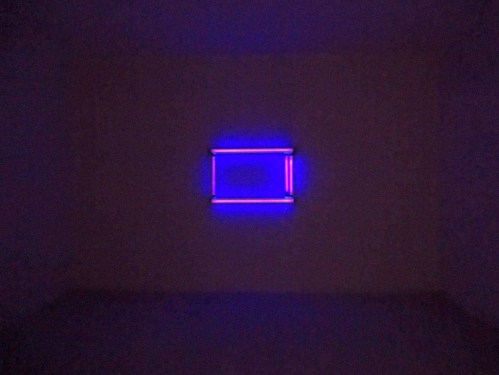
The colors are strong, almost blinding. My wife and I preferred by far this much quieter piece, housed in an almost black room.
img_1768
As we advanced down the corridor, there was this luminous half-moon at the end. Was it another Dan Flavin, I wondered?

img_1751
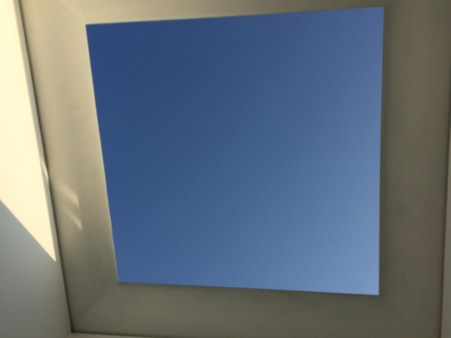
No, it was a piece by James Turrell, foremost exponent of the Light and Space movement. The artist had simply removed a piece of the external wall and what we were seeing was the blue winter sky. In a room off the corridor was another of his pieces, this time a square hole in the ceiling. We were gazing up at the winter sky, yet without any sensory clues such as clouds or trees it seemed to be an abstract painting
img_1750
one where the intensity of the blue varied as we moved around the room.
img_1748
It was a singularly beautiful experience.

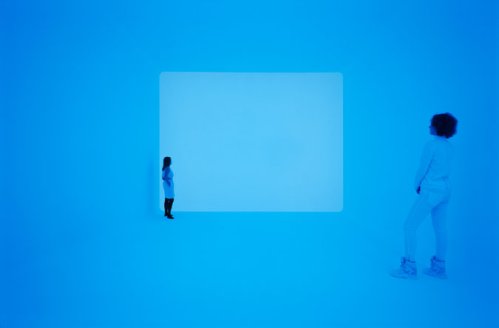
Turrell has another piece in the Villa, an example of his earlier work exploring sensory deprivation. A small group of us stood in a room where corners had been eliminated and were bathed in light of varying colors, giving rise to optical illusions.
img_1774
By another of those quirks which make life so interesting, my wife, not knowing what awaited us at the Villa, had recently booked us a slot for a session in a similar installation by Turrell at the Los Angeles Museum of Contemporary Art, when we go and visit our daughter next month. This will give us a chance to see the other pieces which Count Panza sold to the museum, like these Rothkos for instance.
img_1775
At the risk of being accused of frivolity, I feel I must report on another meeting of the US and Italy which we experienced that same day. After the visit, we walked down the hill and repaired to a place called Hambù for lunch. This is a case of American fast food meets Italian design.
img_1780
img_1778
Or, as Hambù’s web-site breathlessly puts it, “We are not talking about the usual meat patty between two pieces of bread and sauces, but rather of a gastronomic challenge: the radical revolution of the sandwich.”

One more example of the wonderful things that can happen when cultures meet and mix. The new American president and his acolytes should take note.

_______________
Villa Menafoglio Litta Panza, exterior: http://www.shoppingandcharity.it/en/magazine/villa-panza-between-history-and-contemporary-art
Villa interior: http://www.latitudeslife.com/2010/06/dividere-il-vuoto-a-villa-panza-va/
Villa gardens: http://blog.rowleygallery.co.uk/villa-panza/
Villa interior with art: http://dogma-art.com/giuseppe-panza-collection/
Villa interior with art: http://www.flashartonline.it/article/giuseppe-panza-di-biumo/
Dan Flavin: https://www.google.co.uk/amp/s/gupansh.wordpress.com/2013/12/11/villapanza/amp/
Dan Flavin: http://blog.rowleygallery.co.uk/villa-panza/
James Turrell, half moon: my picture
James Turrell, sky painting: my picture
James Turrell, room: https://mobile.nytimes.com/2014/07/20/arts/design/panza-villa-exhibits-illusionary-works.html?_r=0&referer=https://www.google.co.uk/
LA MOCA, Rothko: http://www.panzadiscoveringinfinity.com/the-story/
Hambù: https://www.google.co.uk/amp/s/apostrofoio.wordpress.com/2015/01/22/hambu-di-varese/amp/
Hambù set table: https://www.tripadvisor.com.ph/LocationPhotoDirectLink-g194942-d7294471-i155563419-Hambu-Varese_Province_of_Varese_Lombardy.html

PICASSO AND MY ADOPTED VILLAGE

Sori, 17 January 2017, updated 5 March 2020

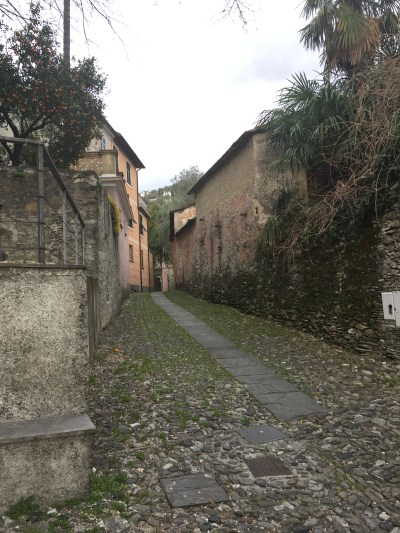
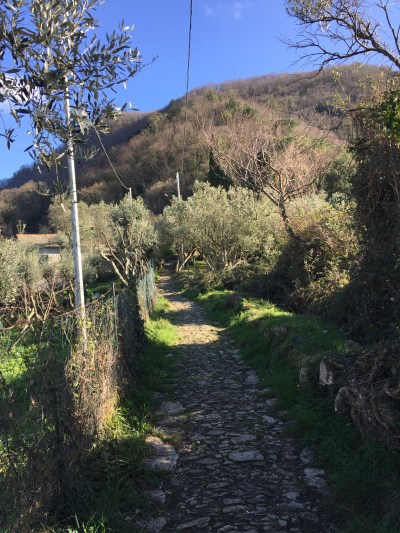
In the little Ligurian village of Sori which we go to often, there is a charming steep lane which has the great advantage of being closed to cars.
img_1542
One house on this lane sports the following plaque.
img_1544
It reads (in translation): “In this house was born Tommaso Picasso, great-grandfather of the famous artist Pablo”.

Well! This is enough to make my breast swell with pride for my adopted village-by-the-sea! Admittedly, the connection is a bit remote; I mean, it’s only a great-grandfather of the great Pablo, and on top of that he left the village, no doubt as a sailor, some 200 years ago, eventually settling in Malaga in Spain. Nevertheless, the village can justly lay claim to a modest place in world history.

Picasso researched his family roots and knew that at least one part of his DNA came from this part of Italy – Picasso is a common name in Liguria; this is one of our local supermarkets.

And here is the notice of the sad death of one Paolo Picasso – was the parents’ choice of the first name at all influenced by the existence of the Great Artist, I wonder?

That being said, I’m almost certain that Pablo Picasso never visited the village; it wasn’t until quite recently that a local historian dug out Tommaso’s birth certificate and nailed down the place of his birth. But I’m sure that if he had come here he would have been proud of the village’s artistic talents.

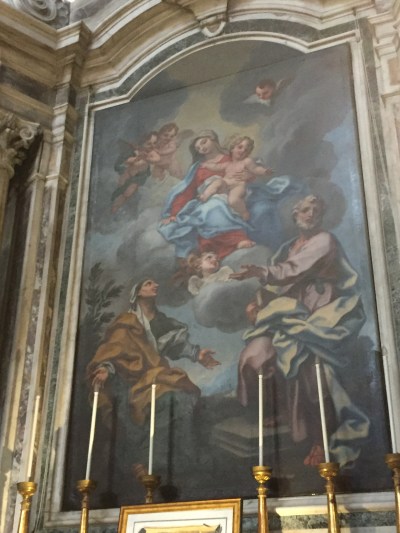
For instance, I can well imagine that he would have had a tolerant smile for the parish church’s neo-baroque frescoes
img_1608
and paintings.
img_1605
This observation of mine might well surprise readers, since we know Picasso as a giant of cubism
img_1616
and surrealism.
img_1634
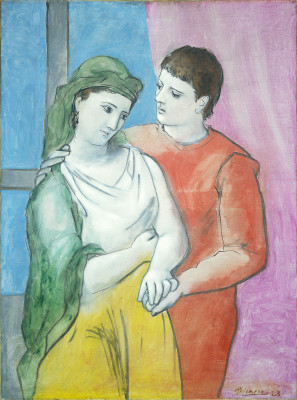
But he refused to be pigeonholed, and painted in many other styles during his long life. For a while, there was a strong strand of realism in his work, although he adopted more neoclassical conventions, in contrast to the Baroque froth we have in the village church. Here are a couple of pieces from this neoclassical period, his son Paul dressed as a harlequin
img_1568
and The Lovers.
img_1573
But his early Blue Period also has some lovely pieces of more traditional representational art, this Old Guitarist for instance.

He also had a fascination for monumental women, like this Three Women at the Spring.
img_1569
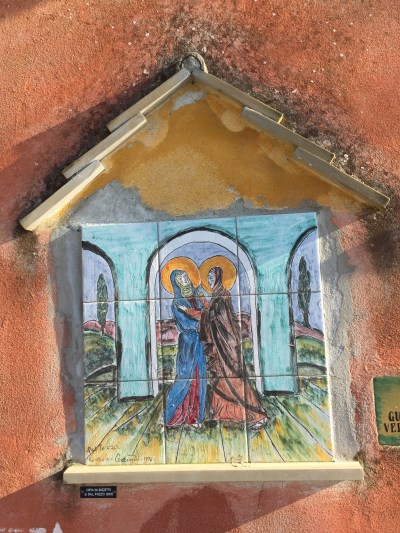
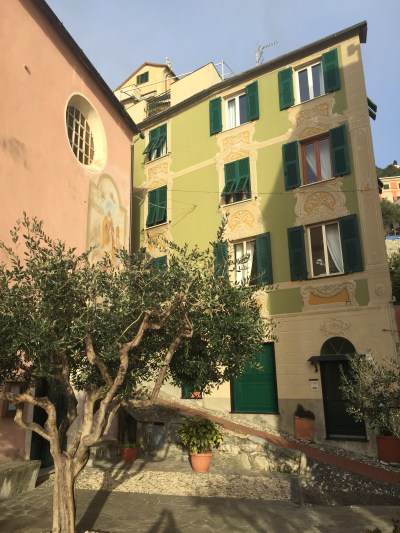
I’m sure, too, that Picasso would have delighted in the trompe l’oeil decorations which are so common on the houses of Liguria and of which this is an example from that same lane where his great-grandfather was born.
img_1547

img_1546
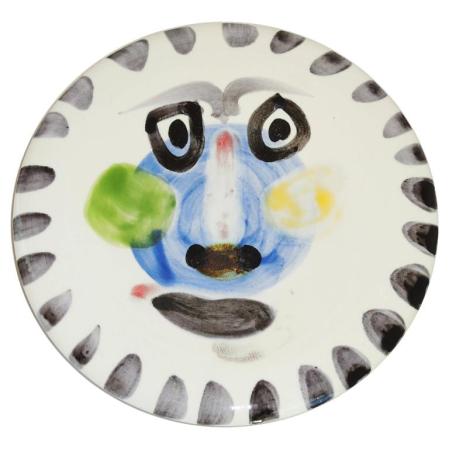
He was into this kind of fancifulness, as these few examples of his ceramics attest.
img_1562
img_1563
img_1567
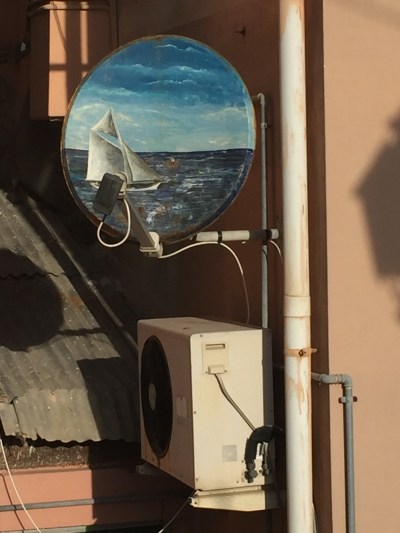
Picasso no doubt would also have been well disposed to the clever villager who has decorated his parabolic dish with a nice marine scene.
img_1548
Although Picasso doesn’t seem to have painted on made objects like our friend has done, he did make a number of sculptures where he painted on formed metal and other materials. For instance, there is this lovely Head of a Woman, which is painted steel
img_1572
while this piece, Friendship, is a composite of various painted materials.
img_1570
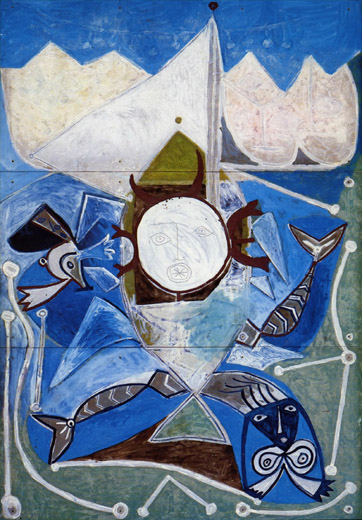
As for marine scenes, as a man of the Mediterranean Picasso painted a number over the years. I throw in this one, Ulysses and the Sirens.
img_1574
What would Picasso have thought of these scenes painted by the children of the local artistic cultural association? They use the walls of the underpass at the village railway station as their canvas, and every year each new batch of students repaints the whole thing. This is a sampling of the current contribution.
img_1600
img_1598

img_1599
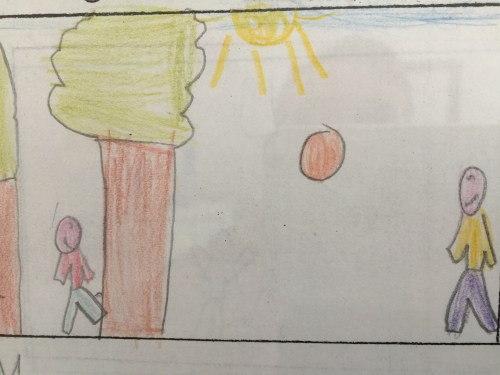
He might have approved. After all, he once pronounced, “All children are artists.” On the other hand, he might have been thinking of the art of younger children, like this picture drawn by my son when he was six-seven,
img_1620
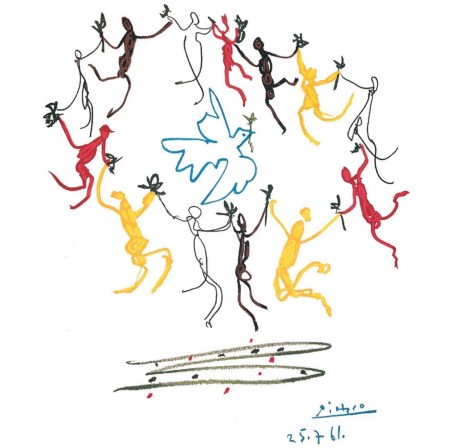
art which has not yet been “contaminated” by formal art teaching. In the quote I cite above, Picasso goes on to say, “The problem is how to remain an artist once one grows up.” He also once said, “At eight, I was Raphael. It took me a whole lifetime to paint like a child.” This Dance of Youth is a nice example of Picasso “painting like a child”.

In fact, in front of pieces like this, my son whom I have mentioned above tends to mutter “I could do that” (to which my reply always is, “well, why don’t you? you might be able to make millions.”)

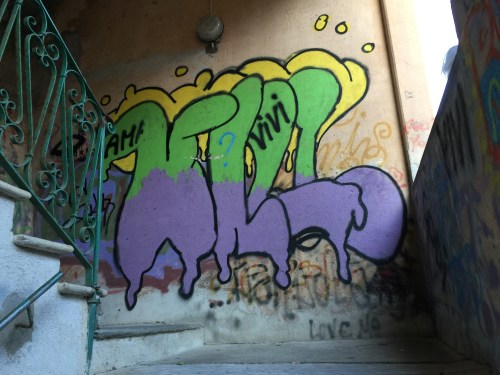
I’m not sure what Picasso would have thought of the graffiti art which some naughty boys have painted in dark and quiet corners of the village.
img_1566
img_1602
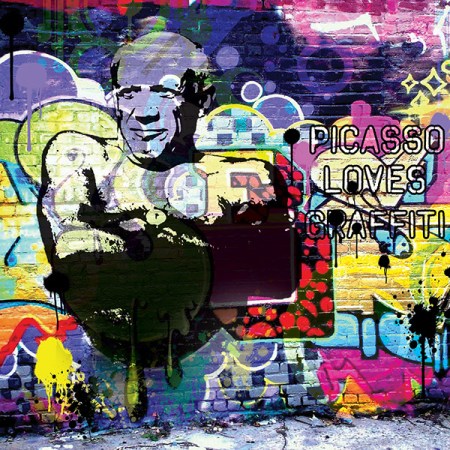
Graffiti artists certainly think he would have approved of their art form
img_1575
and some have shamelessly copied his style – or rather, one of his many styles.
img_1576
Picasso was certainly very open-minded to artistic trends, so who knows, he might indeed have given graffiti artists his blessing.

The really naughty boys have also sprayed this type of graffiti in the darkest corners of the village (a graffiti found everywhere in Italy).
img_1625
I think Picasso would have laughed heartily; he drew some pretty naughty pictures himself, as attested by this drawing of Raphaël and his mistress la Fornarina in the throes of lovemaking, with the Pope looking on (one of a long series of drawings all obsessively on the same topic).
img_1632
Well, that was a nice tour of both the village and of Picasso. I will admit that it has sometimes been a strain to draw parallels between the art of the village and Picasso’s, but it’s been fun trying.

______________
All pictures mine, except as follows:
Picasso, Portrait of Ambroise Vollard: http://www.arthistoryarchive.com/arthistory/cubism/
Picasso, On the Beach: http://www.pablopicasso.org/on-the-beach.jsp
Picasso, Paul en Arlequin: http://aragon.lehoulme.free.fr/spip.php?article528
Picasso: The Lovers: http://www.nga.gov/content/ngaweb/Collection/art-object-page.46667.html
Picasso, Old Guitarist: https://theculturetrip.com/europe/spain/articles/this-incredibly-famous-painting-is-hiding-a-big-secret/
Picasso, Three women at the spring: http://www.pablopicasso.org/three-women-at-the-spring.jsp
Picasso, decorated plate: https://www.google.co.uk/amp/s/www.1stdibs.com/amp/creators/pablo-picasso/furniture/wall-decorations/
Picasso, decorated vase-1: http://antiquesandartireland.com/2013/03/auction-ceramics-picasso-2/
Picasso, decorated vase-2: http://www.antique-collecting.co.uk/picasso-ceramics-at-sothebys/
Picasso, Head of a woman: https://richedwardsimagery.wordpress.com/2015/10/26/picasso-sculpture-exhibition-the-museum-of-modern-art-new-york-new-york-usa/
Picasso, Friendship: http://www.michaelallen.org/cubism-sculpture/
Picasso, Ulysses and the Sirens: http://www.arretetonchar.fr/ulysse-et-les-sirènes-pablo-picasso/
Picasso, Dance of Youth: http://www.leninimports.com/pablo_picasso_dance_youth_print_14a.html
“Picasso loves graffiti”: https://www.behance.net/gallery/5454681/Graffiti-State-of-Mind
Graffiti, Toronto: https://www.theconstantrambler.com/toronto-street-art-photo-tour/
Picasso, Raphaël et la Fornarina XI: http://www.christies.com/lotfinder/Lot/pablo-picasso-raphael-et-la-fornarina-xi-5489080-details.aspx

ABSTRACT LANDSCAPES

Vienna, 30 December 2016

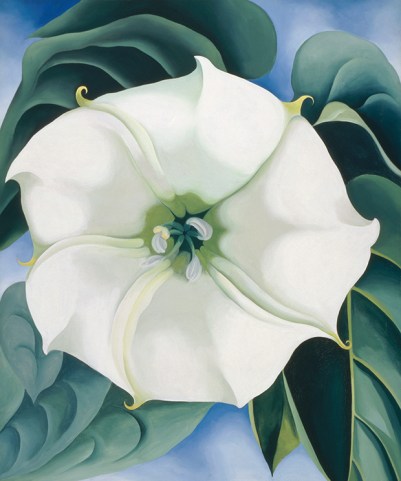
My wife, son and I have just visited a show on Georgia O’Keeffe at the Kunstforum in downtown Vienna. I suppose O’Keeffe is best known for her big, close-up paintings of flowers
image
or of animal skulls floating over desert landscapes from the American Southwest.
image
But personally I find that, after a wow moment on first sighting, these pall quickly. Seeing them now, I find them somewhat twee.

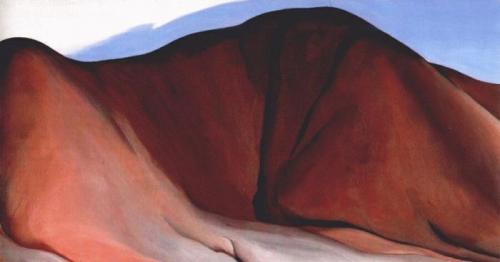
What I prefer by far in O’Keeffe’s works are her paintings of New Mexico’s landscapes. Two in particular in the show caught my attention, Purple Hills from 1935
image
and Rust Red Hills from 1930.


It’s not all her landscapes that I appreciate. It’s those where she has cut away much of the detail to reduce the landscape to its essential shapes and colours. For me, this kind of painting is a form of abstract art. In fact, it’s the only form of abstract art that I really appreciate, where the eye is captivated by the interplay of shape and colour but where there is still a recognizable subject.

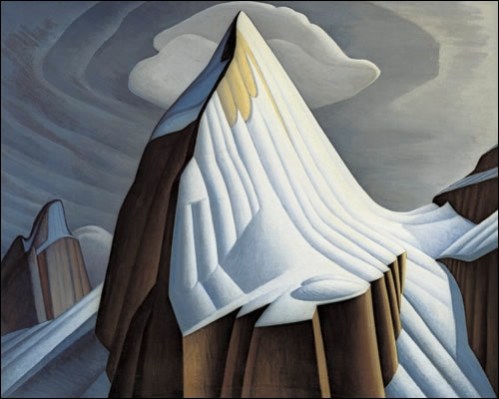
Even as I write these lines, I gaze at two prints of paintings hanging on my wall, by the Canadian painter Lawren Harris, who worked in the same way, painting quasi-abstract landscapes. In his case, though, his subjects came from Canada’s far north. The prints I have are his Lake and Mountains, painted in 1928

and his Mount Lefroy, painted in 1930.
image
Harris is part of the Group of Seven, a grouping of seven Canadian painters who believed that a distinct Canadian art could be developed through direct contact with nature and who concentrated on paintings inspired by the Canadian landscape. Perhaps the most iconic painting of this group is North Shore, Lake Superior, painted by Harris in 1926.
image
I first came across the Group of Seven as a teenager, when I visited the National Gallery of Canada in Ottawa. I loved their paintings, especially those of Harris. The pared down monumentality of his paintings seemed to reflect so well the huge, spare landscapes I was seeing around me.

The only other time I have come across abstract representation of landscapes is in Australia, and more specifically in the work of Rover Thomas, whom I’ve mentioned in an earlier post. The example I gave there was the painting River Ord, River Bow, River Denham.

I also gave there an example of another quasi-abstract landscape, this one by the Australian painter Fred Williams, again of a river system.


Interestingly enough, Georgia O’Keefe painted a similar scene, It Was Blue and Green.
image

It seems to be the case that painters are drawn to these types of “abstract landscapes” in the remoter, more rugged parts of the world. I wonder if there are North African painters, or painters from the Sahel countries, who have painted in abstract form the landscapes of the Sahara desert. Or how about Scandinavian or Russian painters who have painted their far north in abstract form? Who knows, maybe there are even Argentinian painters who have depicted Patagonia in this way.

But O’Keefe shows that actually it is possible to extract the abstract from the more homely parts of the world. Here is her Winter Road 1, from 1963, also in the Vienna show.
image
Perfect: a dark brown to black line curving across a white background, but also obviously a road across snowy hills. I have seen this exact scene several times in my life in places no more remote than North Yorkshire.

_______________
Georgia O’Keeffe, flower: http://de.phaidon.com/agenda/art/articles/2014/february/05/what-do-you-see-in-georgia-okeeffes-flowers/
Georgia O’Keeffe, animal skull: http://www.marissamuller.com/blog/2015/7/3/skulls-flowers
Georgia O’Keeffe, Purple Hills: http://www.scottzagar.com/arthistory/timelines.php?page=event&e_id=1935
Georgia O’Keeffe, Rust Red Hill: http://www.tate.org.uk/context-comment/articles/my-faraway-nearby
Lawren Harris, Lake and Mountains: https://www.oberhauserart.com/close_up_views_of_selected_artwork
Lawren Harris, Mount Lefroy: http://www.artcountrycanada.com/group-of-seven-harris.htm
Lawren Harris, North Shore, Lake Superior: http://www.arthistoryarchive.com/arthistory/canadian/The-Group-of-Seven.html
Rover Thomas, River Ord, River Bow, River Denham: http://richardtulloch.files.wordpress.com/2012/06/rover-thomas.jpg
Fred Williams, Dry Creek Bed, Werribee Gorge I: http://www.tate.org.uk/art/images/work/T/T12/T12271_9.jpg
Georgia O’Keeffe, It Was Blue and Green: http://www.oocities.org/moondarlin/artokeeffe3.html
Georgia O’Keefe, Winter Road 1: https://gerryco23.wordpress.com/2013/07/17/the-walk-to-laggan-cottage-ruins-and-ancient-footfalls/georgia-okeeffe-winter-road-1-1963/

FULL OF SOUND AND FURY, SIGNIFYING NOTHING

Vienna, 29 December 2016

image
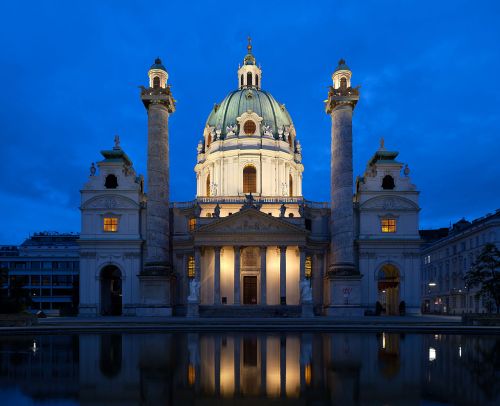
Nice, isn’t it? It’s Karlskirche, Charles Church, fronting the square of the same name, Karlsplatz, in Vienna. In this picture, the church is reflected in a large pool situated in front of it, making an even prettier picture of it all.

It’s also very nice-looking at night, when cleverly-placed lights dramatically illuminate the facade and dome.
image
It really looks like the backdrop of some Mozart opera.

It so happens that we pass through Karlsplatz every time we take the tram into the city centre, and I always give Karlskirche an admiring look as we pass by.

It was the Holy Roman Emperor Charles VI who ordered it to be built, in 1713, just after what turned out to be the last great plague epidemic had swept through these lands. He had it built as thanks for the pestilence having spared him and his family. He dedicated the new church to San Carlo Borromeo, Cardinal of Milan, who not only was his personal patron saint but was also revered as a healer of plague sufferers. The church was completed by 1737.

Karlskirche was built in pure Baroque style. A few quotes are in order here, to hopefully answer the question “what exactly is the Baroque style?”:
– a style “characterized by new explorations of form, light and shadow, and dramatic intensity”
– a style which “used exaggerated motion and clear, easily interpreted detail to produce drama, tension, exuberance, and grandeur”
– “Baroque architecture and its embellishments were on the one hand more accessible to the emotions and on the other hand, a visible statement of the wealth and power of the Church” (as well as of the secular Princes, I should add)

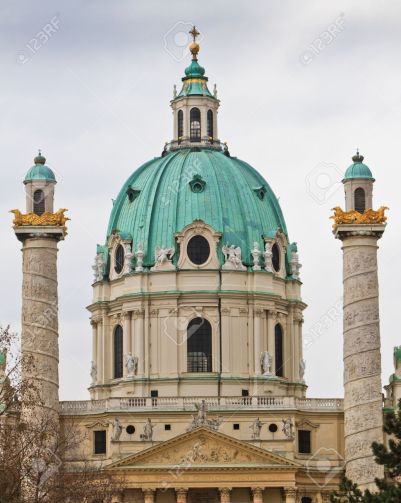
Well, Karlskirche certainly produces drama, tension, exuberance, and grandeur on the outside. We have that dominating dome with its green copper sheath, along with the two columns flanking the front.
image
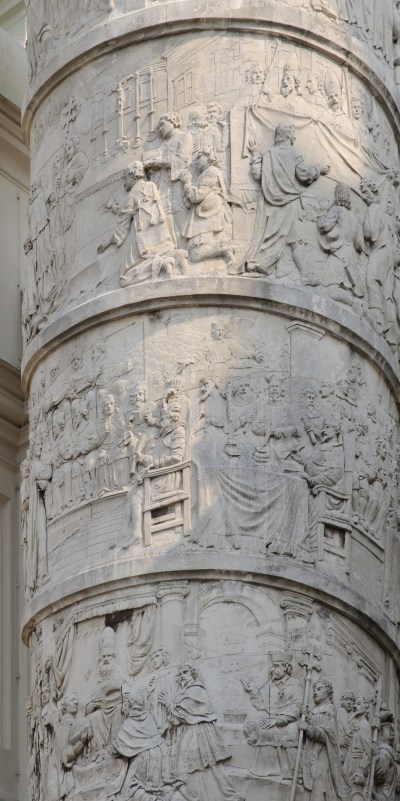
Those columns are modeled on Trajan’s column in Rome.
image
However, they substitute tales of Trajan’s victories in the Dacian wars with pious scenes from the life of that great “Prince” of the Church, San Carlo Borromeo.
image
We have the pediment crowning the front, where we see the cardinal virtues sucking up to San Carlo standing on the apex of the pediment.
image
So it is in a state of high tension and of great exuberance that one enters the church – only to find oneself in a small chapel. It is really the strangest feeling: all that architectonic might and majesty on the outside, clothing a really very modestly-sized internal space.
image
Oh, I grant you, there is also dramatic intensity on the inside: the fresco in the dome, for instance
image
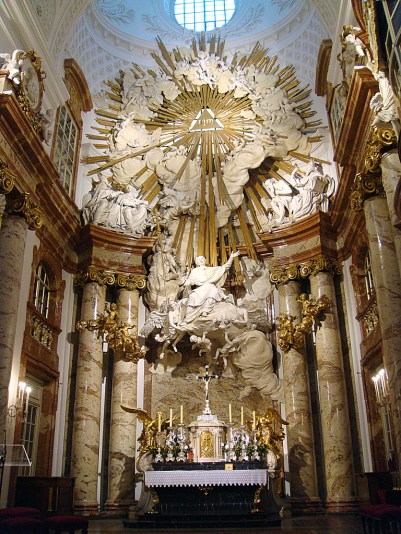
or the altarpiece portraying the ascension of San Carlo.
image
But the overall effect is: “Really? That’s all there is to this church? This tiddly little space?” I have to say, the only time I went in I felt quite cheated.

In the name of full disclosure, I should state at this point that I am anyway not a great fan of Baroque decoration. My general feeling about this style of art can be summed up in Macbeth’s words, “full of sound and fury, signifying nothing”. Even if the scale of the church’s interior had been on a par with the outside I probably wouldn’t have liked it. I find Baroque decoration, especially in Catholic churches, pompous and overblown. On top of that, for a religion that claims to value poverty, I find Baroque’s in-your-face glitter – gold and silver everywhere – particularly offensive. There is a toe-curling example of this blingy over-the-top quality in Baroque in Vienna’s Jesuit church, whose interior was completed some five years before Charles VI decided to have Karlskirche built.
image
All this being said, there is one example of church baroque that I have come across which I really loved, and that was in the cathedral of Saint Gall in the Swiss canton of Saint Gallen. Our visit to it was completely serendipitous. We were driving from Vienna to my parents’ house in France, and Saint Gallen happened to be a good place to stop for the night. The next morning, I decided that we should take the occasion to visit the cathedral and dragged a rather unwilling family with me. What a revelation!


There were the usual dramatic and intense frescoes on the ceiling, but the rest of the church was quite bare. Instead of the glittering gold, the marble, the overwrought statuary, we found ourselves in a space of mostly bare white walls carrying only a few highly curlicued decorations painted a lovely pale blue-green. It was so wonderful that it put me in a good mood for the next nine hours of driving and the thought of having to spend a long weekend with my parents.

The cathedral was remodeled into its current form in the 1750s-60s, so some 20-30 years after Karlskirche. That lapse of time might explain the more rococo style that was used, along with the fact that the cathedral stood at the border with Protestantism – literally, since the town that had sprung up around the cathedral and its abbey had turned Protestant while the abbey itself remained Catholic; Protestant baroque tends to be more restrained than the Catholic version.

Whatever the reason, Saint Gall Cathedral has partially reconciled me to baroque. Since that magic moment some 20 years ago when I first entered the cathedral, I have been inclined to simply grimace and shrug at excesses like those in Vienna’s Jesuit church rather than dream of taking the iconoclast’s hammer to it all. Or maybe I’m simply getting older and perhaps a little bit wiser.

___________
Karlskirche panoramic: http://www.thousandwonders.net/Karlskirche
Karlskirche at night: https://en.m.wikipedia.org/wiki/Karlskirche
Karlskirche dome: http://www.123rf.com/photo_13006441_dome-of-the-karlskirche-st-charles-s-church–vienna-austria.html
Trajan’s column: https://www2.bc.edu/~kenth/honors4.html
Karlskirche columns’ detail: https://commons.m.wikimedia.org/wiki/File:Karlskirche_column_detail_-_Vienna.jpg
Karlskirche pediment: http://www.panoramio.com/m/photo/93052486
Karlskirche interior: https://www.studyblue.com/notes/note/n/lecture-21/deck/5993225
Karlskirche dome fresco: https://www.pinterest.com/soledadvilchez/monumental-ceilings/
Karlskirche altar: https://www.flickr.com/photos/57669468@N00/3252233159
Jesuit church, Vienna, interior: https://www.flickr.com/photos/time-to-look/18903468079
Cathedral of St. Gall, interior: https://commons.m.wikimedia.org/wiki/File:St-gall-interior-cathedral_1.jpg

AMBROGIO DA FOSSANO DETTO IL BERGOGNONE

Milan, 13 December 2016

A week or so ago, I had an appointment just off Milan’s corso Garibaldi, to discuss a possible presentation that I could make on the UN’s Sustainable Development Goals and how companies could incorporate them into their CSR programmes. Since I had grossly overestimated the time it would take for me to walk there, I found myself at the meeting place with half an hour to spare. Looking around for some way to kill time, I spied a venerable-looking church across the road and decided to go and have a peek, to see what hidden treasures it might contain (every church in Italy beyond a certain age – 250 years, say – contains treasures to be discovered).

The church in question was the Basilica di San Simpliciano. As its title of basilica suggests, this is a very venerable church indeed. It was one of four basilicas wanted by the great Saint Ambrose, Doctor of the Church and bishop of Milan from 374 to his death in 397 AD.
image
Ambrose planned to have one such basilica on each of the four main roads leading out of Roman Milan.

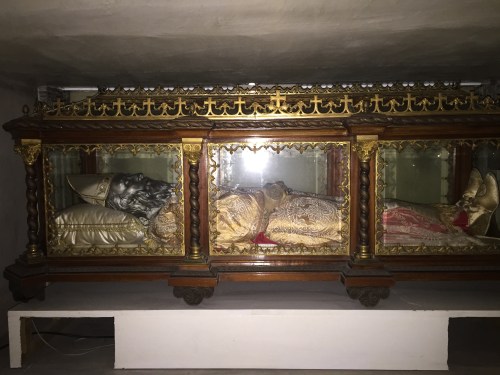
The church was completed by his successor, Saint Simpliciano, who also had himself buried here; his bones have been venerated ever since, lying under the main altar but now clothed and masked – a skeleton is not quite the thing anymore.

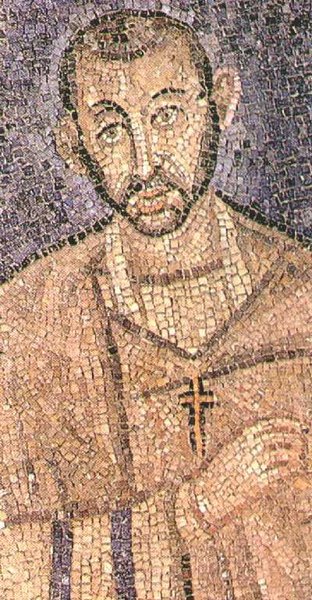
image

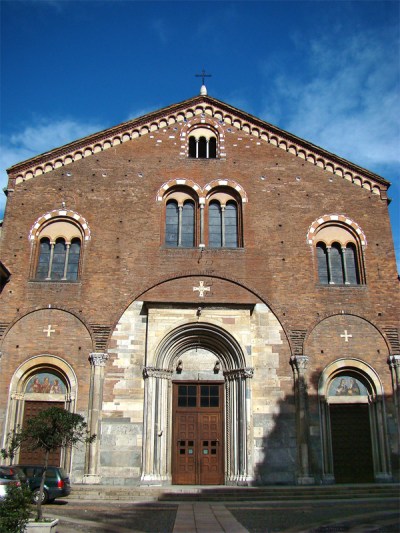
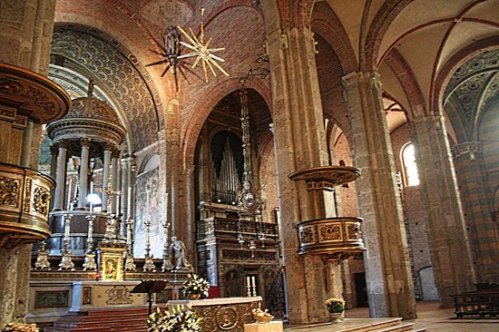
Unfortunately, very little of this original church remains. I say unfortunately because I happen to be very fond of early Christian mosaics. I’m sure the church’s interior would have been covered in mosaics like the one whose photo I give above, itself a mosaic shard which has survived because tucked away in an obscure corner of an even more venerable Milanese church, the Basilica di Sant’Ambrogio. Cluniac Benedictines took over San Simpliciano in the 800s, and by the 1200s they had completely renovated the church in the styles then all the rage, Romanesque with a little bit of early Gothic. These styles have stamped themselves on the church’s exterior appearance.
image
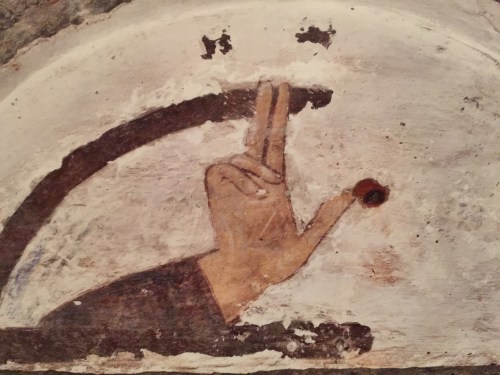
Unfortunately, hardly anything remains of this period’s internal decorations. One imagines that the walls would all have been frescoed; all that is left is this hand raised in benediction, tucked away in some obscure corner of the church.
image
Thereafter, with each passing artistic phase various alterations were made, in the process destroying the harmony of the whole. Here, for instance, a side chapel in the Baroque mode was added.

image

To all this was added more obvious vandalism. The church and the adjoining cloisters were turned into barracks by the occupying troops of Revolutionary France; no doubt the church was turned into stables for the troops’ horses (a fate common to many churches, it would seem). I’m sure the French soldiers would have taken pleasure in destroying the church’s decorations, much as ISIS troops have taken pleasure in sledgehammering and dynamiting every non-Islamic work of art that has fallen under their control, and much as Mao’s Revolutionary Guards took pleasure in smashing anything they could lay their hands on from Old China. But bad as all this was, the nadir for San Simpliciano was the 1820s, when some artist who will remain unnamed stuccoed over everything and painted scenes of a painfully sucrose sentimentality – one side chapel in this style has been kept.
image
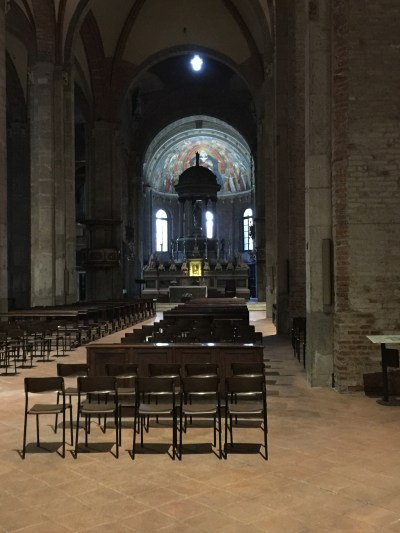
After the Second World War, it was decided that there was nothing left to do but to strip more or less everything away, down to the brickwork. This has given the church a certain rough simplicity, very pleasing to the eye (to mine at least).
image
We have to remember, though, that this is a very modern style. None of the original builders or later fiddlers would have dreamed of maintaining such a naked simplicity. Churches were built to demonstrate the glory of God, and naked brickwork definitely didn’t make the cut.

All this I learned from some posters tucked away in a corner (so tucked away that I nearly missed them). I knew none of this on entering the church. What immediately struck me instead was the fresco in the apse behind the main altar.

image
Even though it was much obscured by the 1820s main altar (something that was already fiercely criticized when the Artist who will Remain Unnamed installed it), its brilliant blues and reds amid all that raw brick jumped out at me and beckoned me to come closer. Which I did, threading a passage between the main altar and the outer walls of the church. The view was well worth the threading.
image
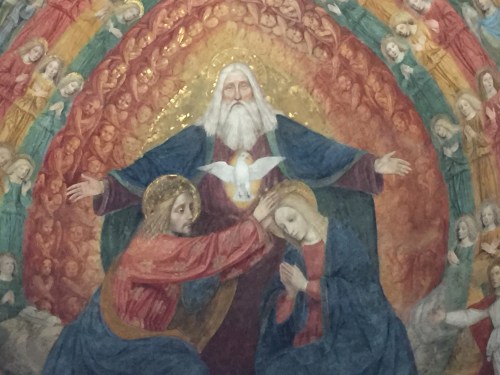
It is a fresco (I later learned from the posters) from 1508 celebrating the Incoronation of the Virgin Mary, painted by il Bergognone (or, to give him his full name and title, Ambrogio da Fossano detto il Bergognone). We see Mary, meek and mild, being solemnly crowned by her son Jesus, God the Son, in a ceremony presided over by God the Father and God the Holy Spirit, within a rainbowed arc of seraphims, cherubims and angels

image

and with saints and others laypersons (no doubt donors and other Very Important Persons) looking on.

image

Thank goodness it was placed high off the ground, otherwise those French revolutionary soldiers would no doubt have destroyed it. With my heart well warmed by its beauty, and my mind well primed by the posters, I hurried back to my meeting, arriving a little breathless but just on time.

I have to say, Bergognone is not a painter that I am at all familiar with. In writing this post, I have mugged up on him a little. He was active primarily in Lombardy, and although works of his have leaked out to many major museums in the western world the bulk of his output is still to be found in and around Milan. Since Saint Ambrose initiated my description of San Simpliciano, let me throw in here a painting Bergognone made of that saint

which hangs in Pavia’s monastery complex, the Certosa.
image
Bergognone was particularly active in the Certosa di Pavia. My wife tells me we have visited it, but I have no memory of doing so (a situation which is becoming alarmingly common). I think I will add it to my ever lengthening list of places around Milan which we will go and visit, once Spring beckons us forth like hibernating bears from the apartment.

_______________
Photos: mine, except the following
Saint Ambrose mosaic: https://it.m.wikipedia.org/wiki/Sant%27Ambrogio
San Simpliciano exterior: https://it.m.wikipedia.org/wiki/Basilica_di_San_Simpliciano
San Simpliciano interior: https://www.tripadvisor.it/LocationPhotoDirectLink-g187849-d1899819-i87445764-Basilica_di_San_Simpliciano-Milan_Lombardy.html
San Simpliciano Bergognone fresco overview: http://www.italiamedievale.org/sito_acim/contributi/simpliciano.html
Bergognone’s Sant’Ambrogio: https://forum.termometropolitico.it/274962-7-dicembre-s-ambrogio-vescovo-e-dottore-della-chiesa.html
Certosa di Pavia: http://www.pavialcentro.it/monumentos/monastero-della-certosa-di-pavia

A WALK FROM ONE SAINT TO ANOTHER

Sori, 10 December 2016

We started in San Rocco, which is perched on a rocky spur high above Camogli.

image
The last time we visited it, we huffed and we puffed our way up the old mule track that snakes its way up from Camogli. This time, we took it easy; we took the Recco-Rapallo bus and hopped off at Ruta, which lies on the saddle between Camogli on one side of Monte di Portofino and Santa Margherita on the other, and took another little bus from Ruta to San Rocco.

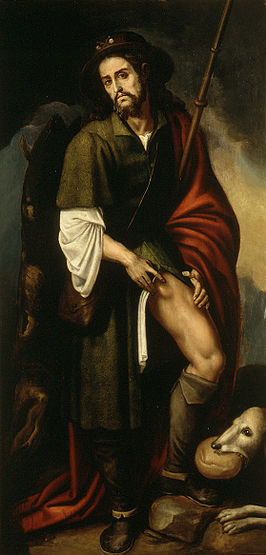
A little aside on the lives of obscure saints: San Rocco, known in English – if at all – as Saint Roch (I found traces of a couple of British churches named after him), lived in the late 1200s, early 1300s, dividing his time between what is now southern France and northern Italy. He is the patron saints of dogs and bachelors (a strange combination) and was especially invoked in times of the plague – hence this painting of the saint pensively pointing to a plague bubo on his leg.
image
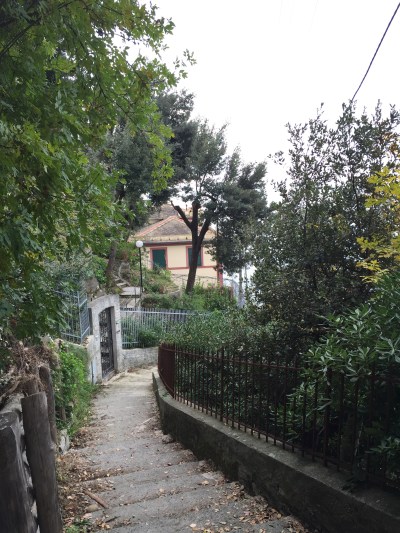
In any event, fresh from our relaxing bus drive, and fortified by a cappuccino and a slice of focaccia, we set off down the path which led to Punta Chiappa, a low rocky ledge jutting out into the sea at the furthest reaches of Monte di Portofino. The idea was to have lunch in a restaurant down at the water’s edge just before Punta Chiappa and, suitably fuelled up, toil our way back up to San Rocco. We started losing height through a series of long flights of steps
image
we wended our way through woods
image
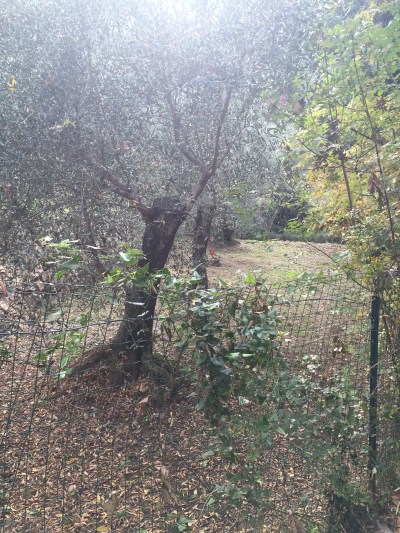
through which struggled a few remaining olive groves.
image
We finally arrived at San Nicolò, a small collection of houses clustered around a pretty little 12th Century church.
image
The original monks who had ministered to the small community of fisherfolk clinging on to this steep hillside finally moved away in the face of continuing depredations by Barabary pirates (I suppose church plate was considered good loot) and the church fell into disuse. Recently, suitable renovations have been undertaken, although there was little left of the original decorations to restore.

Another quick aside on the lives of obscure saints: San Nicolò, Saint Nicholas in English, lived at the juncture of the 3rd and 4th centuries. He was a bishop in Asia Minor and was famous for working miracles (he seems to have been particularly good at this). Of relevance to this story, he is the patron saint of sailors and fishermen.
image
But he also is responsible for a whole host of other professions including coopers, archers, pharmacists and – somewhat bizarrely – broadcasters. Somewhere along the line, no doubt because he is the patron saint of children, this very worthy saint morphed into that very heathen Santa Claus.

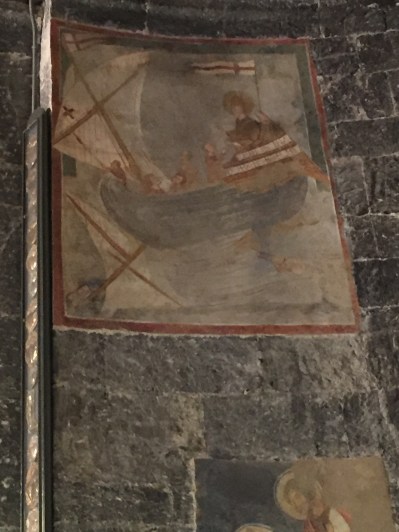
One of the few fragments of the original decorations left is this piece of fresco.
image
It shows St. Nicholas saving two sailors from drowning as their ship founders: that nightmare of all sailors and the subject of famous paintings
image
as well as a myriad of humbler ex-votos, normally dedicated as in this case to Mary in her role as Stella Maris, Star of the Seas.
image

I am moved to insert here those lovely lines from T.S. Eliot’s “The Wasteland” in the short section of the poem entitled Death by Water:

Phlebas the Phoenician, a fortnight dead,
Forgot the cry of gulls, and the deep sea swell
And the profit and loss.
A current underseas
Picked his bones in whispers. As he rose and fell
He passed the stages of his age and youth
Entering the whirlpool.
Gentile or Jew
O you who turn the wheel and look to windward
Consider Phlebas, who was once handsome and tall as you.

From San Nicolò, we got the first good view of the Golfo di Paradiso, the woods having obscured the view in the upper reaches of the walk.
image
Hunger drove us on. We dropped still further towards the sea,
image
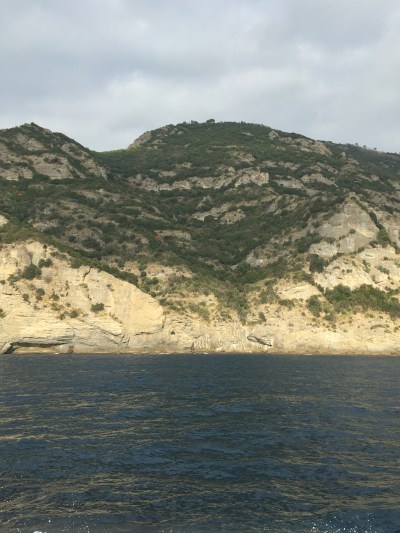
finally reaching the restaurant. Alas! Contrary to what we had been assured in the café where we took our morning cappuccino and focaccia, it was closed. We were mournfully counting the tangerines we had brought with us and reckoning on the number of stairs we would need to climb to get back to San Rocco on a nearly empty stomach when we saw a boat coming in to dock. We hurried forward and discovered that by sheer serendipity we had arrived just in time to catch the boat to San Fruttuoso, from whence we could get a boat back to Camogli! Light of stomach, but also light of heart, we hopped on, took a seat, and admired the passing views as we rounded Punta Chiappa
image image
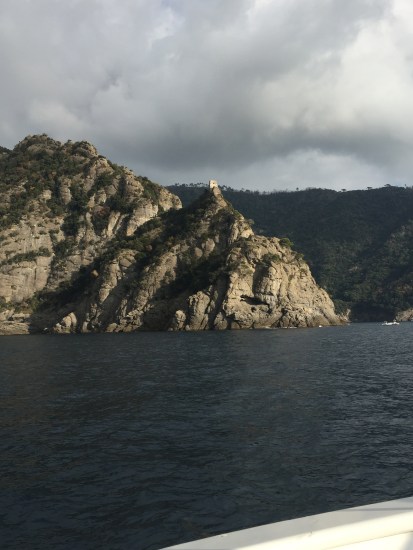
motored past forbidding headlands
image
until the small fort protecting San Fruttuoso hove into sight,
image
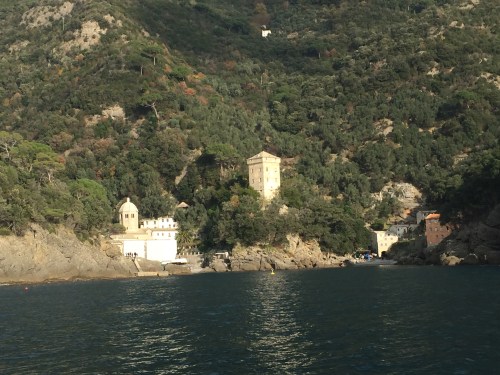
where we turned into San Fruttuoso’s bay and chugged in towards the village itself.
image
image

image

Calling this a village is perhaps a bit of an exaggeration, composed as it is of the ancient abbey (currently under renovation)
image
a somewhat less ancient watchtower
image
and a few fishermen’s houses clustered in between.

It’s a charming site, much frequented in the summer by people who come to lie on the beach (as it was when we visited it, during a long weekend). We took the easy way in, but hardier folk can take one of a number of paths crisscrossing Monte di Portofino which pass through San Fruttuoso. Well rested and after eating our meager cache of tangerines I went off to visit the Abbey while my wife read her book on the beach.

A final note on the lives of obscure saints: San Fruttuoso, Saint Fructuosus in English (a saint so obscure in the English world that I could find no church named after him), was a bishop of Tarragona in Spain in the second half of the third century.
image
His main, in fact his only, claim to fame was that he was martyred during the reign of the Roman Emperor Diocletian. He is so obscure that no group has claimed him as their patron saint, which is a bit sad. Given his name, makers of fruit juices could perhaps apply …

How an abbey in Italy got to be dedicated to him is a bit of a mystery. The story goes that when the Vandals invaded Spain some monks from Tarragona, anxious that his remains not be despoliated, carried them off by sea. After a certain amount of wandering around the Mediterranean, they ended up on the Monte di Portofino. I find the story to have a lot of holes in it, but hey, who am I to question its veracity? Suffice to say that the Abbey grew quite wealthy from donations of land. Wealth put it in the sights of the Barabary pirates. Like San Nicolò, it went into decline after repeated depredations and was eventually abandoned.

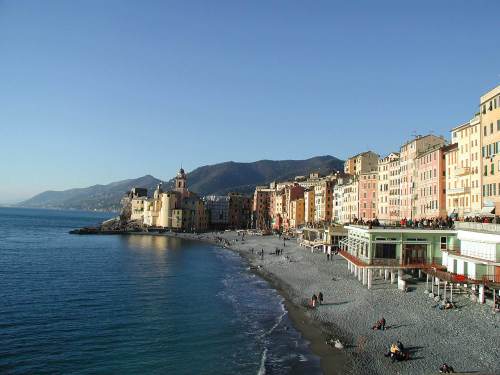
In the early afternoon, our return boat docked. We piled in and returned to Camogli
image
for a well-deserved late lunch of focaccia al formaggio.

image
______________

All photos: mine, except as follows

San Rocco: https://commons.m.wikimedia.org/wiki/File:Camogli-chiesa_di_San_Rocco_(Ruta)-DSCF0645.JPG
Saint Roch: https://en.m.wikipedia.org/wiki/Saint_Roch
Le radeau de la méduse: https://fr.m.wikipedia.org/wiki/Le_Radeau_de_La_Méduse
Ex-voto shipwreck: http://www.ottante.it
Saint Nicholas: http://aristidhmilaqi.blogspot.it/2011/06/saint-nicholas-patron-saint-of-sailors.html?m=1
Saint Fructuosus: https://en.m.wikipedia.org/wiki/Fructuosus
Camogli: http://www.cepolina.com/Camogli-sea-beach.html
Focaccia al formaggio: http://www.italianbotanicalheritage.com/it/scheda.php?struttura=499

OF ZEN GARDENS AND MISO SOUP

Milan, 3 December 2016

Back from Kyoto, and still with a bad case of jet lag (it’s 4 am and my wife and I are sprawled on the living room couches, wide awake), it’s time to review the three weeks we spent in that city. Apart from the misery caused by the American presidential elections and the pleasure derived from teaching a course on sustainable industrialization to a group of eager youngsters not yet affected by the pessimism of old age, what else will I take back with me from my three weeks spent in Kyoto?

Ever since I first visited the city thirty years ago, Kyoto for me is first and foremost the place of Zen gardens. I have already written a paean to these rock gardens in a previous post, so I will not repeat myself. I will simply mention the pleasure I derived from visiting several rock gardens which I had not seen thirty years ago (or even five years ago, when we came for a brief visit from Beijing). My wife and I decided that our daughter, who came to visit us for Thanksgiving, just had to see a couple of these glorious creations: “he (or she) who has not seen a Zen garden has not lived”, to surely misquote someone famous. We took her to the gardens in Tofuku-ji Temple as well as those in Kennin-ji Temple, both at the foot of that range of hills which runs down Kyoto’s eastern edges and which is constellated with temples. The garden in Tofuku-ji was laid down a mere 75 years ago, in the last years of the 1930s. It gives one pause to think that these so very peaceful gardens were created when Japan was ramping up its war effort towards the disastrous conclusion of Hiroshima and Nagasaki five years later.

The garden was designed by Mirei Shigemori. This was his first major work and it made him famous (at least in the small world of landscape gardening). The work consists of four gardens surrounding the Abbot’s Hall. The largest, and best known, is the south garden.
tofukuji-south-garden-2
It is dominated by four clusters of massive rocks. Standing imposingly at one end of the garden, they represent the mythic, far-off isles of the immortals.
tofukuji-south-garden-1
Their shores are “washed” by a sea of raked white gravel, which leads the eye to five moss-covered mounds at the other end. These represent the five main temples in Kyoto of the Rinzai sect of Buddhism, one of whose temples is Tofuku-ji.
Unknown
This garden obviously has its roots in the design of the far more famous zen garden at Ryoan-ji.
ryoanji-garden
Shigemori’s departures from the classical zen garden style were far more radical in the other three smaller gardens surrounding the Abbot’s Hall. The north garden has a checkerboard pattern, with square paving stones embedded in moss, that gently fades off into randomness, thus drawing the eye to the stand of Japanese maples beyond.
tofukuji-north-garden
The west garden repeats the checkerboard motif, but this time with a dense array of square-cut azalea bushes.
tofukuji-west-garden
The small east garden departs from the usual use of rough stones, inserting instead seven truncated stone cylinders (recycled from the temple’s old outhouse) into the usual “sea” of raked gravel surrounded by moss. Shigemori set the pillars out like the stars of the Big Dipper, Seven Northern Stars in Japanese.
tofukuji-east-garden
These last three gardens caused much frothing at the mouth by the traditionalists but also drew much praise from the garden landscaping avant-garde. I leave it to readers to decide in which camp they want to be in. Meanwhile, I will move to the second zen garden which we visited with our daughter, the gardens in Kennin-ji. These gardens are a good deal more venerable, as befits the oldest Zen temple in Kyoto.

The same design of gardens surrounding the Abbot’s Hall is found here. We have here the main garden, where, in contrast to Tofuku-ji, the monk-designer allowed a fringe of vegetation along the far border of the garden.
kenninji-garden-1
On the other side of the Abbot’s Hall, we have a smaller garden that invites the visitor to step over it to a beckoning tea house.
image
(unfortunately, the path is off-limits, but the determined visitor can reach the tea-house through a more circuitous set of stepping stones).

We have a moss garden enclosed between buildings and walkways.
kenninji-garden-3
Finally, squeezed in between several buildings, we have the small, compact “circle-triangle-square” garden
Kenninji Circle Triangle Square Garden
so-called because it is said that all things in the universe can be represented by these three forms (at the risk of being irreverent, though, I see the circle and square in the garden but I don’t see a triangle).

Switching gears dramatically, these three weeks in Kyoto also reanimated the love which my wife and I have for miso soup, that most Japanese of all soups.
miso-soup
Readers may think I lack gravitas turning in this way from the glories of Zen gardens to the humble miso soup, gentle handmaiden to the flashier main courses of countless Japanese meals. But I feel there is a strong affinity between the two: spare simplicity in the assemblage of the constituent elements, yet delivery of intense pleasure to the senses.

What is it about miso soup’s ingredients that give it that unique taste, to be found in no other soup? It is a question which I have asked myself every time I sip on its delights, yet it is only now, in my jet-lagged haze, that I turn to the Internet to find out.

The answer is the miso paste. It is this paste which, mixed with the traditional Japanese stock “dashi”, is at the heart of all miso soups. Other ingredients that are added, such as silky tofu cubes, finely chopped spring onions, and seaweed, are – if I may mix my culinary metaphors – merely cherries on the cake. Digging further, to my mind the magic of miso paste, what gives it that so very special taste, is the fungus Aspergillus oryzae. I should perhaps explain that miso paste is the product of a fermentation process; here we have the fermentation taking place the traditional way.
miso-fermentation-barrel
Our friend A. oryzae works its fermenting magic on a mash of soybeans and salt (to which other grains such as barley and rice are sometimes added). This is what the little critter looks like through a high-powered microscope.
miso-aspergillus
My internet searches have also turned up the interesting fact that there are many kinds of miso paste, depending on the length of fermentation. At the less fermented end of the spectrum, we have white miso, lighter in colour and taste, at the more fermented end, we have red miso, darker and with a stronger flavour, and we have different colourings in between.
miso-pastes
As one might imagine, there are regional preferences in the colour of one’s miso paste and, by extension, one’s miso soup. We must have been eating white miso soup since that is the preferred colour in Kyoto (while red miso soup is preferred in Tokyo, for instance).

After all this, my eyelids are beginning to droop. Maybe I’ll be able to get in a few hours of sleep before the new day dawns and have sweet dreams of visiting Kyoto once more. There are more Zen gardens to visit and more miso soups to try.

______________
Tofukuji-south garden-1: http://kyotofreeguide-kyotofreeguide.blogspot.it/2010/04/tofukuji-temple.html
Tofukuji-south garden-2: http://www.japan-guide.com/e/e3930.html
Tofukuji-south garden-3: https://www.artflakes.com/en/products/japan-kyoto-tofukuji-temple-landscape-garden-1
Ryoanji garden: http://www.123rf.com/photo_21419380_zen-garden-in-ryoanji-temple.html
Tofukuji-north garden: https://commons.wikimedia.org/wiki/File:Toufuku-ji_hojyo7.JPG
Tofukuji-west garden: http://www.panoramio.com/photo/121832697
Tofukuji east garden: http://www.panoramio.com/photo/121832672
Kenninji gardens-1: http://www.yurukaze.com/tag/kennin-ji/
Kenninji gardens-2: mine
Kenninji gardens-3: http://www.wa-pedia.com/japan-guide/kenninji_kyoto.shtml
Kenninji gardens-4: http://asian-images.photoshelter.com/image/I0000NbQQcA_e4yM
Miso soup: https://i.ytimg.com/vi/lH7pgsnyGrI/maxresdefault.jpg
Aspergillus oryzae: https://sites.google.com/site/microbiologiecours/support-de-cours/mycologie
Miso pastes : http://www.thekitchn.com/the-best-type-of-miso-for-miso-soup-tips-from-the-kitchn-215117

SACRI MONTI

Kyoto, 26 November 2016

Two weeks ago, my wife and I visited the temple on mount Kurama, a mountain on the outskirts of Kyoto. We took the train to the mountain’s foot and then climbed to the top – well, “climbed” is perhaps misleading, since rather than toil all the way up using the path that snakes its way to the top we took a cable car to very near the summit and toiled lightly the rest of the way. It was the Fall colours which had brought us there, and indeed the red of the Japanese maples and the yellow of the ginkgoes were a sight to behold.
mount-kurama-2

mount-kurama-3
Since it was a cool, rainy day, the surrounding landscape was enveloped in drifting cloud and mist, strongly reminiscent of painted Japanese landscapes.
misty-japanese-landscape
At the top, we walked around the temple

and enjoyed the view.
mount-kurama-1
After which, we walked down the other side of the mountain
mount-kurama-4
to take a well-deserved lunch at the bottom.
mount-kurama-5
A week later, when our daughter joined us for Thanksgiving, we took her to the Fushimi Inari Shrine on the hilly eastern edge of Kyoto and hiked up the mountain behind the shrine, passing through the famed tunnel of torii on the way
Torii gates—Fushimi Inari Shrine
(although when we passed through the tunnel, it was packed with people – the disadvantage of visiting Kyoto at this time of the year).

After admiring the view at the top and inspecting the small shrines sprinkled along the path, all of which were smothered in small votive torii
http://regex.info/blog/2008-06-19/841
we made our way down again and had a well-deserved bowl of rahmen at the mountain’s foot.
noodle-shop-inari
Ours was an admittedly very secular version of a pastime as ancient as civilization itself, the climbing of mountains to pray to the gods. I suppose it makes sense. Gods often have been thought to reside up in the sky somewhere, and mountains were as close to the sky as we humans could get before the age of aviation. And before there were 7 billion of us, working our presence into every nook and cranny of the planet, mountains were remote, mysterious places, where our ancestors could more easily commune with the divine.

So it comes as no surprise to see that all religions have their mountains. Several degrees of longitude to the west of Kyoto, the Chinese had their Four Sacred Mountains of Buddhism and their Four Sacred Mountains of Daoism, and scholars sitting at the foot of mountains is a common scene on scrolls.
scholars-under-mountain
Hinduism, along with Jainism and Buddhism, has its Mount Meru, a mythological mountain, which for many believers, though, finds its material incarnation in Mt. Kailash in Tibet.

Processed by: Helicon Filter;

Many Hindus and Buddhists make the arduous journey to the mountain. Once they reach it they will reverently circle it (I highly recommend the book “To A Mountain In Tibet”, in which that great travel writer Colin Thubron relates his journey on foot to this mountain up through the high valleys of Nepal).

Moving further west, Judaism has its Mount Sinai, traditionally thought to be this mountain.
mount-sinai
The Bible tells us that Moses climbed it to commune with Yahweh in the Burning Bush, and from its top he brought down the Ten Commandments to the people of Israel. Charlton Heston gave a great performance as Moses in the Hollywood film epic “The Ten Commandments”
charlton-heston-as-moses-in-the-ten-commandments
although I personally prefer Michelangelo’s splendid Moses.
michelangelo-moses
Islam also has its holy mountains; since it is a religion of the Book, many of these are linked to stories in the Bible: Mt. Sinai because of its link to Moses, Al-Judi, reputed to be where Noah’s Ark came to rest after the Flood, the mount of Olives, where the righteous will be chosen and evil abolished. But it also has mountains which are holy because of events in the life of the Prophet Muhammad. One such is the Temple Mount, the scene for Muslims of the Prophet’s ascent to heaven in his Night Journey, and on which they built the beautiful Dome of the Rock.

dome-of-the-rock

Another is Jabal Al-Nour, on the outskirts of Mecca.
jabal-al-nour
This mountain houses the Hira Cave in which Muhammad began receiving the revelations which became the Qu’ran. The cave is extremely popular with Muslim pilgrims who make the arduous trek up the mountain to reach it.

As for Christianity, Jesus was crucified on a hill, Mount Golgotha, outside Jerusalem. It’s really quite a modest hill, a hillock really, which in Christian art, though, grew into a respectable hill, as shown in this painting by Pieter Bruegel the Elder.
procession-to-calvary-by-pieter-bruegel-the-elder
Imagining a good-sized hill gave later generations of Christians an excuse to bedeck local hills with a Via Crucis, or Way of the Cross, which would wend its way up to the top of the hill and along which would be dotted the fourteen stations. The faithful would climb the Via Crucis, stopping and praying at each station (I remember well doing this as a young boy). UNESCO has canonized as a World Heritage Site nine such hills, the Sacri Monti or Sacred Hills, which are strung along the alpine foothills of Lombardy and Piedmont, not too far from Milan where we currently reside. Their Vie Crucis were all created in the 16th-17th centuries.
sacri-monti-1
sacri-monti-2
I’m trying to persuade my wife that we should go and climb a couple. To make the suggestion more palatable, I’m suggesting that we now wait until Spring – and that we choose sacri monti that have good restaurants at their foot to which we can repair after the climbs.

____________________
Misty Japanese landscape: https://loganbalstad.wordpress.com/2013/07/20/japanese-landscape-painting/
Mount Kurama temple: http://apdl.kcc.hawaii.edu/roads/18_temples.html
Other pix of Mount Kurama: ours
Scholars under mountain: http://www.sothebys.com/en/auctions/2013/fine-classical-chinese-paintings-n09009.html
Mount Kailash: https://en.wikipedia.org/wiki/Mount_Kailash
Torii Fushimi Inari Shrine: https://commons.wikimedia.org/wiki/File:Torii_gates%E2%80%94Fushimi_Inari_Shrine_(9977683204).jpg
Fushimi Inari mouintainside shrine: http://regex.info/blog/2008-06-19/841
Noodle shop, Fushimi Inari shrine: http://www.picrumb.com/best-restaurants/inari/
Mount Sinai: https://www.lds.org/media-library/images/mount-sinai-egypt-moses-1244104?lang=eng
Charlton Heston as Moses: https://theiapolis.com/movie-20AU/the-ten-commandments/gallery/charlton-heston-as-moses-in-the-ten-commandments-1081961.html
Michelangelo’s Moses: http://syndrome-de-stendhal.blogspot.jp/2012/04/der-moses-des-michelangelo.html
Dome of the Rock: http://www.123rf.com/photo_42141970_aerial-view-the-dome-of-the-rock-on-the-temple-mount-from-the-mount-of-olives-in-jerusalem-israel.html
Jabal Al-Nour: http://dreamzs338.tumblr.com/post/132478018857/jabal-al-noor-the-mountain-of-light-in-makkah
Pilgrims to Hira Cave: http://mapio.net/pic/p-16183166/
“Procession to Calvary” by Peter Breugel the Elder: https://mydailyartdisplay.wordpress.com/2011/03/07/the-procession-to-calvary-by-pieter-bruegel-the-elder/
Sacri Monti-1: http://www.unescovarese.com/Sacri-monti-in-Piemonte-e-Lombardia
Sacri Monti-2: https://en.wikipedia.org/wiki/Sacro_Monte_di_Varallo

KYOTO IN NOVEMBER

Kyoto, 13 November 2016

We read glumly about the results of the American presidential elections and their aftermath. The future looks bleak. Yet, even in this dark hour, it is impossible not to be struck by the beauty that surrounds us in Kyoto.

The paintings on the sliding doors of the temples, branches spreading over a wash of gold.
sliding-doors
The sweep of moss, brilliant green, under the trees, in the temple gardens.
img_6563
The leaves turning on the Japanese maples, early November scarlet bleeding into old summer green.
img_6413
I am moved, like the Japanese poets of old, to compose a haiku.
japanese-poet

Velvet moss greening gnarled roots,
Maples blooming red:
I weep for America.

____________________
Sliding doors: http://www.metmuseum.org/art/collection/search/44858
Japanese poet: https://www.pinterest.com/reaconnell/haiku-japanese-poetry/
Other photos: ours

POLITICALLY-CHARGED PUBLIC ART

Milan, 4 November 2016

There is a quiet square not too far from where my wife and I live in Milan which goes by the name of Piazza Affari. As the name suggests, this is meant to be the pulsating business and financial centre of Milan. That certainly was the idea when the square was fashioned back in the early 1930s by demolishing a whole block of buildings in front of the just completed stock exchange, the Palazzo Mezzanotte.
image
This quite handsome building clad in white travertine is often considered “typical” Fascist architecture because of when it was constructed, but in truth it is actually a nice exemplar of the Italian architecture of the turn of the century, most famously exemplified by Milan’s main train station.
image
Another building opposite the stock exchange, finished in 1939, closed off the new square.
image
Well, the war came and went, this corner of Milan survived the intense Allied bombing of the city, Fascism fell, and life went on. Then, in 2011, as part of a plan to make Milan a centre of contemporary art, the-then municipal government wanted to hold an exhibition of the works of Maurizio Cattelan, a famous Italian contemporary sculptor well known for satirical sculptures. As part of the deal, the city commissioned an outdoor work from the artist. After some back and forth, it was decided to place the piece in Piazza Affari and Cattelan came up with this.
image
Of course, everyone immediately decided that the artist was giving the finger to Italy’s financial sector – this was a few years after the near meltdown of the banking sector worldwide, whose impacts on the Italian economy were then still being felt (and continue to be felt). The denizens of the stock exchange hated it, everyone else loved it. What was meant to be a temporary exhibition has turned out to be permanent. It has been pointed out, and the photo above shows it clearly, that the hand is not actually giving the finger to the stock exchange but, if anything, to the anonymous building on the other side of the square. And the artist himself has said that the sculpture was actually a commentary on the fall of Fascism – some complicated explanation to the effect that the hand really represents the Fascist salute, and the chopped-off fingers represent the fall of Fascism; its positioning in front of a building seen as Fascist is what links it to Fascism. Others have commented that this finely sculpted hand (look at those veins!) in lovely white marble, in a square with its vaguely Roman look (look at those arcades attached to the 1939 building), reminds them of a De Chirico painting.
image

None of this matters. What is important is what people think. And people think the finger is being given to all those goddamned bankers who screwed all of us over, and they cheer the artist on.

Statuary in public places has always excited intense emotions. Staying in the world of white marble, consider the statue of the naked Alison Lapper, a British artist born without arms and only stubs of legs, and eight months pregnant when the statue was made.
image
In 2005, this statue was placed as a temporary exhibit on the fourth plinth at Trafalgar Square in London, which has been empty ever since the square received its current look back in the 1830s.
image
Many people hated it (because it was ugly; did those who said this realize the judgement they were passing on handicapped people?), many people loved it (because of its optimistic message about the handicapped and because it brought handicapped people more into the mainstream). A much larger replica was used in the opening ceremonies of the 2012 London Paralympic Games.
image
But what about that granddaddy of white marble statuary, Michelangelo’s David?
image
(another statue, I note in passing, with lovely hands)
image
Today, we look at it simply as a glorious work of art, but at the time of its unveiling it was also a highly charged political statement. Already, David had a special place in the heart of the Florentines. They identified with the puny boy who destroyed the huge, nasty Goliath (seen to represent Rome, the French, the Holy Roman Emperor, or any other power threatening it at any particular moment in time). A committee of notable artists, including Da Vinci and Botticelli, was charged with deciding on its emplacement. They chose to have it stand in Piazza Signoria, at such an angle that the statue glared defiantly towards Rome.
image
A statue whose unveiling in 1992 had particular resonance for me was that of Sir Arthur “Bomber” Harris, commander-in-chief during the Second World War of Britain’s Bomber Command.

As the picture shows, it is the typical statue of some Worthy Person which dots every public space in Europe, nothing terribly exciting artistically. But Bomber Command was the group responsible for the so-called area bombing during the War which wiped out entire German cities, many of no military value. Dresden is perhaps the best known.
image
There are many people, and I include myself among them, who believe that these bombings were a crime against humanity, so I have difficulty feeling any disapproval for the person who did this to Harris’s statue.
image
To be fair to Harris, he was not the only person in high circles (Winston Churchill included) who thought that area bombing was a good idea, but he implemented the plan with particular relish.

The placement of politically-charged art in public spaces continues. Banksy’s painting in the Calais “Jungle” of Steve Jobs as an immigrant trying to get in shows this.

In a rare statement on any of his art, Banksy commented that he wanted to remind people of the value of immigrants. If Jobs’s father, an immigrant from Homs in Syria, hadn’t been let into the US we wouldn’t have Apple. In this day and age of heated debates, especially in Europe, about refugees and how many to let in, Banksy has very publicly taken sides. It’s a pity that his high mindedness has been subverted, first by an entrepreneurial inhabitant of the Jungle demanding to be paid 5 euros to view the painting and then by a nihilistic vandalizing of the painting.
image
I presume that the vandalizer was doing no more than celebrating The Clash’s third album. Such is life.

Let’s see what this year will bring us in politically-charged statuary.

____________
Palazzo Mezzanote: http://www.newsly.it/braxit-ultime-notizie-borse-europee-in-rialzo-scommettono-sul-si-1
Stazione centrale: http://www.milanoguida.com/visite-guidate/altri-monumenti-milano/stazione-centrale-milano/
Palazzo on other side: https://ripullulailfrangente.wordpress.com/2012/08/24/ancora-per-milano-al-mattino-presto-targhe/
Il dito: http://www.manageronline.it/articoli/vedi/3359/il-dito-medio-in-piazza-affari/
Giorgio de Chirico: http://www.beniculturali.it/mibac/export/MiBAC/sito-MiBAC/Contenuti/MibacUnif/Eventi/visualizza_asset.html_1741131230.html
Alison Lapper statue: http://www.arupassociates.com/en/projects/trafalgar-square-fourth-plinth/
Alison Lapper statue close-up: http://albertis-window.com/2014/01/
Alison Lapper statue Paralympic Games: http://www.goodtoknow.co.uk/wellbeing/galleries/34626/london-2012-paralympic-games/41
David: https://www.pinterest.com/pin/430234570629286662/
David’s hand: http://www.accademia.org/explore-museum/artworks/michelangelos-david/
David’s head: https://www.pinterest.com/almetrami/renaissance-david/
Sir Arthur Harris: http://www.fotolibra.com/gallery/1172664/sir-arthur-harris/
Dresden bombed: http://www.ibtimes.co.uk/dresden-bombing-70th-anniversary-interactive-then-now-photos-show-scale-destruction-1487817
Harris statue defaced: http://www.dailymail.co.uk/debate/article-2166966/PETER-HITCHENS-The-heroes-Bomber-Command-deserve-memorial–unlike-butcher-led-them.html
Banksy’s Steve Jobs: http://edition.cnn.com/2015/12/11/europe/banksy-steve-jobs-graffiti/
Banksy’s Steve Jobs defaced: http://www.zeroviolenza.it/component/k2/item/74240-alto-4-metri-e-lungo-un-chilometro-il-nuovo-muro-antimigranti-è-a-calais