THE BOOK AS SCULPTURE

Beijing, 13 July 2014

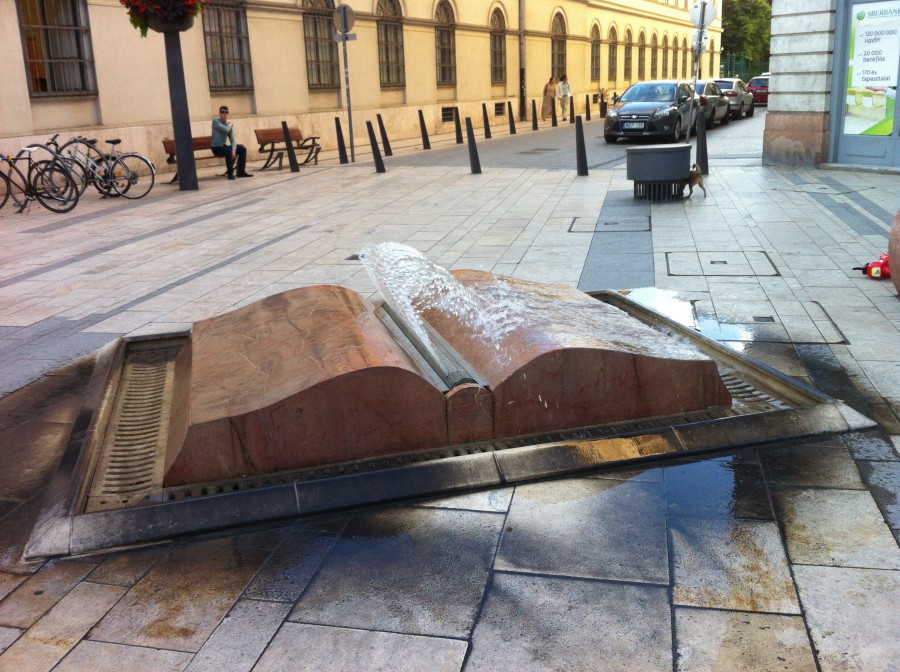
As I mentioned in the postscript to my previous posting, I was in Budapest these last few days. One evening, in search of a restaurant, I came across this fountain:

Budapest 2014 fountain 001

Budapest 2014 fountain 002

As the pictures suggest, the fountain consists of a sheet of water moving as if it were the page of a book being turned. I rather like that idea. I didn’t notice it at the time, but I have since discovered that two venerable Hungarian universities, Eötvös Loránd University and Péter Pázmány Catholic University, both of whose foundations reach back to the 1600’s, are located across the street from the fountain. I would guess that the fountain is linked to them: aren’t Universities places which revere books? Maybe the fountain is telling us that books water our intellectual life. But that’s a bit too fanciful, perhaps.

My curiosity piqued, I started looking around for pictures of other sculptures where books play the lead role. And of course someone has already helpfully put together a gallery of such photos! It’s on a site called Book Riot, which promotes reading of book reading and writing about them, my kind of site. I have shamelessly lifted a number of their photos to put here. Most of them have obvious connections to book-related institutions.

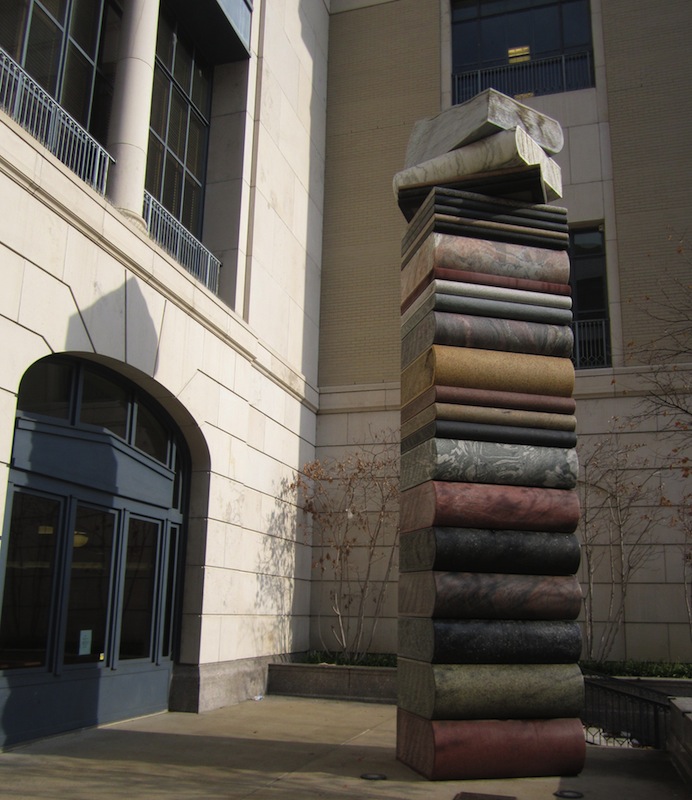
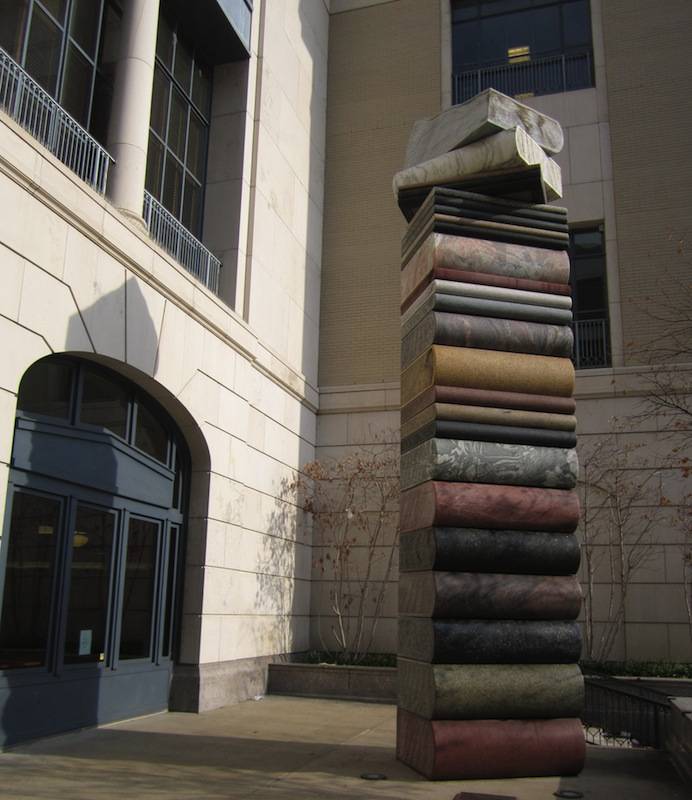
Stacking books is clearly a popular design motif. Here’s a fairly straightforward stack in a sculpture in front of the Nashville public library

nashville-public-library-book-statue

Here is another, a little bit more untidy and making the connection between books and children (which perhaps explains the untidiness of the stacking?). It adorns the public library in Coshocton, which is (and I had to look this up on Google Maps) in Ohio. The sculpture is composed of 100 books, each one representing one year of the library’s service to the community.

coshocton-public-library

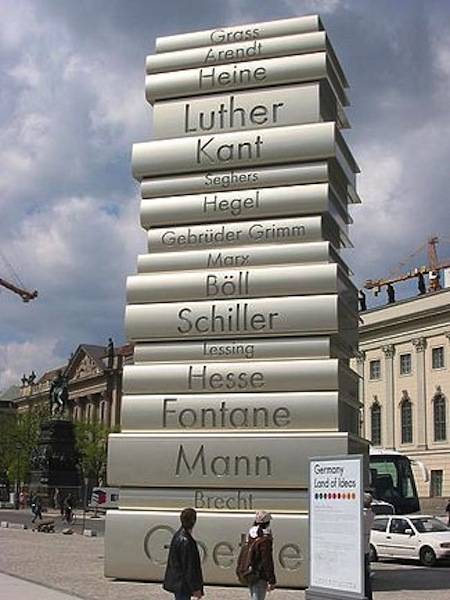
Here is another stack of books, this time from Berlin.

berlin-book-statue

This particular sculpture no longer exists, alas. It was part of a set of six sculptures celebrating the football World Cup of 2006. After a few months, they were taken away, who knows where to. This particular sculpture, set up in Bebelplatz opposite Humboldt University, celebrated Johannes Gutenberg who invented the modern letterpress in the German city of Mainz in around 1450.

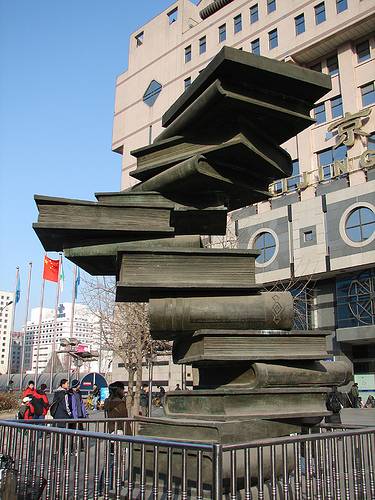
The stacking motif continues with this sculpture, although a spiraling twist has been given to the whole.

beijing-xinhua-bookstore-statue

The sculpture is in front of Beijing’s Xinhua bookstore, although I must confess to never having noticed it.

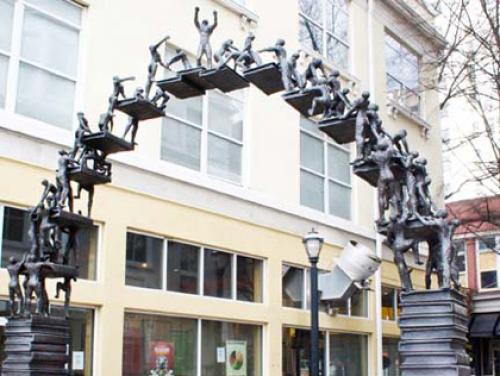
Here, the stacking has turned into a triumphal arch, located in Atlanta, at Georgia State University.

georgia tech atlanta

This is a very obviously symbolic statue. It was created by the sculpture students at the University and is entitled “No Goal Is Too High If We Climb With Care And Confidence”. A visual metaphor dear to the hearts of many a University Professor, I’m sure.

This one, from Charlotte North Carolina, is quite different. Like the sculpture in Coshocton, it makes a connection between books and children, but here it becomes equivalent to playground equipment, showing books as something for children to play with, on, in.

brick-book-statue

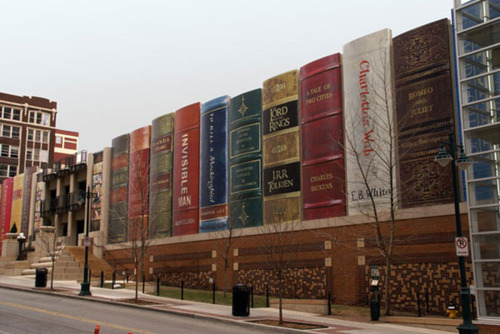
As for Kansas City library, it dispenses with sculptures altogether and has just built the books right into its façade

kansas city public library

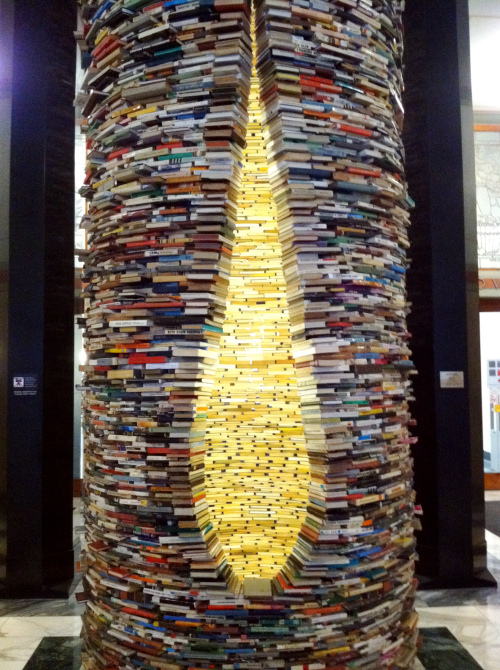
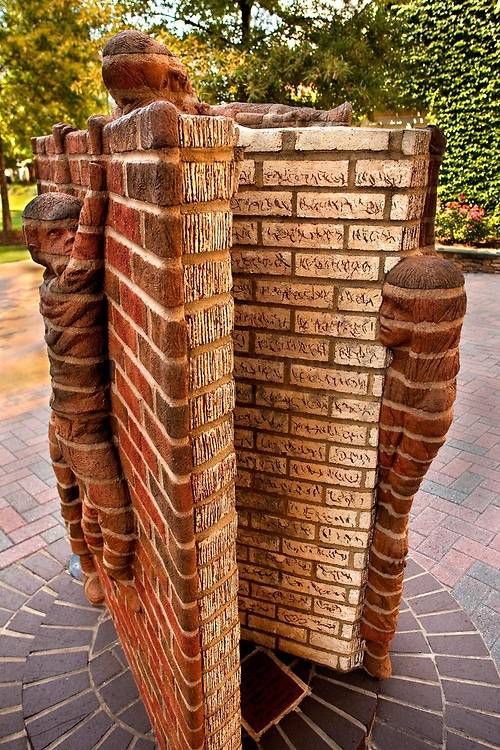
Another approach to book-sculptures is to consider the book a brick to be used to build structures. The Czech-Slovak artist Matej Kren has created a number of such structures, a couple of which I have photos for. The first is in the Prague municipal library

prague city library

I’ve not seen it, but I read that if you look inside you get the impression of an infinite tower. It seems that Kren has made clever use of mirrors to get this optical effect.

I don’t know where the structures in these other two photos are to be found

matej kren-1

matej kren-2

The last could easily be an old farm house in southern Europe somewhere. The following site shows a couple more such structures made with books by Kren and other artists.

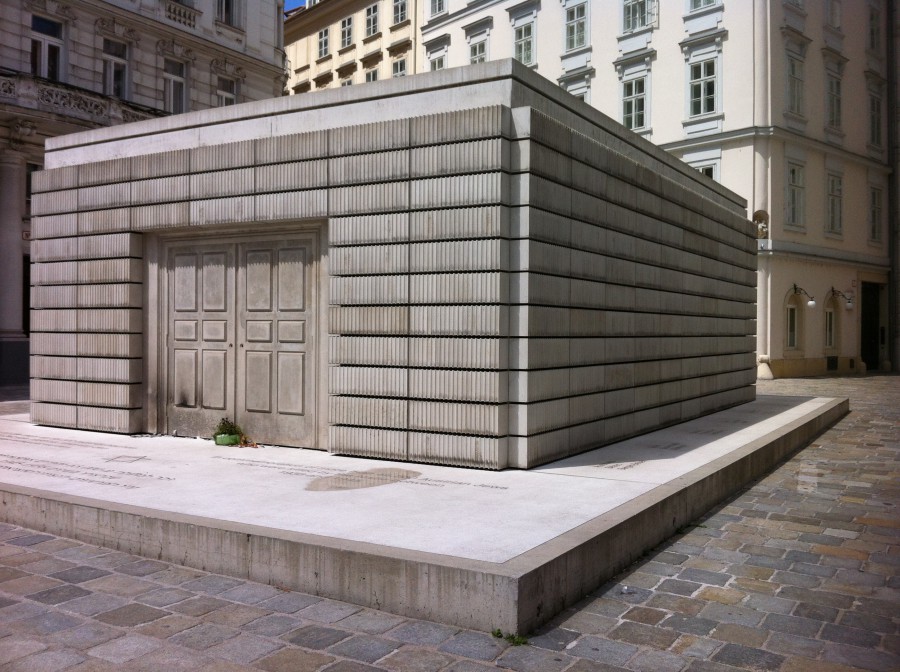
This last photo brings me to another structure made with books, but of an altogether darker tenor. It is the Holocaust memorial in Judenplatz, Vienna, a memorial to the more than 65,000 Austrian Jews killed by the Nazis before and during World War II. On my way back from Budapest to Beijing through Vienna, and with the book fountain still fresh in my mind, I decided on the spur of the moment to quickly revisit the memorial before boarding the bus for the airport.

holocaust memorial 001

From far away, it looks like one of those squat, windowless blockhouses which dotted the battlefields of World War II. But when you get closer, you see something else.

holocaust memorial 002

You see that the walls of this blockhouse are made of shelves of books. But the books are facing outwards rather than inwards as would normally be the case on a shelf. So unlike the sculpture pictured above in Berlin’s Bebelplatz, we know neither the author nor the title of any of the books. The shelves of the memorial simply appear to hold endless copies of the same book, which can stand for the vast array of faceless victims. The choice of books as the design motif perhaps alludes to the idea of the Jews being a “People of the Book”. Fittingly, another name for this memorial is the Nameless Library. Around the edges of the structure are carved the names of the camps where Austrian Jews died

holocaust memorial 003

At the other end of Judenplatz is a statue of the writer Lessing, staring so it seems at the Holocaust memorial.

Lessing statue Judenplatz

This is the same Lessing whose name appears on one of the spines of the sculpted stack of books in Berlin’s Bebelplatz, a photo of which I included earlier. A connection which allows me to segue into my next memorial, in that same Bebelplatz, a memorial to the campaign of book burnings, orchestrated by the German Student Union, which took place there and in 34 other German university towns in May 1933, shortly after the Nazis had taken power. The purpose was to ceremonially burn books by classical liberal, anarchist, socialist, pacifist, communist, Jewish, and other German and non-German authors whose writings were viewed as subversive to the new regime. Many came from Humboldt University’s libraries. The students first marched in torchlight parades “against the un-German spirit”. Some 40,000 people then gathered in Bebelplatz to hear Joseph Goebbels deliver a fiery address:

“The era of extreme Jewish intellectualism is now at an end. The breakthrough of the German revolution has again cleared the way on the German path…The future German man will not just be a man of books, but a man of character. It is to this end that we want to educate you. As a young person, to already have the courage to face the pitiless glare, to overcome the fear of death, and to regain respect for death – this is the task of this young generation. And thus you do well in this midnight hour to commit to the flames the evil spirit of the past. This is a strong, great and symbolic deed – a deed which should document the following for the world to know – Here the intellectual foundation of the November Republic is sinking to the ground, but from this wreckage the phoenix of a new spirit will triumphantly rise.

Then the students joyfully threw the books onto the pyre, with band-playing, songs, “fire oaths”, and incantations.

bebelplatz book burning-1

DEU NS ZEIT BUECHERVERBRENNUNG JAHRESTAG

In Berlin, some 20,000 books were burned. Looking back at the stack of books which make up the sculpture put in this same square 83 years later, Heinrich Heine’s books were burned, as were those of Anna Seghers, Karl Marx, Heinrich Mann, and Bertolt Brecht. In all, the works of some 60 German authors and 25 non-German authors were consigned to the flames.

The memorial to this shameful episode consists simply of a glass plate set into the square’s cobble stones, below which are visible empty bookcases, enough of them to hold the total of the 20,000 burned books.

Bebelplatz_Night_of_Shame_Monument-2

Next to it is a plaque, with a line from Heinrich Heine’s 1821 play Almansor: “That was only a prelude; where they burn books, they will in the end also burn people.” Heine was referring to the burning of the Muslim Quran by the Christian Inquisition in Spain. But looking back at the Holocaust memorial in Vienna’s Judenplatz, how prescient is that line! And the book burnings haven’t stopped, as a Wikipedia article eloquently shows.

______________________

Budapest book fountain: my photos
The following five photos are from bookriot.com/2013/03/06/10-superbly-bookish-statues
– Nashville public library: http://bookriotcom.c.presscdn.com/wp-content/uploads/2013/03/nashville-public-library-book-statue.jpg
– Coshocton public library: http://bookriotcom.c.presscdn.com/wp-content/uploads/2013/03/centennial-statue-coshocton-public-library-317×1024.jpg
– Berlin Walk of Ideas http://bookriotcom.c.presscdn.com/wp-content/uploads/2013/03/berlin-book-statue.jpg
– Xinhua bookstore, Beijing: http://bookriotcom.c.presscdn.com/wp-content/uploads/2013/03/beijing-xinhua-bookstore-statue.jpg
– Brick book statue: http://bookriotcom.c.presscdn.com/wp-content/uploads/2013/03/brick-book-statue.jpg
Georgia Tech University, Atlanta: http://www.himalayanrestaurantct.com/article_images/best-bizarre-statues-or-public-art-in-atlanta.jpg [in http://www.himalayanrestaurantct.com/arts-culture/best-art-museums-in-atlanta-449.php%5D
Kansas city library: http://media.tumblr.com/tumblr_m37ijcSOnV1qc4g44.jpg [in http://callmeabsurd.tumblr.com/post/22000303273/beautiful-structures-made-of-books%5D
Prague city library: http://davidgutterman.files.wordpress.com/2011/11/book-statue-library.jpg?w=500&h=670 [in http://davidgutterman.wordpress.com/2011/11/16/prague-blog-7/%5D
Matej Kren-1: http://avisualjournal.files.wordpress.com/2011/09/artwork_images_425933222_663093_matej-kren.jpg [in http://avisualjournal.wordpress.com/page/43/%5D
Matej Kren-2: http://pitchdesignunion.com/wp-content/uploads/2010/10/book-cell-02.jpeg [in http://pitchdesignunion.com/2010/10/matej-kren/%5D
Holocaust memorial, Judenplatz, Vienna: my photos
Lessing statue Judenplatz: http://en.wikipedia.org/wiki/Judenplatz#mediaviewer/File:WienLessingDenkmal.jpg [in http://en.wikipedia.org/wiki/Judenplatz#Lessing_monument%5D
Bebelplatz book burning-1: http://upload.wikimedia.org/wikipedia/commons/2/2b/1933-may-10-berlin-book-burning.JPG [in http://en.wikipedia.org/wiki/Nazi_book_burnings%5D
Bebelplatz book burning-2: http://cdn2.spiegel.de/images/image-485121-galleryV9-ohuq.jpg [in http://www.spiegel.de/fotostrecke/photo-gallery-erich-kaestner-and-the-nazi-book-burnings-fotostrecke-95652-2.html%5D
Bebelplatz memorial to book burning: http://en.wikipedia.org/wiki/Nazi_book_burnings#mediaviewer/File:Bebelplatz_mit_Mahnmal_B%C3%BCcherverbrennung_Aug_2009.jpg [in http://en.wikipedia.org/wiki/Nazi_book_burnings%5D

GIFTS FROM THE GREAT

Beijing, 28 June 2014

The first time my wife and I went to North Korea, we were given the royal treatment – well, not royal since we were in a Socialist paradise, but out of the ordinary. We were taken to the place where the Great Leader Kim Il-sung was born. We were taken to the national museum which showed Korea’s glorious history from the earliest times up to the defining moment when the Great Leader (and his family) took over. And we were taken to the International Friendship Exhibition Hall outside of Pyongyang.

international frienship exhibition hall-exterior

The point of this massive building was to show the people of North Korea, and ignorant visitors like ourselves, that contrary to what the cynical capitalists might say about the Great Leader being a political pariah he was actually very much loved by peoples from all over the world. As testimony to this blindingly obvious fact, the building housed the tens of thousands, maybe hundreds of thousands, of gifts which he had received during his reign, from the mightiest of mighty personalities (heads of state and suchlike) to the lowliest of the lowly (a local communist youth league from some benighted country, for instance). These are all lovingly laid out in high-end display cabinets which are spread out through hundreds of rooms over seven or eight floors. Someone with a tidy frame of mind, perhaps the Great Leader himself, had neatly divided all the gifts by geographical region of provenance (Africa, Asia, and so on). When we arrived, the guide asked us what region we wanted to visit. Much to her surprise, I plumped for Africa, continent of my birth. Rather disappointed she took us there, but once we had visited that part of the collection, she beamed her approval when we said we now wanted to visit Europe, obviously where we should have been the whole time.

The whole experience was totally surreal. The place was spotlessly clean, so clean, so antiseptic, that we were required to put on shoe-covers. We were there in early November, and it was nice and warm inside the Exhibition Hall, in stark contrast to every other building in the country which we had visited, which were cold and dank – the population was expected to save on precious imported fuel. The lights were motion-sensitive, so rooms instantly lit up the moment we walked in and blacked out the moment we left them (there wasn’t a single window in the place). All of this hoopla for displaying gifts which were really very, very ordinary and in some cases in embarrassingly bad taste. If I had been given these gifts, after thanking the giver politely and waving him off at the door, I would have promptly put 99% of them in the attic for future “recycling”. We had to keep reminding ourselves that the whole point of this grotesque exercise was to show the viewer – again and again, obsessively – that the Great Leader was adored by all the peoples of the world. As a grand finale to all of this, the guide ushered us into a large room with a diorama at one end of Korea’s famous Mount Paektu and a Mme Tussauds-like wax reproduction of the Great Leader standing in front of it with a benign, grandfatherly smile on his face. As we walked in, piped concert music swelled to a crescendo and the North Koreans who were with us bowed deeply (we stood there, not knowing quite what to do, shifting from foot to foot, rather like atheists in a church).

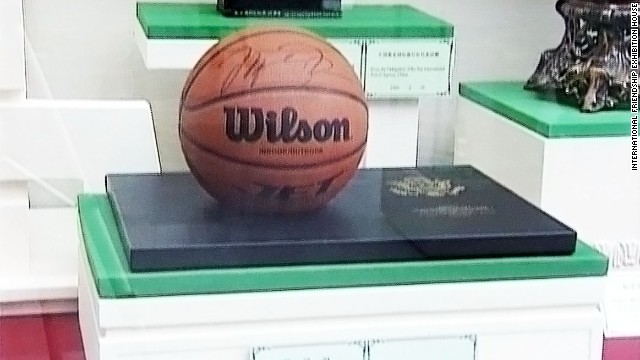
Apart from the discomfort we felt at seeing all this money being poured into a project of pharaonic proportions in a country where the people are dying of hunger, we were amazed by the strangeness, not to say the bad taste, of many of the gifts. I can understand that communist youth leagues might only be able to afford a cheap ashtray as a gift, but even the high and mighty gave odd gifts. How, for instance, did Madeleine Albright, US Secretary of State, arrive at the idea of giving the Great Leader a basketball signed by Michael Jordan?

Kim present-basketball

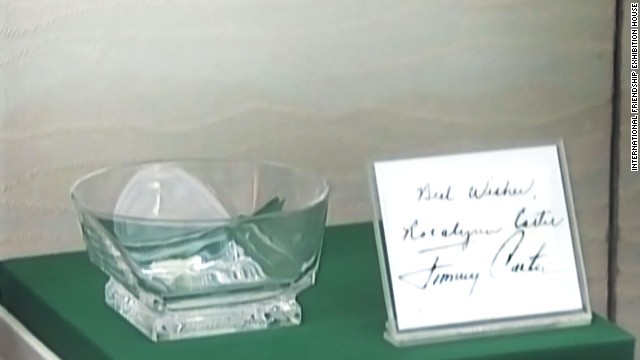
Maybe President Carter’s gift explains it all: you have no idea what to give, so you choose the most colourless thing you can think of – in his case, literally so:

Kim present-glass bowl

Or you become so desperate trying to figure out what to give that you end up giving something completely ridiculous, like the Sandanistas of Nicaragua, who gave the Great Leader a grinning alligator standing up, holding out a wooden tray of cocktail glasses.

Kim present-alligator

The strange world of official gift-giving …

I was reminded of all this last weekend, when my wife and I visited China’s National Museum on Tiananmen Square. We actually went there to see if we could buy a copy of one of the Tang-era porcelain horses, to complement the copy of a Tang-era camel which we had purchased there a few years ago. Alas! The only one on sale was far too big for our modest dwelling. Disconsolate, we went around seeing what was new. Which brought us to a new exhibition of the official gifts received over the years by China’s Greats: Mao Zedong, Zhou Enlai, Deng Xiaoping, the recent Presidents and Prime Ministers, and other luminaries whose names meant nothing to me. The same general bad taste which assailed us in North Korea prevailed, although it wasn’t quite as bad as in the International Friendship Exhibition Hall. Either the cheap ashtrays had been quietly and sensibly “recycled” or people were more eager to be friends with China than with North Korea and were more careful about the gifts they made. Or both. But it still amazed us how much bad taste leaders of the world exhibit. I have to put it down to gift choosing being a decision made by a government committee somewhere, and we all know that government committee decisions lead to the Least Common Denominator, and the Great Person not having the time to check the gifts before he or she packs the bags, kisses the partner on the cheek, hugs the kids, pats the pet, and heads for the airport for the next official visit.

Luckily, though, in all this morass of dubious taste a few pieces stood out, pieces which we wouldn’t have minded keeping rather than storing in the attic for “recycling” etc. I note these here for posterity with photos taken with my iPhone.

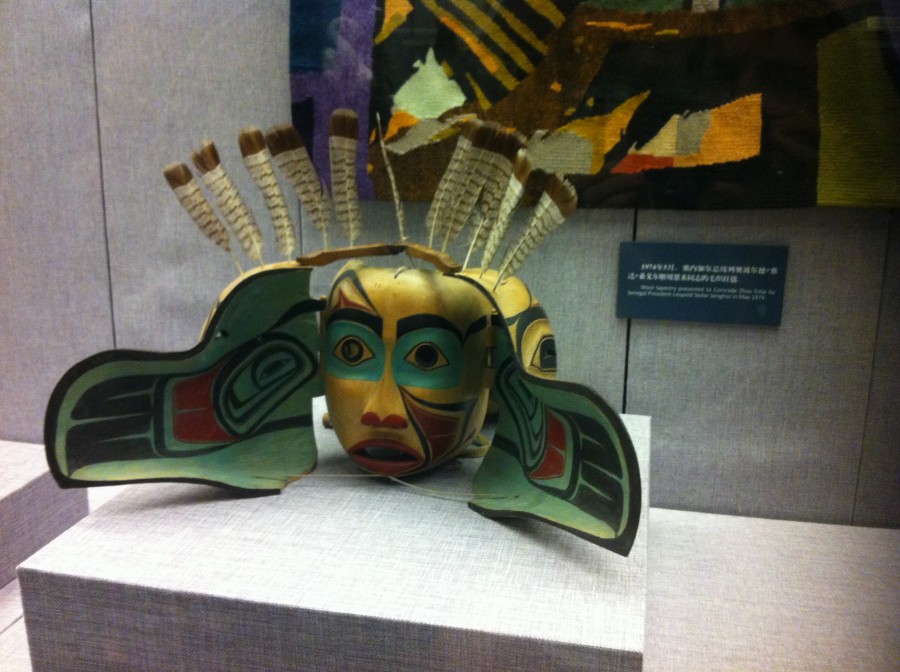
In general, I feel that the Canadians did better than everyone else in their choice of gifts. Here is the one that Pierre Trudeau gave Zhou Enlai, a beautiful Native Indian double mask, from the style I would guess from the Pacific coast

canadian mask 002

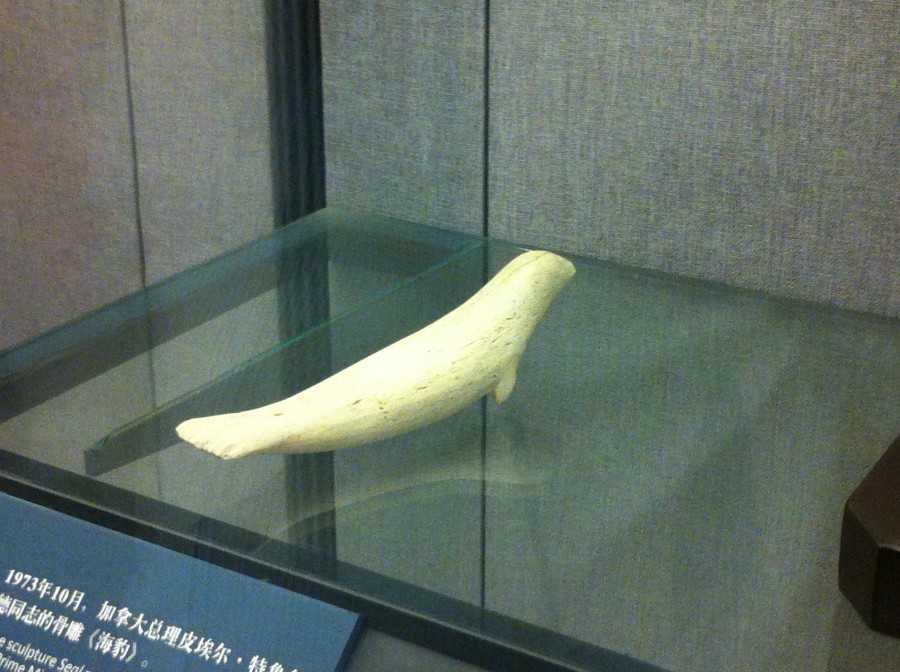
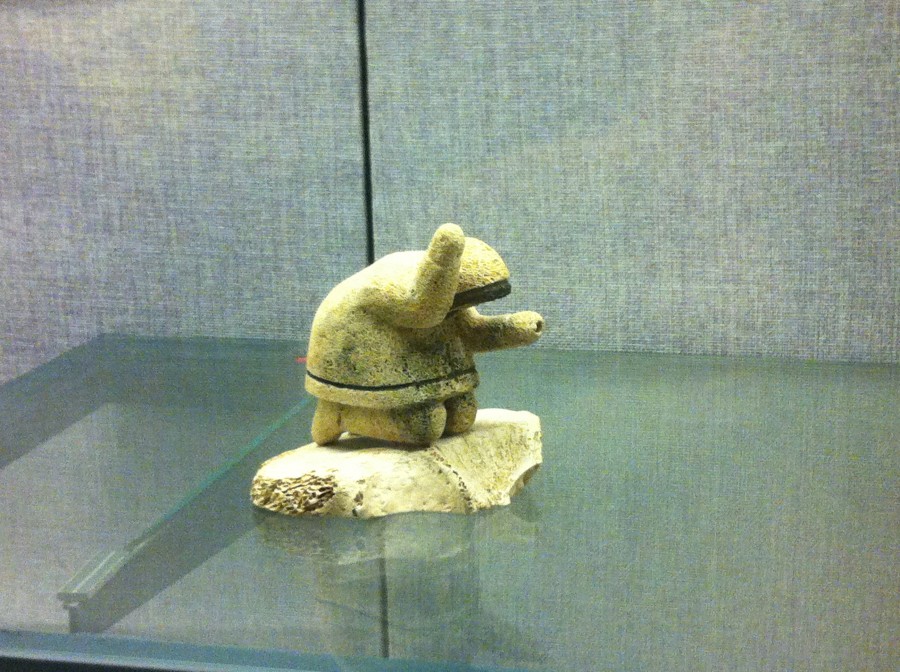
while here is a small but lovely sculpture, also given by Pierre Trudeau but this time to Zhu De, of a seal carved in  bone

canadian seal 001

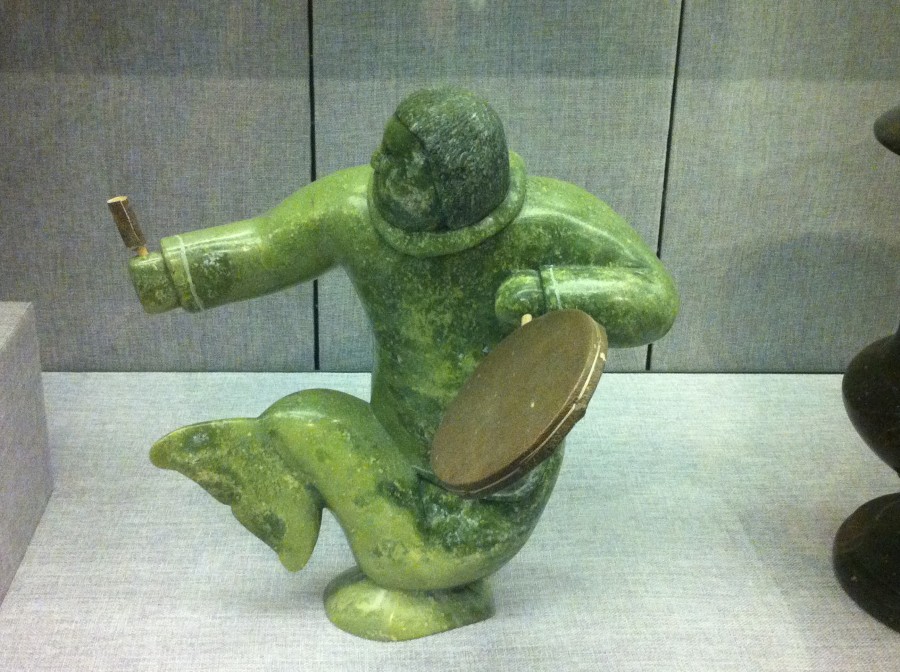
This piece was given by Governor-General Romeo LeBlanc to Jiang Zemin, a beautiful carving in jade stone of what appears to be a merman dancing.

canadian merman 001

Keeping to the regional focus used in North Korea (the exhibition had the pieces laid out temporally), we can continue with North America, where the only other piece worthy of mention actually came from the same part of the world as the previous two, Alaska. It is a gift from that State’s Government to Deng Xiaoping, of an Inuit ice fishing, made of walrus bone

alaskan inuit 001

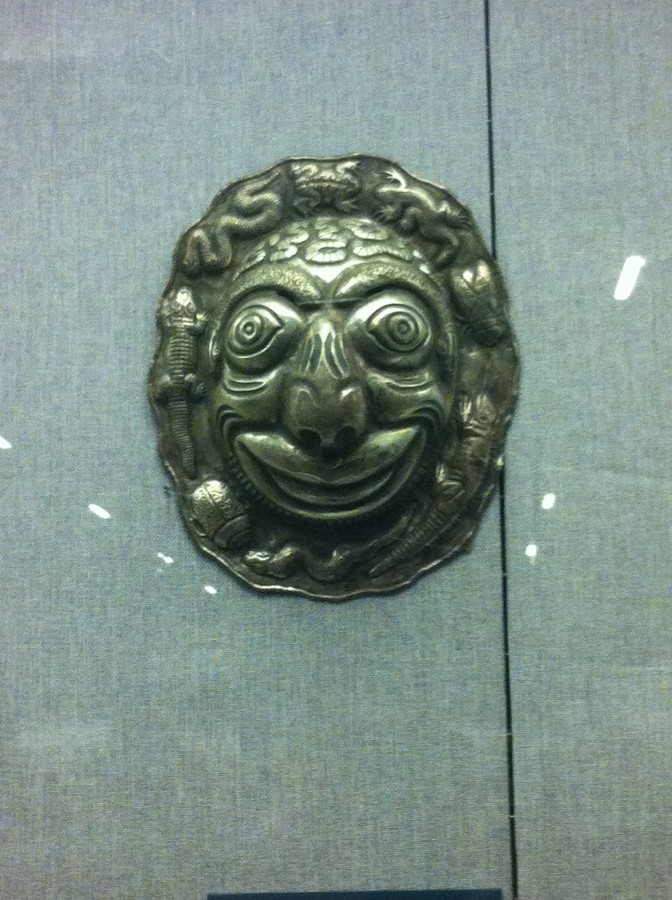
There was nothing else of note from the rest of the USA, or from Central America, so we can fly over to South America to land in Bolivia, where President Jaime Paz Zamora gave Yang Shangkun this lovely silver mask

bolivian mask 001

and then to Brazil, where President Jao Baptista de Oliveira Figueiredo gave Deng Xiaoping this delicate gift of a silver crane with crystal feathers

brazilian crane 001

(another Brazilian tried the same style some years later, but the result was not nearly as noteworthy)

After which I propose to fly over to Africa, which gave some of the best – but also many of the worst – gifts. Here are the best:

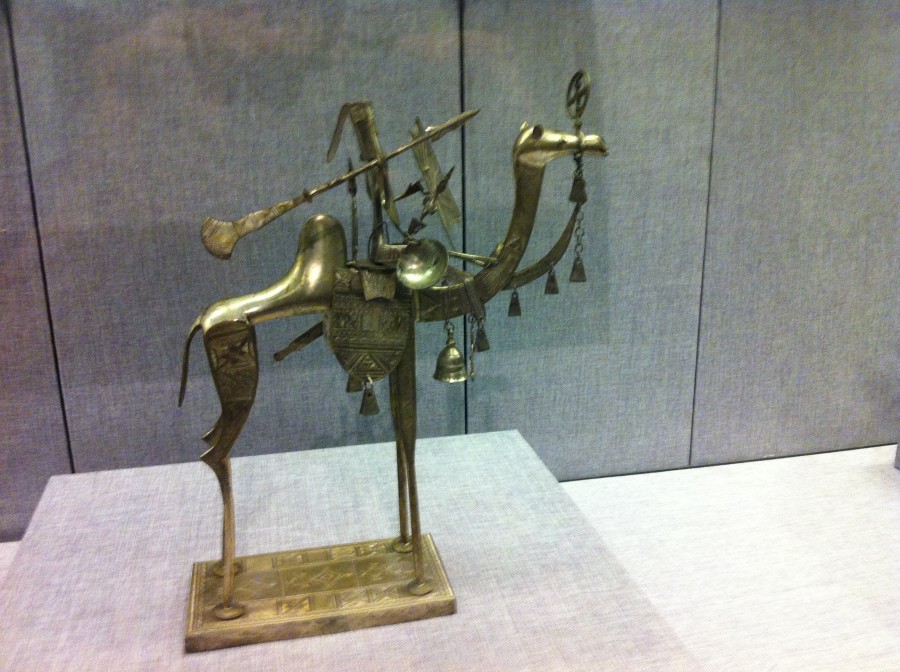
– a silver warrior riding his camel, from Niger, given by Head of State Seyni Kountche to Deng Xiaoping

nigerois warrior and camel 001

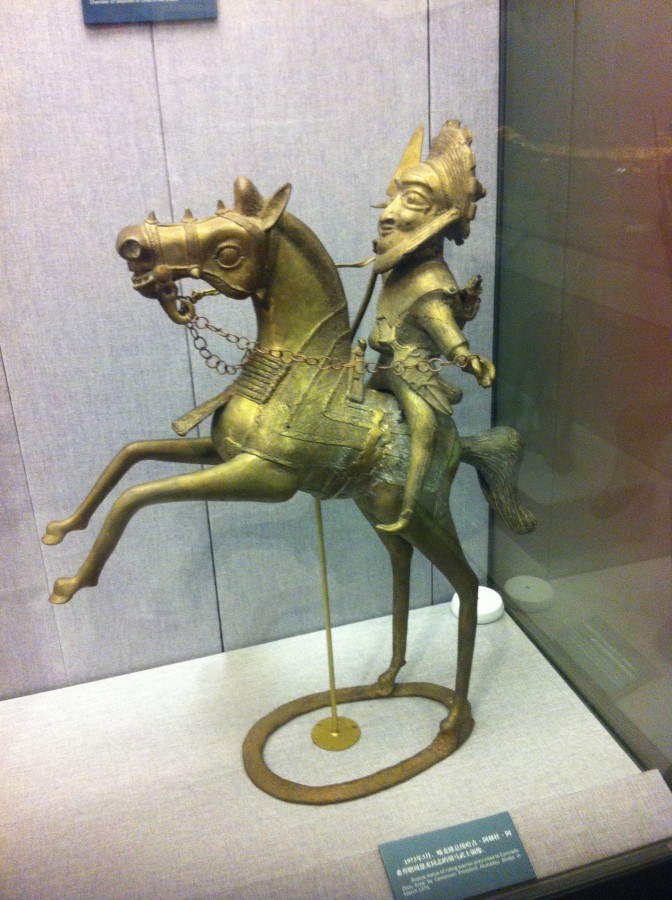
– somewhat in the same style but on a grander scale, a brass horse and rider from Cameroon, given by President Ahmadou Ahidjo to Zhou Enlai

cameroon brass horse 001

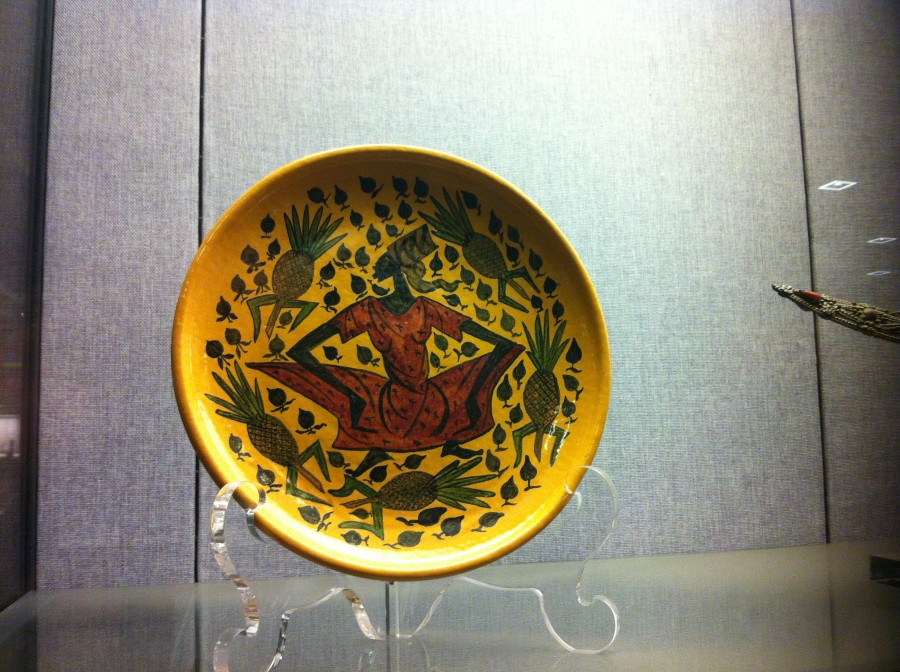
– a plate from the Republic of Congo, given by President Alphonse Massamba-Debat to Mao Zedong

congolese plate 001

– bust from Gabon, given by President El Hadj Omar Bongo Ondimba to Jiang Zemin

gabon bust 001

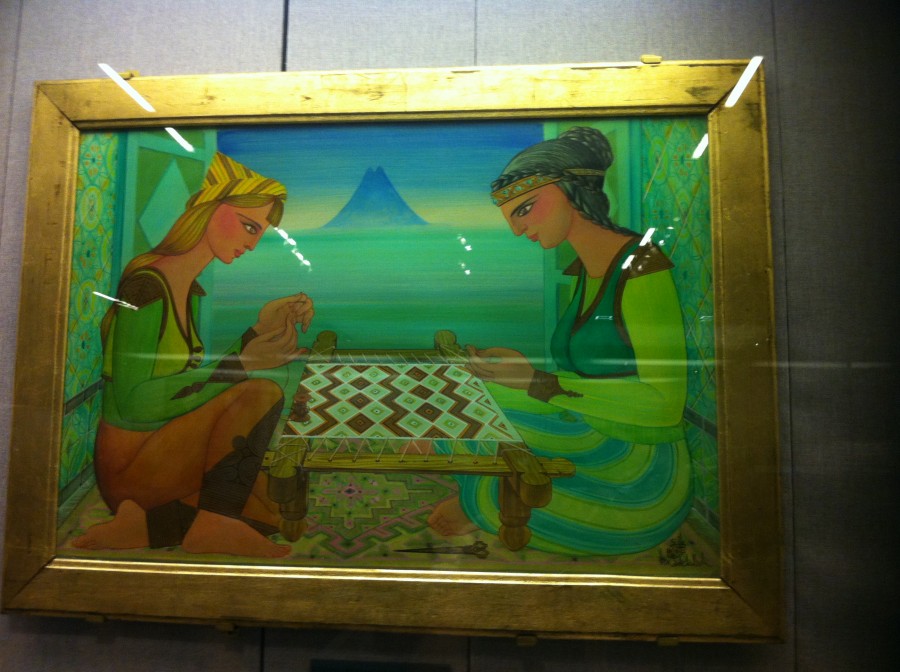
– and finally a gift from North Africa, a painting from Tunisia, given by Prime Minister Hedi Nouira to Zhou Enlai

tunisian painting 001

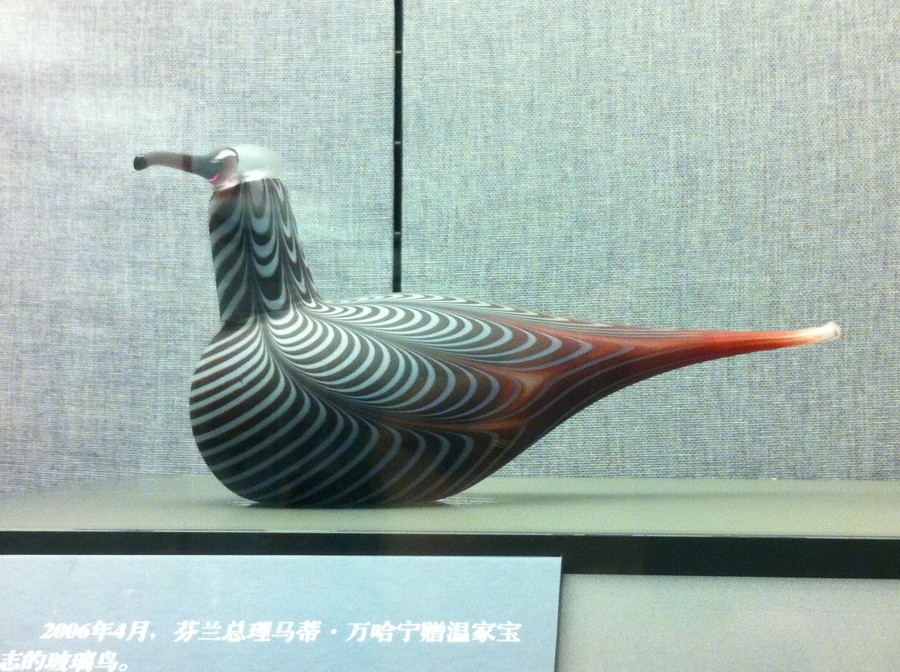
Tunisia is close to Europe, so why not do a hop, skip and a jump north over the Mediterranean. There was precious little that was nice from there, though. The best was this glass bird, a curlew, from Finland, a gift from Prime Minister Matti Vanhani to Wen Jiaobao

finnish bird 001

(there was another Finnish gift in the same style, but unfortunately the photo came out blurred so I haven’t added it; the Swedes, by the way, also gave a gift in glass, of fish in this case, but of appalling taste)

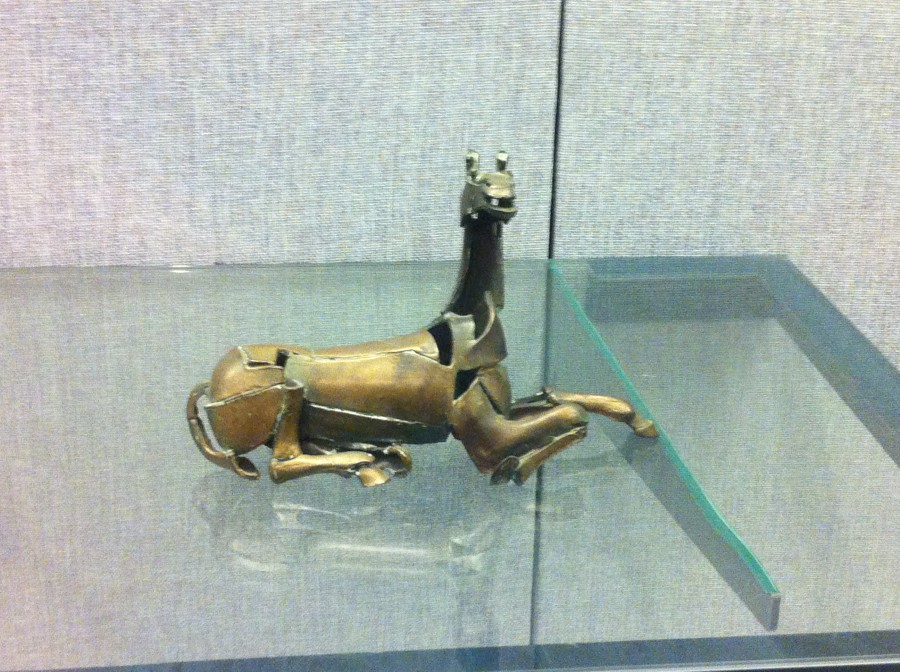
The Belgians, through the good office of King Baudoin, made a gift to Deng Xiaoping of a small but beautiful statue of a sitting horse

belgian horse 001

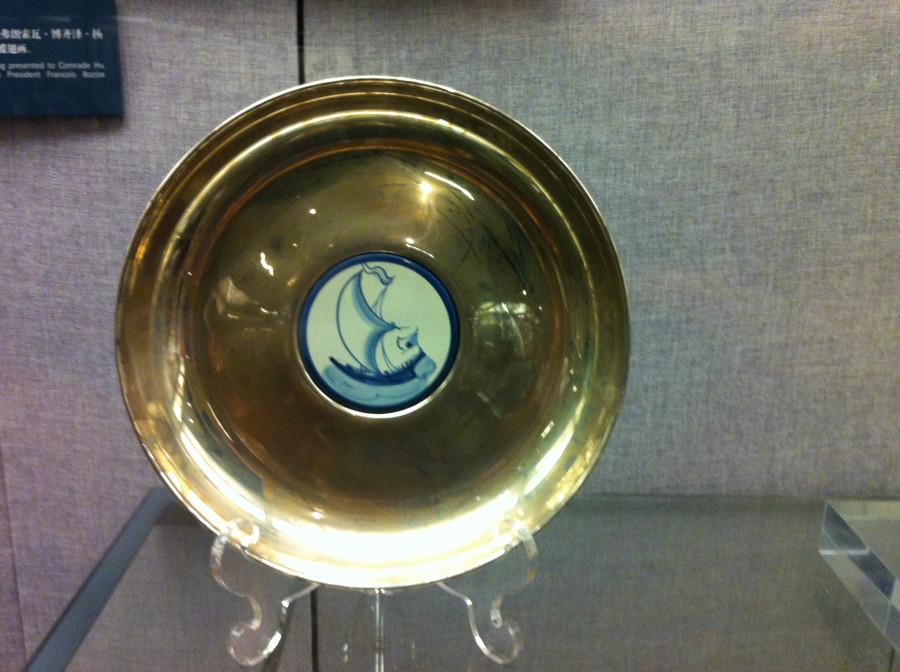
while from Portugal came this gift from Prime Minister Jose Socrates to Hu Jintao of a silver plate with a lovely azulejo­-inset of a boat in full sail

portuguese plate 001

Which leaves Asia, from where there was even less than Europe. The best was this silver bowl with a glass liner of a lustrous blue, from Vietnam, a gift from the Government to Liu Shaoqi.

vietnamese silver bowl 001

And that was it, as far as we were concerned. Really sad to see how little taste our Great Leaders have.

By the way, readers might be interested to know that, not to be outdone by his father, the Supreme Leader Kim Jong-il also built himself a hall, next to his father’s, to house his collection of rubbish … I mean, gifts. Luckily, we didn’t have to visit that one. No doubt Kim Jong-un, the current Supreme leader of North Korea, is currently hard at work with a team of architects designing his hall. Meanwhile, his people die of starvation and neglect.

______________

International Friendship Exhibition Hall: http://www.bestinsighttours.com/UpLoadFile/2013011818361673499.jpg [in http://www.bestinsighttours.com/ProductsView.Asp?id=44%5D
Kim present-basketball: http://i2.cdn.turner.com/cnn/dam/assets/130806190158-secretary-of-state-basketball2-horizontal-gallery.jpg [in http://www.cnn.com/2013/08/06/travel/north-korea-kim-gifts/%5D
Kim present-glass bowl: http://i2.cdn.turner.com/cnn/dam/assets/130806190133-jimmy-carter-gift2-horizontal-gallery.jpg [in http://www.cnn.com/2013/08/06/travel/north-korea-kim-gifts/%5D
Kim present-alligator: http://comtourist.com/images/large/north-korea-04/mt-myohyang-int-friendship-exhibition-04.jpg [in http://comtourist.com/mt-myongyang%5D
all other photos: mine

SCULPTURE AND NATURE

Beijing, 15 June 2014

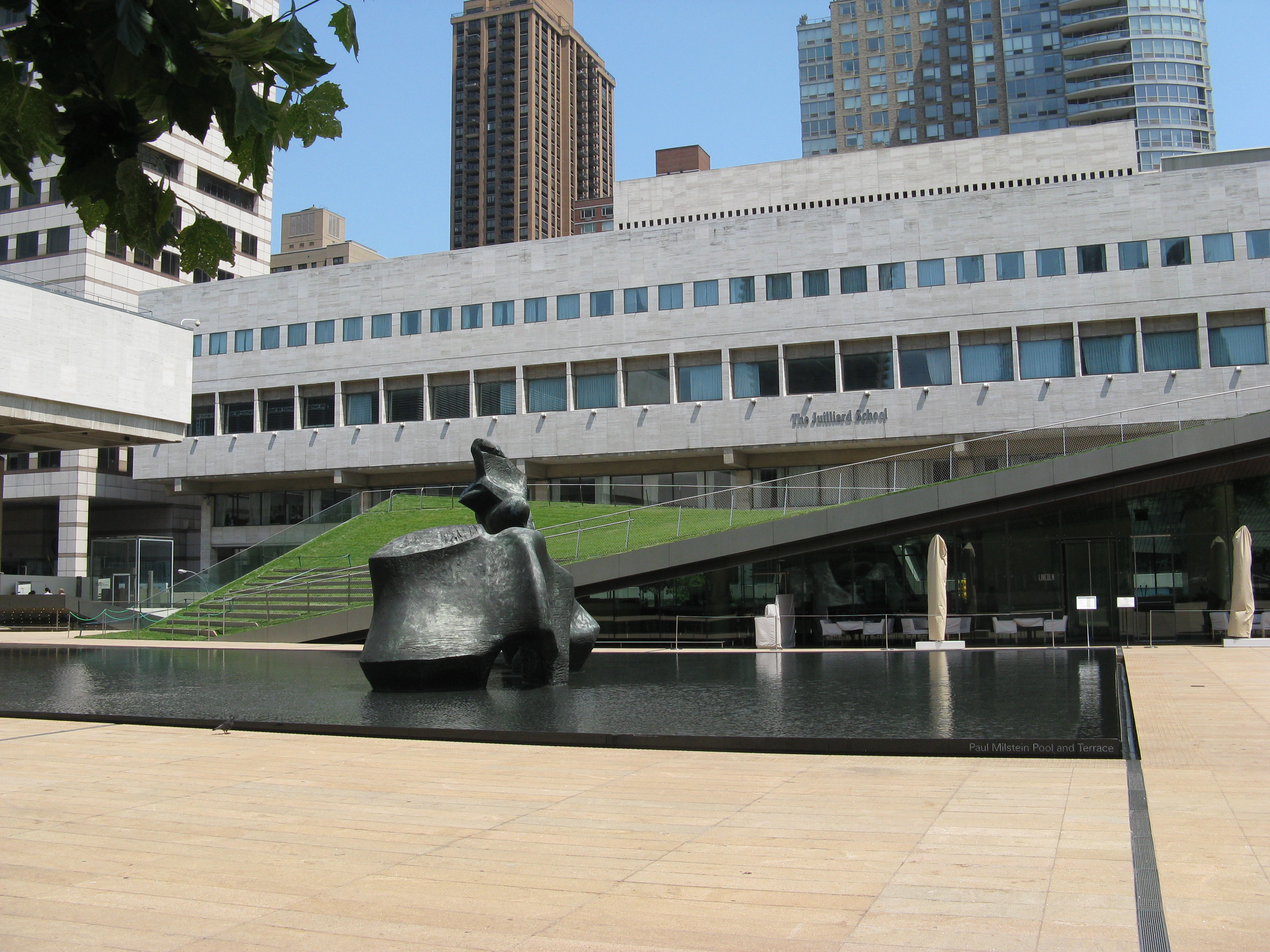
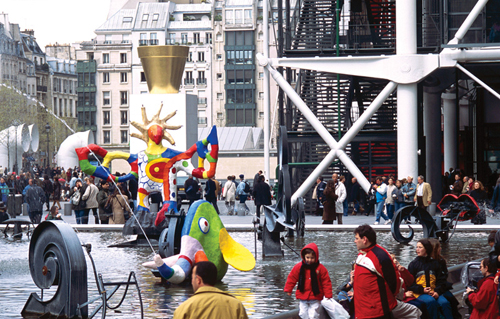
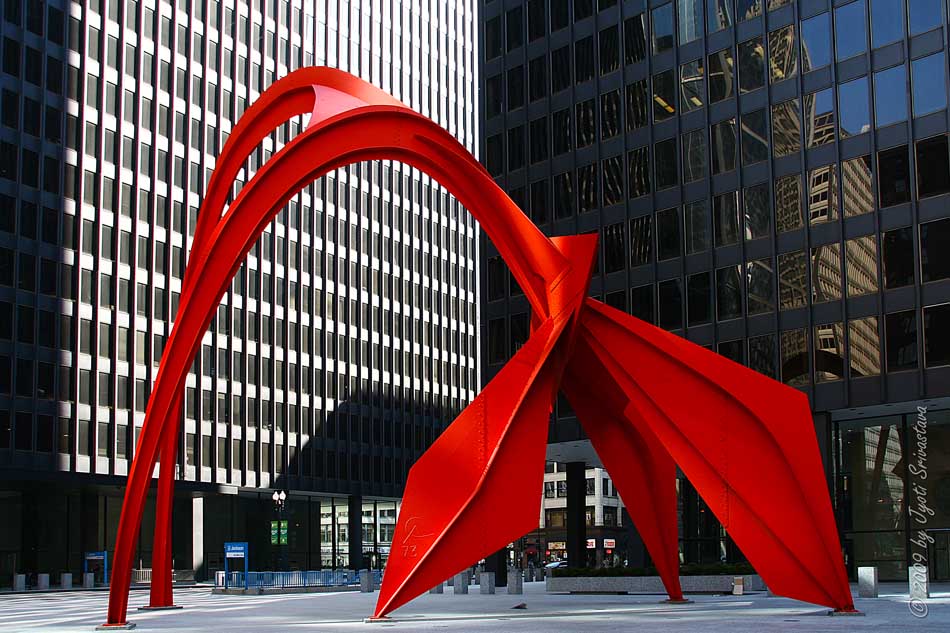
My wife and I were watching TV with one eye the other day when the BBC passed a programme which caught our attention. It was about the Yorkshire Sculpture Park in the north of England. I think a few words of explanation are required for those readers who have never heard of this Park (our situation before watching the BBC programme). It was established back in 1977 in the grounds of a stately home the last of whose aristocratic owners (Viscount Allendale) had sold it to the local council after World War II, no doubt to save his financial skin (I mentioned the financial woes of the UK’s stately homes in an earlier posting of mine). The idea is a simple one: rather than displaying modern sculpture in open spaces in cities like plazas
sculpture in cities-1

sculpture in cities-2

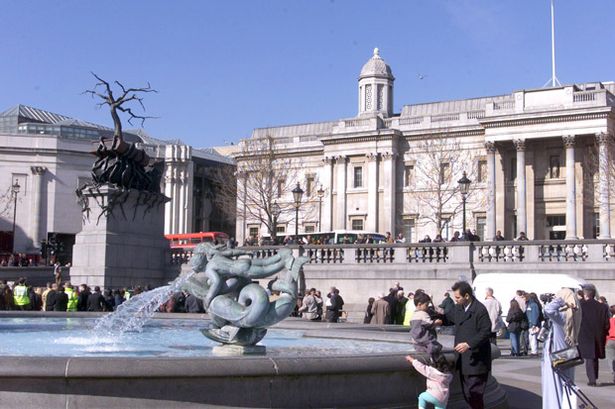
or squares

sculpture in cities-3

sculpture in cities-4

or using the atriums of posh buildings

sculpture in cities-6

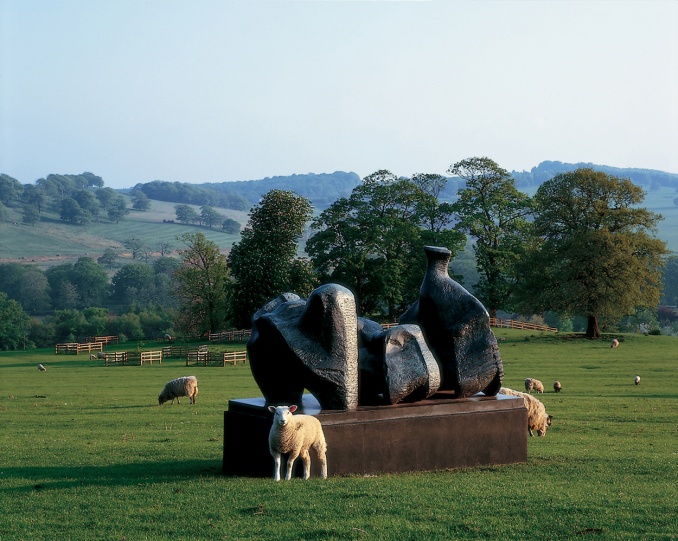
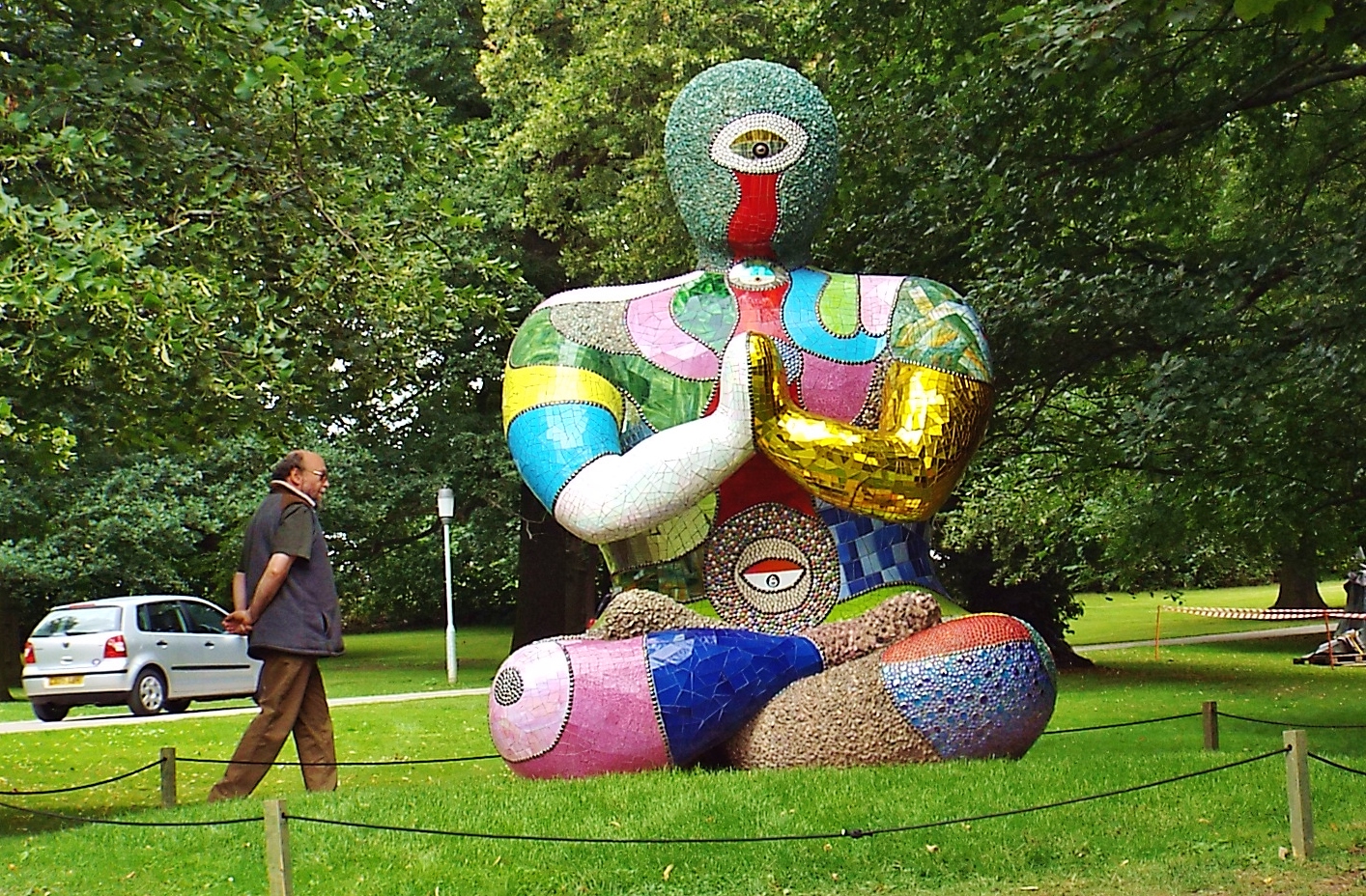
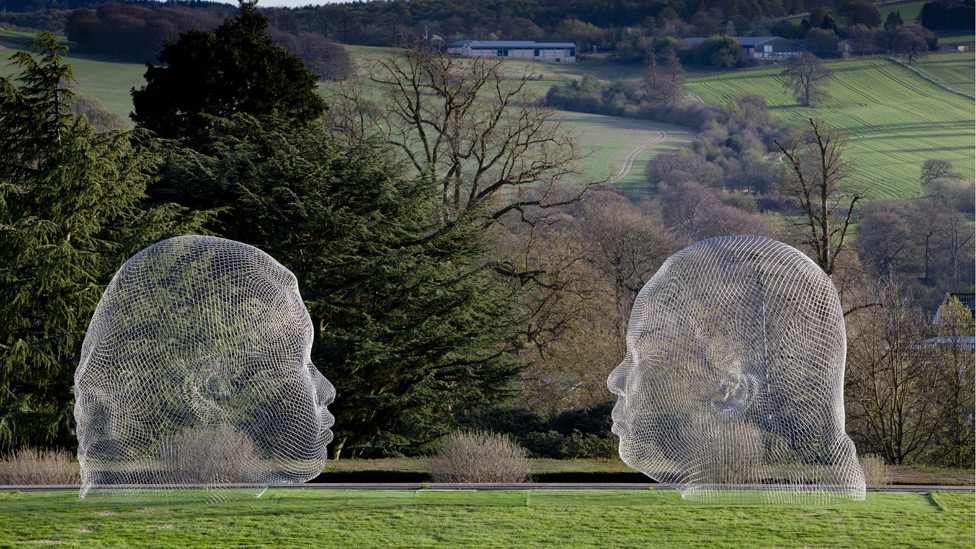
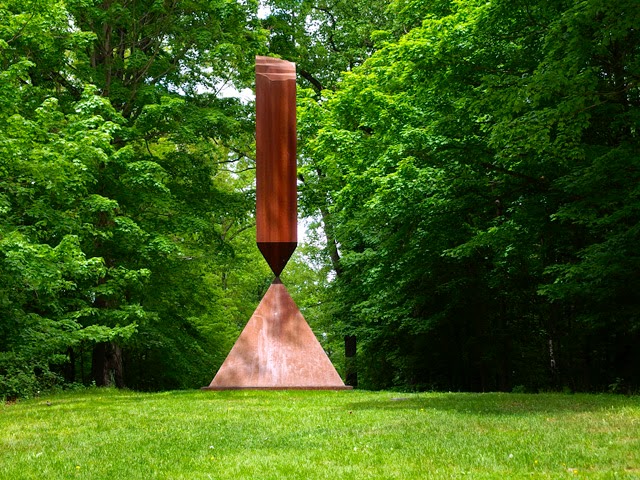
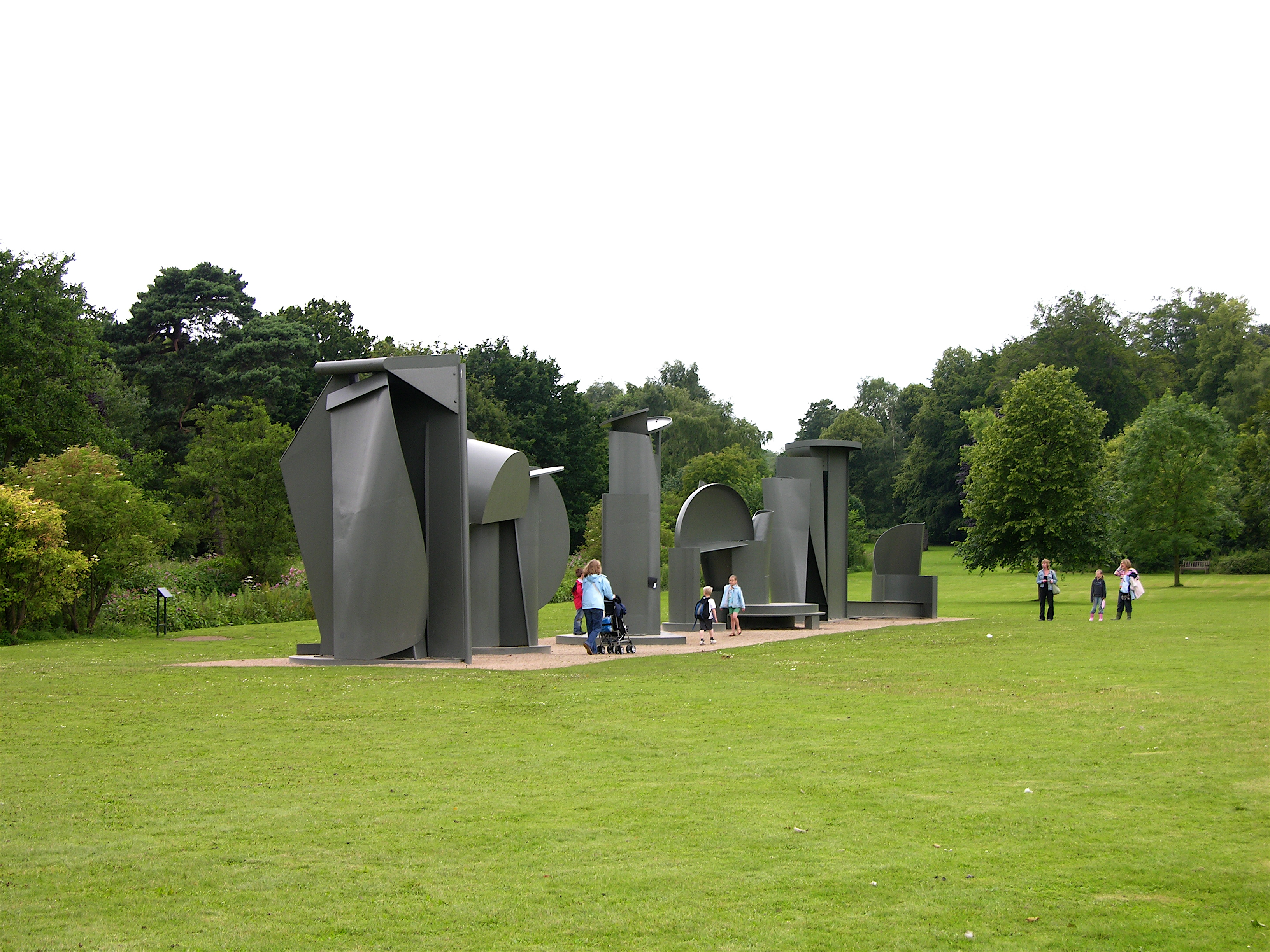
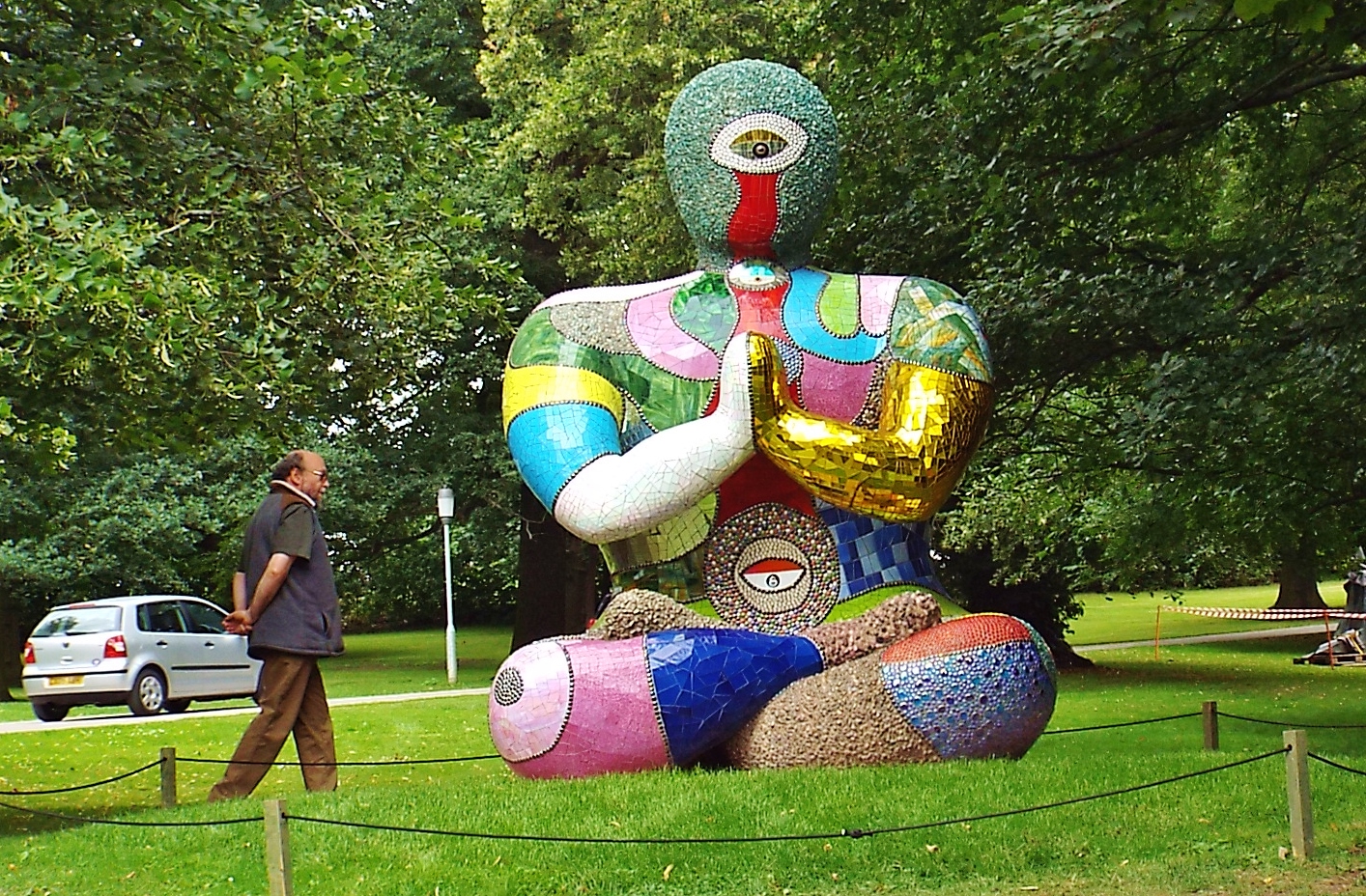
use the sweeping, open vistas of the countryside to display them. Here are some of the pieces at the Yorkshire Sculpture Park:
YSP-4
DSCN2327.JPG
YSP-6

YSP-9

YSP-10

YSP-14

YSP-1
My wife and I agree on many things, and one of them is that modern sculptures are enhanced by being seen in a natural, organic setting rather than in the built urban environment. Personally, I think it has to do with the contrast between the dead surfaces of the sculptures and the much softer, living surfaces of the surrounding landscapes. It sounds a bit fancy, but the dead sculpture comes alive when in contact with organic life.

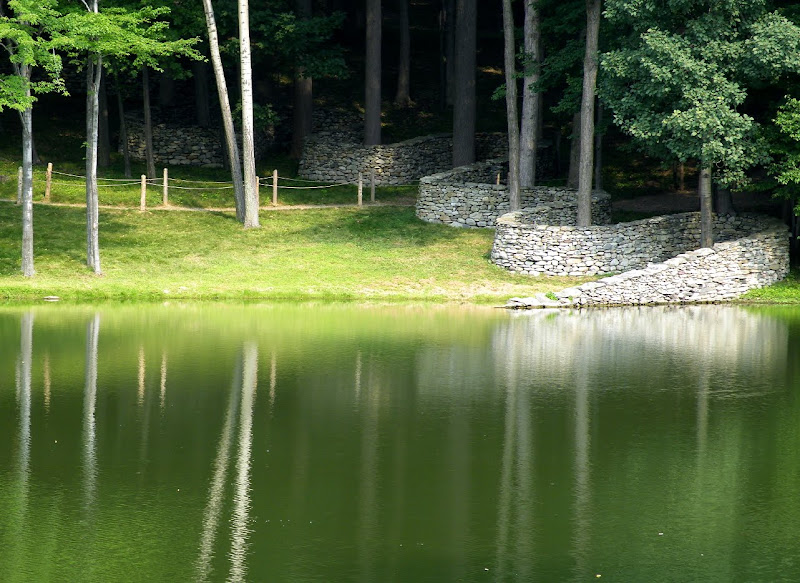
This was brought home to us very strongly when, 25 years ago, and on the advice of a friend who worked at the Metropolitan Museum of Art, we visited the Storm King Art Centre, which is an hour’s drive north of New York City, near the Hudson River. Here again, a few words of introduction. It’s really the classic American story (as much as the history of the Yorkshire Sculpture Park is the classic British story of modern times – decay of the old order and birth of a new one). A certain Mr. Ogden, after a successful career in the family business, purchased the land and property of Storm King and started collecting. He initially bought small sculptures which he exhibited around the house. At some point, he expanded out into the surrounding landscape, installing much bigger pieces. That’s it, in a nutshell. But the result – for us at least – was epiphanic.

In wonder we wandered along the rides mown through the grass, walking from one towering sculpture to another

SK-1

SK-4

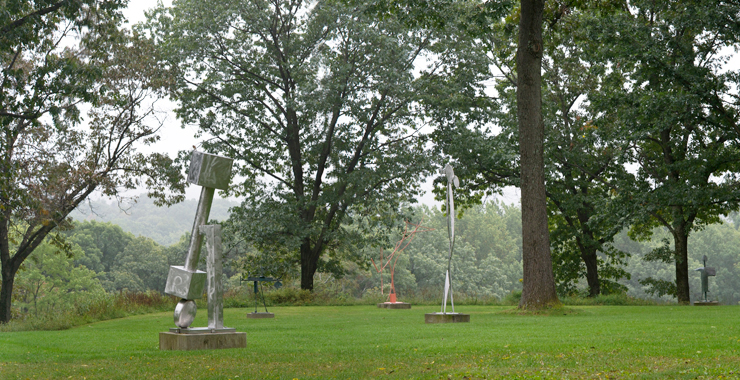
from hilltops, we discovered long views across the surrounding landscape, where sculpture and land merged into one

SK-2

we walked through glades in the woods, each with their own sculpture

SK-8

SK-9

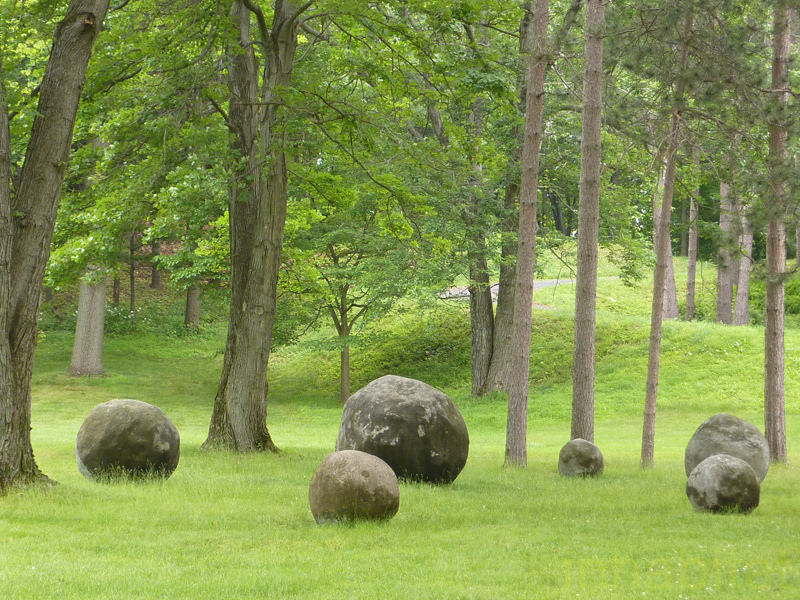
we entered the woods to find smaller, more intimate sculptures scattered under the trees

SK-7

SK-10

we also found a sculpture-wall meandering through them

SK-5

(better seen in this photo taken during the winter)

SK-14

we turned our steps back to the house, discovering other smaller sculptures set down in more formal gardens around the house.

SONY DSC

SK-11

And finally, we entered the house and fell upon a sculpture which in all these years I have never forgotten: a group of robotic-looking statues with small motors making their jaws work up and down and with a closed-loop recording of voices quietly droning “chatter, chatter, chatter, chatter, chatter, chatter …” on and on, endlessly. Wonderful.  Every time I find myself in one of those meetings where people blather on and on and on I recall this statue group with intense clarity.

So taken were we with Storm King that the very first time we went back to New York after an absence of fifteen years we made sure to find time to go up there. It cast the same spell over us – although sadly the chattering statues had vanished (smashed to smithereens, no doubt, by an employee crazed by their endless droning).

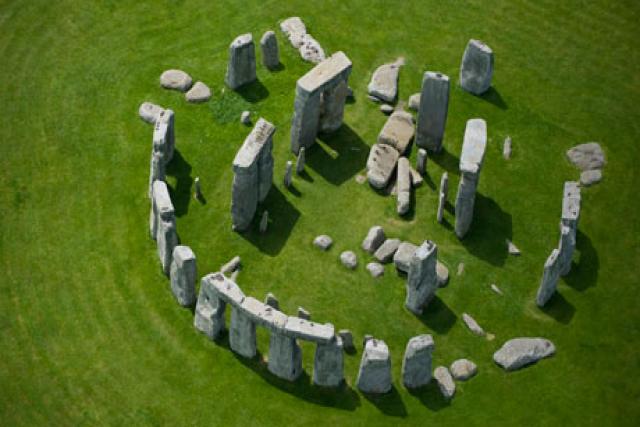
As I contemplate these photos, it occurs to me that many of the megalithic structures scattered across the face of Europe could pass as modern sculptures set down in the surrounding landscape. Stonehenge, the most iconic of all megalithic structures, is probably too much like a ruin to make this comparison
Stonhenge-2
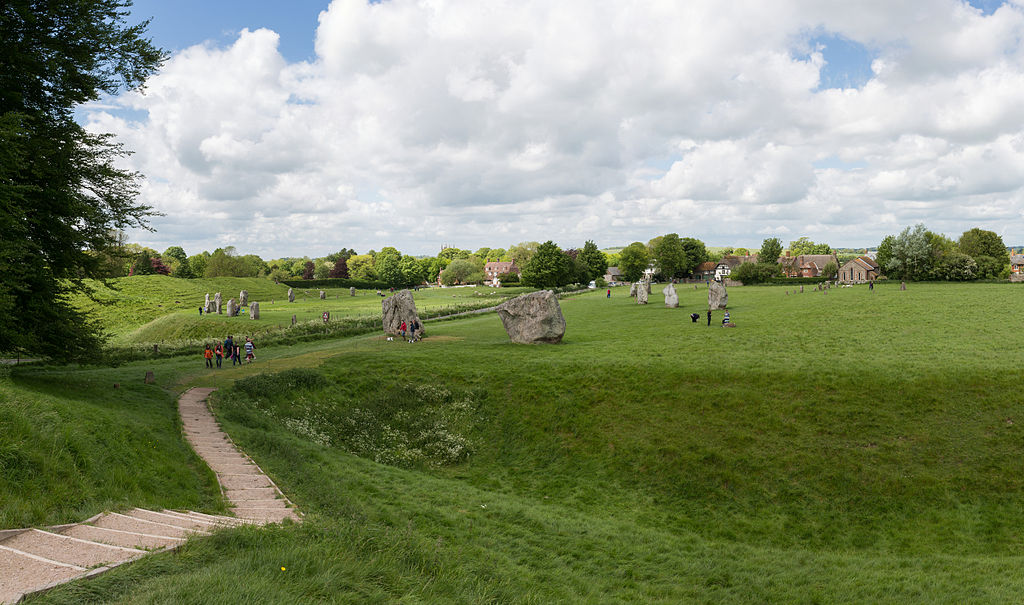
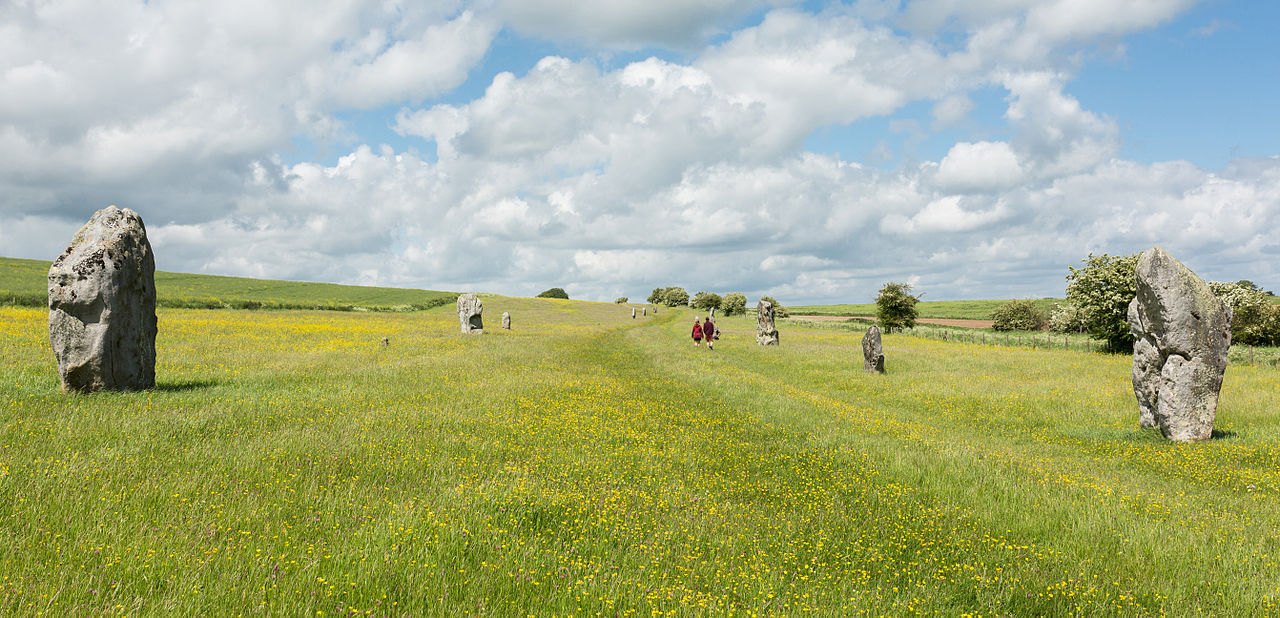
but Avebury, like Stonehenge located in Wiltshire, has something of the abstraction of sculpture parks

Avebury-2

Avebury-1

and how about Carnac, in Brittany?
carnac-1

carnac-2
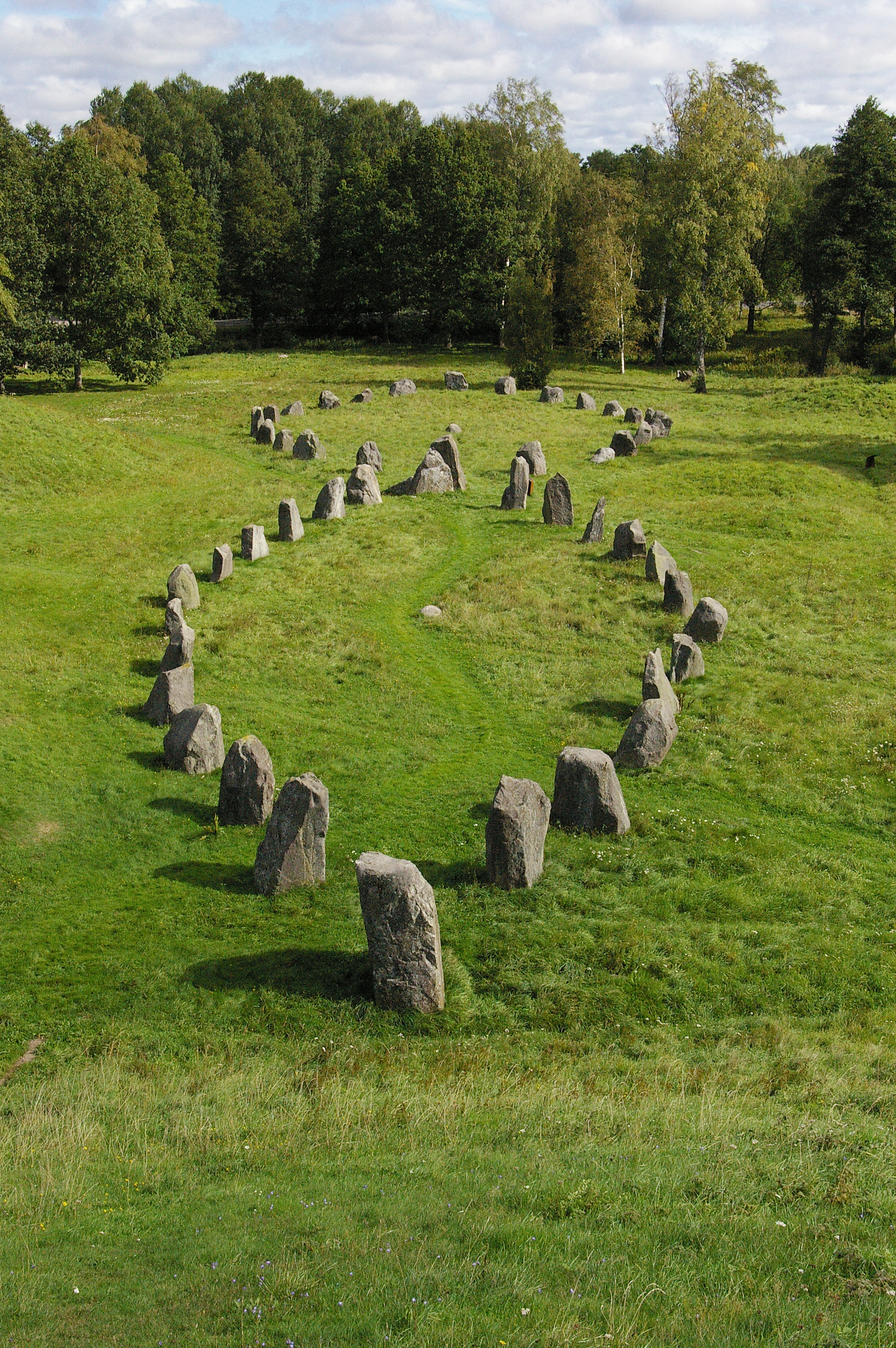
or Badelunda in Sweden?

Badelunda Västmanland

or the Ring of Brodgar, in the Orkney islands?

Ring of Brodgar

And even further afield, although not from the Mesolithic period, we have this intimate collection of upright stones in Toraja, Indonesia

OLYMPUS DIGITAL CAMERA

Of course, the people who built these structures were not building sculpture parks, but I have to think that they too were stirred by the same feeling of connectedness between their standing stones and nature as we have between sculpture and nature. They attributed this feeling to a divine grace in the place, we simply enjoy the feeling.

____________________________

Sculpture in cities-1: http://percivalhenry.files.wordpress.com/2014/03/52af841ee4b0b09acc808041-lost3f3f3f-1387234862071-flamingo.jpg [in http://percivalhenry.wordpress.com/2014/03/20/art-history-martch-madness-first-round-new-york-regional/comment-page-1/%5D
Sculptures in cities-2: http://upload.wikimedia.org/wikipedia/commons/2/26/Juilliard_School-Manhattan-New_york.jpg [in http://commons.wikimedia.org/wiki/File:Juilliard_School-Manhattan-New_york.jpg%5D
Sculpture in cities-3: http://i3.mirror.co.uk/incoming/article740970.ece/alternates/s615/A%20new%20sculpture%20on%20the%20fourth%20plinth%20in%20Trafalgar%20Square,%20central%20London%20The%20work%20by%20sculptor%20Bill%20Woodrow,%20entitled%20%27Regardless%20of%20History%27,%20%20shows%20a%20tree%20resting%20on%20a%20head%20and%20a%20book [in http://www.mirror.co.uk/news/uk-news/love-it-or-hate-it-bronze-rocking-741129%5D
Sculpture in cities-4: http://womenworld.org/image/082012/Paris%20-%20Beaubourg%20and%20Les%20Halles_1.jpg [in http://womenworld.org/travel/paris—around-town—beaubourg-and-les-halles-%28part-1%29.aspx%5D
Sculpture in cities-5: http://www-news.uchicago.edu/releases/06/images/cis/sculpture.jpg [in http://www-news.uchicago.edu/releases/06/060426.cis-photos.shtml%5D
YSP-1: http://www.yorkshireattractions.org/images/cms/attractions_21_3_large.jpg [in http://www.yorkshireattractions.org/visitor-attractions/21/yorkshire-sculpture-park%5D
YSP-2: http://upload.wikimedia.org/wikipedia/commons/0/0a/Yorkshire_Sculpture_Park_Caro_Promenade.jpg [in http://commons.wikimedia.org/wiki/File:Yorkshire_Sculpture_Park_Caro_Promenade.jpg%5D
YSP-3: http://antonyjwaller.files.wordpress.com/2012/06/nik_5931-copy.jpg [in http://antonyjwaller.wordpress.com/travel-articles/yorkshire-and-northern-england/the-yorkshire-sculpture-park/%5D
YSP-4: http://www.sculpture-info.com/upload/1008/image/Yorkshiresculpturepark.jpg [in http://www.sculpture-info.com/news-626/yorkshire-sculpture-park.html%5D
YSP-5: http://2.bp.blogspot.com/-6GgifPCMTc8/UgZKx2yojhI/AAAAAAAACDg/WYBKhXaNWp8/s1600/2+Buddha+and+Rob.JPG [in http://expertslife.blogspot.com/2013/08/picture-of-week-10-august-2013.html%5D
YSP-6: http://www.thomasharveydesign.co.uk/wp-content/uploads/2011/05/YSP6.jpg [in http://www.thomasharveydesign.co.uk/2011/05/09/yorkshire-sculpture-park-wakefield/%5D
YSP-7: http://news.bbcimg.co.uk/media/images/52104000/jpg/_52104252_7cbb7745-313f-43e9-8974-d144adf6c05f.jpg [in http://www.bbc.co.uk/news/entertainment-arts-13034363%5D
SK-1: http://brooklynimbecile.files.wordpress.com/2011/10/img_4256.jpg [in http://brooklynimbecile.com/2011/11/05/weekend-spread-storm-king-art-center/%5D
SK-2: http://3.bp.blogspot.com/-OWDq8YQCBog/UA6M17c9N6I/AAAAAAAAYI4/OqODfTIunKU/s1600/Mountainville_NY_A_Calder_Storm_King_AC_photo_S_Gruber_June_2012_+%2888%29.JPG [in http://publicartandmemory.blogspot.com/2012_07_01_archive.html%5D
SK-3: http://www.greenstrides.com/images-wp/Storm-King.jpg [in http://www.greenstrides.com/2013/07/10/sculpture-parks-can-inspire-your-own-garden-design/%5D
SK-4: http://4.bp.blogspot.com/-4sgNF1ufdU4/U4T1ul7DPRI/AAAAAAAAP8w/JzGsmMOY6No/s1600/Newman.jpg [in http://nycgarden.blogspot.com/2014/06/storm-king.html%5D
SK-5: http://i.vimeocdn.com/video/332835418_1280.jpg [in http://vimeo.com/48015694%5D
SK-6: http://inhabitat.com/nyc/wp-content/blogs.dir/2/files/2011/07/storm-king-boulders.jpg [in http://inhabitat.com/nyc/storm-king-art-center-a-summer-retreat-for-the-artsy-nature-loving-new-yorker/storm-king-boulders/%5D
SK-7: http://faeriemooncreations.blogspot.com/2010_11_01_archive.html [in http://faeriemooncreations.blogspot.com/2010_11_01_archive.html%5D
SK-8: http://4.bp.blogspot.com/_sVe9wO8fJls/S4zMOOgpUZI/AAAAAAAAEDo/IaUESi6KOGQ/s800/goldsw3.jpg [in http://lettuce-eating.blogspot.com/2010_03_01_archive.html%5D
SK-9: http://stormking.weebly.com/uploads/2/3/8/8/23889452/6893557.jpg [in http://stormking.weebly.com/permanent-collection.html%5D
SK-10: http://www.stormking.org/wp-content/uploads/2013/07/smith-lawn1.jpg [in http://www.stormking.org/collection-conversation/%5D
SK-11: http://eof737.files.wordpress.com/2011/09/img_2564.jpg?w=800 [in http://mirthandmotivation.com/2011/09/04/happiness-installation-art-at-storm-king/img_2564/%5D
Stonehenge: http://st-listas.20minutos.es/images/2013-06/362538/4049632_640px.jpg?1370571567 [in http://listas.20minutos.es/lista/maravillas-del-mundo-362538/%5D
Avebury-1: http://en.wikipedia.org/wiki/Avebury#mediaviewer/File:Avebury_Panorama,_Wiltshire,_UK_-_Diliff.jpg [in http://en.wikipedia.org/wiki/Avebury%5D
Avebury-2: http://en.wikipedia.org/wiki/Avebury#mediaviewer/File:Avebury,_West_Kennet_Avenue,_Wiltshire,_UK_-_Diliff.jpg [in http://en.wikipedia.org/wiki/Avebury%5D
Carnac-1: http://weadorefrance.com/es/images/w.800/h.600/c.1/d.guide_photos/sd./i.carnac-brittany-standing-stones-20130325.jpg [in http://weadorefrance.com/es/brittany-bretagne/g.31%5D
Carnac-2: http://media.tinmoi.vn//2012/02/27/4_28_1330310626_92_20120224114942_l6.jpg [in http://www.tktyt1haiduong.edu.vn/?p=888%5D
Badelunda, Sweden: http://upload.wikimedia.org/wikipedia/commons/d/d3/Badelunda_V%C3%A4stmanland_Sweden.jpg [in http://some-landscapes.blogspot.com/2011_10_01_archive.html%5D
Ring of Brodgar, Orkney: http://en.wikipedia.org/wiki/Ring_of_Brodgar#mediaviewer/File:RingofBrodgar.jpg [in http://en.wikipedia.org/wiki/Ring_of_Brodgar%5D
Toraja, Indonesia: http://tribudragon.files.wordpress.com/2013/03/2-tt-6.jpg [in http://tribudragon.wordpress.com/category/indonesia/%5D

SPRING IS IN THE AIR!

Beijing, 20 March 2014

It’s the first day of Spring! The day of the vernal equinox! The moment in the year when, after a slow climb out of the short days and long nights of the winter solstice, night equals day. From now on, the days will get longer and the nights shorter, until the summer solstice in the month of June is reached and the cycle reverses.

equinox

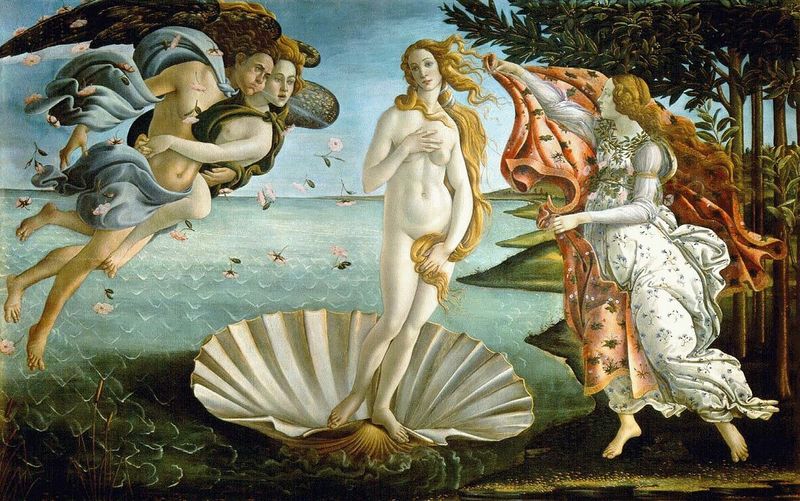
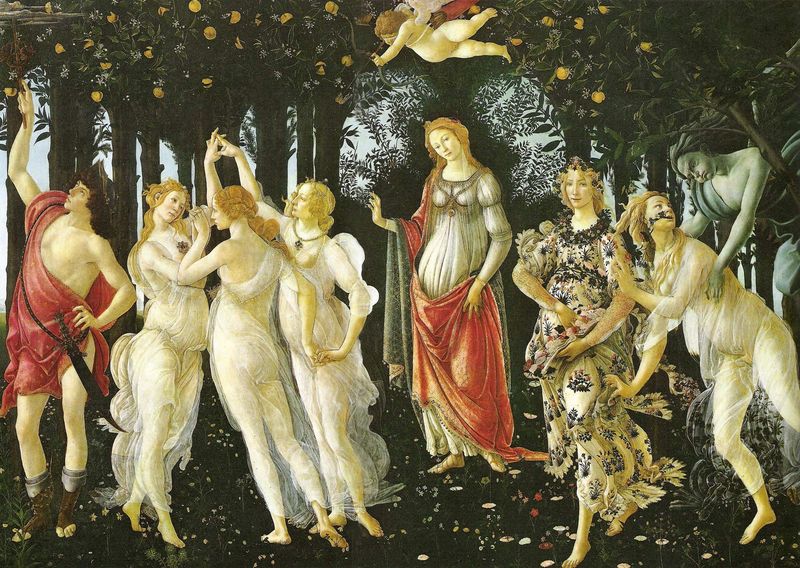
And actually, apart from cold astronomical considerations, today in Beijing it really was a spring day! A beautiful, sunny spring day! When I walked out of the apartment building this morning, the sun shone out of a blue, unclouded sky, but there was a chill in the air. When I left the office as evening drew in, the sky was still an unclouded blue, but now there was a soft breath of warm air on my cheek. Verily, I felt like Boticelli’s Venus stepping off her shell, with the zephyrs blowing over me

birth of venus

although I will admit that she has a considerably better body than mine.

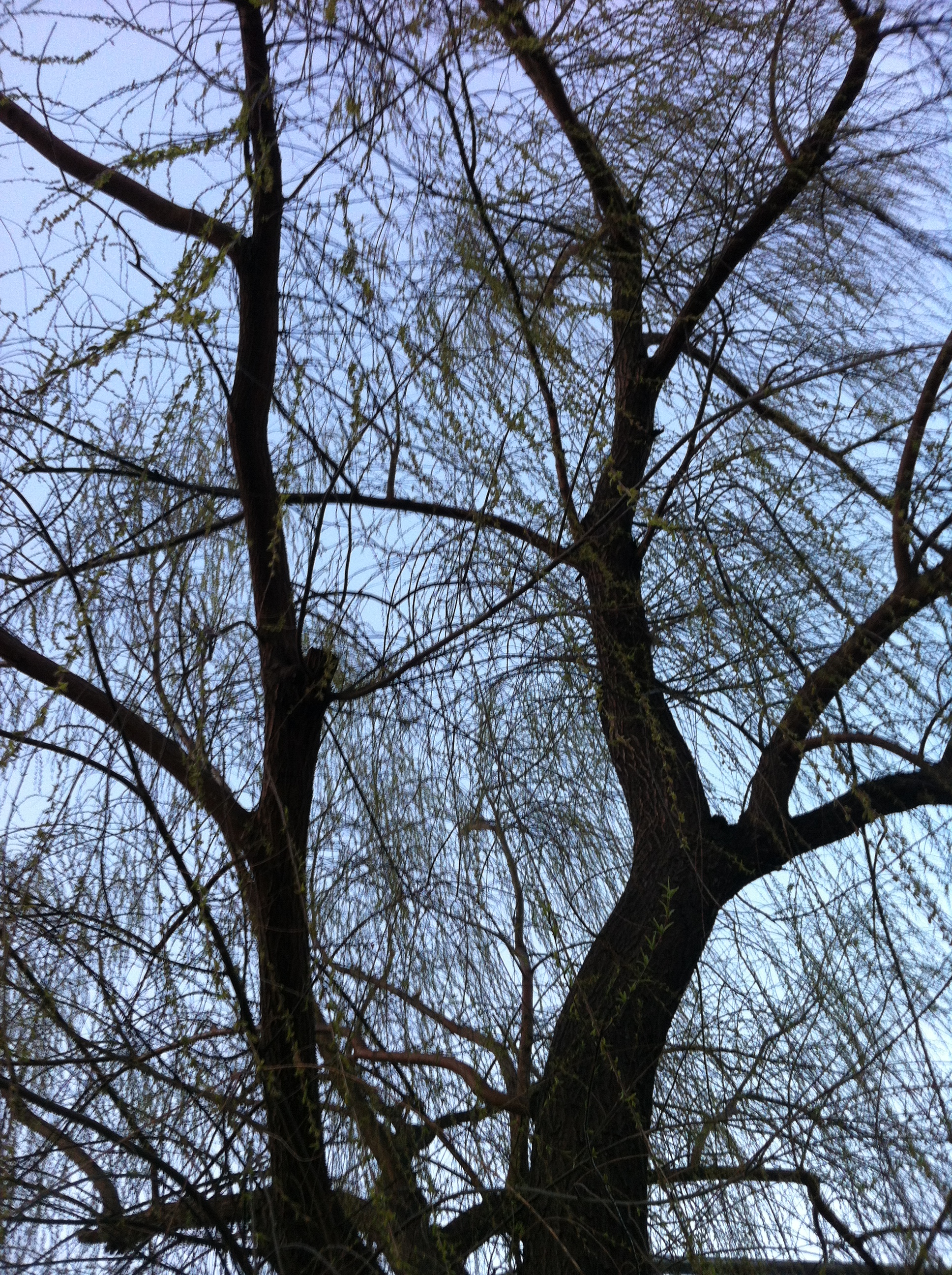
Humming quietly to myself, I made my way home, pausing for a moment under the willow trees on which the zephyr’s warm breath had worked its magic, covering the branches with a light green furze.

greening willows

Nature awakes from its winter sleep. Venus walks the land. Flora, goddess of flowers and Spring, follows in her wake.

primavera

_____________

Equinox: http://www.imd-corp.com/figures/ARIX0020.jpg [in http://www.imd-corp.com/formx_ind_display_flexible_getmethod.php?category=name&fname=%%5D
Birth of Venus: http://www.artble.com/imgs/9/b/3/416525/birth_of_venus.jpg [in http://www.artble.com/artists/sandro_botticelli/paintings/primavera%5D
Greening willows: my picture
Primavera: http://www.artble.com/imgs/6/c/a/616543/primavera.jpg [in http://www.artble.com/artists/sandro_botticelli/paintings/primavera%5D

SNOWY MOUNTAINS

Beijing, 8 February 2014

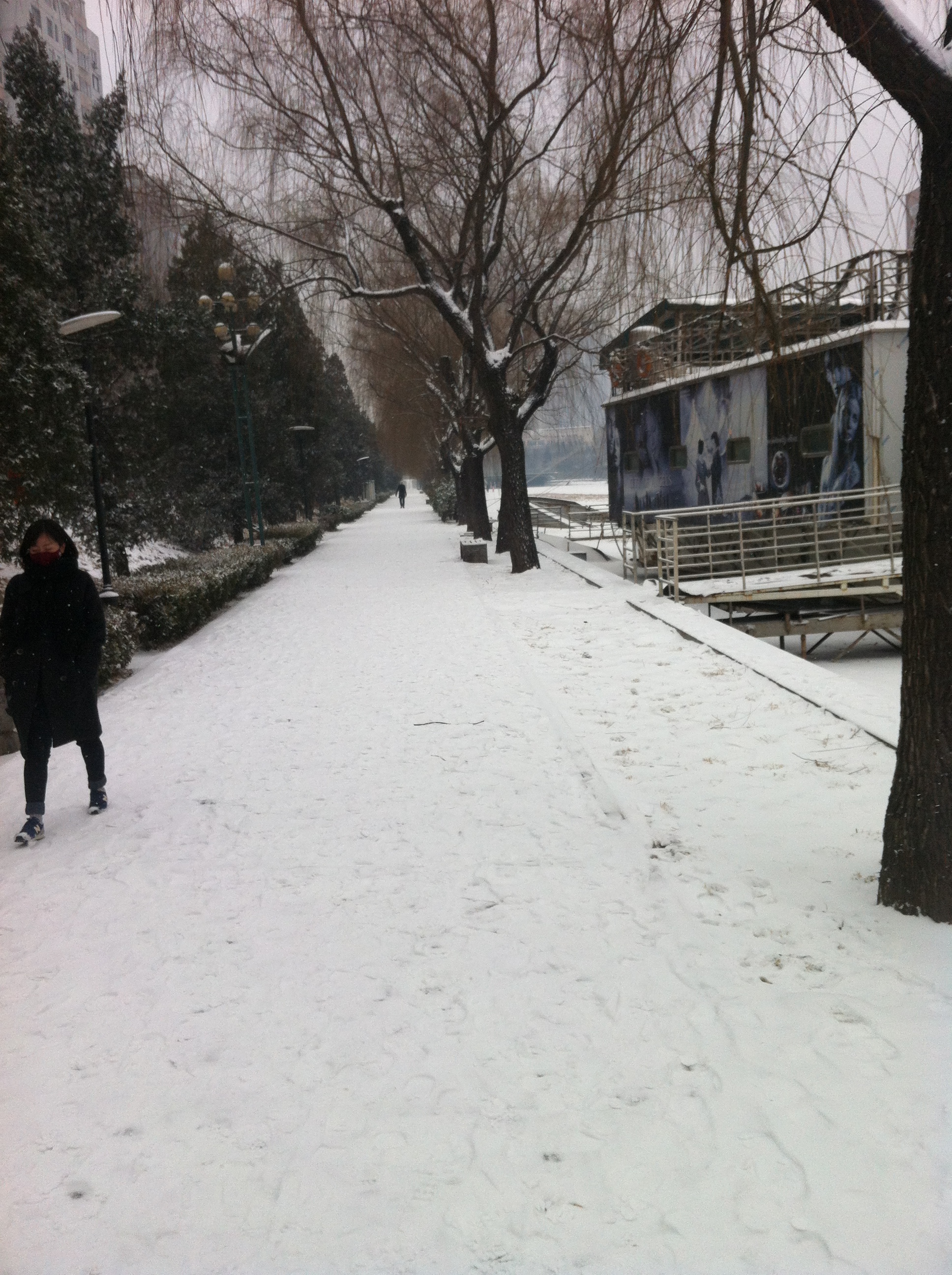
It was snowing when we got up yesterday, the first snowfall of the season – in fact, the first time there has been any precipitation, rain or snow, in the last four months in Beijing. The city was still quiet after the Chinese New Year, so it was with pleasure that I crunched my way to work through the deserted streets and along my piece of canal, with the small, grainy snowflakes floating down around me.
canal-before
And dimly through the flakes and mist, I perceived a man on the other bank of the canal slowly going through the balletic moves of tai-chi. Magic …

It kept snowing fitfully all day and into the evening, becoming greyer and foggier by the hour. So I just hurried home after work, looking forward to a welcoming wife, a cheerfully lit apartment, a glass of wine, and a plate of pasta. We closed out the world and enjoyed two French detective thrillers before retiring to bed.

This morning, the clouds had been chased away along with the fog, and the sun shone down brightly. How different the world looked! There is nothing like a coating of snow under a bright sun and a clear blue sky to make even the most squalid cityscape look inviting. On our way to morning coffee and lunch, I took a couple of photos of the canal to record the event.
canal-after 004
OK, let’s not get carried away here. Quite soon, all that fresh snow will turn into muddy slush, making a misery for us pedestrians as we pick our way round large puddles, warily avoid being splashed by passing cars, and stay ever alert for a hidden piece of ice under our feet . And even when the snow is still fresh, the view simply cannot beat a snowscape in the mountains. My wife is a good and enthusiastic skier, and when the children were young she liked to take them skiing in the Alps. I, on the other hand, dislike skiing, so it was always with a certain grouchiness that I accompanied them on these skiing expeditions. The traffic jams to get there! The crowds at the shop to hire the gear! The astronomic cost of the ski passes! The kilometric lines to get on the ski lifts! All those peacocks parading their latest ski gear! The morons who skied far too fast down the crowded slopes! The icy wind turning my face into a piece of numb codfish! But even grouchy old me could not avoid a smile when suddenly confronted at the turning of a path with vistas of virgin white snow softly pillowing rocky hill and dale and gathering protectively around the pine trees, while the mountains glittered behind against a backdrop of a deep blue sky.

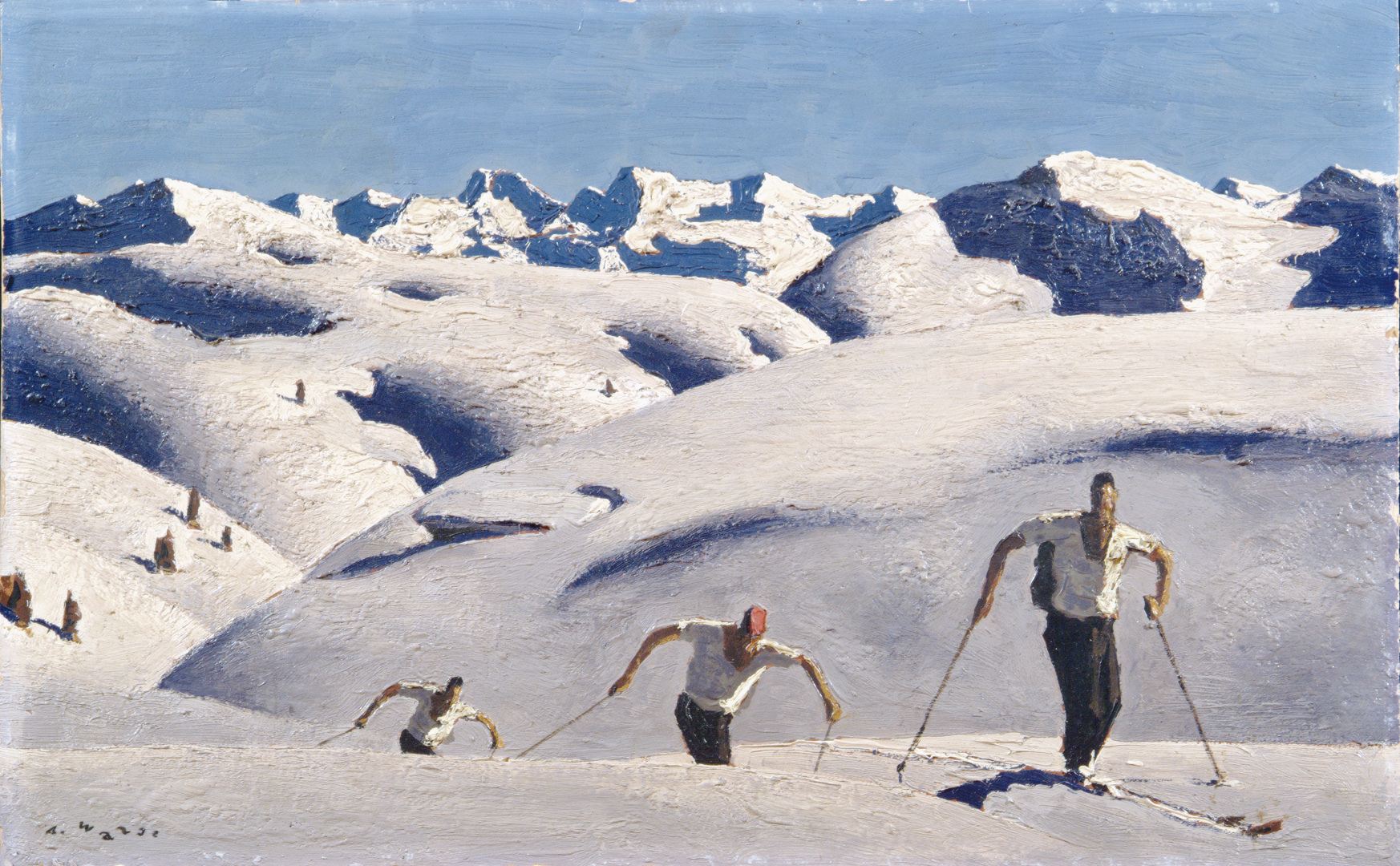
The only artist I know who has ever captured the beauty of mountains in the winter is the Austrian painter Alfons Walde. Walde was from Kitzbühel in the Tyrol, so he knew the Alps well.  From the mid 1920s onwards, he painted a series of pictures of the Tyrolian Alps during winter. I show here a selection, starting with the first of his paintings I ever came across, in the form of a poster advertising a show of his works in Vienna. I still have that poster somewhere. It is his “Ascent of the Skiers”, 1931

alfons walde-Der Aufstieg der Schifahrer-1931

Here we have “Steinbergkogel”, 1926

Alfons Walde-Steinbergkogel-1926

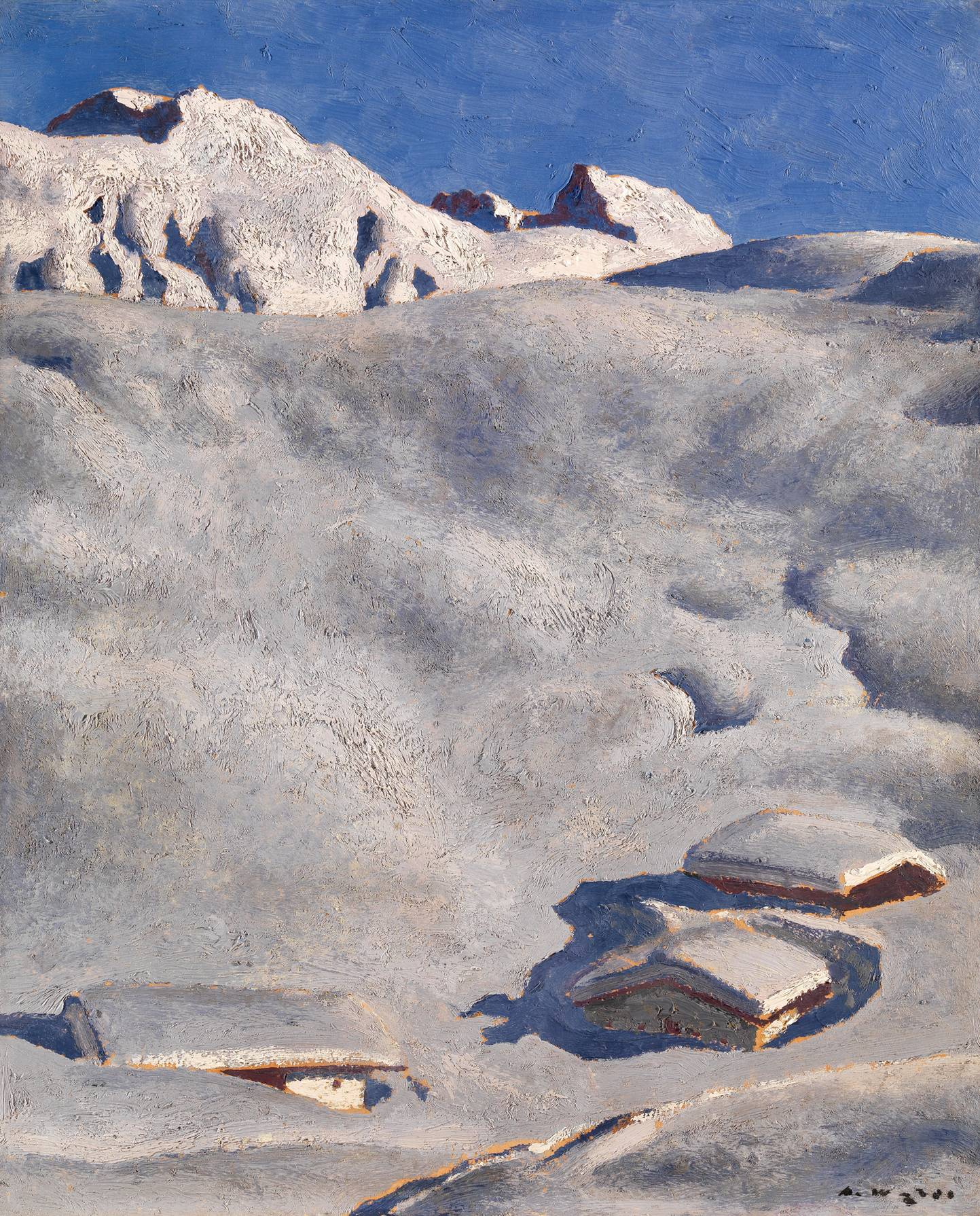
And here his “Meadows under Snow”, 1926

alfons walde-Almen im Schnee-1926

Walde also liked to paint the inhabitants of the Tyrolian villages. They still wore their traditional costumes back then. There’s still a faint echo of this in Austria’s traditional jackets for men and the dirndls the women wear. This is his “Auracher Church”, 1927-30

Alfons Walde-Auracher Kircherl-1927-30

And this is his “Meeting”, about 1924

Alfons Walde-begegnung

I will be frank. I wouldn’t mind owning one of Walde’s paintings.  But I’m not a millionaire. The best I’ve managed is a print by another Austrian artist

general photos 008

But hope springs eternal. You never know, I may find a Walde in my attic one day.

______________________

pix in Beijing: mine
“Ascent of the Skiers”: Alfons Walde- Der Aufstieg der Schifahrer-1931: http://shop.alfonswalde.com/WebRoot/Store/Shops/es268867/50B4/8486/F7AD/8B37/3A2E/50ED/8962/9095/Aufstieg_der_Schifahrer_1080.jpg [in http://shop.alfonswalde.com/epages/es268867.sf/de_DE/?ObjectPath=/Shops/es268867/Products/PLW35%5D
“Steinbergkogel”:  http://shop.alfonswalde.com/WebRoot/Store/Shops/es268867/50B4/CA47/6775/F975/A744/50ED/8962/CB5B/PLWT36-Steinbergkogel_1080.jpg [in http://shop.alfonswalde.com/epages/es268867.sf/de_DE/?ObjectPath=/Shops/es268867/Products/PLW36%5D
“Meadows under Snow”: Alfons Walde- Almen im Schnee: https://myartmap.com/sites/default/files/walde_2.png [in https://myartmap.com/user/5189/shop%5D
“Aucherl Church”: Alfons Walder-Auracher Kircherl-1927-30: http://www.austrianfineart.at/images/largeorig/Walde-Auracher%20Kircherl-Kat.%202001.jpg [in http://www.austrianfineart.at/detailtest.php?cid=297&lang=%5D
“Meeting”: Alfons Walde-begegnung: http://alfonswalde.com/cms/wp-content/uploads/2013/05/begegnung_1080_WZ.jpg [in http://alfonswalde.com/cms/?cat=16%5D
pic of the barn in the snow: mine

LANDSCAPES

Beijing, 26 January 2014

Last week, I went to visit a factory on the outskirts of Beijing which recycles waste equipment.  They take old TVs, old computer monitors, refrigerators, air conditioners, and washing machines; if the regulatory conditions become right, they will also start taking mobile phones. They disassemble these old products and recycle the various components, having first properly separated them. It’s fascinating to watch the disassembly, which is the exact mirror image of normal manufacturing: the process starts with the whole product, which as it moves down the (dis)assembly line slowly comes apart, ending up back as its individual components.  This is the future, my friends. All the products we make should be collected at the end of their useful lives, brought to factories like this one, and taken apart so that their component materials can be reused: “Circular Economy” is the tag for this.

But actually, I want to write about something completely different. After visiting the disassembly line and talking with the company management about its plans for the future, we were invited to lunch in the company’s canteen. As is customary, we were taken to a separate room, which contained one large round table and the usual Lazy Mary languidly turning in the middle. As we sat and chatted and picked at the dishes going by, my eyes wandered around the room. They fastened on this painting on the wall:

canteen photo 002

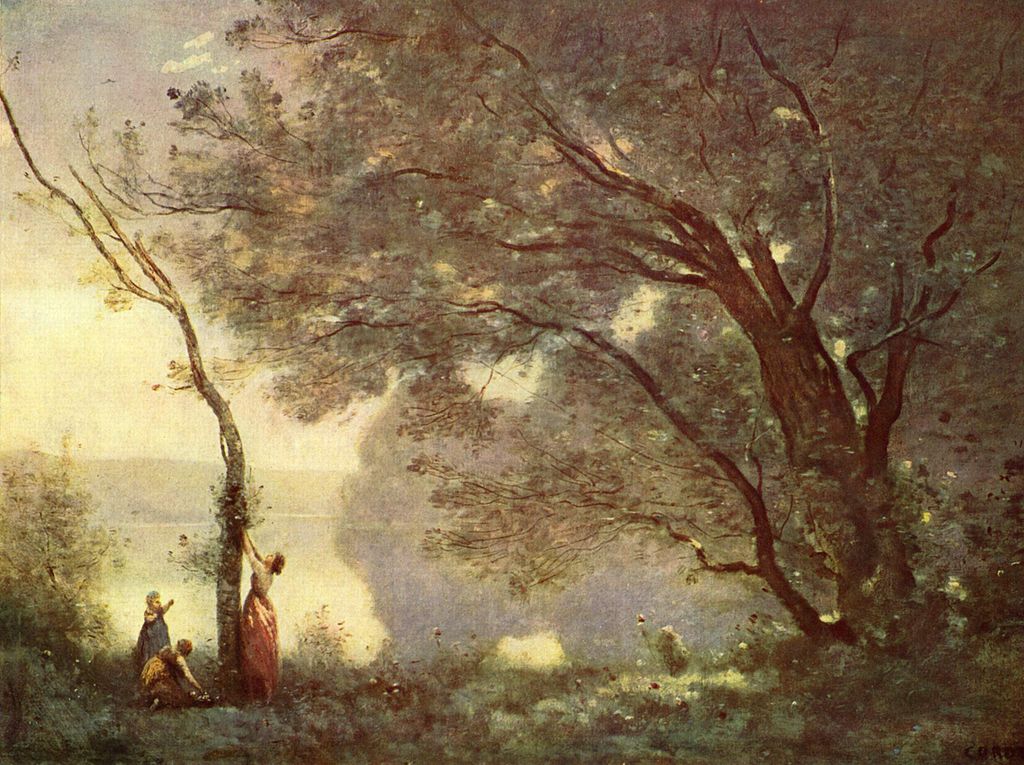
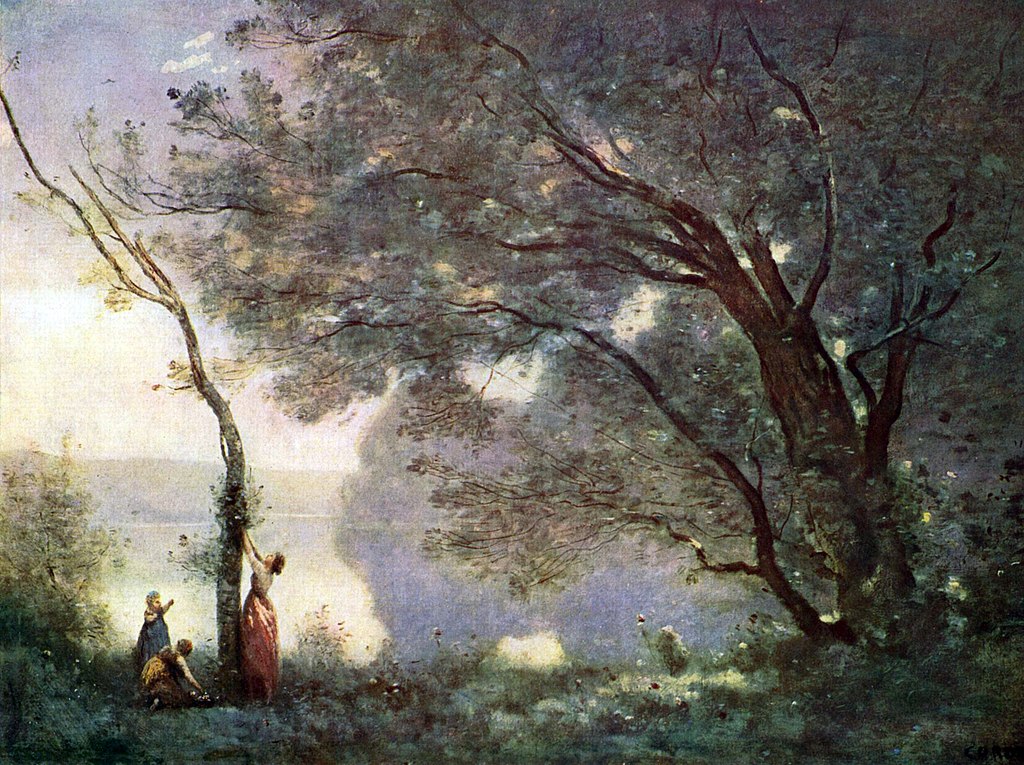
It was a welcome dash of cheerful green on what were otherwise rather drab walls. That being said, it was not much to write home about, a clearly amateur rendering of the scene, the sort of thing one could pick up for 1 euro at any flea market. And yet … there was something about it which sparked a faint memory. The memory fluttered indistinctly around in my mind as we said our goodbyes at the end of the lunch and headed back to the office. It was like having a grain of sand in one’s shoe, softly but insistently irritating. There was nothing for it, I was going to have to do some research when I got back to the office. Luckily, it didn’t take long to pin down the memory. What I had been looking at was a copy – or a copy of a copy of a copy … – of a famous painting by the French painter Camille Corot, Souvenir de Mortefontaine, painted in 1864 and now hanging in the Louvre Museum:

Corot-souvenir de Mortefontaine

But that’s not where I had seen it first. That memory which I had been vainly chasing through the corridors of my brain was set in my grandmother’s house in London.  She had a copy of the painting hanging on her drawing room wall, from where it would look down on me as I sat on the couch drinking my grandmother’s lapsang souchong tea. Strange how life is … an invisible thread loops through time and space, linking my grandmother’s drawing room in the 1960s, cluttered with family memories, to a rather drab factory canteen on the outskirts of Beijing in 2014.

For all the warm, fuzzy memories it evokes, I would not put this particular painting, in original or in copy, on my wall. Memories are one thing, taste another. I remember my grandmother saying once how much she loved Corot. Me, I find him cloyingly sentimental, his feathery trees irritate me, and the grey-green palette he used in this particular series of paintings – he did a number of such Souvenirs – grates on my senses.  If I were going to have a landscape on my wall by a famous painter, I would much prefer any one of a host painted in the last five hundred years.  I could easily live with one of Bruegel’s paintings of the seasons, his Corn Harvest say:

Bruegel-The Corn Harvest (August)-

or why not a Constable, for instance his Wivenhoe Park:

Constable - Wivenhoe Park

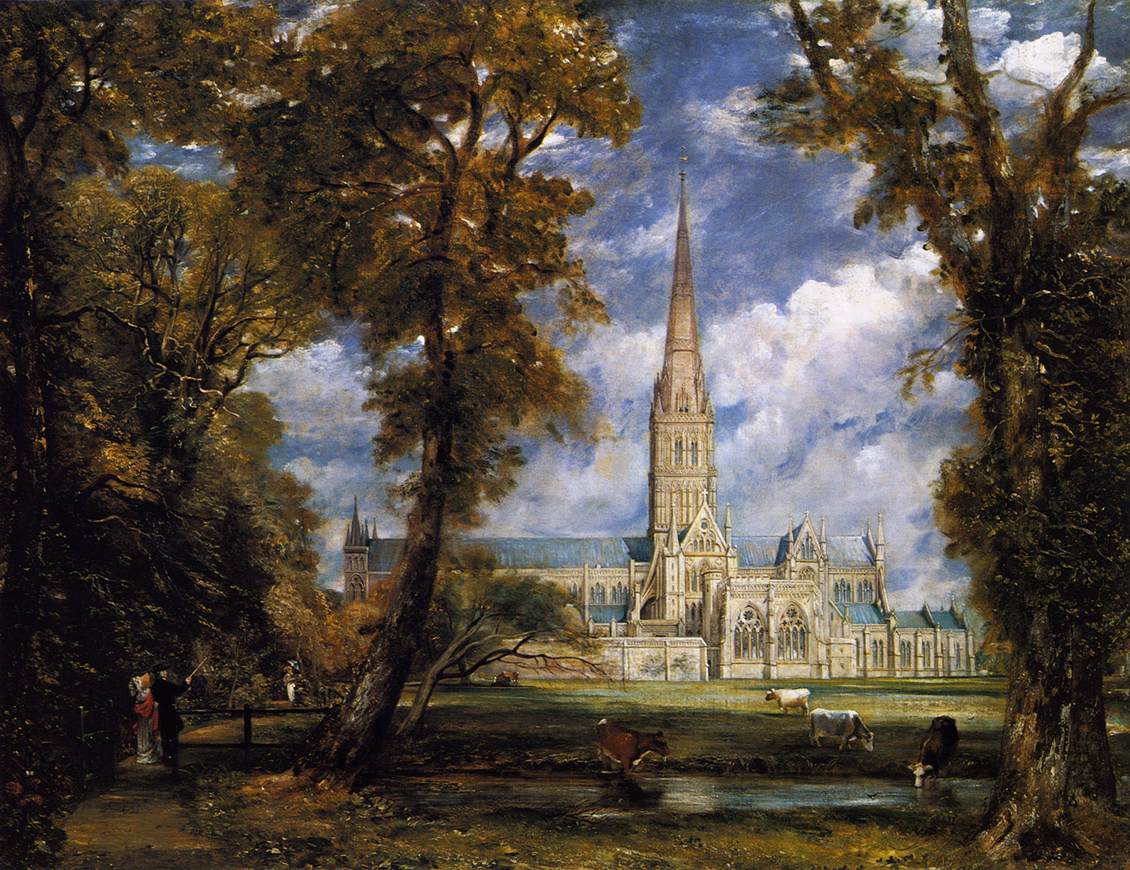
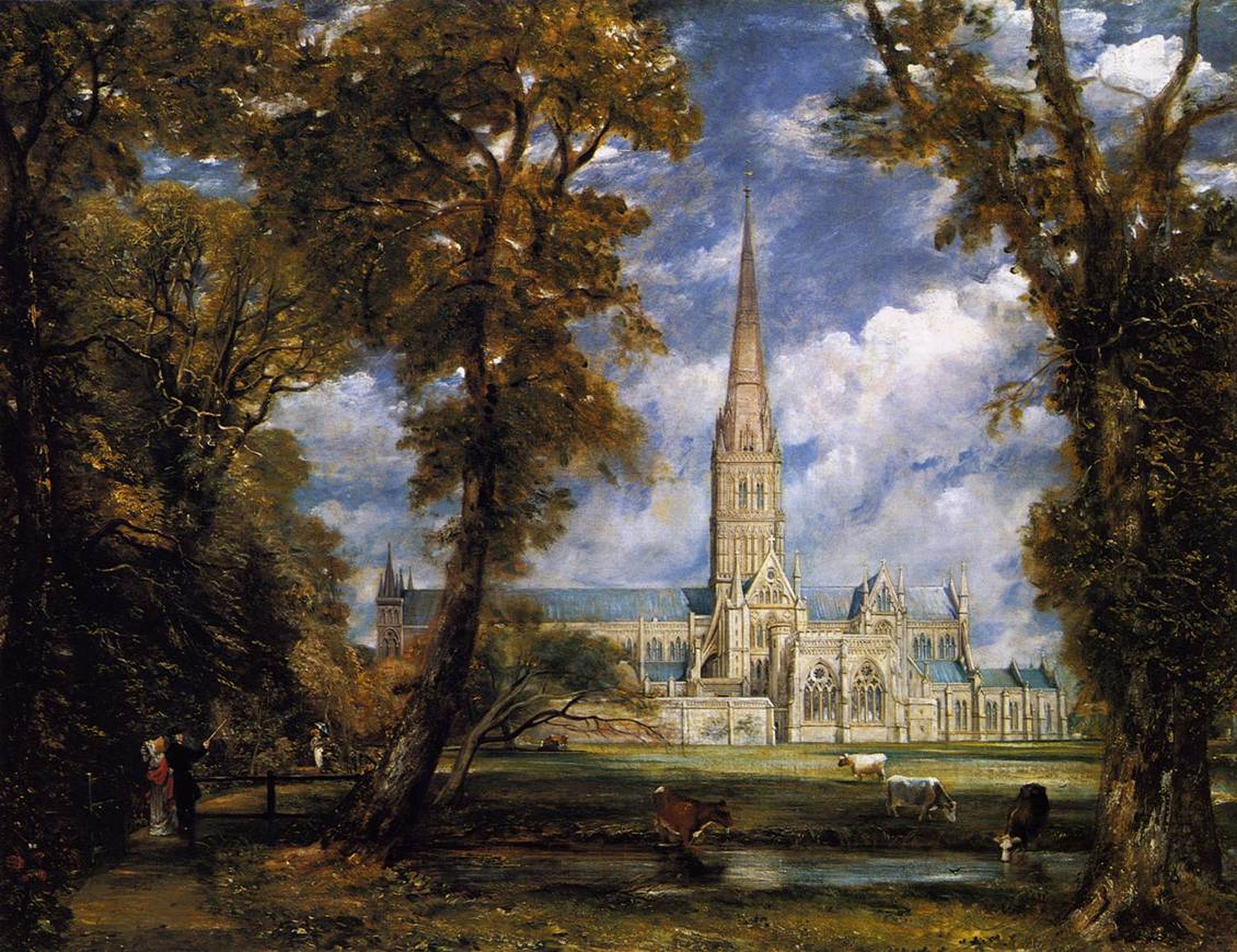
or his Salisbury Cathedral (although calling this a landscape may be a bit of a stretch)

Constable-Salisbury Cathedral-1825

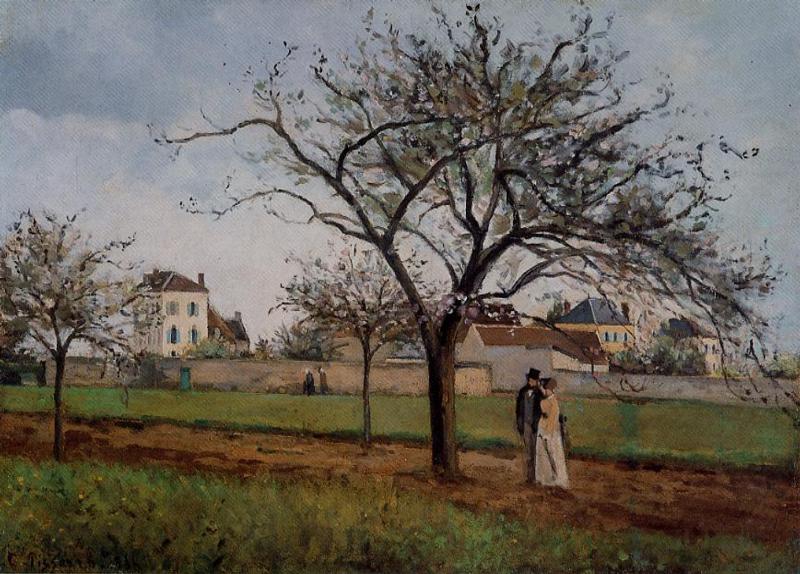
I could also happily live with one of the pre-impressionist works which were already being painted when Corot was painting Souvenirs de Mortefontaine, like this Pissarro, La Maison de Père Gallien à Pointoise, painted just two years after the Corot, but which already shows a more real, more vibrant world than Corot’s honeyed one

Pissaro-Pere galliens house at Pontoise-1866

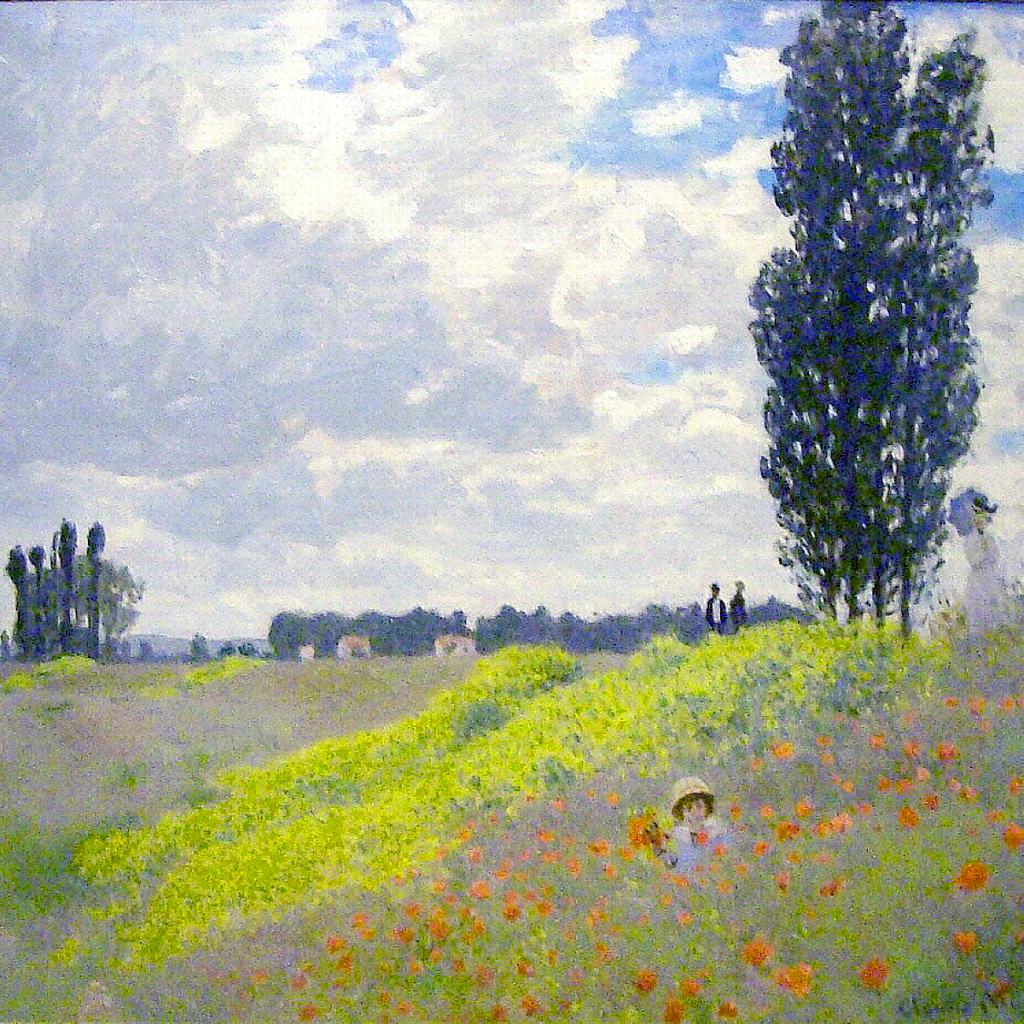
From the impressionist period, I could take a Monet landscape, like this one from a series he made of the fields around Argenteuil, Walk in the meadows around Argenteuil:

Monet-walk-in-the-meadows-at-argenteuil

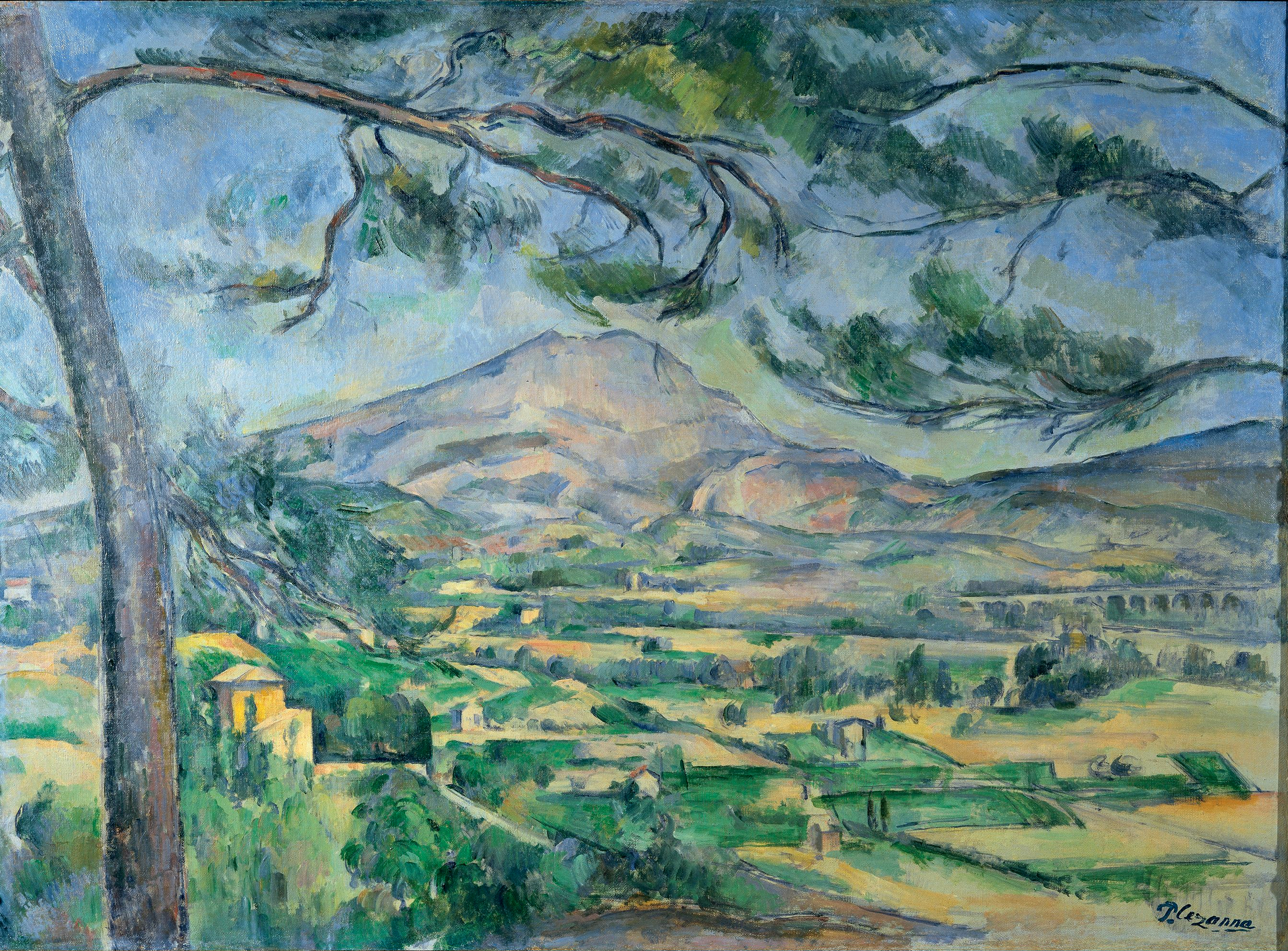
From a little bit later, one of Cézanne’s many proto-cubist paintings of Mont Saint Victoire in the south of France would be lovely:

Cézanne-Mont St Victoire

as would one of Van Gogh’s whirling wheat fields like this one, Wheat field with cypresses

Van Gogh-Wheatfield with cypresses-1889

A pointillist landscape would do nicely too, like this Signac, Comblat Castle and the Pré:

Signac-comblat-castle-the-pre-1886

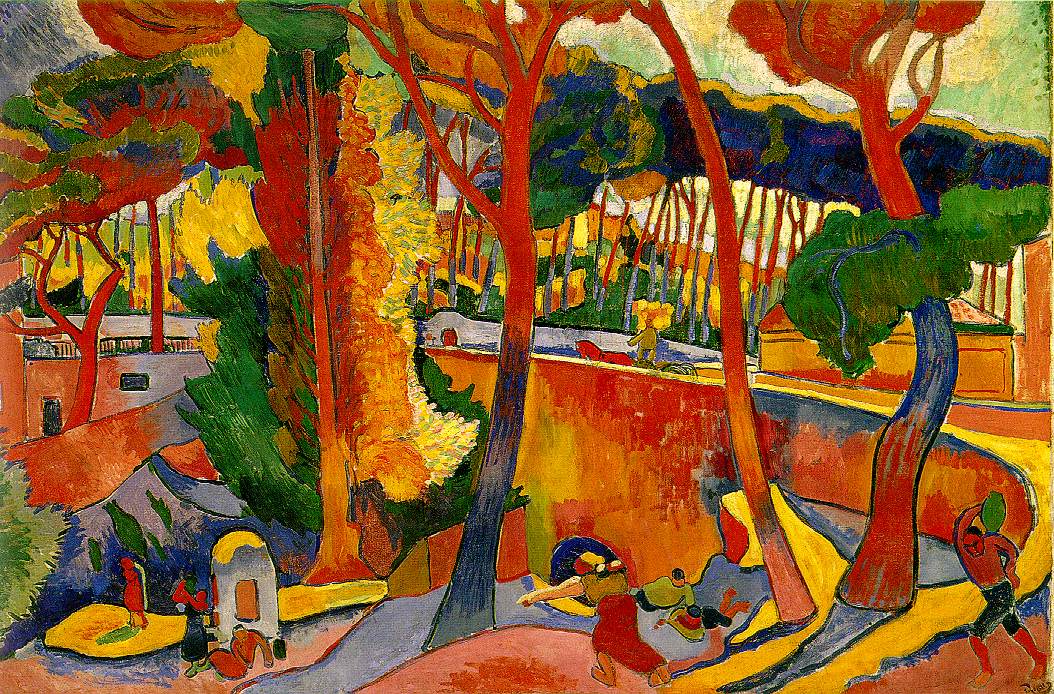
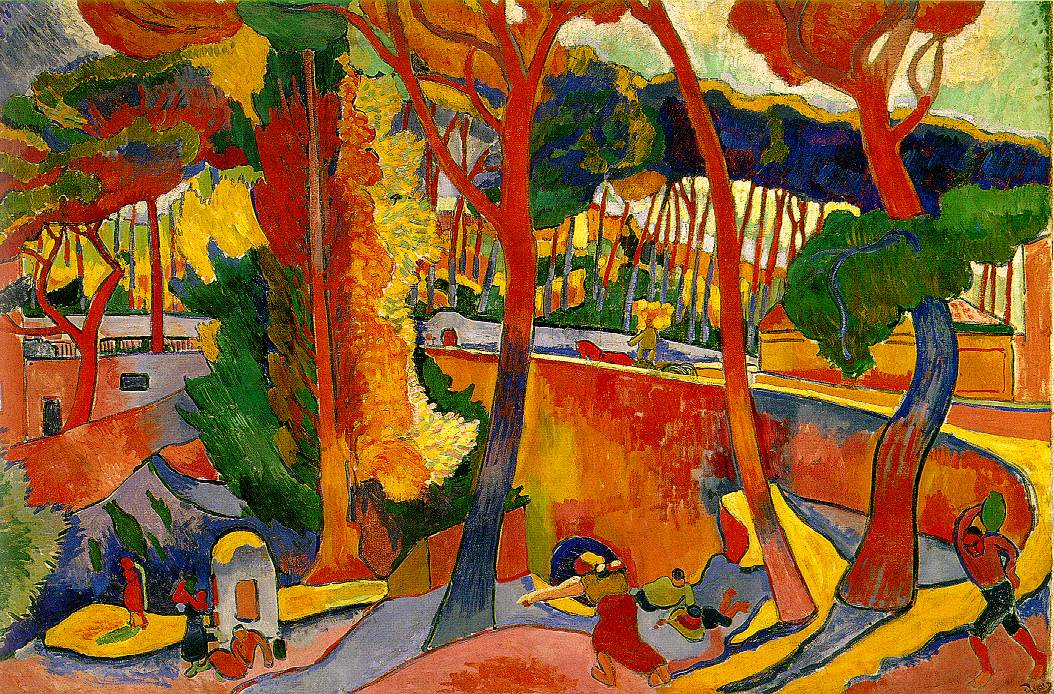
I could even hang a fauvist landscape on my wall, like this one, The Turning Road, l’Estaques, by Derain:

Derain-The Turning Road lEstaques

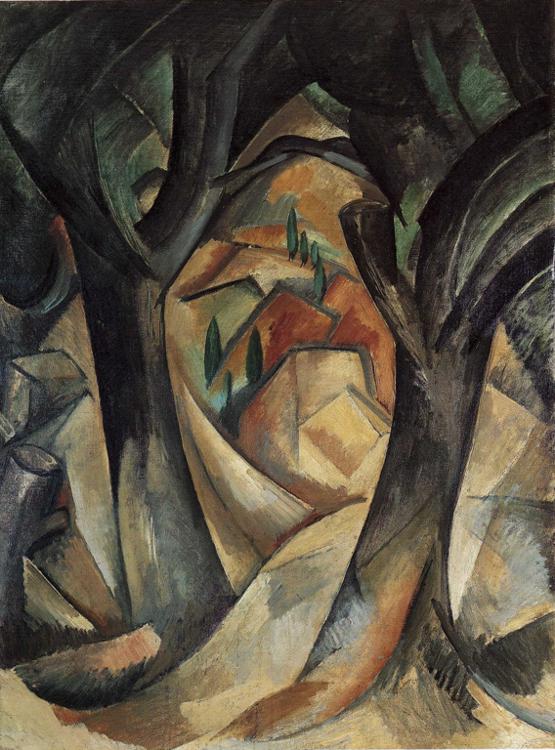
or even, at a pinch, a cubist landscape like this one by Braque, Big Trees at Estaques:

Braque-big-trees-at-estaque-1908

But maybe I would eschew the modernist trends which I have been following up to now, and go for one of the paintings by the American artist Grant Wood, like this Young Corn, painted in 1931:

Grant Wood-young-corn-1931

There are certain similarities to the Bruegel I started with, no?

But in the end, I wouldn’t need to put any of these paintings on my walls, because I already have my landscape painting, purchased in the Dorotheum, the Viennese auction house.

general photos 002

Maybe one day I will have grandchildren who will drink lapsang souchong tea with me, look at the painting, and ask themselves what on earth Grandpa sees in it.

_____________________________

Pic in the canteen: mine
Corot-Souvenir de Mortefontaine: http://upload.wikimedia.org/wikipedia/commons/thumb/7/74/Jean-Baptiste-Camille_Corot_012.jpg/1024px-Jean-Baptiste-Camille_Corot_012.jpg [in http://fr.wikipedia.org/wiki/Jean-Baptiste_Corot%5D
Constable-Wivenhoe Park: http://upload.wikimedia.org/wikipedia/commons/thumb/1/15/John_Constable_-_Wivenhoe_Park%2C_Essex_-_Google_Art_Project.jpg/1280px-John_Constable_-_Wivenhoe_Park%2C_Essex_-_Google_Art_Project.jpg [in http://commons.wikimedia.org/wiki/File:John_Constable_-_Wivenhoe_Park,_Essex_-_Google_Art_Project.jpg%5D
Constable-Salisbury Cathedral: http://upload.wikimedia.org/wikipedia/commons/4/46/Salisbury_Cathedral_from_the_Bishop_Grounds_c.1825.jpg [in http://en.wikipedia.org/wiki/Salisbury_Cathedral%5D
Pissaro-Père Gallien’s house at Pontoise: http://uploads6.wikipaintings.org/images/camille-pissarro/pere-gallien-s-house-at-pontoise-1866.jpg [in http://www.wikipaintings.org/en/camille-pissarro/pere-gallien-s-house-at-pontoise-1866%5D
Monet-the Promenade Argenteuil: http://uploads7.wikipaintings.org/images/claude-monet/the-promenade-argenteuil.jpg [in http://www.wikipaintings.org/en/claude-monet/the-promenade-argenteuil%5D
Cezanne-Mont St Victoire-1887: http://upload.wikimedia.org/wikipedia/commons/d/d2/Paul_C%C3%A9zanne_107.jpg [in http://en.wikipedia.org/wiki/Mont_Sainte-Victoire_%28C%C3%A9zanne%29%5D
Van Gogh-Wheatfield with cypresses-1889: http://upload.wikimedia.org/wikipedia/commons/e/e8/1889_van_Gogh_Wheatfield_with_cypresses_anagoria.JPG [in http://en.wikipedia.org/wiki/Wheat_Field_with_Cypresses%5D
Signac-Comblat Castle and the Pré-1886: http://uploads3.wikipaintings.org/images/paul-signac/comblat-castle-the-pre-1886%281%29.jpg [in http://www.wikipaintings.org/en/paul-signac/comblat-castle-the-pre-1886%5D
Derain-The turning road: http://4.bp.blogspot.com/_0n9IExEpmh8/S_DnuJ6ZT8I/AAAAAAAAVk4/JCfVk6QJNws/s1600/The_Turning_Road_L_Estaque.jpg [in http://www.artistsandart.org/2010/05/andre.html%5D
Braque-Big trees at Estaques-1908: http://uploads1.wikipaintings.org/images/georges-braque/big-trees-at-estaque-1908.jpg [in http://www.wikipaintings.org/en/georges-braque/big-trees-at-estaque-1908%5D
Grant Wood-Young Corn-1931: http://uploads5.wikipaintings.org/images/grant-wood/young-corn-1931.jpg [in http://www.wikipaintings.org/en/grant-wood/young-corn-1931%5D
Pic of my landscape: mine

THE ARTIST AND THE SELFIE

Beijing, 19 January 2014

There is a phenomenon which my wife and I both agree is on the upswing in China, which is the taking of selfies.  We are proud to know this word, by the way, which is so new that it hasn’t made it yet into the Merriam-Webster on-line dictionary – although the Urban dictionary, which is obviously hipper, does contain a definition: “pictures taken of oneself while holding the camera at arm’s length”.   We might know what the word means, but it doesn’t mean that we approve. We actually find it sad to see young women (it seems to be preponderantly young women) taking photos of themselves. It is so narcissistic, we cry!

chinese selfies

But actually the phenomenon is not new, its amplitude is. New technology – the mobile phone with built-in camera – and its fantastic, phenomenal, global dissemination have allowed this. But the picture-makers of old – artists – have been making selfies for centuries now, since at least the Renaissance (in Europe anyway). They made selfies – self-portraits – to advertise their skills, or to allow them to exercise themselves without having to pay a model, or to comment on their or other people’s private lives, or in a more serious vein to explore their inner emotions. Anyone interested in the topic can go to the Wikipedia article on it.  At the beginning, they seemed to be a bit shy (or maybe just cautious; prisons were nasty then), and rather than executing free-standing portraits of themselves they preferred to include themselves (and their friends, and even sometimes their enemies) in the role of modest bystanders in their paintings. Here, for instance, is a painting by Botticelli, an Adoration of the Magi, where the person on the extreme right in the yellow cloak and looking out towards the viewer is said to be the painter himself.

Botticelli-adoration of the magi

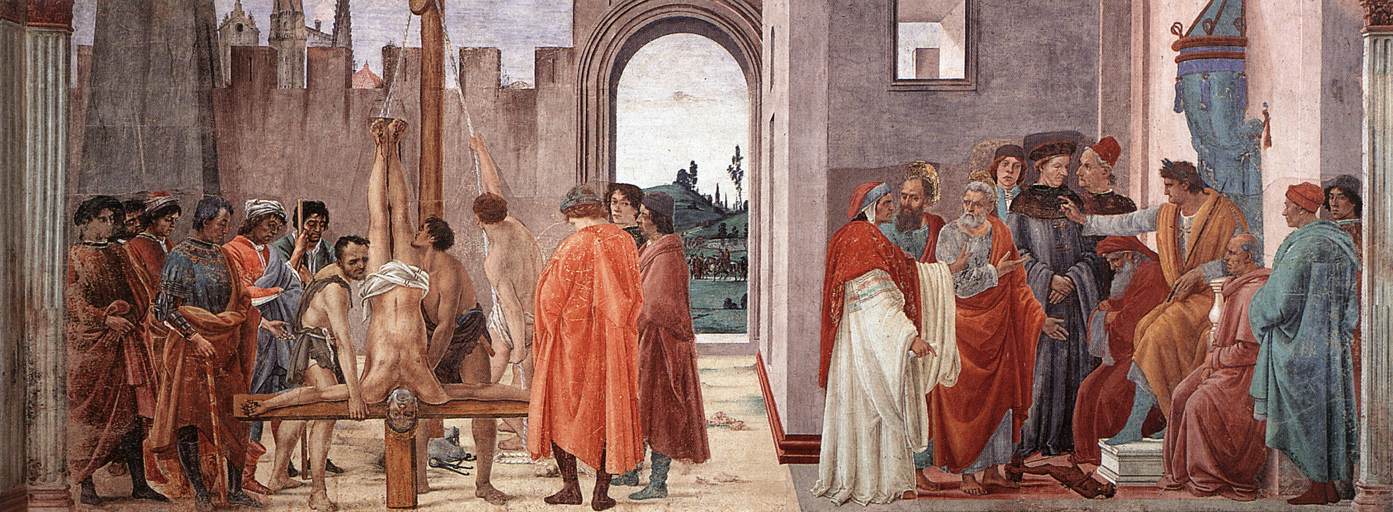
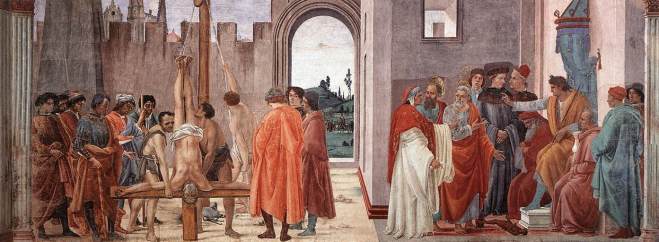
And here is a fresco, by Filippino Lippi, The Disputation with Simon Magus and the Crucifixion of Peter, where Lippi is the person on the extreme right of the fresco looking out towards the viewer from behind the pillar.
Filippino Lippi-simon magus

But after a while some artists were having none of this modesty. For instance, Velázquez put himself very obviously in what is probably his most famous painting, Las Meninas, which hangs in the Prado Museum in Madrid.

Velázquez-Las Meninas

On the face of it, the painting is of the young Infanta Margaret Theresa, surrounded by her entourage of maids of honour, her chaperone, bodyguard, two dwarves and a dog. But actually, Velázquez is quite obtrusively in the painting too! You can’t fail to miss him standing behind the Infanta and working on a large canvas, looking out towards the viewer. Behind him, on the wall, is a mirror, which if you look carefully can be see to be reflecting a couple. These are the king, Philip IV, and his queen, Mariana of Austria. Aha! It is them that Velásquez’s is painting, while standing in a painting which he painted … All very clever – and quite cheeky on the part of Velázquez to put himself so central when there were all these kings, queens, and princesses around!

But in my opinion not as cheeky as Dürer, who in a self-portrait of 1500 portrayed himself as a wonderfully powerful Christ-like figure.

Duerer-self portrait

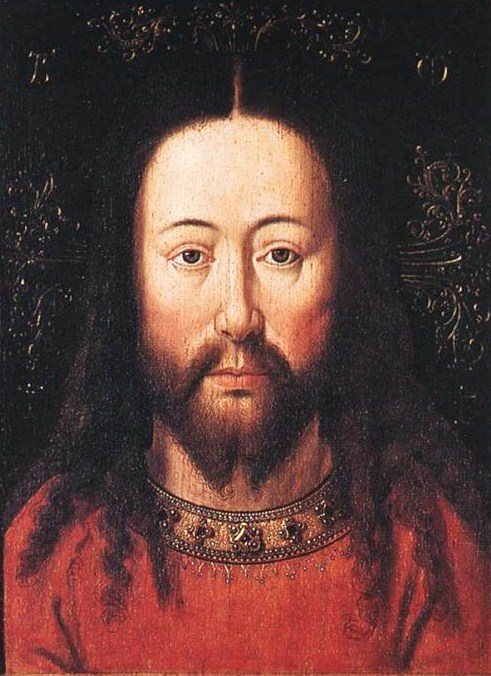
He was following a well-known type of painting, such as this one by the Flemish artist Jan van Eyck.

Christ by Jan van Eyck

I’m always surprised by the sheer effrontery of Dürer comparing himself so obviously to Christ. And not to some meek and mild Christ either.  The painting’s Latin inscription translates as “I, Albrecht Dürer of Nuremberg, portrayed myself in everlasting colours aged twenty-eight years”.  Wow! Talk about someone being sure of his fame in posterity. I’m amazed that he didn’t get hauled in front of some ecclesiastical court for committing the sin of overweening pride with this painting, but apparently he didn’t.

And then there are those artists who used selfies to do a bit of character assassination. Take Cristofano Allori, an Italian painter I’d never heard of until my wife and I came across a painting of his a few years ago in the Queen’s Gallery in London. Well worth the visit, by the way; it houses part of the extensive royal art collection. The painting in question was Judith with the head of Holofernes

allori-judith with head of holofernes

It’s a story from the Bible: Holofernes was a general sent by Nebuchadnezzar, King of Babylon, to wreak vengeance on various nations along the Mediterranean sea board  for not having supported him.  This included Israel.  Holofernes is besieging a Jewish city, which is about to surrender. But it is saved when Judith, a beautiful Jewish widow, visits Holfernes in his tent, seduces him, gets him drunk and then while he’s sleeping cuts off his head. Many painters liked this subject, no doubt because of all the blood and gore; they generally painted Judith in the act of cutting off Holofernes’s head. But Allori’s take is different. There’s no violence here. The head is already off and the blood has stopped running. Judith is holding it as she would a trophy, staring all the while at the viewer with a complacently triumphant look on her face. Anyone who saw the painting at the time and knew Allori must have tittered. Because Allori painted himself as poor Holofernes while his model for Judith was his ex-mistress Maria Mazzafirri and the servant in the background helping Judith was Maria’s mother. Poor Cristofano, they must have said, that harlot Mazzafirri and that hag of a mother of hers really screwed him over, got their claws into his loot (look at that beautiful dress she’s wearing!) and then dumped him. Or maybe they thought, what the hell did the beautiful Mazzafirri see in that dolt Allori? Good for her, good riddance to bad rubbish.

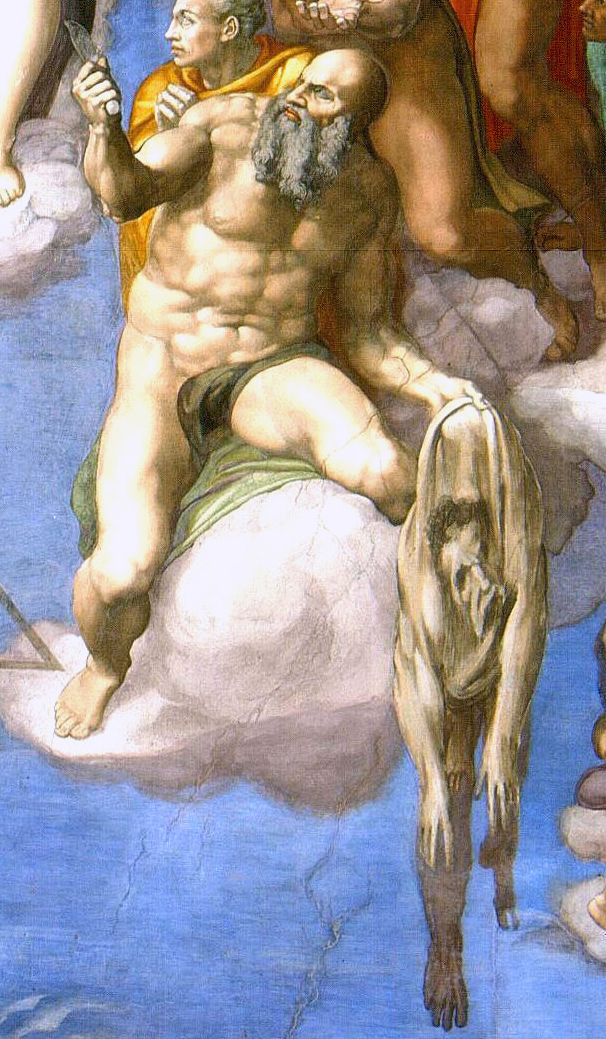
Michelangelo also included himself in a very personal way in a number of his works, the most famous of which must be in the fresco of the Last Judgement in the Sistine Chapel.

michelangelo-Last judgement

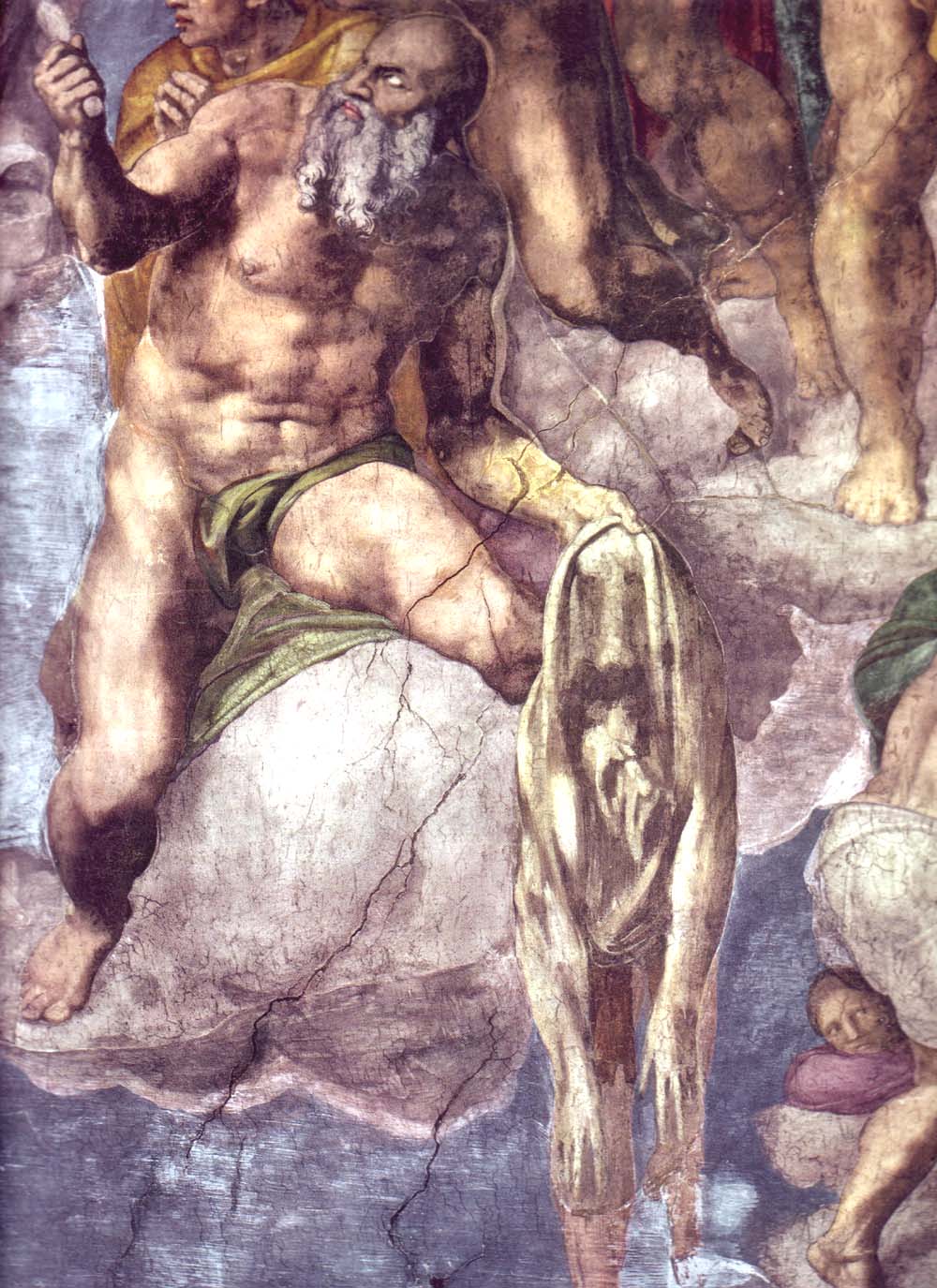
In that huge drama, he painted his face on the flayed skin of St. Bartholomew (I have written about the flaying of this saint in an earlier post).

michelangelo-Last judgement-detail

Scholars have debated the meaning of this since it was noticed in 1925. One scholar has suggested that Michelangelo was commenting on his extremely shabby and painful treatment (from his point of view) by the Pope and his minions during the painting of the Last Judgement. Amusing, along the lines of Allori’s painting, but I think other scholars are more correct when they see this as an excrutiatingly personal comment by Michelangelo on the precarious balance of his soul between salvation and damnation: it seems that the flayed skin is at an exact midpoint between the salvation of the Triumphant Christ and the horrified man who is about to be pulled into Hell. The poetry Michelangelo wrote at this time –  he was also a good poet – speaks a lot about his fear for the salvation of his soul.

And suddenly the selfie is an ussie. The artist is speaking for us all.

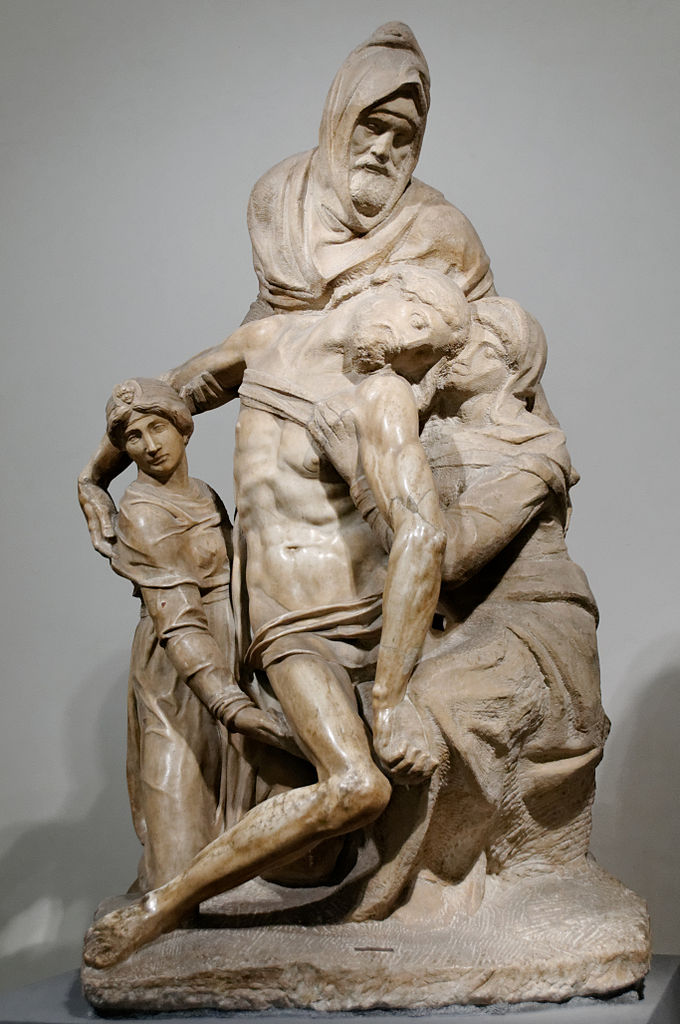
Personally, I like more the selfie in Michelangelo’s sculpture The Deposition from the Cross, which is in Florence.

michelangelo-deposition

I saw the sculpture during my first trip to Italy when I was a University student (I have also mentioned this trip in an earlier post). The old man, presumably Joseph of Arimathea, is said to be a self-portrait.

michelangelo-deposition-detail

A look of such sadness, such desolation he is giving the dead Christ! I was so struck by it that I remained transfixed in front of the statue. I stood there so long that someone in a group of tourists flowing by muttered to her neighbour “What’s he looking at?”

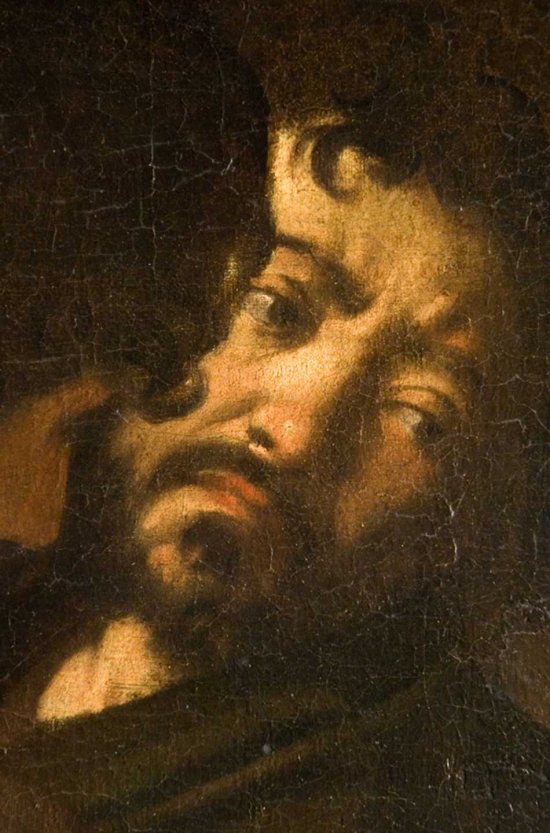
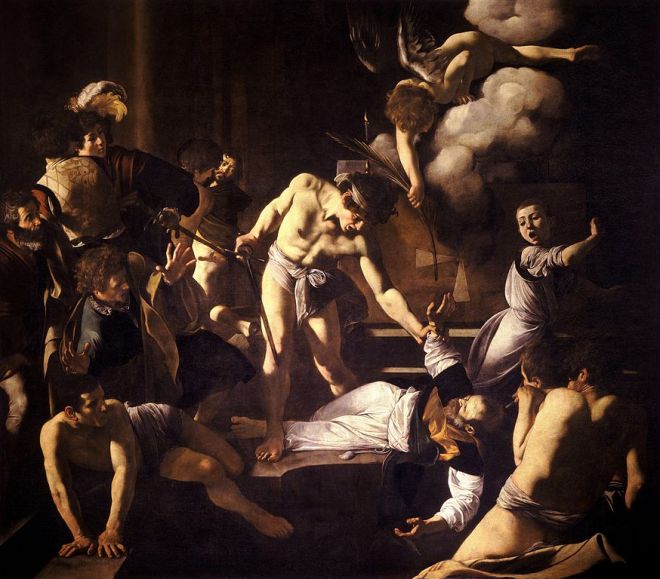
That look of intense sadness brings me to Caravaggio, who must be my most favourite painter. As I have mentioned elsewhere, I brought few books to Beijing, but one of these was the massive Caravaggio: The Complete Works by Sebastian Schütze, which I later complemented by Caravaggio: A Life Sacred and Profane, the almost detective story of his life by Andrew Graham-Dixon. Caravaggio included himself in a number of his paintings. Take his Martyrdom of Saint Matthew, one of a cycle of three paintings in the Contarelli Chapel of the Church of San Luigi dei Francesi in Rome.
Caravaggio-Martyrdom of St Matthew

The subject of the painting is the killing of Matthew, the author of one of the four Gospels. According to tradition, the saint was killed while celebrating Mass at the altar. And so we have the saint knocked to the ground, the assassin readying to deliver the fatal blow, an angel thoughtfully passing on to the saint the palm of martyrdom, and the crowd screaming and shouting and running about, the whole bathed in that chiaroscuro, that light and dark, for which Caravaggio is so famous.  A great painting, although in my opinion not as good as the other two in the chapel. In any case, what interests us right now is the figure at the back, picked out by the light, seemingly making an escape but looking back at the scene. It is Caravaggio.

Caravaggio-Martyrdom of St Matthew-detail

Why did he include himself like this? And why that look of intense sadness? Graham-Dixon suggests that Caravaggio is saying, “I am no different from these people, who stand there instead of helping Matthew,  or even run away. I would have had no more courage than they.  I, too, would have run away”.

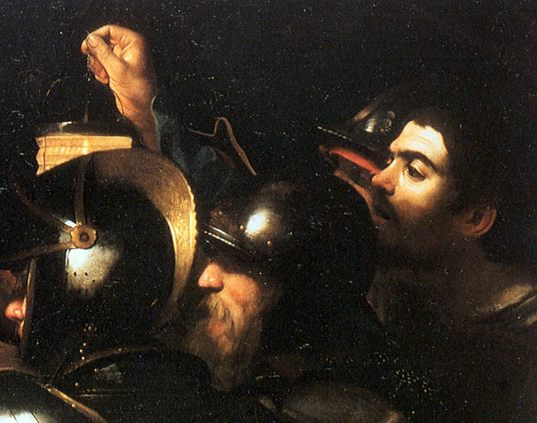
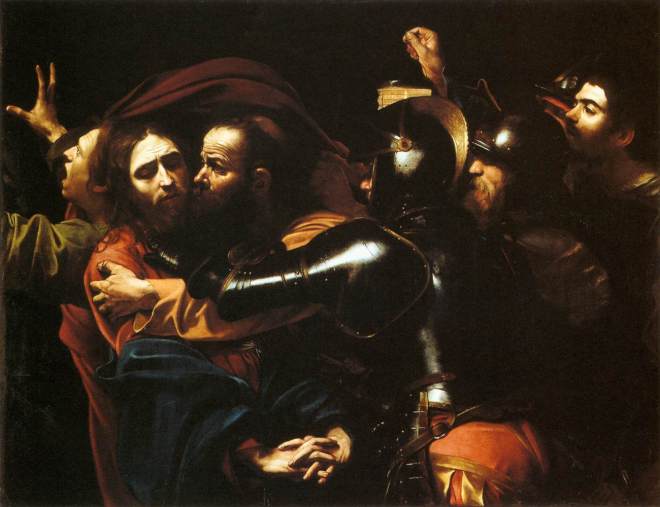
So different, this look, from the expression we see on his face in an earlier painting, the Taking of Christ in the Garden of Gesthemane, which hangs in the National Gallery of Ireland in Dublin.
Caravaggio-Taking of Christ

Caravaggio has painted the moment when Judas completes his betrayal of Jesus by kissing him in the Garden of Gesthemane, to indicate to the soldiers around him whom they should arrest. Caravaggio is the person holding the lamp at the back.

Caravaggio-Taking of Christ-self portrait

He is there to shed light on the scene, but he is also looking eagerly over the shoulders of the soldiers to get a better view.  Such a wonderful metaphor for every painter, of all ages, trying hard to visualize the scene which they are planning to paint, and which they can see only darkly.

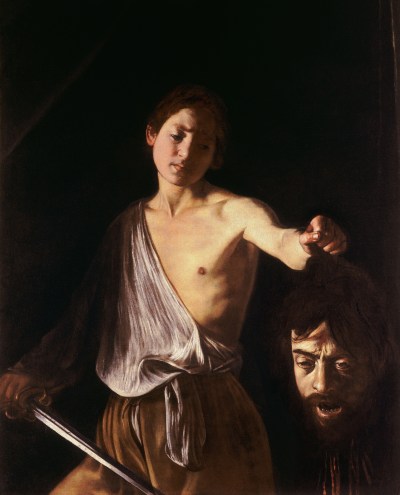
And so we get to the last of Caravaggio’s portrayals, painted late in his career. The subject is another decapitation which was very popular with painters, David’s killing of Goliath. Caravaggio himself did at least three versions of this story, more or less all of the same moment, when David grasps the head of Goliath.  This last one, housed in the Galleria Borghese in Rome, is the darkest, the most tragic.
caravaggio-david with goliath

It is Caravaggio’s face we see in Goliath, as he was in the last years of his life, on the run from the law in at least two jurisdictions but also from enemies who had personal vendettas with him and were trying to kill him, desperately trying to have himself pardoned by the Pope so that he could return to Rome. It is said that Caravaggio intended the painting to be a gift to Cardinal Borghese who had the power to have him pardoned, a sort of “here is my head on a platter, please be merciful and forgive me”. And who modelled David, a David who strangely enough is not looking triumphantly at Goliath whom he has just overcome in battle, whose gaze rather is a mixture of sadness and compassion for his supposed enemy? One interpretation, which I like immensely, is that this is also Caravaggio, painted as he looked when he was a young boy! And so we have a scene where the young Caravaggio is looking on sadly at the old Caravaggio which he will become. Alas, this interpretation does not seem correct. More probably, the model is Caravaggio’s studio assistant, Cecco, looking on sadly as his master slowly falls to pieces before his eyes. And indeed Caravaggio died shortly thereafter.

Another artist whose powerful self-portraits have always fascinated me is the Mexican painter Frida Kahlo. I must say, she was almost obsessed with herself, self-portraits making up a very large proportion of her oeuvre. Here is one of them

Frida Kahlo-self portrait

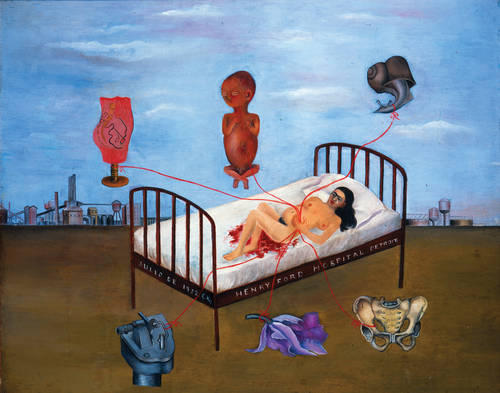
but there is one self-portrait of hers which stands out above all the rest and which I find truly gut-wrenching, Henry Ford Hospital.
Frida Kahlo-Henry Ford Hospital

She painted it shortly after her second miscarriage, when she realized she would never be able to have the children she so desperately wanted. You see her lying in the blood of her miscarriage on her bed in the Henry Ford Hospital in Detroit (the city in the background; her husband, the Mexican painter Diego Rivera, had been given a commission there by Edsel Ford). Above her floats the baby she has just lost, a baby boy. Also floating around her are a female torso, showing the anatomical parts linked to having children, her fractured pelvis, fruit of an accident she suffered when young and which made it impossible for her to have children, medical-looking equipment used during the miscarriage, an orchid which Rivera had given her, and a snail, depicting the slow pace of her miscarriage. All are linked to her by umbilical-like bloodlines.

I finish with a self-portrait by Käthe Kollwitz, a German artist who was active before and after the First World War. It, too, is about the loss of a child, but this time of a child born.  Her younger son Peter was badly wounded in the first days of the war and died in her arms a few months later. She created this woodcut just after his death. It is of her and her husband, distraught at their boy’s death

Kathe Kollwitz-grieving-parents-woodcut

After the war, she distilled this image into a pair of statues, Grieving Parents, which stand in the German War cemetery at Vladslo in Belgium (I have written an earlier post about these cemeteries).

Kathe Kollwitz-grieving-parents-statues-1

The two figures are based on Käthe and her husband Karl

Kathe Kollwitz-grieving-parents-statues-2

They represent all the parents of the young men buried in the cemetery
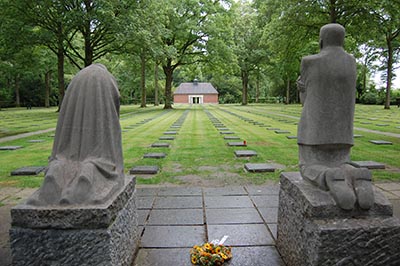
Kathe Kollwitz-grieving-parents-statues-3

although it is said that Karl is gazing directly at the tomb of his son Peter.

To parents like us with children still of age to be called up, incredibly moving.

POST SCRIPTUM

A few weeks ago (June 2014), I saw with great pleasure that my favouritest of favourite cartoonists in The New Yorker magazine, Roz Chast, had made the same connection as I had between the modern selfie movement and artists’ self-portraits

roz chaz selfie 001

______________________________

Chinese selfies: http://www.chinadaily.com.cn/slides/images/attachement/jpg/site1/20131213/b8ac6f27ada21414a28412.jpg [in http://www.chinadaily.com.cn/slides/2013-12/13/content_17172459_6.htm%5D
Botticelli – Adoration of the Magi: http://upload.wikimedia.org/wikipedia/commons/thumb/3/34/Botticelli_085A.jpg/942px-Botticelli_085A.jpg [in http://en.wikipedia.org/wiki/Adoration_of_the_Magi_of_1475_(Botticelli)%5D
Filippino Lippi-The Disputation with Simon Magus and the Crucifixion of Peter: http://www.wga.hu/art/l/lippi/flippino/brancacc/crucdisp.jpg [in http://www.wga.hu/tours/brancacc/crucif_d.html%5D
Velázquez-Las Meninas: http://upload.wikimedia.org/wikipedia/commons/thumb/3/31/Las_Meninas%2C_by_Diego_Velázquez_from_Prado_in_Google_Earth.jpg/890px-Las_Meninas%2C_by_Diego_Velá1zquez%2C_from_Prado_in_Google_Earth.jpg [in http://en.wikipedia.org/wiki/Las_Meninas%5D
Dürer-self portrait: http://upload.wikimedia.org/wikipedia/commons/thumb/f/fc/Duerer01.jpg/740px-Duerer01.jpg [in http://en.wikipedia.org/wiki/Self-Portrait_%28D%C3%BCrer%29%5D
Christ by Jan van Eyck: http://2.bp.blogspot.com/-HSgyBuOLqog/T36J0B01fsI/AAAAAAAA8Ko/yhh8A_Rq5GQ/s1600/Jan%2Bvan%2BEyck%2B%2528Flemish%2Bpainter%252C%2B1385-1441%2529%2BChrist%2B1440.jpg [in http://bjws.blogspot.com/2013/03/early-portraits-of-jesus.html%5D
Allori-Judith with the head of Holofernes: http://cdn.royalcollection.org.uk/cdn/farfuture/JPL2-m0ogCUIVnYQgnX1GLNkeFf11XoRWGNrkNMHuQk/mtime:1373966874/sites/royalcollection.org.uk/files/col/404989_255798_ORI_0_0.jpg [in http://www.royalcollection.org.uk/visit/the-queens-gallery-buckingham-palace%5D
Michelangelo-last judgement: http://upload.wikimedia.org/wikipedia/commons/a/a5/Michelangelo,_Giudizio_Universale_02.jpg [in http://en.wikipedia.org/wiki/The_Last_Judgment_(Michelangelo)%5D
Michelangelo-last judgement-detail: http://upload.wikimedia.org/wikipedia/commons/c/cf/Last_judgement.jpg [in http://en.wikipedia.org/wiki/Self-portrait%5D
Michelangelo-Deposition: http://upload.wikimedia.org/wikipedia/commons/thumb/c/c6/Pieta_Bandini_Opera_Duomo_Florence_n01.jpg/680px-Pieta_Bandini_Opera_Duomo_Florence_n01.jpg [in http://en.wikipedia.org/wiki/The_Deposition_(Michelangelo)%5D The sculpture is housed in the Museo dell’Opera del Duomo in Florence.
Michelangelo-Deposition-detail: http://www.bc.edu/bc_org/avp/cas/fnart/art/ren_italy/sculpture/10_97_5_30.jpg [in http://www.bc.edu/bc_org/avp/cas/fnart/art/ren_italy/ren_sculpture01.html%5D
Caravaggio-Martyrdom of St Matthew: http://upload.wikimedia.org/wikipedia/commons/thumb/5/57/The_Martyrdom_of_Saint_Matthew-Caravaggio_(c._1599-1600).jpg/874px-The_Martyrdom_of_Saint_Matthew-Caravaggio_(c._1599-1600).jpg [in http://en.wikipedia.org/wiki/The_Martyrdom_of_Saint_Matthew_(Caravaggio)%5D
Caravaggio-Martyrdom of St Matthew-detail: http://caravaggista.com/wp-content/uploads/2013/09/matthew-sp.jpg [in http://caravaggista.com/2013/09/happy-birthday-caravaggio-2013/%5D
Caravaggio-Taking of Christ: http://upload.wikimedia.org/wikipedia/commons/e/e6/Caravaggio_-_Taking_of_Christ_-_Dublin.jpg [in http://en.wikipedia.org/wiki/The_Taking_of_Christ_(Caravaggio)%5D
Caravaggio-Taking of Christ-detail: http://caravaggista.com/wp-content/uploads/2012/05/Screen-shot-2012-05-25-at-12.49.30-PM.png [in http://caravaggista.com/2012/05/caravaggio-the-leader/%5D
Caravaggio-David with Goliath: http://upload.wikimedia.org/wikipedia/commons/6/60/Caravaggio_-_David_con_la_testa_di_Golia.jpg [in http://en.wikipedia.org/wiki/David_with_the_Head_of_Goliath%5D
Frida Kahlo-self portrait: http://upload.wikimedia.org/wikipedia/en/1/1e/Frida_Kahlo_%28self_portrait%29.jpg [in http://en.wikipedia.org/wiki/Frida_Kahlo%5D
Frida Kahlo-Henry Ford Hospital: http://0.tqn.com/d/arthistory/1/7/Q/1/1/Frida-Kahlo-Henry-Ford-Hospital-1932.jpg [in http://arthistory.about.com/od/from_exhibitions/ig/frida_kahlo/fk200708_03.htm%5D
Käthe Kollwitz-grieving parents-woodcut: http://scattergoodmoore.files.wordpress.com/2012/03/grieving-parents.jpg [in http://scattergoodmoore.wordpress.com/category/kollwitz/%5D
Käthe Kollwitz-grieving parents-statues-1: http://www.judithdupre.com/wp-content/uploads/2010/07/Mourning-Parents-kollwitz2-e1278340988804.jpg [in http://www.judithdupre.com/books/full-of-grace/full-of-grace-gallery/%5D
Käthe Kollwitz-grieving parents-statues-2: http://static.panoramio.com/photos/large/1536597.jpg [in http://www.panoramio.com/photo/1536597%5D
Käthe Kollwitz-grieving parents-statues-3: http://www.eyes-and-ears.co.uk/squaredog/images/kollwitz_rear.jpg [in http://www.eyes-and-ears.co.uk/squaredog/details.asp?Title=The%20Art%20of%20Remembrance%5D

ROCKS IN THE GARDEN

Beijing, 4 December 2013

The Chinese have a a strange relationship with rocks. Go to any self-respecting Chinese garden and somewhere in the twists and turns of its paths you will come nose to nose with a fantastically twisted rock standing there waiting to be admired.

The Forbidden City in Beijing has a specimen which is (of course) very large
rock sculpture forbidden city-2
while a number of the famous gardens in Suzhou have examples more to the human scale.
rock sculpture suzhou-1

rock sculpture suzhou-2
rock sculpture suzhou-3
Admire them they do, the Chinese. When they catch sight of one of these rock sculptures, they will normally break into oohs and aahs, and end up – inevitably, in today’s culture in China – taking a group photo in front of said rock.

The fascination with these rock sculptures extends to internal spaces. It is very common to come across smaller (and sometimes not so smaller) versions in Ministries and other public buildings. Even in the intimate space of the scholar’s study, it was almost de rigeur for the scholar to have a small rock sculpture such as this one
scholar stone
sitting on his desk, among the brushes, ink stand, rice paper, and the rest of his scholarly paraphernalia.

This is not a dead art form. Chinese sculptors are continuing to create these rock sculptures, as this photo from an outdoor exhibition in Chicago attests (in this case, though, while the design principles remain the same, rock no longer seems to be the medium)

rock sculpture in Chicago

I have to assume that Chinese garden designers, like their English counterparts, were bringing the natural landscapes around them, suitably tamed, into their gardens. In the case of the rocks, the landscapes in question must surely be the karst landscapes which are common in many parts of China. This is one such landscape in Yunnan, known as the Stone Forest and famous enough to have been listed as a UNESCO World Heritage site.
stone forest yunnan-2
(on an aside, I should note that it was visited by Lisa, of whom I have written earlier, during a trip which she took to Yunnan some six months ago; predictably, her photos of the trip included a large number of her, or her traveling companion, or her tour group, standing among the rocks)

I have to say, I don’t like these rock sculptures. I find the sheer froth of all that twisted stone to be just too much.  Those whorls, those curlicues, those knobs, those piercings, the sheer grotesqueness of it all … Ugh!

This fascination with large rocks has taken on a modern twist. It has become a sign of class for any organization with pretensions of social or economic significance to have a large rock placed before its important buildings, with its name carved on it in classy Chinese characters. These rocks tend to eschew the flowery style, opting instead for a massive ponderousness which no doubt is meant to signal the solidity and power of the organization in question.

rock in front of building-1

I don’t like these sculptures any better. They are just big and heavy with no redeeming features that I can see – the Chinese will sometimes get excited about the script, either because it adheres to the classical cannons of beauty for Chinese characters or because they are copies of some famous Chinese person’s script, but all that leaves me cold.

So you can imagine the relief and pleasure I felt when my wife and I came across this
rock landscape Suzhou IM Pei museum
in the courtyard of a museum in Suzhou, which was designed by the architect I. M. Pei (he of the East Wing of the National Art Gallery in Washington D.C.). Here at last was a rock sculpture in China which I could relate to, spare, simple, clean of line, yet able to evoke beautifully its subject, a range of mountains in the distance.

It is that same spare style which made me fall in love so many years ago with Japanese rock gardens which my wife and I visited in Kyoto during a trip to Japan. Here are pictures of some of the more beautiful of these gardens.
Kyoto Nanzenji rock garden

Kyoto Ryoanji-Rock-Garden

Kyoto Ryogen-in Rock-Garden-2

Kyoto Tofuukuji rock garden-2

Kyoto totekiko rock garden
When I saw these gardens, I vowed that some day, somewhere, I would make my own rock garden. I had to wait 15 years before I got my chance, in Vienna, in a corner of the large balcony which wrapped itself around our apartment. I bought the small stones in a garden store, I found two largish stones in the woods around Vienna (I nearly bust a gut carrying them to the car and then up the stairs to the balcony), and I strategically placed two small plants (also bought in the garden store) behind these stones. I cut saw teeth into a plywood plank to make a rough rake, and then I lovingly raked the small stones around the large stones to create a vision of ripples around rocky islets. The result was really not bad, even if I say so myself.

But we left the apartment, and with death in my heart I had to abandon my rock garden. But some day, somewhere, I’ll make another one, to contemplate it in my old age with peace in my heart.

____________________

Rock sculpture in the Forbidden City-2: http://www.annapoynter.net/pictures/China/IMG_2011.JPG [in http://www.annapoynter.net/Holidays.html%5D
Rock sculpture Suzhou-1: http://farm4.staticflickr.com/3016/2901558799_c71f5ea4d5_z.jpg [in http://www.flickr.com/photos/orangenation/2901558799/%5D
Rock sculpture Suzhou-2: http://upload.wikimedia.org/wikipedia/commons/e/ef/20090905_Suzhou_Lion_Grove_Garden_4502.jpg [in http://en.wikipedia.org/wiki/Chinese_garden%5D
Rock sculpture Suzhou-3: http://static.panoramio.com/photos/large/2984134.jpg [in http://www.panoramio.com/photo/2984134%5D
Scholar’s stone: http://www.mrlei.com/images/134/1.jpg [in http://www.mrlei.com/item.php?cat=rock&lang=%5D
Stone forest Yunnan: http://31.media.tumblr.com/54195fa03584bc1fbc2a488da1fb12d9/tumblr_mhd5vjD4wl1s2zxumo5_1280.jpg [in http://viajes-por-el-mundo.tumblr.com/post/41747655074/viajes-por-el-mundo-capitulo-81-karst-de%5D
Rock in front of building-1: http://2.bp.blogspot.com/_pxr81FiVJcw/SsHJAmLcQEI/AAAAAAAAAQU/6bdhavyfVu4/s320/IMG_1209.JPG [in http://tainanchineseclass.blogspot.com/2009_09_01_archive.html%5D
Rock sculpture in Chicago: http://2.bp.blogspot.com/-yHQ9FxAo-ZQ/TW0pQdVNXkI/AAAAAAAAcUM/LodlhBZ5_y8/s1600/LI-sculp-MP-007b.jpg [in http://chicago-outdoor-sculptures.blogspot.com/2009_04_01_archive.html%5D
Rock landscape Suzhou IM Pei Museum: http://www-tc.pbs.org/wnet/americanmasters/files/2010/03/full-rocklandscape.jpg [in http://www.pbs.org/wnet/americanmasters/episodes/i-m-pei/image-gallery-of-the-suzhou-museum/1570/%5D
Kyoto Nanzenji rock garden: http://www.lexaloffle.com/img2/jrg1.jpg [in http://www.lexaloffle.com/jrg.htm%5D
Kyoto Ryoanji: http://famouswonders.com/wp-content/uploads/2009/11/Ryoanji-Rock-Garden.jpg in [http://famouswonders.com/ryoanji-rock-garden/]
Kyoto Ryogen-in rock gardens: http://images.fineartamerica.com/images-medium-large/ryogen-in-zen-rock-garden–kyoto-japan-daniel-hagerman.jpg [in http://fineartamerica.com/featured/ryogen-in-zen-rock-garden–kyoto-japan-daniel-hagerman.html%5D
Kyoto Tofukuji rock garden: http://4.bp.blogspot.com/_bWbsTZVSaLw/S8uzFo1o2mI/AAAAAAAAAO4/tq11td38q3I/s1600/april-13+141.jpg [in http://kyotofreeguide-kyotofreeguide.blogspot.com/2010_04_01_archive.html%5D
Kyoto Totekiko rock garden: http://muza-chan.net/aj/poze-weblog2/totekiko-garden-ryogen-in-temple-kyoto-big.jpg [in http://muza-chan.net/japan/index.php/blog/smallest-japanese-zen-rock-garden-japan%5D

DREAM JOURNEY: PART II

Beijing, 24 November 2013

Back in May, I closed my post Dream Journey: Part I in Aquileia, in North-Eastern Italy. I said then that my wife and I would be continuing the journey.  But somehow, I got distracted by other things.  Now the days are shortening and the cold is beginning to bite …

No matter, let’s continue! Even in late Autumn the Mediterranean is beautiful. But we won’t be following my original plan for the second leg of the trip, which was to drive in our open-topped MG from Aquileia to Istanbul through the Balkans following the trace of the old Roman roads Via Gemina and Via Militaris. It’s too cold for that now.  Instead, we’ll backtrack to Venice airport, drop off the MG in the airport’s parking lot for the next dream travelers to pick up, and take a plane to Istanbul.

No sooner said than done. With a click of the mouse we have arrived in Istanbul!

Wonderful city, Istanbul. Since time immemorial, a place of passage and trade between Asia to the east and Europe to the west, between the Black Sea to the north and the Mediterranean Sea the south. Where Jason and the Argonauts passed on their way north to find the golden fleece. Where the Persian King Darius I crossed his troops to chase after and subdue the pesky Scythian horsemen to the north. Where, more prosaically, grain ships from the northern shores of the Black Sea passed on their way south to bring their cargoes to the Greek city states and later to Rome.  Chosen by Constantine the Great as the seat of his new capital of the Roman Empire. Later, capital only of the Eastern Roman Empire when the Empire’s western portion disintegrated and disappeared, and later still of the renamed Byzantine Empire. Conquered one thousand two hundred years later by the Ottoman Sultan Mehmed II, to become the capital of the Ottoman Empire, a role it played for another five hundred years. Set aside by Kemal Atatürk as capital of the new Turkey in favour of Ankara. In the last several decades, swollen to bursting by millions of impoverished migrants from Turkey’s eastern provinces. But still a lovely, vibrant city.

In this dream trip of mine my wife and I are only here to visit the city’s early christian mosaics, so we’ll ignore the Islamic splendours of the city …

blue mosque Istanbul

the breathtaking views of the Bosphorus …

bosphorus views

the fun of the covered spice bazaar …

spice bazaar istanbul

the culinary delights of its restaurants …

restaurants Istanbul

No, we tell the taxi driver instead to take us straight to Hagia Sophia.

Hagia_Sophia external

The edifice started life as the Basilica of Holy Wisdom in 537, was turned into a mosque when the city fell to the Ottomans in 1453, and finally became a museum in 1935. Other than the four slim minarets, it has remained pretty much the same on the outside over the last millennium and a half. The inside has changed more as the obvious signs of its Christian function were whitewashed over or removed and replaced with Muslim symbols. This process of islamicization, together with those natural processes linked to the passage of time – rot, mould, water ingress, along with an earthquake or two – has meant that most of the glittering mosaics which covered every inch of the vast interior have disappeared.

hagia-sophia-interior

We are left with a few modest shards tucked away in various corners of the interior:

A gentle Madonna in the apse, but so high, so remote:

hagia sophia-1-apse

A stern Christ between Mary and John the Baptist:

hagia sophia-7-deesis

The Emperors Justinian and Constantine humbly offering the Madonna the basilica and the city:

hagia sophia-6-justinian and constantine

The Emperor Comnenus and Empress Irene with the Madonna:

hagia sophia-5-comnenus and irene

The Emperor Constantine Monomacchus and the Empress Zoe with the Christ:

Mosaïque de l'impératrice Zoé, Sainte-Sophie (Istanbul, Turquie)

The Emperor Leo VI prostrate at the feet of the Christ:

hagia sophia-4-Leo VI

And lastly, uncovered just a few years ago, a seraph:

hagia sophia-8-seraphim

(As I look more closely at his face

hagia sophia-9-seraphim-detail

I cannot escape the notion that he is saying, “get me out of this stuff!”)

I cannot avoid a certain melancholy as I survey what is left and think of what it must have been. I am reminded of a story from the time of the Ottomans’ conquest of the city. It is said that when Mehmed II wandered around the Imperial palace originally built by Constantine, now lying ruined and abandoned, he murmured some lines from a famous Persian poet:
“The spider spins his web in the Palace of the Caesars,
An owl hoots in the towers of Afrasiyab”.

Still in a state of melancholy, I click the mouse, and my wife and I are now visiting another, much smaller, church in Istanbul, Kariye Camii (the Church of the Holy Saviour). It still has extensive mosaics, executed in early 1300s. We are entering the twilight age of mosaics; in fact, the church also has extensive frescoes, the medium which eventually triumphed over mosaics. Here are photos of some of the mosaics.
Up in its two small domes:

kariye camii-6-christ cupola

kariye camii-5-virgin genealogy

which give us an idea of what the dome of Hagia Sophia must have looked like.

Scenes of Christ’s Ministry:

kariye camii-7-christs ministry

Scenes from the life of the Virgin:

kariye camii-3-paying tax

And finally the donor, the powerful Byzantine statesman Theodore Metochites, humbly offering his church to Christ:

????????????????

(I like the hat!)

The church also has some wonderful frescoes. This one is my favourite, a fresco of the Resurrection

kariye camii-2-fresco

Such a dynamic Christ! So different from the stiff, awkward, reserved Christs of this period’s mosaics.

We come out into sunlight of the noisy street outside. It’s time to move on.  The next leg of the journey will be in Greece.

____________________

Blue Mosque: http://www.beautifulmosque.com/wp-content/uploads/2013/03/Sultan-Ahmed-Mosque-in-Istanbul-Turkey-1.jpg
Bosphorus views: http://www.wallpapersgalaxy.com/wp-content/uploads/2011/07/suleiman-mosque-in-istanbul-turkey-view-to-bosphorus.jpg
Spice bazaar Istanbul: http://images.fxcuisine.com/blogimages/turkey/istanbul/egyptian-spice-bazar/istanbul-egyptian-bazar-02-1000.jpg
Restaurant Istanbul: http://thumbs.ifood.tv/files/images/editor/images/top%20restaurants%20in%20Istanbul.jpg
Hagia Sophia-exterior: http://upload.wikimedia.org/wikipedia/commons/2/22/Hagia_Sophia_Mars_2013.jpg
Hagia Sophia-interior: http://powertripberkeley.com/wp-content/uploads/hagia-sophia-wallpaperhagia-sophia-interior-by–thesolitary-on-deviantart-cjcwsxkd.jpg
Hagia Sophia-apse: http://www.mosaicartsource.com/Assets/html/artists/lilian/mosaic_hagia_sophia.jpg
Hagia Sophia-Deesis: http://www.gradale.com/Media/Deesis.jpg
Hagia Sophia-Justinian and Constantine: http://upload.wikimedia.org/wikipedia/commons/0/06/Istanbul.Hagia_Sophia075.jpg
Hagia Sophia-Comnenus and Irene: http://www.turkey4travel.com/wp-content/uploads/2009/05/hagia-sofia-mosaic.jpg
Hagia Sophia-Zoe and Constantine Monomacchus: http://upload.wikimedia.org/wikipedia/commons/7/7f/Empress_Zoe_mosaic_Hagia_Sophia.jpg
Hagia Sophia-Leo VI: http://www.cambridge2000.com/gallery/images/P33112366e.jpg
Hagia Sophia-seraph: http://farm5.static.flickr.com/4089/4973697085_028b4ed969.jpg
Hagia Sophia-seraph-detail: http://i.telegraph.co.uk/multimedia/archive/01725/mysteries-2509_1725247c.jpg
Kariye Camii-Christ in the cupola: http://upload.wikimedia.org/wikipedia/commons/thumb/2/2a/Chora_Christ_south_coupole.jpg/800px-Chora_Christ_south_coupole.jpg
Kariye Camii-Virgin Mary in the cupola: http://upload.wikimedia.org/wikipedia/commons/thumb/0/00/HSX_Mary_genealogy.jpg/800px-HSX_Mary_genealogy.jpg
Kariye Camii-Christ’s Ministry: http://farm9.staticflickr.com/8069/8213661931_5653c8fd48_o.jpg
Kariye Camii-paying tax: http://upload.wikimedia.org/wikipedia/commons/a/a6/Meister_der_Kahriye-Cami-Kirche_in_Istanbul_005.jpg
Kariye Camii-theodore metochites: http://www.sacred-destinations.com/turkey/istanbul-kariye-chora-pictures/dedication-theodore-metochites-ccc-access-denied.jpg
Kairye Camii-fresco resurrection: http://www.vikiturkey.com/wp-content/uploads/2012/10/chora-museum.jpg

VARY THE THEME!

Beijing, 19 October 2013

Anyone who visits China for more than a few days cannot fail to notice the many, many pairs of stone animals standing guard in front of any building which has pretensions to be something (although “something” can be no more than a second-rate noodle restaurant). Here is a typical pair of these animals, which my wife and I recently came across in front of the China National Philatelic Corporation.

chinese lion 003

The Chinese call these animals “lions”, which is really a bit of a joke. In today’s globalized world, where images of this iconic animal must surely have been beamed into every corner of every house on the planet, we all know that lions actually look like this:

real male and female lions

One theory has it that the original model for these “lions” was the Asiatic lion, of which a few miserable specimens still linger on in the Indian state of Gujarat. According to this theory, some live samples were brought to China along the Silk Road from Central Asia or the Middle East some 2,000 years ago, as gifts, tribute or whatever. Artists copied them, and then the originals stopped coming. So the artists copied the copies, and then copied the copies of the copies, and … Anyone who has seen the film Multiplicity, where Michael Keaton makes copies of himself and then the copies make copies of themselves

Multiplicity movie

knows what happens: there is a high loss of quality in the picture the further you get from the original.

A second theory is that actually the original model wasn’t a lion at all. It was a chow chow, which is a dog from this part of the world. It seems to have originated somewhere in northern China or Mongolia, or possibly in Siberia. I don’t know what readers think, but I’m not convinced that this

chow chow dog sitting

is the model of the above. Nor am I convinced that another ancient Chinese dog breed, the noble Pekingese (only members of the imperial family were allowed to have them), is the model

Pekingese dog

Such an irritating little dog, I’ve always felt, as it raspily yaps around your feet at some apartment door – a good, swift kick is what it deserves, but one has to be polite to the apartment owners. In any event, while it’s true that the Pekingese’s face has certain resemblances to my stone “lions” (and in fact it’s often called a lion-dog because of this resemblance), I rather think this is an example of convergent evolution: the sculptors went their way with their designs, the dog breeders with theirs, and one day someone said, “Ooh look, the Peke looks just like the stone lions!”.

A third theory, which I find quite convincing, is that actually the models for the Chinese stone “lions” are the stone lions which are often found outside Indian temples. See the following link for a further development of this theory, while here is a picture of one such Indian lion from Mahabalipuram:

indian carved lion

It really does look quite similar, doesn’t it?  I presume that proponents of this theory would argue that it is Buddhism which brought to China the idea of placing stylized “lions” at the entrances of temples and then with time they migrated to the entrances of any important building.

However the design came about, the fact is that this being China, where everything eventually became (and still becomes) formalized, codified and rigidified, these pairs of stone “lions” have been made in exactly the same way ever since the Ming dynasty. The key is that they look nearly exactly the same. Both have the same ritualized snarl on their faces. Both have the same mane of tight curls. Both have the same strong legs. Both are sitting on their haunches. There is only one important difference, fruit of a typical male chauvinism: the male is always – always – made with his paw resting on a ball (representing the male’s mastery over the world)

chinese lion 001

while the female is always – always – made with her paw resting on a cub which is playfully lying on its back (representing the female’s nurturing nature).

chinese lion 002

And sited as they are on either side of the entrance, their heads are always slightly inclined towards the enterer.

There must be literally millions of these stone “lions” scattered across the length and breadth of China, large, small, and every imaginable size in between. I swear, somewhere in China there must be a factory like this

huge-industrial-factory

that churns these damned things out by the thousands every day.

So tedious! So boring! Change, for God’s sake!

So you can imagine that it is with some small relief that I occasionally run across variations on this monotonous theme. Take this pair of “lions” which I recently came across in Beiing, in front of a restaurant.

lions looking at one another

How exciting! They are looking at each other and not the enterer.

Or take this “lion”, which I came across during my recent trip to Fujian.

river gorge 008

Why, rather than glaring at you he really looks glad to see you! And he seems to be offering you the ball to play with. It could almost be a playful Pekingese (assuming those damned dogs play). What a refreshing site for sore eyes.

Or how about this pair of “lions”, which we bumped into in Hong Kong? They were outside some bank as I recall, and not even guarding an entrance. A wonderful postmodern take on the old, very tired stone lion design.

lions in HK

And now, I even see real lions! This picture was taken five minutes after the picture with which I started the post

realistic lion

It was sitting in front of a furniture shop as I recall.

So when will I see two giraffes guarding the entrance to some place?

sitting giraffes

Change, for God’s sake!

____________________________

pair of Chinese lions: my picture
Real male and female lions: http://farm4.staticflickr.com/3400/3189788124_26e25201fd_o.jpg [in http://www.flickr.com/photos/kenkeener1621/3189788124/%5D
Multiplicity movie: http://www.thefancarpet.com/uploaded_assets/images/gallery/4480/Multiplicity_41523_Medium.jpg [in http://www.thefancarpet.com/ActorGalleryPicture.aspx?mga_id=46948&a_id=714%5D
Chow chow dog: http://comps.canstockphoto.com/can-stock-photo_csp7744774.jpg [in http://www.canstockphoto.com/search.php?term=chow%20dog%20sitting&type=1%5D
Pekingese dog: http://www.dogbreedinfo.com/images19/PekingeseSissiePrincess11YearsOld1.JPG [in http://www.dogbreedinfo.com/pekingese.htm%5D
Indian carved lion: http://farm3.staticflickr.com/2036/2312684736_1f31c1a673_b.jpg [in http://bighugelabs.com/onblack.php?id=2312684736&size=large%5D
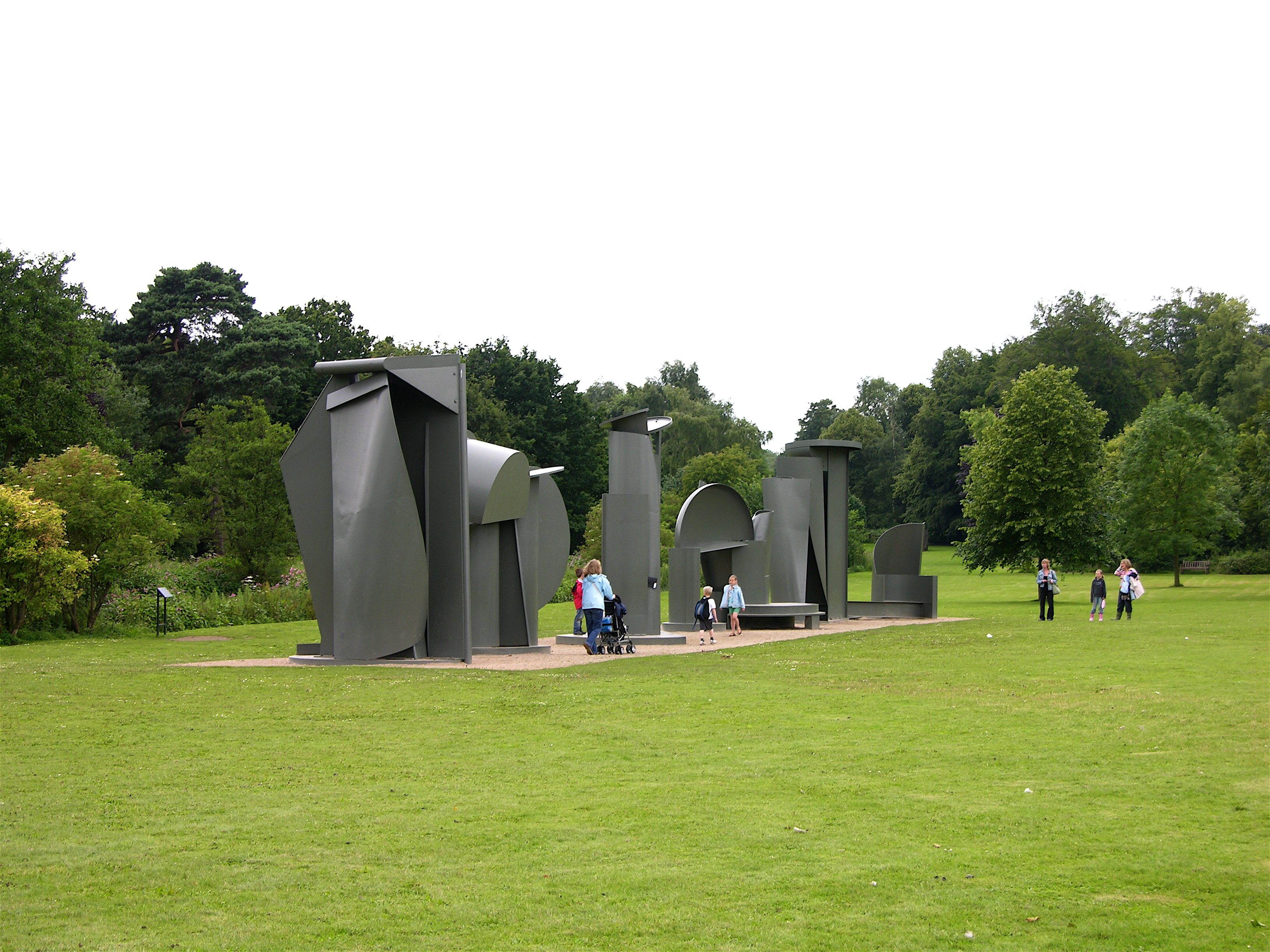
male Chinese stone lion: my picture
female Chinese stone lion: my picture
Huge industrial factory: http://thumbs.dreamstime.com/x/huge-industrial-factory-9265211.jpg [in http://www.dreamstime.com/royalty-free-stock-photos-huge-factory-image6897978%5D
Chinese stone lions looking at each other: my picture
Chinese stone lion in Fujian: my picture
Chinese stone lions in Hong Kong: my picture
Realistic stone lion: my picture
sitting giraffes: http://media.offexploring.co.uk/photos/pamandralph/photos/070212-11-DSC_0112.JPG [in http://blogs.statravel.co.uk/pamandralph/albums/uganda/10149717%5D