WESTMINSTER ABBEY’S COSMATESQUE PAVEMENT

Vienna, 8 April 2023

I don’t understand it, my wife and I have not yet received our invitation to attend King Charles III’s coronation in Westminster Abbey! It’s taking place very soon, on 6 May!

Source

This is a huge problem, because I won’t get a chance to surreptitiously inspect the Cosmatesque pavement laid in front of the Abbey’s High Altar while the assembled Archbishops drone their way through the coronation liturgy.

Source

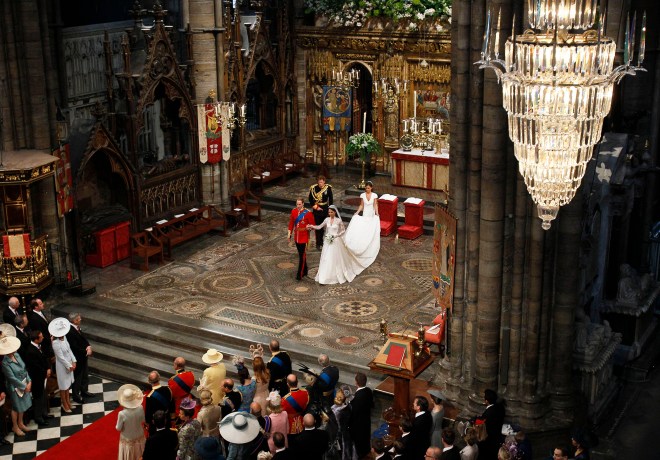
The fact is, the pavement is covered up almost all the time, to protect it. It’s only during a coronation or other exceptional events that it is uncovered. In fact, the last time it was uncovered was when William and Kate were married in the Abbey back in 2011 (another event to which my wife and I were not invited; have they mislaid our address, I wonder?)
Source

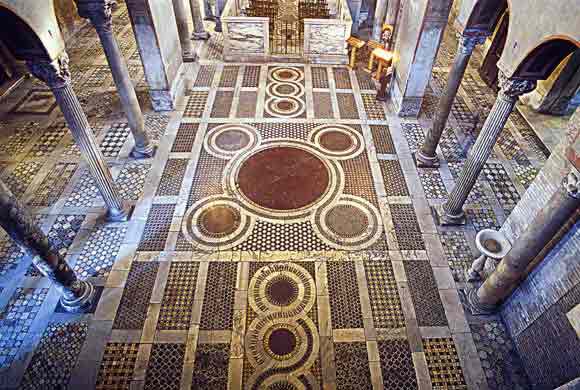
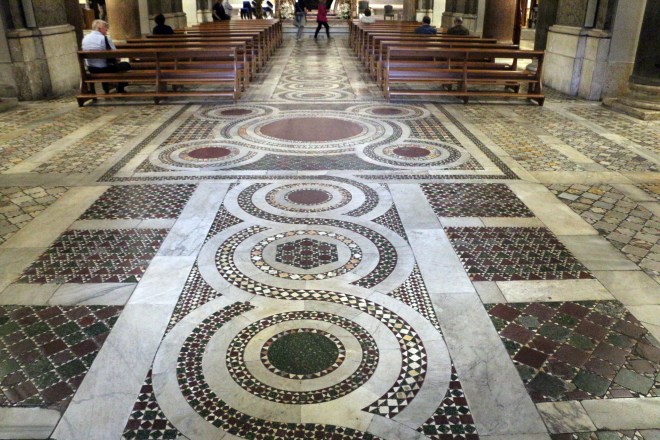
Why my anxiety to inspect the pavement? Well, the Abbey’s Cosmatesque pavement is quite remarkable, simply because it really shouldn’t be there. One finds this style of pavement primarily in and around Rome, where it was developed from the end of the 11th Century to the 13th Century by a number of families of artisans, the most well-known of which were the Cosmati, who have given their name to the style. As a rule, Cosmatesque pavements have white or light-coloured marbles for background, into which have been inlaid triangles, squares, parallelograms, and circles of darker stones. These are surrounded by ribbons of mosaic composed of coloured and gold-glass tesseræ. The result are lovely geometrical designs of swirling colours over the floor. Here are some of the best examples that have come down to us.

Basilica di San Clemente:

Source

Basilica di Santa Maria in Cosmedin

Source

Basilica di Santa Croce in Gerusalemme
Source

Basilica di San Lorenzo fuori le Mura

Source

Basilica di San Saba

Source

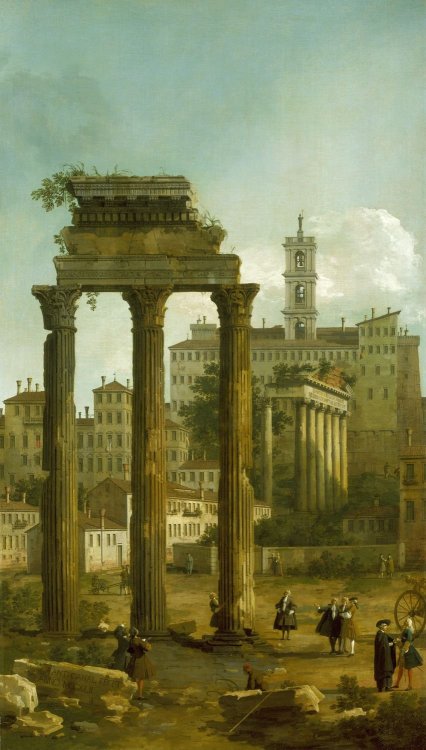
The artisans laying down these pavements recycled much of the stones they used from the copious ancient Roman ruins that still littered Rome and its environs; the circles in particular were sliced off columns that couldn’t be used as columns any more. The artisans would dig through old ruins, looking for marble to salvage (with one of their side businesses being selling off the statues which they came across during their digs). This painting by Canaletto is from many centuries later, and it just shows people visiting the ruins in Rome rather than digging into them, but it gives a nice impression of what it must have been like to live with all those ruins around one.
Source

The sources I’ve read talk airily about examples of Cosmatesque work also existing north of the Alps, although the only example they ever cite is Westminster Abbey. I haven’t been able to find a single other example of Cosmatesque pavement outside of the Roman heartlands, not even in the north of Italy (if any readers know of examples outside Italy, please let me know). So  the presence of a Cosmatesque pavement in Westminster Abbey is indeed pretty remarkable. How come there is this one isolated example north of the Alps?

The answer to that question lies in the history of Westminster Abbey. The Abbey has always had a special relationship with the English (and later, British) crown, ever since King Edward the Confessor in the 1040s established his royal palace by the banks of the river Thames west of the city of London and decided to re-endow and greatly enlarge a small Benedictine monastery already located there. This included building the first cathedral, the “west minster” (as opposed to the “east minster”, St. Paul’s cathedral, in the city of London). Here, we have a scene from the Bayeux tapestry, showing the funeral procession of Edward the Confessor, bringing him to his cathedral where he was buried.

Source

Thereafter, the English kings patronised the abbey and its cathedral, with all the coronations of English (and then British) monarchs from 1066 onwards (bar two) taking place in the cathedral.

Presumably as a reflection of its special royal status, in the period we’re interested in, namely the second half of the 13th Century, the Abbot reported directly to the papacy and not to any local bishop as would normally have been the case. This meant that it was the Pope who approved the choice of abbot made by Westminster’s monks. Which explains why, in 1258, a certain Richard de Ware, whom the monks of Westminster had chosen as their new abbot, travelled down to Rome to obtain the necessary papal approval. It just so happened that the pope and his court were residing in the town of Agnani, some 60 km south-east of Rome, when Richard arrived (for a while, it was a popular place for Popes to spend their summers). So Richard made his way there. He of course visited the cathedral in Agnani, where he was captivated by its Cosmatesque pavement. I deliberately left this pavement out from the examples I gave above so that I could show it here in all its splendour and imagine Richard de Ware’s feelings when he set eyes on it. The first photo shows the pavement in the main church, the second the pavement in the crypt.

Source
Source

It seems that Richard lusted after this pavement: “I must have it in my abbey church!”, I can hear him cry (in Latin) to the assistants who travelled with him (ever since the beginning of time, Important People have had what the Italians call portaborse, or bag carriers, to accompany them wherever they go).

Richard was probably encouraged to have these lustful thoughts because Westminster Abbey was in the middle of a total makeover. In 1245, England’s king, Henry III, had launched a rebuilding programme of the cathedral, adopting the-then ultramodern Gothic style. I presume that when Richard got back from Agnani, he persuaded Henry that a Cosmatesque pavement in front of the high altar was de rigeur if the cathedral was to be fully at the architectural cutting edge. But it took another ten years for the pavement to be laid. Work on the cathedral’s makeover proceeded fitfully; Henry was always chronically short of funds, and he was constantly at war with his Barons (at one point, he was even their prisoner). But finally, in 1268, after Richard got a team of artisans headed by a certain Odoricus to come from Rome to do the work, the pavement in front of the high altar was finished.

Source

If I’ve repeated the photo of Westminster Abbey’s pavement, it’s to allow readers to compare it better to the pavement in the cathedral of Agnani and the other Roman and Lazian examples which I gave earlier. One fundamental difference jumps out: in Westminster, the background stone – the stone in which the rest of the stones are inlaid – is dark while in the Roman and Lazian examples it is white. I have to say, personally I feel that the Abbey’s pavement suffers from this change in background colour. A white background allows the geometric patterns and swirls to stand out much more effectively. The only reason I’ve found in my readings for this change of colour is that the white Carrara marble used in Italy suffers in damp climates – and heaven knows the UK is damp! But maybe English tastes were anyway for dark stone. Certainly the stone used – Purbeck marble, which comes from a quarry near Bournemouth in Dorset – was popular in English church architecture; it’s to be found in virtually all of the cathedrals in the south of England. Here, we have quarriers of Purbeck marble from 150 or so years ago.

Source

Considering now the design of the pavement, I can assure readers that there is a meaning to the way it was laid out. Cutting through all the symbolic froth, it evokes a sacred centre of the world, what the Ancient Greeks called the omphalion, the navel of the world, which in turn is at the centre of the universe. And it is on that omphalion in the centre of Westminster Abbey’s pavement that the clergy will place coronation chair on which Charles will sit to be crowned, as they have for all the English and British monarchs (bar two, as I said earlier) who have come before him. I show here a photo of the previous coronation, of Queen Elizabeth II – as readers will note, the pavement was covered up that time.

Source

There’s more heavy symbolism to the pavement’s design, alluded to by the Latin inscription which ran around it but of which very little is left today. Luckily, several hundred years ago, someone transcribed it while it was still legible. It said (translated from the original Latin):

In the year of Christ one thousand two hundred and twelve plus sixty minus four, the third King Henry, the city [of London, presumably], Odoricus [the head of the crew which laid the pavement] and the abbot [Richard de Ware] put these porphyry stones together. If the reader wisely considers all that is laid down, he will find here the end of the primum mobile; a hedge [lives for] three years, add dogs and horses and men, stags and ravens, eagles, enormous whales, the world: each one following triples the years of the one before.

According to scholars who have spent many hours parsing this gobbledygook, it shows that the pavement was meant to symbolise not only the world and the universe, but also to predict the number of years to its end. Very reminiscent of Dan Brown’s “Da Vinci Code”!

Source

The stones set into the dark Purbeck marble tell us another story, a story of trade, one of the many which I have recounted in these posts. Looking at the Westminster pavement, we can trace a story of a trade in stones across the Roman Empire, the breakdown of that trade as the Roman Empire collapsed, and – as Europe developed economically – its replacement by a European trade in stones. To appreciate these trade flows, readers have to know that the pavement we see today in the Abbey is not exactly the original. Three limited restorations have been carried out over the ages – one in the mid-17th Century, one at the turn of the 18th Century, and a final one in the mid-19th Century – where some of the original stones, worn or lost, were replaced by other stones.

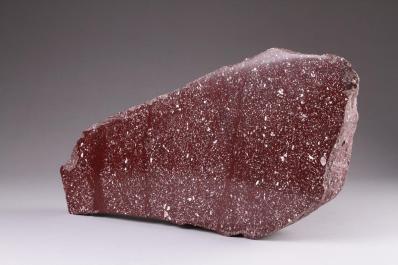
In the original parts of the pavement, purple and green porphyry are the most abundant inlaid stones. Purple porphyry was the “imperial” stone in the Roman and Byzantine Empires (purple being the imperial colour), and it could only be used in connection with the Emperors and their closest family.
Source

That’s why, for instance, the sculpture of the four Tetrarchs (who between them reigned over the Roman Empire in the late 290s, early 300s AD), which today is set into the corner of St. Mark’s Basilica in Venice, is made with porphyry.
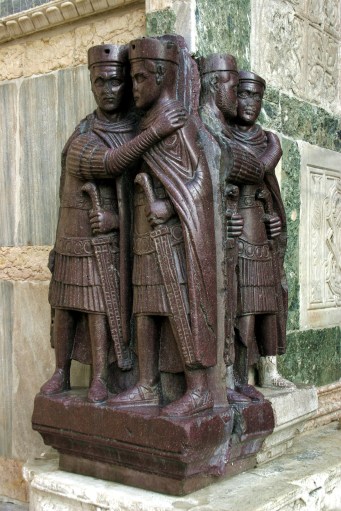
Source

This stone is found in only one set of quarries, located in Egypt’s harsh Eastern Desert. The Romans, and the Byzantines after them, mined it there and transported it all over the Empire. This is a photo of the mountain that the Romans called Mons Porphyris, with remains of the Roman mining town in the foreground.

Source

When the Byzantines lost control of Egypt to the Arabs in the 7th Century, they lost access to porphyry. Thereafter, they were forced to recycle the porphyry already scattered around the Empire.

The green porphyry, on the other hand, originally came from quarries in the Greek Peloponnese.

Source

The quarries were located near the small town of Krokees, not too far from Sparta.

Source

This stone too was traded all over the Empire, a trade that sputtered to a halt after the 5th Century AD as the Empire began to fall apart. The location of the quarries was forgotten and they were only recently rediscovered.

Surprisingly, given the highly symbolic nature of the pavement, porphyry was not used in the central roundel, where the monarchs are crowned. Instead, an alabaster stone was used.

Source

The precise provenance of this alabaster (also used in several other places in the pavement) is not known, but in all probability it was mined somewhere in what is now Turkey but what was in Roman times called Asia Minor.

Odoricus and his crew used a few other stones in minor quantities: africano, a red and black marble breccia, which was also quarried in Asia Minor near what is today Izmir; breccia corallina, a breccia of white marble in a coral-pink matrix, also quarried in Asia Minor, but in what used to be the ancient kingdom of Bythinia; and gabbro, another stone that was quarried in Egypt’s Eastern Desert.

By the time the Westminster pavement was laid down, the trade in these stones had been dead for some 800 years. So contemporary trade was not their source. Just as the stones in the Cosmatesque pavements in Rome were extracted from the Roman ruins scattered around the city, they could have come as spolia from England’s sparse Roman ruins. But Richard de Ware left us a message which suggests that Rome was the source. His grave (which lies on the north side of the pavement) once carried an inscription, which read (in Latin): “Abbot Richard de Ware, who rests here, now bears those stones which he himself bore hither from the City”, in this case the Eternal City, Rome. I can’t believe that Richard’s entourage personally carried the stones back from Rome, like bags of swag slung over their shoulders. I take the inscription to mean that when he got Odoricus and his crew to come from Rome, they brought with them the necessary stones, excavated from the Roman ruins in and around the city.

Interestingly enough, one stone which is common in Rome’s Cosmatesque pavements, but which for some reason Odoricus brought very little of, is giallo antico, a yellow limestone. Here is a nice example of a Cosmatesque use of this stone, in a roundel in the church of San Benedetto in Piscinula.
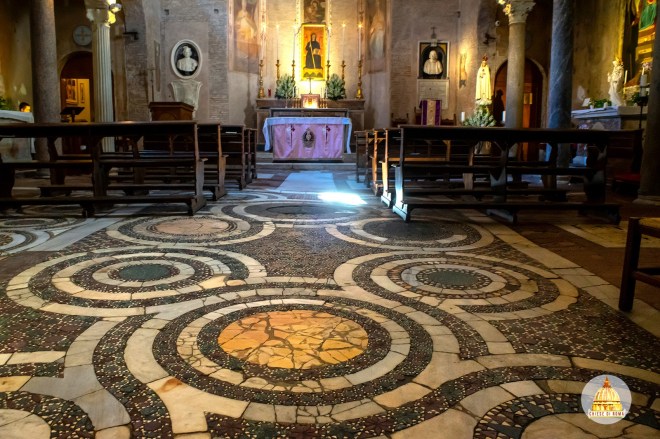
Source

It was used extensively by the Romans and was mined by them in quarries near Carthage in what is now Tunisia.

Sources

The few pieces of this stone in the Westminster pavement have been supplemented by an English stone, Tadcaster limestone from North Yorkshire.

Fast-forward 3½-4 Centuries, to when repairs needed to be carried out to the pavement, and the picture had changed. Stones were being traded once again across Europe. And so, to fill in pieces of missing purple porphyry, ammonitico rosso from the Alps near Verona was used, as was rouge royale, a red limestone from the area around Dinant in Belgium. Any missing green porphyry was substituted either by verde genova, which comes from the mountains lying between Piedmont and Liguria, or verde di Prato, which is mined on the Tuscan side of the Appenines. Where dark-coloured stones needed replacing, a couple of black/grey-black limestones from Belgium were used.

So many interesting things to ponder on! Medieval symbolism, international trade through the ages, political ties between England and Rome in the Middle Ages, and who knows what else! But I can’t do any of this pondering if my wife and I don’t get invited to Charles’s coronation! What can I do to unhook an invite? What favours owed to me can I call in? Let me check my list of contacts for Important Persons whom I can importune to help me get invites. Two measly invites is all I’m looking for!

STOP THE PRESSES! I have just learned that for a limited period just after the coronation, tours are being offered of Westminster Abbey which will include visiting the pavement (shoeless, of course). Unfortunately, all the tickets are already sold out. Who can I buy tickets from, no doubt at highly inflated prices?

THE ONE THAT NEARLY GOT AWAY

Vienna, 20 February 2023

I’m normally quite good at writing posts about the wonderful experiences which my wife and I have enjoyed as we pass through this Autumn of our lives. Sometimes, though, they escape me. We get carried along by the River of Life as it rolls remorselessly on and soon something else has happened which becomes the topic of my next post. That experience disappears from the rear-view mirror and is gone for ever.

This post is about one such experience, which I am determined will not wriggle free of my electronic pen, because it was simply too wonderful not to document. It’s been eight years since it occurred but it has never quite disappeared from my mind’s eye. Every time the memories resurface, I castigate myself for my laziness and vow to write That Post. I am finally making good on that vow.

As I said, I have to take my readers back eight years, when we went to spend the Christmas break in Mexico with our son and daughter – he was working there, and she flew down from New York where she was working. As a last trip before we went back to Bangkok, where I was stationed at the time, the two of us along with our son (our daughter had had to go back) flew down to the state of Chiapas, which borders with Guatemala. We had arranged for a car and driver to pick us up in Tuxtla Gutiérrez, from which we were to take a one-week tour. The itinerary was put together by an agency, with limited input from our side; we were happy to go along with their recommendations. And so we found ourselves going to the Sumidero Canyon, San Cristobal de las Casas, Palenque, a couple of Mayan ruins in the Reserva de la Biósfera Monte Azules down by the Guatemalan border, and finishing off in Villahermosa in the neighbouring state of Tabasco (I had to check our photos floating around in the i-cloud to remember where we’d been).

Ever since my wife and I, together with my mother-in-law, had toured central and southern Mexico back in the early 1980s, I have had an enduring fascination for the ruins of pre-Hispanic Mesoamerican civilisations. On that earlier trip, we had visited Palenque, so I looked forward to revisiting the site. Alas, the intervening years have not been kind. The site was in good shape, I hasten to say; that wasn’t the problem. Actually, the site was in too good a shape, very much tamed, with the surrounding semi-tropical vegetation cut back and kept under control, a far cry from my memory of Palenque as a place where the ruins poked out of the jungle. And it was terribly crowded! The curse of having been declared a UNESCO World Heritage Site, I’m sure. So I’m afraid to say I felt slightly deflated after the visit.

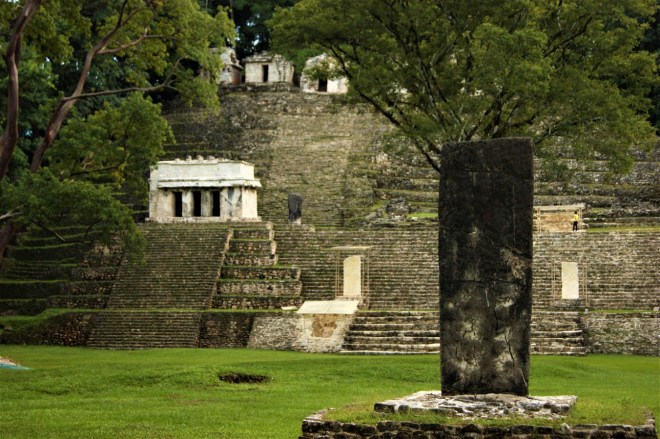
The next day, the driver announced that we would be visiting two other Mayan sites today. They were quite remote, requiring us to drive a good long way down to the Guatemalan border. It all sounded very intriguing, but after Palenque I, for one, was game for a little adventure. So off we went, down this rather minor road, with our driver doing some alarming overtaking along the way. After a while, we reached the first site, Bonampak, which lay just off the road.

Source

Its main claim to fame are its murals, which are indeed quite remarkable. I thought of inserting here some of our photos of these murals which are adrift in my i-cloud, but I find that other photos available on the internet are much better, so as is my habit I have instead shamelessly lifted these two photos, showing some of the murals.

Source
Source

On we drove, until finally we reached a river (I later learned that Guatemala started on the other side). Our driver parked the car and we got out. Where was the site, we asked, looking around. Oh no, he said, you could only get to the site by boat. We would be taking one of the boats (rather frail-looking, I found) pulled up on the bank, and it would take us about 40 minutes to get there.

out photo

And with that, he handed us over to the skipper of one of the boats and brightly informed us that he’d be waiting for us. Right, we said, and took our seats somewhat gingerly in the boat. As the skipper roared off upstream, I was feeling quite like Indiana Jones setting off into the jungle to discover a long-lost temple stuffed with gold.

Source

A sudden squall of rain dampened the thrill, especially as our trousers and shoes began to get seriously wet. But the rain left mist trailing romantically through the increasingly thick jungle on the Mexican side of the river.

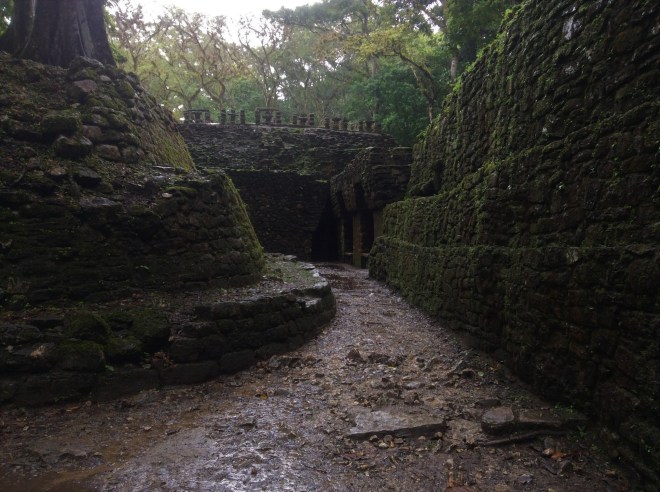
Finally, our skipper pulled up to a jetty and motioned us to take a path which disappeared off into the jungle. And so we climbed up through thick vegetation until we finally entered some moss-covered ruins jutting out of the jungle.

Our photo

The path led us to a dark, creepy corridor, which we felt our way along

Our photo

until we finally exited back into the light.

Our photo

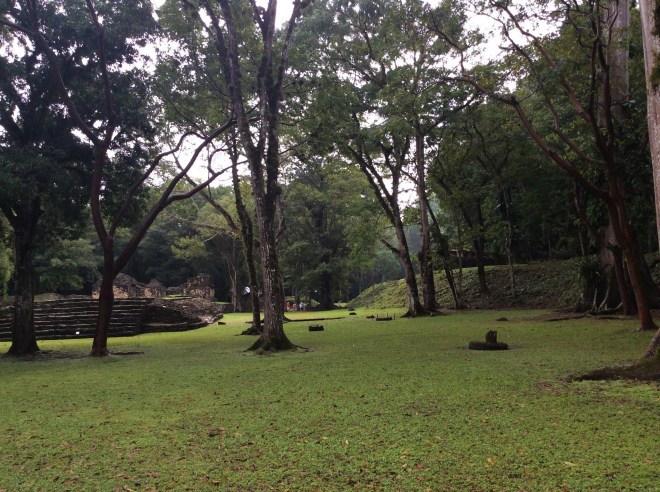
We walked into a clearing, where we could see other ruins peaking out of the surrounding jungle.

Our photo

We had entered the ancient Mayan city of Yaxchilán.

I find any ancient ruin fascinating – the pull of a place once the centre of a vibrant life but now just a tumbled pile of mouldering stones. Others before me have captured this melancholy fascination of ruins in words much better than mine. Sultan Mehmet II, the Ottoman conqueror of Constantinople, is said to have murmured a distich by the Persian poet Ferdowsi as he surveyed the ruins of what had been the Sacred Palace of the emperors of Byzantium:

The Spider has wove her web in the imperial palace,
The Owl has sung her watch song upon the towers of Samarkand.

While an anonymous Anglo-Saxon penned these lines about Roman ruins he encountered somewhere in Britain:

Wondrous is this wall-stead, wasted by fate.
Battlements broken, giant’s work shattered.
Roofs are in ruin, towers destroyed,
Broken the barred gate, rime on the plaster,

Walls gape, torn up, destroyed, consumed by age.
A hundred generations have passed.
Earth-grip holds the proud builders, departed, long lost,
In the hard grasp of the grave. How often has this wall,

Hoary with lichen, red-stained, outlasted the passing reigns,
Withstanding the storms; the high arch now has fallen …

(At this point, there is a gap, for the parchment on which the poem was written has itself suffered badly from the passage of time).

But there is something very special about ruins like Yaxchilàn immersed in jungle. It has to do, I think, with Nature much more obviously reclaiming what is hers, a powerful reminder of the warning uttered endlessly by the catholic priests of my boyhood on Ash Wednesday as they crossed your forehead with ash, “Remember, man, that thou art dust, and to dust thou shalt return.” That sense of Nature slowly growing back and smothering men’s foolish dreams in stone is overpowering in Angkor Wat, of which this one photo, endlessly reproduced, is a potent example.

Source

But it was also there in Yaxchilàn, all the more so since the overcast weather gave the site a brooding feel.

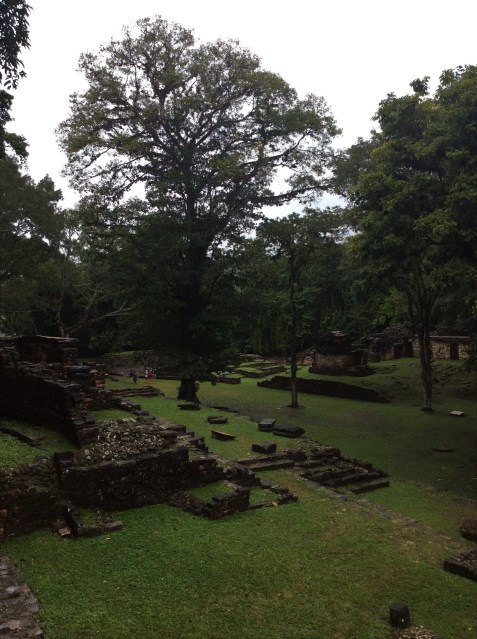
And so, with the site more or less to ourselves, we wandered from ruin to ruin.

Our photo
Our photo
Our photo

Finally, we climbed a long flight of stairs that disappeared up into the surrounding vegetation.

Our photo

At the top of which there was this structure.

Source

And beyond which rolled away to the horizon the thick jungle of the Reserva de la Biósfera Monte Azules.

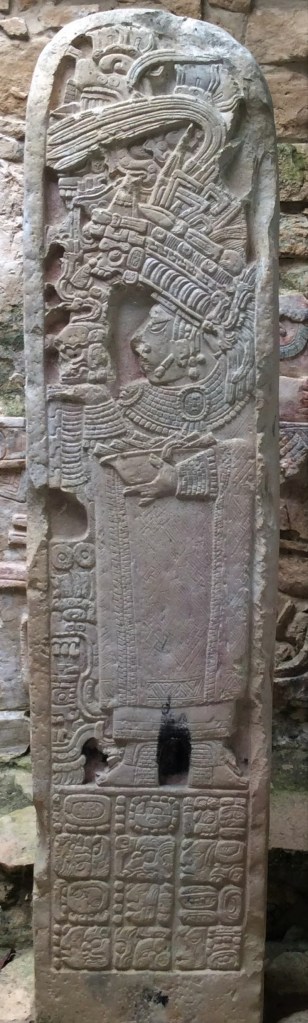
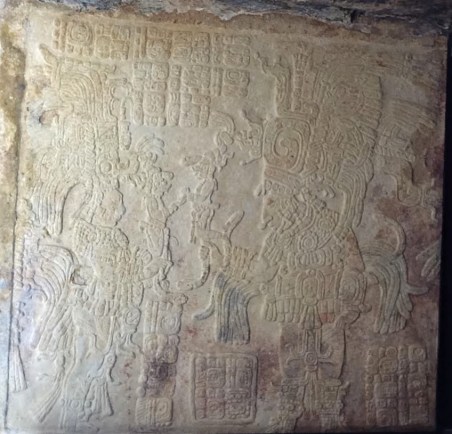
As we walked around we came across carved stone steles showing the proud rulers of this once thriving city state.

Our photo
Our photo
Our photo
Our photo

Looking at them, it was hard not to murmur Shelley’s Ozymandias:

I met a traveller from an antique land
Who said: Two vast and trunkless legs of stone
Stand in the desert. Near them, on the sand,
Half sunk, a shattered visage lies, whose frown,
And wrinkled lip, and sneer of cold command,
Tell that its sculptor well those passions read
Which yet survive, stamped on these lifeless things,
The hand that mocked them and the heart that fed:
And on the pedestal these words appear:
“My name is Ozymandias, king of kings:
Look on my works, ye Mighty, and despair!”
Nothing beside remains. Round the decay
Of that colossal wreck, boundless and bare
The lone and level sands stretch far away

And so we travellers walked back down to the river, got into our boat, and skimmed along the river to our waiting driver.

SERENDIPITY

Milan, 20 January 2023

I love serendipity, those moments in life when, quite by chance, something wonderful happens to you. Such a moment occurred a month or so ago now, when my wife and I, free for the day from our babysitting duties, headed off to LA’s Chinatown, to have our hair cut and to nose around a little. Pleasant as this all was, it was not where the serendipitous moment occurred. It was later, when we decided to walk from Chinatown to Bunker Hill, hoping to catch an exhibition at the Broad Museum or the Museum of Contemporary Art, which both sit on that hill. There was indeed a wonderful exhibition at MOCA, but fascinating as it was, it was also not there that the serendipitous moment occurred. It happened on the way; by sheer chance, I chose a route which took us past LA’s Catholic Cathedral of Our Lady of the Angels.

I cannot stress strongly enough, one should never go past a church without visiting it. For two thousand years, churches have been the repositories of some of the best art our cultures have produced (as indeed have temples and other sites of worship the world over), so there are very good chances that there will be something interesting to see in every church. The Cathedral of our Lady of the Angels was a brilliant example of the truth of my injunction, “Enter that church! Do not walk past it!”

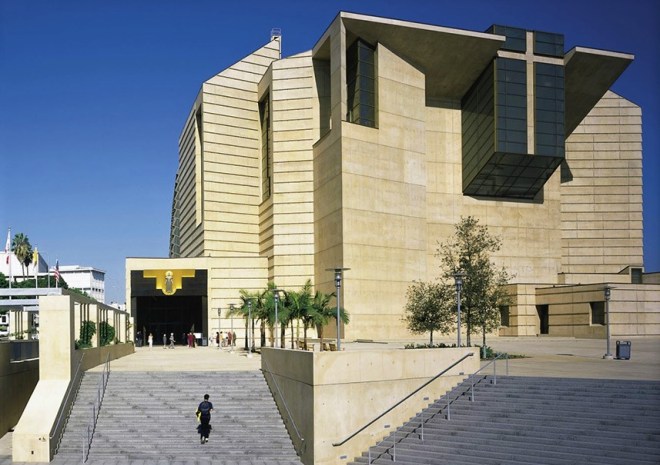
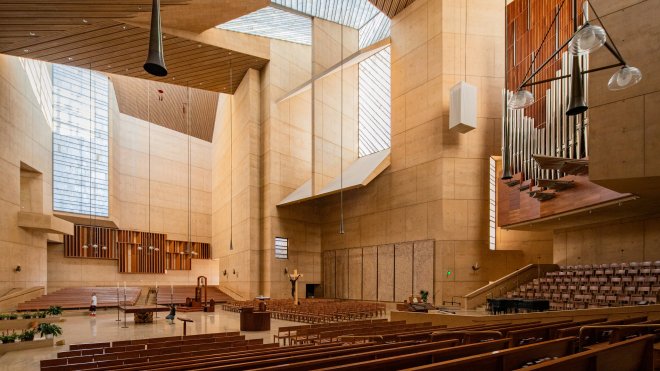
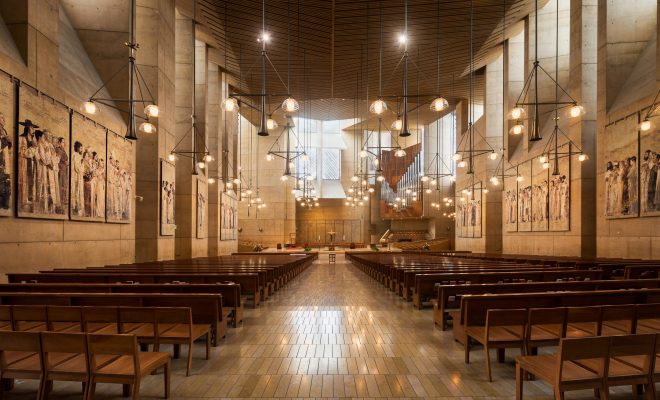
The cathedral itself, opened in 2002, is certainly an interesting example of postmodern design by the Spanish architect Rafael Moneo (who also designed the fantastic museum of Roman Art in Merida, Spain, which my wife and I visited some 15 years ago; but that is another story). These two photos give an idea of what the cathedral looks like inside and out.

Source
Source

As I said, interesting. But the real jewel – that serendipitous moment – were the tapestries that lined the two walls of the nave. They were magnificent. They were designed by the Californian artist John Nava and woven in Belgium, a country with a centuries-old tradition in the making of tapestries.

This photo shows their general layout.

Source

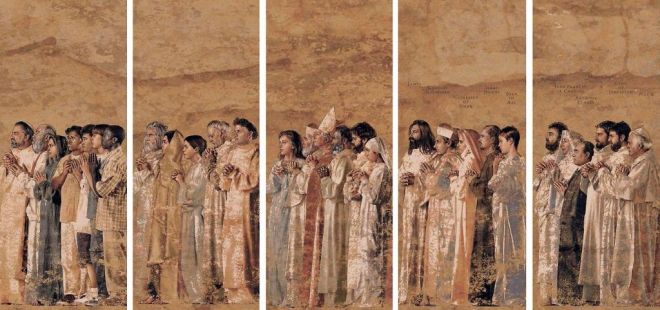
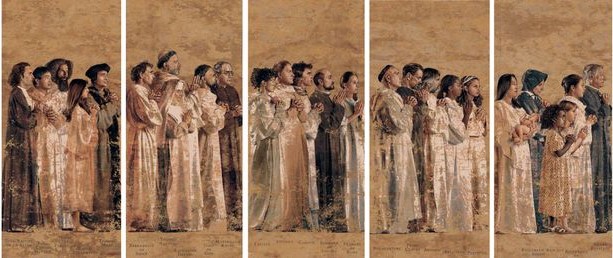
Readers with good eyes will be able to see that the tapestries depict a procession of people – women, men, children – moving towards the cross above the high altar. Closer inspection shows that most of these people are saints (or in certain cases blesseds). These photos show some of the panels (there are 26 of them in all).
Some of the tapestries on the southern wall:

Source

Sone of the tapestries on the northern wall:

Source

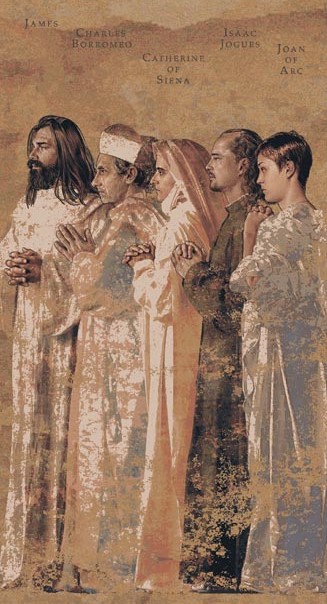
With the more modern saints, Nava used photos or contemporary paintings to create their likeness, otherwise he used family members, acquaintances, and models. He wanted his saints to look like real people, where we the viewers could say “hey, that looks awfully like so-and-so”.

The tapestries show quite a mix of saints and blesseds, from all over the world (although Europe does predominate) and across all ages. A good number I’m familiar with. My mother, may she rest in peace, used to ply me with comic books (graphic novels might be a more respectable term, given the subject matter) of the lives of various saints, to give me good examples to live up to. So, for instance, I’m familiar with Jean Vianney, the Curé d’Ars (the saint on the far right in this photo).

Source
Then there’s Saint Francis, a saint I am particularly fond of as I’ve written about in an earlier post (again, the saint on the far right of this photo).

Source

Then there’s San Carlo Borromeo; you cannot live in Milan for any length of time without coming across him multiple times (he’s the second from the left in the photo below).

Source

I’ve mentioned San Carlo a few times in my posts, and I think Nava has made his nose too small – all the paintings of the saint I’ve ever seen show that he had a monstrous conk.

Some are saints who were alive during my lifetime and with whom I have a certain familiarity – Mother Theresa and Pope John XXIII, for instance.

Source

I like the fact that Nava has mixed in a number of anonymous people with his saints and blesseds – mostly children, as we see in the first of these close-up photos – to remind us that we can all be saints (although, as history has sadly taught us, we can all be devils too; but we’ll draw a veil over that today).

Readers will see that while the faces which Nava created are intact, the clothes of many show gaps and scars, reminiscent of old frescoes which have been partly destroyed; a nice touch, I found.

Stumbling across these tapestries was wonderful enough. But what was even more delightful was that this modern procession of saints immediately brought to my mind another such procession, in a church nearly 10,000 km away and erected some 1,500 years before the cathedral of our Lady of the Angels: Sant’Apollinare Nuovo in Ravenna, a church which has been the subject of several of my earlier posts.

Source

Ravenna is one of my most favorite places in the world, filled as it is with early Christian churches whose interiors house mosaics. Any long-term readers of my blog will know that early Christian mosaics hold a special place in my heart. I still remember that morning in early July of 1975 when I walked into Sant’Apollinare Nuovo for the first time: another serendipitous moment. Callow youth that I was, I had put Ravenna on my itinerary because the Michelin Green Guide, which I was religiously following, assigned the town its maximum of three stars. I had no idea what to expect, and I was overcome by what I found before me. The walls of Sant’Apollinare glitter with wonderful mosaics showing a line of virgins and martyrs processing solemnly towards the high altar. In a sign of how things have changed in the intervening 1,500 years, whereas in the tapestries all the saints are mixed companionably together, in Ravenna they are rigorously segregated by gender, with the virgins processing down one wall and the martyrs (all male) processing down the other (they are also all white, showing the much more local reach of the Christian church then than now).

Here we have the procession of the virgins.

Source

And here, a little less clearly, we have the procession of the martyrs.

Source

I throw in a couple of close-ups to give readers a better sense of what the mosaics are like. Here, are some of the virgins, with names that we would recognize today – Christina, Caterina, Paulina.

Source

And here are some of the martyrs, with names like Clement and Laurence but also others which are far less familiar to us today – Sistus, Hypolitus, Cornelius.

Source

The other mosaics I discovered that day – in the churches of Sant’Apollinare in Classe and of San Vitale, in the Mausoleum of Galla Placidia, in the Baptistery of Neon and the Arian Baptistery – were just as magnificent and are forever etched in my mind.

Ah, the thrill of serendipity! Remember, readers: never pass a church (or a mosque, or a synagogue, or a temple, or a gurdwara) without going in! (if they allow you, that is) Chances are you’ll see something interesting, and sometimes you’ll find something wonderful.

SAINT NOTBURGA

Los Angeles, 26 September 2022

Just before my wife and I hurried over to Los Angeles to help our daughter, we spent a very pleasant long weekend in Innsbruck, celebrating our wedding anniversary. We actually weren’t visiting Innsbruck itself but rather using it as a base to do some hiking. As the city’s name indicates, it is situated on the river Inn. The valley down which the river flows is flanked on both sides by mountains, and it was these that we were there to hike, up, down and along.

Nevertheless, on the way to and from our hikes we found ourselves enjoying various parts of the old town through which we strode (on the way out) or shuffled (on the way back), and on the last morning we had time enough before our train left for Vienna to visit one museum. Being a fanatic believer in the Green Michelin Guide, I quickly looked up what museums it suggested to visit in Innsbruck, and discovered that this august publication bestowed its maximum encomium, three stars, on only one museum in the city: the Museum of Tyrolean Arts and Handicrafts. So the Museum of Tyrolean Arts and Handicrafts it was!

As usual, the Michelin Green Guide was spot on. I earnestly recommend any of my readers who are spending some time in Innsbruck to visit this museum. But this post is not really about the museum. It is about one particular painting which I chanced upon, of St. Notburga.

My photo

Well! As any faithful reader of my posts will know, I have a very soft spot for obscure saints, the obscurer the better. In my time, I have written posts about Saints Radegund, Pancras, Blaise (who is also, incidentally, the subject of a small painting in the museum), John of Nepomuk, Hubert, Peter of Verona, Fructuosus, and a few other odds and ends in the Saints’ Department. So it was clear from the moment I clapped eyes on the painting that I would have to write a post about her. The train journey back to Vienna gave me all the time I needed to do the background research.

St. Notburga’s story is quickly told, and hinges around three miracles. If she existed at all, and I for one have my doubts about that, she was born in 1265 or thereabouts, into a humble family living in the small town of Rattenberg situated on the river Inn some 50 kilometres downstream from Innsbruck. So she was a Tyrolean girl.

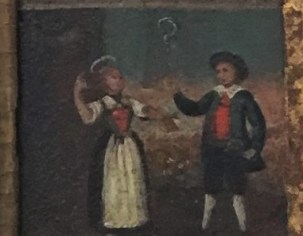
Some time in her teens, she went to work as a servant in the household of the local aristocrats, the Count and Countess of Rottenburg. She was – of course – a very good girl and was scandalized by the fact that the leftover food from the Count’s meals was fed to the pigs when there were lots of townsfolk who went hungry. So with the Count and Countess’s blessing, she collected the leftovers and distributed them to the poor. (From here on, I show, very blown-up, some of the scenes which circle the painting above. They are somewhat dark and fuzzy; if I had known about Notburga beforehand, I would have taken close-ups from the painting itself. Ah well …)

My photo

Alas! the Count died, and his son inherited his father’s title, lands, and servants. The new Count and his lady wife didn’t approve of Notburga’s good works at all. They wanted all the leftovers to go to their pigs. So the Countess, who was in charge of running the household, told Notburga to stop.

My photo

Being – of course – a very obedient girl, Notburga did as she was commanded. But how she suffered! So she decided to put aside some of her own food instead, especially on Fridays – being not only good but pious, she fasted on Fridays – and  gave this to the poor. The nasty Count and Countess didn’t like that either. As far as they were concerned, she was giving away their food, not hers, and saw this as theft. The Count decided to catch her in the act of leaving the castle with the food.

FIRST MIRACLE: So one Friday, Notburga was as usual carrying the food she had put aside for the poor in her apron and a jug of wine in her hand, when she encountered the Count and his entourage in the castle’s courtyard. He demanded to know what she was carrying. Notburga replied, “wood shavings and lye, Master”. The Count scoffed and commanded her to open her apron. Notburga obeyed, but in place of food, the Count saw only wood shavings and sawdust! Then he tried the wine, but tasted only lye!

My photo

Of course, the Count being a nasty man, he suspected that Notburga had played a trick on him and fired her. She accepted her fate with forbearance, and left the castle and moved to a small village of Eben on Lake Achen, some 20 kilometres from Ratenberg. Here we have her (I think) walking to Eben.

My photo

There, she was employed as a farm worker by a local farmer. She looked after the cattle and helped with the field work. Being, as I say, a very pious girl, Notburga only asked that the farmer let her stop work to pray when the bell first rang in the evening and let her go to Mass on Sunday and holy days, to which he graciously agreed.

SECOND MIRACLE: One afternoon, as always, Notburga stopped work when the first bell rang. But the weather was threatening to change, so the farmer demanded that no one stop until all the grain had been collected. Seeking divine assistance to make her case, Notburga raised up her sickle and said: “Let my sickle be judge between me and you.” She let go – and the sickle remained suspended in mid-air, caught on a ray of sunshine!

My photo

Frightened half out of his wits, the farmer let her stop working, and he never tried that one again!

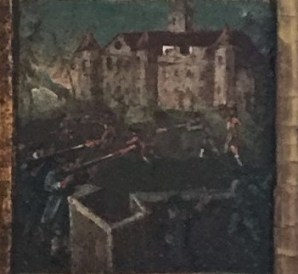
In the meantime, things were going very badly for Count Rottenburg. His pigs – the ones to whom the leftover food was given – were ravaged by some mysterious disease. His wife’s half-brother set the castle on fire after a bitter quarrel. Here, we have the half-brother attacking the castle.

My photo

Finally, his wife sickened and died. Many residents decided that the Count had been cursed and left. The Count began to ascribe all his misfortunes to his dismissal of Notburga. He sought her out, together with his new wife, and implored her to return to work for him.

My photo

She accepted, but only on condition that he let her resume her care for the poor. The Count immediately agreed, and of course his fortunes took a great turn for the better when Notburga came back. For 18 years, she served in the castle as nanny for the Count’s children, then cook, all the while continuing her charitable good works. She also succeeded in reconciling the Count with his first wife’s half-brother, the one who had very nearly burned the castle to the ground.

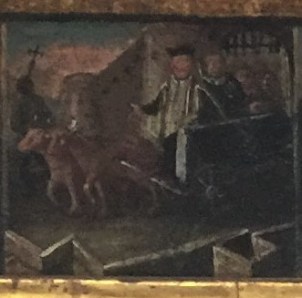
THIRD MIRACLE: In September of 1313, sensing that death was approaching, Notburga requested her master to place her corpse on a wagon drawn by two oxen and to bury her wherever the oxen would stand still. The Count did as she had asked. So off went the oxen, followed by the funeral procession.

My photo

When the cart reached the Inn, the river parted and all the mourners were able to cross to the other shore without harm!

My photo

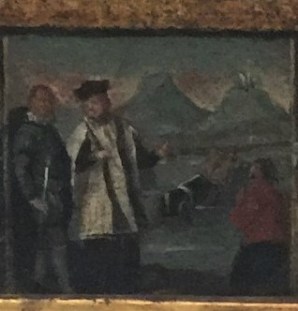
The oxen continued on their way, covering at a leisurely pace the 20 kilometres to Eben (the mourners must have all had sore feet by now). There, just outside a wayside chapel on the outskirts of Eben they finally stopped. With much pomp and ceremony, she was laid to rest in the chapel; it is even said that angels carried her coffin into the chapel.

My photo

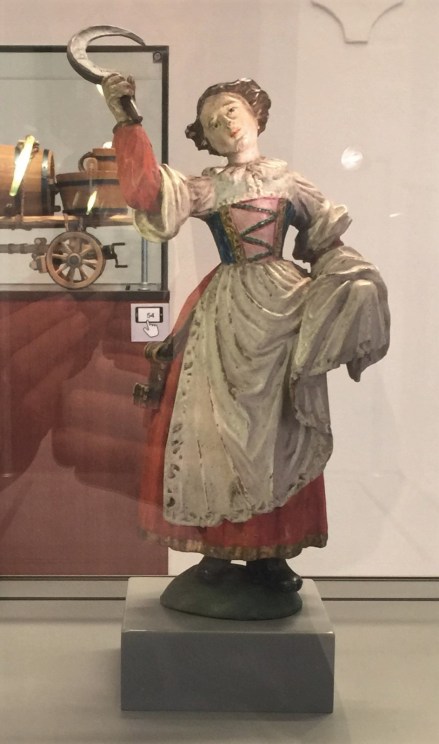
And that’s Notburga’s life wrapped up. Readers will have noted by now the importance of the sickle in Notburga’s life. Hence her being represented in the painting above prominently waving a sickle around. I insert here a statue of her which I also came across in the museum, again waving that sickle around.

My photo

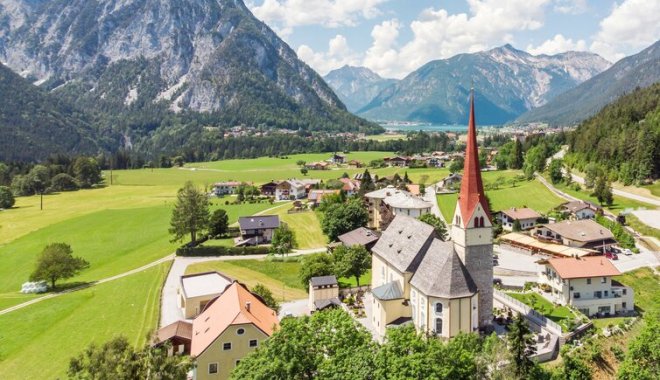
I have told her story somewhat tongue-in-cheek. Quite honestly, it’s difficult for me to see what was so saintly about her life. I find the miracles ascribed to almost akin to conjurors’ tricks. But somethings about her definitely captured the imagination of the rural folk of the Tyrol and contiguous areas. Pilgrimages to that little chapel in Eben started up and became big enough for Maximilian I (whose own mausoleum sits in the church next to the museum) to decide to have a bigger church built in the village at the beginning of the 16th Century. It got a late Baroque makeover a few centuries later. Here is an aerial view of the church, set in the beautiful Tyrolean landscape (it really is a beautiful part of the world).

Source

And here is a view of the church’s interior.

Source

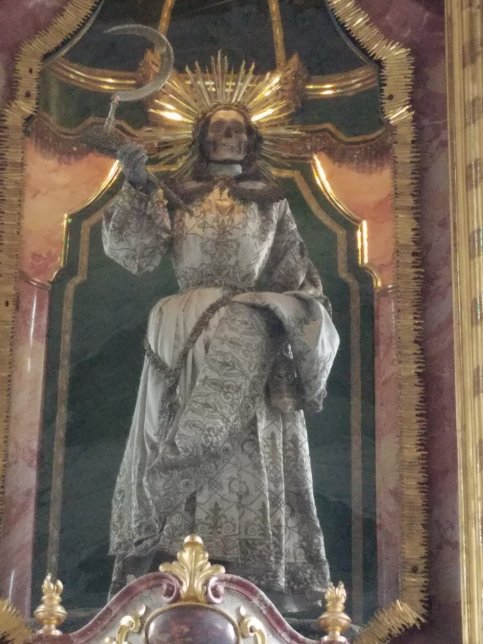
Her skeleton (or someone’s skeleton) was unearthed from the original chapel and, dressed in rich clothing, now rather macabrely presides over the church’s interior.

Source

Notburga was until recently one of the most revered saints in Tyrol and South Bavaria, as well as in East Styria and Slovenia (I would imagine that the general dechristianization of Europe has put paid to this, although a quick search on LinkedIn and Facebook show that there are still quite a lot of people called Notburga). Rural folk would ask for her intervention in many situations of distress, from human or animal sickness to threatening storms. Apart from her representation on religious furniture and furnishings (paintings, votive images, statues, stained glass windows, church bells, even offering boxes and holy water basins) her image could be found on all sorts of objects of everyday use like salt shakers, stove tiles, and cupboards. There are even tiny, 2 by 2.8 cm., pictures of her to be swallowed or “inhaled” from; they were used as part of religious folk medicine and belonged in the home apothecary. It was believed that consuming or breathing in from these little images would release Notburga’s healing powers. Little silver Notburga sickles were worn on watch chains and rosaries as amulets. Many songs, prayers and litanies were dedicated to her.

There are those who say that Notburga was a Christian personification of much older goddesses who were prayed to in the mountains. Her sickle, for instance, is considered as pointing to a connection with a moon goddess, a common goddess throughout Europe and indeed the world; we have here the Roman goddess Luna.

Source

Notburga’s association with fields, crops, grain and bread recalls the “grain mothers” like the Greek fertility goddess Demeter and the Roman Ceres.

Source

This could well all be true. But I see another thread in her story, the constant struggle of rural folk with hunger, linked at least in part to their exploitation by landowners, both big (aristocrats) and small (rich farmers). Those rich folk were wasting food? Ha! She took it all and redistributed it to us poor folk! The Count fired her? Ha! He sure suffered for having done that! The farmer insisted that his workers work long hours? Ha! She sure put the fear of God in him for doing that, and after that he behaved himself! It’s no coincidence that she is the patron saint of the downtrodden in rural areas: servants, female agricultural workers, and the peasantry in general. I can understand that people would pray to her to deal with the richer folk making their life miserable. Personally, though, I think unionization is the better way to go.

Source
Source

Just saying …

APEROL SPRITZ

Los Angeles, 26 December 2021

A Chinese reader very kindly sent me a comment recently on a post I had written about tomato ketchup. After reading his comment, and re-reading the post in question (I must confess to have forgotten much of what I’d written in that post), I started thinking fondly of the five years my wife and I spent in China (where, incidentally, I started this blog). And as my mind wandered over the Good Old Days, it alighted – in that odd way which wandering minds do – on a bar on the edges of Sanlitun in Beijing where we would go from time to time to have an Aperol Spritz. Yes, I know, it’s odd for a mind meandering through Chinese recollections to land on Aperol Spritz, but there you go, that’s globalization for you.

The thing is, once my mind had alighted on Aperol Spritz I had to investigate: What is this Aperol? What are its origins? And where did this Aperol Spritz thing come from? etc., etc.. What to do, for better or for worse that’s the way my mind works. In any event, I am now ready to report back on the results of my investigations.

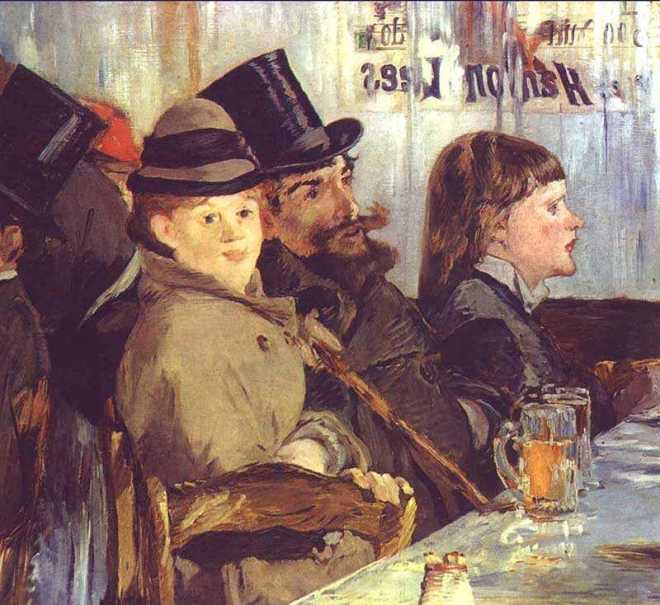
I will start my story in Paris, towards the end of the 19th Century. After Baron Haussmann had brutally driven his wide, straight boulevards through the city’s hodgepodge of medieval streets, a thriving café culture sprung up along them, with people of all classes loitering at the tables to sip a drink and natter with friends. We have here a painting by Manet depicting the café scene.

Source

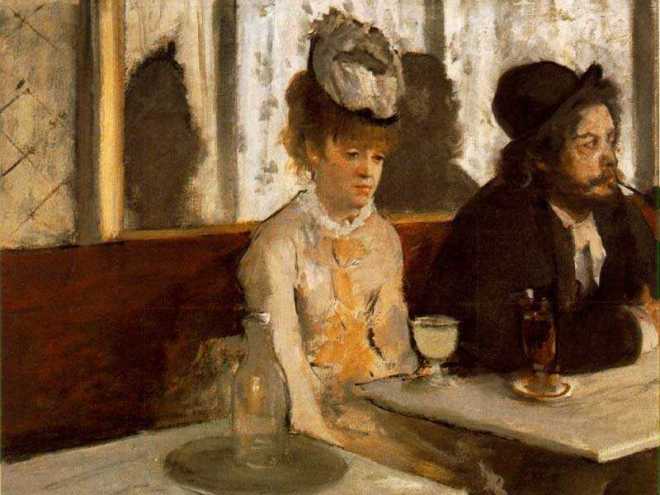
This happy lady appears to be drinking a traditional beer, but a new drink also made its appearance at this time: the apéritif . This apéritif was actually a retooling of a drink originally invented in the Middle Ages as a medicinal product, something to open your body up and let the bad vapours and whatnot escape (aperire being the Latin for “to open”). It was made by steeping and macerating various herbs and roots in wine (first) and alcohol (later). By the time the café culture along Paris’s boulevards came along, the apéritif had lost its medicinal connotations and was promoted instead as something to take before a meal to “open up” your appetite. We have a painting here by Degas of this new custom.

Source

Important for our story is the fact that the French quickly shortened the rather formal word apéritif into apéro, as in “Hey Jean, see you this afternoon at the Café du Peuple on the Boulevard de la Paix for an apéro”.

We now turn our attention to the town of Padova in northern Italy; for reasons which will become apparent in a second, I throw in a photo of the Basilica Sant’Antonio which is located in the city.

Source

There, in 1880, a certain Giuseppe Barbieri set up a liquor business, making and selling various alcoholic concoctions. One of his more popular offerings was Liquore Sant’Antonio, a liqueur made by steeping various herbs and roots in alcohol (“a sugar cube soaked in Liquore Sant’Antonio is an excellent sedative to take before going to bed” used to proclaim the label).

Source

In 1912, Giuseppe handed over the reins of the business to his two sons, Silvio and Luigi. We have a photo of them here in later life.

Source

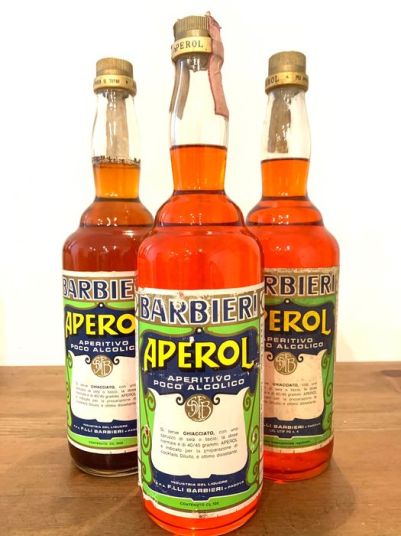
The two brothers spent the next seven years developing a new drink to add to the company’s line-up. Following the company’s experience with products like Liquore Sant’Antonio, it was to be a concoction of herbs and roots steeped and macerated in alcohol. But Silvio, who had spent many years in France where he had got to know the culture of the apéritif, persuaded Luigi that they should be developing an aperitif-like drink, not too alcoholic, to be taken before a meal to “open up” the appetite. After much tinkering, they came up in 1919 with a bright orange drink which, in honour of its connection to the French apéro culture, was baptized Aperol.

Source

What, readers might well ask, is in Aperol? The label only admits to the presence of alcohol (well, duhh!), water (ditto), sugar, and “flavourings”, which of course come from all those herbs and roots which are left to steep and macerate in the alcohol. Of these, the label only identifies quinine, although various internet sites add gentian, rhubarb, and cinchona, as well the rind of both sweet and sour oranges. One site also claims that a drop or two of absinthe is added to counteract the slightly bitter taste which all these ingredients would otherwise leave. All the other ingredients are, as usual, a tightly held secret (my eyes roll at this point; as I have intimated in earlier posts, I’m no fan of secrecy when it comes to ingredients).

None of these ingredients explain Aperol’s main visual characteristic, its bright orange colour. That no doubt comes from two food colourants which the label confesses to be present in the brew: the yellow E110 and the red E124. Now, it’s claimed that Aperol’s recipe has remained unchanged since its birth in 1919, but the Barbieri brothers cannot possibly have used these two modern, synthetic, colourants. My guess is that for their yellow colouring they used curcumin, extracted from turmeric, and for red they used cochineal.

Whatever gave Aperol its taste, it was an instant hit with the good citizens of Padova, where it was drunk either pure or mixed with a shot of soda water. Its fame spread quickly to other parts of northern Italy, and the serious money started rolling in. Thereafter, the trajectory followed by the Barbieri brothers was very similar to that taken by Davide Campari for his eponymous drink, a story which I have told in an earlier post.

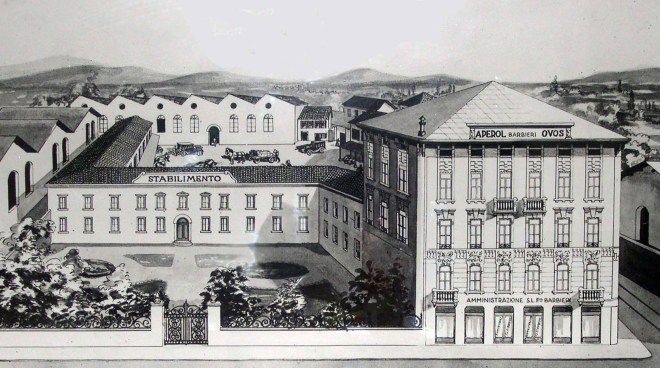
First, like Davide Campari, the brothers abandoned their father’s artisanal approach and built a modern factory to make their Aperol on an industrial scale.

Source

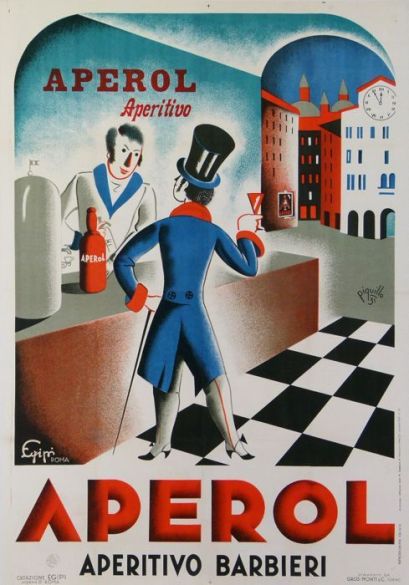
Second, again like Campari, recognizing that they were selling a product based on desire and not on need, Silvio and Luigi invested heavily in the black arts of enticement – or, if we are to be more polite, in what was then the new art form of advertising. Here are a few examples of the posters which the company created in the interwar years.

Source
Source
Source

If I’m to be honest, I think Campari did a better job in its advertising. I think readers would agree with this if they go to my post on Campari and look at the examples I give there of the advertising posters which Campari commissioned. The last one at least has the advantage of admitting publicly to three of Aperol’s ingredients.

The Second World War was not kind to the Barbieri brothers. Apart from the fact that sales must have been down, the Barbieri lost their factory to a bombing raid (the Campari family was luckier; they managed to keep their original factory, now a museum dedicated to the Campari story). Luckily for us, the Barbieri were undeterred and rebuilt after the War.

Which brings us – finally – to the Aperol Spritz, the drinking of which all those years ago in Beijing set me off on this post. The story of Aperol Spritz starts in the 1950s. But actually, we first need go back a little further. Originally, a spritz – a common drink in the Veneto region (of which Padova is part) – consisted of a glass of white wine into which sparkling water had been splashed (spritzen in Austrian German; Veneto was part of the Austro-Hungarian Empire at the time). Then, in the 1950s, and specifically in the province of Padova, bars began adding a shot of bitters to the traditional spritz. One of these bitters – but only one – was Aperol. Depending on the barman’s or drinker’s inclinations and on what was available behind the bar, the bitter added could be Cynar, Select, Campari, China Martini, maybe some locally-made bitter, as well as Aperol. In fact, it is still possible to find barmen in the Veneto region who will serve you a spritz with one of these other bitters. In any event, this new take on the spritz went well with the dolce vita which took hold of Italy in the fifties and sixties, captured so well in Fellini’s film of the same name.

Source
Source
Source

By dint of persistent advertising, especially in the new medium of television, Aperol became a national brand. There was an incredibly famous (for Italians) TV show called Carosello which ran pretty much every day of the year for all of the 1960s and much of the 1970s. The show was basically a way for the Italian Television monopoly RAI to get around the strict rules on advertising. Carosello was made up of a series of skits which each ended with an advert for some product or other. Aperol was a regular contributor. My wife used to religiously watch the show every evening and speaks very fondly of it. Even today, nearly fifty years after last seeing it, she can quote some of the more famous advertising tag lines. I’m sure she remembers Aperol’s, which had the presenter smack his forehead and exclaim “Ah! Aperol!” Here we have him doing it with a bunch of young people who of course were now the intended target audience for Aperol.

Source

In parallel, the Barbieri (by now, the next generation had taken over) aggressively pushed Aperol as the bitter of choice for the new-type spritz. Here are some examples of the advertising posters they used to promote the Aperol Spritz.

Source
Source
Source

As we can see, the ads began to appeal to a hipper, cooler, more chilled set. This was typified by a famous (to Italians) TV ad from the late 1980s, featuring a pretty woman in Miami hitching up her miniskirt provocatively before getting on her motorbike and setting out to meet her cool, chilled friends for an Aperol Spritz.

Watch the video here

In the meantime, the Barbieri got caught up in the Great Game of brand purchases by Corporate behemoths, which I have bemoaned in previous posts. In 1991, the family sold Aperol and a few other brands to the Irish company Cantrell & Cochrane, itself part of the multinational Allied Lions. The new owners began to internationalize Aperol and Aperol Spritz. The German world was an early market (where the Aperol Spritz was germanized to Aperol Gespritz), and then the US market opened its arms to the orange concoction.

In 2003, the Great Game of brand buying and selling saw Cantrell & Cochrane sell Aperol to Campari (which explains why I have sneakily been making comparisons to Campari as I went along). Campari put heavyweight advertising behind Aperol and the Spritz, which turbocharged Aperol’s global diffusion. Thus, hopping from one bar to another, the Aperol Spritz eventually made its way to that bar in Sanlitun where my wife and I would go from time to time to sample an Aperol Spritz, sitting at the bar’s terrace, watching the world go by. Since we are neither hip, nor cool, nor chilled, by this time (we are talking 2010 or thereabouts) Aperol Spritz had clearly gone mainstream.

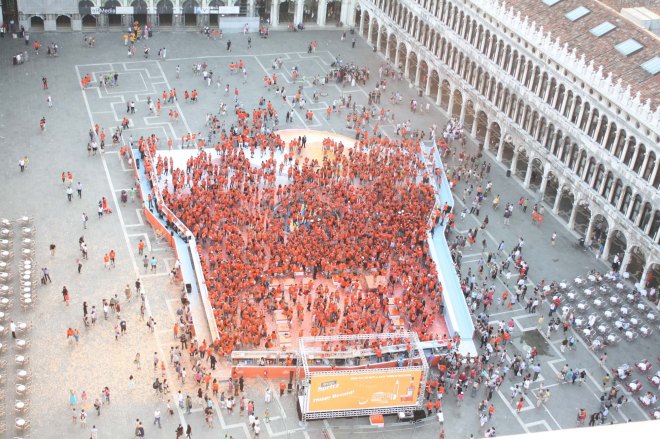
I have since discovered that we had joined a Global Movement! On 29 June 2012, some 2,600 Aperol fans descended on Piazza San Marco in Venice to attempt a Guinness World Record for the “Largest Aperol Spritz Toast”. Here we have the joyous crowd clinking their glasses (I like the T-shirt! Wonder where I can get one?)

Source
Source

And so we come to 2019, the centenary of Aperol. To celebrate this earth-shaking event, Campari commissioned a series of designs for centenary labels.

Source
Source

So, dear readers, buy yourselves a bottle of Aperol! Go ahead and make yourselves an Aperol Spritz this evening! Bring in the New Year with an Aperol Spritz! FYI, in case you’ve never made one yourselves, the International Bartender Association’s recipe for the Aperol Spritz has you mixing 9 cl of prosecco with 6 cl of Aperol and as much as soda water or seltzer as necessary.

Cheers!

Source

PRETTY INDUSTRIAL CHIMNEYS

Milan, 12 December 2021

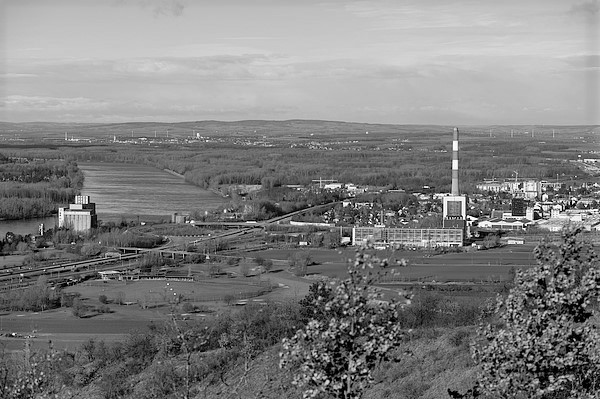
If there’s one thing that will always depress me when I see them, it’s those tall industrial chimneys belching out white clouds of steam (sometimes tinged a faint orange by the oxides of nitrogen they can contain, depending on which way the sun is shining). Here’s a typical example of the genre, this one a frequent sight on our hikes upstream of Vienna – it belongs to a power plant.

Source

It’s all that grey concrete that does it, often topped with garish red and white stripes to keep planes from flying into them. Just so ugly! And so damned tall that you can’t ignore them!! So in your face!!! They just drain any brightness and colour out of the surrounding landscape.
I almost think that the older designs of brick chimneys were nicer on the eye. They were less high for one thing, and – at least in some models – took the form of long thin cones, which are considerably more elegant than mere cylinders. But that black smoke which they routinely belched out! Like in this British painting from about 1830.

View of Rotherham, South Yorkshire (c. 1830) by William Cowen (1791-1864). Photo credit: Rotherham Heritage Services

The fact that someone actually painted all that black muck shows how our sensitivities have changed in the last fifty years or so. When the artist painted this, black smoke was a thing to be celebrated, it meant the economy was growing. Now, we think instead that the company’s top managers should be in jail for allowing it to happen.

But back to today’s industrial chimneys. Among all the gloom they have brought to my life, there have been two bright shafts of light over the years, caused by chimneys which I’ve actually enjoyed looking at. The first of these is a chimney in Vienna which belongs to a waste incinerator.

Source

Wonderful piece of work! The design, both of the chimney as well as the rest of the facility, is due to an Austrian artist by the name of Friedensreich Hundertwasser. His normal output looks like this.

Source

I’m sure readers can see the relation between this type of work and his chimney design.

The incinerator has been originally built in the late 1960s, but needed extensive repairs after a fire broke out in 1987. I was told that the mayor of Vienna brought Hundertwasser in to redesign the facades of the facility as well as the chimney, because the local community was up in arms about the city fathers’ plan to continue having a working incinerator in their neighbourhood. Hundertwasser, who was quite an environmentalist, was only persuaded to accept the commission when he was promised that the most up-to-date emissions abatement technology would be installed – and in fact the chimney hardly ever gives off anything. I must say I’m quite glad Hundertwasser accepted the commission, because he created what must be the jauntiest waste incinerator in the world. It makes you almost want to work there (almost …)

It was the second sighting, that of the chimney of another waste incinerator on the outskirts of Milan, which moved me to write this post, although it has taken me nearly nine months to get around to it. Last April, after the success of the hike my wife and I did from Milan to Monza, I decided to do a similar hike in another direction. I chose the direction pretty much at random, which meant, among other things, that there was one stretch where we had to walk along a very busy road with trucks thundering by and no space on the edge of the road for us to walk on. My wife regularly reminds me of this walk whenever I suggest doing a hike sight unseen around the edges of Milan … In any event, it was on this grim stretch of road that we stumbled across the waste incinerator. Its chimney immediately caught my attention. It had been painted a most extraordinary colour, a sort of shimmering, silvery grey blue, merging, but not quite, with the surrounding sky. It was really lovely to look at. I took several photos of it between the thundering trucks. I’m not sure any of them do justice to the chimney’s colour but I throw in the best one.

my photo

By one of those extraordinary coincidences that make one believe that there is some order after all in the chaos of the universe, this chimney happens to have been painted by another Austrian artist! Jorrit Tornquist is his name; his Wikipedia entry informs me that he is a color theorist and color consultant (no doubt it was in this latter role that he was called in by Milan’s waste management company to paint the chimney). As an artist, he does works like this.

Source

Again, readers can surely see the relation between this type of work and the chimney.

As I say, these are the only two industrial chimneys which have ever brought some happiness into my life. But writing this post has moved me to search the Internet to see what other painted industrial chimneys await me and my wife on hikes we might one day do around the world. Here’s what I found, in no particular order.

Source

A couple of chimneys in the Paris suburb of Bagnolet, being finished up in classic trompe l’oeil style.

Source

A chimney at the sewage works in Milwaukee, where the art is actually part of the city’s water management system. The chimney is normally blue-coloured but turns red when heavy rain is forecast, warning people to reduce their water use so that the city’s drains are not overwhelmed.

Source

An old chimney in Mount Vernon, Virginia, now hosting two graceful tulips.

I finish with a chimney which happens to be in Milan! It’s the chimney of the old factory where the Italian amaro, or bitter, Fernet Branca used to be produced.

Source

For those of my readers who might not be too familiar with this drink, this is what a bottle of Fernet Branca looks like.

Source

This particular bitter was first formulated in 1845 in Milan. It is made by steeping 27 herbs and other ingredients in alcohol. Which herbs and ingredients are used is of course a tightly-held secret, a pesky problem I have already come across for these kinds of drinks. But apparently at least some of the herbs are pictured on the chimney, so perhaps a close reading of the chimney will lead me to figure out what herbs are used in this drink.

As readers have no doubt understood, I am planning to view this chimney. It can be the object of one of the urban walks my wife and I will take this winter. I’ve already checked on Google Maps to see how to get there, and I’m happy to report that we will not need to walk along busy roads with trucks thundering by. I’m going to have to wait for the right moment in which to casually suggest to my wife that we go for this walk, without spilling the beans about what we are going to see – and of course I will have to reassure her about the absence of busy roads with thundering trucks.

SAINT HUBERT, PATRON SAINT OF FORESTS

Vienna, 10 October 2021
Amended 2 April 2022

My son commented to me yesterday morning that I hadn’t posted in a while, and he’s right. It’s been over a month! The fact is, I’ve been busy these days (or B-U-S-Y as my son used to write in reply when we fond parents sent him a WhatsApp message suggesting a chat; luckily, he wasn’t B-U-S-Y yesterday morning). I’ve been helping students at a school in Wales figure out how the school could reduce its carbon footprint and I’ve had to prepare and deliver quite a number lectures for webinars on the topic of Circular Economies. All fascinating stuff, but it has eaten into my blogging time.

Anyway, it seems to me that as the days shorten, the temperatures fall, and my wife and I have our last hikes in the woods around Vienna before we migrate south to Italy for the winter, it would be good to celebrate Saint Hubert, the patron saint of all things linked to forests:

– Of hunters and their hounds, here painted by Paolo Uccello.

Source

– Of archers (because they originally used their bows to hunt in the forests; Robin Hood comes to mind).

Source

– Of trappers (another type of hunter who lurked in forests trapping beavers and other animals for their furs), here seen in a painting at the Metropolitan Museum of Art.

Source

– Of loggers and other forest workers, seen here in a photo from the late 1800s.

Source

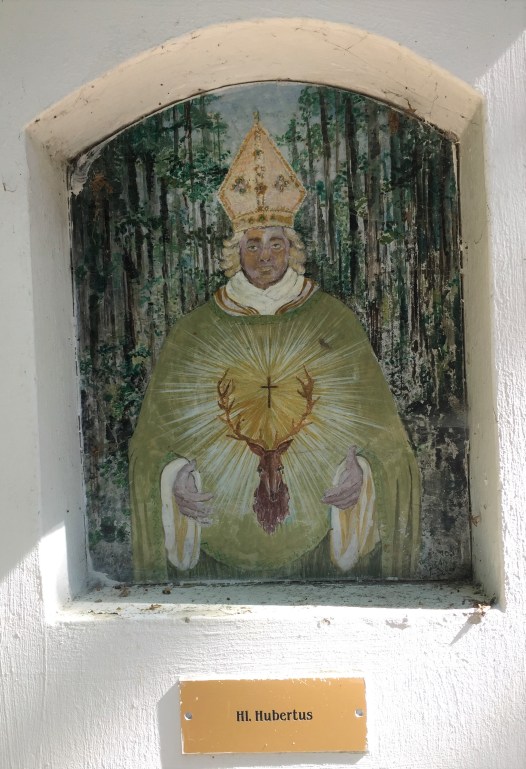
Here is a photo of Hubert on one side of a small forest shrine that we came across during one of our recent hikes.

my photo

And this is the shrine.

My photo

Hubert’s story, which explains why he was made patron saint of all things to do with forests, is quickly told. He was born in the 650s AD in Toulouse, into a family that was part of the high Frankish aristocracy. Initially, he joined the Neustrian court centered on Paris, but because of quarrels with the Mayor of the Neustrian palace he transferred to the Austrasian court centered on Metz, where he was warmly welcomed by the Mayor of the Austrasian palace, on the grounds of “the enemy of my enemy is my friend” – the two Mayors were constantly fighting each other. He seems to have quickly inserted himself into the local elites, marrying the daughter of the Duke of Leuven (if you’re a Flemish speaker, Louvain if you’re a French speaker).

Like all good aristocrats of the time (indeed, like all good aristocrats of all ages), Hubert loved to hunt, and he seems to have spent most of his time roaming the forests of the Ardennes looking for some red meat to shoot. His predilection for hunting only increased after his wife died in child birth, to the point that one Good Friday, when he really should have been in a church on his knees praying for his soul, he instead vaulted onto his horse and rode off into the forest in pursuit of game.

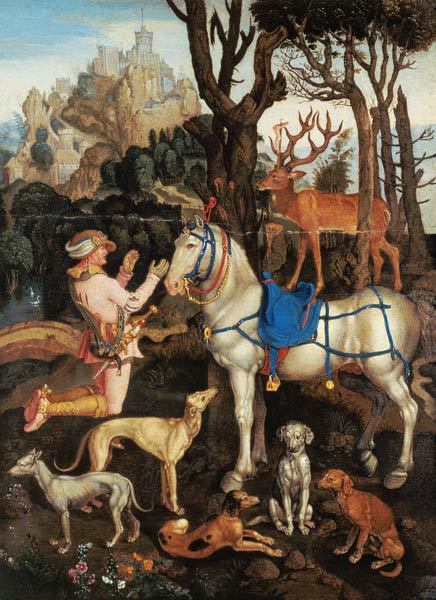
The story goes that he spied a magnificent stag and was riding full tilt after it, when the animal suddenly turned. Hubert was astounded to see a crucifix hovering between its antlers. This scene has captivated various artists over the centuries – or more probably, it captivated their clients and the artists merely executed their clients’ wishes. Here’s a version by Albrecht Dürer.

Source

Here’s one by Jan Brueghel the Elder

Source

Even Egon Schiele painted a version!

Source

In any event, the story goes on that Hubert heard a Voice, telling him to clean up his act or else he would be going straight to Hell. When he humbly asked the Voice what he should do, It told him to go find Lambert, Bishop of Maastricht, who would straighten him out.

And straighten him out he did! Under Lambert’s direction, Hubert gave away all his worldly possessions, entered a monastery, led an ascetic life, evangelized among the heathen folk who lived in the depths of the forest of Ardennes where he had once joyously hunted, etc., etc.

In about 705 AD, Lambert was assassinated, the victim of some quarrel between different Frankish factions. The event is depicted in all its gory detail in this painting by Jan van Brussel.

Source

Hubert became bishop in Lambert’s place. At some point, he moved Lambert’s remains from Maastricht to Liège, where Lambert had been killed, as we see here in this manuscript miniature.

Source

He built a magnificent basilica, which was soon turned into a cathedral, of which he naturally became the bishop (in the process, he kick-started the rise to greatness of Liège, which was then just a pissy little village). Alas, this cathedral was demolished by revolutionaries in 1794.

Source

Much to his disappointment, Hubert wasn’t martyred but died peacefully in his bed in the late 720s AD. He was, as might be expected, initially buried in Liège, but about 100 years later his bones were dug up and transferred to the Benedictine Abbey of Amdain. This event was depicted in this wonderful painting by Rogier van der Weyden.

Source

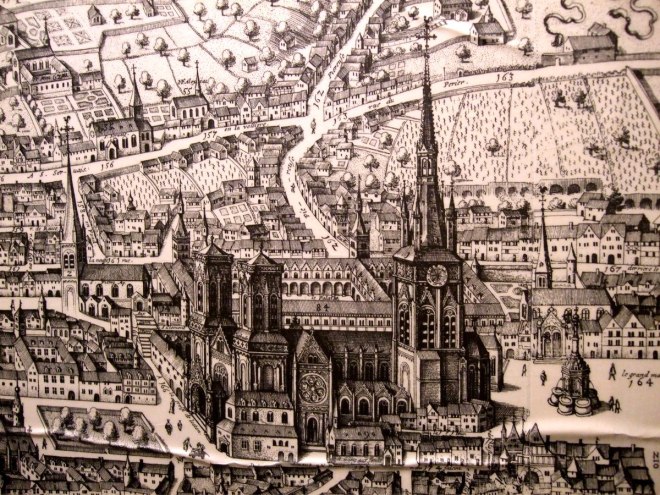
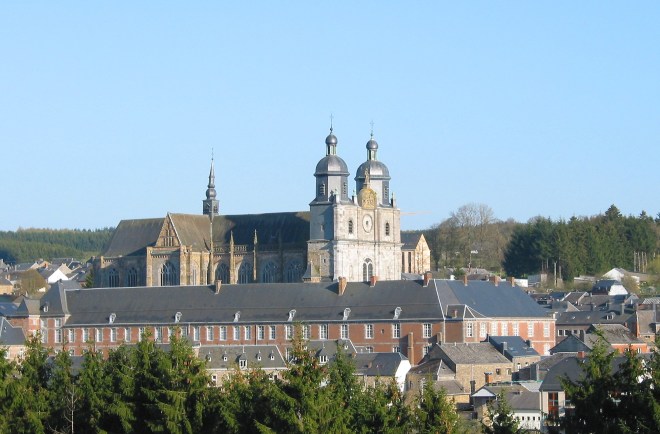
Not surprisingly, the town around the abbey renamed itself Saint-Hubert in his honour and became a focus for pilgrimages over the succeeding centuries (no doubt making the Abbey rich in the process).

Source

I think readers will now understand why Hubert is patron saint of all things forest. He was a very popular saint among the little people in the Middle Ages, probably because forests played an important role in people’s livelihoods until deforestation shrank those forests, first to woods and then to woodlots on the margins of rural lives. Not surprisingly, given his passion for hunting, Hubert was also very popular among the aristocracy, and several Noble Orders dedicated to hunting were named after him. Take, for instance, the Venerable Order of Saint Hubertus, which was founded in 1695 by Count Franz Anton von Sporck.

Source

The Order brought together the Holy Roman Emperor Charles VI and hunting enthusiasts from various other noble families throughout the Holy Roman Empire. It still exists, its current Grand Master being Istvan von Habsburg-Lothringen.

Source

Given that in the early days of the European presence in Canada so many French Canadians were involved in the fur trade as trappers, I also now understand why Saint Hubert was a popular saint in French Canada; in the teen years I spent there, I was intrigued by the number of places called Saint-Hubert (there is even a chain of chicken restaurants in Quebec called Saint Hubert). No doubt the saint’s protection was invoked by the Catholic trappers as their canoes set off on their way to the beaver grounds out west.

Source

Of course, since the regions we now call Belgium and southern Netherlands were the saint’s favoured hunting grounds, both literally and figuratively, many places there are also called Saint-Hubert (French) or Sint Hubertus (Flemish/ Netherlandish). One beer has taken its name from the town of Saint-Hubert around the abbey where Hubert was eventually buried. Here is a bottle of one of the company’s brews (triple amber for any beer enthusiasts among my readers).

Source

There is also a brew that is popular here in Vienna, the Hubertus Bräu.

Source

I’m not sure why it’s called Hubert’s Brew. It’s certainly not named after the place it’s brewed in, which is Laa an der Thaya (nice area; we’ve been on a couple of hikes around there). But it has a very distinguished pedigree. The town obtained the right to brew it back in 1454, from Ladislaus Postumus, Duke of Austria (and for this privilege they had to deliver the good Duke a keg of beer on each holiday, which doesn’t sound much – but maybe there were lots of holidays back then).

As readers will note, both these beers have as a symbol the famous stag’s head with the crucifix hovering between its antlers. So does the digestive Jägermeister, that concoction of herbs macerated in alcohol, which for some strange reason became popular with the student crowd.

Source

In this case, the connection to Hubert is via its name, which means Master of the Hunt.

Of course, I understand why any alcoholic drink which has some sort of connection to Hubert would use the symbol of the stag with the hovering crucifix. But I wonder if the makers of these drinks have thought this idea through. For me, the implication is that drinking the beer or digestive will make you see things which aren’t there (rather like that hoary chestnut that alcoholics see pink elephants).

Not perhaps the best image one wants to give to an alcoholic drink. On the other hand, putting a picture of Hubert as a bishop, like the one in the photo which I started this post with, could well put a damper on one’s enthusiastic desire to drink. A tricky marketing conundrum …

With that, I lift a good glass of wine to my readers and go and join my wife to do the packing. Auf wiedersehen, arrivederci, we will see each other again once we’ve moved down to Italy!

TOTENTANZ, THE DANCE OF DEATH

Sori, 4 July 2021

During this year’s week-long hike in the Dolomites (which I also mentioned in passing in my previous post), I managed to squeeze in a visit to the parish church of Sesto (or Sexten, to give its German name; we are in Sud Tirol, after all). Let me repeat here a message I have tried to pass in previous posts: always visit every church you come across in Europe, no matter how small it is, because there is a good chance that you will discover an artistic gem (or two). The church in Sesto / Sexten was no exception.

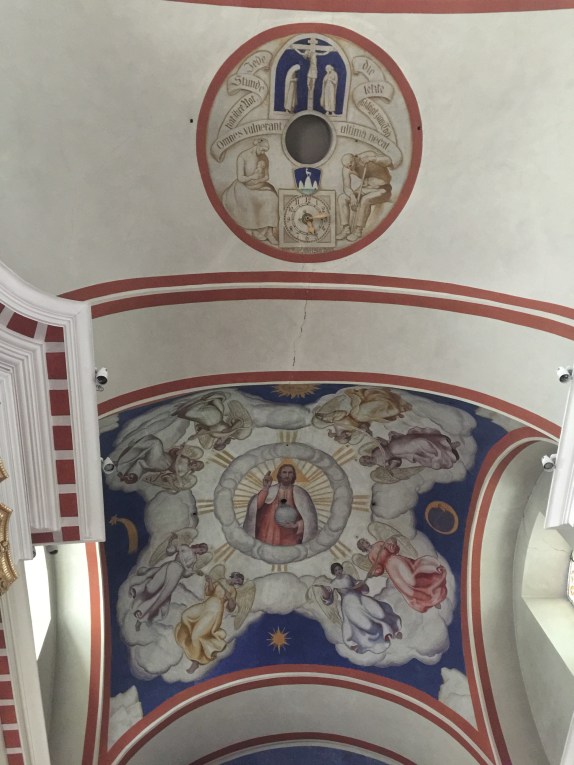
The church itself was OK – it had some interesting frescoes on the ceiling.

My photo

But what really made the visit worth while was the cemetery. My wife will tell you that I have a morbid streak, and indeed I don’t deny having a certain preoccupation with death – a preoccupation which, naturally enough I think, is growing with age. But cemeteries do also often contain wonderful art, as people try to lessen the pain caused by the departure of loved ones and reduce the fear of death itself through art. Things started with a bang at the entrance to the cemetery, which took the form of a small circular pavilion reached by a covered staircase from the road.

My photo

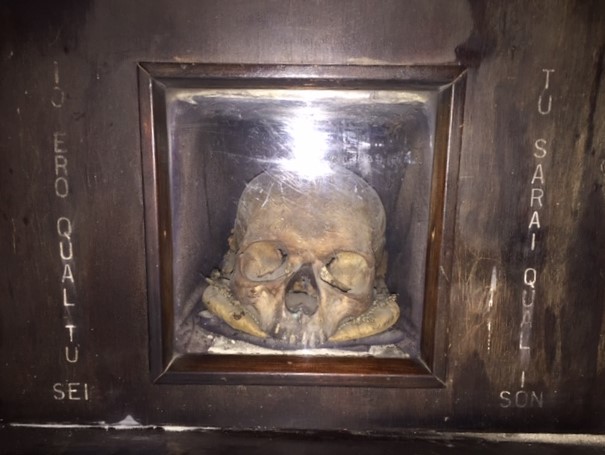
The ceiling of the pavilion was adorned with a Totentanz, or Dance of Death (danza macabra in Italian). This type of artistic depiction flourished in Europe during the 15th and 16th Centuries, probably in response to the Black Death and the lesser outbreaks of the plague which continued to periodically sweep through the continent. They were a form of memento mori, a reminder to us that we must all die sooner or later: “Remember, man, that thou art dust and to dust thou shalt return”. I came across a typical example of the form several years ago, in a church in Milan.

My photo

The phrase on the left says “I was what you are”, while the one on the right says “You will be what I am” (I emailed the photo to a dear friend of mine as an attachment to a lighthearted note; he died a year later – death catches us all, some of us sooner than later).

Dances of Death were different because they stressed that Death was the Great Leveller: whatever your social position, however powerful you were, you could not hide from Death. I suppose this idea was thrown into sharp relief by the Plague: here was a disease which made no distinctions, remorselessly scything down rich and poor, powerful and powerless, old and young, sick and healthy. And so Dances of Death would depict men and women – and children – from all ranks of society and all walks of life dancing with, being embraced by, skeletons. Here are typical examples of the genre.

Source
Source

In the earlier versions, each person would be accompanied by a short poem, often written in an ironic tone, commenting on him or her and their incipient death. And the skeletons would be quite jolly, not only dancing but frolicking about.

Even though the example on the ceiling of that pavilion in the cemetery of Sesto / Sexten was quite modern – it was painted soon after the First World War – its author, Rudolf Stolz, followed the traditional iconography quite faithfully. Thus, we have a ruler.

My photo

He is accompanied by a rhyming couplet in German, which states (in my rather free translation)
“The sands have run out,
Lay aside your scepter.”
The skeleton is holding an hourglass, so we can interpret these couplets as something the skeletons are saying to their charges.

Then we have a mature woman, a “matron” as they used to be called.

My photo

Her skeleton is saying to her
“Woman, your devotions are over
Idly burns your candle”
To make the point, it pinches the candle’s wick. Like many a matron in a village like Sesto, she must have been a regular churchgoer.

Next we have a mature man, no doubt a local farmer, dressed the way locals would have dressed until quite recently.

My photo

With a scythe slung over its shoulder, his skeleton is intoning
“Your virility, your creativity
Cut like grass by a stroke of my scythe”

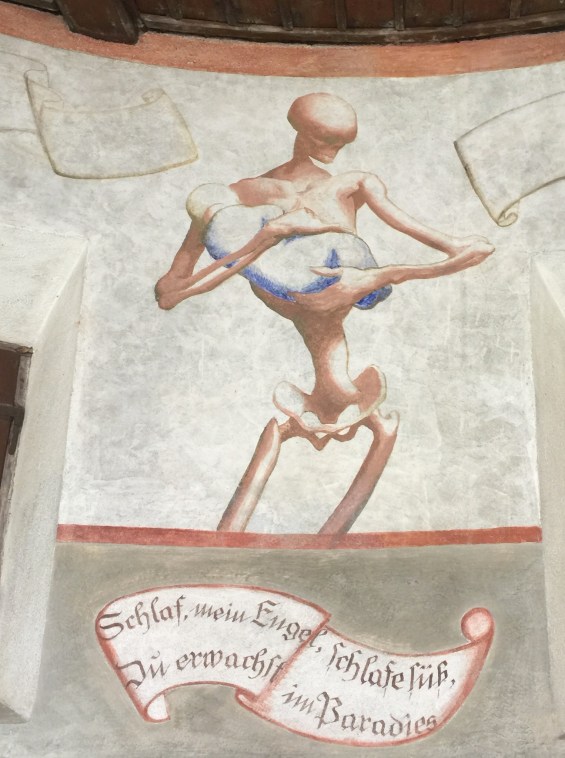
He is followed by the most poignant of the depictions, that of a baby.

My photo

The skeleton is crooning to the baby
“Sleep, my angel, sleep sweetly
You’ll awake in paradise”
At a time when the death of babies and children was still quite common, I can only hope that this painting was of some comfort to grieving mothers on their way to tend the graves of their children.

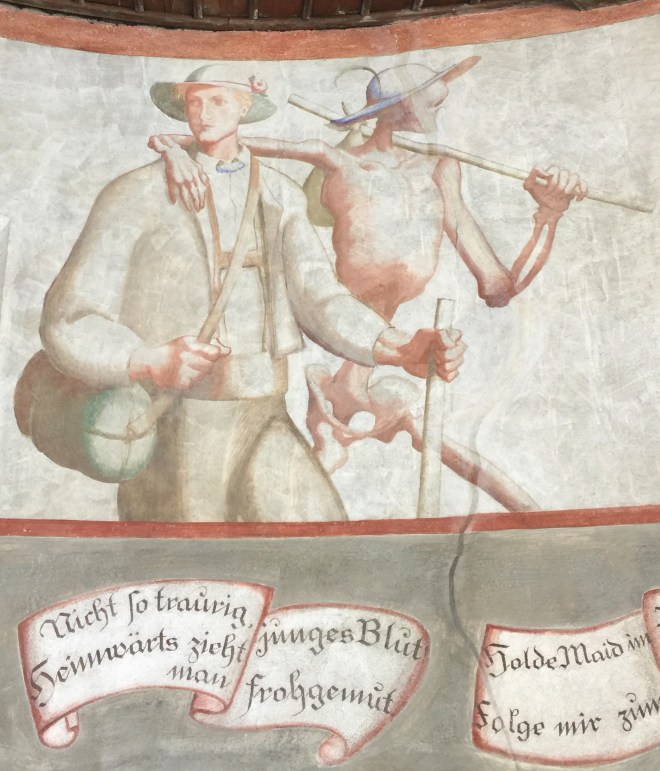
On goes the dance! We move on to a young man.

My photo

His friendly skeleton, bony arm wrapped around his shoulder, is telling him
“Not so sad, young blood
Go homewards with cheerful heart”
Presumably “homewards” in this context means home to the kingdom of God.

Which brings us to a young woman.

My photo

Her skeleton is telling her
“Fair maiden with the myrtle wreath
Follow me to the wedding dance”
And indeed the skeleton seems to be about to start the kind of square dance that was common in these parts. But no doubt it is referring to a wedding with Death.

And so we come to the final character, a bishop.

My photo

His skeleton is telling him
“Bishop with the shepherd’s crook
Set aside your heavy burden”
and is helpfully taking away his crosier (his crook), no doubt as a first step in divesting him of his other accoutrements.

When I saw this Dance of Death, I was immediately reminded of another Dance of Death which recently went under the hammer at the Dorotheum auction house in Vienna, a version of Albin Egger-Lienz’s “Totentanz 1809”.

Source

The affinity between these paintings is no surprise. As his name indicates, Egger-Lienz was born just down the road from Sesto / Sexten, in Lienz, now in Austria. Most of the themes of his paintings were Tyrolese. Rudolf Stolz was a great fan of his.

Suitably reminded of my own approaching demise, I passed into the cemetery itself. Tyrolese cemeteries are a joy to visit. Each grave is a little garden, carefully tended by relatives. This one was particularly well kept, and the view on the Dolomites of Sesto was magnificent.

My photo

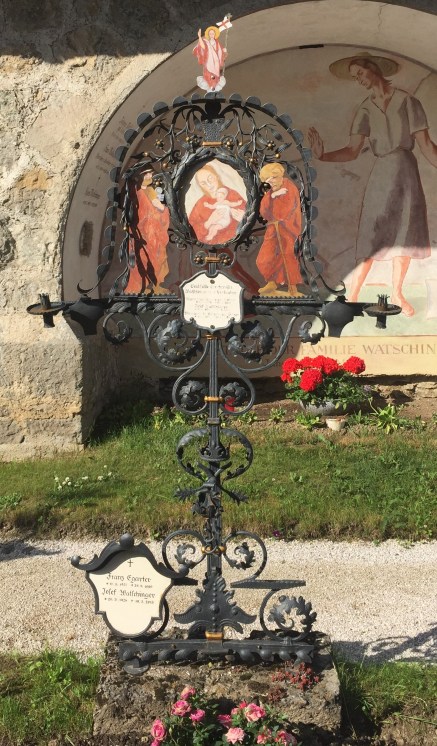
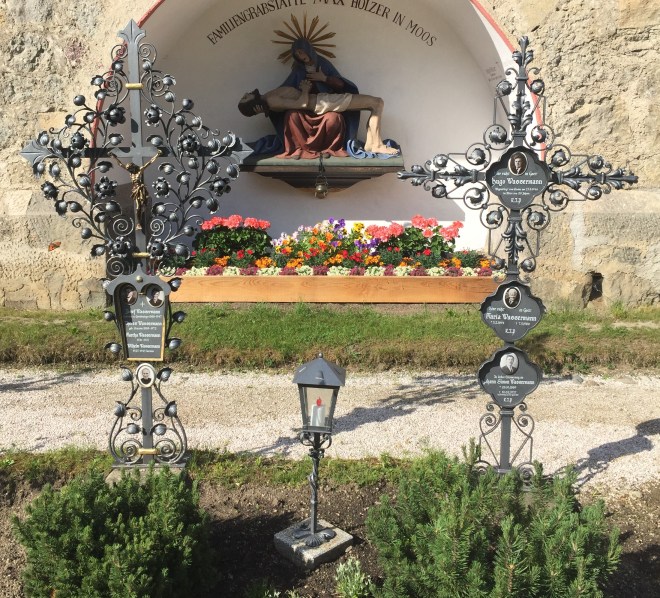
In addition, the crosses over the graves are often masterpieces of ironwork. I throw in a few examples I came across.

My photo
My photo
My photo

I have to assume that all those flowery curlicues are to remind the Christian viewer that the wooden cross is the bearer of (eternal) life, rather like a stick which – when stuck in the ground – sprouts leaves.

Behind the first cross you can see an example of the frescoes that are painted on some of the cemetery’s family tombs. Rudolf and his two brothers Albert and Ignaz painted a good number of these (Albert also painted the frescoes on the ceiling of the church). I rather like this fresco by Ignaz Stolz, a nice take on the story of the Sermon on the Mount.

My photo

In the end, though, I rather preferred the sculptures in wood – another great art form in the Tirol; not surprising, given the wealth of wood here – that adorned some of the family tombs.

My photo

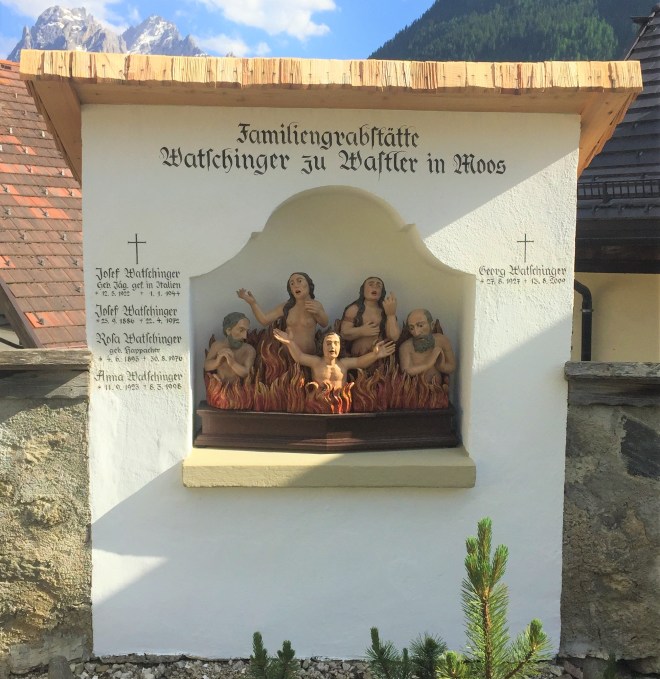
I’m not sure I would want a sculpture on my family tomb strongly suggesting that I would be burning in Hell …

My photo

The story of the women coming to the grave of Jesus to prepare him, only to find an angel sitting at the mouth of the tomb.

My photo

A pietà.

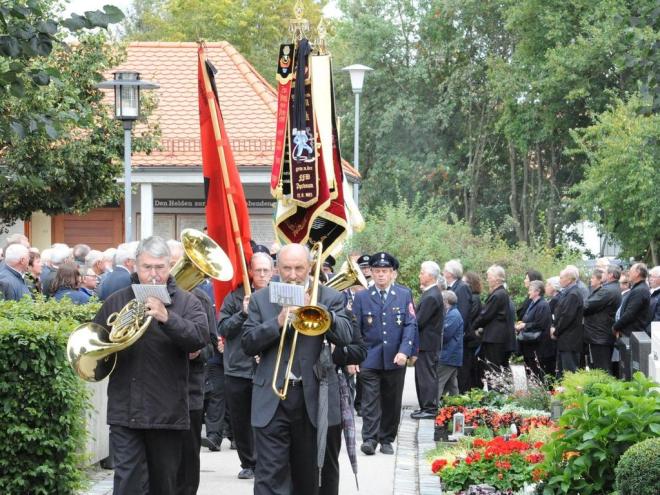
Yes, if I am finally laid to rest in a cemetery – which is not a given; cremation is a strong possibility – I think a Tyrolese grave, surrounded by mountain flowers, will do me very well. And I want a brass band to see me off! Once, many years ago, when I was convalescing at home after a knee operation, my wife took me for a spin through the countryside around Vienna. Quite by chance, we came across a funeral procession that had just reached the village cemetery. We stopped to watch. Suddenly, the sombre silence was broken by a duet between trumpet and trombone. What a way to go, to the sound of brass!

Source

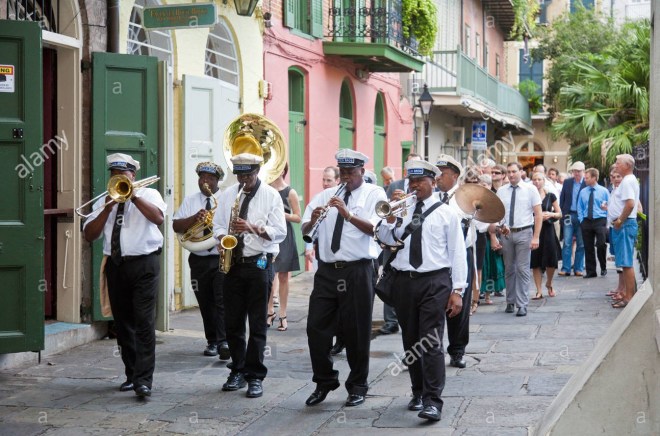
I have often told my wife of this desire, but I suspect she has been dismissing it as an emanation of the Monty-Pythonesque side of me, not to be taken seriously. But really, what better way to say that that final goodbye than through the booming notes of a brass band? Since she and I like jazz so much, maybe she could fly in one of those New Orleans funeral bands. Now that would be something!

Source

IRISES

Milan, 4 June 2021

On the hikes which my wife and I have been doing around Lake Como, we frequently come across irises blooming in people’s gardens. They are very nice, of course, but what I really admire are those irises which we spy on the side of the path, normally growing out of a small mound of garden waste. Clearly, someone in the vicinity did some clearing in their gardens, which included pulling up some iris rhizomes (their tuber-like roots), and then they just chucked the waste by the side of the path. But these irises are tough. In the face of adversity, they’ve just kept going, rooting into their new environment and continuing to bloom, to the delight of passersby. Unfortunately, the photos which I took at the time of these feral irises have disappeared into the Photo Black Hole in my iPhone, so I throw in this stock photo instead.

Source
I really admire the irises’ toughness. They remind me rather of a similarly tough plant with lovely flowers which I’ve written about earlier, common chicory.

Irises also reach back deep into my subconscious. My mother had planted irises in her garden in the house of my early childhood in Eritrea – or maybe she inherited them from previous renters of the house; that will to survive which I was just mentioning – and small child though I was (I could not have been more than six years’ old), I was awestruck by these lovely, bright, complex-looking flowers, with their sword-like leaves. My memory may be playing tricks with me but I remember them being yellow irises.

Source

Yet another encounter during a walk last week around Lake Como with irises growing out of waste piles has finally persuaded me to take up my electronic pen and write about them.

Not that there’s a huge amount to write about, unless you’re fixated about irises (and a good number of people do seem to be fixated by them). I was rather astonished to discover that taxonomists recognize something like 280 species of iris (there are also thousands of hybrids – the iris is a flower which enthusiasts have loved to fiddle with – but I won’t bother with them; it’s the Real Thing that interests me). Their natural distribution spans much of northern Eurasia, although there are also a number of species which are native to North America. I throw in some photos of irises in their natural habitat, not imprisoned in someone’s garden: as I’ve remarked in an earlier post about tulips, it’s so much nicer to see flowers in their natural state.
A field of irises in North America:

Source

Iris sibirica in Central Europe

Source

Iris haynei in the Middle East

Source

The Nazareth iris, also from the Middle East

Source

Iris lortetii, also from the Middle East

Source

With 280 species to choose from, I suppose I could have added a good deal more photos of wild irises. But I think that will do. I’m struck by the colours I chose; I rather suspect that I wanted to get away from the typical purple and yellow irises one sees in gardens.

Talking of natural states, it seems to me that iris is a bit of a fancy name for a flower, at least in English. Something like mugwort or yellow flag (actually an alternative name for one of the irises) seems more English. In fact, it appears that we owe the flower’s name to the French. Someone there, some time in the 13th Century, noticing that the flower’s petals had iridescent reflections gave the flower the Greek name for rainbow. Perhaps the deep violet colour of many of the species, resembling the violet and indigo bands of the rainbow, also played a part in this naming exercise.

Source

I’m not completely convinced by this explanation of the name; my inspections of the flower don’t show any obvious iridescence; maybe it was the flowers’ way of shading from colour to colour that inspired the French to name it iris.

Source

In any event, I find that this explanation makes more sense to me than the other explanation bouncing around the Internet, namely that the flower was called iris because it comes in all the shades of the rainbow; this clearly is not the case.

Whatever the right explanation, a connection has been made with a Greek goddess, which has given me an excuse to explore this member of the Greek pantheon. She is, I must admit, a very minor member. Her sole role in life was to carry messages from the gods to other gods or mortals. But she did this very prettily, by laying down a rainbow and walking along it to whoever she was delivering a message to. Apparently, there are no ancient statues of her bar one; one of the statues on the frieze of the Parthenon now in the British Museum – I will skate over the passionate arguments that this relocation to London has generated.

Source

Yes, well, I mutter under my breath, how can anyone know who this very bashed up piece of stone is meant to represent? Nevertheless, I bow to the Experts and accept their attribution.

We seem to be on firmer ground when it comes to paintings on Greek pottery. Here we have a picture of Iris on this vase from the 5th Century BC.

Source

Iris was also depicted by those European artists of the 17th, 18th and 19th Centuries who went in for classical themes – not my cup of tea, but hey! it takes all sorts to make a world. This particular painting from 1811, by Pierre Narcisse Guerin, falls into this category.

Source

I have to say, it seems to me that the painting is verging on soft porn. In any event, it claims to be portraying a story from Ovid’s Metamorphoses, where Juno sends Iris to give a message to Somnus, the god of sleep – the message is, “send a dream to Alcyone that her husband Ceyx is dead” (any reader who wants to know the backstory is welcome to read the Metamorphoses). Iris throws down a rainbow and walks along it (or slides down it?) into the underworld, where Somnus sleeps away his days and nights. She can barely rouse him from his slumbers but finally manages and delivers the message. She then gets the hell out of there as she feels she is about to fall asleep, and clambers back up her rainbow. I should explain at this point that Somnus has one thousand sons, whose job it is to deliver dreams to us mortals. He summons his son Morpheus, the best deliverer of dreams, instructs him to pass on Juno’s message, and promptly falls back to sleep. Guerin got the story wrong by depicting Iris delivering the message directly to Morpheus.  But Somnus was presumably middle-aged while Morpheus was a strapping young fellow, so no doubt Guerin took some artistic license so as to be able to paint a nakedly handsome young man as a worthy companion to the nakedly pretty young woman.

The French not only gave the flower its modern name, they also brought the flower’s heraldic representation, the fleur-de-lys, to great prominence, through the adoption by the French kings of the fleur-de-lys as their heraldic emblem. I have to admit to have been really surprised to discover this connection. Why are fleur-de-lys not called fleur-de-iris, then? The best explanation I’ve come across is that the French kings were descended from a line of Frankish chiefs who had lived originally around the river Lies in Belgium before they invaded France. These Frankish chiefs took as their heraldic symbol the yellow Iris pseudacorus, which grows in abundance along the edges of the River Lies, and which is known in Frankish – their original tongue – as Lieschbloem, the bloom of the Lies. It’s easy to see how that could have been frenchified to fleur-de-lys. Here, we have the Lieschbloem in its natural riverine habitat.

Source

And here we have a comparison of a Lieschbloem in close-up and a fleur-de-lys.

Source

I think one can appreciate that the fleur-de-lys could well be a stylized Lieschbloem. As a clincher, readers should note that the background of the French kings’ armorials was blue (“azure” in heraldic lingo) – a representation of the River Lies? Here are the arms of King Louis XVI.
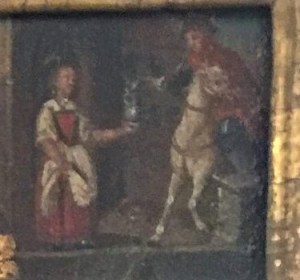
Source

The kings changed their the number of fleur-de-lys on their arms quite frequently, and I chose him because everyone has probably heard of him – the one who got his head cut off during the French Revolution.

Source

Talking of fleur-de-lys, it was also – still is, actually – the centrepiece of the arms of Florence. But there’s an interesting story to the colour scheme. Originally – we’re talking before 1251 – the colours were a white fleur-de-lys on a red background.

Source

The white Iris florentina grew wild in the area around Florence.

Source

It even grew, it is said, on the city’s walls – this is no longer the case, alas, for the few stretches of the walls still left around Florence.

Source

So I suppose it was quite reasonable for the City Fathers to choose a white iris as the city’s heraldic symbol (why they placed it on a red background I don’t know).

In 1251, the government of the city was in the hands of the Ghibelline faction. I hope my readers are at least vaguely familiar with the fighting between Guelphs and the Ghibellines that roiled pretty much all of the city-states in northern and central Italy in the 12th and 13th Centuries. Here, for instance, we have Guelphs and Ghibellines duking it out in Bologna.

Source

Formally, the Guelphs supported the Popes and the Ghibellines the Holy Roman Emperors in the never-ending feud of these two about who controlled who. But in many cities this was just an excuse to cover local quarrels. In Florence, for instance, it was more about the patricians (Ghibellines) versus the plebs (Guelphs). In 1251, the Guelph faction wrested control of the city from the Ghibellines, and to signal that there had been a definitive political change, the Guelphs switched the colours around on the city’s armorial bearings. I suppose they were in power for long enough for the switch to become definitive, because still today we have a red fleur-de-lys on a white background.

Source

One side-effect of this colour switch was people trying to breed a truly red bearded iris (the group of irises to which Iris florentina belongs) and failing dismally. The judgement of Those Who Know is that there is no truly red iris, bearded or otherwise.  Well of course the experts know, but the copper iris from North America looks pretty red to me.

Source

But, once again, I bow to the Experts.

It would seem that the Florentines discovered another interesting thing about their Iris florentina, namely that if you take the plant’s rhizome and dry it for a very long time – 3 to 5 years – reactions slowly take place in the rhizome which eventually lead to the production of chemicals with the fragrance of violets. This fragrance is liberated by crushing the now rock-hard rhizomes to a powder. Catherine de’ Medici brought this alchemist-like knowledge to the French court when she married Henry II of France in 1533. Mixed with rice powder, it eventually became a popular way for Europe’s upper crust to perfume their faces, clothes, and eventually wigs when these later came into fashion. Nowadays, perfumers plant huge fields of a light purple cousin of Iris florentinaIris pallida.

Source

They dig up the rhizomes, dry them, and then steam distill them to obtain a thick, buttery oil known as orris oil. Eyewateringly expensive stuff – like €100,000 a kilo – it’s used by perfumers to give a base note to their creations.

Source

After all of this, though, I’m sure my readers will agree with me when I say, let’s just forget all the metaphorical, allegorical, or representational bla-bla with which irises have been enveloped, and let’s just enjoy the flowers as they are. So let me close with a couple of paintings of irises by Vincent Van Gogh.

Source
Source

THE GARDENS AT VILLA DURAZZO PALLAVICINI

Sori, 16 March 2021

Nearly a month ago, when my wife and I were walking through the local town of Nervi, I happened to notice this banner strung across the street.

my photo

It was an invitation to all and sundry to come and admire the camellia which were flowering in the gardens of the Villa Durazzo Pallavicini in the Genoese suburb of Pegli.

We filed this invite away for possible future use, but it was only a week or so ago that we got around to going. What we discovered was more than just a bunch of camellia in flower – although we did also find that. It turns out that the villa’s gardens, which were laid out in the first half of the 1840s, are quite famous. They were the brainchild of the Marquess Ignazio Pallavicini and were designed for him by a certain Michele Canzio. This Michele Canzio was a man of the arts: an architect, an interior designer, and – important for our story – a set designer for Genova’s opera house, the Carlo Fenice theatre.  The garden he designed for Ignazio Pallavicini was composed of a series of theatre sets made up of little lakes, streams, waterfalls, various buildings of one sort or another, garden furnishings, rare plants, all inserted into general greenery. In fact, a visit to the gardens was quite openly a theatrical event, with visitors invited to wind their way up the steep hill behind the villa through gardens divided into a Prologue and Background followed by three Acts. Each of these in turn were sub-divided into a number of Scenes, with each section and sub-section having a title. So we have:

Prologue and Background
– The Gothic Avenue
– The Classical Avenue

Act I: The Return to Nature
– Scene I: The Hermitage
– Scene II; The Amusement Park
– Scene III: The Old Lake
– Scene IV: The Spring

Act II: The Recovery of History
– Scene I: The Chapel of the Virgin Mary
– Scene II: The Swiss Hut
– Scene III: The Condottiere’s Castle
– Scene IV: The Condottiere’s Mausoleum

Act III: Catharsis
– Scene I: The Inferno
– Scene II: The Large Lake
– Scene III: The Gardens of Flora
– Scene IV: Remembrance

Looking at all that, I have a sense of being trapped in a rather bad knock-off of a Wagnerian opera, with some knight errant wandering the forests of Mittel Europe searching for his Loved One. But what I feel doesn’t matter. It’s what people at the time felt that matters. They loved it. When it opened to the public (for a fee), it was an instant success. It became the centre-piece of a broader plan by Marquess Pallavicini to turn Pegli from a sleepy little fishing village on the far outskirts of Genova into a smart seaside resort where the Great and the Good from all over Europe could come to spend their winters (and later their summers). The Marquess used his political muscle (he was a Senator in the newly-formed Kingdom of Italy) to make sure that the railway being built out from Genova westwards had a stop at Pegli, donating part of his land for the station buildings as well as for an upscale hotel to house the Great and the Good who would be arriving by train and for a smart new municipal building from which the new, modern municipality he was promoting could be run. Other Genoese aristocratic families which had summer villas in the area knew a good thing when they saw it and had their villas turned into luxurious hotels. And the Great and the Good came: the hereditary princes of the German Empire, various members of Italy’s House of Savoy, various literati such as George Sand, Alfred de Musset, August Strindberg, Franz Kafka, Arrigo Boito, among others. All these Great and Good visited the gardens at Villa Durazzo Pallavicini, and where they went so did Europe’s bourgeoisie.

By now readers might be getting a little impatient and asking themselves what these gardens looked like. Let me answer them by showing a series of postcards from the turn of the century. Wonderful things, postcards. People loved to show the folk back home where they had been, and tourist spots like the gardens of the Villa Durazzo Pallavicini were more than glad to oblige. My wife has a large collection of postcards sent by her parents, grandparents, and their friends over the decades, and it’s lovely to sit down of a winter evening and browse through them. But I digress. Here are postcards of the gardens:

The Gothic Avenue

Source

The Classical Avenue

Source

The Hermitage (which Canzio rather cleverly had built on the back of the Triumphal Arch which completed the Classical Avenue)

Source

The Amusement Park (where visitors could take a spin on the carousels)

Source

The Spring

Source

The Chapel of the Virgin Mary

Source

The Condottiere’s Castle

Source

The Condottiere’s Mausoleum

Source

The Inferno (made by taking the stalactites and stalagmites from other caves and placing them here; the environmentalist in me shudders)

Source

You could also visit the Inferno by boat

Source

And finally the Large Lake

Source

as well as the Gardens of Flora

Source

Oh, and perhaps I should add a photo of the camellias, which was what brought us to the gardens originally (although this is not a postcard, since it would seem that postcard makers didn’t see the interest in having postcards of the camellias).

Source

As this photo suggests, we came a little too late, many of the camellias being past their prime. Quite how the camellias fitted into Canzio’s grand operatic scheme is not clear to me, but we can let that pass.

Would I recommend to readers to visit the gardens? I’m not sure I would. It’s not just that the highly artificial nature of the gardens does not chime with modern sensibilities (at least, it doesn’t chime with mine). It’s also that the gardens have suffered heavily from Genova’s modernization over the last century. To explain what I mean, I have to take up the story of Pegli from where I left off a few paragraphs ago.
Marquess Pallavicini wanted to turn Pegli into a smart seaside resort, and as we have seen for a while this plan was successful, as this poster from the turn of the century suggests.

Source

But in the late 19th-early 20th Century, Genova, which we see in the far distance in this poster, was spreading like a cancer along the coast and up the valleys behind it – it was the only way the city could expand in this region where the steep hills drop precipitously into the sea. To show what I mean, here is a map of what Genova looks like today. It’s expanded up and down the coast, swallowing up places like Pegli, and sent tendrils of urbanisation up into the valleys behind.

Source

By 1926, Genova had reached Pegli and gobbled it up. Pegli as a distinct municipality was no more.

Like all modern cities, Genova was also pushing to industrialize, and it was industrializing on the side towards Pegli. In 1915, just before Italy entered the First World War, this was the view the visitor would have had looking towards the villa.

Source

We have the villa standing proud on the edge of the hill, with the gardens climbing the hill behind it. In front of it are orange trees, vineyards, and other fields, all the property of Marquess Pallavicini and his heirs. A decade or so later, we have this large cotton mill down by the rail tracks, with the villa in the middle distance partially blotted out by the belching industrial chimney. There were even bigger industrial plants to the right of this photo. One in particular became a very large steel plant.

Source

By this time, the Great and the Good had packed their bags and were spending their winters and summers elsewhere along the Ligurian coast, or on the adjoining coast in France, the Côte d’Azur. Pegli had just become a grimy suburb of Genova. I suspect that Pallavicini’s heirs saw which way the wind was blowing, because the last owner of the villa and its gardens donated them to the city of Genova in 1928. But at least she did so with the provision that the villa be allocated to some cultural use and that the gardens be kept open to the public (Genova more or less honoured the bargain; one part of the villa has become a museum and the gardens were kept open until the 1960s – more on that in a minute).

The pace of modernization quickened after World War II. And here, to continue the story, I switch back to our visit of the gardens. We had passed through the Prologue and Background and had started onto Act I when we started hearing a low roar, which got stronger and stronger as we progressed. At some point, we reached a Belvedere where we got a beautiful, close-up view of –– the A10 motorway, which runs from Genova to Ventimiglia. This section of the motorway was built in the 1960s.

Source

This screenshot from Google Maps shows just how the motorway smashed its way through the hill under the gardens.

Source

The construction of the tunnel so badly damaged the gardens that they were closed until 1992, when they were reopened to the public after a decade of restoration. Even today, much of Act I of the gardens is blighted by the continuous roar from the motorway.

When we had climbed higher, reaching the end of Act I, we began to get splendid views over the sea –– and onto the runway of Genova’s airport.

Source

As the photo shows, the runway is built on the sea, a consequence of the fact, which I’ve already mentioned, that Genova lies at the foot of steep hills that drop straight into the sea – there is no nice flat space nearby where a runway could be built.  After some back and forth, it was decided to build the airport and its runway to the west of Genova, I suspect because this part of the city had already been blighted by industrialization and no-one would complain too much about it. Luckily, the day we visited the gardens no planes landed or took off – Covid-19 induced no doubt – but I presume that on a normal day the noise of planes taking off would add to the noise from the motorway.

On we climbed, and as we got the end of Act II, and the highest point of the gardens, we could enjoy a new view across the valley running alongside the gardens –– to a series of oil tanks planted on the hill on the other side of the valley. They were painted a sickly green, no doubt to claim they were environmentally-friendly. Unsurprisingly, but unfortunately for me, no-one seems to have posted a photo of these oil tanks taken from the gardens, so the best I can do is to show another satellite photo from Google Maps.

Source

The tanks are that group of circles, and to locate the gardens please follow the motorway as it punches its way through the hill.

The presence of oil tanks there are the consequence of another decision, taken in the early 1960s, to have Genova’s oil terminal built close to the airport (so another pleasant sight from the gardens must no doubt be the periodic arrival of oil tankers coming in to offload their cargo). The oil pipelines snake over the hills from the terminal to these tanks, where the oil is stored prior to further onward delivery to the north of Italy.

After enjoying these sights, we wended our way down through Act III of the gardens and on down to the exit. When we arrived back at the villa we went out on its ample terrace to admire the view –– and got a close-up of people’s clothes drying on their balconies. In the 1960s and ’70s, those pleasant fields of orange trees, vineyards and other crops which used to lie at the foot of the villa, and which I show above in that postcard from 1915, had been cemented over to make way for cheap housing. Here we have a view of that housing, and at the end of the avenue we can see the villa.

Source

No “green belt” was kept between the housing and the villa. The apartment blocks come right up to the gates of the villa.

So, like I say, I don’t think I will be recommending a visit to these gardens to anyone. I feel sorry for the enthusiastic volunteers who manned (and womanned) the gardens, I respect the spending of public moneys to restore the gardens, seen as a great example of garden design from the Romantic age, but the garden’s context has been so ruined as to blight any visit to the gardens.