LAGO D’ORTA

Milan, 29 November 2019

My wife and I recently accompanied our son on a short business trip he was making to a small place to the north of Milan, near Lake Maggiore. He was going there to look over a company. We went along to share the driving and visit the local area. The company he was visiting happened to be very close to the point where a few weeks previously we had given up a walk in the area (the one where we had stumbled across several very lovely varieties of mushrooms), so we decided that we would use the occasion to visit what would have been the end point of our walk had we finished it.

That end point was the village of Orta San Giulio, which sits on a peninsula jutting out into Lake Orta. This is a small lake, the most westward of that series of lakes which form a necklace at the base of the Alps, between Verona to the east and Novara to the west. Readers with good eyes will see Lake Orta, marked with a red pin, to the far left on the map below.
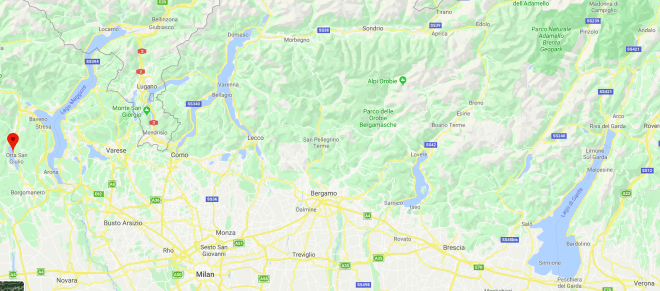
Google maps

Once we had deposited our son at the gates of the company he was visiting, we set off to Orta San Giulio. It was not, truth be told, the best day to visit anything: it was grey and drizzly, the kind of day that in my mind will be forever linked to the UK. But that didn’t stop us appreciating the scene that unfolded before our eyes as we arrived at the lake’s southernmost tip and took the road which hugged its eastern coast. My wife and I took no photos during our little tour, and the lake under the rain seems to have no fans among the legions of persons who post photos on the internet, so I can only describe to readers what we saw.

As we wound our way along the coast, with the wipers sweeping regularly across the windscreen, the trees covering the slopes which fell steeply into the lake’s waters – trees vested in their brown and reds of late autumn – began to give way to large estates with equally steep but more manicured grounds, the kinds of estates which I associate with the late 19th Century. Out on the water, dimly at first but ever more visible as we got closer to the village of Orta San Giulio, we discerned through the drizzle an island, the Isola San Giulio. The road began to climb to the top of the ridge of the peninsula along whose outer edge Orta San Giulio is built. Once we reached the top, we turned off the main road and made our way down to the village itself, passing as we did other, smaller estates climbing the side of the hill. When the road reached the water’s edge, it turned cobbled and narrowed into a single lane. We found a place to park and continued on foot, huddling under our umbrellas. Apart from a cat or two, we had the place to ourselves. Soon we were walking between rows of old houses on both sides of the street and only got an occasional glimpse of the lake down a side alley. But all at once, we entered the village’s main square, Piazza Motta, and there had a full view, across the square’s wet and windswept flagstones, of the lake and Isola San Giulio hovering on its waters in the middle distance. We could now make out the buildings on the island, in particular a Romanesque campanile on the water’s edge and a big hulking building, looking in all respects like an army barracks, which dominated the island’s centre point. We admired the view, looked curiously at an old hotel, now very much worse for wear, which occupied one whole side of the square, noted the street at the back of the square which, the signposts informed us, took one up to the Sacro Monte d’Orta, the Sacred Mountain of Orta, and then headed back to the car. It was time to go and pick up our son, and anyway it really was too wet and cold to explore any further. “For another time!” we promised each other. Maybe this Spring; there is a train we can take from Novara to Orta San Giulio.

In the meantime, though, I feel I must give my readers some idea of what we saw, or perhaps more accurately what we might be seeing when we come back in better weather. As is my habit, I’ve also been mugging up on the lake’s history and so can use this occasion to tell my wife – faithful reader of my posts – and any other interested readers about what I’ve learned.

So here is a photo album which I’ve cobbled together with other people’s pictures posted on the internet.

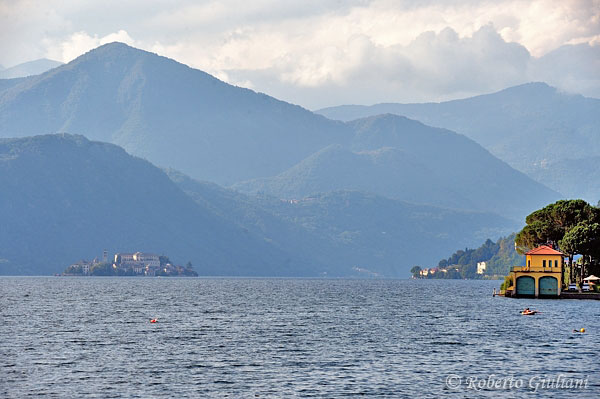
This is what the lake looks like on a good day from its south end, the end that we first saw it from.
Source

Isola San Giulio is visible, along with a few houses of Orta San Giulio to the right. The pre-Alps rise up in the background.

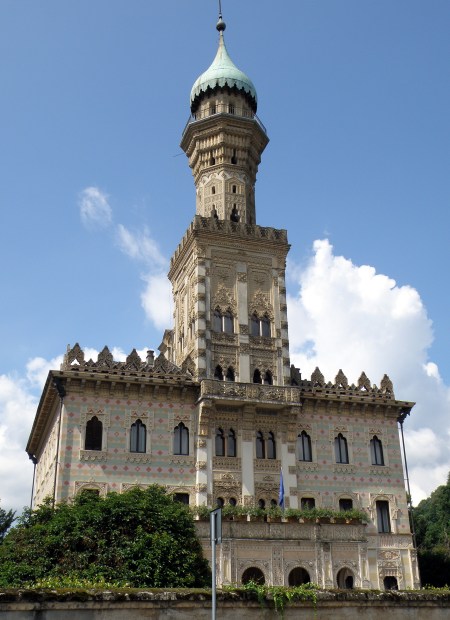
As we turned off the main road down to Orta San Giulio, we passed this frothy building.
Source

It is Villa Crespi. It was commissioned in 1879 by a wealthy cotton merchant by the name of Cristoforo Crespi and built in the Moorish Revival style. I suppose it is a somewhat outlandish example of what was happening around all of northern Italy’s lakes during that period: rich (or enriched) industrialists and bourgeois joined the aristocracy in building summer homes on the lakes. The same phenomenon certainly happened on Lakes Como and Maggiore (we see those villas every time we walk around those two lakes) and no doubt on Lake Garda (which still awaits a visit from us). Quite frankly, this particular building reminds me of some of the cinemas which dotted British cities when I was young, but at least this one continues to serve a decent purpose: it is a luxury hotel and home to the restaurant of one Antonino Cannavacciuolo (a well-known chef on Italian TV, I have read).

Certainly Lake Orta must have been a popular playground for the wealthier classes of the late 19th Century. It hosted the first ever European Rowing Championship in 1893 (rowing in Italy being considered a very aristocratic sport) and various national rowing championships thereafter, as this poster of 1909 attests (for an event, readers will note, “under the patronage of HM the King” [of Italy, of course]).

Source

What happened in the following decades is a classic example of how not to manage a lake – but we will get to that later.

This was the narrow street we walked down after parking the car: Via Giovanetti.

Source

It was pleasant to walk along under the rain; it looks even more pleasant on a sunny day.

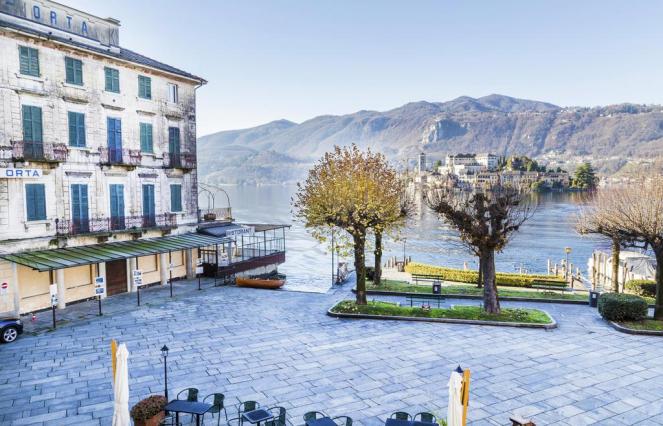
And this is the village’s main square, Piazza Motta.

Source

I’m not an expert on real estate but it does seem strange to me that the old hotel we see across the square in the photo (called, rather prosaically, Hotel Orta) has not been snapped up by someone and refurbished. There cannot be many places which have this nice a view when one steps out of the lobby onto the street:
Source

Down by the lakeside at the foot of the square one catches the boat to go over to the Isola San Giulio, which, as we get closer, will look like this,

Source

while we leave Orta San Giulio literally in our wake.

Source

I think a little bit of history is in order here, because Isola San Giuglio has always been at the centre of the lake’s story.

The island gets its name from St. Julius, a possibly legendary saint who is said to have christianized the area around the end of the 4th Century AD. It is narrated that Julius and his brother Julian were two Greeks who somehow made it to Italy and were instructed by Emperor Theodosius I to destroy pagan altars and sacred woods and to build Christian churches. Which they did with a vengeance. The little church which Julius built on the island is said to have been the hundredth – and last – church he built. There are the usual colourful stories of his doings like, for instance, this one: having decided that he would build his last church on the island but finding no-one willing to take him there he laid his mantle on the water and miraculously sailed over to the island. As a final aside on this saint, he made it to sainthood, but – rather unfairly, I think, since the two worked hand-in-hand in their proselytizing mission – his brother Julian did not.

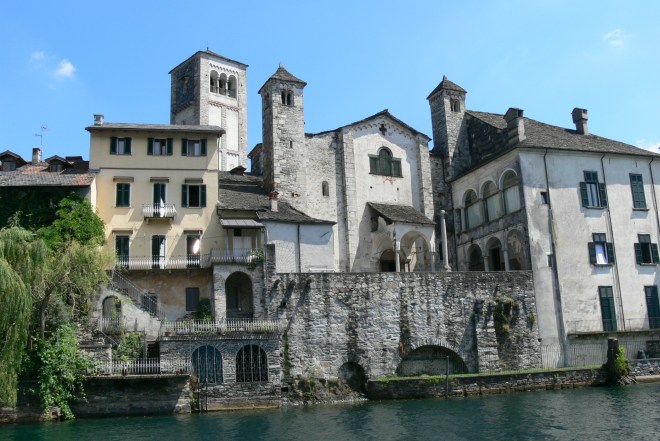
In any event, the first little church was succeeded by a larger one built in the 6th Century, which itself was succeeded by an even larger one built in the 12th Century; it was later nominated a basilica. That is the building we see today (although it has been much remodelled inside, as we will see, and squeezed in between houses built in later centuries). It is its campanile which we noticed when we were standing in Piazza Motta that cold and rainy day gazing out towards the island.
Source

The island’s religious vocation was always in conflict with its obvious military importance. As this map shows, Lake Orta was one of two natural passageways for anyone crossing the Alps at the Simplon Pass to get down into the Po River plain and all its riches – the other was along the shores of Lake Maggiore. The red pin shows the location of the Simplon Pass in the map.
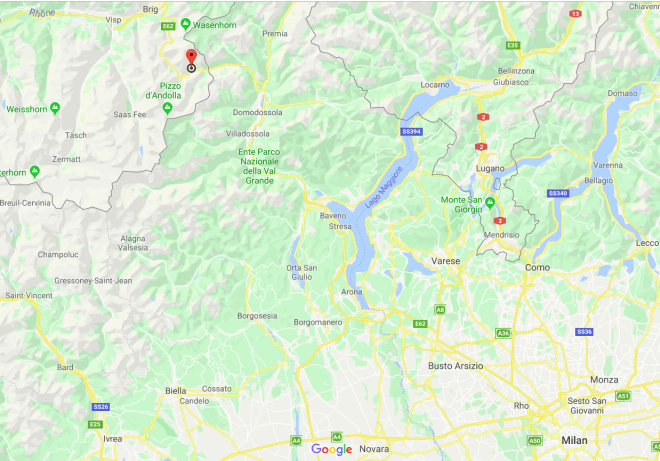
Google maps

Having crossed the Simplon, armies would march down (or peaceful merchant trains would lumber down) the valley of the River Ossola and then either go along Lake Maggiore or march up to Lake Orta and then pass through the valley at the other end. A Frankish army did that in 590 AD, marching into territory that was claimed by the Longobards. A Longobard Duke, Mimulfo by name, who was entrenched in the island, seems to have just let the Franks through. For this betrayal, the Longobard King Childebert had Mimulfo beheaded on the island. (A French Corps also crossed the Simplon in 1800, as part of Napoleon’s campaign in Italy; I have no idea which of the two routes they used to get to Milan)

The island was also a useful place to hole up if hostile armies were around. To this end, a castle was built there as early as the 900s AD, reconverting some of the church buildings to military use and generally constricting how the church and its buildings could be expanded. By then, the Longobards had been defeated by the Carolingian Franks and northern Italy had become part of the Holy Roman Empire. The Emperors were traditionally also Kings of Italy, and northern Italy was therefore impacted by Imperial policies and politics. Around the turn of the first millennium, a struggle started in northern Italy between the smaller noble houses, many of Longobard origin, and the larger noble houses and the bishops, who owed their positions and land to the Emperors. The smaller nobles wanted – not unsurprisingly – to have their own, local king, while the bigger nobles and bishops wanted to continue to be beholden to an Emperor far away on the other side of the Alps who left them to pretty much run the show as they wanted. In 945, at a time of Imperial weakness, the smaller nobles got the upper hand and elected one their own, Lothair, as King of Italy. He was quickly replaced by Berengar, whose family was powerful in the region around Lake Orta. By this time, the Empire was back on an even keel and, at the request of the Northern Italian bishops, the new Emperor Otto I sent his son Liudolf with a large army over the Alps to deal with this upstart.  Berengar’s family split up and holed up in various castles which the family controlled. Berengar, together with one of his sons, chose the castle on Isola San Giuglio. There, he was besieged by Liudolf and eventually surrendered. For some reason, Liudolf let both Berengar and his son go free. They went off and holed up in another castle of theirs in Romagna. Several months later, Liudolf died, officially of a fever although it was whispered that Berengar’s people had got to him and poisoned him. With Liudolf’s death his army melted away, and Berengar came out of his castle in Romagna to proclaim himself King of Italy once more. More Italian bishops headed north over the Alps, besieging Otto to come personally to deal with Berengar. This he did in 961, but first he went to Rome to have the Pope proclaim him Emperor and then to Pavia to have himself proclaimed King of Italy. By 962 he was ready to deal with Berengar, who adopted the same strategy: split up the family and hole up in various castles, except that this time it was his wife Willa who got to be in the castle on Isola san Giuglio (together with the family treasure) while Berengar headed for the castle in Romagna. Otto decided to go after Willa and history repeated itself: a siege of several months of the castle on Isola San Giulio followed by its capitulation. Again, Willa was allowed to go free (but not the family treasure) and she joined her husband. This time, though, Otto made sure that the castle stayed under Imperial control. As for Berengar, he died four years later and none of his sons seem to have made any attempts to retake the throne. There was another revolt by the small nobles some 40 years later, when Berengar’s grand-nephew, Arduin, was proclaimed King of Italy, and Northern Italy was put through the same circus: The Emperor (this time Henry II) came over the Alps with a large army and put Arduin in his place; he went back to Germany with his army and Arduin came out of whatever castle he was hiding in and proclaimed himself King again; Henry II came back over the Alps with another large army and dealt with Arduin again, this time for good (without, though, putting him to death; I think the Longobard king Childebert had the right approach: off with their heads!) Italy was not to have an independent King again until Italian unification nearly 900 years later.

After that, Isola San Giulio seems to have been pivoted away from its martial use back to its religious vocation and the whole area became a bit of a rural backwater. Over the next two hundred years, the successive bishops of Novara maneuvered to gradually have the Emperor give over to them the southern part of the lake as a feudal principality, which they then ruled with what seems to have been distant benevolence for some five hundred years; the local notables were generally allowed to rule themselves as long as they paid the necessary tithes and taxes to the prince-bishop. I don’t know if the prince-bishops used any of these funds to make life better for the peoples of their little principality. They certainly did use some of their funds, as did pious pilgrims, to make the basilica ever more beautiful. From the 14th to the 18th centuries, the church’s look was “modernized”, with the latest Baroque additions giving the inside of the basilica its current look, and frescoes were added on every available surface, with the later ones sometimes obliterating the earlier ones. We have here the “modern” frescoes in the vault and dome (the picture also shows the baroque “scarification”).

Source

while here we have one of the earlier frescoes, which are now tucked away out of sight in the lateral aisles.

Source

I have already made my feelings abundantly clear about baroque and later religious art in earlier posts, so I need hardly say that I prefer the earlier frescoes.

While all this religiosity was going on, life was not completely trouble-free in Isola San Giorgio and the surrounding principality. The end of the 15th, beginning of the 16th Centuries were agitated times in Italy and while this quiet corner of northern Italy was largely able to avoid the troubles, for a decade or so, 1520-30, the troubles came to it. In 1523, the plague broke out, in all likelihood brought to the area by refugees from Novara which had been sacked and pillaged by French troops fighting the Spaniards. But worse were the predations by the neighbouring lordlets, many of them from the Visconti family, who were attracted by the relative prosperity of the principality. Although officially the Duke of Milan was exhorting the lordlets to be good boys – these were church lands, after all – he probably unofficially supported them in their rapine, because he had his own quarrel with the Bishop of Novara over the ownership of this little principality: Novara and its province had come under Milanese dominion some two hundred years earlier. On some excuse, Orta San Giulio was sacked in 1524 by one Visconti lordlet and prisoners taken for ransom. In 1526 and ’27, the principality was forced by another Visconti lordlet to put up, for free, a company of Imperial soldiers. In 1528, the same Visconti lordlet decided to become Governor of the principality and moved into the castle on Isola San Giulio. When the locals besieged him there, a third Visconti lordlet came to his rescue and sacked Orta San Giulio a second time. In early 1529, a random Imperial army invaded the principality and demanded a huge payment to leave. The locals refused to pay and escaped to the island and the relative safety of its castle. After trying to take the castle a few times, the army gave up and left, sacking and pillaging as it went. A few months later, the third Visconti lordlet decided it was time to pillage some more and marched into the principality at the head of a band of soldiers. This time, the locals were “mad as hell and weren’t going to take it anymore”, as the saying goes; they were determined to resist. Grabbing what arms they had, they met the invaders and brought them to battle. The invaders made the classic mistake of thinking that these were just a bunch of peasants who would run away when the going got tough. But they didn’t; they fought like madmen. They were helped, it has to be said, by the marshy ground they had chosen, which meant that the invaders’ horsemen were neutralized. The result was that the Visconti lordlet and a good portion of his men were massacred. The other lordlets of the area took heed and desisted in their predations (probably aided by the fact that a general peace was finally brokered between the Great Powers fighting over Italy).

Thereafter, Isola San Giorgio and the rest of the principality slipped back into its state of feudal somnolence for another two hundred years. In 1735, Novara and its province were handed over by the Austrians to the House of Savoy. The-then Duke of Savoy (and King of Sardinia) Charles-Emmanuel III had no patience with quaint feudal relics in his lands like the Bishop of Novara’s principality around Lake Orta. Pressure was brought to bear and slowly, slowly the bishops divested themselves of their feudal rights to the principality in favour of the House of Savoy. By 1819, the deed was done: the principality was no more. It was just one more district in the lands of Piedmont and, after 1861, in the newly-unified kingdom of Italy.

As a sign of the changes, the remains of the castle on the island were dismantled completely in 1841 and in their place a huge seminary was built – it is that big blockhouse of a building which I thought were old army barracks.  We have here an old postcard celebrating the seminarists.
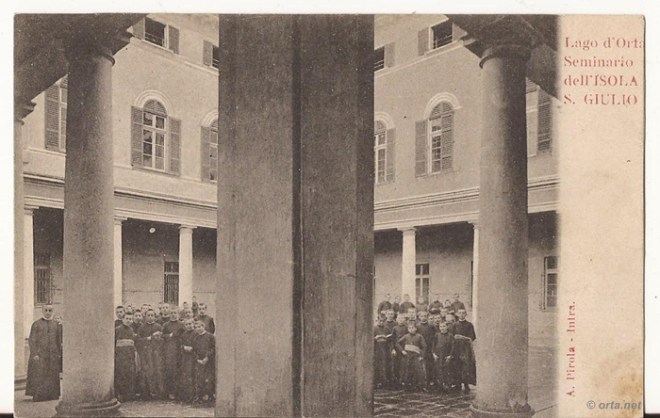
Source

The seminary is no more; it lasted a little less than a hundred years. But the religious vocation of the island continues. The basilica and seminary have been handed over to a congregation of Benedictine nuns – we have one here going through the rite of becoming a Bride of Christ.
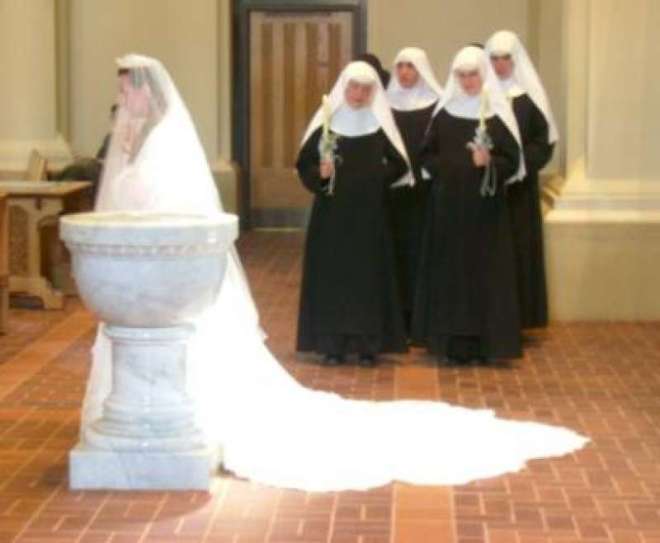
Source

The nuns have an interesting vocation. They study and translate ancient texts, and restore ancient fabrics and tapestries.

It is time to go back to Orta San Giulio and take that street at the back of Piazza Motta which we had noticed that cold and drizzly day, and which carries one up past this church to the Sacred Mountain of Orta.
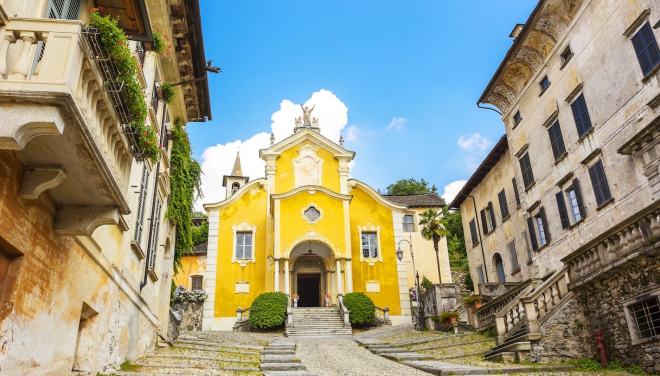
Source

The Sacred Mountain of Orta is one of a number of Sacred Mountains which were created in the late 16th, early 17th Centuries in Northern Italy. They were very much promoted by San Carlo Borromeo, Cardinal of Milan (whose very large nose I have mentioned in an earlier post). The original idea was to create places of pilgrimage which could stand in for the Medieval pilgrimages to the Holy Land, which was becoming harder and harder for pilgrims to reach. For San Carlo Borromeo, the Sacred Mountains were also to be a way to teach the little people, who had not had the benefit of an education, in an easily understandable way such mysteries as the Trinity but also the lives of Christ, the Virgin Mary, and great saints. To this end, the Sacred Mountains were made up of a series of chapels containing life-sized models in terracotta, backed up by frescoes on the chapel walls, each telling a story in a holy person’s life or making a point about some tricky theological concept: little theatrical pieces, if you will. I have mentioned the use of art to teach illiterate people about religion in an earlier post. With the growth of Protestantism, the Sacred Mountains took on a third purpose, that of combating these horrible heresies. That no doubt explains why there are so many Sacred Mountains in Northern Italy, where they were created as bulwarks against the tide of Protestantism that could be washing over the Alps at any minute. In fact, the Sacred Mountain of Orta is part of nine such Sacred Mountains in northern Italy which are now inscribed in UNESCO’s list of World Heritage Sites. In September, my wife and I visited another of these nine sites, at Varallo in Piedmont (where, coincidentally, we were once again accompanying our son on one of his business trips). I mentioned another of these sites, at Varese, in an earlier post I wrote about the fondness of religions around the world for sacrilizing mountains.

The Sacred Mountain of Orta is dedicated to the life of St. Francis, which pleases me no end since he must be my favourite saint, as I have mentioned in an earlier post. There are 20 chapels, laid out in a wooded landscape.

Source

I don’t propose to show readers photos of them all. Just two can give readers a sense of what would await them were they to visit this Sacred Mountain (or any of the other Sacred Mountains for that matter).

Source
Source

I hope these scenes are in better shape than the ones we saw at Varallo, which were really rather tatty. Luckily, they were in the midst of being restored when we visited.

You get beautiful views over the lake from the Sacro Monte.

Source

As you gaze down on this sunny scene, it’s hard to believe that a mere thirty years ago the lake was dead. Everything in it had been killed off by industries which were discharging their crap into the lake, turning it into the most acidic lake in the world. It started back in 1927, when the German company Bemberg, which was making rayon fibre using the cuprammonium process, set itself up on the lakeside. The plant’s copper and ammonium discharges quickly acidified the lake, killing all life in it in about two years. Bemberg made limp efforts to control the discharges, which did begin to finally show noticeable reductions in the late 1950s. But by then Bemberg had been joined by a host of small plants making metal consumer products; two of these companies, incidentally, went on to become global brands: Bialetti and Alessi.

Sources

Many of these plants included electroplating in their processes (that Alessi kettle is heavily chromed, for instance) and consequently toxic heavy metals such as chromium, zinc, copper and nickel were added to the filthy mix being discharged into the lake. As if that weren’t enough, the acidic waters of the lake released aluminium from the natural and normally harmless imissions of aluminosilicate into the lake, adding yet another toxic metal to the stew. Things only got better when the legislators eventually banged their fist on the table and passed Italy’s first water protection law in 1976 (the Legge Merli; I know it well, I referred to it countless times when as an environmental consultant I would tell Italian companies they needed to control their water discharges). Suddenly, companies which had claimed for years that it was impossible to control their discharges and remain in business found – surprise, surprise – that actually it was possible to control them and stay in business. But it took more than just forcing companies to properly control their discharges to get the lake’s pH back to normal. A massive liming operation was required, where calcium carbonate was added to the lake. A boat was specially made for the purpose. Lime was first sprayed on the surface.
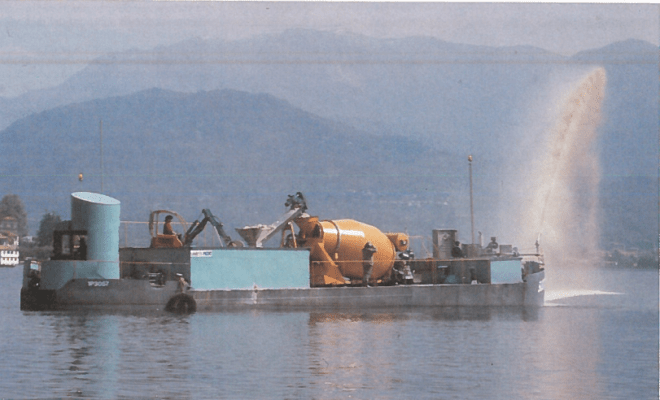
Source

But that wasn’t enough. Lime had to be injected deep into the lake, below the thermocline. It took twenty years to restore what had taken a mere two to destroy. The lake is now more or less OK: “fishable, swimmable”, in the catchy phrase of the US’s first water protection law, although the planctonic populations are not quite right yet.

Well, on that somewhat hopeful note, I leave my readers. Maybe some of them will make it to Lake Orta one day. My wife and I certainly will, when Spring comes rolling round again.

A STRIKINGLY HANDSOME SPIDER

Milan, 26 October 2019

My wife and I have just come back from our annual trip to Kyoto, where I teach a two-week intensive course on sustainable industrial development. As usual, when I was not giving classes we were either visiting Kyoto or walking the ring of hills which surround the city. And as usual, we’ve been coming across a good many examples of this representative of the insect world.

Source

This, dear readers, is the Nephila clavata, or the Joro spider. It is found throughout most of Japan, as well as in Korea, China and Taiwan. And this is the time of year when they spin their webs. They are everywhere! If you’re not careful, you will walk into the webs as you walk along, getting those silky threads all over your face. Here is an especially dense set of webs which we had to navigate.

my photo

I have to say, this species of spider is really quite striking. Look at those green and black markings!  And that dark red stripe around its abdomen!  I am definitely not a fan of the spider family, but even I have to admit that the Joro spider is beautiful, even if in a rather sinister sort of way. And it does spin lovely webs, the classic ones, a series of concentric circles with radiating spokes. My wife and I were lucky enough to catch this one in the morning sunlight when it was still wet with dew.

my photo

The Joro spider is a champion for matriarchal societies. The female is much bigger than the male, and it is she who sits, in deathly stillness, at the centre of the web, waiting for hapless insects to blunder into it and become her next meal.

As for the males, a couple of them will be found on the edges of the web, waiting anxiously for their chance to copulate with the female. After copulation, the female will spin an egg sack, fill it with anything from 400 to 1500 eggs, and then attach it to a tree or other suitable surface. After which, with the onset of winter, all the adults die, leaving the eggs to hatch the following May. The juveniles scatter through the underbrush and the cycle starts again.

And that’s all there is to say, really, about the Joro spider. I’m sure arachnothologists could natter on excitedly for hours about various aspects of the spider’s life cycle and behaviour but I’m assuming my readers are, like me, just ordinary folk with no more than a passing interest in spiders. So I will say no more about the Joro spider – except for one thing.

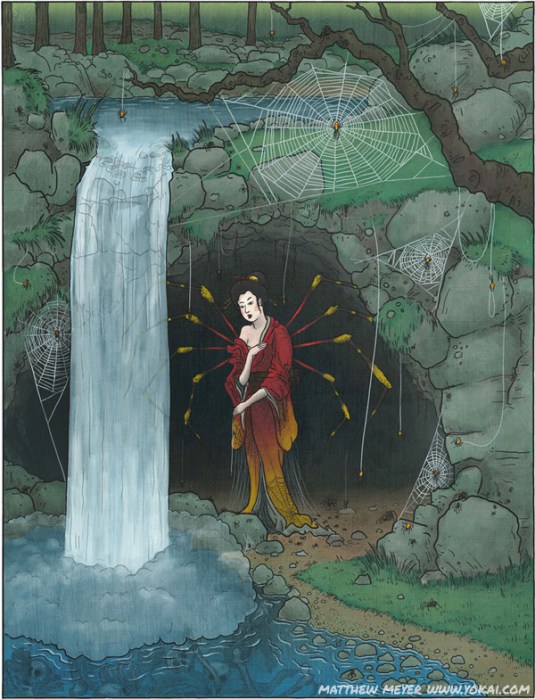
Readers may be interested to know that the Joro spider has over the centuries become one of Japan’s many yokai – these are the supernatural monsters, spirits, and demons that haunt Japanese folklore. I have this theory that it is the dominance of the female over the male along with her vivid colouration that has led to the Joro spider being turned into a yokai. The name in Japanese, Jorogumo, actually means “woman spider”. The name can also be written to mean more negatively “entangling bride” or even “whore spider”. The common role of the Jorogumo yokai in folk tales is to shapeshift into a beautiful woman who will set herself up in a cave, in the forest, or in an empty house in town, and will wait there for unwary men to pass by. She will seduce them, tie them up in her silken web, and then devour them. We have here several modern takes on these ancient storylines, with the second bordering on the pornographic.

Source
Source

A common finale to these folk tales is that one young man, more astute than the rest, will figure out that the beautiful woman who is trying to inveigle him is actually the dreaded entangling woman/whore spider and will take her out with a sword or other suitable weapon. Here we have a strapping samurai doing just that, in a 19th century woodblock by Utagawa Kuniyoshi.

Source

It is interesting that a number of folk tales from other parts of the world include wicked seducing women from the supernatural world, ready to kill or otherwise neuter healthy young men. Just off the top of my head, I can think of the enchantress Circe in the Odyssey, who turned Odysseus’s men into pigs and whose plot to visit the same fate on Odysseus was foiled by the hero.

Source

Or in the same Odyssey, we have the (female) Sirens whose beautiful songs drove (male) sailors mad and incited them to smash their ships onto the rocks.

Source

Without getting too anthropological about it, I have to assume that these tales are a product of the patriarchal societies in which they were developed. In a strongly male-dominated society, the worst thing that can happen to a man is to find himself dominated by a woman. The best excuse a man can give to explain why this happened is for him to say that the woman seduced him. To make it an even better excuse, give the woman supernatural powers of seduction – “if she’d been a normal woman, I could have resisted her female lures”.

As I walked along, ducking out of the way of the Joro spiders’ webs, I found myself wondering how one of these tales would have been told in a matriarchal society.

TRAUNKIRCHEN

Vienna, 25 September 2019

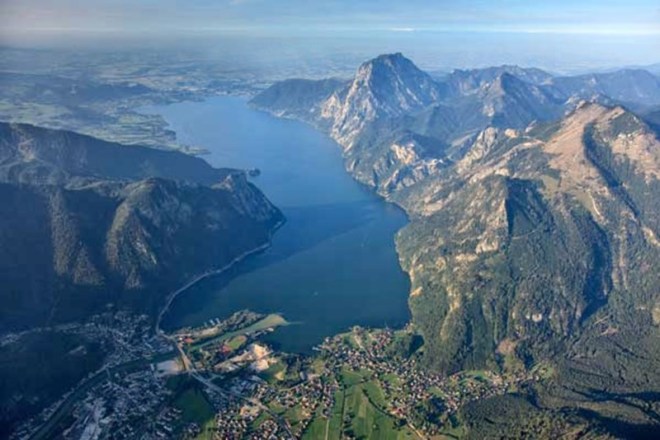
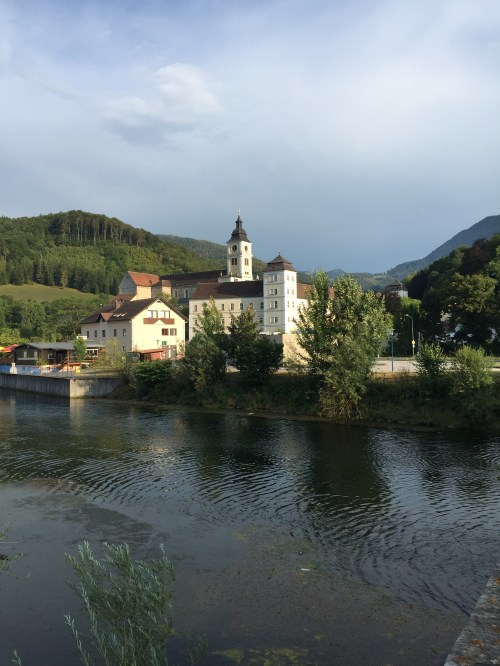
My wife and I recently spent a long weekend on Traunsee (Lake Traun), which is one of several lakes which sprinkle the Salzkammergut region of Austria. Here is an aerial photo of the lake, looking from south to north.

Source

Readers will notice that the topography around the lake is generally mountainous other than a section of relatively gentle hills on the lake’s northwestern shore. We were staying on the edges of the village of Traunkirchen, down south on the western shore, where gentle hill meets steep mountain. This gave us the opportunity to try out both topographies for our hikes, these being the main purpose of our visit.
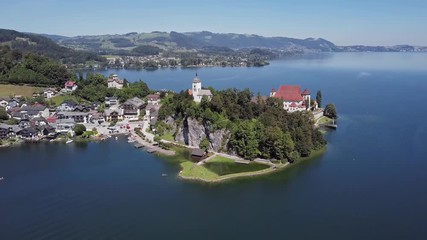
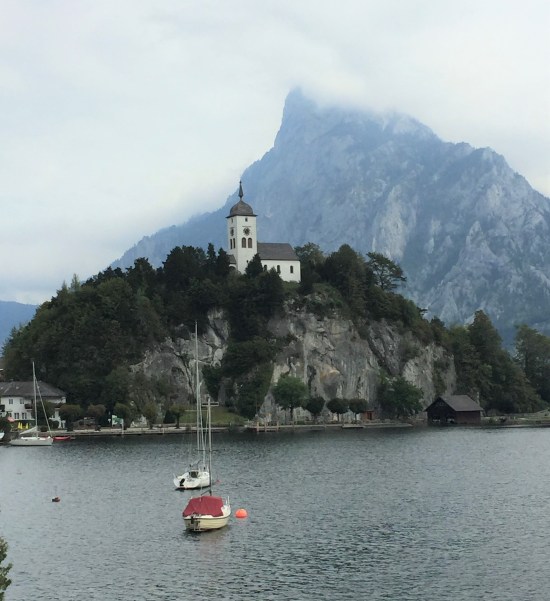
Traunkirchen is wonderfully located, clustered as it is around a rocky spit perched on the edge of the lake – readers with sharp eyes may notice that spit in the photo above. I add in here a closer aerial view of the village.

Source

On the afternoon we arrived, we took advantage of a pedal boat, which our hotel kept moored at its little piece of beachfront, to pedal slowly over to the spit and admire the church built on it from the water.

my wife’s photo

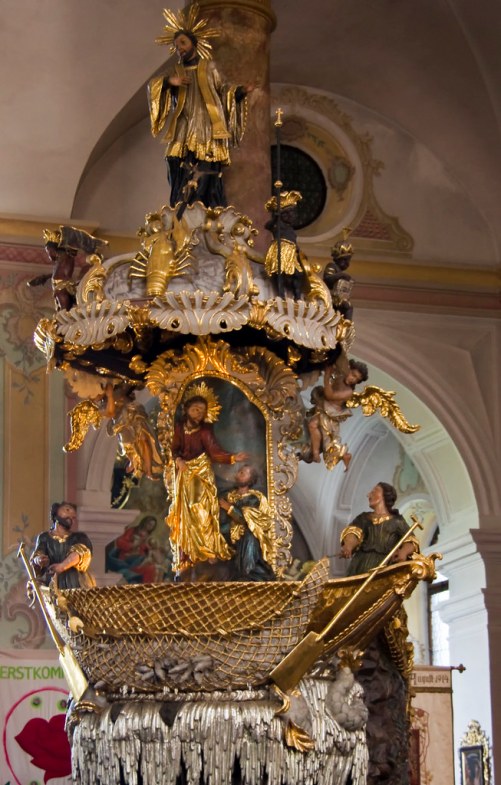
We later visited the church, whose interior was the usual Baroque confection. As I have frequently mentioned, the last time no later than my last post, I am no great fan of the Baroque. But this church does have one splendid piece, the pulpit. It is built in the form a boat, into which fishermen are hauling their catch.

Source

An apt iconography for a village by a lake, but also no doubt the artist was recalling the words of Jesus on Lake Galilee: “As he was going along by the Sea of Galilee, he saw Simon and Andrew, the brother of Simon, casting a net in the sea; for they were fishermen. And Jesus said to them, ‘Follow me, and I will make you become fishers of men.’ Immediately they left their nets and followed Him.”

Our visit to the church was part of a longer itinerary thoughtfully provided by the local tourist office to explore the village. Our next port of call was a small chapel on the highest point of the spit. Up close the chapel was no great shakes, but from afar it made for a wonderful view, as we saw the next day at the start of one of our hikes.

my photo

The local tourist office’s itinerary then carried us away from the water front and up the hill that backed the village. There, perched on a ridge, was a large house built in the early 1850s and known by the locals as the Russian Villa.

Source

The house got its nickname from its first owner. She was the daughter of a Russian prince and went by the delightful name of Sophie Baroness Pantschoulidzeff. The name immediately evokes in me pictures of a languid lady with a Slavic cut to the cheekbones, toying with an enormously long cigarette holder and calling everyone “Daahlingh”. Despite my best efforts, I have been unable to discover anything about this Baroness on the internet. But she kept good company in her villa. Many of Vienna’s artistic elites spent time with her there.

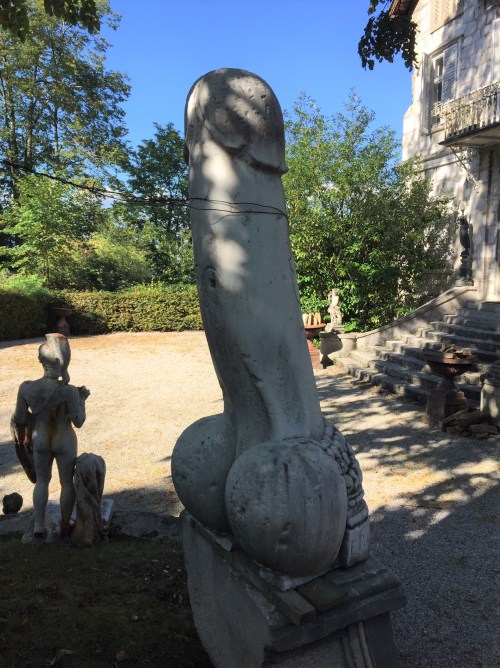
After Baroness Pantschoulidzeff’s death, the villa passed through various hands. Whoever owns it now has a collection of Ancient Greek or Roman statues (or copies thereof) in the garden. Among these, there is one which is – how shall I put it? – particularly intriguing: it is a huge phallus. Of course I had to take a photo.

my photo

From writing which I glimpsed carved into its base, I think it also was of Graeco-Roman origin (or a copy of one such).

We saw it because the itinerary recommended by the tourist office took us along a path which passed by the gate to the villa’s garden. The path then went on to become Traunkirchen’s Via Crucis. I can only hope that anyone walking the path for religious purposes, and not – like us – to follow a tourist itinerary, will keep their eyes firmly fixed on the horizon and ignore that giant male member as they pass the villa’s garden gate.

After this glimpse of the surreal, we went on to follow the Via Crucis, which led us eventually to its final chapel in the woods.

Source

After a look at the crucifixion scene in the chapel, we wended our way back down to the waterfront, where we sat down at the cafe outside the Hotel Post.

Source

While we rested, we enjoyed a good cup of Earl Grey tea served to us by a very friendly waiter dressed in lederhosen – we were in Austria, after all – before we heaved ourselves back on our feet and headed back to our Pension.

SAINT JOHN OF NEPOMUK

Vienna, 17 September, 2019

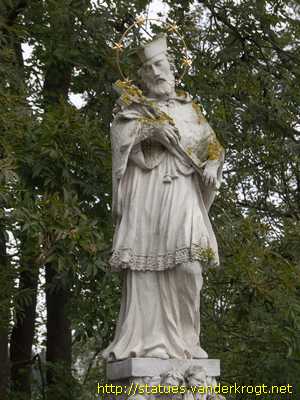
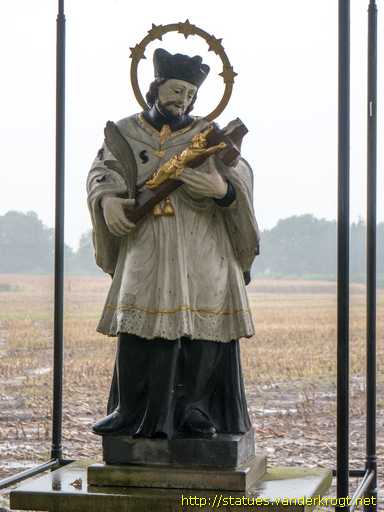
I had never heard of this particular saint until my wife and I came to this part of the world, but once here we saw him repeatedly, not only in Austria but also in the Czech Republic, in Slovakia, and in Hungary (and Wikipedia informs me that we could come across statues of his in Germany, Poland, Lithuania, and even further afield). Here is a photo of a typical statue of him.

Source

This particular photo comes from a web site devoted to statues. The site has listed a little over 200 photos of statues of John of Nepomuk, mostly from the catholic lands of Central Europe but with a smattering from elsewhere, which gives some idea of the saint’s popularity in this part of Europe. The photo shows a “typical” statue of John: bearded, clothed as a priest, wearing the priest’s three-peaked biretta, holding a cross, and with a halo of five stars around his head (what is also often found, but is missing from this particular statue, is a martyr’s palm). The statues are often found on bridges or close to them, for reasons which will become clear in a moment. They often look lost and forlorn, engulfed by modern expansions of what were once little villages.

I suppose John of Nepomuk really came into focus for me when, relatively soon after our move to Vienna, my wife and I decided to visit Prague with the children. As anyone who has been to that city knows, no visit is complete without a crossing of the Charles Bridge.

Source

The most striking thing about the bridge (apart from the fine views it affords of both the old and the less old parts of the city) is the thirty or so statues which line both parapets.

Source

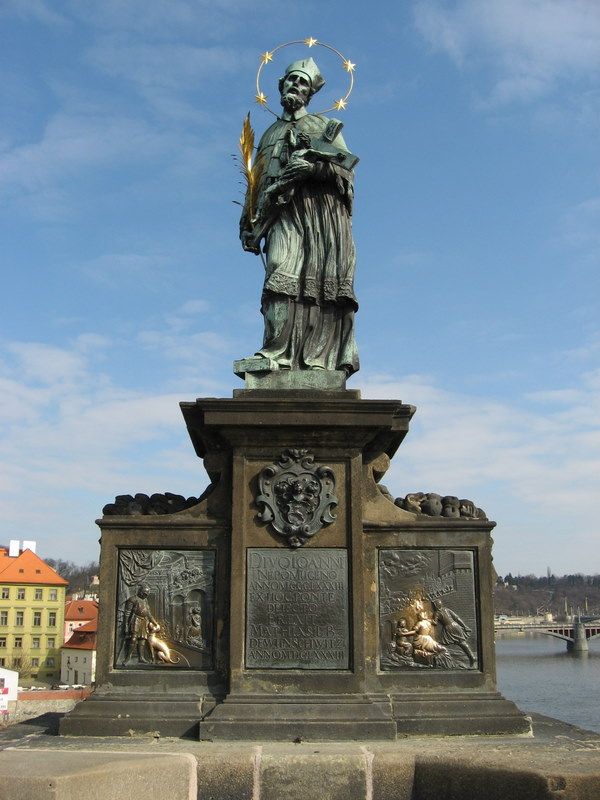
For the most part, they are of various saints who presumably were important to the city – or to the donors who paid for them. One of them – actually, the oldest of them all – is a statue of St. John of Nepomuk.

Source

The reasons why some of the other saints got a privileged position on the bridge may not be entirely clear, but in John’s case it is crystal clear. He is the patron saint of the Czech Republic (and, before the Czech Republic existed, of Bohemia). As if that weren’t enough he was killed by being thrown off this very same bridge, which was nearing the end of its construction when he was summarily tipped over the parapet.

Well! It’s not every day that you stand on the very same spot (more or less) from which a saint was dispatched to his death. And such an interesting death! I don’t want to sound too morbid, but the way he was killed – according to my guide-book, sewn into a goatskin bag before being heaved into the river below – was considerably more quirky than most run-of-the mill deaths of saints I’ve come across. Thoroughly intrigued, I began asking myself what John of Nepomuk had done to deserve being declared a saint (being killed isn’t enough, otherwise we would have millions if not billions of saints).

After reading various accounts of his life, I’m afraid I have to conclude that he did nothing to deserve his title of saint. His sainthood was an act of pure politics.

Perhaps it is time for me to give a thumbnail sketch of John’s life and times. He was born in the 1340s in the Czech (Bohemian) town of Pomuk (later renamed Nepomuk). I would guess that his father – a burgher of the town – decided that his son should make his career in the Church. John must have been a bright lad because after the usual schooling he was sent to the University of Prague, completing his studies of theology and jurisprudence in 1374. Somehow he caught the eye of John of Jesentein, who later became archbishop of Prague. Here is a statue of the good Archbishop on the cathedral of St. Vitus in Prague (if this is a true likeness, he seems to have been a merry fellow).

Source

John of Jesenstein became Archbishop in 1378 and made John his first secretary. Presumably the Archbishop decided that John needed to further his studies and he went off to the University of Padua in 1383, returning home in 1387 with a doctorate in canon law in his pocket. Upon his return, he received – no doubt from the Archbishop – various positions: canon in the church of St. Ægidius in Prague, canon of the cathedral in Wyschehrad in 1389, Archdeacon of Sasz and canon of the Cathedral of St. Vitus in Prague in 1390, president of the ecclesiastical court shortly afterwards, and finally the Archbishop’s vicar-general (a sort of deputy for administrative matters) in 1393. It all sounds like the very rapid ascent of a very able fellow in the Church hierarchy. No doubt a brilliant career beckoned.

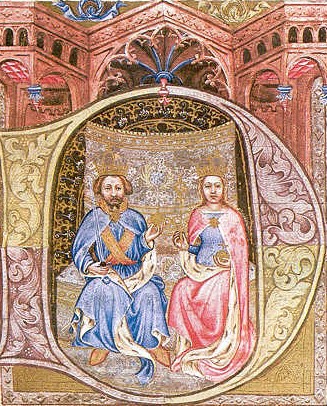
All this was taking place against a turbulent political background. Wenceslaus IV was King of Bohemia at the time. We see him here with his wife Sophia (more of her later), in a miniature from his bible.

Source

From what I read, he was a rather weak man. He certainly didn’t seem able to control his overweening family members, who were constantly undercutting him. His nobles, perhaps already restive but perhaps sensing his weakness, spent their time being obstreperous. He made matters worse by relying on favourites, something which nobles everywhere have always disliked; they feel that by reason of their birth they should be getting the positions being doled out to lower-born favourites. I have to say, Wencelsaus reminds me a lot of Richard II of England.

It was Wenceslaus wanting to reward a favourite which brought him on a collision course with the Church. The crisis came to a head pretty much immediately after John took up his post as the Archbishop’s vicar-general. Wenceslaus wanted to found a new bishopric for one of his favourites. His eyes fell on the rich and powerful Benedictine Abbey of Kladruby, an abbey which still exists. This picture gives us an idea of what a juicy piece of real estate it must have been.

Source

It so happened that its abbot was dying. Wenceslaus ordered that upon his death no new abbot was to be elected. Instead, the abbey’s territories were to be turned into a bishopric and his favourite installed as its bishop (his idea was that the bishop could then return the favour, using the abbey’s resources to support the King in his struggles with family and aristocracy). Now, if there was one thing the Church hierarchy really objected to, that was having Kings telling them who should fill what Church posts, especially when those posts carried with them rich benefices which would be lost to the Church. So when the old abbot finally copped it, the monks of Kladruby held an election post haste and chose one of their own monks to be the new abbot; John, as vicar-general, promptly confirmed the election.

When he heard the news, Wenceslaus blew his top; I am reminded of Henry II of England who, driven to distraction by his Archbishop Thomas à Becket, cried out “Will no-one rid me of this turbulent priest?”, a cry which led four knights to travel to Canterbury and slaughter Thomas on the steps of the cathedral’s high altar. In this case, Wenceslaus had John and three other top Church officials who had played some role in the decision arrested and thrown into gaol. In good medieval fashion, they were all tortured to get them to change the decision. The three others cracked and agreed. But John of Nepomuk held firm. So finally Wenceslaus ordered that he be placed in chains, paraded through the city with a block of wood in his mouth, and thrown from the Charles Bridge into the river. His executioners added the bit about being sewn into a goatskin bag. This fateful final event in John’s story occurred in March of 1393.

I’m not quite sure what the fall-out of all this was. The Archbishop certainly hot-footed it down to Rome, accompanied by the new abbot of Kladruby, to make a formal exposition of all that had happened (thus giving us the earliest written account of John’s death). In that exposition, he wrote of John being a martyr, presumably wanting to clothe in holiness a death that was really about quarrels between Church and State and who was more powerful, swirling around what was – let’s face it – a nice juicy piece of real-estate.

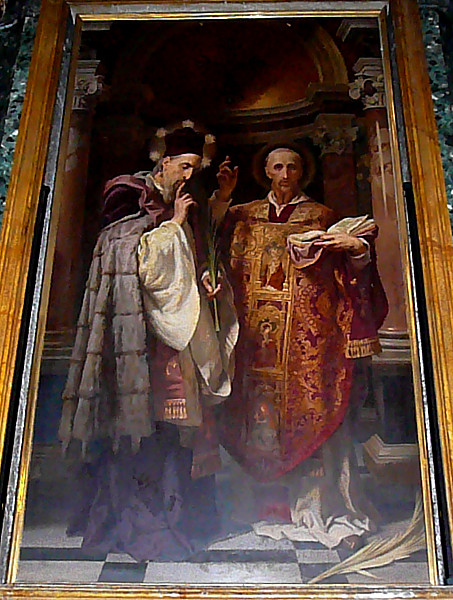
Regardless of what went on in the corridors of power, John’s death caught the imagination of the “little people” of Bohemia. A cult gradually grew up around him. By 1459, so some 70 years after John’s death, a more fanciful – and somewhat more holy – story appeared about the reason for his death; I suppose grubby little arguments about power and money didn’t seem suitable. It was now said that John had been Queen Sophia’s father confessor, that Wenceslaus had pressured him to tell if the Queen had confessed to having a lover, that John had refused to spill the beans citing the secrecy of the confessional, and that the King had lost it, leading to John being tossed into the river. This story is why John is quite often shown with his finger on his lips, as in this painting in the Church of Santa Maria Anima in Rome.

Source

When, after Emperor Ferdinand II smashed the Protestant forces of Bohemia at the Battle of White Mountain in 1620 and the forces of the Counter-Reformation were in full flow to forcibly turn Bohemia back into a Catholic state, it was decided to build on John’s popularity with the little people and push for his canonization. A very thick report was put together which emphasized the fanciful story of his death over the real reason for his death, and it was forwarded to the relevant authorities in Rome. The Roman Curia was happy to comply, so John was beatified in 1721 and canonized in 1729.

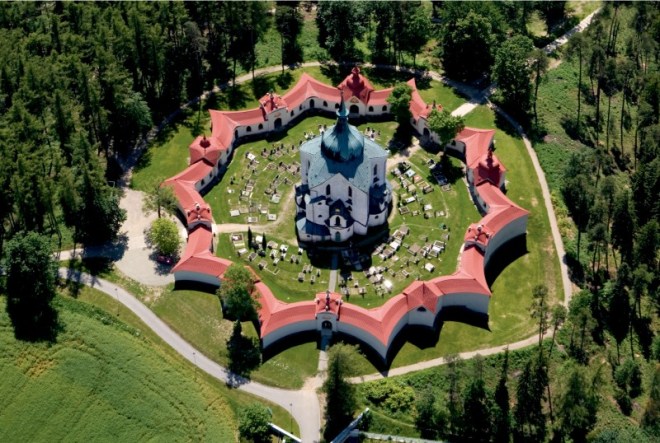
John’s sainthood of course drove the creation of art. Some of this was what we could call High Art. For instance, the years between his beatification and canonization saw the building of the Pilgrimage Church of St John of Nepomuk, a church that is famous in the Czech Republic and is now a UNESCO World Heritage Site (its rather fanciful shape is apparently based on an interpretation of the Cabbala).

Source

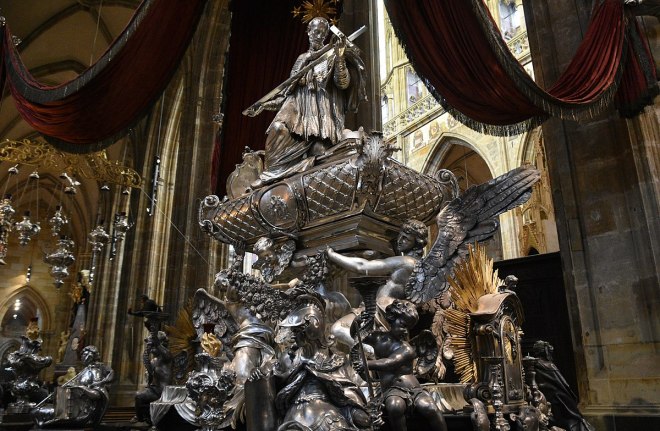
My wife and I have never seen this church, although it looks like a good candidate for a visit; I shall talk to her about it. On the other hand, I am firmly of the opinion that John’s Baroque tomb in the cathedral of Saint Vitus in Prague can be skipped.

Source

Not only does it have in spadefuls all that I dislike about Baroque art – all flash and no substance – I really disapprove of the fact that two tonnes of silver were used to make the tomb; the money used to purchase the silver should have been distributed to the poor.

That’s the High Art. The Low Art generated by John are all those thousands of statues of him scattered around Central Europe and beyond. As readers can imagine, based on the fanciful explanation of his death, John of Nepomuk is the patron saint of good confession, confessors and penitents. But – more interestingly, to my mind – because of the way he died, he is also believed to protect against floods and troubled waters, and so is considered a patron saint of bridges and fords. Certainly the latest statue of him that my wife and I came across was in Lilienfeld during our walk along the so-called Via Sacra between Vienna and Mariazell. The statue was situated on the bank of a river, next to a bridge.

my photo

This statue is somewhat more exciting than most statues of this type, showing John in the act of being thrown over the bridge’s parapet by a fellow who looks quite mean and nasty.

The river itself flowed quite placidly when we crossed the bridge.

my photo

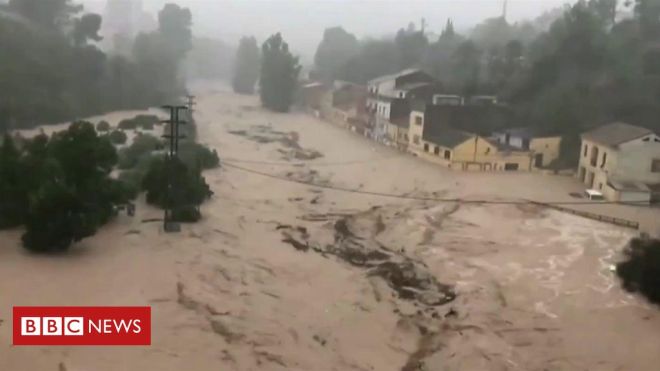
But the news is often filled with stories of rivers which have flooded and killed tens or hundreds of people. Why, only a few days ago we were treated to pictures of extreme flooding in Spain.

Source

I can imagine that the little, humble people have always had great respect for the power of rivers. They bring life-saving water to the crops, but they also unleash death and destruction when angry. I’m sure rites to propitiate the river gods are as old as civilization itself. The Greeks and Romans had their river gods and goddesses. So did the Celts. In fact, so did just about every other culture: Wikipedia has an entry on all these deities. I’m sure that the medieval Bohemians used John as a way of christianizing their age-old river gods.

Of course, if you have a saint to whom you pray to stop floods and the heavy rain which creates them, it is not a great step to also ask him to intercede in the opposite case, the case of drought. That’s why you will also find statues of John in the middle of farmland, like this one from a place called Burlo in Germany (although the field behind looks rather sodden in this case).

Source

So there we have it. An actor in a Shakespearean drama of power and money who was, over the centuries and for various political reasons, turned into a saint. But below the official Catholic radar, a man who by chance became the means for a mostly rural population to officialize their magic to try to manage water, one of their most precious resources.

P.S. After reading this post, my wife began to see statues of John of Nepomuk everywhere we hiked. They really are common in this part of the world!

BATLINER COLLECTION, ALBERTINA MUSEUM

Vienna, 11 September 2019

I should have written this post a long time ago, when I first went to see the Batliner collection at the Albertina Museum here in Vienna. But somehow it got left behind. I have been jogged along by the death in June of Mr. Batliner, although even then I am several months late. But hey, better late than never!

A little bit of background is in order. Herbert Batliner was a hideously rich Liechensteiner banker (he was actually half Liechensteiner, half Austrian; his mother was Austrian). It will probably come as no surprise to readers to know that his Liechensteiner father was a banker and that he himself followed his father into banking. He made millions helping seriously rich people stash their wealth away from pesky tax collectors (and others) in “family foundations”. Some of these people had iffy reputations – the son of an African dictator, the partner of an Ecuadorian drug baron, a pardoned fugitive US financier, that sort of thing. Some of his replies when he was asked about these rather grey financial dealings were quite instructive: “I’m not a Father Confessor who has to ask his clients if they have obeyed the laws of their homelands”,  and “We don’t take unannounced clients, or those that show up with suitcases full of cash”. At one point, the German tax authorities started investigating him for possible involvement in illegal financial transactions by one of the country’s political parties, but he saw the danger off with the payment of a rather hefty fine. All this assistance to the filthy rich made him rich too. In 2006, his assets were estimated at about 200 million Swiss Francs.

On the plus side, Mr. Batliner, together with his wife Rita, used his millions to build up a remarkable collection of modern and contemporary art. In 2007, he transferred his collection (in the form of a foundation, of course) to the Albertina Museum as a permanent loan. The Museum was, of course, exceedingly grateful. The Director Klaus Albrecht Schröder called the donation a “key event in the history of the Albertina”. We see here Herbert and Rita, together with a beaming Schröder, in front of one of the paintings in their collection, a Monet painting of the water lilies in the pond of his garden at Giverny.

Source

This same painting make up the background to the Albertina’s poster which publicizes the permanent exhibition.

Source

The Albertina then cannily transferred this poster to the long flight of steps leading up to the entrance to the museum.

my photo

It has become quite a hit with the public, being a popular spot for photos and selfies.

The poster, and other material related to the exhibition, highlight the presence of paintings by Monet and Picasso, but in truth these were not the paintings that struck me the most when I visited the exhibition. I show here, in the order in which I came across them, the works that caught my attention.

Peace (1915) by Augusto Giacometti.

My photo

This Giacometti was related to the more well-known Alberto Giacometti, being a cousin of Alberto’s father. This is the only time I’ve ever come across any of his work. Wikpedia informs me that “he was prominent as a painter in the Art Nouveau and Symbolism movements, for his work in stained glass, as a proponent of murals and a designer of popular posters.”

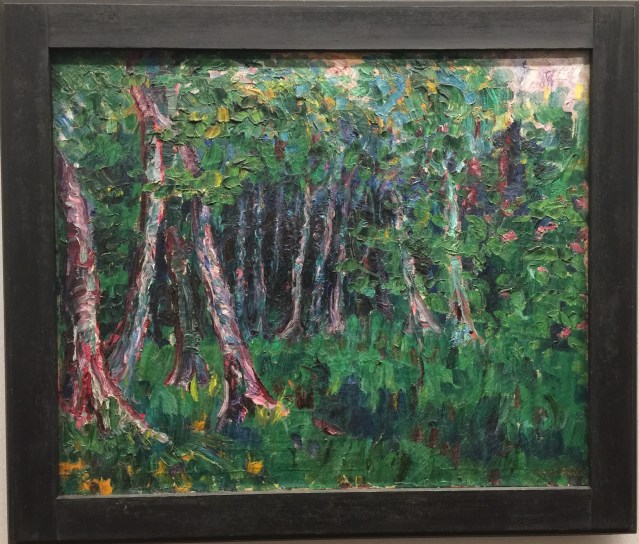
Forest (1909) by Emil Nolde.

my photo

Nolde was German-Danish, being born in Schleswig. He was one of the first Expressionists, a member of the Die Brücke movement.

Moonlit Night (1914), again by Emil Nolde.

my photo

Unfortunately, Nolde is a prime example of the fact that being a great painter doesn’t mean that you are a nice person. Already in the early 1920s Nolde was a supporter of the Nazi party, expressing anti-semitic opinions about Jewish artists and considering Expressionism to be a distinctively Germanic style. But he was hoist on his own petard. Hitler rejected all forms of modern art as “degenerate”, and the Nazi regime officially condemned Nolde’s work.  Over a thousand of his works were removed from museums, more than those of any other artist, and some were included in the 1937 Degenerate Art exhibition.  He was not allowed to paint – even in private – after 1941.

Irises in the Evening Shadows (1925) by Max Pechstein.

my photo

Like Nolde, Pechstein was German and a member of the Die Brücke movement. He fell out with his fellow members, though, in 1912 and went it alone. He too fell foul of the Nazis and had a number of his works exhibited in the Degenerate Art exhibition.

Approach to Löbau Train Station (1911) by Ernst Ludwig Kirchner.

my photo

Also German, also an Expressionist painter, also a member of the Die Brücke movement, also branded as “degenerate” and had a number of his paintings exhibited in the Degenerate Art Exhibition. He committed suicide in 1938.

Yachting on Lake Tegern (1910) by August Macke.

my photo

Macke was another German Expressionist painter, but he was a founder member of another movement, the Blaue Reiter, which was based in the outskirts of Munich. He died in the first weeks of the First World War, in Champagne.

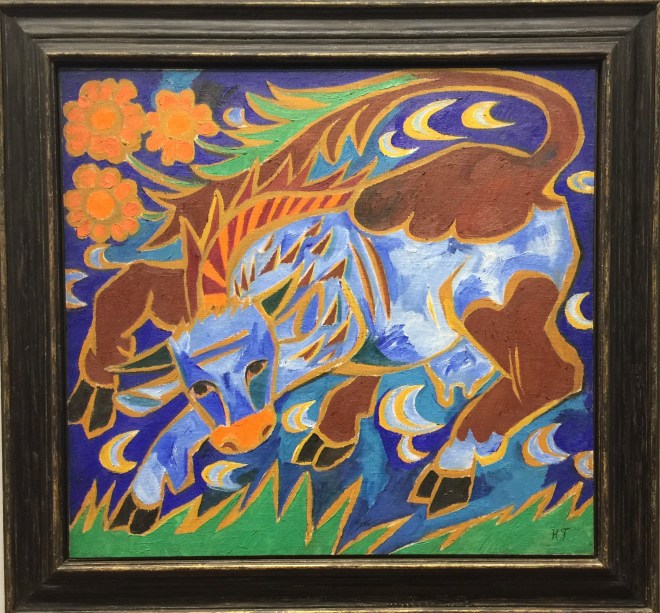
The Blue Cow (c. 1911) by Natalia Goncharova.

my photo

A Russian, Goncharova was, according to her Wikipedia entry, “a founding member of both the Jack of Diamonds (1909–1911), Moscow’s first radical independent exhibiting group, the more radical Donkey’s Tail (1912–1913), and with her lifelong partner, Mikhail Larionov, invented Rayonism (1912–1914). She was also a member of the German based art movement known as Der Blaue Reiter.”

Young Girl with a Flowered Hat (1910) by Alexej Jawlensky.

my photo

Another Russian, Jawlensky moved to Germany, joined the Expressionist trend, and was another founder member of the Blaue Reiter movement. I recently saw a wonderful painting of his in Munich.

Another gorgeous painting by Jawlensky, Cornfield near Carantec, from a bit earlier: 1905.

my photo

Very different from the “typical” Jawlensky painting, of which the Young Girl with a Flowered Hat is an example.

A third Jawlensky, Abstract Head, from 1928/29.

my photo

I suppose he felt the need to move with the times. But the colouring is still lovely.

Jawlensky is another example of a great painter but not a very nice man. Early on in his career, he shacked up with a rich woman, Marianne von Werefkin, who gave up her painting to look after him and ensure he could paint without having to work, then at some point he dumped her and married another woman, by whom he had already had a child. Marianne died alone, in poverty and obscurity in 1938.

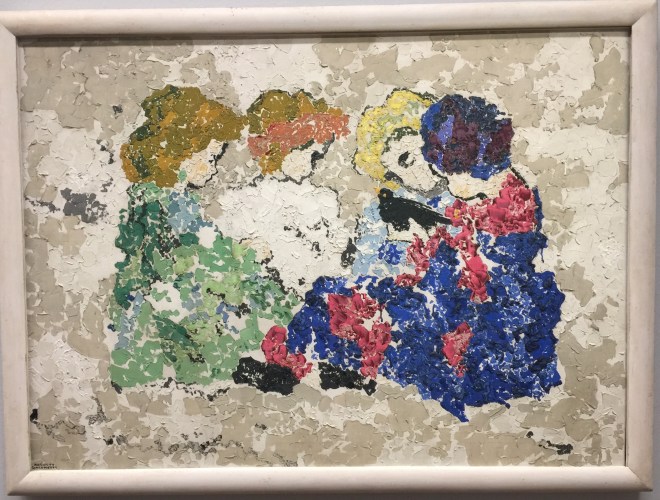
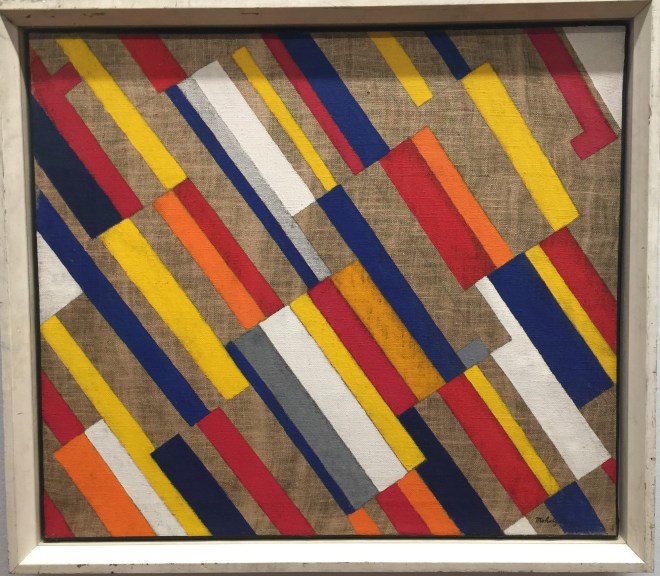
Hungarian Fields (1919) by László Moholy-Nagy.

my photo

Moholy-Nagy is not normally an artist that I warm to, but this painting stopped me dead in my tracks. I had noticed this same pattern of small strips of fields in Austria around Lake Neusidl, on the border with Hungary.

Source

On the Hungarian side of the lake, the fields were much larger. I’m sure they were just as small as the fields in Austria until World War II, but collective farming during the Communist period wiped them out.

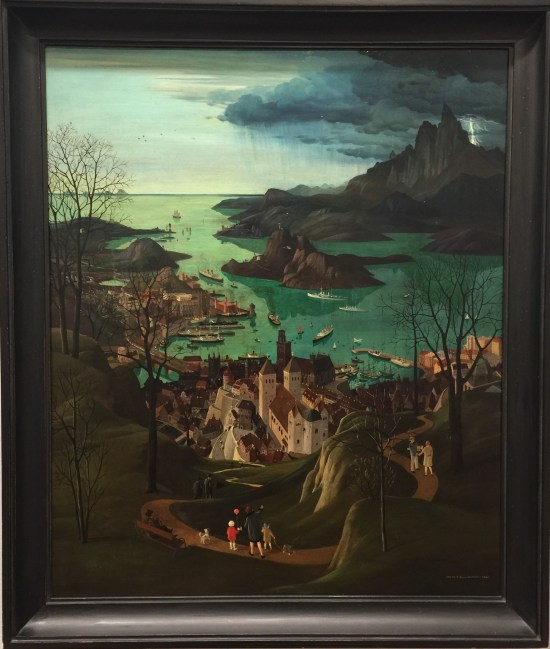
The exhibition had a number of examples of Austrian painters who adhered to the New Objectivity movement which sprang up after World War I, as a reaction to Expressionism. One strand of New Objectivity was a return to classicism. After the horrors of the war, throughout Europe there was a “return to order” in the arts, which resulted in a turn away from abstraction by many artists towards neoclassicism. I include here one example from the exhibition, The Big Port of 1928 by Herbert von Reyel-Hanisch.

my photo

I started with Augusto Giacometti, I finish with his more famous cousin once-removed, Alberto Giacometti.

my photo
my photo

One photo doesn’t do justice to this remarkable statuette, Slender Bust on Plinth (Amenophis) from 1954. I suspect that when Giacometti refers to Amenophis he has in mind the pharaoh Akhenaten. Akhenaten started reigning as Amenhotep IV, a name which the Greeks translated as Amenophis. As this photo attests, he did have a long thin face with pronounced features like Giacometti’s statuette.

Source

I was certainly much struck by the statues of Akhenaten which we saw during a recent visit to Egypt. I could well imagine that Giacometti would have found his face fascinating.

Well, those were my take-aways from this exhibition. If any of my readers come to Vienna, they should really make time for this exhibition and see what they think. The rest of the Albertina Museum is also worth visiting, they normally have excellent temporary exhibitions.

QUAFFING MEAD

Vienna, 18 August 2019

Back in April, I was up in Vienna to make a presentation at a workshop on ecodesign and its role in promoting circular economies. Fascinating topic, but what I actually want to write about is the fact that at this meeting I met an old contact of mine, Wolfgang, who many years ago had run a training programme for me on ecodesign in Sri Lanka. After the workshop, we repaired to a bar to catch up on the past 15 years or so over a beer. Wolfgang first told me all about what he’s been up to in the ecodesign world, but then added, “What’s really exciting me at the moment is my production of mead.”

Mead … I don’t know what visions this conjures up in my readers, but for me I immediately see Vikings wassailing the dark Nordic nights away, drinking mead out of horns or possibly the skulls of their enemies, and preparing for the battle of tomorrow where they will die heroically and go to Valhalla. These fine fellows will stand in nicely for such a scene.

Source

I had certainly never drunk the stuff myself; I didn’t know anyone made it anymore.

Thoroughly intrigued, I pressed Wolfgang for more information. As is the case with all enthusiasts, I didn’t have to press very hard. With a pint of beer inside him, he waxed lyrical on the subject. He had to start at the very beginning, with what mead is made from – I didn’t even know that. It’s a mixture of honey and water to which yeast is added to turn the sugars in the honey into alcohol. The relative ratios of honey to water will determine the level of sweetness of the final product. Sweetness can be further increased by the addition of fruits. On the other hand, the mix can be made dryer by adding astringent berries or herbs. Wolfgang was very dismissive about the modern trend of making sweet meads. In fact, he said, he started making mead because he was appalled at how horribly sweet most modern meads are, which in his opinion obliterates the wonderful underlying tastes of the honey. He decided he was going to swim against the current and make a dry mead. He had been at it for a couple of years, and was beginning to sell his product to other enthusiasts.

Well, this all sounded very interesting! I was definitely going to have to try this stuff. Unfortunately, I was going back down to Milan the next day. But we agreed that when my wife and I came up to Vienna for the summer, I would contact him and we would arrange a mead-tasting event.

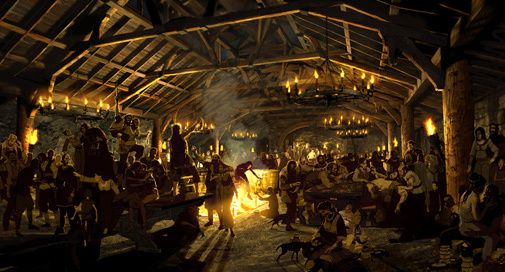
In the meantime, down in Milan, I did some research. Mead, it turns out, is very ancient, probably the first alcoholic drink that human beings ever quaffed. It’s also a pretty universal drink. The tribes that settled Europe certainly all drank mead. I’ve already mentioned the Vikings. They loved mead so much, they wrote a whole saga about it – Kvasir and the Mead of Poetry. It’s a story that has dwarves, giants, the god Odin, thievery, murder, and various other bits and bobs. A shaggy dog story if ever I heard one, good to while away those long Nordic nights while quaffing mead. The bottom line of the saga is that mead can turn you into a poet or a scholar: a feeling that I’m sure all of us have had when we have drunk too much alcohol; a feeling we normally have just before we are sick or pass out, or both. And much of Beowulf, that Anglo-Saxon poem greatly revered by lovers of the English language, takes place in a mead hall; it was in these specially-built halls that Viking chieftains and their retinue of warriors drank mead, listened to long, long – long – sagas, and generally wassailed the nights away, before collapsing onto the benches or even onto the floor in a drunken stupor. Here is an artist’s representation of a mead hall.

Source

And here is an excellent summary of the first part of Beowulf: “The fantastical mead hall of Heorot forms an integral part of the epic Old English poem Beowulf, serving as both the setting and instigation of the action. It is the carousing of Heorot’s denizens as they slug back mead in the hall which awakens the terrible ire of the monster Grendel – with predictably gruesome results. The solution to the problem – in typical Old English style – was not to put down the mead horns and cease partying, but to slay the monster (and his mother) before throwing an even bigger and more mead-soaked party to celebrate.”

The Vikings may be the best known quaffers of mead, but the Celts were no slouches, and nor were the Germanic tribes. There is riddle-poem in the Exeter Book, a 10th-century anthology of Anglo-Saxon poetry, about honey and mead. I quote the first couple of lines:

Ic eom weorð werum, wide funden,
brungen of bearwum ond of burghleoþum,
of denum ond of dunum. Dæges mec wægun
feþre on lifte, feredon mid liste …

But since I’m sure that 99.99% of my readers are like me not able to read Anglo-Saxon, I insert here a translation of the poem into modern English:

I am valuable to men, found widely,
brought from groves and from mountain slopes,
from valleys and from hills. By day, was I carried
by feathers up high, taken skillfully
under a sheltering roof. A man then washed me
in a container. Now I am a binder and a striker;
I bring a slave to the ground, sometimes an old churl.
Immediately he discovers, he who goes against me
and contends against my strength,
that he shall meet the ground with his back,
unless he ceases from his folly early;
deprived of his strength, loud of speech, his power bound,
he has no control over his mind, his feet, or his hands.
Ask what I am called, who thus binds slaves
to the earth with blows, by the light of day.

The Anglo-Saxons clearly recognized the power of mead to bring you crashing to the floor of the mead hall or any other establishment where you drank the stuff in excess.

The Slavs also drank the stuff – they still do, with Poland having an especially developed culture of mead drinking. We have here a painting of a couple of early 19th Century Polish noblemen enjoying a flagon of mead, a scene inspired by that great nationalist Polish poem, Pan Tadeusz by Adam Mickiewicz. I don’t even bother with the Polish here, I just launch straight into an English translation, and cut out much of the saga-like talk between the two old men who are our subject:

Two old men sat outside the house, tankards
of strong mead resting on their knees; …
The old men drink their mead and dip their snuff
from a bark case, continuing their chat.
“Yes, yes, Protazy, it is true enough,”
said the Warden. “I can agree with that,”
replied Protazy the Apparitor.
“Yes,” they repeated in unison, “Yes,”
nodding their heads. …
…. The turf bench in the yard
on which they sat adjoined the kitchen wall;
from an open window, steam filled the air,
billowing like a conflagration. When all
the smoke was gone, a white chef‟s hat was there,
flitting like a dove. It was the Seneschal,
who stuck his head out through the kitchen window,
eavesdropping on this private conversation.
Finally, he handed them a plate with two
biscuits. “Have this cake with your libation,”
He said …

Source

It wasn’t just tribes in Europe’s north who drank mead. The Ancient Greeks drank it – I read that Dionysios was the God of mead before becoming the God of wine. Greek followers of Dionysios, and Roman followers of Bacchus (same God, different name), used to hold festivals – the Dionysia or Bacchanalia – where much drinking and dancing and cavorting about (nudge, nudge, wink, wink, say no more) was the key. Here is a take on a Bacchanalia by Hendrik Balen (he did the figures) and Jan Breughel the Elder (he did the landscape), painted in about 1620.

Source

As I say, the Romans partook enthusiastically in Bacchanalia, but there were more sober Roman citizens who left us some serious commentary on mead. Here is my favourite, by the Roman naturalist Lucius Junius Moderatus Columella, who included a recipe for making mead in his tome on agriculture, De re rustica, which he wrote in about 60 CE (again, I skip the Latin and go straight into an English translation).

Take rainwater kept for several years, and mix a sextarius [ca. ½ litre] of this water with a [Roman] pound [ca. ⅓ kg] of honey. For a weaker mead, mix a sextarius of water with nine ounces [ca. ¼ kg] of honey. The whole is exposed to the sun for 40 days, and then left on a shelf near the fire. If you have no rain water, then boil spring water.

I am appalled and fascinated in equal measure by this idea that one could take several-year old rainwater and use it to make something to drink; I suppose this was a way of inoculating the honey-water mix with natural yeasts which somehow found their way into the rainwater. I presume Columella drank his own mead and survived, so it cannot have been as deadly as it sounds.

And it wasn’t just the Europeans who drank it. The Chinese did – in fact, the oldest archaeological evidence tentatively pointing to mead drinking has been found in China: some honey, rice, and fermentation residues found on the inside of a pot 9,000 years old. The Mandaya and Manobo people in the island of Mindanao in the Philippines still drink mead, which they call bais.

In Africa, the Xhosa in South Africa have an ancient tradition of drinking mead, or iQhilika in Xhosa, and the Ethiopians have been, and continue to be, enthusiastic drinkers of mead (or tej as it’s called locally). Here we have Ethiopians enjoying a wee dram of the stuff.

Source

And I love this picture, done in the traditional Ethiopian style, of what appears to be a priest and his acolytes getting ready to down some tej.

Source

What I find particularly delicious in this painting is that normally the figures in Ethiopian paintings are very solemn; no-one breaks into a smile. Yet here, at the thought of the pleasures to come, we see a hint of a smile on the acolytes’ faces (while the priest looks troubled, which is perhaps how it should be: “Guys, should we be doing this? What if someone sees me drinking this stuff? I have an important position in the community.”).

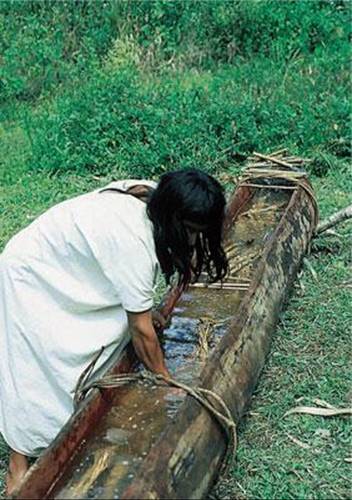
Even in the Americas mead was, and still is consumed. Prior to the Spanish conquest, the Maya made a drink called balché made by soaking the bark of a special tree in a honey-water mix and allowing it to ferment. Apparently, the Maya consumed balché in enema form to maximize its inebriating effect (just think if the Vikings had cottoned on to that …). For some reason, the Conquistadores banned the drink, but it never went away completely. Here is an Amerindian from the Chiapas region of Mexico making balché the old way: in a hollowed log, place the bark of the tree, add water and honey, cover and wait.
Balché may be making a comeback, although one of the reasons the Spaniards didn’t like it is that it smelled foul to them. They popularized a variant, xtabentún, which replaced the tree bark with anise (they also added rum, which makes the drink more of a liqueur).

In a way, it’s not surprising that mead is drunk in so many parts of the world. Honey, its basic ingredient, is to be found pretty much everywhere on this planet, as this map of the global distribution of the honeybee attests (the different colours refer to sub-species of the honeybee; the pinkish colour, the most dominant, gives the range for apis mellifera).

Source

For reasons that are not completely clear to me, the drinking of mead went into steep decline in Europe some time after the Middle Ages. Somehow, it got squeezed out by wine on one side and beer on the other. So now there are a few traditional hold-outs where mead never completely died out and enthusiasts like Wolfgang who are trying to bring mead back.

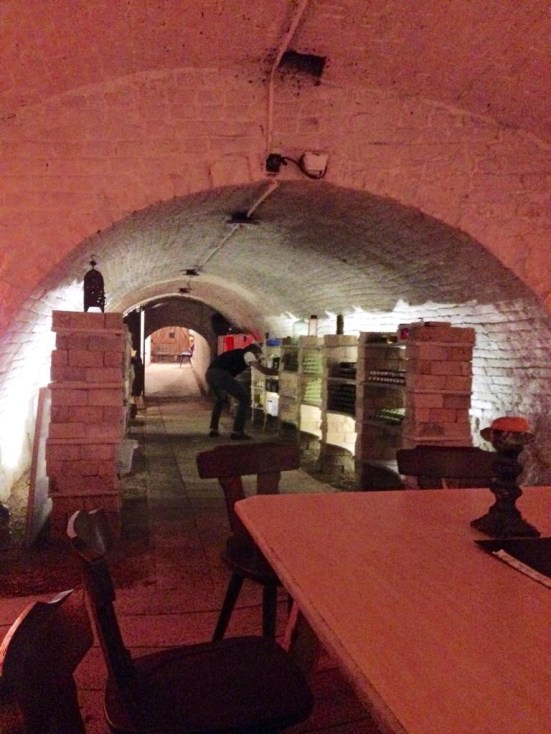
Coming back to Wolfgang, when June came around and my wife and I came up to Vienna for the summer, I contacted him. But one thing and another – he was away, then I was away; he was busy, then I was busy – meant that we weren’t able to arrange the mead tasting until last week. But it was finally arranged! Wolfgang keeps his mead in an old wine cellar in a small village outside Vienna, so we took a bus with him one evening and sallied forth. It was a lovely cellar, very deep, at the end of which he had a table with chairs where we sat down to do our mead tasting.
He got us some glasses and a bottle of his best mead.
He uncorked it, poured us a generous portion, and invited us to taste. We ceremonially picked up the glass, sniffed it, swirled it around, and took a sip.

It was … interesting. I think that’s the best I can say. I don’t know if readers can imagine this, but it tasted like honey without the sweet taste. What gets left behind if you take out the honey’s sweetness is a slightly acrid, slightly “waxy” taste. If any of my readers have ever nibbled at wax, that was the predominant taste of the mead.

The first mead we tried was made with honey where the bees had been feeding on the nectar from lime-tree (linden) flowers (I have waxed lyrical about the flower of the linden tree in a past post). We then tried a mead made with honey where the bees had feasted on rhododendron nectar up in the Alps. It was much clearer in colour, but the taste did not change much. As a finale, we tried a mead to which chokeberries had been added. These turned the mead’s colour redder and made the taste smokier – but it did not change the basic facts.
Well, we bought two bottles from Wolfgang. We felt we owed him that for the trouble he had gone to. We plan to take the bottles down to Milan, where we’ll try them on our son and see what he thinks.

In the meantime – but I have to hide this from Wolfgang – I think we should find some sweet mead to try. I feel that despite Wolfgang’s tut-tutting, people are not so wrong to drink their mead sweet. And that Ethiopian mead looks really interesting! I wonder if the Ethiopian restaurant we go to in Milan has any?

HOLIDAY SNAPS OF MUNICH AND BREGENZ

Vienna, 8 August 2019

I left readers at the end of my last post promising to cover the rest of our stay in Munich as well as our stay in Bregenz in another post. Well, I am a man of his word, here is that post!

In truth, the post will be more of a showing of photos than anything else, the e-equivalent of having your friends round for dinner after your latest holiday and boring them with your holiday snaps. I hope my readers will not be too bored and slip away early from this post …

With that, let us begin!

Munich

Well, I can’t say that I was carried away by the overall look and feel of the city. Pleasant enough, but Vienna for instance is a much more striking city overall. So what follows is a string of individual things that stuck in my mind as we criss-crossed the city.

The Nymphenburg Palace, the little summer pad of the Dukes-Kings-Electors of Bavaria.

Source

It was once out in the countryside but is now in the suburbs of Munich. Considerably more dramatic than the Hapsburgs’ little summer pad at Schönbrunn (now also marooned in Vienna’s suburbs).

The outside may have been dramatic, but the palace’s interiors weren’t up to much. On the other hand, the interior of Amalienburg, a little hunting lodge hidden among the trees of the Palace’s park, was quite something.

Source

“One of the finest examples of Rococo architecture in Germany” intones the Michelin Green Guide. I’m quite ready to believe it.

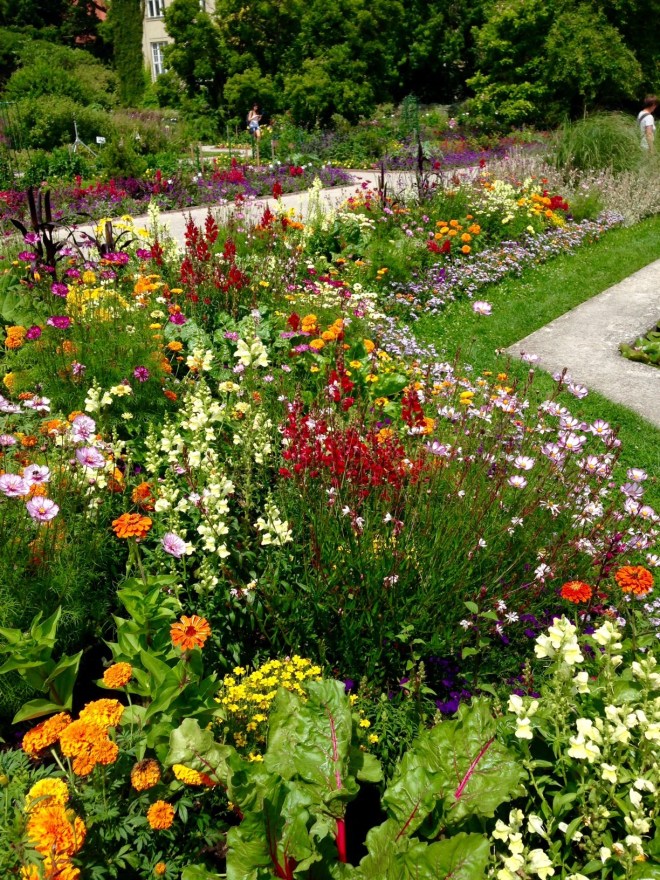
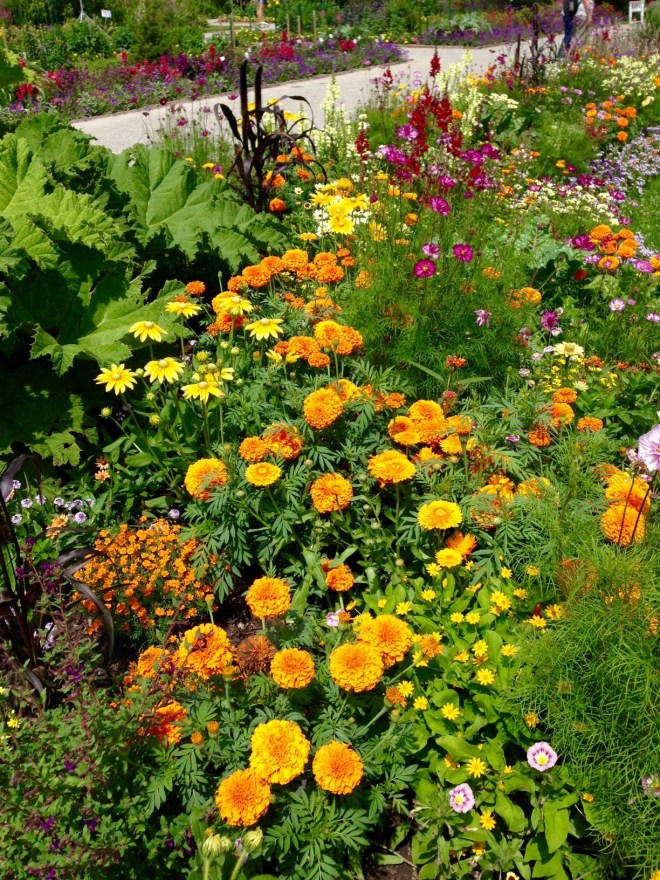
A riot of colour at the city’s botanical gardens, situated on the edge of Nymphenburg Palace’s park.

our photo
our photo

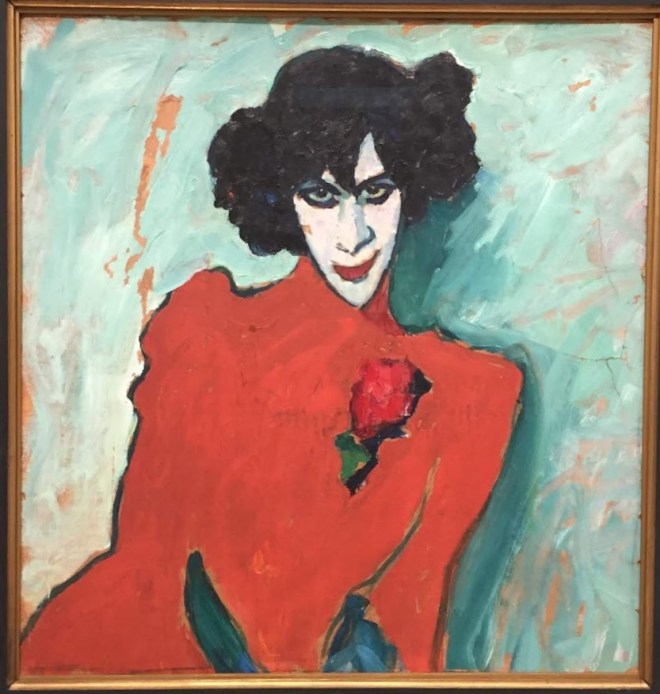
A striking painting by Alexej Jawlensky (Portrait of the Dancer Sacharoff), at Villa Lenbach, one of the museums we visited.

source

The museum has a whole section devoted to members of the Blaue Reiter group. A worthy collection indeed, but nothing other than this painting grabbed me.

Villa Lenbach also had a room devoted to paintings from after 1945, which is where I saw this one.

Source

The Seated Man, by Jean Hélion, a French painter whom I had never, ever heard of prior to entering the Villa Lenbach. Well, you learn something new every day …

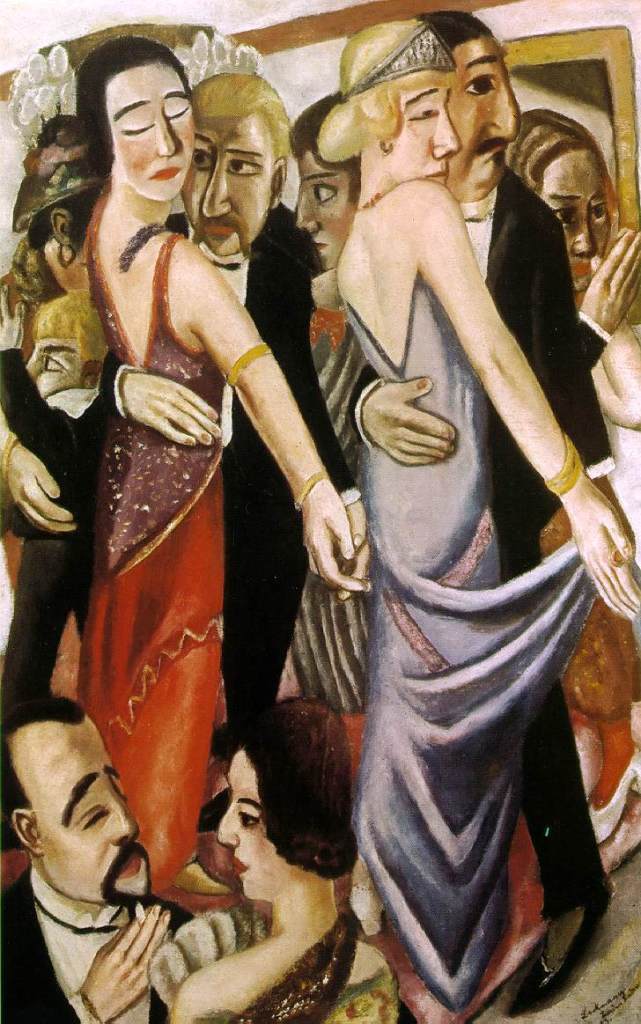
We also visited the Modern Art Gallery (Pinakothek der Moderne). Again, a very worthy collection, but only this painting by Max Beckmann (Dance in Baden-Baden) has stayed with me.

Source

On our wanderings, we entered the Burgersaal church by mistake (I misread the map and thought we were visiting St. Michael’s church, “the first Renaissance church built north of the Alps” the Michelin Green Guide dixit – the serendipity of tourism).

our photo

The paintings on the ceiling were a pleasingly modernized take on an old art form.

our photo

The church is dedicated to Blessed Rupert Mayer (kneeling to the left on that ceiling painting), a priest who stood up to the Nazis. He was one of the very few German Catholics who did so …

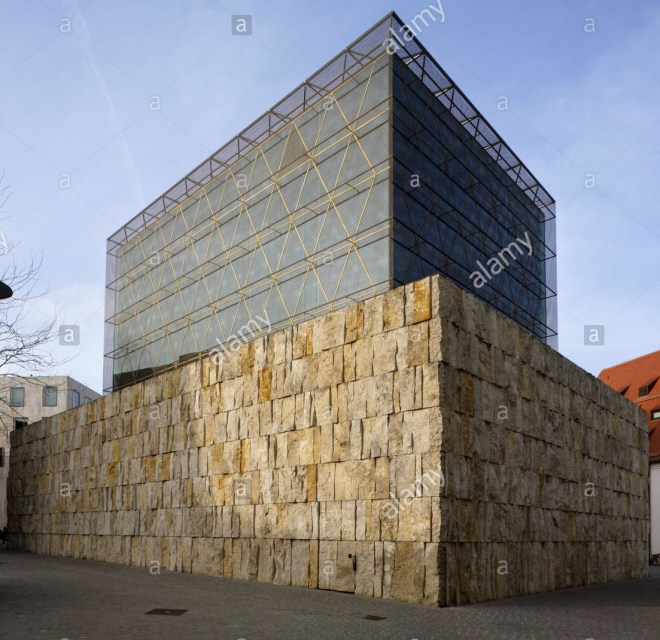
The new main Jewish synagogue in St. Jakobs Platz in the old town.

Source

The previous main synagogue was pulled down by the Nazis in 1938. We didn’t get to visit inside, but the brooding, rugged exterior was impressive enough. It reminded me of the Wailing Wall in Jerusalem. The Jewish Museum next door was interesting, too, but more as a collection of memories of a community scythed down by the Nazis. Many were sent to Dachau, a mere 20 km to the north of Munich.

The Hofbräuhaus Beer Hall in the old town.

Source

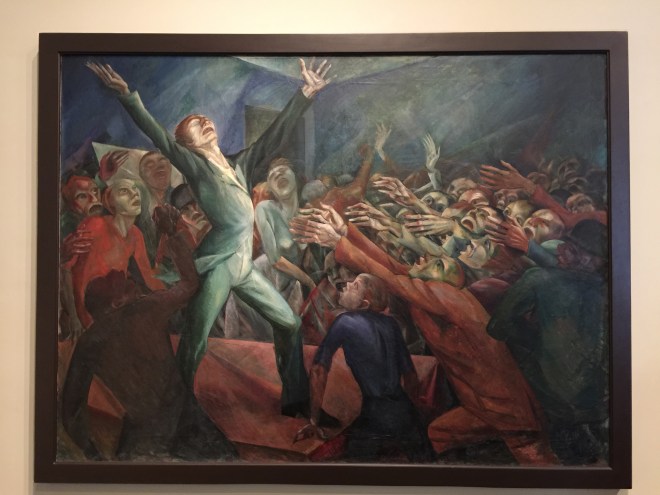
This was one of several such halls in Munich in which Hitler used to speak in the early days of his political career. I don’t know what I was expecting; a sense of menace or of dread in the air? No doubt I was influenced by a painting I had seen in Los Angeles’s County Museum of Art: The Orator, by Magnus Zeller.

our photo

The location of that painting could easily have been the Hofbräuhaus.

But all I saw were a lot of people enjoying a beer, and all I heard was a lot of cheerful babble.

And that’s it for Munich! Next stop:

Bregenz

I must confess that I was expecting more. Its location on Lake Constance, its venerable and ancient past (it was originally a Roman town by the name of Brigantium), all led me to think it would be an interesting place to visit. But no, there really wasn’t much to it, and what there was, was ruined by bad town planning: the railway station and a busy through road effectively cut the city off from the lake. So again, just a few photos of some individual places.

A view of the upper town, a charming and quiet little corner of the city.

Source

That tower in the background with the squat onion dome is St. Martin’s Tower; this charming fresco is one of several which adorn its interior.

Our photo

A view of the city and the lake from up a mountain outside the city. We discovered some beautiful walks in the mountains surrounding the city.

our photo

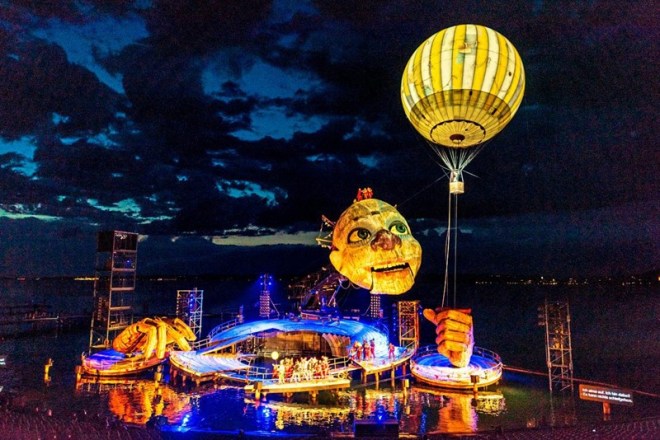
The spectacular set for the opera; it was the fact that our friend from Bregenz had extra tickets that brought us to the city in the first place.

Source
Source

The stage is a little way out in the lake, just off the shore, and the audience takes its place on seating put up along the shore. We were seeing Verdi’s Rigoletto, but the opera itself was completely overshadowed by the set. That giant head went up and down and turned this way and that, the eyes opened and closed, as did the mouth, people entered and exited the mouth, the hands moved, fluttering here and there, the tethered balloon went up and down … All this while the sun was setting over the lake and darkness came creeping up on us. It was jaw-dropping. Was the singing good? I don’t know, I was so concentrated on that head and its next move.

And that’s it for Bregenz!

I hope you’re still with me and that you enjoyed our holiday snaps. See you next time!

EL ANATSUI, GHANAIAN-NIGERIAN ARTIST

Vienna, 2 August 2019
amended 5 August 2019

A couple of months ago, a friend of ours told us that he had two spare tickets for the Bregenz Opera festival and asked us if would we like to take them. It so happens that I had been meaning to go and check Bregenz out ever since, many years ago, we had driven through it one wintry day on our way to visit my parents. So my wife and I gladly took him up in his offer. A write-up on that trip, though, will have to wait for another day. What I want to write about today is our little pre-trip to Munich.

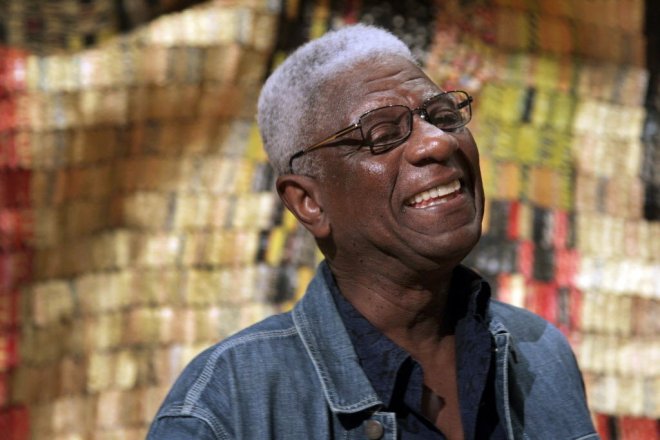
It just so happens that a couple of days after we accepted our friend’s offer to go to Bregenz we read about an exhibition in Munich of the works of the Ghanaian-Nigerian artist El Anatsui.

source

We had come across his work in New York’s Metropolitan Museum of Art some five years ago, and had been hankering to see more of his stuff ever since. It also so happens that we had passed through Munich as well as Bregenz that wintry day of many years ago – as readers will ascertain looking at a map, Munich and Bregenz are in the same general direction from Vienna. There too, I had promised myself to return some day to visit the city.

So after a little discussion and a study of bus and train timetables, my wife and I decided that we would visit Munich for a few days before going on to Bregenz for another couple of days. Thus it was that two weeks ago we disembarked from the bus at Munich’s bus station to start our visit.

Since it was the primary reason for our visiting Munich, I will focus in this post on the exhibition of El Anatui’s work. I’ll deal with the rest of Munich and Bregenz in a later post.

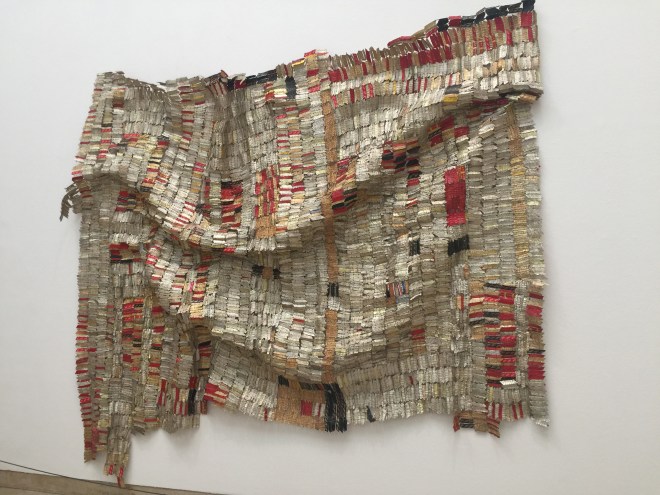
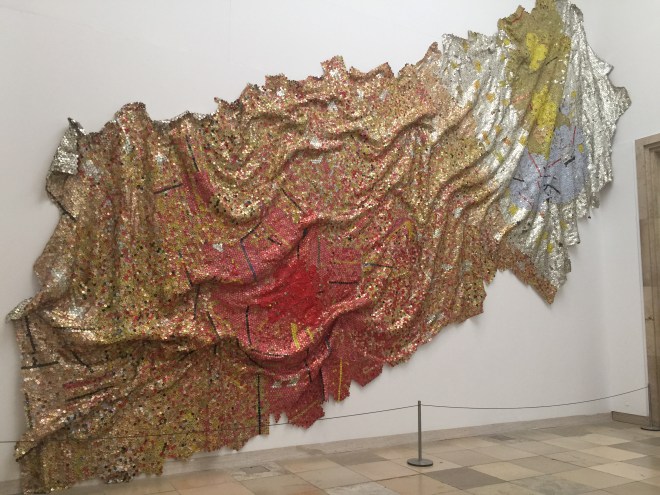
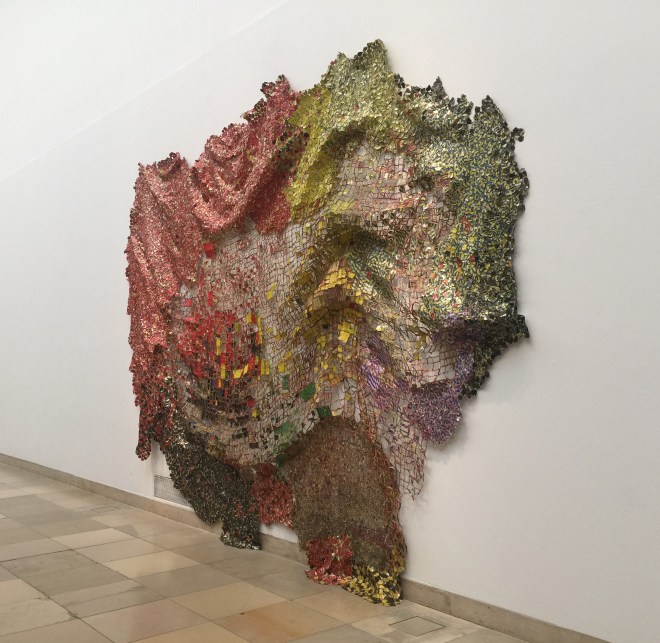
Anatsui is best known for these kinds of works.
At first glance, they appear to be large sheets of textiles of some sort, draped on the wall. But actually, the sheets are made up of thousands of aluminum bottle tops, from bottled drinks, as well as of the aluminum bands or sheaths to which the unopened tops are attached.
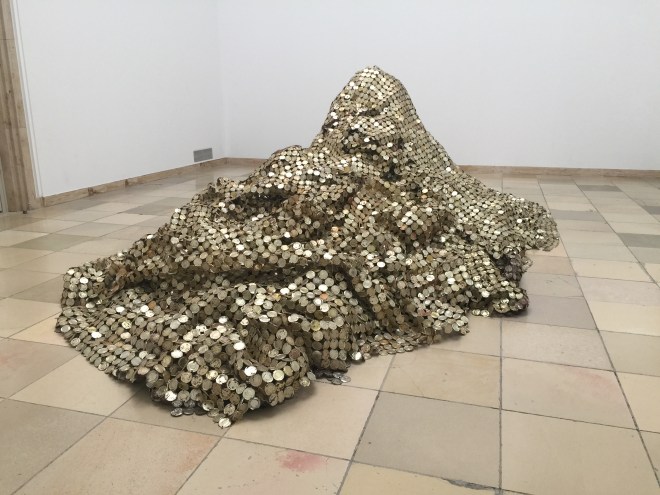
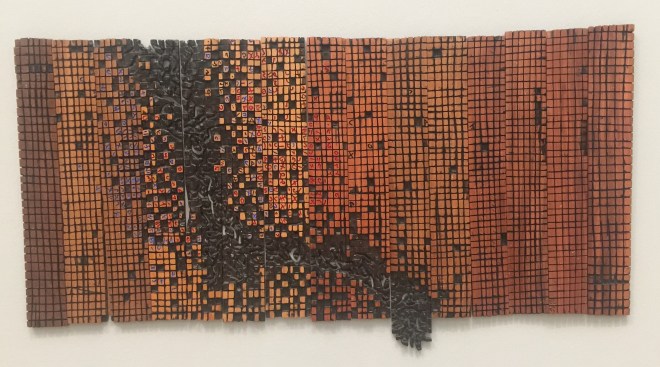
Anatsui was driven to experiment with these waste objects by a principle he lives by: artists should use what they have around them to create their art. He buys these discarded pieces of aluminum from the informal recyclers who collect them. His large crew of assistants then flatten them, after which Anatsui has them lay the pieces on the ground, where he shuffles them around, using the brand colours of the aluminum pieces to produce an overall large-scale abstract design. Once he is satisfied with the design, his assistants “sew” the pieces together with copper wire. When Anatsui is setting up an exhibition, he will spend much time in “draping” the sheets on the wall until he is satisfied with the effect. Here are some other pieces in the exhibition.
Sometimes, Anatsui uses the aluminum pieces differently. He will have his assistants twist them into circles, which they will then sew together.
This gives him semi-transparent sheets with a gauze-like effect. He had one very large work of this type in the exhibition, filling up a whole room.
While Anatsui has mostly used aluminum bottle tops and their sheaths in these kinds of works, he has also used other metallic discards. This work, for instance, is made with the “Easy Open” can tops, the ones you can just pull off the cans.
Personally, I find his work with the aluminum caps and sheathes more interesting. Can tops are too big, so the textile-like effect of his other works is not really there. The brand colours are absent too, so he can’t get the abstract designs he creates with the bottle tops.

I have to say, I find these pieces fascinating. Not only are they beautiful to look at, they are also a wonderful example of how, with some thought and dedication, a waste can be given a new life. And what a new life they have been given by Anatsui! His works remind me of another African artist whom I have written a post about earlier, Abdoulaye Konaté. He also takes small coloured pieces of material, in his case pieces of textile, and creates beautiful abstract designs out of them.

Although Anatsui is best known for his work with aluminum bottle caps, he actually arrived at this quite late in his career. Before that, he worked, and continues to work, with wood. His basic approach is to first take a chain-saw to the wood, gouging out lines, often criss-crossing and of varying depths and orientation, and then taking a blow torch to the surface to selectively blacken it. He may then add touches of colour. The effect can be quite striking. Here are photos of a couple of his works in the exhibition.
Before that, he worked in clay. We are now at the start of his career, and as is perhaps often the case with artists this early work is good but not great. I include only one of these works here.

As I say, a really great artist. I’ve said it before, and I say it again: I think the best art today is coming out of the developing countries; In Europe especially, our art is dying on its feet. I’m afraid any readers who are interested in seeing this exhibition will no longer be able to see it in Munich. It closed at the end of July. But I think there is a chance it will go on to other places. Keep a lookout for it!

LAMENTATIONS OVER A LOVED ONE

Milan, 8 June 2019

During the month of March, my wife and I went to Bologna for a short visit (I should have written up this post quite a while back; but hey, as they say, better late than never). It’s a nice little town, somewhat off the tourists’ beaten track, which makes it all the nicer. It had been decades since either of us had been back – my wife studied there for a year in the late 1970s, and I had visited her one Christmas before we went off for a little jaunt to Puglia. So it was nice to visit a few old haunts, although in truth her memories of the town were somewhat hazy and mine were almost non-existent.

But actually, what I had really been looking forward to visit was a Lamentation over the Dead Christ, by Niccolò dell’Arca from 1463, which is located in the Church of Santa Maria della Vita (tucked away behind Piazza del Nettuno). I had come across it a decade or so ago when I was methodically leafing through the 1,000 pages of the book 30,000 Years of Art: the story of human creativity across time and space.

Source

This very – very – thick book purports to summarize the best art that we humans have created ever since we started making things: the first entry in the book is from c. 28000 BC, the last is from the mid-1990s. Its entry for the year 1463 is Niccolò dell’Arca’s Lamentation (on page 685, if anyone is interested). When I saw it, I said to myself, “One day, I must go to Bologna to see this!”

The Lamentation in question is not a painting. Rather, it is a collection of terracotta statues making up a sort of “tableau vivant” of the scene of sorrow around Jesus’s dead body, after he has been taken down from the cross and before he has been deposed in his tomb. It seems that Lamentations of this kind were quite common, at least in Italy (and not just in terracotta; I recently saw the remains of two other Lamentations made of wood, in the Pinacoteca of Milan’s castle). The statues represent a set of stock characters: Jesus, of course, lying on the ground after being taken down from the cross; Mary, the mother of Jesus (whom I shall henceforth refer to as the Madonna, to avoid confusion with the three other Marys); St. John the Evangelist; the three other Marys – Mary Magdalene, Mary of Cleophas, Mary Salome; Joseph of Arimathea; and Nicodemus. Here is a typical example of the form, which we also saw in Bologna, in the cathedral, made by the artist Alfonso Lombardi between 1522 and 1526.

our photo

Very nice, very dignified, very composed.

But now consider the Lamentation which I wanted to see.

Source

Talk about lamentation! Look at the faces of the women!
Mary, mother of Jesus, first of all

our photo

Next to her, Mary Salome, gripping her thighs frenetically in her anguish

our photo

At the feet of Jesus, Mary of Cleophas, trying to shield herself from the awful truth

our photo

Finally, next to her, Mary Magdalene, shrieking out her horror at what she sees.

our photo

The weeping, the wailing – the shrieking – going on in that circle of people is all heightened by Mary Magdalene’s clothes streaming behind her in a most dramatic fashion.

our photo

The explanation given in the church is that she was running to the scene and the artist caught her – as if in a cinematic still – at the moment when she burst into the circle around the body and saw with horror that Jesus was dead.

In contrast, the two men in the group are quite subdued. St. John’s expression can only be described as that of someone who is feeling somewhat miserable

our photo

while Joseph of Arimathea simply looks phlegmatic.

our photo

(for those of my readers who might be asking themselves this, Nicodemus was either not part of this particular group or he disappeared in the intervening 400 years)

This male-female contrast in emotions brings to mind an exchange we as a family had on WhatsApp about Theresa May’s resignation speech in late May. Our son commented that it was somewhat embarrassing to see her cry, at which our daughter leaped to her defence. I quote: “I thought her speech was pretty good. She got emotional when talking about the honour of the job and the fact that she was the second ever female UK prime minister (and not the last) – I think it’s fair to get emotional at that stage! We need to stop vilifying emotional releases such as tears. Women are physiologically more prone to crying – our tear ducts open more easily. If we see tears as a sign of weakness we are inherently disadvantaging women. Anyway, the premise that being “strong” means being unemotional I also think should be changed. We don’t need to go to the opposite extreme but her release was very appropriate.”

Well, Nicolò dell’Arca certainly seemed to think that grown men don’t cry, but that women do, and copiously!

It struck me that I could use the various Lamentations paintings created over the centuries to explore how painters felt about this gender difference in the showing of emotions, or simply about the showing of emotions at all. I should add a warning here that my personal take on this is that in real life the scene at the centre of the Lamentations would have been highly emotional: your son, or your leader, who has had you believing that he is heralding the arrival of the end of time and the start of the reign of Yahweh, has instead been shamefully put to death by the colonial authorities and now lies before you, dead. All your hopes, all your beliefs, smashed to smithereens. If I had been there I would have been a total puddle, even if I am a man. But let’s see what painters thought.

We can start this exploration some two centuries before dell’Arca’s composition, with Giotto’s Lamentation of 1303, which is to be found in the Scrovegni chapel in Padova (and on page 615 of the Very, Very Thick Book).

Source

Here, everyone who is gathered around the dead Jesus is crying – not wailing as the women are in dell’Arco’s composition, but definitely crying. Even St. John – the person standing over the women huddled around Jesus – is crying. In fact, I would say that St. John is in transports of sorrow, more so than the women. Even the angels are in anguish. It is true that the two fellows to the right – believed to be Joseph of Arimathea and Nicodemus – are quite composed, but one could argue that they were not close companions of Jesus and so not as committed to the cause that he represented. It could also show that Giotto thought it was OK for young men like St. John to show their emotions, but that older men should keep their upper lip well stiffened.

Jumping forward to 1440-42, we have a Lamentation by the Dominican monk Fra’ Angelico, in the Monastery of San Marco in Florence.

Source

Here, no crying, just a gentle preparation of the body for the tomb behind, by the women and St. John (who has his back to us) (the fellow in the background is St. Dominic, seeing all this in a trance). A typical work of Fra’ Angelico, I would say, as gentle as the man himself. Maybe strong emotions frightened him. Maybe he preferred to choose a moment slightly after the tears and the wailing, when practical considerations kicked in: the dead body needed to be prepared for the grave.

We can go forward another fifty years, to Mantegna’s Lamentation of 1489, hanging on the walls of Milan’s Pinacoteca di Brera just up the road from where I write this (and which can be viewed on page 707 of the VVThB, by the way).

Source

Looking at the painting, readers can see that next to Jesus there are three people – the Madonna, St. John next to her, and a third person you can just make out over the Madonna’s shoulder. They are all crying copiously. It seems that Mantegna, rather like Giotto, believed in everyone showing their emotions.

On the other hand, in Botticelli’s Lamentation of almost the same period (1490-92), now in Munich’s Alte Pinakothek, the artist only has the women lamenting (although in a very stylized way, it seems to me; shades of things to come). St. John simply looks grim. So Boticcelli appears to be with dell’Arco on this one: women show emotions, men don’t.

Source

The painting also has that stock situation, common in later times, and which I must confess to find most irritating, of the Madonna fainting from the emotion of it all. This really is the male assumption about the weakness and frailty of women: when the going gets tough, women faint. The other men, saints of various kinds, are simply there to witness the scene, like St. Dominic in Fra’ Angelico’s version, so do not show much emotion (I do think, though, that Botticelli had some cheek in including St. Peter – the fellow to the right, clutching a big key – since according to the Gospels while Jesus was being taken down from the cross and being buried he and the other – male – disciples were all cowering in a room somewhere, in fear of imminent arrest).

This next Lamentation is by Bellini, executed at the same time as Botticelli’s (1485-95). It is one of many Lamentations which he painted. This particular one is in the Uffizi in Florence. Here, everyone is even more composed: the Madonna, Mary Magdalene, and St. John seem to be sniffling a little while everyone else is looking calmly noble. Bellini does not believe in showing emotions, it would seem (although in fairness to him, some of his other Lamentations seem somewhat more emotionally charged).

Source

On the other hand, in this Lamentation by the Venetian painter Carlo Crivelli, from exactly the same period (1485) (and now in Boston’s Museum of Fine Arts), both the Madonna and St. John are in absolute agony, with the latter literally howling (it is true to say, though, that Mary Magdalene is more contained).

Source

It would seem that Crivelli was a believer in showing strong emotions, like dell’Arca, and was quite happy with men showing such emotions.

But now look at this Lamentation by Perugino, again from the same period, 1495 (and now in the Palazzo Pitti in Florence).

Source

I mean, everyone, man and woman, looks ridiculously calm and noble! (there is one half-hearted attempt at gesticulation, by the lady in red at the back, but it’s very unconvincing). Perugino must have thought that emotions weren’t necessary to the scene.

From 50 years later, 1547, we have this Lamentation by Paolo Veronese (it seems that every artist worth his salt had a go at this theme), now in the Castelvecchio Museum in Verona.

Source

Again, everyone looks calm and dignified. The Madonna looks a trifle pale, but that’s about it. No emotions please!

A decade on, 1560 or thereabouts, Tintoretto painted this Removal from the Cross bleeding into a Lamentation, now in the Galleria dell’Accademia in Venice.

Source

This is best described as baroque, although it’s a bit early for that. We have a fainting Madonna, dramatic gesticulation, contorted clothing – but not a single tear. Drama is required, but not emotions.

The same message comes through 45 years later in Caravaggio’s Deposition of 1603-1604 (which also contains some Lamentation in it), now in the Pinacoteca Vaticana.

Source

The drama here comes from the play of light and dark and the angle from which it was painted. But the women seem quite composed in their sorrow; the gesticulation of the girl at the back feels contrived.

If real emotions seem to have drained away from the Lamentations painted in Italy, to be replaced first by Olympian calm and then by drama, there never seems to have been any real emotions at all in the Lamentations painted north of the Alps. The genre crossed the Alps at about the time that Giotto painted his Lamentation in Padova and became very popular. I have not been able to find any tears, or even much emotion, in these Northern European versions of the genre. For instance, this Lamentation from 1455-60, by the Early Netherlandish painter Petrus Christus (and now in Brussel’s Royal Museum of Fine Art) has the Madonna in a tasteful swoon, a lady to the right possibly wiping away a tear, and a woman to the left meekly wringing her hands. But everyone else is quietly going about their business.

Source

This Lamentation by the Burgundian Early Netherlandish painter Simon Marmion is from a little later, about 1476 (and now in New York’s Metropolitan Museum).

Source

Not a shred of emotion here. No drama, either. “Oh dear, he’s dead” is all I get from it.

Dürer, a few decades later (c. 1500), managed to include one person in his Lamentation who is gesticulating, although in a quite contained manner (you almost feel that Dürer included her because it was the done thing to do). The other women just look a little sad, while all the men are simply standing around. (This is another painting in Munich’s Alte Pinakothek)

Source

This next Lamentation, in London’s National Gallery, is by Gerard David, another Early Netherlandish painter, and is from a few decades later still, 1515-1523.

Source

It looks a polished work, but I still see very little emotion. A certain quiet sadness is all I get from the painting, from everyone involved.

I could add more paintings – like I say, every painter worth his salt seems to have had a crack at this one – but I think we get the gist. If there is any trend in later paintings, it’s towards the dramatic – exaggerated gestures, contorted clothing – but with only the women showing – theatrical – emotion; the men simply look stolid.

So what conclusions can we draw? – because we have to draw some conclusion. I have to say that I agree with my daughter on this one. Perhaps it is physiologically easier for women to cry than men, but I also think that European culture (and possibly all cultures) have evolved and now strongly suggest that men should have stiff upper lips while it’s OK for women’s (and children’s, male and female) upper lips to tremble.  I also think that it is expected for our leaders not to cry – stern anger, for instance against the enemy is OK, but no tears. Tears imply weakness, and our leaders must not be weak. Which is why the Renaissance painters stopped showing these ordinary people around Jesus, which Christianity had turned into leaders, crying – and why our son felt a certain embarrassment at seeing May crack up at her podium in front of No. 10. But I think we men should stop trying to look strong and weep and wail when we feel the need to, especially when we have lost someone very near and dear to us.

Oh, and do go to Bologna to see dell’Arco’s Lamentation. it’s really worth the visit – and Bologna is a nice place, with very good food.


FRANCESCO BARACCA, ACE OF ACES

Sori, 3 June 2019

My wife and I were recently walking to the library of the Italian Alpine Club, with the idea of looking at some guide books on a walk in the Dolomites which we will be doing in a few weeks (and on which I hope to write a post or two). The walk took us through a part of Milan with which I’m not familiar, and so it was that I found myself walking for the first time through a little square. In the middle of it was this very intriguing statue.

Source

As readers can see, it consists of a man emerging from a stone plinth, naked but for some sort of cap with ear flaps on his head, holding a lit torch in one hand, and wearing a heroic expression. The name carved into the base of the plinth was Francesco Baracca. I asked my wife who it was. She wasn’t sure – a First World War general, she hazarded? But I wasn’t convinced. The cap looked too much like those leather caps worn by the early aviators. I mean, who doesn’t remember Snoopy on his way to fight the Red Baron?

Source

In my memory, there were also pictures of Biggles from the boys’ books of my youth.

Source

No-one who is not British and not my age or older will know who this Biggles is. He was a fictional World War I fighter pilot about whom a series of exciting books were written. He was a very heroic figure and a Jolly Good Chap.

A bit more seriously, here is a photo of Charles Lindbergh, the first person to manage a solo crossing of the Atlantic non-stop, which he did in 1927.

Source

Well, it turned out I was right. Francesco Baracca had indeed been an aviator. And not just any old aviator! He was Italy’s Ace of Aces during the First World War, racking up 34 recognized victories, the highest score for any Italian fighter pilot. Here we have him sitting in his plane with his flying cap on (and, contrary to his statue, with his clothes on; very sensible, it’s cold up there), ready to go and let the enemy have it.

Source

While here we have him posing in front of one of the enemy planes he had downed.

Source

Of course the government squeezed all the propaganda benefits they could out of his exploits. Anything heroic that could take the public’s mind off the bloody and ineffectual meat grinder of trench warfare was to be welcomed. And anyway, there was something terribly dashing about these aerial duels; it was the modern equivalent of Medieval knights jousting. As a result, he was lionized by the Italian public, who followed his every victory with enthusiasm.

It wasn’t just Italians who were enthused by the new forms of warfare in the air. On all sides of the war, the exploits of these new heroes of the air were followed avidly. But perhaps the Italians had a particular penchant for the exploits of aerial warfare. After all, it was in Italy that the Futurismo art movement was born, which had a total commitment to modern technology. To make the point, here are some key excerpts from two of the Futurist Manifestos that were published in 1910.

This is from the Futurist Painters Manifesto:

We want to fight with all our might the fanatical, senseless and snobbish worship of the past … We rebel against that spineless worshipping of old canvases, old statues and old bric-a-brac, against everything which is filthy and worm-ridden and corroded by time … Comrades! We declare to you that the triumphant progress of science has brought about such profound changes in humanity as to excavate an abyss between those docile slaves of past tradition and us, free, and confident in the radiant splendour of the future. … In the eyes of other countries, Italy is still a land of the dead, a vast Pompeii, whitened with sepulchres. But Italy is being reborn … In this land of illiterates, schools are multiplying; in this land of “dolce far niente” innumerable workshops now roar; in this land of traditional aesthetics are today taking flight inspirations dazzling in their novelty. Only art which draws its elements from the world around it is alive. Just as our forebears drew their artistic inspiration from a religious atmosphere which fed their souls, so must we inspire ourselves from the tangible miracles of contemporary life: the iron network of speedy communications which envelops the earth, the transatlantic liners, the dreadnoughts, those marvelous flights which furrow our skies, the profound courage of our submarine navigators and the spasmodic struggle to conquer the unknown. 


And this is from the Futurism Manifesto penned by the poet Marinetti, the “Father of Futurism”, who laid out a decalogue of futurist thought.

1. We want to sing of a love of danger, and the practice of energy and rashness.

3. Literature has up to now magnified pensive immobility, ecstasy and slumber. We want to exalt aggressive movement, feverish sleeplessness, the double march, the perilous leap, the slap and the punch.

4. We affirm that the splendor of the world has been enriched by a new beauty: the beauty of speed. A racing car, its bonnet adorned with great tubes like serpents with explosive breath … a roaring motor car, which seems to run on machine-gun fire, is more beautiful than the Victory of Samothrace.

9. We want to glorify war – the only cleanser of the world – militarism, patriotism, the destructive gesture of liberals, beautiful ideas for which one dies, and contempt for women.

10. We want to destroy the museums and libraries, the academies of every type, and combat moralism, feminism, and against every opportunistic and utilitarian vileness.

11. We will sing of the great crowds agitated by work, pleasure and revolt; we will sing of the multi-colored and polyphonic tide of revolutions in the modern capitals; we will sing of the vibrant nocturnal fervour of the arsenals and construction sites, enflamed by violent electric moons; the ravenous railway stations, devourers of smoking serpents; the workshops suspended from the clouds by the twisted threads of their smoke; the bridges which, like giant gymnasts, leap across rivers, flashing in the sun with the glitter of knives; the adventurous steamers sniffing at the horizon, and the great-breasted locomotives, pawing at the rails like enormous steel horses harnessed with pipes, and the gliding flight of aeroplanes whose propellers flutter in the wind like a flag and seem to applaud like an enthusiastic crowd.


Pretty incendiary stuff …

Right from the start, Futurist paintings reflected this adoration of speed and power, although initially the focus was on terrestrial technology. For instance, from 1912-1913, we have Luigi Russolo’s Dynamism of an Automobile.

Source

From 1922, we have Ivo Pannaggi’s Moving Train.

Source

(which rather reminds me of the opening credits of the Poirot TV series)

Source

From 1923, we have Ugo Giannattasio’s Motorcyclists

Source

It was only in the 1930s that Futurist painter’s started painting airplanes. For instance, from 1930 we have Tato’s Flying Over the Colosseum in Spirals.

Source

Perhaps it took a while for the painters to get into a cockpit and experience the sensation of flying.

Coming back to Baracca, he was eventually shot down, in June 1918. For propaganda purposes, the Italian government put it out that he had been hit by ground fire (to perpetuate the myth that no other aviator could shoot him down), although the Austrians claimed with good evidence that he was taken out by one of their planes. However it happened, his body was recovered and he was given a hero’s funeral. He was finally laid to rest in his home town of Lugo in Emilia-Romagna. Several decades later, the Fascists erected a large statue of him in the main square (this time with his clothes on)

Source

while his co-citizens opened a museum about him – might as well make some money off the town’s most famous son …

This story has a fascinating coda, which was really why I wrote this post. To explain it properly, I have to go back a bit and give readers a thumbnail biography of Baracca. He was, as I said, a citizen of Lugo, a small town located close to Ravenna. His parents were well-off and to some degree aristocratic – his mother was a countess. After his schooling, he chose to join the army. After studying at a military academy, in 1909 he was assigned a regiment. Given his social status, this was a cavalry regiment, the 2nd “Royal Piedmont”, a regiment created in 1692 by Duke Vittorio Amedeo II of Savoy. Because of its importance to my story, I insert here the regiment’s traditional banner: a silver prancing horse on a red field.

Source

In 1912, after watching an aerial exhibition in Rome, Baracca became wildly enthusiastic about the future of military aviation. He asked to join the newly-created aviation arm of the army, a request that was granted. He went for training in France and by the time Italy joined the War in 1915, he was trained and ready to go.

As his number of victories climbed, the High Command fawned over him. In 1917, he was given his own squadron, the 91st, and allowed to choose his own pilots. He took all the other Italian aces, so the squadron became known as “the squadron of the aces”. On the right side of his plane’s fuselage, he placed the squadron’s insignia, a rampant griffin. On the left side, he placed his personal insignia. For this, in recognition of his earlier affiliation with the 2nd cavalry regiment, he chose its prancing horse. He changed the colour scheme, though, making the horse black on a silver background. Here we see him standing in front of his plane on which we see plainly his personal insignia.

Source

The insignia was an instant hit with the public, especially when the pilots of his squadron all adopted it in his honour after his death.

Fast forward a few years after the war, 1923 to be exact. I now introduce another character to this story, that of Enzo Ferrari, the fabled creator of the Ferrari racing team and car manufacturer. In 1923, he was just a driver for Alfa Romeo, racing their cars on various circuits. Racing was very popular in Italy, and the successful drivers were stars, rather like Baracca had been – and they wore the same leather caps as aviators.

Source

In any event, in that year Ferrari won a race near Ravenna. On the race’s edges, he met Baracca’s father. This led to a second meeting, this time with Baracca’s mother. He must have told them how much he had admired their son. And maybe they saw the racing of cars as an honourable descendant of what their son had been doing with planes. Whatever the reason, Baracca’s mother uttered these fateful words: “Ferrari, put my son’s horse on your cars. It will bring you good luck.” And that is exactly what Ferrari did seven years later in 1930, when he created his own racing team. From then on, his cars sported Baracca’s prancing horse. The only changes he brought were to make the field behind the horse canary yellow, to honour his home town, Modena, whose coat of arms has the same yellow field, and to raise the horse’s tail.

Source

And that is why, dear readers, Ferrari cars to this day sport a shield with a black prancing horse on a yellow field.

Source