GARLIC

Manila, 6 June 2018

A few days ago, my wife and I went for a walk in the Wiener Wald, those woods which drape the hills ringing Vienna on its northern and western sides. It was a public holiday, the Feast of Corpus Christi, so it seemed an excellent excuse to go for a ramble in the woods. On top of it, it was a beautiful day, bright, sunny, with a slight breeze.

We were not disappointed. We found surprisingly few people. The beech trees were splendid

with sunlight filtering through their leaves.
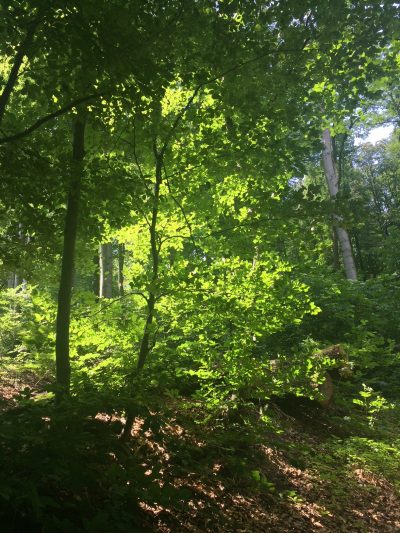
Wildflowers peeped out from the undergrowth

Deer crossed our path …

In a word, it was perfect.

Except for one thing: the fetid smell that periodically wafted up from the forest floor.

The source of the smell was these plants, which carpeted the ground in many parts of the woods.

They are wild garlic, Allium ursinum, so readers will not be surprised if I say that the smell they emanated made me think of rancid garlic cloves. It was quite similar to the nauseous smell given off by some of the hole-in-the-wall kebab joints in Vienna, where garlic powder is used with wild abandon.

Our walk was too late in the season for us to at least enjoy the delicate white flower they display.

For that, you need to go into the woods in April, early May. But it was just as well we had come late: previous experience had shown me that when the plant is flowering the smell is even more penetrating.

I remember talking with a German colleague of mine about my first brush with wild garlic’s exhalations in the Viennese woods. He sympathized, but waxed eloquent about the soup which can be made from its leaves. As previous postings record, I am no fan of garlic and so have never tried this soup. But for readers who are better disposed to garlic than I am and who happen to have a wood nearby in which wild garlic grows, I throw in an Austrian version of the soup’s recipe (the amounts cited here should serve four people). Pick 200 grams of wild garlic leaves (one source suggests picking them young and tender, even before the plant flowers, to get the most delicate taste). Wash, drain, and chop finely. Melt 50 grams of butter in a saucepan, stir in 3 tablespoons of flour, and slowly add 1 litre of vegetable stock. Bring to a boil. Stir in the chopped wild garlic leaves. Bring to a boil again. Simmer gently, all the while seasoning with salt, pepper, a shot of lemon juice, and a pinch of anchovy paste. Finally, stir in 1/8 litre of sour cream and two tablespoons of whipped cream, season to taste with a pinch of nutmeg. The soup should look something like this.

I should note that a number of recipes from the German-speaking world suggest adding some cubed potatoes rather than flour and cream, but I feel that the recipe I’ve cited sounds more authentic (a number of recipes also suggest adding onions and/or shallots and/or garlic cloves, but this really seems to be exaggerating the presence of this malodorous family!).

My favourite source of information – Wikipedia – tells me that wild garlic is native to the temperate regions of Europe, from Britain in the west to the Caucasus in the east. Wikipedia also informs me that we Europeans have been munching on wild garlic leaves in one form or another for the last 10,000 years or so – an impression of a wild garlic leaf was found in a Mesolithic settlement in Denmark. Did our European forebears also munch on the bulb? Perhaps only if they were very hungry, because the bulb of wild garlic is very small.

No, it’s not Allium ursinum which gave us the garlic cloves that we are so – unfortunately – familiar with today. We have to thank a Central Asian cousin, Allium longicuspis, for that.

Early farmers in Central Asia cultivated the wild variety, and as has happened so many times with other plants they played around with it and slowly turned it into the plant we know today, with that pungent – oh, so pungent! – bulb.

It seems that garlic was one of the very first plants that our farming ancestors tinkered with. Their tinkering was so successful that the plant got carried out of Central Asia along the Silk Road and other trade routes, east to China and south-east Asia, south to the Indian subcontinent, west to the kingdoms of the Near East, followed by Egypt and later Greece and Rome. As the plant was moved out of its homeland, farmers kept tinkering so that today there is a bewildering number of sub-variants.

Now, I know this will raise hackles among garlic lovers, but really, what on earth possessed those early farmers to spend their precious time in developing this bulb?! It tastes really strong (“pungent” is the word used in the garlic literature), it leaves a metallic taste in your mouth after you’ve eaten it (well, in mine at least), it makes your breath – indeed, your whole person – smell “pungently” after partaking of it, and it – hmm, let me see how best to put this – it disrupts your digestive system resulting in odorous wind and other unpleasant side effects in the bathroom (at least, it does so in my case).

But develop it they did. And they found enthusiastic consumers far and wide. The ancient Egyptians consumed particularly enthusiastically. The poor buggers who slaved away to put these up

were, it seems, paid with the stuff – garlic was believed to give one strength, and what did these guys need but strength, and a lot of it? It’s not as if the workers were forced to eat it, either. It seems they loved it. One of the only two known slave revolts in Egypt occurred after the failure of the annual garlic harvest.

Generally speaking, in all places and at all times garlic was believed to be good for your health and a cure for all sorts of maladies, from the plague to the pox. In fact, this may have been why garlic was originally developed – for its supposed health effects rather than as a food additive. There must be people who still believe in garlic’s curative powers; why else would companies offer these sorts of over-the-counter products for sale?

One persistent belief is that garlic has antiseptic properties. It seems that garlic was used during both World Wars as an antiseptic and a cure for dysentery. I can hardly believe it; doctors in the mid-20th Century had no better medicine than that?! What I do know is that until very recently the Chinese were using garlic as a sort of antiseptic mouthwash. A friend of ours who had been already living in China for some years before we arrived told me that in the early noughties it was common for people to rub their gums with a garlic clove in the morning before going to work. He said that taking the bus in the morning was not for the faint of heart. I shudder inwardly every time I think of his story.

Talking of shuddering, in ancient Greek and Roman times (and probably even before) it was believed that garlic was a powerful aphrodisiac. Quite how anyone could have come to this conclusion is beyond me. But then the human mind has an infinite capacity for self-delusion. And of course it must have been men who believed this. I can imagine the scene: a randy old goat who munches on the ancient world’s equivalent of a little blue pill and then rushes off to bed to perform. Pity the poor woman who is the recipient of his performance!
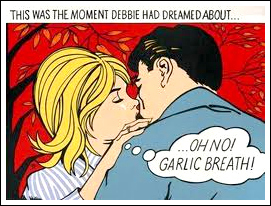
In fact, smelling of garlic has always been associated with being uncouth. Those Egyptian priests who eagerly fed their workers garlic never touched the stuff themselves. Upper caste Indians never let garlic pass their lips in case it made them smell like their lower caste compatriots. In ancient Greece, it was generally believed that the gods disliked the smell of garlic. In temples dedicated to the goddess Cybele, this was taken to extremes. Those who wished to enter one of her temples had to pass the garlic breath test. King Alfonso of Castille ruled that any gentle person coming into court smelling of garlic was banished for a week. In the US until the 1940s the reek of garlic was used as an ethnic slur, being called such things ‘Italian perfume’.

I suppose that the thinking which led Greeks to conclude that the gods disliked the smell of garlic also led to the belief that garlic could ward off witches, evil spirits and the like. Which belief no doubt underlies the use of garlic to ward off vampires. All this tells me is that vampires have good taste.

Readers may protest and say that garlic’s main role is surely now in the kitchen. True. And to show that even with garlic I can be broadminded let me throw in here a famous recipe where garlic plays the main role, for the garlic lovers out there to try if they have not done so already. It is the recipe for another soup, Sopa de Ajo, Garlic Soup, which is eaten throughout Spain. Once again, the amounts cited here will serve four. Heat 4 tablespoons of olive oil in a saucepan over a low heat. Add 4 to 5 large garlic bulbs (yes, four to five), broken into the cloves – do not remove their skin. Fry gently, stirring often, for 15-20 minutes, until the skins are golden brown and the flesh is soft. Remove them from the hot oil. Wait until they have cooled a little, then squeeze out the garlic flesh, discarding the skins. Puree and set aside. Meanwhile, add 100g of cooking chorizo, cut into little pieces, to the pan and fry until crisp and caramelized. Add 1 teaspoon of fresh thyme leaves, fry for a few seconds. Then add the pureed garlic and stir it in well. Add ½ teaspoon of sweet smoked Spanish paprika, and pour on 1 litre of chicken stock. Bring to a boil, gently simmer, and season to taste. About two minutes before serving, poach four eggs in the soup and add 8 slices of ciabatta, toasted and torn into rough pieces. The finished product should look something like this.

Four to five garlic bulbs … For all my broadmindedness, I cannot suppress yet another inward shudder. What the consumers of this soup must smell like when they rise from the dining table! Quite possibly, it was this soup which had been eaten by the Spanish gentlemen who plays the lead role in my most searing memory of garlic breath. I invite my readers to dip into the post where I write about this painful episode in my life. In the meantime, once I am back from my travels my wife and I will go for other long and pleasant walks in the Wiener Wald. The wild garlic plants were already wilting when we took our walk on Corpus Christi Day. Hopefully, they will all soon be dead and I can enjoy the woods without my nostrils being assailed by the smell of rancid garlic.

___________________

Woods photos: ours, except:
Deer in woods: https://viennalife.wordpress.com/tag/vienna-woods/

Kebab shop, Vienna: https://commons.wikimedia.org/wiki/File:Wien_Bellaria_Kebab_Pizza_Dez2006.jpg
Wild garlic in flower: https://www.flickr.com/photos/sarfrazh/26388112004
Wild garlic soup: https://www.chefkoch.de/rezepte/25941006183503/Baerlauchsuppe.html
Wild garlic plant with bulb: https://scottishforestgarden.wordpress.com/2013/04/19/growing-and-eating-wild-garlic/
Allium longicuspis: https://thebetter.wiki/en/Garlic
Garlic: https://www.shopevoo.com/products/infused-garlic-1
Building the pyramids: https://exploredia.com/top-10-shocking-facts-ancient-egypt/
Garlic pills: https://www.amazon.com/Natures-Bounty-Extract-Release-Softgels/dp/B002Y27JD8
Garlic breath: https://dailykale.com/2011/09/16/foods-that-heal-garlic/garlic-cartoon/
Garlic and vampires: https://horror.media/four-theories-about-why-vampires-hate-garlic
Sopa de Ajo: https://www.theguardian.com/lifeandstyle/2013/may/04/10-best-garlic-recipes

WIENER SCHNITZEL vs COTOLETTA ALLA MILANESE

Vienna, 14 July 2017

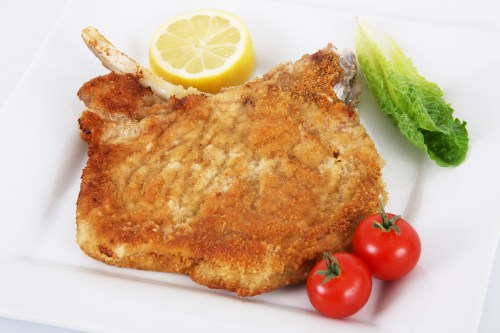
As readers of my posts may know, since I retired last year my wife and I have pretty much divided our time between Vienna and Milan, having roots in both places. I therefore think it is time for me to wade into the Battle of the Wiener Schnitzel and the Cotoletta alla Milanese. As their names indicate, these delicious dishes are at home in Vienna and Milan, respectively. To get everyone’s juices flowing, I throw in here a photo of each: wiener schnitzel first

cotoletta alla milanese next.

For those of my readers who may not be conversant with one or both of these dishes, I should explain that both take a veal cutlet, dunk the veal in a beaten egg (sometimes preceded by a dunk in flour), cover it with a generous portion of breadcrumbs, and fry the result in butter (Milan) or lard (Vienna). They are for all intents and purposes the same dish, although the cognoscenti will insist on the differences: I have just mentioned the different frying medium, to which can be added: boned vs. deboned, Milan’s version still having the rib bone attached, while in Vienna’s version the bone has been detached; and as a consequence of this, different thicknesses, the Viennese version being pounded thin while the Milanese version, being still attached to the bone, is a few centimeters thick.

As I said, they are for all intents and purposes the same dish, and naturally enough the question has been raised if the chefs of one city did not at some point copy the chefs of the other. Well, let me tell you, much ink, and perhaps a little blood, has been spilled over this vital question: who copied who? Is the wiener schnitzel the son of the cotoletta alla milanese, or on the contrary did the wiener schnitzel sire the cotoletta alla milanese? Readers who think that this is an interesting academic question but surely hardly one over which to draw the kitchen knives don’t know the history of this little corner of the world. Allow me to give them a thumbnail sketch.

From 1525 to 1860, with the exception of some decades during the French Revolution and the Napoleonic Empire that followed, Milan, along with much of northern Italy, was ruled by the Hapsburgs, first the Spanish branch of the family and then, from 1706 onwards, the Austrian branch. And so, by an accident of history, the Austrian was the Enemy when the Milanese, along with many other northern Italians, rallied behind the cause of Italian unification in the first decades of the 19th Century. Things first boiled over in 1848. Every Milanese, my wife included, will tell you of Le Cinque Giornate, the glorious five days in March of that year when the Milanese rose up and drove the Austrian Governor, Field Marshal Radetzky (he of Johan Strauss’s Radetzky March), and his troops out of Milan.

Alas! A few months later, Radetsky defeated the troops of the Piedmontese King of Sardinia, who had eagerly stepped forward to help his Lombard brothers (with the idea, of course, of incorporating Lombardy into his kingdom), and regained control of Milan and Austria’s other northern Italian territories. Not surprisingly, Radetzky is not seen with a terribly favourable eye in Milan.

Northern Italy was forced to remain under the yolk of the Austro-Hungarian Empire for another 11 years. In the meantime, Count Cavour, Prime Minister of the Piedmontese kingdom, had cut a deal with Napoleon III, which led to a Franco-Piedmontese war against the Austrians in 1859. The Austrians were beaten at the extremely bloody Battle of Solferino (it was his witnessing of the battle that caused the Swiss Henry Dunant to found the Red Cross).

After the battle, Lombardy was incorporated into the Kingdom of Sardinia, soon to be renamed the Kingdom of Italy.

I will skip the rest of the struggle against Austria, which only really concluded at the end of World War I with the cession of Trento and Alto Adige to the kingdom of Italy after the collapse of the Austro-Hungarian Empire in 1918.

I think my potted history of Italian unification – at least its northern ramifications – will suffice to explain the sensitivities (especially in Milan, I have to say) about the relationship between the wiener schnitzel and the cotoletta alla milanese. I mean, just imagine how the Indians would feel if, for instance, someone claimed that chicken masala was actually a copy of a British dish: a dish of the ex-colonialist! The sensitivities are such that in the late 1960s a Sicilian who had emigrated to Milan and had become more Milanese than the natives published a completely fabricated story about how Radetzky, in the middle of a report to the Imperial Court about the military situation in northern Italy, had started rhapsodizing about a wonderful veal dish he had been introduced to in Milan. This piqued the Emperor’s attention, and when Radetzky next came back to Vienna to report, the Emperor packed him off to the Imperial kitchens to give the chef the recipe. Thus was born the wiener schnitzel, our Sicilian claimed, sired by the cotoletta alla milanese.

For many years, the story that Radetzky brought the cotoletta alla milanese to Vienna was widely believed, on both sides of the debate, but it has now been debunked. I won’t go into the details, suffice to say that our Sicilian’s story was a tissue of lies from one end to the other. But then this has meant that the question of which of the two dishes came first reared its ugly head again and sent food historians scrambling to do more research.

A face-saving solution seemed to have been found in the form of a French cookery book from 1749, “La Science du Maître d’Hôtel Cuisinier”.

It was pointed out that the book contained a recipe where a veal cutlet was dipped in a beaten egg, covered in bread crumbs, and fried. Surely this meant that the French had invented the dish? That was alright, after all French cuisine is the mother of all cuisines and to be descended from a French dish is an honour. After which, various theories were put forward to explain how this French dish arrived both in Milan and in Vienna.

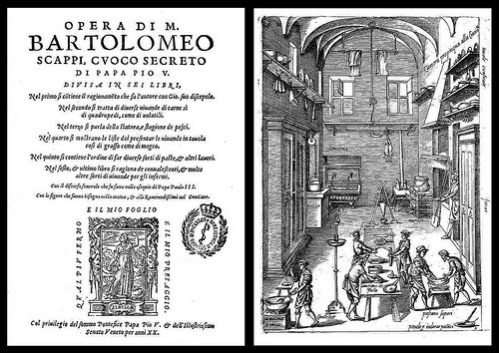
However, other – Italian – food historians have pointed out that the technique of breading and frying meat was already in use in Italy in the 16th-17th Centuries, as evidenced in the cookery book published in 1570 by Bartolomeo Scappi, noted chef to Cardinals and Popes.

The same technique is to be found in the cookery book published by the Bolognese Vincenzo Tanara in 1653.

Both cookery books give this technique as a way of using up various cuts of meat.

These food historians have gone one step further. Tanara lived all his life in Bologna and Scappi spent many years there as a cook to a Bolognese cardinal. They therefore suggest that the ancestor of the cotoletta alla milanese (and maybe by some tortuous path the wiener schnitzel) is none other than … the cotoletta alla bolognese! For those readers who, like me, had never heard of this dish before today, I can quickly report that it is a veal cutlet prepared just like a cotoletta alla milanese or a wiener schnitzel but on which slices of raw cured ham have been placed, followed by flakes of Parmesan cheese, the whole then being placed in the oven and heated until the Parmesan has melted (aficionados pop a shaving of truffle on the top at the end). This is what it looks like.

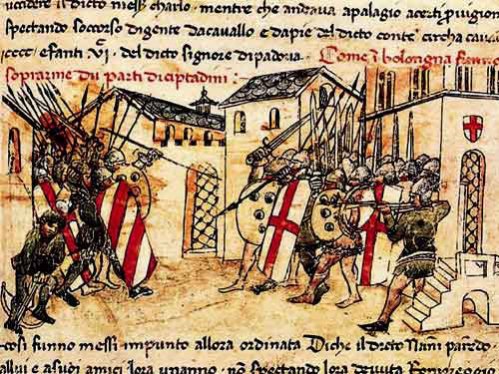
Well! Here, we will plunge into an even earlier period of the Italian peninsula’s history, when the city-states were all quarreling and fighting with each other,

a competitiveness which lingers on in Italy’s football championship; here we have Inter Milan against Bologna last year (Inter Milan won 2-1).

Will the Milanese ever be able to accept that they received anything good from Bologna? I’ve asked my wife about the cotoletta alla bolognese and she says she’s never heard of it, even though she lived a year in Bologna during her student days and the dish is reported as being a very important, very ancient Bolognese dish.

This does not bode well for how this theory will be greeted as it percolates down from the small clique of food historians to the general Milanese public. Already other food historians claim to have found evidence that a predecessor of the cotoletta alla milanese already existed in Milan in the 12th Century. There is a Milanese document which lists in macaronic Latin the dishes eaten by the cannons of the Basilica of Sant’Ambrogio in 1148. One of these dishes is “lombolos cum panitio”. No-one seems to have a problem with the word lombolos, which all agree is a cut of meat. The problem is with “cum panitio”. The more optimistic interpreters think it means breaded, and on the basis of this interpretation Milan’s city fathers passed a city decree a few years ago giving the cotoletta alla milanese a denomination of local origin. The more skeptical interpreters shrug their shoulders and say “cum panitio” could mean any one of a series of bread-based foodstuffs which were simply accompanying the lombolos.

The arguments will no doubt rage on. My personal take, for what it’s worth, is that the technique of breading a piece of meat could well have been invented in many places independently. Why couldn’t cooks in different places and at different times have figured out that bread crumbs will attach to a piece of meat when it’s been dipped in beaten egg and that the breaded meat can then be fried? I mean, we’re not talking rocket science here. But hey, who am I? Just a guy who enjoys eating wiener schnitzel and cotoletta alla milanese from time to time. What do I know about anything?

_________________

Wiener Schnitzel: http://wanderlusttips.com/2015/11/03/nhung-dac-san-khong-bo-qua-tren-khap-gioi/
Cotoletta alla Milanese: http://mangiarebuono.it/la-cotoletta-o-costoletta-alla-milanese/
Cinque Giornate: http://duomo24.it/2018/03/18/le-cinque-giornate-di-milano/
Battle of Solferino: http://www.experiences-plus.it/extra/extra_risorgimento_3.htm
Science du Maître d’Hôtel Cuisinier: https://nouveauservice.wordpress.com/category/recherche/
Opera di Bartolomeo Scappi: http://bibliodyssey.blogspot.co.at/2009/03/renaissance-kitchen.html?m=1
Vincenzo Tanara, L’economia del Cittadino I Villa: https://www.maremagnum.com/libri-antichi/l-economia-del-cittadino-in-villa-del-signor-vincenzo-tanara/105032152
Cotoletta bolognese: https://www.google.co.uk/amp/ricette.donnamoderna.com/cotolette-alla-bolognese%3Famp%3Dtrue
Battle between Italian city states: http://www.medievalists.net/2008/11/the-rise-and-decline-of-italian-city-states/
Inter Milan-Bologna, 2016: http://www.ilrestodelcarlino.it/bologna/sport/calcio/inter-bologna-2016-diretta-1.1970445

FOSSILS IN THE STAIRS

Vienna, 29 June 2017

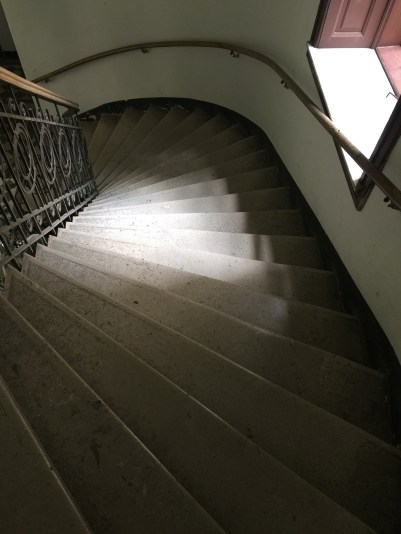
A few days ago, just as my wife and I were setting out from the apartment, it started to rain. It was my wife who had decreed that it wouldn’t rain, but it was I who went back to get the umbrellas. As readers can imagine, I was a little grumpy as I ascended the stairs, glaring at the individual steps. Perhaps it was my acute attention of the steps, perhaps it was the light; whatever it was, I suddenly noticed in the sixth step from last, which had been worn smooth by countless feet treading on it, something which I had never noticed before on my walks up and down those stairs: a fossil.

At first sight it looked like a leaf, but I now think it could be a coral of some sort. I walked up and down all six flights of stairs in our building looking intently at each step,

and I now see what I had never really noticed before, that the limestone used for them is made up of a mass of shells and other marine remains, fallen randomly on top of each other and then squeezed tight by the monstrous weight of later rocks above them.

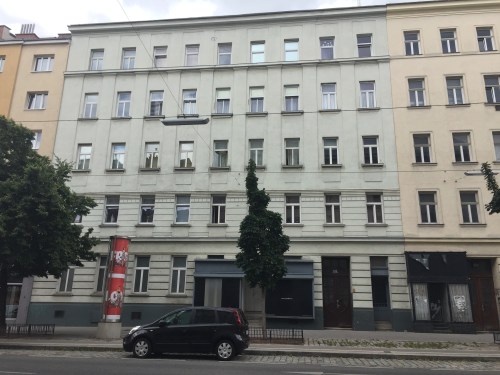
As we discovered when we bought the apartment and picked through the Land Register, our building was constructed at the turn of the century. It was, and has remained, a modest building – no Belvedere Palace for us

just a modest lower middle-class building, one of many outside Vienna’s swank 1st District.

Consequently, even at a time when long-distance travel had been made a thousand times easier by the booming rail system and nascent road system, I would imagine that the stone for our steps came from a local quarry. Which is more than possible, there being quite a number of old limestone quarries around Vienna, a number of which – I have been breathlessly informed by an Austrian fossil-hunter website – are good sources of marine fossils.

An Austrian map of the country’s geology informs me – if my rudimentary German is correct – that the rock formations in question are Late Tertiary.

Specifically, according to a mind-numbing report prepared for the 26th International Geological Congress which I leafed through electronically, they belong to the Neogene beds in the Vienna basin; these were laid down some some 10-15 million years ago, between the Upper Eggenburgian and Lower Badenian stages of the Middle Miocene epoch, as a result of at least two marine incursions into the Vienna basin.

Setting aside all the arcane – and, frankly, incomprehensible – scientific mumbo-jumbo with which this report is filled, we can happily conclude that the jumbled marine fossils locked forever more into the steps of our building’s stairway are the result of the area around Vienna twice being a sea. It must have been a nice warm sea too, since corals flourished in its waters. In fact, this map of mid-Miocene Europe shows that much of Central Europe was under water during this Epoch, this being the far western end of the wonderfully-named Tethys Sea.

In cases like these, I am always taken by a sense of wonder. Here I am, living on the edges of a rich agricultural plain 350 kilometers from the nearest sea.

Yet once upon a time there was sea all around me, probably quite like the sea which my wife and I snorkeled over a year ago in Thailand, with coral outcrops, starfish and sea urchins clinging to their rocks, crabs scuttling along the sea floor, fish flashing in and out of the coral, and from time to time the passing shadow of a shark.

That same sense of wonder came over me many years ago, when we visited Arizona’s Petrified Forest National Park. The park sits in the middle of a harsh, dry, desert region.

Yet all around us lay the petrified remains of a once mighty forest.


Artists imagine that these 200 million year-old forests looked something like this.

All that teaming life in this now almost dead environment …

It was more with a sense of fascinated horror than awe that I first gazed on the “fossils” (mummies is perhaps the better term) of people and animals dug up at Pompeii.


They were overtaken, submerged, in the 1000°C-hot pyroclastic flow that swept down the sides of Mt. Vesuvius and howled through the city at 700 km/hr.

What a terrible, terrible death! But perhaps it was a mercifully quick death, with them being flash-cooked, basically.

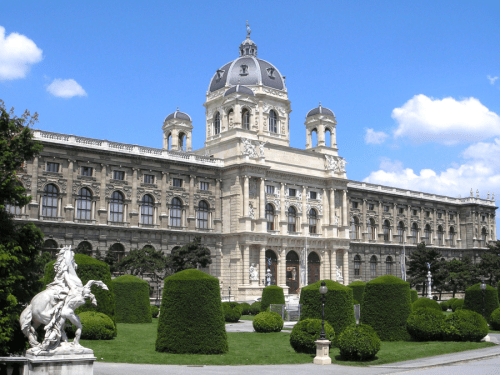
Hmm, I didn’t want to finish on this rather depressing note. But hey, that’s life! In the meantime, I need to escogitate a plan to persuade my wife join me on a visit to Vienna’s Natural Science Museum (sheathed in a very nice stone, I should add) so that I can study the area’s geology better.

_______________

Our building’s steps: our photos
Belvedere Palace: http://www.austriawanderer.com/the-belvedere-palace-in-vienna/
Our apartment building: our photo
Geological map of Europe: http://www.gifex.com/detail-en/2011-06-29-13972/Geological-map-of-Austria.html
Miocene Europe: http://www.dandebat.dk/eng-klima4.htm
Vienna plain: http://www.donau.com/de/roemerland-carnuntum-marchfeld/detail/marktgemeinde-goetzendorf-an-der-leitha/c53b2a6b0c75fed4d809b78b888830d9/
Tropical sea: https://fineartamerica.com/featured/coral-reef-in-thailand-louise-murray-and-photo-researchers.html
Petrified Forest NP: http://kids.nationalgeographic.com/explore/nature/petrifiedforest/#petrified-forest-hills.jpg
Petrified tree-1: http://www.alamy.com/stock-photo/petrified-forest-national-park-arizona.html
Petrified tree-2: http://www.van-tramp.com/wp/petrified-forest-national-park-revisit/
Forest 100 million years ago: https://jerry-coleby-williams.net/2015/02/15/bunya-prehistoric-plant-ancient-australian-food-tradition/araucaroid-forest-ca-100-million-years-ago/
Pompeii mummies-1: https://www.google.co.uk/amp/s/www.pinterest.com/amp/pin/535224736949021987/
Pompeii mummies-2: http://hesed.info/blog/pompeii-lava-statues.abp
Pompeii mummies-3: https://forums.arrowheads.com/forum/general-discussion-gc5/fossils-paleontology-old-bones-gc30/25828-reposting-pam-s-odd-rock-fossil-2nd-opinion
Pompeii and Mt Vesuvius: https://it.pinterest.com/agcinnamongirl/pompeii-italy/
Natural History Museum, Vienna: https://ictca2017.conf.tuwien.ac.at/index.php/natural-history-museum-vienna

SCOOTING

Vienna, 4 June 2017

Many – many – years ago, when I was but a lad of six or seven, I was the proud owner of a scooter, one of those good old-fashioned scooters which you kick along with your foot. It looked very much like this, although my memory tells me it was blue rather than red.

Honesty impels me to clarify that it was not bought for me. Like many things in our large family where I was towards the tail end, it was a hand-me-down from one of my elder siblings. But I cared not! On this machine I was king of the pavements, sailing along at what seemed to be vertiginous speeds after a series of brisk kicks.

In my memory, the scooter’s use is entangled with a “girl next door”, a girl a few years older than me with whom I would whirl around the local pavements. Her name is gone, her face is a blur, but I think it’s true to say that I had a crush on her. I also had a crash with her, on my scooter. The details are now fuzzy, but I think we were playing a game of follow-me, wherein I was following her every twist and turn. All was going swimmingly well until she suddenly put on the brakes. I ran into her, somehow flipped over the handlebars and landed on my nose. Argh, the pain! the blood! The upshot, as I learned a few days later, when my mother finally took me to see a doctor, was that I had broken my nose.

As readers can imagine, this incident left me with somewhat conflicted feelings about scooters. I suppose I must have continued to use mine for a while, although it disappears from my memory at this point, along with the girl-next-door. Bicycles take over.

In fact, over the years that followed it seems to me that scooters generally lost their popularity with children. I don’t remember seeing many around when I was in my teen and early adult years, my children never emitted the desire to have a scooter, and none of their friends had one. And it certainly was never an adult thing.

So it was with some surprise that I registered, when we came back last September from our seven years in the East, an efflorescence of scooters on the pavements of Vienna. And being kicked along not only by children but also by adults: young adults like this one, who one could argue may not yet have completely grown up

but also by older adults like myself, who in an earlier period I would have said should stop making a fool of themselves in this way.

Now that we have come back up to Vienna for the summer and the weather is getting good, I am struck by the same phenomenon: scooters whizzing by carrying adults.

Clearly, something is up! Surfing the web, I get the impression that the trend towards adults getting on scooters has to do with beating traffic jams to get to work and doing some healthy exercise while you’re at it (although the growing use of electric scooters rather undermines this last part).

Before I’m accused of sexism, I quickly throw in a picture of a businesswoman with a scooter, although this picture is obviously posed.

It helps a lot that scooters are easily foldable

so that there are no parking problems and one can walk into one’s office (or cubicle, if that’s the company’s culture) casually carrying the scooter under one’s arm.

As usual, once something catches on the designers move in and start offering cool designs. From this, which seems to be the fairly standard design although in quite cool colours

we have this, an electric version

or this big-wheel design

(which rather reminds me of penny-farthing bicycles of yore).

Big wheels makes me think of fat wheels

while here we have a Y-shaped design, which is moved by a scissor-motion of the legs.

This is an interesting one, a luggage scooter.

In airports, you can drop down the platform and back wheel attached to the suitcase and whizz along to your gate. This last one is unutterably cool although I’m not quite sure how you are meant to ride it.

There are many more designs out there but I’ll leave it at that.

I think my wife and I need to get into this new trend, so that we too can zip by normal pedestrians, our hair fluttering in the wind. I casually asked her a few days ago if she had had a scooter as a child, to which she said no. This is going to make it tricky to persuade her to try since I feel that a residual nostalgia (and acquired expertise) from childhood would make it easier to accept looking a trifle silly on scooters at our venerable age. But nothing ventured, nothing gained, as they say.

________________

Old scooter: http://www.20th.ch/les_jouets_de_notre_enfance.htm
Young man on electric scooter: http://www.funshop.at/produkte/inmotion-3/inmotion-l6/
Older man on electric scooter: http://www.stadt-wien.at/lifestyle/elektro-scooter-test.html
Businessmen on scooters: https://www.linkedin.com/in/keggleton/zh-cn
Businesswoman with scooter: https://www.pinterest.com/pin/439312138625936673/
Folded scooter: https://www.nycewheels.com/micro-scooter-review.html
Normal scooter with cool colours: https://mobile.willhaben.at/object/186524698/
Cool electric scooter: https://www.pinterest.com/baylissw/kick-scooter/
Cool scooter with big wheels: http://www.tretrollershop.at/fs_sport_classic.html
Penny-farthing: http://www.bikemonkey.ca/blog
Cool electric scooter with fat wheels: https://www.pinterest.com/pin/439312138625936673/
Y-shaped scooter: https://www.nycewheels.com/micro-scooter-review.html
Luggage scooter: http://www.toxel.com/tech/2012/02/25/scooter-luggage/
Unutterably cool scooter: http://design720.com/category/g5/page/2

UNDER A LINDEN TREE

Vienna, 1 June 2017

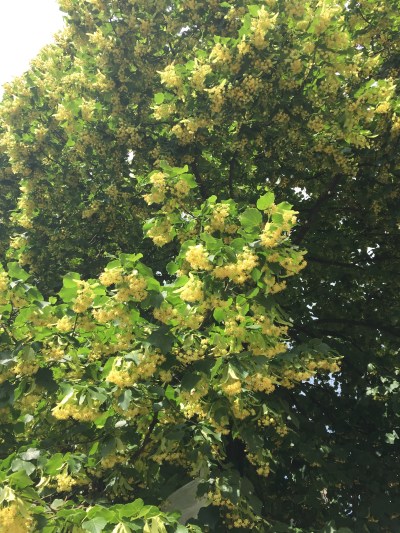
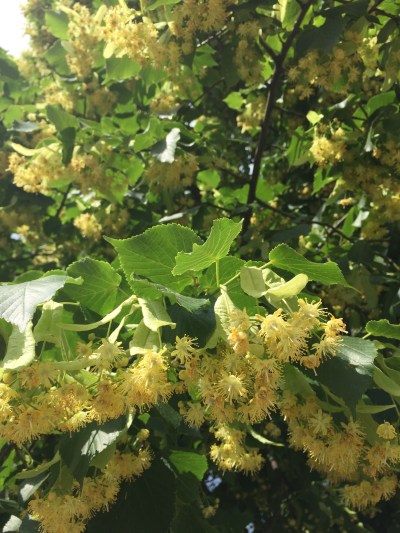
One of the reasons we were attracted to the apartment we bought in Vienna is that there is a linden tree, or lime tree, just outside the living room, at eye level.

Right now, the flowers are still forming, but it was July when we bought the apartment and the tree was in full bloom, covered in pale yellow flowers around which buzzed a thousand insects.


The scent that wafted through the open window was divine. For those readers who have not had the good fortune to be near a linden tree in full bloom, let me try to describe the scent: delicate – your brain barely registers it; sweet – at the height of the bloom, insects are crazy to get to the nectar; ephemeral – the scent wafts your way for a second, then disappears just as quickly. I’m sure the memory of that scent still lingered in our minds when we signed the purchase contract.

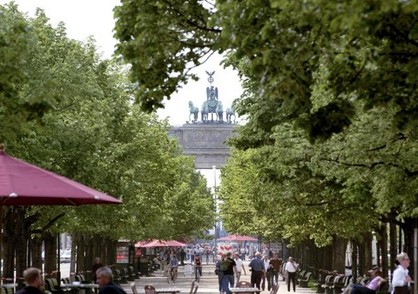
Strangely enough, even though the linden tree grows in the U.K., I have no memory of that scent from my youth; perhaps because I hardly ever spent any of my summers there. Nor do I have any memory of the scent from France, where I spent many a youthful summer, or from Italy, where I spent many of my adult years. It was only when I moved to Austria twenty years ago that I became aware of it. Was it perhaps because linden trees are common shade trees throughout the Germanic and Slavic lands? Certainly, the street we live on in Vienna has a portion, closer to the city centre, which is entirely shaded in linden trees – and what a treat it is for the nose to walk unter den linden, under the linden trees, when they are in bloom! I will make sure we walk along the much more famous Unter den Linden Avenue in Berlin


when we go there in early August although by then I fear that the peak of the trees’ blooming will have passed.

I have to think that the frequent presence of linden trees in urban settings throughout Central Europe can be traced back to the sacred place the tree had in Germanic and Slavic mythology. When Christianity arrived, it sensibly adapted, planting linden trees around churches, accepting that villagers congregate under the village linden tree for important meetings or for seasonal festivities

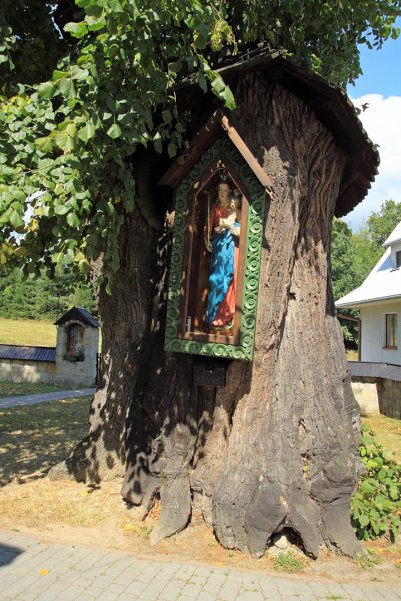
as well as encouraging a tradition linking the Virgin Mary to the linden tree (probably because this displaced a pagan goddess linked to the tree).

Thus was the tree’s place in Central Europe’s modern cities assured. But why the linden tree was sacred to Slavic and Germanic tribes in the first place is not clear to me – at least, I have found no good answer in the literature available to me on the web. I have read that the tree was seen to represent the female side of nature (with the oak tree representing the male side), its natural capacity to regrow quickly being seen to symbolize rebirth and fertility. Perhaps. But – simply because it appeals to my romantic fancies – let me add here another theory, which I extracted from the wilder and woolier side of the internet, from a site dedicated to Druidism to be exact. There, the writer noted that the tree is in full bloom around the time of the summer solstice. Well! What better reason to sacralize a tree which gives off a heavenly scent when the great Sun God reaches its apogee! (we have here modern devotees celebrating the summer solstice at Stonehenge)

Whatever the reasons, the linden tree’s connection to the feminine side has meant that it has naturally been connected to love. Betrothals took place under the village linden tree, but so – people whispered – did love in its wilder form. A famous German minstrel song from the 12th Century, Unter der Linden (translated here by Raymond Oliver, with one tiny change by me), says it all (or nearly so).

Under the linden tree
On the heather,
Where we had shared a place of rest,
Still you may find there,
Lovely together,
Flowers crushed and grass down-pressed.
Beside the forest in the vale,
Tándaradéi,
Sweetly sang the nightingale.

I came to meet him
At the green:
There was my true love come before.
Such was I greeted —
Heaven’s Queen! —
That I am glad for evermore.
Had he kisses? A thousand some:
Tándaradéi,
See how red my mouth’s become.

There he had fashioned
For luxury
A bed from every kind of flower.
It sets to laughing
Delightedly
Whoever comes upon that bower;
By the roses well one may,
Tándaradéi,
Mark the spot my head once lay.

If any knew
He lay with me
(May God forbid!), for shame I’d die.
What did he do?
May none but he
Ever be sure of that — and I,
And one extremely tiny bird,
Tándaradéi,
Who will, I think, not say a word.

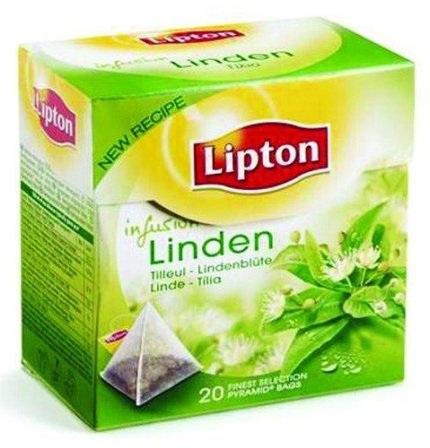
Of course, the tree’s sacred properties meant that it had a special place in the apothecary of our ancestors, with various parts of it being ingested to remedy numerous ills. A pale descendant of this is the infusions of linden flowers which are available in our supermarkets.

My mother-in-law liked this infusion and always had a packet of it in her kitchen cupboard (my wife and I prefer camomile; it has more taste, we think).

But tasteless infusions are not the only food which is extracted today from linden trees. Bees adore linden flowers, and honey aficionados adore linden flower honey, praising it to the rafters for its sublime taste. Not being a honey enthusiast, I can only offer this judgment without comment. They also mention its much lighter colour compared to other honeys, which this photo certainly attests to.

As can be imagined, the linden tree’s wood was also considered to have talismanic properties. I want to believe that many religious statues in this part of Europe were carved out of limewood for this reason, although more prosaic reasons such as the wood’s ease of carving and its ability to hold intricate detailing are also given. Be that as it may, some lovely carvings have resulted. Here is a Saint Stephen looking pensive and holding in his lap the rocks with which he was lapidated

while this is the Supper at Emmaus, a solemn occasion indeed for the artist, from the look on everyone’s faces.

Well, time now to go to bed. Tomorrow, at breakfast, we’ll open the window again on our linden tree.

___________

Linden tree from window: our picture
Linden tree blooms: our picture
Unter den Linden Avenue, Berlin: http://www.berlin.de/tourismus/fotos/sehenswuerdigkeiten-fotos/1355832-1355138.gallery.html?page=2
Villagers dancing under a linden tree: https://fineartamerica.com/featured/under-the-village-linden-tree-ken-welsh.html
Shrine under linden tree: https://www.lamusdworski.wordpress.com/2017/03/19/linden-tree/amp/
Summer solstice, Stonehenge: http://notihoy.com/en-fotos-mas-de-20-000-personas-presenciaron-el-solsticio-de-verano-en-stonehenge/
Linden flower infusion: https://www.amazon.co.uk/Lipton-LINDEN-Tea-Bags-pyramid/dp/B00TVCXZ7S
Lime flower honey: http://www.dealtechnic.com/shop/honey/raw-wild-flower-lime-honey-800g-with-jar-honey-flow-2014-natural-organic-farm/
Saint Stephen: https://www.pinterest.com/elkie2/small-sculpture/
Supper at Emmaus: http://www.alamy.com/stock-photo-christ-in-the-house-of-mary-and-martha-the-last-supper-the-supper-68542669.html

FULL OF SOUND AND FURY, SIGNIFYING NOTHING

Vienna, 29 December 2016

image
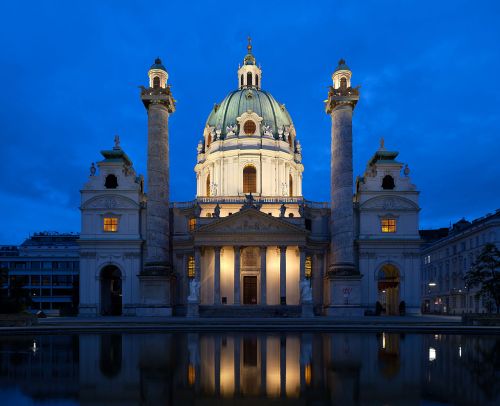
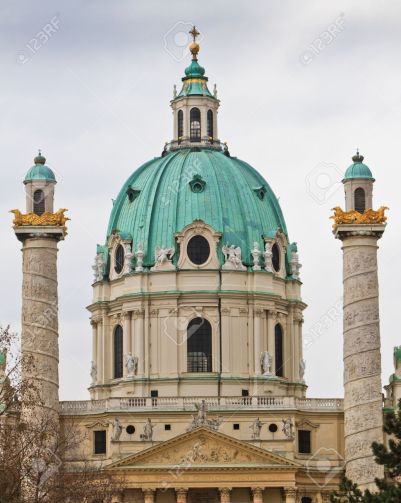
Nice, isn’t it? It’s Karlskirche, Charles Church, fronting the square of the same name, Karlsplatz, in Vienna. In this picture, the church is reflected in a large pool situated in front of it, making an even prettier picture of it all.

It’s also very nice-looking at night, when cleverly-placed lights dramatically illuminate the facade and dome.
image
It really looks like the backdrop of some Mozart opera.

It so happens that we pass through Karlsplatz every time we take the tram into the city centre, and I always give Karlskirche an admiring look as we pass by.

It was the Holy Roman Emperor Charles VI who ordered it to be built, in 1713, just after what turned out to be the last great plague epidemic had swept through these lands. He had it built as thanks for the pestilence having spared him and his family. He dedicated the new church to San Carlo Borromeo, Cardinal of Milan, who not only was his personal patron saint but was also revered as a healer of plague sufferers. The church was completed by 1737.

Karlskirche was built in pure Baroque style. A few quotes are in order here, to hopefully answer the question “what exactly is the Baroque style?”:
– a style “characterized by new explorations of form, light and shadow, and dramatic intensity”
– a style which “used exaggerated motion and clear, easily interpreted detail to produce drama, tension, exuberance, and grandeur”
– “Baroque architecture and its embellishments were on the one hand more accessible to the emotions and on the other hand, a visible statement of the wealth and power of the Church” (as well as of the secular Princes, I should add)

Well, Karlskirche certainly produces drama, tension, exuberance, and grandeur on the outside. We have that dominating dome with its green copper sheath, along with the two columns flanking the front.
image
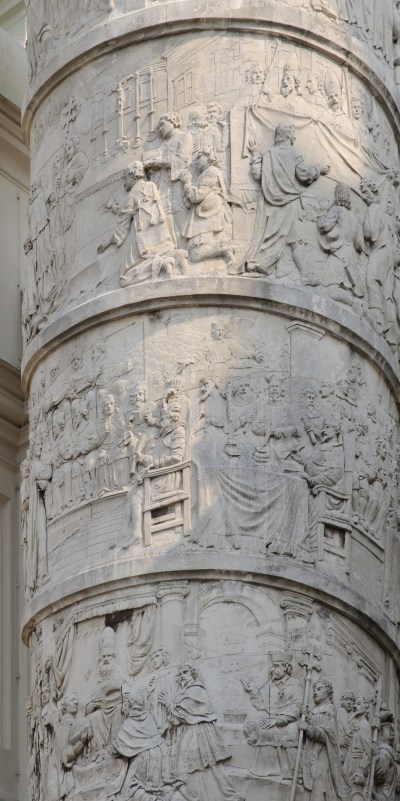
Those columns are modeled on Trajan’s column in Rome.
image
However, they substitute tales of Trajan’s victories in the Dacian wars with pious scenes from the life of that great “Prince” of the Church, San Carlo Borromeo.
image
We have the pediment crowning the front, where we see the cardinal virtues sucking up to San Carlo standing on the apex of the pediment.
image
So it is in a state of high tension and of great exuberance that one enters the church – only to find oneself in a small chapel. It is really the strangest feeling: all that architectonic might and majesty on the outside, clothing a really very modestly-sized internal space.
image
Oh, I grant you, there is also dramatic intensity on the inside: the fresco in the dome, for instance
image
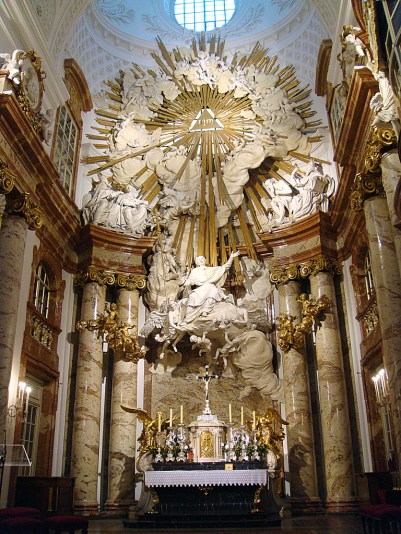
or the altarpiece portraying the ascension of San Carlo.
image
But the overall effect is: “Really? That’s all there is to this church? This tiddly little space?” I have to say, the only time I went in I felt quite cheated.

In the name of full disclosure, I should state at this point that I am anyway not a great fan of Baroque decoration. My general feeling about this style of art can be summed up in Macbeth’s words, “full of sound and fury, signifying nothing”. Even if the scale of the church’s interior had been on a par with the outside I probably wouldn’t have liked it. I find Baroque decoration, especially in Catholic churches, pompous and overblown. On top of that, for a religion that claims to value poverty, I find Baroque’s in-your-face glitter – gold and silver everywhere – particularly offensive. There is a toe-curling example of this blingy over-the-top quality in Baroque in Vienna’s Jesuit church, whose interior was completed some five years before Charles VI decided to have Karlskirche built.
image
All this being said, there is one example of church baroque that I have come across which I really loved, and that was in the cathedral of Saint Gall in the Swiss canton of Saint Gallen. Our visit to it was completely serendipitous. We were driving from Vienna to my parents’ house in France, and Saint Gallen happened to be a good place to stop for the night. The next morning, I decided that we should take the occasion to visit the cathedral and dragged a rather unwilling family with me. What a revelation!


There were the usual dramatic and intense frescoes on the ceiling, but the rest of the church was quite bare. Instead of the glittering gold, the marble, the overwrought statuary, we found ourselves in a space of mostly bare white walls carrying only a few highly curlicued decorations painted a lovely pale blue-green. It was so wonderful that it put me in a good mood for the next nine hours of driving and the thought of having to spend a long weekend with my parents.

The cathedral was remodeled into its current form in the 1750s-60s, so some 20-30 years after Karlskirche. That lapse of time might explain the more rococo style that was used, along with the fact that the cathedral stood at the border with Protestantism – literally, since the town that had sprung up around the cathedral and its abbey had turned Protestant while the abbey itself remained Catholic; Protestant baroque tends to be more restrained than the Catholic version.

Whatever the reason, Saint Gall Cathedral has partially reconciled me to baroque. Since that magic moment some 20 years ago when I first entered the cathedral, I have been inclined to simply grimace and shrug at excesses like those in Vienna’s Jesuit church rather than dream of taking the iconoclast’s hammer to it all. Or maybe I’m simply getting older and perhaps a little bit wiser.

___________
Karlskirche panoramic: http://www.thousandwonders.net/Karlskirche
Karlskirche at night: https://en.m.wikipedia.org/wiki/Karlskirche
Karlskirche dome: http://www.123rf.com/photo_13006441_dome-of-the-karlskirche-st-charles-s-church–vienna-austria.html
Trajan’s column: https://www2.bc.edu/~kenth/honors4.html
Karlskirche columns’ detail: https://commons.m.wikimedia.org/wiki/File:Karlskirche_column_detail_-_Vienna.jpg
Karlskirche pediment: http://www.panoramio.com/m/photo/93052486
Karlskirche interior: https://www.studyblue.com/notes/note/n/lecture-21/deck/5993225
Karlskirche dome fresco: https://www.pinterest.com/soledadvilchez/monumental-ceilings/
Karlskirche altar: https://www.flickr.com/photos/57669468@N00/3252233159
Jesuit church, Vienna, interior: https://www.flickr.com/photos/time-to-look/18903468079
Cathedral of St. Gall, interior: https://commons.m.wikimedia.org/wiki/File:St-gall-interior-cathedral_1.jpg

GLÜHWEIN

Vienna, 18 December 2016

Christmas cheer is all around us here in Vienna! Hordes of tourists wander the streets, the shops are doing good business, the more popular streets have their bright decorations, the town hall is graced with a large Christmas tree, Christmas markets have sprung up in various squares, selling the twee and the bling for last-minute Christmas presents … and then there are these little huts dispensing with brisk efficiency the German world’s equivalent to mulled wine: glühwein (which translates as glow wine; I thought this referred to the glow it imparts to the drinker, but apparently not. It refers to the original way of heating the spiced wine, with glowing pokers).
image
Aaahh, now that’s Christmas cheer for you! After a mug (or two) of glühwein, the world seems a cheerier place, the early grey dusk of a December day not quite so drear, the people around you considerably pleasanter. And what’s more, the cheer can start quite early. Normally, my wife and I wouldn’t pour ourselves our evening glass of wine until at least 6 pm, but we have no qualms in hitting the glühwein bottle at 4 pm, as the early dusk deepens around us and the cold begins to bite. I, for one, am then in a much better mood for the slow wandering through all the other elements of Christmas good cheer: people, shops, Christmas trees, bright lights, etc.
image
It seems that many if not all European countries have their local equivalent of mulled wine: glögg, gløgg, glögi in the Nordic countries (the different spellings no doubt caused by the mental confusion brought about by too much quaffing of said glögg, gløgg, and glögi), bisschopswijn (bishop’s wine) in the Netherlands (I presume this is a post-Reformation slur by the Dutch on the drinking habits of their old Roman Catholic bishops), and many, many names which are variants on the temperature of the wine: hot or heated wine (Belgium, Bulgaria, France, Latvia, Poland, Portugal, Spain, Turkey), which seems reasonable; boiled wine (Czech Republic, Hungary, Macedonia, Romania), which seems excessive but perhaps due to too much cheer in the kitchen and consequent inattention to the stove; and even burnt wine (Italy), which seems frankly contrarian (but the Italians’ name for the drink, vin brulé, is French, so perhaps something got lost in translation as the fumes of delicious mulled wine circulated the translator’s brain).

In this day and age when so many Europeans shout that they are different from each other, it’s nice to point to common traditions. So let’s lift up our mugs of steaming glühwein, mulled wine, glögg-gløgg-glögi, bisschopswijn, vin chaud, vin brulé, kuvano vino, vino caliente, vinho quente, греяно вино , svařené víno, forralt bor, karstvīns, варено вино, grzane wino, vin fiert, Глинтвейн, Sıcak Şarap, and I’ve missed a good few, and wish ourselves a good 2017 – we surely need it.
image_________________

Glühwein: http://www.chowhound.com/recipes/german-mulled-wine-gluhwein-30925/amp
Christmas lights: http://styleture.com/2009/12/22/beautiful-2009-christmas-decorations/
Toasting with glühwein: http://www.laurelkallenbach.com/lkblog/tag/eiserloh-almonds/

HORSERADISH

Turin, 12 October 2016

I’ve just had a yummy lunch at Vienna airport, which is a bit surprising since airport eateries are not known for quality. It was nothing special; actually, it was very ordinary for this part of the world (this part of the world being Austria). It was two sausages of the frankfurter variety (although longer and thinner than the classic frankfurter), a bread roll, a dollop of mustard, and some grated horseradish. Voilà!

What really made the dish for me was the horseradish. It was the first time I ate horseradish like this, and I found that its slightly sweet tartness calmed the excesses of the mustard.

I have to confess to being a great fan of horseradish, although I joined this particular fan club latish in life: I only discovered the culinary delights of the root once I moved to Austria, when I was already over 40. For those of my readers who (like me) have never seen a horseradish in the flesh (as it were), I throw in a picture.
image
It’s rather surprising that I came to horseradish so late, because it’s actually quite popular in the UK. A common way of eating it is to mix it with vinegar and use it as a condiment with meat or fish. This commercial offering looks very fancy.

Fancy or plain, I never partook; the closest I ever got was lamb with a vinegar-based mint sauce, the glories of which I have extolled in an earlier post. I’m guessing that the British picked up the habit from the Germans: Wikipedia informs me that a certain John Gerrard, in his Herball, or Generall Historie of Plantes of 1597, writes that “the Horse Radish stamped with a little vinegar put thereto, is commonly used among the Germans for sauce to eat fish with and such like meats as we do mustard.” I wonder if, rather than classic mustard, John Gerrard meant Tewksebury mustard (another British condiment which I have never tried). It seems that the British, since at least the Middle Ages, have been fond of this blend of mustard and grated horseradish. No less a person than Shakespeare mentions it in Henry IV Part II, where he has Falstaff say of Poins: “his wit’s as thick as Tewkesbury Mustard”. Here’s a modern version, sold by the ASDA supermarket chain, so it can’t be too fancy a condiment.
image
Just to close the circle, a very similar horseradish-mustard blend, called Krensenf, is popular in Austria. I suppose the cook in my airport eatery was expecting me to make my own blend before slathering it onto the frankfurter. Ignorant at that moment of Krensenf, I just blended it in my mouth.

I haven’t mentioned in what dish I first discovered horseradish. It was that great, that glorious, Austrian dish, Tafelspitz. It’s actually a very simple dish: boiled beef, served with boiled root vegetables (carrots, parsnips, celeriac) and re-fried boiled potatoes.
image
To my mind, what elevates it above similar dishes, like pot au feu in France or bollito misto in Italy, is the sauce into which you dip your morsels of meat: it must be a blend of thickish apple sauce and grated horseradish. The horseradish wakes up what is otherwise a rather bland apple sauce, and this jazzed-up sauce wakes up the otherwise slightly bland meat, to the delight of one’s taste buds. I see that this mixing of sweet with horseradish seems quite popular. Several parts of Eastern Europe (which seems to be the original home of the horseradish, by the way) mix it with beet roots, as do the Ashkhenazi Jews, who often use it as a condiment for gefillte fish. Another recipe from Franconia in southern Germany blends horseradish with lingonberries.

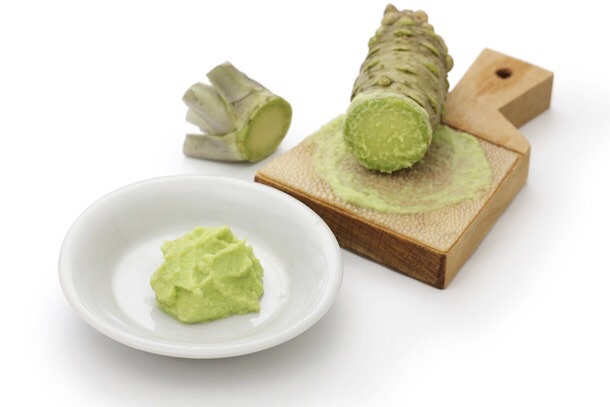
No discussion of horseradish is complete without a mention of wasabi, that wonderful green paste which, together with ginger, accompanies sushi and sashimi.
image
I’m not particularly keen on the ginger, but wasabi is a must for me – whenever my wife and I eat sushi or sashimi, she gives me her wasabi and I give her my ginger, which she loves; it’s a deal made in heaven. As anyone who has eaten both horseradish and wasabi will know, there is a definite relationship; the tastes are too similar for it to be coincidental. In fact, the two plants are close botanical cousins; the picture above shows the greenish root which is the source of wasabi. But here I have to reveal a mournful truth. In this era of globalized cuisine, where sushi bars seem to be sprouting up everywhere, when we eat wasabi we are nearly always eating horseradish paste mixed with green colourant. The wasabi plant is difficult to grow, so production cannot keep up with demand, hence the substitution. Sad in a way. An Italian friend of mine was recently telling me of a similar case, for a foodstuff I am particularly fond of, bresaola, which has also become a global food-star. In principle, bresaola should be made from cattle reared in the Valtellina, in the Italian Alps. But cattle production in this really quite small Alpine valley cannot possibly keep up with demand, so cattle is shipped in from Brazil to be processed in the Valtellina and stamped “bresaola”.

My wife and I are going to Japan in November. Let’s see if we can find a place which serves real wasabi.

_______________

Horseradish: http://www.herbalextractsplus.com/horseradish-root.html
Horseradish and vinegar: http://www.handmade-treats.co.uk/shop/horseradish-vinegar/
Tewksebury mustard: https://groceries.asda.com/product/mustard/asda-extra-special-tewkesbury-mustard/80755029
Tafelspitz: http://www.lecker.de/tafelspitz-19222.html
Wasabi: http://www.seriouseats.com/2014/03/pantry-essentials-all-about-wasabi.html

POINTILLISM

Vienna, 1 October 2016

The Albertina Museum in Vienna is currently holding an exhibition on pointillism and its reverberations in later art. My wife and I decided to visit it, as a treat for successfully becoming residents of Austria and for finding our apartment in good shape after our tenants had handed it over. We were glad we went. Never had we been exposed to this many Pointillists in one go; the larger collections of Impressionists and Post-Impressionists we have seen generally have just a few pointillist paintings sprinkled into the mix. Not only were there paintings by Seurat, the originator of the technique, Signac, his best-known follower, and other French Pointillists, there were also a roomful or two of Belgian and Dutch Pointillists whom we had never heard of. There was also a whole section devoted to pointillist portraits; pointillism was never a style I had connected with portraiture. There were some examples of late pointillism, by then renamed divisionism, where the earlier dots were replaced by longer and broader paint strokes. And then the final room had a brace of Van Goghs, some Matisses, a couple of Picassos and Mondrians, and a few other odds and ends, to show how divisionism had affected later artists.

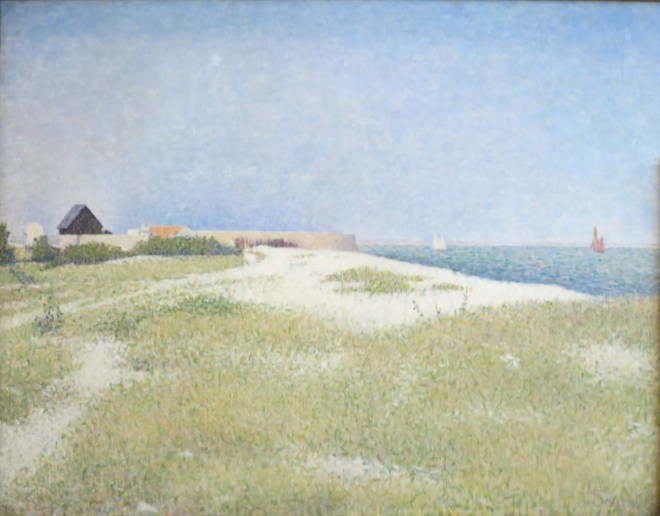
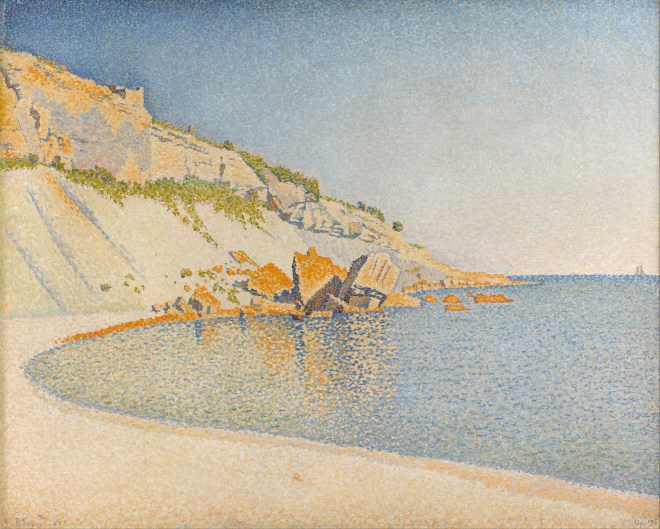
All exceedingly interesting. And yet … my wife and I both had the same reaction to the show. After an initial burst of enthusiasm, doubts set in. The effect of seeing so many pointillist paintings together was to have a chocolate-box sensation. The paintings were all preternaturally bright, the skies of the many landscapes were a uniformly blank cerulean blue, and the other colours seemed to all veer towards the pastel. Here’s a couple of pointillist paintings that exemplify what we found before us. The first is by Seurat, the second by Signac.

image
image
All this in large doses eventually becomes rather sickly. There was also an eerie stillness in many of the paintings, perhaps because by their nature pointillist works were carefully and patiently crafted in the studio. This stillness, emptiness almost, is obvious in what is probably the most famous pointillist painting, Sunday Afternoon on the Island of La Grande Jatte, which shows what should be a scene full of life and movement but gives the impression of being peopled by mannequins put there for the occasion.


image
It seems that after an initial burst of enthusiasm contemporary painters also turned away from pointillism, but more because creating these paintings took so much time. Certainly Van Gogh was never convinced by pointillism, although he experimented with it a bit, because it eliminated any spontaneity in painting.

A footnote to the exhibition: many of the paintings were on loan from the Kröller-Müller Museum in Otterlo, the Netherlands. I had never heard of this museum (as for my wife, after an initial bout of amnesia, on seeing pictures of the museum she suddenly remembered visiting it more than forty years ago). Yet this museum has, among other things, the second largest collection of Van Goghs in the world. The collection was put together by Helene Kröller-Müller in the first decades of the last century. She was born into a wealthy German industrialist family and married a Dutch mining and shipping tycoon, a combination which made her the richest woman in the Netherlands.
image
She used her money wisely to put together a great collection of what was then modern art. Towards the end of her life she donated it to the Dutch state.

When I read such stories, I sigh and wish my father had been a tycoon. I would have loved to spend inherited millions putting together an art collection. Maybe in my next life.
__________

Seurat: https://en.m.wikipedia.org/wiki/Georges_Seurat
Signac: https://en.m.wikipedia.org/wiki/Paul_Signac
A Sunday Afternoon on the Island of la Grande Jatte: https://en.m.wikipedia.org/wiki/Île_de_la_Jatte
Helene Kröller-Müller: http://www.betergeven.nl/over-filantropie/filantropen-in-beeld/helene-kroller-muller/

SAINT RADEGUND

Vienna, 19th September 2016

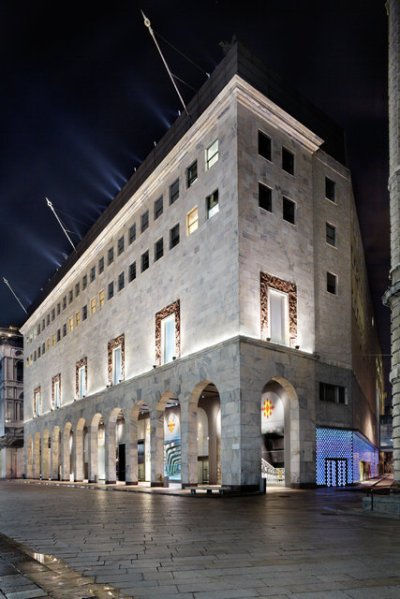
There is a small street which gives on to Piazza Duomo in Milan, which goes by the name of via Santa Radegonda. It’s a very modest, narrow, little street, really quite boring. Its main claim to fame is that it runs alongside the posh department store La Rinascente.

image
But I like the street, for the quite frivolous reason that I like the name. Radegonda, Radegund in the original German: now that’s a girl’s name with some whoomph to it! Not like Amelia, or Olivia, or Emily, which are currently some of the most popular names for little British girls.

This particular Radegund was a 6th Century princess from Thuringia, in what is now central Germany. Her life story was as colourful as her name. Her father, Berachtar, was one of three kings in Thuringia. Her uncle, Hermanfrid, one of the other Thuringian kings, killed her father in battle, took over his part of the Thuringian lands, and while he was at it took Radegund into his household. Hermanfrid then made a deal with the Frankish king, Theuderic, to share sovereignty of the whole of Thuringia, subject to material aid from Theuderic. Having sealed the deal, Hermanfrid attacked, defeated, and killed the third king of Thuringia, his brother Baderic. He then promptly reneged on his agreement with Theuderic. Not surprisingly, Theuderic sought revenge of this perfidy. Together with his brother Chlothar, he defeated Hermanfrid and took over Thuringia. In the ensuing carve-up, Clothar took charge of Radegund and brought her back to Gaul. All this happened before Radegund was 11, by the way.

Clothar packed Radegund off to one of his villas until she was of a more marriageable age. When she was 19 or so, he married her himself. No doubt it made his claims to Thuringia stronger to have her as his wife. She joined Clothar’s five other wives – Guntheuca, Chunsina, Ingund, Aregund, and Wuldetrada – in what may, or may not, have been a cozy concubinage. In any event, she bore Clothar no children.

By the time Radegund was 30, her only remaining brother was the last surviving male member of the Thuringian royal family. Presumably to head off any pesky competing claims to the Thuringian lands, Clothar had him murdered. At which point, either because she feared for her own life or because she was fed up with all this mayhem, Radegund fled and sought the protection of the Church, eventually founding, when she was about 40, a nunnery in Poitiers. Initially, Clothar tried to get her back but eventually left her alone and focused on expanding his lands at the expense of all those around him, including his brothers (although he had the grace not to kill them to obtain his ends, good manners which did not extend to their sons). By the time he died, he was master of a kingdom stretching from the Pyrenees to Thuringia, and from Brittany to French-speaking Switzerland.

All these Franks and Thuringians may have been a lying, traitorous, murderous lot, but they had wonderful names. This all rather reminds me of my Favourite History Book, 1066 And All That, my copy of which recently came to light, among many a delighted cry on my part, from the storage box in which it has been lying these last seven years.
image
In that book, we are reminded that Anglo-Saxon England was peopled with persons carrying wonderful names:

“Wave of Egg-Kings

Soon after this event Egg-Kings were found on the thrones of all these kingdoms, such as Eggberd, Eggbreth, Eggfroth, etc. None of them, however, succeeded in becoming memorable except in so far as it is difficult to forget such names as Eggbirth, Eggbred, Eggbeard, Eggfish, etc. Nor is it even remembered by what kind of Eggdeath they perished.”

The authors were exaggerating, but not by much.

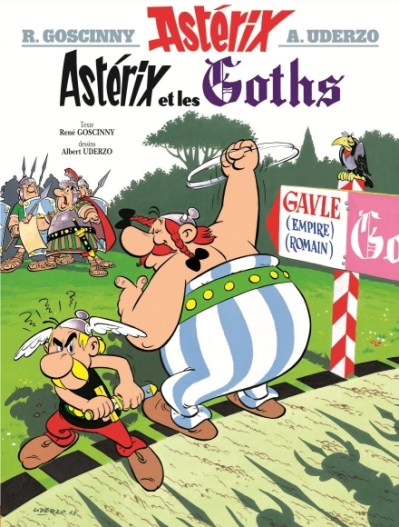
The murderous goings-on around Radegund also remind me of that other Great Source of Early European History, Asterix. In the album Astérix chez les Goths
image
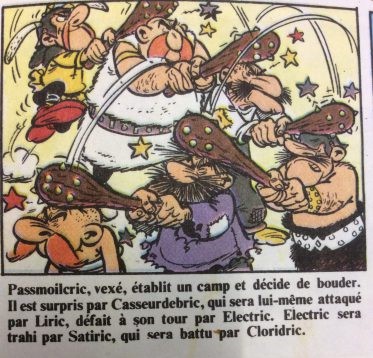
the endemic fighting among the Germanic tribes is well captured.

(Please note the authors’ take on Gothic names – they exaggerate but not by much)

But I digress, and I think my wife feels I’m letting my childish side get the upper hand here. Let us focus on the saintly Radegund. Already when queen, she was noted for her almsgiving. Once a nun, she cared for the local lepers and other infirm of Poitiers. She was also known for eating nothing but legumes and green vegetables: no fish, no eggs, not even fruit. I’m sure the vegans of today would approve (although even they might find her decision to forswear fruit a trifle extreme) but to the meat-eating Germanic elites, who spent much of their time hunting, this must have been pretty weird. Here is the most ancient representation of this saintly lady that I found, from a 10th-11th Century manuscript in the Municipal library of Poitiers, where we see Radegund getting herself to the nunnery (to misquote Hamlet).
image
As far as I can make out, though, her main claim to religious fame, at least in the Dark and Middle Ages, is that the Byzantine Emperor Justin II gave her a fragment of the True Cross. I hasten to add that he did not do so because he was much taken by Radegund’s saintliness. It was, I’m afraid, a purely political maneuver. Justin wanted to wrest control of the north of Italy from the barbarian Lombards, but for this he needed the help of the (equally barbarian) Franks. The relic, given to an ex-wife of the Frankish king who, though, was still on friendly terms with said king, was the bribe, or, to put it more kindly, the bait. Whatever the reason, the relic which Justin handed over to Radegund was a Really Good relic, and any Medieval religious institution with a Really Good relic was sitting on a goldmine as the pilgrims poured in and spent their money locally. This no doubt was the happy fate of Poitiers, helped along by the fact that Radegund was widely believed to have the gift of healing. Indeed, several miracles around her tomb greatly helped to increase the pilgrim traffic. The result was the building of a church which is a combination of Romanesque and Angevin Gothic styles.
image
Sadly, the vicissitudes of history, and more specifically a sack by Huguenots in the 16th Century and the ravages of the French Revolution, combined with some heavy-handed restoration in the 19th Century, has scarred the original splendour.

The pilgrim traffic to Poitiers had the happy side-effect of carrying Radegund’s name far and wide as the pilgrims returned home, and new churches and other religious institutions sprang up all over Europe dedicated to her name. This was certainly the case in Milan, where on the site on which now stands that temple to consumerism, La Rinascente, there once stood a nunnery dedicated to Santa Radegonda. No trace of this nunnery remains today save in the name of that modest, narrow, little street which I like so much.

I give just one further example of the many places in Europe which adopted her name, and that is the small village of Sankt Radegund in Upper Austria. In the next few years, readers will see a new film come out, with the title “Radegund”. It is the story of Franz Jägerstätter, a native of Sankt Radegund, who was the only one in his village to vote against the Anschlüss and was courageous enough to be a conscientious objector during World War II.
image
My readers will no doubt convene that this was a dangerous thing to declare oneself to be under the Nazi regime, and in fact Jägerstätter ended up being guillotined in 1943, for the crime of “undermining military morale”. The recent (German) Pope, Benedict XVI, had Jägerstätter beatified: a more appropriate saint for our age, I think.
image
Yesterday afternoon, I noticed that behind Milan’s Duomo there is a small road called via Santa Tecla. What an interesting name! I wonder who she was?

__________________
La Rinascente: http://www.nytimes.com/2014/12/25/fashion/in-milan-with-handbags-and-tongs-under-one-roof.html?_r=0
Clothar I: http://www.pearltrees.com/sirius84/francs-merovingiens/id9615614/item93489971
“1066 And All That”: http://rogerandfrances.eu/books/1066-and-all-that
“Asterix chez les Goths”: http://www.asterix.com/the-collection/albums/asterix-and-the-goths.html
Goths fighting: my photo
Radegund entering nunnery: https://en.m.wikipedia.org/wiki/Radegund
Eglise Sainte-Radégonde, Poitiers: https://www.poitiers.fr/c__244_788__Poitiers_capitale_romane.html
Franz Jägerstätter: http://voiceseducation.org/content/franz-jagerstatter-austrian-world-war-ii-resistance
Icon with Franz Jägerstätter: https://en.m.wikipedia.org/wiki/Franz_Jägerstätter