PEKING WILLOW

Beijing, 9 April 2014

The somber, funereal tone of my last post seems like a good place to start this one – a tombstone

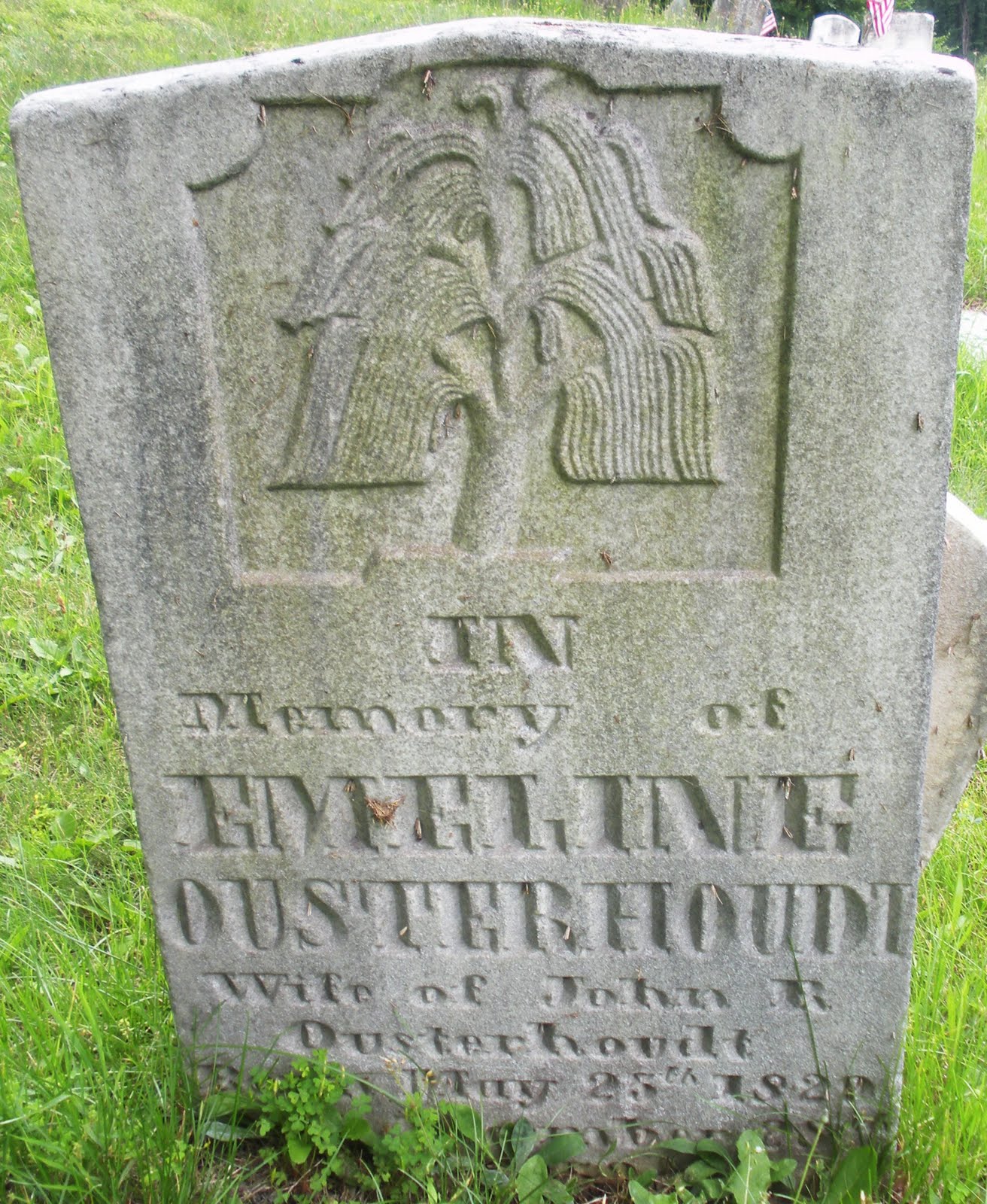
Weeping Willow on gravestone

This one has a weeping willow on it, a common symbol on tombstones 200 years ago. Its drooping branches symbolize, you’ve guessed it, the weeping of the world at your passage to the next. Here’s another in the same genre from the same period, this time a piece of needlework memorializing the death of three babies.
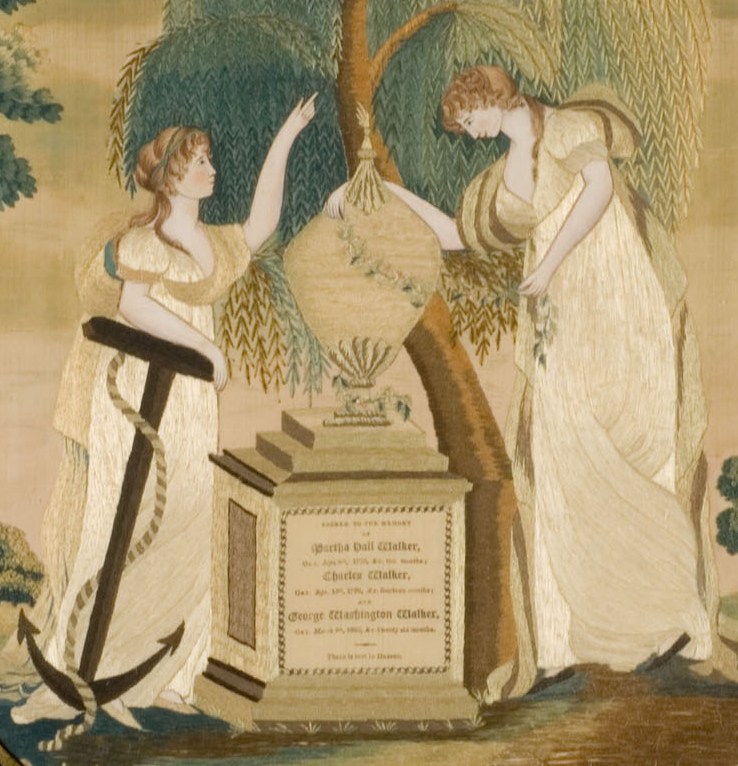
BT OA FR

And then there were the ballads which used the weeping willow as the symbol of death, lost love, or both:

My heart is sad and I’m in sorrow
For the only one I love
When shall I see him, oh, no, never
Till I meet him in heaven above

Oh, bury me under the weeping willow
Yes, under the weeping willow tree
So he may know where I am sleeping
And perhaps he will weep for me

They told me that he did not love me
I could not believe it was true
Until an angel softly whispered
He has proven untrue to you

Oh, bury me under the weeping willow
Yes, under the weeping willow tree
So he may know where I am sleeping
And perhaps he will weep for me

 Etc. You get the picture.

The weeping willow’s symbolism was used a bit more elegantly in Psalm 137 of the Old Testament, that lyrical lament about the pains of exile, in this case that of the Israelites who had been marched off to Babylon from Jerusalem:

By the rivers of Babylon—
there we sat down and there we wept
when we remembered Zion.
On the willows there
we hung up our harps.
For there our captors
asked us for songs,
and our tormentors asked for mirth, saying,
“Sing us one of the songs of Zion!”

 How could we sing the Lord’s song
in a foreign land?
If I forget you, O Jerusalem,
let my right hand wither!
Let my tongue cling to the roof of my mouth,
if I do not remember you,
if I do not set Jerusalem
above my highest joy.

jewish bible with picture

I’ve left out the last verse where the poet gets vengeful and nasty, talking about taking the babies of their captors and bashing their brains out against the rocks …

But if we brush aside the drooping veil of gloom, we find a really beautiful tree, for the most part sitting elegantly near a body of water, into which its trailing branches will often dip.
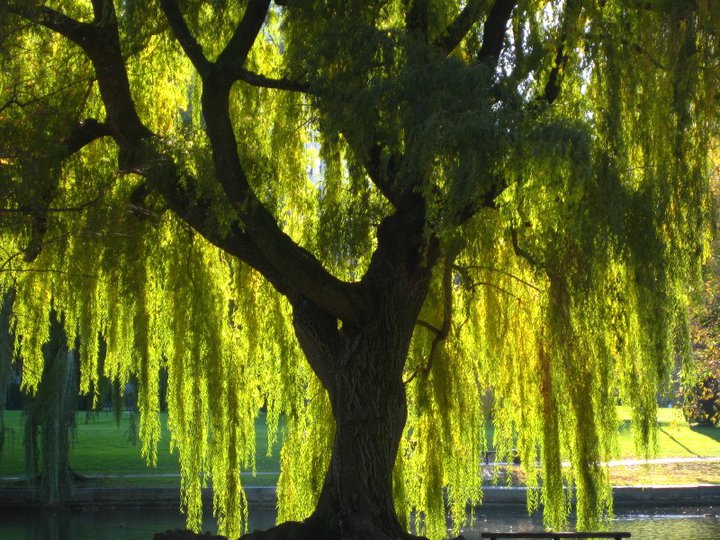
weeping willow tree

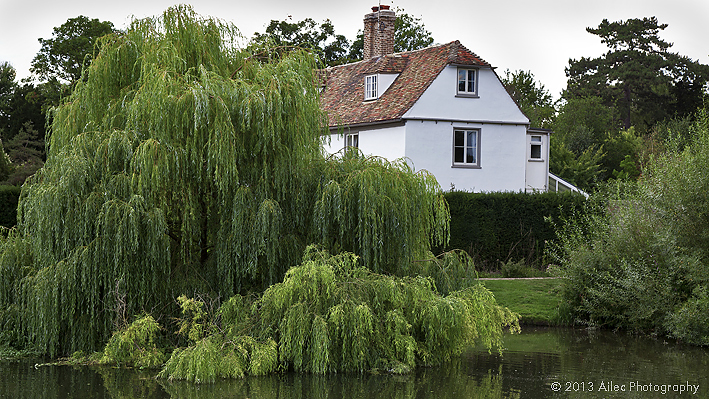
And such an English tree! (well, you also find them on the continent but we’ll ignore that). Here’s a weeping willow on the edges of a pond in Grantchester, in which, so it is said, the poet Byron swam.

weeping-willow-Grantchester

Here are students punting on the river Cam in Cambridge with some weeping willows languidly brushing the water’s surface.

weeping willows on the River Cam

Here is a 1946 poster from the Great Western Railway, inviting Londoners to take a day out in the Thames Valley, with a weeping willow centre stage beckoning to them.

great western railway-thamesvalley

Talking of the Thames, here is the cover of that most English of children’s books, The Wind in the Willows, where we see our friends Mole, Ratty and Toad on the river Thames, waving to Badger on the shore, the whole discretely framed by weeping willows

the_wind_in_the_willows

And of course there’s Three Men in a Boat, a book about – well, three men in a boat, messing around on the same river Thames (a book much loved by my father-in-law, in passing). Here we have them in that quintessentially English situation, rain, together with that quintessentially English animal, the dog, with some weeping willows in the background.
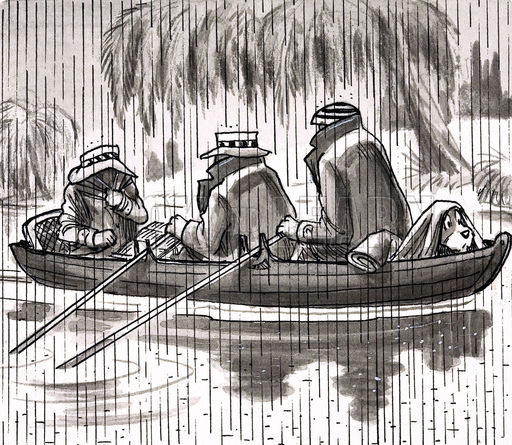
Three Men in a Boat by Jerome K. Jerome

Yes, all very English.

Except that the weeping willow isn’t English.

It’s Chinese.

Well, half-Chinese.

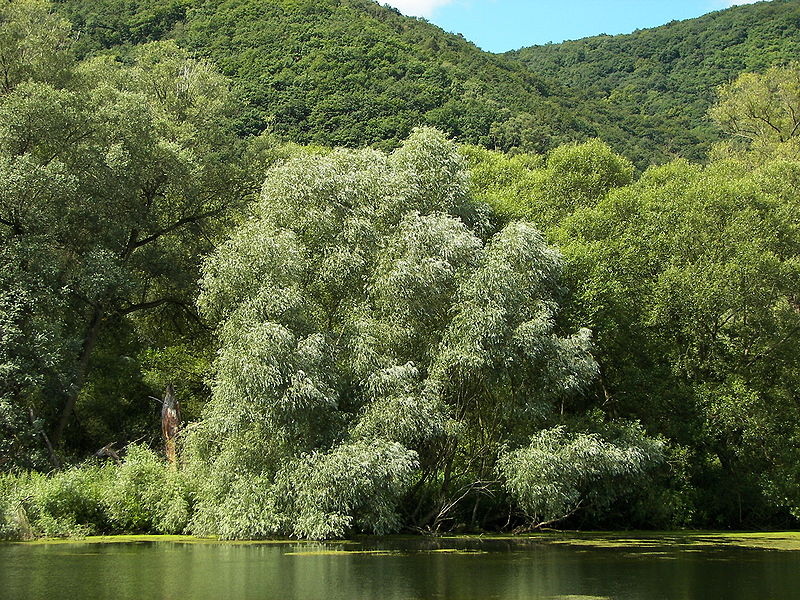
Yes, the willows, suitably called Peking willows, lining my piece of canal in Beijing
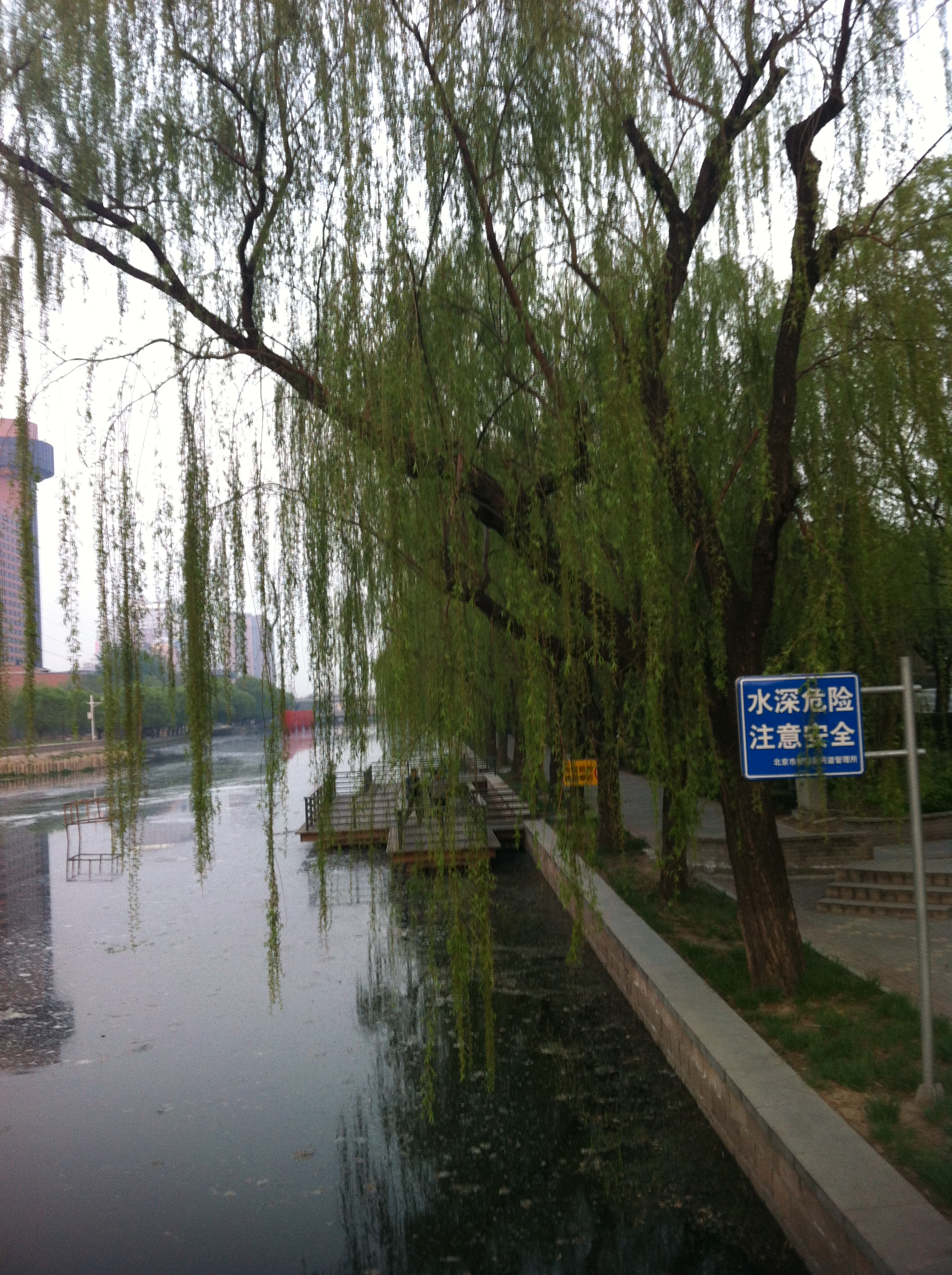
peking willows 004

are the ancestors of all those graceful weeping willows whose photos I have included above. It is they which carry the gene that makes the tree’s branches weep.

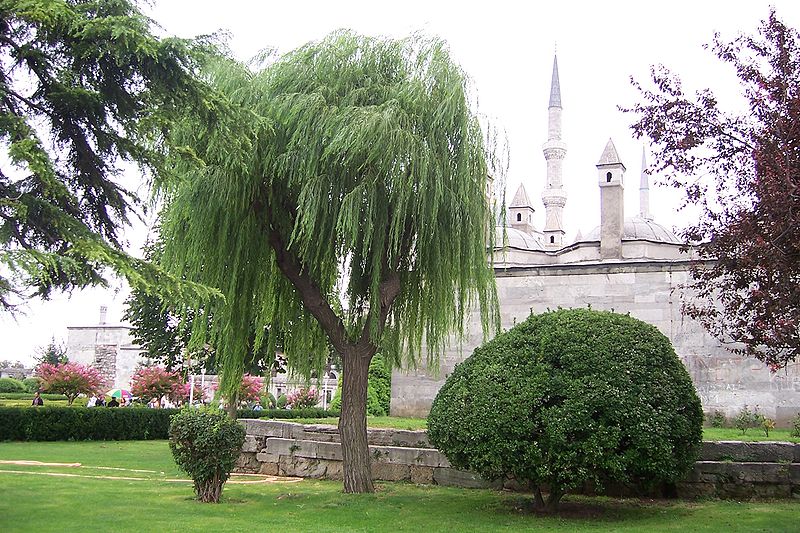
Somehow, for some reason, cuttings or seeds from these trees made their way to the west. I have read that they were moved along the Silk Road. Probably, traders from the west were charmed by the trees’ weeping branches and wanted them in their gardens. I’ve looked for pictures of Peking willows planted along the Road. The best I have found is a Peking willow in Istanbul.

Salix_babylonica in Istanbul

Not quite on the Road, which ended on the Mediterranean seaboard at Antioch or Tyre or Sidon, but close enough. And maybe one of the ways which the Peking willow entered Europe, through the Balkans.

Somewhere along the way further to the west, the Peking willow was crossed with another willow, the European white willow.
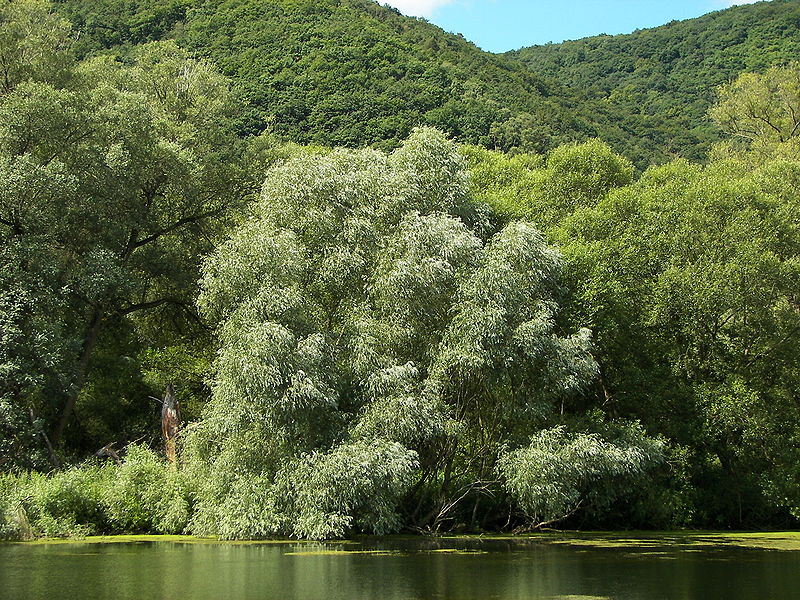
white willow

The two were crossed because gardeners found that the Peking willow suffered in the more humid climate of Europe. Its gene pool needed bracing up, as it were.

So the weeping willow is half Chinese, half European.

Although my bubble of Englishness has been pricked, I’m glad to report that the weeping willow is nevertheless half brother –  or perhaps half sister – to that most English of artifacts, the cricket bat! Because these are made from the willow of a cross between the white willow and (possibly) the crack willow (the ancestry on the other side is not clear). So this allows me to insert here a picture of that most English of cricketers WG Grace holding a bat, in an ad for that most  English of condiments, Colman’s Mustard

wg grace with bat

Well, while I’m about it, I might as well also clarify another misconception. The willows by the waters of Babylon under which the Israelites wept were not willows, they were Euphrates poplars.

euphrates poplar

______________________

Tombstone with weeping willow: http://4.bp.blogspot.com/-V965riBwMQE/ThW9WsV_6gI/AAAAAAAAAA4/kGf3gW9vaZ0/s1600/%2523%2523%2523Weeping+Willow+St.+Mark%2527s+Luth+Appenzell+%25283%2529.JPG [in http://callmetaphy.blogspot.com/2011/07/symbol-of-weeping-willow-in-gravestone.html%5D
Girls weeping on tomb: http://mansionmusings.files.wordpress.com/2011/04/mourning-picture-detail.jpg [in http://mansionmusings.wordpress.com/2011/04/29/a-mansion-favorite-returns-home-abigail-walker-needlework-mourning-picture-ca-1803/%5D
Jewish psalter: http://upload.wikimedia.org/wikipedia/commons/9/97/Chludov_rivers.jpg [in http://en.wikipedia.org/wiki/Psalm_137%5D
Weeping willow tree: http://www.blogmagazine.org/wp-content/uploads/2012/05/weepingwillow.jpg [in http://www.blogmagazine.org/2012/05/admiring-the-beauty-of-the-weeping-willow/%5D
Weeping willows Grantchester: http://3.bp.blogspot.com/-3Lkrd8FlSCE/UhFK2RfkItI/AAAAAAAAGiM/v5kklmS41GE/s1600/photograph-of-weeping-willow-Byrons-Pool-Grantchester.jpg [in http://ailecphotography.blogspot.com/2013/08/day-18-august-challenge.html%5D
Weeping willows on the river Cam: http://upload.wikimedia.org/wikipedia/commons/d/da/Punting_on_the_River_Cam_-_geograph.org.uk_-_222149.jpg [in http://commons.wikimedia.org/wiki/File:Punting_on_the_River_Cam_-_geograph.org.uk_-_222149.jpg%5D
“The Wind in the Willows”: http://www.usborne.com/images/covers/eng/max_covers/the_wind_in_the_willows.jpg [in http://www.usborne.com/catalogue/book/1~CS~CSP~3249/the-wind-in-the-willows.aspx%5D
“Three Men in a Boat”: http://s3-eu-west-1.amazonaws.com/lookandlearn-preview/A/A008/A008727.jpg [in http://www.lookandlearn.com/history-images/A008727/Three-Men-in-a-Boat-by-Jerome-K-Jerome?img=2&search=Jerome+Klapka+Jerome&bool=phrase%5D
Great Western Railway poster: http://www.southernposters.co.uk/Destinations/Resources/thamesvalleylarg.jpeg [in http://www.southernposters.co.uk/Destinations/thamesvalley1946.html%5D
Peking willow, Beijing: my photo
Peking willow in Istanbul: http://upload.wikimedia.org/wikipedia/commons/thumb/7/75/Salix_babylonica.jpg/800px-Salix_babylonica.jpg [in http://en.wikipedia.org/wiki/Salix_babylonica#Horticultural_selections_and_related_hybrids%5D
White willow: http://bioweb.uwlax.edu/bio203/2011/girard_stev/maintop.jpg [in http://bioweb.uwlax.edu/bio203/2011/girard_stev/facts.htm%5D
Euphrates willow: http://mw2.google.com/mw-panoramio/photos/medium/49589465.jpg [in http://www.panoramio.com/user/1183385/tags/%D7%A0%D7%97%D7%9C%20%D7%A6%D7%99%D7%9F%5D
100th ANNIVERSARY

Beijing, 21 July 2013

I am astonished to discover that this is my 100th posting! It seems only yesterday that, rather like a kid on his first day at school, I was nervously writing my first posting. This milestone deserves to be celebrated in some way. And what better way could there be than by singing the praises of the written word?

In my very first posting, which I entitled Manifesto (and which later became my “About” page, once I’d understood better how all this blog thing worked), I explained why, as I neared my 60th birthday, I had finally decided to take up the pen (electronic in this case) and write.

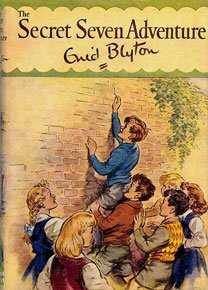
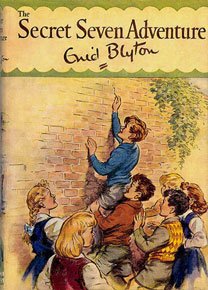
My decision to write actually flowed from my habit of reading. I’ve always loved to read. I still remember the day I got really hooked. I was maybe six, possibly seven. I was bored, and as is usual in these cases was bothering my elder siblings, who were all reading. In exasperation, one of my sisters gave me a book and ordered me to read it. I complied a trifle sulkily, but before I knew it I was drawn in – sucked in! – by the story. I still remember the book; it was from the Secret Seven series by Enid Blyton, about seven very English children who sluith around solving various mysteries (I’m amazed to see that these stories are still popular!)

secret-seven-adventure

For most of the next decade or so I read only fiction, but then I lost interest with the excuse that I lacked time.  I took up the habit again in my mid-twenties and I haven’t looked back. The contents of my modest library are packed away in Vienna, waiting to see the light of day again, but in my mind’s eye I can still walk slowly, pleasurably, along my bookcases packed with the books which have marked the passing of my adult life. My library always started with a section which I suppose would be called English Literature in a public library, so in my head my hand is now brushing over the spine of the novel “House of Spirits” by Isabelle Allende, which was the first of her novels I read and which led me – and my wife – to read many of her other novels (OK, strictly speaking these are not English literature, but since I read them in English that’s where I put them). They reconciled me with fiction after a long rift I had with the genre.

isabelle allende house of spirits

My eye is then drawn to the shelves dedicated to detective stories (since those memorable Secret Seven days, I’ve always had a weakness for “yellows” as Italians call them), where my hand falls on “A Morbid Taste for Bones”, the first in the series about Cadfael, the Benedictine monk from the great Abbey of Shrewsbury during the reign of King Stephen.

a morbid taste for bones

I picked up the first out of curiosity at the British bookshop in Milan but it led me, fascinated and hooked, to the next one, which led me in turn to the next one, and on and on like Adriadne’s thread, until one day I had read them all – they always reminded me so much of my school days in a Benedictine Abbey school.

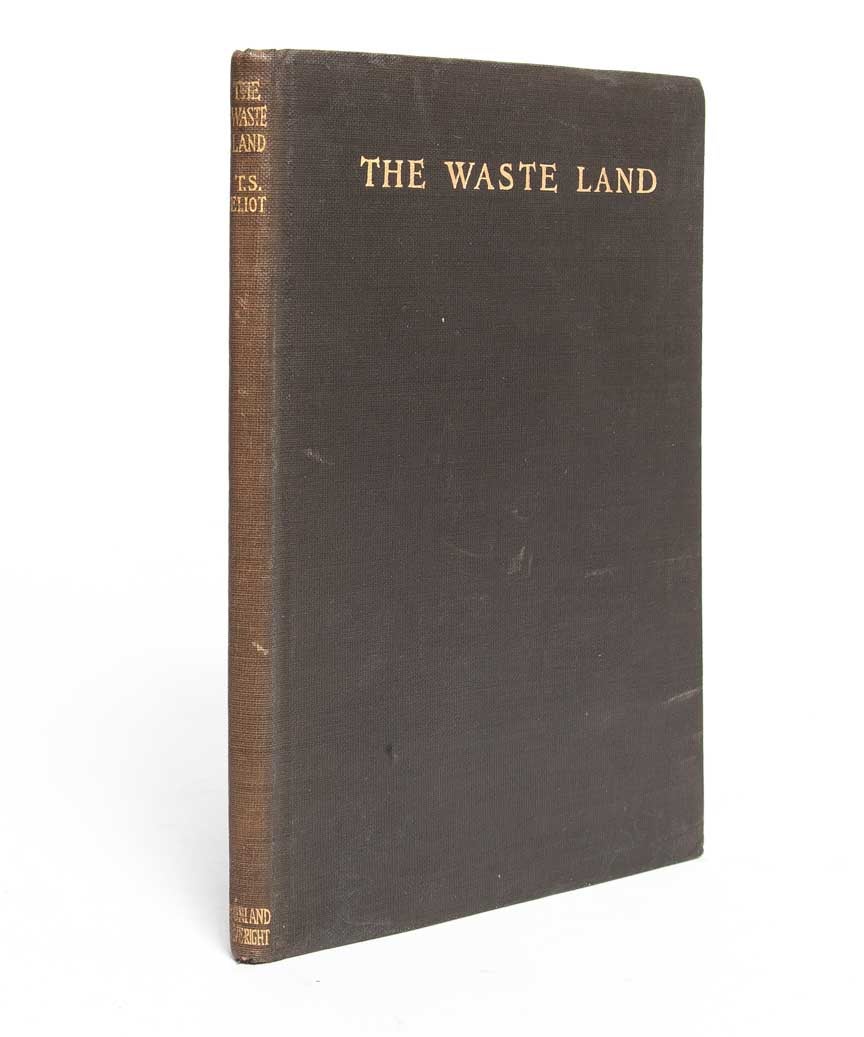
In my library, where space as much as logic has determined where books are placed (my wife has resisted the wholesale takeover of our successive apartments by books), the detective stories are followed by poetry. Here, I pick out the poems of T.S. Eliot, the first poet I came to appreciate, at age 16, during a class at school on English poetry, run by a wonderfully eccentric schoolmaster. The poem he introduced us to was, of course, “The Waste Land”.

wasteland

I always place “The Waste Land” next to the poems by Wilfred Owen and the other First World War poets. I feel that this poem’s sorrowful elegies of times past marry well with the anger that pulses through the war poems, an anger at the sheer futility and waste of that war.  I picked up this particular compendium of WWI poetry in a bookstore on Oxford Street, during a short visit to London.

first world war poetry

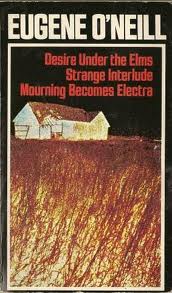
The English Lit section finishes with the plays I have acted in and the many more I would have liked to act in (“Mourning Becomes Electra” by Eugene O’Neill definitely falls into the latter category; it is a constant wound in my soul that I have never seen this play acted, yet alone acted in it myself).
mourning becomes electra

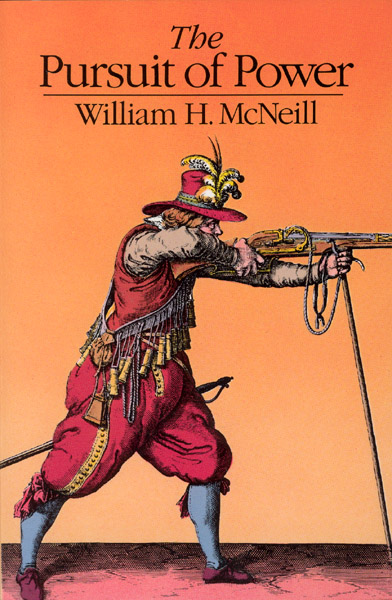
After English Lit in my library comes History: my passion – if I had not chosen to do sciences in high school, I would  have done history.   Among my many, many history books, I eye with particular fondness “The Pursuit of Power” by William McNeill,  which is a magnificent synthesis of military, technological, and social history over an arc of a thousand years.

pursuit of power

My hand then brushes over “Guns, Germs and Steel” by Jared Diamond, which (I am summarizing here!) tried to answer the question “Why was it European ships that sailed west and discovered the Americas and not the other way around?”. This book gave me the same shock of intellectual stimulation as McNeill’s book did when I first read it.

Guns Germs SteelI quickly jump to a shelf dedicated to histories of War, where I pick out  “The Face of Battle”, by the British war historian John Keegan, a fascinating analysis about how the field of battle has changed over time. I bought this book on impulse in a Barnes & Noble bookshop in New York 25 years ago and I liked it so much that over the succeeding years I read every single book Keegan wrote.

The-Face-of-Battle

History is followed by Other Social Sciences – politics, sociology, economics, and such like – where my hand brushes briefly over Henry Kissinger’s two volumes on his years in the White House.

white house years

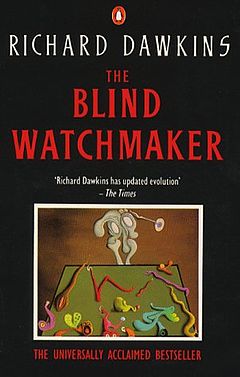
I pass on quickly to the Science section, where I stop in front of my small collection of books on the biological sciences and evolution especially. My favourites are the collected essays on natural history by Stephen Jay Gould, whose warm, wisecracking style I find so quintessentially American, and the books by his “competitor” Richard Dawkins, whose coldly lucid style I find so quintessentially English.

Pandas ThumbBlind_Watchmaker

My science books are followed by my books on religion; why not? science has challenged (and in my view defeated) religion. And here my hand falls on “The Faces of Jesus” by Geza Vermès.

changing faces of Jesus

This was one of those books which takes your breath away by its ability to blow old ideas out of the window. It led me to buy several of his books, to explore who the real Jesus probably was once you get behind all the layers of Christian piety.

And finally, squeezed in at the end of my bookshelves, are books on art, cookery books, travel guides …

In China, I have continued the habit of buying books, nosing out where books in English can be found. We came with nearly no books (two compendia of English poetry, a book on Caravaggio, a book or two on Chinese history), now we don’t know where to put all the books that are piling up in drifts throughout the apartment.

Yet, during all this reading I have always felt a point of guilt: I was passively receiving these written words without writing anything back. Oh, I wrote a lot, but it was all dry, sterile stuff which I had to do for work; at the best of times clear, precise analysis, at the worst of times bureaucratese of the highest order. And so I started this blog. What a liberation it has been! I feel that I have finally gained my voice, that after all the croaking I’ve done I can finally sing (to paraphrase some lines from the African-American poet Langston Hughes, “now do I wonder at this thing, that I am old and yet can sing”). Of course, I don’t pretend to be writing great literature. These postings are just scribblings. My wife urges me to write a book, but I don’t think I can go beyond these brief notes. I am a sprinter, I tell her, I can only run 100 metres, I’m not a marathon runner. Still, the pleasure I derive from this writing is immense – and I hope my few readers derive some pleasure from reading these posts.

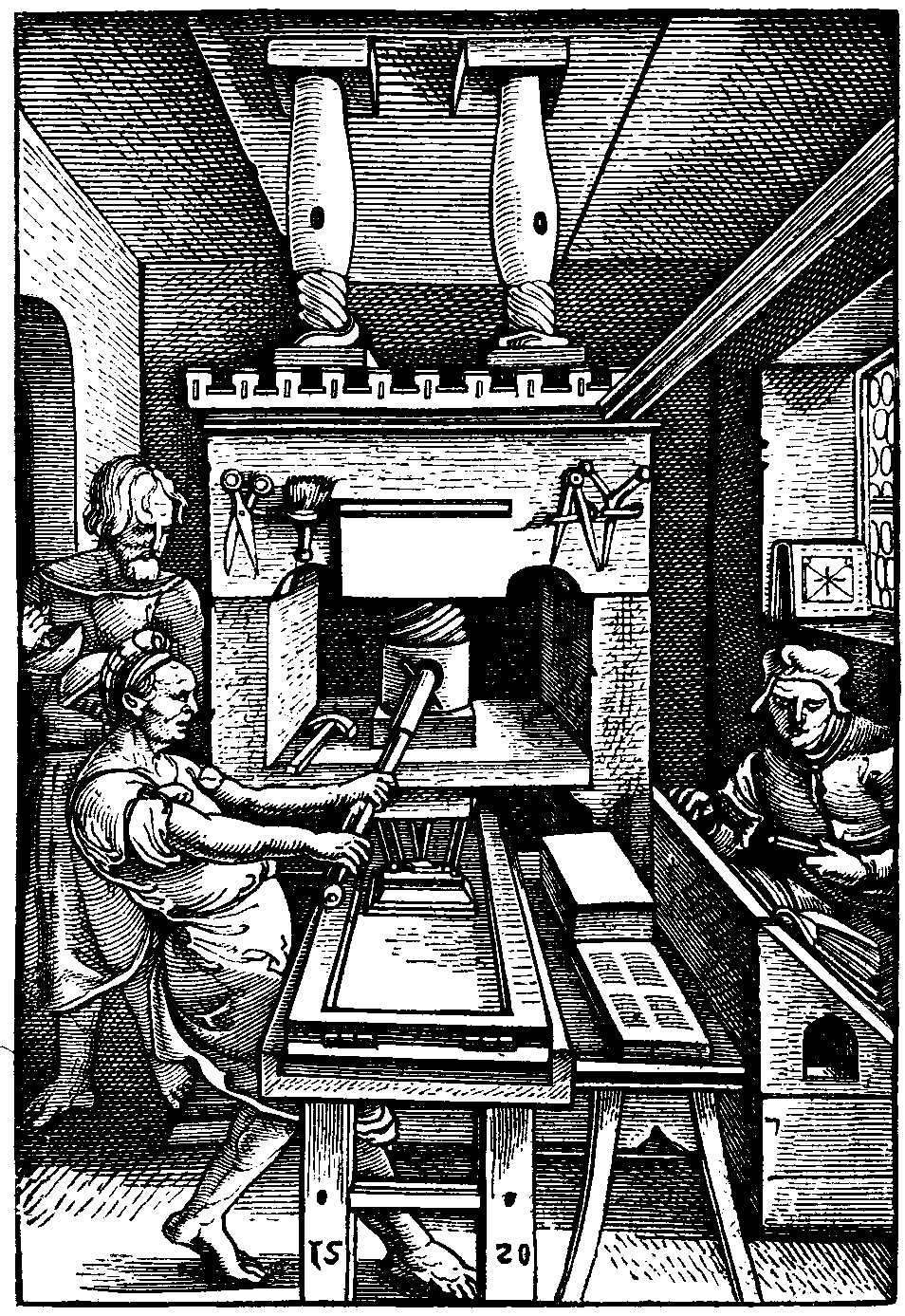
Yet, amidst all this pleasure, I have a sense that all is not well in the world of the written word. I see with dismay that bookshops are closing one after another as if hit by some sort of plague, and those that remain often survive by selling rubbish. To some degree, it is simply a change in venue. The written word is migrating from the printed page to an electronic format – am I not writing somewhere in an electronic cloud? For sure, newspapers have already almost vanished to be replaced by their electronic namesakes. Even books are taking this path. A younger colleague of mine urged me to switch to a Kindle; he even gave me his to handle, rather as you would drape a snake around someone’s shoulders to show how nice they really are. But I recoil from this electronicization of books. I want my books the old way, printed on paper, the way Gutenberg started it 500 years ago.

gutenberg

I sense, though, that the malaise with books goes deeper than a simple migration to the electronic cloud. I truly wonder if books will survive at all. The book I am currently reading, “The Swerve” by Stephen Greenblatt, tells me that books have disappeared before.

the swerve

Greenblatt is writing about the near-miraculous recovery in the 1400’s, from some dark corner of a library in a European monastery, of a mouldering 8th Century copy of the poem “De Rerum Natura” by  the Roman poet Lucretius, written in the first decades BCE. But in telling this story he also tells of the time when books disappeared from the Roman Empire as the Empire slowly collapsed in on itself and Christianity spread. It had seemed to the Roman intelligentsia that books would be there for ever, and then one day they were gone. Many Roman writers we know only by name; none of their works have survived. To a book lover like me, it is a story that sends a shiver down the spine.

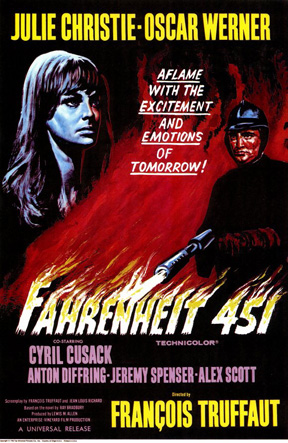
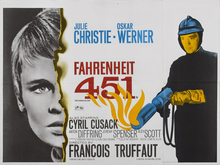
Those of my generation may remember a film of the 1960’s, Fahrenheit 451. The story is set in modern times, in a society which has banned books and where firemen are there to burn down houses containing books and not put out fires burning down houses. Through various twists and turns, the hero goes from being part of the system of suppression as a fireman to joining a resistance movement whose members live in the forests and keep books alive by each learning a few books by heart to pass on to younger generations, waiting for the time when books will be accepted again.

Fahrenheit 451

I don’t think that the next time books disappear it will be because society is hostile to them, or because society is collapsing. It will simply be through a collective bout of attention deficiency disorder as our electronic toys spin a web of confusion around our minds. Who will need books when you can slip on a pair of super-cool glasses and take part in a 3-D story peopled by electronic characters and set in electronic simulations of paradises on Earth?

I hope I’m not alive to see that day.

_____________

Secret Seven: http://www.enidblytonsociety.co.uk/author/covers/secret-seven-adventure.jpg
House of Spirits: http://swanyart.com/cms/wp-content/uploads/2013/05/houseofspirits.jpg
A Morbid Taste for Bones: http://www.hachettebookgroup.com/_b2c/media/cache/44/a4/44a4f75b43b0f8f64547b5fb88d3d63b.jpg
Waste Land: http://www.whitmorerarebooks.com/pictures/464.JPG
First World War poetry: http://ethershop.umwblogs.org/files/2011/10/poetry.jpg
Mourning Becomes Electra: http://t2.gstatic.com/images?q=tbn:ANd9GcQiKE5e4yBs1a08Z3wtMqkMnkbgAmpbLeajHmGMMCFt-_hTQ-hj
Pursuit of Power: http://www.bibliovault.org/thumbs/978-0-226-56158-5-frontcover.jpg
Guns, Germs and Steel: http://www.beyondone.org/images/image/GunsGermsSteel.jpg
Face of Battle: http://www.jamesaitcheson.com/wp-content/uploads/2013/01/The-Face-of-Battle.jpg
White House Years: http://i.ebayimg.com/00/s/NDgwWDMyNQ==/$%28KGrHqF,!osE8Vffrj3DBPOp0ebETg~~60_35.JPG?set_id=8800005007
Panda’s Thumb: http://www.ateism.nu/images/The%20Pandas%20Thumb%20by%20Stephen%20Jay%20Gould.jpg
Blind Watchmaker: http://upload.wikimedia.org/wikipedia/uk/thumb/f/f8/Blind_Watchmaker.jpg/240px-Blind_Watchmaker.jpg
The Changing Faces of Jesus: http://img2.imagesbn.com/p/9780142196021_p0_v1_s260x420.jpg [in http://www.barnesandnoble.com/w/the-changing-faces-of-jesus-geza-vermes/1004427856?ean=9780142196021%5D
Gutenberg: http://www.mainlesson.com/books/bachman/inventors/zpage206.gif
The Swerve: http://media.npr.org/assets/bakertaylor/covers/t/the-swerve/9780393064476_custom-90f41678e2d9b3883ed17ae22fff5d2273ca209e-s6-c30.jpg
Fahrenheit 451: http://upload.wikimedia.org/wikipedia/en/f/f0/Fahrenheit451B.jpg

SICILY THE LOVELY, SICILY THE DAMNED

Beijing, 12 June 2013

Two weeks ago, when I walked into the apartment in the evening, back from a business trip, my wife announced triumphantly that she had discovered a treasure trove on Youtube, shows from a series on Italian TV that we never even knew existed: Commissario Montalbano.

Readers will be forgiven if they look blank at this announcement. I will allow that Montalbano is not (yet) a household name. Yet my wife’s announcement filled me with great excitement. The detective stories written by the Sicilian-born writer Andrea Camilleri about Salvo Montalbano, Inspector of police in some modest township in western Sicily, have gripped me ever since I stumbled across one of them some six years ago. I read them in the original, which I must say is not easy. Already reading in Italian is slightly more difficult for me than reading in English, and Camilleri writes in an Italian which has been heavily saturated with Sicilian dialect. The first time I ventured into one of Camilleri’s books I was reading like a child of 5 for the first ten pages or so until I got the hang of it and could stop asking my wife every ten seconds what this word or that word meant. It’s still tough going, but the dialect really helps to drop you into Sicily.

Well that evening, after dinner, we settled down on the couch, poured ourselves a glass of wine, opened Youtube, chose one of the shows, and started to watch. For me, there was an initial moment of discomfort; when you have read so many stories about the same characters you create an image of them in your mind’s eye, and I was finding it difficult to adjust to this being Commissario Montalbano:

Commissario-Montalbano

(too handsome!), this being his two main collaborators, Mimí and Fazio:

mimi-e-fazio

(too tall the first, too handsome the second), and this being the klutz of the office, Cattaré:

catarella

(too much of a clown)

(I also have a very distinct picture in my mind of Smiley, Le Carré’s master spy hero – the spitting image of my Latin teacher at school. But I digress)

Quickly, though, I was drawn into the stories and forgot to mentally tut-tut over the faces of the protagonists, and we have now eased into a nightly ritual of hauling out the computer after dinner, pouring ourselves a generous glass of wine, and watching a Montalbano.

I have always thought that this series of detective stories, inserted as they are so deeply into the Sicilian reality, would have little echo outside Italy. Imagine, then, our astonishment when a few days ago (this coincidence of dates must have some cosmic meaning …) my wife read out an article at breakfast from the Guardian newspaper commenting on the popularity of the Italian Montalbano TV series in the UK. The article also commented on the number of Brits doing Montalbano-themed visits to Sicily! I was gobsmacked. When we did a little bit of web surfing, we discovered that actually people from all over the world love Montalbano (much of this coming from comments left on TripAdvisor about Montalbano’s house, which some canny Sicilian has turned into a Bed and Breakfast).

Is it just that we all love a good yarn well told, and a good detective story has all the makings of a good yarn? Is it the Italianness of the character which attracts people? The relative exoticness of the locations? Something else?

As far as I’m concerned, my attachment to Montalbano goes far beyond the thrill of the detective story. It goes even beyond the characters, marvelous as they are. Through Salvo Montalbano, Camilleri depicts wonderfully well that spirit of contrariness which is very definitely part of the human landscape of southern Italy.  The TV show captures this trait of Montalbano’s nicely, as it does the subtle intelligence and cynical sense of humor – such Italian traits! – which Camilleri gives to his creation. And of course Camilleri injects wondrous descriptions of Sicilian food by making Montalbano a gourmet, something which we see a little of in the TV series by having Montalbano spend a fair amount of time sitting at restaurant tables (but we discovered a web-site which lovingly lists the recipes of all the dishes which Montalbano eats!). My only real disappointment with Montalbano’s TV character (apart from him not looking like I imagine he should) is that I haven’t yet seen Salvo Montalbano’s love of the written word (which is, of course, Camilleri’s). Camilleri has peppered the books with his hero’s musings on various works of literature. I love this about him since I also like to muse (muse to excess, my wife might add) on literature.

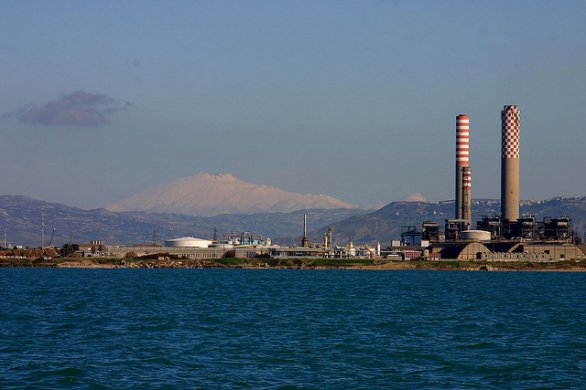
But what actually draws me most to these detective stories is the melancholy view of Sicily which permeates them. Sicily the beautiful, damned by the gods and abandoned to its fate. So much my feeling of the island! Camilleri shows it mostly by building in a constant, extensive, subliminal presence of the Mafia – truly like a cancer in the island’s body politic – and exposing the total corruption – moral more than monetary – of the island’s political class. I saw it instead through my work. Fate had it that I had to spend most of my time in Sicily in collapsing industrial zones, built in the 1950s and ’60s. These came into existence as part of a political discourse which claimed to be bringing modernity and wealth to the south of the country by implanting heavy industry there: oil refineries, petrochemicals, agro-chemicals, iron and steel, non-ferrous refining … you name it, there was one somewhere in the Mezzogiorno. It was a stupid idea right from the start. The south had neither the infrastructure nor the industrial culture to digest these huge industrial complexes dumped on them: “cathedrals in the desert”, the Italians aptly named them. This is a refinery in the south of Sicily, with Mt. Etna in the back:

raffineria gela

And the actual implementation of the government’s plans made it all so much worse. Corruption was rampant, with every level involved in planning and construction decisions taking its cut. Many companies only located in the south to take advantage of the government’s tax holidays; it made no economic sense for them otherwise. The moment the holidays were over they upped stakes and moved on, leaving the State to hold the baby. The Government couldn’t afford politically the loss of jobs, so many of these industries were nationalized, which made them even more inefficient and drew in even more corruption (and the Mafia). The Trade Unions fought to remove the only advantage the south had, cheaper labour than the north, by insisting on equal pay for equal work. And then came globalization, which was the kiss of death. It now made even less sense to have these kinds of industries in the south. So I was a small part of a larger strategy by the government to quietly sell off – often in fire sales – the miserable remnants of these industries. The Sicilians I spoke to were so angry, so bitter, so sad about the whole thing. Huge investments by the government, which would never come again, which could have raised the island out of its chronic poverty, but which had just been frittered away … Poor Sicily.

______________

Montalbano: http://www.blogtivvu.com/wp-content/uploads/2011/03/Commissario-Montalbano.jpg
Mimí and Fazio: http://static.televisionando.it/televisionando/fotogallery/625X0/66329/mimi-e-fazio-fidi-collaboratori-di-salvo-montalbano.jpg
Catarella: http://www.ilbrigante.it/wp-content/uploads/2010/04/angelo-russo_preview.jpg
Refinery in Gela: http://static.blogo.it/ecoblog/IverticidellaRaffineriadiGelaSpaindagatiperomissionedicautelecontrodisastri.jpg

A HORSE! A HORSE! MY KINDGOM FOR A HORSE!

Beijing, 5 February 2013

I was all atwitter this morning when I saw the news. The skeleton found under the car park in Leicester, England, is indeed that of Richard III, last of England’s Plantagenet kings! OK, there are some sour-puss academics raising doubts, but that’s probably because the skeleton wasn’t found under their car park.

I spent the early morning skittering around the house with one shoulder up and shouting “A horse! A horse! My kingdom for a horse!” instead of getting ready for work. My wife looked on and rolled her eyes. But what Englishman has not at least heard of Shakespeare’s play Richard III? What person, who – like me – has thespian pretensions, has not dreamed of prancing about a stage as a mediaeval version of Quasimodo, murdering all and sundry with devilish glee and getting the beautiful women into the bargain? If it wasn’t for Shakespeare, who would remember King Richard III?

I did most of my acting at school. To my great regret, we never put on Richard III. But I’ve seen it a number of times, both in film as well as on the stage. I first saw it years ago with my wife, in some poky cinema on Paris’s rive gauche. That was the 1955 film version, with Laurence Olivier doing a marvelously over-the-top evil characterization of Richard.

laurence olivier

This film stayed in some sort of medieval setting. The next version I saw, with Ian McKellen playing Richard III, was made 40 years after Olivier’s movie. It tried to be clever and set the story in some sort of 1930s fascist version of Britain where the king’s deformity was moral rather than physical.

ian mckellen

We saw this film in Milan. As you can imagine, given Italy’s history

mussolini

the fascist overtones of the film had a certain resonance there.

And then, about a year ago, through sheer serendipity – we just happened to be visiting Hong Kong when the play was running – we saw Kevin Spacey play Richard III with a manic savageness.

kevin spacey

One of the amazing things about Shakespeare is the sheer number of quotes he has generated. Half the quotes people use, or so it seems, come from one Shakespeare play or another. Richard III has its fair share. There’s the quote which I’ve used as my title, which must be one of the most famous quotes in the English language. Then there is this quote:

“Now is the winter of our discontent
Made glorious summer by this sun of York”

which seems to be one of those quotes that everyone knows. Then there is this quote:

“Off with his head!”

which my father was very fond of using  whenever I was naughty.

Apart from these, the play has some deliciously cynical lines:

“Conscience is but a word that cowards use
Devis’d at first to keep the strong in awe”

“And thus I clothe my naked villainy
With odd old ends stolen out of holy writ;
And seem a saint, when most I play the devil.”

“Why, I can smile and murder while I smile,
And cry ‘content’ to that which grieves my heart,
And wet my cheeks with artificial tears,
And frame my face for all occasions”

Yes, we never did put on Richard III at school. But we put on Shakespeare’s Richard II; the events it recounts were the original cause of the War of the Roses, whose final act was the unhorsing of Richard III on Bosworth Field outside of Leicester and his killing with several savage blows to the head as shown by that skull beneath the car park.  I played the Duke of York (I should have played King Richard II, of course, but we’ll pass over that). As usual, the play has many memorable lines, but one set in particular remains with me, uttered by my elder brother John of Gaunt, Duke of Lancaster, as he lies dying in Act I:

This other Eden, demi-paradise;
This fortress, built by nature for herself,
Against infection, and the hand of war;
This happy breed of men, this little world;
This precious stone set in the silver sea,
Which serves it in the office of a wall,
Or as a moat defensive to a house,
Against the envy of less happier lands;
This blessed plot, this earth, this realm, this England

I don’t go back to the UK very often, but those lines echo with me when I stand in the countryside and see how so very lovely it can be.

english-countryside

_______________________________-

Laurence Olivier: http://3.bp.blogspot.com/-Z1o-IQnC1nE/UK8xybvIJ7I/AAAAAAAABCU/OJcjGS2QOzE/s1600/tumblr_m3xc1hNXLZ1rrfb56o1_1280.jpg

Ian McKellen: http://www.mckellen.com/images/r3/ban-15.jpg

Mussolini: http://757f8ed9aaa522dde29d-4c07cfa4f788be17c79661948c0f2477.r99.cf1.rackcdn.com/5728_1323465695_july-25th-benito-mussolini-deposed.jpg

Kevin Spacey: http://i.telegraph.co.uk/multimedia/archive/01934/Richard_a_1934160b.jpg

English countryside: http://www.style-passport.com/style/wp-content/uploads/2012/10/english-countryside.jpg

MY MESSAGE IN A BOTTLE

Beijing, 16 January 2013

My previous posting on a message in a bottle has reminded me of a story that happened to me a year or so ago. It all started when out of the blue I received an email from a woman who was quite unknown to me. After telling me that she had got my email address off the Internet, she cited me an address in Edinburgh and one in Canada, and asked me if I had ever lived there. It so happened that the Edinburgh address was where my wife and I had lived in our last two years as students at University, while the Canadian address was that of my parents.

I didn’t know what to make of this email. How had this complete stranger found my old addresses? I looked her up on the Internet and discovered that she was British, so some sort of connection with my past was possible. But she was obviously at least ten years younger than me, possibly more, so it wasn’t someone I had known in the past whose name had changed, nor was it someone with whom I could have had a common acquaintance of my generation. So who was she? Was this some kind of scam? Was some murky story in my past coming back to haunt me? But what murky story could that possibly be? I’m not a very murky person.

After a few weeks of mulling it over – I was on holidays at the time – I decided that I couldn’t resist the temptation to know more. So I wrote back to her, warily admitting that I had indeed lived at those addresses and so I was probably the person she was looking for. I then politely asked her what this was all about.

She got back to me quickly, thanking me effusively for replying. She then explained the background. One day, she and her boyfriend were browsing around in a used books store in Royal Tunbridge Wells in the south of England. For those of you, like me, who have never been to this pretty little town, I append here a picture.

Royal Tunbridge Wells

In the store, she told me, she had stumbled across a small book in the front of which a piece of paper had been slipped with my name and the addresses in Edinburgh and Canada written on it – as well as the fateful phrase “please forward if possible”. My correspondent was electrified by that last phrase. She felt that fate had sent her a message-in-a-bottle and she decided there and then that she was going to track me down and hand over the book.

So the hand-over took place through my daughter in London. No doubt my correspondent was highly pleased with herself. But I was left with an even deeper mystery. Who had wanted to give me this book? And why?

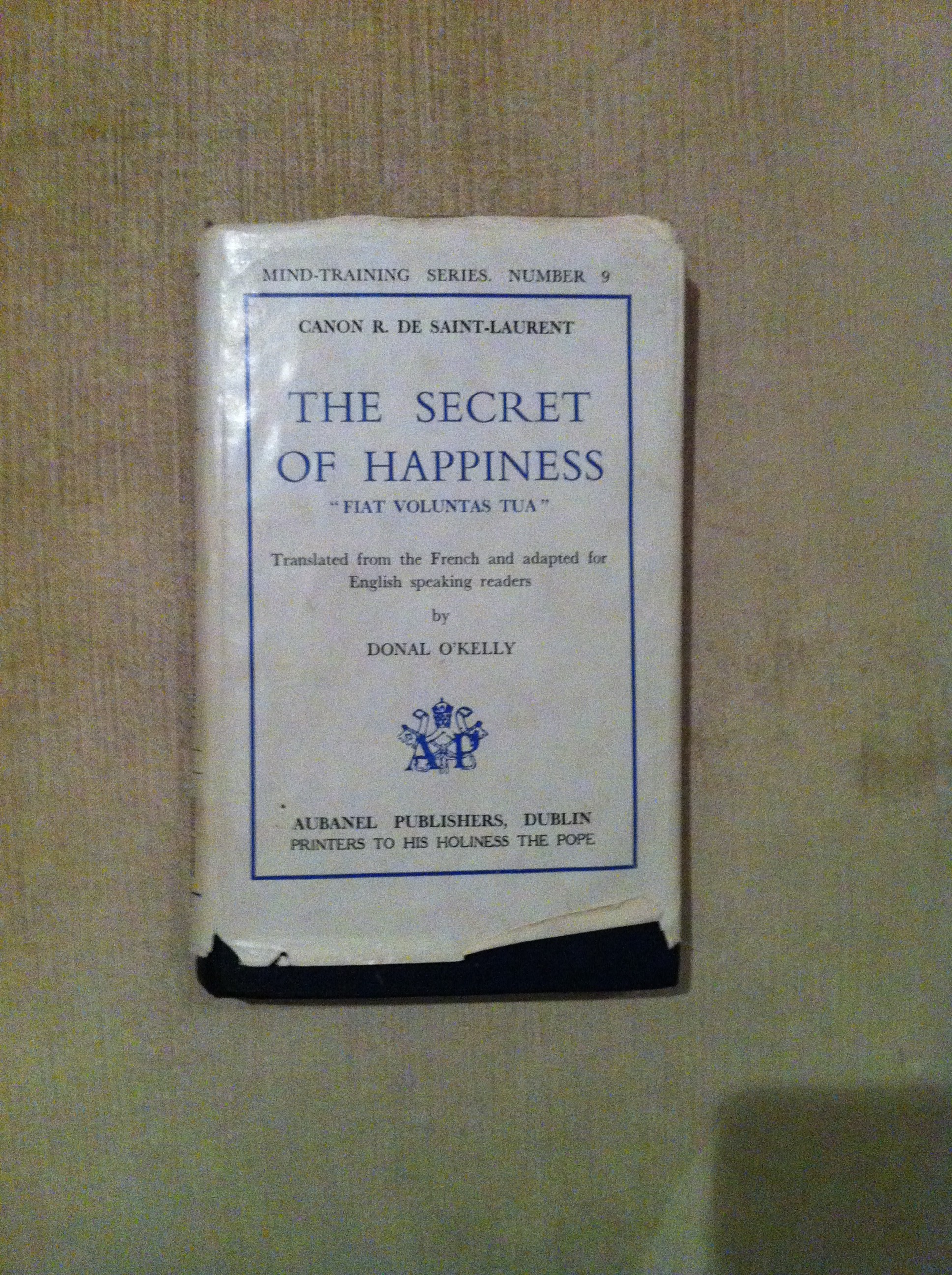
The book is quite special. It is entitled “The Secret of Happiness” and subtitled “Fiat Voluntas Tua”, or Thy Will be Done.  It is a rigorously Catholic self-help book, written originally in French by a certain Canon Raymond de Saint-Laurent, and published in English by Aubanel Publishers, Dublin, “Printers to His Holiness the Pope”, in 1951.

book cover 002

According to the book’s back cover, the reverend Canon was the author of many such books with titles like “A Cure for Shyness: Causes, Consequences and Remedies”, Self-Control: Ways of Curing Yourself from Being Emotive, Expansive and Impulsive”, and “Optimism: How to Acquire Mental Poise”.

Who had thought I would be interested in this book, or that it would help me? I’ve never needed help to be happy.

The book itself gives no clues other than the inserted note. There are no names written in it, no dedications, no marginalia. In fact, the book looks unread. Not surprising really. I flipped through a couple of pages, it’s enough to send the most hardened insomniac into a deep Rip van Winkle-like sleep.

Casting around for possible suspects, I first thought of my mother. She had from time to time during my boyhood sent me pious books to read, but mostly on the lives of worthy saints, presumably as exemplars for me of a better life. I also vaguely recall that in my puberty she once gave me a book on Sex, written by a Jesuit priest. All I remember from it is an affirmation that after heavy petting it was quite normal for girls to have backaches … But I quickly eliminated my mother. The writing on the note wasn’t hers, she hadn’t lived in the UK since the book was published, and why would she put her own address in Canada?

I then thought of an Aunt, sister of my father, who lived to the south of London and in the general direction of Royal Tunbridge Wells. She was a very religious person, High Church of England – only my father had converted – so she might have owned this book. And she did always send us books for Christmas. Perhaps when she died and the contents of her house were dispersed this book somehow ended up in a used books store in Royal Tunbridge Wells. But this scenario didn’t seen likely. The type of books she sent us was detective stories and the like; I really couldn’t see her wanting to send me this book.  Nevertheless, in order to pursue all lines of enquiry, I sent a scan of the note to one of her children to see if he thought it was her handwriting. He replied in the negative.

Given the religious nature of the book, I then thought of my godparents. I eliminated my godmother immediately. She was French, a dentist in Haute Savoie. I had met her a few times, and she had never struck me as the type of Catholic who reads books like this. And why would the book have ended up in Royal Tunbridge Wells? My godfather made for a better candidate. He was English and lived in the south of England somewhere, so it’s imaginable that books dispersed after he died ended up in Royal Tunbridge Wells. From the diary my father kept at school and university, which I had recuperated from a dusty shelf after he died, I discovered that my godfather had been very instrumental in encouraging my father to convert to Catholicism when at University, so I knew he was a strong Catholic. But we were never close; I had only met him once. Could it be that as a last act of his godfathering he thought of sending me this book? There is no way of finding out. He’s dead and I don’t know any of his children, to whom I could have sent the note to check the handwriting.

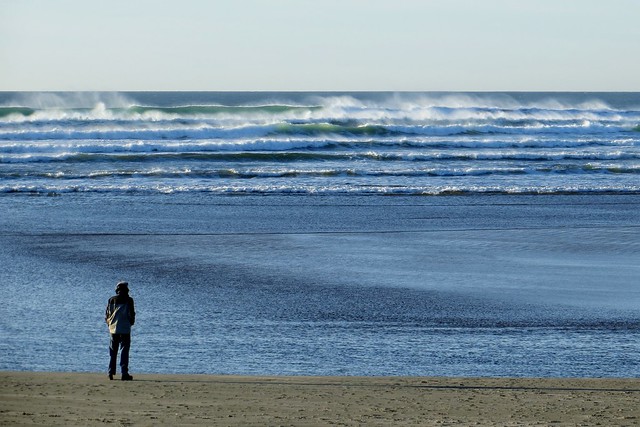
And so the leads have all gone cold, and I am left with the unsolved mystery. I stand on the metaphorical beach holding in my hands the message that arrived to me in a bottle. I will spend the rest of my life scanning the horizon, wondering where the message came from and why it was sent to me.

man standing on a beach-2

And saddest of all, although I love reading books I will never read this one, because it is a type of book that I would never, ever, read!

_____________________

Royal Tunbridge Wells: http://farm9.staticflickr.com/8078/8367015396_c8c90646e0_z.jpg
book cover: my picture
Man staring out to sea: http://farm9.staticflickr.com/8078/8367015396_c8c90646e0_z.jpg

TINTIN À PÉKIN

Beijing, 14 August 2012

To get to our favourite cafés, my wife and I cross the bridge which spans my piece of canal and then walk all the way down Sanlitun road to the South Village. It’s one of the places in Beijing where many Embassies are located. It’s very green and leafy, quiet, a really pleasant place to walk.

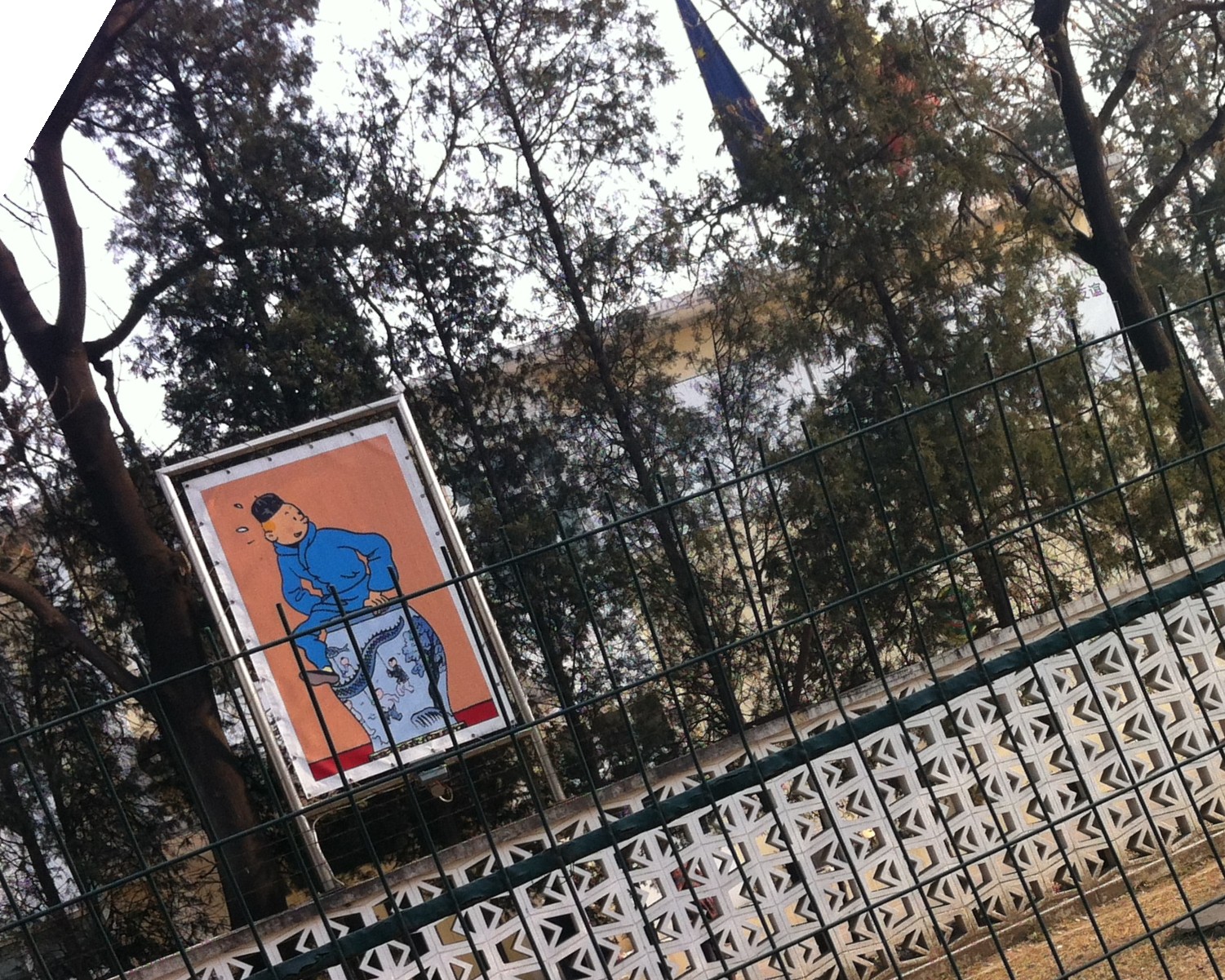
Our usual route takes us past the Belgian Embassy. It has nothing notable about it except for one rather odd thing. Set up outside the Embassy’s perimeter wall, about two metres above the ground and facing the road, lit up at night, is a large picture of Tintin. I tried to take a photo of it for this posting,  but was warned off by the Chinese guard at the gate. So I took a photo in secret, stopping in front of the picture and pretending to take a call but actually clicking a photo! I’m rather pleased with myself even though the photo is skew.

tintin embassy poster 001

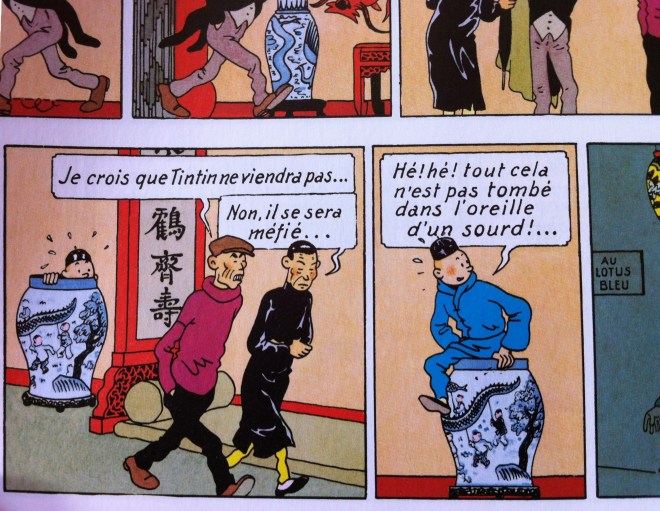
Tintin aficionados will immediately recognise this as a scene from Le Lotus Bleu, the fifth album of the series and first published in 1936. It comes from a moment in the story when Tintin, who has been hiding in an opium den in Shanghai to pick up information on the Japanese villain Mitsuhirato, is making his getaway. It’s quite a cheerful picture; Tintin has a slight smile as he jumps out, and the vase has a design of children carrying a paper dragon through the streets. I show here the original picture in the album.

bande dessine 003

So famous is this picture that it is one of a number of scenes from Tintin which have been turned into collectible statuettes.

tintin from vase 008

As I say, I find it slightly odd that the Belgian Embassy, an institution I would have thought anxious to project a sense of its own importance and probity, should decide to put up a picture from a comics album in so public a fashion.  But if it is going to do it, a picture of Tintin, who was drawn by Hergé, no doubt the best known Belgian in the world, taken from a story that takes place in China, sounds like a good choice.

Apart from smiling at this picture seen in such incongruous surroundings, I was also intrigued by it. Before coming to China, I had checked what books were banned here. I had read that Le Lotus Bleu was one of them because it gave too sympathetic a reading of the Kuomintang. But the Belgian Embassy’s bold move suggested that the ban was no longer in place, if it had ever been. Or perhaps the Chinese Government simply didn’t believe that any Chinese walking by would know the story and so recognise the picture. Which is probably true and to my mind quite sad. The Chinese are missing something.

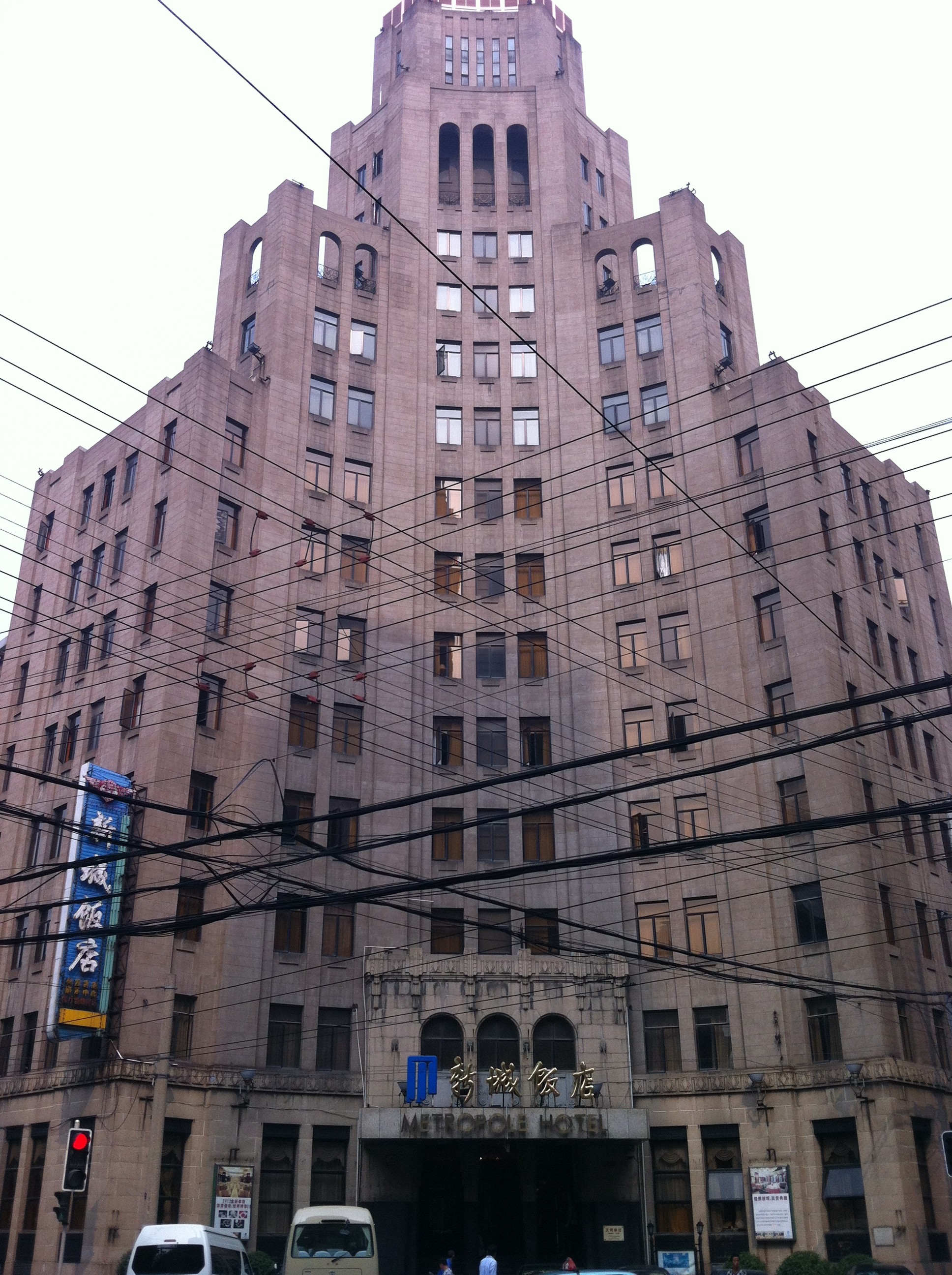
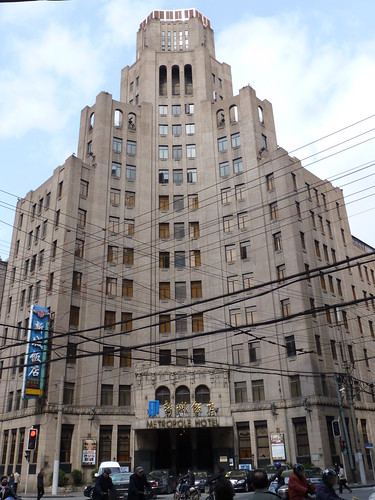
Le Lotus Bleu is of course the most Chinese of Tintin’s adventures, but Tintin en Amérique, first published in 1932, also has strong Chinese echoes for me. The first time my wife and I went to Shanghai, as we walked from the Bund to Renmin Square we found ourselves among buildings from the thirties. And all of a sudden we found ourselves at the crossing of Fuzhou and Sichuan Roads where there are four identical buildings on each corner. This picture is of one of them, the Metropole Hotel:

shanghai-2012 082

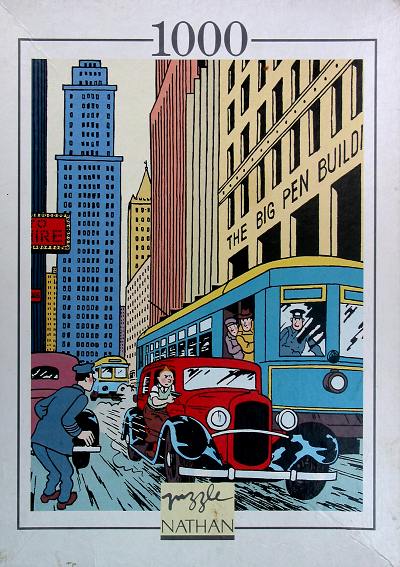
… and suddenly I was in Chicago in 1932, watching Tintin roar by in a Deusenberg, chasing Al Capone’s men!

tintin in chicago 010

Oh no! Just around the corner other members of the gang were waiting to gun him down! …

… I miss my Tintin albums. They are sitting in a packing box in the dark of a warehouse in Vienna, waiting for us to come back to Europe to retrieve them. I’m nearly 60 but I’m not ashamed to say that I always got a lift when I pulled one out of the bookshelf and settled down on the couch for a good read.

And I miss the times on that same couch when I read the albums to my young children, translating as I went along. How they laughed at the Fat Man Full of Soup! A minor character in the earlier parts of L’Oreille Cassée, I should clarify, who was called such by a parrot and who thought it was the carrier of the parrot who had dared so insult him. I miss the simple joys which suffused those years, as we watched our children grow. Perhaps one day I will have grandchildren sitting with me on the couch laughing again at the Fat Man Full of Soup.

__________________
photo credits
Tintin picture outside Embassy: my picture
Scenes from the album: my picture
Tintin coming out of the vase: www.1000-sabords.fr
Hotel Metropole: my photo
Tintin in Chicago: bd-blogeur.blogspot.com