Back from Kyoto, and still with a bad case of jet lag (it’s 4 am and my wife and I are sprawled on the living room couches, wide awake), it’s time to review the three weeks we spent in that city. Apart from the misery caused by the American presidential elections and the pleasure derived from teaching a course on sustainable industrialization to a group of eager youngsters not yet affected by the pessimism of old age, what else will I take back with me from my three weeks spent in Kyoto?
Ever since I first visited the city thirty years ago, Kyoto for me is first and foremost the place of Zen gardens. I have already written a paean to these rock gardens in a previous post, so I will not repeat myself. I will simply mention the pleasure I derived from visiting several rock gardens which I had not seen thirty years ago (or even five years ago, when we came for a brief visit from Beijing). My wife and I decided that our daughter, who came to visit us for Thanksgiving, just had to see a couple of these glorious creations: “he (or she) who has not seen a Zen garden has not lived”, to surely misquote someone famous. We took her to the gardens in Tofuku-ji Temple as well as those in Kennin-ji Temple, both at the foot of that range of hills which runs down Kyoto’s eastern edges and which is constellated with temples. The garden in Tofuku-ji was laid down a mere 75 years ago, in the last years of the 1930s. It gives one pause to think that these so very peaceful gardens were created when Japan was ramping up its war effort towards the disastrous conclusion of Hiroshima and Nagasaki five years later.
The garden was designed by Mirei Shigemori. This was his first major work and it made him famous (at least in the small world of landscape gardening). The work consists of four gardens surrounding the Abbot’s Hall. The largest, and best known, is the south garden.
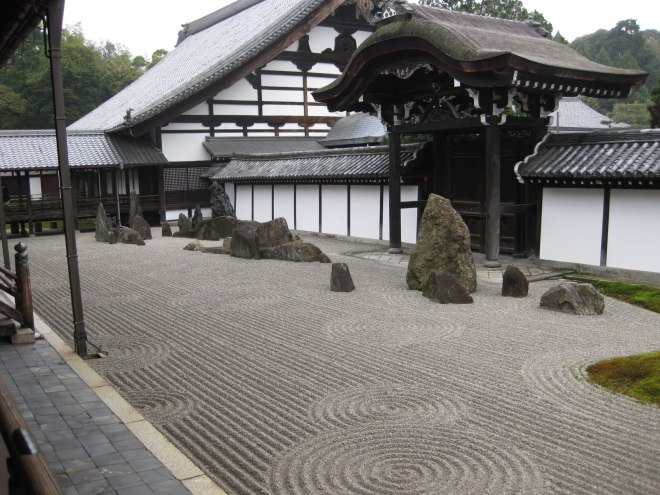
It is dominated by four clusters of massive rocks. Standing imposingly at one end of the garden, they represent the mythic, far-off isles of the immortals.
Their shores are “washed” by a sea of raked white gravel, which leads the eye to five moss-covered mounds at the other end. These represent the five main temples in Kyoto of the Rinzai sect of Buddhism, one of whose temples is Tofuku-ji.
This garden obviously has its roots in the design of the far more famous zen garden at Ryoan-ji.
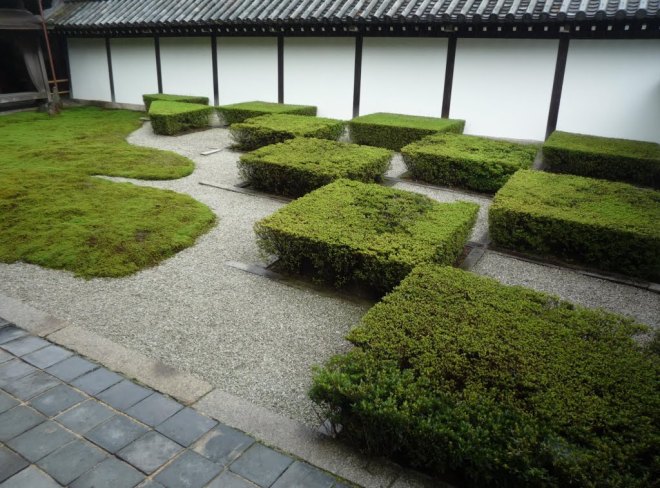
Shigemori’s departures from the classical zen garden style were far more radical in the other three smaller gardens surrounding the Abbot’s Hall. The north garden has a checkerboard pattern, with square paving stones embedded in moss, that gently fades off into randomness, thus drawing the eye to the stand of Japanese maples beyond.
The west garden repeats the checkerboard motif, but this time with a dense array of square-cut azalea bushes.
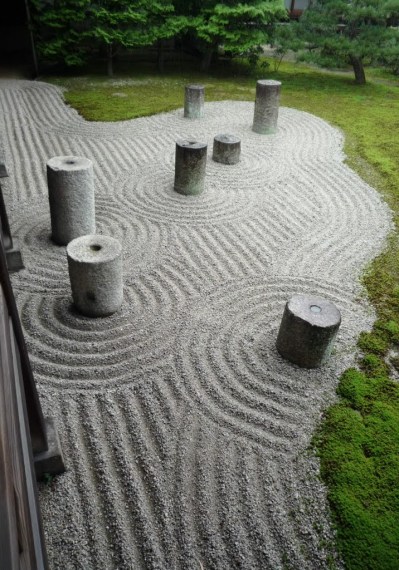
The small east garden departs from the usual use of rough stones, inserting instead seven truncated stone cylinders (recycled from the temple’s old outhouse) into the usual “sea” of raked gravel surrounded by moss. Shigemori set the pillars out like the stars of the Big Dipper, Seven Northern Stars in Japanese.
These last three gardens caused much frothing at the mouth by the traditionalists but also drew much praise from the garden landscaping avant-garde. I leave it to readers to decide in which camp they want to be in. Meanwhile, I will move to the second zen garden which we visited with our daughter, the gardens in Kennin-ji. These gardens are a good deal more venerable, as befits the oldest Zen temple in Kyoto.
The same design of gardens surrounding the Abbot’s Hall is found here. We have here the main garden, where, in contrast to Tofuku-ji, the monk-designer allowed a fringe of vegetation along the far border of the garden.
On the other side of the Abbot’s Hall, we have a smaller garden that invites the visitor to step over it to a beckoning tea house.
(unfortunately, the path is off-limits, but the determined visitor can reach the tea-house through a more circuitous set of stepping stones).
We have a moss garden enclosed between buildings and walkways.
Finally, squeezed in between several buildings, we have the small, compact “circle-triangle-square” garden
so-called because it is said that all things in the universe can be represented by these three forms (at the risk of being irreverent, though, I see the circle and square in the garden but I don’t see a triangle).
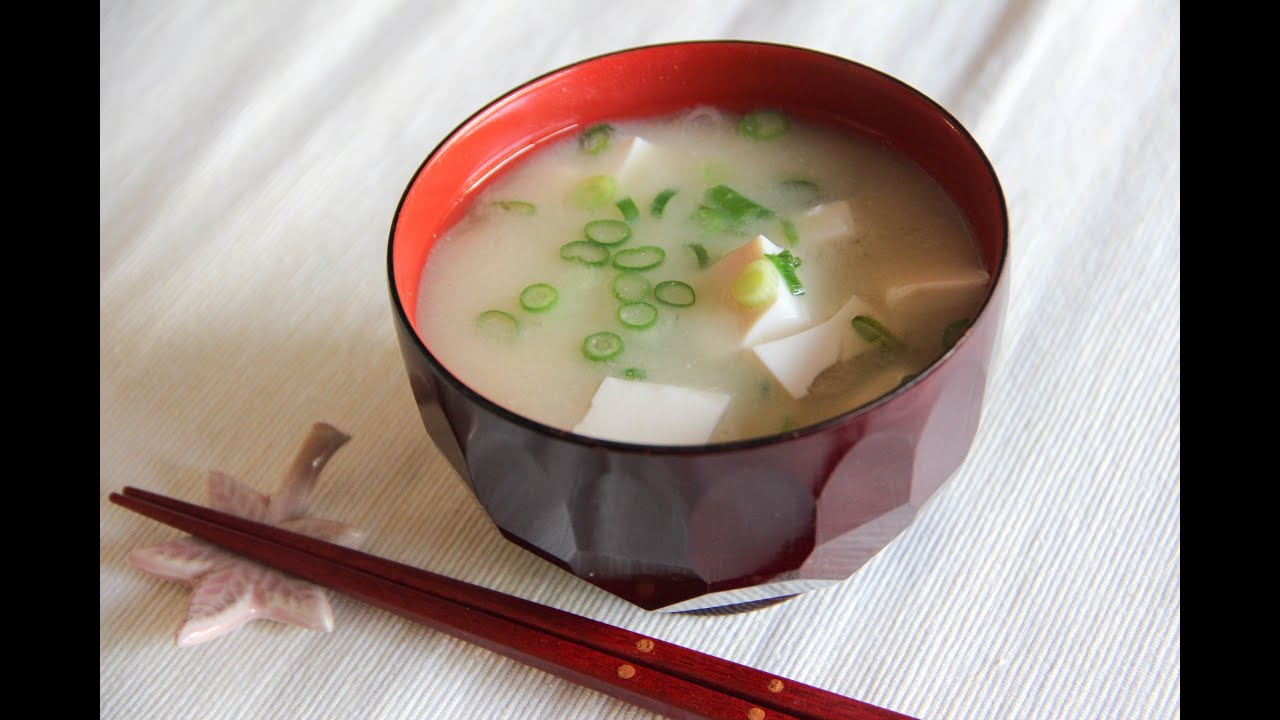
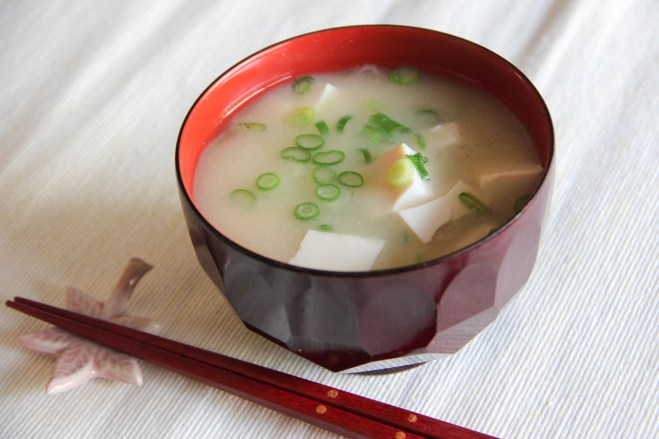
Switching gears dramatically, these three weeks in Kyoto also reanimated the love which my wife and I have for miso soup, that most Japanese of all soups.
Readers may think I lack gravitas turning in this way from the glories of Zen gardens to the humble miso soup, gentle handmaiden to the flashier main courses of countless Japanese meals. But I feel there is a strong affinity between the two: spare simplicity in the assemblage of the constituent elements, yet delivery of intense pleasure to the senses.
What is it about miso soup’s ingredients that give it that unique taste, to be found in no other soup? It is a question which I have asked myself every time I sip on its delights, yet it is only now, in my jet-lagged haze, that I turn to the Internet to find out.
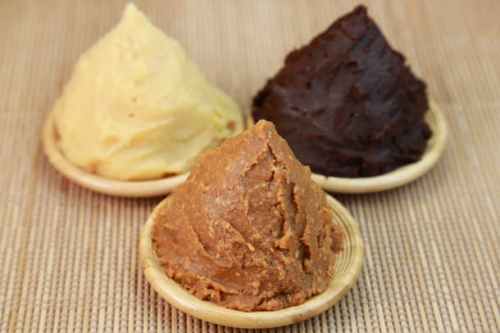
The answer is the miso paste. It is this paste which, mixed with the traditional Japanese stock “dashi”, is at the heart of all miso soups. Other ingredients that are added, such as silky tofu cubes, finely chopped spring onions, and seaweed, are – if I may mix my culinary metaphors – merely cherries on the cake. Digging further, to my mind the magic of miso paste, what gives it that so very special taste, is the fungus Aspergillus oryzae. I should perhaps explain that miso paste is the product of a fermentation process; here we have the fermentation taking place the traditional way.
Our friend A. oryzae works its fermenting magic on a mash of soybeans and salt (to which other grains such as barley and rice are sometimes added). This is what the little critter looks like through a high-powered microscope.
My internet searches have also turned up the interesting fact that there are many kinds of miso paste, depending on the length of fermentation. At the less fermented end of the spectrum, we have white miso, lighter in colour and taste, at the more fermented end, we have red miso, darker and with a stronger flavour, and we have different colourings in between.
As one might imagine, there are regional preferences in the colour of one’s miso paste and, by extension, one’s miso soup. We must have been eating white miso soup since that is the preferred colour in Kyoto (while red miso soup is preferred in Tokyo, for instance).
After all this, my eyelids are beginning to droop. Maybe I’ll be able to get in a few hours of sleep before the new day dawns and have sweet dreams of visiting Kyoto once more. There are more Zen gardens to visit and more miso soups to try.
In 1960, during a televised speech, General de Gaulle, then the first President of France’s newly-minted Fifth Republic, posed the rhetorical question, “How do you govern a country which has 246 varieties of cheese?”, implying that a country with such individualism takes badly to being centrally governed. Well, Italy has more types of pasta than France has cheeses – 350 according to one website – which might explain Italy’s chronic ingovernability. We watch with anxiety as the country lurches towards a referendum, which should be about changing the Constitution to make the country more governable but is rapidly turning into a vote of no-confidence in the current government. A collapse in the government with early elections lurk around the corner, perhaps leading to a collapse of the banking sector, and – who knows? – an ignominious exit from the Euro. The continuing incoming flood-tide of refugees/economic migrants isn’t helping.
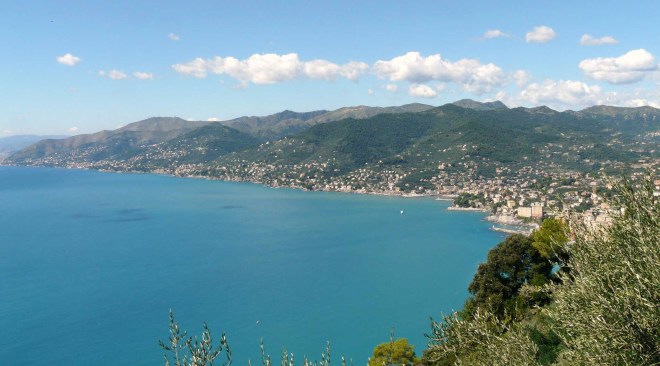
But it is not of these political anxieties that I wish to write, it is about one of these 350 pastas, which goes by the name of trofie. Like many pastas, trofie are very regional in character, coming from Liguria and even more narrowly really only being found in any quantity in the communes giving onto the Golfo Paradiso, which runs from the Monte di Portofino to the west to the outskirts of Genova to the east.
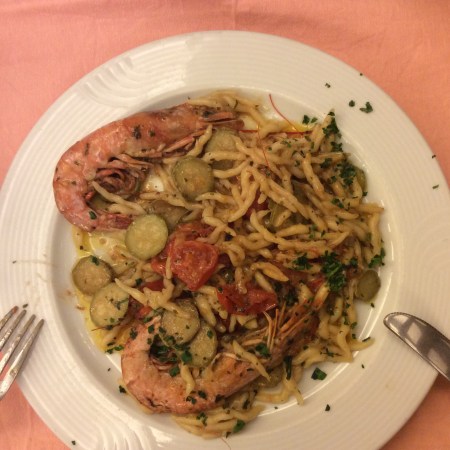
That is where my wife and I have spent the last few days, and that’s where I found myself a few evenings ago in front of a plate of trofie in a sauce of tomatoes and zucchini, with a couple of shrimp thrown in for good measure.
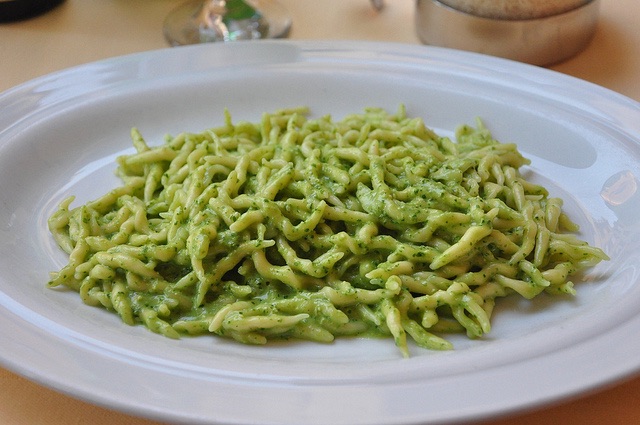
As readers will notice, trofie look rather like worms – an unappetizing simile but really the one that describes them best. The shape comes from how they are made: small lumps of dough are rubbed between the hands (which action is also probably the source of their name: strofinare in Italian means to rub). They are very often eaten with pesto, that other, incomparable, gift from Liguria to global cuisine.
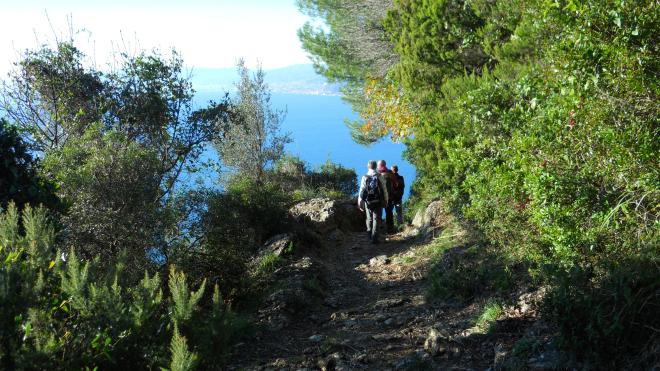
I still remember with great clarity the first time I ever ate pesto. My wife and I had gone walking in the hills which in the picture above run down into the Golfo Paradiso. We found ourselves in a cheery restaurant serving only locals, all of whom spoke the local incomprehensible – to my ears – dialect. We were served lasagne in pesto with brisk efficiency. So good they were … We came back to this restaurant often in the years we lived in Italy. Although pesto is considered typically Ligurian, its ingredients suggest a broader reach. The basil, the oil, the pine nuts do indeed come from Liguria – the basil grown in Liguria is the most perfumed I have ever known – but the Parmesan comes from across the Apennine chain which hugs the coast here, while the Pecorino comes from Sardinia across the Golfo Paradiso and beyond. In any event, my wife bought a small cupful of pesto to bring back to Milan, where we will eat it with pansotti, another incredibly good pasta from Liguria – but that is a story for another day.
In the same shop, my wife pointed to a different type of trofie, made with chestnut flour. Chestnut trees grow on those Ligurian hills we go walking in, above the olive groves; they probably grew all the way to the valley bottoms before olive trees were brought to Liguria. On the spur of the moment I told her to buy them, along with the sauce with which they are normally eaten, walnut sauce, another gift of Liguria to the world; walnut trees grow well up on the Ligurian hills. As readers can see in the next photo, these trofie are browner than the normal trofie made with hard wheat. They are also a little sweeter, as befits a pasta made with chestnuts, and a walnut sauce goes wonderfully well with them, softening that sweet note.
Many decades ago, we brought a cupful of walnut sauce with us to Paris and served it on a pasta to a friend of ours, an amateur cook from Sicily. He muttered over and over again, “Mmm, that’s good” (a pretty amazing statement for a Sicilian to make about northern Italian cuisine). To thank us, the next evening he whipped up a pasta served with a broccoli-based sauce – soooo good!
Those chestnut trofie make me reflect once more on Italy. My first Italian boss came from the province of Varese, to the north of Milan, a part of the country which before the economic miracle of the 1950s and ’60s was very poor. I don’t know how we got onto the topic, but one day he started reminiscing about his childhood, and he told me that when his parents were young and food ran short they were sent off into the woods to collect chestnuts, which would be ground to a flour to make bread from. Liguria was also a very poor region until quite recently. No doubt chestnut trofie are from those times. Italy has come a long way in the last sixty years, I just hope it can stay the course.
I was with an old colleague in Turin at the beginning of last week, and he was telling me that he had visited the city several times over the last few years to attend the annual Slow Food festival. I made a mental note to attend the next one with my wife. It must have been that thought which made me accept with alacrity my wife’s proposal to go to an exhibition of Italian small-scale food producers, which was taking place in Milan over the weekend. Its title was “Milano Golosa”, which can be translated either as Greedy Milan or as Gourmand Milan. I prefer to think that we were gourmands, although I can understand it if, after reading this post, readers conclude that we were greedy.
The exhibition was being held in the Palazzo del Ghiaccio, the Ice Palace, a rather grand name for what used to be the city’s premier ice rink. Just visiting the building was a trip down memory lane for my wife. She told me with a reminiscent smile that she had been taken there many a time by her grandfather. While she skated around the rink, he sat on the bleachers reading his newspaper – no doubt the universal pastime of grandfathers supervising grandchildren in parks and other public spaces. At some point in the last forty years, its use as an ice rink was abandoned. The bleachers were removed along with the rink proper, and the building was turned into an exhibition space. It is actually quite a nice building, of the 19th Century train station type, and the empty space looks gorgeous in that typically Italian good design style.
When we entered the space, though, it was bisected by four or five rows of little booths, each taken by an Italian food or wine producer (there was one food producer from the islands of São Tomé and Príncipe, off the west coast of Africa, but that was a definite outlier). They came from all over Italy, from Sicily in the south all the way up into the high alpine valleys in the north, and from Sardinia in the west to the Marches in the east.
For the vulgar weekend visitors like us, who were not there for professional reasons, the deal was this. You paid 10 euros to get in (5 more if you wanted to drink wine, which we didn’t), and then you tried to eat as many nibbles as possible at all of the booths to cover your initial investment. You could do your eating quite shamelessly, just grabbing the nibbles being made available and heading off to the next booth, or you could pretend to be knowledgeable and stand there trying to make intelligent comments about the nibbles you were scarfing down with enthusiasm. I started with the latter strategy, pretending to write notes on my phone (of the type “good cake!”, “good cheese!”), but eventually abandoned all pretense of knowledge and just wolfed down the nibbles. I was rather reminded of the trailer which my wife and I have been seeing of an upcoming French film, “Saint Amour”, which as far as I can make out is the story of a large pub crawl from one French wine festival to another.
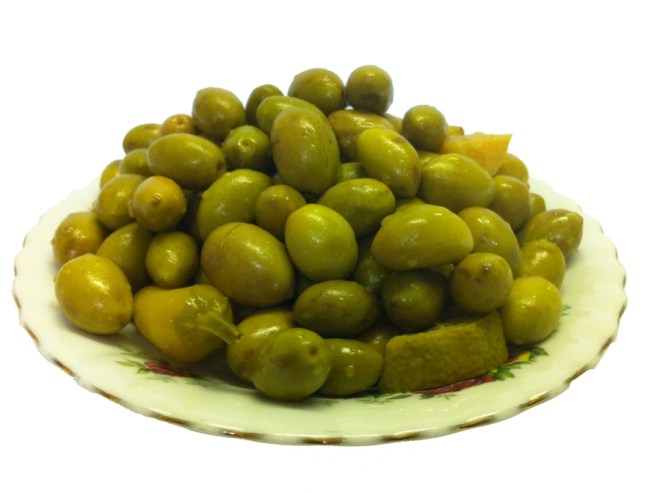
For all of this rank amateurism on my part, I could still appreciate that the nibbles were delicious. Many of the classical Italian products were present: raw ham, cooked ham, salamis of various types, bologna, cooked meats in aspic; hard cheeses like parmesan, soft cheeses like stracchino or crescenza, middling soft and middling hard cheeses whose names now escape me; olive oils of all descriptions, as well as the olives themselves, balsamic vinegars; tomatoes, of course, of all shapes and sizes, beans of all shapes and sizes; pastas of varying lengths and geometries, breads made from a variety of grains, but also bread sticks, fat and short and long and thin; numerous spreads to put on the bread (one in particular, from Sicily and based on sea urchin and a fish whose name meant nothing to me, remains in my taste memory bank); sweet dishes in profusion: panettone, panforte, amaretti dolci, chocolates containing varying levels of coca. And I’m sure I’ve missed things. A veritable smorgasbord! Or perhaps the Italian equivalent to a Chinese banquet, where one picks at a little bit of this and at a little bit of that as the Lazy Mary slowly turns before you. I think we got our ten euros’ worth, staggering out after a couple of hours of busy nibbling. We shelled out some more cash to buy a small bottle of olive oil from the province of Bari and a mozzarella from the province of Naples, both of which we picked up as we wended our way from booth to booth. I can report that at dinner that night the oil went very nicely with the mozzarella, as well as with the salad of green beans I had on the side.
I’ve just had a yummy lunch at Vienna airport, which is a bit surprising since airport eateries are not known for quality. It was nothing special; actually, it was very ordinary for this part of the world (this part of the world being Austria). It was two sausages of the frankfurter variety (although longer and thinner than the classic frankfurter), a bread roll, a dollop of mustard, and some grated horseradish. Voilà!
What really made the dish for me was the horseradish. It was the first time I ate horseradish like this, and I found that its slightly sweet tartness calmed the excesses of the mustard.
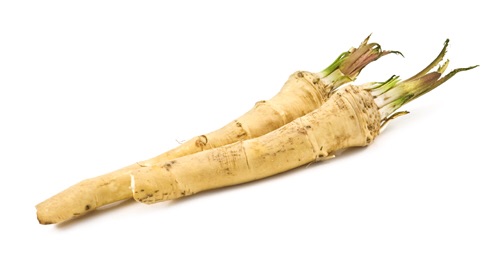
I have to confess to being a great fan of horseradish, although I joined this particular fan club latish in life: I only discovered the culinary delights of the root once I moved to Austria, when I was already over 40. For those of my readers who (like me) have never seen a horseradish in the flesh (as it were), I throw in a picture.
It’s rather surprising that I came to horseradish so late, because it’s actually quite popular in the UK. A common way of eating it is to mix it with vinegar and use it as a condiment with meat or fish. This commercial offering looks very fancy.
Fancy or plain, I never partook; the closest I ever got was lamb with a vinegar-based mint sauce, the glories of which I have extolled in an earlier post. I’m guessing that the British picked up the habit from the Germans: Wikipedia informs me that a certain John Gerrard, in his Herball, or Generall Historie of Plantes of 1597, writes that “the Horse Radish stamped with a little vinegar put thereto, is commonly used among the Germans for sauce to eat fish with and such like meats as we do mustard.” I wonder if, rather than classic mustard, John Gerrard meant Tewksebury mustard (another British condiment which I have never tried). It seems that the British, since at least the Middle Ages, have been fond of this blend of mustard and grated horseradish. No less a person than Shakespeare mentions it in Henry IV Part II, where he has Falstaff say of Poins: “his wit’s as thick as Tewkesbury Mustard”. Here’s a modern version, sold by the ASDA supermarket chain, so it can’t be too fancy a condiment.
Just to close the circle, a very similar horseradish-mustard blend, called Krensenf, is popular in Austria. I suppose the cook in my airport eatery was expecting me to make my own blend before slathering it onto the frankfurter. Ignorant at that moment of Krensenf, I just blended it in my mouth.
I haven’t mentioned in what dish I first discovered horseradish. It was that great, that glorious, Austrian dish, Tafelspitz. It’s actually a very simple dish: boiled beef, served with boiled root vegetables (carrots, parsnips, celeriac) and re-fried boiled potatoes.
To my mind, what elevates it above similar dishes, like pot au feu in France or bollito misto in Italy, is the sauce into which you dip your morsels of meat: it must be a blend of thickish apple sauce and grated horseradish. The horseradish wakes up what is otherwise a rather bland apple sauce, and this jazzed-up sauce wakes up the otherwise slightly bland meat, to the delight of one’s taste buds. I see that this mixing of sweet with horseradish seems quite popular. Several parts of Eastern Europe (which seems to be the original home of the horseradish, by the way) mix it with beet roots, as do the Ashkhenazi Jews, who often use it as a condiment for gefillte fish. Another recipe from Franconia in southern Germany blends horseradish with lingonberries.
No discussion of horseradish is complete without a mention of wasabi, that wonderful green paste which, together with ginger, accompanies sushi and sashimi.
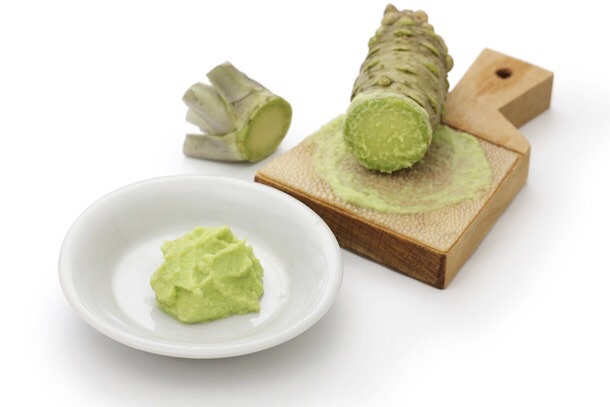
I’m not particularly keen on the ginger, but wasabi is a must for me – whenever my wife and I eat sushi or sashimi, she gives me her wasabi and I give her my ginger, which she loves; it’s a deal made in heaven. As anyone who has eaten both horseradish and wasabi will know, there is a definite relationship; the tastes are too similar for it to be coincidental. In fact, the two plants are close botanical cousins; the picture above shows the greenish root which is the source of wasabi. But here I have to reveal a mournful truth. In this era of globalized cuisine, where sushi bars seem to be sprouting up everywhere, when we eat wasabi we are nearly always eating horseradish paste mixed with green colourant. The wasabi plant is difficult to grow, so production cannot keep up with demand, hence the substitution. Sad in a way. An Italian friend of mine was recently telling me of a similar case, for a foodstuff I am particularly fond of, bresaola, which has also become a global food-star. In principle, bresaola should be made from cattle reared in the Valtellina, in the Italian Alps. But cattle production in this really quite small Alpine valley cannot possibly keep up with demand, so cattle is shipped in from Brazil to be processed in the Valtellina and stamped “bresaola”.
My wife and I are going to Japan in November. Let’s see if we can find a place which serves real wasabi.
So my wife and I have finally left Thailand, after having spent two years there – we lifted off one last time from Bangkok international airport six days ago.
What memories of things typically Thai do I take with me?
Well, there’s tamarind.
Readers may find that a little odd, but tamarind is actually a very common ingredient in Thai cuisine. In fact, it was animatedly discussed at the goodbye party my staff gave me. It’s a fruit I had never actually come across until I arrived in Thailand. I had heard of it, but it existed as an exotica on the far periphery of my knowledge, rather like those strange beings which Medieval Europeans imagined lived on the far edges of the world.
I was introduced to tamarind by the kind lady who brought me my morning coffee in the office. She was in the habit of also bringing me any of the fruits which Thai colleagues had brought in for sharing. I was conversant with the other fruits she served with my coffee, but this large pod-like thing had me stumped.
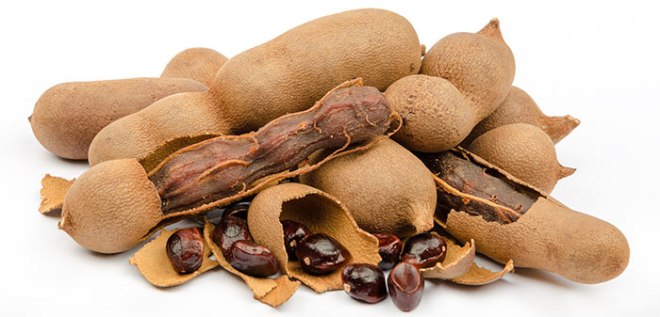
I had to go down the hall to ask colleagues explanations of what it was and how to eat it (split open the brittle shell, extract the pasty fruit from its stringy support and eat, making sure not to crack your teeth on the small, very hard seeds buried inside the sticky pulp).
Thai cooks will extract the pasty fruit and use it as an ingredient in many of their dishes. I mention only two here, Pad Thai and Kaeng Som.
As probably every foreigner knows, since every foreigner coming to Thailand seems to eat it, Pad Thai is at base a dish of rice noodles, these having then been stir-fried with a whole bunch of things: shrimp, both fresh and dried (other meats are used but it’s not very Thai), shrimp paste in oil, soybean sprouts, firm tofu, chopped peanuts, scrambled egg, sliced shallots, sliced Chinese chives, sliced preserved radishes, minced garlic, sliced chilies, and I don’t know what else. What foreigners probably don’t know, because it’s not obvious in the final dish placed before them, is that a tamarind-based sauce has also been added to the mix during the stir-fry. This sauce is a blend of sour-sweet tamarind paste, salty fish sauce, spicy chili sauce, and sweet palm sugar; the particular balance to strike between these four tastes gives rise to much passionate debate in the Thai recipe world.
My wife was particularly fond of Pad Thai, but it is as popular with Thais as it is with foreigners. In our wanderings around Bangkok, we discovered a Pad Thai joint a little south of the Golden Mount, where the people patiently waiting in the long lines outside (which we quickly joined) were primarily Thai.
Pad Thai may seem very typically Thai, but actually in its present form it is quite a recent dish, having been invented only in the 1930s as a move by the-then military dictator to promote Thai nationalism. I suspect that Kaeng Som has a much longer culinary pedigree, since it has speciated, with every region of Thailand having its own variant. The variant I describe here is from Central Thailand, this being dominant in Bangkok. It seems that every street food stall sells Kaeng Som, although cognoscenti mutter that this is rat’s piss (my words) compared to the Real Thing. I wouldn’t know; I avoided street food stalls like the plague, desirous of avoiding seriously upset stomachs and consequent absences from work.
Kaeng Som is really a curry base to which you then add other ingredients. You will first grind and pound together, preferably in a stone mortar, chilies, salt, shrimp paste, sliced shallots, and meat of a freshwater fish stripped off the bones, until you have a smooth paste. You will add this to a simmering fish stock (preferably made with the remains of the fish), followed by tamarind paste, fish sauce, and palm sugar. Once again, the sour-salt-spicy-sweet tastes have been brought together, and you will fuss around at this point trying to get the “right” balance.
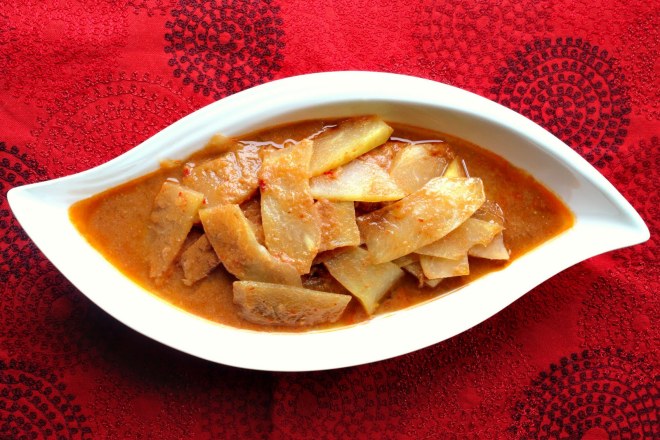
Now you are ready to add the remaining ingredients. Vegetables dominate, and it seems that Kaeng Som will marry well with a large number of different vegetables. I report, in no particular order, the suggestions given in the blog of Thai cuisine SheSimmers: morning glory, water mimosa, summer squash, cauliflower, green beans, daikon, Napa cabbage, green papaya, chayote, and watermelon rinds. This last interests me greatly, since I have always wondered, as I have thrown away the rinds after a good watermelon binge, what if anything could be done with them in the kitchen. I now have an answer. The same blog warns against the use of certain other vegetables: eggplants, broccoli, Brussels sprouts, starchy root vegetables, and green leafy vegetables such as collard greens. Vegetables as an added ingredient seem quite enough, but if you want you can also add shrimps or pieces of fish.
At this point, I have to confess to one major unpleasant memory I bring back from Thailand, and that is the (super-)abundant use of chilies in Thai cuisine. As I have reported elsewhere, I very much dislike chili and its ‘hot’ spicy cousins. This has been a major difficulty for me in eating – and enjoying – these or any other Thai dishes. I have also reported elsewhere how I made another popular Thai dish, Tom Yum soup, without chili and found that for me at least it worked perfectly well. If I can find a source of tamarind paste in Milan, I can try making Kaeng Som without the chilies and see what it’s like.
My dislike of hot spices also cuts me off from properly enjoying the use of tamarind in Indian cuisine. The use of tamarind is very popular in India, where the tree is widespread. Unfortunately, every Indian recipe using tamarind also seems to use chilies or something equally spicy. So I guess I will have to make do with Lea & Perrins’s Worcestershire sauce, a small bottle of which graces the condiments section in our kitchen in Milan; as every aficionado of L&P sauce knows, it contains tamarind extract.
Legend also has it that this sauce has its roots in India. It is said that Messrs Lea and Perrins, pharmacists in Worcester, created their sauce back in the 1830s on the basis of a recipe brought back from Bengal by a certain Lord Sandys, a nobleman of the county. Although I suspect that this story is a bunch of bull, I’m quite happy to believe it, because it allows me to pretend that I am enjoying an Indian sauce, suitably adapted to English tastes, in particular with the use of chilies eliminated. This is yet more support for my argument that chilies are simply not necessary in cooking.
I think I’ve said it before, but it’s worth repeating. I really should spearhead a movement to eliminate chili and its evil cousins from the kitchen. Now that I’m retired and have time on my hands, this is my chance to walk the talk. Chili growers beware!
Yes, I did that. On our recent tour of the Kimberley in Australia. The ant in question was the Green Tree ant or Weaver ant.
As readers can see, the ant has a bright green bum. The driver-cum-guide of our tour was a passionate advocate of the country’s Aboriginal population, of which there are still many in this little corner of Australia (it was the last part of the continent to be penetrated by white settlers, back in the 1870s). Among other things, on our walks through the bush he would point out various bush tucker (for non-Australians, that’s wild food which can be harvested in the bush), which he always claimed were bursting with proteins, Vitamin C, and other goodies, and which he would then invite us to try. So apart from Green Tree ants, I dutifully ate the petals of Australia’s kapok tree
the “petals” of the rosella “flower”
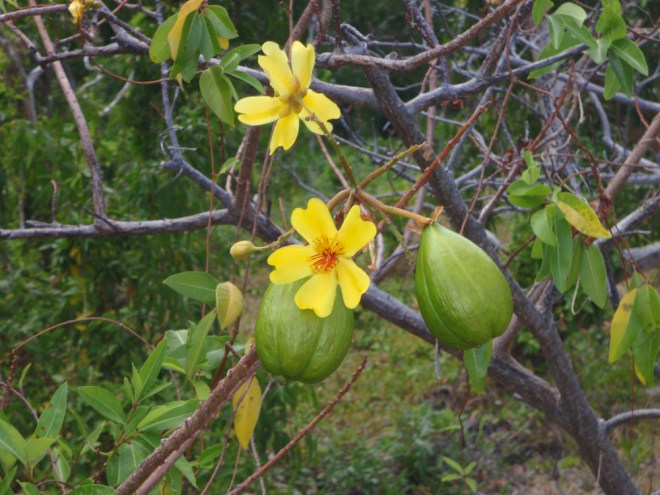
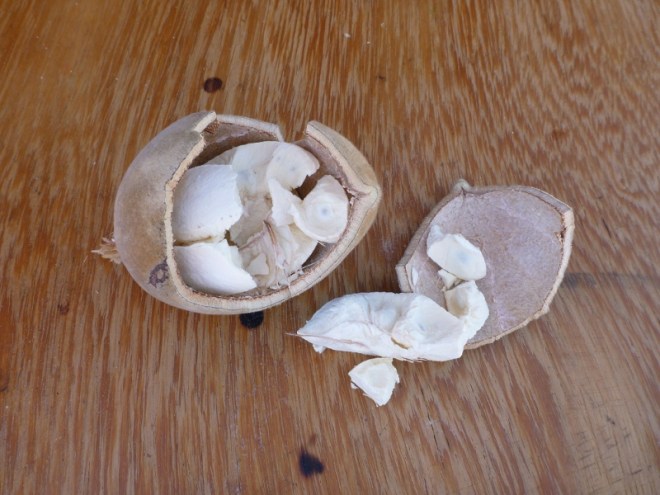
and the inside of the “nut” of the Australian boab tree (on which hangs a fascinating tale, which I will write up in a later post).
His partner, who was our cook, also fed us camel burghers (camels can now be found in the wild in Australia by their millions)
and kangaroo stew (also to be found in their millions throughout Australia, but of which we saw surprisingly few on this trip).
My conclusion: I really hope I don’t need to be a vegetarian in the Australian bush.
But actually, further research on my part since we returned from Australia suggests that the range of bush tucker we tried on our tour was rather limited. One article in Wikipedia has quite a long list of bush tucker to be found in the top end of Australia where we found ourselves, only one of which – the boab nut – we tried. So I really shouldn’t give up on bush tucker just yet.
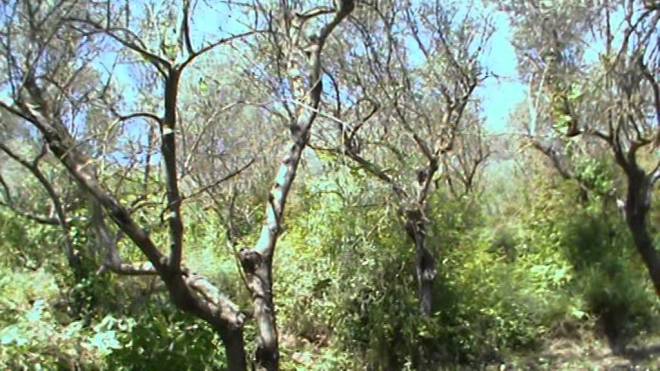
There is a small olive orchard abutting the path that runs behind our apartment in Liguria. It’s in a sorry state, seemingly sorrier every time my wife and I pass it on our way into the hills. I’ve never taken a picture of it, but it looks something like this, only worse.
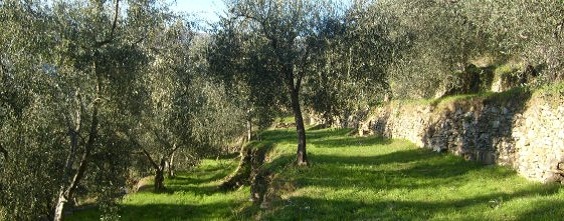
It’s the sad fate of many of the terraced olive orchards in Liguria. It makes no economic sense any more to harvest olives in this part of Italy, and as the peasant-farmers who own them die off their children and grandchildren abandon the orchards to their fate. And so the brambles and nettles and vines and finally maybe some scrubby oaks recolonize the land. Harvesting Ligurian olives is now a labour of love.
My wife and I could lavish that love on that derelict olive orchard, once I’m retired. I have a dream of us identifying the owners and making a deal with them. Let us clear the orchard, I tell them, let us give those poor olive trees a bit of TLC, so that they can once again shake out their branches and drink in the Mediterranean sun.
In return, I say in this dream dialogue with the owners, let us have the olives which those trees, in their gratitude, will give birth to.
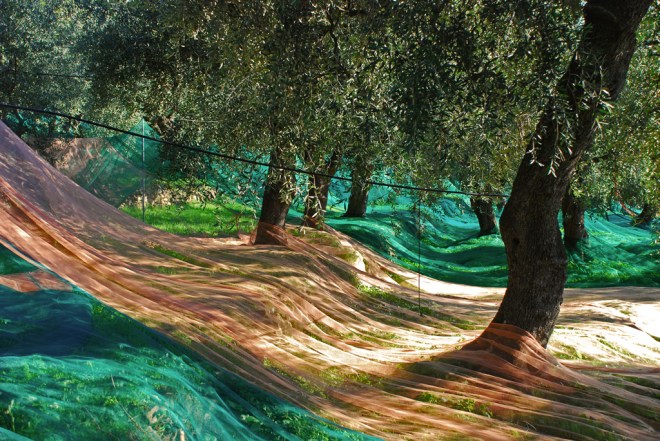
Neither my wife nor I have ever picked an olive in our lives, but in my dream this is not a problem. My wife and I would extend under the spreading olive branches those orange and green nets I’ve seen so often in Liguria to catch the olives as they fall (would we have to shake the branches, I wonder?)
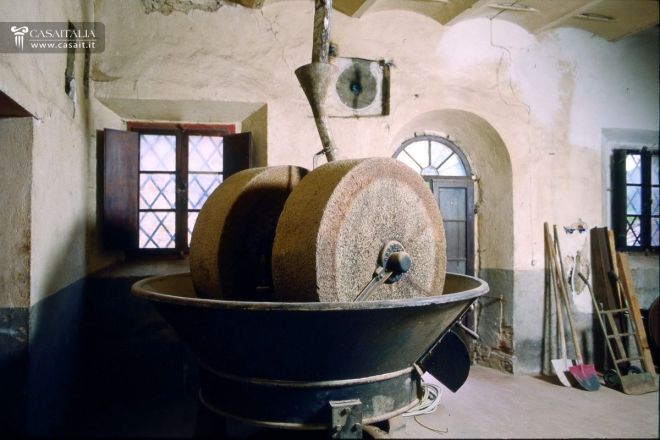
And then, arm-in-arm, we would bring our harvest of olives to the local olive press.
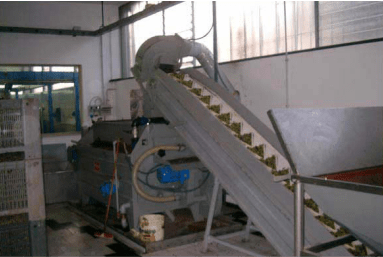
Actually, an internet search has informed me that the nearest local olive press is 10 km away, so a car ride rather than a stroll would be in order. Also, it doesn’t use stone presses, that is passé; something along these lines is used – more modern, more sterile, but, the internet assures me, more efficient.
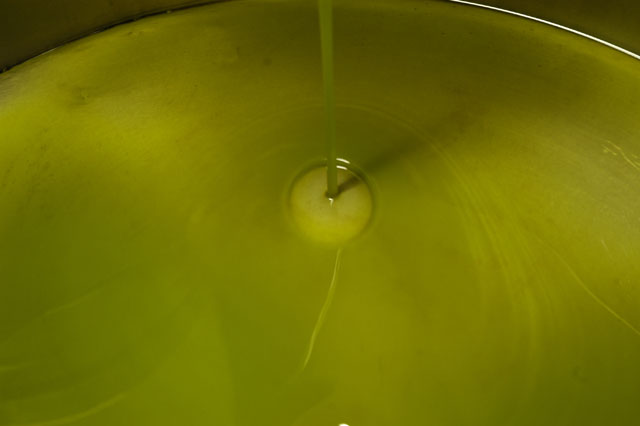
No matter, one way or another the oil from our olives would be squeezed out
and after some filtering, some racking, and some other things (I’m going to have to learn the olive oil lingo), we would become the proud owners of several bottles like these of cold-pressed, organic, extra-virgin olive oil.
We would drizzle this nectar of the gods on our salads for a year, until the next harvest was brought in. Or might we want to pickle the olives? A quick whip around the internet persuades me that it’s not that difficult to pickle olives; you just need time and brine.
OK, it’s decided: we will follow what happens in the global olive market, we will pickle 10% of our olive harvest and use the rest to make our very own olive oil.
I’m in South Korea at the moment, giving a training on green industry. It is Spring here. In Bangkok, I’ve forgotten what Spring is like and the delights it brings to the heart of the first signs of new growth. There are wonderful, wonderful cherry trees in bloom just outside the training room, which makes it difficult for me to focus on my presentations.
But I don’t want to talk about any of that. I want to talk about kimchi, which I was confronted with last night at an otherwise perfectly respectable Korean meal. For those readers who have not heard of this foodstuff, it is without doubt the national dish of Korea – both Koreas, actually, North and South (on this deeply divided peninsula, there are two things that unite its peoples: their love of kimchi, and their deep dislike of the Japanese). South Koreans eat it at breakfast, lunch, and dinner (as I’m sure would the North Koreans had they any kimchi to eat and any rice to eat it with). There is a museum of kimchi in Seoul. It has been listed with UNESCO as an intangible cultural heritage, by both North and South Korea – separately, of course. It is said – but I wonder if this is not an urban legend – that during the Vietnam War, the-then South Korean President begged President Johnson to urgently help get kimchi to the South Korean troops who were fighting alongside their American comrades; without it, their morale was sagging badly. More believably, when the SARS crisis hit in 2003, kimchi sales in South Korea soared 40%, on the back of people’s belief that it would surely help ward off the evil disease.
As one might expect from a dish which is the subject of such national adulation, there are many regional variations and no doubt noisy arguments about which variant is the best. That being said, the most common type of kimchi – and certainly the one I have seen in Korean restaurants and eateries – is based on cabbage, napa cabbage to be precise. To make this kimchi is very easy, and if I’m not mistaken any self-respecting Korean housewife (not housespouse; this is still a very male dominated society) can make her own. Take the cabbage, cut it in pieces, thoroughly coat the pieces with salt, let them stand in their own briny juice for several hours, pressing them down from time to time. In the meantime, chop up some Asian radish and scallions, and prepare a paste of finely chopped garlic and ginger with fish sauce or salted shrimp and crushed dried paprika (this is the basic paste recipe, to which I’m sure can be added other ingredients whose identity are the jealously guarded secrets of individual kimchi makers). Thoroughly rinse the cabbage pieces of their brine, mix them well with the radish and scallions, and coat the whole with the paste. Let this mixture stand in some suitable container for several days at a cool temperature – in the old days, Korean housewives used beautiful pots like these and buried them in the earth during winter.
What is happening behind all these manipulations is that the cabbage is being subjected to fermentation by lactobacillus bacteria. The results look like this.
Depending on tastes and needs, the kimchi can be eaten “fresh” or left to continue to ferment and eaten months later.
It is sad to report that while the Korean populations love this stuff, I hate it. Well, “hate” may be a strong word: “thoroughly dislike it” may be the better term. During my first-ever trip to South Korea, while my credit with my hosts soared after I ate dog and declared it to be most delicious (and I wasn’t being polite), it crashed when I made it also very clear that kimchi was revolting. What to do, the perils of cultural exchanges.
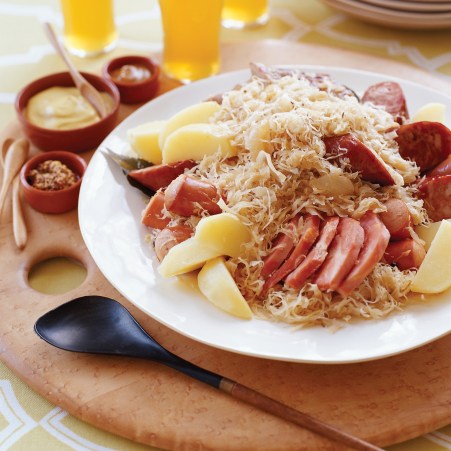
It’s actually puzzling that I don’t like kimchi, because I looooove sauerkraut or, to give it its French name under which I first got to know it decades and decades ago, choucroute. Aah, those most magnificent choucroutes garnies of my youth, sauerkraut served with pork chops and various sausages, with boiled potatoes on the side!
If I close my eyes, I can still remember, still taste in my mouth, a truly wonderful sauerkraut which I had on a German ferry boat carrying a bunch of us from school to Germany (we were on our way to do two weeks of “military service”, required of all of us by our high school, with a British tank regiment stationed near Hannover; but I digress, these fond memories being triggered no doubt by the lingering taste of that truly epochal sauerkraut).
As I say, it is indeed puzzling that I don’t like kimchi, because sauerkraut is also cabbage-based and is subjected to exactly the same procedure of brining followed by a fermentation at the hands (as it were) of lactobacilli. What is going on here?
After some thought, I have concluded that the paste is to blame. Actually, I think this is a no-brainer. I mean, what else is different between the two? My problem with kimchi has to reside in the paste. My first thought was that the paprika was the culprit. As I have written in no uncertain terms in an earlier post, I can’t stand hot spices, and the paprika in the kimchi certainly doesn’t endear me to the dish. But my problem with kimchi goes deeper than the burnt-out mouth it gives me. Below that lurks another problem, a problem of bitterness. One or more of the other ingredients in the kimchi is changing the taste from the sour of sauerkraut to the bitter of kimchi. I’m afraid I will never know which it is until I do some scientific experiments in the kitchen, making fermented cabbage and varying the ingredients it is pasted with. I can therefore cheerfully add sauerkraut/kimchi to the list of foodstuffs which I will try making when I have retired, and I will report back if and when I find the solution.
In the meantime, all this writing about sauerkraut has given me a serious desire to eat some. I need to send an urgent message to my wife, who is excellent at searching the Internet, asking her to identify a restaurant where we can eat a half-decent choucroute garnie in Bangkok.
Bangkok, 19 March 2016
updated Vienna, 5 February 2025
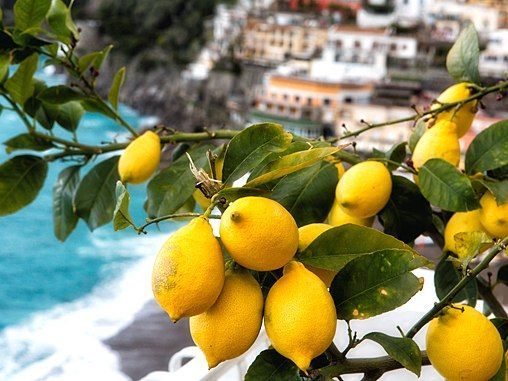
In the recent trip which my wife and I made to Italy, we managed to squeeze in a visit to our apartment near Genoa, where I was particularly delighted to see so many lemon trees in fruit. It’s wonderful to see trees heavy with lemons peeping over a wall or hanging over a garden fence.
Once back in Bangkok, I decided to do some research on the lemon and its history: how did this lovely yellow fruit end up in Liguria? But delving into the lemon’s history inevitably dragged me into the history of the citrus family. It turns out that the lemon does not have a long or distinguished pedigree. It is the citrus equivalent to a mutt, a fairly recent hybrid. In fact, most citrus fruits with which we are familiar are fairly recent hybrids. It seems that the members of this family love to hybridize, and of course humans – being intrusive busybodies by nature – have been only too willing to assist them. The result is a family tree of bewildering complexity.
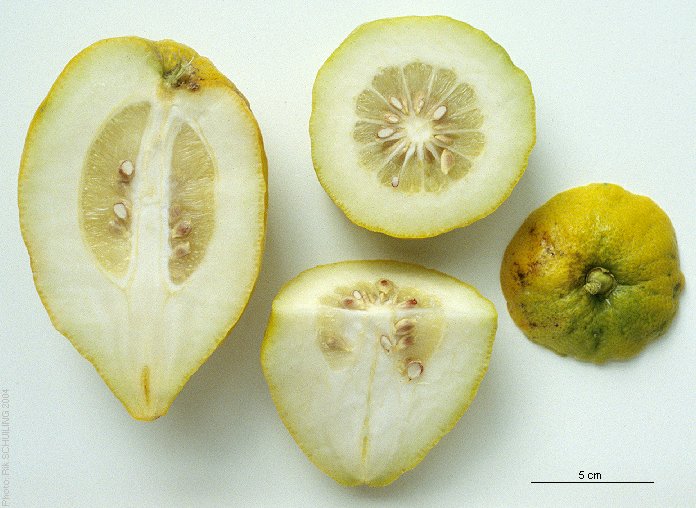
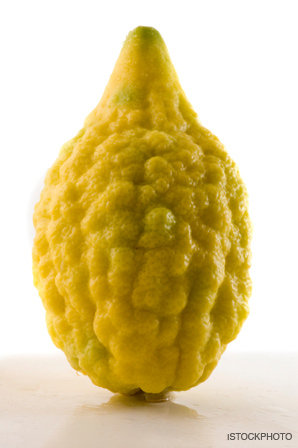
As I tried to make sense of all this, my attention was diverted by something I read about the citron. I think I need to insert here a few words about the citron, since I’m sure there are many readers who are not familiar with this citrus fruit. It is relatively difficult to find these days since it has little use – except for one very special one, which I will come to in a minute. It looks like a large, warty, lemon.
Coming to what I read, it seems that during a ceremony in the Temple of Jerusalem marking the Feast of the Tabernacles, or Sukkot, in one of the years around 100 BC, the Jews pelted the High Priest with citrons and got massacred for doing so. Now that was something worth finding more about! How I would have loved to use citrons, rotten tomatoes, eggs, dog-eared hymn books – anything, really – to pelt the priests with for subjecting me to excruciatingly boring sermons during the Sunday Masses of my childhood! It turns out, though, that the Jews were not horribly bored with what the High Priest was saying, but horrified by what he was doing. It is reported that he deliberately poured the water of libation over his feet rather than over the sacrificial animals. I can’t say that I can get quite as excited about this action as the Jews did, but the fact is that they did, and satisfyingly peppered the High Priest with citrons.
Of course, it does come spontaneously to ask oneself why on earth the Jews were carrying citrons around in the Temple in the first place. It’s certainly not the item that would immediately come to my mind as expecting to see in the hands of Jews within the sacred precincts of the Temple. It turns out that the citron plays an extremely important role in the ceremonies of Sukkot. Every morning of this seven-day Feast, Jews are required to ceremoniously wave the “four species”. Citron is one of these, the other three being the date palm, the myrtle, and the willow. We see here the Tosher Rabbi of Montreal waving the four species.
One can therefore assume that the Jews were carrying their four species when the High Priest poured the water of libation over his feet, and in the horror of the moment they blindly grabbed their citrons and threw them at the impious prelate. It seems that they must have also thrown something harder – stones, no doubt – since it is reported that the stone altar was damaged. I can’t really see citrons doing damage to a stone altar.
It’s a bit of a mystery to me why the citron ever became one of the four species, because it is not native to the Near East, whereas the other three species are. The citron, like all the original citrus fruits, originated somewhere in the region of South-East Asia-Yunnan in southern China-the Himalayan slopes of India. So how did it end up in the Near East? There is general agreement that the fruit was first cultivated in northern India. From there, it migrated, presumably along trade routes, to Persia. What happened next is a hotly debated issue – at least, in certain circles. One hypothesis has the citron migrating to Egypt, where its essential oils were used in embalming, and from whence the Jews brought it with them to the Promised Land when they escaped from bondage in Egypt. A second hypothesis has the citron being carried from Persia to the Mediterranean basin in the baggage of Alexander the Great’s returning soldiers, who somewhere along the way dropped it off in the Levant. Yet another hypothesis has the citron migrating from Persia to Babylonia, where the Jews came across it during their Babylonian captivity and brought it with them when they came back to Israel.
These are all suppositions, with no real evidence to back them up. A very clever piece of archaeological sleuthing suggests a more concrete hypothesis. We need to first recall that after the Persians defeated the Babylonians and allowed the exiled Jews to return home, Israel was a Persian province for several hundred years. Israeli archaeologists have been excavating a site quite close to Jerusalem which turns out to have been a Persian palace with an extensive garden around it. Here is a reconstruction of the site.
The archaeologists wanted to see if they could find evidence of what was planted in this garden. They therefore looked for traces of ancient pollen. None could be found in the earth of the garden – whatever had been there had decomposed long ago. So they decided to try their luck in the plaster with which the walls of an ancient pool in the garden had been coated. The thinking was that pollen grains could have got stuck in the plaster while it was drying and been preserved. They were right – and one of the types of pollen they found was that of the citron. From the other types of pollen found – a number from species not present in Israel – the archaeologists deduced that this was a garden planted with rare plants, designed to show off the wealth and power of the palace’s resident, either a Persian satrap or a Babylonian Jew close to the Persians and sent there to keep an eye on the locals. Perhaps it was here that the Jerusalem Temple elites, coming to pay their respects to the Palace’s resident, first saw the citron and admired this strange and exotic fruit. Maybe it became the rage to have a citron tree in one’s garden in emulation of the Persian masters.
Assuming this is somewhere near correct, how did the chicness of the citron eventually segue into its strong religious symbolism? Here, I shall hazard an explanation which I found written nowhere but which satisfies my fertile imagination. One has to know that the adoption by the Jews of the four species in the rituals of Sukkot derives from a text in the Book of Leviticus, where it is said (in the English translation):
“And you shall take on the first day the fruit of beautiful trees, branches of palm trees and boughs of leafy trees and willows of the brook, and you shall rejoice before the Lord your God for seven days.”
The text specifically names two of the plants: the palm tree and the willow. For the other two, though, it is quite vague. Talmudic tradition eventually settled on the citron as the “fruit of beautiful trees” and on myrtle as “boughs of leafy trees”.
The choice of myrtle makes sense to me – it is satisfyingly leafy.
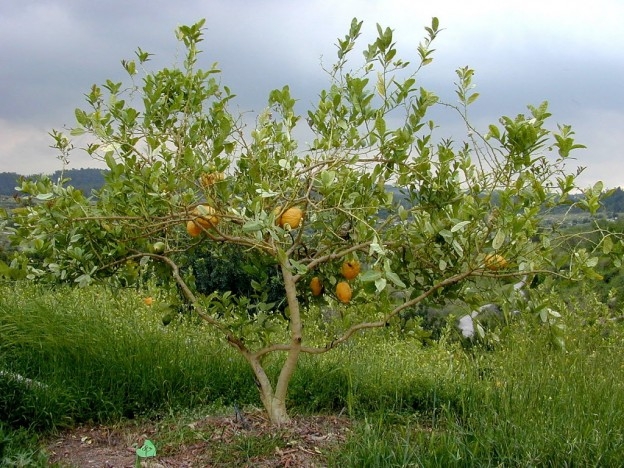
But the choice of citron as the fruit of a beautiful tree? That is really quite odd. In no way can the citron tree be considered a beautiful tree. It is low and scrubby, more bush-like.
It seems, though, that the Hebrew text is grammatically ambiguous. Although the phrase in Leviticus is typically translated as “fruit of a beautiful tree”, it can also be rendered as “a beautiful fruit of a tree.” At first sight, this doesn’t seem to fit the citron either. As the picture above shows only too well, it is warty and knobbly, really quite ungraceful. But beauty, as they say, is in the eye of the beholder. The citron’s name in Persian, turunj, derives from the Sanskrit suranga, “beautifully coloured”. In today’s world, our lives are so saturated in bright colours that it is difficult for us to appreciate the impact on our ancestors of the few naturally brightly coloured things. As the photo above also reveals, the citron does indeed have a lovely yellow colour, and there really aren’t that many fruits that are so beautifully yellow (lemons come to mind, but that doesn’t count because they are a hybrid of the citron). Maybe the Persians, and the Indians before them, and the Jews after them, found the citron’s colour captivating.
If that explanation doesn’t satisfy my readers, let me suggest another reason. Under proper conditions, the citron is the only tree that can flower and bear fruit throughout the year. Even more distinctively, it can retain its fruit from one year to the next. So the citron tree can have buds, blossoms, and mature fruit all at the same time. This is a unique property, and one which may have aroused awe and reverence in our ancestors.
If that explanation doesn’t satisfy my readers, how about this one? Both the Greek philosopher, Theophrastos, and the Roman natural philosopher, Pliny the Elder, mention the citron in their botanical writings. And both stress the fact that the citron, fruit and leaves, has a very strong scent, that typical scent which you also get from the zest of the lemon. It is so strong, they say, that if the fruit is put among clothes it acts as a moth-repellent. This seems a little weak as a reason for nominating the citron as a “beautiful fruit”, although as every woman knows scent can be an important ingredient in beauty. And maybe the elites of India, Persia, and Israel were particularly receptive to the idea that their magnificent – and expensive – clothes could be protected from those pesky moths by the citron.
Either one of these explanations, or all three, must explain not only why the Jews adopted the citron as a religious symbol but also why anyone bothered to cultivate the citron in the first place and then bothered to carry it along to different parts of the world. From a utilitarian point of view, and our ancestors were nothing if not supremely utilitarian when it came to their natural environment, the citron really does seem a singularly useless plant. As I’ve said, the tree is low, scrubby, and bush-like, so it cannot be used as a shade tree. It is sickly and prone to disease, so is difficult to cultivate. The wood is no good for timber. Even the fruit is not much good to eat. It is mostly pith with hardly any flesh, and what flesh there is, is dry with relatively little juice.
Whatever the reason, by the time the High Priest poured the water of libation over his feet (no doubt with a sneer on his lips) the practice of using the citron as one of the four species in the ceremonies of Sukkot was fixed.
It was this deliberately offensive act at the altar of the Temple which set me off on this quest to know more about the citron. But I can’t stop here, because the continuing history of the citron is equally fascinating. So I hope my readers will bear with me if I take them on a journey into the fruit’s more recent history.
From the fall of Jerusalem in AD 70, the European history of the citron has been indissolubly bound up with that of the Jewish communities in Europe, so let me switch to using its Hebrew name, etrog (which, by the way, derives from the citron’s Persian name, turunj, via Aramaic, strengthening the idea that somehow it was the Persians who brought it into the lives of the Jews). The Romans’ destruction of Jerusalem, which ended Temple-centred worship for the Jews, meant that the feast of Sukkot began to be celebrated wherever the Jews happened to live. Since the citron was now indispensable in the celebrations of Sukkot, it followed the Jewish diaspora as the latter spread out through the Roman Empire into Greece, Italy, and Spain. With time, more and more attention was given to ensuring that the etrogim used in Sukkot were the most beautiful: after all, they were offerings to the Lord our God and nothing but the most beautiful should be offered. Detailed guidelines were issued about what constituted a “perfect” etrog, and considerable sums of money were paid for the most perfect ones.
All was under control until the Diaspora began to move northwards into parts of Europe where the climate was too cool for the citron to grow. These more northerly Jewish communities therefore urgently needed etrogim to be brought to them from lands further to the south – no other fruit would do since the four species had been prescribed in the Talmud. This brings us back to where this post started, Genoa. Because of its climate, but also presumably because of its flourishing, and ancient, Jewish community, there were citron orchards around Genoa. It also happened to be a dynamic trading port, so it wasn’t long before Genoa dominated the trade in etrogim to northern Europe. With time, Genoa seems to have gotten out of the business of actually growing etrogim. Instead, it picked up etrogim as far south as Calabria, still a source of etrogim for some Jewish communities, and all points in between, as well as in Corsica, a Genoese colony, and shipped them north. Here we have a painting by Chagall from 1914, of a rabbi, presumably from Vitebsk in Bielorussia, where Chagall grew up, carrying his etrog to the synagogue (and clutching what looks like the local version of myrtle).
my photo
Genoa’s monopoly on the etrog trade began to be undermined when the Sephardic Jews, expelled from Spain, filtered eastward across the Mediterranean to Italy, Greece, and Turkey, and discovered the etrogim being grown in Corfu and other Ionian islands, presumably for the very ancient Jewish communities of Greece. These were very beautiful as defined by the guidelines on etrog beauty, and they began to seriously compete with the Genoese etrogim. At first, there was resistance in some of the Ashkenazic communities in northern Europe. To explain why, I have to go back to what started me on this post initially, the lemon. The first substantial cultivation of the lemon in Europe only occurred in the mid-15th Century, in Genoa – Genoa again (the sour or bitter orange arrived earlier, in the 11th Century, while the sweet orange arrived somewhat later, in the early 16th Century). European growers of citrons discovered – or maybe they picked it up from the Arabs – that grafting citrons onto lemon stock gave plants which were much hardier than pure citron trees. But grafting created an enormous problem for the Jews because the mixing of species was non-kosher, and etrogim used in a religious Feast had to be kosher. We now know that grafting doesn’t actually lead to a mixing of genes, or hybridization, although 400 years ago it was quite easy to think that it did; after all, everyone knew that if you crossed a horse and a donkey, you got a hybrid, the mule. Many in the Ashkenazic communities suspected that the Greek etrogim were actually so beautiful because they were grafted onto lemon trees. Various rabbis were prepared to certify that they were not, and anyway the Napoleonic wars cut off the traditional supply of etrogim from Genoa. And the Greek etrogim really were so very beautiful …
So the Greek etrog triumphed and trade from Corfu flourished. Eventually, this got the Greek farmers greedy. They calculated that they had the Jewish communities over a barrel – they needed beautiful etrogim, the etrogim from Corfu were the most beautiful, hence they would pay whatever it took to get them. In 1875, they therefore created a cartel and jacked up the price. They turned out to be wrong. The Jewish communities reacted vigorously and successfully boycotted the Greek etrogim. They bought from Calabria, from Corsica, and more importantly from Israel, to where we now turn.
As more and more European Jews immigrated to Palestine in the 1800s, they discovered a local variety of etrogim. They surmised that these must be descended from the etrogim used in Temple worship before the Temple’s destruction. A number of rabbis therefore decided to promote these etrogim from Palestine, which were surely more authentic than etrogim grown elsewhere. They also thought it would help the poverty-stricken economy of Palestine to be able to export high-priced etrogim to Jewish communities in Europe. The problem was that although these etrogim might be more authentic they weren’t nearly as beautiful as the Greek etrogim. On top of it, Sephardic communities which had immigrated to Palestine brought in seeds of Greek citron trees and started planting orchards of the beautiful Greek etrog there. The stand-off with Corfu helped boost sales in Palestine, both of the original as well as of the Greek etrogim transferred there. However, authentic Palestinian etrogim were suffering from the competition.
Coming back to Corfu, the Greek farmers eventually backed down and brought their prices down again. But they didn’t forget or forgive. Some 15 years later, when the body of an unknown woman was found just outside the Jewish quarter in Corfu, the local etrog growers claimed that the woman had been murdered by Jews. This sparked off a pogrom against the local Jewish community, which left 139 people dead. And then it was discovered that the dead woman was actually Jewish. That finished off the etrogim trade from Corfu.
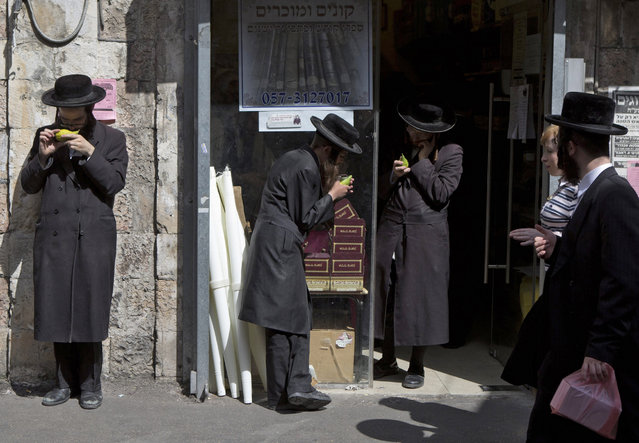
Meanwhile, back in Palestine, the transplanted Greek etrog was pushing the local variety off the market. Eventually, the Greek etrog, which did not adapt very well to the climate in Israel, began to be grafted onto stock of the original etrog, a graft which is kosher. This was a marriage made in heaven: the beautiful Greek etrog with the original, Temple-era etrog. It is this variety which now dominates the modern etrog market, and is no doubt the one being intensely studied by these Orthodox Jews prior to an eventual purchase.
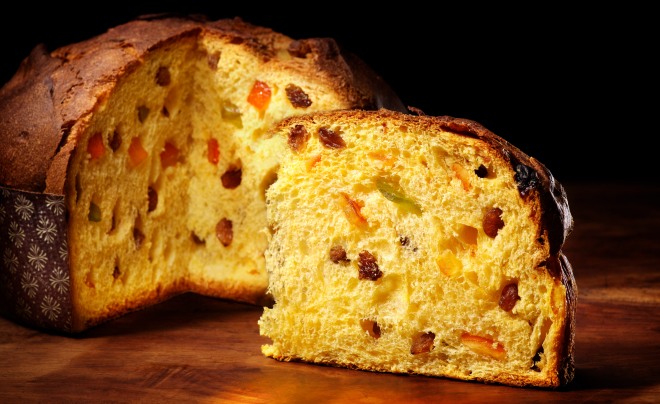
I cannot finish my story of the citron without mentioning the one way of usefully consuming it that was eventually discovered. For this, I have to back up a little and say a few words about the history of cane sugar. Cane sugar, brought west from India by, once again, Alexander the Great’s troops (they seem to have been great collectors of plants …), was first exploited in the Near East. It was the Crusaders, who came across caravans of this “sweet salt”, and who brought sugar to the attention of Europe. Until then, Europeans had only had honey as a sweetener. Genoa’s fiercest rival, Venice, was the first to make sugar available in Europe. It also brought another Arab invention, candying of fruit, to Europe. Not to be outdone by its hated rivals, the Genoese also finally got into the candying business. Somewhere along the line, someone had the idea of candying the citron, or rather its pith, of which there is so much, as the photo above shows. Leghorn (Livorno) became the centre of production: citrons from the south all the way to Sicily, from Corfu and the other Ionian islands in the east, and from Corsica in the west, were sent, de-pulped and brined, to Leghorn. There, the citron pith was de-brined and steeped in progressively more concentrated solutions of cane sugar. Once dried and chopped into small pieces, it was shipped, no doubt in Genoese ships, all over Europe to be added to cakes, sweet bread loaves, and other patisseries. I have a particular reason to mention all this because the panettone, that glory of my wife’s home town, Milan, was originally made with candied citron pith (as well as candied orange and sultana raisins).
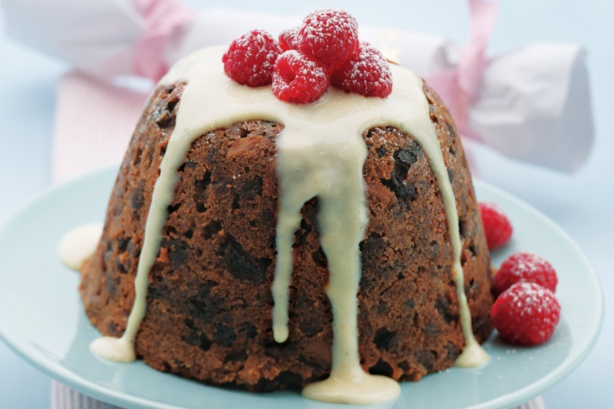
More humbly, the original recipes of the English plum pudding of my youth also called for candied citron from Leghorn.
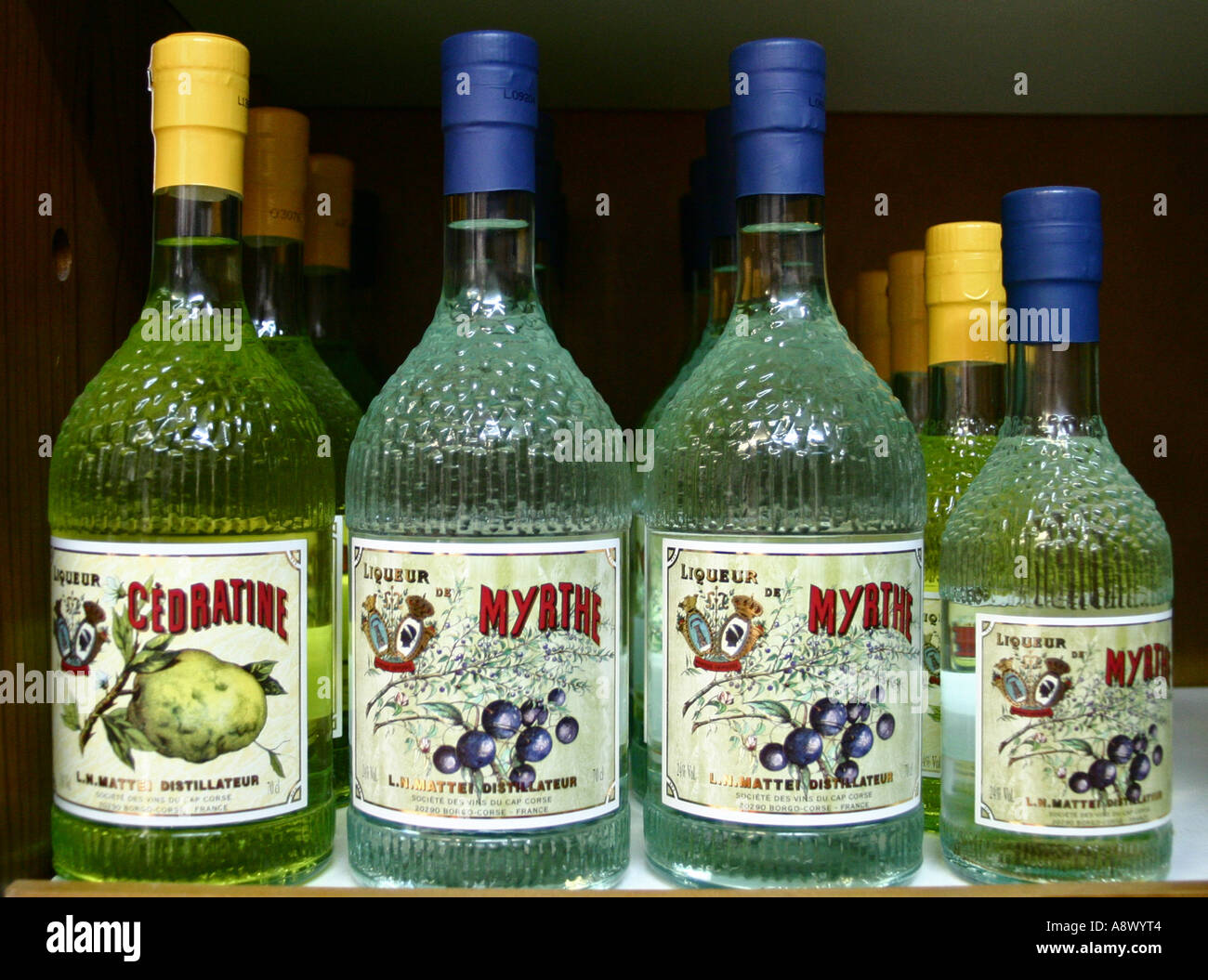
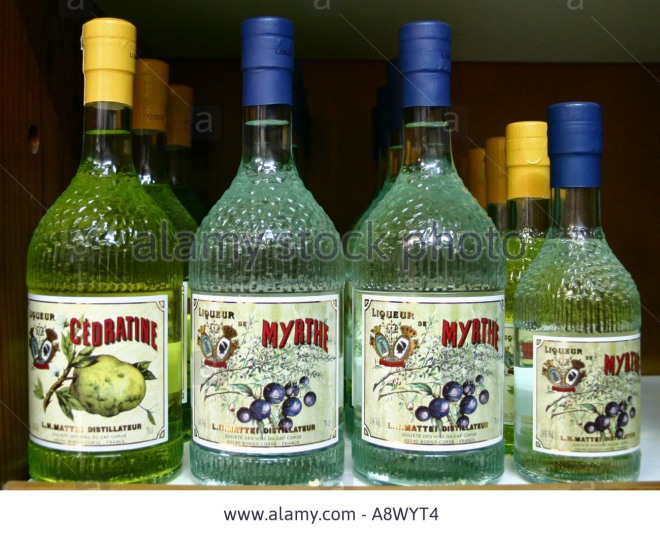
Alas! I believe this market has declined drastically – or perhaps citrons from elsewhere have cornered the candying market. The fact is, Leghorn is no longer a centre for candied citron production, the Calabrian citron hangs on by managing to keep a foot in the etrog market, while the Corsican and Corfu citron production is down almost to nothing; the few which are grown there are only used to make a local liqueur. Here’s the Corsican variety. Somehow, it seems apt that the bottle stands next to one made with myrtle, another of the four species.
Let’s lift a glass to the citron a.k.a. the etrog! Cin-Cin!
2016 is upon us! My wife and I did not stay up to ring in the new year, we let the younger folk do that.
No need to make any new year resolutions, this year will be one of momentous change! (for me, anyway) I retire in August and finally become a free man again! Yippee!
What I need to do over the next eight months (apart from ensuring as smooth a handover as possible to my eventual successor) is to figure out what my wife and I will do with all this wonderful spare time given to me. Travel is high on the list. For instance, we are planning to drive across the US, something I’ve dreamed of doing since my student days in the US 35 years ago, visiting the natural wonders of the West
as well as the man-made wonders along the way.
Or there’s a little trip I’ve had in mind for a while, visiting stained glass windows across Europe, from the Medieval glories of la Sainte Chapelle in Paris
or Chartres cathedral
to the modern take on this art form in Cologne Cathedral.
Further afield, I have emitted the desire in a previous post to visit Easter Island.
Or how about Belize? My wife is currently searching the web for places there where our daughter and her beau could go and spend a short vacation. I’m thinking we should go there too and do some snorkeling
as well as go and visit some of the country’s Mayan ruins
My wife and I have also talked of spending several months in a number of our favourite cities, cities which we’ve only been able to visit briefly because of our work schedules but which we would like to get to know better. And on and on … There’s so much of the world we’ve not seen! But we cannot spend our whole time just traveling. For one thing, it gets rather expensive and I’m not sure how far my pension will stretch. For another, it greatly increases our carbon footprint, which is currently a big problem.
Which brings me to more serious things that my wife and I need to do in this latest phase of our lives. I’ve already mentioned in a previous post that we are going to have to do something to drastically reduce our environmental footprint. I’m thinking in a confused way of turning these efforts into a blog and/or a website and/or an app to help others do the same. That will definitely keep me busy, especially since the workings of websites, apps, and the like are black holes to me. Time to learn and keep the old brain working!
And then there’s the exercise! We have to continue the good work we’ve started. Joining a gym near our apartment in Milan is a definite possibility (we’ve already looked into the options). But we’ll surely supplement that with trekking in the Ligurian hills behind our apartment near Genova.
And here we can give back for all the years we’ve been using the trails, volunteering to help maintain them in our spare time (of which we will now have plenty).
And then, hopefully not in contradiction with the last two thoughts, I would like to turn my hand to some cooking. Not common-or-garden cooking but rather out-of-the-way things. For instance, I’ve always wanted to make tomato ketchup from scratch
and I want to try (again) to make my own vinegar.
Vinegar makes me think that I would like to try pickling my own vegetables.
I know this culinary impulse of mine is strange. I suppose it’s my way of rebelling against all the processed food that has swamped our lives. Maybe I can make this a subset of my website on reducing our environmental footprints, since our current food habits are such a big part of them.
I’m thinking that I could also do a bit of teaching, linked to my professional specialties. One university has reached out to me, let’s see if we can come to a mutually satisfactory arrangement.
I’m sure there’s a thousand other things we could set our hand to. But of course it could be that amongst all this busyness we’ll be called to do our duty as grandparents. The children are not yet at the point of having their own children, but the moment could come. Have no fear, children, we’ll drop everything and be there in a jiffy!
What better way is there to spend one’s waning years than in imparting some of one’s experience (I won’t say wisdom) to the little ones in our society?
Happy New Year!
________________
New Year’s eve: https://www.theodysseyonline.com/11-thoughts-had-this-new-years-morning
Happy Snoopy: https://johnrberkowitz.wordpress.com/2015/03/
Monument Valley: http://anguerde.com/TTF-412276-zidane.html
Gateway Arch: https://cityofstlouis.com/events/day?date=2018-01-20
Sainte-Chapelle: https://www.pinterest.com/pin/517280707186310674/
Chartres Cathedral: http://art1arquitectura.blogspot.it/2011/07/rilke-la-catedral-el-roston-el-caiptel.html
Cologne Cathedral: https://anushkaenalemania.wordpress.com/2012/04/20/ciudades-koln/
Easter Island: https://www.pinterest.co.uk/pin/824581012997275195/
Snorkeling Belize: https://blog.tripreviewer.com/2017/08/21/top-water-activities-to-do-in-the-usa/
Belize ruins: http://lushpalm.com/10-places-to-see-before-its-too-late/
Environmental footprints: http://ingienous.com/the-challenge/economics/consumption/
Monte di Portofino: https://www.caisezionedirho.it/sito/images.asp?cat=25&id=146
Tomato ketchup: http://cjoloughlin.ie/product/tomato-ketchup-brown-sauce/
Wine vinegar: https://www.vomfassusa.com/shop/vinegars/bordeaux-red-wine-vinegar/
Pickled vegetables: http://www.recipesbnb.com/small-batch-pickles/86358
Blackboard: http://www.enjoymyanmarholiday.com/index.php/essay/11149/
Grandparents: https://sweetsouthernhome.net/2018/02/26/5-things-older-citizens-should-do-to-protect-their-homes/
Old year and new year: http://mzayat.com/cliparts/old-clipart-man-and-boy.html
















































 the heart thrills