MEMORIES, MEMORIES

Bangkok, 14 March 2015

I don’t know why, but yesterday the tune of a song which my mother used to sing popped unbidden into my head. As I hummed along, I was trying to remember the words. Snatches came back but there were frustratingly large holes. I decided it was now or never: either I dredged up the words today or they would be lost to me forever. Well, my memory is shot, but there is the internet. As I have had cause to mention before, the internet really is a wonderful thing. There is a lot of rubbish, but there is also a veritable treasure trove of stuff ready to be mined, put there by devoted souls. In this case, the devoted soul turned out to be Google, for after trying out a few key words and remembered phrases of the song, I finally found a book from 1843 entitled “Chants et Chansons Populaires de la France”, which Google had scanned as part of its Google Books initiative. There, tucked in among lots and lots of songs that I had never heard of, was mine.

The authors of the book are vague about the date of the song, but I reckon from some words it uses that it was written in the sixteenth century or thereabouts. Its title is “La Vieille”, which can be loosely translated “The Old Crone”, and it is a deliciously malicious take on the foolish desire of some old people to stay young and on the power of money. In a few words, the song tells us of an eighty-year old woman who wants not only to join the young people in their dance but also to be coupled with the youngest and handsomest man there. Not surprisingly, he tells her to go away, adding that she is far too poor for him. After she intimates that she is actually very rich, our young man immediately changes his mind and calls her back to the dance. In fact, he rushes her off to a notary public to be married and no doubt to make sure that a will is prepared leaving all her wealth to him.

la vieille 001

He then takes her back to the dance, where she dances so energetically

la vieille 002

that she expires.

Unceremoniously, her young husband and his friends look in his dead wife’s mouth, no doubt searching for her gold teeth, but find only three teeth, “une qui branle, une qui hoche, une qui s’envole au vent”, one which moves, one which wobbles, and one which is ready to blow away on the wind. They then look in her pockets and find only three small coins: “Ah, la vieille, la vieille, la vieille, avait trompé son gallant”, the song concludes; ah, the old crone had fooled her young paramour. Anyone who is interested in the original words can find them at the end of this post (although in the interests of brevity I’ve cut the repetitions of which the song is full).

My mother loved to sing, and had a really quite beautiful voice (whereas when my father – blessed be his memory – sang, it resembled the croaking of a crow). By the time I knew my mother – that is, by the time I was old enough to judge her – she was of course a decorous middle-aged matron, but also one who had had to endure the slings and arrows of life’s misfortunes. So, apart from the hymns in Church which she delivered with gusto, the songs she sang tended to be soulful and mournful. Edith Piaf was a favourite: “Ils sont arrivés se tenant par la main, l’air émerveillé de deux chérubins”, “they arrived holding hands, with the look of wonder of two cherubs”. But then they were found dead, together, in the hotel room they had rented to make love for the last time. There was another, a haunting lament, about a wife waiting for her husband knight to return from the wars so that she can announce to him that she is with child. He comes back, but only to die in the same bed where the child was conceived, of his wounds. There was also “A la claire fontaine”, which is a somewhat trite song about lost love, but has a beautifully quiet melody.

But when my mother sang “La Vieille”, a mischievous glint would come into her eye and I could see the young, cheeky girl which, in the autobiography that she wrote for us children, she confessed to having once been. The same glint would come into her eye whenever she told droll stories of her family. There were the two brothers, for instance, great-uncles, who were “of the left”, and fervent anticlericals (we are talking of the great anticlerical moment in French history during the late 19th Century). Every Good Friday, they would take a table at the window of a restaurant close by the cathedral and make sure to be eating heartily and mightily when the poor souls came out of Church hungry from their Lenten fasting. One of these same brothers indicated in his will that when he died he wished to be buried in a simple pine coffin like a man of the people. But his daughters, whom I have mentioned before, were having none of that. They found their father embarrassing enough in life, they were not going to be embarrassed by him in death in front of their bourgeois friends. He was buried in a sumptuous coffin, and with a church ceremony to boot. Then there was the uncle, Oncle Jacques, who had been a dashing rake in his youth. Why, he had even been a daredevil pilot, this at a time when it was lucky if planes stayed together in the air. A somewhat older woman, Renée, had fallen hard for him, and in a standard tactic announced that she was pregnant, a pregnancy which mysteriously vanished when he did the Right Thing and married her. In the event, the marriage held and they did eventually have children. But Tante Renée shed many a bitter tear during the marriage over Oncle Jacque’s serial infidelities. This last set of stories were delivered the day before Oncle Jacques and Tante Renée came to make one of their annual visits to my grandmother, using the little train which I’ve mentioned in an earlier post. I still have a memory of the pair, arriving in the garden to effusive welcomes after the walk up the long alleyway from the train station. Tante Renée was hideously made up with pink powder, bright red lipstick, and rinsed hair, and as she bent over to give me a peck on the cheek I was drowned in the overpowering scent of a very sweet perfume. Oncle Jacques, on the other hand, stood there looking distinguished in his old age and with a mischievous glint in his eye.

Ah, memories, memories. Come, let’s finish with the refrain from another old French song, this one about the capture of an English ship by a smaller French ship in the early 1800’s during the Napoleonic wars:

Buvons un coup, buvons en deux
À la santé des amoureux
À la santé du Roi de France
Et MERDE au Roi d’Angleterre
Qui nous a déclaré la guerre.

Let’s drink a cup, let’s drink two
To the health of all lovers
To the health of the King of France
And BUGGER the King of England
Who went and declared war on us.

____________

photos: taken by me from https://books.google.co.th/books?id=2N7F5Gqine0C&dq=chanson+qui+avait+quatre+vingt+ans+l’autre+qui+s’envole+au+vent&source=gbs_navlink_s

-o0o-

LA VIEILLE

A Paris dans une ronde
Composée de jeunes gens
Il se trouva une vieille
Agée de quatre-vingt ans!

Elle choisit le plus jeune
Qui était le plus galant
“Va-t-en, va-t-en bonne vieille
Tu n’as pas assez d’argent!”

“Si vous saviez c’qu’a la vieille
Vous n’en diriez pas autant”
“Dis nous donc ce qu’a la vieille?”
“Elle a dix tonneaux d’argent”

“Reviens, reviens bonne vieille
Marions-nous promptement!”
On la conduit au notaire
“Mariez-moi cette enfant”

“Cette enfant”, dit le notaire
“Elle a bien quatre-vingt ans”
Aujourd’hui le marriage
Et demain l’enterrement

On fit tant sauter la vieille
Qu’elle est morte en sautillant

On regarda dans sa bouche
Elle n’avait que trois dents
Une qui branle, une qui hoche
Une qui s’envole au vent

On regarda dans sa poche
Elle n’avait que trois liards d’argent
Ah la vieille, la vieille, la vieille
Avait trompé le galant!

What follows is a quick-and-dirty translation:

In Paris, at a round dance
Composed of young people
Arrived an old crone
Of the venerable age of eighty

She approached the youngest man
Who was also the most handsome
“Leave me be, you old crone
You’re far too poor for me!”

“If you knew what the old crone has
You wouldn’t say as much”
“Tell us then how much she has”
“She owns ten barrels-full of money”

“Come back, come back, you old dear
Let us marry forthwith!”
They took her to the notary
“Marry me to this child”

“This child”‘ intoned the notary
“Is not a day younger than eighty”
Today the marriage
Tomorrow the burial

They made the old crone dance so hard
That she died mid-hop

They looked in her mouth
She had but three teeth
One which moved, one which wobbled
One which blew away on the wind

They looked in her pockets
They found but three farthings
Ah the old, old crone
She had fooled her handsome boy!


CHEESE, GLORIOUS CHEESE!

Beijing, 24 June 2014

My wife and I were having our usual chat with our daughter via FaceTime when she announced that she and her flat mate had been discussing the vital question of why cheeses were different from each other.

Well! That was more than enough bait for a nerd like myself to rise to. With eyes a-shinin’ and lips a-lickin’, I started to research the topic. It was actually a question I had also often posed myself: how on earth did you get so many different-tasting products out of the same rather bland starting material, milk?

I am proud to announce the results of my research. The answer is …. “The most important agents include the four following elements: rennet, starter bacteria and associated enzymes, milk enzymes, second starter bacteria and associated enzymes, and non-starter bacteria”. OK, that’s not very clear, so let me expand a little.

The first step in cheese making is curdling. In fresh, unpasteurized milk, curdling happens naturally. Attack by bacteria floating around in the air and settling on the milk leads to the formation of lactic acid, and it is heightened acidity that causes milk to curdle, separating out into solid curds and liquid whey. But we humans have learned to help the process along. Rennet, which is a complex of enzymes, seems to have been an early favourite for inducing curdling. An interesting theory I read is that our ancestors discovered the milk-curdling properties of rennet when they used animal stomachs as storage vessels for milk. FYI, mammalian stomachs naturally contain rennet as an evolutionary response to milk drinking (which is what makes a mammal a mammal rather than, say, a bird or a reptile). It allows young mammals to digest their mothers’ milk.

Or you can use acids. Given that you want to eat the result, you probably don’t want to use sulphuric acid or hydrochloric acid, even though I’m sure they would do the trick. Naturally-occurring (and edible) acids like vinegar and lemon juice will do nicely.

Or you don’t wait for some random bacteria floating around to attack the milk. Instead, you deliberately inoculate milk with so-called starter bacteria (often adding rennet in a second step). Presumably from previous trials and errors which occurred who knows how many centuries ago in monastery cellars or elsewhere

monks in cellar

these various strains of bacteria are known to give specific tastes to the final cheese. They will chemically attack the milk, and later the curds, in differing ways, giving rise to chemical products with different tastes.

In any event, one way or the other you will end up with curds

curds

and whey

Whey

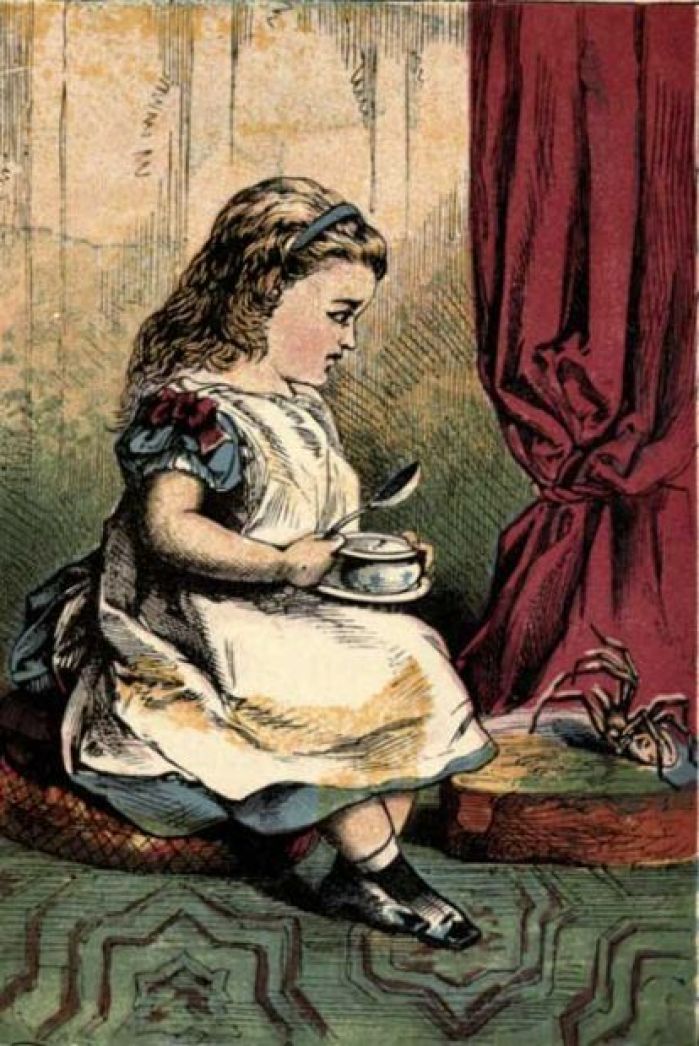
Like little Miss Muffet who sat on a tuffet, you can already eat the curds and whey if you so wish, preferably before a spider turns up and spoils your appetite.

little miss muffet

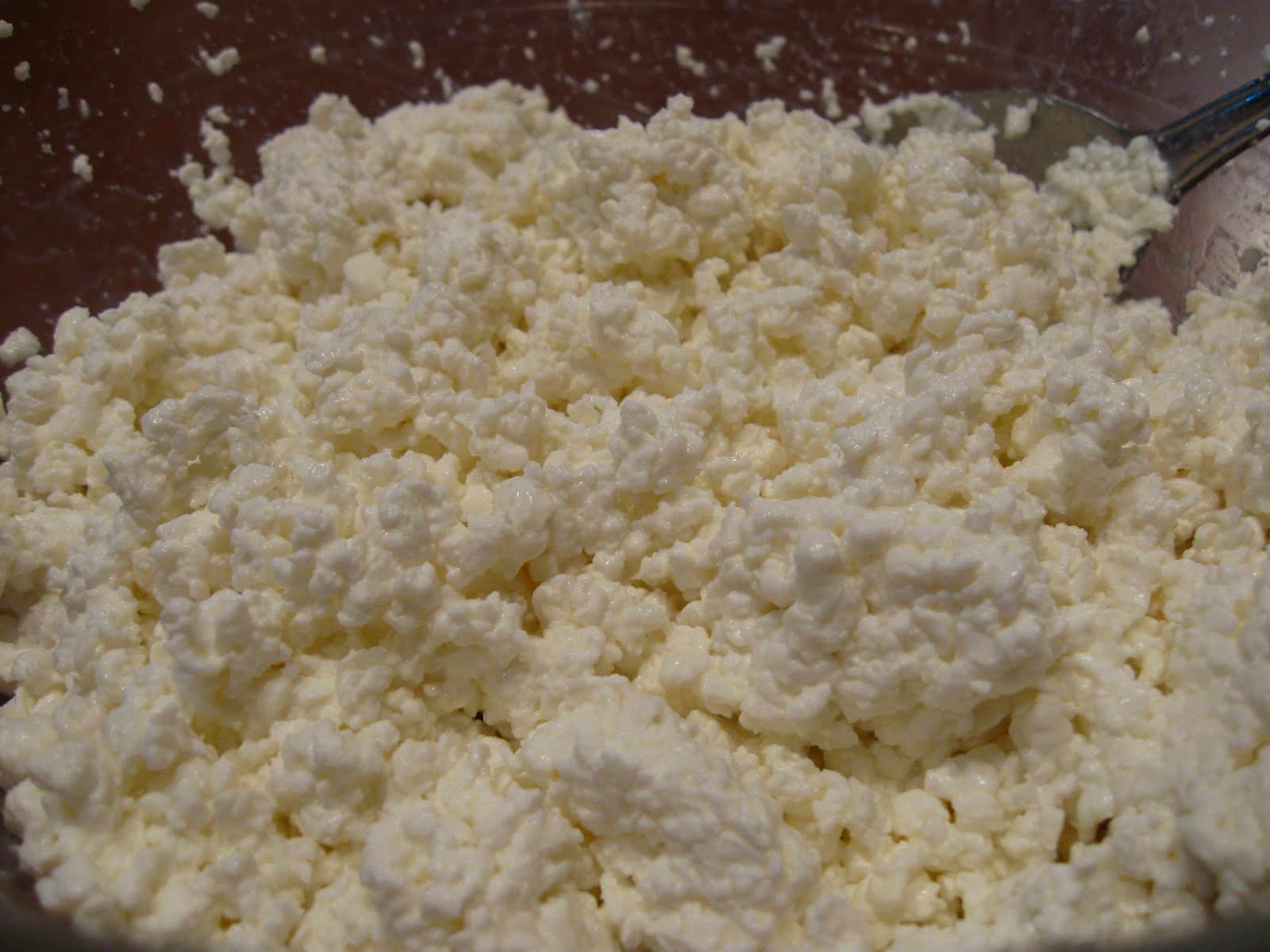
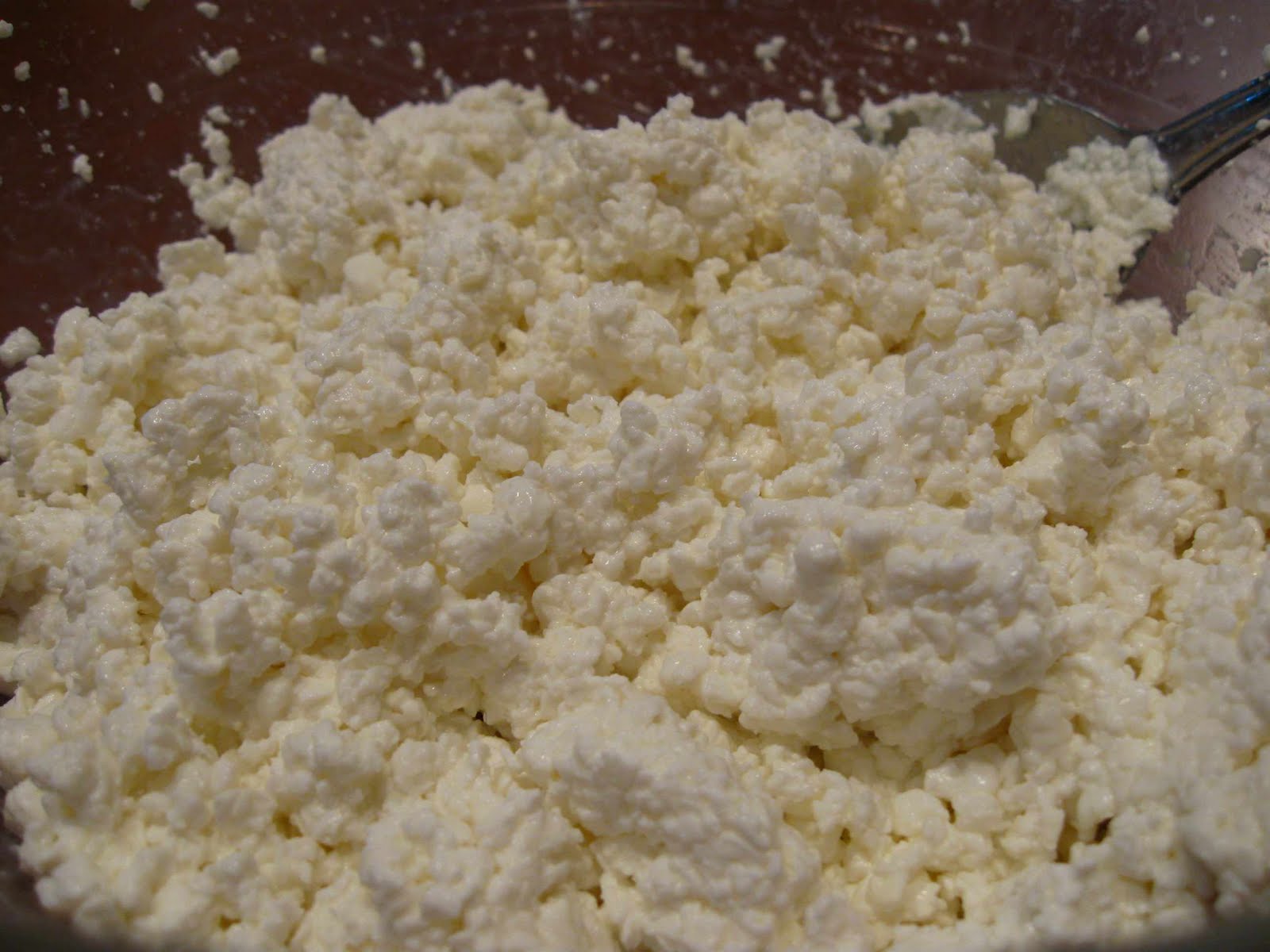
That is basically what cottage cheese is, loose curds

cottage cheese

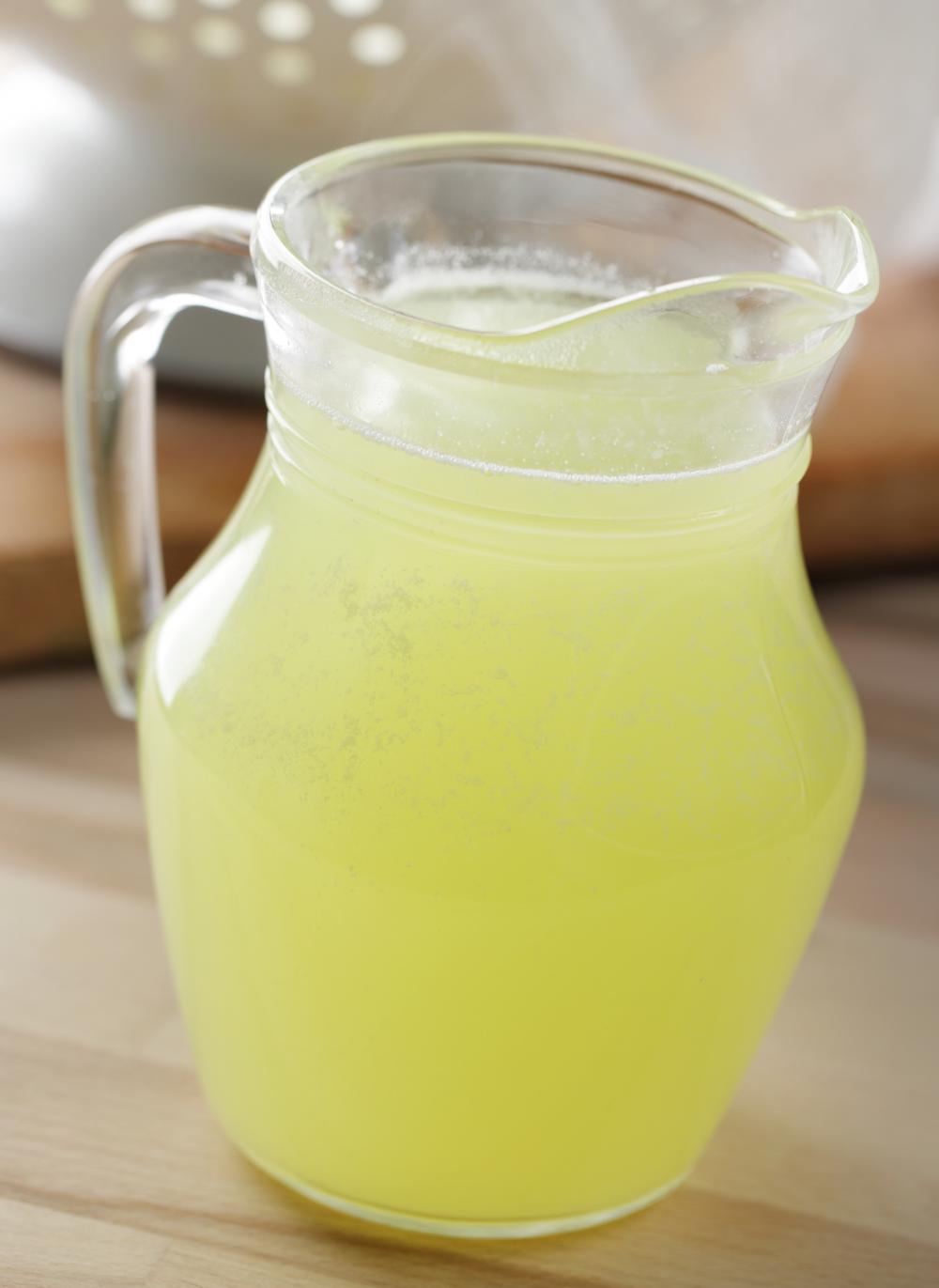
while after a period when whey was considered only good for poor peasants, whey-based drinks are gaining a certain popularity with the health conscious.

whey-based drink

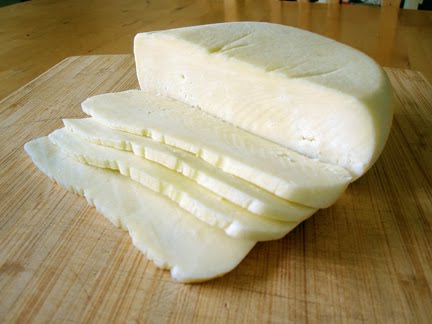
Alternatively, you can take the curds and start pressing them to get rid of liquid. Depending on how much you press them and process them thereafter, you’ll get a whole series of fresh cheeses: pot cheese, farmer’s cheese, hoop cheese, sour milk cheese, curd cheese, cream cheese, and a thousand others made in non-English cultures. I will mention three of these, the Italian mozzarella (where the curds are actually stretched and kneaded), the French fromage blanc, and the Austrian topfen: mozzarella, because it has to be the best cheese in the world; fromage blanc, because my French grandmother used to serve it when I was young and I always have it when I go back to France; topfen, because I discovered this cheese in the form of the dish topfenstrudel when we moved to Vienna. I will let this photo of farmer’s cheese stand for the whole class of fresh cheeses.
Farmer Cheese

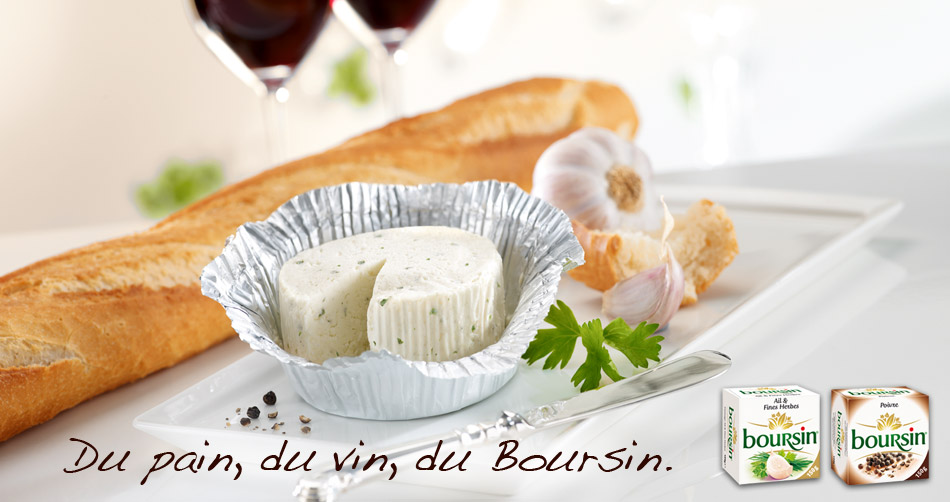
Let me also mention boursin cheese, because (a) my daughter, who set me off on this posting, likes it, (b) it is a good example of the mixing of other ingredients – in this case garlic and fines herbes – with fresh cheese to make a new product (walnuts is another popular ingredient in this category) and (c) when I was young it had a really cool advertising line, “Du pain, du vin, du boursin”

boursin pub

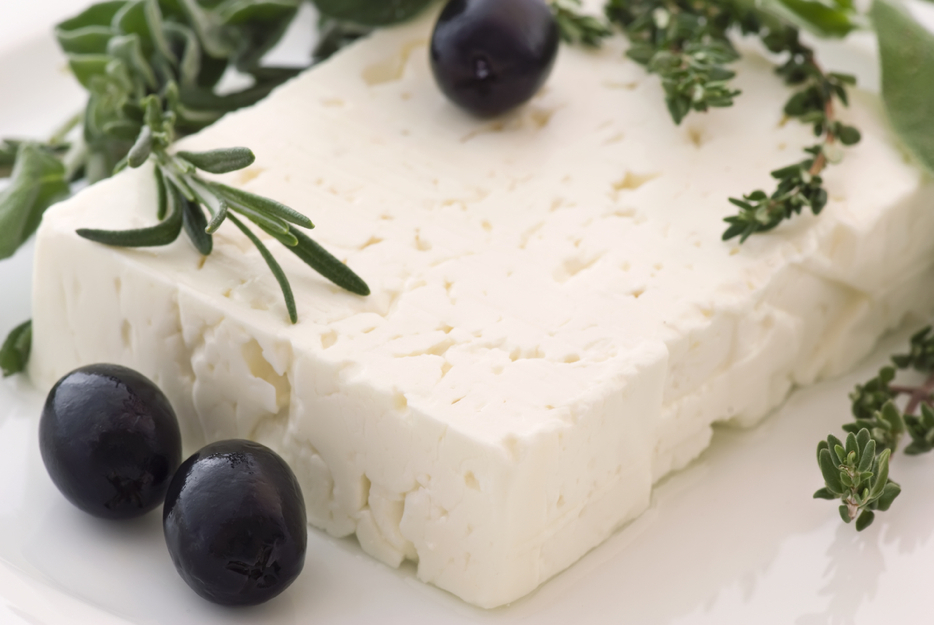
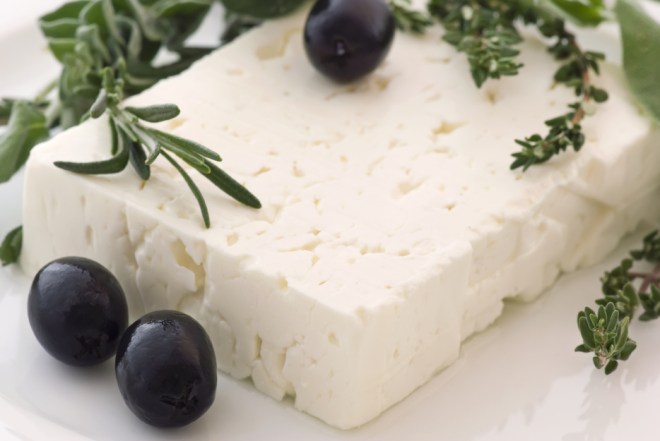
Fresh cheese is just that, fresh. If you don’t process it further, it will spoil. The most basic preserver of cheese is salt, which has been used for millennia to preserve all sorts of food (salt also firms up the texture of cheese, by the way). So as a salute to salt, let me first deal with brined cheeses, which are cheeses that are matured in a brine solution. This is the main type of cheese produced in the Middle East and the Mediterranean areas: Greek feta, Cypriot halloumi, South-Eastern European sirene, Romanian telemea, Middle Eastern akkawi, Egyptian mish (which is also pickled), …. I will let a photo of feta cheese stand in for the class of brined cheeses.
feta

In other cases, … well, the pressed curds seem to be processed in a bewilderingly different number of ways. They will always be salted (to put off spoilage). Some will be heated (which will kill off some, but not all, bacteria). Others will be washed (getting rid of acid and so making them milder to eat). Some are gently set in moulds (soft cheeses), others have the curds ruthlessly crumbled before being subject to moulding (hard cheeses). Then the cheeses are left to ripen for anything from three weeks to several years. But they aren’t left alone, oh no! Many are regularly washed, which helps to form the rinds and keep the cheese moist and no doubt to impart specific tastes. Brine is a common washing solution. In some cases, just to complicate things, the brine is aromatized with herbs. Alcoholic beverages are also popular rinses: wine, cider, beer, and just about any other alcoholic drink known to man. Or the cheeses are sprayed or injected with molds, or smeared with bacteria or molds or yeasts. Or some are smoked. And after all of this, cheese makers still keep fiddling: with humidity levels, with temperature, and with I don’t know what else. All of which gives rise to a dizzying variety of cheeses: they can be soft, or semi-soft, or medium-firm, or firm, or hard; their texture can be brittle, chalky, chewy, creamy, crumbly, flaky, grainy, runny, sticky; they can taste ammoniated, buttery, clean, complex, fermented, herbal, mild, musty, nutty, ripe, robust, salty, smoky, sour, spicy, sweet, tangy, tart, yeasty.

And I haven’t mentioned the effect on taste and texture of what is really the very, very first step in cheese-making, the choice of milk. I think you can make cheese from any mammalian milk (some clever fellows have even made cheese from human milk), but in practice cow’s milk dominates. Goat’s milk is also popular in many parts of the world, while sheep’s milk gets an honourable mention. Water buffalo’s milk is a must for mozzarella. Yak’s milk is used by the Mongolians and Tibetans. The Mongolians also use horse mare’s milk, while Afghanis and Pakistanis use camel’s milk. The Finns use reindeer’s milk, while Serbians have a tradition of making cheese with donkey’s milk. As anyone knows who has eaten goat’s cheese, for instance, the choice of milk sure changes the taste of the cheese. And of course milk isn’t just milk! There are those who insist that what the animals ate – hay versus grass versus any old crap – will affect the milk and therefore the taste of the cheese, so there are cheeses where – it is claimed – only milk from cows eating grass is used. And the time of the year in which the milk is produced, others say, affects its biochemical makeup, so there are cheeses which, I read, should only be made in March, or October, or …

All of this is enough to give one a strong headache …

Out of all of this seeming chaos, I have managed to extract a few categories of ripened cheeses to describe in more detail. Let me start with those cheeses which have molds sprayed onto them, principally of the penicillin family, and which give rise to rinds with white blooms on them. The best known of these has to be the French Camembert, whose surface is sprayed with a mold that is so linked to the cheese that it is named after it, Penicillium camemberti.

Camembert

After years of eating it too, I feel I should also mention the French Brie.

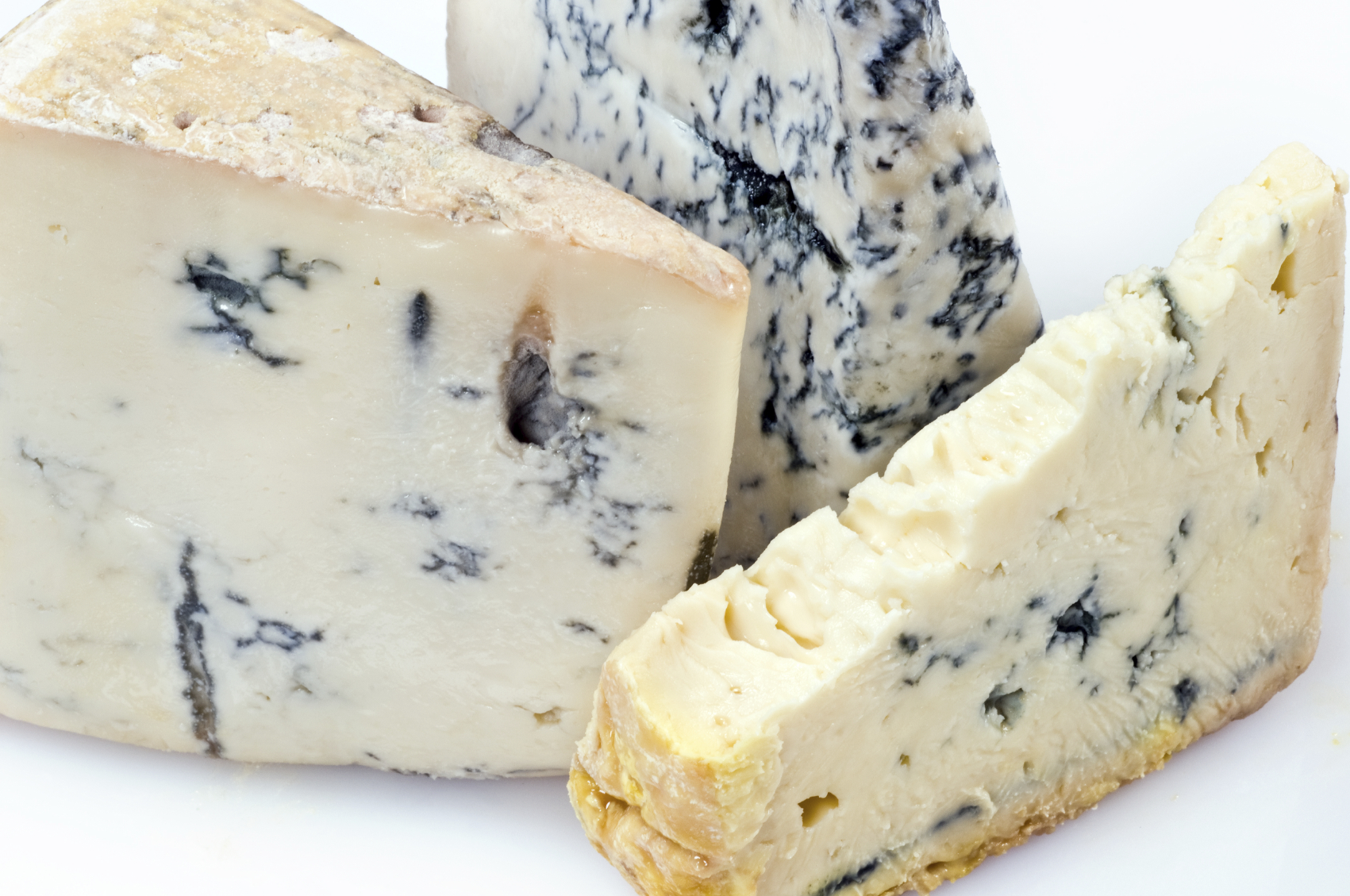
Then there are the cheeses where the mold is injected into them. The French Roquefort and English Stilton fall into this category, although I will have a picture of the Italian Gorgonzola stand in for this group

gorgonzola

for the completely trivial reason that when I drove through the village of Gorgonzola (which is near Milan) for the first time, I belatedly realized that actually the cheese was named after a real place.

Then there are the cheeses whose rinses encourage the growth on the rinds of another bacterium, Brevibacterium linens, which gives these cheeses their characteristic pinkish-reddish tint. This bacterium is ubiquitous on the human skin, so no prizes for guessing how it ended up on the cheeses. It is also why our feet smell when sweaty, which no doubt explains why the cheeses in this category tend to stink (it looks like we weren’t so wrong when as boys at school we accused each other of having socks which smelled of old cheese). There are some well-known cheeses in this category like Munster, Limburger, and Port-du-Salut, but I will use as a stand-in for this group a cheese that sadly no longer seems to exists but was a family favourite when I was young: crotte du diable, devil’s droppings (I have mentioned this cheese in a previous post).

crotte du diable

The cheese was very aptly named, having an incredibly foul-smelling rind, so foul that you had to wash your hands very thoroughly after eating it. But the cheese itself was wonderfully smooth.

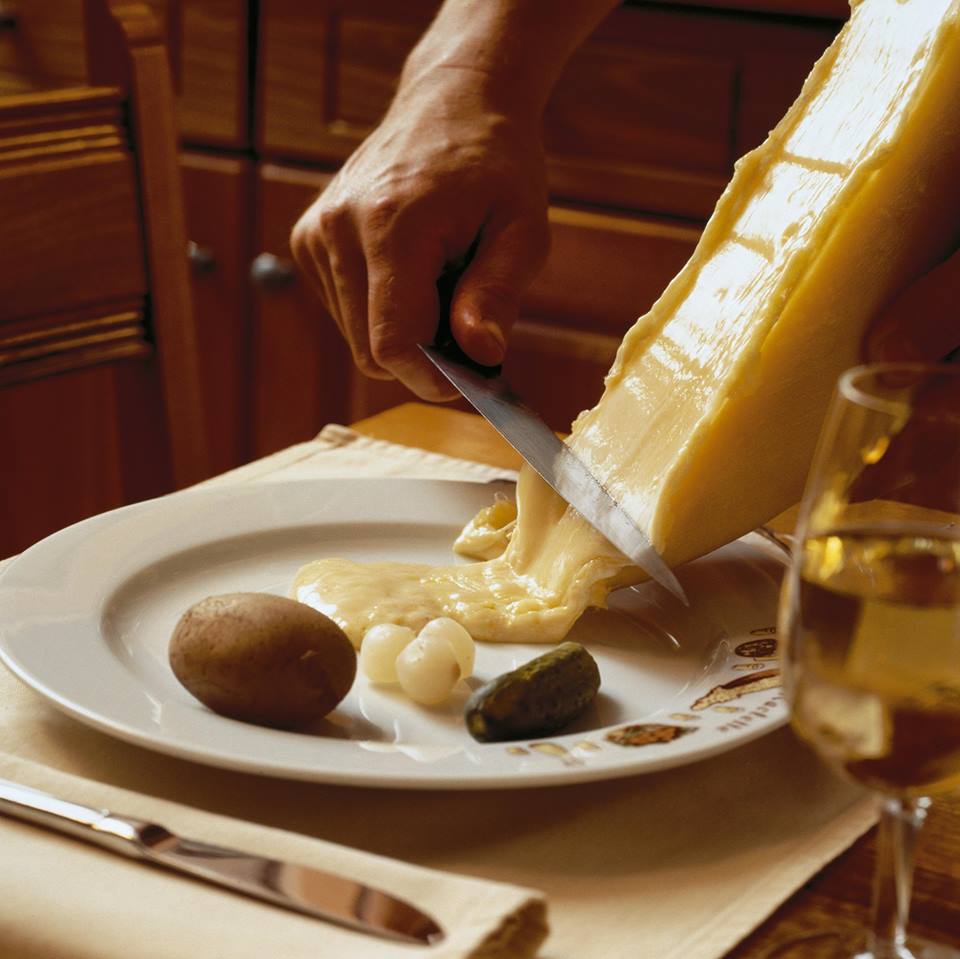
I have to mention another cheese in this category, the Swiss Raclette. My wife introduced me to this cheese. She had got to know it well during her skiing days in the Alps. During our time in Paris, in the early 1980s, we discovered a little restaurant just off the Champs Elysées where you could get a glorious raclette, served just the way it should be, scraped (raclé) onto your plate and served with gherkins, pickled onions, and potatoes in their jacket.

Raclette

When we went back to Paris many years later, we homed in on the place for lunch like bees for their hive. Alas! the restaurant was gone. Glumly, we wandered into a nearby restaurant and had ourselves a totally non-descript lunch. Sic transit gloria mundi.

I can’t think what other categories to extract from this mass of cheeses (over 700 of them according to www.cheese.com). So I’ll just salute a few cheeses which I personally consider deserve special mention:

The great, the glorious, the incomparable, Parmigiano Reggiano

Parmigiano reggiano

not to be grated onto some anonymous pasta, and not to be shaved onto some anonymous salad, but to be eaten alone, flake by grainy flake, slowly and with hushed reverence. When, a few years ago, my wife and I saw that a rare earthquake in Emilia Romagna had wrecked a couple of Parmigiano Reggiano storehouses, we briefly toyed with the idea of jumping onto the first airplane back to Italy and picking up some slightly damaged wheels of the cheese on the cheap. Good sense eventually prevailed.

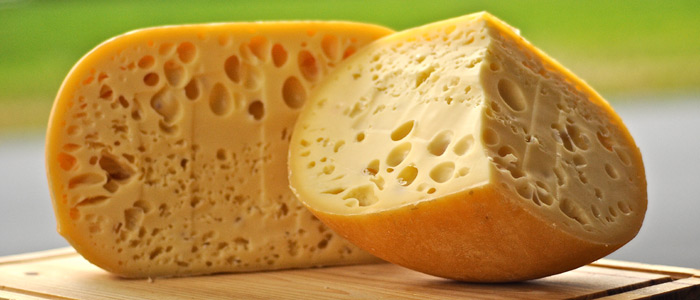
Emmental

Emmental

which for me somehow is my youth (my mother was a generous purchaser of the cheese), and whose holes (which I have just learned are called “eyes” in the trade) fascinated me. With old age, I have become boringly scientific and now know that the eyes are caused by the use in the starter bacteria of the bacterium Propionibacterium freudenreichii, which consumes lactic acid and excretes CO2; the latter creates bubbles, which we see as eyes (if you get my drift). In the old days, these eyes were considered defects to be avoided, but no doubt after seeing how the eyes made the cheese popular with children and therefore with their parents, emmental makers began to encourage their presence.

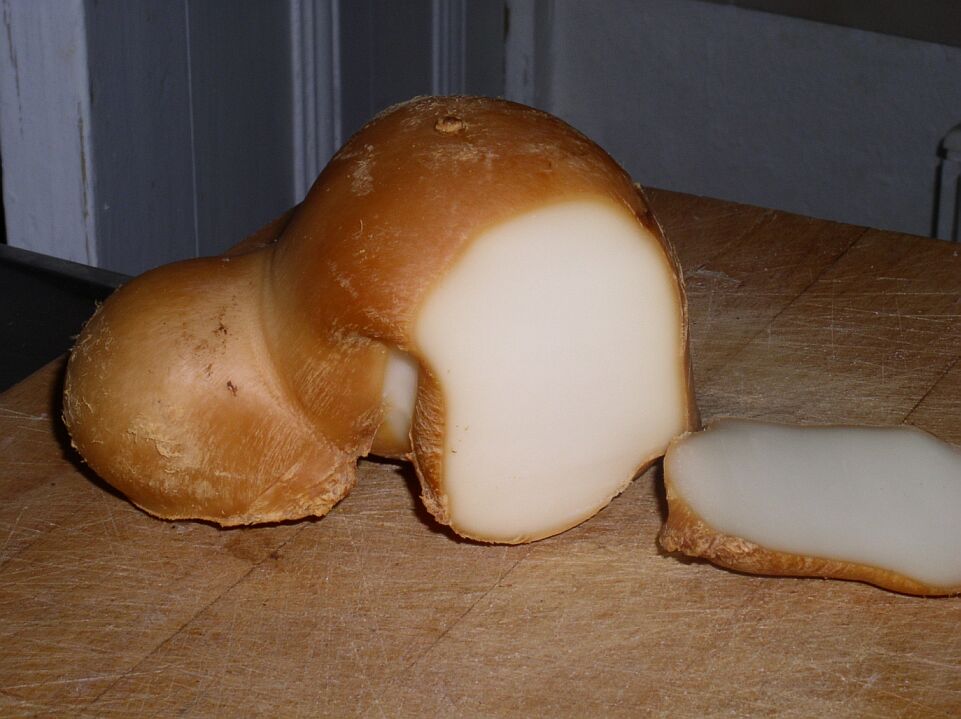
Then I pass on to scamorza affumicata, which is not that well-known outside of Italy. Like mozzarella, it’s a stretched curd cheese which is then allowed to ripen. Makers form a ball and then tie a string around it to hang up in the store room, which explains its “strangled” shape.

scamorza

It looks like this inside.

OLYMPUS DIGITAL CAMERA

It is best when smoked, and best eaten grilled on bread. It was one of the Italian foodstuffs which my wife introduced me to when we first met.

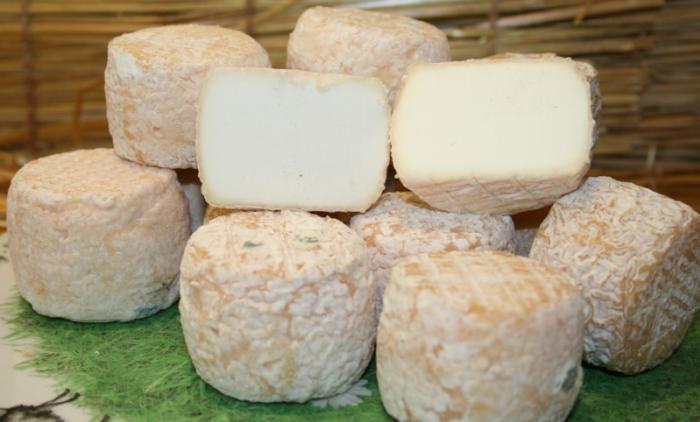
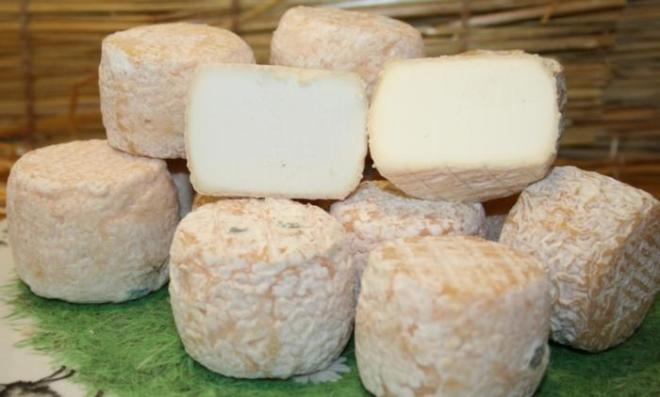
And finally, goat’s cheese. Not those fussy little rolls you find in upscale shops, often covered in herbs or pepper or some other thing. No, I mean the goat’s cheese which I would eat at my grandmother’s house in France, which looked like this
fromage de chevre

The ones I ate were made by the farmer’s wife down the road. When we needed some, my mother or grandmother would give me the money, I would hop on my Solex and speed over to the farm, and after a little chit-chat – “how are you? how are the children?’ – she would take me out to the yard, where in an old bird cage sat a number of goat cheeses of differing ages. After some thoughtful discussion, I would choose a few, ranging from the fresh to the somewhat aged. Ah, those cheeses were soooo good!

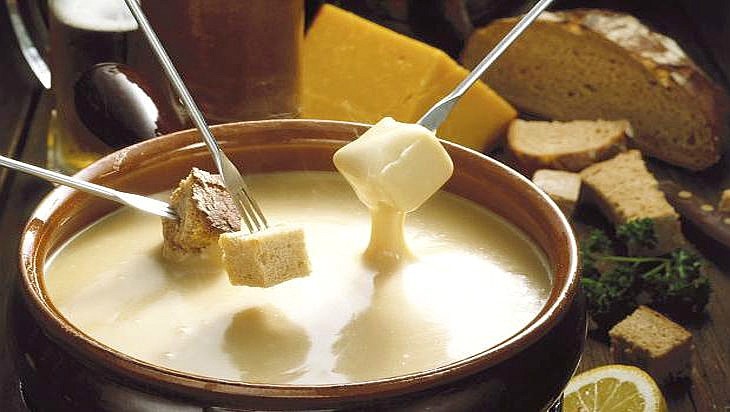
I cannot end without a mention of Fondue, even though it’s a cheese dish rather than a cheese, because it’s just so … damned … good. It can be made from quite a number of cheeses, often mixed together, produced in the Alps or in the nearby Jura mountains: the Swiss Gruyère, Emmental, Vacherin, Sbrinz, and Appenzeller; the French Comté, Beaufort, and Reblochon; or the Italian Fontina. The key, of course, is the white wine. Here’s how you prepare a fondue: (1) Rub the inside of the pot with garlic. (2) Lightly heat the white wine with cornstarch (used to prevent separation of wine and cheese). (3) Add the grated cheese or cheeses and stir until it is all melted. (4) Top off with a bit of kirsch. Start eating, dipping chunks of bread into the pot.

fondue

Fondue has become so linked with Switzerland that Astérix, that bellwether of popular European culture, has fondue playing a prominent part in the album Astérix chez les Hélvètes. But in a bout of creative delirium the writer, Goscinny, and the illustrator, Uderzo, laced this most Swiss of traditions with debauchery borrowed from Federico Fellini’s much-discussed film Satyricon, which came out a year before the Asterix album was published and scandalized many. Satyricon included a series of Roman orgies, full of painted faces, feelings of ennui, mechanical gorging of elaborate food, and sado-masochistic punishments. So the fondue parties organized by Goscinny-Uderzo’s Roman governor of Helvetia take the form of orgies – although, to the governor’s great irritation, they are much too clean; this is Switzerland, after all.

asterix and fondue

The scenes pick up on a tradition that if you lose your bread in the fondue pot, you are punished in some way: for instance, a man has to buy a round of drinks, while a woman has to kiss her neighbours. In the case of Asterix, the young fool is thrown into Lake Geneva with weights attached to his feet, another nod to the casual brutality which filled Satyricon.

Anyway, these are my choices. I’m sure each one of my readers has his or her own list of favourites. I earnestly suggest that they immediately rush out, buy one or more of their favourites, and gorge themselves in a wild bout of cheese-eating.

And I hope I’ve answered my daughter’s question about how cheese is made.

_________________________

Monks in a cellar: http://p9.storage.canalblog.com/95/74/180464/28709536.jpg [in http://toutinfrimage.canalblog.com/archives/2008/08/07/10163569.html%5D
Curds: http://3.bp.blogspot.com/-e_yg4m7wR4g/Toy0E_DhaOI/AAAAAAAAChs/Qmjyg7II6Gw/s1600/salting_curds.jpg [in http://cooking-from-scratch.blogspot.com/2011/10/cottage-cheese.html
Whey: http://4.bp.blogspot.com/-n-UC59ZGNzg/T7sTeo1GtWI/AAAAAAAABCM/9qzvn0wQ3U0/s1600/Whey.jpg [in http://www.hybridrastamama.com/2012/05/making-whey-protein-and-cream-cheese-try-these-unique-food-products.html%5D
Little Miss Muffet: http://bloximages.chicago2.vip.townnews.com/nwitimes.com/content/tncms/assets/v3/editorial/e/b6/eb652bda-d380-5344-a681-06a4de4af8d6/52e7fed631b22.preview-699.jpg [in http://www.nwitimes.com/lifestyles/food-and-cooking/from-the-farm-reader-looking-for-healthy-blender-drink-recipe/article_e8c2a9b9-4658-54a3-9d24-8f00640a8484.html%5D
Cottage cheese: http://uptownmagazine.com/files/2014/05/uptown-kraft-cottage-cheese-recall.jpe [in http://uptownmagazine.com/2014/05/kraft-recall-cottage-cheese/%5D
Whey-based drink: http://www.ebperformance.com/wp-content/uploads/2011/05/proteinjuice-bottles.png [in http://www.ebperformance.com/products/protein-drinks/%5D
Farmer’s cheese: http://3.bp.blogspot.com/_a-oLImtGrzM/S_Mpn-DOErI/AAAAAAAAAr0/ivqGKz6av4s/s1600/Blog+Raw+Milk+Farmer+Cheese+8.jpg [in http://artistta.blogspot.com/2010/05/homemade-raw-milk-farmer-cheese.html%5D
Feta cheese: http://www.yiannislucacos.gr/sites/default/files/ingredient318_feta2.jpg [in http://www.yiannislucacos.gr/en/ingredient/2404/feta-cheese%5D
Boursin publicity: http://www.boursin.ch/uploads/pics/Indexbild_ganze_Breite_2011_01.jpg [in http://www.boursin.ch/%5D
Camembert: http://upload.wikimedia.org/wikipedia/commons/8/88/Camembert.JPG [in http://en.wikipedia.org/wiki/Camembert%5D
Gorgonzola: http://blog.fairwaymarket.com/wp-content/uploads/2011/10/GorgonzolaCheese.jpg [in http://blog.fairwaymarket.com/2011/10/blue-cheese-moldy-cheese-day/%5D
Crotte du diable: http://p1.storage.canalblog.com/18/34/180464/7469035.jpg [in http://toutinfrimage.canalblog.com/archives/2006/10/15/2911082.html
Raclette: http://www.gentlemansgazette.com/wp-content/uploads/2013/12/Traditional-Raclette.jpg [in http://www.gentlemansgazette.com/dinner-party-ideas-how-to-host/%5D
Parmigiano Reggiano: http://upload.wikimedia.org/wikipedia/commons/5/5b/Parmigiano_reggiano_piece.jpg [in http://en.wikipedia.org/wiki/Parmigiano-Reggiano%5D
Emmental: http://cheesecrafters.ca/wp/wp-content/uploads/2012/06/full_Emmental.jpg [in http://cheesecrafters.ca/products/emmental/%5D
Scamorza affumicata: http://www.lascelta.com/media/catalog/product/cache/1/image/700×477/9df78eab33525d08d6e5fb8d27136e95/f/o/for022aff.jpg [in http://www.lascelta.com/formaggi/semi-stagionati/scamorza-bianca-1.html%5D
Scamorza-inside: http://upload.wikimedia.org/wikipedia/commons/8/85/Scamorza.jpg [in http://en.wikipedia.org/wiki/Scamorza%5D
Goat’s cheese: http://www.fromagerie-martin.com/photos/crottindechevre_23071.jpg [in http://www.fromagerie-martin.com/fiche_produit.php?id=23071%5D
Fondue: http://postfiles15.naver.net/20140430_30/cheesemarket_1398825823552cruRM_JPEG/%C6%FE%B5%E04.JPG?type=w2 [in http://blog.naver.com/PostView.nhn?blogId=cheesemarket&logNo=90194981830&categoryNo=0&parentCategoryNo=21&viewDate=&currentPage=1&postListTopCurrentPage=1%5D
Asterix and fondue: http://3.bp.blogspot.com/-94znst74TRI/TwEM1x4890I/AAAAAAAAPzA/OoSEUFiQkN0/s1600/asterix+chez+les+helvetes.jpg [in http://heavenlypalate.blogspot.com/2012/01/cheese-fondue-great-cheesy-meal-during.html%5D

SCULPTURE AND NATURE

Beijing, 15 June 2014

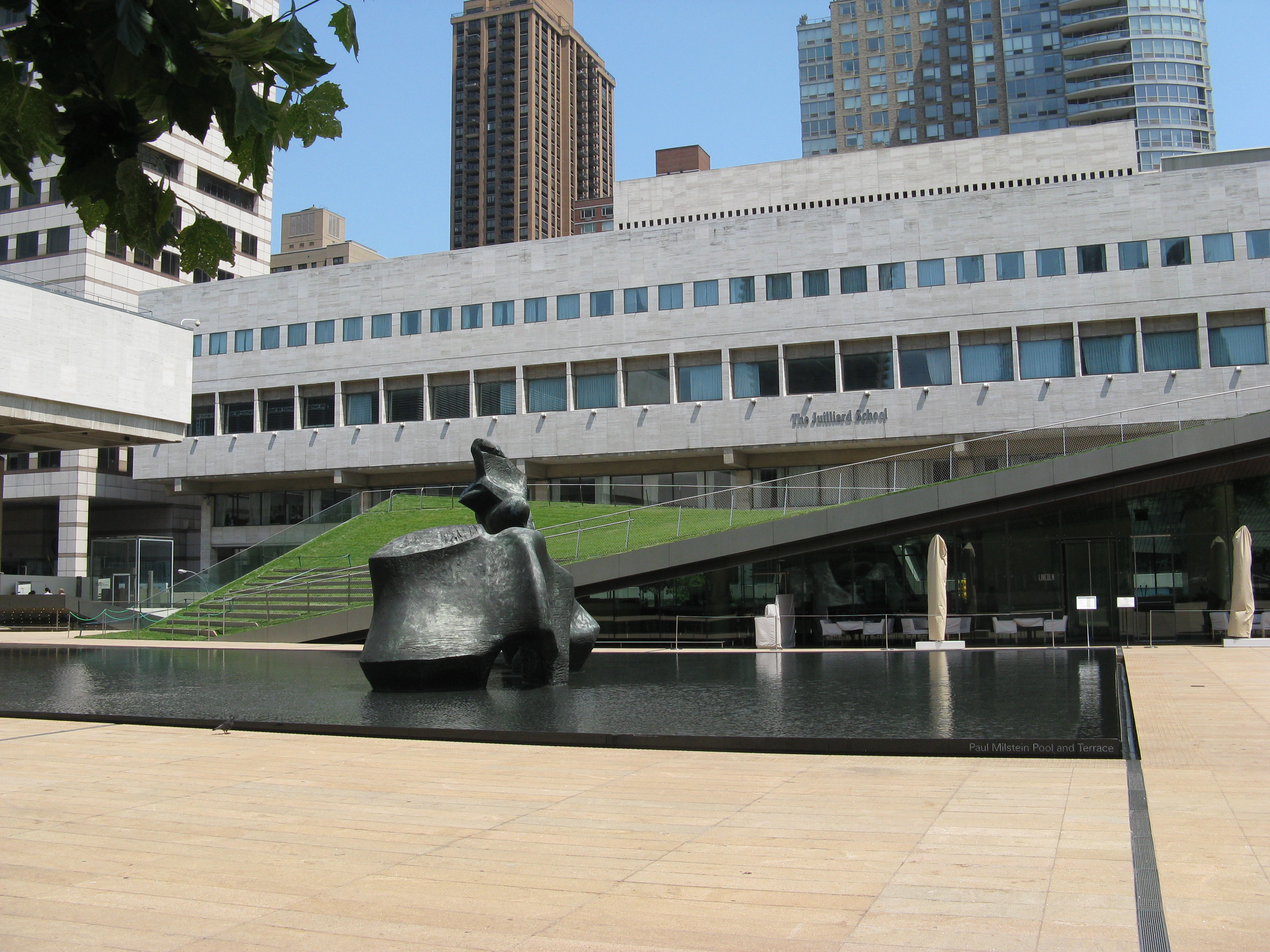
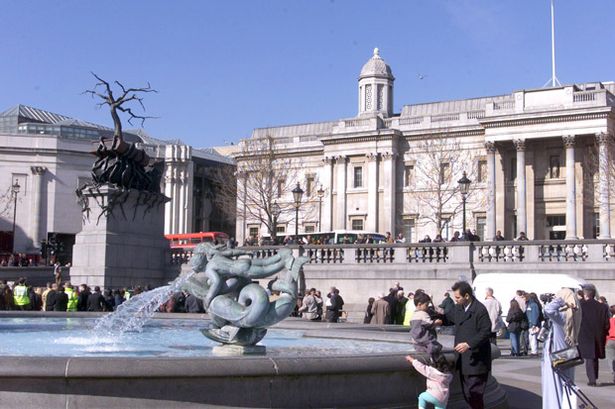
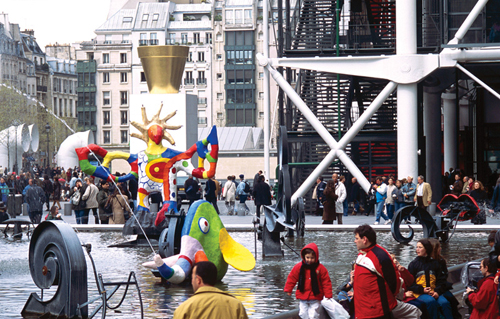
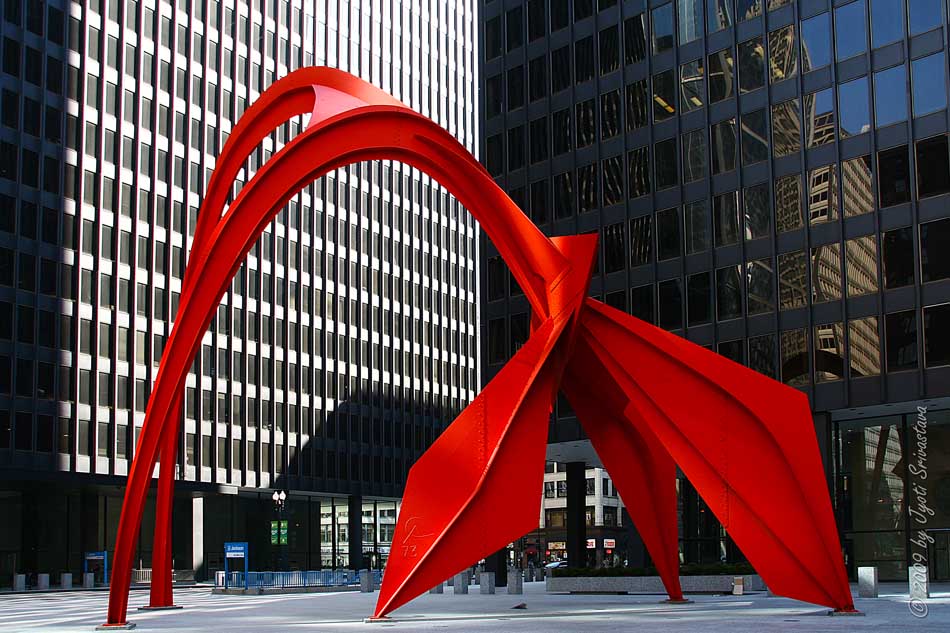
My wife and I were watching TV with one eye the other day when the BBC passed a programme which caught our attention. It was about the Yorkshire Sculpture Park in the north of England. I think a few words of explanation are required for those readers who have never heard of this Park (our situation before watching the BBC programme). It was established back in 1977 in the grounds of a stately home the last of whose aristocratic owners (Viscount Allendale) had sold it to the local council after World War II, no doubt to save his financial skin (I mentioned the financial woes of the UK’s stately homes in an earlier posting of mine). The idea is a simple one: rather than displaying modern sculpture in open spaces in cities like plazas
sculpture in cities-1

sculpture in cities-2

or squares

sculpture in cities-3

sculpture in cities-4

or using the atriums of posh buildings

sculpture in cities-6

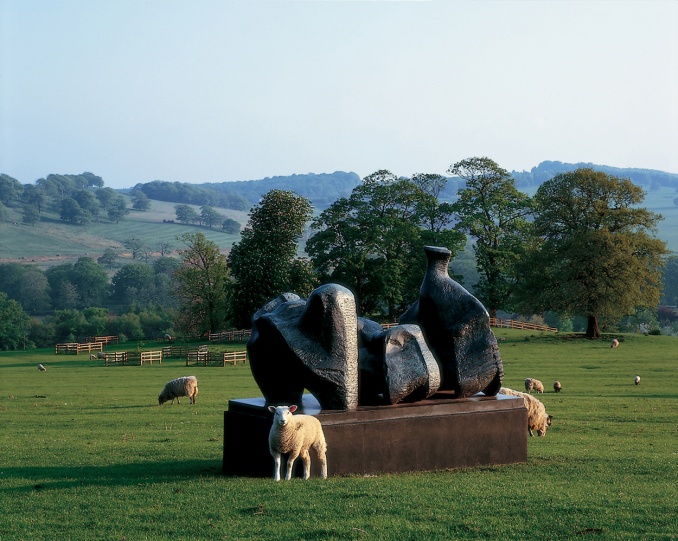
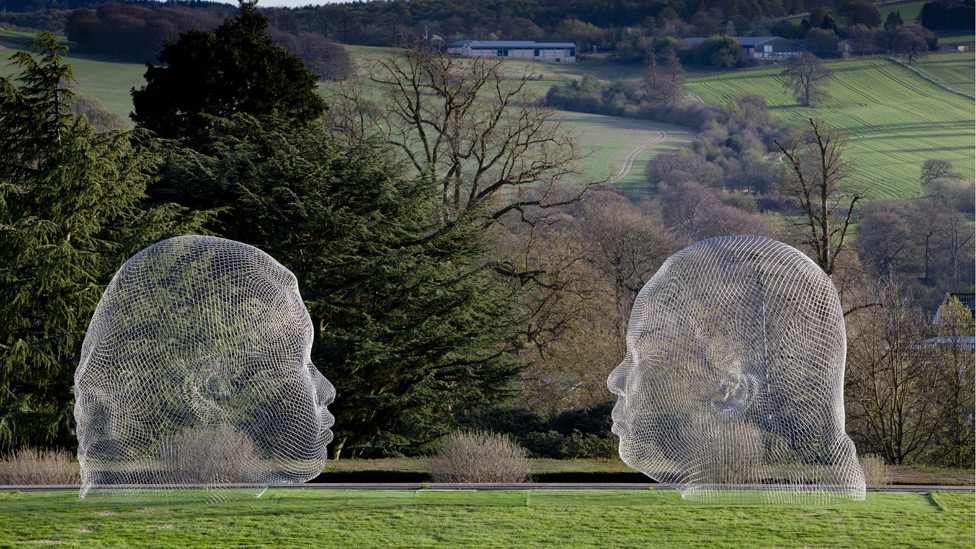
use the sweeping, open vistas of the countryside to display them. Here are some of the pieces at the Yorkshire Sculpture Park:
YSP-4
DSCN2327.JPG
YSP-6

YSP-9

YSP-10

YSP-14

YSP-1
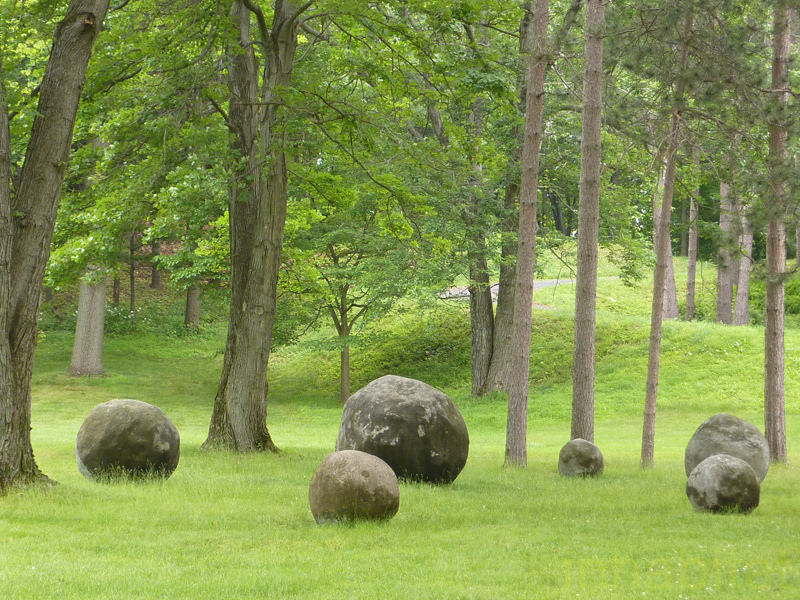
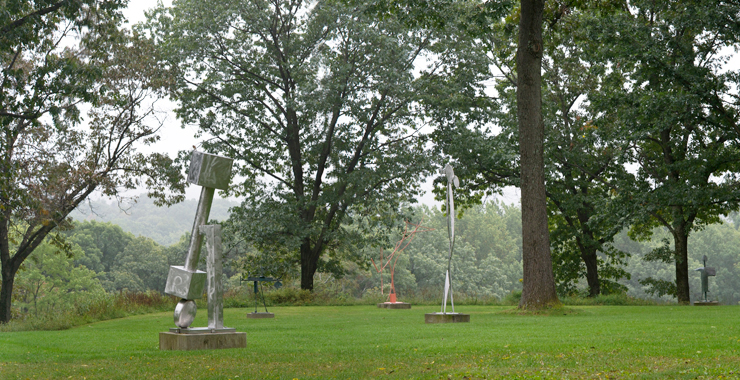
My wife and I agree on many things, and one of them is that modern sculptures are enhanced by being seen in a natural, organic setting rather than in the built urban environment. Personally, I think it has to do with the contrast between the dead surfaces of the sculptures and the much softer, living surfaces of the surrounding landscapes. It sounds a bit fancy, but the dead sculpture comes alive when in contact with organic life.

This was brought home to us very strongly when, 25 years ago, and on the advice of a friend who worked at the Metropolitan Museum of Art, we visited the Storm King Art Centre, which is an hour’s drive north of New York City, near the Hudson River. Here again, a few words of introduction. It’s really the classic American story (as much as the history of the Yorkshire Sculpture Park is the classic British story of modern times – decay of the old order and birth of a new one). A certain Mr. Ogden, after a successful career in the family business, purchased the land and property of Storm King and started collecting. He initially bought small sculptures which he exhibited around the house. At some point, he expanded out into the surrounding landscape, installing much bigger pieces. That’s it, in a nutshell. But the result – for us at least – was epiphanic.

In wonder we wandered along the rides mown through the grass, walking from one towering sculpture to another

SK-1

SK-4

from hilltops, we discovered long views across the surrounding landscape, where sculpture and land merged into one

SK-2

we walked through glades in the woods, each with their own sculpture

SK-8

SK-9

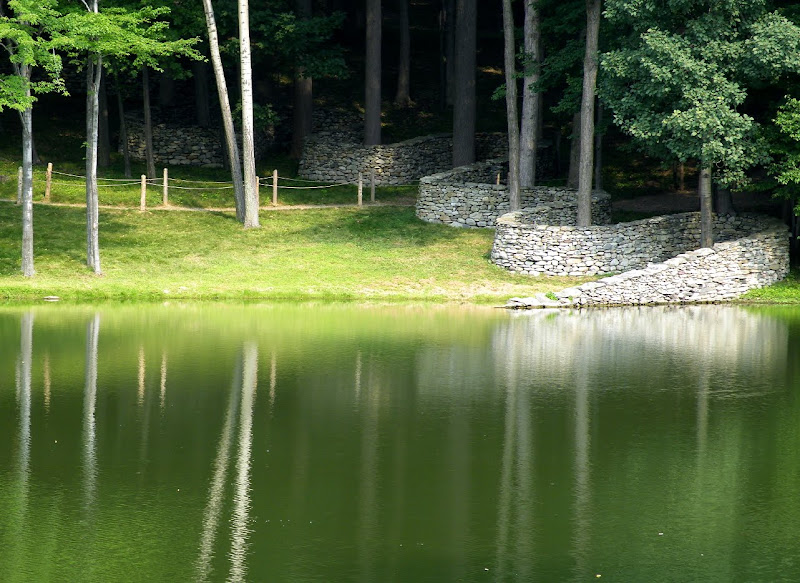
we entered the woods to find smaller, more intimate sculptures scattered under the trees

SK-7

SK-10

we also found a sculpture-wall meandering through them

SK-5

(better seen in this photo taken during the winter)

SK-14

we turned our steps back to the house, discovering other smaller sculptures set down in more formal gardens around the house.

SONY DSC

SK-11

And finally, we entered the house and fell upon a sculpture which in all these years I have never forgotten: a group of robotic-looking statues with small motors making their jaws work up and down and with a closed-loop recording of voices quietly droning “chatter, chatter, chatter, chatter, chatter, chatter …” on and on, endlessly. Wonderful.  Every time I find myself in one of those meetings where people blather on and on and on I recall this statue group with intense clarity.

So taken were we with Storm King that the very first time we went back to New York after an absence of fifteen years we made sure to find time to go up there. It cast the same spell over us – although sadly the chattering statues had vanished (smashed to smithereens, no doubt, by an employee crazed by their endless droning).

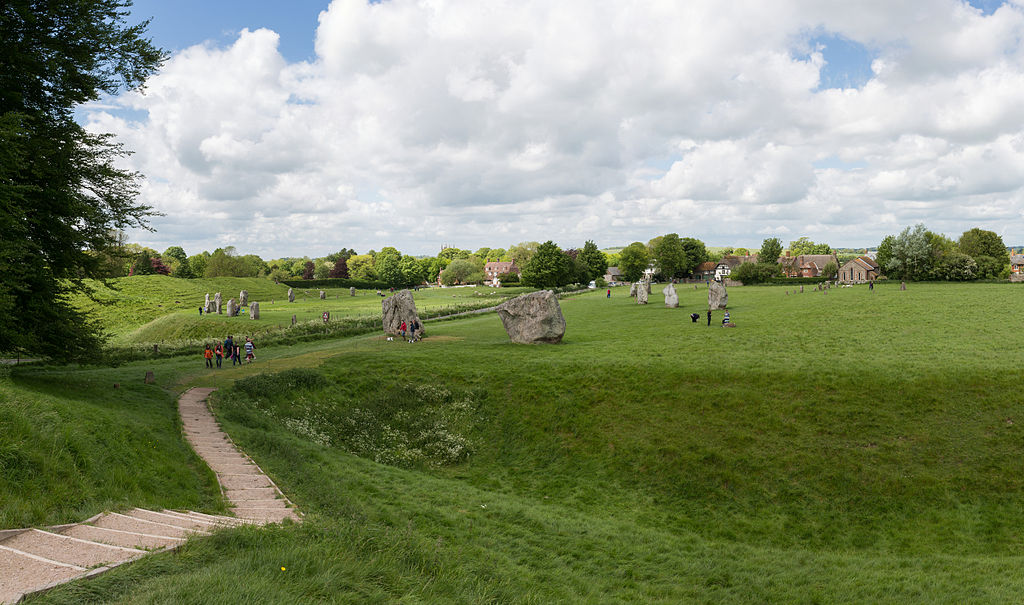
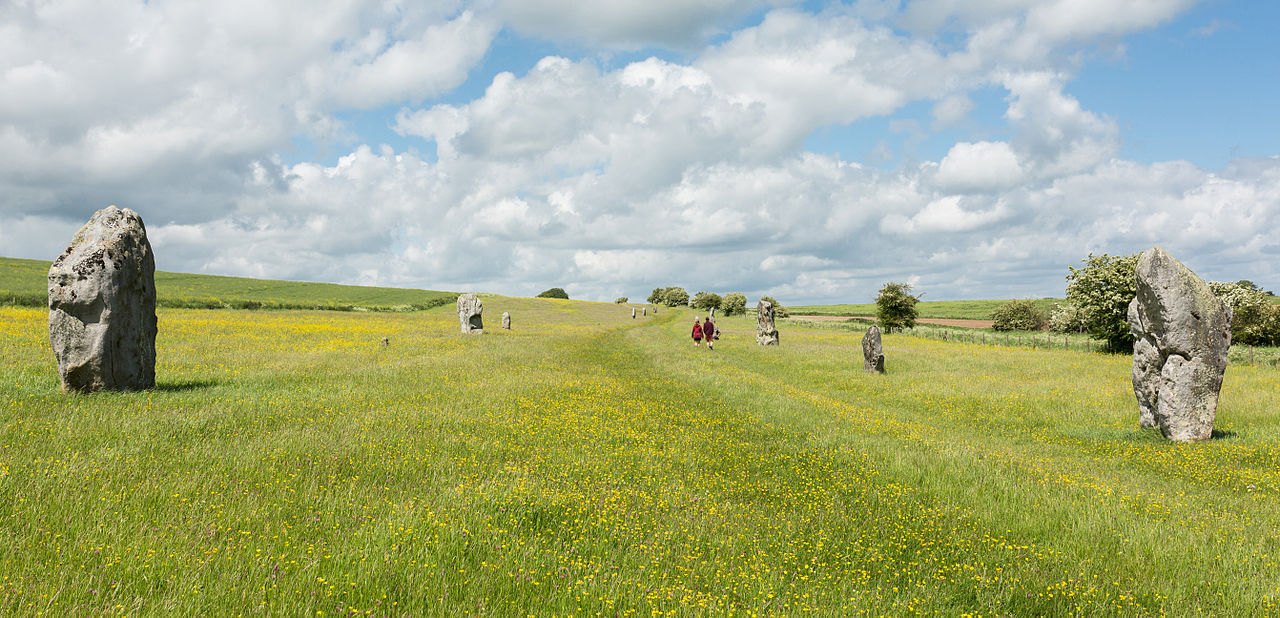
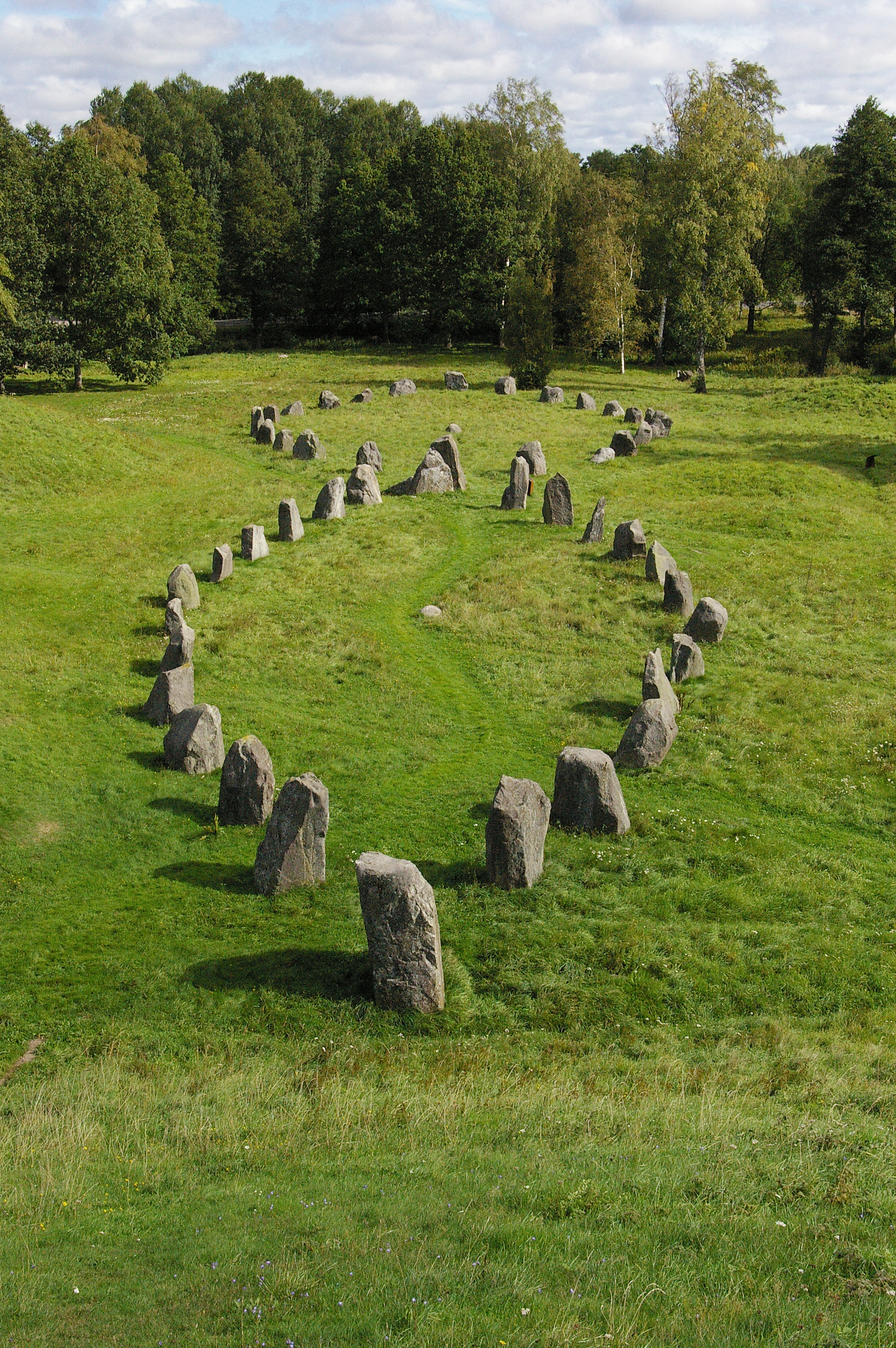
As I contemplate these photos, it occurs to me that many of the megalithic structures scattered across the face of Europe could pass as modern sculptures set down in the surrounding landscape. Stonehenge, the most iconic of all megalithic structures, is probably too much like a ruin to make this comparison
Stonhenge-2
but Avebury, like Stonehenge located in Wiltshire, has something of the abstraction of sculpture parks

Avebury-2

Avebury-1

and how about Carnac, in Brittany?
carnac-1

carnac-2
or Badelunda in Sweden?

Badelunda Västmanland

or the Ring of Brodgar, in the Orkney islands?

Ring of Brodgar

And even further afield, although not from the Mesolithic period, we have this intimate collection of upright stones in Toraja, Indonesia

OLYMPUS DIGITAL CAMERA

Of course, the people who built these structures were not building sculpture parks, but I have to think that they too were stirred by the same feeling of connectedness between their standing stones and nature as we have between sculpture and nature. They attributed this feeling to a divine grace in the place, we simply enjoy the feeling.

____________________________

Sculpture in cities-1: http://percivalhenry.files.wordpress.com/2014/03/52af841ee4b0b09acc808041-lost3f3f3f-1387234862071-flamingo.jpg [in http://percivalhenry.wordpress.com/2014/03/20/art-history-martch-madness-first-round-new-york-regional/comment-page-1/%5D
Sculptures in cities-2: http://upload.wikimedia.org/wikipedia/commons/2/26/Juilliard_School-Manhattan-New_york.jpg [in http://commons.wikimedia.org/wiki/File:Juilliard_School-Manhattan-New_york.jpg%5D
Sculpture in cities-3: http://i3.mirror.co.uk/incoming/article740970.ece/alternates/s615/A%20new%20sculpture%20on%20the%20fourth%20plinth%20in%20Trafalgar%20Square,%20central%20London%20The%20work%20by%20sculptor%20Bill%20Woodrow,%20entitled%20%27Regardless%20of%20History%27,%20%20shows%20a%20tree%20resting%20on%20a%20head%20and%20a%20book [in http://www.mirror.co.uk/news/uk-news/love-it-or-hate-it-bronze-rocking-741129%5D
Sculpture in cities-4: http://womenworld.org/image/082012/Paris%20-%20Beaubourg%20and%20Les%20Halles_1.jpg [in http://womenworld.org/travel/paris—around-town—beaubourg-and-les-halles-%28part-1%29.aspx%5D
Sculpture in cities-5: http://www-news.uchicago.edu/releases/06/images/cis/sculpture.jpg [in http://www-news.uchicago.edu/releases/06/060426.cis-photos.shtml%5D
YSP-1: http://www.yorkshireattractions.org/images/cms/attractions_21_3_large.jpg [in http://www.yorkshireattractions.org/visitor-attractions/21/yorkshire-sculpture-park%5D
YSP-2: http://upload.wikimedia.org/wikipedia/commons/0/0a/Yorkshire_Sculpture_Park_Caro_Promenade.jpg [in http://commons.wikimedia.org/wiki/File:Yorkshire_Sculpture_Park_Caro_Promenade.jpg%5D
YSP-3: http://antonyjwaller.files.wordpress.com/2012/06/nik_5931-copy.jpg [in http://antonyjwaller.wordpress.com/travel-articles/yorkshire-and-northern-england/the-yorkshire-sculpture-park/%5D
YSP-4: http://www.sculpture-info.com/upload/1008/image/Yorkshiresculpturepark.jpg [in http://www.sculpture-info.com/news-626/yorkshire-sculpture-park.html%5D
YSP-5: http://2.bp.blogspot.com/-6GgifPCMTc8/UgZKx2yojhI/AAAAAAAACDg/WYBKhXaNWp8/s1600/2+Buddha+and+Rob.JPG [in http://expertslife.blogspot.com/2013/08/picture-of-week-10-august-2013.html%5D
YSP-6: http://www.thomasharveydesign.co.uk/wp-content/uploads/2011/05/YSP6.jpg [in http://www.thomasharveydesign.co.uk/2011/05/09/yorkshire-sculpture-park-wakefield/%5D
YSP-7: http://news.bbcimg.co.uk/media/images/52104000/jpg/_52104252_7cbb7745-313f-43e9-8974-d144adf6c05f.jpg [in http://www.bbc.co.uk/news/entertainment-arts-13034363%5D
SK-1: http://brooklynimbecile.files.wordpress.com/2011/10/img_4256.jpg [in http://brooklynimbecile.com/2011/11/05/weekend-spread-storm-king-art-center/%5D
SK-2: http://3.bp.blogspot.com/-OWDq8YQCBog/UA6M17c9N6I/AAAAAAAAYI4/OqODfTIunKU/s1600/Mountainville_NY_A_Calder_Storm_King_AC_photo_S_Gruber_June_2012_+%2888%29.JPG [in http://publicartandmemory.blogspot.com/2012_07_01_archive.html%5D
SK-3: http://www.greenstrides.com/images-wp/Storm-King.jpg [in http://www.greenstrides.com/2013/07/10/sculpture-parks-can-inspire-your-own-garden-design/%5D
SK-4: http://4.bp.blogspot.com/-4sgNF1ufdU4/U4T1ul7DPRI/AAAAAAAAP8w/JzGsmMOY6No/s1600/Newman.jpg [in http://nycgarden.blogspot.com/2014/06/storm-king.html%5D

SK-5: http://i.vimeocdn.com/video/332835418_1280.jpg [in http://vimeo.com/48015694%5D
SK-6: http://inhabitat.com/nyc/wp-content/blogs.dir/2/files/2011/07/storm-king-boulders.jpg [in http://inhabitat.com/nyc/storm-king-art-center-a-summer-retreat-for-the-artsy-nature-loving-new-yorker/storm-king-boulders/%5D
SK-7: http://faeriemooncreations.blogspot.com/2010_11_01_archive.html [in http://faeriemooncreations.blogspot.com/2010_11_01_archive.html%5D

SK-8: http://4.bp.blogspot.com/_sVe9wO8fJls/S4zMOOgpUZI/AAAAAAAAEDo/IaUESi6KOGQ/s800/goldsw3.jpg [in http://lettuce-eating.blogspot.com/2010_03_01_archive.html%5D
SK-9: http://stormking.weebly.com/uploads/2/3/8/8/23889452/6893557.jpg [in http://stormking.weebly.com/permanent-collection.html%5D
SK-10: http://www.stormking.org/wp-content/uploads/2013/07/smith-lawn1.jpg [in http://www.stormking.org/collection-conversation/%5D
SK-11: http://eof737.files.wordpress.com/2011/09/img_2564.jpg?w=800 [in http://mirthandmotivation.com/2011/09/04/happiness-installation-art-at-storm-king/img_2564/%5D
Stonehenge: http://st-listas.20minutos.es/images/2013-06/362538/4049632_640px.jpg?1370571567 [in http://listas.20minutos.es/lista/maravillas-del-mundo-362538/%5D
Avebury-1: http://en.wikipedia.org/wiki/Avebury#mediaviewer/File:Avebury_Panorama,_Wiltshire,_UK_-_Diliff.jpg [in http://en.wikipedia.org/wiki/Avebury%5D
Avebury-2: http://en.wikipedia.org/wiki/Avebury#mediaviewer/File:Avebury,_West_Kennet_Avenue,_Wiltshire,_UK_-_Diliff.jpg [in http://en.wikipedia.org/wiki/Avebury%5D
Carnac-1: http://weadorefrance.com/es/images/w.800/h.600/c.1/d.guide_photos/sd./i.carnac-brittany-standing-stones-20130325.jpg [in http://weadorefrance.com/es/brittany-bretagne/g.31%5D
Carnac-2: http://media.tinmoi.vn//2012/02/27/4_28_1330310626_92_20120224114942_l6.jpg [in http://www.tktyt1haiduong.edu.vn/?p=888%5D
Badelunda, Sweden: http://upload.wikimedia.org/wikipedia/commons/d/d3/Badelunda_V%C3%A4stmanland_Sweden.jpg [in http://some-landscapes.blogspot.com/2011_10_01_archive.html%5D
Ring of Brodgar, Orkney: http://en.wikipedia.org/wiki/Ring_of_Brodgar#mediaviewer/File:RingofBrodgar.jpg [in http://en.wikipedia.org/wiki/Ring_of_Brodgar%5D
Toraja, Indonesia: http://tribudragon.files.wordpress.com/2013/03/2-tt-6.jpg [in http://tribudragon.wordpress.com/category/indonesia/%5D

CAPERS

Beijing, 7 June 2014

It never ceases to amaze me that there are certain ingredients which one adds to recipes in small quantities but which make a huge difference to the final taste. Spices are the obvious example – although I often wish that the hot spices had never existed – but there are others. Parsley, for instance, or coriander, or anise. Or capers.

Capers are a particular favourite of mine ever since a business trip I made many years ago to Malta. I was there to do an environmental audit of a factory. After a long day of inspecting the wastewater treatment plant, the waste segregation area, the toxic chemicals storage area, and I don’t know what else, my colleagues and I were finally free for dinner. We left the hotel and wandered around, but it was a dead time of the year and there wasn’t much available. We finally came across a modest restaurant, which proclaimed itself to be a fish restaurant. Why not? we said, after all, we were in an island, presumably the fish would be good. And it was, it was! We all ordered Orata al cartoccio, where a bream is cooked – steamed in its own juices, really – in a closed aluminium foil package together with cherry tomatoes, capers, and olives. It’s really a very simple recipe. Having washed and cleaned the bream, you lay it on a big piece of aluminium foil, you place a little rosemary inside the fish, drizzle it with olive oil, place the sliced cherry tomatoes, rinsed capers, and olives around the bream, wet the whole with a little white wine, wrap up the foil and close it well (so that none of the juices escape), and cook it in the oven at 200°C for about 45 minutes. Voilà!

orata pomodorini capperi olive

Simple, but absolutely delicious. The capers in particular impart a taste to the fish’s flesh which even to this day, after all these years, I can summon up at will for my private delectation.

The marvelous effect of the capers was actually quite a surprise to me. I had first come across capers as a young boy, at my English grandmother’s house. At some earlier moment, my elder brother had evinced a love of capers, so every time he came to stay with her she bought a small jar of them. This time, I was in tow so I got to try some. Salty! So salty! How could anyone like these tiny balls of salt? I made sure to steer clear of them after that, pushing them carefully aside if I came across them in a salade Niçoise, for instance. Until that fateful encounter in a modest fish restaurant in Malta. Such is life …

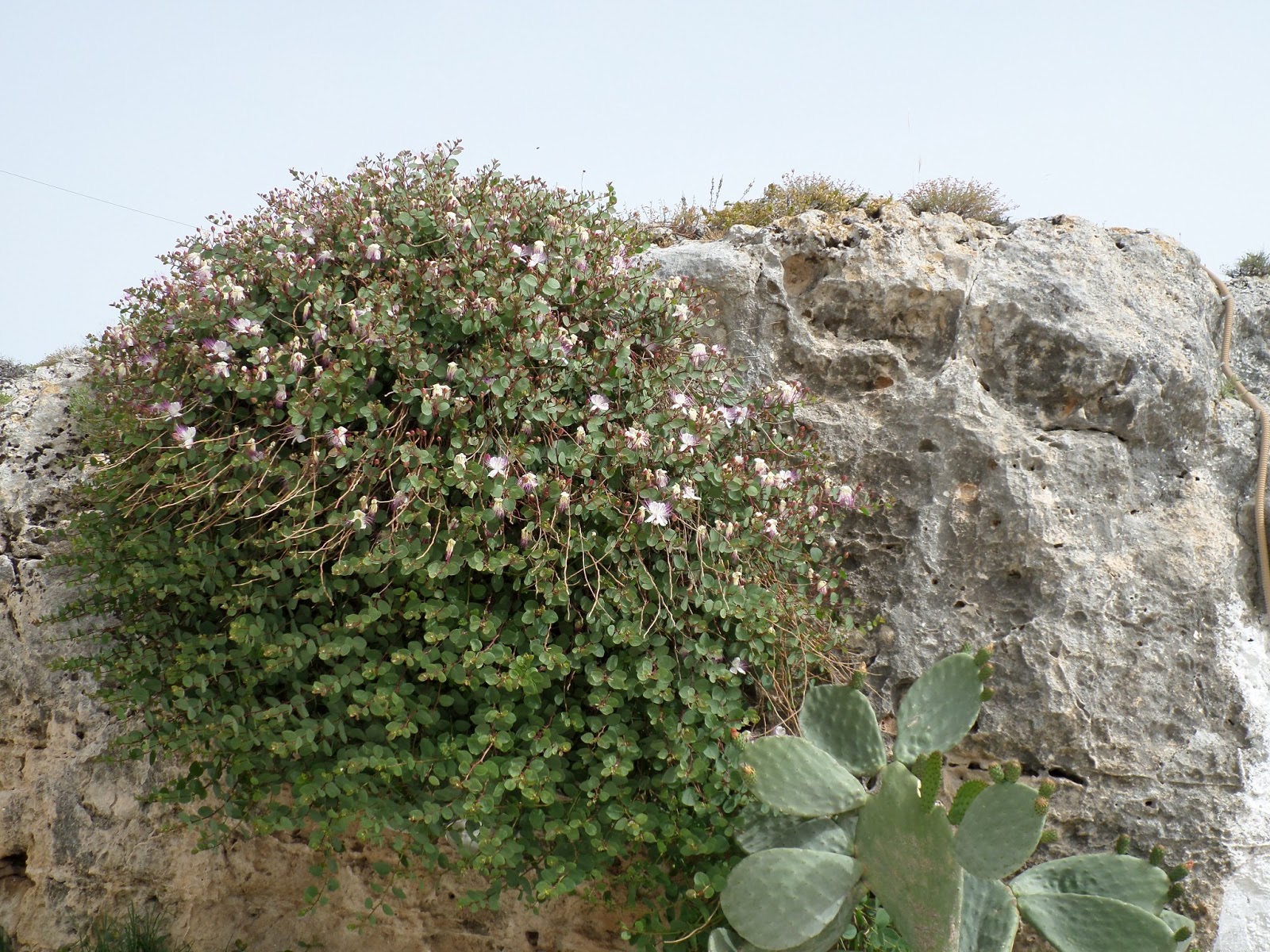
After that gastronomic epiphany in Malta, I feel that I owe it to the caper to write its hagiography, which like all good hagiographies should start from its birth. The caper comes from a bush, the caper bush to be precise, capparis spinosa. The bush is not much to write home about. Here is an example from the island of Salina, one of the Eolian Islands off the north-west coast of Sicily

caper bush-1

and here’s another from near Brindisi in southern Italy

caper bush-2

Both pictures admirably depict the poor, rocky soils and harsh environments that the bush grows well in. They also tell us that you find the bush around the Mediterranean. But that’s not only place you find C. spinosa; the bush has quite a wide range, down through eastern Africa, across central, southern, and southeastern Asia, all the way out to the Pacific Islands and Australia. But as far as I know, and I’m very willing to be corrected, the caper is not used in the local cuisine in any of these areas.

The last picture also tells us that the bush sports flowers. Small, but actually very lovely, with a cluster of long mauve stamens reaching out to the world (this is one of many beautiful photos of the caper flower on the internet; the efforts of my photographic e-friends have turned me quite poetic).

caper flowers-2

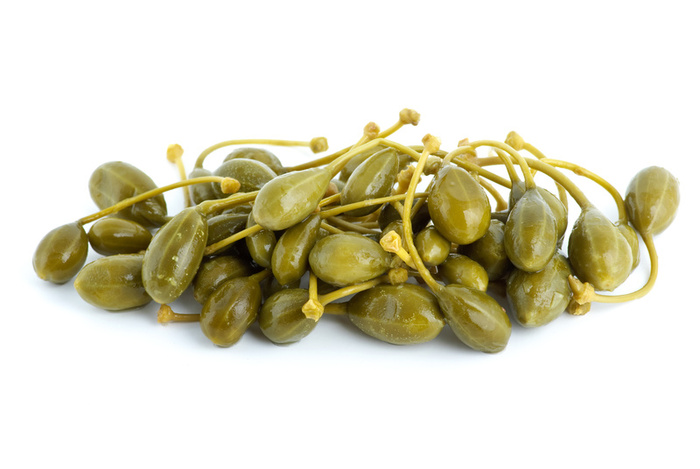
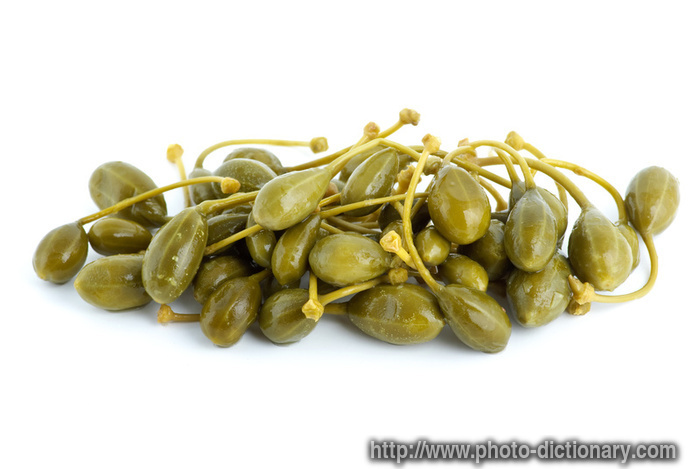
This last picture also modestly introduces us to the hero our story. Because the caper is that green flower bud behind. It gets picked, salted, and pickled for our delight. I think it deserves a picture of its own

caper buds

I have to say, I always marvel at things like this. How did the women in some far-off time think of picking the flower buds of this bush to eat? (I’m sure it was the women; the men were just lazing around the camp fire cracking stupid jokes and farting.) Maybe desperation, to stave off starvation. Or maybe … but I’m getting ahead of myself.

Capers are sold sorted by size. Either because the French got into the game of commercializing capers before anyone else, or because some canny marketer thought French names would sell better, or for some other reason unknown to me, the grades mostly have French names. From smallest to biggest we have: “non-pareil”, incomparable; “surfine”, very delicate (those hideously salty little balls which my grandmother bought for my brother must have been either surfines or non-pareils); “capucine”, which is a little pointed cowl, like the ones worn by Franciscans nuns – looking at the photo below and squinting a little, I suppose you could say that the capers in question look cowl-like; “capote”, which is a rather bigger cowl with a definite point (it is also French slang for a condom for reasons which I’m sure the readers can divine after a little bit of thought); “fine”, delicate (like the oysters). And at the very end of the grades we have “grusas”, which is not a French word. My guess is that it’s Provençal and has a meaning similar to the Spanish “gruesos”, fatty. Of course, the French were not going to use their delicate language for such a coarse member of the caper family. As one could guess from the grading nomenclature, the smallest sizes are considered to be the most desirable; I’m sure it is no coincidence that the smallest sizes come from southern France …

graded capers

Malta brought me my culinary epiphany with the caper. It also introduced me to the caper berry, which I find to be a much more delicious product of the caper bush. My Italian colleague, whom I have had cause to mention in an earlier post as the person who introduced me to durian, was with me on this Maltese environmental audit. Rather than asking the staff of the wastewater treatment plant to see the data on wastewater treatment efficiency he asked them to get him several jars of pickled Maltese caper berries. On the promise of my not revealing this professional faux-pas of his he shared one of the jars with me, which I took home to my wife. We have been hooked ever since.

caper berries-2

As the name suggest, caper berries are the fruit of the caper bush. This photo shows the berry in its natural state.

caper berries-natural state

I understand they are perfectly edible, although I have never seen them sold in a shop. I’ve only eaten the pickled variety. They are much bigger than capers, less salty, more crunchy (because of the seeds they contain) and can be eaten as a snack – and my wife and I have indeed snacked happily and often on them, in front of the TV or other such snack-happy locations.

Coming back to my meditation on how anyone ever came up with the idea of pickling flower buds to eat, I suspect the path was through the berry: step 1 – eat the berries; step 2 – salt the berries to preserve the excedent harvest before they rot; step 3 – hang on, why don’t we try the same thing with the flower buds?

My in-depth research (i.e., Wikipedia) has revealed to me that in Greece and Cyprus they also eat the pickled leaves of the caper bush.

caper leaves

This I have never tried. I read that they are particularly used in salads and fish dishes. A web-site called Good Greek Stuff proclaims that “these tangy cured leaves of the caper plant are less salty than the buds, and lend a citrusy undertone to such foods as Greek country salad, dakos (barley rusks with tomato, olive oil and feta), fish sauces, and cabbage slaws. It gives an astringent, piquant note to herb pestos and pasta dishes. And you’ll be amazed at what it does to the humble spaghetti aglio, olio e peperoncino or how well it works as a garnish to fried squid.”

I have another culinary epiphany awaiting me in some Greek island.
__________________
Orata, pomodorini, capperi, olive: http://www.cucinanonnapapera.it/wp-content/uploads/2011/07/PICT1017.jpg [in http://www.cucinanonnapapera.it/?p=464%5D
Caper bush Salina: http://atasteoftravel.files.wordpress.com/2011/07/20110717-082956.jpg [in http://atasteoftravelblog.com/2011/capers-on-salina/%5D
Caper bush Brindisi: http://2.bp.blogspot.com/-2Nr_U2AWCUs/Uaid3mGYgqI/AAAAAAAAASM/NBQh22nv_Rk/s1600/Caper+Bush+growing+from+Rocks.jpg [in http://lisainitalymay2013.blogspot.com/%5D
Caper flower: http://kojikisans2.files.wordpress.com/2013/01/caper11.jpg?w=1008 [in http://kojikisans2.wordpress.com/%5D
Caper flower buds: http://en.wikipedia.org/wiki/Caper#mediaviewer/File:%E1%83%99%E1%83%90%E1%83%9E%E1%83%90%E1%83%A0%E1%83%98_Capparis_spinosa_Kapernstrauch.JPG [in http://en.wikipedia.org/wiki/Caper%5D
Graded capers: http://www.asofood.com/aso_images/capers.gif [in http://www.asofood.com/capers.html%5D
Caper berries: http://www.photo-dictionary.com/photofiles/list/1401/4818marinated_capers.jpg [in http://www.photo-dictionary.com/phrase/1401/marinated-capers.html%5D
Caper berries-natural state: http://2.bp.blogspot.com/_Okhm7AjHzv8/R1kZdfwxBCI/AAAAAAAAAac/Eu8RWxYi6f4/s320/e-caperberries.jpg [in http://medcookingalaska.blogspot.com/2007/12/recipes-caper-tart-capers-and-eggs.html%5D

Caper leaves: http://eshop-santorini.gr/media/catalog/product/cache/1/image/9df78eab33525d08d6e5fb8d27136e95/k/a/kaparofilla-caper-leaves.jpg [in http://eshop-santorini.gr/index.php/authentic-food-1/more/santorini-wild-capers-1.html%5D

TROUBLES IN THE MEDITERRANEAN

Beijing, 27 May 2014

Ten days ago, this was.

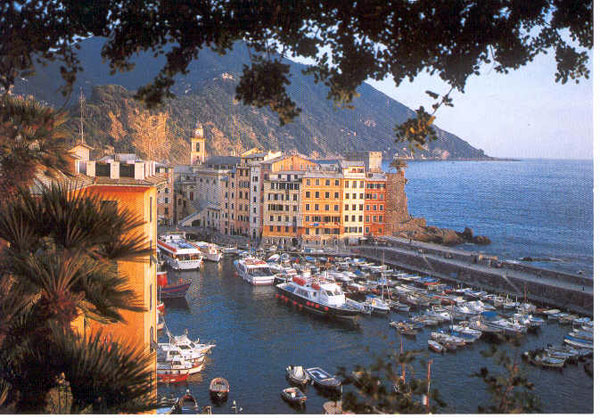
We walked into Camogli from Recco, getting a first glimpse of the little harbour from the road.

Recco-Camogli

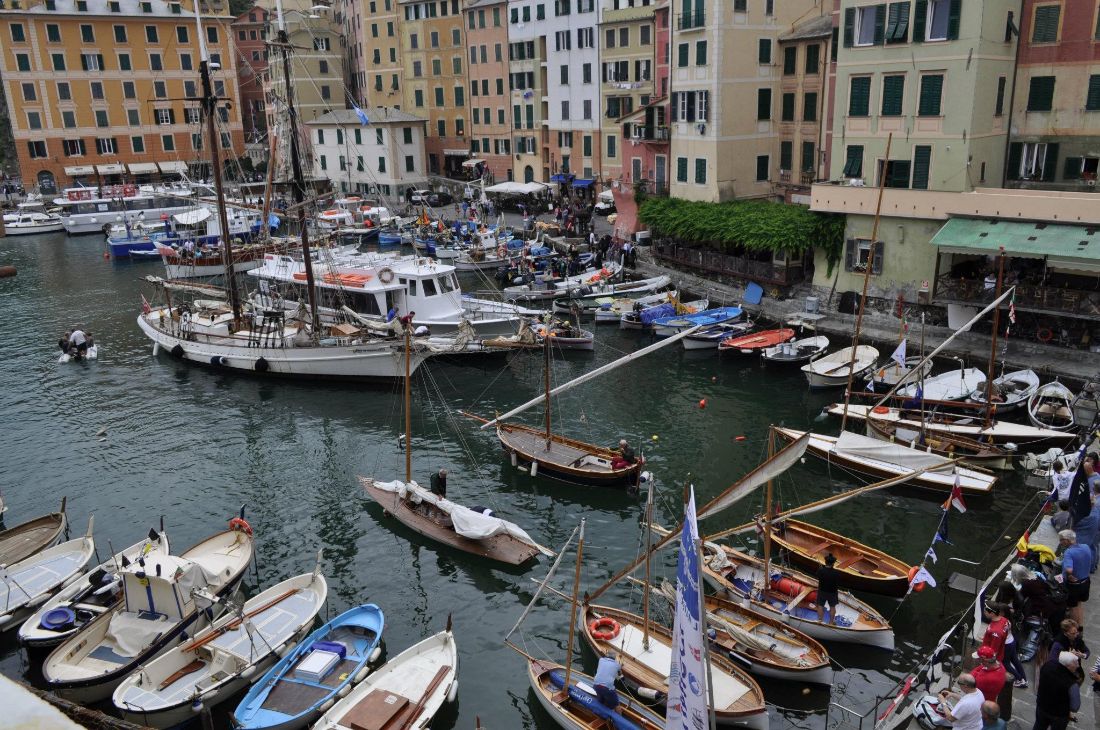
We walked down to the harbour, skirted its edge.

camogli port

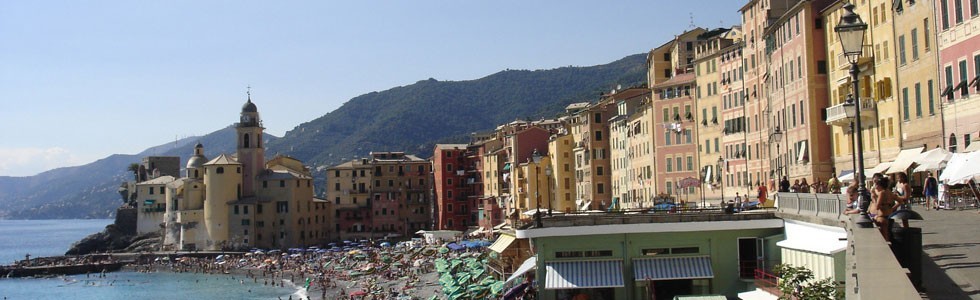
We passed on to the boardwalk on the other side of the church.  Glancing back, this was the sight which greeted us.

camogli-boardwalk

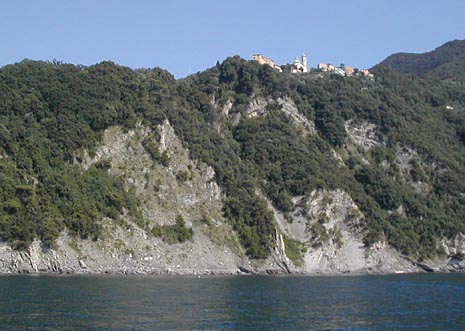
Our goal was San Rocco, sitting high above Camogli on a steep spur of Monte di Portofino.

san rocco from the sea

We started climbing, slowly, stopping often, huffing and puffing, using one of the old mulattiere, mule trails, which criss-cross the hills around here.

Camogli-San Rocco path-2

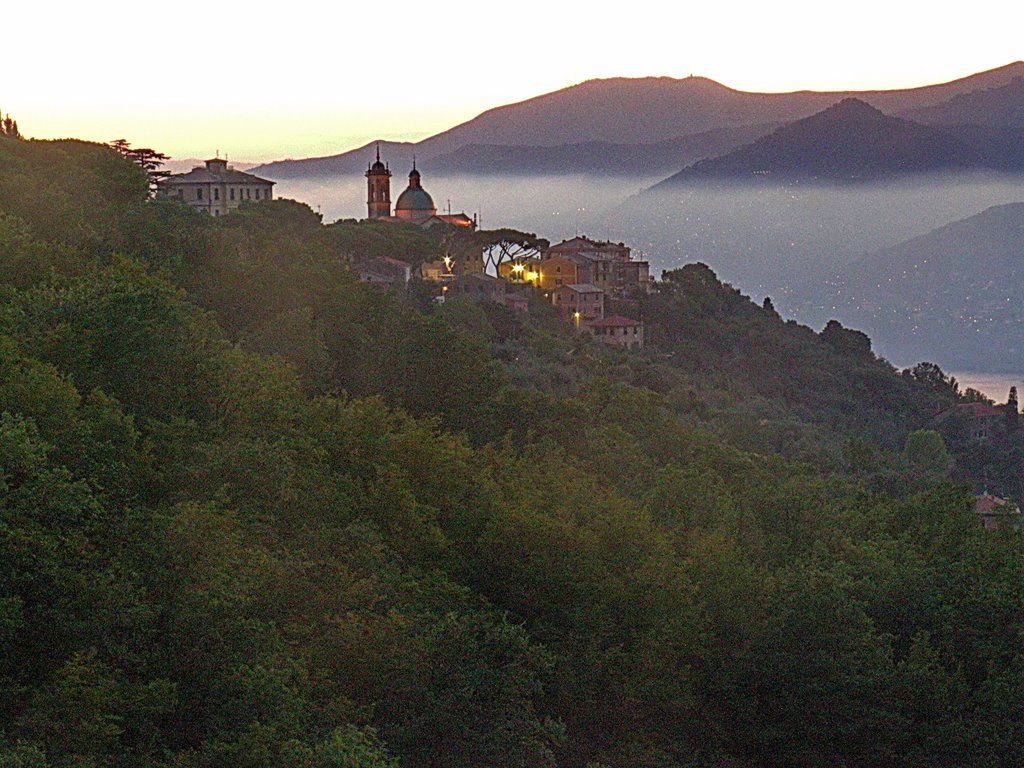
We toiled up past rather decrepit houses and semi-abandoned olive groves until we finally reached San Rocco.

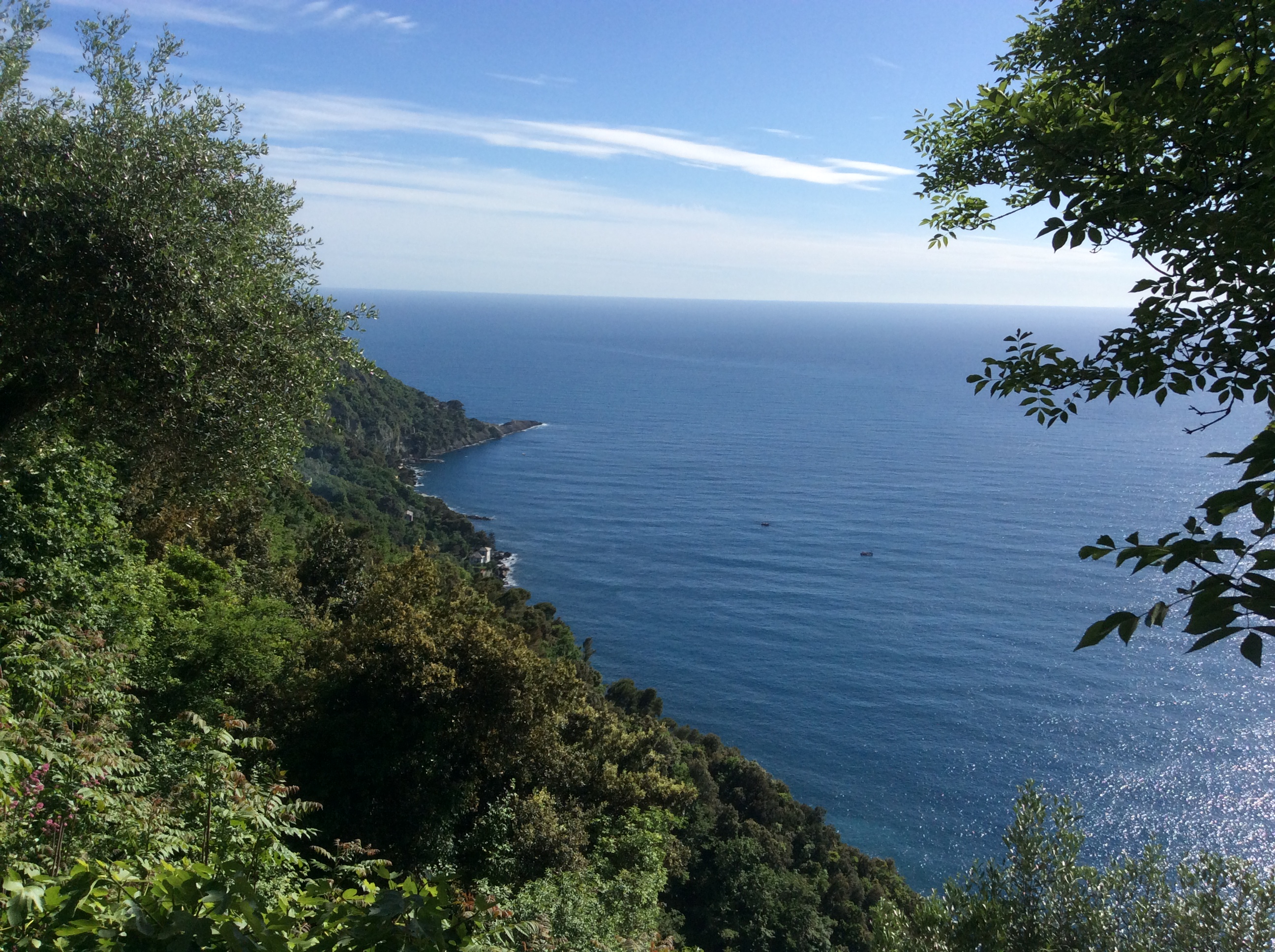
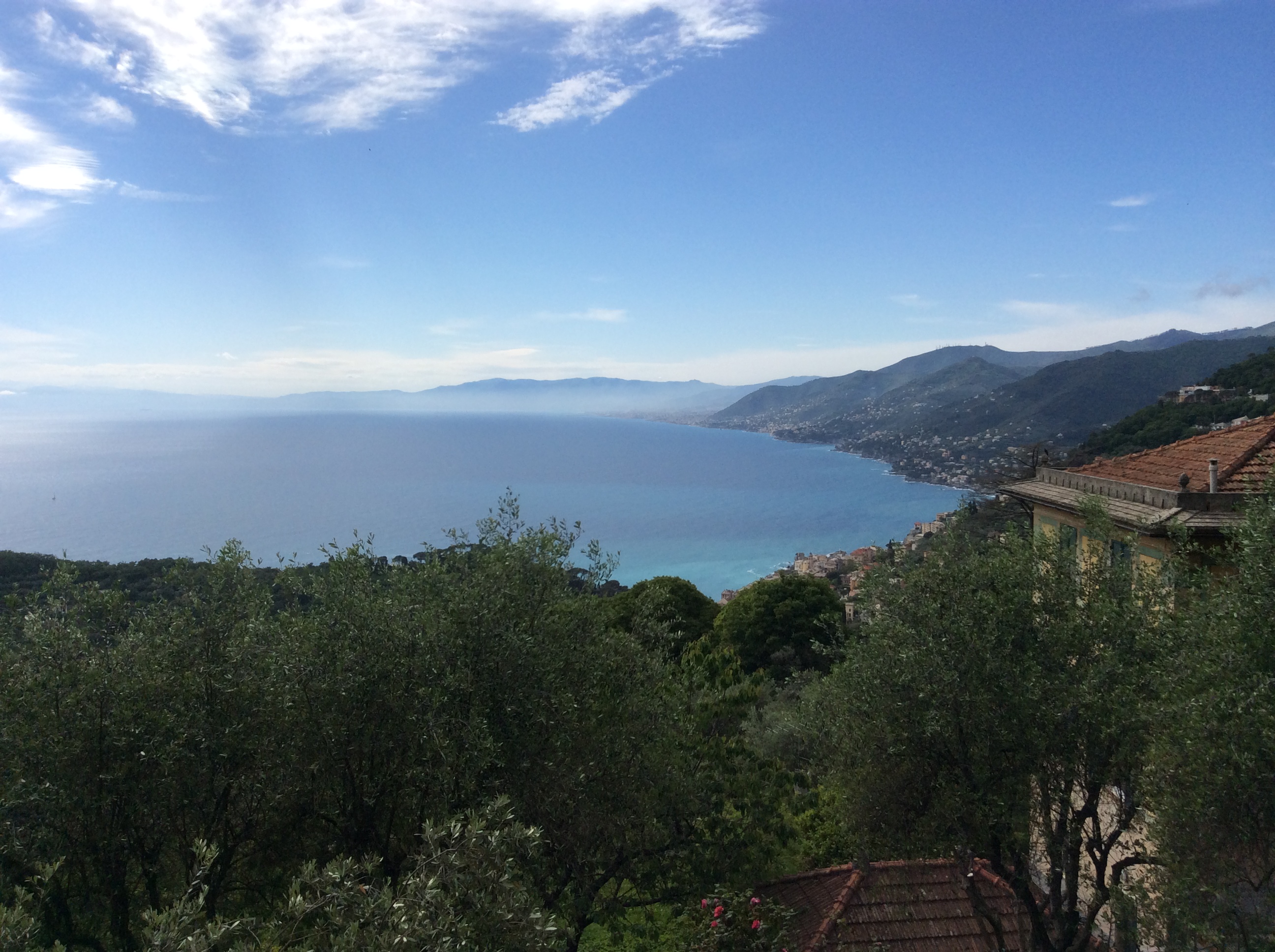
There, from the little piazza in front of the church, we had these gorgeous views, south-east towards Punta Chiappa

monte di portofino-1

and north-west towards Genova.

monte di portofino-2

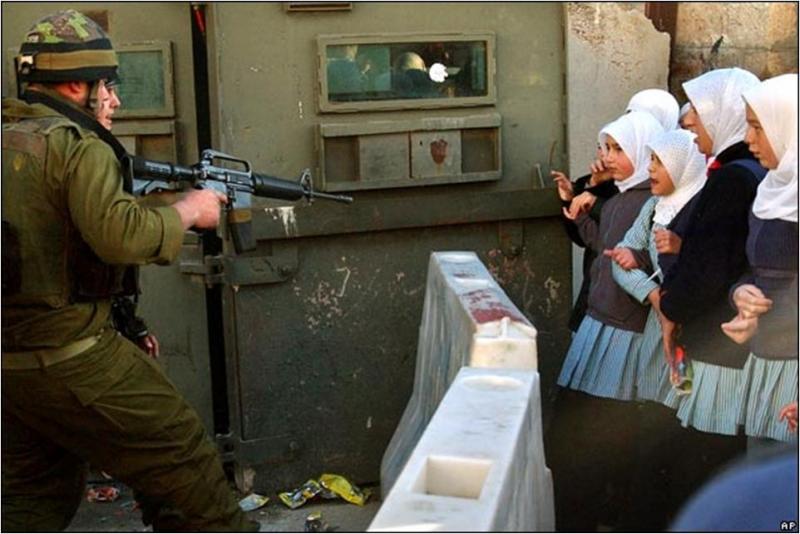
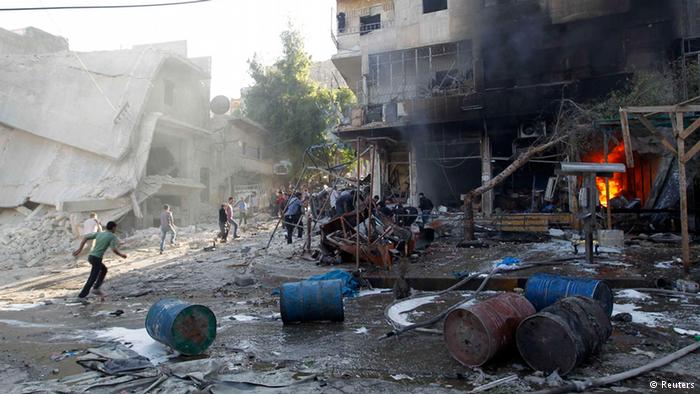
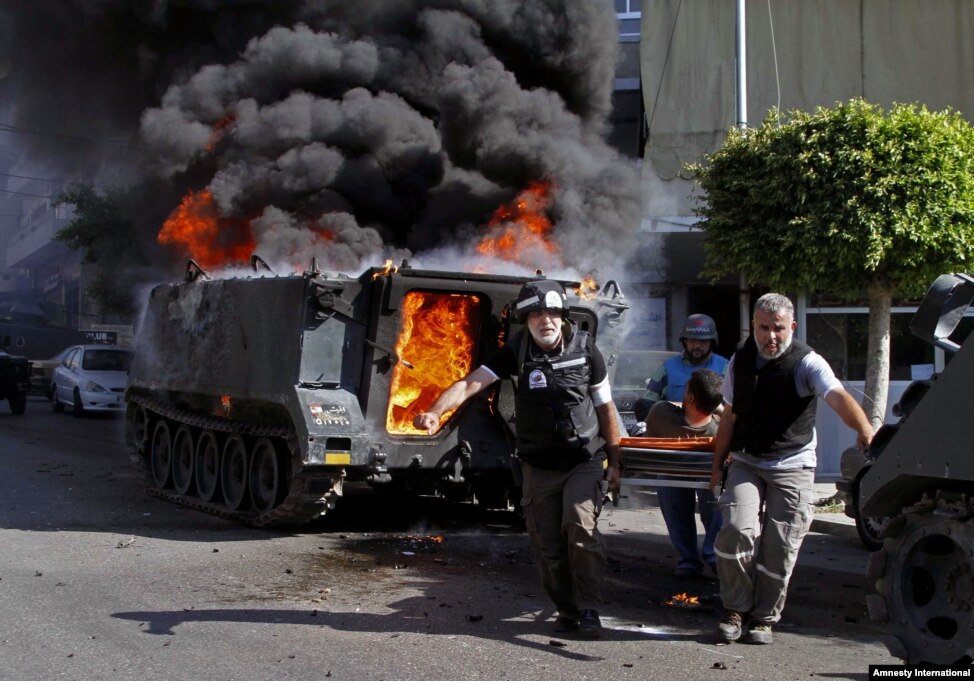
We sank onto the bench and drank in view and sun. And as we sat there, in my mind’s eye I overflew the seaboard of the Mediterranean. Burning, burning, all burning …

Egypt

egypt-2

The West Bank

west bank

Syria

syria

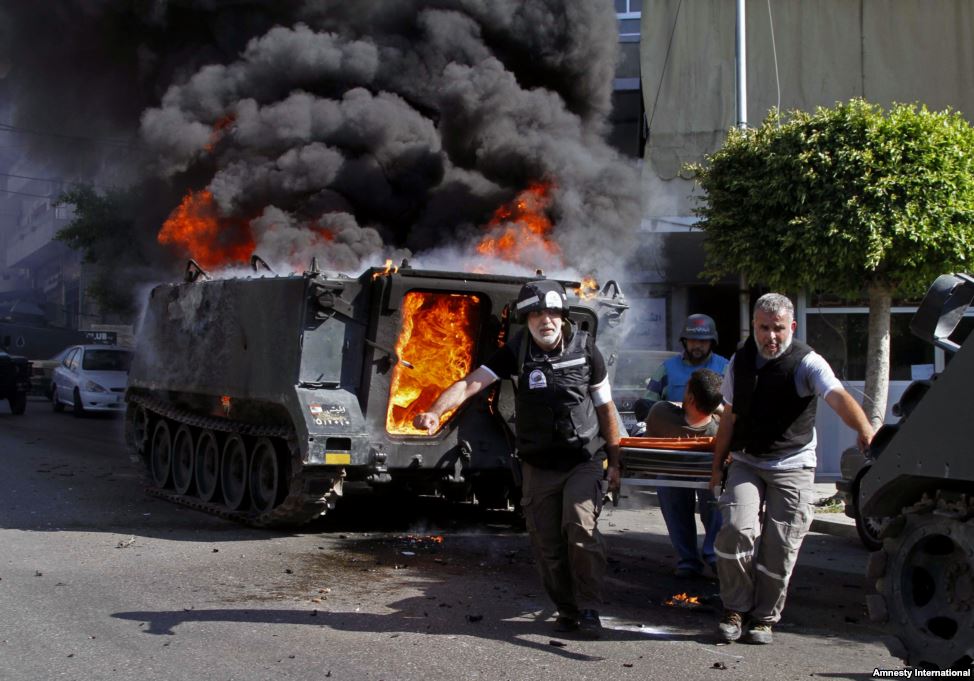
Lebanon

lebanon

Turkey

turkey

Morocco

morocco

Algeria

algeria

Tunisia

Protesters shout slogans during a demonstration to call for the departure of the Islamist-led ruling coalition in Avenue Habib-Bourguiba in central Tunis

and finally Libya

libya

libya-2

from where, amidst all this rage and pain and despair, poor souls are struggling against all odds to cross the Mediterranean and sneak into Europe

pantelleria

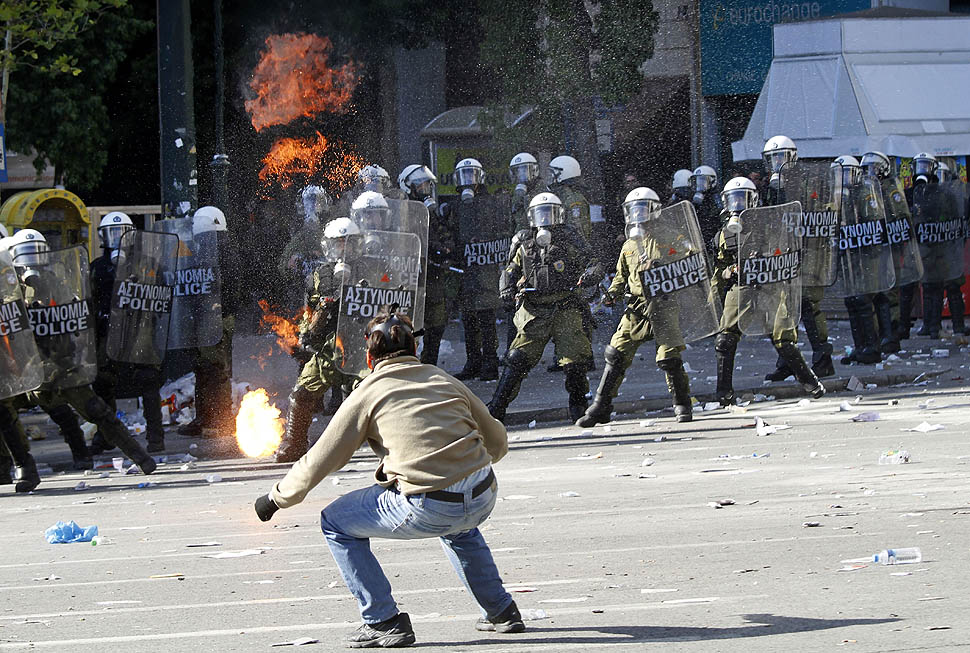
a Europe which is itself sinking under its own weight of troubles: Greece of course

Greece Financial Crisis

but also Italy itself

italy

as well as France

France Strike

and Spain

spain

I closed my mind’s eye. Tomorrow, tomorrow, I said to myself, my wife and I would worry about the state of the universe tomorrow. Today, sitting on the bench and enjoying sun and sea, we just let the world go hang.

san rocco-1

____________________________

Recco-Camogli: http://www.mareblucamogli.com/images/Camogli_porto_oggi.jpg?129 [in http://www.mareblucamogli.com/page_31.html%5D
Camogli port: http://blog.marinayachting.it/media/458191_246746435438893_111283799_o.jpg [in http://blog.marinayachting.it/ai1ec_event/13-trofeo-challenge-nicola-dodero/?instance_id=%5D
Camogli-boardwalk: http://www.portofinotrek.com/trek/17-category/da-camogli-san-rocco.jpg [in http://www.portofinotrek.com/trek/17-da-camogli-san-rocco%5D
San Rocco from the sea: http://www.villagoduria.it/media/img/dintorni/s-rocco%20dal%20mare.jpg [in http://www.villagoduria.it/i_dintorni.php?lang=it%5D
Camogli-San Rocco path: http://www.alpioccidentali.it/escursioni/images-esc/Camogli-SanFruttuoso_glicine.JPG [in http://www.alpioccidentali.it/escursioni/Camogli-SanFruttuoso.htm%5D
Camogli San Rocco path-2: http://www.portofinotrek.com/trek/10-246-thickbox/da-camogli-a-san-rocco.jpg [in http://www.portofinotrek.com/trek/10-da-camogli-a-san-rocco.html%5D
San Rocco-1: http://static.panoramio.com/photos/large/3427674.jpg [in http://www.panoramio.com/photo/3427674%5D
Egypt: http://www.cairoportal.com/media/k2/items/cache/296cd9de158e249f3870555c2eeb013a_XL.jpg?t=-62169984000 [in http://www.cairoportal.com/news/9739#.U4NTHXYUZ40%5D
West Bank: http://stat.ks.kidsklik.com/statics/files/2011/07/1309663247638250606.jpg [in http://elmustakeem.blogspot.com/2011/07/sekolah-anak-anak-palestina.html%5D
Syria: http://www.dw.de/image/0,,17607086_303,00.jpg [in http://www.dw.de/syrias-war-economies-add-fuel-to-the-conflict/a-17609218%5D
Lebanon: http://gdb.voanews.com/B5FAA55E-7326-4D3F-B6F4-97DD2C6863FA_w974_n_s.jpg [in http://www.zeriamerikes.com/media/photogallery/june-23-2013-day-in-photos/1687666.html%5D
Turkey: http://82.222.152.134/imgsdisk/2014/05/22/220520141648544381677.jpg [in https://twitter.com/gokmen%5D
Morocco: http://i.cdn.turner.com/cnn/2011/WORLD/africa/02/21/morocco.protests/t1larg.morocco.feb20.gi.afp.jpg [in http://www.cnn.com/2011/WORLD/africa/02/21/morocco.protests/%5D
Algeria: http://l1.yimg.com/bt/api/res/1.2/Z.PSaSbzYDbmat1.7F6nKg–/YXBwaWQ9eW5ld3M7Zmk9ZmlsbDtoPTQyMTtweG9mZj01MDtweW9mZj0wO3E9NzU7dz03NDk-/http://media.zenfs.com/en_us/News/ap_webfeeds/cb75ae006f10880a4e0f6a7067006b93.jpg [in http://news.yahoo.com/algeria-activists-stage-rare-anti-govt-protest-145742769.html%5D
Tunisia: http://revolution-news.com/wp-content/uploads/2013/10/3540ab5d-15a8-49c8-91ff-a9649aea4186_16x9_600x338.jpg [in http://revolution-news.com/category/middle-east/tunisia/%5D
Libya: http://wartime.org.ua/uploads/posts/2012-01/1325936226_vyskova-operacya-v-lvyi-rozkrila-slabku-boyegotovnst-nato-5.jpg [in http://wartime.org.ua/648-vyskova-operacya-v-lvyi-rozkrila-slabku-boyegotovnst-nato.html%5D
Libya-2: http://www.bigpicture.si/wp-content/uploads/2012/02/1241.jpg [in http://www.bigpicture.si/archives/tag/sirija%5D
Pantelleria: http://292fc373eb1b8428f75b-7f75e5eb51943043279413a54aaa858a.r38.cf3.rackcdn.com/world_03_temp-1303281776-4dae8070-620×348.jpg [in http://www.timesofmalta.com/articles/view/20110420/world/Nationalism-comes-of-age-in-anti-immigrant-bailout-Europe.361418%5D
Greece: http://latimesphoto.files.wordpress.com/2011/10/greek-crisis08.jpg [in http://framework.latimes.com/2011/10/19/protest-in-greece/%5D
Italy: http://www.ctvnews.ca/polopoly_fs/1.1773564!/httpImage/image.jpg_gen/derivatives/landscape_960/image.jpg [in http://www.ctvnews.ca/world/anti-austerity-protest-in-rome-italy-turns-violent-1.1773562%5D
France-Marseille: http://static.guim.co.uk/sys-images/Guardian/Pix/pictures/2013/9/10/1378816498459/3befa5d8-0b5b-4ca9-be36-9ef459246334-620×421.jpeg [in http://www.theguardian.com/business/2013/sep/10/french-unions-hold-protests-over-pension-reforms—live%5D
Spain: http://img.rt.com/files/news/1e/1d/30/00/000_dv1422028.si.jpg [in http://rt.com/news/spain-protest-austerity-corruption-347/%5D
San Rocco: http://static.panoramio.com/photos/large/3427674.jpg [in http://www.panoramio.com/photo/3427674%5D

SCENT OF ANISE

Beijing, 16 May 2014

Several scents have followed me through my life. I wrote earlier of the scent of water. Another scent which has been a lifelong companion, gladly greeted when met, is the scent of anise.

I first became aware of the scent of anise during those long summer holidays of my youth which I spent at my grandmother’s house in France. To while away the summer days, my cousins and I would go for long bike rides through the surrounding countryside. We would often stop at bistrots in the villages we passed through, to have a break and slake our thirst. Given our young age, we would ask for soft drinks: a lemonade for me, while my cousins would opt for a sirop à la menthe, a peculiar French drink, violently green in colour and based on mint. Propping up the bar, meanwhile, there would always be a couple of locals, drinking, regardless of the time of day, un petit rouge (a glass of red wine), or un petit blanc (ditto, but white), or a beer, or a pastis.
image
They were normally also enveloped in a thick cloud of cigarette smoke which emanated from the unfiltered Gauloises cigarettes hanging from a corner of their mouths.

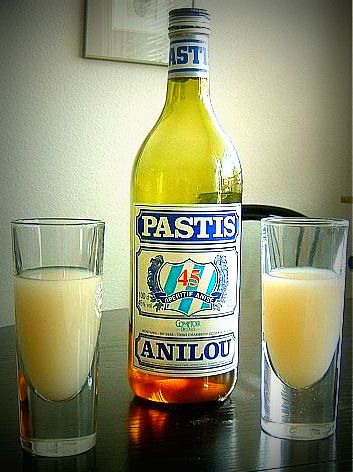
I was particularly fascinated by the pastis. For those of my readers who are not familiar with this drink, pastis is a typically French liquor very much associated with the south of France.
image
It gives off this wonderful aroma, being flavoured with aniseed (as well as licorice). It is strong (40-45% alcohol by volume), but it is never drunk neat. The drinker will add a fair amount of cold water before drinking it, at which point the liquor’s original dark transparent yellow colour clouds to a milky soft yellow.
image
As a boy, I would never tire of watching this wondrous, almost alchemical, change take place before me and breathe in the sweet scent of anise.

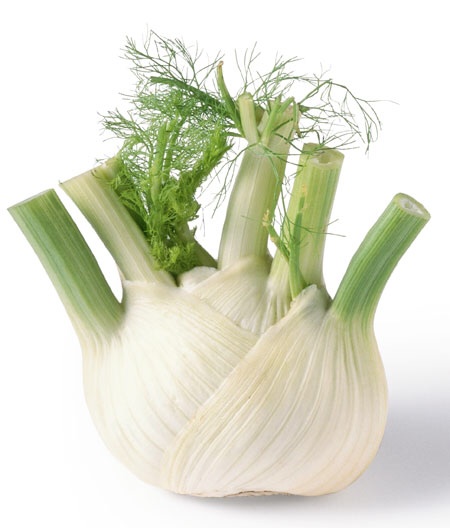
Since my family never used anise or the closely related fennel in cooking, I only next stumbled across the scent of anise when I came to Italy for the first time, nearly forty years ago. My wife to-be (as it turned out, although I didn’t know it then) introduced me to finocchio, or Florence fennel, a special cultivar of the fennel which was developed in Italy.
image
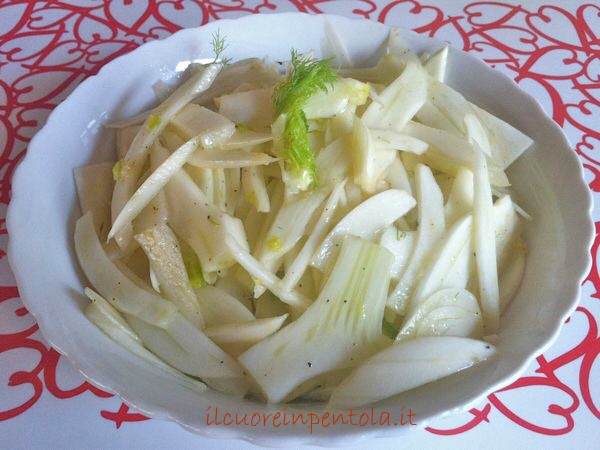
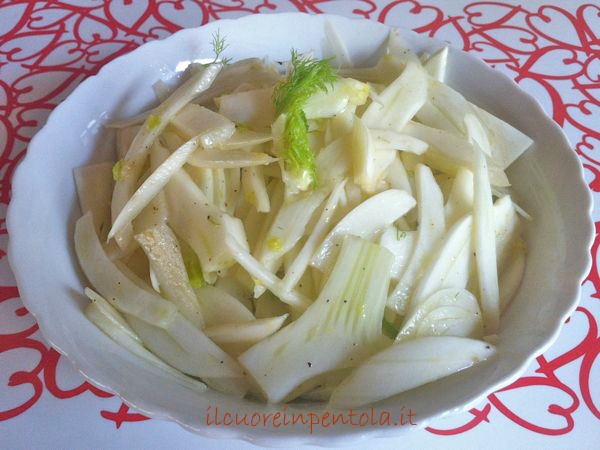
Many people (my late mother-in-law for one) eat finocchio cooked or braised but I prefer it raw, sliced very thin, almost shaved, with a simple oil and vinegar dressing.
image
Like that, it maintains the scent of anise, which begins to waft out as you prepare it in the kitchen, rises appetizingly from the plate as you spear the fennel slices, and is liberated in your mouth as you crunch down on them. Whenever I’m in Italy, and if it’s the right time of year, I will eat finocchio. In fact, it was my having a finocchio in salad last night that moved me to write this post.

Years later, just after coming to China, I stumbled across the scent of anise in another guise. During one of the early banquets to which I was invited, I noticed a star-shaped thing sitting in my dish.
image
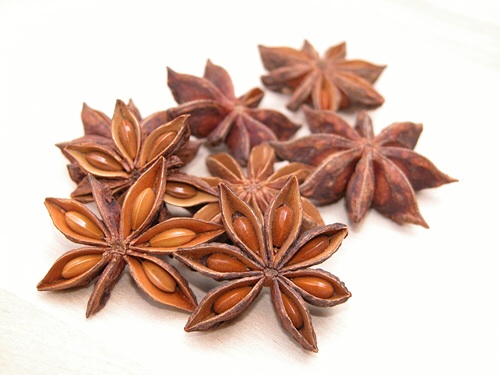
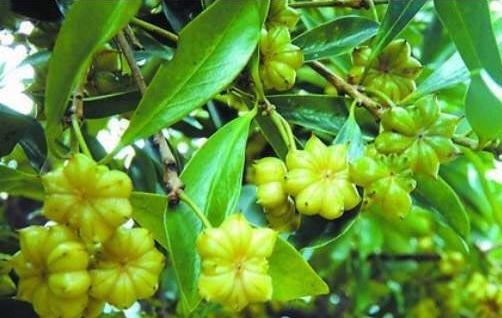
Intrigued, I asked what it was. Star anise, I was told, a spice which is commonly used in Chinese cooking (and actually in the cuisine of much of Asia, as I later discovered). It’s actually a very pretty spice:
image
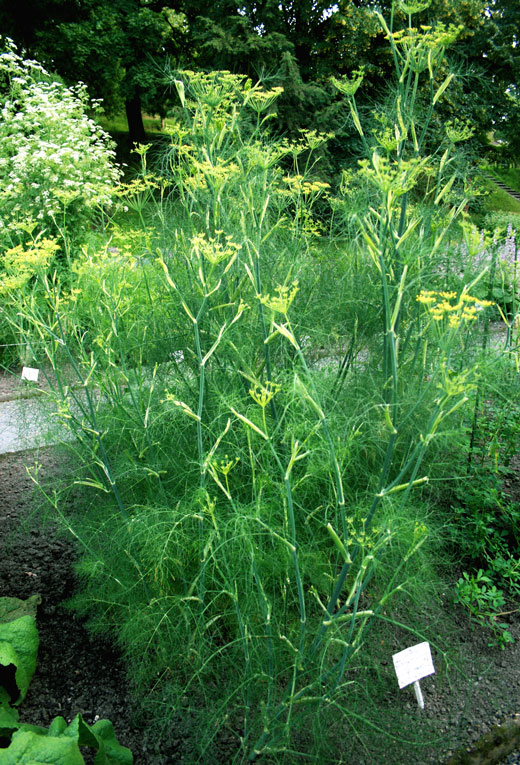
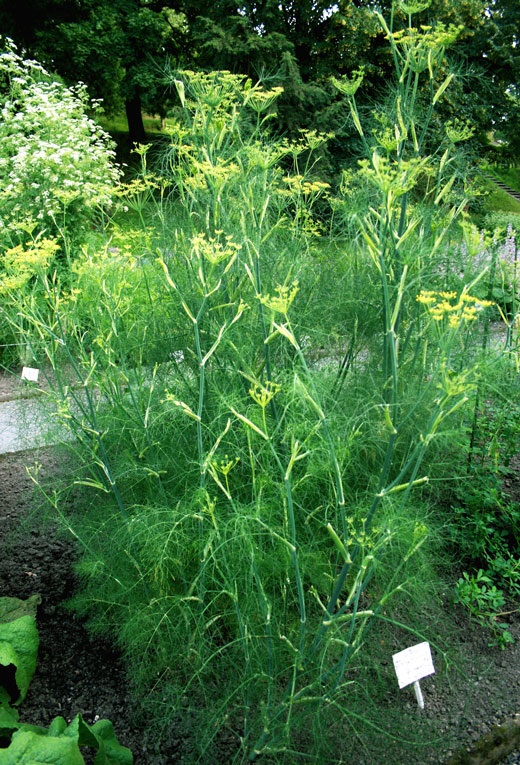
In any event, even more intrigued, I took a tentative bite and suck, and it did indeed taste of anise. But later research showed me that similar taste and scent do not a botanical relationship make. Anise, Pimpinella anisum, and Fennel, Foeniculum vulgare, are flowering plants which are both members of the Apiaceae family, and in fact look quite similar:
Anise:
image
Fennel:
image
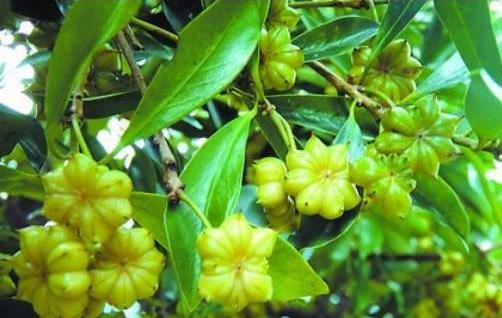
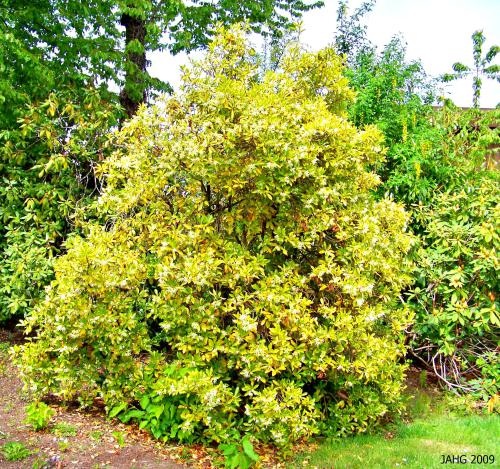
Star anise, on the other hand, is the fruit of a medium-sized tree or big bush, Illicium verum, of the Schisandraceae family:
image
image
The same-scentedness arises from the happy chance that all three plants (as well as licorice to some degree) contain the organic chemical anethole – and here I get distinctly nerdy and add a diagram of this chemical
image
Why these unrelated plants should all contain anethole I don’t know – and why we smell it and taste it as pleasant I don’t know either. Somewhere out there in the ether there may be papers which explain. But I have neither the patience nor the energy to trawl through the depths of the internet to find them.

But what I have found out is that there is at least one other plant out there whose leaves contain anethole. This is the rare tree from the Australian rainforest, the ringwood or (appropriately) aniseed tree, Syzygium anisatum – although confusingly, the leaf, which contains the anethole, is called anise myrtle.
image
image
Feeling rather like one of those birders who will travel to the ends of the Earth to sight a bird which they have never seen, I am thinking (although I have not yet told my wife this) that she and I should travel to Australia again, this time to try this new, exotic source of anise scent. I read with interest that anise myrtle is considered a bush tucker spice in Australia, that is to say a spice from a native plant which can be used to spice a dish of native fauna and flora. Anyone for a stew of kangaroo and warrigal greens spiced with anise myrtle, followed by a couple of quandong fruit for dessert?

_____________________
A village café: http://wwwdotgretagarburedotcom.files.wordpress.com/2013/04/les-vieux-de-la-vieille-jean-gabin-noc3ablnoc3abl-pierre-fresnay-via-pkcine-com.jpg (in http://gretagarbure.com/tag/comptoir/)
Pastis poster: http://www.posterclassics.com/Images-Drinks-French/bigPastisOlive.jpg (in http://journals.worldnomads.com/theglobetrottingtexan/story/69164/France/Marseille-Pastis-Capital-of-the-World#axzz31oe3iEng)
Pastis going cloudy: http://www.frenchmoments.eu/wp-content/uploads/2013/04/Pastis-©-Peng-CC3.0.jpg (in http://www.frenchmoments.eu/pastis-from-provence/)
Finocchio: http://www.dietagratis.com/wp-content/uploads/2014/01/Finocchi08-450RCS.jpg (in http://www.dietagratis.com/ricette-light/3552-insalata-di-finocchi/)
Finocchio salad: http://www.ilcuoreinpentola.it/images/stories/ricette/2013/maggio/insalata-finocchi.jpg (in http://www.ilcuoreinpentola.it/ricette/contorni/insalata-di-finocchi/)
Star anise in a dish: http://www.withaglass.com/wp-content/uploads/2013/10/tenderloinsoyp.jpg (in http://www.withaglass.com/?p=15273)
Star anise alone: http://foodie-isms.com/wp-content/uploads/2011/04/star-anise1.jpg (in http://foodie-isms.com/?p=5085)
Anise plant:http://herbgardening.com/HerbGardeningImages/AnisePimpinellaanisum.jpg (in http://herbgardening.com/growinganise.htm)
Fennel plant: http://herbgardening.com/HerbGardeningImages/Foeniculum_vulgare520.jpg (in http://herbgardening.com/growinganise.htm)
Illicium verum: http://thegardenpalette.files.wordpress.com/2009/06/watermark_303.jpg?w=500&h=468 (in http://thegardenpalette.wordpress.com/tag/star-anise/)
Star anise on tree: http://www.cnseed.org/wp-content/uploads/Star%20Anise%20seed%20Illicium%20verum.jpg (in http://www.cnseed.org/star-anise-seed-illicium-verum.html)
Anethole structure: http://structuresearch.merck-chemicals.com/cgi-bin/getStructureImage.pl?owner=MDA&unit=CHEM&product=800429 (in http://www.merckmillipore.com/chemicals/trans-anethole/MDA_CHEM-800429/p_BwWb.s1L3_sAAAEWfeEfVhTl)
Aniseed tree: http://floragreatlakes.info/rfsimages/ringwood1.jpg (in http://floragreatlakes.info/html/rfspecies/ringwood.html)
Anise myrtle: http://www.anfil.org.au/wp-content/uploads//flushing-tree.bmp (in http://www.anfil.org.au/key-native-species/flavour-of-the-month-february/)

ROOTLESS IN BEIJING

London, 4 May 2014

I like George Orwell. His novels are good, no doubt about it – some of them, like 1984 and Animal Farm, are classics – but it is really his non-fiction work that I appreciate the most. When I was young and going to school in the UK, I particularly liked those books of his like Down and Out in Paris and London and The Road to Wigan Pier in which he excoriated the smug, self-satisfied, class-ridden Britain of the 1930s, a Britain which still existed, albeit in a milder form, when I was going to school.

Orwell had a particular animus against colonialism, in part no doubt because of his first-hand experience with it as an officer in the Burmese police. But he still showed a certain compassion for the colonial administrators. I particularly remember his description of one of his superiors who had spent his whole working life in the colonies, who by necessity believed he had a deep connection with the Mother Country (wasn’t he out there on His Majesty’s Service?), but who in his rare visits home would sit friendless and familyless in his Club in London, looking out at a country he no longer recognized or felt part of, nursing a gin and tonic while waiting for the boat to carry him back.

I am not a colonial administrator but I have been out of the UK for nigh on forty years. I didn’t mean it to be so. When I left after University I was quite expecting to come back, but you know how it is, life just takes over. And now, on one of my rare visits back to the UK, I too, like that colonial administrator of long ago, no longer feel any connection to the country. I too sit there, not participating in the social, economic and political life going on around me, but merely observing it. Even my own language is becoming foreign to me. I don’t get many of the jokes any more, referring as they do to situations I am not familiar with. Much of today’s slang is a closed book to me. I’m even beginning to experience difficulties in understanding some of the stronger British accents!

This alienation from Britain sometimes fills me with melancholy, as it did today walking around the streets of London. Where do I belong? I am just a stone rolling around the world gathering no moss. I am Rootless in Beijing today, I will be Rootless in some other city tomorrow.

It’s not as if I can even mourn the loss of British roots, because I’ve never really had any. My parents left the UK before I was born and I only went to school there. When I tell people I’m British, they normally ask me where I’m from in Britain. I just say London. Everyone has heard of London and I did spend some time there with my grandmother. But I’m no real Londoner.

To make it all worse, I’m only half British, with my other half being French. At school, they sometimes called me froggie in that way children have of unerringly picking up differences and using them to pick on you. The fact is, I did feel different from most of my schoolmates. They were so much more English than I was! But my French side gave me no comfort. I was even less French than I was English. I just spent summer holidays there.

When I was younger, I didn’t mind my rootlessness. In fact, I was quite proud to be a citizen of the world, of belonging nowhere and everywhere, and I quite liked the fact that I could often ignore the social conventions of the places I lived in because I was foreign and not expected to conform.

But with age, I feel ever more urgently a need for roots. I want to have a place where I can say, “here, I will lay down my head; here, I will lay my bones to rest”. Luckily, my wife has given me strong roots in Italy. That is where I will finally come to rest when my tour of duty in Beijing is finished.

Goodness me, what is all this maundering self-pity? Time to pour myself another gin and tonic and discuss with my wife what we shall do tomorrow.

WISTERIA

Beijing, 13 April 2014

My French grandmother’s house was … old-fashioned, shall we say. Among its many quirks was the fact that it did not have a flush-toilet. Instead, you eased yourself into this small, cluttered space, and you parked your derriere (your backside) on this beautiful wooden seat to do your besoins (your needs), as the French delicately put it. Once finished, you pulled a lever to open a trap door at the bottom of the porcelain bowl and off went your besoins, helped along with a generous portion of water you poured in from a large enameled metal jug. The exhalations emanating from the opened trap door were sometimes eye-wateringly powerful, and there was always a generally musty smell in the loo. However, the olfactory downsides were more than offset by the beautiful view from the window, framed as it was by the bright green leaves of a wisteria vine which snaked up the outside wall and onto the roof. The view was that much more beautiful in spring when clusters of the wisteria’s light purple flowers thrust themselves at the window. When my mother inherited the house, one of the first things she did was to install a flush toilet. But the wisteria remained. In fact, after my parents retired there my mother encouraged it to spread to other walls nearby, which made it a rare pleasure to go and visit my parents in spring. This is not a photo of the house, but it gives an idea of what would greet my wife and I, with children in tow, after a long drive up from Italy in May.
glycine sur mur-2
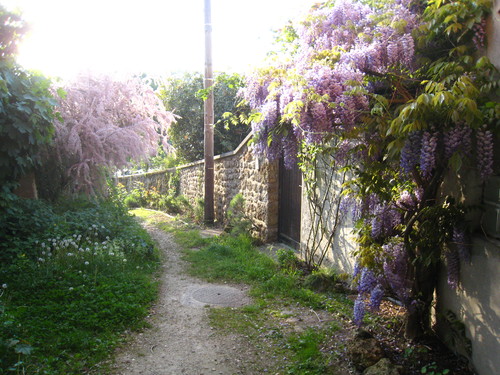
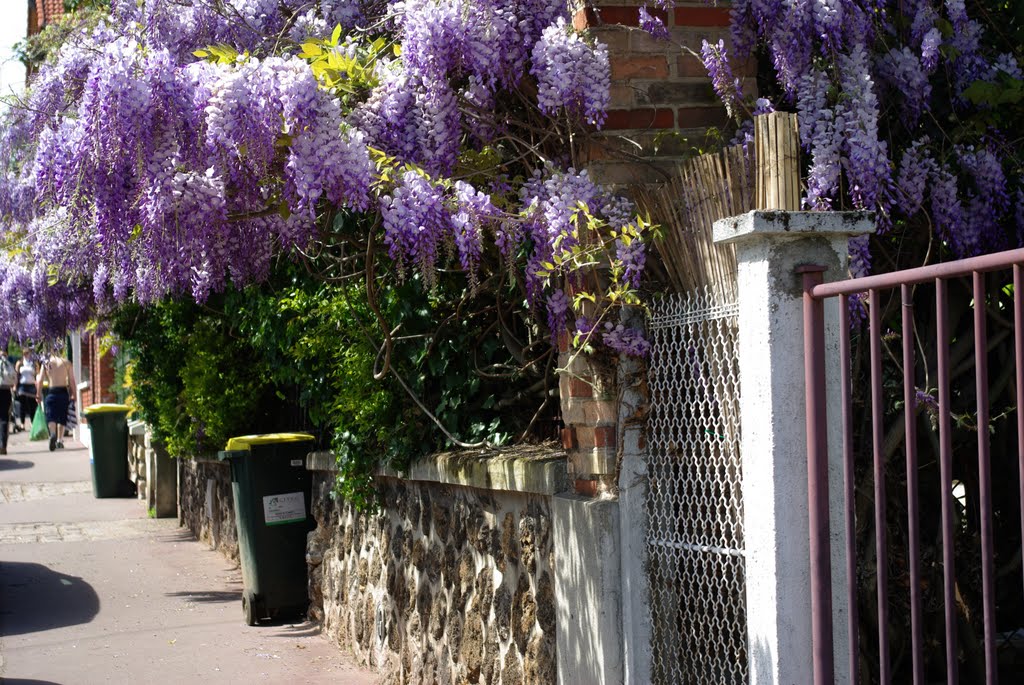
Since those moments in my grandmother’s loo, I have always had a weak spot for wisteria. At the right moment of the year, I keep an eager lookout for a sudden froth of light purple flowers popping up over a wall or in the corner of a garden. I have a particularly powerful memory of a bike trip which my wife and I made many years ago along the Loire valley, where between one Renaissance chateau

chateau_amboise

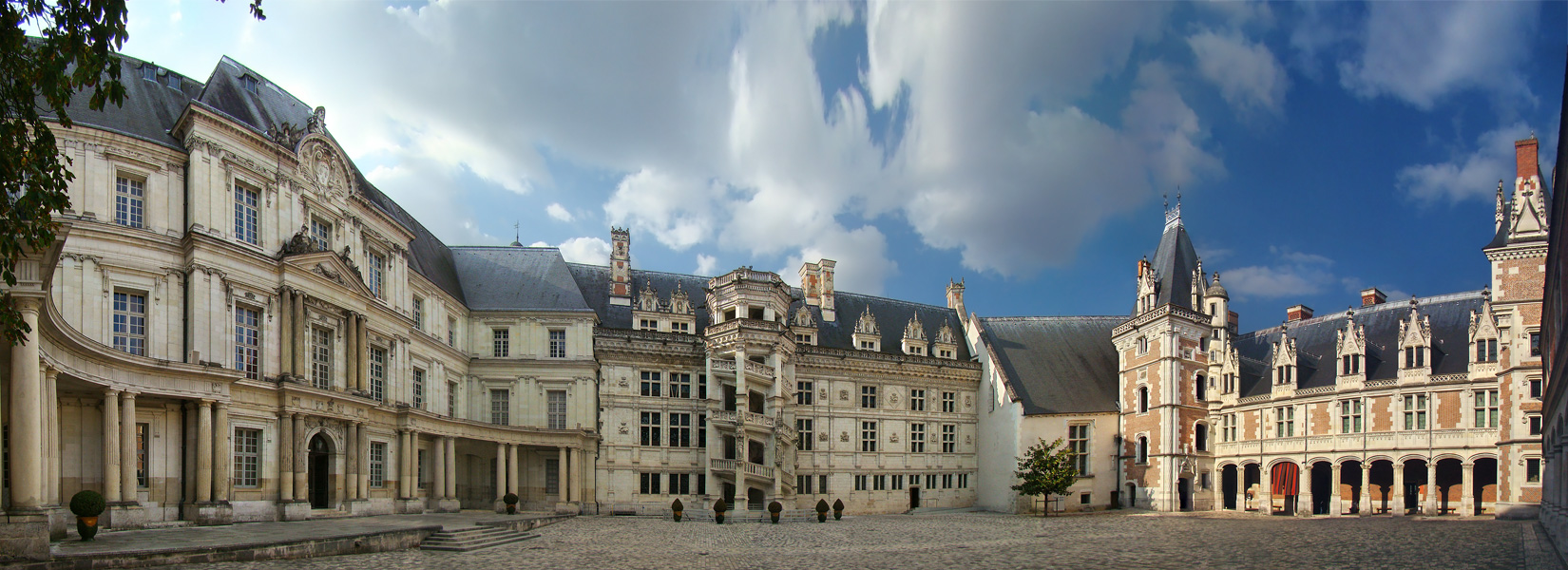
and another

chateau_Blois

we would run into cascades of wisteria – every garden seemed to have a wisteria.
glycine dans la vallee de la Loire-1

glycine dans la vallee de la Loire-2
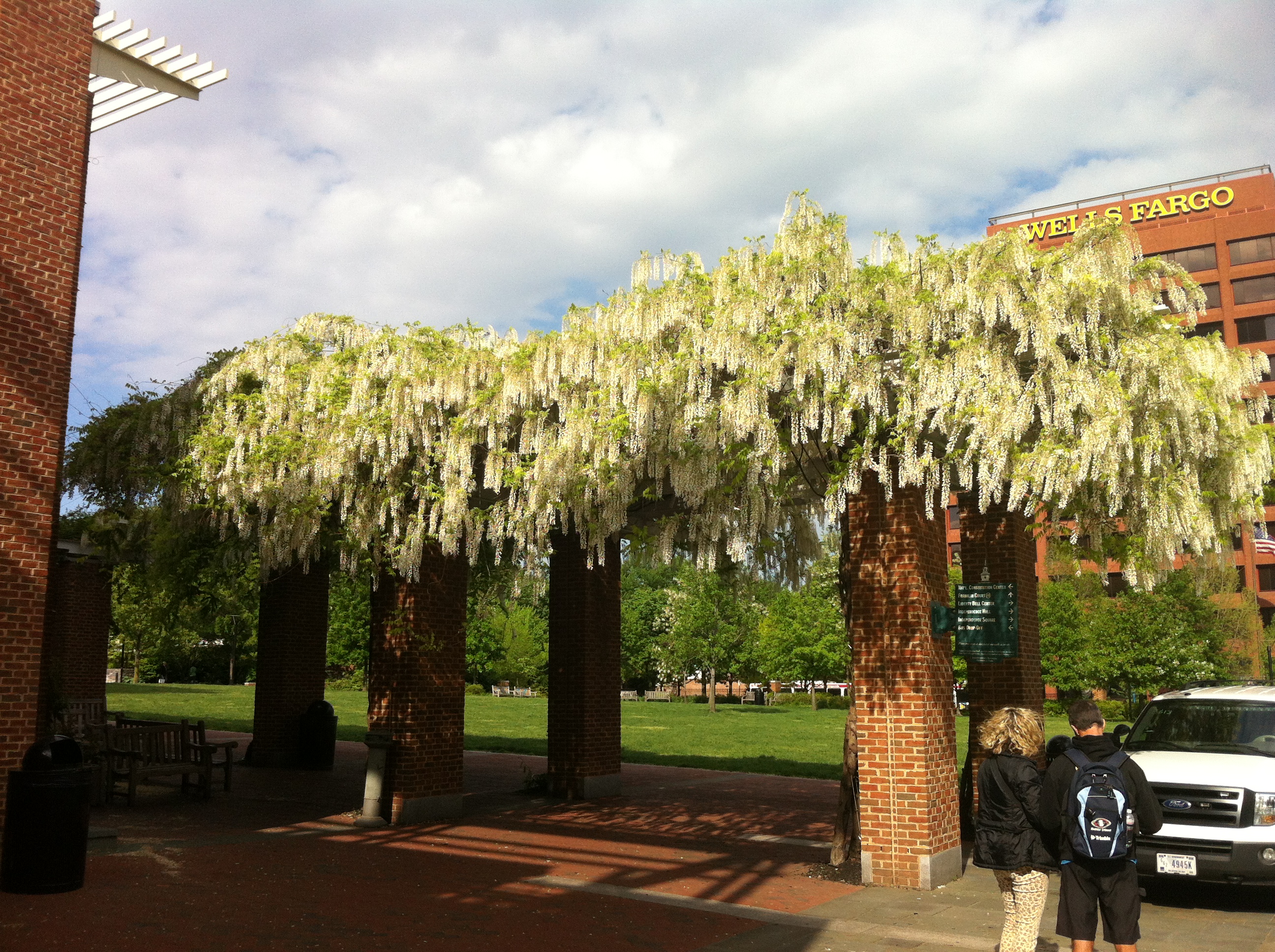
And just last year, when we were in Philadelphia, we stumbled onto a pergola covered by a thick coat of white wisteria, which was a first for me (I’ve mentioned this in an earlier post but I repeat the photo)
white flowers 003
And the neighbours to our rooftop garden in our last apartment in Vienna had planted a wisteria, which coiled and twisted its way onto our side, an intrusion we gladly accepted since it rendered so pleasant those first days in spring when my wife (with a very little help from me) toiled at her garden tubs, planting and repotting, after the long sleep of winter. In fact, jealous at their success, I purchased a modest wisteria plant for our side, with dreams of it eventually smothering our balcony. Alas, it perished miserably that summer while we were away for our holidays.

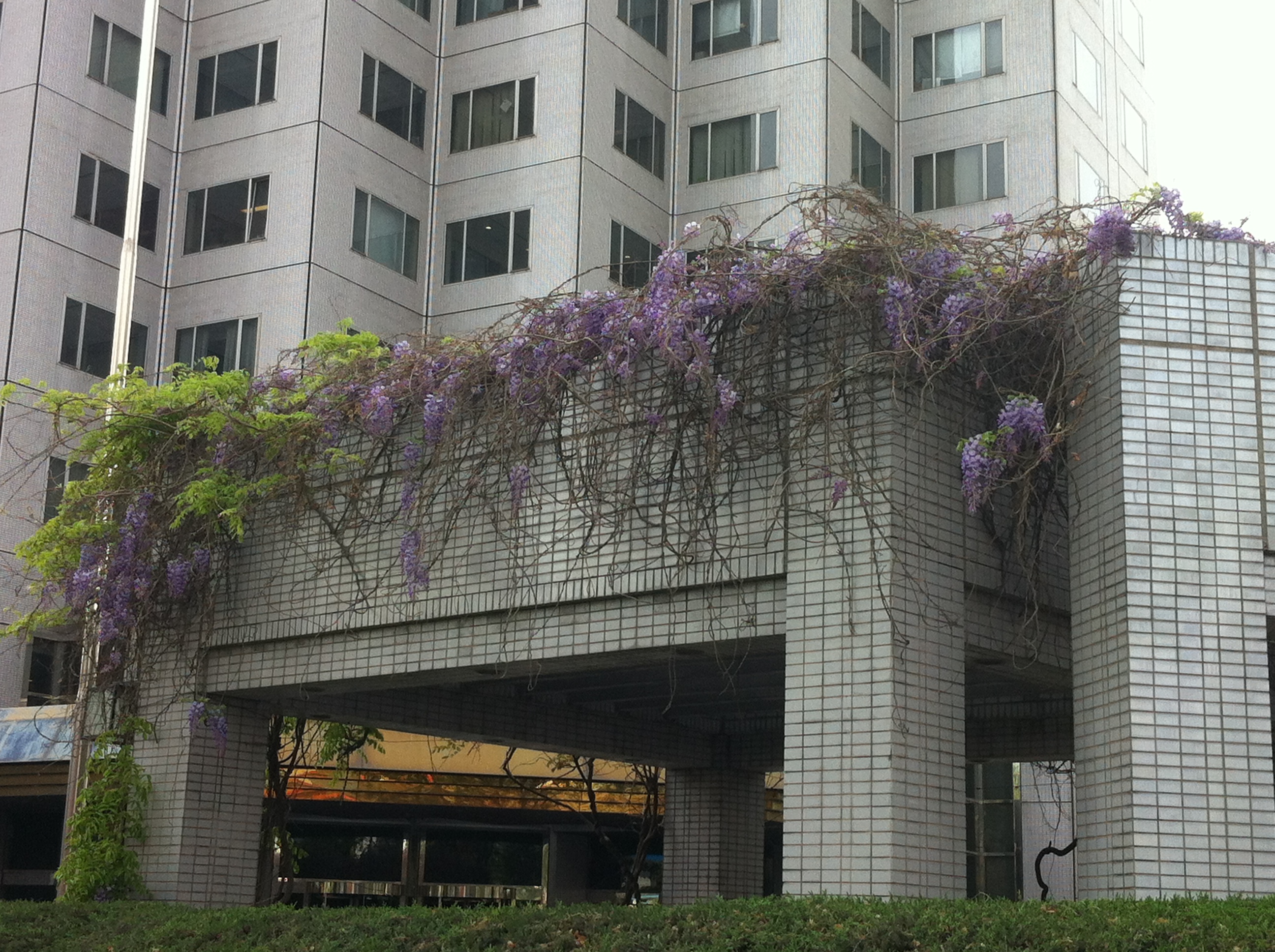
So you can understand my pleasure when I saw that the wisteria across the road from our apartment in Beijing had flowered
wisteria beijing

although I mentally castigated the management of the building for not doing a little pruning.

For the first time in my life, I read up a bit on wisteria. And the first thing I discovered is that wisteria is Chinese! Well, there’s also a Japanese wisteria. And two American wisterias. But no European wisteria! So once again, like the weeping willow which I wrote about in my last post and the magnolia which I wrote about a few posts earlier, Europeans have borrowed a plant from China, or maybe in this case from Japan (but not from the US; American wisteria don’t seem to be gardeners’ favourites, even in the US itself, since their flowers are of more modest size, bloom for less time, and are scentless). When you read these cases, you begin to understand why the poorer countries complain about pharmaceutical and other companies from the richer countries coming and “borrowing” their flora and making a fortune selling them, or their chemical components, back home.

But now I’m left with a tricky question: was the wisteria at my grandmother’s house Chinese or Japanese? The literature tells me that the flower-clusters (racemes in the horticultural lingo) of the Japanese wisteria are longer than those of the Chinese wisteria, but I’m buggered if I remember the length of those racemes nodding at the loo window. And anyway, I’m sure raceme lengths are all averages, so I don’t think this would be a good way for an uneducated plant man like me to distinguish a Chinese wisteria from its Japanese cousin. A far more powerful way of distinguishing the two seems to be the direction of twining which the vine adopts. Chinese wisteria twine clockwise, while Japanese wisteria twine counter-clockwise! (I love it; isn’t that a great way of figuring out where a plant comes from? But why would one twine one way and the other the other? The mysteries of genetics). I must remember to send my sister an email (she inherited the house, did further massive works, but kept the wisteria) and ask her which way the wisteria twines. This will no doubt be the moment she concludes that I have finally lost it …

______________

Wisteria on the house: http://img.over-blog-kiwi.com/0/53/56/12/201305/ob_bbf5590f142c0c0c464830009f54793b_img-8686.JPG [in http://mounic.over-blog.com/lieu-saint-de-provence%5D
Château d’Amboise : http://www.chateau-amboise.com/oktThemes/p-c094-01/images/chateau_amboise_accueil.jpg [in http://www.chateau-amboise.com/en/%5D
Château de Blois : http://upload.wikimedia.org/wikipedia/commons/f/fb/Loire_Cher_Blois1_tango7174.jpg [in ] http://en.wikipedia.org/wiki/Ch%C3%A2teau_de_Blois
Wisteria along the road-1: http://mw2.google.com/mw-panoramio/photos/medium/22548315.jpg [in http://www.panoramio.com/user/701296/tags/Season%20Spring?photo_page=2%5D
Wisteria along the road-2: http://static.panoramio.com/photos/large/34926262.jpg [in http://www.panoramio.com/user/701296/tags/Season%20Spring?photo_page=2%5D
Wisteria in Philadalphia: my photo
Wisteria in Beijing: my photo

LET’S DANCE!

Beijing, 24 March 2014

Jean Renoir, son of the French impressionist painter of the same name, was a good film director. In fact, he is considered by some to be among the greatest film directors of all time. He made such classics as La Grande illusion (1937) and La Règle du jeu (1939). So it was with some anticipation that some years ago my wife and I went to see The River, a film he had made in 1951, on location in India, in English, his first in colour, and which won the International Prize at the Venice Film Festival.

The River

Bad, bad mistake! The theme of the film – loss, love lost, love found – had all to hold one. The problem was the actors. They were all, to a man and woman, dogs – it’s the only word to adequately describe the appallingly amateur acting that we were subjected to. To this day, I ask myself what on earth happened in the making of this film. How did Jean Renoir lose control of his creation? Was it lack of money? Loss of talent? – was he getting too old for the job? Was it working far from home and in a foreign language? Mystery …

The worst actor by far was an Indian woman, Radha Burnier by name. She later gained a certain fame by becoming president of the Indian branch of the Theosophical Society (fame defined here as having an entry in Wikipedia). But that was still in the future when she acted in this film. I literally gritted my teeth every time she appeared on-screen and droned out her lines tonelessly. And then, at some point in all this hideousness, she acted out a dream sequence. For some reason which I cannot now recall, this dream required her to dance a classical Indian dance. What a transformation!  This ugly duckling of an actress morphed into a beautiful dancer. We were treated to a powerfully expressive, supremely graceful performance of Indian classical dancing.

I immediately forgave her all her poor acting.

I was forcefully reminded of this episode a few weeks ago when, during a long flight back from the US, I decided to watch An American in Paris, a film also made in 1951, directed by Vincente Minelli and with Gene Kelly in the lead role.

An_American_in_Paris_poster

It was an exceedingly silly film, with the lightest of plots (love lost, love gained, the whole with a papier mâché Paris in the background), but at least the actors could act. It also had a good musical score by George Gershwin. So I smiled indulgently and let myself be carried along on the silly frothiness of it all. At some point, though, Gene Kelly went into a tap dancing routine. My attention suddenly snapped into focus. What a dance! Light-hearted though it was, it was a superb rendition, a wonderful example of what a highly accomplished classical dancer can do with the hypnotic rhythms of clicking shoes.

In a way, I think these two threads of dancing come together in Spanish flamenco dancing – the syncopation of tap dancing fusing with the sinuous, sulphurous eroticism of Indian classical dancing, which also carries its own brand of stressed rhythm with the use of feet bangles. Staying in the film medium, I give here a wonderful example of Spanish flamenco from Carmen, a 1983 film directed by Carlos Saura.

Carmen_by_Saura

It’s a remake in the flamenco style of Bizet’s famous opera of the same name. Here we have love exploding between Carmen and Don José

but alas! it all ends badly

Ah, the madness of jealous love!

I cannot end without bringing in tango, that most sultry of all dances. Which is just as well because that allows me to introduce a final clip from the 2005 film Je ne suis pas là pour être aimé

je-ne-suis-pas-la-pour-etre-aime

in which two lonely people, Jean-Claude and Françoise, find a common love, and love, in tango

Ah, l’amour, l’amour! After a few taps of my toes and a pirouette, I turn in for the night.

______________________

The River: http://upload.wikimedia.org/wikipedia/en/7/77/La_Fleuve_1951_film_poster.jpg [in http://en.wikipedia.org/wiki/The_River_(1951_film)%5D
An American in Paris film poster: http://en.wikipedia.org/wiki/File:An_American_in_Paris_poster.jpg [in http://en.wikipedia.org/wiki/An_American_in_Paris_%28film%29%5D
Carmen film poster: http://en.wikipedia.org/wiki/File:Carmen_by_Saura.jpg [in http://en.wikipedia.org/wiki/Carmen_%281983_film%29%5D
Je ne suis pa la pour etre aime poster: http://www.bestofneworleans.com/imager/french-cin-club-je-ne-suis-pas-la-pour-tre-aim/b/original/2222223/686d/f8df3e30_je-ne-suis-pas-la-pour-etre-aime.jpg [in http://www.bestofneworleans.com/gambit/french-cin-club-je-ne-suis-pas-la-pour-tre-aim/Event?oid=2222222%5D

THE BASQUE BERET

Beijing, 2 February 2014

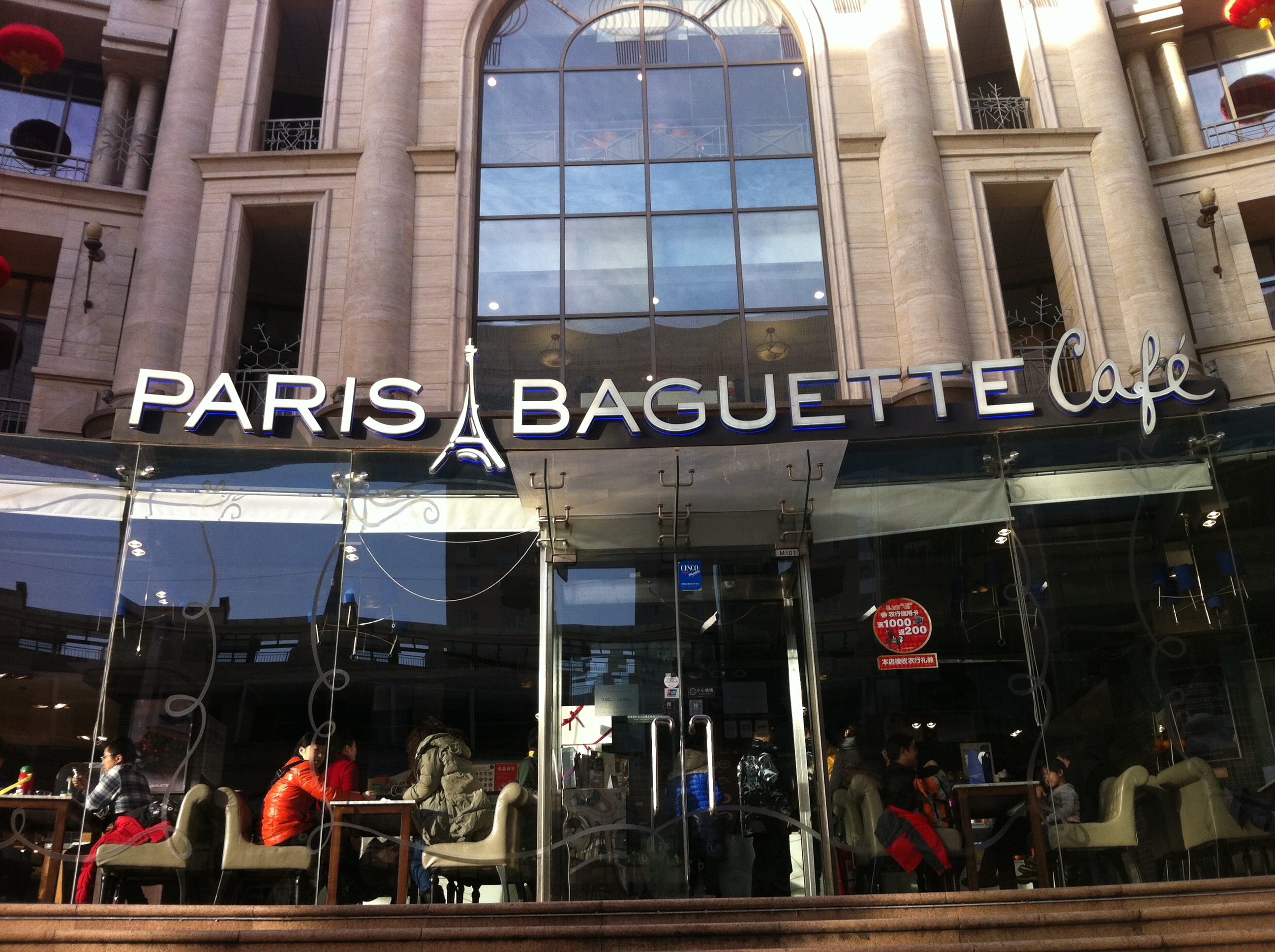
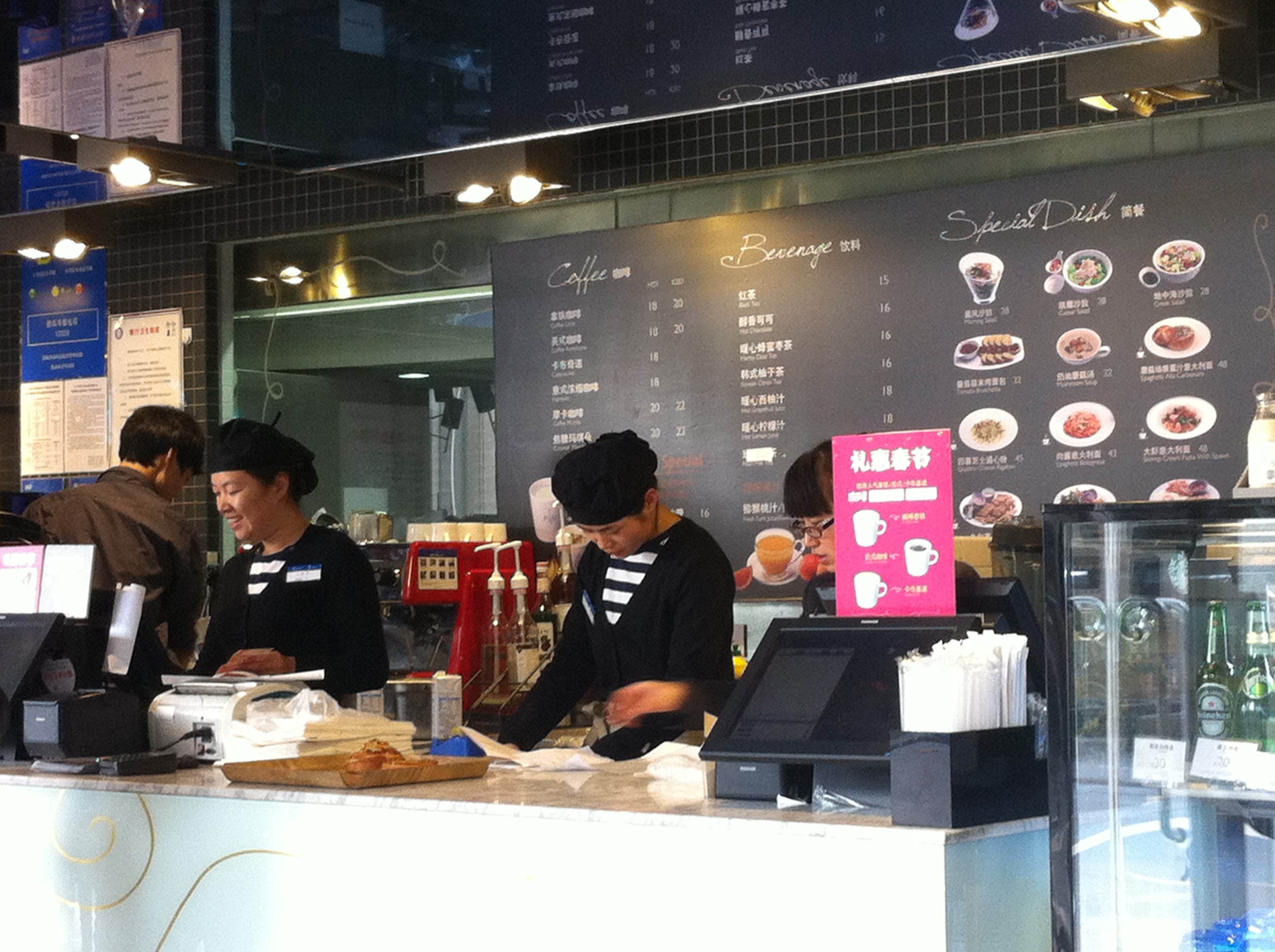
It’s quiet at the moment in Beijing. The Chinese New Year has just passed and the city is still deserted, with the locals staying at home and the migrants off in their home towns or villages. So when we went out for our usual Sunday afternoon coffee to The Place, a mall whose main claim to fame is that it hosts a ginormous TV screen, it was singularly empty. We decided to eschew our usual coffee houses such as Starbucks and Costa Coffee, both of which grace The Place, and took our coffee instead at a branch of (the South Korean-based) Paris Baguette.

paris baguette 003

As the name suggests, this chain of stores offers a vaguely French eating experience, the most obvious of which being the sale of baguettes – they’re not bad, although the Vietnamese, after their bout of colonization by the French, bake better ones. The stores also sell French pastries: croissants, of course, madeleines, and various others (they also sell a lot of pastries which my French grandmother would never have recognized as French in any way). And, as I discovered today, the staff wear berets basques
paris baguette 001
At least, I think that is what they are meant to be wearing. They are certainly modeled on the beret basque, although they look more like the floppy hats that popular and upwardly mobile painters sported in the 19th Century.

As everyone knows, the beret basque is as French as … well, the baguette
basque beret-2
or the gauloise cigarette and glass of red wine …
beret basque et gauloises
… or onions and garlic. I remember when I was young coming across the last gasps of an old tradition: Frenchmen bicycling around the UK selling onions. Lord knows why this tradition started, but as every Englishman knows the French eat a lot of onions – and garlic – so maybe the English thought that French onions purchased from a Frenchman were better than onions grown in the UK. So legions of canny Frenchmen set out every summer to bicycle door-to-British door and sell French onions. And of course branding rules required them to wear a beret basque.
basque beret-onion sellers
The funny thing is, only once in my life do I ever remember seeing a Frenchman actually wear a beret basque, and that was the driver of a car who, just north of Dunkerque, ran smack into the right-hand side of the deux-chevaux which my English friend was driving.

Since, as everyone knows, the deux-chevaux is as French as the beret basque, the baguette, and the gauloise

Citroen 2CV

the driver presumably thought that my friend knew the typically French road rule of “priorité à droite”, priority to the right: a car coming from the right always has priority unless otherwise specified. Unfortunately, my friend knew the much more sensible English road rule that a car on a big road has priority over a car on a little one, and since our road was a least three times as wide as his road, she thought … The resulting clash of cultures left a very big dent in her car door.

In any event, the only place I ever really saw the beret basque being worn regularly was in northern Italy, and that was only in the early years of my going there, some 30-plus years ago. Quite quickly, the younger generation abandoned the beret, as well as any other head coverage, presumably for one or more of the reasons which I listed in an earlier post. But I am very fond of a couple of photos lying around our apartment in Milan.  In one, my father-in-law is wearing his basco (as it is called in Italy) and smiling into the camera. In another, we see him sporting the beret and holding my wife, just a small girl at the time, by the hand. Whenever we come across them, my wife smiles and begins to reminisce. They were on holidays, it was the mid-sixties, times were good then in Italy, there was optimism in the air. The Good Old Days …

What about the region which gave its name to the beret? Do they wear it? Alas, as these photos suggest, it’s only the older folk who wear it any more:

basques with berets-2

basques with berets-3

basques with berets-1

basques with berets-5

basques with berets-4

Hmm, we still have my father-in-law’s beret, in some corner of a cupboard. Maybe when I’m nearing the end of my road, I’ll start wearing it.

_____________________________

Paris Baguette, inside and out: my pics
Basque beret and baguette: http://www.labellemeche.com/blog/wp-content/uploads/2013/09/b%C3%A9ret.jpg [in http://www.labellemeche.com/blog/page/3/%5D
Basque beret, gauloises and red wine: http://wshiell.net/vintage_ads2/original/gauloises.png [in http://wshiell.net/vintage_ads2/original/gauloises.html%5D
Basque beret-onion sellers: http://blog.privateislandparty.com/wp-content/uploads/2013/05/Onion-Johnnies.jpg [in http://blog.privateislandparty.com/beret-origins-of-style/%5D
Citroën 2CV: http://classics.honestjohn.co.uk/imagecache/file/fit/730×700/media/5716157/Citroen%202CV%20%281%29.jpg [in http://classics.honestjohn.co.uk/reviews/citroen/2cv/%5D
Basques with berets-1: http://www.dkimages.com/discover/Projects/AT876/previews/446914.JPG [in http://www.dkimages.com/discover/Home/Geography/Europe/France/Southwest-France/Pyrenees/Towns-and-Villages/St-Jean-de-Luz/Basque-Men/Basque-Men-1.html%5D
Basques with berets-2: http://www.blog.giuseppelupo.eu/wp-content/uploads/2007/10/d1_louis_the_basque.jpg [in http://www.blog.giuseppelupo.eu/?cat=159%5D
Basques with berets-3: http://www.cephas.com/ImageThumbs/1205630/3/1205630_Men_in_traditional_Basque_dress_Seissan_Gers___France.jpg [in http://theobamadiary.com/2012/03/15/so-whos-tuning-in-tonight/%5D
Basques with berets-4: http://www.concierge.com/images/destinations/destinationguide/europe/spain/bilbao/bilbao_013p.jpg [in http://www.concierge.com/travelguide/bilbao/photos/photoview/61474?sort=-createDate%5D
Basques with berets-5: http://nimgs3.s3.amazonaws.com/others/original700/2008-8-4-3-45-25-35af8c3c35d345aea2744a44c6cf7937-35af8c3c35d345aea2744a44c6cf7937-2.jpg [in http://newshopper.sulekha.com/an-old-man-wearing-the-typical-basque-beret-passes-a-poster-reading-in-basque-inaki-de-juana-welcome-after-21-years-ago-in-pr_photo_246070.htm%5D