QUAFFING MEAD

Vienna, 18 August 2019

Back in April, I was up in Vienna to make a presentation at a workshop on ecodesign and its role in promoting circular economies. Fascinating topic, but what I actually want to write about is the fact that at this meeting I met an old contact of mine, Wolfgang, who many years ago had run a training programme for me on ecodesign in Sri Lanka. After the workshop, we repaired to a bar to catch up on the past 15 years or so over a beer. Wolfgang first told me all about what he’s been up to in the ecodesign world, but then added, “What’s really exciting me at the moment is my production of mead.”

Mead … I don’t know what visions this conjures up in my readers, but for me I immediately see Vikings wassailing the dark Nordic nights away, drinking mead out of horns or possibly the skulls of their enemies, and preparing for the battle of tomorrow where they will die heroically and go to Valhalla. These fine fellows will stand in nicely for such a scene.

Source

I had certainly never drunk the stuff myself; I didn’t know anyone made it anymore.

Thoroughly intrigued, I pressed Wolfgang for more information. As is the case with all enthusiasts, I didn’t have to press very hard. With a pint of beer inside him, he waxed lyrical on the subject. He had to start at the very beginning, with what mead is made from – I didn’t even know that. It’s a mixture of honey and water to which yeast is added to turn the sugars in the honey into alcohol. The relative ratios of honey to water will determine the level of sweetness of the final product. Sweetness can be further increased by the addition of fruits. On the other hand, the mix can be made dryer by adding astringent berries or herbs. Wolfgang was very dismissive about the modern trend of making sweet meads. In fact, he said, he started making mead because he was appalled at how horribly sweet most modern meads are, which in his opinion obliterates the wonderful underlying tastes of the honey. He decided he was going to swim against the current and make a dry mead. He had been at it for a couple of years, and was beginning to sell his product to other enthusiasts.

Well, this all sounded very interesting! I was definitely going to have to try this stuff. Unfortunately, I was going back down to Milan the next day. But we agreed that when my wife and I came up to Vienna for the summer, I would contact him and we would arrange a mead-tasting event.

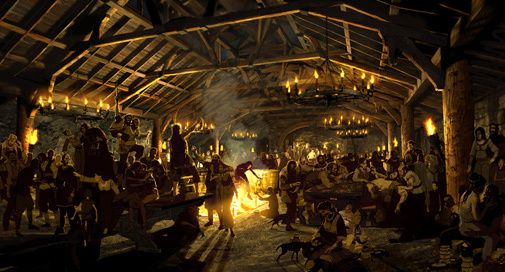
In the meantime, down in Milan, I did some research. Mead, it turns out, is very ancient, probably the first alcoholic drink that human beings ever quaffed. It’s also a pretty universal drink. The tribes that settled Europe certainly all drank mead. I’ve already mentioned the Vikings. They loved mead so much, they wrote a whole saga about it – Kvasir and the Mead of Poetry. It’s a story that has dwarves, giants, the god Odin, thievery, murder, and various other bits and bobs. A shaggy dog story if ever I heard one, good to while away those long Nordic nights while quaffing mead. The bottom line of the saga is that mead can turn you into a poet or a scholar: a feeling that I’m sure all of us have had when we have drunk too much alcohol; a feeling we normally have just before we are sick or pass out, or both. And much of Beowulf, that Anglo-Saxon poem greatly revered by lovers of the English language, takes place in a mead hall; it was in these specially-built halls that Viking chieftains and their retinue of warriors drank mead, listened to long, long – long – sagas, and generally wassailed the nights away, before collapsing onto the benches or even onto the floor in a drunken stupor. Here is an artist’s representation of a mead hall.

Source

And here is an excellent summary of the first part of Beowulf: “The fantastical mead hall of Heorot forms an integral part of the epic Old English poem Beowulf, serving as both the setting and instigation of the action. It is the carousing of Heorot’s denizens as they slug back mead in the hall which awakens the terrible ire of the monster Grendel – with predictably gruesome results. The solution to the problem – in typical Old English style – was not to put down the mead horns and cease partying, but to slay the monster (and his mother) before throwing an even bigger and more mead-soaked party to celebrate.”

The Vikings may be the best known quaffers of mead, but the Celts were no slouches, and nor were the Germanic tribes. There is riddle-poem in the Exeter Book, a 10th-century anthology of Anglo-Saxon poetry, about honey and mead. I quote the first couple of lines:

Ic eom weorð werum, wide funden,
brungen of bearwum ond of burghleoþum,
of denum ond of dunum. Dæges mec wægun
feþre on lifte, feredon mid liste …

But since I’m sure that 99.99% of my readers are like me not able to read Anglo-Saxon, I insert here a translation of the poem into modern English:

I am valuable to men, found widely,
brought from groves and from mountain slopes,
from valleys and from hills. By day, was I carried
by feathers up high, taken skillfully
under a sheltering roof. A man then washed me
in a container. Now I am a binder and a striker;
I bring a slave to the ground, sometimes an old churl.
Immediately he discovers, he who goes against me
and contends against my strength,
that he shall meet the ground with his back,
unless he ceases from his folly early;
deprived of his strength, loud of speech, his power bound,
he has no control over his mind, his feet, or his hands.
Ask what I am called, who thus binds slaves
to the earth with blows, by the light of day.

The Anglo-Saxons clearly recognized the power of mead to bring you crashing to the floor of the mead hall or any other establishment where you drank the stuff in excess.

The Slavs also drank the stuff – they still do, with Poland having an especially developed culture of mead drinking. We have here a painting of a couple of early 19th Century Polish noblemen enjoying a flagon of mead, a scene inspired by that great nationalist Polish poem, Pan Tadeusz by Adam Mickiewicz. I don’t even bother with the Polish here, I just launch straight into an English translation, and cut out much of the saga-like talk between the two old men who are our subject:

Two old men sat outside the house, tankards
of strong mead resting on their knees; …
The old men drink their mead and dip their snuff
from a bark case, continuing their chat.
“Yes, yes, Protazy, it is true enough,”
said the Warden. “I can agree with that,”
replied Protazy the Apparitor.
“Yes,” they repeated in unison, “Yes,”
nodding their heads. …
…. The turf bench in the yard
on which they sat adjoined the kitchen wall;
from an open window, steam filled the air,
billowing like a conflagration. When all
the smoke was gone, a white chef‟s hat was there,
flitting like a dove. It was the Seneschal,
who stuck his head out through the kitchen window,
eavesdropping on this private conversation.
Finally, he handed them a plate with two
biscuits. “Have this cake with your libation,”
He said …

Source

It wasn’t just tribes in Europe’s north who drank mead. The Ancient Greeks drank it – I read that Dionysios was the God of mead before becoming the God of wine. Greek followers of Dionysios, and Roman followers of Bacchus (same God, different name), used to hold festivals – the Dionysia or Bacchanalia – where much drinking and dancing and cavorting about (nudge, nudge, wink, wink, say no more) was the key. Here is a take on a Bacchanalia by Hendrik Balen (he did the figures) and Jan Breughel the Elder (he did the landscape), painted in about 1620.

Source

As I say, the Romans partook enthusiastically in Bacchanalia, but there were more sober Roman citizens who left us some serious commentary on mead. Here is my favourite, by the Roman naturalist Lucius Junius Moderatus Columella, who included a recipe for making mead in his tome on agriculture, De re rustica, which he wrote in about 60 CE (again, I skip the Latin and go straight into an English translation).

Take rainwater kept for several years, and mix a sextarius [ca. ½ litre] of this water with a [Roman] pound [ca. ⅓ kg] of honey. For a weaker mead, mix a sextarius of water with nine ounces [ca. ¼ kg] of honey. The whole is exposed to the sun for 40 days, and then left on a shelf near the fire. If you have no rain water, then boil spring water.

I am appalled and fascinated in equal measure by this idea that one could take several-year old rainwater and use it to make something to drink; I suppose this was a way of inoculating the honey-water mix with natural yeasts which somehow found their way into the rainwater. I presume Columella drank his own mead and survived, so it cannot have been as deadly as it sounds.

And it wasn’t just the Europeans who drank it. The Chinese did – in fact, the oldest archaeological evidence tentatively pointing to mead drinking has been found in China: some honey, rice, and fermentation residues found on the inside of a pot 9,000 years old. The Mandaya and Manobo people in the island of Mindanao in the Philippines still drink mead, which they call bais.

In Africa, the Xhosa in South Africa have an ancient tradition of drinking mead, or iQhilika in Xhosa, and the Ethiopians have been, and continue to be, enthusiastic drinkers of mead (or tej as it’s called locally). Here we have Ethiopians enjoying a wee dram of the stuff.

Source

And I love this picture, done in the traditional Ethiopian style, of what appears to be a priest and his acolytes getting ready to down some tej.

Source

What I find particularly delicious in this painting is that normally the figures in Ethiopian paintings are very solemn; no-one breaks into a smile. Yet here, at the thought of the pleasures to come, we see a hint of a smile on the acolytes’ faces (while the priest looks troubled, which is perhaps how it should be: “Guys, should we be doing this? What if someone sees me drinking this stuff? I have an important position in the community.”).

Even in the Americas mead was, and still is consumed. Prior to the Spanish conquest, the Maya made a drink called balché made by soaking the bark of a special tree in a honey-water mix and allowing it to ferment. Apparently, the Maya consumed balché in enema form to maximize its inebriating effect (just think if the Vikings had cottoned on to that …). For some reason, the Conquistadores banned the drink, but it never went away completely. Here is an Amerindian from the Chiapas region of Mexico making balché the old way: in a hollowed log, place the bark of the tree, add water and honey, cover and wait.
Balché may be making a comeback, although one of the reasons the Spaniards didn’t like it is that it smelled foul to them. They popularized a variant, xtabentún, which replaced the tree bark with anise (they also added rum, which makes the drink more of a liqueur).

In a way, it’s not surprising that mead is drunk in so many parts of the world. Honey, its basic ingredient, is to be found pretty much everywhere on this planet, as this map of the global distribution of the honeybee attests (the different colours refer to sub-species of the honeybee; the pinkish colour, the most dominant, gives the range for apis mellifera).

Source

For reasons that are not completely clear to me, the drinking of mead went into steep decline in Europe some time after the Middle Ages. Somehow, it got squeezed out by wine on one side and beer on the other. So now there are a few traditional hold-outs where mead never completely died out and enthusiasts like Wolfgang who are trying to bring mead back.

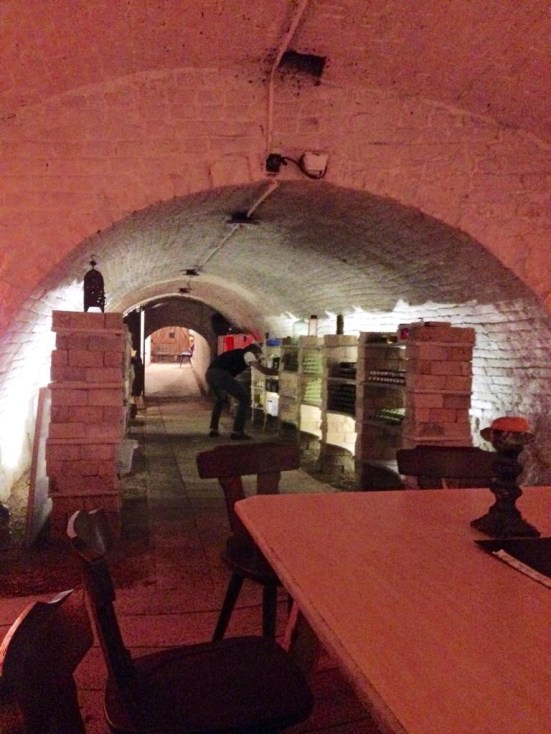
Coming back to Wolfgang, when June came around and my wife and I came up to Vienna for the summer, I contacted him. But one thing and another – he was away, then I was away; he was busy, then I was busy – meant that we weren’t able to arrange the mead tasting until last week. But it was finally arranged! Wolfgang keeps his mead in an old wine cellar in a small village outside Vienna, so we took a bus with him one evening and sallied forth. It was a lovely cellar, very deep, at the end of which he had a table with chairs where we sat down to do our mead tasting.
He got us some glasses and a bottle of his best mead.
He uncorked it, poured us a generous portion, and invited us to taste. We ceremonially picked up the glass, sniffed it, swirled it around, and took a sip.

It was … interesting. I think that’s the best I can say. I don’t know if readers can imagine this, but it tasted like honey without the sweet taste. What gets left behind if you take out the honey’s sweetness is a slightly acrid, slightly “waxy” taste. If any of my readers have ever nibbled at wax, that was the predominant taste of the mead.

The first mead we tried was made with honey where the bees had been feeding on the nectar from lime-tree (linden) flowers (I have waxed lyrical about the flower of the linden tree in a past post). We then tried a mead made with honey where the bees had feasted on rhododendron nectar up in the Alps. It was much clearer in colour, but the taste did not change much. As a finale, we tried a mead to which chokeberries had been added. These turned the mead’s colour redder and made the taste smokier – but it did not change the basic facts.
Well, we bought two bottles from Wolfgang. We felt we owed him that for the trouble he had gone to. We plan to take the bottles down to Milan, where we’ll try them on our son and see what he thinks.

In the meantime – but I have to hide this from Wolfgang – I think we should find some sweet mead to try. I feel that despite Wolfgang’s tut-tutting, people are not so wrong to drink their mead sweet. And that Ethiopian mead looks really interesting! I wonder if the Ethiopian restaurant we go to in Milan has any?

HOLIDAY SNAPS OF MUNICH AND BREGENZ

Vienna, 8 August 2019

I left readers at the end of my last post promising to cover the rest of our stay in Munich as well as our stay in Bregenz in another post. Well, I am a man of his word, here is that post!
In truth, the post will be more of a showing of photos than anything else, the e-equivalent of having your friends round for dinner after your latest holiday and boring them with your holiday snaps. I hope my readers will not be too bored and slip away early from this post …

With that, let us begin!

Munich

Well, I can’t say that I was carried away by the overall look and feel of the city. Pleasant enough, but Vienna for instance is a much more striking city overall. So what follows is a string of individual things that stuck in my mind as we criss-crossed the city.

The Nymphenburg Palace, the little summer pad of the Dukes-Kings-Electors of Bavaria.

Source

It was once out in the countryside but is now in the suburbs of Munich. Considerably more dramatic than the Hapsburgs’ little summer pad at Schönbrunn (now also marooned in Vienna’s suburbs).

The outside may have been dramatic, but the palace’s interiors weren’t up to much. On the other hand, the interior of Amalienburg, a little hunting lodge hidden among the trees of the Palace’s park, was quite something.

Source

“One of the finest examples of Rococo architecture in Germany” intones the Michelin Green Guide. I’m quite ready to believe it.

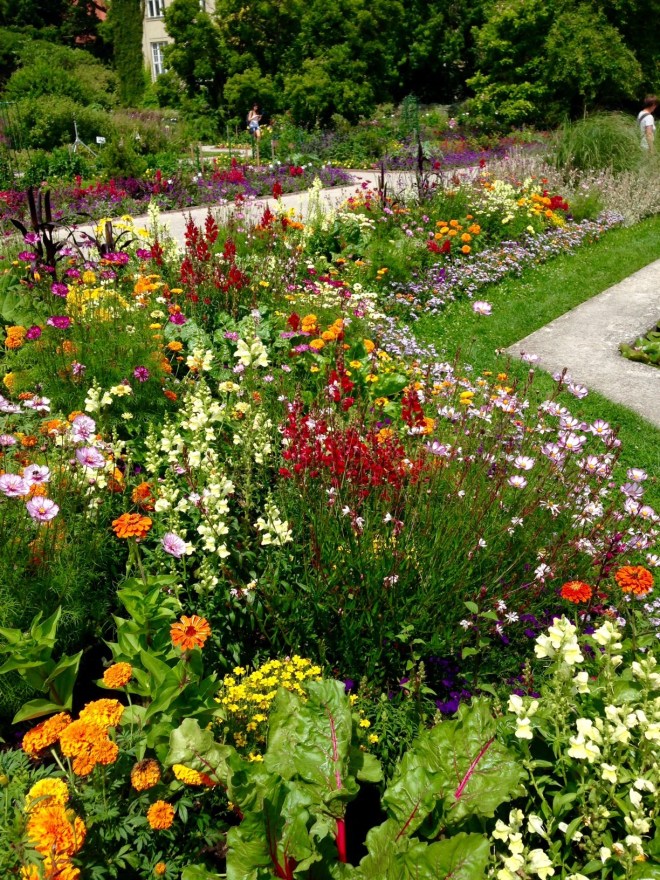
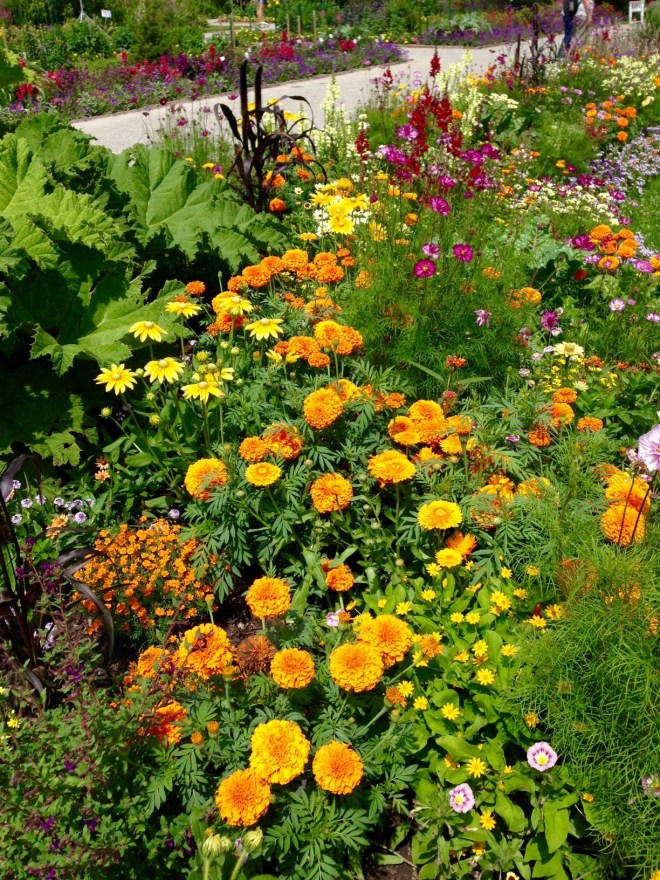
A riot of colour at the city’s botanical gardens, situated on the edge of Nymphenburg Palace’s park.

our photo
our photo

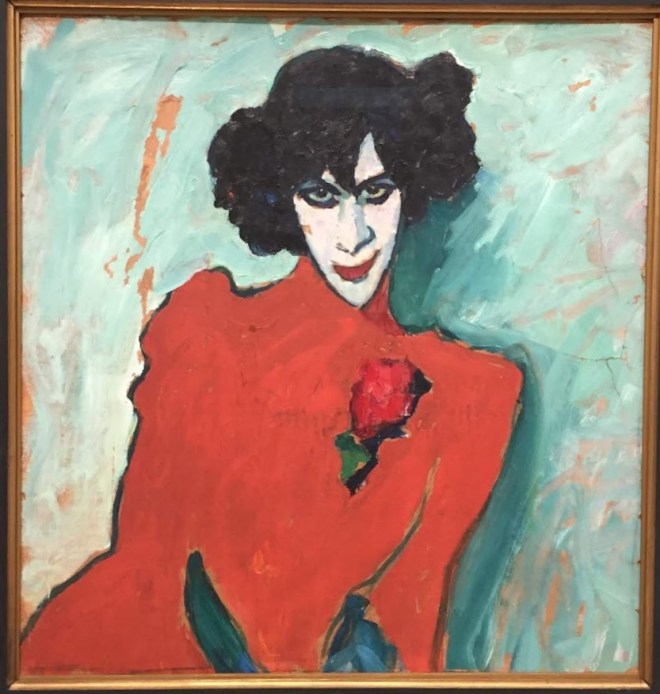
A striking painting by Alexej Jawlensky (Portrait of the Dancer Sacharoff), at Villa Lenbach, one of the museums we visited.

source

The museum has a whole section devoted to members of the Blaue Reiter group. A worthy collection indeed, but nothing other than this painting grabbed me.

Villa Lenbach also had a room devoted to paintings from after 1945, which is where I saw this one.

Source

The Seated Man, by Jean Hélion, a French painter whom I had never, ever heard of prior to entering the Villa Lenbach. Well, you learn something new every day …

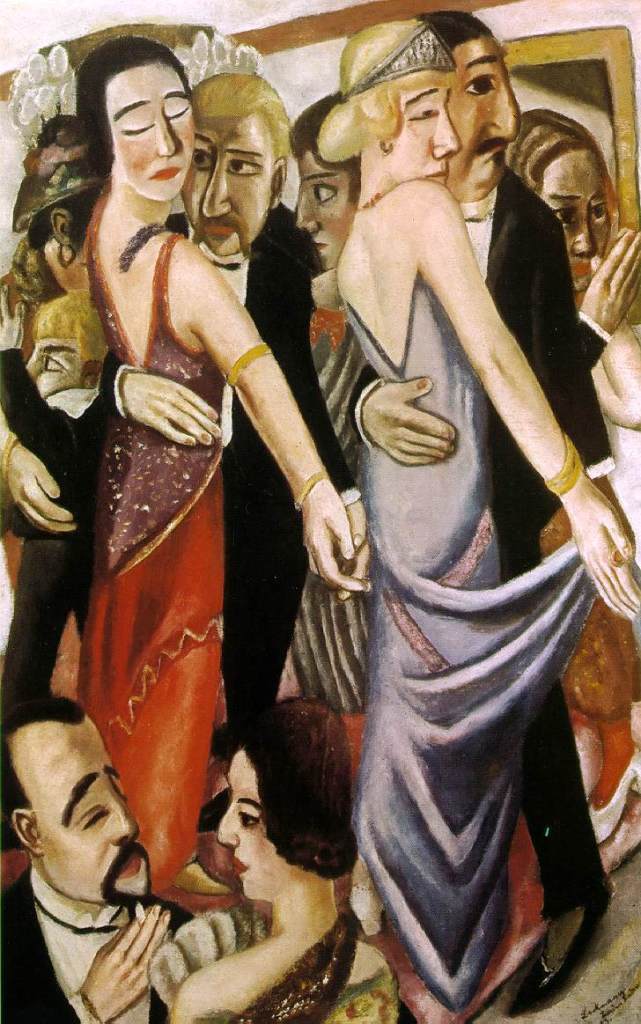
We also visited the Modern Art Gallery (Pinakothek der Moderne). Again, a very worthy collection, but only this painting by Max Beckmann (Dance in Baden-Baden) has stayed with me.

Source

On our wanderings, we entered the Burgersaal church by mistake (I misread the map and thought we were visiting St. Michael’s church, “the first Renaissance church built north of the Alps” the Michelin Green Guide dixit – the serendipity of tourism).

our photo

The paintings on the ceiling were a pleasingly modernized take on an old art form.

our photo

The church is dedicated to Blessed Rupert Mayer (kneeling to the left on that ceiling painting), a priest who stood up to the Nazis. He was one of the very few German Catholics who did so …

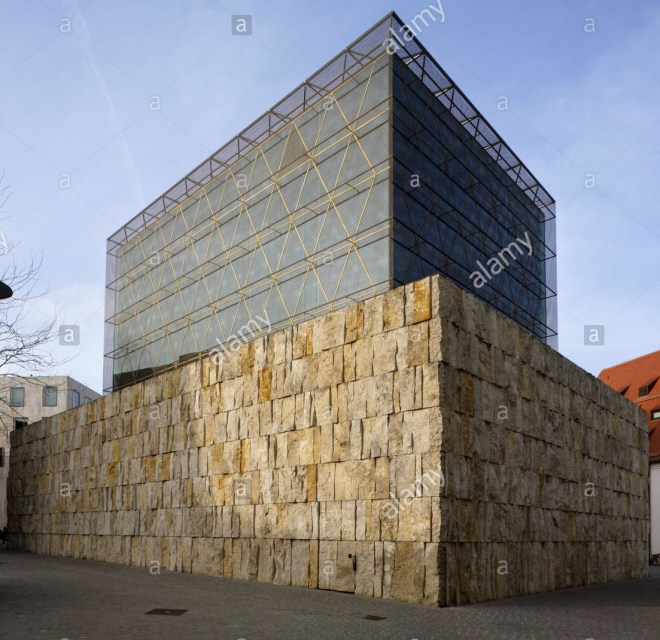
The new main Jewish synagogue in St. Jakobs Platz in the old town.

Source

The previous main synagogue was pulled down by the Nazis in 1938. We didn’t get to visit inside, but the brooding, rugged exterior was impressive enough. It reminded me of the Wailing Wall in Jerusalem. The Jewish Museum next door was interesting, too, but more as a collection of memories of a community scythed down by the Nazis. Many were sent to Dachau, a mere 20 km to the north of Munich.

The Hofbräuhaus Beer Hall in the old town.

Source

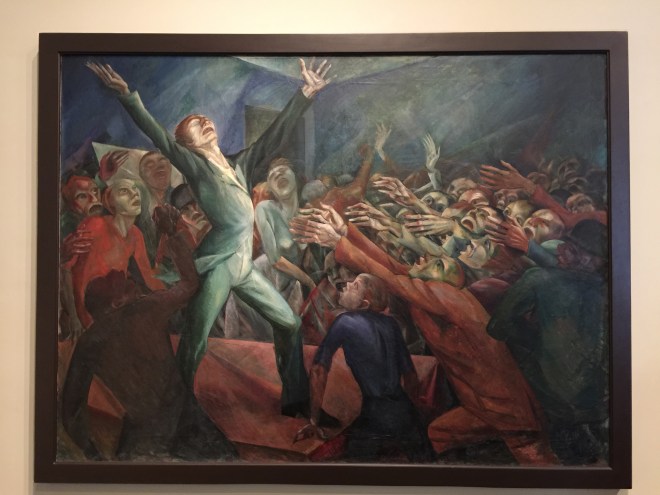
This was one of several such halls in Munich in which Hitler used to speak in the early days of his political career. I don’t know what I was expecting; a sense of menace or of dread in the air? No doubt I was influenced by a painting I had seen in Los Angeles’s County Museum of Art: The Orator, by Magnus Zeller.

our photo

The location of that painting could easily have been the Hofbräuhaus.

But all I saw were a lot of people enjoying a beer, and all I heard was a lot of cheerful babble.

And that’s it for Munich! Next stop:

Bregenz

I must confess that I was expecting more. Its location on Lake Constance, its venerable and ancient past (it was originally a Roman town by the name of Brigantium), all led me to think it would be an interesting place to visit. But no, there really wasn’t much to it, and what there was, was ruined by bad town planning: the railway station and a busy through road effectively cut the city off from the lake. So again, just a few photos of some individual places.

A view of the upper town, a charming and quiet little corner of the city.

Source

That tower in the background with the squat onion dome is St. Martin’s Tower; this charming fresco is one of several which adorn its interior.

Our photo

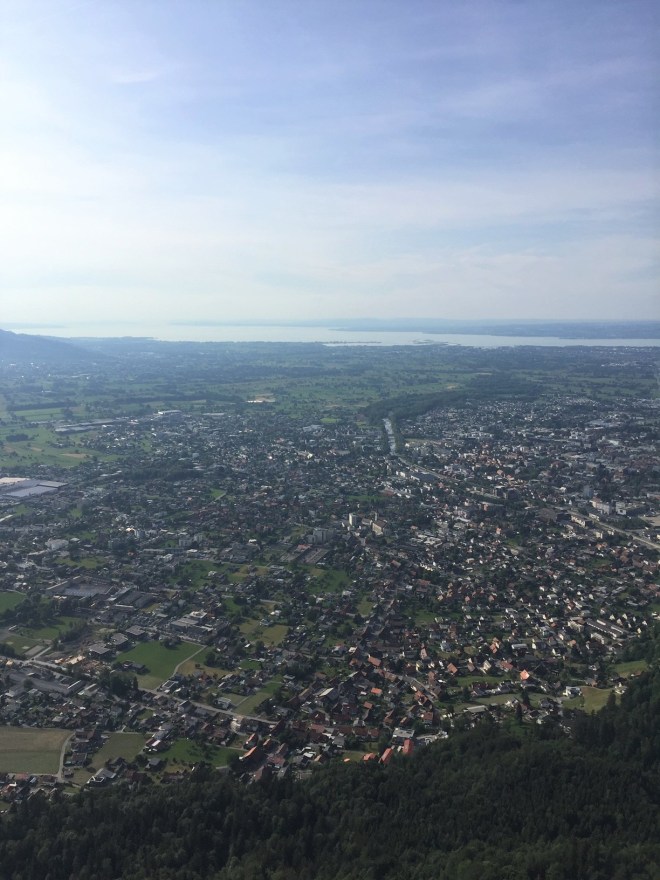
A view of the city and the lake from up a mountain outside the city. We discovered some beautiful walks in the mountains surrounding the city.

our photo

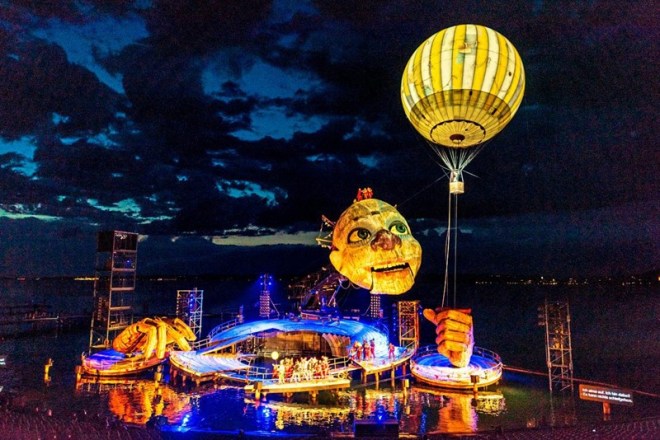
The spectacular set for the opera; it was the fact that our friend from Bregenz had extra tickets that brought us to the city in the first place.

Source
Source

The stage is a little way out in the lake, just off the shore, and the audience takes its place on seating put up along the shore. We were seeing Verdi’s Rigoletto, but the opera itself was completely overshadowed by the set. That giant head went up and down and turned this way and that, the eyes opened and closed, as did the mouth, people entered and exited the mouth, the hands moved, fluttering here and there, the tethered balloon went up and down … All this while the sun was setting over the lake and darkness came creeping up on us. It was jaw-dropping. Was the singing good? I don’t know, I was so concentrated on that head and its next move.

And that’s it for Bregenz!

I hope you’re still with me and that you enjoyed our holiday snaps. See you next time!

ÖTZI THE ICEMAN

Vienna, 29 June 2019

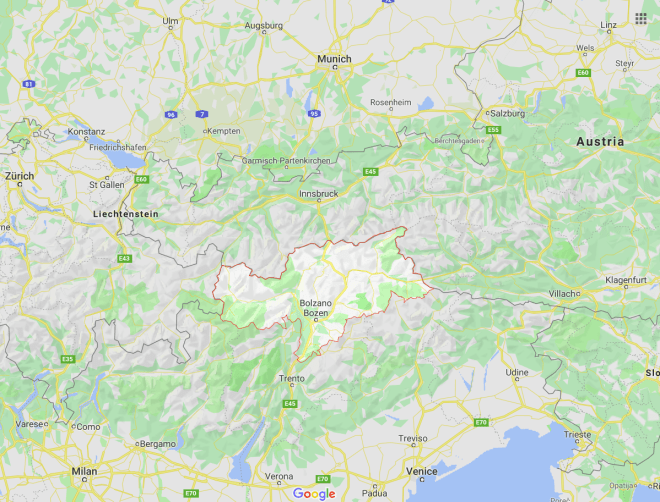
My wife and I were in Bolzano two weeks ago. For readers who are not familiar with Italy’s geography, that’s the main city of the Autonomous Province of Bolzano. This is a mainly German-speaking region of Italy in the Alps, wedged up against Austria.

Source

Italians call it Alto Adige but many of its inhabitants call it South Tyrol, it having been part of the County of Tyrol since time immemorial; it was only prised away from the Austro-Hungarian Empire and given to Italy after the former collapsed at the end of the First World War. Over the last hundred years this fateful decision has led to much agitation, repression by the Italian State, and consequent acts of terrorism, although all the brouhaha has pretty much died down by now.

Fascinating as it is, the region’s history was not what brought us to Bolzano. It was Ötzi, the Stone Age mummy discovered in a glacier high up in the Ötzal Alps (hence the mummy’s nickname) nearly thirty years ago. Ever since a museum dedicated to him opened in Bolzano in 1998, I have been hankering to visit it. Our planned hiking trip to the valley next door (which will be the subject of my next post) gave me my chance to drop by Bolzano to look over Ötzi, and my wife – although not an Ötzi fan like me – was willing to come along.

Some words of introduction. Ötzi was discovered in September 1991 by a German couple who were hiking up in the Ötzal Alps. They were crossing the Tisenjoch Pass (Giogo di Tisa in Italian), where a small glacier is located. Climate change and a particularly hot summer had led to much shrinkage in the glacier and the couple spotted a body poking out through the ice.

Source

They reported the matter to the owners of a mountain hut close by, who in turn reported it to the authorities – the initial assumption was that it must be the body of someone who had perished on a climb or hike. The man – as he turned out to be – died very close to the Italian-Austrian border. Initially, it was thought that the body’s location was in Austria and he was therefore taken down to Innsbruck (capital of the Austrian province of [northern] Tyrol) for examination. Later, after some careful measurements were made, it was concluded that he had actually been found within Italy, some 95 metres south of the border.

Under normal circumstances, if it had just been some poor bastard who had died on a hike or climb, this problem of which country he had actually been recovered in would not have been such a big deal. But it rapidly became apparent that the mummy was actually very, very old; it has since been calculated that Ötzi is some 5,000 years old. At that point, everyone began to see the dollar (or euro) signs

Source

and the question about which country “owned” the mummy became vitally important. Luckily for the rest of the world, the issue was resolved by people who were actually “cousins”, whatever modern borders might say. The Governors of (Italian) Alto Adige/South Tyrol and (Austrian) Tyrol sat down around a table and (in German) hammered out an agreement. The scientists at Innsbruck (who were much better equipped anyway to study such an ancient mummy) would take the lead on all the scientific studies while the authorities in Bolzano would prepare the museum to house it. And so it was. In 1998, Ötzi was solemnly brought back from Innsbruck to his new home in Bolzano.

While all this had been going on, and in fact ever since Ötzi has been back in Bolzano, scientists from a multitude of disciplines have been busily at work on Ötzi as well as on all the things he was wearing or carrying. I have to say, these scientists seem to have squeezed poor old Ötzi and the tattered remnants of his clothes and equipment like a lemon; squeezed him so hard that his pips have squeaked as they say. But they have come up with an astonishing amount of information. Let me start, though, with a scientific work of art: a statue of what scientists believe Ötzi looked like, which now stands at the very end of the museum tour.

Source

This work is scientific in that it has used the latest technology to measure Ötzi very precisely, to rebuild his bones, to cover those bones with muscles and skin, and then cover those with reconstitutions of his leggings and his shoes; it is artistic in that its creators have made Ötzi look incredibly human. They have given him an expression of someone you might just have met on the street and who is not completely sure who you are.

Source

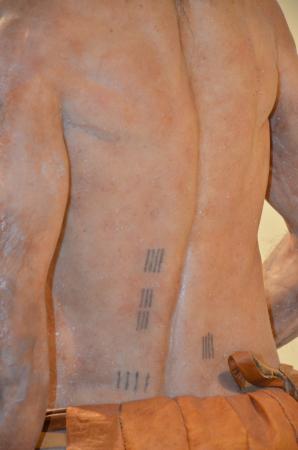
A few words about what we would have noticed about Ötzi if we had met him 5,000 years ago just before he died. He was about 160 cm (5 ft 3 in) tall (small by today’s standards, perhaps big by the standards of the day). His shoe size would have been an EU 38 (I will let readers translate that into whatever shoe size system they are familiar with; they can use this site, for instance, to do this). He weighed about 50 kilos (110 lbs), nicely within his BMI. He had brown eyes. He had dark hair. He was gap-toothed. His teeth in general were not in particularly good condition, badly worn down and with cavities (probably due to a diet based on heavily processed grains). As to his age when he died: about 45 – young by today’s standards, old by the standards of his time; the makers of the statue have made him look weatherbeaten, which he probably was. And he was tattooed; in all, he carried 61 tattoos on his body! This photo of the rear of the statue shows where he had some of them on his back.

source

As readers can see, they are not really decorative tattoos. From where they are found on Ötzi’s body, scientists believe that they probably had a therapeutic function; they were a way for Ötzi to deal with the aches and pains in his joints, an early form of acupuncture, especially since the tattoos are located along acupuncture lines still used today. For instance, scientists can see that his knee joints were well worn; I’m sure his knees ached as a result (something I can deeply sympathize with given the current state of my knees). So he had a good number of tattoos around his knees; I generally disapprove of tattoos but maybe I should try these kinds of tattoos around my knees …

From their high-tech prodding and probing, scientists have also discovered a number of things about Ötzi which you can’t see. The poor man had been sick several times in the last six months of his life; scientists can tell this from the Beau’s lines on his three remaining nails which they found (any readers who are doctors will no doubt understand this; it’s gibberish to me). He had worms – whipworms to be precise. This would have given him frequent bouts of painful diarrhea. He also had Lyme disease, while his clothes carried fleas. He had broken several ribs and his nose some time during his lifetime. His blood group was O positive. He was lactose intolerant. By rights, we should all be; it’s the “natural” default position for us humans in adulthood. But in Europe our herding culture and its dependence on milk products led to some of us eventually becoming lactose tolerant through a genetic mutation. Talking of mutations, Ötzi carried a rare genetic trait which meant that he was missing two ribs. His DNA links him to small populations of people living in remote parts of Sardinia and Corsica: testimony to his being part of the earlier populations of Europe which were later pushed aside by later immigrants.

It’s not just the man who has been thoroughly investigated, it’s also his clothes and equipment. What mainly transpires for me was that in today’s language, Ötzi was a completely sustainable guy. He relied heavily on animal hides for all his needs; scientists have identified bear skin, deer skin, goat skin. These were used not only for his clothes but also parts of his equipment (fascinating factoid: at least one of the hides which he used was tanned with bear brains and fat; better than the human carcinogen Chromium VI which is almost universally used nowadays). Animal sinews were used to sew the pieces of hide together (I’m no expert on sewing, but for those who are interested there are sites, e.g., this one, which explain the kind of sewing that was used). Grasses of various kinds were used to both make twine and as a thermal stuffing. Here is a close-up of the reconstituted leggings and shoes on the statue of Ötzi

Source

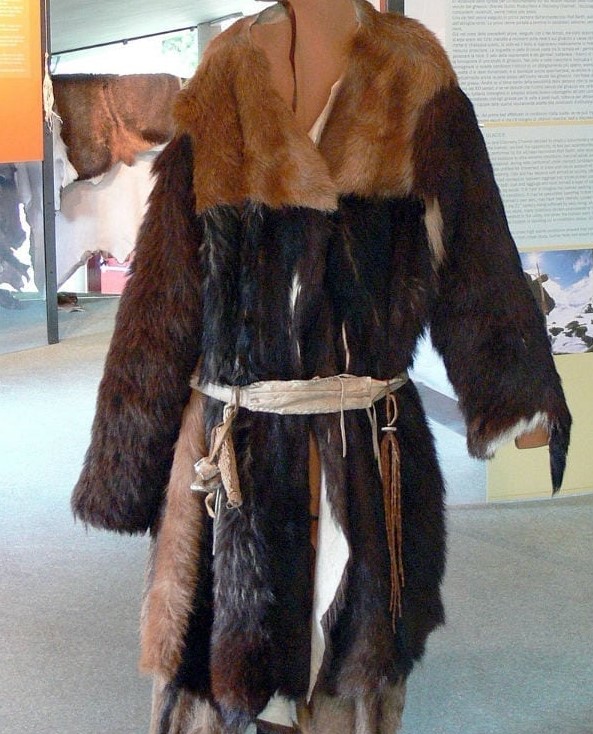
while this photo shows the coat he was wearing – scientists think that the dark-pale-dark look was not serendipitous; it was a statement of some sort.

source

I’ll skip the weapons Ötzi was carrying except for one – his axe – which I will come back to in a minute. I find more fascinating the stuff he was carrying to make himself a fire: a fungus called tinder fungus. I’ve diligently read explanations of how to light a fire with a flint and some tinder fungus. It sounds easy, but I very much doubt it is. Unfortunately, making fires without matches is something they never taught me to do in the Scouts, and I am always fascinated by the apparent magic of people making fire from nothing. In such situations, I always think of Tom Hanks in the film Cast Away when he managed to start his first fire without matches: I can empathize with his sense of triumph at having cracked this problem.

Source

And so we come to the great mystery of Ötzi’s death, the first murder that we know of. For it was murder: scientists discovered that an arrow had penetrated Ötzi just below his left shoulder. Someone shot him from behind. The arrowhead sliced through his subclavian artery, so medics have concluded that he would have bled out quite quickly. We can surmise that he dropped face down on his left arm (which was the position the mummy was found in) and died. From the depth of penetration, scientists estimate that the arrow was shot from 30 m (or 100 ft) away. That sounds to me like a pretty lucky shot. But then I’ve never tried killing anyone with a bow and arrow; maybe 30 m is no big deal for someone who is adept at using a bow and arrow. The fatal arrowhead is still in the mummy, but there was no sign of the arrow shaft, from which the scientists conclude that Ötzi’s killer pulled it out.

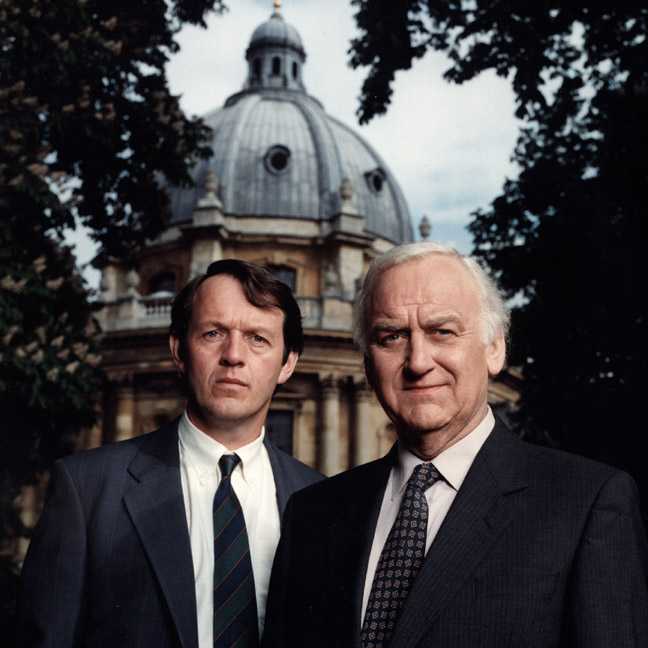
And now to the big question: Why? Why was Ötzi killed? Towards the end of the museum tour, visitors are invited to write down and submit their own theory about the reasons surrounding Ötzi’s death. My wife and I have been watching a lot of episodes from the British TV show Inspector Morse recently, whom we see here with his faithful sidekick Sergeant Lewis.

Source

So I decided that this was an excellent opportunity to Think like Morse. Having sieved through the available facts, I have come up with the following story line:

A day or so before his death, Ötzi was involved in a vicious fracas with someone. We know this because scientists discovered a very deep cut between his thumb and forefinger as well as other cuts on his hands. These are typical of someone trying to protect themselves during a close-in fight involving weapons with a cutting edge, a knife attack for instance. I surmise that he successfully defended himself and in the process killed his assailant.

What was this deadly fracas about? “Cherchez la femme”, that’s what I say! As I already mentioned, Ötzi’s knee joints were well worn, indicating a lifestyle that required a lot of walking. This has led some scientists to suggest that he was a shepherd and so spent much of his time moving his flocks around the area’s Alpine pastures. I’m not convinced. The reason for that is his axe. The axe has a copper head; at the time of his death, this would have been a very rare, and therefore very valuable, item: until it was found it was thought that the Age of Metals had not yet started in Italy. So I conclude that he must have been a VIP of some sort. That in itself is not important to his murder, I believe. What is important is that his position required a lot of time away from home walking the mountains. My guess is that he returned home unexpectedly to find his wife canoodling with another man – or maybe his daughter. He got into a fight with the man and killed him. In the language of our time, it was an honour killing.

What next? There has been speculation that Ötzi was escaping when he was killed. That certainly could fit my story; it is not unusual in cases of honour killing for the murderer to quickly go into hiding until passions have subsided. But Ötzi doesn’t seem to have been in a hurry on his last journey. Scientists can tell that Ötzi’s deep cut to his hand occurred a day or so before his death, so he clearly hung around for a while before leaving. They also have figured out that he had quite a heavy meal about an hour before he died: not the behaviour one would expect from a man on the run. So I surmise that after putting his house in order Ötzi headed out again calmly, without a sense that his life was in danger. How wrong he was!

In my scenario, the family of the man he killed vowed revenge. I also posit that they didn’t live in the same village as Ötzi, so it took a while for the news to reach them, which explains why there wasn’t an immediate reaction. I also think that they couldn’t be too open about wanting revenge because of Ötzi’s VIP position. So they hurried over in secret, discovered that he had already left, and hurried after him. They caught up with him at the Pass. Maybe he saw them coming, realized what was happening, and started running, which would explain the decision to take a long bow shot before he disappeared over the horizon. After checking he was dead and pulling out the arrow shaft from where it was buried below his left shoulder, Ötzi’s killers then hurried back to their village, leaving him where he fell. If Ötzi was always traveling, it could have been a while before his family realized something was wrong, by which time early summer snows had already covered the body and hidden it from view – and started the long, slow process of mummification (by the way, scientists know it was early summer when he died because of the types of pollen that he swallowed with his last meal: such clever fellows, these scientists …).

There you have it, ladies and gentlemen, my theory on Ötzi’s untimely death! If you are not convinced, I suggest you find time one day to visit his museum in Bolzano to come up with your own theories. Or you can just read the wealth of stuff on the net about it all – Ötzi has created a veritable cottage industry around his life and death.

Whatever you do, though, spare a thought for poor old Ötzi, who is now hardly visible anymore in his own museum, lying as he is in a specially-created cold cell recreating the conditions he lay in for 5,000 years in the Tisenjoch Glacier, visible only through a small window.

Source

FRANCESCO BARACCA, ACE OF ACES

Sori, 3 June 2019

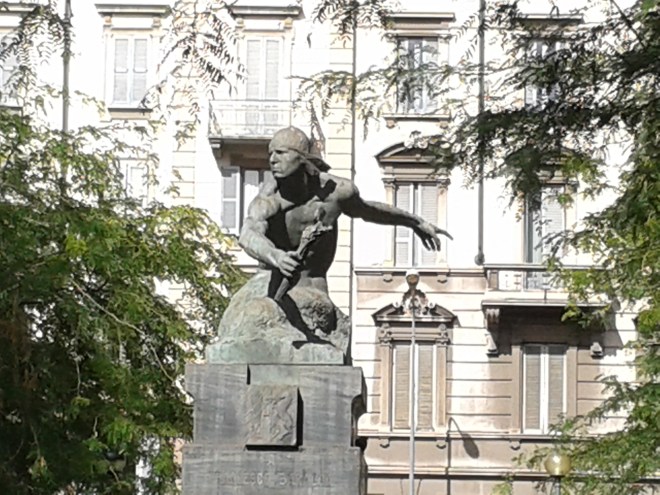
My wife and I were recently walking to the library of the Italian Alpine Club, with the idea of looking at some guide books on a walk in the Dolomites which we will be doing in a few weeks (and on which I hope to write a post or two). The walk took us through a part of Milan with which I’m not familiar, and so it was that I found myself walking for the first time through a little square. In the middle of it was this very intriguing statue.

Source

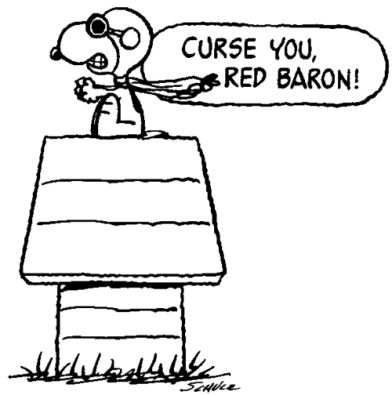
As readers can see, it consists of a man emerging from a stone plinth, naked but for some sort of cap with ear flaps on his head, holding a lit torch in one hand, and wearing a heroic expression. The name carved into the base of the plinth was Francesco Baracca. I asked my wife who it was. She wasn’t sure – a First World War general, she hazarded? But I wasn’t convinced. The cap looked too much like those leather caps worn by the early aviators. I mean, who doesn’t remember Snoopy on his way to fight the Red Baron?

Source

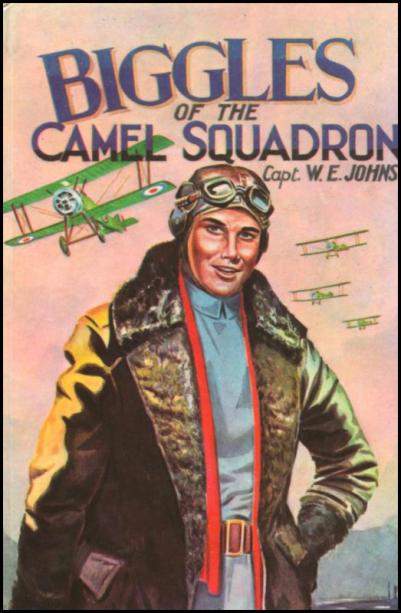
In my memory, there were also pictures of Biggles from the boys’ books of my youth.

Source

No-one who is not British and not my age or older will know who this Biggles is. He was a fictional World War I fighter pilot about whom a series of exciting books were written. He was a very heroic figure and a Jolly Good Chap.

A bit more seriously, here is a photo of Charles Lindbergh, the first person to manage a solo crossing of the Atlantic non-stop, which he did in 1927.

Source

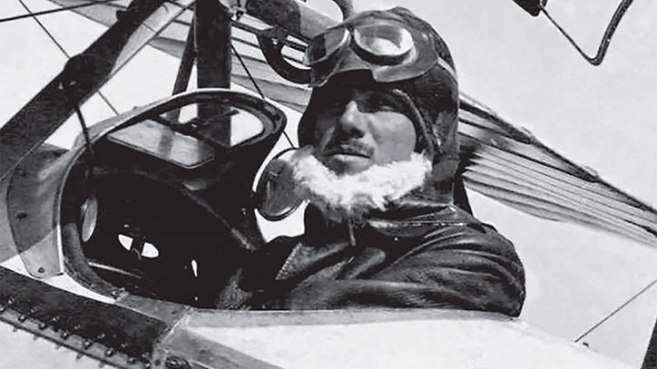
Well, it turned out I was right. Francesco Baracca had indeed been an aviator. And not just any old aviator! He was Italy’s Ace of Aces during the First World War, racking up 34 recognized victories, the highest score for any Italian fighter pilot. Here we have him sitting in his plane with his flying cap on (and, contrary to his statue, with his clothes on; very sensible, it’s cold up there), ready to go and let the enemy have it.

Source

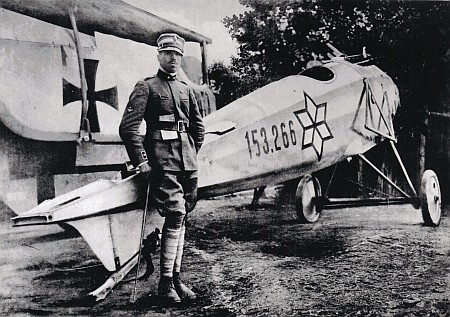
While here we have him posing in front of one of the enemy planes he had downed.

Source

Of course the government squeezed all the propaganda benefits they could out of his exploits. Anything heroic that could take the public’s mind off the bloody and ineffectual meat grinder of trench warfare was to be welcomed. And anyway, there was something terribly dashing about these aerial duels; it was the modern equivalent of Medieval knights jousting. As a result, he was lionized by the Italian public, who followed his every victory with enthusiasm.

It wasn’t just Italians who were enthused by the new forms of warfare in the air. On all sides of the war, the exploits of these new heroes of the air were followed avidly. But perhaps the Italians had a particular penchant for the exploits of aerial warfare. After all, it was in Italy that the Futurismo art movement was born, which had a total commitment to modern technology. To make the point, here are some key excerpts from two of the Futurist Manifestos that were published in 1910.

This is from the Futurist Painters Manifesto:

We want to fight with all our might the fanatical, senseless and snobbish worship of the past … We rebel against that spineless worshipping of old canvases, old statues and old bric-a-brac, against everything which is filthy and worm-ridden and corroded by time … Comrades! We declare to you that the triumphant progress of science has brought about such profound changes in humanity as to excavate an abyss between those docile slaves of past tradition and us, free, and confident in the radiant splendour of the future. … In the eyes of other countries, Italy is still a land of the dead, a vast Pompeii, whitened with sepulchres. But Italy is being reborn … In this land of illiterates, schools are multiplying; in this land of “dolce far niente” innumerable workshops now roar; in this land of traditional aesthetics are today taking flight inspirations dazzling in their novelty. Only art which draws its elements from the world around it is alive. Just as our forebears drew their artistic inspiration from a religious atmosphere which fed their souls, so must we inspire ourselves from the tangible miracles of contemporary life: the iron network of speedy communications which envelops the earth, the transatlantic liners, the dreadnoughts, those marvelous flights which furrow our skies, the profound courage of our submarine navigators and the spasmodic struggle to conquer the unknown. 


And this is from the Futurism Manifesto penned by the poet Marinetti, the “Father of Futurism”, who laid out a decalogue of futurist thought.

1. We want to sing of a love of danger, and the practice of energy and rashness.

3. Literature has up to now magnified pensive immobility, ecstasy and slumber. We want to exalt aggressive movement, feverish sleeplessness, the double march, the perilous leap, the slap and the punch.

4. We affirm that the splendor of the world has been enriched by a new beauty: the beauty of speed. A racing car, its bonnet adorned with great tubes like serpents with explosive breath … a roaring motor car, which seems to run on machine-gun fire, is more beautiful than the Victory of Samothrace.

9. We want to glorify war – the only cleanser of the world – militarism, patriotism, the destructive gesture of liberals, beautiful ideas for which one dies, and contempt for women.

10. We want to destroy the museums and libraries, the academies of every type, and combat moralism, feminism, and against every opportunistic and utilitarian vileness.

11. We will sing of the great crowds agitated by work, pleasure and revolt; we will sing of the multi-colored and polyphonic tide of revolutions in the modern capitals; we will sing of the vibrant nocturnal fervour of the arsenals and construction sites, enflamed by violent electric moons; the ravenous railway stations, devourers of smoking serpents; the workshops suspended from the clouds by the twisted threads of their smoke; the bridges which, like giant gymnasts, leap across rivers, flashing in the sun with the glitter of knives; the adventurous steamers sniffing at the horizon, and the great-breasted locomotives, pawing at the rails like enormous steel horses harnessed with pipes, and the gliding flight of aeroplanes whose propellers flutter in the wind like a flag and seem to applaud like an enthusiastic crowd.


Pretty incendiary stuff …

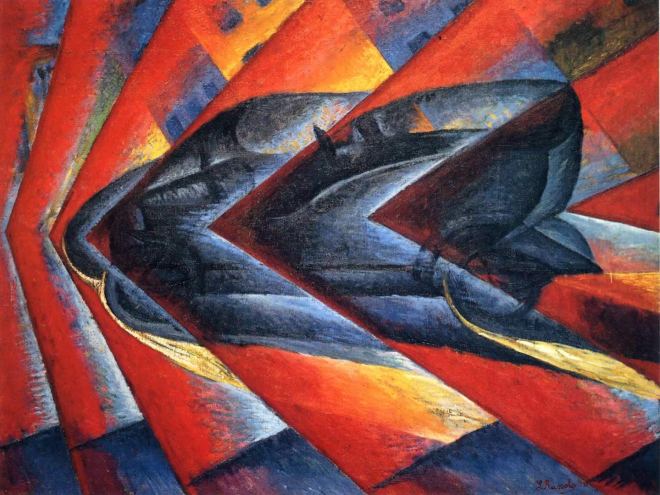
Right from the start, Futurist paintings reflected this adoration of speed and power, although initially the focus was on terrestrial technology. For instance, from 1912-1913, we have Luigi Russolo’s Dynamism of an Automobile.

Source

From 1922, we have Ivo Pannaggi’s Moving Train.

Source

(which rather reminds me of the opening credits of the Poirot TV series)

Source

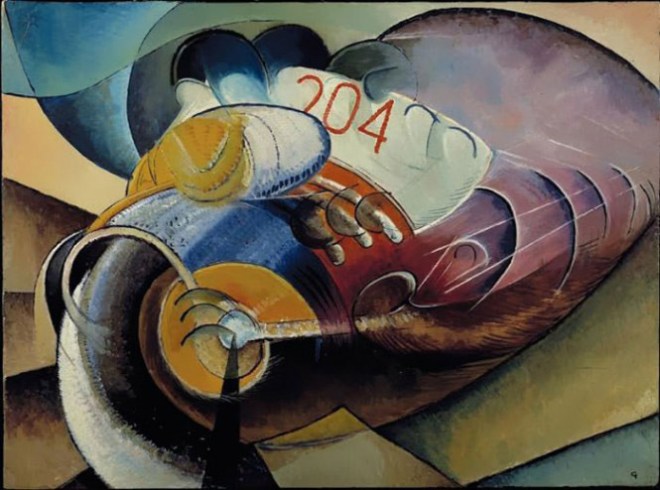
From 1923, we have Ugo Giannattasio’s Motorcyclists

Source

It was only in the 1930s that Futurist painter’s started painting airplanes. For instance, from 1930 we have Tato’s Flying Over the Colosseum in Spirals.

Source

Perhaps it took a while for the painters to get into a cockpit and experience the sensation of flying.

Coming back to Baracca, he was eventually shot down, in June 1918. For propaganda purposes, the Italian government put it out that he had been hit by ground fire (to perpetuate the myth that no other aviator could shoot him down), although the Austrians claimed with good evidence that he was taken out by one of their planes. However it happened, his body was recovered and he was given a hero’s funeral. He was finally laid to rest in his home town of Lugo in Emilia-Romagna. Several decades later, the Fascists erected a large statue of him in the main square (this time with his clothes on)

Source

while his co-citizens opened a museum about him – might as well make some money off the town’s most famous son …

This story has a fascinating coda, which was really why I wrote this post. To explain it properly, I have to go back a bit and give readers a thumbnail biography of Baracca. He was, as I said, a citizen of Lugo, a small town located close to Ravenna. His parents were well-off and to some degree aristocratic – his mother was a countess. After his schooling, he chose to join the army. After studying at a military academy, in 1909 he was assigned a regiment. Given his social status, this was a cavalry regiment, the 2nd “Royal Piedmont”, a regiment created in 1692 by Duke Vittorio Amedeo II of Savoy. Because of its importance to my story, I insert here the regiment’s traditional banner: a silver prancing horse on a red field.

Source

In 1912, after watching an aerial exhibition in Rome, Baracca became wildly enthusiastic about the future of military aviation. He asked to join the newly-created aviation arm of the army, a request that was granted. He went for training in France and by the time Italy joined the War in 1915, he was trained and ready to go.

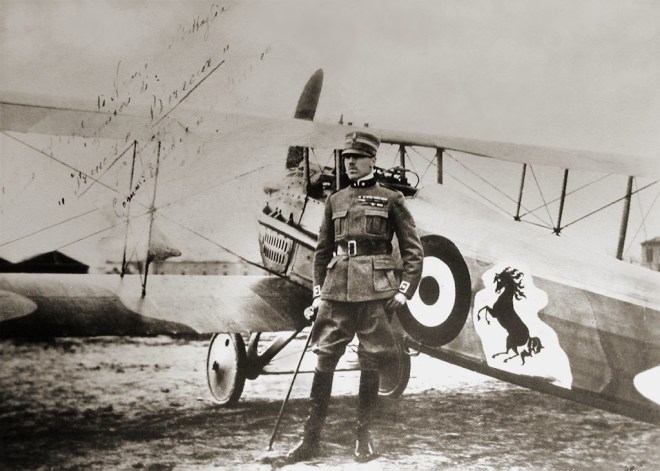
As his number of victories climbed, the High Command fawned over him. In 1917, he was given his own squadron, the 91st, and allowed to choose his own pilots. He took all the other Italian aces, so the squadron became known as “the squadron of the aces”. On the right side of his plane’s fuselage, he placed the squadron’s insignia, a rampant griffin. On the left side, he placed his personal insignia. For this, in recognition of his earlier affiliation with the 2nd cavalry regiment, he chose its prancing horse. He changed the colour scheme, though, making the horse black on a silver background. Here we see him standing in front of his plane on which we see plainly his personal insignia.

Source

The insignia was an instant hit with the public, especially when the pilots of his squadron all adopted it in his honour after his death.

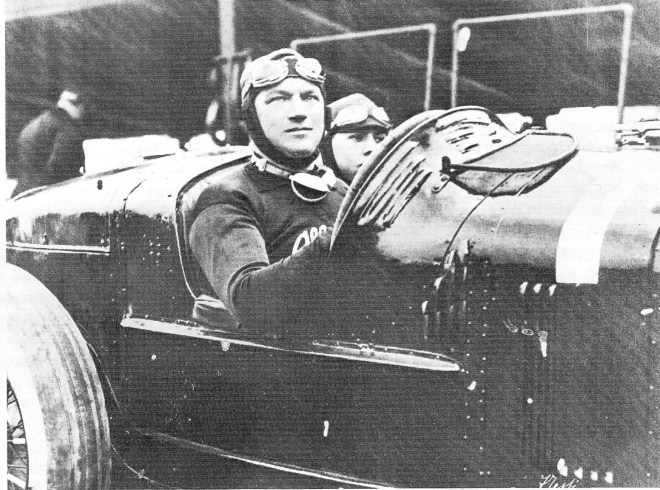
Fast forward a few years after the war, 1923 to be exact. I now introduce another character to this story, that of Enzo Ferrari, the fabled creator of the Ferrari racing team and car manufacturer. In 1923, he was just a driver for Alfa Romeo, racing their cars on various circuits. Racing was very popular in Italy, and the successful drivers were stars, rather like Baracca had been – and they wore the same leather caps as aviators.

Source

In any event, in that year Ferrari won a race near Ravenna. On the race’s edges, he met Baracca’s father. This led to a second meeting, this time with Baracca’s mother. He must have told them how much he had admired their son. And maybe they saw the racing of cars as an honourable descendant of what their son had been doing with planes. Whatever the reason, Baracca’s mother uttered these fateful words: “Ferrari, put my son’s horse on your cars. It will bring you good luck.” And that is exactly what Ferrari did seven years later in 1930, when he created his own racing team. From then on, his cars sported Baracca’s prancing horse. The only changes he brought were to make the field behind the horse canary yellow, to honour his home town, Modena, whose coat of arms has the same yellow field, and to raise the horse’s tail.

Source

And that is why, dear readers, Ferrari cars to this day sport a shield with a black prancing horse on a yellow field.

Source

SIX-LEGGED, BACKWARD-LOOKING, FIRE-BREATHING SHAGGY BLACK DOG

Milan, 17 April 2019

One of the nice things about being in Milan at this time of the year is that it allows my wife and me to visit the various exhibitions which make up the city’s annual Design Week. This last week saw us tramping the highways and byways of Milan and dropping into exhibitions of design, mostly of furniture and furnishings, this week also being the time that Milan was holding the Salone del Mobile, its huge international exhibition of furniture and furnishings. I cannot say that I saw anything that knocked my socks off, or even just rolled them down. But it did allow us to visit a good number of old palazzi which were hosting exhibitions and which are out of bounds to the general public the rest of the year. It also allowed us to visit a small botanical garden that is tucked away behind the Brera Academy in the heart of Milan’s fashion district, a garden which neither of us knew existed. It is that visit which started off this post.

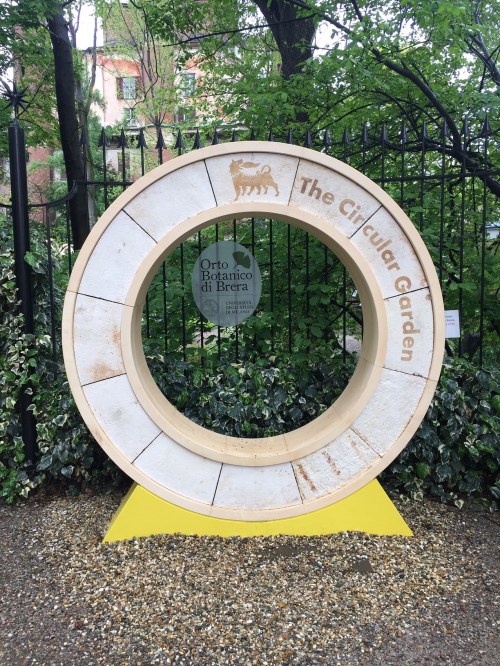
Our reason for going to the botanical garden was that ENI, Italy’s huge national oil and gas corporation, was holding an exhibition there on the theme of circular economy. This is an idea that is currently growing in importance in the environmental world and one which I have been running trainings on, and I was curious to see what ENI had to say on the subject. The short answer is: not terribly much. But I came away with this picture.
For readers who might be interested, the white core of this ring is composed of fungal mycelium, which ENI reminds us is completely biodegradable, and the outer casing is made of birch wood, which ENI says will be reused once the exhibition is over. Without much exaggeration, that pretty much sums up what ENI had to say about the circular economy in its exhibition.

Of greater interest for this post is what the makers of this ring have etched into the mycelium: apart from the title of the exhibition and the company’s name, the company’s logo: the six-legged dog. It is this dog which is the subject of this post. Or rather, given where this post started, it is the design history of this dog which I will write about.

My story starts in 1949, when Enrico Mattei, the charismatic boss of Agip, Italy’s national oil company, announced that oil and gas reserves had been discovered in the Po River plain. In truth, the finds were quite modest: the oil fields were to run dry quite quickly, while the gas fields, although they continue to chug along, have only a very modest output. But Mattei talked up the finds, offering a vision of Italy finally being self-sufficient in the fuels it needed to power its economic development, and thereby created a huge national stir. By late 1951, Italian refineries were beginning to produce the first petrol derived from Italian crude oil and Mattei’s PR office had come up with a name for this purely Italian petrol: Supercortemaggiore (Corte Maggiore being the place where the find had been made). In May 1952, Mattei decided to crank up excitement levels by announcing that Agip would hold a public competition open to all Italian citizens, inviting them to come up with, among other things, a publicity poster for Supercortemaggiore petrol. He made 10 million lire (or about 160,000 euros in today’s money) available in prize money to further whet people’s appetites. He composed a jury of very eminent persons to judge the entries; to give readers an idea of their eminence , the chair of the jury was the world-famous architect Giò Ponti.

Creative Italy got to work. By the closure of the competition in September, some 4,000 entries had been received. The jury ploughed through the submissions and for the Supercortemaggiore poster, it plumped for this:

source

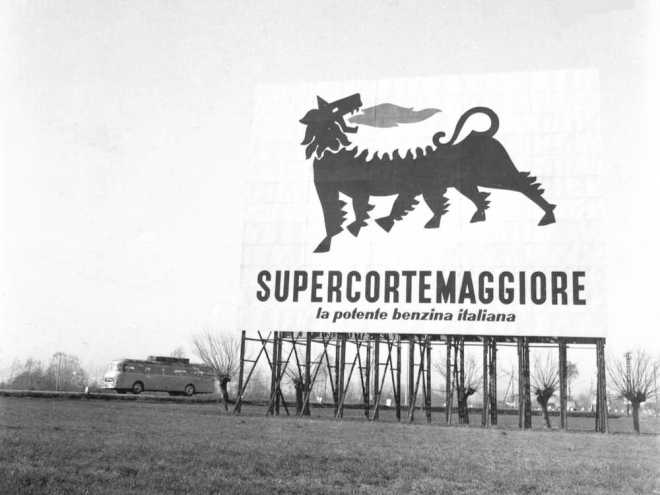
The caption read: “Supercortemaggiore: the powerful Italian petrol”. But what really dominated the poster was a six-legged shaggy black dog blowing out a red flame over its back. The whole poster had a bright yellow background. The original drawing as submitted actually had the dog facing frontward with the flame shooting out forward. Mattei decreed that this was too aggressive, people could imagine they were faced with a canine version of a flame-thrower. No problem! The head was swiveled 180 degrees so that the flame flared harmlessly back over the dog’s back. The net result was that by late 1952 Italians up and down the land found themselves faced with huge billboards such as these.

source

Most advertising ideas work OK, some are a complete flop, and some work spectacularly well. The six-legged, fire-breathing, backward-looking, shaggy black dog falls into the last category; it was an instant hit with Italians. So popular did it become that in 1953, when Mattei created the new national oil and gas holding company, the Ente Nazionale Idrocarburi or ENI, with Agip as one of its subsidiaries, he decided that the dog should become the corporate brand. And so quite soon when Italians went to fill up at their local Agip petrol station they were faced with something like this.

source

In fact, this was how I first came across this intriguing dog. This was in Asmara, the capital of Eritrea, where I was born a year or so after the shaggy black dog burst upon the scene. As an ex-Italian colony still full of Italians in the 1950s, Agip had a monopoly on the country’s petrol supply. It took a little while for the new ENI/Agip logo to grace every Agip petrol station, especially when the petrol stations were as far away from the center of the ENI empire as those in Asmara were. But they eventually got there, and I would have first seen the dog in 1958-59, from the back seat of the car as my father filled her up at the petrol station just behind our house.

Just to finish the design part, the dog has gone through some discreet remodelling as ENI has redesigned its look over the years. This is what it now looks like: slightly shorter than it was at the start and half out of the box rather than all in it. But the essentials are all still there.

source

At some point, everyone who looks at this dog asks themselves “why six legs?” or the more-or-less equivalent question “what kind of animal is this, actually?” To discuss this properly, I need to take a step sideways and relate a dramatic turn of evens which occurred in 1983, 30 or so years after Mattei held his competition. In that year, the startling news broke that Giuseppe Guzzi, the person who everyone had assumed was the creator of the dog – because the submission to the competition’s jury was in his name – was not in fact its author! He had been merely the front man for the dog’s real creator, Luigi Broggini, a respectable Milanese sculptor. Broggini died in 1983 and his children, who broke the news, felt that it was time for the real creator of the famous dog to get the credit he was due. It seems that Broggini was a bit of a cultural elitist; he felt that being linked to such a vulgar enterprise as designing a publicity poster for a brand of petrol was unworthy of a true artist such as he. This is a typical product of his artistic inclinations.

source

The cynic inside of me whispers that he probably didn’t deign to take the prize money; I only hope he shared it fairly with Guzzi to reward him for agreeing to be his front man.

So now we can return to the question of why six legs. Unfortunately, because Broggini died before his true role in this whole affair was revealed, we will never be able to ask the dog’s creator what he had in mind. I presume Broggini never told Guzzi, because it doesn’t seem that Guzzi ever gave any coherent response to this question. Maybe he would just smile mysteriously when asked and invite the questioners to come up with their own theory.

And come up with theories people have. One suggests that Broggini, thinking about the fact that the original crude oil lay underground, looked for possible models to the panoply of Greek and Roman gods and goddesses that peopled the shadowy underworld. Cerberus, the dog which guarded the entry to Hades, is considered one model. Cerberus was normally described as having three heads, a serpent for a tail, and snakes writhing out from his body in various places. But he had the normal amount of legs and he didn’t breathe fire. Here is a Greek vase depicting him.

source

The idea to have a fire-breathing animal no doubt comes from petrol’s readiness to burn. But what animal breathes fire? The answer is the dragon.

source

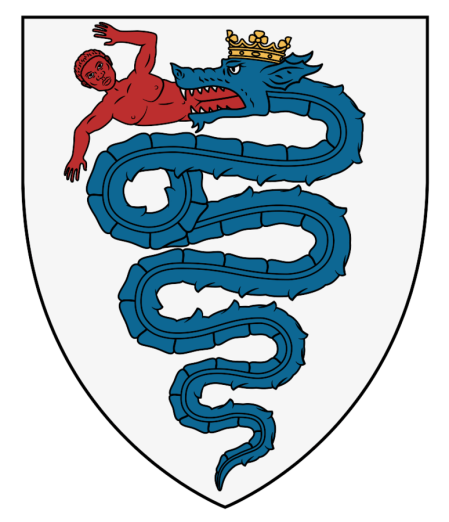
So another theory suggests that Broggini took a cue from a local Lombard legend of a dragon named Tarantasio which lived in a lake near Lodi, south-east of Milan (and perhaps not coincidentally quite close to the natural gas finds which Mattei announced in 1949). It was said that its breath was pestilential and it liked to devour little children. The Visconti, Lords of Milan, claimed that their ancestor had killed the terrible child-eating dragon and took it as the symbol on their coat of arms.

source

So maybe Broggini was imagining a dog from the underworld with dragon-like characteristics. Adding a dragon to the mix might explain the flaming mouth, but as far as I can make out dragons are, like dogs, four-legged. So we still have no explanation for the six legs. The best I can think of is that Broggini liked the idea of using Cerberus as a model, perhaps allied to a dragon-like ability to breathe fire, but didn’t think having multiple heads was a good idea and so decided on multiple legs. Whatever the reason, the ENI PR office came up with a really pathetic slogan: “the dog with six legs, faithful friend to the man on four wheels”. And the man who came up with this slogan was none other than the great film director, Ettore Scola! As I always say to my wife in cases like these, he surely needed to pay his rent and electricity bills.

Let me finish this post recounting what happened to the man who started the whole business of the competition which brought us the dragon-dog, Enrico Mattei. For Mattei, the real point of the competition was to strengthen public support for a strong national oil and gas company, which he could translate into political support. He succeeded spectacularly well. A year after the competition, he got the politicians to back his idea of creating ENI. He used the profits which Agip petroli and its sister company Agip gas made from the Italian oil and gas finds to fund his ventures in foreign countries rich in oil and gas. His long-term strategy was for ENI to become a competitor to the Seven Sisters (a term he invented to describe the seven – mainly US – corporations which at that time dominated the world’s oil and gas markets). To make this happen, he went to places the Seven Sisters couldn’t or didn’t want to go to, he offered the countries really good deals in the share of profits, and he wasn’t above offering succulent bribes. Judging by ENI’s heft today in the world market, I would say that Mattei got it right. But in the process he stepped on many, many toes. In 1962, he died when his private plane crashed while coming in to land at Milan airport. The inquest was rushed through and arrived at the conclusion that it was an accident. But this is Italy. Rumors continued to circulate that his plane had been sabotaged. In the early 1990s, his body and that of one of the two passengers on the plane with him were exhumed, and examination of metal fragments in their bones showed they had been deformed by an explosion. In 1994, the case was reopened and eventually the episode was reclassified as a homicide by a person or persons unknown. There has been enormous amounts of speculation as to who these “unknown persons” might be. At one time or other, the finger has been pointed at the British Secret Service, the French Secret Service, the OAS (the French irredentists for a French Algeria), the CIA, the Mafia (as a favour to their cousins in America, the Cosa Nostra), one or more of the Seven Sisters, and I’m sure I’ve missed a few. We’ll no doubt never know.

But we can all thank Mattei for that splendid six-legged, backward-looking, fire-breathing, shaggy black dog which he bequeathed the world!

FINAL THOUGHTS

Milan, 16 March 2019

Let me start this final post on the topic of UK industry in art by throwing in photos of a couple of paintings which didn’t make it into my previous posts but which really are worth being seen.

A Street with Washing (1962) by Peter Brook Calderdale (1927-2009), © the artist’s estate. Photo credit: Metropolitan Borough Council
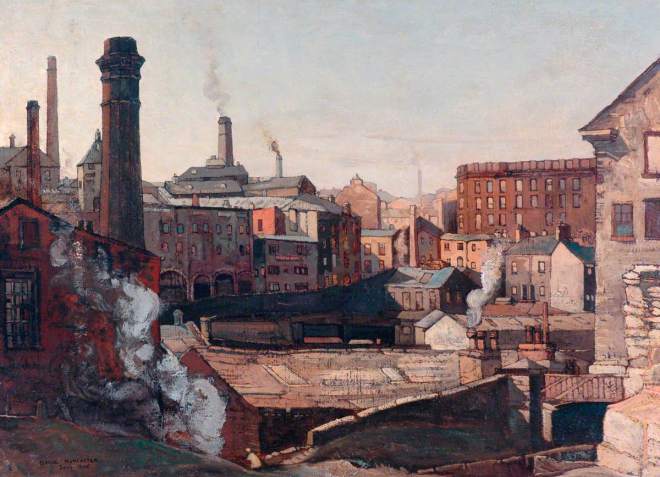
Halifax (Bowling Dyke) (1925) by Claude Muncaster (1903-1974), © by kind permission of Claude Muncaster’s estate. Photo credit: Calderdale Metropolitan Borough Council
Backyard of Otaco Ltd Factory, 16 Market Road (date unknown) by Käthe Strenitz (1923-2017), © the artist’s estate. Photo credit: Islington Local History Centre and Museum
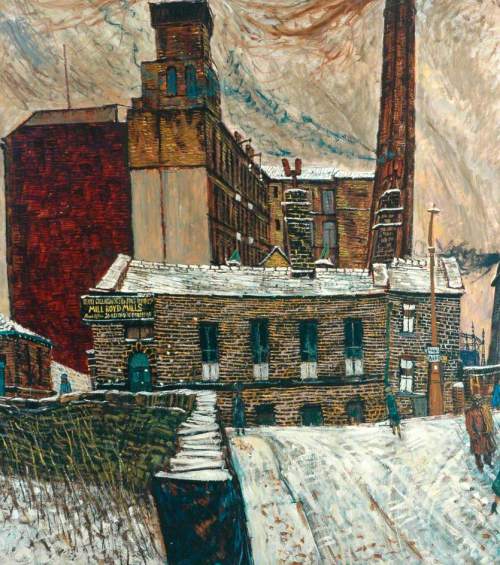
Mill in Winter (1958) by Peter Brook (1927-2009), © the artist’s estate. Photo credit: Kirklees Museums and Galleries
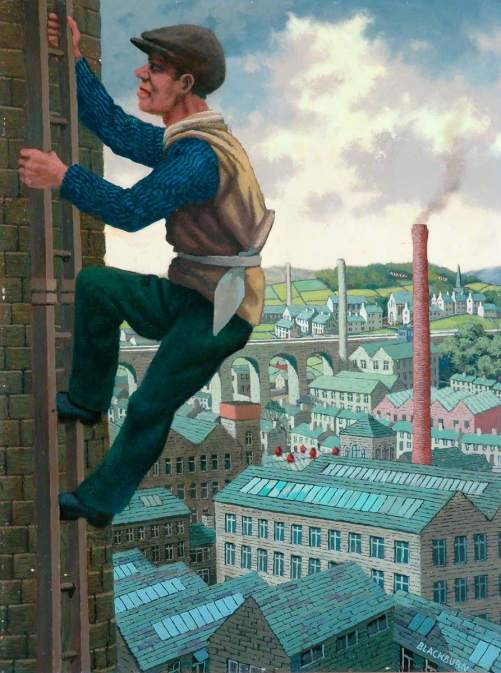
Steeplejacks (date unknown) by Harold Blackburn (1899-1980), © the copyright holder. Photo credit: Kirklees Museums and Galleries
Lilly Clare, Last of the Taker-Inners (1979) by Christopher Brady (b. 1956), © the copyright holder. Photo credit: St Helens Council Collection
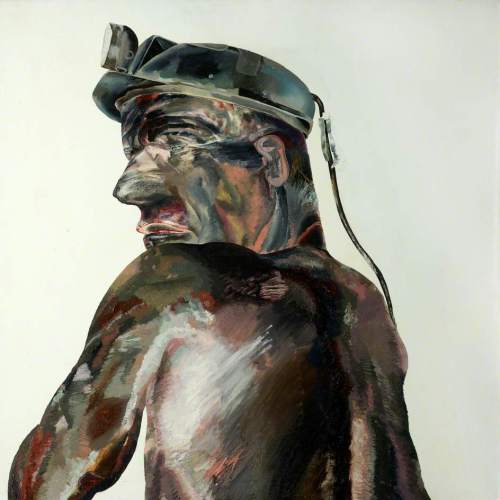
Miner on G6 Face (date unknown) by Jack Crabtree (b. 1938), © the artist. Photo credit: University of South Wales Art Collection Museum
High Rake Lead Mine (2008) by Susan Loft (b. 1945), © the artist. Photo credit: Buxton Museum & Art Gallery


And now, with that out of the way, let me meditate for a minute on where things stand for UK industry and what its future might look like.

Through sheer coincidence I have been publishing these posts just when the British Parliament is going through what will probably be the last moments of a contorted, acrimonious process which will take the UK out of the EU, a process that was kicked off by the Referendum results of 23 June 2016. It is the leave vote that interests me here. There were many reasons why people voted to leave, many of them I’m sure having nothing – or relatively little – to do with the EU per se. Consider the following map, which gives a regional distribution of the vote.

The first thing that strikes one is the very clear difference in voting patterns between England and Scotland, and to a lesser degree Northern Ireland. That explains some of the Parliamentary shenanigans we have been witnessing these last two years. Putting that aside, the other major thing that strikes one is that, just from a territorial point of view, the vast majority of England and Wales voted to leave! (although the vote was admittedly close in many places) If the overall vote ended up such a close balance between leave and remain, it is because the bigger cities, which have big populations squeezed into small territories, voted strongly for remain. The following population-adjusted map shows this effect: London and its heavily populated surrounding swells, Scotland and Wales with their small populations shrink.

This divergence in the Referendum results between the large cities and the rest of the country has been interpreted as a protest vote on the part of those who live in the smaller towns. The Referendum was, so the thinking goes, a way they could figuratively stick a finger in the eye of the big-city elites. Since the EU is seen in the heartlands to be very much an elite project, a vote against the EU in the Referendum was very often a vote against the big-city slickers. The people who live in England’s and Wales’s small towns feel left behind, abandoned by the big cities. This must be especially true of towns which were once heavily industrialized whose citizens have seen their proud towns founder and collapse while the big cities seemingly have continued to grow and be ever more prosperous. One of the things that struck me as I prepared the last six posts is how many of the small towns in the paintings I was looking at were once busy, prosperous industrial towns and are now, because of deindustrialization, shells – ghosts – of what they once were. Looking at where the towns in the paintings I chose are on those voting maps, I can understand how the bitterness which has accumulated over the last forty years in these small industrial towns could have spilled over into a vote against the EU – especially since the UK’s membership in the EU started a mere decade before the UK’s deindustrialization started in earnest.

It’s so tragic really, because it looks like many leave voters actually stuck a finger in their own eye. As we have seen over the last few months, manufacturing, which although much diminished still mainly takes place in the old industrial towns, has taken a hit because of Brexit, with one multinational company after another closing down or downsizing their British operations. It will continue taking a hit: in the long term, it has been predicted that Brexit will cause more harm to those who voted to leave than to those who voted to remain.  I fear that the divide between England’s big cities and the rest of the country will only deepen once – as I think is now inevitable – the UK leaves the EU. In turn, this will increase the social tensions which already exist and I see no obvious way of defusing them outside the EU. I must confess to being quite gloomy about the UK’s future prospects.

_________________________________

All photos of paintings are from the Art UK website

Map of Brexit voting: https://commons.wikimedia.org/wiki/File:United_Kingdom_EU_referendum_2016_area_results.svg

Population adjusted map of Brexit voting: http://www.viewsoftheworld.net/?p=4848


IT ALL WENT AWAY

Milan, 15 March 2019

In the late 1980s, globalization really took hold and industry massively began to move out of developed countries and into developing countries. The UK suffered especially heavy losses of its manufacturing capacity. Whole communities not only lost their jobs but their whole raison-d’être. Their ancestors had been forced off the land to work in the factories, the towns they lived in had been created to house the factories, now there was no reason anymore for these towns to exist.  People my age remember that time, especially the miners’ strikes, which was their last-ditch attempt to save an industry that was doomed by global market forces. Artists memorialized those terrible moments in the UK’s recent history.

Miners’ Strike 2 (1970s) by an unknown artist, © the copyright holder. Photo credit: Thames Valley Police Museum
Miners’ Strike (1970s) by an unknown artist, © the copyright holder. Photo credit: Thames Valley Police Museum
Picket Line (2009) by Paul Schofield (b. 1938), © the artist. Photo credit: Haig Colliery Mining Museum
Miners’ Strike (c. 1985) by Margaret Varis, © the copyright holder. Photo credit: National Coal Mining Museum for England
On Strike (1985) by David Lawrence Carpanini (b. 1946), © the artist. Photo credit: Merthyr Tydfil Leisure Trust

But it was all to no avail. One after another, industries closed or moved away, leaving joblessness and broken communities behind

No Vacancies at This Colliery of Any Category (1984) by Andrew Hay (b. 1944), © the artist. Photo credit: Glasgow Museums

and leaving old workers with their memories of better times.

‘There are no longer any birds in last years’ nests. Times change and we with them’ (1993) by Andrew Tift (b. 1968), © Andrew Tift. Photo credit: The New Art Gallery Walsall

What of industry’s environmental impacts, the topic of my professional interests? Well, there was all that black smoke belching out of factories’ chimneys. Painters readily included these smoking chimneys in their paintings of industry: black smoke meant industrial activity, it meant economic progress, it meant wealth! But as we now know, all that black smoke must have also played havoc with people’s lungs, especially poor people’s lungs – they couldn’t escape to comfortable suburbs far away from all that factory smoke – and especially poor children’s lungs. As industry developed, especially the chemical industry, chimney stacks began emitting different coloured smoke, something which artists picked up.

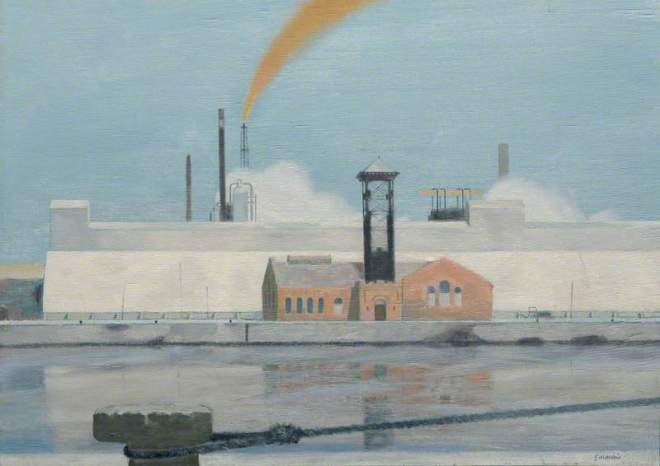
Leith (1970s) by George Mackie (b. 1920), © the artist. Photo credit: Aberdeen Maritime Museum
Industrial Panorama (1`953) by Laurence Stephen Lowry (1887-1976), © the estate of L. S. Lowry. All rights reserved, DACS 2019. Photo credit: Nottingham City Museums

Artists seem to have been less interested in painting the black rivers – or even sometimes highly coloured rivers if textile factories were involved – which were another by-product of industrialization. As usual, L.S. Lowry seems to have been the only painter who turned his unflinching gaze on this watery ugliness.

The Lake (1937) by Laurence Stephen Lowry (1887-1976), © The Lowry Collection, Salford. Photo credit: The Lowry Collection, Salford
Industrial Landscape, River Scene (1950) by Laurence Stephen Lowry (1887-1976), © the estate of L. S. Lowry. All rights reserved, DACS 2019. Photo credit: Leicester Arts and Museums Service

Of course, when industries closed or went away, this air and water pollution disappeared (only to reappear, though, in the developing countries where the industries relocated). Not so with industry’s solid wastes. In the early days, there was always a useful hole somewhere behind the factories where wastes could be conveniently dumped and forgotten about.

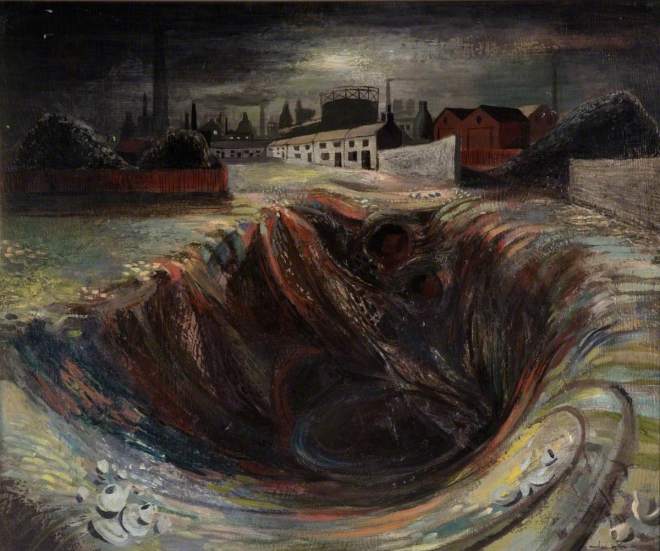
The Tip, Hanley (1946) by Michael Ayrton (1921-1975), © estate of the artist. Photo credit: The Potteries Museum & Art Gallery
Reflections (Rose Hill, Bolton) (1954) by Brian Bradshaw (b. 1923), © the artist. Photo credit: Manchester Art Gallery

Industries may have closed down and moved away, but these noisome deposits stayed. How many of them have I dug up over my career! A poisoned present from past industries left for current and future generations to clean up.

And of course the mining operations – coal mines, tin mines, slate mines, … – have left indelible scars on the UK’s landscape, with their tips of mining waste looming up behind the mining villages.

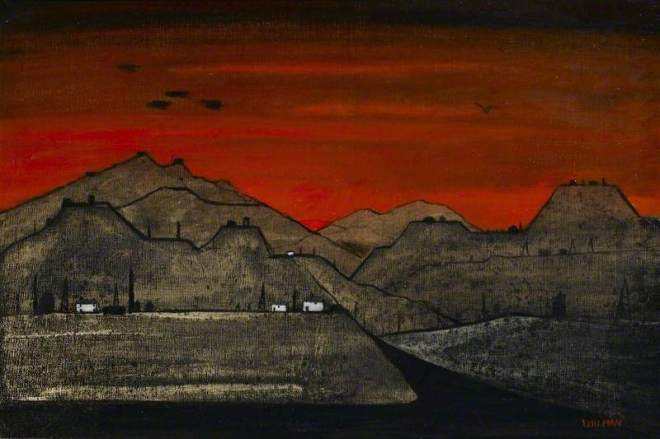
Landscape, County Durham (date unknown) by Marjorie Arnfield (1930-2001), © the artist’s estate. Photo credit: Middlesbrough Institute of Modern Art, mima
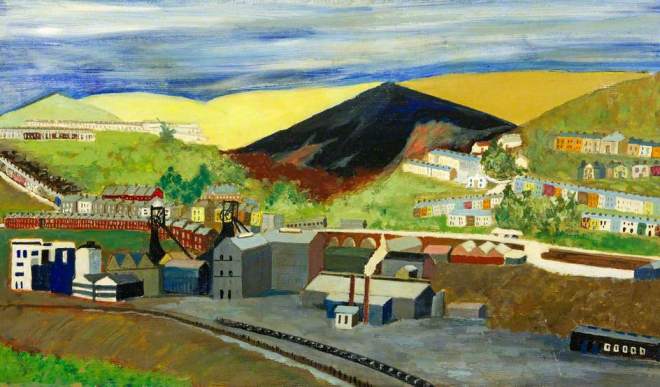
Elliot Colliery (c. 1970) by Gilbert House (1919-2007), © the artist’s estate. Photo credit: Caerphilly County Borough Museums & Heritage Service – Winding House
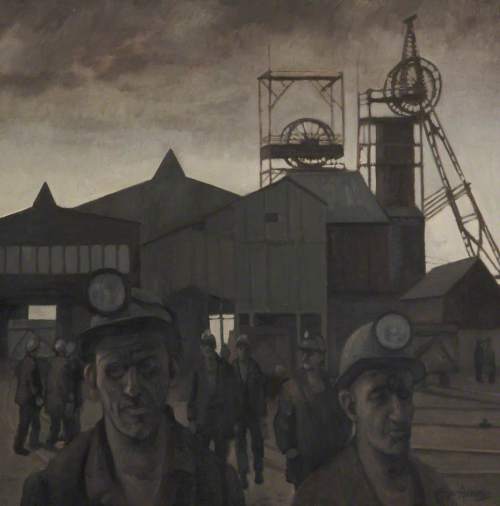
Miners and Colliery (1970) by Tom C. Brown (1925-2006), © the copyright holder. Photo credit: Llyfrgell Genedlaethol Cymru / The National Library of Wales
The Slate Mines (date unknown) by Fred Uhlman (1901-1985), © the artist’s estate / Bridgeman Images. Photo credit: Herbert Art Gallery & Museum

In my next and final post, I’ll slip in some paintings which didn’t fit my narrative but which deserve to be seen by a wider audience. I’ll also meditate on what has been the deeper impact of this story on the UK.

____________________________________

All photos from the Art UK website


CLOSE-KNIT COMMUNITIES

Milan, 14 March 2019

The rural poor may have been chased off the land and dragooned into factories, but at least they went on to create vibrant, closely-knit communities. Artists celebrated this throng of humanity in the shadow of the factories.

Unidentified Mill Scene (c. 1820-25) by British (English) School. Photo credit: Manchester Art Gallery. Distributed under a CC BY-NC-ND licence
Morledge, Derby, by Night in Fairtime (1882) by Claude Thomas Stanfield Moore (1853-1901). Photo credit: Derby Museums Trust. Distributed under a CC BY-NC-SA licence
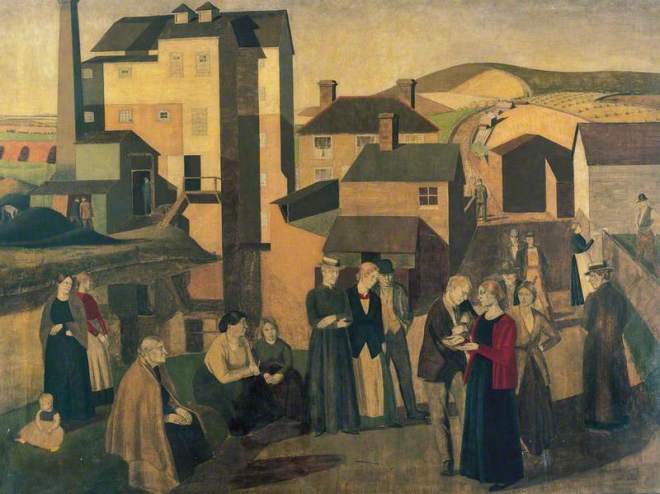
A Scene in a Village Street with Mill-Hands Conversing (1919) by Winifred Knights (1899-1946). Photo credit: UCL Art Museum
Poole Pottery, Dorset (c. 1925) by Eustace P. E. Nash (1886-1969), © the artist’s estate. Photo credit: Poole Museum Service
Any Wintry Afternoon in England (1930) by Christopher Richard Wynne Nevinson (1889-1946). Photo credit: Manchester Art Gallery. Distributed under a CC BY-NC-ND licence
Street Scene (1935) by Laurence Stephen Lowry (1887-1976), © the estate of L. S. Lowry. All rights reserved, DACS 2019. Photo credit: Atkinson Art Gallery Collection
Market Scene, Northern Town (1939) by Laurence Stephen Lowry (1887-1976), © The Lowry Collection, Salford. Photo credit: The Lowry Collection, Salford
Sunnyside Mill Bride to Be (date unknown) by Roger Hampson (1925-1996), © the artist’s estate. Photo credit: Salford Museum & Art Gallery
Mill Girls, Ashton, Lancashire (1948) by Harry Rutherford (1903-1985), © the artist’s estate. Photo credit: Tameside Museums and Galleries Service: The Astley Cheetham Art Collection
Spring Evening (1950) by Joan Baker (1922-2017), © the artist’s estate. Photo credit: Aberystwyth University, School of Art Museum and Galleries
Cheetham Street, Middlesbrough, Tees Valley (1953) by Kenneth Gribble (1925-1995), © the copyright holder. Photo credit: Middlesbrough Institute of Modern Art, mima
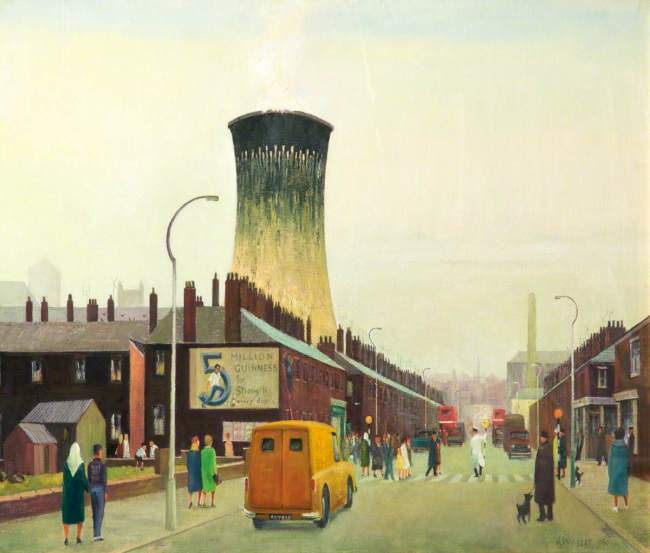
The Cooling Tower, Stockport, Cheshire (1960) by Harry Kingsley (1914-1998), © Rochdale Arts & Heritage Service. Photo credit: Rochdale Arts & Heritage Service. Distributed under a CC BY-NC licence
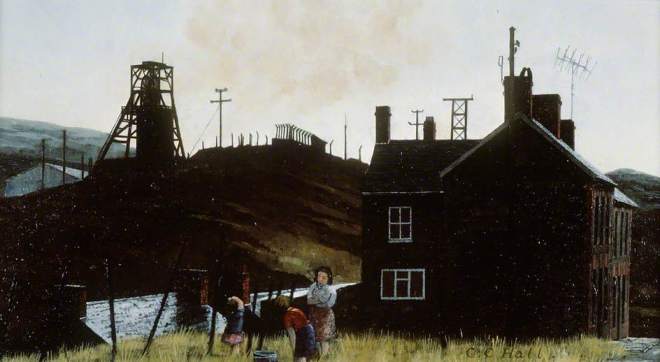
Lady Windsor Colliery, Ynysybwl (c. 1980) by Christopher Hall (b. 1930), © the artist. Photo credit: Llyfrgell Genedlaethol Cymru / The National Library of Wales

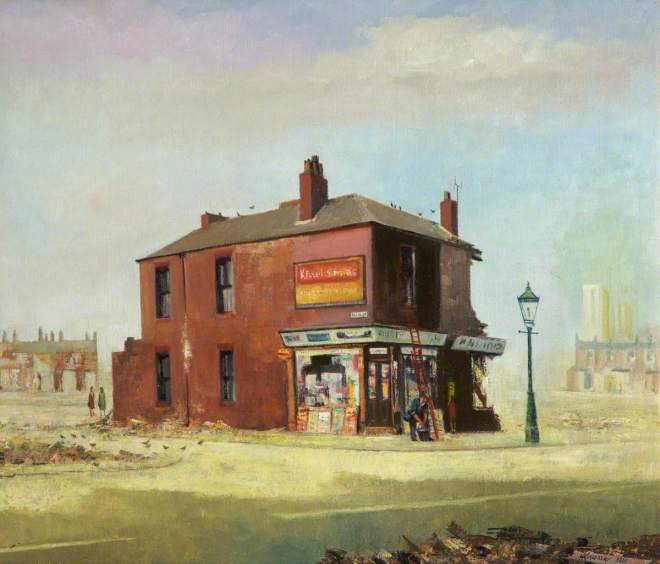
In the bigger cities, these communities began to be ripped apart in the late 1950s, early 1960s by well-meaning attempts to upgrade people’s living conditions, but it meant that the centres of industrial cities were laid to waste as factories were moved out into industrial estates and the people were moved into high-rise blocks of flats.

Terrace House Demolition, Barton Hill (c. 1963) by Gerald Albert Cains (b. 1932), © the artist. Photo credit: Bristol Museums, Galleries & Archives
The Green Fence, Hulme (1960) by Harry Kingsley (1914-1988), © the copyright holder. Photo credit: Manchester Art Gallery
New Street (1961) by Harry Kingsley (1914-1998), © Rochdale Arts & Heritage Service. Photo credit: Rochdale Arts & Heritage Service. Distributed under a CC BY-NC licence
Embryo, Moss Side, Manchester (1965) by Harry Kingsley (1914-1998), © the copyright holder. Photo credit: Rochdale Arts & Heritage Service
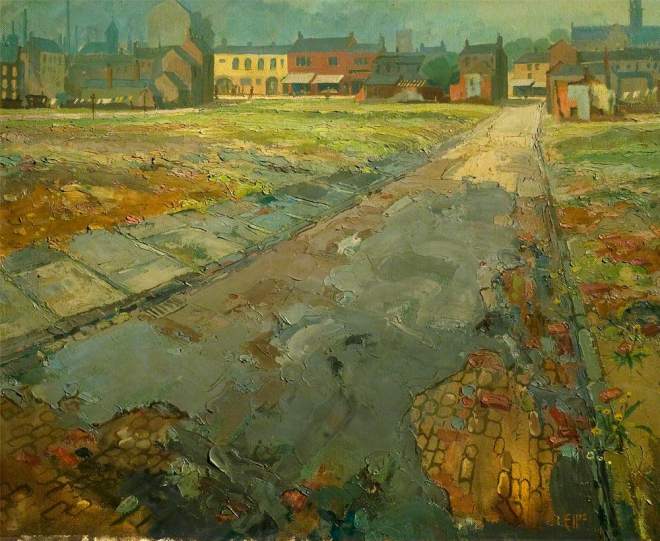
Wharf Street Vista, Leicester (1970) by Norman Ellis (1913-1971), © the copyright holder. Photo credit: Leicester Arts and Museums Service
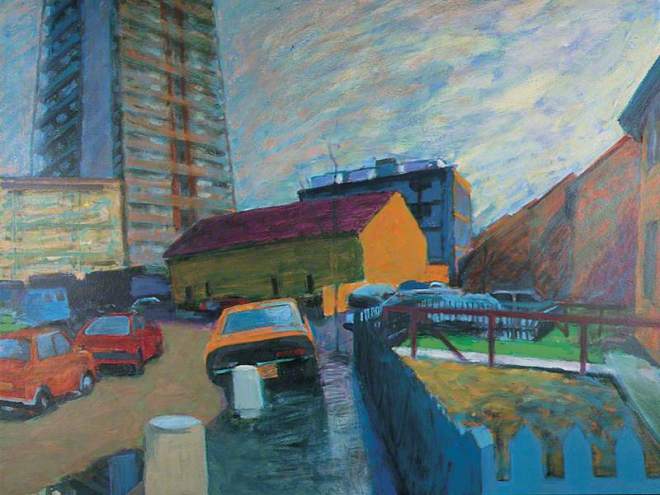
Elephant and Castle, London, High Rise (1988) by Oliver Bevan (b. 1941), © the artist. Photo credit: Museum of London

Far greater wreckage was to occur a few decades later when the UK started deindustrializing under Thatcher as globalization shifted factories into the developing countries and left many old industrial towns and cities with no future. This topic will be covered in my next post.

_____________________________

All photos from the Art UK website.

WORKERS OF THE WORLD, UNITE!

Milan, 12 March 2019

The industrial revolution could only take off because the rural poor were chased off the land, herded into towns, and put to work in the burgeoning factories. These foot soldiers of the industrial revolution were immediately of interest to painters, who caught on right away to the military, drill-like quality of the work for many.

The Richardson Cutting Shop (date unknown) by Emily Hodgetts (active 1820-50). Photo credit: Dudley Museums Service
File Cutters (1917) by Edward Frederick Skinner (1865-1924). Photo credit: Science Museum / Science & Society Picture Library
The Blouse Factory (1917) by Charles Ginner (1878-1952), © the copyright holder. Photo credit: Government Art Collection
Women at Work: The Belgian Steel Factory, Goldhawk Road, W12 (1918) by Edgar Seligman (1867-1958), © the artist’s estate. Photo credit: IWM (Imperial War Museums)
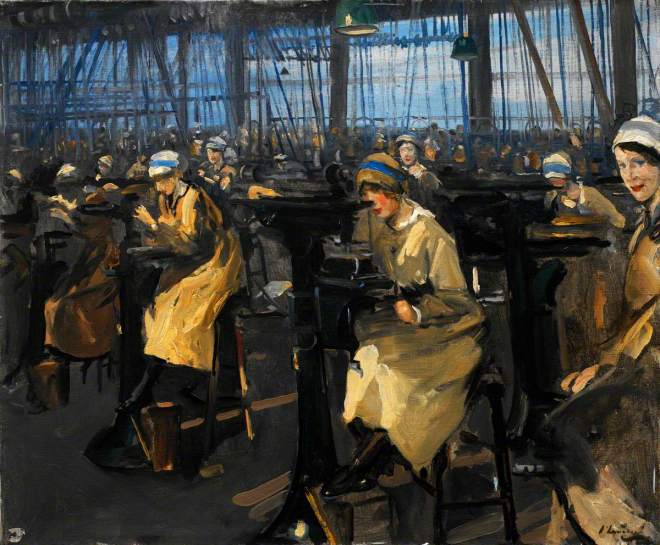
Elswick, 1917: Messrs. Armstrong, Whitworth & Company by John Lavery (1856-1941). Photo credit: IWM (Imperial War Museums)
The Weaving Shed, Old Glamis Factory (1929) by James McIntosh Patrick (1907-1998), © the artist’s estate / Bridgeman Images. Photo credit: Dundee Art Galleries and Museums Collection (Dundee City Council)
Women Making Munitions Boxes (1946) by John Campbell Hutton (1906-1978), © the copyright holder. Photo credit: Museum of Farnham
Body Shop, Austin, Longbridge, Warwickshire (1947) by Robert Johnston (active 1947-1985), © the copyright holder. Photo credit: British Motor Industry Heritage Trust

It is striking indeed that most of these pictures have women workers, but this might be more a reflection of the fact that many of the pictures were painted during the two World Wars, when women were drafted into the workplace to replace the men; when the wars were over they were expected to go home. (It is also striking that in the pictures in yesterday’s post, which were all from “heavy industries”, there were NO women.)

The harsh working conditions, the tendency of the factory owners to pay their workers as little as possible, the lack of job security, all led to worker agitation and the creation of the Trades Union movement as well as of left-wing political parties. Artists captured these political trends early.

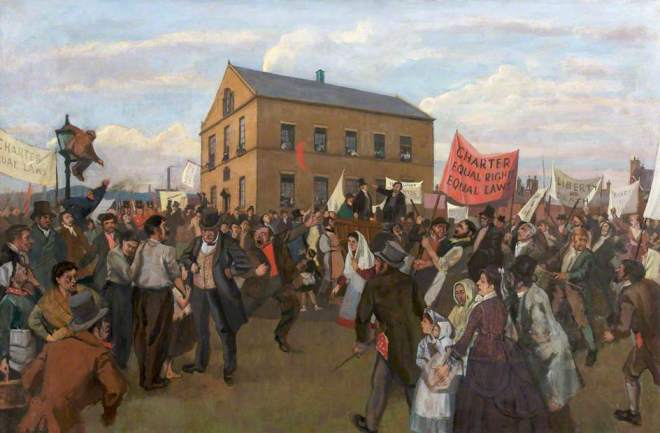
The Opening of the Chartists’ Meeting House, Hyde [in 1838] by Harry Rutherford (1903-1985), © the artist’s estate. Photo credit: Tameside Museums and Galleries Service: The Astley Cheetham Art Collection
National Builders Labourers And Construction Workers Society Banner (1921) by an unknown artist. Photo credit: People’s History Museum
The Sunderland Employers Banner (1871) by an unknown artist. Photo credit: People’s History Museum

In later decades, some artists were perhaps not so sympathetic to the workers’ movement.

The Communist, a Political Meaning (c. 1932) by Evan Walters (1893-1951), © the artist’s estate. Photo credit: Amgueddfa Cymru – National Museum Wales
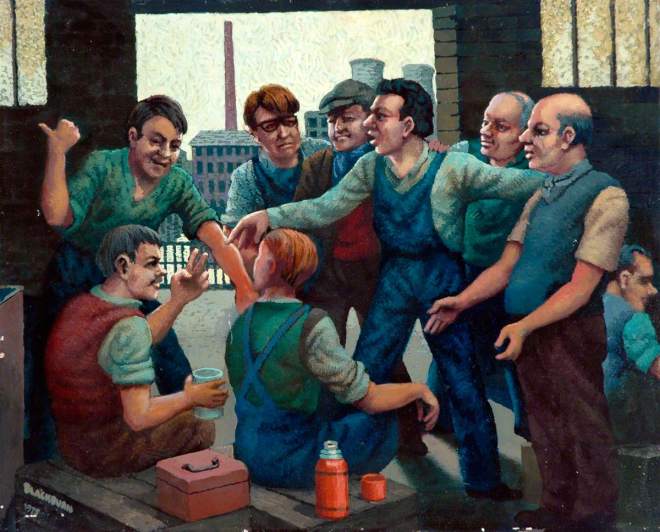
Union Men (1975) by Harold Blackburn (1899-1980), © the copyright holder. Photo credit: Kirklees Museums and Galleries

Others were decidedly more sympathetic.

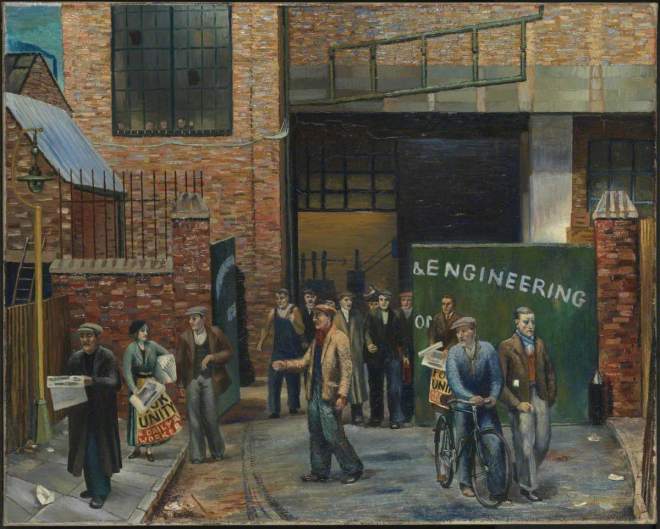
Selling the ‘Daily Worker’ outside Projectile Engineering Works (1937) by Clive Branson (1907-1944). Photo credit: Tate. Distributed under a CC BY-NC-ND licence
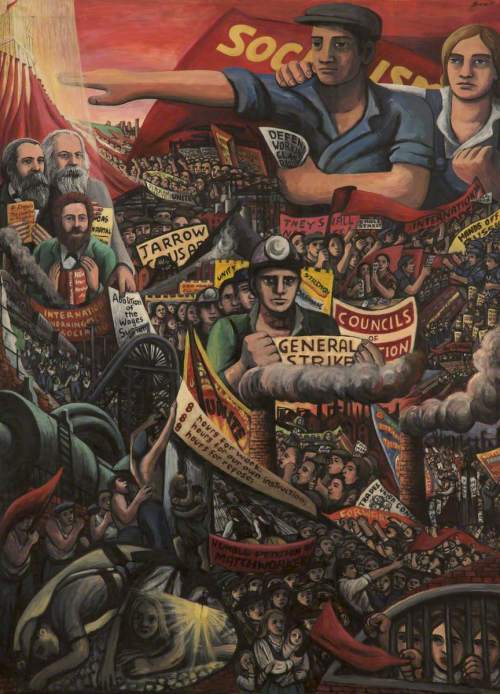
The History of Labour (1975) by Maureen Scott (b. 1940), © the artist. Photo credit: People’s History Museum
Two Trade Unionists (1986) by Ken Currie (b. 1960), © the artist/courtesy Flowers Gallery, London and New York. Photo credit: North Lanarkshire Council / CultureNL
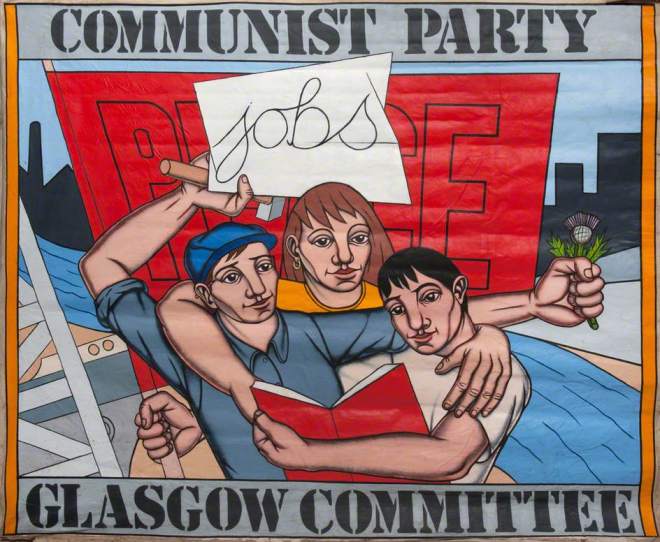
Glasgow Communist Party Committee Banner (1983-85) by Ken Currie (b. 1960), © the artist/courtesy Flowers Gallery, London and New York. Photo credit: Glasgow Caledonian University
Unemployment on Merseyside: Campaigning for the Right to Work (1993) by Michael Patrick Jones (b. 1944), © the artist. Photo credit: Museum of Liverpool

While all this was happening, a number of artists went about using the new art forms of 20th Century art to depict the real nature of work.

The Weaver (1910) by Natalia Goncharova (1881-1962), © ADAGP, Paris and DACS, London 2019. Photo credit: Amgueddfa Cymru – National Museum Wales
Munitions Factory (1940s) by William Patrick Roberts (1895-1980), © estate of John David Roberts. By courtesy of The William Roberts Society. Photo credit: Salford Museum & Art Gallery
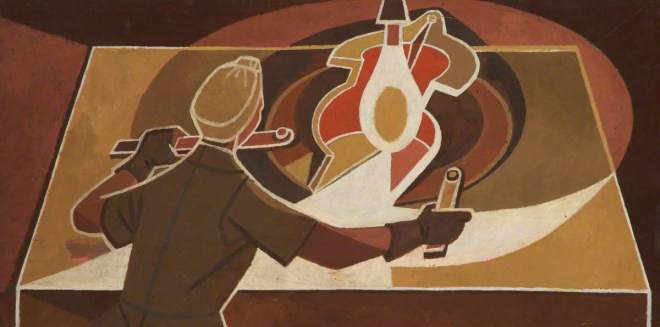
Female Glass Worker (date unknown) by Cliff Rowe (1904-1989), © the artist’s estate. Photo credit: People’s History Museum
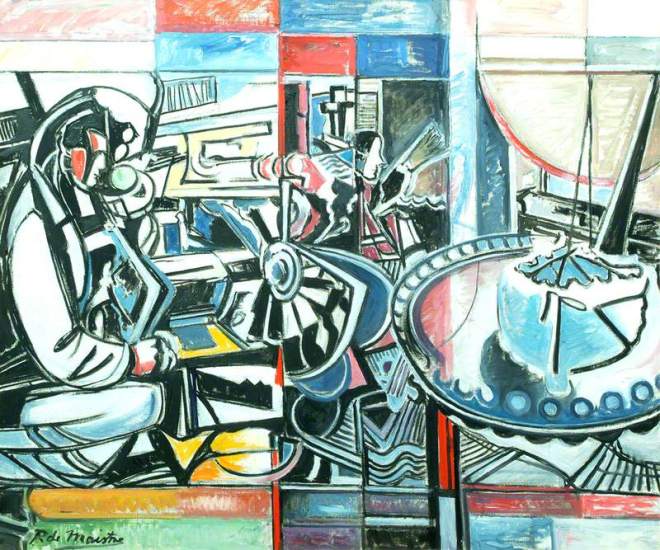
Machine Shop (1963) by Leroy Leveson Laurent Joseph de Maistre (1894-1968), © the artist’s estate. Photo credit: Aberdeen Art Gallery & Museums
The Machinist (1970s) by Tony Evans (1920-2001), © the artist’s estate. Photo credit: Carmarthenshire Museums Service Collection
Workers in a Frozen Pea Factory (1979) by Francis Higgins, © the copyright holder. Photo credit: University of Dundee, Duncan of Jordanstone College Collection

Artists were also interested in capturing the flow of workers into and out of the factories, at the beginning and end of their day or their shift. Miners’ shift changes got pride of place.

Miners Return from Night Shift (1928) by Richard Schmick, © the copyright holder. Photo credit: National Coal Mining Museum for England
Miners Returning from Work (1931) by an unknown artist. Photo credit: Llyfrgell Genedlaethol Cymru / The National Library of Wales
Bedford Colliery, Leigh (date unknown) by Roger Hampson (1925-1996), © the artist’s estate. Photo credit: Salford Museum & Art Gallery
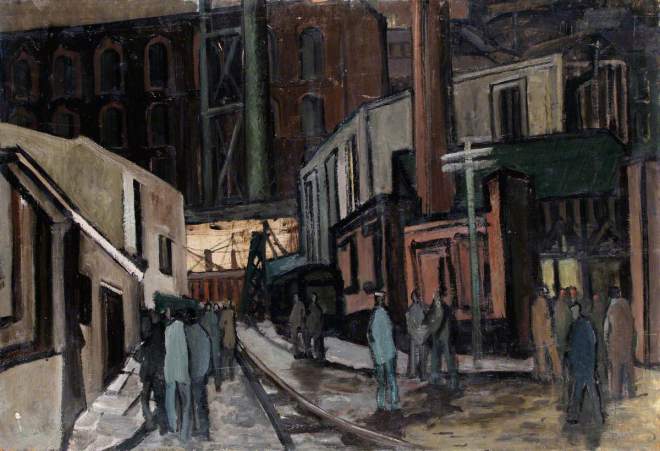
The Crossing (Colliery at Night) (1964) by Tom McGuinness, © the artist’s estate. Photo credit: National Coal Mining Museum for England
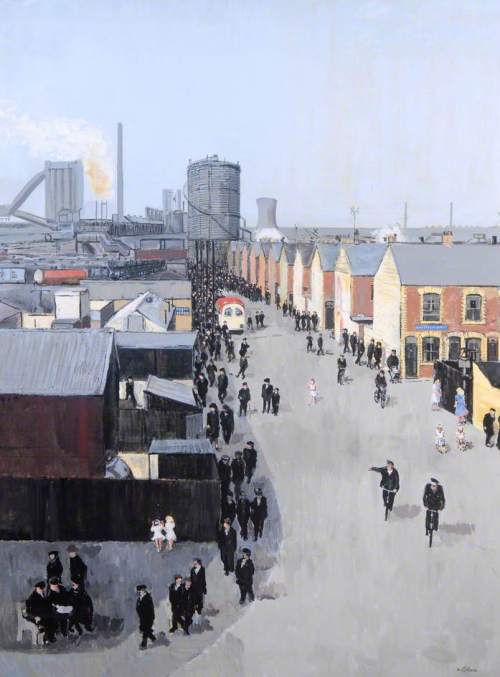
Pit Road near a Colliery, Winter (c. 1990) by Norman Stansfield Cornish (1919-2014), © Northumbria University Gallery on behalf of the artist’s estate. Photo credit: Northumbria University Gallery
Back and Forth (date unknown) by Brian Maunders (b. 1942), © the copyright holder. Photo credit: National Coal Mining Museum for England

But pictures were painted of other factory workers too, catching them when they came out

Coming from the Mill (1930) by Laurence Stephen Lowry (1887-1976), © The Lowry Collection, Salford. Photo credit: The Lowry Collection, Salford
End of the Day (1947) by David Ghilchik (1890-1970), © the artist’s estate. Photo credit: Chesterfield Museum & Art Gallery
Men Leaving Work (1954) by Carel Victor Morlais Weight (1908-1997), © the artist’s estate / Bridgeman Images. Photo credit: Tullie House Museum and Art Gallery

or went in.

Going to the Mill (1925) by Laurence Stephen Lowry (1887-1976), © the estate of L. S. Lowry. All rights reserved, DACS 2019. Photo credit: Pallant House Gallery
Entrance to a Factory near the Canal Entrance (date unknown) by Käthe Strenitz (1923-2017), © the artist’s estate. Photo credit: Camden Local Studies and Archives Centre

Paintings of workers’ lives in their local community outside the factory gates will be the topic of the next post.

____________________________________

All photos taken from the Art UK website


DARK SATANIC MILLS

Milan, 12 March 2019

Right from the start of the industrial revolution, artists were fascinated by the factories which glowed red in the night or sent flames leaping up into the night sky – William Blake’s dark satanic mills. Here is a series of paintings on this theme.

Coalbrookdale by Night (1801) by Philip James de Loutherbourg (1740-1812). Photo credit: Science Museum / Science & Society Picture Library
The Steelworks, Cardiff at Night (1893-7) by Lionel Walden (1861-1933). Photo credit: Amgueddfa Cymru – National Museum Wales
Dowlais Works at Night (1929) by Charles William Mansel Lewis (1845-1931) (attr. to). Photo credit: Merthyr Tydfil Leisure Trust. Distributed under a CC BY-NC-ND licence
Lever House Mural (date unknown) by Leonard Henry Rosoman (1913-2012), © the artist’s estate. Photo credit: Williamson Art Gallery & Museum
Industrial Landscape (Hulme, Manchester in the Sixties) by John Bold (1895-1979), © the copyright holder. Photo credit: Salford Museum & Art Gallery
BP Baglan Bay at Night (1963) by Andrew Vicari (1938-2016), © the copyright holder. Photo credit: Amgueddfa Cymru – National Museum Wales
Industry (1987) by Leslie Frederick Clarke (1907-2000), © the copyright holder. Photo credit: Erewash Borough Council

Much of that fire has emanated from iron and steel works, whose interiors have also drawn artists – like moths to a flame, we could say.

The Wealth of England, the Bessemer Process of Making Steel (1895) by William Holt Yates Titcomb (1858-1930). Photo credit: Sheffield Industrial Museums Trust
Bessemer Process Plant, Abbey Works, Margam (1958) by Charles Ernest Cundall (1890-1971), © the artist’s estate / Bridgeman Images. Photo credit: Amgueddfa Cymru – National Museum Wales
Steelworkers (1940) by Roland Vivian Pitchforth (1895-1982), © the artist’s estate. Photo credit: Herbert Art Gallery & Museum
Tapping a Blast Furnace (1957) by Charles William Brown (1882-1961), © the copyright holder. Photo credit: The Potteries Museum & Art Gallery
Last Tapping of the Blast Furnace at Brymbo (c. 1978) by Jan Boenisch, © the artist’s estate. Photo credit: Wrexham County Borough Museum and Archives

While the molten metal went on to further working, the slag from the foundries was thrown onto heaps where, still incredibly hot, it glowed sullenly until it had cooled sufficiently.

Tipping the Slag (date unknown) by Edwin Butler Bayliss (1874-1950), © the artist’s estate. Photo credit: Wolverhampton Arts and Heritage

These slag heaps must have looked quite satanic at night, giving off a deep red glow.

Rolling mills, where molten – or at least red-hot – metal is rolled out, have also been a constant source of artistic inspiration.

Interior of a Rolling Mill (1855-65) by Godfrey Sykes (1824-1866). Photo credit: Science Museum / Science & Society Picture Library
Hot Strip Mill (c. 1952) by Norman Hepple (1908-1994), © the artist’s estate / Bridgeman Images. Photo credit: Ebbw Vale Works Archival Trust
Rolling Mill, Avesta, Sheffield (1990) by M. Lawrance, © the copyright holder. Photo credit: Sheffield Industrial Museums Trust

Forging, too, has had its enthusiasts.

The Tyre Mill (1940-44) by Edith Grace Wheatley (1881-1970), © the artist’s estate. Photo credit: Science Museum / Science & Society Picture Library
‘Becking’, Locomotive at Blaenavon Works, 1947 by R. Smith (possibly), © the copyright holder. Photo credit: Torfaen Museum Trust

Moulding has also attracted followers.

Ley Maleable Works, Lincoln (1920) by L. Hare, © the copyright holder. Photo credit: Museum of Lincolnshire Life
Pouring Metal into Moulds (date unknown) by Norman Biddle (1932-2000), © the artist’s estate. Photo credit: Sandwell Museums Service Collection

I finish with a spray of sparks

Scarfer (1971) by John Collins, © the copyright holder. Photo credit: Ebbw Vale Works Archival Trust

and a homage to the men who spent their working lives in those dark satanic mills.

The Black-Country Steelworkers (1992) by Andrew Tift (b. 1968), © Andrew Tift. Photo credit: The New Art Gallery Walsall

This last picture is an introduction to my next post, which will cover the theme of industrial workers.

______________________________________

All photos from the Art UK website.