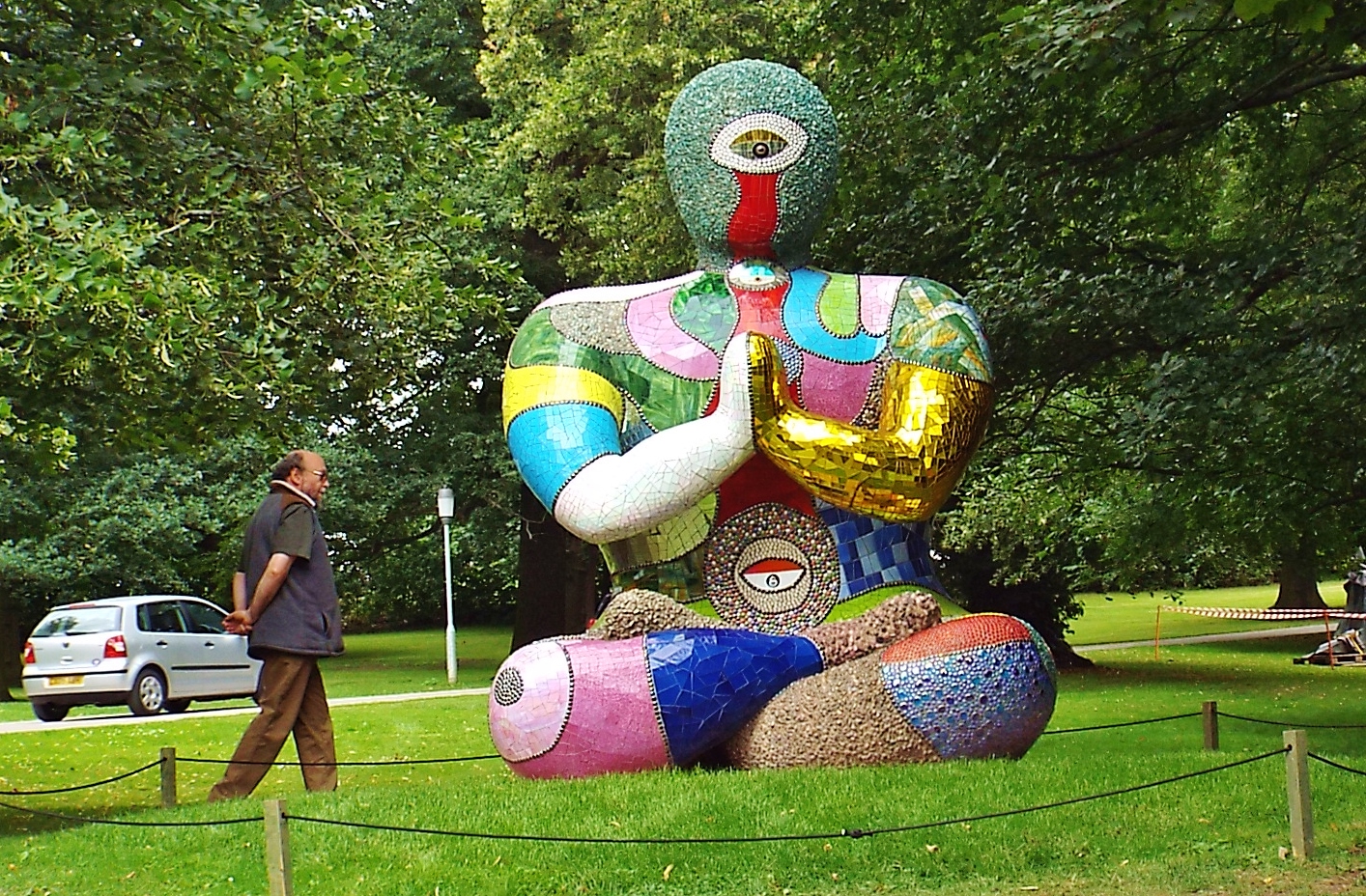
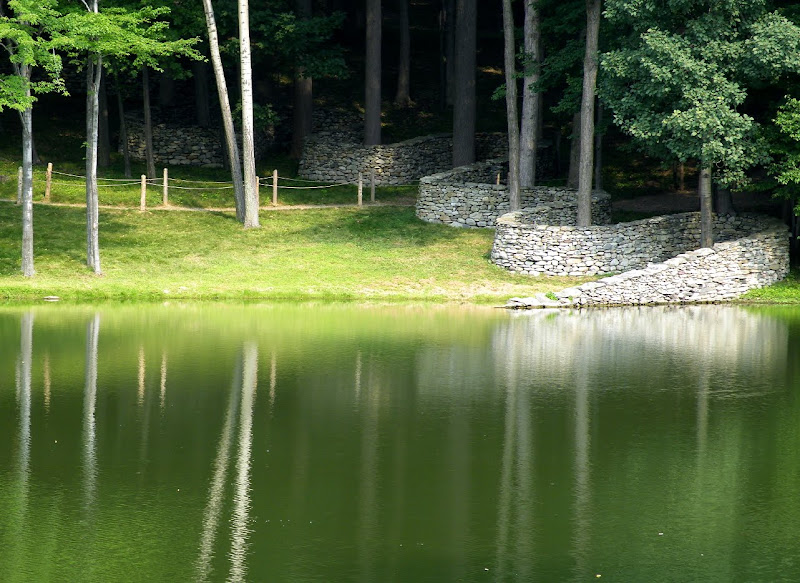
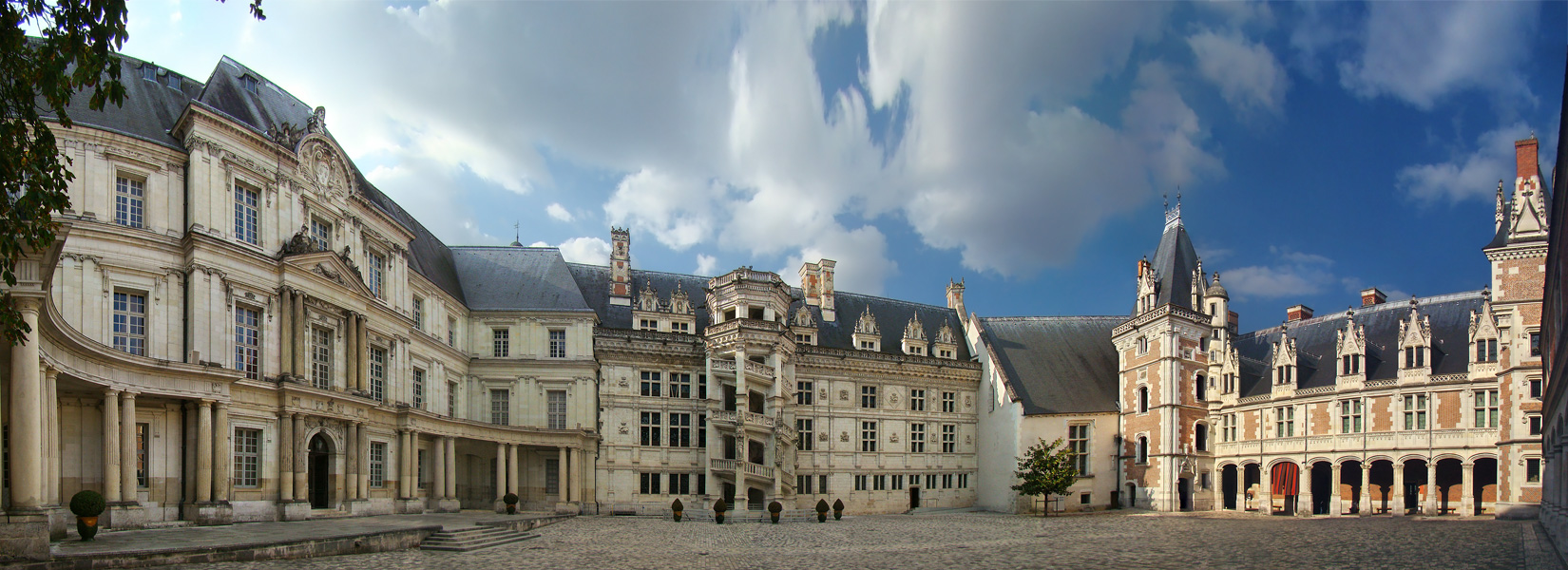
IT SHOULD FIT OVER MY SOFA

New York, 28 December 2015

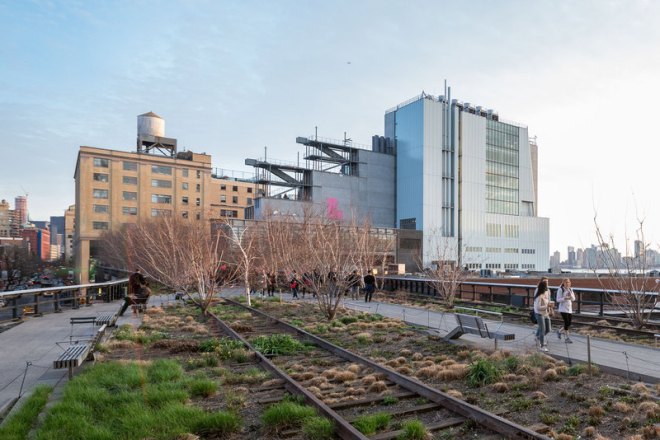
I’ve described in a previous post the beautiful, and really very unique, High Line Park in New York. On our first visit to the park, we heard that the Whitney museum was planning to relocate from uptown to new premises bang on the High Line. Now, two years later, the plans have come to fruition, and since we are once again in town to celebrate Christmas and New Year with the children we decided to go and visit.

The building itself was designed by the architect Renzo Piano, he of the Centre Pompidou in Paris (along with fellow architect Richard Rogers)
image
and, less felicitously, of the Shard in London
image
along with a string of projects in between. The new Whitney is not as spectacular as these two, giving the impression of being more of a workmanlike project – how to give the museum lots of exhibition space – and blending in quite well with its surroundings.
image
image
One also gets beautiful views across the Hudson River from its windows.
image
Perhaps it’s just as well. I mean, the main purpose of going to a museum is not so much to see the container as to see what is contained (I grant, though, that a handsome packaging can add lustre to what’s in the package). So let me focus on the contents.

Actually, I don’t really want to focus on the contents as such, but rather use them to meditate on something which gets under my skin when it comes to really modern art – let’s say, stuff produced in the last sixty years i.e., during my lifetime.

I happen to think that the primary purpose of any piece of art should be to adorn one’s abode in a way that gladdens the heart and puts a spring in one’s step. The key, though, is that the piece of art should fit through the door of one’s abode and, once in, should fit on a wall of that abode (or, if a sculpture, on a small table or shelf). The core of the Whitney’s collection, from the ’30s and ’40s, would do this admirably. For instance, there was a lovely Hopper on view which would could be passed through the door of our apartment quite easily and would fit quite nicely on one of its walls.
image
It’s one of several delectable Hoppers in the collection. Or I wouldn’t mind at all putting this painting by Charles Demuth on our wall.
image
Getting it into the apartment would be a breeze – I think it could probably even fit it into the small elevator we have in our building, thus avoiding us having to carry it up three flights of stairs.

But as we get into the late ’50s, early ’60s, the pieces begin to grow. We would just about be able to manhandle this Pollock which the Whitney has through our apartment door, but I think we would have difficulty finding a place for it on the wall.
image
And this painting by his wife Lee Krasner would be impossible to hang in our apartment, it’s just too damned big let alone of a size to get through the door.
image
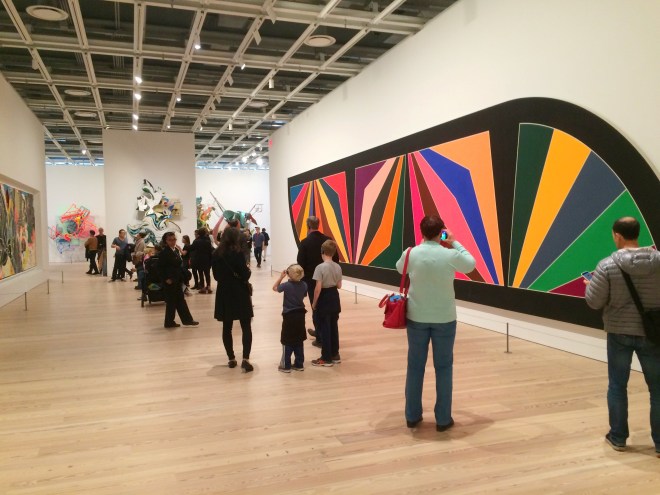
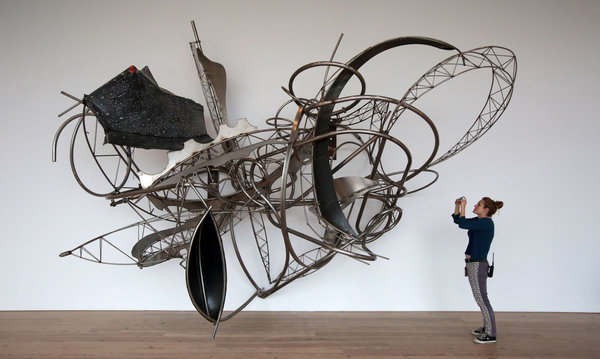
The pieces in the Frank Stella show which the Whitney is currently organizing were even worse. They were huge lumbering monsters, which would not even fit through the front doors of our apartment building, leave alone through the door of our apartment.
image

And even if by some miracle we got them into the apartment, many of his pieces jut out, making it hard to have any furniture around them.
image
Of course, given the stellar prices for modern art, only plutocrats can afford to buy these pieces. But do even they live in such palatial abodes as to make it possible for such a piece to fit snugly in the living room, say? I find it hard to believe.

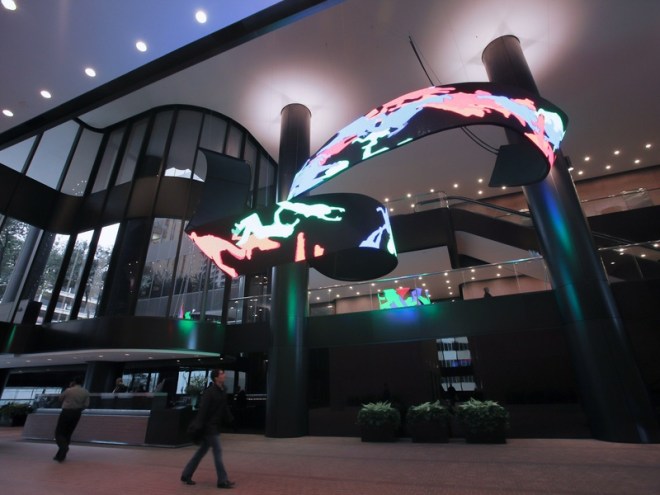
I can only assume that much modern art is either made for large and powerful multinational corporations, whose huge atriums or corporate boardrooms in their Headquarters have enough space for such pieces
image

image

or it is made for museums such as the Whitney which have large exhibition spaces. Either way, art for the people it is not. And that’s a pity, because at the end of the day art should be for us, something which we can hang on our wall and admire for decades or even centuries before perhaps donating it to a museum.

I think it’s time for a new art movement, the FOTS (“Fits Over The Sofa”) movement.

image

_____________________
Centre Pompidou: http://www.leparis.pl/centre-georges-pompidou-muzeum-sztuki-wspolczesnej/
The Shard: https://en.m.wikipedia.org/wiki/Renzo_Piano
The Whitney (both views): http://whitney.org/About/NewBuilding
View across the Hudson: http://elizabethbarton.blogspot.com
Edward Hopper “Early Sunday Morning”: http://collection.whitney.org/artist/621/EdwardHopper
Charles Demuth “My Egypt”: http://collection.whitney.org/object/635
Jackson Pollock “Number 27, 1950”: http://www.allartnews.com/pollock-and-the-irascibles-the-new-york-school-opens-at-palazzo-reale-in-milan/
Lee Krasner “The Seasons”: http://www.brooklynstreetart.com/theblog/2015/04/30/the-new-whitney-opens-may-1-america-is-hard-to-see/#.VoE8i3o8KrU
Frank Stella: http://www.nytimes.com/2015/10/30/arts/design/tracking-frank-stellas-restless-migrations-from-painting-and-beyond.html?_r=0
Frank Stella: http://www.hedgefundintelligence.com/Article/3503103/Steve-Cohen-sponsors-Frank-Stella-exhibition-at-the-Whitney-Museum.html
Headquarter atrium art: http://houston.culturemap.com/news/entertainment/03-02-13-image-bending-spanish-artist-transforms-downtown-houston-office-atrium-with-iwavesi/slideshow/
Corporate boardroom art: http://www.artworks-solutions.com/news/view/corporate-art-works
Space over sofa: http://www.utrdecorating.com/blog/hanging-pictures-sofa/

A STUDY OF FEET

Bangkok, 19 October 2015

One of the interesting side-effects of living in Bangkok is that I can carry out a comprehensive study of feet. The climate here is such that the wearing of open footwear is exceedingly widespread, so I can examine – surreptitiously, of course – a very large number of feet as I walk around, sit in public places, or – as was the case when I started this post – sit in buses stuck in Bangkok’s perennially dreadful traffic. Since so many foreigners come to Bangkok, the study is very cross-cultural: I study not only the feet of the Thai, but also – judging from the shards of phrases I overhear as the foreigners walk by – Australians, Europeans of all stripes, North Americans, some Latin Americans, quite a number of Middle Easterners, a sprinkling of Africans, and of course Asians from every corner of Asia. I am now ready to report back on the findings of my study.

Let us first set the benchmark against which I can compare the feet I see. This would be a foot in its natural state, that is to say a foot that is perennially shoeless. This photo, which I’ve used before, gives an excellent example. What we have here is a band of Amazonian Indians who are coming into contact with the modern world for the first time. Their astonished and somewhat fearful faces upturned towards the helicopter (I guess) are fascinating, but I would invite the reader to focus on their feet, feet which have never been shod.

amazonian Indian feet

As the readers will quickly agree, these feet are in the state that most human feet have been in for 99.99% of the time we have inhabited this planet.

I throw in here an older photo, taken – no doubt by some amateur anthropologist – to deliberately show a natural foot. And of course it has to be an old photo, because wearing shoes is probably now the norm rather than the exception. Finding a foot nowadays which has never been shod must indeed be hard.

natural and baby feet

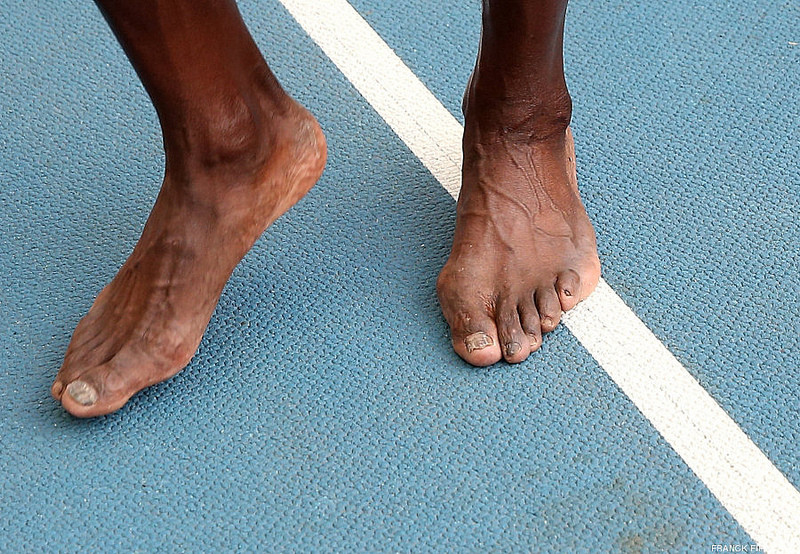
Note the way the toes in the natural foot, especially the big toe, are splayed out. A minute’s thought will show that of course this is the way it should be. By spreading out like that, toes are giving the foot a wider footprint and therefore making it easier for the person on top of those feet to balance.

In this photo of a baby’s feet, the reader will notice that they naturally take this splayed form

baby feet

Only later, through imprisonment in shoes, do the toes come closer together

feet with toes close

sometimes too close together.

toes too close

I am reminded of TS Eliot’s poem Animula, which tracks the evolution of a person’s soul from birth to adulthood, but which actually describes very well the fate of our feet: “‘Issues from the hand of God, the simple soul’ …Issues from the hand of time, the simple soul … misshapen, lame, unable to fare forward …”.

But back to the matter in hand. Having set the benchmark, I can now report the results of my pseudo-sociological field experiment in the streets and other public spaces of Bangkok.

Generally speaking, the feet of Thai people look in considerably better shape than those of foreigners from “civilized” countries. A good number have quite splayed toes, fruit no doubt of hardly ever wearing shoes at home. In fact, it’s quite common to see their little toes falling off their flip-flops or sandals. Clearly, the basic “chassis design”, if I can put it that way, adopted by shoe manufacturers simply ignores the natural form of the foot with splayed toes. Shoe manufacturers take as their starting point an already somewhat malformed foot. Well they would, wouldn’t they? After all, it is their products which have malformed out feet in the first place. Other Thais have moderately straightened toes, fruit of some level of constriction by shoes.

thai girl's feet

I detect a social element here. It is clear from their dress and occupation that the Thai owners of feet whose toes are splayed come from the poorer strata of society, while those with feet with straight toes come from the richer ones. And I also detect a gender element. Young Thai women show more evidence of constricted toes than do the men. I will come back to this in a minute.

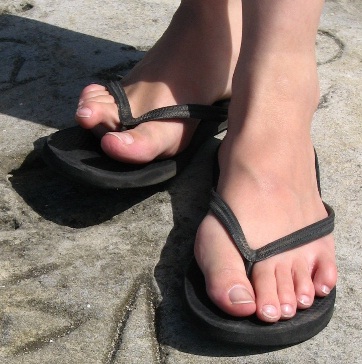
As for the feet of the foreigners, those of people from more developed, richer, more “civilized” countries show toes much more tightly squeezed together

white feet in flip flops

along with more extreme signs of foot distress: bunions

bunions

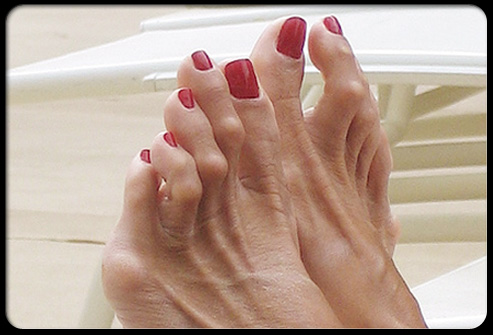
hammer toes

hammer toes

calluses and corns.

Like in the case of the Thai, women’s feet seem more malformed than men’s. Which gets us of course to the cause of all these foot problems: canons of accepted (feminine) beauty.

Let’s face it, for hundreds if not thousands of years, there has been this insidious idea that those members of society who are more civilized, more refined – and richer – have delicate (for women) or well proportioned (for men) limbs and features. Hands, of course, have always been a particular object of this odious social creed, because having big hands, and especially having big fingers, meant that you were poor and so did a lot of manual labour.

If you were rich, on the other hand, you could pay people to do your manual labour for you, leaving your hands and fingers slim.

slim hands

With feet, it must have been a little different. Like grand clothes, the fact that you wore shoes showed that you had money to burn, not like that bum on the street who had to run around in his bare feet all day. And of course, slim, petite, shoes (that is to say, narrow, horribly constricting, shoes) showed (or pretended to show, since your feet were actually squashed into the shoe) that you had slim, petite, feet, not broad feet like that bum on the street etc.

Woman's_silk_brocade_shoes_1770s

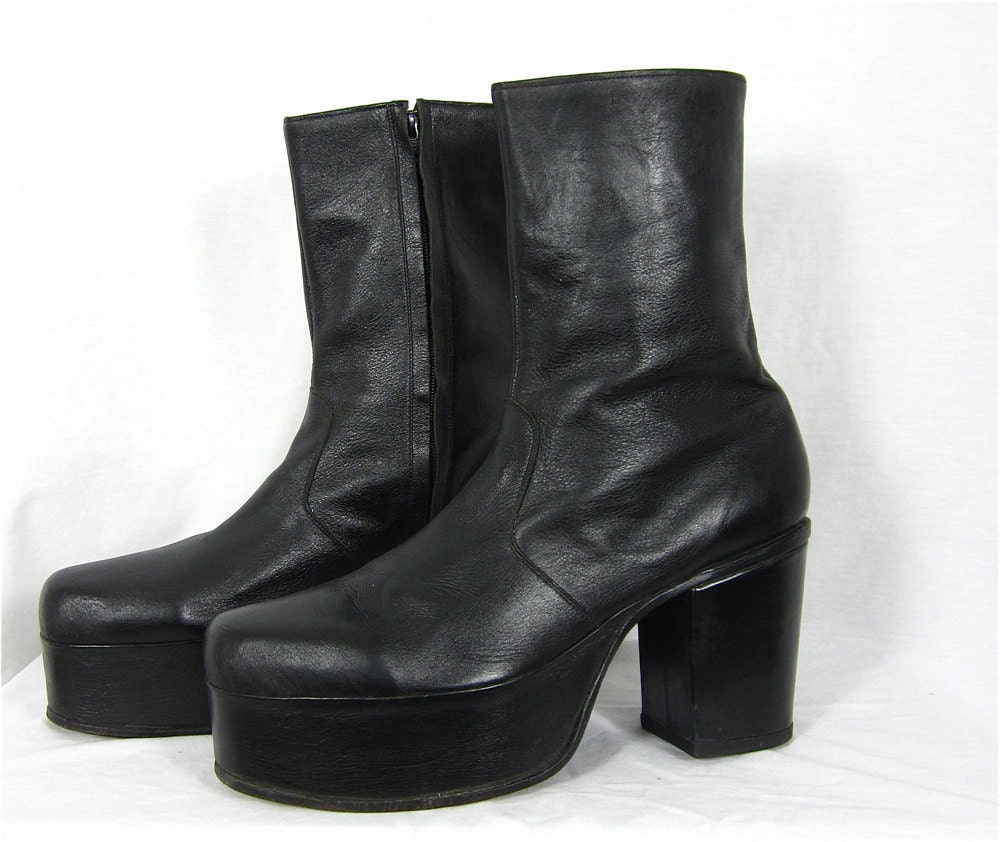
This last pair of shoes, with their modest heels, allows me to segue smoothly into that terrible habit of wearing high-heeled shoes. As we all know, it’s mostly women who wear them, but men do too, depending on the state of fashion. I am ready to reveal at this time that when I was young and foolish I went through a phase of wearing platform boots, one black pair and one brown, which looked like this.

platform shoes

Apart from feeling pretty cool as I walked around Uni, I found a most satisfying side-effect to be that I was taller. No doubt that’s one reason why women do this to their feet

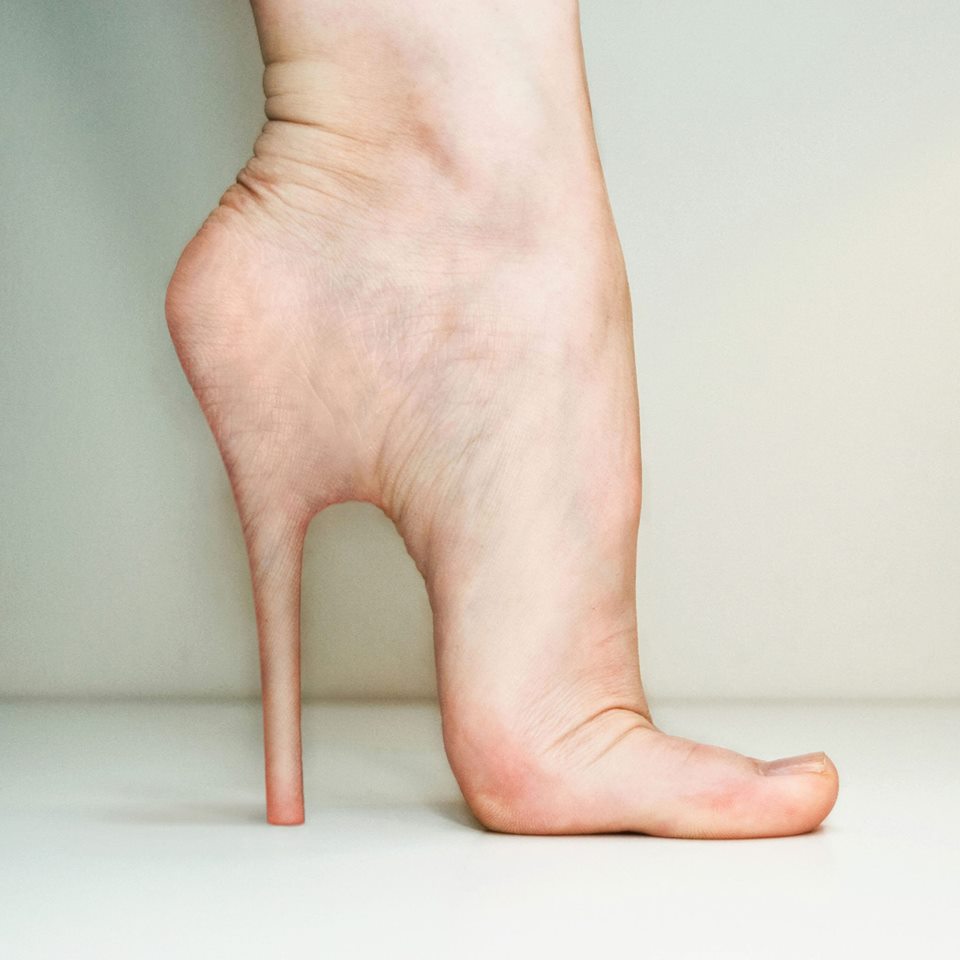
high heels

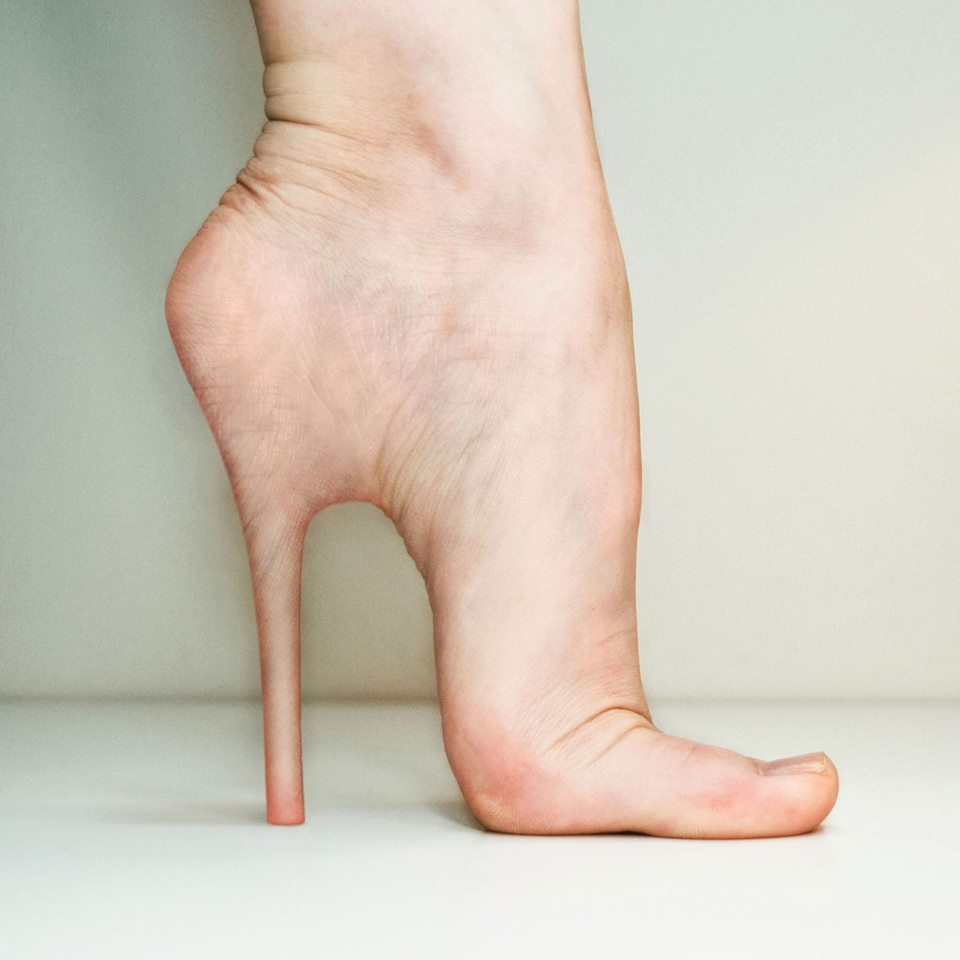
which when you strip away the shoe looks like this.

foot in high heel position

Modest heels I could understand. I mean, I fell for them. But why subject yourself to the pain of excessively high heels, not only a pain that comes today but also a pain that dogs you for years to come? Because men still rule the world, and they like to see the accentuated swish in a woman’s gait caused by walking in high heels, or maybe they like the fact that her legs look longer, or that her feet look smaller, or her toes shorter, when wearing heels. Or maybe it makes women take smaller steps, to avoid falling over (my wife still remembers her father exhorting her to take small steps, because that was more ladylike and refined). Or maybe because it makes men feel strong to see women tottering around on heels, not able to walk very far before complaining of sore feet and needing help.

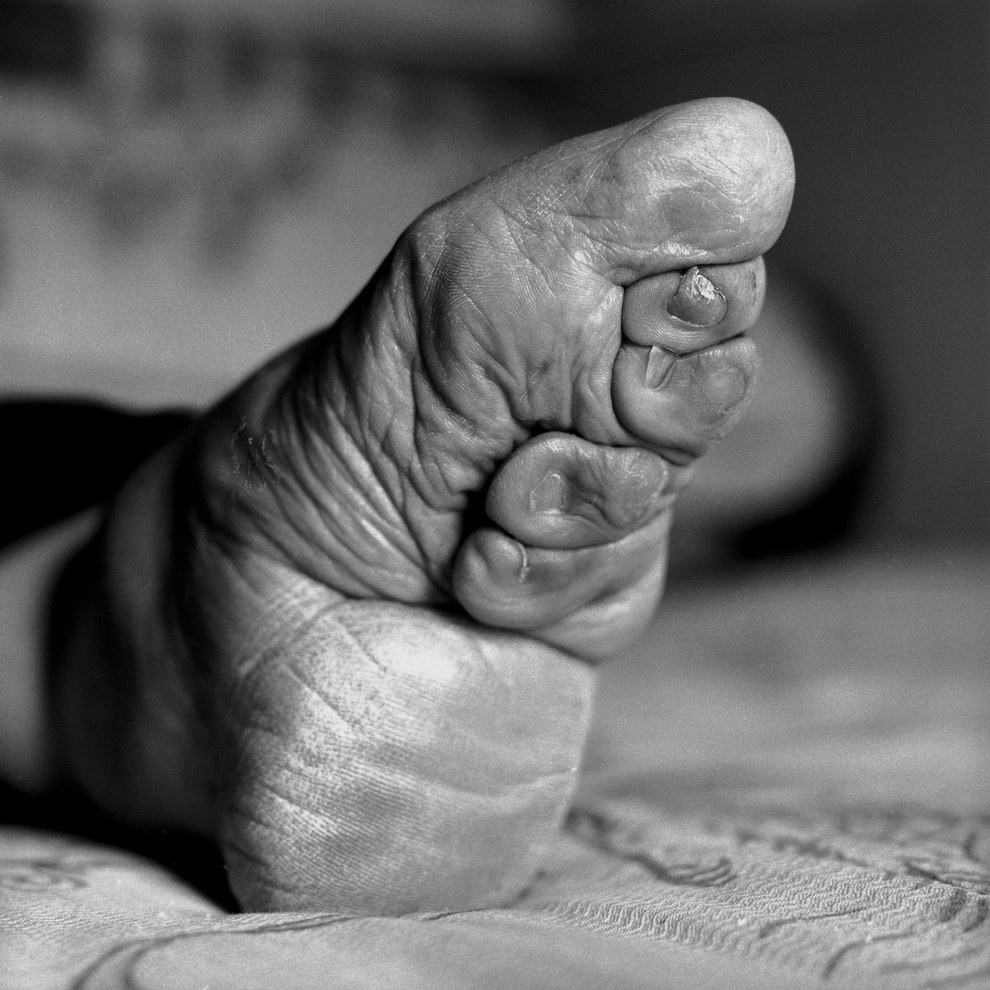
Fanciful? Perhaps. But consider this. For nearly one thousand years, from early in the Song dynasty, about 1000 AD, to the early 20th Century, many Chinese women were subjected to the unbearably painful process of foot binding. To appreciate the full horror of this practice, let me give the readers a quick summary of what girls were subjected to. The process was started when girls were between the ages of 4 and 9, that is, before the arches of their feet had had a chance to develop fully. First, after softening the feet and cutting back the toenails, the toes of each foot were curled under and then pressed with great force into the sole of the foot until – the – toes – broke. But it didn’t finish there. While the broken toes were held tightly against the sole of the foot, the arch of the foot was also broken so that the foot could be drawn down straight with the leg. So you basically smashed the little girl’s feet. Then you started the binding. The idea was to pull the ball of the foot ever closer to the heel, causing the broken foot to fold at the arch, and pressing the toes underneath the sole.

As the readers can imagine, a girl’s broken feet required a great deal of care and attention if she was not to die from this process; it is estimated that 10% of girls died from gangrene and other infections due to foot binding. So their feet were regularly unbound, they were washed, the toes unfolded and checked for injury, and the nails carefully trimmed. The broken feet were also kneaded to soften them and the soles of the girl’s feet beaten to make the joints and broken bones more flexible. Then the poor girl’s broken toes were folded back under and the feet rebound. Every time the feet were rebound, the bindings were pulled even tighter. The ideal was to end up with a “foot” no more than 10 cm long.

The Chinese are nothing if not eminently practical. Recognizing that mothers might well be too sympathetic to their daughters’ pain, it was generally an older female member of the family or a professional foot binder who carried all this out. Oh, and the process was usually started during the winter time since girls’ feet were more likely to be numb from the cold, and therefore the pain would not be as extreme. How nice of them.

This was the result:

crushed bound foot

Chinese lady with bound feet

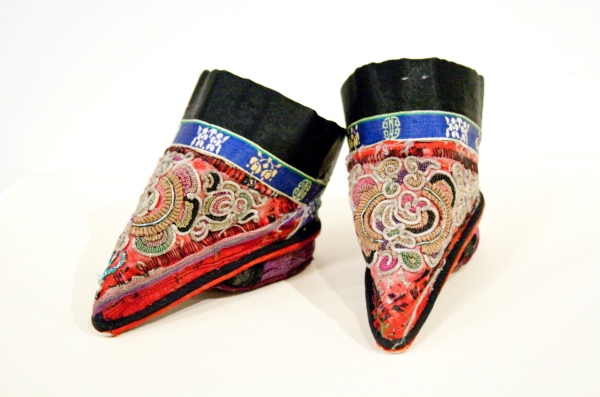
Of course, no-one except the persons caring for the feet ever saw this. What they saw was this, these oh-so dainty little shoes.

Lotus-ShoesAnd why were Chinese women subjected to this horrible procedure for a thousand years? For beauty, of course. Men ruled China (they still do), and crazy as it might sound to the modern reader, men considered bound feet to enhance a woman’s beauty by making her movements more dainty and “ladylike”. As readers can imagine, it was difficult to walk on broken feet. Women with bound feet tended to walk predominantly on their heels. As a result, they walked with a cautious, unsteady gait, taking tiny, swaying steps. And, of course, that most important thing where women were concerned, well bound feet helped her parents contract a good marriage for her. It could also be that it was found to be an effective way of forcing women to be housebound and completely reliant on men. In this view, traditional societies forbid women from leaving the house; the Chinese simply broke their feet.

So what is the moral of all this? Look after your feet! Stop obsessing about narrow, dainty feet. Celebrate splayed toes. Go to the office in flip-flops and take off your shoes the moment you sit at your desk (which is what most Thais do). Put on sandals until the dead of winter; our feet can tolerate quite a lot of cold. Throw away all your high-heeled shoes. And if a man ever asks you to wear high heels, cut him mercilessly out of your life; he is clearly a swine.

_____________________

Amazonian Indian feet: http://birthdayshoes.com/media/blogs/bdayshoes/2013_Photos/.evocache/human_feet_look_like_if_you_never_wear_shoes.jpg/fit-640×540.jpg?mtime=1386261566 (in http://birthdayshoes.com/what-a-natural-human-foot-looks-like-if-you-never-wear-shoes)
Natural human feet: http://origin.ih.constantcontact.com/fs096/1102283092773/img/101.jpg?a=1102864935304 (in http://www.sukiebaxter.com/could-your-feet-be-the-source-of-that-pain-in-your-neck)
Baby feet: http://naturalrunningcenter.com/wp-content/uploads/2012/02/Screen-shot-2012-02-26-at-5.30.11-PM.png (in http://naturalrunningcenter.com/2012/02/27/enhancing-natural-pronation-control-feet-designed-that/
Feet with toes close: http://www.guide2health.net/wp-content/uploads/2012/08/bare-feet.jpg (in http://www.guide2health.net/2012/08/life-long-immunity-to-disease/bare-feet/)
Feet with toes too close: http://i.imgur.com/aURQcnm.jpg (in http://www.inquisitr.com/931111/lebron-james-feet-picture-of-stars-messed-up-toes-goes-viral/)
Thai girl’s feet: http://www.zeefashionstore.com/ProductImage/18391/1.jpg (in http://www.zeefashionstore.com/womenshoes.php?brand=79&section=6)
White feet in flip-flops: http://blog.diagnosticfootspecialists.com/wp-content/uploads/2014/04/flip-flops.jpg (in http://blog.diagnosticfootspecialists.com/)
Bunions: https://upload.wikimedia.org/wikipedia/commons/c/ce/Hallux_Valgus-Aspect_pr%C3%A9_op_d%C3%A9charge.JPG (in https://en.wikipedia.org/wiki/Bunion)
Hammer toes: http://images.medicinenet.com/images/slideshow/diabetes_foot_problems_s13_hammertoes.jpg (in http://www.medicinenet.com/image-collection/hammertoes_picture/picture.htm)
Working hands: https://scpeanutgallery.files.wordpress.com/2015/02/working-hands.jpg (in http://scpeanutgallery.com/2015/02/04/morning-prayer-4-feb-heb-124-7-11-15-mk-61-6-get-a-grip/)
Slim hands: http://hoocher.com/Agnolo_Bronzino/Portrait_of_Lucrezia_Panciatichi_ca_1540.jpg (in http://hoocher.com/Agnolo_Bronzino/Agnolo_Bronzino.htm)
Woman’s shoes 1770: https://upload.wikimedia.org/wikipedia/commons/2/20/Woman’s_silk_brocade_shoes_1770s.jpg (in https://en.wikipedia.org/wiki/1775%E2%80%9395_in_Western_fashion)
Platform boots: http://img3.etsystatic.com/000/0/5381238/il_fullxfull.291560419.jpg (in http://galleryhip.com/platform-shoes-for-men.html)
High heels: http://www.glamour.com/images/fashion/2013/08/heels-w724.jpg (in http://www.glamour.com/fashion/blogs/dressed/2013/08/check-out-this-3d-scan-of-what)
Women in high heel position: http://www.tellwut.com/uploads/media/image/12607e1398914701o270.jpg (in http://katherincruikshank.blogas.lt/tag/hammer-toes)
Crushed bound foot: http://www.buzzfeed.com/hayleycampbell/lotus-feet#.vj027qN6E (in http://www.buzzfeed.com/hayleycampbell/lotus-feet#.eegdQJg3y0)
Chinese lady with bound feet: https://en.wikipedia.org/wiki/Foot_binding#/media/File:A_HIGH_CASTE_LADYS_DAINTY_LILY_FEET.jpg (in https://en.wikipedia.org/wiki/Foot_binding#Variation_in_practice)
Lotus shoes: http://www.top5ives.com/wp-content/uploads/2012/09/Lotus-Shoes.jpg (in http://www.top5ives.com/top-5-most-weird-shoes-in-history/)

HOT PASTRAMI SANDWICH

Bangkok, 12 August 2015

Last weekend, my wife informed me excitedly that she had discovered a restaurant downtown which claimed to serve Reuben and pastrami sandwiches. Goodness me, we chirruped to each other, it had been years since we’d eaten either. We had to go back to the late 1980s, when we lived in New York for a while, for our last Reuben and pastrami sandwiches. The seminal initiation event was in a small deli to the south of Central Park, one of those places with booths where you slide into your seat (although unfortunately it didn’t have the really cool little juke box that you can see in this picture).

diner booth

We had actually gone in there because we happened to be in the neighbourhood and it happened to be lunch time. Since it also happened to be a Jewish deli, we found ourselves scanning a menu listing Jewish delicacies. After some rumination, we plumped for this thing called a Reuben sandwich and this other thing called a hot pastrami sandwich. What an experience! The deli owner looked on amusedly as we oohed and aahed over our two sandwiches. Thereafter, we ate them regularly during the rest of our stay in New York.

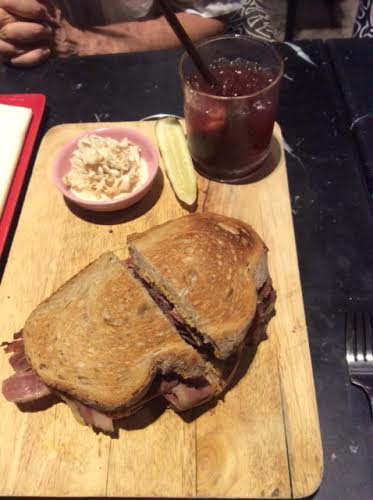
So even though we had had a traumatizing experience two months ago with coq au vin, we decided to risk it. This time, we were not disappointed. We were served very creditable Reuben and pastrami sandwiches. I have a picture of the Reuben sandwich we ate.

reuben sandwich

But in our haste to devour the pastrami sandwich we forgot to take a photo of it. Which is a pity, because if I have to choose between the two, I would plump for the pastrami sandwich, and in fact the rest of this post is about pastrami.

No matter, I can throw in here a photo of a pastrami sandwich from Katz’s Deli.

pastrami sandwich katz deli

This deli, which is on Houston Street in New York, is claimed in certain quarters of the internet to be “the keeper of the Jewish culinary flame” in the city.

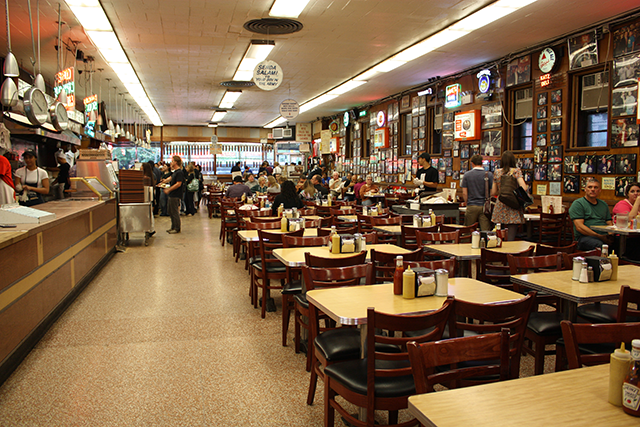
katz deli

katz deli inside

Strong claim indeed! Never having been to the establishment myself, I can’t tell you if this claim is reasonable (although I will note that my daughter has been there and was not that impressed by their pastrami sandwich – but then, she doesn’t much care for pastrami in the first place).

Before I get into rival claims, of which there are many in this field, let me quickly review the making of pastrami (something which I’d always vaguely asked myself about but had never bothered to check until I decided to write this post). Start with a cut of beef from around the animal’s navel, the so-called plate cut (you can also use brisket – more of this choice in a minute). Cure it with salt and saltpeter and let it dry for several weeks (you can also throw some herbs into the curing mix). Once cured, rub and coat your meat with a mix of herbs (as you can imagine, the precise make-up of this coating is a trade secret, jealously guarded by rival delis, but onion, garlic, black pepper, coriander seed, possibly sugar, all seem to be common ingredients). Once nicely coated, smoke it at low heat for several days (the precise wood used for the smoke being again a closely guarded trade secret).

So far, so good. This is no different from the preparation of many dried, cured meats around the world, and before the advent of refrigeration these methods had been used by human beings in one combination or another for thousands of years to preserve meat. It’s the next steps where it gets interesting. After smoking, you first boil the meat to cook it, and then steam it for some 15 minutes. These last steps seem to have to do with the cut of beef used. Initially, pastrami was a poor man’s dish. People used the plate and brisket cuts because they were the cheapest, and they were the cheapest because they are fatty and gristly. Boiling and steaming was used to soften both the meat and all those difficult-to-chew parts in the meat.

Then you serve it, fresh from the steamer, on rye bread; actually, it’s a wheat-rye bread, of a kind that the not-too-poor people used to eat in Europe (wheat bread was only eaten by the rich, while the poorest people ate horsebread, so called because it was made of the cheaper grains fed to rich men’s horses). The sandwich should always be served with a pickle (or two or three) on the side. To me, this is capital; the sharp astringency of the pickle offsets nicely the fattiness of the pastrami. It’s often served with coleslaw, but frankly that can be left out, at least the kind of commercial gooey coleslaw that tends to be served nowadays. It adds no real value to the dish that I can see.

The alert reader may have noted a stress in the last couple of paragraphs on poverty. This allows me to segue smoothly into a discussion of pastrami’s history. Pastrami researchers have concluded that its roots are to be found in New York’s community of Romanian Jews, who emigrated to the States in the late 1800s. They were escaping from Romania’s increasingly organized and ethnically-tainted anti-Semitism as well as looking for better economic opportunities. Like millions of other people, they would have transited through Ellis Island

immigrants at Ellis Island


and then been sucked into the slums of New York.

Mulberry street NYC

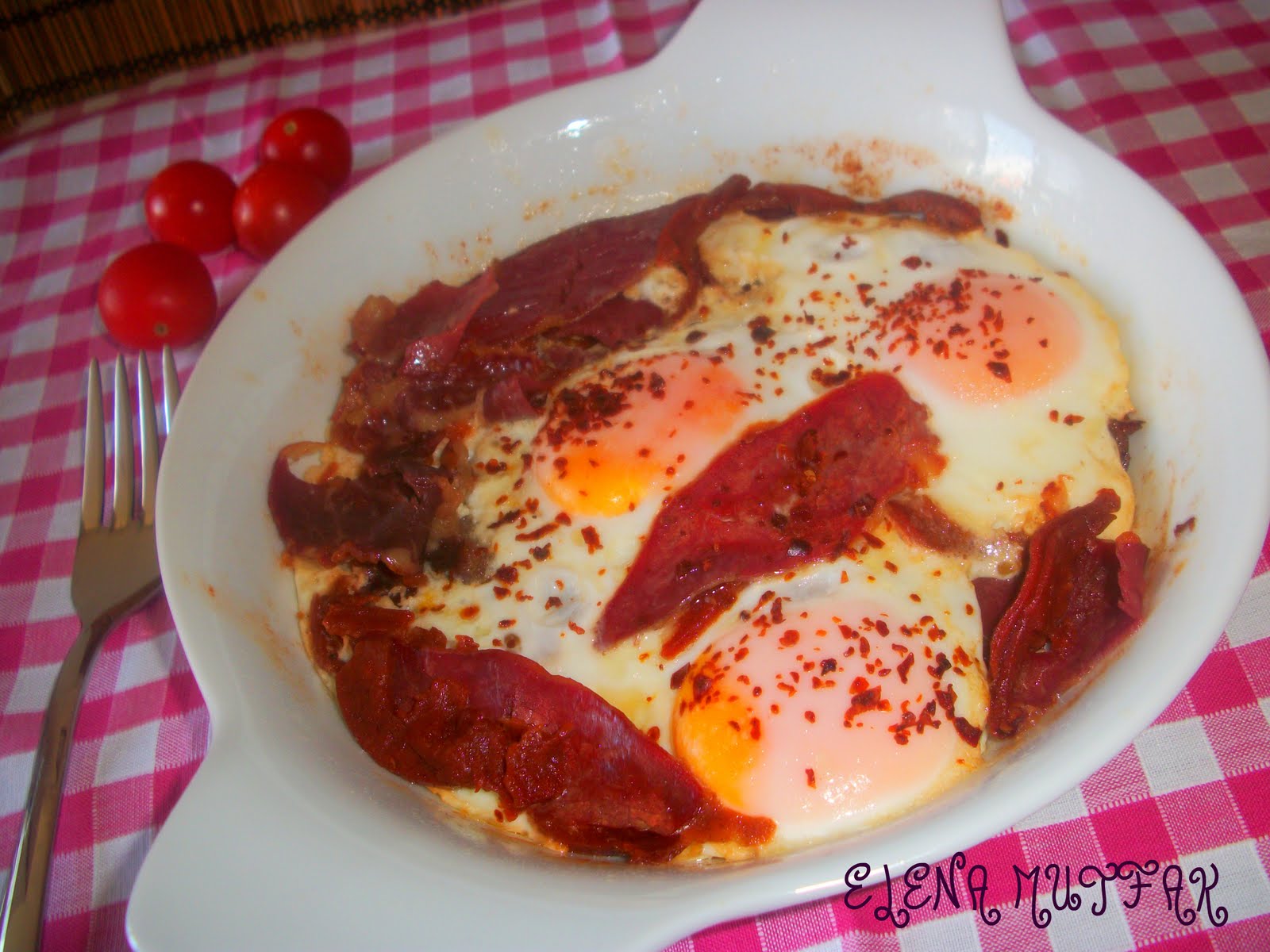
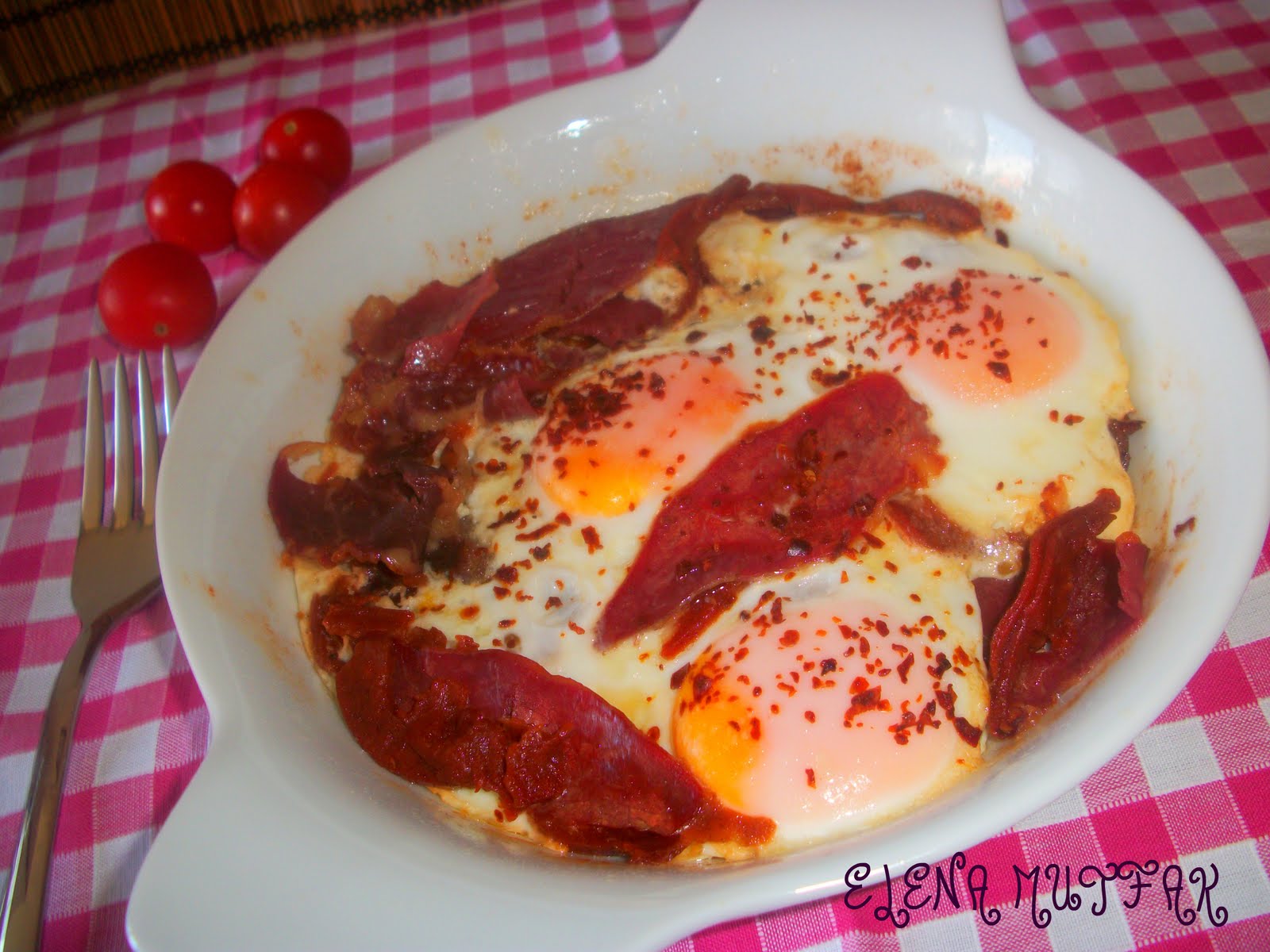
There, like all immigrants everywhere and at all times, they would have tried to maintain their culinary traditions, and one of these was a dried, cured meat called pastramă (in the early days, New York’s version was called pastrama, which was then changed to pastrami so that it could rhyme with salami, the idea being that this would help people remember it – an early form of the marketing jingle). But as is also often the case, they would have had to modify it to fit the ingredients they could find in their new homeland. And here the change was radical. In Romania, pastramă tended to be made with mutton or goose or even veal (but that must have been a rich man’s version; poor people didn’t eat veal). But what Romanians found in New York was beef (pork also, but that was non-kosher), so beef-based their pastramă became. And because they were poorer than poor, they used the cheapest cuts of beef, the plate and brisket. I suppose it was the fact that pastramă made this way was really chewy that led them to take the extra steps of boiling and steaming. The common Romanian way of eating pastramă is grilled. In fact, pastramă sounds to me like the Romanian version of bacon. Bacon, which is also a cured and dried meat (pork in this case), is also grilled before eating, and it is often eaten with eggs, as is grilled pastramă.

pastrama and eggs

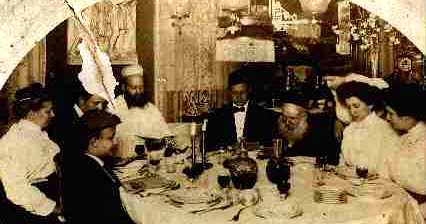
Or was it maybe this gentleman (at the back with the white headgear) who introduced the boiling and steaming steps?

sussman volk

This gentleman is Sussman Volk, an Orthodox Jew of Lithuanian ancestry. He is credited with having introduced pastrami to New York, and through New York to the rest of the world. He had emigrated to the States and had eventually opened a small butcher’s shop on Delancey Street. One day, so the story goes, a Romanian Jew came in and asked if he could store a trunk in the shop’s basement while he went back to Romania. Rab Volk agreed, and in return he got the recipe for pastrami. So Rab Volk started making pastrami, and then people wanted it on a slice of bread, and then he put chairs and tables in, and suddenly he was running a delicatessen. And the rest is history, as they say (just to close the circle, the following year Katz’s Deli opened). It could be that the recipe given to Rab Volk already included the boiling and steaming steps, or it could be that Rab Volk – reaching back into his Lithuanian culinary roots, or maybe other immigrant culinary roots – introduced the boiling and steaming steps himself.

Who knows? In the end, it doesn’t matter. This is the way pastrami is made, and that’s that.

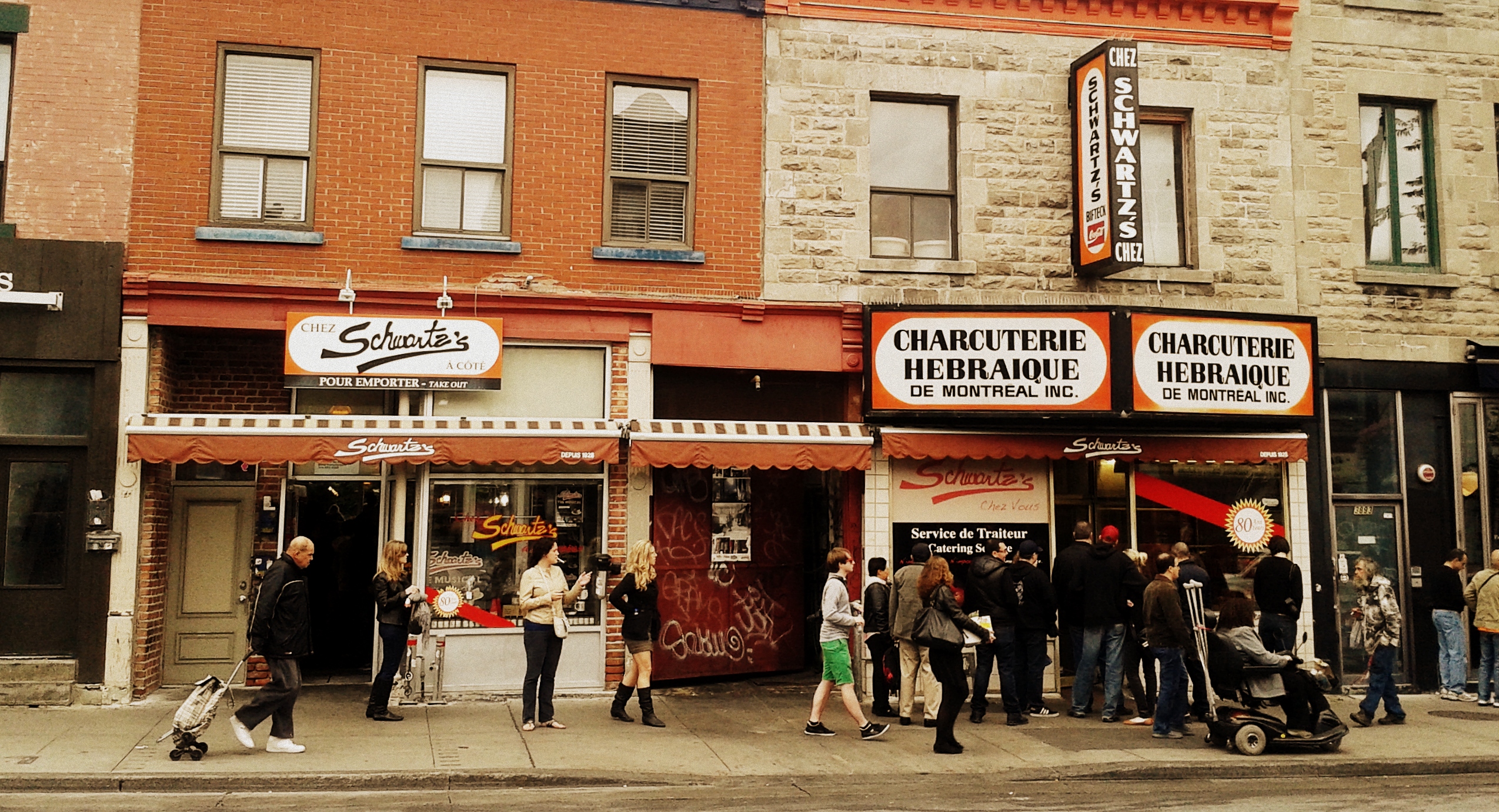
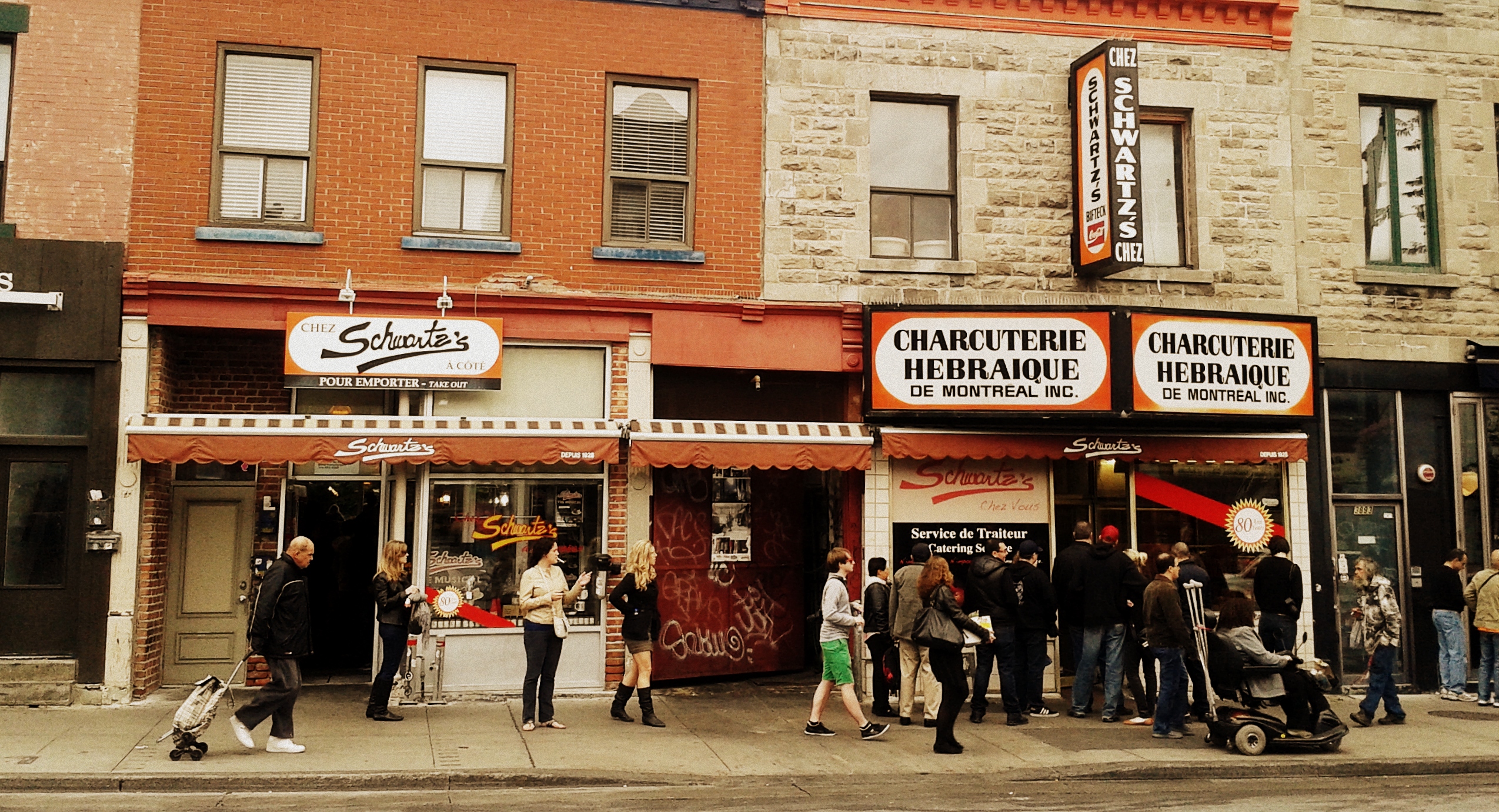
If readers were to think that the story ends here, they would be wrong. Because Romanian Jews also emigrated to Canada, settling in Montreal. And there they also introduced Montrealers to another son-of pastramă, in this case just called smoked meat. The two – relatively small – differences between the two products are the cut of beef used (smoked meat tends to use more brisket) and the mix of herbs used to rub and coat the meat (the fact that both boil/steam the meat suggests to me that these were introduced by the Romanian émigrés rather than by Rab Volk). Schwartz’s Deli in Montreal seems to be a good candidate for “the keeper of the Jewish culinary flame” in Montreal, so I’ll throw in a photo of the deli.

Schwartz deli

And here is the product

smoked meat Schwartz deli

Mmm, that looks gooood!

And now the Montrealers have boldly brought the fight to New York. A Canadian couple has set up a new Jewish deli in New York, the Mile-End deli. They’ve opened one shop in Brooklyn and another in Manhattan, in Bond Street.

mile end deli

Well, the next time my wife and I go to New York, we (or at least I) will forget about visiting the Metropolitan Museum or any other worthy institution. First stop will be Katz’s Deli and then Mile End Deli. To compare and contrast the two products.

_______________

Empty booth in a diner: https://hautevitrine.files.wordpress.com/2011/11/empty-booth-rockin-johnnys-diner-ottawa-2007.jpg (in http://hautevitrine.com/page/17/)
Reuben sandwich: our pic
Pastrami sandwich, Katz’s deli: http://ilovekatzs.com/wp-content/uploads/2011/11/pastrami1.jpg (in http://ilovekatzs.com/)
Katz’s Deli: http://animalnewyork.com/wp-content/uploads/katz_artgalll.jpg (in http://animalnewyork.com/2013/katzs-deli-opening-an-art-gallery-and-pop-up-shop/)
Katz’s Deli inside: http://www.sheilazellerinteriors.com/wp-content/uploads/2011/02/00-20-Inside-Katz.png (in https://carileee.wordpress.com/2011/11/05/dining-101-new-york-katzs-deli/)
Immigrants at Ellis Island: http://history105.libraries.wsu.edu/fall2014/wp-content/uploads/sites/3/2014/08/Ellis-Island.jpg (in http://history105.libraries.wsu.edu/fall2014/2014/08/28/jewish-immigration-in-the-1940s/)
Mulberry street NYC: https://theselvedgeyard.files.wordpress.com/2011/02/mulberry_street_new_york_city_loc_det-4a08193.jpg (in http://piedader-letspractiseenglish.blogspot.com/2011/11/jacob-riis.html)
Pastramă and fried eggs: http://3.bp.blogspot.com/_GzvYAGoAhKY/TH5bioNE7PI/AAAAAAAACW0/bto1mheJNDM/s1600/oua.jpg (in http://elenamutfak.blogspot.com/2010/09/pastrama-cu-oua-ochiuri.html)
Sussman Volk: http://astro.temple.edu/~bstavis/family/oldstavins.jpg (in http://astro.temple.edu/~bstavis/family/oldstavin.htm)
Schwartz deli: http://gottakeepmovin.com/wp-content/uploads/2013/10/20130914_151229.jpg (in http://gottakeepmovin.com/classic-montreal-schwartzs-smoked-meat-sandwiches/)
Smoked meat sandwich Schwartz deli: https://travelloafers.files.wordpress.com/2013/06/montreal-schwartz-deli-680×680.jpg (in https://travelloafers.wordpress.com/2013/06/11/celine-dion-is-the-queen-of-cured-salted-meats/)
Mile End deli Manhattan: http://mileenddeli.com/wp-content/uploads/2012/01/photo-for-web_SANDWICH.jpg (in http://mileenddeli.com/)

SALT AND SWEET

Bangkok, 5 February, 2015

A few weeks ago, I visited a couple of electric arc furnaces which were recycling scrap steel. It was a very interesting visit, the first time I had seen this type of furnace in action.

EAF

They are a nice example of a vital step in what the Chinese call a “circular economy”, an economy in which the materials we use do not simply get thrown away after we’ve finished with them, but are collected, recovered, and reused.

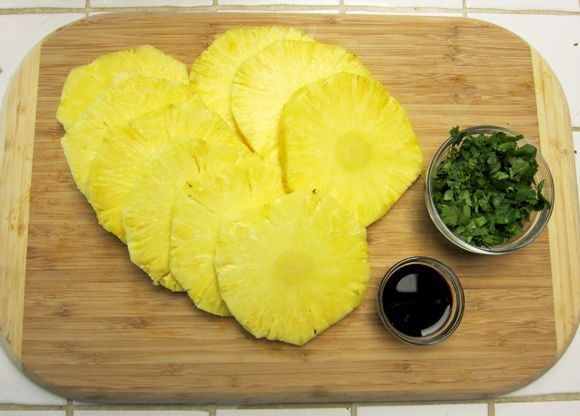
But actually, what I want to focus on in this post is the dinner we were served during the visit, or rather on one course of that dinner. I should explain that since these furnaces work on electricity and since electricity is expensive in Thailand during the day, the furnaces are run at night. So the visit of the furnaces started at 8 o’clock in the evening, and the first company we visited kindly offered us dinner to fortify us for the hot and dusty visit which awaited us. Since this was a Chinese-owned company, we were served a Chinese-style dinner which, after my five years spent in China, brought a nostalgic mist to my eye. As is usual in China, the dinner ended with fresh fruit. But this fruit course had an interesting twist. We were served fresh pineapple with a soy sauce dip. Soy sauce! That is not something I had ever thought of combining with pineapple. But actually it was delicious.

Pineapple and Soy Sauce

This is the only photo I could find on the (English-language) web which in any way resembled what we found before us at dessert time, but even this is for a recipe where the pineapple is fried, which explains the presence in the photo of the coriander (to be used as a final garnish). I take this lack of photos to be an indicator that I may be one of the few in the English-speaking world who has tried this particular combination of sweet and salt. But readers are free to disabuse me of my belief.

In any event, as I let my taste buds deal with this interesting sweet-salt combination, I remembered a conversation we had had around the Christmas lunch table about precisely this issue: the mixing of salt and sweet. Our son had maintained that it was not natural to mix sweet and salt, and more generally that different flavours should be kept separate. Our daughter maintained that there were many dishes where salt and sweet were combined, which suggested that actually it was quite natural to mix sweet and salt. I was torn. As my long-suffering wife knows only too well, I object to mixing things on my plate: the vegetables are to be kept neatly separated from the meat and from each other, the dressing from the salad should not be allowed to leak over to the meat, etc. So on these grounds, I also feel that sweet and salt should not mix. Yet I have to acknowledge that there are dishes where the sweet and salt combination is exceedingly pleasing. After the pineapple and soy sauce dip experience, I resolved to do some research (a.k.a. web browsing) on the topic.

I’ve now done the research and am ready to report back, although I must confess to not having much to report. All agree that “common sense” suggests that salt and sweet do not mix, yet all agree that actually many of us do like to mix the two. Why is this? As far as I can make out, no-one has really figured it out. One possible answer is biochemical. The sodium ions of salt somehow enhance all taste buds: “there’s evidence that applying a sodium-channel blocker (TTX) can dramatically inhibit the activity of all taste receptors, suggesting that sodium plays a key role in the cellular detection of every taste (and not just the taste of salty things) … This would explain why food without any salt is so hopelessly boring: it might be literally harder for our various taste receptors to get excited.” So mixing salt with sweet enhances sweet because of a biochemical pathway we are born with. Just to make the whole discussion sound even more scientific, I throw in here a close-up of a taste bud on a tongue, which is what sodium ions seem to be enhancing.

tongue-taste-bud

But why would we have evolved to have that biochemical pathway? One possible answer is that because we humans are omnivores, we’re wired to desire many different foods and tastes. It’s bad for us to eat just one thing, so our sense of taste has evolved to give us greater gratification if we mix tastes. My wife will be very pleased to hear that there is a scientific underpinning to her insistence on mixing foods and tastes.

Let me celebrate this new understanding on my part of my biological processes by sharing with readers some of the wonderful sweet-salt dishes which I have stumbled across in my life. Where to start? Well, at the beginning, I guess, with the first such dish I ever remember trying, lamb with mint sauce. My English grandmother had taken me to visit an uncle and aunt and assorted cousins, and my aunt served us lamb with mint sauce for lunch.

lamb and mint

She served it with two veg, as is de rigeur for any English meat dish. In this case, I remember distinctly that the veg in question were that most English of combinations, peas and potatoes (she also made a magnificent apple crumble, by the way; no apple crumble I have ever eaten since has tasted so good).

Mint sauce is really easy to make, by the way, about as easy as lamb chops. I give an executive-summary recipe at the end of the post for those readers who are interested. What I think is important to point out here is that the recipe calls for a mix of sugar and vinegar. In my humble opinion the best combination is actually sweet, salt, and acid or tartness. To my mind, that’s what made the pineapple and soy sauce so good, the fact that the pineapple is also tart. Dragon fruit, a much milder fruit, was being served along with the pineapple. When I asked if that too should be dipped in the soy sauce, our hosts pursed their lips and gave it as their considered opinion that it wouldn’t work.

Lamb with mint sauce is incredibly English (and I mean English. I don’t think the Scots or the Welsh eat it). It is so English that the French made fun of Les Anglais because of it – the French consider the use of mint sauce to be beyond the cooking pale. Our friends Goscinny and Uderzo, who wrote the Asterix and Obelix stories, had mint sauce play a major role in our heroes’ adventures in Britain, with the governor of province at one point shouting that if his men did not find the pair (who had just disappeared from prison) he would have his commanders boiled and served with mint sauce to the lions. To which the commanders commented how horrible that would be – for the lions.
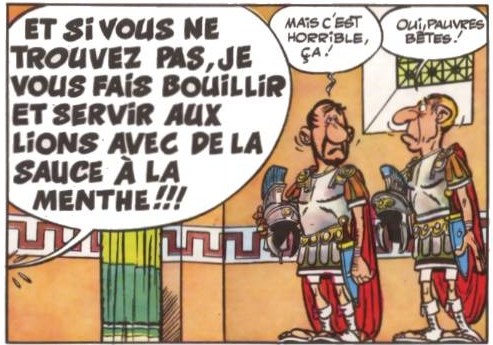
asterix sauce a la menthe

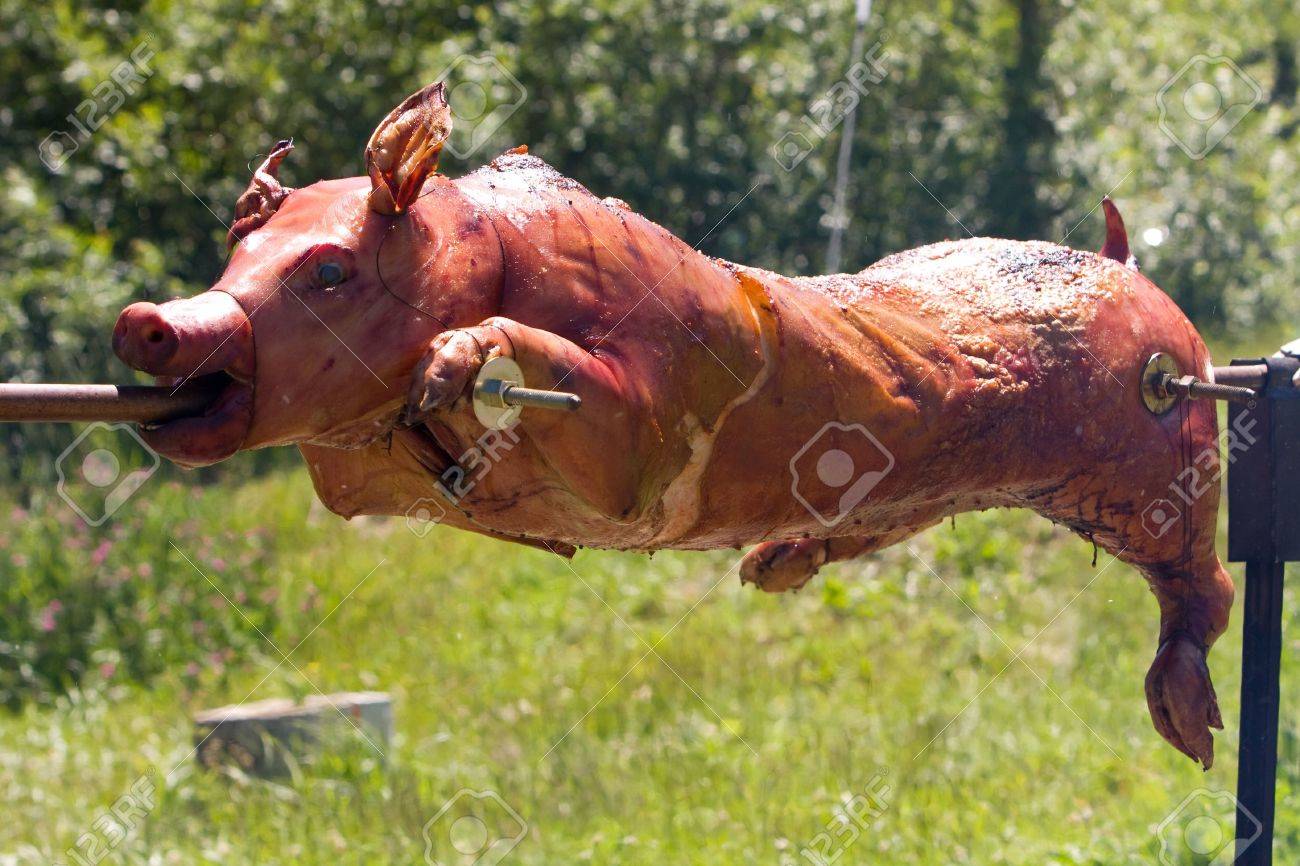
The French loved it, lapping up the fun being poked at English cuisine. But I will ignore the smirking French and concentrate on another great example of English cuisine which is also a sweet-salt dish, roast pork and apple sauce. I first had this delicious dish as a boy scout. It was summer, the end of the school year, that time in the calendar when England can often be bathed in golden light rather than be grey and sodden.  For our last outing of the year, the scout master had the brilliant idea of buying a whole pig and roasting it on a spit in the woods. I have this crystal clear memory of sitting around the spit, listening to the fat crackle, breathing in the smell of cooking meat, watching the scout master sharpen the large carving knife, while the sunlight dappled the ground all around us. It’s the closest I have ever felt to being a Cro-Magnon man.
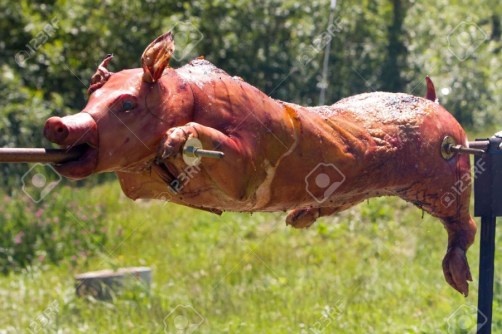
roasted pig

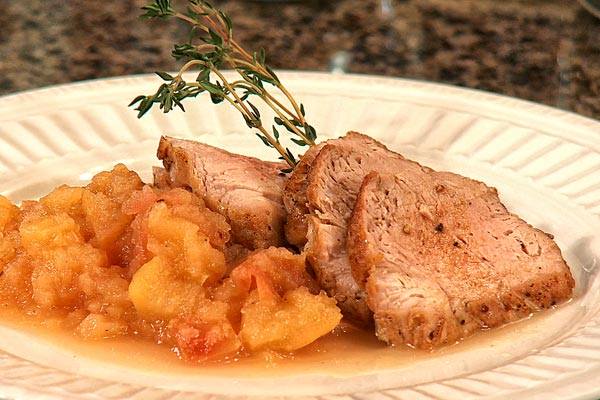
And then there was the discovery of the exquisite taste of roast pork and apple sauce, a large dollop of which was dumped onto our metal field plates along with a big slab of pork meat and crackling.

roast pork and apple sauce

Those readers interested in knowing how to make this sauce should scroll down to the end of the post. I just want to note that cooking apples should be used. They are tarter than eating apples. It’s the tartness thing again. One can also add lemon zest, presumably to add yet more tartness.

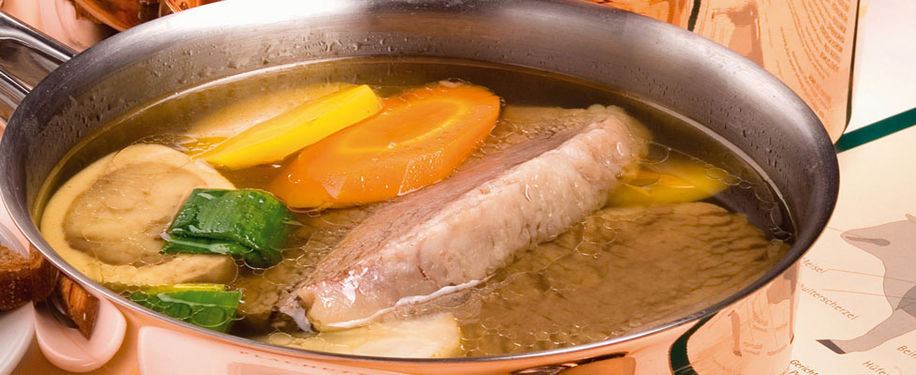
Of course, the English do not have a monopoly in Europe on sweet-salt dishes. Allow me to introduce here a dish I discovered and came to love when we moved to Vienna: Tafelspitz. There is a venerable ritual to cooking Tafelspitz, but when you reduce it to its essentials it is beef meat (topside or top round) boiled slowly over many hours with a medley of root vegetables – carrot, celeriac, parsnip and the like – and a piece of marrow bone. It is normally served like this:

tafelspitz

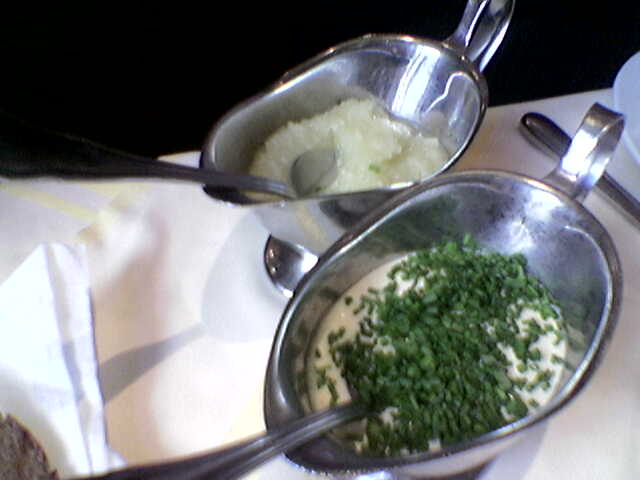
You can start with a cup of the broth which is engendered by the boiling of the meat, just to whet your appetite. You can then turn your attention to the meat proper, which you will eat with the vegetables, possibly some fried grated potatoes, and – to spice up what is otherwise a rather bland dish – two types of sauce, a cream-based chive sauce and apple-horseradish sauce.

tafelspitz sauces

My earnest suggestion is that you ignore the chive sauce in the front of the photo and go with the apple-horseradish sauce behind it. It is just a variant of the apple sauce I described earlier; you simply add grated horseradish. If you make this sauce at home, my further suggestion is to be generous with the amount of horseradish you add. The best Tafelspitz I ever had was served with an apple-horseradish sauce that made my eyes water slightly. I don’t want to sound like a broken record, endlessly repeating myself, but tartness really helps appreciation of the sweet-salt taste.

Both the French and the Italians have a similar dish of boiled meat, pot-au-feu in the first case and bollito misto in the second. My French grandmother made an excellent pot-au-feu and I am very fond of it, but since it is normally eaten with mustard I will drop it from this discussion. We shall focus instead on bollito misto, a dish which is very popular in northern Italy and (as the name suggests) consists of a variety of boiled meats: cuts of beef and veal, cotechino (a pork-based sausage), and sections of hen or capon.

bollito misto

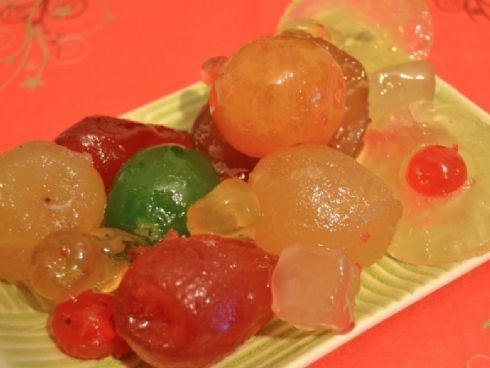
My wife reminisces from time to time that her father was very fond of bollito misto, eating it like most northern Italians do with a sauce called mostardaactually, mostarda di Cremona. In a country known for the fierce independence of its cities, it will come as no surprise to the readers that probably every city in northern Italy has its own variety of mostarda. Despite its name, the sauce has only a little to do with mustard. It is really a mix of candied fruit which is given a kick by the addition of mustard powder (that tartness thing again…). Those slices of fruit in the photo above are the mostarda, but I give here a more direct picture.

mostarda di cremona

My wife confesses to never having liked mostarda; she can’t even stand the smell. Personally, I have never tried it, but a number of sites do support my wife’s assertion, mentioning that the taste of mostarda is an “acquired taste”. This is normally code for saying that something tastes revolting the first several/many times you try it. In any event, if my wife says it’s not nice, then that’s good enough for me! No spoonful of it shall ever pass my lips. For those readers who will ignore these warnings and wish to try it, though, I give a brief recipe at the end of the post.

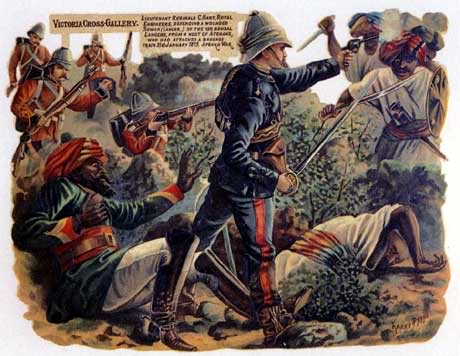
I feel that I cannot move away from mostarda without mentioning the somewhat similar chutney sauce one finds in the UK, or at least one found when I was a boy. Although “chutney” as a word has Indian roots, what I ate as a boy was several removes from things Indian. The most popular brand back then was a mango chutney which went by the name of Major Grey’s Chutney and was sold by Crosse & Blackwell. The story went that a certain Major Grey, a British officer in India, had surveyed the local Indian chutneys and then invented his own, more British, chutney, which he proceeded to bring back to the motherland when he retired, to remind him of the Good Old Days. When I was a boy I rather imagined this Major Grey to look like this

British soldier India-1

fighting heroically against savage natives on the Northwest frontier and getting a VC for his –quite literal – pains. But alas! this appears to be pure legend. It seems that something similar to mostarda, some sort of fruit conserve, existed already in the UK and the Brits in India took the idea with them and adapted it to local ingredients. So what this chutney will usually have as ingredients is mangoes, raisins, vinegar, onions, sugar, and spices. Crosse & Blackwell also include lime juice and tamarind juice. As you can imagine from the ingredients, this chutney is both sweet and tart. Again, for heroic readers who want to make this sauce from scratch, scroll to the end of the post.

I haven’t eaten this kind of chutney in many decades, but when I was young my favourite way of eating it was with slices of cold meat (the chutney is in the round bowl to the left of the photo below).
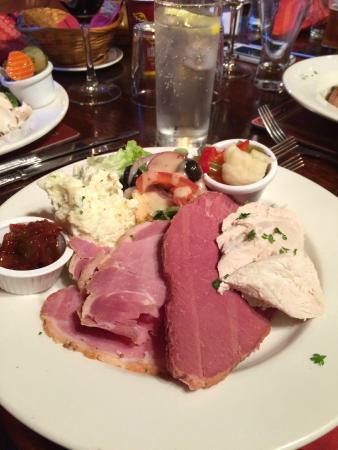
cold meat and chutney

This was an especially popular dish in pubs, where this photo was taken. Sitting here in Thailand, I feel a sudden nostalgia for the English country pubs whose bars I propped up in my youth, so I am moved to throw in a photo of a nice country pub.
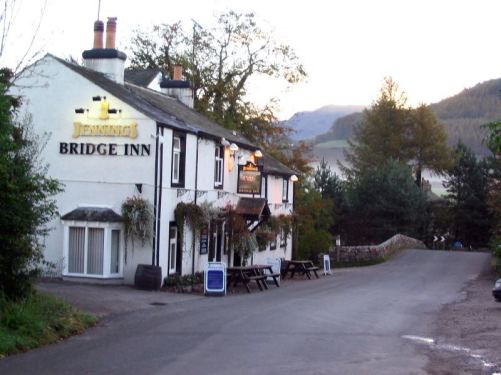
Bridge Inn

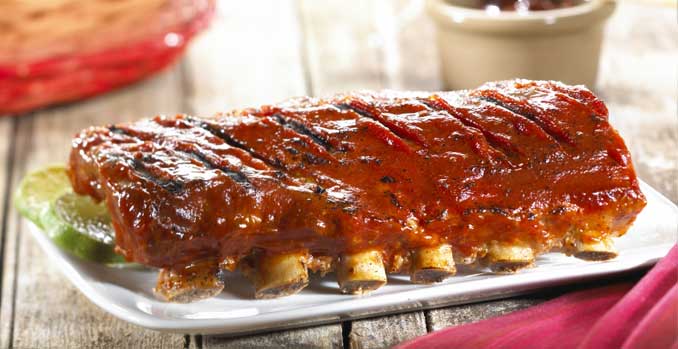
Like Superman, I now vault over to the US and alight somewhere in the open ranges of the Midwest, for no better reason than having this feeling that my next salt-sweet sauce – barbecue sauce – was invented around there somewhere. That being said, my wife and I didn’t try it there. We were just discussing this point and we reckon that it was somewhere between Boston and Washington in the early 1980s. Wherever it was, we stared open-mouthed at these large racks of ribs smothered in this dark reddish brown sauce.

ribs and barbecue sauce

But very soon we were closing our mouths over those ribs. Ah, that sauce! … But I should say: those sauces. In this little research I’ve done I have discovered that there are dozens of different barbecue sauces. I thought the Italian quarrels about where the best mostarda is made were fierce, but boy! the arguments about what place in the US makes the best barbecue sauce are right up there. I’m going to keep my head low without backing any particular sauce. I’m merely going to say that wherever the sauces are made they all seem to have sugar (preferably brown), tomato ketchup, vinegar, and some salt, to which various spices are added in varying levels and in different combinations (Worcestershire sauce, pepper, paprika, mustard, chili, cayenne, and on and on). That combination of sweet and tart again, to challenge the salt of the meat. Readers can look at the end of a post for condensed recipe of an excellent sauce from Kansas City (but don’t tell anyone I said it).

Deary me, I seem to have gone on for quite a while here, and I’m sure I haven’t covered one-hundredth of the sweet-salt dishes enjoyed around the world. On top of it, I’ve only mentioned meat dishes; it makes me sound a total carnivore, red in tooth and claw. But there was that fish dish in Shanghai … and there are all those sweet salad sauces to pour on vegetables … But I have to stop. I’ll just add two final combinations of salt and sweet which show that meat (or fish) is not the only food the delight of which is heightened by the salt-sweet experience: one which probably every person on the planet has enjoyed by now, what with the prevalence of fast food joints, french fries and ketchup

french fries and ketchup

and one which I’ve mentioned in an earlier post, chocolate and French baguette

chocolate and baguette

Mmm, so good!

So give your taste buds a whirl and douse them with sugar and salt – and a dash of vinegar, or horseradish, or something tart. Enjoy!

-o0o-

Mint sauce: Strip the leaves off a bunch of mint, sprinkle them with a pinch of salt, and chop finely. Place the result in a bowl, add 1 level tablespoon of caster sugar and pour over the mix 4 tablespoons of boiling water. Stir and leave to cool. Stir in 4 tablespoons of vinegar. Add more water or vinegar to suit your taste.

Apple sauce: Take a number of cooking apples, peel them, core them, and chop them up. Put the apples in a saucepan and add water. Once can also add lemon zest. Cover and cook over a low heat until the apples have gone soft and mushy. At which point take off the heat and beat in a knob of butter and a teaspoon of sugar. Cool.

Mostarda di Cremona: Begin by washing the various fruit: pears, quinces, cherries, apricots, figs, and peaches (although I’m sure you can vary the fruit as you wish). Cut the apricots and peaches into halves or quarters (depending on their size) and remove their stones, peel. Core and quarter the pears and quinces. Dry all the fruit after preparation. Add the sugar – a lot of sugar! half a kilo for every kilo of fruit, more if you want your mostarda sweet (but for reasons suggested above, I would go easy on the sweetness and maybe go heavier on the mustard powder). Pour some squeezed orange juice over it. Let the whole rest for 24 hours, gently turning the pieces a couple of times. By the end of this time the sugar will have dissolved. Drain the fruit well – without losing the syrup! Bring the syrup slowly to a boil, and let it boil gently until its volume is reduced by half. Pour the remaining syrup back over the fruit. The sugar in the now-concentrated syrup will extract more moisture from the fruit, which will begin to shrink and firm up. Concentrate the syrup again and steep the fruit in it overnight again. Dissolve several tablespoons of mustard powder in some white wine vinegar. Bring the mixture gently to a boil and let it bubble for a few minutes. In the meantime, drain the fruit again, and concentrate the syrup again. Put the candied fruit into jars, add the mustard powder infusion, and then add the hot syrup. The amount of infusion you add will determine of course how much of a kick your mostarda will have. Cover the jars and put them on a cool dark shelf. The mostarda will be ready to eat in two weeks’ time.

Major Grey’s chutney: (this is one of many recipes for this kind of chutney) Combine 4 cups of 5-6 medium-sized chopped mangoes, 1 cup of brown sugar, half a cup of molasses, 1 cup of vinegar, 1 cup of coarsely chopped onions, three-quarters of a cup of golden raisins, half a cup of seeded and chopped limes, half a cup of peeled, seeded and chopped orange, a quarter of a cup of peeled, seeded and chopped lemon, and finally a bunch of spices: half a cup of grated ginger root , 3 cloves of minced garlic, 1 tablespoon of mustard seed, 1 tablespoon of dried red pepper flakes. Cook for about 30 minutes, stirring often. Add 2 tablespoons finely chopped fresh cilantro, 1 teaspoon of ground cinnamon, a quarter of a teaspoon of ground cloves, a quarter of a teaspoon of ground allspice. Cook for another 10 minutes or so, until chutney starts to thicken. Ladle chutney into a jar and close it air-tight.

Barbecue sauce: (from Kansas City) In a saucepan over medium heat, stir together ½ cup of ketchup, 2 tablespoons of brown sugar, 1 tablespoon of cider vinegar, 2 tablespoons of Worcestershire sauce, ¼ teaspoon of salt, ¼ teaspoon of mustard powder, 1 teaspoon of garlic powder, and a dash of hot pepper sauce. Bring to a simmer, then remove from heat and allow to cool.

_________________

Electric arc furnace: http://ih.constantcontact.com/fs163/1101151826392/img/505.jpg (in http://ricorant.blogspot.com/2014/11/fwd-dominance-of-steel-111114.html)
Pineapple and soy sauce: http://static.squarespace.com/static/51107688e4b0e3b888c1183b/t/519f0a2ee4b0bb6d74d9bdcf/1369377327493/Grilled+Soy-Sauce+Pineapple (in http://larkspurcompany.com/blog/2013/5/20/grilled-soy-sauce-pineapple)
Taste bud closeup: http://cdn1-www.webecoist.momtastic.com/assets/uploads/2010/01/tongue-taste-bud1.jpg (in http://webecoist.momtastic.com/2010/01/11/biological-photography-magnificent-microscopic-ultraminiature-photos/)
Lamb and mint sauce: http://www.thetimes.co.uk/tto/multimedia/archive/00050/table_townsend_74217_50069c.jpg (in http://www.thetimes.co.uk/tto/life/food/recipes/article2701689.ece)
Asterix sauce a la menthe: http://www.prise2tete.fr/upload/NickoGecko-Saucementhe.jpg (in
Roasted pig: http://previews.123rf.com/images/azlightning/azlightning0908/azlightning090800003/5315340-whole-golden-roasted-pig-on-a-spit-spit-roasting-is-a-traditional-hawaiian-luau-method-of-cooking-a-.jpg (in http://www.123rf.com/photo_5315340_whole-golden-roasted-pig-on-a-spit-spit-roasting-is-a-traditional-hawaiian-luau-method-of-cooking-a-.html)
Roast pork and apple sauce: http://www.growingagreenerworld.com/wp-content/uploads/2010/10/123-dishAppleSauce_Pork.jpg (in http://www.growingagreenerworld.com/pork-tenderloin-spiced-applesauce-recipe/)
Tafelspitz: http://www.plachutta.at/typo3temp/pics/1115b4ecd0.jpg (in http://www.plachutta.at/en/about/)
Tafelspitz sauces: http://thepassionatecook.typepad.com/sauces.jpg (in http://thepassionatecook.typepad.com/thepassionatecook/traditional_austrian_food/page/2/)
Bollito misto: http://www.buonissimo.org/archive/borg/XRqDUZ2JX8O3MtcV7PuMgNvG9IvTytvNm6Rhlcw8yOzcxGV4vWA1kg%253D%253D (in http://www.buonissimo.org/lericette/5685_Bollito_misto)
Mostarda di Cremona: http://www.cremonacitta.it/intranet/immagini/_resized/1/scheda/58/w/490x/Prodotti_De_Co_di_Cremona_la_Mostarda_cremonese-img58-01-1.jpg (in http://www.cremonacitta.it/it/gusto_e_sapori_a_cremona/prodotti_de_co_a_cremona_mostarda_tradizionale_sc_58.htm)
Cold meat and chutney: http://media-cdn.tripadvisor.com/media/photo-s/07/0d/d8/5a/blairs-inn.jpg (in http://www.tripadvisor.ie/LocationPhotoDirectLink-g186599-d2014376-i118347866-Blairs_Inn-Blarney_County_Cork.html)
Bridge Inn: http://www.hallflatfarm.co.uk/IMAGES/The%20local%20-%20the%20Bridge%20Inn.jpg (in http://www.hallflatfarm.co.uk/location.html)
British officer in India: http://i80.photobucket.com/albums/j199/matteaston/Afghan1.jpg (in http://www.fioredeiliberi.org/victorian/)
Ribs and sauce: http://www.cooldeals.es/Images/deal-images/eef5c31f-f992-46a5-8993-db0198715a35/20140818133044604.jpg (in http://www.cooldeals.es/Deals/Marbella-Estepona/9fd8ffad-612a-42de-8755-55153751c9e6)
French fries and ketchup: http://scms.machteamsoft.ro/uploads/photos/652×450/652x450_7b63084e7d5012a126811947191414.jpeg (in http://stiri.acasa.ro/social-125/afla-ce-alimente-ascund-sute-de-kilocalorii-110745.html)
Baguette with chocolate: http://a142.idata.over-blog.com/600×449/2/90/63/97/Autrefois-./Chocolat/Le-Bon-Chocolat–13-.JPG

A STREET PHOTOGRAPHER

Bangkok, 21 December, 2014

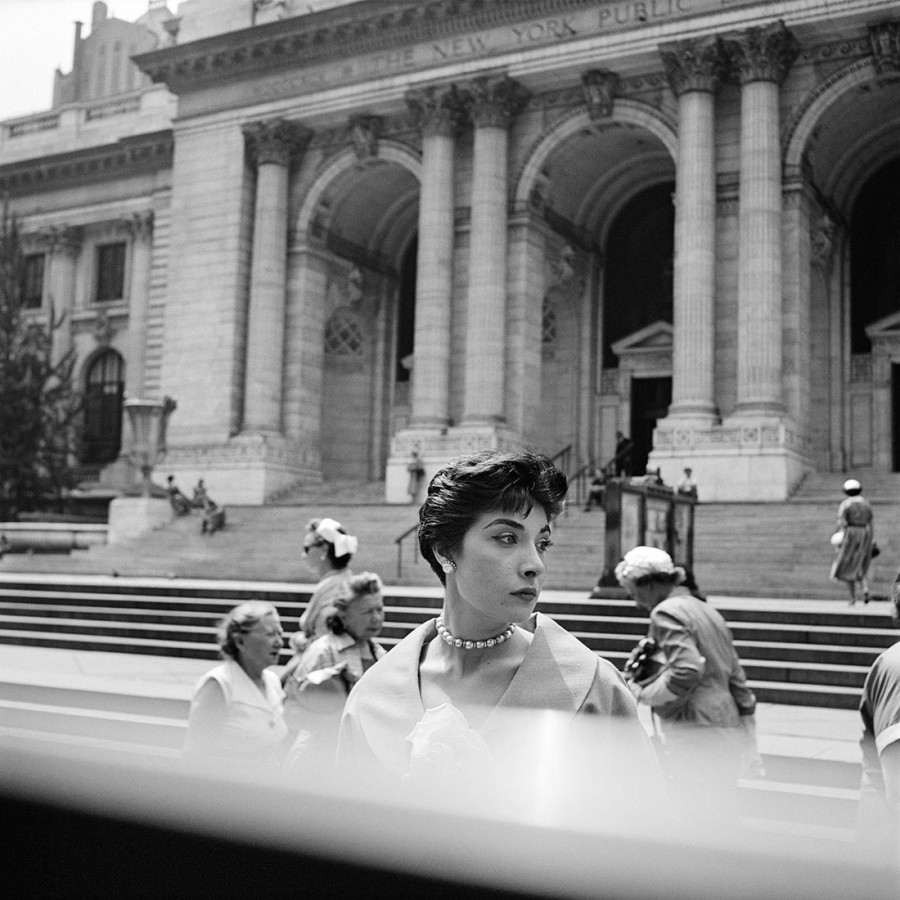
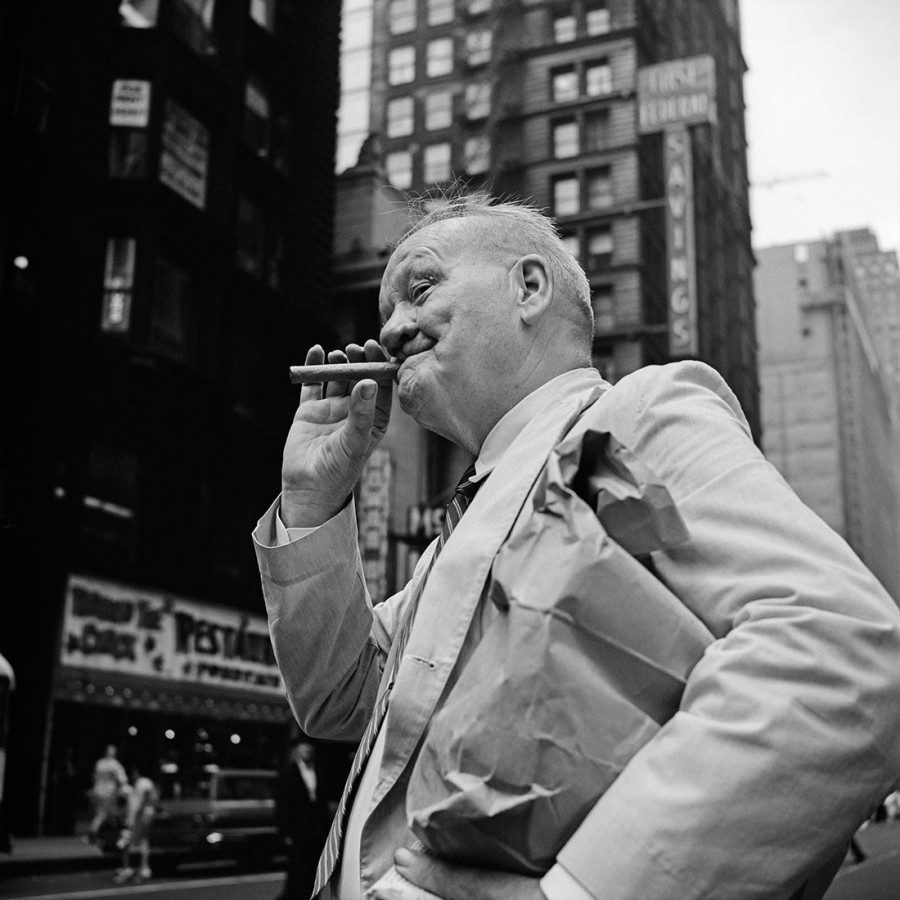
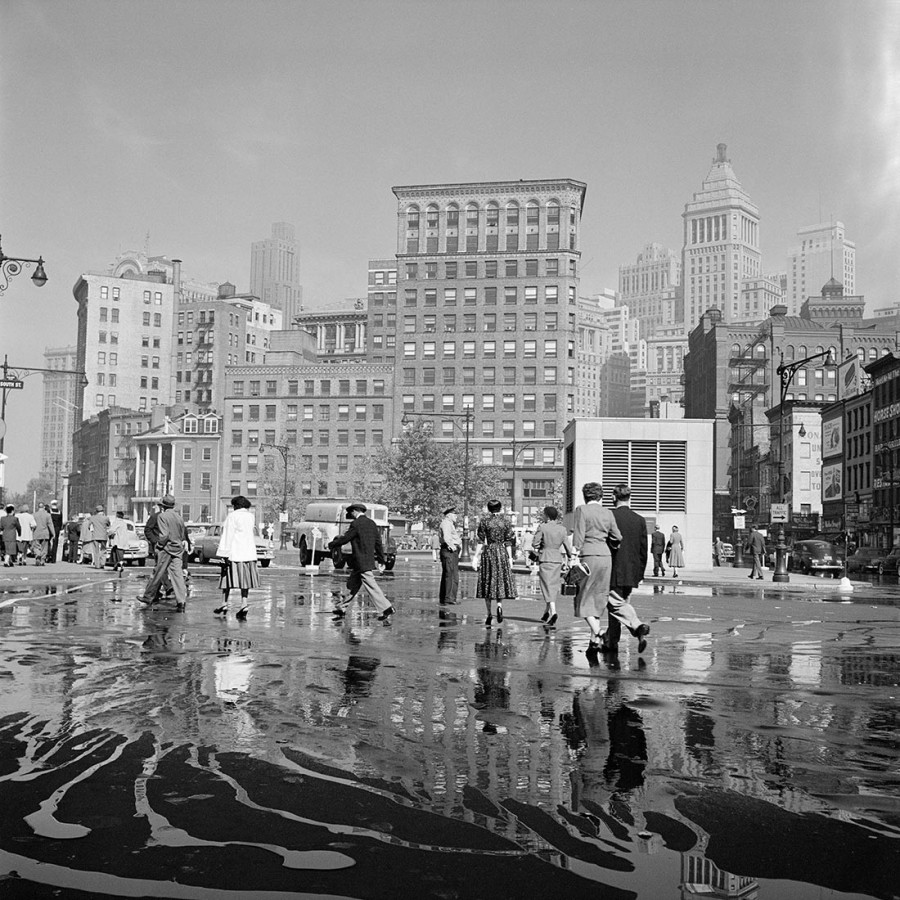
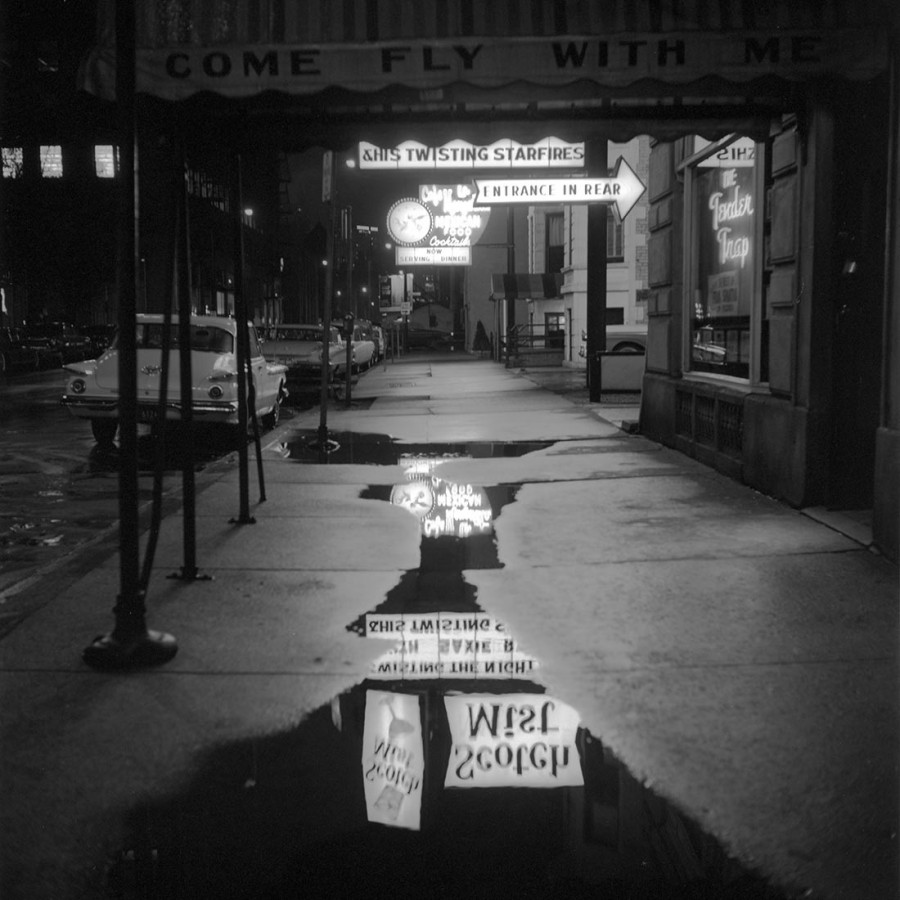
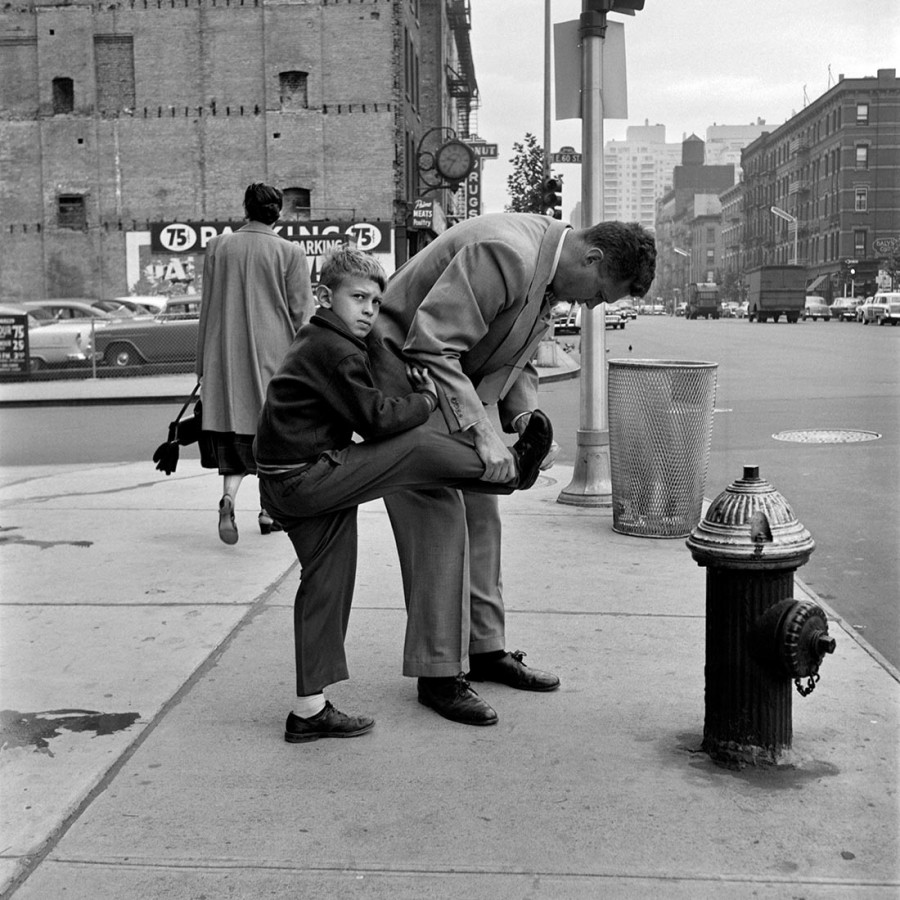
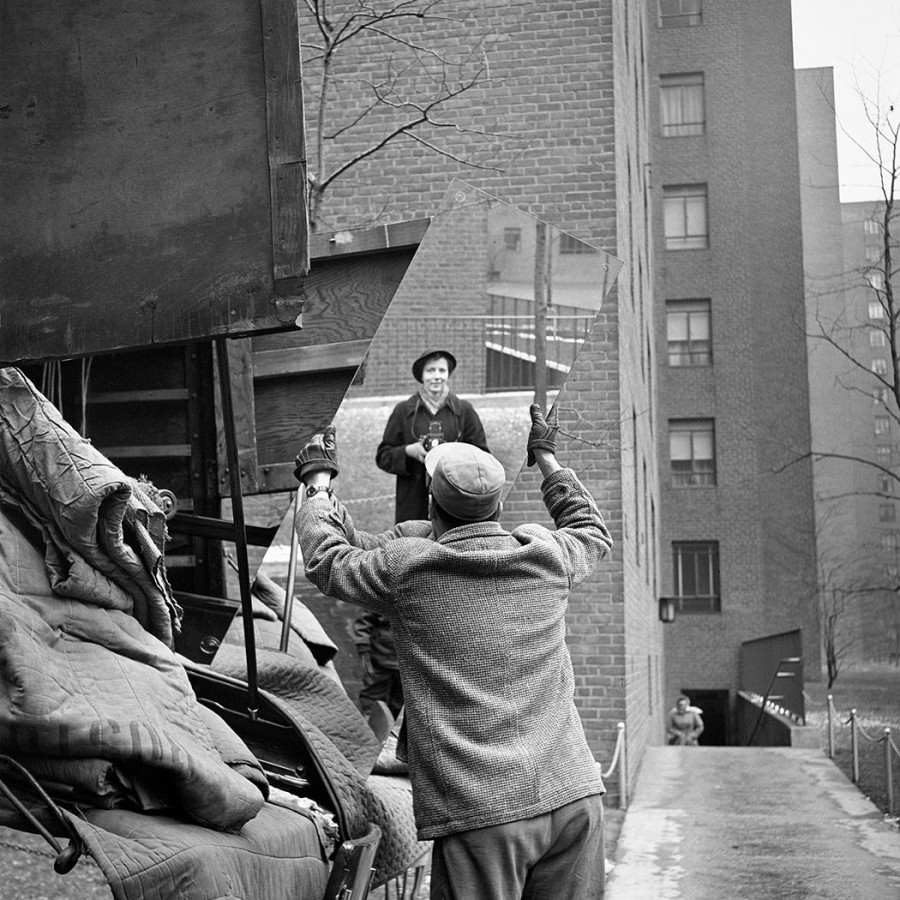
Her name was Vivian Maier. She died not long ago, in 2009, at the age of 83, a spinster and childless, and penniless. She had spent some forty years, from the mid-1950s on, being a nanny for various well-off families in the Chicago area.

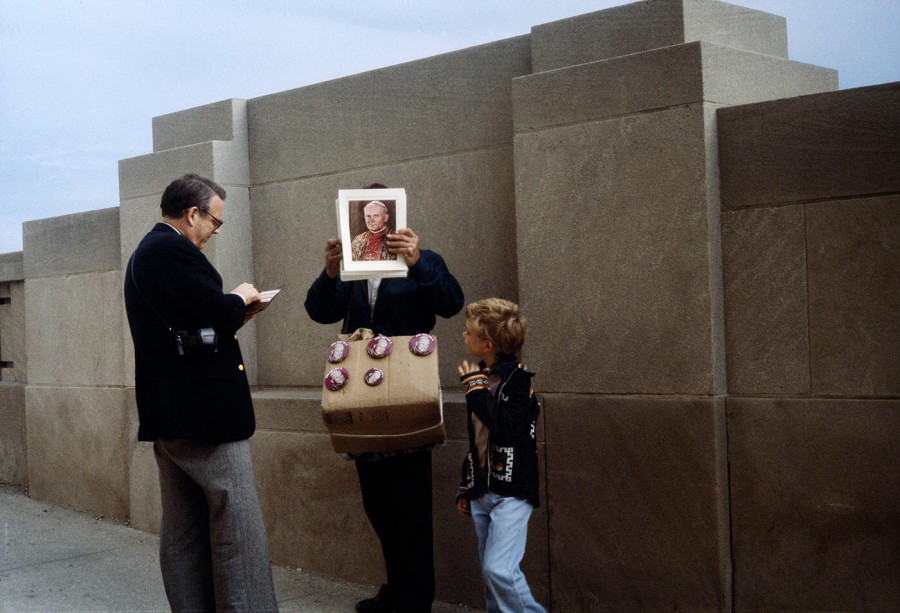
And she was a gifted photographer of the streets, mainly those of Chicago and New York.

She spent every possible minute that she could taking photos: in all her free time, but also when she was taking her charges for walks or to the playgrounds, as well as on her one big trip around the world, which she made in the early sixties. She took hundreds of thousands of photos. But hardly any of these made it past the stage of negatives, and many didn’t even get that far; they just stayed as rolls of unprocessed film.

She was a compulsive hoarder. She kept all the negatives and all the film rolls, and the 8 mm films she made, and the audio tapes she recorded, and just about everything else she had ever owned or collected, in cardboard boxes, old suitcases, and other containers. As she moved from one nannying job to another, she offloaded her accumulating stuff into a commercial storage space. In 2007, after she failed to keep up with her payments, the storage company auctioned her stuff off.

It looked like her work was about to disappear. But a number of photo collectors bought at the auction. They recognized a spark of genius in her photos and started trying to publicize them. A first attempt by Ron Slattery in 2008, who posted some of her photos on the internet, failed to generate much interest. Then in October 2009, six months after she died, another of the collectors, John Maloof, put some of his trove of her photos on Flickr, linked them to his blog, and the results went viral (this is a very modern story). Things snowballed from there, and her work is now beginning to garner a fair amount of critical and popular praise.

Would Vivian Maier have wanted this recognition? That is one of the questions touched upon in a fascinating documentary which John Maloof put together entitled “Finding Vivian Maier”. He tells the story of how after his initial purchase of her stuff he went on a voyage of discovery of who she was and what she did – quite a detective story – and he interviews a number of the children she nannied and their parents to try to understand what kind of person she was. It was seeing this film that moved me to write this post. I highly recommend my readers to see it if they have not done so already. And, by the way, according to the people who had known her, the answer to the question with which I started this paragraph is, probably yes for her work, but she would have intensely disliked to have the light of publicity shone on her; she was a very private person.

For those readers who want to get a taste of her work, I suggest you visit the site http://www.vivianmaier.com. I add here, from that same site, some of her photos which most struck me, to whet your appetite.
image

image

image

image

image

image

image

image

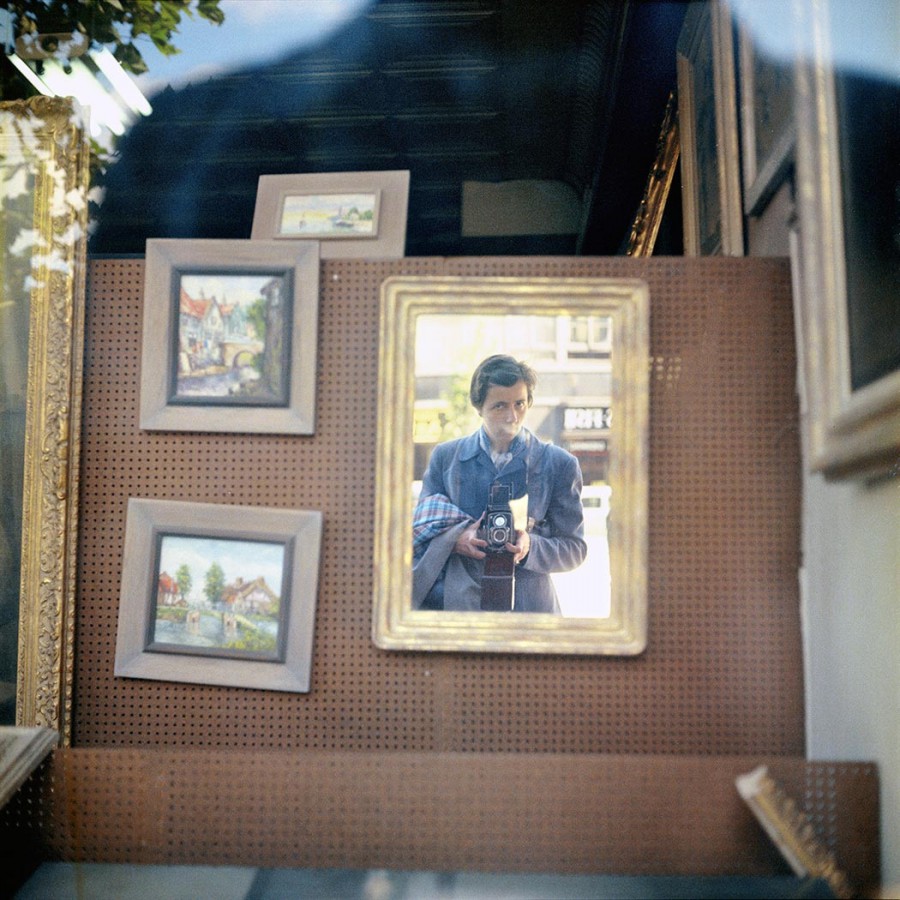
I prefer her black-and-white photos, but I add a few of her colour photos
image

image

image

That last one, with her shadow, leads naturally to a few of her self-portraits. She took a lot of photos of herself.
image

image


image

In a sad postscriptum, I have just read that Vivian Maier’s estate has got entangled in a challenge about who owns the copyright to her photos. The result is that it will be probably harder to see her works for the next several years. If my readers get a chance to see an exhibition, on no account miss it. It might be a long time before you get another chance.


THE BOOK AS SCULPTURE

Beijing, 13 July 2014

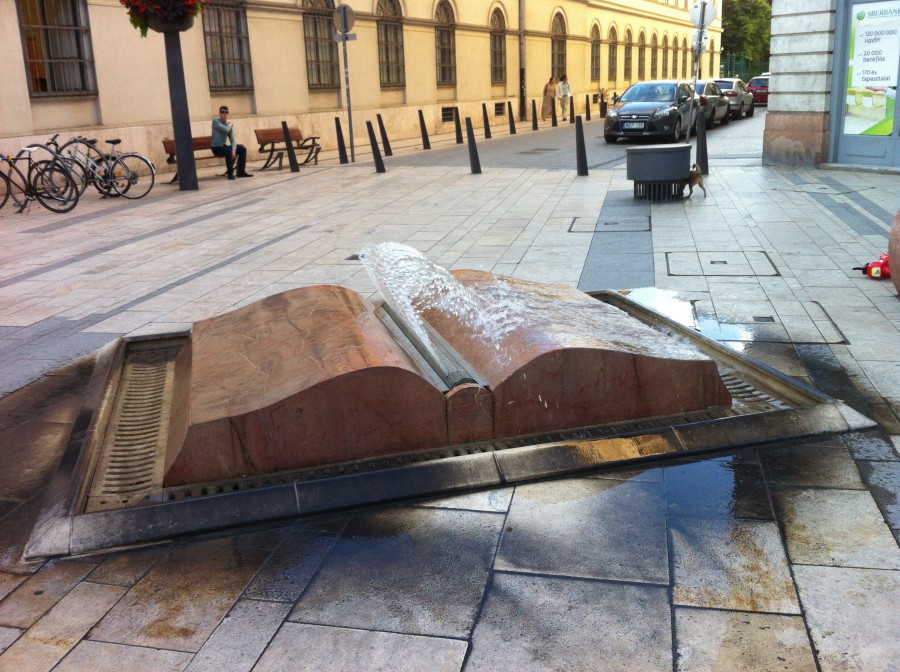
As I mentioned in the postscript to my previous posting, I was in Budapest these last few days. One evening, in search of a restaurant, I came across this fountain:

Budapest 2014 fountain 001

Budapest 2014 fountain 002

As the pictures suggest, the fountain consists of a sheet of water moving as if it were the page of a book being turned. I rather like that idea. I didn’t notice it at the time, but I have since discovered that two venerable Hungarian universities, Eötvös Loránd University and Péter Pázmány Catholic University, both of whose foundations reach back to the 1600’s, are located across the street from the fountain. I would guess that the fountain is linked to them: aren’t Universities places which revere books? Maybe the fountain is telling us that books water our intellectual life. But that’s a bit too fanciful, perhaps.

My curiosity piqued, I started looking around for pictures of other sculptures where books play the lead role. And of course someone has already helpfully put together a gallery of such photos! It’s on a site called Book Riot, which promotes reading of book reading and writing about them, my kind of site. I have shamelessly lifted a number of their photos to put here. Most of them have obvious connections to book-related institutions.

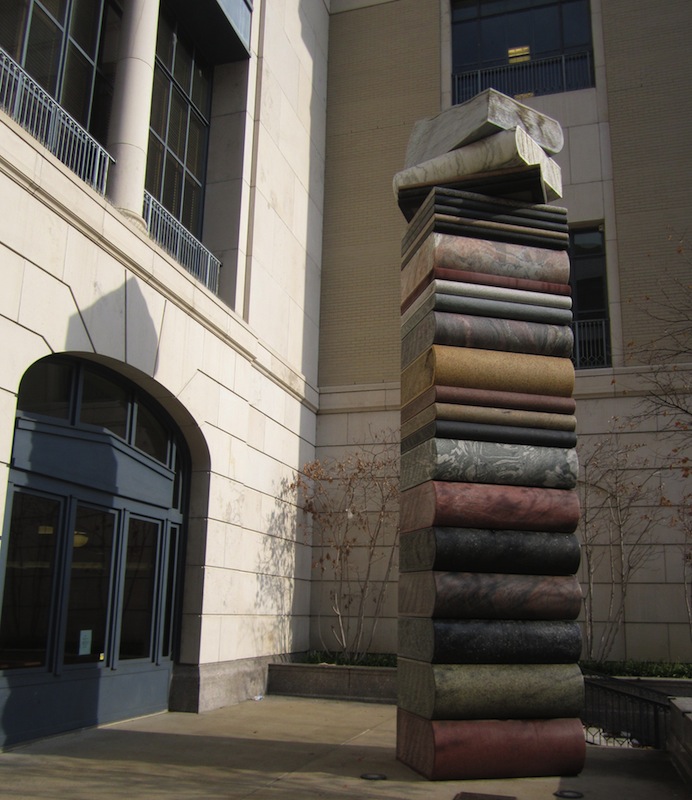
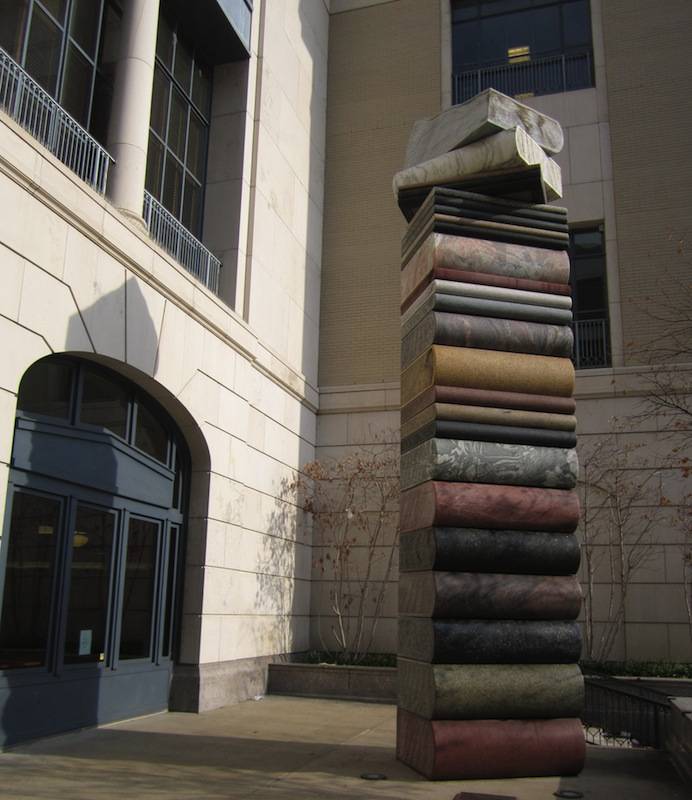
Stacking books is clearly a popular design motif. Here’s a fairly straightforward stack in a sculpture in front of the Nashville public library

nashville-public-library-book-statue

Here is another, a little bit more untidy and making the connection between books and children (which perhaps explains the untidiness of the stacking?). It adorns the public library in Coshocton, which is (and I had to look this up on Google Maps) in Ohio. The sculpture is composed of 100 books, each one representing one year of the library’s service to the community.

coshocton-public-library

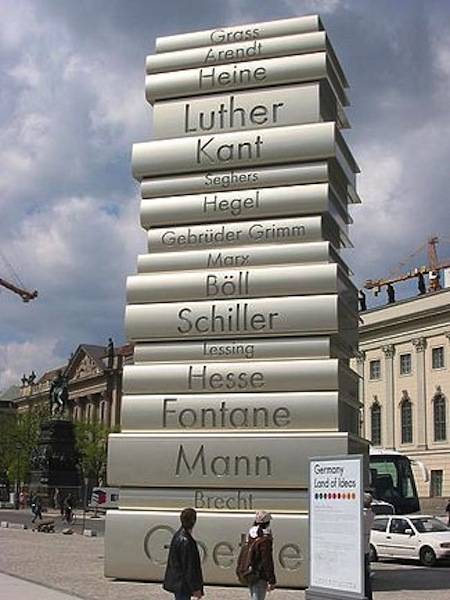
Here is another stack of books, this time from Berlin.

berlin-book-statue

This particular sculpture no longer exists, alas. It was part of a set of six sculptures celebrating the football World Cup of 2006. After a few months, they were taken away, who knows where to. This particular sculpture, set up in Bebelplatz opposite Humboldt University, celebrated Johannes Gutenberg who invented the modern letterpress in the German city of Mainz in around 1450.

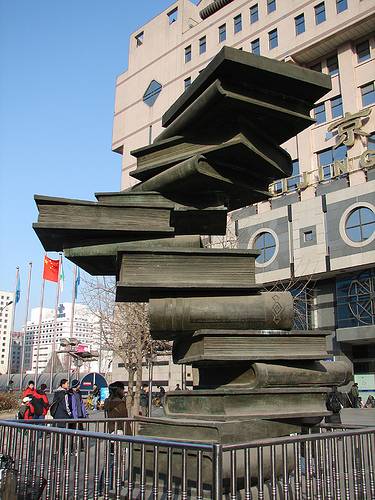
The stacking motif continues with this sculpture, although a spiraling twist has been given to the whole.

beijing-xinhua-bookstore-statue

The sculpture is in front of Beijing’s Xinhua bookstore, although I must confess to never having noticed it.

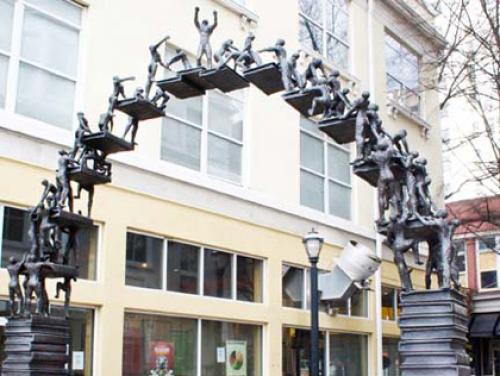
Here, the stacking has turned into a triumphal arch, located in Atlanta, at Georgia State University.

georgia tech atlanta

This is a very obviously symbolic statue. It was created by the sculpture students at the University and is entitled “No Goal Is Too High If We Climb With Care And Confidence”. A visual metaphor dear to the hearts of many a University Professor, I’m sure.

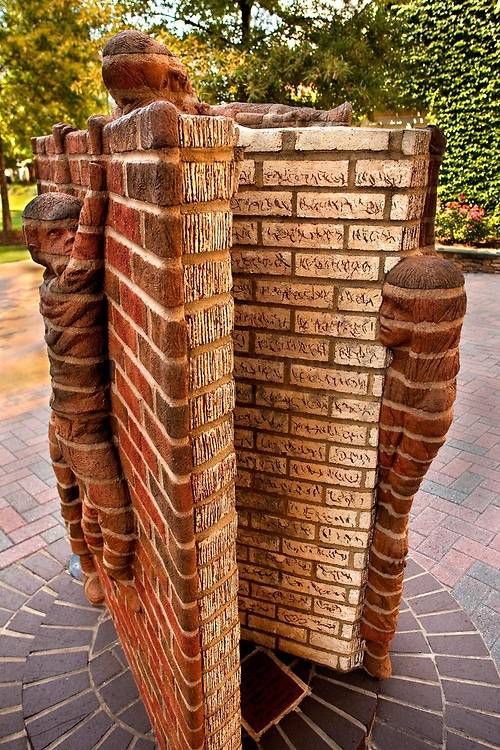
This one, from Charlotte North Carolina, is quite different. Like the sculpture in Coshocton, it makes a connection between books and children, but here it becomes equivalent to playground equipment, showing books as something for children to play with, on, in.

brick-book-statue

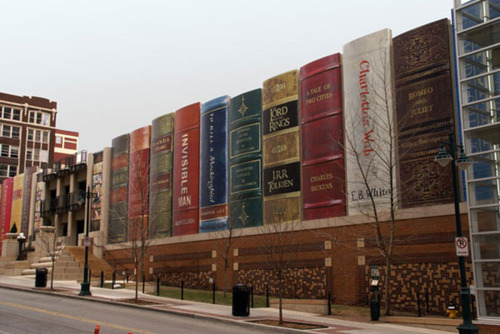
As for Kansas City library, it dispenses with sculptures altogether and has just built the books right into its façade

kansas city public library

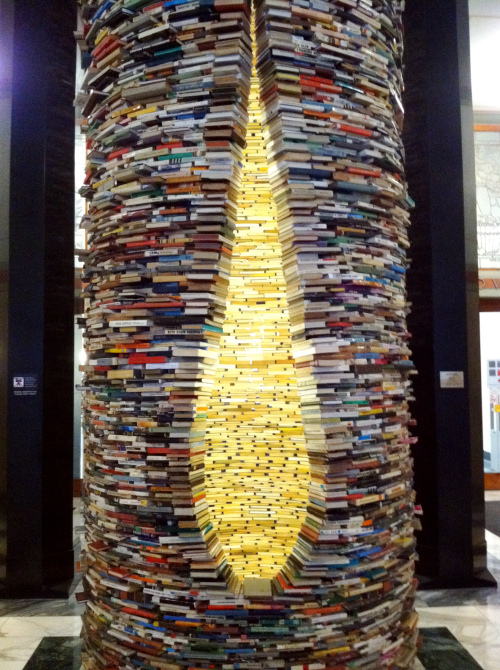
Another approach to book-sculptures is to consider the book a brick to be used to build structures. The Czech-Slovak artist Matej Kren has created a number of such structures, a couple of which I have photos for. The first is in the Prague municipal library

prague city library

I’ve not seen it, but I read that if you look inside you get the impression of an infinite tower. It seems that Kren has made clever use of mirrors to get this optical effect.

I don’t know where the structures in these other two photos are to be found

matej kren-1

matej kren-2

The last could easily be an old farm house in southern Europe somewhere. The following site shows a couple more such structures made with books by Kren and other artists.

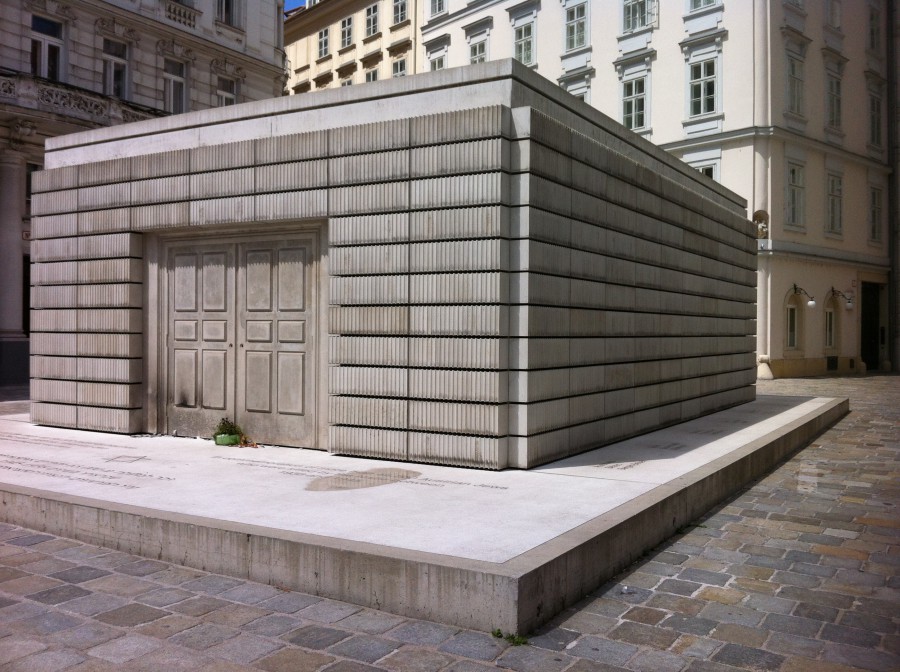
This last photo brings me to another structure made with books, but of an altogether darker tenor. It is the Holocaust memorial in Judenplatz, Vienna, a memorial to the more than 65,000 Austrian Jews killed by the Nazis before and during World War II. On my way back from Budapest to Beijing through Vienna, and with the book fountain still fresh in my mind, I decided on the spur of the moment to quickly revisit the memorial before boarding the bus for the airport.

holocaust memorial 001

From far away, it looks like one of those squat, windowless blockhouses which dotted the battlefields of World War II. But when you get closer, you see something else.

holocaust memorial 002

You see that the walls of this blockhouse are made of shelves of books. But the books are facing outwards rather than inwards as would normally be the case on a shelf. So unlike the sculpture pictured above in Berlin’s Bebelplatz, we know neither the author nor the title of any of the books. The shelves of the memorial simply appear to hold endless copies of the same book, which can stand for the vast array of faceless victims. The choice of books as the design motif perhaps alludes to the idea of the Jews being a “People of the Book”. Fittingly, another name for this memorial is the Nameless Library. Around the edges of the structure are carved the names of the camps where Austrian Jews died

holocaust memorial 003

At the other end of Judenplatz is a statue of the writer Lessing, staring so it seems at the Holocaust memorial.

Lessing statue Judenplatz

This is the same Lessing whose name appears on one of the spines of the sculpted stack of books in Berlin’s Bebelplatz, a photo of which I included earlier. A connection which allows me to segue into my next memorial, in that same Bebelplatz, a memorial to the campaign of book burnings, orchestrated by the German Student Union, which took place there and in 34 other German university towns in May 1933, shortly after the Nazis had taken power. The purpose was to ceremonially burn books by classical liberal, anarchist, socialist, pacifist, communist, Jewish, and other German and non-German authors whose writings were viewed as subversive to the new regime. Many came from Humboldt University’s libraries. The students first marched in torchlight parades “against the un-German spirit”. Some 40,000 people then gathered in Bebelplatz to hear Joseph Goebbels deliver a fiery address:

“The era of extreme Jewish intellectualism is now at an end. The breakthrough of the German revolution has again cleared the way on the German path…The future German man will not just be a man of books, but a man of character. It is to this end that we want to educate you. As a young person, to already have the courage to face the pitiless glare, to overcome the fear of death, and to regain respect for death – this is the task of this young generation. And thus you do well in this midnight hour to commit to the flames the evil spirit of the past. This is a strong, great and symbolic deed – a deed which should document the following for the world to know – Here the intellectual foundation of the November Republic is sinking to the ground, but from this wreckage the phoenix of a new spirit will triumphantly rise.

Then the students joyfully threw the books onto the pyre, with band-playing, songs, “fire oaths”, and incantations.

bebelplatz book burning-1

DEU NS ZEIT BUECHERVERBRENNUNG JAHRESTAG

In Berlin, some 20,000 books were burned. Looking back at the stack of books which make up the sculpture put in this same square 83 years later, Heinrich Heine’s books were burned, as were those of Anna Seghers, Karl Marx, Heinrich Mann, and Bertolt Brecht. In all, the works of some 60 German authors and 25 non-German authors were consigned to the flames.

The memorial to this shameful episode consists simply of a glass plate set into the square’s cobble stones, below which are visible empty bookcases, enough of them to hold the total of the 20,000 burned books.

Bebelplatz_Night_of_Shame_Monument-2

Next to it is a plaque, with a line from Heinrich Heine’s 1821 play Almansor: “That was only a prelude; where they burn books, they will in the end also burn people.” Heine was referring to the burning of the Muslim Quran by the Christian Inquisition in Spain. But looking back at the Holocaust memorial in Vienna’s Judenplatz, how prescient is that line! And the book burnings haven’t stopped, as a Wikipedia article eloquently shows.

______________________

Budapest book fountain: my photos
The following five photos are from bookriot.com/2013/03/06/10-superbly-bookish-statues
– Nashville public library: http://bookriotcom.c.presscdn.com/wp-content/uploads/2013/03/nashville-public-library-book-statue.jpg
– Coshocton public library: http://bookriotcom.c.presscdn.com/wp-content/uploads/2013/03/centennial-statue-coshocton-public-library-317×1024.jpg
– Berlin Walk of Ideas http://bookriotcom.c.presscdn.com/wp-content/uploads/2013/03/berlin-book-statue.jpg
– Xinhua bookstore, Beijing: http://bookriotcom.c.presscdn.com/wp-content/uploads/2013/03/beijing-xinhua-bookstore-statue.jpg
– Brick book statue: http://bookriotcom.c.presscdn.com/wp-content/uploads/2013/03/brick-book-statue.jpg
Georgia Tech University, Atlanta: http://www.himalayanrestaurantct.com/article_images/best-bizarre-statues-or-public-art-in-atlanta.jpg [in http://www.himalayanrestaurantct.com/arts-culture/best-art-museums-in-atlanta-449.php%5D
Kansas city library: http://media.tumblr.com/tumblr_m37ijcSOnV1qc4g44.jpg [in http://callmeabsurd.tumblr.com/post/22000303273/beautiful-structures-made-of-books%5D
Prague city library: http://davidgutterman.files.wordpress.com/2011/11/book-statue-library.jpg?w=500&h=670 [in http://davidgutterman.wordpress.com/2011/11/16/prague-blog-7/%5D
Matej Kren-1: http://avisualjournal.files.wordpress.com/2011/09/artwork_images_425933222_663093_matej-kren.jpg [in http://avisualjournal.wordpress.com/page/43/%5D
Matej Kren-2: http://pitchdesignunion.com/wp-content/uploads/2010/10/book-cell-02.jpeg [in http://pitchdesignunion.com/2010/10/matej-kren/%5D
Holocaust memorial, Judenplatz, Vienna: my photos
Lessing statue Judenplatz: http://en.wikipedia.org/wiki/Judenplatz#mediaviewer/File:WienLessingDenkmal.jpg [in http://en.wikipedia.org/wiki/Judenplatz#Lessing_monument%5D
Bebelplatz book burning-1: http://upload.wikimedia.org/wikipedia/commons/2/2b/1933-may-10-berlin-book-burning.JPG [in http://en.wikipedia.org/wiki/Nazi_book_burnings%5D
Bebelplatz book burning-2: http://cdn2.spiegel.de/images/image-485121-galleryV9-ohuq.jpg [in http://www.spiegel.de/fotostrecke/photo-gallery-erich-kaestner-and-the-nazi-book-burnings-fotostrecke-95652-2.html%5D
Bebelplatz memorial to book burning: http://en.wikipedia.org/wiki/Nazi_book_burnings#mediaviewer/File:Bebelplatz_mit_Mahnmal_B%C3%BCcherverbrennung_Aug_2009.jpg [in http://en.wikipedia.org/wiki/Nazi_book_burnings%5D

SCULPTURE AND NATURE

Beijing, 15 June 2014

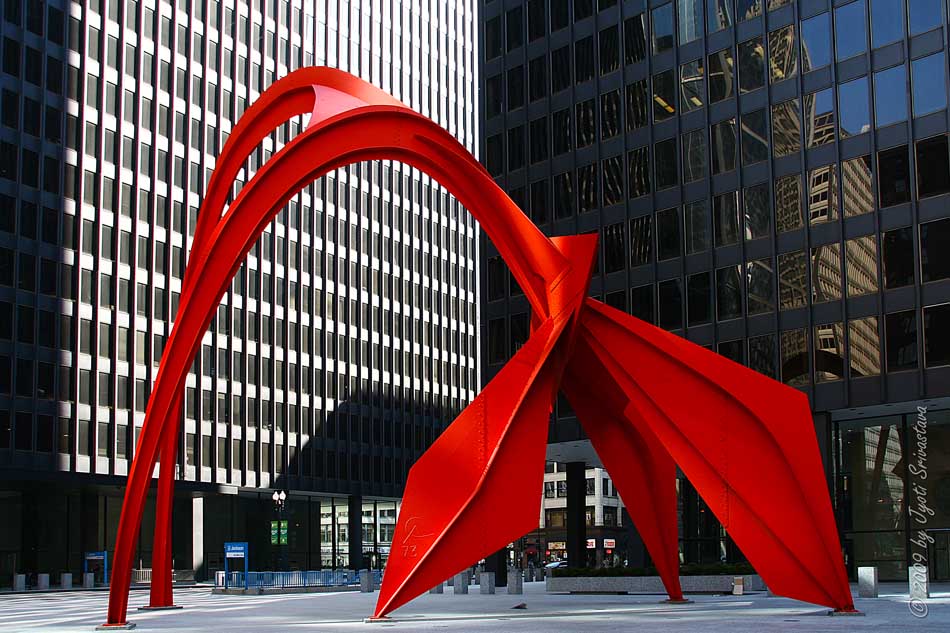
My wife and I were watching TV with one eye the other day when the BBC passed a programme which caught our attention. It was about the Yorkshire Sculpture Park in the north of England. I think a few words of explanation are required for those readers who have never heard of this Park (our situation before watching the BBC programme). It was established back in 1977 in the grounds of a stately home the last of whose aristocratic owners (Viscount Allendale) had sold it to the local council after World War II, no doubt to save his financial skin (I mentioned the financial woes of the UK’s stately homes in an earlier posting of mine). The idea is a simple one: rather than displaying modern sculpture in open spaces in cities like plazas
sculpture in cities-1

sculpture in cities-2

or squares

sculpture in cities-3

sculpture in cities-4

or using the atriums of posh buildings

sculpture in cities-6

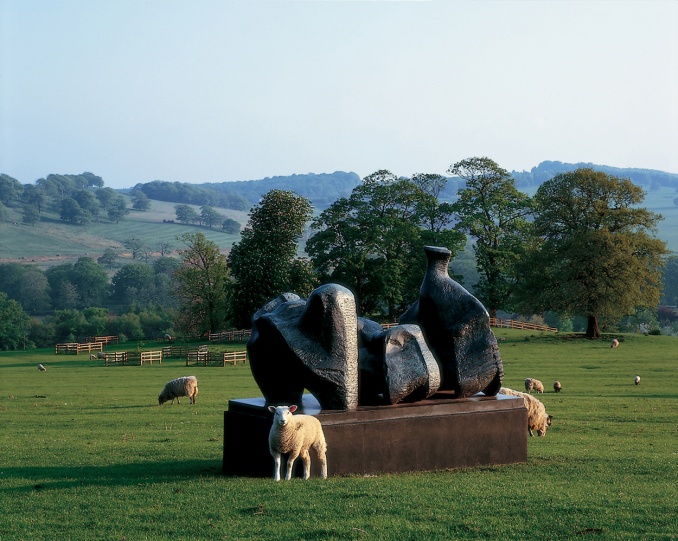
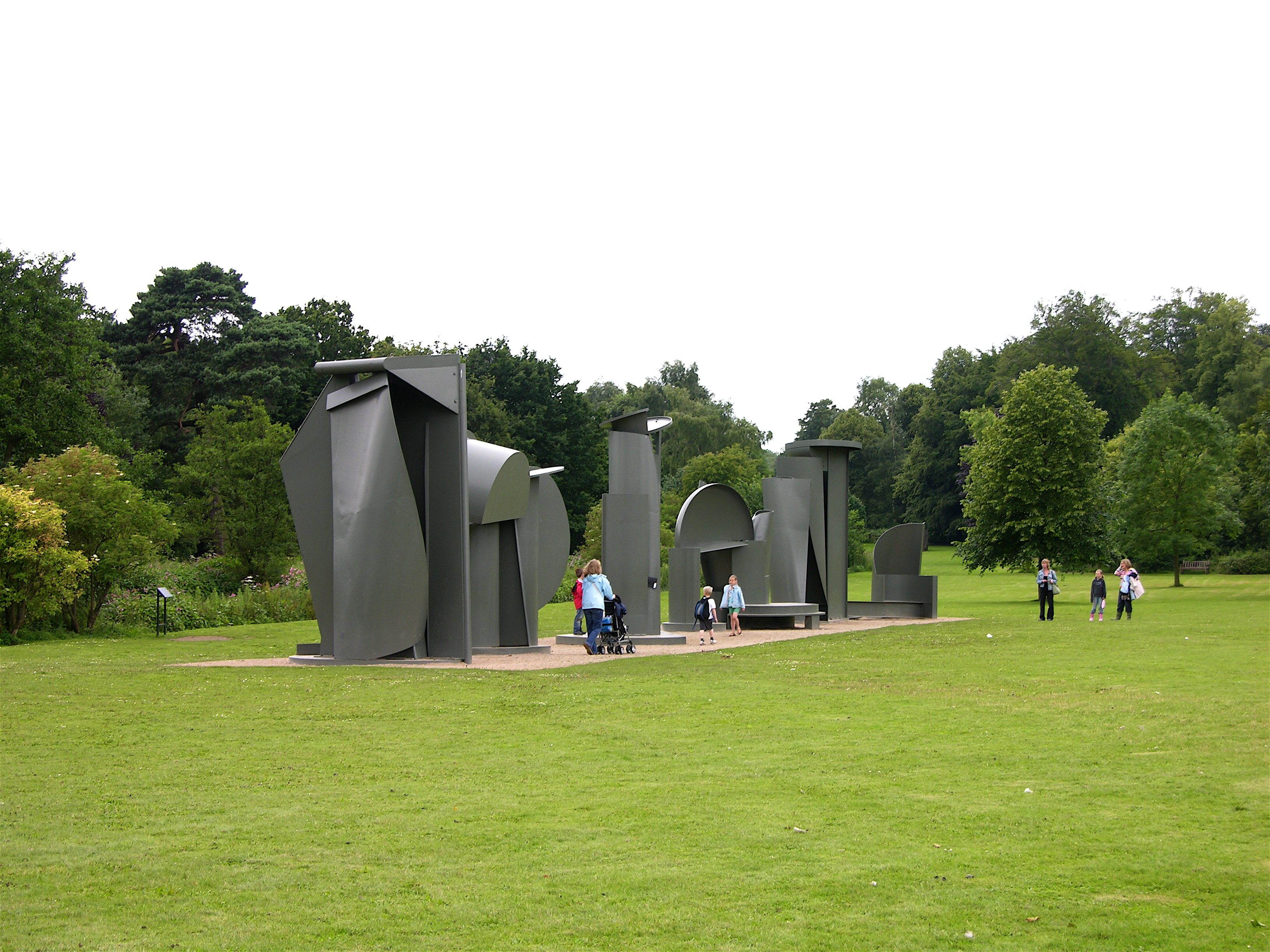
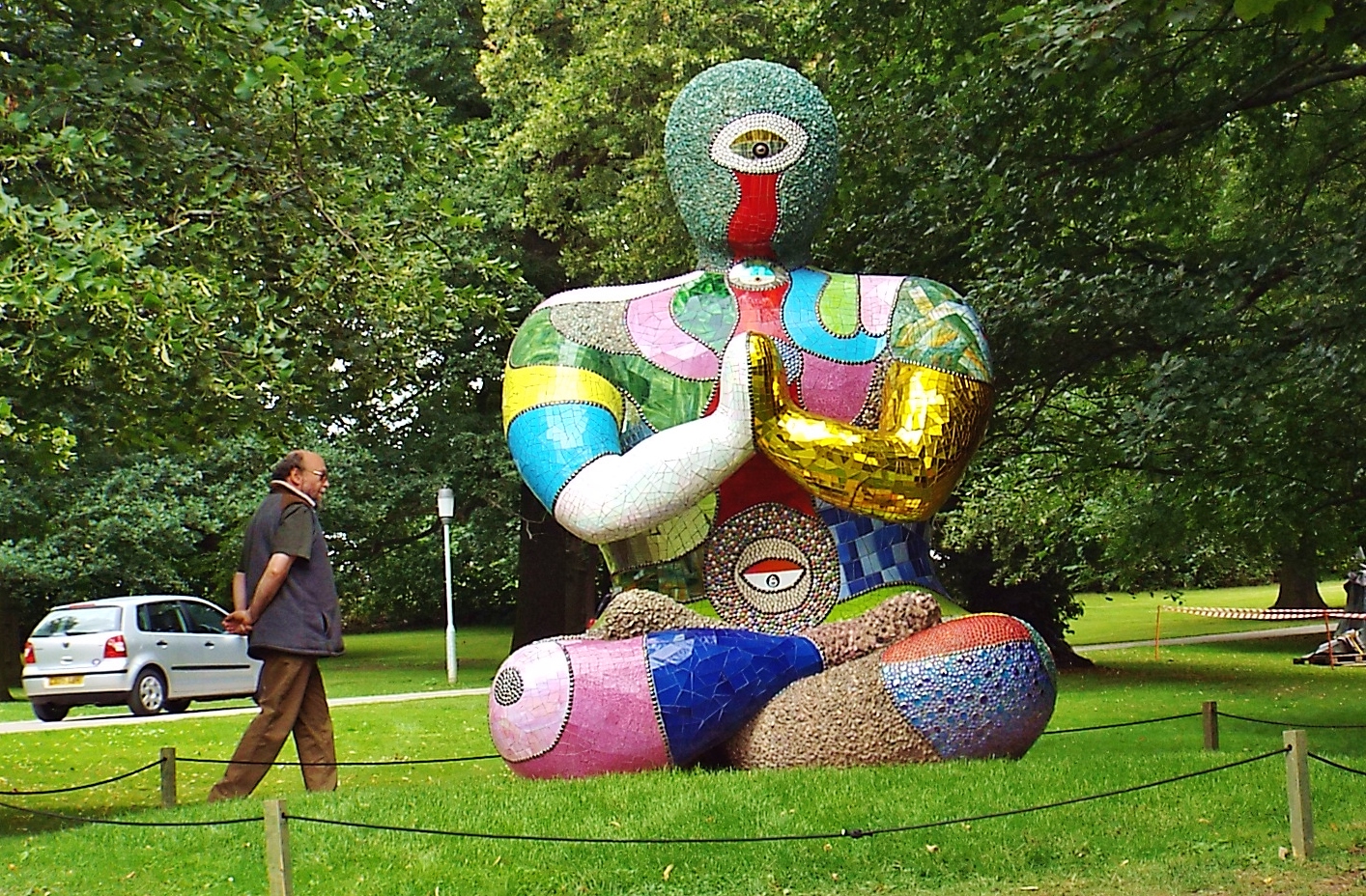
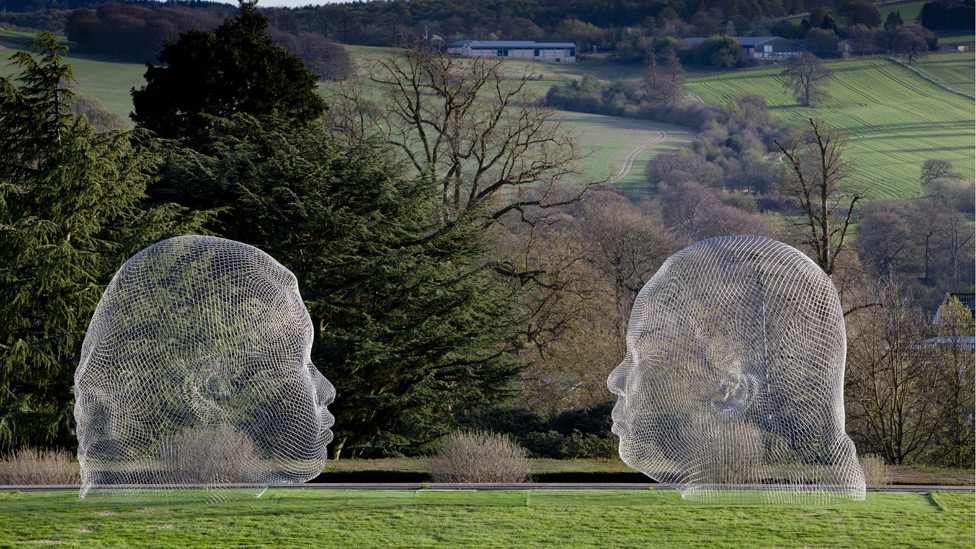
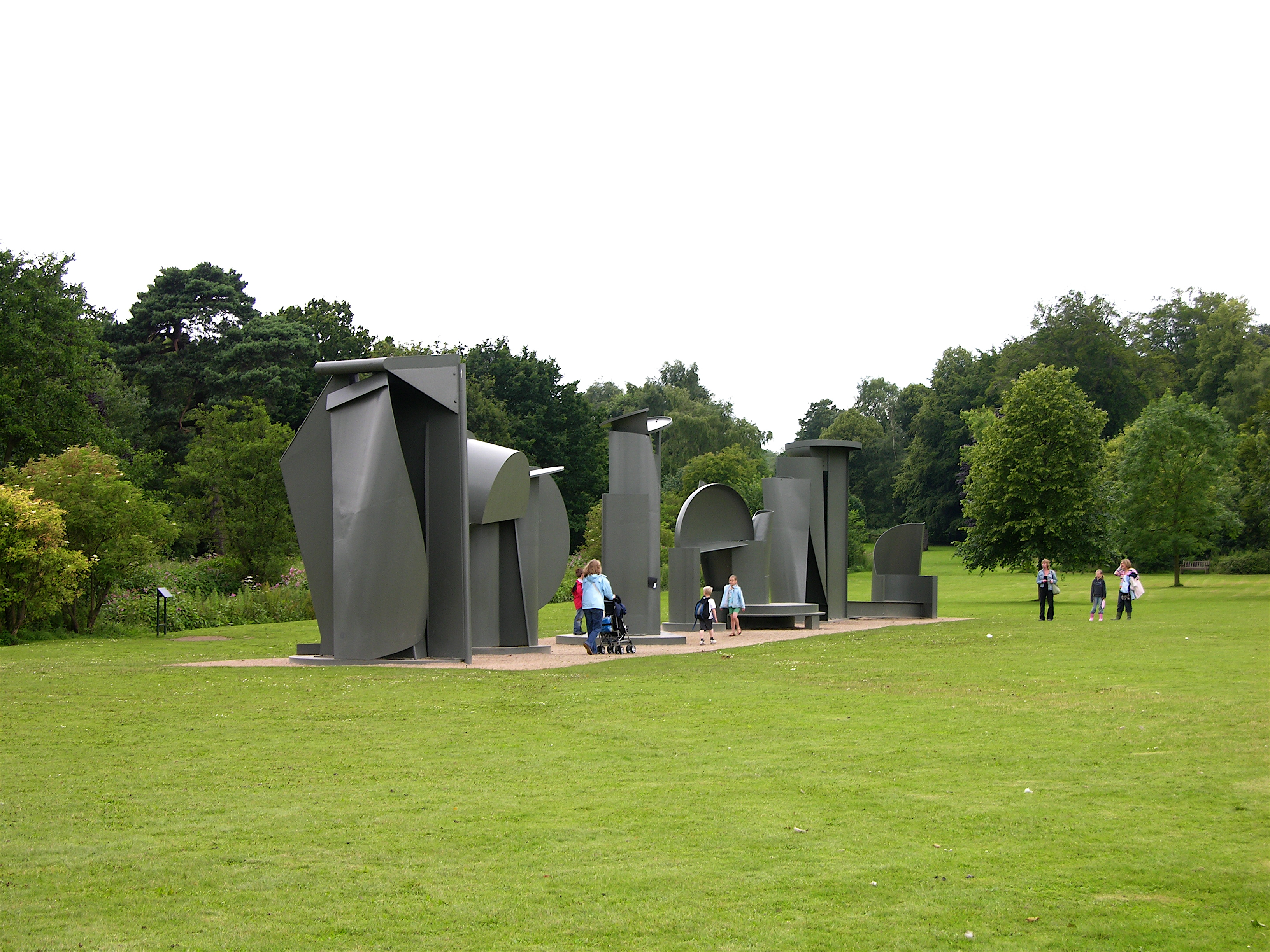
use the sweeping, open vistas of the countryside to display them. Here are some of the pieces at the Yorkshire Sculpture Park:
YSP-4
DSCN2327.JPG
YSP-6

YSP-9

YSP-10

YSP-14

YSP-1
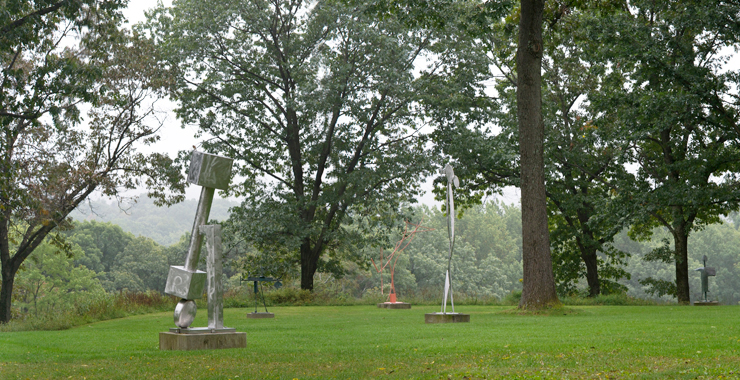
My wife and I agree on many things, and one of them is that modern sculptures are enhanced by being seen in a natural, organic setting rather than in the built urban environment. Personally, I think it has to do with the contrast between the dead surfaces of the sculptures and the much softer, living surfaces of the surrounding landscapes. It sounds a bit fancy, but the dead sculpture comes alive when in contact with organic life.

This was brought home to us very strongly when, 25 years ago, and on the advice of a friend who worked at the Metropolitan Museum of Art, we visited the Storm King Art Centre, which is an hour’s drive north of New York City, near the Hudson River. Here again, a few words of introduction. It’s really the classic American story (as much as the history of the Yorkshire Sculpture Park is the classic British story of modern times – decay of the old order and birth of a new one). A certain Mr. Ogden, after a successful career in the family business, purchased the land and property of Storm King and started collecting. He initially bought small sculptures which he exhibited around the house. At some point, he expanded out into the surrounding landscape, installing much bigger pieces. That’s it, in a nutshell. But the result – for us at least – was epiphanic.

In wonder we wandered along the rides mown through the grass, walking from one towering sculpture to another

SK-1

SK-4

from hilltops, we discovered long views across the surrounding landscape, where sculpture and land merged into one

SK-2

we walked through glades in the woods, each with their own sculpture

SK-8

SK-9

we entered the woods to find smaller, more intimate sculptures scattered under the trees

SK-7

SK-10

we also found a sculpture-wall meandering through them

SK-5

(better seen in this photo taken during the winter)

SK-14

we turned our steps back to the house, discovering other smaller sculptures set down in more formal gardens around the house.

SONY DSC

SK-11

And finally, we entered the house and fell upon a sculpture which in all these years I have never forgotten: a group of robotic-looking statues with small motors making their jaws work up and down and with a closed-loop recording of voices quietly droning “chatter, chatter, chatter, chatter, chatter, chatter …” on and on, endlessly. Wonderful.  Every time I find myself in one of those meetings where people blather on and on and on I recall this statue group with intense clarity.

So taken were we with Storm King that the very first time we went back to New York after an absence of fifteen years we made sure to find time to go up there. It cast the same spell over us – although sadly the chattering statues had vanished (smashed to smithereens, no doubt, by an employee crazed by their endless droning).

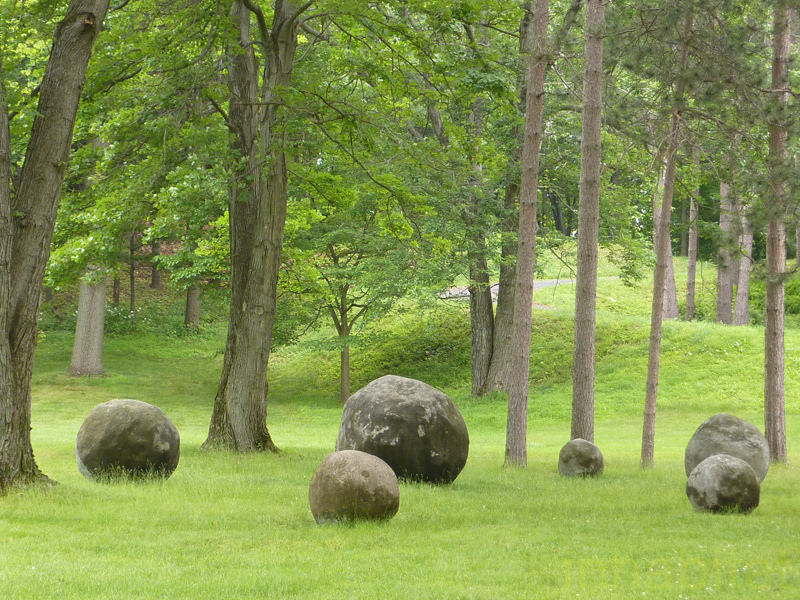
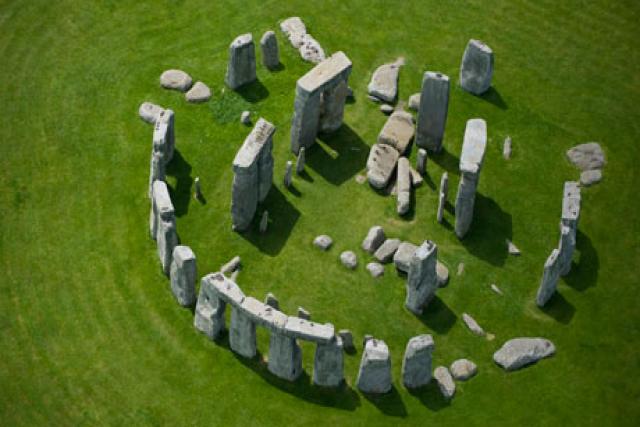
As I contemplate these photos, it occurs to me that many of the megalithic structures scattered across the face of Europe could pass as modern sculptures set down in the surrounding landscape. Stonehenge, the most iconic of all megalithic structures, is probably too much like a ruin to make this comparison
Stonhenge-2
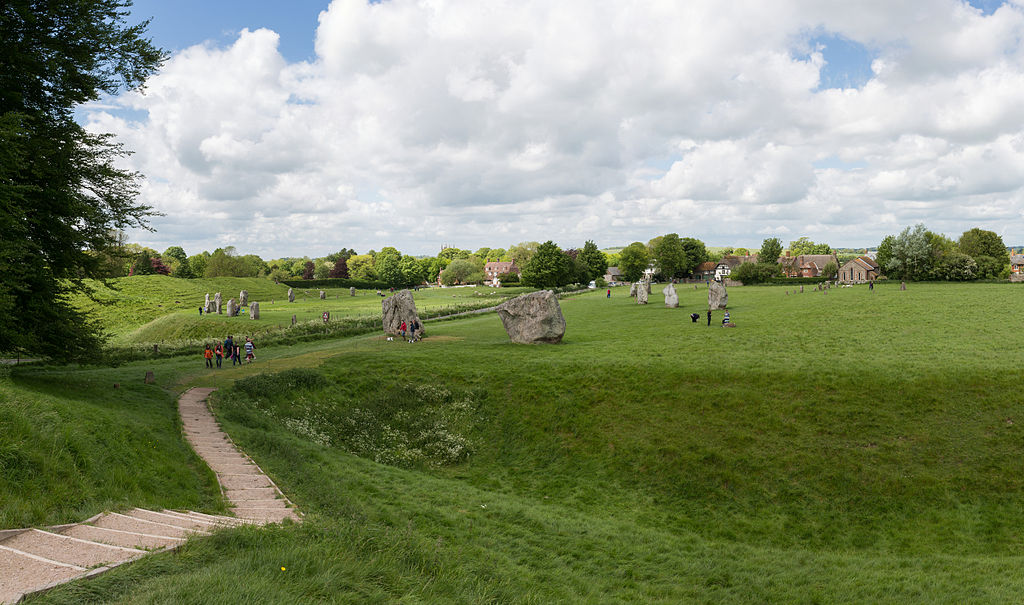
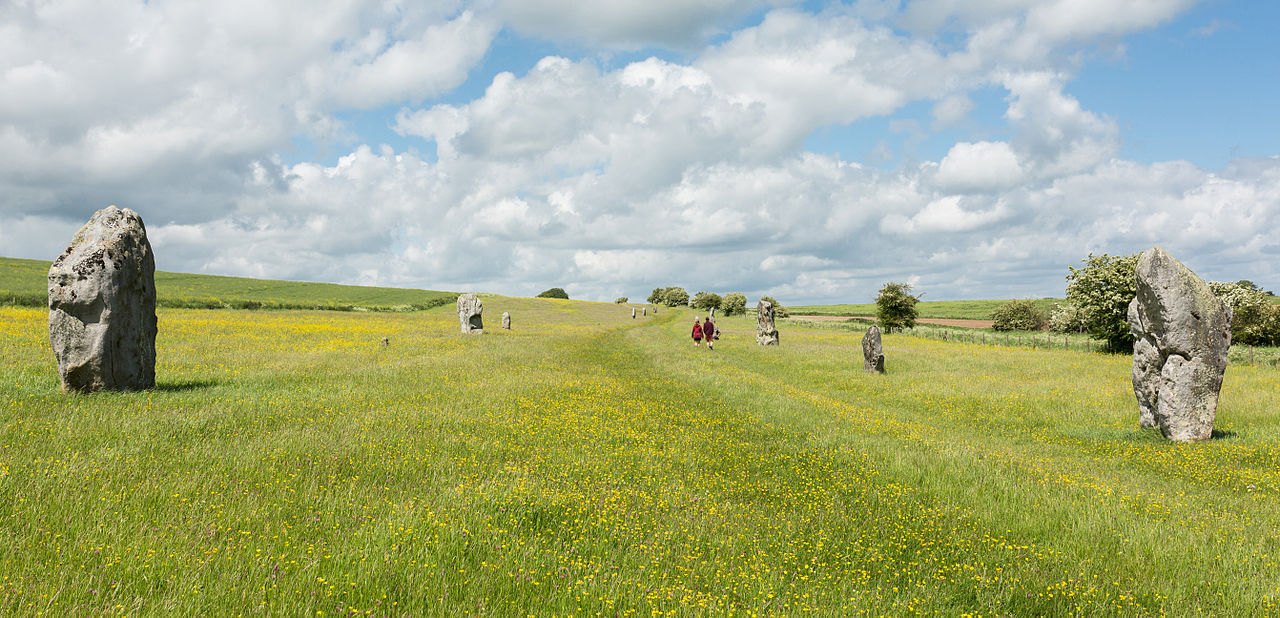
but Avebury, like Stonehenge located in Wiltshire, has something of the abstraction of sculpture parks

Avebury-2

Avebury-1

and how about Carnac, in Brittany?
carnac-1

carnac-2
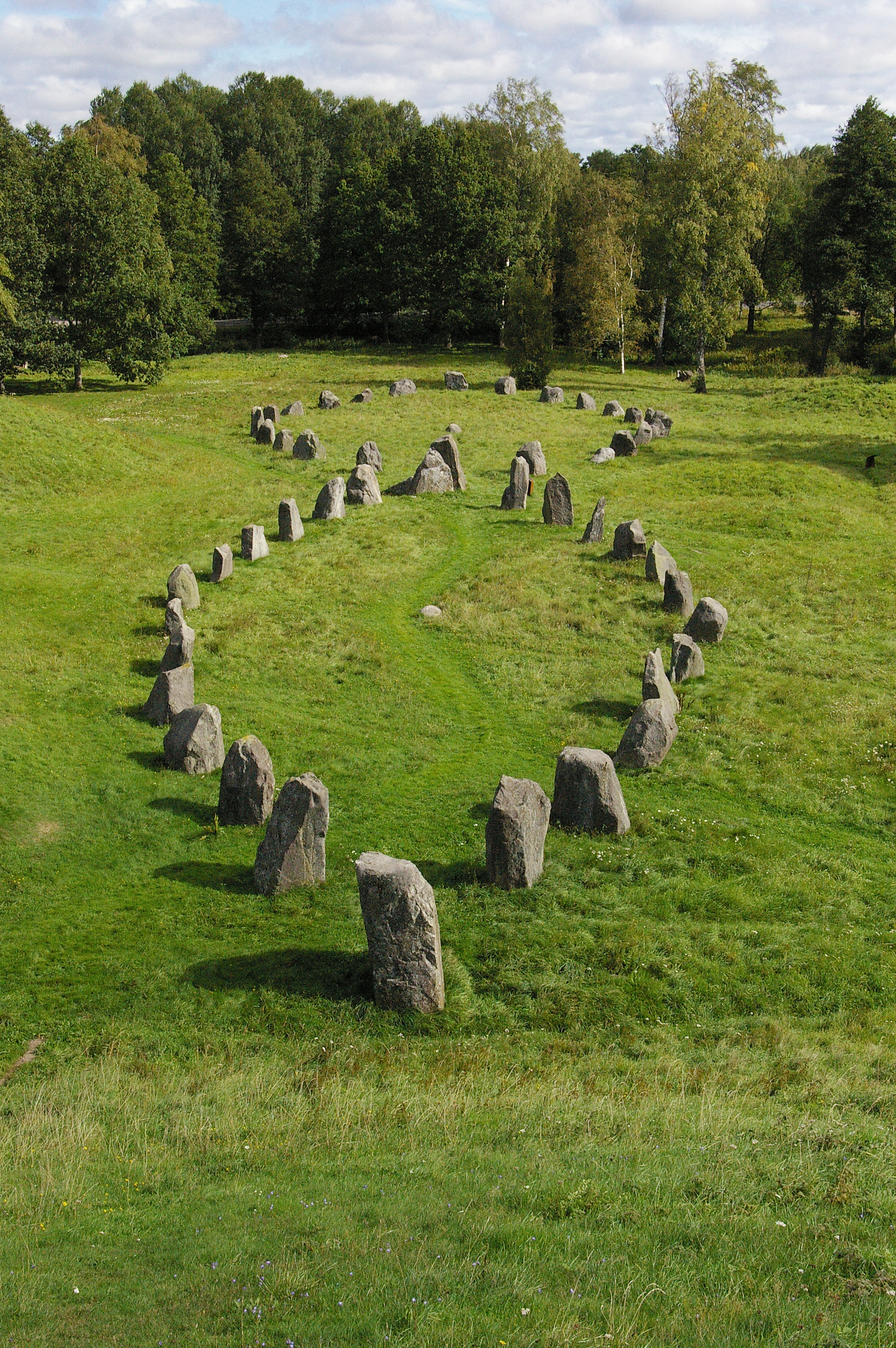
or Badelunda in Sweden?

Badelunda Västmanland

or the Ring of Brodgar, in the Orkney islands?

Ring of Brodgar

And even further afield, although not from the Mesolithic period, we have this intimate collection of upright stones in Toraja, Indonesia

OLYMPUS DIGITAL CAMERA

Of course, the people who built these structures were not building sculpture parks, but I have to think that they too were stirred by the same feeling of connectedness between their standing stones and nature as we have between sculpture and nature. They attributed this feeling to a divine grace in the place, we simply enjoy the feeling.

____________________________

Sculpture in cities-1: http://percivalhenry.files.wordpress.com/2014/03/52af841ee4b0b09acc808041-lost3f3f3f-1387234862071-flamingo.jpg [in http://percivalhenry.wordpress.com/2014/03/20/art-history-martch-madness-first-round-new-york-regional/comment-page-1/%5D
Sculptures in cities-2: http://upload.wikimedia.org/wikipedia/commons/2/26/Juilliard_School-Manhattan-New_york.jpg [in http://commons.wikimedia.org/wiki/File:Juilliard_School-Manhattan-New_york.jpg%5D
Sculpture in cities-3: http://i3.mirror.co.uk/incoming/article740970.ece/alternates/s615/A%20new%20sculpture%20on%20the%20fourth%20plinth%20in%20Trafalgar%20Square,%20central%20London%20The%20work%20by%20sculptor%20Bill%20Woodrow,%20entitled%20%27Regardless%20of%20History%27,%20%20shows%20a%20tree%20resting%20on%20a%20head%20and%20a%20book [in http://www.mirror.co.uk/news/uk-news/love-it-or-hate-it-bronze-rocking-741129%5D
Sculpture in cities-4: http://womenworld.org/image/082012/Paris%20-%20Beaubourg%20and%20Les%20Halles_1.jpg [in http://womenworld.org/travel/paris—around-town—beaubourg-and-les-halles-%28part-1%29.aspx%5D
Sculpture in cities-5: http://www-news.uchicago.edu/releases/06/images/cis/sculpture.jpg [in http://www-news.uchicago.edu/releases/06/060426.cis-photos.shtml%5D
YSP-1: http://www.yorkshireattractions.org/images/cms/attractions_21_3_large.jpg [in http://www.yorkshireattractions.org/visitor-attractions/21/yorkshire-sculpture-park%5D
YSP-2: http://upload.wikimedia.org/wikipedia/commons/0/0a/Yorkshire_Sculpture_Park_Caro_Promenade.jpg [in http://commons.wikimedia.org/wiki/File:Yorkshire_Sculpture_Park_Caro_Promenade.jpg%5D
YSP-3: http://antonyjwaller.files.wordpress.com/2012/06/nik_5931-copy.jpg [in http://antonyjwaller.wordpress.com/travel-articles/yorkshire-and-northern-england/the-yorkshire-sculpture-park/%5D
YSP-4: http://www.sculpture-info.com/upload/1008/image/Yorkshiresculpturepark.jpg [in http://www.sculpture-info.com/news-626/yorkshire-sculpture-park.html%5D
YSP-5: http://2.bp.blogspot.com/-6GgifPCMTc8/UgZKx2yojhI/AAAAAAAACDg/WYBKhXaNWp8/s1600/2+Buddha+and+Rob.JPG [in http://expertslife.blogspot.com/2013/08/picture-of-week-10-august-2013.html%5D
YSP-6: http://www.thomasharveydesign.co.uk/wp-content/uploads/2011/05/YSP6.jpg [in http://www.thomasharveydesign.co.uk/2011/05/09/yorkshire-sculpture-park-wakefield/%5D
YSP-7: http://news.bbcimg.co.uk/media/images/52104000/jpg/_52104252_7cbb7745-313f-43e9-8974-d144adf6c05f.jpg [in http://www.bbc.co.uk/news/entertainment-arts-13034363%5D
SK-1: http://brooklynimbecile.files.wordpress.com/2011/10/img_4256.jpg [in http://brooklynimbecile.com/2011/11/05/weekend-spread-storm-king-art-center/%5D
SK-2: http://3.bp.blogspot.com/-OWDq8YQCBog/UA6M17c9N6I/AAAAAAAAYI4/OqODfTIunKU/s1600/Mountainville_NY_A_Calder_Storm_King_AC_photo_S_Gruber_June_2012_+%2888%29.JPG [in http://publicartandmemory.blogspot.com/2012_07_01_archive.html%5D
SK-3: http://www.greenstrides.com/images-wp/Storm-King.jpg [in http://www.greenstrides.com/2013/07/10/sculpture-parks-can-inspire-your-own-garden-design/%5D
SK-4: http://4.bp.blogspot.com/-4sgNF1ufdU4/U4T1ul7DPRI/AAAAAAAAP8w/JzGsmMOY6No/s1600/Newman.jpg [in http://nycgarden.blogspot.com/2014/06/storm-king.html%5D
SK-5: http://i.vimeocdn.com/video/332835418_1280.jpg [in http://vimeo.com/48015694%5D
SK-6: http://inhabitat.com/nyc/wp-content/blogs.dir/2/files/2011/07/storm-king-boulders.jpg [in http://inhabitat.com/nyc/storm-king-art-center-a-summer-retreat-for-the-artsy-nature-loving-new-yorker/storm-king-boulders/%5D
SK-7: http://faeriemooncreations.blogspot.com/2010_11_01_archive.html [in http://faeriemooncreations.blogspot.com/2010_11_01_archive.html%5D
SK-8: http://4.bp.blogspot.com/_sVe9wO8fJls/S4zMOOgpUZI/AAAAAAAAEDo/IaUESi6KOGQ/s800/goldsw3.jpg [in http://lettuce-eating.blogspot.com/2010_03_01_archive.html%5D
SK-9: http://stormking.weebly.com/uploads/2/3/8/8/23889452/6893557.jpg [in http://stormking.weebly.com/permanent-collection.html%5D
SK-10: http://www.stormking.org/wp-content/uploads/2013/07/smith-lawn1.jpg [in http://www.stormking.org/collection-conversation/%5D
SK-11: http://eof737.files.wordpress.com/2011/09/img_2564.jpg?w=800 [in http://mirthandmotivation.com/2011/09/04/happiness-installation-art-at-storm-king/img_2564/%5D
Stonehenge: http://st-listas.20minutos.es/images/2013-06/362538/4049632_640px.jpg?1370571567 [in http://listas.20minutos.es/lista/maravillas-del-mundo-362538/%5D
Avebury-1: http://en.wikipedia.org/wiki/Avebury#mediaviewer/File:Avebury_Panorama,_Wiltshire,_UK_-_Diliff.jpg [in http://en.wikipedia.org/wiki/Avebury%5D
Avebury-2: http://en.wikipedia.org/wiki/Avebury#mediaviewer/File:Avebury,_West_Kennet_Avenue,_Wiltshire,_UK_-_Diliff.jpg [in http://en.wikipedia.org/wiki/Avebury%5D
Carnac-1: http://weadorefrance.com/es/images/w.800/h.600/c.1/d.guide_photos/sd./i.carnac-brittany-standing-stones-20130325.jpg [in http://weadorefrance.com/es/brittany-bretagne/g.31%5D
Carnac-2: http://media.tinmoi.vn//2012/02/27/4_28_1330310626_92_20120224114942_l6.jpg [in http://www.tktyt1haiduong.edu.vn/?p=888%5D
Badelunda, Sweden: http://upload.wikimedia.org/wikipedia/commons/d/d3/Badelunda_V%C3%A4stmanland_Sweden.jpg [in http://some-landscapes.blogspot.com/2011_10_01_archive.html%5D
Ring of Brodgar, Orkney: http://en.wikipedia.org/wiki/Ring_of_Brodgar#mediaviewer/File:RingofBrodgar.jpg [in http://en.wikipedia.org/wiki/Ring_of_Brodgar%5D
Toraja, Indonesia: http://tribudragon.files.wordpress.com/2013/03/2-tt-6.jpg [in http://tribudragon.wordpress.com/category/indonesia/%5D

WISTERIA

Beijing, 13 April 2014

My French grandmother’s house was … old-fashioned, shall we say. Among its many quirks was the fact that it did not have a flush-toilet. Instead, you eased yourself into this small, cluttered space, and you parked your derriere (your backside) on this beautiful wooden seat to do your besoins (your needs), as the French delicately put it. Once finished, you pulled a lever to open a trap door at the bottom of the porcelain bowl and off went your besoins, helped along with a generous portion of water you poured in from a large enameled metal jug. The exhalations emanating from the opened trap door were sometimes eye-wateringly powerful, and there was always a generally musty smell in the loo. However, the olfactory downsides were more than offset by the beautiful view from the window, framed as it was by the bright green leaves of a wisteria vine which snaked up the outside wall and onto the roof. The view was that much more beautiful in spring when clusters of the wisteria’s light purple flowers thrust themselves at the window. When my mother inherited the house, one of the first things she did was to install a flush toilet. But the wisteria remained. In fact, after my parents retired there my mother encouraged it to spread to other walls nearby, which made it a rare pleasure to go and visit my parents in spring. This is not a photo of the house, but it gives an idea of what would greet my wife and I, with children in tow, after a long drive up from Italy in May.
glycine sur mur-2
Since those moments in my grandmother’s loo, I have always had a weak spot for wisteria. At the right moment of the year, I keep an eager lookout for a sudden froth of light purple flowers popping up over a wall or in the corner of a garden. I have a particularly powerful memory of a bike trip which my wife and I made many years ago along the Loire valley, where between one Renaissance chateau

chateau_amboise

and another

chateau_Blois

we would run into cascades of wisteria – every garden seemed to have a wisteria.
glycine dans la vallee de la Loire-1

glycine dans la vallee de la Loire-2
And just last year, when we were in Philadelphia, we stumbled onto a pergola covered by a thick coat of white wisteria, which was a first for me (I’ve mentioned this in an earlier post but I repeat the photo)
white flowers 003
And the neighbours to our rooftop garden in our last apartment in Vienna had planted a wisteria, which coiled and twisted its way onto our side, an intrusion we gladly accepted since it rendered so pleasant those first days in spring when my wife (with a very little help from me) toiled at her garden tubs, planting and repotting, after the long sleep of winter. In fact, jealous at their success, I purchased a modest wisteria plant for our side, with dreams of it eventually smothering our balcony. Alas, it perished miserably that summer while we were away for our holidays.

So you can understand my pleasure when I saw that the wisteria across the road from our apartment in Beijing had flowered
wisteria beijing

although I mentally castigated the management of the building for not doing a little pruning.

For the first time in my life, I read up a bit on wisteria. And the first thing I discovered is that wisteria is Chinese! Well, there’s also a Japanese wisteria. And two American wisterias. But no European wisteria! So once again, like the weeping willow which I wrote about in my last post and the magnolia which I wrote about a few posts earlier, Europeans have borrowed a plant from China, or maybe in this case from Japan (but not from the US; American wisteria don’t seem to be gardeners’ favourites, even in the US itself, since their flowers are of more modest size, bloom for less time, and are scentless). When you read these cases, you begin to understand why the poorer countries complain about pharmaceutical and other companies from the richer countries coming and “borrowing” their flora and making a fortune selling them, or their chemical components, back home.

But now I’m left with a tricky question: was the wisteria at my grandmother’s house Chinese or Japanese? The literature tells me that the flower-clusters (racemes in the horticultural lingo) of the Japanese wisteria are longer than those of the Chinese wisteria, but I’m buggered if I remember the length of those racemes nodding at the loo window. And anyway, I’m sure raceme lengths are all averages, so I don’t think this would be a good way for an uneducated plant man like me to distinguish a Chinese wisteria from its Japanese cousin. A far more powerful way of distinguishing the two seems to be the direction of twining which the vine adopts. Chinese wisteria twine clockwise, while Japanese wisteria twine counter-clockwise! (I love it; isn’t that a great way of figuring out where a plant comes from? But why would one twine one way and the other the other? The mysteries of genetics). I must remember to send my sister an email (she inherited the house, did further massive works, but kept the wisteria) and ask her which way the wisteria twines. This will no doubt be the moment she concludes that I have finally lost it …

______________

Wisteria on the house: http://img.over-blog-kiwi.com/0/53/56/12/201305/ob_bbf5590f142c0c0c464830009f54793b_img-8686.JPG [in http://mounic.over-blog.com/lieu-saint-de-provence%5D
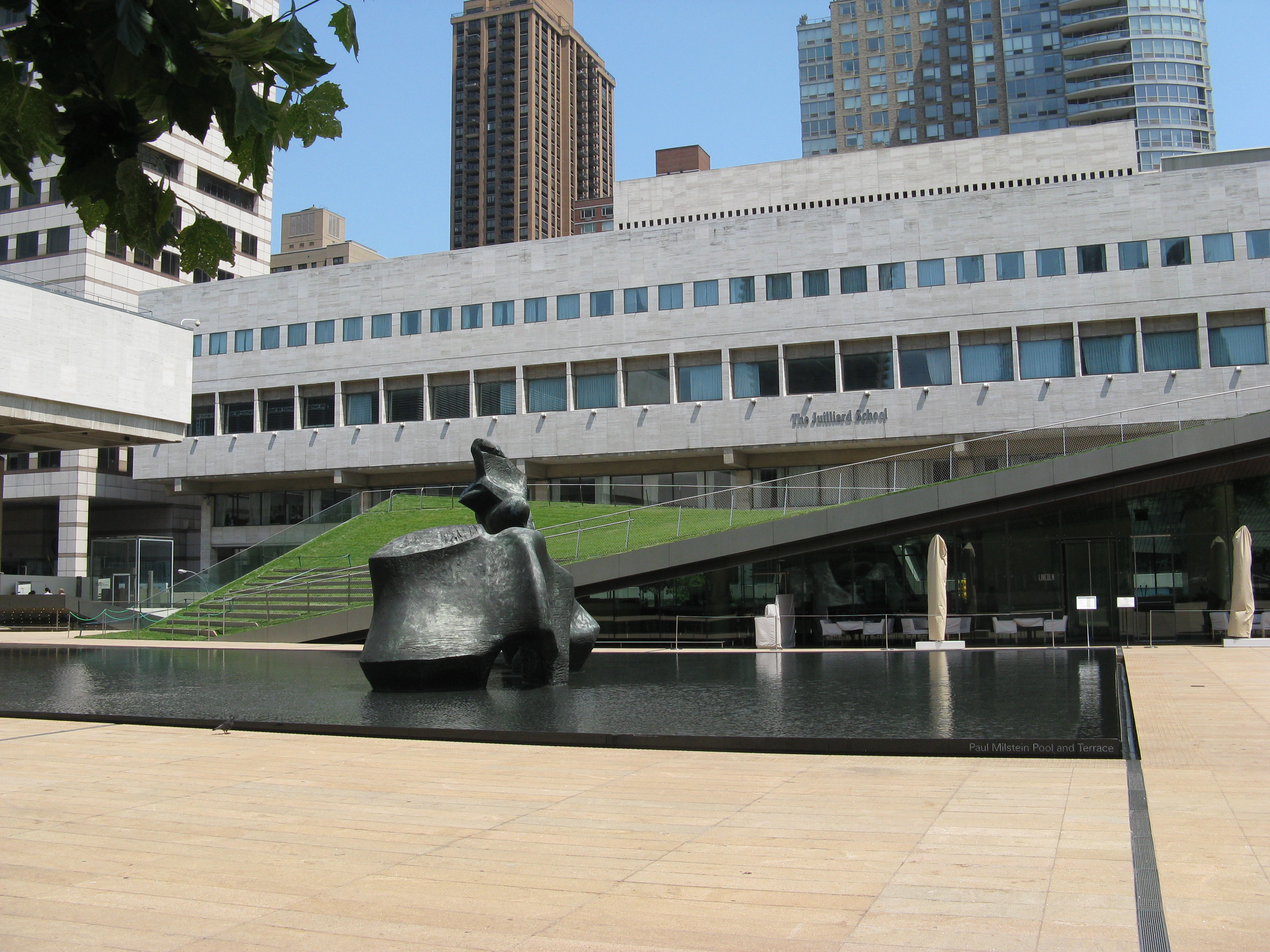
Château d’Amboise : http://www.chateau-amboise.com/oktThemes/p-c094-01/images/chateau_amboise_accueil.jpg [in http://www.chateau-amboise.com/en/%5D
Château de Blois : http://upload.wikimedia.org/wikipedia/commons/f/fb/Loire_Cher_Blois1_tango7174.jpg [in ] http://en.wikipedia.org/wiki/Ch%C3%A2teau_de_Blois
Wisteria along the road-1: http://mw2.google.com/mw-panoramio/photos/medium/22548315.jpg [in http://www.panoramio.com/user/701296/tags/Season%20Spring?photo_page=2%5D
Wisteria along the road-2: http://static.panoramio.com/photos/large/34926262.jpg [in http://www.panoramio.com/user/701296/tags/Season%20Spring?photo_page=2%5D
Wisteria in Philadalphia: my photo
Wisteria in Beijing: my photo

MAGNOLIA

Beijing, 4 April 2014

One of my abiding memories of Vienna is the magnolias in flower. I suppose it’s always the case that the first months you spend in a new place imprint themselves more forcefully on your brain’s virtual retina than the remaining years. We arrived in Vienna in February, two months later the magnolias were in bloom. It seemed that every garden and every park had its magnolia tree.
OLYMPUS DIGITAL CAMERA
We would pass one particularly magnificent specimen as we drove the children up to school every day. It was like living in a multiple exposure photo. Every day, as we swept by, we would note its progress, as the buds opened fully, and then the decay, as the flowers wilted and scattered their petals over the pavement.

A month or so later, it was the turn of the city’s multitude of lilac bushes to bloom, another fond memory which I have of Vienna and one about which I have had cause to write an earlier post.

Yes, they were good times.

And then, when my wife and I came to Beijing, we found our friends the magnolia trees here, waiting to greet us with their blooms after we emerged from our first Chinese winter. A sight for sore eyes, let me tell you, after all that grey dryness of a Beijing winter. There was a pure white variety
magnolia trees dajue western temple
as well as a pinker type which we were familiar with from Vienna.
Tanzhe western Temple
Then, with the passage of time, I discovered that this tree, which I had, without really thinking about it, assumed was European, was actually Chinese! Actually, it’s a bit more complicated than that. There are nearly hundred different types of magnolia native to China (out of 200-plus native to Asia). The beautiful white magnolia pictured above, which comes from central and eastern China, grabbed the Chinese headlines early on. With its flower rightly regarded as a symbol of purity, it was planted in Buddhist temple gardens and the gardens of the emperors from as early as 600 AD during the Tang dynasty. It is called the Yulan, or jade lily, magnolia; I presume the name refers to the jade-like glossy smoothness of the magnolia’s petals and the sometimes lily-like look of the flower.

A second magnolia which has also been very popular in China for centuries is the Mulan magnolia which comes from Sichuan and Yunnan provinces.
magnolia lillliflora
Magnolias of course became favourite subjects of the poets, seeing as they spent hours haunting such gardens.

???

Here is the poem Magnolia Slope by Wang Wei, who lived in the 700s AD and is considered “the consummate master of the short imagistic landscape poem that came to typify classical Chinese poetry” (in the words of David Hinton, who made the admirable translation below).

Lotus blossoms adrift out across treetops
flaunt crimson calyces among mountains.

At home beside this stream, quiet, no one
here. Scattered. Scattered open and falling.

As with many things Chinese which were considered the nec plus ultra by the East Asian fashionistas and trend followers of yesteryear, the cultivation of these magnolias was taken up with enthusiasm by the Japanese, from whence – like the Chinese ginkgo tree of which I have written earlier – it made its way to Europe. And there, in 1820, in the grounds of his château of Fromont near Paris, an ex-cavalry officer turned plantsman, Étienne Soulange-Bodin, crossed the Yulan with the Mulan and created the hybrid saucer magnolia.
OLYMPUS DIGITAL CAMERA
With its large, early-blooming flowers in various shades of white, pink, and purple, this cultivar became immensely popular and spread around Europe (including Austria, no doubt, because I’m sure the Viennese magnolia I described above is one of these), the US, and eventually – I suspect – China, in hundreds of different cultivars as plant breeders continued to play with its gene pool.

Here I have to pause, to consider that other great reservoir of magnolias, the Americas. I said earlier that Asia boasts 200 or more types of magnolias. The Americas are host to another 90 or so. In fact, it was in the Americas, in the Caribbean island of Martinique to be exact, that in the 1690s a French botanist by the name of Charles Plumier discovered and named – in the modern scientific nomenclature; of course it already had a native name, the talauma – the magnolia, after yet another French botanist Pierre Magnol (a lot of French botanists in this story …). I haven’t found a picture of his original drawing of the magnolia which he came across but this one will do as a substitute.
talauma
This picture, with its flower surrounded by a thick crown of leaves, sums up nicely a perplexity I had until I did some reading for this post. When we had been in the US, we had come across the southern magnolia, which looked something like this specimen, that is to say, a tree with very thick foliage and a few flowers sprinkled over the whole.
southern magnolia
Very beautiful flowers, by the way.
southern magnolia-flower
I couldn’t relate all this to the magnolias like those above, which are first completely covered with flowers and only get their leaves after the flowers have fallen. Well, the fact is, they are – botanically speaking – part of the same family. It’s just that it’s a very large family (some 300 members all told), and like in all large families distant cousins don’t necessarily resemble each other very much.

Which brings me to my final coda. The magnolia cousins have drifted so far apart because it is an old – very old – genus. It branched off the main tree of trees, if you get my drift, 100 million years or so ago. Fossils of plants identifiably belonging to the Magnoliaceae have been found dating back to 95 million years ago, while a 20 million year-old fossil has been found of the cucumber magnolia, which is native to the Eastern US and has this small flower with lovely yellow hues (in fact, these yellow hues as well as the tree’s cold hardiness have been exploited to create new yellow-flowered hybrid magnolias).
magnolia acuminata
Magnolias are so ancient that they came on the scene as flowering plants before bees, or butterflies, or moths, existed to help along with pollination. So magnolias have evolved to use for pollination the only insects which were around at the time, beetles or flies.
beetle in magnolia-1
And this co-existence with beetles explains the rather leathery petals magnolias have. Compared to bees, beetles are clumsy insects, clomping around all over the flower and with a tendency to snack on the petals as well as the nectar. The leathery petals protect the flowers from these lumbering but necessary partners in the act of procreation.

Oh, and by the way, magnolia flowers don’t actually have petals, they have tepals. And that’s because the flowers are quite primitive, so their sepals and petals are not distinct and differentiated (no idea what that really means, but it sounds impressive).

__________________
Magnolia in Vienna: http://farm3.staticflickr.com/2542/3753020942_3f6c39bb5f_o.jpg [in https://www.flickr.com/%5D
Yulan Magnolia tree in Dajue western temple: http://www.beijingrelocation.com/blog/wp-content/uploads/2013/03/magnolia.jpg [in http://www.beijingrelocation.com/blog/beijing-trees/%5D
Magnolia tree in Tanzhe temple: http://www.travelchina.gov.cn/picture/0/1403261604282295162.png [in http://www.travelchina.gov.cn/art/2014/3/26/art_15_1202.html%5D
Mulan Magnolia: http://upload.wikimedia.org/wikipedia/commons/thumb/d/d6/Magnolienbluete_freiburg.jpg/800px-Magnolienbluete_freiburg.jpg [in http://en.wikipedia.org/wiki/Magnolia_liliiflora%5D
Poet in garden: http://upload.wikimedia.org/wikipedia/commons/1/1a/Wang_Xizhi_by_Qian_Xuan.jpg [in http://en.wikipedia.org/wiki/Chinese_garden%5D
Magnolia soulangeana: http://upload.wikimedia.org/wikipedia/commons/3/3e/Magnolia_x_soulangeana.jpg [in http://en.wikipedia.org/wiki/Saucer_magnolia%5D
Talauma: http://www.plantillustrations.org/illustration.php?id_illustration=90190 [in http://www.plantillustrations.org/epithet.php?epithet=plumieri&lay_out=1&hd=0%5D
Southern magnolia: http://whangareiflora.weebly.com/uploads/8/4/3/9/8439522/6466041_orig.jpg [in http://whangareiflora.weebly.com/exotic-trees.html%5D
Southern magnolia-flower: http://www.magnoliasociety.org/resources/Pictures/images/cultivars/msieboldi8422.JPG [in http://www.magnoliasociety.org/MagnoliaResources%5D
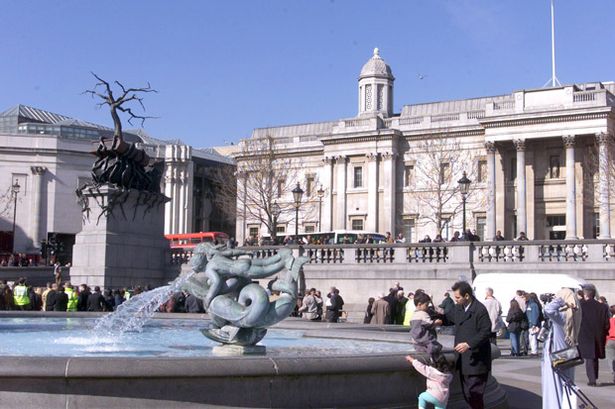
Magnolia acuminata: http://1.bp.blogspot.com/-yf82eYSuRd4/T6gSQGfe2bI/AAAAAAAAAnI/6SgLRh0exIY/s1600/DSCF7584.JPG [in http://welkinweir.blogspot.com/2012/05/may-flowers.html%5D
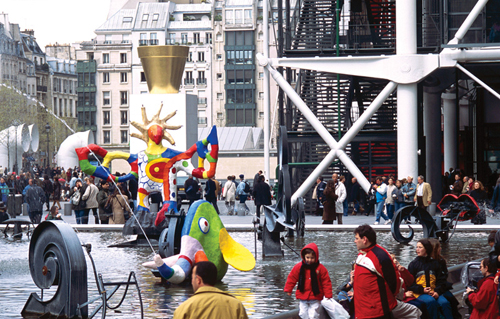
Beetle in a magnolia: http://blogging.la/wp-content/uploads/2009/06/gjb.jpg [in http://blogging.la/2009/06/28/it-caught-my-eye-the-beetle-the-blossom/%5D

LET’S DANCE!

Beijing, 24 March 2014

Jean Renoir, son of the French impressionist painter of the same name, was a good film director. In fact, he is considered by some to be among the greatest film directors of all time. He made such classics as La Grande illusion (1937) and La Règle du jeu (1939). So it was with some anticipation that some years ago my wife and I went to see The River, a film he had made in 1951, on location in India, in English, his first in colour, and which won the International Prize at the Venice Film Festival.
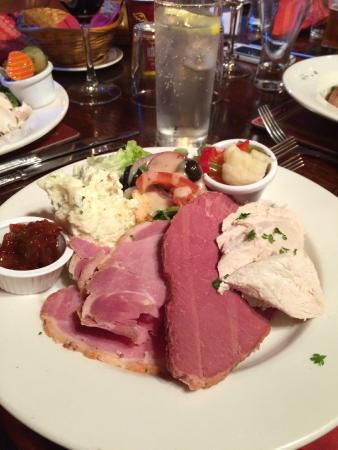
The River

Bad, bad mistake! The theme of the film – loss, love lost, love found – had all to hold one. The problem was the actors. They were all, to a man and woman, dogs – it’s the only word to adequately describe the appallingly amateur acting that we were subjected to. To this day, I ask myself what on earth happened in the making of this film. How did Jean Renoir lose control of his creation? Was it lack of money? Loss of talent? – was he getting too old for the job? Was it working far from home and in a foreign language? Mystery …

The worst actor by far was an Indian woman, Radha Burnier by name. She later gained a certain fame by becoming president of the Indian branch of the Theosophical Society (fame defined here as having an entry in Wikipedia). But that was still in the future when she acted in this film. I literally gritted my teeth every time she appeared on-screen and droned out her lines tonelessly. And then, at some point in all this hideousness, she acted out a dream sequence. For some reason which I cannot now recall, this dream required her to dance a classical Indian dance. What a transformation!  This ugly duckling of an actress morphed into a beautiful dancer. We were treated to a powerfully expressive, supremely graceful performance of Indian classical dancing.

I immediately forgave her all her poor acting.

I was forcefully reminded of this episode a few weeks ago when, during a long flight back from the US, I decided to watch An American in Paris, a film also made in 1951, directed by Vincente Minelli and with Gene Kelly in the lead role.

An_American_in_Paris_poster

It was an exceedingly silly film, with the lightest of plots (love lost, love gained, the whole with a papier mâché Paris in the background), but at least the actors could act. It also had a good musical score by George Gershwin. So I smiled indulgently and let myself be carried along on the silly frothiness of it all. At some point, though, Gene Kelly went into a tap dancing routine. My attention suddenly snapped into focus. What a dance! Light-hearted though it was, it was a superb rendition, a wonderful example of what a highly accomplished classical dancer can do with the hypnotic rhythms of clicking shoes.

https://www.youtube.com/watch?v=OJtXkorMZII

In a way, I think these two threads of dancing come together in Spanish flamenco dancing – the syncopation of tap dancing fusing with the sinuous, sulphurous eroticism of Indian classical dancing, which also carries its own brand of stressed rhythm with the use of feet bangles. Staying in the film medium, I give here a wonderful example of Spanish flamenco from Carmen, a 1983 film directed by Carlos Saura.

Carmen_by_Saura

It’s a remake in the flamenco style of Bizet’s famous opera of the same name. Here we have love exploding between Carmen and Don José

but alas! it all ends badly

Ah, the madness of jealous love!

I cannot end without bringing in tango, that most sultry of all dances. Which is just as well because that allows me to introduce a final clip from the 2005 film Je ne suis pas là pour être aimé

je-ne-suis-pas-la-pour-etre-aime

in which two lonely people, Jean-Claude and Françoise, find a common love, and love, in tango

http://www.youtube.com/watch?v=i6DjacUVpRM

Ah, l’amour, l’amour! After a few taps of my toes and a pirouette, I turn in for the night.

______________________

The River: http://upload.wikimedia.org/wikipedia/en/7/77/La_Fleuve_1951_film_poster.jpg [in http://en.wikipedia.org/wiki/The_River_(1951_film)%5D
An American in Paris film poster: http://en.wikipedia.org/wiki/File:An_American_in_Paris_poster.jpg [in http://en.wikipedia.org/wiki/An_American_in_Paris_%28film%29%5D
Carmen film poster: http://en.wikipedia.org/wiki/File:Carmen_by_Saura.jpg [in http://en.wikipedia.org/wiki/Carmen_%281983_film%29%5D
Je ne suis pa la pour etre aime poster: http://www.bestofneworleans.com/imager/french-cin-club-je-ne-suis-pas-la-pour-tre-aim/b/original/2222223/686d/f8df3e30_je-ne-suis-pas-la-pour-etre-aime.jpg [in http://www.bestofneworleans.com/gambit/french-cin-club-je-ne-suis-pas-la-pour-tre-aim/Event?oid=2222222%5D