POSTS

RETIREMENT HERE WE COME!

New York, 1 January 2016

2016 is upon us! My wife and I did not stay up to ring in the new year, we let the younger folk do that.
image
No need to make any new year resolutions, this year will be one of momentous change! (for me, anyway) I retire in August and finally become a free man again! Yippee!
image
What I need to do over the next eight months (apart from ensuring as smooth a handover as possible to my eventual successor) is to figure out what my wife and I will do with all this wonderful spare time given to me. Travel is high on the list. For instance, we are planning to drive across the US, something I’ve dreamed of doing since my student days in the US 35 years ago, visiting the natural wonders of the West
image
as well as the man-made wonders along the way.
image
Or there’s a little trip I’ve had in mind for a while, visiting stained glass windows across Europe, from the Medieval glories of la Sainte Chapelle in Paris
image
or Chartres cathedral
image
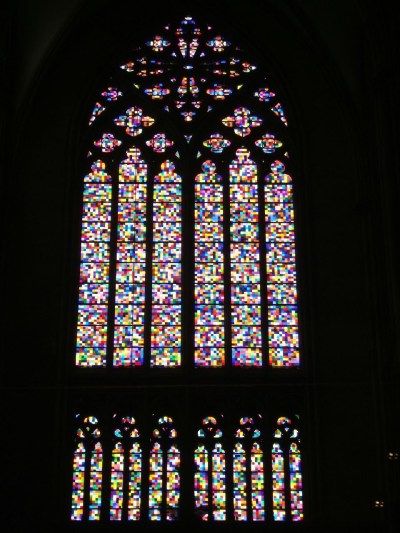
to the modern take on this art form in Cologne Cathedral.
image
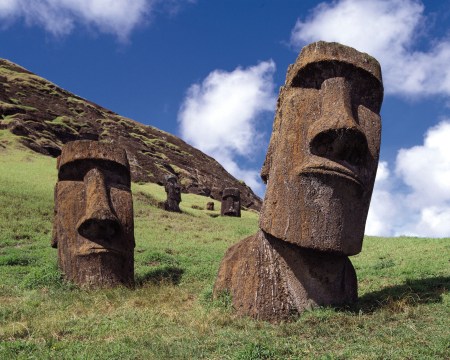
Further afield, I have emitted the desire in a previous post to visit Easter Island.

AH2B07 Chili

Or how about Belize? My wife is currently searching the web for places there where our daughter and her beau could go and spend a short vacation. I’m thinking we should go there too and do some snorkeling

image
as well as go and visit some of the country’s Mayan ruins
image
My wife and I have also talked of spending several months in a number of our favourite cities, cities which we’ve only been able to visit briefly because of our work schedules but which we would like to get to know better. And on and on … There’s so much of the world we’ve not seen! But we cannot spend our whole time just traveling. For one thing, it gets rather expensive and I’m not sure how far my pension will stretch. For another, it greatly increases our carbon footprint, which is currently a big problem.

Which brings me to more serious things that my wife and I need to do in this latest phase of our lives. I’ve already mentioned in a previous post that we are going to have to do something to drastically reduce our environmental footprint.
imageI’m thinking in a confused way of turning these efforts into a blog and/or a website and/or an app to help others do the same. That will definitely keep me busy, especially since the workings of websites, apps, and the like are black holes to me. Time to learn and keep the old brain working!

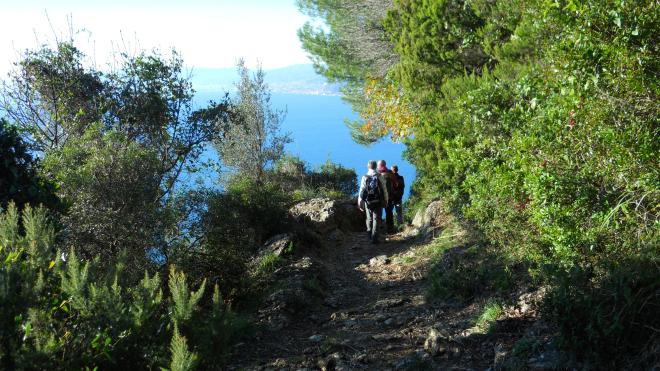
And then there’s the exercise! We have to continue the good work we’ve started. Joining a gym near our apartment in Milan is a definite possibility (we’ve already looked into the options). But we’ll surely supplement that with trekking in the Ligurian hills behind our apartment near Genova.
image
And here we can give back for all the years we’ve been using the trails, volunteering to help maintain them in our spare time (of which we will now have plenty).

And then, hopefully not in contradiction with the last two thoughts, I would like to turn my hand to some cooking. Not common-or-garden cooking but rather out-of-the-way things. For instance, I’ve always wanted to make tomato ketchup from scratch

and I want to try (again) to make my own vinegar.
image
Vinegar makes me think that I would like to try pickling my own vegetables.
image

I know this culinary impulse of mine is strange. I suppose it’s my way of rebelling against all the processed food that has swamped our lives. Maybe I can make this a subset of my website on reducing our environmental footprints, since our current food habits are such a big part of them.

I’m thinking that I could also do a bit of teaching, linked to my professional specialties. One university has reached out to me, let’s see if we can come to a mutually satisfactory arrangement.
image
I’m sure there’s a thousand other things we could set our hand to. But of course it could be that amongst all this busyness we’ll be called to do our duty as grandparents. The children are not yet at the point of having their own children, but the moment could come. Have no fear, children, we’ll drop everything and be there in a jiffy!
image
What better way is there to spend one’s waning years than in imparting some of one’s experience (I won’t say wisdom) to the little ones in our society?

Happy New Year!
image

________________

New Year’s eve: https://www.theodysseyonline.com/11-thoughts-had-this-new-years-morning
Happy Snoopy: https://johnrberkowitz.wordpress.com/2015/03/
Monument Valley: http://anguerde.com/TTF-412276-zidane.html
Gateway Arch: https://cityofstlouis.com/events/day?date=2018-01-20
Sainte-Chapelle: https://www.pinterest.com/pin/517280707186310674/
Chartres Cathedral: http://art1arquitectura.blogspot.it/2011/07/rilke-la-catedral-el-roston-el-caiptel.html
Cologne Cathedral: https://anushkaenalemania.wordpress.com/2012/04/20/ciudades-koln/
Easter Island: https://www.pinterest.co.uk/pin/824581012997275195/
Snorkeling Belize: https://blog.tripreviewer.com/2017/08/21/top-water-activities-to-do-in-the-usa/
Belize ruins: http://lushpalm.com/10-places-to-see-before-its-too-late/
Environmental footprints: http://ingienous.com/the-challenge/economics/consumption/
Monte di Portofino: https://www.caisezionedirho.it/sito/images.asp?cat=25&id=146
Tomato ketchup: http://cjoloughlin.ie/product/tomato-ketchup-brown-sauce/
Wine vinegar: https://www.vomfassusa.com/shop/vinegars/bordeaux-red-wine-vinegar/
Pickled vegetables: http://www.recipesbnb.com/small-batch-pickles/86358
Blackboard: http://www.enjoymyanmarholiday.com/index.php/essay/11149/
Grandparents: https://sweetsouthernhome.net/2018/02/26/5-things-older-citizens-should-do-to-protect-their-homes/
Old year and new year: http://mzayat.com/cliparts/old-clipart-man-and-boy.html

WORLD TRADE CENTER

31 December 2015

Two years ago, when we were last in New York, we visited Ground Zero and the newly created Memorial to the victims of 9/11. Several days ago, during our current New York stay, we decided to go back to see how things have moved on.

Well, I’m glad to report that One World Trade Center is finally finished. I read up the back story to the development of the overall master plan for the area as well as for the design of the individual buildings; a veritable Shakespearean drama, with super egos confronting each other in dramatic showdowns, stabbing each other in the back, making sonorous declarations to the press, and otherwise carrying on like children in kindergarten. It’s a wonder that anything got done at all.
image
Rising serenely above all this human mayhem, WTC 1 is a very lovely, glass-sheathed building. As readers can see in the photo below, the corners have been severely shaved back. I wouldn’t know how to describe the geometrical shenanigans going on here, so I simply quote a line from the building’s entry in Wikipedia: “from the 20th floor upwards, the square edges of the tower’s cubic base are chamfered back, shaping the building into eight tall isosceles triangles, or an elongated square antiprism”. However you describe it, the effect is pretty cool.
image

WTC 2 is lagging behind. After having gone through a complete redesign, it is now being built, with a planned completion date of 2020. It should look like this once it is finished – a set of cubes stacked somewhat untidily one on top of the other.
image
Personally, I’m not sure I will like this building. Something about those poorly stacked cubes disturbs my sensibilities. But I’m willing to be convinced once 2020 rolls around.

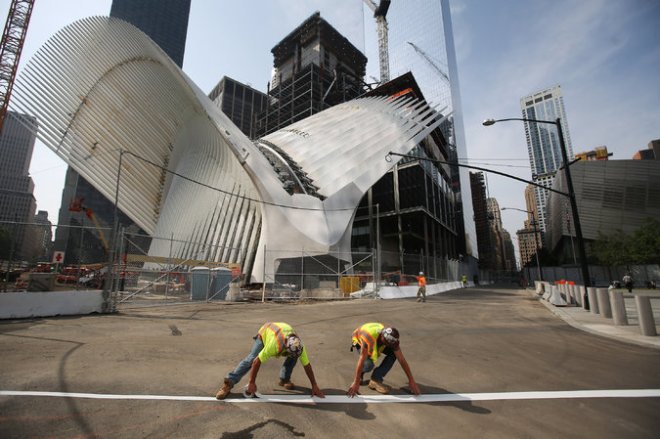
I will skip over WTCs 3, 4, 5 and 7 (WTC 6 seems to have disappeared from the roster in the new master plan), although I would draw readers’ attention to WTC 4, finished a few years ago and a very handsome building indeed. I want to focus instead on the Transportation Hub, which is a grand name for the entry to the subway lines running under the site. This, I have to say, is a rather strange-looking structure.
image
When I first caught sight of it, from the side, I was powerfully reminded of photos that came out in the immediate aftermath of September 11, showing the jagged remains of the outer sheathing of the old WTC 1 and 2 buildings which had come crashing to the ground.
APW2001091209845
I don’t know if that was also on the mind of the Hub’s designer, the Spanish architect Santiago Calatrava. In his public pronouncements, he has talked rather about it being like a bird flying out of a hand. It certainly has a bird-like quality from the back, although commentators have suggested a more stegosaurus-like look, which as the photo above shows is certainly true from the front. For those readers who may not be familiar with their dinosaurs I throw in a picture here of a reconstructed stegosaurus.
image
The similarity is even more striking when you consider a stegosaurus skeleton.
image
Frankly, I’m not completely sure how well this piece of design will withstand the test of time. Calatrava’s other design for the new World Trade Centre, the rebuilding of the tiny Orthodox Church of St. Nicholas which got flattened in the maelstrom of September 11, may weather better, at least from the models I’ve seen
image
but we will have to wait until 2017 to pass a firmer judgement.

Well, it seems that my wife and I have plenty of excuses to come back to New York in the years to come. Which is nice, because the primary current excuse for our coming, our daughter living here, is about to disappear as she moves on to greater and better things.

_____________________
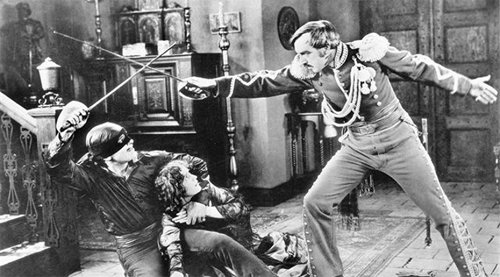
Silent film dramatic scene: http://bayflicks.net/2014/01/17/whats-screening-january-17-23/
WTC 1: http://anotherpartofme.com/the-real-reason-one-world-trade-center-1wtc-lost-its-best-features/
WTC 2: http://www.cnn.com/2015/06/12/travel/two-world-trade-center-tower-big/
Transportation Hub: http://www.nytimes.com/2015/06/25/nyregion/a-crossroads-decades-gone-will-reopen-at-the-world-trade-center.html
Ground Zero: http://www.propublica.org/article/new-docs-detail-how-feds-downplayed-ground-zero-health-risks
Stegosaurus reconstruction: https://en.m.wikipedia.org/wiki/Stegosaurus_in_popular_culture
Stegosaurus skeleton: https://digitalstore.makerbot.com/stegosaurus-skeleton
St. Nicholas Greek Orthodox Church: http://www.nytimes.com/2013/10/31/nyregion/st-nicholas-church-destroyed-on-9-11-to-rebuild-with-byzantine-design.html

IT SHOULD FIT OVER MY SOFA

New York, 28 December 2015

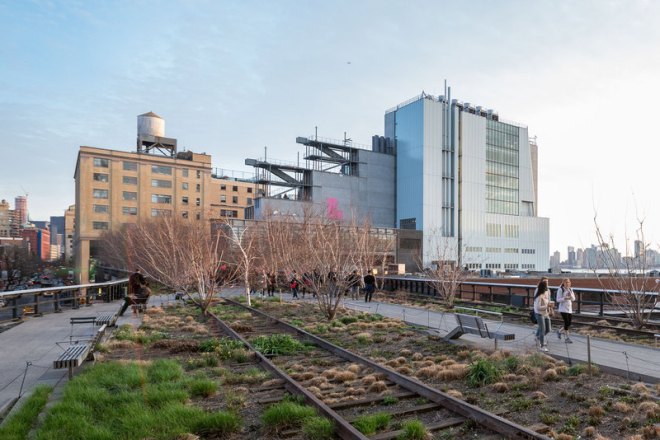
I’ve described in a previous post the beautiful, and really very unique, High Line Park in New York. On our first visit to the park, we heard that the Whitney museum was planning to relocate from uptown to new premises bang on the High Line. Now, two years later, the plans have come to fruition, and since we are once again in town to celebrate Christmas and New Year with the children we decided to go and visit.

The building itself was designed by the architect Renzo Piano, he of the Centre Pompidou in Paris (along with fellow architect Richard Rogers)
image
and, less felicitously, of the Shard in London
image
along with a string of projects in between. The new Whitney is not as spectacular as these two, giving the impression of being more of a workmanlike project – how to give the museum lots of exhibition space – and blending in quite well with its surroundings.
image
image
One also gets beautiful views across the Hudson River from its windows.
image
Perhaps it’s just as well. I mean, the main purpose of going to a museum is not so much to see the container as to see what is contained (I grant, though, that a handsome packaging can add lustre to what’s in the package). So let me focus on the contents.

Actually, I don’t really want to focus on the contents as such, but rather use them to meditate on something which gets under my skin when it comes to really modern art – let’s say, stuff produced in the last sixty years i.e., during my lifetime.

I happen to think that the primary purpose of any piece of art should be to adorn one’s abode in a way that gladdens the heart and puts a spring in one’s step. The key, though, is that the piece of art should fit through the door of one’s abode and, once in, should fit on a wall of that abode (or, if a sculpture, on a small table or shelf). The core of the Whitney’s collection, from the ’30s and ’40s, would do this admirably. For instance, there was a lovely Hopper on view which would could be passed through the door of our apartment quite easily and would fit quite nicely on one of its walls.
image
It’s one of several delectable Hoppers in the collection. Or I wouldn’t mind at all putting this painting by Charles Demuth on our wall.
image
Getting it into the apartment would be a breeze – I think it could probably even fit it into the small elevator we have in our building, thus avoiding us having to carry it up three flights of stairs.

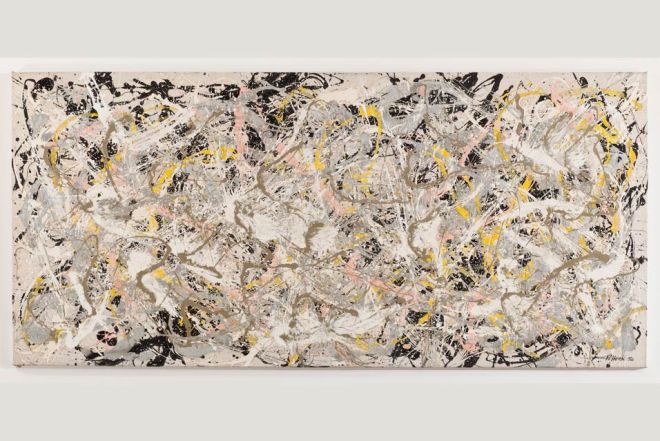
But as we get into the late ’50s, early ’60s, the pieces begin to grow. We would just about be able to manhandle this Pollock which the Whitney has through our apartment door, but I think we would have difficulty finding a place for it on the wall.
image
And this painting by his wife Lee Krasner would be impossible to hang in our apartment, it’s just too damned big let alone of a size to get through the door.
image
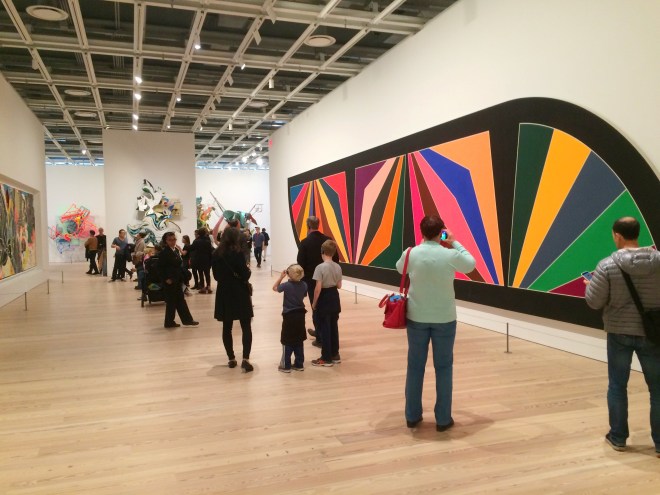
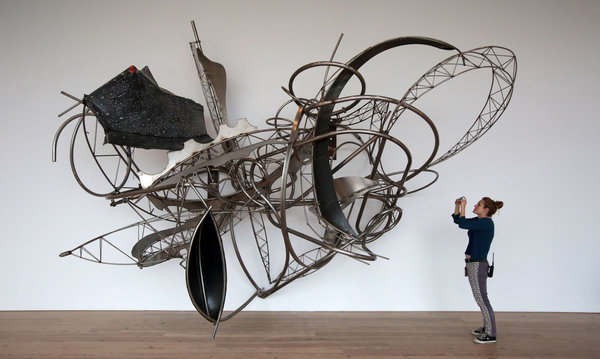
The pieces in the Frank Stella show which the Whitney is currently organizing were even worse. They were huge lumbering monsters, which would not even fit through the front doors of our apartment building, leave alone through the door of our apartment.
image

And even if by some miracle we got them into the apartment, many of his pieces jut out, making it hard to have any furniture around them.
image
Of course, given the stellar prices for modern art, only plutocrats can afford to buy these pieces. But do even they live in such palatial abodes as to make it possible for such a piece to fit snugly in the living room, say? I find it hard to believe.

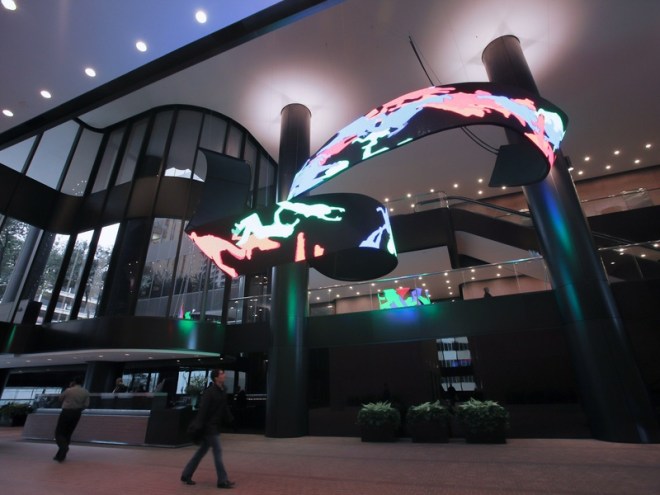
I can only assume that much modern art is either made for large and powerful multinational corporations, whose huge atriums or corporate boardrooms in their Headquarters have enough space for such pieces
image

image

or it is made for museums such as the Whitney which have large exhibition spaces. Either way, art for the people it is not. And that’s a pity, because at the end of the day art should be for us, something which we can hang on our wall and admire for decades or even centuries before perhaps donating it to a museum.

I think it’s time for a new art movement, the FOTS (“Fits Over The Sofa”) movement.

image

_____________________
Centre Pompidou: http://www.leparis.pl/centre-georges-pompidou-muzeum-sztuki-wspolczesnej/
The Shard: https://en.m.wikipedia.org/wiki/Renzo_Piano
The Whitney (both views): http://whitney.org/About/NewBuilding
View across the Hudson: http://elizabethbarton.blogspot.com
Edward Hopper “Early Sunday Morning”: http://collection.whitney.org/artist/621/EdwardHopper
Charles Demuth “My Egypt”: http://collection.whitney.org/object/635
Jackson Pollock “Number 27, 1950”: http://www.allartnews.com/pollock-and-the-irascibles-the-new-york-school-opens-at-palazzo-reale-in-milan/
Lee Krasner “The Seasons”: http://www.brooklynstreetart.com/theblog/2015/04/30/the-new-whitney-opens-may-1-america-is-hard-to-see/#.VoE8i3o8KrU
Frank Stella: http://www.nytimes.com/2015/10/30/arts/design/tracking-frank-stellas-restless-migrations-from-painting-and-beyond.html?_r=0
Frank Stella: http://www.hedgefundintelligence.com/Article/3503103/Steve-Cohen-sponsors-Frank-Stella-exhibition-at-the-Whitney-Museum.html
Headquarter atrium art: http://houston.culturemap.com/news/entertainment/03-02-13-image-bending-spanish-artist-transforms-downtown-houston-office-atrium-with-iwavesi/slideshow/
Corporate boardroom art: http://www.artworks-solutions.com/news/view/corporate-art-works
Space over sofa: http://www.utrdecorating.com/blog/hanging-pictures-sofa/

KEEP IT SIMPLE

Bangkok, 19 December 2015

I don’t know what it was, it seems to be happening to me more and more often as I near retirement, but a few days ago my mind wandered off the Worthy but Very Boring Thing I was working on and, light as feather, drifted away on the winds of memory to finally alight in St. George’s Chapel in Windsor Castle, which is the spiritual home of the Order of the Garter.

Yes, I know, very strange. What can I say, that’s where my mind went that day.

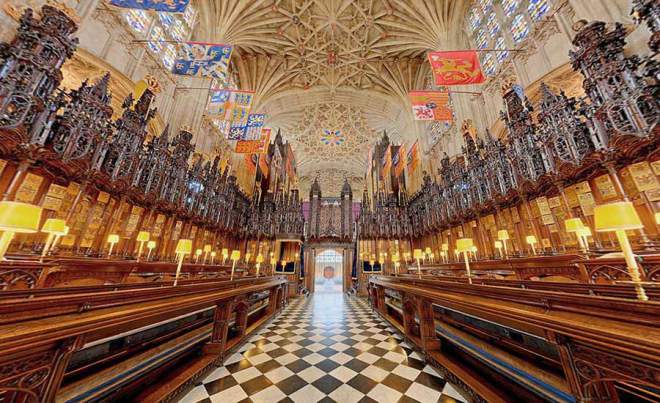
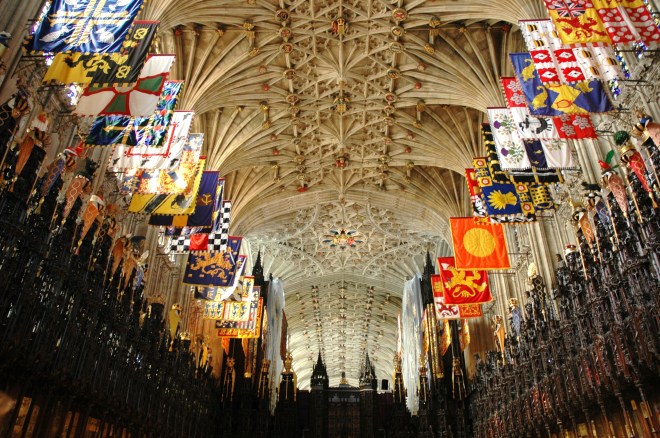
My wife and I had visited the chapel some nine-ten years ago. For those of my readers who have never been there, I throw in a photo that gives a generalized view of the chapel’s interior.
image
I could chirrup on about the age of the chapel, its architecture, its history. But I won’t. I invite readers who are interested in these details to go to the relevant websites. Instead, I will focus on the one thing that immediately strikes any sentient being who crosses the chapel’s threshold: the flags hanging from its walls.
image
I need to explain these flags, which in turn requires me to give a brief background to the Order of the Garter. As any English child of my generation will know, if they didn’t spend all their history classes snoozing, the Order of the Garter was created by King Edward III one evening back in the early 1300s, during a dance, when the Countess of Salisbury lost her garter. As the King picked it up, someone sniggered, and the King pronounced (in French; the English kings didn’t speak English yet) “Honi soit qui mal y pense”, which can be loosely translated as “Only dirty buggers would see anything wrong in my simply picking up a garter”. Now, why this story should have led to the creation of an Order of Chivalry (basically, a club of aristocrats), with the reigning monarchs at its head and the original kingly utterance as its motto, was not clear to me when I was a ten year old boy and is still not clear to me as a sixty-one year old adult. But there you go, it did.

The important point as far as the flags are concerned is that the members of the Order were originally all aristocrats, and as we all know one of the many things which distinguished aristocrats from the vulgar hoi polloi like us was the fact that they had the right to a coat of arms. So what we have hanging from the walls are the heraldic banners of the members of the order (which of course means that when the Order began to let in representatives of the vulgar hoi polloi these vulgar persons had to get themselves double quick a title and a coat of arms).

For the purpose of my story, there is another important point to make about the Order’s membership. From the start, there could only be 24 members in addition to the sovereign and the Prince of Wales, and of course the members were only English (and later British). But George III started adding “supernumerary” members, to deal with the pressing problem of him having a whole bunch of sons who all wanted to be members. Then he had the bright idea of adding the Emperor of Russia as a supernumerary member, after which various other members of European royal families got added, then more exotic royalty like the Sultan of the Ottoman Empire and the King of Persia, to finish – importantly for this story – this march to the East with the Emperor of Japan in 1903. The Emperors of Japan have been members ever since (barring, understandably, the World War II years and several decades thereafter when spirits were still bruised by Japanese atrocities).

OK, so what, I hear my readers say. Well, all this allows me to vault onto one of my favourite hobby horses, my insistence that design should be simple. In this case, I am referring to the design of the members’ heraldic banners. To see what I mean, please see below the coat of arms of one of the British members, that of Gerald Grosvenor, 6th Duke of Westminster (I choose him for no other reason than he is stinking rich due to his property holdings around Grosvenor Square in London and elsewhere).
image
So complicated! So fussy! So busy! The formal heraldic description of the shield, which is what is on the banner, says it all:
“Quarterly, 1st and 4th, Azure a Portcullis with chains pendant Or on a Chief of the last between two united Roses of York and Lancaster a Pale charged with the Arms of King Edward the Confessor; 2nd and 3rd, Azure a Garb Or”.

Aïe! Contorted! Confusing! And this is not the most complicated of the Order’s members’ banners. I mean, look at the one of the good Prince of Wales
image
with its heraldic description of the shield “Quarterly 1st and 4th Gules three lions passant guardant in pale Or armed and langed Azure 2nd Or a lion rampant Gules armed and langued Azure within a double tressure flory counterflory 3rd Azure a harp Or stringed Argent overall an inescutcheon of the Royal Badge of Wales”. It hurts my eyes just to read this.

Consider, now, the banner of the Emperor of Japan, which responds to the same original need – signaling who you are on the battlefield – but adopts a completely different design principle:
image

So simple! And simply so beautiful!

The beautiful, essential simplicity of the Japanese banner immediately leapt out at me that summer morning years ago when we visited the chapel. The second photo I’ve inserted shows this, where the Emperor’s banner shines out among all the surrounding fussiness. And I have kept that memory with me ever since, as a vivid reminder of the KISS design principle: Keep It Simple, Stupid (a principle originally enunciated, interestingly enough, by the US Navy in 1960).

It must have been some fussy design which set my mind wandering those few days ago …

__________________________
St. George’s Chapel interior: https://boothancestry.wordpress.com/booth-profiles/knights-of-the-garter/
The flags:
https://en.m.wikipedia.org/wiki/St_George%27s_Chapel,_Windsor_Castle
Duke of Westminster’s coat of arms: https://en.m.wikipedia.org/wiki/Order_of_the_Garter#List_of_Founder_Knights
Prince of Wales’s coat of arms: https://en.m.wikipedia.org/wiki/Order_of_the_Garter#List_of_Founder_Knights
Emperor of Japan’s standard: https://en.m.wikipedia.org/wiki/Akihito

CHOFAHS

Bangkok, 13 December 2015

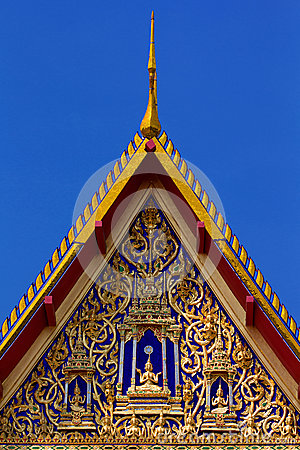
I’m not a great fan of Thai religious art. Much of it seems to be made up of endlessly repeated and very dense geometricized forms, like on this temple door

Vine Pattern Door

or on this one, where the temple guardians or whatever they are have been surrounded by dense geometricized foliage

temple door-2

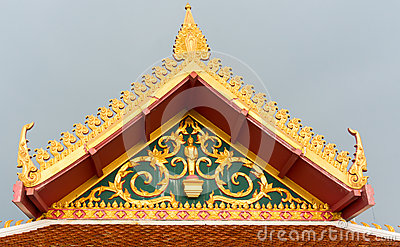
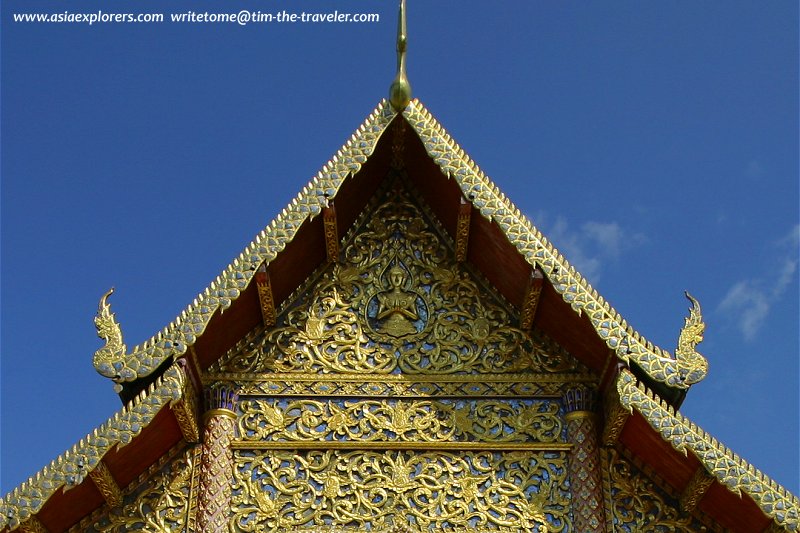
or here on a temple’s roof gable, where it is now a representation of the Buddha that is surrounded by endless curlicues

gable

and which often in Bangkok are terrifically bling, being made with reflecting coloured mosaic tesserae (I understand that only temples with royal connections can use these reflecting tesserae).

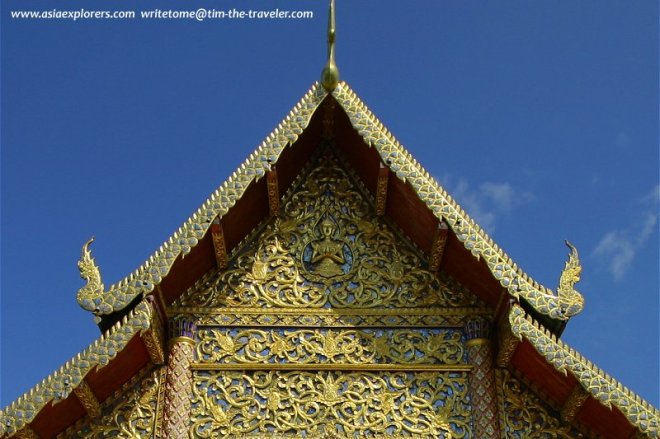
Or on the so-called bargeboards which run along the gables

bargeboards

the designs often representing, as is clearly the case here, a naga snake; the naga snake design is less obvious in this next photo.

bargeboards-2

The interiors of the temples are not much better, with the walls normally being densely carpeted either with an endlessly repeating series of Bodhisattvas or some such, or with very dense scenes of the life of the Buddha or some similarly holy personage.

temple interior-1

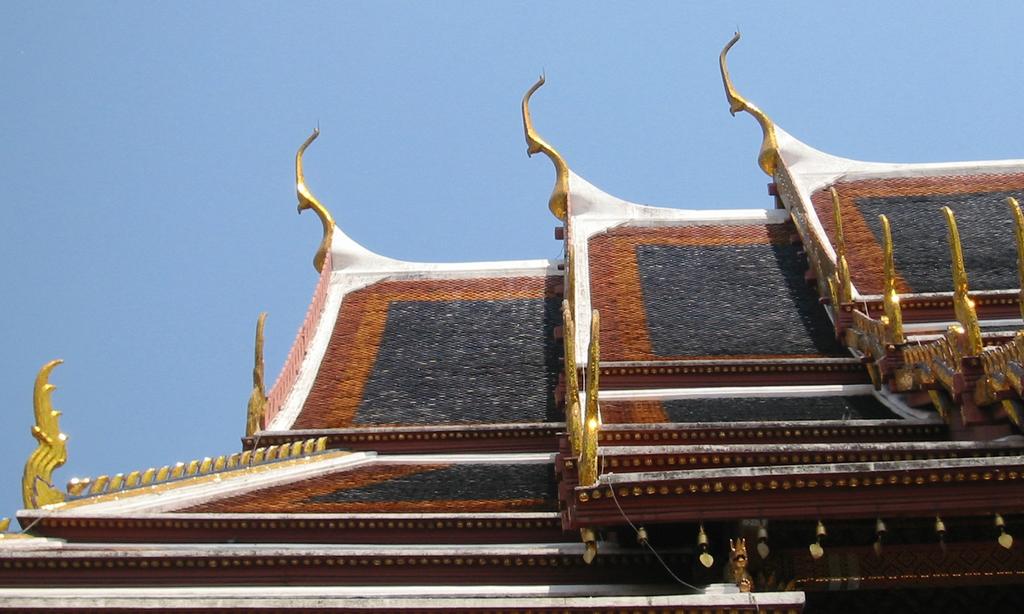
As I’ve mentioned in at least one previous posting, I’m not a great fan of busy artwork, so I generally feel uncomfortable in Thai temples. The one exception is my feelings for the chofah. Chofahs are the very distinctive finials added to the end of temple roofs, and which are quite striking, especially from a distance. Here are two views of Wat Phra Kaew in Bangkok, showing that temple’s chofahs, this one from a certain distance

Wat Phra Kaew from a distance

and this one from closer up.

Wat Phra Kaew - chofahs

What exactly are they? What do they represent? Well, the literal meaning of chofah is “bunch of air” although someone has given it the more poetic translation of “sky tassel”. The name may be poetic but I don’t feel it helps much, since I don’t see any obvious connection between what I see before me and bunches of air or tassels, skywise or otherwise. More helpfully, they are generally considered to be representations of the Garuda, the half-bird, half-man which the Indian God Vishnu is said to fly on (and which is now the national emblem of Thailand), although there is a competing theory that actually they represent the hamsa, which is a goose, or a gander, or maybe even a swan, which in Hindu mythology is the mount of the God Brahma. Whichever it is, there is a definite resemblance to a bird. Looking at the last picture, I think it’s easy to see a head, a beak, a neck, and a breast of a bird (what’s a little less birdlike is the long tuft-like extension on the head; we’ll come back to that in a minute). Contrary to the baroque ornateness of everything else in Thai temples, we have here a simple ornament, where resemblance is implied with a few graceful strokes chiseled into wood.

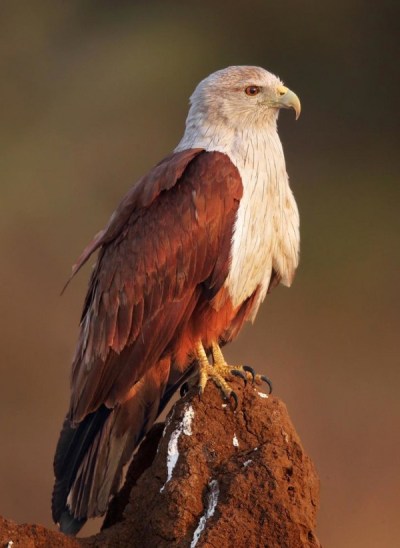
Just to make the bird connection a bit stronger, I throw in a picture here of a brahminy kite sitting on a stone.

Brahminy Kite

I choose this particular bird because it is currently considered the contemporary representation of the Garuda. More irreverently, I also throw in a picture of the cover page from one of Lucky Luke’s comic books, where the reader will note another raptor, the vulture.

Lucky Luke vulture

Vultures are always hovering around in Lucky Luke’s stories, waiting for their next meal in the form of a dead Lucky Luke or other dead meat; note the drop of saliva falling from the beak – it’s looking forward to that meal of dead meat …

If I introduce comic books, it’s because that tuft-like extension on the chofah stirs a vague memory in me of some comic-book bird with a long tuft on its head. Maybe I’m thinking of Woody Woodpecker.

woody woodpecker

But Thai temple builders definitely weren’t thinking of Woody or anyone else when they added that long tuft to their chofah design. They originally believed that the tuft would actually act as a skewer and protect the temple from flying demons by impaling them should they get too close.

So maybe the chofah is a sort of lightning conductor before its time.

____________

Temple door-1: http://static5.depositphotos.com/1031223/456/i/950/depositphotos_4560014-Golden-Buddhist-temple-door-at-Wat-Phoechai-Loa..jpg (in http://depositphotos.com/4560014/stock-photo-golden-buddhist-temple-door-at.html)
Temple door-2: http://previews.123rf.com/images/trahcus/trahcus1007/trahcus100700017/7330394-Thai-style-painted-door-Stock-Photo-door-golden-temple.jpg (in http://www.123rf.com/photo_7330394_thai-style-painted-door.html)
Roof gable: http://thumbs.dreamstime.com/x/wat-thai-temple-decorations-phra-kaew-bangkok-thailand-30782920.jpg (in http://www.dreamstime.com/stock-photo-decorations-wat-phra-kaew-details-temple-emerald-buddha-bangkok-thailand-image47184437)
Bargeboards-1: http://www.asiaexplorers.com/pics/gable-northern-thai-temple.jpg (in http://www.asiaexplorers.com/thailand/northern-thai-temple-architecture.htm)
Bargeboards-2: http://thumbs.dreamstime.com/x/buddhist-temple-roof-detail-thailand-46162088.jpg (in http://www.dreamstime.com/stock-images-buddhist-temple-thailand-phra-choeng-chum-ornate-thai-town-sakon-nakhon-image35533934)
Temple interior: my wife’s pic
Chofahs – Wat Phra Kaew from a distance: http://www.gigaplaces.com/place/144_max.jpg (in http://www.gigaplaces.com/en/gigaplace-wat-phra-kaew-144/)
Chofahs – Wat Phra Kaew: http://photos1.blogger.com/blogger/6018/1224/1600/Bangkok%20-%20Wat%20Phra%20Kaew%20301.jpg (in http://marcsala.blogspot.com/2005/09/temple-guardians-in-thailand.html)
Brahminy kite: http://voices.nationalgeographic.com/files/2013/05/Brahminy-Kite-Gururaj-Moorching-600×822.jpg (in http://voices.nationalgeographic.com/tag/macaw/feed/)
Vulture in Lucky Luke: http://1.bp.blogspot.com/-m2HaZEeDsfk/VYQHOyjtjAI/AAAAAAAASMo/NJ805YwsIWs/s1600/LuckyLuke46a.jpg (in http://mysterycomics-rdb.blogspot.com/2015/06/critique-648-lucky-luke-tomes-43-46-le.html)
Woody Woodpecker: http://vignette4.wikia.nocookie.net/woodywoodpecker/images/4/44/477098-villi.jpg/revision/latest?cb=20141107234707 (in http://woodywoodpecker.wikia.com/wiki/Woody_Woodpecker)

VIENNA, “WORTH THE TRIP”

Phnom Penh, 7 December 2015

My wife and I have just come back from a trip to Vienna. I had to be there for work, but luckily we also got to stay over a weekend. This allowed us to taste once more the artistic delights of the city. Wonderful, truly wonderful … Enough to give one heart palpitations.

We had first tasted the artistic glories of the city back in March of 1985 (I am certain of the date, because I was in Vienna to witness the signing of the Vienna Convention for the Protection of the Ozone Layer). That time too we had had a weekend to ourselves, which we used to first visit the Kunsthistorisches Museum, Austria’s national Museum of Fine Arts. I have to tell you, we were gobsmacked – that’s the only word – as we walked from room to room and saw one marvel after another hanging on the walls. It was one of those cases of “Really? They have this painting here? Wow …” I just can’t stop myself from showing you some of my favourites; there are many, many more, for all tastes.

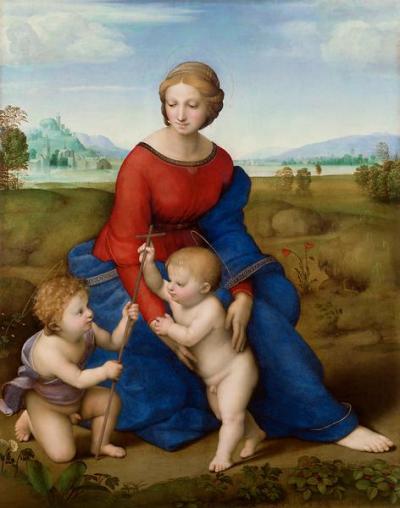
Here’s Raphael’s “Madonna del Prato”
image
Lotto’s “Portrait of a Young Man with a Lamp”
image
Arcimboldo’s “Summer”
image
Canaletto’s “Vienna, seen from the Belvedere”
image
A whole slew of Titians, most of which are of disagreeably sucrose blondes, but which also include this powerful portrait of Johann Frederich, Elector of Saxony
image
Caravaggio’s “Madonna of the Rosary”
image
as well as one of his several versions of “David with the head of Goliath” (another of which I’ve mentioned in an earlier post)
image
A wondrous collection of Peter Bruegel the Elder, of which I throw in only his “Hunters in the Snow (Winter)”

image

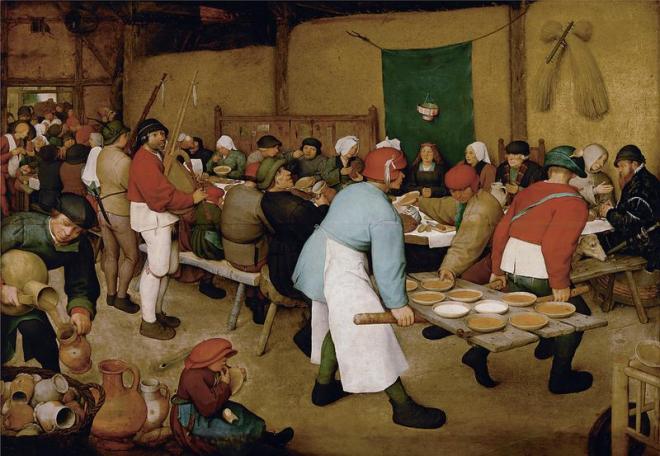
and his “Peasant Wedding”

image

A magisterial self-portrait by Rembrandt
image
Vermeer’s “The Art of Painting”
image
Cranach the Elder’s “Judith with the Head of Holophernes” (although I still prefer the same scene which I came across years ago in the Queen’s Gallery in London)
image
Dürer’s “Kaiser Maximilian I”
image
as well his “Portrait of a Venetian Lady”
image
I stop, otherwise I will bore my readers. But, without wanting to sound too much like an advert for Vienna, I would really urge any of them who are lovers of art but have somehow never made it to Vienna to hurry on over, if only to visit the Kunsthistorisches Museum. As the Michelin Guides would say, it alone “is worth the trip”.

But Vienna has much, much more. That same weekend back in 1985 we discovered Egon Schiele. We saw an exhibition of his paintings somewhere in the Grinzing area of Vienna, and I was just blown away. This particular painting of his, “The Embrace”, has remained imprinted in my memory ever since.
image
The most extensive collection in the world of Egon Schiele’s work is in the Leopold Museum, part of Vienna’s Museums Quartier, MQ. MQ opened when we were living in Vienna, some 20 years after our first visit. Along with the Leopold Museum, MQ houses MUMOK, the Museum Moderner Kunst Stiftung Ludwig Wien. Personally, I always preferred the Leopold Museum; MUMOK was a little too aggressively modern for my tastes. So I suppose it comes as no surprise to hear that after visiting the Kunsthistorisches Museum last week we visited the Leopold. The Egon Schieles are wonderful. This one painting of his, “Seated Male Nude”, can stand in for the whole collection.
image
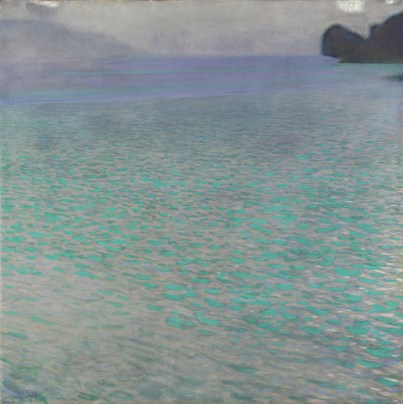
You cannot go to the Leopold just for the Schieles, wonderful as they are. You must visit the whole collection. This is where I discovered a host of Austrian artists from the late 1800s up to World War II: Gustav Klimt of course, but also Richard Gerstl, Koloman Moser, Oskar Kokoschka, Albin Egger-Lienz, Anton Kolig, and many others. The Leopold holds the painting of Gustav Klimt which I adopted as my gravatar for this blog. Those who are interested to see it can visit my Home Page. Here, I will insert another of his paintings in the museum’s collection, a beautiful painting of early morning on Lake Attersee
image
and I add to this, as a stand-in for all the others, a painting by Richard Gerstl, “Semi-Nude Self-Portrait” with its hypnotic eyes.
image
It’s not finished! Vienna also has the Belvedere Museum. We wanted to visit it too last week – they were holding an Exhibition on “The Women of Klimt, Schiele and Kokoschka”, which included Schiele’s “Embrace” – but we ran out of time. The Belvedere has a collection which stretches all the way from the Middle Ages to the present day. It competes strongly with the Ludwig Museum, having an excellent collection of paintings from the late 19th Century to the Second World War (the Klimts and Schieles are not to be missed), but it also has interesting paintings from the Baroque to the Biedermeier period. I will not show any of these, however. Instead, I will throw in a picture of a piece from its Medieval collection, a statue of St. Leonhard, from South Tyrol.
image
I chose this picture because the Belvedere has some beautiful pieces of that most Germanic of art forms, religious sculpture made of wood, originally painted in bright polychrome. The picture also gives me an excuse to cycle back to the Kunsthistorisches Museum. Because that museum is more, much more, than a gallery of paintings! There’s the collection of arms and armour, which one has to visit simply to gawp at the brilliant metalworking skills of past armourers. There’s the collection of historical musical instruments, which my mother-in-law, a lover of music, frothed at the mouth about. And then there’s the collection of sculpture and decorative arts, a disparate collection of artifacts, ranging from the seriously bling to the exquisite. Probably the most well-known piece in this collection is Benvenuto Cellini’s salt cellar, currently famous because it was recently stolen dramatically, only to dramatically reappear, unharmed, a few years later.
image
I prefer, though, this “Vanitas”, made, like St. Leonhard above, of wood and beautifully polychromed.
image
It reminds us that while we may be beautiful now, and well-toned, one day we will be old and sag in all directions (in my case, I’m already at that point, so I suppose the piece reminds me regretfully of what I once was).

I like these two ivory pieces even more. The first shows Gregory the Great feverishly scribbling away (he was a very prolific writer, this Pope), with scribes below him feverishly joining in.
image
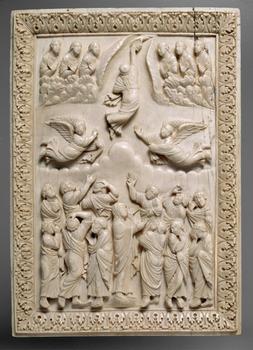
The second shows the Ascension of Jesus, with the disciples weeping bitterly below. But rather than having Jesus levitate, which is the way this scene is normally depicted, Jesus is being swept up by God (note His hand), rather like a gymnast being elegantly swept up by a trapeze artist.
image
If readers were to think that it finishes there, they would be wrong! The Kunsthistorisches also runs the Imperial Treasury, another smorgasbord of golden baubles smothered in precious stones. Because of my fondness of cabochon stones, I only show here the Crown of the Holy Roman Emperor, of the 10th-11th Centuries
image
and St. Stephan’s  Purse, actually a reliquary, from the 9th Century.
image
Along with various other items, these were taken in the early 1800s from Aachen, Charlemagne’s original Imperial capital, to keep them from falling into the hands of the revolutionary French, and somehow they never made it back.

I suspect that my readers’ attention might be beginning to drift, so I quickly throw in two other wonders to be found in Vienna. One, located in the Museum für Völkerkunde or the Museum of Ethnology, is the so-called headdress of Montezuma, an exquisite piece from Mexico made of the feathers of quetzals and other birds mounted in a base of gold studded with precious stones.
image
As we once heard from Austria’s Ambassador to Mexico (whose apartment we were renting at the time), the piece is a source of continuing friction between the two countries, Mexico claiming that it was somehow stolen and Austria claiming that it was legitimately purchased (by the Archduke Ferdinand of Austria in at least 1575 and maybe before, i.e., no more than 90 years after Columbus discovered America – how did our good Archduke lay his hands on it?).

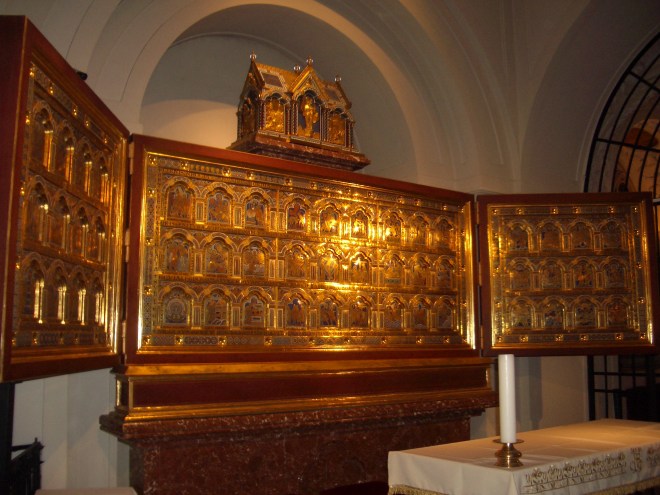
The second piece is actually to be found a little outside Vienna, in the imperial abbey of Klosteneuburg. It is the 12th Century Verdun altar, so called because it was made by Nicholas of Verdun, one of the most famous goldsmiths and enamelists of the Middle Ages.

image

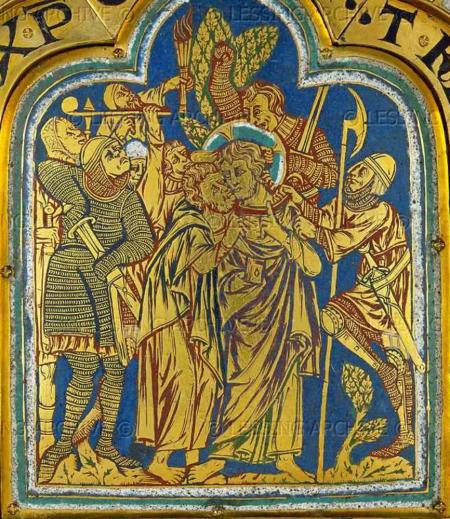
The altar consists of 45 beautifully enameled panels, telling the biblical story. This one, for instance, relates the kiss of Judas (a theme I have mentioned in a previous post, in this case in a painting by Caravaggio).
image
If any of my readers have finished visiting the altar and still feel ready for more, they can always consider visiting the Samlung Essl, a museum of (very) modern art in Klosteneuburg, which, like the MQ, opened while we were living in Vienna. On the other hand, if like me they find this museum’s art too aggressively modern, or if they are simply too tired, they can just head back into town and with a bit of luck they will sight a most interesting piece of art, the municipal incinerator of Spittelau, decorated by the Austrian artist Hundertwasser.
image
I’ve seen many municipal incinerators in my time, and I must say this is definitely one of the prettiest; it certainly helped to gain its acceptance by the local population.

There’s more, much more art to visit in Vienna, but I’ll leave it at that. Like I’ve already said, I don’t want to sound like an advert for Vienna, but really it’s a wonderful destination for lovers of art.

And don’t get me started on the music …

____________
Paintings in the Kunsthistorisches Museum: http://www.khm.at/en/visit/collections/picture-gallery/selected-masterpieces/
Egon Schiele “The Embrace”: http://www.wikiart.org/en/egon-schiele/the-embrace-1917
Egon Schiele “Seated Male Nude”: http://www.leopoldmuseum.org/en/leopoldcollection/masterpieces/35
Gustav Klimt, “Attersee”: http://www.leopoldmuseum.org/en/leopoldcollection/focus/Klimt
Richard Gerstl “Semi-Nude Self-Portrait”: https://commons.m.wikimedia.org/wiki/File:Richard_Gerstl_-_Semi-Nude_Self-Portrait_-_Google_Art_Project.jpg
St. Leonhard, Belvedere: https://www.belvedere.at/en/sammlungen/belvedere
KHM, Collection of Sculpture and Decorative Arts: http://bilddatenbank.khm.at/
Imperial Treasury: http://www.kaiserliche-schatzkammer.at/en/visit/collections/secular-treasury/selected-masterpieces/
Moctezuma’s crown: https://en.m.wikipedia.org/wiki/Montezuma%27s_headdress#/media/File%3AFeather_headdress_Moctezuma_II.JPG (in https://en.m.wikipedia.org/wiki/Montezuma%27s_headdress#)
Verdun altar: https://en.m.wikipedia.org/wiki/Klosterneuburg_Monastery
Verdun altar – detail: http://armourinart.com/248/397/
Spittelau Incinerator: http://www.epd.gov.hk/epd/english/environmentinhk/waste/prob_solutions/WFdev_overseas.html

SWEET POTATOES AND CATAMARANS

Bangkok, 22 November 2015

I was in Vanuatu recently, which, for those readers not familiar with the Pacific, is one of those many little island states that dot the Pacific Ocean, like Tuvalu or Palau or Kiribati. I was there on business, for reasons which are too long to explain here. In any event, as is my habit, when I had a little bit of spare time I went down to the local market in the capital, Port Vila, to see what fruits, veggies, and other local delicacies they might be selling.

market port vila

Much of what I saw was familiar, although I don’t think I’ve ever seen taro before (those neat little bunches behind the potatoes)

taro

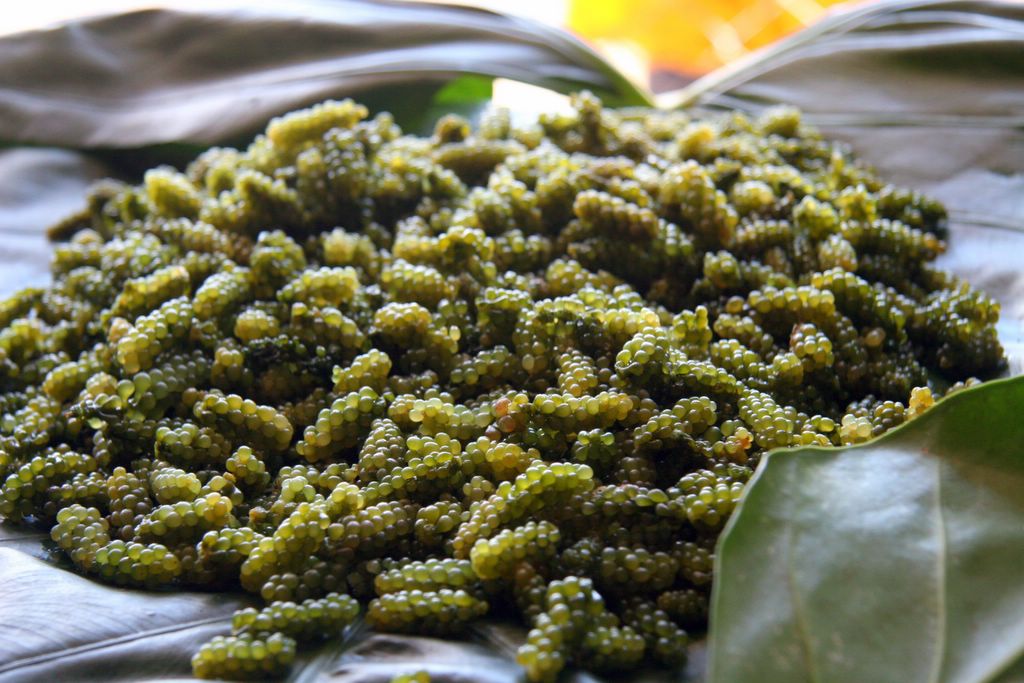
and I’ve definitely never seen sea grapes, which is a kind of seaweed if I’ve understood correctly (no idea how you eat them).

sea grapes

Sweet potatoes fall into the category of the known. Nevertheless, I did pause in front of them and go dreamy.

sweet potato market port vila

It wasn’t so much for the sweet potatoes – I’m not a great fan of this tuber, to be honest – but rather for its story here in the Pacific. Let me explain.

As previous posts attest, I have a great interest in the movement of foodstuffs around the world, so whenever I go to markets I always mentally map how the fruits and vegetables (and sometimes meat) must have originally ended up on the counters before me. True to form, I went through the same exercise in that market in Port Vila. Much of what I was seeing was brought into the Pacific Islands from the West, either brought along for the ride by the original inhabitants of the islands when they migrated out of South-East Asia, or through later regional trade between the Pacific Islands and South-East Asia, or even later through the colonial masters when they took over the islands. But the sweet potato was different. As I’m sure my readers know, the sweet potato originally comes from northern South America and possibly Central America. So how did it make it to the Pacific Islands? Well, it could definitely have come with the Spaniards after they conquered Latin America and set up a long distance trading system between Mexico and the Philippines – and in fact, at least one type of sweet potato was introduced to the Pacific Islands this way. It could also have come from the other direction, via Europe – and this is indeed the way that the Portuguese introduced the sweet potato to this part of the world, mostly to the islands of South-East Asia rather than the Pacific itself, as they sniffed around the area for spices. But there was another route of introduction of the sweet potato to the Pacific Islands, one which is much more fascinating, and this was by the Pacific Islanders themselves, who sailed all the way to South America and brought the sweet potato back with them (and may have left the chicken, although this is much debated). Since I’ve been talking about maps, here’s one which summarizes nicely the spread of the sweet potato in the Pacific:

map of sweet potato spread

The blue line is the Spanish introduction, the yellow line is the Portuguese introduction, and the red line is the introduction by the Polynesians. The evidence for a Polynesian introduction is archaeological (remains of sweet potato in Polynesian tombs datable to a time long before the colonial period), linguistic (as the map shows, there is a definite similarity between the Polynesian/Melanesian name of the sweet potato and its original South American name), and more recently DNA-related, through comparison of gene sequence mappings of the DNA of South American varieties with old specimens kept in European herbariums collected during the first trips of exploration by James Cook, Louis de Bougainville, and others.

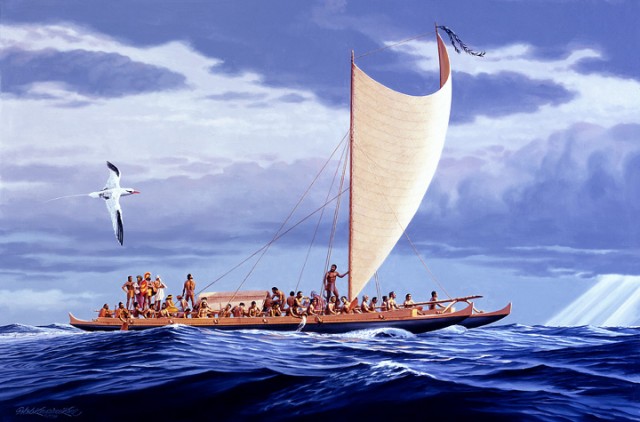
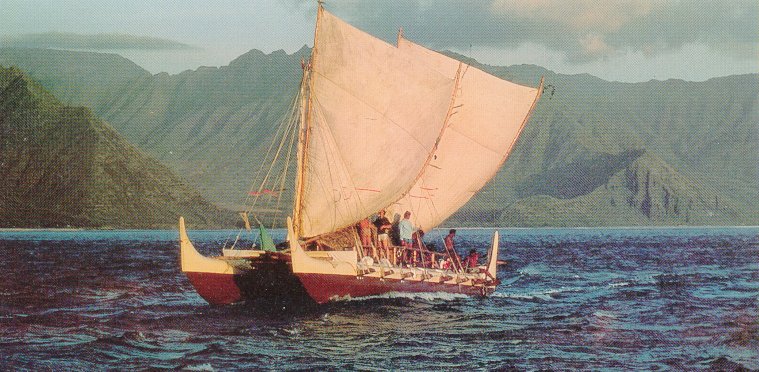
The map also shows the most probable route taken by the Polynesians to reach South America, via Easter Island. But now, let me tell you, East Island is far away from South America. It’s about 3,500 km far away. And on the other side it’s far away from other Pacific Islands. It’s about 3,600 km far away from the islands of French Polynesia, which are the closest biggish islands. Yet, the Polynesians sailed these vast distances – and not on some big comfy ship running on oil and crammed full with the latest navigation equipment but on a boat like this, powered by sail, and where they could only rely on their reading of stars, cloud formations, sea swells, and bird flight patterns to navigate.

polynesian ship

This picture clearly romanticizes the vessel. It must have been a cramped, dangerous voyage. Many times, the ships must have got lost at sea – James Cook writes of coming across a boatful of Polynesians in the middle of nowhere, who had been driven off course by a storm and were asking where they were.

This is a modern version of one of these ships, built in the 1970s,

modern polynesian ship

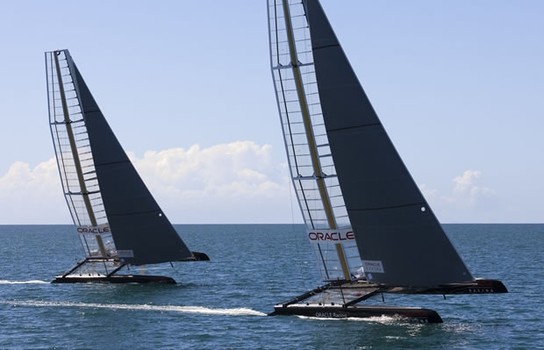
which clearly shows the unique aspect of their design, the use of two hulls. In fact, this design inspired modern ocean-going catamarans and eventually the truly amazing catamarans that now race in the America’s Cup.

image

These beauties can go up to 80 km/hr, but a more typical speed on a modern ocean going catamaran would be 15 km/hr. Doing a little maths here, it would therefore take a modern catamaran about 10 days to sail from Easter Island to South America. So if luck was with them, if the winds stayed steady and did not get too boisterous, if there were no nasty storms to drive them off course, the Polynesians probably would have had to last 10 days-two weeks out in the Pacific before hitting South America, which seems doable. Getting back, though, must have been considerably harder. I mean, on the way there, the Polynesians just had to hit South America, which is kinda big. On the way back, though, they would have had to hit these tiny specks in the ocean, specks which on top of it were much further away – taking the trade winds out of South America would have meant their having to aim for the French Polynesian islands for their first landfall, and these are 8,000 km away, or something like three weeks’ sailing if all went well.

But some Polynesians made it to South America and a few others made it back, with the sweet potato in tow. Because of these very skillful and very courageous sailors, I was looking at sweet potatoes in the market at Port Vila. No wonder I paused and smiled when I saw these not very tasty tubers.

______________

Port Vila market: https://scottmathiasraw.com/wp-content/uploads/2015/02/img_4446.jpg (in https://scottmathiasraw.com/vanuatu-welcomes-australian-raw-food-chef/)
Taro, Port Vila market: http://www.asiapacificnazarene.org/wp-content/uploads/s_Market-food.jpg (in http://www.asiapacificnazarene.org/five-months-post-cyclone-pam-vanuatu-recovering-thank-you-for-your-prayers-and-partnership/)
Sea grapes: http://photos1.blogger.com/img/164/977/1024/IMG_0110.jpg (in http://becksposhnosh.blogspot.com/2005/09/nama.html)
Sweet potato, Port Vila market: http://c8.alamy.com/comp/DFEN99/purple-colored-sweet-potatoes-in-a-basket-made-of-palm-leaves-on-a-DFEN99.jpg (in http://www.alamy.com/stock-photo-purple-colored-sweet-potatoes-in-a-basket-made-of-palm-leaves-on-a-61174997.html)
Map of spread of sweet potato in Pacific: http://www.pnas.org/content/110/6/2205/F1.large.jpg (in http://www.pnas.org/content/110/6/2205/F1.expansion.html)
Polynesian ship: http://cdn.arstechnica.net/wp-content/uploads/2013/01/kane_waa_small10-640×422.jpeg (in http://arstechnica.com/science/2013/01/polynesians-reached-south-america-picked-up-sweet-potatoes-went-home/)
Modern Polynesian ship: http://pvs.kcc.hawaii.edu/images/canoes/hokulea_circa_1975.jpg (in http://pvs.kcc.hawaii.edu/index/founder_and_teachers/nainoa_thompson.html)
America Cup boat: http://www.examiner.com/article/america-s-cup-event-authority-launches-new-sailing-simulation-app

REMEMBERING THE “OTHER RANKS”

Vanuatu, 11 November 2015

At this time when we are commemorating the end of the First World War (“the 11th hour of the 11th day of the 11th month”), I thought I could do my modest part to remember those who fell in that War, by recounting my English grandfather’s role in the conflict. It was not, I hasten to add, a heroic role. In fact, when all is said and done, it was very much less than stellar. But he tried to do his part to the best of his abilities and he regretted for the rest of his life that he was not able to have done more.

Until recently, I didn’t know much about my grandfather’s war record. My grandmother had a standard story which she trotted out to all her grandchildren, to the effect that he was a Captain in the Army, that he had gone to France in 1916 a few months after marrying her, that he had gotten food poisoning almost immediately, that he had been shipped home, and that a few months later he was invalided out of the Army. My father never talked about his father’s war record. The only thing I ever remember him saying was that my grandfather always got depressed at after-dinner sit-arounds in the living room when his peers began to tell stories of their days in the trenches, because he had not been there. That was the sum total of what I knew.

All of that changed a few months ago when, cruising the Internet, I stumbled across a cite to my grandfather’s War Office file, now in the UK’s National Archives. Much intrigued, I asked for, and received, a copy. The story it told, through the dry, matter-of-fact medical board reports, letters, and other bits and pieces which it contained, confirmed my grandmother’s tale. My grandfather went before three medical boards between July and November 1916, he couldn’t shake off the symptoms of whatever nasty bug it was that he had caught in France, and the Army eventually decided to let him go. But the papers in the file also told me some other things. They told me what battalion and regiment he had belonged to: the 11th (Service) Battalion of the South Lancashire Regiment, the St. Helens Battalion, so called because it had been raised in the autumn of 1914 in St. Helens, Lancashire, a gritty coal and heavy industry town not too far from Liverpool. They also told me when he had joined up. One of the pieces of paper in the file was his sign-up sheet, which showed that he had joined up in late October 1914, I suppose as part of that mad rush of volunteers which the first months of the War witnessed. Why he joined up in St. Helens is a bit of a mystery to me. He wasn’t from that part of England, and he was working in Wolverhampton, in the Midlands, when the War broke out. Perhaps it was easier to join up in St Helens than elsewhere; there are tales of huge queues at sign-up stations as literally millions of men tried to all join up at the same time.

In any event, by early October 1914, he was a 2nd Lieutenant in the 11th Battalion, part of Kitchener’s New Army. Of course, the Battalion wasn’t sent immediately to the Front. Since the UK didn’t have military service, unlike just about every other country in the War, very few men had any military training. So the new recruits of the 11th Battalion were subjected to a year of training, after which, in November 1915, they shipped out to the Western Front.

They went without my grandfather. At some point in the intervening year, he had become a Captain, and at the end of September 1915 he was made Commanding Officer of a new Battalion that was created, the 13th (Reserve) Battalion (I discovered this because of a little research done for me by the Lancashire Regiment Museum). Like all Reserve Battalions, it remained based in the UK and had the thankless but very important task of training up new volunteers (or conscripts by the middle of 1916) and of retraining men, who because of wounds or disease, had been taken out of the line for recuperation. My grandfather wasn’t in the new position for very long. By November, the Army had dragged some retired senior offices out of their retirement and they began running the 13th Battalion.

I lose track of my grandfather’s movements at this point. My guess is that he made his way back into the ranks of the 11th Battalion and was on his way to joining them when he fell sick in Rouen, before getting anywhere near the trenches, in the middle of July 1916. And that was the end of his military career. He might have regretted this twist of fate all his life, but I have to say it was lucky for me and my siblings, as well as for my numerous cousins. If my grandfather had made it to the Front, I don’t suppose he would have sired the children he eventually did sire – assuming he would have survived the holocaust of the Western Front in the first place.

If my grandfather had made it to the 11th Battalion in that July of 1916, he would have found himself caught up in the Battle of the Somme, which had already started on 1 July and finally petered out in November. As usual, the casualties were enormous (on the first day of the battle alone the British Army suffered its worst-ever casualties in one day of fighting: 570,000), although after intensive involvement in the first few days of July the Battalion played quite a modest role in the whole wretched affair. I should explain that it was not an infantry Battalion but a pioneer Battalion, which means that it spent most of its time on the Western Front digging trenches, maintaining roads, putting up Nissen huts, that sort of thing. Not a very glamorous job, but a necessary one. Thinking about it, it can’t have been coincidence that a Battalion raised in St. Helens was a pioneer Battalion. Most of the rank-and-file must have been miners since they made up the bulk of the local population, and who better than miners to dig trenches and fill shell craters in roads?

I found out what the Battalion did exactly when I came across the Battalion’s War Diary on the Internet. It gives you a fascinating picture of its day-to-day life at the Front, Company A off to dig this communications trench, Company B to fix that forward road, Company C to help the Royal Engineers do something else. All very humdrum, yet all the while a steady bleeding off of its troops was occurring, one man here, another there, a third the next day, no doubt as individual soldiers got hit by bullets, shrapnel, or other pieces of metal flying around the battlefield. From time to time, the numbers of men “killed in action” or “died of wounds” would spike, as it did in the first few days of the Battle of the Somme, as it did again in the third Battle of Ypres in 1917, and as it did for a final time during the last German offensive in the Spring of 1918, when the Battalion just happened to find itself in the way of the German attempt to punch a hole in the Allied line (it was during these desperate days of trying to hold the line that the Battalion earned its one and only Victoria Cross).

Armies, at least in those days, were made up of lots of rank-and-file commanded by a handful of Officers. So the great majority of the Battalion’s dead were “Other Ranks”, mostly privates, a sprinkling of corporals and lance-corporals, some sergeants, all poor lads who were doing their best under very difficult circumstances and who just happened to be in the wrong place at the wrong time. It wasn’t them who had precipitated this stupid, pointless War, but it was them who bore the brunt of the suffering. So it is them that I remember most particularly today, and not so much the Officer class to which my grandfather belonged.

INVASIVE SPECIES

Bangkok, 25 October 2015

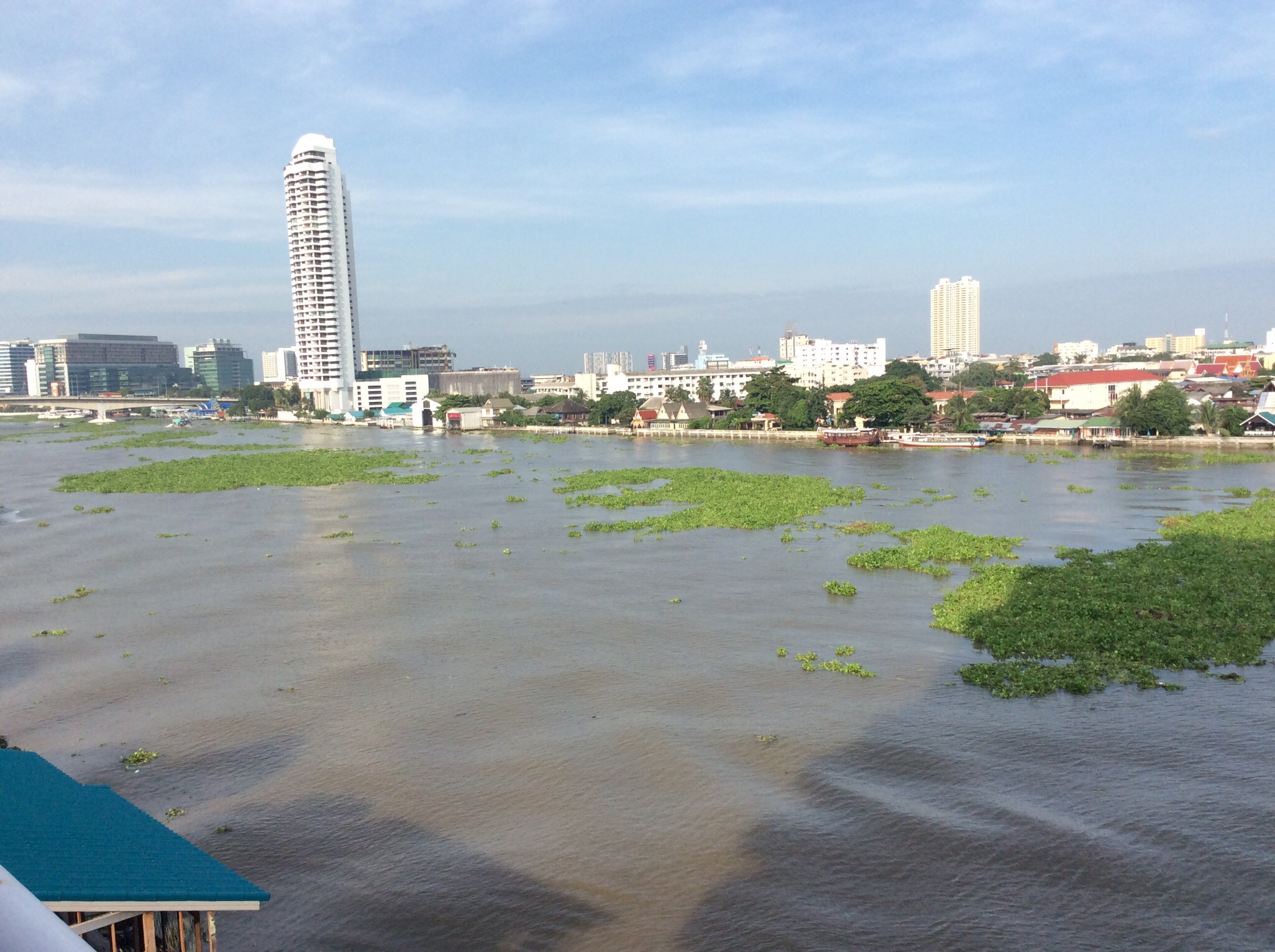
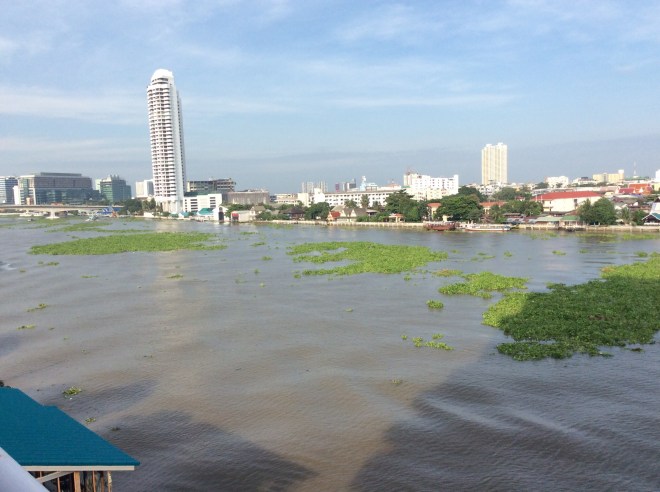
A few weeks ago now, my wife and I were greeted with this site when we came out for breakfast on our balcony overlooking the Chao Phraya River

image

image

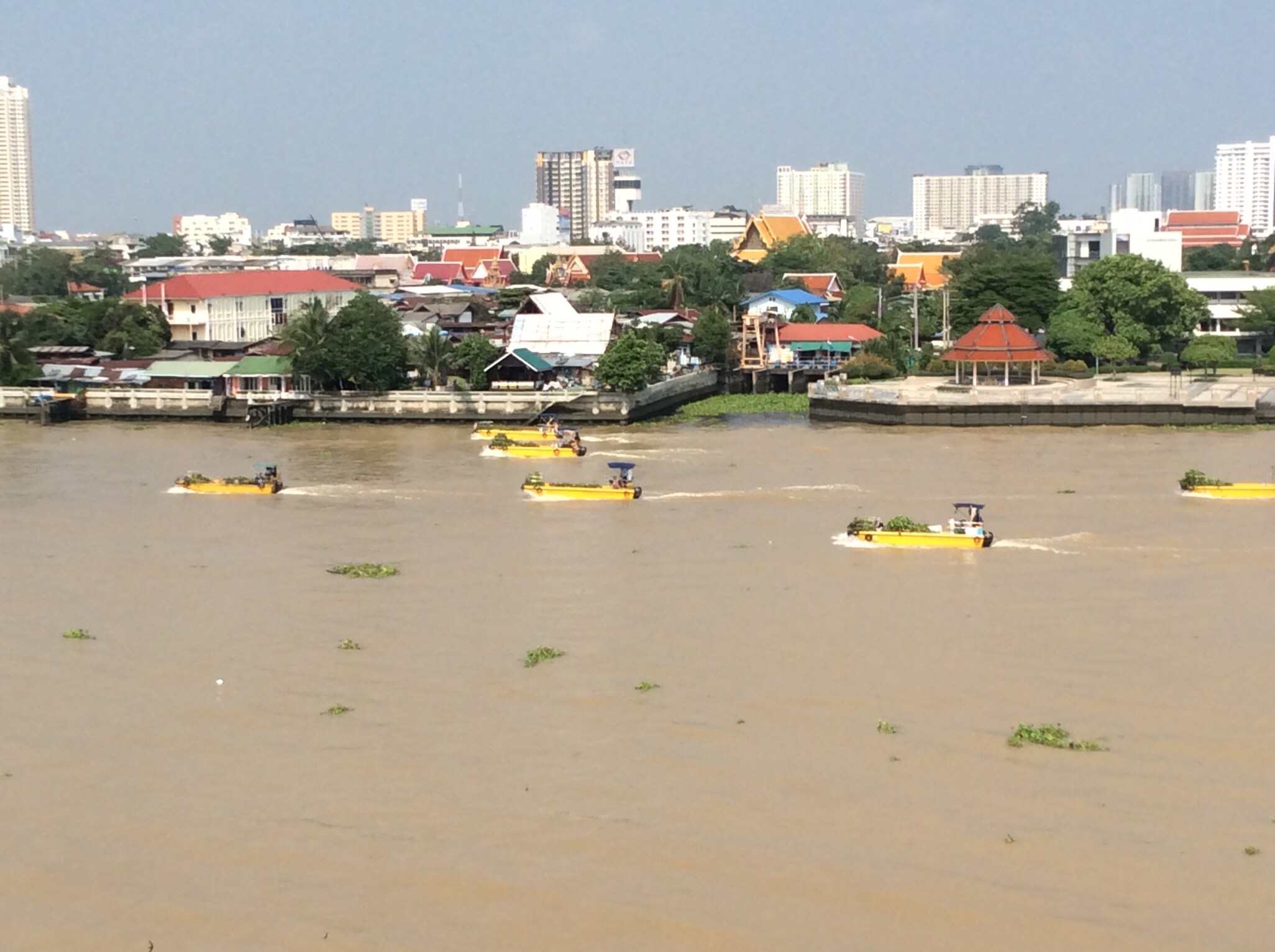
Huge mats – small islands, almost – of water hyacinth were floating by, on their way to the Gulf of Thailand. So big were they that they were interfering with the water buses as they zig-zagged across the river from pier to pier. They had to slowly push their way through the mats, rather like ice-breakers, to reach the piers and let off their passengers. As the days went by the mats got smaller, and now there are only clumps moving to and fro with the tide, some with a white egret perched on them going along for the ride. A flotilla of yellow boats went by yesterday morning loaded up with baskets full of water hyacinth.

image

They must be part of some collection system. Given the amount of the stuff floating in the river, it seems a doomed effort, more a way for the government to give jobs to the boys than to really clear up the river’s water hyacinth problem.

When we first arrived here a year ago, these mats of water hyacinth floating by were one of the things which had struck us about the river. Then, over the months, they had disappeared. We had almost forgotten about them when those huge mats greeted us at breakfast that morning of a few weeks ago. I suppose the seasonal rains had filled canals and reservoirs upstream enough for someone to open dykes and dams to relieve the pressure and in the process clear out the water hyacinths which had been quietly growing there all year.

Water hyacinth has a beautiful flower

Water hyacinth flower

which is why someone (or someones) took it out of its original habitat, the Amazon basin, and carried it off to botanical and private gardens around the world. But from there, the plant somehow made it out into the big wide world and happily colonized waterways which had never known it and had no biological weapons to combat it. It grows very rapidly and soon was choking up waterways, beautifully of course, but still choking the life out of them.

water hyacinth in flower in canal

Water hyacinth is considered an invasive species, that is to say, a species which is not native to a specific location and which has a tendency to spread in that new location to such a degree that it causes damage to the environment, to human health, and/or to the economy. That certainly describes the water hyacinth. It invaded the waterways of Louisiana and Florida in the late 19th Century, choking them up. In Africa, it’s invaded many places. It’s invaded the Nile, all the way from Sudan to Egypt. It invaded Lake Victoria in the 1980s (it was brought to Rwanda by Belgian colonists, who wished to beautify their properties, and then escaped into River Kagera, which led it to the lake). This is Kisumu harbour on the lake.

Kisumu Harbour Lake Victoria

In India, it has invaded the Kerala backwaters.

Kerala Backwaters

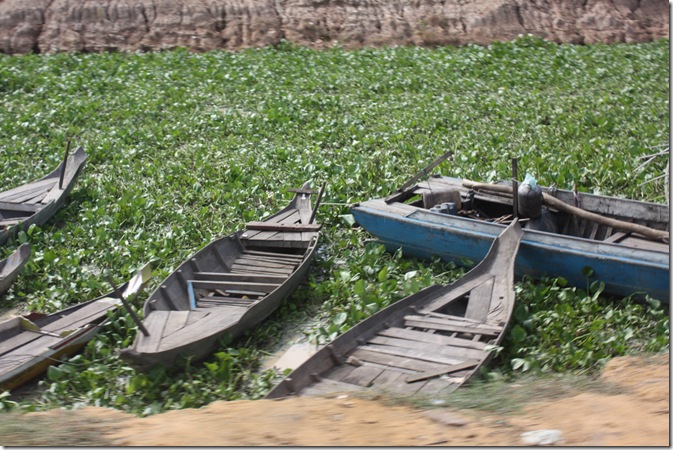
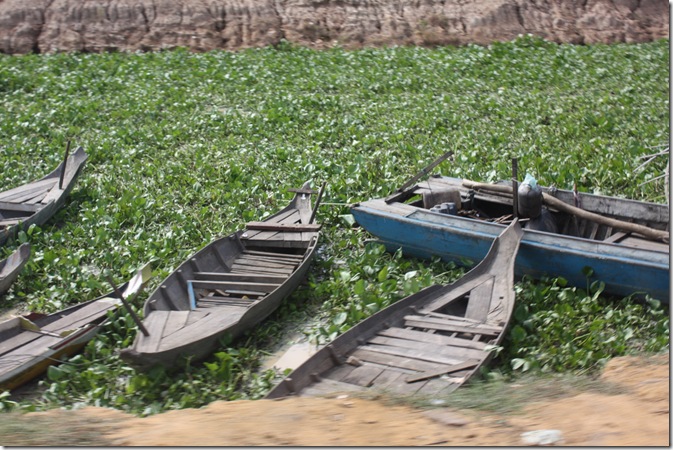
In South-East Asia, apart from the Chao Phraya River and many, many other places, it has invaded Tonlé Sap Lake in Cambodia, a lake with a very unique ecology.

tonle sap

If you don’t control it, water hyacinth will cover lakes and ponds entirely, as these pictures show. This dramatically impacts water flow, it blocks sunlight from reaching native aquatic plants, and it starves the water of oxygen, often killing aquatic species. The mats are also create great places for mosquitos to live, as well as a species of snail known to host a parasitic flatworm which causes schistosomiasis.

I am reminded of a beautiful but evil woman: shall we say Julia Roberts as Snow Queen?

julia roberts evil queenOK, to be gender-neutral let me also suggest a handsome but evil man: shall we say Robert Pattinson as Edward Cullen in Twilight?

Edward Cullen in Twilight

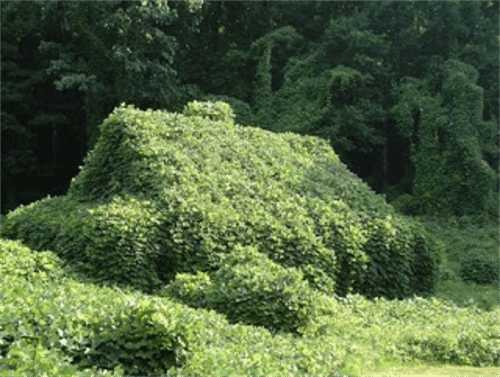
To be fair to water hyacinth, it is not the only invasive species by any manner of means. There must be hundreds if not thousands of species which are considered invasive in some corner of the globe. The International Union for the Conservation of Nature (IUCN) has come up with a list of the 100 worst invasive species, confessing that it had great difficulty in squeezing the list down to a mere hundred (although water hyacinth did make it onto the list). Reading the list is eye-opening and depressing. Let me make a relatively random selection of a few of them. Kudzu, which has been receiving a lot of bad press as an invasive species, is on the list, and if this picture of a house smothered by kudzu is anything to go by, with good reason.
kudzu

Originally from China, it was introduced to Japan, and from there to the US as an ornamental. Then during the 1930s farmers were paid to plant kudzu to combat soil erosion. Then it went crazy.

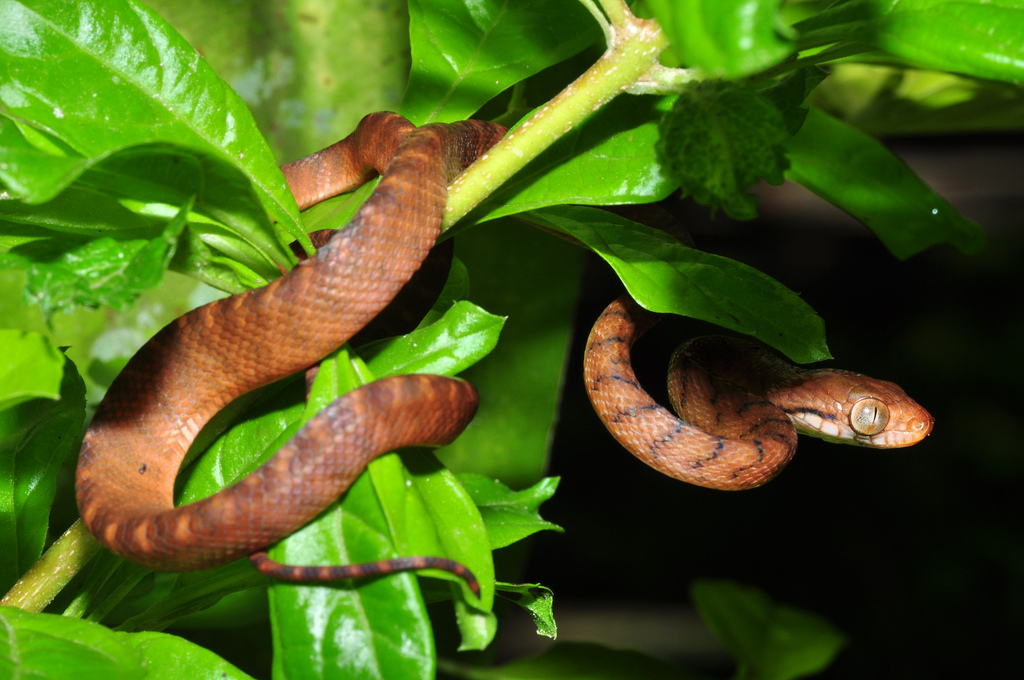
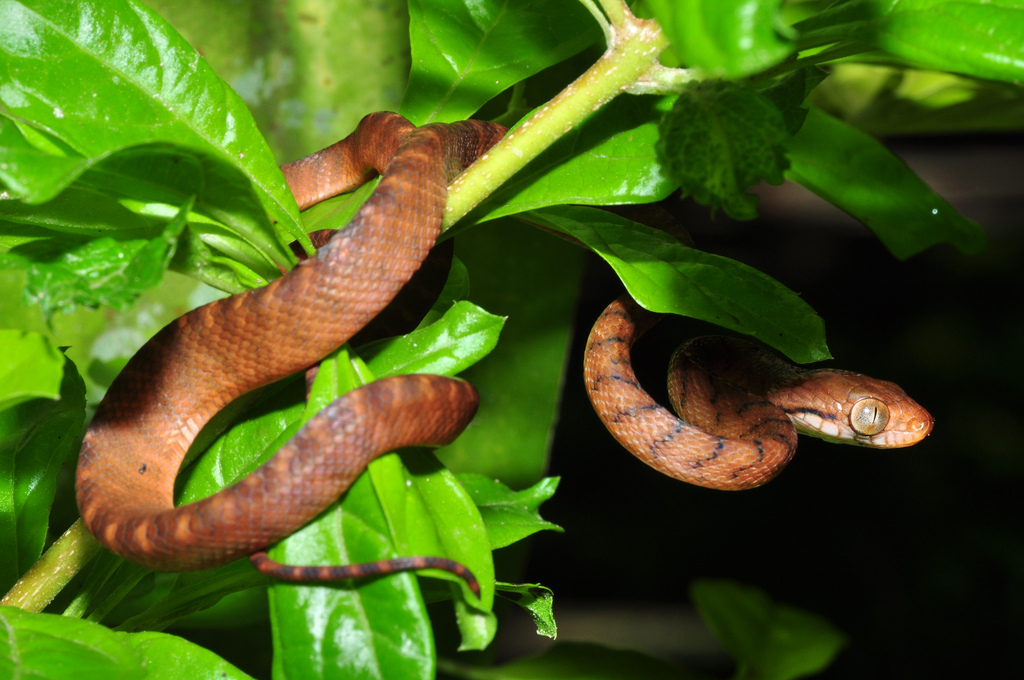
The brown tree snake, which has also received a lot of bad press as an invasive, is on the list too.

brown tree snake

Originally from northern Australia, New Guinea, and some of the nearby islands, it was accidentally introduced into the island of Guam in the late forties-early fifties, maybe by crawling into the landing gear of an aeroplane, maybe as a stowaway on a ship. Once on the island, it went crazy, decimating, and in some cases completely eliminating, certain species of birds and rodents. Since Guam is a big transport node, it’s highly possible that the snake will get carried to other islands in the Pacific.

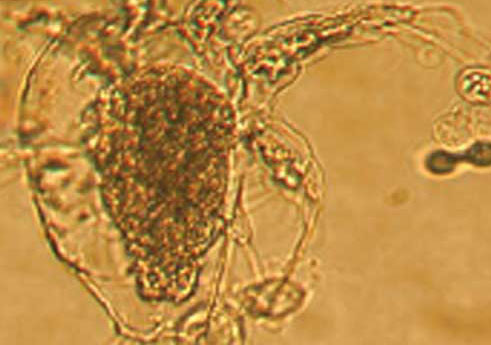
The fungus Batrachochytrium dendrobatidis, or Bd as it is known, is also there.

Batrachochytrium dendrobatidis

This little bugger has been wiping out frog populations all over the world, down to extinction in some cases. Only discovered in 1998, it’s thought that Bd originated in Africa and subsequently spread to other parts of the world by trade in the African clawed frog. Another fungus on the list is Ophiostoma ulmi sensu lato, better known as the fungus that causes Dutch Elm Disease. Originally from Asia, it somehow got into Europe in the early 1900s, probably in a shipment of Asian elm, but it was a mild form and was contained. From the Netherlands, it got into the US in the 1920s, through New York, where it has slowly but surely been killing off the North American elms. A much more virulent strain came back into Europe from the US in the late 1960s, probably in some infected wood, and has been killing off European elms ever since. This view of Salisbury Cathedral, for instance, painted by John Constable in 1820, is no more; the magnificent elms to the left have all died.

john constable salisbury cathedral

Closer to home, did you know that the cat is an invasive species?

cat

Well, it is in certain parts of the world like New Zealand or Australia, or even the US. European colonists brought them, they have gone feral – or they just hunt for the fun of it – and have decimated, if not obliterated, certain bird species, and continue to do so. It’s so bad that it has made in onto the list of the 100 worst.

Staying with the familiar, the goat – an aggressive “eating machine” – is on the list, as are the rabbit, the red deer, the fox, the starling, and the rainbow trout, all introduced into new habitats by European colonists to make the colonies more like home, and all causing damage to the new ecosystems they found themselves in .

Going small again, I pick a mollusk from the list, the cannibal snail.

cannibal snail

I pick it because it teaches us an important lesson in the fight against invasive species. The snail is an invasive in Hawaii, where it was originally introduced to try to eliminate another invasive species, the giant African land snail. Our friend is a fast and voracious predator, hunting and eating other snails and slugs, which gives it its pretty nickname. So the hope was that it would go after the giant African land snail. But instead, it went after the indigenous O’ahu tree snail species. And it went after them so enthusiastically that many of the species were extinct within a year. This is the risk with introducing a new predator to prey on an invasive species. There are chances that the predator will find other, indigenous, prey more yummy or simply easier to hunt, and you now find yourself with two invasives on your hands rather than one. Stoats, also on the list, fall into this category. Introduced into New Zealand to control the invasive rabbits and hares, it went after the indigenous birds instead, so now New Zealanders are left with trying to get rid of the stoat as well as the rabbit and hare.

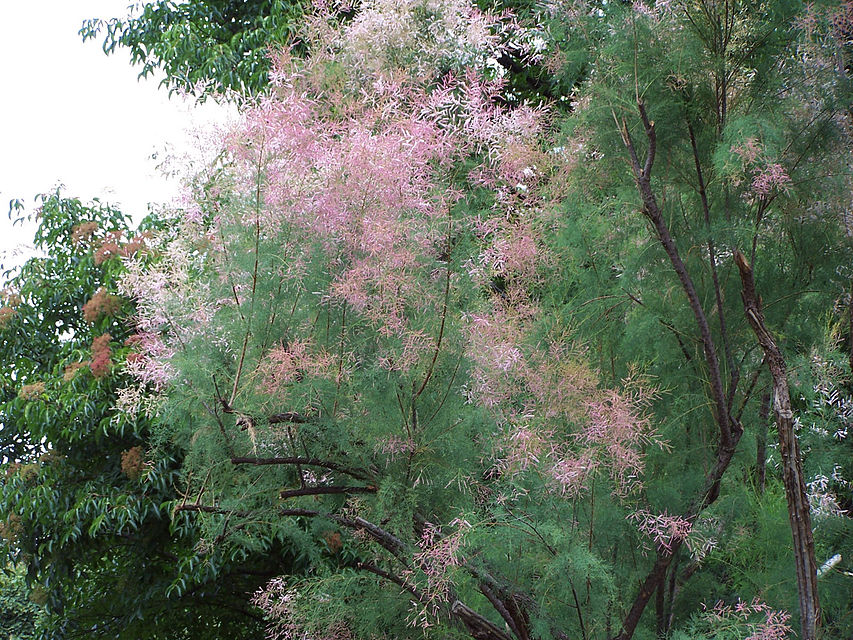
For another plant on the list, the prickly pear, I refer the reader to an earlier post which I wrote about it. I’ll finish with a small tree, the cedar tree.

cedar tree

I add it simply because my French grandmother had one in her garden, and I loved climbing it when I was small. It was OK for her to have it, it is native to Europe and Asia. But when this tree, with its lovely pink flowers and feathery leaves, was introduced into the Southwestern US it was a disaster.

I invite readers to look at the list. It is quite sobering. In fact, as I study it, it occurs to me that there is one horribly invasive species that is not on it: homo sapiens sapiens.

human familyThis species left its original home in Africa 70,000 years ago and slowly spread all over the world. In at least three places, Australia, North America, and much later New Zealand, its arrival seems to have triggered a massive die-off of the bigger indigenous fauna, probably because they didn’t have sufficient defences against its clever hunting habits. About two hundred and fifty years ago, the species started the so-called scientific and industrial revolutions, which have resulted in it now having unprecedented power over all other species. It has, for its amusement or to make money or to protect one of its enslaved species (its agricultural crops and its livestock) from predatory attack or simply by mistake, moved species around the world, creating all the ecological catastrophes I’ve touched on above. And because it is taking living space away from all other species, crowding them out much more effectively than the kudzu pictured above is, it has set off the greatest die-off of species that the planet has seen in the last 66 million years.

I really think it should be on the list. I must write to the IUCN suggesting it.

__________________________

Water hyacinth on the Chao Phraya River: my photos
Water hyacinth flower: https://upload.wikimedia.org/wikipedia/commons/5/56/Common_Water_hyacinth.jpg (in https://en.wikipedia.org/wiki/Eichhornia)
Water hyacinth in flower in canal: http://img.tamtay.vn/files/2008/02/25/dinhkhoa/photos/247869/48c4920a_a019_resize.jpg (in http://blog.tamtay.vn/entry/view/472876/Thang-Sau-Co-loai-ve-dai-dot-trot-vuong-vao-yeu.html)
Kisumu harbor, Lake Victoria: https://en.wikipedia.org/wiki/Eichhornia_crassipes#/media/File:Kenya_Kisumu_Harbour_Hyacinths_1997ke09b21.jpg (in https://en.wikipedia.org/wiki/Eichhornia_crassipes)
Kerala backwaters: https://en.wikipedia.org/wiki/Kerala_backwaters#/media/File:Kerala-Backwaters_Alppuzha.JPG (in https://en.wikipedia.org/wiki/Kerala_backwaters)
Tonlé Sap: http://lh3.ggpht.com/-KcgJUhcsvQU/UE2G1p3L3GI/AAAAAAAAJl8/0bHMUxxUTAg/IMG_3439_thumb2.jpg?imgmax=800 (in http://jemamum.blogspot.com/2012/09/chong-kneas-floating-village-lake-tonle.html)
Julia Roberts snow queen: http://i.dailymail.co.uk/i/pix/2011/10/07/article-2046339-0E455A1E00000578-532_634x832.jpg (in daily mail; exact site is blocked by the Thai Ministry of Information)
Edward Cullen in Twilight: http://celebspics.org/wp-content/uploads/2012/11/05-Twilight%E2%80%99s-Breaking-Dawn-Part-2-The-Complete-Character-Gallery.jpg (in http://celebspics.org/twilights-breaking-dawn-part-2-the-complete-character-gallery/)
Kudzu: http://41.media.tumblr.com/d6bc26739854ba64e2b54c06a1993889/tumblr_ns2cl4QrQZ1r8vrhxo1_500.png (in http://sleepy-times.tumblr.com/)
Brown tree snake: http://islandarks.com.au/files/2013/03/Brown-Tree-Snake-.jpg (in http://islandarks.com.au/tag/brown-tree-snake/)
Batrachochytrium dendrobatidis: http://www.diark.org/img/species_pict/large/Batrachochytrium_dendrobatidis_JAM81/ (in http://www.diark.org/diark/species_list/Batrachochytrium_dendrobatidis_JAM81)
John Constable Salisbury Cathedral: https://en.m.wikipedia.org/wiki/Dutch_elm_disease#/media/File%3ASalisburyCathedral.jpg (in https://en.m.wikipedia.org/wiki/Dutch_elm_disease#Disease_range)
Cat: http://i1251.photobucket.com/albums/hh554/lemabang2008/Desktop%20Wallpaper/Cats%20Wallpaper%202/wildcat.jpg (in https://lemabang.wordpress.com/2012/08/19/desktop-wallpapers-2/)
Cannibal snail: https://en.m.wikipedia.org/wiki/Euglandina_rosea#/media/File%3AEuglandina_rosea.jpg (in https://en.m.wikipedia.org/wiki/Euglandina_rosea)
Cedar tree: https://en.m.wikipedia.org/wiki/Tamarix_ramosissima#/media/File%3ATamarix_ramosissima_a2.jpg (in https://en.m.wikipedia.org/wiki/Tamarix_ramosissima)
Human family: http://thumbs.dreamstime.com/z/family-sitting-garden-together-15588689.jpg (in http://www.dreamstime.com/royalty-free-stock-images-family-sitting-garden-together-image15588689)


A STUDY OF FEET

Bangkok, 19 October 2015

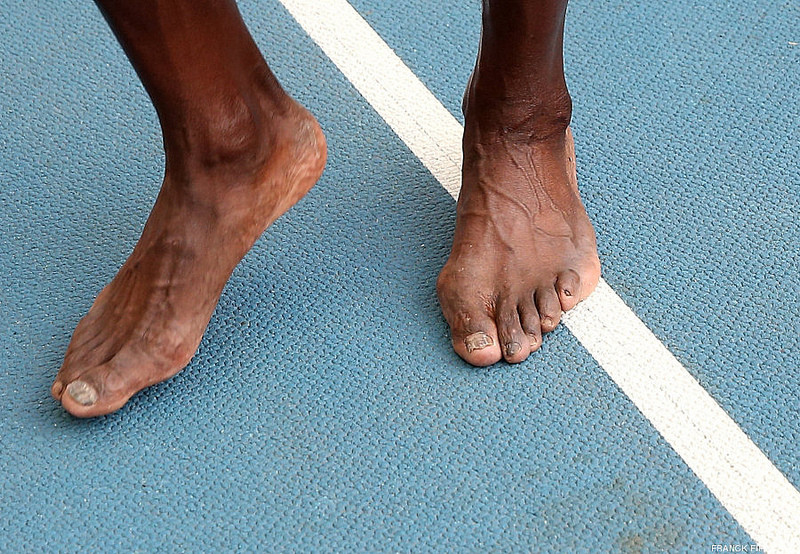
One of the interesting side-effects of living in Bangkok is that I can carry out a comprehensive study of feet. The climate here is such that the wearing of open footwear is exceedingly widespread, so I can examine – surreptitiously, of course – a very large number of feet as I walk around, sit in public places, or – as was the case when I started this post – sit in buses stuck in Bangkok’s perennially dreadful traffic. Since so many foreigners come to Bangkok, the study is very cross-cultural: I study not only the feet of the Thai, but also – judging from the shards of phrases I overhear as the foreigners walk by – Australians, Europeans of all stripes, North Americans, some Latin Americans, quite a number of Middle Easterners, a sprinkling of Africans, and of course Asians from every corner of Asia. I am now ready to report back on the findings of my study.

Let us first set the benchmark against which I can compare the feet I see. This would be a foot in its natural state, that is to say a foot that is perennially shoeless. This photo, which I’ve used before, gives an excellent example. What we have here is a band of Amazonian Indians who are coming into contact with the modern world for the first time. Their astonished and somewhat fearful faces upturned towards the helicopter (I guess) are fascinating, but I would invite the reader to focus on their feet, feet which have never been shod.

amazonian Indian feet

As the readers will quickly agree, these feet are in the state that most human feet have been in for 99.99% of the time we have inhabited this planet.

I throw in here an older photo, taken – no doubt by some amateur anthropologist – to deliberately show a natural foot. And of course it has to be an old photo, because wearing shoes is probably now the norm rather than the exception. Finding a foot nowadays which has never been shod must indeed be hard.

natural and baby feet

Note the way the toes in the natural foot, especially the big toe, are splayed out. A minute’s thought will show that of course this is the way it should be. By spreading out like that, toes are giving the foot a wider footprint and therefore making it easier for the person on top of those feet to balance.

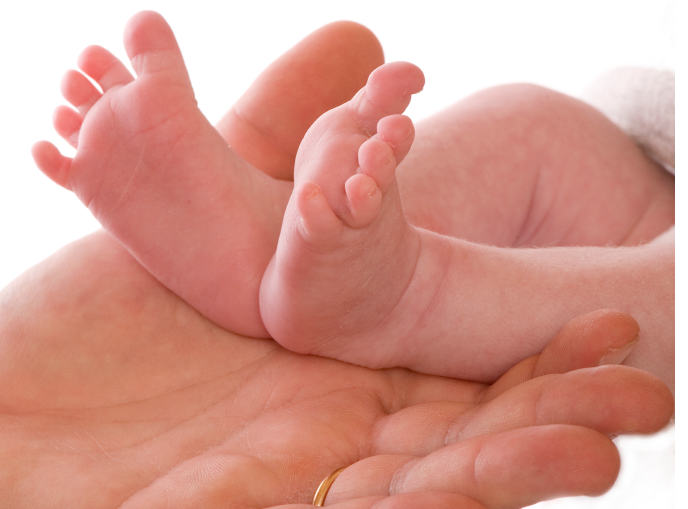
In this photo of a baby’s feet, the reader will notice that they naturally take this splayed form

baby feet

Only later, through imprisonment in shoes, do the toes come closer together

feet with toes close

sometimes too close together.

toes too close

I am reminded of TS Eliot’s poem Animula, which tracks the evolution of a person’s soul from birth to adulthood, but which actually describes very well the fate of our feet: “‘Issues from the hand of God, the simple soul’ …Issues from the hand of time, the simple soul … misshapen, lame, unable to fare forward …”.

But back to the matter in hand. Having set the benchmark, I can now report the results of my pseudo-sociological field experiment in the streets and other public spaces of Bangkok.

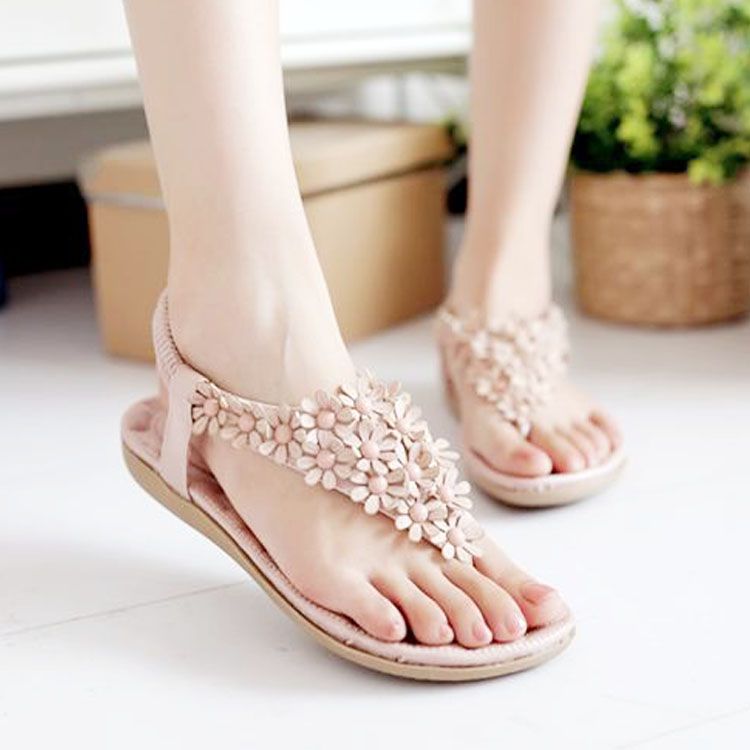
Generally speaking, the feet of Thai people look in considerably better shape than those of foreigners from “civilized” countries. A good number have quite splayed toes, fruit no doubt of hardly ever wearing shoes at home. In fact, it’s quite common to see their little toes falling off their flip-flops or sandals. Clearly, the basic “chassis design”, if I can put it that way, adopted by shoe manufacturers simply ignores the natural form of the foot with splayed toes. Shoe manufacturers take as their starting point an already somewhat malformed foot. Well they would, wouldn’t they? After all, it is their products which have malformed out feet in the first place. Other Thais have moderately straightened toes, fruit of some level of constriction by shoes.

thai girl's feet

I detect a social element here. It is clear from their dress and occupation that the Thai owners of feet whose toes are splayed come from the poorer strata of society, while those with feet with straight toes come from the richer ones. And I also detect a gender element. Young Thai women show more evidence of constricted toes than do the men. I will come back to this in a minute.

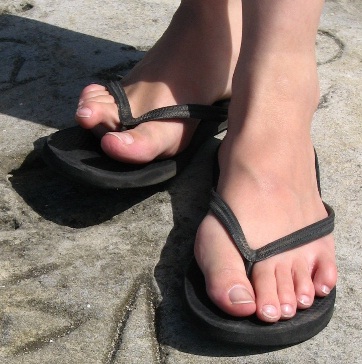
As for the feet of the foreigners, those of people from more developed, richer, more “civilized” countries show toes much more tightly squeezed together

white feet in flip flops

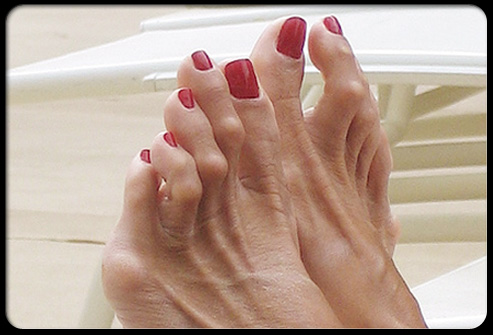
along with more extreme signs of foot distress: bunions

bunions

hammer toes

hammer toes

calluses and corns.

Like in the case of the Thai, women’s feet seem more malformed than men’s. Which gets us of course to the cause of all these foot problems: canons of accepted (feminine) beauty.

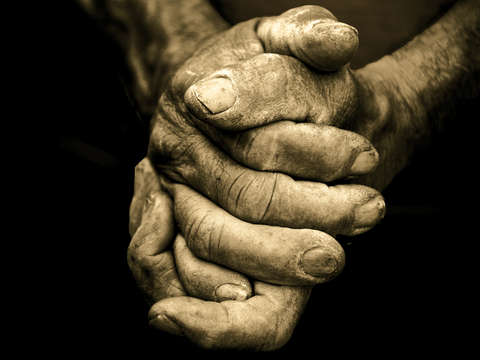
Let’s face it, for hundreds if not thousands of years, there has been this insidious idea that those members of society who are more civilized, more refined – and richer – have delicate (for women) or well proportioned (for men) limbs and features. Hands, of course, have always been a particular object of this odious social creed, because having big hands, and especially having big fingers, meant that you were poor and so did a lot of manual labour.

If you were rich, on the other hand, you could pay people to do your manual labour for you, leaving your hands and fingers slim.

slim hands

With feet, it must have been a little different. Like grand clothes, the fact that you wore shoes showed that you had money to burn, not like that bum on the street who had to run around in his bare feet all day. And of course, slim, petite, shoes (that is to say, narrow, horribly constricting, shoes) showed (or pretended to show, since your feet were actually squashed into the shoe) that you had slim, petite, feet, not broad feet like that bum on the street etc.

Woman's_silk_brocade_shoes_1770s

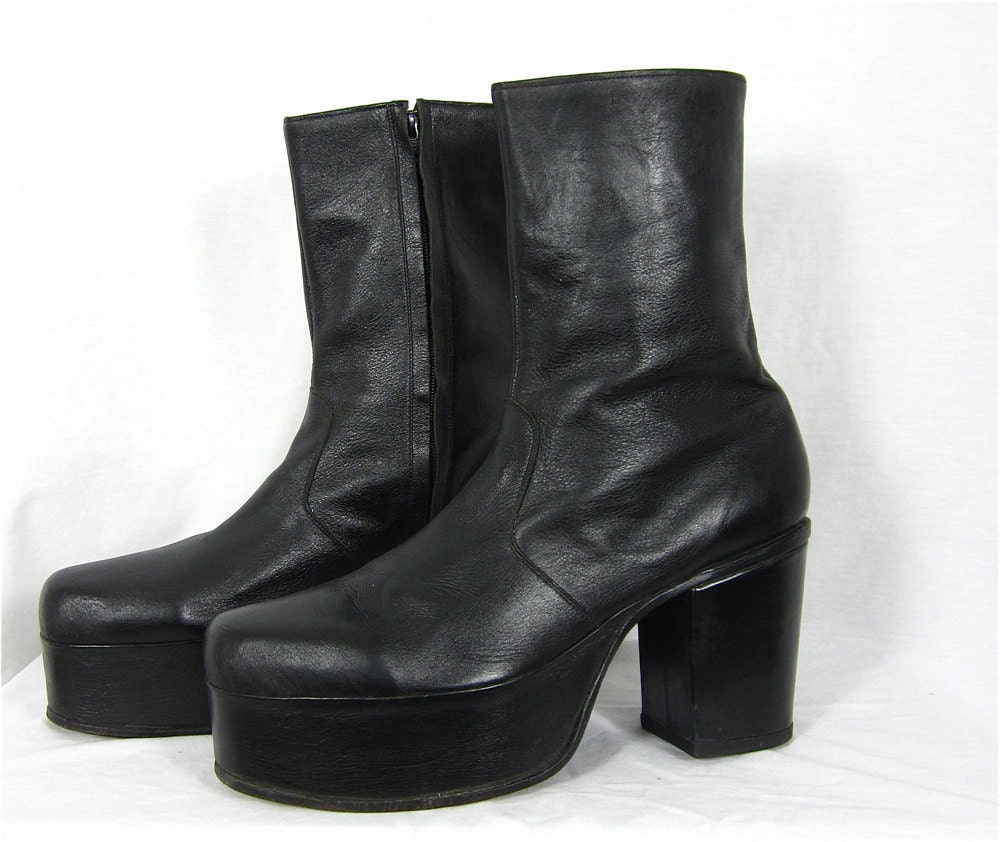
This last pair of shoes, with their modest heels, allows me to segue smoothly into that terrible habit of wearing high-heeled shoes. As we all know, it’s mostly women who wear them, but men do too, depending on the state of fashion. I am ready to reveal at this time that when I was young and foolish I went through a phase of wearing platform boots, one black pair and one brown, which looked like this.

platform shoes

Apart from feeling pretty cool as I walked around Uni, I found a most satisfying side-effect to be that I was taller. No doubt that’s one reason why women do this to their feet

high heels

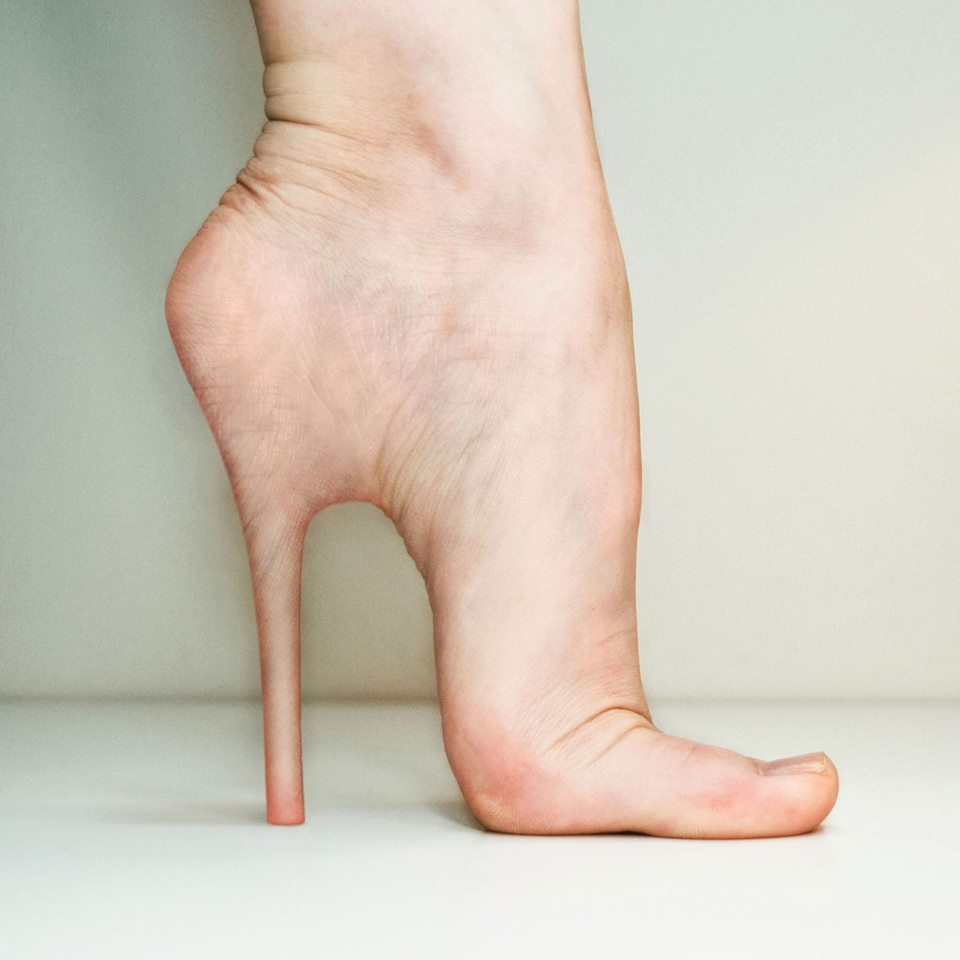
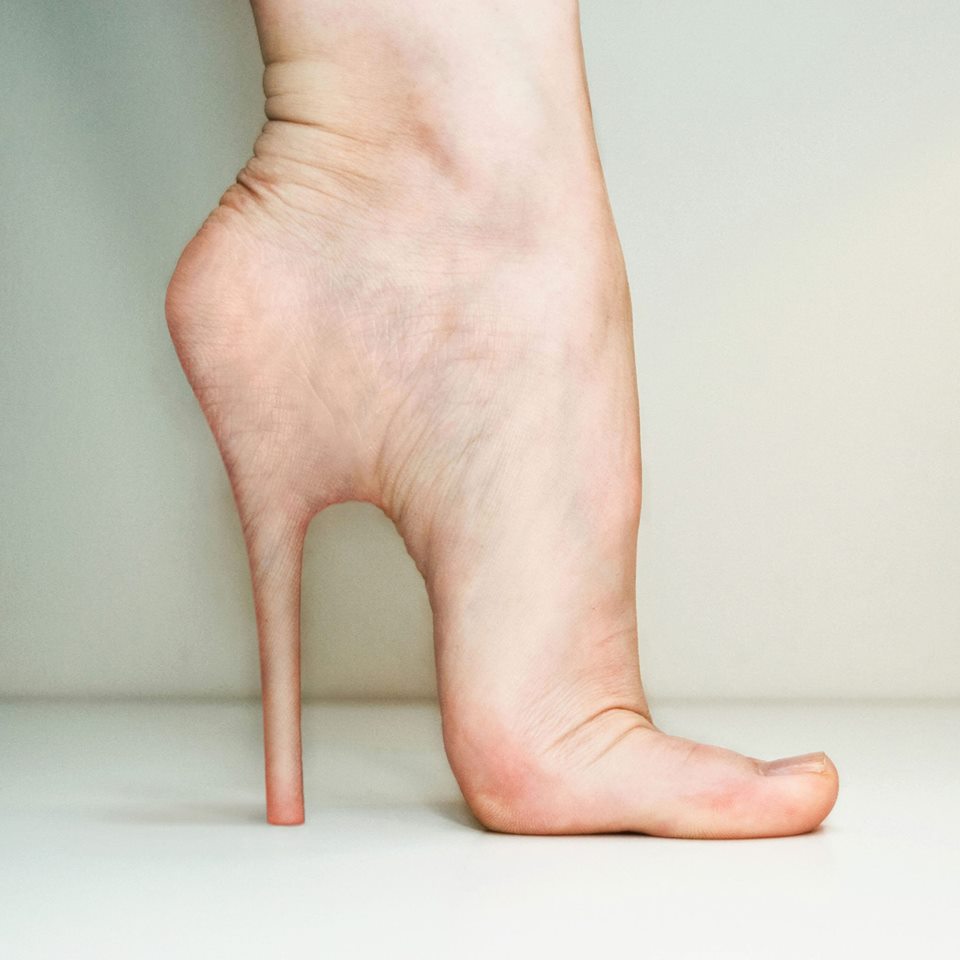
which when you strip away the shoe looks like this.

foot in high heel position

Modest heels I could understand. I mean, I fell for them. But why subject yourself to the pain of excessively high heels, not only a pain that comes today but also a pain that dogs you for years to come? Because men still rule the world, and they like to see the accentuated swish in a woman’s gait caused by walking in high heels, or maybe they like the fact that her legs look longer, or that her feet look smaller, or her toes shorter, when wearing heels. Or maybe it makes women take smaller steps, to avoid falling over (my wife still remembers her father exhorting her to take small steps, because that was more ladylike and refined). Or maybe because it makes men feel strong to see women tottering around on heels, not able to walk very far before complaining of sore feet and needing help.

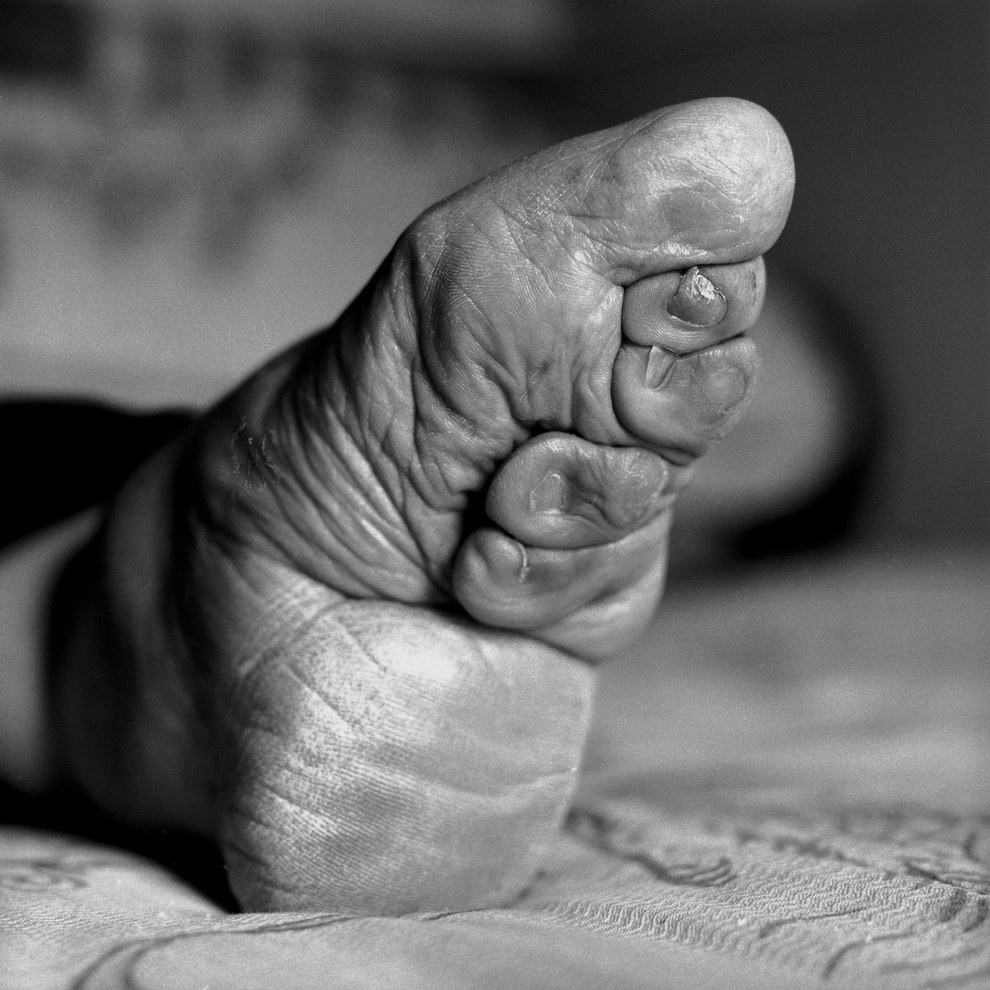
Fanciful? Perhaps. But consider this. For nearly one thousand years, from early in the Song dynasty, about 1000 AD, to the early 20th Century, many Chinese women were subjected to the unbearably painful process of foot binding. To appreciate the full horror of this practice, let me give the readers a quick summary of what girls were subjected to. The process was started when girls were between the ages of 4 and 9, that is, before the arches of their feet had had a chance to develop fully. First, after softening the feet and cutting back the toenails, the toes of each foot were curled under and then pressed with great force into the sole of the foot until – the – toes – broke. But it didn’t finish there. While the broken toes were held tightly against the sole of the foot, the arch of the foot was also broken so that the foot could be drawn down straight with the leg. So you basically smashed the little girl’s feet. Then you started the binding. The idea was to pull the ball of the foot ever closer to the heel, causing the broken foot to fold at the arch, and pressing the toes underneath the sole.

As the readers can imagine, a girl’s broken feet required a great deal of care and attention if she was not to die from this process; it is estimated that 10% of girls died from gangrene and other infections due to foot binding. So their feet were regularly unbound, they were washed, the toes unfolded and checked for injury, and the nails carefully trimmed. The broken feet were also kneaded to soften them and the soles of the girl’s feet beaten to make the joints and broken bones more flexible. Then the poor girl’s broken toes were folded back under and the feet rebound. Every time the feet were rebound, the bindings were pulled even tighter. The ideal was to end up with a “foot” no more than 10 cm long.

The Chinese are nothing if not eminently practical. Recognizing that mothers might well be too sympathetic to their daughters’ pain, it was generally an older female member of the family or a professional foot binder who carried all this out. Oh, and the process was usually started during the winter time since girls’ feet were more likely to be numb from the cold, and therefore the pain would not be as extreme. How nice of them.

This was the result:

crushed bound foot

Chinese lady with bound feet

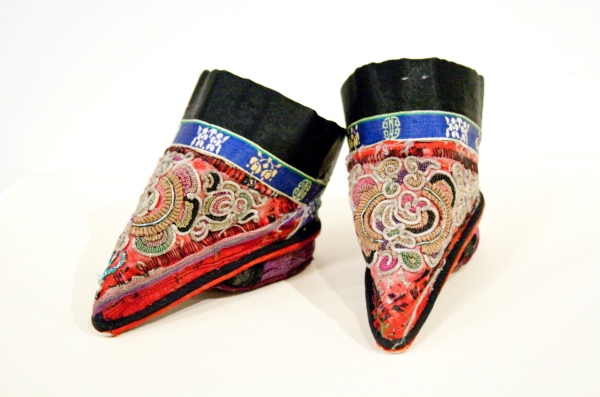
Of course, no-one except the persons caring for the feet ever saw this. What they saw was this, these oh-so dainty little shoes.

Lotus-ShoesAnd why were Chinese women subjected to this horrible procedure for a thousand years? For beauty, of course. Men ruled China (they still do), and crazy as it might sound to the modern reader, men considered bound feet to enhance a woman’s beauty by making her movements more dainty and “ladylike”. As readers can imagine, it was difficult to walk on broken feet. Women with bound feet tended to walk predominantly on their heels. As a result, they walked with a cautious, unsteady gait, taking tiny, swaying steps. And, of course, that most important thing where women were concerned, well bound feet helped her parents contract a good marriage for her. It could also be that it was found to be an effective way of forcing women to be housebound and completely reliant on men. In this view, traditional societies forbid women from leaving the house; the Chinese simply broke their feet.

So what is the moral of all this? Look after your feet! Stop obsessing about narrow, dainty feet. Celebrate splayed toes. Go to the office in flip-flops and take off your shoes the moment you sit at your desk (which is what most Thais do). Put on sandals until the dead of winter; our feet can tolerate quite a lot of cold. Throw away all your high-heeled shoes. And if a man ever asks you to wear high heels, cut him mercilessly out of your life; he is clearly a swine.

_____________________

Amazonian Indian feet: http://birthdayshoes.com/media/blogs/bdayshoes/2013_Photos/.evocache/human_feet_look_like_if_you_never_wear_shoes.jpg/fit-640×540.jpg?mtime=1386261566 (in http://birthdayshoes.com/what-a-natural-human-foot-looks-like-if-you-never-wear-shoes)
Natural human feet: http://origin.ih.constantcontact.com/fs096/1102283092773/img/101.jpg?a=1102864935304 (in http://www.sukiebaxter.com/could-your-feet-be-the-source-of-that-pain-in-your-neck)
Baby feet: http://naturalrunningcenter.com/wp-content/uploads/2012/02/Screen-shot-2012-02-26-at-5.30.11-PM.png (in http://naturalrunningcenter.com/2012/02/27/enhancing-natural-pronation-control-feet-designed-that/
Feet with toes close: http://www.guide2health.net/wp-content/uploads/2012/08/bare-feet.jpg (in http://www.guide2health.net/2012/08/life-long-immunity-to-disease/bare-feet/)
Feet with toes too close: http://i.imgur.com/aURQcnm.jpg (in http://www.inquisitr.com/931111/lebron-james-feet-picture-of-stars-messed-up-toes-goes-viral/)
Thai girl’s feet: http://www.zeefashionstore.com/ProductImage/18391/1.jpg (in http://www.zeefashionstore.com/womenshoes.php?brand=79&section=6)
White feet in flip-flops: http://blog.diagnosticfootspecialists.com/wp-content/uploads/2014/04/flip-flops.jpg (in http://blog.diagnosticfootspecialists.com/)
Bunions: https://upload.wikimedia.org/wikipedia/commons/c/ce/Hallux_Valgus-Aspect_pr%C3%A9_op_d%C3%A9charge.JPG (in https://en.wikipedia.org/wiki/Bunion)
Hammer toes: http://images.medicinenet.com/images/slideshow/diabetes_foot_problems_s13_hammertoes.jpg (in http://www.medicinenet.com/image-collection/hammertoes_picture/picture.htm)
Working hands: https://scpeanutgallery.files.wordpress.com/2015/02/working-hands.jpg (in http://scpeanutgallery.com/2015/02/04/morning-prayer-4-feb-heb-124-7-11-15-mk-61-6-get-a-grip/)
Slim hands: http://hoocher.com/Agnolo_Bronzino/Portrait_of_Lucrezia_Panciatichi_ca_1540.jpg (in http://hoocher.com/Agnolo_Bronzino/Agnolo_Bronzino.htm)
Woman’s shoes 1770: https://upload.wikimedia.org/wikipedia/commons/2/20/Woman’s_silk_brocade_shoes_1770s.jpg (in https://en.wikipedia.org/wiki/1775%E2%80%9395_in_Western_fashion)
Platform boots: http://img3.etsystatic.com/000/0/5381238/il_fullxfull.291560419.jpg (in http://galleryhip.com/platform-shoes-for-men.html)
High heels: http://www.glamour.com/images/fashion/2013/08/heels-w724.jpg (in http://www.glamour.com/fashion/blogs/dressed/2013/08/check-out-this-3d-scan-of-what)
Women in high heel position: http://www.tellwut.com/uploads/media/image/12607e1398914701o270.jpg (in http://katherincruikshank.blogas.lt/tag/hammer-toes)
Crushed bound foot: http://www.buzzfeed.com/hayleycampbell/lotus-feet#.vj027qN6E (in http://www.buzzfeed.com/hayleycampbell/lotus-feet#.eegdQJg3y0)
Chinese lady with bound feet: https://en.wikipedia.org/wiki/Foot_binding#/media/File:A_HIGH_CASTE_LADYS_DAINTY_LILY_FEET.jpg (in https://en.wikipedia.org/wiki/Foot_binding#Variation_in_practice)
Lotus shoes: http://www.top5ives.com/wp-content/uploads/2012/09/Lotus-Shoes.jpg (in http://www.top5ives.com/top-5-most-weird-shoes-in-history/)