OUR ZIEGLER-TYPE CARPET

Vienna, 7 July 2017

About six months ago, my wife suggested that we should get a carpet for our living room in Vienna. She felt that it would soften the room, taking the edge off the hard wooden floor – and covering some ugly marks on that same floor. It so happened that the Dorotheum Auction House, one of my favourite places in Vienna, a place I haunt whenever I’m in town and where I have parted with several largish banknotes for various objects over the years, was holding one of its regular carpet auctions.

Having armed ourselves with the auction’s catalogue, we poured over its pages and selected several promising candidates. They all tended towards the big size, my wife having persuaded me that we should try to cover as much of the floor as possible. We then proceeded to the Auction House itself to inspect our choices – I always pity the poor fellows who have to labour through those stacks of heavy carpets to get to the one you want to look at. In any event, surrounded by would-be bidders doing the same thing, we solemnly looked our choices over. I for one was somewhat self conscious about this since I had no real idea what to look for other than to see if we liked the colour combinations and the feel. But we managed to look as if we knew what we were doing. In the event, we plumped for one of our choices, and then waited for the auction day.

On the big day, we filed into the auction room. My wife does the bidding, I’m too nervous about the whole thing, terrified that I will make a false move and find myself landed with some horror and being required to pay a stellar price for it. She had her paddle at the ready as the auctioneer moved with brisk efficiency through the lots. Our chosen lot came up on the screen, the auctioneer opened the bids, and quick as a flash my wife’s paddle went up for the minimum bid. We were confident we would get it at that price since most of the earlier lots had not gone beyond the minimum, but alas! this time someone else’s paddle went up hot on the heels of my wife’s. The bid climbed inexorably, and we regretfully threw in the towel.

Rather glum about it all, we went back to the unsold lots. There had been another carpet which had taken my wife’s fancy but which I had not been sure about. It had not been sold, so we had another look. After some to-ing and fro-ing, especially on my part – it seemed very big, and the colours were a bit on the pale side – we decided to go with it. Here is the picture of it from the auction catalogue.

A few days later, two men huffed and puffed it up the stairs and into our apartment. We laid it out and I had a moment of panic about its size. It’s 4.90 by 3.80 metres (16 by 12.5 feet, for readers still on British units), so a fair good size. Had I measured the room right?! But all was good; it fit – snugly, but it fit.

No sooner had the two men put it down than two other men came and took it away, huffing and puffing their way back down the stairs. They were Iranian; in the intervening days, we had discovered a carpet shop around the corner, run by a small Iranian who – so we discovered as we chatted with him – had escaped from Iran during the 1979 revolution. Since he also cleaned carpets, we decided to have ours cleaned before laying it down permanently.

Now in place, cleaned and ready to do its job for the next twenty years or so, I’m truly glad we bought it. It really lights up the room. Its paleness, which had led me to hesitate initially, is actually a good thing – too much colour in such a big carpet would have overwhelmed the room. The dark red border gives just enough of a splash of colour. The relative emptiness of its design is also good. Again, if it had been too busy, it would have overwhelmed the room.

My wife and I are currently spending a lot of time staring at that carpet from very close range. As part of our summer campaign to lose weight, we do an exercise routine (almost) every day, faithfully following a series of fitness videos my wife has found on the internet. As we do burpees, planks of various descriptions, bridges, and I know not what else, we get to stare close up at the carpet. In my case at least, given my predilection for all things historical, it has led me to wonder about its history. After some research I am ready to report.

The auction catalogue had informed us that the carpet had been manufactured in the 1990s in Egypt. So the carpet itself is not old, which is just as well since we wouldn’t have been able to afford anything remotely antique. But is the design perhaps an ancient Egyptian design? The answer is no. Egypt has very little history of carpet making. After a moment of glory in the 16th Century, whatever it had shriveled away and was only resurrected in the 1950s after supplies of carpets from Iran, the traditional source, dried up – no doubt the result of soured relations between the two countries after Nasser’s left-wing takeover in Egypt and the CIA-backed coup in Iran which brought the right-wing Shah Pahlavi to power. But the Egyptians just made copies of Iranian designs and as far as I can make out has continued in this tradition ever since. In fact, the auction catalogue described the carpet’s design as “Indo-Persian”.

So do we have here a traditional Iranian design? Again, the answer is no, and here it becomes interesting. It seems that the Iranian carpet industry was actually started by Europeans. The demand back in Europe was far outstripping the very artisanal production in Iran, so various European companies stepped in to bring a certain level of industrialization to the country’s carpet makers. One of these was an Anglo-Swiss company by the name of Ziegler, which set up shop in Sultanabad in the 1870s. It was one of the company’s Sultanabad managers who came up with very non-Oriental carpet designs for their Iranian carpets which later came to be known as Ziegler carpets: “large, simplified designs of a languorous nature … featur[ing] whimsical draughtsmanship [with] quite deliberate distortions introduced to break up the monotony of a repeating design”, the whole with a light palette of colours.

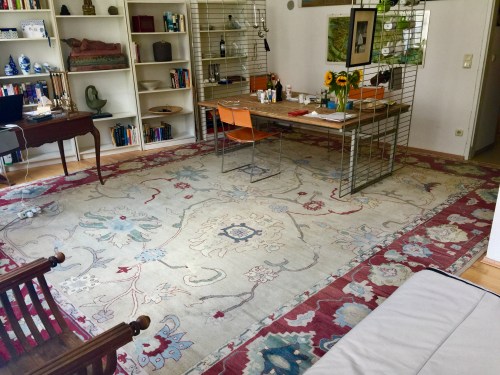
As the first photo attests, these are all design elements found in our carpet: the long tendrils of flowers and other vegetation languidly weaving their way across the carpet surface, a relatively simple design with plenty of open space, light colouring, no obvious axis of reflection in the design. So I pronounce our carpet to be a Ziegler-type carpet (not an original Ziegler carpet, our pockets are not deep enough for that). It seems that after a certain period of popularity Ziegler carpets went out of fashion, their non-Oriental looking designs being looked down on. Then, as usual, there was a resurgence of interest in, and use of, Ziegler designs in the 1980s. I put our carpet’s production down to that.

The carpet has an Arabic inscription woven into its border, something we discovered just recently.

I took this photo to our Iranian carpet shop owner, to see if he could read it. He informed me regretfully that he could not but that he had a man who could. He disappeared into the back of the shop and came back with one of the young fellows who had carried off our carpet to clean it. With me standing there agog, the fellow peered at the photo and pronounced that it was a name, Hamid Ali Bek Bek. Very excited by this nugget of information, I ran an internet search on the name linked to carpets. I came up with no carpet producers in Egypt but did come up with one Hamid Ali Bek, importer of fine carpets in Hamburg. Could it be that this Mr. Bek had had carpets made for him in Egypt (a little strange since he is Iranian, but you never know) to sell in Germany? I fired off an email to the company but have yet to hear back.

My wife tells me that it’s time for closure on this carpet business and for me to move on. So regretfully I have to leave my story there, with still much up in the air about the carpet’s history. Who knows, though? There might be some updates at a later time.

__________

pictures: ours

FOSSILS IN THE STAIRS

Vienna, 29 June 2017

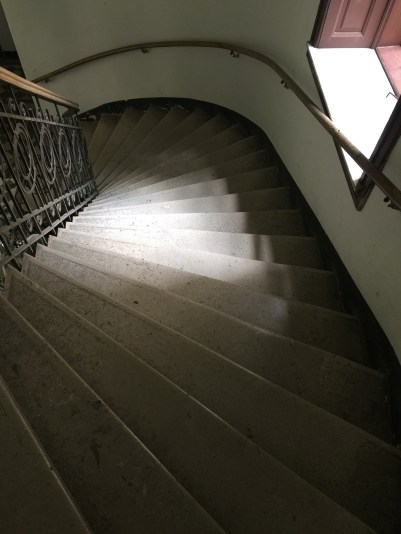
A few days ago, just as my wife and I were setting out from the apartment, it started to rain. It was my wife who had decreed that it wouldn’t rain, but it was I who went back to get the umbrellas. As readers can imagine, I was a little grumpy as I ascended the stairs, glaring at the individual steps. Perhaps it was my acute attention of the steps, perhaps it was the light; whatever it was, I suddenly noticed in the sixth step from last, which had been worn smooth by countless feet treading on it, something which I had never noticed before on my walks up and down those stairs: a fossil.

At first sight it looked like a leaf, but I now think it could be a coral of some sort. I walked up and down all six flights of stairs in our building looking intently at each step,

and I now see what I had never really noticed before, that the limestone used for them is made up of a mass of shells and other marine remains, fallen randomly on top of each other and then squeezed tight by the monstrous weight of later rocks above them.

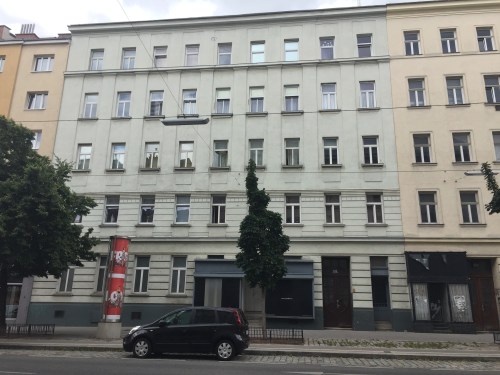
As we discovered when we bought the apartment and picked through the Land Register, our building was constructed at the turn of the century. It was, and has remained, a modest building – no Belvedere Palace for us

just a modest lower middle-class building, one of many outside Vienna’s swank 1st District.

Consequently, even at a time when long-distance travel had been made a thousand times easier by the booming rail system and nascent road system, I would imagine that the stone for our steps came from a local quarry. Which is more than possible, there being quite a number of old limestone quarries around Vienna, a number of which – I have been breathlessly informed by an Austrian fossil-hunter website – are good sources of marine fossils.

An Austrian map of the country’s geology informs me – if my rudimentary German is correct – that the rock formations in question are Late Tertiary.

Specifically, according to a mind-numbing report prepared for the 26th International Geological Congress which I leafed through electronically, they belong to the Neogene beds in the Vienna basin; these were laid down some some 10-15 million years ago, between the Upper Eggenburgian and Lower Badenian stages of the Middle Miocene epoch, as a result of at least two marine incursions into the Vienna basin.

Setting aside all the arcane – and, frankly, incomprehensible – scientific mumbo-jumbo with which this report is filled, we can happily conclude that the jumbled marine fossils locked forever more into the steps of our building’s stairway are the result of the area around Vienna twice being a sea. It must have been a nice warm sea too, since corals flourished in its waters. In fact, this map of mid-Miocene Europe shows that much of Central Europe was under water during this Epoch, this being the far western end of the wonderfully-named Tethys Sea.

In cases like these, I am always taken by a sense of wonder. Here I am, living on the edges of a rich agricultural plain 350 kilometers from the nearest sea.

Yet once upon a time there was sea all around me, probably quite like the sea which my wife and I snorkeled over a year ago in Thailand, with coral outcrops, starfish and sea urchins clinging to their rocks, crabs scuttling along the sea floor, fish flashing in and out of the coral, and from time to time the passing shadow of a shark.

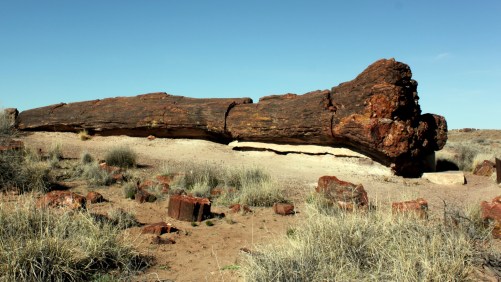
That same sense of wonder came over me many years ago, when we visited Arizona’s Petrified Forest National Park. The park sits in the middle of a harsh, dry, desert region.

Yet all around us lay the petrified remains of a once mighty forest.


Artists imagine that these 200 million year-old forests looked something like this.

All that teaming life in this now almost dead environment …

It was more with a sense of fascinated horror than awe that I first gazed on the “fossils” (mummies is perhaps the better term) of people and animals dug up at Pompeii.


They were overtaken, submerged, in the 1000°C-hot pyroclastic flow that swept down the sides of Mt. Vesuvius and howled through the city at 700 km/hr.

What a terrible, terrible death! But perhaps it was a mercifully quick death, with them being flash-cooked, basically.

Hmm, I didn’t want to finish on this rather depressing note. But hey, that’s life! In the meantime, I need to escogitate a plan to persuade my wife join me on a visit to Vienna’s Natural Science Museum (sheathed in a very nice stone, I should add) so that I can study the area’s geology better.

_______________

Our building’s steps: our photos
Belvedere Palace: http://www.austriawanderer.com/the-belvedere-palace-in-vienna/
Our apartment building: our photo
Geological map of Europe: http://www.gifex.com/detail-en/2011-06-29-13972/Geological-map-of-Austria.html
Miocene Europe: http://www.dandebat.dk/eng-klima4.htm
Vienna plain: http://www.donau.com/de/roemerland-carnuntum-marchfeld/detail/marktgemeinde-goetzendorf-an-der-leitha/c53b2a6b0c75fed4d809b78b888830d9/
Tropical sea: https://fineartamerica.com/featured/coral-reef-in-thailand-louise-murray-and-photo-researchers.html
Petrified Forest NP: http://kids.nationalgeographic.com/explore/nature/petrifiedforest/#petrified-forest-hills.jpg
Petrified tree-1: http://www.alamy.com/stock-photo/petrified-forest-national-park-arizona.html
Petrified tree-2: http://www.van-tramp.com/wp/petrified-forest-national-park-revisit/
Forest 100 million years ago: https://jerry-coleby-williams.net/2015/02/15/bunya-prehistoric-plant-ancient-australian-food-tradition/araucaroid-forest-ca-100-million-years-ago/
Pompeii mummies-1: https://www.google.co.uk/amp/s/www.pinterest.com/amp/pin/535224736949021987/
Pompeii mummies-2: http://hesed.info/blog/pompeii-lava-statues.abp
Pompeii mummies-3: https://forums.arrowheads.com/forum/general-discussion-gc5/fossils-paleontology-old-bones-gc30/25828-reposting-pam-s-odd-rock-fossil-2nd-opinion
Pompeii and Mt Vesuvius: https://it.pinterest.com/agcinnamongirl/pompeii-italy/
Natural History Museum, Vienna: https://ictca2017.conf.tuwien.ac.at/index.php/natural-history-museum-vienna

SCOOTING

Vienna, 4 June 2017

Many – many – years ago, when I was but a lad of six or seven, I was the proud owner of a scooter, one of those good old-fashioned scooters which you kick along with your foot. It looked very much like this, although my memory tells me it was blue rather than red.

Honesty impels me to clarify that it was not bought for me. Like many things in our large family where I was towards the tail end, it was a hand-me-down from one of my elder siblings. But I cared not! On this machine I was king of the pavements, sailing along at what seemed to be vertiginous speeds after a series of brisk kicks.

In my memory, the scooter’s use is entangled with a “girl next door”, a girl a few years older than me with whom I would whirl around the local pavements. Her name is gone, her face is a blur, but I think it’s true to say that I had a crush on her. I also had a crash with her, on my scooter. The details are now fuzzy, but I think we were playing a game of follow-me, wherein I was following her every twist and turn. All was going swimmingly well until she suddenly put on the brakes. I ran into her, somehow flipped over the handlebars and landed on my nose. Argh, the pain! the blood! The upshot, as I learned a few days later, when my mother finally took me to see a doctor, was that I had broken my nose.

As readers can imagine, this incident left me with somewhat conflicted feelings about scooters. I suppose I must have continued to use mine for a while, although it disappears from my memory at this point, along with the girl-next-door. Bicycles take over.

In fact, over the years that followed it seems to me that scooters generally lost their popularity with children. I don’t remember seeing many around when I was in my teen and early adult years, my children never emitted the desire to have a scooter, and none of their friends had one. And it certainly was never an adult thing.

So it was with some surprise that I registered, when we came back last September from our seven years in the East, an efflorescence of scooters on the pavements of Vienna. And being kicked along not only by children but also by adults: young adults like this one, who one could argue may not yet have completely grown up

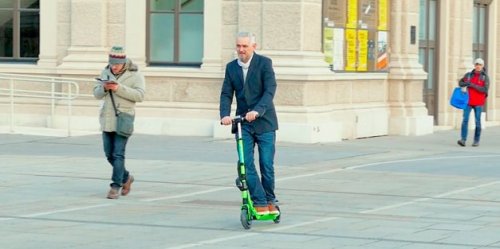
but also by older adults like myself, who in an earlier period I would have said should stop making a fool of themselves in this way.

Now that we have come back up to Vienna for the summer and the weather is getting good, I am struck by the same phenomenon: scooters whizzing by carrying adults.

Clearly, something is up! Surfing the web, I get the impression that the trend towards adults getting on scooters has to do with beating traffic jams to get to work and doing some healthy exercise while you’re at it (although the growing use of electric scooters rather undermines this last part).

Before I’m accused of sexism, I quickly throw in a picture of a businesswoman with a scooter, although this picture is obviously posed.

It helps a lot that scooters are easily foldable

so that there are no parking problems and one can walk into one’s office (or cubicle, if that’s the company’s culture) casually carrying the scooter under one’s arm.

As usual, once something catches on the designers move in and start offering cool designs. From this, which seems to be the fairly standard design although in quite cool colours

we have this, an electric version

or this big-wheel design

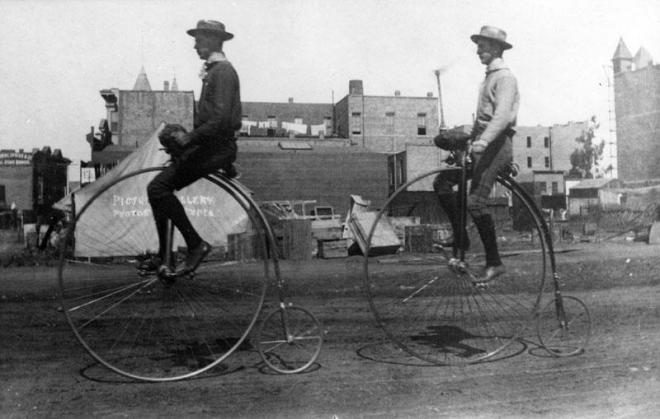
(which rather reminds me of penny-farthing bicycles of yore).

Big wheels makes me think of fat wheels

while here we have a Y-shaped design, which is moved by a scissor-motion of the legs.

This is an interesting one, a luggage scooter.

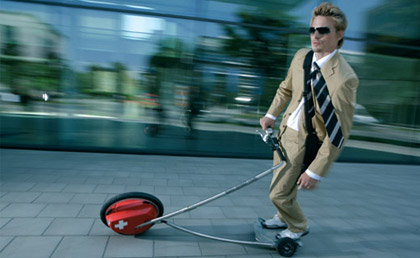
In airports, you can drop down the platform and back wheel attached to the suitcase and whizz along to your gate. This last one is unutterably cool although I’m not quite sure how you are meant to ride it.

There are many more designs out there but I’ll leave it at that.

I think my wife and I need to get into this new trend, so that we too can zip by normal pedestrians, our hair fluttering in the wind. I casually asked her a few days ago if she had had a scooter as a child, to which she said no. This is going to make it tricky to persuade her to try since I feel that a residual nostalgia (and acquired expertise) from childhood would make it easier to accept looking a trifle silly on scooters at our venerable age. But nothing ventured, nothing gained, as they say.

________________

Old scooter: http://www.20th.ch/les_jouets_de_notre_enfance.htm
Young man on electric scooter: http://www.funshop.at/produkte/inmotion-3/inmotion-l6/
Older man on electric scooter: http://www.stadt-wien.at/lifestyle/elektro-scooter-test.html
Businessmen on scooters: https://www.linkedin.com/in/keggleton/zh-cn
Businesswoman with scooter: https://www.pinterest.com/pin/439312138625936673/
Folded scooter: https://www.nycewheels.com/micro-scooter-review.html
Normal scooter with cool colours: https://mobile.willhaben.at/object/186524698/
Cool electric scooter: https://www.pinterest.com/baylissw/kick-scooter/
Cool scooter with big wheels: http://www.tretrollershop.at/fs_sport_classic.html
Penny-farthing: http://www.bikemonkey.ca/blog
Cool electric scooter with fat wheels: https://www.pinterest.com/pin/439312138625936673/
Y-shaped scooter: https://www.nycewheels.com/micro-scooter-review.html
Luggage scooter: http://www.toxel.com/tech/2012/02/25/scooter-luggage/
Unutterably cool scooter: http://design720.com/category/g5/page/2

UNDER A LINDEN TREE

Vienna, 1 June 2017

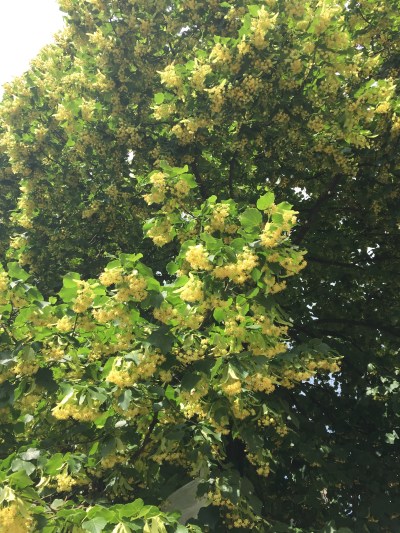
One of the reasons we were attracted to the apartment we bought in Vienna is that there is a linden tree, or lime tree, just outside the living room, at eye level.

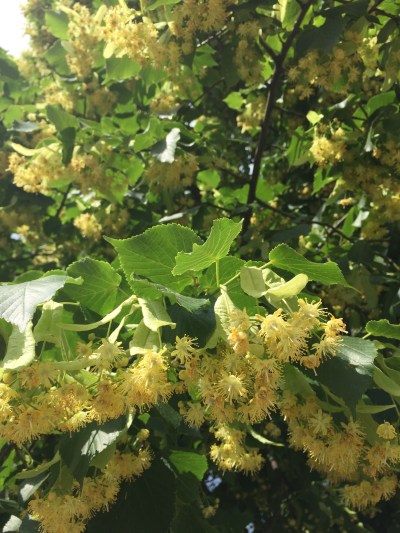
Right now, the flowers are still forming, but it was July when we bought the apartment and the tree was in full bloom, covered in pale yellow flowers around which buzzed a thousand insects.


The scent that wafted through the open window was divine. For those readers who have not had the good fortune to be near a linden tree in full bloom, let me try to describe the scent: delicate – your brain barely registers it; sweet – at the height of the bloom, insects are crazy to get to the nectar; ephemeral – the scent wafts your way for a second, then disappears just as quickly. I’m sure the memory of that scent still lingered in our minds when we signed the purchase contract.

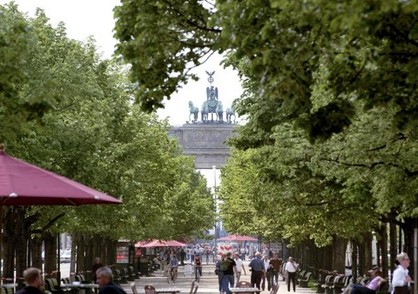
Strangely enough, even though the linden tree grows in the U.K., I have no memory of that scent from my youth; perhaps because I hardly ever spent any of my summers there. Nor do I have any memory of the scent from France, where I spent many a youthful summer, or from Italy, where I spent many of my adult years. It was only when I moved to Austria twenty years ago that I became aware of it. Was it perhaps because linden trees are common shade trees throughout the Germanic and Slavic lands? Certainly, the street we live on in Vienna has a portion, closer to the city centre, which is entirely shaded in linden trees – and what a treat it is for the nose to walk unter den linden, under the linden trees, when they are in bloom! I will make sure we walk along the much more famous Unter den Linden Avenue in Berlin


when we go there in early August although by then I fear that the peak of the trees’ blooming will have passed.

I have to think that the frequent presence of linden trees in urban settings throughout Central Europe can be traced back to the sacred place the tree had in Germanic and Slavic mythology. When Christianity arrived, it sensibly adapted, planting linden trees around churches, accepting that villagers congregate under the village linden tree for important meetings or for seasonal festivities

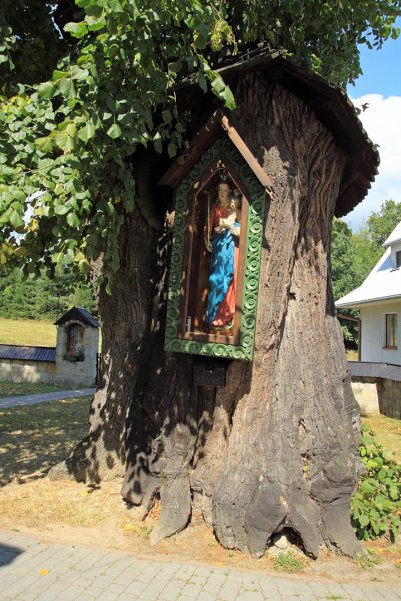
as well as encouraging a tradition linking the Virgin Mary to the linden tree (probably because this displaced a pagan goddess linked to the tree).

Thus was the tree’s place in Central Europe’s modern cities assured. But why the linden tree was sacred to Slavic and Germanic tribes in the first place is not clear to me – at least, I have found no good answer in the literature available to me on the web. I have read that the tree was seen to represent the female side of nature (with the oak tree representing the male side), its natural capacity to regrow quickly being seen to symbolize rebirth and fertility. Perhaps. But – simply because it appeals to my romantic fancies – let me add here another theory, which I extracted from the wilder and woolier side of the internet, from a site dedicated to Druidism to be exact. There, the writer noted that the tree is in full bloom around the time of the summer solstice. Well! What better reason to sacralize a tree which gives off a heavenly scent when the great Sun God reaches its apogee! (we have here modern devotees celebrating the summer solstice at Stonehenge)

Whatever the reasons, the linden tree’s connection to the feminine side has meant that it has naturally been connected to love. Betrothals took place under the village linden tree, but so – people whispered – did love in its wilder form. A famous German minstrel song from the 12th Century, Unter der Linden (translated here by Raymond Oliver, with one tiny change by me), says it all (or nearly so).

Under the linden tree
On the heather,
Where we had shared a place of rest,
Still you may find there,
Lovely together,
Flowers crushed and grass down-pressed.
Beside the forest in the vale,
Tándaradéi,
Sweetly sang the nightingale.

I came to meet him
At the green:
There was my true love come before.
Such was I greeted —
Heaven’s Queen! —
That I am glad for evermore.
Had he kisses? A thousand some:
Tándaradéi,
See how red my mouth’s become.

There he had fashioned
For luxury
A bed from every kind of flower.
It sets to laughing
Delightedly
Whoever comes upon that bower;
By the roses well one may,
Tándaradéi,
Mark the spot my head once lay.

If any knew
He lay with me
(May God forbid!), for shame I’d die.
What did he do?
May none but he
Ever be sure of that — and I,
And one extremely tiny bird,
Tándaradéi,
Who will, I think, not say a word.

Of course, the tree’s sacred properties meant that it had a special place in the apothecary of our ancestors, with various parts of it being ingested to remedy numerous ills. A pale descendant of this is the infusions of linden flowers which are available in our supermarkets.

My mother-in-law liked this infusion and always had a packet of it in her kitchen cupboard (my wife and I prefer camomile; it has more taste, we think).

But tasteless infusions are not the only food which is extracted today from linden trees. Bees adore linden flowers, and honey aficionados adore linden flower honey, praising it to the rafters for its sublime taste. Not being a honey enthusiast, I can only offer this judgment without comment. They also mention its much lighter colour compared to other honeys, which this photo certainly attests to.

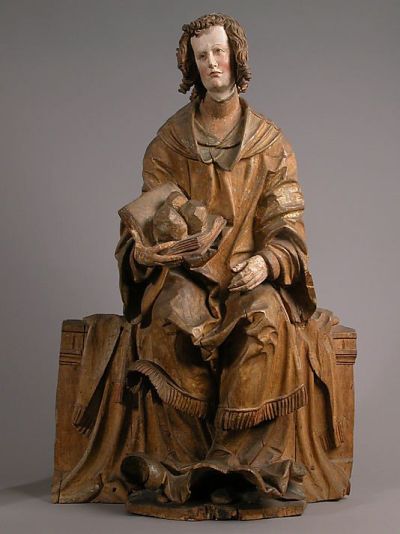
As can be imagined, the linden tree’s wood was also considered to have talismanic properties. I want to believe that many religious statues in this part of Europe were carved out of limewood for this reason, although more prosaic reasons such as the wood’s ease of carving and its ability to hold intricate detailing are also given. Be that as it may, some lovely carvings have resulted. Here is a Saint Stephen looking pensive and holding in his lap the rocks with which he was lapidated

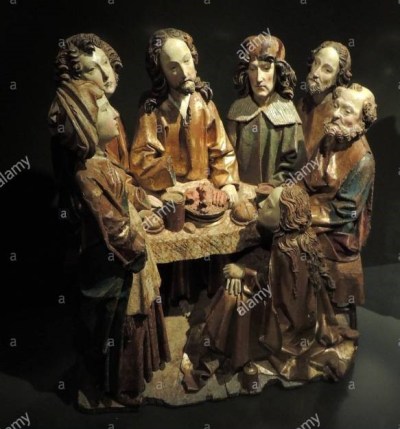
while this is the Supper at Emmaus, a solemn occasion indeed for the artist, from the look on everyone’s faces.

Well, time now to go to bed. Tomorrow, at breakfast, we’ll open the window again on our linden tree.

___________

Linden tree from window: our picture
Linden tree blooms: our picture
Unter den Linden Avenue, Berlin: http://www.berlin.de/tourismus/fotos/sehenswuerdigkeiten-fotos/1355832-1355138.gallery.html?page=2
Villagers dancing under a linden tree: https://fineartamerica.com/featured/under-the-village-linden-tree-ken-welsh.html
Shrine under linden tree: https://www.lamusdworski.wordpress.com/2017/03/19/linden-tree/amp/
Summer solstice, Stonehenge: http://notihoy.com/en-fotos-mas-de-20-000-personas-presenciaron-el-solsticio-de-verano-en-stonehenge/
Linden flower infusion: https://www.amazon.co.uk/Lipton-LINDEN-Tea-Bags-pyramid/dp/B00TVCXZ7S
Lime flower honey: http://www.dealtechnic.com/shop/honey/raw-wild-flower-lime-honey-800g-with-jar-honey-flow-2014-natural-organic-farm/
Saint Stephen: https://www.pinterest.com/elkie2/small-sculpture/
Supper at Emmaus: http://www.alamy.com/stock-photo-christ-in-the-house-of-mary-and-martha-the-last-supper-the-supper-68542669.html

LYING TOGETHER, FOREVER

Milan, 20 May 2017

Last week my wife and I visited, together with a French cousin of mine and his wife, the First World War battlefields of Verdun and Chemin des Dames. For me, it was a follow-on to a trip we made a few years ago to the battlefields around Ypres in the British sector. For my cousin, it was a chance to visit Verdun, a battlefield still deeply etched in the French psyche.

As during my previous visit to Ypres, I was struck by how peaceful the countryside now looks. Traveling along the Chemin des Dames, but also on the west side of the River Meuse at Verdun, with their rich rolling farmland on every side, it was difficult to imagine the large-scale death and destruction visited upon these lands a mere hundred years ago. The farmer’s plough has smoothed away the millions of shell holes that pockmarked the earth, wheat and rapeseed cover the land with carpets of green and yellow.

Yet that farmer’s plough still brings to light every year unexploded ordnance and other detritus of war, and by some estimates will continue to do so for seven hundred years.


And it still brings to light remains of men who died in these now peaceful fields.

At Verdun, these will be added to the Ossuary of Douaumont, where the visitor can gaze upon mountains of human bones, German and French alike.

In certain places, especially on the East bank of the River Meuse but also at Mort-Homme and Cote 304 on the West Bank, and at the Plateau de Californie on the Chemin des Dames, the land was too smashed, and too dangerous, to give back to agriculture. There, trees cover the land with their green foliage and birdsong fills the air. But if you peer beneath the tangle of branches, you can see the cratered, pot-holed landscape the trees hide from our view.

You can begin to imagine what it must have been like for those poor soldiers who cowered there, and fought like savages when they met each other, and died horrible deaths, and whose bodies were ripped into ever smaller shreds by incoming shells.

The official memorials which the French put up in the immediate aftermath of the war ring false to my modern ear: “Glorious Sacrifice!”, “Victory!” Where was the glory in the stinking mud and blizzard of shrapnel? What victory was this which brought us another World War thirty years later? Even that oft repeated phrase “Eternal Remembrance” rings hollow – who remembers any more the individual young men who died here? Their parents are long gone and the last of the soldiers who fought here passed away ten years ago. I find the small, private memorials put up by families whose sons disappeared without trace into the mire of the battlefield much more touching: “Jean Dauly, 350th Infantry Regiment, killed 6th May 1917 in the little wood across the way, aged 20. Mourned by his mother, all his family, and his friends. Pray for him”, “Marcel Duquenoy, from Calais, aged 20, of the 350th infantry regiment. In memory of our son, who disappeared 6th May 1917, in the wood across the way”. As a parent, I can empathize with the agonies of a mother who had lost her son and didn’t have a body to decently bury and a tombstone to grieve over.

The modern iconography is much more sensitive to the sheer, wanton waste of life of this war. There is a superb museum-memorial near Douaumont, which gives a balanced French and German account of the battle of Verdun and shows in great detail the life of ordinary soldiers on both sides. There is a modern sculpture, the Constellation of Suffering, at the museum of the Cave des Dragons on the Chemin des Dames.

It commemorates the 16,000 African soldiers, mostly from the ex-French colonies in West Africa, who were totally decimated in this battle: the ultimate act of colonialism, using colonial troops to fight your wars. And there is of course that iconic picture of Franco-German reconciliation: President François Mitterrand and Chancellor Helmut Kohl holding hands at the annual anniversary of the battle of Verdun in 1984.

You cannot visit World War I battlefields without coming across the military cemeteries both big and small which dot the countryside. I like these cemeteries. They are oases of peace and beauty, but they are also the one place where I can connect, if only for a moment, with the individual men – boys, often – who died in this carnage. I go down rows reading the names. I feel I owe this to them, so that they can exist again for a brief instant before returning to the cold earth. I’m always sorry that I can’t read all the names, there are simply too many and time too short. We visited many French cemeteries, of course

but also the very big American cemetery at Romagne-sous-Montfaucon, product of the Americans’ Meuse-Argonne offensive in 1918 (with so many who died just a few days before the war’s end)

a few small, modest German cemeteries – the penalty of the vanquished leaving their dead in the victor’s country

and a small British cemetery, the result of the frantic rearguard fighting in the first month of the war.

But the cemeteries I most liked were across the road from the memorial chapel on the Chemin des Dames. All the military cemeteries I have ever visited stand in isolation, each country mourning its dead separately. But here, a German cemetery touched upon a French cemetery. They were not side by side – that would have been unthinkable a hundred years ago, perhaps even today – but they touched in one corner, so that you could walk from one to the other.


It makes me think of a poem by the French poet René Arcos, “Les Morts…”, “The Dead…”

Le vent fait flotter
Du même côté
Les voiles des veuves

Et les pleurs mêlés
Des mille douleurs
Vont au même fleuve.
Serrés les uns contre les autres
Les morts sans haine et sans drapeau,
Cheveux plaqués de sang caillé,
Les morts sont tous d’un seul côté.

Dans l’argile unique où s’allie sans fin
Au monde qui meurt celui qui commence
Les morts fraternels tempe contre tempe
Expient aujourd’hui la même défaite.

Heurtez-vous, ô fils divisés!
Et déchirez l’Humanité
En vains lambeaux de territoires,
Les morts sont tous d’un seul côté.

Car sous terre il n’y a plus
Qu’une patrie et qu’un espoir
Comme il n’y a pour l’Univers
Qu’un combat et qu’une victoire.

Here are my very modest efforts at translation:

In the same direction
Does the wind make
The widows’ veils float.

And the mixed tears
Of a thousand pains
Flow into the same stream.
Wedged one against the other
The dead without hate and without flag,
Hair smeared with clotted blood,
The dead, they are all on one side.

In the same clay where come together without end
The world that dies and that which begins
The fraternal dead temple to temple
Expiate today the same defeat.

Clash, divided sons!
And tear Humanity
Into vain rags of territory,
The dead, they are all on one side.

For underground there is
But one fatherland and one hope
As there is for the Universe
But one battle and one victory.

What more fitting monument could there be than these twinned cemeteries for today’s Europe, which sees us inching cautiously closer together, with the goal of making this war (and its successor, the ’39-’45 war) la Der des Ders, as the French called it, la Dernière des Dernières, the absolutely last war.

______________________

Photos: ours or our cousins’, except:

Landscape Chemin des Dames: http://1418.aisne.com/discovery-routes/ASCPIC002FS000JG/detail/laffaux/le-front-du-chemin-des-dames
Unexploded shells: http://www.europe1.fr/faits-divers/pas-de-calais-plusieurs-obus-explosent-naturellement-dans-un-champ-2638741
Soldiers’ remains: http://www.bfmtv.com/societe/une-vingtaine-corps-poilus-retrouves-meuse-527266.html
Kohl and Mitterrand hold hands: http://www.cvce.eu/en/obj/francois_mitterrand_and_helmut_kohl_verdun_22_september_1984-en-2f9050c7-d5cb-4899-9bb2-e1e05bb9cb26.html
British cemetery Vendresse-Beaulne: http://www.ww2cemeteries.co.uk/ww1frenchextension/vendressebrit.htm


NUMBERS, NUMBERS, NUMBERS

Milan, 9 May 2017

In Los Angeles, with some prodding from our daughter, my wife and I started our exercise regimen again, quietly put aside when we left Bangkok. Once a week, we went to a shop on Wilshire Boulevard to check progress. We would get on a machine which would do some sort of body scan and give us our body weight, our percentage of fat, our water retention ratio, and other fascinating pieces of data about ourselves. Bottom line: we were losing weight and our body fat percentages were dropping, but only very gradually. There was nothing for it, we were also going to have to go on a diet.
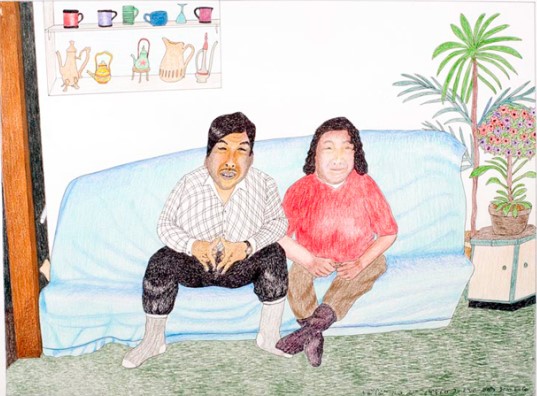
Once back in Italy, I took over the kitchen. This was going to be done scientifically! Every morsel of food we wanted to eat or drink would have its caloric make-up clocked into my computer and would be rigorously measured before it passed our lips. So I burrowed into vast online data banks of nutritional values, dusted off the kitchen scales, and got to work. And now my life has been taken over by numbers: 200, 250, 300 calories, 60, 80, 100 grams, 5, 10, 15 ml …


Meanwhile, we have ramped up our exercise regimen, where numbers also invade our minds: 10, 9, 8 seconds to go, 15, 16, 17 lifts, …

At the same time, we have been anxiously watching the results of the French elections: 21.5%, 32.8%, 46.6%. On Sunday night, we got the final numbers: 66%, 34%. But soon we will be anxiously scouting the news for the numbers in the French legislative elections. And then the U.K. elections …

And then there are all the timetables we seem to be scanning all the time: 10:47, 12:52, 14:35, 16:50, …

And we mustn’t forget the bank account and the investment portfolio and the euro-dollar exchange rate: 1.110, 1.060, 1.035, 1.091, …

Numbers, numbers, numbers …


As Charlie Brown might have said:

But wait, I mustn’t shoot the messenger. Numbers aren’t the problem. Numbers are beauty. The Hungarian mathematician Paul Erdos once said, “I know numbers are beautiful. If they aren’t beautiful, nothing is”, while several thousand years earlier Pythagoras had put it more poetically: “There is geometry in the humming of the strings, there is music in the spacing of the spheres” and “The stars in the heavens sing a music if only we had ears to hear”.

No, it’s just that life is now horribly complex – I turn once more to Charlie Brown.

Long gone are the days when human beings could get by counting “one, two, many”, although it seems there are still a few remote tribes who can get through life with just this as their counting systems.

I suppose we have to thank the damned Mesopotamians for pushing us beyond the one-two-many phase of our history.

They wanted cities, temples, palaces, armies.

For this they needed to count: how many bushels of wheat did you give this month, how many skins of beer, how many goats, how many days of work, how many, how many … They invented tokens like these to keep count.

And gradually, gradually, those tokens led us to this: roomfuls of accountants, keeping count of everything.

And now we have computers keeping count.

Well, I may mutter curses at the Mesopotamians, but do I want to live like this?

I don’t think so. So I’d better just get back to the kitchen and start counting the numbers for supper.

________________
Numbers: http://www.gettyimages.it/detail/illustrazione/lots-of-numbers-on-huge-diminishing-perspective-digital-grafica-stock/667585619
Aaugh!: https://www.pinterest.ph/pin/242631498644327447/
Pythagoras: https://www.google.co.uk/amp/lifenlesson.com/pythagoras/amp/
Sigh!: https://www.google.co.uk/amp/s/www.psychologytoday.com/blog/brain-babble/201304/why-do-we-sigh%3Famp
Mesopotamians: http://www.ancienthistorylists.com/ancient-civilization/ancient-mesopotamia/
Mesopotamian city: https://app.emaze.com/mobile/@AWCFWOLL
Mesopotamian tokens: http://www.maa.org/press/periodicals/convergence/mathematical-treasure-mesopotamian-accounting-tokens
Roomful of accountants: http://www.scoutingny.com/love-sex-on-the-upper-west-side-the-filming-locations-of-the-apartment/
Roomful of servers: http://www.dailymotion.com/video/x3rfici
Kalahari bushmen: http://www.telegraph.co.uk/opinion/2016/03/17/how-britain-connived-in-the-end-of-the-kalahari-bushmen/

IN THE MOUNTAINS

Sori, 24 April 2017

The north wind had blown hard all night, and by morning the air over the sea, the village, and the hills behind it was crystal clear. After our morning coffee, we decided to take the path along the sea cliffs which brings one to the village graveyard. Along the way, we stopped for a moment at the memorial to those villagers who have died at sea.

With the air so clear, though, I soon forgot the dead and let my gaze be drawn by the snow-capped mountains hovering far away on the horizon: Mounts Gelàs and Argentera, along with their acolyte peaks, in the the Maritime Alps, today enveloped in the National Park of the Alpi Marittime.

Oh, that I could skim across that lapis lazuli sea!

Soar over Spotorno on the opposite shore of the Gulf, waiting patiently for its summer bathers, up over the hills behind it.

Over Mondovì, racing for the mountains beckoning to me behind it.

To finally alight, high up in the park, there to enjoy all its delights.


One day we’ll go there, I tell my wife, one day – although no doubt by a more normal mode of transportation.

_____________

Pics of the memorial and the mountains behind it: ours
Flying over the sea: https://www.google.co.uk/amp/s/amp.dailytelegraph.com.au/newslocal/northern-beaches/superman-surfer-gets-birdseye-view-to-sea/news-story/90862b1d51f14ff9887116c7a5768088
Spotorno: http://www.comune.spotorno.gov.it/1822/galleriafotografica/24-06-2007-la-spiaggia-di-spotorno/
Mondovì: https://www.italiadascoprire.net/piemonte/provincia-di-cuneo/mondovi/mondovi.html
Parco alpi marittime-1: http://thetourismcompany.com/casestudy.asp?serviceid=2&projectid=921
Parco alpi marittime-2: http://www.parks.it/parco.alpi.marittime/gallery_dettaglio.php?id=17863
Parco alpi marittime-3: http://www.parks.it/parco.alpi.marittime/gallery_dettaglio.php?id=14489
Parco alpi marittime-4: http://www.parks.it/parco.alpi.marittime/gallery_dettaglio.php?id=7856
Parco alpi marittime-5: http://www.parks.it/parco.alpi.marittime/gallery_dettaglio.php?id=13402
Parco alpi marittime-6: http://www.parks.it/parco.alpi.marittime/gallery_dettaglio.php?id=9385

FRANKINCENSE AND MYRRH

Milan, 19 April 2017

Some forty years ago, when my wife and I were just beginning our journey together through life, I came down to Milan to spend Easter with her. At her mother’s suggestion, we went to a late-night service in the nearby basilica of Sant’Ambrogio.


It was either on Good Friday night or Easter Saturday night (my memory is clouded on this detail). Either way, at the end of the ceremony we all trooped out into the church’s atrium.

There, the presiding bishop put a light to a nice big bonfire which had been laid down earlier, and intoned loudly several times “Christus Resurrexit!”, “Christ is Resurrected!”. Now, since the resurrection of Christ is the central tenet of Christianity – without it, there would be no Christianity – you would think that the bishop would have shouted out this message with joy and gladness, or at least with a mild level of satisfaction. Not a bit of it! The fellow intoned it so mournfully as to make you wonder if he was sorry that the resurrection had ever taken place at all. Or maybe he enjoyed Lent a lot, fasting and praying and beating his breast, and was sorry that it was all over for another year. Or perhaps his hemorrhoids were acting up. Whatever the reason, the three of us agreed afterwards that the Bish had been a douche-bag, resurrection-wise.

Ever since that ceremony long ago, it has been in the back of my mind to attend it again, if only to see if succeeding bishops were a bit more joyful about it all. But as the Italians say, fra il dire e il fare c’è di mezzo il mare, between the saying and the doing lies the sea (it sounds better in Italian, if only because it rhymes). This year I thought the time was finally ripe, but alas! either the ceremony was on Good Friday night, when we had just arrived back from Los Angeles and were in no fit state to take part in anything, or some boringly politically correct entity like the City of Milan Health & Safety Services had decided in the intervening years that open bonfires in church atria were a no-no. Whatever it was, the bottom line was that there was no ceremony on Easter Saturday.

My wife decreed that nevertheless we should at least step into Sant’Ambrogio on Easter Sunday – something to do with a sort of atavistic belief that this would be a good day and place to receive a dose of sympathetic magic – and I grouchily agreed. So some time in the afternoon of Easter Sunday we made our way to the church, weaving our way through the few Milanese left in the city who were going for their Sunday stroll. We walked through the atrium where there should have been the bonfire, and we entered the church.

Ahh! My nose was immediately greeted by the smell of incense which had been burned in earlier ceremonies, and I was transported back to my youth. I saw the boy that was me inhaling that fragrance, pungent but with sweet overtones, watching the smoke curling towards the ceiling, and generally enjoying one of the few bright spots during those weekly masses which I had to endure.

I also thought that swinging that thingy (which I later learned was called a thurible) from which all that thick smoke poured out was pretty cool.

In my teenage years, when I was finally considered responsible enough, I got to serve in High Masses as an altar boy and to swing the thurible (the idea being to pass air over the incense to keep it burning). Luckily, I never got into trouble as Edward Norton did in the film “Keeping the Faith”. Readers may remember the scene where as a young priest just starting out he gets to swing the thurible, which he does with such enthusiasm that he sets his robes alight and has to jump into the font of holy water to douse the flames.

A quick search of my favourite source of information – Wikipedia – informs me that the incense used in the Roman Catholic rites of my youth contains a varying mix of frankincense, myrrh, gum benjamin, copal, and a few other odds and ends.

Frankincense and myrrh …

The Three Wise Men
We three kings of Orient are;
Bearing gifts we traverse afar,
Field and fountain, moor and mountain,
Following yonder star.

Gaspard
Born a King on Bethlehem’s plain
Gold I bring to crown Him again,
King forever, ceasing never,
Over us all to reign.

Melchior
Frankincense to offer have I;
Incense owns a Deity nigh;
Prayer and praising, voices raising,
Worshiping God on high.

Balthazar
Myrrh is mine, its bitter perfume
Breathes a life of gathering gloom;
Sorrowing, sighing, bleeding, dying,
Sealed in the stone cold tomb.

The Three Wise Men
Glorious now behold Him arise;
King and God and sacrifice;
Heav’n sings Hallelujah:
Hallelujah the earth replies.
(I have cut the refrains)

That conjures up another image of my childhood, me in the school choir at primary school, doing the rounds of houses in the neighborhood, our choir master ringing the doorbell, and us launching into this and other Christmas carols when the occupants opened.

At the end of it all, we trooped over to the choir master’s house where his wife had prepared a buffet supper for us all, and where we got to taste just a little bit of the choir master’s home brew … Good times, those were.

Frankincense and myrrh …

The gifts, along with gold, that those three wise men with such mysterious names – Balthazar, Caspar, and Melchior – are proffering to the child Jesus in those countless paintings of the Adoration of the Magi produced in centuries past.

They are also players in the crèches which appear every year at Christmastime in Italian churches, ranging from the simple

to the very elaborate.

As young children we prepared one at home under the overall theological supervision of our mother – the latter meaning that we were allowed to place in the background other figurines in our possession, such as cowboys and Indians or various animals, but not in such quantities as to crowd out the essential Christian message. The three wise men on their camels were placed far away from the manger in which Baby Jesus lay, and then every day after Christmas we children brought them a little closer, to end up at the manger on 6 January, the Day of the Epiphany.

It all looked all so easy to us, but T.S. Eliot, in his poem The Journey of the Magi suggests otherwise (I quote the first twenty lines or so).

A cold coming we had of it,
Just the worst time of the year
For a journey, and such a long journey:
The ways deep and the weather sharp,
The very dead of winter.’
And the camels galled, sorefooted, refractory,
Lying down in the melting snow.
There were times we regretted
The summer palaces on slopes, the terraces,
And the silken girls bringing sherbet.
Then the camel men cursing and grumbling
and running away, and wanting their liquor and women,
And the night-fires going out, and the lack of shelters,
And the cities hostile and the towns unfriendly
And the villages dirty and charging high prices:
A hard time we had of it.
At the end we preferred to travel all night,
Sleeping in snatches,
With the voices singing in our ears, saying
That this was all folly.

Frankincense and myrrh …

So desired throughout the Middle East and the broader Mediterranean world that its production centuries ago brought untold wealth to the Yemeni tribes which controlled the resin-bearing trees, allowing them to build cities like Shabwa, Marib, Baraqish.

They also brought untold riches to the tribes which controlled access to the incense route. This snaked its way up the western side of the Arabian peninsula, skirting the Empty Quarter and the Nafud desert, and culminating in Gaza. The wealth generated by the trade built cities like Avdat in the Negev

and helped build Petra in Jordan.

One day, if they stop hating and killing each other in this part of the world, my wife and I will go and visit the groves of frankincense trees.

And we will travel the incense route, preferably on a camel.

____________________

Sant’Ambrogio: http://www.itmap.it/milano/basilica-di-santambrogio/
Atrium of Sant’Ambrogio: http://muse-garret.cocolog-nifty.com/blog/2018/04/index.html
Incense smoke in church: https://www.pinterest.ph/pin/321233385899973661/
Swinging thurible: http://www.diariodejerez.es/semanasanta/Lunes-Santo-Jerez_3_575672440.html
Christmas carolling: https://www.gettyimages.de/video/choir?sort=mostpopular&offlinecontent=include&phrase=choir
Adoration of the Magi: http://en.artsdot.com/@@/8BWV5K-Rogier-Van-Der-Weyden-Adoration-of-the-Magi
Simple creche: https://ask.fm/matteotesselli99_
Elaborate creche: https://collinadeiciliegi.wordpress.com/2016/12/23/er-presepe/
Ruins of Baraqish: https://en.wikipedia.org/wiki/Baraqish
Ruins of Avdat: http://weekend.knack.be/lifestyle/reizen/israel-restaureert-antieke-stad-avdat/diaporama-normal-450517.html
Ruins of Petra: https://magdalatravel.com/detalles.php?id=82
Frankincense trees: http://holistictoolbox.co.nz/product/frankincense-boswellia-rivae-organic/
Camel riding: http://thesandysnowman.com/5-lessons-life-travel/

OUR L.A. PHOTO ALBUM

Milan, 18 April 2017

My wife and I landed back in Italy a few days ago. And now, lying on the sofa tired and jet lagged, I’m sifting through the multiple, kaleidoscope impressions of LA careening around my brain after our month’s stay there. Picking out from my photos as well as that of my wife’s, and, where for some unexplained reason there is a gap, complementing them with photos off the web, here is our photo album of our holiday in LA. To be viewed together with my last three posts. Enjoy!

-o0o-

I start at Venice Beach, where our daughter and her boyfriend live.

Twenty years ago, we visited the beach so that our son, at that point in his life passionate about in-line skating, could show off his tricks to the other cool dudes who he had read in his magazine congregated there. That had to be our starting point on Day 1.

It’s got much cooler since we were last here. The skatepark looks incredibly futuristic to my untutored eyes.

An amusing message from a citizen of Venice Beach.

I wrote about public murals in an earlier post. Many of these are in Venice Beach. Not surprising, I suppose, since it’s meant to be a very artsy community. Talking of artsy community, here’s the yellow brick road in the Mosaic Tile House.

This is an otherwise normal house in Venice which an artist couple have been covering inside and out with broken tiles and pottery for the last twenty years.

The Venice High School and an ex-police station nearby.

You find this kind of architecture – 1930s? – dotted all over the city. For some reason, they remind me of Superman and his Gotham City. Something to do with the artwork in the early comics? They also remind me of Shanghai, where a lot of the posher pre-WWII buildings have this style.

At the Museum of Contemporary Art (MOCA), up on Bunker Hill.

R.S.V.P., by Senga Nengudi. It’s made of panty-hose weighted down by sand. Still striking.

Better Homes, Better Gardens, by the African-American artist Kerry James Marshall. The museum is holding a major retrospective of his work. It’s fascinating to see these paintings populated by coal-black subjects. It challenges our traditional perspectives, where it is normally white people who inhabit paintings.

Across the road from MOCA, the Walt Disney Auditorium.

It’s rather similar to the Guggenheim Museum in Bilbao; not surprising, really, since the two are by the same architect, Frank Gehry.

A charming fountain in the small garden behind the Auditorium, made with shards of blue and white porcelain.

It reminds me of a sculpture I saw in Beijing a number of years ago.

The monthly flea market at the Rose Bowl.

The art of the deal …

A detail of a painting from the Getty Centre’s impressive collection of European art.

It always appeals to the puerile side of me to see saints – in this case St. Stephen – having the objects by which they were martyred – in this case stones – lodged in their heads. There is a Saint Peter, Saint Peter the Martyr, who died from having his skull smashed in by a sword. In paintings, you see him calmly going about his saintly business with a sword lodged in his head.

The view from the Getty Centre, over Los Angeles.

A beautiful view, although unfortunately you could also see the city’s infamous smog, a light brown mist licking up the base of the surrounding hills.

Some of the statues in the Getty Villa, part of its collection of Classical Greek and Roman art.

I am so used to seeing sightless Greek and Roman statues that I find these staring statues slightly unsettling. If I lived in a Roman villa surrounded by statues looking at me so intently, I think I’d get rather nervous.

One of the beautiful sunsets which greeted us in the desert near Joshua Tree National Park, about which I wrote in an earlier post.

Watching a team putting together the next NASA satellite to be sent to Mars at NASA’s/Caltech’s Jet Propulsion Laboratory.

At the Los Angeles County Museum of Art (LACMA), with its widely diversified collection:

Pieces from the museum’s excellent collection of Amerindian art.

An example of the strange Casta paintings which were produced in Spain’s Latin American colonies.

The aim was to show the result of mixing three populations: the Spaniards, the Amerindians, and the Africans. They were based on incredibly racist concepts, with the whites always at the top of the pile, the blacks always at the bottom, and the natives somewhere in between. The degree of mixing placed you somewhere on this spectrum.

From the museum’s collection of American art:
Moonlight on the Water, by Winslow Homer

Angel’s Flight, by Millard Sheets

Chester, by Sargent Claude Johnson


All nice examples of early 20th Century American art before Abstraction became the norm.

A wonderful painting from the museum’s collection of German Expressionist art:

The Orator, by Magnus Zeller. It captures so well the angst in post-WWI Germany. I think it helps to understand why Hitler succeeded.

A masterful Georges de La Tour, The Magdalen with the Smoking Flame, from the museum’s collection of European art.

A 17th Century plate from the museum’s collection of Japanese art. The turnip has finally been ennobled.

A nice example of Japanese lacquerware, a 17th Century writing box.

West meets East. A painting by Roy Lichtenstein, Landscape with Poet, echoing that most classic of Chinese paintings, the scholar contemplating nature.

Contemporary art at the Hauser & Wirth art gallery in LA’s Art District.

Whatever … I much preferred the rose in the courtyard.


From the exhibition at the Japanese American national museum, exploring the shameful treatment meted out to Japanese Americans in the wake of the attack on Pearl Harbour.

It is hard not to see in this exhibition warnings about current feelings about Muslims in certain quarters of America.

I’ve already written about the wildflowers at Joshua Tree National Park and the Antelope Valley California Poppy Reserve. These are some of the wildflowers we came across during a walk we took one weekend with our daughter and boyfriend on Catalina Island.

The marvelous organ in the Walt Disney concert hall, seen here during a concert we attended.

We were lucky enough to hear it being played a week later.

Infinity Mirrored Room, by Yayoi Kusama: installation art at the Broad Museum.

We were ushered into a dark room with mirrors on all the walls and a very shallow pool of water on the floor. Small LED lights hung down from the ceiling, their light being reflected over and over in the mirrors. One had a sense of floating among the stars. Very tranquil. A pity we could only stay in a minute.

The rest of the museum is dedicated to contemporary art. I’m not a Basquiat fan, but this painting, Eyes and Eggs, stood out positively for me

while this Jeff Koons stood out negatively – I find his stuff so damned shallow.

A wonderful painting in the Norton Simon Museum’s very fine collection of European art.

It shows St. Joseph as a doting father cheerfully playing with the child Jesus. In most paintings, St. Joseph usually stands around solemnly in the background, like a piece of furniture.

West meets East again. This is a statue of a bodhisattva in the museum’s collection of Asian art.

It is a wonderful example of art from Gandhara. The region is home today to the Swat valley, a hotbed of Islamic radicalism, but it was for a couple of centuries (180 BC-10 AD) a Hellenistic kingdom, a carryover from Alexander the Great’s conquests in this part of the world. Greek sculptural concepts were superimposed on the local Buddhist faith.

Olvera Street, one of the few traces left from the original nucleus of LA, the Spanish settlement of El Pueblo de Nuestra Señora la Reina de Los Ángeles de Porciúncula, a small market town for the local ranchers.

Transfer of California from Mexico to the US, the area’s popularity with the American plutocrats looking for winter homes to escape the cold of the Mid-Western states, the growth of the movie industry, attracted here by the region’s almost continuous sunshine, the discovery of oil, the growth of LA’s port during WWII, its becoming a manufacturing hub after the war just when car ownership in the US skyrocketed … across the decades these have all deposited layer upon layer of new urban structures. But none of it has masked the essential Latin Americanness of LA – nearly 50% of Angelinos are Latino.

Part of the army of homeless people in LA.

They are very visible there, no doubt because the weather is so clement, but a problem in all developed countries. How can our societies, so rich, accept this shameful situation?

Portrait of Samuel and Eunice Judkins, Ulster County, New York, by Sheldon Peck

Portrait of Cynthia Mary Osborn, by Samuel Miller

Yankee Driver, by Thomas Hart Benton

The Long Leg, by Edward Hopper

Soldier, by Charles White

A sample of the impressive collection of American art at the Huntington Library, Art Collections, and Botanical Gardens. It also has an extensive collection of British art, of which this Blue Boy, by Thomas Gainsborough, is one.

As I confessed to my wife, the only paint-by-numbers picture I ever tried as a boy.

The Huntington also has lovely, and very extensive, gardens.


Hollywood!

The Dream Machine, masking the essential tackiness of it all.

An exhibition of the artist Jimmie Durham at the Hammer Museum.

A very amusing artist, although you have to wonder if he isn’t taking his viewers for a ride and laughing all the way to the bank.

Seen after visiting the Watts Towers, subject of an earlier post.

It’s the first time I’ve seen the depiction of a real heart in this time-worn phrase, so popular to T-shirt manufacturers.

Art livening up the otherwise dreary underbelly of a highway overpass, seen at a subway transfer station after leaving Watts.

Hollyhock House, the first Frank Lloyd Wright house I have ever visited.
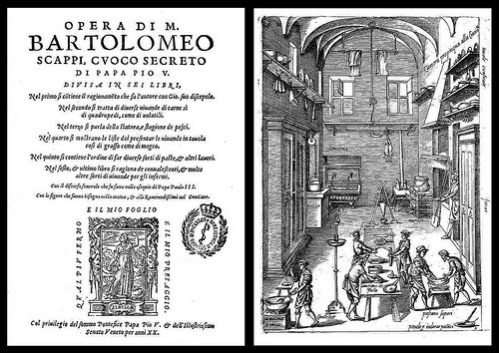
I reserve judgement.

A delightful take on the aristocratic habit of painting palace ceilings with frescoes showing angels, saints, or gods cavorting in the clouds.

Seen at the exit of a subway station, coming up the escalator.

Contemporary art at the Geffen Centre of MOCA.

Whatever … As long as I don’t have to pay for this stuff.

An amusing sign inviting people to come and taste the luncheon delights of a local restaurant.

Resonates particularly strongly with my wife and I, wrestling as we are with the need for weight loss through diet and exercise. We came across it at lunch time as hunger gnawed at our insides.

And with that, it’s a wrap on our stay in LA!

____________________
Photos: ours, except for the following:

Skatepark, Venice Beach: https://m.discoverlosangeles.com/blog/things-to-do-venice-california
Kerry James Marshall: https://www.artsy.net/article/artsy-editorial-how-kerry-james-marshall-became-a-superhero-for-chicago-s-housing-projects
Rose Bowl flea market: http://la.racked.com/maps/los-angeles-vintage-shops/rose-bowl-flea-market
St. Peter Martyr: https://fineartamerica.com/featured/madonna-and-child-with-saint-peter-martyr-1503-lotto-lorenzo.html
Japanese internment: http://freenom.link/?k=80808080&_=1492438798
Infinity Mirrored Room: http://www.thebroad.org/art/exhibitions/yayoi-kusama-infinity-mirrored-room
Basquiat, “Eyes and Eggs”: http://www.thebroad.org/art/jean‐michel-basquiat
Koons: http://robbreport.com/art-collectibles/broad-contemporary-art-museum-opens-los-angeles
Bodhisattva: https://www.pinterest.com/sheth0430/gandharan/
Olvera St.: http://www.inetours.com/Los_Angeles/Photos/Olvera-St-cross.html
LA’s homeless: https://www.google.co.uk/amp/www.latimes.com/local/lanow/la-me-ln-how-los-angeles-homeless-crisis-got-so-bad-20150922-story,amp.html
“Blue Boy”, Thomas Gainsborough: https://en.m.wikipedia.org/wiki/The_Blue_Boy
Huntington gardens: https://commons.m.wikimedia.org/wiki/File:Japanese_Garden_at_Huntington_Library.jpg
Hollyhock House, exterior: http://www.mnn.com/your-home/remodeling-design/blogs/hollyhock-house-frank-lloyd-wright-beauty-to-bloom-again-following
Hollyhock House, interior: https://www.google.co.uk/amp/s/myonebeautifulthing.com/2015/03/16/walk-wright-in/amp/
Carl Andre, MOCA: https://www.moca.org/

WILDFLOWER EXPLOSION

Los Angeles, 10 April 2017

The dark clouds which dumped huge amounts of rain on southern California a few months ago have had a multicolored lining: the intense blooms of wildflowers which have burst out all over this desertic and semi-desertic landscape – water is life. A few posts ago, I wrote about the wildflower blooms in Joshua Tree National Park, considerably more intense this year than in previous years.

Last weekend, my wife and I joined our daughter and her boyfriend on a trek in the Malibu hills where they plunge into the Pacific Ocean.

The hillsides were a riot of yellow, with the flowers growing head high, crowding in over the track, brushing your face, leaving pollen streaks on your cheeks.

And there has been the Antelope Valley California Poppy Reserve …

My wife and I went up there some ten days ago. As we exited San Francisquito Canyon high up on the southern slope of Antelope Valley, we saw spread before us on the valley’s opposite slope several faint patches of orange shimmering in the heat: our goal.

On we drove, down to the valley’s floor and along the its northern slope. We turned a corner and the banks of the road suddenly flamed orange. We were starting to see the California Poppy close up.


After paying our park entry fee and parking the car, we started walking the trails. Our aim was to climb to the top of Kitanemuk hill, walk along the crest a while and then come down and loop around back to the car park. These photos document our walk. I don’t think they need commenting.


I love wildflowers. I love their brilliance, their panoply of shapes and colors. I enjoy their anarchy; not for me the regimented flower beds of suburban gardens. I mourn their evanescence. I see them for a short time in Spring, and spend the rest of the year impatiently waiting their return. I’m really glad that our daughter’s birthday – our excuse for coming to Los Angeles – serendipitously coincides with the annual wildflower explosion in this corner of the world. And I’m secretly thankful for all that rain earlier in the year. It brought much misery to many but a great joy to me and my wife.

____________

Pictures: all ours