A LITTLE TRIP IN CENTRAL ITALY

Milan, 2 May 2025

As in the case of my previous post, the little trip my wife and I recently undertook in central Italy was kicked off by an article in the Guardian which I read some four-five months ago now (although quite how I got to it I can no longer remember; the article is more than three years’ old). The article was about a fresco by the Renaissance artist Piero della Francesca depicting Mary pregnant with Jesus.

Source

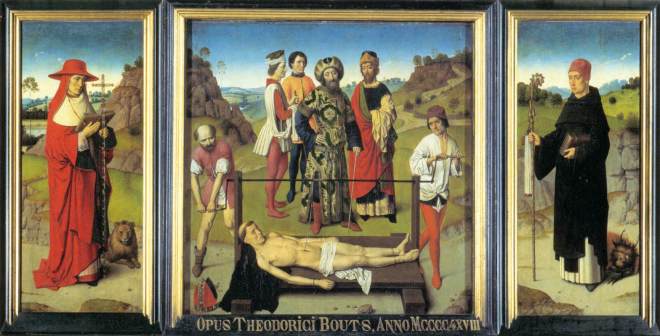
It was such a different depiction of Mary when pregnant. The only paintings I know of where we see her pregnant are depictions of the Visitation, the story in the New Testament where Mary goes to meet Elizabeth and both women are pregnant. Here is a nice example of the genre, by Rogier Van der Weyden, where it is clear that both women are pregnant; in many versions of the Visitation, you would be hard put to see that the two are “with child”, as they used to say.

Source

But Piero della Francesca has Mary alone, not doing anything in particular, just resting her hand on her belly. Such a natural pose! I remember vividly my wife doing exactly the same when she was pregnant with our two children.

Charmed by this fresco, I immediately proposed to my wife that we go to see it. She said she was all for it as long as we got some hiking in too. The fresco is held in a village called Monterchi, on the borders of Tuscany. Once I discovered that we would need to get to Monterchi via Arezzo, I proposed that we also visit Arezzo – I had visited the town fifty years ago, my wife never. And then I saw that one of the earlier stages of the Via di Francesco, the Way of Francis, several stages of which we hiked back in October 2023, passed through Citerna, a village across from Monterchi. So then we decided to walk from Citerna to Sansepolcro. Then late in the planning, we discovered that there was going to be a “once in a lifetime” exhibition of Caravaggio, my favourite painter, in Rome. My wife eventually persuaded me that we should tack on a quick visit to Rome, which allowed for an extra day’s hike to Città di Castello, followed by a two-day stay in Perugia (again, visited by me fifty years ago and by my wife never), with a final quick visit to Rome just for the exhibition.

What follows are notes on our little expedition.

Arezzo (population: 99,000)

After taking a Flixbus down to Florence, we rolled in to Arezzo train station in the early afternoon.

I have to confess that I have no idea why I decided to go to Arezzo fifty years ago. I have but one memory of the place: going to a cafe for lunch and being served by a man with a fascinating face, the type of face I see in Caravaggio’s paintings; the lunch was good, too, as I recall. But I remember nothing of what I visited. A bit embarrassing, really.

What we found was a very pleasant old town, built up a slope towards the cathedral.

Source

Here’s a photo of one of the busier streets.

Source

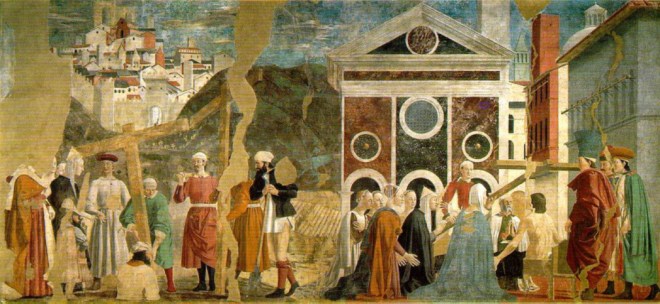
I very nearly missed the town’s artistic highlight, the frescoes in the cappella maggiore in the Church of Saint Francis, by Piero della Francesca (him again; not surprising, really, he was from this part of Tuscany). On the day we set aside to visit Arezzo, the chapel was closed. No problem, we said, we’ll see it tomorrow morning before our bus leaves for Monterchi. Next morning, we were at the church when it opened, but disaster! we were informed that you had to book your visit online, and there were no spaces left. My wife, excellent negotiator that she is, managed to persuade the ladies at the ticket desk to at least allow me in. So I went in and relayed photos to my wife outside via WhatsApp.  These photos, scraped from the web, are frankly much better than the ones I took.

Source
Source
Source

Other highlights in Arezzo:

The Piazza Grande

My wife’s photo

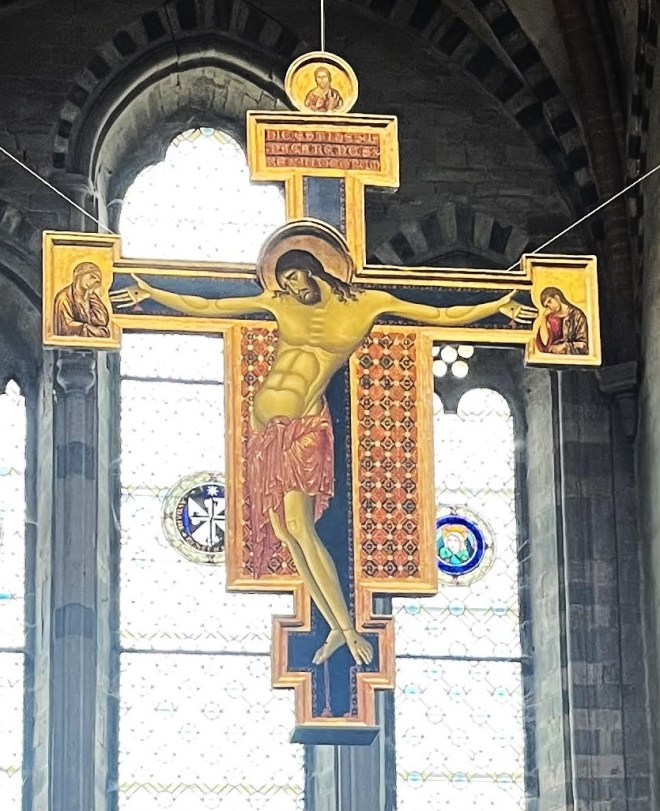
The crucifix by Cimabue in the church of Saint Dominic

My photo

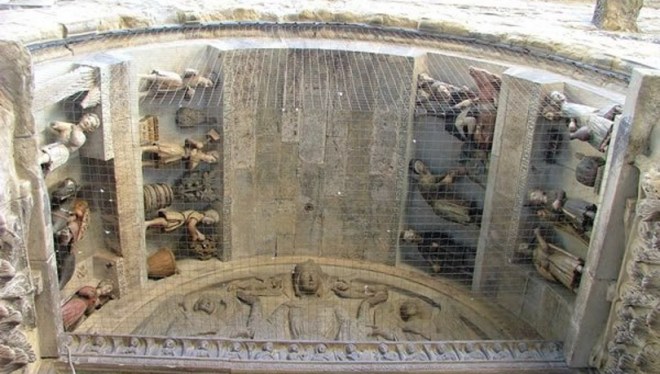
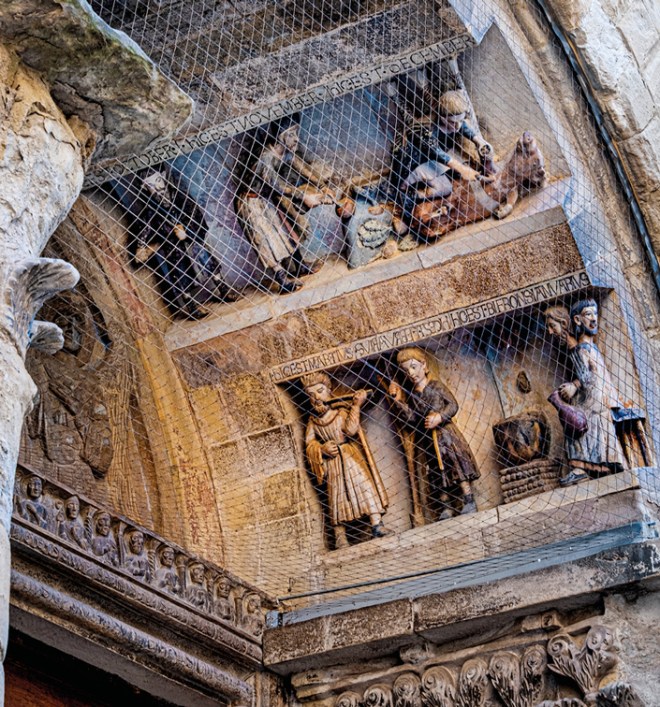
The figurines at the entrance of the church of Santa Maria della Pieve depicting the months of the year.

Source

This photo makes it easier to appreciate these delightful little figurines – we see well the depictions of the months of January and February.

Source

Monterchi (pop: 1,700)

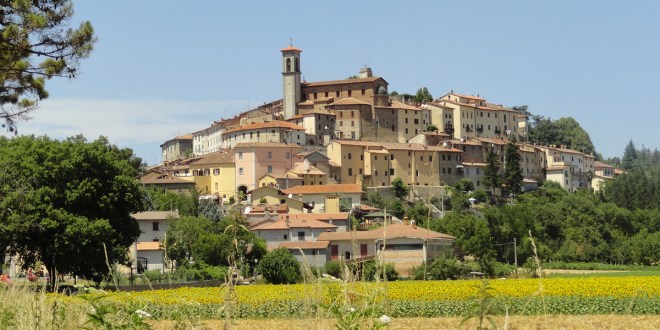
The bus dropped us off at the foot of the village, built like so many villages around here on the top of a hill.

Source

We climbed up and over to the other side of the hill, to the old village school, which had been turned into a little museum just for Piero della Francesca’s fresco of the pregnant Madonna. I won’t repeat the photo I inserted earlier. I throw in instead a photo of a reconstruction of what the fresco originally looked like, with Mary in a tent of some sort.

My photo

It is indeed a lovely representation of pregnancy. I can understand why pregnant women in past centuries would flock to the chapel which contained it, to pray for a safe and easy birth.

Citerna (pop: 3,400)

After the visit to the museum, my wife and I walked to Citerna, sitting on the top of a high hill on the other side of the valley from Monterchi.

My wife’s photo

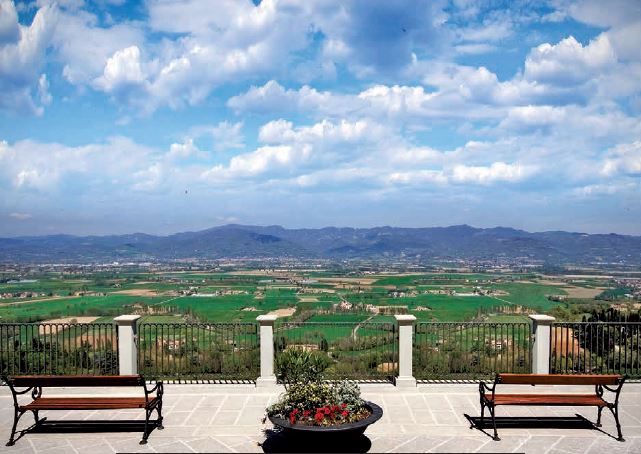
It was a short hike, some 2 km, but steep: the route suggested by Google Maps took us pretty much straight up the hill. What we found at the top was a sleepy little village most of whose residents were old – the fate of so many of Italy’s villages. Internet had informed me that the local church contained a statue by Donatello, although I was warned it was difficult to visit. And so it proved. The church was locked, but there was a note on the door with a phone number to call to arrange a visit. My wife called, but the man who responded told her he was in Ravenna; tomorrow morning, he said, he would be there at 9.45 – or maybe later, he wasn’t sure. Since we were planning to be on the road by 9.00, that was that. The only other thing of note in the village was splendid views of the valley which we would be hiking across the next day.

Source

There was also a stone tablet set in a wall which got me all excited.

My photo

It commemorates the fact that Garibaldi and his beloved wife Anita stayed here in July 1849. Theirs was an impossibly romantic story. They met in 1839 in Brazil; Garibaldi was fighting in a number of wars of independence in Latin America. The way my history teacher told the story in my O-level history class (the only thing I really remember of the part of the curriculum on Italian unification), Anita was washing clothes in the river. Garibaldi spotted her through his telescope from the bridge of his ship. He immediately got his sailors to row him over to her. When he reached her he declared to her – in Italian – “you must be mine!” She was already married but somehow or other the husband was dispensed with and they got married. When Garibaldi came back to Italy in 1848 to fight in the various popular uprisings taking place there, she followed him. She was with him in Rome in 1849, when he was defending the short-lived Roman Republic. Together, they escaped as the Republic collapsed in June. Their aim was to get to Venice, but they were being pursued by at least three armies and navies: the French, Austrian, and papal forces. It was during this flight towards Venice that the pair spent a – presumably hurried – night in Citerna. Tragically, Anita died, probably of malaria, in Garibaldi’s arms, near Ravenna in early August. I throw in a photo of the pair.

Source

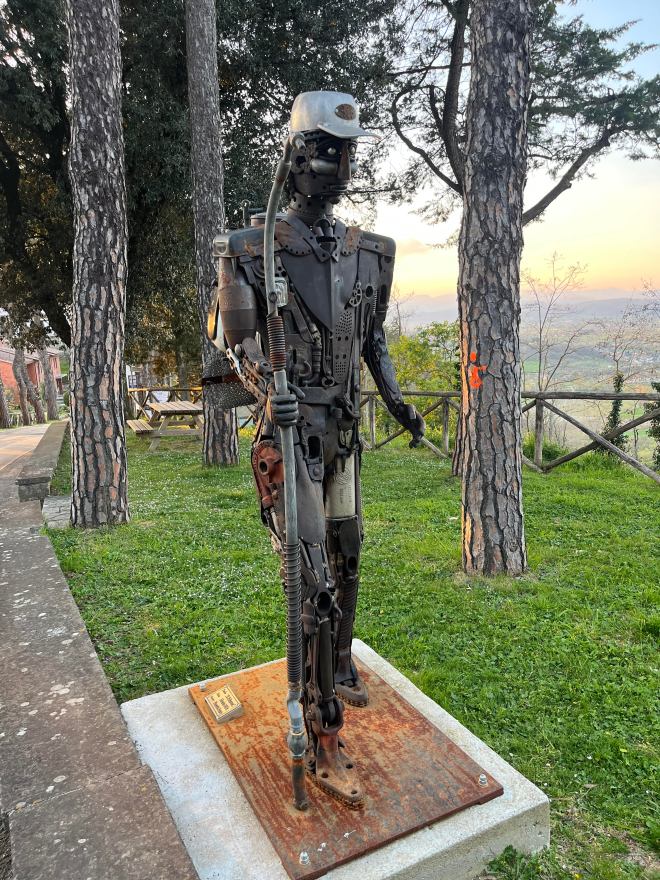
Back in Citerna, we also came across this amusing sculpture.

Source

Made of scrap metal, it commemorates the pilgrims who pass through Citerna, walking the Via di Francesco on their way to Assisi. It was the route we would be taking the next day, although we would be walking it in the opposite direction, to Sansepolcro.

Sansepolcro (pop: 15,000)

We made our way down the hill from Citerna and then started making our way across the valley which lay between us and Sansepolcro. We were taking small roads across the valley which wound their way across flat fields.

Source

From time to time, we passed groups of pilgrims walking the other way, otherwise we had the road to ourselves. 15 km later we arrived at Sansepolcro.

Having dropped off our rucksacks, we went off to explore. In truth, there wasn’t much to explore, but we did go and see the town’s crown jewel, its municipal museum, which contains this lovely polyptich painted by Piero della Francesca.

Source

I’ve always loved these depictions of Mary as the Madonna of Mercy, where she is gathering up a group of faithful into the folds of her cloak. If I had lived in the Renaissance – and if I had been very rich – I would have commissioned a Madonna of Mercy, with my wife and I, along with our two children, their partners, and their children, all gathered under her cloak.

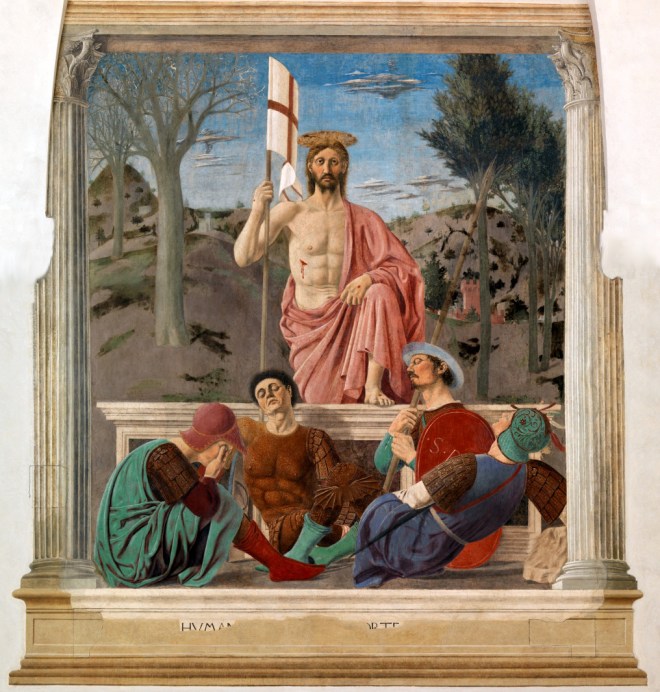
The museum also contained this magnificent Resurrection by Piero della Francesca.

Source

There is a heart-warming story about this fresco. Aldous Huxley had visited Sansepolcro to see this fresco, and in an essay he wrote in the 1920s he described it as “the greatest picture in the world”. In the summer of 1944, as Allied troops were advancing up Italy, the Royal Horse Artillery took up positions to shell Sansepolcro according to orders received. Suddenly, a Lieutenant, by the name of Anthony Clarke, remembered reading that essay as a teenager. Fearing that the shelling could destroy the fresco, he ordered the men to cease fire. Luckily for him, the Germans had already evacuated the town, so the Allied troops could capture it without losses.

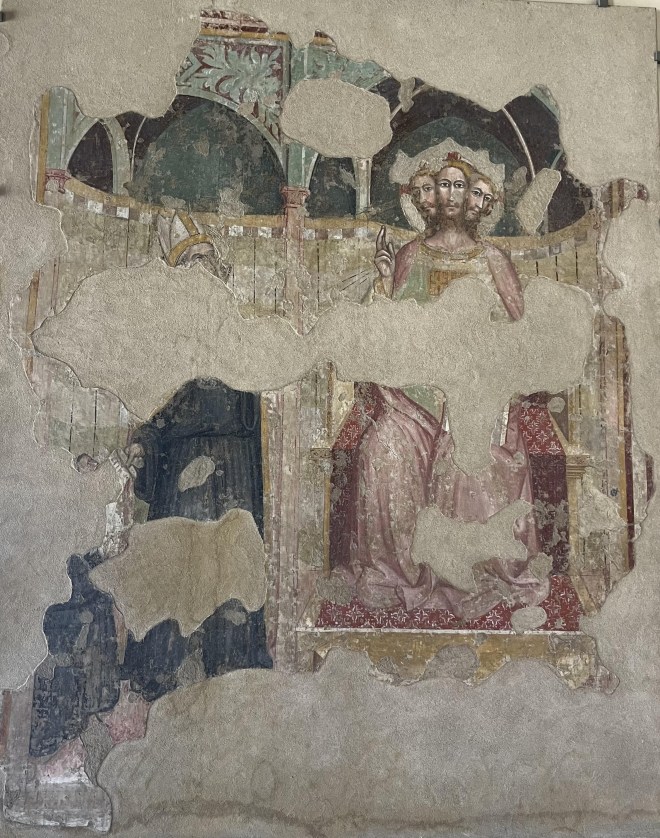
The rest of the museum was so-so, although I was much struck by a very strange fresco tucked away in a back room.

My photo

It is meant to represent the Holy Trinity, although this three-headed person looks more monstrous than holy.

Città di Castello (pop: 38,000)

The next day, we made a 10 km hike southwards to Città di Castello. We weren’t following a pilgrim trail, just a route suggested by one of the hiking apps we use. The first half was very pleasant, taking us along back roads and tracks through fields. The second half was less so, having us walk along a busy road and then through what seemed like the interminable suburbs of the town itself.

Once we had found our lodgings and dropped off our rucksacks, we sallied out to see what we could find. As in the case of Sansepolcro, there really wasn’t much to find. But we did discover – to our surprise, I have to admit – that Città di Castello was the birthplace of a fairly well known modern Italian artist by the name of Alberto Burri, and that, with the blessings of the municipality, he had set up a museum containing an extensive collection of his works. The Green Michelin Guide, my go-to source for all things cultural to visit, gave the museum two stars. Well, what the hell, we said, why not.

Well, I can’t say I was super excited by his work. He used materials like tar, iron, plastic, wood, earth, and glue to create his pieces, which I suppose would be defined as abstract art. A site I read had this to say about him: “Alberto Burri was an Italian painter, among the most important of the 20th Century. His techniques anticipated movements like arte povera and nuovo realismo.” The only work in the museum which I could have lived with is this one.

My photo

After our visit to the museum, we wended our way to the town’s main drag to have an Aperol Spritz, but not before coming across this wonderful stone tablet set in the wall of the old municipal building.

Source

It was an excellent example of a style of lapidary declamation that I often come across in Italy: wordy, pompous, and often – to me, anyway – incomprehensible, mostly because no punctuation is ever used. Below is my best guess at a translation of what the Socialists of Città di Castello were trying to say back in 1911:

“From the red dawn of the International to the victorious outbreak of proletarian forces, neither persecution nor honours bent the proud soul of Andrea Costa away from the socialist ideals of workers’ rights. Supporter, apostle, in the square, in prison, in parliament.

In the name of he who was the symbol of the noblest faith, the Internationalist group of Città di Castello, dispersed in the lands of exile by violent blasts, remember, honor.

The Socialists”

Perugia (pop: 162,000)

We took a creaky old train, much painted over by graffiti, to Ponte San Giovanni at the foot of Perugia and then a bus up to Perugia itself, high up on the hilltops. The weather had turned and we reached our hotel in the midst of a downpour.

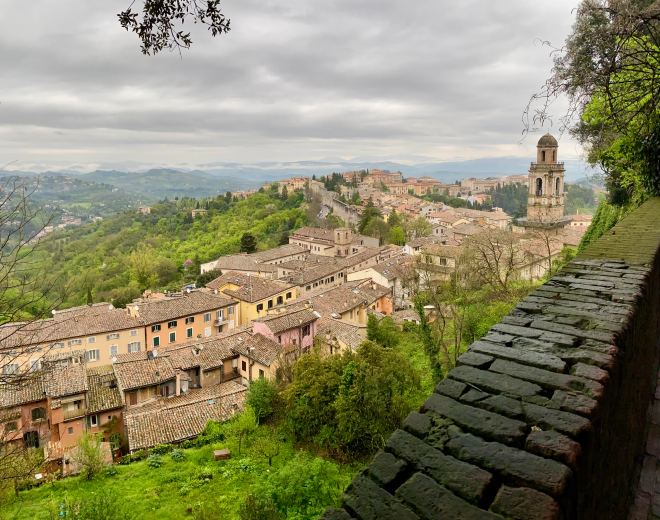
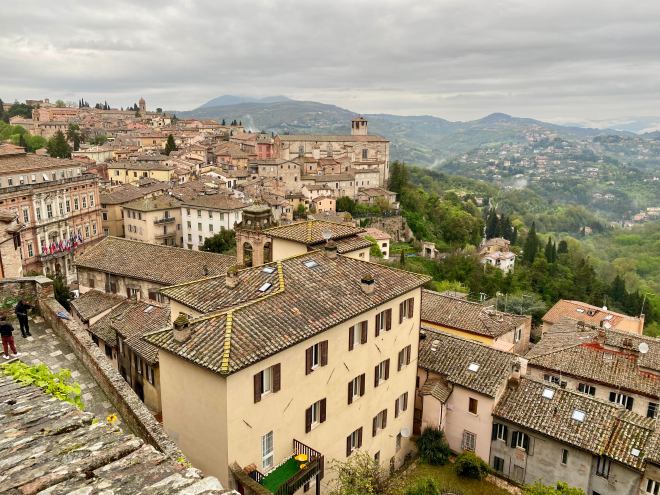
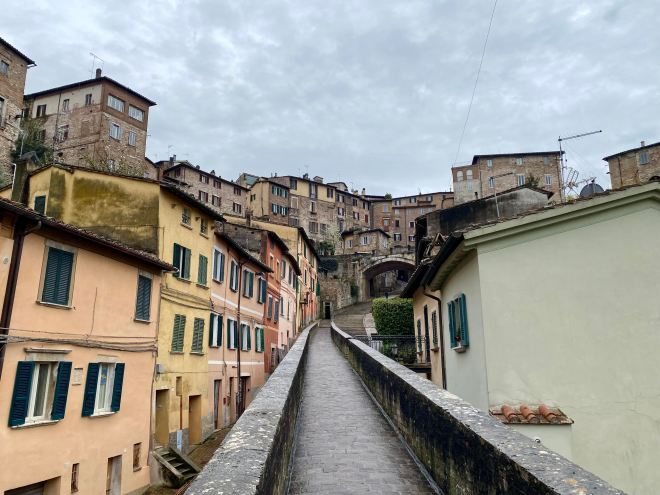
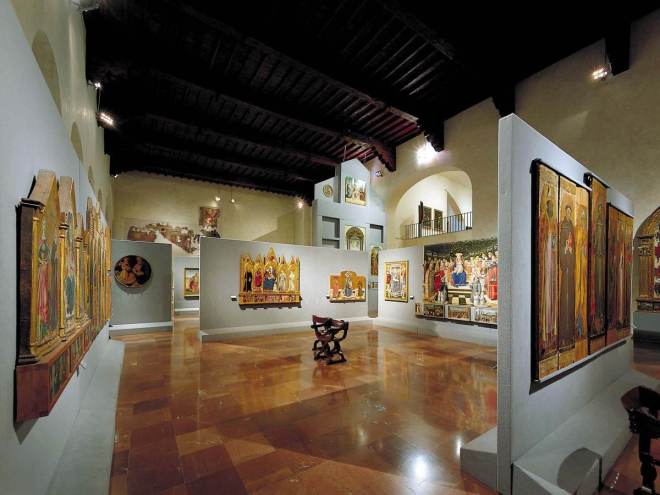
My only memory of Perugia from my previous visit of 50 years ago is a very vague one. It has to do with a museum, the national gallery of Umbria, but has nothing to do with any of the pieces in that museum. My memory synapses just stored away my pleasure at the halls’ minimalist style: undecorated white walls, relatively few well spaced paintings on these walls, uncluttered floors with only the occasional bench to sit on. It is a style that my wife and I have adopted all our lives – although I have sometimes weakened, seeing lovely, and relatively cheap, things to hang on the wall; but my wife has kept me on the straight and narrow. I must admit, it is a strange memory of Perugia to have carried with me all these decades. For instance, I have no memory of the town’s topography. Over the millennia, Perugia has spread over a series of hilltops and their connecting crests, so there are a lot of fairly steep ascents and descents involved in visiting the town. My wife, on her first visit to Perugia, was charmed by this form of urban development and took several photos to record it.

My wife’s photo
My wife’s photo
My wife’s photo

To help the locals (and maybe tourists) to tackle the town’s steep slopes, the municipality has installed escalators at various points. This one passes through the bowels of a fortress built by a pope to keep the Perugians in line.

My wife’s photo

They rather reminded us of the Central-Mid Levels escalator in Hong Kong – although that one was considerably longer.

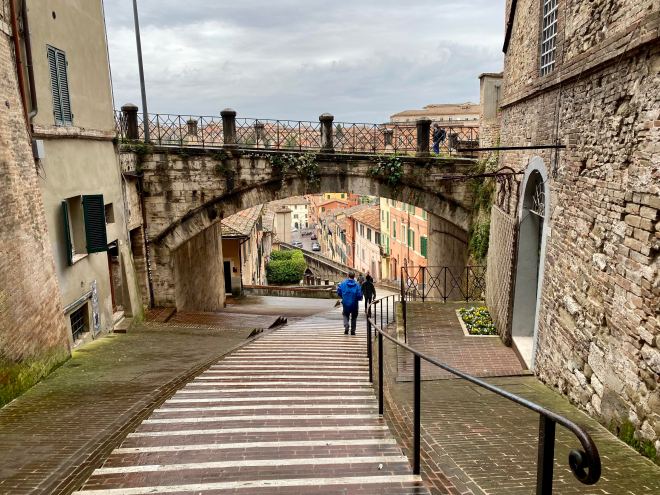
The municipality has also rather cleverly readapted an old viaduct and made it into a walkway.

My wife’s photo

Talking of the national gallery of Umbria, it was a pleasure to (re)visit it. It houses a wonderful, huge crucifix by “the Master of Saint Francis”.

Source

In general, its Medieval and early Renaissance collections are lovely.

Source

The rest of the town delivered a few more pleasurable encounters:

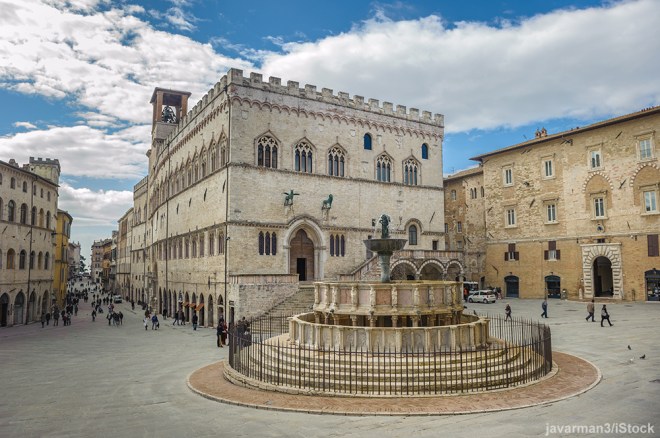
The fontana maggiore place in the town’s main piazza, mainly for its sculpted panels.

Source

The panels were carved by Nicola and Giovanni Pisano (we weren’t actually looking at the originals, which are now housed in the Galleria Nazionale dell’Umbria). The panels depict the months of the year, various allegorical figures, and some other subjects. I show the two panels which cover the months of our two birthdays.

Source
Source

The ornate interior of the abbey church of San Pietro

Source

Rome (pop: 2,760,000)

We took the Flixbus down to Rome, which left us off at Tiburtina station. From there, without even bothering to put down our bags at the hotel, we took the subway to Palazzo Barberini where the Caravaggio exhibition was being held.

Source

It was a wonderful exhibition. Some of the pieces I had already seen “in the flesh”, like this painting, Judith Beheading Holofernes, held in Palazzo Barberini’s own collection.

Source

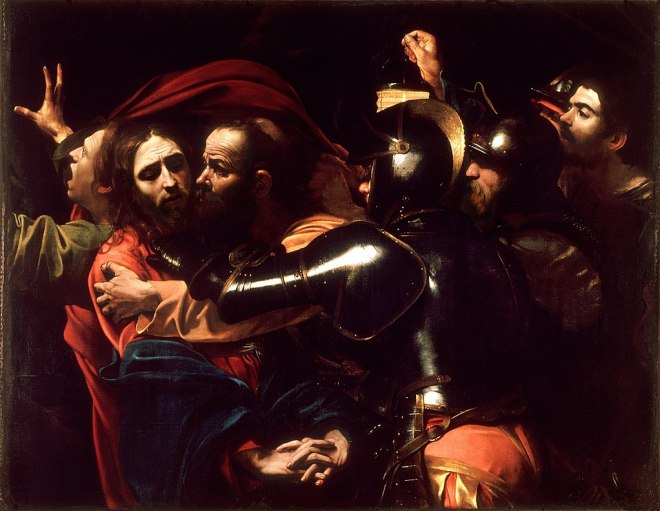
Others I had only seen in my book of Caravaggio’s paintings. For instance, this one, The Taking of Christ, which currently resides in the National Gallery of Ireland (it was rediscovered a mere thirty years ago!).

Source

And this one, The Martyrdom of Saint Ursula, from Naples, is now considered to be Caravaggio’s last painting.

Source

In both, one can see self-portraits of Caravaggio, at the back of the crowds, peering over people’s shoulders.

With that, all our visits on this little trip were now over. But not, alas, our adventures, or rather misadventures in this case. On the subway trip back to the hotel, my wallet was picked from my pocket. The money was the least of things. Gone were the credit and debit cards, my residence permit for Austria, my driver’s license, and few other odds and ends.

Source

Back home

We took the bus back to our seaside place. All the way, I was seething inside over my wallet. I decided I should put a curse on the thief. I should do like the ancients, who wrote their curses on thin sheets of lead, rolled them up, and consigned them to a sacred place. The example I give here is one of 130 curse tablets that were discovered at the bottom of what was during Roman times a sacred spring in Bath, in the UK.

Source

I don’t know what particular curse this tablet has scratched on it, but one of the 130 has this to say about the theft of a ring:

“So long as someone, whether slave or free, keeps silent or knows anything about it, may he be accursed in his blood and eyes and every limb, and even have all his intestines quite eaten away if he has stolen the ring or been privy to the theft.”

Hmm, that sounds like a good curse. But actually, I know an even better one, a really hideous one. I won’t say what it is because then it wouldn’t work anymore. I don’t need a sheet of lead, a sheet of paper will do, and I will consign it to one of those offerings boxes they have in churches. Let the thief suffer the torments of hell, for ever and ever and ever!

ALEXANDERS

Milan, 23 April 2025

It was an article in the Guardian that started me off on this post. The writer was describing an expedition of his into the countryside in Kent to go foraging. He mentioned having seen dandelion, common sorrel, lady’s smock, stinging nettle, goosegrass, reedmace … plants I have never eaten; in fact, apart from dandelion and stinging nettle, I’ve never even heard of them. The writer goes on:

“Further along the hedge, the large glossy leaves of alexanders stand in ragged clumps above the dull, wintered sward; yet another superb edible and the main reason for my visit. This plant, most likely introduced by the Romans, comes from the Mediterranean where it was once known as Petroselinum Alexandrium – the parsley of Alexandria. Like many members of the carrot tribe, they present a huge amount of culinary potential – all parts of the plant can be eaten, offering complex floral flavours and harmonising notes of bittersweet. The root is particularly delicious, something akin to a fragrant parsnip once roasted. … I get to work harvesting a few alexander crowns, the burgeoning flower stems still sheathed in soft green leaves. Later I’ll roast them with feta and sun-dried tomatoes, returning the unmistakable smell of spring fare to the kitchen.”

I have to admit to also never having heard of alexanders, let alone eaten it. In the face of such ignorance, I might have moved on to another article in the Guardian were it not for the fact that something in the article’s description – the mention of a Mediterranean origin perhaps? – intrigued me, and I decided to investigate.

The first thing I did was to pull up some photos of this plant, because I had no idea what it looked like. Here’s a nice example of what I found.

Source

As I studied this and other photos, I said to myself “hang on a minute, I think I’ve seen this plant recently. Wasn’t it at some point half choking the path on that last hike we did?” This was in Liguria, when my wife and I were taking the high path which snakes along the contours of the hills between Sori (where we have our apartment) and Recco (where we were going to eat focaccia al formaggio). As always, I turned to my go-to source, Wikipedia, for further information. I was not disappointed.

Let me start with a map of the plant’s current distribution.

Source

It seems that it can be found throughout Italy and Greece, as well as much of the UK and Ireland. Otherwise, it is more of a coastal plant. So there is a good chance that what I saw on that walk was alexanders. There is some discussion as to whether, as suggested by the writer of the Guardian article, this is a Mediterranean plant which was brought to the UK and elsewhere in Northern Europe (the Romans being a popular possible vector as far as the UK is concerned) or whether it is actually native to all the places in Europe where it is currently found.

I’ll leave that question to the experts to hash out. What caught my eye in the Wikipedia entry instead was a sentence: “Inland [in the UK], it is often found close to the sites of medieval monastery gardens and other historical places such as castles.” And suddenly, a vision of Brother Cadfael working his herb garden floated up in my mind’s eye. For any readers who might not be familiar with Brother Cadfael, he is the main character in twenty books set in a Benedictine monastery in Shrewsbury, England. The stories take place between the years 1135 and 1145, and have Cadfael solving all sorts of murders and other Medieval mayhem. He is also the monastery’s herbalist, making up medicines for sick monks, using herbs he grows in the monastery’s herb garden where he grows the plants he needs to make up his potions. I throw in a photo of the cover of the 20th book in the series, where he seems to be in his herb garden.

My photo

I have to say, I’m extremely fond of the Cadfael stories. As the photo intimates, I have all twenty of the series. I’m not so fond of the TV show starring Derek Jacobi as Cadfael. Normally, I’m a great fan of his, but this show didn’t really grip me.

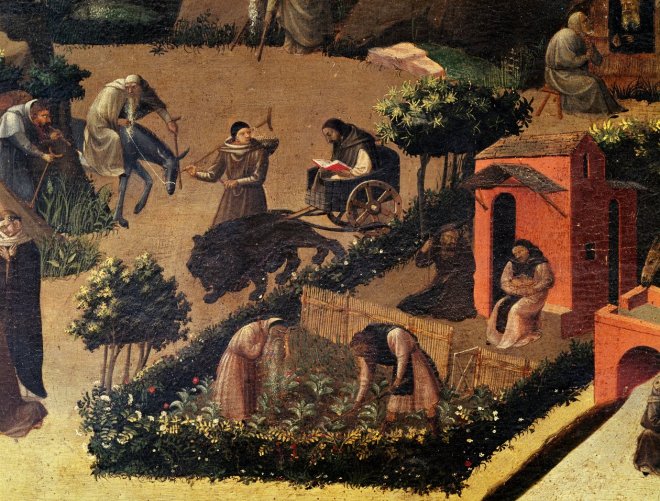
In any event, I throw in here a painting by Fra Angelico showing monks at work on their garden.

Source

I don’t know if Cadfael would have grown alexanders in his herb garden. The plant was mostly grown to eat, but Wikipedia does say that it also had therapeutic uses. So I’m happy to think that his herb garden would have contained alexanders.

Another sentence in the Wikipedia entry caught my eye: “It was once highly valued in northern Europe as an early vegetable: one of the few fresh plants that can be eaten in February or March”. If it was so highly valued, what happened? Well, it seems that in the 18th Century (or maybe even in the century before that) it lost out to celery. John Evelyn (whom I’ve had cause to mention in an earlier post) had this to say in his book Acetaria. A Discourse of Sallets [Salads] published in 1699: “Sellery … was formerly a stranger with us (nor very long since in Italy) [It] is a hot and more generous sort of Macedonian Persley [Macedonian parsley being another name for alexanders] … and for its high and grateful Taste is ever plac’d in the middle of the Grand Sallet, at our Great Men’s tables, and Praetors feasts, as the Grace of the whole Board”. The Wikipedia entry confirms (in slightly more sober language) this similarity in taste between alexanders and celery, at least as far as the leaves are concerned: “the young foliage is intermediate in flavour between celery and parsley”.

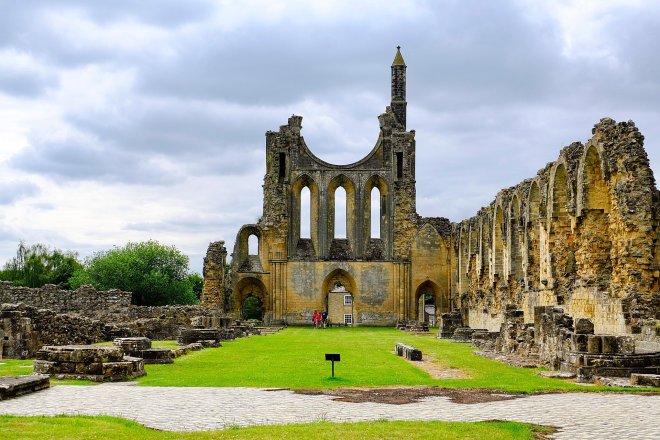
And so, abandoned by monk and lord of the castle, domesticated alexanders went feral, spreading out from the old monastic and aristocratic herb and vegetable gardens into the surrounding countryside. I suppose in the UK in particular the tidy plantings of alexanders in monastic gardens were victim of Henry VIII’s dissolution of the monasteries in the late 1530s, which left behind only a few ruins like this one, of Byland Abbey in Yorkshire.

Source

(I chose this particular ruin because it happens to be down the road from my old school; I did some very basic archaeological mapping there but don’t remember ever seeing any alexanders).

Is there any chance of seeing alexanders back on our plates? Well, Wikipedia holds out some hope: “It … has found some renewed use in exotic “foraged” food recipes and restaurants.” A first, timid step to its journey back onto supermarket shelves next to celery, perhaps. Maybe I should forage it and try it. But the Guardian article does contain a warning: “care must be taken with identification … [nearby] hemlock water dropwort is growing in great profusion. This deadly relative and a half-hearted imposter of alexanders is easy to distinguish with experience … but surviving long enough to gain such confidence requires a little care”. That makes me gulp. Right now, I think I’ll just take photos of the plant, like this one I took recently on a hike on the Monte di Portofino starting from San Rocco.

My photo

BREAD

Sori, Easter Sunday 2025

I suppose every person on this planet will rave about a foodstuff made from the grain which got domesticated in their corner of the planet. I’ve seen Chinese and Japanese go misty-eyed about various rice-based foodstuffs.

Source

I’m sure Central Americans do the same for foodstuffs made with maize.

Source

Or Africans for foodstuffs made with sorghum.

Source

Because my roots are in Europe, where wheat reigns supreme, I go dreamy about foodstuffs made with wheat, a grass that was domesticated in the Middle East. And I go very dreamy about one particular foodstuff made with wheat: bread.

Source

Aaah, that wonderful smell that emanates from local bakeries!

Source

I remember still the delicious scents that wafted out of a bakery in Edinburgh, where I was a student in the early 1970s. It was halfway between my halls of residence and the hall where I was rehearsing plays with the university’s drama society. I would whizz by that bakery on my moped, passing through this cloud of deliciousness.

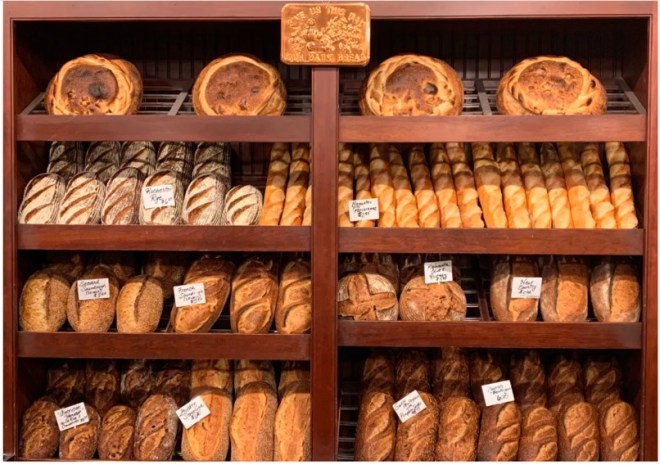
And the wonderful smell that will greet you as you step into a local bakery’s shop and are confronted by rows of freshly baked loaves!

Source

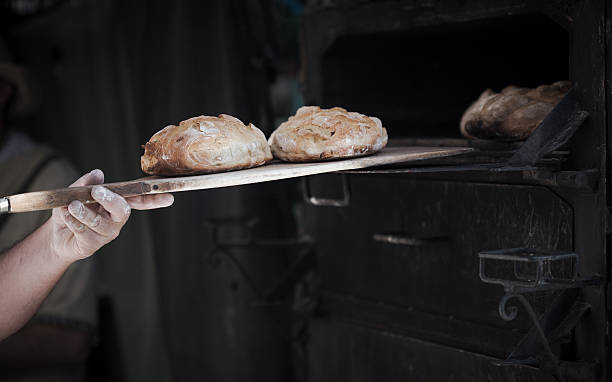
And the delicious taste as you sink your teeth into a loaf still warm from the oven!

Source

And even when the bread is cold the wonderful taste it will have after you’ve used it to mop up the sauce on your plate.

Source

Or the way it will heighten the taste of a hunk of cheese.

Source

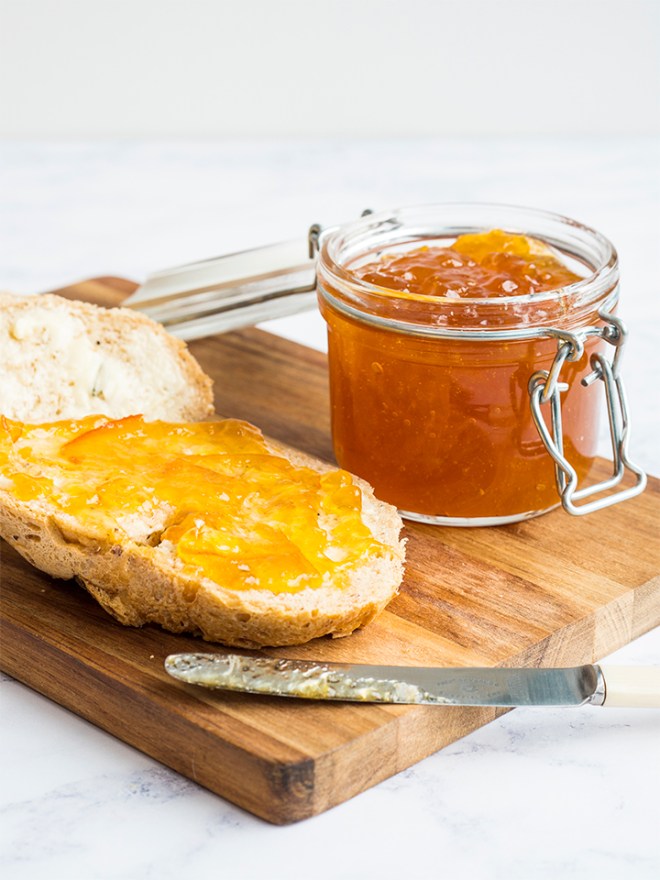
Or of the butter and marmalade you’ve spread onto it.

Source

Mm, yes, bread … (I should note in passing that my heightened appreciation of bread comes from the fact that I eat little of it now – the diet, you know …)

It seems that we have the Ancient Egyptians to thank for these sensory wonders. It is the leavening of bread with yeast that gives bread that very special smell and taste.

Source

And leavening is a discovery the Ancient Egyptians stumbled across. Quite how they did so is a matter of lively debate, at least in certain circles. The theory I most approve of (although no-one is asking for my approval) suggests a serendipitous cross-over from beer making. The making of beer was (and of course still is) another yeast-aided process working on a mash of grains from another grass domesticated in the Middle East, in this case barley. The theory goes that some Ancient Egyptian involved in the making of both unleavened flatbread and beer accidentally splashed some of the beer’s yeast-laden froth (which goes by the delightful name of barm) onto some dough they had prepared. Then for some reason they left the dough to rest for a while (maybe it was evening). When they came back, they saw that the dough had risen. Instead of throwing it away as spoilt, they baked it anyway (maybe supplies of food were limited and they were hungry), and they saw what a marvel resulted.

It can’t have been that simple, there must have been a lot of tinkering after that first leavening of bread, but this story satisfies my fervid imagination. Here, we have small models showing the making of bread, which Ancient Egyptians placed in a tomb, presumably to ensure that the dead person would get to eat bread in the afterlife.

Source

Here we have a similar set of small models from another tomb, showing the brewing of beer.

Source

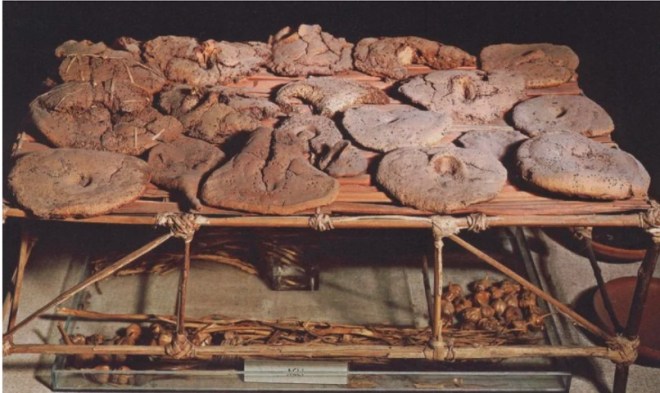
And here we have some real Ancient Egyptian bread loaves found as grave goods.

Source

I grant you they don’t look terribly edible, but they have been sitting in a grave for several thousands of years after all.

At some point, someone – yet again an Ancient Egyptian, I’m thinking – came up with the idea of keeping back a piece of the leavened dough to inoculate the next batch of unleavened dough. And at some other point, I’m guessing also in Ancient Egypt, leavened dough got contaminated with lactic acid bacteria. Maybe the bacteria were on the hands of the people kneading the dough; they had picked them up touching milk products. Or maybe another pathway came into play. However the contamination occurred, it led to the creation of sourdough; it is these bacteria that give sourdough bread its characteristic sour taste. And so nearly all the pieces were in place for the making of sourdough bread for the next five millennia or so – because until the middle of the 19th Century sourdough bread dominated bread making with wheat.

The last piece of the puzzle was the baking oven. It seems that we have the Ancient Greeks to thank for that. What they came up with must have looked quite similar to the wood-fed ovens which any self-respecting pizzeria will install today.

Source

The cupola shape of these ovens concentrates the heat radiating from the bricks onto the oven’s centre, making it more efficient (and thereby lessening the chore for our ancestors of having to go out to collect wood). And progress in oven-building meant that large ovens could be built, in which multiple loaves could be baked at the same time. Thus was born the profession of the baker (which, among many other things, eventually led centuries later to that delightfully ridiculous nursery rhyme “Rub-a-dub-dub, three maids in a tub, And who do you think were there? The butcher, the baker, the candlestick-maker, And all of them gone to the fair”).

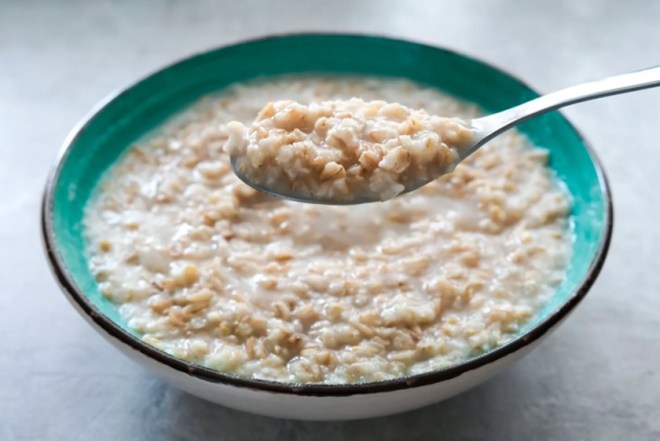
The Ancient Greeks seem also to have taught the uncouth Romans to eat leavened wheat bread. In fairness to the Romans, they weren’t really that different from anyone else in this uncouthness. Originally, they baked flatbread with their grains, or simply ate them in gruel like our Neolithic ancestors had done – but also like many, mostly poor, people have done ever since. I don’t claim to be poor, but the only way I eat oats – another of the grasses domesticated in the Middle East – is as a viscous gruel known to all and sundry as porridge.

Source

And the Italians have what is now a chi-chi dish, zuppa di farro, which originally was just a gruel made with grains of spelt, an early form of wheat which has now all but disappeared.

Source

However, once introduced to the joys of leavened wheat bread, the Romans got into it with a vengeance. And of course evidence of this new enthusiasm of theirs came to light in the ruins of Pompeii, in the form of now burnt loaves of bread abandoned in the town’s bakeries as Mount Vesuvius erupted and the workers ran for their lives.

Source

Perhaps it had already happened elsewhere, but certainly in Rome class reared its ugly head in the matter of bread eating: bread made with the most refined, and so costly, wheat flour, was eaten by the rich, while the poor made do with bread made with poorly sifted whole wheat flour or even a mix of wheat flour and the flour of other grains like barley or oats. That translated into a colour bar: the crumb of the most expensive bread was white while that of the least expensive bread was various shades of brown.

Source

It’s ironic, really, that the rich were eating the nutritionally poorest bread … But at least they were eating other things which could make up for the loss of nutrition in their expensive bread. The poor, on the other hand, had little but bread to eat. Which is why already from the times of the late Republic the Roman governing class was handing out free or subsidised wheat to the poor in Rome, to keep them happy – and politically passive. The Roman poet Juvenal decried this in one of his Satires: “Already long ago, from when we sold our vote to no man, the People abdicated their duties; for the People who once handed out military command, high civil office, legions – everything, now restrains itself and anxiously hopes for just two things: bread and circuses” (it’s a comment that George Orwell updated in his novel 1984 when he described “the Proles”: “Heavy physical work, the care of home and children, petty quarrels with neighbours, films, football, beer and, above all, gambling filled up the horizon of their minds. To keep them in control was not difficult.”)

Fast forward another thousand years or so and we are in Europe’s Middle Ages. The rich were still eating white bread and the poor brown-to-black bread, and bread was still the most important part of the poor’s diet. So nothing much had changed. But if I pause here, it’s because of a very interesting habit we find in rich households regarding tableware. Basically, bread was not just a food, it was also used as a plate. A round piece of, often stale, bread was cut from a large loaf – hence the English name of this tableware, trencher, from the French “trancher”, to cut. The food was ladled onto the trencher, which would absorb any juice or gravy. The illustration below shows trenchers being prepared. It comes from “Les Tres Riches Heures du Duc de Berry”, a prayer book put together during the first half of the 1400s for the said Duke, who we see sitting at the table.

Source

Once the food had been eaten, the trencher, now softened, was cut up and also eaten.

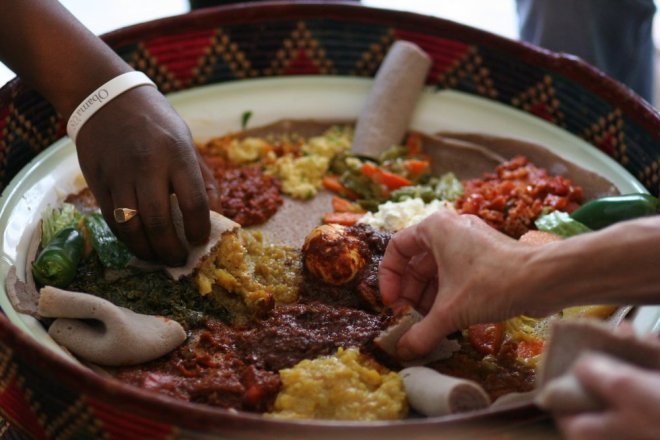
I find this a wonderful way of eating bread. It’s sad that trenchers began to be made of metal or wood, later to be replaced by the plates we are all familiar with today. The only culture that I know of which uses bread in this way is that of the Ethiopian Highlands, where the food is placed on injera, made with flour from the local grain, teff (although, as this photo shows, nowadays the injera is in turn placed on a plate).

Source

Injera is also used as the utensils to pick up the food.

Source

But back to the bread trencher, where there was a similar relation between rich and poor as there had been in Rome over free supplies of bread. If the harvests had been good, if food in the household was plentiful, if the lady of the house was feeling generous or pious, rather than being eaten the used trencher could instead be given to the poor for them to eat. Or it could be fed to the dogs (which is what the Duc de Berry’s servants seem to be doing in the bottom right-hand corner of the illustration). I suppose when supplies were tight and household ate their own trenchers, the poor were just left to starve.

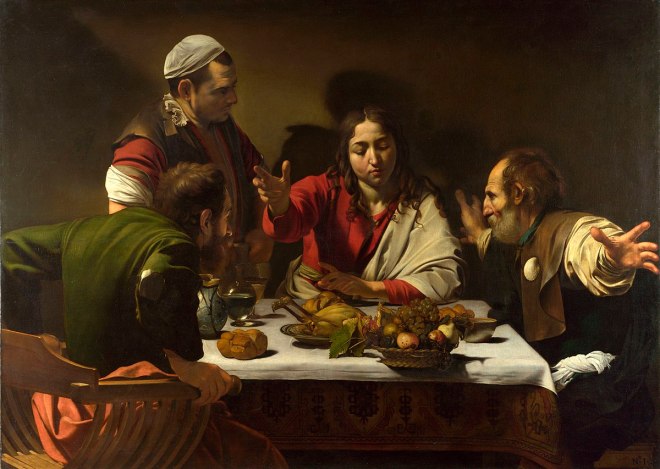
Bread had now also taken on strong religious overtones in Christian lands, because of the role which bread played in the Last Supper. Many are the paintings of the Last Supper, probably the most famous being the fresco by Leonardo da Vinci. But I won’t show a photo of that fresco. It’s too well known, and anyway you can hardly see anything, it’s in such a bad state of conservation. I’ll throw in a painting by Caravaggio instead, and not of the Last Supper but of the Supper at Emmaus. As recounted in St. Luke’s Gospel (in the King James Version):

And, behold, two of them went that same day [the day of the resurrection] to a village called Emmaus, which was from Jerusalem about threescore furlongs. And they talked together of all these things which had happened. And it came to pass, that, while they communed together and reasoned, Jesus himself drew near, and went with them. But their eyes were holden that they should not know him. … And they drew nigh unto the village, whither they went: and he made as though he would have gone further. But they constrained him, saying, Abide with us: for it is toward evening, and the day is far spent. And he went in to tarry with them. And it came to pass, as he sat at meat with them, he took bread, and blessed it, and brake, and gave to them. And their eyes were opened, and they knew him; and he vanished out of their sight.

Source

You can see the bread loaves Jesus is blessing on the table in front of each of them (I should note in passing that my timing here is excellent, today being Easter Sunday, the day this meeting in Emmaus would have taken place).

The formal theme of Caravaggio’s painting might be religious, but what I see in it is companionship: the Latin roots of the word “companion” are cum and panis, “together with bread”. I find it deeply satisfying that bread was considered not just a food but also a strong binder of friends.

And so we whizz on through the centuries, to stop again at the International Exposition of 1867, which was held in Paris.

Source

It was here that Austria presented the first breads made not with sourdough but with much purer strains of yeast uncontaminated with lactic acid bacteria (later known as baker’s yeast). I will show just one of these breads, the Kaisersemmel, for the simple reason that I eat this from time to time during our sojourns in Vienna.

Source

Many people tried the Austrians’ bread at the Exposition and liked it. Why? Because it tasted “sweet”; it didn’t have that characteristic sour taste of bread made with sourdough. This new, exciting way of making bread, the so-called Vienna Process, caught on. And so, perhaps without anyone really noticing, a fundamental shift started taking place for the peoples in Europe, North Africa, and the Middle East who ate leavened wheat bread: they slowly abandoned the sourdough bread which their ancestors had eaten for thousands of years for “sweet” bread. Today, sourdough bread is a niche product.

Was the switch away from sourdough bread a tragedy? I don’t think so. But then, I like sweet bread. I’m quite partial to a Kaisersemmel, for instance, and I will kill for a warm, crusty baguette.

Source

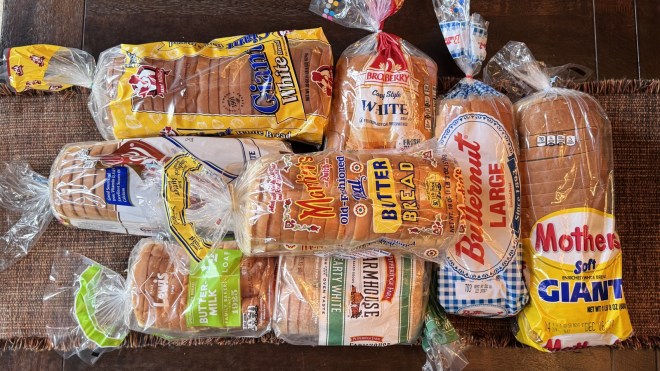
What was definitely a tragedy was the tinkering that went on from the mid-180Os onwards to find ways to make bread faster. “Time is money!” we are told, and never was this aphorism truer than in breadmaking. Making a loaf of sourdough bread takes 24 hours or more from start to finish. Anything to speed this up meant more loaves could be made, and sold, every 24 hours; already the Vienna Process was faster than the traditional method. This tinkering eventually led the British to invent the Chorleywood bread process in 1961. Without going into the technical details, this process can make a loaf of bread from start to finish (sliced and packaged) in about three and a half hours. It results in this hideous kind of product.

Source

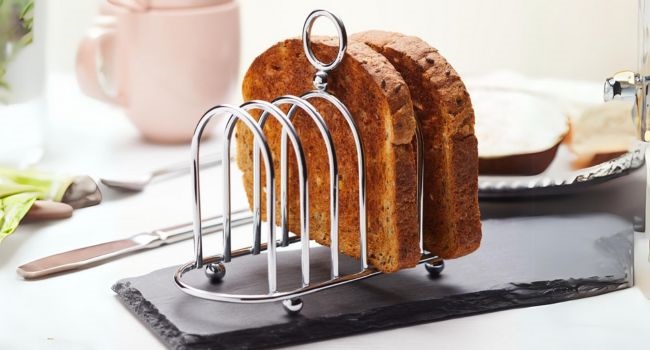
A soft, limp crumb, a miserably thin crust, a thing that you don’t need teeth to eat. Dreadful. The only thing it’s good for is to make toast, which probably explains why toast is so popular in the UK.

Source

And so we have followed the rise – literal as well as metaphorical – of leavened wheat bread and its fall into limpness, softness, and general yuckiness. Luckily, it seems that there is a revival of Real Bread, sourdough bread. Rise (again) Sour-dough!

Source

SAINT ERASMUS AND HIS GUTS

Milan, 18 March 2025

My wife and I recently went to an exhibition at the Gallerie d’Italia, a relatively new museum in Milan which is situated right next to the Scala. The exhibition’s title, “The Genius of Milan. Crossroads of the Arts from the Cathedral Workshop to the Twentieth Century”, didn’t really reveal what the exhibition was about, and I’m not sure I had any better idea after our visit. I think it was trying to show how many non-Milanese artists had come to Milan over the centuries and flourished there, but I wouldn’t swear to it.

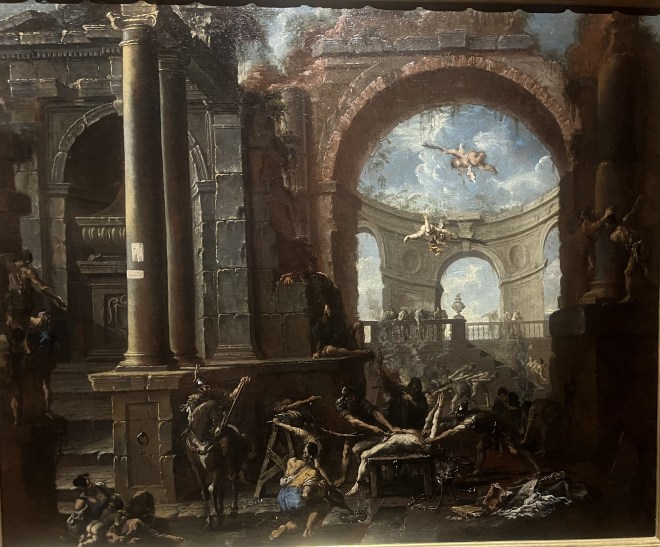
In any event, at some point I was suddenly transfixed by this painting, which shows in horrible, gory detail some poor guy having his entrails pulled out of him and wound around some contraption or other.

My photo

The painting’s label helpfully informed me that the poor guy in question was Saint Erasmus and he was being martyred. It was clearly a popular subject, because there was another painting just across the way about the same thing.

My photo

I’ve mentioned in past posts that early and Medieval Christians loved dreaming up horrible deaths for martyrs, but this one really took the biscuit! What sadistic mind came up with this one? And how did this particular form of torture even cross their mind?! I had, of course, to do some research.

As usual, as written up in the various pious hagiographies which appeared from at least the 5th Century onwards, St. Erasmus’s life seems to be one long muddle. So I’m going to more or less ignore these and sketch out what I think happened, not so much to Erasmus himself as to the legends which clustered around him and to the way he was portrayed in paintings.

It would seem that Erasmus started out as a local saint in the city of Formiae, a Roman port city some 90 km up the coast from Naples. Perhaps he was a bishop there. Bishop or no, there is a good chance that he was martyred in the city during Emperor Diocletian’s campaign of persecution, which ran with differing degrees of intensity from 303 AD to 313 AD. In later centuries, when relics of martyrs and saints became so important, his remains must have been reverently kept by the citizens of Formiae. Probably, too, to bolster the importance of his relics, legends about wondrous deeds performed by Erasmus began to circulate. One of these, which is important for our story, has him continuing to preach even after a thunderbolt struck the ground beside him. By the 5th Century, manuscripts also relating his nasty, vicious martyrdom at the hands of various Emperors were already circulating.

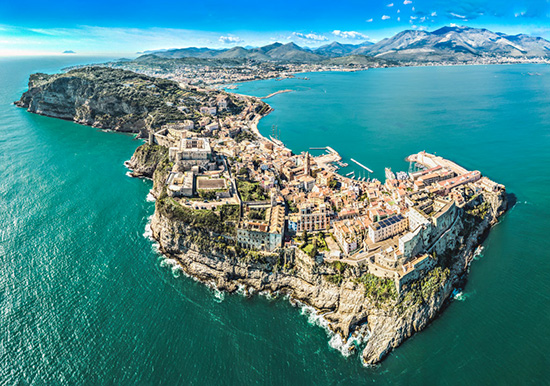
In the meantime, back in the real world, things were not going too well for Formiae. After suffering badly at the hands of the barbarians who flowed into Italy during the death throes of the western Roman Empire, it was razed to the ground in 842 AD by “Saracen” pirates who came from the sea. Its citizens ran – literally – for the hills, and that was the end of Formiae. Luckily, before the city was finally trashed, Erasmus’s precious relics were transported over the bay to nearby Gaeta, which was located on a much more defensible position, as this photo shows, and managed to hold off the pirates.
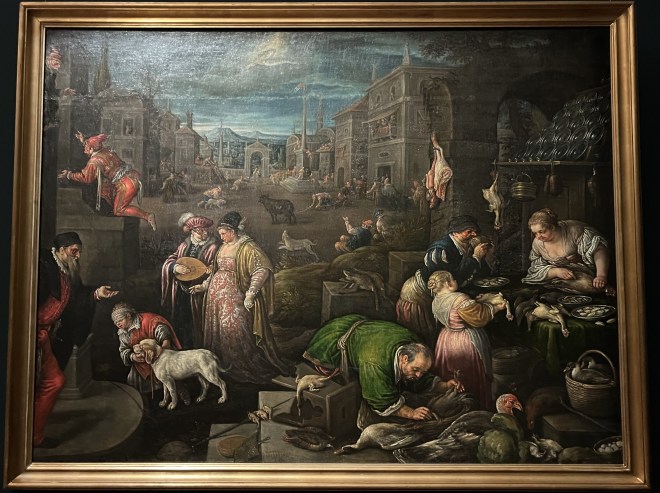
Source

The relics are held to this day in Gaeta’s cathedral, along with the relics of four or five other saints, in a large crypt built in the early 17th Century.

Source

In the 9th Century, when the relics were transferred from Formiae, and for a few centuries thereafter, Gaeta was a marine republic, like the ones on the Sorrentine peninsula further south, and very much in competition with them. Shipping was the backbone of the city’s prosperity, and the city’s sailors adopted Erasmus – one of Gaeta’s patron saints now that they owned his relics – as their personal patron saint. It seems that they chose him on the basis of that story I mentioned earlier, of him being unperturbed by a lightning bolt hitting the ground next to him. One of the perils which sailors ran (and still run) were violent storms. It’s not surprising that so many of the ex-votos found in churches in port cities have as their subject a sailor who was saved during a storm.

Source

During such storms their boats could get hit by lightning. And so Erasmus became one of the patron saints of sailors. In this guise, he was often associated with the crank of a windlass. This may seem odd to readers, but windlasses were used on boats to pull up or let out an anchor or other heavy weights. The heavy weight is tied to a rope, the rope – maybe threaded through a winch – is wound around a barrel, which sailors turn using a crank (K in the diagram below).

Source

It looks like people simplified everything by just associating the crank with Erasmus.

St. Erasmus’s connection in the minds of sailors to lightning got them to also connect him to another electrical phenomenon which sailing ships were (and still are) subject to. In brief, during thunderstorms, when high-voltage differentials are present between the clouds and the ground, oxygen and nitrogen molecules in the air can get ionized around the point of any rod-like object and glow faintly blue or violet. Well, of course, sailing ships in the old days had lots of rod-like objects, like masts or spars or booms, and when conditions were right there would be a faint glow at the end of all these. Here is a print of an old sailing ship with these ghostly “flames” on the ends of its masts and spars.

Source

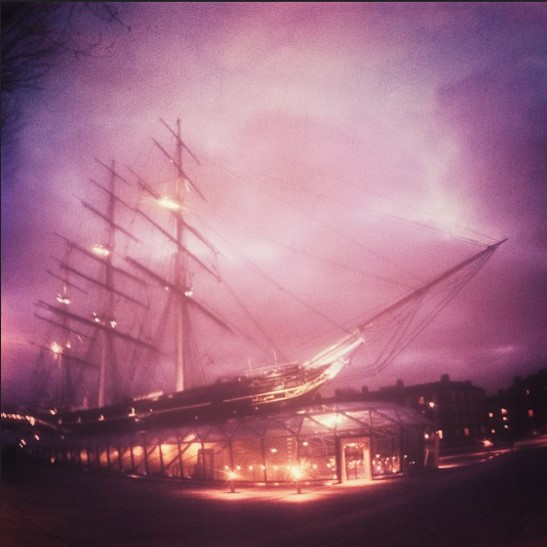
And here is a modern photo of the phenomenon around a clipper ship, the Cutty Sark, moored on the Thames in London.

Source

Well, of course, sailors knew nothing of the physics behind the phenomenon. They interpreted those little flames as meaning that St. Erasmus was protecting their ship, especially since the phenomenon often occurred before the thunder and lightning started. And so the phenomenon become known as St. Elmo’s Fire (Elmo being an Italian corruption of Erasmus).

In a parallel universe, various martyrologies continued to be published over the ages, full of the usual hideous tortures meted out to martyrs. But nothing yet about poor Erasmus’s entrails being pulled out of him. Then, in about 1260, a certain Jacobus de Voragine published his martyrology under the title The Golden Legend. His story about Erasmus recycled many of the tortures covered in previous martyrologies to which the saint had been subjected. But then, Jacobus slipped in a brand new torture. In his words (translated into English by Wynken de Worde in 1527):

“[…] the emperor […] waxed out of his wit for anger, and called with a loud voice like as he had been mad, and said: This is the devil, shall we not bring this caitiff to death? Then found he a counsel for to make a windlass, […] and they laid this holy martyr under the windlass all naked upon a table, and cut him upon his belly, and wound out his guts or bowels out of his blessed body.”

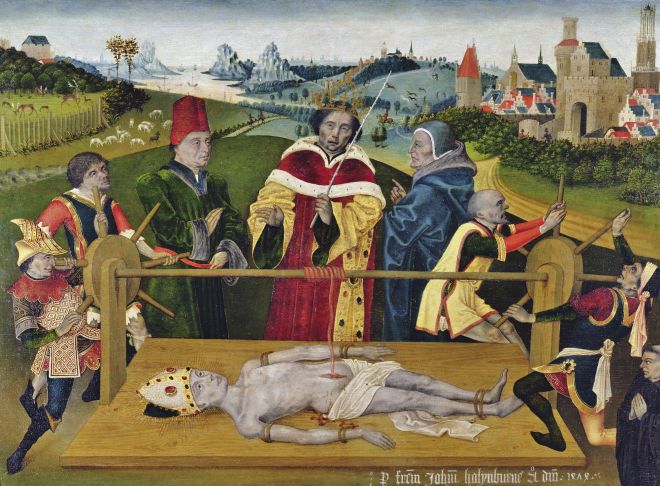
Here is how the scene was depicted in one of the early editions of the Golden Legend (in case any readers are interested, the two fellows on the left having their heads chopped off are Saints Processus and Martinian).

Source

Now, I said at the beginning, how did this particular form of torture ever cross Jacobus’s or someone else’s mind? Well, it has been suggested – and it doesn’t sound improbable – that whoever dreamed it up found inspiration (if that’s the word) from the association of Erasmus with the crank of a windlass. Presumably they assumed that the windlass had to have something to do with his martyrdom. After all, the depictions of many martyrs have them holding the instruments of their torture. Saint Lawrence, for instance, leaning on the grill he was roasted on:

Source

Or Saint Bartholomew carrying the knife with which he was flayed alive.

Source

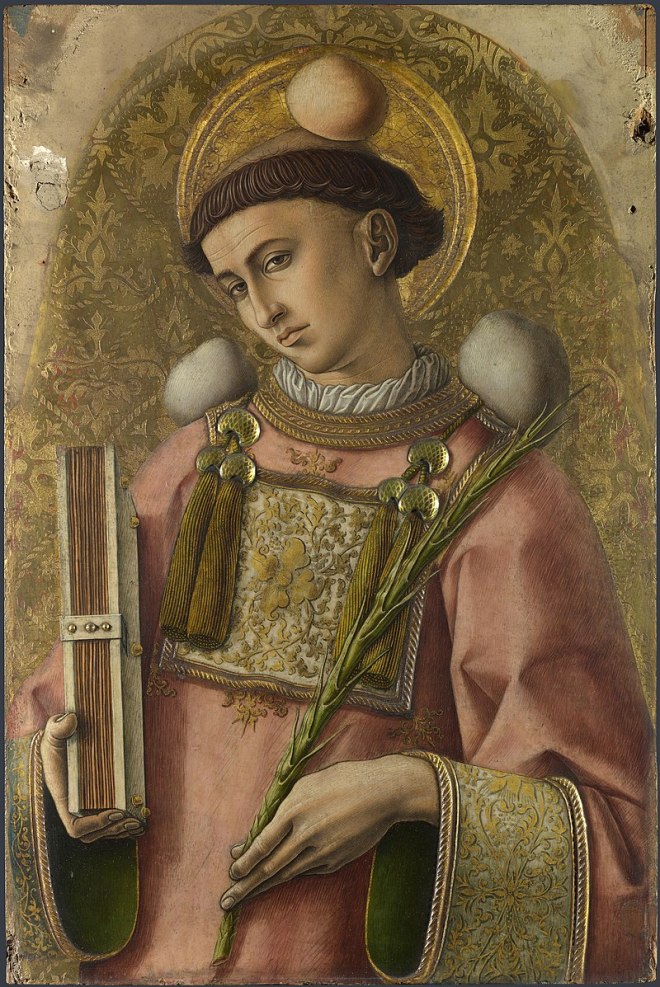
Or Saint Stephen, balancing on his head and shoulders the stones with which he was stoned to death.

Source

But what could the torture be in Erasmus’s case? Well, what do we humans have that looks like ropes? Entrails! And so this novel form of torture was dreamed up.

Now, Jacobus’s list of tortures inflicted on poor Erasmus is really long: I count 19 in all. Many of them would have made very appropriate subjects for the gory paintings of martyrs so beloved by painters until quite recent times. And yet, the entrails being pulled out on the windlass really caught on; I have to assume it’s because that was the one torture that Jacobus had a picture of in his book. Here’s just a few examples I found on the internet.

This first version is a more sophisticated variant of the picture in The Golden Legend and had added the emperor, “waxed out of his wit for anger”, looking on.

Source

This next version is quite similar, except that St. Erasmus’s bishop’s mitre has now been thoughtfully placed to one side.

Source

In this next one, we’re beginning to get a bit more dramatic.

Source

While this one, by Nicolas Poussin, has pushed the drama levels to stratospheric heights.

Source

Other paintings, perhaps trying to avoid all the gruesomeness of these kinds of paintings, just had a thoughtful-looking Erasmus, dressed as a bishop, holding his crank around which his entrails have been tastefully wound. This next painting is an excellent example of the genre.

Source

This focus on Erasmus’s guts and the acute pain he no doubt suffered having them drawn out had an interesting side-effect. I’ve mentioned in a previous post the Fourteen Holy Helpers who helped Medieval people deal with their physical trials and tribulations – the headaches, or the sore throats, or the epileptic fits, or … they suffered from. Well, Erasmus fit very well into this scheme of things! He was obviously the go-to Holy Helper for cases of stomach and intestinal illnesses.

I related in the postscript to a previous post that in a moment of weakness I had bought a painting on glass of the Fourteen Holy Helpers. All this research has allowed me to identify which of the Helpers in my painting is St. Erasmus. Here he is, with his crank and some of his intestines rolled around it. All this research I do does sometimes have benefits …

My photo

ARRESTING FACES

Milan, 28 February 2025

It was freezing cold in Vienna this last month we were there, far too cold for my wife and I to go hiking. So we spent our spare time visiting Vienna’s nice, warm museums. One museum we visited was the Paintings Gallery of the Academy of Fine Arts; I don’t think we’ve been back to it since a visit we made shortly after we arrived here, back in 1998. As the name indicates, we are actually dealing with an arts school, but it has quite a worthy collection of paintings donated to it by various aristocrats over the centuries. It has a particularly good collection of paintings by Lucas Cranach the Elder, and it was one of these that caught my attention, St. Valentine and a Kneeling Donor, painted in 1502-1503.

Source

What a magnificent face St. Valentine has! Not a handsome face at all, but it still had me gazing at it in fascination. A face full of character! If I were to meet this person in real life, my staring at him would probably provoke him into demanding what the hell I was looking at and to scarper before he took a swing at me. His face reminds me of the actor Walter Matthau at his most scowling.

Source

From today’s perspective, what with the saint’s feast day of 14 February being irremediably lodged in our collective memories as the day of lovers, I think many people would be surprised by Cranach’s choice of model. They might have someone more sucrose in mind, like this painting in the church of Santa Maria degli Angeli in Rome.

Source

But that is to forget that in Cranach’s time, St. Valentine was also the saint to whom epileptics would pray, and in fact down at St. Valentine’s feet in Cranach’s painting one can see a man having an epileptic fit. Perhaps this rugged face fits better a saint who was meant to be dealing with epilepsy.

By coincidence, a few days later, at the Museum of the Lower Belvedere, I came across another painting with equally interesting faces. It is of three saints, Jerome, Leonard, and Nicholas. It is from the late 15th Century, painted by an unknown artist.

my photo

As I’ve noted in previous posts, I have a fascination for faces in art. When I visit most collections of Old Masters, after enduring a long series of paintings of classical figures prancing around in sylvan scenes or of various members of the nobility hamming it up in their best clothes, it comes as a relief for me to gaze upon portraits from times past. These are faces I can relate to, faces of people whom I could be seeing on any street corner on any day of the week, just dressed in different clothes. It reminds me that history is not some colourful story in a book but was the lived experience of people just like me.

Most of the faces I gaze on are pleasant; I look, I note, I move on. But sometimes – like St. Valentine’s – they are arresting. There is something about the face that holds my gaze, that makes me stop and look more closely, that makes me wonder what the person was like. Let me use the rest of this post to celebrate some of these arresting faces in art.

A good example is Maximilian I, Holy Roman Emperor. I am particularly fond of this portrait of him, by Albrecht Dürer, painted a few years after Cranach’s St. Valentine.

Source

It’s another painting my wife and I saw as we took refuge from the cold in Vienna’s museums, this time in the Kunsthistorisches Museum.

There are many other portraits of Maximilian, and in some of them he is frankly ugly, like this one of him and his family. With this side pose, his very prominent nose stands out.

Source

Maximilian certainly looks better than many of his successors, who sported the monstrous Hapsburg jaw. It seems to have started with his grandson Charles V, who is in that last painting, bottom centre. It continued down the generations. Here is a portrait of Charles V when young.

Source

In later life, he grew a beard, presumably to camouflage the chin.

But I don’t want to focus on ugly people, even though they are the subject of many, many paintings. So my next candidate for arresting faces is Federico da Montefeltro, Duke of Urbino. Probably the most well-known portrait of him is this one in the Uffizi, in a double portrait with his wife Battista Sforza.

Source

I prefer this portrait of him, though, where we see him together with his son Guidobaldo.
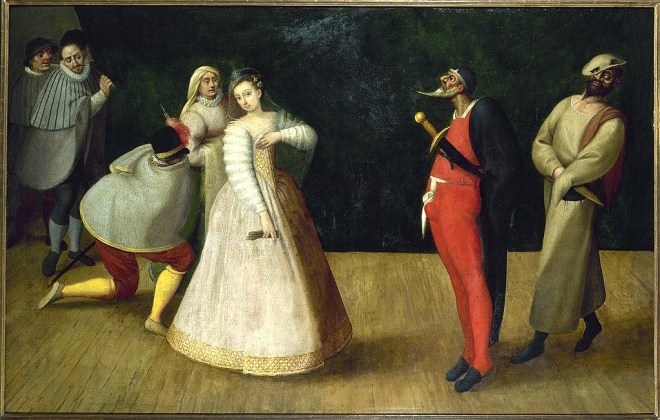
Source

That is a really interestingly craggy face! It certainly mirrors his life, a man who was a brilliant condottiero but also a very cultured man: in the last painting, he is dressed in armour but he is reading a book, an allusion to his humanist interests. Of course, the thing most people almost immediately notice about his face is that notch at the top of his prominent nose. He lost his right eye in a joust (and probably smashed up the right side of his face in the process; he always had himself painted from the left). To be able to see better with his one remaining eye, especially when fighting, he had the top of his nose cut away. A tough, tough guy …

Staying in Italy, the next arresting face I pull up is that of Lorenzo de Medici, il Magnifico. Of the many representations that were made of him, I choose this terracotta statue, whose brooding look captures me. What dark secrets are hidden there!

Source

Other arresting faces come from Caravaggio. It’s the faces of the secondary characters in his paintings who most draw my eye. A prime example is the Incredulity of Saint Thomas. Look at the weatherbeaten faces of those three apostles! They could truly be fishermen walking the shores of the Sea of Galilee, or indeed any shores anywhere.

Source

Or his Salome with the Head of Saint John the Baptist. Look at the face of the executioner!

Source

It’s a face which reminds me of Michelangelo’s, another arresting face.

Source

Personally, I’ve always loved this self-portrait, where Michelangelo included himself as Nicodemus in the Deposition, a sculpture I first saw in Florence decades and decades ago on my first trip to Italy.

Source

Michelangelo’s badly broken nose adds to the allure of his face. I read a while back that it got broken after he mocked the drawings of the artist Pietro Torrigiano, who in a rage took a swing at him.

I can’t leave Italy without including a portrait of San Carlo Borromeo, cardinal archbishop of Milan.

Source

His large nose led the Milanese to nickname him Il Nason, Big Nose.

Readers will see that it’s all been men up to now. Indeed, it’s been very hard to find paintings of women’s faces which are arresting: beautiful yes, haughty yes, homely yes, motherly yes, careworn yes, but arresting …

After a considerable amount of searching, I came up with a few examples. This is Mary, Queen of England.

Source

Now that is the face of a very determined woman! And determined she was. She suffered through all the travails of her father Henry VIII declaring her illegitimate, banishing her from court, and refusing to let her be with her mother when she died, and, once on the throne, she tried with all her might to bring England back into the Catholic fold.

And this is her half-sister Elizabeth I.

Source

She, too, suffered under Henry VIII, nearly losing her head at one point, and when she was queen had to navigate tempestuous religious factional fighting. She was not a woman to be pushed around.

Perhaps I could add this self-portrait of Artemisia Gentileschi. It’s not a face that necessarily arrests me, but knowing her background – raped when she was young by another painter, tortured during his trial for rape to see if she kept to her story, having to see her rapist’s meagre two-year sentence reversed after a short prison term – I sense a steeliness in her.

Source

I finish with the face of a peasant woman in an early painting by Van Gogh, before he went to Paris. It’s from the Potato Eaters, a really dark painting (literally).

Source

It’s the woman on the far right that intrigues me. I show a blow-up (I’ve also lightened it a bit).

Source

Now that’s an arresting face!

A TOUR OF CHAGALL’S STAINED GLASS WINDOWS

Vienna, 15 February 2025
Updated Sori, 10 March 2025
Updated again Vienna, 14 August 2025

My wife and I have just seen an exhibition of Marc Chagall’s paintings at the Albertina in Vienna (we’re normally not here at this time of the year, but I have to give a course on circular economy at the Central European University). I’m sure it was an excellent exhibition, although in truth what really has stayed with me is the crowds. It was just a few days before the end of the exhibition, so everyone who had been putting off going to see it had piled in. It’s really not possible to enjoy what’s on offer when you have to spend most of your time manoeuvring around other people to catch a quick glimpse of the paintings before your view is obscured by someone’s head. At least it was nice to see the original of a poster we have hanging in our apartment, although it’s depressing to think that the painting probably just sits in a bank vault in Japan most of the time (the label mentioned that it was owned by some anonymous Japanese).

Source

In any event, one of the things I learned as I ducked and weaved through the crowds was that Chagall had, late in his career, designed a number of stained glass windows. Now that intrigued me, because I have a great love of stained glass. I should quickly qualify that statement, though. It is Medieval stained glass that I love, because of its quasi-abstract nature; it’s not the scenes which are depicted in the windows that matter, it’s the sense of being flooded in multi-coloured light. I still remember vividly the first time I saw the stained glass windows in Chartres Cathedral, which my wife and I visited when we lived in Paris in the early 1980s.

Source
Source

I remember just as vividly the first time I saw the stained glass windows in La Sainte Chapelle in Paris, which my sister had taken me to see some ten years earlier.

Source

I don’t find later stained glass windows nearly as interesting, because the scenes in the glass intrude too much and that feeling of being bathed in colour is lost. Just look at the stained glass in the Duomo of Milan, considered “an extraordinary testament to the history of the art of stained glass windows from the early 15th to late 20th centuries”, yet really quite boring.

Source

So, as I say, I was intrigued by the idea that Chagall had designed stained glass windows. His love of colour and the semi-abstract flavour of much of his work suggested to me that perhaps he could do something interesting. Once back home, I began to dig a little, to see where my wife and I would have to go to see his stained glass windows. He designed stained glass windows in Europe, Israel, and the USA. I decided to knock the latter two countries off the list: one day, maybe, we can visit his windows there, but only if we happen to be in the right place at the right time. The stained glass windows in Europe were more promising. By chance, I came across a map that helpfully indicated all the places in Europe where Chagall had designed stained glass windows. Looking at that map, I came to the exciting conclusion that my wife and I could make an interesting 11-day tour of all his European stained glass windows! I will use this post to persuade my wife that this could be an excellent project for the late Spring, when the days are getting long but are not too hot yet.

We would start the tour in Milan. I was initially thinking of travelling by bus and train, as we usually do, but it would be too complicated. So car it would have to be. Our first port of call would be the church of Notre-Dame de Toute Grâce, located in the village of Passy in Haute Savoie, in France, just on the other side of the Mont-Blanc road tunnel (looks pretty, but I would make sure we would be there after the snow was gone; I’m not driving in any snow).

Source

According to Google Maps, it would take us a little over three hours to get there, so if we set off in the morning we could be visiting the church in the afternoon. It would actually be a good place to start the tour because the church holds the first two windows which Chagall ever designed, back in 1956-57. Truth to tell, there wouldn’t be much to see. The two windows, which are located in the baptistery, are quite nice.

Source

However, as readers can see in this photo, which is an overview of the whole baptistery, they are really quite modest in size.

Source

Of considerably greater interest is the ceramic “painting” on the wall – also by Chagall – of the passage of the Israelites through the Red Sea.
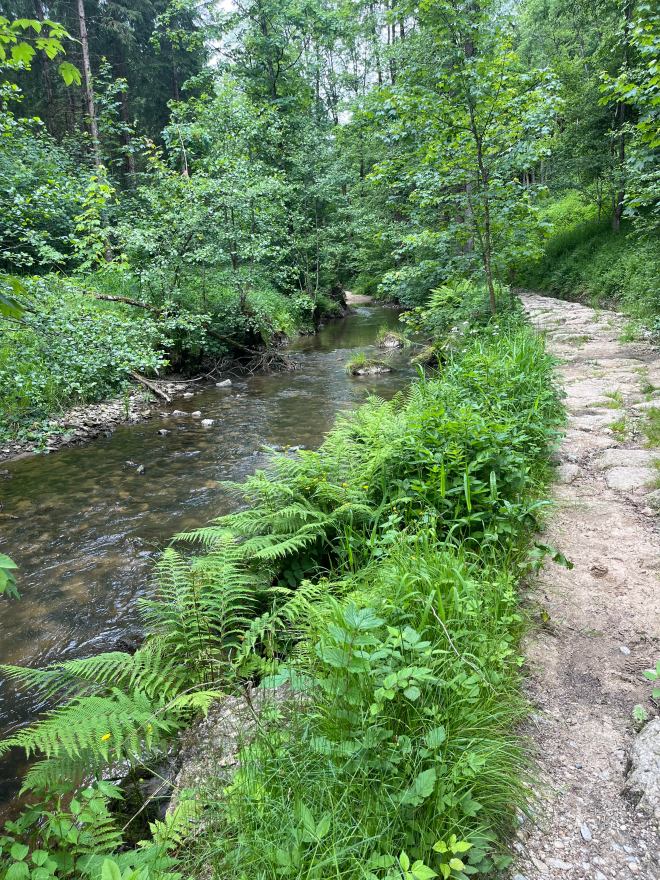
Source

In fact, I would say that the rest of the church is probably much more interesting, filled as it is by artworks by other major 20th Century artists: Pierre Bonnard, Fernand Léger, Georges Rouault, Henri Matisse, Georges Braque, Jacques Lipchitz, just to name the ones I’m familiar with. Here is the façade, graced by a mosaic by Léger.

Source

And here is a view of the choir, with what looks to be a magnificent tapestry.

Source

I’m thinking that there is more than enough in this church – even if it isn’t Chagall – to keep us occupied for a couple of hours, so we should probably just spend the night in Passy and leave the next day for Zürich, our next stop on the tour.

According to Google Maps, it would take us four hours to get Zürich from Passy. We would be visiting the Fraumünster.

Source

Chagall designed five large windows for the choir of the church between 1967 and 1970. You can see three of them in the far distance in this photo.

Source

This photo shows the three windows up close (it’s almost impossible to get a photo of all five together since the other two are to the side of these three).

Source

Chagall also designed a small rose window at the other end of the nave, installed in 1978.

Source

I’m guessing that we could easily visit this church in the afternoon and then stay the night in Zürich.

On Day 3, our final destination would be Mainz, in Germany, where we would be visiting the church of Saint Stephen. It would take us a little over four hours to get there, but I’ve noticed that the route which Google Maps suggests would take us via Strasbourg. I’m thinking that we should take the occasion to make a quick detour to visit Strasbourg Cathedral.

Source

It has some fine late Medieval stained glass windows. The rose window is especially remarkable.

Source

We could make an early start from Zürich, plan a late morning visit to Strasbourg Cathedral, and then, after eating what would no doubt be an excellent Alsatian choucroute for lunch, we could continue on our way to Mainz in the afternoon. Once in Mainz, rather than squeezing in a hurried visit to the church of St. Stephen we could just check into the hotel and stroll around Mainz, which seems to have a very pleasant old town.

Source

Day 4 would start bright and early, at the church of Saint Stephen.

Source

Chagall designed nine windows here between 1978 and 1985, the year he died (and further windows were designed after his death by Charles Marq, Chagall’s glassmaker for many of his windows, in Chagall’s style). This photo gives a sense of the blue light which visitors will find themselves bathed in (like in the Sainte-Chapelle in Paris).

Source

This photo instead is a close-up of the three windows in the choir, which show Chagall’s inimitable style.

Source

After this bath of blue, we would drive some two and a half hours back south into France, to Sarrebourg, where we would visit the small chapelle des Cordeliers.

Source

Chagall designed five windows for this chapel, although as readers might imagine, looking at the photo of the chapel, it is only one, very large, magnificent window that captures all the attention.

Source

At first glance, the window seems to be made up of an enormous posy of flowers. But as a reader pointed out to me, that posy actually seems to be the Tree of Life that grew in the Garden of Eden. In fact, we see what appear to be Adam and Eve in, or maybe above, the tree. The rest of the window is full of scenes from the Bible. The other small windows designed by Chagall are on the left-hand wall.

I’m thinking that we should easily have the time after our visit to push on to Metz (an hour and a half away) and spend the night there.

The next morning (we are now on day 5), we would visit Metz cathedral.

Source

Chagall designed three windows for the cathedral over a period of ten years, between 1958 and 1968.

Source
Source
Source

But what is perhaps more interesting about the cathedral is that it is stuffed with stained glass – some 6,500 square metres of it – ranging from the 13th to the 20th centuries. I’m sure this will be an interesting place to compare Chagall’s work to earlier stained glass windows. To whet our appetites, I throw in here a photo of a window from the 13th Century.

Source

This window instead was installed in the 16th Century (and those clearly visible figures of saints are now crowding out the colour of the glass).

Source

There’s not just the windows to see in the cathedral, so I’m sure the visit would take up the whole morning. So I see ourselves leaving for our next destination, Rheims, in the afternoon. It would take us two hours to get there, so we would arrive in the late afternoon and be ready for a nice dinner in town (with a glass of champagne, no doubt) after checking into our hotel.

The morning of day 6 would see us visiting Rheims cathedral. The cathedral was very badly damaged during the First World War and – among other things – lost nearly all of its original stained glass windows (some had been taken down for safekeeping at the beginning of the war).

Source

The cathedral chapter reinstalled what it could and decided to replace lost windows. The three windows designed by Chagall and installed in 1974 were part of this renewal effort.

Source

But here, too, we would need to spend some time looking at the cathedral’s other windows, like these two rose windows (which are actually modern windows, installed in the 1930s).

Source
Source

The next two stops in our tour are in the south-east of England, so after visiting Rheims cathedral we would need to head over to Calais and catch Le Shuttle train over to Dover, passing through the Channel Tunnel. We would drive out of Dover to Royal Tunbridge Wells and spend the night there. I’ve read that it’s a nice place to visit, although a bit on the twee side.

Source

The next morning (at this point, we are in day 7 of our tour), we would take a 15-minute drive to All Saints Church in the neighbouring village of Tudeley.

Source

All twelve windows of this small church were designed by Chagall, between 1963 and 1978.

Source

But it is the East window that stands out.

Source

By mid morning, I reckon we would be on our way to our next destination, Chichester cathedral, which it would take us an hour and a half to reach.

Source

Chagall designed one window in the cathedral, between 1975 and 1978.

Source

It is quite a modest-sized window, and as far as I can tell is tucked away in a corner. The remaining windows in the cathedral don’t look particularly interesting, being mostly Victorian. There are a few other things to see. But, all in all, I think we would be finished quite quickly.

We would now need to go back to France. Looking at Google Maps, I’m thinking we should drive to Portsmouth (a mere 20-minutes’ drive from Chichester), catch a late ferry to Cherbourg, and spend the night there.

The next destination, la Chapelle du Saillant, is a full day’s drive from Cherbourg. Rather than do one long drive, though, it would be nicer to break the trip about half way. Looking at the map, I’m therefore thinking that on day 8 we could make a stop-over at Tours, on the Loire river, where we could usefully spend the afternoon visiting the cathedral.

Source

It has some splendid Medieval stained glass windows.

Source
Tours

Day 9 would then see us driving down to the chapelle du Saillant, a three and a half hours’ drive from Tours.

Source

We would visit the chapel, all six of whose windows were designed by Chagall between 1978 and 1982.

Source

But it’s only two windows which are worth seeing, the window in the choir and the occulus above the door; the other four are just grisaille.

Source
Source

Our visit would be quite quick, and then it would be on to the next location. By rights, if we were to really visit all the places where Chagall designed windows, that should be Moissac, near Toulouse. But the church there has only one window by Chagall and it’s really small. On top of it, Moissac would be quite a detour. So I’ve made an executive decision: our last destination on this tour would be the Marc Chagall National Museum in Nice.

That being said, Nice would be too far away to reach after our visit to the chapelle du Saillant. Looking at Google Maps, I’m thinking that we could drive to Rodez, about two and a half hours’ away, and spend the night there. We might even be able to squeeze in a visit to Rodez cathedral.

Source

It has little Medieval glass, lost over the ages. On the other hand, it has some remarkable windows which were installed some 15 years ago.

Source
Source

Day 10 would bring us to Nice. That’s still a five hours’ drive from Rodez, too long a drive to then follow up with a visit to a museum. So I’m thinking that we can take our time getting there – maybe take a side trip to Avignon or Aix-en-Provence on the way – and arrive in Nice in the evening.

Which brings us to day 11 with its visit to the Marc Chagall National Museum.

Source

The museum is actually primarily a collection of Chagall’s paintings.

Source
Source

But it does have four, very large, Chagall windows. They grace the museum’s auditorium.

Source

Anyway, given that the germ for this tour was planted in an exhibition of his paintings, it would be a satisfying closure of the circle to see some of his windows against a backdrop of his paintings.

I reckon we could “do” the museum in a morning. So after a quick lunch, we could head back to our starting point in Milan. It’s a three and a half hours’ drive, manageable in an afternoon.

Well, I think this would be a very enjoyable little trip. But have I done a good enough job to persuade my wife? We shall see.

POST SCRIPTUM 10 March, 2025

Well, we’ve just come back from a weekend trip to Nice, where we visited the Chagall museum. Very beautiful! But it looks like the big trip I’ve been proposing is out. We’ll use the salami approach instead: whenever we happen to be going close to one of these windows we’ll go and visit them. Such is life …

THE GROUP OF SEVEN

Milan, 13 January 2025

My wife and I were recently listening to an article from the New York Times about an Egyptian immigrant to New York, by the name of Armia Khalil. Mr. Khalil had been an artist in Egypt. He liked to create pieces that echoed the country’s ancient artefacts. He did so using tools he had created that were similar to those used by the Ancient Egyptians themselves. Of course, when Mr. Khalil arrived in New York, with a suitcase crammed with his tools but with hardly two nickels to rub together, he didn’t have the luxury to use them; he needed a job. But he didn’t want any old job. He wanted a job that brought him close to art. So he applied over and over again for jobs as a museum guard to the city’s many museums; he reasoned that at least this would allow him rub shoulders with art all day. Finally, after six years of trying, he managed to unhook a museum guard job at the Metropolitan Museum of Art.

Source

Readers can read (or hear) the rest of his delightfully heart-warming story in the original New York Times article, if they can get around the paper’s firewall. If not, they can visit his WordPress blog – it gives me great pleasure to advertise a fellow WordPress blogger.

Mr. Khalil’s repeated attempts to be hired as a museum guard to get close to art brought back fond memories for me. Because I had tried to do the same many, many years ago. It was January, I was 18, I was staying with my parents in Ottawa for five months until the beginning of June, I needed to find something to do. Whenever I had spent the holidays with my parents, I had always found the time to visit Canada’s National Gallery. This is the building I used to visit, back in the early 1970s, although I see it has now moved into a sparkling new building somewhere else in Ottawa.

Source

I found the time I spent there most soothing. I thought, why not spend my five months in Ottawa, sitting on a chair in the Gallery’s exhibition rooms and admiring the art around me? So I got myself an appointment with the head of the guards and arrived promptly for the interview. It was in a dreary, windowless office somewhere in the basement of the building. He was sitting at his desk, flanked by one of his guards. He invited me to sit down. He looked me over. Then, with great frankness, he told me why he doubted that I was right for the job. He pointed out that I was much more educated than the other guards, so had I thought about what my social interactions with them would be like? (the implication being, no doubt, that I would be awfully lonely during the working day, with no colleagues to really speak to). Did I not think, he continued, that I was far too young to get stuck in what was, at the end of the day, a pretty boring job? His basic message, I felt, was that it was best to be ignorant, probably stupid, and old before accepting a dead-end job as a museum guard. His side-kick nodded throughout this analysis, which was sad because at the end of the day his chief was talking about him. Thinking about it now, he could have been describing Mr. Bean working at the Royal National Gallery in London, in the film Bean.

Source

My interview was terminated with a final parting shot. The chief pointed to my fashionably long hair and regretfully informed me I would have to cut it, to conform to the short-back-and-sides style sported by the (male) guards. Crestfallen, I left without a job. Unlike Mr. Khalil, I did not try other museums or art galleries in Ottawa.

It was actually just a couple of rooms in the National Gallery that I would particularly have wanted to sit in as a guard, using my time to admire the paintings. They were dedicated to the Group of Seven, a coalition of Canadian painters who came together from shortly after World War I to the early 1930s. They were looking for a style of landscape painting that was distinctly Canadian and modern. To my mind, they succeeded brilliantly, with Lawren Harris being the jewel in the crown. His iconic painting, North Shore, Lake Superior, painted in 1926, is in the National Gallery.

Source

But he painted many other wonderful paintings. Here is a selection. This first painting, Northern Lake, is from around 1923, early on in the Group of Seven’s life.

Source

This painting, from around 1924, is another whose subject is Lake Superior: Pic Island.

Source

At some point in the late 1920s and early 1930s, Harris went to Canada’s far north and even to Greenland. The results of these expeditions were a long series of almost abstract paintings of great beauty. I show only three here. The first two hang on our walls in Vienna in the form of prints (I am not, alas, rich enough to be able to afford an original Lawren Harris).

This one is titled Lake and Mountains, from 1928.

Source

And this one is Mt Lefroy from 1930.

Source

The final painting I show from Lawren Harris is Icebergs, Davis Strait, also from 1930.

Source

Perhaps not surprisingly, in later decades Harris veered off into abstraction. I haven’t followed him there; abstract art is not really my thing.

While I particularly admire Harris, the paintings of the other members of the Group of Seven are not be sniffed at. I give one example for each of them.

Franklin Carmichael, Wabajisik Drowned Lake, from 1929.

Source

A.Y. Jackson, Barns, from 1926.

Source

Frank Johnston, The Fire Ranger, from 1921.

Source

Arthur Lismer, Pine Wrack, from 1933.

Source

J.E.H. MacDonald, Algoma Waterfall, 1920

Source

Frederick Varley, Stormy Weather, Georgian Bay, from 1921.

Source

After all these years, I still don’t know if I would have enjoyed spending five months next to the paintings of this group of artists, or if I would have been bored to tears by the company of my fellow guards, or both. For any readers who might be asking themselves what I did end up doing those five months, I can reveal that I went to work for the YM/YWCA. I replaced a guy who had to go on a long sick leave, so it was a perfect fit. My job was to hand out stationary to the staff and to print the various flyers which they produced. I became a dab hand at offset printing, even if I say so myself – a skill, alas, I was never able to put to good use again.

THREE WISE MEN

Milan, 6 January 2025

Today is 6 January, the day of the Epiphany! The day when the Three Wise Men arrive in Bethlehem to find the Child Jesus. Momentous event! In the words of St. Matthew’s Gospel (I cite the King James version)

And when they were come into the house, they saw the young child with Mary his mother, and fell down, and worshipped him: and when they had opened their treasures, they presented unto him gifts; gold, and frankincense and myrrh.

Or, as the Christmas carol puts it

Three Wise Men
We Three Kings of Orient are,
Bearing gifts we traverse afar,
Field and fountain,
Moor and mountain,
Following yonder Star.
Refrain
O Star of Wonder, Star of Night,
Star with Royal Beauty bright,
Westward leading,
Still proceeding,
Guide us to Thy perfect Light.

Gaspard
Born a King on Bethlehem plain,
Gold I bring to crown Him again,
King for ever,
Ceasing never
Over us all to reign.
Refrain

Melchior
Frankincense to offer have I,
Incense owns a Deity nigh:
Prayer and praising
All men raising,
Worship Him God on High.
Refrain

Balthazar
Myrrh is mine; its bitter perfume
Breathes a life of gathering gloom;—
Sorrowing, sighing,
Bleeding, dying,
Sealed in the stone-cold tomb.
Refrain

Three Wise Men
Glorious now behold Him arise,
King, and God, and Sacrifice;
Heav’n sings Hallelujah:
Hallelujah the earth replies.
Refrain

The Three Wise Men are, of course, important characters in our annual crèche. Ever since Christmas Day, they have been travelling across the furniture of our living room, on their way to Bethlehem. This year, I have had them accompanied by a retinue worthy of their rank.

My photo

I found the figurines of the retinue in a box where they had been carefully stored away by my mother-in-law many years ago. It seemed a pity not to bring them out into the light of day. I think it all looks pretty impressive! (But we have to do something about the camels; I’ve been telling my wife for years that we need to find some more camels, one camel simply isn’t enough. And we have to get a statue to replace the kneeling Wise Man; kneeling before the Baby Jesus is OK, but he can’t be on his knees the whole trip to Bethlehem …).

Here, we can see the tail-end of the cortege.

My photo

I added the birds because they were also in the box. A bit odd, but why not? Maybe the Wise Men were like St. Francis, they were listened to by the birds (boy, are we going to have fun when we set up the crèche with our grandson, possibly grandchildren, in a few years’ time! Who knows what interesting additions we could come up with!).

And now the Three Wise Men have arrived at the manger and are adoring the Baby Jesus!

My photo

This scene of the Adoration of the Magi has been painted over and over again by European artists. I pick here just one of the many offerings. It is by the Flemish painter Hugo van der Goes, who painted it in about 1470.

Source

In truth, though, I prefer the rendering of the Three Wise Men in the mosaics of Sant’Apollinare Nuovo in Ravenna.

Source

Dressed as they are as Persians, wearing the Phrygian cap which Romans seemed to think all Persians wore, they fit better with what the Gospel of St. Matthew had to say: “behold, there came wise men from the east”. Now Matthew didn’t actually say how many Wise Men there were, but pretty quickly most Christian sects settled for three, one for each gift. Matthew also didn’t say how old they were, but clearly by the time these mosaics were laid down it was generally agreed that they represented the three ages of Man, so we have one old one, one middle-aged one, and one young one. It was only later that it was decided that they also represented the three races known to Europeans: the Europeans themselves, the peoples of the Middle-East, and the peoples of Africa. Paintings of the Magi are some of the earliest representations of Black people in European art. Here is a lovely example from an Adoration of the Magi by Hieronymus Bosch.

Source

Painters don’t seem to have been much interested in what was happening to the Three Wise Men on their way to Bethlehem. But T.S. Eliot, in his poem Journey of the Magi, did try to imagine what the trip was like. I cite here the first twenty lines of the poem.

A cold coming we had of it,
Just the worst time of the year
For a journey, and such a long journey:
The ways deep and the weather sharp,
The very dead of winter.’
And the camels galled, sore-footed, refractory,
Lying down in the melting snow.
There were times we regretted
The summer palaces on slopes, the terraces,
And the silken girls bringing sherbet.
Then the camel men cursing and grumbling
And running away, and wanting their liquor and women,
And the night-fires going out, and the lack of shelters,
And the cities hostile and the towns unfriendly
And the villages dirty and charging high prices:
A hard time we had of it.
At the end we preferred to travel all night,
Sleeping in snatches,
With the voices singing in our ears, saying
That this was all folly.

Compared to this description, our Three Wise Men have had it pretty easy: nice, warm living room, easy travel across the furniture, respectful entourage …

As told in St. Matthew’s Gospel, the arrival of the Three Wise Men was like a poke in a hornet’s nest. In Jerusalem, they asked, “Where is he that is born King of the Jews? for we have seen his star in the east, and are come to worship him.” Matthew goes on, “When Herod the king had heard these things, he was troubled, and all Jerusalem with him. And … he demanded of them where Christ should be born. And they said unto him, In Bethlehem … Then Herod … said, Go and search diligently for the young child; and when ye have found him, bring me word again, that I may come and worship him also.” But, Matthew tells us, after giving Jesus his gifts, “being warned of God in a dream that they should not return to Herod, they departed into their own country another way.” He goes on, “behold, the angel of the Lord appeareth to Joseph in a dream, saying, Arise, and take the young child and his mother, and flee into Egypt, and be thou there until I bring thee word: for Herod will seek the young child to destroy him. When he arose, he took the young child and his mother by night, and departed into Egypt.” The Flight to Egypt was also a popular theme for European painters. I show one example, by my favourite painter, Caravaggio, Rest on the Flight to Egypt, where one of the painter’s luminous angels is playing music on a viol to soothe Mary and Jesus in their slumber (the music held by Joseph is readable; it is a motet by the Flemish composer Noel Bauldeweyn dedicated to the Madonna, with a text from the Song of Songs, Quam pulchra es, “How beautiful you are”; nice touch).

Source

Alas, Herod was not a man to be crossed. Matthew tells us, “Then Herod, when he saw that he was mocked of the wise men, was exceeding wroth, and sent forth, and slew all the children that were in Bethlehem, and in all the coasts thereof, from two years old and under.” This Massacre of the Innocents was, too, a popular theme for European artists. I show here an example of the genre by Peter Breughel the Elder.

Source

I’m actually being a little economical with the truth. This is really a copy of Breughel’s painting, by his son Peter Breughel the Younger. The original was once owned by the Holy Roman Emperor, Rudolf II. For some reason – queasiness? – he had the dead children painted over. This copy retains the dead children.

Quite by chance, just before Christmas, we stumbled across a very sophisticated crèche, in a place called Baggio, which once was a village but then got swallowed up by Milan some 150 years ago. There, in the crypt of a church, over the last forty years or so, dedicated local volunteers have created 58 scenes from the Bible, with the Nativity being the central scene. Some of the scenes have running water, others have moving figurines, … it’s very impressive. Here is a shot of the first scene, Adam and Eve in the Garden of Eden (with a delightfully slithery snake in the tree).

Source

Here is one of Moses and the parting of the waters of the Red Sea.

Source

And here is a shot of the central scene of the Nativity.

Source

As I say, very impressive … although I will admit to having been just a teeny-weeny bit jealous. We’ll soon be packing away the crèche and its figurines for another year, but I’m already thinking how we could expand the offerings next year. Running water and moving figurines is a bit beyond me. But maybe Herod in a palace in Jerusalem? The Massacre of the Innocents? Some “snow” for the Wise Men to trudge wearily through? At least let’s fix the camel problem!

A LOMBARD CHRISTMAS DINNER

Milan 31 December, 2024

It is a sad fact of life that most of the time we fail to follow through on our New Year’s resolutions. I am no different. In fact, I have such a dismal track record on this topic that I stopped many years ago making these resolutions – I did not want to add so many paving stones to my private road to Hell.

Source

But there is one end-of-year resolution on which my wife and I seem to be holding the course, one I explained in my first post of this year. Summarizing quickly, the two of us decided that we – and any children or grandchildren who may be visiting – would, for a period of eight years, use the traditional Christmas lunch or dinner to honour our mixed genetic pool: Puglia and Lombardy: the heritage of my wife; Burgundy, England, Scotland and Norway: my heritage; – and, if we are still around, Ireland and the old Pale of Settlement: the heritage of our son-in-law. Specifically, for each of those eight years, we would cook a typical Christmas lunch or dinner from each of these regions.  I decided to start at the southern end of the genetic pool and move north, so last year we cooked ourselves a Christmas lunch from Puglia, which we shared with our son.

Contrary to previous attempts, we did not forget this resolution, and so this year now found us cooking a typical Christmas dinner from Lombardy, which we shared again with our son as well as with his girlfriend. I’m so proud that we managed – at least this year – to keep to the resolution, that I’ve decided to share this year’s menu with my readers.

We started with ravioli in brodo. As far as I can make out, each province in Lombardy has its special type of raviolo, but we didn’t get that subtle. We just took a packet of ravioli stuffed with braised meat which was being sold in our local supermarket, and we cooked them in a chicken broth made with cubes. Since we are most definitely not part of the Instagram generation, we have never got into the habit of taking photos of the food we eat. We just wolf it down and then say “damn, we should have taken a photo”. So I throw in a photo I found on the internet to give readers an idea of what we were eating.

Source

Next, as the main dish we had cotechino with lentils and mashed potatoes. I throw in another photo of this dish from the internet.

Source

I refer any of my readers who wish to know more about this typical Lombard dish to a post I wrote several years ago, where I go into probably too much detail about it; I have no desire to repeat myself here.

For dessert, we had that great, that splendid, Lombard delicacy, the panettone. I’ve also covered this miracle of Lombard cuisine in an earlier post, so I won’t go into further details here. I just refer my readers to that post and throw in a photo of a slice of panettone. I deliberately chose a photo which shows a large dollop of mascarpone, because for the first time ever, we had our panettone with mascarpone.

Source

We decided to add mascarpone because we read that the Lombards are known to slather this extra bit of yumminess onto their panettone during the Christmas season.

Since I’ve never mentioned mascarpone in any of my previous posts – for the simple reason that we hardly ever eat it – let me use this occasion to say a few words about it. It’s a Lombard cheese, originally from the area around Lodi to the south of Milan. Like cotechino, it used to be made with the left-overs from the production of more remunerative dairy foodstuffs, in this case cheeses. It is a smooth, spreadable cheese, with a an ever so slight sweet taste to it and a hint of the aroma of cream.

Mascarpone is now well-known worldwide because it is one of the main ingredients in the famous tiramisù – which, I was surprised to learn, is a very recent creation, from the 1960s, with its place of birth being somewhere in the Veneto or Friuli-Venezia-Giulia regions of Italy.

Source

Mascarpone is actually used in tiramisù in the form of crema al mascarpone, which is a mix of a syrup of sugar, egg yolk, and mascarpone. This is but one variant of sweetened mascarpone which Italians have been eating since at least the 1400s and possibly earlier.

If I am dwelling a little on crema al mascarpone it’s because I have a horrible doubt: should we have eaten our panettone with crema al mascarpone rather than just with mascarpone? Both ways are promoted by different sites on the internet. I have to say, my wife and I found that mascarpone alone combined well with panettone. But might crema al mascarpone have combined better? There’s only really one way to find out – make (or buy) crema al mascarpone and slather it on a couple of slices of panettone. Something to work on next year.

Of course, there wasn’t just food. There were wines, too! Staying in theme, we chose two Lombard wines, a red and a white. The red was a Bonarda, one of the sparkling red wines that are common in the north and centre of Italy. This is a topic I’ve covered in an earlier post, so any readers interested to find out more about this intriguing family of sparkling reds can go there. Here, I’ll just insert a photo of some of the vineyards where Bonarda’s grapes are grown.

Source

As for the white wine, we chose a Lugana, whose grapes are grown on the far eastern edges of Lombardy, looking over the southern shores of Lake Garda.

Source

I suppose we could have finished with some digestivi or some grappa made in Lombardy, but we left it at that. Sometimes, especially at our age, one can have too much of a good thing and spend the night regretting it.

So that’s Lombard Christmas dinner done! Next year, we venture into a Burgundian Christmas lunch – or maybe a Beaujolais Christmas lunch, if there is a difference; my mother was specifically from Beaujolais. We shall see, a happy year of research awaits me.

Happy New Year to all my readers! May 2025 bring you and your families peace and happiness.


MOSS

Milan, 16 December 2024

I’ve been meaning to write this post for a while, but I could never figure out what my angle should be. The thing is, I want to write about mosses, but once you’ve said that mosses can be really beautiful, there’s nothing much more to say about them. I could blather on about their biology and ecology, but only muscophiles would find that interesting. Looking at them from a historical point of view doesn’t help much, either: as far as I can tell, they haven’t played a significant role in anyone’s history. They do have some practical uses, like bedding and wound dressings, but nothing that really stands out. And forget the dietary angle: no-one eats moss unless they are starving, so there are no interesting dishes to report on. So the post has remained unwritten.

But now, finally, I’ve decided. Since there’s not much to write about on mosses, I’ll focus on photos instead. This post will be a photo essay celebrating their beauty! (That being said, I’ll still write some stuff – I can’t stop myself – but it will be more like extended titles to the photos).

I have to start in Japan, because it is moss country par excellence: something like 1,800 species of moss, or around 15% of the world’s total, grow on its islands. It was there, back in 1985 when my wife and I toured the country for a month, that we first appreciated the beauty of mosses. Our first experience was on the island of Hokkaido, where we were taken to visit the Moss Canyon in Shikotsu-Tōya National Park. It’s more of a gorge, really, about 200 metres long with walls some 5 metres high. These walls are covered in velvety green moss.

Source
Source
Source

Later, when we went to Kyoto, one of the temples we visited was Saihōji, whose entire garden is cloaked in moss.

Source
Source
My photo

Other temples we have visited in Kyoto over the years have integrated moss into the overall design of their gardens. This example, from Tofukuji temple, is one of the more intriguing.

Source

Many have even integrated moss into what you might think of as a most unmossy place, their dry rock gardens, where moss is often used to create islands in the sea of pebbles, like this example, also from Tofukuji temple.

my photo

Here are the islands up close.

My photo

Here is another example, from Ryoanji temple.

Source

But moss found out in Japan’s nature can be just as beautiful. Here are various photos I’ve taken over the last few years during our annual stay in Japan.

A moss-covered log on the flanks of mount Kurama, north of Kyoto.

My photo

Fallen Japanese maple leaves smothering a field of moss, out in Ararshiyama in the north-west of Kyoto.

My photo

A tree stump crowned with moss, on the Kumano kodo trail.

My photo

A stone basin with a moss-covered rim, seen on the same trail.

My photo

A stone lantern, being slowly colonized by moss.

my photo

An abandoned motorbike, also being slowly colonized by moss.

my photo

Japan is the land of moss, but it is also the land of fire, as we saw up close on that visit to Hokkaido’s Shikotsu-Tōya National Park

Source

Iceland, too, is a land of fire, as we have recently been reminded.

Source

But, as my wife and I discovered when we hiked the Laugavegur trail a few years ago, Iceland is also a land of moss.

The contrast could not be starker. One island country has lush vegetation of which moss is but a part. The other has little vegetation, its climate being too harsh. And yet mosses manage to thrive. Which was just as well for us because wherever there was water they covered with ethereal green the otherwise denuded landscape which we hiked past.

My photo
My photo
My photo
My photo
My photo
My photo

Well, that’s our photo album with mosses. If we ever come across beautiful mosses elsewhere, I will add photos to the album.