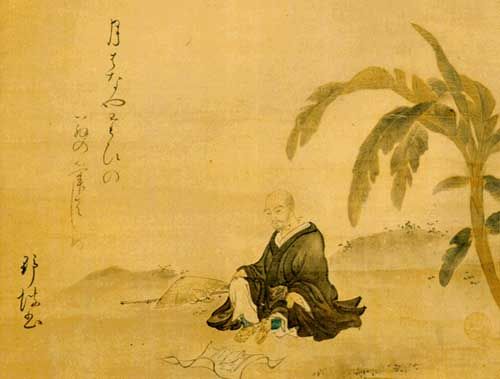
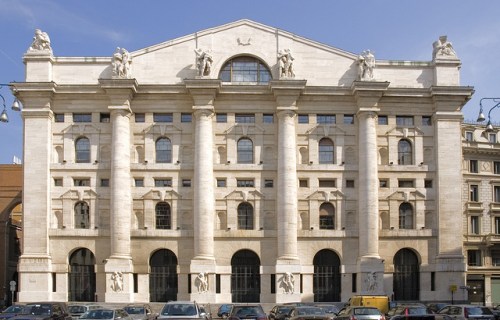
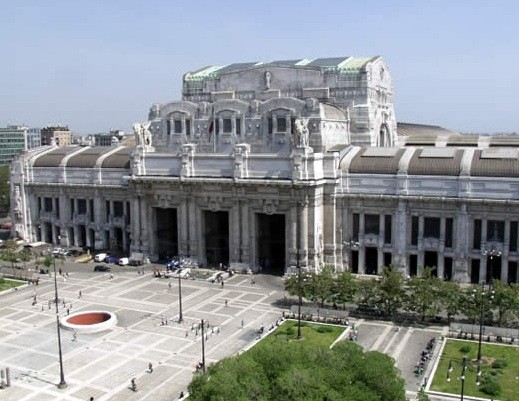
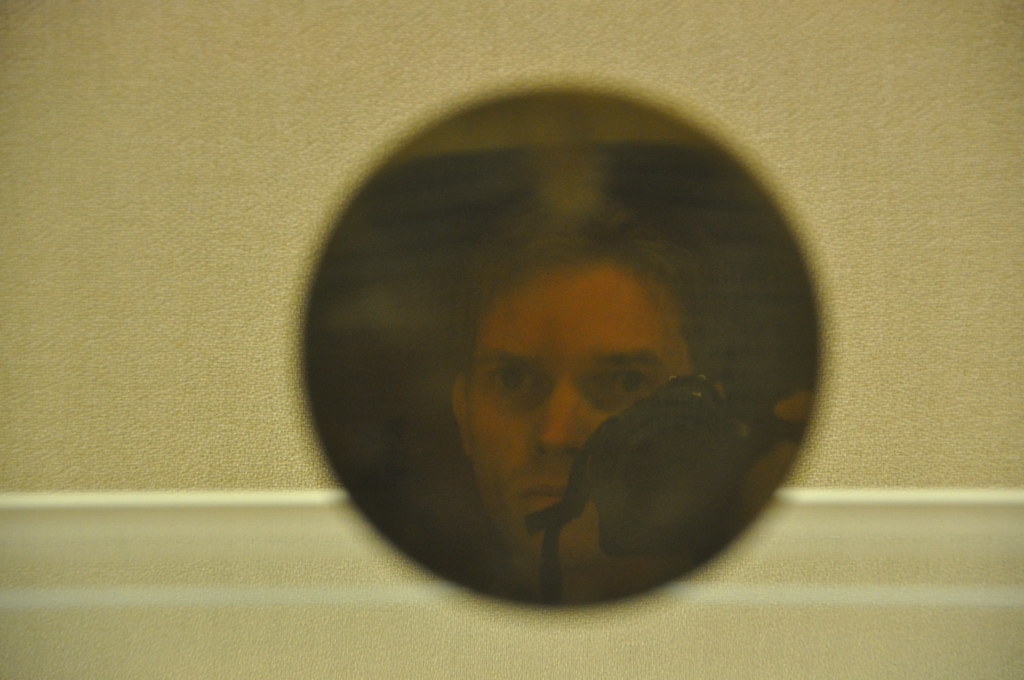
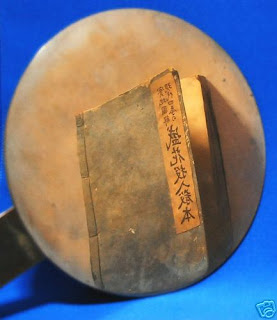
POINTILLISM

Vienna, 1 October 2016

The Albertina Museum in Vienna is currently holding an exhibition on pointillism and its reverberations in later art. My wife and I decided to visit it, as a treat for successfully becoming residents of Austria and for finding our apartment in good shape after our tenants had handed it over. We were glad we went. Never had we been exposed to this many Pointillists in one go; the larger collections of Impressionists and Post-Impressionists we have seen generally have just a few pointillist paintings sprinkled into the mix. Not only were there paintings by Seurat, the originator of the technique, Signac, his best-known follower, and other French Pointillists, there were also a roomful or two of Belgian and Dutch Pointillists whom we had never heard of. There was also a whole section devoted to pointillist portraits; pointillism was never a style I had connected with portraiture. There were some examples of late pointillism, by then renamed divisionism, where the earlier dots were replaced by longer and broader paint strokes. And then the final room had a brace of Van Goghs, some Matisses, a couple of Picassos and Mondrians, and a few other odds and ends, to show how divisionism had affected later artists.

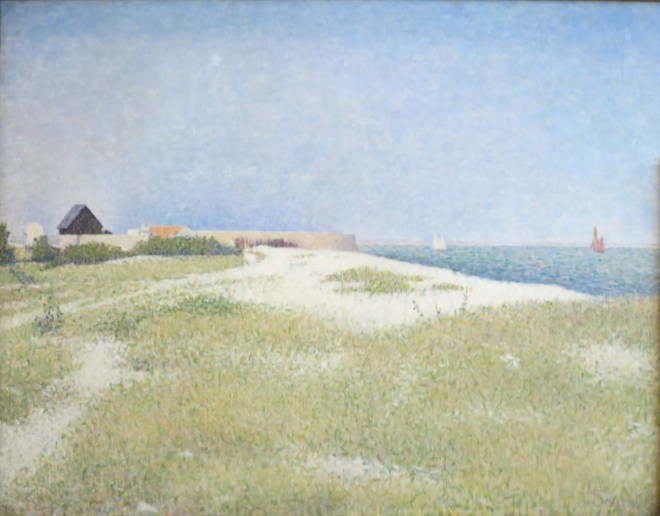
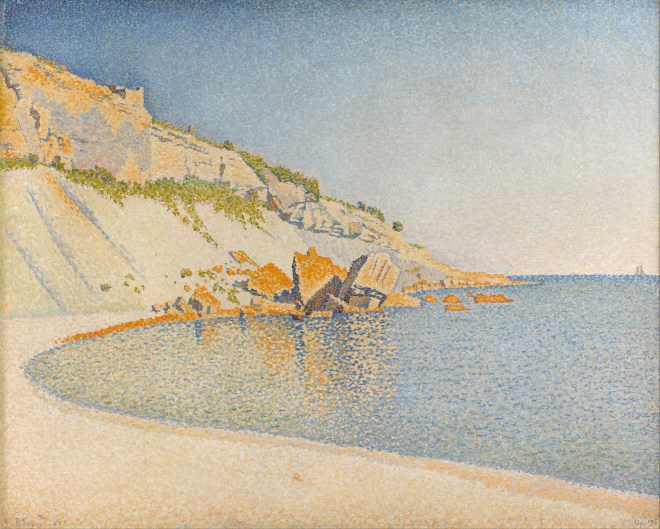
All exceedingly interesting. And yet … my wife and I both had the same reaction to the show. After an initial burst of enthusiasm, doubts set in. The effect of seeing so many pointillist paintings together was to have a chocolate-box sensation. The paintings were all preternaturally bright, the skies of the many landscapes were a uniformly blank cerulean blue, and the other colours seemed to all veer towards the pastel. Here’s a couple of pointillist paintings that exemplify what we found before us. The first is by Seurat, the second by Signac.
image
image
All this in large doses eventually becomes rather sickly. There was also an eerie stillness in many of the paintings, perhaps because by their nature pointillist works were carefully and patiently crafted in the studio. This stillness, emptiness almost, is obvious in what is probably the most famous pointillist painting, Sunday Afternoon on the Island of La Grande Jatte, which shows what should be a scene full of life and movement but gives the impression of being peopled by mannequins put there for the occasion.
image
It seems that after an initial burst of enthusiasm contemporary painters also turned away from pointillism, but more because creating these paintings took so much time. Certainly Van Gogh was never convinced by pointillism, although he experimented with it a bit, because it eliminated any spontaneity in painting.

A footnote to the exhibition: many of the paintings were on loan from the Kröller-Müller Museum in Otterlo, the Netherlands. I had never heard of this museum (as for my wife, after an initial bout of amnesia, on seeing pictures of the museum she suddenly remembered visiting it more than forty years ago). Yet this museum has, among other things, the second largest collection of Van Goghs in the world. The collection was put together by Helene Kröller-Müller in the first decades of the last century. She was born into a wealthy German industrialist family and married a Dutch mining and shipping tycoon, a combination which made her the richest woman in the Netherlands.
image
She used her money wisely to put together a great collection of what was then modern art. Towards the end of her life she donated it to the Dutch state.

When I read such stories, I sigh and wish my father had been a tycoon. I would have loved to spend inherited millions putting together an art collection. Maybe in my next life.
__________

Seurat: https://en.m.wikipedia.org/wiki/Georges_Seurat
Signac: https://en.m.wikipedia.org/wiki/Paul_Signac
A Sunday Afternoon on the Island of la Grande Jatte: https://en.m.wikipedia.org/wiki/Île_de_la_Jatte
Helene Kröller-Müller: http://www.betergeven.nl/over-filantropie/filantropen-in-beeld/helene-kroller-muller/

WE’RE HOME

Milan, 31 August 2016

We touched down at Milan’s Malpensa airport around 8:30 this morning. It was a beautiful day, not too hot. We took the train into Milan, passing first the town of Saronno, home of the eponymous liqueur

then Garbagnate, home of the Galbusera brand of biscuit.


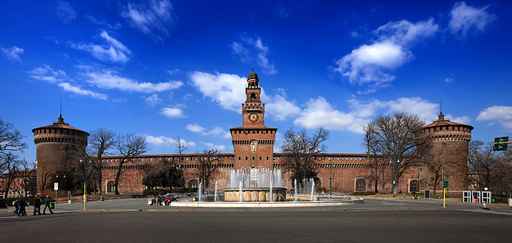
After a few more towns, we pulled into Cadorna station, which lies in the shadow of Milan’s castle.

image
We decided to walk home, so we wheeled our suitcases out, past the strange sculpture in the station square which finally, several years ago, I figured out was a needle and thread – a reference, no doubt, to the city’s place in the fashion world.

image
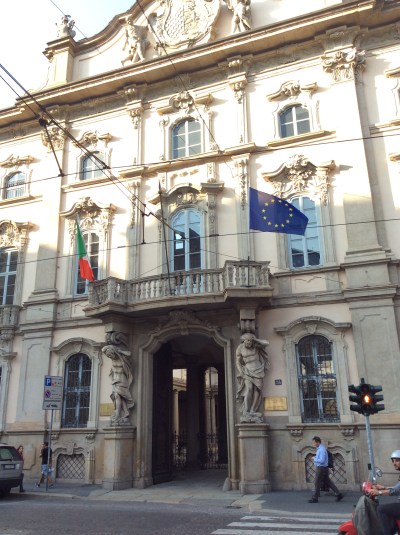
We made our way through back roads to Corso Magenta. We stopped for a well-deserved cappuccino in a caffé there. While we sipped, we admired the Baroque Palazzo Litta on the other side of the Corso.

I’ve always had a fondness for the two giants holding up the massive front door, so obviously suffering from the strain.


On we went down the Corso, past the Church of San Maurizio, which has magnificent 16th Century frescoes painted by Bernardino Luini and his school
image
before we turned right and threaded our way through the back roads again, past the mouldering ruins of the palace built by the 3rd century Roman Emperor Maximian

image
on past a disused church which is now a museum dedicated to the 20th century artist Francesco Messina

image
until we came to our road.

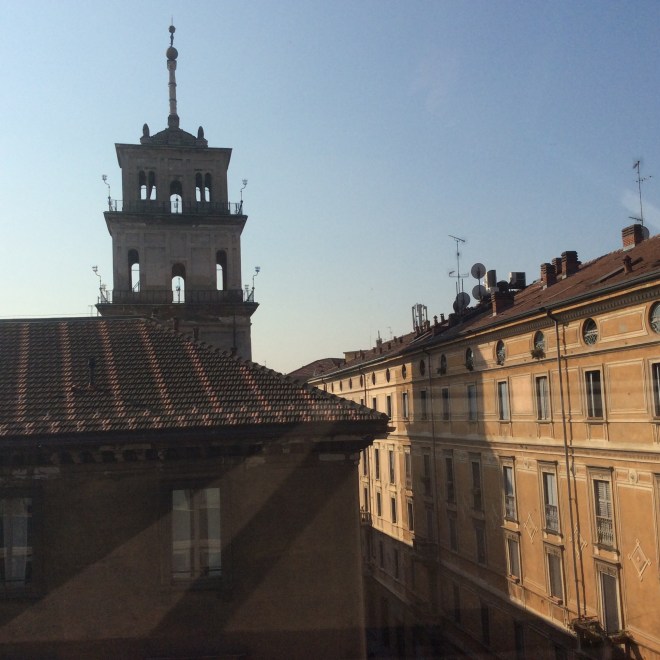
We chatted briefly with the doorman about the family as he handed us a large wad of post, accumulated since our last flying visit six months ago. We squeezed the luggage into the small elevator, manhandled it all through the apartment door, flung open the windows, and gazed over at the tower of the Palazzo Stampa-Soncino across the road.


image
After eighteen years away, it was good to finally be back home.

______________________
Liquore di Saronno: https://it.m.wikipedia.org/wiki/Liquore_amaretto
Biscotti Galbusera: http://www.galbusera.it/prodotti/senza-zuccheri-aggiunti/frollini
Castello Sforzesco, Milan: http://www.conilsud.it/2014/come-raggiungerci/
Sculpture, Piazza Cadorna: http://www.solotravel.it/29032011/piazzale-cadorna-a-milano-tra-design-e-modernita/6334
Palazzo Litta: my photo
Two statues, Palazzo Litta: my photo
Frescoes, church of San Maurizio: http://www.donnecultura.eu/?tag=chiese-di-milano
Remains Imperial Palace of Maximian: http://flickeflu.com/photos/40993657@N06/interesting
Sculpture, Francesco Messina: https://www.pinterest.com/pin/309059593155732010/
Tower, Palazzo Stampa Soncino: my photo

AMBER AND ITS ROAD

Bangkok, 15 August 2016

I’ve just finished a fascinating book about the peopling of Europe, entitled Ancestral Journeys: The Peopling of Europe from the First Venturers to the Vikings, by Jean Manco. The book describes the various waves of people who have settled Europe, peacefully or not, from 40,000 BC to 1,000 AD.

One thread in the rich tapestry of the peopling of Europe is the trade networks which sprang up as neighbouring tribes traded whatever useful or interesting resources they controlled inside their territories. The really high-value resources could in this way travel very long distances from their point of origin, as people passed them on – at ever-increasing value, no doubt – to people further away from the original source. In an earlier post, I’ve mentioned the Stone Age long-distance trade in obsidian, which made excellent, sharp arrowheads. Gold, the subject of my next-to previous post, was also traded over long distances. Amber was another such material.

In the early days of Europe’s history, by far the richest source of amber was the Baltic coast of Poland (it probably still is), where nuggets of amber would wash up on the beach, broken off from the amber deposits on the sea bottom.
image
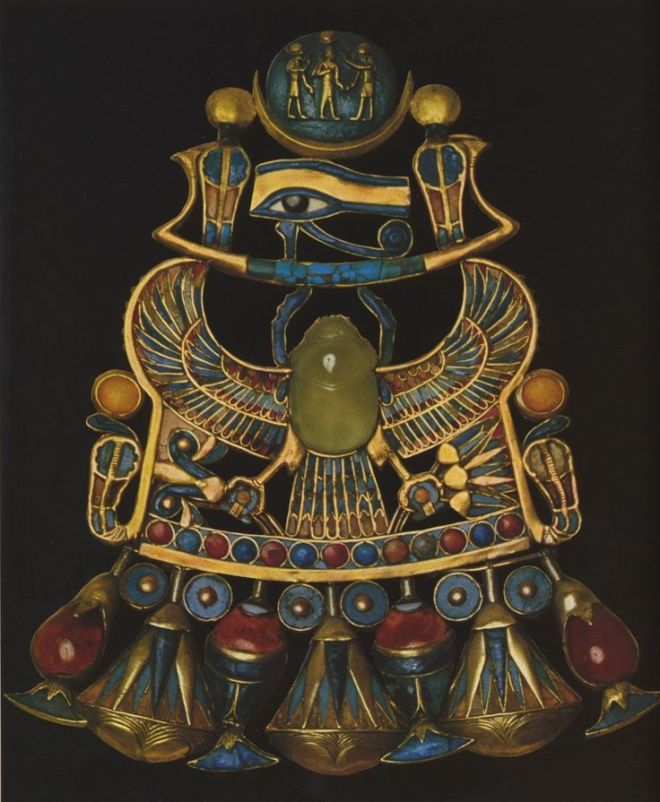
The biggest market for amber, on the other hand, and from time immemorial, were the civilizations around the Mediterranean Sea and in the Middle East. Tutunkhamun’s breast ornament contains pieces of Baltic amber, for instance
image
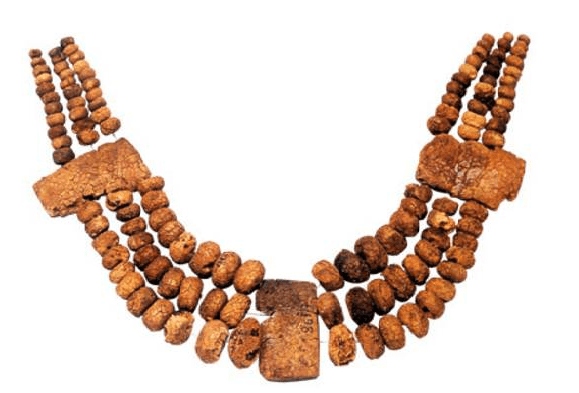
while Heinrich Schliemann found necklace beads of Baltic amber in the Mycenaean tombs he excavated.
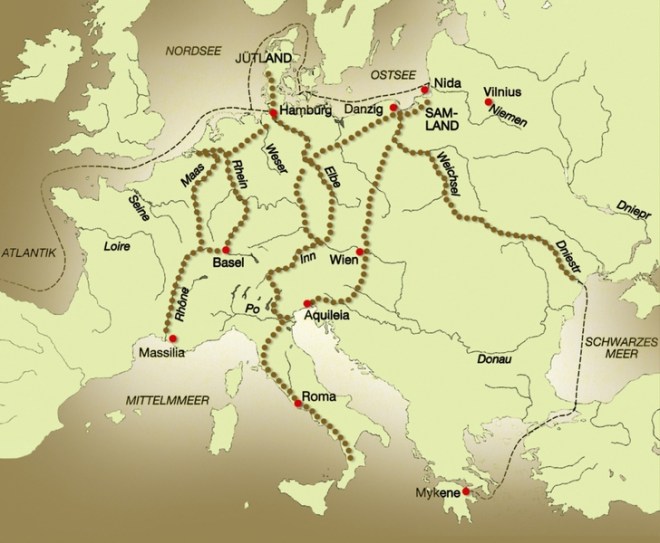
Thus sprang up several “amber roads”, trade routes which brought Baltic (and other Northern European) amber south.
image
The one that most interests me is the amber road which led from the general region of Gdansk down to the Roman provincial capital of Carnuntum on the Danube River (the Danube became the Roman Empire’s frontier in 9 BC), on down along the network of Roman roads to Aquileia in North-Eastern Italy, the terminus. This map shows, more or less, a detailed trace of this amber road.
image
I say “more or less” because while the route taken by the amber after the Danube River crossing is pretty clear – it followed the Roman roads down to the Italian peninsula – how it got to the Danube River from the Baltic coast is less so. There were just tracks through the forests and around the bogs in this part of Europe, and I’m sure every Germanic trader followed his fancy, depending on what else he was buying or selling along the way, as well as what the weather was like and who was fighting who. There seem to have been a few fixed points on the itinerary: Wroclaw (Breslau in German; the British historian Norman Davies, in collaboration with Roger Moorehouse, has written a fascinating biography of this city, Microcosm: Portrait of a Central European City), the Moravian Gate (a pass between the Carpathian and Sudeten mountains, used since remotest antiquity as a passageway), and the Morava River which flows into the Danube just across from Carnuntum.

Once the raw amber arrived in Aquileia, it was turned over to workshops which turned it into desirable luxury products. Aquileia’s amber products were famous not just in the Italic heartlands but throughout the Roman world. In his Natural History, Pliny the Elder – rather dismissively, it seems to me – says they were in demand among women only. He also says that amber was thought to have protective properties for illnesses of the throat, which might explain why so many of the amber products found in the Italian peninsula are pendants.

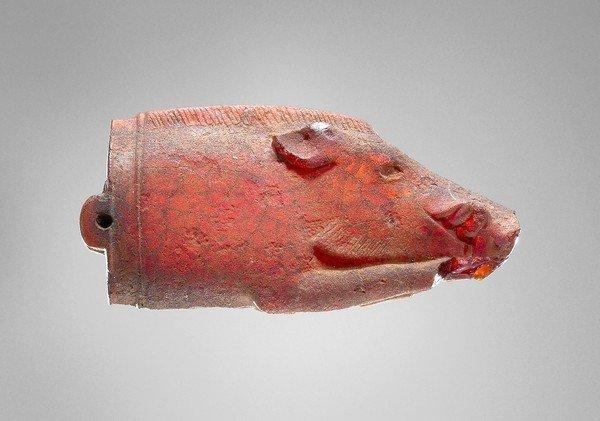
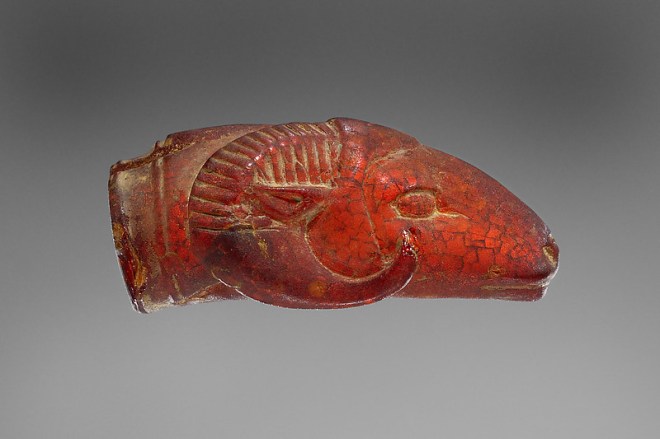
I have to say I’m not a big fan of amber, at least as used in modern jewelry. But I must admit that some of the amber pieces made in the Italian peninsula, both before its domination by Rome and after, are really very lovely. Here, in no particular order, are some pieces whose photos I found on the net. The first two are pre-Roman (Italic and Etruscan, respectively, to be precise)
image
image
while the remainder are from the Roman period; a number of them, if not all, were made in Aquileia’s workshops. This is Dionysius
image
while this must be Pan.
image
This is a perfume bottle
image
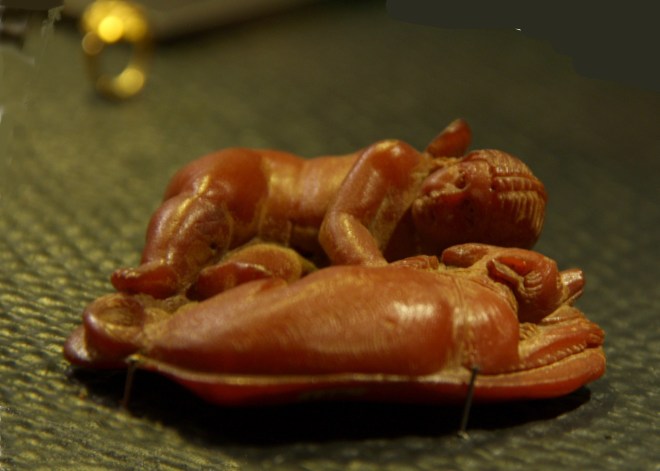
while this little set-piece is “Eros and a bitch”.
image
Lovely little pieces …

Let me go back a step now and explain my interest in this particular amber road. Or rather interests, for there are several. I first got to know about it, and the ancient amber trade in general, when my wife and I lived in Vienna. It so happens that Vienna is located close to Carnuntum. It always tickled me pink to think that Vienna, which gives itself such airs as the capital of the (defunct) Austro-Hungarian Empire, was once upon a time no more than a minor garrison town called Vindobona on the far edges of the much mightier Roman Empire. I’m sure officers and soldiers alike in little Vindobona looked with envy at their more powerful neighbour Carnunutum, which not only had the rich amber trade passing through it but also was the capital of the province. So many more important things went on there! The Emperor Marcus Aurelius chose Carnuntum as his base for three years during one of the periodic Roman campaigns against Germanic tribes across the Danube River (he also wrote part of his famous Meditations there, a copy of which graces my bookshelves). Another Emperor, Septimius Severus, was also based in Carnuntum when governor of Pannonia, and he was proclaimed Emperor there by his troops. Carnuntum hosted a historic meeting between the Emperor Diocletian and his co-emperors Maximian and Galerius, to solve rising tensions within the tetrarchy. Among other things, the meeting led to freedom of religion for the Roman Empire. And on, and on.

In contrast, like in all garrison towns, probably nothing much ever happened in Vindobona (although Marcus Aurelius’s death there in 180 AD must have caused a ripple of excitement). W.H. Auden caught well the tedium of garrison life on the Empire’s frontier for the ordinary soldier, in his poem Roman Wall Blues. The poem is about another of the Empire’s frontiers, Hadrian’s Wall, but I’m sure the tedium was the same, whichever frontier you were assigned to.

Over the heather the wet wind blows,
I’ve lice in my tunic and a cold in my nose.

The rain comes pattering out of the sky,
I’m a Wall soldier, I don’t know why.

The mist creeps over the hard grey stone,
My girl’s in Tungria; I sleep alone.

Aulus goes hanging around her place,
I don’t like his manners, I don’t like his face.

Piso’s a Christian, he worships a fish;
There’d be no kissing if he had his wish.

She gave me a ring but I diced it away;
I want my girl and I want my pay.

When I’m a veteran with only one eye
I shall do nothing but look at the sky.

But I suppose Vienna had the last laugh. It still exists, whereas Carnuntum is now but a very modest pile of ruins, having been systematically sacked by Germanic tribes in the 4th Century (I suppose in a way the Germanic tribes had the last laugh too, after all the denigration they received from the Romans). Sic transit gloria mundi, as I am ever fond of repeating: “thus passes the glory of the world”.

This particular amber road also caught my attention because it gave me an alternative route to the ones we always took to go back to my wife’s home town of Milan: either head south out of Vienna over the mountains to Graz and then over more mountains to Klagenfurt and Villach, slip through the Alps at the Tarvisio pass, then speed past Udine down to Venice, whence turn right and make for Milan; or, head west out of Vienna towards Linz, then Salzburg, and then into Bavaria, turn left at the River Inn and enter Austria again, at Innsbruck turn left again and climb up to the Brenner pass, down the other side to zip by Bolzano and Trento, exit from the Alps at Verona, and turn right there to head for Milan. Now my wife and I could take a lower road (a considerable benefit when traveling in winter, when both the other routes can be unpleasant), as well as one steeped in history. Travelling along the ghosts of old Roman roads (all of which disappeared long ago) we would head south past the tip of Lake Neusidler, shared by Austria and Hungary, to Šopron and then Szombalethy, both in Hungary, on to Ptuj, Celje, and Lubljana in Slovenia, to finally slip through the Julian Alps at Gorizia and on to Aquileia, where we would need to finally get on the A4 motorway and speed on to Milan!

Great idea, except for one slight problem – time. There is no speedy highway linking all these towns, so it would take far longer to get to Milan. Since we were working, we couldn’t afford the time; we were always time-starved. But that will all change in a mere two weeks’ time, when I retire! Then, we will have all the time in the world, and I am determined to finally follow in the footsteps of the legions and pass through what were once the Roman towns of Scarbantia, Savariensum, Poetovium, Celeia, and Emona. There’s not much Roman left in them, though. Like Carnuntum, and like the terminal point Aquileia (of whose total destruction I wrote about in an earlier post), they were all thoroughly sacked and resacked by Germanic, Gothic, Hun, Lombard, Slav, or Hungarian war parties (or some combination of these) during the period of the “Barbarian Invasions” or the “Migration of the Peoples”, the Völkerwanderung (take your pick, depending on your ideological point of view).

I always feel a point of melancholy when faced with these moments of destruction in history. And it’s not just in the remote past. On the northern end of this amber road, tremendous destruction, of places but also of people, was wreaked a mere 70 or so years ago as first, German troops swept through on their way to enacting Hitler’s policy of lebensraum, expanding the living space of the Aryan, Germanic people at the expense of Slavic people, and then again, as the Soviet troops fought their way back to Berlin. Along with many other Polish cities, Gdansk, Wroclaw, Poznan, all sitting astride the amber route, were almost totally destroyed, their Jewish populations annihilated, their Polish populations much depleted, their industrial infrastructure stripped away. What a waste … so much human creativity swept away by the animal desire to destroy.

_________________
Raw amber on a Baltic beach: https://en.m.wikipedia.org/wiki/Baltic_amber#/media/File%3ABaltic_beach_sand_containing_amber.jpg
Tutunkhamun’s breast ornament: https://hu.pinterest.com/pin/249598004324238999/
Amber necklace, Mycenae: https://sites.google.com/site/ambranathistplinio/home/etimologia-e-proprieta
Amber routes map: http://www.ambergallery.lt/en/disp.php?itm=en_museums_3%2Fen_museums_3_9
Amber road through Carnuntum: https://en.m.wikipedia.org/wiki/Amber_Road
Ram’s head, Italic, 500-400 BC: http://museumcatalogues.getty.edu/amber/intro/16/
Boar’s head, Etruscan, 525-480 BC: http://articles.latimes.com/2013/jan/19/entertainment/la-et-getty-ambers-20130119
Mask of Dionysius, Roman, 1st C AD: http://amberregina.blogspot.com/2011_03_01_archive.html
Perfume bottle, Roman, Aquileia workshop, 2nd C AD: http://www.antiquitiesexperts.com/rome138.html
Eros and bitch, Roman: https://commons.m.wikimedia.org/wiki/File:1128_-_Archaeological_Museum,_Udine_-_Ancient_Roman_amber_Eros_and_bitch_-_Photo_by_Giovanni_Dall%27Orto,_May_29_2015.jpg
GOLD

Mandalay, 3 August 2016

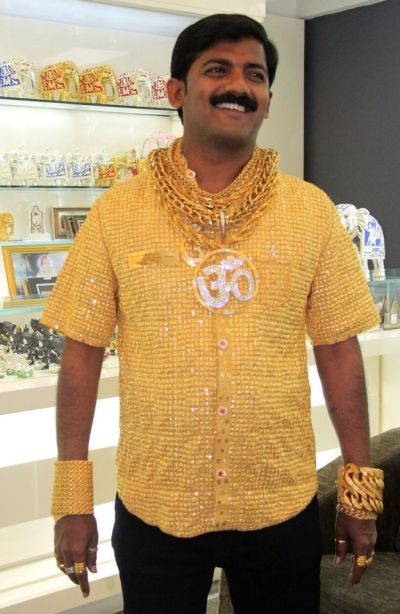
A few weeks ago, I read of the death of an Indian money-lender, murdered by a couple of people to whom he owed money. It was a banal and sordid murder, no different from the hundreds of banal and sordid murders which occur every day the world over. If this particular one was splashed all over the front pages of many newspapers, it was because the unfortunate victim had earlier shot to global fame for purchasing … a shirt made of gold (an idea, I have to say, which I find pretty bling).
image
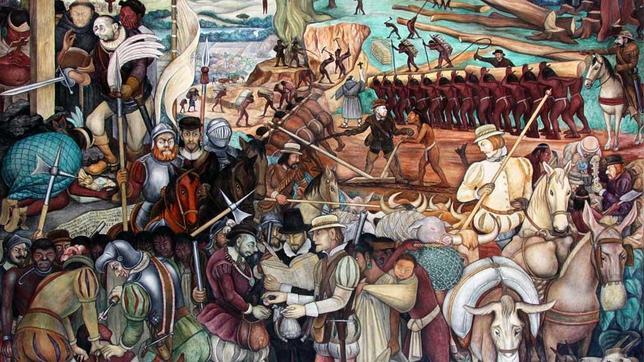
Ah, gold! That lovely, soft, malleable metal, which never rusts, which glows yellow like the sun. Which has been lusted after by so many through the ages. It sent the Conquistadors sailing half way round the globe to an unknown world, not to understand it but to rip the gold out of its heart.

image
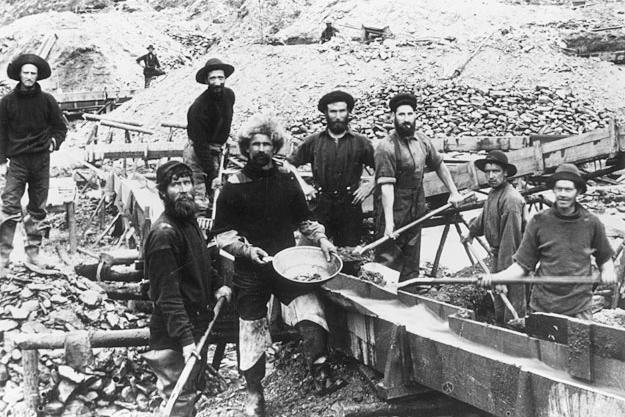
It has sent hundred of thousands running to the ends of the world to feverishly pan it out of water or to hack it out of the ground
image
a gold fever which even today strikes men (but also now women).


But gold has also inspired artisans for at least six thousand years to make beautiful, beautiful objects. It is these lovely creations which I wish to celebrate today, not the ugly side of gold.

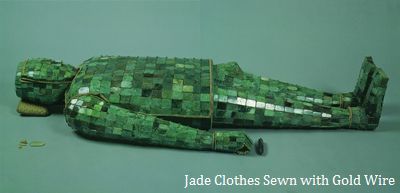
Given where this post started, my first inclination was to search on the Internet for examples of powerful potentates from the past who were discovered by archaeologists buried in shirts or tunics of gold. Alas, I found none, whether because my surfing skills are not up to the task or because even kings of old found this idea really too bling, or because archaeologists simply haven’t stumbled across such cases yet. The closest I got to it was jade burial suits used during China’s Han dynasty by members of the royal family; in some cases, the jade pieces of the suit were sewn together with gold wire.
image
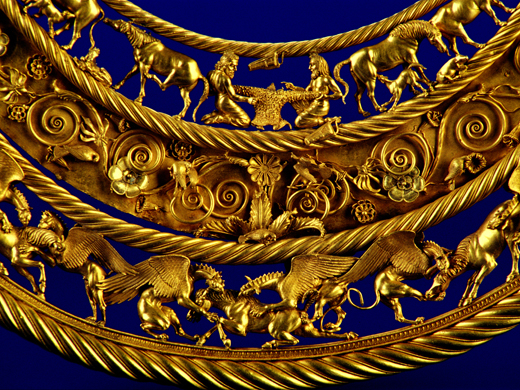
But as I surfed the internet, looking for gold shirts from faraway times, I stumbled across a treasure hoard of ancient gold pieces, some found buried with kings, princes, and their consorts, others buried for safekeeping by their owners who, for some reason, never returned to reclaim them. For instance, I was completely smitten by some of the gold work that archaeologists have found in various Scythian royal tombs in Southern Russia, Ukraine, and the Caucasus region more generally. Look at this pectoral, from the 4th C BC!
image
Here’s a detail – see how fine the work is!
image
Or how about these two vessels, also from the 4th C BC. They were apparently a pair, with this one
image
sitting on top of the other.
image
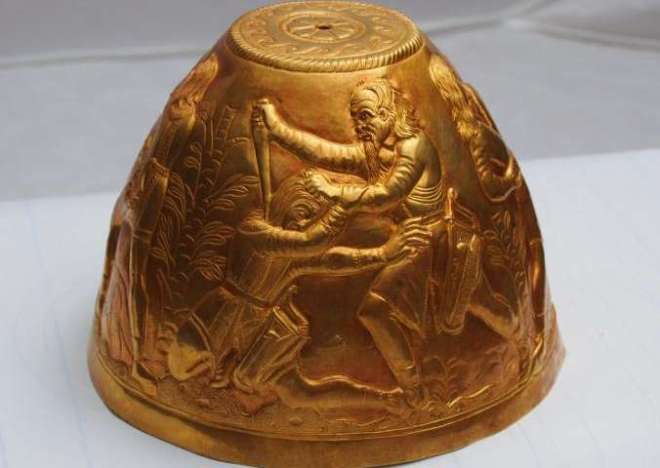
Or this bowl, from more or less the same period.
image
Or this comb, from slightly earlier, late 4th C BC, early 5th C BC.
image
The articles I’ve read about these pieces suggest that they were not actually made by the Scythians but by Greeks, living perhaps in the Crimean region. Fair enough, but this Scythian deer plaque, from the 7th C BC, was surely locally made
image
as was this belt buckle from the same period.
image
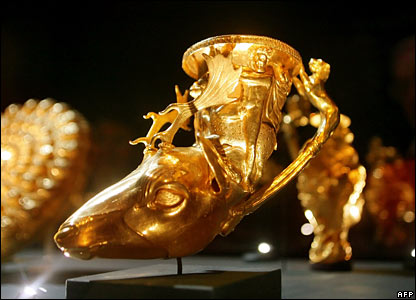
Thracian kings, it seems, were also desirous to be surrounded by fine gold objects. Consider, for instance, Bulgaria’s Panagyurishte gold treasure, thought to have been owned by King Seuthes III and buried to hide them from marauding Celts or Macedonians. I show three pieces from the hoard, all from the 3rd or 4th C BC: two rhytons, or drinking horns
image
image
and a plate.
image
Again, the detail on these pieces is exquisite.

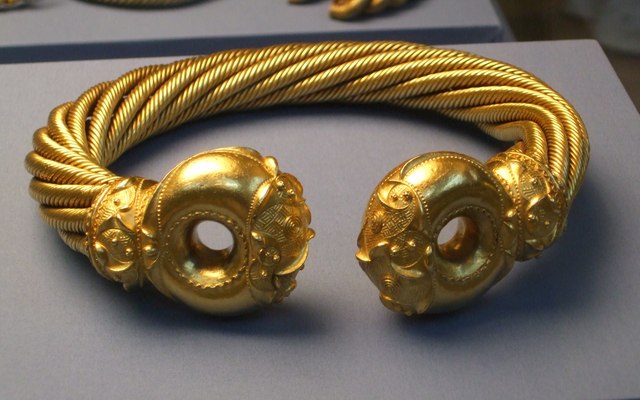
Mention of marauding Celts makes me look in the direction of the Northern European lands, where Celts were also known to hurriedly bury hoards of gold objects at the sound of approaching marauders. This beautiful spiral torc from 1st-4th C BC
image
was part of a cache of torcs found near Stirling in Scotland. This 70 BC torc instead was part of a hoard discovered at Snettisham in Norfolk, England.
image
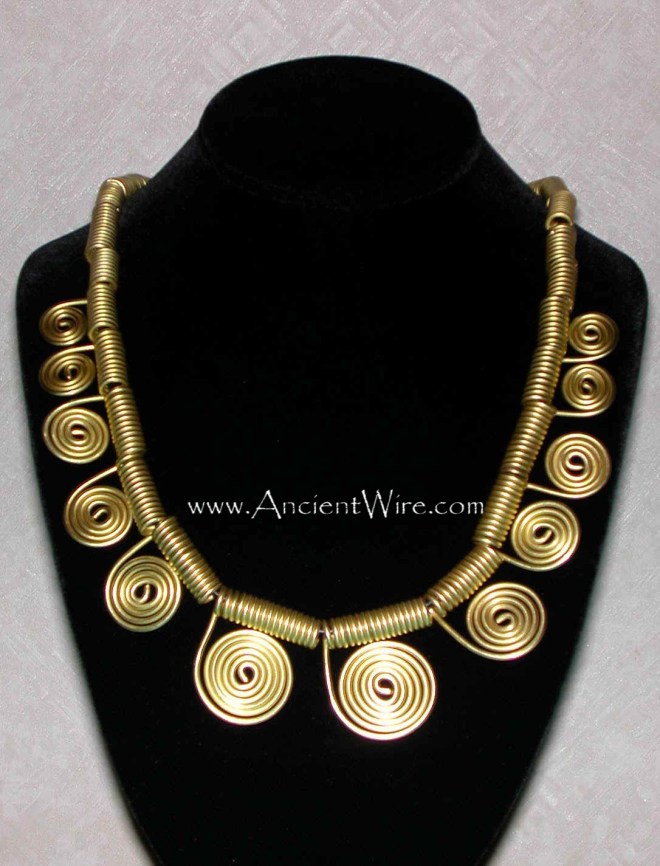
This necklace, on the other hand, is a copy of a 6th-7th C BC original that was buried in Lorup, Germany.
image
I have to say, while I greatly admire the artistry that went into the Thracian and Scythian pieces, I instinctively empathize with the geometric simplicity of these Celtic pieces. “Keep It Simple, Stupid!” has always been my motto.

But that didn’t stop me from whistling when I saw some of the pieces that were made in what is now Iran. Look at this 8th-10th C BC cup, for instance, with its row of wild goats walking primly around it.
image
This must have been a popular design, because this cup from a later period (4th-5th C BC) has instead lions or tigers walking round it.
image
This 4th-5th C BC drinking cup holds its own to the two Thracian rhytons I show above
image
while this 3rd-4th C BC Janus-faced cup is a marvel to behold.
image

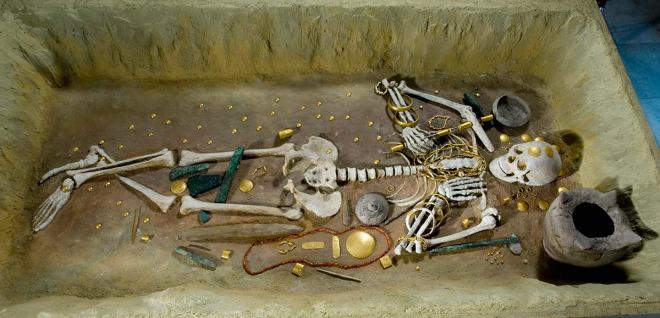
There are many, many other beautiful ancient gold objects out there, but I have to bring this little essay to a close. Let me finish with the oldest gold objects so far found. These are datable to the period 4,200-4,600 BC, and come from a necropolis in Varna, now Bulgaria’s largest city on the Black Sea. Compared to the pieces I show above, the objects in these tombs are quite modest in their design. What caught my attention was this reconstruction of one of the burials in the necropolis.
image
I suppose the man to whom this skeleton belonged was a grandee, and was laid to rest surrounded by all his worldly riches. But as I gaze at this skeleton, I cannot help but remember the dialogue between Hamlet and Horatio in the graveyard. After musing over Yorick’s skull (“Alas, poor Yorick! I knew him, Horatio, a fellow of infinite jest, of most excellent fancy …”), Hamlet turns to Horatio.

Hamlet: Prithee, Horatio, tell me one thing.

Horatio: What’s that, my lord?

Hamlet: Dost thou think Alexander looked o’ this fashion i’ the earth?

Horatio: E’en so.

Hamlet: And smelt so? pah!

Puts down the skull

Horatio: E’en so, my lord.

Hamlet: To what base uses we may return, Horatio! Why may
not imagination trace the noble dust of Alexander,
till he find it stopping a bung-hole?

Horatio: ‘Twere to consider too curiously, to consider.

Hamlet: No, faith, not a jot; but to follow him thither with
modesty enough, and likelihood to lead it: as
thus: Alexander died, Alexander was buried,
Alexander returneth into dust; the dust is earth; of
earth we make loam; and why of that loam, whereto he
was converted, might they not stop a beer-barrel?
Imperious Caesar, dead and turn’d to clay,
Might stop a hole to keep the wind away;
O, that that earth, which kept the world in awe,
Should patch a wall to expel the winter flaw!

___________________
India’s “gold man”: http://www.bbc.com/news/world-asia-india-36804209
“Conquista de Mexico”, Diego Rivera: http://www.abc.es/fotonoticias/fotos-espana/20150428/mural-diego-rivera-sobre-162891744561.html
Gold prospectors, Klondike: http://www.discovery.com/tv-shows/gold-rush/photos/klondike-gold-rush-pictures/
Modern gold prospectors, Colombia: http://www.jansochor.com/photo-blog/gold-mining-colombia
Jade burial suit: https://hu.pinterest.com/pin/454159943647748843/
Scythian pectoral, Ukraine, 4th C BC: http://www.craftycristian.com/tag/artifact/
Scythian pectoral-detail: https://en.m.wikipedia.org/wiki/Scythians
Scythian vessel-top, 4th C BC: http://phys.org/news/2015-06-archeologists-gold-artifacts-scythian-grave.html
Scythian vessel-bottom, 4th C BC: http://www.archaeology.org/issues/220-1607/features/4560-rites-of-the-scythians
Scythian bowl, 2nd half 4th C BC: http://www.metmuseum.org/exhibitions/listings/2000/golden-deer/photo-gallery
Scythian gold comb, Ukraine, late 5th-early 4th BC: http://museum-of-artifacts.eu/post/100759193962/scythian-golden-comb-5th-century-bc
Scythian deer, end 7th C BC: http://www.metmuseum.org/exhibitions/listings/2000/golden-deer/photo-gallery
Scythian belt buckle, 7th C BC: https://en.m.wikipedia.org/wiki/Scythians#/media/File%3AGold_scythian_belt_title_from_Mingachevir%2C_Azerbaijan.JPG
Thracian drinking horn-goat: https://www.pinterest.com/pin/174444185537354589/
Thracian drinking horn-deer: https://www.pinterest.com/pin/492510909227090261/
Ancient Greek plate (phiale): http://www.artlex.com/ArtLex/g/gold.html
Spiral torc, Scotland, 300-100 BC: http://www.nms.ac.uk/explore/stories/scottish-history-and-archaeology/iron-age-gold-torcs/
Celtic torc, Snettisham hoard: http://www.geograph.org.uk/photo/2395380
Ancient wire necklace (copy), Lorup hoard, Germany, late Bronze Age, 700-600 BC: http://www.ancientwire.com/spiralnecklace.htm
Achaemenid cup-wild goats, 1000-1200 BC: http://www.metmuseum.org/art/collection/search/325511?high=on&rpp=50&pg=22&rndkey=20120709&ft=*&pos=1095
Achaemenid gold cup, Kalardasht, 800 BC: https://commons.m.wikimedia.org/wiki/File:Gold_cup_kalardasht.jpg
Achaemenid drinking cup: http://www.daftarche.com/تاریخ،-فرهنگ،-همبود-13/persian-mythology-543-چاپ/برگه-3.html
Achaemenid Janus cup: http://www.iransara.info/main-previous%20post.htm
Varna man: http://edition.cnn.com/interactive/2015/07/style/gold/

BAGAN, MYANMAR

Bangkok, 13 July 2016

My wife and I have just returned from a short visit to Bagan, in Myanmar. Back when Harold Godwinson received an arrow in his eye, losing his life and his English throne to William, Duke of Normandy
image
the kings of Pagan (as the kingdom was then known) had consolidated their hold on the valley of the Irrawaddy River, swallowing up their neighbouring city-states, and had created the first Burmese kingdom. The kingdom grew rich on trade but also on agriculture, harnessing irrigation for the first time in this dry region of Myanmar. As befits the capital of a prosperous kingdom, the population of Pagan swelled. The kings and the richer citizens, anxious to gain merit for their next reincarnation, used their wealth to heavily sprinkle the city and the surrounding plain with stupas, temples, monasteries, and other religious edifices. At the height of this building frenzy, more than 10,000 such edifices covered an area of some 100 square kilometres.

Alas, this well-meaning search for merit undermined the edifice of state. More and more land was donated to the Buddhist monkhood, land which then became exempt from tax, thereby gradually emptying the state coffers. The resulting internal strife weakened the kingdom, and invasions of its borderlands by the Mongol dynasty of China finished her off. By 1287, the kingdom of Pagan was no more, and its capital city had shrunk to the size of a very modest town. Sun, wind, and rain began their work. The plaster moldings with which all the religious edifices had been covered peeled off, and the exposed brick began crumbling away to mud and dust. Trees and bushes did their part, inserting roots between brick and brick and slowly leveraging them apart. Earthquakes played their part too, toppling walls and cracking open stupas. And so the religious edifices so lovingly erected by earlier generations slowly slumped back into the earth from whence they had sprung.

A score of temples and stupas, which continued to be sites of pilgrimage, were maintained, often with infelicitous results as frescoes were painted or whitewashed over and badly crafted statues took the place of the originals. In the last century, conservation work was carried out – haphazardly – under successive military regimes. This has halted, or at least slowed, the dissolution, but even so only some 2,000 edifices remain standing, more or less, today.

But 2,000 is still a big number. Climb, as we did, the Shwesandaw stupa, and you will find yourself gazing out over flat, wooded farmland thickly sprinkled with red-brick stupas and temples of every size and state of disrepair.
image

image

image

image

Get off the paved roads, as we did, and take the dirt roads and paths which crisscross this farmland, and you will come across lonely stupas brooding by the side of fields
image
where the lines of the Persian poet Ferdowsi come to mind:

The spider spins his web in the Palace of the Caesars
An owl hoots in the towers of Samarkand

(it is said that the Ottoman sultan Mehmet II murmured these lines as he visited the desolate ruins of the imperial palace after his conquest of Constantinople in 1453)

It comes spontaneous to compare Bagan to other places. Angkor Wat in neighbouring Cambodia is often cited, but the comparison doesn’t hold. Angkor has edifices which are splendid in their art and architecture.
image

image
image
The edifices of Bagan, on the other hand, now have little if any intrinsic merit. My wife and I saw nothing superlative in any of the stupas or temples we visited. Pleasant, yes, interesting sometimes, but nothing to take one’s breath away.
image
image

image

image
No, it is the overall landscape that makes Bagan noteworthy, and it is to landscapes that we must turn for comparisons. Since many of the edifices in Bagan are funerary in nature, my wife felt a certain affinity between the Italian cemeteries of her youth and Bagan, with the latter of course being on a much larger scale.
image
In such a comparison, I would perhaps lean towards the abandoned part of Vienna’s biggest cemetery, the Wiener Zentralfriedhof, which contains many of the tombs of Vienna’s Jewish community, wiped out in the Nazi concentration camps.
image
I myself favour a comparison with Ancient Rome, not the Ancient Rome of today, swallowed up in the concrete and bitumen of the modern city, but the Ancient Rome that was the subject of many a painting in the 17th to 19th centuries. This is Claude Lorrain
image

this, Piranesi
image
this, Palmer
image
and this, Lear
image
In these paintings I see an echo of the Bagan I looked out on from the heights of the Shwesandaw stupa.

As the lines I cite above show, the melancholy of ruins has always excited the imagination of poets. Rome’s ruins are no exception, with reams of poems written about them. I quote one here, by Alexander Pope.

See the wild waste of all-devouring years!
How Rome her own sad sepulchre appears,
With nodding arches, broken temples spread!
The very tombs now vanished like their dead!
Imperial wonders raised on nations spoiled,
Where mixed with slaves the groaning martyr toiled:
Huge theatres, that now unpeopled woods,
Now drained a distant country of her floods:
Fanes, which admiring gods with pride survey,
Statues of men, scarce less alive than they!
Some felt the silent stroke of mouldering age,
Some hostile fury, some religious rage.
Barbarian blindness, Christian zeal conspire,
And papal piety, and Gothic fire.
Perhaps, by its own ruins saved from flame,
Some buried marble half preserves a name;
That name the learned with fierce dispute pursue,
And give to Titus old Vespasian’s Due.

But this poem is far too frothy, as are all the poems about Rome’s ruins. I prefer the fragments of an Anglo-Saxon poem of the 8th Century, part of an anthology of Anglo-Saxon poems in the library of Exeter Cathedral, whose subject is not Rome but the Roman ruins of Bath.

Wrætlic is þes wealstan, wyrde gebræcon;
burgstede burston, brosnað enta geweorc.
Hrofas sind gehrorene, hreorge torras,
hrungeat berofen, hrim on lime,

For those of my no doubt many readers who, like me, are not conversant with Anglo-Saxon, let me continue with a translation by Siân Echard, of the University of British Columbia, with some modifications on my part.

Wondrous is this wall-stead, wasted by fate.
Battlements broken, giant’s work shattered.
Roofs are in ruin, towers destroyed,
Broken the barred gate, rime on the plaster,

Walls gape, torn up, destroyed, consumed by age.
A hundred generations have passed.
Earth-grip holds the proud builders, departed, long lost,
In the hard grasp of the grave. How often has this wall,

Hoary with lichen, red-stained, outlasted the passing reigns,
Withstanding the storms; the high arch now has fallen …

(At this point, there is a gap, for the parchment itself has suffered badly from the passage of time)

Indeed, the high arches, now fallen, of Bagan have witnessed the passing of many reigns, the last being but a few months ago, when the decades-long military government in Myanmar finally gave way to a democratically-elected civilian government. Knowing the history of neighbouring Thailand, where military meddling is a way of life, I offered a silent prayer in the Ananda temple
image
that this would be the last of the military governments in this beautiful country, which has suffered so much and deserves so much better.

________________
Photos of Bagan: ours
Harold hit by the arrow: http://www.dot-domesday.me.uk/arrow.htm
Angkor Wat-1: https://artmundus.wordpress.com/2010/05/28/the-wonder-that-is-angkor-wat/
Angkor Wat-2: https://artmundus.wordpress.com/2010/05/28/the-wonder-that-is-angkor-wat/
Angkor Wat-3: http://rwethereyetrwethereyet.typepad.com/arewethereyet/2008/04/take-your-kids.html
Cimitero monumentale, Milan: https://www.tripadvisor.it/LocationPhotoDirectLink-g187849-d243431-i28163413-Monumental_Cemetery-Milan_Lombardy.html
Jewish section, Vienna Zentralfriedhof: http://www.flickriver.com/photos/lastingimages/2924629401/
Roman ruins:http://www.bobforrestweb.co.uk/The_Rubaiyat/Galleries/Gallery_5/g5notes.htm
– Claude Lorrain
– Giovanni Battista Piranesi
– Samuel Palmer
– Edward Lear

THUNDER

Bangkok, 4 July 2016

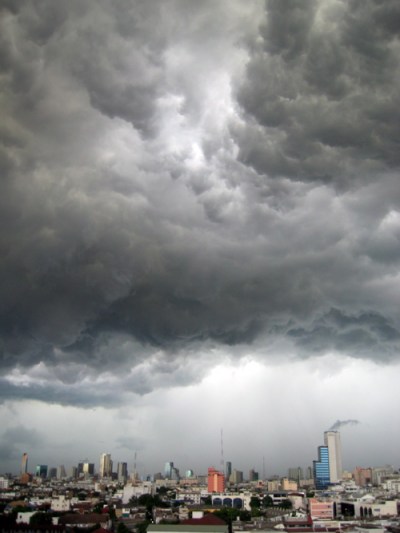
It’s the rainy season in Bangkok. The normal schedule sees the day start dry with perhaps some cloud cover, which then builds up into impressively nasty-looking, black, whorly cloud piles by late afternoon.

image
image
At that point, lightning rips the sky from cloud to ground
image
followed moments later by thunder. And what thunder it is! The air itself seems to crack and splinter, the clouds angrily boom and hammer, over and over again as lightning keeps bursting out of the clouds. Instinctively, my wife and I step back, retreating into the safety of the apartment, and murmur comments to each other about the elemental son et lumière playing outside our windows. And then the rain starts, so dense that the other side of Chaophraya River, normally perfectly visible from our terrace, is blotted out.

At moments like these, I feel pity for our early ancestors cowering in their rock caves or flimsy huts watching the same grand spectacle. With the benefit of science, I can rationalize what I am seeing: why, thunder is just the noise of the sonic shock wave created by the very sudden expansion of air caused by the almost instant increase in pressure and temperature brought about by the passage of a lightning bolt! That’s all … But they did not have this intellectual crutch to lean on. They must have found such dramatic displays by nature very frightening. So I suppose it’s not very surprising that all the early religions had a god of thunder, who no doubt had to be ritually appeased.

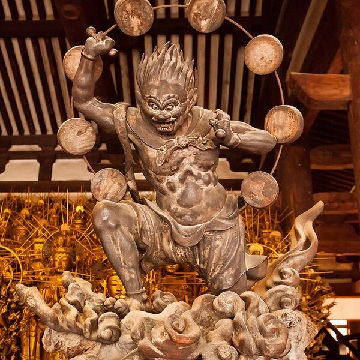
What I do find surprising, though, after a quick zip around the Internet, is how decorously many of these gods of thunder have been portrayed in art. If I were cowering in my cave 50,000 years ago, or even in my flimsy hut 5,000 years ago, listening to all that tearing, splintering, and booming mayhem going on outside, I think it would come naturally to me to depict the god of thunder as a mean, nasty, angry son of a bitch. Some portrayals do seem to go in this direction. For instance, those of Tawhirimatea, the Maori’s god of thunder

make him look satisfyingly nasty. So do portrayals of Raijin, Japan’s god of thunder
image
who to my eyes looks apoplectic. Chaac, the Mayan god of thunder also looks suitably nasty
image
although as in so much Mesoamerican art he looks gruesomely nasty – they really seemed to have a need for downright disgusting-looking gods, the Mesoamericans did. I think Thailand’s own god of thunder, Ramasura, could perhaps be added to the list. I suspect he has a nasty monster’s face, but the nastiness of it is offset by the graceful balletic poses he is depicted in, a pose common to any flying spirit in Thai art.
image
After that, it gets difficult to find angry-looking gods of thunder. Take Zeus, for instance, the Greek god of thunder and lightning. The angriest depiction I could find was this one, on a vase, where frankly he just looks a little snippy rather than rip-roaring mad.
image
His usual mode of representation seems to be that typically Greek one of Olympian calm and good muscle tone, like this magnificent statue of him in the National Archaeological Museum in Athens (the lightning bolt which he is, calmly, throwing has gone missing).
image
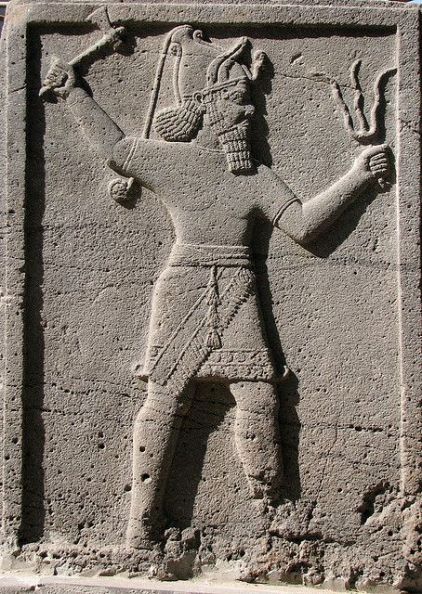
A rapid whizz through the pantheon of thunder gods in the Middle East gave me nothing better than this representation of Teshub, the Assyrian and Babylonian god of thunder
image
who, let’s face it, is looking petulant rather than angry as he wields his axe and lightning bolt.

I was hoping that the Norsemen, who after all seemed to spend most of their time stoving in their enemies’ skulls and drinking mead from those they hadn’t stoved in, would come up with a suitably horrible portrayal of Thor, their god of thunder. Not a bit of it! The best I could find was this
image
which, let’s face it, is a really pathetic representation of this god, who, if I’m to believe the Icelandic sagas, was testosterone-fueled and badly in need of anger management classes. Marvel Comics have done a much better job at depicting him
image
(and, by the way, have done a much better job of depicting Zeus too)
image
What to make of all this? Perhaps that the trick of our ancestors was to personalize these frightening phenomena. By personalizing them, they could clothe them with known and understandable personality traits, thus rendering the unfamiliar familiar. And/or maybe the ruling classes who arose out of the early agrarian societies and needed the acquiescence of the masses to their rule, if necessary through force, rather liked the idea of the masses equating their power to that of natural forces like thunder and lightning – but also wanted that power to look regal rather than just plain nasty; the fist of iron in the velvet glove, as it were.

Well, that’s my two-cent’s worth of pop-anthropological musings. My wife and I can now go back to watching the spectacle through our apartment windows – but from two steps back; you never know.

____________________
Thunder clouds over Bangkok: https://paulandsarahinthailand.wordpress.com/author/artyfooty/page/5/
Thunder clouds over Bangkok-2: http://2bangkok.com/2bangkok-weather-index.html
Lightning over Bangkok: http://www.digitalphotographytipsonline.com/my-image-gallery.html
Tawhirimatea, NZ: http://auckland-west.co.nz/2011/08/09/twhirimatea/
Raijin, Japan: http://www.esamskriti.com/print.aspx?topicid=969&chapter=1
Chaac, Mayan God of rain: http://archaeology.about.com/od/mayaarchaeology/a/Mayan-Rain-God-Chaac.htm
Ramasura: http://www.thaifolk.com/doc/mekkala_e.htm
Zeus on pottery: http://www.theoi.com/Gallery/K1.1.html
Artemisium Zeus statue: http://www.crystalinks.com/zeus.html
Teshub, Assyrian-Babylonian: https://www.pinterest.com/pin/12525705192076524/
Thor: https://en.m.wikipedia.org/wiki/Eyrarland_Statue
Thor comic book: https://en.m.wikipedia.org/wiki/Thor_(Marvel_Comics)
Thor and Zeus comic book: https://en.m.wikipedia.org/wiki/Zeus_(Marvel_Comics)

ROCK ART

Bangkok, 18 June 2016

As readers of this blog cannot have failed to notice, I’m a bit of a history buff. I suppose it runs in the family. My father had an extensive collection of history books, which as I grew up I filched for a quiet read in bed, and my elder brother actually teaches the subject.

As perhaps we all do, my interest in history started with the grand events, the Kings, the Queens, the battles. But with age, I became more interested in the history of the voiceless: the poorer segments of society, the goods and chattel which we humans have enslaved and used for our own material comforts, and – the topic of this post – our forefathers from the time when there were no written records: pre-history. Precisely because they have no written history, the latter can only talk to us through the material remains they have left behind, and through the chemical and biological tracers they have scattered about, from our genetic codes to such mundane things as pollen records. This post is about a particular material remain left to us by the voiceless, rock art.

My first meeting nearly half a century ago with this art form was not very propitious. They were rock paintings, in the middle of Lake of the Woods, on the US-Canadian border, where I was spending a week canoeing. They were painted on a small overhang on the water’s edge of one of the many small islands that dot the lake, so that we could bring the canoe alongside to study them. They looked something like this.
image
If I’m to be honest, I didn’t think much of them. They were pretty crude drawings, and awfully faded. I was far more excited by the very old man we met on another island, who told us that he remembered as a child being hurriedly bundled off into a hiding place because the local Indians had gone on the warpath. Wow! Indians on the warpath! To a boy of 15, that was something to talk about, not those crude, faded rock paintings.

At about the same time as I was gazing with a certain skepticism at the rock paintings on Lake of the Woods, I came across my first rock engraving. It was the White Horse, carved in the mid-19th Century into the escarpment of the Yorkshire Moors near my high school.
image
I have to say, though, that I was more taken by the gliders soaring silently on the updrafts created by the escarpment than the White Horse carved into it.

Well, time passed, I grew up, and I became wiser (I hope). My growing fascination with pre-history meant that I became more interested in rock art. Not that I saw that much rock art in the flesh, as it were. For instance, I have never managed to see the rock engravings in Valcamonica up in the Alps, not that far from my wife’s home town of Milan, even though it was one of the first places to be declared a UNESCO World Heritage Site.
image
image
On the other hand, when my wife and I visited Canyon de Chelly National Monument in Arizona early on in our marriage
image
we came across some rock engravings among the old American Indian pueblos.
image
image
I may not have been seeing much rock art, but I was reading up on whatever new finds were being made. For instance, new caves were being found in France and Spain with art from the Paleolithic era, adding to what was already known. I give here just a few examples from some of the better-known caves:
Lascaux
image
image
Altamira
image
image

Chauvet
image
image
image
Now this is really art! Visiting these caves is on my retirement bucket list – if we can manage to get in. Many of them are closed, or access to them is severely restricted, to protect the paintings. Forget the problem of stray fingers touching where they shouldn’t. Even our innocent breath deteriorates the artwork.

Several of the articles I read were about rock art in Australia. For instance, there was much excitement several years ago when it was announced that some rock art in the Northern Territories had been dated to 28,000 years ago, which made it Australia’s oldest dated rock art, and some of the earliest in the world.
image
Then there were articles a few years before that about the fascinating rock art in Kakadu National Park, also in the Northern Territories, which goes from the ancient
image
image

to the modern – Australian rock art didn’t stop tens of thousands of years ago.
image

All this meant that I approached the rock art which we visited on our recent tour of the Kimberley with a lively interest. We found ourselves confronted with two quite different styles of painting. The more recent, Wandjina art, is dominated by these alien-like faces.
image
To my mind, these paintings were only mildly interesting. Of much greater interest was the considerably older Gwion Gwion art, which is peopled with stencil-like figures like these.
image
image
image
In contrast to many of the representations of people in rock art, where they tend to be reduced to mere stick figures, Gwion Gwion art shows them dressed and coiffed. I don’t think it’s too fanciful to say that one can get an idea of what the painters of this art might have looked like if we had met them.

There are very recent articles reporting scientific analyses which suggest that these paintings could be 50,000 years old. This very much favors the theory which I mentioned in my previous post, the author of which argues not only that African peoples sailed to the Kimberley and brought the baobab tree with them but also that they were the authors of the Gwion Gwion art. He claims similarities between this art and the rock art of the Sandawe people, hunter-gatherers from Tanzania.
image

image
Personally, I’m not convinced. But hey, I’m no expert. In any event, reporting this claim has allowed me to segue smoothly to Africa, a major storehouse of rock art. And here I will leave my readers with some remarkable rock art from the Sahara, once a green and verdant land full of game and peopled by the humans who hunted them and who recorded their lives on the rock.
image
image
image
image
image

____________________
Lake of the Woods rock painting: http://www.panoramio.com/m/photo/8653359
White Horse, Kilburn: http://www.jdw-fitness.co.uk/ben-campbell-5k-10k-trail-races/
Rock engraving Valcamonica: http://www.italia.it/it/idee-di-viaggio/siti-unesco/valcamonica-larte-rupestre.html
Rock engraving Valcamonica: http://www.invasionealiena.com/misteri/articoli-misteri/963-arte-rupestre-delle-alpi-la-valcamonica.html
Canyon de Chelly: http://www.thousandwonders.net/Canyon+de+Chelly+National+Monument
Canyon de Chelly pictographs: http://www.inn-california.com/arizona/apacheC/canyondechelly/rockart.html
Cave wall, Lascaux: https://www.reddit.com/r/Showerthoughts/comments/2xfe1z/what_if_cave_drawings_are_done_by_cavechildren/
Hunters, Lascaux: https://hartogsohn.com/category/טכנופוביה/
Bisons, Altamira: https://www.pinterest.com/gfrilli/prehistoric-art-altamira/
Horses, Chauvet: http://popular-archaeology.com/issue/september-2011/article/prehistoric-cave-paintings-of-horses-were-spot-on-say-scientists
Bears, Chauvet: http://www.ancient-wisdom.com/francechauvet.htm
Rhinoceros, Chauvet: http://www.telegraph.co.uk/news/worldnews/europe/france/10920920/French-cave-paintings-inscribed-on-Unesco-World-Heritage-list.html
Reindeer, Font-de-Gaume: http://artdiscovery.info/rotations/rotation-1/packet-1/
Nawarla Gabarnmang: http://www.sundayobserver.lk/2012/06/24/spe31.asp
Kakadu woman: http://fr.123rf.com/photo_10231459_aboriginal-rock-art-namondjok-at-nourlangie-kakadu-national-park-northern-territory-australia.html
Kakadu kangaroo: https://www.pinterest.com/pin/521502831831829461/
Kakadu boat: http://news.nationalgeographic.com/news/2008/10/photogalleries/australia-aboriginal-art-photos/photo4.html
Wandjina art: https://www.pinterest.com/rosadevaux/wandjina/
Gwion Gwion 1: our photo
Gwion Gwion 2: http://www.bradshawfoundation.com/bradshaws/bradshaw_paintings.php
Gwion Gwion 3: http://www.bradshawfoundation.com/bradshaws/photographs/
Sandawe rock art: http://africanrockart.org
Giraffe, Dabous, Algeria: http://www.bradshawfoundation.com/giraffe/
Cattle, Djanet, Algeria: http://africanrockart.org/rock-art-gallery/algeria/
Antelope, Oued Dider, Algeria: http://africanrockart.org/rock-art-gallery/algeria/
Man and dog, Djanet, Algeria: http://africanrockart.org/rock-art-gallery/algeria/
Archer, Oued Djaret, Algeria: http://africanrockart.org/rock-art-gallery/algeria/

MIRROR, MIRROR, ON THE WALL

Bangkok, 28 February 2016

Every morning, I stare at myself in the mirror as I shave, a ritual which has enslaved me these past forty odd years. And I stare at myself in the mirror as I brush my hair, or brush my teeth, or – more lately – inspect that suspicious mark on my face (is it melanoma?). And I watch as the face which stares back at me grows rounder and more creased, as the hairline recedes and the temples grow greyer, as the lips thin with the loss of back teeth, as the skin begins to sag under my chin.

I grow old, the mirror remorselessly reminds me every day.

I can’t escape my reflection. It follows me everywhere I go, staring back at me from all the mirrors which we have scattered with wild abandon over our urban landscapes: the bars, the restaurants, the public toilets, the elevators, the shops, the lobbies, … My reflection even beckons to me from the smooth, shiny sheathing and coated windows of our fancy modern buildings.

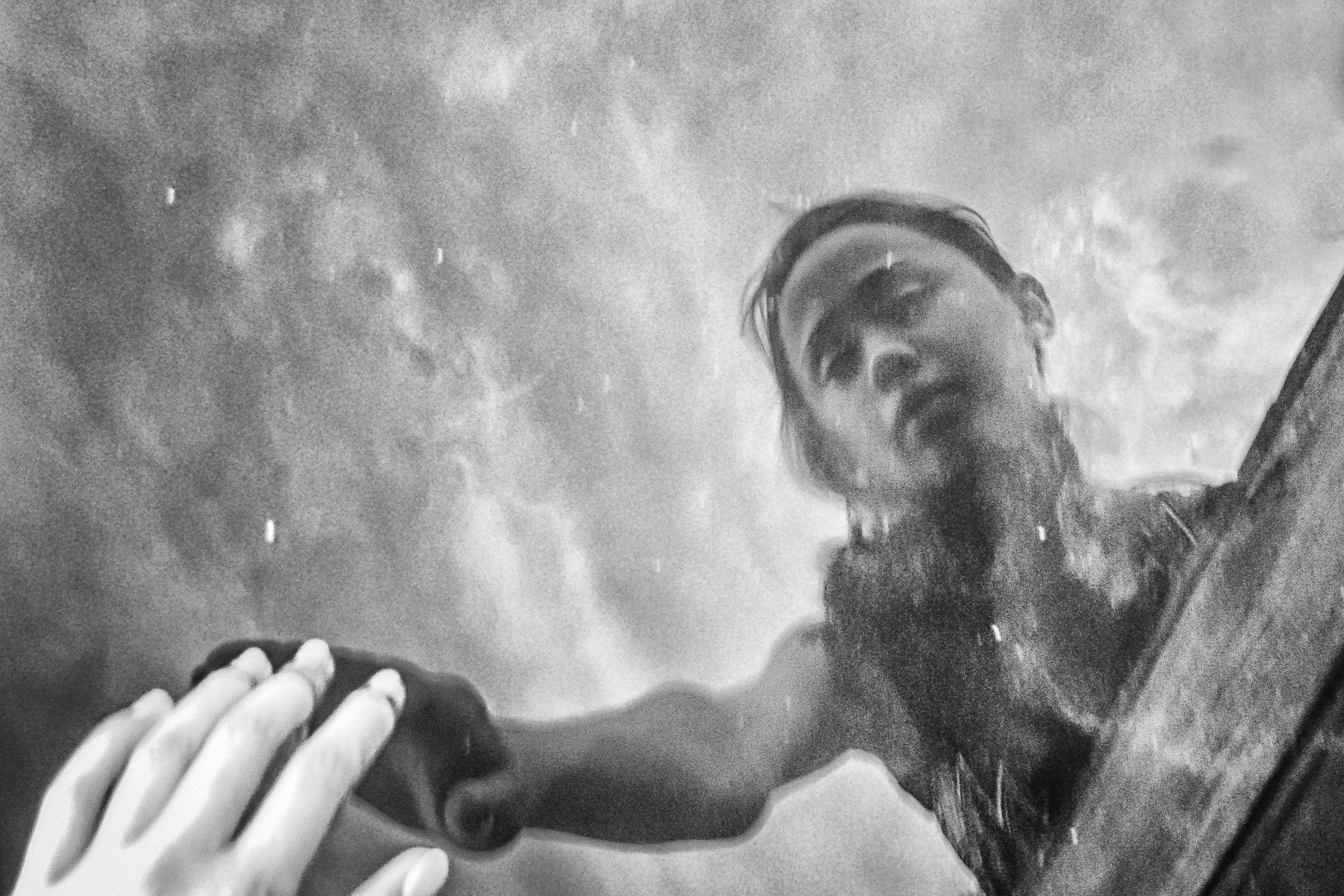
It was not always so. There was a time, not so long ago in the great arc of human history, when we hardly ever saw our own faces. We saw the faces of others: our mothers, our fathers, our siblings, our tribe, our village, and the few strangers who came from the other side of the mountain and passed through. From time to time, when drinking in a still pool, we would have seen a tremulous reflection staring back at us. But it’s not easy to see one’s reflection in water. Water bodies have this infuriating habit of giving a beautiful reflection of things far away but of being blankly clear at one’s feet.

Numa and Rainbow Peaks Reflecting in Bowman Lake, Montana

This young girl has managed to capture her watery reflection quite well

reflection in water

but I think this picture is more typical of what most of us see when we peer into water.

reflection in a puddle

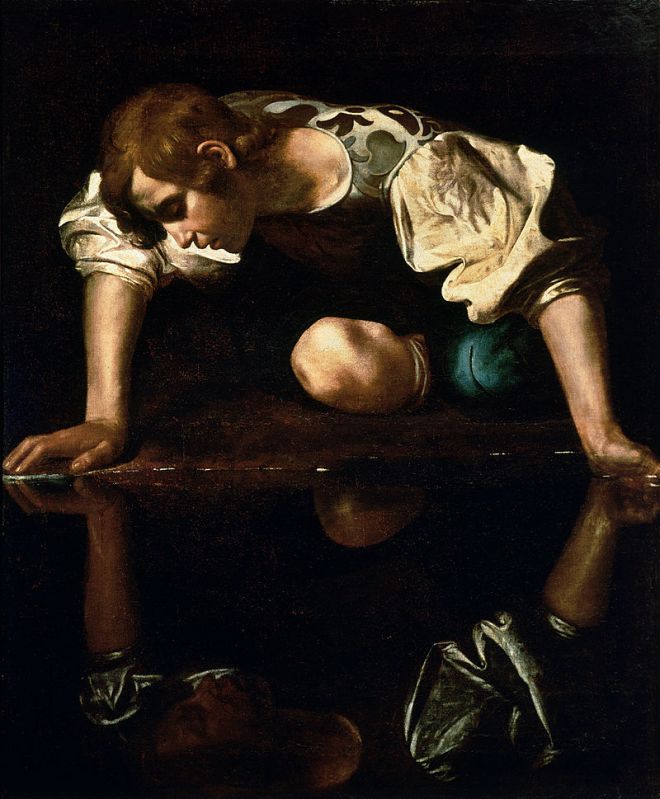
That’s why I’ve never really understood the legend of Narcissus, the beautiful boy who caught sight of his reflection in a pool, fell in love with it, and died at the pool’s edge unable to drag himself away.

Narcissus-Caravaggio

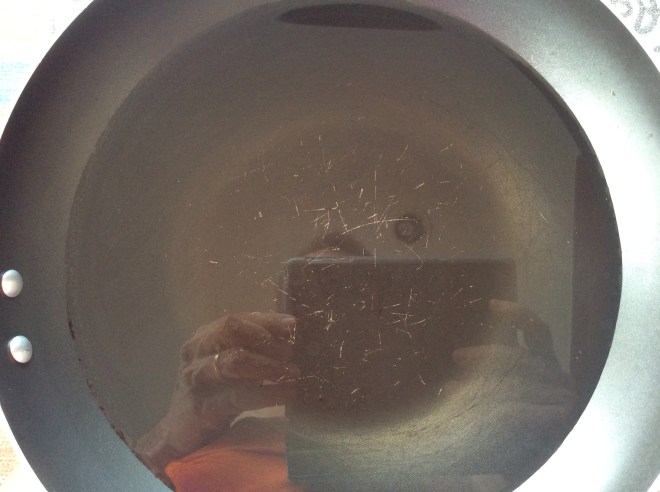
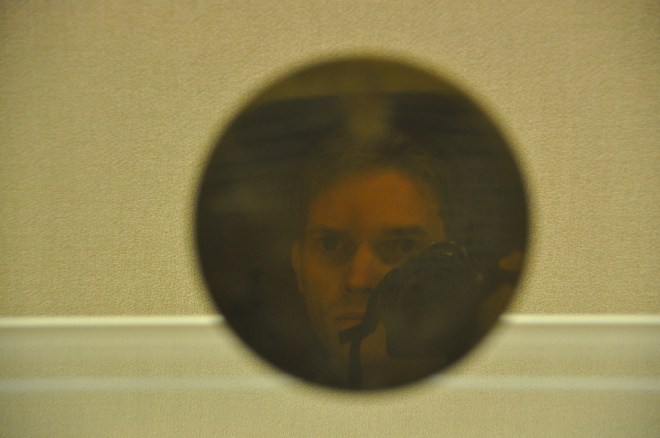
What reflection could he possibly have been so enamoured with? In my experiments in the kitchen with various pots and pans of different colours, the best reflection I got was from a black frying pan

image

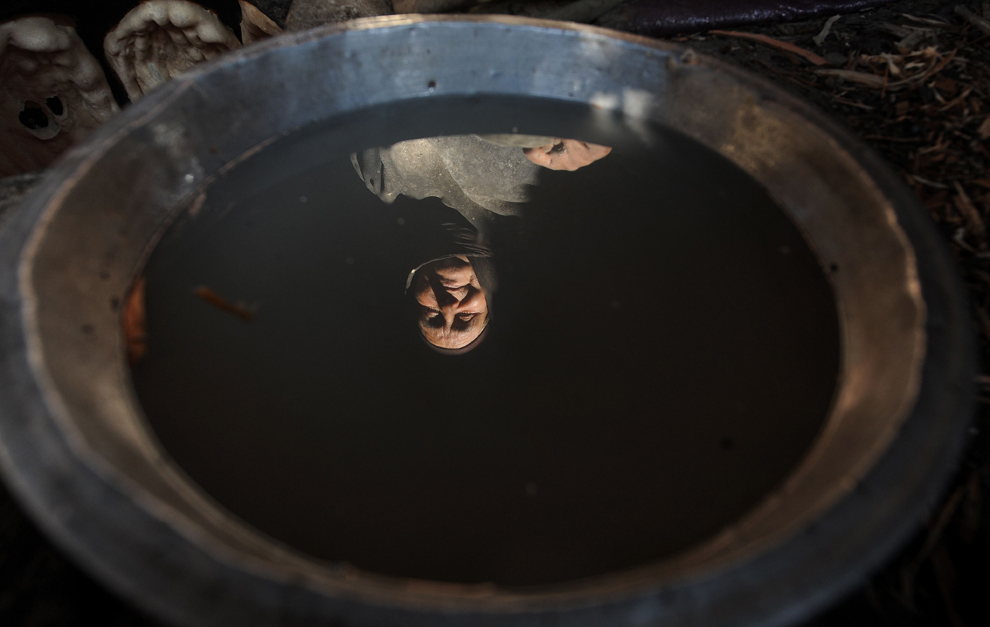
and even that reflection was, as readers can see, murky in the extreme. How could anyone, however beautiful he or she may have been, have fallen in love with this evanescent reflection? Perhaps the original teller of the tale had seen a reflection of a person in a dark pool or vase from a distance, like this photographer has

reflections in a bowl of water

and invented the story around that.

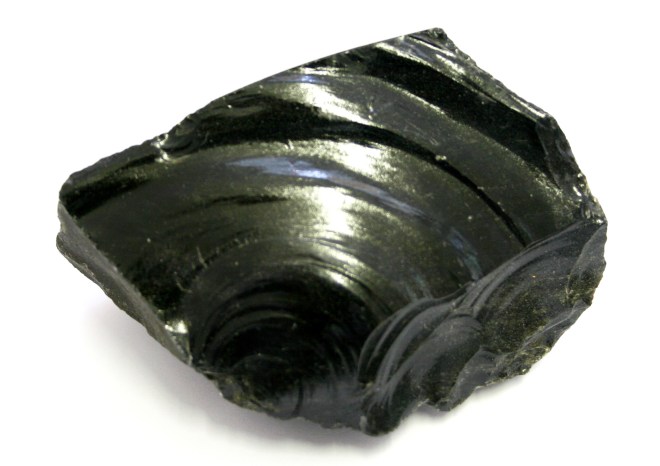
Be that as it may, eventually our ancestors found other ways to see themselves. Obsidian, that beautiful, black, glassy material, product of volcanic activity

imagewas used in the first attempts at non-aqueous mirrors, in Turkey. The country was famous in the pre-metallurgical era for its obsidian, which could be used to make razor-sharp arrow heads – such arrow heads have been found hundreds if not thousands of kilometres away from the mother lode in Anatolia. But large obsidian pieces could also be split open and the faces given a high polish to act as a mirror.

obsidian mirror

Obsidian may be beautiful, but it gives a dark reflection, almost as dark as the water in my frying pan. I am reminded of St. Paul’s famous phrase in his first letter to the Corinthians, “For now we see through a glass, darkly”.

The metallurgical age brought us one step closer to seeing ourselves, in polished copper or bronze mirrors, like this Egyptian copper mirror.

copper mirror egyptian

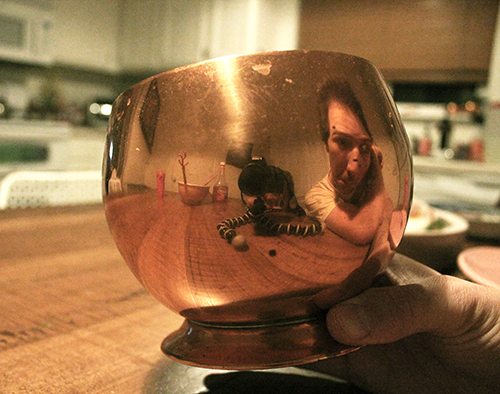
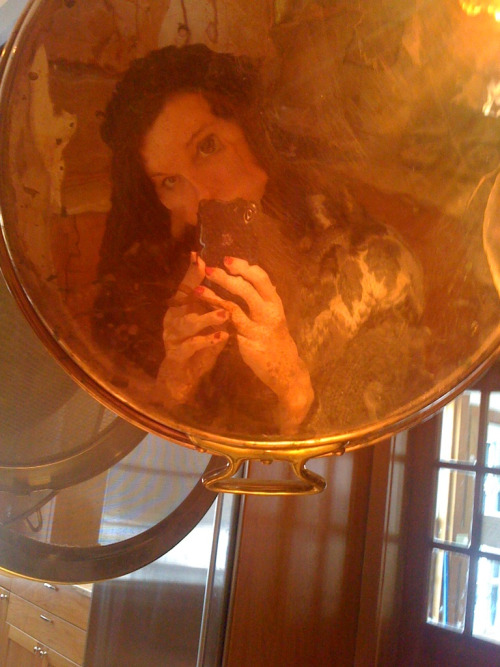
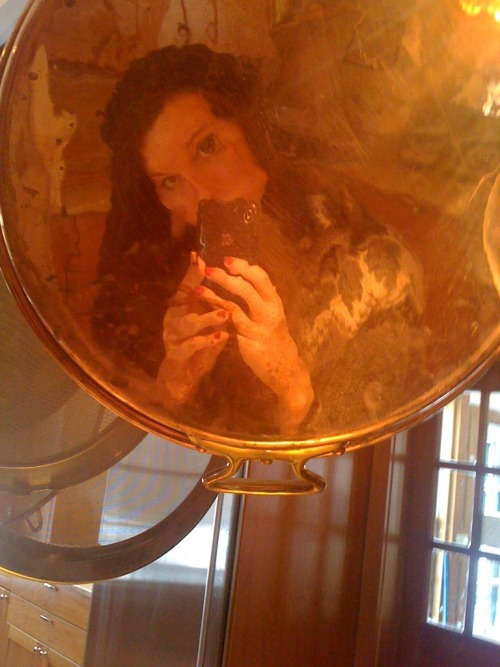
Copper mirrors would have given reddish reflections like those we see in highly polished copper pans, such as this

reflections in a copper potor this.

reflections in a copper pan

(If nothing else, both photos show the need for a uniformly flat surface for a good result …)

The Chinese especially made mirrors out of polished bronze. These would have given yellowish reflections, like this one

bronze mirror-2

or this one, from a Japanese bronze mirror.

bronze mirror

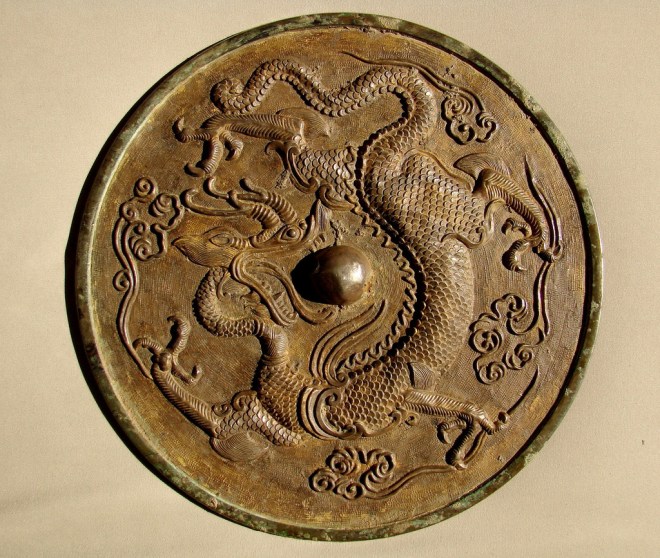
Mirrors such as these were very expensive – indeed, the Chinese turned the backs of their mirrors into admirable works of art, such as this 9th Century one from the Tang Dynasty with its admirably carved dragon.

image

So only the rich, the ancient world’s one-percenters, could afford to peer – curiously, vainly, or dolefully – at their reflection. The man and woman on the street still could only see their reflection in water.

It seems that it was the Egyptians who first thought of coating glass with metal to make glass mirrors, but their reflectivity was poor. As for the Romans, Pliny the Elder mentioned mirrors where gold leaf was applied to glass. I don’t know if any such mirror has survived the ravages of time, I certainly didn’t find a trace of one on the Internet. But very fancy gold-plated mirrors such as the one in this photo are now made, for high-tech applications.

image

I suppose a bleary-eyed Roman plutocrat staring at himself in his gold-plated glass mirror after a night of orgies would have caught such a yellowing reflection as this of his face.

It is the Venetians we have to thank – or curse – for bringing us the modern silvered mirror, which finally allowed humanity to see its own reflection in glorious, embarrassing, or painful technicolour. The glass-makers of Murano figured out a way of making flat – and clear – glass as well as depositing a thin coating of silver on the back of it (my professional self cannot but help notice that they used a silver-mercury amalgam to do this; the mercury inevitably sickened and killed off a good number of Murano mirror-makers – an interesting twist to the French saying “il faut souffrir pour être belle”, “one must suffer to be beautiful”, which here becomes “you suffer, and I admire my beauty”). Once again, it was initially the one-percenters of the European courts who enjoyed – or suffered from – a much clearer reflection of themselves. Venetian glass mirrors such as this one were worth a king’s ransom.

old venetian mirror in good shape

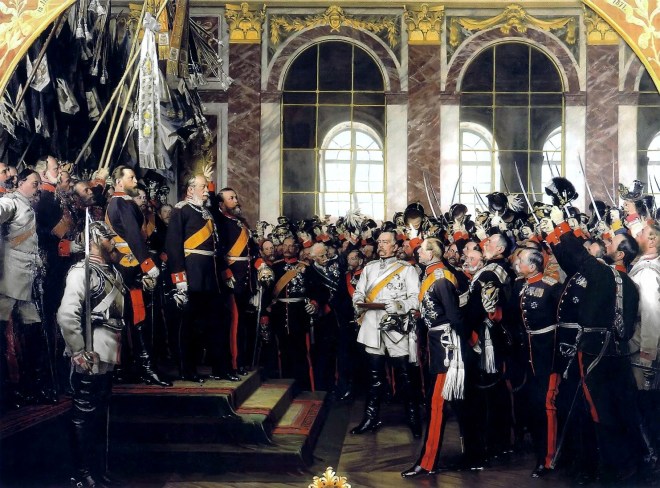
The French one-percenters couldn’t stand the idea that they were sending so much of their wealth southwards to the misbegotten Venetians for glass mirrors. They tried mightily to worm the secrets of mirror-making out of Murano. But La Serenissima, fully appreciating the gold mine they were sitting on, passed draconian laws forbidding these secrets from leaving the lagoon. Eventually, though, the French suborned a group of Venetian mirror-makers, persuading them to bolt from the lagoon and set up shop in the St. Gobain works. Among many other things, this gave us the Hall of Mirrors at the palace at Versailles.

image

This hall has impassively reflected the fun and games of the French monarchy, but also two crucial moments in recent European history: the declaration of the German Empire in 1871 after the Prussians trounced the French in the Franco-Prussian War

image

and the signing of the Treaty of Versailles in 1919 between the Allies and the new-born German democracy

image

that humiliating “diktat of Versailles” which Hitler used to such good effect in his rise to power.

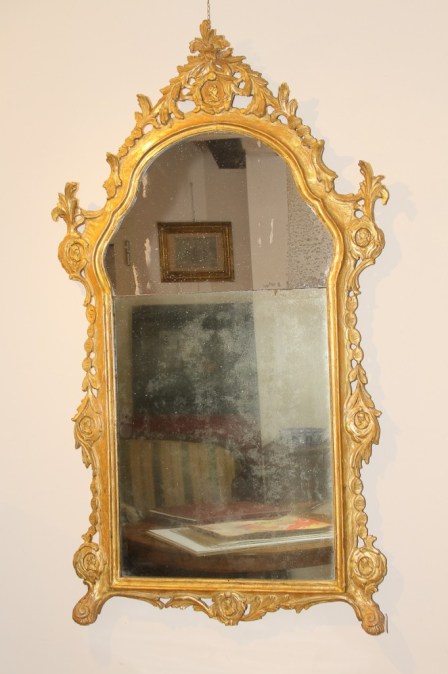
Alas! The silvering process which the Venetians invented, and the French copied, did not last forever. With time, it would crack, it would peel, it would dull, so that reflections would become evanescent once more. How many old houses contain mirrors like this one!

image

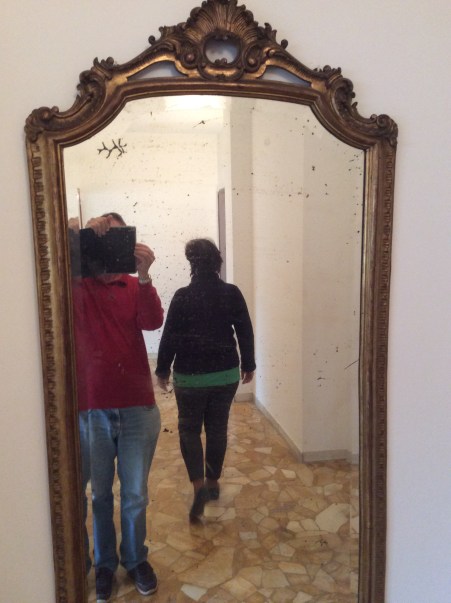
Even our apartment in Milan holds a mirror where Time has inserted its bony fingers into the silvering and has started to strip pieces off.

image

Like my face, mirrors age. But as men have found ways of making faces last longer, so have they found ways to make silvered mirrors that last longer and reflect better. And through the genius of industrialization they have found ways to make these much better mirrors much cheaper, so that 99-percenters like me can also stare, once vainly and now despairingly, at the reflection of our crumbling selves.

I need to escape from my reflection. My wife and I could have ourselves shipwrecked on some remote islet in the Pacific Ocean. Yet even there, I fear that I would find a shard of mirror on the beach, washed up together with all the plastic bottles and other flotsam and jetsam of our consumeristic life that now fill up our oceans.

__________________________________

Reflections in a lake: http://cdn.c.photoshelter.com/img-get2/I0000WnV35_OekPk/fit=1000×750/Numa-and-Rainbow-Peaks-Reflecting-in-Bowman-Lake.jpg (in http://bretedge.photoshelter.com/image/I0000WnV35_OekPk)
Reflection in water: http://www.aheadworld.org/wp-content/gallery/reflection-in-the-water/bellareflectionwater-1.jpg (in http://www.aheadworld.org/2014/07/15/reflection-in-the-water/)
Reflection in a puddle: http://www.nambya.com/wp-content/uploads/image6.jpg (in http://www.nambya.com/gallery/photography/image-7/)
Narcissus by Caravaggio: https://en.wikipedia.org/wiki/Narcissus_%28mythology%29#/media/File:Narcissus-Caravaggio_%281594-96%29_edited.jpg (in https://en.wikipedia.org/wiki/Narcissus_%28mythology%29)
Reflection in a black pan: my photo
Reflection in a bowl of water: http://inapcache.boston.com/universal/site_graphics/blogs/bigpicture/reflections/bp12.jpg (in http://www.boston.com/bigpicture/2012/02/photo_reflections.html)
Chunk of obsidian: https://www.thinglink.com/scene/504686617127026690
Obsidian mirror: https://s-media-cache-ak0.pinimg.com/736x/a0/77/4e/a0774e9d5c812c328852a4850ea59899.jpg
Egyptian copper mirror: https://assets.paddle8.com/510/266/21339/21339-1380672291-Coburn-Item%2033-xl.jpg (in https://paddle8.com/work/egyptian/21339-hand-mirror)
Reflection in a copper pot: http://www.jeffclaassen.com/photos/2013/11/copper_pot_05.jpg ( in http://jeffclaassen.com/blog/2013/11/copper-pot-selfies-in-the-kitchen-after-dinner/)
Reflection in a copper pot-2: http://www.jeffclaassen.com/photos/2013/11/copper_pot_02.jpg (in http://jeffclaassen.com/blog/2013/11/copper-pot-selfies-in-the-kitchen-after-dinner/)
Reflection in a copper pan: https://40.media.tumblr.com/e295593980f36d1411e869333c84b63f/tumblr_mgbmbnhFJl1rjg7f0o1_500.jpg (in https://www.tumblr.com/search/loppapeysa)
Reflection in a Chinese bronze mirror: https://c1.staticflickr.com/3/2601/3810835438_947331566d_b.jpg (in https://www.flickr.com/photos/chrisckemp/3810835438)
Reflection in a Japanese bronze mirror: http://1.bp.blogspot.com/_WxoUP_Y9N1A/RysHFDtbP1I/AAAAAAAAADo/smZF2ussZLo/s320/te-kagami2.JPG (in https://kgtou.wordpress.com/2007/11/02/te-kagami-hand-mirror/)
Chinese mirror – back: https://www.flickr.com/photos/asianart/405662049
Mirror coated with gold: http://www.epner.com/processes-and-products/laser-gold/
Old Venetian mirror in good shape: http://www.antiquario-dellapiana.it/esposizione-antiquariato-alba/dipinti-antichi/
Galerie des Glaces: http://www.historylines.net/history/17th_cent/versailles.html
Proclamation of the German Empire: https://fr.m.wikipedia.org/wiki/Galerie_des_Glaces
Signing of the Versailles Treaty with Germany: https://fr.m.wikipedia.org/wiki/Galerie_des_Glaces
Old Venetian mirror in bad shape: http://www.juliamarkert.com/galleria-riproduzioni-cornici-antiche-firenze/cornici-antiche-firenze/specchio-veneziano/
Reflection in Milan mirror: my photo

RETIREMENT HERE WE COME!

New York, 1 January 2016

2016 is upon us! My wife and I did not stay up to ring in the new year, we let the younger folk do that.
image
No need to make any new year resolutions, this year will be one of momentous change! (for me, anyway) I retire in August and finally become a free man again! Yippee!
image
What I need to do over the next eight months (apart from ensuring as smooth a handover as possible to my eventual successor) is to figure out what my wife and I will do with all this wonderful spare time given to me. Travel is high on the list. For instance, we are planning to drive across the US, something I’ve dreamed of doing since my student days in the US 35 years ago, visiting the natural wonders of the West
image
as well as the man-made wonders along the way.
image
Or there’s a little trip I’ve had in mind for a while, visiting stained glass windows across Europe, from the Medieval glories of la Sainte Chapelle in Paris
image
or Chartres cathedral
image
to the modern take on this art form in Cologne Cathedral.
image
Further afield, I have emitted the desire in a previous post to visit Easter Island.

AH2B07 Chili

Or how about Belize? My wife is currently searching the web for places there where our daughter and her beau could go and spend a short vacation. I’m thinking we should go there too and do some snorkeling

image
as well as go and visit some of the country’s Mayan ruins
image
My wife and I have also talked of spending several months in a number of our favourite cities, cities which we’ve only been able to visit briefly because of our work schedules but which we would like to get to know better. And on and on … There’s so much of the world we’ve not seen! But we cannot spend our whole time just traveling. For one thing, it gets rather expensive and I’m not sure how far my pension will stretch. For another, it greatly increases our carbon footprint, which is currently a big problem.

Which brings me to more serious things that my wife and I need to do in this latest phase of our lives. I’ve already mentioned in a previous post that we are going to have to do something to drastically reduce our environmental footprint.
imageI’m thinking in a confused way of turning these efforts into a blog and/or a website and/or an app to help others do the same. That will definitely keep me busy, especially since the workings of websites, apps, and the like are black holes to me. Time to learn and keep the old brain working!

And then there’s the exercise! We have to continue the good work we’ve started. Joining a gym near our apartment in Milan is a definite possibility (we’ve already looked into the options). But we’ll surely supplement that with trekking in the Ligurian hills behind our apartment near Genova.
image
And here we can give back for all the years we’ve been using the trails, volunteering to help maintain them in our spare time (of which we will now have plenty).

And then, hopefully not in contradiction with the last two thoughts, I would like to turn my hand to some cooking. Not common-or-garden cooking but rather out-of-the-way things. For instance, I’ve always wanted to make tomato ketchup from scratch

and I want to try (again) to make my own vinegar.
image
Vinegar makes me think that I would like to try pickling my own vegetables.
image

I know this culinary impulse of mine is strange. I suppose it’s my way of rebelling against all the processed food that has swamped our lives. Maybe I can make this a subset of my website on reducing our environmental footprints, since our current food habits are such a big part of them.

I’m thinking that I could also do a bit of teaching, linked to my professional specialties. One university has reached out to me, let’s see if we can come to a mutually satisfactory arrangement.
image
I’m sure there’s a thousand other things we could set our hand to. But of course it could be that amongst all this busyness we’ll be called to do our duty as grandparents. The children are not yet at the point of having their own children, but the moment could come. Have no fear, children, we’ll drop everything and be there in a jiffy!
image
What better way is there to spend one’s waning years than in imparting some of one’s experience (I won’t say wisdom) to the little ones in our society?

Happy New Year!
image

________________

New Year’s eve: https://www.theodysseyonline.com/11-thoughts-had-this-new-years-morning
Happy Snoopy: https://johnrberkowitz.wordpress.com/2015/03/
Monument Valley: http://anguerde.com/TTF-412276-zidane.html
Gateway Arch: https://cityofstlouis.com/events/day?date=2018-01-20
Sainte-Chapelle: https://www.pinterest.com/pin/517280707186310674/
Chartres Cathedral: http://art1arquitectura.blogspot.it/2011/07/rilke-la-catedral-el-roston-el-caiptel.html
Cologne Cathedral: https://anushkaenalemania.wordpress.com/2012/04/20/ciudades-koln/
Easter Island: https://www.pinterest.co.uk/pin/824581012997275195/
Snorkeling Belize: https://blog.tripreviewer.com/2017/08/21/top-water-activities-to-do-in-the-usa/
Belize ruins: http://lushpalm.com/10-places-to-see-before-its-too-late/
Environmental footprints: http://ingienous.com/the-challenge/economics/consumption/
Monte di Portofino: https://www.caisezionedirho.it/sito/images.asp?cat=25&id=146
Tomato ketchup: http://cjoloughlin.ie/product/tomato-ketchup-brown-sauce/
Wine vinegar: https://www.vomfassusa.com/shop/vinegars/bordeaux-red-wine-vinegar/
Pickled vegetables: http://www.recipesbnb.com/small-batch-pickles/86358
Blackboard: http://www.enjoymyanmarholiday.com/index.php/essay/11149/
Grandparents: https://sweetsouthernhome.net/2018/02/26/5-things-older-citizens-should-do-to-protect-their-homes/
Old year and new year: http://mzayat.com/cliparts/old-clipart-man-and-boy.html

WORLD TRADE CENTER

31 December 2015

Two years ago, when we were last in New York, we visited Ground Zero and the newly created Memorial to the victims of 9/11. Several days ago, during our current New York stay, we decided to go back to see how things have moved on.

Well, I’m glad to report that One World Trade Center is finally finished. I read up the back story to the development of the overall master plan for the area as well as for the design of the individual buildings; a veritable Shakespearean drama, with super egos confronting each other in dramatic showdowns, stabbing each other in the back, making sonorous declarations to the press, and otherwise carrying on like children in kindergarten. It’s a wonder that anything got done at all.
image
Rising serenely above all this human mayhem, WTC 1 is a very lovely, glass-sheathed building. As readers can see in the photo below, the corners have been severely shaved back. I wouldn’t know how to describe the geometrical shenanigans going on here, so I simply quote a line from the building’s entry in Wikipedia: “from the 20th floor upwards, the square edges of the tower’s cubic base are chamfered back, shaping the building into eight tall isosceles triangles, or an elongated square antiprism”. However you describe it, the effect is pretty cool.
image

WTC 2 is lagging behind. After having gone through a complete redesign, it is now being built, with a planned completion date of 2020. It should look like this once it is finished – a set of cubes stacked somewhat untidily one on top of the other.
image
Personally, I’m not sure I will like this building. Something about those poorly stacked cubes disturbs my sensibilities. But I’m willing to be convinced once 2020 rolls around.

I will skip over WTCs 3, 4, 5 and 7 (WTC 6 seems to have disappeared from the roster in the new master plan), although I would draw readers’ attention to WTC 4, finished a few years ago and a very handsome building indeed. I want to focus instead on the Transportation Hub, which is a grand name for the entry to the subway lines running under the site. This, I have to say, is a rather strange-looking structure.
image
When I first caught sight of it, from the side, I was powerfully reminded of photos that came out in the immediate aftermath of September 11, showing the jagged remains of the outer sheathing of the old WTC 1 and 2 buildings which had come crashing to the ground.
APW2001091209845
I don’t know if that was also on the mind of the Hub’s designer, the Spanish architect Santiago Calatrava. In his public pronouncements, he has talked rather about it being like a bird flying out of a hand. It certainly has a bird-like quality from the back, although commentators have suggested a more stegosaurus-like look, which as the photo above shows is certainly true from the front. For those readers who may not be familiar with their dinosaurs I throw in a picture here of a reconstructed stegosaurus.
image
The similarity is even more striking when you consider a stegosaurus skeleton.
image
Frankly, I’m not completely sure how well this piece of design will withstand the test of time. Calatrava’s other design for the new World Trade Centre, the rebuilding of the tiny Orthodox Church of St. Nicholas which got flattened in the maelstrom of September 11, may weather better, at least from the models I’ve seen
image
but we will have to wait until 2017 to pass a firmer judgement.

Well, it seems that my wife and I have plenty of excuses to come back to New York in the years to come. Which is nice, because the primary current excuse for our coming, our daughter living here, is about to disappear as she moves on to greater and better things.

_____________________
Silent film dramatic scene: http://bayflicks.net/2014/01/17/whats-screening-january-17-23/
WTC 1: http://anotherpartofme.com/the-real-reason-one-world-trade-center-1wtc-lost-its-best-features/
WTC 2: http://www.cnn.com/2015/06/12/travel/two-world-trade-center-tower-big/
Transportation Hub: http://www.nytimes.com/2015/06/25/nyregion/a-crossroads-decades-gone-will-reopen-at-the-world-trade-center.html
Ground Zero: http://www.propublica.org/article/new-docs-detail-how-feds-downplayed-ground-zero-health-risks
Stegosaurus reconstruction: https://en.m.wikipedia.org/wiki/Stegosaurus_in_popular_culture
Stegosaurus skeleton: https://digitalstore.makerbot.com/stegosaurus-skeleton
St. Nicholas Greek Orthodox Church: http://www.nytimes.com/2013/10/31/nyregion/st-nicholas-church-destroyed-on-9-11-to-rebuild-with-byzantine-design.html