PEOPLE ON THE MOVE

Bangkok, 27 July 2014

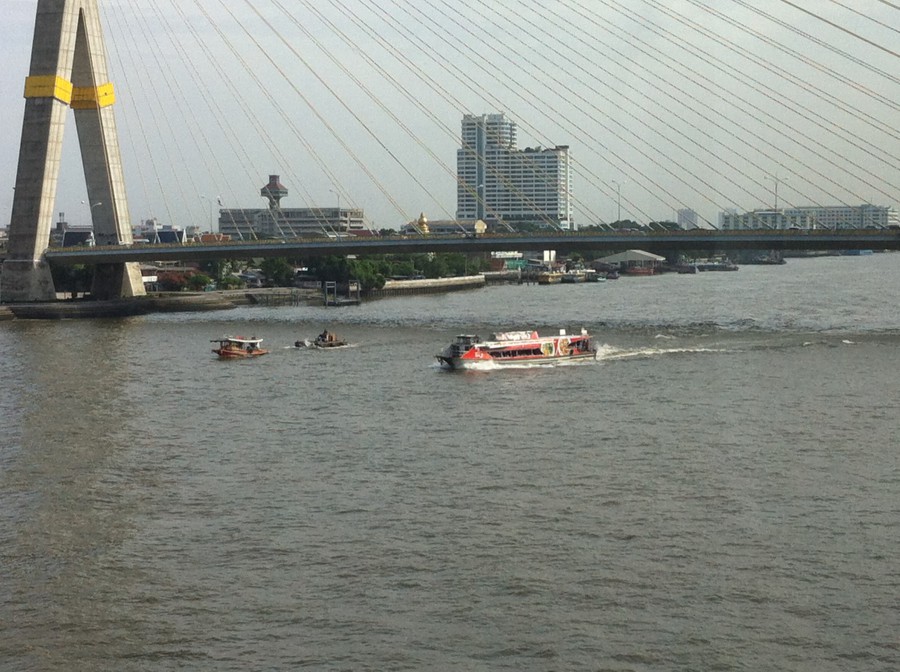
Well, I’ve received my transfer orders. I’m moving to Bangkok to take over our office there. So my wife and I have been down in Bangkok for the last week, looking for a place to stay. For the moment, we’re renting an apartment which we got through AirBnB. It gives right onto the Chao Phraya River, which runs through the middle of the city and around which the city grew. So as we have breakfast in the morning before we go out apartment-hunting we can watch the traffic on the river: the empty barges, riding high

ships on river 002

the full barges, with water to their gunwales

ships on river 005

the express boats crowded with commuters darting in between as they weave their way from bank to bank.

ships on river 001

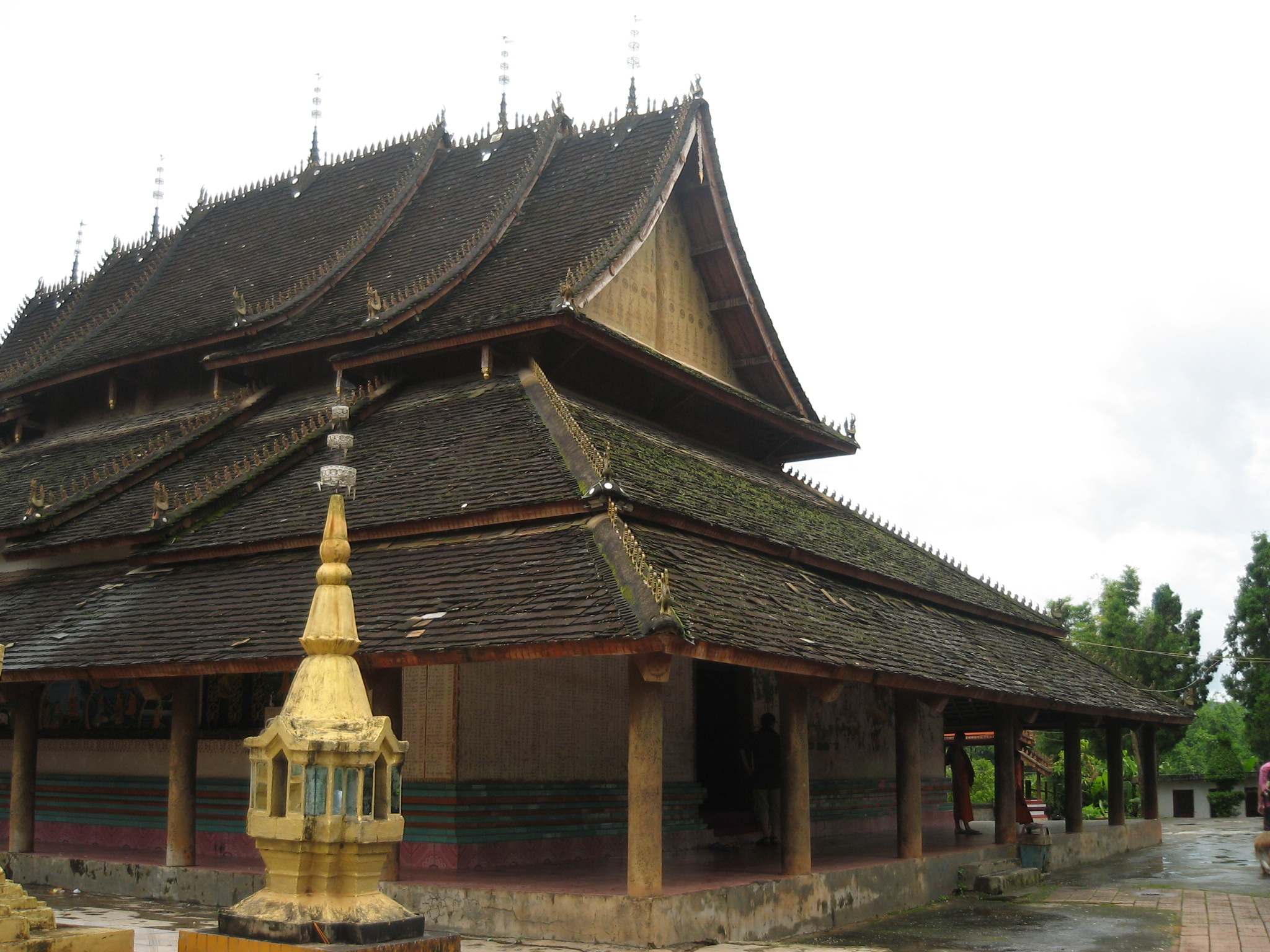
But what also catches my eye is this temple on the other side of the river

temple across the river 001

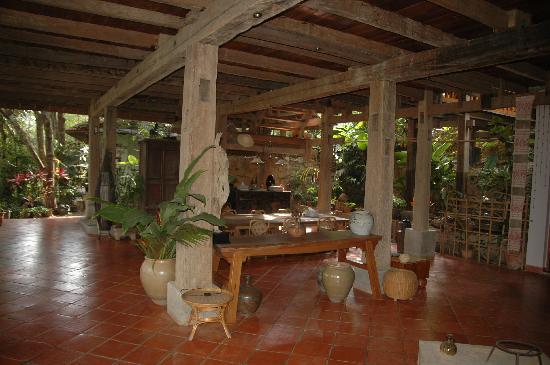
and it always reminds me of … China. Or rather, a certain corner of China, the Xishuangbanna Dai Autonomous Prefecture. This is way down in the south of Yunnan province, squeezed between Laos to the East and Myanmar to the West. A few years back, we spent a Dragon Boat Festival holiday in the prefecture’s main town, Jinghong, in a beautiful house which was built from elements scavenged from traditional houses that were being torn down in China’s rush to modernity.

Yourantai-interior

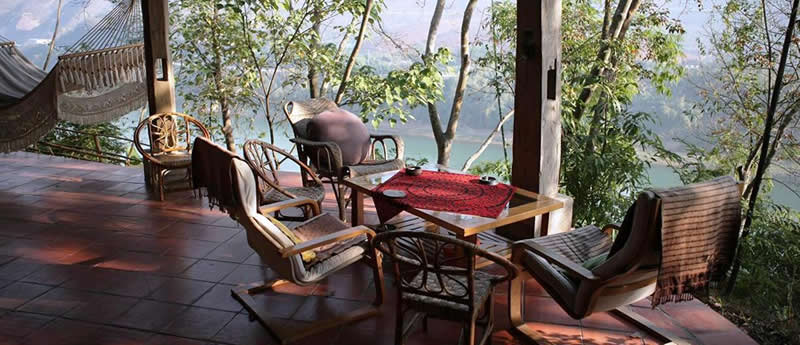
It too gave on a river, the Mekong in this case (although the Chinese don’t call it that; it’s the Lancang River to them), and there too we could gaze down on the river while having our breakfast.

Yourantai-view of the river

The temples in Jinghong are built in the same style as the one I see across my breakfast table, or at least the newer establishments are.

Mange-Buddhist-Temple-Jinghong-XishuangBanna

The older temples in the area are somewhat more sobre.

temple Xishuangbanna

This very obvious echoing of the Thai style has a simple reason. The Thai people (Dai people in this part of the world, hence the name of the prefecture) originally came from southern China. Then, for reasons which may have to do with the southwards migration of the Han Chinese, a portion of them upped sticks in the first millennium AD and started wandering south through Laos and Myanmar until they settled in what is now Thailand. But they left echoes of their culture behind, reflected in the designs of the temples but also in the language – many of the signs in Jinghong are in Thai as well as in Chinese.

The local culture (Thai and non-Thai; the ethnic mix in this part of the world is quite bewildering) is threatened with submersion in the Han culture – recall that this is why the Thais probably originally started migrating southwards. Until the 1950s there were few Han Chinese in this part of Yunnan – they were afraid of the malaria, which was then endemic. But the Chinese communists vigorously promoted programmes which eradicated the malaria. They then brought in poverty-stricken migrants from other parts of China and put them to work cutting down the jungle and planting rubber trees in its place, so now the hills around Jinghong are monotonously covered with acre after acre of rubber trees. These are all clones from the same genetic line. Those who know about these things predict that sooner or later (probably sooner rather than later) a rubber tree virus from Brazil will arrive here and wipe out every single rubber tree: an environmental disaster of epic proportions.

In the meantime, the descendants of the miserably poor Chinese who were sent to Xishuangbanna to plant and tap all those rubber trees still live in miserably poor Chinese villages, scorned and resented by the local populations.

As I look at the temple across the river and reflect on all these historic movements of people, I am reminded of the current tensions in Thailand caused by more recent movements, tensions between migrants from Cambodia, Laos and Myanmar, who do the dirty, poorly paying jobs which the locals no longer want to do, and the Thais, who have conveniently forgotten (if they were ever taught) that they too were once migrants.

“Plus ça change et plus c’est la même chose”, as Jean-Baptiste Karr, a French journalist and novelist, said back in 1849, and as my French grandmother was fond of quoting: the more things change, the more they stay the same. So true.

___________________

Chao Phraya river pics: mine
Yourantai-interior: http://media-cdn.tripadvisor.com/media/photo-s/01/b9/8b/a5/les-repas-dans-un-cadre.jpg [in http://www.tripadvisor.co.uk/LocationPhotoDirectLink-g528741-d1749170-i28937125-Yourantai_B_B-Jinghong_Yunnan.html%5D
Yourantai-river view: http://www.cielyunnan.com/wp-content/uploads/2012/04/Yourantai-24.jpg [in http://www.cielyunnan.com/hotels/hotels-xishuangbanna/xishuangbanna-yourantai-resort/%5D
Buddhist temple Jinghong: http://www.yunnanadventure.com/UploadFiles/Yunnan-Attractions/Xishuangbanna-Attractions/Mange-Buddhist-Temple-Jinghong-XishuangBanna.jpg [in http://www.yunnanadventure.com/attraction-p156-mange-buddhist-temple-jinghong-city
Temple Xishuangbanna: http://www.wildchina.com/blog/wp-content/uploads/2008/08/img_8570.jpg [in http://www.wildchina.com/es/multimedia/wildchina-blog-details/yunnan-hiking-in-xishuangbanna%5D

LIME GREEN? SPRING BUD MAYBE?

Beijing, 1 July 2014

For reasons which are too long to explain, a few days ago my wife and I moved out of our apartment and into another one not too far away. Suffice to say that renters have little if any protection in China: “you don’t agree to my doubling the rent? Well, the door is over there. Oh, and by the way, I’ll keep the deposit.”

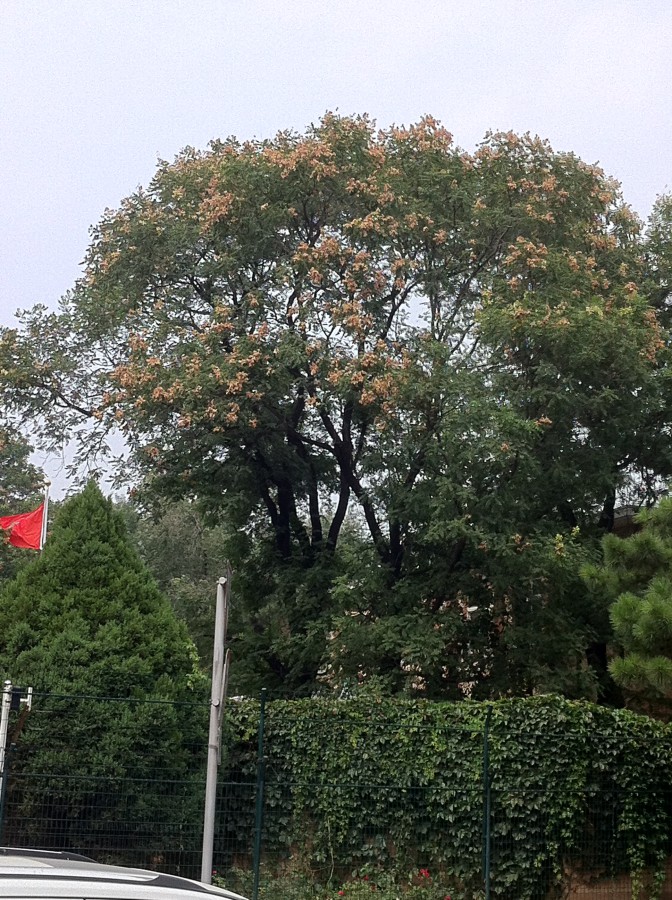
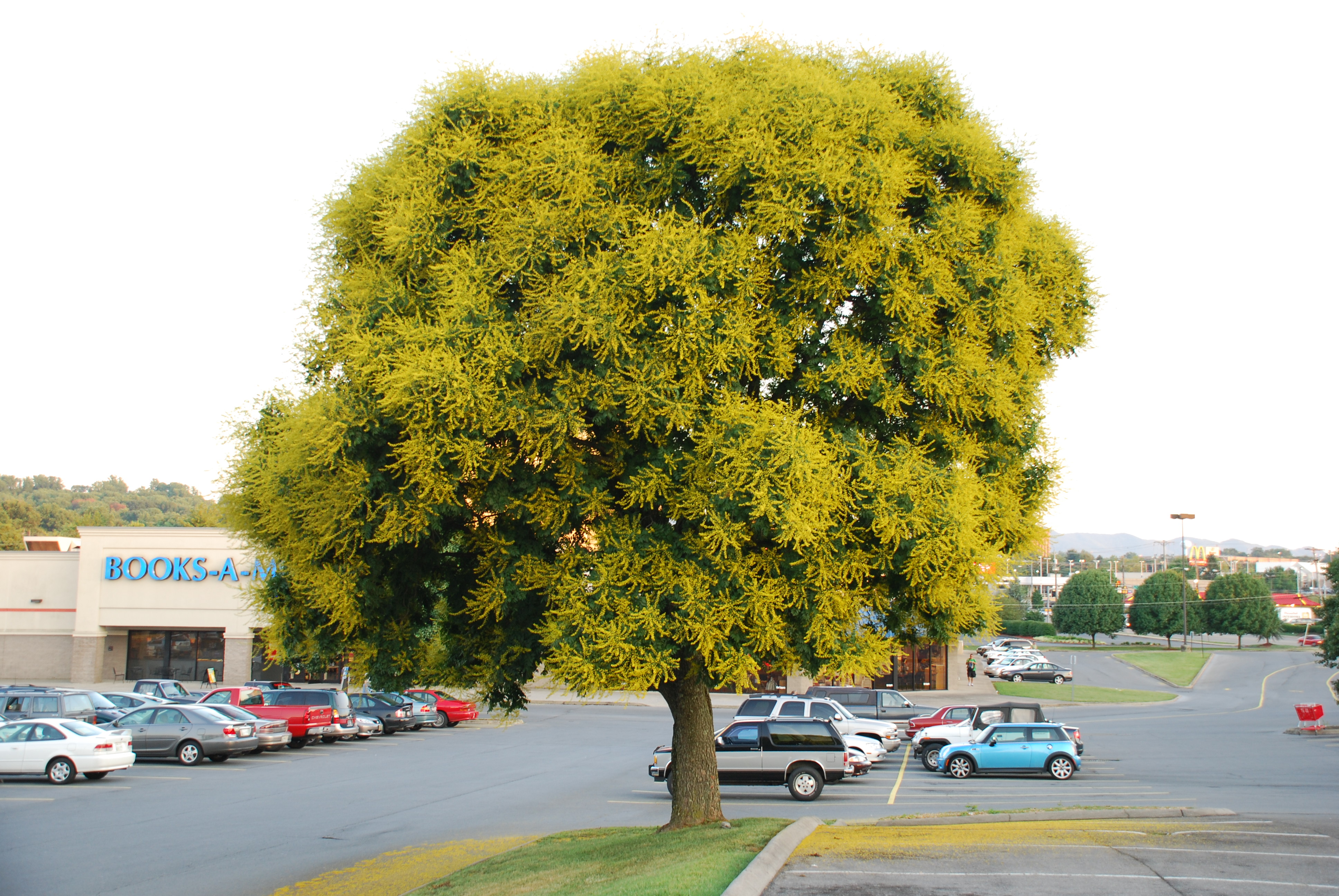
In any event, this forced relocation has meant that I’ve had to walk a new route to and from the office, which takes me under a new set of trees. Every cloud has a silver lining, as they say, which in this case is my discovery of the goldenrain tree, Koelreuteria paniculata, under a row of which I now walk every day. This picture shows nicely the origins of the name. At this time of the year, the tree is covered with bunches of small yellow flowers, which drizzle down on the ground around the tree.

solitary goldenrain tree

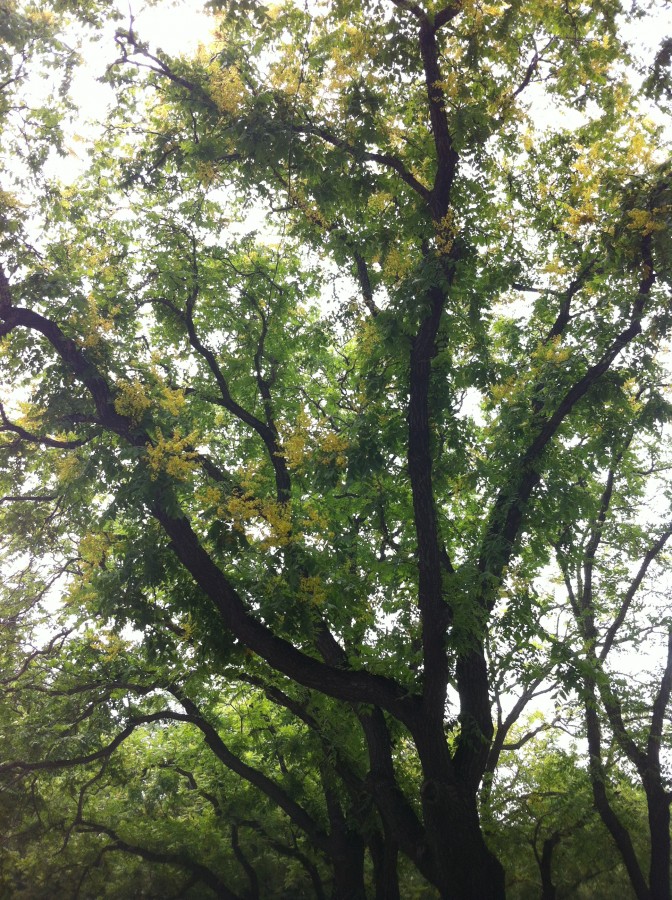
In my row of goldenrain trees, planted as they are close to each other – to give shade, which is devoutly to be thanked for at this time of year – I don’t get such an uncluttered view of the trees and their flowers. This is about the best I’ve managed to see.

golden rain tree 009

I also haven’t really been able to see the golden raindrops scattered around on the ground since the street sweepers are very efficient in this part of town. This is all I’ve seen, little piles ready to be picked up

golden rain on ground

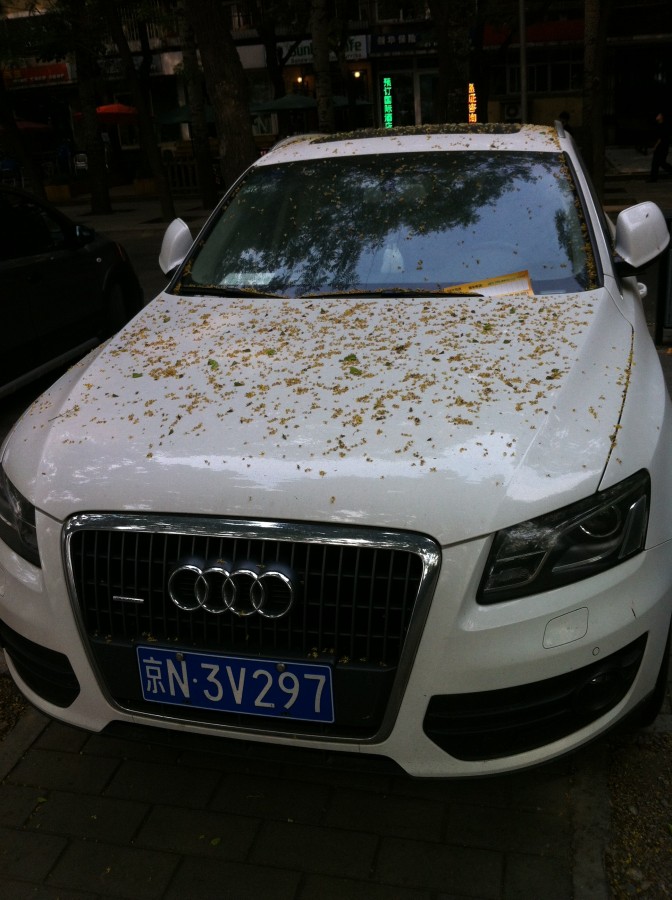
although this car parked under some of the trees shows what the pavement must look like early in the morning.

golden rain on car

Actually, it wasn’t the flowers which attracted my attention. It was the seed pods (the tree seems to move from flower to seed astonishingly quickly). Some of them had fallen onto the pavement

seed pods on ground 006

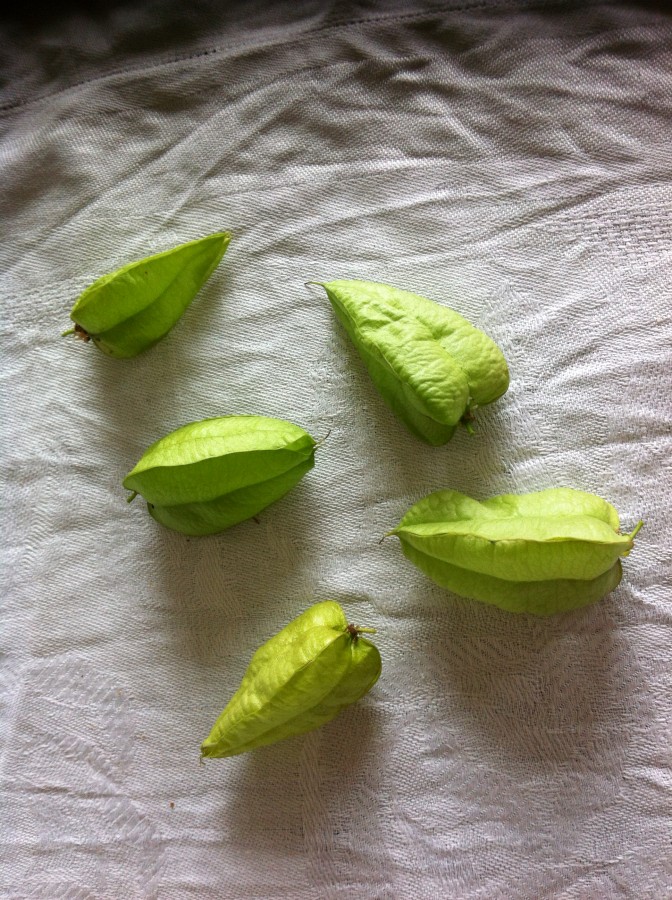
and it was their light, translucent green which drew my eye. I carefully picked up a few – they are very delicate – and took them home. My wife took this in her stride; she is used by now to my bringing home botanical strays. I laid the pods out on our table cloth and took this picture

pods on table - 1 july 001

I’m not sure what to call this green. The clever thingy which in the Word software allows me to have an infinite number of colours for my fonts tells me that in the colour model RGB (whatever that is) it’s about 200 Red, 255 green, and 90 blue. But that’s far too boringly scientific. I would like a name for this green! A search of colour charts for paints, dyes and the like suggests that it could be Lime Green. Or there’s a green called Inchworm, after an inch-long worm of that colour. Or could it be Chartreuse? But that’s too yellow I think. Or maybe Spring Bud; it certainly has something of that tender green which we associate with Spring.

And I really like their shape. A number of websites call it bladder-like. Really, some people have no imagination! Others note a resemblance to Chinese lanterns, which is a much better comparison

green chinese lantern

although I think Chinese lantern makers could profit aesthetically from trying to copy the somewhat rounded pyramidal shape of these seed pods.

Having had my attention drawn to the pods, I quickly noticed how they clustered thickly about the crown of the trees, giving a frosting of light green on the dark green of the leaves, a delightful effect.

pods on tree - 1 july 002

pods on the tree

I understand that the pods eventually turn brown. It will be interesting to see how this changes the visual pleasure which I currently get from the tree on my daily walk to and from the office (intermittently cursing at my previous landlord).

POSTSCRIPT 1, 10 July 2014

Once you see one, you begin to see them everywhere …

I’m in Budapest at the moment, for reasons which are also too long to explain. Yesterday evening, I was walking across a little park when at its exit I stumbled across a goldenrain tree sheltering locals having a quiet evening drink and chat.

goldenrain trees Budapest 003

Here, it’s an immigrant in a foreign land. The goldenrain tree is native to China and Korea.

POSTSCRIPT 2, 17 August 2014

Well, the pods have turned brown. This is what the trees look like now.

golden rain tree with mature pods 002

I don’t know, I think I prefer the pods in their lime green phase.

______________________

Solitary goldenrain tree: http://www.whatgrowsthere.com/grow/wp-content/uploads/2011/04/Koelreuteria-paniculata-6.jpg [in http://www.whatgrowsthere.com/grow/2011/07/01/goldenrain-tree-sparks-a-july-golden-celebration/%5D
Green Chinese lanterns: http://10kblessingsfengshui.typepad.com/.a/6a00e39336235e8834014e5f344434970c-800wi [in http://10kblessingsfengshui.typepad.com/10000_blessings_feng_shui/2011/02/lighting-lamps-for-the-lantern-festival.html%5D
other pictures: mine

GIFTS FROM THE GREAT

Beijing, 28 June 2014

The first time my wife and I went to North Korea, we were given the royal treatment – well, not royal since we were in a Socialist paradise, but out of the ordinary. We were taken to the place where the Great Leader Kim Il-sung was born. We were taken to the national museum which showed Korea’s glorious history from the earliest times up to the defining moment when the Great Leader (and his family) took over. And we were taken to the International Friendship Exhibition Hall outside of Pyongyang.

international frienship exhibition hall-exterior

The point of this massive building was to show the people of North Korea, and ignorant visitors like ourselves, that contrary to what the cynical capitalists might say about the Great Leader being a political pariah he was actually very much loved by peoples from all over the world. As testimony to this blindingly obvious fact, the building housed the tens of thousands, maybe hundreds of thousands, of gifts which he had received during his reign, from the mightiest of mighty personalities (heads of state and suchlike) to the lowliest of the lowly (a local communist youth league from some benighted country, for instance). These are all lovingly laid out in high-end display cabinets which are spread out through hundreds of rooms over seven or eight floors. Someone with a tidy frame of mind, perhaps the Great Leader himself, had neatly divided all the gifts by geographical region of provenance (Africa, Asia, and so on). When we arrived, the guide asked us what region we wanted to visit. Much to her surprise, I plumped for Africa, continent of my birth. Rather disappointed she took us there, but once we had visited that part of the collection, she beamed her approval when we said we now wanted to visit Europe, obviously where we should have been the whole time.

The whole experience was totally surreal. The place was spotlessly clean, so clean, so antiseptic, that we were required to put on shoe-covers. We were there in early November, and it was nice and warm inside the Exhibition Hall, in stark contrast to every other building in the country which we had visited, which were cold and dank – the population was expected to save on precious imported fuel. The lights were motion-sensitive, so rooms instantly lit up the moment we walked in and blacked out the moment we left them (there wasn’t a single window in the place). All of this hoopla for displaying gifts which were really very, very ordinary and in some cases in embarrassingly bad taste. If I had been given these gifts, after thanking the giver politely and waving him off at the door, I would have promptly put 99% of them in the attic for future “recycling”. We had to keep reminding ourselves that the whole point of this grotesque exercise was to show the viewer – again and again, obsessively – that the Great Leader was adored by all the peoples of the world. As a grand finale to all of this, the guide ushered us into a large room with a diorama at one end of Korea’s famous Mount Paektu and a Mme Tussauds-like wax reproduction of the Great Leader standing in front of it with a benign, grandfatherly smile on his face. As we walked in, piped concert music swelled to a crescendo and the North Koreans who were with us bowed deeply (we stood there, not knowing quite what to do, shifting from foot to foot, rather like atheists in a church).

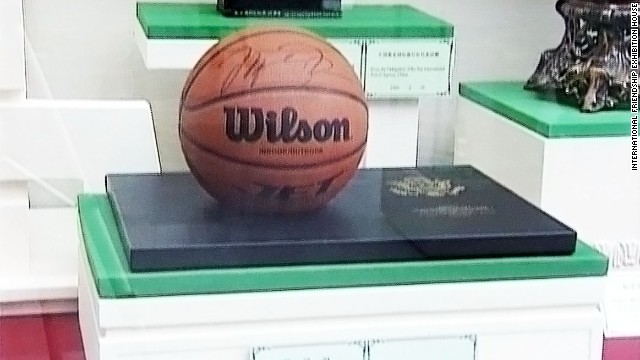
Apart from the discomfort we felt at seeing all this money being poured into a project of pharaonic proportions in a country where the people are dying of hunger, we were amazed by the strangeness, not to say the bad taste, of many of the gifts. I can understand that communist youth leagues might only be able to afford a cheap ashtray as a gift, but even the high and mighty gave odd gifts. How, for instance, did Madeleine Albright, US Secretary of State, arrive at the idea of giving the Great Leader a basketball signed by Michael Jordan?

Kim present-basketball

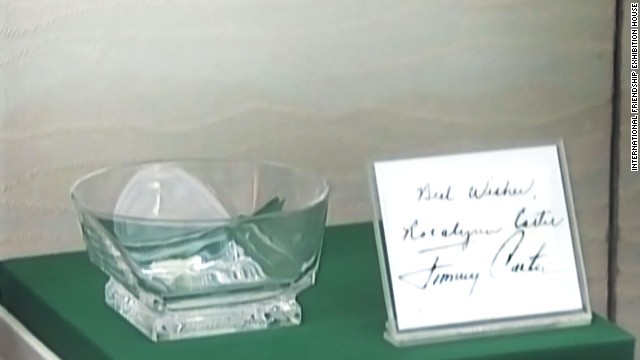
Maybe President Carter’s gift explains it all: you have no idea what to give, so you choose the most colourless thing you can think of – in his case, literally so:

Kim present-glass bowl

Or you become so desperate trying to figure out what to give that you end up giving something completely ridiculous, like the Sandanistas of Nicaragua, who gave the Great Leader a grinning alligator standing up, holding out a wooden tray of cocktail glasses.

Kim present-alligator

The strange world of official gift-giving …

I was reminded of all this last weekend, when my wife and I visited China’s National Museum on Tiananmen Square. We actually went there to see if we could buy a copy of one of the Tang-era porcelain horses, to complement the copy of a Tang-era camel which we had purchased there a few years ago. Alas! The only one on sale was far too big for our modest dwelling. Disconsolate, we went around seeing what was new. Which brought us to a new exhibition of the official gifts received over the years by China’s Greats: Mao Zedong, Zhou Enlai, Deng Xiaoping, the recent Presidents and Prime Ministers, and other luminaries whose names meant nothing to me. The same general bad taste which assailed us in North Korea prevailed, although it wasn’t quite as bad as in the International Friendship Exhibition Hall. Either the cheap ashtrays had been quietly and sensibly “recycled” or people were more eager to be friends with China than with North Korea and were more careful about the gifts they made. Or both. But it still amazed us how much bad taste leaders of the world exhibit. I have to put it down to gift choosing being a decision made by a government committee somewhere, and we all know that government committee decisions lead to the Least Common Denominator, and the Great Person not having the time to check the gifts before he or she packs the bags, kisses the partner on the cheek, hugs the kids, pats the pet, and heads for the airport for the next official visit.

Luckily, though, in all this morass of dubious taste a few pieces stood out, pieces which we wouldn’t have minded keeping rather than storing in the attic for “recycling” etc. I note these here for posterity with photos taken with my iPhone.

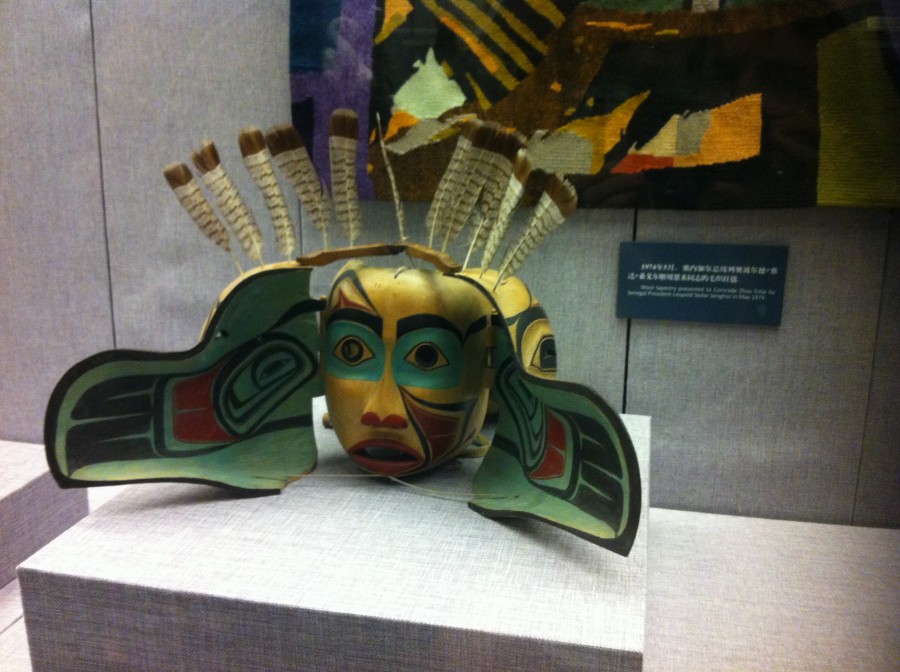
In general, I feel that the Canadians did better than everyone else in their choice of gifts. Here is the one that Pierre Trudeau gave Zhou Enlai, a beautiful Native Indian double mask, from the style I would guess from the Pacific coast

canadian mask 002

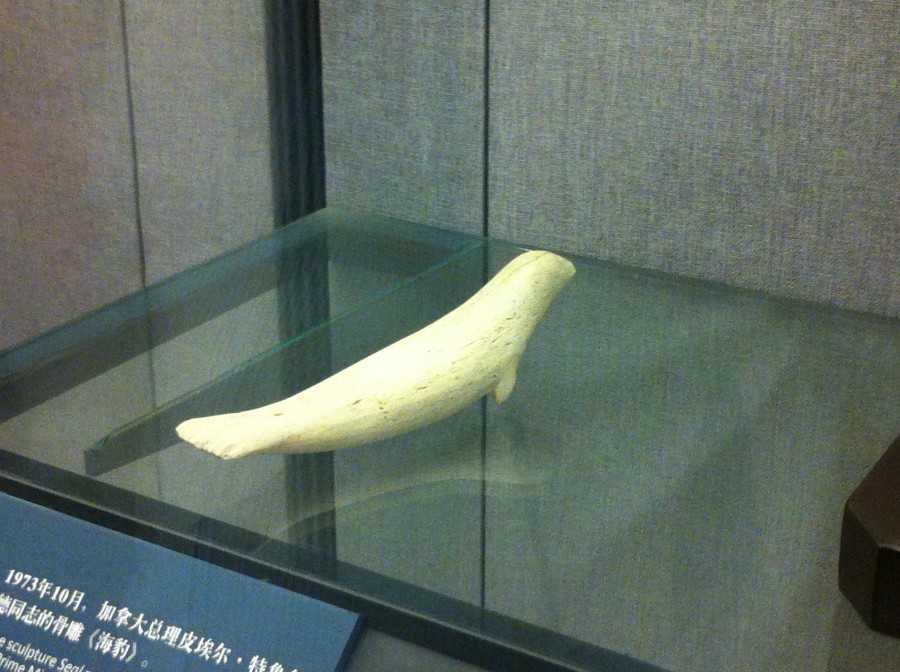
while here is a small but lovely sculpture, also given by Pierre Trudeau but this time to Zhu De, of a seal carved in  bone

canadian seal 001

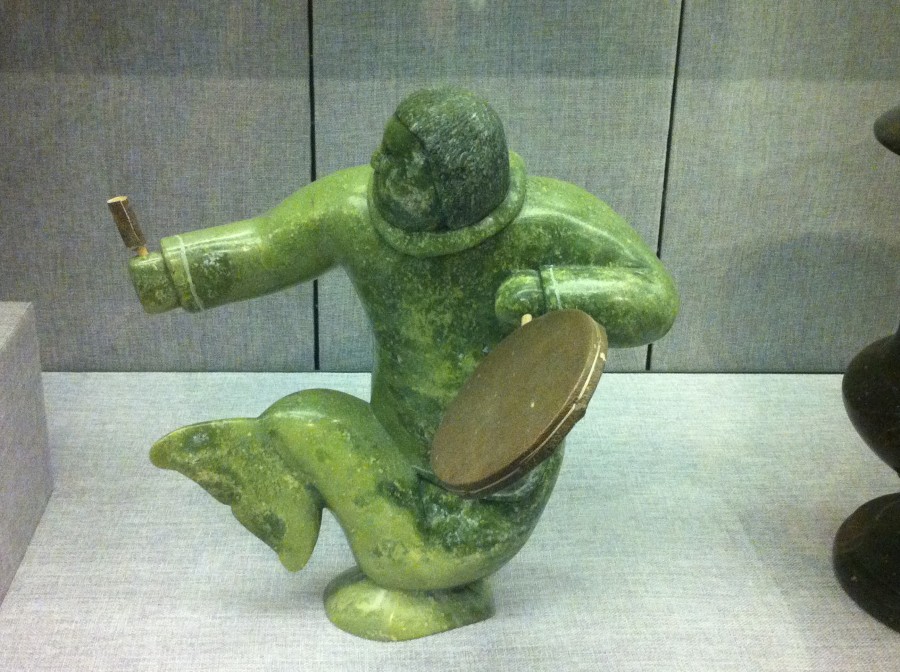
This piece was given by Governor-General Romeo LeBlanc to Jiang Zemin, a beautiful carving in jade stone of what appears to be a merman dancing.

canadian merman 001

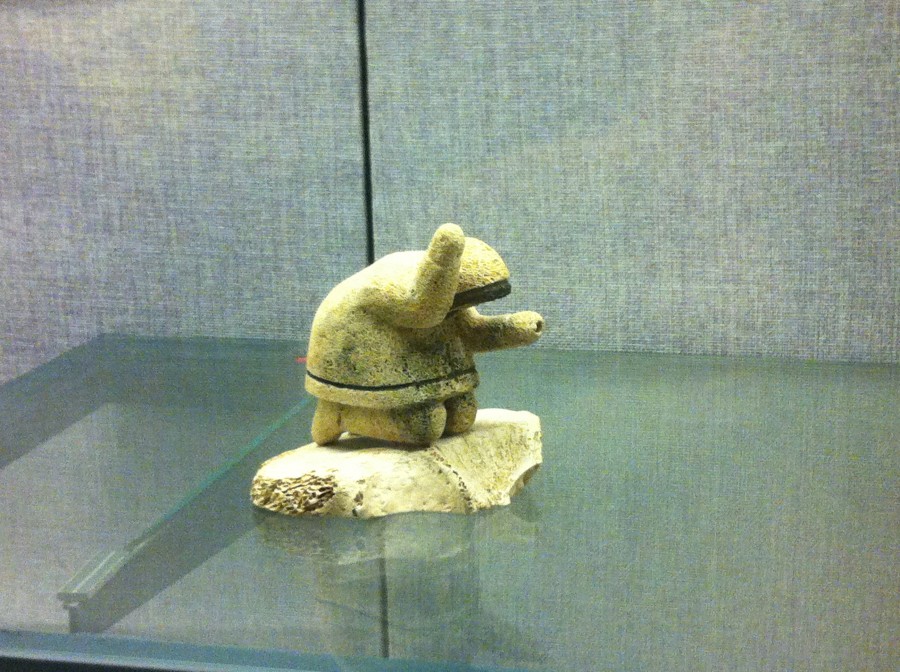
Keeping to the regional focus used in North Korea (the exhibition had the pieces laid out temporally), we can continue with North America, where the only other piece worthy of mention actually came from the same part of the world as the previous two, Alaska. It is a gift from that State’s Government to Deng Xiaoping, of an Inuit ice fishing, made of walrus bone

alaskan inuit 001

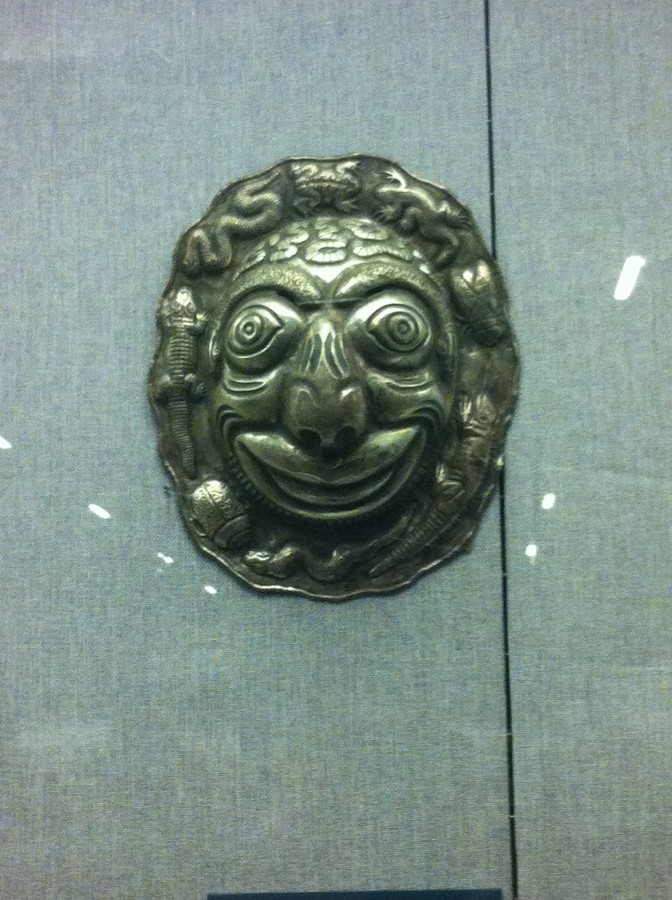
There was nothing else of note from the rest of the USA, or from Central America, so we can fly over to South America to land in Bolivia, where President Jaime Paz Zamora gave Yang Shangkun this lovely silver mask

bolivian mask 001

and then to Brazil, where President Jao Baptista de Oliveira Figueiredo gave Deng Xiaoping this delicate gift of a silver crane with crystal feathers

brazilian crane 001

(another Brazilian tried the same style some years later, but the result was not nearly as noteworthy)

After which I propose to fly over to Africa, which gave some of the best – but also many of the worst – gifts. Here are the best:

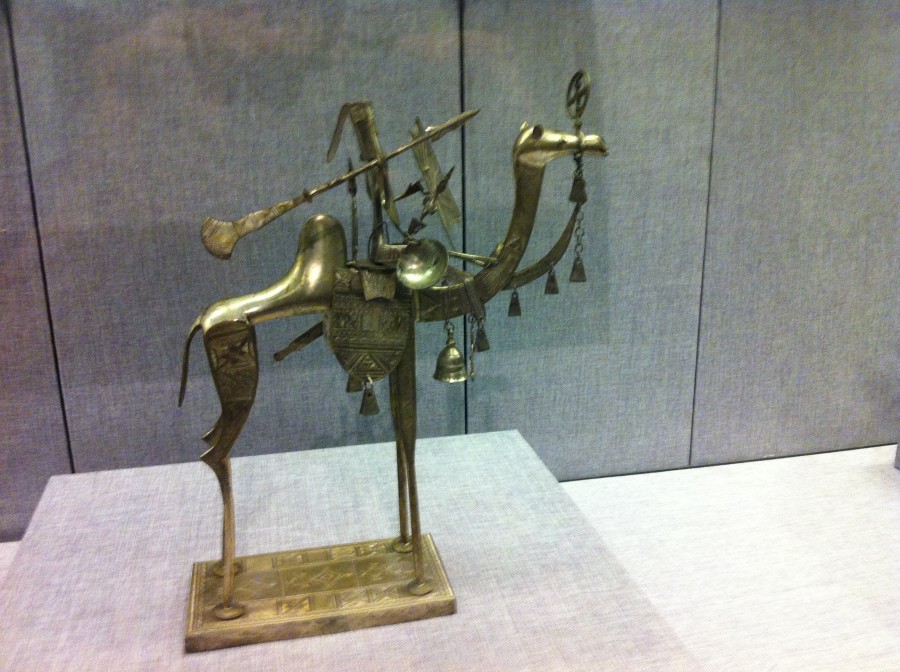
– a silver warrior riding his camel, from Niger, given by Head of State Seyni Kountche to Deng Xiaoping

nigerois warrior and camel 001

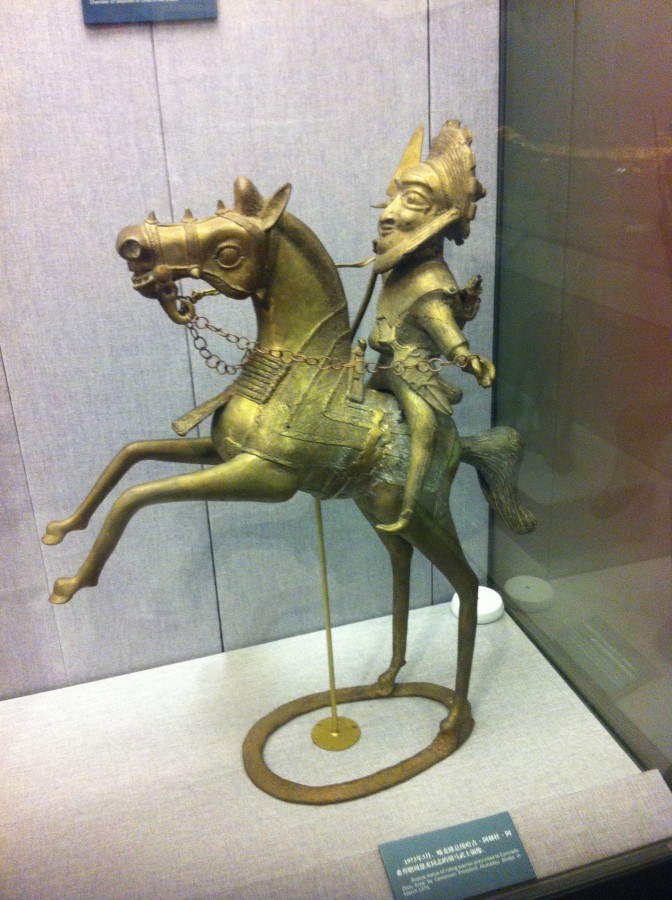
– somewhat in the same style but on a grander scale, a brass horse and rider from Cameroon, given by President Ahmadou Ahidjo to Zhou Enlai

cameroon brass horse 001

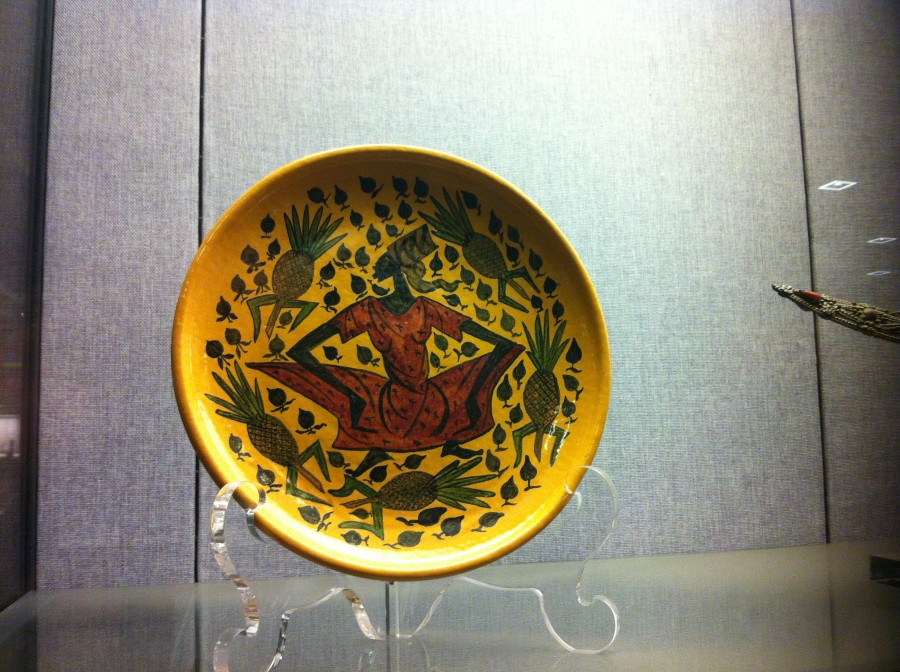
– a plate from the Republic of Congo, given by President Alphonse Massamba-Debat to Mao Zedong

congolese plate 001

– bust from Gabon, given by President El Hadj Omar Bongo Ondimba to Jiang Zemin

gabon bust 001

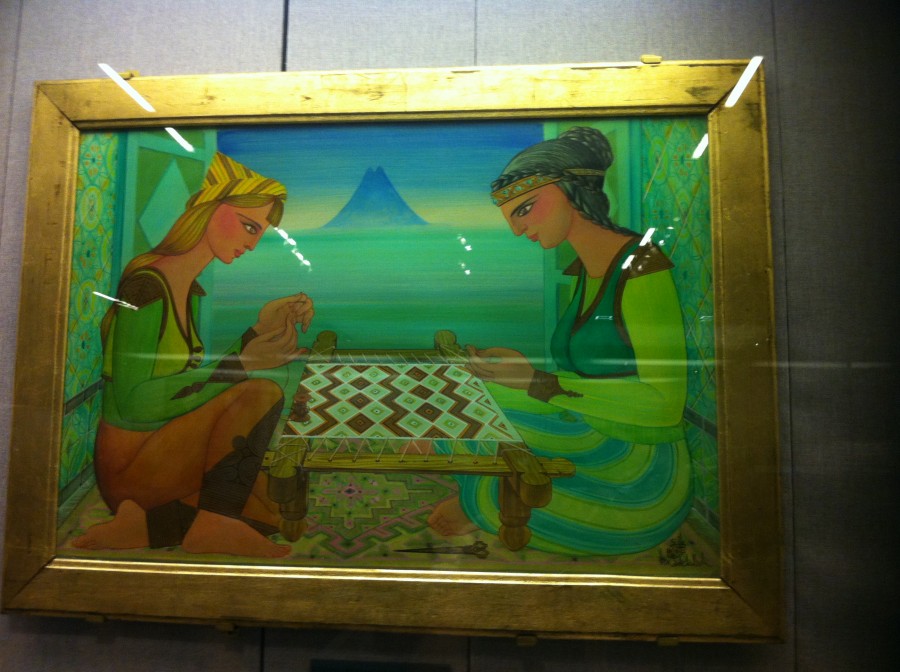
– and finally a gift from North Africa, a painting from Tunisia, given by Prime Minister Hedi Nouira to Zhou Enlai

tunisian painting 001

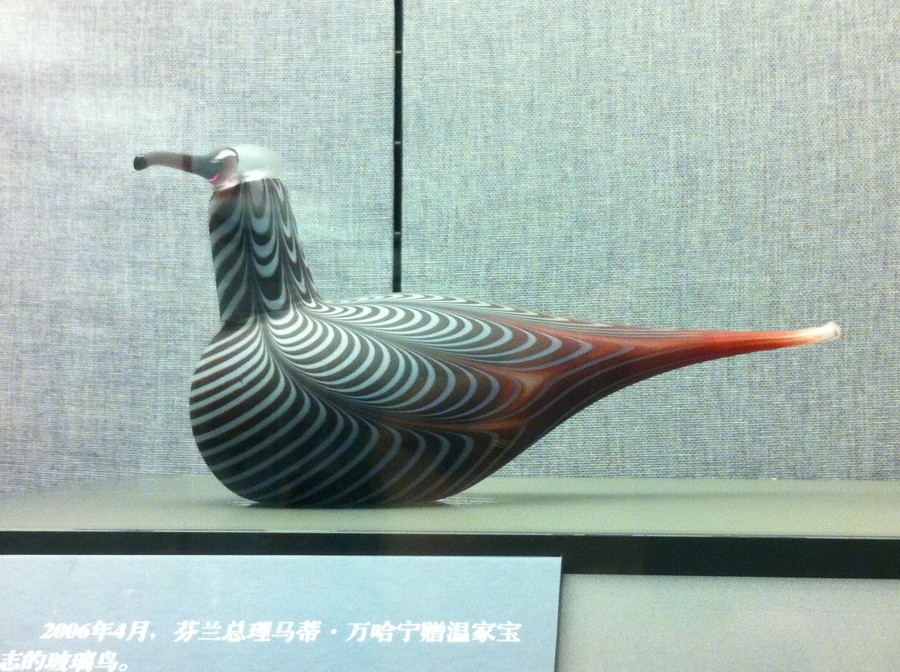
Tunisia is close to Europe, so why not do a hop, skip and a jump north over the Mediterranean. There was precious little that was nice from there, though. The best was this glass bird, a curlew, from Finland, a gift from Prime Minister Matti Vanhani to Wen Jiaobao

finnish bird 001

(there was another Finnish gift in the same style, but unfortunately the photo came out blurred so I haven’t added it; the Swedes, by the way, also gave a gift in glass, of fish in this case, but of appalling taste)

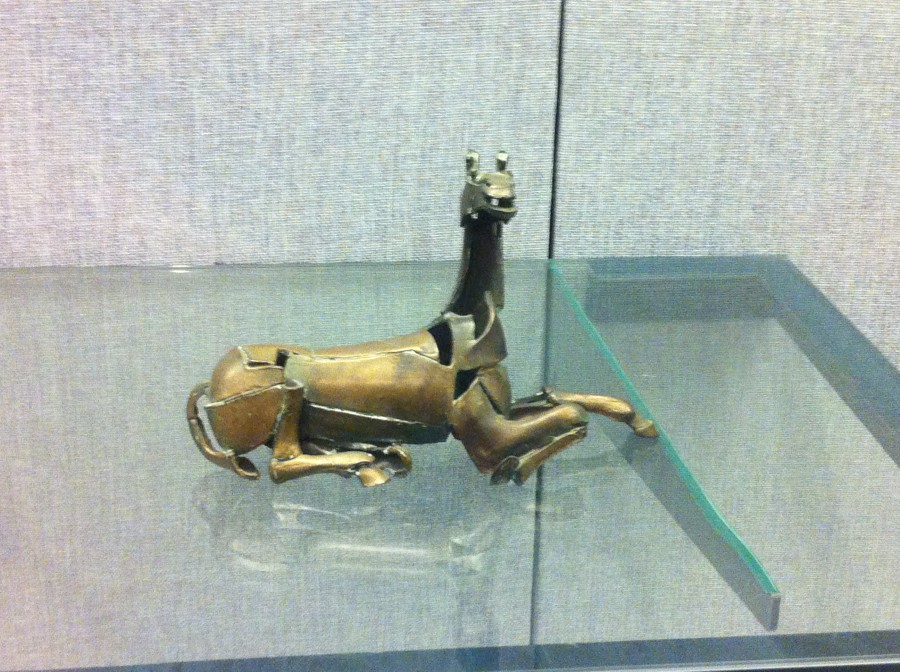
The Belgians, through the good office of King Baudoin, made a gift to Deng Xiaoping of a small but beautiful statue of a sitting horse

belgian horse 001

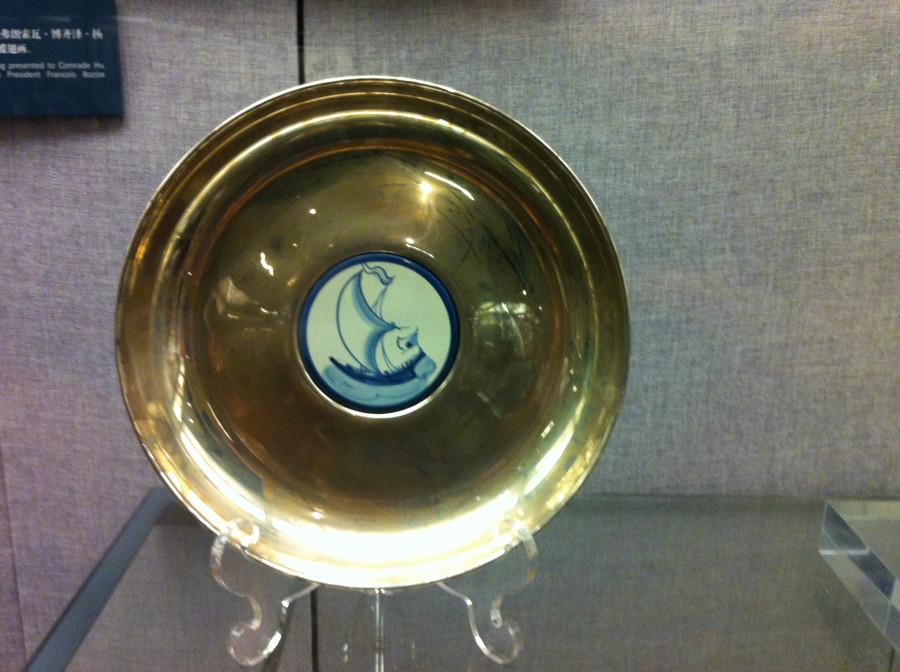
while from Portugal came this gift from Prime Minister Jose Socrates to Hu Jintao of a silver plate with a lovely azulejo­-inset of a boat in full sail

portuguese plate 001

Which leaves Asia, from where there was even less than Europe. The best was this silver bowl with a glass liner of a lustrous blue, from Vietnam, a gift from the Government to Liu Shaoqi.

vietnamese silver bowl 001

And that was it, as far as we were concerned. Really sad to see how little taste our Great Leaders have.

By the way, readers might be interested to know that, not to be outdone by his father, the Supreme Leader Kim Jong-il also built himself a hall, next to his father’s, to house his collection of rubbish … I mean, gifts. Luckily, we didn’t have to visit that one. No doubt Kim Jong-un, the current Supreme leader of North Korea, is currently hard at work with a team of architects designing his hall. Meanwhile, his people die of starvation and neglect.

______________

International Friendship Exhibition Hall: http://www.bestinsighttours.com/UpLoadFile/2013011818361673499.jpg [in http://www.bestinsighttours.com/ProductsView.Asp?id=44%5D
Kim present-basketball: http://i2.cdn.turner.com/cnn/dam/assets/130806190158-secretary-of-state-basketball2-horizontal-gallery.jpg [in http://www.cnn.com/2013/08/06/travel/north-korea-kim-gifts/%5D
Kim present-glass bowl: http://i2.cdn.turner.com/cnn/dam/assets/130806190133-jimmy-carter-gift2-horizontal-gallery.jpg [in http://www.cnn.com/2013/08/06/travel/north-korea-kim-gifts/%5D
Kim present-alligator: http://comtourist.com/images/large/north-korea-04/mt-myohyang-int-friendship-exhibition-04.jpg [in http://comtourist.com/mt-myongyang%5D
all other photos: mine

A SCHNOZZLE, A CONK, A HOOTER!

Beijing, 21 May 2015

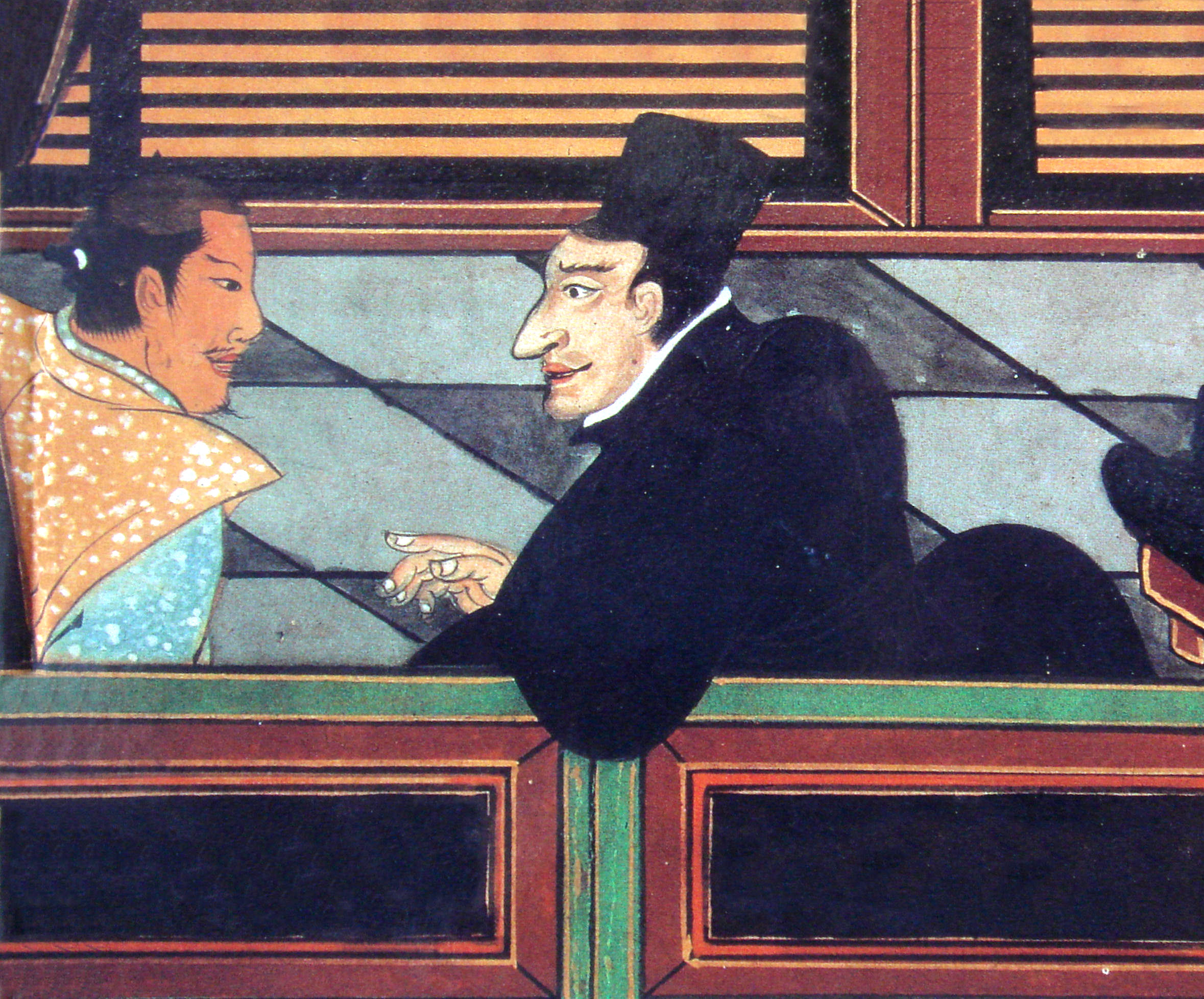
I’ve just come back to Beijing from Europe. I’ve been living long enough in China now that whenever I’m back in Europe I acutely notice differences, especially physical differences. For instance … noses. We white folk have really big schnozzles, you know! This was one of the first things which the Japanese noticed when the Portuguese showed up on their shores in the late 1500’s. The Japanese paintings of the time stress differences in nose sizes.

Jesuit in Japan

And now, after just four years in Asia, I feel that everyone in Europe is Cyrano de Bergerac

cyrano de bergerac

or San Carlo Borromeo, the cardinal saint from Milan whose conk sticks out mightily from every painting of him in every church of Milan

San_Carlo_Borromeo

As I see these large noses all around me back home, the lines from Cyrano come to mind, where he mocks his own gigantic hooter in front of an appreciative audience, on stage and off:

Ah ! Non ! C’est un peu court, jeune homme !
On pouvait dire… oh ! Dieu ! … bien des choses en somme…
En variant le ton, —par exemple, tenez :
Agressif : « moi, monsieur, si j’avais un tel nez,
Il faudrait sur le champ que je me l’amputasse ! »
Amical : « mais il doit tremper dans votre tasse :
Pour boire, faites-vous fabriquer un hanap ! »
Descriptif : « c’est un roc ! … c’est un pic… c’est un cap !
Que dis-je, c’est un cap ? … c’est une péninsule ! »
Etc.

 Or, in English:

Ah no! young blade! That was a trifle short!
You might have said at least a hundred things
By varying the tone. . .like this, suppose,. . .
Aggressive: “Sir, if I had such a nose
I’d amputate it!’ Friendly: ‘When you sup
It must annoy you, dipping in your cup;
You need a drinking-bowl of special shape!’
Descriptive: ”Tis a rock!. . .a peak!. . .a cape!
–A cape, forsooth! ‘Tis a peninsular!’
Curious: ‘How serves that oblong capsular?
For scissor-sheath? Or pot to hold your ink?’
Gracious: ‘You love the little birds, I think?
I see you’ve managed with a fond research
To find their tiny claws a roomy perch!’
Truculent: ‘When you smoke your pipe. . .suppose
That the tobacco-smoke spouts from your nose–
Do not the neighbors, as the fumes rise higher,
Cry terror-struck: “The chimney is afire”?’
Considerate: ‘Take care,. . .your head bowed low
By such a weight. . .lest head o’er heels you go!’
Tender: ‘Pray get a small umbrella made,
Lest its bright color in the sun should fade!’
Pedantic: ‘That beast Aristophanes
Names Hippocamelelephantoles
Must have possessed just such a solid lump
Of flesh and bone, beneath his forehead’s bump!’
Cavalier: ‘The last fashion, friend, that hook?
To hang your hat on? ‘Tis a useful crook!’
Emphatic: ‘No wind, O majestic nose,
Can give THEE cold!–save when the mistral blows!’
Dramatic: ‘When it bleeds, what a Red Sea!’
Admiring: ‘Sign for a perfumery!’
Lyric: ‘Is this a conch?. . .a Triton you?’
Simple: ‘When is the monument on view?’
Rustic: ‘That thing a nose? Marry-come-up!
‘Tis a dwarf pumpkin, or a prize turnip!’
Military: ‘Point against cavalry!’
Practical: ‘Put it in a lottery!
Assuredly ‘twould be the biggest prize!’
Or. . .parodying Pyramus’ sighs. . .
‘Behold the nose that mars the harmony
Of its master’s phiz! blushing its treachery!’

_________________________

Jesuit priest in Japan: http://upload.wikimedia.org/wikipedia/commons/3/3a/Jesuit_with_Japanese_nobleman_circa_1600.jpg [in http://en.wikipedia.org/wiki/Hidden_Christians_of_Japan%5D
Cyrano de Bergerac: http://www.lecture-academy.com/wp-content/uploads/2014/05/logo_13453.jpg [in http://www.lecture-academy.com/livre/poche-cyrano-de-bergerac-texte-integral/%5D
San Carlo Borromeo: http://biografieonline.it/img/bio/s/San_Carlo_Borromeo.jpg [in http://biografieonline.it/biografia.htm?BioID=3135&biografia=San+Carlo+Borromeo%5D

SCENT OF ANISE

Beijing, 16 May 2014

Several scents have followed me through my life. I wrote earlier of the scent of water. Another scent which has been a lifelong companion, gladly greeted when met, is the scent of anise.

I first became aware of the scent of anise during those long summer holidays of my youth which I spent at my grandmother’s house in France. To while away the summer days, my cousins and I would go for long bike rides through the surrounding countryside. We would often stop at bistrots in the villages we passed through, to have a break and slake our thirst. Given our young age, we would ask for soft drinks: a lemonade for me, while my cousins would opt for a sirop à la menthe, a peculiar French drink, violently green in colour and based on mint. Propping up the bar, meanwhile, there would always be a couple of locals, drinking, regardless of the time of day, un petit rouge (a glass of red wine), or un petit blanc (ditto, but white), or a beer, or a pastis.
image
They were normally also enveloped in a thick cloud of cigarette smoke which emanated from the unfiltered Gauloises cigarettes hanging from a corner of their mouths.

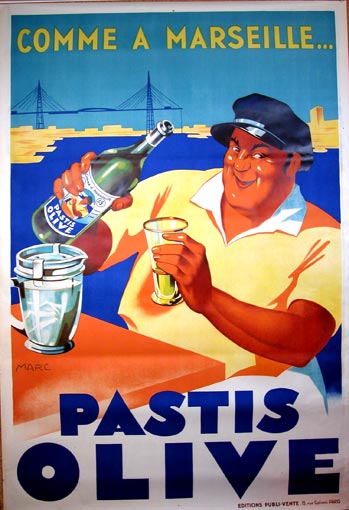
I was particularly fascinated by the pastis. For those of my readers who are not familiar with this drink, pastis is a typically French liquor very much associated with the south of France.
image
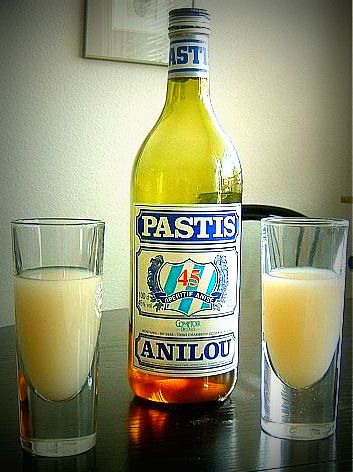
It gives off this wonderful aroma, being flavoured with aniseed (as well as licorice). It is strong (40-45% alcohol by volume), but it is never drunk neat. The drinker will add a fair amount of cold water before drinking it, at which point the liquor’s original dark transparent yellow colour clouds to a milky soft yellow.
image
As a boy, I would never tire of watching this wondrous, almost alchemical, change take place before me and breathe in the sweet scent of anise.

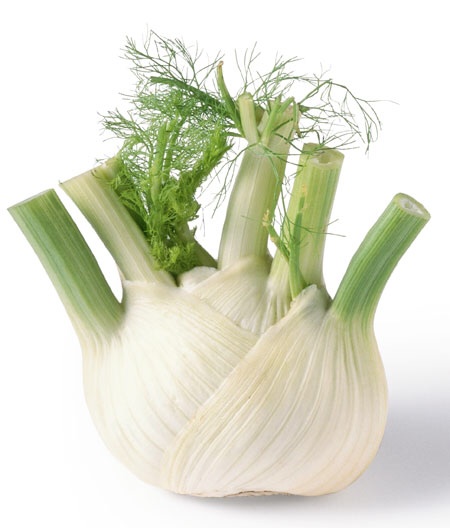
Since my family never used anise or the closely related fennel in cooking, I only next stumbled across the scent of anise when I came to Italy for the first time, nearly forty years ago. My wife to-be (as it turned out, although I didn’t know it then) introduced me to finocchio, or Florence fennel, a special cultivar of the fennel which was developed in Italy.
image
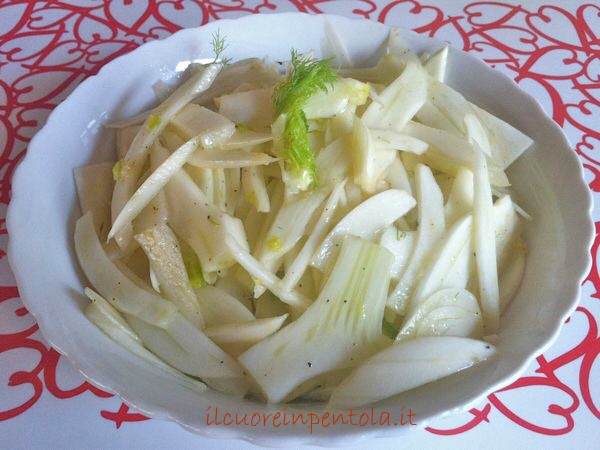
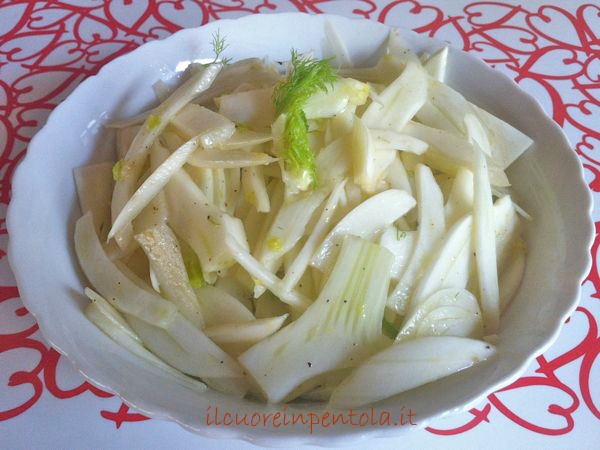
Many people (my late mother-in-law for one) eat finocchio cooked or braised but I prefer it raw, sliced very thin, almost shaved, with a simple oil and vinegar dressing.
image
Like that, it maintains the scent of anise, which begins to waft out as you prepare it in the kitchen, rises appetizingly from the plate as you spear the fennel slices, and is liberated in your mouth as you crunch down on them. Whenever I’m in Italy, and if it’s the right time of year, I will eat finocchio. In fact, it was my having a finocchio in salad last night that moved me to write this post.

Years later, just after coming to China, I stumbled across the scent of anise in another guise. During one of the early banquets to which I was invited, I noticed a star-shaped thing sitting in my dish.
image
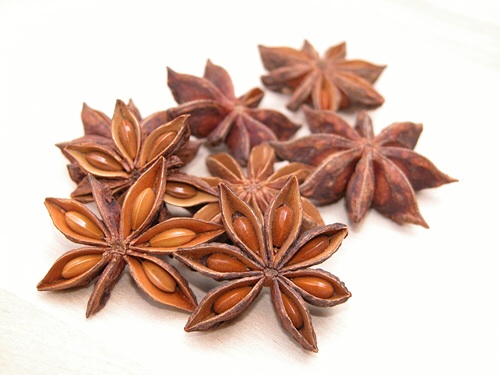
Intrigued, I asked what it was. Star anise, I was told, a spice which is commonly used in Chinese cooking (and actually in the cuisine of much of Asia, as I later discovered). It’s actually a very pretty spice:
image
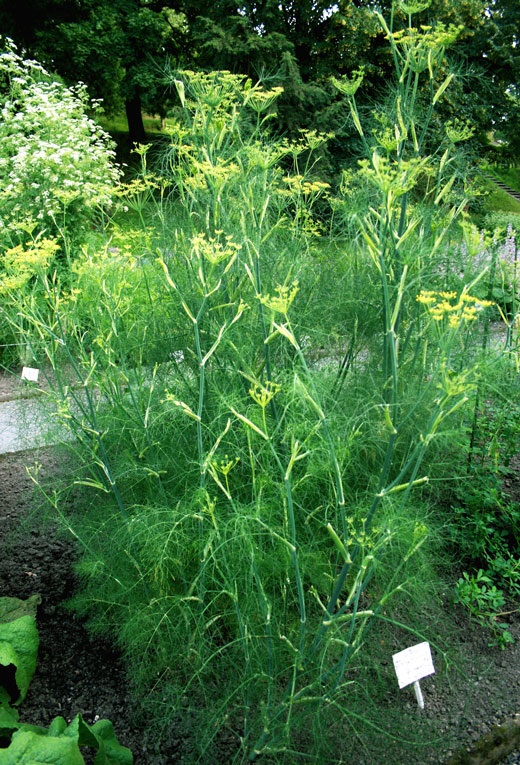
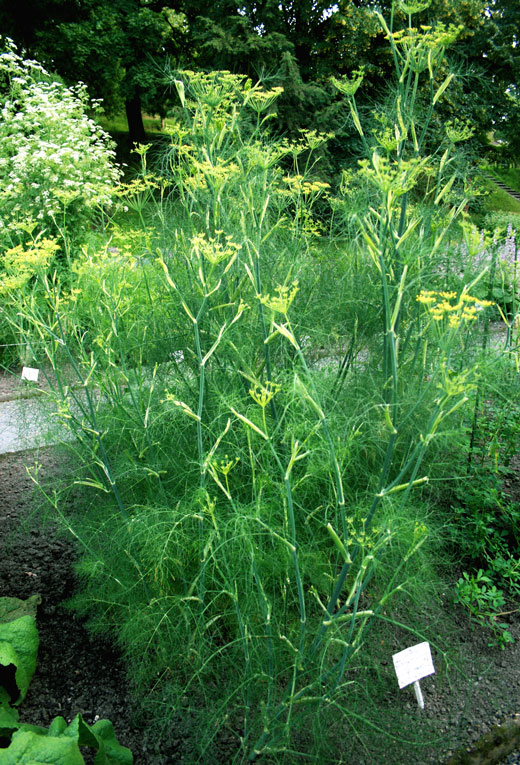
In any event, even more intrigued, I took a tentative bite and suck, and it did indeed taste of anise. But later research showed me that similar taste and scent do not a botanical relationship make. Anise, Pimpinella anisum, and Fennel, Foeniculum vulgare, are flowering plants which are both members of the Apiaceae family, and in fact look quite similar:
Anise:
image
Fennel:
image
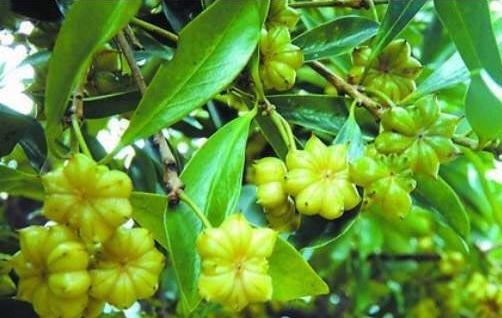
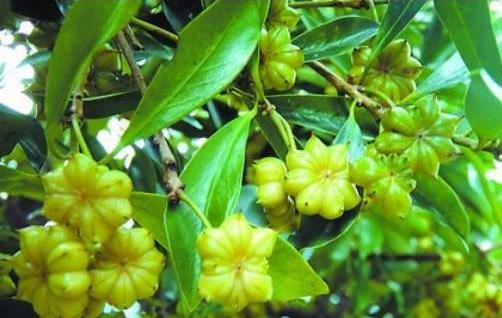
Star anise, on the other hand, is the fruit of a medium-sized tree or big bush, Illicium verum, of the Schisandraceae family:
image
image
The same-scentedness arises from the happy chance that all three plants (as well as licorice to some degree) contain the organic chemical anethole – and here I get distinctly nerdy and add a diagram of this chemical
image
Why these unrelated plants should all contain anethole I don’t know – and why we smell it and taste it as pleasant I don’t know either. Somewhere out there in the ether there may be papers which explain. But I have neither the patience nor the energy to trawl through the depths of the internet to find them.

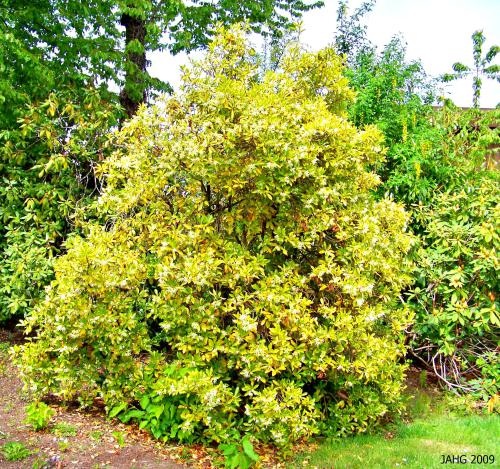
But what I have found out is that there is at least one other plant out there whose leaves contain anethole. This is the rare tree from the Australian rainforest, the ringwood or (appropriately) aniseed tree, Syzygium anisatum – although confusingly, the leaf, which contains the anethole, is called anise myrtle.
image
image
Feeling rather like one of those birders who will travel to the ends of the Earth to sight a bird which they have never seen, I am thinking (although I have not yet told my wife this) that she and I should travel to Australia again, this time to try this new, exotic source of anise scent. I read with interest that anise myrtle is considered a bush tucker spice in Australia, that is to say a spice from a native plant which can be used to spice a dish of native fauna and flora. Anyone for a stew of kangaroo and warrigal greens spiced with anise myrtle, followed by a couple of quandong fruit for dessert?

_____________________
A village café: http://wwwdotgretagarburedotcom.files.wordpress.com/2013/04/les-vieux-de-la-vieille-jean-gabin-noc3ablnoc3abl-pierre-fresnay-via-pkcine-com.jpg (in http://gretagarbure.com/tag/comptoir/)
Pastis poster: http://www.posterclassics.com/Images-Drinks-French/bigPastisOlive.jpg (in http://journals.worldnomads.com/theglobetrottingtexan/story/69164/France/Marseille-Pastis-Capital-of-the-World#axzz31oe3iEng)
Pastis going cloudy: http://www.frenchmoments.eu/wp-content/uploads/2013/04/Pastis-©-Peng-CC3.0.jpg (in http://www.frenchmoments.eu/pastis-from-provence/)
Finocchio: http://www.dietagratis.com/wp-content/uploads/2014/01/Finocchi08-450RCS.jpg (in http://www.dietagratis.com/ricette-light/3552-insalata-di-finocchi/)
Finocchio salad: http://www.ilcuoreinpentola.it/images/stories/ricette/2013/maggio/insalata-finocchi.jpg (in http://www.ilcuoreinpentola.it/ricette/contorni/insalata-di-finocchi/)
Star anise in a dish: http://www.withaglass.com/wp-content/uploads/2013/10/tenderloinsoyp.jpg (in http://www.withaglass.com/?p=15273)
Star anise alone: http://foodie-isms.com/wp-content/uploads/2011/04/star-anise1.jpg (in http://foodie-isms.com/?p=5085)
Anise plant:http://herbgardening.com/HerbGardeningImages/AnisePimpinellaanisum.jpg (in http://herbgardening.com/growinganise.htm)
Fennel plant: http://herbgardening.com/HerbGardeningImages/Foeniculum_vulgare520.jpg (in http://herbgardening.com/growinganise.htm)
Illicium verum: http://thegardenpalette.files.wordpress.com/2009/06/watermark_303.jpg?w=500&h=468 (in http://thegardenpalette.wordpress.com/tag/star-anise/)
Star anise on tree: http://www.cnseed.org/wp-content/uploads/Star%20Anise%20seed%20Illicium%20verum.jpg (in http://www.cnseed.org/star-anise-seed-illicium-verum.html)
Anethole structure: http://structuresearch.merck-chemicals.com/cgi-bin/getStructureImage.pl?owner=MDA&unit=CHEM&product=800429 (in http://www.merckmillipore.com/chemicals/trans-anethole/MDA_CHEM-800429/p_BwWb.s1L3_sAAAEWfeEfVhTl)
Aniseed tree: http://floragreatlakes.info/rfsimages/ringwood1.jpg (in http://floragreatlakes.info/html/rfspecies/ringwood.html)
Anise myrtle: http://www.anfil.org.au/wp-content/uploads//flushing-tree.bmp (in http://www.anfil.org.au/key-native-species/flavour-of-the-month-february/)

PEKING DUCK LIKE OPIUM

Beijing, 30 April 2014

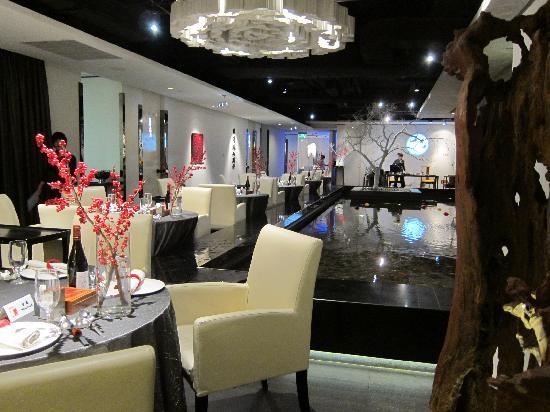
One of the first things my wife and I did when we arrived in Beijing was to eat Peking Duck. Well, not quite the first thing. We waited until the children came a few months later to visit us at Christmas before trying this Beijing delicacy. It was worth the wait. We went to the Dadong restaurant, which in the meantime has grown exponentially into a chain of really quite swanky restaurants scattered throughout the city.

dadong restaurant

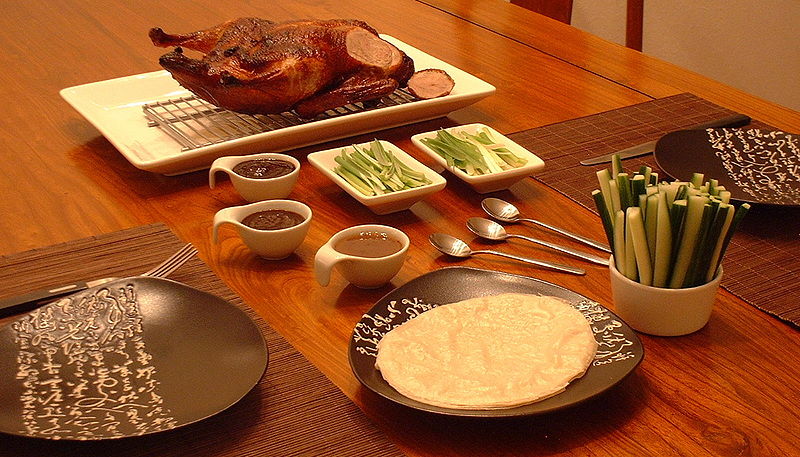
For readers who have not tried this dish, it presents itself so:

Peking Duck complete dish-3

As you can see, we don’t just have duck. Many other ingredients are part of the package. Eating Peking Duck requires one to follow a certain, very specific procedure, to bring together all these ingredients in the right order. Allow me to walk readers through the Standard Operating Procedure (SOP) for eating Peking Duck.

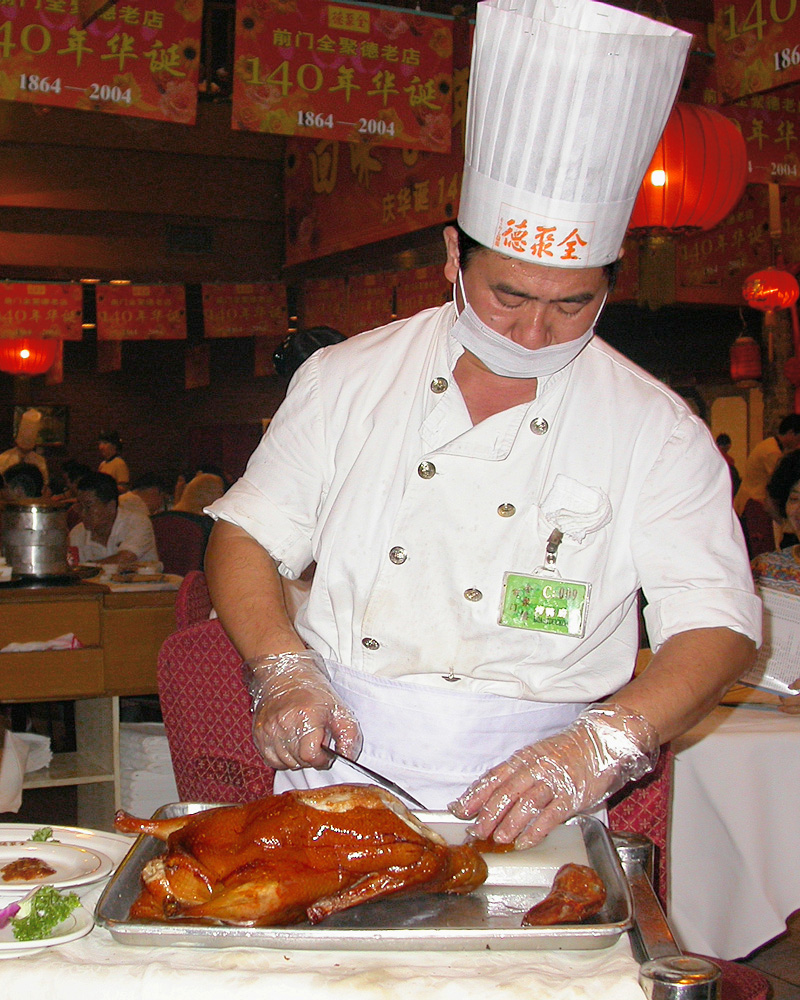
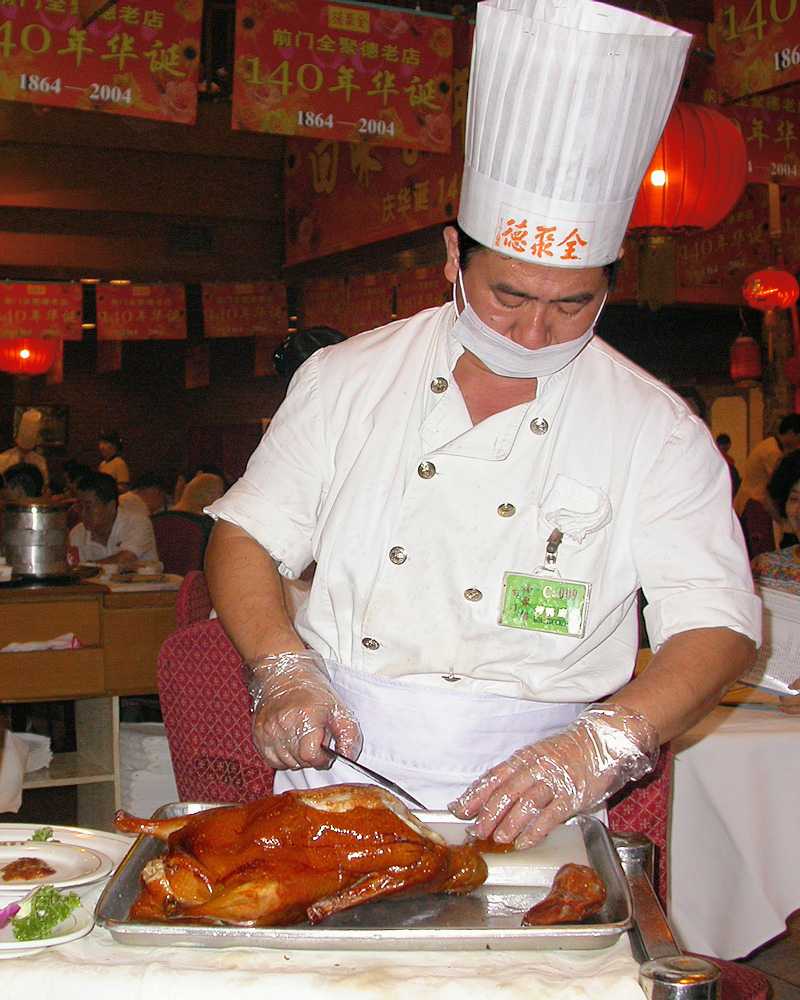
1. Look on respectfully as a chef comes to your table and slices up the bird in front of you.

cook slicing the duck

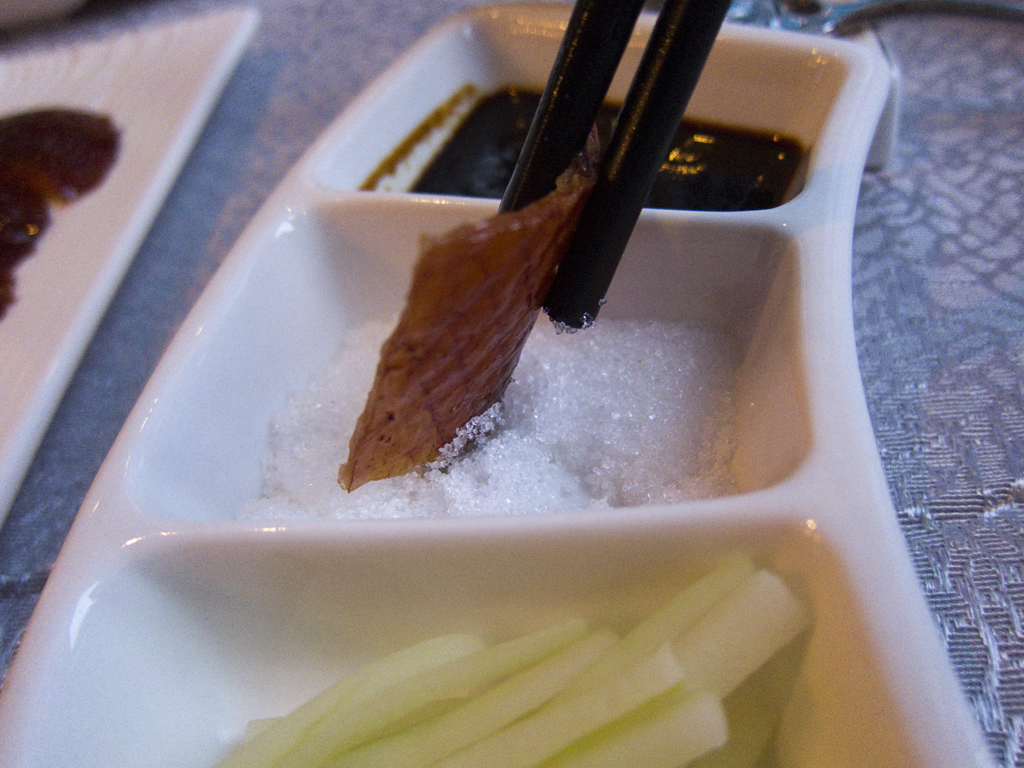
2. Start with the crispy skin. Take a piece or two, dip into sugar, and eat.

dipping skin in sugar

Personally, I find that one piece is enough for me; it’s just too fatty.

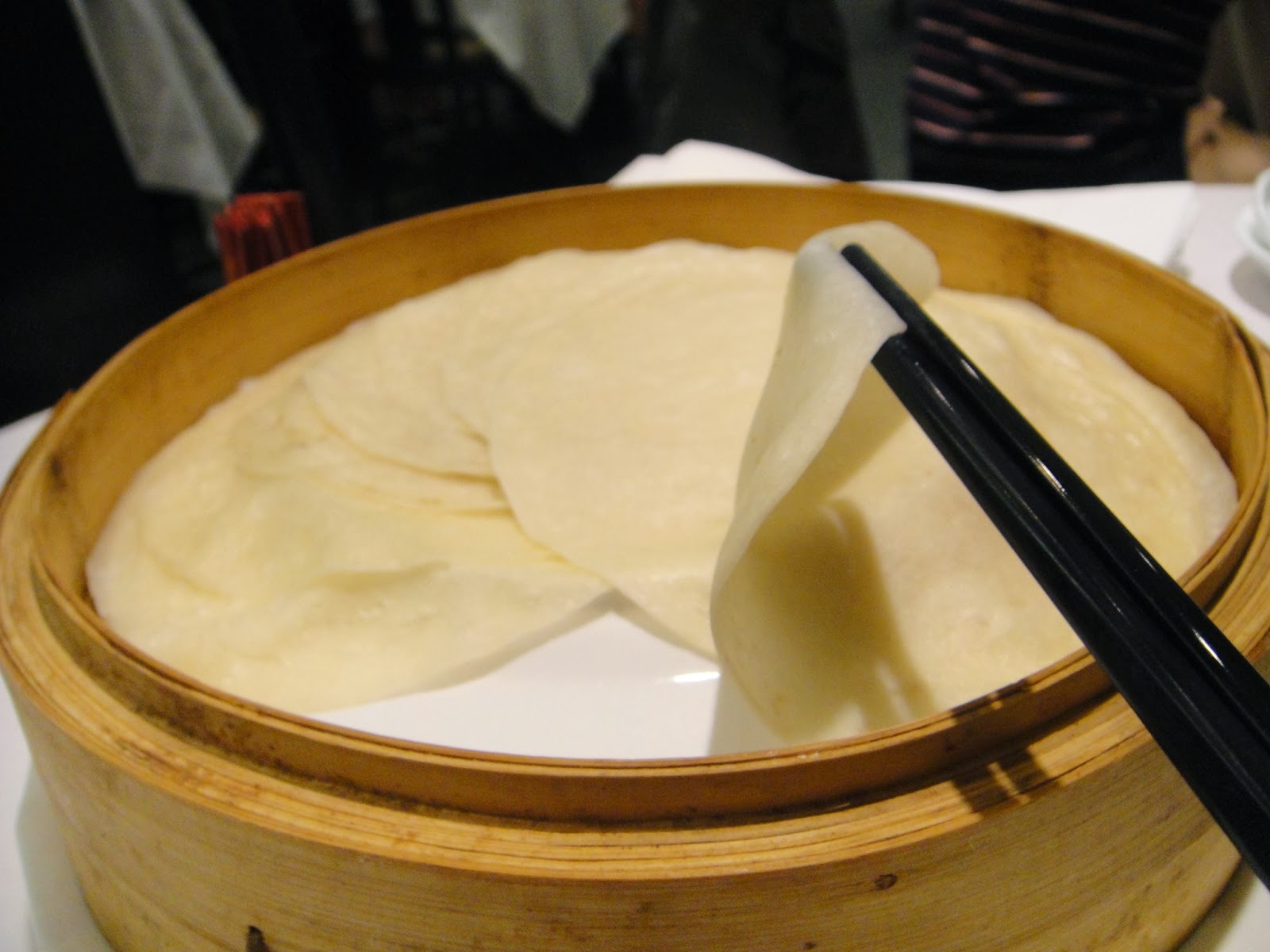
3. Start in on the duck meat proper. Pick up a wafer-thin circular crepe. For neophytes in the use of chopsticks, this can be an immense challenge.
picking up crepes
4. Use the chopsticks to smear dollops of the various sauces onto the bread wrap. The usual menu of sauces include sweet bean sauce or hoisin sauce, which is a thick, pungent sauce usually including soy, red chilies, garlic, vinegar and sugar.
hoisin sauce
5. Place the slices of roast duck on the bed of sauce. A mix of crackling skin and meat is the optimal choice. More sauce can be smeared on the meat if so desired. Place on top of the duck a couple of thinly sliced scallions.

duck and spring onions on crepe

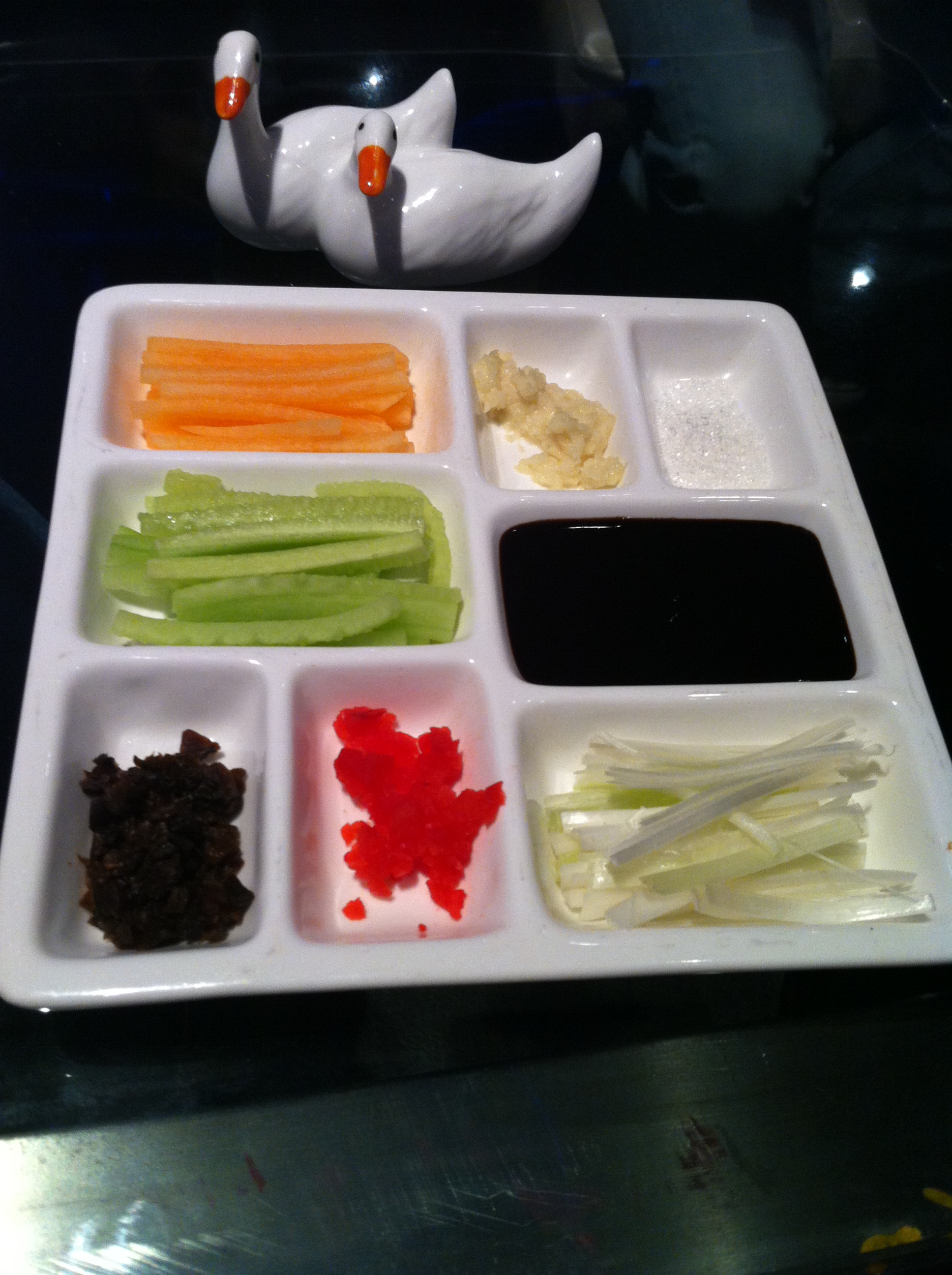
Various other ingredients can also be added: thinly chopped cucumber is popular, at Dadon they also offer thinly chopped melon and some other stuff whose identity is a mystery.

beijing duck ancillaries 002
6. Roll the whole into a tubular sandwich.

rolled up crepes

These look far fancier than the ones I produce. It’s rather like comparing the product of someone who has spent a life rolling his own cigarettes to that of the fellow who is just starting out in this bad habit.

7. Eat, making loud noises of appreciation if you have been invited by Chinese hosts, who are always glad to know that you’re liking it.

8. Repeat from step 3 (or step 2 if you have a mind to), making small variations if you wish, until all the duck has been consumed.

9. As a finale, slurp down the duck soup which they will bring, made with all the leftovers of the carved ducks.

duck soup

This must really be one of the most Chinese of dishes. Some even call it China’s national dish (I’m not sure what the Cantonese think of that, but we’ll let it pass).

So it’s a bit of a shock to know that the ducks consumed in China aren’t all that Chinese.

I was informed of this fact last week during a talk in Shanghai by a very respected Academician, who revealed to the stunned audience the whole sorry story.

There was a time, before 1873, when the duck was Chinese. It had evolved and prospered on the Grand Canal, where it had grown fat on the grain that fell off the barges going north towards the capital. The Chinese, never ones to leave anything go to waste, had recycled this lost grain by domesticating the ducks and eating them. In Beijing, the SOP described above evolved as the way to consume the ducks. This culture of duck rearing was beautifully captured in the children’s book The Story about Ping, which I loved to read to my children (although I don’t know if they loved hearing me read it …)

the-story-about-ping

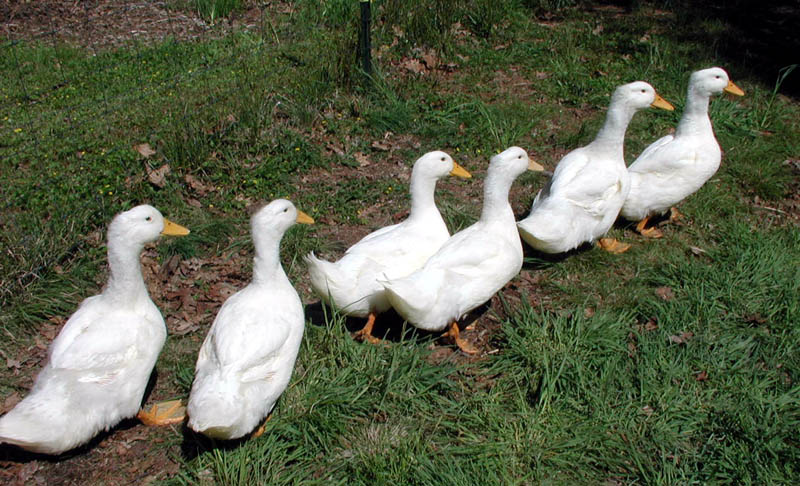
Then, in 1873, 25 of these Pekin ducks (note: no final g on Pekin) were exported to Long Island – most of them didn’t make it, eaten no doubt by the hungry voyagers on the same ship as them. The few that made it through went on to become the progenitors of the most successful domesticated breed of duck in Europe and the US. Those nice white ducks waddling around the farmyards of my youth were in all probability children of Chinese immigrants.

OLYMPUS DIGITAL CAMERA

Except that European and American farmers and agronomists were not content with just taking this Chinese duck and breeding it. They started playing with its DNA through selective breeding to make bigger, fatter, and I know not what.

In the meantime, the Chinese had slipped into anarchy, had been eviscerated by the war imposed on them by the Japanese, and – after the Revolution and the creation of the new China – had gone through the disasters of the Great Leap Forward and Cultural Revolution. So by the time the 1970s rolled in, the original Pekin Duck and its rearing were in as sorry a state as the rest of the country.

Well, the economy picked up and so did the Chinese appetite for Peking Duck. But for some reason, national production remained stagnant, or at least didn’t grow as fast. The result was that China, the biggest exporting country in the world, began to import the Pekin Ducks to turn into Peking Ducks. And began to import them in vast quantities. According to the Respected Academician in Shanghai, 70% of the Peking Ducks which are consumed in China were born and bred … in the UK. In fact, for the most part they come from one farm in Lincolnshire, the Cherry Valley Farm.

Supra

Unbelievable. It’s the opium wars all over again, except that this time the UK is flooding China with Pekin Ducks …

______________________

Dadong restaurant: http://media-cdn.tripadvisor.com/media/photo-s/01/e4/55/6e/beautiful-room.jpg [in http://www.tripadvisor.com/members-citypage/msyolee/g294212%5D
Peking duck-complete dish: http://img.cits.net/images/2011/9/27/151515157efde4e3-d.jpg [in http://www.cits.net/china-guide/china-traditions/peking-roast-duck.html%5D
Cook slicing the duck: http://upload.wikimedia.org/wikipedia/commons/e/e5/Quanjude_roastduck.JPG [in http://en.wikipedia.org/wiki/Peking_duck%5D
Dipping skin in sugar: [in http://theavidphotographer.wordpress.com/tag/paradise-pavilion/%5D
Picking up crepes: http://2.bp.blogspot.com/-T1E6blAnjAY/Up5-R7KL_bI/AAAAAAAAAtw/J3kRodTOSdc/s1600/DSC05471.JPG [in http://missvancouverpiggy.blogspot.com/2013/12/red-star-seafood-vancouver-location.html%5D
Hoisin sauce: http://www.seriouseats.com/images/2012/01/20120116-188016-hoisin-sauce-small.jpg [in http://www.seriouseats.com/2012/01/sauced-hoisin-sauce.html%5D
Duck and spring onions on crepe: http://finedininglovers.cdn.crosscast-system.com/BlogPost/l_1859_pancake-duck-00244258-CUT1.jpg [in http://www.finedininglovers.com/recipes/main-course/peking-duck-recipe-pancakes/%5D
Peking duck ancillaries: our photo
Rolled up crepes: http://www.frugal-cafe.com/public_html/frugal-blog/frugal-cafe-blogzone/wp-content/uploads/2011/01/peking-duck-pancake-rolls-loua-flickr.jpg [in http://www.frugal-cafe.com/public_html/frugal-blog/frugal-cafe-blogzone/2011/01/28/fab-food-friday-fotos-chinese-style-stewed-meatballs-easy-tartlets-twinkie%5D
Duck soup: http://chompchowchew.typepad.com/.a/6a01156f88f5ce970b015431e280cc970c-800wi [in http://chompchowchew.typepad.com/blog/2011/04/peking-duck-house-nyc.html%5D
The story about Ping: http://laughingstars66.files.wordpress.com/2010/05/the-story-about-ping.jpg [in http://www.momto3feistykids.com/2010/05/rowing-story-about-ping.html%5D
Pekin ducks: http://www.rocketroberts.com/farm/images/ducks_in_row.jpg [in http://www.rocketroberts.com/farm/farm.htm%5D
Cherry Hill farm-1: http://upload.wikimedia.org/wikipedia/commons/7/7b/Cherry_Valley_-_geograph.org.uk_-_373257.jpg [in http://commons.wikimedia.org/wiki/File:Cherry_Valley_-_geograph.org.uk_-_373257.jpg%5D

PAULOWNIA BY THE BARRACKS

Beijing, 19 April 2014

When my wife and I first arrived here, we lived in an apartment on the 31st floor of a high-rise. We soon noticed that we could hear regular shouting somewhere in the distance. We consulted with each other. What could we be hearing? Initially, I thought we were witnessing a spontaneous popular demonstration, and I scanned the horizon for signs of smoke, tear gas, armoured police, or other evidence of mayhem. But there was none, and no news on BBC or CNN to this effect. And the shouting was coming regularly, a couple of times a day. My wife then suggested that there must be a stadium somewhere around us and what we were hearing were the fans cheering on their team. But upon further investigation we concluded that the closest stadium was too far away for us to be hearing the shouting. And anyway, as I said, the shouting was quite regular, not just at the weekends or in the evening, which is what you might expect if a stadium was the source of the shouting.

We eventually solved the mystery. But before I tell you what it was all about, I need to take a step back and explain one thing. All of the embassies around here have guards, young lads who from the look of them were probably planting rice not that long ago. Here’s a couple standing tall and proud in front of the UK embassy

guards at UK embassy

Something you quickly learn to do if you live around the embassies is to get out of the way when the change of the guard is taking place. Several times a day you will see a platoon of guards marching along the pavements

guards marching along the pavement

with individual guards peeling off when they reach their assigned embassy. Nothing stops them, not even the traffic. One of the lads will march off into the road and stop the traffic, and the platoon marches over, looking neither left nor right.

guards crossing the road 002

Of course, since, as we all know, every action has an equal and opposite reaction (Newton’s third law), it comes as no surprise that soon after a platoon has marched in one direction, a platoon comes marching back in the opposite direction, consisting of the lads who have been relieved.

And where do they march to? The answer to this question brings us back to our mystery shouting. They are marching back to their barracks. We discovered that we had a barracks discretely tucked away near our apartment. And the noise we were hearing was the lads being led through some sort of periodic cheering exercise, no doubt to build up their soldierly virtues. What do they shout, I wonder? “Death to the capitalist pigs”? “Long live the Politburo”? “Beijing-3, Shanghai-0”? Whatever it is, their lusty voices floated up to us loud and clear on the 31st floor.

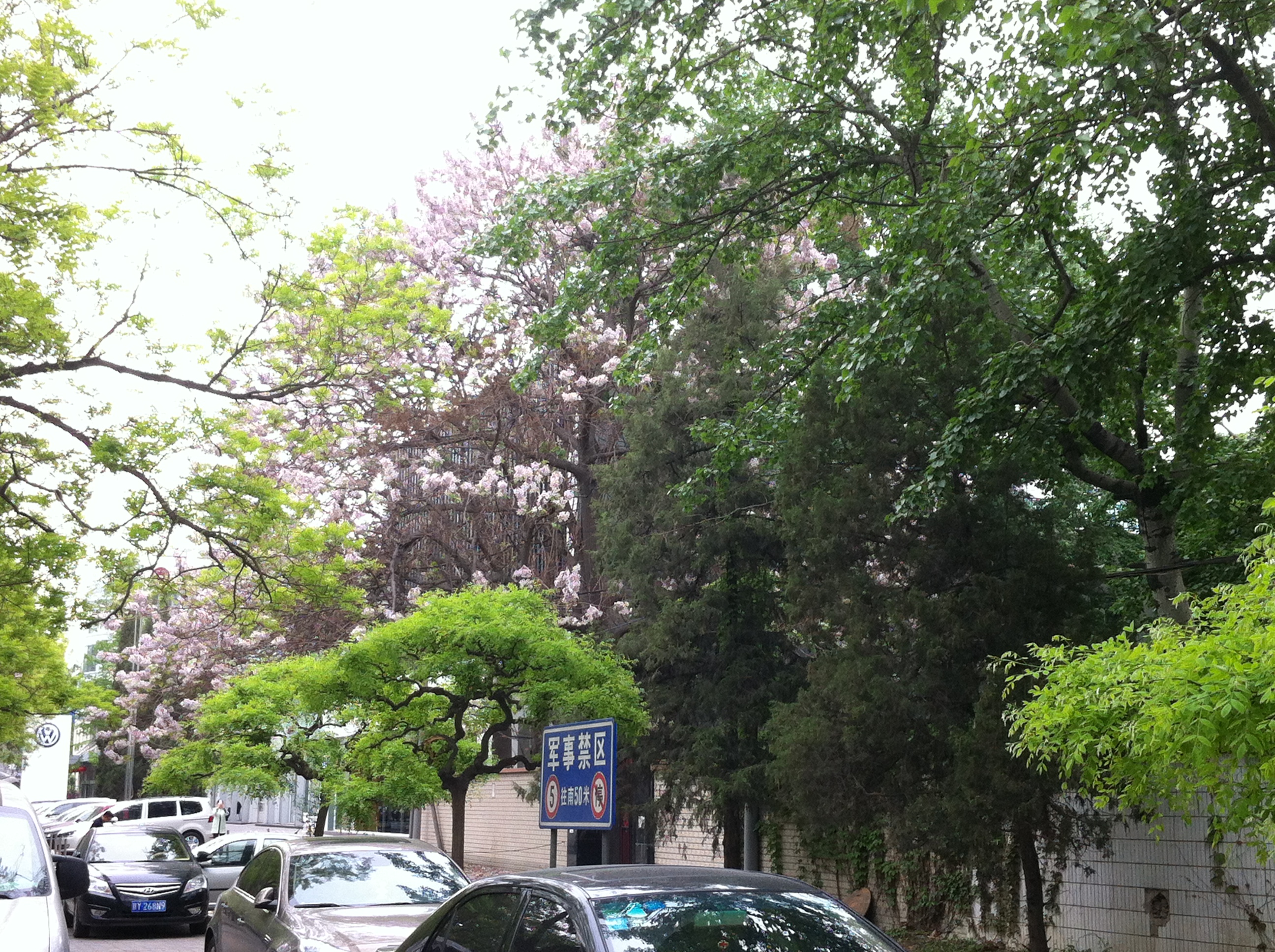
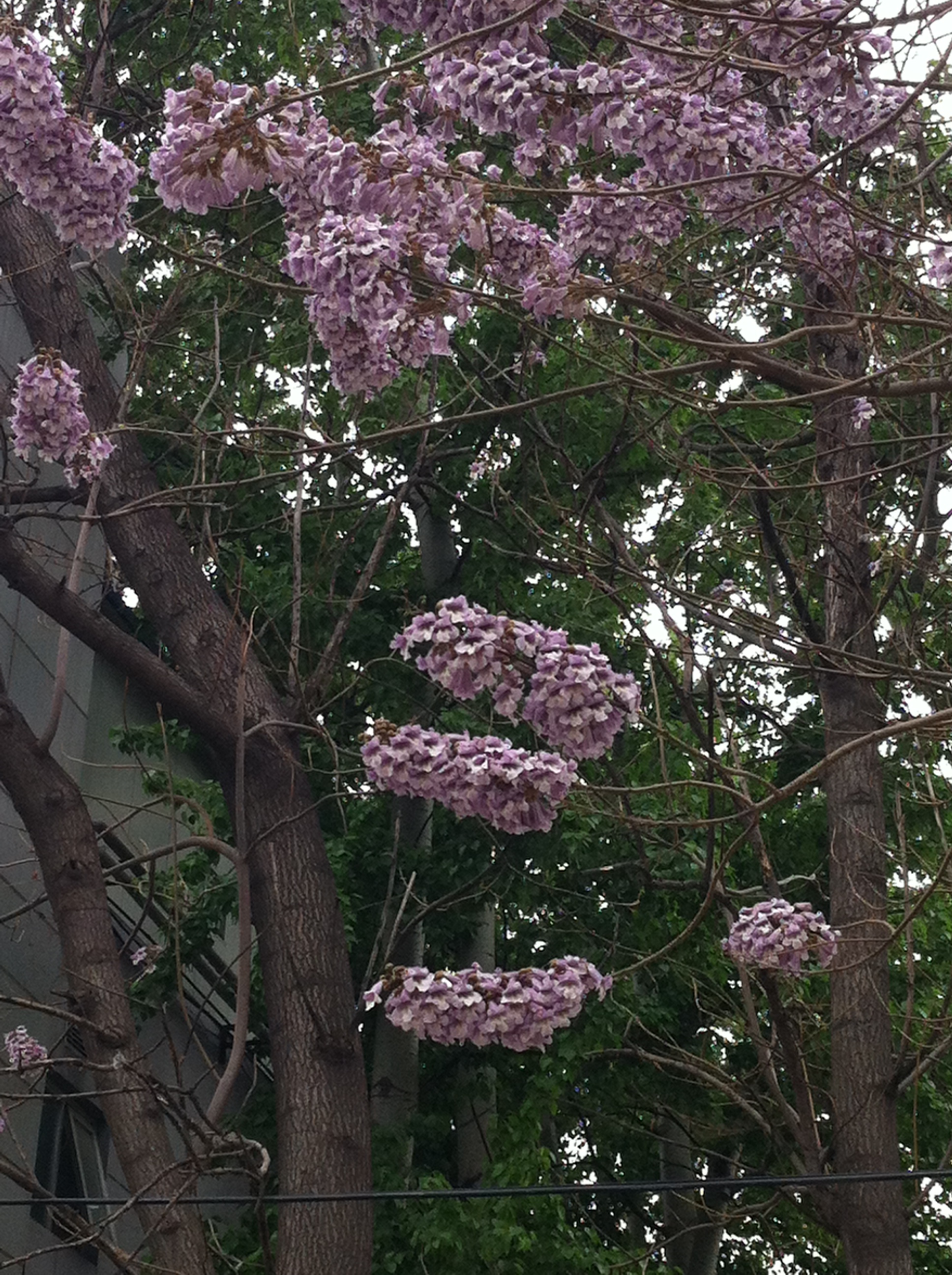
I just said that the barracks is discretely located. One of the things that helps it maintain this discretion is a screen of trees along the inside of the barracks wall which lean gracefully out over the pavement, giving the whole a feeling of a courtyard of a normal housing estate. Some of the trees in question are Paulownias, and at this time of the year, when they are in flower, they are magnificent.

paulownia at the barracks April 2014 002

paulownia at the barracks April 2014 003

paulownia at barracks 001

I throw in for good measure a photo which my wife took of a road we stumbled across just this morning. It was flanked on both sides by Paulownias, all in flower at the moment and, my wife tells me, smelling heavenly (I smelled nothing; the pollution must be getting to my olfactory organs)

paulownia along road FN 003

As usual, I did a bit of research on the tree before writing this post and discovered that it was so named by a Dutch botanist, Siebold, in honour of the-then Queen of the Netherlands, Anna Paulowna, daughter of Tsar Paul I of Russia. The choice of name was not very apt for this lovely tree; the queen was by all accounts rather full of herself. She was arrogant and distant towards the public, she valued pomp, etiquette, and formal ceremonies and rituals, and she felt she had married beneath herself, her husband being a mere kinglet while she was the daughter of a great emperor.

Anna Paulowna

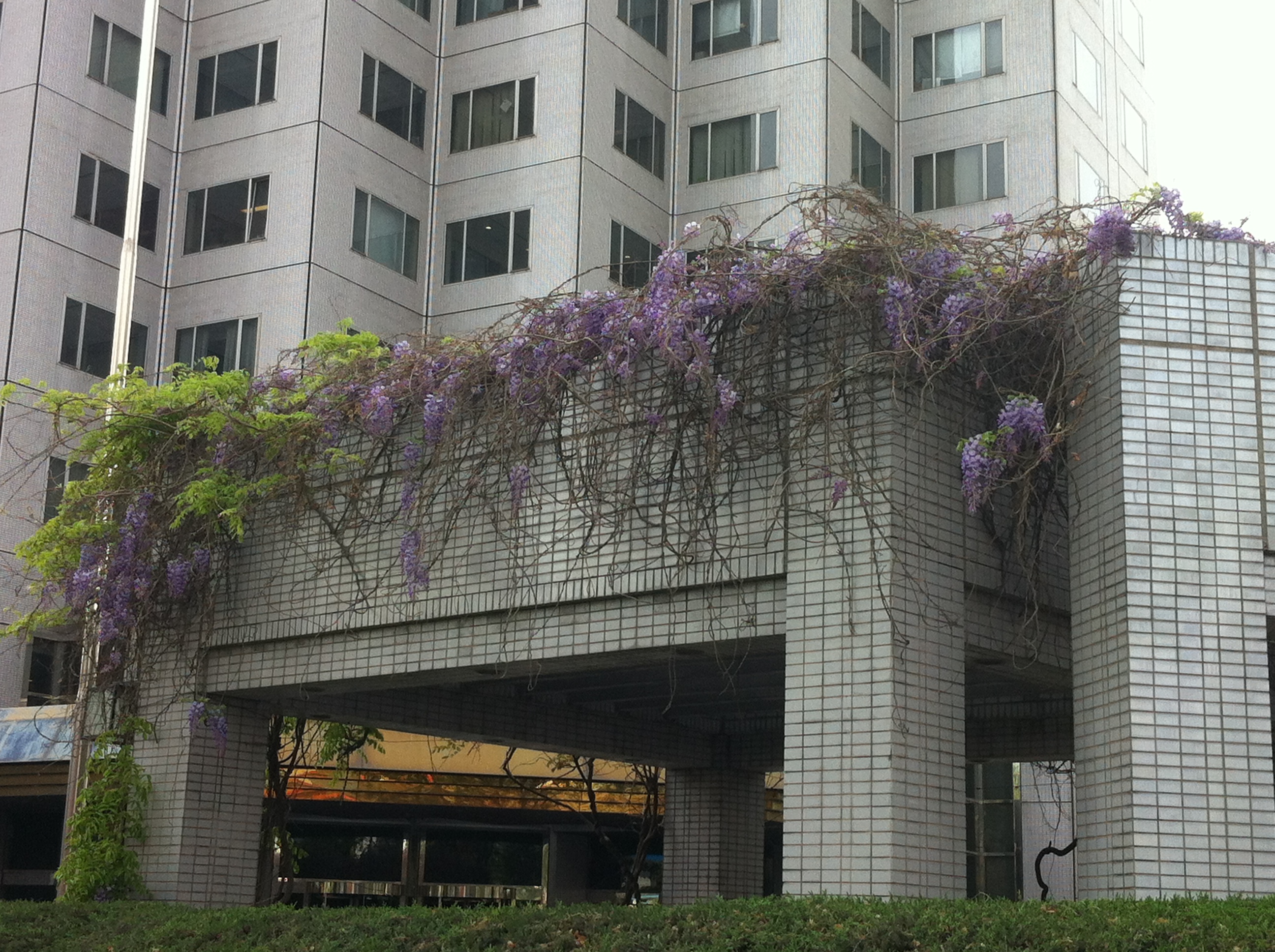
Not at all the kind of person I like. I suppose Siebold was sucking up to royalty by naming the tree after her. But I don’t need to suck up to royalty, so instead I will use its Chinese name, tongmu. Because, apart from anything else, like the wisteria, the magnolia, the weeping willow, the persimmon, and the gingko, about all of which I have written recently, the Paulownia is Chinese – this is getting to be a bit of a habit, this discovering that plants I had come to know and love in Europe are actually Chinese immigrants. It’s also getting to be a habit to discover that the route of immigration was via Japan; it seems that this is where Siebold discovered the plant and brought it back to Europe.

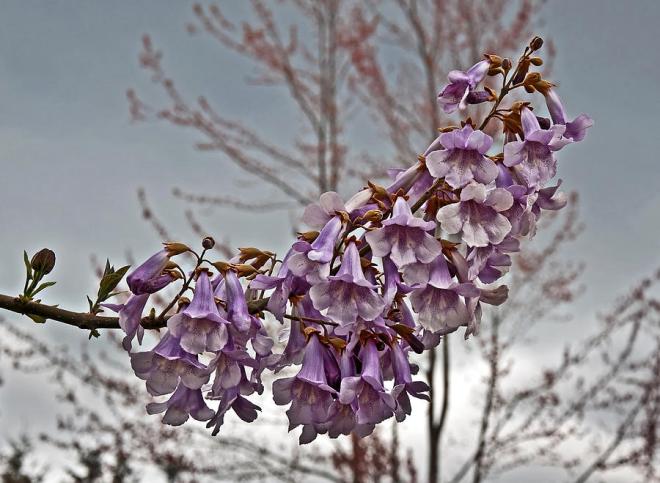
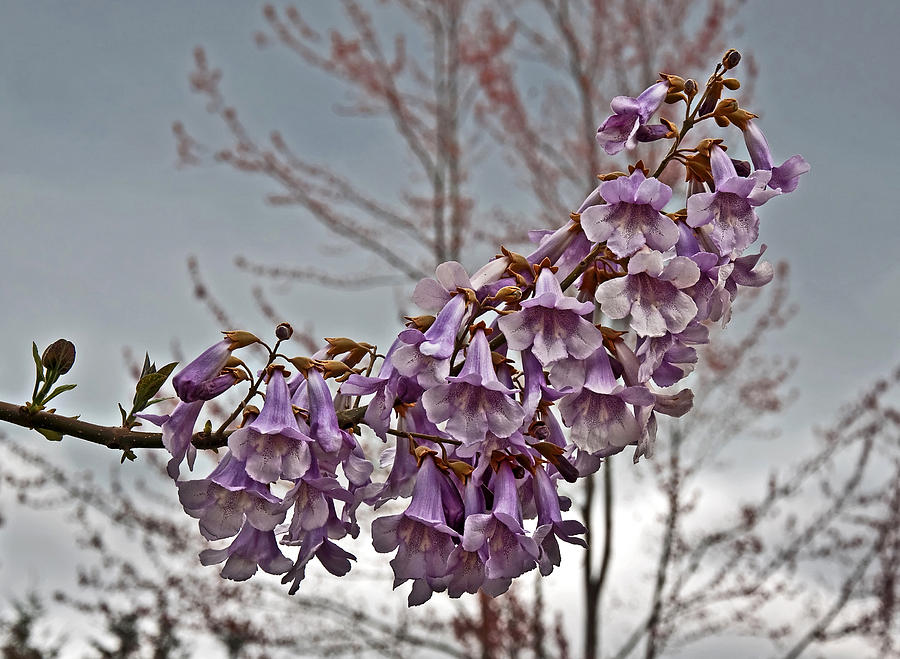
The tongmu is sometimes called the foxglove tree because the flowers, both in their bell-like shape (or finger-glove shape) and in their clustering effect look like foxgloves:


foxglove flower

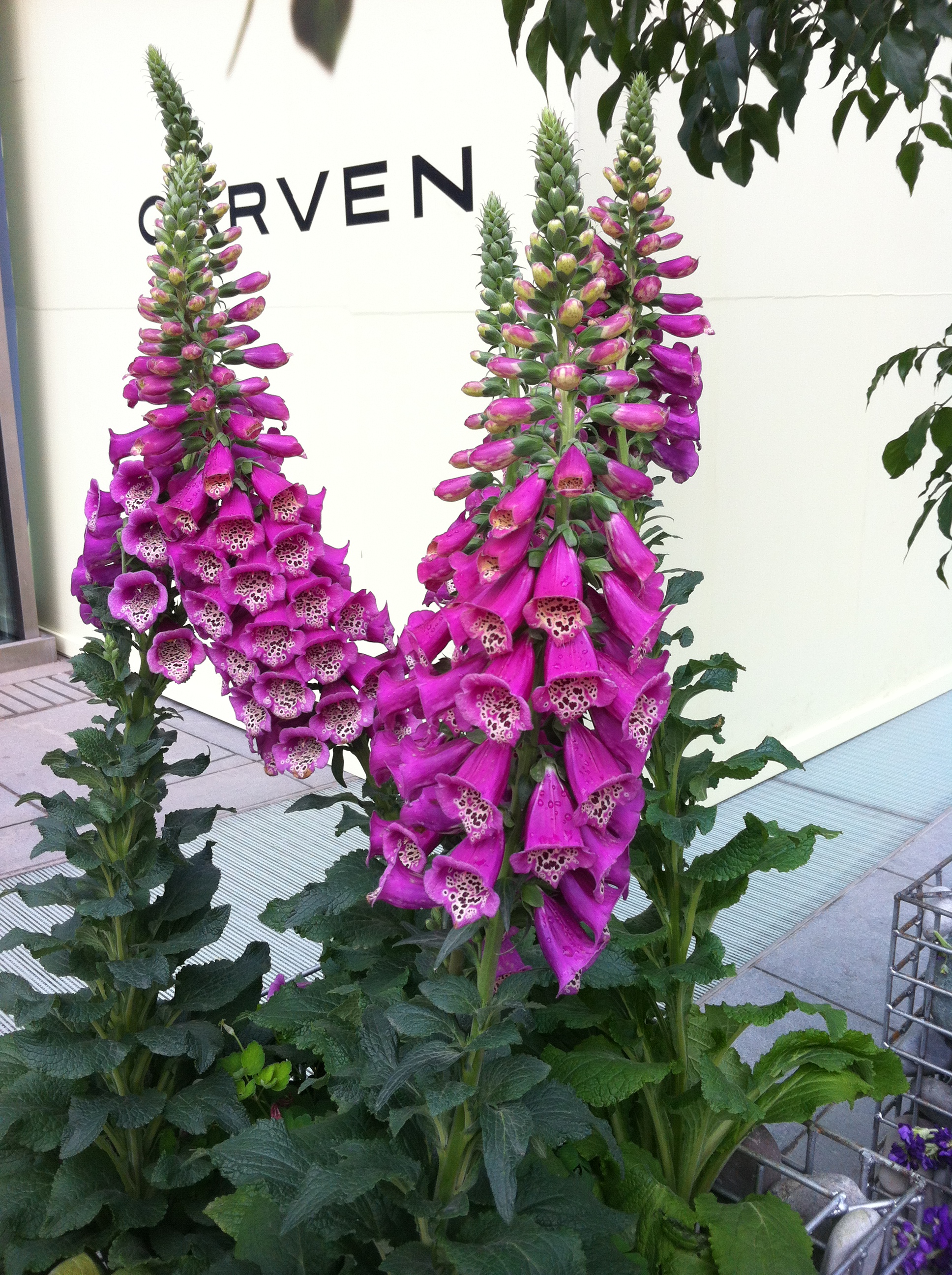
This happy resemblance allows me to conclude with the thought that despite appearances to the contrary the botanical flow has not been all one way. Plants have flowed from Europe to China. This was brought home to me just now when I noticed foxgloves planted – for advertising effect only, I think – in front of a shop at the South Village mall down the road at Sanlitun

foxgloves at sanlitun 001
The foxglove is native to western and southwestern Europe, western and central Asia, northwestern Africa, and Australasia (the last I find odd; there must be a story in there: how did foxgloves end up being native in Australia?)

______________

Guards at UK embassy: http://cdn.24.co.za/files/Cms/General/d/2362/ac78b462d715435cb3207a3c45bb415a.jpg [in http://www.news24.com/Multimedia/World/Margaret-Thatcher-remembered-20130409%5D
Guards marching along pavement: our photo
Guards marching across the road: our photo
Paulownia in flower in front of the barracks-1: our photo
Paulownia in flower in front of the barracks-2: our photo
Paulownia in flower in front of the barracks-3: our photo
Paulownia along the road: our photo
Anna Paulowna: http://upload.wikimedia.org/wikipedia/commons/f/fc/Jan_Baptist_van_der_Hulst_-_Koning_Willem_II_en_familie.jpg [in http://en.wikipedia.org/wiki/Anna_Pavlovna_of_Russia%5D
Paulownia flower: http://images.fineartamerica.com/images-medium-large-5/1-rare-foxglove-tree-paulownia-tomentosa-blooms-valerie-garner.jpg [in http://fineartamerica.com/featured/1-rare-foxglove-tree-paulownia-tomentosa-blooms-valerie-garner.html%5D
Foxglove flower: http://www.plants4less.co.uk/ekmps/shops/plants4less/images/digitalis-purpurea-woodland-foxgloves-purple-225-p.jpg [in http://www.plants4less.co.uk/digitalis-purpurea-woodland-foxgloves-purple-225-p.asp%5D
Foxglove flower in Sanlitun: our photo

WISTERIA

Beijing, 13 April 2014

My French grandmother’s house was … old-fashioned, shall we say. Among its many quirks was the fact that it did not have a flush-toilet. Instead, you eased yourself into this small, cluttered space, and you parked your derriere (your backside) on this beautiful wooden seat to do your besoins (your needs), as the French delicately put it. Once finished, you pulled a lever to open a trap door at the bottom of the porcelain bowl and off went your besoins, helped along with a generous portion of water you poured in from a large enameled metal jug. The exhalations emanating from the opened trap door were sometimes eye-wateringly powerful, and there was always a generally musty smell in the loo. However, the olfactory downsides were more than offset by the beautiful view from the window, framed as it was by the bright green leaves of a wisteria vine which snaked up the outside wall and onto the roof. The view was that much more beautiful in spring when clusters of the wisteria’s light purple flowers thrust themselves at the window. When my mother inherited the house, one of the first things she did was to install a flush toilet. But the wisteria remained. In fact, after my parents retired there my mother encouraged it to spread to other walls nearby, which made it a rare pleasure to go and visit my parents in spring. This is not a photo of the house, but it gives an idea of what would greet my wife and I, with children in tow, after a long drive up from Italy in May.
glycine sur mur-2
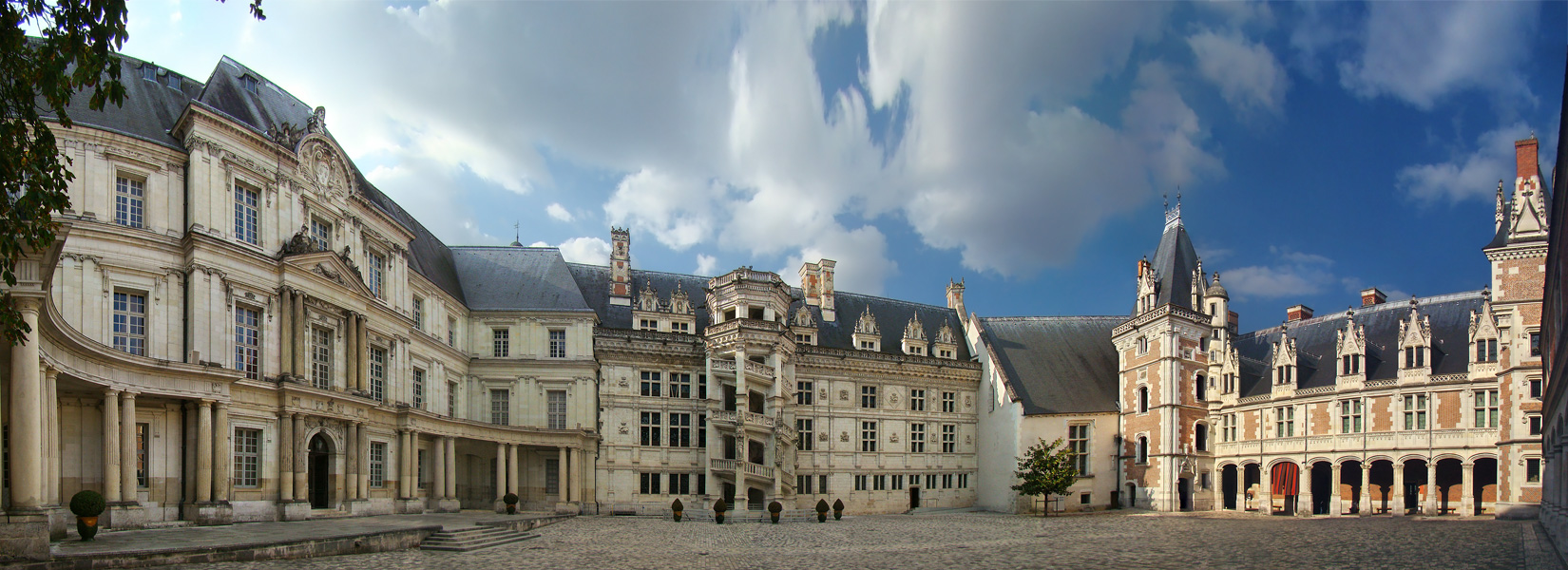
Since those moments in my grandmother’s loo, I have always had a weak spot for wisteria. At the right moment of the year, I keep an eager lookout for a sudden froth of light purple flowers popping up over a wall or in the corner of a garden. I have a particularly powerful memory of a bike trip which my wife and I made many years ago along the Loire valley, where between one Renaissance chateau

chateau_amboise

and another

chateau_Blois

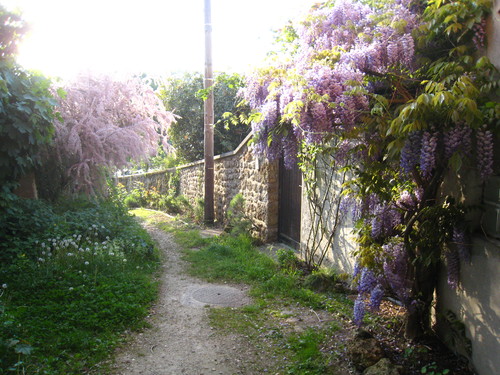
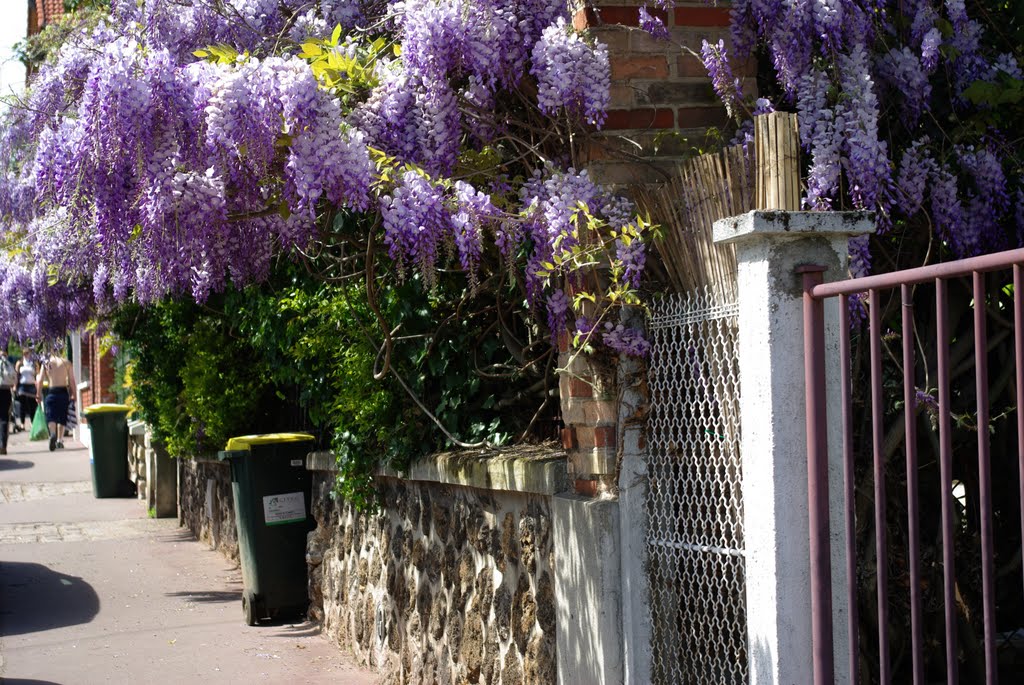
we would run into cascades of wisteria – every garden seemed to have a wisteria.
glycine dans la vallee de la Loire-1

glycine dans la vallee de la Loire-2
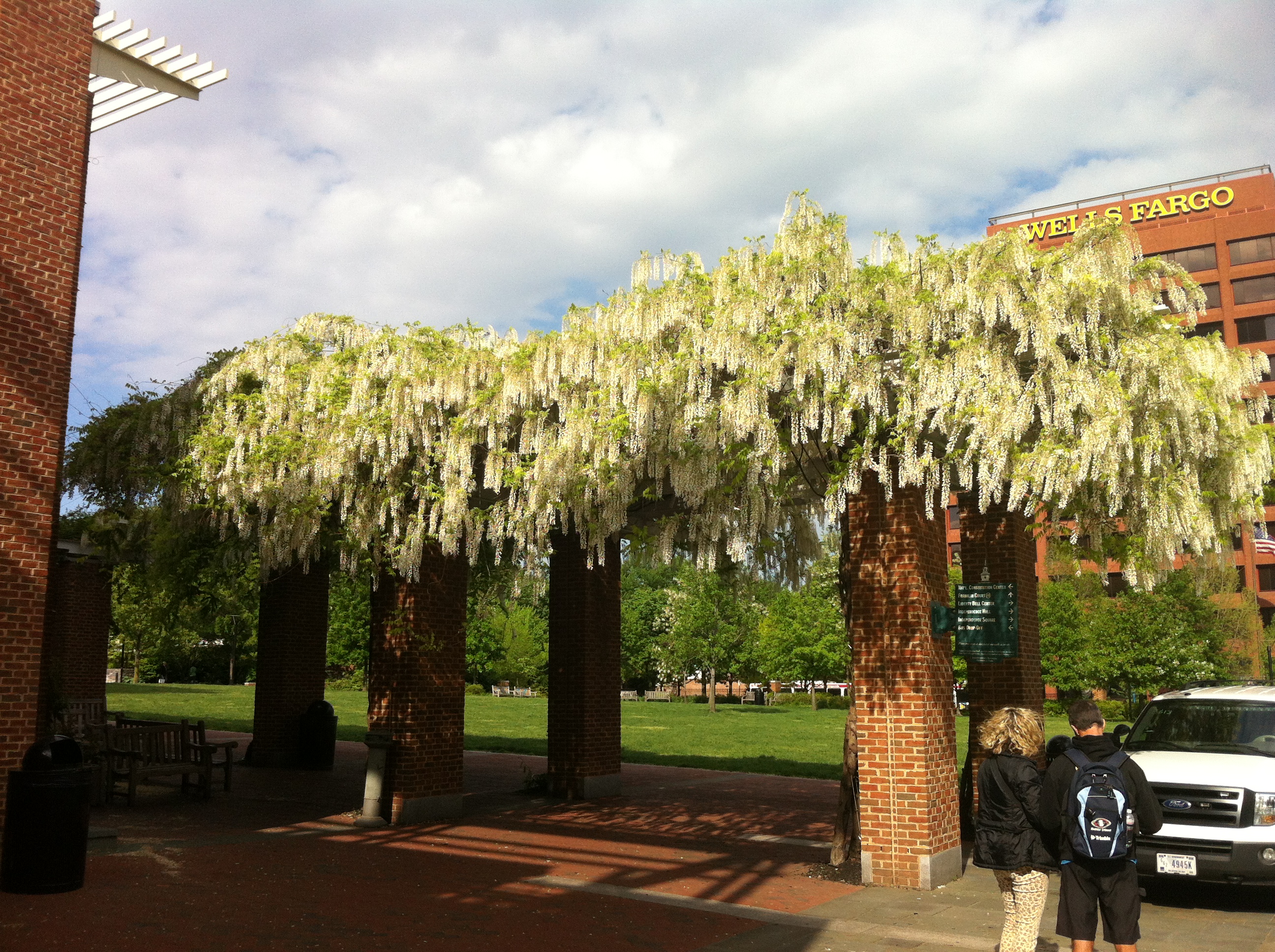
And just last year, when we were in Philadelphia, we stumbled onto a pergola covered by a thick coat of white wisteria, which was a first for me (I’ve mentioned this in an earlier post but I repeat the photo)
white flowers 003
And the neighbours to our rooftop garden in our last apartment in Vienna had planted a wisteria, which coiled and twisted its way onto our side, an intrusion we gladly accepted since it rendered so pleasant those first days in spring when my wife (with a very little help from me) toiled at her garden tubs, planting and repotting, after the long sleep of winter. In fact, jealous at their success, I purchased a modest wisteria plant for our side, with dreams of it eventually smothering our balcony. Alas, it perished miserably that summer while we were away for our holidays.

So you can understand my pleasure when I saw that the wisteria across the road from our apartment in Beijing had flowered
wisteria beijing

although I mentally castigated the management of the building for not doing a little pruning.

For the first time in my life, I read up a bit on wisteria. And the first thing I discovered is that wisteria is Chinese! Well, there’s also a Japanese wisteria. And two American wisterias. But no European wisteria! So once again, like the weeping willow which I wrote about in my last post and the magnolia which I wrote about a few posts earlier, Europeans have borrowed a plant from China, or maybe in this case from Japan (but not from the US; American wisteria don’t seem to be gardeners’ favourites, even in the US itself, since their flowers are of more modest size, bloom for less time, and are scentless). When you read these cases, you begin to understand why the poorer countries complain about pharmaceutical and other companies from the richer countries coming and “borrowing” their flora and making a fortune selling them, or their chemical components, back home.

But now I’m left with a tricky question: was the wisteria at my grandmother’s house Chinese or Japanese? The literature tells me that the flower-clusters (racemes in the horticultural lingo) of the Japanese wisteria are longer than those of the Chinese wisteria, but I’m buggered if I remember the length of those racemes nodding at the loo window. And anyway, I’m sure raceme lengths are all averages, so I don’t think this would be a good way for an uneducated plant man like me to distinguish a Chinese wisteria from its Japanese cousin. A far more powerful way of distinguishing the two seems to be the direction of twining which the vine adopts. Chinese wisteria twine clockwise, while Japanese wisteria twine counter-clockwise! (I love it; isn’t that a great way of figuring out where a plant comes from? But why would one twine one way and the other the other? The mysteries of genetics). I must remember to send my sister an email (she inherited the house, did further massive works, but kept the wisteria) and ask her which way the wisteria twines. This will no doubt be the moment she concludes that I have finally lost it …

______________

Wisteria on the house: http://img.over-blog-kiwi.com/0/53/56/12/201305/ob_bbf5590f142c0c0c464830009f54793b_img-8686.JPG [in http://mounic.over-blog.com/lieu-saint-de-provence%5D
Château d’Amboise : http://www.chateau-amboise.com/oktThemes/p-c094-01/images/chateau_amboise_accueil.jpg [in http://www.chateau-amboise.com/en/%5D
Château de Blois : http://upload.wikimedia.org/wikipedia/commons/f/fb/Loire_Cher_Blois1_tango7174.jpg [in ] http://en.wikipedia.org/wiki/Ch%C3%A2teau_de_Blois
Wisteria along the road-1: http://mw2.google.com/mw-panoramio/photos/medium/22548315.jpg [in http://www.panoramio.com/user/701296/tags/Season%20Spring?photo_page=2%5D
Wisteria along the road-2: http://static.panoramio.com/photos/large/34926262.jpg [in http://www.panoramio.com/user/701296/tags/Season%20Spring?photo_page=2%5D
Wisteria in Philadalphia: my photo
Wisteria in Beijing: my photo

PEKING WILLOW

Beijing, 9 April 2014

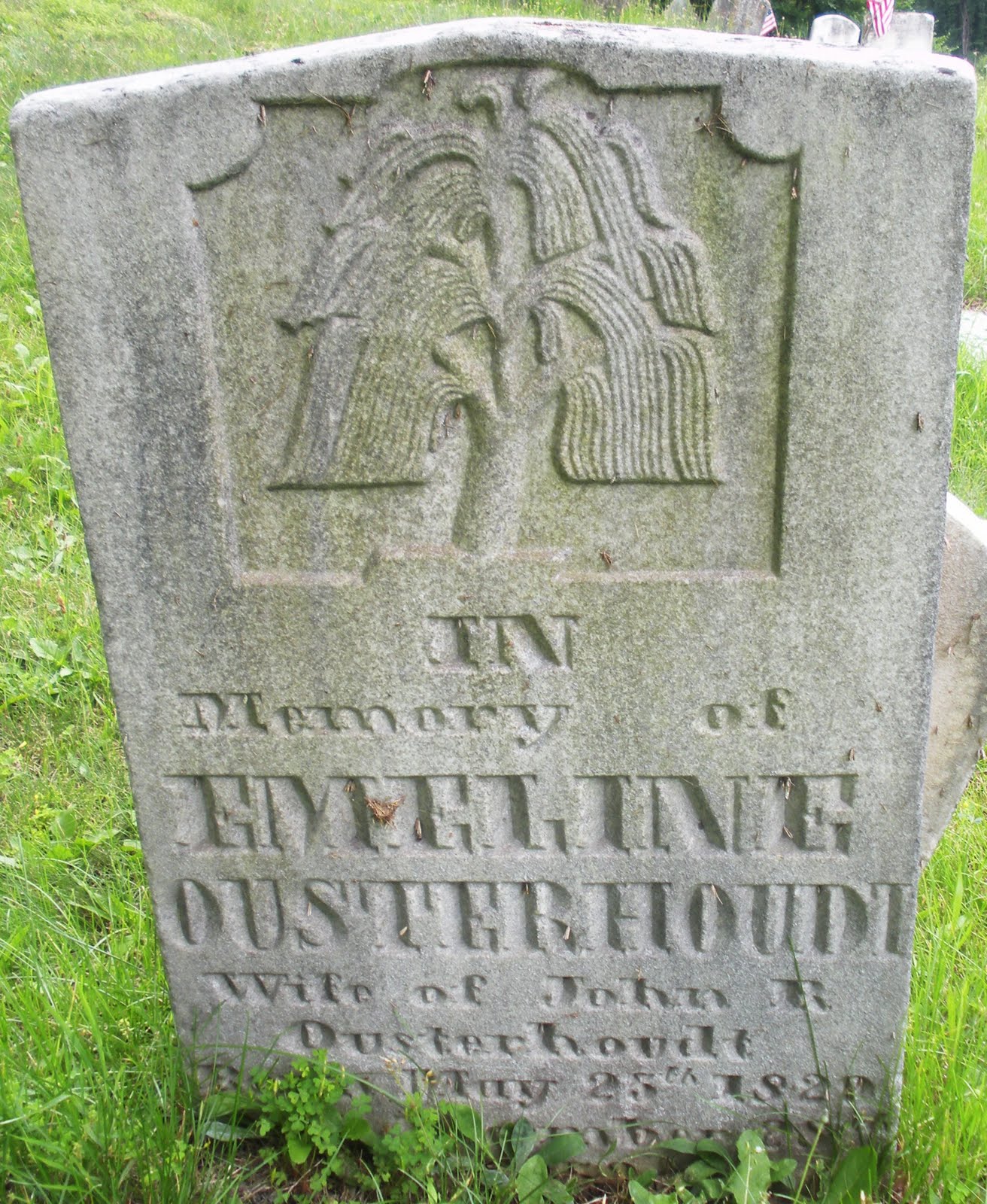
The somber, funereal tone of my last post seems like a good place to start this one – a tombstone

Weeping Willow on gravestone

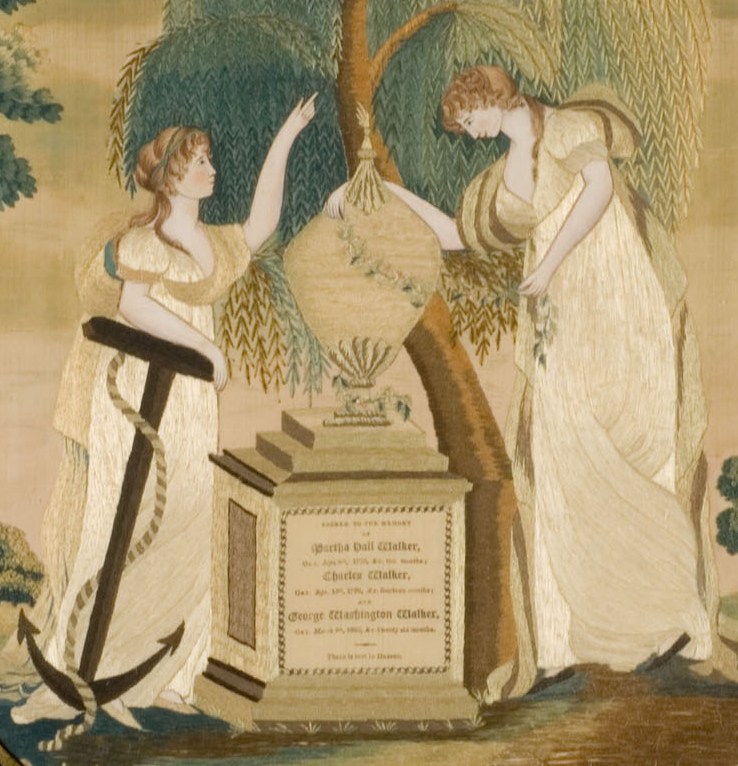
This one has a weeping willow on it, a common symbol on tombstones 200 years ago. Its drooping branches symbolize, you’ve guessed it, the weeping of the world at your passage to the next. Here’s another in the same genre from the same period, this time a piece of needlework memorializing the death of three babies.

BT OA FR

And then there were the ballads which used the weeping willow as the symbol of death, lost love, or both:

My heart is sad and I’m in sorrow
For the only one I love
When shall I see him, oh, no, never
Till I meet him in heaven above

Oh, bury me under the weeping willow
Yes, under the weeping willow tree
So he may know where I am sleeping
And perhaps he will weep for me

They told me that he did not love me
I could not believe it was true
Until an angel softly whispered
He has proven untrue to you

Oh, bury me under the weeping willow
Yes, under the weeping willow tree
So he may know where I am sleeping
And perhaps he will weep for me

 Etc. You get the picture.

The weeping willow’s symbolism was used a bit more elegantly in Psalm 137 of the Old Testament, that lyrical lament about the pains of exile, in this case that of the Israelites who had been marched off to Babylon from Jerusalem:

By the rivers of Babylon—
there we sat down and there we wept
when we remembered Zion.
On the willows there
we hung up our harps.
For there our captors
asked us for songs,
and our tormentors asked for mirth, saying,
“Sing us one of the songs of Zion!”

 How could we sing the Lord’s song
in a foreign land?
If I forget you, O Jerusalem,
let my right hand wither!
Let my tongue cling to the roof of my mouth,
if I do not remember you,
if I do not set Jerusalem
above my highest joy.

jewish bible with picture

I’ve left out the last verse where the poet gets vengeful and nasty, talking about taking the babies of their captors and bashing their brains out against the rocks …

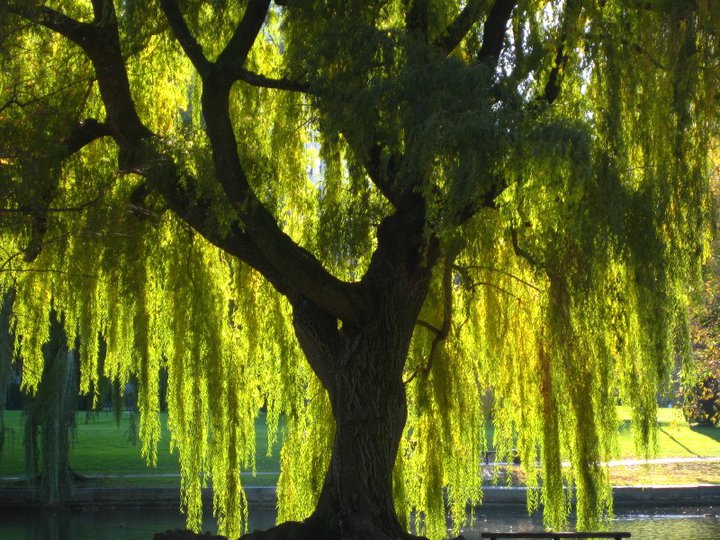
But if we brush aside the drooping veil of gloom, we find a really beautiful tree, for the most part sitting elegantly near a body of water, into which its trailing branches will often dip.

weeping willow tree

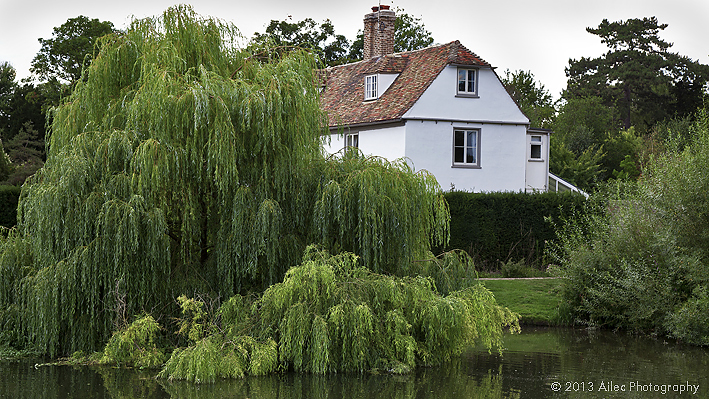
And such an English tree! (well, you also find them on the continent but we’ll ignore that). Here’s a weeping willow on the edges of a pond in Grantchester, in which, so it is said, the poet Byron swam.

weeping-willow-Grantchester

Here are students punting on the river Cam in Cambridge with some weeping willows languidly brushing the water’s surface.

weeping willows on the River Cam

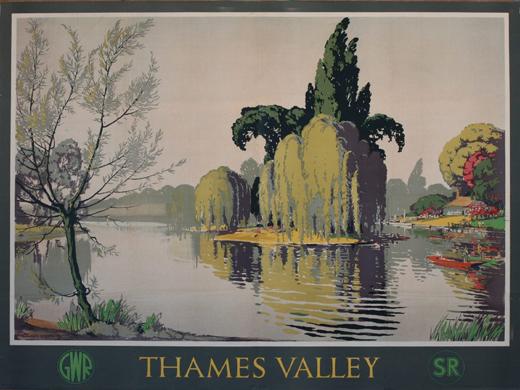
Here is a 1946 poster from the Great Western Railway, inviting Londoners to take a day out in the Thames Valley, with a weeping willow centre stage beckoning to them.

great western railway-thamesvalley

Talking of the Thames, here is the cover of that most English of children’s books, The Wind in the Willows, where we see our friends Mole, Ratty and Toad on the river Thames, waving to Badger on the shore, the whole discretely framed by weeping willows

the_wind_in_the_willows

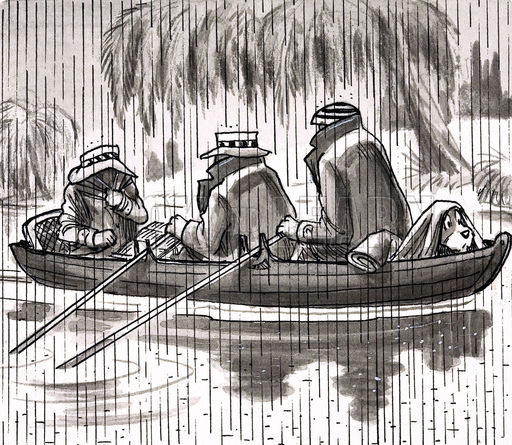
And of course there’s Three Men in a Boat, a book about – well, three men in a boat, messing around on the same river Thames (a book much loved by my father-in-law, in passing). Here we have them in that quintessentially English situation, rain, together with that quintessentially English animal, the dog, with some weeping willows in the background.

Three Men in a Boat by Jerome K. Jerome

Yes, all very English.

Except that the weeping willow isn’t English.

It’s Chinese.

Well, half-Chinese.

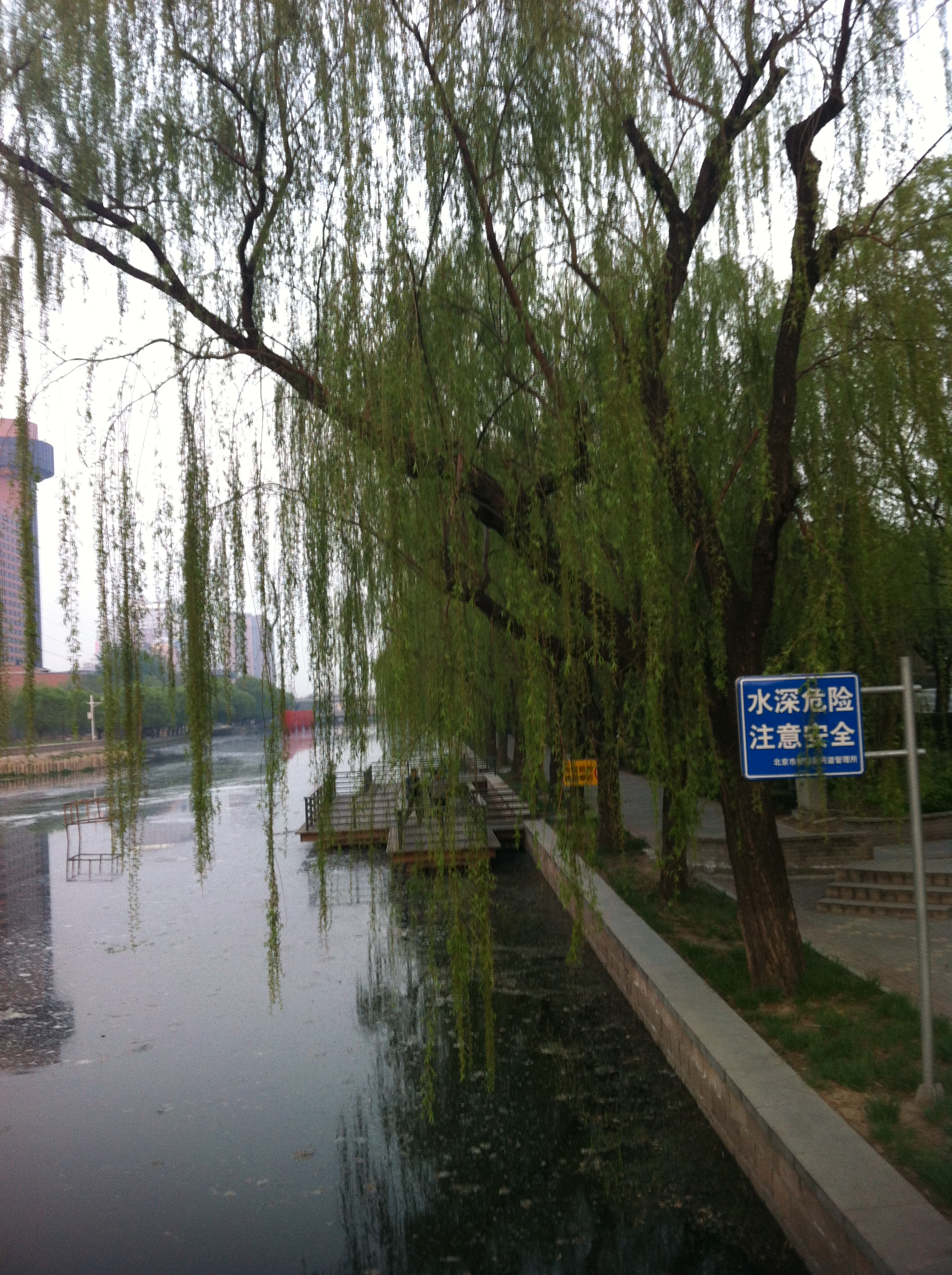
Yes, the willows, suitably called Peking willows, lining my piece of canal in Beijing

peking willows 004

are the ancestors of all those graceful weeping willows whose photos I have included above. It is they which carry the gene that makes the tree’s branches weep.

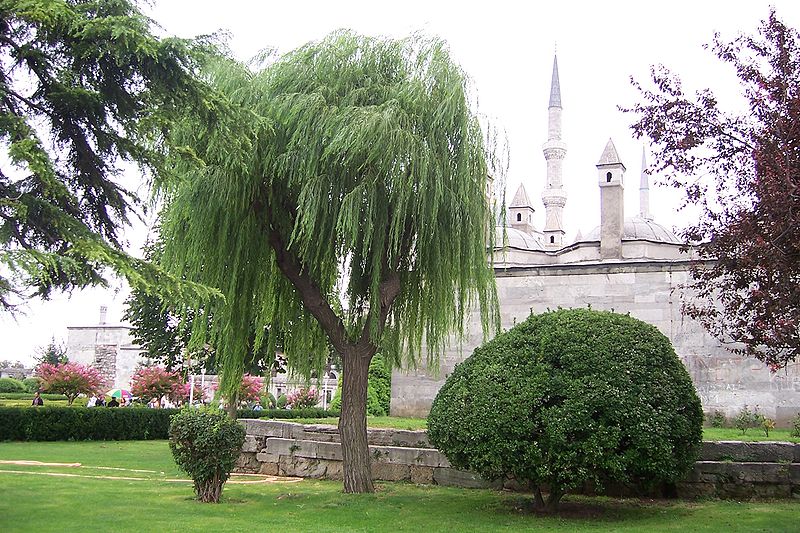
Somehow, for some reason, cuttings or seeds from these trees made their way to the west. I have read that they were moved along the Silk Road. Probably, traders from the west were charmed by the trees’ weeping branches and wanted them in their gardens. I’ve looked for pictures of Peking willows planted along the Road. The best I have found is a Peking willow in Istanbul.

Salix_babylonica in Istanbul

Not quite on the Road, which ended on the Mediterranean seaboard at Antioch or Tyre or Sidon, but close enough. And maybe one of the ways which the Peking willow entered Europe, through the Balkans.

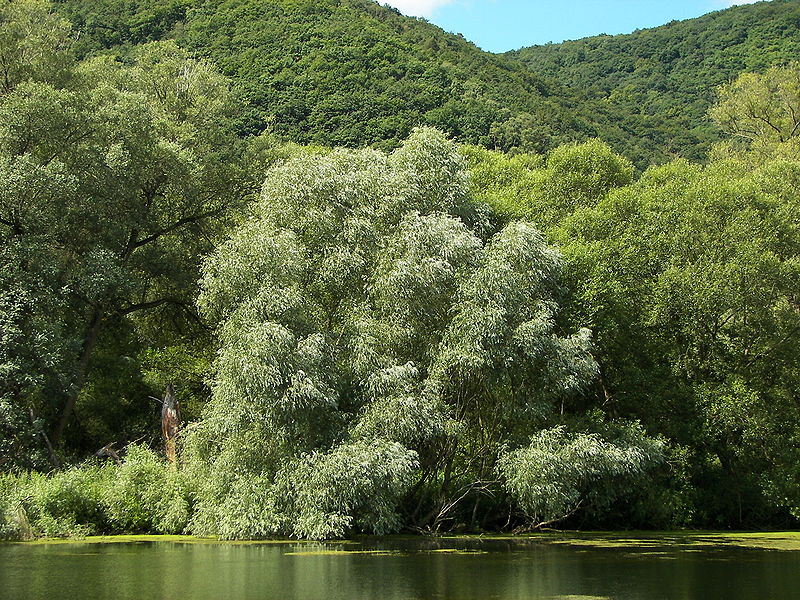
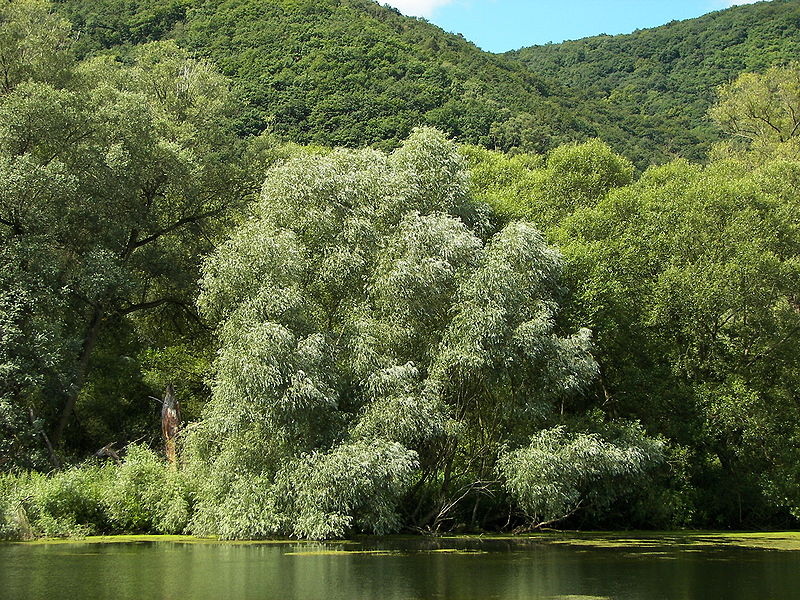
Somewhere along the way further to the west, the Peking willow was crossed with another willow, the European white willow.

white willow

The two were crossed because gardeners found that the Peking willow suffered in the more humid climate of Europe. Its gene pool needed bracing up, as it were.

So the weeping willow is half Chinese, half European.

Although my bubble of Englishness has been pricked, I’m glad to report that the weeping willow is nevertheless half brother –  or perhaps half sister – to that most English of artifacts, the cricket bat! Because these are made from the willow of a cross between the white willow and (possibly) the crack willow (the ancestry on the other side is not clear). So this allows me to insert here a picture of that most English of cricketers WG Grace holding a bat, in an ad for that most  English of condiments, Colman’s Mustard

wg grace with bat

Well, while I’m about it, I might as well also clarify another misconception. The willows by the waters of Babylon under which the Israelites wept were not willows, they were Euphrates poplars.

euphrates poplar

______________________

Tombstone with weeping willow: http://4.bp.blogspot.com/-V965riBwMQE/ThW9WsV_6gI/AAAAAAAAAA4/kGf3gW9vaZ0/s1600/%2523%2523%2523Weeping+Willow+St.+Mark%2527s+Luth+Appenzell+%25283%2529.JPG [in http://callmetaphy.blogspot.com/2011/07/symbol-of-weeping-willow-in-gravestone.html%5D
Girls weeping on tomb: http://mansionmusings.files.wordpress.com/2011/04/mourning-picture-detail.jpg [in http://mansionmusings.wordpress.com/2011/04/29/a-mansion-favorite-returns-home-abigail-walker-needlework-mourning-picture-ca-1803/%5D
Jewish psalter: http://upload.wikimedia.org/wikipedia/commons/9/97/Chludov_rivers.jpg [in http://en.wikipedia.org/wiki/Psalm_137%5D
Weeping willow tree: http://www.blogmagazine.org/wp-content/uploads/2012/05/weepingwillow.jpg [in http://www.blogmagazine.org/2012/05/admiring-the-beauty-of-the-weeping-willow/%5D
Weeping willows Grantchester: http://3.bp.blogspot.com/-3Lkrd8FlSCE/UhFK2RfkItI/AAAAAAAAGiM/v5kklmS41GE/s1600/photograph-of-weeping-willow-Byrons-Pool-Grantchester.jpg [in http://ailecphotography.blogspot.com/2013/08/day-18-august-challenge.html%5D
Weeping willows on the river Cam: http://upload.wikimedia.org/wikipedia/commons/d/da/Punting_on_the_River_Cam_-_geograph.org.uk_-_222149.jpg [in http://commons.wikimedia.org/wiki/File:Punting_on_the_River_Cam_-_geograph.org.uk_-_222149.jpg%5D
“The Wind in the Willows”: http://www.usborne.com/images/covers/eng/max_covers/the_wind_in_the_willows.jpg [in http://www.usborne.com/catalogue/book/1~CS~CSP~3249/the-wind-in-the-willows.aspx%5D
“Three Men in a Boat”: http://s3-eu-west-1.amazonaws.com/lookandlearn-preview/A/A008/A008727.jpg [in http://www.lookandlearn.com/history-images/A008727/Three-Men-in-a-Boat-by-Jerome-K-Jerome?img=2&search=Jerome+Klapka+Jerome&bool=phrase%5D
Great Western Railway poster: http://www.southernposters.co.uk/Destinations/Resources/thamesvalleylarg.jpeg [in http://www.southernposters.co.uk/Destinations/thamesvalley1946.html%5D
Peking willow, Beijing: my photo
Peking willow in Istanbul: http://upload.wikimedia.org/wikipedia/commons/thumb/7/75/Salix_babylonica.jpg/800px-Salix_babylonica.jpg [in http://en.wikipedia.org/wiki/Salix_babylonica#Horticultural_selections_and_related_hybrids%5D
White willow: http://bioweb.uwlax.edu/bio203/2011/girard_stev/maintop.jpg [in http://bioweb.uwlax.edu/bio203/2011/girard_stev/facts.htm%5D
Euphrates willow: http://mw2.google.com/mw-panoramio/photos/medium/49589465.jpg [in http://www.panoramio.com/user/1183385/tags/%D7%A0%D7%97%D7%9C%20%D7%A6%D7%99%D7%9F%5D

TOMB SWEEPING DAY

Beijing, 6 April 2014

I think it must be a universal characteristic of human beings to want to remember their dead. Perhaps it’s part of a refusal, deep down in our psyche, to accept that we die, so remembering the dead is a way to declare defiantly that we too, when we will be among the dead, will not really be dead. Whatever it is, and I’m certainly not competent to explore this side of our collective consciousness, we do have ritual days in our calendars when we are called upon to remember our dearly departed. For us in Western Europe, it’s All Souls’ Day, November 2nd.
All souls day Germany-3
For those following the Christian Orthodox tradition, it’s the Saturday of Souls, commemorated some time in Spring
Greek orthodox saturday of souls-2
For the Chinese, it’s the Qingming Festival, or tomb sweeping day. It falls on the 15th day following the Spring equinox, which this year turned out to be yesterday. The pious Beijingers flocked to the tombs of their loved ones, while the rest of us, who don’t have any tombs to sweep in the immediate vicinity, took the day off. My wife and I fall into the latter category, our parents and grandparents lying in peace (I hope) in Italy, France and the UK. Nevertheless, we thought it would be interesting to observe this Chinese festival at first-hand. So we visited a cemetery in the farther reaches of the city, arriving there after a long journey by bus and under the curious stares of the locals.

The cemetery was indeed full of people
tomb sweeping day-1
and it was fascinating to watch what they did. They burned incense
tomb sweeping day-3
As well as leaving normal flowers, they garlanded the graves with paper flowers (I suppose cheaper than real flowers, and certainly a good deal more colourful)
picture 001
They left food on the graves
picture 005
They left money (fake, alas, as we determined after surreptitiously picking up a few notes under the suspicious gaze of one of the gardeners)
tomb sweeping day-5
They paid their respects
tomb sweeping day-4-woman bowing
And even in one case we heard an old woman talking to her husband (I presume), I suppose updating him on what had been happening since she had last visited. The loneliness of old age can indeed be hard …

Well, the flowers we could relate to. After all, we do that in Europe too on All Souls Day – although the garlands of fake flowers was new to us.
All souls day Austria-2
We could also sort of understand the incense – I remember piles of incense being burned in the churches of my youth, although I never saw it used on tombs.

But the food and the money we found really strange. Especially the food. There was something almost animistic about this. It was like the ancient Egyptians who buried their dead with food for the afterlife.
bringing food to the dead egypt
Mind you, it’s not as if we don’t have our own strange cemetery habits. For instance, what I missed were the little candles which we leave on our graves in Europe
All souls day Germany-2-night
But if a Chinese were to ask me what those candles signify I would have to confess to not knowing. To keep away the bad spirits? To help God remember that they are there? To light up the darkness in which they lie?

Something else I missed was the statuary. The tombs we saw were very sober affairs.
picture 012
Compare this to the almost baroque constructions I’m familiar with, especially in Italy. Here are a few examples from the cemetery where my wife’s parents are buried
Giorno-dei-morti-Milano
statua monumentale Milano-2
statua monumentale Milano-3
From the style of these examples you might think that this was a habit of the past, but one of the tombs near my father-in-law’s has a life-size statue of a fisherman standing on it.

around nonno's grave 003

I presume the tomb’s incumbent loved fishing. Another close by, sadder to contemplate, is the statue of the young man buried there, whose life was tragically cut short.

around nonno's grave 006

My father-in-law’s tomb itself has a beautiful statuary group of angels singing in the heavenly choir.
angels with trumpets
We are going back to Milan in a few weeks to recuperate it after cremating his remains. My father-in-law has had thirty-five years of peaceful repose and now it is the turn of someone else to lie there: the iron law of increasing populations and decreasing real estate in which to rest the dead. But we’ll have the singing angels by which to remember him – and my mother-in-law, who chose the statuary’s theme. They had a common love of music. We will try to have his ashes relocated next to hers, so that after a separation of thirty-five years they can be together in death as they had been in life.

I wish I could say the same for my parents. Deaths ten years apart and the same real-estate forces which I just alluded to has meant that, after a life together, they were buried in different places. It fills me with melancholy and makes me think of Thomas Hardy’s poem In Death Divided

I shall rot here, with those whom in their day
You never knew,
And alien ones who, ere they chilled to clay,
Met not my view,
Will in your distant grave-place ever neighbour you.

No shade of pinnacle or tree or tower,
While earth endures,
Will fall on my mound and within the hour
Steal on to yours;
One robin never haunt our two green covertures.

Some organ may resound on Sunday noons
By where you lie,
Some other thrill the panes with other tunes
Where moulder I;
No selfsame chords compose our common lullaby.

The simply-cut memorial at my head
Perhaps may take
A Gothic form, and that above your bed
Be Greek in make;
No linking symbol show thereon for our tale’s sake.

And in the monotonous moils of strained, hard-run Humanity,
The eternal tie which binds us twain in one
No eye will see
Stretching across the miles that sever you from me.

I hope that, one day, I can bring them together so that finally one robin can haunt their two green covertures.

___________________________

All Souls Day Germany: http://images.fotocommunity.de/bilder/architektur/friedhoefe/allerheiligen-auf-dem-gratweiner-friedhof-1cf8be4b-d04b-430a-93e0-b3685f0f992f.jpg [in http://www.fotocommunity.de/pc/pc/display/14858389%5D
Greek Orthodox Saturday of souls: http://1.bp.blogspot.com/-Co-zt3nzWXs/T1EaVmrfyRI/AAAAAAAAAVA/M9gA4b1_m2I/s1600/%CF%83%CE%AC%CF%81%CF%89%CF%83%CE%B70003.jpg [in http://fiestaperpetua.blogspot.com/2012/03/blog-post.html%5D
Tomb sweeping day-1: http://www.wildchina.com/blog/wp-content/uploads/2010/04/pb-120404-qingming-da.photoblog900.jpeg [in http://www.wildchina.com/blog/tag/tomb-sweeping-day/%5D
Tomb sweeping day-2: http://www.fashion-bop.com/wp-content/uploads/2010/04/Tomb-Sweeping-Day.jpg [in http://www.fashion-bop.com/fashion-bop-things-about-us/tomb-sweeping-day/%5D
Tomb sweeping day-3: our picture
Tomb sweeping day-4: our picture
Tomb sweeping day-5: http://farm6.static.flickr.com/5193/7044748643_b7415e94a9.jpg [in http://easternjourney.com/2012/04/tomb-sweeping-day-2012/%5D
Tomb sweeping day-6: http://i.telegraph.co.uk/multimedia/archive/01864/Bowing_1864893i.jpg [in http://www.telegraph.co.uk/news/picturegalleries/worldnews/8429441/The-Qingming-festival-The-Chinese-honour-their-ancestors-by-sweeping-their-tombs.html%5D
All Souls Day Austria-flowered graves: http://www.mariazellerland-blog.at/wp-content/gallery/allerheiligen/allerheiligen-mariazell_1501.jpg [in http://www.mariazellerland-blog.at/allerheiligen-und-allerseelen-in-mariazell/allgemein/3588/%5D
Bringing food to the dead in Egypt: http://static.guim.co.uk/sys-images/Guardian/Pix/pictures/2010/10/11/1286794872587/Extra-British-Museum-Book-006.jpg [in http://www.theguardian.com/extra/2010/oct/11/extra-event-british-museum-book-of-the-dead%5D
All Souls Day Germany-night lights: http://images.fotocommunity.de/bilder/specials/mystische-orte/allerheiligen-am-friedhof-1436be22-b4bf-4a77-aba9-500ebdb2f3e7.jpg [in http://www.fotocommunity.de/pc/pc/display/19329266%5D
General view of Chinese cemetery: our photo
Statues cemetery Milan-1: http://www.milanospia.it/wp-content/uploads/2011/10/Giorno-dei-morti.jpg [in http://www.milanospia.it/2011/10/31/ponte-di-ognissanti-al-cimitero-di-milano-diventa-un-business/%5D
Statues cemetery Milan-2: http://farm8.staticflickr.com/7141/6655629153_17775801fa_o.jpg [in http://italia-ru.com/blog/ankh/2012/01/25/cimitero-monumentale-di-milano%5D
Statues cemetery Milan-3: http://milanosotto.files.wordpress.com/2013/08/cimitero-monumentale-scorcio.jpg [in http://milanosotto.wordpress.com/2013/08/13/il-cimitero-monumentale-di-milano-tra-storia-leggende-e-simboli-massonici/%5D
Statues cemetery Milan-4, 5 & 6: our photo