FULL OF SOUND AND FURY, SIGNIFYING NOTHING

Vienna, 29 December 2016

image
Nice, isn’t it? It’s Karlskirche, Charles Church, fronting the square of the same name, Karlsplatz, in Vienna. In this picture, the church is reflected in a large pool situated in front of it, making an even prettier picture of it all.

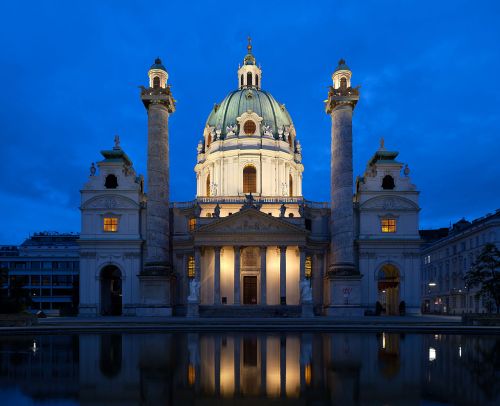
It’s also very nice-looking at night, when cleverly-placed lights dramatically illuminate the facade and dome.
image
It really looks like the backdrop of some Mozart opera.

It so happens that we pass through Karlsplatz every time we take the tram into the city centre, and I always give Karlskirche an admiring look as we pass by.

It was the Holy Roman Emperor Charles VI who ordered it to be built, in 1713, just after what turned out to be the last great plague epidemic had swept through these lands. He had it built as thanks for the pestilence having spared him and his family. He dedicated the new church to San Carlo Borromeo, Cardinal of Milan, who not only was his personal patron saint but was also revered as a healer of plague sufferers. The church was completed by 1737.

Karlskirche was built in pure Baroque style. A few quotes are in order here, to hopefully answer the question “what exactly is the Baroque style?”:
– a style “characterized by new explorations of form, light and shadow, and dramatic intensity”
– a style which “used exaggerated motion and clear, easily interpreted detail to produce drama, tension, exuberance, and grandeur”
– “Baroque architecture and its embellishments were on the one hand more accessible to the emotions and on the other hand, a visible statement of the wealth and power of the Church” (as well as of the secular Princes, I should add)

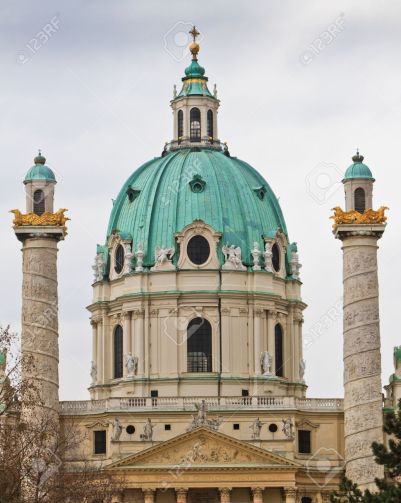
Well, Karlskirche certainly produces drama, tension, exuberance, and grandeur on the outside. We have that dominating dome with its green copper sheath, along with the two columns flanking the front.
image
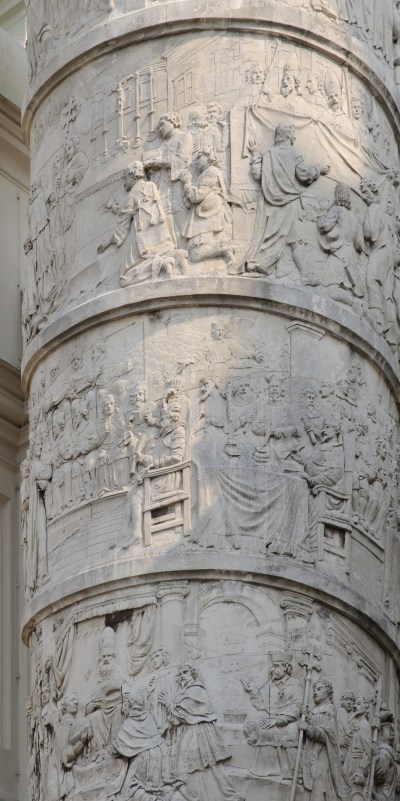
Those columns are modeled on Trajan’s column in Rome.
image
However, they substitute tales of Trajan’s victories in the Dacian wars with pious scenes from the life of that great “Prince” of the Church, San Carlo Borromeo.
image
We have the pediment crowning the front, where we see the cardinal virtues sucking up to San Carlo standing on the apex of the pediment.
image
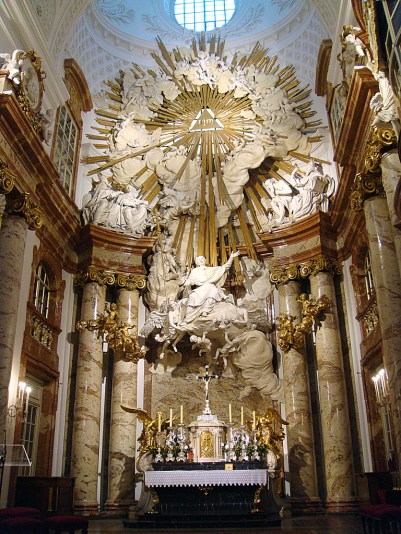
So it is in a state of high tension and of great exuberance that one enters the church – only to find oneself in a small chapel. It is really the strangest feeling: all that architectonic might and majesty on the outside, clothing a really very modestly-sized internal space.
image
Oh, I grant you, there is also dramatic intensity on the inside: the fresco in the dome, for instance
image
or the altarpiece portraying the ascension of San Carlo.
image
But the overall effect is: “Really? That’s all there is to this church? This tiddly little space?” I have to say, the only time I went in I felt quite cheated.

In the name of full disclosure, I should state at this point that I am anyway not a great fan of Baroque decoration. My general feeling about this style of art can be summed up in Macbeth’s words, “full of sound and fury, signifying nothing”. Even if the scale of the church’s interior had been on a par with the outside I probably wouldn’t have liked it. I find Baroque decoration, especially in Catholic churches, pompous and overblown. On top of that, for a religion that claims to value poverty, I find Baroque’s in-your-face glitter – gold and silver everywhere – particularly offensive. There is a toe-curling example of this blingy over-the-top quality in Baroque in Vienna’s Jesuit church, whose interior was completed some five years before Charles VI decided to have Karlskirche built.
image
All this being said, there is one example of church baroque that I have come across which I really loved, and that was in the cathedral of Saint Gall in the Swiss canton of Saint Gallen. Our visit to it was completely serendipitous. We were driving from Vienna to my parents’ house in France, and Saint Gallen happened to be a good place to stop for the night. The next morning, I decided that we should take the occasion to visit the cathedral and dragged a rather unwilling family with me. What a revelation!


There were the usual dramatic and intense frescoes on the ceiling, but the rest of the church was quite bare. Instead of the glittering gold, the marble, the overwrought statuary, we found ourselves in a space of mostly bare white walls carrying only a few highly curlicued decorations painted a lovely pale blue-green. It was so wonderful that it put me in a good mood for the next nine hours of driving and the thought of having to spend a long weekend with my parents.

The cathedral was remodeled into its current form in the 1750s-60s, so some 20-30 years after Karlskirche. That lapse of time might explain the more rococo style that was used, along with the fact that the cathedral stood at the border with Protestantism – literally, since the town that had sprung up around the cathedral and its abbey had turned Protestant while the abbey itself remained Catholic; Protestant baroque tends to be more restrained than the Catholic version.

Whatever the reason, Saint Gall Cathedral has partially reconciled me to baroque. Since that magic moment some 20 years ago when I first entered the cathedral, I have been inclined to simply grimace and shrug at excesses like those in Vienna’s Jesuit church rather than dream of taking the iconoclast’s hammer to it all. Or maybe I’m simply getting older and perhaps a little bit wiser.

___________
Karlskirche panoramic: http://www.thousandwonders.net/Karlskirche
Karlskirche at night: https://en.m.wikipedia.org/wiki/Karlskirche
Karlskirche dome: http://www.123rf.com/photo_13006441_dome-of-the-karlskirche-st-charles-s-church–vienna-austria.html
Trajan’s column: https://www2.bc.edu/~kenth/honors4.html
Karlskirche columns’ detail: https://commons.m.wikimedia.org/wiki/File:Karlskirche_column_detail_-_Vienna.jpg
Karlskirche pediment: http://www.panoramio.com/m/photo/93052486
Karlskirche interior: https://www.studyblue.com/notes/note/n/lecture-21/deck/5993225
Karlskirche dome fresco: https://www.pinterest.com/soledadvilchez/monumental-ceilings/
Karlskirche altar: https://www.flickr.com/photos/57669468@N00/3252233159
Jesuit church, Vienna, interior: https://www.flickr.com/photos/time-to-look/18903468079
Cathedral of St. Gall, interior: https://commons.m.wikimedia.org/wiki/File:St-gall-interior-cathedral_1.jpg

AMBROGIO DA FOSSANO DETTO IL BERGOGNONE

Milan, 13 December 2016

A week or so ago, I had an appointment just off Milan’s corso Garibaldi, to discuss a possible presentation that I could make on the UN’s Sustainable Development Goals and how companies could incorporate them into their CSR programmes. Since I had grossly overestimated the time it would take for me to walk there, I found myself at the meeting place with half an hour to spare. Looking around for some way to kill time, I spied a venerable-looking church across the road and decided to go and have a peek, to see what hidden treasures it might contain (every church in Italy beyond a certain age – 250 years, say – contains treasures to be discovered).

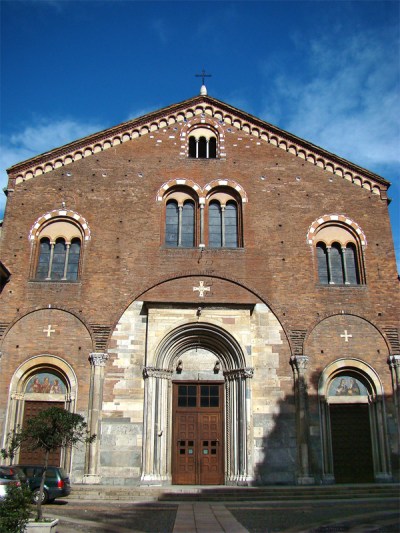
The church in question was the Basilica di San Simpliciano. As its title of basilica suggests, this is a very venerable church indeed. It was one of four basilicas wanted by the great Saint Ambrose, Doctor of the Church and bishop of Milan from 374 to his death in 397 AD.
image
Ambrose planned to have one such basilica on each of the four main roads leading out of Roman Milan.

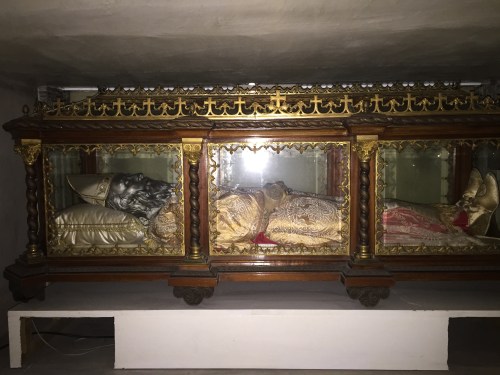
The church was completed by his successor, Saint Simpliciano, who also had himself buried here; his bones have been venerated ever since, lying under the main altar but now clothed and masked – a skeleton is not quite the thing anymore.

image

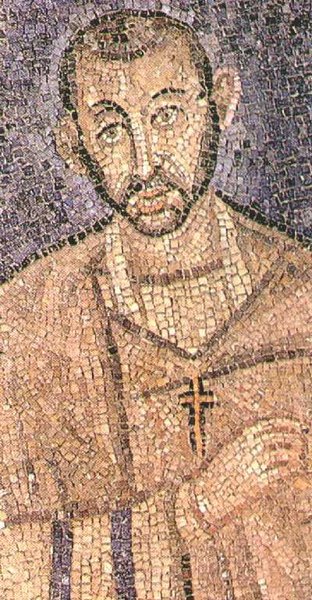
Unfortunately, very little of this original church remains. I say unfortunately because I happen to be very fond of early Christian mosaics. I’m sure the church’s interior would have been covered in mosaics like the one whose photo I give above, itself a mosaic shard which has survived because tucked away in an obscure corner of an even more venerable Milanese church, the Basilica di Sant’Ambrogio. Cluniac Benedictines took over San Simpliciano in the 800s, and by the 1200s they had completely renovated the church in the styles then all the rage, Romanesque with a little bit of early Gothic. These styles have stamped themselves on the church’s exterior appearance.
image
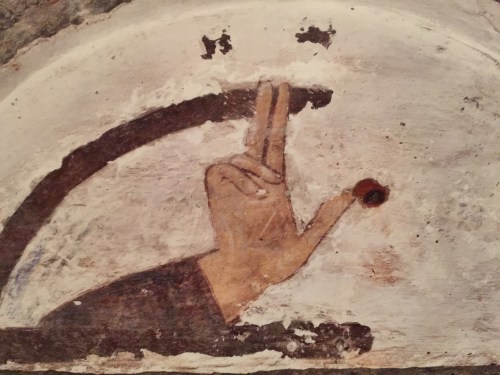
Unfortunately, hardly anything remains of this period’s internal decorations. One imagines that the walls would all have been frescoed; all that is left is this hand raised in benediction, tucked away in some obscure corner of the church.
image
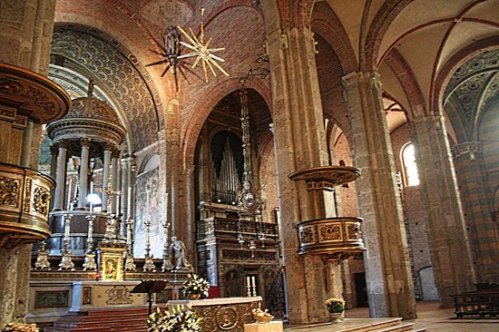
Thereafter, with each passing artistic phase various alterations were made, in the process destroying the harmony of the whole. Here, for instance, a side chapel in the Baroque mode was added.

image

To all this was added more obvious vandalism. The church and the adjoining cloisters were turned into barracks by the occupying troops of Revolutionary France; no doubt the church was turned into stables for the troops’ horses (a fate common to many churches, it would seem). I’m sure the French soldiers would have taken pleasure in destroying the church’s decorations, much as ISIS troops have taken pleasure in sledgehammering and dynamiting every non-Islamic work of art that has fallen under their control, and much as Mao’s Revolutionary Guards took pleasure in smashing anything they could lay their hands on from Old China. But bad as all this was, the nadir for San Simpliciano was the 1820s, when some artist who will remain unnamed stuccoed over everything and painted scenes of a painfully sucrose sentimentality – one side chapel in this style has been kept.
image
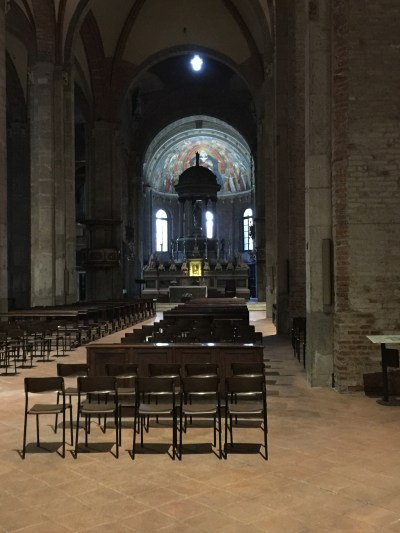
After the Second World War, it was decided that there was nothing left to do but to strip more or less everything away, down to the brickwork. This has given the church a certain rough simplicity, very pleasing to the eye (to mine at least).
image
We have to remember, though, that this is a very modern style. None of the original builders or later fiddlers would have dreamed of maintaining such a naked simplicity. Churches were built to demonstrate the glory of God, and naked brickwork definitely didn’t make the cut.

All this I learned from some posters tucked away in a corner (so tucked away that I nearly missed them). I knew none of this on entering the church. What immediately struck me instead was the fresco in the apse behind the main altar.

image
Even though it was much obscured by the 1820s main altar (something that was already fiercely criticized when the Artist who will Remain Unnamed installed it), its brilliant blues and reds amid all that raw brick jumped out at me and beckoned me to come closer. Which I did, threading a passage between the main altar and the outer walls of the church. The view was well worth the threading.
image
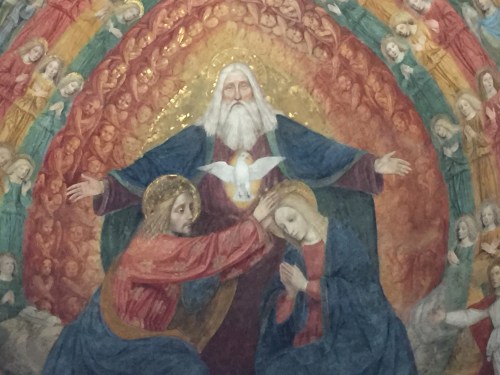
It is a fresco (I later learned from the posters) from 1508 celebrating the Incoronation of the Virgin Mary, painted by il Bergognone (or, to give him his full name and title, Ambrogio da Fossano detto il Bergognone). We see Mary, meek and mild, being solemnly crowned by her son Jesus, God the Son, in a ceremony presided over by God the Father and God the Holy Spirit, within a rainbowed arc of seraphims, cherubims and angels

image

and with saints and others laypersons (no doubt donors and other Very Important Persons) looking on.

image

Thank goodness it was placed high off the ground, otherwise those French revolutionary soldiers would no doubt have destroyed it. With my heart well warmed by its beauty, and my mind well primed by the posters, I hurried back to my meeting, arriving a little breathless but just on time.

I have to say, Bergognone is not a painter that I am at all familiar with. In writing this post, I have mugged up on him a little. He was active primarily in Lombardy, and although works of his have leaked out to many major museums in the western world the bulk of his output is still to be found in and around Milan. Since Saint Ambrose initiated my description of San Simpliciano, let me throw in here a painting Bergognone made of that saint

which hangs in Pavia’s monastery complex, the Certosa.
image
Bergognone was particularly active in the Certosa di Pavia. My wife tells me we have visited it, but I have no memory of doing so (a situation which is becoming alarmingly common). I think I will add it to my ever lengthening list of places around Milan which we will go and visit, once Spring beckons us forth like hibernating bears from the apartment.

_______________
Photos: mine, except the following
Saint Ambrose mosaic: https://it.m.wikipedia.org/wiki/Sant%27Ambrogio
San Simpliciano exterior: https://it.m.wikipedia.org/wiki/Basilica_di_San_Simpliciano
San Simpliciano interior: https://www.tripadvisor.it/LocationPhotoDirectLink-g187849-d1899819-i87445764-Basilica_di_San_Simpliciano-Milan_Lombardy.html
San Simpliciano Bergognone fresco overview: http://www.italiamedievale.org/sito_acim/contributi/simpliciano.html
Bergognone’s Sant’Ambrogio: https://forum.termometropolitico.it/274962-7-dicembre-s-ambrogio-vescovo-e-dottore-della-chiesa.html
Certosa di Pavia: http://www.pavialcentro.it/monumentos/monastero-della-certosa-di-pavia

A WALK FROM ONE SAINT TO ANOTHER

Sori, 10 December 2016

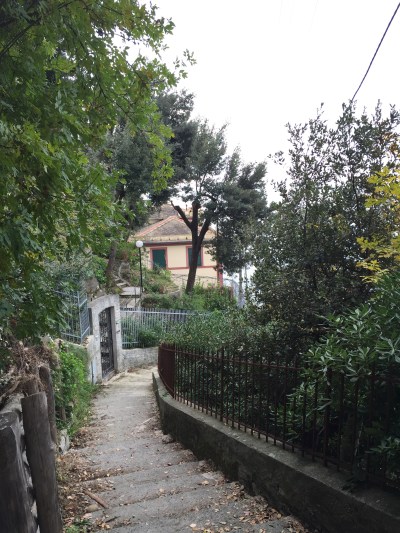
We started in San Rocco, which is perched on a rocky spur high above Camogli.

image
The last time we visited it, we huffed and we puffed our way up the old mule track that snakes its way up from Camogli. This time, we took it easy; we took the Recco-Rapallo bus and hopped off at Ruta, which lies on the saddle between Camogli on one side of Monte di Portofino and Santa Margherita on the other, and took another little bus from Ruta to San Rocco.

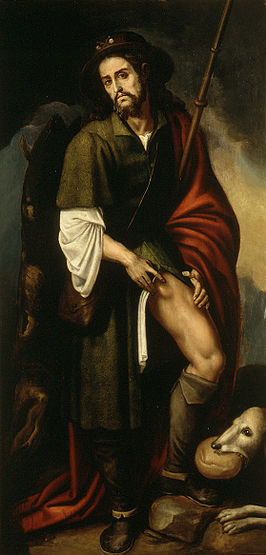
A little aside on the lives of obscure saints: San Rocco, known in English – if at all – as Saint Roch (I found traces of a couple of British churches named after him), lived in the late 1200s, early 1300s, dividing his time between what is now southern France and northern Italy. He is the patron saints of dogs and bachelors (a strange combination) and was especially invoked in times of the plague – hence this painting of the saint pensively pointing to a plague bubo on his leg.
image
In any event, fresh from our relaxing bus drive, and fortified by a cappuccino and a slice of focaccia, we set off down the path which led to Punta Chiappa, a low rocky ledge jutting out into the sea at the furthest reaches of Monte di Portofino. The idea was to have lunch in a restaurant down at the water’s edge just before Punta Chiappa and, suitably fuelled up, toil our way back up to San Rocco. We started losing height through a series of long flights of steps
image
we wended our way through woods
image
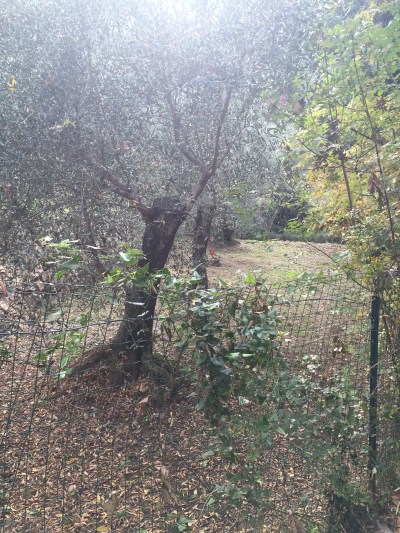
through which struggled a few remaining olive groves.
image
We finally arrived at San Nicolò, a small collection of houses clustered around a pretty little 12th Century church.
image
The original monks who had ministered to the small community of fisherfolk clinging on to this steep hillside finally moved away in the face of continuing depredations by Barabary pirates (I suppose church plate was considered good loot) and the church fell into disuse. Recently, suitable renovations have been undertaken, although there was little left of the original decorations to restore.

Another quick aside on the lives of obscure saints: San Nicolò, Saint Nicholas in English, lived at the juncture of the 3rd and 4th centuries. He was a bishop in Asia Minor and was famous for working miracles (he seems to have been particularly good at this). Of relevance to this story, he is the patron saint of sailors and fishermen.
image
But he also is responsible for a whole host of other professions including coopers, archers, pharmacists and – somewhat bizarrely – broadcasters. Somewhere along the line, no doubt because he is the patron saint of children, this very worthy saint morphed into that very heathen Santa Claus.

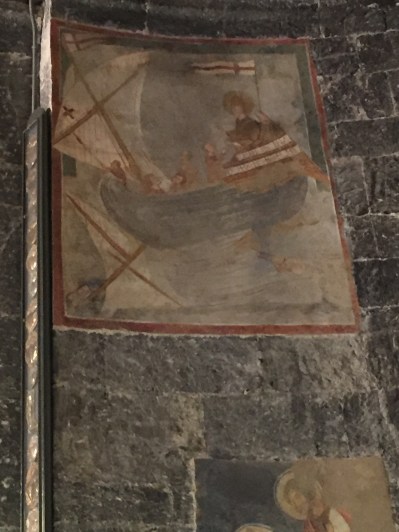
One of the few fragments of the original decorations left is this piece of fresco.
image
It shows St. Nicholas saving two sailors from drowning as their ship founders: that nightmare of all sailors and the subject of famous paintings
image
as well as a myriad of humbler ex-votos, normally dedicated as in this case to Mary in her role as Stella Maris, Star of the Seas.
image

I am moved to insert here those lovely lines from T.S. Eliot’s “The Wasteland” in the short section of the poem entitled Death by Water:

Phlebas the Phoenician, a fortnight dead,
Forgot the cry of gulls, and the deep sea swell
And the profit and loss.
A current underseas
Picked his bones in whispers. As he rose and fell
He passed the stages of his age and youth
Entering the whirlpool.
Gentile or Jew
O you who turn the wheel and look to windward
Consider Phlebas, who was once handsome and tall as you.

From San Nicolò, we got the first good view of the Golfo di Paradiso, the woods having obscured the view in the upper reaches of the walk.
image
Hunger drove us on. We dropped still further towards the sea,
image
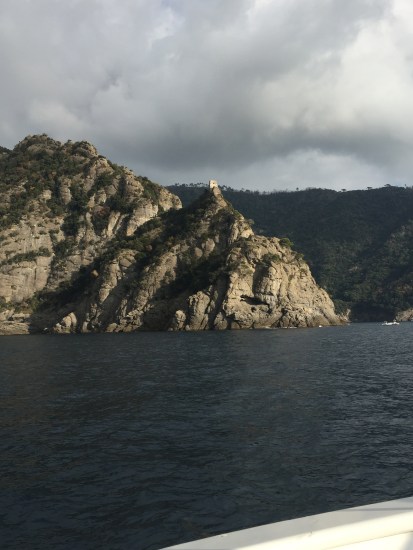
finally reaching the restaurant. Alas! Contrary to what we had been assured in the café where we took our morning cappuccino and focaccia, it was closed. We were mournfully counting the tangerines we had brought with us and reckoning on the number of stairs we would need to climb to get back to San Rocco on a nearly empty stomach when we saw a boat coming in to dock. We hurried forward and discovered that by sheer serendipity we had arrived just in time to catch the boat to San Fruttuoso, from whence we could get a boat back to Camogli! Light of stomach, but also light of heart, we hopped on, took a seat, and admired the passing views as we rounded Punta Chiappa
image image
motored past forbidding headlands
image
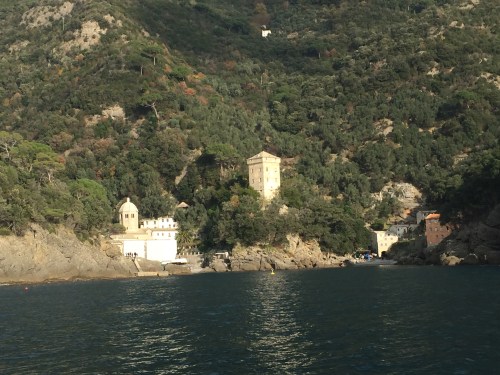
until the small fort protecting San Fruttuoso hove into sight,
image
where we turned into San Fruttuoso’s bay and chugged in towards the village itself.
image
image

image

Calling this a village is perhaps a bit of an exaggeration, composed as it is of the ancient abbey (currently under renovation)
image
a somewhat less ancient watchtower
image
and a few fishermen’s houses clustered in between.

It’s a charming site, much frequented in the summer by people who come to lie on the beach (as it was when we visited it, during a long weekend). We took the easy way in, but hardier folk can take one of a number of paths crisscrossing Monte di Portofino which pass through San Fruttuoso. Well rested and after eating our meager cache of tangerines I went off to visit the Abbey while my wife read her book on the beach.

A final note on the lives of obscure saints: San Fruttuoso, Saint Fructuosus in English (a saint so obscure in the English world that I could find no church named after him), was a bishop of Tarragona in Spain in the second half of the third century.
image
His main, in fact his only, claim to fame was that he was martyred during the reign of the Roman Emperor Diocletian. He is so obscure that no group has claimed him as their patron saint, which is a bit sad. Given his name, makers of fruit juices could perhaps apply …

How an abbey in Italy got to be dedicated to him is a bit of a mystery. The story goes that when the Vandals invaded Spain some monks from Tarragona, anxious that his remains not be despoliated, carried them off by sea. After a certain amount of wandering around the Mediterranean, they ended up on the Monte di Portofino. I find the story to have a lot of holes in it, but hey, who am I to question its veracity? Suffice to say that the Abbey grew quite wealthy from donations of land. Wealth put it in the sights of the Barabary pirates. Like San Nicolò, it went into decline after repeated depredations and was eventually abandoned.

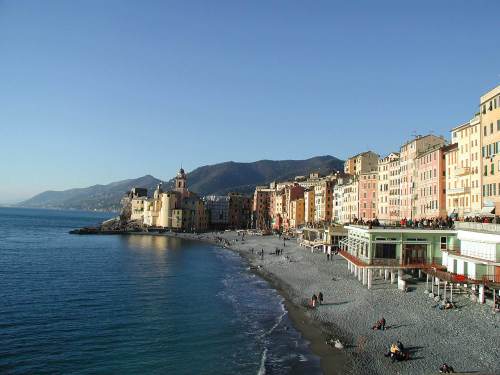
In the early afternoon, our return boat docked. We piled in and returned to Camogli
image
for a well-deserved late lunch of focaccia al formaggio.

image
______________

All photos: mine, except as follows

San Rocco: https://commons.m.wikimedia.org/wiki/File:Camogli-chiesa_di_San_Rocco_(Ruta)-DSCF0645.JPG
Saint Roch: https://en.m.wikipedia.org/wiki/Saint_Roch
Le radeau de la méduse: https://fr.m.wikipedia.org/wiki/Le_Radeau_de_La_Méduse
Ex-voto shipwreck: http://www.ottante.it
Saint Nicholas: http://aristidhmilaqi.blogspot.it/2011/06/saint-nicholas-patron-saint-of-sailors.html?m=1
Saint Fructuosus: https://en.m.wikipedia.org/wiki/Fructuosus
Camogli: http://www.cepolina.com/Camogli-sea-beach.html
Focaccia al formaggio: http://www.italianbotanicalheritage.com/it/scheda.php?struttura=499

POLITICALLY-CHARGED PUBLIC ART

Milan, 4 November 2016

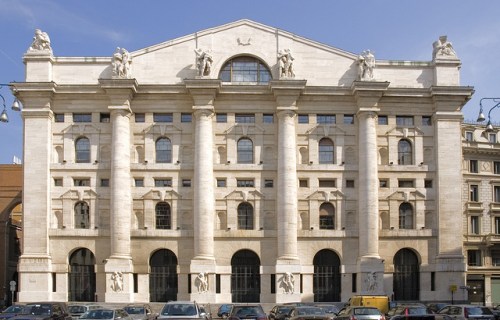
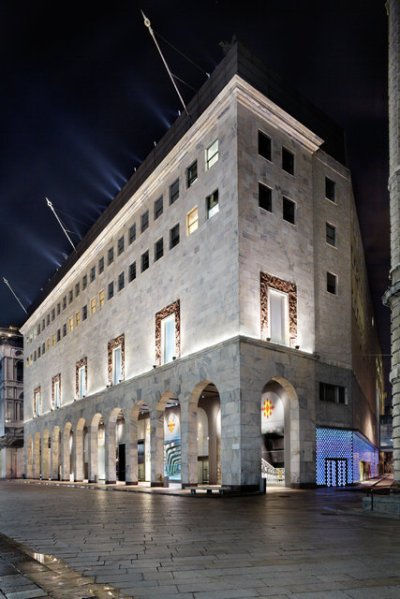
There is a quiet square not too far from where my wife and I live in Milan which goes by the name of Piazza Affari. As the name suggests, this is meant to be the pulsating business and financial centre of Milan. That certainly was the idea when the square was fashioned back in the early 1930s by demolishing a whole block of buildings in front of the just completed stock exchange, the Palazzo Mezzanotte.
image
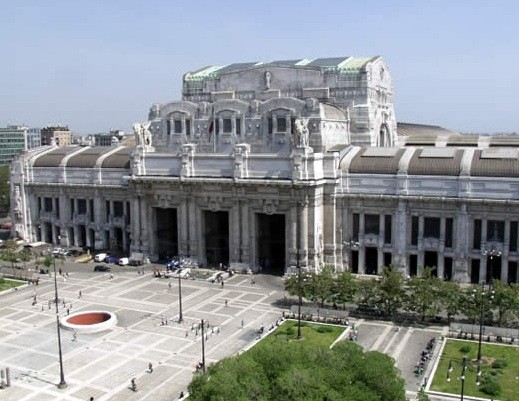
This quite handsome building clad in white travertine is often considered “typical” Fascist architecture because of when it was constructed, but in truth it is actually a nice exemplar of the Italian architecture of the turn of the century, most famously exemplified by Milan’s main train station.
image
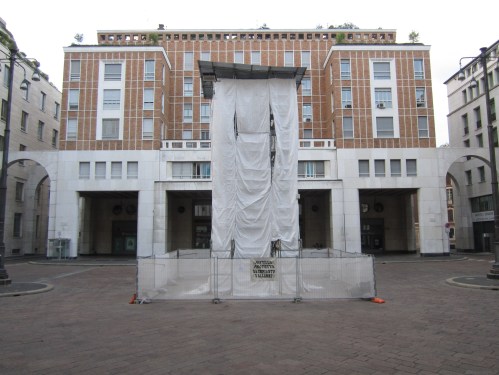
Another building opposite the stock exchange, finished in 1939, closed off the new square.
image
Well, the war came and went, this corner of Milan survived the intense Allied bombing of the city, Fascism fell, and life went on. Then, in 2011, as part of a plan to make Milan a centre of contemporary art, the-then municipal government wanted to hold an exhibition of the works of Maurizio Cattelan, a famous Italian contemporary sculptor well known for satirical sculptures. As part of the deal, the city commissioned an outdoor work from the artist. After some back and forth, it was decided to place the piece in Piazza Affari and Cattelan came up with this.
image
Of course, everyone immediately decided that the artist was giving the finger to Italy’s financial sector – this was a few years after the near meltdown of the banking sector worldwide, whose impacts on the Italian economy were then still being felt (and continue to be felt). The denizens of the stock exchange hated it, everyone else loved it. What was meant to be a temporary exhibition has turned out to be permanent. It has been pointed out, and the photo above shows it clearly, that the hand is not actually giving the finger to the stock exchange but, if anything, to the anonymous building on the other side of the square. And the artist himself has said that the sculpture was actually a commentary on the fall of Fascism – some complicated explanation to the effect that the hand really represents the Fascist salute, and the chopped-off fingers represent the fall of Fascism; its positioning in front of a building seen as Fascist is what links it to Fascism. Others have commented that this finely sculpted hand (look at those veins!) in lovely white marble, in a square with its vaguely Roman look (look at those arcades attached to the 1939 building), reminds them of a De Chirico painting.
image

None of this matters. What is important is what people think. And people think the finger is being given to all those goddamned bankers who screwed all of us over, and they cheer the artist on.

Statuary in public places has always excited intense emotions. Staying in the world of white marble, consider the statue of the naked Alison Lapper, a British artist born without arms and only stubs of legs, and eight months pregnant when the statue was made.
image
In 2005, this statue was placed as a temporary exhibit on the fourth plinth at Trafalgar Square in London, which has been empty ever since the square received its current look back in the 1830s.
image
Many people hated it (because it was ugly; did those who said this realize the judgement they were passing on handicapped people?), many people loved it (because of its optimistic message about the handicapped and because it brought handicapped people more into the mainstream). A much larger replica was used in the opening ceremonies of the 2012 London Paralympic Games.
image
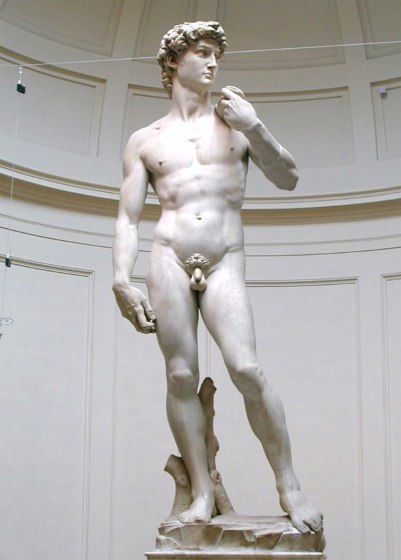
But what about that granddaddy of white marble statuary, Michelangelo’s David?
image
(another statue, I note in passing, with lovely hands)
image
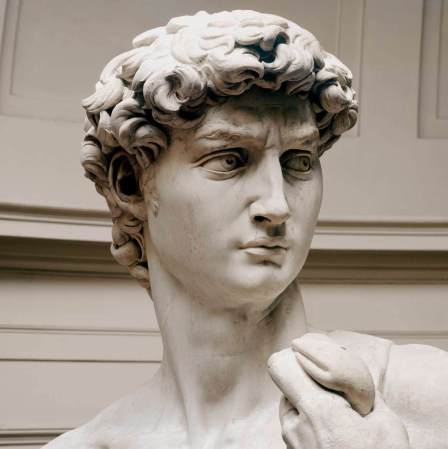
Today, we look at it simply as a glorious work of art, but at the time of its unveiling it was also a highly charged political statement. Already, David had a special place in the heart of the Florentines. They identified with the puny boy who destroyed the huge, nasty Goliath (seen to represent Rome, the French, the Holy Roman Emperor, or any other power threatening it at any particular moment in time). A committee of notable artists, including Da Vinci and Botticelli, was charged with deciding on its emplacement. They chose to have it stand in Piazza Signoria, at such an angle that the statue glared defiantly towards Rome.
image
A statue whose unveiling in 1992 had particular resonance for me was that of Sir Arthur “Bomber” Harris, commander-in-chief during the Second World War of Britain’s Bomber Command.

As the picture shows, it is the typical statue of some Worthy Person which dots every public space in Europe, nothing terribly exciting artistically. But Bomber Command was the group responsible for the so-called area bombing during the War which wiped out entire German cities, many of no military value. Dresden is perhaps the best known.
image
There are many people, and I include myself among them, who believe that these bombings were a crime against humanity, so I have difficulty feeling any disapproval for the person who did this to Harris’s statue.
image
To be fair to Harris, he was not the only person in high circles (Winston Churchill included) who thought that area bombing was a good idea, but he implemented the plan with particular relish.

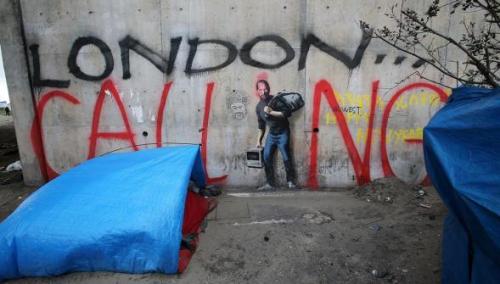
The placement of politically-charged art in public spaces continues. Banksy’s painting in the Calais “Jungle” of Steve Jobs as an immigrant trying to get in shows this.

In a rare statement on any of his art, Banksy commented that he wanted to remind people of the value of immigrants. If Jobs’s father, an immigrant from Homs in Syria, hadn’t been let into the US we wouldn’t have Apple. In this day and age of heated debates, especially in Europe, about refugees and how many to let in, Banksy has very publicly taken sides. It’s a pity that his high mindedness has been subverted, first by an entrepreneurial inhabitant of the Jungle demanding to be paid 5 euros to view the painting and then by a nihilistic vandalizing of the painting.
image
I presume that the vandalizer was doing no more than celebrating The Clash’s third album. Such is life.

Let’s see what this year will bring us in politically-charged statuary.

____________
Palazzo Mezzanote: http://www.newsly.it/braxit-ultime-notizie-borse-europee-in-rialzo-scommettono-sul-si-1
Stazione centrale: http://www.milanoguida.com/visite-guidate/altri-monumenti-milano/stazione-centrale-milano/
Palazzo on other side: https://ripullulailfrangente.wordpress.com/2012/08/24/ancora-per-milano-al-mattino-presto-targhe/
Il dito: http://www.manageronline.it/articoli/vedi/3359/il-dito-medio-in-piazza-affari/
Giorgio de Chirico: http://www.beniculturali.it/mibac/export/MiBAC/sito-MiBAC/Contenuti/MibacUnif/Eventi/visualizza_asset.html_1741131230.html
Alison Lapper statue: http://www.arupassociates.com/en/projects/trafalgar-square-fourth-plinth/
Alison Lapper statue close-up: http://albertis-window.com/2014/01/
Alison Lapper statue Paralympic Games: http://www.goodtoknow.co.uk/wellbeing/galleries/34626/london-2012-paralympic-games/41
David: https://www.pinterest.com/pin/430234570629286662/
David’s hand: http://www.accademia.org/explore-museum/artworks/michelangelos-david/
David’s head: https://www.pinterest.com/almetrami/renaissance-david/
Sir Arthur Harris: http://www.fotolibra.com/gallery/1172664/sir-arthur-harris/
Dresden bombed: http://www.ibtimes.co.uk/dresden-bombing-70th-anniversary-interactive-then-now-photos-show-scale-destruction-1487817
Harris statue defaced: http://www.dailymail.co.uk/debate/article-2166966/PETER-HITCHENS-The-heroes-Bomber-Command-deserve-memorial–unlike-butcher-led-them.html
Banksy’s Steve Jobs: http://edition.cnn.com/2015/12/11/europe/banksy-steve-jobs-graffiti/
Banksy’s Steve Jobs defaced: http://www.zeroviolenza.it/component/k2/item/74240-alto-4-metri-e-lungo-un-chilometro-il-nuovo-muro-antimigranti-è-a-calais

SAINT RADEGUND

Vienna, 19th September 2016

There is a small street which gives on to Piazza Duomo in Milan, which goes by the name of via Santa Radegonda. It’s a very modest, narrow, little street, really quite boring. Its main claim to fame is that it runs alongside the posh department store La Rinascente.

image
But I like the street, for the quite frivolous reason that I like the name. Radegonda, Radegund in the original German: now that’s a girl’s name with some whoomph to it! Not like Amelia, or Olivia, or Emily, which are currently some of the most popular names for little British girls.

This particular Radegund was a 6th Century princess from Thuringia, in what is now central Germany. Her life story was as colourful as her name. Her father, Berachtar, was one of three kings in Thuringia. Her uncle, Hermanfrid, one of the other Thuringian kings, killed her father in battle, took over his part of the Thuringian lands, and while he was at it took Radegund into his household. Hermanfrid then made a deal with the Frankish king, Theuderic, to share sovereignty of the whole of Thuringia, subject to material aid from Theuderic. Having sealed the deal, Hermanfrid attacked, defeated, and killed the third king of Thuringia, his brother Baderic. He then promptly reneged on his agreement with Theuderic. Not surprisingly, Theuderic sought revenge of this perfidy. Together with his brother Chlothar, he defeated Hermanfrid and took over Thuringia. In the ensuing carve-up, Clothar took charge of Radegund and brought her back to Gaul. All this happened before Radegund was 11, by the way.

Clothar packed Radegund off to one of his villas until she was of a more marriageable age. When she was 19 or so, he married her himself. No doubt it made his claims to Thuringia stronger to have her as his wife. She joined Clothar’s five other wives – Guntheuca, Chunsina, Ingund, Aregund, and Wuldetrada – in what may, or may not, have been a cozy concubinage. In any event, she bore Clothar no children.

By the time Radegund was 30, her only remaining brother was the last surviving male member of the Thuringian royal family. Presumably to head off any pesky competing claims to the Thuringian lands, Clothar had him murdered. At which point, either because she feared for her own life or because she was fed up with all this mayhem, Radegund fled and sought the protection of the Church, eventually founding, when she was about 40, a nunnery in Poitiers. Initially, Clothar tried to get her back but eventually left her alone and focused on expanding his lands at the expense of all those around him, including his brothers (although he had the grace not to kill them to obtain his ends, good manners which did not extend to their sons). By the time he died, he was master of a kingdom stretching from the Pyrenees to Thuringia, and from Brittany to French-speaking Switzerland.

All these Franks and Thuringians may have been a lying, traitorous, murderous lot, but they had wonderful names. This all rather reminds me of my Favourite History Book, 1066 And All That, my copy of which recently came to light, among many a delighted cry on my part, from the storage box in which it has been lying these last seven years.
image
In that book, we are reminded that Anglo-Saxon England was peopled with persons carrying wonderful names:

“Wave of Egg-Kings

Soon after this event Egg-Kings were found on the thrones of all these kingdoms, such as Eggberd, Eggbreth, Eggfroth, etc. None of them, however, succeeded in becoming memorable except in so far as it is difficult to forget such names as Eggbirth, Eggbred, Eggbeard, Eggfish, etc. Nor is it even remembered by what kind of Eggdeath they perished.”

The authors were exaggerating, but not by much.

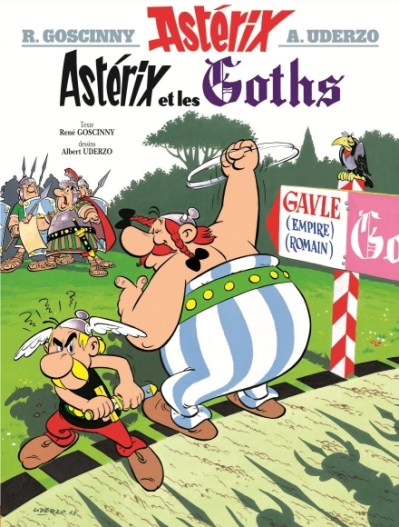
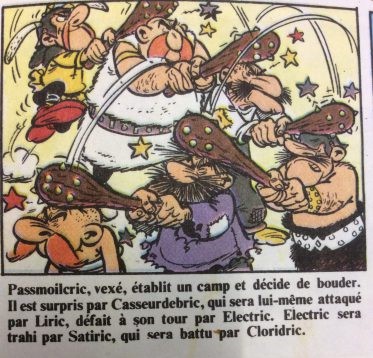
The murderous goings-on around Radegund also remind me of that other Great Source of Early European History, Asterix. In the album Astérix chez les Goths
image
the endemic fighting among the Germanic tribes is well captured.

(Please note the authors’ take on Gothic names – they exaggerate but not by much)

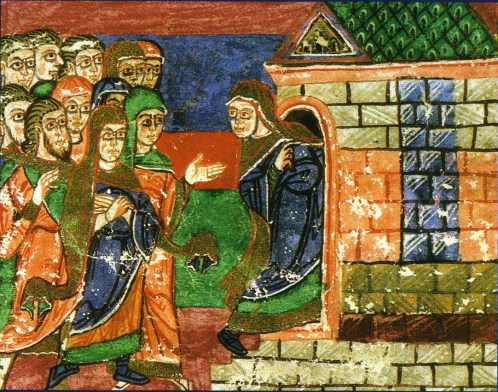
But I digress, and I think my wife feels I’m letting my childish side get the upper hand here. Let us focus on the saintly Radegund. Already when queen, she was noted for her almsgiving. Once a nun, she cared for the local lepers and other infirm of Poitiers. She was also known for eating nothing but legumes and green vegetables: no fish, no eggs, not even fruit. I’m sure the vegans of today would approve (although even they might find her decision to forswear fruit a trifle extreme) but to the meat-eating Germanic elites, who spent much of their time hunting, this must have been pretty weird. Here is the most ancient representation of this saintly lady that I found, from a 10th-11th Century manuscript in the Municipal library of Poitiers, where we see Radegund getting herself to the nunnery (to misquote Hamlet).
image
As far as I can make out, though, her main claim to religious fame, at least in the Dark and Middle Ages, is that the Byzantine Emperor Justin II gave her a fragment of the True Cross. I hasten to add that he did not do so because he was much taken by Radegund’s saintliness. It was, I’m afraid, a purely political maneuver. Justin wanted to wrest control of the north of Italy from the barbarian Lombards, but for this he needed the help of the (equally barbarian) Franks. The relic, given to an ex-wife of the Frankish king who, though, was still on friendly terms with said king, was the bribe, or, to put it more kindly, the bait. Whatever the reason, the relic which Justin handed over to Radegund was a Really Good relic, and any Medieval religious institution with a Really Good relic was sitting on a goldmine as the pilgrims poured in and spent their money locally. This no doubt was the happy fate of Poitiers, helped along by the fact that Radegund was widely believed to have the gift of healing. Indeed, several miracles around her tomb greatly helped to increase the pilgrim traffic. The result was the building of a church which is a combination of Romanesque and Angevin Gothic styles.
image
Sadly, the vicissitudes of history, and more specifically a sack by Huguenots in the 16th Century and the ravages of the French Revolution, combined with some heavy-handed restoration in the 19th Century, has scarred the original splendour.

The pilgrim traffic to Poitiers had the happy side-effect of carrying Radegund’s name far and wide as the pilgrims returned home, and new churches and other religious institutions sprang up all over Europe dedicated to her name. This was certainly the case in Milan, where on the site on which now stands that temple to consumerism, La Rinascente, there once stood a nunnery dedicated to Santa Radegonda. No trace of this nunnery remains today save in the name of that modest, narrow, little street which I like so much.

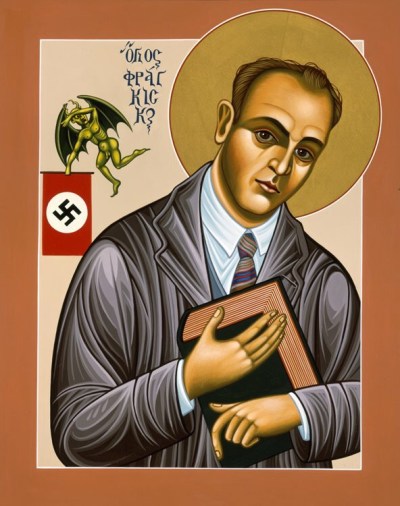
I give just one further example of the many places in Europe which adopted her name, and that is the small village of Sankt Radegund in Upper Austria. In the next few years, readers will see a new film come out, with the title “Radegund”. It is the story of Franz Jägerstätter, a native of Sankt Radegund, who was the only one in his village to vote against the Anschlüss and was courageous enough to be a conscientious objector during World War II.
image
My readers will no doubt convene that this was a dangerous thing to declare oneself to be under the Nazi regime, and in fact Jägerstätter ended up being guillotined in 1943, for the crime of “undermining military morale”. The recent (German) Pope, Benedict XVI, had Jägerstätter beatified: a more appropriate saint for our age, I think.
image
Yesterday afternoon, I noticed that behind Milan’s Duomo there is a small road called via Santa Tecla. What an interesting name! I wonder who she was?

__________________
La Rinascente: http://www.nytimes.com/2014/12/25/fashion/in-milan-with-handbags-and-tongs-under-one-roof.html?_r=0
Clothar I: http://www.pearltrees.com/sirius84/francs-merovingiens/id9615614/item93489971
“1066 And All That”: http://rogerandfrances.eu/books/1066-and-all-that
“Asterix chez les Goths”: http://www.asterix.com/the-collection/albums/asterix-and-the-goths.html
Goths fighting: my photo
Radegund entering nunnery: https://en.m.wikipedia.org/wiki/Radegund
Eglise Sainte-Radégonde, Poitiers: https://www.poitiers.fr/c__244_788__Poitiers_capitale_romane.html
Franz Jägerstätter: http://voiceseducation.org/content/franz-jagerstatter-austrian-world-war-ii-resistance
Icon with Franz Jägerstätter: https://en.m.wikipedia.org/wiki/Franz_Jägerstätter

GOLD

Mandalay, 3 August 2016

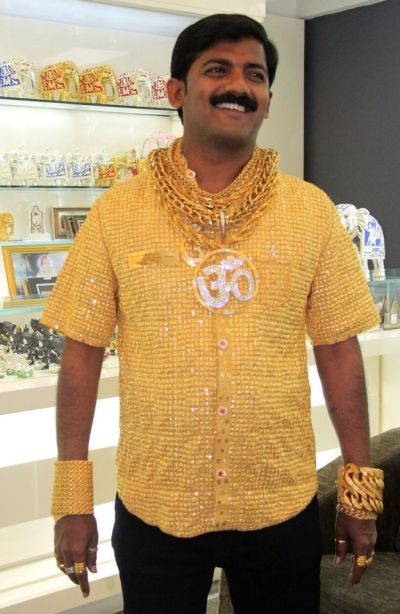
A few weeks ago, I read of the death of an Indian money-lender, murdered by a couple of people to whom he owed money. It was a banal and sordid murder, no different from the hundreds of banal and sordid murders which occur every day the world over. If this particular one was splashed all over the front pages of many newspapers, it was because the unfortunate victim had earlier shot to global fame for purchasing … a shirt made of gold (an idea, I have to say, which I find pretty bling).
image
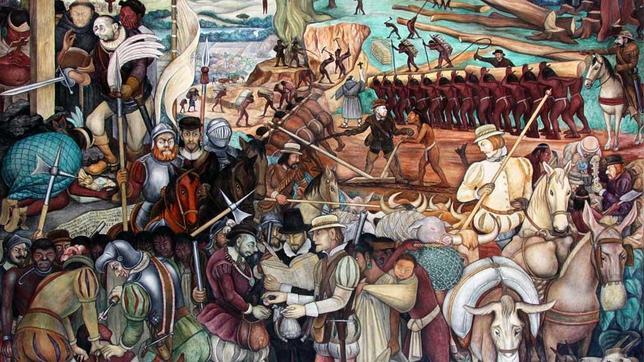
Ah, gold! That lovely, soft, malleable metal, which never rusts, which glows yellow like the sun. Which has been lusted after by so many through the ages. It sent the Conquistadors sailing half way round the globe to an unknown world, not to understand it but to rip the gold out of its heart.

image
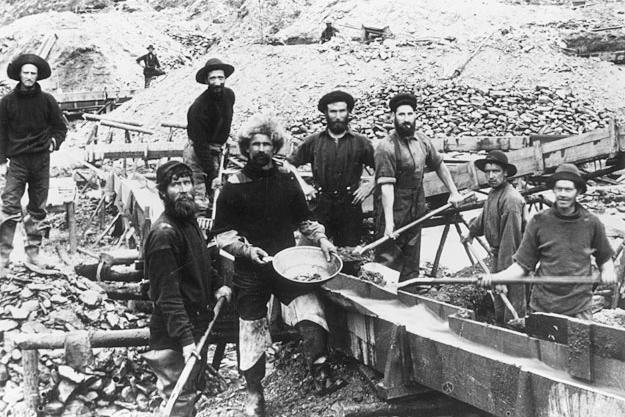
It has sent hundred of thousands running to the ends of the world to feverishly pan it out of water or to hack it out of the ground
image
a gold fever which even today strikes men (but also now women).


But gold has also inspired artisans for at least six thousand years to make beautiful, beautiful objects. It is these lovely creations which I wish to celebrate today, not the ugly side of gold.

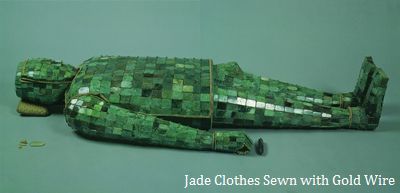
Given where this post started, my first inclination was to search on the Internet for examples of powerful potentates from the past who were discovered by archaeologists buried in shirts or tunics of gold. Alas, I found none, whether because my surfing skills are not up to the task or because even kings of old found this idea really too bling, or because archaeologists simply haven’t stumbled across such cases yet. The closest I got to it was jade burial suits used during China’s Han dynasty by members of the royal family; in some cases, the jade pieces of the suit were sewn together with gold wire.
image
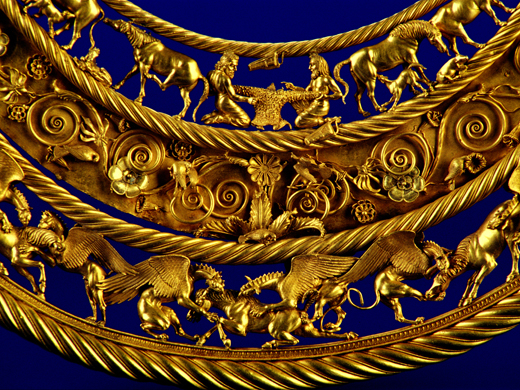
But as I surfed the internet, looking for gold shirts from faraway times, I stumbled across a treasure hoard of ancient gold pieces, some found buried with kings, princes, and their consorts, others buried for safekeeping by their owners who, for some reason, never returned to reclaim them. For instance, I was completely smitten by some of the gold work that archaeologists have found in various Scythian royal tombs in Southern Russia, Ukraine, and the Caucasus region more generally. Look at this pectoral, from the 4th C BC!
image
Here’s a detail – see how fine the work is!
image
Or how about these two vessels, also from the 4th C BC. They were apparently a pair, with this one
image
sitting on top of the other.
image
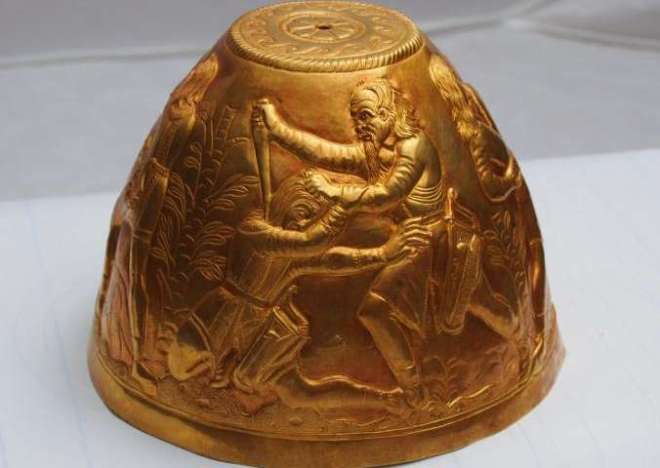
Or this bowl, from more or less the same period.
image
Or this comb, from slightly earlier, late 4th C BC, early 5th C BC.
image
The articles I’ve read about these pieces suggest that they were not actually made by the Scythians but by Greeks, living perhaps in the Crimean region. Fair enough, but this Scythian deer plaque, from the 7th C BC, was surely locally made
image
as was this belt buckle from the same period.
image
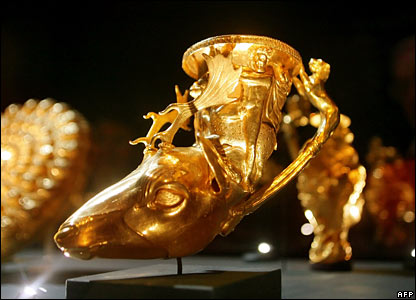
Thracian kings, it seems, were also desirous to be surrounded by fine gold objects. Consider, for instance, Bulgaria’s Panagyurishte gold treasure, thought to have been owned by King Seuthes III and buried to hide them from marauding Celts or Macedonians. I show three pieces from the hoard, all from the 3rd or 4th C BC: two rhytons, or drinking horns
image
image
and a plate.
image
Again, the detail on these pieces is exquisite.

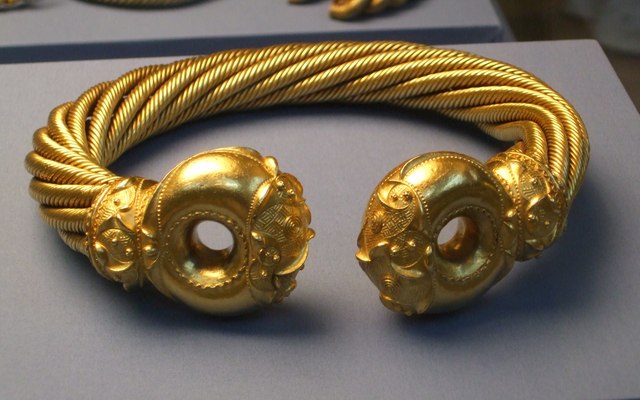
Mention of marauding Celts makes me look in the direction of the Northern European lands, where Celts were also known to hurriedly bury hoards of gold objects at the sound of approaching marauders. This beautiful spiral torc from 1st-4th C BC
image
was part of a cache of torcs found near Stirling in Scotland. This 70 BC torc instead was part of a hoard discovered at Snettisham in Norfolk, England.
image
This necklace, on the other hand, is a copy of a 6th-7th C BC original that was buried in Lorup, Germany.
image
I have to say, while I greatly admire the artistry that went into the Thracian and Scythian pieces, I instinctively empathize with the geometric simplicity of these Celtic pieces. “Keep It Simple, Stupid!” has always been my motto.

But that didn’t stop me from whistling when I saw some of the pieces that were made in what is now Iran. Look at this 8th-10th C BC cup, for instance, with its row of wild goats walking primly around it.
image
This must have been a popular design, because this cup from a later period (4th-5th C BC) has instead lions or tigers walking round it.
image
This 4th-5th C BC drinking cup holds its own to the two Thracian rhytons I show above
image
while this 3rd-4th C BC Janus-faced cup is a marvel to behold.
image

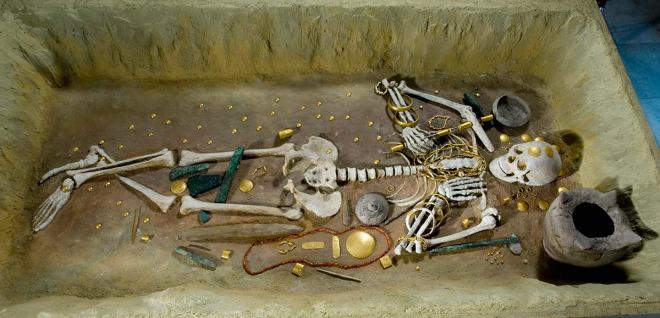
There are many, many other beautiful ancient gold objects out there, but I have to bring this little essay to a close. Let me finish with the oldest gold objects so far found. These are datable to the period 4,200-4,600 BC, and come from a necropolis in Varna, now Bulgaria’s largest city on the Black Sea. Compared to the pieces I show above, the objects in these tombs are quite modest in their design. What caught my attention was this reconstruction of one of the burials in the necropolis.
image
I suppose the man to whom this skeleton belonged was a grandee, and was laid to rest surrounded by all his worldly riches. But as I gaze at this skeleton, I cannot help but remember the dialogue between Hamlet and Horatio in the graveyard. After musing over Yorick’s skull (“Alas, poor Yorick! I knew him, Horatio, a fellow of infinite jest, of most excellent fancy …”), Hamlet turns to Horatio.

Hamlet: Prithee, Horatio, tell me one thing.

Horatio: What’s that, my lord?

Hamlet: Dost thou think Alexander looked o’ this fashion i’ the earth?

Horatio: E’en so.

Hamlet: And smelt so? pah!

Puts down the skull

Horatio: E’en so, my lord.

Hamlet: To what base uses we may return, Horatio! Why may
not imagination trace the noble dust of Alexander,
till he find it stopping a bung-hole?

Horatio: ‘Twere to consider too curiously, to consider.

Hamlet: No, faith, not a jot; but to follow him thither with
modesty enough, and likelihood to lead it: as
thus: Alexander died, Alexander was buried,
Alexander returneth into dust; the dust is earth; of
earth we make loam; and why of that loam, whereto he
was converted, might they not stop a beer-barrel?
Imperious Caesar, dead and turn’d to clay,
Might stop a hole to keep the wind away;
O, that that earth, which kept the world in awe,
Should patch a wall to expel the winter flaw!

___________________
India’s “gold man”: http://www.bbc.com/news/world-asia-india-36804209
“Conquista de Mexico”, Diego Rivera: http://www.abc.es/fotonoticias/fotos-espana/20150428/mural-diego-rivera-sobre-162891744561.html
Gold prospectors, Klondike: http://www.discovery.com/tv-shows/gold-rush/photos/klondike-gold-rush-pictures/
Modern gold prospectors, Colombia: http://www.jansochor.com/photo-blog/gold-mining-colombia
Jade burial suit: https://hu.pinterest.com/pin/454159943647748843/
Scythian pectoral, Ukraine, 4th C BC: http://www.craftycristian.com/tag/artifact/
Scythian pectoral-detail: https://en.m.wikipedia.org/wiki/Scythians
Scythian vessel-top, 4th C BC: http://phys.org/news/2015-06-archeologists-gold-artifacts-scythian-grave.html
Scythian vessel-bottom, 4th C BC: http://www.archaeology.org/issues/220-1607/features/4560-rites-of-the-scythians
Scythian bowl, 2nd half 4th C BC: http://www.metmuseum.org/exhibitions/listings/2000/golden-deer/photo-gallery
Scythian gold comb, Ukraine, late 5th-early 4th BC: http://museum-of-artifacts.eu/post/100759193962/scythian-golden-comb-5th-century-bc
Scythian deer, end 7th C BC: http://www.metmuseum.org/exhibitions/listings/2000/golden-deer/photo-gallery
Scythian belt buckle, 7th C BC: https://en.m.wikipedia.org/wiki/Scythians#/media/File%3AGold_scythian_belt_title_from_Mingachevir%2C_Azerbaijan.JPG
Thracian drinking horn-goat: https://www.pinterest.com/pin/174444185537354589/
Thracian drinking horn-deer: https://www.pinterest.com/pin/492510909227090261/
Ancient Greek plate (phiale): http://www.artlex.com/ArtLex/g/gold.html
Spiral torc, Scotland, 300-100 BC: http://www.nms.ac.uk/explore/stories/scottish-history-and-archaeology/iron-age-gold-torcs/
Celtic torc, Snettisham hoard: http://www.geograph.org.uk/photo/2395380
Ancient wire necklace (copy), Lorup hoard, Germany, late Bronze Age, 700-600 BC: http://www.ancientwire.com/spiralnecklace.htm
Achaemenid cup-wild goats, 1000-1200 BC: http://www.metmuseum.org/art/collection/search/325511?high=on&rpp=50&pg=22&rndkey=20120709&ft=*&pos=1095
Achaemenid gold cup, Kalardasht, 800 BC: https://commons.m.wikimedia.org/wiki/File:Gold_cup_kalardasht.jpg
Achaemenid drinking cup: http://www.daftarche.com/تاریخ،-فرهنگ،-همبود-13/persian-mythology-543-چاپ/برگه-3.html
Achaemenid Janus cup: http://www.iransara.info/main-previous%20post.htm
Varna man: http://edition.cnn.com/interactive/2015/07/style/gold/

BAGAN, MYANMAR

Bangkok, 13 July 2016

My wife and I have just returned from a short visit to Bagan, in Myanmar. Back when Harold Godwinson received an arrow in his eye, losing his life and his English throne to William, Duke of Normandy
image
the kings of Pagan (as the kingdom was then known) had consolidated their hold on the valley of the Irrawaddy River, swallowing up their neighbouring city-states, and had created the first Burmese kingdom. The kingdom grew rich on trade but also on agriculture, harnessing irrigation for the first time in this dry region of Myanmar. As befits the capital of a prosperous kingdom, the population of Pagan swelled. The kings and the richer citizens, anxious to gain merit for their next reincarnation, used their wealth to heavily sprinkle the city and the surrounding plain with stupas, temples, monasteries, and other religious edifices. At the height of this building frenzy, more than 10,000 such edifices covered an area of some 100 square kilometres.

Alas, this well-meaning search for merit undermined the edifice of state. More and more land was donated to the Buddhist monkhood, land which then became exempt from tax, thereby gradually emptying the state coffers. The resulting internal strife weakened the kingdom, and invasions of its borderlands by the Mongol dynasty of China finished her off. By 1287, the kingdom of Pagan was no more, and its capital city had shrunk to the size of a very modest town. Sun, wind, and rain began their work. The plaster moldings with which all the religious edifices had been covered peeled off, and the exposed brick began crumbling away to mud and dust. Trees and bushes did their part, inserting roots between brick and brick and slowly leveraging them apart. Earthquakes played their part too, toppling walls and cracking open stupas. And so the religious edifices so lovingly erected by earlier generations slowly slumped back into the earth from whence they had sprung.

A score of temples and stupas, which continued to be sites of pilgrimage, were maintained, often with infelicitous results as frescoes were painted or whitewashed over and badly crafted statues took the place of the originals. In the last century, conservation work was carried out – haphazardly – under successive military regimes. This has halted, or at least slowed, the dissolution, but even so only some 2,000 edifices remain standing, more or less, today.

But 2,000 is still a big number. Climb, as we did, the Shwesandaw stupa, and you will find yourself gazing out over flat, wooded farmland thickly sprinkled with red-brick stupas and temples of every size and state of disrepair.
image

image

image

image

Get off the paved roads, as we did, and take the dirt roads and paths which crisscross this farmland, and you will come across lonely stupas brooding by the side of fields
image
where the lines of the Persian poet Ferdowsi come to mind:

The spider spins his web in the Palace of the Caesars
An owl hoots in the towers of Samarkand

(it is said that the Ottoman sultan Mehmet II murmured these lines as he visited the desolate ruins of the imperial palace after his conquest of Constantinople in 1453)

It comes spontaneous to compare Bagan to other places. Angkor Wat in neighbouring Cambodia is often cited, but the comparison doesn’t hold. Angkor has edifices which are splendid in their art and architecture.
image

image
image
The edifices of Bagan, on the other hand, now have little if any intrinsic merit. My wife and I saw nothing superlative in any of the stupas or temples we visited. Pleasant, yes, interesting sometimes, but nothing to take one’s breath away.
image
image

image

image
No, it is the overall landscape that makes Bagan noteworthy, and it is to landscapes that we must turn for comparisons. Since many of the edifices in Bagan are funerary in nature, my wife felt a certain affinity between the Italian cemeteries of her youth and Bagan, with the latter of course being on a much larger scale.
image
In such a comparison, I would perhaps lean towards the abandoned part of Vienna’s biggest cemetery, the Wiener Zentralfriedhof, which contains many of the tombs of Vienna’s Jewish community, wiped out in the Nazi concentration camps.
image
I myself favour a comparison with Ancient Rome, not the Ancient Rome of today, swallowed up in the concrete and bitumen of the modern city, but the Ancient Rome that was the subject of many a painting in the 17th to 19th centuries. This is Claude Lorrain
image

this, Piranesi
image
this, Palmer
image
and this, Lear
image
In these paintings I see an echo of the Bagan I looked out on from the heights of the Shwesandaw stupa.

As the lines I cite above show, the melancholy of ruins has always excited the imagination of poets. Rome’s ruins are no exception, with reams of poems written about them. I quote one here, by Alexander Pope.

See the wild waste of all-devouring years!
How Rome her own sad sepulchre appears,
With nodding arches, broken temples spread!
The very tombs now vanished like their dead!
Imperial wonders raised on nations spoiled,
Where mixed with slaves the groaning martyr toiled:
Huge theatres, that now unpeopled woods,
Now drained a distant country of her floods:
Fanes, which admiring gods with pride survey,
Statues of men, scarce less alive than they!
Some felt the silent stroke of mouldering age,
Some hostile fury, some religious rage.
Barbarian blindness, Christian zeal conspire,
And papal piety, and Gothic fire.
Perhaps, by its own ruins saved from flame,
Some buried marble half preserves a name;
That name the learned with fierce dispute pursue,
And give to Titus old Vespasian’s Due.

But this poem is far too frothy, as are all the poems about Rome’s ruins. I prefer the fragments of an Anglo-Saxon poem of the 8th Century, part of an anthology of Anglo-Saxon poems in the library of Exeter Cathedral, whose subject is not Rome but the Roman ruins of Bath.

Wrætlic is þes wealstan, wyrde gebræcon;
burgstede burston, brosnað enta geweorc.
Hrofas sind gehrorene, hreorge torras,
hrungeat berofen, hrim on lime,

For those of my no doubt many readers who, like me, are not conversant with Anglo-Saxon, let me continue with a translation by Siân Echard, of the University of British Columbia, with some modifications on my part.

Wondrous is this wall-stead, wasted by fate.
Battlements broken, giant’s work shattered.
Roofs are in ruin, towers destroyed,
Broken the barred gate, rime on the plaster,

Walls gape, torn up, destroyed, consumed by age.
A hundred generations have passed.
Earth-grip holds the proud builders, departed, long lost,
In the hard grasp of the grave. How often has this wall,

Hoary with lichen, red-stained, outlasted the passing reigns,
Withstanding the storms; the high arch now has fallen …

(At this point, there is a gap, for the parchment itself has suffered badly from the passage of time)

Indeed, the high arches, now fallen, of Bagan have witnessed the passing of many reigns, the last being but a few months ago, when the decades-long military government in Myanmar finally gave way to a democratically-elected civilian government. Knowing the history of neighbouring Thailand, where military meddling is a way of life, I offered a silent prayer in the Ananda temple
image
that this would be the last of the military governments in this beautiful country, which has suffered so much and deserves so much better.

________________
Photos of Bagan: ours
Harold hit by the arrow: http://www.dot-domesday.me.uk/arrow.htm
Angkor Wat-1: https://artmundus.wordpress.com/2010/05/28/the-wonder-that-is-angkor-wat/
Angkor Wat-2: https://artmundus.wordpress.com/2010/05/28/the-wonder-that-is-angkor-wat/
Angkor Wat-3: http://rwethereyetrwethereyet.typepad.com/arewethereyet/2008/04/take-your-kids.html
Cimitero monumentale, Milan: https://www.tripadvisor.it/LocationPhotoDirectLink-g187849-d243431-i28163413-Monumental_Cemetery-Milan_Lombardy.html
Jewish section, Vienna Zentralfriedhof: http://www.flickriver.com/photos/lastingimages/2924629401/
Roman ruins:http://www.bobforrestweb.co.uk/The_Rubaiyat/Galleries/Gallery_5/g5notes.htm
– Claude Lorrain
– Giovanni Battista Piranesi
– Samuel Palmer
– Edward Lear

LET’S NOT LEAVE THE EU

Bangkok, 18 June 2016

As my country of citizenship moves inexorably towards a historic referendum on whether or not to leave the EU, with there being a damned good chance that a majority will vote yes, my thoughts turn towards what it means to be British. And of course, the first thing that comes to my mind is … cricket (although you can’t really say it’s a British game; it’s the English who developed it while the Scots, for one, hardly play the game at all).

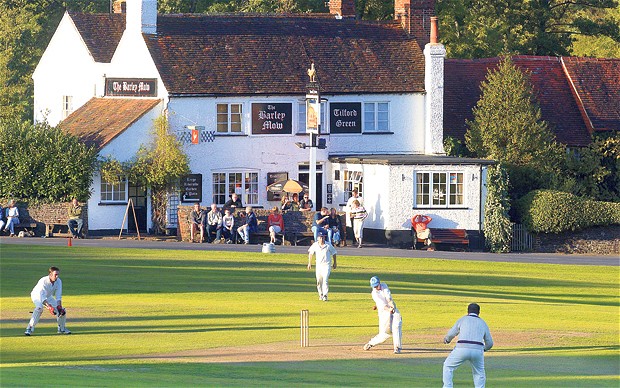
I started playing cricket, at school, in the summer of 1963, and played my last game, at school, in the summer of 1972. I stopped playing with no regret (and anyway went to University in Scotland, where, as I have just mentioned, hardly anyone plays cricket). Truth to tell, I was never very good at the game. I never could get over my nervousness of having someone throw a hard – very hard – ball straight at me, and pretty damned fast at that. In the years I played, batters protected their shins with pads and their testicles with a cup. The rest was naked, unprotected, at the mercy of nasty, vicious hits from the ball. That being said, when I was far out of the line of fire, standing in the far reaches of the field waiting idly for the odd ball to come my way, I could not help but admire the simple beauty of it all: lovely green grass sweeping off into the distance, framed by a venerable tree or two, the field dotted with people kitted out in impeccably white attire, and with luck a beautiful summer sky crowning the whole.
ab39073.jpg
It’s even better if there is a quaint old pub in the background to which one can retire for a refreshing draught of the local ale.
image

And when batsmen were good, it really was a pleasure to the eye to watch them taking clean, easy swings, knocking the ball this way and that, twisting their body elegantly as they followed through their shots.

image

Yes, elegant is the word for the best of cricket.

I still remember with great pleasure a match we played when I was 12-13 years old, against the local village. It was an annual affair, where we fielded a side of mixed Masters and boys. For some reason, I was included – someone must have been sick. In any event, I have this memory of politely playing against the local farmers on the village green, a beautiful oval surrounded by great beeches. I batted way down the list and was out pretty quick. Then I watched from the edge of the playing field as we got convincingly trounced. No matter, we were English, and the winners and the losers mingled in good cheer at the end:
“For when the One Great Scorer comes
To mark against your name,
He writes – not that you won or lost –
But HOW you played the Game.”

As the summer sun slowly set and the shadows grew longer across that village green, we ate home-made cakes and quaffed the local cider – we boys quaffing with special permission from the Headmaster.

Well, as much as I have changed, so has cricket. The commercial diktats of TV required that the achingly long Test matches be shortened to much shorter one day-and-night matches. The result is far more exciting to the uninitiated, as slugging has become the norm for batters rather than the patient, incremental build-up of runs of yesteryear; anyone can appreciate slugging. Taking a leaf out of football, all that uniform white in the kits has given way to a rainbow of colours as each national side now goes out in its own distinct colour. I suppose like that it’s easy to tell who is batting and who fielding. To get the evening viewers, matches go on into the night under the glare of lights. No doubt players get paid much more. And cheating during play, so as to make money on the betting, has begun. I’ve not heard of doping scandals in cricket, but if it isn’t happening yet I’m sure it eventually will.
image
Sometimes, when I look at a modern match of cricket, I wish we could go back to the old ways. Cricket seemed so much nicer back then.

image

Of course, my memory has quietly deleted those much less pleasant memories of cricket, on a nasty windy day, for instance, or under the rain; it really was not as wonderful as I’d sometimes like to think it was.

image

And anyway we can’t go back. The world has changed, and so must cricket.

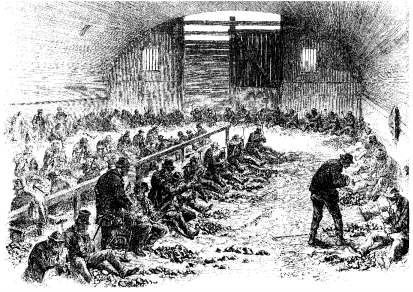
I’m sure much the same nostalgia drives many of my countrymen and women who want to vote to leave the EU. They want to go back to the past, to a time when Britain was great, was self-reliant … and was white. But paraphrasing Karl Marx, history repeats itself, the first time as tragedy, the second time as farce. Britain’s past history was not necessarily a tragedy, but it wasn’t as glorious as some people might think. My family did well out of Britain’s industrial revolution and later imperial ambitions, but there are many, many, many British families who suffered enormously from the industrial revolution

image

and there are a multitude of families in the countries we colonized who suffered enormously from our imperial ambitions.

image

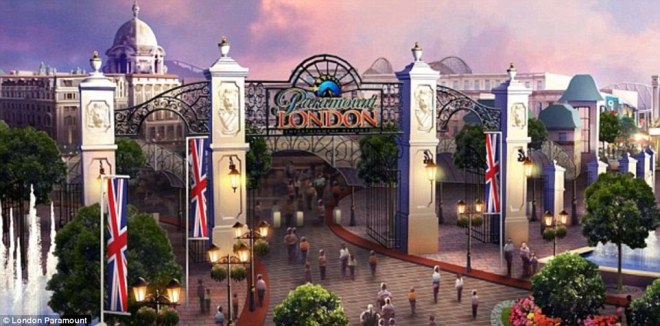
As for Britain’s future, trying to go back to its, largely mythical, past will simply condemn the country to be a poor, foggy little island on the outer edges of Europe, which itself is turning into the frazzled outer edge of a renascent Eurasian continent. Britain’s future history will not necessarily turn into a farce, but it will be trivial. With no manufacturing sector to speak of, sacrificed decades ago to the financial services sector, and with no financial services sector to speak of, since an exit from the EU will all make them emigrate to Frankfurt, Britain, like Italy, will have to rely more and more on tourism to make ends meet. It will become one vast Disneyworld
image
welcoming hordes of foreign tourists to its shores, to watch – for five minutes – its quaint games of cricket, visit a quaint pub, watch the Queen or King inspect all those nice toy soldiers with their lovely scarlet tunics and tall, funny hats

image

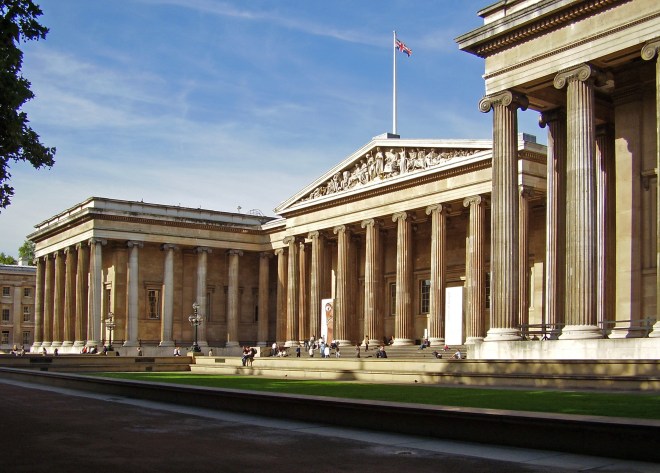
visit its majestic museums (while muttering to themselves about how much stuff was stolen from them)

OLYMPUS DIGITAL CAMERA

and send their children to spend a year in one of its quaint universities getting a costly but ultimately meaningless Master’s degrees.

image

Let’s not make this our future.

POSTSCIPT 24 June 2016

Well, my (very modest) call to remain fell on deaf ears. By midday today (Bangkok time), it was clear that a majority of my country men and women had decided to leave the EU. A pity.

________________
Cricket on local field: http://blog.acis.com/2013/08/
Cricket in front of the local pub: http://www.telegraph.co.uk/news/earth/countryside/8695840/The-village-green-is-crickets-soul.html
hitting a six: http://www.gettyimages.com/event/first-test-india-v-south-africa-day-3-51766051#robin-peterson-of-south-africa-hits-a-six-off-harbharjan-news-photo-id51774798
One day international at night: http://colorlibrary.blogspot.com/2012/07/stadium-which-hosted-most-number-of-one.html
Old painting of cricket: http://www.antiquemapsandprints.com/chelmsford-1934-old-vintage-print-nice-view-cricket-match-essex-l-b-bruhl-185061-p.asp
Cricket under the rain: http://www.alamy.com/stock-photo-a-set-of-stumps-at-an-abandoned-village-cricket-match-due-to-the-rain-9630656.html
Social consequences of industrial revolution: http://economistsview.typepad.com/economistsview/2007/08/social-conseque.html
Aborigines in chains: http://nationalunitygovernment.org/content/prisoners-frontier-wars-blackbirding-chain-gangs
British Disneyland: http://www.dailymail.co.uk
Trooping of the colours: http://www.zimbio.com/pictures/GChQyMYbIXr/Trooping+The+Colour
British Museum: https://en.m.wikipedia.org/wiki/British_Museum
Cambridge University students: http://www.theguardian.com/education/2016/feb/02/cambridge-university-to-introduce-written-admissions-tests

ROCK ART

Bangkok, 18 June 2016

As readers of this blog cannot have failed to notice, I’m a bit of a history buff. I suppose it runs in the family. My father had an extensive collection of history books, which as I grew up I filched for a quiet read in bed, and my elder brother actually teaches the subject.

As perhaps we all do, my interest in history started with the grand events, the Kings, the Queens, the battles. But with age, I became more interested in the history of the voiceless: the poorer segments of society, the goods and chattel which we humans have enslaved and used for our own material comforts, and – the topic of this post – our forefathers from the time when there were no written records: pre-history. Precisely because they have no written history, the latter can only talk to us through the material remains they have left behind, and through the chemical and biological tracers they have scattered about, from our genetic codes to such mundane things as pollen records. This post is about a particular material remain left to us by the voiceless, rock art.

My first meeting nearly half a century ago with this art form was not very propitious. They were rock paintings, in the middle of Lake of the Woods, on the US-Canadian border, where I was spending a week canoeing. They were painted on a small overhang on the water’s edge of one of the many small islands that dot the lake, so that we could bring the canoe alongside to study them. They looked something like this.
image
If I’m to be honest, I didn’t think much of them. They were pretty crude drawings, and awfully faded. I was far more excited by the very old man we met on another island, who told us that he remembered as a child being hurriedly bundled off into a hiding place because the local Indians had gone on the warpath. Wow! Indians on the warpath! To a boy of 15, that was something to talk about, not those crude, faded rock paintings.

At about the same time as I was gazing with a certain skepticism at the rock paintings on Lake of the Woods, I came across my first rock engraving. It was the White Horse, carved in the mid-19th Century into the escarpment of the Yorkshire Moors near my high school.
image
I have to say, though, that I was more taken by the gliders soaring silently on the updrafts created by the escarpment than the White Horse carved into it.

Well, time passed, I grew up, and I became wiser (I hope). My growing fascination with pre-history meant that I became more interested in rock art. Not that I saw that much rock art in the flesh, as it were. For instance, I have never managed to see the rock engravings in Valcamonica up in the Alps, not that far from my wife’s home town of Milan, even though it was one of the first places to be declared a UNESCO World Heritage Site.
image
image
On the other hand, when my wife and I visited Canyon de Chelly National Monument in Arizona early on in our marriage
image
we came across some rock engravings among the old American Indian pueblos.
image
image
I may not have been seeing much rock art, but I was reading up on whatever new finds were being made. For instance, new caves were being found in France and Spain with art from the Paleolithic era, adding to what was already known. I give here just a few examples from some of the better-known caves:
Lascaux
image
image
Altamira
image
image

Chauvet
image
image
image
Now this is really art! Visiting these caves is on my retirement bucket list – if we can manage to get in. Many of them are closed, or access to them is severely restricted, to protect the paintings. Forget the problem of stray fingers touching where they shouldn’t. Even our innocent breath deteriorates the artwork.

Several of the articles I read were about rock art in Australia. For instance, there was much excitement several years ago when it was announced that some rock art in the Northern Territories had been dated to 28,000 years ago, which made it Australia’s oldest dated rock art, and some of the earliest in the world.
image
Then there were articles a few years before that about the fascinating rock art in Kakadu National Park, also in the Northern Territories, which goes from the ancient
image
image

to the modern – Australian rock art didn’t stop tens of thousands of years ago.
image

All this meant that I approached the rock art which we visited on our recent tour of the Kimberley with a lively interest. We found ourselves confronted with two quite different styles of painting. The more recent, Wandjina art, is dominated by these alien-like faces.
image
To my mind, these paintings were only mildly interesting. Of much greater interest was the considerably older Gwion Gwion art, which is peopled with stencil-like figures like these.
image
image
image
In contrast to many of the representations of people in rock art, where they tend to be reduced to mere stick figures, Gwion Gwion art shows them dressed and coiffed. I don’t think it’s too fanciful to say that one can get an idea of what the painters of this art might have looked like if we had met them.

There are very recent articles reporting scientific analyses which suggest that these paintings could be 50,000 years old. This very much favors the theory which I mentioned in my previous post, the author of which argues not only that African peoples sailed to the Kimberley and brought the baobab tree with them but also that they were the authors of the Gwion Gwion art. He claims similarities between this art and the rock art of the Sandawe people, hunter-gatherers from Tanzania.
image

image
Personally, I’m not convinced. But hey, I’m no expert. In any event, reporting this claim has allowed me to segue smoothly to Africa, a major storehouse of rock art. And here I will leave my readers with some remarkable rock art from the Sahara, once a green and verdant land full of game and peopled by the humans who hunted them and who recorded their lives on the rock.
image
image
image
image
image

____________________
Lake of the Woods rock painting: http://www.panoramio.com/m/photo/8653359
White Horse, Kilburn: http://www.jdw-fitness.co.uk/ben-campbell-5k-10k-trail-races/
Rock engraving Valcamonica: http://www.italia.it/it/idee-di-viaggio/siti-unesco/valcamonica-larte-rupestre.html
Rock engraving Valcamonica: http://www.invasionealiena.com/misteri/articoli-misteri/963-arte-rupestre-delle-alpi-la-valcamonica.html
Canyon de Chelly: http://www.thousandwonders.net/Canyon+de+Chelly+National+Monument
Canyon de Chelly pictographs: http://www.inn-california.com/arizona/apacheC/canyondechelly/rockart.html
Cave wall, Lascaux: https://www.reddit.com/r/Showerthoughts/comments/2xfe1z/what_if_cave_drawings_are_done_by_cavechildren/
Hunters, Lascaux: https://hartogsohn.com/category/טכנופוביה/
Bisons, Altamira: https://www.pinterest.com/gfrilli/prehistoric-art-altamira/
Horses, Chauvet: http://popular-archaeology.com/issue/september-2011/article/prehistoric-cave-paintings-of-horses-were-spot-on-say-scientists
Bears, Chauvet: http://www.ancient-wisdom.com/francechauvet.htm
Rhinoceros, Chauvet: http://www.telegraph.co.uk/news/worldnews/europe/france/10920920/French-cave-paintings-inscribed-on-Unesco-World-Heritage-list.html
Reindeer, Font-de-Gaume: http://artdiscovery.info/rotations/rotation-1/packet-1/
Nawarla Gabarnmang: http://www.sundayobserver.lk/2012/06/24/spe31.asp
Kakadu woman: http://fr.123rf.com/photo_10231459_aboriginal-rock-art-namondjok-at-nourlangie-kakadu-national-park-northern-territory-australia.html
Kakadu kangaroo: https://www.pinterest.com/pin/521502831831829461/
Kakadu boat: http://news.nationalgeographic.com/news/2008/10/photogalleries/australia-aboriginal-art-photos/photo4.html
Wandjina art: https://www.pinterest.com/rosadevaux/wandjina/
Gwion Gwion 1: our photo
Gwion Gwion 2: http://www.bradshawfoundation.com/bradshaws/bradshaw_paintings.php
Gwion Gwion 3: http://www.bradshawfoundation.com/bradshaws/photographs/
Sandawe rock art: http://africanrockart.org
Giraffe, Dabous, Algeria: http://www.bradshawfoundation.com/giraffe/
Cattle, Djanet, Algeria: http://africanrockart.org/rock-art-gallery/algeria/
Antelope, Oued Dider, Algeria: http://africanrockart.org/rock-art-gallery/algeria/
Man and dog, Djanet, Algeria: http://africanrockart.org/rock-art-gallery/algeria/
Archer, Oued Djaret, Algeria: http://africanrockart.org/rock-art-gallery/algeria/

THE AUSTRALIAN BOAB TREE

Bangkok, 11 June 2016

One of the first things which struck me as my wife and I started our tour of the Kimberley in Australia was the presence of this tree, which we frequently saw, both in leaf
image
and bare
image
and many of them with fruit.

image
I kept saying, “Aren’t those baobab trees?” For they looked amazingly like African baobabs.
image
Well, the fact is, they are baobabs (although Australians insist on calling them boabs). These trees are to be found in sub-Saharan Africa (two species) as well as in Madagascar (six species, of which these, subjects of a previous post of mine, are magnificent specimens)
image
and there is this one species in Australia – actually, the tree is found only in the Kimberley and nowhere else in Australia.

How did the baobab tree end up in the Kimberley? I mean, it’s quite some distance, some 8,000 km to be precise, between the east coast of Africa and the west coast of Australia.

A first hypothesis was that this was a left-over from the break-up hundreds of millions of years ago of the supercontinent Gondwana into its constituent pieces of South America, Africa and Madagascar, Antarctica, India, and Australia
image
which then proceeded, through continental drift, to arrive where they are now. The ancestors of the baobab had existed on Gondwana, so the thinking went, and were carried along for the ride on the drifting continents.

Apart from the fact that this hypothesis doesn’t explain why there aren’t baobabs in India or South America, modern DNA analysis has nixed it. Comparison of DNAs has shown that the African and Australian varieties of the baobab separated a “mere” 100,000 years or so ago, when (by my calculation) Africa and Australia were 7 km closer (continental plates drift slowly).

So how did the baobab make it to Australia?

Well, the next most obvious hypothesis is that an African baobab nut or two (of which the smiling ladies in the photo above are holding a basketful) was carried out to sea and then carried along by surface currents to its new home in Northwestern Australia. But the experts are hesitant, and I understand why. A study of this map of surface currents
image
shows that to make it to the Kimberley region, a nut would have had to fall into the Somali current and been carried northward, then it would have had to get taken eastward by the northern branch of the Indian Ocean’s Equatorial current, all the way to the island of Sumatra. At that point, our bobbing baobab nut would have had to hug the southern coastlines of Sumatra and Java, to then, somewhere around Bali or Timor, change course, coming southward and westward, finally making a landing in the Kimberley. As the sad fate of the Malaysian flight MH370 has shown, anything floating further south in the Indian Ocean would tend to be carried westward rather than eastward. The map below is a computer-generated estimate of where debris of the plane could have drifted from the original hypothesized crash point (the square point on the border of the blue area); the red area is where debris might have been 18 to 24 months after the crash.
image
If this ocean voyage of the baobab nut occurred at all, it would have taken place during the last ice age. This started 110,000 years ago, which is pretty much when the two baobab lines separated, and finished 12,000 years ago. Among other things, the ice age caused sea levels to drop, which modified coastlines in certain parts of the world. In turn, these modifications could have affected the direction of surface currents. So to be really correct, one should look at a map of someone’s best guess of surface ocean currents during the ice age. Unfortunately, I didn’t come across any such map. This map, however, shows where the coastlines were at the time.

image
It seems there were no big changes in the area we’re interested in except around the islands of Indonesia and New Guinea, where the lower sea levels connected up a lot of the islands (and, en passant, made that last hop of human beings into Australia 50,000 or so years ago a good deal easier). I’m no ocean currentologist, but I rather think that the blocking up of the straits between these islands might actually have made the last leg of the baobab nut’s journey, that right turn from Bali to Australia, somewhat easier.

How long would such a trip have taken? Well, it took debris from MH370 about two years to wash up on the coast of Mozambique, so I would imagine that it would take just as long, if not longer, for a baobab nut to travel in the opposite direction. Could a baobab nut soak that long in the ocean and still be able to germinate upon arrival? We can look to the coconut for an answer; a coconut, at least the original version before human beings started messing around with it, was designed to be dispersed by sea.
image
There happens to be a lot of argument on this point, but no-one has ever claimed that a coconut can last two years in seawater. A maximum seems about three months, and even that has been challenged. So I seriously doubt that a baobab nut, even if it had managed to make it to the Kimberley by sea, would have been in a fit state to germinate.

So, how else could the baobab have arrived in the Kimberley?

The next most obvious hypothesis is that human beings brought the baobab with them, because they too originated in Africa. Could the ancestors of the Aboriginal people, who are currently thought to have arrived in Australia 50,000 years ago (plus or minus 10,000 years), have carried the baobab nut with them? Well, since they left Africa about 120,000 years ago and took 70,000 years to reach Australia, that would have meant planting the baobab as they went along. This is not actually as crazy as it sounds. Both in Africa and in the Kimberley there is strong evidence that the local hunter-gathering groups deliberately carried the baobab with them and planted it in new areas – the tree is a great source of many things other than the nut. But if this really did happen, then shouldn’t we find baobabs along their most probable migration route?
image
Yet, apart from southern Arabia, none of the places between Africa and Australia have baobabs, or even baobab remains. Of course, it could be that climate changes in these places after the end of the ice age killed off the baobabs, or it could be that they were killed off by the after-effects of the absolutely gigantic volcanic eruption of Mount Toba in the island of Sumatra about 70,000 years ago
image
the ash from which fell over a huge area, much of it on the migration route to Australia, which could have choked plant life.
image
It has also been argued that many years of permanent darkness set in after this event, a sort of “nuclear winter”, which of course would have affected the ability of plants to photosynthesize.

But still, all in all, the chances of the baobab having gotten to Australia via this long, long migration route seem very slim.

So how, then, could the baobab have gotten to the Kimberley?

And here, gentle readers, we step into a wasps’ nest. One Australian scientist has made the radical suggestion that tribes sailed from the east coast of Africa to the Kimberley, carrying baobab nuts as food. He claims that the rock art of the Kimberley (which I will cover in a future post) is (a) far older than is generally thought, maybe 50,000 years old, and (b) shows that 50,000 years ago the painters knew the use of boats.

OLYMPUS DIGITAL CAMERA
He suggests that the nuclear winter caused by Mount Toba led them to sail east, to the source of the sun, to find it again, which coincidentally would have brought them to the Kimberley (and he argues that there are strong connections between Kimberley’s rock art and the rock art of East Africa).

Well, as readers can imagine, such views have the Australian archaeological community in a tizzy. It certainly is a pretty far fetched theory. But somehow we have to explain how the baobabs got to the Kimberley, right? Anyone of my readers have any ideas?

_____________________
Boab tree in leaf: https://en.m.wikipedia.org/wiki/Adansonia_gregorii
Boab tree bare: http://www.alamy.com/stock-photo/boab-tree-kimberly.html
Boab tree in fruit: http://www.visualphotos.com/image/1×10636003/australia-western-australia-broome-roebuck-bay-a-faint-banded-sea-snake-caught-on-the-mud-flats-at-low-tide
African baobab tree: http://www.telegraph.co.uk/foodanddrink/11328252/Baobab-the-superfood-of-2015.html
Grove of baobab trees, Madagascar: https://www.pinterest.com/pin/1618549836269760/
Gondwana: http://www.earthsciences.hku.hk/shmuseum/earth_evo_07_01.php
Ocean surface currents: http://www.cruiserswiki.org/wiki/Indian_Ocean
Debris path of MH 370: http://www.deepseanews.com/2015/07/how-currents-pushed-debris-from-the-missing-malaysian-air-flight-across-the-indian-ocean-to-reunion/
Coastlines last ice age: http://maxworldhistory.weebly.com/map-exercise.html
Coconut in the sea: http://www.allposters.com/-sp/Coconut-Floating-on-Water-Indo-Pacific-Split-Level-Dispersal-of-Seed-Posters_i2634256_.htm
Migration out of Africa: http://cogweb.ucla.edu/ep/Paleoanthropology.html
Mount Toba eruption: http://www.thedailysheeple.com/yellowstone-super-volcano-is-far-bigger-than-previously-thought_122013
Mount Toba ash coverage: http://news.berkeley.edu/2015/03/31/200th-anniversary-of-tambora-eruption-a-reminder-of-volcanic-perils/
Bradshaw art boat: http://forum.woodenboat.com/showthread.php?169983-Primitive-Depictions-of-Medieval-Ships-Seen-from-Above