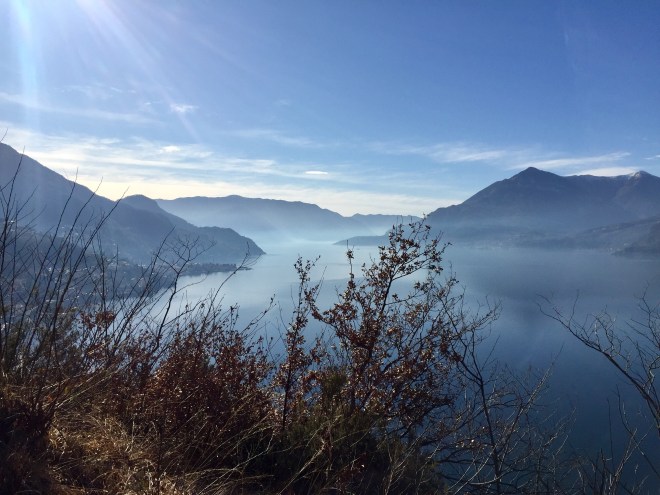
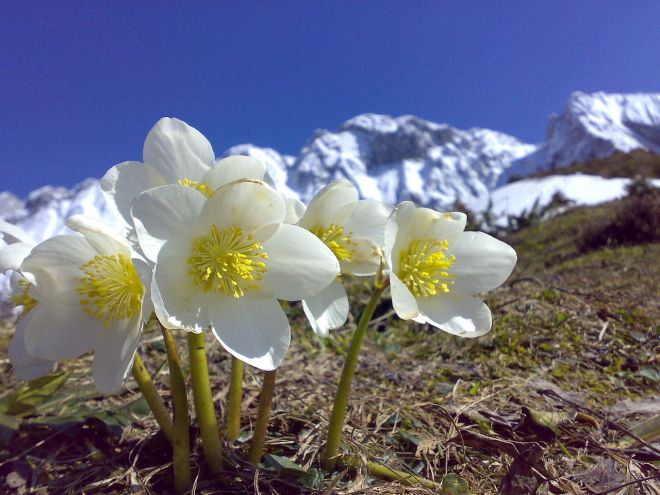
BACK IN THE DOLOMITES

Vienna, 11 July 2020

Last year, at about this time, my wife and I undertook our first hike in the Dolomites. Readers can see the commented photos of that hike in an earlier post. At the time, we promised ourselves to come back this year, to explore another part of the Dolomites. We were true to our promise, even though Covid-19 threatened to upset our plans, particularly since we were joined by one of my French cousins and his wife: would the borders be open on time? would they  have to quarantine in Italy? or in France on their way back? But all was well; restrictions on travel were lifted in time. And it was great that they could come, because I have shamelessly used a good number of the photos they took.

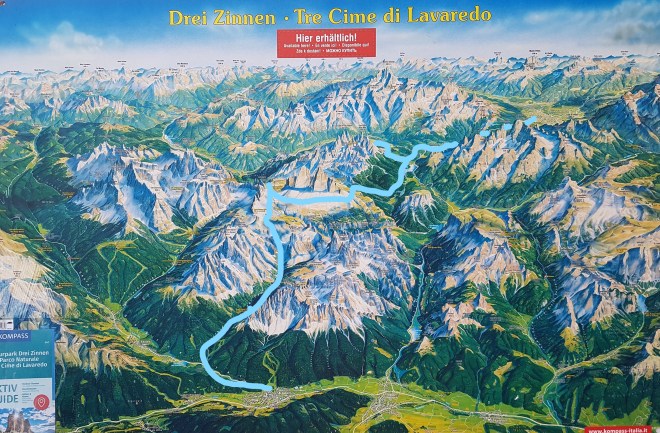
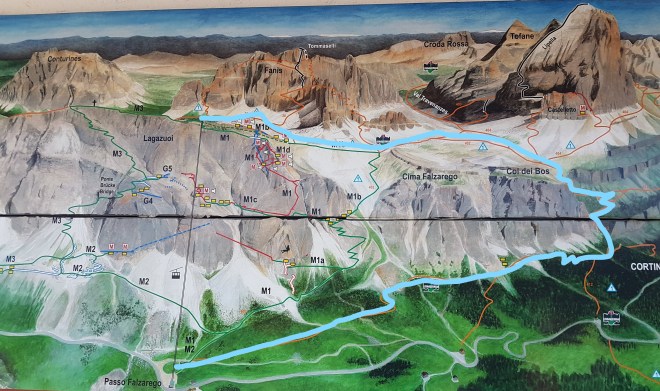
This year, we explored the Dolomites around the Val Pusteria as well as the Ampezzine Dolomites close to Cortina d’Ampezzo. I have a fondness of bird’s-eye view maps like the one below, but they do allow me to mark the route we took.

Cousins’ photo

We started in San Candido at the bottom of the map (which is Innichen to the local, mostly German-speaking population; we are in the South Tyrol here). We hiked over the group of mountains south of the town, where the Tre Cime di Lavaredo, the Three Peaks, were the star of the show, and down into Cortina d’Ampezzo at the top right of the map. Then we hiked around another group of mountains to the west of Cortina; I’ll show a map of that in a minute. But let’s have the photos tell the rest of the tale!
21 June

On the evening we arrive, the setting sun brightens the tops of the mountains behind San Candido / Innichen

our photo

22 June

First stage, hiking up the Val Campo di Dentro up to the Drei Schuster Hütte / Rifugio Tre Scarperi: gradual climb of about 450 m. Here we are, arriving at the hut in time for lunch.

Cousins’ photo

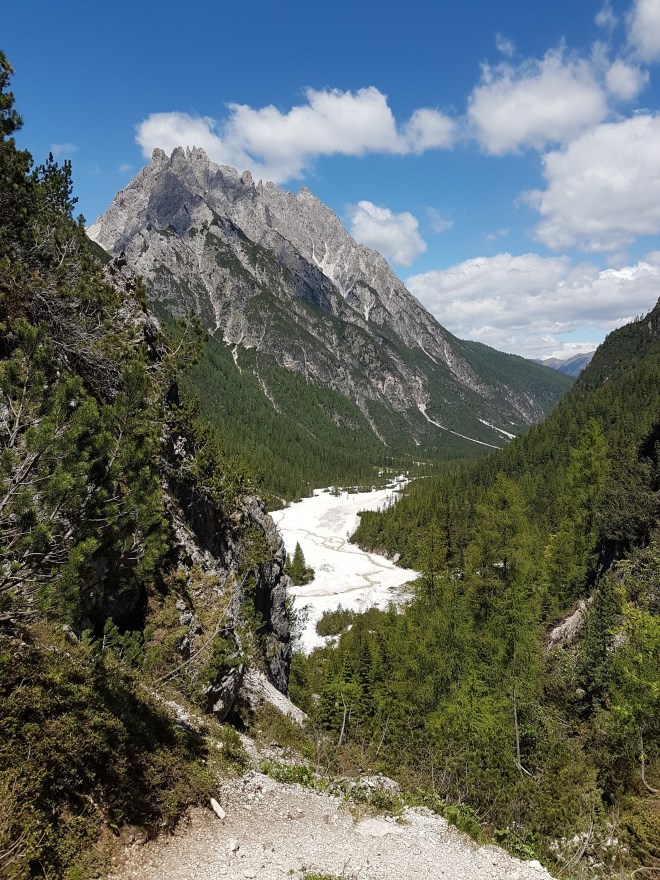
The mountain blocking the end of the valley. After lunch we climbed up to the top of the saddle to the left of that mountain: a brutally steep climb of 840 m!

Our photo

We have started climbing. The valley floor is dropping away below us

Cousins’ photo

Clambering over an impossibly lovely stream, hoping not to fall in …

Cousins’ photo

And we climb …

Our photo

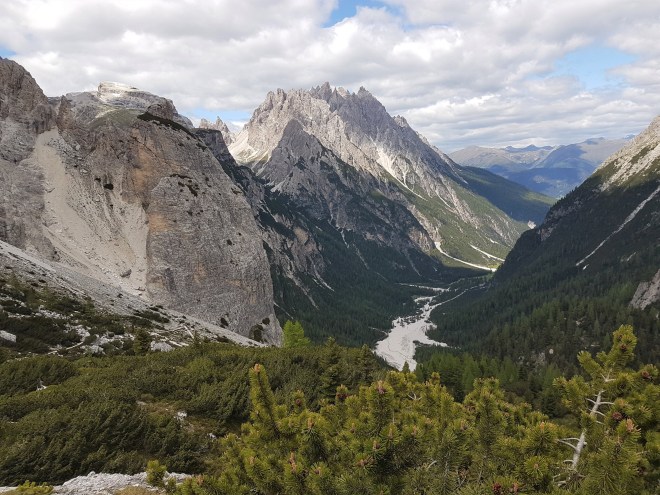
The valley is far below now …

Our photo

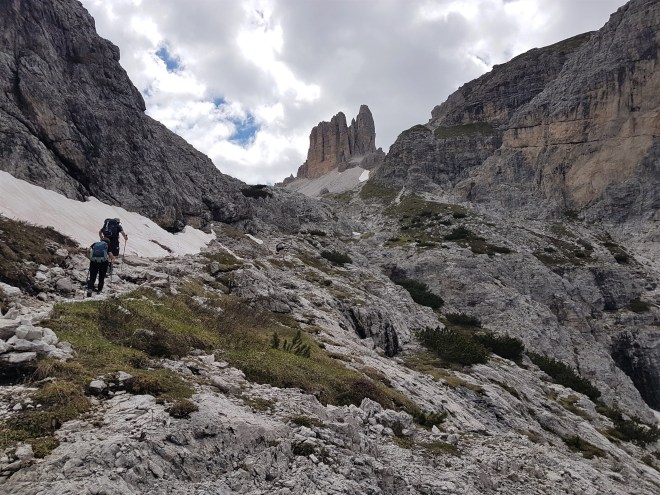
… but still we climb … we begin to hit snow patches …

Cousins’ photo

Last sighting of the valley far, far below

Cousins’ photo

… and still we climb …

Our photo

Finally, the top!

Cousins’ photo

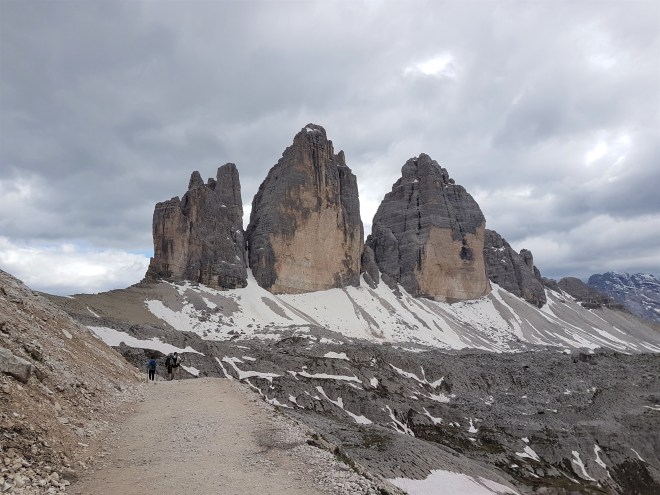
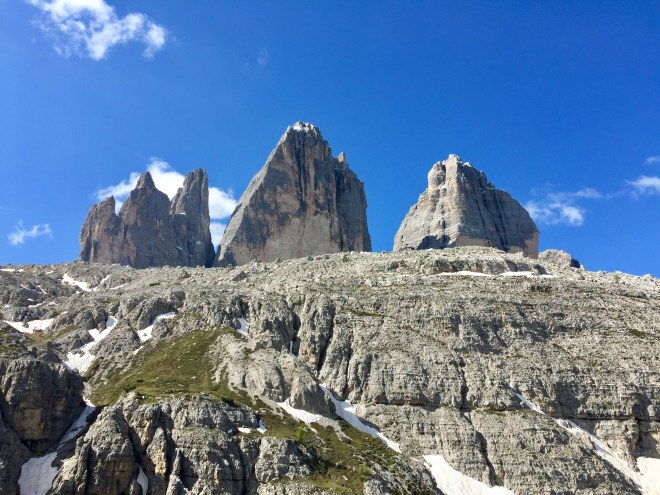
Our first sighting of the Three Peaks of Lavaredo. We will be walking to the saddle to the left of them, to reach the mountain hut we will be sleeping in.

our photo

Our first clear view of of these three majestic peaks

Cousins’ photo

Getting closer to them, while the weather is turning …

Cousins’ photo

… also looking back at the route we’ve taken.

Cousins’ photo

Nearly at the top of the saddle …

Our photo

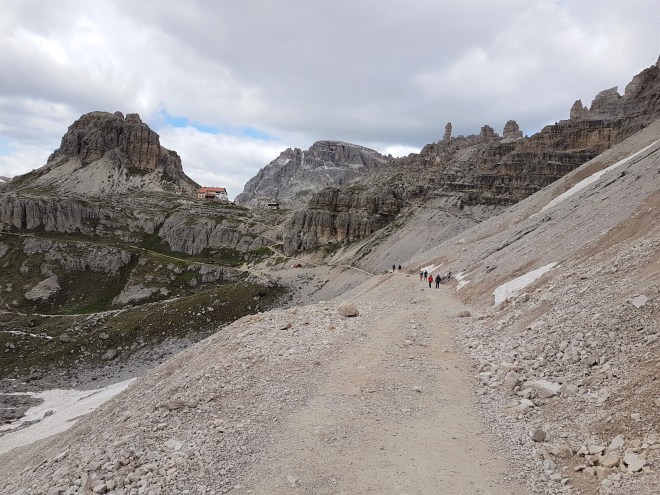
Looking over the other side of the saddle, down onto the Rifugio Lavaredo where we will be staying the night. Nearly the end of a long day.

Our photo

23 June

Beautiful day. We go back to the top of the saddle.

That’s the path we’ll be taking today, snaking away to the far left.

Our photo

The Three Peaks keep us company on our left as we walk

Our photo

We pass a lovely spray of pink flowers

Cousins’ photo

A last look at the Three Peaks …

Our photo

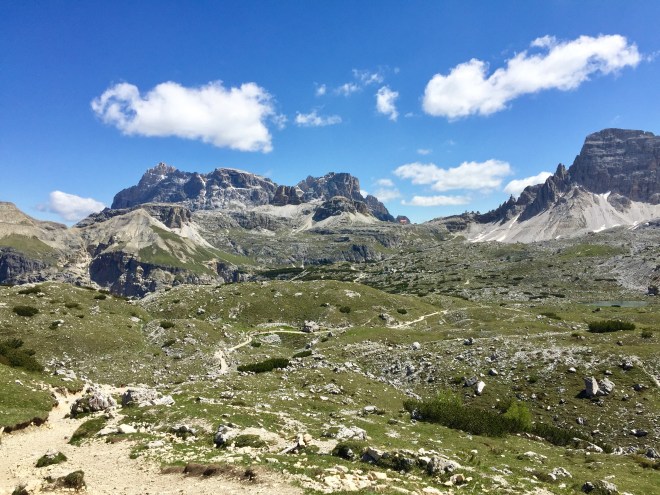
… and at the panorama behind us, with the path we’ve just taken winding across it

Our photo

Lake Misurina, glinting in the sunlight, beckons to us from far below in the valley. It is time to start climbing down.

Our photo

We drop about 600 m before finally arriving at the lake.

Source

We take the chairlift to the Rifugio Col de Varda, the mountain hut where we will be staying the night.

24 June

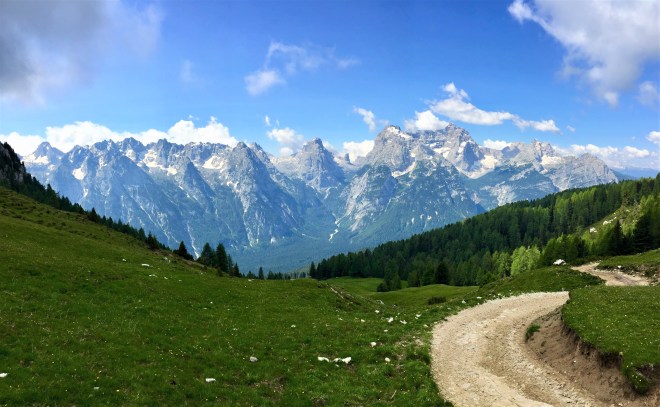
Today is taken up with a walk to the Rifugio di Città di Carpi and back via Lake Misurina. It’s a walk primarily through forest but with some fine views across the valley …

Cousins’ photo

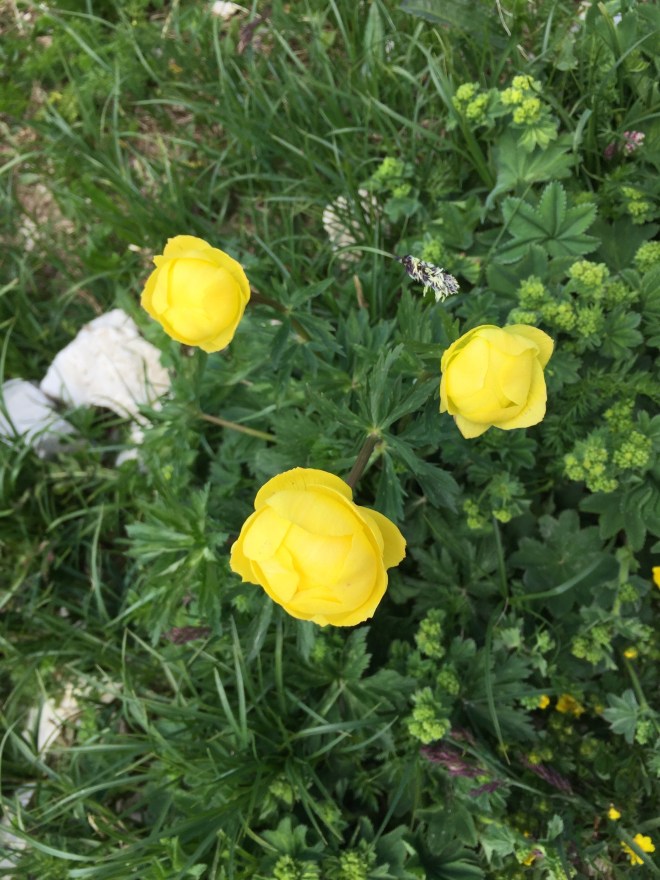
… as well as sightings of some beautiful flowers – this is a particularly lovely example of the globe flower

our photo

We arrive at the Rifugio di Città di Carpi in time for coffee – to be purchased with masks on the face; Covid-19 haunts us even here.

Source

After coffee, a final look at the view …

our photo

… before we plunge once more into the forest, walking down to Misurina.

Source

25 June

Today the weather forecast is for rain, so we kit ourselves up. We are walking mostly through forest, up to the Passo Tre Croci and then down to Cortina d’Ampezzo.

A tank trap near the pass, built by Mussolini to keep out the Germans – the most obvious sign we came across of this area being a border region, with all the tensions that come with that. During our walks around the Tre Cime we were crossing now vanished World War I trenches and spied dugouts carved into the rocks.

Cousins’ photo

Some lovely forest land around the Agritur El Brite de Larieto (closed, alas, when we passed by; I had rather been hoping to have lunch there), which mixed woods and pastures – a delightful combination, especially when we saw the cows wandering between the trees; and what a heavenly smell they gave off! Of fresh milk.

Source

By the time we reached the Rifugio Mietres (also closed), the weather was turning decidedly to the stormy, with thunder rumbling away in the mountains above us.

Our photo

Our first view of Cortina d’Ampezzo in the valley below, our objective for today

Our photo

Going down a ski track. In the middle distance a flock of sheep

Cousins’ photo

A closer look at the sheep. They must be on their way to the high alpine meadows for the summer

Cousins’ photo

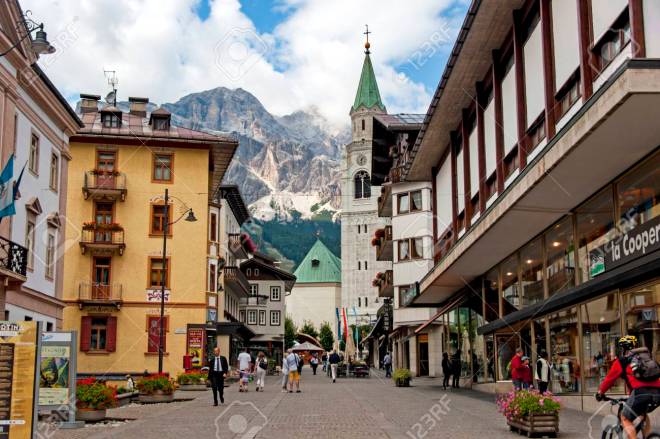
The main street in Cortina d’Ampezzo, where we had a late lunch before driving up to the hotel at the Passo Falzarego

Source

26 June

I said I would show another map of the trail we did on this last day of our hike, so here it is.

Cousins’ photo

We start at Lagazuói, taking the cable car from the Pass up to it.

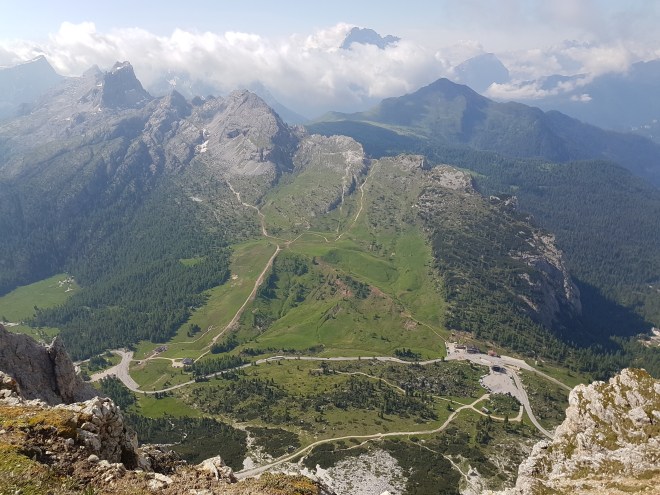
View of the Pass far below from the top of the cable car

Cousins’ photo

View of the other side, where we would be walking down and then going off to the right

Cousins’ photo

We’ve walked down, over extensive beds of snow, to this first pass

Our photo

Further on, a plunging view down to our left

Cousins’ photo

Striding across a soggy meadow

Cousins’ photo

The clouds are billowing up from the valley below …

our photo

… which means that we are soon climbing down into mist

Cousins’ photo

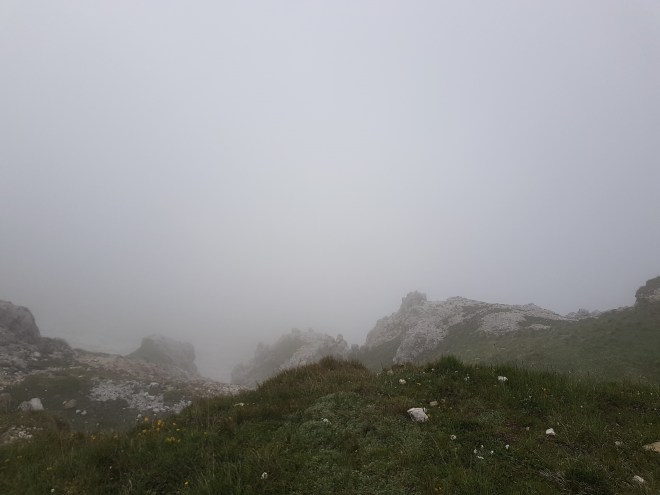
Soon, the world around us turns milky

Cousins’ photo

But we eventually break out from the mist and can look up at the heights we came down from

Our photo

The path wends its way through dwarf pines

Cousins’ photo

We go on until we reach the cable car you can see in the distance.

Cousins’ photo

So ended this year’s hike to the Dolomites. I’m sure we will be back next year – Covid-19 permitting.

OLEANDER AND RABBIT HOLES

Milan, 27 June 2020

This post was going to be about the oleander, but as often happens when I surf the web I disappeared down some fascinating rabbit holes along the way. So while I will discuss the oleander I will also throw in a couple of disparate facts linked more or less tenuously to the oleander.

First the oleander. The walks which my wife and I have been taking recently on the Ligurian coast have led us past many an example of this fine plant, whose showy red and pink flowers have lit up our way, especially when we have been traversing urban sections of our walks.

various sources

As usual, after quietly enjoying at this display from Nature, I looked to the plant’s history, to see where it had originally come from (not believing for a minute that it could be native to Liguria). What I found was, I suppose, a testimony to its enduring attraction to humans as well as to its toughness and endurance: enduring attraction to humans because it’s been domesticated for such a long time that no-one can make out its original home – South to South-West Asia seems to the best guess; toughness and endurance because even when taken out of its native habitat it has survived and thrived and created new homes for itself – here is a picture of oleander which has gone native in northern Israel, growing along the side of streams.

Source

It has gone similarly native in many places, from Portugal and Morocco in the west to Yunnan in China in the east.

Its toughness and endurance has made it a popular plant to use in unforgiving environments, like the median strips of highways: you can’t get much tougher than that – poor, stony soil, little water, fumes from the passing cars, collection point for all the rubbish that people throw out of their cars, or that drop off their cars. As a bonus, it almost makes highways look pretty.

Source

One of the first things that struck me when I went to Sicily was the oleander bushes along the highways there, the flowers turning what was really a very sterile environment into a pleasure to look at as the car whizzed down the highway.

The only other thing to note about oleander is its poisonous effects on humans and other animals. Every part of the plant is poisonous: in a word, beautiful but deadly. A couple of books have had as plot devices the murder of someone with oleander. For me, the best is Dragonwyck, not so much for the book as for the 1946 film made from the book. It has Vincent Price, a slimy smoothie if there ever was one, who does in his wife with oleander. We have him here staring broodingly at the fatal oleander plant.

Source

Actually, oleander’s deadliness has been exaggerated. It’s not really that bad. Very few people have certifiably died from ingesting oleander. The worst that normally happens is that you feel horribly sick, you vomit, you get diarrhea … I’m sure I don’t have to spell it out, readers get the picture.

And that’s it, really, for the oleander. Now I can turn to the rabbit holes I fell down!

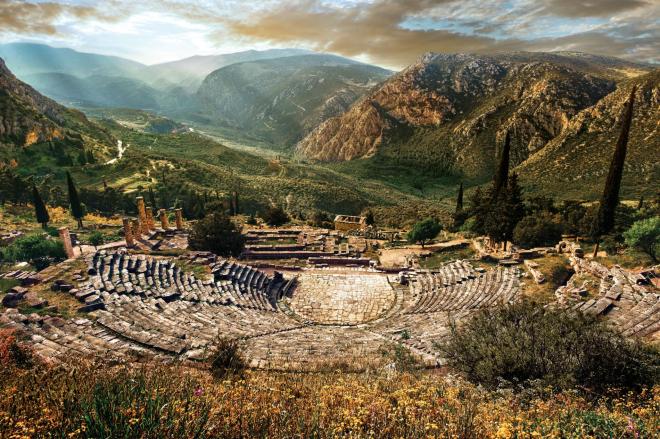
The first is related to the plant’s effects on humans. But I must start with a little bit of context. I want to take my readers to Delphi, in Greece.

Source

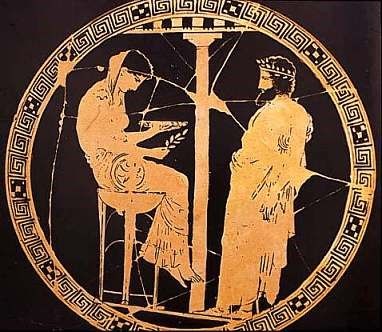
Now the place is just a mass of romantic ruins, but in its heyday, from about 600 BCE to about 200 CE, it was really famous in the Ancient World, a place to go to if you wanted divine advice about something important to you: should our city go to war with our neighbour? should we start a new colony? or, on a more personal level, should I marry her? The temple there was dedicated to the god Apollo, and one of the temple’s priestesses, the Pythia, would answer your question. After offering a splendid goat for sacrifice and paying a suitable tribute (there’s no such thing as a free lunch), supplicants would be led down into the inner sanctum of the temple, this dark small room, where they would find the Pythia sitting on a tripod and flanked by a couple of priests. The tripod was placed across a cleft in the floor through which vapours or fumes would be rising and enveloping the Pythia. She would be holding a branch of laurel in one hand (the laurel was sacred to Apollo) and a small basin of clear water from a nearby sacred stream in the other. Rustling the laurel branch and gazing into the basin of water, she would answer your question. Here is the scene depicted on the bottom of an ancient Greek drinking cup, the supplicant to the right, the Pythia to the left.

Source

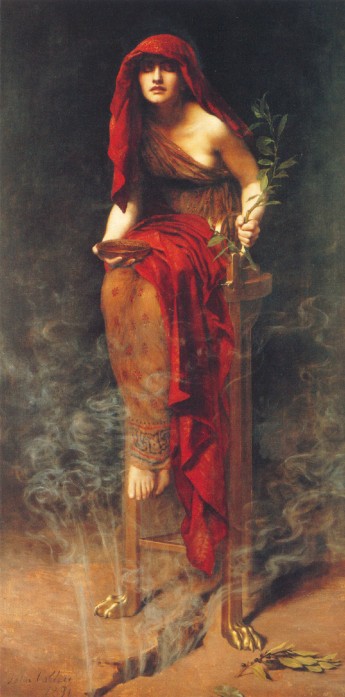
Now, this was not like having a pleasant conversation with someone. The Pythia would be pretty agitated: “her hair stood on end, her complexion changed, her heart beat hard, her bosom swelled, and her voice became seemingly more than human”. Here is a much more satisfyingly dramatic rendering, painted by a certain John Collier in 1891, of what the Pythia might have looked like.

Source

The whole experience must have been quite unnerving and overpowering for the supplicants. On top of it, the answer they got was often quite cryptic, leaving the supplicants scratching their heads trying to understand the true meaning of what Apollo had told them through the Pythia.

Why am I recounting all this? Because there has been considerable discussion about how the Pythia got herself all worked up. What was she eating, drinking, or smoking to get herself into that state? Some of the ancient sources say that the Pythia was chewing laurel leaves. But as we all know – bay leaves, which are actually laurel leaves, being used in cooking – laurel leaves don’t have any effect on someone who eats them. Which is where oleander comes in. The Greeks were rather slipshod in their use of the name “laurel”, using it to denote several plants including the oleander (the leaves of the oleander and the laurel do look quite similar). So one clever chap has suggested that the Pythia was actually chewing oleander leaves, which could indeed give you all the symptoms the Pythias exhibited.

I would be remiss if I didn’t mention the vapours and fumes emanating from the cleft under the Pythia’s seat (and which are very evident in the painting by John Collier). Some have argued that it could have been these that (also) set the Pythia off. Given that Delphi sits on two geological faults which cross each other, it is thought in certain circles that the cleft which the Pythia sat astride was a natural opening into the bowels of the Earth. There has therefore been much discussion about what naturally formed fumes and vapors could have been seeping out from the Earth’s interior and been having this effect on the Pythia – ethylene? benzene? something else? – but it’s all been quite inconclusive. The above-mentioned clever chap suggests what seems to me a much simpler solution, that maybe under the room where the Pythia sat was another room, connected to the former through the cleft, and in which a priest was burning oleander leaves. By inhaling these fumes the Pythia was adding to the effects from chewing the leaves.

That’s one interesting rabbit hole connected to the oleander.

The other involves Hiroshima. As I would hope everyone knows, the first atom bomb ever dropped came down on Hiroshima on 6 August 1945. Here is a picture of the dreaded mushroom cloud which formed over the city.

Source

The city was totally devastated. Here are a few pictures of what the city looked like in the days and months after the dropping of the bomb.

Source
Source
Source
Source

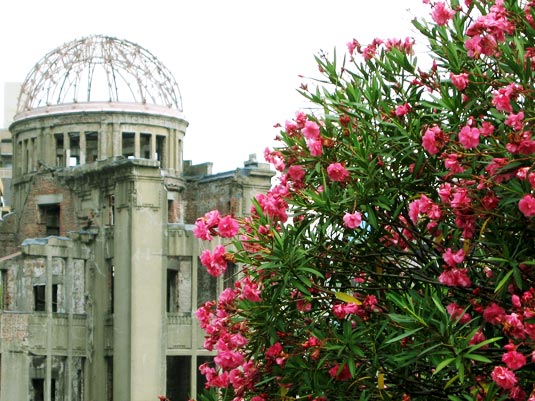
The city’s botanical gardens were not spared. So bad was the destruction that the garden’s directors thought that nothing would grow there again for decades. Yet lo and behold, the year after the bomb was dropped the oleanders in the gardens grew out from their blasted roots and flowered! The oleanders became a symbol of hope for Hiroshima’s citizens, convincing them that the city could be reborn even after this terrible catastrophe – as indeed it has. Ever since, the oleander has been the city’s official flower.

Source

I’ve become a bit of a cynic in my old age, but this little story does warm the cockles of my heart.

STRAWBERRY

Milan, 14 June 2020
Revised in Vienna, 20 October 2020

In the recent hikes which my wife and I have been doing, we’ve come across a lot of these.

My photo

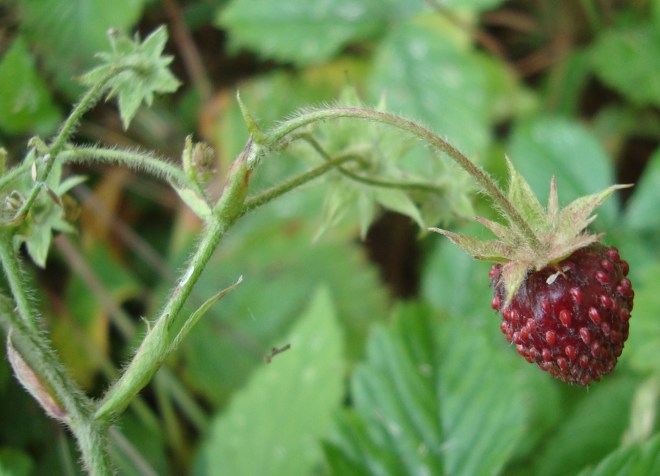
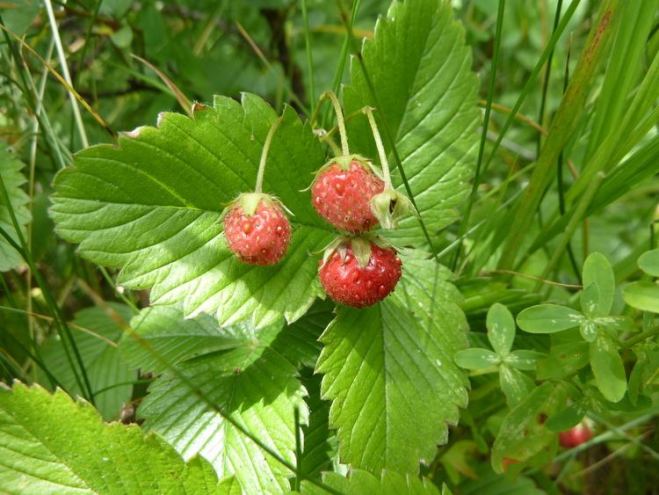
“These” are woodland strawberries (but see the Postscript at the end). I throw in here a much more professional photo of this plant, to give readers a better view.

Source

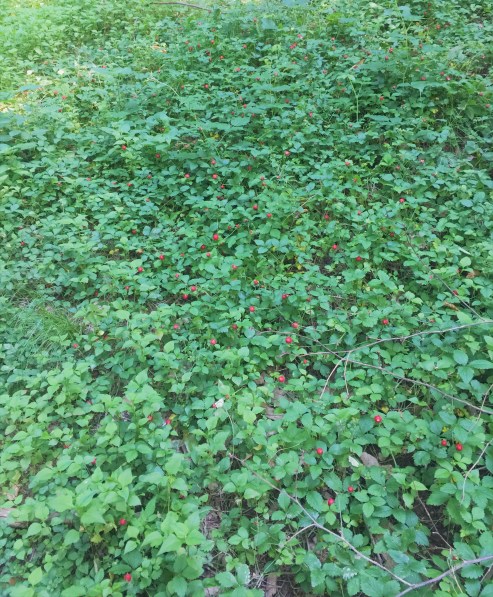
The fact is, though, that they are really very small, no more than half a centimetre across, as this photo of a whole sheet of them shows: they are just bright red dots against the green of the leaves.

My photo

Those bright red dots always catch my eye as we walk along. From time to time, I’ve picked one of the bigger ones and eaten it. They are pretty bland, I have to say. Their taste is really nothing to write home (or a post) about.

Which – as I tramped along – got me thinking: who were the people who laboured so hard to turn these small, not very tasty berries into the big, juicy and wonderfully sweet berries that we eat today?

Readers of my posts will know that I have a fondness of saluting the almost always anonymous folk who over the millennia have coaxed tasty foodstuffs which we eat today out of small and not so tasty wild plants. The last such foodstuff whose creation I have saluted is the common chicory. I decided to do the same thing for the strawberry. And so I have been beavering away on my computer these last few weeks, surfing the web and seeing what I could find.

The first thing I found was that I had been completely wrong. Today’s strawberries do not descend from those little woodland strawberries we had been spotting on our walks. They are not the result of countless generations of rural people patiently selecting woodland strawberry plants with ever sweeter and ever bigger fruits. The story of today’s plump and juicy strawberries is much more complex. They are actually the result of Europe having colonised much of the rest of the planet.

But let me start where all good stories start, at the beginning. It is true that Europeans had at one time domesticated woodland strawberries. Perhaps the Romans had done so, but if they did these domesticates were lost during the Dark Ages. Medieval Europeans certainly started domesticating them. King Charles V of France, for instance, has his gardeners transplant 1,200 woodland strawberry plants into his gardens some time in the late 1300s. Europeans also started domesticating the other species of strawberries which are found in Europe, the musk, or hautbois, strawberry, which is somewhat bigger than the woodland strawberry

Source

and the creamy strawberry, which as its name suggests can be quite pale; it’s about the same size as the woodland strawberry.

Source

It’s hard to tell from surviving documents, but Medieval and Renaissance gardeners do seem to have created strains of strawberries which were bigger and sweeter than their wild cousins. But by “bigger” I mean something as big as a plump blackberry, no more than that.

Then started the period of European colonisation. In the Americas this led to, among other things, the transfer of a wealth of new foodstuffs to Europe, a phenomenon I’ve touched upon in a couple of past posts. Maize, tomato, and potato are probably the most well known of these arrivals from the Americas. Like these three, most of the new foodstuffs came from Central and South America, but a few also made their way from North America. The best known of these is the sunflower, while I recently wrote a post about another, more modest transfer from North America, the Jerusalem artichoke. And now I have discovered that there was yet another transfer from North America: the Virginian (or scarlet) strawberry! This species of strawberry grows throughout much of North America, but it was of course first seen by Europeans in the colonies strung along the eastern seaboard.

These colonists must have been quite pleased to have this new strawberry plant at hand. We’re still not talking of berries the size of those we’re now used to – its berries were about the same size as those of the European musk strawberry. But no doubt they would have seen them as a useful adjunct to their diet.

Source

When exactly someone brought plants of the Virginia strawberry back to Europe is not clear – the early 1600s seem to be the most probable time frame. And what country they brought them back to is not clear either – the British, French and Dutch all had colonies in the strawberry’s range, so any of these three countries could have been the original entry point, and maybe the plant was introduced into Europe more than once. Wherever its entry point (or points) was, the Virginia strawberry didn’t spread that quickly through the rest of Europe. It seems to have been more of a curiosity, and certainly didn’t replace the European species with which people were familiar.

While the French, British, and Dutch were busy colonising North America, the Spaniards were busy colonising Central and South America. In South America, they first smashed the Inca Empire. Then they turned their attention further southward. It made strategic sense for them to control the whole of the Pacific seaboard down to the Straits of Magellan, to keep an eye on other pesky European nations coming through those straits for who knows what nefarious reasons. So they went on to conquer what is now Chile. In the south of Chile, the Spaniards encountered the Mapuche and Huilliche peoples, who put up a stiff resistance but who were eventually overcome and subjugated.

Source

The Spaniards discovered that these two tribes had domesticated another local species of strawberry, the Chilean (or beach) strawberry. And in this case the berry was pretty damned big!

Source

The Spanish colonists were very happy to add the Chilean strawberry to their local diet, to the point that it was commonly available in local markets in the new Spanish towns of southern Chile. It remained, however, a local delicacy. If anyone ever tried to bring back plants to Spain, there is no sign of them having succeeded.

So things stood until 1712. In that year, King Louis XIV of France sent a certain Amédée François Frézier on a secret mission to Chile. We have here a portrait of Frézier in old age, after a long and successful career.

Source

His orders were to find out all he could about the Spanish military presence there: forts, harbours, military units, and so on (this was part of Louis XIV’s ongoing struggles with Spain). For nearly two years, Frézier followed his orders most diligently, posing as a merchant looking for trading opportunities. But Frézier was a man of many interests, one of these being botany. Naturally enough, the Chilean strawberry, with its very big fruit, caught his attention. As he was to write later:

They there cultivate entire fields of a type of strawberry differing from ours by their rounder leaves, being fleshier and having strong runners. Its fruit are usually as large as a whole walnut, and sometimes as a small egg. They are of a whitish-red colour and a little less delicate to the taste than our woodland strawberries.

Frézier determined to bring some plants back with him when he returned to France. So it was that when in 1714 he finally boarded the ship which would be taking him home, he took five plants of the Chilean strawberry with him, and managed to keep alive on the long – and hot – trip home. When he arrived in France, he kept one of the plants for himself and sent the others to various friends and patrons. News of this new species of strawberry quickly made the rounds among Europe’s little circle of amateur botanists, especially after Frézier’s book was published in which he gave a detailed account of his doings in Chile and included a description of this strawberry plant with such large fruits. Strawberry plants are easy to propagate, so not only did news about the Chilean strawberry get around; so did clones of the various plants he brought back. Anyone with a serious botanical garden had to have the plant in their collection!

Alas! Great disappointment lay in store for many of those eminent botanists who planted the Chilean strawberry in their garden and eagerly awaited it to flower and – especially – to fruit (“usually as large as a whole walnut, and sometimes as a small egg”, Frézier had written). For the most part, their plants yielded nothing – nada, zero! They began to think that maybe the plant’s transfer to Europe had made it sterile.

Here, with the advantage of hindsight, I shall cut through all the intellectual confusion that pervaded the minds of Europe’s finest botanists for several decades. The fundamental problem was this: they hadn’t realized that some species of plants are hermaphrodites, and so can self pollinate, while in other species there are separate male and female plants, so both have to be present – and relatively close to each other – for pollination to occur. It just so happens that all the European species of strawberries are hermaphrodites, as is the Virginian strawberry, but the Chilean strawberry is not. There are both male and female plants in that species. Frézier must have taken only plants which were fruiting, and therefore females. This was sensible enough, given his (and everyone else’s) knowledge of strawberries; he wanted to be sure that the plants he nicked were fertile. But what this meant is that there was no way that those poor female Chilean strawberry plants, along with their clones which all the botanists were busy sending each other, were ever going to fruit in Europe without a male plant handy. This mystery was finally elucidated in the early 1760s by a young Frenchman called Antoine Nicolas Duchesne, who had a fascination for natural history. He was lucky to have access to King Louis XV’s gardens at Versailles and to be mentored by the “Assistant Demonstrator of the Exterior of Plants at the King’s Garden”, Bernard de Jussieu. After making a detailed study of strawberries, he explained all in his book Histoire naturelle des fraisiers published in 1766, when he was a mere 19 years old! Here is picture of him in old age.

Source

But actually there was a way to make the Chilean strawberry produce berries! The discovery had been made some time in the first half of the 1700s by those anonymous farmers whom I love to salute. While all those well-off, educated botanists were tearing their hair out at the Chilean strawberry’s obdurate refusal to fruit, they had found a way to coax it to do so – by interplanting the plants with either Virginian strawberry plants or musk strawberry plants. The pollens of these species were closely related enough to that of the Chilean strawberry to pollinate it. Presumably, by chance a farmer (or his wife) had planted these various species close together in their strawberry patch, had seen that the Chilean strawberry fruited under these conditions, and were sharp enough to draw the right conclusion. Who exactly these clever farmers were will of course never be known. But the chances are that it was one or more farmers from around the French city of Brest, in Brittany (Frézier was posted to Brittany on his return from Chile, which probably explains this Breton connection), although it could (also) have been farmers in the Netherlands.

And what fruits they were! Big, juicy, sweet – everything that Frézier had said of the strawberries he had eaten in Chile. Further experimentation showed that the two species from the Americas, the Virginian strawberry and the Chilean strawberry, gave birth to a fertile hybrid, which could be grown as a separate species. On top of this, this hybrid was hermaphroditic so no need for all that fiddly stuff of making sure to plant males and females together! This hybrid is the garden strawberry, the modern strawberry eaten all around the world today.

Source

An industry was created, which currently produces some 9 million tonnes of garden strawberries per year, (with – sign of the times – 40% of that being in China).

And what of the strawberries which this hunking hybrid of a strawberry displaced? The woodland strawberry has disappeared back into the woods from whence it came and where I found it at the beginning of this post. As far as I can tell, the same fate has befallen the Virginian strawberry. There is apparently still a small but devoted following of the musk strawberry in gourmet circles in Italy (of which my wife and I are clearly not part since no restaurant in this country has ever offered us this delicacy). And the Chilean strawberry is still eaten in certain parts of southern Chile.

And what of the other species of strawberries? Because there are something like 15 other species of strawberries around the world. Not surprisingly (strawberry plants liking cool to cold conditions), most of these are native to northern Eurasia, in an arc going from western Siberia to northern Japan. But a number are also to be found in the high areas of western China, all the way from Qinghai in the north to Yunnan in the south. A couple of species are also found in the Himalayas proper. There is even one species which inhabits the hill country of southern India and the mountainous regions of the Philippines.

A good few of these species don’t produce a fruit worth eating. Others do, but the steamroller of the garden strawberry hybrid has meant that they have never had a chance to develop commercially. They are only eaten locally. This is especially true in China. I find that a pity. Rather than becoming the biggest global producer of what is essentially an American hybrid, China should look to its own strawberries and bring them to its people, and to the rest of the world. Just a thought.

As for me and my wife, I think we should plan an enormously long hike from Yunnan to Qinghai, sampling the local strawberries along the way. That would certainly keep us busy for quite a while …

POSTSCRIPT 20 October 2020

A sharp-eyed, and knowledgeable, reader recently informed me that I had made a fundamental mistake when I thought that the little red fruits I was seeing on those hikes with my wife were woodland strawberries. Actually, he kindly told me, they were false strawberries (or mock strawberries), Potentilla indica. The fruits look like the Real McCoy, the leaves look like the Real McCoy, but it ain’t the Real McCoy! After a moment of indignation against this plant masquerading as another, I actually felt relieved. I wrote above that the fruits which I had tasted were bland tasting. Actually, eating them was like eating paper filled with sand (the keen-eyed reader felt it was like eating styrofoam; the few times I’ve bitten into styrofoam makes me think that that taste is quite nice compared to what I was tasting). I kept on wondering how our ancestors could ever have thought they were nice to eat. Now I know that what they were eating – the Real Mccoy – probably tastes quite nice, and I look forward to coming across some in next year’s hikes.

This discovery that what I had been looking at was actually Potentilla indica led me of course to do my usual (Wikipedia-based) research. Which in turn led me to discover that this false-friend is actually native to southern and eastern Asia. Another invasive species! Any faithful reader of mine will know that this has been a topic on which I’ve written several posts over the years. If any of my readers happen to live in Minnesota, they should be aware of the fact that that State’s Department of Natural Resources invites people to report this plant (and any other invasive species) to the authorities. I’m not sure if Italy has any such reporting system, but if it does I will be sure to report any more patches of this fake strawberry which I come across to the right authorities, and will gladly help them in uprooting the little bastards.

JASMINE

Sori, 6 June 2020

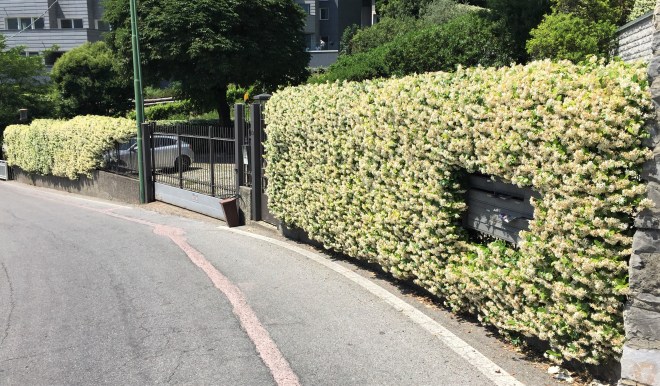
All the walks my wife and I do around Lake Como (and now Lake Maggiore, to change a bit) start in an urban setting. We take trains, or buses, or boats, to get to our starting points and we are perforce dropped off in small towns or villages. In the last couple of weeks, as we have walked up through the back roads of these towns or villages to get to the woods and meadows above them, we have noticed a marvelous thing: whole walls of the sweetest smelling jasmine.

my photo
my photo
my photo

This person has even made a tunnel covered in jasmine (I’m guessing it’s the garage).

my photo

The scent of so much jasmine has quite gone to my head and my fingers have automatically begun doing a little research on the flower.

Truth to tell, I already did a little research on jasmine for an earlier post, when I researched the only perfume of my wife’s which I have ever liked: Chance Eau Fraîche, by Chanel. One of its ingredients is jasmine oil.

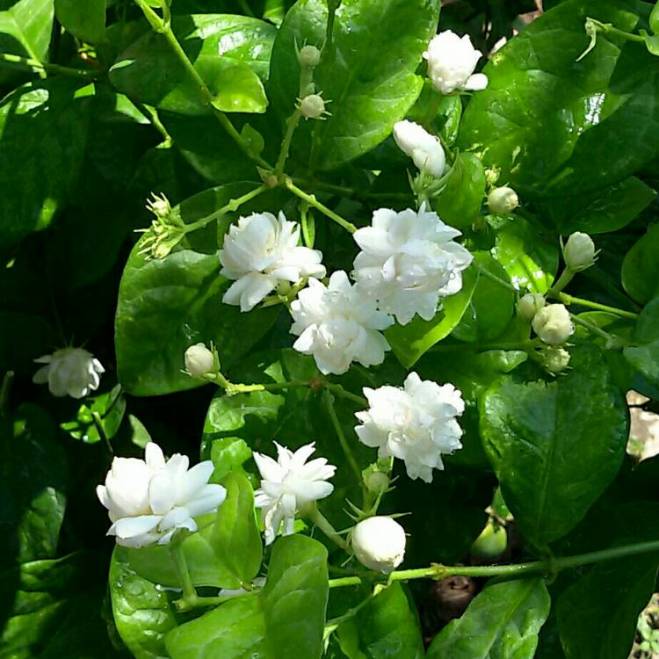
As I noted in that post, there are a large number of different species of jasmine. Some 200 have been catalogued, and who knows how many more are out there waiting to be discovered. My guess, though, is that those walls of jasmine which we have been passing are Jasminum officinale, the common, or white, or summer, or poet’s jasmine (and that’s just the English names).

Source

The logic for my choice is simple: it’s the most common jasmine in Europe.

But it’s not native to Europe. In fact, there is only one species of jasmine which is native to Europe, and only the Mediterranean part of Europe at that, the common yellow jasmine.

Source

Even in this case it’s difficult to say it’s a European flower. Its range stretches all the way to northern Iran.

The biggest “hotspot” of jasmine species is actually in South and Southeast Asia, although the west of China, especially Yunnan, hosts quite a few species. A number of species are present in Central Asia, but I suspect they may have been carried there from the Indian subcontinent. Australia is home to a few species, I suppose as a southward extension of their presence in Southeast Asia. And then there’s a good dozen species in Africa, especially southern Africa. To complete this world tour, no jasmine species are native to the Americas, alas.

If the jasmine my wife and I are seeing is not native to Europe, how did it get here? It seems that common jasmine, along with a couple of other jasmine species – sambac (or Arabian) jasmine, and Spanish (or Royal, or Catalan) jasmine – originally entered Europe via Sicily and Spain, when these were Arabian kingdoms: common and sambac jasmines through Sicily, and Spanish jasmine through (appropriately enough) Spain. Since I inserted a picture of the common jasmine earlier, I feel I owe it to these two other species to insert a picture of them too:
sambac jasmine

Source

Spanish jasmine

Source

But none of these jasmines were native to the Arabian-dominated lands either. The Arabs had discovered them even further to the east and had brought the flowers back to their homelands. They brought common jasmine back from Persia after they conquered it (a similar post-conquest westward transfer occurred with the lilac, as I narrated in an earlier post). In fact, the European name “jasmine” is a corruption of the flower’s Arabic name, which is itself a corruption of the Persian name for the flower, Yasameen, which means “gift from God” (such poets, the Persians!). And it’s possible that the Persians had come across the flower further east still. As for sambac and Spanish jasmines, it seems that trade, not conquest, brought them westwards, in the holds of the ships of Arab traders doing business with the Indian subcontinent.

Jasmines didn’t just ride westwards on trade routes. Common jasmine and sambac jasmine also rode on them out to the east, into China (another result of the ancient trade routes across the Eurasian continent – the “Silk Roads” – about which I’ve written previously). Here, too, the Chinese adopted the Persian name: Yeh-hsi-ming.

It’s interesting that the Chinese felt the need to import jasmines, given that they had quite a few of their own. Perhaps it was the pure white colour of these imported jasmines which attracted the Chinese – many of their jasmines are yellow as far as I can tell; I throw in a photo of one of the more common Chinese jasmines, winter jasmine.

Source

By the way, it’s called winter jasmine because it actually flowers from November to March. In fact, its Chinese name, Yingchun, means “the flower that welcomes Spring” (the Chinese, too, can be quite poetic). This quirk has meant that winter jasmine has now also been carried off to many a corner of the world.

But coming back to the jasmines imported into China, no doubt their heady scent helped too; perhaps they had a stronger scent than the native species. Or perhaps it was these jasmines’ close links with Buddhist ritual (something which the early Indian Buddhists had no doubt picked up from the Hindus). Anyone who has been to a Buddhist (or Hindu) temple in South and South-East Asia will have noticed the liberal use they make of jasmine flowers.

Source

By this reasoning, the use of these jasmines entered into China along with Buddhism, something else which was transported along trade routes (I have written earlier about a slightly different botanical story, the cooption by Chinese Buddhists of the ginkgo tree as a replacement for the bo-tree tree so beloved of South Asian Buddhists).

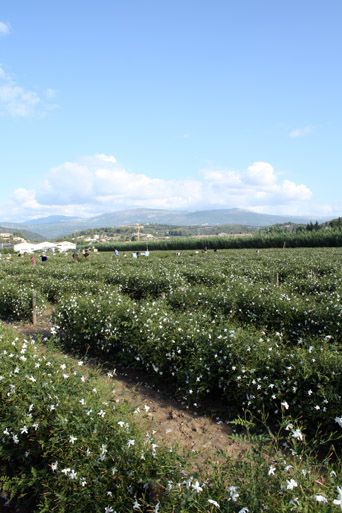
No doubt the Arabs were attracted by the colour of the jasmines (white seems to symbolise purity in so many cultures). But they were assuredly also attracted by their scent (which, I have to say, is indeed sublime). The name “sambac” points to this. It is a corruption of the Medieval Arabic term “zanbaq”, which means jasmine oil. As attested by the perfume Chance Eau Fraîche, which I mentioned earlier, the modern thirst for jasmine oil in perfumery is as great as it was in the Arabian kingdoms – actually far greater, since there are so many billions more of us on this planet now. Here is a field of  jasmine flowers in Grasse, in the south of France, waiting for their oils to be extracted (a field owned, by the way, by Chanel).

Source

But there is so little oil in each flower! As many as 8,000 flowers will have perished to produce this little, 1ml vial of jasmine oil (jasmine absolute, in the jargon of perfumery).

Source

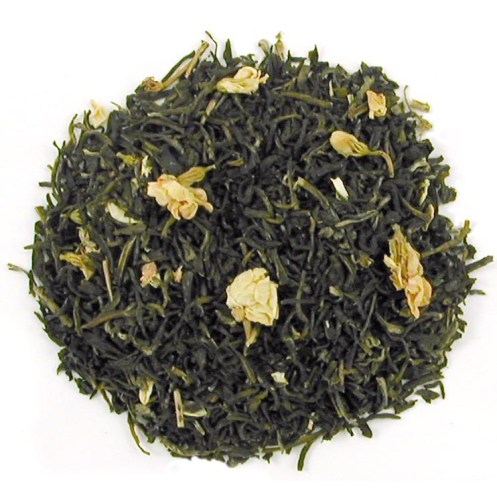
Perhaps the way the Chinese use jasmine to scent tea is a little more “humane”. I watched a no-nonsense Chinese video on the making of jasmine tea. Cutting out all the marketing bla-bla, they mix together about an equal measure of tea (usually green tea) and jasmine buds (common or sambac), they let the mixture sit for a while so that the tea leaves get impregnated with the jasmine’s scent, and then they dry it. The result looks something like this.

Source

In truth, I’m not a great fan of jasmine tea. I like the scent of the flower on the air, but the scent of it in tea I find rather sickly. But perhaps this is because I have never had a really high-quality jasmine tea. I am ready to be pleasantly surprised one day.

Is it possible that such lovely flowers with such a delightful scent could have an evil side? Alas, it is possible: some species of jasmine have been declared invasive species in a couple of countries and are subject to eradication programmes. It is not the fault of the jasmines. It is our desire to fill our gardens with foreign flowers that is to blame. Take Brazilian jasmine, a lovely member of the family.

Source

For starters, it’s not Brazilian at all. It’s one of the African jasmines, no doubt taken to Brazil from one of Portugal’s African colonies (remember that the Americas have no native jasmines; perhaps a colonial administrator wanted to enliven his garden in Brazil). In the 1920s, the “Brazilian” jasmine was imported into Florida. Initially, it was planted in people’s gardens, but inevitably – as I’ve recounted in other posts in the case of other invasive species – the “Brazilian” jasmine “jumped over” the garden fence and began to spread. It has now invaded intact, undisturbed hardwood forests in the south of Florida, where it can climb high into the tree canopy, completely enshrouding native vegetation and reducing native plant diversity. Here is a picture of this jasmine at work in the forests of Florida.

Source

I was thinking about this this afternoon as my wife and I were walking high up in the hills. We were surrounded by beautiful wild flowers of all descriptions. Why do gardeners have to fill their gardens with foreign flowers when there are so many beautiful ones right on their doorstep? Another mystery to be solved one day.

Well, the evening is drawing in. It’s time for me to get ready to test something. I’ve read that the jasmine flower opens at night, so the scent is most powerful then. I shall persuade my wife to accompany me on a hunt for a wall – or just a modest bush – of jasmine, to see if this is true. I shall report back.


HELLO CLOUDS! HELLO SKY!

Milan, 4 May 2020

We’re out at last! First day post-lockdown in Italy. Like Basil Fotherington-Tomas, I was saying, “Hello clouds! Hello sky!” as I skipped (well, walked) along.

Source

For those of my readers who are not familiar with this character, he appears in the book “Down with Skool!”, written in the 1950s, purportedly by one Nigel Molesworth, a boy in an English Prep school.

Source

The delightful cartoons which pepper the book’s pages are by the great Ronald Searle.

Molesworth’s judgement of Fotherington-Tomas is severe: “you kno he say Hullo clouds hullo sky he is a girlie and love the scents and sounds of nature … he is uterly wet and a sissy” (Molesworth’s spelling is also quite erratic).

Well, I’m not utterly wet and a sissy (although I do admit to being a bit of a nerd), but my joy of finally being let out of my apartment is uncontainable.

Hello sky!

my photo

Hello birds! (even if they are filthy urban pigeons)

My photo

Hello tree!

My photo

Hello ancient church!

My photo

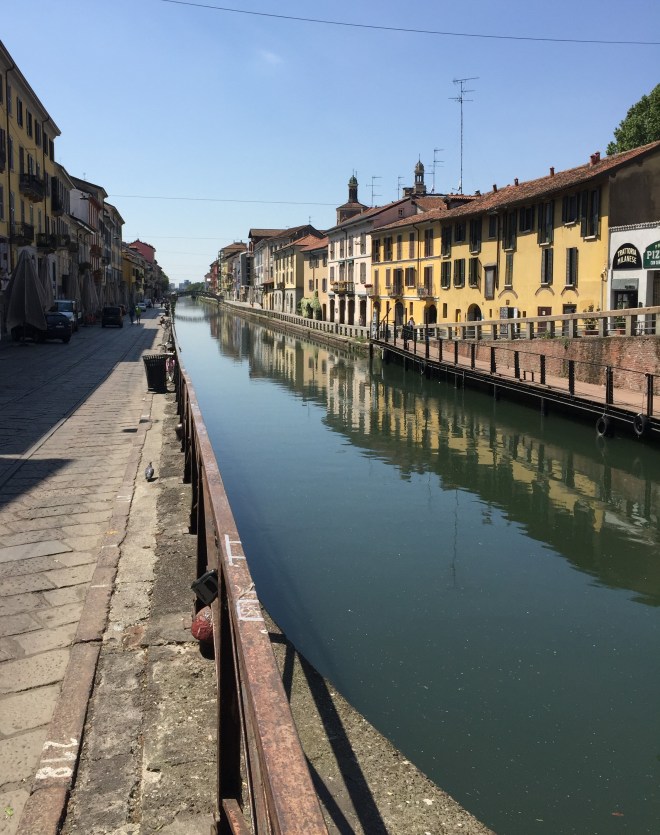
Hello canal of Milan!

my photo

Hello bridge over the canal! (even if you are a pretty ugly bridge)

my photo

It’s great to be out here and see you all again!

We now just have to hope that we don’t get too much of a spike back up in the numbers, otherwise they’ll send us once more into lockdown …

Source

PLANTS, FRUITS, FLOWERS

Milan, 2 May 2020

Two days to go until we can roam the streets again …

Well, having covered the animal kingdom in my last two wanderings around the apartment, it seems fair to now cover the vegetable kingdom. And here’s an interesting thing I’ve discovered on my wanders: while humans and animals often take centre stage in the pieces which I reported on earlier – they are the piece – plants are almost always – at least in this apartment – relegated to the role of mere decoration of something else. Let me show my readers what I mean.

For starters, many of our plates, bowls, and jugs are decorated with plants or flowers or fruit. Take this plate, for instance, which I bought many years ago in New York and which I’ve mentioned in previous posts.

my photo

The plate itself is a copy of an old Ottoman design, depicting a spray of wild flowers. I spy a tulip, a carnation of some sort, a sweet William perhaps. Lovely. But still, only decoration on a plate. In theory, we could cover all those flowers with a greasy meat sauce (I say in theory, because we never actually use this plate, it would feel sacrilegious to do so).

Or take this plate, which my mother-in-law bought.

my photo

Plants are much more aggressively centre stage here. We have four large leaves surrounding a small fruit. Lovely piece of design. But still only a plate. We’ve sometimes covered those leaves with olives, small onions, and other hors-d’oeuvres, to serve at table.

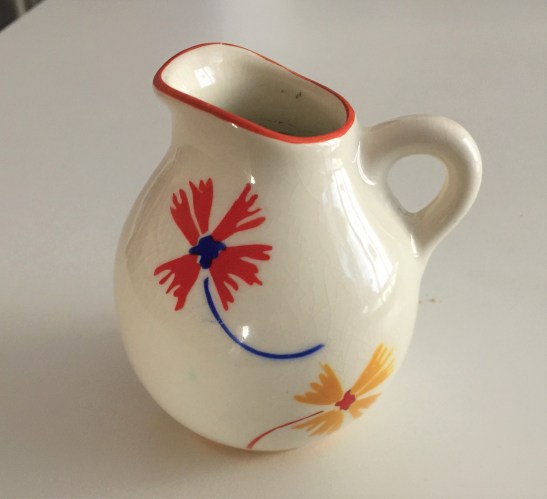
Or how about this little milk jug, which once must have been part of a larger tea set (and which I recently discovered, by studying the marks on the bottom of it, to have been made by Richard-Ginori).

my photo

Simple but beautiful design. But only decoration on a jug.

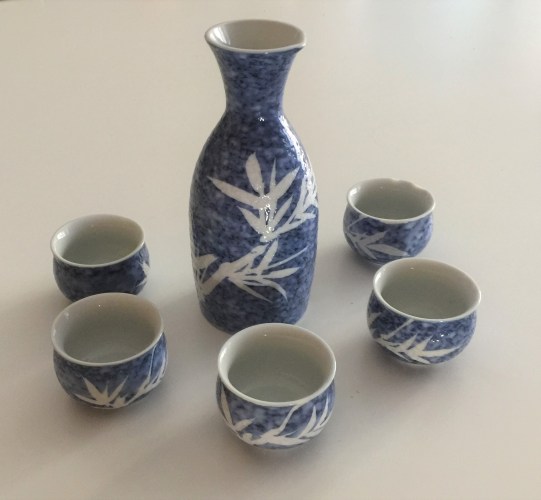
From the other side of the world but the same idea: a sake bowl and its companion cups, which my wife and picked up on our travels in Asia.

my photo

Here, we have the ever popular presence of bamboo in Asian design. Very handsome. But only there to be admired as one drinks one’s sake from them – which my wife and I have often done.

At a larger, more rustic scale, we have this series of water pitchers, all of which use plants and flowers as their decoration.

my photo

All, except for the pitcher with the wisteria, were bought by mother-in-law, who had a great fondness for pitchers. The pitcher-covered wisteria was instead given to us by a friend. They were made by her aunt, a potter. It came with a similarly decorated oil and vinegar cruet and salt cellars.  Every time I shake salt on my food, I admire those wisteria, a flower I adore. Lovely – but still only decoration on a utilitarian object.

Sometimes, the vegetal decoration gets so abstract as to almost disappear from view. Take this vase, for instance, another piece which my mother-in-law bought.

my photo

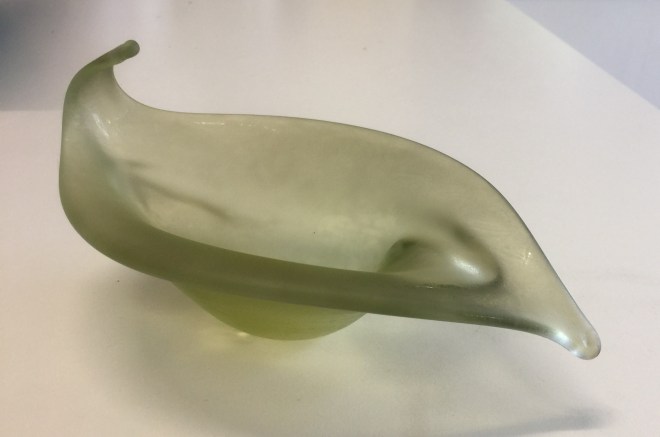
It’s really very handsome. But you have to study the vase a bit to see the flowers and the leaves. The more distracted eye, using it perhaps to hold cut flowers, just sees a swirl of browns and yellows.

It’s the same with this glass ashtray.

my photo

Only a closer look will discern a leaf in the rippling glass. The distracted smoker will see nothing but a receptacle for his butt-ends.

The fading of vegetal decoration into abstraction is even more marked in other objects. Take this carpet, for instance (another of my mother-in-law’s purchases), which in these days of confinement my wife and I  are regularly using as a exercise mat.

my photo

Only from time to time, as I groan my way through the exercises, will I focus and spy the flowers peeping out from the highly geometric design of the carpet.

It’s the same with the massive cupboard in our bedroom, inherited from my in-laws. Only sometimes, as I open one of its doors searching for a piece of clothing, will I register the rather stylized vegetal design carved in the wood.

my photo

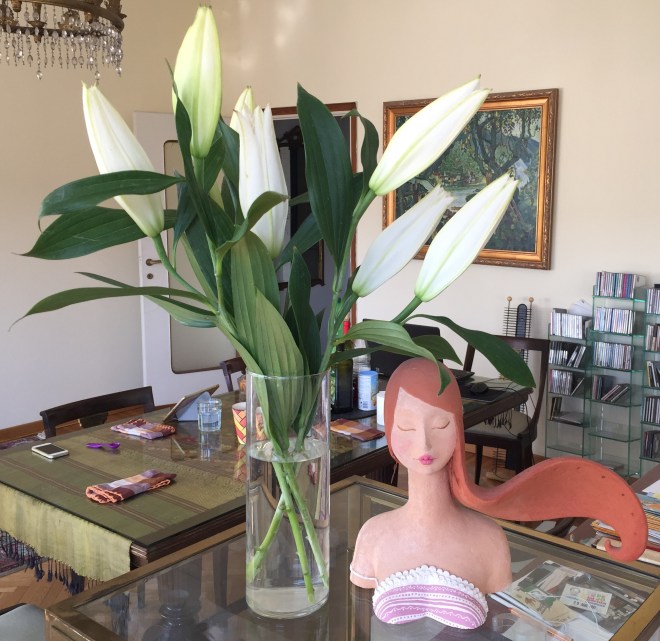
I wonder why it is that the vegetable kingdom plays such a modest, secondary role in the pieces with which we surround ourselves. Why don’t we have a statue of a flower in the apartment, for instance? Perhaps it’s because we can more easily have the real thing – the potted plant, a living statue as it were. At the moment, for example, we have this splendid bunch of flowers slowly opening up before us.

my photo

If you can have the real thing, why bother with inanimate copies?

Stay safe.

A MAGNOLIA BEHIND THE CATHEDRAL

Milan, 9 March 2020

A virus stalks the land,  it goes by the name of Covid-19.

Source

For weeks it has been spreading quietly, behind our backs, skipping from hand to hand, riding on droplets we cough out. Now it is out in the open. The patients are pouring into the hospitals. The hospitals are struggling. The frailest – the old, the weak – are dying. The government has enacted drastic measures. Here in Milan, we are in lock-down. No-one can enter or leave the region without a good and serious reason, no-one can even move around within the region. The government exhorts us to stay home. In fact, if we have even a small temperature it orders us to stay home. If we are infected, we are to go to the hospital only if we can no longer breathe. These are anxious times for us all.

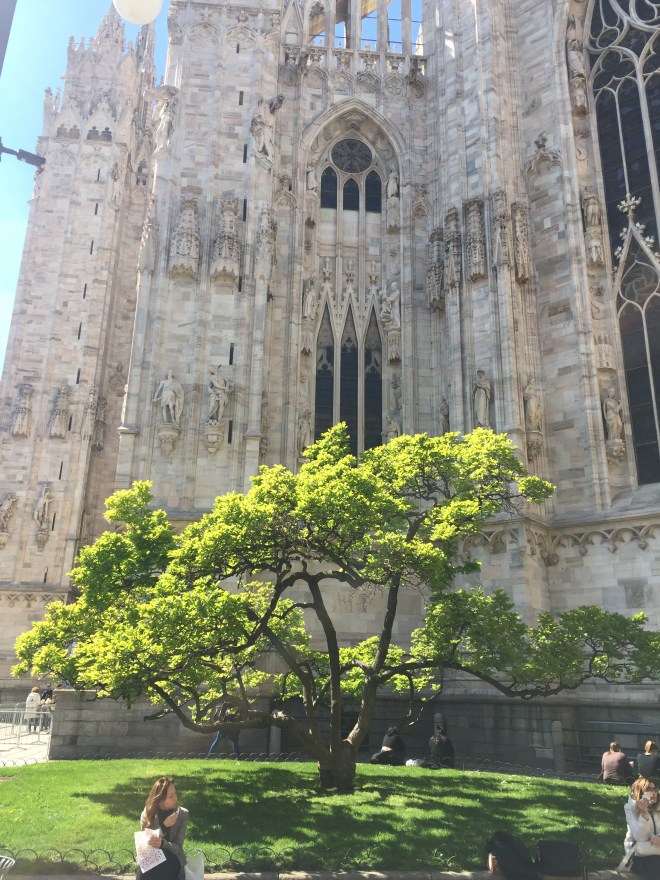
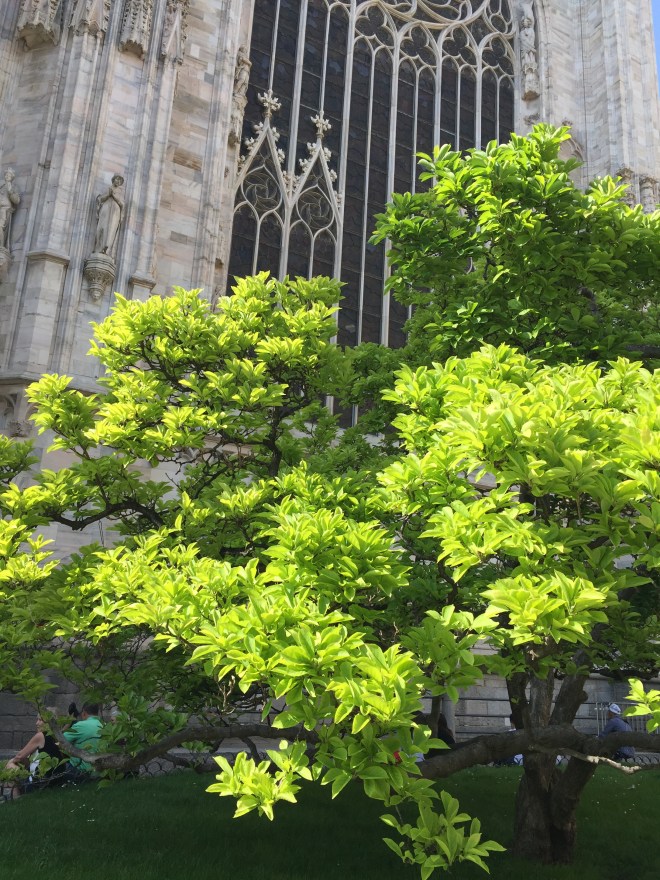
True to the philosophy behind this blog, I have been looking around me for beauty and the peace it can bring the anxious soul. I have found it, in a magnolia tree behind Milan’s cathedral.

As a previous post of mine attests, I love magnolias – who does not? I discovered this particular magnolia tree a few years ago. It grows on a small lawn tucked away between the cathedral’s gothic apse and its southern transept. Last year, I happened to pass by when it was in full bloom. Here, I took the photo with the apse behind.

My photo

Here, I took it with the transept behind.

My picture

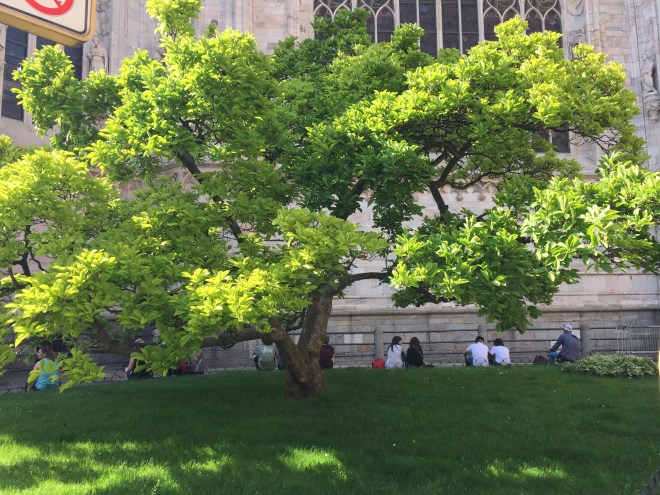
On impulse, I decided to watch the tree cycle through the seasons, finding excuses to walk this way from time to time. The next time I came by it was summer. The flowers had given way to thick foliage.

My photo

As a previous post attests, I have a weakness for this shade of green, but I found the contrast between the green of the leaves and the white of the cathedral’s stone particularly stunning.  So entranced was I that I snapped several photos of this symphony of green and white.

My photo
My photo
My photo

Shortly after taking this photo, we moved up to Vienna for the rest of the summer, and the autumn took us to Japan once more. So it was only in the dead of winter that I saw the tree again. I saw it at night, its skeleton of branches barely lit by the lights illuminating the cathedral.

My photo

The delicate tracery of the cathedral’s gothic windows took pride of place.

And now, in these dark times, I have gone back to see the tree in flower once more, to draw solace from it.

My photo


PARAPHRASING WORDSWORTH

Milan, 26 February 2020

updated 29 February 2020

“I wandered lonely as a cloud
That floats on high o’er vales and hills,
When all at once I saw a crowd,
A host, of golden daffodils;
Beside the lake, beneath the trees,
Fluttering and dancing in the breeze.”

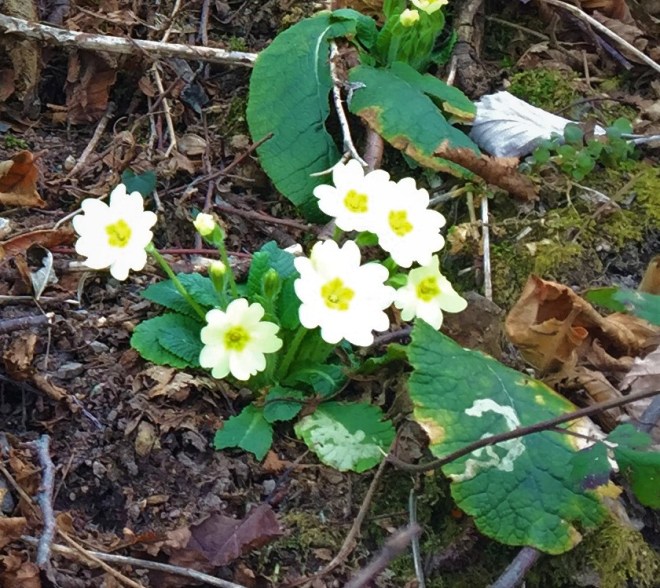
Except that, contrary to William Wordsworth, I wasn’t lonely as a cloud, I was with my wife, and it wasn’t daffodils that I saw crowded on the hillside but primroses. My wife and I were finishing the last stage of the Traveler’s Trail along Lake Como when we turned a corner and found before us this star-burst of yellow.

my photo

True to their name — prim-rose; first “rose”, or flower — the primroses have been one of the first flowers to burst out of their winter hibernation into this Year of Our Lord 2020. They have been a constant companion along the paths we have travelled these last days of February, coming up through the forest floor litter of last year.

My photo

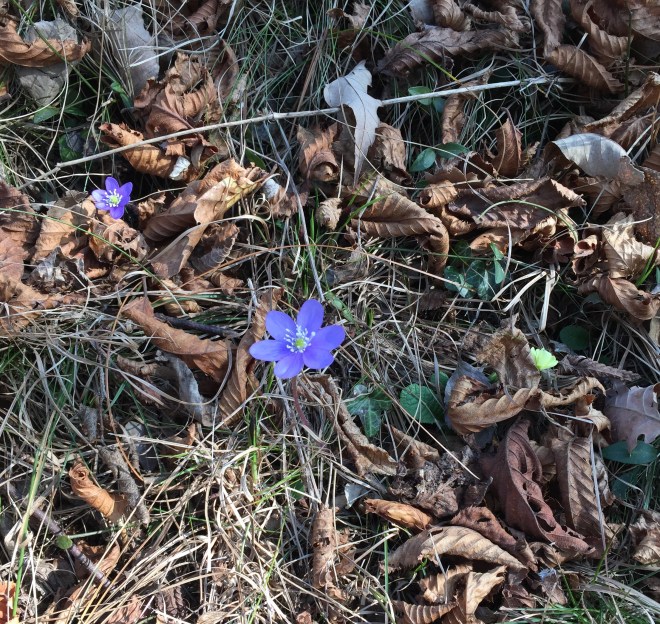
But it is not only them which have been keeping us company. For every primrose we have seen, it seems there has been a small purple flower close by. A few minutes after seeing that crowd of primroses, we saw a heavy sprinkling of these purple flowers along the side of the path.

My photo

Some investigation on my part has revealed that they are liverworts. They are so small that I had to crouch down low to get this picture, with my old bones protesting all the while.

My photo

We have seen them showing off hues ranging from this violet to washed-out jeans-blue.

Nature, slowly coming alive again, has continued to give. Today, as we travelled a trail from Como which wends its way through the woods north of the town, we came across a few bunches of this flower.

My photo

My internet searches failed to come up with a name for this lovely green flower with yellow pistils. Luckily, however, my initial plea for help led one helpful reader to point out that I had another hellebore on my hands, the helleborus viridis, or green hellebore (I happen to have written about the black hellebore in my previous post).  This flower hangs its head modestly on its stalk, so to get this picture I had to lie down on the path – I must confess to having had difficulties getting back up; luckily, my wife was at hand …

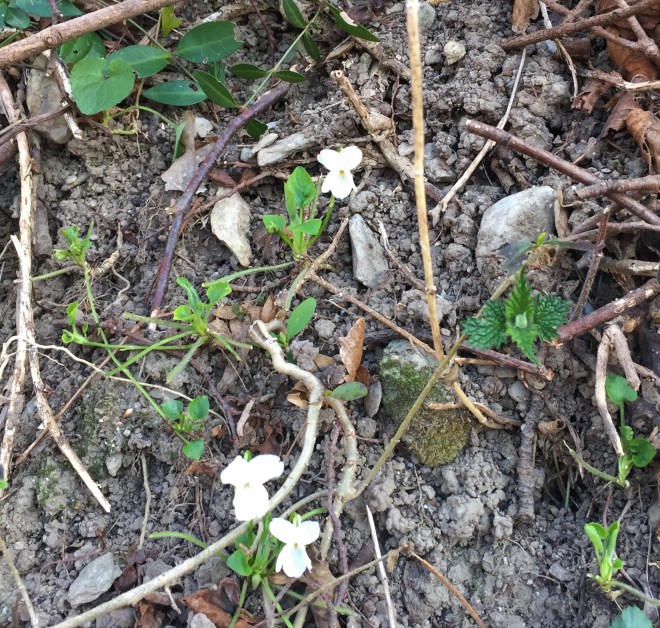
A little further, we came across another tiny purple flower. For a moment, I thought it was a liverwort, but on closer inspection I concluded that it was a violet.

my photo

And a little further on, we came across a white version of this same flower.

my photo

And now, riding back on the train to Milan, writing this up, I think I can say about all these flowers, paraphrasing Wordsworth (and severely harming his rhythm in the process), that

“… when on my couch I will lie
In vacant or in pensive mood,
They will flash upon that inward eye
Which is the bliss of solitude;
And then my heart with pleasure will fill,
And dance with the primroses, liverworts, violets, and green hellebores” .

BLACK HELLEBORE

Milan, 21 February 2020

My wife and I are in the middle of a multi-day hike down the eastern shore of Lake Como, walking a 45-km long trail which links Colico, located more or less where the River Adda flows into the lake at its northern end, to Lecco which straddles the River Adda as it flows out of the southern end of the lake on its way to join the River Po. It’s called the Sentiero del Viandante, the Wayfarer’s Trail. For any of my readers who might be hikers, I throw in a couple photos to whet their appetite.

My photo

Since the trailheads feeding the trail can easily be reached by train from Milan, we’ve been doing it in stages, closely watching the weather forecasts and going only when the sun is predicted to be shining. We’ve done three stages so far, with one more to go.

On the latest stage, as we were crossing a clearing, we came across this flower.

My photo

Of course, it gladdens the heart to see flowers blooming in February. It tells us that the Earth – at least in the Northern hemisphere – is waking up from its winter slumber. But this flower was particularly beautiful: large white petals surrounding a yellow-green centre. It was also quirky: this large flower was perched on a tiny stem, with no leaves that I could discern; it seemed almost to spring straight out of the ground.

As usual, once we’d seen one we saw many. Some were just opening. In others, the petals looked fly-blown, ready to fall. In others again, the petals were pink-veined.

On the train back, we started chatting with another couple whom we’d met along the trail. Suddenly remembering the flower, I pulled out my phone and showed them the photo of the flower. Ah, they said, in Italian that’s called elleboro. Pulling up my trusty Google Translate, I discovered that its English name is hellebore.

Hellebore … this stirred up vague memories in me, of poison and death. As the train racketed along towards Milan Central Station, I passed the time reading up on hellebore and saw that the plant is indeed horribly poisonous. “All hellebores are toxic, and all parts of the hellebore plant are toxic”, I read in Wikipedia. “Poisonings will occur through ingestion or handling … Poisoning cases are most severe when the plants are eaten … causing tinnitus, vertigo, stupor, thirst, anaphylaxis, emesis (vomiting), catharsis, bradycardia (slowing of the heart rate), and finally, collapse and death from cardiac arrest.” Bloody charming … And it doesn’t finish there! “Dermatitis may also occur from handling the hellebore plants without protection. … The poison on the outside of the plant will cause irritation and burning sensations on the skin.” Jeez Louise …

Wikipedia also informed me that there are a good number of different hellebores. The particular hellebore we came across on the walk is the Helleborus niger, or black hellebore. I find this a strange name, given the snowy whiteness of the flower, seen here in a particularly appealing photo (also showing, incidentally, its natural range, the Alps, in the background).

Source

The blackness, it seems, refers to its roots, which are indeed somewhat black.

Source

It is the roots, suitably dried, that are ground to a powder and fed to unsuspecting victims: “hubble, bubble, toil and trouble…”, to misquote the three witches in Macbeth, whom we have here in an especially dramatic painting by a Victorian painter by the name of William Edward Frost.

Source

I had hoped that Shakespeare might have had them mention hellebore as one of the ingredients in their magic brew. But no. They mention eye of newt, toe of frog, wool of bat, tongue of dog, adder’s fork, blind-worm’s sting, lizard’s leg, howlet’s wing. Oh, and fillet of fenny snake. But no hellebore. Nor is the plant mentioned in any of his other plays where magic and magicians play a part.

I was quite disappointed that the Bard passed hellebore over in silence. Because it did play a role in the magic of his time and earlier (and still does, if I’m to believe some of the web sites I’ve visited). It could be used to cause madness, or put a good curse on someone. It was good for both raising demons as well as banishing or exorcising them. Carrying it on your person could stop demons possessing you. Planting it near the entrance to your house would deter demons from entering. It was often planted in graveyards to gain the allegiance of the dead. It seemed especially popular in healing swine and cattle from illness and protecting them from evil spells (cast, no doubt, by jealous neighbours): “a piece of the root being drawne through a hole made in the eare of a beast troubled with cough or having taken any poisonous thing cureth it, if it be taken out the next day at the same houre”, wrote a certain Parkinson in 1641. Two properties attributed to it which I particularly like is the ability to make you invisible (scatter powdered hellebore in the air around you as you walk along) and to make you fly to witches’ sabbaths and suchlike (make an ointment of it and spread it liberally on yourself. There actually seem to have been quite a number of recipes for these so-called flying ointments; one I particularly like was given by Francis Bacon: “the fat of children digged out of their graves, of juices of smallage, wolfe-bane, and cinque foil, mingled with the meal of fine wheat”).

I have a great fondness of medieval witches and sorcerers, my vision of them having been determined by the comic books of my youth regaling me with the stories of two medieval boys by the names of Johan and Pirlouit. I throw in here a picture from the story “La Guerre des Sept Fontaines” to give an idea of the treatment of witches and sorcerers in these books.

My photo

But enough with this childishness! Let me finish on a more positive note. A legend about black hellebore revolves around another name for it, Christmas rose. We are in Palestine. The Christ child has recently been born. A poor shepherdess, Madelon by name, has seen the three Wise Men passing through on their way to see the child. She has followed them and seen them presenting him with their valuable gifts of myrrh, frankincense and gold. She also wants to give the child a gift, but being very poor cannot afford to. So she stands at the door of the manger, weeping quietly. The angel hovering over the manger takes pity on her and decides to help with a little miracle. He gently brushes aside the snow at her feet and where her tears have fallen, spring up a beautiful cluster of waxen white winter roses. Then he softly whispers into the shepherdess’s ear, “these Christmas roses are far more valuable than any myrrh, frankincense or gold, for they are pure and made of love”. Madelon joyfully gathers the flowers and offers them to the Holy Infant, who, seeing that the gift was reared with tears of love, smiles at her.

Hmm, having just read about all the dermatitis you can get from just touching these plants, I can only assume that Madelon, poor though she was, was wearing gloves … This irreverent thought leads to another. I took this photo of a modern take on the three Wise Men, painted on the wall of a Milan house by a wannabee Milanese Banksy.

My photo

I really must stop being so childish …

OLIVES

Dedicated to my daughter, who loves olives as much as I do

Sori, 27 January 2020

A week or so ago, I accompanied my wife to a supermarket that we go to from time to time – it’s bigger than the ones just down the road from us but somewhat further away, so we only go there for certain items which the closer supermarkets don’t stock. But I don’t want to discuss shopping strategies in this post, fascinating as these are to retirees like ourselves. I want to discuss table olives.

This particular supermarket has an olive bar, where you can buy olives loose by the gram (or kilogram if you’re an olive fanatic).

my photo

It’s a delightful spot in this otherwise bog-standard supermarket. I like to linger there, looking over these glistening globules of yumminess. From time to time – when I’m in a mood to splash out – I will take the plunge, grab the beckoning spoons, and fill a few plastic tubs to take home and munch my way through. I hasten to add that I remember what we taught the children: I will share, with my wife if her diet allows it and with my children if they happen to be around.

This supermarket is proudly patriotic and offers only Italian olives. For the uninitiated, it is offering, among others:

Green olives from Cerignola in Puglia

Source

These gigantic green olives are probably my favourite. They are crisp, not too strongly flavoured, almost buttery.

Green Nocellara olives, from the flanks of Mount Etna in Sicily

Source

These olives are cut, crushed, seasoned with oil, spices and hot sauce and garnished with whole chillies. The use of chillies (which I profoundly dislike) and their slightly bitter taste mean that I skip these when I get some tubfuls of olives at the supermarket.

Black olives from Gaeta in Puglia.

Source

These small, purplish-brown olives have a soft, tender flesh and a tart, citrusy taste. The Gaetas in the supermarket are brine-cured, but they can also be dry-cured, in which case they are more shrivelled and chewy, somewhat like the next ones.

Black Nocellara olives from the Belice valley in western Sicily.

Source

These olives are harvested when completely ripe (in November). After an initial brining to desiccate them somewhat, they are placed in an oven at low temperature to further desiccate them.

There are more varieties of olive in the supermarket’s olive bar but I will stop there, for fear of boring readers with my purplish prose. And anyway, while I respect the supermarket’s patriotic choice of only offering Italian olives, I feel I must point out that other parts of the Mediterranean basin offer equally delicious olives.

There are the Greek Agrinion and Amfissa olives, for instance, both coming from the same variety of olive tree, but the former grown at lowish altitudes near the Ionian Sea / Gulf of Corinth and the latter grown at higher altitudes around Delphi in central Greece. They come in the green and black forms as well as every hue in between, depending on when they are picked, and both have a wide range of tastes. After some debate with myself I have chosen to insert a photo of the Amfissa olive as the emblem of these two olives, but only because I liked the farmer’s hands cradling the olives.

Source

Or there are Gordal olives from Andalusia in Spain.

Source

True to their name (gordal means “fatty” in Spanish), these olives are big and plump, with plenty of firm, meaty richness.

Or we have Lucques olives from the Languedoc region of France.

Source

These olives marry an interesting external appearance – bright green and crescent shaped – with a mild nutty taste and buttery texture inside.

From further east in France, around the Côte d’Azur, come Niçoise olives.

Source

We know these olives because of the Salade Niçoise, of which they are an integral part. In truth, the Niçoise is none other than the Taggiasca olive, which is grown across the border in Liguria and which is the olive my wife and I buy when we go down to the sea. They both come from the same variety of olive tree and grow in the same climate. On both sides of the – artificial – border growers pick the olives while they are in the process of changing from green to black, giving them a striking medium to dark brown color.

I’ve only mentioned olives from the Mediterranean’s northern seaboard. The southern and eastern seaboards have equal variety, but they are just not as well known. Canny marketing hasn’t created brands there yet, so they are rarely consumed beyond their local area of production. Beldi olives from central Morocco are an exception.

Source

These olives, picked when they are fully ripe, are then salt-cured. This gives them a shriveled appearance and a chewy texture. They are wildly, intensely flavorful.

From the eastern end of the Mediterranean, I’ve picked Gemlik olives from the Zeytinbaği region on the Sea of Marmara in the north of Turkey, close to Istanbul.

Source

These too are picked when they are fully ripe. Because of their high oil content, they can be cured in a number of different ways, giving rise to olives with different tastes:

    • oil-cured (rotated in drums with a little salt; the agitation causes the olive to exude oil), then dry stored; this gives a rich, low-salt-tasting olive;
    • purely brine-cured olive, which gives a firm, salty olive;
    • dried in a basket of rock salt, which draws all the water out of the olive, leaving a firm, crinkly olive with hardly any salty taste.

There are good olives produced in other parts of the world where Europeans have transported the olive tree, the Americas especially, but I will be proudly patriotic and focus only on olives from the Mediterranean basin, which is the tree’s original home.

Olives joins that long list of plants which were basically inedible but out of which our ancestors were able to extract extremely yummy foodstuffs. In these posts, I have written about five such plants – the caper bush, cole, sea beet, common chicory, and cardoon – and there must be hundreds of others. I’m always amazed by the cleverness which was shown by armies of anonymous farmers over the millennia in patiently coaxing the DNA of plants which grew around them to evolve in a direction which expanded the range of foods available to them and to us, their descendants.

The edibility problem with wild olives is that they contain a number of incredibly bitter chemicals which go by such names as oleuropein, ligstroside, and dimethyl oleuropein. The levels of these chemicals are high in a just ripening olive, enough to impart such a bitter taste as to make you desist eating it immediately. As the fruit ripens further, the levels of these nasty chemicals drop. In most cases, though, their levels never drop low enough to make eating an olive straight off the tree a pleasant experience (there are a couple of domesticated varieties where the bitterness levels are low enough in the fully ripe olive to make them edible, but they are the exception). It’s a defence mechanism: the plant doesn’t want predators other than birds to eat its fruit because they could crack and therefore ruin the seeds (this is not a problem in the case of birds, which swallow the olives whole).

But actually, edibility is a secondary issue for the olive. The first use of olives was not as food but as a source of oil. Olives are rich in oil and by at least 5,000 years ago some bright spark (or sparks) had figured out ways of squeezing the oil out of ripe olives. It’s not even clear that the oil was used initially as a foodstuff. The same problem of bitterness rears its head with olive oil: if the olives are picked too early this will impart a bitter taste to the oil. It could well be that olive oils were first used as a source of fuel in lamps or as a raw material in soap making, or were used as a skin-care product or in medicines or in perfumes. It was olive oil that really drove the domestication of the olive tree. The economies of at least two Mediterranean civilizations – the late Minoan and the Mycenaean – were probably based in good part on the production of olive oil and its trade around the Mediterranean. Olives to eat became a by-product of the oil industry. That is still the case today: the great majority of olives which are grown around the world are turned into oil, with only a small percentage being eaten.

Luckily for us olive lovers, though, at some point some other bright spark (or sparks) stumbled on the discovery that steeping olives in brine for a good few months cut the bitterness levels to acceptable levels, because the nasty chemicals were leached out. Even better, the fermentation processes which brining kicked off gave the olives a better taste. On top of that, brining dealt with the familiar problem which our ancestors were confronted with everywhere: the fruit (or grain, or vegetables) ripen all at the same time; how can we conserve them so that in the weeks and months ahead we can eat the excess that we don’t eat straight away? By acidifying them a bit, brining meant the olives would last quite some time without going bad. A win-win-win situation, as we would say today!

After this fundamental breakthrough, olive eating could take off. Human beings being the way they are, our ancestors continued to tinker away. Various things were added (herbs, spices, wine, vinegar, …) to make the final product even more yummy. It was discovered that cutting or cracking the olive – basically, splitting open the flesh – allowed the leaching to happen faster. Different methods for leaching were developed (water – very slow; salt – gives rise to chewy olives like the Beldi). And, more importantly, they tried brining not quite ripe olives, picked when they were going from green to black and when the dreaded levels of bitterness were still high. Well, by gum, it worked! Sufficient leaching took place so that you could pick the olives somewhat earlier – maybe a month earlier – and still have a yummy product to eat. That allowed the development of olives like the Taggiasca or the Niçoise.

The next big breakthrough was the discovery by yet another bright spark or sparks that if you used a weak solution of lye (or caustic soda, to use a more modern appellation), you could turn green olives with very high levels of bitterness in them into an edible product. In this case, rather than encouraging the nasty chemicals to leach out as brine does, the lye penetrates the olive and chemically destroys them. As readers might suspect, olives subjected just to processing with lye don’t taste very good, so there is still a brining step involved. This treatment was developed in Spain, apparently; it’s called the Spanish or Sevillian approach. I’m not sure if I should congratulate the Spaniards who came up with lye processing. On the one hand, it has allowed us olive lovers to eat green olives like the Cerignola and the Lucques. On the other hand, it does begin to feel more like chemical processing than food preparation, the first step on a slippery slope.

I feel confirmed in my fears by the next big advance in olive processing – the so-called California style of processing (presumably because that was where it was invented) – which smacks even more of chemical processing. It is used with green and semi-ripe olives. It adds a step between the lye treatment and the brining, and consists of washing the olives in water injected with compressed air. This intense exposure to air oxidises the skin and flesh of the olives, turning them black. In other words, it’s a way of taking green olives and artificially “ripening” them. Olives treated in this way are the ones most favoured by fast-food pizza makers, those olives which are chewy and have no taste but look good sitting on the pizza.

And it’s not finished! An article I read which summarizes the state of play in olive processing reports that people are looking into the use of ultrasound during lye treatment to accelerate debittering; adding absorptive resins to the brine; running treatment processes under a vacuum; blanketing green olives in carbon dioxide; blanketing them in pure oxygen; using potassium and calcium chloride solutions instead of normal brine (sodium chloride solutions); exposing olives while still on the tree to aminoethoxyvinylglycine to delay ripening and so allowing levels of the bitterness-causing chemicals to reduce more than they normally would. And I’ve skipped a few.

Reading this list makes me look at my olives in a different light now. Rather than food, I see lumps of chemicals. Why can’t we just prepare food the good old way?

Source