MY JAPANESE WOODBLOCK PRINT

Vienna, 10 September 2026

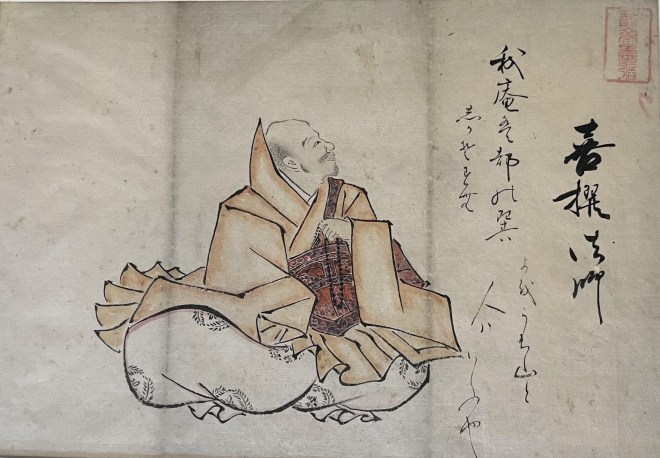
When my wife and I are in Vienna, we always find time to go to one of my favourite haunts, the Dorotheum auction house. As I’ve explained elsewhere, the Dorotheum has a whole floor where you can buy pieces at a fixed price, and I like to wander through that floor to see what’s on offer. When I see a piece that pleases me, I dream of where I might place it in the apartment. My wife is strictly rationing my purchases – she thinks our walls are too cluttered as it is – and I can only really buy something as a birthday gift to myself. So it was that for my birthday last year I bought for myself a lovely Japanese coloured woodblock print.
My photo

I liked the bold strokes of the man’s clothes, contrasting as they do with the delicate handling of his face and one exposed hand. I loved the way the colouring is delicately suggested. And I was really intrigued by his gaze: what was he looking up at so intently, I wondered?

The brief description given by the Dorotheum told me that this is a portrait of Kisen Hōshi, a Buddhist monk and poet who lived in the 9th Century CE. He is considered one of Japan’s six poetic sages, although only two short poems have been confidently attributed to him.

The writing on the right of course excited my curiosity. I learned later that this kind of calligraphy is known as sosho, or grass script, and it certainly looks like blades of grass scattered down the page. I initially tried using Google Translate to give me a translation, but the grassy calligraphy defeated the software. I turned to an old colleague of mine as well as to my brother’s wife, both of whom are Japanese, to see if they could decipher it. They both confessed to finding the calligraphy quite difficult to read, although they were able to read enough to make me understand that the bolder writing was the poet’s name, Kisen Hoshi, while the remainder was one of his poems. I looked around for translations of it and was astonished to find a good many quite different translations. I have to assume that the text is somewhat hermetic and can be read in many different ways. I have plumped for this translation, because it recognises the pun at the poem’s heart:

My hermitage is southeast of the capital [Kyoto], and thus I live peacefully;
Yet people call it ‘The Mountain of Worldly Sorrows’
(the poet’s hermitage was located on Mount Uji, and the poem relies on a pun playing on “Uji”, the place name, and “Ushi”, meaning gloomy or sorrowful.)

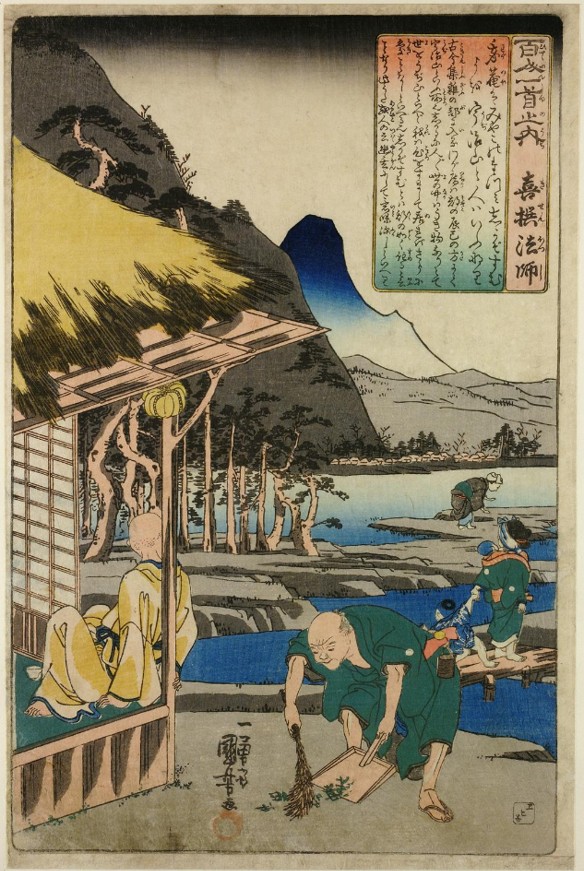
I throw in another early 19th-Century woodcut print, by the artist Utagawa Kuniyoshi, depicting the hermitage and our monk-poet sitting peacefully on its verandah.
Source

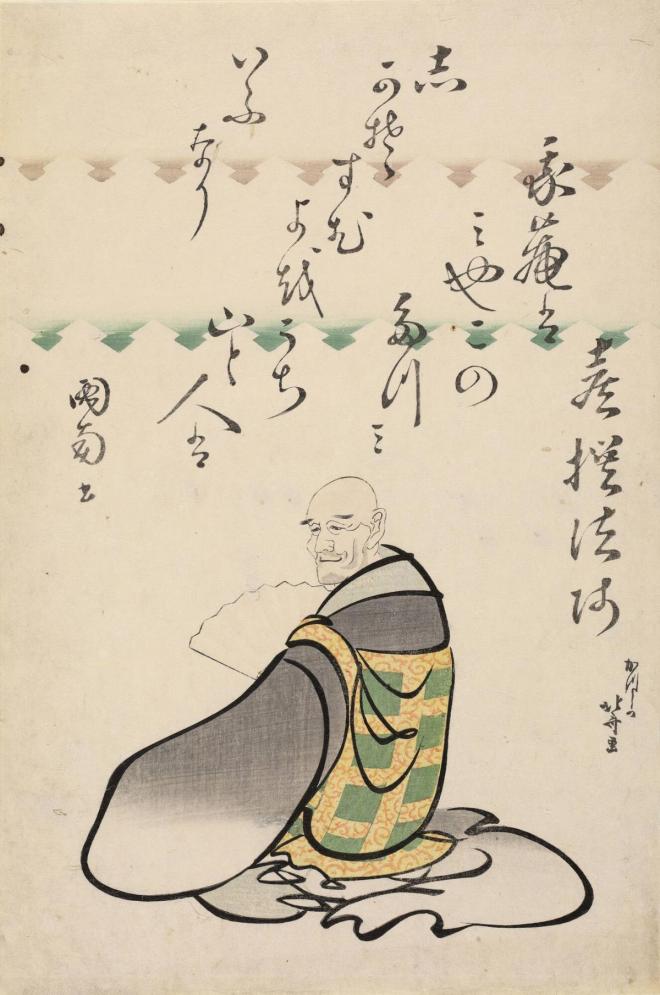
And this woodcut print, by Katsushika Hokusai (he of the “Great Wave off Kanagawa“), also from the early 19th Century, is of the same scene as my print.
Source

I have to say, Hokusai’s version seems to fit the poem’s theme better, of someone living peacefully far away from the madding crowd. Why is the monk in my version looking up so insistently? My Japanese colleague thought that he was actually lonely and hoping to see some friends walk through the door, but that doesn’t really fit with the sense of the poem. I have my own theory, but before I propose it I will focus on who the artist of my version was.

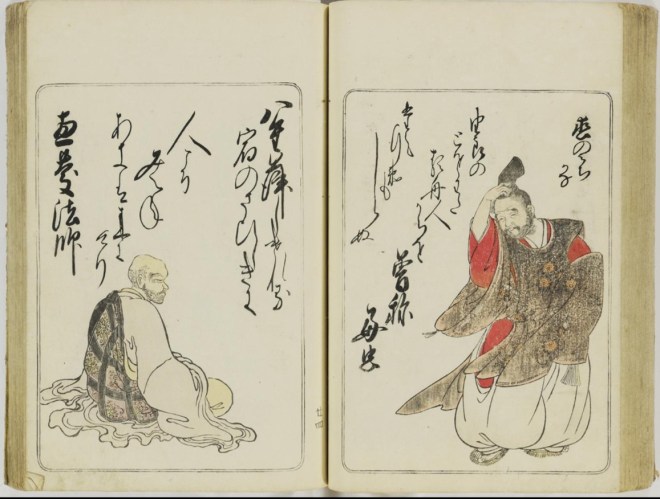
All the Dorotheum allowed itself to say on the subject was that the piece is a product of the Katsukawa school. This is a school of artists which flourished for about a hundred years, from the 1750s to the 1840s. I certainly can see a relationship to other woodcut prints created by exponents of the school, particularly by Katsukawa Shunshō, probably its most well-known exponent. In 1775, he created a woodblock-printed illustrated book, “The Hundred Poets Brocaded in the Eastern Weave”, which as the title suggests illustrates one hundred famous poets, along with one of their poems. Here is one page out of a copy of the book in the British Museum.
Source

The print on the left is of the monk Ekei Hōshi, the poem floating above him being one of his most celebrated poems:

In the loneliness of this desolate dwelling overgrown with thick, tangled weeds – where no human face is ever seen – autumn has arrived.

The print on the right, meanwhile, is Katsukawa Shunshō’s take on our friend Kisen Hōshi, with the same poem as before raining down gently around him.

I can be braver than the Dorotheum and give the artist of my print a name, because he stamped his chop mark in red in the top right-hand corner of the print. The name in the stamp reads Shaku Sessō. “Shaku” translates literally as Shakyamuni, an honorific title of the Buddha. In Buddhist art and calligraphy, Buddhist monks traditionally drop their secular family surnames and adopt “Shaku” as their spiritual surname to denote that they are followers or “children” of the Buddha. So our artist was a Buddhist monk. His name “Sessō” literally translates as “Snow and Frost.” In Zen Buddhist philosophy and classical art, snow and frost are powerful metaphors representing purity, mental clarity, resilience, and the transient, impermanent nature of life. I’m afraid that is as far as I have been able to go. I have found no information on the internet about an artist-Buddhist monk going by the name Sessō. Where and when he lived will probably remain forever a mystery.

And now back to that insistent stare. If readers look closely at the photo of my print, they will see that the figure seems to be looking straight at the chop mark. So my theory is that what we have here is a self-portrait by the monk Shaku Sessō! I will in all probability never be able to prove it, but I find it a neat explanation.

In any event, I don’t really care that I’ll probably never know who the artist is. And I don’t care that, according to the Dorotheum, the print is heavily stained (yes, there are some stains, and what also look like scuff marks), it has two folds (yes, you can’t miss those; for some strange reason a previous owner had folded it in two, as if to put it in an envelope) and the top corner is restored (I see no sign of that). I just take great pleasure in looking at him while I eat my meals (we’ve hung him close to our dining table), and that is enough.
EXTINCTION IS FOREVER

Vienna, 4 September 2026

Well we’re back from Los Angeles, leaving our two bundles of fun – that is to say, our grandchildren – to grow and prosper. But I don’t want to use this post to drool over them, even though they are very droolable. I want to write about the monarch butterfly – and there is a connection between it and the grandchildren, as readers will see.

Source

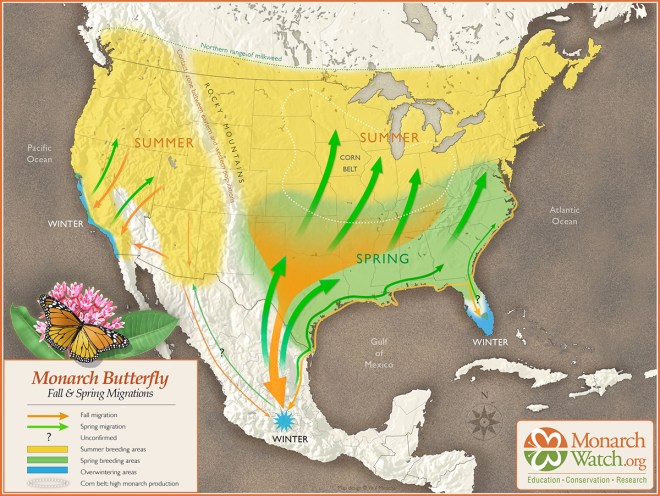
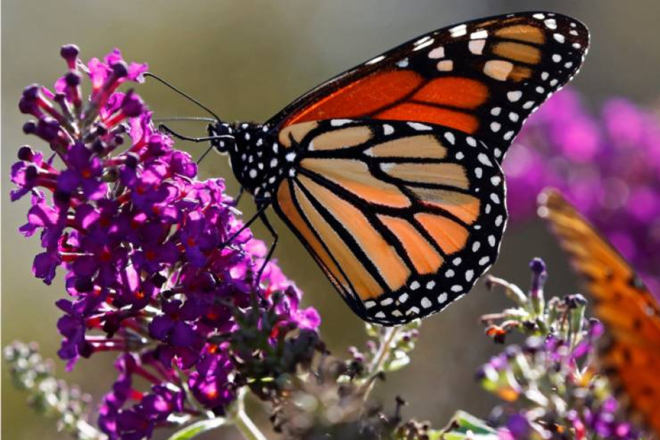
I think we can all agree that this particular species is a rather handsome example of the butterfly family. Subspecies of the monarch butterfly exist in various parts of the world, but the North American monarch is exceptional because it exhibits a wonderful trait. It migrates over thousands of kilometres every year, in what has been called “one of the most spectacular natural phenomena in the world”.

Source

There are two branches to this migration.

Source

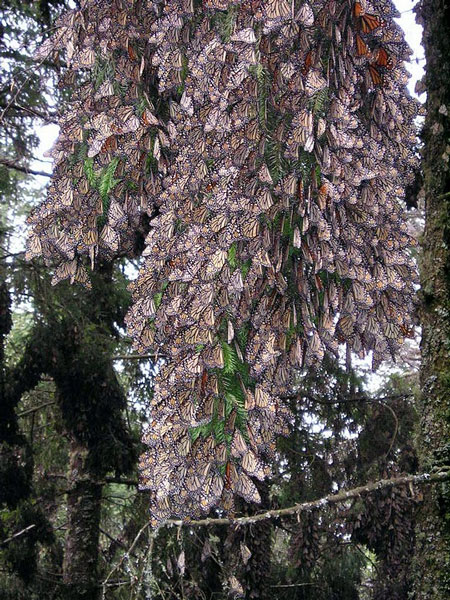
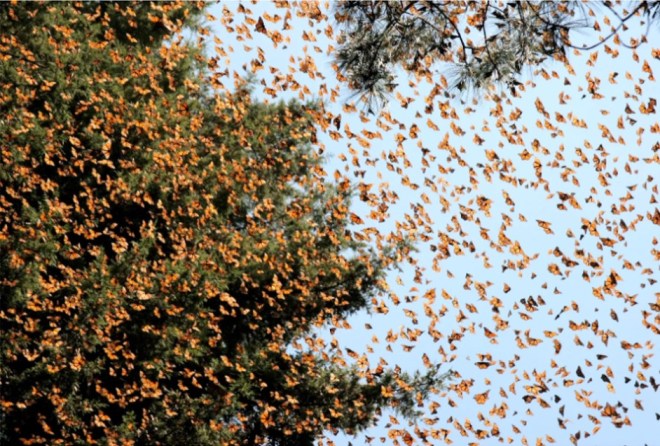
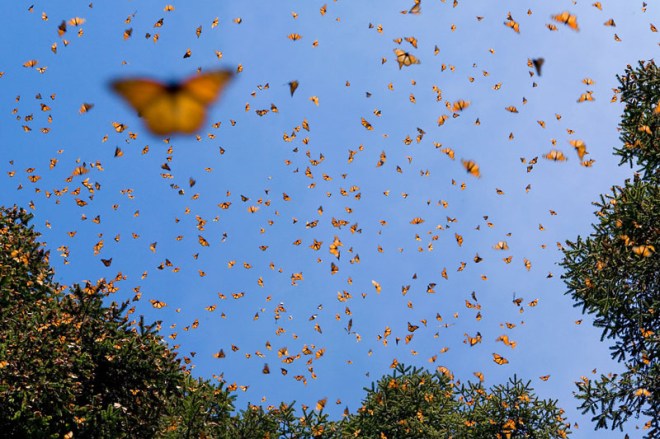
In the first, the eastern branch, the butterflies migrate back and forth between central Mexico in the south and the Great Lakes region in the north, a distance of some 5,000 km. This is by far the largest branch, with millions of monarchs overwintering in Mexico, slumbering on oyamel fir trees.

Source

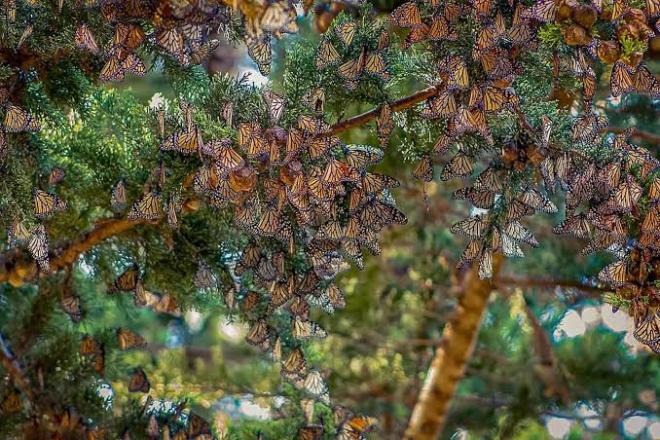
The second, western, branch is more modest, both in distance travelled (500 to 1,500 km) and in the numbers of butterflies involved. The butterflies migrate between their overwintering sites in coastal areas of California to the south and the regions west of the Rocky Mountains all the way up to the Canadian border to the north. Here we have a photo of the butterflies overwintering in Pismo Beach, in California’s San Luis Obispo county.

Source

Although more modest, this is the migration branch that interests me, because the monarch butterflies I have been seeing flitting around these last few months belong to this branch.

My interest in them was first triggered last year when we went to Los Angeles in July. Our daughter’s next-door neighbour had planted some tropical milkweeds in his front garden to support the monarchs – milkweeds are the only plants these butterflies will lay their eggs on. This particular species of milkweed also happens to have quite handsome flowers.

my photo

Last year, a number of monarchs had laid their eggs on the neighbour’s milkweeds, and he kindly allowed number-one bundle of fun to inspect the caterpillars and the pupae. The inspections stretched over several weeks as the caterpillars developed, pupated, and eventually emerged as butterflies, and I accompanied the little one on several of his expeditions. I was there primarily to ensure that curious little fingers didn’t damage either caterpillars or pupae, but I used the occasion to do some inspecting of my own.

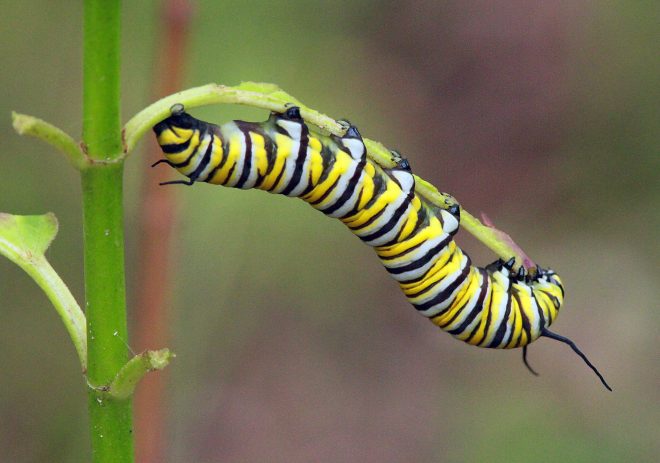
I have to say, I am not generally a great fan of caterpillars. I have some rather negative memories of them from my childhood; they were black hairy caterpillars which gave you a rash if they crawled onto your skin. But the monarch’s caterpillars are really very handsome, with their white, yellow, and black transverse bands.

Source

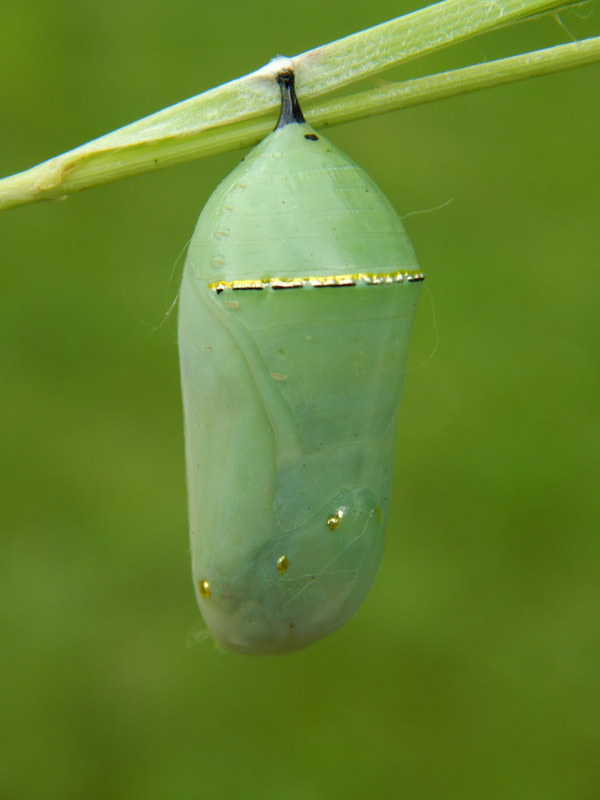
And the pupae are quite lovely, these little opaque green boxes with small golden dots near the bottom, and a gold-and-black rim around the top.

Source

Fortified by his success, this year the neighbour planted many more tropical milkweeds. Alas! Not a single monarch butterfly laid its eggs on them. The fact is, the western monarch butterflies are under tremendous stress. The migrations used to involve millions of them, but the numbers are now terribly diminished. Every year, around Thanksgiving, devoted volunteers do a count of the number of monarch butterflies overwintering in California. Last year, 12,260 monarchs were counted at the Californian overwintering sites. As recently as the 1980s, which is a mere 40 years ago, the counts were in the low millions. So a 99% drop …

A host of reasons have been driving these huge die-offs: the use of pesticides, which kill both the butterflies themselves and the milkweeds on which their lifecycle completely depends as well as the nectar sources which they need to fuel their long, long migrations; destruction of their overwintering sites in the name of development – by a cruel irony, all the butterfly’s overwintering site are along the coast, where development is most intense; climate change; and on and on … We are nearing the point of extinction.

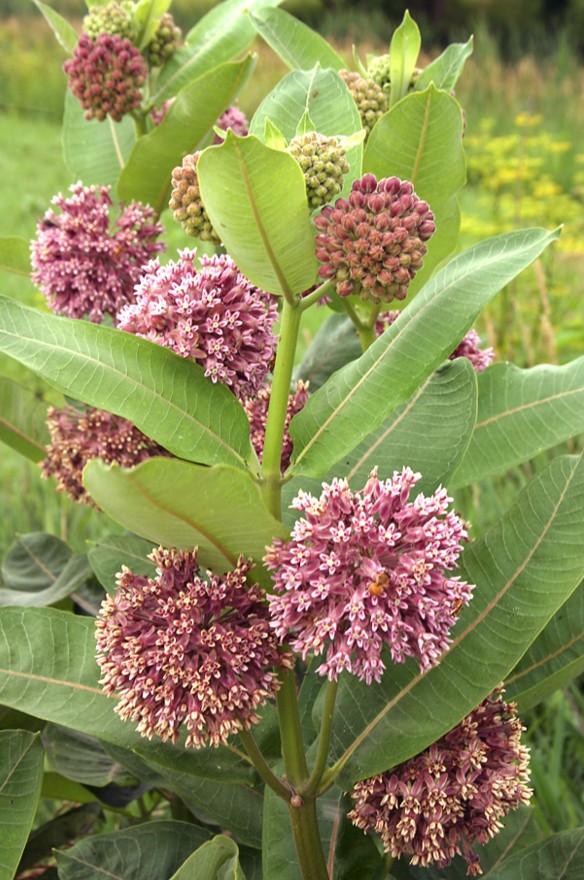
And our daughter’s neighbour, God bless his soul, and many others like him who plant tropical milkweed to help the monarchs aren’t actually helping at all. As the name suggests, this species of milkweed isn’t native to North America. In contrast to native milkweeds, it keeps flowering during the winter, which discourages the monarchs from migrating. Essentially, sedentary populations of monarchs spring up wherever a lot of tropical milkweed is planted. Subtle chemical differences in the sap of this milkweed reinforces the butterflies’ tendency to become sedentary. At the same time, caterpillars feeding on tropical milkweed mean that the butterflies into which they metamorphose tend to suffer from a dramatic buildup of a particular parasite, which reduces population numbers. It would be much better if he were to plant native species such as common milkweed,

Source

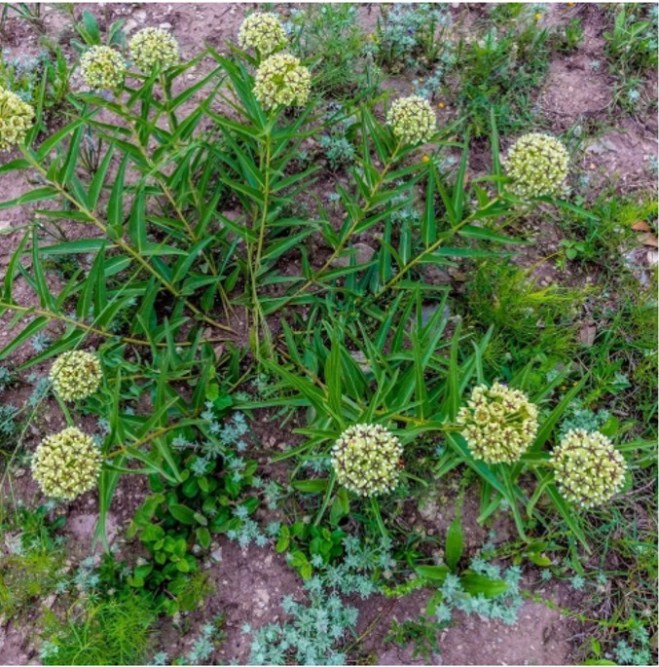
green antelope horn milkweed,

Source

or just plain antelope horn milkweed.

Source

Admittedly, they aren’t as showy as the tropical milkweed, but if he really wants to help the butterflies he should accept a somewhat less pretty garden.

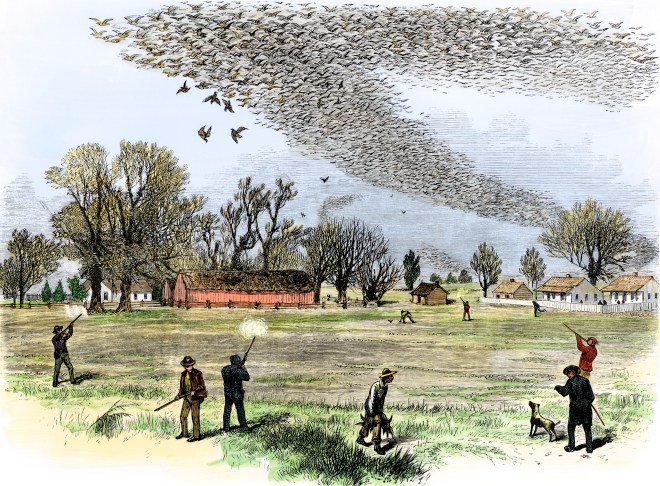
This catastrophic drop in the western monarch’s numbers and the probable end to its annual  migrations – that “spectacular natural phenomenon” – reminds me of the fate of the carrier pigeon. When European colonists arrived in North America, they were awed by the annual migrations of this bird, which numbered literally in the billions. Here is a description by John James Audubon, the artist, naturalist, and ornithologist famous for his lifelike and detailed paintings of North American birds.

“In the autumn of 1813, I left my house at Henderson, on the banks of the Ohio River, on my way to Louisville. … I observed the pigeons flying from northeast to southwest in greater numbers than I thought I had ever seen them before … I traveled on, and still met more the farther I proceeded. The air was literally filled with pigeons; the light of noonday was obscured as by an eclipse; the dung fell in spots, not unlike melting flakes of snow, and the continued buzz of wings had a tendency to lull my senses to repose. Before sunset I reached Louisville, distant from Hardinsburgh fifty-five miles. The pigeons were still passing in undiminished numbers and continued to do so for three days in succession.”

The continuation of Audubon’s description explains why the pigeon was extinct within a century of him writing down this description:

“The people [in Louisville] were all in arms. The banks of the Ohio were crowded with men and boys incessantly shooting at the pilgrims, which there flew lower as they passed the river. Multitudes were thus destroyed. For a week or more, the population fed on no other flesh than that of pigeons and talked of nothing but pigeons.”

Source

Extreme levels of hunting, coupled with rapid deforestation, did it for the passenger pigeon. In 1914, the last member of the species died miserably in Cincinnati Zoo.

The same fate nearly overcame the bison, as I’ve written earlier. But luckily in their case there was a different outcome. From the brink of extinction, the bison has been brought back, not to its original millions but at least to numbers which will allow our two bundles of fun to watch them one day, hopefully with the same awe that engulfed the teenage me many decades ago in a Canadian national park as I watched a troop of bison graze on a prairie.

I have to really, really hope that the western monarch follows the path of the bison and not the passenger pigeon, so that our two bundles of fun will also one day be able to watch the monarchs wake from their winter slumber and flutter off from their Californian overwintering sites, if not in their millions at least in their thousands.

Source