RED WINES FROM SOUTHERN ITALY

Milan, 24 May 2021

In an earlier post, I confessed that the amount of wine my wife and I consumed during the two lockdowns which we have endured over the past year was considerable. In that same post, I said that we focused much of our wine drinking on red wines from the south of Italy – Sicily, Sardinia, Puglia, some Calabria, some Basilicata. I always prefer red wines – white wines give me stomach burns. My wife is quite happy to follow me in my choices, although from time to time she’ll splash out and get herself a bottle of white wine.

I chose to buy wines from southern Italy because I didn’t know them very well, which fed into my general tendency to support the underdog and be contrarian. After sampling a few bottles, I also felt that the red wines of southern Italy had more oomph to them than wines from northern and central Italy – I beg readers not to ask me to translate that into the flowery language of the wine connoisseur because I can’t. As I once confessed in an earlier post, my general method of assessing wines is “mmh! that’s a nice wine!” or “mm … not a good wine”.

Source

Also – and this was important with the tightening of household budgets under lockdown – they were generally cheaper than other Italian wines.

I also felt virtuous in supporting local grape varieties. Not for me the Cabernet Sauvignon, Merlot, Chardonnay, Syrah, Grenache Noir, Sauvignon Blanc, Pinot Noir, and the few others which dominate wine-making worldwide! No sirree, I was going to support the more than 1,500 grape varieties (yes, I kid you not, 1,500) which exist in Italy.

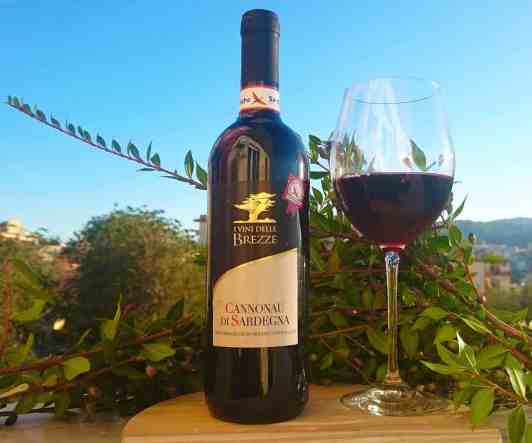
So from Sardinia I was buying wines made with Cannonau grapes (or to be more precise, where the Cannonau made up the largest share; the great majority of Italian wines are blends).
Source

From Sicily, it was wines made with Nero d’Avola grapes.

Source

From Puglia, it was wines made with Primitivo grapes.

Source

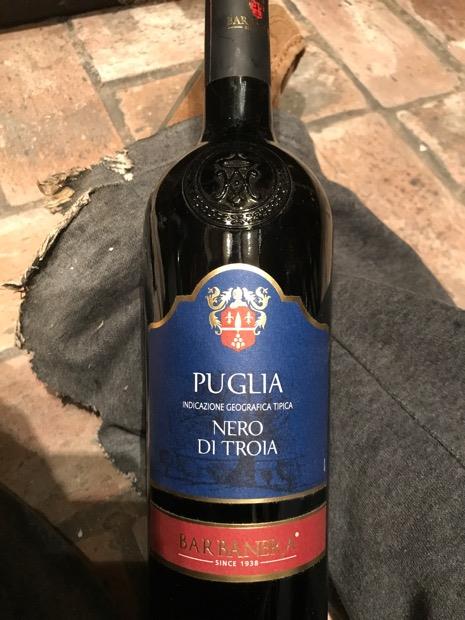
From time to time, though, we branched out into wines made with Nero di Troia grapes.
Source

From Basilicata, it was wines made with Aglianico grapes.

Source

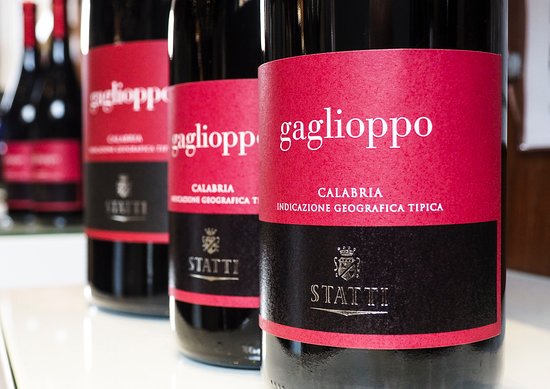
From Calabria, it was wines made with Gaglioppo grapes.
source

(For reasons which are now not clear to me through the haze of history, I chose few if any wines from Campania – a lapse to be rectified in any future lockdowns!)

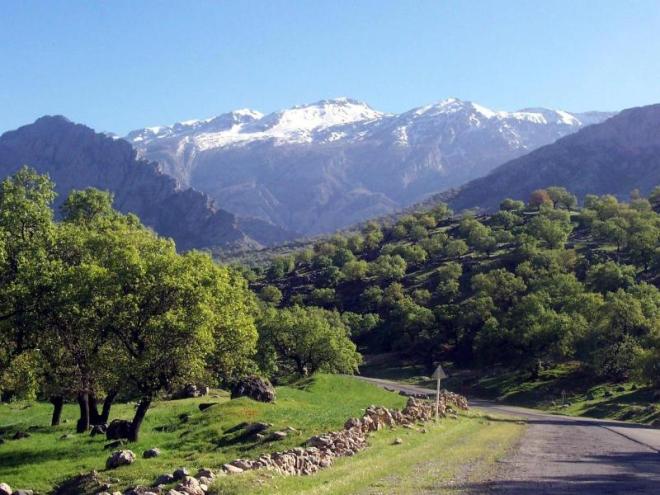
At some point, though, through the wine fumes, I began to wonder how many of these grape varieties really were local. One can make the case that actually no domesticated grape varieties are really autochthonous. Archaeologists tell us that domestication and the related discovery of wine-making took place somewhere in the region between the Black Sea and Iran, between the seventh and the fourth millennia BC. The earliest evidence of domestication has been found in Georgia (the country, not the US state) and of wine production in Iran in the northern Zagros Mountains.
source

Subsequently, domesticated vines and wine-making knowledge spread to other civilizations in the region, first Egypt and Lower Mesopotamia, and then to the Assyrians, Phoenicians and Greeks (at a later period vine and wine-making moved along the Silk Road to China and Japan, but that is a story for another day). The Greeks and the Phoenicians, continues this story, transferred the domesticated grape vine and wine-making technologies further west, to Italy, Spain, and the south of France. The Romans then carried the vine and wine-making further north in Europe to what are more-or-less its northernmost borders today. And then when Europe colonized the rest of the world, the Europeans took their vine and wine-making knowledge with them. So in this view of history, no domesticated grape vines are really autochthonous.

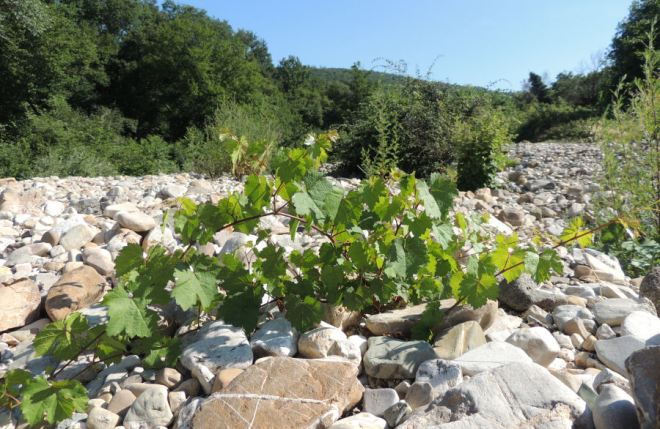
But that’s one Creation Story. Another Creation Story points to the fact that the vine species which was domesticated for wine-making (called, appropriately enough, Vitis vinifera) grows wild from Georgia to Portugal.
Source

So why could wine-making not have been independently discovered in several places?

A third Creation Story, and the one – for what it’s worth – that I feel is most credible, is that wine-making did indeed start in Iran or thereabouts, and cuttings of the domesticated vines were indeed carried westwards. But in their new homes, these vines could well have crossed spontaneously with local wild forms of the vine (or have been made to cross with them by the local viticulturists), thus shaking up their DNA a little and possibly affecting berry size, ripening time, sweetness, and whatever other characteristics viticulturists prized at the time. In this view of history, each locality can have vines which are hybrids of immigrant vines and local ones, which makes them pretty local. And anyway, even if a vine was brought in from somewhere else, if it’s been around in one locality for a long time surely it’s become local? (a bit like all Americans of immigrant stock nevertheless considering themselves locals) And anyway, the grape vine’s DNA is subject to spontaneous mutations (like American immigrants), which over time will distinguish it from its neighbors. All excellent reasons, I think, for declaring that grape vines which have been grown in one locality long enough can be considered autochthonous.

Of course, one could argue that all these Creation Stories are irrelevant because of the American pest phylloxera which devastated vineyards planted with Vitis vinifera in the late 19th Century (we have here a cartoon of the time, whose caption was “The phylloxera, a true gourmet, finds out the best vineyards and attaches itself to the best wines”)

Source

Ever since then, pretty much all commercial vineyards are Frankensteins, with Vitis vinifera grafted onto a root stock of one of the American members of the grape vine family which are resistant to the pest. Under the circumstances, I can hear some people ask, can one really call any commercial vine autochthonous?

I reject this latter argument because first, if I did accept it I wouldn’t have a story to tell, and second, because even with an American rootstock the grapes still express only the DNA of the grafted Vitis vinifera. Just as a person who has had their heart replaced is still expressing their old DNA.

So with all that out of the way, we can now focus on those wines which my wife and I (and not infrequently our son) were imbibing during lockdown, and ask ourselves the question: are the grapes that went into making them local or not? As usual in life, the answer is yes in some cases, no in others.

As one might expect, many of the local vines in southern Italy have their own Creation Stories. The cynic in me suggests that a good number of these were invented to increase a wine’s marketability, although I could well imagine that there is a desire on the part of the local people to have the stories of their vines reflect their own Creation Stories. Thus, many of the Creation Stories reflect the south of Italy’s ancient history as Magna Graecia, that arc of Ancient Greek colonies which stretched from Puglia all the way to Sicily. They suggest that the vines were brought from Greece by these early colonists. Others look to the Phoenicians as the source of their vines; Phoenicians also had colonies in Sicily and further afield. This map shows the situation in about 500 BC.

Source

If these Creation Stories are true, they would place the original migration episodes for the vines in question at some two and a half thousand years ago, quite long enough to claim that they are now fully local. Other Creation Stories suggest instead that the local vines are crosses between local wild stock and immigrant stock. Who can deny that such vines are fully local? Ampelographers have weighed in (these are experts in the study and classification of cultivated varieties of grape). They have given savant judgements on the heredity of countless vines by comparing the shape and colour of their leaves and their grape berries. Wonderful word, ampelographer! It rolls off the tongue like a good wine rolls down the throat. In my next life, I want to be an ampelographer, it must look so cool on a CV.

Anyway, along have come DNA studies, to cut through all the bullshit. We finally have a scientific basis for making judgements about a vine’s genealogy.

Source

And the white-coated scientists in their labs have discovered some very interesting things.

Take Cannonau, the grape variety that is the Sardinian grape par excellence (editorial note: since photos of bunches of grapes get pretty boring pretty quickly, I will instead be throwing in nice photos of the places where the various grapes grow).

Source

DNA studies have shown that actually, it is none other than Garnacha from Spain! (which, by the way, is also none other than Grenache; the French brought the vine from Spain and then frenchified the name) The most likely Creation Story in this case is that the Spaniards brought Garnacha to the island some time during their centuries-long dominion, from 1324 to 1718. Some Sardinians have tried to claim that the move was actually in the other direction, from Sardinia to Spain, but I don’t think that will wash, especially since a number of other “local” Sardinian grape varieties have also turned out to have a Spanish origin. On the one hand, I’m saddened by the fact that although I thought I was supporting a local variety when I bought Cannonaus in fact I wasn’t. On the other hand, I was pleased to learn of this Spanish connection, because I recall thinking, when I first tried Cannonau, that it reminded me of Rioja, and Garnacha grapes are one of the constituent grapes of Rioja.

Skipping to the island of Sicily, what about the Nero d’Avola grape?

source

Well there, I’m happy to say, I have been supporting an autochthonous variety – that is to say, a variety which could well have been introduced several thousands of years ago by the Dorian Greeks who colonized the part Sicily where the town of Avola is located; the town does indeed seem to be the center of this grape’s distribution. The original immigrant grape could actually have been a forefather of today’s Nero d’Avola, since DNA studies have revealed a cousin-like relationship between it and two other ancient Sicilian grapes, Catarratto and Inzolia. As far as I know (although the white-coated scientists publish many of their DNA studies in scientific journals which I don’t have access to), no relationship has (yet) been found between Nero d’Avola and Greek grape vine varieties. It could well be that the forefather has vanished, as old vine varieties were replaced with newer ones; phylloxera also put paid to a large number of varieties.

Vaulting now over to Puglia, in Italy’s heel, we can have a look at the Primitivo grape.

source

And here I must start by admitting that my wine choices were not supporting autochthonous grapes; Primitivo is not an Italian variety. Nevertheless, we have a fascinating story here. DNA studies have shown that actually Primitivo is a Croatian grape variety, more specifically one from the Dalmatian coast. Unfortunately, the devastations of phylloxera mean that there is hardly anything left now of the variety in its homeland – a few vines here and there. We can imagine some adventurous southern Italian sailing across the Adriatic Sea to Dalmatia and bringing cuttings back home. As far as can be judged, this was quite recent, some time in the 18th Century. The grape’s Italian name points to why viticulturists were interested in it – it was an early (“primitive”) ripener.

What makes the Primitivo story really fascinating is that DNA studies have also confirmed that it is pretty much the same as the “Californian” grape Zinfandel! (bar a mutation or two) How a Dalmatian grape variety ended up in southern Italy is not hard to imagine. But how on earth did it end up in California?! The best guess is by quite a circuitous route. Step 1 is that the variety was transferred to the Hapsburgs’ greenhouses in Vienna, when Dalmatia was part of the Austrian Empire. Step 2 is that, as part of a burgeoning global trade in plant species, horticulturalists living on the US’s eastern seaboard requested the Imperial greenhouses to send them cuttings, which they did. They probably also requested cuttings from British greenhouses, which had earlier requested them from the Viennese greenhouses. Step 3 is that one or more of these horticulturalists from the Eastern US joined the gold rush to California but took care to take vine cuttings with them. Presumably, they found that in the end it was more profitable to make wine in California than to pan for gold. (As a quick aside, one of my French cousins many times removed, who came from our family of vignerons in the Beaujolais, did something similar. He joined the gold rush to Australia but ended up making wine; I don’t know if he took cuttings with him or used the vine varieties which others had already brought to Australia. In any event, I have a whole bunch of Franco-Australian cousins whom I have never met)

But let’s get back to Puglia, to consider the Nero di Troia grape variety, which we tried from time to time during lockdown.

Source

DNA studies have shown that this grape has an equally fascinating genealogy – and luckily for me and my determination to support autochthonous grape varieties, I think I can safely say that it is definitely an Italian variety. DNA studies have shown that Nero di Troia’s mother is Bombino bianco, an ancient white grape variety found all along the Adriatic coast but especially in Puglia, while its father is Uva rosa antica, now only found as a very minor variety in the province of Salerno in Campania.

So far, so good. But what makes Nero di Troia more interesting than most varieties is that DNA studies have also shown that it has two full siblings (same father vine, same mother vine): Bombino nero and Impigno. Which just goes to show that grapes are like humans: you and your siblings can have the same parents but you can be quite different from each other.

What’s even more interesting is that comparisons of the DNA profile of the father, Uva rosa antica, to those in DNA libraries have revealed that this minor variety from Salerno is one and the same with another minor variety called Quagliano found only in a few Alpine valleys in Piedmont, in the very north of Italy, which in turn is one and the same with a variety called Bouteillan noir found in Provence, in France. Which just goes to show that there must have been quite a vigorous, though completely informal and unmonitored, trade in vine cuttings throughout southern Europe.

Moving on to Basilicata, the wines we tried from that region during the long months of lockdown were based mostly on the Aglianico grape.

Source

This is definitely one of the grapes where the locals have a Creation Story involving its introduction to the region by the Ancient Greeks through their colonies in Basilicata. Alas, DNA studies have revealed little if any relation to other existing Greek varieties, so if Aglianico was imported to Basilicata the original Greek plantings have all disappeared. Which suggests that perhaps Aglianico is actually a cross between some immigrant vine from somewhere and local wild stock. In any event, I think we can count this one as an autochthon.

Finally, Calabria. The wines we were drinking from this region are mostly made with the Gaglioppo grape.

Source

This is another grape variety that the local inhabitants wish to believe came originally from Greece, through the Ancient Greek colonies on the Calabrian coast. However, DNA studies have clarified that Gaglioppo is a very Italian grape, being a cross of the Sangiovese and Mantonico grapes. The latter is a very typical and ancient Calabrian grape. As for Sangiovese, viticulturists have used this grape to sire a whole series of grape varieties. At least ten are known at the moment, including Gaglioppo. There must have been something about Sangiovese grapes that viticulturists liked; if any ampelographer reads this, please tell me what it was. It doesn’t finish there, because in turn DNA studies have revealed that Sangiovese is itself the product of a cross between the Ciliegiolo and Calabrese Montenuovo grape varieties. Ciliegiolo is an ancient variety from Tuscany. Calabrese Montenuovo, on the other hand, has its origins in Calabria; sadly, it is now an almost-extinct relic. We have here another example of the vigorous trade in vine cuttings, this time up and down the Italian peninsula.

I could go on. For instance, each of these grape varieties is blended with various other grapes, and many of these have had their DNA studied. But I’m running out of steam and I fear that I will soon be losing my readers – there’s a limit to how much information about DNA one can absorb before one’s mind begins to whirl like a double helix.

Source

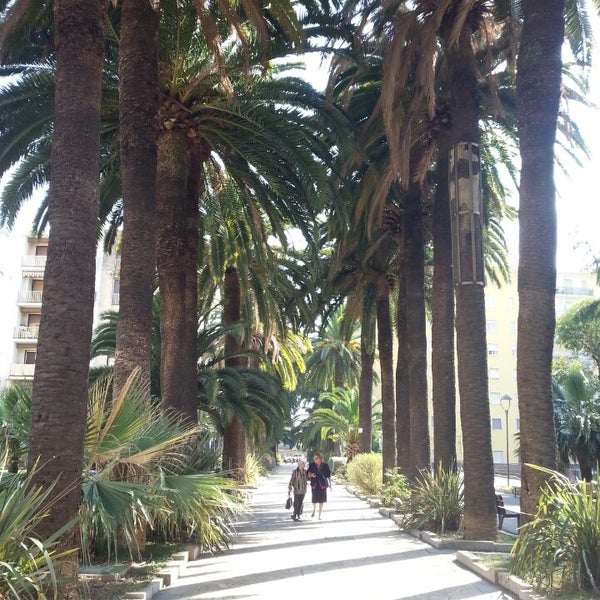
I leave my readers with a final plea: considering that there are 1,500 varieties of grape in Italy, please ignore any wines made with the Top Ten grape varieties and concentrate on trying out all 1,500 Italian varieties. Cin-cin!

Source

THE PALM TREES ARE DYING

Sori, 27 April 2021

There is a walk which my wife and I take in Liguria (calling it a hike would be a bit of a stretch), which brings us by easy stages to mid level on the hills dropping into the sea, leading us eventually to the small village of San Bernardo perched atop the old fishing port of Bogliasco, from where we can walk down to Bogliasco itself and catch a bus home (after, perhaps, an ice cream to reward us for the walking).

On the way, we pass a wide terrace, which stands out from the surrounding olive terraces and vegetable patches for the simple reason that it is terribly bare. The little grass it has is clipped to within an inch – what am I saying, a centimetre – of its life. This bareness is due to the terrace’s hosting a number of ruminants – a couple of donkeys and three-four sheep – which graze voraciously on any blade of grass that dares to raise its head.

Until a year or so ago, the terrace also used to host half a dozen magnificent palm trees – very old Canary Island date palms judging by their height and girth. Two years ago, we noticed a sign which proudly proclaimed that the palm trees were part of some EU-funded project, leading us to make cynical comments about the wasteful use of EU largesse. Last year, the palm trees were gone; the ruminants had the terrace to themselves. After more cynical comments about wastage of public monies, we began to wonder.

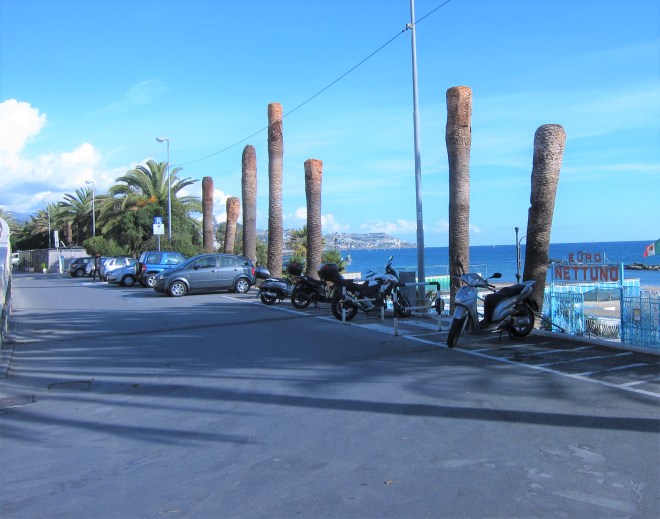
Liguria, like most Italian regions by the sea, has a large population of palm trees. The most common palm tree by far is the Canary Island date palm, and any self-respecting seaside resort will have at least one avenue lined with them, like this one in Taggia, in Liguria.

Source

Many gardens in Liguria, both public and private, will also boast a palm tree or two. Other than the Canary Island date palm, it’s possible to spot, over a garden wall or tucked away in the corner of a park, a whole slew of different palm species: the true date palm, the Chinese windmill palm, the California fan palm, the Mexican fan palm, the Chilean wine palm, and more.

Now, the fact is that in the last year or so during our walks and hikes in Liguria we have been noticing many dead palm trees, either with their fronds dried up and drooping piteously, or with the fronds completely amputated leaving behind a forlorn blackened trunk.

Source
Source

A quick zip around the Internet has shown us that this Great Die-Off of Ligurian palm trees that we have been witnessing is due to this critter.

Source

This is Rhynchophorus ferrugineus, known in English as the red palm weevil. It’s really a very pretty beetle, one which I would be proud to have pinned to the board of a beetles collection if I had such a thing.

Source

But this pretty, pretty beetle has the unfortunate habit of laying its eggs at the base of palm tree fronds, from which larvae hatch, which then burrow down into the trunk to the root of the fronds and live off their lymph, killing them off in the process. The larvae pupate inside the trunks, and when they have metamorphosed into beetles, they crawl out and fly off to find mates and new palm trees to attack. This attack on the fronds is deadly because palm trees, unlike true trees, die when their crown of leaves are killed or are chopped off.

This beetle is originally from tropical Asia, where it attacks many species of palms. But the active international trade in palm trees has brought it to Italy, where it has been overjoyed to find a host of new palm trees to attack. Unfortunately for the palm trees, our beetle friend is not at all finicky about what palm trees it attacks. And it seems to have no complaints about the Italian climate either.

It’s the same old story of invasive species, a topic I’ve covered several times in these posts: the water hyacinth, the prickly pear, the Himalayan balsam, the Jerusalem artichoke, among others. I’m beginning to sound like a broken record, repeating myself over and over again (as I write this, it saddens me to think that only people over the age of 60 will know what I mean, because they might well have owned a vinyl record in their youth and seen how a scratch can lead to the needle jumping backwards and repeating the same piece of music over and over. But I digress.)

Of course, it’s not just Italy which has been attacked by this plague of red palm weevils. Everywhere along the southern rim of Europe, where the climate is mild enough to allow palms to grow, the beetle has arrived and is decimating palm populations. It’s also arrived in the Middle East and North Africa and is decimating their date palm groves.

Source

In this case, there are large, and growing, economic costs attached to this plague – in Italy, palms are merely for show. In fact, I had come across anguished talk of this beetle a year or so ago, when doing some research on date palms for a project I’m involved with in Egypt (the largest producer of dates in the world, in case anyone is interested). It is only now that I have made the connection between the holocaust of palms in Italy and this other massacre of palms in North Africa.

A sighting of the beetle in California was reported back in 2010, but it turned out to be a false alarm. It’s only a matter of time, though, before the beetle arrives in the US, and many of those tall, thin, graceful palm trees my wife and I saw in LA will start dying.

Source

And no other corner of the world where palm trees grow will be spared the red palm weevil’s scourge. Eventually, the pretty red beetle will arrive. We simply live in a world which is far too open to trade; if we and our goods move all around the world so will other species, some of which will turn out to be invasive in their new homes. Simple as that.

As if all this is not depressing enough, Italy’s palm trees are under further attack from another invasive species, a moth this time, which hails from Uruguay and central Argentina. Its formal name is Paysandisia archon, but it’s known in English as the palm moth or palm borer. It too is quite a handsome species.

Source

It attacks palms in more or less the same way as the red palm weevil: it lays its eggs at the base of the palm fronds, the grubs once hatched burrow into the trunk to the root of the fronds, and then they proceed to suck the life out of the fronds. “Luckily” (if that term has any meaning here), this moth has a rather long life cycle, so it’s taking longer to spread through Italy’s palm populations than the red palm weevil (and so is getting less press). But it is spreading, under the radar. Like the red palm weevil, its tastes in palms are quite catholic, so none of the palm species in Italy are spared its attentions.

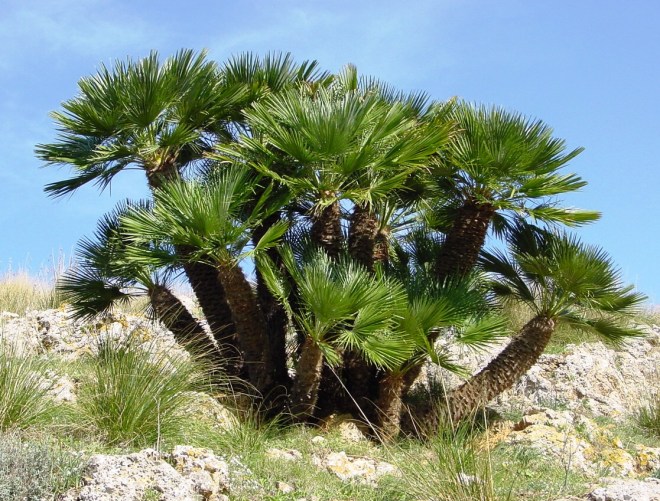
Of course, one could shrug one’s shoulders and point out that this beetle is wiping out plants that are not themselves natural to Italy but were brought here from somewhere else – a punishment for an earlier disregard of Nature’s ecosystems. Unfortunately, though, the beetle also seems to attack Italy’s one and only endemic species of palm, the dwarf fan palm.

Source

As the name suggests and the photo shows, it’s a bit of a runt of a palm. It doesn’t grow more than 2 metres high, and it grows in clumps, so you can’t use it to line a stately avenue of some seaside resort. But it is actually from this part of the world, and it does have its niche and role to play in Italy’s ecosystems. Right now, the red palm weevil seems to prefer the other species of palm available to it in Italy, so it only occasionally attacks the dwarf fan palm. But imagine what will happen once the weevil has killed off most of the other types of palms around: very sensibly, it will turn to the next best thing to keep going, at which point the dwarf fan palm’s days will be numbered – if it hasn’t already disappeared, that is; contrary to the red palm weevil, the palm moth is very partial to the poor little Italian palm.

I’d like to end this post on a somewhat positive note, but right now it looks like we are losing the battle against weevil and moth. The classic modern response of spraying everything in sight with chemical insecticide is not only dangerous but it’s also not clear how well it works. And on top of that, it appears that the weevil at least is becoming resistant to chemical insecticides. Maybe pheromone traps could work. But maybe not. What I’m really nervous about is that some bright spark will go to tropical Asia (for the weevil) or Uruguay and central Argentina (for the moth) and bring back one of these pests’ natural predators, that the predators will be set free to attack weevil and moth, and that they will promptly attack some other easier target they find, thus becoming an invasive species in their own right – this is not science fiction, it’s happened before.

The best thing is just leave species where they are. We all have perfectly lovely local species. Let’s make our surroundings lovely with them and not with species we have brought from some other corner of the globe.

A PUDGY CHERUB AS A WEATHERVANE

Sori, 14 February 2021

As my wife and I were walking down into Vernazza on our latest hike along the trail which links together the Cinque Terre, I noticed this on the steeple of the village church.

my photo

I suspect it’s a little difficult for readers to see what I mean, so I throw in this close-up photo of the steeple.

my photo

“This” is a weathervane. As I’m sure many of my readers will know, in the pre-modern world, where weather satellites didn’t exist and TV channels didn’t give you weather forecasts every hour on the hour, the function of weathervanes was to tell people which way the wind was blowing, a pretty good indicator of what the weather was going to be like. And of course peering at weathervanes went along with some of the weather-related sayings people were fond of quoting, like this one about the winds:
“When the wind is in the east, it’s good for neither man nor beast.
When the wind is in the north, the old folk should not venture forth.
When the wind is in the south, it blows the bait in the fishes’ mouth.
When the wind is in the west, it is of all the winds the best.”

I can imagine some great-great-great grandfather of mine looking up at the weathervane on the barn and saying “Aah, wind today’s from the north. Like they say, ‘old folk shouldn’t venture forth’”, no doubt using this as a good excuse to wend his way to the village pub to fritter his time (and money) away.

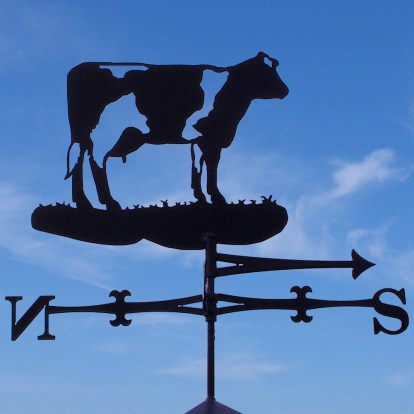
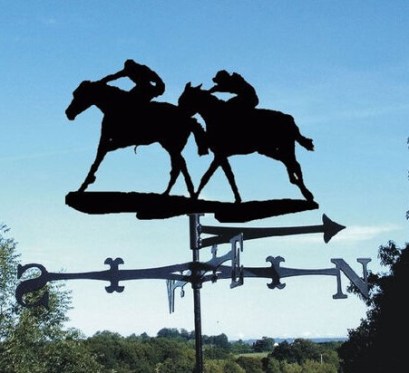
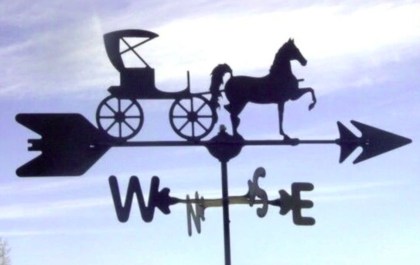
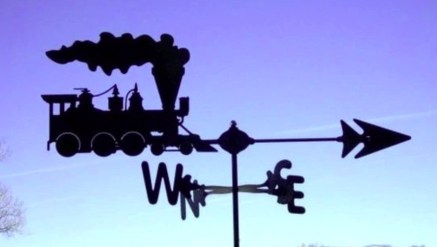
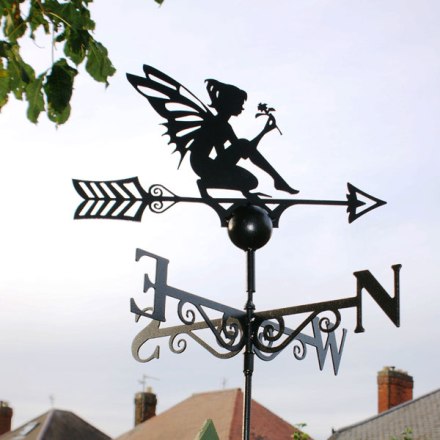
But weathervanes are also excellent examples of how we human beings transform functional objects into art. Take that weathervane on Vernazza’s church. If readers look again at my photo, they’ll see that the weathervane-maker turned the sail, which a weathervane needs if it is to work, into a rather pudgy angel. The things which weathervane-makers have turned the sail into, and continue to turn them into (this is by no means a dead art), are endless. I throw in here, in no particular order, some of the designs which have caught my fancy.

Source
Source
Source
Source
Source
Source
Source
Source
Source
Source
Source

The eventual owners of weathervanes will often choose designs that comment on something: their profession, their beliefs, their interests, the times they live in, even the racehorses they have bet on … No doubt it was in that spirit that Pope Nicholas I, way back in the 9th century, ordered that the rooster be the emblem used on weathervanes placed on Christian churches. It seems that Pope Nicolas was harking back to a comment made by Pope Gregory the Great even further back in time, in the 6th Century. Gregory had decreed that the rooster was the most suitable emblem of Christianity, being the emblem of St Peter – he is referring to the story in the Gospel where Jesus predicted that Peter would deny him three times before the rooster crowed at dawn, here captured in a painting by Francesco Rosa in San Zachariah church in Venice.

Source

Personally, I find this a rather strange reason to choose the rooster as an emblem on churches, referencing as it does a moment of shameful betrayal by the man who was to become the first Pope. I rather think that Popes Gregory and Nicolas were doing something which Christians had been doing since the dawn of their religion, putting a Christian gloss on what were actually thriving pagan traditions (“if you can’t beat them, join them”). For the Goths and no doubt other “barbarians”, the rooster, crowing as it does at dawn, was an emblem of the sun. What better emblem to put on churches! Wasn’t Jesus (apparently) born at the winter solstice, when the sun is reborn?

In any event, from the 9th Century on, rooster-themed weathervanes became the norm on Christian churches (which no doubt explains why, in English, another name for the weathervane is the weathercock). The oldest surviving weathervane in Europe – from the 9th Century – is a rooster which, until 1891, graced the Church of Saints Faustino and Giovita in the city of Brescia.

Source

And the Bayeux tapestry, my favourite tapestry and one I’ve mentioned several times in these posts, clearly shows a man installing a rooster weathervane on Westminster Abbey (the scene is actually about the burial of King Edward the Confessor; I presume the nuns who made the tapestry were adding local colour).

Source

Now, I’m sure that at this point my alert readers are saying, “Hang on a minute, why does the weathervane on that church in Vernazza have an angel and not a rooster, then?” Well, it seems that at some point the Church authorities relaxed the rooster rule somewhat. Other emblems were possible, although normally ones which were linked to the saint or saints to which the church was dedicated. In the case of the church in Vernazza, it is dedicated to Saint Margaret of Antioch. A quick zip around the Internet tells me that a weathervane emblem connected to her (completely apocryphal) life could be a dragon: one of the more dramatic moments in her life was that she was swallowed by the Devil in the form of a dragon. Dragons are popular emblems for weathervanes. Here’s a nice example.

Source

Or the emblem could be a hammer. She is often depicted, especially in Orthodox icons, as hammering the Devil – once no doubt she had been regurgitated alive by him. My wife and I saw a great example of such an icon in a museum in Athens a few years ago (for some reason, the Orthodox call her Marina rather than Margaret).

My photo

Here’s a nice example of a hammer, although it’s put together with a saw (“hammer and saw”).

Source

But no, we have an angel. OK, I guess angels are pretty saintly and so a good emblem for a church – as long as they look serious, like this emblem (for some reason, most of the weathervanes have the angel blowing a horn).

Source

But no, if readers go back to my original photo, they will see that the weathervane-maker seems to have made more of a cherub. Raphael painted the most iconic of cherubs.

Source

And here we have a nice weathervane example (also tooting a horn; it seems that angelic figures are expected to be horn players).

Source

The example on Vernazza’s church doesn’t seem nearly as cute. As far as I can make out, the cherub there has gone to seed; a cherub who has spent rather too much of his lockdown time eating and drinking and not enough time working out in his living room.

my photo

I’m not sure how the weathervane-maker got this pretty non-religious weathervane past the parish priest. Perhaps the weathervane-maker was the parish priest. Or perhaps the parish priest was a jolly fellow who liked a good laugh. I have in mind someone like don Camillo as played by Fernandel.

Source

The parish priest must also have calculated that his bishop would never come to this Godforsaken village during his tenure – until quite recently it was pretty difficult to get to Vernazza and the other Cinque Terre; you either walked over the hills or you took a fishing boat, neither of which I see any self-respecting bishop doing.

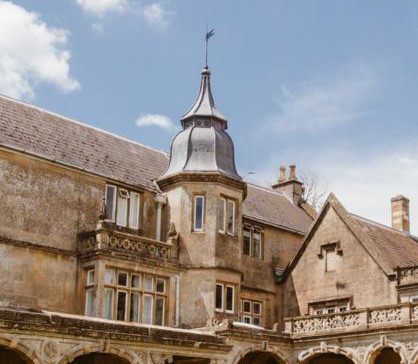
I don’t suppose we’ll ever know the backstory on this weathervane. In the meantime, I’ve gone back in my mind’s eye to see where I might have come across weathervanes in my life. Only one episode comes back to me, from my days at prep school (in British vernacular this being a boarding school for primary-school-age children). As I ascertained after a quick zip around the Internet, the school still exists. The only change I can see is that it has gone co-ed in the intervening years, an excellent thing. The school has taken over a building with venerable origins, as this picture of the main lawn attests.

Source

But the main reason for my putting in this photo is that discrete weathervane on that small tower in the centre of the photo. I throw in here an enlargement.

Source

It’s a rather boring weathervane, taking the shape of a flag (the first instruments used to figure out which way the wind was blowing were no doubt flags; indeed, the English word “vane” is derived from the Old English word fana, meaning flag). Nevertheless, I know that weathervane well. One year, my dormitory gave onto the roof covering the gallery (those windows we see to the left of the base of the tower). I was a naughty boy and friends with other naughty boys. We would regularly sneak out of the dormitory window at night onto that roof and go for a walk, just for the dare. Sometimes, that weathervane would be silhouetted against the moon. I see it still … aahh, the good old days!

One other memory I have of weathervanes is their figurative use in cartoons, especially political cartoons. As we all know too well, politicians are notorious for going “whichever way the wind blows” (a popular wind-related saying). Cartoonists have always had a field day with weathervanes, using them to show politicians who chop and change their opinions, “trimming their sails” to prevailing opinion (another popular wind-related saying). I remember a British cartoon mocking the British Prime Minister Harold MacMillan for acting like a weathervane over the independence of British colonies in Africa. I couldn’t find that particular one on the Internet. But political cartoonists have been busy with the weathervane metaphor in the intervening years. Here are some recent examples.

Source
Source
Source
Source

For some reason, the use of weathervanes seems to be especially popular among American cartoonists. Could it be that the extensive use of interest groups in American politics makes American politicians chop and change their opinions more frequently – and, given the pervasiveness of TV news teams, the evidence of their chopping and changing is more obviously there for everyone to see?

Politicians are of course sensitive to the charge of behaving like weathervanes. Quebecan politicians are so sensitive to the charge that the provincial Assembly has banned the use of the term, considering it a slur. I never knew politicians were quite that thin-skinned …

Well, that still leaves the mystery of my pudgy angel. Maybe, next time my wife and I are in Vernazza, I’ll drop into the church and try to find an answer.

My photo

If I find one I will report back.

PASSITO WINES, BOTRYTISED WINES, ICE WINES

Milan, 7 February 2021

One of the things which my wife and I agree went up during our first Covid lockdown last spring was our consumption of wine. Those long evenings when we couldn’t go out anywhere tended to encourage larger suppers accompanied by copious servings of wine, servings which were repeated when we had finished eating and had settled down for our evening’s entertainment – old TV series which we found on YouTube. When we got out of lockdown, our wine consumption went back down to normal. But when we went into our second lockdown, the wine consumption went up again. What to do, we have to pass the time as pleasantly as possible.

We get our wines from the two or three local mini-markets which are close at hand. I make a bee-line for the sections devoted to red wines from the south of Italy – Sicily, Sardinia, Puglia, some Calabria, some Basilicata. I always prefer red wines – white wines give me stomach burns – and I find that that red wines from the south of the country have more depth and body to them than the better-known reds from northern Italy; they are considerably cheaper, too. My wife is quite happy to follow me in my choices, although from time to time she’ll splash out and get herself a bottle of white wine. One day, I will write a post about southern Italian red wines, but today I want to write about something quite different.

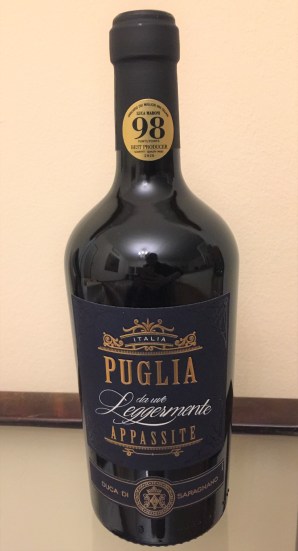
A few weeks ago, as I was scouring the shelves of one of the mini-markets, looking for a wine we hadn’t tried, I came across this:

my photo

“This” is a bottle of red wine from Puglia, with a classification of Indicazione Geografica Tipica, i.e., pretty good but not up there among the stars. Nothing out of the ordinary so far. But what caught my attention was the phrase on the label da uve leggermente appassite: “from grapes that have been slightly dried”. I vaguely knew about the “passito” method of making wine, which meant that the grapes have been dried out before being crushed and pressed. After polishing off the bottle with my wife (more on this later), I decided to do a bit of research on the “passito” method (which for the most part consisted of reading a bunch of Wikipedia articles). I can now happily share my newfound knowledge with those of my readers who, like me, are not super experts on wine (those who are super experts had better just skip to the end).

The first thing I discovered is that “appassimento” (the procedure of drying grapes and making them “passiti”) is actually one of three procedures which are used in grape-growing regions with the primary purpose of concentrating the sugars in the grapes. And the reason for concentrating the sugars is to be able to make strong, sweet wines, usually drunk with desserts (hence often being called “dessert wines” in English).

“Appassimento” is the most obvious, and therefore the oldest, of these three procedures: there is evidence of sweet wines being made this way already 6,000 years ago in Cyprus. There are various ways of carrying out “appassimento”. One is simply to leave the grapes on the vine longer than you normally would, so that they overripen and have higher than normal sugar levels; they also tend to lose water and shrivel, which also increases sugar concentrations. Canny wine-makers can play with the amount of “appassimento” they allow. They can have just a bit of “appassimento” (which is probably how the Puglia wine I mentioned earlier was made).

Source

Or they can go the whole hog and choose extreme “appassimento”.

Source

Of course, the longer wine-makers wait, the greater the risk that something will go wrong (bad weather, mould, etc.). But the more interesting can be the flavours so generated. A variant to this approach is to leave the grape bunches on the vine but twist their stem, to “strangle” them as it were. If I understood correctly, this hastens the “appassimento” process, so that you can avoid the risks but enjoy the advantages – having your cake and eating it.

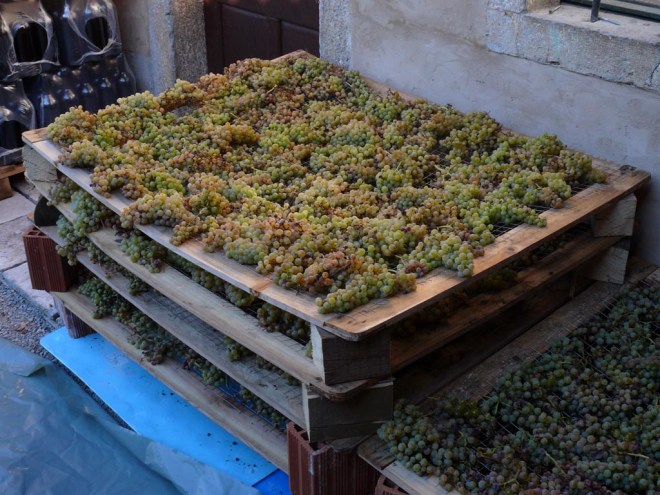
You can also harvest the grapes at the normal time but then let them dry in the sun.

Source

Or, if you’re not too sure of the weather, you can do it inside.

Source

Wines made this way are called straw wines (vin de paille in the original French), because the grape bunches were originally laid down on straw to dry out.

As readers can imagine, all this works better in places with lots of sun, which is no doubt one of the reasons why Cyprus holds the prize for the earliest use of the procedure.

Let me at this point throw in some examples of sweet wines made this way. Since my investigations were started with an Italian wine, I’ll give Italy pride of place, while recognizing that all of the southern European countries, as well as the New World wine-making countries, make this kind of wine. Even in Italy, there are numerous such wines, so I’ll just mention a couple, chosen for the completely banal reason that they are from lovely places. Thus, we have the various Vinsanti from Tuscany.

Source

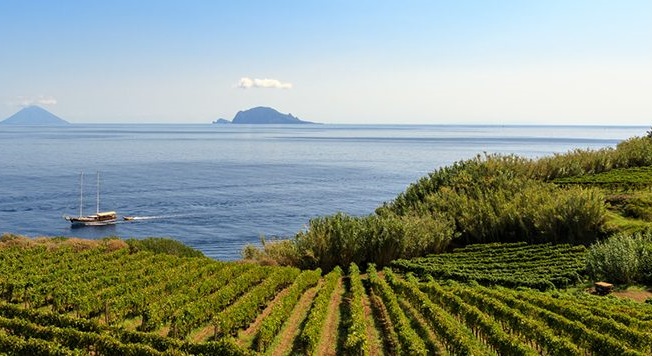
And then we have Malvasia delle Lipari passito, made in the small islands of Lipari and Eolie off the coast of Sicily.

Source

In the second procedure used to concentrate sugars in grapes, you allow your grapes to be attacked by a fungus, the Botrytis cinerea. The fungus shrivels the grapes and increases sugar concentrations, thus allowing wine-makers to make a sweet wine. For rendering this useful service, the fungus has been named the “noble rot”.

Source

For the noble rot to work properly, you need specific humidity conditions at specific times of the day at specific times of the year, so there are only a few places in the world where you can use this procedure. And you have to be damned careful that the fungus doesn’t run riot in your vineyards, otherwise you get another form of the fungus, “grey rot”, which completely ruins your harvest. It seems that Hungarian winemakers were the earliest to figure out how to harness Botrytis cinerea to make sweet wines, having done so by the 16th Century.

You really have to ask yourself how anyone – Hungarian or otherwise – figured this procedure out. My assumption is that when one year some wine makers found themselves with a harvest of grapes on their hands which had been attacked by the fungus, rather than just throw the grapes away they decided to go ahead and make wine anyway, reasoning that even a bad wine was better than none at all, and were pleasantly surprised by the result.

As examples of what are, sensibly enough, called botrytised wines, I’ll mention Tokaji from Hungary, because that seems to be the granddaddy of this kind of wine.

Source

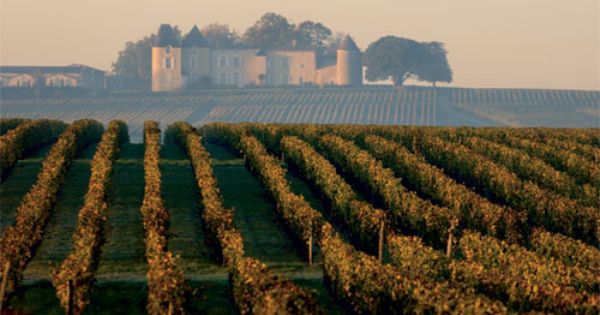
And I’ll mention Sauternes from the Bordeaux region of France, perhaps the most famous of the botrytised wines.

Source

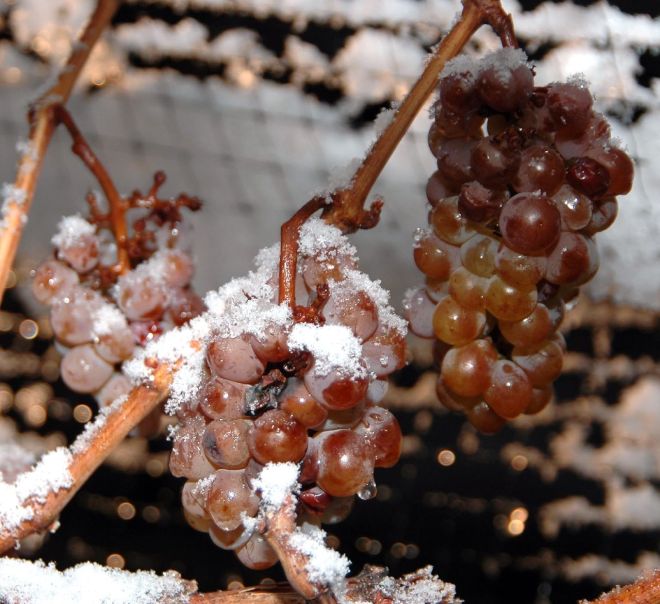
The third and final procedure is used to make so-called ice wines. Here, you leave the grapes on the vines until January/February. The precise time you pick the grapes crucially depends on the outside temperature: picking must take place the first time the temperature drops to -7°C, which normally means picking the grapes at night, picking them quickly, and pressing them immediately.

Source

What is happening is that the water in the grapes is turned to ice but not the sugars. When you press the grapes, the iced water stays with the must, and the resulting grape juice has very high levels of sugars. The procedure is a relative newbie: it was only discovered at the very end of the 18th Century, in Germany.

As an example of an ice wine, I’ll mention Canadian ice wines.

Source

This may seem a surprising choice, but it allows me to slip in a mention of what is probably the greatest environmental disaster staring us in the face: climate change. Because of climate change, it is getting more and more difficult to make ice wine reliably in the northernmost wine-growing regions of Europe where the procedure was first developed, because it is becoming rarer and rarer for the temperatures there to drop sufficiently low. But because temperatures still drop reliably every year to -7°C in Canada, its wine regions, particularly those in Ontario, have stepped into the breach and have become the world’s major producers of ice wine.

Readers will no doubt have noticed that all the examples I have given so far are of white wines, and indeed most of the wines made in these three ways are white, using grape varieties like muscat, malvasia, and riesling. But – as my discovery in the mini-market shows – some red wines are also made this way. Since, as I pointed out earlier, I’m more of a fan of red wines than white wines, I want to finish this post by fighting for the red corner, and will do so by mentioning three red wines, all from northern Italy, and all passito wines.

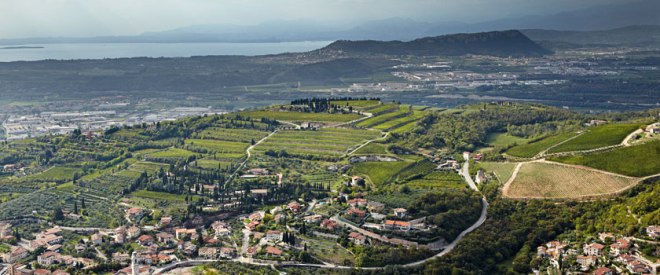
Two come from the Valpolicella region, which lies north of Verona and east of Lake Garda – in this photo, you can see the lake in the distance.

Source

The first of the two red passito wines from here is Recioto della Valpolicella. This, like most passito wines, is a sweet wine, and indeed this photo suggests its use as a dessert wine.

Source

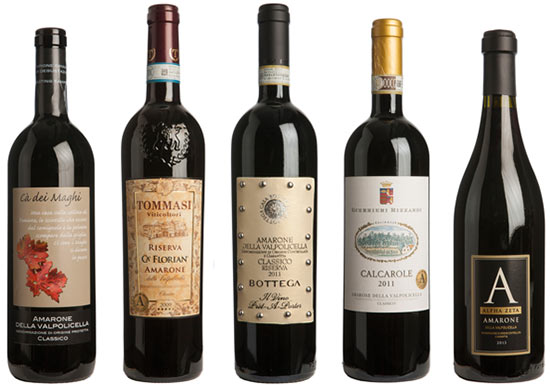
Perhaps at this point I should reveal that I’m not a great fan of sweet wines. I don’t deny that they can be very tasty, but I feel that somehow – and I’m sure this is just a ridiculous prejudice – sweet wines are not serious. This prejudice of mine is most extreme when it comes to red wines; I’ve signaled this already in an earlier post about sparkling Italian red wines, most of which are sweet. To my mind, for red wines to be serious they must be dry. So it comes as a relief for me to able to introduce the second wine from Valpolicella, the Amarone della Valpolicella.

Source

This is a dry wine. Its name signals this, Amarone being derived from the Italian word “amaro”, which means bitter or sour. The wine is not really bitter or sour; it probably refers to the fact that this wine originally came from batches of Recioto della Valpolicella where the fermentation hadn’t stopped and so the sugars had all been turned into alcohol: so from sweet to sour.

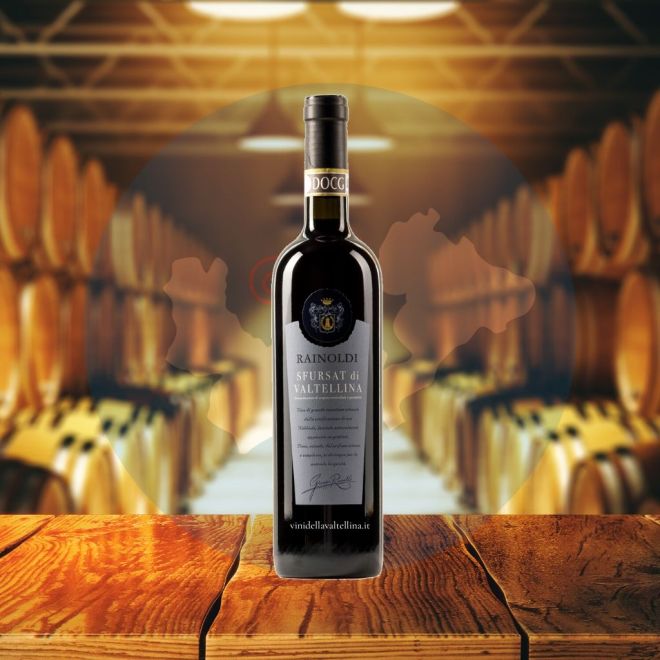
Which leads me naturally to my final red passito wine, another dry wine, the Sfursat. This comes from the Valtellina valley in upper Lombardy, upstream of Lake Como (and of the hike along the Sentiero del Viandante which my wife and I did last year).

Source

Let me throw in here a photo of grapes drying in readiness to become sfursat.

Source

And here is a photo of a bottle of sfursat, which gives me an excuse to have a photo of that inescapable part of the wine world, a wine cellar.

Source

At this point, I have to make another revelation. Neither my wife nor I have ever tried any of these three wines. But now we have an excuse to try some different wines during lockdown! (we’ll have to accept to fork out considerably more cash than we are used to, though, but hey! no pain, no gain).

And what about the Puglia wine that started this whole post? As I poured it into our glass wines I was half afraid that it would be sweet, but no, it turned out to be a dry wine, which was a relief. As we sipped it, we felt that the intense and bright red colour of the wine, characterized by delicate purplish hues, was the perfect expression of its complex and fruity bouquet. Balsamic notes of blackberries, spirited cherries and plum jam were smartly dressed by elegant sweet spicy scents. It was warm, round, and with a good balance of tannins … OK, I confess, I just copied all that last bit from the label on the back. As I commented in a post written years ago, I’m always impressed by the bullshit wine merchants come up with. My wife and I, we just went mmm, yummy! And the next day, I bought another couple of bottles.

HOLLY AND CHRISTMAS

Milan, 12 December 2020

It’s that time of the year again! Time to drink nice hot toddies, time to put up the Christmas tree and other sundry decorations, time to set up the nativity, time to put on the CD of Christmas carols and sing along (in my case, somewhat off-key).

“The holly and the ivy,
When they are both full grown,
Of all the trees that are in the wood,
The holly bears the crown.”

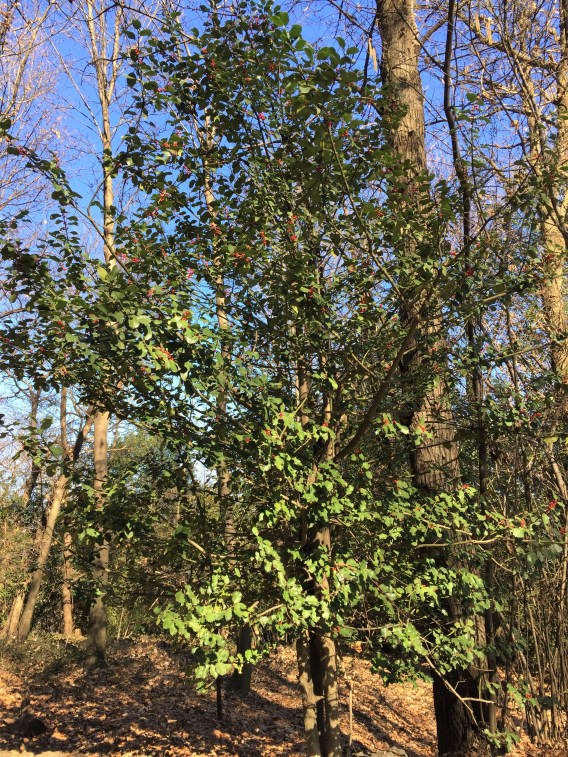
Holly is a nice plant. With its lovely shiny green leaves and strongly red berries, it really does bring a brightness to our lives just when we most need it. I was struck by this most forcefully last December, when my wife and I were hiking through the woods around Lake Maggiore and Lake Como (a pleasure that is currently denied us by the latest round of Covid lockdowns). The trees were all bare and drear, the rustling underfoot as we trod over dead leaves reminding us of the lovely greenery that had covered them just a few months before. Suddenly, we spied a bright cheerful green among the trees. It was a holly tree.

My photo

Quite soon, a few more popped up between the bare trees.

my photo
My photo

No doubt we were traversing a zone where soil and climate conspired to give the holly a competitive advantage.

It was a pleasure to see holly in the wild. Before then, I’d only ever seen holly trees tamed and manicured to within an inch of their lives in a garden, a splash of dark green against the lighter green of lawn

Source

Or used as a well-trained, well-trimmed hedge.

Source

And of course I’d seen holly as part of the wreaths which people hang on their doors at Christmastime.

Source

This connection between Christmas and holly is very old. When you strip away all the layers of religiosity that envelop Christmas, it’s really a feast about the winter solstice, a celebration of when the sun, which has been dying and allowing the days to get ever shorter and nature to die, is reborn, slowly making the days become longer and nature come alive again. In our festivities welcoming the rebirth of the sun, it made perfect sense for us to use plants like holly which are still green at the winter solstice, to remind the sun of the job it had to do to make everything else green again.

Thus we have the Romans decorating their homes with holly during their feast of Saturnalia, a winter solstice feast where there was a lot of gift-giving, feasting and merrymaking (a lot of other things happened during Saturnalia which need not detain us here, but any reader interested in Roman goings on can read about them here).

Source

Funnily enough, when early Christians followed Roman practice and hung holly in their homes and churches, the pagans around them told them not to – I suppose they thought these bloody Christians were desecrating their festival. But at the same time the Church Fathers were also telling them not to, finding this ritual really too pagan for words. Luckily for us, the Christian-on-the- street ignored both the pesky pagans and kill-joy Church Fathers and continued to hang holly in their homes and houses of worship. Which in turn has allowed us to sing over the ages (in my case, somewhat off-key),

“Deck the halls with boughs of holly
Fa la la la la, la la la la
‘Tis the season to be jolly
Fa la la la la, la la la la”

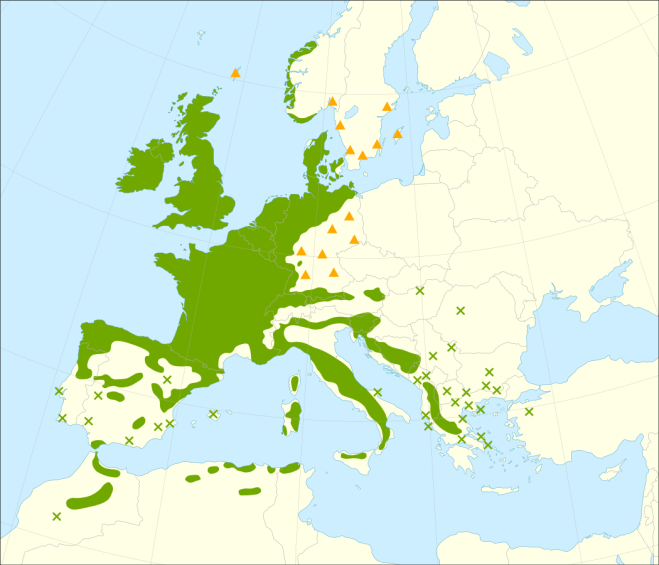
Presumably, as the legions marched outwards from the Roman heartlands they took with them their Saturnalia festival. Holly (at least the species which grows around Rome) is present in just about all the European regions and some of the North African regions which the Romans conquered (the green crosses mean isolated populations, and the orange triangles indicate places where the holly was introduced and became naturalized).

Source

So no doubt halls were also decked with holly in the Roman colonies of western Europe and North Africa. In fact, it is possible that our Christmas love affair with holly in Western Europe has its roots in the Romans’ Saturnalia festival.

Or perhaps not. Because holly was also a special plant for the Celtic tribes of Northern Europe: the map above shows that holly was very much present in their heartlands. They too decked their halls with holly, and for much the same reasons as the Romans: the plant’s evergreen leaves and bright red berries brought cheer to an otherwise dreary time of the year, and they were a reminder that greenery had not disappeared for ever, that it would soon be back, warmed by a re-born and newly vigorous sun.

The Celts saw holly as a symbol of fertility and eternal life, and imparted many magical powers to the plant. Hanging holly in homes was believed to bring good luck. During winter, branches of holly in the house would provide shelter from the cold for fairies, who in return would be kind to those who lived in the dwelling. In the same vein, holly was believed to guard people against evil spirits. So Druids wore holly garlands on their heads, as did chieftains. Holly trees were often planted around homes; because holly was believed to repel lightning this would protect homes from lightning strikes. Just as the oak tree was considered the ruler of summer, so the holly was seen as the ruler of winter, the dark time. As such, holly was associated with dreams and Druids would often invoke the energy of holly to assist them in their dream work and spiritual journeying. Here is one rather fanciful modern depiction of the magical powers of holly.

Source

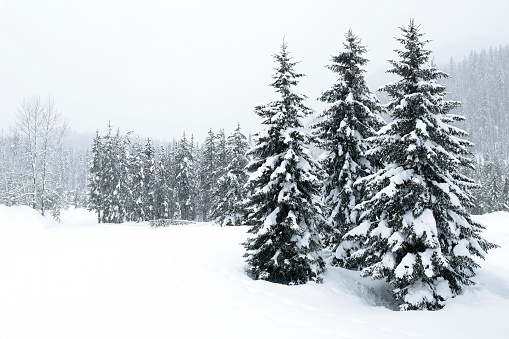
Holly is not the only evergreen plant which has been caught up in our Christmas celebrations. There’s the Christmas tree, of course.

Source

“O Christmas tree, o Christmas tree
Thy leaves are so unchanging
Not only green when summer’s here
But also when it’s cold and drear”

The custom of using pine trees in Christmas celebrations started in modern-day Estonia and Latvia, by the way, during the Middle Ages and spread out from there. The trees were traditionally decorated with flowers made of colored paper, apples, wafers, tinsel and sweetmeats. I would say that the original idea was to remind us that trees would soon be a-fruiting again.

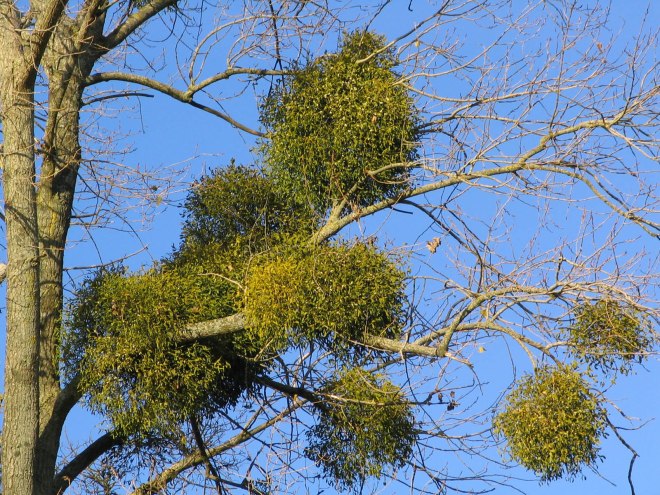
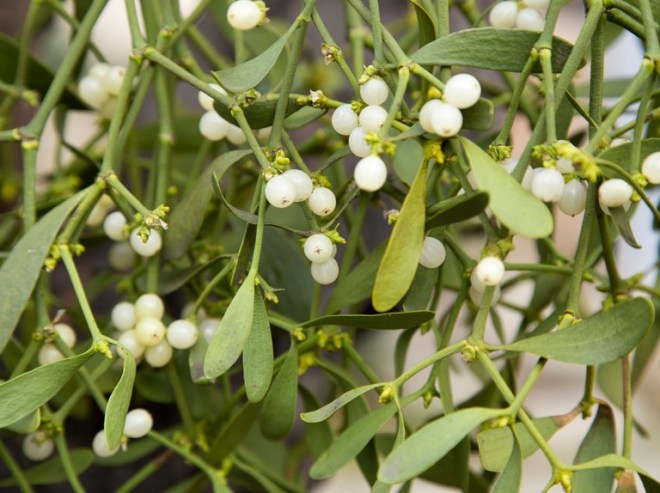
Then there’s the mistletoe.

Source

“When I close my eyes
It’s just you and I
Here under the mistletoe
Magic fills the air
Standin’ over there
Santa hear my prayer
Hеre under the mistlеtoe”

Our wanting to steal a kiss under the mistletoe is a pale reflection of an ancient belief that mistletoe brought fecundity into a home – its white berries were considered to be the sperm of the oak tree.

Source

Kissing under the mistletoe will never feel the same again now that I’ve read that.

I actually have a sense that just about any evergreen plant was made part of Christmas celebrations in some place and at some time – after all, if the point of having evergreen plants around was to remind us of the newly green world just around the corner, any evergreen plant should surely do the trick. I rather like a Christmas decoration that was once popular and summed up all the ideas around the use of evergreens in a celebration of the re-birth of the sun. This was the Kissing Bough. It was a popular Christmas decoration before the pine tree dethroned it and came to dominate our Christmases. To make one, five wooden hoops were tied together in the shape of a ball (four hoops vertical to form the ball and the fifth horizontal to go around the middle). The hoops were then covered with whatever evergreen plants were at hand: holly, ivy, rosemary, bay, fir or anything else (signifying the vegetation to come). An apple was hung inside the ball (signifying the fruits to come) and a candle was placed inside the ball at the bottom (signifying the re-birth of light). The Bough was finished by hanging a large bunch of mistletoe from the bottom of the ball (signifying the fecundity to come).

Source

Coming back to holly, before we get carried away with all this magical imagery and mystical meanings (and let me tell you, the Internet is awash with reams of magico-mystico stuff on holly), let’s go back even beyond our Celtic and Roman forebears to a time when we were mere hunter-gatherers. Etymologists believe that the word “holly” has its origins in the Old English word hole(ġ)n. This is related to the Old Low Franconian word *hulis, and both are related to Old High German hulis, huls. These Germanic words appear to be related to words for holly in the Celtic languages, such as Welsh celyn, Breton kelen(n) and Irish cuileann. Probably all come from Proto-Indo-European root *kel- “to prick”.

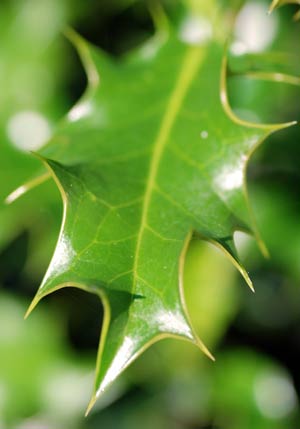
What an eminently sensible lot, the hunter-gatherers were, to give this plant a name which stressed its prickliness! Yes, holly is nice to look at, but get close and you immediately notice something else: its leaves have very sharp spines.

Source

This is not a tree to hide under or climb: something I learned as a child when I was once violently pushed into a holly hedge by another, very nasty, child. Ouch, it bloody hurt!
WHAT’S IN A NAME?

Vienna, 30 November 2020

Wagram: A region close to the River Danube upstream of Vienna, where there are steep terraces made up of deposits of loess laid down millions of years ago.

Source

“Wagram” is a composite of two Middle High German words: “wac” (moving water, river) and “rain” (meadow, slope). So Wagram means Slope by the Water or Bank. No doubt these terraces were created centuries ago by a meander of the Danube which then changed course at some point, because there’s not much water by these slopes now. Vineyards have been planted on many of the terraces where the slopes are not too abrupt.

Source
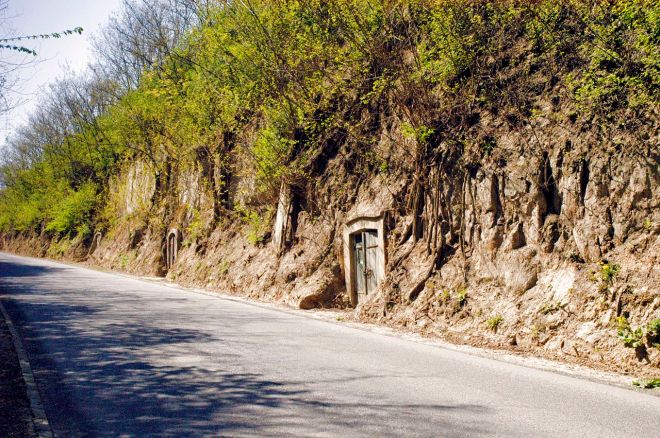
I suppose the sandy soil of the loess is good for vines. The wine – mostly made with Grüner Veltliner grapes – is good enough to have given the region its own wine name, “Wagram”. In some of the steeper slopes wine cellars have been dug directly into the loess.

Source

We’ve been climbing up and down these terraces throughout the summer, principally because we’ve been hiking along sections of the pilgrim path to St. James of Compostela, known as Jacobsweg in this part of the world. The path happens to run along the loess terraces.

Source

Many a village which stands at the foot of these terraces has added “Wagram” to its name. So we’ve walked through Fels am Wagram, Kirchberg am Wagram, Königsbrunn am Wagram, Stetteldorf am Wagram, Eggendorf am Wagram, … (there’s even a Wagram am Wagram, which seems a bit exaggerated).

Deutsch-Wagram: Sharp-eyed readers will no doubt have noticed that on the map above, a village of this name is marked. It is across the Danube from Vienna and a little to the north-east of it.  It too sits on deposits of loess, although the slopes of the terraces here are very gentle, almost imperceptible. The village stands on the northern edge of a flat plain, the Marchfeld plain, which is rich agricultural land. There’s really nothing much to say about this village. I’ve looked at its Wikipedia entry and sifted through photos of the place online, but I could find nothing of any substance to report – except for one thing: it gave half of its name to one of Napoleon I’s major battles.

Battle of Wagram: It was fought in early July 1809 not too far from where I’m writing this. Napoleon had captured Vienna in May, but the Austrian Emperor had not capitulated, and the bulk of the Austrian army was undefeated and was camped on the Marchfeld plain across the Danube from Vienna. Napoleon concluded that until he had beaten this army no peace could be concluded. He therefore decided to get his army across the Danube onto the Marchfeld plain and give battle. His first attempt, in May, using the island of Lobau as his entry point into the plain, was a costly failure. This has come down in history as the battle of Essling, taking its name from the village of Essling around which much of the fighting took place.

Source

Learning from his mistakes, Napoleon prepared his army’s crossing of the Danube through Lobau with far more care and this time the crossing was successful. And so by the early hours of 5 July the two armies were facing each other across the Marchfeld plain. This rather fine old map shows the battleground nicely.

Source

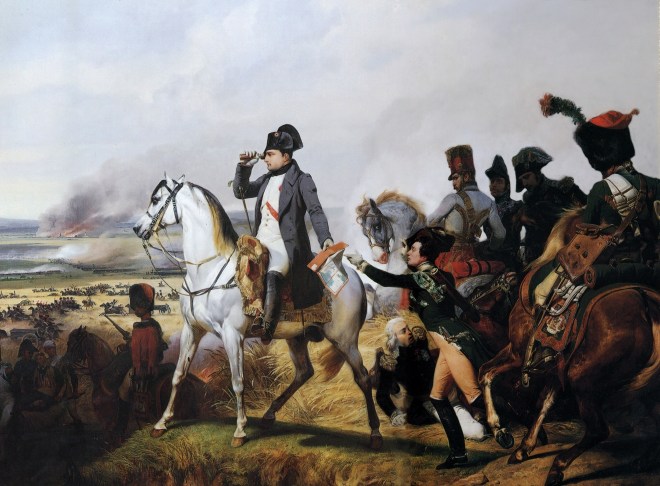
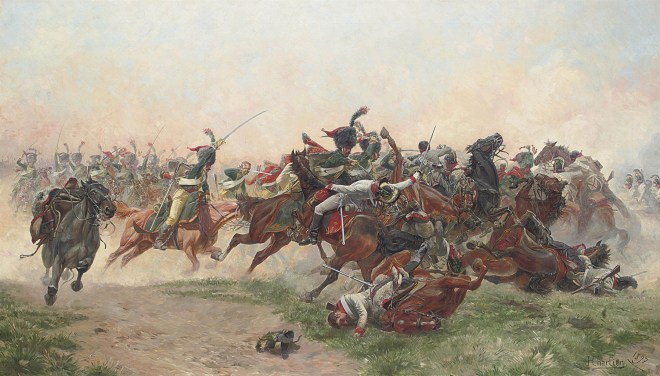
The Austrian commander, Archduke Charles, knew that Napoleon would cross again at Lobau and had set up his positions along the slight ridge of loess, placing himself at the centre of the Austrian line, in the village of Deutsch-Wagram. That slight ridge, along with a marshy stream which ran at its foot and which acted as a fine defensive barrier, put the Austrians in a good position. I do not propose to give a detailed blow-by-blow account of the battle. A few fanciful paintings of a propagandist nature will suffice.

Source
Source
Source

The reality of the battle was grimmer. After two days of hard fighting, the Austrian army retired in good order while the French army was too knackered to properly pursue it. The French claimed victory, and although that was technically correct the “victory” didn’t change the strategic situation. After another inconclusive battle 5 days later at Znaïm, the two sides agreed to an armistice.

The battle of Wagram and the previous battle of Essling had been very costly. The casualties were very high on both sides, but for the French, after more than 10 years of almost continuous fighting, it was harder to make up the losses. Napoleon’s enemies had finally understood his strategies and were beginning to emulate them. There were going to be no more spectacular victories with relatively light losses as there had been in the past. Many see the battle of Wagram as the beginning of the end for Napoleon.

Avenue de Wagram: One of the twelve avenues that radiate out from the Arc de Triomphe in Paris. Although now largely forgotten, the avenue’s naming in 1864 was originally a piece of propaganda by the-then Emperor Napoleon III. It was always useful for him to glorify the deeds of his uncle Napoleon I, it was a way of burnishing his rather more doubtful credentials. Baron Haussmann was busy creating a new urban landscape for Paris at the time, which, among other things, meant that the area around the Arc de Triomphe was being remodeled. The Arc had originally been built as a memorial to one of Napoleon I’s greatest victories, the battle of Austerlitz. When his ashes were returned from the island of St. Helena in 1840, they passed through the Arc de Triomphe on their way to his final resting place in Les Invalides.

Source

Why not, then, turn the area around the Arc into a memorial to the first Napoleon’s military genius? And so, in 1864, a number of the new avenues radiating out from the Arc were named after Emperor Napoleon’s more famous battles (his earlier battles when he was a mere revolutionary general or even First Consul were ignored): along with the Avenue de Wagram, there was the Avenue d’Essling which I’ve already mentioned, the Avenue d’Iéna, celebrating the battle of 1806 fought at Jena in Thuringia, during which Napoleon pulverized the Prussian army, the Avenue de Friedland, celebrating the battle of 1807 fought in what was then eastern Prussia, during which Napoleon decisively beat the Russian army, and the Avenue d’Eylau, commemorating a battle fought four months prior to Friedland in the same neck of the woods. One other avenue was named the Avenue de la Grande Armée, to commemorate Napoleon’s imperial army which had fought in all of these battles and more during his campaigns from 1804 to 1814. To cap it off, a circular road which runs around the Arc de Triomphe had one half of the circle named rue de Presbourg, commemorating the treaty of Presbourg signed with Austria after the victory at Austerlitz, and the other half named rue de Tilsit, commemorating the treaty of Tilsit signed with Russia after the victory at Friedland. As a cherry on the Napoleonic propaganda cake, a number of the remaining avenues were named after members of the Napoleonic clan. Quite understandably, all these last avenues had their names changed later when Napoleon III was toppled, along with the avenues commemorating the battles of Essling and Eylau (not surprising really; as we’ve seen, Napoleon actually lost the battle of Essling and he only just won the battle of Eylau).

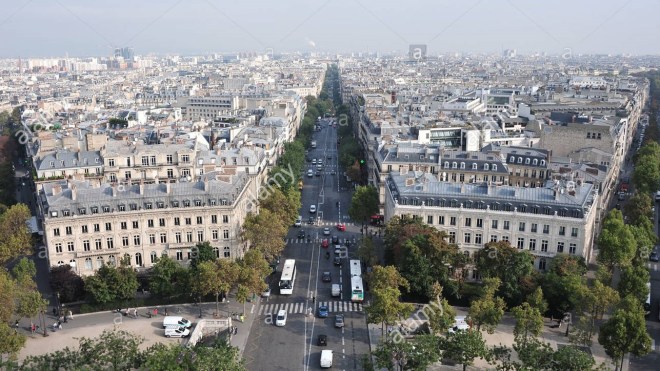
I’m sure all this propaganda from the past is lost on the avenue’s current inhabitants. The only thing that seems to matter today is that Avenue de Wagram is a very chic place to live. While not situated in the “seizième arrondissement”, the 16th district of Paris, the city’s toniest district, it is still a very desirable place to put on your calling card. Real estate on the avenue is eyewateringly expensive. This is a view of the avenue from the top of the Arc de Triomphe.

Source

As befits such a moneyed area, it is represented in Parliament by a member of the right-of-centre party Les Républicains, Ms. Brigitte Kuster.

Source

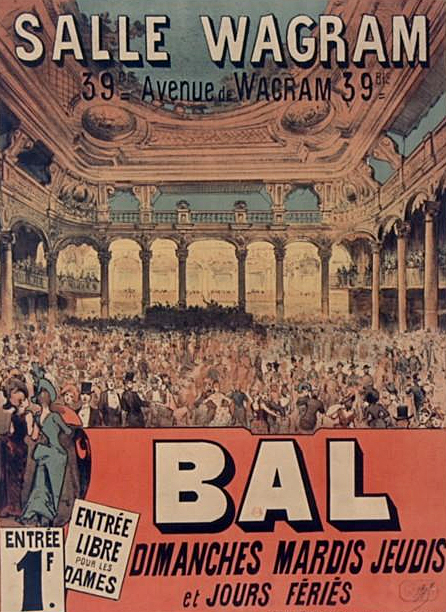
Salle Wagram: Whatever the Napoleonic propagandists might have wanted, for the people of Paris the area around what became Avenue de Wagram near the Arc de Triomphe had been a place where you went and had fun ever since the Revolution. The ball got rolling with a drinking hole where you could also dance. Then came theatres, music halls, concert-cafés, and then cinemas.  Perhaps the most famous of these palaces of fun was the Salle Wagram, a large hall built in 1865. It was located at 39bis, avenue de Wagram.

Source

It was famous as a place where Gay Paree went to dance the night away.

Source
Source

But it was also a place for exhibitions and other “serious” shows, like the First Cycling Exhibition of 1894.

Source

The money took over from the fun. All the places of entertainment other than Salle Wagram and a couple of others have disappeared, leaving space for expensive offices and apartments. C’est la vie, as the French philosophically remark.

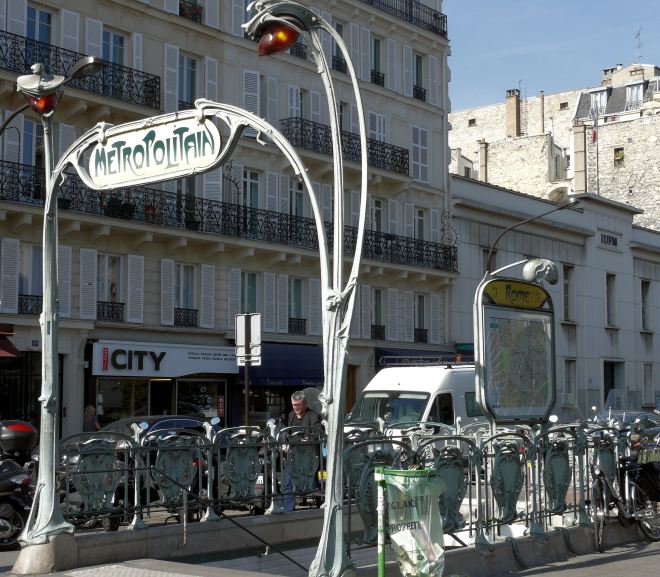
Station Wagram: The name of a station in Paris’s subway system, one of many.

Source

It serves Avenue de Wagram, although it’s actually located on a small street that crosses the avenue – the avenue’s greater name recognition decided the station’s naming. Opened in 1911, many of the initial travellers no doubt used the station to go to Salle Wagram or the other entertainment spots in the area. But now it probably only services workers whose offices are in the area and the cleaners and other domestics who work in the surrounding rich apartments.  The station itself is nothing to write home about. Perhaps it was more interesting architecturally when first opened, but the modernizations of the 1960s have left it a bog-standard station.

Source

Its one saving grace is its entrance, which harbours one of Hector Guimard’s delightful Art Nouveau floral designs.

Source

So it is that by the vagaries of history, loess terraces in eastern Austria were transmuted into a dot on the Parisian subway map 1200 km away.

Source                                                                                     Source

C’est la vie, as the French say.

YELLOW AND RED

Vienna, 21 November 2020

Just look at that maple! What a magnificent yellow its leaves turned!

my photo
my photo

My wife and I walked under it during a hike we did a couple of weeks ago. We were following the edge of a wood and lo and behold! there it was.

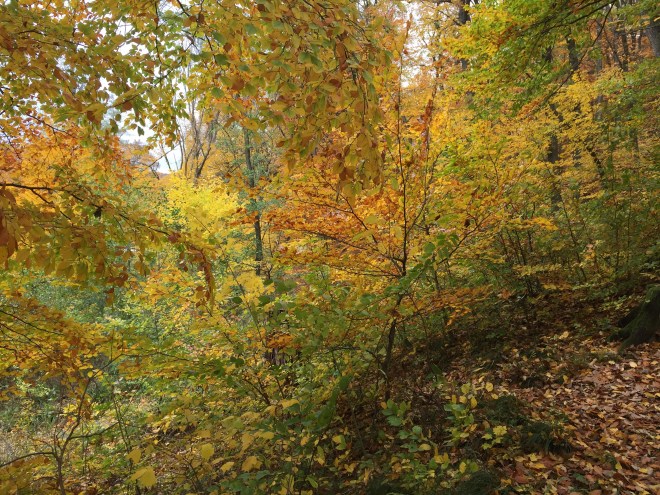
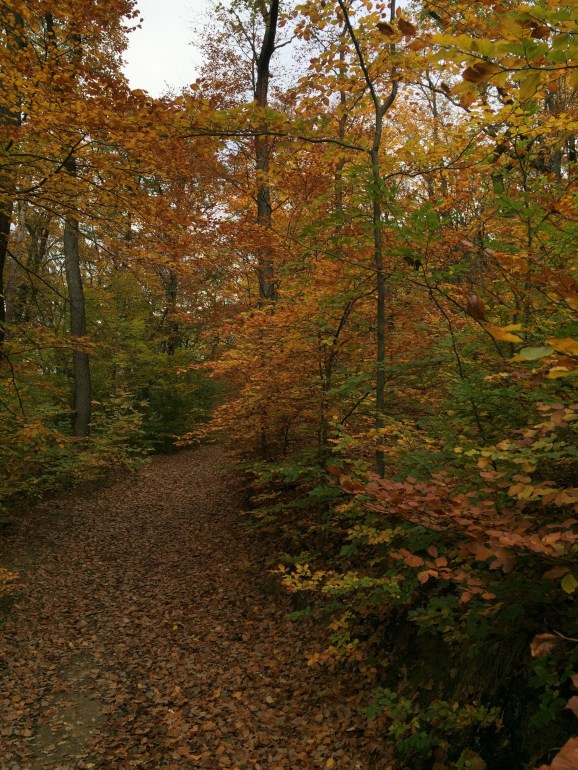
As I mentioned in an earlier post, as we have been walking the woods these last few weeks the trees have been putting on their autumnal colours. We have been bathed in yellows of all hues, turning to russet, and finally to dark brown.

My photo
my photo
My photo

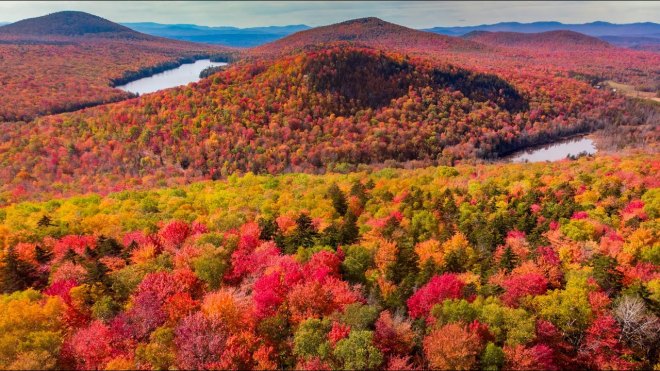
But what we have not been bathed in is reds. We have not witnessed the wonders of a North American Fall

Source

or the splendour of an East Asian Autumn.

Source

“Why is that?” I asked myself as I sat there gazing at my photo of that yellow maple tree, “why is it that North Americans and East Asians have splendid red hues in their autumn colours and we in Europe do not?”

To answer this, we are going to use a version of Root Cause Analysis called the “5 Whys”. This was something invented by Sakichi Toyoda, the father of the founder of Toyota, who claimed that you had to ask “Why?” (more or less) five times before you got to the root cause of something. His son used it extensively in his car factories as a quality control tool, to discover the fundamental reason – the root cause – for a quality failure (and at a much more modest scale I have used it to discover the root cause of a source of pollution or waste). A simple example goes as follows:

“Why the hell isn’t my car working?!”
Because the alternator isn’t functioning.
“Well why is the bloody alternator not functioning?!”
Because the alternator belt has broken.
“Oh. Why did the alternator belt break?”
Because it was well beyond its useful service life but has never been replaced.
“Ah. Why wasn’t it ever replaced?”
Because you, idiot that you are, didn’t maintain your car according to the recommended service schedule.
“Ah, right, OK, sorry about that.”

OK, so now we can start using the method on our little problem:

“Why do the leaves of many species in North America and East Asia go red, whereas so few do so in Europe?”

We see leaves as green because of the chlorophyll they contain. But leaves also contain other pigments, which if the chlorophyll were not there would make the leaves look yellow, orange, or all hues in between. The chlorophyll simply masks them.

In Europe, when autumn comes and the chlorophyll begins to disappear, these other pigments are finally allowed to “express themselves”, giving the leaves the beautiful hues of yellow that we see. This explains the fact that the maple we came across went from green to lovely canary yellow.

Source and source

In North America and East Asia, something else happens when the chlorophyll begins to disappear from the leaves. There, trees begin to produce – from scratch – a red pigment, anthocyanin, in their leaves. This pigment masks – or perhaps “mixes with” – the yellow or orange pigments already there, to give various shades of red. Thus do North American and East Asian maples go from green to red.

Source and source

“OK, but why do North American and East Asian species produce this red pigment at the end of their leaves’ lives?”

Yes indeed, it does seem that the trees and bushes which do this are penalizing themselves. Just when their leaves are about to fall off, part of the general shut-down for their winter slumber, the trees start expending precious energy to pump their dying leaves full of red pigment. The reason for this apparently foolish behaviour has to do with pest control and especially control of aphids (which I happened to mention in an earlier post on wood ants). Aphids have this nasty habit (as far as trees are concerned) of sucking amino acids from them in the Fall season, and then laying their eggs on them; the eggs hibernate along with the trees and give birth to a new generation of aphids in the Spring. So the trees get hit twice: they lose precious amino acids to those pesky aphids, and then the next year they have to endure attacks by the next generation of aphids! Now, it so happens that aphids believe that a brightly-coloured tree is a tree that is chemically well defended against predators, so they tend to avoid laying their eggs on such trees. So of course trees in North America and East Asia have evolved to turn themselves bright red in the Fall, just when the aphids are laying their eggs, by pumping their dying leaves full of anthocyanin.

“Why do aphids think a brightly-coloured tree is a chemically well defended tree?

I thought you might ask that. The answer is, I don’t know. Stop being a smart-ass and move on to the next question.

“A bit touchy are we? Well OK, why don’t European trees make their leaves go red then?”

Because they don’t they have aphids which prey on them.

“Why is that? How can it be that aphids prey on the North American and East Asian trees and not on the European trees? What’s so special about European trees?”

Yes indeed, this is where it gets really interesting. To answer this, we have to go back 35 million years. At about this time, the northern hemisphere began to go through a series of ice ages and dry spells. Most trees reacted to this by going from being evergreen to deciduous. They also retreated southwards when the ice sheets advanced and returned northwards when the ice sheets retreated. In North America and East Asia, their predators of course went with them, evolving to deal with the fact that trees now lost their leaves and went dormant during the winter. In turn, the trees evolved to fight off these predators by, among other things, turning their leaves red in the Fall. This struggle between tree and predator continued even as the trees moved northwards or southwards as the ice sheets advanced or retreated. Thus, still today, the trees in those parts of the world go a glorious red in the Fall.

But in Europe, there were the Alps and their lateral branches, which ran east-west. In North America and East Asia, the mountain ranges, where they existed, ran north-south, so the trees in their periodic advances and retreats could “flow around” these mountains. In Europe, though, as the trees moved southwards to escape the ice sheets they hit the barrier of the Alps; there, they could go no further and so perished in the piercing cold. And so of course did the predators which they harboured. Only seeds were carried southwards, by birds or the wind or in some other fashion, and of course these seeds harboured no predators. Thus it was that European trees did not need to make red leaves and so they give us glorious shades of yellow in the Autumn.

There is at least one exception to this rule, and these are dwarf shrubs that grow in Scandinavia. They still colour their leaves red in autumn. Unlike the trees, dwarf shrubs managed to survive the ice ages; in the winter they would be covered by a layer of snow, which protected them from the extreme conditions above. But that blanket of snow also protected the insect predators! So the plants had to continue their struggle with their predators, and thus evolved to colour their leaves red. We have here an example, the smooth dwarf birch.

Source

Well, that was an interesting use of the 5 Whys method! I must see if there are other issues I could use it on.

MARTIN’S GOOSE

Vienna, 11 November 2020

Often in past years, on this day – 11 November, the day on which the First World War ended on the Western Front – I have published a post in memory of those who died in that war or who were permanently scarred by it. But this year, since my wife and I are spending November in Vienna, I published this year’s memorial post a few days ago, in recognition of the fact that the war ended about a week earlier for the Austro-Hungarian Empire. So instead, I shall use this post to celebrate rather than grieve. I shall write about a food dish, the Martinsgans (which for some strange reason becomes Martinsgansl in Austria).

Martinsgans is a dish from the German lands and is traditionally eaten today, 11 November (but of course nowadays, as a way of increasing sales, it gets offered in restaurants for a couple of weeks around that date – although this year, because of Covid, all the restaurants are now closed in Vienna). It is a dish based on goose – Martinsgans translates into English as Martin’s goose. Why Martin’s goose rather than anyone else’s goose? Well, that’s because 11 November happens to be feast day of St. Martin in the Christian calendar.

A Martinsgans made according to tradition consists of roast goose served with cooked red cabbage and potato dumplings. This is what it will look like when it is placed on the table to the oohs and aahs of the assembled family and guests.

Source

For those of my readers who feel the need for an adventure in the kitchen, here is a recipe for making Martinsgans.

The goose:

Wash the goose thoroughly inside and out and dry.  Cut a couple of apples and an orange into eights, mix well with some thyme and marjoram, and stuff the goose with the mix. Tie the goose up and seal with wooden skewers. Rub the goose well on the outside with salt, pepper, marjoram and thyme, and then place the bird, breast side down, in a large greased roasting pan or baking dish. Roast the goose in the oven, preheated to 220°C, for about half an hour. Brush the goose with honey several times and pour a bottle of beer over it. Turn the oven down to 180°C, deglaze with a little water, and roast the goose in the oven for about 2 hours. Pour its own juice over the goose while it is roasting. Take the roasted goose out of the oven, and let it rest for a while before serving.

While the goose is roasting, you can prepare the red cabbage and the potato dumplings.

Red cabbage:

Clean, wash and finely chop the red cabbage. Mix with some orange juice and red wine, a dash of lemon juice, salt and caraway seeds, and let it all steep for a while. Then cook in a saucepan over medium heat until soft (30 minutes or so).

Potato dumplings:

Peel some potatoes, cook them until soft, then squash them. Mix in some potato starch, semolina, salt and nutmeg. Let the dough rest for half an hour. Then form the dumplings, and let them simmer in a saucepan with salted water for 15 minutes.

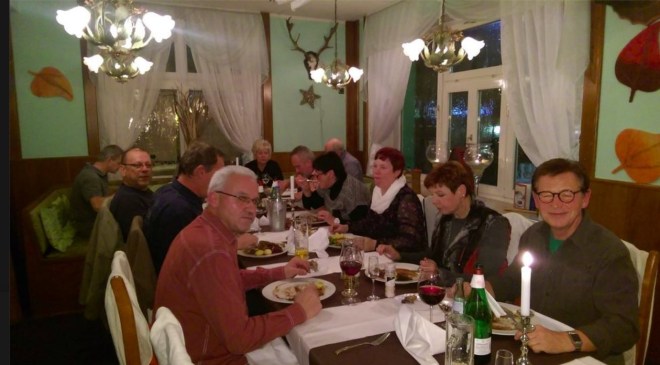
I could leave it there and invite my readers to go celebrate life with a Martinsgans night out, as these folk are.

Source

But I’m afraid I can’t. Too many questions were buzzing through my mind when I was reading up on Martinsgans. Why is the goose eaten on 11 November and not 11 October or 11 December, or indeed the 11th of any other month? And why goose rather than duck or swan – or chicken or turkey or any other fowl? I had to investigate further, and as is my habit I feel a bursting desire to share what I have learned with my readers (and I fervently hope that they have a bursting desire to listen).

On the question of why November 11. As usual, there are several reasons given on the net. The one which I think makes most sense is that it is the result of the Catholic Church’s liturgical calendar. There was a time, long, long ago (from the 7th to 12th centuries CE, to be precise), when the Church required all good Christians to do three days of fasting a week from St. Martin’s day (i.e., 11 November) to Christmas, to prepare themselves for that great feast. Very sensibly in my opinion, people decided that they would have one last good meal before starting to fast. Thus was born the tradition of having a slap-up meal on St. Martin’s day.

What’s odd, though, is that the Church authorities eventually decided to cut this period of preparation before Christmas – which is now called Advent – to four weeks, with the start date being in the very last days of November. So why didn’t the slap-up meal migrate to the end of November?

It could be because, together with the decision to shorten the Advent period, the Church authorities dropped the requirement to fast (a very sensible decision in my opinion; I never could understand why fasting would make you more religious). So perhaps there was no longer any need (or excuse) to have a slap-up meal just before Advent started.

But then why continue with the slap-up meal on St. Martin’s day? And here I think we have to look to some of the other reasons proposed on the net. In the old agricultural calendar, the beginning of November was when in many European countries excess livestock was slaughtered and the meat salted or otherwise preserved (I wrote about one such product, the Italian cotechino, in an earlier post). As a result, it was also a period when many peasants (I dare hardly call them farmers) paid some of the rents which they owed to their lords, payments nearly always made in kind rather than in cash.

Source

St. Martin’s day was traditionally the day when these payments were made. Early November also happens to be the time when domesticated geese are at their fattest. Hence, payments were often made in live geese (in the picture above, one of the peasants is making his payment with what looks suspiciously like a swan).

It’s a little off the point, but I remember well a story which my mother used to tell us when we were young. My maternal grandparents owned some lands, which they rented out to local farmers. The day when the farmers paid their rents was St. Martin’s day. One such farmer was a farmer with red hair (this point was stressed in the story, because – quite unfairly, I think – my mother considered red-haired people to be excitable). In my imagination, I see him something like this.

Source

Like many rural folk of the time (we’re talking the late 1920s, early 1930s), this farmer had received little formal education – probably primary school, if that – before starting to work the land. The discussion would always start pleasantly enough. My grandfather would work his way through the accounts, showing the farmer, let’s call him Mr. Dupont, how he had arrived at the amounts due. As long as my grandfather kept to addition Mr. Dupont could follow. But whenever my grandfather strayed into multiplication, Mr. Dupont got nervous, he would go red in the face, raise his voice, and start objecting vociferously, with my grandfather vainly trying to placate him: “but no, Mr. Dupont, really, if you multiply 20 by 5 you get 100” – all to no avail. My grandfather had to keep to addition with Mr. Dupont.

But back to the subject at hand. Since the lords now had live geese on their hands, and since lords were always eager to eat fresh meat, we can understand that at least a few of the geese would have been sent to the lord’s kitchen for neck-wringing (or throat-cutting?), plucking and roasting, with a fine feast to follow.

Source

Luckily for us (because most of us had peasants as ancestors, no?), the industrial revolution came along and wealth got much better distributed. So it’s not only lords now who can afford to eat goose on 11 November, it’s most of us. Which is a Good Thing – except, of course, for the poor geese which end up roasted on our dining room tables.

Source

As I look these geese waddling to their roasted fate, I am reminded of a song in Carmina Burana (admittedly about a swan, but the principle is the same). The original is in Latin, but I will spare the readers the trauma of reading the original and give them an English translation:

Verse 1:
Once I lived on lakes,
Once I looked beautiful
When I was a swan.

Chorus:
Misery me!
Now black
And roasting fiercely!

Verse 2:
The servant is turning me on the spit;
I am burning fiercely on the pyre:
The steward now serves me up.

Chorus

Verse 3:
Now I lie on the platter,
And can fly no longer,
I see bared teeth.

Chorus

Spare a thought for the goose as you bare your teeth to tuck into your Martinsgans.

THE EASTERN FRONT

Vienna, 5 November 2020

It’s been many years since my wife and I have been in Vienna in November – 12,  to be exact; I have to go back to the year before we left for China. Like many things which have been done differently this year, the cause lies in Covid. Had it not been for that damned virus, we would have flown to Japan in early October for my teaching course, and we would have flown back to Milan in late October. As it is, constrained by the “new normal”, I am giving my course online, from my living room.

I see, though, that one advantage of being here in Vienna during the month of November is that I can continue my annual habit of memorializing the end of the First World War. But this time, rather than writing about the Western Front with which I am more familiar, I can write about the fronts in which the Austro-Hungarian Empire was involved, principally the Eastern Front.

Not that I know terribly much about the war on the Eastern Front, which was for the most part a war between the Germans and Austro-Hungarians, on one side, and the Russians, on the other. I have bought books on the subject over the years, but by a twist of Fate those books are down in Milan: all the books which we put into storage when we left for China went to Milan and all the books which we bought in China have ended up here in Vienna, and of course I bought books on the Eastern Front when we lived in Vienna before going to China.

So little do I know about the war in this part of the world that I got the date of the ceasefire between the Austro-Hungarian Empire and the Allies wrong. I thought it was on 7 November and was planning to post on that day, but actually it was on 3 November, so this post is actually two days late.

I’ve read that the Eastern Front was so long – it stretched all the way from the Baltic Sea to the Black Sea, so some 1,600 km – that trench warfare never really developed there. The density of soldiers along the Front was much lower than it was along the Western Front, so it was easier to break through the enemy’s lines, and then once a breakthrough was made it was difficult to stop it because the very sparse lines of communication made it difficult to rush the necessary reinforcements to plug the hole in the line. The result was a much more fluid Front.

That’s as may be, but a few years ago I took pity on a very faded aquarelle by the Austrian painter Rudolf Weber, an official War artist for Austro-Hungary, which was on sale at the Dorotheum Auction House. Its subject was a scene from 1916 on the Eastern Front, in Galicia to be precise. I felt that I owed it to the men who died there to give the aquarelle a decent home. It now hangs on the wall, in the shadows to protect it from the light. Although the colours are bleached, you can see a trench snaking across what appears to be a high plateau.

my photo

Weber must have been capturing a moment just after a local skirmish. In the lower left-hand corner one can make out dead soldiers lying on the edge of the trench as well as in it.

my photo

So there must have been some trench warfare on the Eastern Front.

What happened to those dead soldiers, I wonder? I suppose most of them must have been buried close to the front, just as they were on the Western Front. But are there military cemeteries like those lovely, well tended cemeteries that we see on the Western Front?

Source

I fear not. The Eastern Front runs through the modern-day countries of Latvia, Poland, Bielorussia, Ukraine, and Romania. A number of these countries suffered through the Russian Revolution and its many years of chaotic aftermath. Then this whole region was embroiled in the incredibly bitter fighting of the Second World War. I suspect that whatever military cemeteries were created along the Eastern Front vanished in the decades that followed.

Even if they had existed, they would have been too far away from Austria for most parents to visit and mourn over the graves of their dead sons. The Eastern Front was some 600 km away from Vienna at its nearest point, and as we’ve seen the means of communication we’re not good in that region.

Where did parents mourn their dead sons, then? I suppose they had to make do with the war memorials that dot every Austrian town and village (memorials that a mere 25 years later were lengthened, sometimes by a good deal, through the addition of the names of those who died in the Second World War).

Source

And what of the grand public memorials, by which the warring States memorialized the citizens which they sent to the slaughter? Austria has two. It has a War Memorial, erected in 1925 in the Central Cemetery, which is not central at all, being located on the edges of the city.

Source

And it has a Tomb of the Unknown Soldier, which has been placed within the building of the old city gates that give access to the old Imperial Palace, the Hofburg.

Source

Perhaps I’m reading too much into this, but I can’t help but wonder if the locations of these two monuments reflect the differing political contexts of the years in which they were built. Of course, there is a logic in having a memorial to the war dead in a cemetery, but in 1925 the elites were struggling to make a go of the new democratic Republic of Austria. Perhaps these politicians didn’t want any reminder too near the centres of power of the war which destroyed the Empire, leaving them with a small runt of a country to run: better to tuck it away in a cemetery on the outskirts of the city. By 1934, however, Austria was effectively a Fascist dictatorship, and no doubt the elites of this dictatorship wanted a monument glorifying the valiant “warriors” who fought and died for the fatherland in that war. Thus are monuments used to project political ideas.

The First World War spawned a slew of war poetry and war art in the UK and, to a lesser degree, in France, which wrestled with the moral outrage of this war. Did the same thing happen in Austria? I cannot judge if Austrians created any war poetry (I know the Germans did; I have translations of some of it). As for war art, few if any of the well-known Austrian artists who lived through the war seem to have produced anything war-related. Egon Schiele painted a few portraits of the Russian POWs that he was in contact with (because of his weak heart and his excellent handwriting, Schiele was given a job as a clerk in a POW camp).

Source

Gustav Klimt doesn’t seem to have created any war paintings – but then he was not personally involved in the war effort. Oskar Kokoschka, who actually fought on the Eastern Front, seems to have created only one painting, Knight Errant, with the war as its theme, but I find it too heavy on the symbolism for my taste.

Source

The same with Alfred Kubin, who seems to have only created this illustration, End of the War from 1918 – but, like Klimt, he was too old and had no direct experience of the fighting.

Source

Only Albin Egger-Lienz seems to have created some great war paintings. Here is his painting The Nameless.

source

Every time I see it, I am reminded of a commentary I read on the American Civil War, about an attack by Unionist troops on a Confederate-held fort. As they ran towards the fort, the soldiers leaned forward as if running against a strong hailstorm – which in a way they were, although it was a hail of lead rather than of ice.

Here we have The Dead Soldier.

Source

This is Finale from 1918 (compare to Kubin’s lame attempt on the same theme).

Source

Egger-Lienz was also sensitive to the havoc the war wrought on home life. Here is his painting War Women, the women left behind when the men left for the war.

Source

And here is his painting The Blind, his commentary on the mutilations meted out by the war.

Source

Otherwise, we have to go down a level, to artists who are not all that well known outside Austria. A number of these were official war artists like Rudolf Weber, others fought in the war. Here, in no particular order, are some of the better paintings (and drawings) which I found on the net.

Rudolf Höger’s Fight at Doberdo

Source

Höger was an official war artist and no doubt was trying to show the soldiers in a good light, as brave “warriors”. But all I see is the sheer brutish thugishness of it all.

Alfred Basel’s Fighting in the Carpathians

Source

Basel was also an official war artist. In a way, his subject is no different from Höger’s, yet it seems more of a ballet in his hands.

This other work by Basel, After the Breakthrough at Tagliamento, reminds me of the work of another war artist, C.R.W. Nevinson, about whom I’ve written an earlier post.

Source

A painting by Wilhelm Dachauer

Source

Dachauer was assigned to a medical team as an orderly. No doubt this subject was drawn from his experience.

Stephanie Hollenstein’s Dying Soldier

Source

Pretending to be a man, Hollenstein joined a rifle brigade in 1915. After a few months, her officers discovered the deception and threw her out. But she returned to the Front, this time as an official war artist. No doubt she drew this on one of her visits to the Front.

Robert Angerhofer’s Dead Soldier in Barbed Wire

Source

As these paintings show, soldiers suffered and died in the same way on the Eastern Front as they did on the Western Front. But if there is one thing that has always struck me living here is how little the Austrians commemorate their war dead compared to the UK. Are the Austrians trying to forget their past? Or is it simply that they have decided that they cannot forever lament the dead? I sometimes think the British commemorate their war dead too much, in the process glorifying war. That is not good. But I don’t think we can just blank out the death and suffering of millions. We owe it to them not to forget.  So I’m glad that, once again – although a little late in this case – I have spent some time this year remembering the millions who died or were maimed, physically and mentally, in the war that was meant to end all wars.

THE OBSCURE NAMES DEPARTMENT

Vienna, 14 October 2020

Question: What connects this tumbledown church, which my wife and I stumbled across during a multi-day hike we did this summer in the Wachau region of Austria

my photo

and this train station in London, well known to all those who take Eurail to go to London?

Source

Answer: Their names: they are both called Saint Pancras.

I must say, when we came across that half-ruined church and discovered its name my curiosity was piqued. I mean, Pancras is a funny name, no? I’ve never met anyone face-to-face called Pancras, I’ve never even heard of someone called Pancras. And those websites which will breathlessly list you famous persons having a certain name all came up blank for Pancras. I had only ever heard the name due to the station, and that only because it’s right next to King’s Cross Station, which I used a lot at a certain moment of my life. And I only remember the name because of its close similarity to the name of that organ we all have and whose precise purpose I have never really understood. Yet here were two places some 1,500 km apart with the same name. Yes, my curiosity was piqued, I had to investigate – “Google it!”, as my son always says. And I am now ready to report.

First of all, who was this Saint Pancras? Well, he was an obscure fellow about whom relatively little is known. Like Saint Blaise, another obscure fellow whom I have written about in an earlier post, he was born in what is now central Turkey some time in the 3rd Century. When still a boy and after his parents died, he moved to Rome to be with his guardian. There, again like Saint Blaise, he was caught up in one of the periodic persecutions against Christians, in this case by the Emperor Diocletian. It seems that he and his guardian were giving shelter to Christians and as a result he (and presumably his guardian, but he disappears from the story) were arrested. Pancras was 14. Here, the story gets fanciful. His hagiographer claims that Pancras was hauled in front of the Emperor himself, that the two had a long discussion during which Pancras impressed the Emperor with his youth and determination. Finally, annoyed (enraged, says the hagiographer) by the teenager’s refusal to refute his Christianity, he ordered Pancras’s execution. Pancras was promptly dragged off and beheaded. I find it hard to believe that the Emperor ever bothered to speak to this unknown youth; in fact, as one of the commentators diplomatically put it, it would have been very difficult for him to do so since he was not actually in Rome in the year that Pancras was beheaded. Whatever actually happened, it seems that Pancras was buried along the Via Aureliana.

For reasons that are just as obscure to me as the details of his life, his grave became a hub of pilgrimage and supposed miracles. Pope Symmachus built a basilica over the grave in 500 AD, a basilica that was expanded and much remodeled over the centuries. A church still stands on the spot (a church which, I must admit, I have never visited; perhaps the next time I’m in the Eternal City …).

Source

If things had remained there, Pancras might have ended up as simply a minor regional saint. But for reasons which are yet again obscure to me Saint Gregory of Tours in France wrote in a famous book on Christian martyrs which was published in about 590 AD, that anyone making a false oath at the saint’s tomb would be seized by a demon and would collapse and die. Well! In an age where oaths were taken incredibly seriously and where everyone believed in the existence of demons and Hell, this was equivalent to saying that Saint Pancras was a divine lie detector: who in their right minds would dare to lie if asked to take an oath on the saint’s tomb? An oath on Saint Pancras’s tomb was considered so potent that it could be held up in court as proof of a witness’s testimony.

There was one slight problem: Saint Pancras’s tomb was in Rome and Rome was far away. No matter! In an age in which trade in the relics of saints flourished, relics of Saint Pancras were considered just as potent. There was therefore a huge and urgent demand from all over Western Christendom for relics of Saint Pancras to be sent to them. The Romans were not slow to oblige, and soon relics purported to be of Saint Pancras were on their way to every corner of Western Europe. As one source I read commented: “The whole body of the Saint was apparently in at least twenty churches; the head, in at least ten cities. As for the individual bones, they were without number. Of course, only a small part of these relics could be authentic .”

Of course, such potent relics needed to be housed appropriately! As a result, many a church was built and dedicated to Saint Pancras, with his relics enclosed in the main altar. In great pomp and ceremony, swearers of oaths could be solemnly brought before the altar and required to take their oaths. In our more cynical age, we can smile at the credulity of our ancestors but I have to say if I had been around in the Middle Ages and had been required to take an oath before the relics of Saint Pancras I’m pretty sure I wouldn’t have lied. Who wants to spend eternity in Hell, even if you are being asked to swear that you didn’t kill someone?

It wasn’t just churches who owned relics. Rich aristocrats also had their collections of relics, housed in richly made reliquaries like this one.

Source

I have absolutely no basis for making the following claim, but I would like to believe that one of the most famous of all oaths taken during the Middle Ages, that taken by Harold Godwinson in Normandy in 1064 before Duke William, was taken on relics of Saint Pancras. For readers who are not familiar with this story, let me quickly summarize the salient points. In 1064, the-then king of England, Edward the Confessor, was clearly nearing the end of his life and didn’t have a son to succeed him. Various regional powers were jockeying to get into position to take the crown on Edward’s death. One of these was Duke William of Normandy, who was related to Edward, although in a rather indirect way. Another was Harold Godwinson, head of the most powerful family in England. For reasons which are not entirely clear, Harold went to Normandy (some say he was actually on his way to France but got shipwrecked on the Normandy coast). Duke William promptly laid hands on him and held him prisoner, although he went through the motions of treating him as a valued guest. Harold’s “stay” ended with him swearing an oath on a series of relics. The Bayeux tapestry captures this moment.

Source

Quite what he swore is not clear. William claimed that Harold swore fealty to him and agreed that he would support him to be king. Consequently, he cried foul when Edward died and Harold took the throne. Harold retorted that he had been made to take the oath under duress and therefore (whatever it was that he was made to promise) it was not valid. William took this “betrayal” as an excuse to legitimize his invasion of England. We all know how that finished. The two armies met at Hastings, Harold took an arrow in the eye and died, and his army collapsed. Again, this key moment in English history was caught in the Bayeux tapestry.

Source

We’ll never know what oath Harold really took. As they say, history is written by the victors. But coming back to the relics that Harold took his oath on, it certainly seemed to have been important enough to have warranted the use of Saint Pancras’s relics. The poet Lord Alfred Tennyson believed that they were of Saint Pancras. In his verse-drama “Harold,” when it comes to the moment of the oath he has William exclaim:
“Lay thou thy hand upon this golden pall!
Behold the jewel of St. Pancratius
Woven into the gold. Swear thou on this!”

Continuing in the obscurity department, when the Church hierarchy got around to assigning saints to all the days in the year, something which they seemed to have done quite early on, they assigned St. Pancras to 12th May. Why St. Pancras got 12th May is completely mysterious to me. In any event, 12th May was already St. Pancras day in 896 AD, when the Holy Roman Emperor Arnulf of Carinthia conquered Rome. Arnulf belonged to that delightful period of European history when everyone had fantastic names, something I have noted in an earlier post about Saint Radegund (itself a wonderful name). His father was called Carloman, his mother Liutswind, his son Zwentibold. He deposed Charles the Fat as Holy Roman Emperor and took his place, he was saving Pope Formosus from the clutches of Lambert and his mother Ageltrude when he conquered Rome. And on and on: there are literally dozens more such colourful names attached to Arnulf’s life and times.

But I digress. Arnulf attributed his success in conquering Rome to the intercession of that day’s saint, that is to say Saint Pancras. This made Saint Pancras even more popular than he already was in the German lands, and could well explain in a roundabout way why my wife and I came across this dilapidated church in the Wachau dedicated to him.

The fact that May 12th is Saint Pancras’s day meant that for centuries he also played an important role in the agricultural calendar of large swathes of Europe, from Lombardy and Liguria as well as Slovenia and Croatia in the south to Sweden and Poland in the north, from Belgium and France to the west to Hungary in the east. He, St. Mamertus (May 11th), St. Servatius (May 13th), and St. Boniface of Tarsus (May 14th) became collectively known as the Ice Saints, and Saint Sophia (May 15th) as Cold Sophy. They were so called because the middle days of May were believed to often bring a brief spell of colder weather, and there were warnings against sowing too early in case young crops were caught in a frost. These were translated into a series of colourful sayings, no doubt repeated around the hearth by the wise men (and perhaps wise women) of the village:

Pankraz, Servaz, Bonifaz
only make way for summer.

No summer before Boniface
No frost after Sophie.

You’re never safe from night frost
Until Sophie is over.

Servaz must be over
If you want to be safe from night frost.

Pankrazi, Servazi and Bonifazi are three frosty Bazi.
And finally, Cold Sophie is never missing.

Pankraz and Servaz are two bad brothers
What spring brought they destroy again.

Never plant before Cold Sophie.

Readers get the picture. Alas, science seems to disprove peasants’ belief that there was a tendency to a cold spell in that period. In fact, science has generally stopped us from giving any credence to saints. Which is generally a good thing. But it does mean that names like Pancras, Mamertus, Servatius, and Boniface have sunk into obscurity, so much so that when I came across a church dedicated to Pancras I scratched my head and muttered to myself “Who on earth was he?” Luckily there was Google to help me find the answer.

Oh, in case any readers are asking themselves why the railway station in London is called after St. Pancras, it seems that it was so called because the surrounding district was so called, and the district was so called because there was once in the vicinity a very ancient church dedicated to Saint Pancras. So there you are.