Milan, 6 January 2025
Today is 6 January, the day of the Epiphany! The day when the Three Wise Men arrive in Bethlehem to find the Child Jesus. Momentous event! In the words of St. Matthew’s Gospel (I cite the King James version)
And when they were come into the house, they saw the young child with Mary his mother, and fell down, and worshipped him: and when they had opened their treasures, they presented unto him gifts; gold, and frankincense and myrrh.
Or, as the Christmas carol puts it
Three Wise Men
We Three Kings of Orient are,
Bearing gifts we traverse afar,
Field and fountain,
Moor and mountain,
Following yonder Star.
Refrain
O Star of Wonder, Star of Night,
Star with Royal Beauty bright,
Westward leading,
Still proceeding,
Guide us to Thy perfect Light.
Gaspard
Born a King on Bethlehem plain,
Gold I bring to crown Him again,
King for ever,
Ceasing never
Over us all to reign.
Refrain
Melchior
Frankincense to offer have I,
Incense owns a Deity nigh:
Prayer and praising
All men raising,
Worship Him God on High.
Refrain
Balthazar
Myrrh is mine; its bitter perfume
Breathes a life of gathering gloom;—
Sorrowing, sighing,
Bleeding, dying,
Sealed in the stone-cold tomb.
Refrain
Three Wise Men
Glorious now behold Him arise,
King, and God, and Sacrifice;
Heav’n sings Hallelujah:
Hallelujah the earth replies.
Refrain
The Three Wise Men are, of course, important characters in our annual crèche. Ever since Christmas Day, they have been travelling across the furniture of our living room, on their way to Bethlehem. This year, I have had them accompanied by a retinue worthy of their rank.
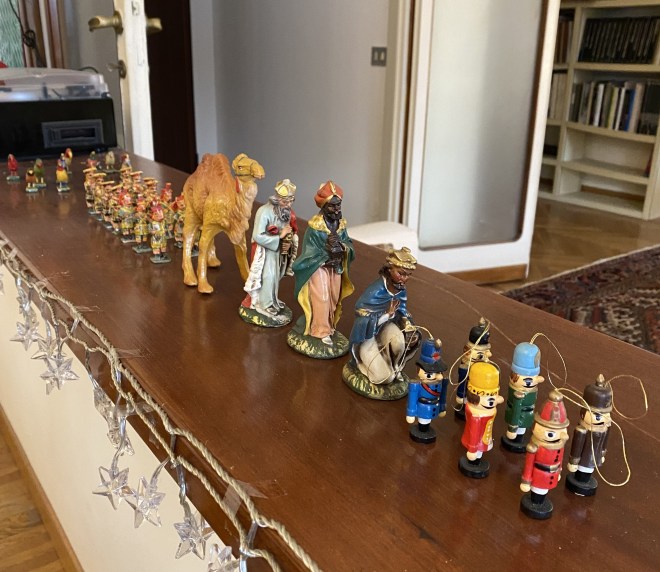
I found the figurines of the retinue in a box where they had been carefully stored away by my mother-in-law many years ago. It seemed a pity not to bring them out into the light of day. I think it all looks pretty impressive! (But we have to do something about the camels; I’ve been telling my wife for years that we need to find some more camels, one camel simply isn’t enough. And we have to get a statue to replace the kneeling Wise Man; kneeling before the Baby Jesus is OK, but he can’t be on his knees the whole trip to Bethlehem …).
Here, we can see the tail-end of the cortege.

I added the birds because they were also in the box. A bit odd, but why not? Maybe the Wise Men were like St. Francis, they were listened to by the birds (boy, are we going to have fun when we set up the crèche with our grandson, possibly grandchildren, in a few years’ time! Who knows what interesting additions we could come up with!).
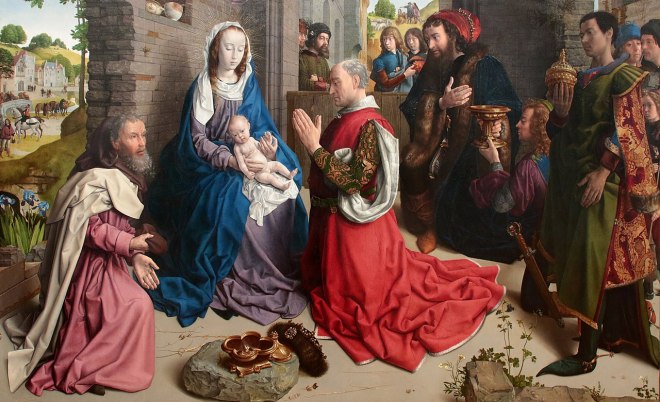
And now the Three Wise Men have arrived at the manger and are adoring the Baby Jesus!

This scene of the Adoration of the Magi has been painted over and over again by European artists. I pick here just one of the many offerings. It is by the Flemish painter Hugo van der Goes, who painted it in about 1470.
In truth, though, I prefer the rendering of the Three Wise Men in the mosaics of Sant’Apollinare Nuovo in Ravenna.

Dressed as they are as Persians, wearing the Phrygian cap which Romans seemed to think all Persians wore, they fit better with what the Gospel of St. Matthew had to say: “behold, there came wise men from the east”. Now Matthew didn’t actually say how many Wise Men there were, but pretty quickly most Christian sects settled for three, one for each gift. Matthew also didn’t say how old they were, but clearly by the time these mosaics were laid down it was generally agreed that they represented the three ages of Man, so we have one old one, one middle-aged one, and one young one. It was only later that it was decided that they also represented the three races known to Europeans: the Europeans themselves, the peoples of the Middle-East, and the peoples of Africa. Paintings of the Magi are some of the earliest representations of Black people in European art. Here is a lovely example from an Adoration of the Magi by Hieronymus Bosch.

Painters don’t seem to have been much interested in what was happening to the Three Wise Men on their way to Bethlehem. But T.S. Eliot, in his poem Journey of the Magi, did try to imagine what the trip was like. I cite here the first twenty lines of the poem.
A cold coming we had of it,
Just the worst time of the year
For a journey, and such a long journey:
The ways deep and the weather sharp,
The very dead of winter.’
And the camels galled, sore-footed, refractory,
Lying down in the melting snow.
There were times we regretted
The summer palaces on slopes, the terraces,
And the silken girls bringing sherbet.
Then the camel men cursing and grumbling
And running away, and wanting their liquor and women,
And the night-fires going out, and the lack of shelters,
And the cities hostile and the towns unfriendly
And the villages dirty and charging high prices:
A hard time we had of it.
At the end we preferred to travel all night,
Sleeping in snatches,
With the voices singing in our ears, saying
That this was all folly.
Compared to this description, our Three Wise Men have had it pretty easy: nice, warm living room, easy travel across the furniture, respectful entourage …
As told in St. Matthew’s Gospel, the arrival of the Three Wise Men was like a poke in a hornet’s nest. In Jerusalem, they asked, “Where is he that is born King of the Jews? for we have seen his star in the east, and are come to worship him.” Matthew goes on, “When Herod the king had heard these things, he was troubled, and all Jerusalem with him. And … he demanded of them where Christ should be born. And they said unto him, In Bethlehem … Then Herod … said, Go and search diligently for the young child; and when ye have found him, bring me word again, that I may come and worship him also.” But, Matthew tells us, after giving Jesus his gifts, “being warned of God in a dream that they should not return to Herod, they departed into their own country another way.” He goes on, “behold, the angel of the Lord appeareth to Joseph in a dream, saying, Arise, and take the young child and his mother, and flee into Egypt, and be thou there until I bring thee word: for Herod will seek the young child to destroy him. When he arose, he took the young child and his mother by night, and departed into Egypt.” The Flight to Egypt was also a popular theme for European painters. I show one example, by my favourite painter, Caravaggio, Rest on the Flight to Egypt, where one of the painter’s luminous angels is playing music on a viol to soothe Mary and Jesus in their slumber (the music held by Joseph is readable; it is a motet by the Flemish composer Noel Bauldeweyn dedicated to the Madonna, with a text from the Song of Songs, Quam pulchra es, “How beautiful you are”; nice touch).

Alas, Herod was not a man to be crossed. Matthew tells us, “Then Herod, when he saw that he was mocked of the wise men, was exceeding wroth, and sent forth, and slew all the children that were in Bethlehem, and in all the coasts thereof, from two years old and under.” This Massacre of the Innocents was, too, a popular theme for European artists. I show here an example of the genre by Peter Breughel the Elder.

I’m actually being a little economical with the truth. This is really a copy of Breughel’s painting, by his son Peter Breughel the Younger. The original was once owned by the Holy Roman Emperor, Rudolf II. For some reason – queasiness? – he had the dead children painted over. This copy retains the dead children.
Quite by chance, just before Christmas, we stumbled across a very sophisticated crèche, in a place called Baggio, which once was a village but then got swallowed up by Milan some 150 years ago. There, in the crypt of a church, over the last forty years or so, dedicated local volunteers have created 58 scenes from the Bible, with the Nativity being the central scene. Some of the scenes have running water, others have moving figurines, … it’s very impressive. Here is a shot of the first scene, Adam and Eve in the Garden of Eden (with a delightfully slithery snake in the tree).
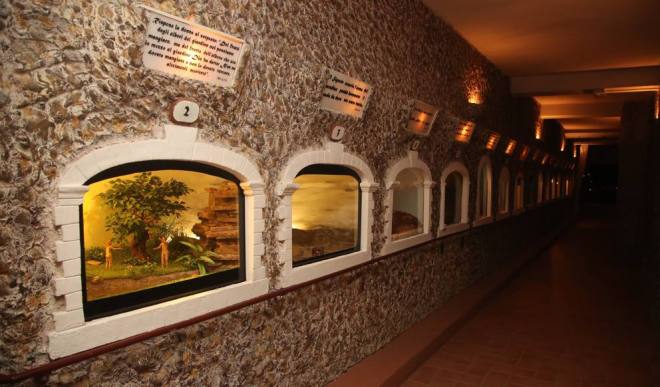
Here is one of Moses and the parting of the waters of the Red Sea.

And here is a shot of the central scene of the Nativity.

As I say, very impressive … although I will admit to having been just a teeny-weeny bit jealous. We’ll soon be packing away the crèche and its figurines for another year, but I’m already thinking how we could expand the offerings next year. Running water and moving figurines is a bit beyond me. But maybe Herod in a palace in Jerusalem? The Massacre of the Innocents? Some “snow” for the Wise Men to trudge wearily through? At least let’s fix the camel problem!


























































 the heart thrills

