DREAM JOURNEY: PART IV

Bangkok, 22 May 2015

Normally, we would be rather groggy as we drive our MG off the ferry in Bari at 8 am in the morning, coming in from Dürres and the previous post. I certainly would be; I never sleep well on ships. But this is a dream, so I decree that we are bright-eyed and bushy-tailed as we roar off the ferry. Our goal is Otranto, very near the end of Italy’s high heel. We head down the old Via Traiana, now more boringly called the Strada Statale 16, as far as Brindisi. There we take the SS 613, which follows the trace of a previous local Roman road that was too modest to have a name. We pass through Lecce, where we pause. Lecce is known for its plentiful baroque buildings constructed in the 1600s, all using a beautiful local white stone, so I throw in a picture of a square there as a visual memorial to this city.

Lecce

We continue on to Otranto, and drive straight up to the Cathedral. For this is the objective of our visit to Otranto – or rather the floor of the church is. When visitors enter the church, they are greeted by this magnificent floor.
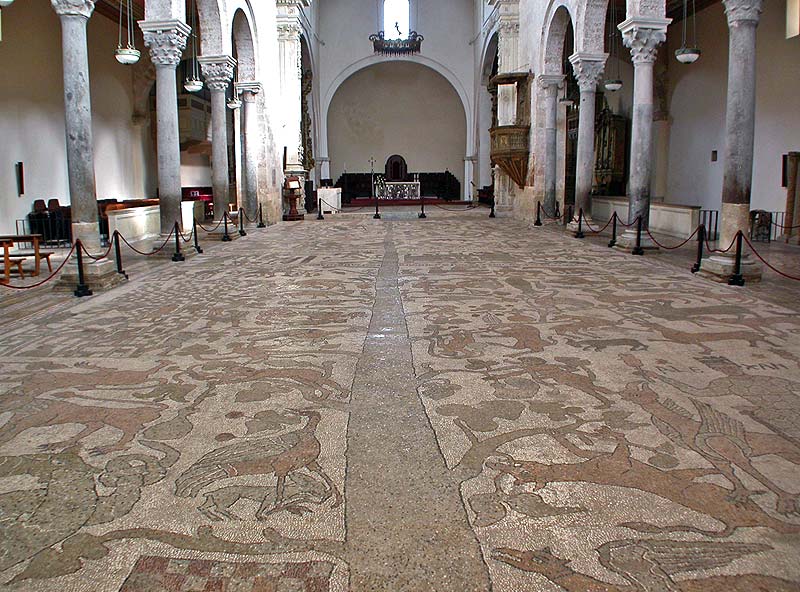
otranto-mosaic-1

It is the largest floor mosaic in Europe. It brings me back to that other floor mosaic which we visited in the first leg of our trip in Aquileia, although eight centuries separate them. Some clever fellow took this photo from the ceiling, showing more or less the full extent of the mosaic.

otranto-mosaic-2

The subject of the mosaic is a Tree of Life, and you can indeed see the trunk of the tree working its way up the nave. Strangely enough, the narrative of this tree flows from the top down, and so near the high altar we have various scenes from the story of Adam and Eve, of which I throw in one photo.

otranto-mosaic-3-adam eve snake

Honestly speaking, the story is difficult to read, so I shall just insert a couple of photos of other parts of the floor. This is King Arthur

otranto-mosaic-4-King Arthur

and this, Satan

otranto-mosaic-5-Great Satan

while this is said to be a self-portrait of the floor’s designer, a monk by the name of Pantaleone who hailed from the monastery of San Nicola di Casole, a little to the south of Otranto.

otranto-mosaic-6-Pantaleone_ self-portrait

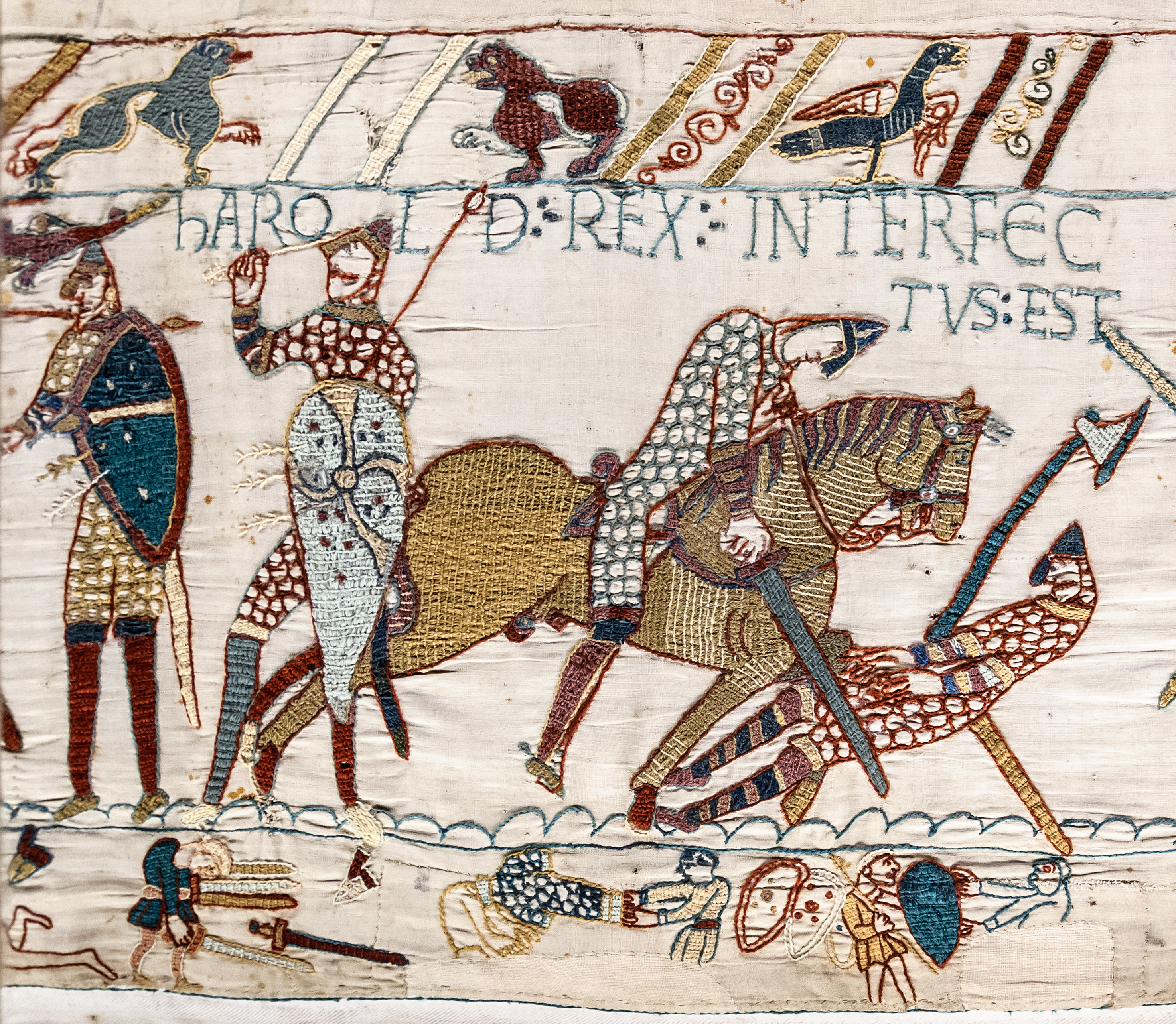
The mosaic was laid down in the 12th Century when this part of Italy was Norman, along with Sicily. In fact, the design of the floor rather reminds me of that other great masterpiece of Norman art, the Bayeux tapestry. I include here one photo of that tapestry, the famous scene where Harold Godwinson is killed by a Norman arrow through his eye.
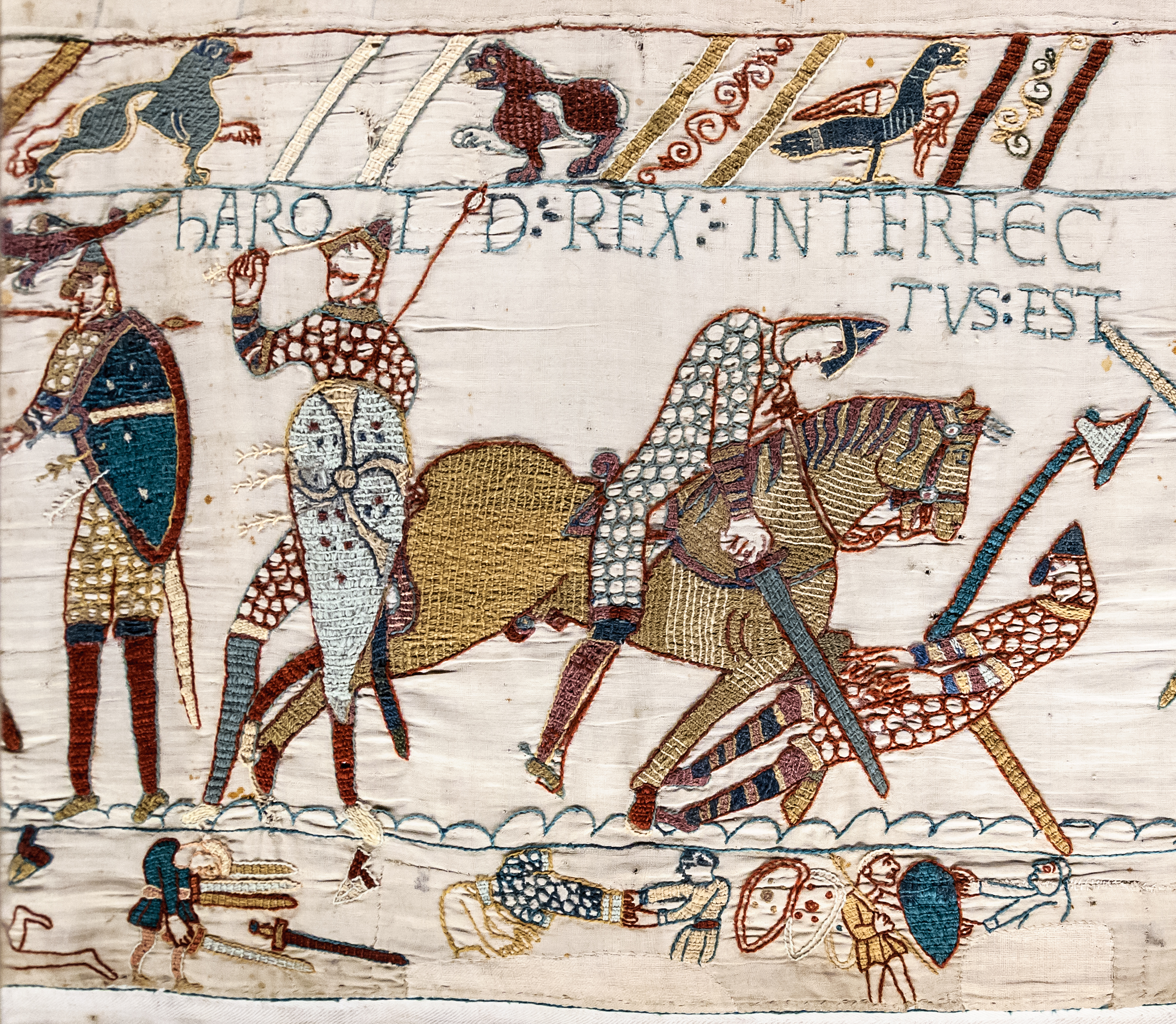
Tapisserie de Bayeux - Scène 57 : La mort d'Harold

Next stop: Palermo in Sicily. We’ll get there by cutting across Italy’s heel to Taranto and then along the instep and sole of the Italian boot all the way to Reggio Calabria, where we’ll catch the ferry over to Sicily. I take the back roads to get to Taranto, because I want to drive through the small town of Copertino. As far as I know, this town is known for nothing special except a large castle and a saint. But to us, it has a great importance: my wife’s maternal grandfather came from Copertino and so it is the source of one-eighth of my children’s DNA. He emigrated to Milan in the early 1900’s, part of the massive migrations out of the south of Italy at the turn of the 20th Century. In typical migratory fashion, his departure eventually brought all his brothers and sisters up north. Family lore has it that his father ruined the family by taking the new Italian State to court over the expropriation of some of his land. He took the case all the way to the Court of Cassation, where he eventually lost the case, by which time he had also burned through all his money. Even though this is a very modest place with nothing special to write home about, I feel I must throw in a photo to commemorate it.

copertino

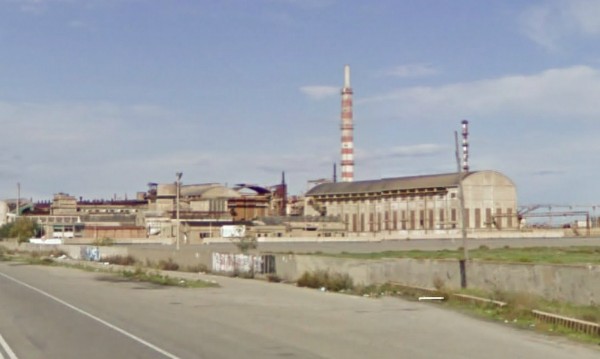
Onwards to Taranto, although in truth as we approach the city we turn our heads away and drive on. Taranto has been devastated by the plans of successive Italian government in the post-war period to develop the south of Italy through the implantation of heavy industry (I’ve already mentioned this in another post on Sicily). What were then the biggest steel works in Europe were plonked down here in the 1960s, and other heavy industry followed. By the 1980s, when my wife and I went to Taranto for the first time, the investment was in trouble. But the government couldn’t let it go down the tubes, it was politically too important. So money – half of it wasted through corruption and graft – was poured in to prop everything up. It’s stayed propped up – just – but in the meantime the industrial complex has poisoned half the population. Talk about sustainable development …

taranto

We are now driving through what was once Magna Graecia, Greater Greece, that string of Greek colonies which dotted the underside of the Italian boot as well as the coasts of Sicily (and even the shin and calf of that shapely Italian boot). The glittering stone in this string of cities was undoubtedly Syracuse in Sicily, where Archimedes – he of the original eureka moment – was born and was killed. But all the cities along here, from Taranto in the East to Selinunte in the West, were once flourishing and prosperous city-states. One of them, Sybaris, even became a byword for self-indulgent opulence – it was said of one of its citizens that he slept on a bed of rose petals, and if even one of them was folded over he could not sleep. The town’s name has entered the English language, a sybarite being a voluptuary or a sensualist. Now, Sybaris lies under four meters of mud. The only claim to fame of the surviving Calabrian towns is that they are infested by the ‘Ndrangheta, Calabria’s answer to Sicily’s mafia. It is said that John Paul Getty III, kidnapped in Rome back in 1973, was kept hidden in these parts. He was returned after his family forked over a ransom of $3 million – paid a good deal reluctantly (his grandfather is reported to have said, “I have 14 grandchildren. If I pay one penny now, I’ll have 14 kidnapped grandchildren”) and only after one of his ears had been cut off and sent to a newspaper. It is whispered that many a new house around here was built with Getty money.

We stop for a moment in Crotone, on the ball of Italy’s foot, not because it’s any less dreary than the other towns we’ve passed through, but because something momentous happened here: Pythagoras set up his first school and came up with all those clever mathematics, among which was his theorem which I, like every child of 11 or so, learned in geometry class: “a2 + b2 = c2“, or in plain English, “in a right triangle, the square of the hypotenuse is equal to the sum of the square of the other two sides”. At least, that’s what I was told by proud Crotonesi when I was here 20 years ago to do an environmental audit. Alas! It was not so. Pythagoras did indeed come to Crotone, but all he did was to set up some sort of mystical, esoteric sect which dabbled in the quasi-magic of whole numbers. It’s very unlikely that he personally came up with any of the mathematical cleverness attributed to him; his disciples did, but later. I think this painting, by a 19th Century Russian painter, captures nicely the strongly mystical (and to my way of thinking, rather weird) overtones of the initial Pythagorean movement.
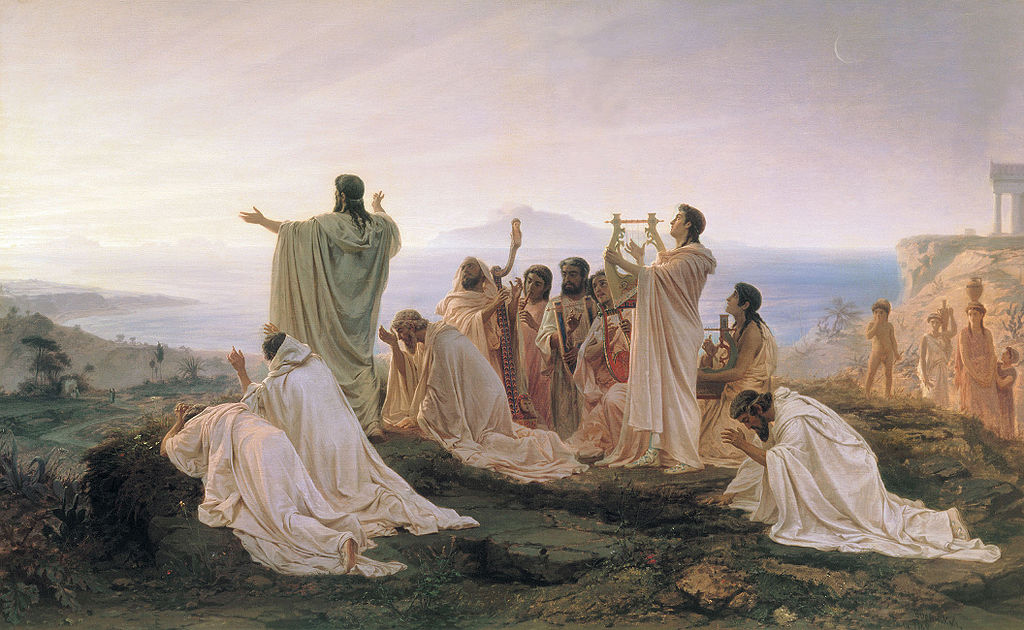
pythagoreans celebrating sunrise

What Pythagoras and his sect did do in Crotone was to eventually take over the city’s government, and it was during his time in office that Crotone destroyed Sybaris. Several other cities in the area also espoused Pythagorean forms of government, but after a while there was a backlash. Back in Crotone Pythagoras was chased out, to end his days in nearby Metapontum, another city now lying under meters of mud. But Pythagorean schools continued, although they restricted themselves to maths and “natural philosophy” and left politics to others. Probably better that way …

I take one last look at the industrial plant I audited all those years ago – another industrial works plonked down here, and another one that has closed, leaving nothing but bitterness in its wake.

pertusola

It’s time to move on.

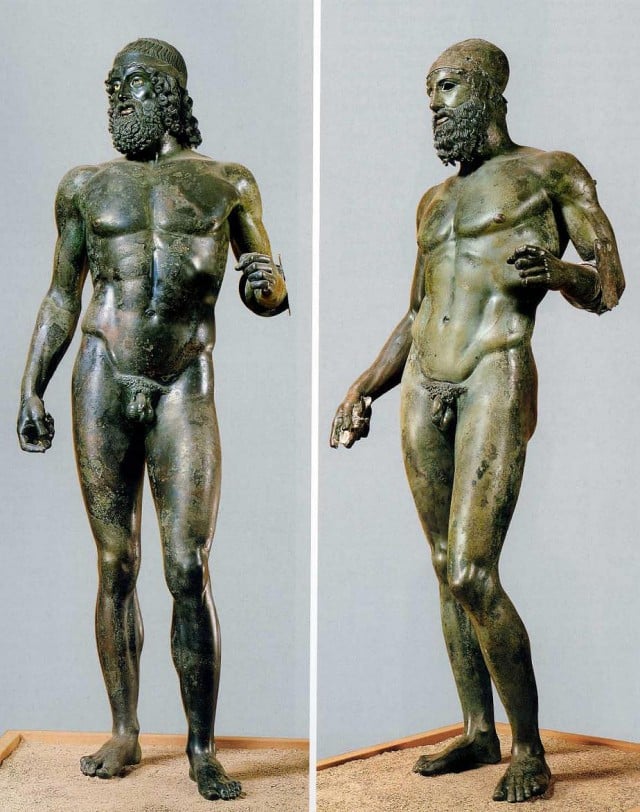
When we reach Reggio Calabria, although my wife is reluctant I insist: we must go to the Museum of Magna Graecia to see the two Bronzes of Riace. Neither of us have ever seen them, and it would be a pity not to take advantage of our passing through Reggio to have a peek. I know the objective of our trip is early Christian mosaics, but other wonders along the way should not be ignored. No sooner said than done! With a click of the mouse, I have us parked in front of the museum and magically transported past the queues of people waiting to enter the climate-controlled, earthquake-proofed room where they stand.

bronzi di riace

What magnificence! And what we see today are stripped down versions of the original. Each would have been coiffed with a Corinthian-style helmet, would have carried a shield on that raised left arm, and would have held a lance in the other. The latest theories hypothesize that they represent two of the Seven Heroes who set off from Argos to fight against Eteocles, king of Thebes and son of Oedipus (he of the complex), and died at the city’s seven gates. One expert suggests that they were originally part of a group of seven statues which stood in the Agora of the city of Argos. How they ended up on the sea bed off the coast of Calabria is anyone’s guess. My guess, for what it’s worth, is that during Roman times Argos was hard up, and rich Romans, avid for Greek art, came along and offered to buy the statues. Why not … In later centuries hard-up Italians sold their Renaissance treasures to rich Englishmen, avid for Italian art, and later still these Englishmen, hard up in their turn, sold these same treasures to rich Americans. In any event, they were being shipped to Rome, but when the ship was off the coast of Calabria a violent storm blew up, and the captain, rather than losing his ship and his life, tossed the heavy stuff overboard.

Time to catch the ferry over to Sicily, home to some of the most beautiful Byzantine-style mosaics still extant, created when the Normans controlled Sicily. The web helpfully informs us that there is a ferry over to Messina every hour or so. In this dream trip, we will not have any difficulty in catching the ferry, unlike real life 30 years ago when my wife and I decided to take her mother to spend Christmas and the New Year in Sicily. We arrived in Reggio Calabria on the evening of 23 December, along with a horde of Sicilian migrant workers returning home from Northern Europe for the holidays. We discovered to our horror that the ferry boat crews had just decided to strike for more pay. Those bastards had chosen this particular time to strike because they knew it put the owners under huge pressure to settle. Settle they did, but not before we had spent a miserable night in the ferry car park. When those ferry boat crews arrive, as they assuredly will one day, before the Pearly Gates, I hope they will be kicked off down to Hell, to roast in its fires for Eternity (anyone curious to know what that might look like can refer back to the posting with which I started this dream journey and study the photo I inserted there from the back wall of the church on the island of Torcello).

Once on the other side,  we set off for Palermo. I firmly decide that we will take the normal roads to get there. In this dream we’re in no hurry, and I prefer by far the “reeling roads”, the “rolling roads”, that “ramble round the shire”, as G.K. Chesterton wrote in his most famous poem “The Rolling English Road”. Yes, I prefer by far his “merry roads” and his “mazy roads” to the smooth monotony of sterile highways. We pass Milazzo, where you can catch the boat to the Aeolian Islands – a trip for another day – and where I did yet another environmental audit 20 years ago for another struggling industrial complex, which mercifully has not closed – yet. We hum along until we arrive at the small town of Cefalù, nestling under the mighty headland which gives it its (Greek) name. We head, yet again, for the Cathedral, constructed by the Normans in the first half of the 1100s. There, some beautiful mosaics still cling to the apse and the last bay of the choir.
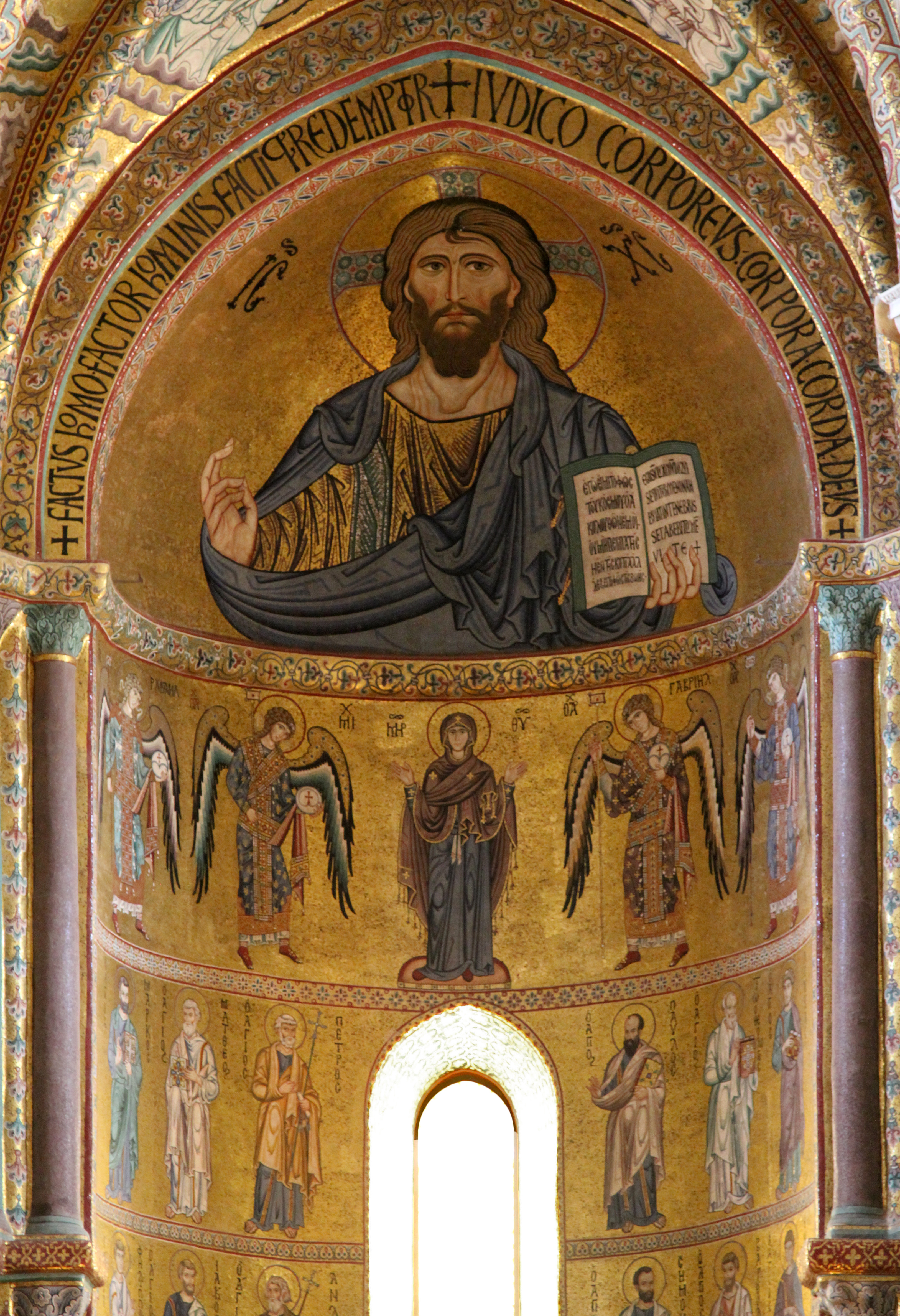
cefalu-duomo-1

The Pantocrator gracing the apse is “for many the greatest portrait of Christ in all Christian art”, in the words of John Julius Norwich (I am quoting from his history of Sicily).

cefalu-duomo-2

The style is clearly mature Byzantine, a style we’ve already seen in Istanbul as well as in the lagoons of Venice, and would have seen in Daphni and Saint Luke in Greece had we made the detour from Thessaloniki. The Normans got Byzantine artists, or artists trained in Byzantine workshops, to make the mosaics.

It’s time to go on to Palermo, which is our final destination on this leg of the journey. We hug the coast, coming into the city on its seaward side. Once we reach the port, we swing up Via Vittorio Emanuele (there’s one of these in every village, town, and city in Italy, along with a Via Garibaldi), which is the main thoroughfare through the city’s old center. When we get near the Martorana church, we miraculously find – free! – parking (this is a dream, after all) for our little MG and head over to the church.

The church has been much modified over the centuries, not least of which by a brutal Baroque make-over in the front part of the nave in the 17th Century. But once we get past these horrors and enter the upper nave, we are greeted by some lovely mosaics: Christ in majesty in the dome of the church
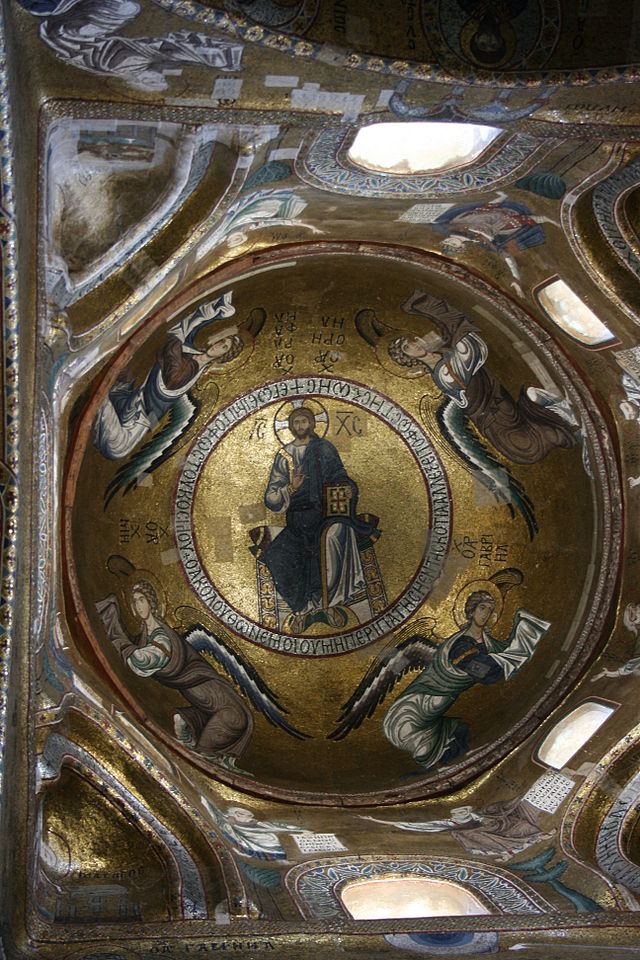
palermo-martorana-1

the annunciation

palermo-martorana-4

the nativity

palerno-martorana-7

the dormition of the Virgin Mary

palerno-martorana-6

As we leave, I want particularly to see these two mosaics. In this first one, we have the greatest of all the Norman kings of Sicily, Roger II, having himself cheekily crowned by Christ himself, as if he were a Byzantine emperor

palermo-martorana-2

It was he who first brought this Byzantine art form to Sicily.

And here we have the original donor of the church, George of Antioch, Roger II’s admiral, humbly offering his church to the Virgin Mary (much like we saw in Cariye Kamii in Istanbul)

palermo-martorana-5

A final note about this church: it belongs to the Italian-Albanian community in Sicily, the remnants of the Albanians who fled to Italy in the 15th and later Centuries as the Ottomans methodically went about conquering their home country. So it is not just geographical proximity which led the modern Albanians back in late 1990s to escape by their thousands to Italy as Albania imploded after the collapse of Communism (with many of these new arrivals squatting in and around Otranto, as it so happens).

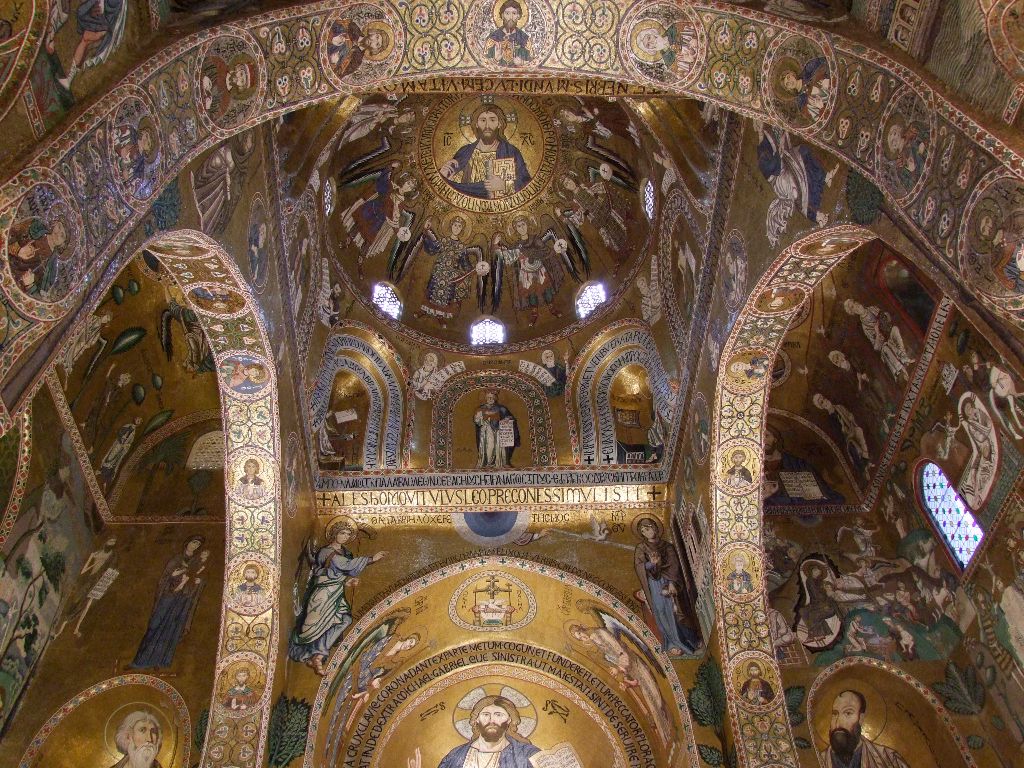
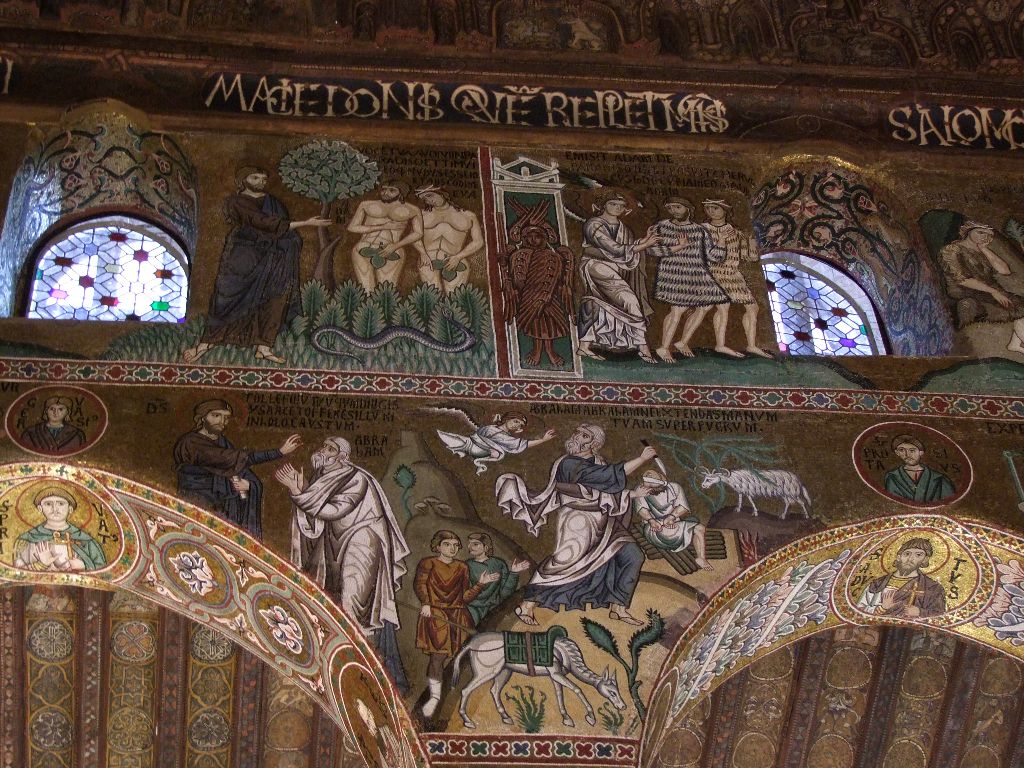
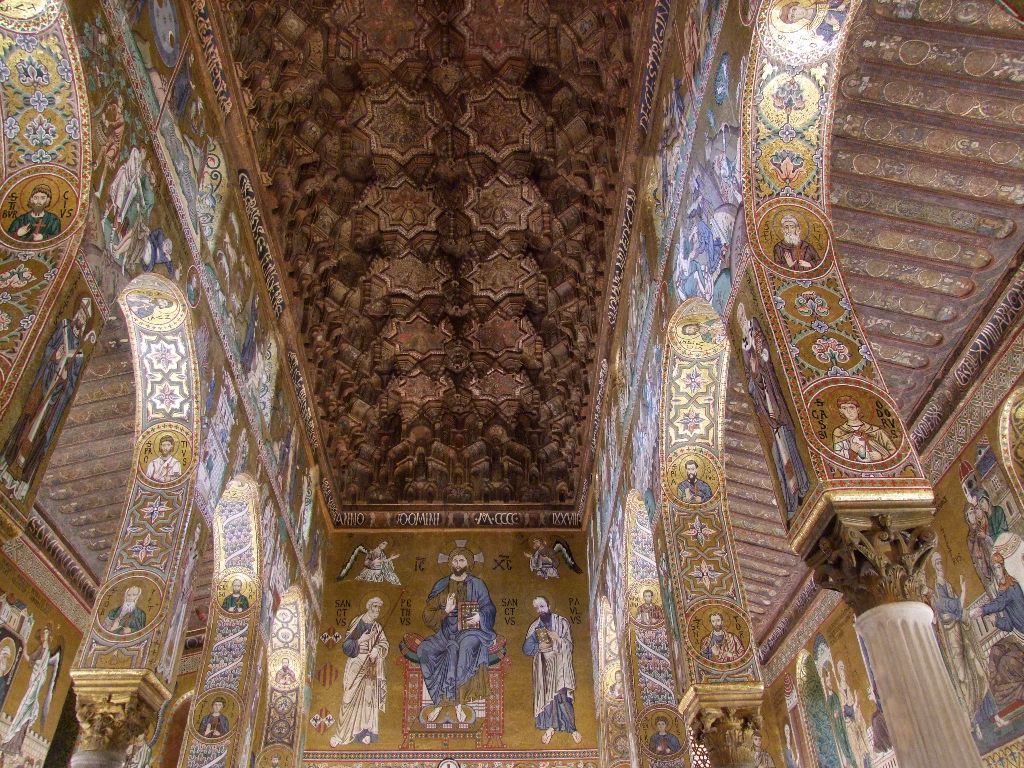
We go back to the car and continue up Via Vittorio Emanuele to the Palazzo dei Normanni, the Palace of the Normans, which actually was originally built by the Arabs. This rather severe building houses the Cappella Palatina, which was built by Roger II as the King’s private chapel. It houses some magnificent 12th Century mosaics.

palermo-cap-palatina-1

palermo-cap-palatina-6

palermo-cap-palatina-5

This last one shows also the ceiling, a wonderful piece of Arab carpentry work, an example of which we last saw in the Alhambra palace in Granada.
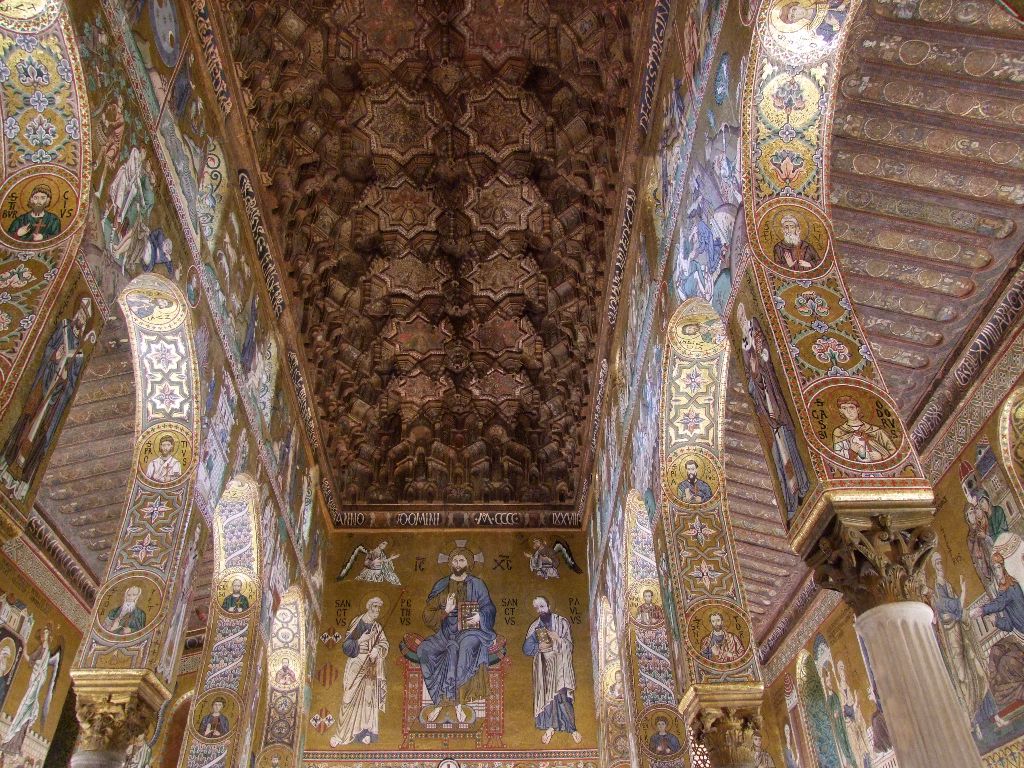
palermo-cap-palatina-4

Roger II understood that in this island with large Greek and Arab populations, he had to be open to their cultures if he was going to maintain the peace. Indeed, he welcomed this mixing of cultures. It is part of Sicily’s tragedy that later rulers did not continue this practice of toleration and openness.

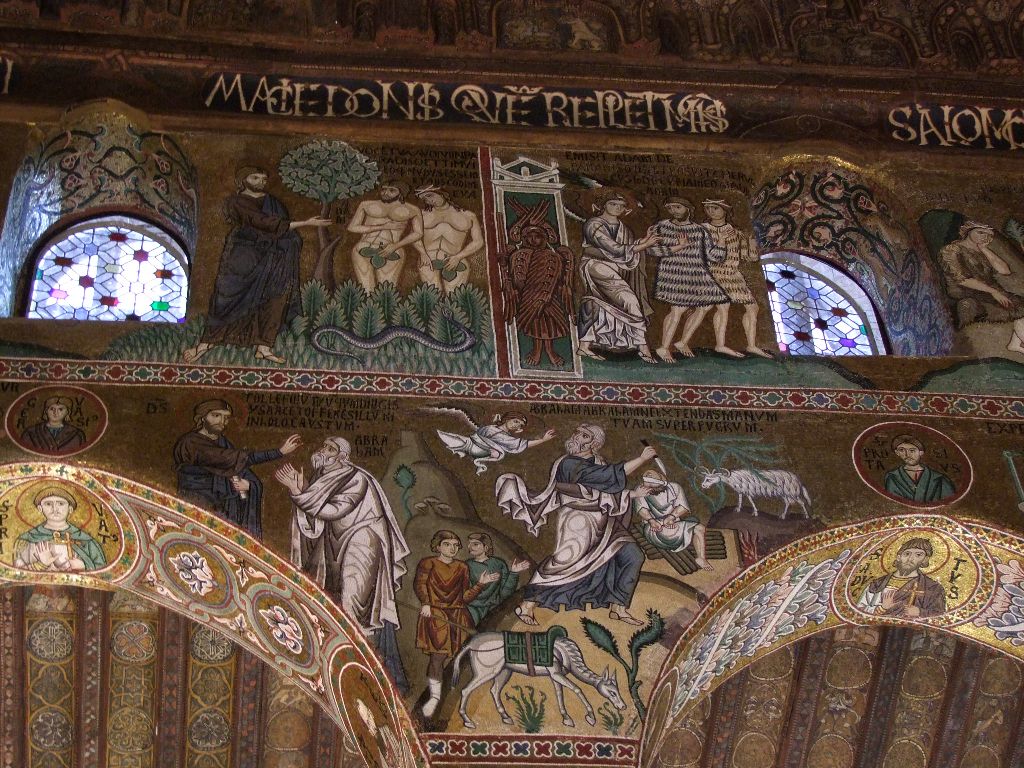
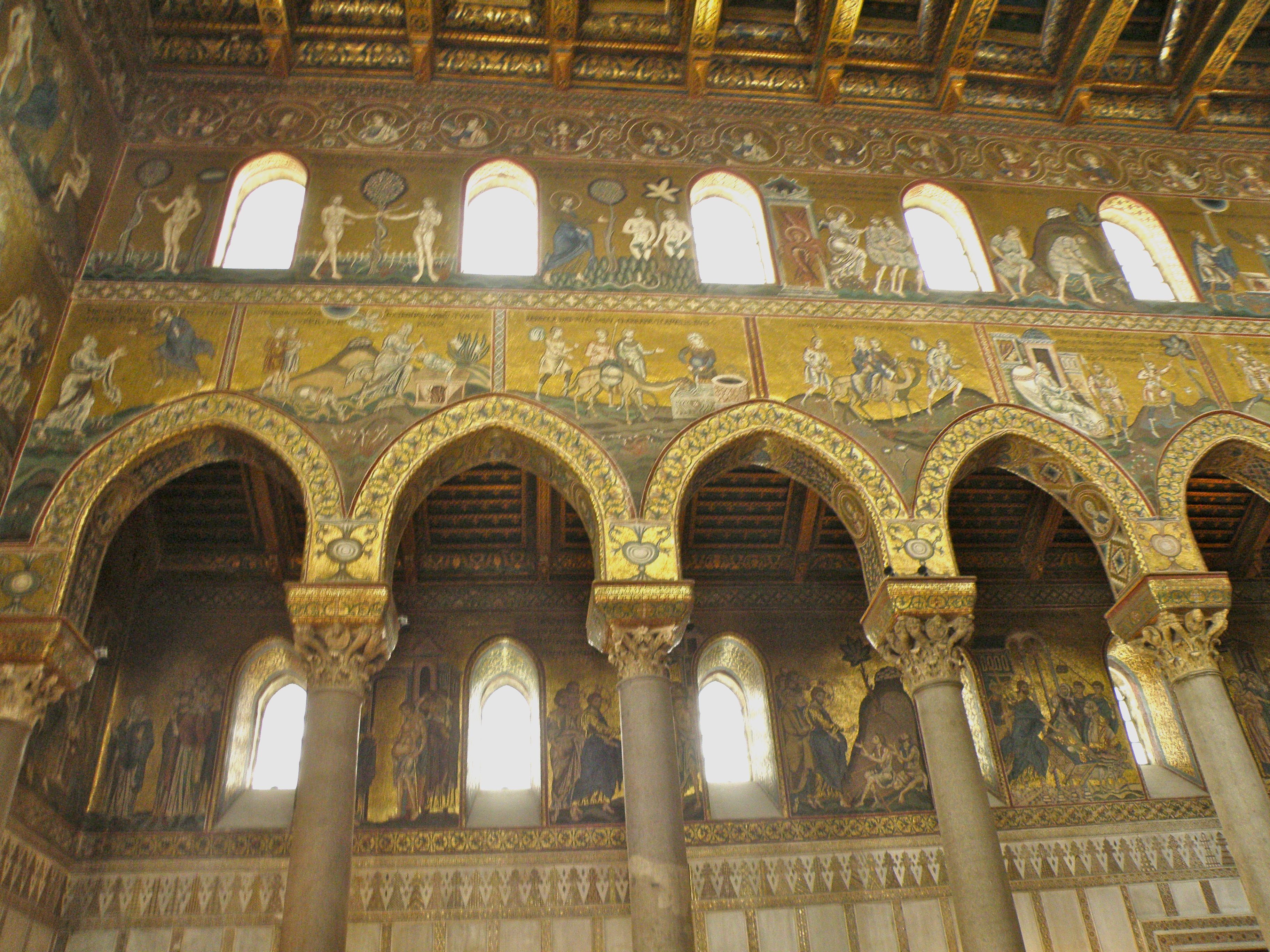
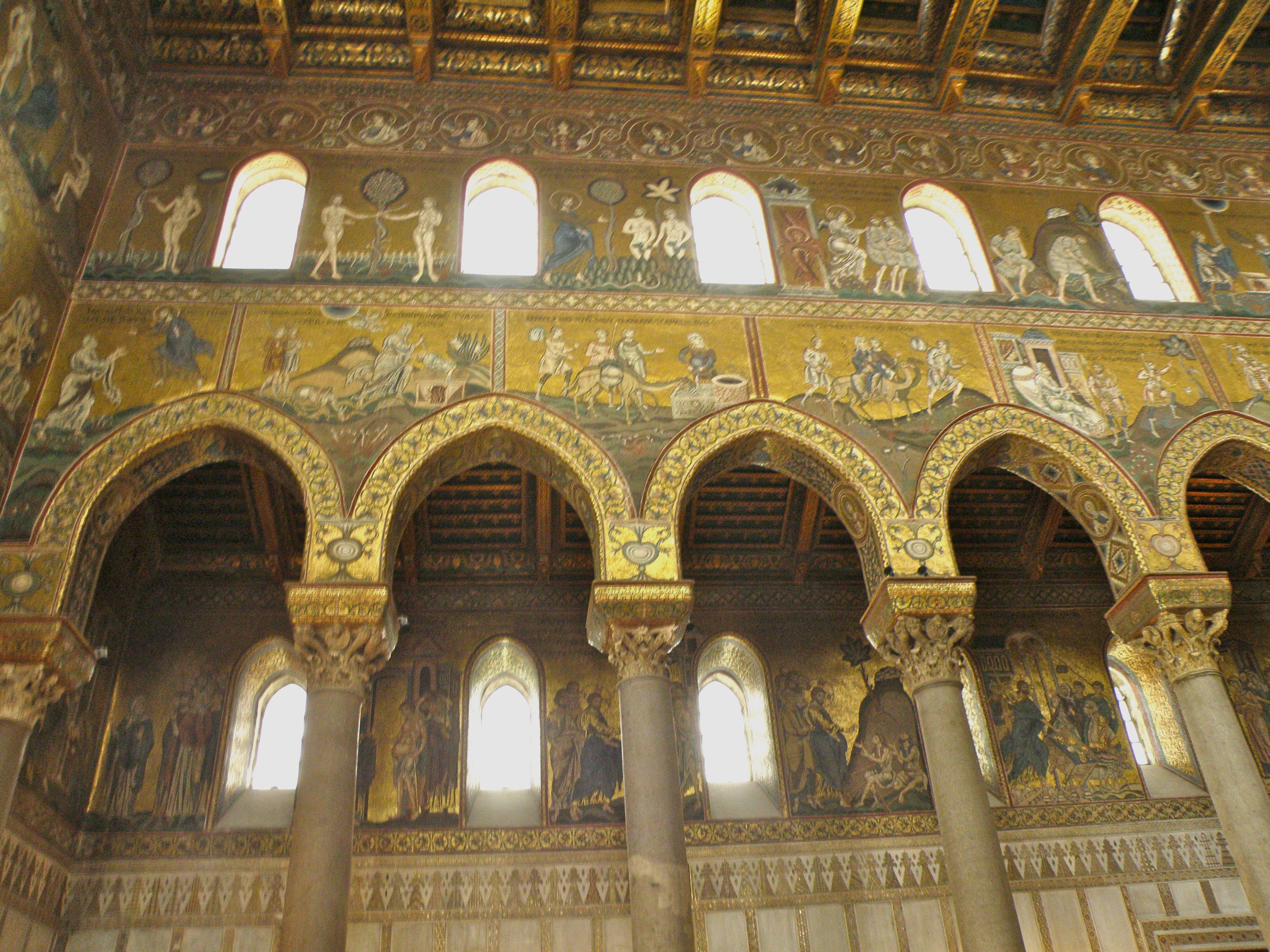
We are not finished yet! We vault into the car (after constant badgering by our children we’ve taken to doing a lot of exercise recently, so I can imagine ourselves vaulting jauntily over the doors and dropping into our seats) and we keep on going up Via Vittorio Emanuele, which has now morphed into Via Calatafimi. We go on and on until we hit the hills behind Palermo, at which point we start climbing and finally find ourselves in Monreale, once a village on the outskirts of Palermo but now a suburb. We head – of course – for the cathedral and casually park the car in front of the cathedral. We walk into this late 12th Century church and I suddenly feel that I am back in the church of Sant’Apollinare in Ravenna, where we started our dream journey.
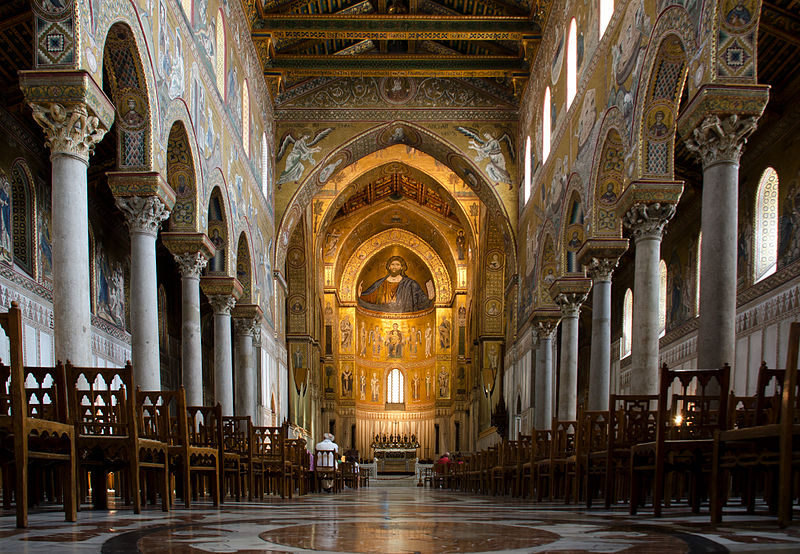
monreale-duomo-1

Biblical scenes on fields of gold unfurl along upper tiers of the nave

monreale-duomo-6

OLYMPUS DIGITAL CAMERA

to reach the theological high point in the apse, with its assembled saints and angels presided over by a rather severe Pantocrator.
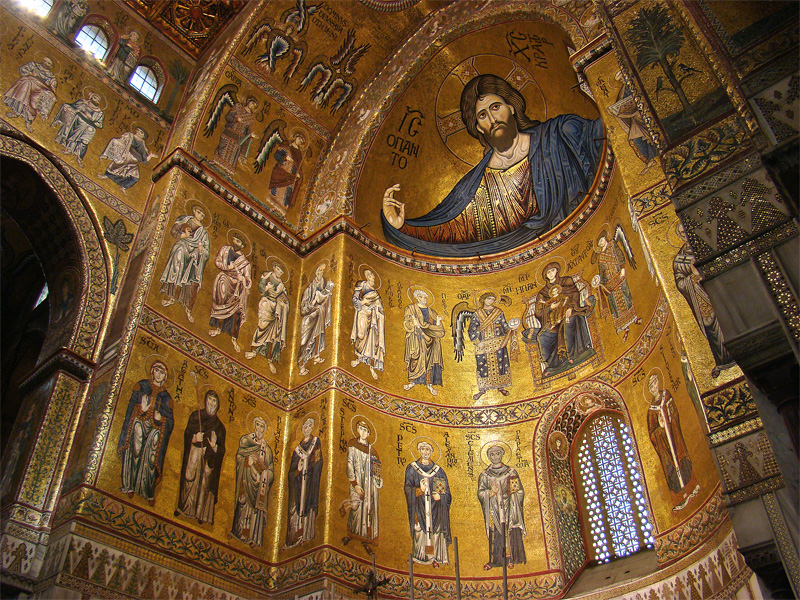
monreale-duomo-2

But how the styles have changed in the intervening six centuries! Then, it was still Roman art, although of a rough-and-ready sort. Now, it is early medieval art in all its stiff, hieratic splendour.

After all that gold, we go up on the roof of the church and drink in the astringent blue of the sky, which is rather like eating a lemon sorbet after a heavy main course so as to cleanse the mouth of all that richness. We gaze out across Palermo and over the “wine-dark” Tyrrhenian Sea beyond (to borrow Homer’s rather strange description of the sea’s colour).
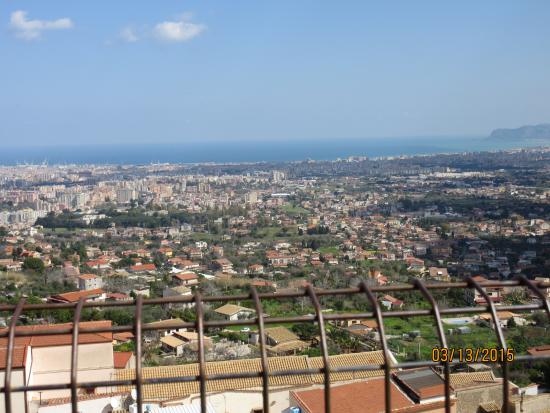
monreale-panoramic-view

Tonight, we will catch the ferry and cross that sea to Naples – another Greek colony long, long ago – and from there drive up to Rome, our last stop on this exhaustive, and mentally exhausting, tour of early Christian mosaics.

_________________

Lecce: https://youthfullyyoursgr.files.wordpress.com/2013/05/lecce-it.jpg (in https://youthfullyyoursgr.wordpress.com/%CF%80%CF%81%CE%BF%CE%B3%CF%81%CE%AC%CE%BC%CE%BC%CE%B1%CF%84%CE%B1/get-up-stand-up-be-healthy-guys-youth-exchange-lecce-%CE%B9%CF%84%CE%B1%CE%BB%CE%AF%CE%B1-22-29072013/)
Otranto-mosaic-1: http://www.paradoxplace.com/Perspectives/Sicily%20&%20S%20Italy/Puglia/Otranto/Cattedrale/Images_Mosaics/800/Mosaic_Floor-Nov06-DC9997sAR800.jpg (in http://www.paradoxplace.com/Perspectives/Sicily%20&%20S%20Italy/Puglia/Otranto/Otranto.htm)
Otranto mosaic-2: http://www.swide.com/wp-content/uploads/2014/06/Reasons-to-travel-puglia-apulia-italy-mosaics-Otranto.jpg (in http://www.swide.com/food-travel/reasons-to-travel-to-puglia-apulia-italy-top-20-things-to-do/2014/06/30)
https://canvas.harvard.edu/courses/305/pages/the-mosaic-of-otranto
Bayeux Tapestry: http://upload.wikimedia.org/wikipedia/commons/b/bb/Bayeux_Tapestry_scene57_Harold_death.jpg (in http://en.wikipedia.org/wiki/Bayeux_Tapestry)
Copertino: http://www.amedeominghi.info/wp-content/uploads/2014/05/PiazzaMazzini.jpg (in http://www.amedeominghi.info/nuovedate/)
Taranto: http://it.wikipedia.org/wiki/Ilva#/media/File:ILVA_-_Unit%C3%A0_produttiva_di_Taranto_-_Italy_-_25_Dec._2007.jpg (in http://it.wikipedia.org/wiki/Ilva#Unit.C3.A0_produttiva_di_Taranto)
“Pythagoreans celebrating the sunrise”, by Fyodor Bronnikov(1827–1902): http://en.wikipedia.org/wiki/Pythagoras#/media/File:Bronnikov_gimnpifagoreizev.jpg (in http://en.wikipedia.org/wiki/Pythagoras)
Pertusola: http://www.ilcirotano.it/wp-content/uploads/2012/06/Ex-Pertusola.jpg (in http://www.ilcirotano.it/2012/10/09/viaggio-nella-pertusola-sud/)
Bronzi di Riace: https://news.artnet.com/wp-content/news-upload/2014/08/Riace-bronzes-e1408562456865.jpg (in https://news.artnet.com/art-world/italy-risks-priceless-riace-bronzes-for-cash-82747)
Cefalù-duomo-1: http://commondatastorage.googleapis.com/static.panoramio.com/photos/original/74677063.jpg (in https://geolocation.ws/v/P/74677063/abside-del-duomo-di-cefal-cristo/en)
Cefalù-duomo-2: http://it.wikipedia.org/wiki/Duomo_di_Cefal%C3%B9#/media/File:Cefalu_Christus_Pantokrator_cropped.jpg (in http://it.wikipedia.org/wiki/Duomo_di_Cefalù)
Palermo-Martorana-1: http://upload.wikimedia.org/wikipedia/commons/thumb/c/c0/Chiesa_della_Martorana_cupola.jpg/640px-Chiesa_della_Martorana_cupola.jpg (in http://en.wikipedia.org/wiki/Martorana#Interior)
Palermo-Martorana-2: http://it.wikipedia.org/wiki/Chiesa_della_Martorana#/media/File:Palerme_Martorana168443.JPG (in http://it.wikipedia.org/wiki/Chiesa_della_Martorana)
Palermo-Martorana-3: https://classconnection.s3.amazonaws.com/848/flashcards/3299848/jpg/palermo_chiesa_20martorana_mosaic_nativity-13F311CF74763DF1FB7.jpg (in https://www.studyblue.com/notes/note/n/ecb-final-review/deck/8598474)
Palermo-Martorana-4: http://www.wga.hu/art/zgothic/mosaics/8/2martor2.jpg (in http://www.wga.hu/html_m/zgothic/mosaics/8/2martor2.html)
Palermo-Martorana-5: http://upload.wikimedia.org/wikipedia/commons/b/b3/Chiesa_della_Martorana_Christus_kr%C3%B6nt_Roger_II.jpg (in http://commons.wikimedia.org/wiki/File:Chiesa_della_Martorana_Christus_kr%C3%B6nt_Roger_II.jpg)
Palermo-Martorana-6: http://it.wikipedia.org/wiki/Chiesa_della_Martorana#/media/File:George_of_Antioch_and_Holy_Virgin_2009.jpg (in http://it.wikipedia.org/wiki/Chiesa_della_Martorana)
Palermo-Cappella Palatina-1: http://en.wikipedia.org/wiki/Cappella_Palatina#/media/File:Cappella_Palatina_in_Palermo_Sicily.JPG (in http://en.wikipedia.org/wiki/Cappella_Palatina)
Palermo-Cappella Palatina-2: http://www.scherminator.com/italy/sicily/cappellaPalatina/cappellaPalatina5.jpg (in http://www.scherminator.com/italy/sicily/cappellaPalatina/cappellaPalatina.html)
Palermo-Cappella Palatina-3: http://www.scherminator.com/italy/sicily/cappellaPalatina/cappellaPalatina0.jpg (in http://www.scherminator.com/italy/sicily/cappellaPalatina/cappellaPalatina.html)
Palermo-Cappella Palatina-4: http://www.scherminator.com/italy/sicily/cappellaPalatina/cappellaPalatina10.jpg (in http://www.scherminator.com/italy/sicily/cappellaPalatina/cappellaPalatina.html)
Monreale-Duomo-1: http://it.wikipedia.org/wiki/Duomo_di_Monreale#/media/File:MonrealeCathedral-pjt1.jpg (in http://it.wikipedia.org/wiki/Duomo_di_Monreale)
Monreale-duomo-2: https://ofsplendourinthegrass.files.wordpress.com/2012/08/p1110054.jpg (in https://ofsplendourinthegrass.wordpress.com/2012/08/30/monreale/)
Monreale-duomo-3: http://giazza.se/wp-content/uploads/2012/05/pal-dome-2.jpg (in http://giazza.se/?p=1506)
Monreale-duomo-4: http://it.wikipedia.org/wiki/Duomo_di_Monreale#/media/File:Sicilia_Monreale2_tango7174.jpg (in http://it.wikipedia.org/wiki/Duomo_di_Monreale)
Monreale-panoramic view: http://media-cdn.tripadvisor.com/media/photo-s/07/87/3f/dc/panoramic-view-from-the.jpg (in http://www.tripadvisor.it/LocationPhotoDirectLink-g666663-d4470498-i126304220-Norman_Cathedral_of_Monreale-Monreale_Province_of_Palermo_Sicily.html)

A SCHNOZZLE, A CONK, A HOOTER!

Beijing, 21 May 2015

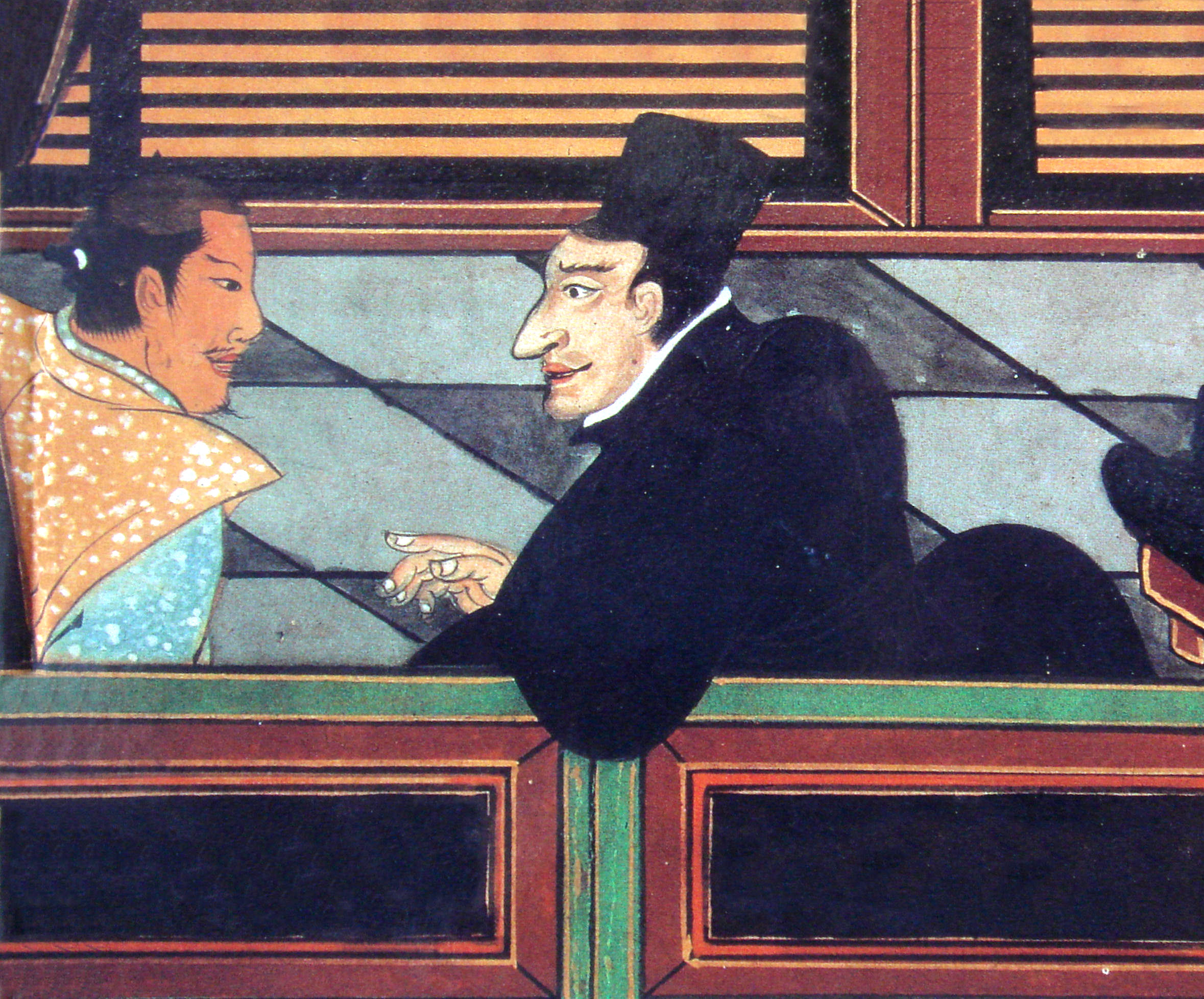
I’ve just come back to Beijing from Europe. I’ve been living long enough in China now that whenever I’m back in Europe I acutely notice differences, especially physical differences. For instance … noses. We white folk have really big schnozzles, you know! This was one of the first things which the Japanese noticed when the Portuguese showed up on their shores in the late 1500’s. The Japanese paintings of the time stress differences in nose sizes.

Jesuit in Japan

And now, after just four years in Asia, I feel that everyone in Europe is Cyrano de Bergerac

cyrano de bergerac

or San Carlo Borromeo, the cardinal saint from Milan whose conk sticks out mightily from every painting of him in every church of Milan

San_Carlo_Borromeo

As I see these large noses all around me back home, the lines from Cyrano come to mind, where he mocks his own gigantic hooter in front of an appreciative audience, on stage and off:

Ah ! Non ! C’est un peu court, jeune homme !
On pouvait dire… oh ! Dieu ! … bien des choses en somme…
En variant le ton, —par exemple, tenez :
Agressif : « moi, monsieur, si j’avais un tel nez,
Il faudrait sur le champ que je me l’amputasse ! »
Amical : « mais il doit tremper dans votre tasse :
Pour boire, faites-vous fabriquer un hanap ! »
Descriptif : « c’est un roc ! … c’est un pic… c’est un cap !
Que dis-je, c’est un cap ? … c’est une péninsule ! »
Etc.

 Or, in English:

Ah no! young blade! That was a trifle short!
You might have said at least a hundred things
By varying the tone. . .like this, suppose,. . .
Aggressive: “Sir, if I had such a nose
I’d amputate it!’ Friendly: ‘When you sup
It must annoy you, dipping in your cup;
You need a drinking-bowl of special shape!’
Descriptive: ”Tis a rock!. . .a peak!. . .a cape!
–A cape, forsooth! ‘Tis a peninsular!’
Curious: ‘How serves that oblong capsular?
For scissor-sheath? Or pot to hold your ink?’
Gracious: ‘You love the little birds, I think?
I see you’ve managed with a fond research
To find their tiny claws a roomy perch!’
Truculent: ‘When you smoke your pipe. . .suppose
That the tobacco-smoke spouts from your nose–
Do not the neighbors, as the fumes rise higher,
Cry terror-struck: “The chimney is afire”?’
Considerate: ‘Take care,. . .your head bowed low
By such a weight. . .lest head o’er heels you go!’
Tender: ‘Pray get a small umbrella made,
Lest its bright color in the sun should fade!’
Pedantic: ‘That beast Aristophanes
Names Hippocamelelephantoles
Must have possessed just such a solid lump
Of flesh and bone, beneath his forehead’s bump!’
Cavalier: ‘The last fashion, friend, that hook?
To hang your hat on? ‘Tis a useful crook!’
Emphatic: ‘No wind, O majestic nose,
Can give THEE cold!–save when the mistral blows!’
Dramatic: ‘When it bleeds, what a Red Sea!’
Admiring: ‘Sign for a perfumery!’
Lyric: ‘Is this a conch?. . .a Triton you?’
Simple: ‘When is the monument on view?’
Rustic: ‘That thing a nose? Marry-come-up!
‘Tis a dwarf pumpkin, or a prize turnip!’
Military: ‘Point against cavalry!’
Practical: ‘Put it in a lottery!
Assuredly ‘twould be the biggest prize!’
Or. . .parodying Pyramus’ sighs. . .
‘Behold the nose that mars the harmony
Of its master’s phiz! blushing its treachery!’

_________________________

Jesuit priest in Japan: http://upload.wikimedia.org/wikipedia/commons/3/3a/Jesuit_with_Japanese_nobleman_circa_1600.jpg [in http://en.wikipedia.org/wiki/Hidden_Christians_of_Japan%5D
Cyrano de Bergerac: http://www.lecture-academy.com/wp-content/uploads/2014/05/logo_13453.jpg [in http://www.lecture-academy.com/livre/poche-cyrano-de-bergerac-texte-integral/%5D
San Carlo Borromeo: http://biografieonline.it/img/bio/s/San_Carlo_Borromeo.jpg [in http://biografieonline.it/biografia.htm?BioID=3135&biografia=San+Carlo+Borromeo%5D

PEKING WILLOW

Beijing, 9 April 2014

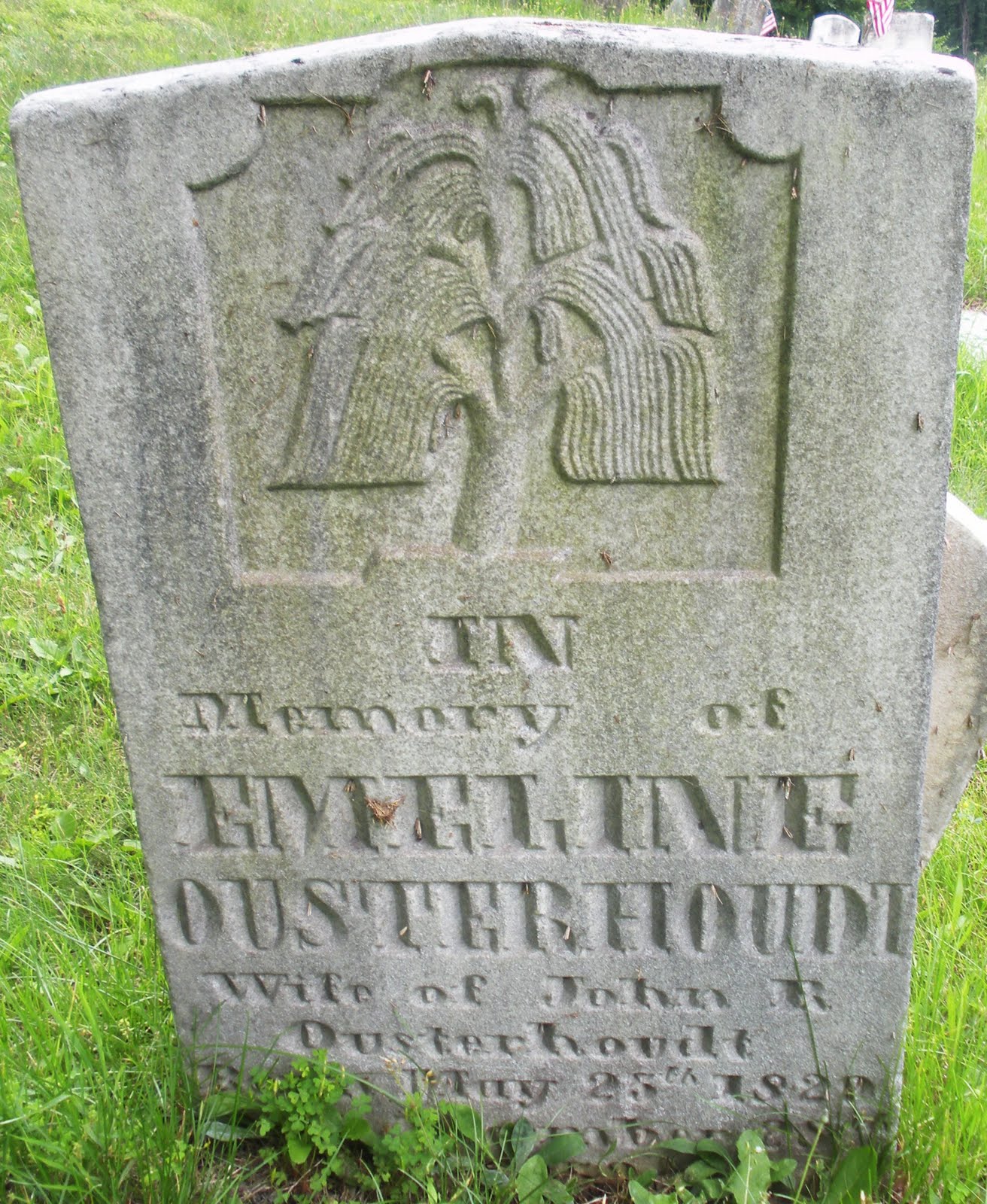
The somber, funereal tone of my last post seems like a good place to start this one – a tombstone

Weeping Willow on gravestone

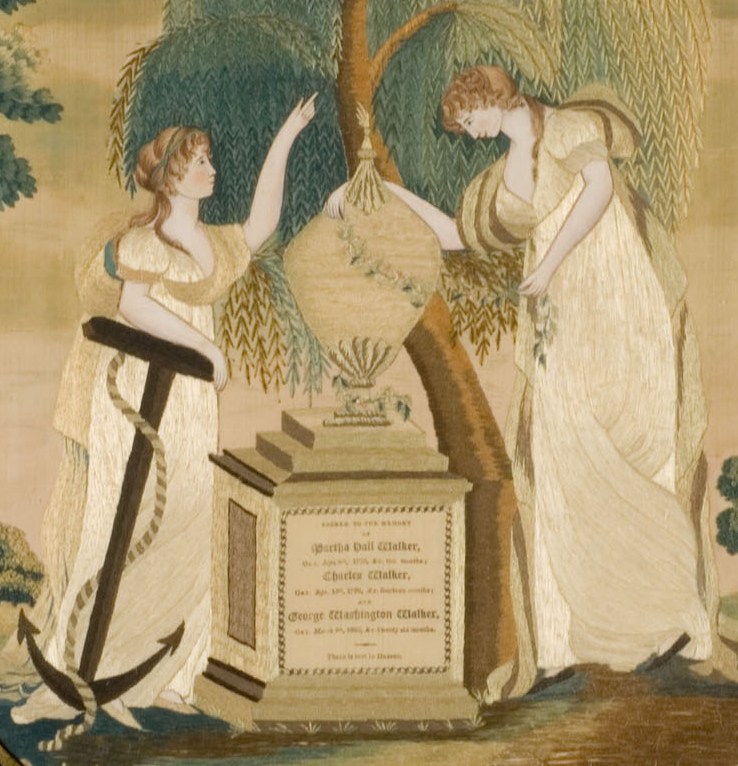
This one has a weeping willow on it, a common symbol on tombstones 200 years ago. Its drooping branches symbolize, you’ve guessed it, the weeping of the world at your passage to the next. Here’s another in the same genre from the same period, this time a piece of needlework memorializing the death of three babies.

BT OA FR

And then there were the ballads which used the weeping willow as the symbol of death, lost love, or both:

My heart is sad and I’m in sorrow
For the only one I love
When shall I see him, oh, no, never
Till I meet him in heaven above

Oh, bury me under the weeping willow
Yes, under the weeping willow tree
So he may know where I am sleeping
And perhaps he will weep for me

They told me that he did not love me
I could not believe it was true
Until an angel softly whispered
He has proven untrue to you

Oh, bury me under the weeping willow
Yes, under the weeping willow tree
So he may know where I am sleeping
And perhaps he will weep for me

 Etc. You get the picture.

The weeping willow’s symbolism was used a bit more elegantly in Psalm 137 of the Old Testament, that lyrical lament about the pains of exile, in this case that of the Israelites who had been marched off to Babylon from Jerusalem:

By the rivers of Babylon—
there we sat down and there we wept
when we remembered Zion.
On the willows there
we hung up our harps.
For there our captors
asked us for songs,
and our tormentors asked for mirth, saying,
“Sing us one of the songs of Zion!”

 How could we sing the Lord’s song
in a foreign land?
If I forget you, O Jerusalem,
let my right hand wither!
Let my tongue cling to the roof of my mouth,
if I do not remember you,
if I do not set Jerusalem
above my highest joy.

jewish bible with picture

I’ve left out the last verse where the poet gets vengeful and nasty, talking about taking the babies of their captors and bashing their brains out against the rocks …

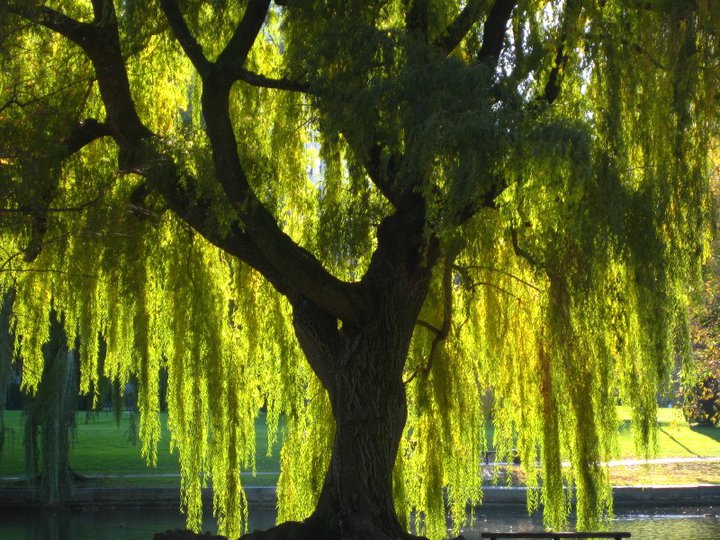
But if we brush aside the drooping veil of gloom, we find a really beautiful tree, for the most part sitting elegantly near a body of water, into which its trailing branches will often dip.

weeping willow tree

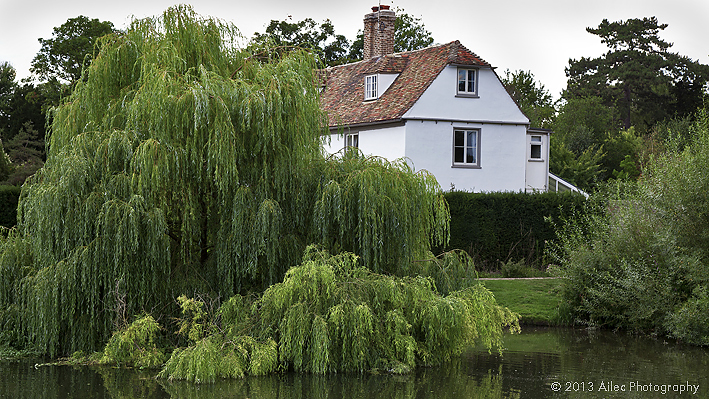
And such an English tree! (well, you also find them on the continent but we’ll ignore that). Here’s a weeping willow on the edges of a pond in Grantchester, in which, so it is said, the poet Byron swam.

weeping-willow-Grantchester

Here are students punting on the river Cam in Cambridge with some weeping willows languidly brushing the water’s surface.

weeping willows on the River Cam

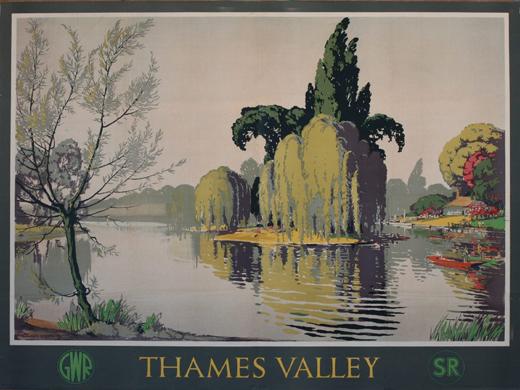
Here is a 1946 poster from the Great Western Railway, inviting Londoners to take a day out in the Thames Valley, with a weeping willow centre stage beckoning to them.

great western railway-thamesvalley

Talking of the Thames, here is the cover of that most English of children’s books, The Wind in the Willows, where we see our friends Mole, Ratty and Toad on the river Thames, waving to Badger on the shore, the whole discretely framed by weeping willows

the_wind_in_the_willows

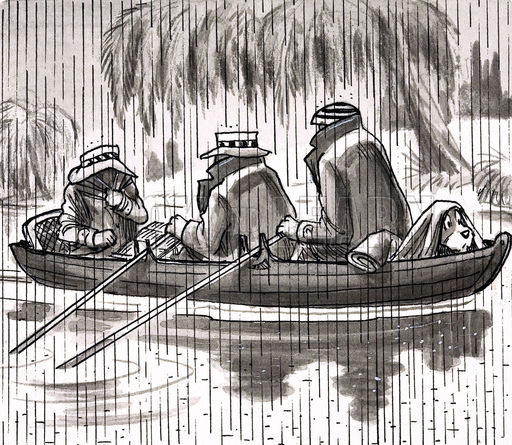
And of course there’s Three Men in a Boat, a book about – well, three men in a boat, messing around on the same river Thames (a book much loved by my father-in-law, in passing). Here we have them in that quintessentially English situation, rain, together with that quintessentially English animal, the dog, with some weeping willows in the background.

Three Men in a Boat by Jerome K. Jerome

Yes, all very English.

Except that the weeping willow isn’t English.

It’s Chinese.

Well, half-Chinese.

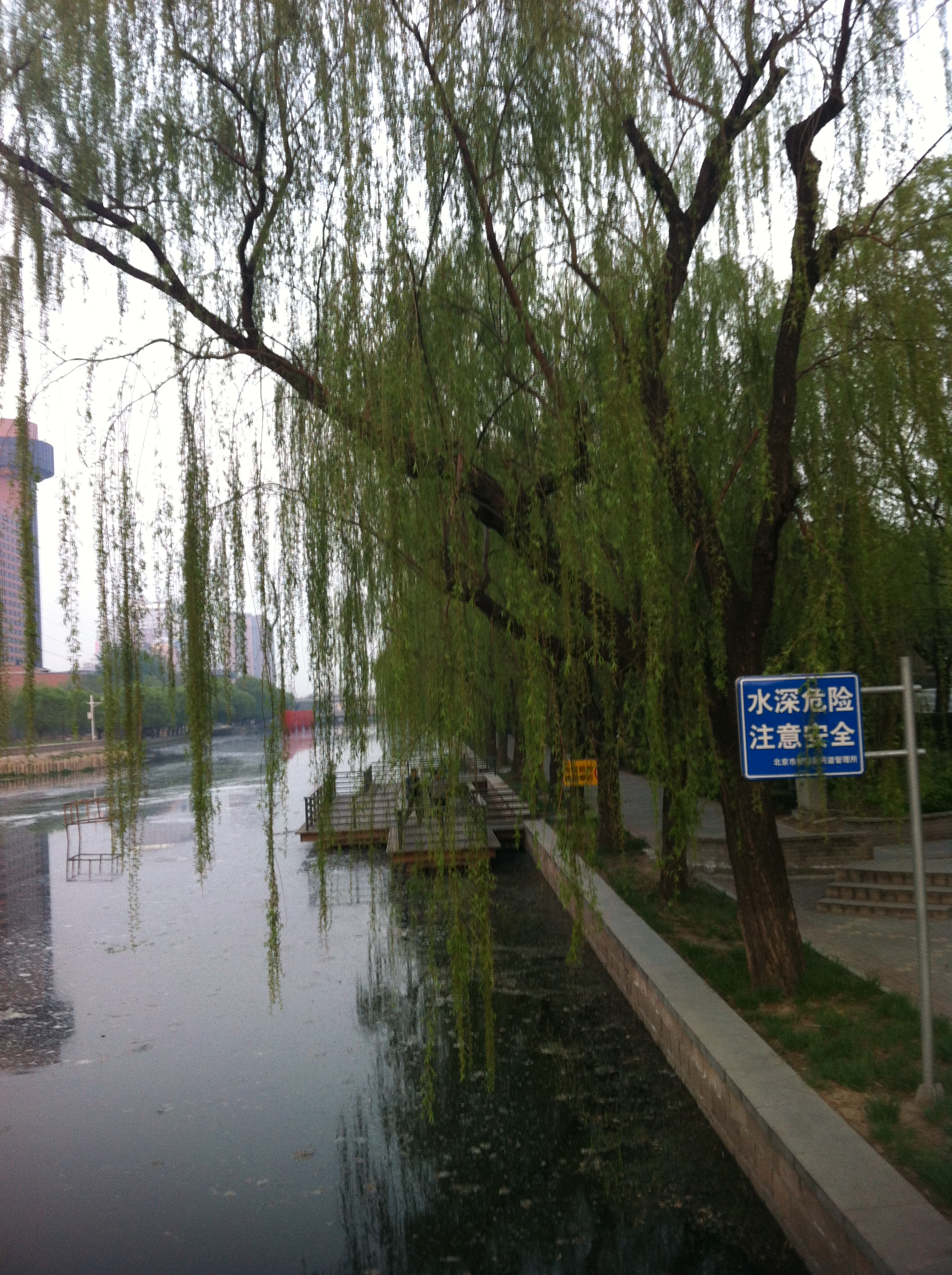
Yes, the willows, suitably called Peking willows, lining my piece of canal in Beijing

peking willows 004

are the ancestors of all those graceful weeping willows whose photos I have included above. It is they which carry the gene that makes the tree’s branches weep.

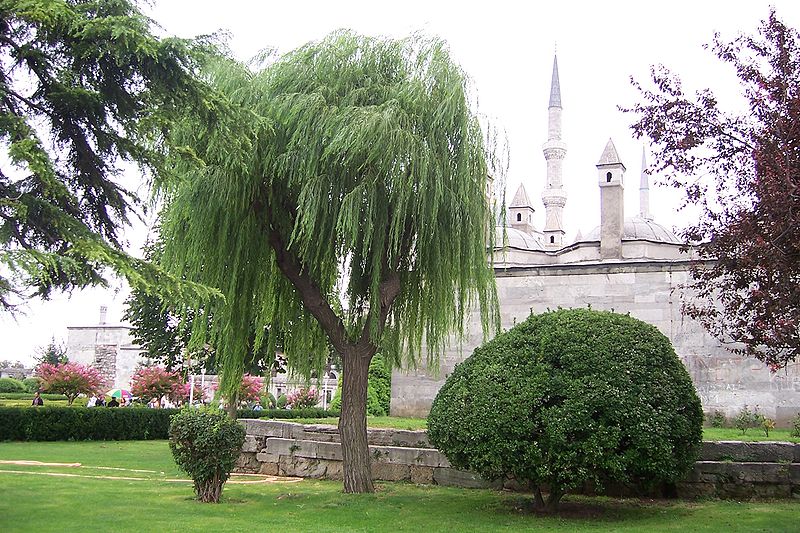
Somehow, for some reason, cuttings or seeds from these trees made their way to the west. I have read that they were moved along the Silk Road. Probably, traders from the west were charmed by the trees’ weeping branches and wanted them in their gardens. I’ve looked for pictures of Peking willows planted along the Road. The best I have found is a Peking willow in Istanbul.

Salix_babylonica in Istanbul

Not quite on the Road, which ended on the Mediterranean seaboard at Antioch or Tyre or Sidon, but close enough. And maybe one of the ways which the Peking willow entered Europe, through the Balkans.

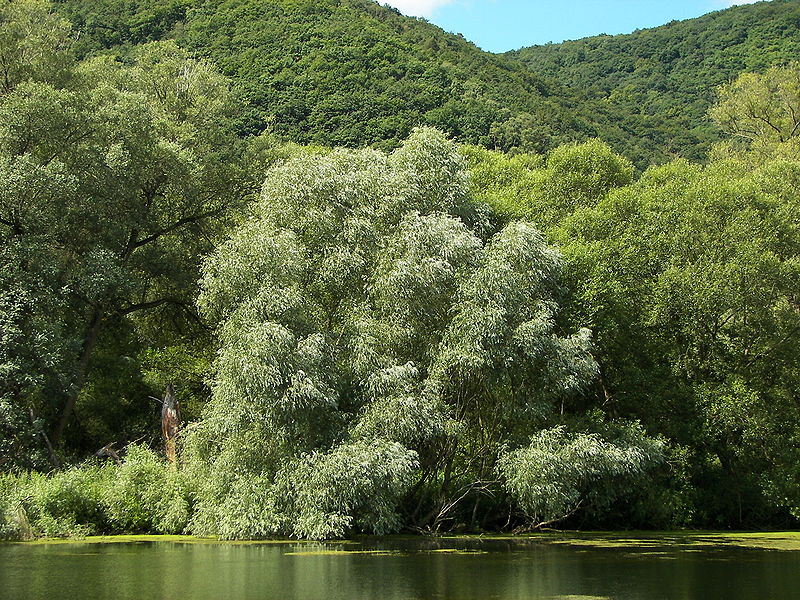
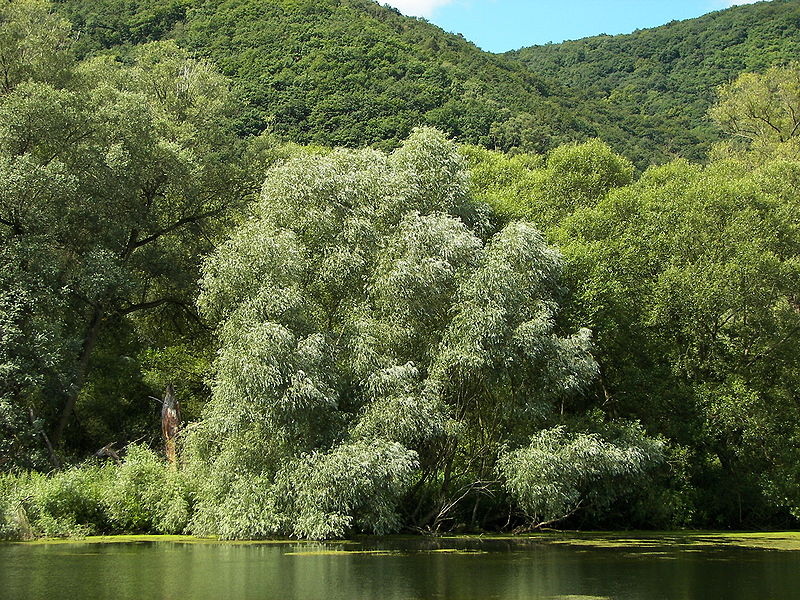
Somewhere along the way further to the west, the Peking willow was crossed with another willow, the European white willow.

white willow

The two were crossed because gardeners found that the Peking willow suffered in the more humid climate of Europe. Its gene pool needed bracing up, as it were.

So the weeping willow is half Chinese, half European.

Although my bubble of Englishness has been pricked, I’m glad to report that the weeping willow is nevertheless half brother –  or perhaps half sister – to that most English of artifacts, the cricket bat! Because these are made from the willow of a cross between the white willow and (possibly) the crack willow (the ancestry on the other side is not clear). So this allows me to insert here a picture of that most English of cricketers WG Grace holding a bat, in an ad for that most  English of condiments, Colman’s Mustard

wg grace with bat

Well, while I’m about it, I might as well also clarify another misconception. The willows by the waters of Babylon under which the Israelites wept were not willows, they were Euphrates poplars.

euphrates poplar

______________________

Tombstone with weeping willow: http://4.bp.blogspot.com/-V965riBwMQE/ThW9WsV_6gI/AAAAAAAAAA4/kGf3gW9vaZ0/s1600/%2523%2523%2523Weeping+Willow+St.+Mark%2527s+Luth+Appenzell+%25283%2529.JPG [in http://callmetaphy.blogspot.com/2011/07/symbol-of-weeping-willow-in-gravestone.html%5D
Girls weeping on tomb: http://mansionmusings.files.wordpress.com/2011/04/mourning-picture-detail.jpg [in http://mansionmusings.wordpress.com/2011/04/29/a-mansion-favorite-returns-home-abigail-walker-needlework-mourning-picture-ca-1803/%5D
Jewish psalter: http://upload.wikimedia.org/wikipedia/commons/9/97/Chludov_rivers.jpg [in http://en.wikipedia.org/wiki/Psalm_137%5D
Weeping willow tree: http://www.blogmagazine.org/wp-content/uploads/2012/05/weepingwillow.jpg [in http://www.blogmagazine.org/2012/05/admiring-the-beauty-of-the-weeping-willow/%5D
Weeping willows Grantchester: http://3.bp.blogspot.com/-3Lkrd8FlSCE/UhFK2RfkItI/AAAAAAAAGiM/v5kklmS41GE/s1600/photograph-of-weeping-willow-Byrons-Pool-Grantchester.jpg [in http://ailecphotography.blogspot.com/2013/08/day-18-august-challenge.html%5D
Weeping willows on the river Cam: http://upload.wikimedia.org/wikipedia/commons/d/da/Punting_on_the_River_Cam_-_geograph.org.uk_-_222149.jpg [in http://commons.wikimedia.org/wiki/File:Punting_on_the_River_Cam_-_geograph.org.uk_-_222149.jpg%5D
“The Wind in the Willows”: http://www.usborne.com/images/covers/eng/max_covers/the_wind_in_the_willows.jpg [in http://www.usborne.com/catalogue/book/1~CS~CSP~3249/the-wind-in-the-willows.aspx%5D
“Three Men in a Boat”: http://s3-eu-west-1.amazonaws.com/lookandlearn-preview/A/A008/A008727.jpg [in http://www.lookandlearn.com/history-images/A008727/Three-Men-in-a-Boat-by-Jerome-K-Jerome?img=2&search=Jerome+Klapka+Jerome&bool=phrase%5D
Great Western Railway poster: http://www.southernposters.co.uk/Destinations/Resources/thamesvalleylarg.jpeg [in http://www.southernposters.co.uk/Destinations/thamesvalley1946.html%5D
Peking willow, Beijing: my photo
Peking willow in Istanbul: http://upload.wikimedia.org/wikipedia/commons/thumb/7/75/Salix_babylonica.jpg/800px-Salix_babylonica.jpg [in http://en.wikipedia.org/wiki/Salix_babylonica#Horticultural_selections_and_related_hybrids%5D
White willow: http://bioweb.uwlax.edu/bio203/2011/girard_stev/maintop.jpg [in http://bioweb.uwlax.edu/bio203/2011/girard_stev/facts.htm%5D
Euphrates willow: http://mw2.google.com/mw-panoramio/photos/medium/49589465.jpg [in http://www.panoramio.com/user/1183385/tags/%D7%A0%D7%97%D7%9C%20%D7%A6%D7%99%D7%9F%5D

TOMB SWEEPING DAY

Beijing, 6 April 2014

I think it must be a universal characteristic of human beings to want to remember their dead. Perhaps it’s part of a refusal, deep down in our psyche, to accept that we die, so remembering the dead is a way to declare defiantly that we too, when we will be among the dead, will not really be dead. Whatever it is, and I’m certainly not competent to explore this side of our collective consciousness, we do have ritual days in our calendars when we are called upon to remember our dearly departed. For us in Western Europe, it’s All Souls’ Day, November 2nd.
All souls day Germany-3
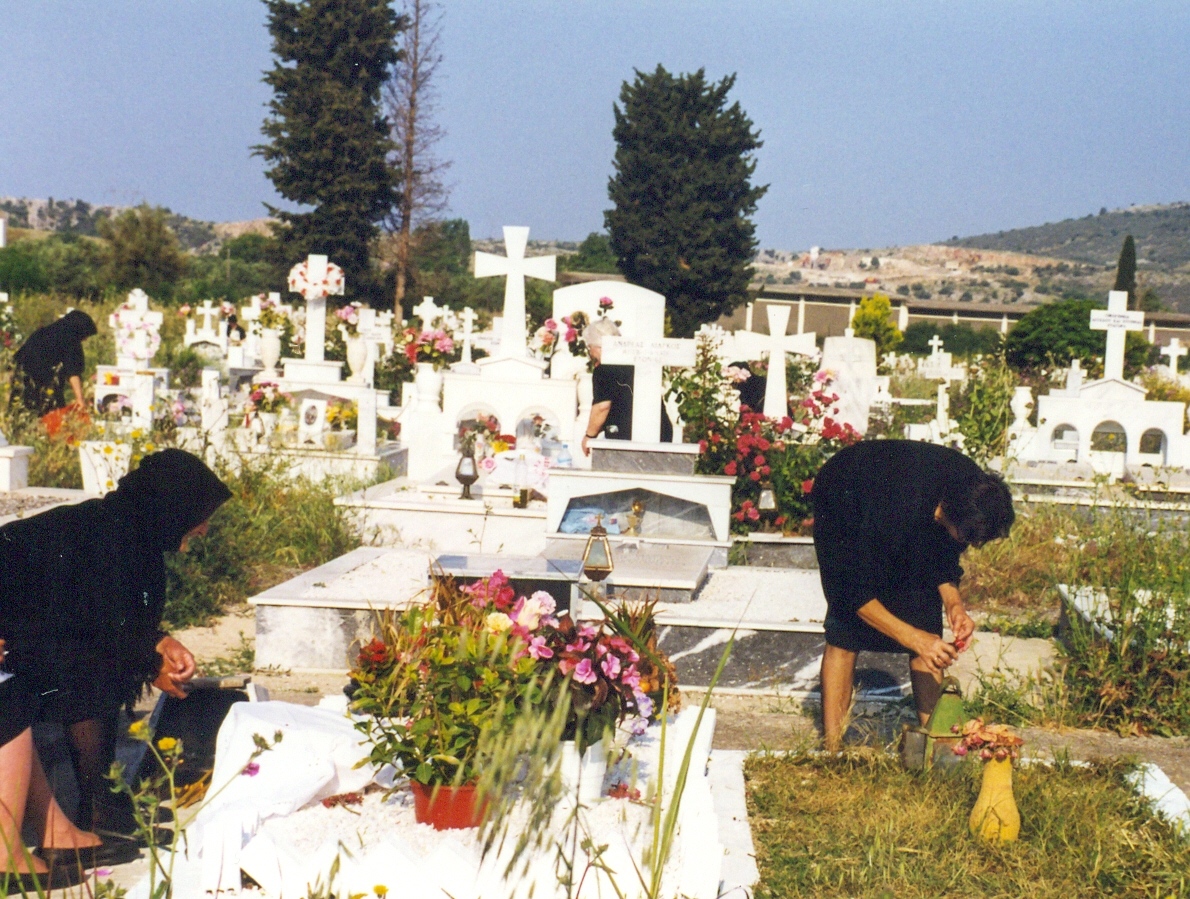
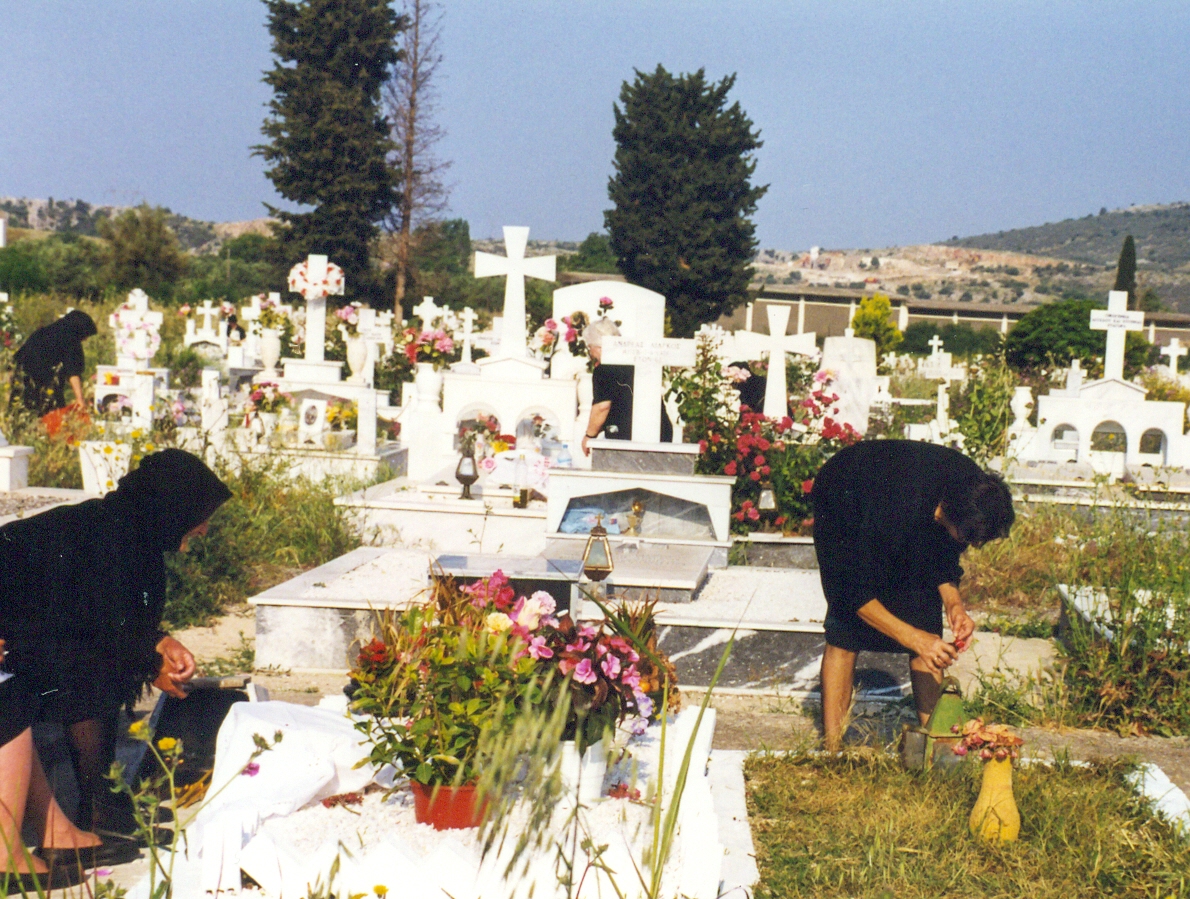
For those following the Christian Orthodox tradition, it’s the Saturday of Souls, commemorated some time in Spring
Greek orthodox saturday of souls-2
For the Chinese, it’s the Qingming Festival, or tomb sweeping day. It falls on the 15th day following the Spring equinox, which this year turned out to be yesterday. The pious Beijingers flocked to the tombs of their loved ones, while the rest of us, who don’t have any tombs to sweep in the immediate vicinity, took the day off. My wife and I fall into the latter category, our parents and grandparents lying in peace (I hope) in Italy, France and the UK. Nevertheless, we thought it would be interesting to observe this Chinese festival at first-hand. So we visited a cemetery in the farther reaches of the city, arriving there after a long journey by bus and under the curious stares of the locals.

The cemetery was indeed full of people
tomb sweeping day-1
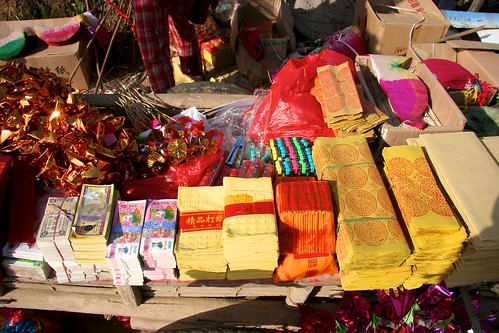
and it was fascinating to watch what they did. They burned incense
tomb sweeping day-3
As well as leaving normal flowers, they garlanded the graves with paper flowers (I suppose cheaper than real flowers, and certainly a good deal more colourful)
picture 001
They left food on the graves
picture 005
They left money (fake, alas, as we determined after surreptitiously picking up a few notes under the suspicious gaze of one of the gardeners)
tomb sweeping day-5
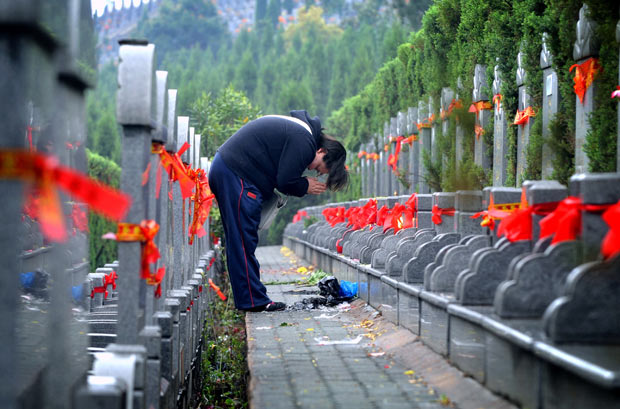
They paid their respects
tomb sweeping day-4-woman bowing
And even in one case we heard an old woman talking to her husband (I presume), I suppose updating him on what had been happening since she had last visited. The loneliness of old age can indeed be hard …

Well, the flowers we could relate to. After all, we do that in Europe too on All Souls Day – although the garlands of fake flowers was new to us.
All souls day Austria-2
We could also sort of understand the incense – I remember piles of incense being burned in the churches of my youth, although I never saw it used on tombs.

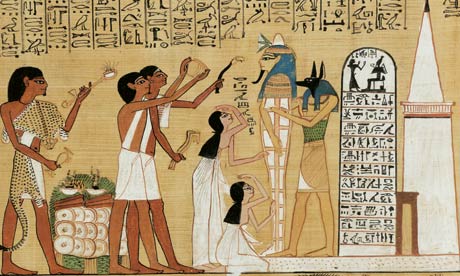
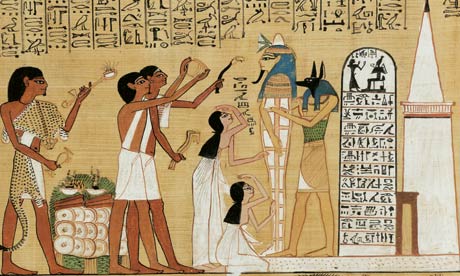
But the food and the money we found really strange. Especially the food. There was something almost animistic about this. It was like the ancient Egyptians who buried their dead with food for the afterlife.
bringing food to the dead egypt
Mind you, it’s not as if we don’t have our own strange cemetery habits. For instance, what I missed were the little candles which we leave on our graves in Europe
All souls day Germany-2-night
But if a Chinese were to ask me what those candles signify I would have to confess to not knowing. To keep away the bad spirits? To help God remember that they are there? To light up the darkness in which they lie?

Something else I missed was the statuary. The tombs we saw were very sober affairs.
picture 012
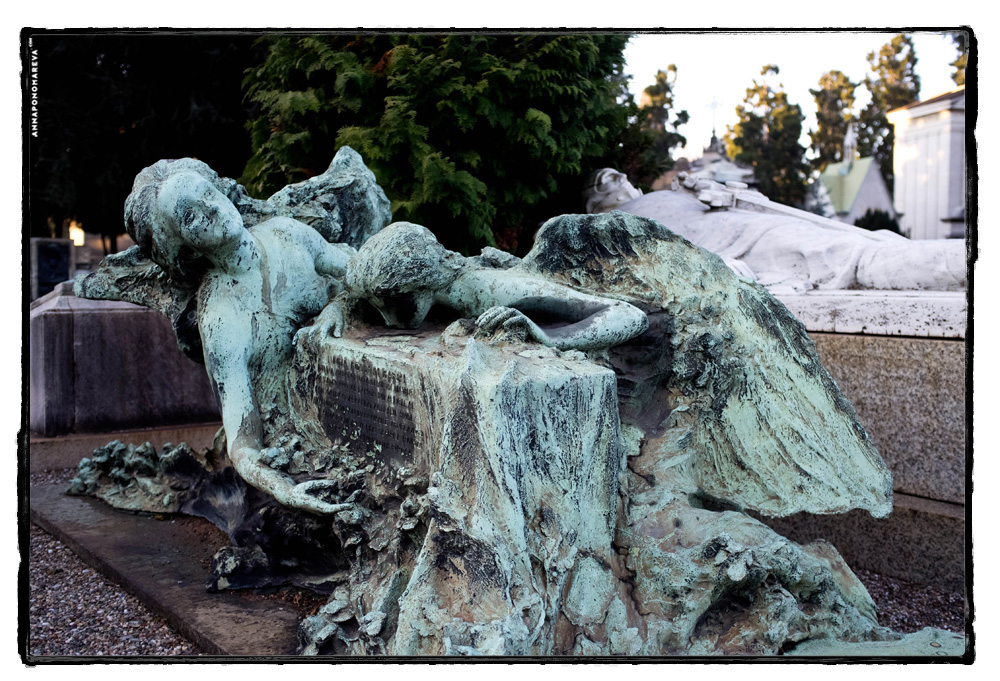
Compare this to the almost baroque constructions I’m familiar with, especially in Italy. Here are a few examples from the cemetery where my wife’s parents are buried
Giorno-dei-morti-Milano
statua monumentale Milano-2
statua monumentale Milano-3
From the style of these examples you might think that this was a habit of the past, but one of the tombs near my father-in-law’s has a life-size statue of a fisherman standing on it.

around nonno's grave 003

I presume the tomb’s incumbent loved fishing. Another close by, sadder to contemplate, is the statue of the young man buried there, whose life was tragically cut short.

around nonno's grave 006

My father-in-law’s tomb itself has a beautiful statuary group of angels singing in the heavenly choir.
angels with trumpets
We are going back to Milan in a few weeks to recuperate it after cremating his remains. My father-in-law has had thirty-five years of peaceful repose and now it is the turn of someone else to lie there: the iron law of increasing populations and decreasing real estate in which to rest the dead. But we’ll have the singing angels by which to remember him – and my mother-in-law, who chose the statuary’s theme. They had a common love of music. We will try to have his ashes relocated next to hers, so that after a separation of thirty-five years they can be together in death as they had been in life.

I wish I could say the same for my parents. Deaths ten years apart and the same real-estate forces which I just alluded to has meant that, after a life together, they were buried in different places. It fills me with melancholy and makes me think of Thomas Hardy’s poem In Death Divided

I shall rot here, with those whom in their day
You never knew,
And alien ones who, ere they chilled to clay,
Met not my view,
Will in your distant grave-place ever neighbour you.

No shade of pinnacle or tree or tower,
While earth endures,
Will fall on my mound and within the hour
Steal on to yours;
One robin never haunt our two green covertures.

Some organ may resound on Sunday noons
By where you lie,
Some other thrill the panes with other tunes
Where moulder I;
No selfsame chords compose our common lullaby.

The simply-cut memorial at my head
Perhaps may take
A Gothic form, and that above your bed
Be Greek in make;
No linking symbol show thereon for our tale’s sake.

And in the monotonous moils of strained, hard-run Humanity,
The eternal tie which binds us twain in one
No eye will see
Stretching across the miles that sever you from me.

I hope that, one day, I can bring them together so that finally one robin can haunt their two green covertures.

___________________________

All Souls Day Germany: http://images.fotocommunity.de/bilder/architektur/friedhoefe/allerheiligen-auf-dem-gratweiner-friedhof-1cf8be4b-d04b-430a-93e0-b3685f0f992f.jpg [in http://www.fotocommunity.de/pc/pc/display/14858389%5D
Greek Orthodox Saturday of souls: http://1.bp.blogspot.com/-Co-zt3nzWXs/T1EaVmrfyRI/AAAAAAAAAVA/M9gA4b1_m2I/s1600/%CF%83%CE%AC%CF%81%CF%89%CF%83%CE%B70003.jpg [in http://fiestaperpetua.blogspot.com/2012/03/blog-post.html%5D
Tomb sweeping day-1: http://www.wildchina.com/blog/wp-content/uploads/2010/04/pb-120404-qingming-da.photoblog900.jpeg [in http://www.wildchina.com/blog/tag/tomb-sweeping-day/%5D
Tomb sweeping day-2: http://www.fashion-bop.com/wp-content/uploads/2010/04/Tomb-Sweeping-Day.jpg [in http://www.fashion-bop.com/fashion-bop-things-about-us/tomb-sweeping-day/%5D
Tomb sweeping day-3: our picture
Tomb sweeping day-4: our picture
Tomb sweeping day-5: http://farm6.static.flickr.com/5193/7044748643_b7415e94a9.jpg [in http://easternjourney.com/2012/04/tomb-sweeping-day-2012/%5D
Tomb sweeping day-6: http://i.telegraph.co.uk/multimedia/archive/01864/Bowing_1864893i.jpg [in http://www.telegraph.co.uk/news/picturegalleries/worldnews/8429441/The-Qingming-festival-The-Chinese-honour-their-ancestors-by-sweeping-their-tombs.html%5D
All Souls Day Austria-flowered graves: http://www.mariazellerland-blog.at/wp-content/gallery/allerheiligen/allerheiligen-mariazell_1501.jpg [in http://www.mariazellerland-blog.at/allerheiligen-und-allerseelen-in-mariazell/allgemein/3588/%5D
Bringing food to the dead in Egypt: http://static.guim.co.uk/sys-images/Guardian/Pix/pictures/2010/10/11/1286794872587/Extra-British-Museum-Book-006.jpg [in http://www.theguardian.com/extra/2010/oct/11/extra-event-british-museum-book-of-the-dead%5D
All Souls Day Germany-night lights: http://images.fotocommunity.de/bilder/specials/mystische-orte/allerheiligen-am-friedhof-1436be22-b4bf-4a77-aba9-500ebdb2f3e7.jpg [in http://www.fotocommunity.de/pc/pc/display/19329266%5D
General view of Chinese cemetery: our photo
Statues cemetery Milan-1: http://www.milanospia.it/wp-content/uploads/2011/10/Giorno-dei-morti.jpg [in http://www.milanospia.it/2011/10/31/ponte-di-ognissanti-al-cimitero-di-milano-diventa-un-business/%5D
Statues cemetery Milan-2: http://farm8.staticflickr.com/7141/6655629153_17775801fa_o.jpg [in http://italia-ru.com/blog/ankh/2012/01/25/cimitero-monumentale-di-milano%5D
Statues cemetery Milan-3: http://milanosotto.files.wordpress.com/2013/08/cimitero-monumentale-scorcio.jpg [in http://milanosotto.wordpress.com/2013/08/13/il-cimitero-monumentale-di-milano-tra-storia-leggende-e-simboli-massonici/%5D
Statues cemetery Milan-4, 5 & 6: our photo

MAGNOLIA

Beijing, 4 April 2014

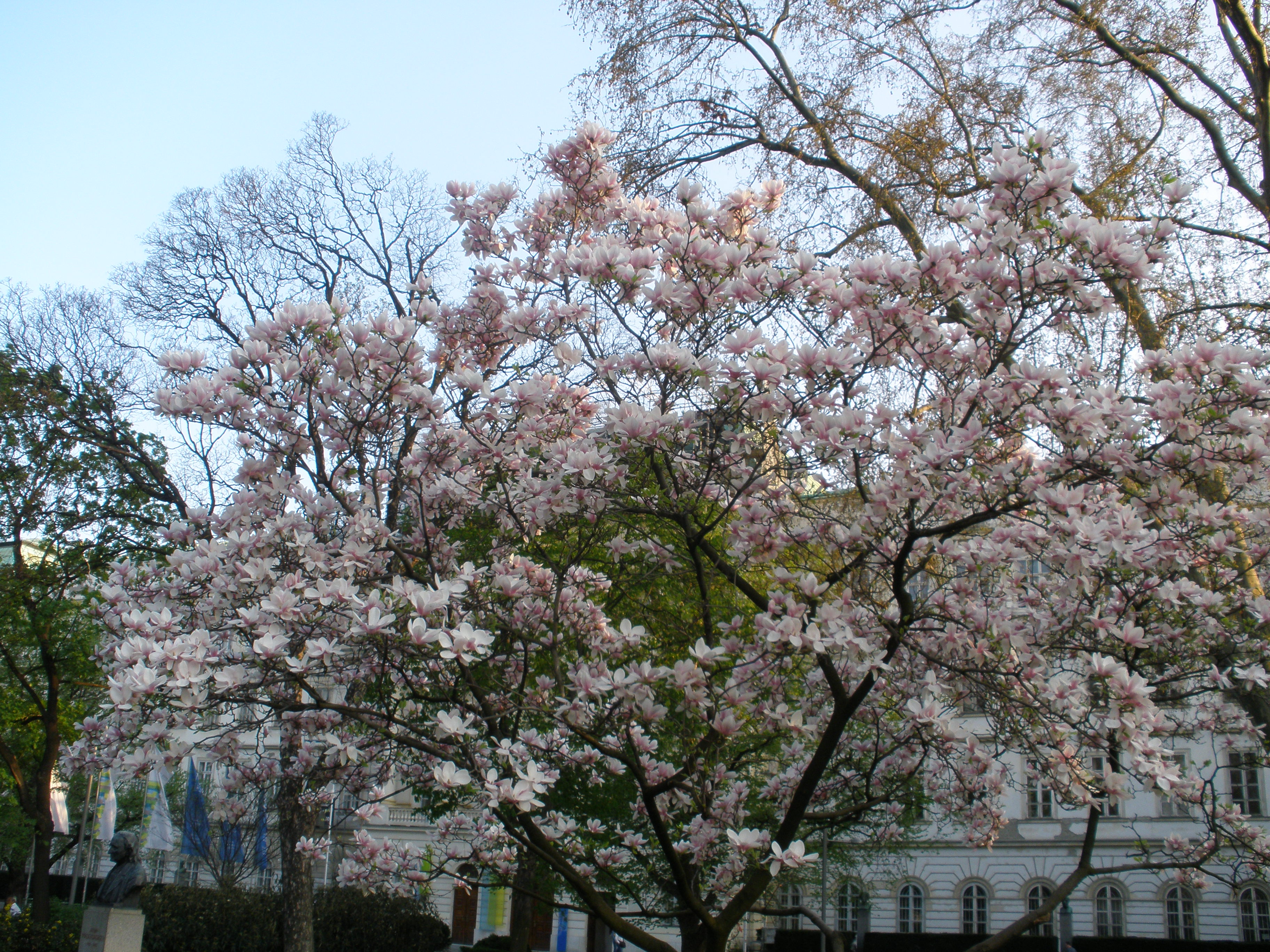
One of my abiding memories of Vienna is the magnolias in flower. I suppose it’s always the case that the first months you spend in a new place imprint themselves more forcefully on your brain’s virtual retina than the remaining years. We arrived in Vienna in February, two months later the magnolias were in bloom. It seemed that every garden and every park had its magnolia tree.
OLYMPUS DIGITAL CAMERA
We would pass one particularly magnificent specimen as we drove the children up to school every day. It was like living in a multiple exposure photo. Every day, as we swept by, we would note its progress, as the buds opened fully, and then the decay, as the flowers wilted and scattered their petals over the pavement.

A month or so later, it was the turn of the city’s multitude of lilac bushes to bloom, another fond memory which I have of Vienna and one about which I have had cause to write an earlier post.

Yes, they were good times.

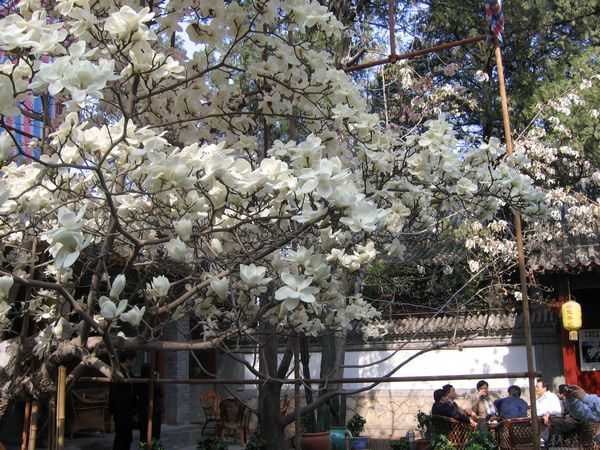
And then, when my wife and I came to Beijing, we found our friends the magnolia trees here, waiting to greet us with their blooms after we emerged from our first Chinese winter. A sight for sore eyes, let me tell you, after all that grey dryness of a Beijing winter. There was a pure white variety
magnolia trees dajue western temple
as well as a pinker type which we were familiar with from Vienna.
Tanzhe western Temple
Then, with the passage of time, I discovered that this tree, which I had, without really thinking about it, assumed was European, was actually Chinese! Actually, it’s a bit more complicated than that. There are nearly hundred different types of magnolia native to China (out of 200-plus native to Asia). The beautiful white magnolia pictured above, which comes from central and eastern China, grabbed the Chinese headlines early on. With its flower rightly regarded as a symbol of purity, it was planted in Buddhist temple gardens and the gardens of the emperors from as early as 600 AD during the Tang dynasty. It is called the Yulan, or jade lily, magnolia; I presume the name refers to the jade-like glossy smoothness of the magnolia’s petals and the sometimes lily-like look of the flower.

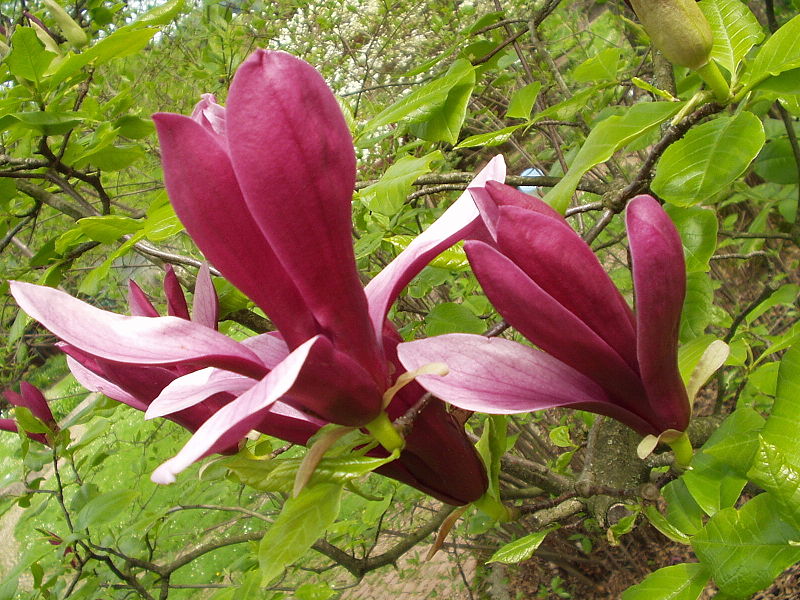
A second magnolia which has also been very popular in China for centuries is the Mulan magnolia which comes from Sichuan and Yunnan provinces.
magnolia lillliflora
Magnolias of course became favourite subjects of the poets, seeing as they spent hours haunting such gardens.

???

Here is the poem Magnolia Slope by Wang Wei, who lived in the 700s AD and is considered “the consummate master of the short imagistic landscape poem that came to typify classical Chinese poetry” (in the words of David Hinton, who made the admirable translation below).

Lotus blossoms adrift out across treetops
flaunt crimson calyces among mountains.

At home beside this stream, quiet, no one
here. Scattered. Scattered open and falling.

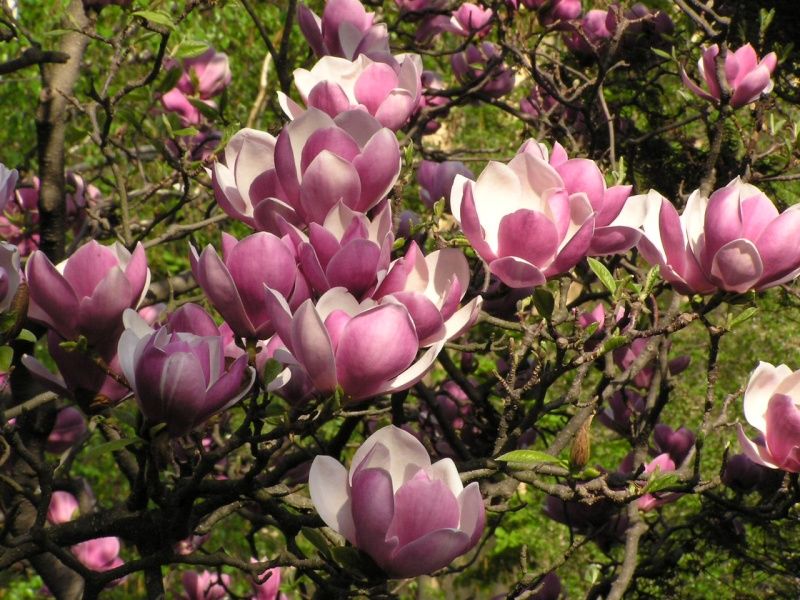
As with many things Chinese which were considered the nec plus ultra by the East Asian fashionistas and trend followers of yesteryear, the cultivation of these magnolias was taken up with enthusiasm by the Japanese, from whence – like the Chinese ginkgo tree of which I have written earlier – it made its way to Europe. And there, in 1820, in the grounds of his château of Fromont near Paris, an ex-cavalry officer turned plantsman, Étienne Soulange-Bodin, crossed the Yulan with the Mulan and created the hybrid saucer magnolia.
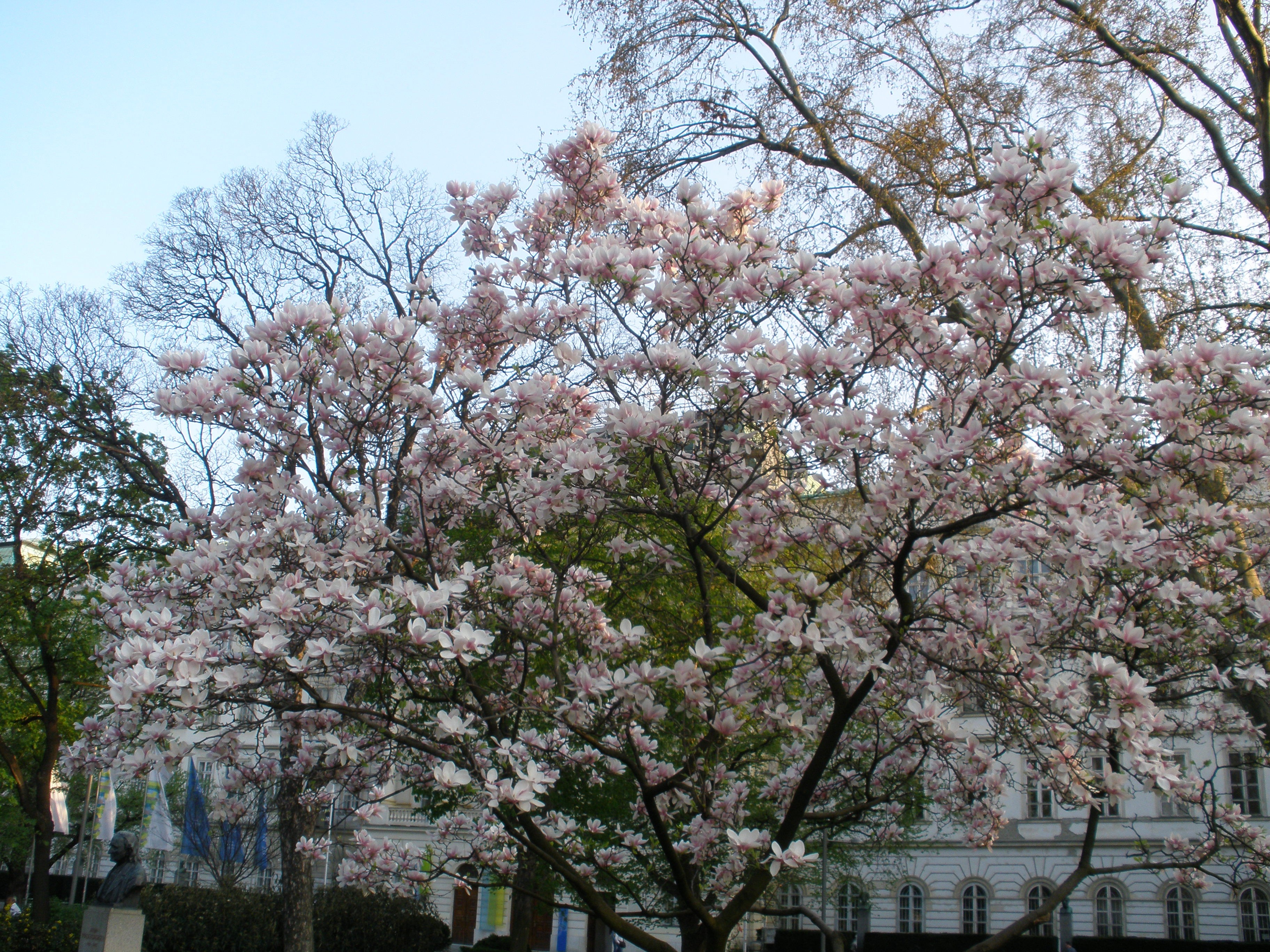
OLYMPUS DIGITAL CAMERA
With its large, early-blooming flowers in various shades of white, pink, and purple, this cultivar became immensely popular and spread around Europe (including Austria, no doubt, because I’m sure the Viennese magnolia I described above is one of these), the US, and eventually – I suspect – China, in hundreds of different cultivars as plant breeders continued to play with its gene pool.

Here I have to pause, to consider that other great reservoir of magnolias, the Americas. I said earlier that Asia boasts 200 or more types of magnolias. The Americas are host to another 90 or so. In fact, it was in the Americas, in the Caribbean island of Martinique to be exact, that in the 1690s a French botanist by the name of Charles Plumier discovered and named – in the modern scientific nomenclature; of course it already had a native name, the talauma – the magnolia, after yet another French botanist Pierre Magnol (a lot of French botanists in this story …). I haven’t found a picture of his original drawing of the magnolia which he came across but this one will do as a substitute.
talauma
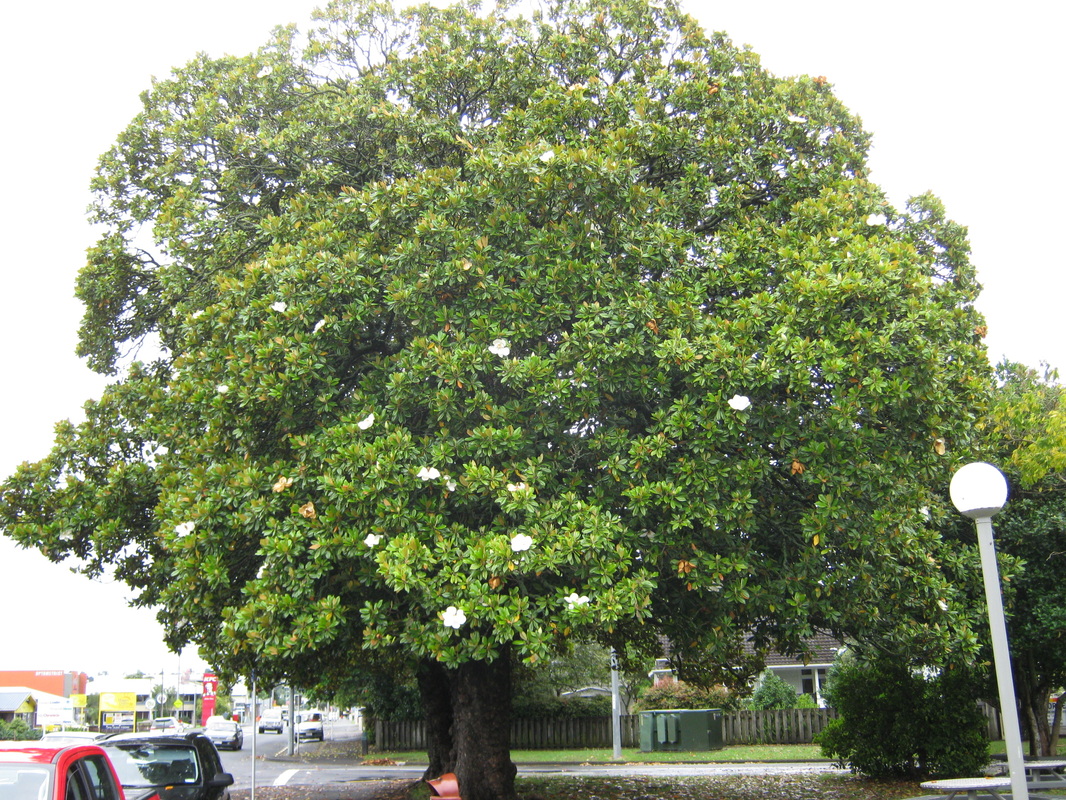
This picture, with its flower surrounded by a thick crown of leaves, sums up nicely a perplexity I had until I did some reading for this post. When we had been in the US, we had come across the southern magnolia, which looked something like this specimen, that is to say, a tree with very thick foliage and a few flowers sprinkled over the whole.
southern magnolia
Very beautiful flowers, by the way.
southern magnolia-flower
I couldn’t relate all this to the magnolias like those above, which are first completely covered with flowers and only get their leaves after the flowers have fallen. Well, the fact is, they are – botanically speaking – part of the same family. It’s just that it’s a very large family (some 300 members all told), and like in all large families distant cousins don’t necessarily resemble each other very much.

Which brings me to my final coda. The magnolia cousins have drifted so far apart because it is an old – very old – genus. It branched off the main tree of trees, if you get my drift, 100 million years or so ago. Fossils of plants identifiably belonging to the Magnoliaceae have been found dating back to 95 million years ago, while a 20 million year-old fossil has been found of the cucumber magnolia, which is native to the Eastern US and has this small flower with lovely yellow hues (in fact, these yellow hues as well as the tree’s cold hardiness have been exploited to create new yellow-flowered hybrid magnolias).
magnolia acuminata
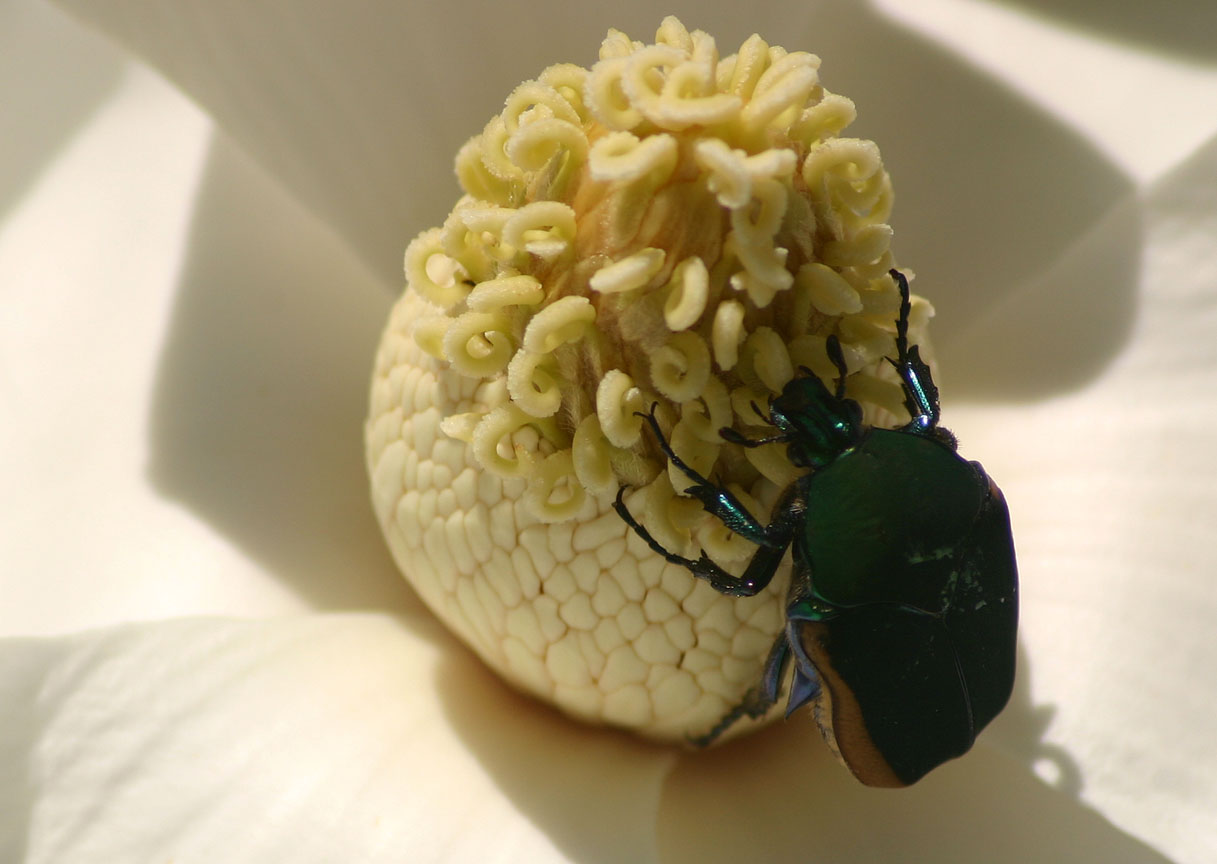
Magnolias are so ancient that they came on the scene as flowering plants before bees, or butterflies, or moths, existed to help along with pollination. So magnolias have evolved to use for pollination the only insects which were around at the time, beetles or flies.
beetle in magnolia-1
And this co-existence with beetles explains the rather leathery petals magnolias have. Compared to bees, beetles are clumsy insects, clomping around all over the flower and with a tendency to snack on the petals as well as the nectar. The leathery petals protect the flowers from these lumbering but necessary partners in the act of procreation.

Oh, and by the way, magnolia flowers don’t actually have petals, they have tepals. And that’s because the flowers are quite primitive, so their sepals and petals are not distinct and differentiated (no idea what that really means, but it sounds impressive).

__________________
Magnolia in Vienna: http://farm3.staticflickr.com/2542/3753020942_3f6c39bb5f_o.jpg [in https://www.flickr.com/%5D
Yulan Magnolia tree in Dajue western temple: http://www.beijingrelocation.com/blog/wp-content/uploads/2013/03/magnolia.jpg [in http://www.beijingrelocation.com/blog/beijing-trees/%5D
Magnolia tree in Tanzhe temple: http://www.travelchina.gov.cn/picture/0/1403261604282295162.png [in http://www.travelchina.gov.cn/art/2014/3/26/art_15_1202.html%5D
Mulan Magnolia: http://upload.wikimedia.org/wikipedia/commons/thumb/d/d6/Magnolienbluete_freiburg.jpg/800px-Magnolienbluete_freiburg.jpg [in http://en.wikipedia.org/wiki/Magnolia_liliiflora%5D
Poet in garden: http://upload.wikimedia.org/wikipedia/commons/1/1a/Wang_Xizhi_by_Qian_Xuan.jpg [in http://en.wikipedia.org/wiki/Chinese_garden%5D
Magnolia soulangeana: http://upload.wikimedia.org/wikipedia/commons/3/3e/Magnolia_x_soulangeana.jpg [in http://en.wikipedia.org/wiki/Saucer_magnolia%5D
Talauma: http://www.plantillustrations.org/illustration.php?id_illustration=90190 [in http://www.plantillustrations.org/epithet.php?epithet=plumieri&lay_out=1&hd=0%5D
Southern magnolia: http://whangareiflora.weebly.com/uploads/8/4/3/9/8439522/6466041_orig.jpg [in http://whangareiflora.weebly.com/exotic-trees.html%5D
Southern magnolia-flower: http://www.magnoliasociety.org/resources/Pictures/images/cultivars/msieboldi8422.JPG [in http://www.magnoliasociety.org/MagnoliaResources%5D
Magnolia acuminata: http://1.bp.blogspot.com/-yf82eYSuRd4/T6gSQGfe2bI/AAAAAAAAAnI/6SgLRh0exIY/s1600/DSCF7584.JPG [in http://welkinweir.blogspot.com/2012/05/may-flowers.html%5D
Beetle in a magnolia: http://blogging.la/wp-content/uploads/2009/06/gjb.jpg [in http://blogging.la/2009/06/28/it-caught-my-eye-the-beetle-the-blossom/%5D

BIRDS IN BEIJING

Beijing, 22 March 2014

A few days ago, as I was walking to work along my piece of canal, I saw, sitting on the lower branch of a willow tree, a small bird which I had never seen before. I’m not a birder by any means, but I do appreciate a beautiful or graceful bird when I see one. This bird had a wonderfully variegated plumage, really very handsome. By the shape of its head and bill I was guessing it to be a member of the woodpecker family. Intrigued, I sidled forward to have a better look. The bird cocked its head, kept a wary eye on me, and finally decided I had invaded too much of its private space. With a quick flip of its wings, it was off, dipping and lifting across the waters of the canal. I finally lost sight of it among the willow trees and buildings on the other bank.

The internet is a wonderful thing, really it is. Yes, there are dark corners where bad, nasty people show and say bad, nasty things, but overall it is a great global market square into which you can wander of an evening and, like young Marco Polo sauntering along Venice’s wharves, hear tales fantastical of faraway lands and pick up information from the furthest reaches of the globe. This burst of appreciation for the internet at this particular moment in my tale comes from the fact that at home that evening, on a whim, I typed “birds in beijing” in my search field to see what I could find. And I immediately stumbled onto the site Birding Beijing! I salute its author, Terry Townshend, a Beijing resident like myself and a dedicated birder, who has put together this wonderful site.

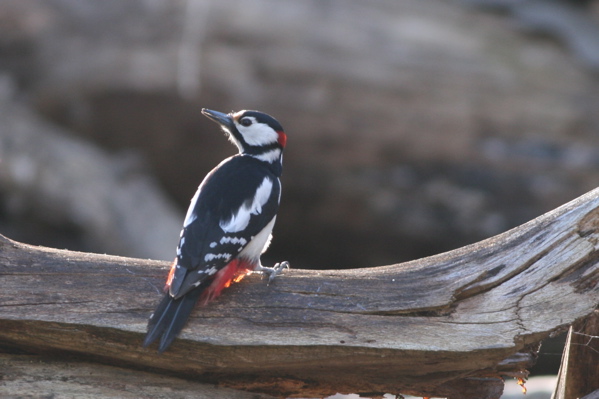
Terry’s site gave me the answer I was looking for. The bird I had seen in the morning was indeed a woodpecker, the great spotted woodpecker (Dendrocopos major) to be precise. This photo is from his site
great-spotted-woodpecker-small-1
Here is another from a UK site

great-spotted-woodpecker-2
which I chose because this woodpecker has a range which stretches all the way from China across Central Asia and Europe to my home country. It gives me an odd sense of comfort, that: part of home in Beijing.

Terry’s site gave me the answer to one more ornithological question which has been nagging me for the last few years, the identity of another bird which I have often seen here. It seemed to me quite like the magpie, although with much more delicate colouring in its feathers. It seemed to fill the same ecological niche, too, as far as I could gather. Well, Terry’s site tells me that it is indeed a magpie! (although a different member of the family, to be sure). It is the azure-winged magpie (Cyanopica cyanus). This photo of it is also from Terry’s site

azure-winged-magpie-1

but this one comes from a Russian orthinological site

azure-winged-magpie-2

which I include because the range of this magpie covers East and North-East Asia (so including Siberia).

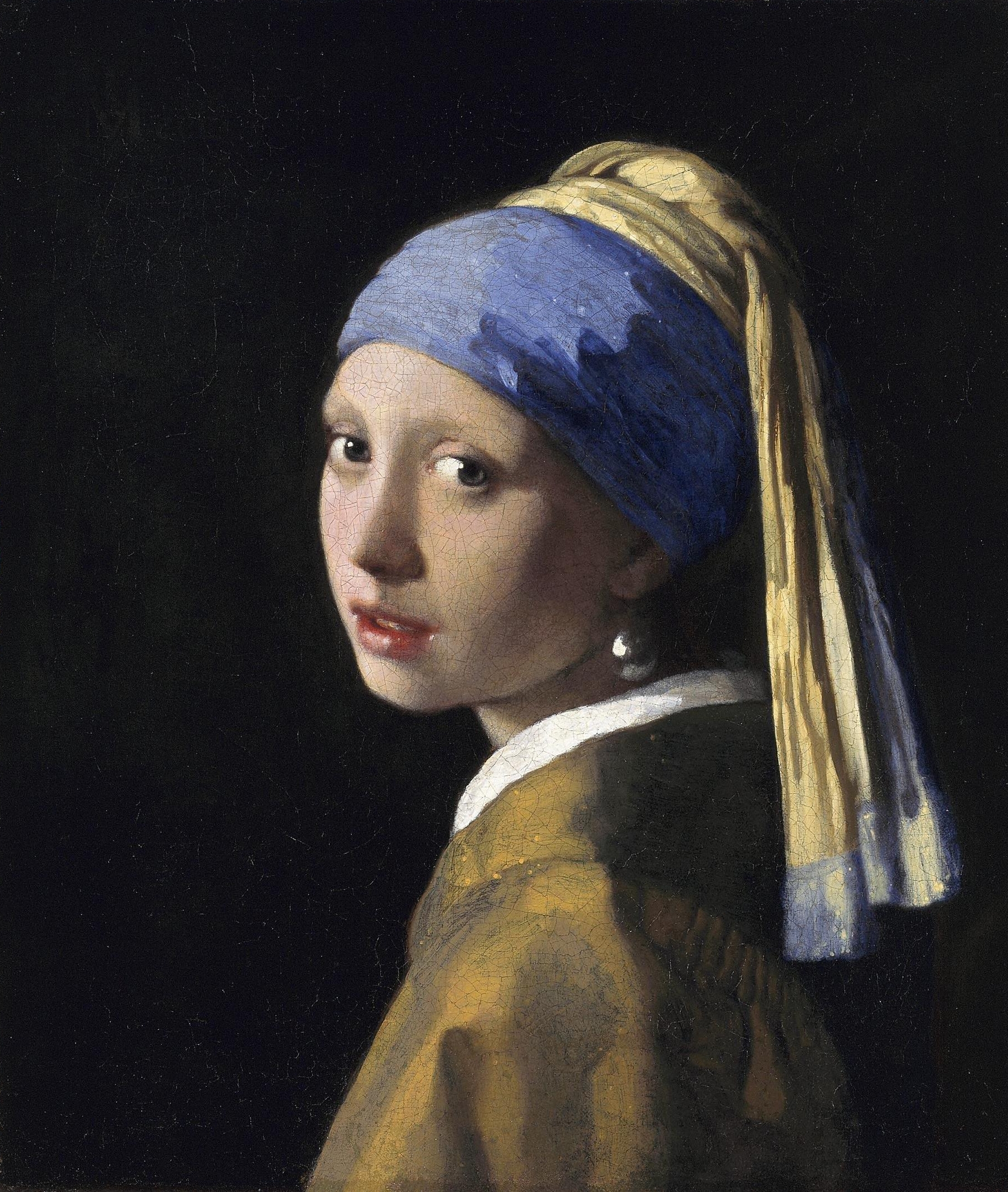
I’m not sure “azure” really describes the wonderful shade of blue which this bird sports in its wing and tail feathers. A long hunt through various other internet sites makes me think that cornflower blue might better describe this particular shade of blue. The internet also tells me that this colour was one of the Dutch painter Jan Vermeer’s favourite colours. Is the blue in his painting Girl with a Pearl Earring the same?

Girl_with_a_Pearl_Earring

Perhaps it is a slightly darker shade of blue?

Flush from these two successful identifications, I went through the rest of the bird gallery in Terry’s site, to put a name to what else I’ve seen in Beijing. He mentions the the Eurasian magpie (Pica pica), which I’ve had cause to write about in an earlier posting. It seems more common than the azure-winged magpie; I certainly feel that I see it more often. Terry does not include a picture of this magpie (too common, no doubt), so I add here a photo from another site
Eurasian magpie-2
Terry mentions the Eurasian tree sparrow (Passer montanus). I’ve seen that, of course, who hasn’t?
tree-sparrow
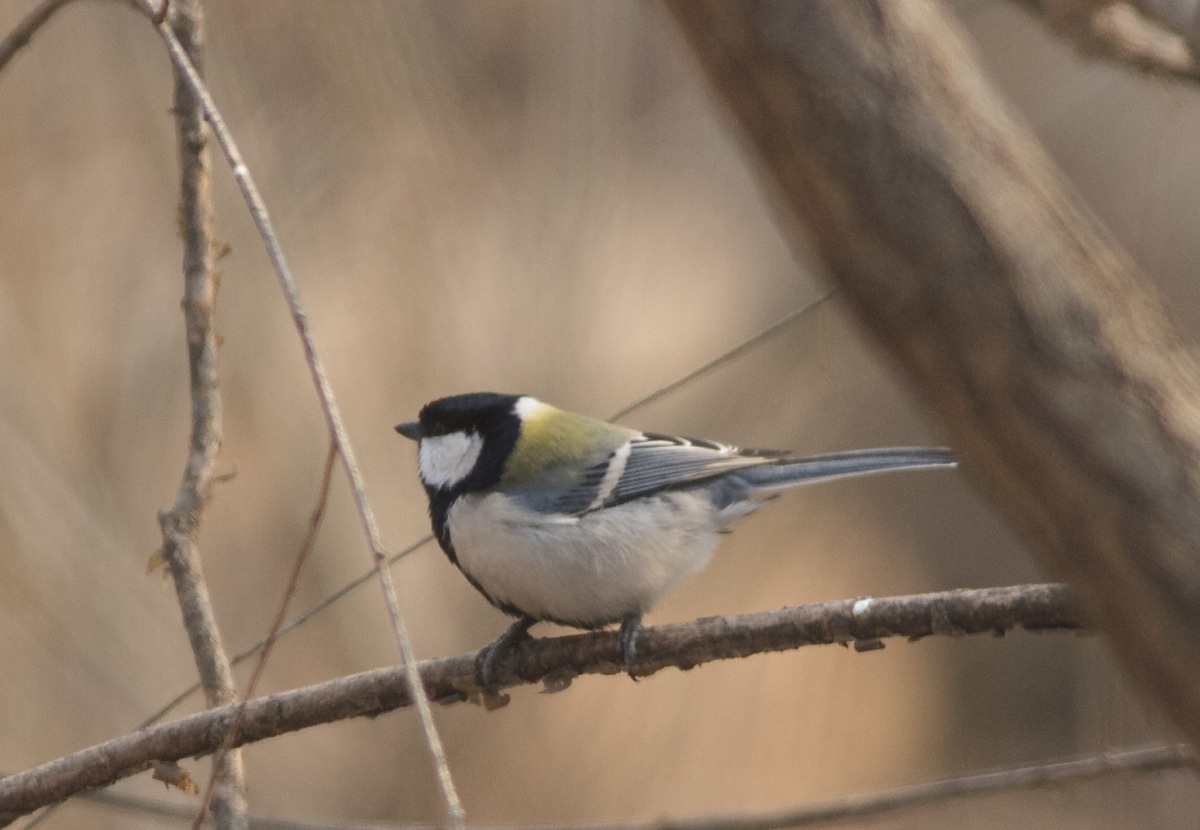
I think I might once have seen another bird he mentions, the eastern great tit (Parus minor)
japanese-tit
I’m almost certain I also saw a Eurasian kestrel (Falco tinnunculus) once. I spotted it during a particularly boring teleconference for which I was a passive participant, sitting at my desk and staring out of the window while the others droned on.  I was glad for the lovely distraction of its diving and swooping around my office building.

kestrel

These wonderful photos move me to cite here three poems about birds which I particularly like:

The Eagle, by Alfred, Lord Tennyson

He clasps the crag with crooked hands;
Close to the sun in lonely lands,
Ring’d with the azure world, he stands.

The wrinkled sea beneath him crawls;
He watches from his mountain walls,
And like a thunderbolt he falls.

The Windhover, by Gerard Manley Hopkins

I caught this morning morning’s minion, king-
  dom of daylight’s dauphin, dapple-dawn-drawn Falcon, in his riding
  Of the rolling level underneath him steady air, and striding
High there, how he rung upon the rein of a wimpling wing
In his ecstasy! then off, off forth on swing,
  As a skate’s heel sweeps smooth on a bow-bend: the hurl and gliding
  Rebuffed the big wind. My heart in hiding
Stirred for a bird,—the achieve of; the mastery of the thing!

Brute beauty and valour and act, oh, air, pride, plume, here
  Buckle! AND the fire that breaks from thee then, a billion
Times told lovelier, more dangerous, O my chevalier!

No wonder of it: shéer plód makes plough down sillion
Shine, and blue-bleak embers, ah my dear,
  Fall, gall themselves, and gash gold-vermillion.

The Darkling Thrush, by Thomas Hardy

I leant upon a coppice gate
    When Frost was spectre-gray,
And Winter’s dregs made desolate
    The weakening eye of day.
The tangled bine-stems scored the sky
    Like strings of broken lyres,
And all mankind that haunted nigh
    Had sought their household fires.

The land’s sharp features seemed to be
    The Century’s corpse outleant,
His crypt the cloudy canopy,
    The wind his death-lament.
The ancient pulse of germ and birth
    Was shrunken hard and dry,
And every spirit upon earth
    Seemed fervourless as I.

At once a voice arose among
    The bleak twigs overhead
In a full-hearted evensong
    Of joy illimited;
An aged thrush, frail, gaunt, and small,
    In blast-beruffled plume,
Had chosen thus to fling his soul
    Upon the growing gloom.

So little cause for carolings
    Of such ecstatic sound
Was written on terrestrial things
    Afar or nigh around,

That I could think there trembled through
    His happy good-night air
Some blessed Hope, whereof he knew
    And I was unaware.

Lovely …

And yet I’m worried. Last Christmas, when we were in New York, we visited the Metropolitan Museum. On our wanderings through the galleries we bumped into four of these hanging on the wall of a corridor:

Peruvian-Featherwork-cape-1

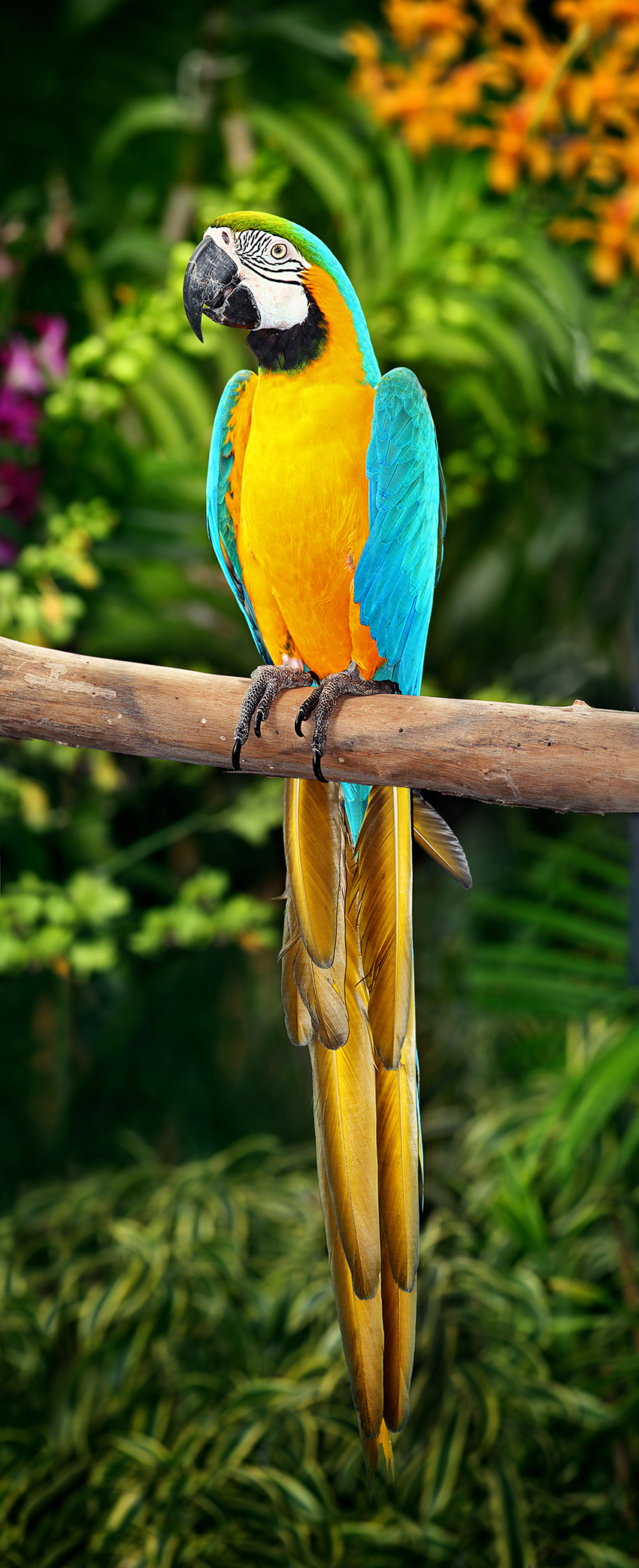
They are capes, from Peru. They are 1,000 years old, made with the feathers of the blue-and-yellow macaw.

Blue-and-yellow Macaw

How many of these magnificent birds were killed to make these capes? Such needless, selfish destruction! Nowadays, it’s not killing for their feathers that’s killing off birds, it’s destruction of their habitat. But it’s still the same: needless, selfish destruction.

____________________

Great spotted woodpecker-1: http://birdingbeijing.files.wordpress.com/2013/03/great-spotted-woodpecker-small-1.jpeg [in http://birdingbeijing.com/birders-guide-to-beijing/a-guide-to-beijings-common-birds/%5D
Great spotted woodpecker-2: http://www.worldbirds.co.uk/images/oakes0/photos/image298.jpg [in http://www.worldbirds.co.uk/lesser_spotted_woodpecker.aspx?key=60%5D
Azure-winged magpie-1: http://birdingbeijing.files.wordpress.com/2013/03/2013-12-28-azure-winged-magpie.jpg [in http://birdingbeijing.com/birders-guide-to-beijing/a-guide-to-beijings-common-birds/%5D
Azure-winged magpie-2: http://onbird.ru/img/photo/golubaya-soroka/golubaya-soroka foto 4 (onbird.ru).jpg [in http://onbird.ru/opredelitel-ptic/golubaya-soroka-584/foto%5D
Girl with a pearl earring: http://upload.wikimedia.org/wikipedia/commons/c/ce/Girl_with_a_Pearl_Earring.jpg [in http://en.wikipedia.org/wiki/Johannes_Vermeer%5D
Eurasian magpie: http://birdsofkazakhstan.com/wp-content/uploads/2010/01/Pica-pica-bactriana-adult-Zhabagly-South-Kazakhstan-province-Kazakhstan-16-September-2009-Rene-Pop2.jpg [in http://birdsofkazakhstan.com/eurasian-magpie-pica-pica/%5D
Tree sparrow: http://birdingbeijing.files.wordpress.com/2013/03/2013-10-03-tree-sparrow.jpg [in http://birdingbeijing.com/birders-guide-to-beijing/a-guide-to-beijings-common-birds/%5D
Japanese tit: http://birdingbeijing.files.wordpress.com/2013/03/2014-01-23-japanese-tit.jpg [in http://birdingbeijing.com/birders-guide-to-beijing/a-guide-to-beijings-common-birds/%5D
Kestrel: http://birdingbeijing.files.wordpress.com/2013/03/2009-09-14-kestrel2.jpg [in http://birdingbeijing.com/birders-guide-to-beijing/a-guide-to-beijings-common-birds/%5D%5D
Peruvian featherwork cape: http://www.thehistoryblog.com/wp-content/uploads/2013/09/470_Peruvian-Featherwork.jpg [in http://www.thehistoryblog.com/archives/27107%5D
Blue and yellow macaw: http://upload.wikimedia.org/wikipedia/commons/6/6d/Blue-and-Yellow-Macaw.jpg [in http://en.wikipedia.org/wiki/Blue-and-yellow_Macaw%5D

LEST WE FORGET

Beijing, 10 November 2013

I don’t think I’ll be able to wear my poppy this year.

Hoppe

Every year I pick it out of the corner of the drawer where I keep it, from under the paper clips and rubber bands. After four years in China, the paper petals are now sadly scuffed and creased, but I still like to give it pride of place in the lapel of my jacket. I am somewhat diffident to wear it here, because everyone stares at it wondering what it is. Several of my Chinese staff have asked me politely what it means. After I’ve gone through the explanation, they thank me nicely but I rather think they put my behaviour down to a form of British eccentricity.

It was the same in Vienna. You would have thought that Europeans would be more familiar with the British paper poppy and its symbolism but it seems not. Every year, I would be asked by two or three people what it was all about, and every time I would go through the explanation.

In Vienna, the enquirers would often start by commenting that they had seen the same poppy being worn by British politicians

Britain's Prime Minister David Cameron (

and indeed it is the sight of these politicians on my TV screen looking pious behind their poppies that reminds me that it is once again that time of the year … the eleventh hour, of the eleventh day, of the eleventh month. It was on 11 November 1918 that the Armistice between Germany and the Allied Forces was signed. The guns finally fell silent on the Western Front and the First World War came to an end.

The habit in the Commonwealth countries of wearing a poppy to remember the end of that war, and to raise funds for the wounded who came home and the widows and orphans of those who did not, grew out of a popular war poem written by a Canadian officer, John McCrae, who fought on the Western Front. I cite its first two verses here.

In Flanders fields the poppies blow
Between the crosses, row on row,
That mark our place; and in the sky
The larks, still bravely singing, fly
Scarce heard amid the guns below.

We are the Dead. Short days ago
We lived, felt dawn, saw sunset glow,
Loved and were loved, and now we lie
In Flanders fields.

Anyone who has ever seen a field sprinkled with poppies will immediately understand their strong symbolic resonance. They look like so much blood sprayed across the land.

poppies in field-3

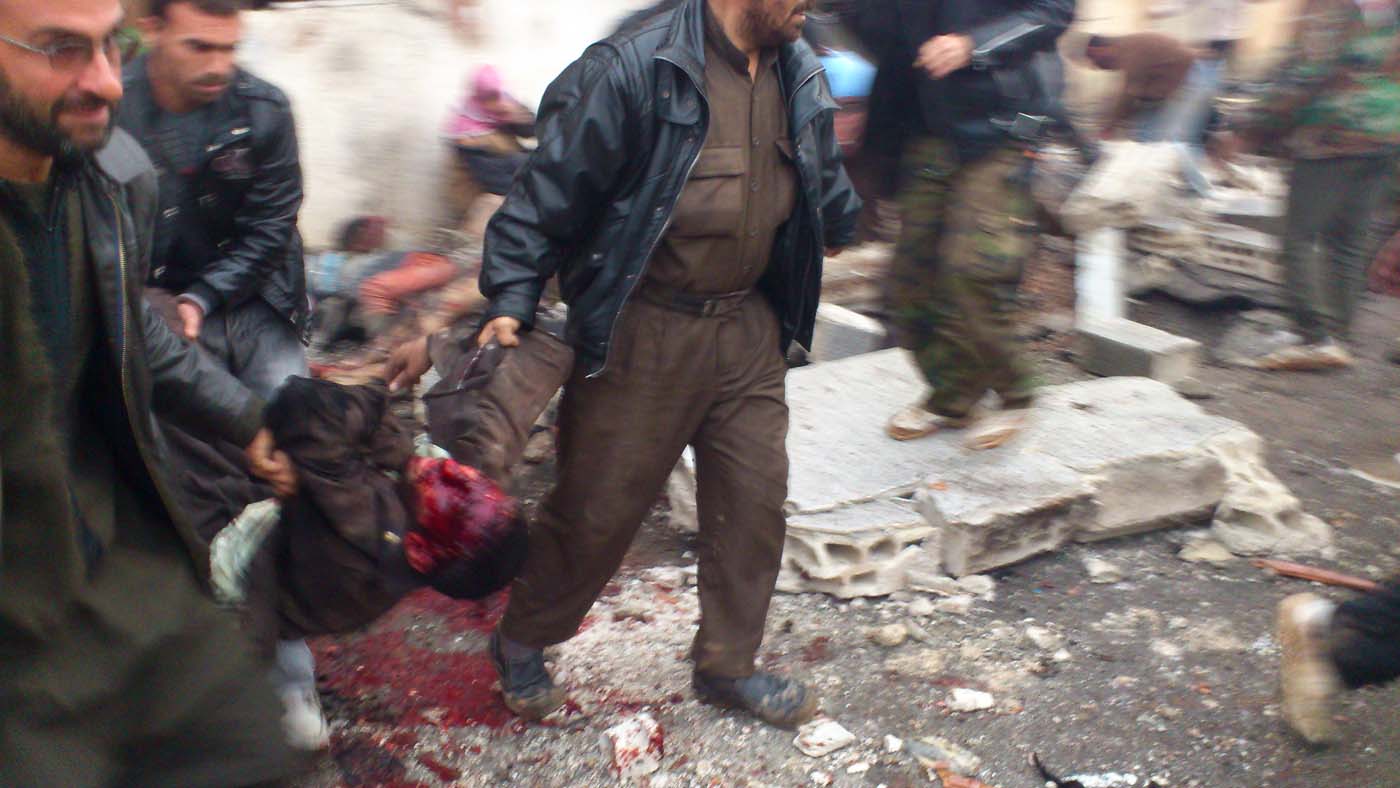
Earlier pious-looking politicians proclaimed that the First World War was the war to end all wars. Well, as we are all too aware, it wasn’t. As wars have continued to be fought, the poppy has become the way for the British and ex-British colonies of remembering their war dead. But I wear my poppy to remember all those who have died – civilians as well as soldiers – and continue to die in wars and other conflicts big and small the world over. Just this year we have the human tragedy of Syria, which is spilling over into Lebanon, there is the continuing conflict in Afghanistan which is spilling over into Pakistan, the continuing violence in Iraq and Libya, the growing violence in Egypt, the fighting in South Sudan, in Somalia, in the Congo, in Mali, in Myanmar, and on and on and on …

SYRIA-CONFLICT

When you see the sheer scale of the human misery which all this fighting engenders you understand why I did not cite the last verse of John McCrae’s poem.

Take up our quarrel with the foe:
To you from failing hands we throw
The torch; be yours to hold it high.
If ye break faith with us who die
We shall not sleep, though poppies grow
In Flanders fields.

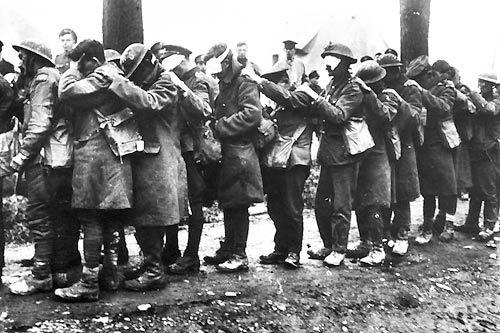
I hate this glorifying of war, this coating in a veneer of sacred language what is simply a nasty, brutish fight. I prefer the following poem from that same war

Bent double, like old beggars under sacks,
Knock-kneed, coughing like hags, we cursed through sludge,
Till on the haunting flares we turned our backs
And towards our distant rest began to trudge.
Men marched asleep. Many had lost their boots
But limped on, blood-shod. All went lame; all blind;
Drunk with fatigue; deaf even to the hoots
Of disappointed shells that dropped behind.

GAS! Gas! Quick, boys!– An ecstasy of fumbling,
Fitting the clumsy helmets just in time;
But someone still was yelling out and stumbling
And floundering like a man in fire or lime.–
Dim, through the misty panes and thick green light
As under a green sea, I saw him drowning.

In all my dreams, before my helpless sight,
He plunges at me, guttering, choking, drowning.

If in some smothering dreams you too could pace
Behind the wagon that we flung him in,
And watch the white eyes writhing in his face,
His hanging face, like a devil’s sick of sin;
If you could hear, at every jolt, the blood
Come gargling from the froth-corrupted lungs,
Obscene as cancer, bitter as the cud
Of vile, incurable sores on innocent tongues,–
My friend, you would not tell with such high zest
To children ardent for some desperate glory,
The old Lie: Dulce et decorum est
Pro patria mori..
[It is sweet and right to die for your country, a line from the Latin poet Horace]

dead soldiers

blinded soldiers

war-cripples

The poem was written by Wilfred Owen, who was killed exactly one week (almost to the hour) before the Armistice was signed. His mother received the telegram informing her of his death on Armistice Day, as the church bells were ringing out in celebration …

I must find a few minutes tomorrow to wear my poppy. I must make my annual statement against war, even if I am the only one to understand what I’m saying.

_____________

poppy in jacket: http://wpmedia.o.canada.com/2013/10/remembrance_frustrated_vets_20121108_24958803.jpg?w=660&h=330&crop=1 [in http://o.canada.com/technology/internet/legion-asks-redditors-to-remove-poppy-symbol-citing-trademark-protection/%5D
Politicians with poppies: http://4.bp.blogspot.com/-9GUo5YLH4iQ/Tr_Fb1rb4AI/AAAAAAAAInQ/qOXaLXKgfjg/s1600/a-9.jpg [in http://nobelprofile.blogspot.com/2011_10_16_archive.html%5D
Poppies in field: http://gallery.photo.net/photo/7644092-md.jpg [http://photo.net/blog/tag?tag=nature]
Wounded person: http://www.lapatilla.com/site/wp-content/uploads/2012/12/000_Nic6168584.jpg [http://www.lapatilla.com/site/2012/12/28/las-mejores-fotos-de-la-semana-5/]
Dead soldiers: http://upload.wikimedia.org/wikipedia/commons/8/89/Q_004256GermanDeadGuillemont.jpg [http://en.wikipedia.org/wiki/World_War_I_casualties]
Blinded soldiers: http://www.icrc.org/eng/who-we-are/history/first-world-war/v-p-hist-03088-25.jpg [in http://www.icrc.org/eng/who-we-are/history/first-world-war/overview-first-world-war.htm%5D
Crippled soldiers: http://www.ralphmag.org/CG/war-cripples640x432.gif [in http://www.ralphmag.org/CG/world-war-one2.html%5D

NOTES ON AUSTRALIA – UPPER MURRAY RIVER

Beijing, 8 October 2013

After a quick visit to Canberra and its museums, which I covered in my last post, we were on our way to the Snowy Mountains and beyond. Since I want to focus on the beyond, I’ll quickly slip through the mountains part. It wasn’t quite that easy in practice. Our plan was to drive along the Alpine Way, but when we got to Jindabyne, we discovered that the Way was closed after Thredbo because of a massive landslide.  What to do? After poring over the map, we decided to loop through the mountains to the north and rejoin the Alpine Way just before Corryong.

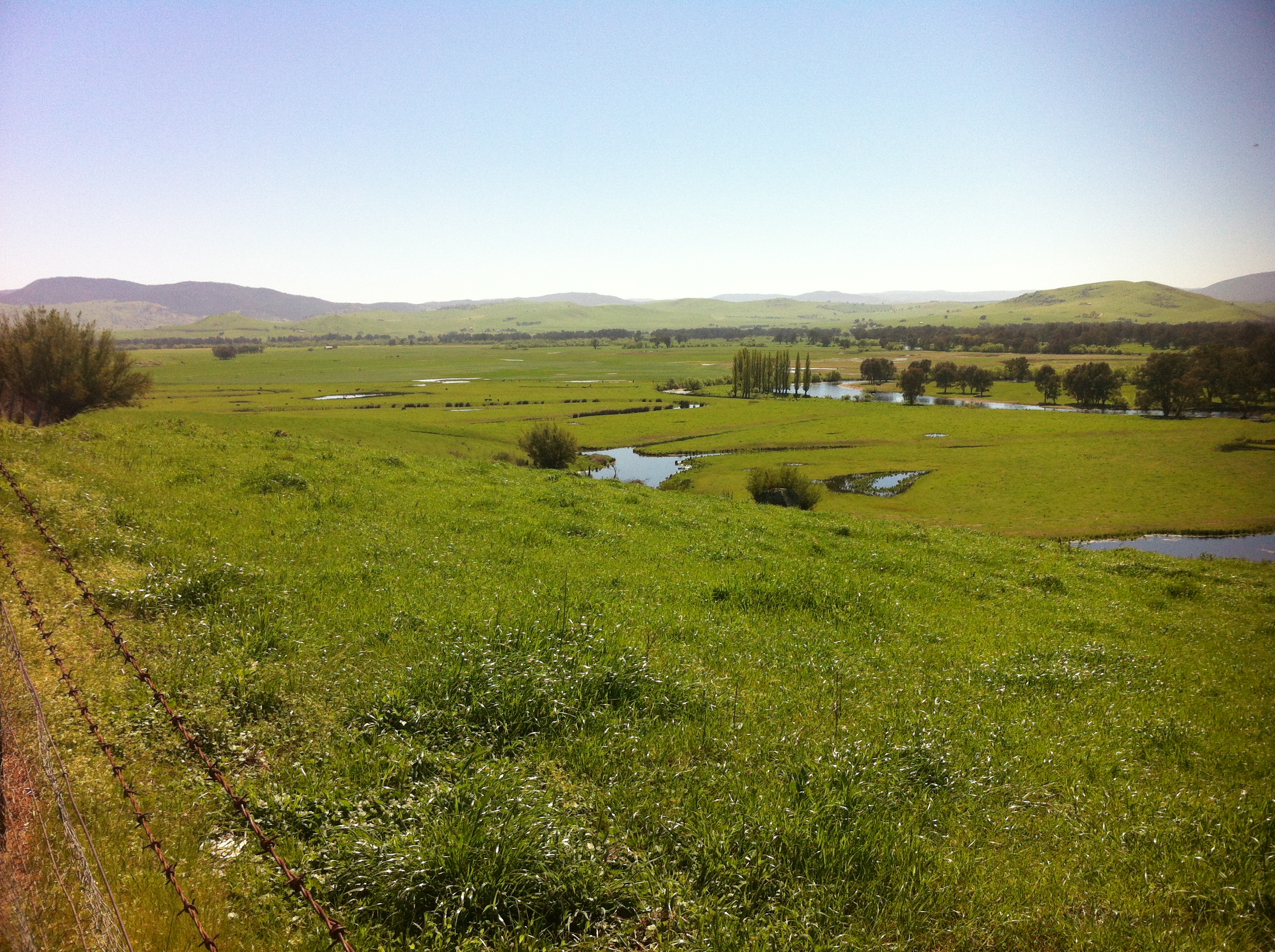
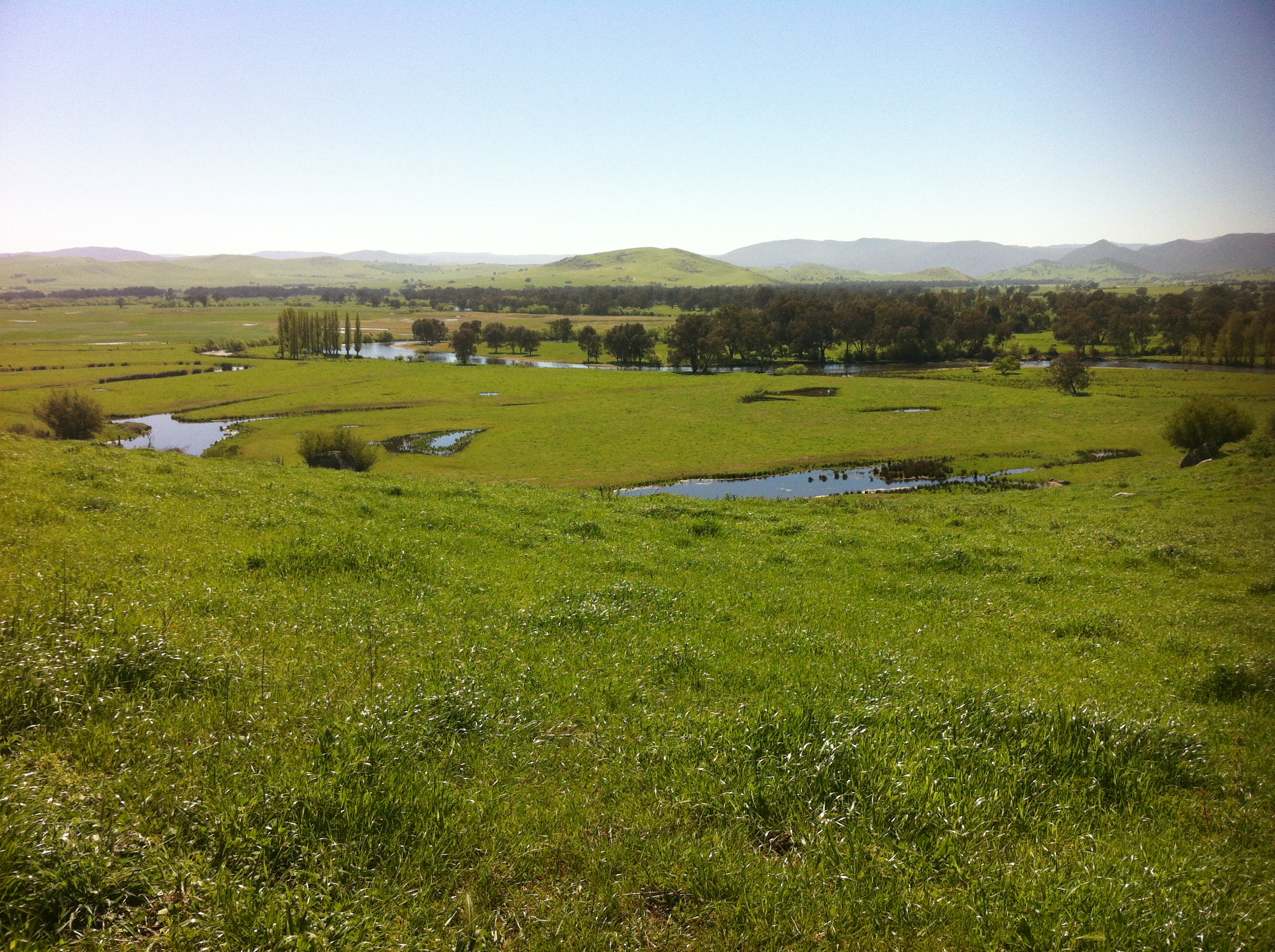
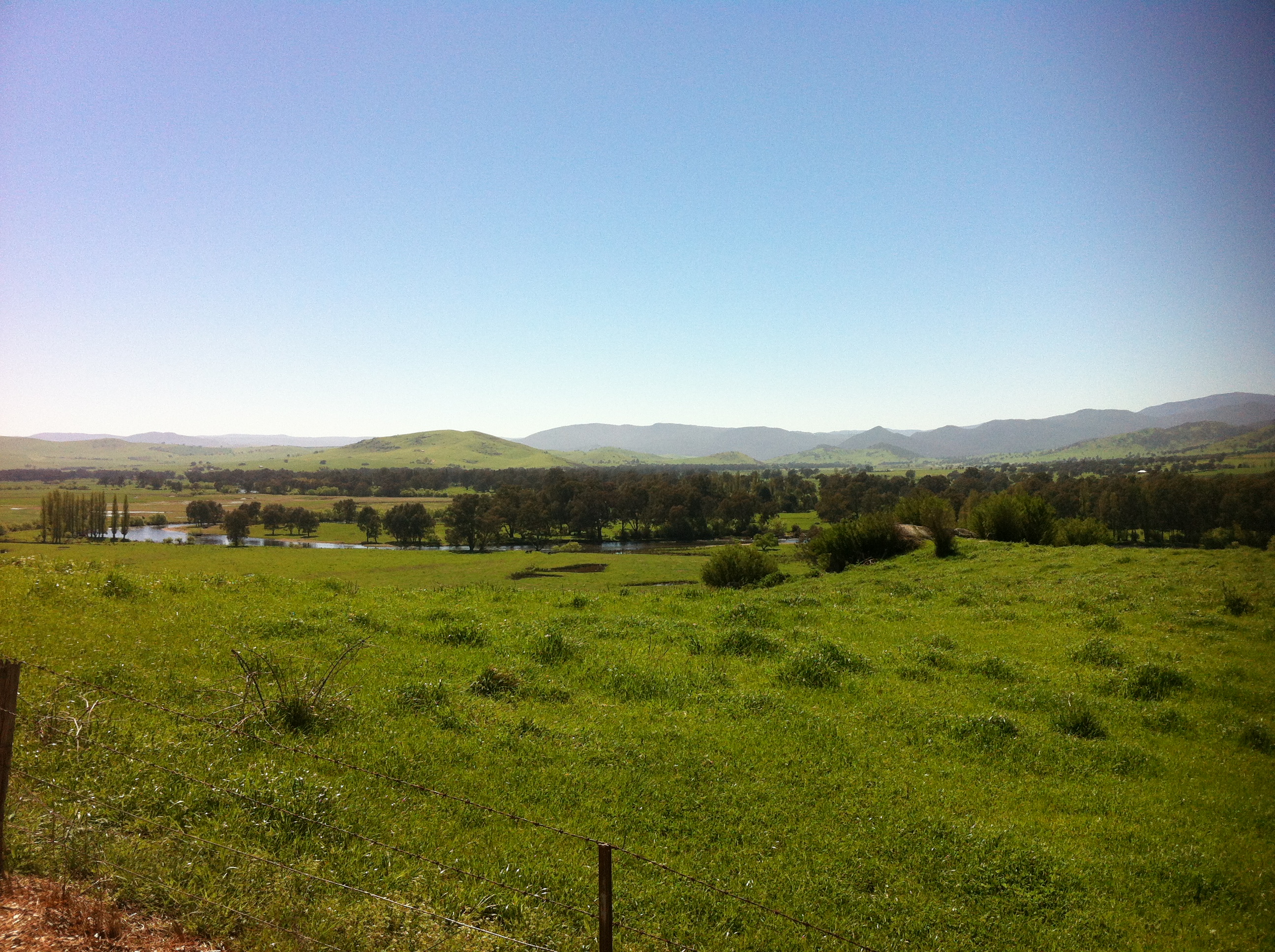
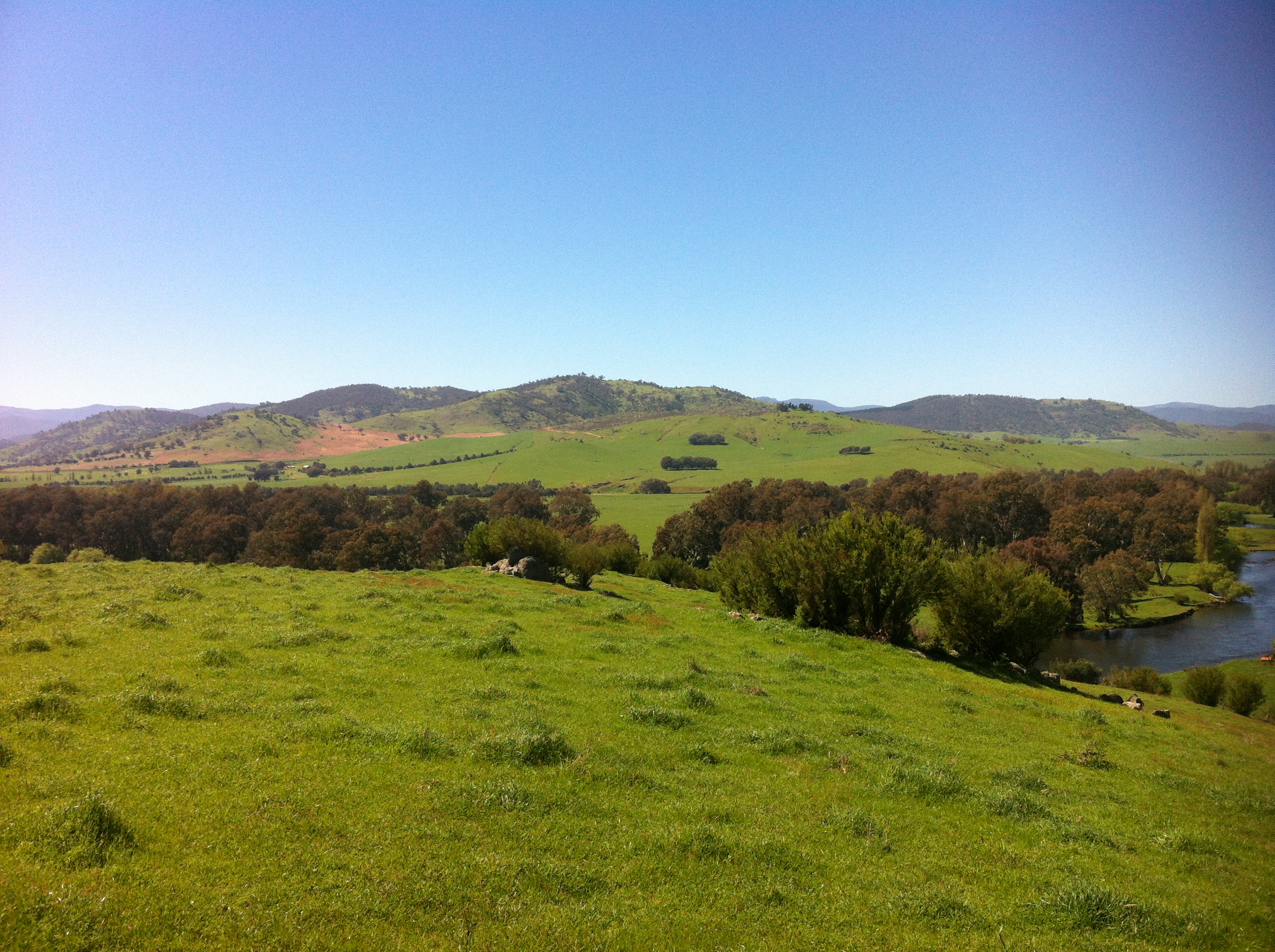
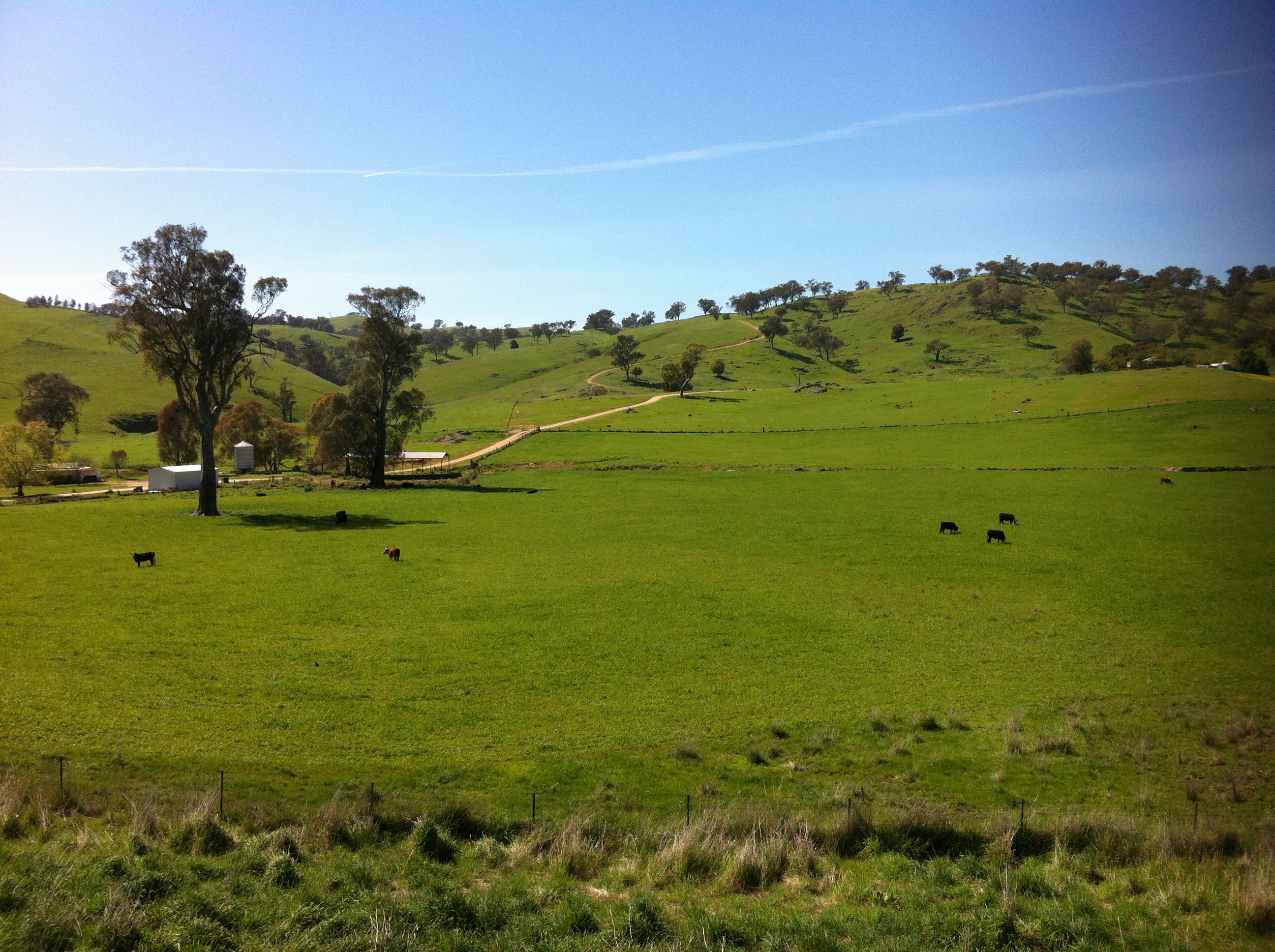
And so we found ourselves, without really planning it, in the upper reaches of the Murray River. I have to tell you, it was absolutely, absolutely lovely.  Maybe we were lucky with the season, with spring being in full swing. It certainly helped that we had clear, sunny days. Here’s a series of photos I took with my iPhone. Hopefully, they can give readers a sense of the sheer beauty of the landscape that we had wandered into.

upper murray river valley-corryong 020

upper murray river valley-corryong 019

upper murray river valley-corryong 017

upper murray river valley-corryong 016

upper murray river valley-corryong 015

You can see the Snowy Mountains in the distance, while the river in the foreground is the Murray River and the ponds are the famous billabongs which I mentioned in my first Australian post.

When I saw this landscape after our drive through the relatively dry eastern side of the Snowy Mountains and the forests of Kosciuszko National Park, I could not stop myself from thinking biblically. Up popped the Old Testament story of the Israelites who come back to Moses after exploring Canaan and exclaim, “We went into the land to which you sent us, and it does flow with milk and honey!” Milk and honey … that certainly describes the land we saw before us. William Blake’s Jerusalem also came to mind:
And did those feet in ancient time,
Walk upon England’s mountains green:
And was the holy Lamb of God,
On England’s pleasant pastures seen!

My wife’s first thought had instead a whiff of the pagan. It reminded her, she said, of Lord of the Rings or the Hobbit.

the-hobbit-movie

Whatever the reference, it was certainly very beautiful.

After spending a night in Corryong, and getting some good advice on which road to take from a very nice lady at the local information centre (I have to say, these information centres gave us excellent service everywhere we went), we set off along a small road which hugged the Murray River. It was all very peaceful.

upper murray river valley-corryong 050

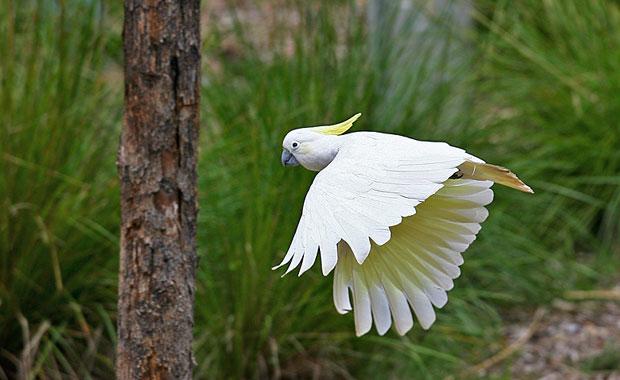
We watched a local farmer and his family herd in cows and their calves for marking, as they bellowed mightily against this corralling, and had a long chat with them about the future of farming. We watched Australian white ibises, which we had last seen in Sydney as scavengers, fly regally over our heads, while sulphur-crested cockatoos crossed our path with a slow and sensuous flap of their wings.

sulphur-crest-cockatoo

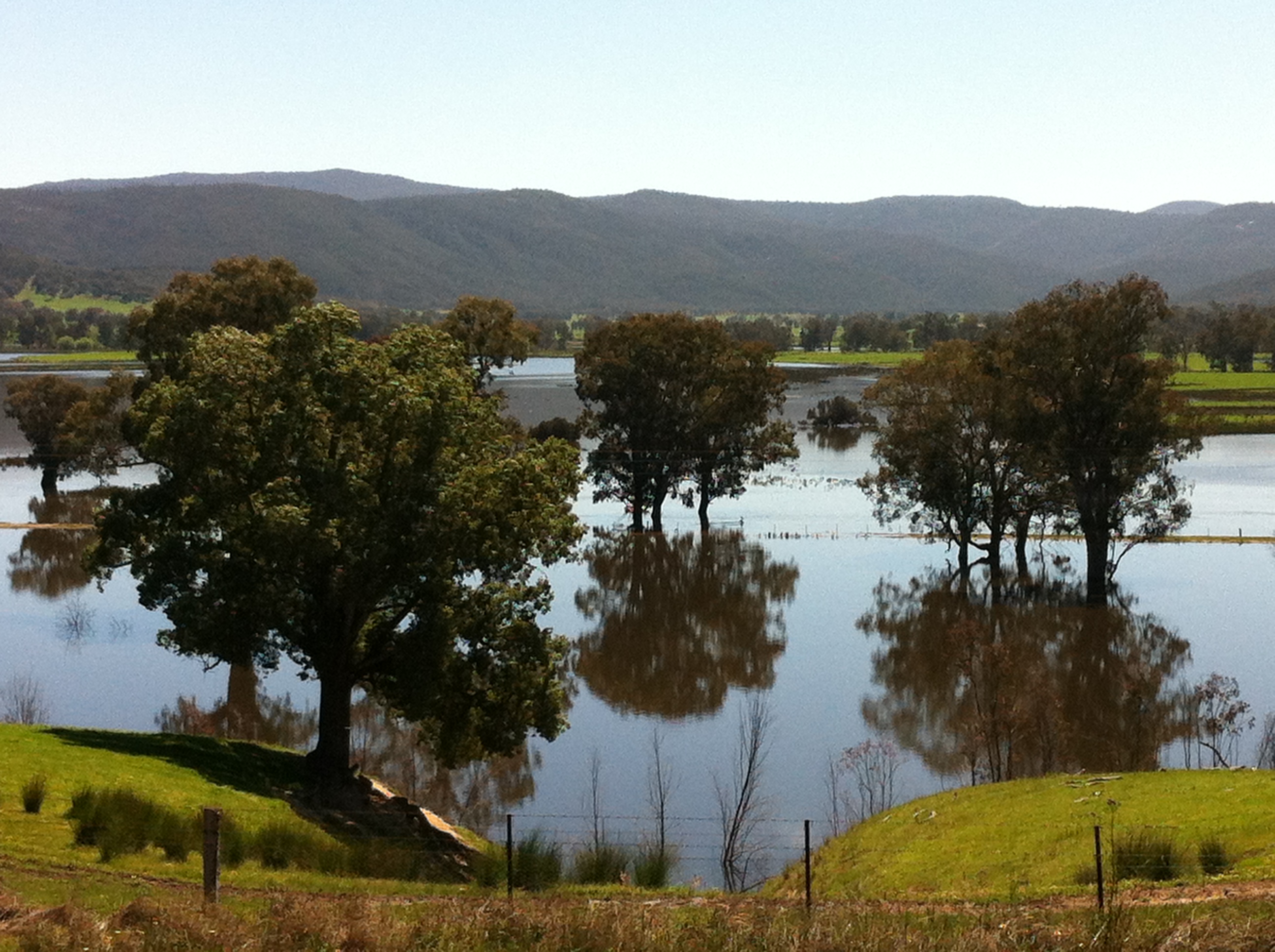
We finally reached Lake Hume. At first, it was the drowned trees which struck us

upper murray river valley-corryong 021

then it was the pelicans, which were swimming among the trees

upper murray river valley-corryong 024

The last time I had seen pelicans was as a child in St. James’s park

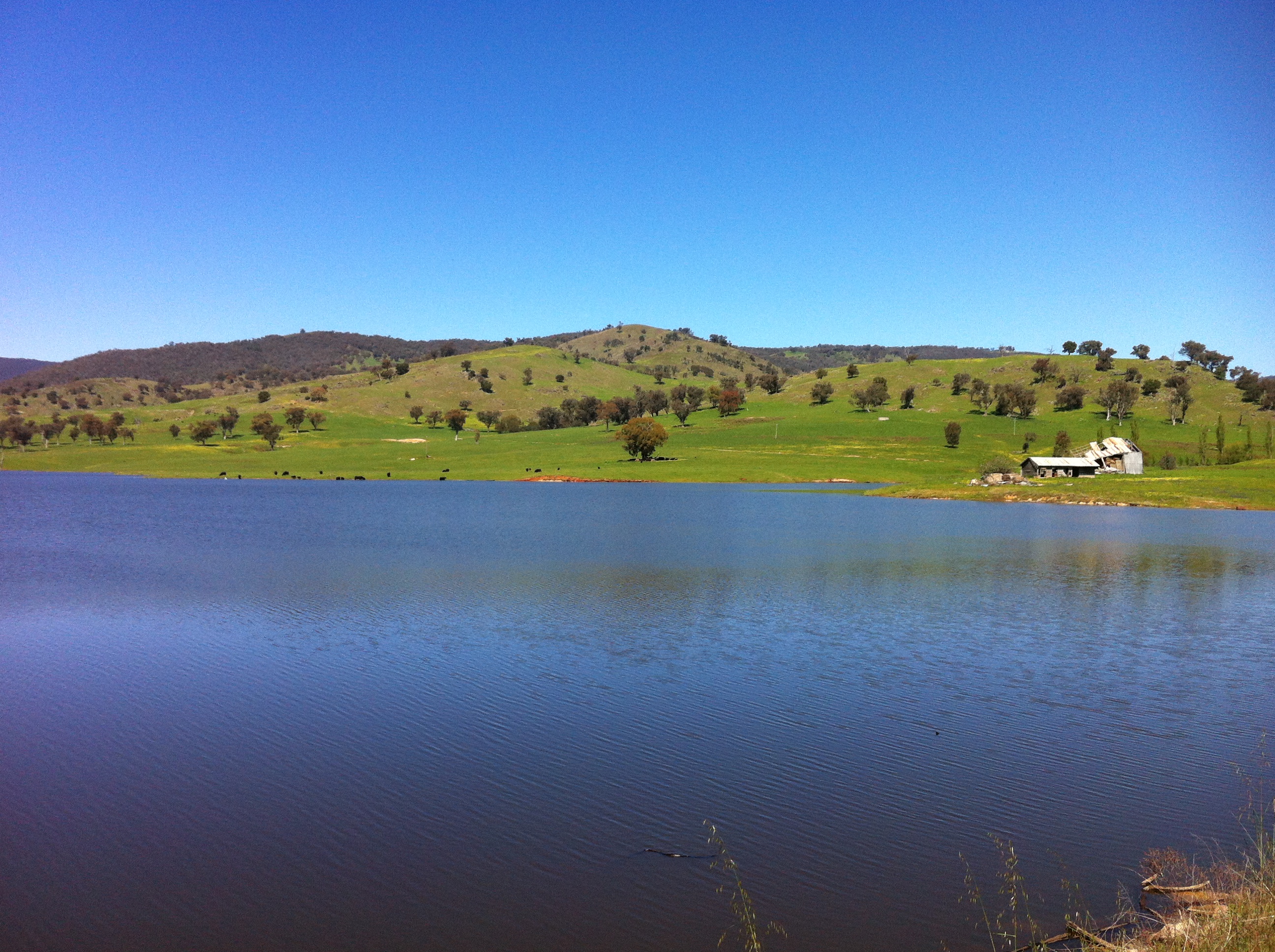
Then the lake broadened out.

upper murray river valley-corryong 036

We followed the lakeshore until Albury. Thereafter, the landscape got drier, flatter and less interesting so I’ll skip the final day.

Finally, it was time to drive back to Sydney. We decided to pass through Corryong again; we had liked it so much. We had one last vision of wondrous drifts of wildflowers in the fields

upper murray river valley-corryong 038

upper murray river valley-corryong 051

before we headed up through Tumbarumba and Tumut to the Hume Highway. Next stop, Sydney Airport and then Beijing. Sigh!

_____________________________

Hobbit: http://www.digitaltrends.com/wp-content/uploads/2013/02/the-hobbit-movie-48-fps.jpg
Sulphur-crested cockatoo: http://www.zoo.org.au/sites/default/files/styles/zv_carousel_large/public/sulphur-crest-cockatoo-animal-profile-web620.jpg?itok=dXPfOmk5
all other photos: mine

DIGGING

Beijing, 31 August 2013

Between my finger and my thumb
The squat pen rests; snug as a gun.

Under my window, a clean rasping sound
When the spade sinks into gravelly ground:
My father, digging. I look down

Till his straining rump among the flowerbeds
Bends low, comes up twenty years away
Stooping in rhythm through potato drills
Where he was digging.

The coarse boot nestled on the lug, the shaft
Against the inside knee was levered firmly.
He rooted out tall tops, buried the bright edge deep
To scatter new potatoes that we picked,
Loving their cool hardness in our hands.

By God, the old man could handle a spade.
Just like his old man.

My grandfather cut more turf in a day
Than any other man on Toner’s bog.
Once I carried him milk in a bottle
Corked sloppily with paper. He straightened up
To drink it, then fell to right away
Nicking and slicing neatly, heaving sods
Over his shoulder, going down and down
For the good turf. Digging.

The cold smell of potato mould, the squelch and slap
Of soggy peat, the curt cuts of an edge
Through living roots awaken in my head.
But I’ve no spade to follow men like them.

Between my finger and my thumb
The squat pen rests.
I’ll dig with it.

Seamus Heaney, Irish poet, Nobel Laureate for Literature, died 30 August 2013.

DRAGONFLY SWARMS

Beijing, 14 August 2013

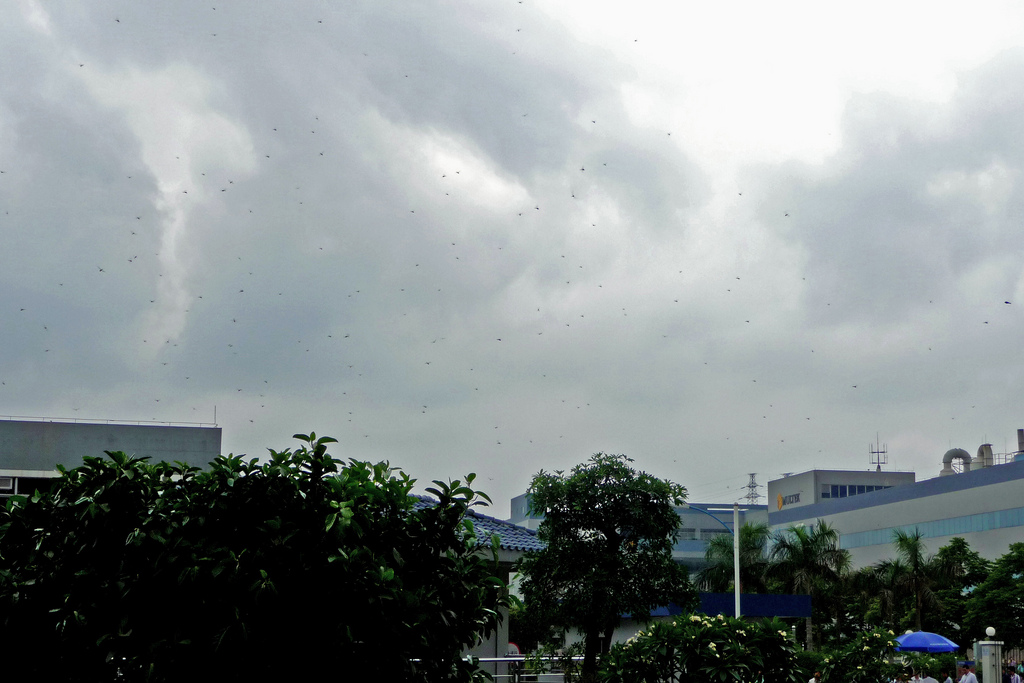
As we swelter in the heat and humidity of a Beijing August, my wife and I have noticed over the last week or so a singular natural phenomenon: the appearance of swarms of dragonflies. They are particularly thick around my piece of canal, which I suppose is not surprising since their larvae are aquatic. Neither my wife nor I have ever seen dragonfly swarms in Europe, so we are fascinated by this phenomenon. I tried taking photos with my iPhone but it was a miserable failure. My wife looked at the photos and said, “Sorry, where are the dragonflies?” The swarms are invisible. So I’ve borrowed a few photos taken by people who clearly knew how to go about it (even then, in the first one you really have to look hard to see the dragonflies).

swarm of dragonflies-4

swarm of dragonflies-1

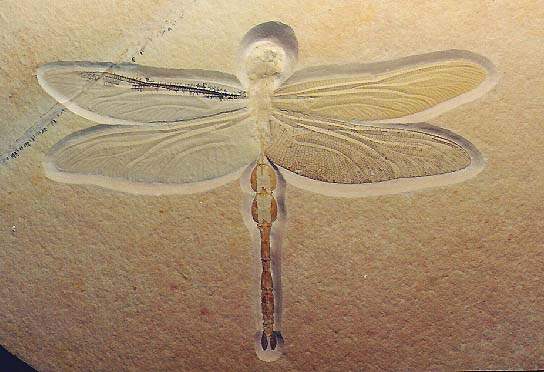
I like dragonflies. They look so awkwardly designed, the kind of thing a kid would put together with a meccano set (does anyone under the age of 50 know what that is?): a bumbling insect, with a big head attached to a thin, thin body, the whole pushed around by those funny double wings. But let me tell you, they are survivors! They’ve been around for 300 million years or so. And the design must be pretty good, because it hasn’t changed much over those millions of years. Look at these fossil dragonflies.

dragonfly fossil-1

dragonfly fossil-2

With a bit of luck, they will still be around when we’ve disappeared off the face of the earth.

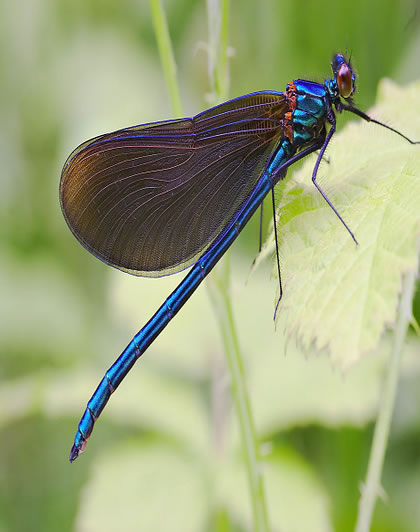
I suppose the number of species is also a good indicator of success, and here dragonflies also do pretty well: some 6,000 different species, from every continent (except the Antarctic, of course). The species we are seeing here don’t look anything special, but take a look at these photos. There are some really lovely specimens.

beautiful dragonfly-1

beautiful dragonfly-2

beautiful dragonfly-3

I can’t resist throwing in some close-ups

dragonfly closeup-2

Look at those eyes!

dragonfly closeup-1

My English grandfather, who was a scientist and an expert on high-powered microscopes, took beautiful black and white photographs of insects. I found them by chance in a shoe box in my grandmother’s house. I asked to have them. I took them to school. Somewhere along the line, I lost them – all those changes of addresses …

I’m glad to report that a Serious English Poet (whose poems were included in the magisterial Oxford Book of English Verse, no less) also liked dragonflies. Walter Savage Landor wrote this poem some time in the late 1700’s when a dragonfly landed on the page of his book:

Life (priest and poet say) is but a dream;
I wish no happier one than to be laid
Beneath a cool syringa’s scented shade,
Or wavy willow, by the running stream,
Brimful of moral, where the dragon-fly,
Wanders as careless and content as I.
Thanks for this fancy, insect king,
Of purple crest and filmy wing,
Who with indifference givest up
The water-lily’s golden cup,
To come again and overlook
What I am writing in my book.
Believe me, most who read the line
Will read with hornier eyes than thine;
And yet their souls shall live for ever,
And thine drop dead into the river!
God pardon them, O insect king,
Who fancy so unjust a thing!

Well, I can’t argue with the Poet’s point. Either all living things have souls or none do.

There’s one thing, though, in all this that worries me. It is said that dragonfly swarms prefigure earthquakes. In fact, there is a Chinese film, Aftershock, which starts in late July 1967 with swarms of dragonflies and segues into the destruction of the city of Tangshan. A magnitude 7.8 earthquake. A quarter of a million deaths. So I keep looking around me nervously, waiting for things to start shaking.

_____________________

Swarm of dragonflies-1: http://www.flickr.com/photos/dcmaster/3534906552/sizes/l/in/photostream/
Swarm of dragonflies-2: http://2.bp.blogspot.com/_bto9jE_yKYY/TNn-8Eg-EuI/AAAAAAAAAY0/cWleFwXL82I/s320/100903-dragonflies.jpg
Dragonfly fossil-1: http://www.bernstein.naturkundemuseum-bw.de/odonata/isophleb.htm
Dragonfly fossil-2: http://www.bernstein.naturkundemuseum-bw.de/odonata/cymato.jpg
Beautiful dragonfly-1: http://www.dragonfly-site.com/graphics/pictures-17.jpg
Beautiful dragonfly-2: http://www.dragonfly-site.com/graphics/pictures-18.jpg
Beautiful dragonfly-3: http://rateeveryanimal.com/wp-content/uploads/2013/07/Dragonfly-pink.jpg
Dragonfly closeup-1: http://jcgator1.files.wordpress.com/2012/08/dragonfly-stare.jpg
Dragonfly closeup-2: http://img.over-blog-kiwi.com/0/01/15/99/201211/ob_cdf5ef5226bf6ca6c7789ee543e3da5e_image-0.jpg