MY SPIRIT HOUSE

Bangkok, 15 February, 2015

Anyone who has been in Thailand for more than half an hour begins to notice that every building, residential, commercial, governmental, whatever it happens to be, has one or more doll-like houses standing outside it in some corner of the property. To be very visible to one and all, they are set either on a tall pillar or on four somewhat smaller stilts. These, for instance, are the two which grace a corner of the parking lot at our apartment block.
spirit houses-general view-1
spirit house big

spirit house small

And if, finally rendered curious by constantly coming across them, one decides to have a closer look, you will find that they hold little figurines – old people, dancers, horses, elephants, cars, sometimes a Buddha. This, for instance, is a catalogue of what the bigger of our apartment block’s two little houses contains.

spirit house big-horses
spirit house big-elephants
They will often have votive offerings of food and drink as well as burning incense sticks set out in front of them along with fresh flowers

spirit houses-flowers and incense

many of them will have flower garlands draped over them
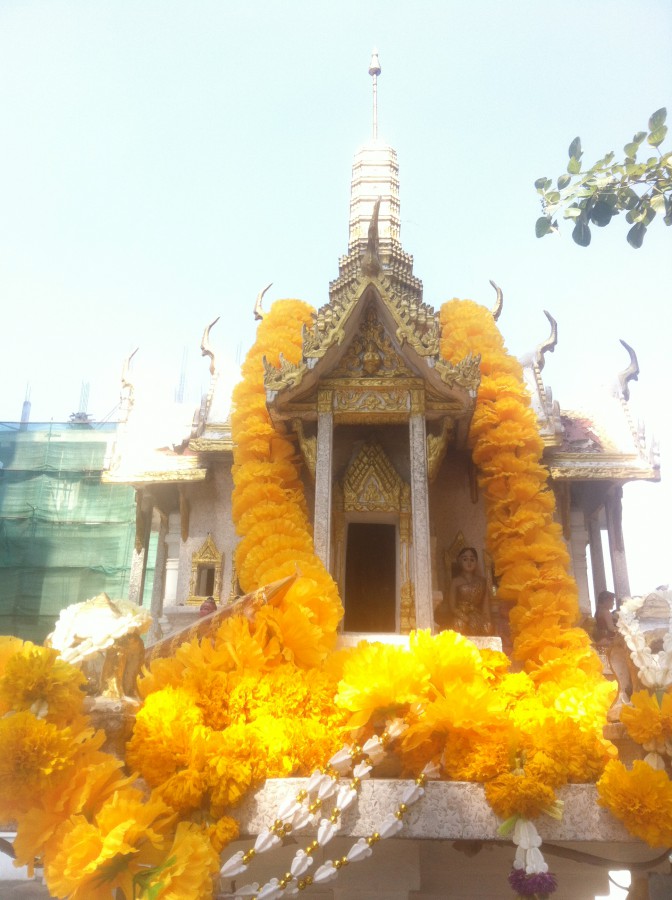
spirit house big-garland

and – at night – candles are set out or strings of lights turned on to light them up.

spirit house big-night

Quite charming. In fact, when my wife and I came to Bangkok for the first time some seven years ago, we were quite taken by these little houses and considered buying a DIY kit of one, to put up on the landing in front of the door of our then-apartment in Vienna, to house a small ivory Buddha which I had bought a few years before in Sri Lanka. But it was really too bulky, so we abandoned the idea.

But actually, why are these little houses there in the first place? I should have asked myself that the first time I saw them, before seriously considering putting one in front of my door.

A little bit of reading has informed me these houses are put up to propitiate the spirits of the land. This is a core belief of animism, that spirits reside in all the material manifestations of this world – the land, its streams, rivers, lakes, waterfalls, its trees and other plants, all animals, everything really, even man-made objects like bridges. Animism has deep, deep roots in Thailand – actually, in the whole of South-East Asia, from Myanmar down to Indonesia and across to the Philippines; the tradition of spirit houses, for instance, is found throughout the region apart possibly from the Philippines. The arrival of more rational, complex, sophisticated religions like Hinduism, Buddhism, Islam, or Christianity (or ethical systems like Confucianism in Vietnam), did not make the earlier animistic beliefs disappear, although I’m sure the leaders of these new religions tried hard to stamp them out (and at least in Thailand are still trying to, according to what I’ve read) or to absorb them (which is certainly what Buddhism has tried to do).

The sad thing is that these spirits are not nice beings. The purpose of those cute little houses is actually to make sure that the spirits of the land don’t get mad at you because you’re using their land and decide to burn down your house or give you a heart attack or bring Lord knows what other calamity down on your head. So in the house you’ll put figurines of servants to tend to the local land spirit’s every whim,  you’ll put figurines of dancing girls (geishas might be a better descriptor) to keep him happy, you’ll put horses and elephants (and cars for the more sophisticated urbanized spirits) to make sure he can go for a ride whenever he gets bored of sitting at home and watching the dancing girls gyrate, you’ll give him food and drink to make sure he doesn’t go hungry … Reading all this, it occurs to me that these spirits are really just like the mafia in Sicily: if you don’t pay this man the requested pizzo, or protection money
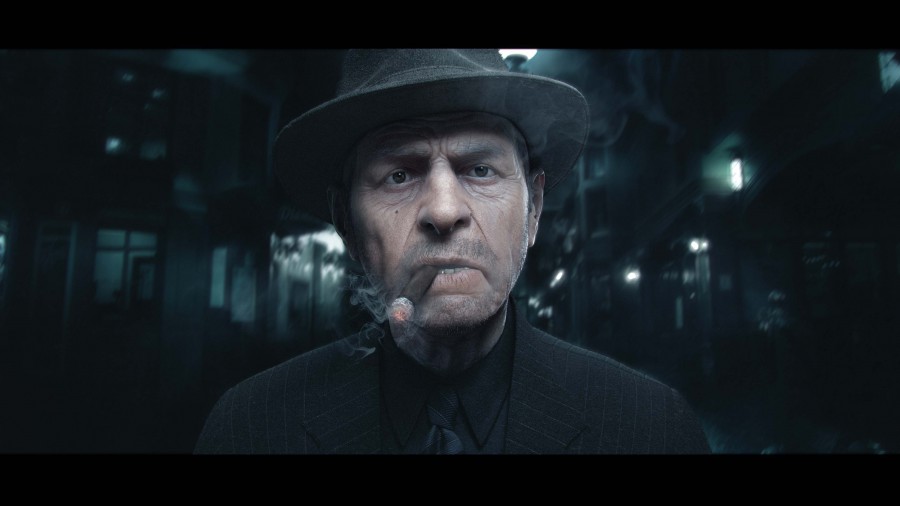
mafia-man

then unfortunately this will happen to your shop.
burning shop
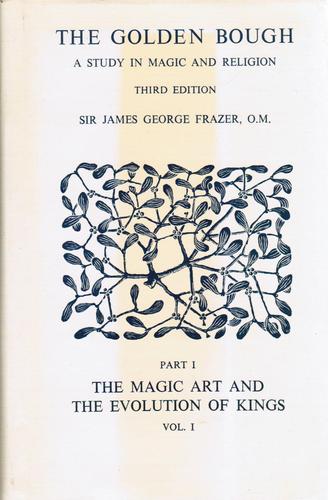
So, these pretty little houses are actually the reflection of a deep existential fear, that all around you are naughty, nasty little spirits who will hurt you if you’re not nice to them. These reflections moved me to dip into “The Golden Bough: A Study in Magic and Religion” by the Scotsman James George Frazer.
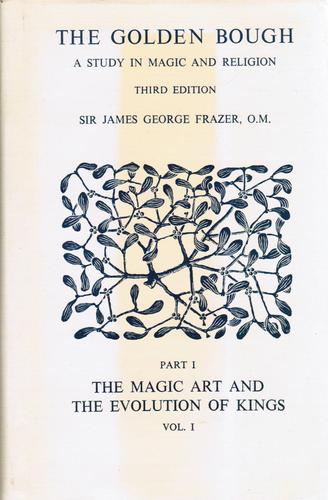
Golden_Bough
The book, first published in 1890 and republished several times thereafter, attempts to define the shared elements of religious beliefs, discussing fertility rites, human sacrifice, the “dying god”, the “scapegoat”, and many other symbols and practices. Its thesis is that old religions were fertility cults that revolved around the worship and periodic sacrifice of a sacred king (among other places, his ideas take a central role in T.S. Elliot’s poem, “The Wasteland”, which I have had cause to mention 100 posts ago and which was the reason why I originally read “The Golden Bough”). I’m sure modern anthropologists would dispute Frazer’s basic thesis, but in writing the book Frazer collected accounts from around the world of magical, animistic beliefs, which are fascinating in themselves. Here are three excerpts which he cites from other sources on the belief in spirits in South-East Asia.

“Thus the life of the Thay seems regulated down to its smallest details by custom founded on his belief in the spirits. Spirits perpetually watch him, ready to punish for his negligences, and he is afraid. Fear is for him not only the beginning of wisdom, it is the whole of his wisdom. Love has only a very moderate place in it. Even the respect in which he holds his dead, and the honours which he pays them on various occasions, seem to be dominated by a superstitious fear. It seems that the sacrifices which he offers to them aim rather at averting from himself the evils which he dreads than at honouring worthily the memory of his deceased kinsfolk and at paying them the tribute of his affection and gratitude.”

“Independently of the demons who are in hell, the Siamese recognize another sort of devils diffused in the air: they call them phi; they are, they say, the demons who do harm to men and who appear sometimes in horrible shapes. They put down to these malign spirits all the calamities which happen in this world. If the mother has lost a child, it is the phi who has done the ill turn; if a sick man is given over, it is a phi that is at the bottom of it. To appease him, they invoke him and make him offerings which they hang in desert places.”

“The desire to propitiate the good spirits and exorcise the bad ones is the prevailing influence upon the life of the Laotians. With phis to the right of him, to the left of him, in front of him, behind him, all round him, his mind is haunted with a perpetual desire to make terms with them, and to ensure the assistance of the great Buddha, so that he may preserve both body and soul from the hands of the spirit.”

The first two excerpts, written in 1907 and 1831 respectively, come from books written by French missionaries, the third from a book written by an Englishman in 1884. The first two no doubt had religious axes to grind, wishing to show how the Thai (Siamese being the old name for the Thai) were poor, benighted folk in need of Christian redemption. But even accounting for a certain amount of exaggeration, the picture which these excerpts paint is bleak indeed: a constant, haunting fear at every step.

Of course, before we shake our heads and smile and take another sip of our coffee, we should remind ourselves (as Frazer reminds us in his book) that Europe, just to take my part of the world, was also the home of naughty, nasty little spirits. Anyone like me who had to suffer through Latin and Greek in their education will remember the Roman and Greek nymphs who haunted the sacred groves and streams, and who had to be propitiated. And what about all those leprechauns, and trolls, and sprites, and ogres, who populate children’s books and popular stories? Remember Rumplestiltskin, that nasty little imp who saves the miller’s daughter from the wrath of the king by spinning straw into gold for her, but on condition that she give him her first-born child?
rumplestiltskin
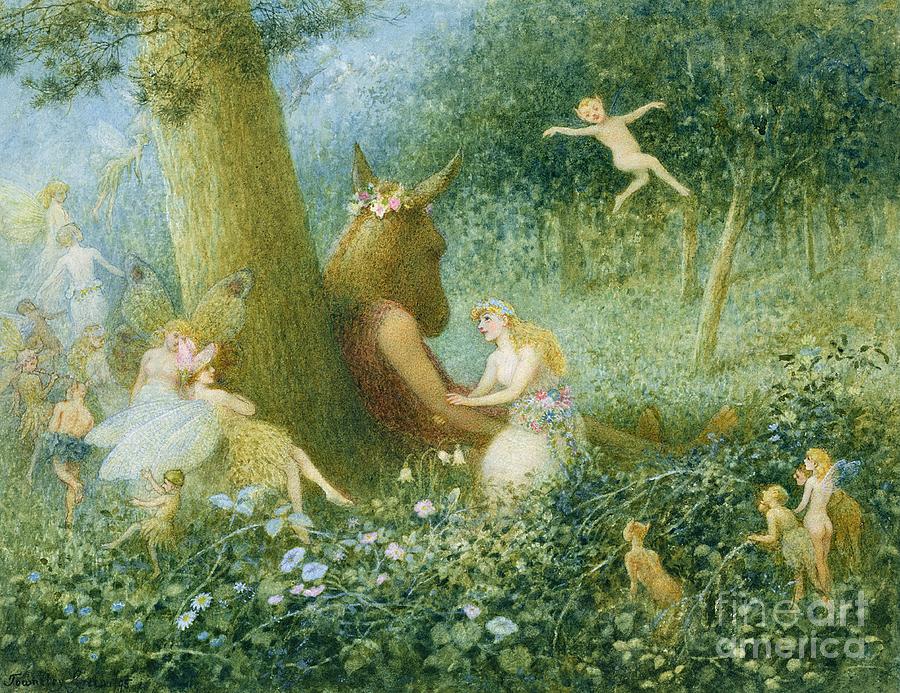
Or that “shrewd and knavish sprite” Puck in Shakespeare’s “A Midsummer Night’s Dream”, who at the behest of his master Oberon, King of the fairies, wreaks mayhem in the Athenian woods?
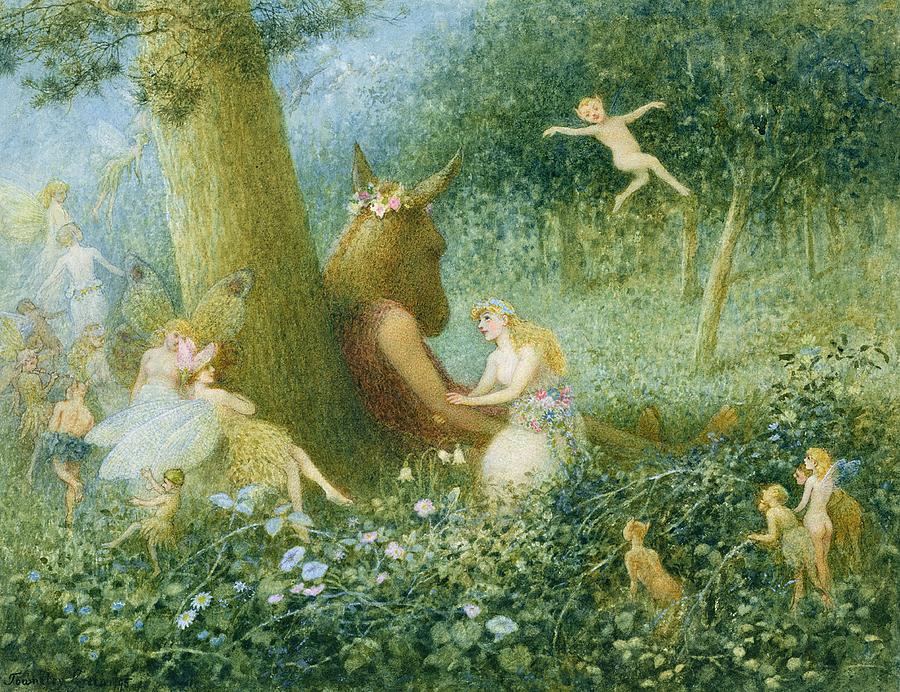
puck

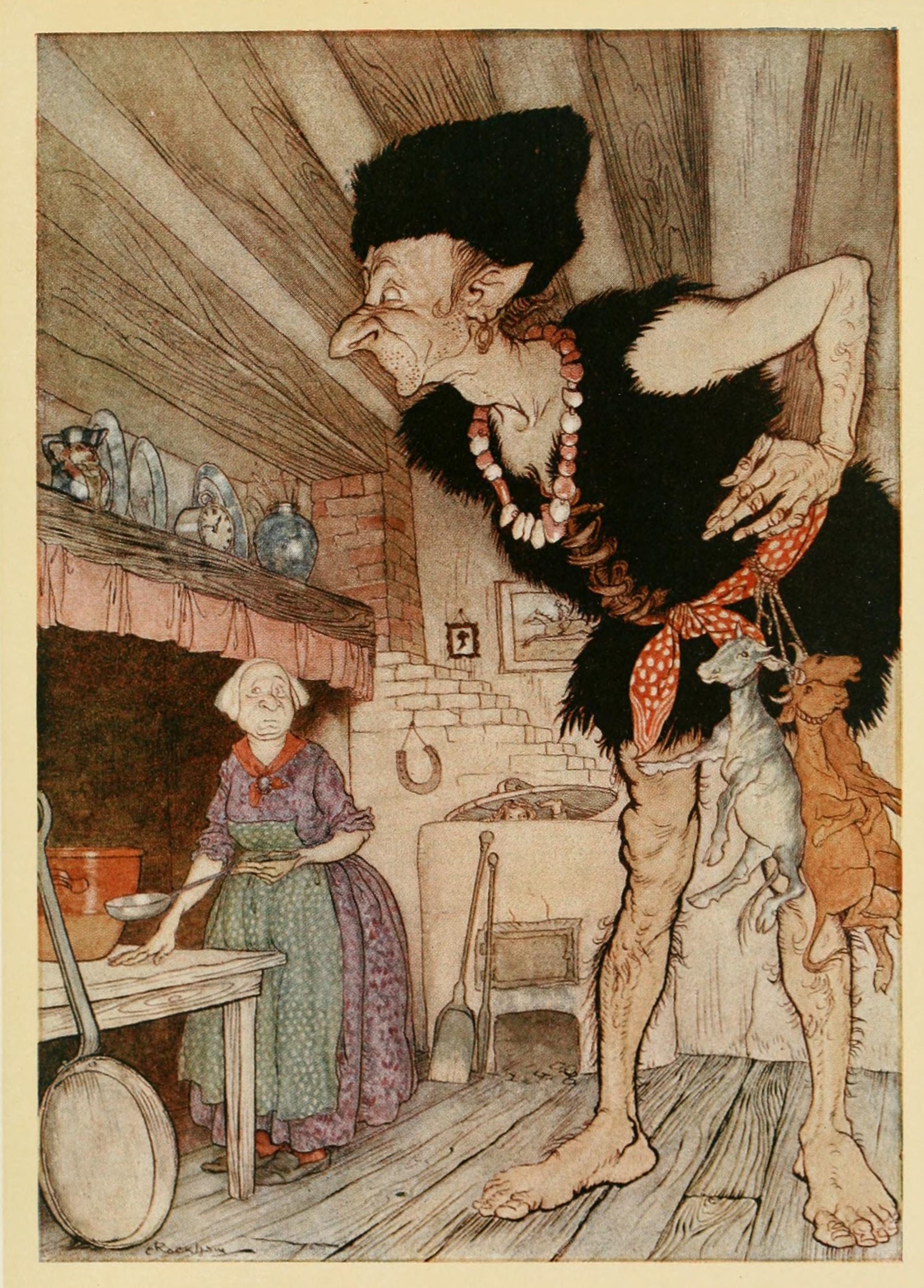
Or the ogre in Jack and the Beanstalk, who on sensing that little Jack is hiding in his house, intones

“Fee-fi-fo-fum!
I smell the blood of an Englishman,
Be he alive, or be he dead,
I’ll grind his bones to make my bread.”
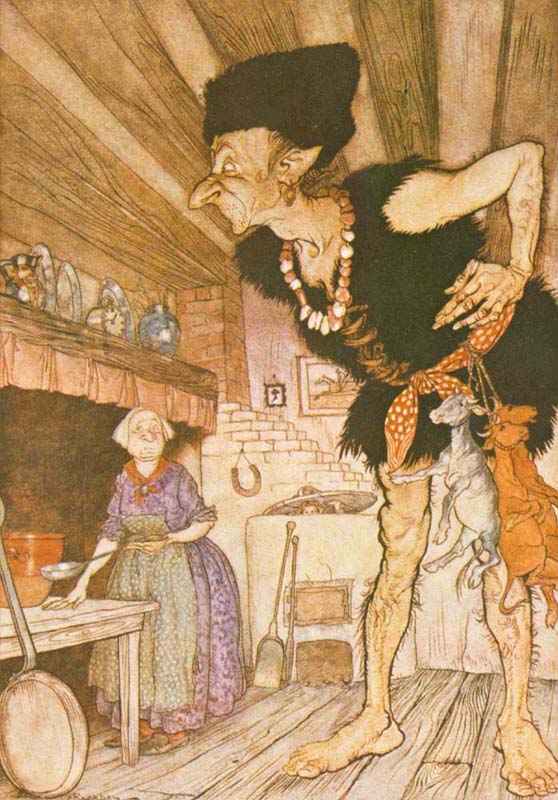
ogre jack and the beanstalk

Even Tinkerbell in Disney’s sucrose version of “Peter Pan” is not a particularly nice person.

tinkerbell
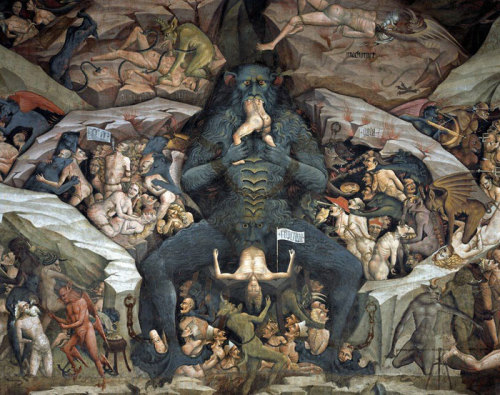
I suppose Christianity managed to reduce the strength of animistic beliefs in Europe – I won’t say stamp out, because otherwise we wouldn’t have the children’s stories – but only to replace them by another existential fear, that of suffering in hell for ever and ever.
hell
Luckily, science has come to the rescue and driven out all the religious claptrap. There is no supernatural world, it tells us, only the natural world around us. And with that, all those spirits disappear in a flash.

But now that I know all this, would I still buy a spirit house kit to assemble on the landing in front of my apartment door in Europe? Do I want to be seen, if only to myself, to believe in naughty, nasty spirits? After giving some thought to the matter, I have concluded that yes, I would, but for a very different reason. One of the houses whose photo I give at the beginning of the post is the house of the ancestral spirits of the place, the spirits – or ghosts I suppose – of the people who lived there before you. In fact this house contains figurines of old people.
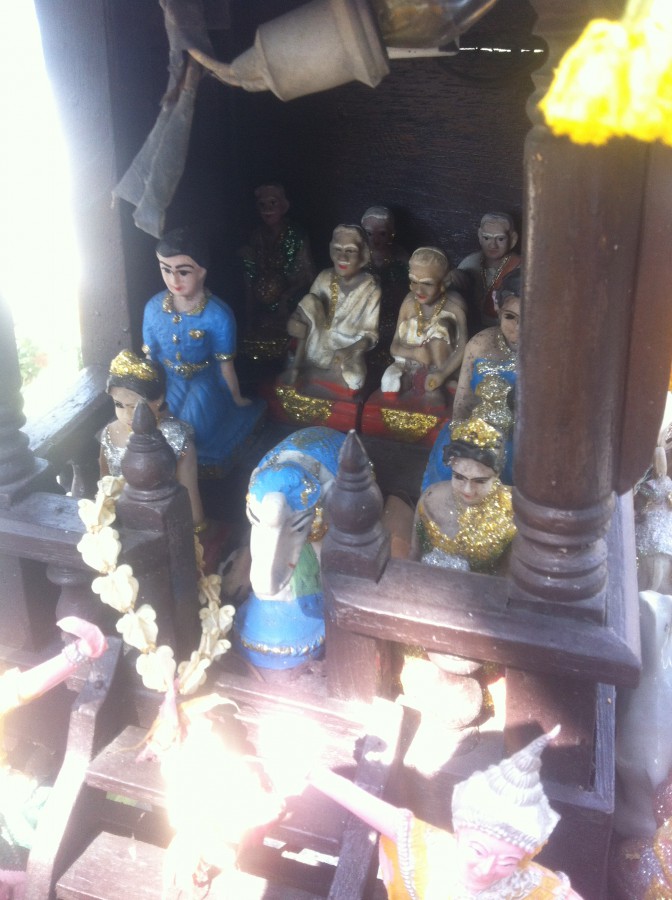
spirit house small-old people
Unfortunately, these spirits also require propitiation in Thailand, since they too can turn nasty (jeez louise, what a world view!). But I would use the house differently. I would use it to house the memory of my parents and my wife’s parents. For my parents, I would have a very tall figurine stand in for my father and a very small figurine for my mother, for that indeed is how they were; one of my abiding memories of them is the two dancing together, he very tall, she very small, slowly circling the dance floor. For my wife’s parents, I would have a large figurine stand in for my mother-in-law, for she was indeed of a stout disposition. For my father-in-law, I’m not sure, I hardly knew him. I’ve mentioned before his fondness for wearing a Basque beret, so perhaps a figurine of a man with such a beret would do? But I would leave this for my wife to decide. And I would move the house into the apartment, so that their memory could be with us, rather than left out in the dark like the dog. I feel that this would be a better way of remembering them, of keeping their memory alive, than going on infrequent visits to the graveyard, and a useful complement to looking at old photos and reminiscing. And I would hope that one day my children would also have a spirit house to which they could add little figurines of us once that day arrives. As it surely will.

____________________

Spirit houses: my pictures
Mafia man: https://solo3d.files.wordpress.com/2012/09/mafia-man-by-siamak-roshani-1.jpg (in https://solo3d.wordpress.com/scenes/portraits/mafia-man/)
Burning shop: http://www.newsbiscuit.com/images/845.jpg (in http://www.newsbiscuit.com/2007/09/05/fire-brigade-turned-up-late-to-burning-pizza-shop-as-satirical-statement/)
“The Golden Bough” cover: http://3.bp.blogspot.com/-KNKUm2qVFeo/URmCSeqWMuI/AAAAAAAAMKQ/YNPwXF5oY7s/s1600/The_Golden_Bough.jpg (in http://38is.blogspot.com/2013_02_01_archive.html)
Rumplestitskin: http://www.artsycraftsy.com/goble/wg_rumplestiltskin.jpg (in http://www.artsycraftsy.com/goble/goble_rumplestiltskin.html)
Puck: http://images.fineartamerica.com/images-medium-large/a-midsummer-nights-dream-ht-green.jpg (in http://fineartamerica.com/featured/a-midsummer-nights-dream-ht-green.html)
Ogre in Jack and the Beanstalk: http://upload.wikimedia.org/wikipedia/commons/4/4c/Jack_and_the_Beanstalk_Giant_-_Project_Gutenberg_eText_17034.jpg (in http://en.wikipedia.org/wiki/Jack_and_the_Beanstalk)
Tinkerbell: http://cdn.hellogiggles.com/wp-content/uploads/2015/01/22/Walt-Disney-Screencaps-Peter-Pan-Wendy-Darling-Tinker-Bell-walt-disney-characters-34385876-4326-3237.jpg (in http://hellogiggles.com/real-life-disney-romance/walt-disney-screencaps-peter-pan-wendy-darling-tinker-bell-walt-disney-characters-34385876-4326-3237)
Hell: https://36.media.tumblr.com/20721aba85e8475adb529816d4e40a10/tumblr_n1kmegRkqx1qm5yeno1_500.jpg (in https://www.tumblr.com/search/art%20history%20hell)

COLOURING POLITICS

Bangkok, 9 December 2014

We have just finished celebrating H.M. the King’s birthday here in Bangkok. Truth to tell, “celebrating” may be a little of an overstatement. My wife and I found it quite a muted affair. For instance, the fireworks in the evening were really quite brief and modest, while a drive-by of high officials, which we just happened to find ourselves witnesses to, was greeted with silence by the folk lining the road side. What was out in full force, though, were the yellow shirts. They had already been popping up with greater and greater insistence in the days running up to the great day. But on the birthday itself the pavements were a sea of yellow.
image
Many were wearing yellow T-shirts made specifically for the purpose, but many others (who didn’t get included in the official photos) gave the impression of having grabbed the first yellow, or near-yellow, shirt or blouse they could find in their wardrobe. So the palette of yellows went all the way from pastel yellow through to citrine. Given the recent history of Thailand, one began to wonder if the choice of hue was a political statement of some sort. That man with the orange shirt, for instance, was it just the closest thing he had to yellow in his drawer, or was it actually the closest he dared get to the dreaded colour red? Or that woman over there with the pastel yellow blouse, had she simply been caught short without anything really yellow in her closet, or was she actually signalling her lack of enthusiasm for the whole exercise? Or what about the few people without yellow shirts? What, if anything, was their message? That student, for example, with the green shirt, what was he trying to tell us?

Thus are the seeds of paranoia sown ….

(By the way, for those of you who may be interested, the King’s colour is yellow because he was born on a Monday. Based on Hindu mythology, Thai (and Khmer) tradition assigns different colours to each day. For those of you who may be fascinated by this arcane point, I recommend you visit the following site on Wikipedia)

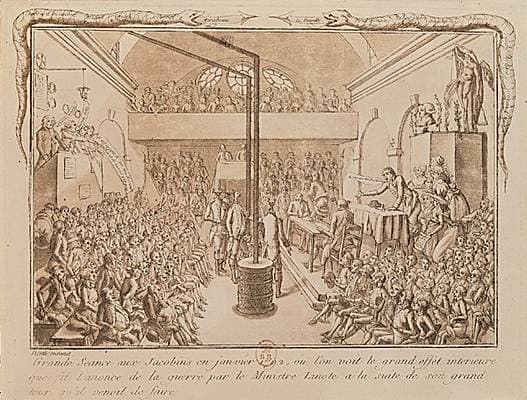
Colours have been recruited to support political quarrels since time immemorial. When I was young, red was the colour of Marxism in all its forms (Social-Democratic, Socialist, Marxist-Leninist, Maoist, Vietminh, Khmer Rouge, …). We have the French Jacobins
image
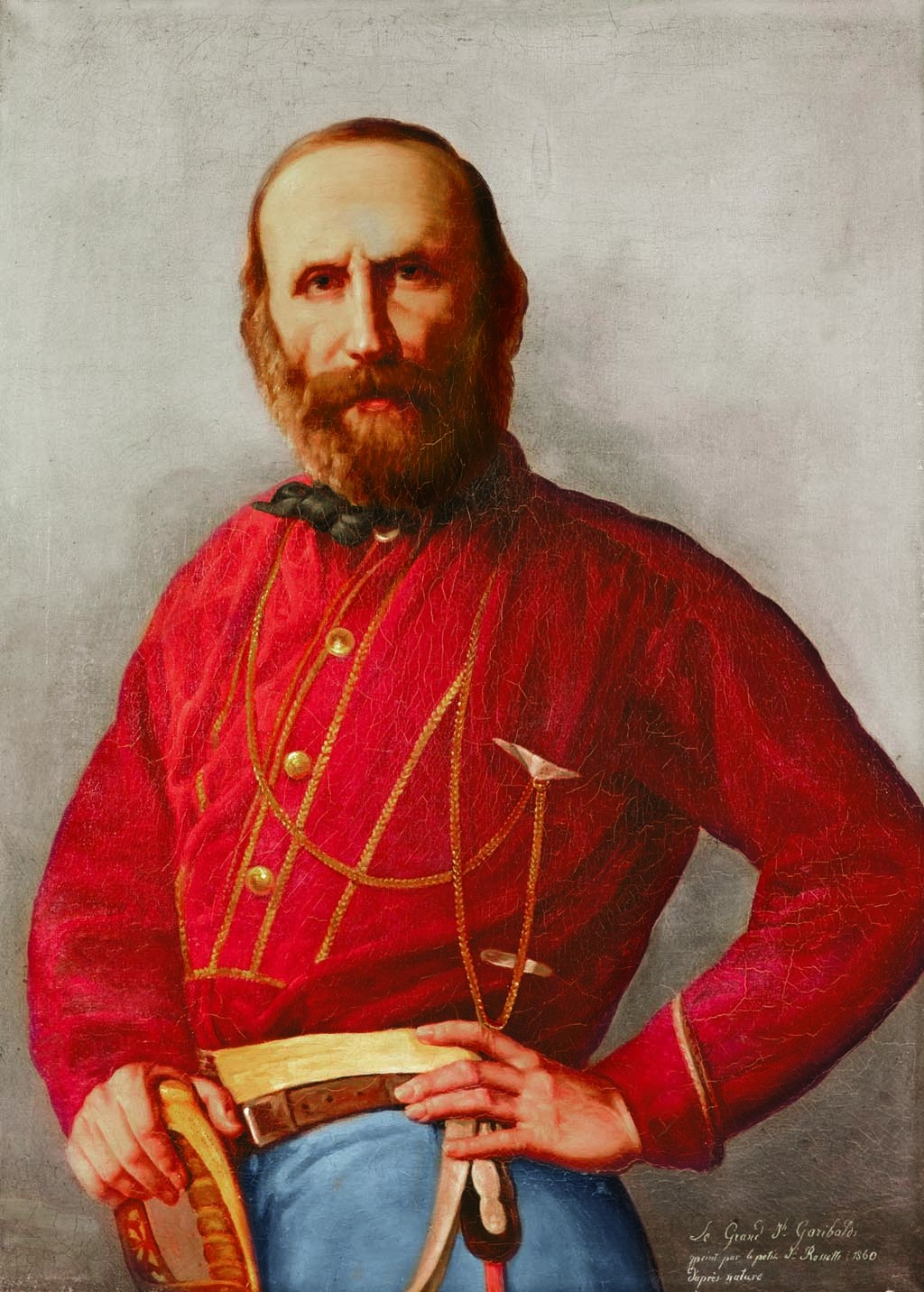
to thank for this association of red with the left of the political spectrum. For reasons which are too complicated to explain here, the Jacobins adopted the red flag as their own during the French Revolution, and the tradition continued in the European Left thereafter. I suppose we are all aware of the red symbols of the Left: the flags, the official art, the scarves, the buttons. But my preferred symbol of redness are the Garibaldini, those 1,000 or so red-shirted volunteers who, led by Giuseppe Garibaldi, sailed away in 1860 from Genoa to Sicily and in a few short months of fighting completed the unification of Italy.
image
I have to add here a painting of the Great Man himself, whose statue graces at least one square, and whose name graces at least one street, in every village, town, and city of Italy.

image

I like Garibaldi, I’ve liked him ever since as a teenager I studied the unification of Italy for my O level History. By way of introduction to Garibaldi, our teacher told us about his earlier exploits in South America. The only thing that sticks in my mind about these worthy endeavors is our teacher’s description of how Garibaldi met his wife. He was on a boat on the Río de la Plata, where he was inspecting something or other through a telescope. He noticed his future wife on the bank, washing clothes or some such. After one look at her, he said (and here the teacher put on a thick Italian accent and struck an operatic pose), “Brring me to herr!”

But back to colours and politics. In the interwar years the red of the Socialists and Communists was violently opposed by various other colours. It was the black-shirted Fascists in Italy, seen here in the March on Rome in 1922
image
and the black-shirted Fascists in Spain, seen here jubilating at the fall of Irun during the Spanish Civil War.
image
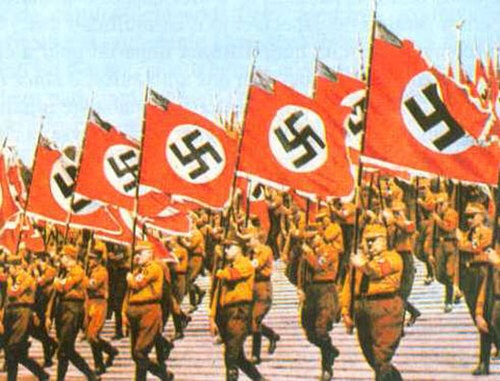
In Germany, it was the brown-shirted Nazis.
image
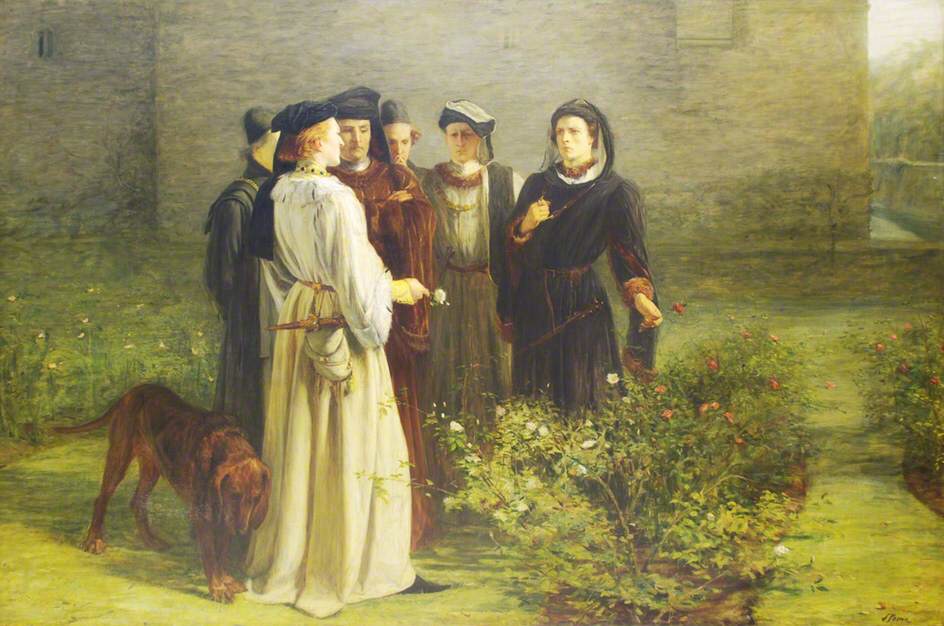
From here my memory leaves coloured shirts and vaults back some 500 years or so to the gardens at the Inner Temple in London, where – at least, according to Shakespeare in Henry VI, Part I – the Lords of Court chose which side to be on in the upcoming War of the Roses, by plucking either a white rose (the Yorkists) or a red rose (the Lancastrians) from rose bushes growing in the garden. Colours again, defining which side you would be taking in the looming political struggle. The scene is caught in this much romanticized painting from the 1870s.

image
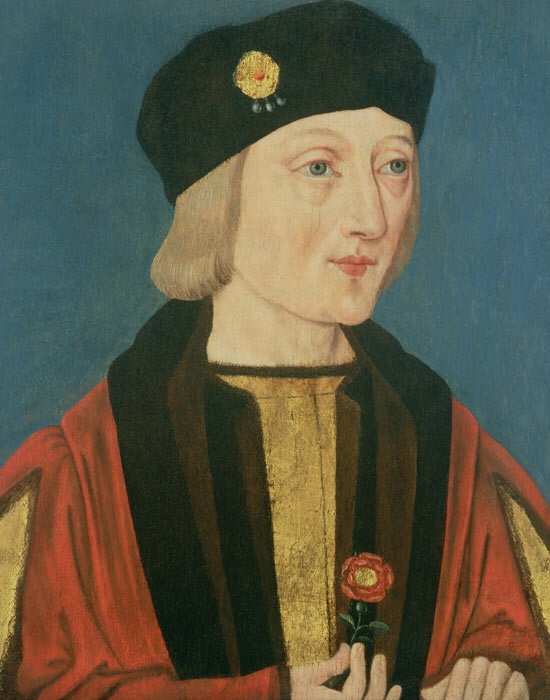
The Lancastrian Red Roses and the Yorkist White Roses fought it out for 30 years until Richard III was unhorsed and killed at the Battle of Bosworth Field, and Henry VII was crowned in his place. As a symbol of a once-more unified country, Henry devised a new badge for his dynasty, a mixed red-and-white rose now called the Tudor Rose.
image
A very clever piece of political manipulation through colour …

Talking of using colours for political purposes, we can fast-forward 300 years to the French Revolution and watch the storming of the Bastille.
image
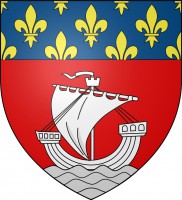
The Paris militia played a prominent role in the attack. To distinguish themselves from other groups taking part, they wore a blue and red cockade in their hats, Paris’s traditional colours.

image

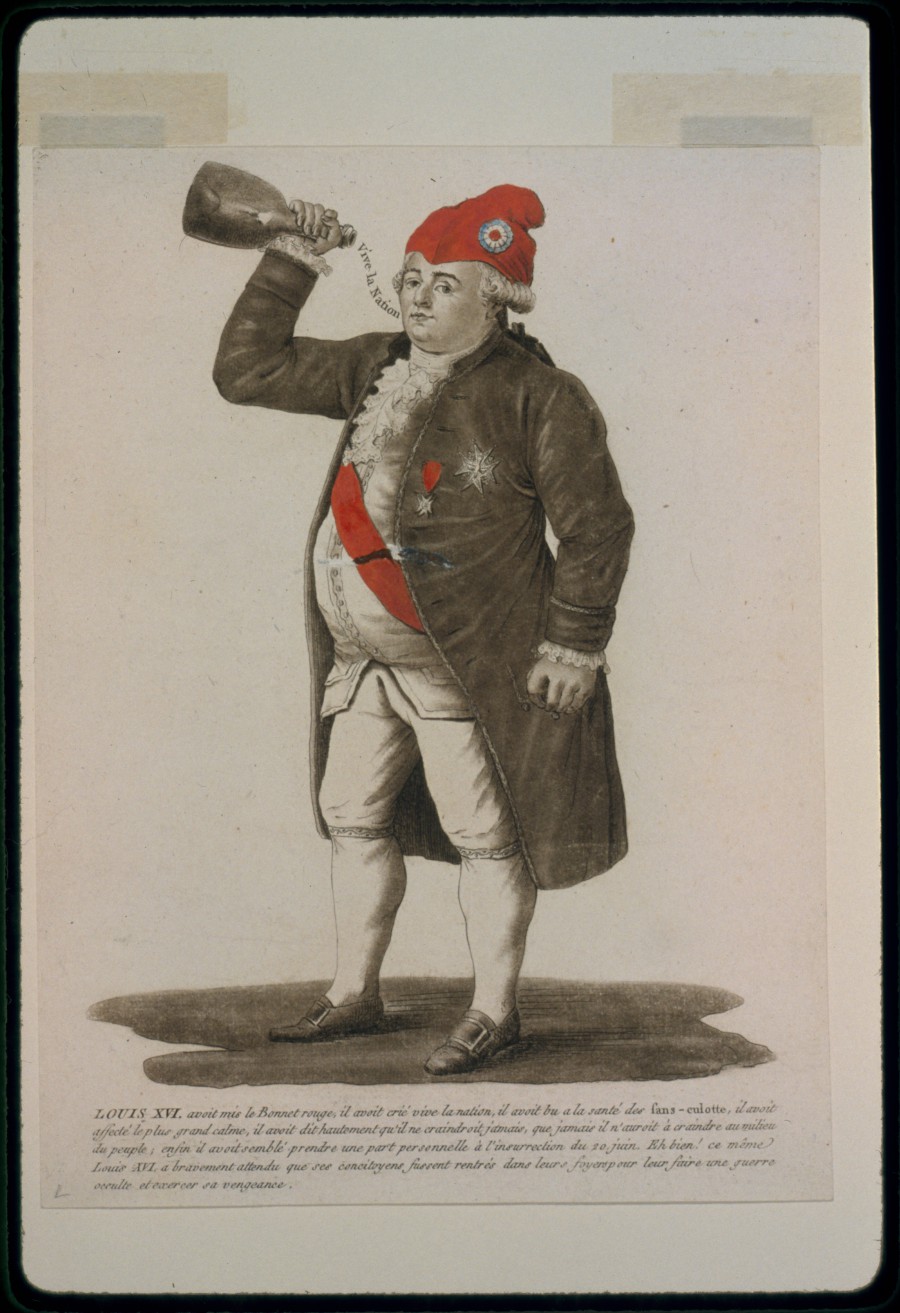
The people of Paris were elated by this victory. But the more moderate – more aristocratic – elements of the revolutionary camp were alarmed by what they saw as rampaging – and armed – mobs. It was decided to create a National Guard out of the Paris militia under the command of the Marquis de Lafayette, a moderate revolutionary with military experience (gained during the American Revolution) and with the trust of King Louis XVI. Lafayette proposed to add white to the militia’s blue and red cockade. His argument was that this would turn what was mainly a Parisian militia into a national force: white was then the national colour.
imageBut in a political system where all things national were the King’s, this was also a way of saying “revolutionaries yes, but still loyal to the King”. Well, things didn’t quite work out that way, but thus was born the red, white, and blue cockade, which even King Louis gracefully accepted to wear – at least for a little while.

image

The cockade morphed into the flag, which became a symbol of hope for some

image
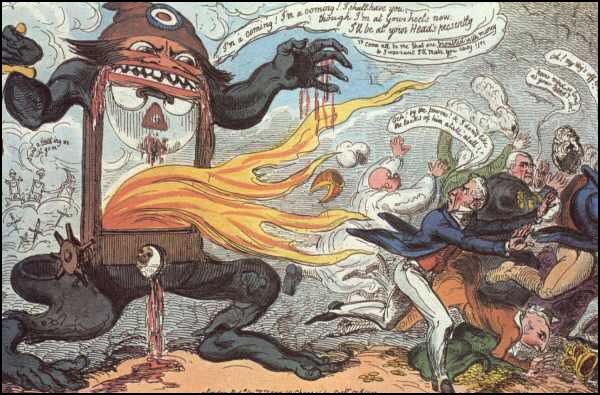
and the dread of many more as French troops unfurled like a tsunami over much of Europe.

image

Rampaging mobs makes my mind spin back more than a thousand years to Constantinople and to its hippodrome, home of the city’s chariot races. Chariot racing was to the Romans and the Byzantines what soccer is today to many people the world over, a mania, a fixation. All over the Roman world, there were four factions, the Greens, the Blues, the Whites, and the Reds, and all chariots in a race belonged to one of these four factions. The charioteers, as well as the fans, wore the colours of their faction, like in this mosaic in Lyon.

image

Like soccer players today, charioteers could and did change faction, but like soccer fans today the fans never did. If you chose to follow the Greens, you were a Green for life. Like soccer today, the enthusiasm of the fans inside the hippodrome often turned into hooliganism and gang warfare outside it. Like soccer today in some parts of the world where there is no recognized outlet for political and social frustrations, factional fighting became a way to vent political anger and score political points.

So it was in Constantinople in 532 AD, when Justinian I was Emperor. By now, there were only really two chariot factions that counted, the Blues and the Greens. Justinian supported the Blues so his enemies at court naturally supported the Greens. Justinian was in the midst of negotiating a badly-needed peace settlement with the Persians, and he had to have peace on the home front. But the people of Constantinople were angry: taxes were crushingly high. There had been politically motivated rioting after some earlier chariot races and a number of rioters had been hanged. But this did not calm excited spirits. For some strange reason, Justinian thought another day of chariot races would pour oil over troubled waters. The races started alright, with Blues and Greens vociferously supporting their teams, even though they also hurled insults at the Emperor, sitting – no doubt a bit nervously – in the imperial box. By the end, though, the two factions united in a common roar of “Nika! Conquer!” With that, the spectators burst out of the hippodrome and assaulted the palace, which conveniently abutted the hippodrome. For the next five days, they laid siege to it, demanding reductions in taxes and the dismissal of the prefect responsible for collecting the taxes and the quaestor responsible for rewriting the tax code. For good measure, they declared Justinian deposed and raised a new Emperor in his place. In the resulting mayhem, fires broke out which eventually burned down half the city.

Initially, Justinian panicked and was looking to scarper. But his wife Theodora was made of sterner stuff and stiffened his spine. Once his funk had passed, Justinian reverted to a true-and-tried method: gold. He got his eunuch Narses to go into the hippodrome, where the Greens and Blues were about to crown the new Emperor, with a large bag of gold. Narses quietly joined the heads of the Blue faction. He reminded them that Justinian was a Blue and that he had always supported them, he pointed out that the new Emperor was a Green and they could surely imagine what would happen to them under him, and then he distributed the gold. The faction leaders held a quiet conference, then spread the word among their followers. In the middle of the coronation, the Blues suddenly all stormed out of the hippodrome, leaving the Greens sitting stunned in their seats. At which point, imperial troops under trusted generals burst into the hippodrome and massacred all and sundry. It is reported that thirty thousand people died that day.

All in the name of colours …

Colours have been hitched to the wagon of many other political causes. Green has morphed from the colour of Byzantine charioteering factions to the colour of modern environmental factions, and we now hear of Deep Green and Light Green factions, each trading barbed – and not so barbed – insults about the depth of their commitment to the cause. We have Hindu fanatics cladding themselves in the colour saffron, a colour with deep religious connotations in Hinduism, and going on rampages against non-Hindus. And on and on … Readers who are interested in the topic can do no worse than go to this Wikipedia site.

But, misquoting Elton John, all I want to say is “Don’t shoot me, I’m only a colour”.

_______________
Yellow-shirts celebrating the King’s birthday: http://www.bangkokpost.com/multimedia/photo/447447/king-birthday
Meeting of a Jacobin club: http://www.larousse.fr/encyclopedie/data/images/1004994-Club_des_Jacobins.jpg (in http://www.larousse.fr/encyclopedie/divers/club_des_Jacobins/125450)
Garibaldini fighting: http://www.ondadelsud.it/wp-content/uploads/2011/04/Marsala-1860-Sbarco-dei-Mille.jpg (in http://www.ondadelsud.it/?p=4664)
Garibaldi: http://www.museotorino.it/images/86/94/ce/b0/8694ceb03de848108691d55482fd1c40-1.jpg?VSCL=100 (in http://www.museotorino.it/view/s/238dcc0376d444d2b6decf0378c13e6c)
The March on Rome: http://www.history.com/news/wp-content/uploads/2012/10/mussolini-march-on-rome.jpg (in http://www.history.com/news/9-things-you-may-not-know-about-mussolini)
Spanish fascists in Irun: http://pix.avaxnews.com/avaxnews/6a/1d/00001d6a_medium.jpeg (in http://avaxnews.net/educative/Spanish_Civil_War_2.html)
Brown shirts marching: http://img2.blog.zdn.vn/37516513.jpg (in http://me.zing.vn/zb/dt/toyotasolara/17039283?from=my)
Scene in the Temple Garden: http://ichef.bbci.co.uk/arts/yourpaintings/images/paintings/warg/large/nml_warg_wag_2712_large.jpg (in http://www.bbc.co.uk/arts/yourpaintings/paintings/scene-in-the-temple-garden-98909)
Henry VII and Tudor rose: http://static.guim.co.uk/sys-images/Admin/BkFill/Default_image_group/2012/3/1/1330616510280/Henry-VII-001.jpg (in http://www.theguardian.com/books/2012/mar/02/tudors-henry-vii-wars-roses)
Storming of the Bastille: http://media-1.web.britannica.com/eb-media/98/90498-004-CEB880DC.jpg (in http://global.britannica.com/EBchecked/topic/55622/Bastille)
Arms of Paris: http://upload.wikimedia.org/wikipedia/commons/thumb/c/ca/Blason_paris_75.svg/931px-Blason_paris_75.svg.png ( in http://en.m.wikipedia.org/wiki/File:Blason_paris_75.svg)
Royal standard of France: http://en.m.wikipedia.org/wiki/Royal_Standard_of_France#/image/File:Pavillon_royal_de_France.svg (in http://en.m.wikipedia.org/wiki/Royal_Standard_of_France#Middle_Ages)
Louis XVI: http://upload.wikimedia.org/wikipedia/commons/7/74/Louis_le_dernier.jpg (in http://commons.m.wikimedia.org/wiki/File:Louis_le_dernier.jpg)
Liberty guiding the People: http://upload.wikimedia.org/wikipedia/commons/thumb/c/cc/Eugène_Delacroix_-_La_liberté_guidant_le_peuple-2.jpg/967px-Eugène_Delacroix_-_La_liberté_guidant_le_peuple-2.jpg (in http://commons.m.wikimedia.org/wiki/File:Eugène_Delacroix_-_La_liberté_guidant_le_peuple-2.jpg)
Revolution as ogre: http://goodcomics.comicbookresources.com/wp-content/uploads/2008/10/cruikshank14.jpg (in http://pixgood.com/french-revolution-political-cartoon.html)
Mosaic of chariot race: http://travellingman.jalbum.net/Lyon%202011/slides/P1120092.JPG (in http://travellingman.jalbum.net/Lyon%202011/slides/P1120092.html)

TOM YUM SOUP – WITHOUT THE CHILLIES!

Bangkok, 23 November 2014

I must say, I am feeling very pleased with myself. When my wife and I first arrived in Bangkok, we did the time-honored thing of scouting out local culinary delicacies to taste. One that intrigued me was Tom Yum soup. It is described as a “clear spicy and sour soup”. It was the sour part that interested me. Sour soup …. What a fascinating concept, I had to try that. But the spicy part made me hesitate. As I have pointed out forcefully in a previous post, I hate spices, or at least hot spices like chilli. But my desire to experience the sour part trumped my distaste of the spicy part. And so I tried it.

Delicious, absolutely delicious! OK, with every spoonful I was making strange rasping sounds at the back of my throat to counteract the chillies, which after a while had my wife drumming her fingers on the table, and I had to drink iced water by the gallon to calm the fires in my mouth. But behind all this mayhem, I could sense the wonderful sourness of the soup. How was this done? I started scouring the web. The answer is: fish sauce meets lime (fruit and leaf), supported by lemongrass. As usual, different recipes add various other bits and pieces, the most common of which are shrimps, tomatoes, mushrooms, galangal (a sort of root like ginger), and coriander (as a final garnish). And of course, always, without fail, chillies.

I took a momentous decision. I was going to make Tom Yum soup WITHOUT chillies. I was going to show the correctness of a fundamental belief of mine, that hot spices actually add nothing to dishes, that food can be enjoyed quite as much without these terrible ingredients.

Today was the day. Yesterday, my wife took me to an upscale supermarket to find the necessary ingredients. I knew I was on the right track when we found that the supermarket helpfully offered packets of the core ingredients. The remaining ingredients were quickly rounded up.

This morning, after a good night’s rest, I got to work. After reviewing a number of recipes again, I decided on the course I would take, to whit:
1. Boil the water.
2. Cut several stalks of lemongrass into short segments. Bruise them so that they more easily exuded their lemony oils. Cut a few slices of galangal. Destalk the lime leaves and cut them up a bit. Squeeze the limes and collect the juice.
3. Ostentatiously throw away the chillies, the ones that the supermarket had added to the pre-packed set of ingredients.
4. Add 2 tablespoons of fish sauce to the boiling water. Add the juice of 2 squeezed limes. Add the lemongrass segments, the slices of galangal, the lime leaves. Bring to a boil. let simmer for a while.
5. Add the mushrooms and the tomatoes. Bring back to a boil and let simmer a bit.
6. Taste. Feel the panic rise because the soup is not nearly sour enough. Add 3 more tablespoons of fish sauce and the juice of 2 more limes. Let simmer. Taste again. Better, but not there yet. Add 2 tablespoons of fish sauce and 1 more lime. Simmer. Taste. That’s better! Now we have that sourness!
7. Add half a dozen shrimps, cook briefly.
8. Serve, spreading chopped coriander on the surface as garnish.

We ate it with a side-dish of rice my wife made.

My wife was the official taster. She pronounced the soup to be absolutely delicious, and declared that the chillies weren’t missed at all. She concluded that henceforth I could be considered the official family provider of (chilliless) Tom Yum soup, along with mashed potatoes (my speciality). My breast swelled with pride.

Now that a few hours have passed and I have reflected on the experience, I would say a few things. First and foremost, I was right: you don’t need chillies! I will now attack various other dishes which I would like very much were it not for the spices that cooks insist on adding (maybe I should make a web-site of this culinary crusade of mine). Second, I think I panicked and made the soup too sour. It was really good at the first spoonful but beginning to get too much by the last. A lighter touch would have carried me through effortlessly to the end. Third, I wonder if something other than shrimps could be used. Their taste really gets lost in the sourness. I have to think about this one a bit. Fourth, I think I have to adopt the European habit of putting the ingredients you won’t eat in a muslin bag. It kind of takes away from the pleasure of eating to have to pile up the lemongrass segments, galangal slices, and lime leaves on the table cloth as you go along. Fifth, I think I should go easy on the coriander the next time. In fact, I might try parsley instead. Sixth and lastly, when I get back to Europe what am I going to use instead of limes? Lemon? Mandarin? Orange? I’m going to have to think about this one too.

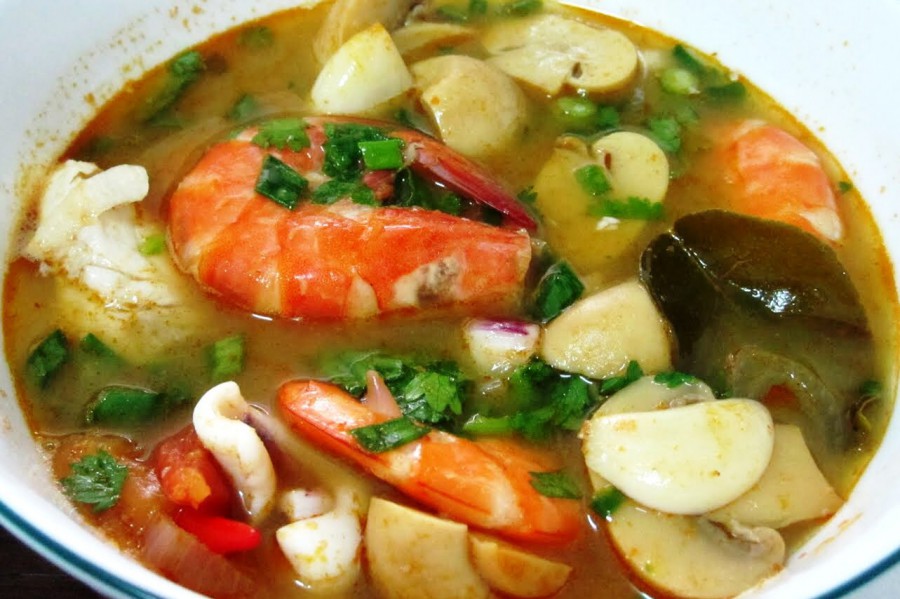
Oh, in all the excitement, I haven’t added a photo of the soup. In our haste to try it, neither my wife nor I took a photo of my creation. And I hesitate to take one from the web, because they all are of soups made with chillies. But what the hell, here is a photo.

image

Also, one day I will write a post on how I make mashed potatoes. Promised.

_________________

Tom Yum soup: http://2.bp.blogspot.com/-oRNilG7HYh8/T7-q1Kg0suI/AAAAAAAAA_k/Z8gykr2ZYtU/s1600/tom-yam-soup-chef-duminda-2012.jpg (in http://cook-with-chef-duminda.blogspot.com/2012/05/tom-yam-soup.html)

KEEP IT SIMPLE

Bangkok, 19 November, 2014

I was in Myanmar last week for the first time in my life, with a team of colleagues. Unfortunately, our trip coincided with an ASEAN Summit in the new capital Nay Pyi Taw, which was attended by sundry political worthies, including President Obama and Premier Li Keqiang. We seemed to have spent most of the week fleeing from these worthies. We hurriedly visited various government Ministries in Nay Pyi Taw in the two days before the Summit started and rode out of town to Yangon the night the politicos started arriving. We were congratulating ourselves on having missed the craziness which usually accompanies the presence of political heavyweights, but we had not reckoned on President Obama following us down to Yangon. His motorcading around the city to meet with Aung San Suu Kyi and do various other things like visit a church snarled Yangon’s already chronically congested traffic and made our lives a misery as we threaded our way through back roads to arrive more or less on time at our various meetings.

But actually this post has nothing to do with President Obama or any other Big Cheese. It has to do with a stop we made somewhere in all this threading, at a market. One member of the team had made promises to his wife to bring a little something back to her, and the other team members thought this was an ideal occasion to pick up some Burmese bibelots. Unwillingly, I tagged along. As I feared, the market was a tourist trap: store after store of rubbish and store keepers hovering ready to pounce. But I preferred to walk around grouchily than sit in the van grouchily.

I had a faint glimmer of hope when I came across a store which sold lacquerware from Bagan. I’d read about the ancient Burmese king who had conquered his way through northern Thailand, Laos and over to Yunnan, and brought back skilled lacquerware craftsmen in his baggage train, using them to create a new luxury industry in his capital Pagan. Might I find something worth contemplating in the store?

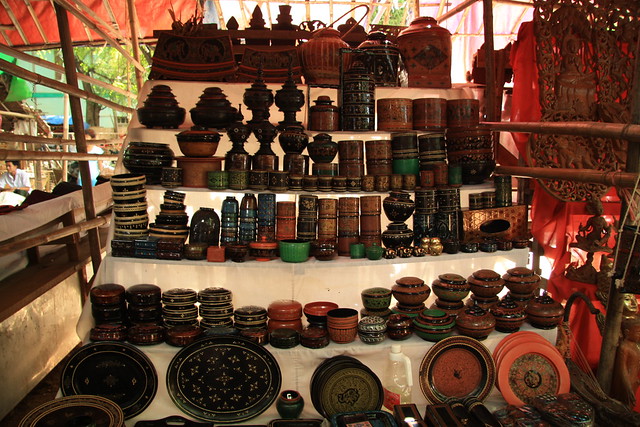
Alas not. For one thing, I cannot stand places which look like this.

image

All that stuff pressing claustrophobically in on you! The feeling of being the proverbial elephant in a china shop, bumping into something and bringing mounds of breakables crashing down around your ears! My immediate reaction is to run out of such places. But I controlled my urge to run and looked. And liked not what I saw. This picture shows the typical designs being offered for sale.
image
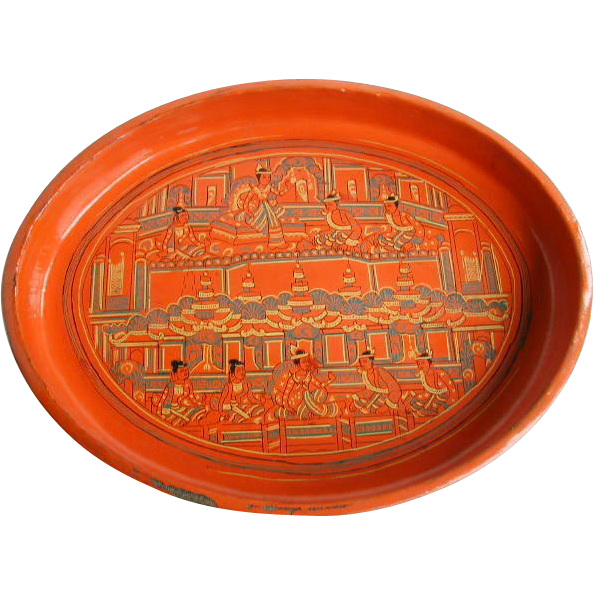
Too much, too much! Too – damned – much! All those dense, dense designs. It makes me think of Australian Aboriginal art, which I wrote about in an earlier post. In art, in design, the KISS principle applies (Keep It Simple, Stupid!). Now it could just be that modern makers of Bagan lacquerware use these designs because tourists have shown a preference for them, and he who pays the piper calls the tune. But a look at older designs suggests that the Burmese kings and their aristocracy also liked busy designs, although this is a good deal better than the modern stuff.
image
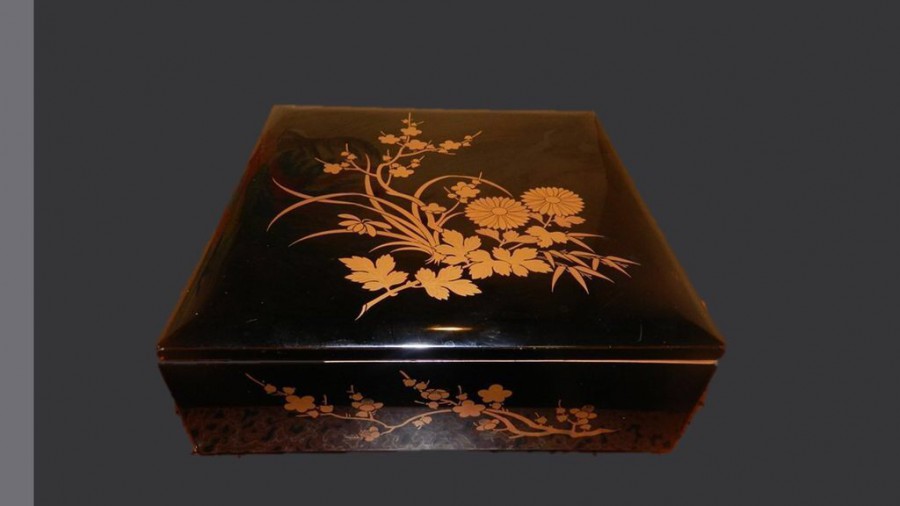
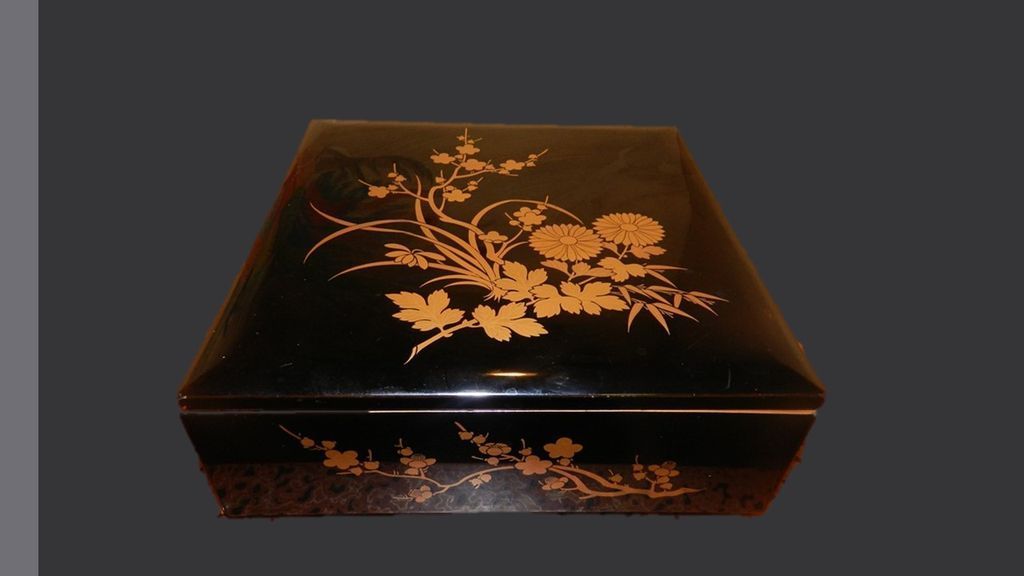
No, give me Japanese lacquerware any day. Look at this bento box in the maki-e style
image
Or this box in the Aizu style
image
Or this tray in the Negoro style (where the upper red layers of lacquer are intended to gradually wear away with use, revealing the black lacquer underneath).
image
These are old fashioned if not antiques. Modern Japanese lacquerware is just as lovely. Look at this:
image
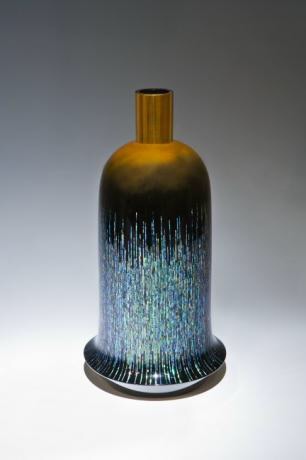
Or if you find that this has strayed too far from lacquerware, how about this vase?
image
Or if you find the design too modern, how about this?
image
Beauty is in simplicity of form and of pattern.

I have spoken.

_____________________________

Myanmar lacquerware store: https://c1.staticflickr.com/5/4106/4989036093_92231568aa_z.jpg (in https://www.flickr.com/photos/kelvinlls/4989036093/)
Typical modern Bagan lacquerware: http://www.travelwireasia.com/wp-content/uploads/2012/06/IMG_6223.jpg (in http://www.travelwireasia.com/2012/07/5-great-arts-and-crafts-to-buy-in-burma/)
Yun lacqerware tray: http://image0-rubylane.s3.amazonaws.com/shops/owensantiques/263.1L.jpg (in http://www.rubylane.com/item/197251-263/Burmese-Red-Lacquer-Tray-Court-Scenes)
Maki-e bento box: http://image0-rubylane.s3.amazonaws.com/shops/781325/ju7.1L.jpg (in http://www.rubylane.com/item/781325-ju7/Japanese-Traditional-Laquer-Maki-e-Bento)
Aizu box: http://www.swarthmore.edu/library/exhibitions/japan/gallery/images/lacquer-box-2f.jpg (in http://www.swarthmore.edu/library/exhibitions/japan/gallery/lacquer-box.php)
Negoro tray: http://content.ngv.vic.gov.au/col-images/xl/EPUB000495.jpg (in http://publications.ngv.vic.gov.au/essays/negoro-lacquer-the-refined-beauty-and-rustic-ambience-of-medieval-japan/#.VGyipmIaySM)
Modern Japanese lacquerware-1: http://www.materialtimes.com/files/files/2014/03brezen/uru.jpg (in http://www.materialtimes.com/vsimame-si/jedovata-kraska.html)
Modern Japanese lacquerware-2: http://www.orientaltreasurebox.com/item.php?id=1601&cat_id=8 (in http://www.orientaltreasurebox.com/category.php?page=3&cat_id=8)
Modern Japanese lacquerware-3: http://toku-art.up.n.seesaa.net/toku-art/image/mutsumi20104.jpg?d=a75 (in http://toku-art.seesaa.net/archives/200709-1.html)

BUTTERFLIES

Bangkok, 8 November 2014

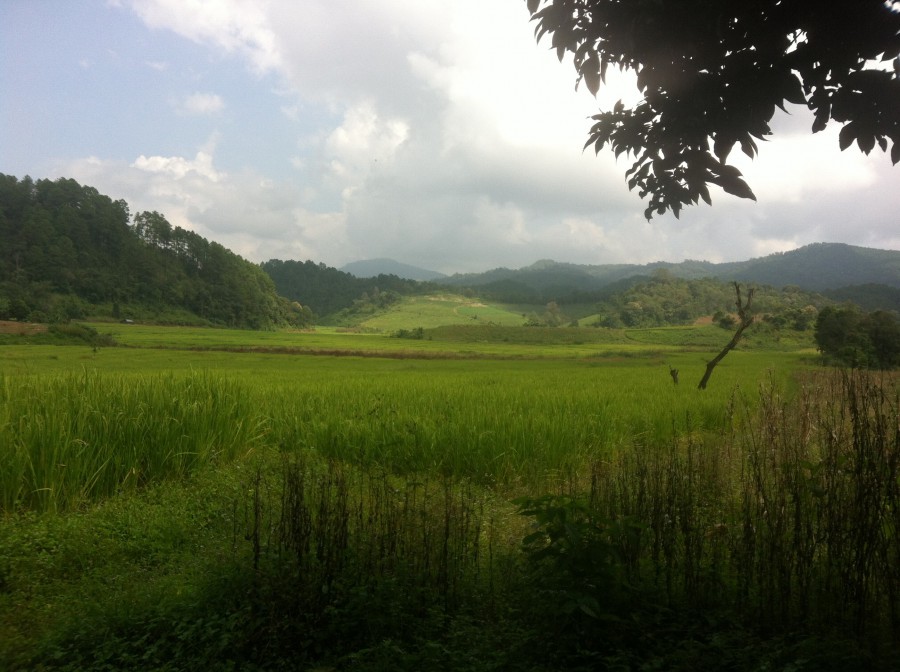
We were up in the north of Thailand two weekends ago, very close to the border with Myanmar, up in the high hills (or low mountains?) behind the town of Mae Hong Son. Lovely, really lovely … We stayed in the small village of Mok Cham Pae, perched on a hillside overlooking a small river and its bottom lands. In the UK they would have been turned into hay meadows. Here, they had become a patchwork of rice paddies.

image

Around Mae Hong Son, the rice was already ripening. But up in Mok Cham Pae it was relatively cooler, so the rice was still green, that intense green which you only get with rice paddies.

image

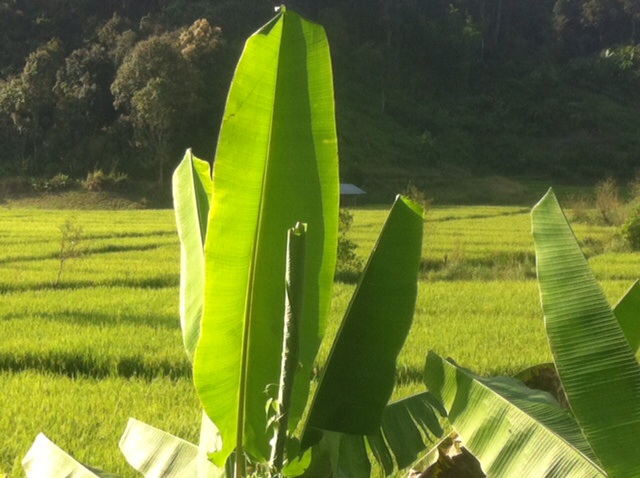
But rice paddies, for all their beauty, are a monoculture, where all other species are kept at bay. After walking around the edge of the paddy fields, seeing only some banana trees marking the edge of “rice country”
image

image

and some very smelly pigs (which turned out to be owned by our hostess), we ventured out along a dirt road which wound its way up the river valley.

image

The paddies narrowed down to a strip along the water, for a while vegetables took their place, and then finally what was left of the forest straggled down to the road’s edge.

image

We saw no elephants browsing in the forest, or tigers moving in for the kill (my memories of Rudyard Kipling’s Mowgli are getting the better of me). But what we did see in profusion were butterflies, fluttering in and out of the bedraggled forest, chasing each other around, or settling on the road close to water. On that walk, which was no more than two hours long, I swear we saw at least 20 different species of butterfly. In Europe now, you’re lucky if you see three different species in a whole day. There were never that many species to begin with, and intensive ploughing, pesticides, and the tearing up of hedgerows have put paid to the few there were. I’ve had a look at various web sites dedicated to Thai butterflies to identify the ones we saw, but it’s hopeless. Did we see a Common Grass Yellow or a Tree Yellow? Was that one by the bush a Gram Blue or a Plains Cupid? Or maybe a Forget-me-not?? In the end, who cares? They were just lovely. I invite readers to visit the following flickr site to get a taste of what awaits you in this part of the world, butterfly-wise.

And I choose just two to represent the class
image

image

I chose these two very deliberately, because they each bring back to me two distinct butterfly-related memories.

The first is from Mexico. It was some 35 years ago, my wife and I – and mother-in-law – were travelling around the country. We mostly took buses and the occasional train. But in Yucatan, we decided to hire a car. We got a Volkswagen beetle – I remember it well, they had recently been phased out in Europe – and drove from one Mayan temple to the next. And along the road we drove through these clouds, these drifts, of green-yellow butterflies. I was in agony at the butterfly holocaust I was causing, but what could I do? They were just sitting there on the road, sunning themselves.

I feel particularly bad about killing butterflies because – and this brings us to the second photo – I have a very vivid memory of when I was a child – six years old, I would guess – in our garden in Africa. It was full of butterflies, and like all children I liked chasing them. But this time, one, of about the color in the photo, had settled on the ground and was sunning itself. I crouched down, picked it up, and slowly – pulled – its – wings – off. Yes, I did that. Even as I write about it, I feel a strong sense of guilt at such a casual act of gratuitous cruelty. Perhaps the rest of my life as an environmental engineer has been an act of atonement for it.

___________
Tree yellow: http://www.vireos.com/Thailand/html/photoFrameset.html
Orange lacewing: http://www.pbase.com/glazemaker/image/130569578

all other photos: ours

RUBBING ALONG TOGETHER

Bangkok, 1 November 2014

I think it must be a scientific law that the closer you get to the equator, the more species you will find per square metre (or foot, if you wish) looking for their space in the sun. All that steamy heat seems to lead to a sustained biological ebullience. Certainly, in a totally unscientific survey, my wife and I have agreed that the number of species wishing to share with us our hot and steamy Bangkok apartment is considerably higher than it was in Beijing. There, over a period of five years, we catalogued a few, relatively small, cockroaches making a frantic getaway over the floor and that was it (although the rare cockroach sighting led to apoplectic calls to the front desk and demands for a thorough chemical spraying). Here, in just one month and a bit, we have seen:
– A little lizard, very pale, almost albino, which we first sighted peeping out from under the dining table, then from behind a column that we have in the living room, then in the cupboard under the kitchen sink. He looked very similar to this little fellow.
image
I have had a soft spot for lizards ever since I used to chase them as a boy across the walls of my grandmother’s garden in France, so I was pleased to see it. But my wife is not a lizardophile and demanded that I get rid of it. I rather reluctantly chased it around a bit and was secretly pleased when it disappeared of its own accord.
– A horribly large cockroach, which luckily was flat on its scaly back, dead, in the shower. But I have seen them horribly alive, skittering ahead of me across the pavements, always in the darker corners of the neighborhood. Disgusting creatures, I refuse to grace them with a picture ….
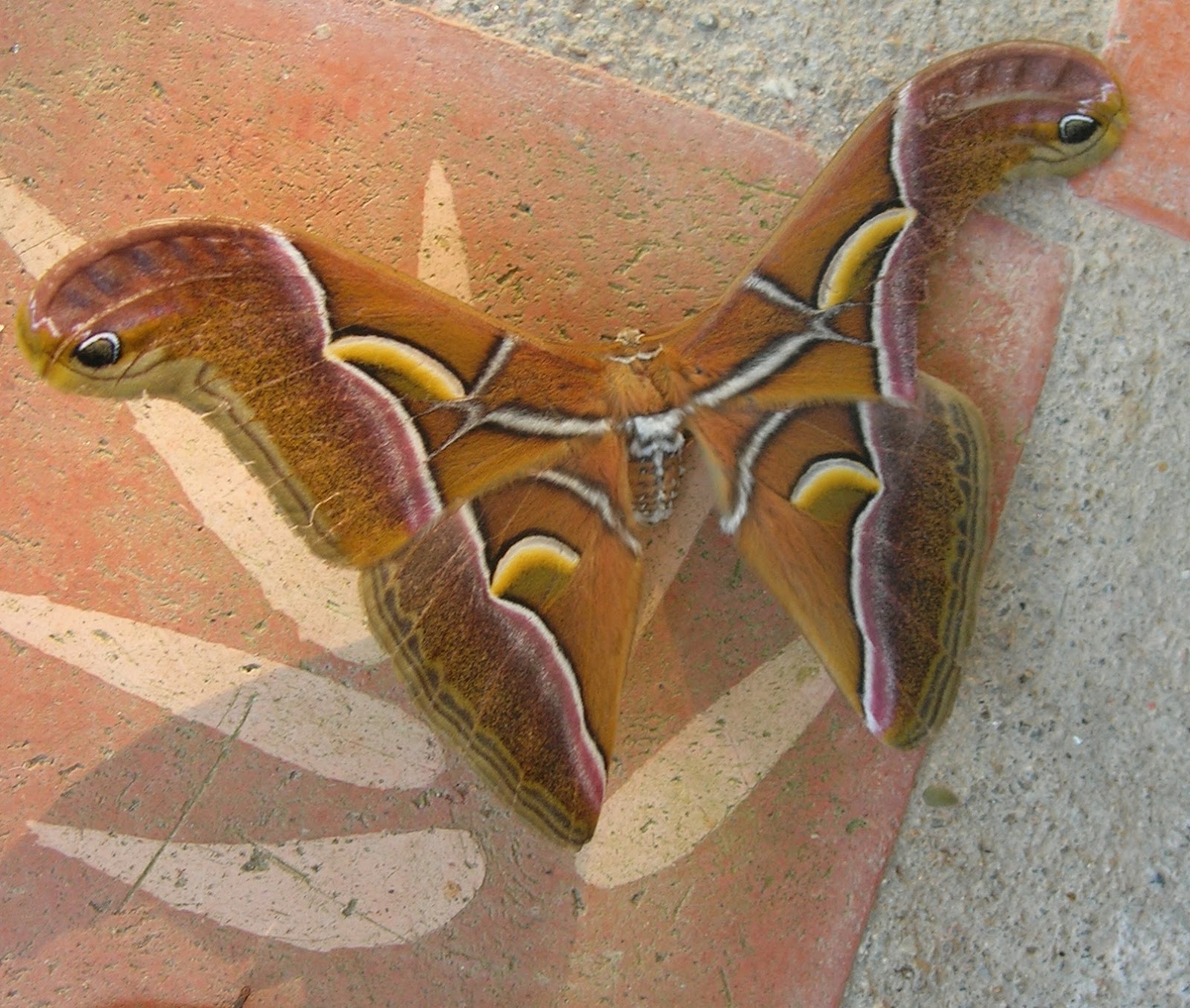
– A number of wonderfully large moths, which flutter in at night from out over the river and settle down for a rest. They are really beautiful, nothing like the dreary little things we have in Europe, so I’d be pleased to share my living space with them.
image
But my wife is having none of it, so with a sigh I shoo them out, using the pasta drainer to catch them and carry them out.
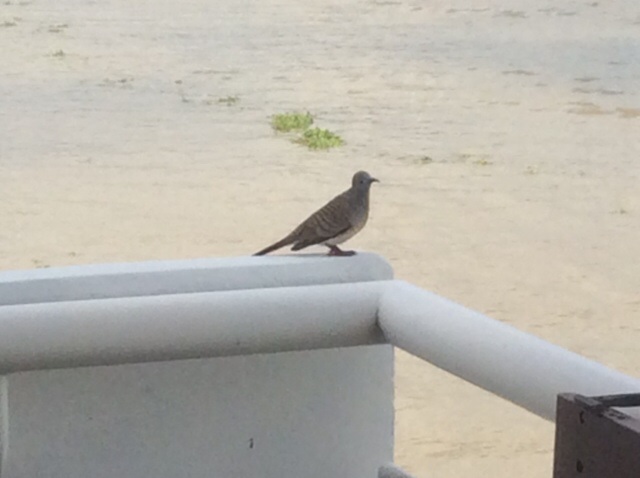
– Several species of bird which use the balcony railing as a favorite stopping place. There are those pesky pigeons which crowd our squares in Europe. But there has also been a beautiful bird, which I think is also a type of pigeon although my wife disagrees.
image
Cheeky little sparrows also hop on and off the railings, beadily eyeing any crumbs which might have fallen off the table that we carry out onto the balcony for breakfast, lunch and dinner.
– swallows, which my wife says she found early one morning twittering around on the living room parquet (we had left the windows open). Imagine that! I see them dive and swoop over the river
image
as I have seen them dive and swoop over summer fields in Europe. But I have never seen them stand still.

All this in the few square meters (or feet, if you wish) of our apartment. Expanding out a little, we’ve seen beautiful little birds, black with white tufts on their wings, fluttering silently on and off the clumps of water hyacinth which drift past us on the river. They have recently been joined by a lovely white egret.

image
And then there’s the Asian koel bird which I’ve mentioned before. I keep on hearing it, but I’ve never managed to see it. In the dirty, oh so very dirty, canal which runs behind the office, I’ve seen what I think is a monitor lizard swimming lazily (or sickly?) in the watery gook: the water is greyer than in this photo.
image
The same canal teams with fish, which some enterprising (or mad?) people fish from time to time. And we have a couple of next-door fishermen who put out their nets in the river while we are having breakfast, well out of the way of the busy river traffic. I’ve sometimes caught a gleam of silvery scales in the bottom of their shallow little boats.

image

But I presume that the number of species we can stumble across in the concrete jungle of Bangkok would be nothing compared to what is present in the real jungle – or what is left of it in Thailand. That pleasure awaits us still.

_______________
Lizard: http://naturestudent.files.wordpress.com/2013/01/20130121-162953.jpg (in http://naturestudent.wordpress.com/2013/01/21/lovely-lizards/)
Moth: http://1.bp.blogspot.com/-R3HpNI3L0lM/TzdPTJ13xQI/AAAAAAAAAD8/TiXKoEuS1go/s1600/Samia+canningii.JPG (in http://norfolkbirderinthailand.blogspot.com/2012/02/thailand-moths-part-two.html)
Bird on the balcony railing: my wife’s picture
Flying swallow: https://c1.staticflickr.com/9/8164/7244597922_bd666a00e8_z.jpg (in https://www.flickr.com/photos/clicks_1000/7244597922/)
Egret: http://upload.wikimedia.org/wikipedia/commons/f/f1/Little_Egret_flying_-_Thailand.jpg (in http://c
ommons.m.wikimedia.org/wiki/File:Little_Egret_flying_-_Thailand.jpg)
Monitor lizard: http://cdn2.vtourist.com/4/6079856-Monitor_lizard_swims_khlong_Bangkok.jpg?version=2 (in http://www.virtualtourist.com/travel/Asia/Thailand/Central_Eastern_Thailand/Bangkok-1445238/Off_the_Beaten_Path-Bangkok-Khlongs_Canals-BR-1.html)

PERAMBULATING PARQUETS

Bangkok, 26 October 2014

My wife has been busy getting to know Bangkok in her usual favorite way, taking the bus (with me joining her on the weekends). When she told the very nice Thai couple whom we have befriended in the building that she takes the bus to get around, they stared at her and finally managed to ask, “the aircon buses?” When she said no, no, the normal buses, they tittered nervously. When pressed, they confessed to have not taken a bus in twenty years. (This reminds me of a scene early in our marriage. It was downtown Baltimore, 1978 or 9. We wanted to get somewhere, I forget where, so we approached a nice young man sitting on a bench eating his lunch and asked him what bus we might take. He confessed that he had no idea, that he had never taken a city bus in his life. We stared at him: how could it be that someone had NEVER taken a bus? The difference between a European and an American, I suppose. But I digress.)

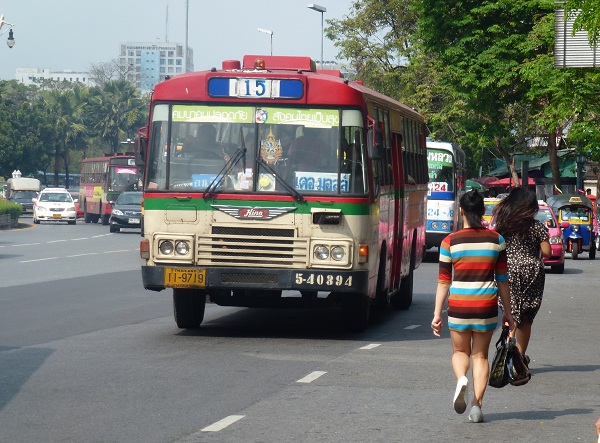
It is true to say that the (non-aircon) buses of Bangkok are not the most handsome of buses. In fact, they obviously have had a hard-scrabble life.
image
And their technology looks – and sounds – very old-fashioned. For instance, whenever the drivers change gears (using a huge gear shift as big as the seated drivers themselves), it sounds distinctly like they are double-declutching (a term which I would imagine is meaningless to anyone below the age of 60). The drivers are always in a tearing hurry, no doubt due to being perennially bottled up in Bangkok’s terrible traffic, so getting on and off buses is an athletic accomplishment. To get on, wave down the bus, rush for the door, swing in as the bus already starts to move off. To get off, ring for the stop, balance yourself on the balls of your feet, hustle down the steps the moment the doors start clattering noisily open, and drop down into the street as the bus already moves off. And while inside, hang on for dear life as the bus barrels its way down the city’s streets, riding roughshod over every pothole and other imperfection in the road’s mantle.

But as I grimly hang on in the bus, bouncing up and down on the (really quite comfortable) seats, I cannot help but wonder at the beautiful parquet floor which the buses have. Look at that! Who has ever seen parquet floors in buses?
image
Well, “parquet” may be pushing it a little, but this is really nice wood they’ve used. No trash soft wood here, being rubbed to pieces by passenger’s dirty shoes. This is close-grained hardwood. I would be proud to have a floor of that in our living room, sanded down and waxed into a rich red-brown color, instead of the fake plasticized “parquet” which our miserly landlord has laid down and which rings hollow every time we walk across it. I wince when I see how this beautiful wood has been mercilessly screwed down onto to the bus chassis, with big, gleaming, screws. Aie-aie-aie!

The only thing that worries me here is the wood’s provenance. This is not plantation wood, nor I’m sure is it certified wood from responsibly managed forests. I fear that this is just brutally logged wood from Myanmar or Laos or perhaps Indonesia (Thailand has already cut down much of its forests).
image
Perhaps it would be better for Bangkok to shift to modern, gleaming, air-conditioned, buses with plasticized floors
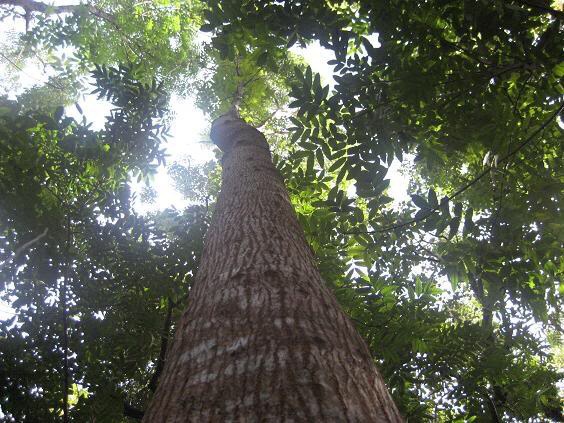
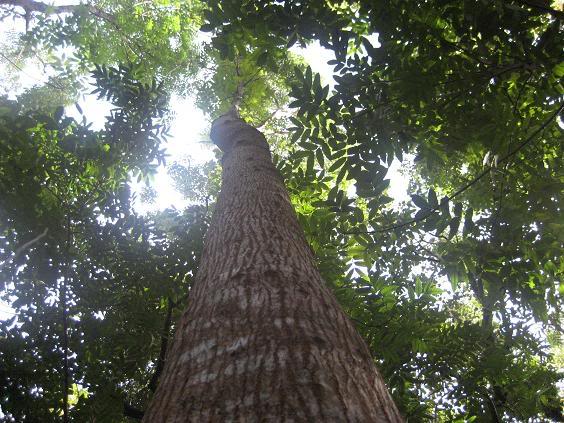
imageand leave this beautiful wood standing in its wilderness, soaring up towards the sky.
image

_______________
Bangkok bus: http://www.langeasy.com/images2/bkk/bus2.jpg (in http://www.langeasy.com/cities/bangkok/bangkokpage1.html)
Bangkok bus floor: my photo
Illegal logging: http://www.globalpost.com/sites/default/files/imagecache/gp3_slideshow_large/illegal_logging_in_anlong_veng_ii.jpg ( in http://pixgood.com/illegal-loggers.html)
Modern city bus: http://i01.i.aliimg.com/photo/v2/280618923_1/SLK6111_Aluminum_Body_City_Bus.jpg (in http://www.skyscrapercity.com/showthread.php?t=1468014)
Mahogany tree soaring: http://treepicturesonline.com/tree-mahogany.jpg (in http://treepicturesonline.com/mahogany_tree_pictures.html)

TUGGING AT MY HEARTSTRINGS

Bangkok, 9 October 2014

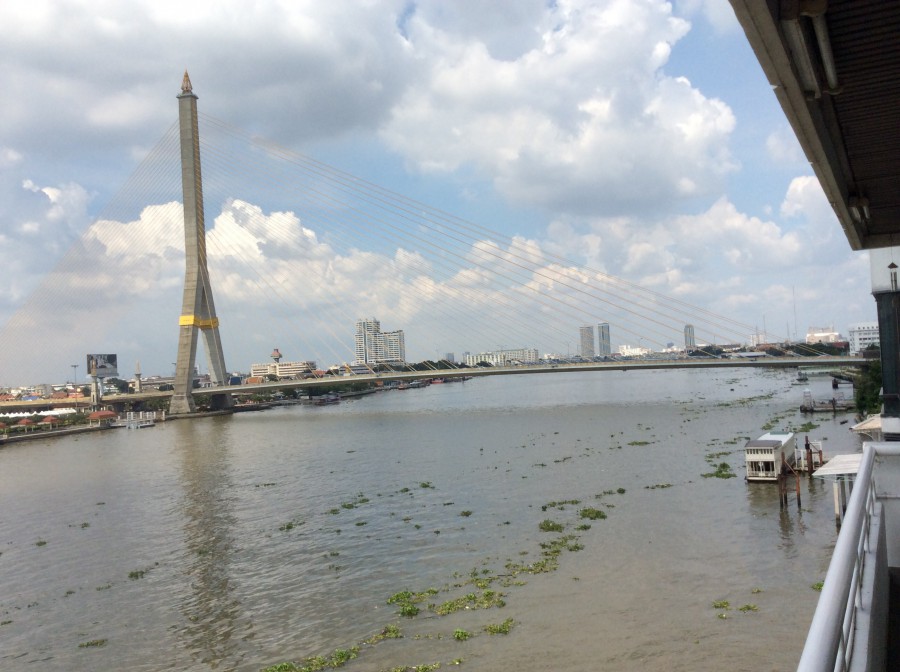
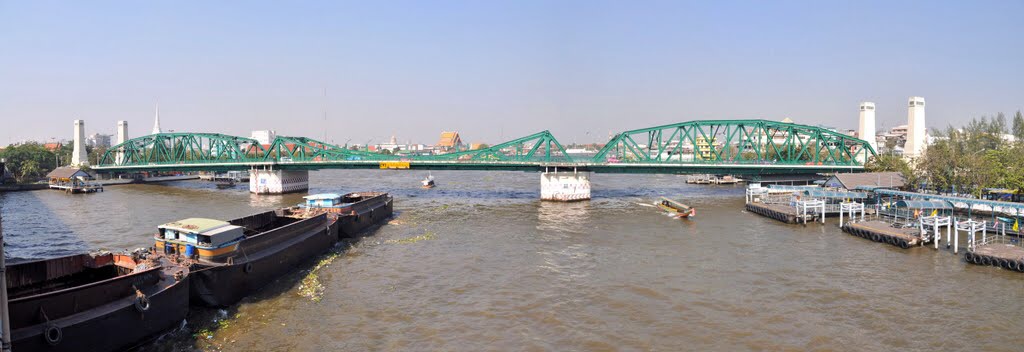
Our living room is small, but it has a magic view on the Chao Phraya River. Two of the living room’s walls are all glass and allow us a wonderful view up and down the river.

image

image

My wife and I maximize this view every morning by dragging our table out onto the narrow balcony which wraps around our living room and taking our breakfast – tea, cereal, and tropical fruit – all the while watching the parade of boats moving up and down the river.

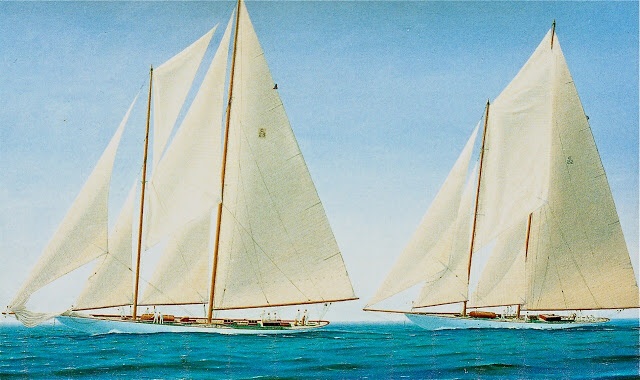
Let’s be clear, the boats we see are not as handsome as these 1920s yachts.

image

I suppose the most striking boat we see are the long-tailed boats which skim across the river’s surface, their huge roaring motors in the stern peremptorily signaling their presence to one and all.

image

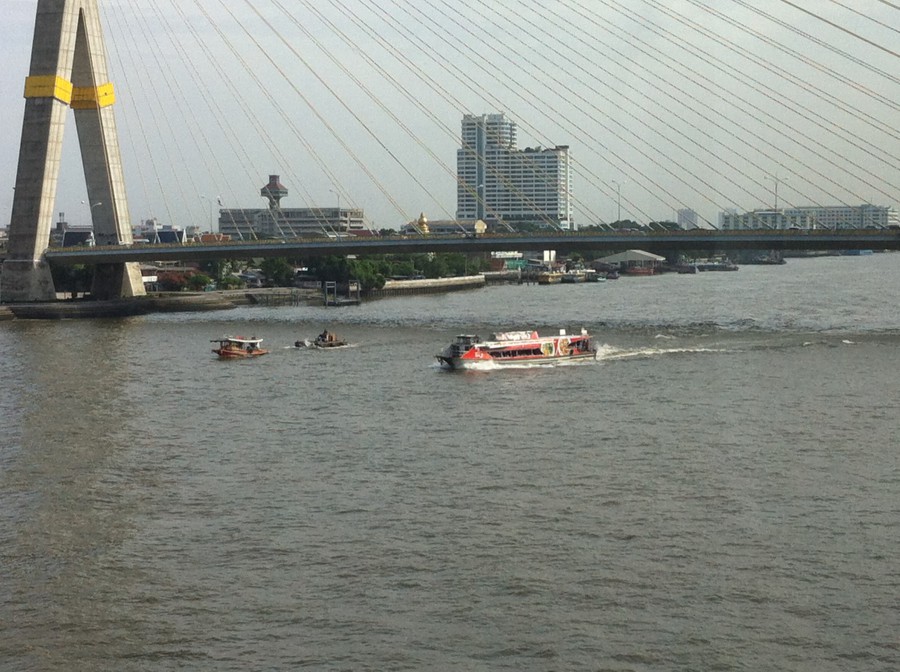
The water buses that ply the river aren’t so showy, but their raked bow gives them a certain allure.

image

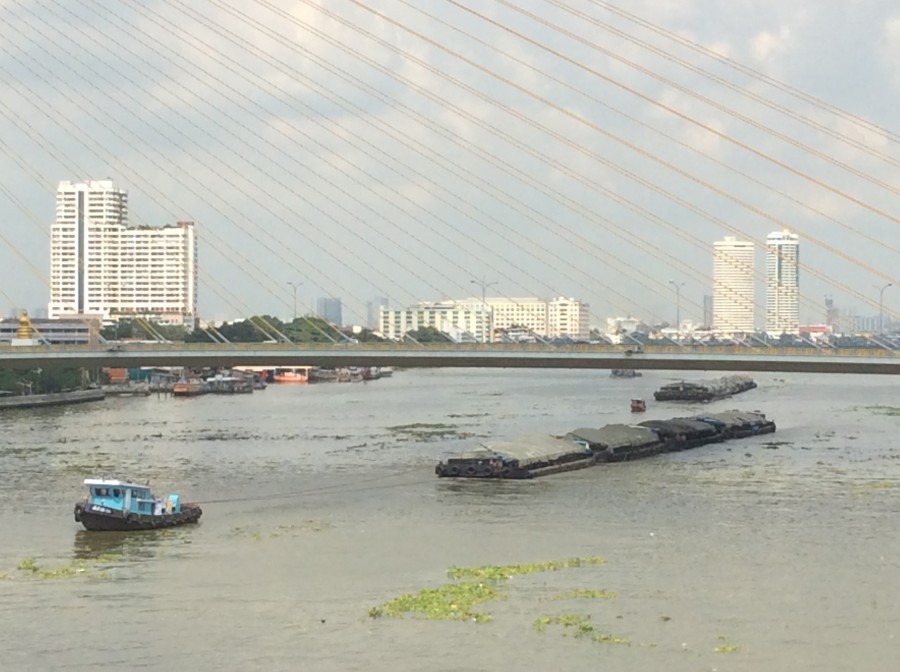
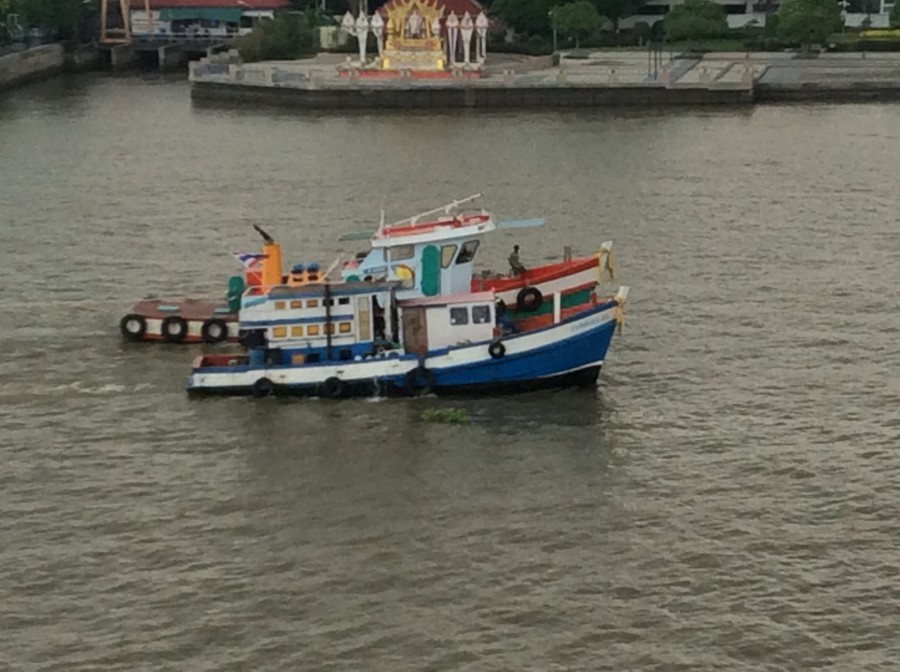
My heart, though, goes out to the lowly ugly tugs which rumble slowly up and down the river dragging trains of barges behind them – slowly, so very slowly when the barges are full, slightly more jauntily when they are empty.

image

image

I sit there, watching them tug and strain, and will them on: “Go, little tug, go! You can do it! Attaboy!”

They may work hard, but these tugs are no shrinking violets. No drab work clothes for them. No siree, their owners paint them strong, happy colors, to signal how proud they are of their work partners. I mean, look at them!

image

image

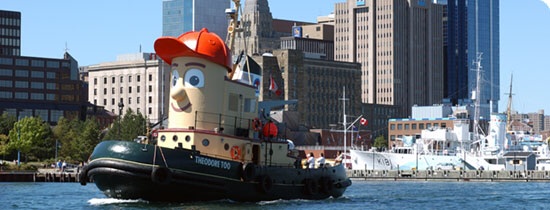
As these tugboats pass, flaunting their color schemes, I can’t help but think dreamily of the tugboats of my youth, like Theodore the Tugboat

image

or Little Toot the Tugboat

image

or even Scuffy the Tugboat

image

Toot, toot!! Tug away, fellas! Job well done! I hope you get a rest and a good lube job in the evening. Toot, toot!!

__________________

Views of Chao Phraya river: my photos
1920s yachts: http://abrushwithsail.blogspot.com/2012/06/grand-yachts-of-1920s.html
long-tailed boat: http://swissnomads.com/wordpress/wp-content/uploads/2013/09/long-tail-boat.jpg
water bus: my wife’s photo
tub boat and barges: my photo and http://www.panoramio.com/m/photo/47654772
colourful tugboats: my wife’s photos
Theodore the Tugboat: http://www.mtcw.ca/theodoretugboat/Tours.php
Little Toot the Tugboat: http://blog.keloland.com/lund/blog/2010/12/20/aunt-leilas-records/
Scuffy the Tugboat: http://www.betterworldbooks.com/scuffy-the-tugboat-sail-away-id-0375826963.aspx

SOUNDS OF BANGKOK

Bangkok, 19 September 2014

Well, we’ve finally moved to Bangkok. We’ve found ourselves a place on the Chao Phraya river, literally overlooking it. The open water gives rise to constant breeze which we can channel through the apartment by a judicious opening of various windows, obviating the need for air-conditioning – a minor miracle in this heavily air-conditioned city. When, as now, the evening’s storm clouds come rolling in, that breeze will rise to a stiff sou’-wester’ threatening to blow every light object into the river below and sends us scurrying around the apartment closing windows and doors. At these moments, I find myself back on my grandmother’s sailing boat, with her at the tiller imperiously ordering me and any other grandchild around to lash down everything movable as the summer storm rips over us and the boat starts to lean over at a precipitous angle.

During the day, that same breeze wafts into our living room all the noises of the river and its banks: the deep grumble of the tug boats slowly pulling the heavily laden barges upriver, the growl of the water-buses as they tack back and forth across the river from stop to stop, the creaking and groaning from the landing piers lining the bank as the wash of passing ships sends their platforms oscillating, the slightly atonal call to prayer from a mosque somewhere on the far bank, the more profane call to evening aerobics in a small park just downriver, the occasional siren from a police car racing over one of the nearby bridges, and just the ordinary household noises rising out of the houses below our balcony.

But for me, two sounds stand out from this medley. One is the piercing whistling used by the water bus conductors to guide the drivers when they berth at stops. I haven’t yet understood the signaling, but somehow the conductor makes the driver understand when to reverse the engine to slow down, then idle it, then start it again to move off from the stop. As I listen and watch, fascinated, I am suddenly back in Hyde Park looking on at a competition of Welsh shepherds using whistling to guide their sheep dogs into driving a flock of sheep from one place to another (I’m not sure the drivers of the water buses would appreciate being compared to sheep dogs).

The other sound is the cry of a bird. It is very distinctive. It starts with a low cry, which is followed in rapid succession by a series of ever higher and more piercing cries, finally reaching a crescendo and dying out. I have asked my Thai staff what the bird is called. They are still wrestling with the Thai name, let alone the English name. In the meantime, I am calling it the Fake Orgasm Bird. It reminds me every time of a night I spent in a cheap hotel in Geneva (cheap for Geneva, expensive for anywhere else), where I was woken up in the early hours by a Lady of the Night who was pleasing her customer by oohing and aahing at the top of her lungs. She sounded exactly like my Bangkok bird.

Postscript 22 November 2014:

I have finally identified my mystery bird! It is the Asian koel. For those who might be interested in its call, go to http://www.youtube.com/watch?v=TU3T6jikQqg.

PEOPLE ON THE MOVE

Bangkok, 27 July 2014

Well, I’ve received my transfer orders. I’m moving to Bangkok to take over our office there. So my wife and I have been down in Bangkok for the last week, looking for a place to stay. For the moment, we’re renting an apartment which we got through AirBnB. It gives right onto the Chao Phraya River, which runs through the middle of the city and around which the city grew. So as we have breakfast in the morning before we go out apartment-hunting we can watch the traffic on the river: the empty barges, riding high

ships on river 002

the full barges, with water to their gunwales

ships on river 005

the express boats crowded with commuters darting in between as they weave their way from bank to bank.

ships on river 001

But what also catches my eye is this temple on the other side of the river

temple across the river 001

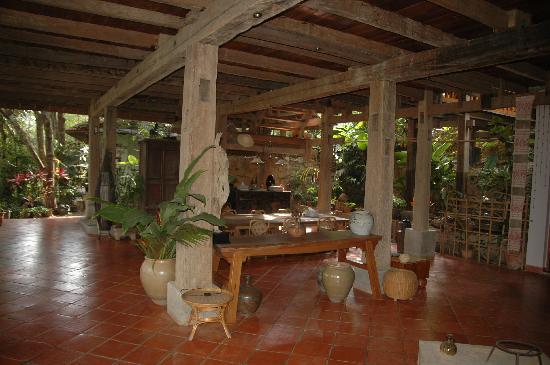
and it always reminds me of … China. Or rather, a certain corner of China, the Xishuangbanna Dai Autonomous Prefecture. This is way down in the south of Yunnan province, squeezed between Laos to the East and Myanmar to the West. A few years back, we spent a Dragon Boat Festival holiday in the prefecture’s main town, Jinghong, in a beautiful house which was built from elements scavenged from traditional houses that were being torn down in China’s rush to modernity.

Yourantai-interior

It too gave on a river, the Mekong in this case (although the Chinese don’t call it that; it’s the Lancang River to them), and there too we could gaze down on the river while having our breakfast.

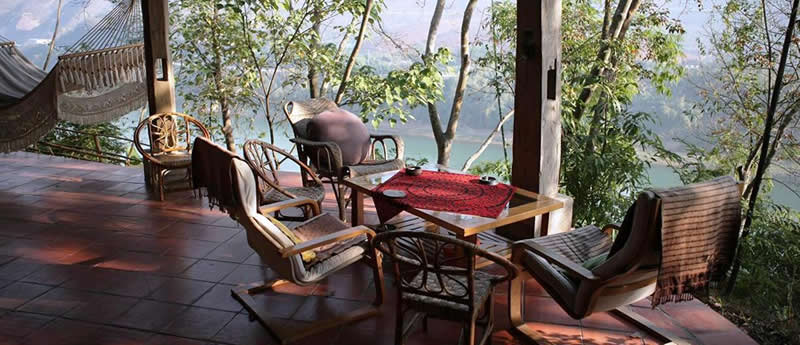
Yourantai-view of the river

The temples in Jinghong are built in the same style as the one I see across my breakfast table, or at least the newer establishments are.

Mange-Buddhist-Temple-Jinghong-XishuangBanna

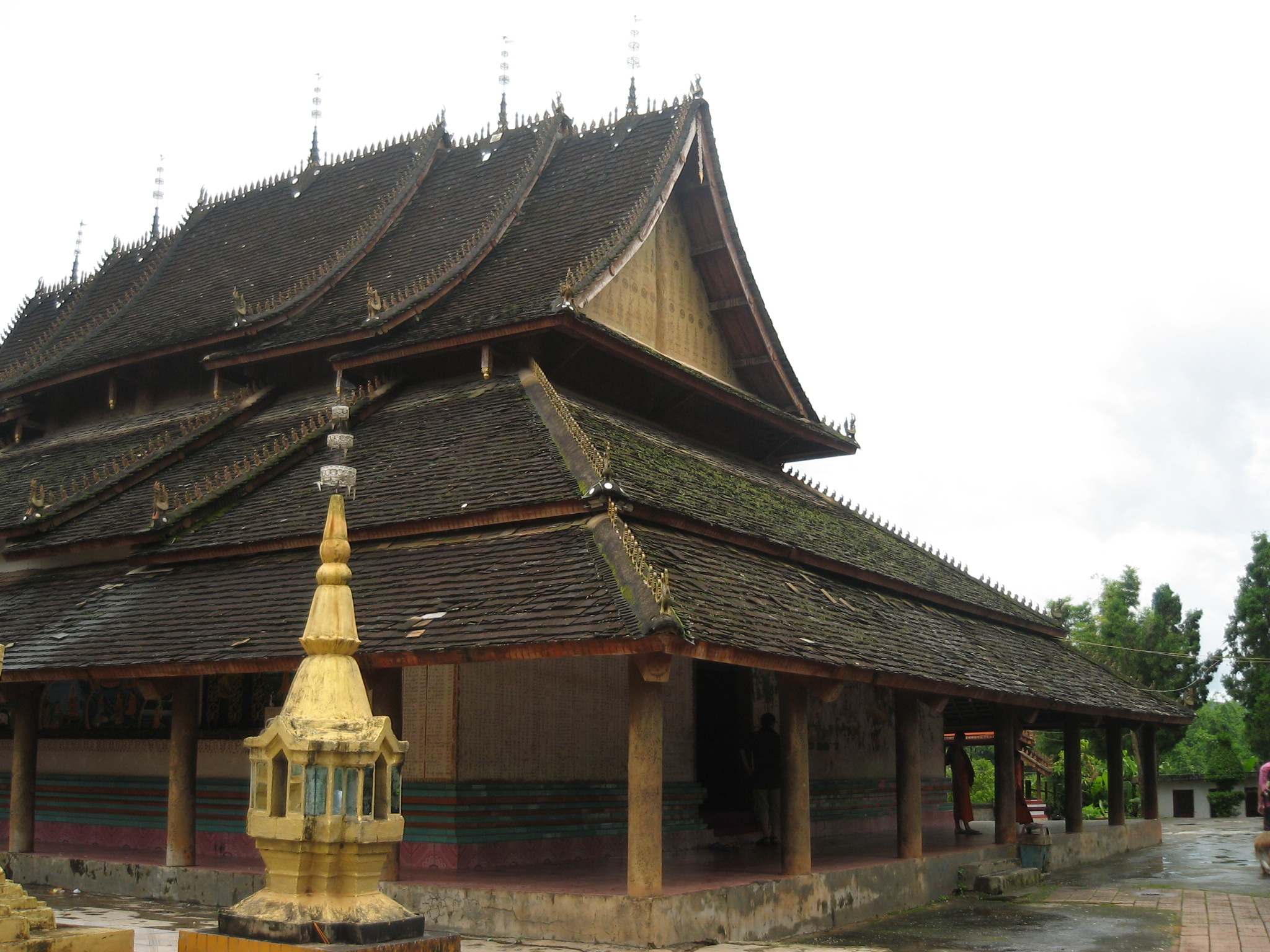
The older temples in the area are somewhat more sobre.

temple Xishuangbanna

This very obvious echoing of the Thai style has a simple reason. The Thai people (Dai people in this part of the world, hence the name of the prefecture) originally came from southern China. Then, for reasons which may have to do with the southwards migration of the Han Chinese, a portion of them upped sticks in the first millennium AD and started wandering south through Laos and Myanmar until they settled in what is now Thailand. But they left echoes of their culture behind, reflected in the designs of the temples but also in the language – many of the signs in Jinghong are in Thai as well as in Chinese.

The local culture (Thai and non-Thai; the ethnic mix in this part of the world is quite bewildering) is threatened with submersion in the Han culture – recall that this is why the Thais probably originally started migrating southwards. Until the 1950s there were few Han Chinese in this part of Yunnan – they were afraid of the malaria, which was then endemic. But the Chinese communists vigorously promoted programmes which eradicated the malaria. They then brought in poverty-stricken migrants from other parts of China and put them to work cutting down the jungle and planting rubber trees in its place, so now the hills around Jinghong are monotonously covered with acre after acre of rubber trees. These are all clones from the same genetic line. Those who know about these things predict that sooner or later (probably sooner rather than later) a rubber tree virus from Brazil will arrive here and wipe out every single rubber tree: an environmental disaster of epic proportions.

In the meantime, the descendants of the miserably poor Chinese who were sent to Xishuangbanna to plant and tap all those rubber trees still live in miserably poor Chinese villages, scorned and resented by the local populations.

As I look at the temple across the river and reflect on all these historic movements of people, I am reminded of the current tensions in Thailand caused by more recent movements, tensions between migrants from Cambodia, Laos and Myanmar, who do the dirty, poorly paying jobs which the locals no longer want to do, and the Thais, who have conveniently forgotten (if they were ever taught) that they too were once migrants.

“Plus ça change et plus c’est la même chose”, as Jean-Baptiste Karr, a French journalist and novelist, said back in 1849, and as my French grandmother was fond of quoting: the more things change, the more they stay the same. So true.

___________________

Chao Phraya river pics: mine
Yourantai-interior: http://media-cdn.tripadvisor.com/media/photo-s/01/b9/8b/a5/les-repas-dans-un-cadre.jpg [in http://www.tripadvisor.co.uk/LocationPhotoDirectLink-g528741-d1749170-i28937125-Yourantai_B_B-Jinghong_Yunnan.html%5D
Yourantai-river view: http://www.cielyunnan.com/wp-content/uploads/2012/04/Yourantai-24.jpg [in http://www.cielyunnan.com/hotels/hotels-xishuangbanna/xishuangbanna-yourantai-resort/%5D
Buddhist temple Jinghong: http://www.yunnanadventure.com/UploadFiles/Yunnan-Attractions/Xishuangbanna-Attractions/Mange-Buddhist-Temple-Jinghong-XishuangBanna.jpg [in http://www.yunnanadventure.com/attraction-p156-mange-buddhist-temple-jinghong-city
Temple Xishuangbanna: http://www.wildchina.com/blog/wp-content/uploads/2008/08/img_8570.jpg [in http://www.wildchina.com/es/multimedia/wildchina-blog-details/yunnan-hiking-in-xishuangbanna%5D