POSTS

ABDOULAYE KONATÉ, MALIAN ARTIST

Milan, 31 December 2017

My wife and I went for a walk the other day in Milan’s so-called Fashion Quadrilateral, the zone in the city centre bounded by four roads – Via Montenapoleone, Via della Spiga, Via Manzoni and Corso Venezia. Here, you will find the boutiques (shops seems too vulgar a word) of the greatest Italian fashion brands as well as of quite a number of the best-known foreign brands. I won’t name names, I don’t feel like giving even an iota of publicity to these temples of conspicuous consumption.

I should clarify that I dislike visiting shops, and the higher the price tags on the merchandise the more I dislike them. Visits to places like Milan’s Fashion Quadrilateral therefore turn me into a rabid Socialist. In moments like these, my wife just ignores me and enjoys the window-gazing.

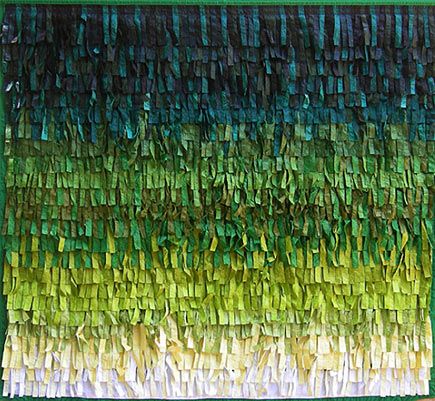
As I stumped grumpily along streets whose windows were stuffed with items the sale of any one of which could cover a Bangladeshi garment worker’s salary for several decades, I spied something out of the ordinary in a window. Now this was something intriguing indeed!

Seeing another one inside the boutique in question, I metaphorically held my nose and entered. It was somewhat smaller but just as striking.
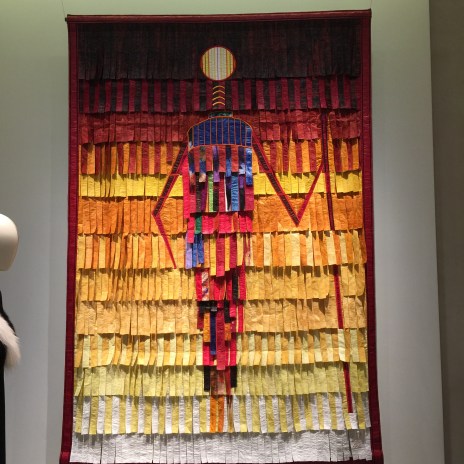
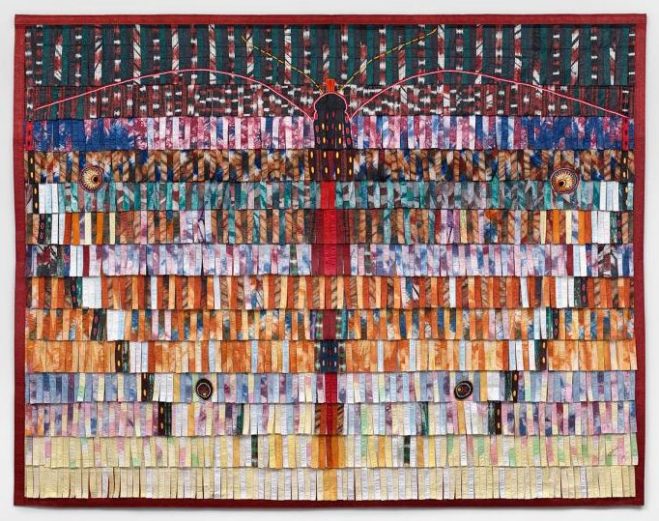
A sign stenciled on the boutique’s window helpfully informed me that the works were by a certain Abdoulaye Konaté. I had never heard of this artist, but a quick search on the Internet revealed the bare bones of his life: he is a Malian artist, one year older than ourselves, and resides in Mali’s capital city, Bamako.

And what lovely pieces he creates! He works primarily with textiles, with one thread of his work – if I may put it that way – veering towards abstract compositions made with small rectangular stripes of highly coloured cotton textiles, much like his works in the boutique. I give here a little gallery of these works, drawn from the Internet.

This final one has recently been purchased by the Metropolitan Museum of Art in New York:
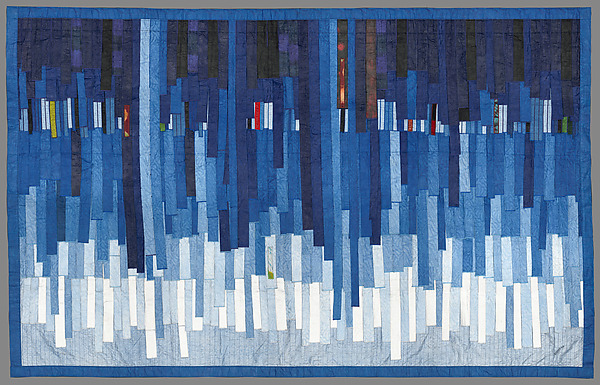
The other main thread of his work veers more towards the figurative, as these examples show:

Thoroughly excited by these discoveries, after Christmas I headed to the gallery in town which was lending the pieces to the boutique. Alas! The gallery only held the pieces loaned to the fashion boutique. Instead, it was holding a show dedicated to Gianfranco Zappettini, an Italian artist from the so-called Analytical school of the 1970s. Paintings like these surrounded us as the young, enthusiastic fellow on duty told us more about Konaté and eventually about Zappettini.


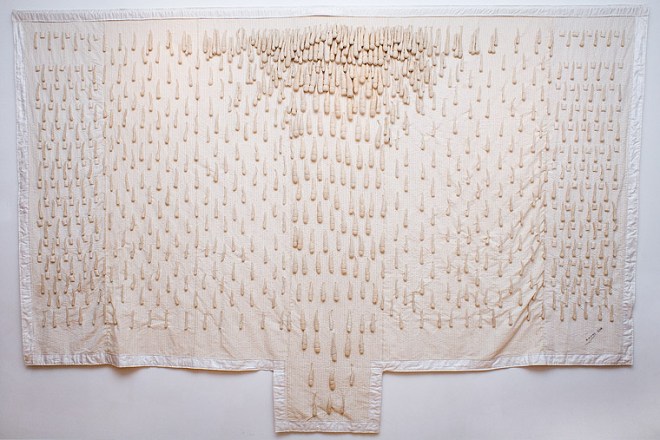
Analytic painting, and I quote, “wished to conduct an analysis of the material components of paintings (the canvas, the frame, the material of the paint, the colour, signs) and the material relationship that takes place between the work as physical object and its author. Painting therefore became the subject of investigation of itself and lost the references which linked it to reality (in figurative painting), to expressiveness (in abstract painting) and to the underlying significance (in conceptual art)”. Well, that pretty much sums up the complete dead-end that modern Western art has finished up in. A feeling that was underscored for me by a visit to a new art venue in Milan, the Pirelli Bicocca, once – as its name implies – a factory of the Pirelli Group, now a large ex-industrial space given over to art. The space is wonderful. But this is what we saw there – piles of old clothes passed off as art.

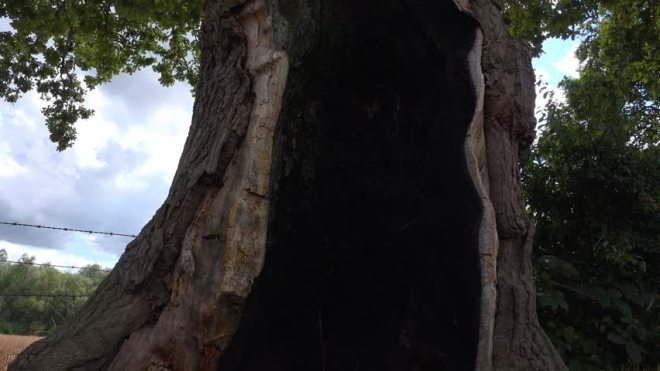
Konaté takes textiles and turns them into lovely pieces of art. We in the west can only make untidy piles out of these textiles and call it art.  It seems to me that contemporary art is like an old tree, rotted away at its heart but still living around its edges which are supporting an exuberant  foliage.
Thank God for Malian artists like Abdoulaye Konaté, or Inuit artists like Kananginak Pootoogook, or Malagasy artists like Joel Andrianomearisoa, or a dozen other artists from the so-called periphery of the world, who are keeping art alive!

___________________________

Shopping in Via Montenapoleone: http://www.wheremilan.com/discover-milan/sightseeing/montenapoleone-district/
Abdoulaye Konaté: http://www.artesmundi.org/artists/abdoulaye-konate
Abdoulaye Konaté-abstract-1: https://www.blainsouthern.com/artists/abdoulaye-konat%C3%A9
Abdoulaye Konaté-abstract-2: https://it.pinterest.com/sztukaafryki/abdoulaye-konat%C3%A9/?lp=true
Abdoulaye Konaté-abstract-3: https://www.wallpaper.com/art/abdoulaye-konat-exhibits-merges-music-and-colour-at-blainsouthern-gallery
Abdoulaye Konaté-abstract-4: https://www.widewalls.ch/abdoulaye-konate-at-blain-southern-berlin-solo-exhibition-useful-dreams-2015/
Abdoulaye Konaté-abstact-5: https://it.pinterest.com/pin/461689399276917735/
Abdoulaye Konaté-abstract-6: https://www.metmuseum.org/art/collection/search/655979
Abdoulaye Konaté-figurative-1: http://biennaleartmagazine.com/1986/04/18/abdoulaye-konate-arken-21-april-18-september-2016-dk/
Abdoulaye Konaté-figurative-2: https://it.pinterest.com/sztukaafryki/abdoulaye-konat%C3%A9/?lp=true
Abdoulaye Konaté-figurative-3: http://www.bbc.co.uk/news/world-africa-16308012
Abdoulaye Konaté-figurative-4: https://www.artsy.net/artwork/abdoulaye-konate-fete-africaine-the-men-and-the-marionettes
Abdoulaye Konaté-figurative-5: https://scope-art.com/wp-content/uploads/2014/03/SMB14-NL-03-v5.html
Gianfranco Zappettini paintings: http://www.primomarellagallery.com/it/mostre/63/la-luce-prima/
Old hollowed-out tree: https://www.shutterstock.com/video/clip-6904222-stock-footage-old-hollowed-out-oak-tree-was-struck-by-lightning-about-years-ago-and-despite-having-a-lost-it.html


COTECHINO FOR CHRISTMAS LUNCH

Milan, 28 December 2017

Many posts ago, I promised that I would render public the recipe for mashed potatoes which had been handed down for generations from mother to daughter on my mother’s side (at least, that’s what I would like to think; I certainly got the recipe from my sister, who in turn got it from our grandmother). I will finally unveil it today – but first, I will dreamily describe the meal which it accompanied, which happens to have been our Christmas lunch.

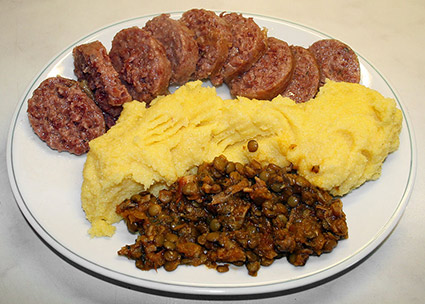
The centerpiece of the lunch, the pièce de resistance as the French would say, was two cotechini. For readers who have no idea what a cotechino is, let me first say that I completely understand; I too had no idea what it was before I had slices of one put on my plate some forty years ago, when I passed my first year’s end in Italy. Let me go on to say that it is a sausage – such an ugly term for this glorious dish! the Italian term salume is so much more elegant, I will use that.

It is made with pork meat, both lean (shoulder, neck, leg, shank) and fatty (throat, cheek, bacon) as well as rind. The meat portion is chopped coarsely, the rind finely. Nowadays, the lean meats predominate in the recipe, with about a fifth each by weight of fatty meat and rind added, but I suspect that in the old days there was much more rind since the salume’s name derives from cotica, the Italian word for rind. In any event, salt, pepper, spices and herbs, and even sometimes wine, are added to the mix. The precise types and amounts of spices and herbs are of course closely guarded secrets handed down from generation to generation in the hush of rural kitchens, but nutmeg, cloves and sometimes cinnamon are present in modern recipes. This fragrant mix is then squeezed into a casing of pig’s intestines. The resulting salume is cured for about a month, after which it is ready to eat. But first it needs to be cooked, which luckily is easy though slow: place the cotechino in boiling water over low heat for some four hours, first pricking the casing to allow the fats inside to ooze out. Et voilà! (I feel I must inform those readers who are pressed for time that there are now modern pre-cooked cotechini which can be ready for the table in half an hour, but I would really urge them to make time in their busy lives to purchase a raw cotechino and cook it the full four hours).

Today, the cotechino is a very respectable dish, but I suspect this is because it has been subjected to the culinary equivalent of gentrification. It must have started life as the ingenious response by poor people to the pressing need to use every bit of their pigs, even the hard, gristly, tough bits. In fact, the region of Friuli-Venezia-Giulia, which until recently was a very poor region of Italy, has always claimed the paternity of the cotechino. In truth, though, it is found in substantially the same form throughout the whole of north-eastern Italy, and has spread west to Lombardy and south to the Apennines. Northern Italy was full of very poor people until comparatively recent times. Some years ago, riding the wave of sourcing your food locally, Modena has cannily parlayed the greater notoriety of its variant of cotechino into a certification of Protected Geographical Indication, no doubt much to the annoyance of all the regions in the north-east who believe that the cotechino was born in their region.

Well, I don’t object to this social upgrading of the cotechino. I’ve always thought that simple “peasant” food is much nicer than the fussy, overwrought creations invented for aristocrats with nothing useful to do with their lives and always looking for something new to excite their jaded palates.

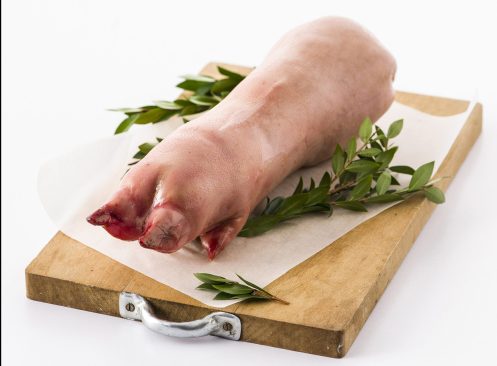
In northern Italy, cotechino is the dish par excellence for Christmas and New Year meals. It is joined in this distinction by the zampone from Emilia Romagna, which is identical to the cotechino except for the casing used: the pig’s front foot rather than its intestines.

It is probably its role in year’s end festivities that has turned the cotechino into a respectable, middle-class dish. But I suspect that its place on the Christmas or New Year table in the first place is actually due to simple chance. In the old days, it was customary in the countryside to slaughter the household pig at the beginning of winter. The meat and offal were then cured or otherwise preserved to build up food supplies for the lean winter and spring months. Cotechino, which is cured within a month, would have been ready by the end of the year, just in time for the festive season. Thus did it happen to become, in my humble opinion, the centerpiece – the piece de resistance – on the Christmas or New Year table.

What of the side dishes to be eaten with cotechino? This year, we followed the time-honored tradition of eating it with lentils.

I personally think this is an excellent culinary pairing. Cotechino has rather a sharp taste, which is admirably offset by the relative blandness of lentils. The relative dryness of lentils also soaks up the cotechino’s tendency to excess fattiness. But I’m not sure this was necessarily the reason for which the pairing originally occurred. Since time immemorial, lentils have been the poor person’s food, so it seems natural to me that it should have been paired with cotechino, the poor person’s salume. It could also be that there was already a tradition of eating lentils at the new year. It seems that since at least Roman times there has been the belief that eating lentils at the new year will ensure your prosperity in the year to come. This credence is based on the shape of the lentils – they look like (very) small coins. I suppose this must be based on a belief in some sort of sympathetic magic: eat coin-shaped food and real coins will soon be clinking in your pocket. I wish it were that simple …

Which brings us back to where this post started: mashed potatoes.

We decided to add this to the basic pairing of cotechino and lentils. I feel that the gentle sweetness of mashed potatoes helps the lentils in its task of smoothing out that bite and tartness which is an essential part of the cotechino’s identity. I’m convinced that our mashed potatoes’ sweetness is enhanced by the way we prepare it (I say “we” because I have passed on the age-old secret recipe to my wife and daughter): mash the potatoes, preferably in one of those old-fashioned manual food-grinders, add enough milk to nearly liquefy the mash, add an extremely large nob of butter, stir. That’s it.

And so we all tucked into our Christmas lunch of cotechino, lentils, and mashed potatoes.


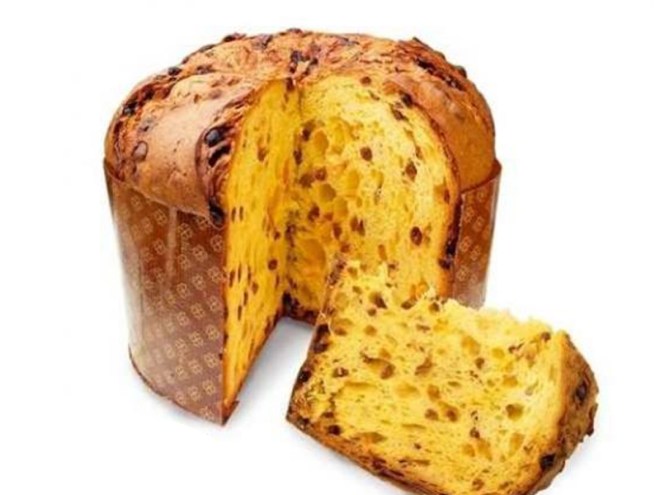
Nothing fancy, just damned good food. And of course followed by that glory of Milanese cuisine, panettone.


Well, it’s taken me a little time to prepare this post, but readers still have just enough time to rush out and buy themselves a cotechino for their New Year’s lunch or dinner. I suggest going to your nearest Italian Deli to see if they have it – you can buy a zampone if they stock that. If not, you might just have time to buy it on-line. But hurry! Time is running out!

__________________

cotechino: http://www.academiabarilla.com/italian-recipes/second-courses/cotechino-with-lentils.aspx
cotechino di Modena IGP: http://www.pubblicitaitalia.com/eurocarni/2007/2/7179.html
zampone: http://www.salepepe.it/ingredienti/tipi-di-carne/zampone/
lentils: http://www.lacasadellericette.com/2011/12/lenticchie-felice-anno-nuovo.html
mashed potatoes: http://www.cookingchanneltv.com/recipes/mashed-potatoes-with-roasted-garlic-and-mascarpone-cheese-1947695
cotechino, lentils, and mashed potatoes: https://cucina.doki.it/secondi-piatti/cotechino-pure-patate-bimby-tm31-ricetta
Panettone: http://www.alimentipedia.it/panettone.html
New Year’s dinner: http://www.grubstreet.com/2016/12/where-to-make-last-minute-new-years-eve-reservations-in-nyc.html

HARK! THE HERALD ANGELS SING

Milan, 25 December 2017

I suppose it’s a sign of old age creeping up on me that I recall with ever greater fondness the memories of my youth, and in this festive season no more so than to Christmases past – here, to get us into the spirit of things, I throw in a picture of Scrooge being visited by the ghost of Christmas Past.

There is one Christmas in particular which comes back vividly to mind.  I must have been six years old, old enough to remember things forever more and young enough for incidents to be deeply impressed into my still malleable brain. I can still see in my mind’s eye the living room of our house in Eritrea – this was probably the last Christmas we spent there; we would be leaving it forever within the coming year. The furniture had been moved around to make room for a Christmas tree in the corner and a nativity scene along the edge of one of the walls. Following the cultural divide in our family, my British father was responsible for the tree while my French mother was responsible for the nativity scene, or crèche as she used to call it. The tree was a source of endless fascination to me, covered as it was with those glittering balls and other baubles. This picture of a Christmas tree from the 1950s captures well the glittering fantasy I beheld.

The balls in particular were a magnet for my little fingers, which was a problem because they were incredibly fragile in those days, made as they were of some very thin, very easily breakable material.  Alas, despite numerous parental warnings to keep out of the living room, I could not resist sneaking in and touching those beautiful balls, with a broken ball and a sore bottom being the inevitable result.

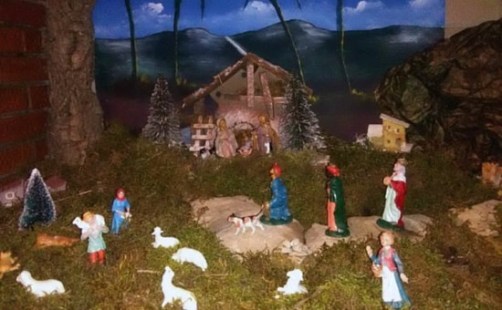
The crèche was an equal source of fascination: the little manger, the figurines of Mary and Joseph, the Mum and Dad to that little baby, Jesus, lying in the hay, the donkey and the cow, very much like the ones I saw when we went for drives in the countryside around the town, the shepherds hanging around the manger, who also looked pretty much like the shepherds I sometimes saw out in the countryside, the angel which hung by a thread over the manger, the three old fellows and a camel who, day by day, were brought closer and closer to the manger until they reached it some time after Christmas … all wonderful stuff. The crèche photographed here has the rough and ready look which ours surely had – in fact, it looks already to be one level above whatever it is that we prepared, although to my innocent eyes ours was a work of art.

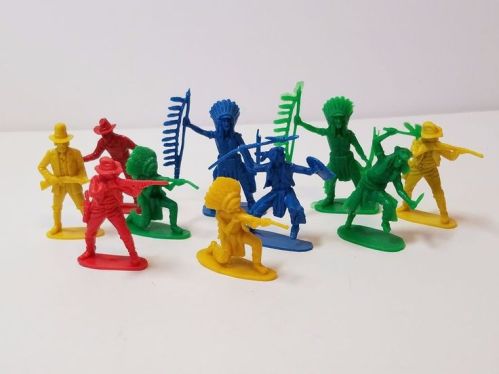
I had little understanding and, frankly, zero interest in the theological profundities which were being exposed before us. What I loved were all those little figurines which we could move around! Our mother made it even more interesting by allowing us to add our own figurines to the mix. I don’t recall what I brought but I remember that my elder brother came with his toy cowboys and indians which he proceeded to hide behind the various trees and bushes dotting the papier-maché landscape.

In all my Christmases Past, I have had a particular fondness for these Christmas trappings, even though for reasons which are now not clear to me the crèche quite quickly dropped away in my parents’ Christmases, leaving only the tree and its baubles. When my Italian wife and I started having our own Christmases the decorated pine tree also dominated, although my wife remembered with great fondness the crèche, or presepe as she calls it, which her father would create when she was young. As she described it to me, it seemed very much like the crèche of my memory, although her father had inserted a pond into the landscape using a mirror and had rigged up a little light driven by a battery which would shine in the star above the manger. Since it was very much my father-in-law’s project, I suppose that after his early death my mother-in-law never had the heart to take the presepe out and set it up, even when our children were young and might have appreciated it. But we took them along to the local churches – every self-respecting Italian church will have a presepe set up in one of the side chapels at Christmas.

This year, as I did my annual trek to the attic to bring down our Christmas tree (made of plastic and reusable; I have to walk my talk, after all, and I can’t stand those piles of dead and dying pine trees on pavements after Christmas), I spied in the corner the box where my mother-in-law had stored the presepe materials, an old box which had once contained a humidifier and which still had her handwritten note on the top of it – a message from the past.

Since it was to be a family Christmas this year, with both our children joining us, I decided on the spur of the moment to set up the presepe. I brought the box down, took everything out, and carried out a general inspection. I decided to drop the pond; I didn’t approve of this novelty. The electrical system was kaput, so I ditched that. The main actors were all there – Jesus, Mary, Joseph, the manger, the ass and the ox, the shepherds and their sheep, the angel, the three Wise Men and their camel. But I was going to need some extra characters, to make up for the cowboys and indians which in my wiser old age I recognized as very incongruous – and anyway I had no cowboy and indian figurines at hand (I had some of my son’s Warhammer figurines in the back of a cupboard, but they would have been even more incongruous).

I decided to check out the greatest of all presepi in Italy, the ones made in Naples, which had brought the art of nativity scenes to heights of splendour. I mean, look at these two!


Now that’s what I call nativity scenes worthy of kings! (and queens) Making one was to be my KPI!

A little research informed me that there are a certain number of stock characters in Neapolitan nativity scenes. There is Benino, the sleeping shepherd, a reference to the line in the gospel that the shepherds were out in the fields at night (and therefore presumably snoozing). There is the wine seller, a reference to the Eucharist, but there is also Cicci Bacco, who is a reference to earlier pagan rites. There’s the Fisherman, symbolizing the fisher of souls. Then we have the two pals Unc’ Vicienzo and Unc’ Pascale, personifying Carnival and Death. There’s the Monk, who is meant to symbolize the union between the sacred and the profane in the Neapolitan nativity scene. There’s a Gypsy Girl, whose symbolism is uncertain but who is fun to have around. There’s Stefania, around whom there is an elaborate tale which I will not relate here. There’s the Prostitute, who is there to form a contrast with the purity of the Virgin and who normally is made to hang around outside the tavern – where else? Finally, there are the sellers in the market, one for each month of the year: butcher for January, seller of ricotta or cheese for February, seller of chickens and other birds March, seller of eggs April, a married couple holding a basket of cherries and fruit for May, baker for June, tomato seller July, watermelon seller August, fig seller September, wine seller October, chestnut seller November, fishmonger December.

A rapid comparison of what I had inherited from my in-laws told me that we had a lot of gaps. I had a Benino, a fisherman, a fishmonger, a young girl with a basket who could be one half of the married couple of May, a young girl who could be Stefania. And that was about it. I had a number of other figurines who it seems are not part of the stock players in a Neapolitan nativity scene. There were a couple of figurines of men playing various instruments, maybe referring to a tradition which was still alive – just – when I first came to Italy in the 1970s and which saw men appearing a little before Christmas playing the Lombard equivalent of bagpipes and inviting donations from passers-by for their efforts. There was also a neat little figurine of a fellow making polenta, no doubt part of an effort to defend the honour of northern Italian cuisine. My wife had come across by chance a little shop which sold a medley of figurines for nativity scenes, so we stocked up on a few of our missing characters. We also bought some sheets of coloured paper to use as backdrops, a bag of moss to sprinkle around as generic vegetation, and some little houses to create a nearby Bethlehem.  Then we got to work, my wife on the tree and me on the presepe alla napoletana. The result is not so bad, even if we say so ourselves.

But there is still much to do on the presepe! Luckily, I am a believer in the philosophy of continuous improvement. Next year, we will make our presepe somewhat better, the year after that better still, and on and on. If I’m lucky enough to celebrate many more Christmases Yet to Come we will finally end up with a magnificent Neapolitan-style presepe! – with some tweaks to distinguish ourselves from our southern cousins.


Merry Christmas! Joyeux Noël! Buon Natale!

____________________

Ghost of Christmas Past: http://www.wisegeek.com/who-is-the-ghost-of-christmas-past.htm
Christmas tree: https://it.pinterest.com/suehirtle1/1950s-christmas/?lp=true
Manger: http://www.unionesarda.it/articolo/sardegna_agenda/2017/11/29/a_villamar_un_corso_per_salvare_l_arte_del_presepe-122-671332.html
cowboys and indians: https://www.pinterest.co.uk/hajosc49/toy-land/
Parish church nativity scene: http://www.valcenoweb.it/2017/12/10/chiesa-parrocchiale-di-pione-bardi-inaugurato-il-presepio-venerdi-8-dicembre-2017/
the presepe box: my photo
Warhammer figurines: http://www.sickchirpse.com/peta-campaign-against-warhammer-fur/
Presepe napoletano: https://it.wikipedia.org/wiki/Presepe_napoletano
Presepe napoletano-2: http://www.oggiroma.it/eventi/mostre/il-presepe-religiosita-e-tradizione-popolare/27671/
The finished Christmas tree: my photo
The finished presepe: my photo
Ghirlandaio, Adoration of the Shepherds: https://it.wikipedia.org/wiki/Adorazione_dei_pastori_(Ghirlandaio)

AUTOSUGGESTION

Milan, 9 December 2017

I was recently reading The Lying Stones of Marrakech, a volume of essays by one of my favorite authors, Stephen Jay Gould.

My writing style in these posts owes a great deal to his essays. If any of my readers have an interest in natural history in general and paleontology specifically, I can highly recommend his books. Tragically, he died of cancer at the age of 60.

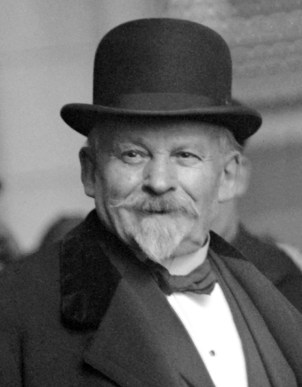
In any event, I had just started reading an essay entitled “Of Embryos and Ancestors”, which starts by Gould quoting the phrase “Every day, in every way, I’m getting better and better”. He then writes that the phrase was invented by a Frenchman by the name of Émile Coué.

Coué, Gould informs us, was “a French pharmacist who made quite a stir in the pop-psych circles of his day with a theory of self-improvement through autosuggestion based on frequent repetition of this mantra”. Gould mentions in passing that the phrase in the original French reads “tous les jours, à tous les points de vue, je vais de mieux en mieux”. I suddenly sat up – I was reading in bed – as if electrified.

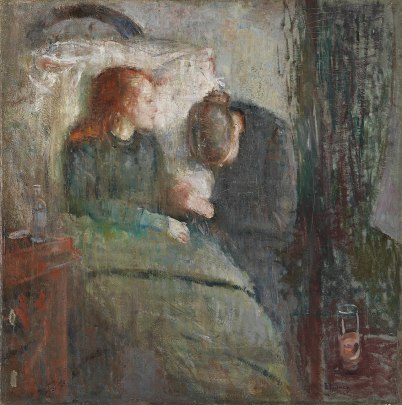
To explain my reaction, I have to recount a little bit of the history of the French side of my family. As I have mentioned in an earlier post, my maternal grandfather contracted tuberculosis in the 1920s. This was in the days before antibiotics, so it was essentially incurable; 50% of the people diagnosed with active tuberculosis had died of it within 5 years, and it was the cause of 1 in 6 deaths in France at that time. Tuberculosis surrounded one on every side. Edvard Munch painted his sister Sophie, who died of tuberculosis at the age of 14, sick in bed (his mother also died of the disease).

Claude Monet painted his first wife, Camille, on her deathbed, killed by tuberculosis.

Literature was full of people who died of tuberculosis: Marguerite Gautier in La Dame aux Camélias, Fantine in Les Misérables, Eva in Uncle Tom’s Cabin.

Coming fast on the heels of my grandfather having lost all his money – actually my grandmother’s dowry – in a failed business, his contracting tuberculosis spelled economic catastrophe. My grandmother was forced to take a job as personal secretary to a rich English woman by the name of Mrs. Green, down in Menton on the Côte d’Azur where the lady and her husband would spend the winters. Mrs. Green stipulated that my grandmother could not live with her husband, for fear that she would contract the disease and – this was the real point – pass it on to her employer. So my grandfather was forced to live hidden away in Nice, where my grandmother would visit him from time to time in secret. In the summer, when Mr. and Mrs. Green returned to England, my grandparents would come up to the house they had managed to hang on to near Mâcon. But even here my grandfather lived apart, away from the children, in a room of his own, using his own sheets, his own towel, his own napkin, even his own plate and cutlery, all in an attempt to avoid infection.

To no avail. One day, my grandmother was diagnosed with tuberculosis. Catastrophe reared its head again. Mrs. Green would fire my grandmother the moment she heard her coughing. But my grandmother was not one to give in to anything. As my mother recounted it, she began to repeat every morning, “je vais de mieux en mieux”. And by God it worked! The tuberculosis was stopped in its tracks. I had always thought that this was just one more example of my grandmother’s indomitable will overcoming yet another setback in life. But reading that phrase in French in Gould’s essay immediately persuaded me that my grandmother had actually been using Coué’s method of autosuggestion.

I was even more convinced of this when I read a bit more about Coué’s method. It was very straightforward. He said that people who wanted to get better should quickly, mechanically repeat the phrase “tous les jours, à tous les points de vue, je vais de mieux en mieux” twenty times, morning and night, while running a string with twenty knots in it through their hands. My mother’s detail that my grandmother had uttered the phrase every morning jibed well with the Coué method.

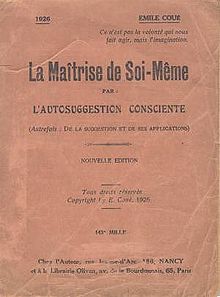
How my grandmother might have heard about the Coué method is now lost in the fog of time. Perhaps she bought one of Coué’s books, very popular at the time; his best-seller was La Maîtrise de soi-même par l’autosuggestion consciente, published in 1926.

Perhaps she read an article in the newspapers about him. Perhaps she heard the record which he made to reach as many people as possible (I’ve heard it in Wikipedia, a thin, scratchy voice from a long time ago). Perhaps one of her friends told her about it. If she did decide to use the Coué method, she never told her daughter about it; perhaps she was a little ashamed of using something that appeared akin to magic.

Of course, as a scientist Gould is dismissive of the method, seeing it only as an example of the placebo effect. I’m sure he’s right, but it – or something very like it – seems to have helped my grandmother overcome her tuberculosis. Which is just as well. My grandfather died of his in 1936. If my grandmother had also died of it, who knows what would have happened to my now-orphaned mother (and her brother). For sure she would not have met my father, so I wouldn’t be around. So thank you, placebo effect! And thank you, Monsieur Coué, if you indeed helped out here!

____________________

Stephen Jay Gould: https://en.m.wikipedia.org/wiki/Stephen_Jay_Gould
Émile Coué: https://en.m.wikipedia.org/wiki/Émile_Coué
Edvard Munch, The Sick Child: https://en.m.wikipedia.org/wiki/Tuberculosis_in_human_culture#/media/File%3AMunch_Det_Syke_Barn_1885-86.jpg
Claude Monet, Camille Monet sur son lit de mort:
https://en.m.wikipedia.org/wiki/Tuberculosis_in_human_culture#/media/File%3AClaude_Monet_-_Camille_Monet_sur_son_lit_de_mort
“La Maîtrise de soi-même par l’autosuggestion consciente”: https://fr.m.wikipedia.org/wiki/Méthode_Coué

LUXOR, EGYPT

Milan, 19 November 2017

My wife and I have just finished a little holiday in Egypt (I also went to do some consultancy on a project proposal in Upper Egypt, whose objective is to create small businesses around the reuse of agricultural and agro-processing waste; but that is a story for another day). We primarily visited Luxor, so the main thrust of our visit was the monuments of Ancient Egypt.

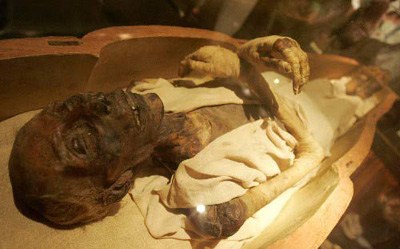
I must confess to being quite ignorant about the art, culture, and history of Ancient Egypt. Of course, I have a passing knowledge about all the usual things: the rather icky mummies

and the richly decorated Russian-doll like cases which enclose them

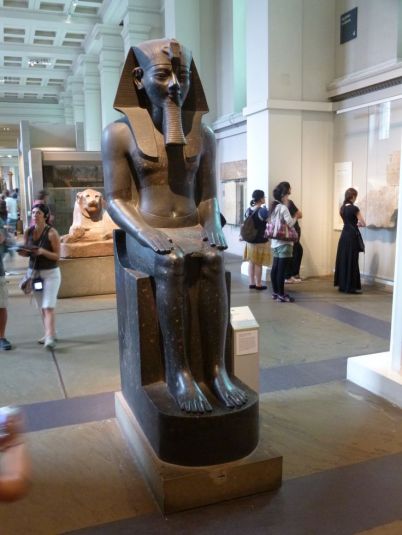
the – rather static and boringly repetitive – statues which fill halls in various Worthy Museums in Europe (here’s the British Museum’s, which I suffered through as a child).

Having read articles from time to time about King Tut and his tomb, I have of course absorbed a certain amount of his story, but to give an idea of the shallowness of my knowledge I have a very clear memory of doing a long line when I was young to visit a King Tut exhibition at the British Museum, but for the life of me don’t remember anything I saw in the exhibition itself.

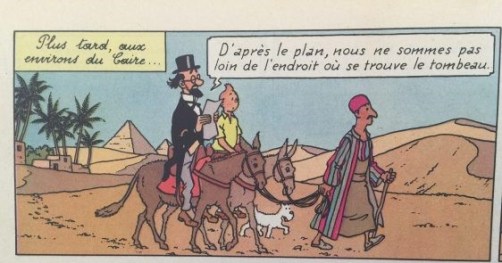
I was also entertained in my childhood by the presentation of Ancient Egypt in the comic books I read: Tintin first of all

with the amusingly absent-minded Egyptologist Philémon Siclone

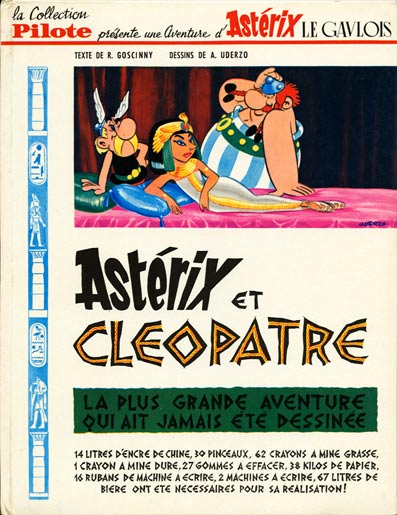
then Asterix

with the Egyptians speaking in hieroglyphics.

In more recent times, I have been tickled by films relating to various Curses of the Mummy.

And that’s about it. In short, I was really very ignorant about Ancient Egypt.

The hotel we stayed at in Luxor continued the comic-book theming of Ancient Egypt. We were staying in the Nefertiti wing, with the Cleopatra wing close by. These two pastiche statues greeted us every day as we made our way to the breakfast room


and the hotel’s walls were decorated with this kind of pastiche fresco.

Luckily, the French-speaking guide we had hired over the Internet turned out to be very competent. He had put together a nice programme which covered many of the best of the sites in and around Luxor: the temple of Karnak, with its large-scale bas-reliefs on its walls

the temple of Luxor, which we saw at night

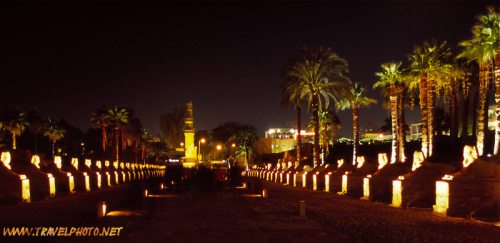
with its avenue of sphinxes

Luxor Museum, which had some lovely pieces

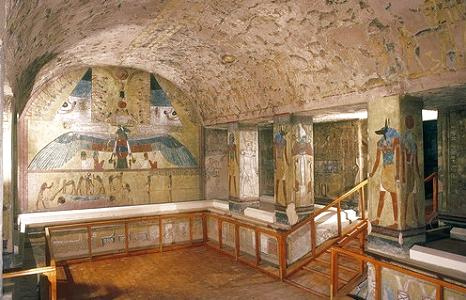
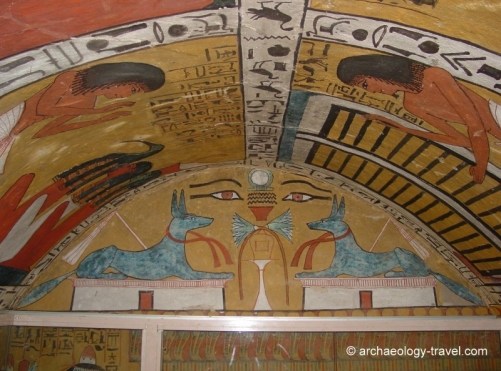
several of the tombs in the valleys of the Kings, Queens, nobles, and in the village of the artisans, with their incredibly fresh frescoes


the temple of Dendera, with its amazing astronomical ceiling

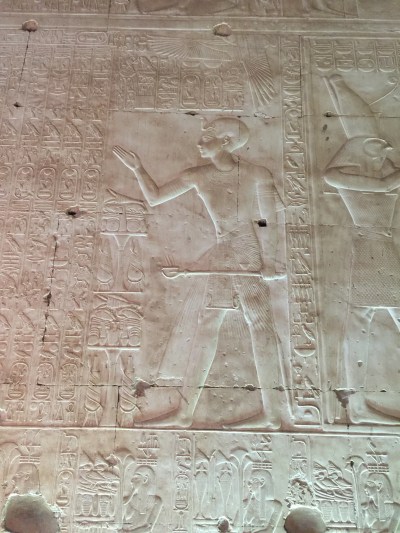
the temple of Abydos, with its lovely bas-reliefs inside the temple

the temple of Hatshepsut, with its dramatic setting

and finally the Ramesseum, with the green fields fed by the Nile’s waters lapping at its feet.

I won’t pretend that by the end of it all I was an Egyptologist, but I do think I now have a passing understanding of the history of the 18th to 20th dynasties (noting, though, the rather depressing fact that there were 30 dynasties in all before the Romans put a halt to pharaonism; I have much more to learn). I also think I have a – still very sketchy – understanding of ancient Egyptians’ religion. Finally, I have a passing knowledge of the architectural principles underlining the buildings that we saw.

I do not propose to bore readers with a breathless precis of what we saw, heard, and sort-of understood. I’ll just comment on some of the things that particularly struck me as we went along.

The sun truly dominated the thinking of the ancient Egyptians. After our two weeks there I can understand why. I saw clouds just once, and that was in Cairo. In Luxor, we had a clear, hard, lapis-lazuli sky the whole time, with the sun climbing slowly from the eastern horizon

up to its apex

and then falling slowly to the western horizon, as we moved from site to site.
It must be like this all the year round, so I can understand how the sun played a primordial role in ancient Egyptian religion. I particularly liked, then, to hear that the obelisk, that most Egyptian of things, was considered a petrified sunbeam.

What a lovely idea! A ray of the sun, congealed – frozen – in stone, driving into the earth. The equivalence would have been even stronger in the old days, when obelisks’ pyramidal capstones were covered with electrum, an alloy of gold and silver; the tips of the obelisks would have flashed and glowed in the sun.

In Cairo, we were told the same thing of the pyramids, but it was more difficult to imagine pyramids as rays of the sun in stone.

The place of the sun in Egyptian religion reached its extreme under the “heretical” pharaoh Akhenaten: he abolished all deities in the Egyptians’ pantheon except for the solar god Aten. In his frescoes and bas-reliefs, he had Aten depicted as a disc from which emanated rays that ended in hands.

The sun caressing the Earth and all that is on it … a beautiful idea! For doesn’t all life on this planet ultimately depend on the warmth of the sun?

Akhenaten was an interesting fellow, not least because of the way he had himself depicted in his official statuary, with an elongated, sensual face, quite different from everything that came before and after.

(the statues of him in the National Museum in Cairo are even more intriguing, with a body that looks distinctly feminine, to the point that some claim this is actually his wife Nefertiti)

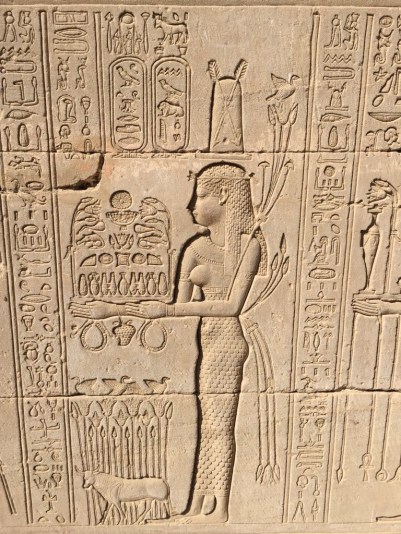
The sun even played a role in the design of the bas-reliefs which covered the walls of temples and tombs. We saw two types of bas-reliefs. The more delicate ones were true bas-reliefs, with the background cut down until the subjects were in light relief, like the ones I showed above from the temple of Abydos. The second type were created instead by cutting deep grooves along the outline of the figures and finished with some light molding of the figures. These were very striking in a raking light – in the late afternoon, for instance – when they stood out, almost like charcoal drawings on the walls.


It seems the effect was deliberate, to make reliefs that were readable in the country’s strong light.

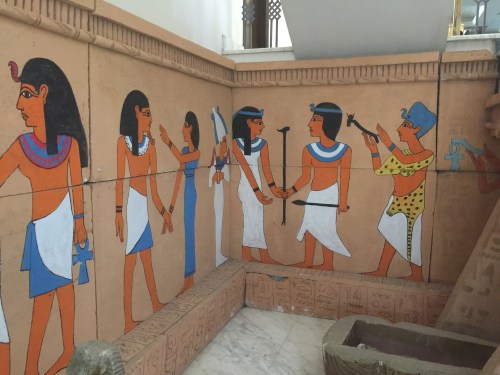
The Egyptians held that the goddess of the sky, Nut, swallowed the sun at sunset and gave birth to him again in the morning. She was the wife (and sister) of the god of the earth, Geb. The story goes that she wanted to lie on him perpetually, but Ra ordered their father Shu, god of air, to force them apart. But Nut managed to keep her hands and feet touching Geb. I just loved the way the artists depicted these stories. The artists painted Nut – very often on ceilings, as one might expect – with her feet touching the Earth in one corner, her hands touching it in another, and her thin, lithe body curving along the edge of the ceiling between these two corners.

See how in the first of these two photos, Nut is shown giving birth to the morning sun and about to swallow the evening sun, while in the second Shu is holding Nut and Geb apart.

Originally, Nut was goddess of the night sky, and night skies are a common decoration of ceilings. We saw many ceilings painted blue and sprinkled – sprayed might be the better term – with a multitude of white stars.

It was a charming effect, and in the tombs certainly gave all those mummies lying on their backs a beautiful night sky to gaze upon for eternity – in the case of the photo above Nefertari, the main wife of Ramesses II.

I finish with the so-called Colossi of Memnon, although actually they are statues of the pharaoh Amenhotep III. Tourists who passed through here a couple of thousand years before us – the Ancient Greeks – misnamed the statues.

Truth to tell, they are not much to look at; they have suffered much at the hands of time. As we stood there, a muezzin nearby started singing his call to afternoon prayers.

Allahu Akbar, Allahu Akbar,
Allahu Akbar, Allahu Akbar.

Ashhadu al la ilaha illa-llah.
Ashhadu al la ilaha illa-Ilah.
Ashhadu anna Muhammadar Rasulu-Ilah,
Ashhadu anna Muhammadar Rasulu-Ilah.
Hayya ‘ala-s-sala,
Hayya ‘ala-s-sala.
Hayya ‘ala-l-falah,
Hayya ‘ala-I-falah.
Allahu Akbar,
Allahu Akbar.
La illaha illa-llah.

God is great, God is great.
I bear witness that there is no god but God.
I bear witness that Muhammad is the Messenger of God.
Hasten to prayer.
Hasten to success.
God is great, God is great.
There is no god but God.

As the song floated over the shattered statues before us, I reflected on the seemingly inevitable passing away of civilizations and their religious constructs. The religion of the Ancient Egyptians was thrown onto the dust heap of history in the 3rd Century of the Common Era, after surviving 3,000 years or more, with a triumphant Christianity taking its place. After a mere 400 years, Christianity in Egypt was in turn overrun by Islam. Today, after 1,400 years, Islam stands seemingly secure in the lands of the Nile. But one day, when the statues before me will have crumbled to mere stumps of stone, Islam will no doubt have given way to something else. Nothing man-made survives the test of time.
_________________

Royal mummy: https://islampapers.com/2013/01/09/the-identification-of-the-pharaoh-during-the-time-of-moses/
Mummy cases: https://www.sciencedaily.com/releases/2013/08/130823091144.htm
Egyptian statue room, British Museum: https://www.pinterest.com/rowan925/egyptian-exhibit-british-museum-artifacts/
Cigares du pharaon cover: https://www.bedetheque.com/BD-Tintin-Tome-4-Les-cigares-du-pharaon-32559.html
Cigares du pharaon egyptologist: my photo
Asterix et Cléopatre cover: https://www.bedetheque.com/BD-Asterix-Tome-6-Asterix-et-Cleopatre-22950.html
Asterix et Cléopatre speaking hieroglyphics: my photo
The Mummy movie poster: http://www.impawards.com/1999/mummy_ver1.html
Pastiche statues and fresco: my photo
Temple of Karnak: http://www.nilecruised.com/tours/karnak-temple/
Temple of Luxor: https://www.traveladdicts.net/2011/10/karnak-temple-luxor-temple-egypt.html
Avenue of sphinxes: http://www.travelphoto.net/a-photo-a-day/wordpress/2005/04/15/sphinx-avenue-at-luxor-temple/
Luxor Museum: http://egypt-magic.com/category/luxor/
Tomb, Valley of the Kings: https://www.flickr.com/photos/shelbyroot/1164944359
Tomb, Village of the Artisans: https://archaeology-travel.com/archaeological-sites/deir-el-medina-luxor/
Temple of Dendera ceiling: https://paulsmit.smugmug.com/Features/Africa/Egypt-Dendera-temple/i-BJPQ24h
Temple of Abydos bas-reliefs: our photo
Temple of Hatshepsut: http://www.ancient-origins.net/ancient-places-africa/mortuary-temple-hatshepsut-deir-el-bahri-002777
Ramesseum: https://www.egypttoursplus.com/ramesseum-temple/
Sunrise Luxor: http://www.news4europe.eu/6369_entertainment/4797559_egypt-s-newly-discovered-artifacts-to-help-revive-tourism-in-luxor.html
Sun high in sky: http://www.psdgraphics.com/backgrounds/blue-sky-with-sun/
Sunset Luxor: my wife’s photo
Obelisk, Luxor Temple: https://commons.m.wikimedia.org/wiki/File:Luxor_Temple_Obelisk.JPG
Obelisk with golden capstone: http://www.riseearth.com/2016/08/mythical-benben-stone-landing-site-of.html?m=1
Sun rays with hands: http://www.ancient-origins.net/ancient-places-africa/art-amarna-akhenaten-and-his-life-under-sun-002587
Akhenaten head: http://www.panoramio.com/photo/2105526
Akhenaten statue: https://www.google.co.uk/amp/s/www.pinterest.com/amp/pin/312437292872997702/
Grooved bas-reliefs: our photos
Goddess Nut, Dendera: http://www.alamy.com/stock-photo-egyptdenderaptolemaic-temple-of-the-goddess-hathorview-of-ceiling-68990173.html
Goddess Nut, tomb Ramses IV: http://www.gettyimages.it/detail/news-photo/egypt-thebes-luxor-valley-of-the-kings-tomb-of-ramses-iv-news-photo/88701257
Stars on ceiling, Nefertari tomb: https://www.pinterest.com/ancha_no1/inside-egyptian-tomb/
Colossi of Memnon: our photo

LE COUSIN JEAN

Luxor, 11 November 2017

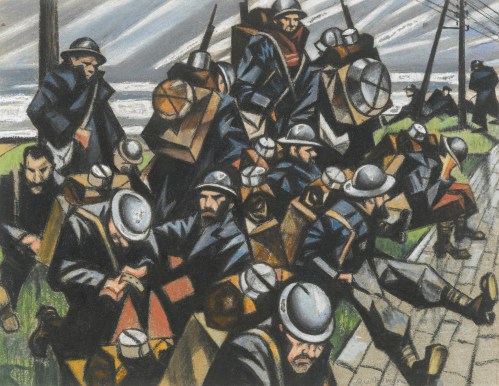
This painting, “A Dawn” by C.R.W. Nevinson, which is coming up for auction at Sotheby’s, was making a splash in the newspapers a couple of weeks ago. It shows tired French troops marching silently to the front on a dawn morning in 1914, those cataclysmic first months of the War when France suffered staggering losses. Nevinson, who was in France as a volunteer ambulance driver within weeks of war breaking out, must have seen these men marching by.

When I saw the painting, it made me think of my French cousin Jean – well, not my cousin, strictly speaking; my French grandmother’s cousin. When I was young, there was this faded oval photo hanging in my grandmother’s living room, of a bearded young man in uniform, solemnly looking out at the viewer. The photo was bordered in bleached purple velvet. One day, when I was nine or ten, I asked my grandmother who this young man was. She became very solemn and intoned, “It is le cousin Jean. He died in the First World War. He died very bravely.” Suitably impressed, I kept silent for a moment before carrying on with my life.

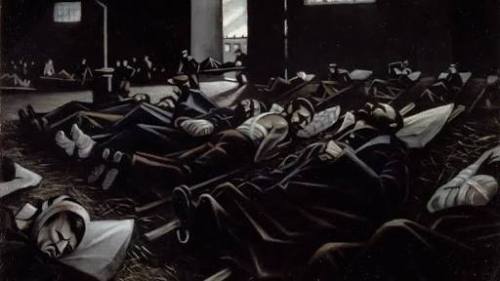
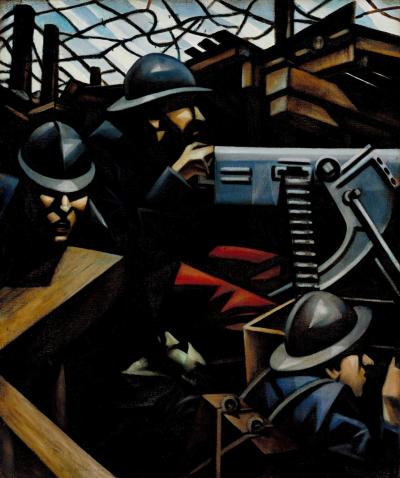
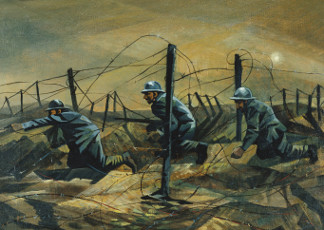
But that photo of le cousin Jean has always stayed with me. It has something to do with his quiet composure in the photo; there was none of that swagger you often see in studio photos of World War I soldiers, with the sitter showing off his uniform and trying to project a military bearing. Jean just gazed steadily out at the viewer. So on this day, the 99th anniversary of the end of the First World War on the Western Front, my memory jogged by Nevinson’s painting, I’ve decided to memorialize his story in that war, illustrating it with other paintings by Nevinson. I should warn readers that his is not a particularly dramatic story. He just did what he had to do.

Jean was 23 when war was declared in 1914, and he was called up almost immediately. He joined his local regiment, the 95th Infantry Regiment, as a sub-lieutenant. The 95th took part in the initial French attempts to retake Alsace and Lorraine. But when the Germans attacked Verdun, leaving the beleaguered city and its string of forts in a deep salient, Jean’s regiment was pulled back and thrown into the furious attacks and counterattacks that took place as the Germans tried to completely surround Verdun and the French tried to stop them. The armies on both sides fought to the point of complete exhaustion.

It was during this period that Jean was wounded in Bois d’Ailly, just south of Verdun, some time in late September-October 1914. He was wounded badly enough to be invalided out. He was probably subjected to the rough and ready medical aid that was available, especially at the beginning of the war.

At some point, Jean had recovered enough to be brought back into active service. He joined a regiment newly-formed in April 1915, the 408th Infantry Regiment. It was created with “elements from the depots”, presumably wounded soldiers like Jean as well as others passed over in the first round of call-ups. He joined one of the regiment’s machine gun sections.


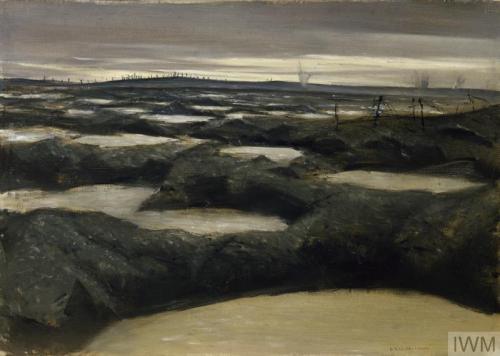
The regiment spent 1915 and the first months of 1916 in a quiet sector of the front. Then in early March, as the situation rapidly deteriorated for the French in the Verdun sector after the Germans renewed their attacks in February, the regiment was shipped in urgently to fight around the Fort de Vaux, in lunar landscapes like this.


The regiment suffered heavy losses, but Jean survived. They were eventually pulled out for rest and refitting. By late September/early October 1916, they were in good enough shape to take part in some small battles at the tail end of the Battle of the Somme. They spent the time thereafter in reserve positions, filling in gaps here and there. They probably did a lot of marching back and forth, from one position to the next.

The regiment’s second tour in the dreaded mincing machine of Verdun came in October 1917, although by then the worst of the fighting was over. By now, Jean had risen to be a Captain, no doubt because everyone else above him was either dead or was filling holes in the ranks even further up the chain of command.

The regiment was out of Verdun by January 1918, moving to a quieter sector. Then, at the end of May, the regiment was sent to the sector just south of Rheims. This was part of the Allies’ increasingly desperate attempts to stop what turned out to be the Germans’ last roll of the dice. In March they had punched a hole through the British lines. In June they punched another through the French lines just west of Reims and had managed to move 14 km south, but now they were caught in a salient, from which they were trying hard to break out. At midnight on July 14th, they abruptly started a bombardment of the eastern wall of the salient, just south of Reims. Their goal was to break through to the town of Épernay and so cut Reims off from Paris. On the morning of July 15th, they began hammering their way through the narrow valley of the River Ardre and the two woods on either side, the Bois de Vrigny to the south and the Bois de Courton to the north. Jean’s machine gun section lay nestled in the Bois de Courton. At some point, Jean went over to his commanding officer to report. While there, he was badly wounded by a shell burst. The family history says that his last words to his commanding officer were, “I’m sorry, Sir, to be leaving you at such a moment” before climbing into an ambulance. Did he really say that? I suppose he could have, but the family can only have known of this from a letter which they received from the commanding officer. Quite often the writers of these letters of condolences tried to make the man’s death more noble than it had been, in an attempt to soften the blow. My guess is that he just crumpled to the ground unconscious, bleeding profusely, and they bundled him into an ambulance.

In any event, according to the French Ministry of Defence’s bureaucratic fiche which logged his death, he died the same day in an Italian dressing station in a small place called Cartière, near Hautvillers, which lies some 10 km from the Bois de Courton. Jean was 27 when he died.

The reference to Italy confused me until I read that the 76th Infantry Regiment of the Italian II Corps had been posted just south of the Bois de Courton on the road to Épernay. The Allied High Command had given the II Corps the task of holding the road, which they managed – just – to do. I suppose the Italian dressing station was the closest to that particular sector of the front.

Jean’s body was brought back home by his family after the war for burial in the family plot; they were lucky, his body could be identified. So now he lies, together with his parents and maternal grandparents, in a graveyard which is a mere 5 km as the crow flies from where the ten year old me stared at that faded photo and asked my grandmother who the young man was with the steady gaze.
______________

CRW Nevinson, “A Dawn”: https://www.theguardian.com/artanddesign/2017/oct/30/first-world-war-painting-expected-to-reach-up-to-1m-at-sothebys
CRW Nevinson, “Troops Resting”: http://www.sothebys.com/en/auctions/ecatalogue/2016/modern-post-war-british-art-l16141/lot.3.html
CRW Nevinson, “The Doctor”: https://www.pinterest.com/amp/pin/362469469989052114/
CRW Nevinson, “La Patrie”: http://www.bbc.co.uk/programmes/p01b6rnx/p01b6qvn
CRW Nevinson, “La Mitrailleuse”: http://www.tate.org.uk/art/artworks/nevinson-la-mitrailleuse-n03177
CRW Nevinson, “In the Trenches”: https://www.pinterest.com/pin/393431717421822995/
CRW Nevinson, “After A Push”: http://www.iwm.org.uk/collections/item/object/20212
CRW Nevinson, “Column on the March”: https://kweiseye.wordpress.com/2014/09/29/christopher-r-w-nevinson-1889-1946/amp/

MIHO MUSEUM

Milan, 30 October 2017

One of the more remarkable things which my wife and I did this year during our three-week stint in Kyoto was to visit the Miho Museum. I must confess that we had never heard of this museum before scanning a newspaper listing the various things to do in Kyoto during the month of October. It’s actually located outside of the city, up in the Shigaraki Mountains, surrounded by a nature reserve. To get there was a mini-adventure in itself: bus to subway; subway to train; train to a final bus, which after a 45-minute meander over hill and dale brought us to our destination – all this while trying to follow our course by painfully deciphering the Japanese names of the stations or bus stops as they went by.

What decided us to go – apart from the excuse it gave us to adventure outside of Kyoto – was the fact that the museum had been designed by I.M. Pei, he of the Pyramid at the Louvre

but also of the east wing of the National Gallery in Washington D.C., which we had discovered as youngsters in the early 1980s


as well as of the Suzhou Museum, which we had discovered at a more venerable age some five years ago


along with his building for the Bank of China in Hong Kong.

Mr. Pei, who – as we discovered at the museum in some breathless descriptions of him – is 100 years old this year, did not deceive us. He whetted our appetite by leading us up a rather spectacular road to reach the museum proper from the car park, bus drop-off, and ticket office. After passing through a twisting tunnel, the road runs over a futuristic bridge spanning a cleft in the hills to bring us to the museum’s main door.

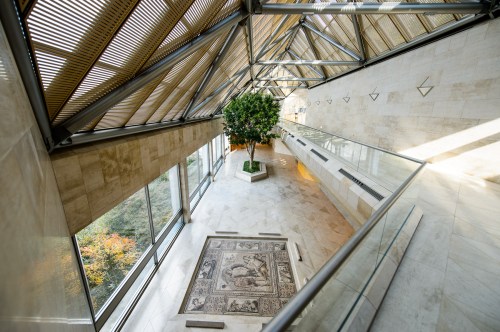
There is hardly anything to see of the museum from the outside. In the museum’s own descriptions of its design much is made of the fact that it has been buried so as to have minimal impact on the surrounding nature reserve. But the inside more than makes up for this external modesty: long clean lines, asymmetry, a profusion of triangles, light flooding in – all signature touches from I.M. Pei; a wonderful light beige stone used for cladding, spectacular views across the valley behind the museum.

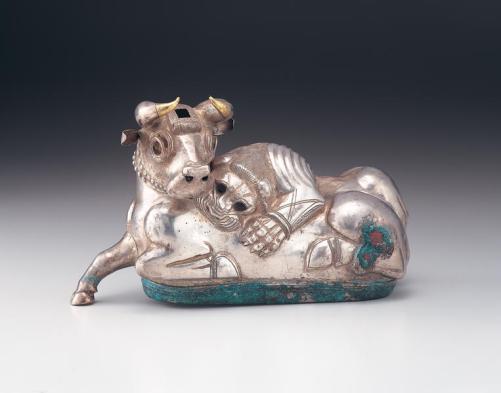
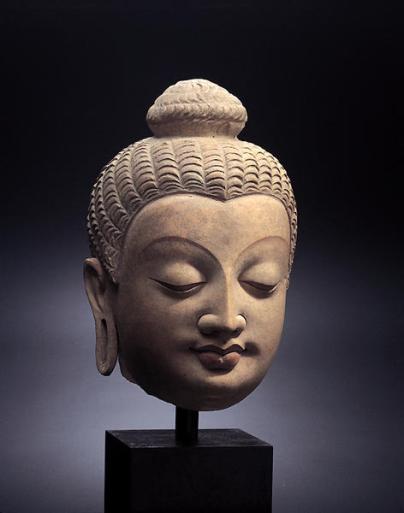
And the collection housed by all this is not to be sniffed at.


And yet … some second-thoughts began to creep in as we watched videos describing the building of the museum, and read articles about how the collection had been put together. When we first read that the museum had been built below ground to respect the natural surroundings, we presumed that they had dug and tunneled down into the rock. Not a bit of it! They just took a huge bite out of the ridge, built the museum, and then covered it up and planted trees and vegetation on top. Granted, the modeling of the covering had been done well, blending apparently seamlessly with the remaining ridge, and the plantings have stayed faithful to the original vegetation. But to claim that this way of building respected the original environment seems to be quite an exaggeration.

As for the art, we read that Mihoko Koyama, who with her daughter Hiroko commissioned Pei, had originally planned to build a small museum to house her relatively small collection of Japanese art, mostly of items linked to the tea ceremony. But Pei told them he would accept the commission only if it would be for an international collection. So the Koyamas went on a massive buying spree on the international art markets. We know from cases like the J. Paul Getty Museum in Los Angeles that when rich buyers appear on the art market wanting to buy in a hurry and not looking too closely at the exact history of the pieces they are offered, all the tomb robbers and their shady intermediary dealers are given a huge incentive to carry out their nefarious activities. Indeed, it turned out that a Chinese statue from the sixth century which mother and daughter purchased for their museum had been stolen from a public garden in Shandong province (let’s put aside questions as to why on earth such a statue should have been put up in a public garden in the first place). Who knows how many other of the museum pieces have shady pasts? And of course hardly any of the pieces have known provenances. So, while they are unquestionably beautiful works of art, their value to archaeology is zero.

I must confess I also began to uncharitably ask myself how Ms. Koyama senior got the $400 million – or maybe even $1 billion (the size of the final bill is unclear) – which it took to pay both for the building of the museum and stocking it with high-end art. So I began to burrow into her life. The details I found were sketchy, so what I present here is subject to possible revision.

Mihoko Koyama, who came into this world in 1910, arrived with a very large silver spoon in her mouth. Her family had started the Toyobo Textile Company some 30 years earlier, back in the 1880s, at a time when Japan was feverishly trying to catch up with the Europeans and textile companies were still the nec plus ultra of industrialization: a country without a textile industry was simply not industrialized. Toyobo was, and still is, a very big and very wealthy company. In the 1970s, its management cannily understood that textiles were a thing of the past and moved into the next nec plus ultra of industrialization, plastics. Now they are navigating in the futuristic waters of biotech, the next nec plus ultra of industrialization.

As if it wasn’t enough to be a wealthy Japanese heiress, Mihoko married a Japanese millionaire. I’ve not managed to find out how he made – or inherited – his millions. Bottom line, she was very comfortably off in her own right. Whether or not she was happy in her marriage is not related.

The moment that changed her life came in 1941, when at the age of 31 she met Mokichi Okada. An intriguing fellow, this Okada. Born poor, he eventually made a fortune in the jewelry business. In 1926, at the age of 44, he claimed to have received a special revelation from God, and nine years later he founded a new religion, the Church of World Messianity. This religion has three pillars, the one of most relevance to us being the Art of Beauty. Okada believed that art had an important role to play in heightening people’s emotions, enriching their lives, and giving meaning and enjoyment to their existence. I can’t really argue with that; this whole blog is pretty much based on the same idea. The second pillar of this religion is the Art of Nature, which includes nature farming. Originally called “no fertilizer farming”, nature farming is based on the ideas that fertilizers pollute the soil and weaken its power of production, that pests will eventually break out from the excessive use of fertilizers, that the difference in disease incidence between resistant and susceptible plants is attributed to nutritional conditions inside the body, and that vegetables and fruits produced by nature farming taste better than those by chemical farming. I can’t quarrel with any of that either (apart from the third idea, which I don’t really understand).

Where things begin to get sticky is the religion’s third and actually most important pillar, the concept of johrei. Okada claimed that his divine revelation of 1926 gave him the power to be a channel of God’s Healing Light (“johrei” in Japanese), which could purify a person’s spiritual realm and so remove the spiritual causes of that person’s illness, poverty, and unhappiness. If enough people received johrei, then they would achieve Messianity and a new Messianic Age would be inaugurated. Okada went on to teach johrei to his followers, allowing them to achieve, like him, Messianity and spread the teachings across the world. Wearing a pendant containing a copy of one of Okada’s calligraphies, which allows the wearers to access the powers of Okada in the spirit world, practitioners of johrei claim to be able to channel healing light into patients by waving their hands over the their body. All this would be kind of cute although pretty weird if it weren’t for the fact that members of this religion forsake modern medicine, arguing that johrei alone can heal. So the usual stories abound of children dying of perfectly preventable diseases because their parents refused to go and see a doctor.

In any event, Mihoko Koyama was bowled over by Okada’s teachings, and she decided to devote the rest of her life to practicing what he taught. After this, things get a little murky. She must have joined Okada’s Church of World Messianity but in 1970, for reasons that are not apparent – at least not from the “open literature” of the Internet – she split off and founded her own group, the Shinji Shumeikai group, Shumei for short. The group was dedicated to the same three principles as Okada’s church: the pursuit of beauty through art; appreciation of nature and “natural agriculture”; the practice of johrei. Mihoko was Shumei’s First President, her daughter Hiroko has been its Second President since her mother died.

All just fairly weird were it not for the distasteful issue of money. To become a new member of Shumei, one has to participate in a three-day “training” in johrei and pay about $300 to obtain the famous pendant used during johrei. Members are then put under severe pressure to either bring in new recruits or to make donations, with public humiliation if they can’t meet agreed targets. Members are also subject to a “daily gratitude donation”, where they are expected to donate 100 yen for every meal they eat to show their gratitude for a safe daily life. This is equivalent to about $100 a month. Members are also expected to make a donation every time they visit the group’s headquarters, and of course the bigger the donation, the greater the praise. Whenever members have a stroke of good luck, they are encouraged to make a donation commensurate to the size of their luck. Conversely, when members suffer a misfortune, they are encouraged to make a donation in thanks that the spirit of Okada helped them avoid the worst. And so on.

So, after this rather long digression through Mihoko Koyama’s life, we can come back to my uncharitable question: how did she pay for the Miho Museum? Well, I would like to believe that Ms Koyama used some of her personal wealth to foot the bills, although the cynic within me suspects that much if not all of the money came from all those donations that the members of Shumei have piously or perhaps fearfully made over the years, or that have been extorted from them through threats of humiliation, eternal damnation, or worse.

All of which leaves a rather bad taste in my mouth. But then, how did all those Renaissance popes pay for the wonderful art they commissioned from the likes of Raphael and Michelangelo? Wasn’t it the Popes’ selling of the indulgences to fund their art purchases and building programmes which led to Martin Luther’s disgust with Rome and eventually the Protestant Reformation?
___________________

Pyramid at the Louvre: http://www.dezeen.com/2017/04/26/architect-im-pei-100-birthday-10-most-significant-buildings/amp/
East wing, National Gallery, exterior: http://www.twoeggz.com/news/1170092.html
East wing, National Gallery, interior: https://www.pinterest.ph/pin/56858014017574318/
Suzhou Museum: https://www.pinterest.com/amp/pin/291678513348642992/
Suzhou Museum: http://www.pbs.org/wnet/americanmasters/i-m-pei-image-gallery-of-the-suzhou-museum/1570/
Bank of China, Hong Kong: https://www.dezeen.com/2017/04/26/architect-im-pei-100-birthday-10-most-significant-buildings/amp/
Miho Museum tunnel and bridge: http://wemedia.ifeng.com/58297950/wemedia.shtml
Miho Museum: https://amuse-i-d.vice.com/why-you-should-visit-i-m-peis-extraordinary-miho-museum/
Miho Museum: http://regex.info/blog/2013-12-06/2349
Miho Museum: http://regex.info/i/JF4_045278.jpg
Artefacts at Miho Museum: https://www.pinterest.com/RoxenPhoenix/ancient-persian-central-asian-jewelry-artifacts/
Artefacts at Miho Museum: https://www.pinterest.com/gianfrancocurat/archeo/

http://www.miho.or.jp/en/exhibition/20th/

OSMANTHUS FRAGRANS

Osaka Airport, 22 October 2017

My wife and I have been in Kyoto these last three weeks. I was here to once again give my course on sustainable industrial development at the university. But I don’t want to discuss that, I want to talk about a scent wafting on the breeze.

As we walked around the quiet neighborhood where we had taken an AirBnB, I found my nose suddenly being assailed by a very sweet smelling scent. The first few times it happened, I couldn’t locate an obvious source around me and I began to fear that I was suffering from olfactory hallucinations, that a tumor was growing in my brain and was beginning to press against whichever bit it is that controls one’s sense of smell. What made me particularly susceptible to this theory was that the scent was distinctly similar to the one most toilet cleaning products emit; you know, the scent which wafts off that bright blue or pink stuff you squeeze into the toilet bowl, leaving your toilet smelling like heaven.


Maybe the tumor was triggering olfactory memories of my toilet … Luckily for my growing levels of paranoia, the third or fourth time it happened I located the source. It was an unprepossessing tree on the corner of the road.

It was covered in small orange flowers.

Relieved that the scent was not a figment of a diseased brain, I set to work trying to figure out what plant it was. A google search quickly revealed its Japanese name to be kinmokusei, and that in the month of October it fills the air with its sweet scent. A further search revealed that its official name is osmanthus fragrans, with its English names being sweet olive, tea olive, or fragrant olive (the reference to olive apparently having to do with a similarity in leaf shape to the olive tree).

According to its Wikipedia entry, the several varieties of osmanthus are “native to Asia, from the Himalayas through southern China to Taiwan and southern Japan and southeast Asia as far south as Cambodia and Thailand”. The mention of China rang a bell somewhere in my (non-diseased) brain, something I had read once, while living in China, about osmanthus jam. Sure enough, the Wikipedia article revealed that the Chinese make an osmanthus-scented jam, but also osmanthus-scented tea, dumplings, cakes, soups, wine, and liquor. My wife and I never tasted any of these delicacies when we lived in China, but that was Beijing, in northern China, outside the osmanthus’s range.

The China connection and the nostalgia it evoked in me made me dig a little more. I discovered that the plant’s relationship with China is long; the Chinese have been cultivating it for some two and a half thousand years – its sweet scent saw to that. As might be expected, the Chinese poets weaved it into their work. Here is Wang Wei, an 8th Century Tang Dynasty poet:

I’m quiet, osmanthus flowers fall,
Tranquil is this spring night, empty the hill,
The rising moon startles mountain birds,
Which call awhile in the spring stream.

Or here we have the 12th Century Song Dynasty female poet, Li Qingzhao:

I recover from illness,
My temples have turned grey.
I lie down to rest and watch the waning moon
Climb up my screen.
Tender lips meet sweet mace, boiled in water,
Aromatic as tea.
Books and poems are so dear to me
While I sit idle against a pillow.
The outside scene freshens when rain falls.
All day long, facing me lovingly
Is the sweet osmanthus.

Things have come to a pretty pass when a flower’s scent, which made the Chinese poets sing, only makes me think of toilet fresheners! What a dumbing down we are witnessing …

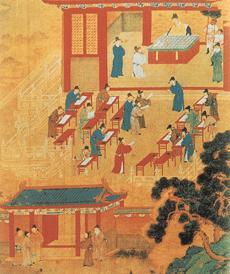
Luckily for me, the Chinese themselves have made a connection between the flower’s sweet scent and more malodorous things. Osmanthus flowers bloom more or less in the eighth lunar month, which is when the Imperial civil service examinations were originally held.

This temporal connection gave rise to a phrase in late Imperial China which was used to euphemistically indicate that a candidate had successfully passed the exam: “pluck osmanthus in the Toad Palace”. Passing the exams would now open up to the successful candidate positions in the administration where myriad possibilities would exist for him to conclude sweet deals to his advantage during the rest of his no doubt illustrious career. Imperial examinations have vanished, only to have their place taken by the gaokao, the university entrance exams.

This is the first critical step to defining how successful a career you can have in China and how much of a life of preferment and sweet deals you will enjoy. “Plus ça change et plus c’est la même chose”, the more things change and the more they stay the same, as the French writer Jean-Baptiste Karr once observed.

While I have been reading up on all this, Typhoon Lan has been brewing in the Pacific to the east of the Philippines. Now it is moving ponderously northward towards Japan. The rain that’s been falling as a prelude to its arrival has stripped the Osmanthus bushes of their flowers.

Their scent is finished for this year. It’s time for us to fly home, hopefully before Typhoon Lan makes a landfall and closes the airport.

_____________

Toilet cleaner: https://wifinowevents.com/news-and-blog/22000-agree-clean-toilets-wi-fi/
osmanthus fragrans: my pictures
Chinese Imperial exams: https://m.youtube.com/watch?v=AXGQt7Ts1wo
Gaokao exam: http://blog.tutorming.com/expats/what-is-gaokao-chinese-college-entrance-exam
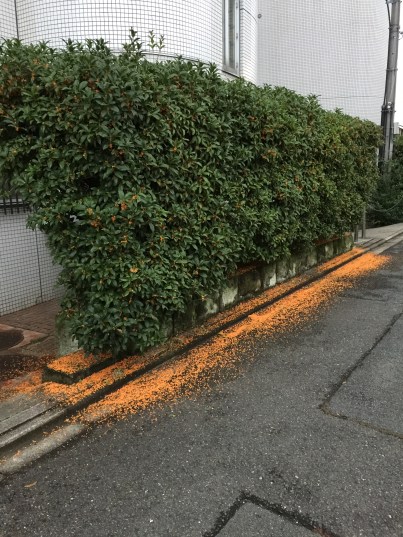
Fallen osmanthus flowers: my picture

CONKERS AND CHESTNUTS

Milan, 26 September 2017

A few days ago, my wife and I decided that for our usual afternoon walk we would take the subway up towards the northwest of Milan and then walk back home. This strategy had us walk through a small park that was once part of the grounds of the royal palace. As we walked down one of the park’s shady avenues, conkers started raining down on us. Well, that may be a bit of an exaggeration. Let’s say that two or three seed balls came cannoning down from above our heads and landed with a thump on the gravel, releasing their conkers which rolled around our feet. I picked one up and rubbed it gently with my fingers. Fresh conkers are really lovely, with their brown, lustrous skin and their smooth velvety feel.

Their seed casing is also very pretty, bright green with soft spikes all over it.

More than anything, though, conkers bring back happy memories from my childhood. I still distinctly remember during the breaks in the schoolyard fishing out my conker from my pocket and squaring off for conker duels with my friends. For those of my readers who are not familiar with this playground game, let me quickly explain how it works.
– Find a conker.
– Drill a hole through it with a nail.
– Thread a shoelace or other such string through the hole, and make a strong knot at the end.
– Face your opponent.
– One of you lets his conker dangle, let’s say your opponent.
– You swing your conker at his conker in a rather special way – see the photo below, which looks to have been taken during my boyhood years.

– If your opponent’s conker breaks, you win. If not, you dangle your conker and your opponent takes a swing at it.
And so on, until either one of the conkers breaks or the bell rings and it’s time to go back to those boring classes.

Conkers was, of course, a game of Autumn, played in the first month or so of the school term until the conkers stopped dropping off the trees and the conker supply dried up. Other games then took over the schoolyard until it was mid-September again and time to prepare that monster conker which would surely smash all other opponents in the schoolyard.

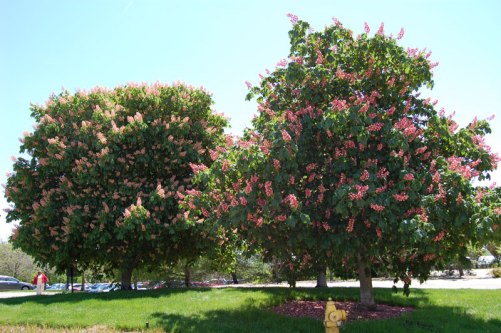
In case any of my readers are wondering, conkers come from the horse chestnut, that tree which gives lovely white or pink flowers in the Spring


and which in the last several decades have often looked distressingly mangy by summer time

the result of attack by the leaf miner moth. It seems that this disease was first noticed in Macedonia and has been marching across the globe ever since.

Perhaps, like I used to, some of my readers think that chestnut trees and horse chestnut trees are related. I mean, the nuts in both cases are so similar, as are their casings!

Yet they are not. They each belong to quite different families. I suppose this must be a case of convergent evolution.

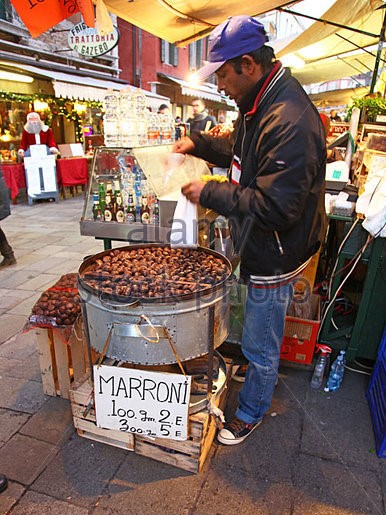
One thing which very definitely distinguishes them is that conkers are not edible, but chestnuts very much are. And in fact in this Autumn season, Milan’s shops and markets are putting out piles of chestnuts to entice you.

I haven’t yet seen chestnut roasters on street corners, though.

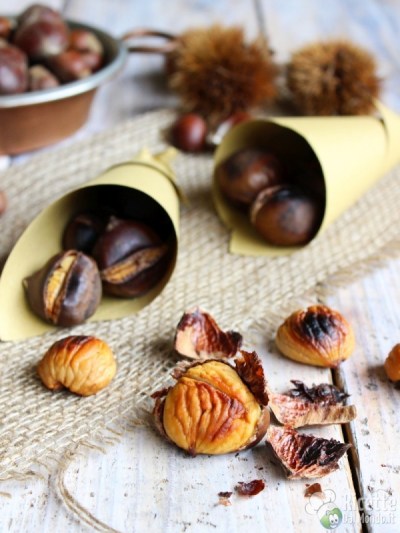
Maybe they only appear when the weather turns cooler. I await them with anticipation, so that I can buy my paper cone full of roasted chestnuts.

________________

Conkers: https://www.google.co.uk/amp/s/www.collinsdictionary.com/amp/english/conker
Conker seed case: https://www.google.co.uk/amp/www.dailymail.co.uk/sciencetech/article-3838298/amp/The-end-conker-Playground-staple-vanish-15-years-horse-chestnut-trees-felled-pests-disease.html
Playing conkers: https://www.google.co.uk/amp/s/www.pinterest.com/amp/pin/437834394994706958/
White horse chestnut tree in flower: http://www.davekilbeyphotography.co.uk/index.php/plants-landscapes/species-trees/horse-chestnut-05/
Pink horse chestnut in flower: https://ag.purdue.edu/btny/ppdl/Pages/POTW_old/6-10-13.html
Horse chestnut attacked by leaf miner: http://www.alamy.com/stock-photo-common-horse-chestnut-tree-damaged-by-the-leaf-miner-moth-cameraria-39467824.html
Chestnut and casing: http://tcpermaculture.blogspot.it/2012/09/permaculture-plants-chestnuts.html?m=1
Chestnuts in an Italian market: http://mercatidiroma.com/mercato-trionfale/trionfale
Chestnut roaster, Italy: http://www.alamy.com/stock-photo/chestnut-street.html
Cone of roast chestnuts: http://www.ricettedalmondo.it/caldarroste.html

PHILIBERT

Milan, 25 September 2017

A few days ago, I was looking for a street on a map of Milan when my eye fell on a road called via Emanuele Filiberto. Now, readers need to know that my third (and last) given name is Philibert, the English – and French – equivalent of the Italian Filiberto. Readers also need to know that the current heir to the defunct Italian throne goes by the name of Emanuele Filiberto – he is the grandson of the last King of Italy, Umberto II, who was kicked out by the referendum of 1946. For the umpteenth time, I wondered why I shared a name with this twerp. Because he is a twerp. He’s the kind of guy who ends up on the cover of magazines you flip through while waiting for your appointment with the dentist.


(will you look at that stupid grin!) He has no obvious source of income. He has a vague career as a TV presenter, and has launched a food truck in LA selling pasta, all of this trading on his royal pretensions.

Finally, I decided to try and find an answer to my question: why do I share the same name with this twerp?

This quest took me up the family tree of the Kings of Italy, which quite quickly turns into the family tree of the Dukes of Savoy; it was the Dukes of Savoy who through the twists and turns of history eventually became the Kings of Italy. I thought perhaps that Filiberto was a family name and that I would find traces of it through the generations. But no. There hasn’t been a Filiberto in the family since Emanuele Filiberto, Duke of Savoy 1553-1580.

But that explains why my twerp carries the name that he does. This first Emanuele Filiberto – or more likely Emmanuel Philibert, for the family was more French than Italian at the time – towers above many of the Dukes of Savoy who came before and after him.

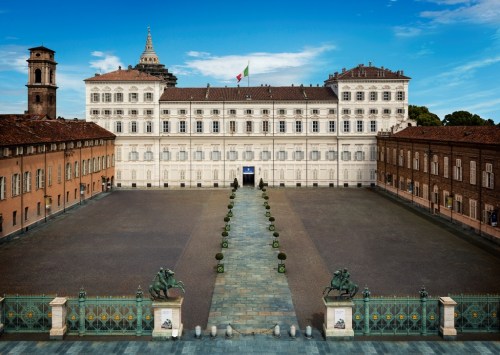
It was he who rescued the family from oblivion. His father Charles had lost all the Savoy lands both south and north of the Alps to the French king Francis I (with the Spanish helping themselves to a few pickings along the way). Refusing to accept the loss of his inheritance, Emmanuel Philibert went to work in the armies of Francis I’s enemy, the Holy Roman Emperor Charles V. He was a brilliant general, winning some key battles for Charles against the French, and earning for himself the sobriquet of Testa di Ferro, Ironhead. In gratitude, Charles V ensured that in the Peace of Cateau Cambrésis which was signed in 1559 Emmanuel Philibert got most of his lands back. It was a new lease of life for the Dukes of Savoy, although it only put off the inevitable loss of Savoy to the French, which finally occurred in 1860 during the reign of Napoleon III. Perhaps it was because he sensed that this would be the long-term outcome that Emmanuel Philibert moved the ducal capital from Chambéry in Savoy to Turin in Piedmont. This is the Royal Palace in Turin.

Obviously, the modern Emanuele Filiberto was so named by his equally twerpish father Vittorio Emanuele to bask in the reflected glory of their ancestor, and perhaps to signal that they would one day emulate his great feat and regain the crown of Italy. Fat chance of that.

But of course this discovery simply reframed my original question: why do I then share a name with Emmanuel Philibert 10th Duke of Savoy? Here, I was helped by a book from 1778 helpfully scanned by Google and available on the internet: “Histoire Généalogique de la Royale Maison de Savoie”.

It’s essentially a hagiography of the House of Savoy, but it was very useful for my purposes. Under the entry on Emmanuel Philibert it has this to say about his two names: “Emmanuel Philibert was born in Chambéry on 8 July 1528. He was given the name Emmanuel in memory of Emmanuel King of Portugal, his maternal ancestor, and that of Philibert because of a vow made by Duke Charles his father to Saint Philibert in Tournus”.

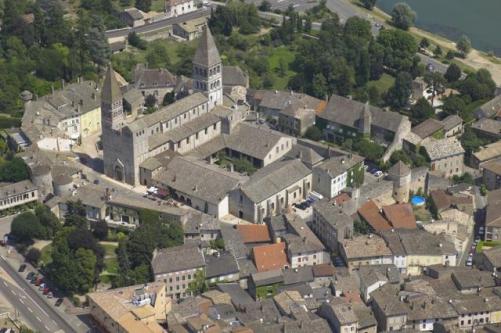
Ah! Now that was exceedingly interesting to read! To explain my excitement, I must now tell readers why I was given the name Philibert. Tournus is a small town – a very small town – in Burgundy on the river Saône, some 35 kilometers north of the somewhat larger town of Mâcon which my mother hailed from. It is famous – and indeed has been famous since the early Middle Ages – for its sanctuary to Saint Philibert. It is a glorious construction from the 11th Century and I would highly recommend my readers to visit it should they ever be in the area.


For reasons that are not clear to me, Saint Philibert is (or at least was) the saint to whom you prayed if you wanted a son. When my mother was pregnant with me, she already had three girls but only one boy. She therefore made a vow to her more-or-less local saint that if her next child was a boy she would give him the saint’s name. I was born and she honored her vow. It may just be a fancy but I suspect that Duke Charles made the same vow some time in the 1520s, especially since Tournus lay just across the river from his westernmost lands.

So there is indeed a link, however tenuous, between me and that twerp Emanuele Filiberto. Which is a pity, but there you are.

Readers might assume, since I have expended so much time on the matter, that I am proud to carry the name Philibert. I have to admit that this is not quite the case. It is, let’s face it, a bit of a silly name. When I was young, I kept it well hidden, only admitting to it when I really had to. Often, when I pronounced it, it would elicit a snicker from my listeners. I silently thank the Good Lord that my mother honored her vow but only by giving it to me as my third name. I shudder to think what my life would have been like if I had had to spend my boyhood years in the playground being called Philibert. I would probably have taken to alcohol or drugs or worse.

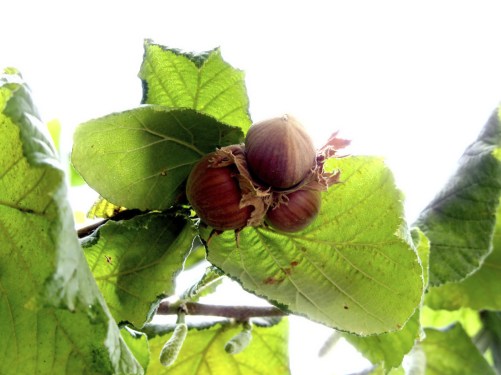
But let me finish on a more positive note. Saint Philibert’s feast day is 20th August, which happens to be peak harvest time for hazelnuts in England. So people began to call them filbert nuts, or filberts. I rather like the idea of having a connection with hazelnuts, an excellent nut which I enjoy in my morning muesli and from time time in pieces of chocolate. Better a connection with a nut than with a twerp.
___________________

Cover of Gente: http://olgopinions.blog.kataweb.it/tag/emanuele-filiberto-di-savoia/page/3/
Cover of Telesette: http://m.famousfix.com/post/valeria-marini-telesette-magazine-cover-italy-24-february-2015-51840502/p51840501?view=large
Emanuele Filiberto and his food truck: https://www.google.co.uk/amp/www.dailymail.co.uk/news/article-3690125/amp/The-prince-Italy-sells-pasta-food-truck-California-truffle-linguine-16-bowl.html
Emmanuel Philibert, Duc de Savoie: https://www.google.co.uk/amp/s/lordozner.tumblr.com/post/89144934533/frans-pourbus-the-elder-emmanuel-philibert-duke/amp
Royal Palace, Turin: http://www.turismotorino.org/mobile/
Histoire Généalogique etc. cover page: https://books.google.it/books/about/Histoire_généalogique_de_la_royale_mai.html?id=GPrH8yauF94C&redir_esc=y
Abbey church of Tournus, aerial view: http://www.tournus.fr/le-site-abbatial-de-saint-philibert
Abbey church of Tournus, interior: http://www.hotel-greuze.fr/test-a-vister
Hazelnuts: https://www.gardeningknowhow.com/edible/nut-trees/hazelnut/when-to-harvest-hazelnuts.htm