POSTS

OF ZEN GARDENS AND MISO SOUP

Milan, 3 December 2016

Back from Kyoto, and still with a bad case of jet lag (it’s 4 am and my wife and I are sprawled on the living room couches, wide awake), it’s time to review the three weeks we spent in that city. Apart from the misery caused by the American presidential elections and the pleasure derived from teaching a course on sustainable industrialization to a group of eager youngsters not yet affected by the pessimism of old age, what else will I take back with me from my three weeks spent in Kyoto?

Ever since I first visited the city thirty years ago, Kyoto for me is first and foremost the place of Zen gardens. I have already written a paean to these rock gardens in a previous post, so I will not repeat myself. I will simply mention the pleasure I derived from visiting several rock gardens which I had not seen thirty years ago (or even five years ago, when we came for a brief visit from Beijing). My wife and I decided that our daughter, who came to visit us for Thanksgiving, just had to see a couple of these glorious creations: “he (or she) who has not seen a Zen garden has not lived”, to surely misquote someone famous. We took her to the gardens in Tofuku-ji Temple as well as those in Kennin-ji Temple, both at the foot of that range of hills which runs down Kyoto’s eastern edges and which is constellated with temples. The garden in Tofuku-ji was laid down a mere 75 years ago, in the last years of the 1930s. It gives one pause to think that these so very peaceful gardens were created when Japan was ramping up its war effort towards the disastrous conclusion of Hiroshima and Nagasaki five years later.

The garden was designed by Mirei Shigemori. This was his first major work and it made him famous (at least in the small world of landscape gardening). The work consists of four gardens surrounding the Abbot’s Hall. The largest, and best known, is the south garden.
tofukuji-south-garden-2
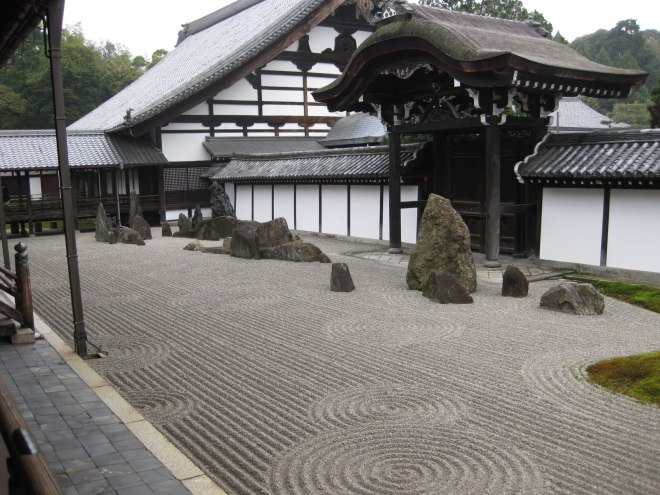
It is dominated by four clusters of massive rocks. Standing imposingly at one end of the garden, they represent the mythic, far-off isles of the immortals.
tofukuji-south-garden-1
Their shores are “washed” by a sea of raked white gravel, which leads the eye to five moss-covered mounds at the other end. These represent the five main temples in Kyoto of the Rinzai sect of Buddhism, one of whose temples is Tofuku-ji.
Unknown
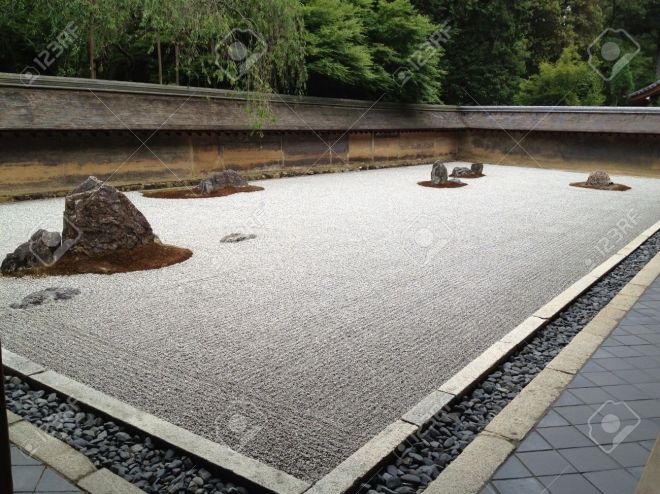
This garden obviously has its roots in the design of the far more famous zen garden at Ryoan-ji.
ryoanji-garden
Shigemori’s departures from the classical zen garden style were far more radical in the other three smaller gardens surrounding the Abbot’s Hall. The north garden has a checkerboard pattern, with square paving stones embedded in moss, that gently fades off into randomness, thus drawing the eye to the stand of Japanese maples beyond.
tofukuji-north-garden
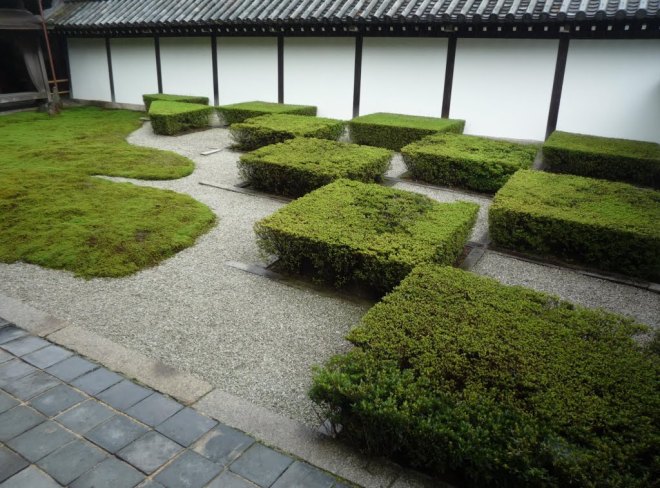
The west garden repeats the checkerboard motif, but this time with a dense array of square-cut azalea bushes.
tofukuji-west-garden
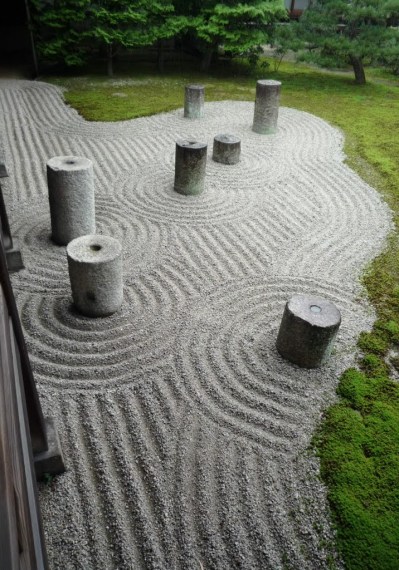
The small east garden departs from the usual use of rough stones, inserting instead seven truncated stone cylinders (recycled from the temple’s old outhouse) into the usual “sea” of raked gravel surrounded by moss. Shigemori set the pillars out like the stars of the Big Dipper, Seven Northern Stars in Japanese.
tofukuji-east-garden
These last three gardens caused much frothing at the mouth by the traditionalists but also drew much praise from the garden landscaping avant-garde. I leave it to readers to decide in which camp they want to be in. Meanwhile, I will move to the second zen garden which we visited with our daughter, the gardens in Kennin-ji. These gardens are a good deal more venerable, as befits the oldest Zen temple in Kyoto.

The same design of gardens surrounding the Abbot’s Hall is found here. We have here the main garden, where, in contrast to Tofuku-ji, the monk-designer allowed a fringe of vegetation along the far border of the garden.
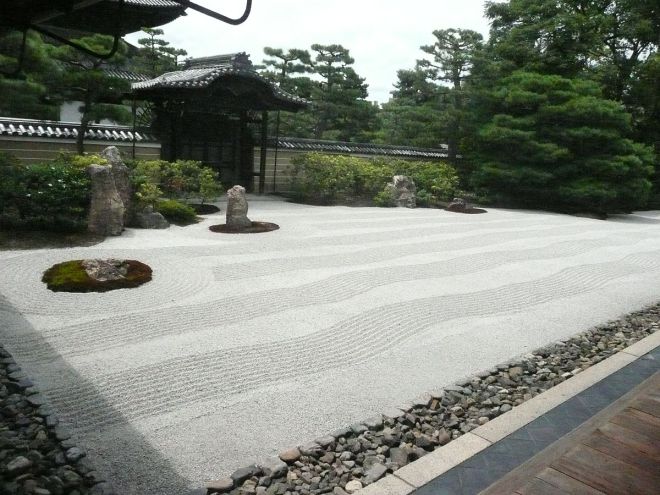
kenninji-garden-1
On the other side of the Abbot’s Hall, we have a smaller garden that invites the visitor to step over it to a beckoning tea house.
image
(unfortunately, the path is off-limits, but the determined visitor can reach the tea-house through a more circuitous set of stepping stones).

We have a moss garden enclosed between buildings and walkways.
kenninji-garden-3
Finally, squeezed in between several buildings, we have the small, compact “circle-triangle-square” garden
Kenninji Circle Triangle Square Garden
so-called because it is said that all things in the universe can be represented by these three forms (at the risk of being irreverent, though, I see the circle and square in the garden but I don’t see a triangle).

Switching gears dramatically, these three weeks in Kyoto also reanimated the love which my wife and I have for miso soup, that most Japanese of all soups.
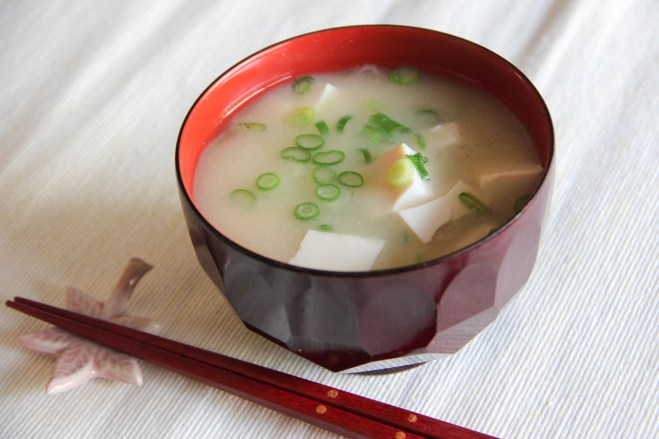
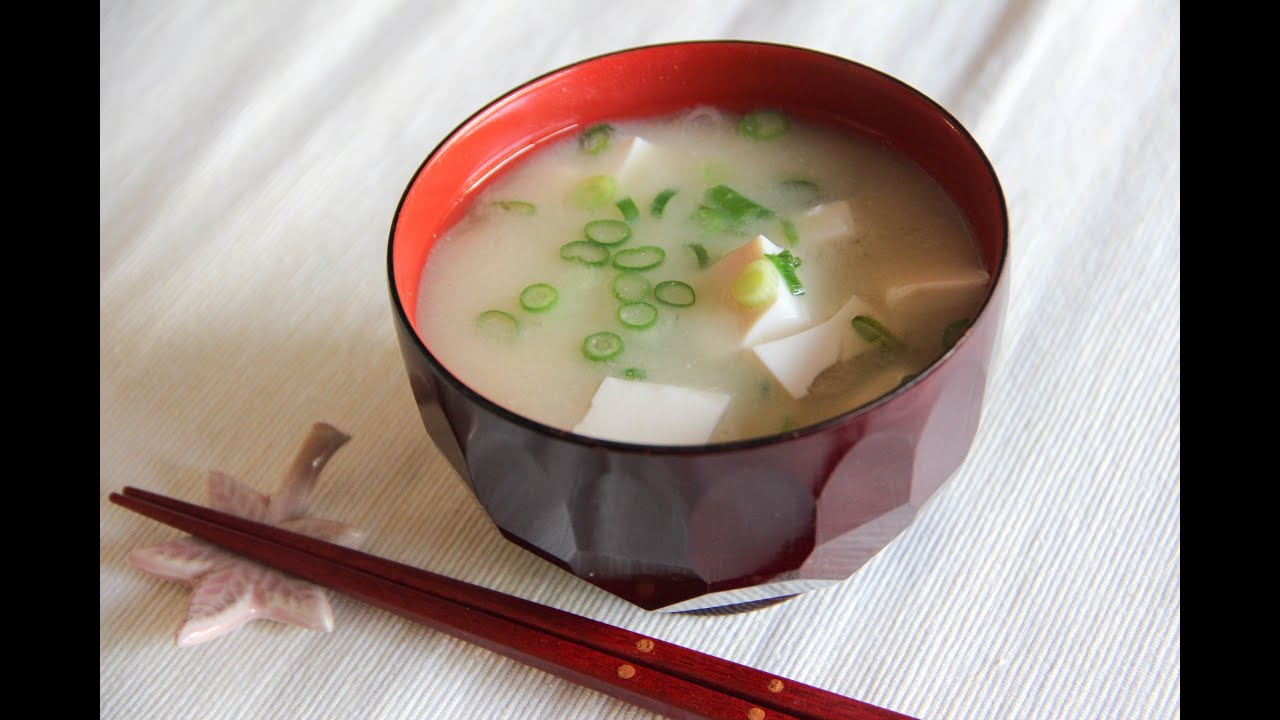
miso-soup
Readers may think I lack gravitas turning in this way from the glories of Zen gardens to the humble miso soup, gentle handmaiden to the flashier main courses of countless Japanese meals. But I feel there is a strong affinity between the two: spare simplicity in the assemblage of the constituent elements, yet delivery of intense pleasure to the senses.

What is it about miso soup’s ingredients that give it that unique taste, to be found in no other soup? It is a question which I have asked myself every time I sip on its delights, yet it is only now, in my jet-lagged haze, that I turn to the Internet to find out.

The answer is the miso paste. It is this paste which, mixed with the traditional Japanese stock “dashi”, is at the heart of all miso soups. Other ingredients that are added, such as silky tofu cubes, finely chopped spring onions, and seaweed, are – if I may mix my culinary metaphors – merely cherries on the cake. Digging further, to my mind the magic of miso paste, what gives it that so very special taste, is the fungus Aspergillus oryzae. I should perhaps explain that miso paste is the product of a fermentation process; here we have the fermentation taking place the traditional way.
miso-fermentation-barrel
Our friend A. oryzae works its fermenting magic on a mash of soybeans and salt (to which other grains such as barley and rice are sometimes added). This is what the little critter looks like through a high-powered microscope.
miso-aspergillus
My internet searches have also turned up the interesting fact that there are many kinds of miso paste, depending on the length of fermentation. At the less fermented end of the spectrum, we have white miso, lighter in colour and taste, at the more fermented end, we have red miso, darker and with a stronger flavour, and we have different colourings in between.
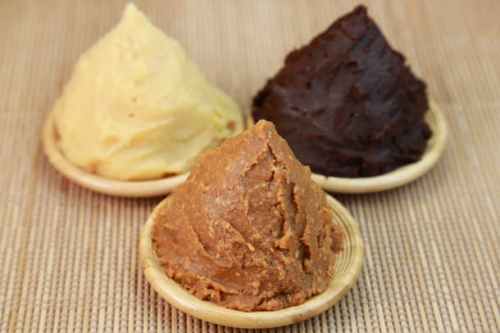
miso-pastes
As one might imagine, there are regional preferences in the colour of one’s miso paste and, by extension, one’s miso soup. We must have been eating white miso soup since that is the preferred colour in Kyoto (while red miso soup is preferred in Tokyo, for instance).

After all this, my eyelids are beginning to droop. Maybe I’ll be able to get in a few hours of sleep before the new day dawns and have sweet dreams of visiting Kyoto once more. There are more Zen gardens to visit and more miso soups to try.

______________
Tofukuji-south garden-1: http://kyotofreeguide-kyotofreeguide.blogspot.it/2010/04/tofukuji-temple.html
Tofukuji-south garden-2: http://www.japan-guide.com/e/e3930.html
Tofukuji-south garden-3: https://www.artflakes.com/en/products/japan-kyoto-tofukuji-temple-landscape-garden-1
Ryoanji garden: http://www.123rf.com/photo_21419380_zen-garden-in-ryoanji-temple.html
Tofukuji-north garden: https://commons.wikimedia.org/wiki/File:Toufuku-ji_hojyo7.JPG
Tofukuji-west garden: http://www.panoramio.com/photo/121832697
Tofukuji east garden: http://www.panoramio.com/photo/121832672
Kenninji gardens-1: http://www.yurukaze.com/tag/kennin-ji/
Kenninji gardens-2: mine
Kenninji gardens-3: http://www.wa-pedia.com/japan-guide/kenninji_kyoto.shtml
Kenninji gardens-4: http://asian-images.photoshelter.com/image/I0000NbQQcA_e4yM
Miso soup: https://i.ytimg.com/vi/lH7pgsnyGrI/maxresdefault.jpg
Aspergillus oryzae: https://sites.google.com/site/microbiologiecours/support-de-cours/mycologie
Miso pastes : http://www.thekitchn.com/the-best-type-of-miso-for-miso-soup-tips-from-the-kitchn-215117
SACRI MONTI

Kyoto, 26 November 2016

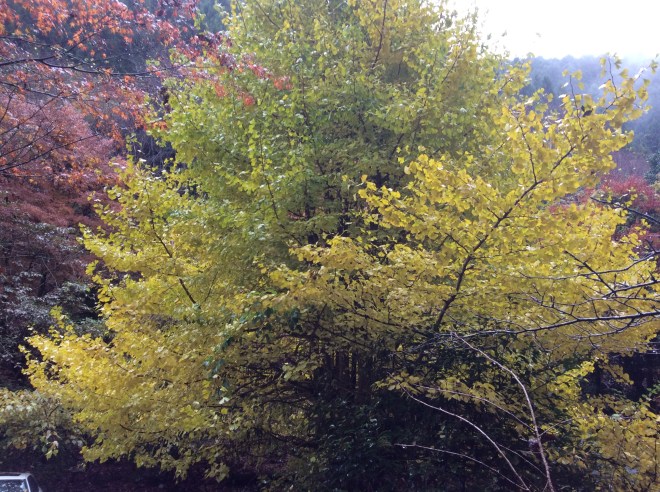
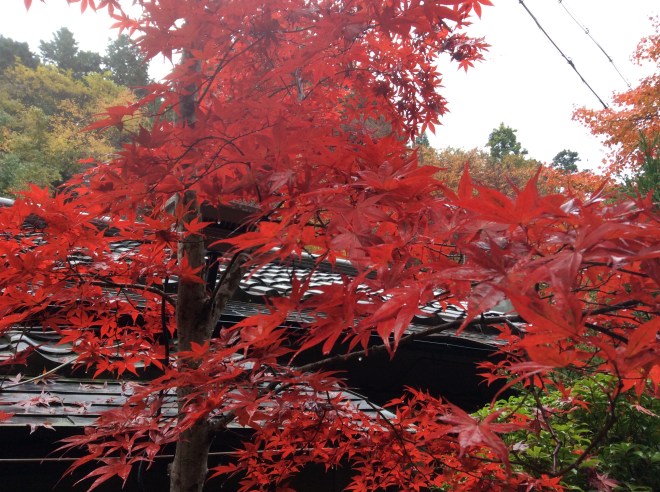
Two weeks ago, my wife and I visited the temple on mount Kurama, a mountain on the outskirts of Kyoto. We took the train to the mountain’s foot and then climbed to the top – well, “climbed” is perhaps misleading, since rather than toil all the way up using the path that snakes its way to the top we took a cable car to very near the summit and toiled lightly the rest of the way. It was the Fall colours which had brought us there, and indeed the red of the Japanese maples and the yellow of the ginkgoes were a sight to behold.
mount-kurama-2

mount-kurama-3
Since it was a cool, rainy day, the surrounding landscape was enveloped in drifting cloud and mist, strongly reminiscent of painted Japanese landscapes.
misty-japanese-landscape
At the top, we walked around the temple

and enjoyed the view.
mount-kurama-1
After which, we walked down the other side of the mountain
mount-kurama-4
to take a well-deserved lunch at the bottom.
mount-kurama-5
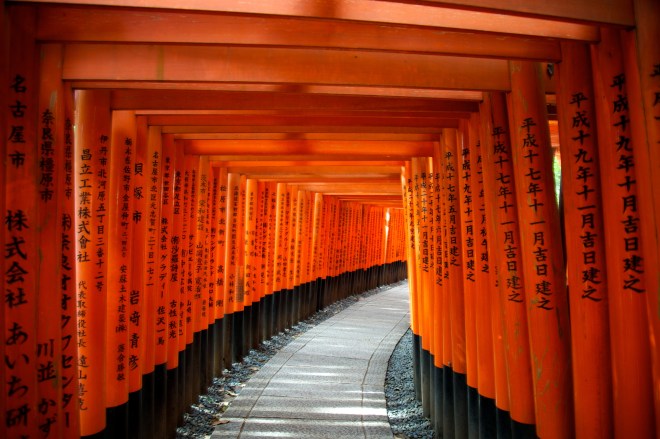
A week later, when our daughter joined us for Thanksgiving, we took her to the Fushimi Inari Shrine on the hilly eastern edge of Kyoto and hiked up the mountain behind the shrine, passing through the famed tunnel of torii on the way
Torii gates—Fushimi Inari Shrine
(although when we passed through the tunnel, it was packed with people – the disadvantage of visiting Kyoto at this time of the year).

After admiring the view at the top and inspecting the small shrines sprinkled along the path, all of which were smothered in small votive torii
http://regex.info/blog/2008-06-19/841
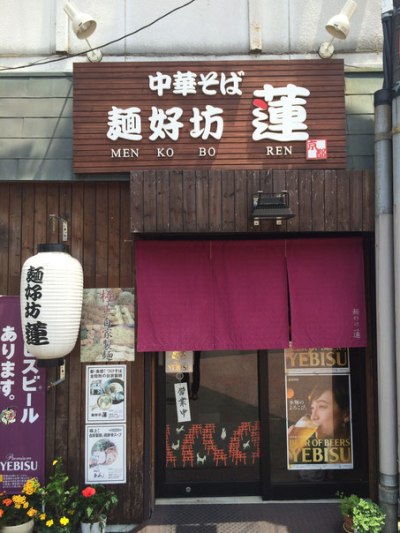
we made our way down again and had a well-deserved bowl of rahmen at the mountain’s foot.
noodle-shop-inari
Ours was an admittedly very secular version of a pastime as ancient as civilization itself, the climbing of mountains to pray to the gods. I suppose it makes sense. Gods often have been thought to reside up in the sky somewhere, and mountains were as close to the sky as we humans could get before the age of aviation. And before there were 7 billion of us, working our presence into every nook and cranny of the planet, mountains were remote, mysterious places, where our ancestors could more easily commune with the divine.

So it comes as no surprise to see that all religions have their mountains. Several degrees of longitude to the west of Kyoto, the Chinese had their Four Sacred Mountains of Buddhism and their Four Sacred Mountains of Daoism, and scholars sitting at the foot of mountains is a common scene on scrolls.
scholars-under-mountain
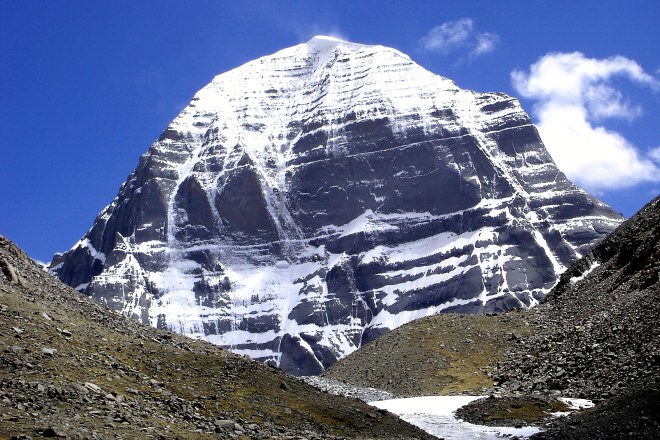
Hinduism, along with Jainism and Buddhism, has its Mount Meru, a mythological mountain, which for many believers, though, finds its material incarnation in Mt. Kailash in Tibet.

Processed by: Helicon Filter;

Many Hindus and Buddhists make the arduous journey to the mountain. Once they reach it they will reverently circle it (I highly recommend the book “To A Mountain In Tibet”, in which that great travel writer Colin Thubron relates his journey on foot to this mountain up through the high valleys of Nepal).

Moving further west, Judaism has its Mount Sinai, traditionally thought to be this mountain.
mount-sinai
The Bible tells us that Moses climbed it to commune with Yahweh in the Burning Bush, and from its top he brought down the Ten Commandments to the people of Israel. Charlton Heston gave a great performance as Moses in the Hollywood film epic “The Ten Commandments”
charlton-heston-as-moses-in-the-ten-commandments
although I personally prefer Michelangelo’s splendid Moses.
michelangelo-moses
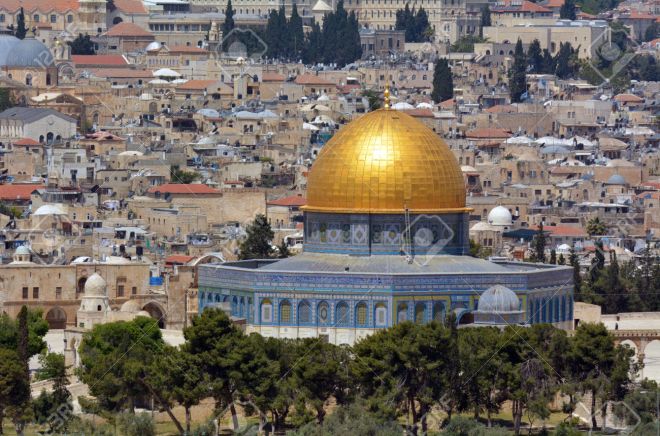
Islam also has its holy mountains; since it is a religion of the Book, many of these are linked to stories in the Bible: Mt. Sinai because of its link to Moses, Al-Judi, reputed to be where Noah’s Ark came to rest after the Flood, the mount of Olives, where the righteous will be chosen and evil abolished. But it also has mountains which are holy because of events in the life of the Prophet Muhammad. One such is the Temple Mount, the scene for Muslims of the Prophet’s ascent to heaven in his Night Journey, and on which they built the beautiful Dome of the Rock.

dome-of-the-rock

Another is Jabal Al-Nour, on the outskirts of Mecca.
jabal-al-nour
This mountain houses the Hira Cave in which Muhammad began receiving the revelations which became the Qu’ran. The cave is extremely popular with Muslim pilgrims who make the arduous trek up the mountain to reach it.

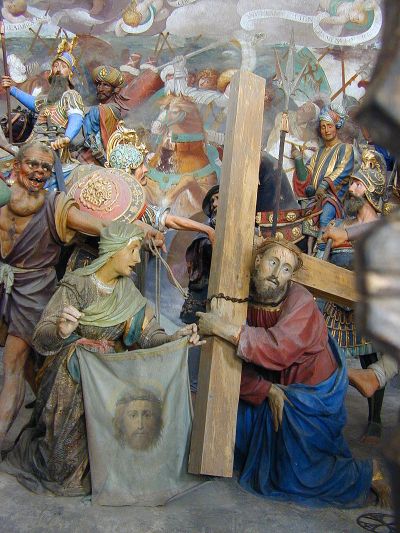
As for Christianity, Jesus was crucified on a hill, Mount Golgotha, outside Jerusalem. It’s really quite a modest hill, a hillock really, which in Christian art, though, grew into a respectable hill, as shown in this painting by Pieter Bruegel the Elder.
procession-to-calvary-by-pieter-bruegel-the-elder
Imagining a good-sized hill gave later generations of Christians an excuse to bedeck local hills with a Via Crucis, or Way of the Cross, which would wend its way up to the top of the hill and along which would be dotted the fourteen stations. The faithful would climb the Via Crucis, stopping and praying at each station (I remember well doing this as a young boy). UNESCO has canonized as a World Heritage Site nine such hills, the Sacri Monti or Sacred Hills, which are strung along the alpine foothills of Lombardy and Piedmont, not too far from Milan where we currently reside. Their Vie Crucis were all created in the 16th-17th centuries.
sacri-monti-1
sacri-monti-2
I’m trying to persuade my wife that we should go and climb a couple. To make the suggestion more palatable, I’m suggesting that we now wait until Spring – and that we choose sacri monti that have good restaurants at their foot to which we can repair after the climbs.

____________________
Misty Japanese landscape: https://loganbalstad.wordpress.com/2013/07/20/japanese-landscape-painting/
Mount Kurama temple: http://apdl.kcc.hawaii.edu/roads/18_temples.html
Other pix of Mount Kurama: ours
Scholars under mountain: http://www.sothebys.com/en/auctions/2013/fine-classical-chinese-paintings-n09009.html
Mount Kailash: https://en.wikipedia.org/wiki/Mount_Kailash
Torii Fushimi Inari Shrine: https://commons.wikimedia.org/wiki/File:Torii_gates%E2%80%94Fushimi_Inari_Shrine_(9977683204).jpg
Fushimi Inari mouintainside shrine: http://regex.info/blog/2008-06-19/841
Noodle shop, Fushimi Inari shrine: http://www.picrumb.com/best-restaurants/inari/
Mount Sinai: https://www.lds.org/media-library/images/mount-sinai-egypt-moses-1244104?lang=eng
Charlton Heston as Moses: https://theiapolis.com/movie-20AU/the-ten-commandments/gallery/charlton-heston-as-moses-in-the-ten-commandments-1081961.html
Michelangelo’s Moses: http://syndrome-de-stendhal.blogspot.jp/2012/04/der-moses-des-michelangelo.html
Dome of the Rock: http://www.123rf.com/photo_42141970_aerial-view-the-dome-of-the-rock-on-the-temple-mount-from-the-mount-of-olives-in-jerusalem-israel.html
Jabal Al-Nour: http://dreamzs338.tumblr.com/post/132478018857/jabal-al-noor-the-mountain-of-light-in-makkah
Pilgrims to Hira Cave: http://mapio.net/pic/p-16183166/
“Procession to Calvary” by Peter Breugel the Elder: https://mydailyartdisplay.wordpress.com/2011/03/07/the-procession-to-calvary-by-pieter-bruegel-the-elder/
Sacri Monti-1: http://www.unescovarese.com/Sacri-monti-in-Piemonte-e-Lombardia
Sacri Monti-2: https://en.wikipedia.org/wiki/Sacro_Monte_di_Varallo

KYOTO IN NOVEMBER

Kyoto, 13 November 2016

We read glumly about the results of the American presidential elections and their aftermath. The future looks bleak. Yet, even in this dark hour, it is impossible not to be struck by the beauty that surrounds us in Kyoto.

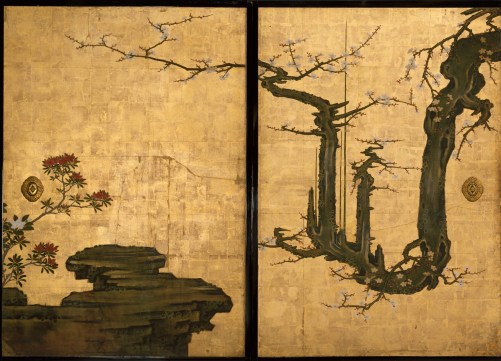
The paintings on the sliding doors of the temples, branches spreading over a wash of gold.
sliding-doors
The sweep of moss, brilliant green, under the trees, in the temple gardens.
img_6563
The leaves turning on the Japanese maples, early November scarlet bleeding into old summer green.
img_6413
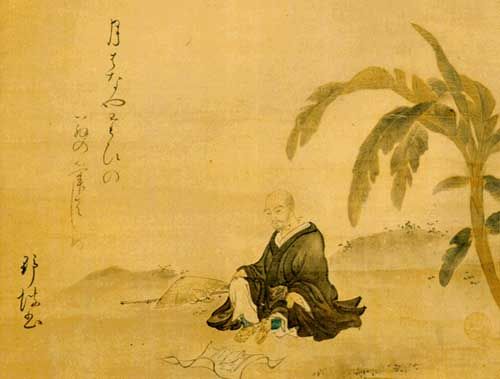
I am moved, like the Japanese poets of old, to compose a haiku.
japanese-poet

Velvet moss greening gnarled roots,
Maples blooming red:
I weep for America.

____________________
Sliding doors: http://www.metmuseum.org/art/collection/search/44858
Japanese poet: https://www.pinterest.com/reaconnell/haiku-japanese-poetry/
Other photos: ours

POLITICALLY-CHARGED PUBLIC ART

Milan, 4 November 2016

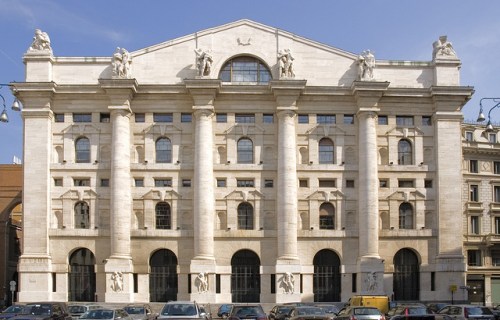
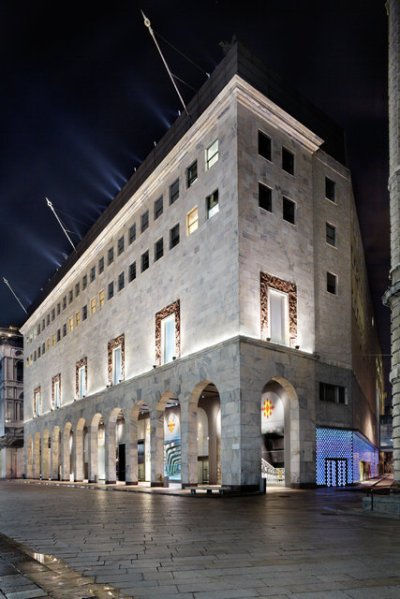
There is a quiet square not too far from where my wife and I live in Milan which goes by the name of Piazza Affari. As the name suggests, this is meant to be the pulsating business and financial centre of Milan. That certainly was the idea when the square was fashioned back in the early 1930s by demolishing a whole block of buildings in front of the just completed stock exchange, the Palazzo Mezzanotte.
image
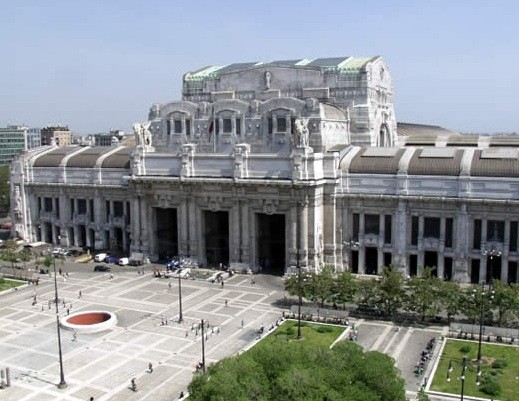
This quite handsome building clad in white travertine is often considered “typical” Fascist architecture because of when it was constructed, but in truth it is actually a nice exemplar of the Italian architecture of the turn of the century, most famously exemplified by Milan’s main train station.
image
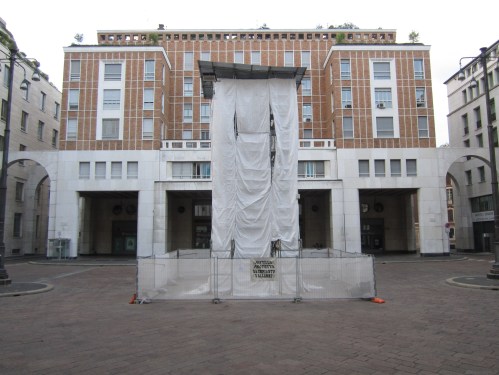
Another building opposite the stock exchange, finished in 1939, closed off the new square.
image
Well, the war came and went, this corner of Milan survived the intense Allied bombing of the city, Fascism fell, and life went on. Then, in 2011, as part of a plan to make Milan a centre of contemporary art, the-then municipal government wanted to hold an exhibition of the works of Maurizio Cattelan, a famous Italian contemporary sculptor well known for satirical sculptures. As part of the deal, the city commissioned an outdoor work from the artist. After some back and forth, it was decided to place the piece in Piazza Affari and Cattelan came up with this.
image
Of course, everyone immediately decided that the artist was giving the finger to Italy’s financial sector – this was a few years after the near meltdown of the banking sector worldwide, whose impacts on the Italian economy were then still being felt (and continue to be felt). The denizens of the stock exchange hated it, everyone else loved it. What was meant to be a temporary exhibition has turned out to be permanent. It has been pointed out, and the photo above shows it clearly, that the hand is not actually giving the finger to the stock exchange but, if anything, to the anonymous building on the other side of the square. And the artist himself has said that the sculpture was actually a commentary on the fall of Fascism – some complicated explanation to the effect that the hand really represents the Fascist salute, and the chopped-off fingers represent the fall of Fascism; its positioning in front of a building seen as Fascist is what links it to Fascism. Others have commented that this finely sculpted hand (look at those veins!) in lovely white marble, in a square with its vaguely Roman look (look at those arcades attached to the 1939 building), reminds them of a De Chirico painting.
image

None of this matters. What is important is what people think. And people think the finger is being given to all those goddamned bankers who screwed all of us over, and they cheer the artist on.

Statuary in public places has always excited intense emotions. Staying in the world of white marble, consider the statue of the naked Alison Lapper, a British artist born without arms and only stubs of legs, and eight months pregnant when the statue was made.
image
In 2005, this statue was placed as a temporary exhibit on the fourth plinth at Trafalgar Square in London, which has been empty ever since the square received its current look back in the 1830s.
image
Many people hated it (because it was ugly; did those who said this realize the judgement they were passing on handicapped people?), many people loved it (because of its optimistic message about the handicapped and because it brought handicapped people more into the mainstream). A much larger replica was used in the opening ceremonies of the 2012 London Paralympic Games.
image
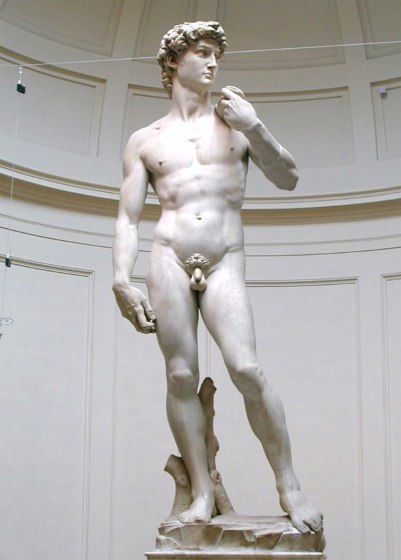
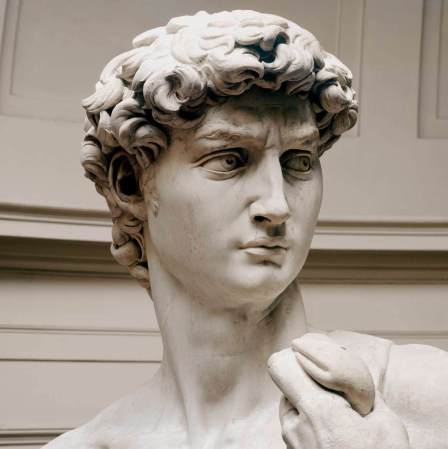
But what about that granddaddy of white marble statuary, Michelangelo’s David?
image
(another statue, I note in passing, with lovely hands)
image
Today, we look at it simply as a glorious work of art, but at the time of its unveiling it was also a highly charged political statement. Already, David had a special place in the heart of the Florentines. They identified with the puny boy who destroyed the huge, nasty Goliath (seen to represent Rome, the French, the Holy Roman Emperor, or any other power threatening it at any particular moment in time). A committee of notable artists, including Da Vinci and Botticelli, was charged with deciding on its emplacement. They chose to have it stand in Piazza Signoria, at such an angle that the statue glared defiantly towards Rome.
image
A statue whose unveiling in 1992 had particular resonance for me was that of Sir Arthur “Bomber” Harris, commander-in-chief during the Second World War of Britain’s Bomber Command.

As the picture shows, it is the typical statue of some Worthy Person which dots every public space in Europe, nothing terribly exciting artistically. But Bomber Command was the group responsible for the so-called area bombing during the War which wiped out entire German cities, many of no military value. Dresden is perhaps the best known.
image
There are many people, and I include myself among them, who believe that these bombings were a crime against humanity, so I have difficulty feeling any disapproval for the person who did this to Harris’s statue.
image
To be fair to Harris, he was not the only person in high circles (Winston Churchill included) who thought that area bombing was a good idea, but he implemented the plan with particular relish.

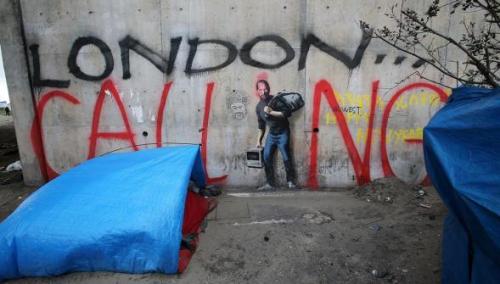
The placement of politically-charged art in public spaces continues. Banksy’s painting in the Calais “Jungle” of Steve Jobs as an immigrant trying to get in shows this.

In a rare statement on any of his art, Banksy commented that he wanted to remind people of the value of immigrants. If Jobs’s father, an immigrant from Homs in Syria, hadn’t been let into the US we wouldn’t have Apple. In this day and age of heated debates, especially in Europe, about refugees and how many to let in, Banksy has very publicly taken sides. It’s a pity that his high mindedness has been subverted, first by an entrepreneurial inhabitant of the Jungle demanding to be paid 5 euros to view the painting and then by a nihilistic vandalizing of the painting.
image
I presume that the vandalizer was doing no more than celebrating The Clash’s third album. Such is life.

Let’s see what this year will bring us in politically-charged statuary.

____________
Palazzo Mezzanote: http://www.newsly.it/braxit-ultime-notizie-borse-europee-in-rialzo-scommettono-sul-si-1
Stazione centrale: http://www.milanoguida.com/visite-guidate/altri-monumenti-milano/stazione-centrale-milano/
Palazzo on other side: https://ripullulailfrangente.wordpress.com/2012/08/24/ancora-per-milano-al-mattino-presto-targhe/
Il dito: http://www.manageronline.it/articoli/vedi/3359/il-dito-medio-in-piazza-affari/
Giorgio de Chirico: http://www.beniculturali.it/mibac/export/MiBAC/sito-MiBAC/Contenuti/MibacUnif/Eventi/visualizza_asset.html_1741131230.html
Alison Lapper statue: http://www.arupassociates.com/en/projects/trafalgar-square-fourth-plinth/
Alison Lapper statue close-up: http://albertis-window.com/2014/01/
Alison Lapper statue Paralympic Games: http://www.goodtoknow.co.uk/wellbeing/galleries/34626/london-2012-paralympic-games/41
David: https://www.pinterest.com/pin/430234570629286662/
David’s hand: http://www.accademia.org/explore-museum/artworks/michelangelos-david/
David’s head: https://www.pinterest.com/almetrami/renaissance-david/
Sir Arthur Harris: http://www.fotolibra.com/gallery/1172664/sir-arthur-harris/
Dresden bombed: http://www.ibtimes.co.uk/dresden-bombing-70th-anniversary-interactive-then-now-photos-show-scale-destruction-1487817
Harris statue defaced: http://www.dailymail.co.uk/debate/article-2166966/PETER-HITCHENS-The-heroes-Bomber-Command-deserve-memorial–unlike-butcher-led-them.html
Banksy’s Steve Jobs: http://edition.cnn.com/2015/12/11/europe/banksy-steve-jobs-graffiti/
Banksy’s Steve Jobs defaced: http://www.zeroviolenza.it/component/k2/item/74240-alto-4-metri-e-lungo-un-chilometro-il-nuovo-muro-antimigranti-è-a-calais

TROFIE

Milan, 25 October 2016

In 1960, during a televised speech, General de Gaulle, then the first President of France’s newly-minted Fifth Republic, posed the rhetorical question, “How do you govern a country which has 246 varieties of cheese?”, implying that a country with such individualism takes badly to being centrally governed. Well, Italy has more types of pasta than France has cheeses – 350 according to one website – which might explain Italy’s chronic ingovernability. We watch with anxiety as the country lurches towards a referendum, which should be about changing the Constitution to make the country more governable but is rapidly turning into a vote of no-confidence in the current government. A collapse in the government with early elections lurk around the corner, perhaps leading to a collapse of the banking sector, and – who knows? – an ignominious exit from the Euro. The continuing incoming flood-tide of refugees/economic migrants isn’t helping.

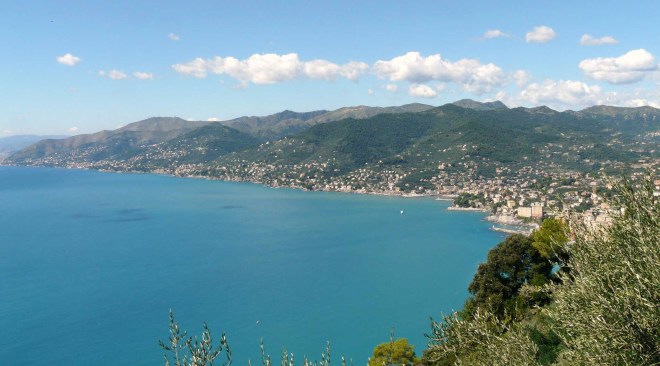
But it is not of these political anxieties that I wish to write, it is about one of these 350 pastas, which goes by the name of trofie. Like many pastas, trofie are very regional in character, coming from Liguria and even more narrowly really only being found in any quantity in the communes giving onto the Golfo Paradiso, which runs from the Monte di Portofino to the west to the outskirts of Genova to the east.
image
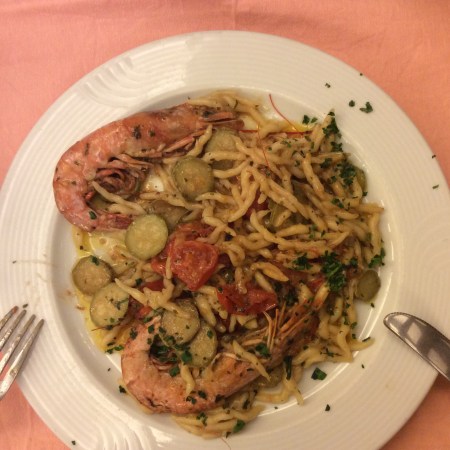
That is where my wife and I have spent the last few days, and that’s where I found myself a few evenings ago in front of a plate of trofie in a sauce of tomatoes and zucchini, with a couple of shrimp thrown in for good measure.
image
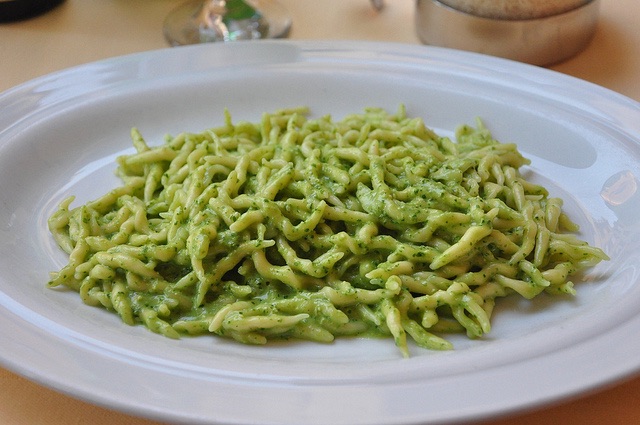
As readers will notice, trofie look rather like worms – an unappetizing simile but really the one that describes them best. The shape comes from how they are made: small lumps of dough are rubbed between the hands (which action is also probably the source of their name: strofinare in Italian means to rub). They are very often eaten with pesto, that other, incomparable, gift from Liguria to global cuisine.

image
I still remember with great clarity the first time I ever ate pesto. My wife and I had gone walking in the hills which in the picture above run down into the Golfo Paradiso. We found ourselves in a cheery restaurant serving only locals, all of whom spoke the local incomprehensible – to my ears – dialect. We were served lasagne in pesto with brisk efficiency. So good they were … We came back to this restaurant often in the years we lived in Italy. Although pesto is considered typically Ligurian, its ingredients suggest a broader reach. The basil, the oil, the pine nuts do indeed come from Liguria – the basil grown in Liguria is the most perfumed I have ever known – but the Parmesan comes from across the Apennine chain which hugs the coast here, while the Pecorino comes from Sardinia across the Golfo Paradiso and beyond. In any event, my wife bought a small cupful of pesto to bring back to Milan, where we will eat it with pansotti, another incredibly good pasta from Liguria – but that is a story for another day.

In the same shop, my wife pointed to a different type of trofie, made with chestnut flour. Chestnut trees grow on those Ligurian hills we go walking in, above the olive groves; they probably grew all the way to the valley bottoms before olive trees were brought to Liguria. On the spur of the moment I told her to buy them, along with the sauce with which they are normally eaten, walnut sauce, another gift of Liguria to the world; walnut trees grow well up on the Ligurian hills. As readers can see in the next photo, these trofie are browner than the normal trofie made with hard wheat. They are also a little sweeter, as befits a pasta made with chestnuts, and a walnut sauce goes wonderfully well with them, softening that sweet note.
image
Many decades ago, we brought a cupful of walnut sauce with us to Paris and served it on a pasta to a friend of ours, an amateur cook from Sicily. He muttered over and over again, “Mmm, that’s good” (a pretty amazing statement for a Sicilian to make about northern Italian cuisine). To thank us, the next evening he whipped up a pasta served with a broccoli-based sauce – soooo good!

Those chestnut trofie make me reflect once more on Italy. My first Italian boss came from the province of Varese, to the north of Milan, a part of the country which before the economic miracle of the 1950s and ’60s was very poor. I don’t know how we got onto the topic, but one day he started reminiscing about his childhood, and he told me that when his parents were young and food ran short they were sent off into the woods to collect chestnuts, which would be ground to a flour to make bread from. Liguria was also a very poor region until quite recently. No doubt chestnut trofie are from those times. Italy has come a long way in the last sixty years, I just hope it can stay the course.

_____________________
Golfo Paradiso: http://www.golfoparadisoportofinovetta.it
Trofie con pomodori e zucchini: my photo
Trofie al pesto: http://foodloversodyssey.com/2010/08/the-dish-from-italy-trofie-al-pesto/
Trofie alla salsa di noci: my photo

SCARFING DOWN ITALIAN NIBBLES

Milan, 20 October 2016

I was with an old colleague in Turin at the beginning of last week, and he was telling me that he had visited the city several times over the last few years to attend the annual Slow Food festival. I made a mental note to attend the next one with my wife. It must have been that thought which made me accept with alacrity my wife’s proposal to go to an exhibition of Italian small-scale food producers, which was taking place in Milan over the weekend. Its title was “Milano Golosa”, which can be translated either as Greedy Milan or as Gourmand Milan. I prefer to think that we were gourmands, although I can understand it if, after reading this post, readers conclude that we were greedy.

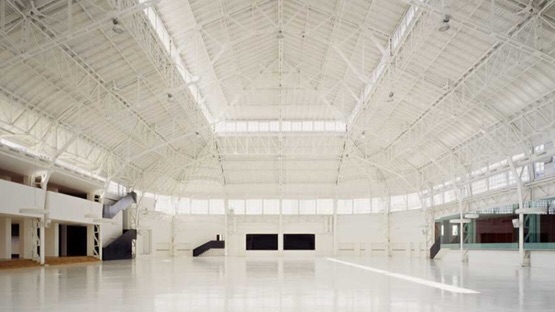
The exhibition was being held in the Palazzo del Ghiaccio, the Ice Palace, a rather grand name for what used to be the city’s premier ice rink. Just visiting the building was a trip down memory lane for my wife. She told me with a reminiscent smile that she had been taken there many a time by her grandfather. While she skated around the rink, he sat on the bleachers reading his newspaper – no doubt the universal pastime of grandfathers supervising grandchildren in parks and other public spaces. At some point in the last forty years, its use as an ice rink was abandoned. The bleachers were removed along with the rink proper, and the building was turned into an exhibition space. It is actually quite a nice building, of the 19th Century train station type, and the empty space looks gorgeous in that typically Italian good design style.
image
When we entered the space, though, it was bisected by four or five rows of little booths, each taken by an Italian food or wine producer (there was one food producer from the islands of São Tomé and Príncipe, off the west coast of Africa, but that was a definite outlier). They came from all over Italy, from Sicily in the south all the way up into the high alpine valleys in the north, and from Sardinia in the west to the Marches in the east.
image
For the vulgar weekend visitors like us, who were not there for professional reasons, the deal was this. You paid 10 euros to get in (5 more if you wanted to drink wine, which we didn’t), and then you tried to eat as many nibbles as possible at all of the booths to cover your initial investment. You could do your eating quite shamelessly, just grabbing the nibbles being made available and heading off to the next booth, or you could pretend to be knowledgeable and stand there trying to make intelligent comments about the nibbles you were scarfing down with enthusiasm. I started with the latter strategy, pretending to write notes on my phone (of the type “good cake!”, “good cheese!”), but eventually abandoned all pretense of knowledge and just wolfed down the nibbles. I was rather reminded of the trailer which my wife and I have been seeing of an upcoming French film, “Saint Amour”, which as far as I can make out is the story of a large pub crawl from one French wine festival to another.
image
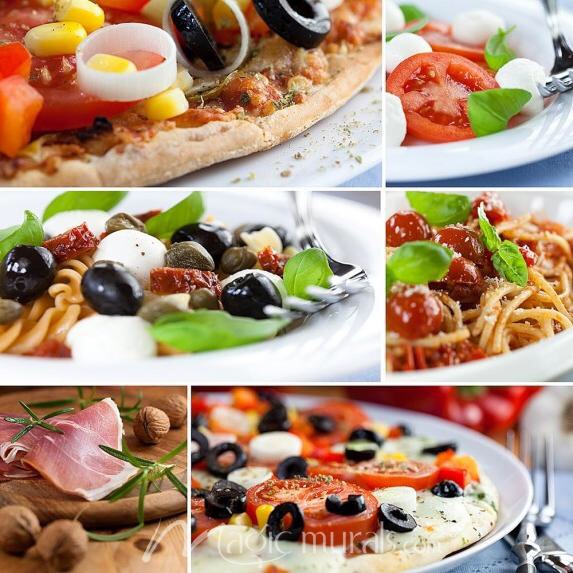
For all of this rank amateurism on my part, I could still appreciate that the nibbles were delicious. Many of the classical Italian products were present: raw ham, cooked ham, salamis of various types, bologna, cooked meats in aspic; hard cheeses like parmesan, soft cheeses like stracchino or crescenza, middling soft and middling hard cheeses whose names now escape me; olive oils of all descriptions, as well as the olives themselves, balsamic vinegars; tomatoes, of course, of all shapes and sizes, beans of all shapes and sizes; pastas of varying lengths and geometries, breads made from a variety of grains, but also bread sticks, fat and short and long and thin; numerous spreads to put on the bread (one in particular, from Sicily and based on sea urchin and a fish whose name meant nothing to me, remains in my taste memory bank); sweet dishes in profusion: panettone, panforte, amaretti dolci, chocolates containing varying levels of coca. And I’m sure I’ve missed things. A veritable smorgasbord! Or perhaps the Italian equivalent to a Chinese banquet, where one picks at a little bit of this and at a little bit of that as the Lazy Mary slowly turns before you. I think we got our ten euros’ worth, staggering out after a couple of hours of busy nibbling. We shelled out some more cash to buy a small bottle of olive oil from the province of Bari and a mozzarella from the province of Naples, both of which we picked up as we wended our way from booth to booth. I can report that at dinner that night the oil went very nicely with the mozzarella, as well as with the salad of green beans I had on the side.

Ah, Italian food!
image

______________
Palazzo del Ghiaccio: http://www.meetingecongressi.com/it/struttura/milano/451/palazzo_del_ghiaccio.htm
Milano Golosa: http://www.ansa.it/canale_terraegusto/notizie/fiere_eventi/2015/09/23/torna-milano-golosa-dal-3-al-5-ottobre-al-palaghiaccio_0867b0e5-db5c-4477-b80a-3e372b3979c1.html
Saint Amour poster: http://www.allocine.fr/film/fichefilm_gen_cfilm=235769.html
Italian food: https://www.magicmurals.com/italian-food-collage.html

HORSERADISH

Turin, 12 October 2016

I’ve just had a yummy lunch at Vienna airport, which is a bit surprising since airport eateries are not known for quality. It was nothing special; actually, it was very ordinary for this part of the world (this part of the world being Austria). It was two sausages of the frankfurter variety (although longer and thinner than the classic frankfurter), a bread roll, a dollop of mustard, and some grated horseradish. Voilà!

What really made the dish for me was the horseradish. It was the first time I ate horseradish like this, and I found that its slightly sweet tartness calmed the excesses of the mustard.

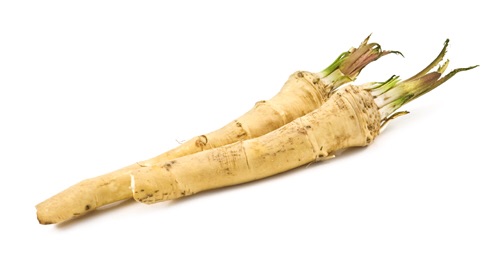
I have to confess to being a great fan of horseradish, although I joined this particular fan club latish in life: I only discovered the culinary delights of the root once I moved to Austria, when I was already over 40. For those of my readers who (like me) have never seen a horseradish in the flesh (as it were), I throw in a picture.
image
It’s rather surprising that I came to horseradish so late, because it’s actually quite popular in the UK. A common way of eating it is to mix it with vinegar and use it as a condiment with meat or fish. This commercial offering looks very fancy.

Fancy or plain, I never partook; the closest I ever got was lamb with a vinegar-based mint sauce, the glories of which I have extolled in an earlier post. I’m guessing that the British picked up the habit from the Germans: Wikipedia informs me that a certain John Gerrard, in his Herball, or Generall Historie of Plantes of 1597, writes that “the Horse Radish stamped with a little vinegar put thereto, is commonly used among the Germans for sauce to eat fish with and such like meats as we do mustard.” I wonder if, rather than classic mustard, John Gerrard meant Tewksebury mustard (another British condiment which I have never tried). It seems that the British, since at least the Middle Ages, have been fond of this blend of mustard and grated horseradish. No less a person than Shakespeare mentions it in Henry IV Part II, where he has Falstaff say of Poins: “his wit’s as thick as Tewkesbury Mustard”. Here’s a modern version, sold by the ASDA supermarket chain, so it can’t be too fancy a condiment.
image
Just to close the circle, a very similar horseradish-mustard blend, called Krensenf, is popular in Austria. I suppose the cook in my airport eatery was expecting me to make my own blend before slathering it onto the frankfurter. Ignorant at that moment of Krensenf, I just blended it in my mouth.

I haven’t mentioned in what dish I first discovered horseradish. It was that great, that glorious, Austrian dish, Tafelspitz. It’s actually a very simple dish: boiled beef, served with boiled root vegetables (carrots, parsnips, celeriac) and re-fried boiled potatoes.
image
To my mind, what elevates it above similar dishes, like pot au feu in France or bollito misto in Italy, is the sauce into which you dip your morsels of meat: it must be a blend of thickish apple sauce and grated horseradish. The horseradish wakes up what is otherwise a rather bland apple sauce, and this jazzed-up sauce wakes up the otherwise slightly bland meat, to the delight of one’s taste buds. I see that this mixing of sweet with horseradish seems quite popular. Several parts of Eastern Europe (which seems to be the original home of the horseradish, by the way) mix it with beet roots, as do the Ashkhenazi Jews, who often use it as a condiment for gefillte fish. Another recipe from Franconia in southern Germany blends horseradish with lingonberries.

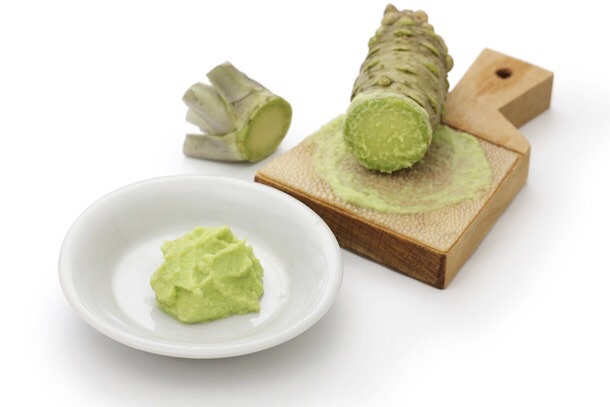
No discussion of horseradish is complete without a mention of wasabi, that wonderful green paste which, together with ginger, accompanies sushi and sashimi.
image
I’m not particularly keen on the ginger, but wasabi is a must for me – whenever my wife and I eat sushi or sashimi, she gives me her wasabi and I give her my ginger, which she loves; it’s a deal made in heaven. As anyone who has eaten both horseradish and wasabi will know, there is a definite relationship; the tastes are too similar for it to be coincidental. In fact, the two plants are close botanical cousins; the picture above shows the greenish root which is the source of wasabi. But here I have to reveal a mournful truth. In this era of globalized cuisine, where sushi bars seem to be sprouting up everywhere, when we eat wasabi we are nearly always eating horseradish paste mixed with green colourant. The wasabi plant is difficult to grow, so production cannot keep up with demand, hence the substitution. Sad in a way. An Italian friend of mine was recently telling me of a similar case, for a foodstuff I am particularly fond of, bresaola, which has also become a global food-star. In principle, bresaola should be made from cattle reared in the Valtellina, in the Italian Alps. But cattle production in this really quite small Alpine valley cannot possibly keep up with demand, so cattle is shipped in from Brazil to be processed in the Valtellina and stamped “bresaola”.

My wife and I are going to Japan in November. Let’s see if we can find a place which serves real wasabi.

_______________

Horseradish: http://www.herbalextractsplus.com/horseradish-root.html
Horseradish and vinegar: http://www.handmade-treats.co.uk/shop/horseradish-vinegar/
Tewksebury mustard: https://groceries.asda.com/product/mustard/asda-extra-special-tewkesbury-mustard/80755029
Tafelspitz: http://www.lecker.de/tafelspitz-19222.html
Wasabi: http://www.seriouseats.com/2014/03/pantry-essentials-all-about-wasabi.html

POINTILLISM

Vienna, 1 October 2016

The Albertina Museum in Vienna is currently holding an exhibition on pointillism and its reverberations in later art. My wife and I decided to visit it, as a treat for successfully becoming residents of Austria and for finding our apartment in good shape after our tenants had handed it over. We were glad we went. Never had we been exposed to this many Pointillists in one go; the larger collections of Impressionists and Post-Impressionists we have seen generally have just a few pointillist paintings sprinkled into the mix. Not only were there paintings by Seurat, the originator of the technique, Signac, his best-known follower, and other French Pointillists, there were also a roomful or two of Belgian and Dutch Pointillists whom we had never heard of. There was also a whole section devoted to pointillist portraits; pointillism was never a style I had connected with portraiture. There were some examples of late pointillism, by then renamed divisionism, where the earlier dots were replaced by longer and broader paint strokes. And then the final room had a brace of Van Goghs, some Matisses, a couple of Picassos and Mondrians, and a few other odds and ends, to show how divisionism had affected later artists.

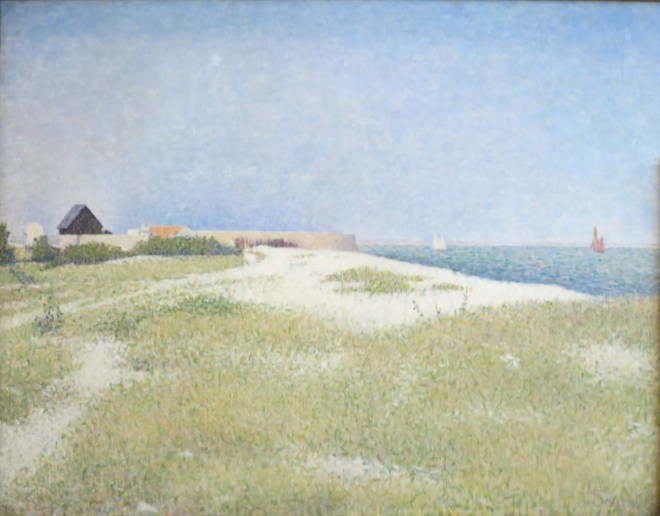
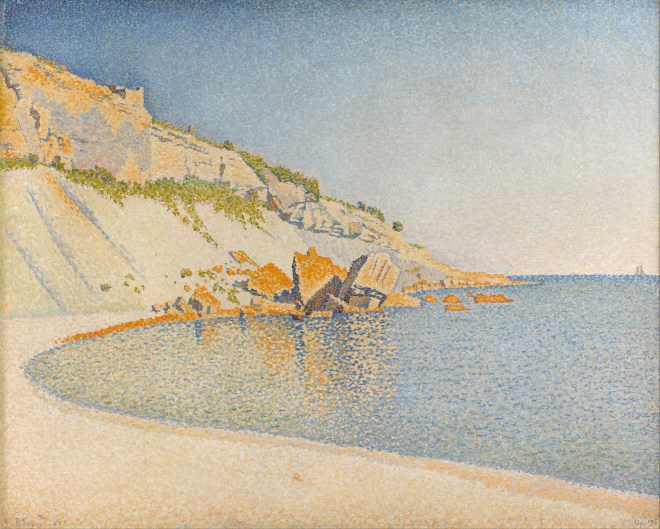
All exceedingly interesting. And yet … my wife and I both had the same reaction to the show. After an initial burst of enthusiasm, doubts set in. The effect of seeing so many pointillist paintings together was to have a chocolate-box sensation. The paintings were all preternaturally bright, the skies of the many landscapes were a uniformly blank cerulean blue, and the other colours seemed to all veer towards the pastel. Here’s a couple of pointillist paintings that exemplify what we found before us. The first is by Seurat, the second by Signac.
image
image
All this in large doses eventually becomes rather sickly. There was also an eerie stillness in many of the paintings, perhaps because by their nature pointillist works were carefully and patiently crafted in the studio. This stillness, emptiness almost, is obvious in what is probably the most famous pointillist painting, Sunday Afternoon on the Island of La Grande Jatte, which shows what should be a scene full of life and movement but gives the impression of being peopled by mannequins put there for the occasion.
image
It seems that after an initial burst of enthusiasm contemporary painters also turned away from pointillism, but more because creating these paintings took so much time. Certainly Van Gogh was never convinced by pointillism, although he experimented with it a bit, because it eliminated any spontaneity in painting.

A footnote to the exhibition: many of the paintings were on loan from the Kröller-Müller Museum in Otterlo, the Netherlands. I had never heard of this museum (as for my wife, after an initial bout of amnesia, on seeing pictures of the museum she suddenly remembered visiting it more than forty years ago). Yet this museum has, among other things, the second largest collection of Van Goghs in the world. The collection was put together by Helene Kröller-Müller in the first decades of the last century. She was born into a wealthy German industrialist family and married a Dutch mining and shipping tycoon, a combination which made her the richest woman in the Netherlands.
image
She used her money wisely to put together a great collection of what was then modern art. Towards the end of her life she donated it to the Dutch state.

When I read such stories, I sigh and wish my father had been a tycoon. I would have loved to spend inherited millions putting together an art collection. Maybe in my next life.
__________

Seurat: https://en.m.wikipedia.org/wiki/Georges_Seurat
Signac: https://en.m.wikipedia.org/wiki/Paul_Signac
A Sunday Afternoon on the Island of la Grande Jatte: https://en.m.wikipedia.org/wiki/Île_de_la_Jatte
Helene Kröller-Müller: http://www.betergeven.nl/over-filantropie/filantropen-in-beeld/helene-kroller-muller/

SAINT RADEGUND

Vienna, 19th September 2016

There is a small street which gives on to Piazza Duomo in Milan, which goes by the name of via Santa Radegonda. It’s a very modest, narrow, little street, really quite boring. Its main claim to fame is that it runs alongside the posh department store La Rinascente.

image
But I like the street, for the quite frivolous reason that I like the name. Radegonda, Radegund in the original German: now that’s a girl’s name with some whoomph to it! Not like Amelia, or Olivia, or Emily, which are currently some of the most popular names for little British girls.

This particular Radegund was a 6th Century princess from Thuringia, in what is now central Germany. Her life story was as colourful as her name. Her father, Berachtar, was one of three kings in Thuringia. Her uncle, Hermanfrid, one of the other Thuringian kings, killed her father in battle, took over his part of the Thuringian lands, and while he was at it took Radegund into his household. Hermanfrid then made a deal with the Frankish king, Theuderic, to share sovereignty of the whole of Thuringia, subject to material aid from Theuderic. Having sealed the deal, Hermanfrid attacked, defeated, and killed the third king of Thuringia, his brother Baderic. He then promptly reneged on his agreement with Theuderic. Not surprisingly, Theuderic sought revenge of this perfidy. Together with his brother Chlothar, he defeated Hermanfrid and took over Thuringia. In the ensuing carve-up, Clothar took charge of Radegund and brought her back to Gaul. All this happened before Radegund was 11, by the way.

Clothar packed Radegund off to one of his villas until she was of a more marriageable age. When she was 19 or so, he married her himself. No doubt it made his claims to Thuringia stronger to have her as his wife. She joined Clothar’s five other wives – Guntheuca, Chunsina, Ingund, Aregund, and Wuldetrada – in what may, or may not, have been a cozy concubinage. In any event, she bore Clothar no children.

By the time Radegund was 30, her only remaining brother was the last surviving male member of the Thuringian royal family. Presumably to head off any pesky competing claims to the Thuringian lands, Clothar had him murdered. At which point, either because she feared for her own life or because she was fed up with all this mayhem, Radegund fled and sought the protection of the Church, eventually founding, when she was about 40, a nunnery in Poitiers. Initially, Clothar tried to get her back but eventually left her alone and focused on expanding his lands at the expense of all those around him, including his brothers (although he had the grace not to kill them to obtain his ends, good manners which did not extend to their sons). By the time he died, he was master of a kingdom stretching from the Pyrenees to Thuringia, and from Brittany to French-speaking Switzerland.

All these Franks and Thuringians may have been a lying, traitorous, murderous lot, but they had wonderful names. This all rather reminds me of my Favourite History Book, 1066 And All That, my copy of which recently came to light, among many a delighted cry on my part, from the storage box in which it has been lying these last seven years.
image
In that book, we are reminded that Anglo-Saxon England was peopled with persons carrying wonderful names:

“Wave of Egg-Kings

Soon after this event Egg-Kings were found on the thrones of all these kingdoms, such as Eggberd, Eggbreth, Eggfroth, etc. None of them, however, succeeded in becoming memorable except in so far as it is difficult to forget such names as Eggbirth, Eggbred, Eggbeard, Eggfish, etc. Nor is it even remembered by what kind of Eggdeath they perished.”

The authors were exaggerating, but not by much.

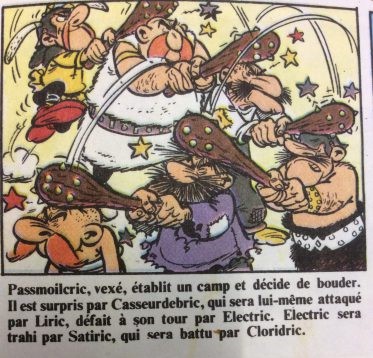
The murderous goings-on around Radegund also remind me of that other Great Source of Early European History, Asterix. In the album Astérix chez les Goths
image
the endemic fighting among the Germanic tribes is well captured.

(Please note the authors’ take on Gothic names – they exaggerate but not by much)

But I digress, and I think my wife feels I’m letting my childish side get the upper hand here. Let us focus on the saintly Radegund. Already when queen, she was noted for her almsgiving. Once a nun, she cared for the local lepers and other infirm of Poitiers. She was also known for eating nothing but legumes and green vegetables: no fish, no eggs, not even fruit. I’m sure the vegans of today would approve (although even they might find her decision to forswear fruit a trifle extreme) but to the meat-eating Germanic elites, who spent much of their time hunting, this must have been pretty weird. Here is the most ancient representation of this saintly lady that I found, from a 10th-11th Century manuscript in the Municipal library of Poitiers, where we see Radegund getting herself to the nunnery (to misquote Hamlet).
image
As far as I can make out, though, her main claim to religious fame, at least in the Dark and Middle Ages, is that the Byzantine Emperor Justin II gave her a fragment of the True Cross. I hasten to add that he did not do so because he was much taken by Radegund’s saintliness. It was, I’m afraid, a purely political maneuver. Justin wanted to wrest control of the north of Italy from the barbarian Lombards, but for this he needed the help of the (equally barbarian) Franks. The relic, given to an ex-wife of the Frankish king who, though, was still on friendly terms with said king, was the bribe, or, to put it more kindly, the bait. Whatever the reason, the relic which Justin handed over to Radegund was a Really Good relic, and any Medieval religious institution with a Really Good relic was sitting on a goldmine as the pilgrims poured in and spent their money locally. This no doubt was the happy fate of Poitiers, helped along by the fact that Radegund was widely believed to have the gift of healing. Indeed, several miracles around her tomb greatly helped to increase the pilgrim traffic. The result was the building of a church which is a combination of Romanesque and Angevin Gothic styles.
image
Sadly, the vicissitudes of history, and more specifically a sack by Huguenots in the 16th Century and the ravages of the French Revolution, combined with some heavy-handed restoration in the 19th Century, has scarred the original splendour.

The pilgrim traffic to Poitiers had the happy side-effect of carrying Radegund’s name far and wide as the pilgrims returned home, and new churches and other religious institutions sprang up all over Europe dedicated to her name. This was certainly the case in Milan, where on the site on which now stands that temple to consumerism, La Rinascente, there once stood a nunnery dedicated to Santa Radegonda. No trace of this nunnery remains today save in the name of that modest, narrow, little street which I like so much.

I give just one further example of the many places in Europe which adopted her name, and that is the small village of Sankt Radegund in Upper Austria. In the next few years, readers will see a new film come out, with the title “Radegund”. It is the story of Franz Jägerstätter, a native of Sankt Radegund, who was the only one in his village to vote against the Anschlüss and was courageous enough to be a conscientious objector during World War II.
image
My readers will no doubt convene that this was a dangerous thing to declare oneself to be under the Nazi regime, and in fact Jägerstätter ended up being guillotined in 1943, for the crime of “undermining military morale”. The recent (German) Pope, Benedict XVI, had Jägerstätter beatified: a more appropriate saint for our age, I think.
image
Yesterday afternoon, I noticed that behind Milan’s Duomo there is a small road called via Santa Tecla. What an interesting name! I wonder who she was?

__________________
La Rinascente: http://www.nytimes.com/2014/12/25/fashion/in-milan-with-handbags-and-tongs-under-one-roof.html?_r=0
Clothar I: http://www.pearltrees.com/sirius84/francs-merovingiens/id9615614/item93489971
“1066 And All That”: http://rogerandfrances.eu/books/1066-and-all-that
“Asterix chez les Goths”: http://www.asterix.com/the-collection/albums/asterix-and-the-goths.html
Goths fighting: my photo
Radegund entering nunnery: https://en.m.wikipedia.org/wiki/Radegund
Eglise Sainte-Radégonde, Poitiers: https://www.poitiers.fr/c__244_788__Poitiers_capitale_romane.html
Franz Jägerstätter: http://voiceseducation.org/content/franz-jagerstatter-austrian-world-war-ii-resistance
Icon with Franz Jägerstätter: https://en.m.wikipedia.org/wiki/Franz_Jägerstätter

RINGING BELLS

Milan, 13 September 2016

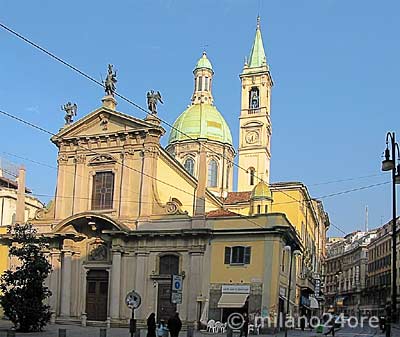
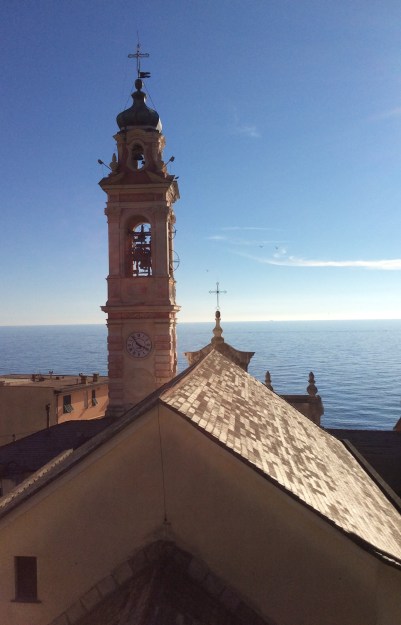
It wasn’t until our first Sunday back in Milan that I realized what it was we had been missing all those years we had spent in China and Thailand: church bells. The carillon that pealed out from the campanile of the nearby Church of San Giorgio
image
for morning mass startled my senses, and I found myself actually listening. Probably Italians, after a lifetime of hearing church bells, simply shut them out: “church bells? what church bells?”

It’s not as if the soundscapes of the cities we have lived in these last seven years have been very different from what we were used to in Europe. Like for everything nowadays, there was a depressing uniformity.  The noise of traffic predominated; given China’s building craze, construction noises came a close second in Beijing. The one typically Chinese noise which we often heard in Beijing was the machine-gun sound of strings of firecrackers going off to celebrate the opening of a new business.
image
Since the economy was doing nicely, this happened quite often. The noise of firecrackers grew to a huge crescendo as the Chinese New Year rolled around.

image

We were always in awe of the massive amounts of firepower, in the form of firecrackers, fireworks, and other noise-making products, being sold on the streets in the days leading up to the New Year.
image
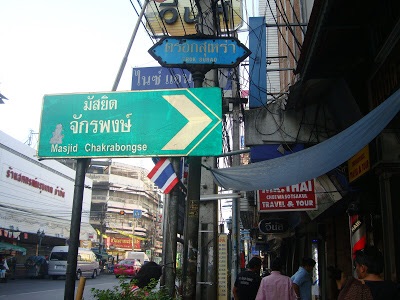
Bangkok was more interesting, noise-wise. From our balcony, as we admired the view over the Chao Phraya river, we would often hear the local muezzin calling the faithful to prayer from the minaret of a nearby mosque. Muslims are a more-or-less tolerated minority in Thailand and as a consequence tend to be very discreet. The Muslim community in our area was no exception. So discreet were they that I never located the minaret and its associated mosque. Was it this one, I wonder? I saw the sign once or twice but never went down the narrow lane to investigate.
image
These calls to prayer were counterbalanced by the morning chanting from the Buddhist monks in the temple across the river.
image
In Thailand’s current politically charged atmosphere, where an aggressive Buddhism is emerging, one has to wonder if the loudspeaker-enhanced chanting was not calculated to remind the local Muslims of who was in charge, just in case they had forgotten.

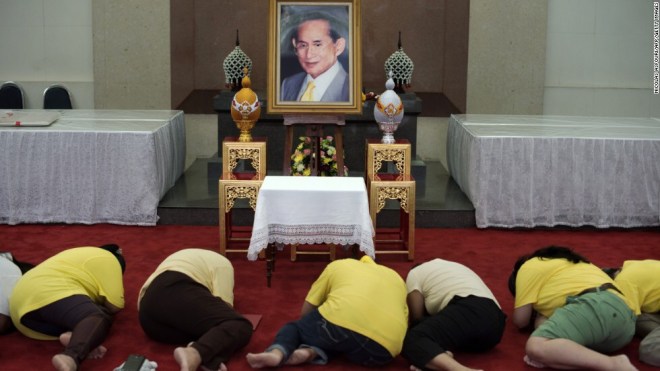
There was also a period when a government institution across the river would blare out the royal anthem twice a day, at 8 am and 6 pm, to remind the populace to venerate their king.
image
Mercifully, from one day to the next, the loudspeakers fell silent. We never figured out why. But we were thankful for the respite.

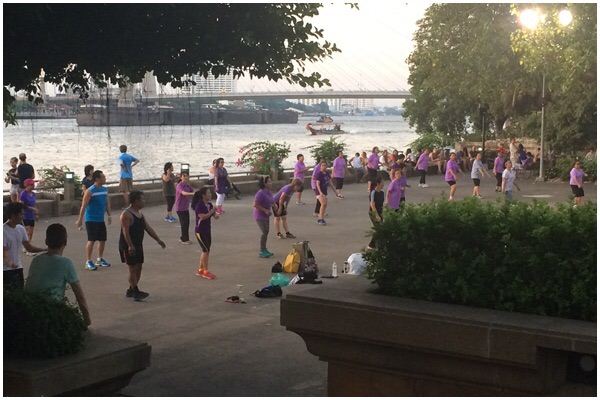
Noises from the new religion of our time, fitness, would assail our ears in the early evening, as an aerobic class would start up in the nearby park at Phra Sumen fort, with the disco music booming out over the river, interspersed with the trainer’s shouted instructions and encouragement.

image
Memories, all memories now. From now on, our soundscapes will be made up, at least in part, of church bells. Christianity may be fading in Europe, but the bells will remain. They will be ringing out the hours of the day and night (even as I write this, the nearby church bells are striking seven pm). They will call the few remaining faithful to Mass on Sundays. They will toll somberly for our brethren who have departed from this world (“Cold it is, my beloved, since your funeral bell was toll’d: / Cold it is, O my King, how cold alone on the wold!”). I may even witness once more, in a Catholic nation somewhere, the bells of a whole city ringing peel after peel in a mad cacophony to speed the soul of a dead Pope on its way; I heard this in Vienna when Pope John Paul II died.

Yes, these sounds are part of my Christian heritage to which I return after many years of absence.

_______________________
San Giorgio: http://www.milano24ore.net/cityinfo/churches/church_of_san_giorgio.php
Fire crackers: http://yourenotfromaroundhere.com/blog/firecrackers-evil-spirit-beijing-china/
Chinese New Year: http://chinesenewyearblog.com/cny-fireworks-victoria-harbor-hong-kong/
Sellers of fireworks: http://iainmasterton.photoshelter.com/image/I0000OGZzPAzdPPM
Mosque Masjid chakrabongse?: http://zlynn17.blogspot.it/2010/02/halal-food-in-banglamphoo.html
Buddhist monks chanting: https://monotonundminimal.wordpress.com/2011/07/28/day-240-bling-bling-bangkok/
Thais venerating the king: http://edition.cnn.com/2014/10/06/world/asia/thailand-king-bhumibol-gallbladder/
Aerobic class Phra Sumen Park: http://www.iamwannee.com/a-nice-walking-path-from-tha-phra-chan-to-tha-phra-athit/