POSTS

MEMORIES, MEMORIES

Bangkok, 14 March 2015

I don’t know why, but yesterday the tune of a song which my mother used to sing popped unbidden into my head. As I hummed along, I was trying to remember the words. Snatches came back but there were frustratingly large holes. I decided it was now or never: either I dredged up the words today or they would be lost to me forever. Well, my memory is shot, but there is the internet. As I have had cause to mention before, the internet really is a wonderful thing. There is a lot of rubbish, but there is also a veritable treasure trove of stuff ready to be mined, put there by devoted souls. In this case, the devoted soul turned out to be Google, for after trying out a few key words and remembered phrases of the song, I finally found a book from 1843 entitled “Chants et Chansons Populaires de la France”, which Google had scanned as part of its Google Books initiative. There, tucked in among lots and lots of songs that I had never heard of, was mine.

The authors of the book are vague about the date of the song, but I reckon from some words it uses that it was written in the sixteenth century or thereabouts. Its title is “La Vieille”, which can be loosely translated “The Old Crone”, and it is a deliciously malicious take on the foolish desire of some old people to stay young and on the power of money. In a few words, the song tells us of an eighty-year old woman who wants not only to join the young people in their dance but also to be coupled with the youngest and handsomest man there. Not surprisingly, he tells her to go away, adding that she is far too poor for him. After she intimates that she is actually very rich, our young man immediately changes his mind and calls her back to the dance. In fact, he rushes her off to a notary public to be married and no doubt to make sure that a will is prepared leaving all her wealth to him.

la vieille 001

He then takes her back to the dance, where she dances so energetically

la vieille 002

that she expires.

Unceremoniously, her young husband and his friends look in his dead wife’s mouth, no doubt searching for her gold teeth, but find only three teeth, “une qui branle, une qui hoche, une qui s’envole au vent”, one which moves, one which wobbles, and one which is ready to blow away on the wind. They then look in her pockets and find only three small coins: “Ah, la vieille, la vieille, la vieille, avait trompé son gallant”, the song concludes; ah, the old crone had fooled her young paramour. Anyone who is interested in the original words can find them at the end of this post (although in the interests of brevity I’ve cut the repetitions of which the song is full).

My mother loved to sing, and had a really quite beautiful voice (whereas when my father – blessed be his memory – sang, it resembled the croaking of a crow). By the time I knew my mother – that is, by the time I was old enough to judge her – she was of course a decorous middle-aged matron, but also one who had had to endure the slings and arrows of life’s misfortunes. So, apart from the hymns in Church which she delivered with gusto, the songs she sang tended to be soulful and mournful. Edith Piaf was a favourite: “Ils sont arrivés se tenant par la main, l’air émerveillé de deux chérubins”, “they arrived holding hands, with the look of wonder of two cherubs”. But then they were found dead, together, in the hotel room they had rented to make love for the last time. There was another, a haunting lament, about a wife waiting for her husband knight to return from the wars so that she can announce to him that she is with child. He comes back, but only to die in the same bed where the child was conceived, of his wounds. There was also “A la claire fontaine”, which is a somewhat trite song about lost love, but has a beautifully quiet melody.

But when my mother sang “La Vieille”, a mischievous glint would come into her eye and I could see the young, cheeky girl which, in the autobiography that she wrote for us children, she confessed to having once been. The same glint would come into her eye whenever she told droll stories of her family. There were the two brothers, for instance, great-uncles, who were “of the left”, and fervent anticlericals (we are talking of the great anticlerical moment in French history during the late 19th Century). Every Good Friday, they would take a table at the window of a restaurant close by the cathedral and make sure to be eating heartily and mightily when the poor souls came out of Church hungry from their Lenten fasting. One of these same brothers indicated in his will that when he died he wished to be buried in a simple pine coffin like a man of the people. But his daughters, whom I have mentioned before, were having none of that. They found their father embarrassing enough in life, they were not going to be embarrassed by him in death in front of their bourgeois friends. He was buried in a sumptuous coffin, and with a church ceremony to boot. Then there was the uncle, Oncle Jacques, who had been a dashing rake in his youth. Why, he had even been a daredevil pilot, this at a time when it was lucky if planes stayed together in the air. A somewhat older woman, Renée, had fallen hard for him, and in a standard tactic announced that she was pregnant, a pregnancy which mysteriously vanished when he did the Right Thing and married her. In the event, the marriage held and they did eventually have children. But Tante Renée shed many a bitter tear during the marriage over Oncle Jacque’s serial infidelities. This last set of stories were delivered the day before Oncle Jacques and Tante Renée came to make one of their annual visits to my grandmother, using the little train which I’ve mentioned in an earlier post. I still have a memory of the pair, arriving in the garden to effusive welcomes after the walk up the long alleyway from the train station. Tante Renée was hideously made up with pink powder, bright red lipstick, and rinsed hair, and as she bent over to give me a peck on the cheek I was drowned in the overpowering scent of a very sweet perfume. Oncle Jacques, on the other hand, stood there looking distinguished in his old age and with a mischievous glint in his eye.

Ah, memories, memories. Come, let’s finish with the refrain from another old French song, this one about the capture of an English ship by a smaller French ship in the early 1800’s during the Napoleonic wars:

Buvons un coup, buvons en deux
À la santé des amoureux
À la santé du Roi de France
Et MERDE au Roi d’Angleterre
Qui nous a déclaré la guerre.

Let’s drink a cup, let’s drink two
To the health of all lovers
To the health of the King of France
And BUGGER the King of England
Who went and declared war on us.

____________

photos: taken by me from https://books.google.co.th/books?id=2N7F5Gqine0C&dq=chanson+qui+avait+quatre+vingt+ans+l’autre+qui+s’envole+au+vent&source=gbs_navlink_s

-o0o-

LA VIEILLE

A Paris dans une ronde
Composée de jeunes gens
Il se trouva une vieille
Agée de quatre-vingt ans!

Elle choisit le plus jeune
Qui était le plus galant
“Va-t-en, va-t-en bonne vieille
Tu n’as pas assez d’argent!”

“Si vous saviez c’qu’a la vieille
Vous n’en diriez pas autant”
“Dis nous donc ce qu’a la vieille?”
“Elle a dix tonneaux d’argent”

“Reviens, reviens bonne vieille
Marions-nous promptement!”
On la conduit au notaire
“Mariez-moi cette enfant”

“Cette enfant”, dit le notaire
“Elle a bien quatre-vingt ans”
Aujourd’hui le marriage
Et demain l’enterrement

On fit tant sauter la vieille
Qu’elle est morte en sautillant

On regarda dans sa bouche
Elle n’avait que trois dents
Une qui branle, une qui hoche
Une qui s’envole au vent

On regarda dans sa poche
Elle n’avait que trois liards d’argent
Ah la vieille, la vieille, la vieille
Avait trompé le galant!

What follows is a quick-and-dirty translation:

In Paris, at a round dance
Composed of young people
Arrived an old crone
Of the venerable age of eighty

She approached the youngest man
Who was also the most handsome
“Leave me be, you old crone
You’re far too poor for me!”

“If you knew what the old crone has
You wouldn’t say as much”
“Tell us then how much she has”
“She owns ten barrels-full of money”

“Come back, come back, you old dear
Let us marry forthwith!”
They took her to the notary
“Marry me to this child”

“This child”‘ intoned the notary
“Is not a day younger than eighty”
Today the marriage
Tomorrow the burial

They made the old crone dance so hard
That she died mid-hop

They looked in her mouth
She had but three teeth
One which moved, one which wobbled
One which blew away on the wind

They looked in her pockets
They found but three farthings
Ah the old, old crone
She had fooled her handsome boy!


MYANMAR: A FOREST OF STUPAS

Bangkok, 8 March 2015

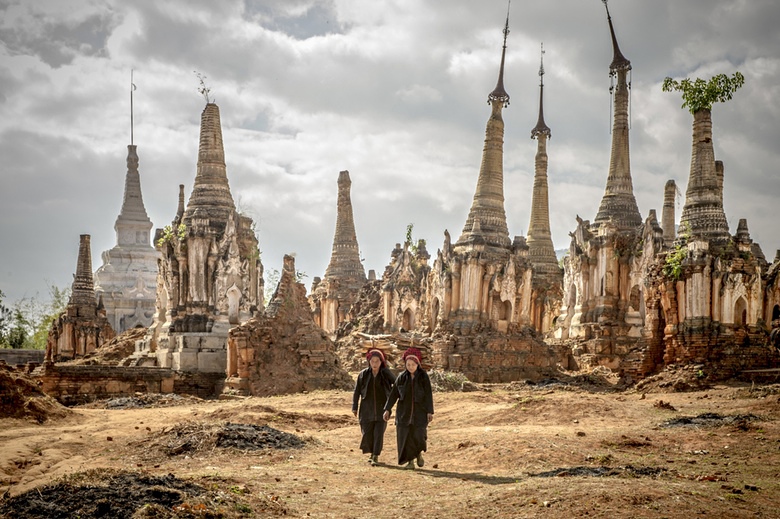
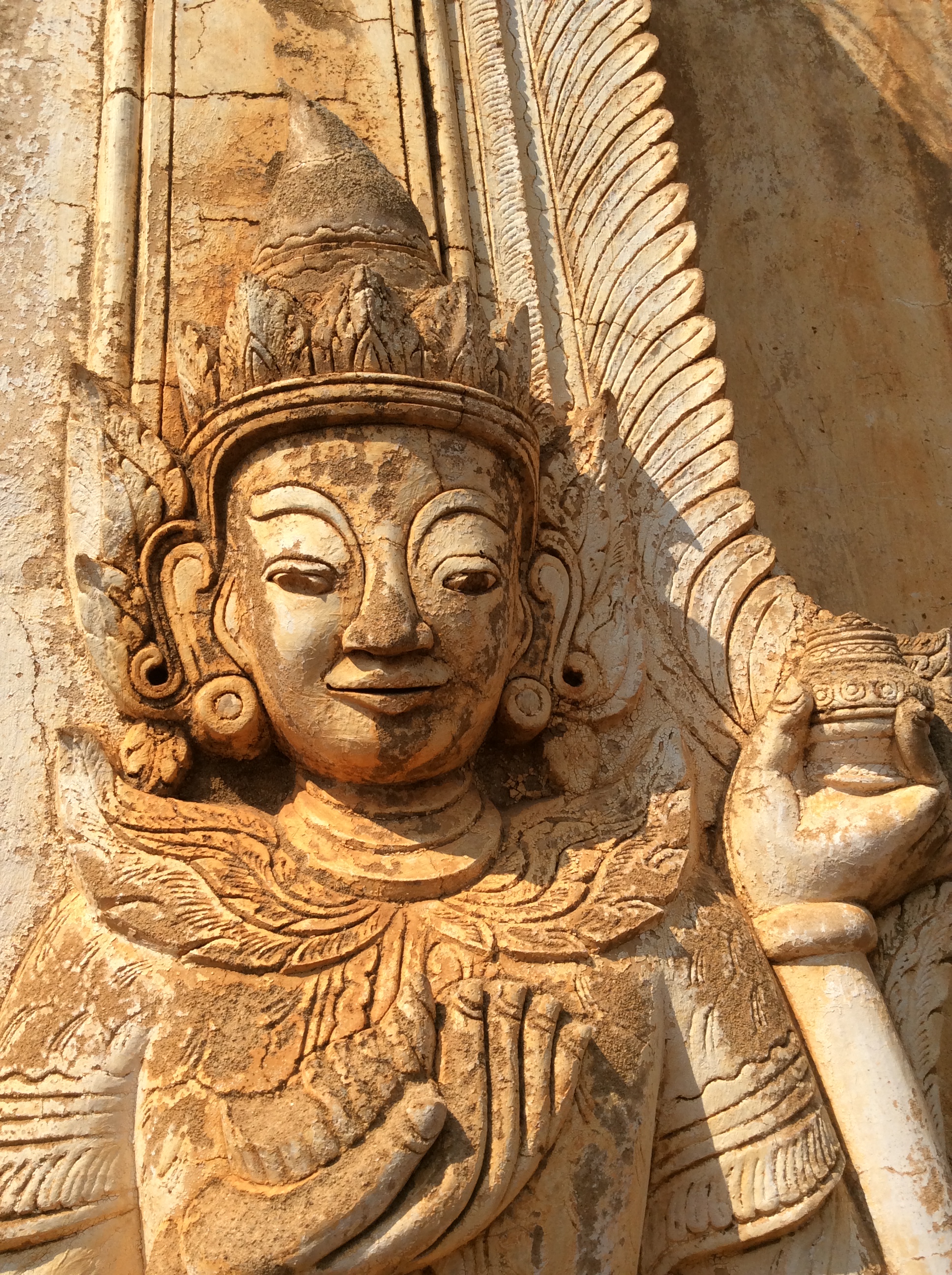
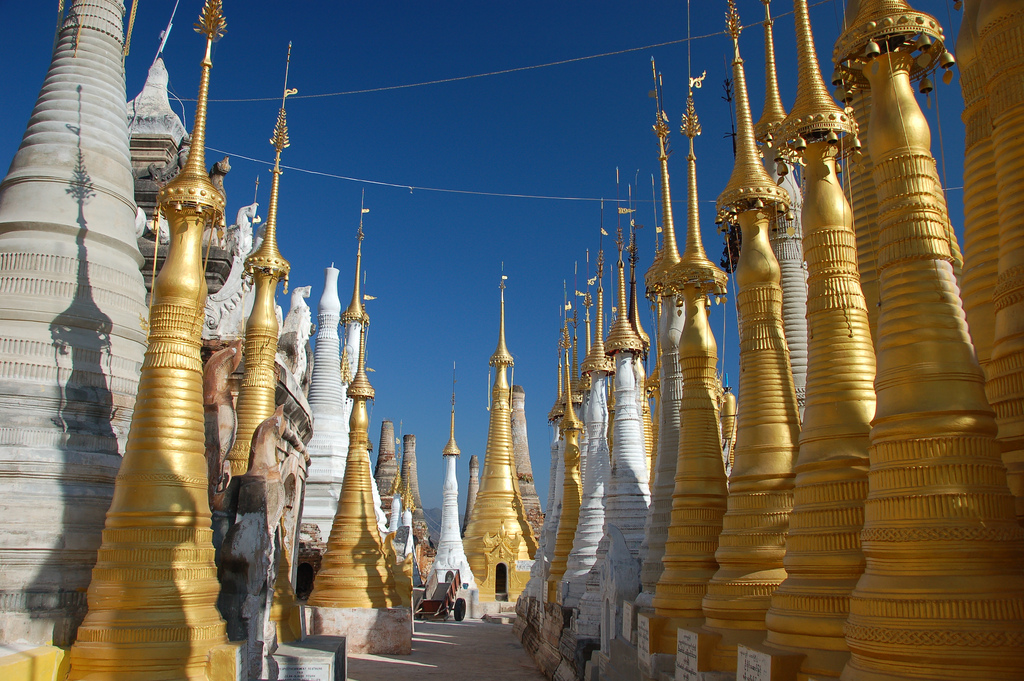
It was this photo that brought us to Myanmar.
Shwe Indein Pagoda, Inle Lake, Burma
My wife said, “We are going to Myanmar, and we are going here!”

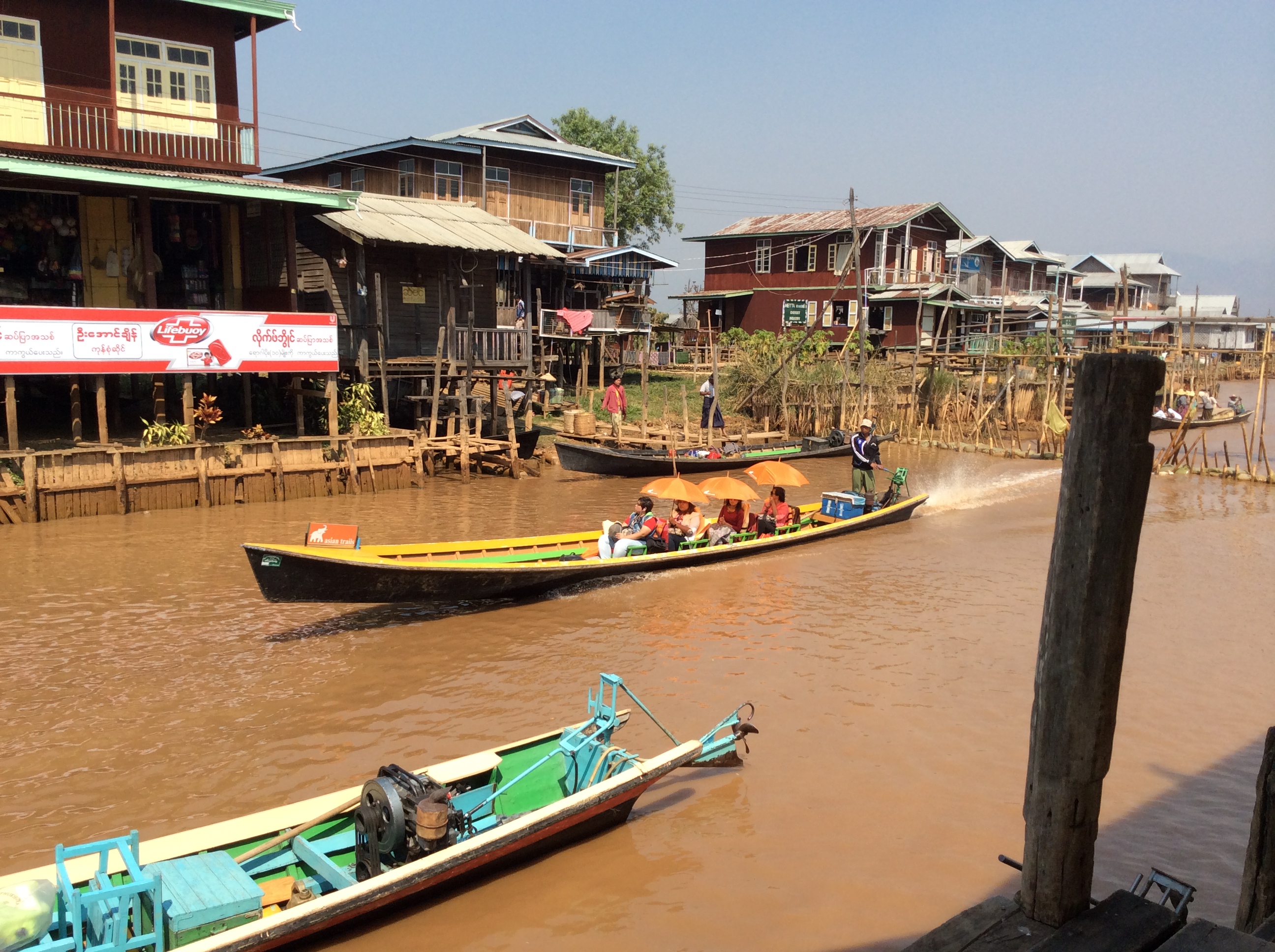
“Here” was Inn Dein, a village on the edge of Inle Lake, in Shan State, which is why we found ourselves staying at a hotel on the lake

06-inle lake-inn dein-flav 003

ready to take one of these boats to the village.
06-inle lake-day 3 006
In truth, our travel was a little different that day, because Inn Dein is actually on the old edge of the lake. Over the last fifty years or so, that edge has been creeping forward as farmers have created floating gardens on the lake’s edge

06-inle lake-day 2-flav 021

which after a while have become solid land, leading the farmers to create yet more floating gardens further out. So to get to Inn Dein, we had to travel up a shallow canal, the artificial continuation of the stream that runs through the village, which meant our travel was more like this.

06-inle lake-day 1 002

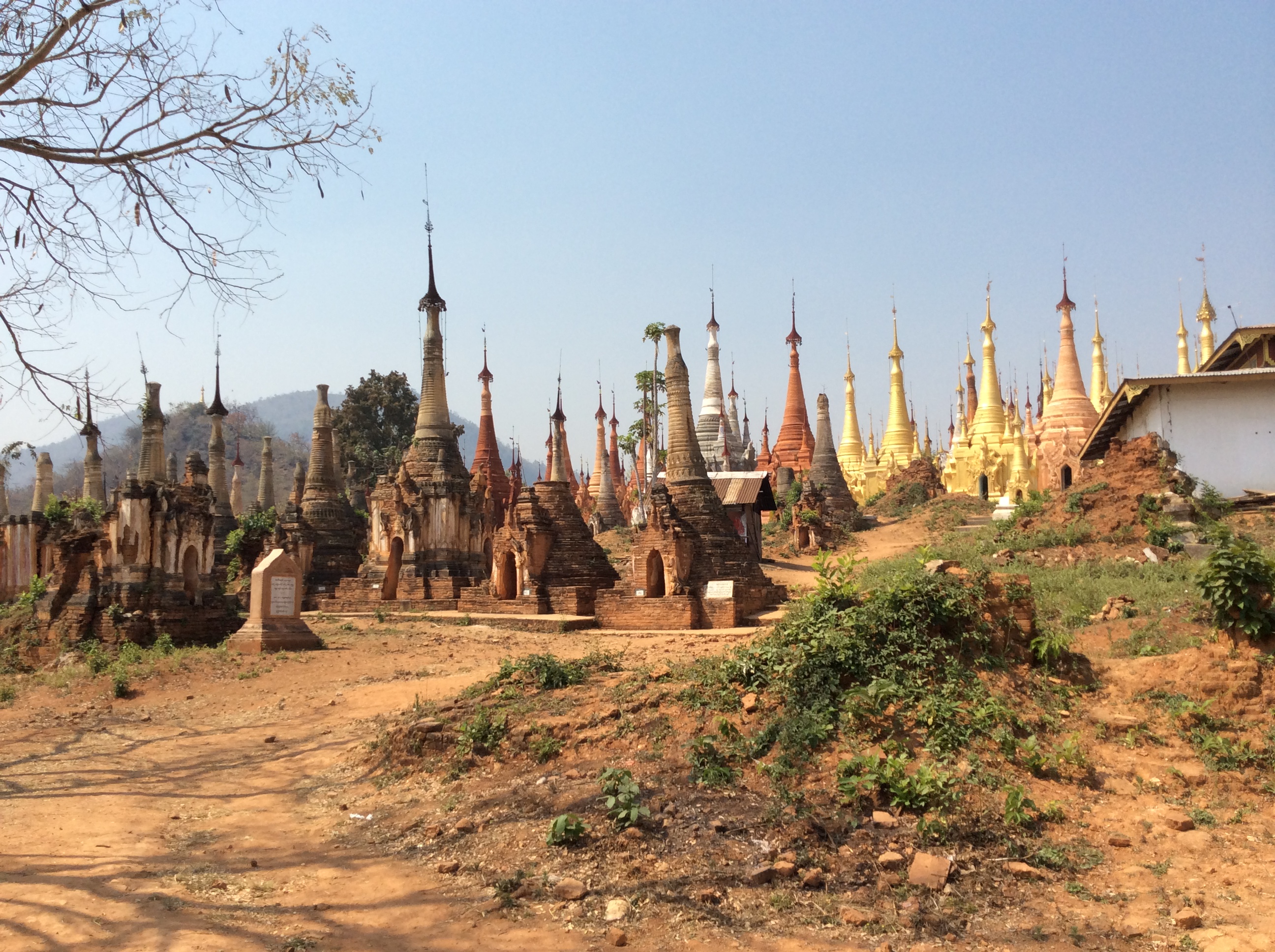
After we disembarked, we crossed Inn Dein’s one and only bridge and soon found ourselves wandering through a field of neglected, mouldering stupas.
06-inle lake-inn dein 007

06-inle lake-inn dein 009

06-inle lake-inn dein-flav 049

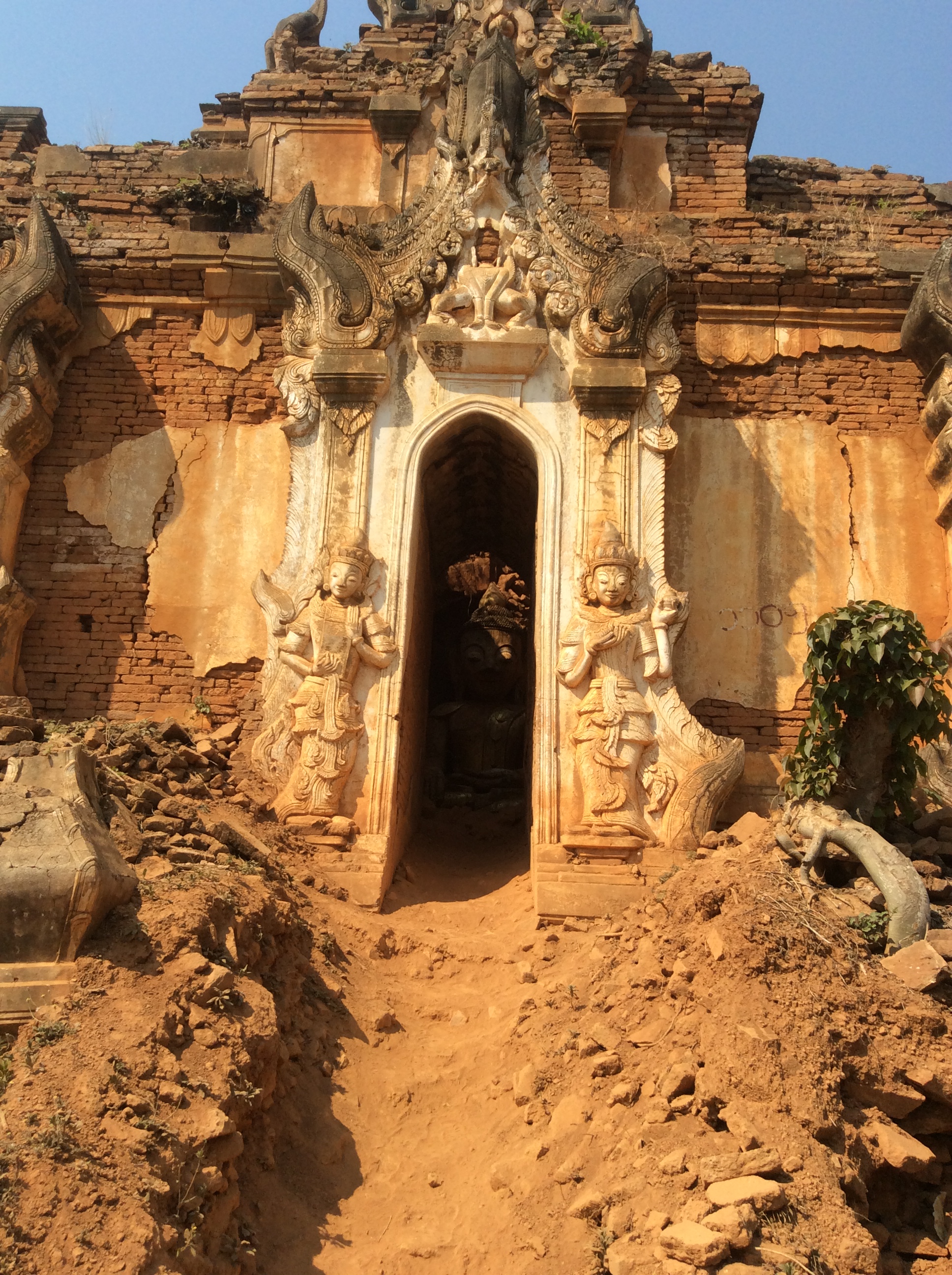
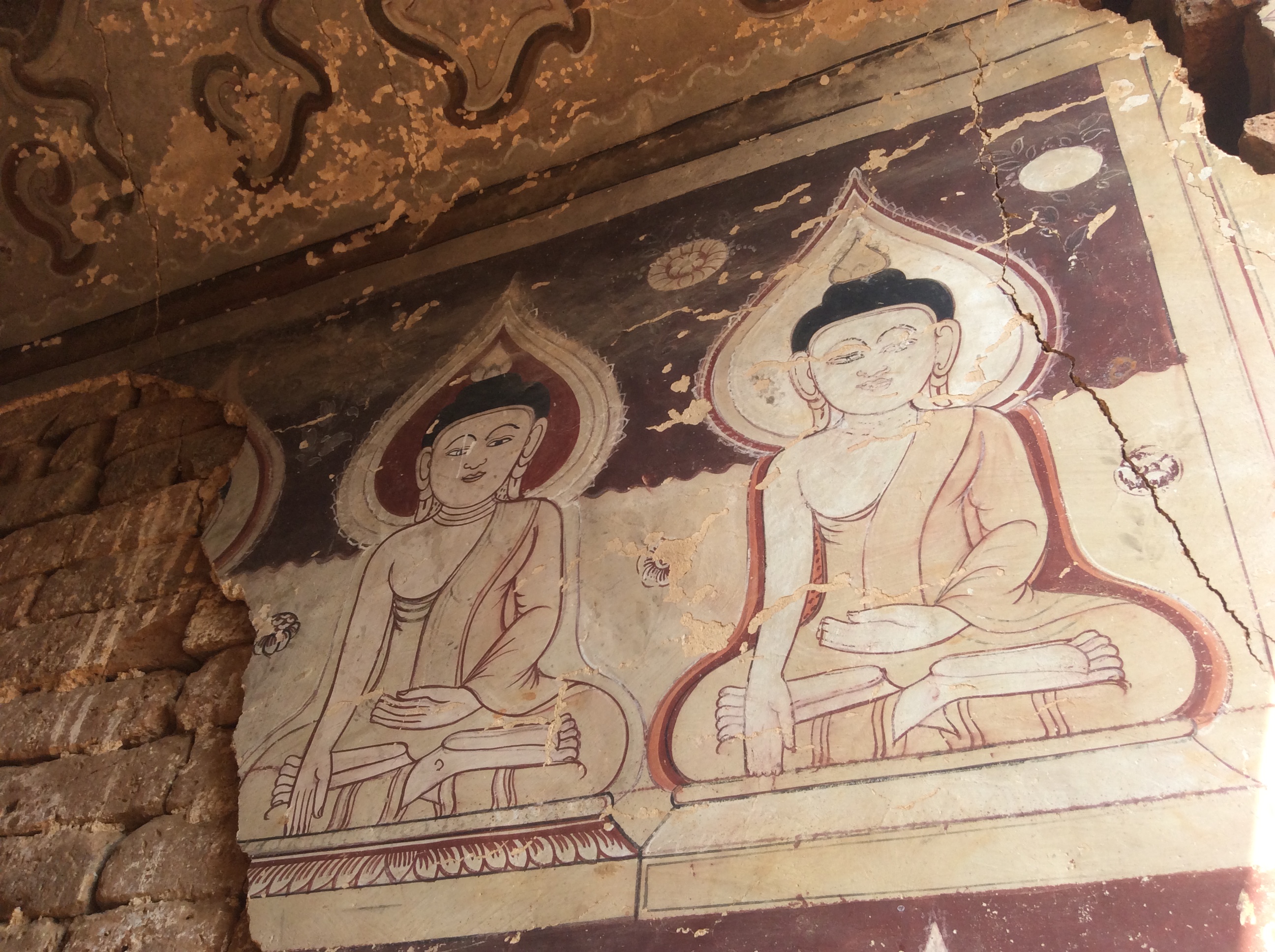
To some still clung fragments of their original ornamentation

06-inle lake-inn dein-flav 041

06-inle lake-inn dein 025

06-inle lake-inn dein-flav 043

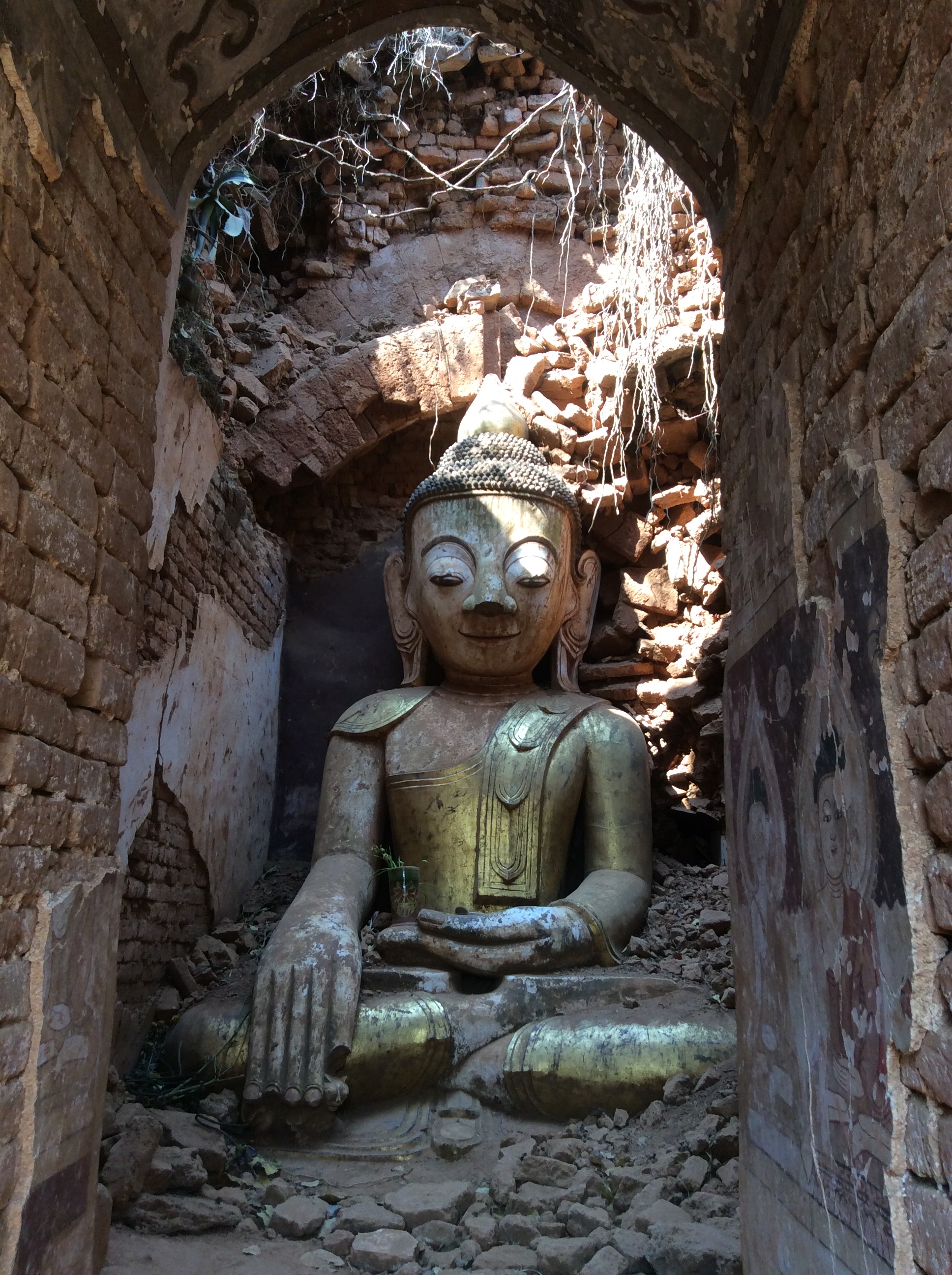
while others housed Buddhas in varying states of repair.

06-inle lake-inn dein-flav 042

06-inle lake-inn dein-flav 052

06-inle lake-inn dein 008

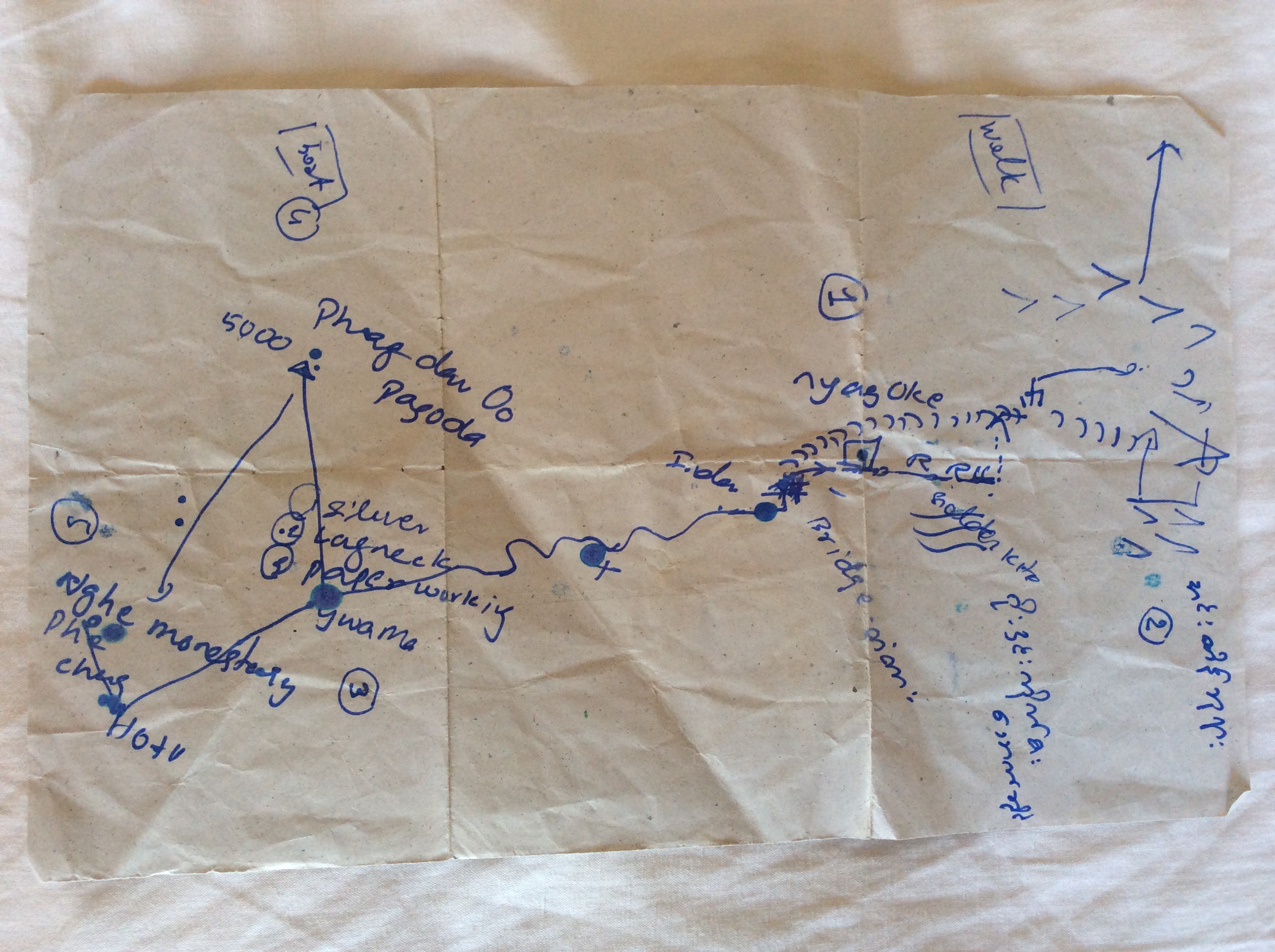
Though beautiful in their neglect, my wife and I agreed that this was not where the photo which had brought us here was taken. So we started walking up the hill behind the village, following the hand-drawn map we had been given at the hotel.
hand drawn map
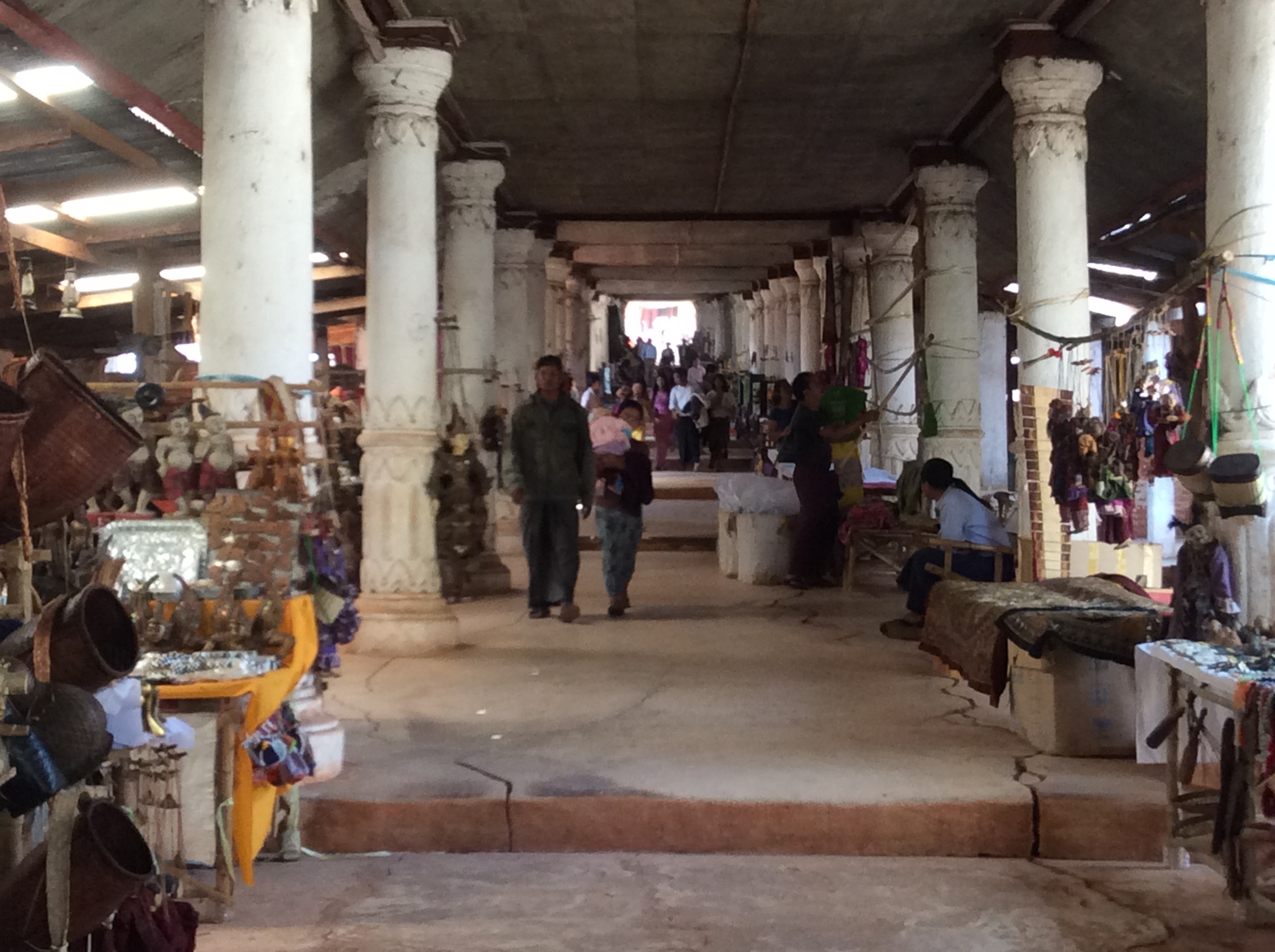
To get out of the sun’s glare, we ducked into a covered walkway that leads up the hill. It was cooler but it exposed us to stall after stall of hideous tourist tat.
06-inle lake-inn dein-flav 058
To console ourselves, I reminded my wife of a similar covered walkway which we had seen in Bologna in Italy, which leads up to the Sanctuary of Saint Luke on a nearby hill.
bologna santuario di S.Luca
No doubt, I told her, when in the old days pilgrims wended their way up the walkway to the Sanctuary (nowadays only tourists do so), there were similar stalls along the side selling hideous religious tat.

When we reached the top, we were greeted by a veritable forest of stupas.
06-inle lake-inn dein 040
The first were mouldering away as romantically as the ones down the hill
06-inle lake-inn dein-flav 071

06-inle lake-inn dein-flav 069

with some of the decoration clinging on

06-inle lake-inn dein-flav 070
Very beautiful, but not, we agreed once more, the place where the original photo which brought us here had been taken.

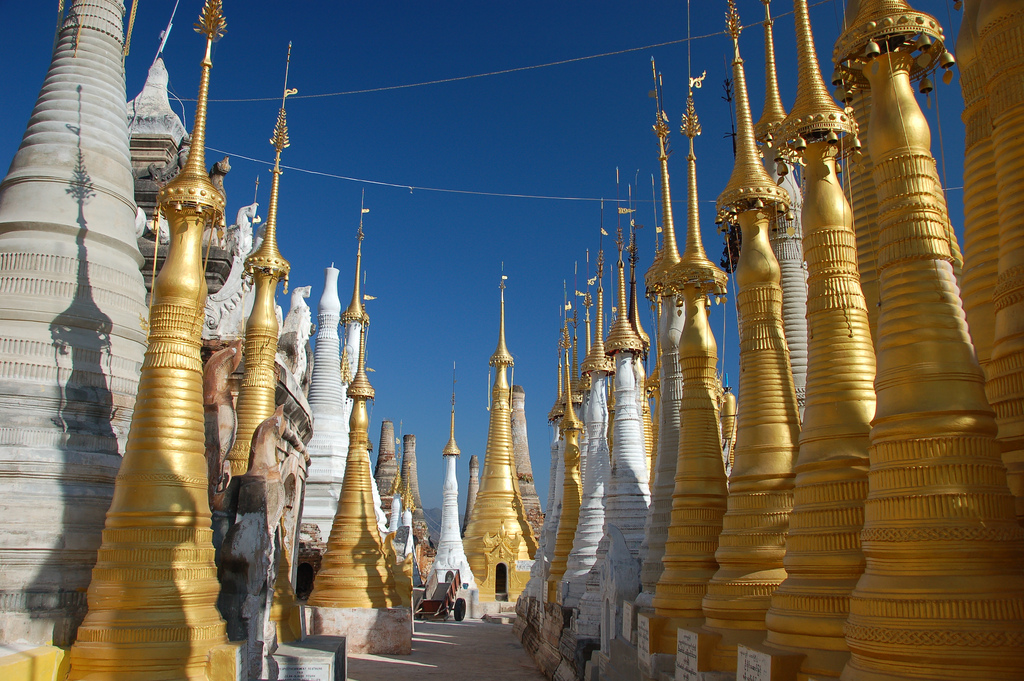
We began to walk up the hill, and soon found ourselves only among renovated stupas. My wife and I had mixed feelings about this wave of renovation that had washed over the hill. The decaying stupas are impossibly romantic, but we can understand that to devout Buddhists it must be dismaying to see such neglect. I suppose the only criticism we have (but it is a large criticism) is that it would have been good to renovate the stupas to their original form, something which quite obviously is not the case. We were so unenthusiastic about these renovated stupas that neither of us took a single photo of them, so what follows comes care of the internet.
Shwe Inn Thein stupas at Indein, Inle Lake
After threading our way, disconsolate, through the packed crowd of renovated stupas, we climbed a nearby hill to get an overview of the stupa forest.
06-inle lake-inn dein 070
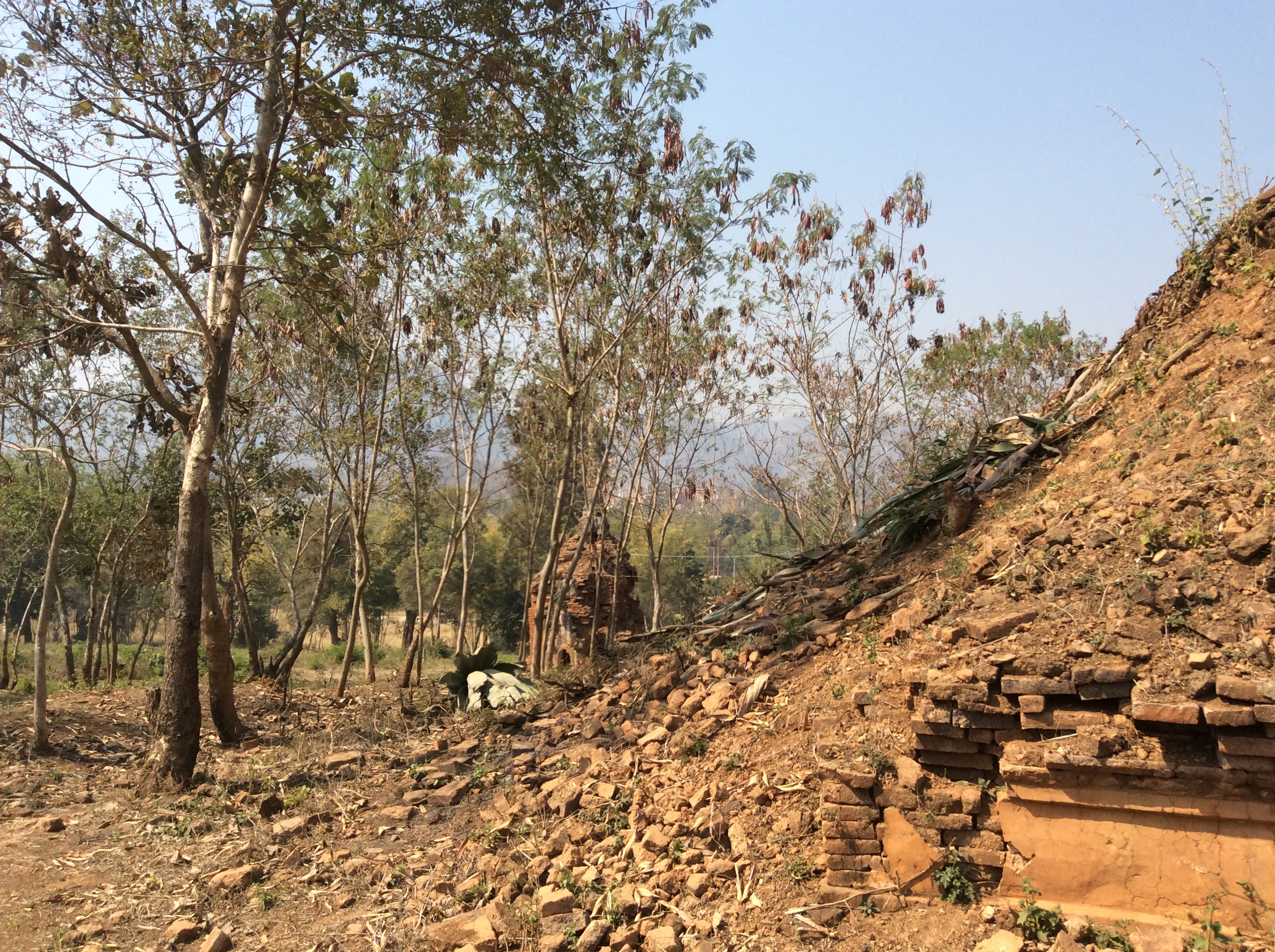
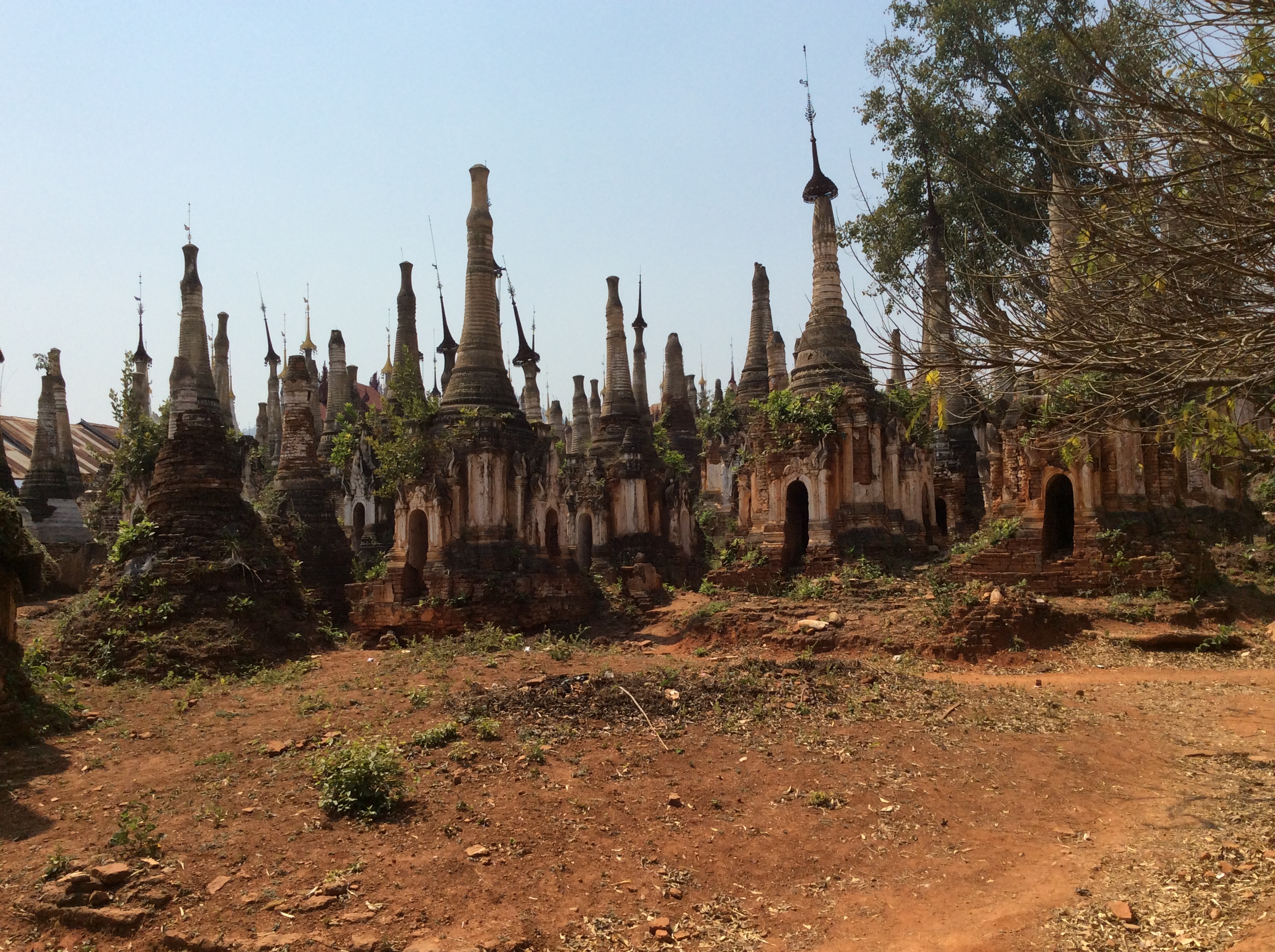
Even from here we could not really understand from where the fateful photo had been taken. So we went back down, walked through the temple at the centre of the forest, and visited the stupas on the other side. These were once again pleasingly decrepit, so we pleasurably ambled our way down the hill through them, picking our way over broken brick and stucco and around bushes and weeds which had taken root in the brick dust.
06-inle lake-inn dein 075
When we broke out of the forest and turned around, there at last we saw the view which had brought us here. Finally …

06-inle lake-inn dein-flav 086a

_____________________

Bologna Santuario san Luca: http://www.laltraitaliatour.it/main2/images/stories/foto_viaggi/centro/tour_cuore_italia/bologna%20santuario%20di%20S.Luca%20panorama%20%28Small%29.jpg (in http://www.laltraitaliatour.it/main2/index.php?option=com_content&view=article&id=100%3Agran-tour-nel-cuore-dellitalia&catid=53%3Aviaggi-centro-italia&lang=en)
Renovated stupas: http://kiplingandclark.com/wp-content/uploads/2014/03/4013943890_7ab483e2b5_b.jpg (in http://kiplingandclark.com/itineraries/myanmar-laos-cambodia-private-tour/)
All other photos: ours

MYANMAR: MRAUK U

Yangon, 7 March 2015

In 1430, King Saw Mon founded a new capital at Mrauk U, in what is now the State of Rakhine, for a Kingdom of Arrakan of which he was the first ruler. Mrauk U lay at the head of several navigable tributaries of the Kaladan River, and so could command the trade routes in the Bay of Bengal, on which the kingdom’s wealth was founded. It became a transit point for goods such as rice, ivory, elephants, tree sap and deer hide from Burma, and of cotton, slaves, horses, cowrie, spices and textiles from Bengal, India, Persia and Arabia. It also lay at the edges of a broad plain, where abundant rice could be grown to feed the city’s population. The area was dotted throughout with hillocks, ideal for capping with splendid pagodas which earned their founders much merit, but also for acting as watchtowers in strong defensive walls which linked hillocks together and could keep the kingdom’s jealous or rapacious neighbours at bay. It was, in all senses, a happy choice for the new kingdom’s capital.

Exactly two hundred years after the city’s founding, a Portuguese monk, Fray Sebastian Manrique, who was to live in India for forty years, visited Mrauk U, as part of an official mission. In a book he wrote about his time in Asia, “Itinerario de las missiones del India Oriental”, he dedicated several chapters to his visit to Mrauk U. “This great city”, he starts, “stands in a lovely valley, some fifteen leagues wide, wholly enclosed by high rocky mountains, which serve as natural fortifications”. The city was bisected by a network of waterways linked to the nearby river, which were “the principal means of traffic, both public and private”. Most of the houses were thatched bamboo and wood structures, held together by “Bengal cane, as we call it in Portugal”. Even the palaces “are made of these reedy materials”. The size and ornamentation of the houses, and not their materials of construction, were what proclaimed the station and wealth of their owners. Inside, wall mats were hung “of the finest texture and of many colours”. No doubt, the richer and more important the owner, the finer and more elaborate the wall mats. The better houses and the palaces also had rooms of wood “ornamented with carving, gilt mouldings, and enamel work in various tints”. Some of the palaces went one further, having rooms of sandalwood and other aromatic woods. One of the richer palaces included a “House of Gold”, a pavilion decorated from floor to ceiling with gold, which housed golden statues, dishes and other vessels. The royal palace boasted a ceremonial hall, with a golden roof “ornamented with flowers of different colours”, supported by thirty gilded wooden pillars. The monks didn’t do too badly for themselves either. A number of the temples and monasteries in which they lived were as sumptuous as the palaces, richly endowed as they were by their wealthy and important founders, who were seeking thereby to gain merit. Most of the temples were “pyramidal in shape”, with a spire that ended in a gilt metal globe on which small bells hung that tinkled in the wind (I presume the good Friar was referring to the stupas, which sit at the centre of temple complexes). The temples’ interiors were decorated with “frescoes done in gold and colours”. Several years later, he again visited Mrauk U on an official mission, and this time he was lucky to be there when the king was crowned. He described in breathless detail all the pomp and ceremony which accompanied the crowning. This print, by the Dutchman Wouter Schouten, gives an idea of what Mrauk U looked like at this time.

mrauk u old print

The happy times did not last. Warfare between the local kingdoms was endemic, as each king tried to grow at the expense of his neighbours. In one of these local wars, King Bodawpaya of the neighbouring kingdom of Burma got the upper hand, helped along, it must be said, by vicious internecine struggles, all worthy of a Shakespearean history play, that were being played out between Arrakanese kings and their impatient heir-apparents, and between them and various usurpers. In 1784, the Burmese army attacked

war elephants

and eventually took the city, razing it to the ground. They took care, though, not to destroy the stupas and associated temples; the soldiers did not want to lose merit. But they stripped them and the rest of the city of all the movable loot they could lay their hands on. What part of the population they did not kill, they enslaved. And so, laden with vast quantities of booty and 20,000 slaves, King Bodawpaya and his army returned home to celebrate, leaving death and desolation behind them. The kingdom of Arrakan and its capital city were no more.

The site was too good to abandon completely. Gradually, people moved back into the city and partially repopulated it. But now it was just a small market town, with the modest lives and modest dreams and modest destiny of such towns. Its citizens lived out their lives in the shadow of monuments from Mrauk U’s royal past, which slowly crumbled away and were overgrown by vegetation.

But Mrauk U’s glorious past was not completely forgotten. Echoes of its history were passed down. Now that Myanmar has come out of its self-imposed isolation from the outside world, and the world has accepted the country back into the community of nations, Mrauk U has become a tourist destination. Not like Bagan, which hosts the ruins of another vanished kingdom, nor like Inle Lake, another popular tourist destination, nor even like the capital Yangon. A much more modest destination, because it has little tourist infrastructure and is hard to get to: seven hours by private boat from Sittwe, several more by the public boat; six hours by car on a spine-crushing road, several more by public bus. But a trickle of tourists do make it through.

We have just been part of that trickle. We hired bicycles, a wonderful way to move around this town whose dimensions are small and whose traffic is contained, and we slowly criss-crossed it, riding down potholed roads, side streets of beaten earth

02-mrauk u-flav 016

half-finished roads on which toiled labour gangs of women

02-mrauk u-flav 059

even across desiccated paddy fields when the half-finished roads were impassible

03-chin villages-flav 001

observing all the very rural life that passed us by. Most of the houses are still made of wood and “reedy materials”

02-mrauk u-flav 050

but from the few modern houses we saw brick and concrete are clearly now the building materials of choice for the wealthy. The network of waterways are still being used, although now sadly choked with plastic and other debris of modern life.

02-mrauk u-flav 052

Bicycles and motor bikes are the mode of transport of choice

02-mrauk u-flav 078

with two-seater bicycle rickshaws playing the role of local taxi

02-mrauk u-flav 067

and ten-seater tuk-tuks playing that of local buses (ten seats is a nominal number; the drivers seemed to be able to squeeze twice that number into them).

03-chin villages-flav 003

As in all ages and in all places, the wealthier disdain these proletarian forms of transport, although they now favour four-wheel drive cars with tinted windows rather than the palanquins and elephants of old. On the edges of town (which were reached after no more than ten minutes by bike from the town centre – and we rode slowly), chickens, pigs, and the odd cow join the human melée. And everywhere, young girls and women (never men and very rarely boys) are walking slowly to or from the wells and reservoirs which dot the town, ferrying the households’ water, no doubt as they had been doing nearly four hundred years ago when Friar Manrique criss-crossed the town – such a waste of women’s time! And the water they were collecting fitted no definition of “drinking water” that I know of.

02-mrauk u-flav 025

The town has schools, but all in a shocking state of decrepitude

02-mrauk u-flav 048

and in any case many children were put to work in various trades: child labour seems the norm here, not the exception. This country’s military dictators have much, much to answer for.

And so it was that we rode and we observed, and we meditated on what we observed, until the next stupa, or temple, or ordination hall from Mrauk U’s past loomed out in front of us. We visited many during our two days, but I will mention only three. The first is Mro U-hnauk Phara
02-mrauk u-flav 037
because it was the first temple we visited, but also because we were intrigued by the very ornate edifice constructed out of galvanized corrugated iron sheets that preceded the ancient stupa.

02-mrauk u-flav 038

The materials of construction may be humble but the designs are really quite complex. We got used to seeing these structures in front of many of the stupas in town. Both my wife and I immediately remarked on how much these constructions reminded us of the stavkirke in Norway.
Borgund_stavkirke
The second site I will mention is Koe Thaung temple, which sits out in the middle of paddy fields a little way out of town.
koe thaung temple
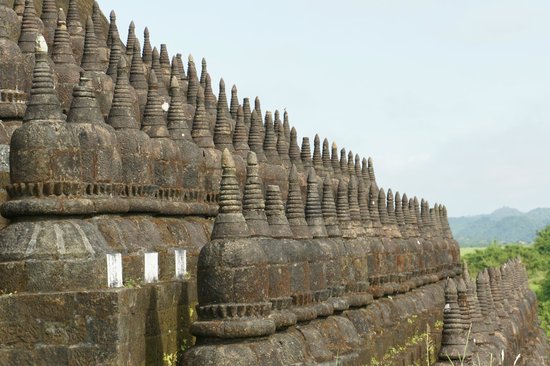
Its design is said to be based on Borobudur in Indonesia. We wouldn’t know, not having been able to visit Borobudur because of a volcanic eruption. But Koe Thaung certainly has charm, what with the serried ranks of stupas lining its terraces

koe-thaung-temple-stupas

and the hundreds of Buddhas, each with a different face, lining the galleries that encircle the edifice.

02-mrauk u-flav 107

When the rice paddies around the temple are planted and green, it must be very beautiful.

The third is actually a grouping of temples and stupas, all situated in a large open space. From the vantage point of the high terrace of one of these, I could see most of the group laid out before me.

02-mrauk u-flav 228

Immediately ahead is the Laymyekhna, with the four Buddhas in its internal gallery facing the four cardinal points, and its attendant Nyidaw Phara. Just behind it the Htukkanthein, a fortress-monastery.  At the base of the hill in the background, is the Shite-thaung temple, the most important religious edifice of the old city and known for its three encircling galleries with Buddhas and friezes.  This is where the coronation during Friar Manrique’s second visit took place. Over to the left is the Ratanabon Temple.

But what also struck me was the apparent indifference of the townsfolk to these venerable monuments. The open space was turned over to the growing of rice and vegetables. There was constant traffic along the roads and tracks which crossed the space as people went about their business. There were goats and cows cropping the grass around the edifices. And I was suddenly reminded of those paintings from the 17th and 18th Centuries, which were also recording the remains of a fallen city, ancient Rome in this case, mouldering slowly away as a new city lived its life around them
Roman forum Claude Lorrain
This particular painting, by Claude Lorrain, is a view of the Forum, with the arch of Septimus Severus in the left foreground, the three remaining columns of the Temple of Castor and Pollux in the middle ground, the arch of Titus in the background, and at the very back the Colosseum. And all around these ruins, the Romans are leading their lives.

Now I don’t want to make too much of a parallel between Rome and Mrauk U. Rome had been a huge city, many times bigger than Mrauk U had ever been. It had also held sway over a much larger territory than Mrauk U had ever done. On the other hand, the collapse of Rome, although over a longer period, was probably as total as Mrauk U’s. Medieval Rome, and perhaps even Baroque Rome, was probably no bigger than Mrauk U is today and just as backward. If it hadn’t been for the Pope, there are good chances that Rome would have disappeared. The Pope kept Europe’s attention on the town, while the pilgrims were a handy source of income, along, later, with the sons of Europe’s aristocracy. They flocked to Rome in the 18th and 19th Centuries because it was the thing for an educated young man to do, and paintings like the one above were produced for them by the hundreds.  Rome was also lucky to have become the capital of the newly unified Italy, which brought it the power (and wealth) of national government. In contrast, Mrauk U seems to have been forgotten by all once its last king fell. If the new government of Myanmar can ensure that Mrauk U shares in the country’s upcoming economic development, then it has the chance to become a prosperous little town.

__________

Mrauk U old print: http://upload.wikimedia.org/wikipedia/commons/0/0c/Vista_de_Mrauk-U,_ou_Arrakan_%28cidade_de_Arrac%C3%A3o%29_no_primeiro_plano_o_bairro_portugu%C3%AAs.jpg (in http://commons.wikimedia.org/wiki/File:Vista_de_Mrauk-U,_ou_Arrakan_%28cidade_de_Arrac%C3%A3o%29_no_primeiro_plano_o_bairro_portugu%C3%AAs.jpg)
War elephants fighting: http://ic2.pbase.com/o6/93/329493/1/131322898.yAQdtZvd.BKKAug10128.jpg (in http://www.alternatehistory.com/discussion/showthread.php?t=240558)
Stavkirke: http://upload.wikimedia.org/wikipedia/commons/b/bb/Borgund_stavkirke.JPG (in http://no.wikipedia.org/wiki/Borgund_stavkirke)
Koe Thaung Temple: http://www.vietnamjettravel.com/images/products/20147141754135.jpg (in http://www.vietnamjettravel.com/voyage-birmanie/a-travers-la-birmanie-de-yangon-a-mrauk-u.79.html)
Koe Thaung temple stupas: http://media-cdn.tripadvisor.com/media/photo-s/04/ab/0c/d1/koe-thaung-temple.jpg (in http://www.tripadvisor.com/LocationPhotoDirectLink-g1390118-d2557685-i78318801-Koe_Thaung_Temple-Mrauk_U_Rakhine_State.html)
Claude Lorrain view of the Roman Forum: http://upload.wikimedia.org/wikipedia/commons/b/ba/Claude_-_The_Campo_Vaccino,_Rome_-_Google_Art_Project.jpg (in http://commons.wikimedia.org/wiki/File:Claude_-_The_Campo_Vaccino,_Rome_-_Google_Art_Project.jpg)
All other photos by my wife

MYANMAR: A JOURNEY

Yangon, 7 March, 2015

We slipped our moorings at half past three in the afternoon, two hours late – the flight from Yangon to Sittwe had left very late. As we drove from the airport to the jetty, our guide told us apologetically that the tide was running out now. This, coupled with the strong current down the Kaladan River, meant we were facing a seven-hour journey up to Mrauk U – if the boat’s engine didn’t break down on the way. Accepting the inevitable, we settled down on the boat’s small focsle, as far away as possible from the engine, which was knocking hard and strong, while the boat chugged its way down the busy creek. It was a beautiful afternoon, cloudless, slightly hazy, not too hot; it was going to be a good ride.

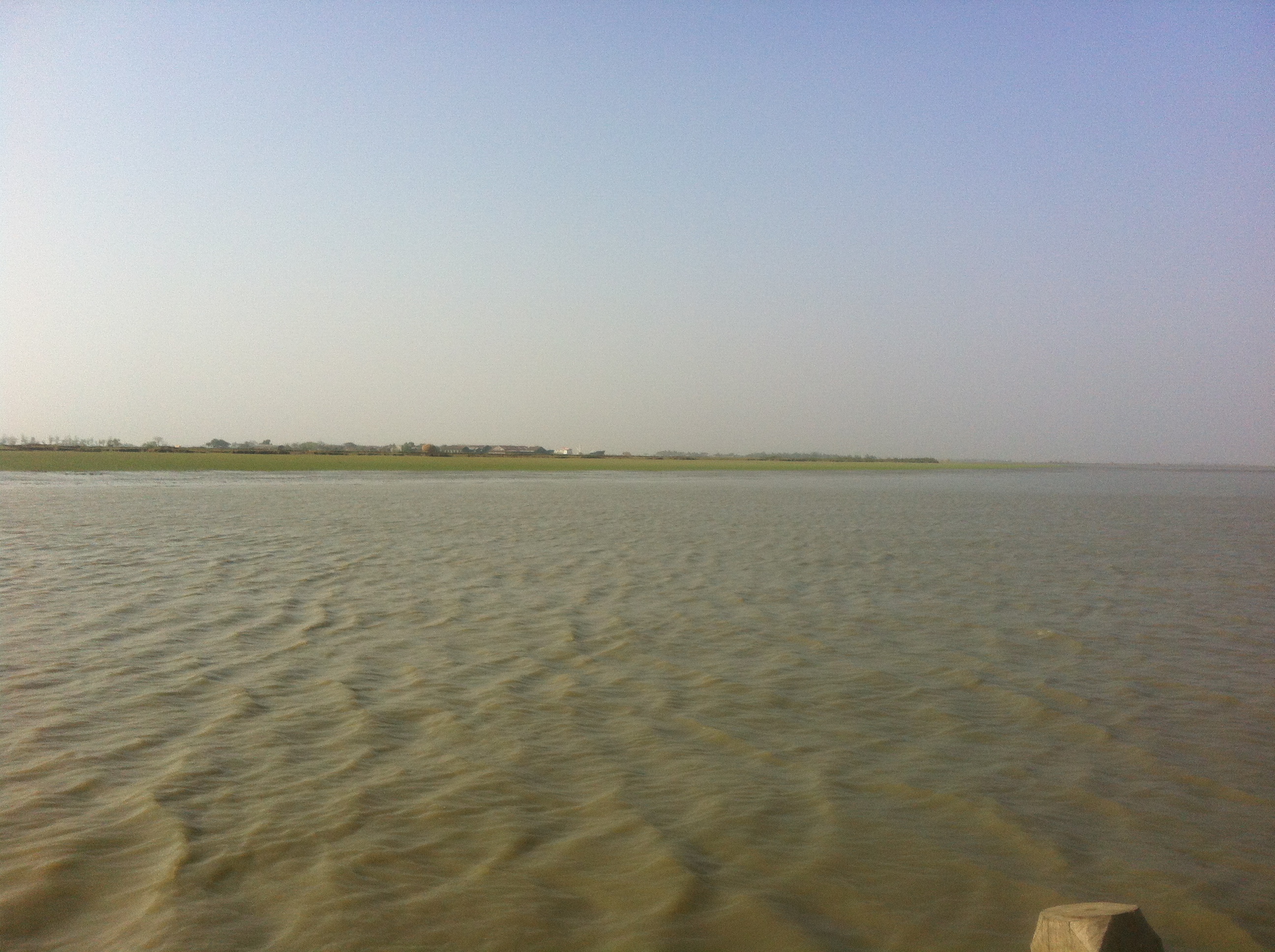
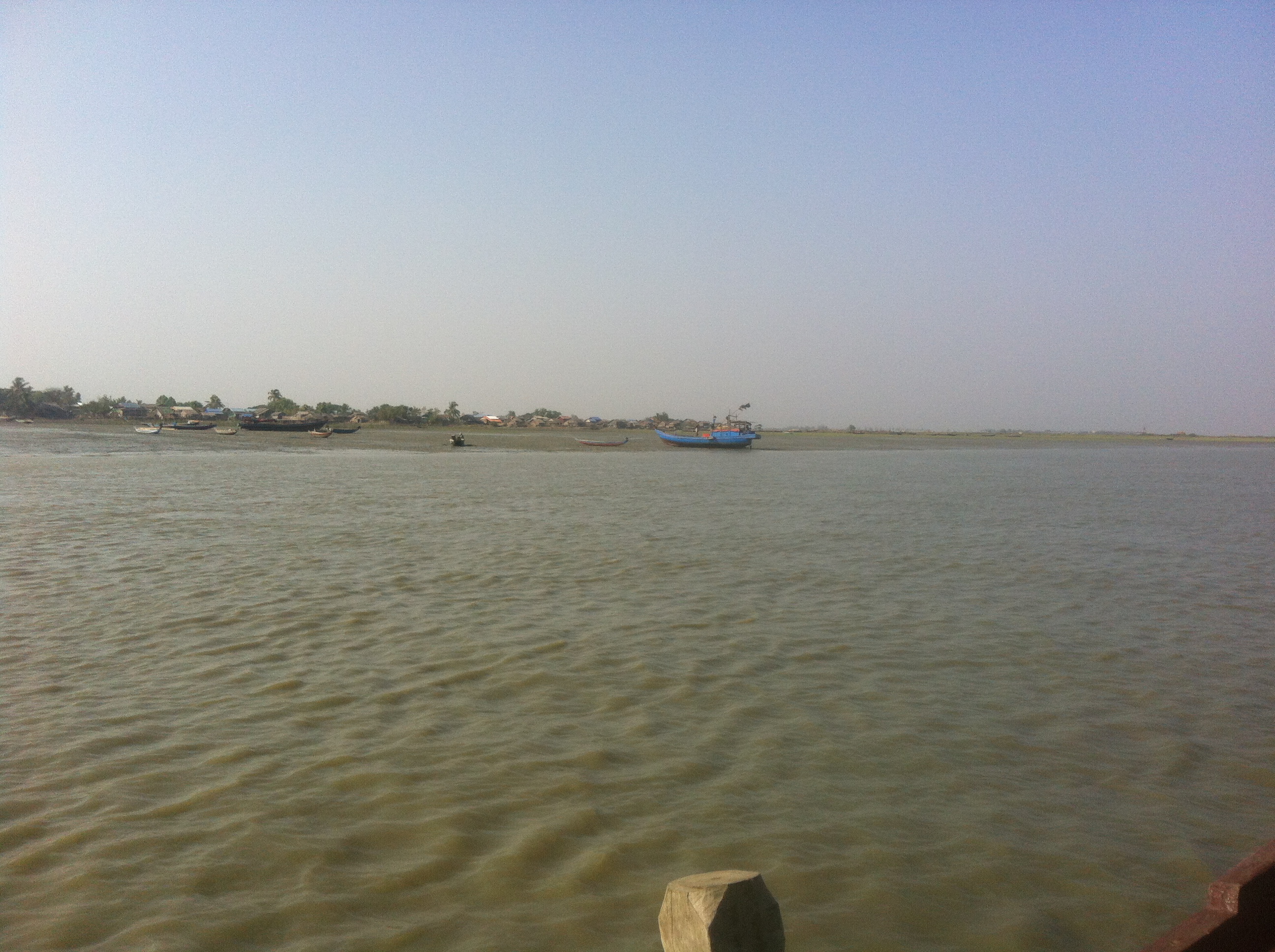
We exited the creek into the mouth of the river, so big that at first we thought we had entered the sea. Surprised, we looked around us as the boat turned northward and started following the shore closely, skirting small fishing boats and their nets. Out to sea, some islets, or maybe headlands, lay humped on the horizon, while to our left extended a grassy plain

01-sittwe-mrauk u 008

on which stood a few small lean-to’s for the fishermen and some fishing boats, sitting upright, waiting to be dragged down to the shore.

01-sittwe-mrauk u 003

We waited for something more riverlike to appear. And gradually, without us noticing it, a low bank crept up on our right, far away in the distance. And so we realized that we had finally entered the Kaladan River. But such a wide river! The far bank kept following us, but always at a respectful distance.

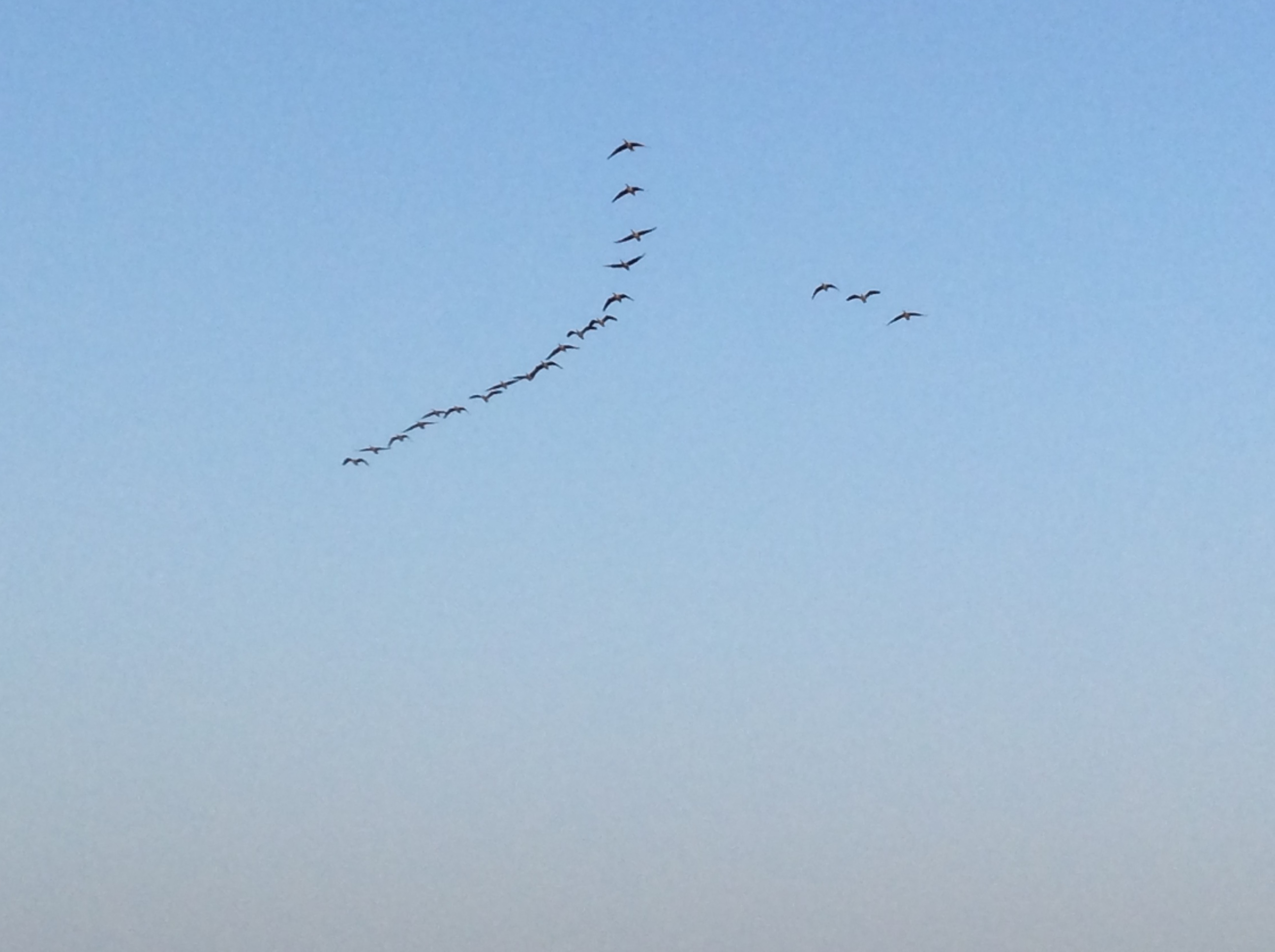
The boat continued crawling up the shore, no doubt to keep out of the strong currents. A flock of birds, sand martins perhaps, dived and swooped close to the water’s surface, flashing from brown to white and back to brown as they rolled and wheeled in tight formation, before settling on the mud of the river bank. Another flock of birds flapped quietly over us in formation, homing in on some faraway destination.

01-sittwe-mrauk u-flav 017

Now and then, a boat would pass us or we would pass one

01-sittwe-mrauk u-flav 020

otherwise we had the river in all its wideness to ourselves. The same flat deserted plain kept us company to our left, but by now the grass had narrowed to a strip of emerald green along the shoreline, backed by a vast expanse of dry paddy fields, dotted with rice-hay ricks.

04-mrauk u-sittwe 013

The flatness was broken now and again by a tall tree standing guard over the landscape.

01-sittwe-mrauk u 012

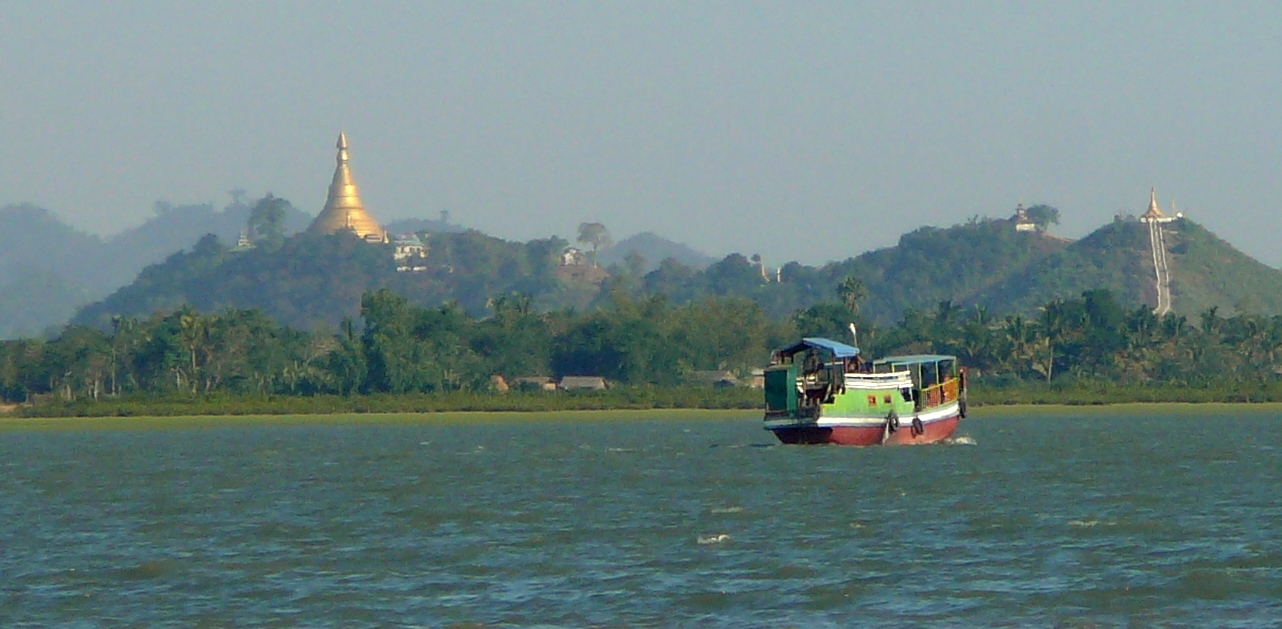
For a brief moment – but only a very brief moment – I imagined ourselves to be chugging along some river in the Netherlands, scanning the flat Dutch farmland. But then a range of small hills hove into sight, with two of them topped by gold-covered stupas and the image of Holland faded.

pagodas

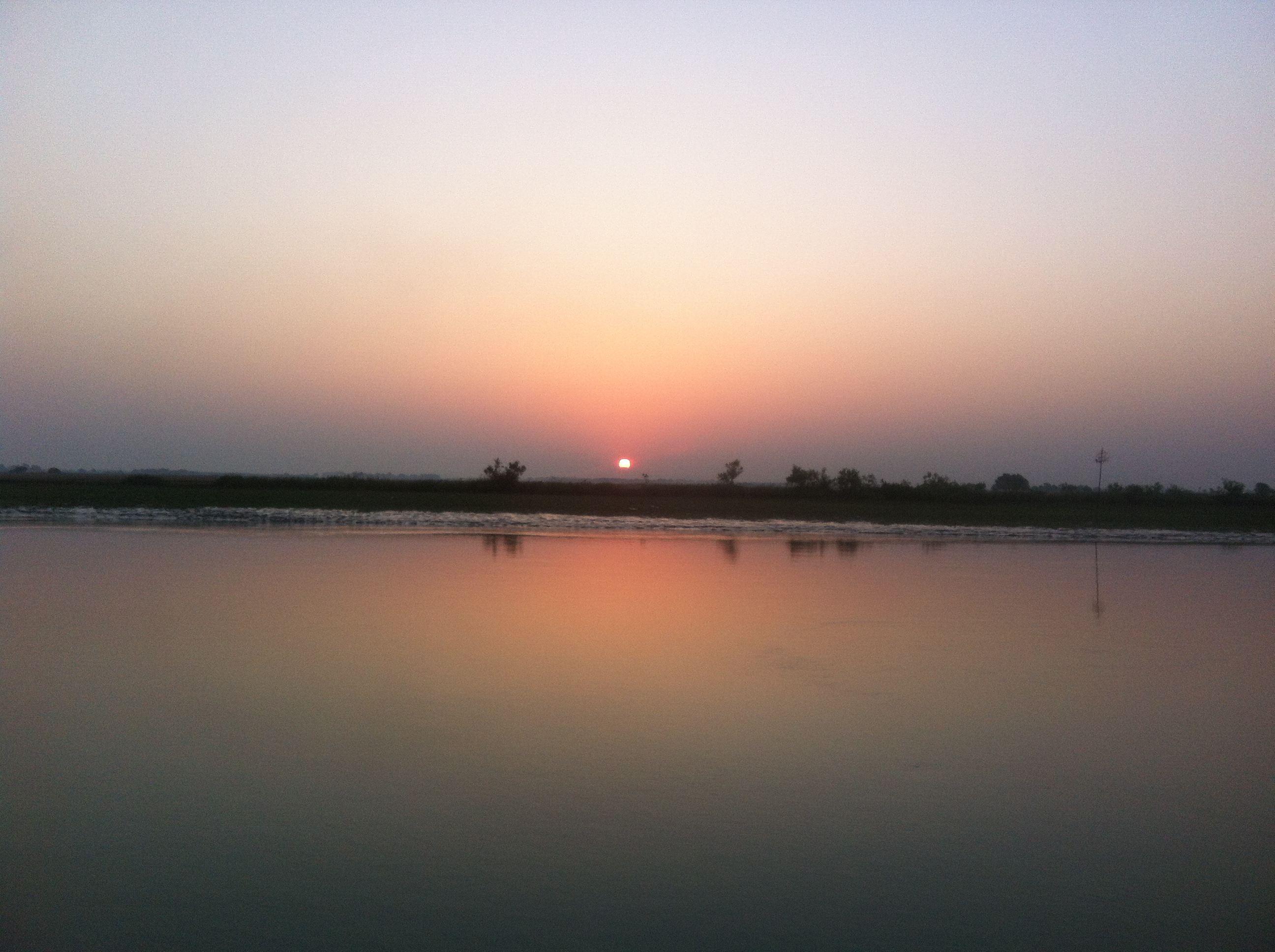
As we approached, the sun began to set, slowly at first and then ever quicker, reddening the stupas’ gold to copper.

04-mrauk u-sittwe 003

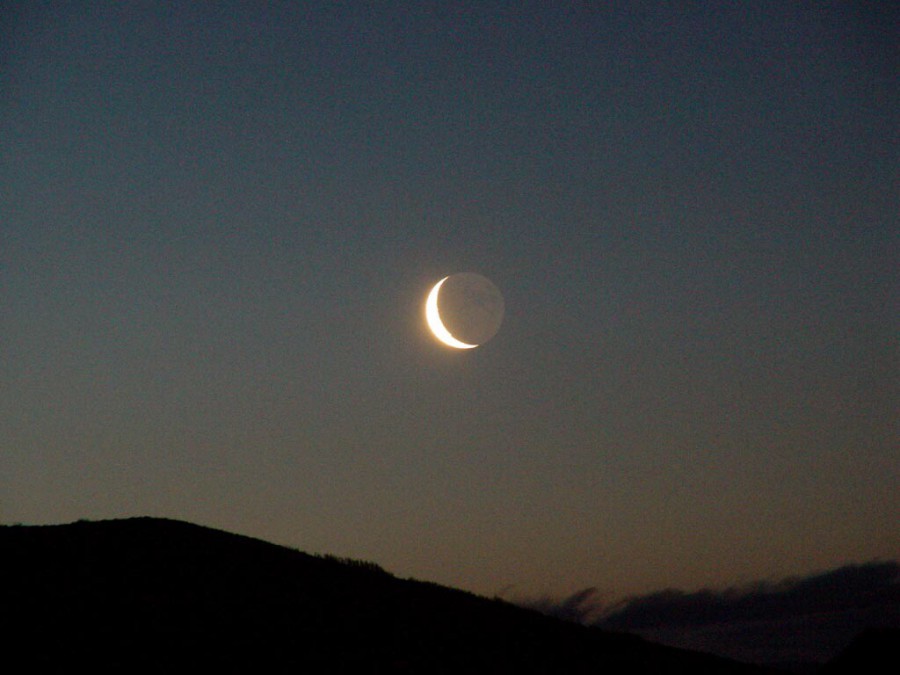
At last, the sun sank below the horizon, leaving us in the moon’s company. She had been waiting quietly for her moment. She was waxing crescent, having reached her dark point a week before. Although only a small sliver was shining down on us, we could make out the ghostly outline of the rest of her lying in that sliver, “the new moone wi’ the auld moone in her arme” as the Scottish ballad puts it.

image

We sat there, enjoying her company, but she was already a spent force when she became visible to us. She stayed with us for just an hour before she too sank below the horizon.

Venus, the star of the evening, had been keeping the moon company, along with some of the brighter stars, but now, with the extinction of the last bright light in the sky, the full panoply of stars was able to appear in all its glory. Such a spectacle! The sky’s dome was studded with stars, some bright, some dim, some big, some small, some quarters of the sky were dense with stars, others were pools of darkness. And arcing across the sky from end to end was the Milky Way

image

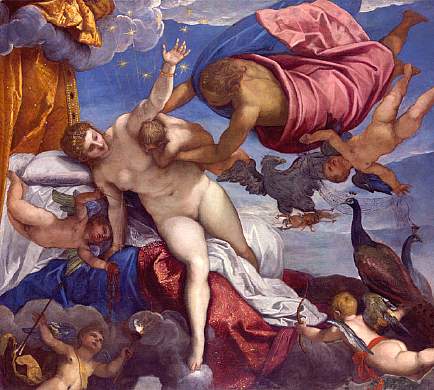
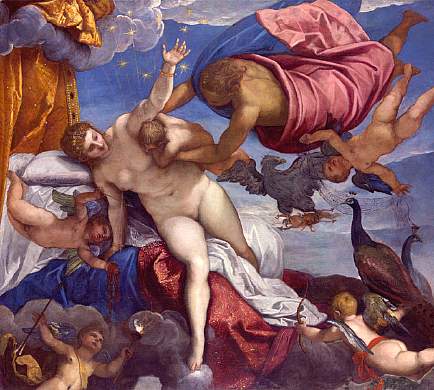
created by the drops of milk, so the Ancient Greeks averred, that sprayed from the breast of the Goddess Hera when she snatched it away from baby Hercules’s mouth, who was suckling her while she slept, put there surreptitiously by Zeus.

milky way tintoretto

We sat entranced. How rarely we see the stars now! The strong lights of our modern life block out all but the brightest stars. Neither my wife nor I know our constellations at all well, but we could make out the three stars in Orion’s Belt

image

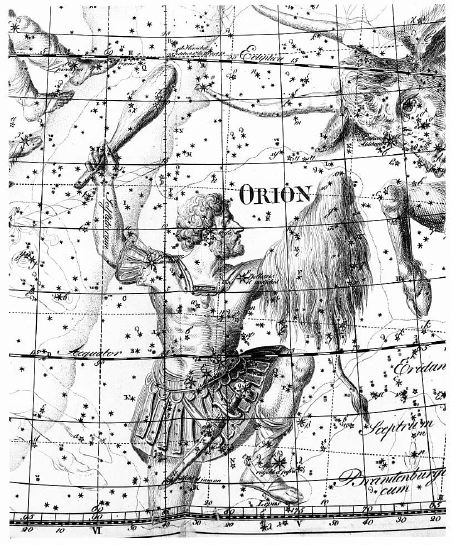
part of a much larger set of stars denoting Orion fighting the heavenly bull in the constellation Taurus

OrionLower on the horizon, we could make out the Great Plough, or Great Wagon (Carro Maggiore) to my Italian wife (and Big Dipper to my American friends).

image

As we pointed and guessed, the Milky Way wheeled this way and that above our heads: the boat was turning strongly now as the river began to meander.

As the river meandered, so did our talk. We talked about the Big Bang, which scientists say occurred some 14 billion years ago. They tell us a fascinating story about what happened afterwards. After a mere microsecond, the first protons and neutrons were being formed. A few minutes later, they began to coalesce into nuclei. Four hundred thousand years later, these combined with electrons to create the first hydrogen atoms. But it was only 150 million years later that the first stars began to form. And it was only 10 billion years later that the process of life creation began on this Earth, eventually leading to my wife and I sitting on the focsle of this boat, gazing at these stars. Scientists tell us that these stars are still rushing away from each other as the Universe continues to expand. What will happen next? Will we see the Big Crunch, where the Universe’s expansion will finally come juddering to a halt and then everything will hurtle back together again? It seems not; current observations suggest that the Universe’s expansion will continue or even accelerate. So will we see the Big Rip, where the Universe expands faster and faster, finally ripping galaxies, stars, and even atoms apart? Or will we see the Big Freeze, where expansion continues more moderately but existing stars burn out, no new ones are created, and the Universe goes dark and very cold? Or something else?

Nearer at home, we talked of our star, the sun. Scientists have a story for its future too. Over the next five billion years or so, they tell us, after it has burned all its hydrogen, our sun will grow into a Red Giant, making the Earth so hot in the process as to become uninhabitable. Then it will suffer a helium flash and collapse inward on itself. After it has stabilized, it will start to consume its helium for several billion years more before starting to expand again. But this time, the expansion will be unstable. At some point, it will shed its outer envelope as a planetary nebula while the core will collapse brutally to become a White Dwarf. It will survive as a White Dwarf for several trillion years before becoming a Black Dwarf. And so, sitting on that little focsle, with our backs against the cabin wall and our eyes on the sky, we followed in the footsteps of our distant ancestors, who for hundreds of thousands of years had gazed up at the stars and weaved beautiful stories to explain them.

Back on Earth, at river level, all was now inky black. No light shone from the shore. From time to time, we would see blinking red lights from fishing boats working the night shift. Once, a strong torch sprang to life ahead of us sweeping the waters, and suddenly a sea-going fishing boat loomed out of the darkness beside us. I dozed on and off, while my wife kept a look-out on the focsle, staring at the stars. At last, a faint glare of light ahead signaled Mrauk U. The wide, wide river had narrowed to a creek, trees were reaching out to us from either bank. The captain throttled the motor and the boat nosed into the jetty, where we could make out the car waiting to take us to our hotel.

_____________

Pagodas: https://www.flickr.com/photos/40867816@N07/4454825335 (in http://flickrhivemind.net/Tags/rakhiang/Interesting)
Old moon in new moon’s arms: http://www.lunarland.com/images/Earthshine.jpg (in http://www.lunarland.com/earthshine-and-the-moon)
http://upload.wikimedia.org/wikipedia/commons/5/51/Night-sky-milky-way-galaxy-astrophotography_-_West_Virginia_-_ForestWander.jpg (in http://feedback.arma3.com/view.php?id=12717)
Tintoretto’s Milky Way: http://www.ianridpath.com/startales/image/milkyway.JPG (in http://www.ianridpath.com/startales/milkyway.htm)
Orion: http://www.scienceinthebible.net/KNOWLEDGE_BIBLE/bigdipper_december.jpg (in http://www.scienceinthebible.net/KNOWLEDGE_BIBLE/NoteChildren2B.htm)
Mythical Orion: http://www.ianridpath.com/startales/image/Orion2.jpg (in http://www.ianridpath.com/startales/orion.htm)
all other photos: ours

MY SPIRIT HOUSE

Bangkok, 15 February, 2015

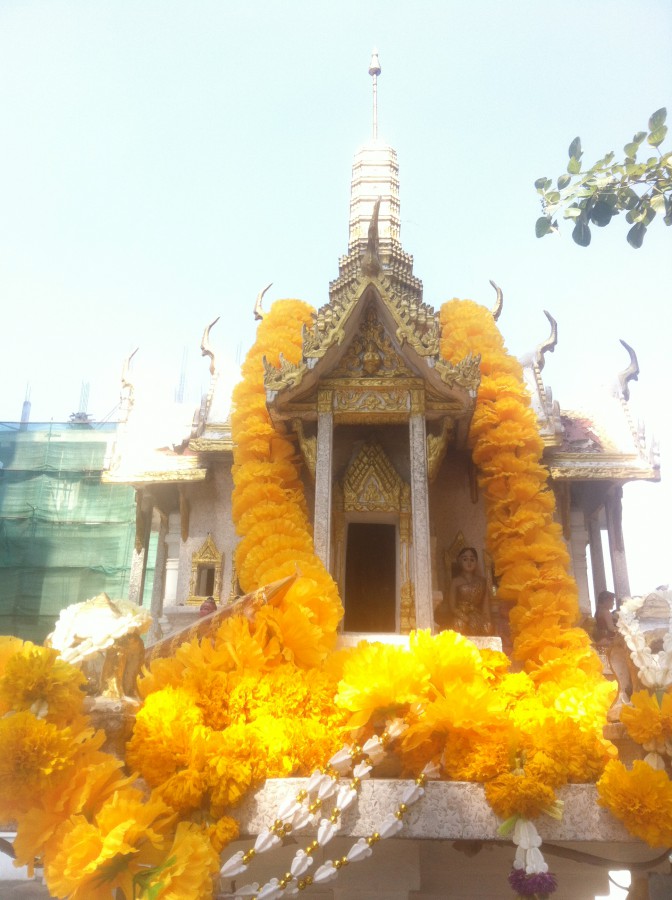
Anyone who has been in Thailand for more than half an hour begins to notice that every building, residential, commercial, governmental, whatever it happens to be, has one or more doll-like houses standing outside it in some corner of the property. To be very visible to one and all, they are set either on a tall pillar or on four somewhat smaller stilts. These, for instance, are the two which grace a corner of the parking lot at our apartment block.
spirit houses-general view-1
spirit house big

spirit house small

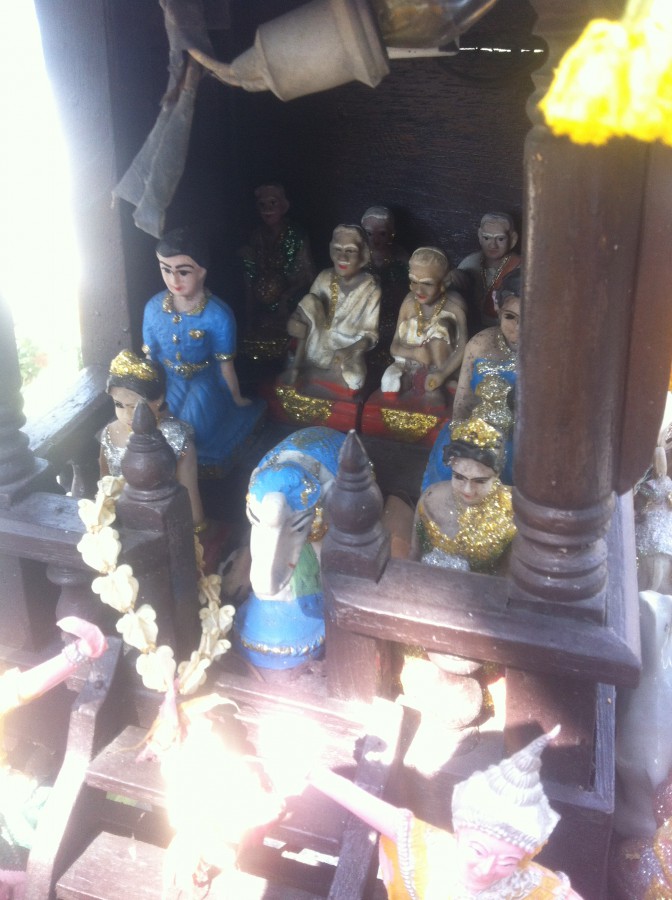
And if, finally rendered curious by constantly coming across them, one decides to have a closer look, you will find that they hold little figurines – old people, dancers, horses, elephants, cars, sometimes a Buddha. This, for instance, is a catalogue of what the bigger of our apartment block’s two little houses contains.

spirit house big-horses
spirit house big-elephants
They will often have votive offerings of food and drink as well as burning incense sticks set out in front of them along with fresh flowers

spirit houses-flowers and incense

many of them will have flower garlands draped over them

spirit house big-garland

and – at night – candles are set out or strings of lights turned on to light them up.

spirit house big-night

Quite charming. In fact, when my wife and I came to Bangkok for the first time some seven years ago, we were quite taken by these little houses and considered buying a DIY kit of one, to put up on the landing in front of the door of our then-apartment in Vienna, to house a small ivory Buddha which I had bought a few years before in Sri Lanka. But it was really too bulky, so we abandoned the idea.

But actually, why are these little houses there in the first place? I should have asked myself that the first time I saw them, before seriously considering putting one in front of my door.

A little bit of reading has informed me these houses are put up to propitiate the spirits of the land. This is a core belief of animism, that spirits reside in all the material manifestations of this world – the land, its streams, rivers, lakes, waterfalls, its trees and other plants, all animals, everything really, even man-made objects like bridges. Animism has deep, deep roots in Thailand – actually, in the whole of South-East Asia, from Myanmar down to Indonesia and across to the Philippines; the tradition of spirit houses, for instance, is found throughout the region apart possibly from the Philippines. The arrival of more rational, complex, sophisticated religions like Hinduism, Buddhism, Islam, or Christianity (or ethical systems like Confucianism in Vietnam), did not make the earlier animistic beliefs disappear, although I’m sure the leaders of these new religions tried hard to stamp them out (and at least in Thailand are still trying to, according to what I’ve read) or to absorb them (which is certainly what Buddhism has tried to do).

The sad thing is that these spirits are not nice beings. The purpose of those cute little houses is actually to make sure that the spirits of the land don’t get mad at you because you’re using their land and decide to burn down your house or give you a heart attack or bring Lord knows what other calamity down on your head. So in the house you’ll put figurines of servants to tend to the local land spirit’s every whim,  you’ll put figurines of dancing girls (geishas might be a better descriptor) to keep him happy, you’ll put horses and elephants (and cars for the more sophisticated urbanized spirits) to make sure he can go for a ride whenever he gets bored of sitting at home and watching the dancing girls gyrate, you’ll give him food and drink to make sure he doesn’t go hungry … Reading all this, it occurs to me that these spirits are really just like the mafia in Sicily: if you don’t pay this man the requested pizzo, or protection money
mafia-man

then unfortunately this will happen to your shop.
burning shop
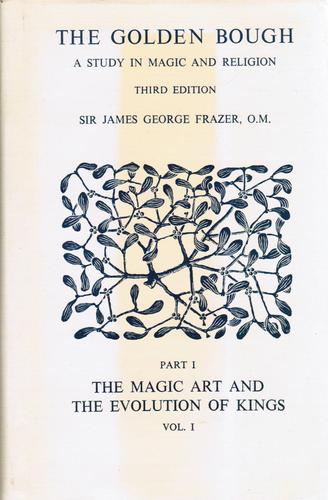
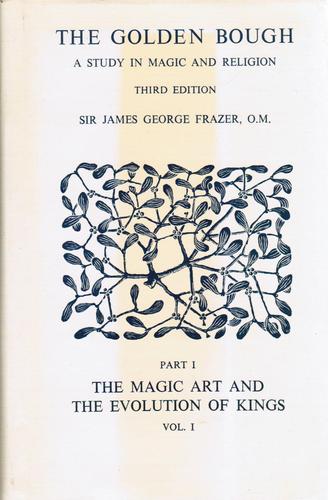
So, these pretty little houses are actually the reflection of a deep existential fear, that all around you are naughty, nasty little spirits who will hurt you if you’re not nice to them. These reflections moved me to dip into “The Golden Bough: A Study in Magic and Religion” by the Scotsman James George Frazer.
Golden_Bough
The book, first published in 1890 and republished several times thereafter, attempts to define the shared elements of religious beliefs, discussing fertility rites, human sacrifice, the “dying god”, the “scapegoat”, and many other symbols and practices. Its thesis is that old religions were fertility cults that revolved around the worship and periodic sacrifice of a sacred king (among other places, his ideas take a central role in T.S. Elliot’s poem, “The Wasteland”, which I have had cause to mention 100 posts ago and which was the reason why I originally read “The Golden Bough”). I’m sure modern anthropologists would dispute Frazer’s basic thesis, but in writing the book Frazer collected accounts from around the world of magical, animistic beliefs, which are fascinating in themselves. Here are three excerpts which he cites from other sources on the belief in spirits in South-East Asia.

“Thus the life of the Thay seems regulated down to its smallest details by custom founded on his belief in the spirits. Spirits perpetually watch him, ready to punish for his negligences, and he is afraid. Fear is for him not only the beginning of wisdom, it is the whole of his wisdom. Love has only a very moderate place in it. Even the respect in which he holds his dead, and the honours which he pays them on various occasions, seem to be dominated by a superstitious fear. It seems that the sacrifices which he offers to them aim rather at averting from himself the evils which he dreads than at honouring worthily the memory of his deceased kinsfolk and at paying them the tribute of his affection and gratitude.”

“Independently of the demons who are in hell, the Siamese recognize another sort of devils diffused in the air: they call them phi; they are, they say, the demons who do harm to men and who appear sometimes in horrible shapes. They put down to these malign spirits all the calamities which happen in this world. If the mother has lost a child, it is the phi who has done the ill turn; if a sick man is given over, it is a phi that is at the bottom of it. To appease him, they invoke him and make him offerings which they hang in desert places.”

“The desire to propitiate the good spirits and exorcise the bad ones is the prevailing influence upon the life of the Laotians. With phis to the right of him, to the left of him, in front of him, behind him, all round him, his mind is haunted with a perpetual desire to make terms with them, and to ensure the assistance of the great Buddha, so that he may preserve both body and soul from the hands of the spirit.”

The first two excerpts, written in 1907 and 1831 respectively, come from books written by French missionaries, the third from a book written by an Englishman in 1884. The first two no doubt had religious axes to grind, wishing to show how the Thai (Siamese being the old name for the Thai) were poor, benighted folk in need of Christian redemption. But even accounting for a certain amount of exaggeration, the picture which these excerpts paint is bleak indeed: a constant, haunting fear at every step.

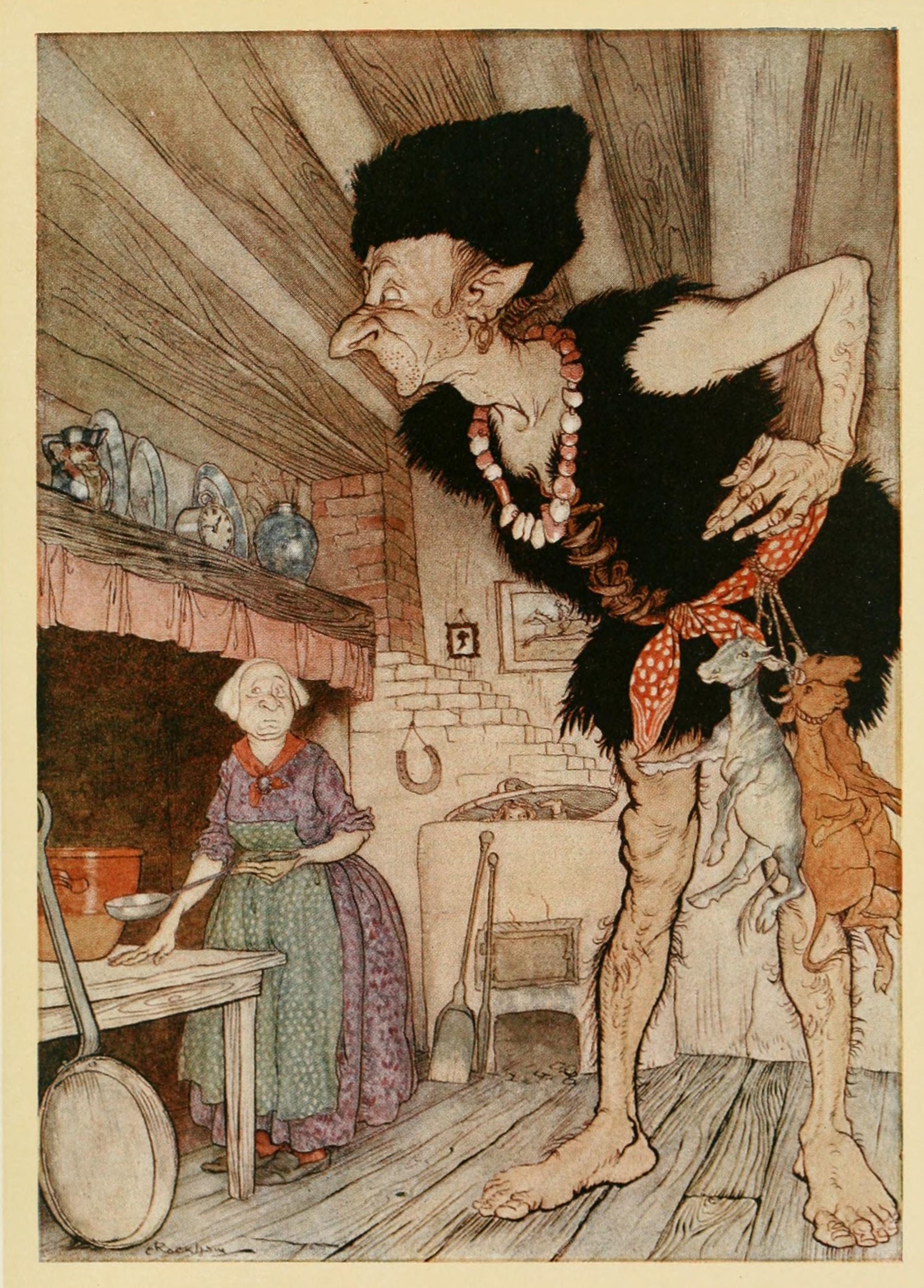
Of course, before we shake our heads and smile and take another sip of our coffee, we should remind ourselves (as Frazer reminds us in his book) that Europe, just to take my part of the world, was also the home of naughty, nasty little spirits. Anyone like me who had to suffer through Latin and Greek in their education will remember the Roman and Greek nymphs who haunted the sacred groves and streams, and who had to be propitiated. And what about all those leprechauns, and trolls, and sprites, and ogres, who populate children’s books and popular stories? Remember Rumplestiltskin, that nasty little imp who saves the miller’s daughter from the wrath of the king by spinning straw into gold for her, but on condition that she give him her first-born child?
rumplestiltskin
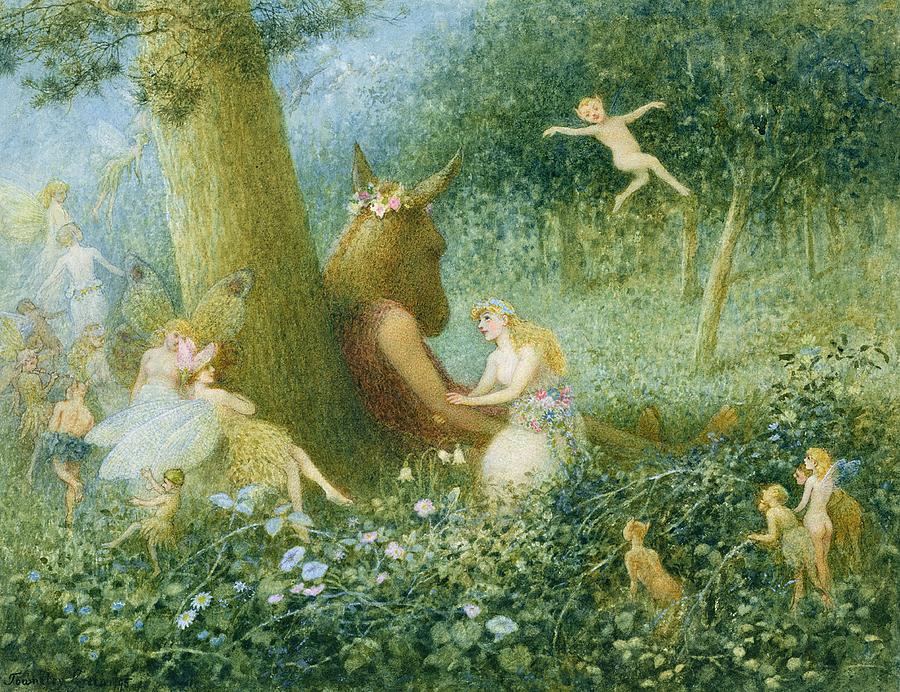
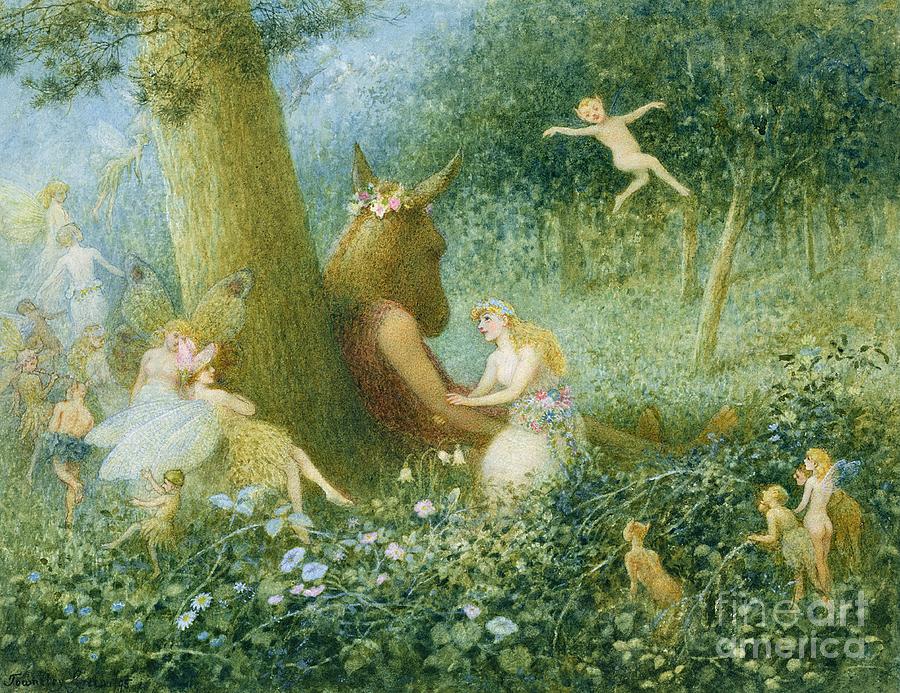
Or that “shrewd and knavish sprite” Puck in Shakespeare’s “A Midsummer Night’s Dream”, who at the behest of his master Oberon, King of the fairies, wreaks mayhem in the Athenian woods?
puck

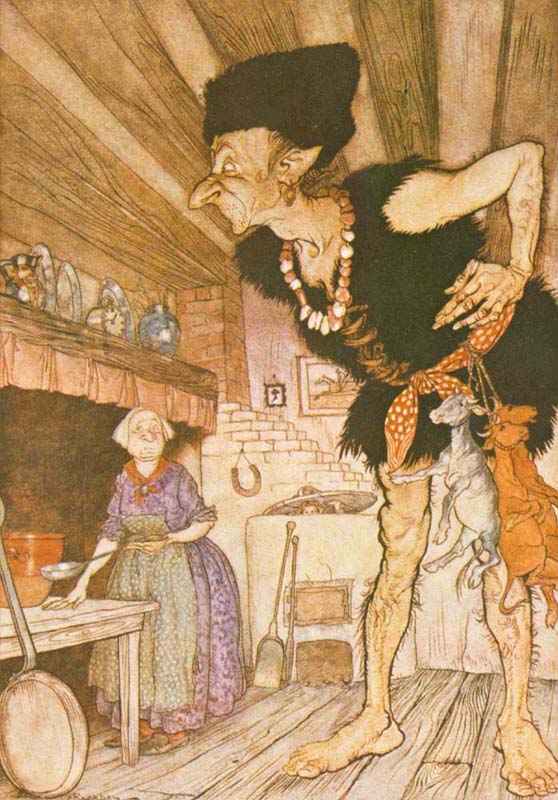
Or the ogre in Jack and the Beanstalk, who on sensing that little Jack is hiding in his house, intones

“Fee-fi-fo-fum!
I smell the blood of an Englishman,
Be he alive, or be he dead,
I’ll grind his bones to make my bread.”
ogre jack and the beanstalk

Even Tinkerbell in Disney’s sucrose version of “Peter Pan” is not a particularly nice person.
tinkerbell
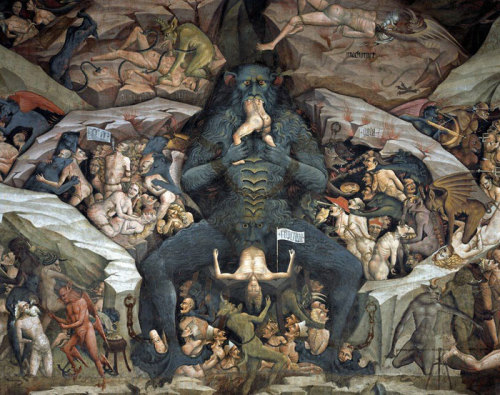
I suppose Christianity managed to reduce the strength of animistic beliefs in Europe – I won’t say stamp out, because otherwise we wouldn’t have the children’s stories – but only to replace them by another existential fear, that of suffering in hell for ever and ever.
hell
Luckily, science has come to the rescue and driven out all the religious claptrap. There is no supernatural world, it tells us, only the natural world around us. And with that, all those spirits disappear in a flash.

But now that I know all this, would I still buy a spirit house kit to assemble on the landing in front of my apartment door in Europe? Do I want to be seen, if only to myself, to believe in naughty, nasty spirits? After giving some thought to the matter, I have concluded that yes, I would, but for a very different reason. One of the houses whose photo I give at the beginning of the post is the house of the ancestral spirits of the place, the spirits – or ghosts I suppose – of the people who lived there before you. In fact this house contains figurines of old people.
spirit house small-old people
Unfortunately, these spirits also require propitiation in Thailand, since they too can turn nasty (jeez louise, what a world view!). But I would use the house differently. I would use it to house the memory of my parents and my wife’s parents. For my parents, I would have a very tall figurine stand in for my father and a very small figurine for my mother, for that indeed is how they were; one of my abiding memories of them is the two dancing together, he very tall, she very small, slowly circling the dance floor. For my wife’s parents, I would have a large figurine stand in for my mother-in-law, for she was indeed of a stout disposition. For my father-in-law, I’m not sure, I hardly knew him. I’ve mentioned before his fondness for wearing a Basque beret, so perhaps a figurine of a man with such a beret would do? But I would leave this for my wife to decide. And I would move the house into the apartment, so that their memory could be with us, rather than left out in the dark like the dog. I feel that this would be a better way of remembering them, of keeping their memory alive, than going on infrequent visits to the graveyard, and a useful complement to looking at old photos and reminiscing. And I would hope that one day my children would also have a spirit house to which they could add little figurines of us once that day arrives. As it surely will.

____________________

Spirit houses: my pictures
Mafia man: https://solo3d.files.wordpress.com/2012/09/mafia-man-by-siamak-roshani-1.jpg (in https://solo3d.wordpress.com/scenes/portraits/mafia-man/)
Burning shop: http://www.newsbiscuit.com/images/845.jpg (in http://www.newsbiscuit.com/2007/09/05/fire-brigade-turned-up-late-to-burning-pizza-shop-as-satirical-statement/)
“The Golden Bough” cover: http://3.bp.blogspot.com/-KNKUm2qVFeo/URmCSeqWMuI/AAAAAAAAMKQ/YNPwXF5oY7s/s1600/The_Golden_Bough.jpg (in http://38is.blogspot.com/2013_02_01_archive.html)
Rumplestitskin: http://www.artsycraftsy.com/goble/wg_rumplestiltskin.jpg (in http://www.artsycraftsy.com/goble/goble_rumplestiltskin.html)
Puck: http://images.fineartamerica.com/images-medium-large/a-midsummer-nights-dream-ht-green.jpg (in http://fineartamerica.com/featured/a-midsummer-nights-dream-ht-green.html)
Ogre in Jack and the Beanstalk: http://upload.wikimedia.org/wikipedia/commons/4/4c/Jack_and_the_Beanstalk_Giant_-_Project_Gutenberg_eText_17034.jpg (in http://en.wikipedia.org/wiki/Jack_and_the_Beanstalk)
Tinkerbell: http://cdn.hellogiggles.com/wp-content/uploads/2015/01/22/Walt-Disney-Screencaps-Peter-Pan-Wendy-Darling-Tinker-Bell-walt-disney-characters-34385876-4326-3237.jpg (in http://hellogiggles.com/real-life-disney-romance/walt-disney-screencaps-peter-pan-wendy-darling-tinker-bell-walt-disney-characters-34385876-4326-3237)
Hell: https://36.media.tumblr.com/20721aba85e8475adb529816d4e40a10/tumblr_n1kmegRkqx1qm5yeno1_500.jpg (in https://www.tumblr.com/search/art%20history%20hell)

SALT AND SWEET

Bangkok, 5 February, 2015

A few weeks ago, I visited a couple of electric arc furnaces which were recycling scrap steel. It was a very interesting visit, the first time I had seen this type of furnace in action.
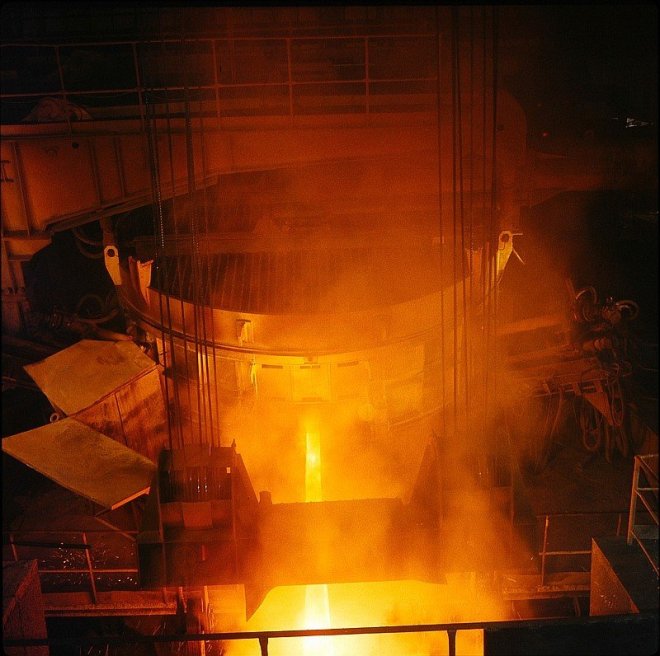
EAF

They are a nice example of a vital step in what the Chinese call a “circular economy”, an economy in which the materials we use do not simply get thrown away after we’ve finished with them, but are collected, recovered, and reused.

But actually, what I want to focus on in this post is the dinner we were served during the visit, or rather on one course of that dinner. I should explain that since these furnaces work on electricity and since electricity is expensive in Thailand during the day, the furnaces are run at night. So the visit of the furnaces started at 8 o’clock in the evening, and the first company we visited kindly offered us dinner to fortify us for the hot and dusty visit which awaited us. Since this was a Chinese-owned company, we were served a Chinese-style dinner which, after my five years spent in China, brought a nostalgic mist to my eye. As is usual in China, the dinner ended with fresh fruit. But this fruit course had an interesting twist. We were served fresh pineapple with a soy sauce dip. Soy sauce! That is not something I had ever thought of combining with pineapple. But actually it was delicious.

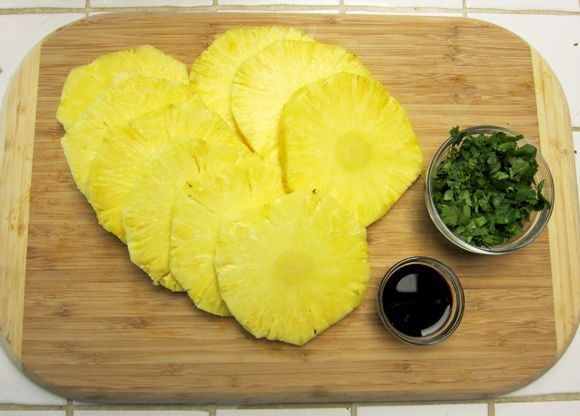
Pineapple and Soy Sauce

This is the only photo I could find on the (English-language) web which in any way resembled what we found before us at dessert time, but even this is for a recipe where the pineapple is fried, which explains the presence in the photo of the coriander (to be used as a final garnish). I take this lack of photos to be an indicator that I may be one of the few in the English-speaking world who has tried this particular combination of sweet and salt. But readers are free to disabuse me of my belief.

In any event, as I let my taste buds deal with this interesting sweet-salt combination, I remembered a conversation we had had around the Christmas lunch table about precisely this issue: the mixing of salt and sweet. Our son had maintained that it was not natural to mix sweet and salt, and more generally that different flavours should be kept separate. Our daughter maintained that there were many dishes where salt and sweet were combined, which suggested that actually it was quite natural to mix sweet and salt. I was torn. As my long-suffering wife knows only too well, I object to mixing things on my plate: the vegetables are to be kept neatly separated from the meat and from each other, the dressing from the salad should not be allowed to leak over to the meat, etc. So on these grounds, I also feel that sweet and salt should not mix. Yet I have to acknowledge that there are dishes where the sweet and salt combination is exceedingly pleasing. After the pineapple and soy sauce dip experience, I resolved to do some research (a.k.a. web browsing) on the topic.

I’ve now done the research and am ready to report back, although I must confess to not having much to report. All agree that “common sense” suggests that salt and sweet do not mix, yet all agree that actually many of us do like to mix the two. Why is this? As far as I can make out, no-one has really figured it out. One possible answer is biochemical. The sodium ions of salt somehow enhance all taste buds: “there’s evidence that applying a sodium-channel blocker (TTX) can dramatically inhibit the activity of all taste receptors, suggesting that sodium plays a key role in the cellular detection of every taste (and not just the taste of salty things) … This would explain why food without any salt is so hopelessly boring: it might be literally harder for our various taste receptors to get excited.” So mixing salt with sweet enhances sweet because of a biochemical pathway we are born with. Just to make the whole discussion sound even more scientific, I throw in here a close-up of a taste bud on a tongue, which is what sodium ions seem to be enhancing.

tongue-taste-bud

But why would we have evolved to have that biochemical pathway? One possible answer is that because we humans are omnivores, we’re wired to desire many different foods and tastes. It’s bad for us to eat just one thing, so our sense of taste has evolved to give us greater gratification if we mix tastes. My wife will be very pleased to hear that there is a scientific underpinning to her insistence on mixing foods and tastes.

Let me celebrate this new understanding on my part of my biological processes by sharing with readers some of the wonderful sweet-salt dishes which I have stumbled across in my life. Where to start? Well, at the beginning, I guess, with the first such dish I ever remember trying, lamb with mint sauce. My English grandmother had taken me to visit an uncle and aunt and assorted cousins, and my aunt served us lamb with mint sauce for lunch.

lamb and mint

She served it with two veg, as is de rigeur for any English meat dish. In this case, I remember distinctly that the veg in question were that most English of combinations, peas and potatoes (she also made a magnificent apple crumble, by the way; no apple crumble I have ever eaten since has tasted so good).

Mint sauce is really easy to make, by the way, about as easy as lamb chops. I give an executive-summary recipe at the end of the post for those readers who are interested. What I think is important to point out here is that the recipe calls for a mix of sugar and vinegar. In my humble opinion the best combination is actually sweet, salt, and acid or tartness. To my mind, that’s what made the pineapple and soy sauce so good, the fact that the pineapple is also tart. Dragon fruit, a much milder fruit, was being served along with the pineapple. When I asked if that too should be dipped in the soy sauce, our hosts pursed their lips and gave it as their considered opinion that it wouldn’t work.

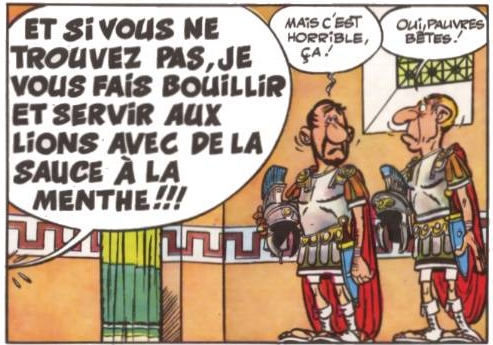
Lamb with mint sauce is incredibly English (and I mean English. I don’t think the Scots or the Welsh eat it). It is so English that the French made fun of Les Anglais because of it – the French consider the use of mint sauce to be beyond the cooking pale. Our friends Goscinny and Uderzo, who wrote the Asterix and Obelix stories, had mint sauce play a major role in our heroes’ adventures in Britain, with the governor of province at one point shouting that if his men did not find the pair (who had just disappeared from prison) he would have his commanders boiled and served with mint sauce to the lions. To which the commanders commented how horrible that would be – for the lions.
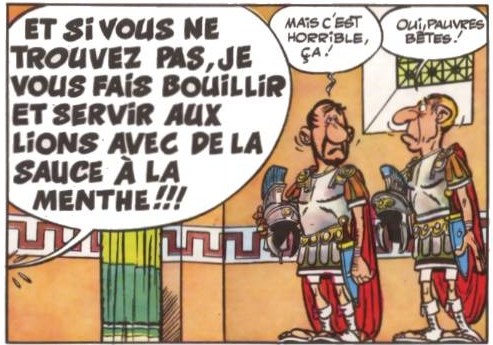
asterix sauce a la menthe

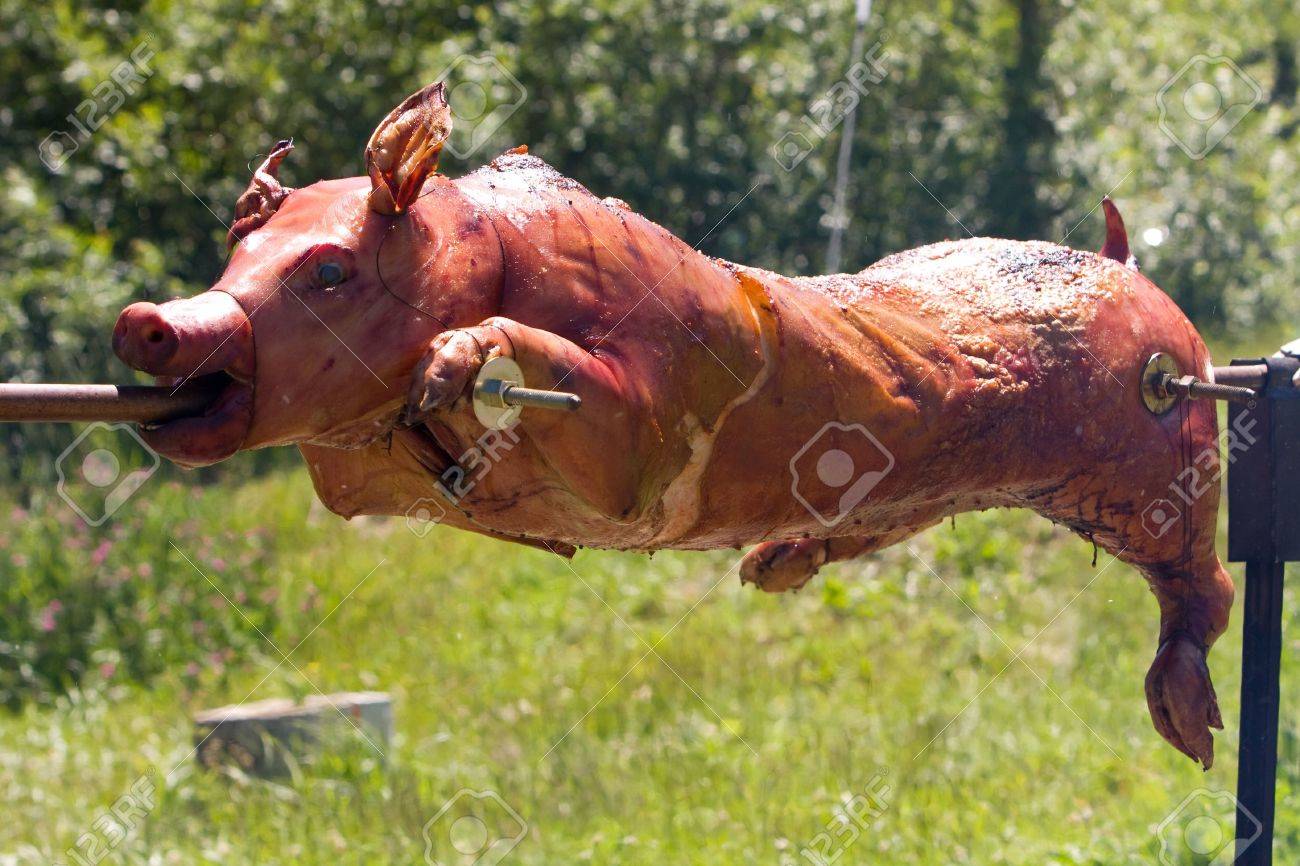
The French loved it, lapping up the fun being poked at English cuisine. But I will ignore the smirking French and concentrate on another great example of English cuisine which is also a sweet-salt dish, roast pork and apple sauce. I first had this delicious dish as a boy scout. It was summer, the end of the school year, that time in the calendar when England can often be bathed in golden light rather than be grey and sodden.  For our last outing of the year, the scout master had the brilliant idea of buying a whole pig and roasting it on a spit in the woods. I have this crystal clear memory of sitting around the spit, listening to the fat crackle, breathing in the smell of cooking meat, watching the scout master sharpen the large carving knife, while the sunlight dappled the ground all around us. It’s the closest I have ever felt to being a Cro-Magnon man.
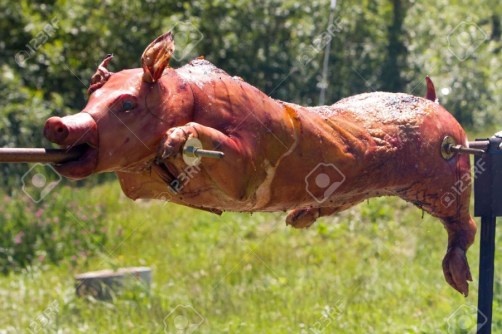
roasted pig

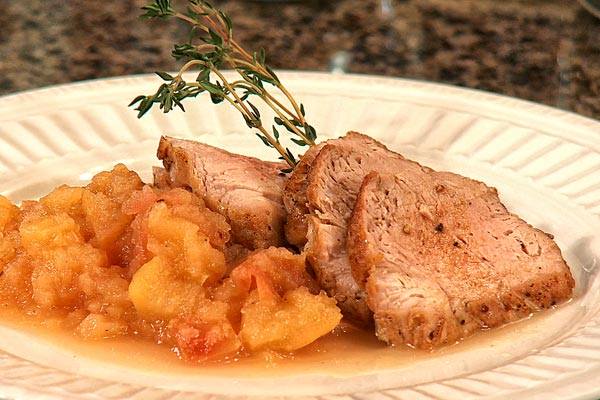
And then there was the discovery of the exquisite taste of roast pork and apple sauce, a large dollop of which was dumped onto our metal field plates along with a big slab of pork meat and crackling.

roast pork and apple sauce

Those readers interested in knowing how to make this sauce should scroll down to the end of the post. I just want to note that cooking apples should be used. They are tarter than eating apples. It’s the tartness thing again. One can also add lemon zest, presumably to add yet more tartness.

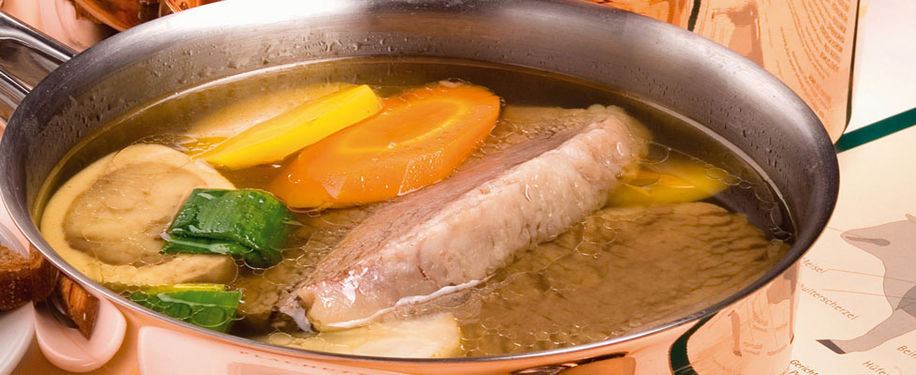
Of course, the English do not have a monopoly in Europe on sweet-salt dishes. Allow me to introduce here a dish I discovered and came to love when we moved to Vienna: Tafelspitz. There is a venerable ritual to cooking Tafelspitz, but when you reduce it to its essentials it is beef meat (topside or top round) boiled slowly over many hours with a medley of root vegetables – carrot, celeriac, parsnip and the like – and a piece of marrow bone. It is normally served like this:

tafelspitz

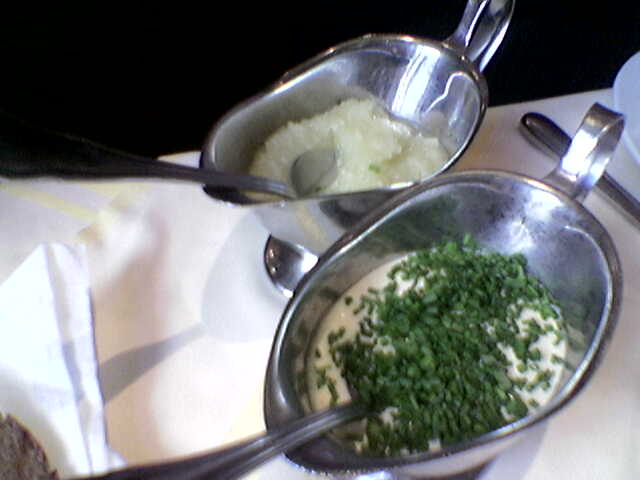
You can start with a cup of the broth which is engendered by the boiling of the meat, just to whet your appetite. You can then turn your attention to the meat proper, which you will eat with the vegetables, possibly some fried grated potatoes, and – to spice up what is otherwise a rather bland dish – two types of sauce, a cream-based chive sauce and apple-horseradish sauce.

tafelspitz sauces

My earnest suggestion is that you ignore the chive sauce in the front of the photo and go with the apple-horseradish sauce behind it. It is just a variant of the apple sauce I described earlier; you simply add grated horseradish. If you make this sauce at home, my further suggestion is to be generous with the amount of horseradish you add. The best Tafelspitz I ever had was served with an apple-horseradish sauce that made my eyes water slightly. I don’t want to sound like a broken record, endlessly repeating myself, but tartness really helps appreciation of the sweet-salt taste.

Both the French and the Italians have a similar dish of boiled meat, pot-au-feu in the first case and bollito misto in the second. My French grandmother made an excellent pot-au-feu and I am very fond of it, but since it is normally eaten with mustard I will drop it from this discussion. We shall focus instead on bollito misto, a dish which is very popular in northern Italy and (as the name suggests) consists of a variety of boiled meats: cuts of beef and veal, cotechino (a pork-based sausage), and sections of hen or capon.

bollito misto

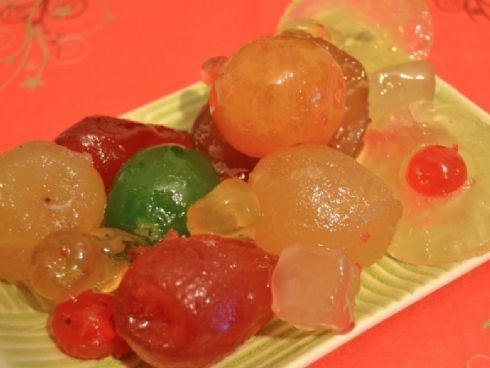
My wife reminisces from time to time that her father was very fond of bollito misto, eating it like most northern Italians do with a sauce called mostardaactually, mostarda di Cremona. In a country known for the fierce independence of its cities, it will come as no surprise to the readers that probably every city in northern Italy has its own variety of mostarda. Despite its name, the sauce has only a little to do with mustard. It is really a mix of candied fruit which is given a kick by the addition of mustard powder (that tartness thing again…). Those slices of fruit in the photo above are the mostarda, but I give here a more direct picture.

mostarda di cremona

My wife confesses to never having liked mostarda; she can’t even stand the smell. Personally, I have never tried it, but a number of sites do support my wife’s assertion, mentioning that the taste of mostarda is an “acquired taste”. This is normally code for saying that something tastes revolting the first several/many times you try it. In any event, if my wife says it’s not nice, then that’s good enough for me! No spoonful of it shall ever pass my lips. For those readers who will ignore these warnings and wish to try it, though, I give a brief recipe at the end of the post.

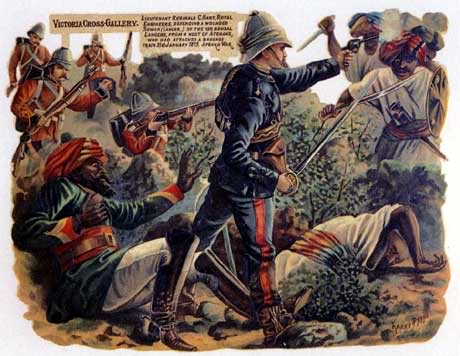
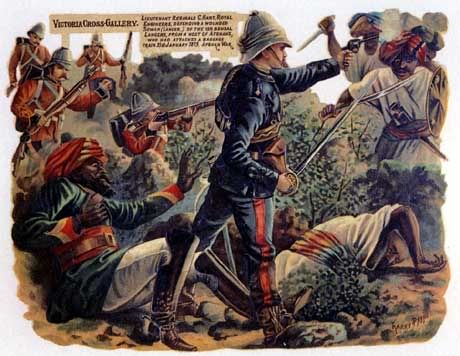
I feel that I cannot move away from mostarda without mentioning the somewhat similar chutney sauce one finds in the UK, or at least one found when I was a boy. Although “chutney” as a word has Indian roots, what I ate as a boy was several removes from things Indian. The most popular brand back then was a mango chutney which went by the name of Major Grey’s Chutney and was sold by Crosse & Blackwell. The story went that a certain Major Grey, a British officer in India, had surveyed the local Indian chutneys and then invented his own, more British, chutney, which he proceeded to bring back to the motherland when he retired, to remind him of the Good Old Days. When I was a boy I rather imagined this Major Grey to look like this

British soldier India-1

fighting heroically against savage natives on the Northwest frontier and getting a VC for his –quite literal – pains. But alas! this appears to be pure legend. It seems that something similar to mostarda, some sort of fruit conserve, existed already in the UK and the Brits in India took the idea with them and adapted it to local ingredients. So what this chutney will usually have as ingredients is mangoes, raisins, vinegar, onions, sugar, and spices. Crosse & Blackwell also include lime juice and tamarind juice. As you can imagine from the ingredients, this chutney is both sweet and tart. Again, for heroic readers who want to make this sauce from scratch, scroll to the end of the post.

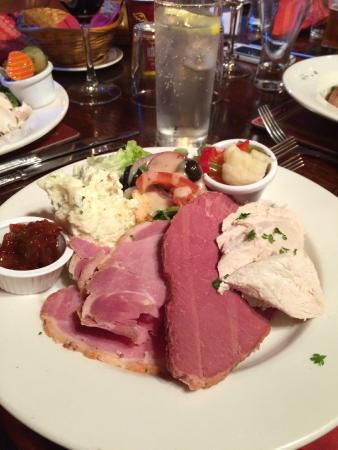
I haven’t eaten this kind of chutney in many decades, but when I was young my favourite way of eating it was with slices of cold meat (the chutney is in the round bowl to the left of the photo below).
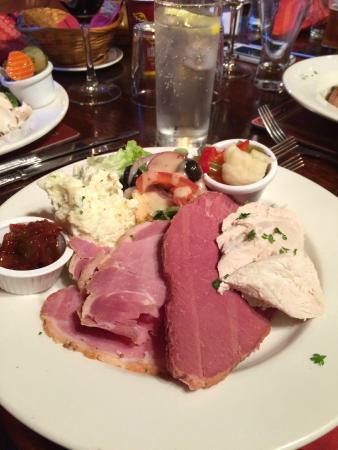
cold meat and chutney

This was an especially popular dish in pubs, where this photo was taken. Sitting here in Thailand, I feel a sudden nostalgia for the English country pubs whose bars I propped up in my youth, so I am moved to throw in a photo of a nice country pub.
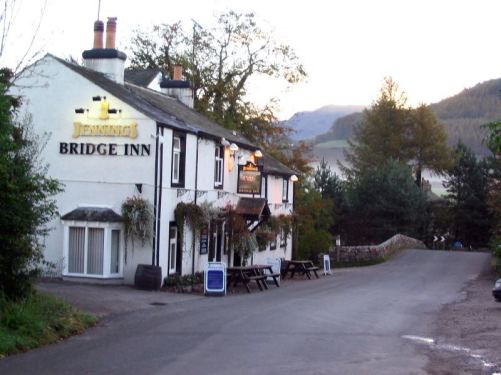
Bridge Inn

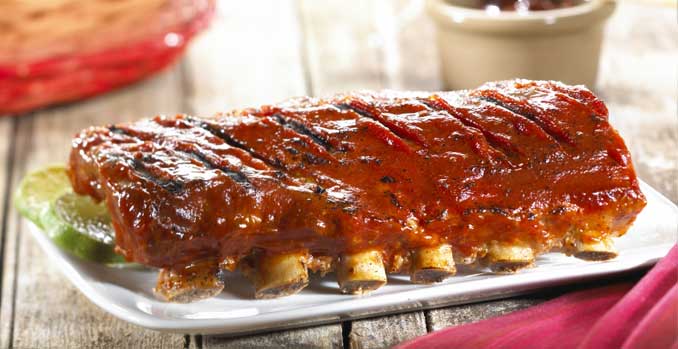
Like Superman, I now vault over to the US and alight somewhere in the open ranges of the Midwest, for no better reason than having this feeling that my next salt-sweet sauce – barbecue sauce – was invented around there somewhere. That being said, my wife and I didn’t try it there. We were just discussing this point and we reckon that it was somewhere between Boston and Washington in the early 1980s. Wherever it was, we stared open-mouthed at these large racks of ribs smothered in this dark reddish brown sauce.

ribs and barbecue sauce

But very soon we were closing our mouths over those ribs. Ah, that sauce! … But I should say: those sauces. In this little research I’ve done I have discovered that there are dozens of different barbecue sauces. I thought the Italian quarrels about where the best mostarda is made were fierce, but boy! the arguments about what place in the US makes the best barbecue sauce are right up there. I’m going to keep my head low without backing any particular sauce. I’m merely going to say that wherever the sauces are made they all seem to have sugar (preferably brown), tomato ketchup, vinegar, and some salt, to which various spices are added in varying levels and in different combinations (Worcestershire sauce, pepper, paprika, mustard, chili, cayenne, and on and on). That combination of sweet and tart again, to challenge the salt of the meat. Readers can look at the end of a post for condensed recipe of an excellent sauce from Kansas City (but don’t tell anyone I said it).

Deary me, I seem to have gone on for quite a while here, and I’m sure I haven’t covered one-hundredth of the sweet-salt dishes enjoyed around the world. On top of it, I’ve only mentioned meat dishes; it makes me sound a total carnivore, red in tooth and claw. But there was that fish dish in Shanghai … and there are all those sweet salad sauces to pour on vegetables … But I have to stop. I’ll just add two final combinations of salt and sweet which show that meat (or fish) is not the only food the delight of which is heightened by the salt-sweet experience: one which probably every person on the planet has enjoyed by now, what with the prevalence of fast food joints, french fries and ketchup

french fries and ketchup

and one which I’ve mentioned in an earlier post, chocolate and French baguette

chocolate and baguette

Mmm, so good!

So give your taste buds a whirl and douse them with sugar and salt – and a dash of vinegar, or horseradish, or something tart. Enjoy!

-o0o-

Mint sauce: Strip the leaves off a bunch of mint, sprinkle them with a pinch of salt, and chop finely. Place the result in a bowl, add 1 level tablespoon of caster sugar and pour over the mix 4 tablespoons of boiling water. Stir and leave to cool. Stir in 4 tablespoons of vinegar. Add more water or vinegar to suit your taste.

Apple sauce: Take a number of cooking apples, peel them, core them, and chop them up. Put the apples in a saucepan and add water. Once can also add lemon zest. Cover and cook over a low heat until the apples have gone soft and mushy. At which point take off the heat and beat in a knob of butter and a teaspoon of sugar. Cool.

Mostarda di Cremona: Begin by washing the various fruit: pears, quinces, cherries, apricots, figs, and peaches (although I’m sure you can vary the fruit as you wish). Cut the apricots and peaches into halves or quarters (depending on their size) and remove their stones, peel. Core and quarter the pears and quinces. Dry all the fruit after preparation. Add the sugar – a lot of sugar! half a kilo for every kilo of fruit, more if you want your mostarda sweet (but for reasons suggested above, I would go easy on the sweetness and maybe go heavier on the mustard powder). Pour some squeezed orange juice over it. Let the whole rest for 24 hours, gently turning the pieces a couple of times. By the end of this time the sugar will have dissolved. Drain the fruit well – without losing the syrup! Bring the syrup slowly to a boil, and let it boil gently until its volume is reduced by half. Pour the remaining syrup back over the fruit. The sugar in the now-concentrated syrup will extract more moisture from the fruit, which will begin to shrink and firm up. Concentrate the syrup again and steep the fruit in it overnight again. Dissolve several tablespoons of mustard powder in some white wine vinegar. Bring the mixture gently to a boil and let it bubble for a few minutes. In the meantime, drain the fruit again, and concentrate the syrup again. Put the candied fruit into jars, add the mustard powder infusion, and then add the hot syrup. The amount of infusion you add will determine of course how much of a kick your mostarda will have. Cover the jars and put them on a cool dark shelf. The mostarda will be ready to eat in two weeks’ time.

Major Grey’s chutney: (this is one of many recipes for this kind of chutney) Combine 4 cups of 5-6 medium-sized chopped mangoes, 1 cup of brown sugar, half a cup of molasses, 1 cup of vinegar, 1 cup of coarsely chopped onions, three-quarters of a cup of golden raisins, half a cup of seeded and chopped limes, half a cup of peeled, seeded and chopped orange, a quarter of a cup of peeled, seeded and chopped lemon, and finally a bunch of spices: half a cup of grated ginger root , 3 cloves of minced garlic, 1 tablespoon of mustard seed, 1 tablespoon of dried red pepper flakes. Cook for about 30 minutes, stirring often. Add 2 tablespoons finely chopped fresh cilantro, 1 teaspoon of ground cinnamon, a quarter of a teaspoon of ground cloves, a quarter of a teaspoon of ground allspice. Cook for another 10 minutes or so, until chutney starts to thicken. Ladle chutney into a jar and close it air-tight.

Barbecue sauce: (from Kansas City) In a saucepan over medium heat, stir together ½ cup of ketchup, 2 tablespoons of brown sugar, 1 tablespoon of cider vinegar, 2 tablespoons of Worcestershire sauce, ¼ teaspoon of salt, ¼ teaspoon of mustard powder, 1 teaspoon of garlic powder, and a dash of hot pepper sauce. Bring to a simmer, then remove from heat and allow to cool.

_________________

Electric arc furnace: http://ih.constantcontact.com/fs163/1101151826392/img/505.jpg (in http://ricorant.blogspot.com/2014/11/fwd-dominance-of-steel-111114.html)
Pineapple and soy sauce: http://static.squarespace.com/static/51107688e4b0e3b888c1183b/t/519f0a2ee4b0bb6d74d9bdcf/1369377327493/Grilled+Soy-Sauce+Pineapple (in http://larkspurcompany.com/blog/2013/5/20/grilled-soy-sauce-pineapple)
Taste bud closeup: http://cdn1-www.webecoist.momtastic.com/assets/uploads/2010/01/tongue-taste-bud1.jpg (in http://webecoist.momtastic.com/2010/01/11/biological-photography-magnificent-microscopic-ultraminiature-photos/)
Lamb and mint sauce: http://www.thetimes.co.uk/tto/multimedia/archive/00050/table_townsend_74217_50069c.jpg (in http://www.thetimes.co.uk/tto/life/food/recipes/article2701689.ece)
Asterix sauce a la menthe: http://www.prise2tete.fr/upload/NickoGecko-Saucementhe.jpg (in
Roasted pig: http://previews.123rf.com/images/azlightning/azlightning0908/azlightning090800003/5315340-whole-golden-roasted-pig-on-a-spit-spit-roasting-is-a-traditional-hawaiian-luau-method-of-cooking-a-.jpg (in http://www.123rf.com/photo_5315340_whole-golden-roasted-pig-on-a-spit-spit-roasting-is-a-traditional-hawaiian-luau-method-of-cooking-a-.html)
Roast pork and apple sauce: http://www.growingagreenerworld.com/wp-content/uploads/2010/10/123-dishAppleSauce_Pork.jpg (in http://www.growingagreenerworld.com/pork-tenderloin-spiced-applesauce-recipe/)
Tafelspitz: http://www.plachutta.at/typo3temp/pics/1115b4ecd0.jpg (in http://www.plachutta.at/en/about/)
Tafelspitz sauces: http://thepassionatecook.typepad.com/sauces.jpg (in http://thepassionatecook.typepad.com/thepassionatecook/traditional_austrian_food/page/2/)
Bollito misto: http://www.buonissimo.org/archive/borg/XRqDUZ2JX8O3MtcV7PuMgNvG9IvTytvNm6Rhlcw8yOzcxGV4vWA1kg%253D%253D (in http://www.buonissimo.org/lericette/5685_Bollito_misto)
Mostarda di Cremona: http://www.cremonacitta.it/intranet/immagini/_resized/1/scheda/58/w/490x/Prodotti_De_Co_di_Cremona_la_Mostarda_cremonese-img58-01-1.jpg (in http://www.cremonacitta.it/it/gusto_e_sapori_a_cremona/prodotti_de_co_a_cremona_mostarda_tradizionale_sc_58.htm)
Cold meat and chutney: http://media-cdn.tripadvisor.com/media/photo-s/07/0d/d8/5a/blairs-inn.jpg (in http://www.tripadvisor.ie/LocationPhotoDirectLink-g186599-d2014376-i118347866-Blairs_Inn-Blarney_County_Cork.html)
Bridge Inn: http://www.hallflatfarm.co.uk/IMAGES/The%20local%20-%20the%20Bridge%20Inn.jpg (in http://www.hallflatfarm.co.uk/location.html)
British officer in India: http://i80.photobucket.com/albums/j199/matteaston/Afghan1.jpg (in http://www.fioredeiliberi.org/victorian/)
Ribs and sauce: http://www.cooldeals.es/Images/deal-images/eef5c31f-f992-46a5-8993-db0198715a35/20140818133044604.jpg (in http://www.cooldeals.es/Deals/Marbella-Estepona/9fd8ffad-612a-42de-8755-55153751c9e6)
French fries and ketchup: http://scms.machteamsoft.ro/uploads/photos/652×450/652x450_7b63084e7d5012a126811947191414.jpeg (in http://stiri.acasa.ro/social-125/afla-ce-alimente-ascund-sute-de-kilocalorii-110745.html)
Baguette with chocolate: http://a142.idata.over-blog.com/600×449/2/90/63/97/Autrefois-./Chocolat/Le-Bon-Chocolat–13-.JPG

PRICKLY PEAR AND THE COLUMBIAN EXCHANGE

Bangkok, 23 January, 2015

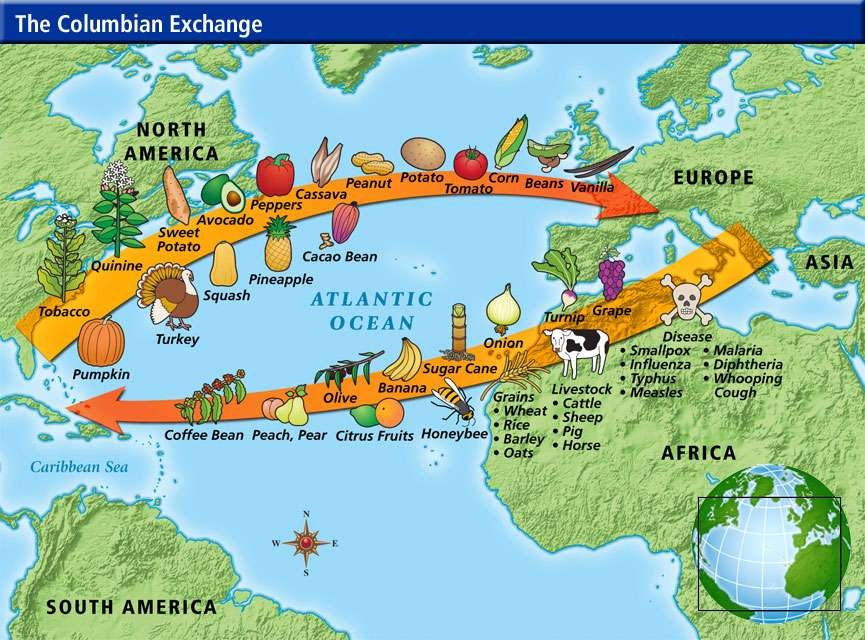
One of the most far-reaching effects of Christopher Columbus’s discovery of the Americas was the so-called Columbian Exchange, the exchange of plants and animals (and bacteria and viruses) between the Americas and the rest of the world. This map shows some of the major crops and livestock which made the journey in either direction between the Americas and Europe.
image
We see, for instance, that the tomato crossed to Europe from the Americas, along with the turkey and corn (and possibly syphilis), while the cow, the horse, and the onion, went the other way, along with smallpox, measles, typhus, and a whole series of other diseases (the diseases nearly wiping out the Amerindian populations).

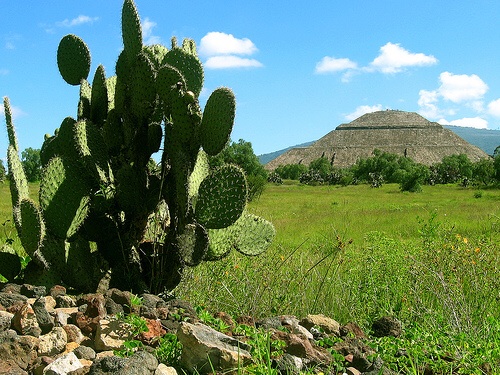
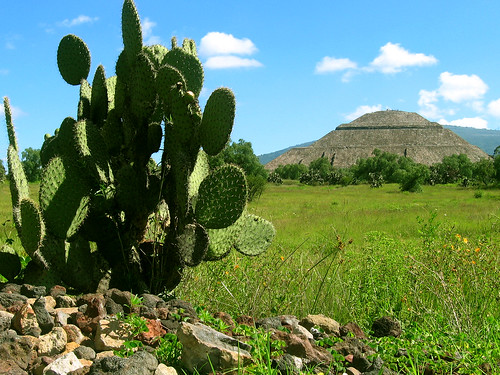
But I want to focus on a plant which normally doesn’t get mentioned in discussions of the Columbian Exchange: the prickly pear, a plant whose history is very much centered on Mexico. Here, we have an exemplar standing guard, as it were, at the site of Teotihuacan.
image
In fact, the prickly pear is so centered on Mexico that it graces the Mexican flag as part of the latter’s central emblem (for those with “mature” eyesight like mine, it’s what the eagle is grasping with its talons at the same time as it grasps that snake in its beak).
image
Maybe the prickly pear’s low profile in Columbian Exchange discussions is because it’s such a nasty, spiny plant, which really doesn’t endear itself to anyone.
image
Or maybe because it’s not much of a commercial crop; the Food and Agricultural Organization, which collects global statistics on some 160 crops, collects no statistics on the prickly pear, for instance.

Whatever the reason, I wish to right this injustice and pay tribute to the prickly pear and its role in the great Columbian Exchange. It may perhaps have played a modest economic role, but it helped to fill many an empty stomach, and it sure as hell has played an important ecological role, sometimes wreaking havoc in the ecosystems into which it was thoughtlessly thrust.

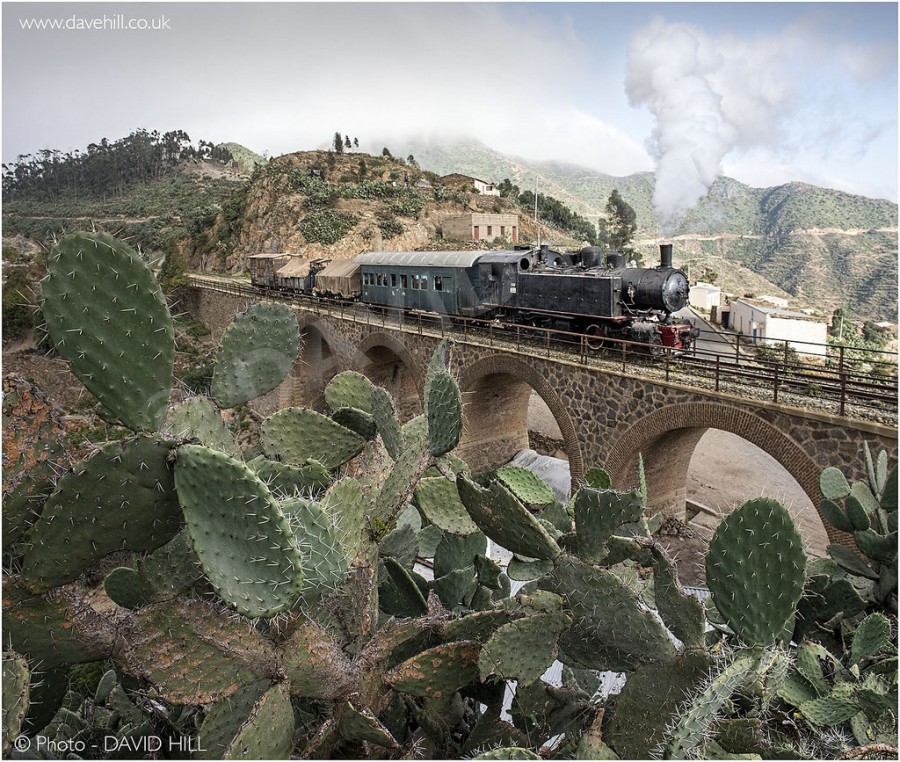
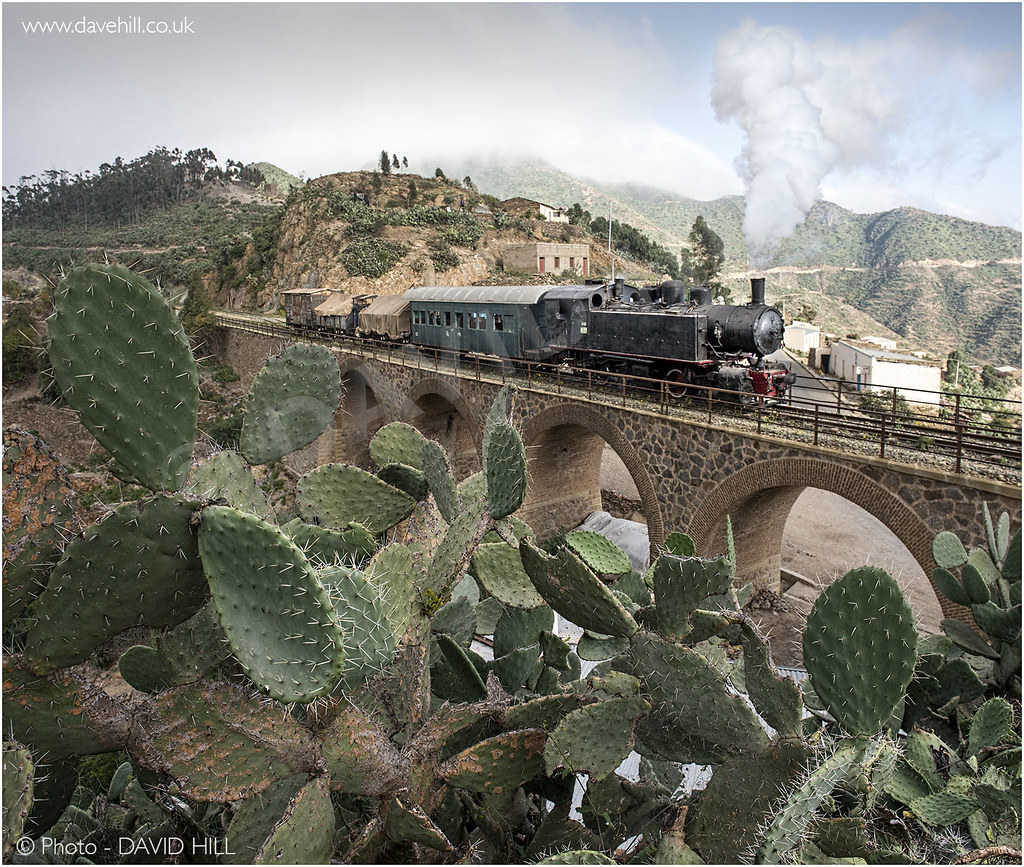
I first met our prickly friend in the country of my birth, Eritrea. Here, you see a specimen in front of the delightful little train which runs from Asmara down to the seaport of Masawa on the Red Sea.
image
I have a vivid memory of taking that train to go down to the coast for a holiday on the beach.

It was the Italians who, as colonial masters
image
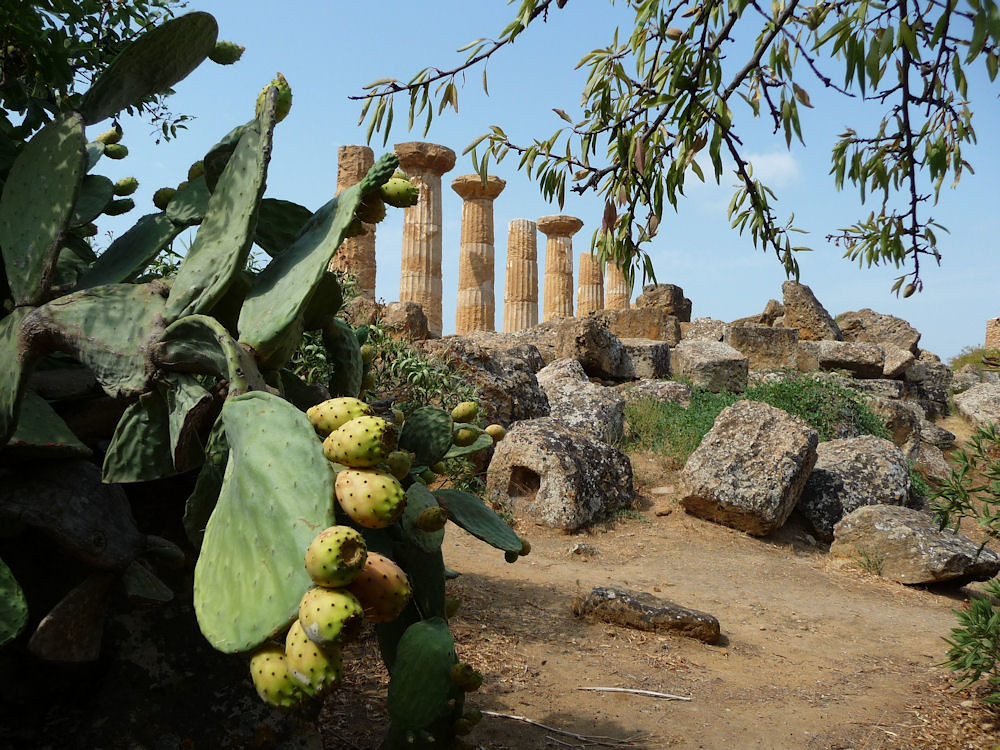
introduced the prickly pear (please note the plant waving at us from behind the colonial troops and their Italian officer). The Italian colonialists brought it from the mother country, of course, where it grows in profusion in the more arid southern regions of the country. We have here an example gracing the ruins of Agrigento in Sicily.
image
But southern Italy was just a later stop on the prickly pear’s journey out of Mexico. It must surely have reached Italy from Spain, which was the first port of call for many of the biological journeys out of the Americas. Here we have a Spanish prickly pear, nudging its way into a photo of Sagunto castle in the province of Valencia.
image
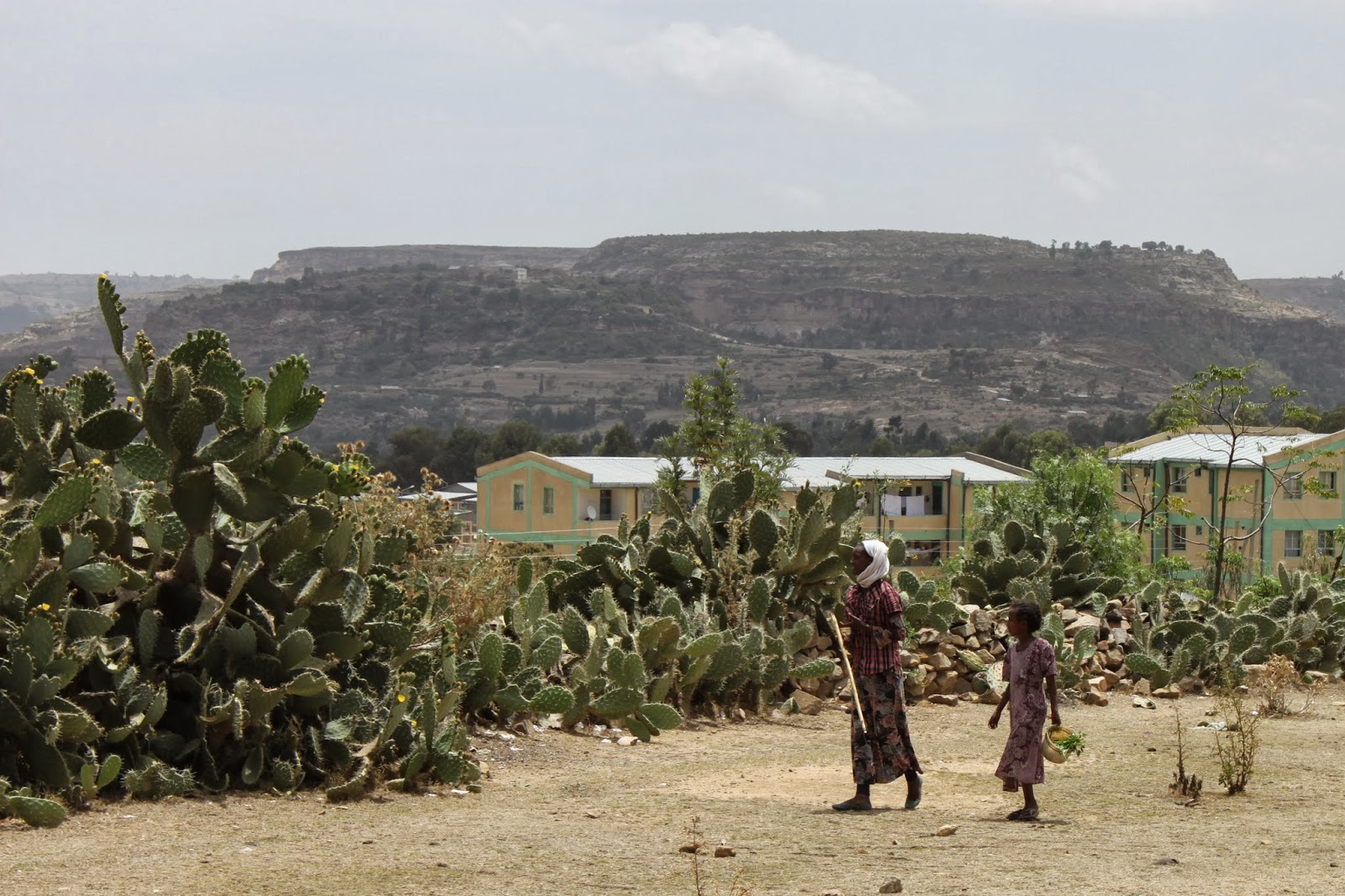
In truth, I have chosen pictures which show off the prickly pear to advantage, but normally the plant is much more unprepossessing. This photo of a ragged, messy patch of prickly pear in a village of Ethiopia is much more typical of how the plant presents itself
image
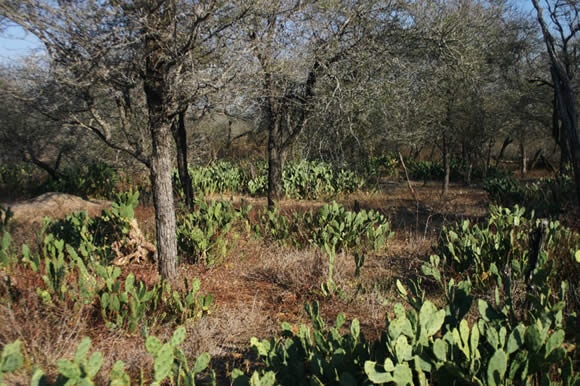
especially when its population levels begin to explode out of control in some foreign ecosystem which has no natural biological defenses against it. The Global Invasive Species Database lists several countries where the prickly pear is now considered an invasive species. Eritrea is one of them, along with the neighboring countries of Ethiopia and Somalia – the Italians, who colonized all three countries had little idea of the damage they were wreaking. But South Africa also considers it an invasive species (here is a picture of prickly pear invading the Kruger national park).
image
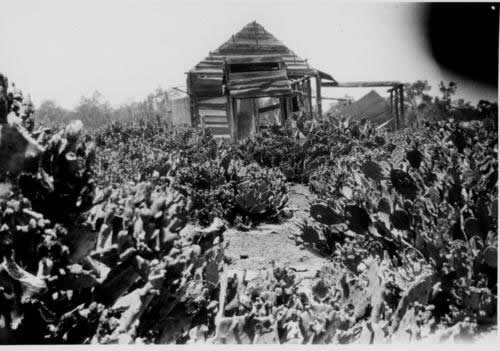
And Australia had a catastrophic invasion. The prickly pear was initially introduced as an ornamental plant for gardens. Then some bright spark thought of using the plant as natural fencing (sensibly enough, cattle and other animals desist from pushing through breaks of prickly pear because of the nasty spines, and they don’t eat them for the same reason) and to start a cochineal dye industry (the little beasties from which the dye is extracted munch the prickly pear’s pads). But the prickly pear went crazy. It eventually converted some 260,000 square kilometers of farmland (which for those readers, who like me don’t think in square kilometers, is more or less equivalent to a square 500 km by 500 km) into an impenetrable green jungle. Farmers were driven off their land by this “green hell” and their abandoned homes were crushed under the cactus growth.
image
The authorities finally managed to get the plague under control in the 1920s by introducing a South American moth, the Cactoblastis cactorum, whose larvae feast on prickly pear. This led to a crash in prickly pear populations, and while the plant has not been eradicated from Australia it has been brought under control (the Australians were lucky, by the way; there is always a risk in this kind of biological control that the agent will find another native plant much more to its liking and wipe that out instead, or once it’s dealt with the original pest will turn its hungry eye on to something else and become an invasive species in its own right).

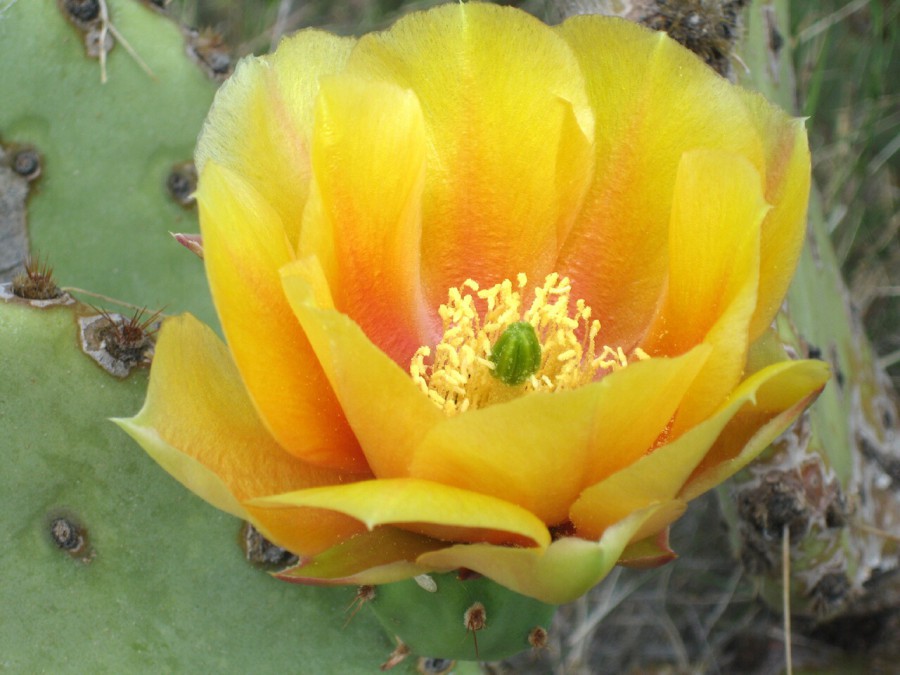
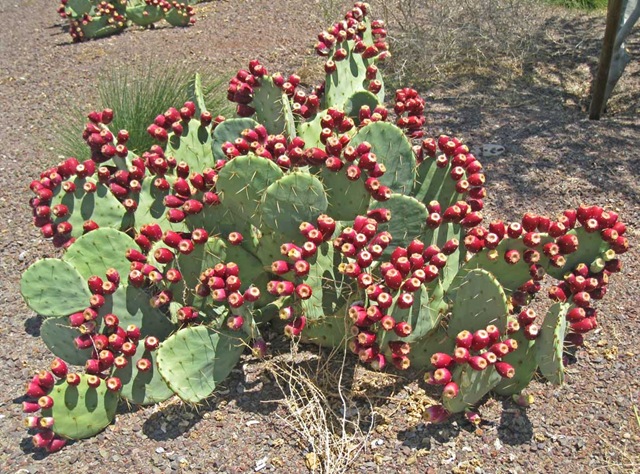
Why did some Spaniard ever bring the prickly pear back to Europe in the first place? Because, as far as I can tell, he thought he could brighten up a Spanish garden somewhere. But it cannot have been because of the beauty of the plant itself. More likely it was the flowers, for indeed the web is full of pictures of the flower of the prickly pear. Here are a few of the more pleasing examples.
image
image
image
At some point, though, people, especially the poor with bellies to fill, began to also focus on the fruit, the “figs” of the prickly pear
image
These had been enjoyed by the Mesoamericans for millennia before Hernan Cortes and his conquistadores arrived and have been enjoyed by the Mexicans ever since.
image

I add here a close-up of the fruit
image
first because it’s a nice photo, but second because the sharp-eyed reader will notice the hair-thin spines which nestle lovingly around the crown of the fruit. Their scientific name is glochids. They are the nastiest little buggers imaginable. They come off easily and lodge under the skin of the unwary picker, where they cause exquisite and unending agony as the said picker tries and tries and tries again to extract them, always in vain. Bloody little bastards … Readers may have gathered from this little burst of ill humour that I have personally experienced this exceedingly painful trial. It was in Eritrea as a matter of fact, where as a young and foolish lad I tried picking the fruit.  I then ran to my Mummy to get the horrible little things out, which she eventually did after much wailing on my part and cross admonitions on her part for me to keep still. I had tried picking the fruit because my mother had earlier bought some, perhaps from a lady like this
image
and I had liked them – a little too many seeds perhaps but nicely fresh and sweet.

Personally, while I like the taste, that early brush with glochids has always made me wary of the fruit. The pain in the hands was bad enough but the thought of those things getting stuck in your tongue or gums because the fruit was badly cleaned is dreadful. And the thought of them getting stuck in your throat is simply too horrible to contemplate.

But others around the world consume the fruit without a second thought, especially around the Mediterranean rim. Here, we have some cheerful young lads selling the fruit in Egypt

image
While here we have a more solemn Moroccan doing the same
image
And here a smiling Sicilian ditto
image
As readers can imagine, over the centuries people in the countries where the prickly pear was introduced eventually got around to putting the fruit into alcoholic drinks – at least in those countries where such drinks are tolerated. Thus, we have a prickly pear-flavoured liqueur called “Ficodi” in Sicily, we have a prickly-pear flavored herbal liqueur called “bajtra” in Malta (another country, by the way, where the prickly pear has been declared an invasive species), out in the lonelier reaches of the Atlantic, on the island of St. Helena (where Napoleon Bonaparte was banished), the potent “Tungi Spirit” is produced with the fruit, while prickly pear fruit is the main ingredient of a popular Christmas beverage in the British Virgin Islands called “Miss Blyden”. Looking at how all these various drinks are made, I think I would plump for Miss Blyden: prickly pear steeped in rum and sweetened with sugar. Mmm, sounds good …Yohoho, and a bottle of Miss Blyden, is what I say.

But actually, these drinks are all derivative, if I can put it that way: you just plunk prickly pear fruit in an alcoholic medium; it could actually be any fruit that is plunked. The Mesoamericans, on the other hand, came up millennia ago with colonche, an alcoholic drink using just the juice of the prickly pear fruit, fermenting it over a number of days. I have read that it is a sweet, fizzy, red beverage. Here’s a photo of a glass of colonche, together with the fruit from which it is derived.
image
I regret to say that I did not try the drink while I was in Mexico. However, I have asked my son to try it and report back. If the feedback is good, we can discuss about getting into the business of exporting it!

What I will not promote, through export or otherwise, is the eating of the pads (that is to say the fleshy leaves) of the prickly pear. They eat them in Mexico – and in New Mexico too (and perhaps some of the other southwestern States of the US). The original peoples of Mexico were eating them when Cortes burst in on the scene, and it’s still quite popular. I saw them sold in the supermarket around the corner from where we were staying in Mexico City and took a photo, but I prefer this more sympathetic photo of a Mexican lady on the street selling them.
image
I mentioned in an earlier post that I had tried the pads, cooked and with melted cheese, in a taco. I also tried them, with cheese but without the taco. It didn’t change the taste much.
image
I’m all for trying things once (with the exception of insects). But not necessarily more than once. Pads of the prickly pear fall into the latter category.

But who knows? As the Mediterranean countries slowly go down the economic drain, and more generally as we 99 percenters slowly get poorer, perhaps we will join our Mesoamerican friends and start eating prickly pear pads – as the poor of the Mediterranean lands turned to the fruits of the prickly pear some three hundred years ago to fill their empty stomachs.

_______________
Columbian exchange: http://globerove.com/wp-content/uploads/2010/03/Columbian-Exchange.jpg (in http://www.slideshare.net/mobile/cbgobble/columbian-v-triangle)
Prickly pear in Teotihuacan: https://farm1.staticflickr.com/214/444712763_0a91a8353e.jpg (in https://www.flickr.com/photos/eternal_sunshine_of_the_spotless_mind/444712763/
Mexican flag: http://www.freepressers.com/wp-content/uploads/2011/10/mexican-flag-640.jpg (in http://www.worldtribune.com/worldtribune/WTARC/2011/k1302_10_21.asp)
Prickly pear: https://seekraz.files.wordpress.com/2012/10/prickly-pear-cacti-in-tucson-desert.jpg (in https://seekraz.wordpress.com/tag/prickly-pear-cactus/)
Prickly pear by Asmara-Masawa railway: https://c1.staticflickr.com/9/8633/16089064905_44b9e68e48_b.jpg (in https://www.flickr.com/photos/dave-hill/16089064905/)
Italian colonial masters: http://upload.wikimedia.org/wikipedia/it/6/6c/Ascari_penne_di_falco.jpg (in http://it.m.wikipedia.org/wiki/Regio_corpo_truppe_coloniali_d’Eritrea)
Prickly pear in Sicily: https://c1.staticflickr.com/9/8299/7826141194_33f0e36a8d_b.jpg (in https://www.flickr.com/photos/mari-mora/7826141194/)
Prickly pear in Spain: https://themostbeautifulplacesineurope.files.wordpress.com/2013/07/dsc_0048.jpg (in https://themostbeautifulplacesineurope.wordpress.com/tag/castle/)
Prickly pear in Ethiopian village: http://4.bp.blogspot.com/-YutF1G9Qjbo/Up44cIZUf_I/AAAAAAAAMPA/fydBOTfLCNY/s1600/00041775.jpg (in http://jhodgesagame.blogspot.com)
Prickly pear in Kruger National Park: http://academic.sun.ac.za/cib/news/images/20120611_opuntia_stricta_impacts_fig1.jpg (in http://academic.sun.ac.za/cib/news/20120611_opuntia_stricta_impacts.htm)
Prickly pear in Australia – the green hell: http://chinchillalibrary.chinchilla.org.au/Images/Local%20History/johnty%20turner’s.jpg (in http://chinchillalibrary.chinchilla.org.au/HTML/HeritagePricklyPear.html)
Prickly pear in flower-1: http://www.fotothing.com/photos/4aa/4aa38f6709881bcb9b0dc2f7bce87dea.jpg (in http://www.fotothing.com/AzViper/photo/4aa38f6709881bcb9b0dc2f7bce87dea/)
Prickly pear in flower-2: http://photosbygarth.com/travels/DesertGardens4-23-11/prickly_pear_cactus_flowers_0887.jpg (in http://photosbygarth.com/wordpress/)
Prickly pear in flower-3: http://www.summitpost.org/prickly-pear-cactus-flower/294673
Prickly pear fruit-1: http://2.bp.blogspot.com/-_NFH_ZhWJCU/T1kjB-HTOWI/AAAAAAAAA84/rBf30_8f5qg/s1600/5.jpg (in http://docsfitnesstips.blogspot.com/2012/03/prickley-pear.html)
Mexicans selling prickly pear fruit:
http://i.gonoma.net/i/destinations/1106/zacatecas-images/prickly.jpg (in http://gonomad.com/destinations-xxx/3205-zacatecas-mexico-rsquo-s-overlooked-colonial-gem)
Prickly pear fruit-2: http://cdn.c.photoshelter.com/img-get/I0000O2m8f8jI.vU/s/600/600/PPCA-021548.jpg (in http://rolfnussbaumer.photoshelter.com/image/I0000O2m8f8jI.vU)
Ethiopian lady selling prickly pear: http://jamminglobal.com/2012/05/ethiopia-part-6-historical-axum-and-mountainous-twisties.html
Prickly pear seller Egypt: http://weekly.ahram.org.eg/Media/NewsMedia/2013/7/16/2013-635095893366005272-600_resized.jpg (http://weekly.ahram.org.eg/News/3357/25/The-fruit-beneath-the-thorns.aspx)
Prickly pear seller Morocco: http://upload.wikimedia.org/wikipedia/commons/b/b1/Prickly_pear_seller.jpg (in http://en.m.wikipedia.org/wiki/Opuntia_ficus-indica)
Prickly pear seller Italy: http://www.fotografieitalia.it/foto/3126/3126-08-20-44-1557.jpg (in http://www.fotografieitalia.it/foto.cfm?idfoto=65383&idfotografo=3126&crono=1)
Colonche: http://173.236.14.43/fotos/nota/2014/9/18/4d68094af571428.jpg (in http://www.am.com.mx/aguascalientes/especiales/espiritus-de-la-republica-144117.html)
Seller of cactus pads: http://holeinthedonut.com/wp-content/uploads/2010/06/Nopal_Cactus_Seller_Mercado_Hidalgo_Guanajuato.jpg (in http://holeinthedonut.com/2010/06/01/mexico-food-nopal-cactus/)

Cactus pad and cheese: http://s3.amazonaws.com/foodspotting-ec2/reviews/846163/thumb_600.jpg?1315336866 (in http://www.foodspotting.com/150802-amandahugnkiss)/)


MEXICO: PAINTED SIGNS

Bangkok, 13 January 2015

It was at Tlaxcala that I began to notice it.

We’d taken a bus from Mexico City to visit this small town, since it was described as a nice example of colonial Mexican architecture and town planning. It certainly was pleasant enough, as were Chiapas de Corzo and San Cristóbal de las Casas, two other colonial-era towns which we visited later. The latter two have been declared “pueblos magicos”, magic towns, a slogan dreamed up by the Mexican tourism authorities (clever branding, although I do feel duty-bound to whisper that the pueblos in Tuscany, for instance, or any number of pueblos which my wife and I have visited in Spain, are more magico than Tlaxcala and the two official pueblos magicos that we visited).

In any event, my point in mentioning the visit to Tlaxcala is another. What I began to notice as we walked around the town was the lack of modern signage on the shops. To understand what I mean, let me insert here a picture of the shopping street in Vienna, the Graben, where we often went for a stroll and coffee when we lived there.
image
Notice the abundant use of neon shop signs, tacked onto the shop fronts. For better or for worse (and in my opinion for worse; it drives me crazy in this age of climate change to see all those illuminated shop signs blazing out into the night), this is now the accepted and expected type of design for shop signs.

So it was with great interest that I saw in Tlaxcala that shop signs tended to be of the old-fashioned type, painted by hand
image
image
Alerted to this phenomenon, I made sure to get some close-ups of such signs in San Cristóbal
image
image

I began to notice that advertisements were often painted too. The following style of painted advertisement was definitely my favorite, with this particular example coming from San Lorenzo Zinacantán.
image
These types of advertisements, to be found on otherwise bare walls, seem always to be announcing some upcoming event. Notice the large, rounded, friendly, inviting font, but placed at a slight angle denoting future excitement, and with a very pleasing colour scheme which starts with a dark colour and shades off into a lighter one. I throw in here some other signs of this genre that I spotted from buses or trains flashing by.
image
image

It would seem that the honorable profession of sign painter is alive and well in Mexico! (this reminds me of a wonderful novel from India, another country with a great sign painting tradition, “The Painter of Signs”, by R.K. Narayan; great novelist, by the way, I highly recommend him to my readers).

Of course, painting on walls has a long and noble tradition in Mexico. This art form must have reached its apogee with the great Mexican muralists Diego Rivera, José Orozco, and David Siqueiros. Already 35 years ago, when we first visited Mexico, we had reverently visited a number of the murals by these artists. This time around, we visited Rivera’s murals in the Secretaría de Educación Pública, just behind the cathedral on the Zocalo in Mexico City. As was his style, they are very political, very “leftie”; they made me and my wife smile as they brought back memories of the excited discussions of our youth. These two murals, “The Capitalist’s Dinner” and “Death of the Capitalist”, epitomize them all.
image
image
In San Cristobal, up some back streets, I saw what I fear are today’s inheritors of Rivera, Orozco, and Siqueiros
image
image
It’s sad really. All that grand, elevated talk of our youth has degenerated into the childish babble of these cartoons. But the rot doesn’t finish there, for Mexico suffers from the same mindless graffiti which defaces so many of our cities

image
“Fuck you. I exist”

What are our civilizations reduced to?

__________________

Mariahilfestrasse 1: http://austriacazare.ro/wp-content/uploads/2012/10/mariahilfer-strasse.jpg (in http://austriacazare.ro/shopping/mariahilferstrasse/#photoGallery%5Bgallery-503%5D/3/)
Calle 20 de noviembre , Tlaxcala: http://www.mexicoenfotos.com/estados/tlaxcala/tlaxcala/MX13379190432534&album=01&province=tlaxcala&city=tlaxcala&pagina=6
Avenida Vicente Guerro, Tlaxcala: http://www.mexicoenfotos.com/estados/tlaxcala/tlaxcala/MX13362760603306&album=01&province=tlaxcala&city=tlaxcala&pagina=6
Shop signs, San Cristobal: my photos
Painted advertisement signs: my photos
Cartoon wall paintings, San Cristobal: my photos
Graffiti, Mexico City: http://3.bp.blogspot.com/-hsTD7FnkGKs/UIEueVASNkI/AAAAAAAAAQs/PJ0N-K0omig/s1600/150559_545018925524744_786800387_n.jpg (in http://thevilgang.blogspot.com/2012/10/el-graffiti-de-la-ciudad-de-mexico.html)

MEXICO: MUSEO DE ARTE POPULAR

Bangkok, 10 January, 2015

While in Mexico City over the Christmas break, my wife and I visited two museums, the Palacio de Bellas Artes and the Museo de Arte Popular. The Bellas Artes is the more Worthy of the two, having vast panels by Great Mexican Painters such as Diego Rivera, David Siqueiros, José Orozco, and others. When we visited, it also had some Worthy exhibitions, one of these being on modern art from cubism onwards, which mixed global titans like Picasso and Pollock with Mexicans. I have mentioned in a previous post how so much of the world looks the same everywhere nowadays, especially where clothes are concerned: everyone, everywhere, dresses the same, particularly the young. I was struck by the same sensation in this exhibition of modern art. Everyone’s modern art was the same everywhere: Diego Rivera’s cubism looked just like Braque’s, Frida Kahlo’s surrealism was indistinguishable from Magritte’s, Gunther Gerzso’s abstract expressionism is no different from Willem de Kooning’s or Mark Rothko’s. In a word, there was nothing particularly Mexican about any of the art on show from Mexican artists. Another, depressing, effect of globalization.

So you can imagine my relief when we visited the Museo de Arte Popular (which I think we can translate as the Museum of Folk Art) and saw pieces which were quite typically Mexican, pieces I would not find in a museum of folk or other art in Europe or the US or Japan or even Thailand where we currently live. (In truth, I’m sure I would find similar pieces in the other Latin American countries, but that’s OK; these countries do after all share a fair amount of cultural history, Hispanic and pre-Hispanic).

So it is with pleasure that I can share with readers photos of some of the pieces I most liked. I hope I will be excused their generally poor quality. They are all taken with my iPhone, and in many instances through the glass of the exhibition cases which often created irritating problems of reflections.

I start with that typical form of folk art, ceramics. Here are some pots and a plate I particularly fancied:
image
image
image
with this one being my favorite of the genre
image
There was also a lot of woven rattan and similar objects. I’m not a big fan of this art form, but I do add here a picture of a container made with a mix of bark and fibres, which had a certain attraction
image
Not particularly Mexican all this, you might argue, so let me continue with a subject very close to the average Mexican’s heart, religion. In the museum collection, it was captured for the most part with that typically Mexican (or perhaps Latin American) fondness for little set scenes. So we have a crucifixion
image
a last supper – but why are they eating watermelon??
image
and a last judgement
image
while the Tree of Life was a very popular motif, made into a lovely candelabra in this example
image
Then there were several examples of ex-votos, that exceedingly popular genre of folk religious painting (and not just in Mexico; Italian churches are littered with them, as are churches in Austria and probably every other Catholic country). Normally, they record a person being saved from some catastrophe or illness, but in this particular case a certain Mr. Jesus Gomez Reyez was thanking the Good Lord for getting his American passport regularized back in 1962, a touching commentary on so many Mexicans’ yearnings to escape to America
image
Religion has much to do with death, and the Mexicans have turned death into a high art, especially that most striking vision of the death which awaits us all, the skeleton. The museum has a particularly rich collection of this art form, of which I show a small selection, starting with this wonderful variation on that insipid form of religious art, the statues of saints in churches
image
I must say, despite the grimness of the topic these skeletons are always remarkably cheerful. Here we have a bunch of skeletons thoroughly enjoying a huge meal – echoes of the last supper?
image
another happily kicking a football around
image
yet another, a child’s skeleton, blowing us a raspberry
image

while here we have an earnest swain declaring his undying love to a simpering and blushing maiden
image
and finally, a very popular character in the skeleton cast of characters, a “Catrina”, a female skeleton dressed to the nines in a 19th Century style
image
We loved these Catrinas so much that we bought a ceramic version and carried it back to Bangkok, where it now stands on our dressing room table.

Keeping to the broad religious theme, devils are also a popular topic. I include three, one blowing a raspberry, something which I have never particularly associated with devils (but a common theme it would seem; does blowing raspberries have some deeper meaning in Mexico?)
image
another showing a bunch of devils taking part in a last-supper type of meal – eating watermelon again! (what’s with this business of watermelon?)
image
and a grimmer scene, a devil rapist (I suppose rape is as bad a problem in Mexico as anywhere else).
image

The little scenes which seem such a popular subject spill over into normal, day-to-day life. We have here a seller in the market (watermelon-eating again …)

image

Fairgrounds seem a popular topic, especially Ferris wheels

image
while here we have a grimmer scene from life, a fire. Many escape from the doors of these towers but one person has had to throw himself off the top.
image
This large needlework piece wonderfully captures the myriad activities of daily life
image
I add one close-up of the many scenes on this piece
image

The final theme is animals, which are a popular subject for folk artists. I feel I should start with a turkey, which was first domesticated in pre-Hispanic Mexico.
image
I continue with a cat, because my wife reminded me that when we were last in Mexico 35 years ago we bought a ceramic cat, which currently faithfully sits in storage in Vienna waiting for our return to Europe.
image
But I also add a dog, in this case in the form of a teponatzle (a type of musical instrument),
image
continue with what appears to be a brightly coloured hedgehog
image
and finish with a couple of birds: what looks like a macaw, fashioned as a handle of a jug
image
and this truly magnificent peacock
image
On the topic of animals, I feel I have to include a picture of this monster
image
The Mexicans seem to have a great fondness of such monsters, which we saw in a number of places, on a much larger scale, being used as floats of some sort.

Well, I don’t want to give everything away about this museum. I hope I’ve persuaded some readers to visit it if they happen to be in Mexico City: Calle Revillagigedo 11, Cuauhtémoc, very central; open every day except Monday.

___________

pictures: all mine

MEXICO: BASHING THE PIÑATA

Mexico City, 4 January, 2015

As my wife and I wandered around Mexico City this last week, we were struck by these strange ornaments which we saw hanging in many places. This particular one, for instance, was hanging in a street somewhere

pinata 002

while this one, somewhat incongruously, swung over the cars in a gas station.

image

Intrigued, I asked our son what they were. Piñata, he told us.

Ah. I had never heard of them.

Undeterred, I rolled up my sleeves and did some research (i.e., browsed the web). I am now ready to report my findings.

What we have here is an example of the strategy used by the Catholic church in the early years of the Spanish conquest of Mexico to christianize the local populations. The church adopted, with the necessary adaptations, those local religious traditions which happened to have similarities with Catholic traditions. The thinking was that this would make Catholicism more familiar, more “user friendly” for the local populations, who would therefore convert more readily (and if necessary, a little gentle pressure from the sharp end of a sword could no doubt be used to help along in the decision-making process).

In the case of the piñata, the local religious tradition in question was part of the Aztec festival for their patron god Huitzilopochtli, sun god, god of war, and god of human sacrifice.
image
The whole of the Aztec month of Panquetzaliztli, which ran from 7 to 26 December in today’s calendar, was dedicated to this festival. The people decorated their homes and trees with paper flags, there were ritual races, processions, dances, songs, prayers, and to top it all off there were human sacrifices.

Only one of the festival’s activities is of interest us here. In it, priests would place a clay pot on a pole in front of the statue of the god. The pot was filled with tiny treasures inside and decorated with colorful feathers outside. The pot would be ritually broken with a stick or club, and the treasures would fall to the feet of the statue as an offering.

It so happened that the Spaniards had a very similar custom, the Dance of the Piñata, which took place during Lent. There, too, a decorated clay pot, the piñata, was suspended and during some kind of dance routine got broken with a stick. Quite what the religious significance of this was is unclear to me, nor do I know if there was anything in the pot.

The canny Franciscan monks who were spearheading the conversion efforts in Mexico (along with Dominicans) figured that they could harness this Lenten custom from Old Spain to a new Christmas custom in New Spain and in so doing help to draw away the indigenous people from their old, “pagan”, “idolatrous”, “devil-worshipping”, etc. religion. They also borrowed from a superficially similar Mayan custom. The Mayans had a game rather like blind man’s buff, where a player was blindfolded, perhaps spun around to disorient him, and then left to try and hit and break a suspended clay pot. No doubt his blundering misses made spectators roar with laughter. Again, I don’t know if there was anything in the pot.

The Franciscans used all these threads to weave together a new, fun custom which the indigenous people were encouraged to practice, in the church grounds no doubt, in the run-up to Christmas. A clay pot, filled with sweets and other goodies, and decorated on the outside, was suspended. The “players” were blindfolded, and guided by the onlookers, would try and bash the pot and release the goodies. If successful, everyone would throw themselves on the goodies. But of course the Franciscans gave the whole thing a religious twist, using the new piñata “game” to inculcate in the locals some Christian catechism. Thus, the clay pot represented Satan, with the outer decorations now transmuted into seven colorful cones or horns representing the seven deadly sins (for those of my readers who have momentarily forgotten which these are, we have, in alphabetical order: envy, gluttony, greed, lust, pride, sloth, and wrath). The outside was made beautiful to remind the viewer that evil is tempting, and the goodies inside the pot represented the temptations of wealth and earthly pleasures. Once the game started, it became a morality play for demonstrating the three theological virtues of Faith, Hope, and Charity. The blindfolded players represented Blind Faith, groping their way towards salvation. The piñata now represented Hope. The onlookers looking up at the hanging piñata were actually gazing towards Heaven, yearning for the salvation that would come from the smashing the pot and the triumph of Faith over Evil. The sweets and other goodies that showered forth now suddenly became the rewards of maintaining the Faith. But everyone shared in the goodies, thus symbolizing Charity. After this dose of religion, it seems to me only correct to include this statue of a Franciscan monk having a bash at a piñata.

image

If any of the players impatiently waiting to have a go at smashing the pot understood any of these theological subtleties I take my hat off to them. If my own youthful experience of catechism is anything to go by, I would guess that they quietly let the priest blather on about whatever he wanted to blather on about and then they got down to the serious business of having some fun. These two photos, which I took in the Museo de Arte Popular (about which more later in a future post), capture nicely the fun aspect of this religious game.

image

image

I’m sure it is the jolliness of smashing something and scrambling around for goodies that makes older Mexicans remember piñata with fondness rather than the catalogue of the seven deadly sins and the triumph of Faith over Evil. In fact, at some point it seems to me that the piñata lost much of its religious connotations and simply became a game to play at parties, and at the same time there was a switch from a ceramic pot to hold the goodies to one made of papier-mâché or cardboard – no doubt fond mothers were worried about having their dear ones and those of their neighbors showered with pottery shards during the children’s parties they organized.
image
Indeed, I have this vague memory of a similar game being played at the birthday party of one of my son’s friends years ago in Italy. By the way, for those of you who like me are fond of useless facts, the Spaniards borrowed the piñata from the Italians, where it was called pignatta. And it seems that the ultimate source of the custom was China, although how it got from the Middle Kingdom to Italy is a bit of a mystery to me (my sources suggest Marco Polo, but he gets mentioned whenever no-one has a good idea how things got transmitted from China to Europe).

In any event, it now looks like the piñata is morphing into a simple Christmas decoration. I certainly don’t think that all the piñatas we’ve seen hung up are there to be bashed vigorously with a stick. In this new identity they have become the equivalent of those stars which seem such a popular Christmas street decoration.
image
Soon, they will morph once more, becoming tame Christmas tree decorations. Indeed, if this Christmas tree at one of Mexico City’s bus stations is anything to go by, the morphing has started already.
image
From reverent offering to the sun god to cheesy decoration on a Christmas tree, the fall has been long and hard.

_____________

Piñata: my photo
Huitzilpochtli: http://upload.wikimedia.org/wikipedia/commons/c/cb/Huitzilopochtli_telleriano.jpg (in http://en.m.wikipedia.org/wiki/Huitzilopochtli)
Franciscan monk hitting piñata: http://en.m.wikipedia.org/wiki/Piñata#/image/File:MonkPiñataAcolman1.JPG (in http://en.m.wikipedia.org/wiki/Piñata)
pix from the museo de arte popular: mine
Children hitting a piñata: http://en.m.wikipedia.org/wiki/Las_Posadas#/image/File:Las_Posadas_Pinata.jpg (in http://en.m.wikipedia.org/wiki/Las_Posadas)
Christmas street decorations: http://wallpaperest.com/wallpapers/street-outdoor-christmas-decorations_074228.jpg (in http://toplowridersites.com/iphone-5-38528-christmas-christmas-street-decoration-jpg/)
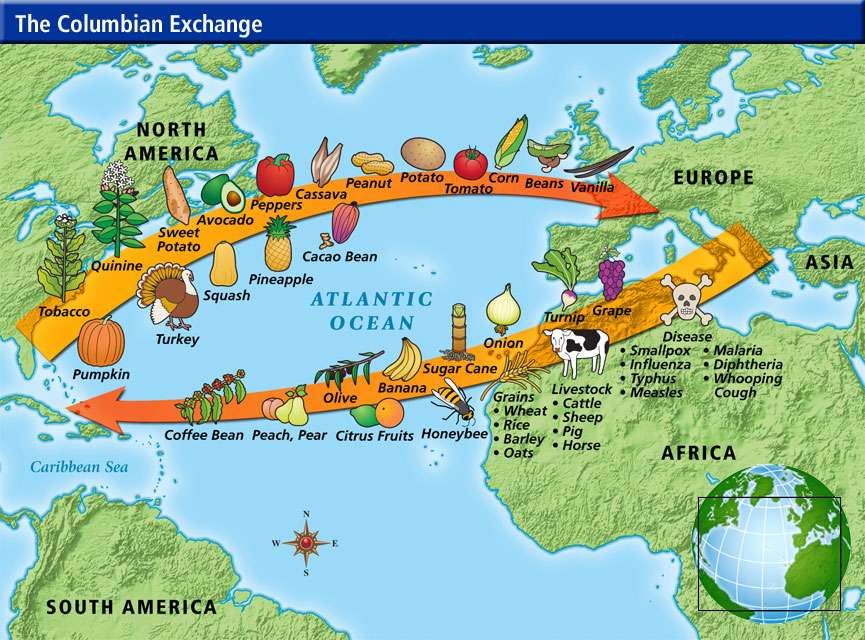
piñata on Christmas tree: my picture