POSTS

14th JULY

Sori, 14 July 2015

When 14th July rolls around, my wife and I give each other fond looks and, depending on where we are, we will go out to celebrate. Not, as some readers might think, to celebrate the anniversary of the fall of the Bastille, although the French Revolution behind that act of rebellion was, when all is said and done, a great thing. No, we are celebrating the anniversary of Us Getting Together. This momentous event took place in Corsica, in the Year of our Lord 1975 (goodness me, when I write it down it seems so long ago …). I had gone to visit her in Milan at the end of a tour of Italy (my first), and on the spur of the moment we had decided to go to Corsica – well, she had proposed it and, rather startled but willing, I had agreed; this was the start of what would be a common pattern in our marriage: she proposes and I agree. We took the ferry from Genova to Bastia, and during the trip I had felt rather sea-sick; this was the start of the process of my wife learning a lot of unedifying things about me. After a day in Bastia, we took the Trinichellu (“little train” in Corsican dialect)

image

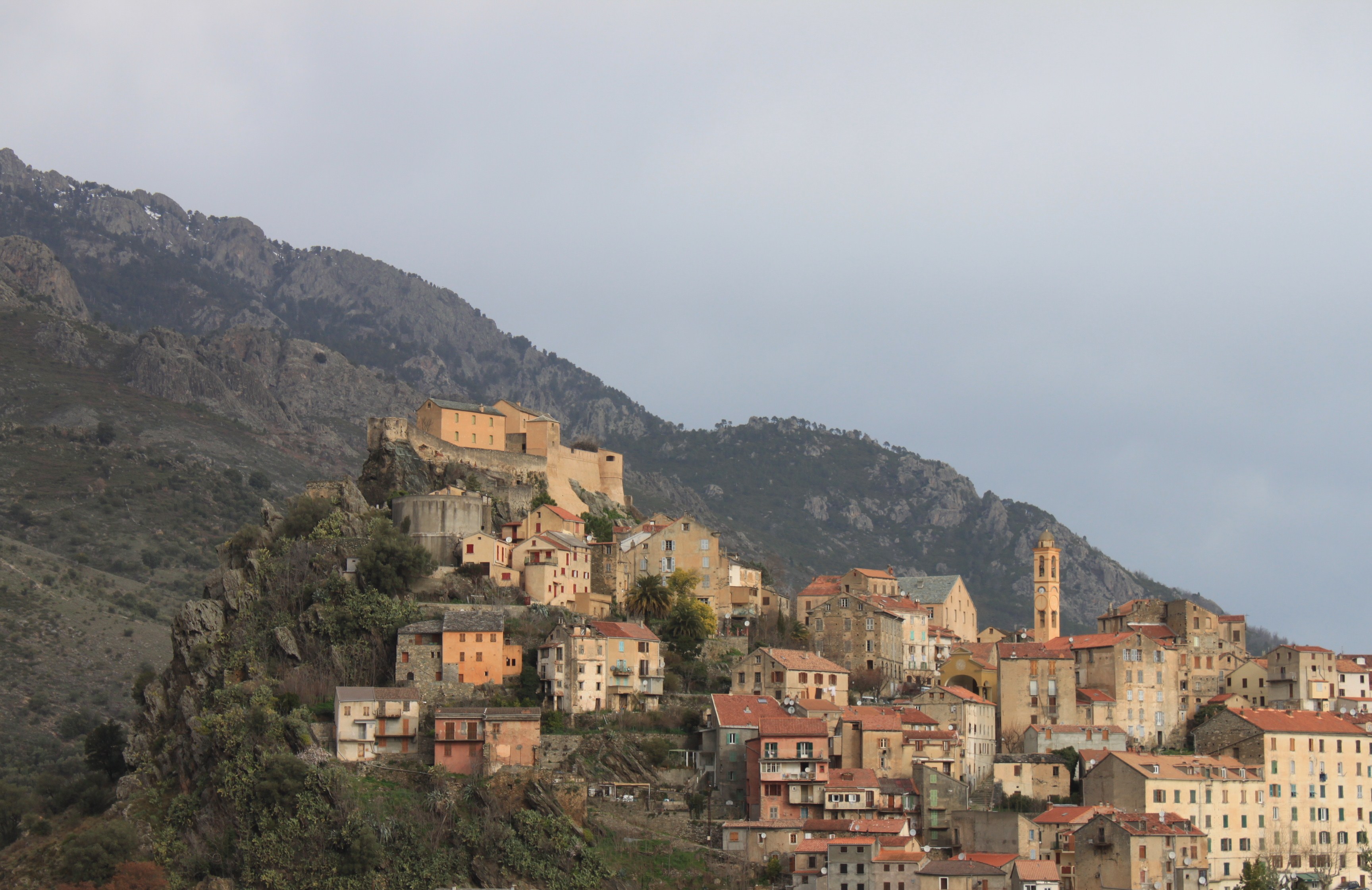
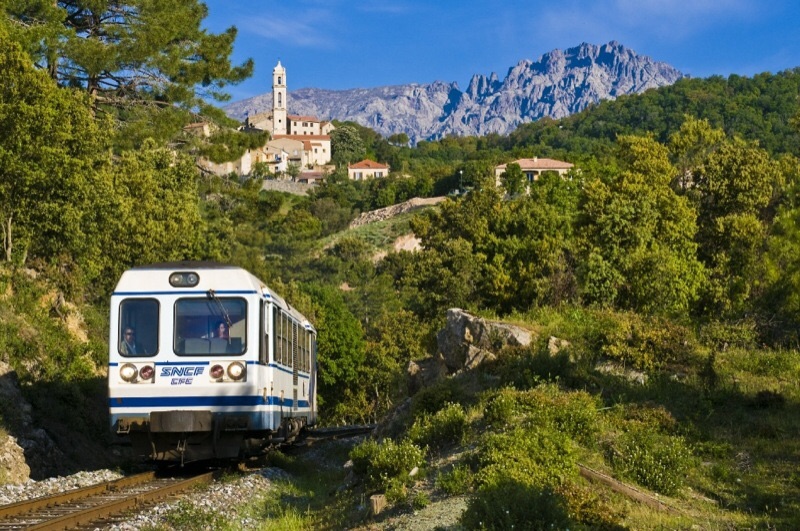
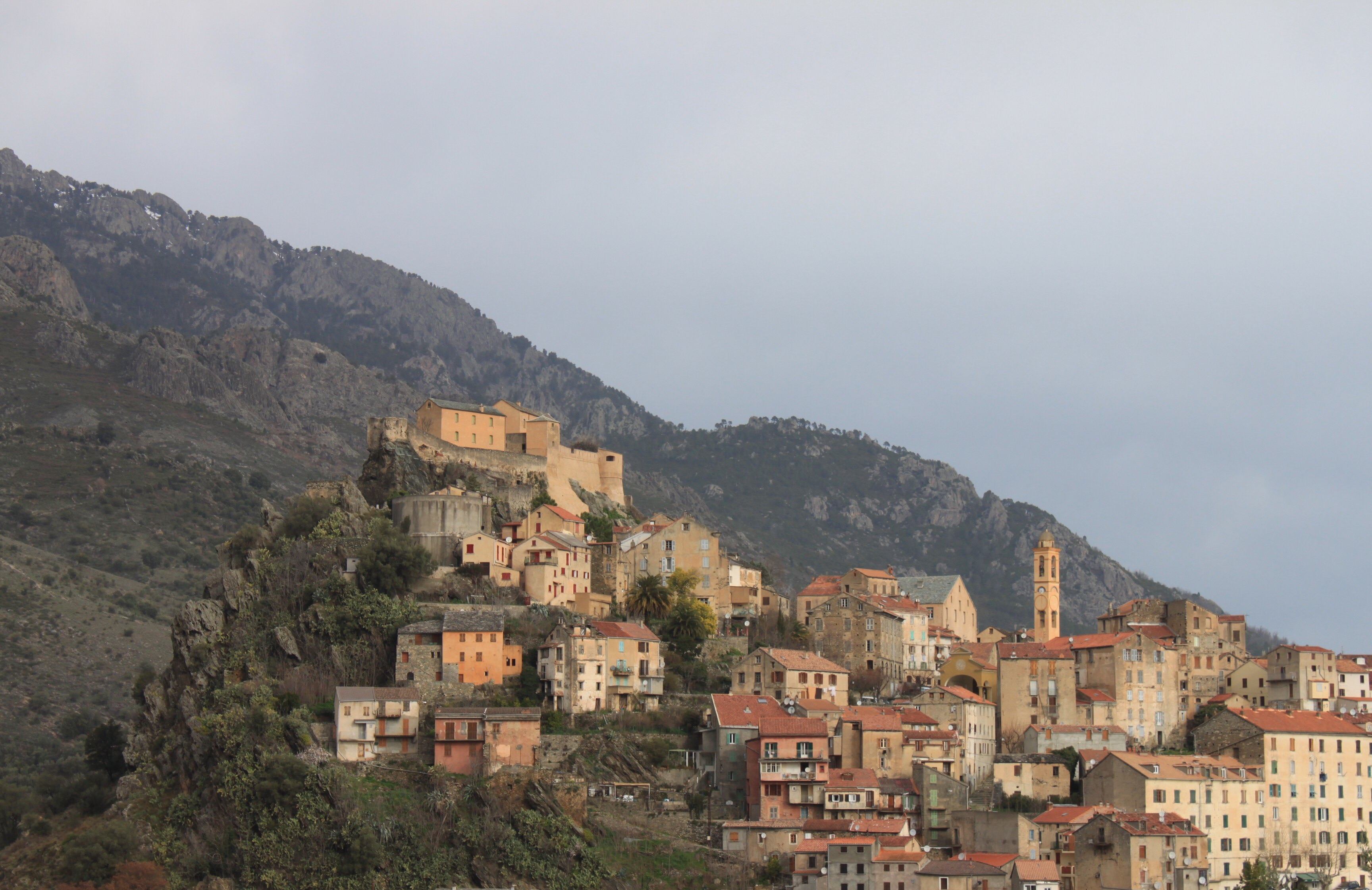
which runs from Bastia on the north-eastern coast to Ajaccio on the western coast, passing over the island’s wild and mountainous spine. We got off in Corte, a nice little mountain town in the centre of the island.

image

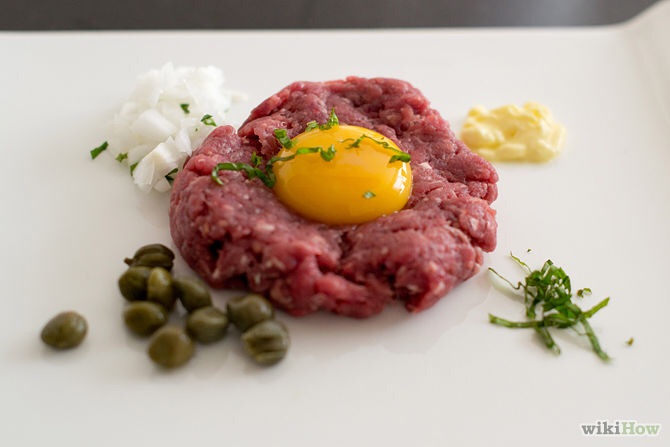
We must have walked around the town but actually my only memory of the place is of the restaurant where my wife introduced me to steak tartare, the start of many culinary discoveries for me, courtesy of my wife.

image

We spent the night in a campground where we shared my rather small tent. And the rest, as they say, is history …

The next day, we took the Trinichellu back to Bastia, to catch the ferry to the mainland. It was 14th July, and that night, hand in hand, we watched the fireworks display. It seemed a fitting commentary on what had just started between us.

image

Which is why we look at each other fondly every 14th July.

___________

Trinichellu: http://www.lightmediation.net/blog/wp-content/myfotos/train-corse/00000053125.jpg (in http://www.lightmediation.net/blog/index.php/2010/09/27/trinichellu-un-express-bien-corse/)
Corte: http://ajaccio.media.tourinsoft.eu/upload/corte.JPG (in http://www.ajaccio-tourisme.com/commerces-et-services/ORGCOR2AV5008WB-7/detail/corte/office-de-tourisme-de-corte-centru-di-corsica)
Steak tartare: http://pad1.whstatic.com/images/thumb/2/2c/Make-Steak-Tartare-Step-8.jpg/670px-Make-Steak-Tartare-Step-8.jpg (in http://m.wikihow.com/Make-Steak-Tartare)
Fireworks: http://france3-regions.francetvinfo.fr/nord-pas-de-calais/sites/regions_france3/files/styles/top_big/public/assets/images/2013/07/13/artifice_2.jpg?itok=1HvQYr8a (in http://france3-regions.francetvinfo.fr/nord-pas-de-calais/2013/07/13/14-juillet-les-feux-d-artifice-du-samedi-287075.html)


EAST, WEST, HOME’S BEST

Milan, 14 July 2015

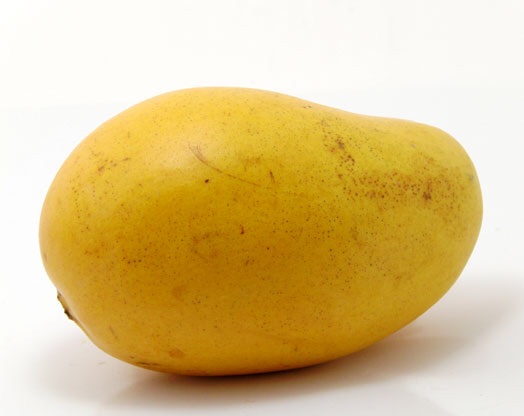
In our short time in Thailand, my wife and I have had the pleasure of trying many wonderful tropical fruits. Some are now known enough in Europe to regularly populate the supermarket shelves: bananas of course, coconuts too, and more recently mangoesimage

pomeloes

image

and dragon fruit

image

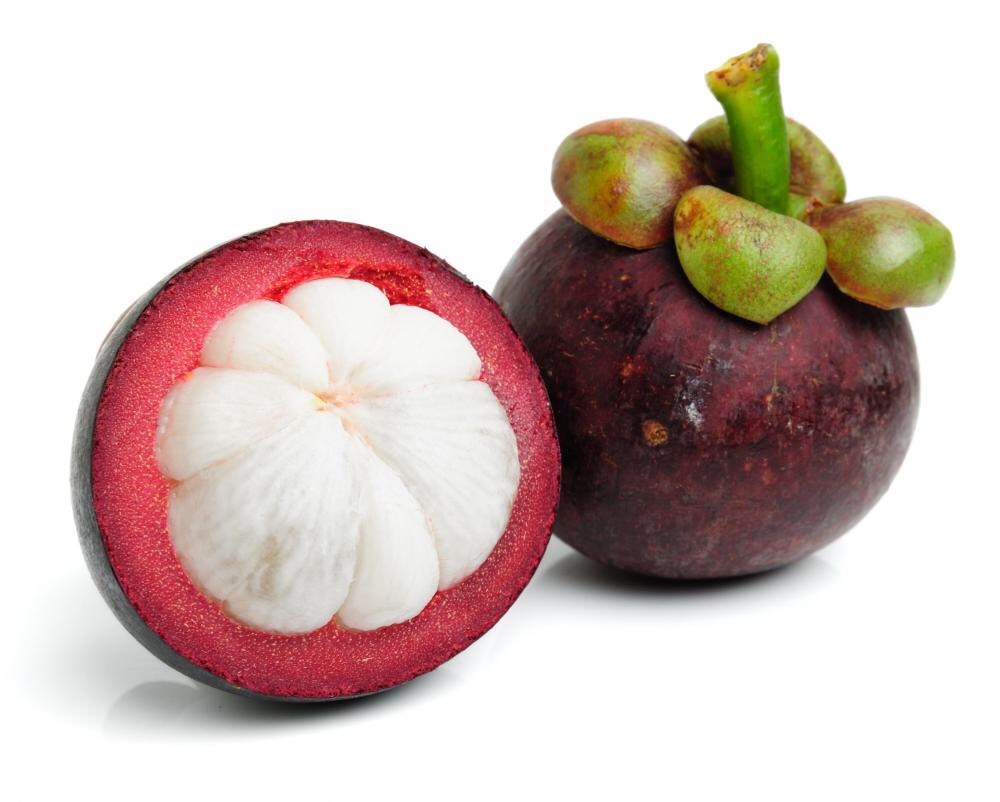
Others, though known to Europeans – primarily through tourism to SE Asia – have not (yet) made it into our supermarkets: the mangosteen, for instance

image

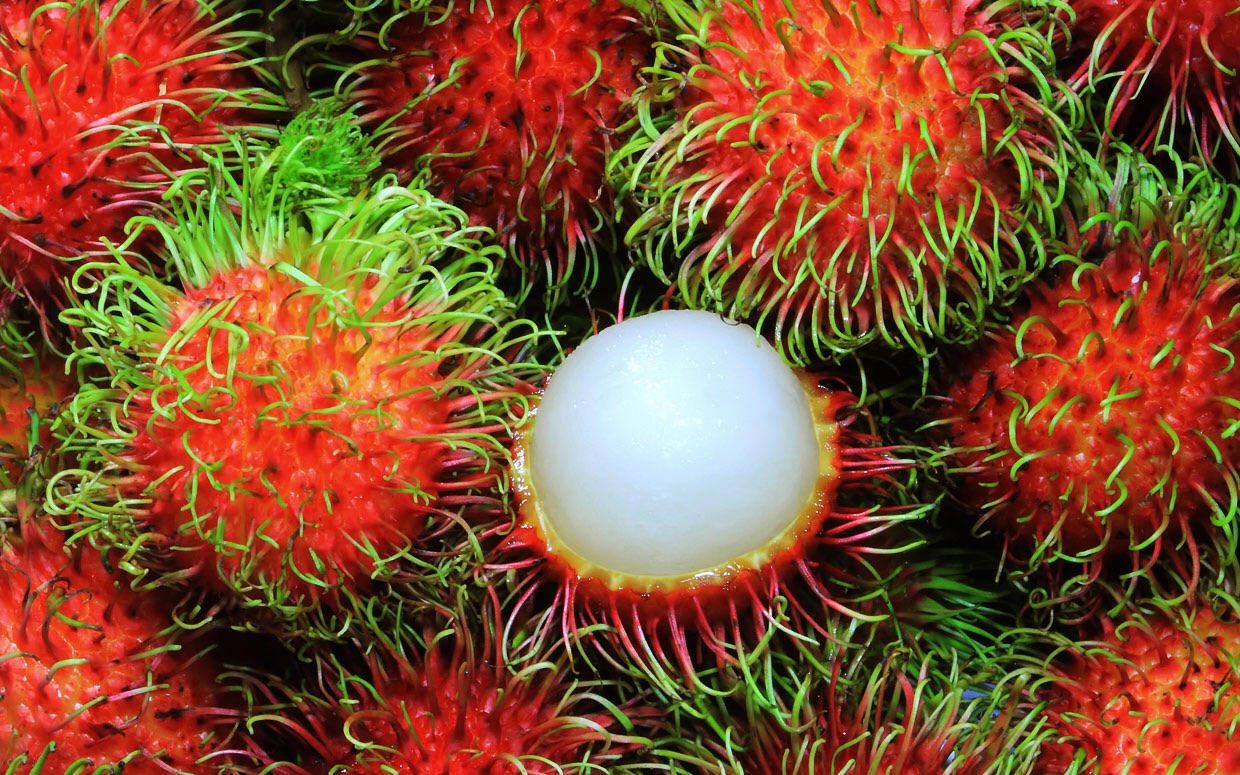
or the rambutan

image

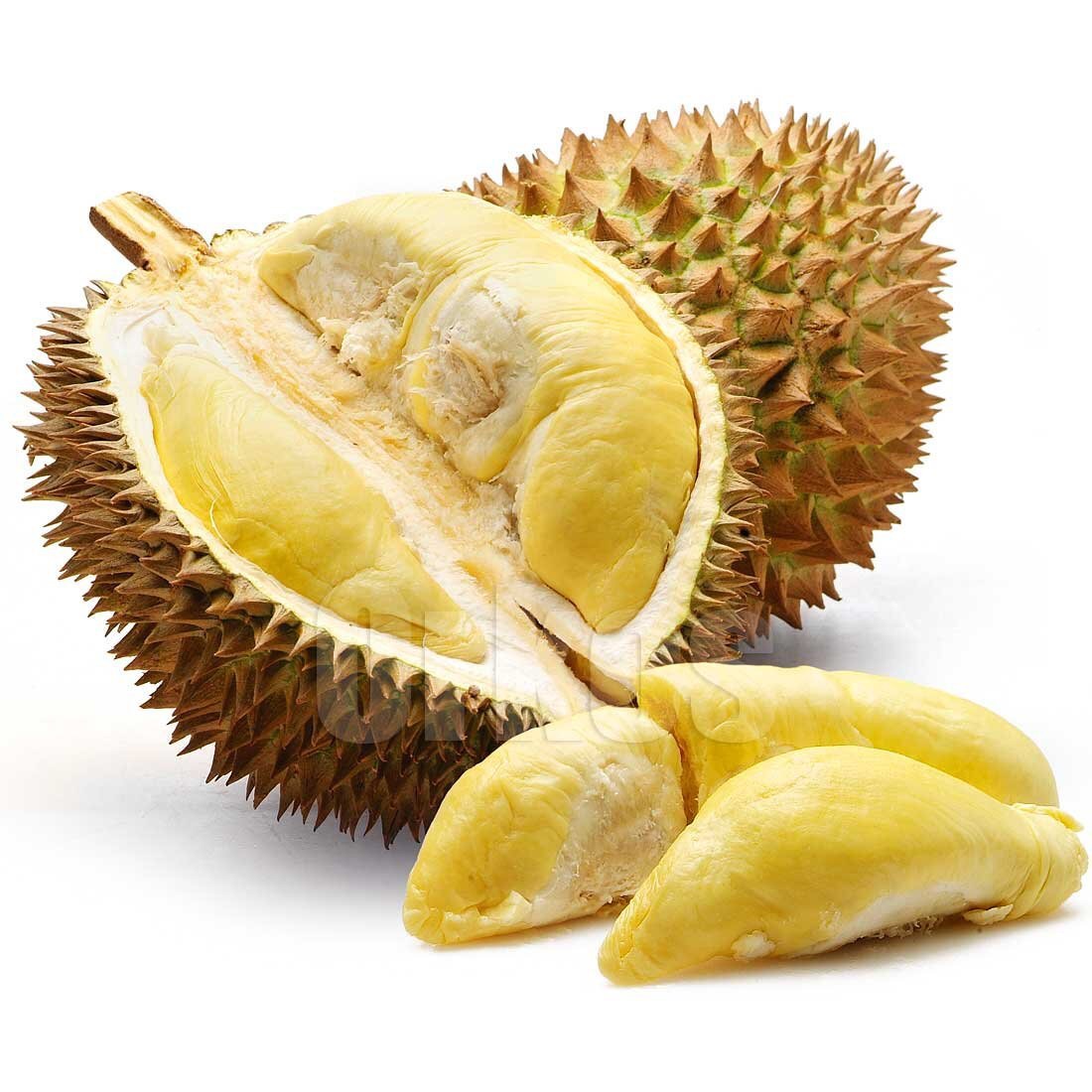
both of which I’ve written about earlier, or the durian, that horribly smelly fruit which I’ve also had a rant about in the same post and which I hope never reaches our supermarkets.

image

And then there are fruits which, as far as I can tell, are quite unknown in Europe. There’s the sala, a fruit about as large as an apricot, which has a ruddy-brown brittle skin covered in sharp scales (these earn it its English name of snake fruit). The white flesh consists of three lobes, rather like the mangosteen, each of which contains a seed. It has a sweet taste with astringent overtones.

image

Or there’s the sathon, which from a distance looks like a large yellow apple except that the rind has a matt, velvety look to it and which, when split open, is found to house several seeds encased in a very sweet sticky white goo that itself is ensconced in a yellow, very sour flesh: it is the interplay of sweet and sour as you scoop all this out that makes this fruit so interesting.

image

Or what about the lamyai (longan in China)? It’s the “other lychee”. Longans come in big bunches. When you shuck the light brown shell, you find something that looks, and tastes, very much like a lychee.

image

We haven’t been through a full annual cycle yet in Thailand, so maybe a few more fruits unknown to us will pop up in the local markets over the coming months.

I have always been more than ready to try strange, exotic fruits, which proudly affirm that even in this era of globalization the world can still offer us the excitement of discovering new foodstuffs in the corner of some foreign land. But then, on a recent trip to Budapest to give my annual training course, I experienced the old rather than the new. I found a couple of raspberries in my salad at dinner one night and popped them in my mouth … Aah, my friends, that taste … Incomparable … As it coursed through my taste buds to my brain, I found myself in seventh heaven; those soft, velvety beads which, when bitten down on, release that sweetly delicate juice, with a slightly musty aftertaste.

image

It was as much the memory as the taste which had me floating on clouds. This companion of my youth! I was transported back fifty years, to my French grandmother’s house, to that untidy patch of raspberry bushes which had colonized a corner of her vegetable garden. My cousins and I would sneak over there, despite strict grandmotherly prohibitions, and quickly pop a few into our mouths before tearing off to avoid detection and grandmotherly wrath. Sometimes, just to play with fire, we would also grab in passing a few sprigs of red currants. But that was just boyhood defiance; their acidity did not sit well in our young mouths.

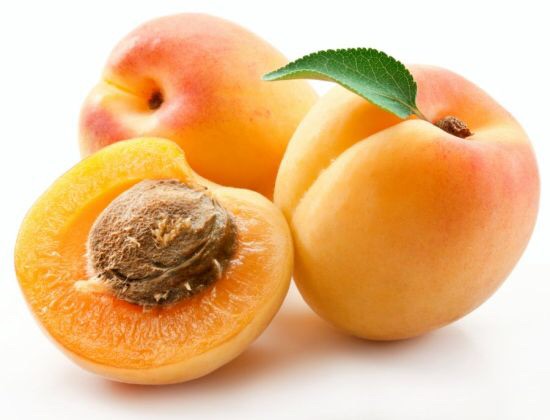
As if this wasn’t enough, the next course of my dinner in Budapest was a dish of braised veal cooked with fennels and fresh apricots. Apricots! As I spooned the slices of the fruit into my mouth, yet another series of sensations coursed through my taste buds and set my nerve synapses afiring. Mmm, that … that … well, that apricoty taste, how else to describe it? Soooo good!

image

Here too I was transported back in time, to my grandmother’s orchard, which stood next to the vegetable garden, and where she had apricot trees, plum trees, peach trees, pear trees, apple trees. My cousins and I would also raid those trees, keeping a wary eye out for our grandmother, who might come around the corner of the vegetable garden at any moment and be instantly transformed from a gentle old soul into a spitfire, running after us, yelling, and threatening to tell our parents.

As I near retirement, as I start becoming the gentle old soul my grandmother was (most of the time), I realize more and more the truth of Oliver Goldsmith’s dictum (and title of one of his poems) “East, West, home’s best”. After years of globe-trotting, of experiencing the exotic splendours of distant lands, I feel ever more strongly with every passing month the pull of home, that part of the world which is in my genes, where there are seasons of moderate heat and moderate cold, where I understand the languages, where the foodstuffs are old friends and not experiences. No offense, but at the end of the day I prefer to be eating raspberries and apricots rather than salas and sathons.

___________

Mango: http://www.mangomaven.com/wp-content/uploads/2011/02/manilla1.jpg (in http://www.mangomaven.com/tasty-tasty-tasty/)
Pomelo: http://previews.123rf.com/images/norgal/norgal1208/norgal120800007/14768629-Green-pomelo-fruit-on-white-Backgorund-Stock-Photo.jpg (in http://it.123rf.com/archivio-fotografico/pomelo.html)
Dragon fruit: http://24.media.tumblr.com/eb843c799502fd0235accc3efe4f3bd2/tumblr_mh0aj3T6Yn1qg5xklo1_r1_1280.gif (in https://theotheri.wordpress.com/2014/09/16/dragon-fruit/)
Mangosteen: http://www.healthyfig.com/wp-content/uploads/2015/02/purple-mangosteen.jpg (in http://www.healthyfig.com/purple-mangosteen/)
Rambutan: http://www.meteoweb.eu/wp-content/uploads/2014/06/RAMBUTAN.jpg (in http://www.meteoweb.eu/2014/06/rambutan-frutto-tropicale-dal-fascino-esotico-simile-ad-piccolo-riccio-mare-giallo-acceso-rosso/289011/)
Durian: http://ecx.images-amazon.com/images/I/71z16SFzrbL._SL1100_.jpg (in http://steven-universe.wikia.com/wiki/Durian_Juice)
Longan: https://lh6.googleusercontent.com/vqe9GQ0UOugxvtYh4V5Fd5kLV-BdriZsJKb1gb2spvxyCwT0rk1u7U75gXjApDU9598LyLC4_Wnzu8__4ygBcwnDHisDpNzj5_dLq82bRHMZ1ADGdb-i67pBSkQeiXso4Q (in http://share.psu.ac.th/blog/general-sarabun/38151)
Sala: https://en.m.wikipedia.org/wiki/Salak#/media/File:Salak_(Salacca_zalacca),_2015-05-17.jpg (in https://en.m.wikipedia.org/wiki/Salak)
Sathon: http://previews.123rf.com/images/panda3800/panda38001205/panda3800120500019/13601415-Santol-fruit-isolated-on-white-background-Stock-Photo-santol.jpg (in https://www.123rf.com/photo_13601415_santol-fruit-isolated-on-white-background.html)
Raspberry: http://www.viper-vapor.com/uploads/4/2/9/8/42981083/s165799847266067809_p13_i1_w1000.jpeg (in http://www.viper-vapor.com/store/p13/RASPBERRY.html)
Apricot: http://sabzi.pk/wp-content/uploads/2015/06/Apricot3.jpg (in http://sabzi.pk/shop/fruits/apricot/)


FOOTPRINTS

Bangkok, 6 July 2015

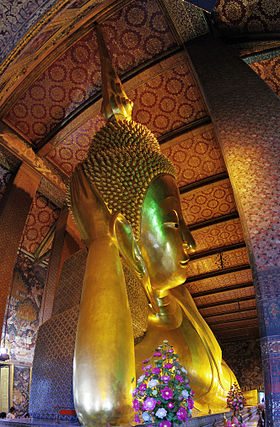
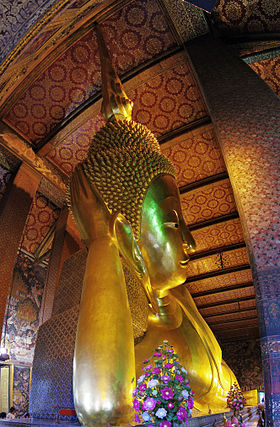
A couple of river-bus stops downriver from where my wife and I live in Bangkok stands the temple Wat Pho, whose main claim to fame is a large reclining Buddha.

wat pho reclining buddha

It is, I read, 46 metres long and 15 metres high, and walking along it certainly is impressive. But I much prefer the soles of the statue’s feet.

wat pho buddhas feet

These soles have been divided into 108 panels each of which contains, in the form of mother-of-pearl inlays, the 108 auspicious symbols by which the Buddha can be identified, like flowers, dancers, white elephants, tigers and altar accessories.

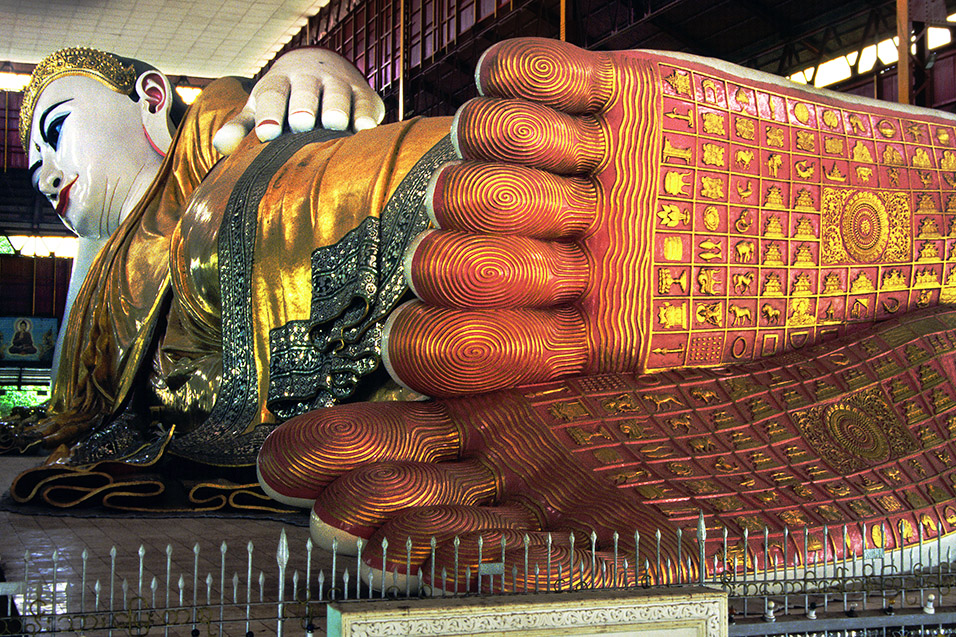
Wat Pho’s reclining Buddha was the first time I saw this interesting art form. But actually it is quite common for reclining Buddhas to have the soles of their feet so decorated. For instance, I find this particular reclining Buddha in Yangon in Myanmar more naturalistic – certainly the pose of the feet is more pleasing to the eye than those stiff blocks in Wat Pho.

yangon_reclining_buddha_feet

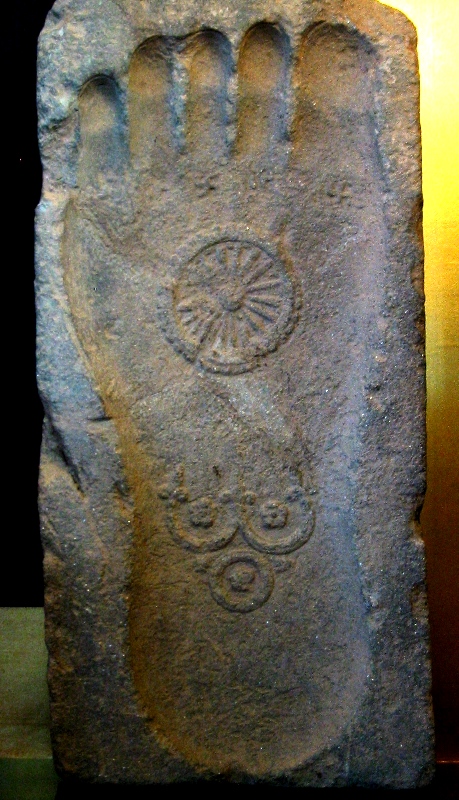
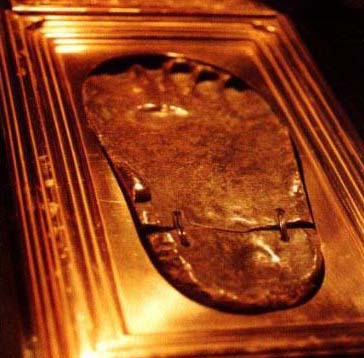
I later learned that the decorations of the feet of Buddha statues are actually a reflection – almost literally – of a much older iconography for depicting the Buddha, that of his footprint. Before anyone made statues of the Buddha, they made his footprints. They were a powerful way to remind the faithful that the Buddha had been present on earth: “the Buddha passed this way”. Quite quickly, the footprints were decorated with some of the symbols used to identify the Buddha. For instance, this footprint of the Buddha made in the 1st Century AD in the kingdom of Gandhara, in what is now the Swat valley in Pakistan, carries the Darmachakra, the “wheel of law”, and the triratna, the “triple gem” of Buddhism: Buddha (the Enlightened One), Dharma (the Teaching), and Sangha (the Community).

Buddha-Footprint

As time went on, more and more symbols were squeezed onto the footprints. And then some bright spark came up with the “positive print”, as it were, where the soles of reclining Buddhas carry the symbols of the Buddha.

Buddhism is not the only religion that has used footprints of its religious leaders as iconography, although it surely has used them more than any other (there is an estimate of 3,000 Buddha footprints throughout the Buddhist lands). My wife and I came across a footprint of the Prophet Muhammad in the Topkapi museum in Istanbul

Muhammad footprint

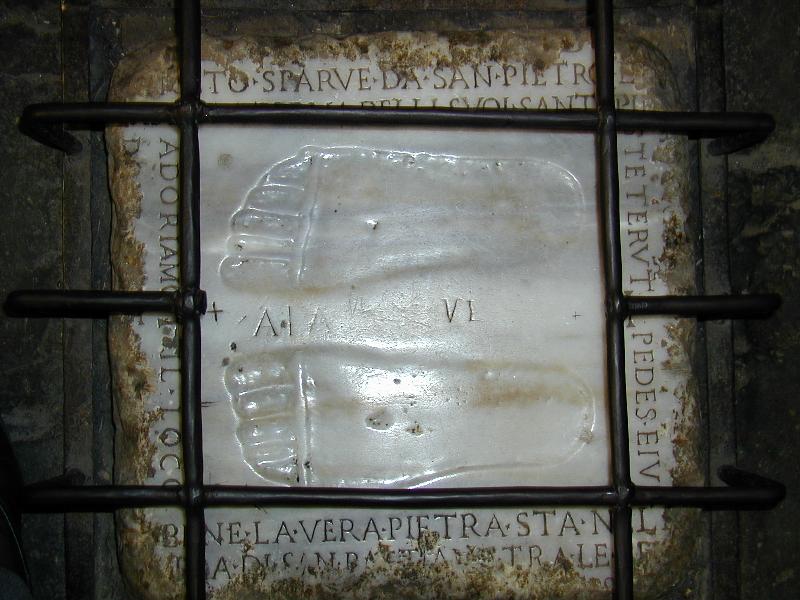
and there is a pair of footprints of Jesus in the Church of Domine Quo Vadis (“Lord, where are you going?”) on the outskirts of Rome.

jesus footprint

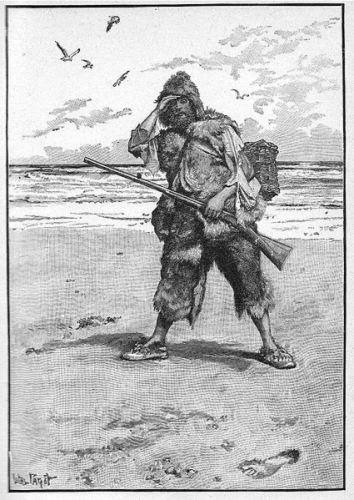
It is true to say that footprints are an incredibly powerful symbol of someone passing, of having been close by. One of the best remembered stories in Robinson Crusoe is of his finding a footprint on the beach.

crusoe and footprint

“It happened, one day about noon going towards my boat, I was exceedingly surprised, with the print of a man’s naked foot on the shore, which was very plain to be seen in the sand. I stood like one thunder-struck, or as if I had seen an apparition; I listened, I looked round me, I could hear nothing, nor see anything; I went up to a rising ground to look farther; I went up the shore and down the shore, but it was all one, I could see no other impression but that one. I went to it again to see if there were any more, and to observe if it might not be my fancy; but there was no room for that, for there was exactly the very print of a foot, toes, heel, and every part of a foot; how it came thither I knew not, nor could in the least imagine. But after innumerable fluttering thoughts, like a man perfectly confused and out of myself, I came home to my fortification, not feeling, as we say, the ground I went on, but terrified to the last degree, looking behind me at every two or three steps, mistaking every bush and tree, and fancying every stump at a distance to be a man.”

That footprint struck fear in Robinson Crusoe, fear of the unknown, fear of attack, fear of savagery. But I get a thrill when I see the footprints that some 15 people left 2,000 years ago in the ash and mud on the shore of Lake Managua in Nicaragua.

nicaragua footprints

I get goose bumps on seeing the footprints left 1.5 million years ago by Homo erectus near the village of Ileret in Northern Kenya on the eastern shore of Lake Turkana.

homo erectus ileret kenya

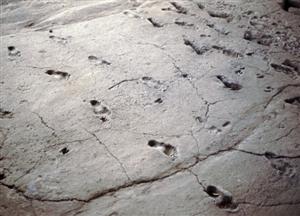
The hairs on my neck rise at the sight of footprints left 3.7 million years ago by three members of the species Australopithecus afarensis at Laetoli in Tanzania, which show that already then bipedalism, such a distinctive feature of our species, was in place.

laetoli footprints

I find these footprints a much more powerful reminder of the Family of Man than a piece of jawbone or a tooth. I can imagine my distant, distant ancestors going about their business, as I will go about mine today.

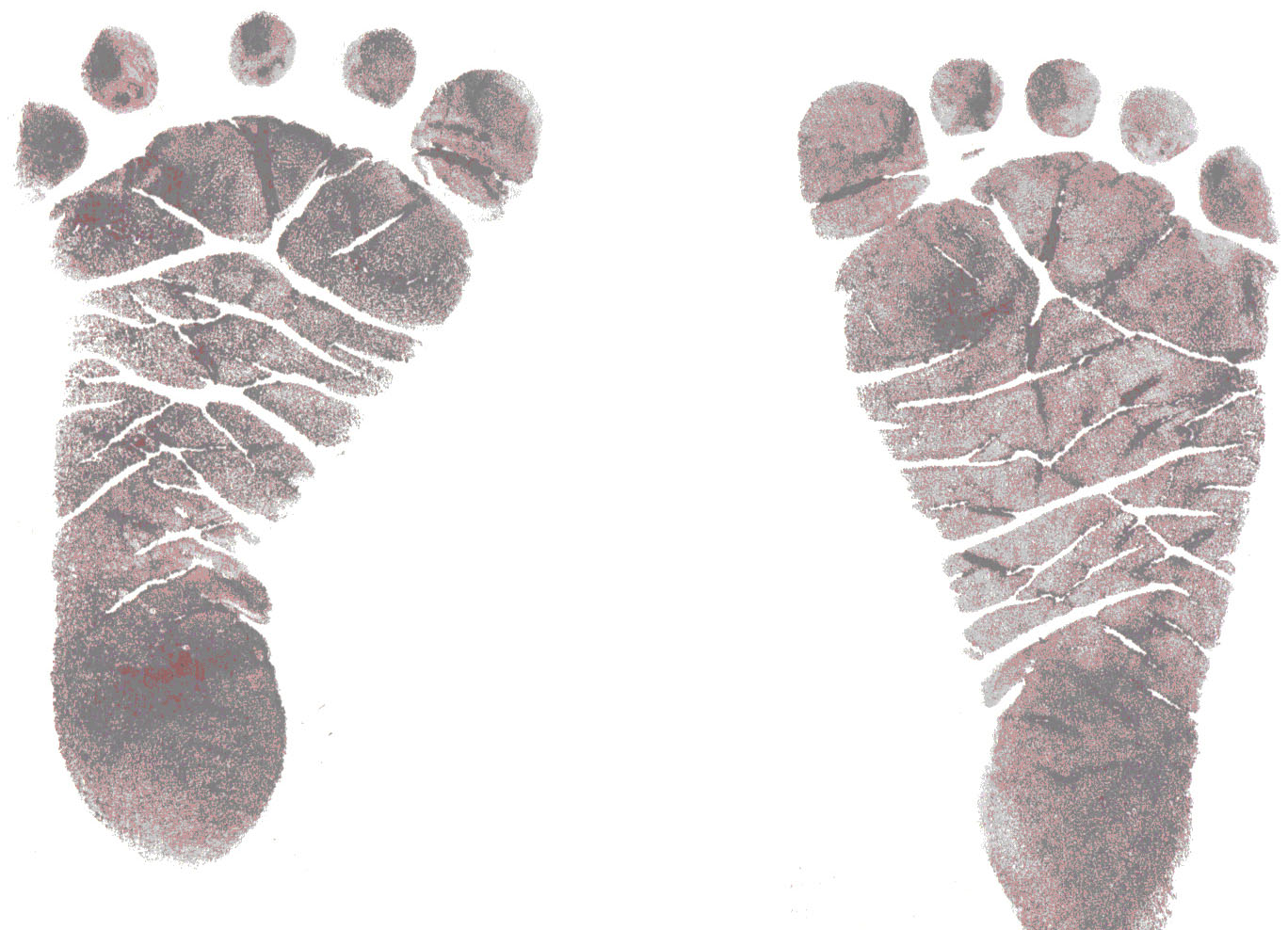
And within the much narrower circuit of my family, my wife and I have two relics, which currently slumber with all our stuff in a warehouse in Vienna but which we will keep preciously until the end of our lives. These are the footprints which the hospital gave us of our children’s feet, made just after they were born; they look like this

newborn footprints

They will forever remind us of the great joy which we experienced when our two children entered our lives and for a few decades walked with us before taking their own path in life.

___________

Reclining Buddha, Wat Pho, Bangkok: https://upload.wikimedia.org/wikipedia/commons/thumb/8/8d/Bangkok_Wat_Pho_reclining_Buddha.jpg/280px-Bangkok_Wat_Pho_reclining_Buddha.jpg (in https://en.wikipedia.org/wiki/Wat_Pho)
Reclining Buddha’s feet: http://s4.perpetualexplorer.com/wp-content/uploads/2013/03/wat_pho.jpg (in http://perpetualexplorer.com/2013/03/03/buddhist-temples/)
Reclining Buddha, Chaukhtatgyi Paya, Yangon: http://www.heybrian.com/lib/images/travels/myanmar/yangon_reclining_buddha_feet.jpg (in http://www.heybrian.com/travels/myanmar/)
Buddha footprint, 1st century, Gandhāra: https://upload.wikimedia.org/wikipedia/commons/7/73/Buddha-Footprint.jpeg (in https://en.wikipedia.org/wiki/Buddha_footprint)
Muhammad footprint, Istanbul: http://www.usna.edu/Users/humss/bwheeler/images/footistanbul.jpg (in http://www.usna.edu/Users/humss/bwheeler/footprints_pm.html)
Jesus footprints, church of Domine Quo Vadis: https://upload.wikimedia.org/wikipedia/commons/b/b1/I_piedi_del_quo_vadis.jpg (in https://en.wikipedia.org/wiki/Church_of_Domine_Quo_Vadis)
Crusoe and the footprint: http://www.bookdrum.com/images/books/92999_m.jpg (in http://www.bookdrum.com/books/the-graveyard-book/16401/bookmark/92998.html)
Nicaragua footprints: http://www.geog.cam.ac.uk/research/projects/eruptions/figures/thumbnails/05_11.jpg (in http://www.geog.cam.ac.uk/research/projects/eruptions/figures.html)
Homo erectus Ileret Kenya: https://nutcrakerman.files.wordpress.com/2014/10/ileret.jpg (in http://nutcrackerman.com/2014/10/14/the-oldest-human-footprints-by-continent/comment-page-1/)
Hominid footprints, Laetoli: http://auth.mhhe.com/socscience/anthropology/image-bank/kottak/chap07/kot37055_0705ta.jpg (in http://auth.mhhe.com/socscience/anthropology/image-bank/kottak/chap07/image7.htm)
Newborn footprints: http://semma.com/Joey/images/Joey/Joey%27s%20Footprints.jpg (in http://semma.com/Joey/photo2.html)

A PAPAL ENCYCLICAL

Bangkok, 2 July 2015

There’s been quite a bit of brouhaha in the press about the new Encyclical which Pope Francis brought out on 18 June, with the title “Laudato Si’: On Care for Our Common Home”. Normally, I would just read what the press has to say and move on. Although I come out of the Catholic tradition, I fell off the Straight- and-Narrow decades ago and it never occurred to me to read any of the Encyclicals brought out by Paul VI or John-Paul II, and certainly none by Benedict XVI, who always struck me as a complete dinosaur. I remember my father reading the Encyclicals, in the original Latin no less (his was probably the last generation of Europeans who were given a serious education in classics; he read Latin and Greek at University). But me, no way, I wasn’t going to read these letters by old, white, celibate men, most of whose views were diametrically opposite mine.

But this Encyclical was different. It was about avoiding a planetary ecological disaster, brought about by climate change and other environmental catastrophes, something which I’ve been wrestling with all my professional life. And it was different from the kind of work I do, which is technical and scientific. It was bringing ethics to bear on the problem, which have been sadly lacking. So I decided that it was time for me to try this rather special form of literature.

Here’s how the Encyclical starts:

  1. “Laudato si’, mi’ Signore” – “Praise be to you, my Lord”. In the words of this beautiful canticle, Saint Francis of Assisi reminds us that our common home is like a sister with whom we share our life and a beautiful mother who opens her arms to embrace us. “Praise be to you, my Lord, through our Sister, Mother Earth, who sustains and governs us, and who produces various fruit with coloured flowers and herbs”.
  2. This sister now cries out to us because of the harm we have inflicted on her by our irresponsible use and abuse of the goods with which God has endowed her. We have come to see ourselves as her lords and masters, entitled to plunder her at will. The violence present in our hearts, wounded by sin, is also reflected in the symptoms of sickness evident in the soil, in the water, in the air and in all forms of life. This is why the earth herself, burdened and laid waste, is among the most abandoned and maltreated of our poor; she “groans in travail” (Rom 8:22). We have forgotten that we ourselves are dust of the earth (cf. Gen 2:7); our very bodies are made up of her elements, we breathe her air and we receive life and refreshment from her waters.

Whoa! Stirring words, pretty different from the stuff I normally read. Thoroughly intrigued, I settled down to read the whole document, all 246 paragraphs of it. Allow me to rapidly summarize its contents for any of my readers who might be too busy or distracted by other things to read it (by the way, the Encyclical has a message for them: “true wisdom, as the fruit of self-examination, dialogue and generous encounter between persons, is not acquired by a mere accumulation of data which eventually leads to overload and confusion, a sort of mental pollution”).

After a review of the state of the planetary environment, whose conclusion can be summed up in this other punchy quote, “the earth, our home, is beginning to look more and more like an immense pile of filth”, the Pope reminds us that our inability to look after our Earth is reflected in our inability to look after our poor: “we should be particularly indignant at the enormous inequalities in our midst, whereby we continue to tolerate some considering themselves more worthy than others. We fail to see that some are mired in desperate and degrading poverty, with no way out, while others have not the faintest idea of what to do with their possessions, vainly showing off their supposed superiority and leaving behind them so much waste which, if it were the case everywhere, would destroy the planet”, to conclude that “a true ecological approach always becomes a social approach; it must integrate questions of justice in debates on the environment, so as to hear both the cry of the earth and the cry of the poor.”

His main conclusion is that both the environmental ills of the planet as well as the ills which bedevil our societies have their roots in excessive consumption by the better-off amongst us.

  • “We all know that it is not possible to sustain the present level of consumption in developed countries and wealthier sectors of society, where the habit of wasting and discarding has reached unprecedented levels.”
  • “To blame population growth instead of extreme and selective consumerism on the part of some, is one way of refusing to face the issues. It is an attempt to legitimize the present model of distribution, where a minority believes that it has the right to consume in a way which can never be universalized, since the planet could not even contain the waste products of such consumption.”
  • “… poor countries … need to acknowledge the scandalous level of consumption in some privileged sectors of their population and to combat corruption more effectively.”
  • “We may well be leaving to coming generations debris, desolation and filth. The pace of consumption, waste and environmental change has so stretched the planet’s capacity that our contemporary lifestyle, unsustainable as it is, can only precipitate catastrophes, such as those which even now periodically occur in different areas of the world.”
  • “.. given the insatiable and irresponsible growth produced over many decades, we need also to think of containing growth by setting some reasonable limits and even retracing our steps before it is too late.”
  • “… a world of exacerbated consumption is at the same time a world which mistreats life in all its forms.”

All music to my ears! For ten years now, I’ve seen that excessive consumption is the key to all our most intractable environmental problems and have been wrestling with what to do about it. We have to do something to reduce the levels of consumption in the richest countries, or more specifically among the world’s richest people (because as the Pope pointed out even the poor countries have hideously rich people).

But to have this happen is a huge, huge political problem. To explain why, let me borrow a photo or two from the photographer Peter Menzel and others who have copied him. Mr. Menzel went around the world photographing families outside their homes with all their stuff piled up around them (anyone wanting to see the whole series should dip into his book “Material World: A Global Family Portrait”). His idea proved so popular that others copied him. This photo, which is of a family in Inner Mongolia
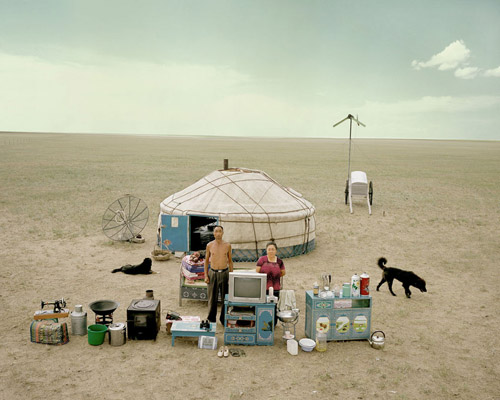
inner mongolian family

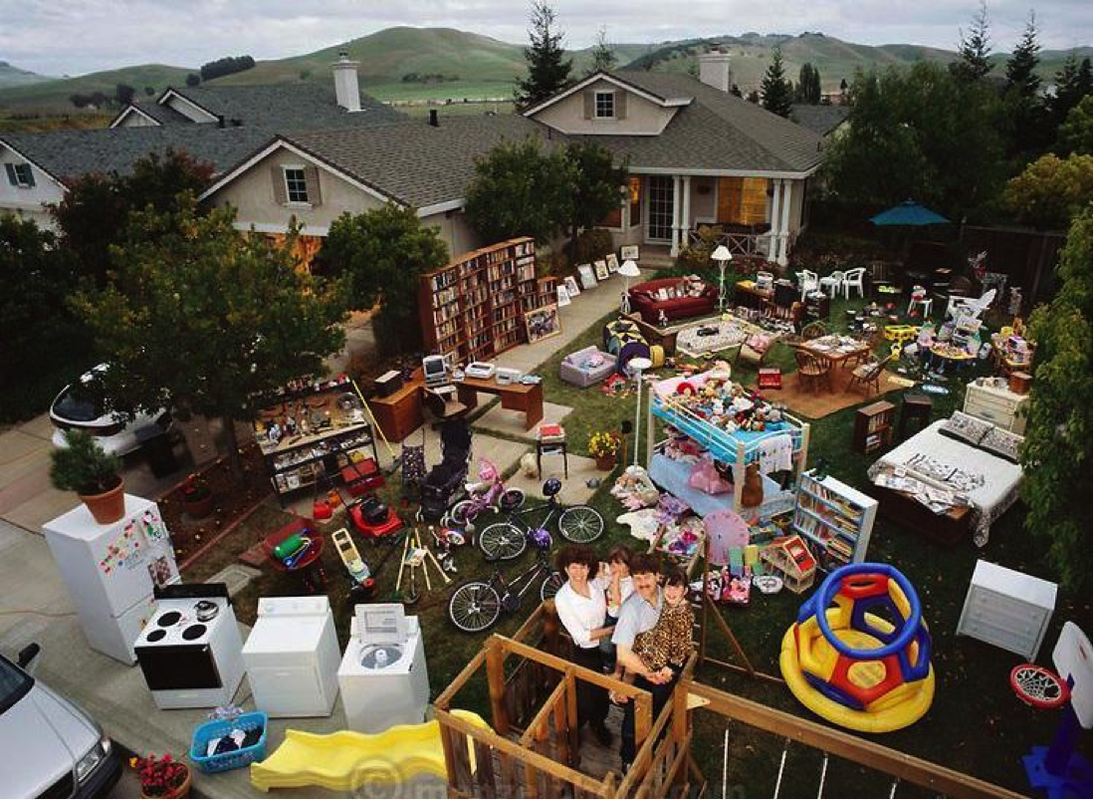
shows a level of stuff-ownership which is typical of millions, if not billions, of families around the world. These families want a materially better life. And why not? There is no reason they should not have it. But if the goal of every family in the world is to end up like this one
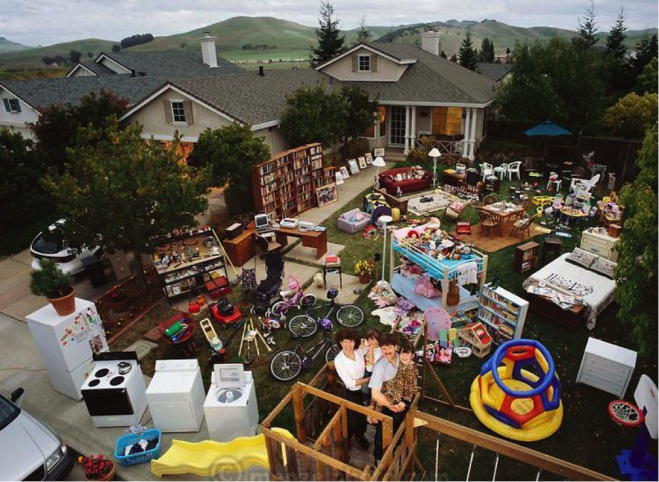
developed family

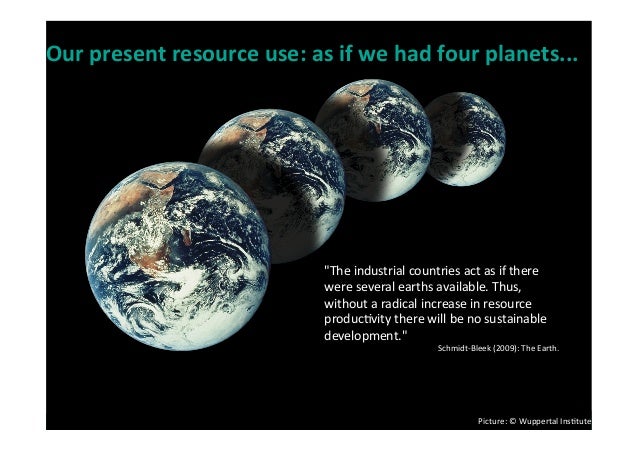
– well, it’s simply not possible, because a lifestyle like this for everyone requires a level of consumption of the world’s resources that would need 4 or more Earths to sustain
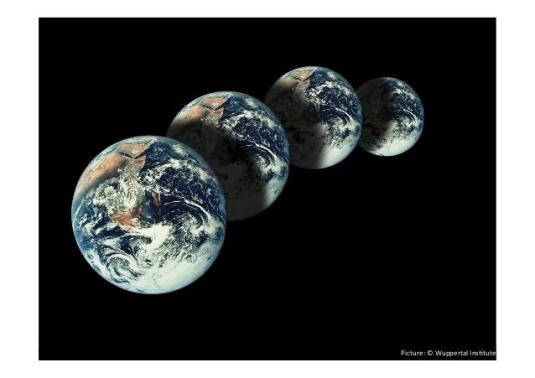
four planets

and, except for those of us who live in a parallel universe, we all know that there is but one planet.

But it’s also not possible to have a world where a few families can live like kings while everyone else has to live like the huddled masses or else the planet goes into meltdown. Somehow, those who currently are over-consuming have to accept to reduce their consumption.

What kind of material sacrifice would be required of these over-consumers? To answer this question, let me use myself as an example. A little while back, curious to see how large my personal environmental footprint might be, I used a footprint calculator offered by the Environmental Protection Agency of the State of Victoria in Australia (there are a number of such calculators on-line; I chose this one because it’s easy to use and I reckon that Southern Australia’s climate is quite similar to Italy’s where I intend to retire – I couldn’t find a good Italian footprint calculator). With an eye to my upcoming retirement, I entered data for myself and my wife on our eating habits, on the home we will live in, and the modes of transport we will be using. To put it in a nutshell, the two of us will live in a 120 sq. metre apartment in an apartment block, whose electricity will partially come from renewable energy. We’ll be having several servings a day of dairy, eggs, fish, or meat products, and a quarter of the food that we’ll eat will be either processed, packaged, or imported. Since we’ll be recycling a lot we’ll throw away less than one 30 litre bin-bag of waste a week. We’ll be using a lot of public transportation, but we’ll still have a small car to potter around town a bit, while twice a year we’ll fly to see the kids in the States. I pushed the last button, and the answer came back … “If everyone lived like you, we would need 3.9 planets” Aarrgh!!!! I was one of those guys greedily overusing the Earth’s resources! I could NOT believe it! I had worked in the environmental field all my professional life, and yet here I was devouring the planet! O-M-G!!

Once the shock wore off, I started doing what scientists call sensitivity analysis: I changed my answers one at a time, to see which changes would give me the biggest reductions. That would give me a menu of changes to our lifestyles which we could adopt, with the goal of bringing that horrible figure of 3.9 down to 1.0 – I think it’s OK to have a lifestyle which, were everyone to have it, would use only 1 planet’s worth of resources.

I won’t weary my readers with a full summary of the results, let me just give the highlights. The biggest reduction in my levels of planetary destruction comes from changes in diet. Having only a few servings a week of dairy, eggs, fish, or meat products, instead of several a day, cuts 1 full planet out of my footprint. That’s great, I knew that meat-eating especially is terribly harmful to the environment. I think we can switch to a strongly vegetarian diet without too much difficulty.

So that’s already 1.0 planet’s worth of reduction.

The other big reduction, though, 1.1 planets’ worth, comes from basically cutting out air travel. No, no, this is not possible, we cannot stop visiting our children! And we can’t just tell the kids to come instead, that would be foisting onto them part of our footprint! What to do? I suppose we could cut our trips to once a year … Alright, let’s say that, so that’s half a planet’s worth of reduction.

That gives us a running total of 1.5 planets’ worth of reduction.

The next biggest reduction, 0.7 planet’s worth, would come if we switched from living in a multi-storey apartment building to a free-standing house without running water. OK, we’re not going to cut off our water, but my take-away here is that saving water has a significant impact on the size of my footprint. We can’t stop drinking, but we’ll ruthlessly chop at our three other big water uses, hot showers, clothes washing, and toilet flushing. We’ll simply shower less, wash our clothes less often, and (ugh!) flush less often. Let’s clock that in at 0.35 planet’s worth.

So, the running total is now 1.85 planets’ worth of reduction.

Next on my list is to switch to a green design residence, which would give me half a planet’s worth of reduction. Well, we can’t change apartments at this point. But we can do things to make the apartment more energy efficient: compact fluorescent bulbs (although they will look totally hideous in the chandelier we have in the living room), double-glazed windows everywhere (more costs …), if possible more insulation on that wall in our bedroom, … I don’t know, there must be other things we can do. Let’s just assume that there are and clock this in at 0.25 planet’s worth.

That gives me a running total of 2.1 planets’ worth of reduction.

What else?

Well, next on the list is simply to cut off the electricity to the apartment, which would give me another half a planet’s worth of reduction. Well, that ain’t gonna happen … But we could reduce our consumption of electricity. The CFLs I’ve already decided to install will help here, as will the reductions in the use of the washing machine. We can mostly wash our dishes by hand, which will reduce the use of the dishwasher (which will also help reduce water use). We could unplug all those gadgets with pilot lights so they aren’t on all the time. I promise not to leave the lights on after leaving a room (a bad habit I have). We could climb the stairs rather than use the elevator (which will be good exercise anyway). I don’t know if they offer this in Italy, but if they do I could ask to have all my electricity booked as coming from renewable energy…. OK, let’s assume 0.25 planet’s worth for all this.

Running total: 2.35 planets’ worth of reduction.

I’m running out of options here, and I still need to chop 0.55 planet’s worth out of our lifestyle!

OK, we can switch to riding bicycles around town and walking even more, so as to reduce our use of public transportation (I have us hardly using a car). Maybe we could squeeze another 0.2 planet’s worth out of our lifestyle in this way.

Running total: 2.55 planets’ worth of reduction.

Let me see, what else? … I’m really scraping the bottom of the barrel here … Well, we could have a third person come and live with us. I choose this option with extreme reluctance. One of the kids would be ideal, but they probably have no desire to come and live with their parents. And anyway, they would need a job in Italy, which in this economic climate is not at all a given. Maybe we could take in a student, preferably one who is studying environmental sciences and who would enthusiastically join in the hunt for things to do to reduce our footprint. One more person in the apartment would give us 0.3 planet’s worth of reduction.

That gives us a grand total of 2.85 planets’ worth of reduction, close enough to the goal of 2.9.

That was hard, really hard! I’m making big sacrifices here. I don’t think eating much more greens will be that bad, but not being able to see the children more than once a year, that will be tough. And having to share the apartment with a stranger does not fill me with joy at all.

And therein lies the huge political problem. This all sounds like an intense diet, and as we all know diets are not greeted with joy but with mournful suffering. Who wants to do them? We need to flip this, we need to make people like me feel happy as they merrily throw out of their lives the mountain of stuff that surrounds them.

This is where the rest of Pope Francis’s Encyclical comes in. In the case of Catholics, it’s easy. He’s telling them that it is their moral duty to change their lifestyles, and he strongly suggests this to other Christians too. But to the others amongst us who are not Christians? I can do no better than quote another chunk of text:

We need to take up an ancient lesson, found in different religious traditions and also in the Bible. It is the conviction that “less is more”. A constant flood of new consumer goods can baffle the heart and prevent us from cherishing each thing and each moment. To be serenely present to each reality, however small it may be, opens us to much greater horizons of understanding and personal fulfilment. Christian spirituality proposes a growth marked by moderation and the capacity to be happy with little. It is a return to that simplicity which allows us to stop and appreciate the small things, to be grateful for the opportunities which life affords us, to be spiritually detached from what we possess, and not to succumb to sadness for what we lack. This implies avoiding the dynamic of dominion and the mere accumulation of pleasures.

Such sobriety, when lived freely and consciously, is liberating. It is not a lesser life or one lived with less intensity. On the contrary, it is a way of living life to the full. In reality, those who enjoy more and live better each moment are those who have given up dipping here and there, always on the look-out for what they do not have. They experience what it means to appreciate each person and each thing, learning familiarity with the simplest things and how to enjoy them. So they are able to shed unsatisfied needs, reducing their obsessiveness and weariness. Even living on little, they can live a lot, above all when they cultivate other pleasures and find satisfaction in fraternal encounters, in service, in developing their gifts, in music and art, in contact with nature, in prayer. Happiness means knowing how to limit some needs which only diminish us, and being open to the many different possibilities which life can offer.

We need to start a huge campaign to persuade people of the rightness of the message “less is more”, and to have them actively wanting to drastically reduce their material needs, of feeling bad, almost sick, if they start accumulating too much. If we don’t change this basic mindset we are doomed. As the Encyclical so rightly says, there is no technical solution to climate change and other severe global environmental problems, there is only an ethical choice.

I hope this piece can be one small part of this campaign.

___________

Inner Mongolian family: http://fast.mediamatic.nl/f/sjnh/image/146/188097-500-400.jpg
Developed country family’s stuff: http://akkermanlc.weebly.com/uploads/1/2/7/5/12751216/4773841_orig.png (in http://akkermanlc.weebly.com/quality-of-life-project.html)
Four planets: http://image.slidesharecdn.com/foodinasustainablematerialfootprint-131011032957-phpapp01/95/food-in-sustainable-consumption-2-638.jpg?cb=1381463878 (in http://www.slideshare.net/lettenmeier/food-in-sustainable-consumption)
THE FLESH CRIES OUT

Bangkok, 21 June 2015

After years of bugging by our children, especially by our daughter, and after watching a couple of our friends Go the Way of All Flesh or nearly so, my wife and I have committed to a serious training regime. Twice a week, a personal trainer turns up at our apartment block, and in the very rudimentary gym which we have (it’s really just a common space where some exercise machines have been installed) he puts us through one hour of rigorous exercises. In addition, my wife goes to a gym every day for an hour, while I do (more or less, depending on my schedule) half an hour’s worth of exercises at home in the evening. We’ve been at it for three and a half months.

I don’t know, I feel that after a suitable period of shock at the beginning – we have, to be very, very frank, done bugger-all exercise for nigh on forty years – we should now be looking forward to going to our twice-weekly routine and feel happy after it
happy exercisers
perhaps not as blissfully happy as this couple, but at least somewhat satisfied.

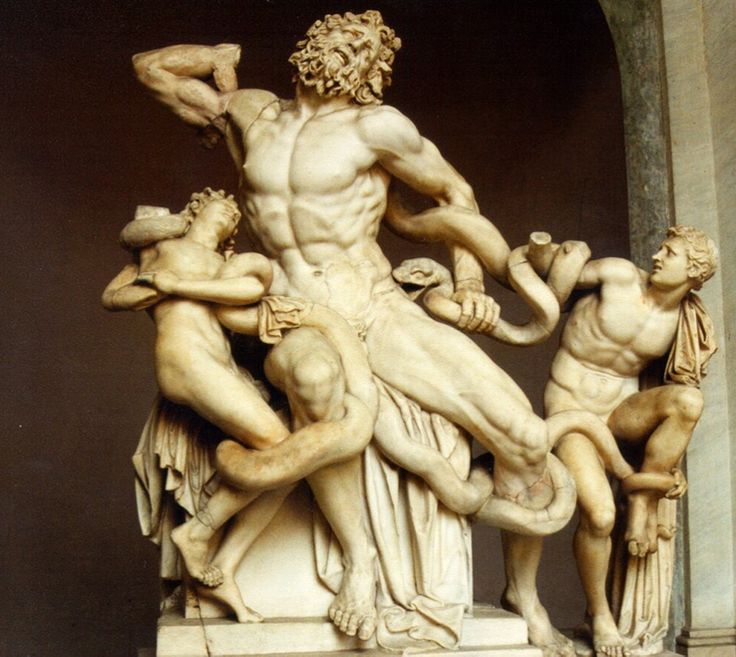
Yet it is not so. As we go down to the makeshift gym we feel like what those poor people in Singapore must feel like as they go to get 100 lashes for dropping chewing gum on the pavement or whatever, and the exercises themselves are still excruciating. We both feel like poor old Laocoön and his sons as we put our protesting bodies through the routines
laocoon
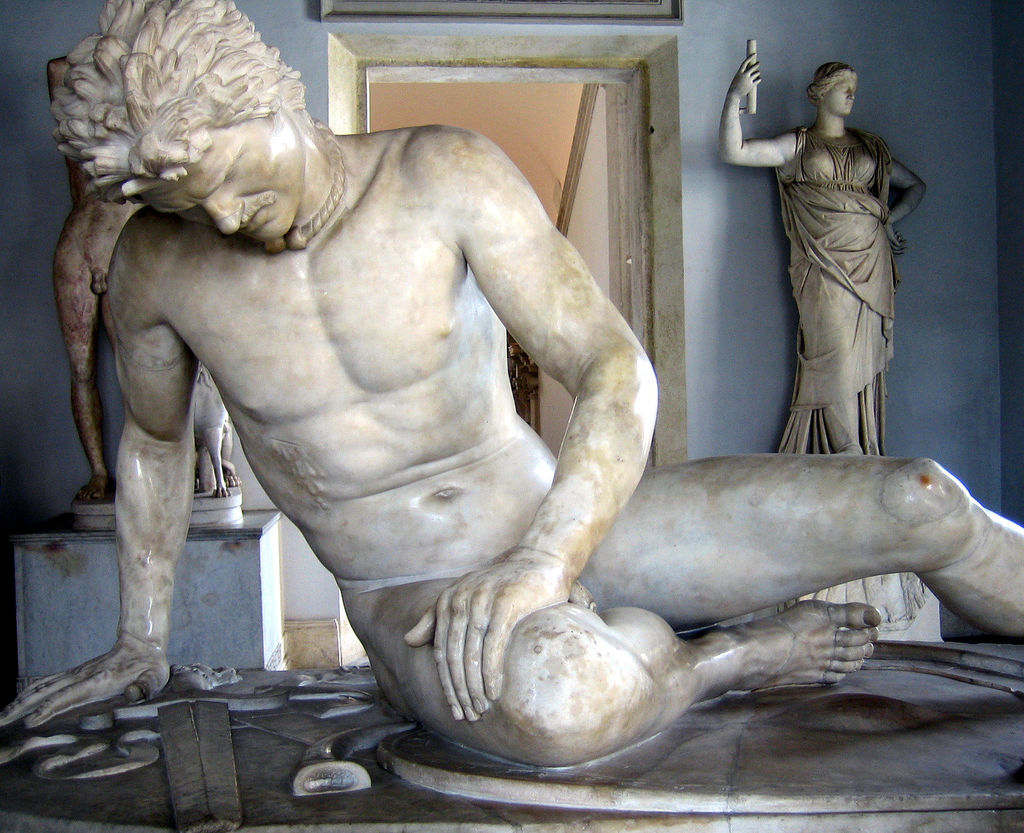
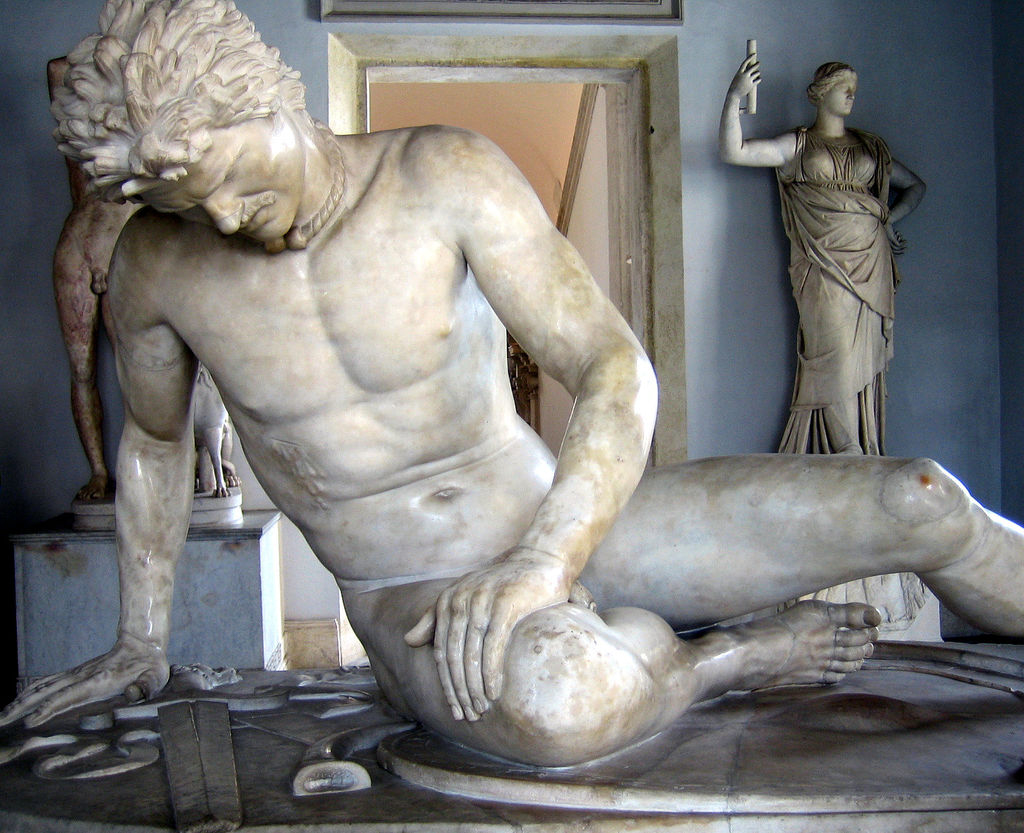
while when we try to get up from a floor exercise we both look and feel like this dying Gaul
Dying gaul
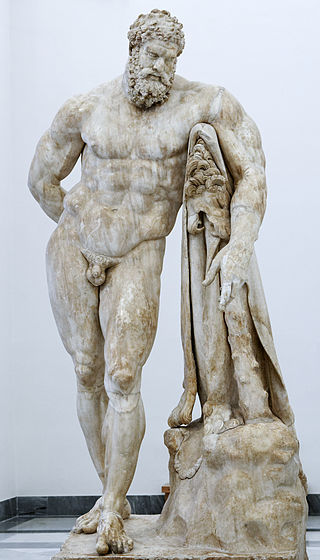
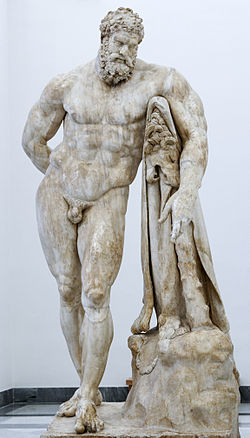
Understand me, I’m not hoping to look like Hercules by the end of all this
Herakles Farnese
Something like this would do me very nicely
God
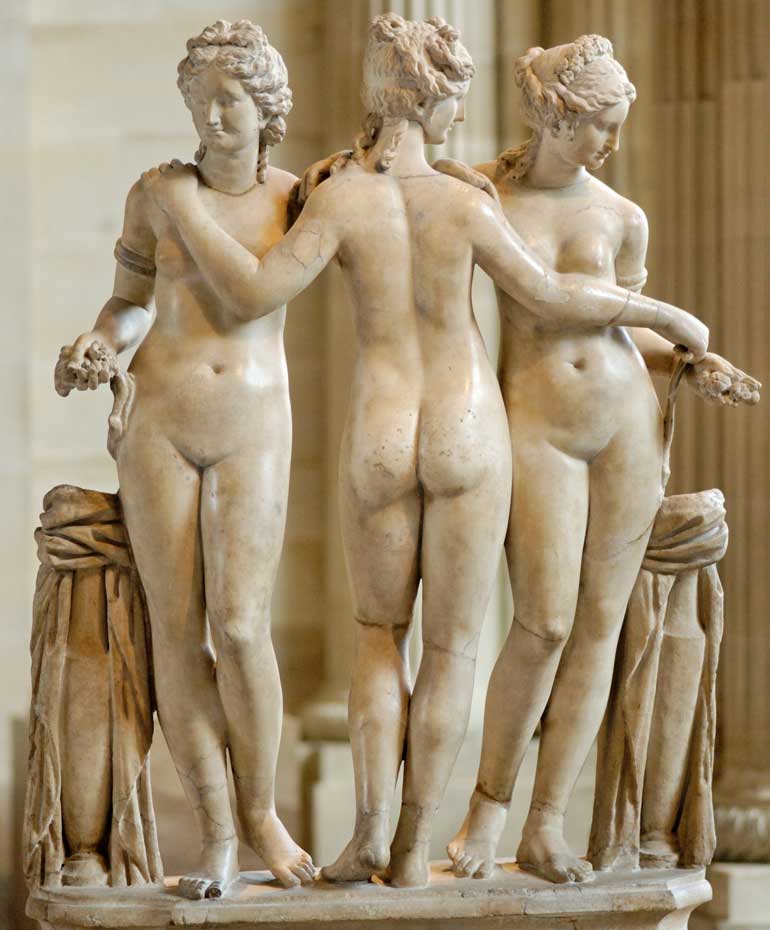
while my wife would be more than happy to end up looking like any of these three Graces
Three Graces
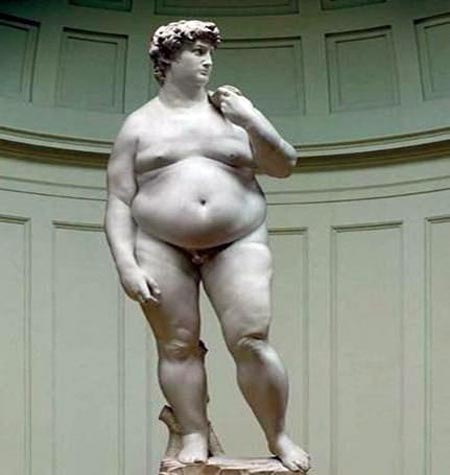
In fact, to be completely honest, I wouldn’t mind ending up looking like this as long as I was feeling good.
fat david
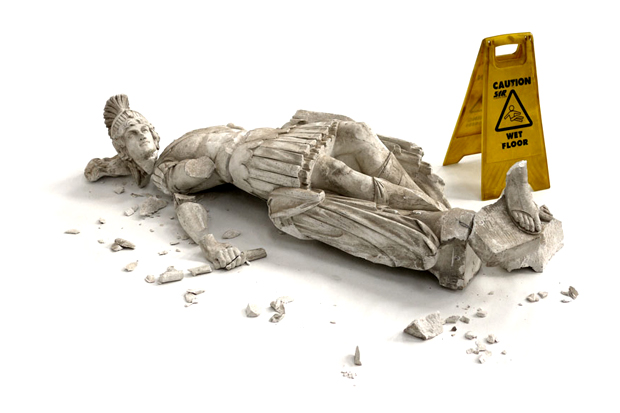
But I don’t feel good, I just feel like this at the end of the one hour
banksy-fallen-sculpture-1
and continue to feel like this for the rest of the day.

Will it ever be different?

_____________

Happy exercisers: https://experiencelife.com/wp-content/uploads/2011/11/Apr10_ExGorg1.jpg (in https://experiencelife.com/article/8-ways-exercise-makes-you-gorgeous/)
Laocoön: https://s-media-cache-ak0.pinimg.com/736x/bf/aa/24/bfaa2441e5e25a8ec7be0f9fb81db7dd.jpg (in https://www.pinterest.com/heotang/the-death/)
Dying Gaul: http://anadio.com/004b%20Ancient%20Greek%20sculpture%20web%20ss/resources/images/medium/Dying_gaul.jpg (in http://anadio.com/004b%20Ancient%20Greek%20sculpture%20web%20ss/index.html)
Herakles: https://upload.wikimedia.org/wikipedia/commons/thumb/a/ad/Herakles_Farnese_MAN_Napoli_Inv6001_n01.jpg/250px-Herakles_Farnese_MAN_Napoli_Inv6001_n01.jpg (in https://en.wikipedia.org/wiki/Farnese_Hercules)
God: http://cdn.theatlantic.com/static/mt/assets/culture_test/100ideasart_2.jpg (in http://www.theatlantic.com/entertainment/archive/2012/10/from-greek-sculpture-to-graffiti-100-ideas-that-changed-art/264165/)
Three Graces: http://www.mlahanas.de/Greeks/Mythology/Images/ThreeGracesLouvreMa287.jpg (in http://www.mlahanas.de/Greeks/Mythology/ThreeGracesLouvreMa287.html)
Fat David: http://www.clevelandseniors.com/images/funny/fat-david.jpg (in http://bellasvitas.blogspot.com/2011/03/michael-angelo-sculptures.html)
Broken sculpture: http://www.visualtherapyonline.com/wp-content/uploads/banksy-fallen-sculpture-1.jpg (in http://www.visualtherapyonline.com/?p=20403)

SNIFFING AT MY INHALER

Bangkok, 20 June 2015

The Thais are a handsome race, no doubt about it. They seem to be genetically predisposed to having a gracile body structure, which leads to a race of naturally slim and slender people. Of course, there are Thais who have had a hard life, especially in rural areas, and whose bodies and faces have been marked by it. And given the popularity of fast food and of snacking on processed foods, obesity is on the rise as it is everywhere in the world. But overall, the Thais are pleasing to the eye.
cool thai couple
So it is really very unfortunate that many Thais have this strange habit of going around with an inhaler up their nose, which obviously detracts from their natural comeliness.
women with inhalers
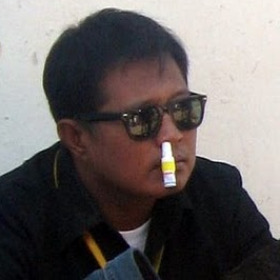
Normally you just see them holding the inhaler to the nose and sniffing away as if they were snorting cocaine or some other such substance, but in extreme cases they will jam the inhaler in their nostrils and walk about with it dangling from their noses.
man with inhaler in nose
man with inhaler in nose-2
(I have even heard of cases of Thais with two inhalers jammed up their noses! But perhaps this is an urban legend)

Quite why they do it is not clear to me. No doubt it has something to do with warding off noxious smells, which indeed can sometimes be a problem in Thailand where open drains are still the rule rather than the exception. But the street smells can be strong even in the absence of open drains: cooking smells, for instance, can be penetrating, which may explain this lady’s use of an inhaler
woman vendor with sniffing stick
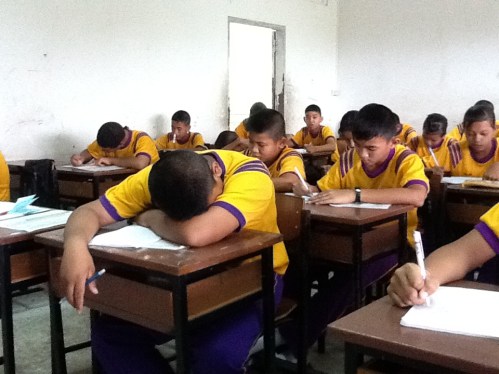
Or it could be a way of keeping alert when required, as this photo of an examination room suggests
https://theheartthrills.com/wp-content/uploads/2015/06/12926-photo2b1-721216.jpg
(the boy with the inhaler is towards the back left and is busily writing while the poor fellow in the front looks like he could do with an inhaler)

But various sites darkly suggest that one can become hooked and simply sniff for the artificial pleasure of it all. Bent on making a scientific examination of the issue, I purchased an inhaler at my local 7-11 – the cheapest, I’m not that dedicated –
image
and carried out a series of sniff tests …

… Ah yes! That eucalyptus smell that I remember soooo well from the Vicks inhalers that our mothers used to hand us young children when we had a cold
vicks inhaler
and which, together with Vicks vapo rub for our chests and Vicks cough drops for our scratchy throats were used by several generations of anxious mothers for their coughing and sniffling brood.
https://img1.etsystatic.com/047/2/9430690/il_570xN.668385061_prsm.jpg
Yes, yes, one or two sniffs and you could feel the stuffiness in your nose magically disappearing, and the late November fogs lifting – only for stuffiness and fog to reappear after a while – to be chased away again with another sniff or two – and so the cycle went on endlessly, until Spring arrived …

… But behind the astringent, aseptic quality of the eucalyptus there lies a softer smell of mint and peppermint … of the Polo mints of my youth!
https://i0.wp.com/oi55.tinypic.com/2cffhar.jpg
“the mint with the hole”, as the ad tag line had it
https://i0.wp.com/images.esellerpro.com/2486/I/514/4/polo-mints-postcard.jpg
a taste which has me instinctively grasping out at one of the mint sweets that hotels in this part of the world so thoughtfully place on the check-in counter for incoming guests.

Memories, memories … I suppose I could end up walking down Bangkok’s streets, dreamily sniffing on my inhaler, letting visions of my – really quite pleasant – life unfold before me. Is that what Thailand is, a nation of dreamers? Or are these inhalers just a modern version of the pomander, that ball made of perfumes held in a perforated case, which the rich of the European Middle Ages hung around their necks to ward off the frequent bad smells around them or in the pious hope that it would protect them against the plague?
pomander
I will let my gentle readers decide.

________________

Cool Thai couple: http://garbagelapsap.com/wp-content/uploads/2012/01/GARBAGELAPSAP_STREETSTYLE_BANGKOK_FASHION.jpg (in http://www.elarmarioaj.com/2013_04_01_archive.html)
Women with inhalers: https://jayinthailand.files.wordpress.com/2012/02/960f.jpeg (in https://jayinthailand.wordpress.com/)
Man with inhaler in nose: http://www.mymuaythai.com/wp-content/uploads/2010/01/inhaler.jpg?7503ae (in http://www.mymuaythai.com/archives/poy-sian-mark-ii/)
Man with inhaler in nose-2: http://pinoyajarn.com/blog/wp-content/uploads/2014/09/2-Vicks-Inhaler.png (in http://pinoyajarn.com/blog/category/living-in-thailand/)
Woman vendor with sniffing stick: https://c1.staticflickr.com/5/4048/4179283228_1a7755aca7_b.jpg (in https://www.flickr.com/photos/adrianbangkok/4179283228/)
Kid with inhaler in nose: https://theheartthrills.com/wp-content/uploads/2015/06/12926-photo2b1-721216.jpg (in http://nakhontuba.blogspot.com/2011_09_01_archive.html)
Inhaler: http://static07.st-sm.com/07SM/1813-thickbox_default/inhaler-nasal-siang-pure-2cc.jpg (in http://www.st-sm.com/07SM/en/pocket-inhaler/420-inhaler-nasal-siang-pure-2cc-8850109011412.html)
Vicks inhaler: https://s-media-cache-ak0.pinimg.com/736x/26/4c/26/264c2634676f95bb2998ba2b0f4b208e.jpg (in https://www.pinterest.com/lhollifield123/the-doctor-said/)
Vicks ad: https://img1.etsystatic.com/047/2/9430690/il_570xN.668385061_prsm.jpg (in https://www.etsy.com/listing/207428148/1945-vicks-vaporub-ad-vicks-inhaler)
Polo sweets: http://oi55.tinypic.com/2cffhar.jpg (in http://tinypic.com/view.php?pic=2cffhar&s=7#.VYTky1Ipq-t)
Polo mint ad: http://images.esellerpro.com/2486/I/514/4/polo-mints-postcard.jpg (in http://www.ebay.co.uk/itm/NEW-POLO-MINTS-POSTCARD-RETRO-VINTAGE-OPIE-OFFICIAL-IMAGE-MINT-WITH-THE-HOLE-/281202056658)
Pomander: http://www.1st-art-gallery.com/thumbnail/342661/1/Portrait-Of-Jan-Gerritz.-Van-Egmond-Van-De-Dijenborgh,-Bust-Length-Wearing-A-Black-Fur-Trimmed-Coat,-Holding-A-Pomander,-Seen-Within-An-Arched-Decorated-Embrasure,-A-Landscape-Beyond.jpg (in http://eighteenthcenturylit.pbworks.com/w/page/70599154/Smelling%20Salts)

TIME DILATION

Bangkok, 14 June 2015

Who hasn’t heard of the theory of relativity? I mean, everyone has, right? Apart maybe from some Amazonian tribes who’ve only just been discovered.

uncontacted tribe

And of course everyone has heard of Albert Einstein, who came up with the theory in the first place.

Albert-Einstein-Tongue

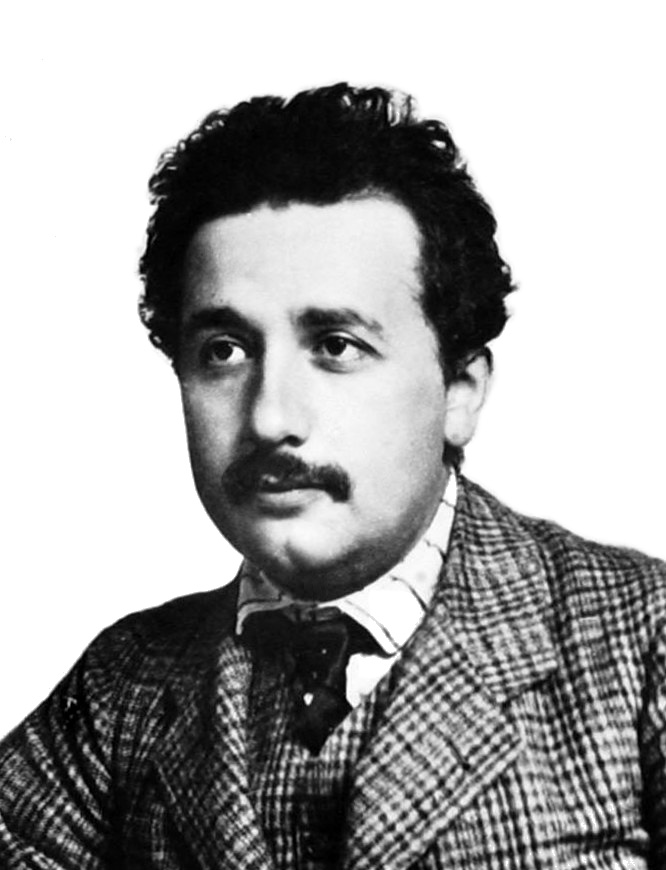
OK, this photo may suggest that Einstein was not a very serious fellow, so let’s throw in a more solemn photo of him, taken a year before he published the special theory of relativity in 1905.

Einstein_young

(as we all undoubtedly know, this is the first of two theories of relativity; Albert published the general theory of relativity in 1916).

1905, by the way, was Einstein’s annus mirabilis. His paper on the special theory of relativity was one of four seminal papers he published that year in the highly respected Annalen der Physik; the other three were on the photoelectric effect, on Brownian motion, and on mass-energy equivalence (you know, E=mc2, that one). He was one hell of clever guy, no doubt about it. No wonder he got the Nobel prize! Should have got two, if you ask me.

Anyhoo, the special theory of relativity, known as STR to conoscenti like me, has two very interesting predictions: the faster you go, the smaller you get and the slower time passes. So you get squeezed tighter and tighter slower and slower. And the amazing thing is, you wouldn’t notice you’re getting all squished and that your Rolex is running slower! To you, everything looks completely normal. Like I said, Einstein was a pretty amazing guy.

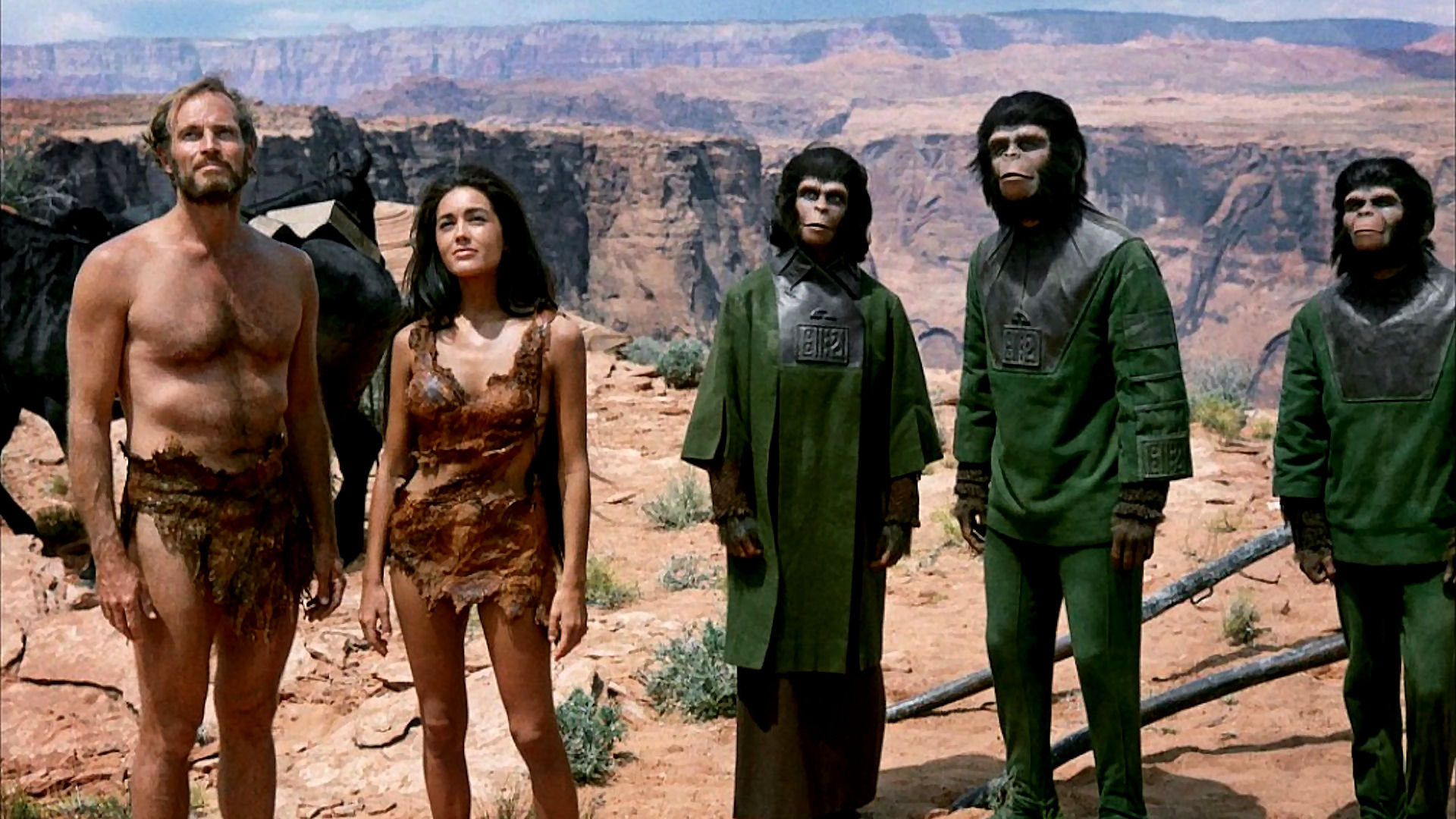
Well, of course science fiction writers latched onto the second of these predictions – so-called time dilation to conoscenti like me – like that leach latched onto my leg many decades ago. For instance, they have imagined some poor married astronaut going off on an interstellar journey, travelling at near the speed of light for a couple of years and then coming back, also at near the speed of light, TO FIND HIS WIFE AN OLD CRONE! At his super speed, he has only aged a few years, but his wife, traveling at the Earth’s much slower pace, has aged decades. Amazing thought, no? This plot line was the basis of the original “Planet of the Apes” movie of 1968 (no doubt only old fuddy-duddies like me even remember that there was such a movie). The astronaut hero, Charlton Heston, has been on super-fast intergalactic travel and crashes onto a planet, which he discovers is run by apes.

heston and the apes

Only at the end of the movie, after many super exciting adventures, does he realize that the planet is actually Earth, hundreds of years after he had left it.

heston and statue of liberty

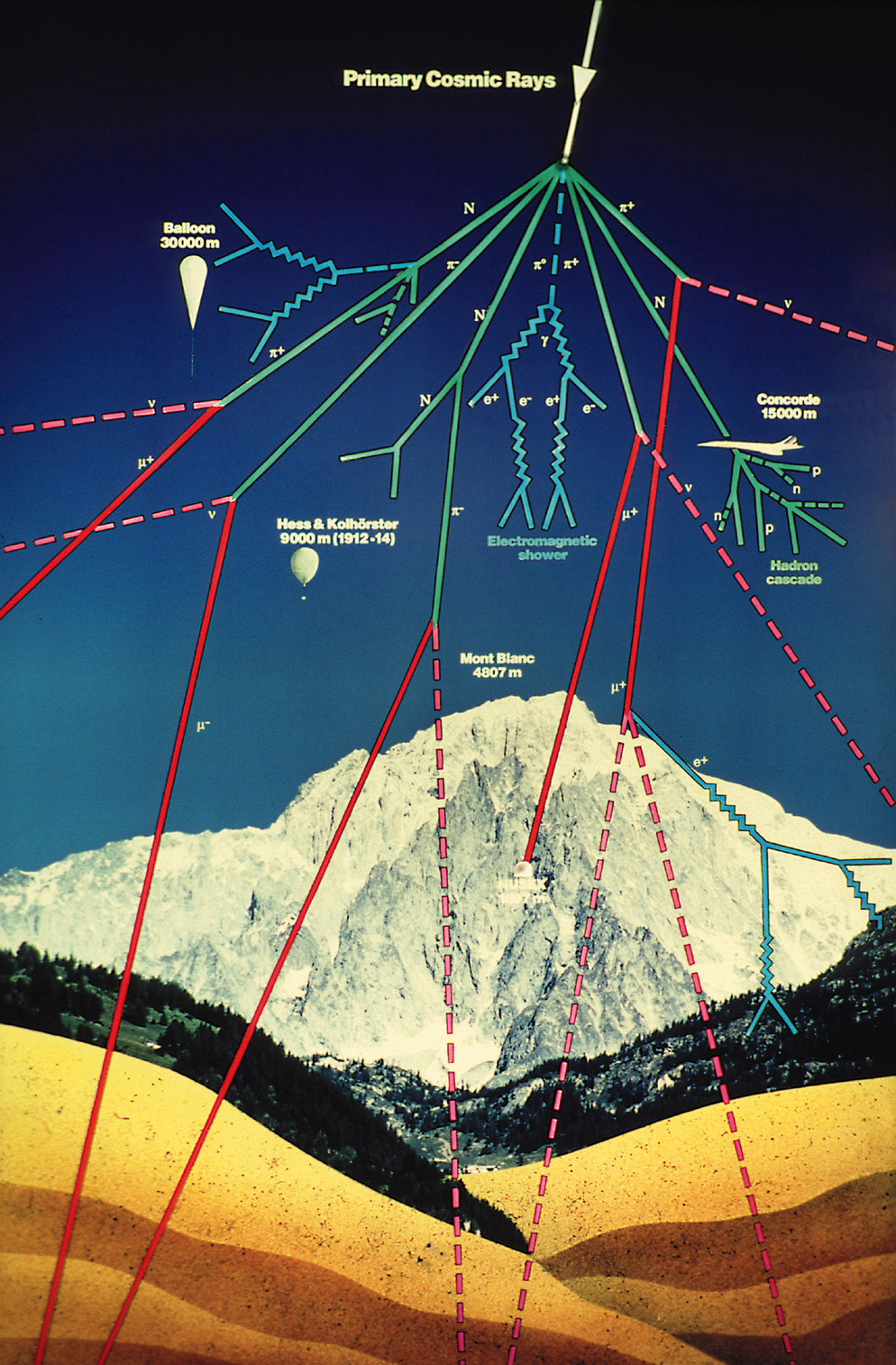
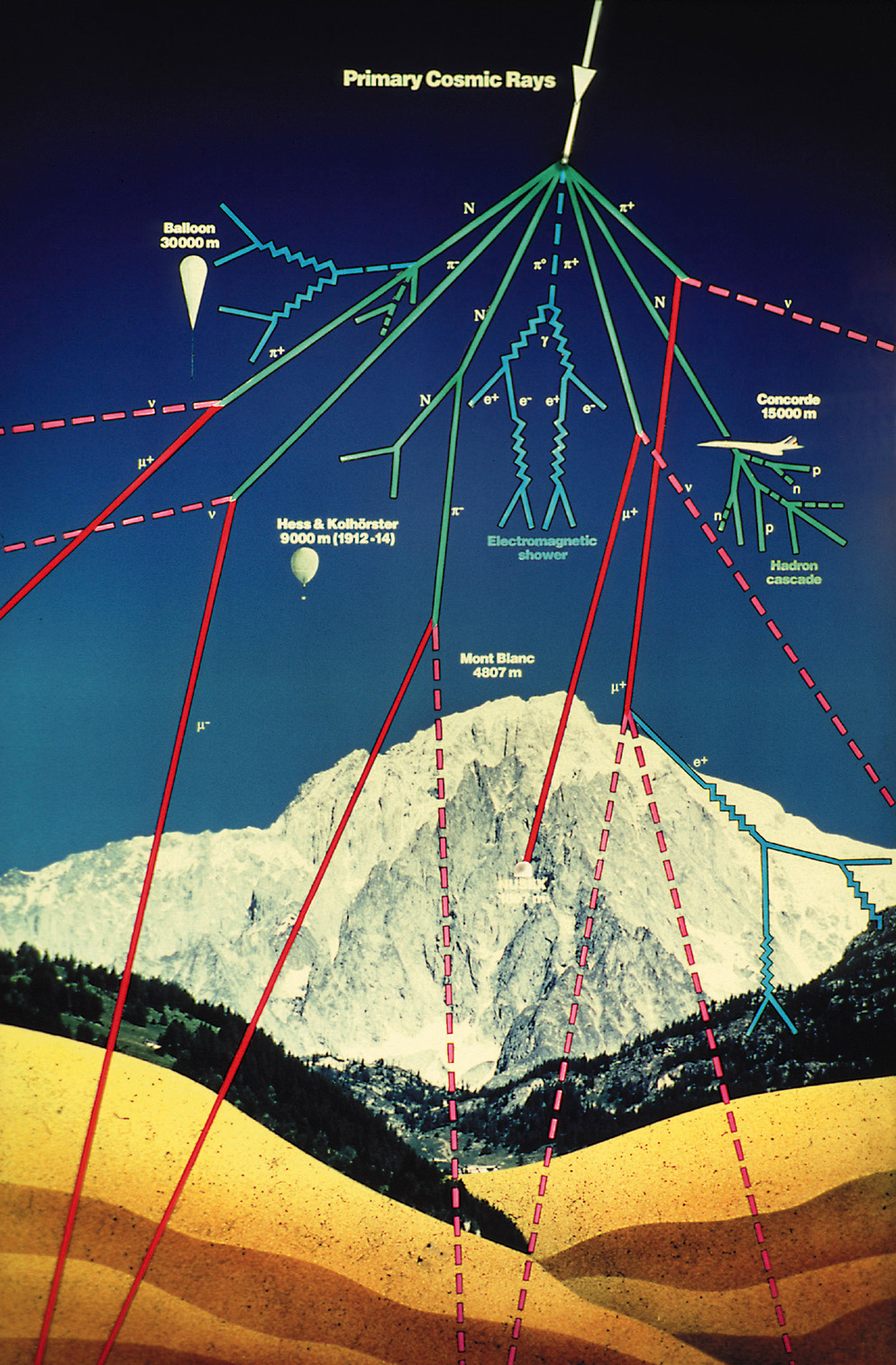
In the real world, it took a while for clever scientists to design experiments to test Einstein’s predictions. Time dilation was only proved for the first time in 1938, by two fellows at Harvard. To be honest, their experiment was so clever that I don’t understand it. I understand much better an experiment carried out down the road, at MIT, in 1963, which involved measuring the number of muons whizzing by at the top of Mt. Washington in New Hampshire and the amount whizzing into MIT’s campus. You see, as muons rain down from the outer layers of the atmosphere, where they are created, they decay, like uranium atoms, and clever scientists know the speed with which they decay.

muons

So if you measure the muon whizz-by rate at the top of the mountain as well as the number of muons so whizzing, and if you know the muon decay rate as well as the difference in height between Mt. Washington and the MIT campus, then you can calculate how many muons should have decayed away before reaching said campus, and you can compare that to the actual number you measure whizzing into your lab on campus. And you would find many more arriving than you calculated! BUT, if you now went back to the blackboard

blackboard-2

(or whiteboard in this day and age) and factored in Einstein’s time dilation effects, then the difference between what you calculated and what you measured would pretty much disappear. Because, you see, while you, the clever scientist in your MIT lab, was saying “well, it should take one millisecond for a muon to go from the height of Mt. Washington to the height of my lab”, the muon, speeding along at something near the speed of light, would glance at its Rolex and say “hang on a millisec, it only took me one microsecond to get here, so I ain’t decayed yet.” Clever, no?

Of course, all these experiments cost a lot of money. I have just discovered a much cheaper experiment proving the time dilation effect, although admittedly it takes a good deal longer to carry out. It came to me in a flash a few days ago. I saw a shop, which proudly proclaimed that it had been established in 1975. “Pah!”, I said “that’s just yesterday”. But then I thought, “Hang on. If in 1975 I had seen a shop proclaiming that it had been established in 1935, I would have said, ‘Wow, that’s a long time ago!'”. Which proves time dilation incontrovertibly: as each of us moves faster and faster through life towards the grave, time past seems to go by slower and slower. QED, as Einstein would have said in his heavy German accent.

I wonder if I can get this proof published in Nature?

_______________

Uncontacted tribe: http://b.vimeocdn.com/ts/125/234/125234174_640.jpg (in http://all-that-is-interesting.com/last-uncontacted-tribes)
Einstein with tongue out: http://theartmad.com/wp-content/uploads/2015/04/Albert-Einstein-Tongue-Wallpaper-4.jpg (in http://theartmad.com/wallpapers-of-albert-einstein/albert-einstein-tongue-wallpaper-4/)
Young Einstein: http://blogs.esa.int/atv/files/2013/07/Einstein_patentoffice.jpg (in http://blogs.esa.int/atv/2013/07/04/atv-made-in-switzerland-2/einstein_patentoffice/)
Heston and the apes: https://aworldoffilm.files.wordpress.com/2014/04/u4s4b3xrz5gohwzo2knedqil7bf.jpg (in http://aworldoffilm.com/2014/04/02/planet-of-the-apes-franklin-j-shaffner-1968-niall-mcardle/)
Heston and the statue of liberty: http://25fps.cz/wp-content/uploads/2011/08/www.monstermagazineworld.blogspot.complanetaopic1.jpg (inhttp://25fps.cz/2011/alec-charles-cz/)
Muons: http://www.physi.uni-heidelberg.de/Einrichtungen/FP/anleitungen/F13/jpg/cosmics.jpg (in http://www.science20.com/quantum_diaries_survivor/muon_tomography_who_leading_research)
Blackboard: http://alphanumericjournal.com/wp-content/uploads/2015/01/mathematics-chalkboards_003104581.jpg (in http://alphanumericjournal.com/)

FADO

Bangkok, 11 June 2015

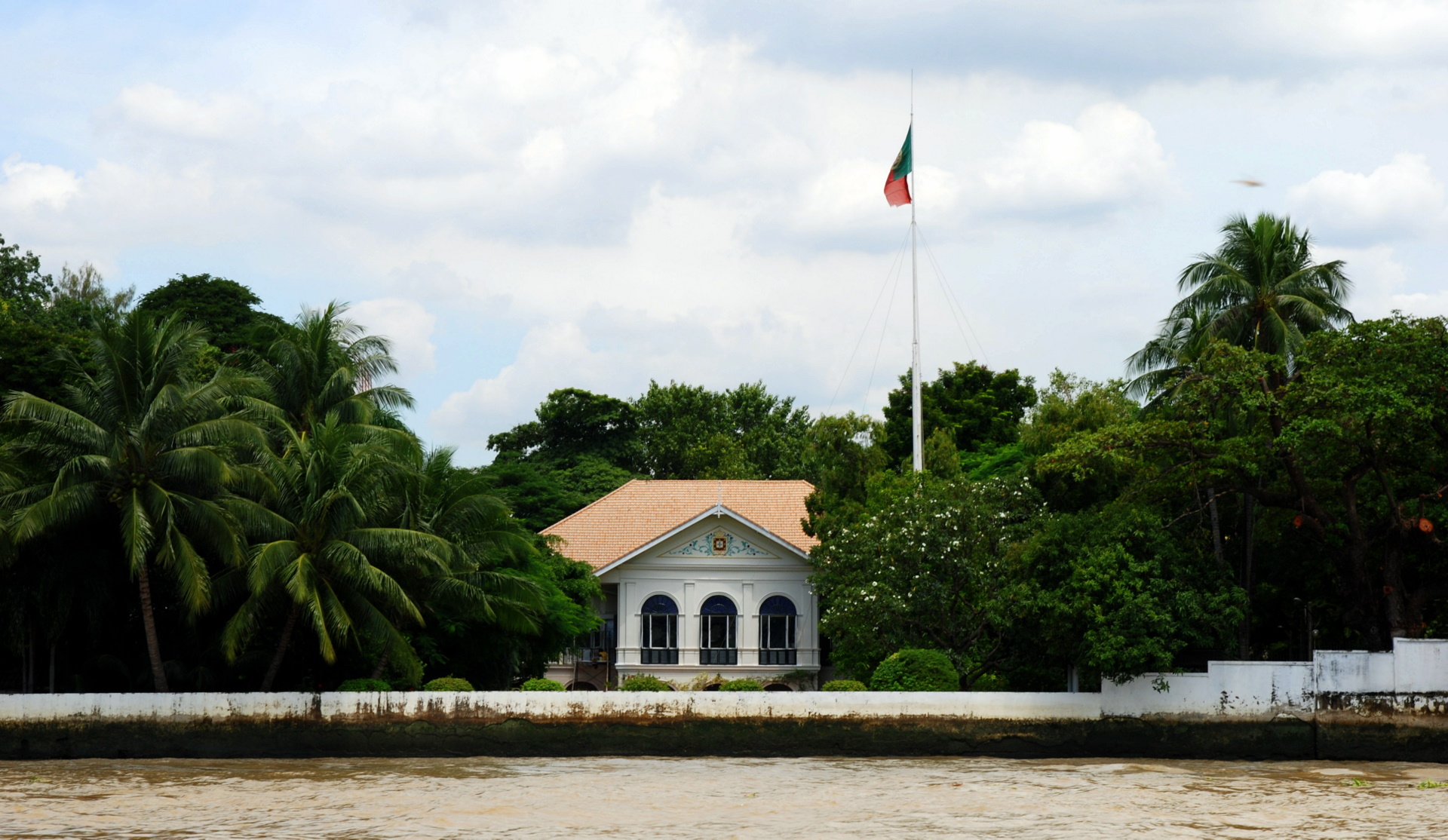
I get many invitations to diplomatic dos. I almost always bin them, but when I received one from the Embassy of Portugal to celebrate the country’s National Day, I hesitated. They do have the most wonderful Embassy here, right on the Chaophraya River.

embassy from river

My wife and I pass it very time we take the water bus down to Sathorn, and as we pass I always feel a twinge of nostalgia, to see this lovely villa from the 1870s, with its lawn sweeping down to the river, squeezed now between modern buildings of concrete, glass and steel. Ah, the Bangkok that once was …

It was decided.  I would accept the Ambassador’s invitation, to give us a chance to see this wonderful property up close.

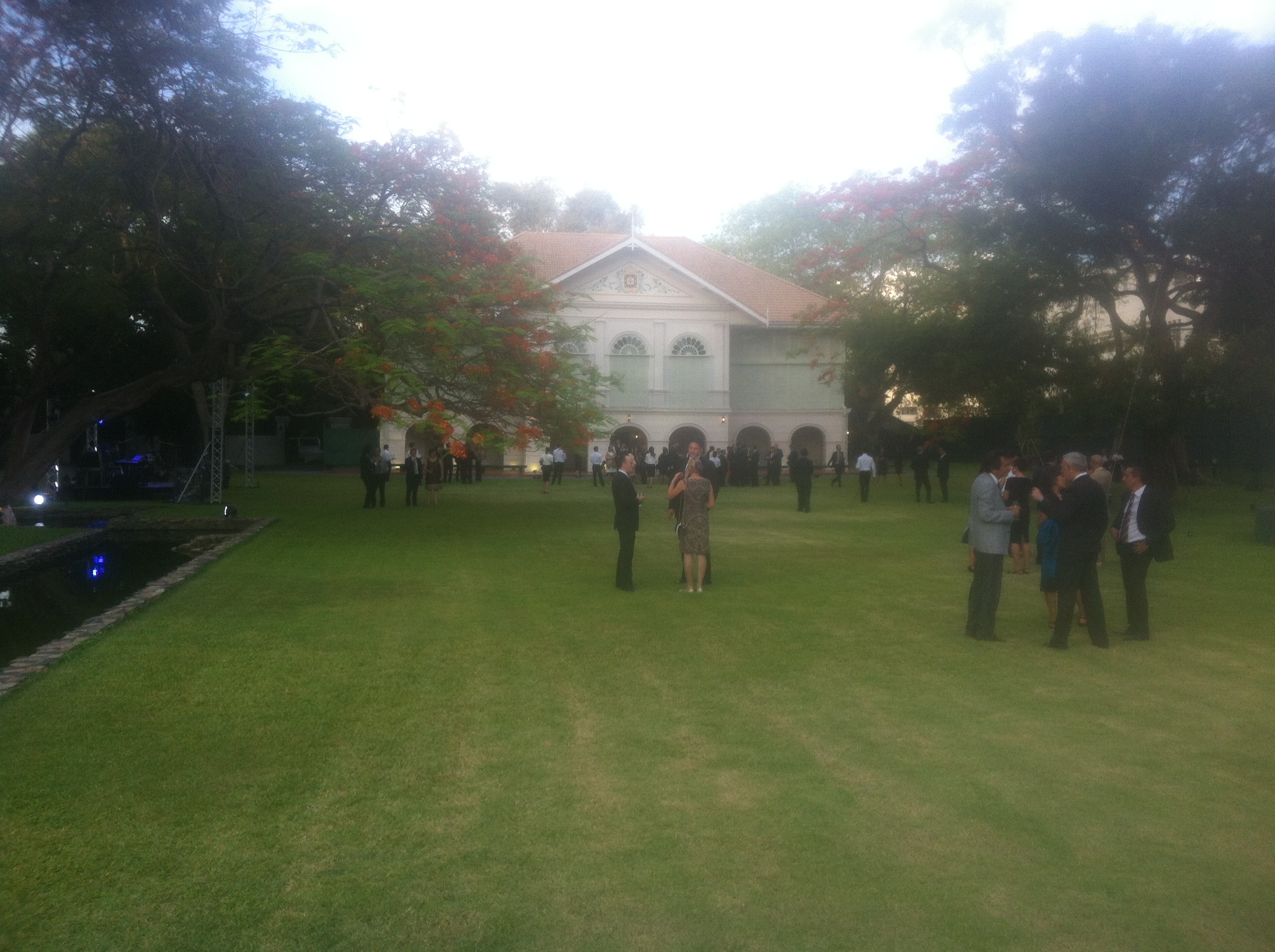
So it was that last night, as dusk was falling, we joined a line of guests to shake the Ambassador warmly by the hand, and then were left free to wander around the lawn, with a white wine in hand. We walked over to the river, turned around, and admired the scene.

lawn of embassy 002

As we stood there, sipping our wine, from under the flame tree came the unmistakable lilting lament of fado. Song after song floated across the lawn

É meu e vosso este fado
destino que nos amarra
por mais que seja negado
às cordas de uma guitarra

Sempre que se ouve um gemido
duma guitarra a cantar
fica-se logo perdido
com vontade de chorar

Ó gente da minha terra
agora é que eu percebi
esta tristeza que trago
foi de vós que a recebi

E pareceria ternura
se eu me deixasse embalar
era maior a amargura
menos triste o meu cantar

Ó gente da minha terra

This fado is mine and yours,
A destiny that binds us,
No matter how much denied,
To the strings of a guitar

When we hear the lament
Of a guitar in song
We are instantly lost
In a desire to weep

Oh people of my land,
Now is it that I understand
This sadness which I carry.
I received it from you

And it would seem a tenderness
To allow myself to be soothed.
The bitterness would be greater
My singing less sad.

Oh people of my land

And so filled with saudade, that indefinable existential melancholy which we are told pervades the Portuguese soul, as well as with several glasses of excellent Portuguese wine, we slowly made our way inside the villa, to eat bacalhau à Gomes de Sá.

___________

Embassy from River: http://upload.wikimedia.org/wikipedia/commons/2/2a/Embassy_of_Portugal_Bangkok.JPG (in http://commons.wikimedia.org/wiki/File:Embassy_of_Portugal_Bangkok.JPG)

The other picture: mine

COQ AU VIN

Bangkok, 8 June 2015

Yesterday evening, my wife and I went over to the Central World mall to see a film (“Spy”, a hilarious film, well worth seeing). Afterwards, feeling peckish, we decided to stay and have dinner in the mall – at least it was well refrigerated there, a decided plus in this hot season when the promised rains are failing to come to cool us. The problem is, most of the restaurants in the mall are of Asian extraction – Japanese is a definite favourite, followed by Korean, and then trailing far behind a few Chinese, Thai, and “international” (i.e., mixed Asian) – and that’s not what I felt like eating. I wanted something “different”, although I wasn’t quite sure what that “different” might be. We made a bee line for a French restaurant advertised on the information board, but it had disappeared since they had last updated the board. We sighted an Italian restaurant, although something called “Spaghetti Factory” surely is to be avoided like the plague. We got a fleeting glimpse of a Mexican restaurant tucked away in a corner, but Mexican food didn’t entice me … You get the picture. I was being finicky, and time was passing. Eventually, we saw a bar-cum-restaurant called “1881”, which looked nice enough. We rapidly checked the menu, and since it looked suitably international we went for it.

Ensconced at our table, we scanned the menu more closely. For the main course, we both happily plumped for the coq au vin. It had been an age since we had eaten this, we both exclaimed. To keep us going while we waited, we ordered some starters, and of course a glass of red wine. The starters were delicious, the wine was good, everything looked set for a memorable dinner. Alas! it was not to be. When the coq au vin arrived, we found ourselves faced with a chicken leg, deep fried à la manière KFC, sitting on some sort of thick tomato-based sauce peppered with carrots and onions, maybe something which had been recycled from an osso buco dish, and which had obviously never seen a drop of vin. We glumly ate our poulet à une sauce indéfinie, agreeing with each other that something had definitely got lost in translation. The dessert, a great pannacotta with some sort of balsamic-strawberry gelée, partially made up for the very disappointing main dish, but it was undeniable that the coq au vin had been a black hole in our sensory experiences of the evening.

I feel I owe it to my genes, to my heritage, to right the balance, to advertise from the rooftops the greatness of coq au vin. At least describing how the dish is made might allow me to partially enjoy, if only in my imagination, the taste of the Real Thing.

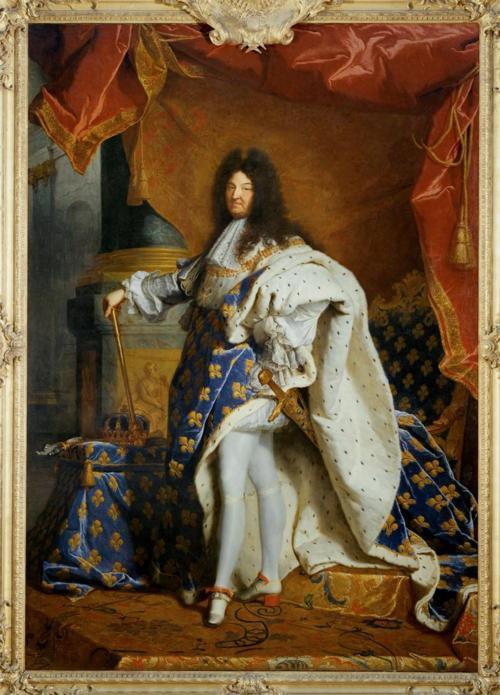
Let me start by saying that in the olden days coq au vin was not a dish that would have been served to the Great Sun King, Louis XIV

Louis_XIV_of_France

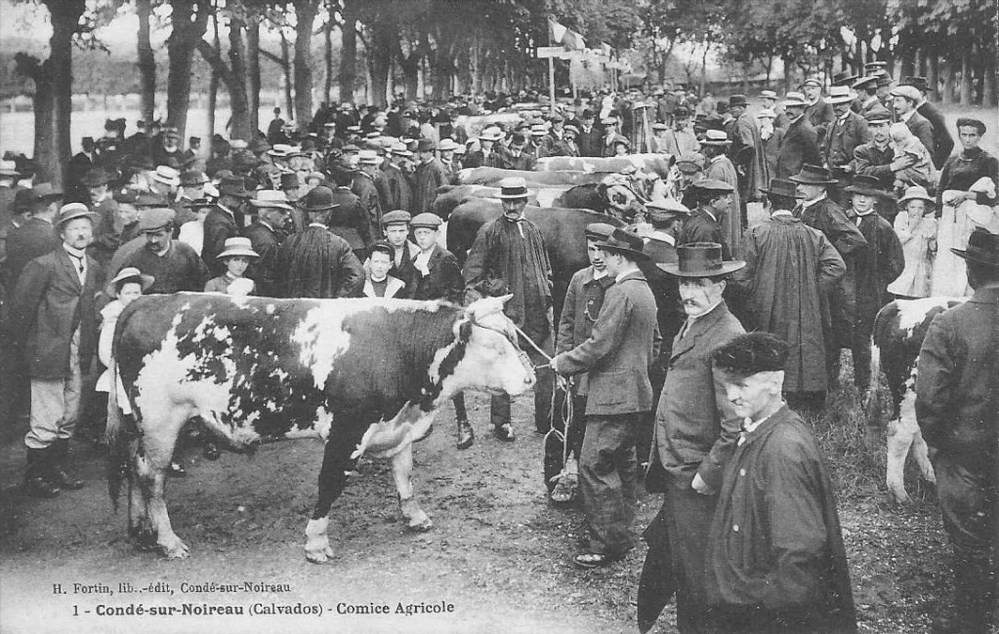
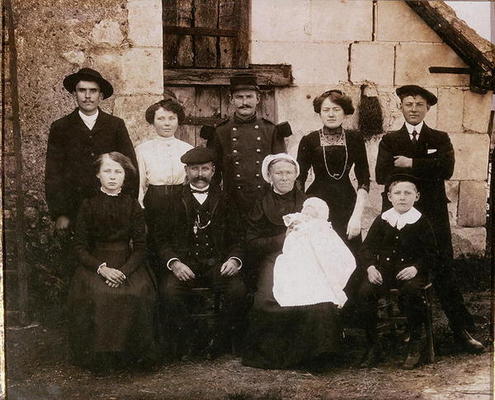
or some other such august personage, unless of course you wanted to be sent to the Mediterranean galleys or to rot away on L’île du Diable. The great French chef of the mid-19th Century, Marie-Antoine Carême, author of the encyclopedic L’Art de la Cuisine Française and other works, never mentioned it, nor did the even greater French chef of the late 19th-early 20th Century, Auguste Escoffier, in his various publications. No, this was above all a peasant’s dish, a way of recycling that rooster in the yard which had reached the end of the rooster road. It was people like these who created coq au vin, making a virtue out of necessity.

french peasants-2

french peasants-3

CHT216766 Peasant family of the Sarthe area at a baptism, late 19th century (photo); by French Photographer, (19th century); photograph; Private Collection; Archives Charmet; French, out of copyright

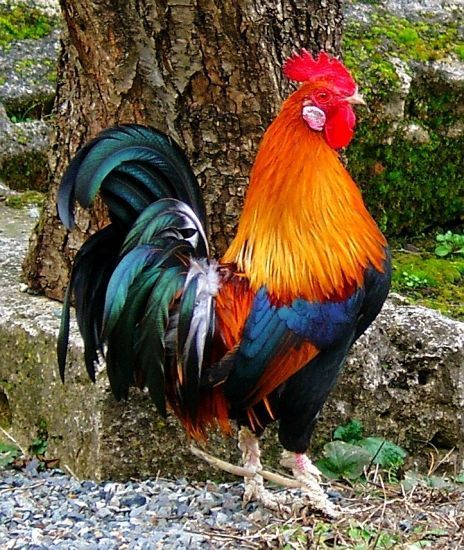
So now let us see how this wonderful dish is made. The paysan (or paysanne) will first have laid his (or her) hands on a rooster like this one

https://i0.wp.com/monia2009.m.o.pic.centerblog.net/gg7spkhz.jpg

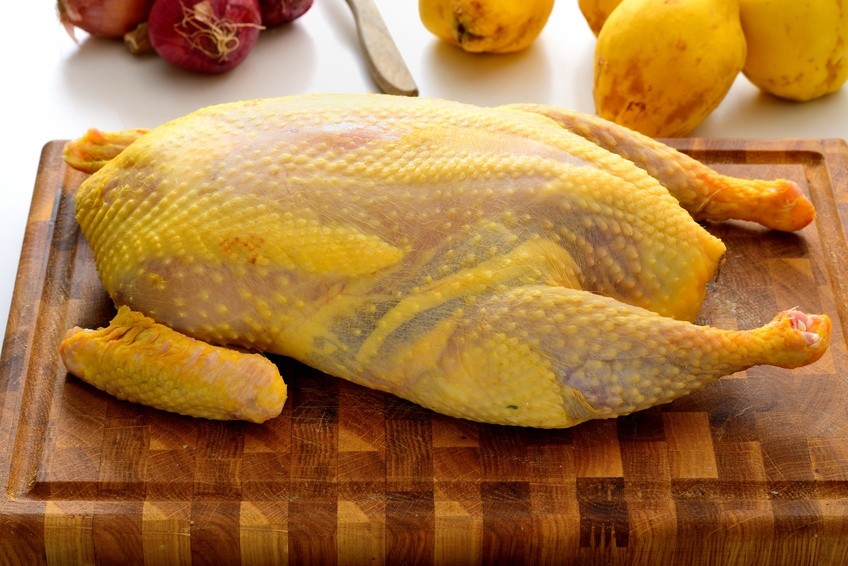
and wrung its neck. We modern men and women are squeamish about killing to eat, but what to do: unless you hang around prides of hunting lions and scavenge what they are kind enough to leave behind, to eat meat you need to kill; simple as that. Oh, and by the way, it’s good to slit the rooster’s throat and drain its blood, which you will use later in making the dish. If you can’t bring yourself to do all this, you can subcontract the task to a butcher. You can also subcontract him the task of plucking the bird, which the paysanne would have done herself (I remember my French grandmother doing this, while she sat on the balcony discussing this, that, and the other with my mother). The wonderful feathers of the rooster should be conserved, although I’m not quite sure what to do with them. In any event, in one way or another you should end up with something like this:

coq-fermier-pret-a-cuire

Personally, to support the Home Team, that is to say Burgundy, where the French side of me comes from, I would want a rooster from Bresse, which is on the other side of the River Saône from Burgundy: the Burgundians gave the people of Bresse their wine and in return got farm products like chickens.

Now we can start the cooking.

First, you will cut up the rooster. Place the pieces in some container, to which you will add diced carrots, onions, and shallots, and – if you really must – chopped garlic (personally, I would drop the garlic; I’m not a fan of this particular bulb). The paysan would have collected these from his vegetable garden like the one my French grandmother had hidden behind her lilac bushes, but I recognize that in our modern, highly urbanized society most of us do not have access to vegetable gardens, so we will have to make do with the local grocery store, or even the local supermarket. Add laurel, thyme and parsley. Add a little stock. Salt and pepper. And now we come to the wine.

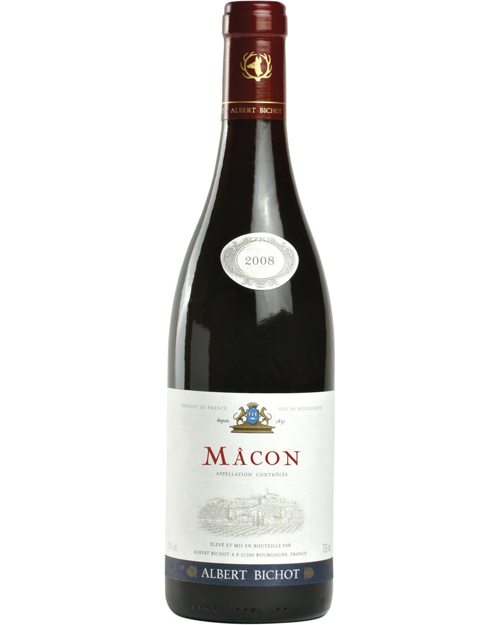
Obviously, this is a key ingredient, so some thought needs to go into its choice. Nothing too fancy, of course – not going to waste a $100 bottle of wine to cook our rooster. Something with a good body but not too tannic should do the trick. I would go for a red wine, although there are parts of France (Alsace, for instance, or the Jura) where the dish is made with white. Since, as I’ve mentioned, I’m batting for the Home Team, I would personally go for a red Burgundy, maybe shading into a Beaujolais, something just down the road from where my Grandmother lived.

macon rouge

Our paysanne would have gone down into the cellar of the kind my Grandmother had and taken a bottle of wine made from grapes growing in one of the surrounding vineyards and bottled in that very cellar or at least locally. But we – with a sigh – will make do with what we find at our local wine store.

In any event, pour in enough wine to just cover the rooster. Cover the container and leave it in a cool place. You will let the rooster and the vegetables marinate for a full 24 hours.

The next day, fresh from a good night’s sleep, you will begin the next phase.

As a first step, fish the rooster pieces out of the marinade, draining them well. Do the same for the vegetables. Do not throw away the marinade! Very important.

Put all these aside, and take a large skillet, in which you will heat a little butter and oil. Frankly, I don’t think the paysanne would have used oil, at least not in Burgundy. Traditionally, Burgundy was not an oil country. I would guess, from a perusal of an old French cookery book from 1651, that she would have used butter and/or lard. Nevertheless, we will go with butter and oil since nowadays oil you find in shops but lard only with difficulty.

Once the butter-cum-oil is hot enough, slide in the rooster pieces, together with some chunks of bacon, and let the whole brown nicely. Throw in the vegetables from the marinade and let them colour a bit. Sprinkle with flour and let it all cook a moment. Move the skillet off any open flame, take a small glass of cognac, sprinkle it over the rooster pieces, and light it up with a match – taking care, of course, that your face is not too close; the last thing you need is to find yourself eating the final product without eyebrows. In Burgundy, the paysanne would probably have used a Marc de Bourgogne, which is a brandy made with the solid leftovers from the grape presses. But unless you actually live in Burgundy, you probably do not have this at hand, so go with cognac. Once the flames have died down, add in the marinade, and bring the whole back to a boil for a few minutes.

You will now let the mix simmer slowly for a long, long time: aim for six hours. Let it fill your kitchen with a gorgeous aroma, but don’t hang around there because otherwise you will soon no longer be able to stand it and you will throw yourself on the cooking rooster and wolf it down. As would have done the paysanne, go and busy yourself in the garden, in the studio, anywhere that is some distance from the kitchen. Keep your mind and hands busy with other things, just popping in from time to time to check. As the hours pass, the meat softens and falls off the bone, it absorbs the wonderful aromas it is basting in, and the sauce itself slowly thickens. Towards the end of this long simmering period, you will take the blood you collected when you killed the rooster (remember that?) and add it to the sauce to thicken it. You will also prepare boiled potatoes a little while before the end, to accompany the coq au vin.

The coq au vin is now ready to eat. Lay out the pieces of coq in a serving plate, pour the sauce au vin over them.

coq au vin

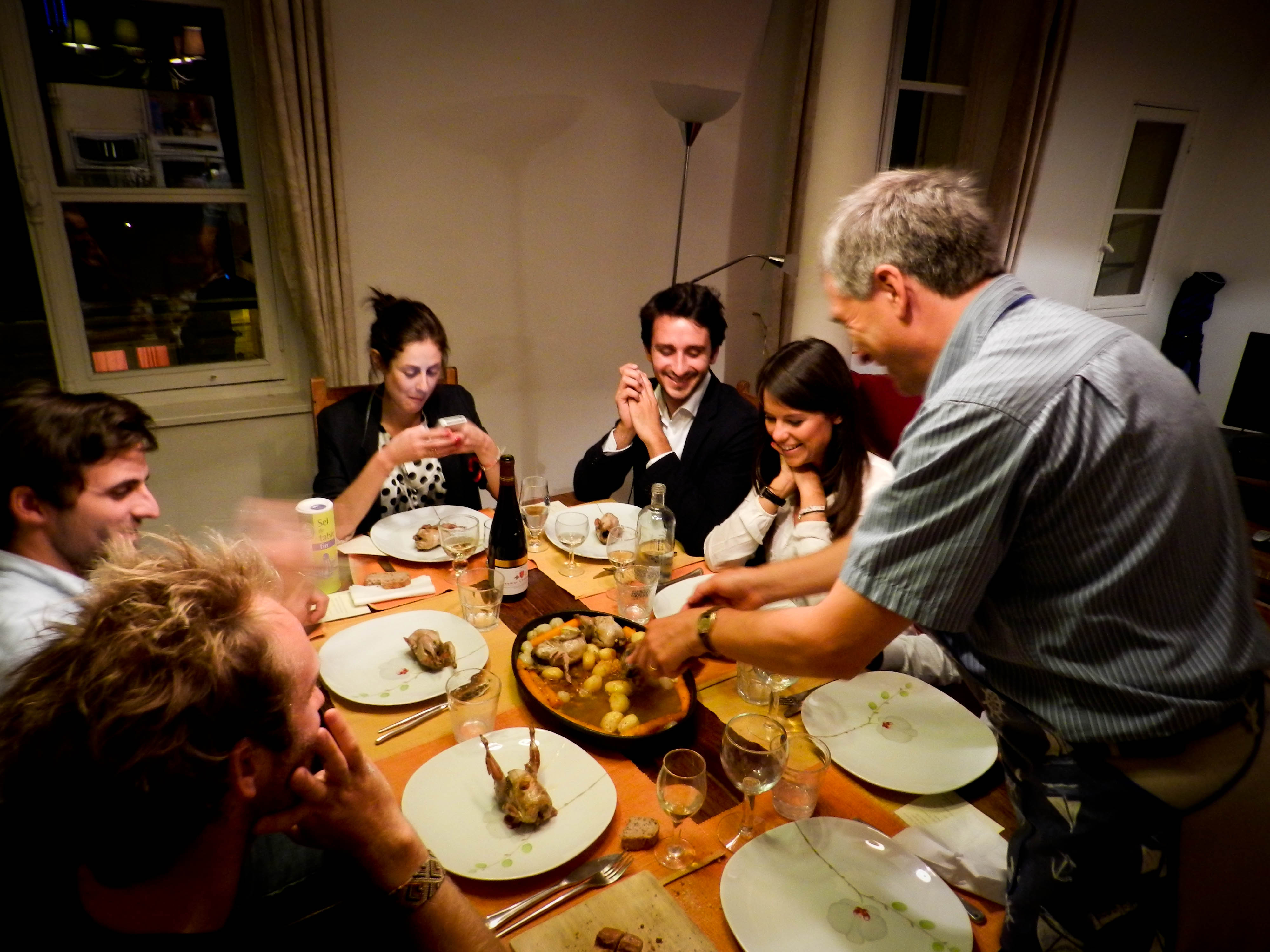
Place the potatoes on the side, bring out that special bottle of Burgundy you’ve been keeping for an exceptional moment, call in the family and your special friends, and enjoy!

meal-2

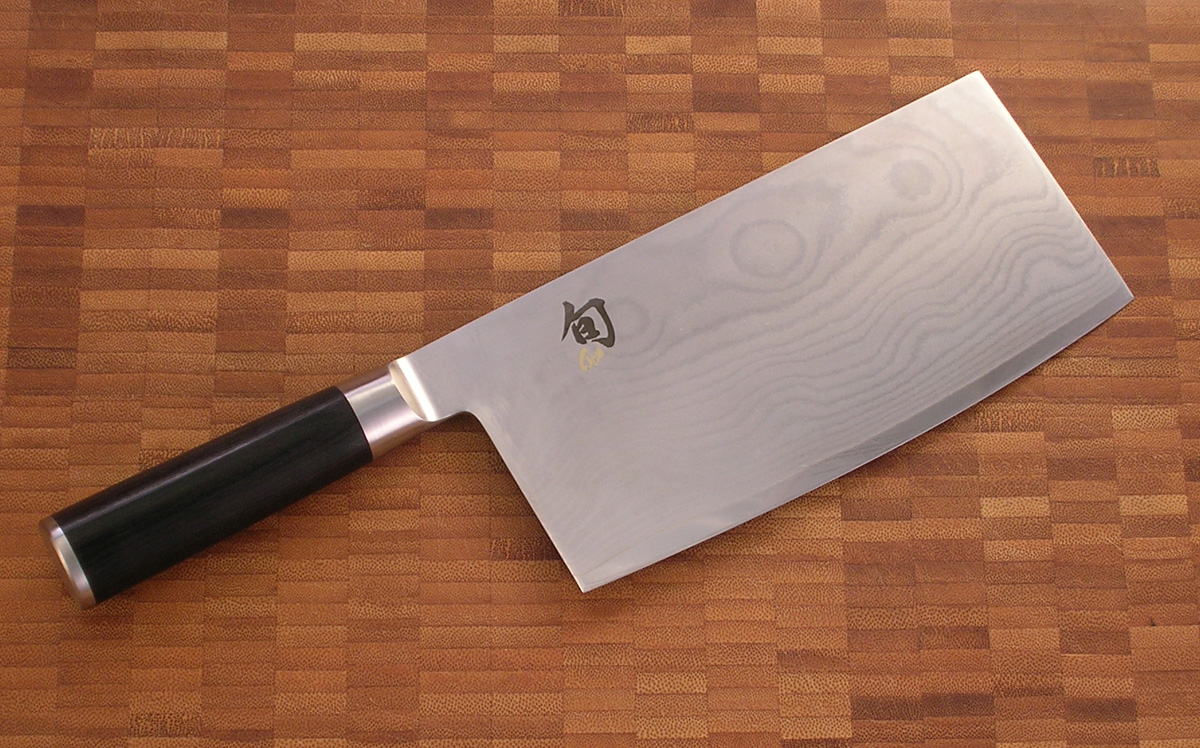
Mmm, there’s a rooster I keep hearing over the other side of the lane, in a building site. Maybe tonight, I’ll go out with this cleaver which we bought in China

cleaver

And find me a rooster for a nice coq au vin

______________________

Louis XIV: http://media.tumblr.com/tumblr_lkzid3Jvkb1qggdq1.jpg (in http://wtfarthistory.com/post/5361387982/red-high-heels-for-him)
French peasants-1: http://www.myartprints.co.uk/kunst/french_photographer_19th_century/peasant_family_of_the_sarthe_a_hi.jpg (in http://www.myartprints.co.uk/a/frenchphotographer19thcen/peasantfamilyofthesarthea.html)
French peasants-2: http://img.over-blog-kiwi.com/0/81/05/67/201311/ob_9bbe36_conde-sur-noireau-calvados-comice-agricole.jpg (in http://stephane.guillard.over-blog.com/2013/11/l-histoire-des-comices-agricoles-en-france-xixe-xxe-si%C3%A8cles.html)
French peasants-3: http://tnhistoirexix.tableau-noir.net/images/scene-de-moissons.jpg (in http://tnhistoirexix.tableau-noir.net/pages/campagnes-xix-siecle.html)
Rooster: http://monia2009.m.o.pic.centerblog.net/gg7spkhz.jpg (in http://lenissa.musicblog.fr/3467011/France-Allemagne-C-est-fini/
Rooster ready to cook: http://www.lesplaisirsdegargantua.com/419/coq-fermier-pret-a-cuire.jpg (in http://www.lesplaisirsdegargantua.com/sitemap.xml)
Mâcon rouge: http://sohowine.co.uk/import/images/B-MACON.jpg (in http://sohowine.co.uk/?c=products&deptno=2&country=France&region=Burgundy&page=2)
Coq au vin: http://www.joyce-farms.com/topics/wp-content/uploads/2014/09/coqauvin.jpg (in http://www.mairie-reffannes.fr/news/soireecoqauvinaumuguet)
Meal: https://labelleassiette.fr/blog/wp-content/uploads/2012/09/DSCN0568.jpg (in https://labelleassiette.fr/blog/diner-lba-3-avec-philippe-engammare/)
Cleaver: http://img92.imageshack.us/img92/7854/shun9wy.jpg (in http://www.knifeforums.com/forums/showtopic.php?tid/771029/)

JOHAN ET PIRLOUIT

Bangkok, 26 May 2015

A week or so ago, I was in Cambodia for some official business relating to a project we are about to start there to reduce dioxin emissions. But actually, that is irrelevant to this post. What is relevant is that I was staying in a hotel room half of whose lights were blue. Why, is a mystery. Perhaps it has something to do with the fact that the hotel claimed to also be a spa; perhaps people in spas like the rather cold light that blue creates. Or perhaps it had something to do with the modern furniture that graced the room; it was Nordic-looking in its design, cool, remote, and the blue light made it all that much cooler. But I’m just hazarding guesses here; perhaps blue bulbs were simply the cheapest on the market at the time the hotel was purchasing its light bulbs.

Whatever the reason, this blue light turned me blue. I only realised it when, skyping my wife, I noticed with astonishment that in the small icon which held my image I was a lovely blue hue. Basically, I looked like this fellow:

schtroumpfThe very youngest amongst us will immediately tell us that he is a Smurf. They are wrong – well, not quite right. He is a Schtroumpf; Smurf is the Dutch translation, adopted later by the English-speaking world.

Aah, the Schtroumpfs …they are my youth! This fellow may look young, but actually I am just a few years older than him. I burst onto the scene in 1954, the Schtroumpfs burst onto the cartoon scene in 1957, invented by the Belgian cartoonist Peyo.

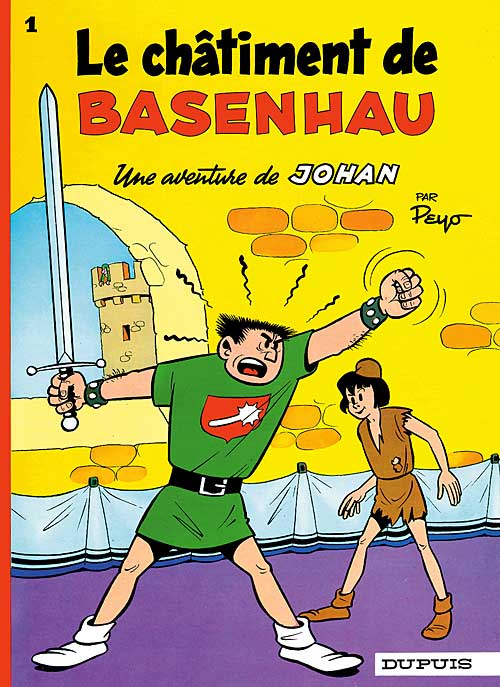
But here I have to clarify something. My real love was not the Schtroumpfs. It was Johan and Pirlouit, invented some years earlier by Peyo. Johan came first, hustling into the lives of little fellows like me in 1952, before I was even a gleam in my parent’s eyes, in the story Le Châtiment de Basenhau, The Punishment of Basenhau. This was the cover of the album (Johan is the young fellow dressed in ragged brown).

01-chatiment de basenhau

The details of the story are irrelevant. The important point is that Johan lived in the Middle Ages and that he was a dashing young fellow. After Le Châtiment de Basenhau came Le Maître de Roucybeuf, The Master of Roucybeuf, in 1953

02-maitre de roucybeuf

and then in 1954, when my mother was heavily pregnant with me, came Le Lutin du Bois aux Roches, The Imp of Rocks’ Wood, in which Peyo introduced us to Pirlouit, who was to become Johan’s bosom buddy.

03-lutin du bois aux roches

Pirlouit is the little blond-haired fellow holding the very large hammer. While Johan was the serious, Boy Scout type, straight as an arrow, Pirlouit was the joker, a hilarious guy who was always doing silly things. But when push came to shove, he was there by Johan’s side, as they fought off the assorted Medieval baddies they had to deal with. From now on, the two were to be inseparable.

Their stories of derring-do, wielding sword, shield, bow, and other assorted medieval weaponry, galloping through dark, forbidding forests – Johan on a horse, Pirlouit on a goat (he was a little person, remember), dealing with sorcerers and their potions, … these were so thrilling to that young me – I was, what? ten-eleven years old when I discovered these albums, when Peyo was already famous throughout the length and breadth of France. I whiled away many a wonderful summer afternoon at my cousins’ house, tearing my way through the collection:

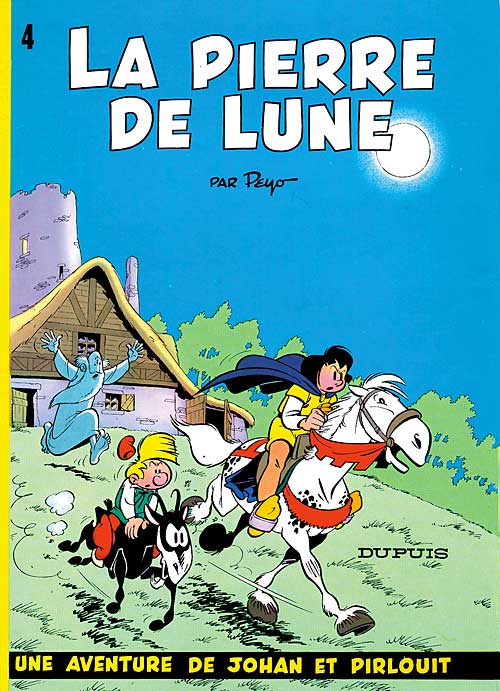
La Pierre de Lune, The Moonstone

04-pierre de lune

Le Serment des Vikings, The Oath of the Vikings

05-serment des vikings

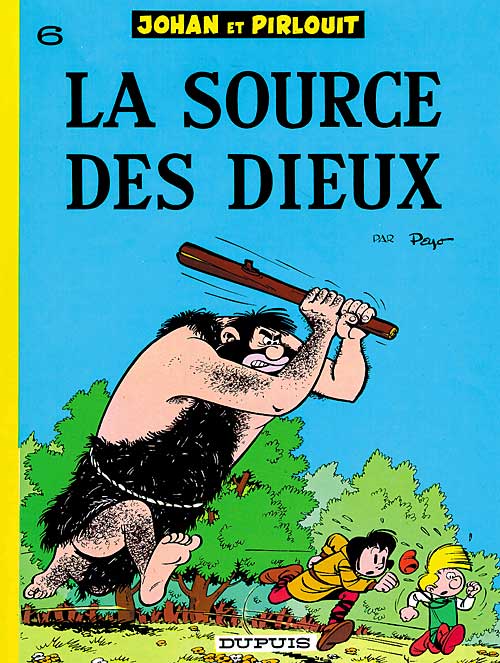
La Source des Dieux, The Spring of the Gods

06-source des dieux

La Fleche Noire, The Black Arrow

08-fleche noire

Le Sire de Montrésor, The Lord of Montresor

08-sire de montresor

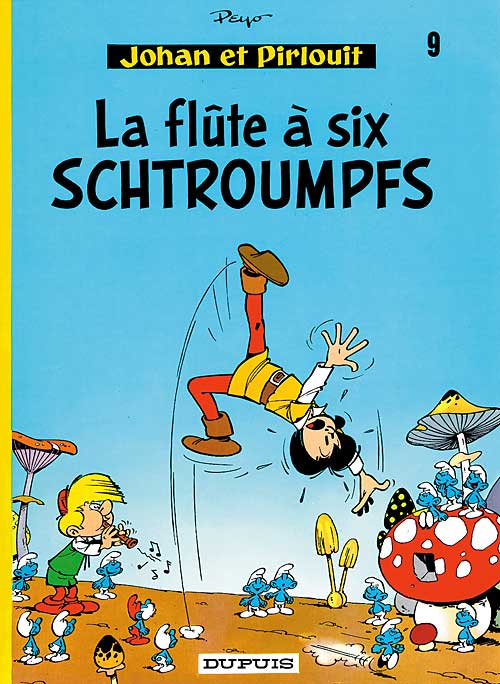
to arrive at La Flûte à Six Schtroumpfs, The Flute with Six Schtroumpfs

09-flute a six schtroumpfs

This is where the Schtroumpfs first made their entry onto the world stage. And this is where I start to cry.

Understand me, the Schtroumpfs were nice enough, they added a fun element to the story. But in my view they were minor characters. It was Johan and Pirlouit who were firmly centre stage.

Alas! I was in a minority. The junior readers of Spirou magazine – the stories originally came out in serialized format – wrote letters to the magazine enthusing about the little Schtroumpfs. The editors of the magazine, and Peyo himself, saw the commercial possibilities. And so Peyo took the first steps down the slippery slope. He started with minor albums of Schtroumpf stories. He graduated to major albums. He got involved in animated films. First, in Belgium. Then in the US. Then the breakfast cereal companies came knocking on the door: they wanted Schtroumpf statuettes in the Cornflake packages.schtroumpf statuettes

And after that the advertising firms came knocking at the door, asking to use the Schtroumpfs in various advertising campaigns. As this photo shows, the demand from advertizers continues unabated.

schtroumpf advertisement-1

Peyo always said yes. And John and Pirlouit disappeared; he was too busy with the Schtroumpfs. Peyo managed one more great album, La Guerre des 7 Fontaines, the War of the 7 Fountains.

10-guerre des sept fontaines

To me, it was his best, a wonderful story of Fall and Redemption. After that, he managed only a few more albums, pale copies of what had come before. The Schtroumpfs had eaten up his life. He had his first heart attack when he was 41, his last when he was 64.

And I am left with the memories of my youth, those golden afternoons in the France of the early ’60s, with medieval jousts and battles echoing faintly across the fields.

______________________

Schtroumpf: http://www.tattoo-kids.com/581-1284-thickbox/tatouages-schtroumpfs-pack.jpg (in http://www.tattoo-kids.com/pochette-de-tattoos/581-tatouages-schtroumpfs-pack.html)
Chatiment de Basenhau: http://www.bdzone.com/images/tout/9782800100951g1.jpg (in http://www.bdzone.com/chop/couvranteswap.php?serie=JOHA&debut=0&fin=9)
Maitre de Roucybeuf: http://www.bdzone.com/images/tout/9782800100968g1.jpg (in http://www.bdzone.com/chop/couvranteswap.php?serie=JOHA&debut=0&fin=9)
Lutin du Bois aux Roches : http://www.bdzone.com/images/tout/9782800100975g1.jpg (in http://www.bdzone.com/chop/couvranteswap.php?serie=JOHA&debut=0&fin=9)
Pierre de Lune : http://www.bdzone.com/images/tout/9782800100982g1.jpg (in http://www.bdzone.com/chop/couvranteswap.php?serie=JOHA&debut=0&fin=9)
Serment des Vikings : http://www.bdzone.com/images/tout/9782800100999g1.jpg (in http://www.bdzone.com/chop/couvranteswap.php?serie=JOHA&debut=0&fin=9)
Source des Dieux : http://www.bdzone.com/images/tout/9782800101002g1.jpg (in http://www.bdzone.com/chop/couvranteswap.php?serie=JOHA&debut=0&fin=9)
Fleche Noire : http://www.bdzone.com/images/tout/9782800101019g1.jpg (in http://www.bdzone.com/chop/couvranteswap.php?serie=JOHA&debut=0&fin=9)
Sire de Montresor : http://www.bdzone.com/images/tout/9782800101026g1.jpg (in http://www.bdzone.com/chop/couvranteswap.php?serie=JOHA&debut=0&fin=9)
Flute a Six Schtroumpfs: http://www.bdzone.com/images/tout/9782800101033g1.jpg ((in http://www.bdzone.com/chop/couvranteswap.php?serie=JOHA&debut=0&fin=9)
Guerre des 7 Fontaines: http://www.bdzone.com/images/tout/9782800101040g1.jpg (oin http://www.bdzone.com/chop/couvranteswap.php?serie=JOHA&debut=9&fin=9#)
Schtroumpf statuettes: http://img0.ndsstatic.com/wallpapers/e40969b9033ccdd352337e6494a54def_large.jpeg (in http://www.ohmymag.com/les-schtroumpfs/wallpaper)
Schtroumpf advertisement: http://img.xooimage.com/files51/2/4/e/lg-optimus-01-22e2217.jpg (in http://schtroumpfmania.soforums.com/t1518-Smartphone-LG.htm)