POSTS

SALT AND SWEET

Bangkok, 5 February, 2015

A few weeks ago, I visited a couple of electric arc furnaces which were recycling scrap steel. It was a very interesting visit, the first time I had seen this type of furnace in action.

EAF

They are a nice example of a vital step in what the Chinese call a “circular economy”, an economy in which the materials we use do not simply get thrown away after we’ve finished with them, but are collected, recovered, and reused.

But actually, what I want to focus on in this post is the dinner we were served during the visit, or rather on one course of that dinner. I should explain that since these furnaces work on electricity and since electricity is expensive in Thailand during the day, the furnaces are run at night. So the visit of the furnaces started at 8 o’clock in the evening, and the first company we visited kindly offered us dinner to fortify us for the hot and dusty visit which awaited us. Since this was a Chinese-owned company, we were served a Chinese-style dinner which, after my five years spent in China, brought a nostalgic mist to my eye. As is usual in China, the dinner ended with fresh fruit. But this fruit course had an interesting twist. We were served fresh pineapple with a soy sauce dip. Soy sauce! That is not something I had ever thought of combining with pineapple. But actually it was delicious.

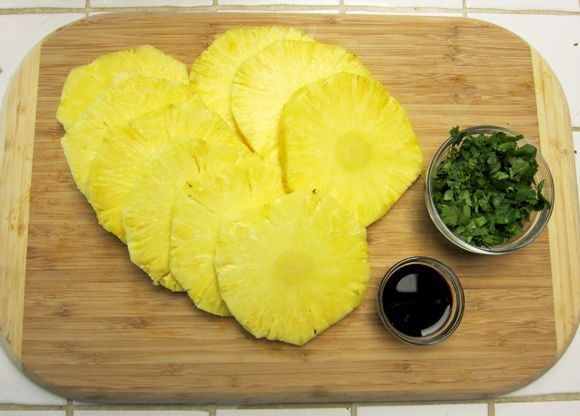
Pineapple and Soy Sauce

This is the only photo I could find on the (English-language) web which in any way resembled what we found before us at dessert time, but even this is for a recipe where the pineapple is fried, which explains the presence in the photo of the coriander (to be used as a final garnish). I take this lack of photos to be an indicator that I may be one of the few in the English-speaking world who has tried this particular combination of sweet and salt. But readers are free to disabuse me of my belief.

In any event, as I let my taste buds deal with this interesting sweet-salt combination, I remembered a conversation we had had around the Christmas lunch table about precisely this issue: the mixing of salt and sweet. Our son had maintained that it was not natural to mix sweet and salt, and more generally that different flavours should be kept separate. Our daughter maintained that there were many dishes where salt and sweet were combined, which suggested that actually it was quite natural to mix sweet and salt. I was torn. As my long-suffering wife knows only too well, I object to mixing things on my plate: the vegetables are to be kept neatly separated from the meat and from each other, the dressing from the salad should not be allowed to leak over to the meat, etc. So on these grounds, I also feel that sweet and salt should not mix. Yet I have to acknowledge that there are dishes where the sweet and salt combination is exceedingly pleasing. After the pineapple and soy sauce dip experience, I resolved to do some research (a.k.a. web browsing) on the topic.

I’ve now done the research and am ready to report back, although I must confess to not having much to report. All agree that “common sense” suggests that salt and sweet do not mix, yet all agree that actually many of us do like to mix the two. Why is this? As far as I can make out, no-one has really figured it out. One possible answer is biochemical. The sodium ions of salt somehow enhance all taste buds: “there’s evidence that applying a sodium-channel blocker (TTX) can dramatically inhibit the activity of all taste receptors, suggesting that sodium plays a key role in the cellular detection of every taste (and not just the taste of salty things) … This would explain why food without any salt is so hopelessly boring: it might be literally harder for our various taste receptors to get excited.” So mixing salt with sweet enhances sweet because of a biochemical pathway we are born with. Just to make the whole discussion sound even more scientific, I throw in here a close-up of a taste bud on a tongue, which is what sodium ions seem to be enhancing.

tongue-taste-bud

But why would we have evolved to have that biochemical pathway? One possible answer is that because we humans are omnivores, we’re wired to desire many different foods and tastes. It’s bad for us to eat just one thing, so our sense of taste has evolved to give us greater gratification if we mix tastes. My wife will be very pleased to hear that there is a scientific underpinning to her insistence on mixing foods and tastes.

Let me celebrate this new understanding on my part of my biological processes by sharing with readers some of the wonderful sweet-salt dishes which I have stumbled across in my life. Where to start? Well, at the beginning, I guess, with the first such dish I ever remember trying, lamb with mint sauce. My English grandmother had taken me to visit an uncle and aunt and assorted cousins, and my aunt served us lamb with mint sauce for lunch.

lamb and mint

She served it with two veg, as is de rigeur for any English meat dish. In this case, I remember distinctly that the veg in question were that most English of combinations, peas and potatoes (she also made a magnificent apple crumble, by the way; no apple crumble I have ever eaten since has tasted so good).

Mint sauce is really easy to make, by the way, about as easy as lamb chops. I give an executive-summary recipe at the end of the post for those readers who are interested. What I think is important to point out here is that the recipe calls for a mix of sugar and vinegar. In my humble opinion the best combination is actually sweet, salt, and acid or tartness. To my mind, that’s what made the pineapple and soy sauce so good, the fact that the pineapple is also tart. Dragon fruit, a much milder fruit, was being served along with the pineapple. When I asked if that too should be dipped in the soy sauce, our hosts pursed their lips and gave it as their considered opinion that it wouldn’t work.

Lamb with mint sauce is incredibly English (and I mean English. I don’t think the Scots or the Welsh eat it). It is so English that the French made fun of Les Anglais because of it – the French consider the use of mint sauce to be beyond the cooking pale. Our friends Goscinny and Uderzo, who wrote the Asterix and Obelix stories, had mint sauce play a major role in our heroes’ adventures in Britain, with the governor of province at one point shouting that if his men did not find the pair (who had just disappeared from prison) he would have his commanders boiled and served with mint sauce to the lions. To which the commanders commented how horrible that would be – for the lions.

asterix sauce a la menthe

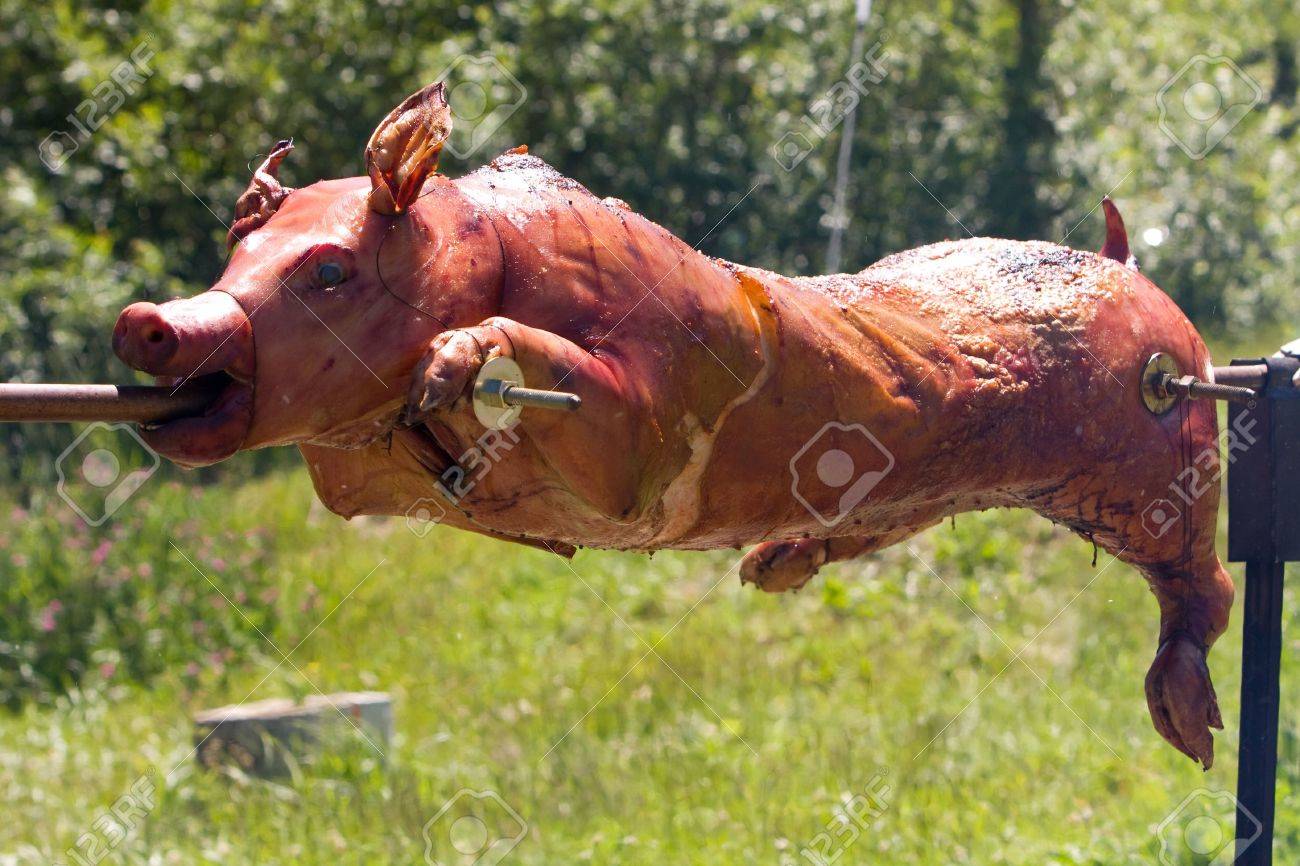
The French loved it, lapping up the fun being poked at English cuisine. But I will ignore the smirking French and concentrate on another great example of English cuisine which is also a sweet-salt dish, roast pork and apple sauce. I first had this delicious dish as a boy scout. It was summer, the end of the school year, that time in the calendar when England can often be bathed in golden light rather than be grey and sodden.  For our last outing of the year, the scout master had the brilliant idea of buying a whole pig and roasting it on a spit in the woods. I have this crystal clear memory of sitting around the spit, listening to the fat crackle, breathing in the smell of cooking meat, watching the scout master sharpen the large carving knife, while the sunlight dappled the ground all around us. It’s the closest I have ever felt to being a Cro-Magnon man.
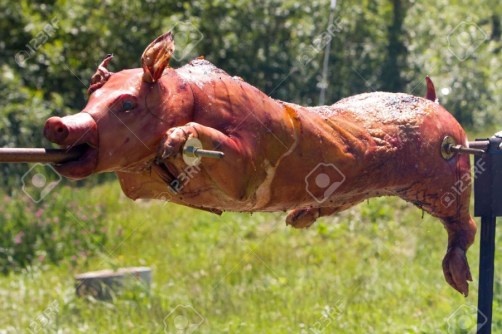
roasted pig

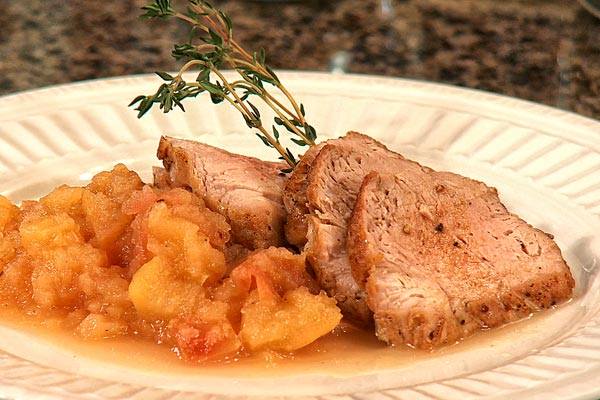
And then there was the discovery of the exquisite taste of roast pork and apple sauce, a large dollop of which was dumped onto our metal field plates along with a big slab of pork meat and crackling.

roast pork and apple sauce

Those readers interested in knowing how to make this sauce should scroll down to the end of the post. I just want to note that cooking apples should be used. They are tarter than eating apples. It’s the tartness thing again. One can also add lemon zest, presumably to add yet more tartness.

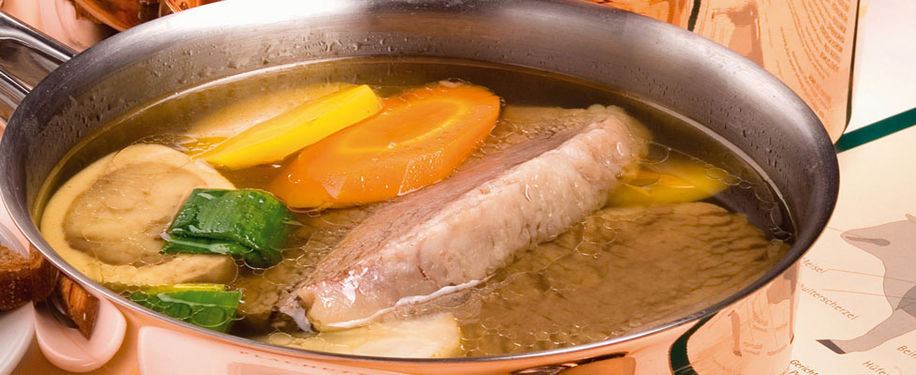
Of course, the English do not have a monopoly in Europe on sweet-salt dishes. Allow me to introduce here a dish I discovered and came to love when we moved to Vienna: Tafelspitz. There is a venerable ritual to cooking Tafelspitz, but when you reduce it to its essentials it is beef meat (topside or top round) boiled slowly over many hours with a medley of root vegetables – carrot, celeriac, parsnip and the like – and a piece of marrow bone. It is normally served like this:

tafelspitz

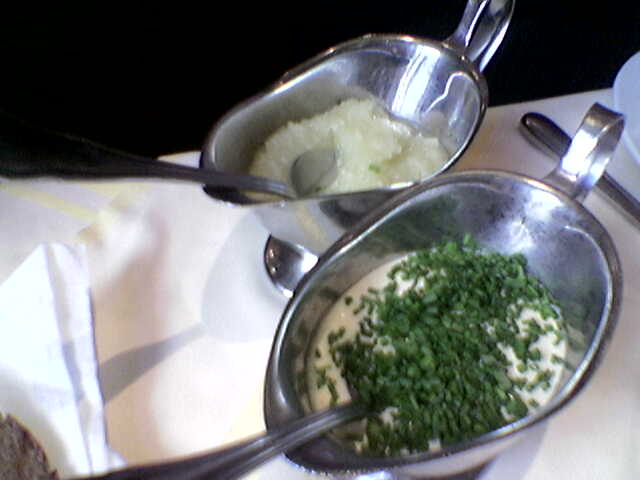
You can start with a cup of the broth which is engendered by the boiling of the meat, just to whet your appetite. You can then turn your attention to the meat proper, which you will eat with the vegetables, possibly some fried grated potatoes, and – to spice up what is otherwise a rather bland dish – two types of sauce, a cream-based chive sauce and apple-horseradish sauce.

tafelspitz sauces

My earnest suggestion is that you ignore the chive sauce in the front of the photo and go with the apple-horseradish sauce behind it. It is just a variant of the apple sauce I described earlier; you simply add grated horseradish. If you make this sauce at home, my further suggestion is to be generous with the amount of horseradish you add. The best Tafelspitz I ever had was served with an apple-horseradish sauce that made my eyes water slightly. I don’t want to sound like a broken record, endlessly repeating myself, but tartness really helps appreciation of the sweet-salt taste.

Both the French and the Italians have a similar dish of boiled meat, pot-au-feu in the first case and bollito misto in the second. My French grandmother made an excellent pot-au-feu and I am very fond of it, but since it is normally eaten with mustard I will drop it from this discussion. We shall focus instead on bollito misto, a dish which is very popular in northern Italy and (as the name suggests) consists of a variety of boiled meats: cuts of beef and veal, cotechino (a pork-based sausage), and sections of hen or capon.

bollito misto

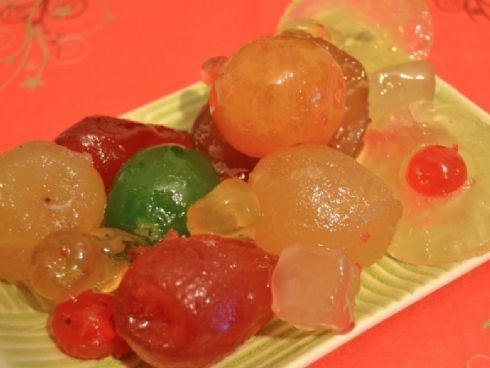
My wife reminisces from time to time that her father was very fond of bollito misto, eating it like most northern Italians do with a sauce called mostardaactually, mostarda di Cremona. In a country known for the fierce independence of its cities, it will come as no surprise to the readers that probably every city in northern Italy has its own variety of mostarda. Despite its name, the sauce has only a little to do with mustard. It is really a mix of candied fruit which is given a kick by the addition of mustard powder (that tartness thing again…). Those slices of fruit in the photo above are the mostarda, but I give here a more direct picture.

mostarda di cremona

My wife confesses to never having liked mostarda; she can’t even stand the smell. Personally, I have never tried it, but a number of sites do support my wife’s assertion, mentioning that the taste of mostarda is an “acquired taste”. This is normally code for saying that something tastes revolting the first several/many times you try it. In any event, if my wife says it’s not nice, then that’s good enough for me! No spoonful of it shall ever pass my lips. For those readers who will ignore these warnings and wish to try it, though, I give a brief recipe at the end of the post.

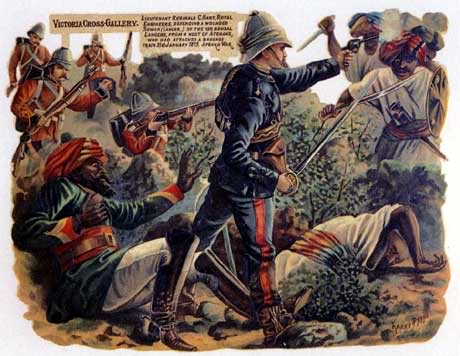
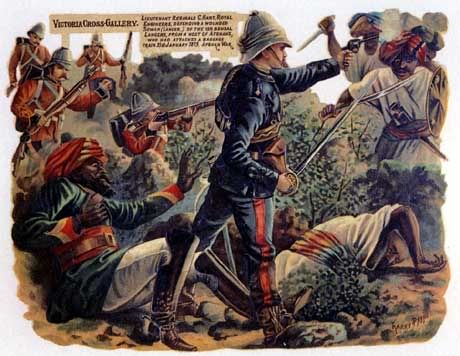
I feel that I cannot move away from mostarda without mentioning the somewhat similar chutney sauce one finds in the UK, or at least one found when I was a boy. Although “chutney” as a word has Indian roots, what I ate as a boy was several removes from things Indian. The most popular brand back then was a mango chutney which went by the name of Major Grey’s Chutney and was sold by Crosse & Blackwell. The story went that a certain Major Grey, a British officer in India, had surveyed the local Indian chutneys and then invented his own, more British, chutney, which he proceeded to bring back to the motherland when he retired, to remind him of the Good Old Days. When I was a boy I rather imagined this Major Grey to look like this

British soldier India-1

fighting heroically against savage natives on the Northwest frontier and getting a VC for his –quite literal – pains. But alas! this appears to be pure legend. It seems that something similar to mostarda, some sort of fruit conserve, existed already in the UK and the Brits in India took the idea with them and adapted it to local ingredients. So what this chutney will usually have as ingredients is mangoes, raisins, vinegar, onions, sugar, and spices. Crosse & Blackwell also include lime juice and tamarind juice. As you can imagine from the ingredients, this chutney is both sweet and tart. Again, for heroic readers who want to make this sauce from scratch, scroll to the end of the post.

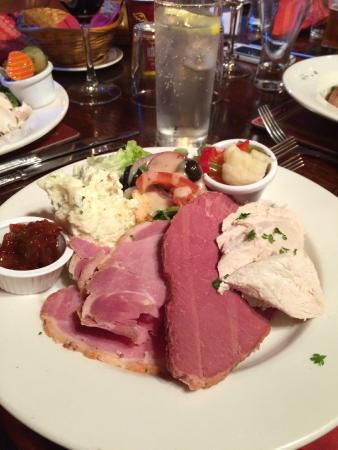
I haven’t eaten this kind of chutney in many decades, but when I was young my favourite way of eating it was with slices of cold meat (the chutney is in the round bowl to the left of the photo below).
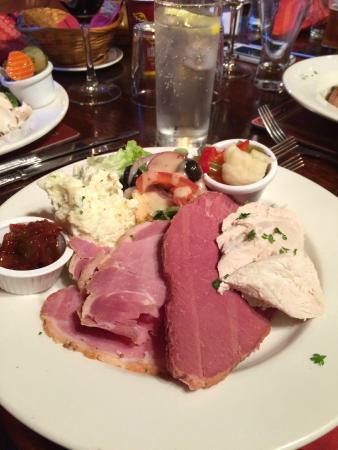
cold meat and chutney

This was an especially popular dish in pubs, where this photo was taken. Sitting here in Thailand, I feel a sudden nostalgia for the English country pubs whose bars I propped up in my youth, so I am moved to throw in a photo of a nice country pub.
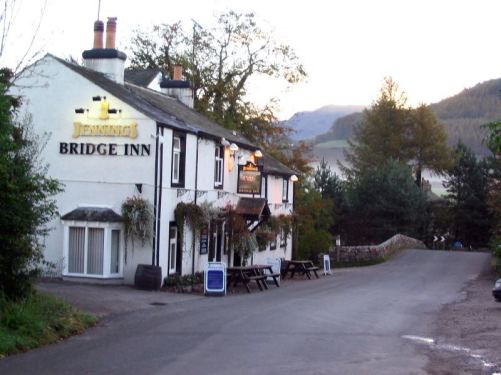
Bridge Inn

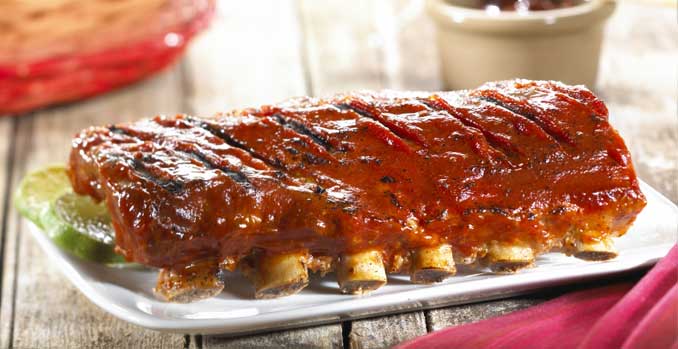
Like Superman, I now vault over to the US and alight somewhere in the open ranges of the Midwest, for no better reason than having this feeling that my next salt-sweet sauce – barbecue sauce – was invented around there somewhere. That being said, my wife and I didn’t try it there. We were just discussing this point and we reckon that it was somewhere between Boston and Washington in the early 1980s. Wherever it was, we stared open-mouthed at these large racks of ribs smothered in this dark reddish brown sauce.

ribs and barbecue sauce

But very soon we were closing our mouths over those ribs. Ah, that sauce! … But I should say: those sauces. In this little research I’ve done I have discovered that there are dozens of different barbecue sauces. I thought the Italian quarrels about where the best mostarda is made were fierce, but boy! the arguments about what place in the US makes the best barbecue sauce are right up there. I’m going to keep my head low without backing any particular sauce. I’m merely going to say that wherever the sauces are made they all seem to have sugar (preferably brown), tomato ketchup, vinegar, and some salt, to which various spices are added in varying levels and in different combinations (Worcestershire sauce, pepper, paprika, mustard, chili, cayenne, and on and on). That combination of sweet and tart again, to challenge the salt of the meat. Readers can look at the end of a post for condensed recipe of an excellent sauce from Kansas City (but don’t tell anyone I said it).

Deary me, I seem to have gone on for quite a while here, and I’m sure I haven’t covered one-hundredth of the sweet-salt dishes enjoyed around the world. On top of it, I’ve only mentioned meat dishes; it makes me sound a total carnivore, red in tooth and claw. But there was that fish dish in Shanghai … and there are all those sweet salad sauces to pour on vegetables … But I have to stop. I’ll just add two final combinations of salt and sweet which show that meat (or fish) is not the only food the delight of which is heightened by the salt-sweet experience: one which probably every person on the planet has enjoyed by now, what with the prevalence of fast food joints, french fries and ketchup

french fries and ketchup

and one which I’ve mentioned in an earlier post, chocolate and French baguette

chocolate and baguette

Mmm, so good!

So give your taste buds a whirl and douse them with sugar and salt – and a dash of vinegar, or horseradish, or something tart. Enjoy!

-o0o-

Mint sauce: Strip the leaves off a bunch of mint, sprinkle them with a pinch of salt, and chop finely. Place the result in a bowl, add 1 level tablespoon of caster sugar and pour over the mix 4 tablespoons of boiling water. Stir and leave to cool. Stir in 4 tablespoons of vinegar. Add more water or vinegar to suit your taste.

Apple sauce: Take a number of cooking apples, peel them, core them, and chop them up. Put the apples in a saucepan and add water. Once can also add lemon zest. Cover and cook over a low heat until the apples have gone soft and mushy. At which point take off the heat and beat in a knob of butter and a teaspoon of sugar. Cool.

Mostarda di Cremona: Begin by washing the various fruit: pears, quinces, cherries, apricots, figs, and peaches (although I’m sure you can vary the fruit as you wish). Cut the apricots and peaches into halves or quarters (depending on their size) and remove their stones, peel. Core and quarter the pears and quinces. Dry all the fruit after preparation. Add the sugar – a lot of sugar! half a kilo for every kilo of fruit, more if you want your mostarda sweet (but for reasons suggested above, I would go easy on the sweetness and maybe go heavier on the mustard powder). Pour some squeezed orange juice over it. Let the whole rest for 24 hours, gently turning the pieces a couple of times. By the end of this time the sugar will have dissolved. Drain the fruit well – without losing the syrup! Bring the syrup slowly to a boil, and let it boil gently until its volume is reduced by half. Pour the remaining syrup back over the fruit. The sugar in the now-concentrated syrup will extract more moisture from the fruit, which will begin to shrink and firm up. Concentrate the syrup again and steep the fruit in it overnight again. Dissolve several tablespoons of mustard powder in some white wine vinegar. Bring the mixture gently to a boil and let it bubble for a few minutes. In the meantime, drain the fruit again, and concentrate the syrup again. Put the candied fruit into jars, add the mustard powder infusion, and then add the hot syrup. The amount of infusion you add will determine of course how much of a kick your mostarda will have. Cover the jars and put them on a cool dark shelf. The mostarda will be ready to eat in two weeks’ time.

Major Grey’s chutney: (this is one of many recipes for this kind of chutney) Combine 4 cups of 5-6 medium-sized chopped mangoes, 1 cup of brown sugar, half a cup of molasses, 1 cup of vinegar, 1 cup of coarsely chopped onions, three-quarters of a cup of golden raisins, half a cup of seeded and chopped limes, half a cup of peeled, seeded and chopped orange, a quarter of a cup of peeled, seeded and chopped lemon, and finally a bunch of spices: half a cup of grated ginger root , 3 cloves of minced garlic, 1 tablespoon of mustard seed, 1 tablespoon of dried red pepper flakes. Cook for about 30 minutes, stirring often. Add 2 tablespoons finely chopped fresh cilantro, 1 teaspoon of ground cinnamon, a quarter of a teaspoon of ground cloves, a quarter of a teaspoon of ground allspice. Cook for another 10 minutes or so, until chutney starts to thicken. Ladle chutney into a jar and close it air-tight.

Barbecue sauce: (from Kansas City) In a saucepan over medium heat, stir together ½ cup of ketchup, 2 tablespoons of brown sugar, 1 tablespoon of cider vinegar, 2 tablespoons of Worcestershire sauce, ¼ teaspoon of salt, ¼ teaspoon of mustard powder, 1 teaspoon of garlic powder, and a dash of hot pepper sauce. Bring to a simmer, then remove from heat and allow to cool.

_________________

Electric arc furnace: http://ih.constantcontact.com/fs163/1101151826392/img/505.jpg (in http://ricorant.blogspot.com/2014/11/fwd-dominance-of-steel-111114.html)
Pineapple and soy sauce: http://static.squarespace.com/static/51107688e4b0e3b888c1183b/t/519f0a2ee4b0bb6d74d9bdcf/1369377327493/Grilled+Soy-Sauce+Pineapple (in http://larkspurcompany.com/blog/2013/5/20/grilled-soy-sauce-pineapple)
Taste bud closeup: http://cdn1-www.webecoist.momtastic.com/assets/uploads/2010/01/tongue-taste-bud1.jpg (in http://webecoist.momtastic.com/2010/01/11/biological-photography-magnificent-microscopic-ultraminiature-photos/)
Lamb and mint sauce: http://www.thetimes.co.uk/tto/multimedia/archive/00050/table_townsend_74217_50069c.jpg (in http://www.thetimes.co.uk/tto/life/food/recipes/article2701689.ece)
Asterix sauce a la menthe: http://www.prise2tete.fr/upload/NickoGecko-Saucementhe.jpg (in
Roasted pig: http://previews.123rf.com/images/azlightning/azlightning0908/azlightning090800003/5315340-whole-golden-roasted-pig-on-a-spit-spit-roasting-is-a-traditional-hawaiian-luau-method-of-cooking-a-.jpg (in http://www.123rf.com/photo_5315340_whole-golden-roasted-pig-on-a-spit-spit-roasting-is-a-traditional-hawaiian-luau-method-of-cooking-a-.html)
Roast pork and apple sauce: http://www.growingagreenerworld.com/wp-content/uploads/2010/10/123-dishAppleSauce_Pork.jpg (in http://www.growingagreenerworld.com/pork-tenderloin-spiced-applesauce-recipe/)
Tafelspitz: http://www.plachutta.at/typo3temp/pics/1115b4ecd0.jpg (in http://www.plachutta.at/en/about/)
Tafelspitz sauces: http://thepassionatecook.typepad.com/sauces.jpg (in http://thepassionatecook.typepad.com/thepassionatecook/traditional_austrian_food/page/2/)
Bollito misto: http://www.buonissimo.org/archive/borg/XRqDUZ2JX8O3MtcV7PuMgNvG9IvTytvNm6Rhlcw8yOzcxGV4vWA1kg%253D%253D (in http://www.buonissimo.org/lericette/5685_Bollito_misto)
Mostarda di Cremona: http://www.cremonacitta.it/intranet/immagini/_resized/1/scheda/58/w/490x/Prodotti_De_Co_di_Cremona_la_Mostarda_cremonese-img58-01-1.jpg (in http://www.cremonacitta.it/it/gusto_e_sapori_a_cremona/prodotti_de_co_a_cremona_mostarda_tradizionale_sc_58.htm)
Cold meat and chutney: http://media-cdn.tripadvisor.com/media/photo-s/07/0d/d8/5a/blairs-inn.jpg (in http://www.tripadvisor.ie/LocationPhotoDirectLink-g186599-d2014376-i118347866-Blairs_Inn-Blarney_County_Cork.html)
Bridge Inn: http://www.hallflatfarm.co.uk/IMAGES/The%20local%20-%20the%20Bridge%20Inn.jpg (in http://www.hallflatfarm.co.uk/location.html)
British officer in India: http://i80.photobucket.com/albums/j199/matteaston/Afghan1.jpg (in http://www.fioredeiliberi.org/victorian/)
Ribs and sauce: http://www.cooldeals.es/Images/deal-images/eef5c31f-f992-46a5-8993-db0198715a35/20140818133044604.jpg (in http://www.cooldeals.es/Deals/Marbella-Estepona/9fd8ffad-612a-42de-8755-55153751c9e6)
French fries and ketchup: http://scms.machteamsoft.ro/uploads/photos/652×450/652x450_7b63084e7d5012a126811947191414.jpeg (in http://stiri.acasa.ro/social-125/afla-ce-alimente-ascund-sute-de-kilocalorii-110745.html)
Baguette with chocolate: http://a142.idata.over-blog.com/600×449/2/90/63/97/Autrefois-./Chocolat/Le-Bon-Chocolat–13-.JPG
PRICKLY PEAR AND THE COLUMBIAN EXCHANGE

Bangkok, 23 January, 2015

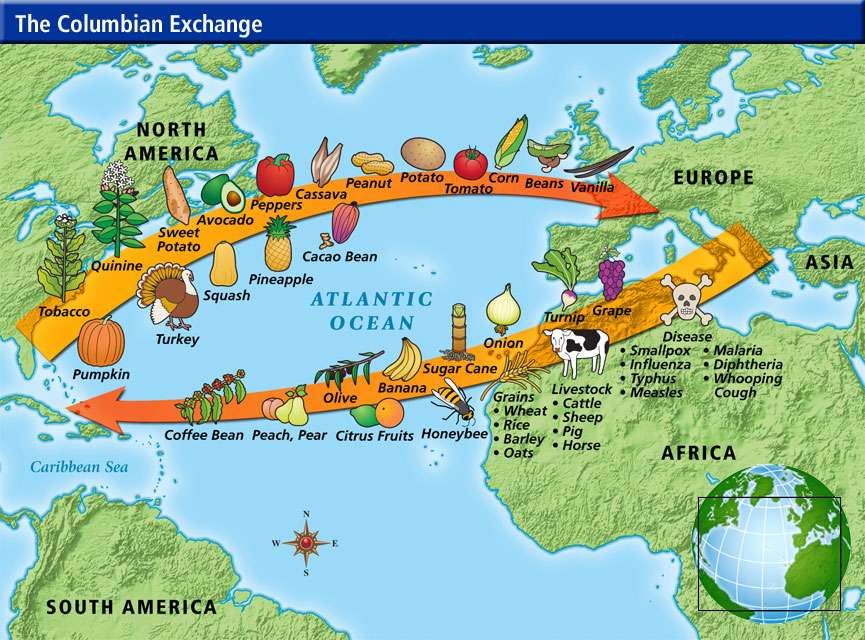
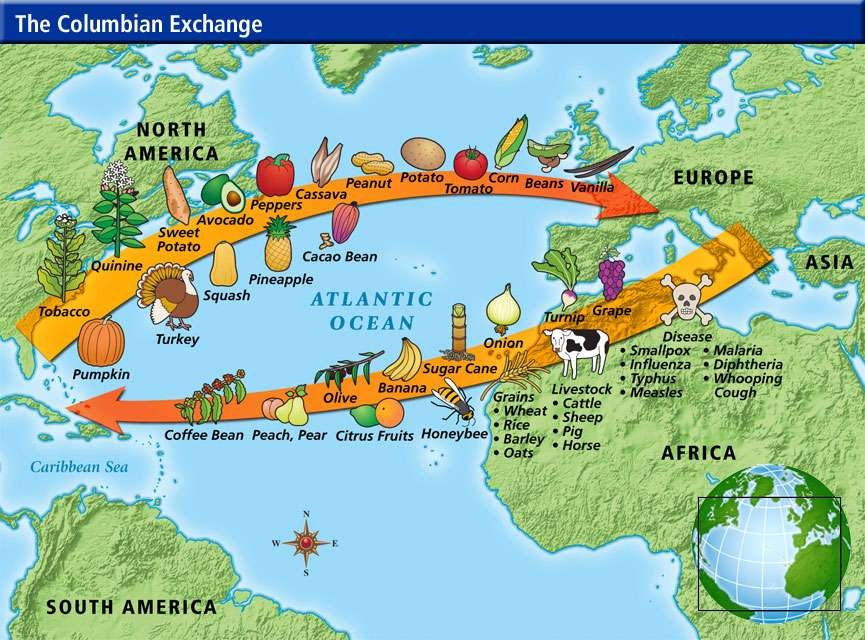
One of the most far-reaching effects of Christopher Columbus’s discovery of the Americas was the so-called Columbian Exchange, the exchange of plants and animals (and bacteria and viruses) between the Americas and the rest of the world. This map shows some of the major crops and livestock which made the journey in either direction between the Americas and Europe.
image
We see, for instance, that the tomato crossed to Europe from the Americas, along with the turkey and corn (and possibly syphilis), while the cow, the horse, and the onion, went the other way, along with smallpox, measles, typhus, and a whole series of other diseases (the diseases nearly wiping out the Amerindian populations).

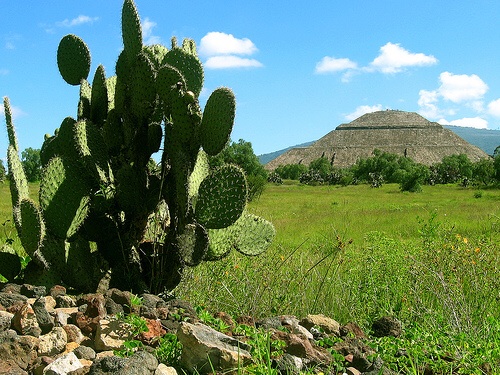
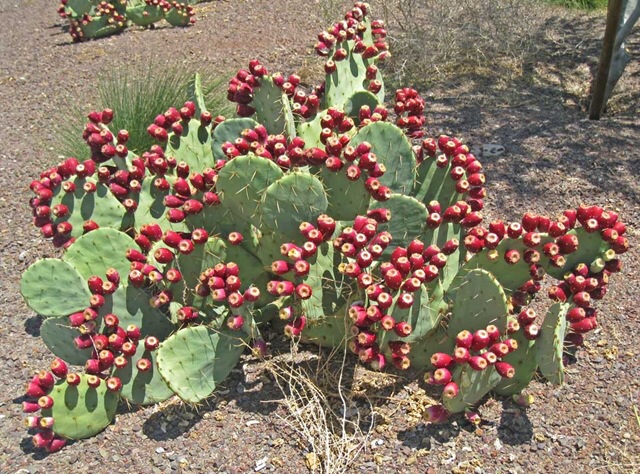
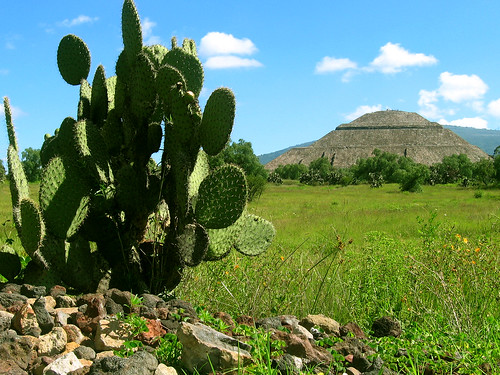
But I want to focus on a plant which normally doesn’t get mentioned in discussions of the Columbian Exchange: the prickly pear, a plant whose history is very much centered on Mexico. Here, we have an exemplar standing guard, as it were, at the site of Teotihuacan.
image
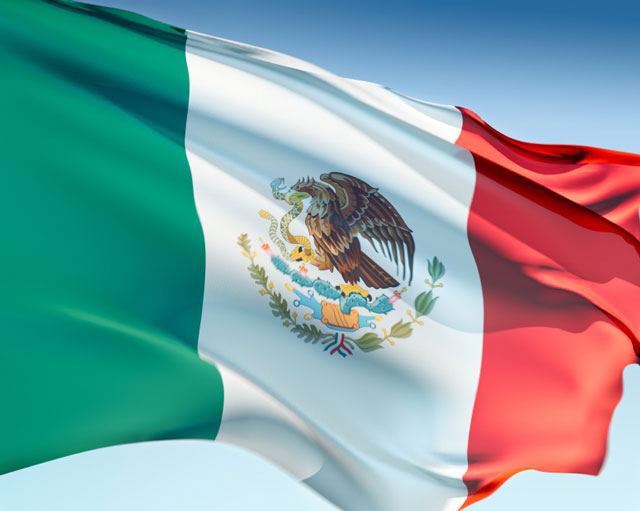
In fact, the prickly pear is so centered on Mexico that it graces the Mexican flag as part of the latter’s central emblem (for those with “mature” eyesight like mine, it’s what the eagle is grasping with its talons at the same time as it grasps that snake in its beak).
image
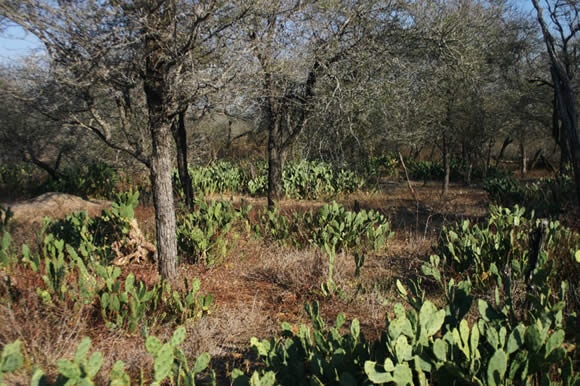
Maybe the prickly pear’s low profile in Columbian Exchange discussions is because it’s such a nasty, spiny plant, which really doesn’t endear itself to anyone.
image
Or maybe because it’s not much of a commercial crop; the Food and Agricultural Organization, which collects global statistics on some 160 crops, collects no statistics on the prickly pear, for instance.

Whatever the reason, I wish to right this injustice and pay tribute to the prickly pear and its role in the great Columbian Exchange. It may perhaps have played a modest economic role, but it helped to fill many an empty stomach, and it sure as hell has played an important ecological role, sometimes wreaking havoc in the ecosystems into which it was thoughtlessly thrust.

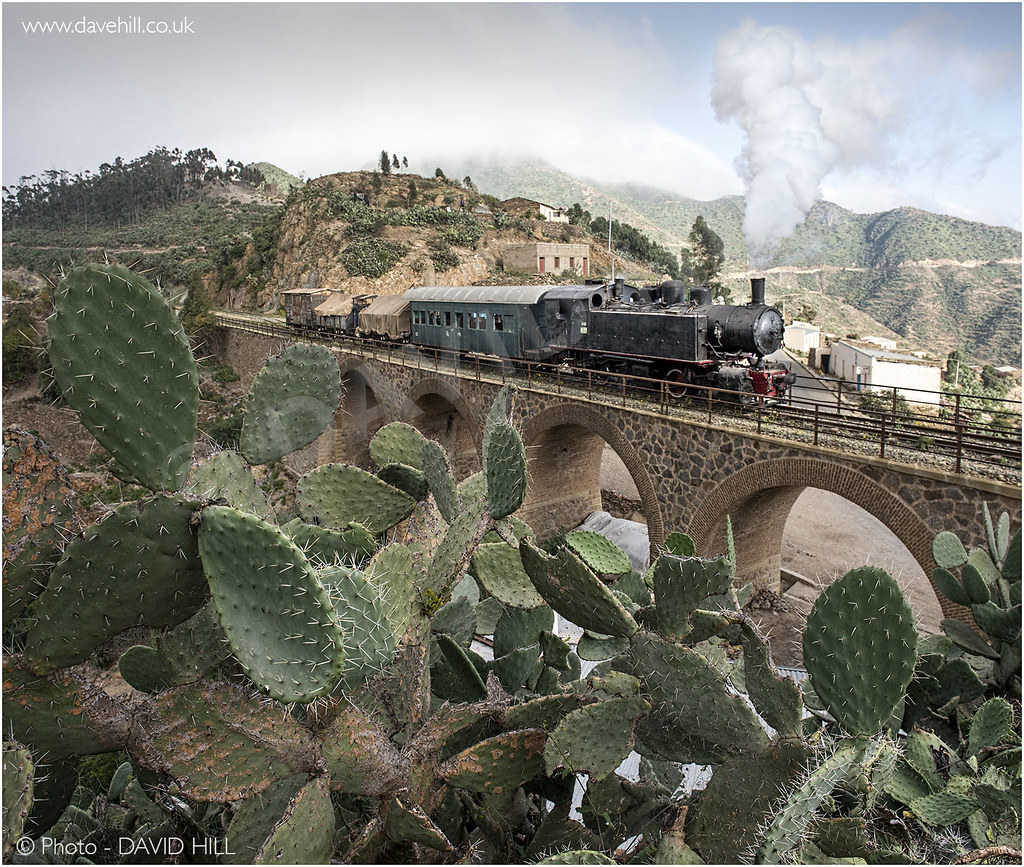
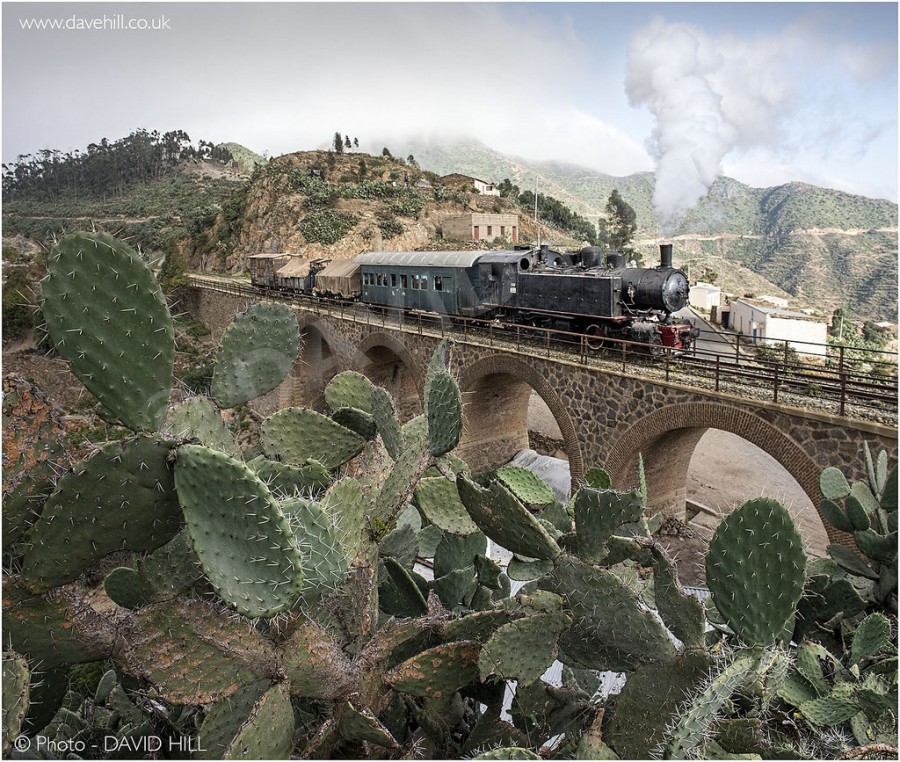
I first met our prickly friend in the country of my birth, Eritrea. Here, you see a specimen in front of the delightful little train which runs from Asmara down to the seaport of Masawa on the Red Sea.
image
I have a vivid memory of taking that train to go down to the coast for a holiday on the beach.

It was the Italians who, as colonial masters
image
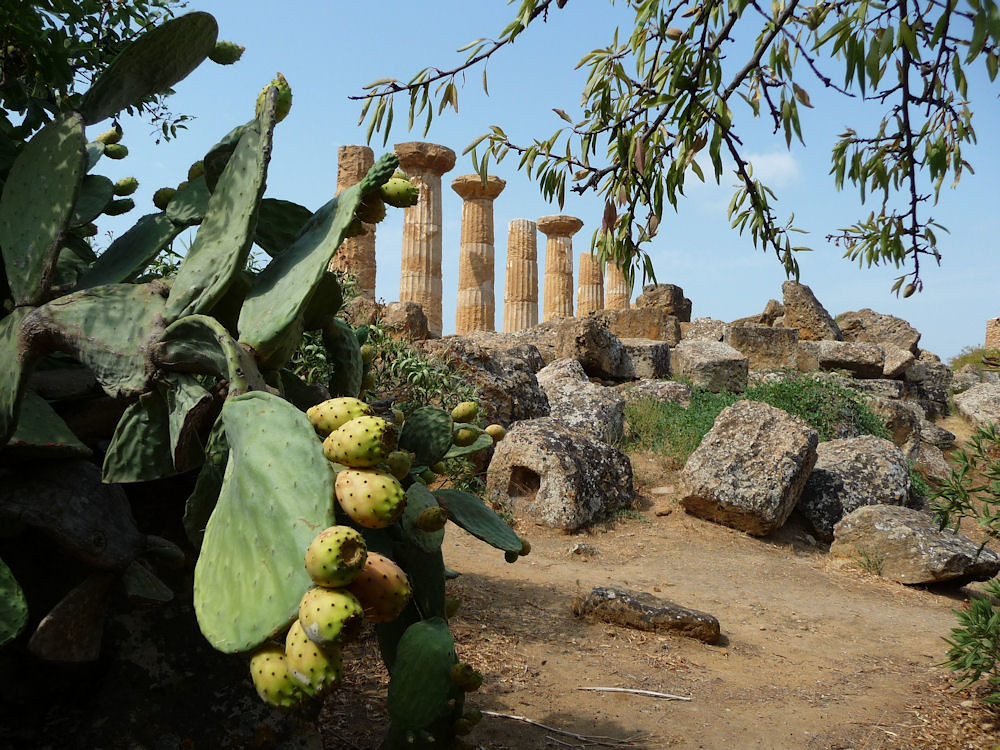
introduced the prickly pear (please note the plant waving at us from behind the colonial troops and their Italian officer). The Italian colonialists brought it from the mother country, of course, where it grows in profusion in the more arid southern regions of the country. We have here an example gracing the ruins of Agrigento in Sicily.
image
But southern Italy was just a later stop on the prickly pear’s journey out of Mexico. It must surely have reached Italy from Spain, which was the first port of call for many of the biological journeys out of the Americas. Here we have a Spanish prickly pear, nudging its way into a photo of Sagunto castle in the province of Valencia.
image
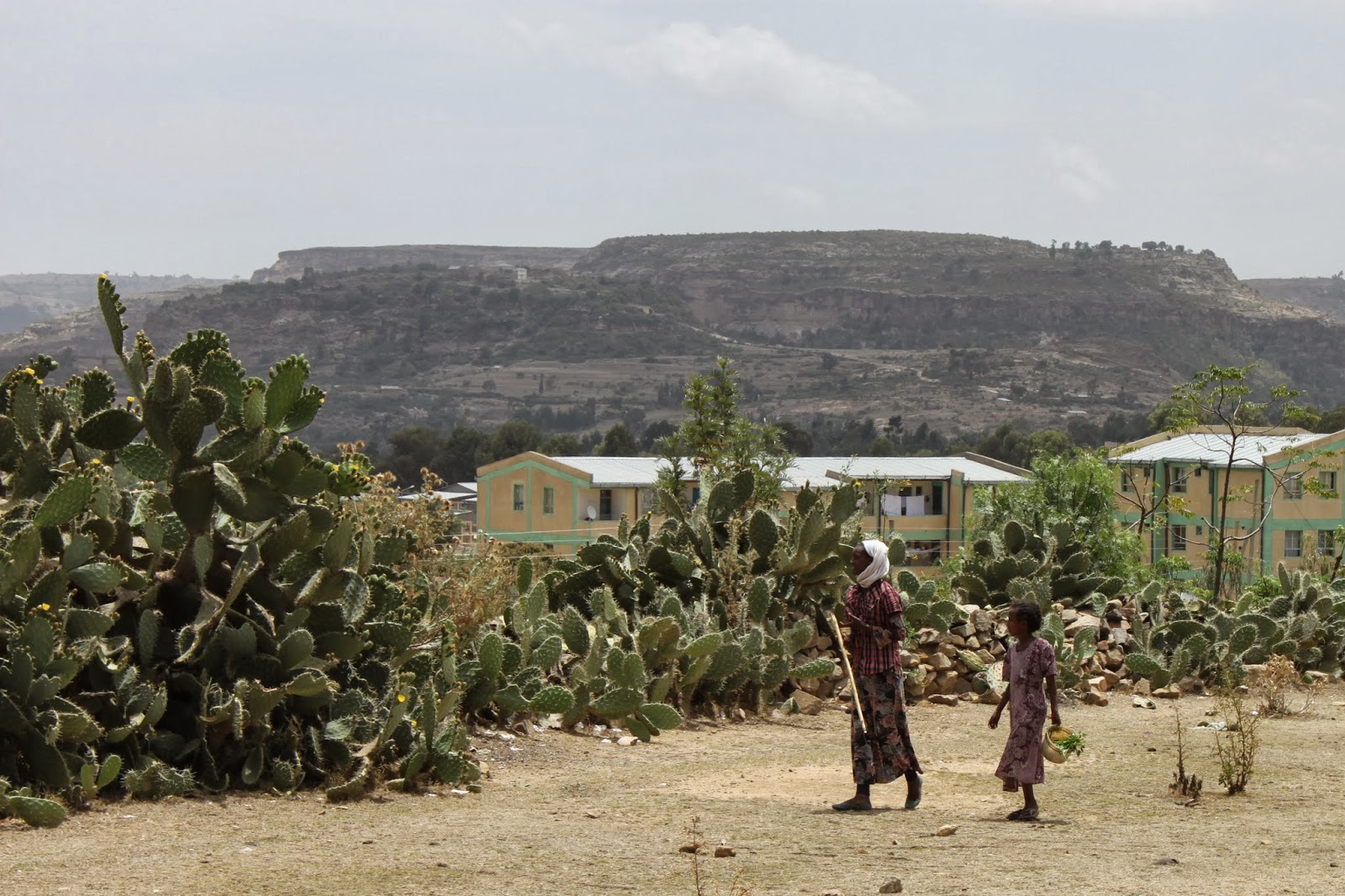
In truth, I have chosen pictures which show off the prickly pear to advantage, but normally the plant is much more unprepossessing. This photo of a ragged, messy patch of prickly pear in a village of Ethiopia is much more typical of how the plant presents itself
image
especially when its population levels begin to explode out of control in some foreign ecosystem which has no natural biological defenses against it. The Global Invasive Species Database lists several countries where the prickly pear is now considered an invasive species. Eritrea is one of them, along with the neighboring countries of Ethiopia and Somalia – the Italians, who colonized all three countries had little idea of the damage they were wreaking. But South Africa also considers it an invasive species (here is a picture of prickly pear invading the Kruger national park).
image
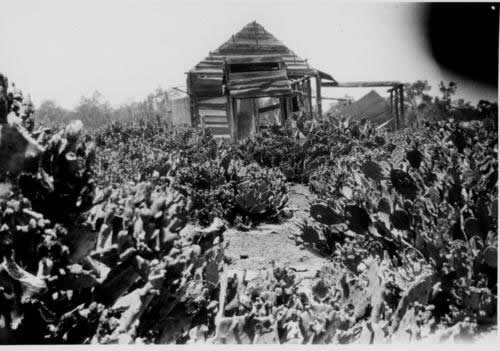
And Australia had a catastrophic invasion. The prickly pear was initially introduced as an ornamental plant for gardens. Then some bright spark thought of using the plant as natural fencing (sensibly enough, cattle and other animals desist from pushing through breaks of prickly pear because of the nasty spines, and they don’t eat them for the same reason) and to start a cochineal dye industry (the little beasties from which the dye is extracted munch the prickly pear’s pads). But the prickly pear went crazy. It eventually converted some 260,000 square kilometers of farmland (which for those readers, who like me don’t think in square kilometers, is more or less equivalent to a square 500 km by 500 km) into an impenetrable green jungle. Farmers were driven off their land by this “green hell” and their abandoned homes were crushed under the cactus growth.
image
The authorities finally managed to get the plague under control in the 1920s by introducing a South American moth, the Cactoblastis cactorum, whose larvae feast on prickly pear. This led to a crash in prickly pear populations, and while the plant has not been eradicated from Australia it has been brought under control (the Australians were lucky, by the way; there is always a risk in this kind of biological control that the agent will find another native plant much more to its liking and wipe that out instead, or once it’s dealt with the original pest will turn its hungry eye on to something else and become an invasive species in its own right).

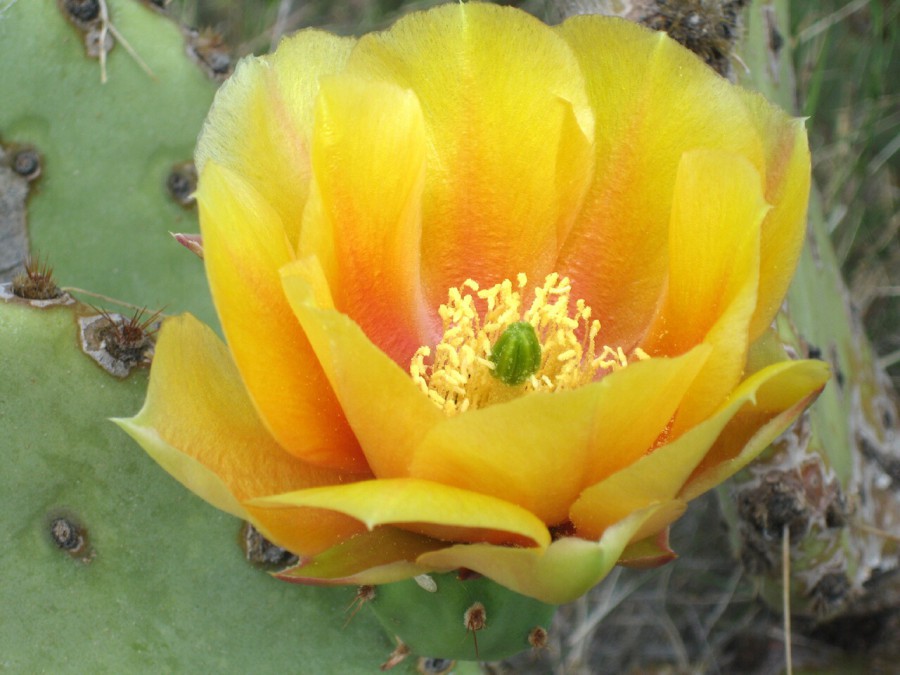
Why did some Spaniard ever bring the prickly pear back to Europe in the first place? Because, as far as I can tell, he thought he could brighten up a Spanish garden somewhere. But it cannot have been because of the beauty of the plant itself. More likely it was the flowers, for indeed the web is full of pictures of the flower of the prickly pear. Here are a few of the more pleasing examples.
image
image
image
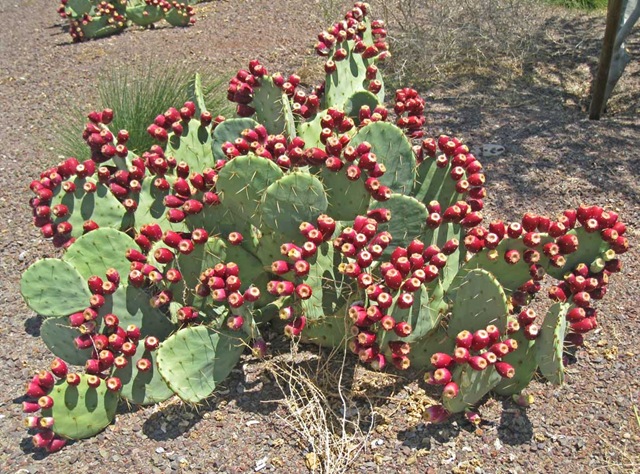
At some point, though, people, especially the poor with bellies to fill, began to also focus on the fruit, the “figs” of the prickly pear
image
These had been enjoyed by the Mesoamericans for millennia before Hernan Cortes and his conquistadores arrived and have been enjoyed by the Mexicans ever since.
image

I add here a close-up of the fruit
image
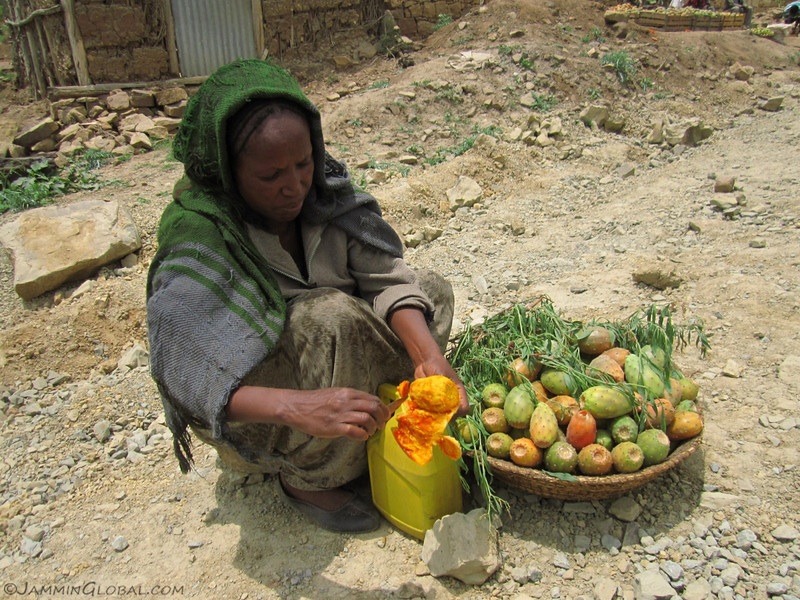
first because it’s a nice photo, but second because the sharp-eyed reader will notice the hair-thin spines which nestle lovingly around the crown of the fruit. Their scientific name is glochids. They are the nastiest little buggers imaginable. They come off easily and lodge under the skin of the unwary picker, where they cause exquisite and unending agony as the said picker tries and tries and tries again to extract them, always in vain. Bloody little bastards … Readers may have gathered from this little burst of ill humour that I have personally experienced this exceedingly painful trial. It was in Eritrea as a matter of fact, where as a young and foolish lad I tried picking the fruit.  I then ran to my Mummy to get the horrible little things out, which she eventually did after much wailing on my part and cross admonitions on her part for me to keep still. I had tried picking the fruit because my mother had earlier bought some, perhaps from a lady like this
image
and I had liked them – a little too many seeds perhaps but nicely fresh and sweet.

Personally, while I like the taste, that early brush with glochids has always made me wary of the fruit. The pain in the hands was bad enough but the thought of those things getting stuck in your tongue or gums because the fruit was badly cleaned is dreadful. And the thought of them getting stuck in your throat is simply too horrible to contemplate.

But others around the world consume the fruit without a second thought, especially around the Mediterranean rim. Here, we have some cheerful young lads selling the fruit in Egypt

image
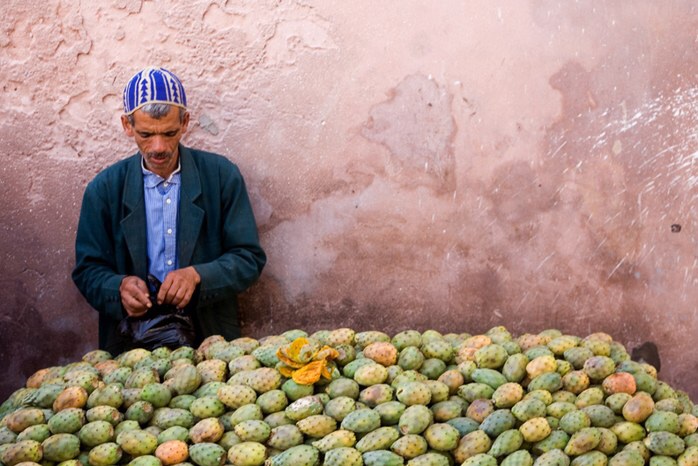
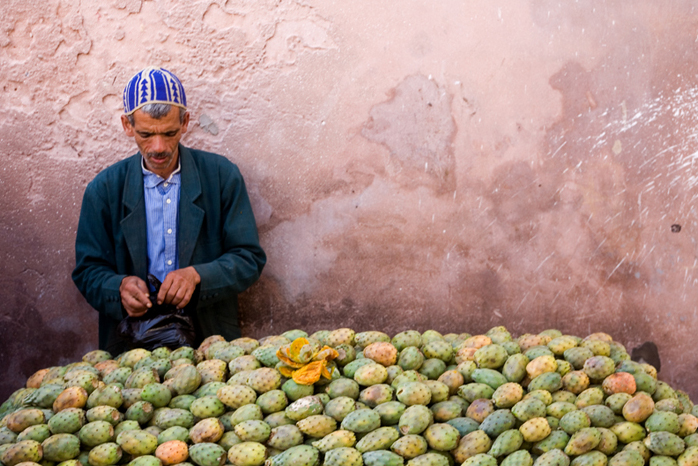
While here we have a more solemn Moroccan doing the same
image
And here a smiling Sicilian ditto
image
As readers can imagine, over the centuries people in the countries where the prickly pear was introduced eventually got around to putting the fruit into alcoholic drinks – at least in those countries where such drinks are tolerated. Thus, we have a prickly pear-flavoured liqueur called “Ficodi” in Sicily, we have a prickly-pear flavored herbal liqueur called “bajtra” in Malta (another country, by the way, where the prickly pear has been declared an invasive species), out in the lonelier reaches of the Atlantic, on the island of St. Helena (where Napoleon Bonaparte was banished), the potent “Tungi Spirit” is produced with the fruit, while prickly pear fruit is the main ingredient of a popular Christmas beverage in the British Virgin Islands called “Miss Blyden”. Looking at how all these various drinks are made, I think I would plump for Miss Blyden: prickly pear steeped in rum and sweetened with sugar. Mmm, sounds good …Yohoho, and a bottle of Miss Blyden, is what I say.

But actually, these drinks are all derivative, if I can put it that way: you just plunk prickly pear fruit in an alcoholic medium; it could actually be any fruit that is plunked. The Mesoamericans, on the other hand, came up millennia ago with colonche, an alcoholic drink using just the juice of the prickly pear fruit, fermenting it over a number of days. I have read that it is a sweet, fizzy, red beverage. Here’s a photo of a glass of colonche, together with the fruit from which it is derived.
image
I regret to say that I did not try the drink while I was in Mexico. However, I have asked my son to try it and report back. If the feedback is good, we can discuss about getting into the business of exporting it!

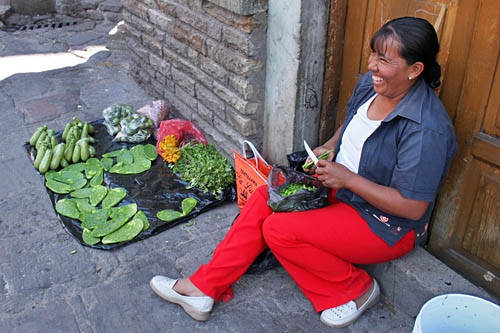
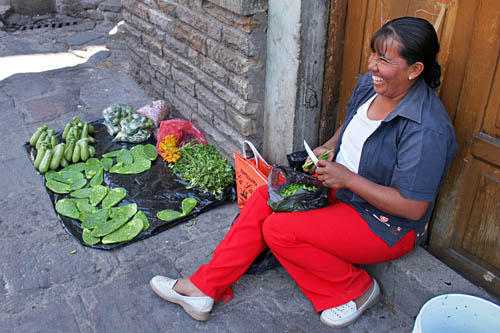
What I will not promote, through export or otherwise, is the eating of the pads (that is to say the fleshy leaves) of the prickly pear. They eat them in Mexico – and in New Mexico too (and perhaps some of the other southwestern States of the US). The original peoples of Mexico were eating them when Cortes burst in on the scene, and it’s still quite popular. I saw them sold in the supermarket around the corner from where we were staying in Mexico City and took a photo, but I prefer this more sympathetic photo of a Mexican lady on the street selling them.
image
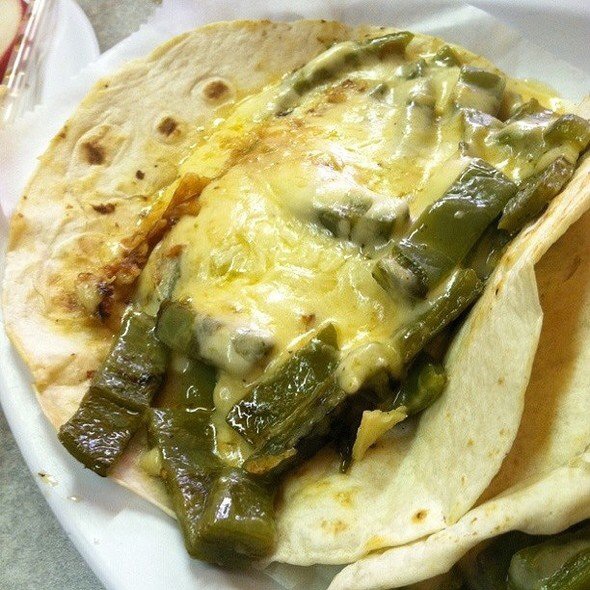
I mentioned in an earlier post that I had tried the pads, cooked and with melted cheese, in a taco. I also tried them, with cheese but without the taco. It didn’t change the taste much.
image
I’m all for trying things once (with the exception of insects). But not necessarily more than once. Pads of the prickly pear fall into the latter category.

But who knows? As the Mediterranean countries slowly go down the economic drain, and more generally as we 99 percenters slowly get poorer, perhaps we will join our Mesoamerican friends and start eating prickly pear pads – as the poor of the Mediterranean lands turned to the fruits of the prickly pear some three hundred years ago to fill their empty stomachs.

_______________
Columbian exchange: http://globerove.com/wp-content/uploads/2010/03/Columbian-Exchange.jpg (in http://www.slideshare.net/mobile/cbgobble/columbian-v-triangle)
Prickly pear in Teotihuacan: https://farm1.staticflickr.com/214/444712763_0a91a8353e.jpg (in https://www.flickr.com/photos/eternal_sunshine_of_the_spotless_mind/444712763/
Mexican flag: http://www.freepressers.com/wp-content/uploads/2011/10/mexican-flag-640.jpg (in http://www.worldtribune.com/worldtribune/WTARC/2011/k1302_10_21.asp)
Prickly pear: https://seekraz.files.wordpress.com/2012/10/prickly-pear-cacti-in-tucson-desert.jpg (in https://seekraz.wordpress.com/tag/prickly-pear-cactus/)
Prickly pear by Asmara-Masawa railway: https://c1.staticflickr.com/9/8633/16089064905_44b9e68e48_b.jpg (in https://www.flickr.com/photos/dave-hill/16089064905/)
Italian colonial masters: http://upload.wikimedia.org/wikipedia/it/6/6c/Ascari_penne_di_falco.jpg (in http://it.m.wikipedia.org/wiki/Regio_corpo_truppe_coloniali_d’Eritrea)
Prickly pear in Sicily: https://c1.staticflickr.com/9/8299/7826141194_33f0e36a8d_b.jpg (in https://www.flickr.com/photos/mari-mora/7826141194/)
Prickly pear in Spain: https://themostbeautifulplacesineurope.files.wordpress.com/2013/07/dsc_0048.jpg (in https://themostbeautifulplacesineurope.wordpress.com/tag/castle/)
Prickly pear in Ethiopian village: http://4.bp.blogspot.com/-YutF1G9Qjbo/Up44cIZUf_I/AAAAAAAAMPA/fydBOTfLCNY/s1600/00041775.jpg (in http://jhodgesagame.blogspot.com)
Prickly pear in Kruger National Park: http://academic.sun.ac.za/cib/news/images/20120611_opuntia_stricta_impacts_fig1.jpg (in http://academic.sun.ac.za/cib/news/20120611_opuntia_stricta_impacts.htm)
Prickly pear in Australia – the green hell: http://chinchillalibrary.chinchilla.org.au/Images/Local%20History/johnty%20turner’s.jpg (in http://chinchillalibrary.chinchilla.org.au/HTML/HeritagePricklyPear.html)
Prickly pear in flower-1: http://www.fotothing.com/photos/4aa/4aa38f6709881bcb9b0dc2f7bce87dea.jpg (in http://www.fotothing.com/AzViper/photo/4aa38f6709881bcb9b0dc2f7bce87dea/)
Prickly pear in flower-2: http://photosbygarth.com/travels/DesertGardens4-23-11/prickly_pear_cactus_flowers_0887.jpg (in http://photosbygarth.com/wordpress/)
Prickly pear in flower-3: http://www.summitpost.org/prickly-pear-cactus-flower/294673
Prickly pear fruit-1: http://2.bp.blogspot.com/-_NFH_ZhWJCU/T1kjB-HTOWI/AAAAAAAAA84/rBf30_8f5qg/s1600/5.jpg (in http://docsfitnesstips.blogspot.com/2012/03/prickley-pear.html)
Mexicans selling prickly pear fruit:
http://i.gonoma.net/i/destinations/1106/zacatecas-images/prickly.jpg (in http://gonomad.com/destinations-xxx/3205-zacatecas-mexico-rsquo-s-overlooked-colonial-gem)
Prickly pear fruit-2: http://cdn.c.photoshelter.com/img-get/I0000O2m8f8jI.vU/s/600/600/PPCA-021548.jpg (in http://rolfnussbaumer.photoshelter.com/image/I0000O2m8f8jI.vU)
Ethiopian lady selling prickly pear: http://jamminglobal.com/2012/05/ethiopia-part-6-historical-axum-and-mountainous-twisties.html
Prickly pear seller Egypt: http://weekly.ahram.org.eg/Media/NewsMedia/2013/7/16/2013-635095893366005272-600_resized.jpg (http://weekly.ahram.org.eg/News/3357/25/The-fruit-beneath-the-thorns.aspx)
Prickly pear seller Morocco: http://upload.wikimedia.org/wikipedia/commons/b/b1/Prickly_pear_seller.jpg (in http://en.m.wikipedia.org/wiki/Opuntia_ficus-indica)
Prickly pear seller Italy: http://www.fotografieitalia.it/foto/3126/3126-08-20-44-1557.jpg (in http://www.fotografieitalia.it/foto.cfm?idfoto=65383&idfotografo=3126&crono=1)
Colonche: http://173.236.14.43/fotos/nota/2014/9/18/4d68094af571428.jpg (in http://www.am.com.mx/aguascalientes/especiales/espiritus-de-la-republica-144117.html)
Seller of cactus pads: http://holeinthedonut.com/wp-content/uploads/2010/06/Nopal_Cactus_Seller_Mercado_Hidalgo_Guanajuato.jpg (in http://holeinthedonut.com/2010/06/01/mexico-food-nopal-cactus/)

Cactus pad and cheese: http://s3.amazonaws.com/foodspotting-ec2/reviews/846163/thumb_600.jpg?1315336866 (in http://www.foodspotting.com/150802-amandahugnkiss)/)


MEXICO: PAINTED SIGNS

Bangkok, 13 January 2015

It was at Tlaxcala that I began to notice it.

We’d taken a bus from Mexico City to visit this small town, since it was described as a nice example of colonial Mexican architecture and town planning. It certainly was pleasant enough, as were Chiapas de Corzo and San Cristóbal de las Casas, two other colonial-era towns which we visited later. The latter two have been declared “pueblos magicos”, magic towns, a slogan dreamed up by the Mexican tourism authorities (clever branding, although I do feel duty-bound to whisper that the pueblos in Tuscany, for instance, or any number of pueblos which my wife and I have visited in Spain, are more magico than Tlaxcala and the two official pueblos magicos that we visited).

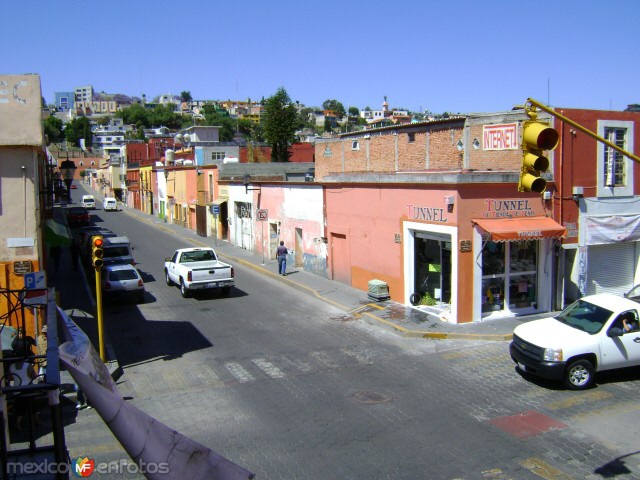
In any event, my point in mentioning the visit to Tlaxcala is another. What I began to notice as we walked around the town was the lack of modern signage on the shops. To understand what I mean, let me insert here a picture of the shopping street in Vienna, the Graben, where we often went for a stroll and coffee when we lived there.
image
Notice the abundant use of neon shop signs, tacked onto the shop fronts. For better or for worse (and in my opinion for worse; it drives me crazy in this age of climate change to see all those illuminated shop signs blazing out into the night), this is now the accepted and expected type of design for shop signs.

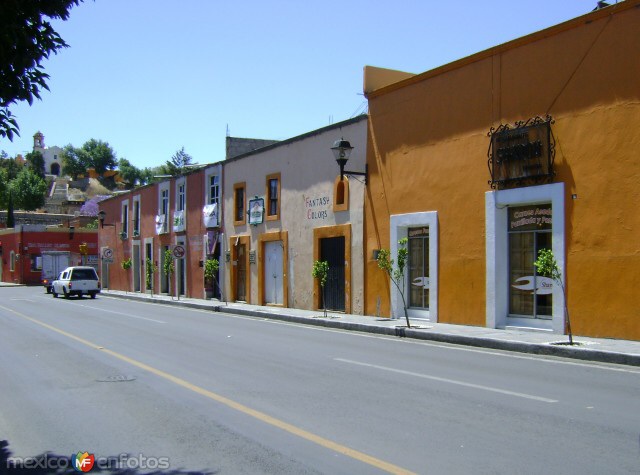
So it was with great interest that I saw in Tlaxcala that shop signs tended to be of the old-fashioned type, painted by hand
image
image
Alerted to this phenomenon, I made sure to get some close-ups of such signs in San Cristóbal
image
image

I began to notice that advertisements were often painted too. The following style of painted advertisement was definitely my favorite, with this particular example coming from San Lorenzo Zinacantán.
image
These types of advertisements, to be found on otherwise bare walls, seem always to be announcing some upcoming event. Notice the large, rounded, friendly, inviting font, but placed at a slight angle denoting future excitement, and with a very pleasing colour scheme which starts with a dark colour and shades off into a lighter one. I throw in here some other signs of this genre that I spotted from buses or trains flashing by.
image
image

It would seem that the honorable profession of sign painter is alive and well in Mexico! (this reminds me of a wonderful novel from India, another country with a great sign painting tradition, “The Painter of Signs”, by R.K. Narayan; great novelist, by the way, I highly recommend him to my readers).

Of course, painting on walls has a long and noble tradition in Mexico. This art form must have reached its apogee with the great Mexican muralists Diego Rivera, José Orozco, and David Siqueiros. Already 35 years ago, when we first visited Mexico, we had reverently visited a number of the murals by these artists. This time around, we visited Rivera’s murals in the Secretaría de Educación Pública, just behind the cathedral on the Zocalo in Mexico City. As was his style, they are very political, very “leftie”; they made me and my wife smile as they brought back memories of the excited discussions of our youth. These two murals, “The Capitalist’s Dinner” and “Death of the Capitalist”, epitomize them all.
image
image
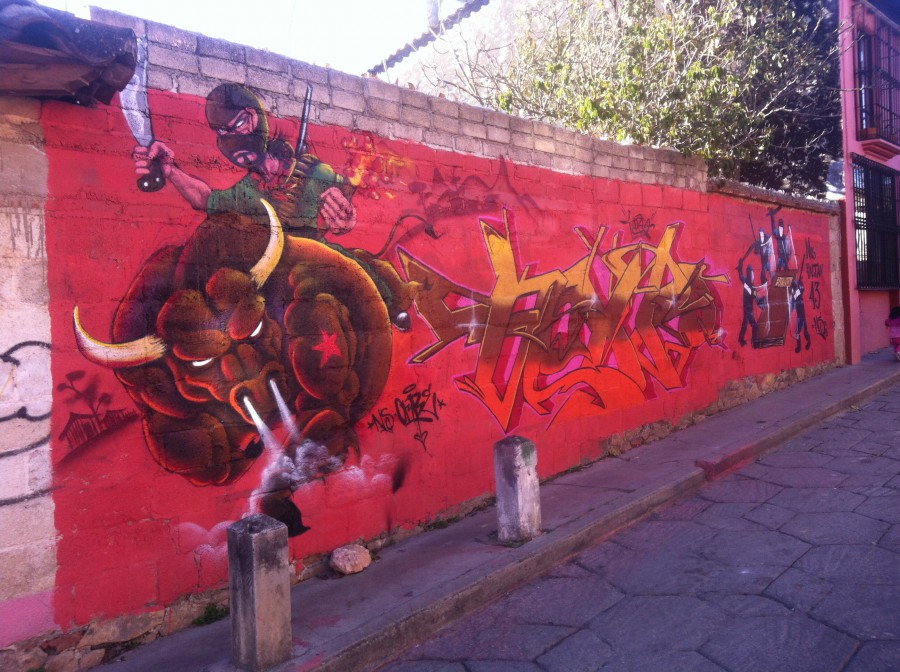
In San Cristobal, up some back streets, I saw what I fear are today’s inheritors of Rivera, Orozco, and Siqueiros
image
image
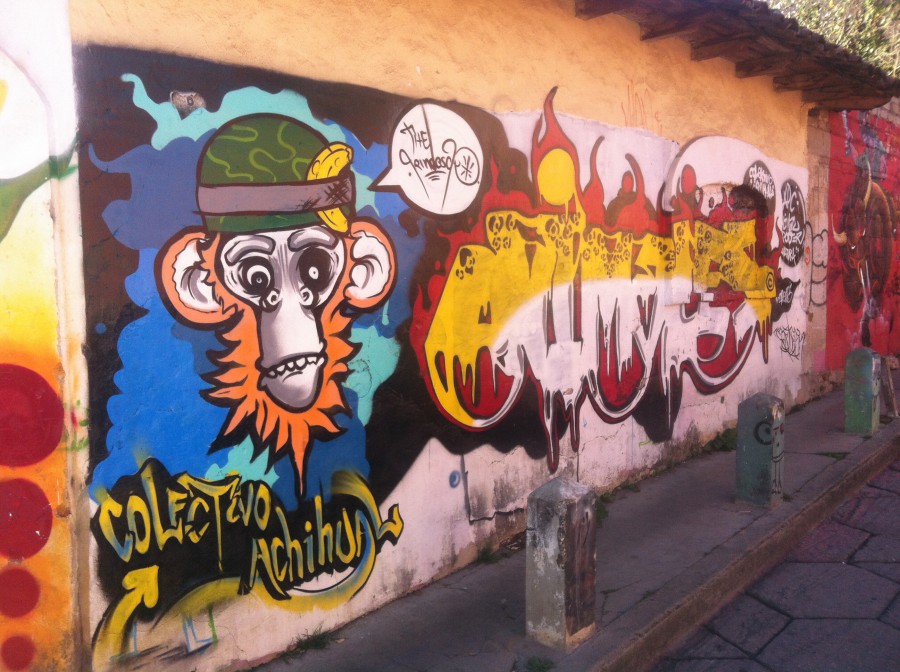
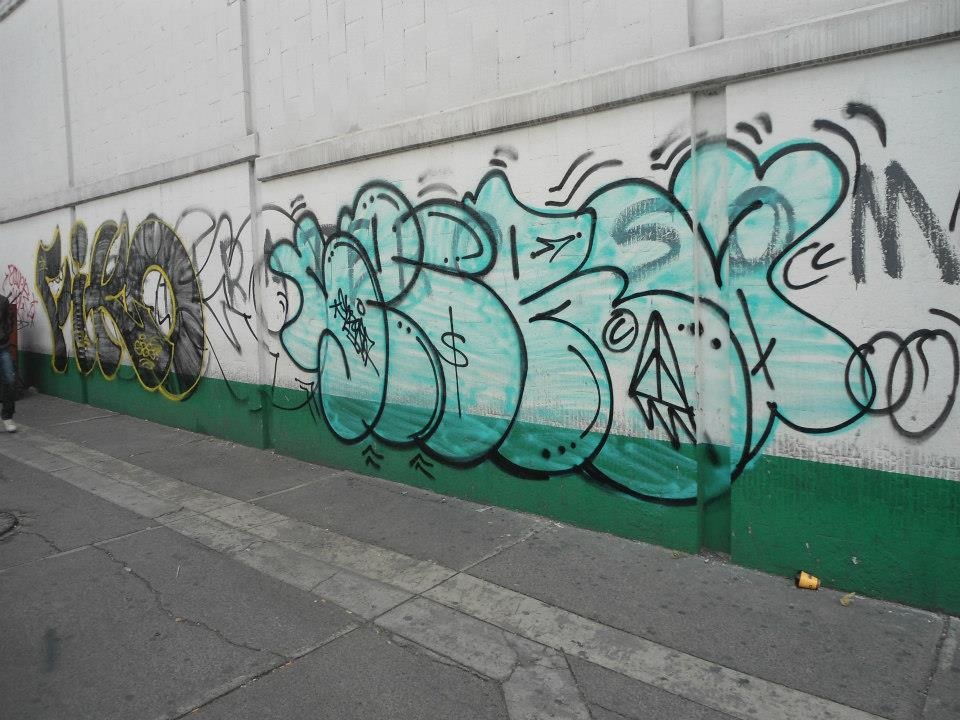
It’s sad really. All that grand, elevated talk of our youth has degenerated into the childish babble of these cartoons. But the rot doesn’t finish there, for Mexico suffers from the same mindless graffiti which defaces so many of our cities

image
“Fuck you. I exist”

What are our civilizations reduced to?

__________________

Mariahilfestrasse 1: http://austriacazare.ro/wp-content/uploads/2012/10/mariahilfer-strasse.jpg (in http://austriacazare.ro/shopping/mariahilferstrasse/#photoGallery%5Bgallery-503%5D/3/)
Calle 20 de noviembre , Tlaxcala: http://www.mexicoenfotos.com/estados/tlaxcala/tlaxcala/MX13379190432534&album=01&province=tlaxcala&city=tlaxcala&pagina=6
Avenida Vicente Guerro, Tlaxcala: http://www.mexicoenfotos.com/estados/tlaxcala/tlaxcala/MX13362760603306&album=01&province=tlaxcala&city=tlaxcala&pagina=6
Shop signs, San Cristobal: my photos
Painted advertisement signs: my photos
Cartoon wall paintings, San Cristobal: my photos
Graffiti, Mexico City: http://3.bp.blogspot.com/-hsTD7FnkGKs/UIEueVASNkI/AAAAAAAAAQs/PJ0N-K0omig/s1600/150559_545018925524744_786800387_n.jpg (in http://thevilgang.blogspot.com/2012/10/el-graffiti-de-la-ciudad-de-mexico.html)

MEXICO: MUSEO DE ARTE POPULAR

Bangkok, 10 January, 2015

While in Mexico City over the Christmas break, my wife and I visited two museums, the Palacio de Bellas Artes and the Museo de Arte Popular. The Bellas Artes is the more Worthy of the two, having vast panels by Great Mexican Painters such as Diego Rivera, David Siqueiros, José Orozco, and others. When we visited, it also had some Worthy exhibitions, one of these being on modern art from cubism onwards, which mixed global titans like Picasso and Pollock with Mexicans. I have mentioned in a previous post how so much of the world looks the same everywhere nowadays, especially where clothes are concerned: everyone, everywhere, dresses the same, particularly the young. I was struck by the same sensation in this exhibition of modern art. Everyone’s modern art was the same everywhere: Diego Rivera’s cubism looked just like Braque’s, Frida Kahlo’s surrealism was indistinguishable from Magritte’s, Gunther Gerzso’s abstract expressionism is no different from Willem de Kooning’s or Mark Rothko’s. In a word, there was nothing particularly Mexican about any of the art on show from Mexican artists. Another, depressing, effect of globalization.

So you can imagine my relief when we visited the Museo de Arte Popular (which I think we can translate as the Museum of Folk Art) and saw pieces which were quite typically Mexican, pieces I would not find in a museum of folk or other art in Europe or the US or Japan or even Thailand where we currently live. (In truth, I’m sure I would find similar pieces in the other Latin American countries, but that’s OK; these countries do after all share a fair amount of cultural history, Hispanic and pre-Hispanic).

So it is with pleasure that I can share with readers photos of some of the pieces I most liked. I hope I will be excused their generally poor quality. They are all taken with my iPhone, and in many instances through the glass of the exhibition cases which often created irritating problems of reflections.

I start with that typical form of folk art, ceramics. Here are some pots and a plate I particularly fancied:
image
image
image
with this one being my favorite of the genre
image
There was also a lot of woven rattan and similar objects. I’m not a big fan of this art form, but I do add here a picture of a container made with a mix of bark and fibres, which had a certain attraction
image
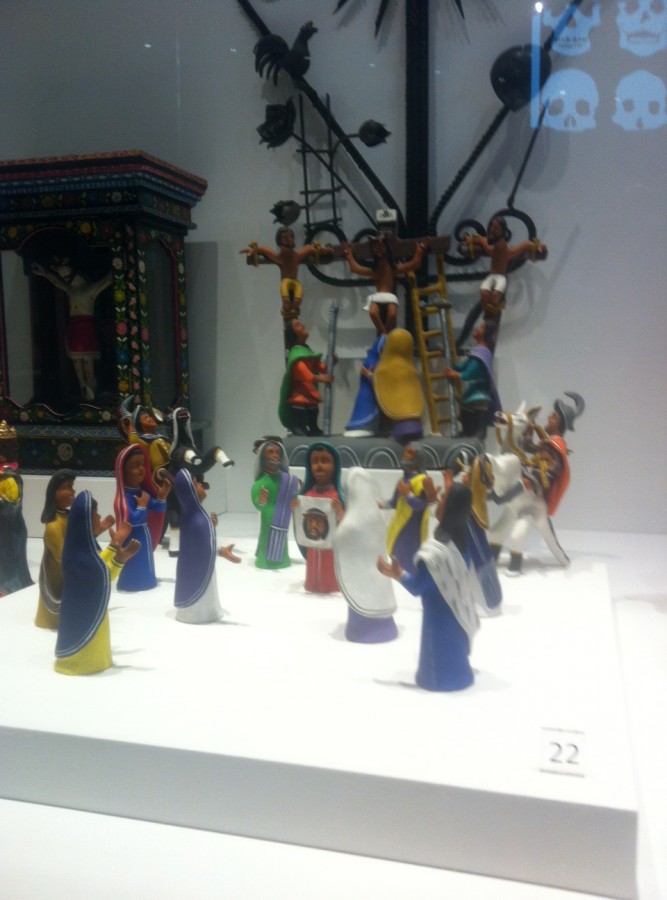
Not particularly Mexican all this, you might argue, so let me continue with a subject very close to the average Mexican’s heart, religion. In the museum collection, it was captured for the most part with that typically Mexican (or perhaps Latin American) fondness for little set scenes. So we have a crucifixion
image
a last supper – but why are they eating watermelon??
image
and a last judgement
image
while the Tree of Life was a very popular motif, made into a lovely candelabra in this example
image
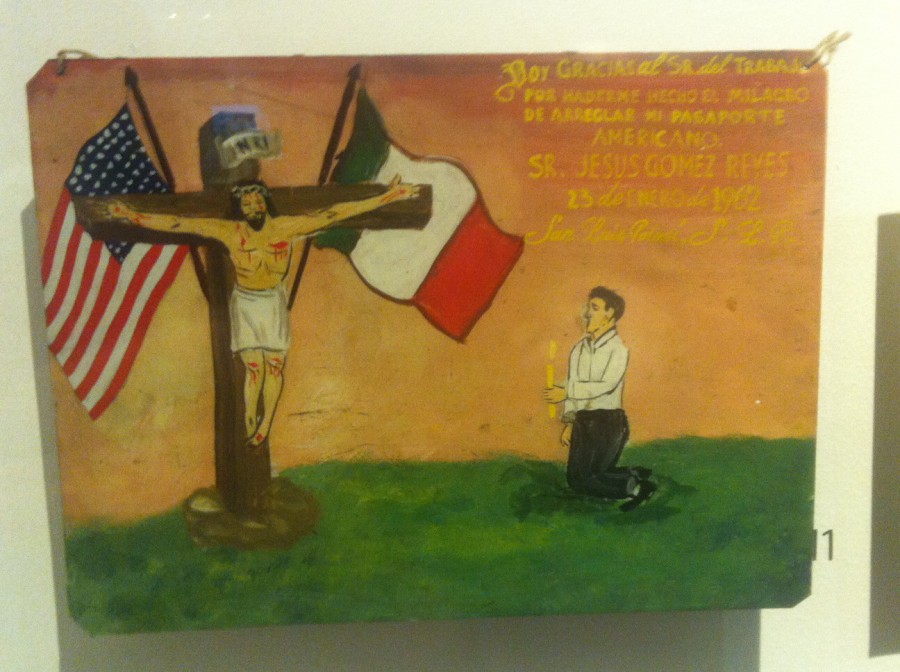
Then there were several examples of ex-votos, that exceedingly popular genre of folk religious painting (and not just in Mexico; Italian churches are littered with them, as are churches in Austria and probably every other Catholic country). Normally, they record a person being saved from some catastrophe or illness, but in this particular case a certain Mr. Jesus Gomez Reyez was thanking the Good Lord for getting his American passport regularized back in 1962, a touching commentary on so many Mexicans’ yearnings to escape to America
image
Religion has much to do with death, and the Mexicans have turned death into a high art, especially that most striking vision of the death which awaits us all, the skeleton. The museum has a particularly rich collection of this art form, of which I show a small selection, starting with this wonderful variation on that insipid form of religious art, the statues of saints in churches
image
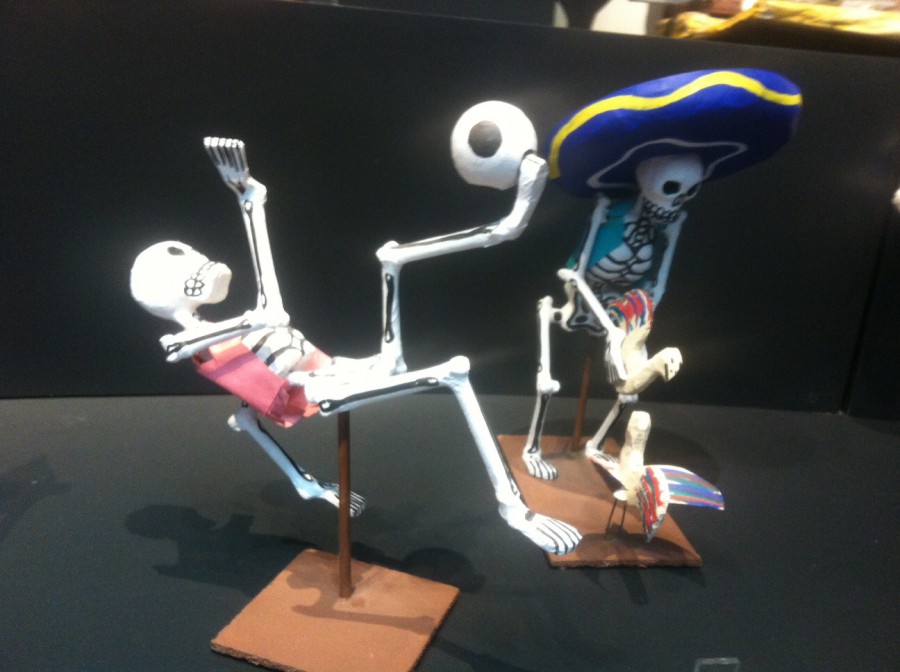
I must say, despite the grimness of the topic these skeletons are always remarkably cheerful. Here we have a bunch of skeletons thoroughly enjoying a huge meal – echoes of the last supper?
image
another happily kicking a football around
image
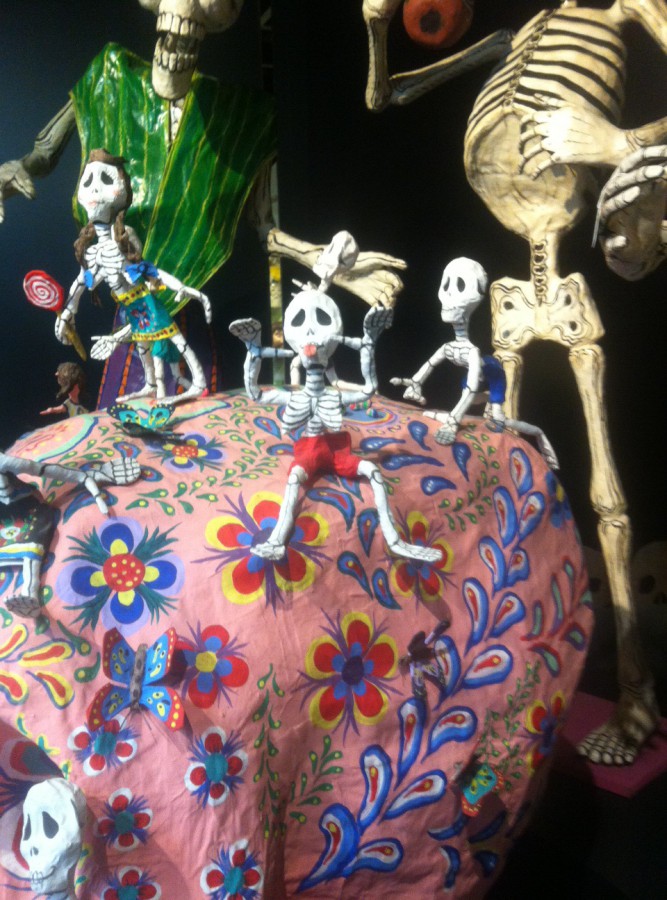
yet another, a child’s skeleton, blowing us a raspberry
image

while here we have an earnest swain declaring his undying love to a simpering and blushing maiden
image
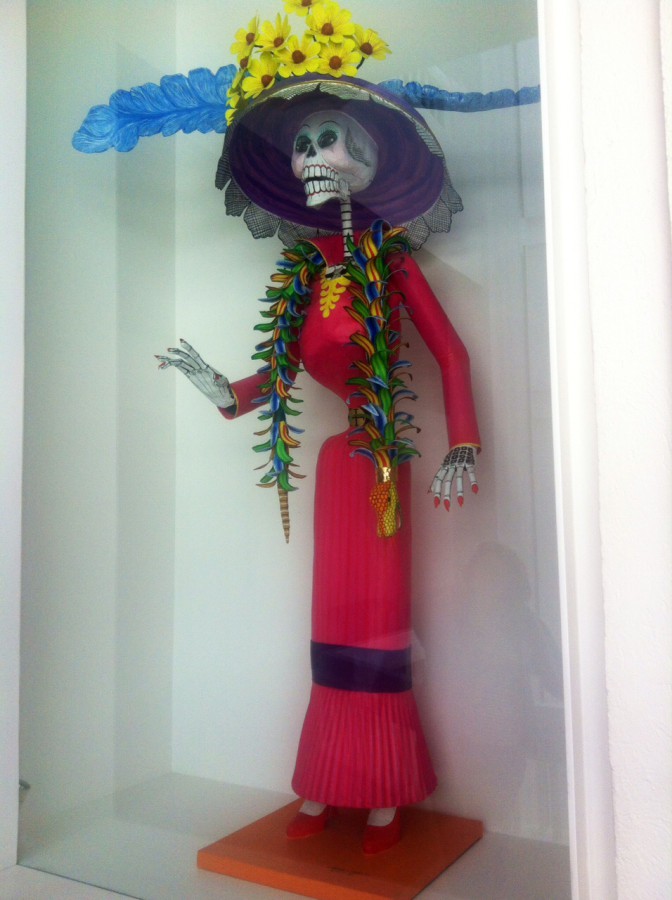
and finally, a very popular character in the skeleton cast of characters, a “Catrina”, a female skeleton dressed to the nines in a 19th Century style
image
We loved these Catrinas so much that we bought a ceramic version and carried it back to Bangkok, where it now stands on our dressing room table.

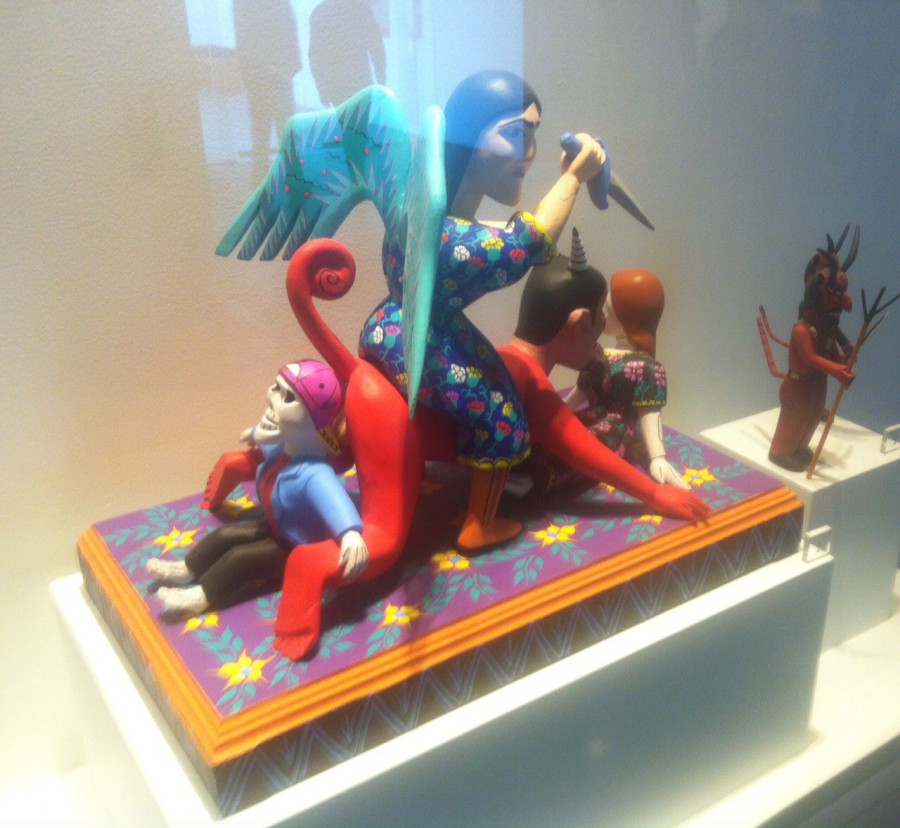
Keeping to the broad religious theme, devils are also a popular topic. I include three, one blowing a raspberry, something which I have never particularly associated with devils (but a common theme it would seem; does blowing raspberries have some deeper meaning in Mexico?)
image
another showing a bunch of devils taking part in a last-supper type of meal – eating watermelon again! (what’s with this business of watermelon?)
image
and a grimmer scene, a devil rapist (I suppose rape is as bad a problem in Mexico as anywhere else).
image

The little scenes which seem such a popular subject spill over into normal, day-to-day life. We have here a seller in the market (watermelon-eating again …)

image

Fairgrounds seem a popular topic, especially Ferris wheels

image
while here we have a grimmer scene from life, a fire. Many escape from the doors of these towers but one person has had to throw himself off the top.
image
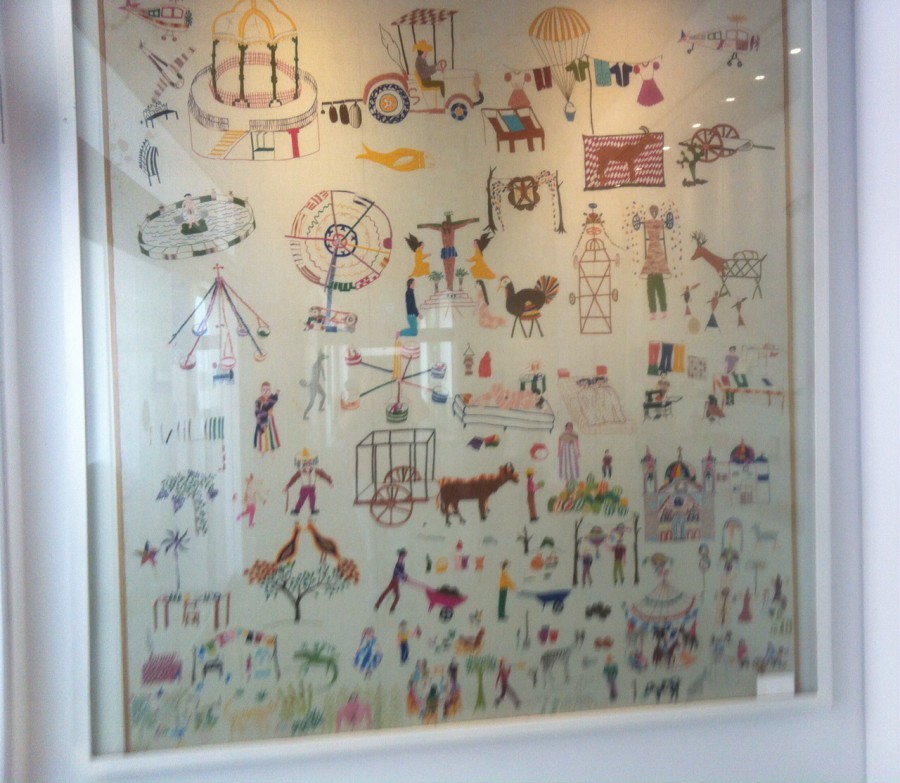
This large needlework piece wonderfully captures the myriad activities of daily life
image
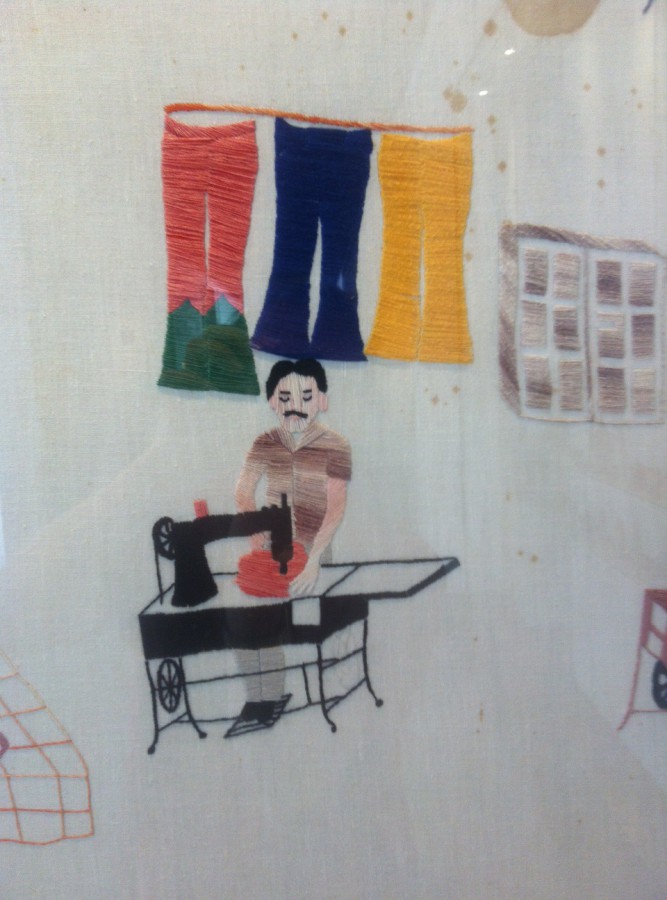
I add one close-up of the many scenes on this piece
image

The final theme is animals, which are a popular subject for folk artists. I feel I should start with a turkey, which was first domesticated in pre-Hispanic Mexico.
image
I continue with a cat, because my wife reminded me that when we were last in Mexico 35 years ago we bought a ceramic cat, which currently faithfully sits in storage in Vienna waiting for our return to Europe.
image
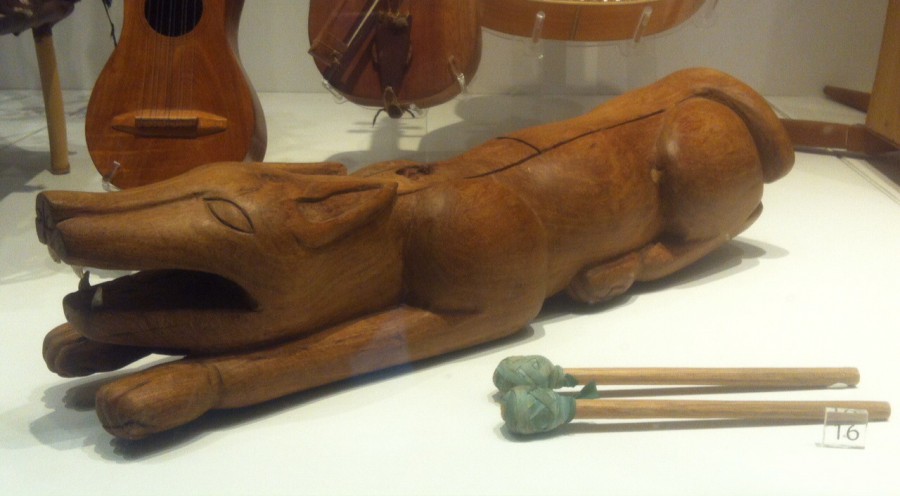
But I also add a dog, in this case in the form of a teponatzle (a type of musical instrument),
image
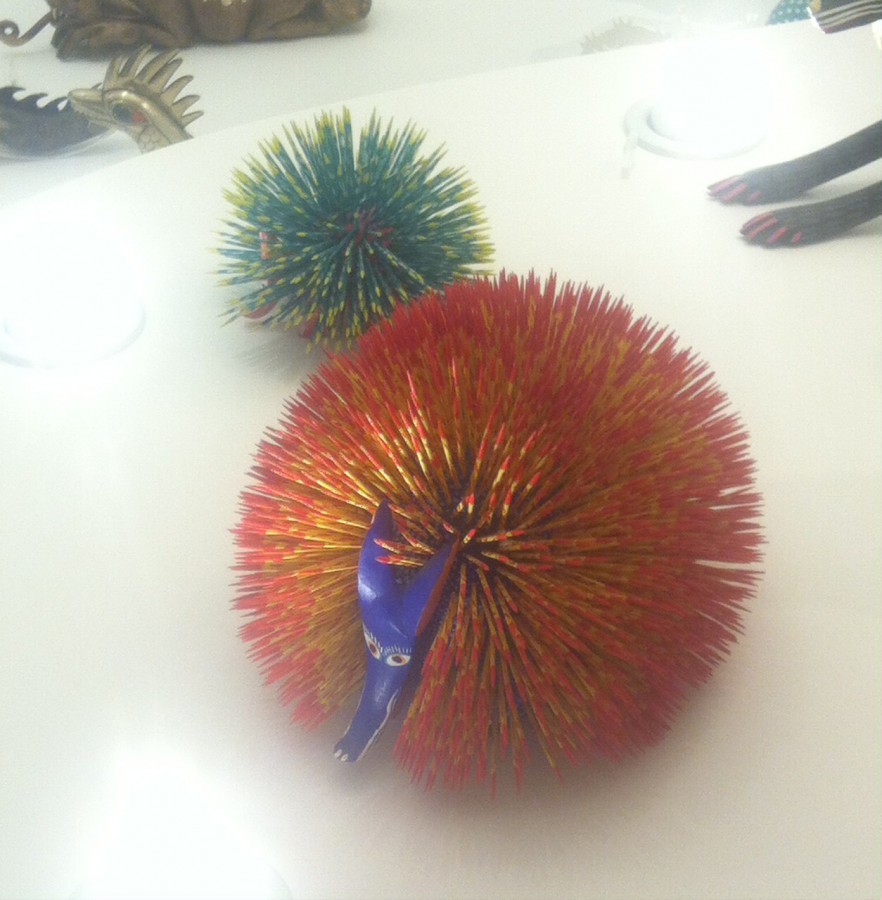
continue with what appears to be a brightly coloured hedgehog
image
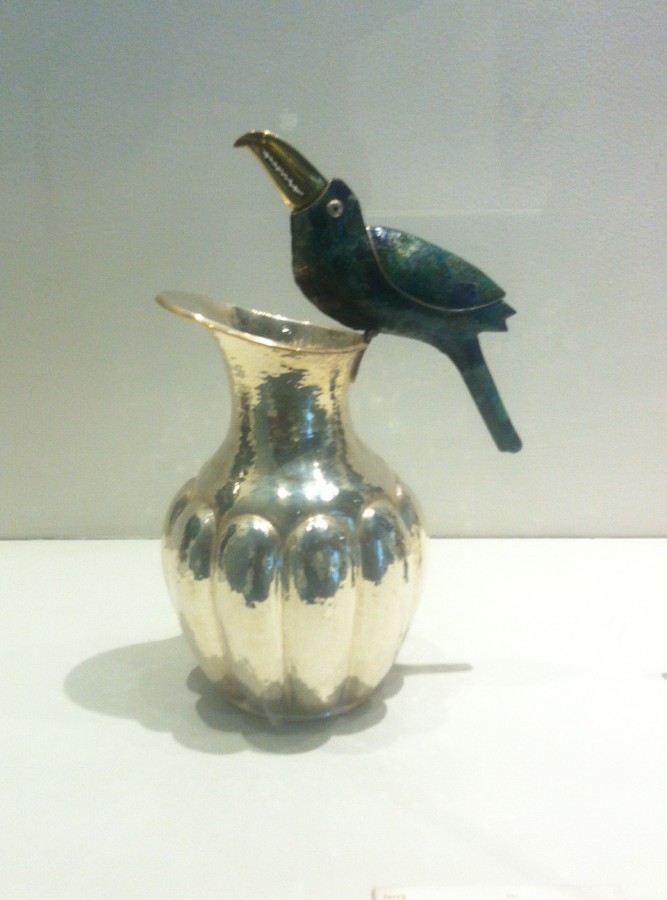
and finish with a couple of birds: what looks like a macaw, fashioned as a handle of a jug
image
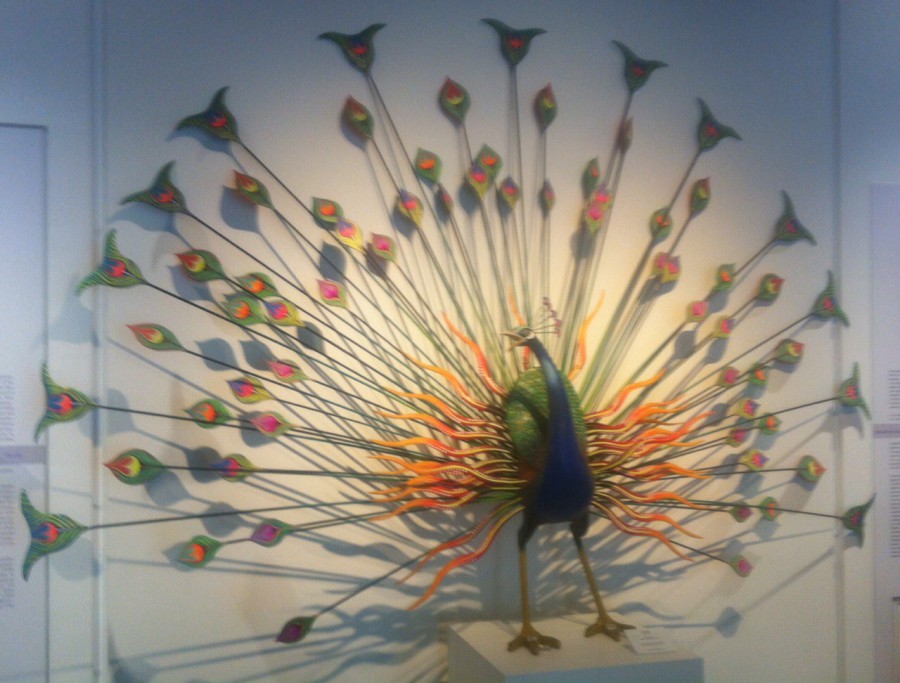
and this truly magnificent peacock
image
On the topic of animals, I feel I have to include a picture of this monster
image
The Mexicans seem to have a great fondness of such monsters, which we saw in a number of places, on a much larger scale, being used as floats of some sort.

Well, I don’t want to give everything away about this museum. I hope I’ve persuaded some readers to visit it if they happen to be in Mexico City: Calle Revillagigedo 11, Cuauhtémoc, very central; open every day except Monday.

___________

pictures: all mine

MEXICO: BASHING THE PIÑATA

Mexico City, 4 January, 2015

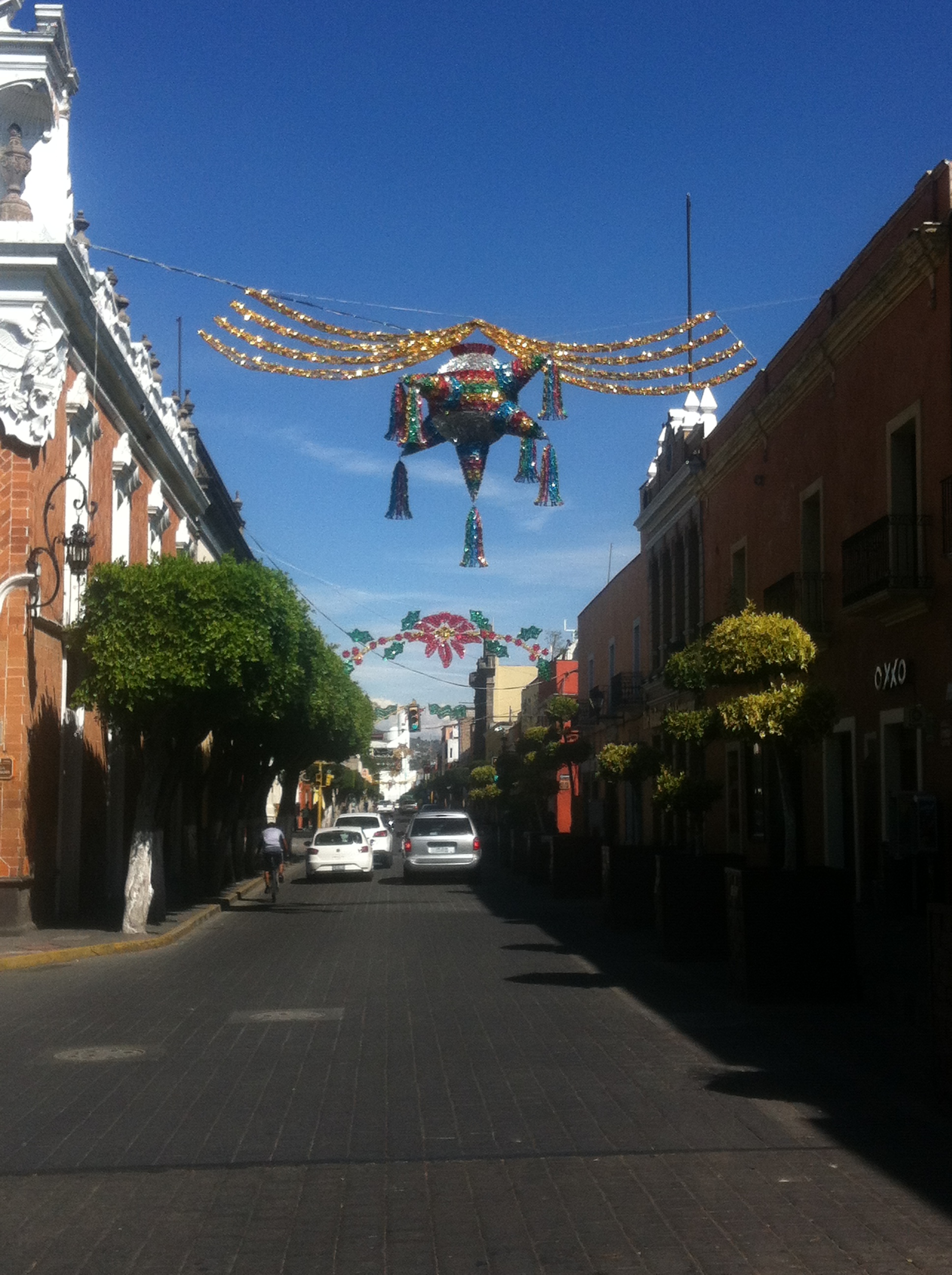
As my wife and I wandered around Mexico City this last week, we were struck by these strange ornaments which we saw hanging in many places. This particular one, for instance, was hanging in a street somewhere

pinata 002

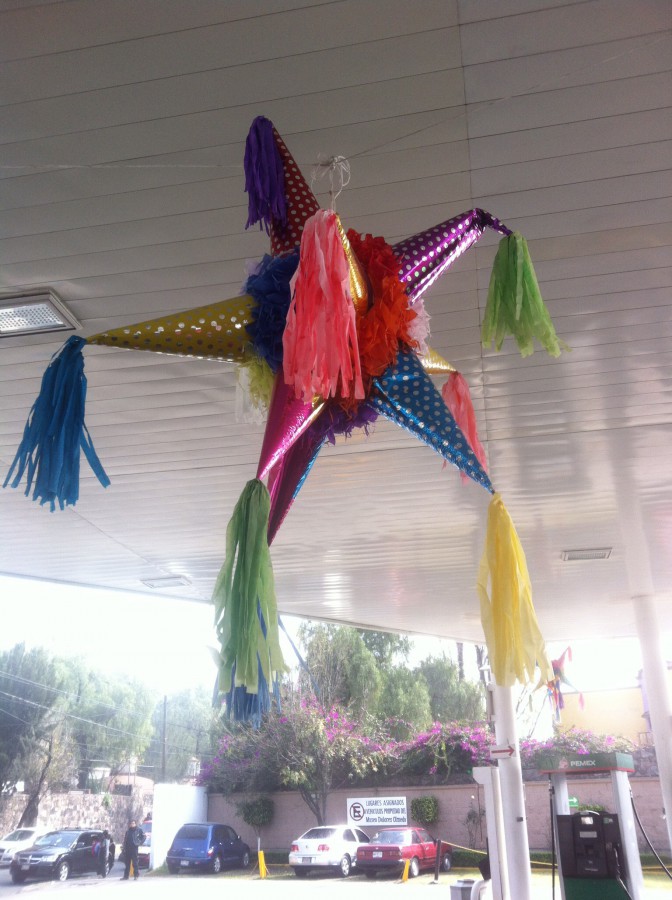
while this one, somewhat incongruously, swung over the cars in a gas station.

image

Intrigued, I asked our son what they were. Piñata, he told us.

Ah. I had never heard of them.

Undeterred, I rolled up my sleeves and did some research (i.e., browsed the web). I am now ready to report my findings.

What we have here is an example of the strategy used by the Catholic church in the early years of the Spanish conquest of Mexico to christianize the local populations. The church adopted, with the necessary adaptations, those local religious traditions which happened to have similarities with Catholic traditions. The thinking was that this would make Catholicism more familiar, more “user friendly” for the local populations, who would therefore convert more readily (and if necessary, a little gentle pressure from the sharp end of a sword could no doubt be used to help along in the decision-making process).

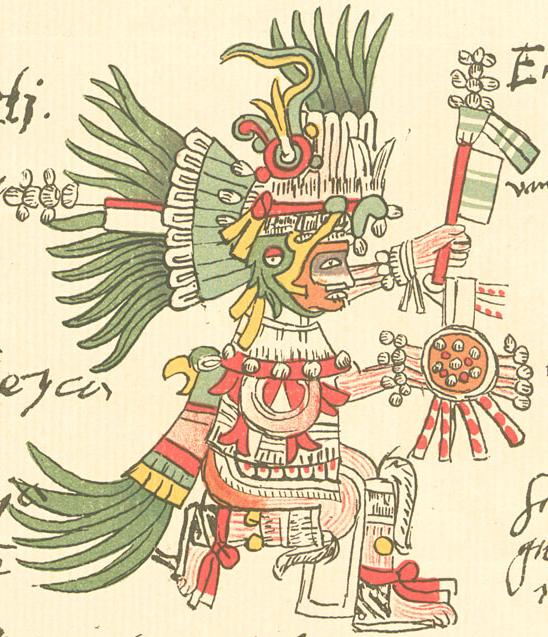
In the case of the piñata, the local religious tradition in question was part of the Aztec festival for their patron god Huitzilopochtli, sun god, god of war, and god of human sacrifice.
image
The whole of the Aztec month of Panquetzaliztli, which ran from 7 to 26 December in today’s calendar, was dedicated to this festival. The people decorated their homes and trees with paper flags, there were ritual races, processions, dances, songs, prayers, and to top it all off there were human sacrifices.

Only one of the festival’s activities is of interest us here. In it, priests would place a clay pot on a pole in front of the statue of the god. The pot was filled with tiny treasures inside and decorated with colorful feathers outside. The pot would be ritually broken with a stick or club, and the treasures would fall to the feet of the statue as an offering.

It so happened that the Spaniards had a very similar custom, the Dance of the Piñata, which took place during Lent. There, too, a decorated clay pot, the piñata, was suspended and during some kind of dance routine got broken with a stick. Quite what the religious significance of this was is unclear to me, nor do I know if there was anything in the pot.

The canny Franciscan monks who were spearheading the conversion efforts in Mexico (along with Dominicans) figured that they could harness this Lenten custom from Old Spain to a new Christmas custom in New Spain and in so doing help to draw away the indigenous people from their old, “pagan”, “idolatrous”, “devil-worshipping”, etc. religion. They also borrowed from a superficially similar Mayan custom. The Mayans had a game rather like blind man’s buff, where a player was blindfolded, perhaps spun around to disorient him, and then left to try and hit and break a suspended clay pot. No doubt his blundering misses made spectators roar with laughter. Again, I don’t know if there was anything in the pot.

The Franciscans used all these threads to weave together a new, fun custom which the indigenous people were encouraged to practice, in the church grounds no doubt, in the run-up to Christmas. A clay pot, filled with sweets and other goodies, and decorated on the outside, was suspended. The “players” were blindfolded, and guided by the onlookers, would try and bash the pot and release the goodies. If successful, everyone would throw themselves on the goodies. But of course the Franciscans gave the whole thing a religious twist, using the new piñata “game” to inculcate in the locals some Christian catechism. Thus, the clay pot represented Satan, with the outer decorations now transmuted into seven colorful cones or horns representing the seven deadly sins (for those of my readers who have momentarily forgotten which these are, we have, in alphabetical order: envy, gluttony, greed, lust, pride, sloth, and wrath). The outside was made beautiful to remind the viewer that evil is tempting, and the goodies inside the pot represented the temptations of wealth and earthly pleasures. Once the game started, it became a morality play for demonstrating the three theological virtues of Faith, Hope, and Charity. The blindfolded players represented Blind Faith, groping their way towards salvation. The piñata now represented Hope. The onlookers looking up at the hanging piñata were actually gazing towards Heaven, yearning for the salvation that would come from the smashing the pot and the triumph of Faith over Evil. The sweets and other goodies that showered forth now suddenly became the rewards of maintaining the Faith. But everyone shared in the goodies, thus symbolizing Charity. After this dose of religion, it seems to me only correct to include this statue of a Franciscan monk having a bash at a piñata.

image

If any of the players impatiently waiting to have a go at smashing the pot understood any of these theological subtleties I take my hat off to them. If my own youthful experience of catechism is anything to go by, I would guess that they quietly let the priest blather on about whatever he wanted to blather on about and then they got down to the serious business of having some fun. These two photos, which I took in the Museo de Arte Popular (about which more later in a future post), capture nicely the fun aspect of this religious game.

image

image

I’m sure it is the jolliness of smashing something and scrambling around for goodies that makes older Mexicans remember piñata with fondness rather than the catalogue of the seven deadly sins and the triumph of Faith over Evil. In fact, at some point it seems to me that the piñata lost much of its religious connotations and simply became a game to play at parties, and at the same time there was a switch from a ceramic pot to hold the goodies to one made of papier-mâché or cardboard – no doubt fond mothers were worried about having their dear ones and those of their neighbors showered with pottery shards during the children’s parties they organized.
image
Indeed, I have this vague memory of a similar game being played at the birthday party of one of my son’s friends years ago in Italy. By the way, for those of you who like me are fond of useless facts, the Spaniards borrowed the piñata from the Italians, where it was called pignatta. And it seems that the ultimate source of the custom was China, although how it got from the Middle Kingdom to Italy is a bit of a mystery to me (my sources suggest Marco Polo, but he gets mentioned whenever no-one has a good idea how things got transmitted from China to Europe).

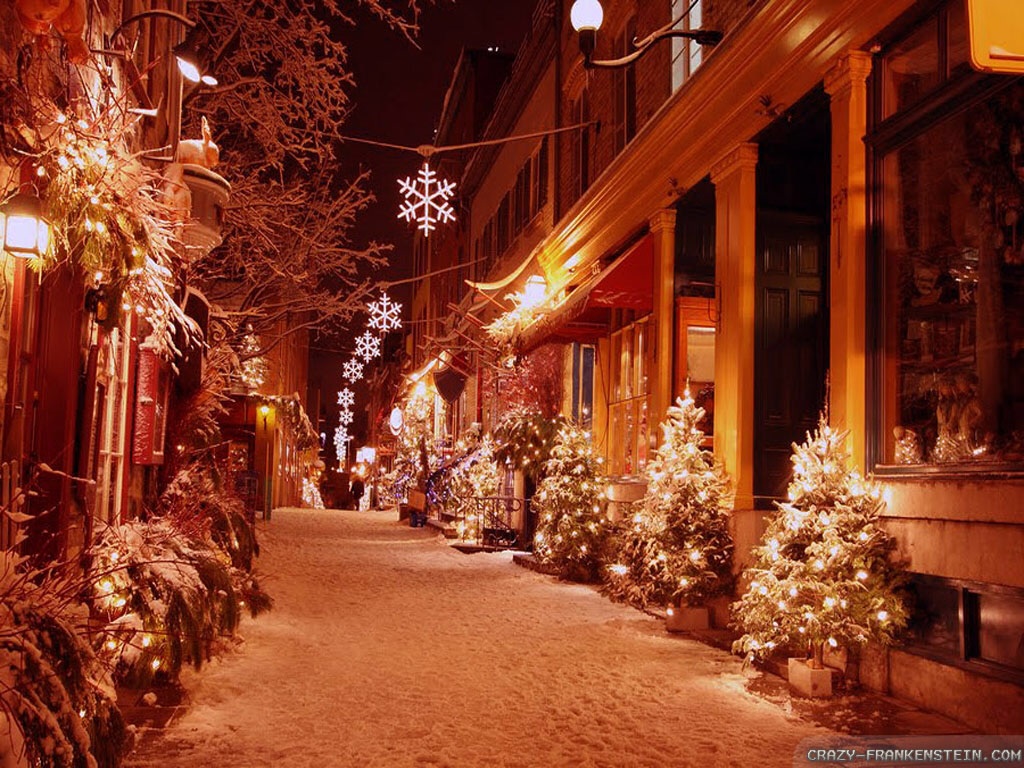
In any event, it now looks like the piñata is morphing into a simple Christmas decoration. I certainly don’t think that all the piñatas we’ve seen hung up are there to be bashed vigorously with a stick. In this new identity they have become the equivalent of those stars which seem such a popular Christmas street decoration.
image
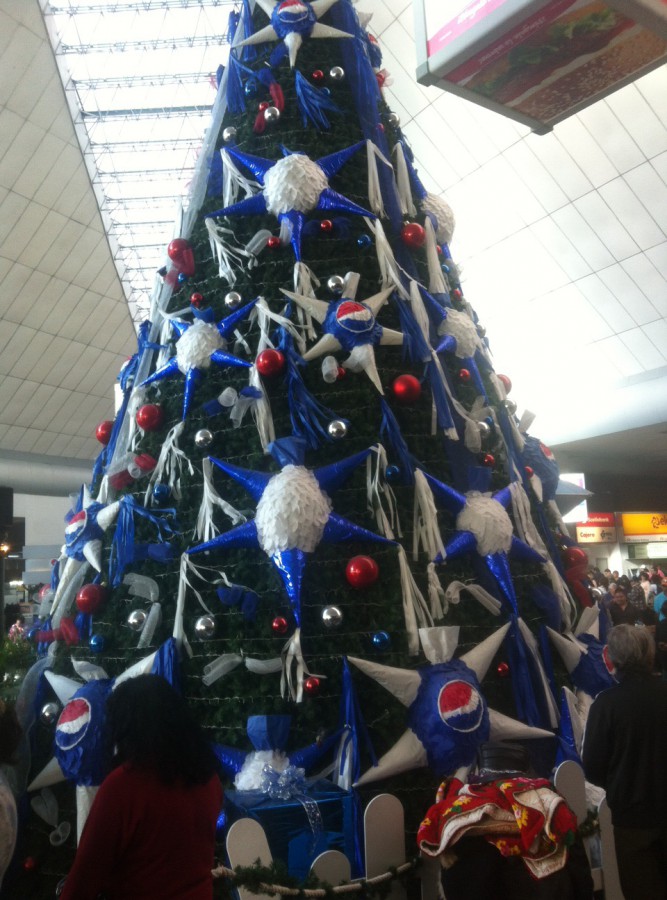
Soon, they will morph once more, becoming tame Christmas tree decorations. Indeed, if this Christmas tree at one of Mexico City’s bus stations is anything to go by, the morphing has started already.
image
From reverent offering to the sun god to cheesy decoration on a Christmas tree, the fall has been long and hard.

_____________

Piñata: my photo
Huitzilpochtli: http://upload.wikimedia.org/wikipedia/commons/c/cb/Huitzilopochtli_telleriano.jpg (in http://en.m.wikipedia.org/wiki/Huitzilopochtli)
Franciscan monk hitting piñata: http://en.m.wikipedia.org/wiki/Piñata#/image/File:MonkPiñataAcolman1.JPG (in http://en.m.wikipedia.org/wiki/Piñata)
pix from the museo de arte popular: mine
Children hitting a piñata: http://en.m.wikipedia.org/wiki/Las_Posadas#/image/File:Las_Posadas_Pinata.jpg (in http://en.m.wikipedia.org/wiki/Las_Posadas)
Christmas street decorations: http://wallpaperest.com/wallpapers/street-outdoor-christmas-decorations_074228.jpg (in http://toplowridersites.com/iphone-5-38528-christmas-christmas-street-decoration-jpg/)
piñata on Christmas tree: my picture

MEXICO: BOUGAINVILLEA

Mexico City, 25 December, 2014

My wife and I are spending Christmas in Mexico City. Parental love is what draws us to Mexico. Our son has his business here, and this year it is his turn to hold the fort over the busy Christmas period. As the Turkish saying goes, “Dağ sana gelmezse, sen dağa gideceksin”, “If the mountain won’t come to you, you must go to the mountain”. These last few days, together with our daughter (she has been able to escape from her job in New York, but at the price of being often on FaceTime and email with her colleagues), we have been roaming the city and appreciating its delights, both visual and gastronomic. Yesterday, for instance, we visited Frida Kahlo’s house, La Casa Azul, which presents a compact collection of her paintings (including one which I’ve mentioned in a previous post) as well as of paintings by her husband Diego Rivera. And while we stood in the long, long line to get in, we tucked into an assortment of delicious tacos, including one where the filling was a mix of cheese and cactus pads. Cactus pads! That was a first for me.

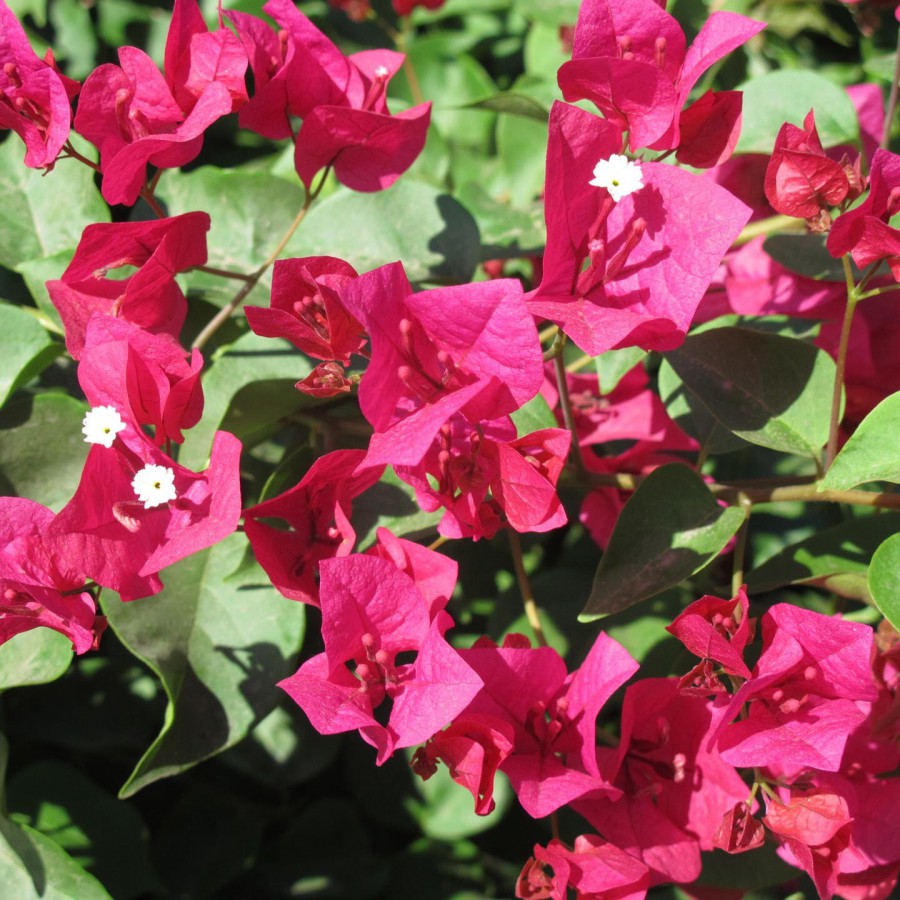
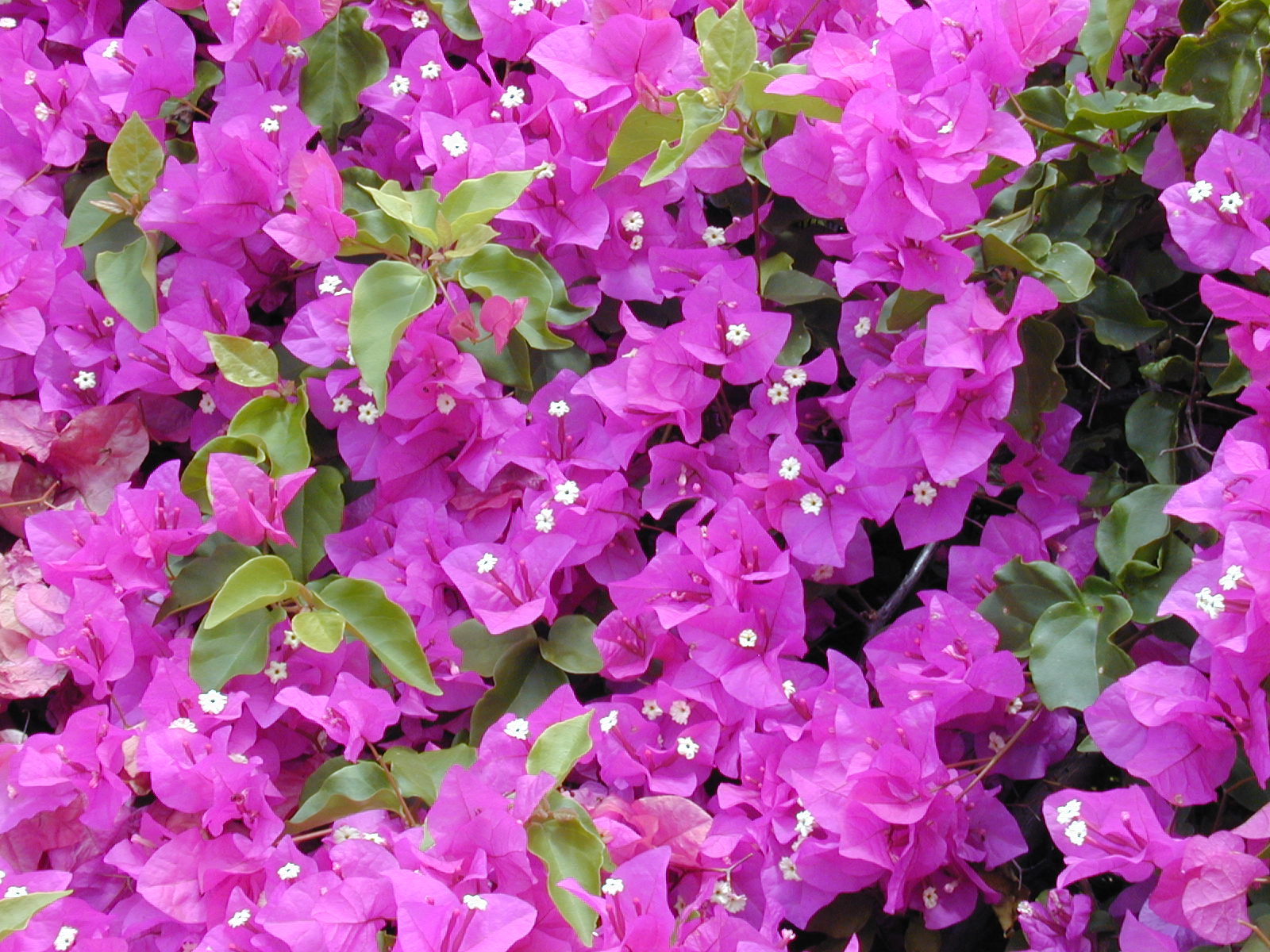
Everywhere we have been in the city, we have been delighted with great clouds of bougainvillea, mauveimage

red

image
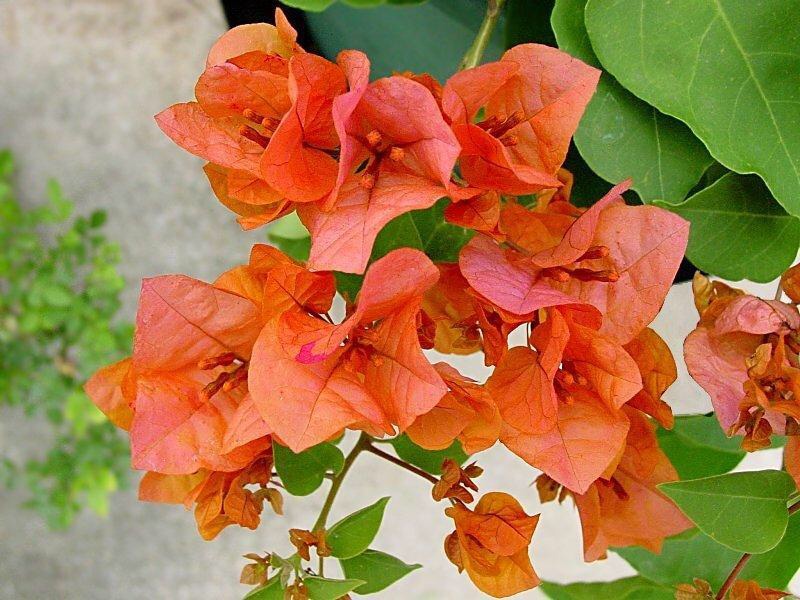
orange
image

white

image

clawing their way over roofs, snaking along balconies, tumbling over walls, strangling trees, or simply sculpted into staid bushes.

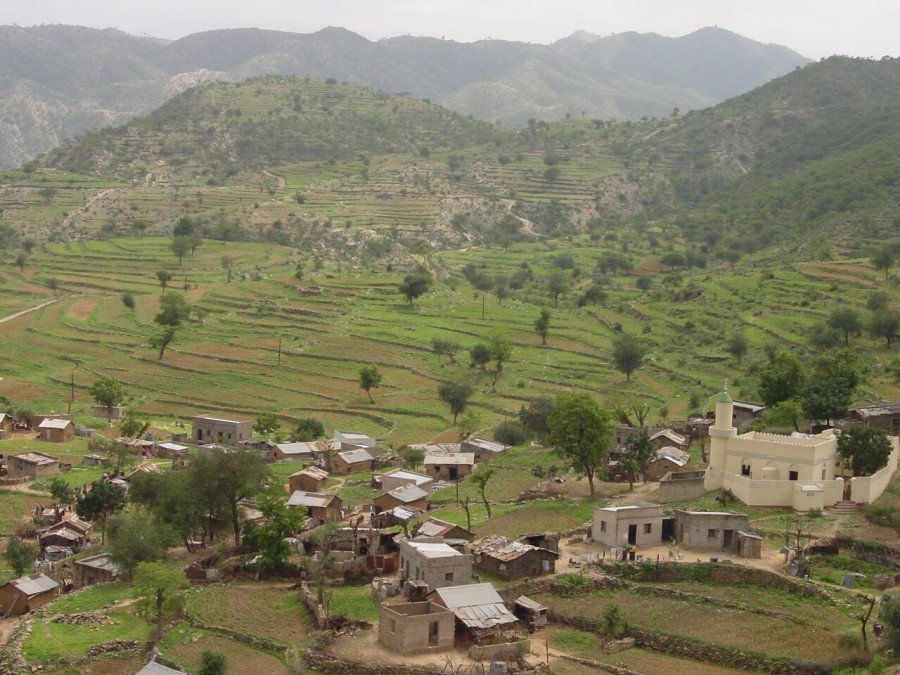
I’m very fond of bougainvillea. It’s an old friend which I’ve run into in various parts of the world, always places with the sunny, warm climates which I feel very comfortable in, like Eritrea where I was born
image
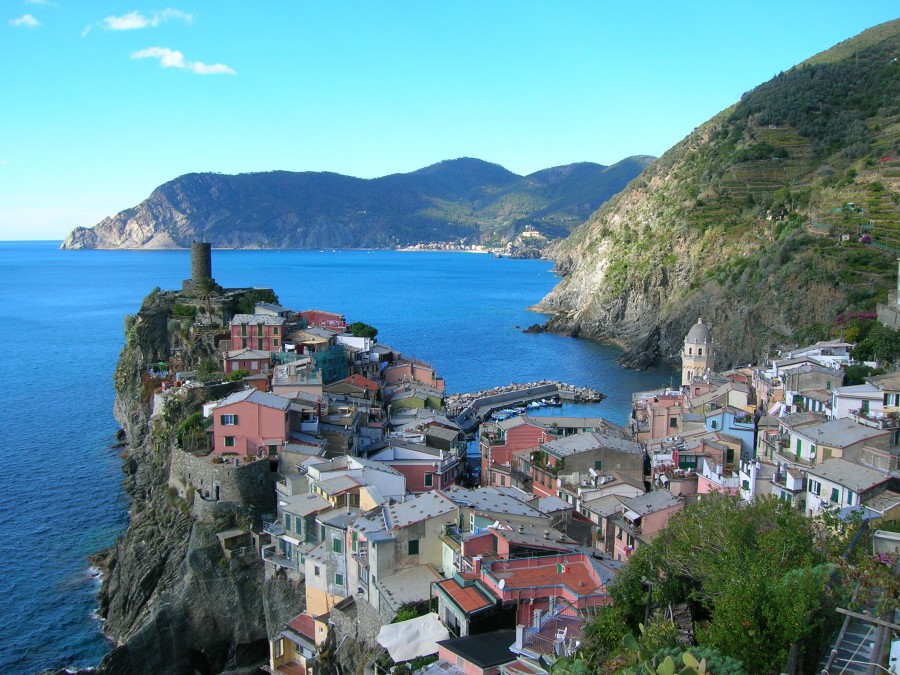
or Liguria which my wife introduced me to nearly 40 years ago and to which we return again and again
image
or Thailand where we live at the moment.
image

This latest meeting with bougainvillea in Mexico has moved me to use my free time during this holiday period, between visits to the sites and shopping for Christmas lunch and dinner, to explore this beautiful plant’s history. I had always known that its rather fancy name came from the French Admiral Louis Antoine, Comte de Bougainville.
image
France’s response to Britain’s James Cook, Bougainville was the first Frenchman to circumnavigate the globe, in the late 1760s, and it was during this trip that bougainvillea was discovered (by Europeans; the locals knew it already of course). It was actually Bougainville’s on-board botanist, Philibert Commerson, who discovered it.

image

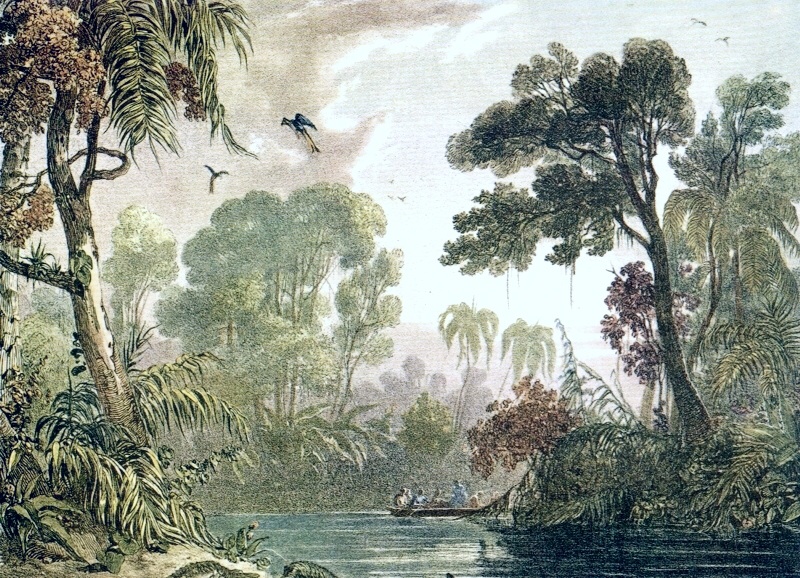
The discovery occurred during an enforced stopover in the Bay of Rio de Janeiro, where Bougainville had decided to regroup and carry out urgent repairs to his two ships. Like most European botanists of the time, Commerson was dazzled by the huge biological diversity he found in Brazil: “this country is the most beautiful in the world”, he wrote home. Something of what he found before him can be gathered from this more-or-less contemporary painting.
image
Commerson took advantage of the stop in Rio to go out botanizing along the coast and islets of the bay. As he reported to a friend in a letter home, one day he stumbled on this vine, “a wonderful plant with big flowers of a sumptuous violet colour”. He decided to honour Bougainville by naming the plant after him (Bougainville also gave his name to a couple of islands, a couple of straits between islands, and a town in the Falkland Islands). Commerson’s dried sample eventually made it back to France, where it can still be viewed, faded but nevertheless recognizable.
image
We can leave the story of bougainvillea there; suffice to say that the first period of globalization which came with European colonialism spread the pretty plant far and wide. But its discovery in the Bay of Rio de Janeiro gives me pause. That wonderful botanical diversity which so took Commerson’s breath away has been sadly depleted. Before the arrival of the Europeans, the bay of Rio de Janeiro was enveloped by the Mata Atlântica, the Atlantic Forest. This mighty forest stretched unbroken from north-east Brazil all the way down the Atlantic coastline as far as Uruguay, and spread into north-eastern Argentina and eastern Paraguay. It once covered some one and a half million square kilometres, but three hundred years of deforestation for logging and farming have seen it become the second most threatened biome in the world, after Madagascar. Today, less than a tenth of the original forest area remains.

There is some light in all the gloom. Despite all the loss and habitat fragmentation, the region is still ranked in the top five of the world’s biodiversity hotspots. It is particularly remarkable for its bird species. In 2001, wanting to preserve what was left if not reverse some of the damage (to which his own ancestors had contributed), a farsighted owner of farmland at the base of the mountains, in the valley of the Guapiaçu river, some 80 kilometres north-east of Rio, established an ecological Reserve, the Reserva Ecológica de Guapiaçu (REGUA). REGUA’s objective is to protect the remaining forest and biodiversity from deforestation, hunting, and over-extraction of natural resources. With funds from the World Land Trust and others, REGUA has bought land to consolidate and extend the Reserve. Over 100,000 trees, all native species, have been planted, wetlands have been recreated, some animal species have been reintroduced, hunters have been turned into guides, and visitors are encouraged to come and share in this wonderful effort. If I know all this, it is because my wife and I financially supported the planting of a modest number of trees and stayed at the Reserve’s lodge for several days, going out on a birding expedition, inspecting our tree seedlings and the-then nascent wetlands, and just generally enjoying ourselves.
image
We hope to go back there one day, to see how our trees are doing. And maybe we’ll spot some bougainvillea in its natural state, ruthlessly climbing over some unfortunate tree, choking the life out of it.

_______________________________
Mauve bougainvillea: http://upload.wikimedia.org/wikipedia/commons/f/f8/Starr_030418-0058_Bougainvillea_spectabilis.jpg (in http://en.m.wikipedia.org/wiki/Bougainvillea_spectabilis)
Red bougainvillea: http://www.boethingtreeland.com/media/catalog/product/cache/1/image/1440x/9df78eab33525d08d6e5fb8d27136e95/B/o/Bougainvillea-Temple-Fire.jpg (in http://www.boethingtreeland.com/bougainvillea-temple-fire.html)
Orange bougainvillea: http://pics.davesgarden.com/pics/2007/02/01/htop/a25dea.jpg (in http://davesgarden.com/guides/pf/showimage/139848/#b)
White bougainvillea: http://www.phytoimages.siu.edu/users/paraman1/7_13_09/Upload13July09A/BougainvilleaWhite1.jpg (in http://www.phytoimages.siu.edu/imgs/paraman1/r/Nyctaginaceae_Bougainvillea_spectabilis_16879.html)
Eritrean highlands: http://4.bp.blogspot.com/_iNSpfNcQ0Sg/SmH-m6Qdw7I/AAAAAAAABk0/m6818sz2DR8/s1600-h/asmara+114.jpg (in http://www.concretegardener.com/2009/07/glimpse-of-massawa-eritrea.html)
Liguria: http://upload.wikimedia.org/wikipedia/commons/e/ea/Vernazza.JPG (in http://commons.m.wikimedia.org/wiki/File:Vernazza.JPG)
Thailand: http://ichef.bbci.co.uk/wwtravel/624_330/images/live/p0/15/w6/p015w6lz.jpg (in http://www.bbc.com/travel/feature/20130304-the-perfect-trip-thailand)
Bougainville: http://en.m.wikipedia.org/wiki/Louis_Antoine_de_Bougainville#/image/File:Louis_Antoine_de_Bougainville_-_Portrait_par_Jean-Pierre_Franquel.jpg (in http://en.m.wikipedia.org/wiki/Louis_Antoine_de_Bougainville)
Commerson: http://en.m.wikipedia.org/wiki/Philibert_Commerçon#/image/File:Commerson_Philibert_1727-1773.png (in http://en.m.wikipedia.org/wiki/Philibert_Commerçon)
Brazilian jungle: http://fr.m.wikipedia.org/wiki/Philibert_Commerson#/image/Fichier:Rugendas_-_Embouchure_de_la_riviere_Caxoera.jpg
Commerson’s dried sample: http://dsiphoto.mnhn.fr/sonnera2/LAPI/scanG/G20090518/P00169376_a.jpg
REGUA: http://media-cdn.tripadvisor.com/media/photo-s/06/3f/61/18/regua-reserva-ecologica.jpg (in http://www.tripadvisor.com.au/LocationPhotoDirectLink-g954096-d2557905-i104816920-REGUA_Reserva_Ecologica_de_Guapiacu-Cachoeiras_de_Macacu_State_of_Rio_de.html)

A STREET PHOTOGRAPHER

Bangkok, 21 December, 2014

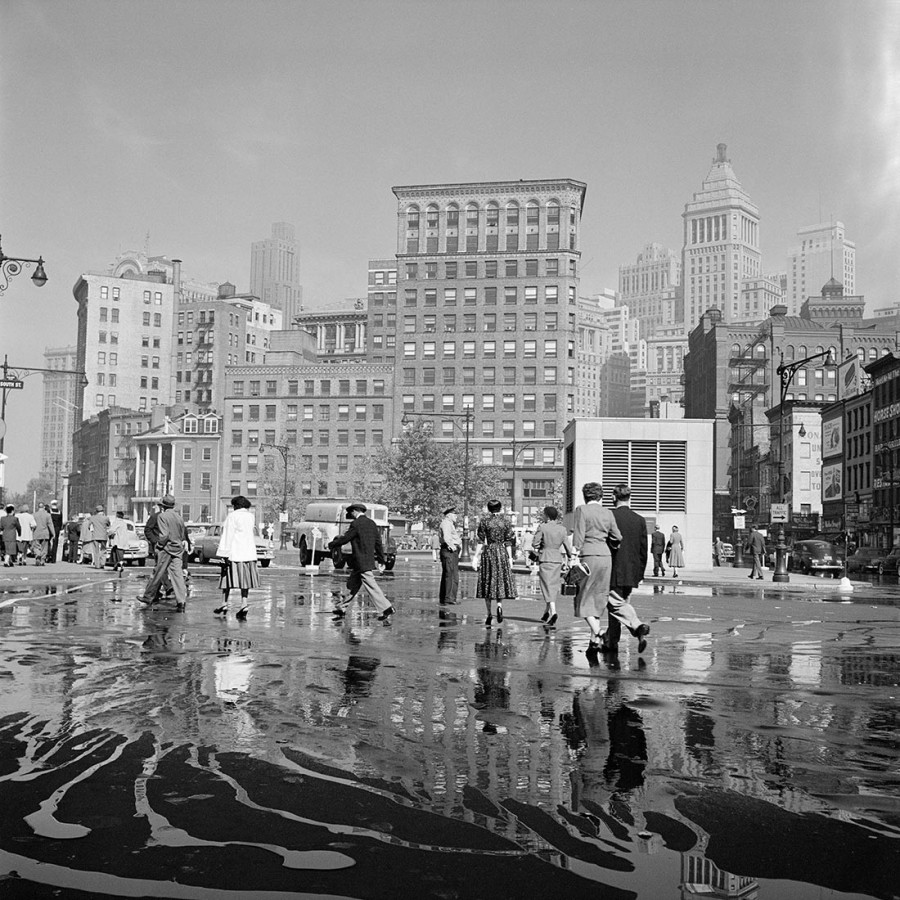
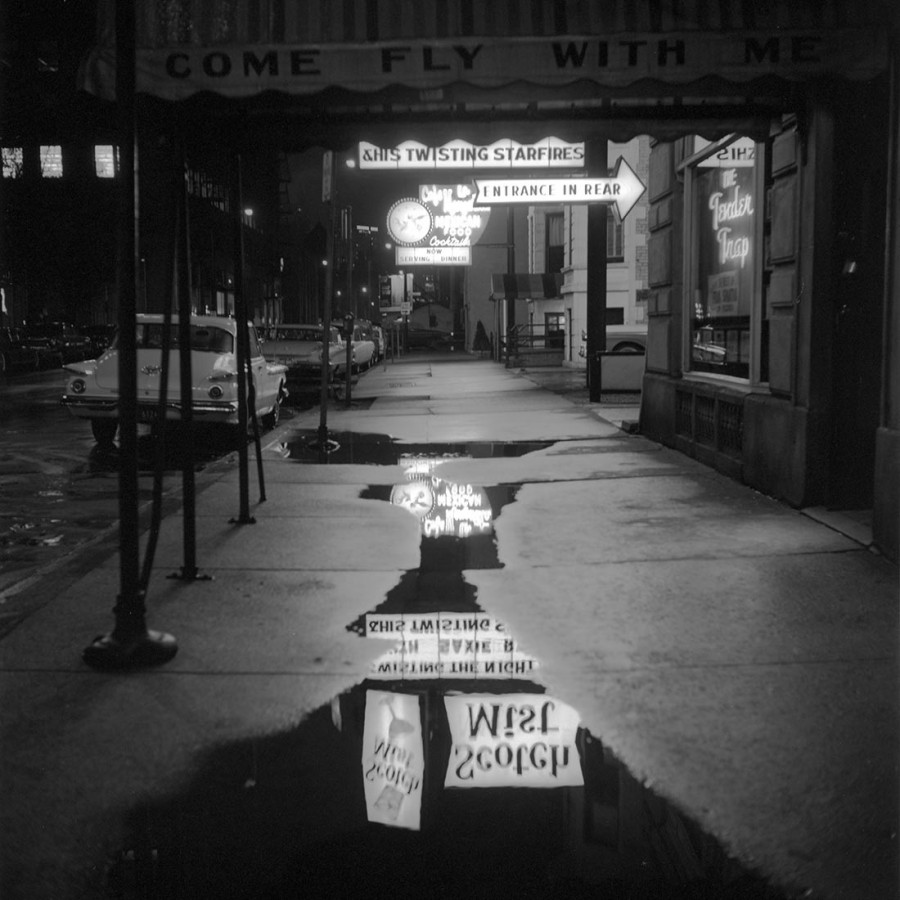
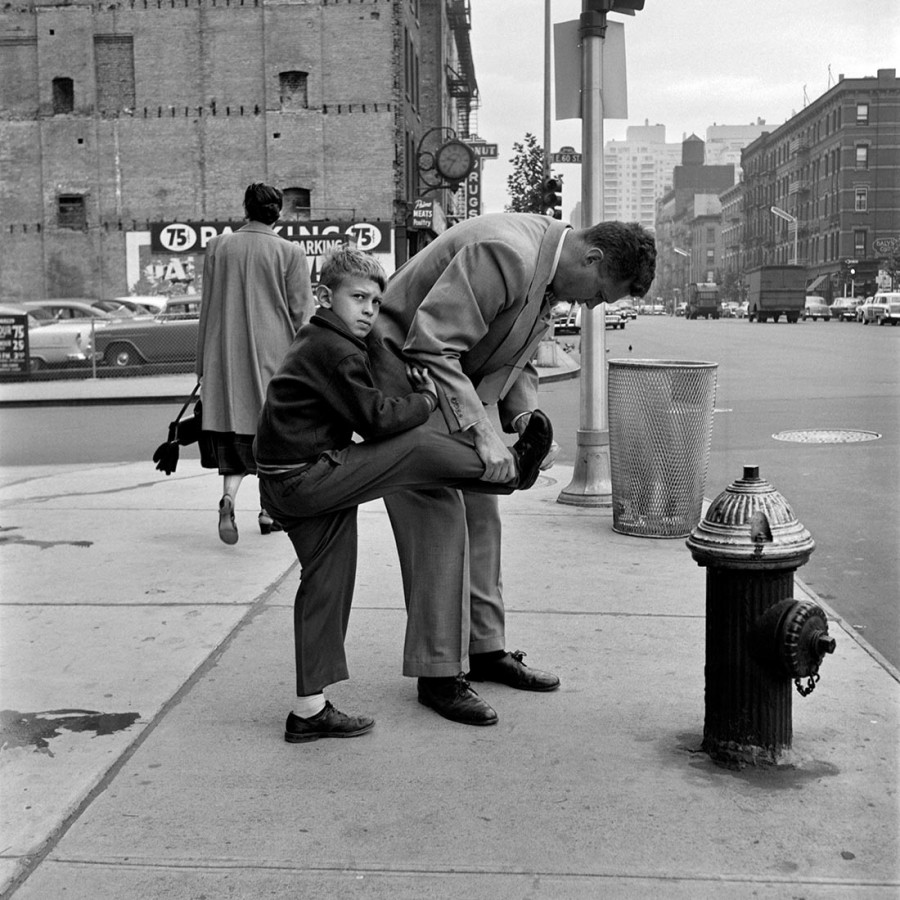
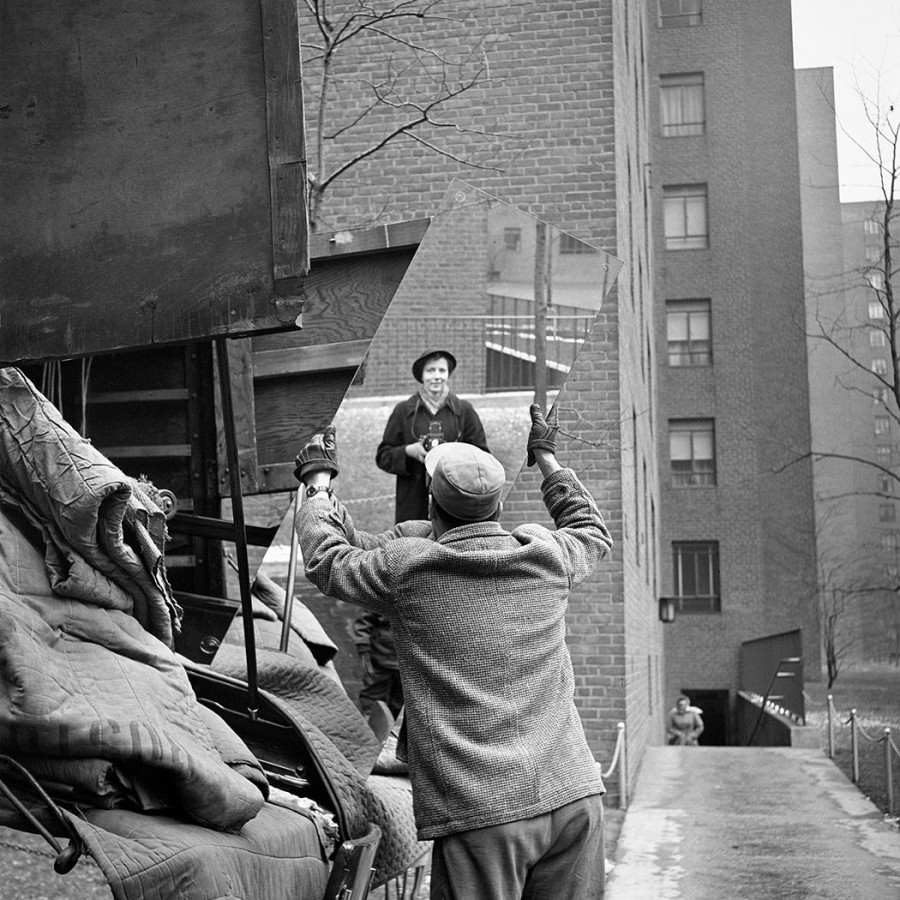
Her name was Vivian Maier. She died not long ago, in 2009, at the age of 83, a spinster and childless, and penniless. She had spent some forty years, from the mid-1950s on, being a nanny for various well-off families in the Chicago area.

And she was a gifted photographer of the streets, mainly those of Chicago and New York.

She spent every possible minute that she could taking photos: in all her free time, but also when she was taking her charges for walks or to the playgrounds, as well as on her one big trip around the world, which she made in the early sixties. She took hundreds of thousands of photos. But hardly any of these made it past the stage of negatives, and many didn’t even get that far; they just stayed as rolls of unprocessed film.

She was a compulsive hoarder. She kept all the negatives and all the film rolls, and the 8 mm films she made, and the audio tapes she recorded, and just about everything else she had ever owned or collected, in cardboard boxes, old suitcases, and other containers. As she moved from one nannying job to another, she offloaded her accumulating stuff into a commercial storage space. In 2007, after she failed to keep up with her payments, the storage company auctioned her stuff off.

It looked like her work was about to disappear. But a number of photo collectors bought at the auction. They recognized a spark of genius in her photos and started trying to publicize them. A first attempt by Ron Slattery in 2008, who posted some of her photos on the internet, failed to generate much interest. Then in October 2009, six months after she died, another of the collectors, John Maloof, put some of his trove of her photos on Flickr, linked them to his blog, and the results went viral (this is a very modern story). Things snowballed from there, and her work is now beginning to garner a fair amount of critical and popular praise.
Would Vivian Maier have wanted this recognition? That is one of the questions touched upon in a fascinating documentary which John Maloof put together entitled “Finding Vivian Maier”. He tells the story of how after his initial purchase of her stuff he went on a voyage of discovery of who she was and what she did – quite a detective story – and he interviews a number of the children she nannied and their parents to try to understand what kind of person she was. It was seeing this film that moved me to write this post. I highly recommend my readers to see it if they have not done so already. And, by the way, according to the people who had known her, the answer to the question with which I started this paragraph is, probably yes for her work, but she would have intensely disliked to have the light of publicity shone on her; she was a very private person.

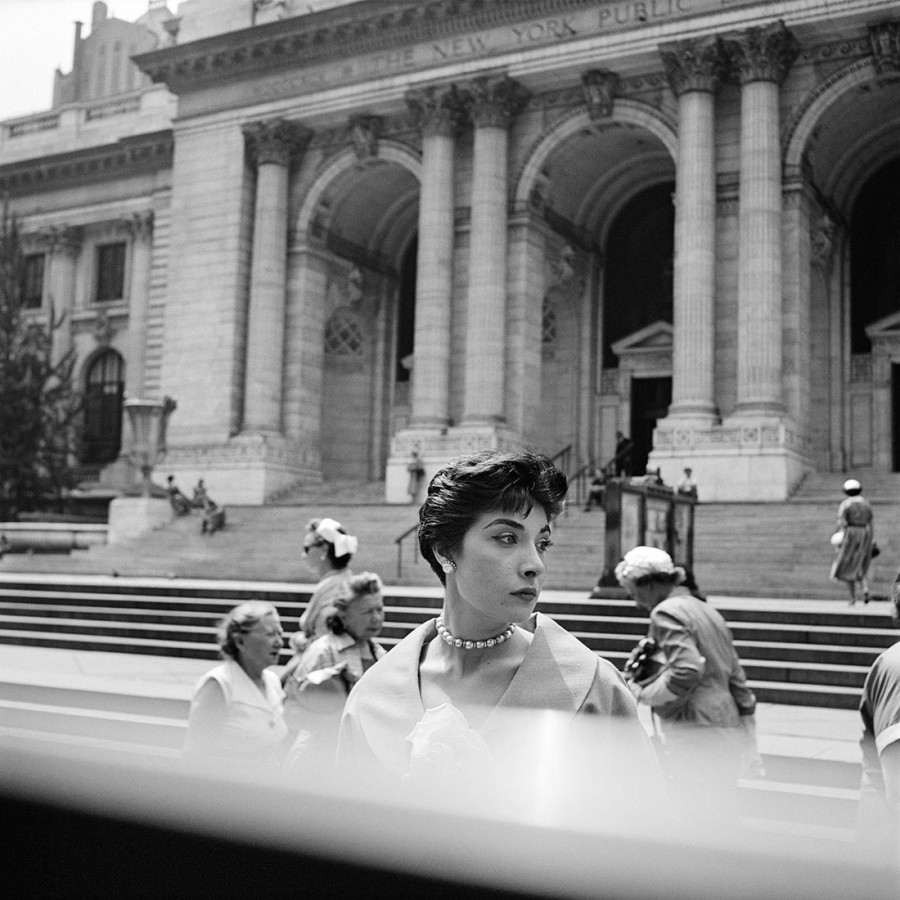
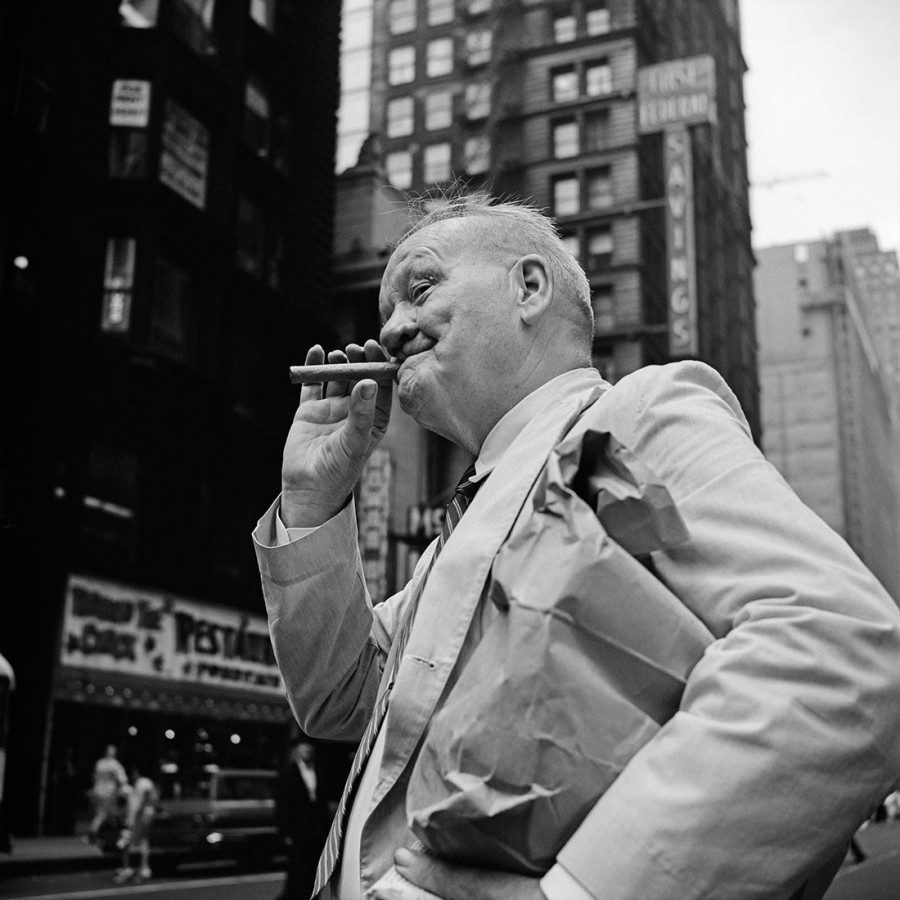
For those readers who want to get a taste of her work, I suggest you visit the site http://www.vivianmaier.com. I add here, from that same site, some of her photos which most struck me, to whet your appetite.
image

image

image

image

image

image

image

image

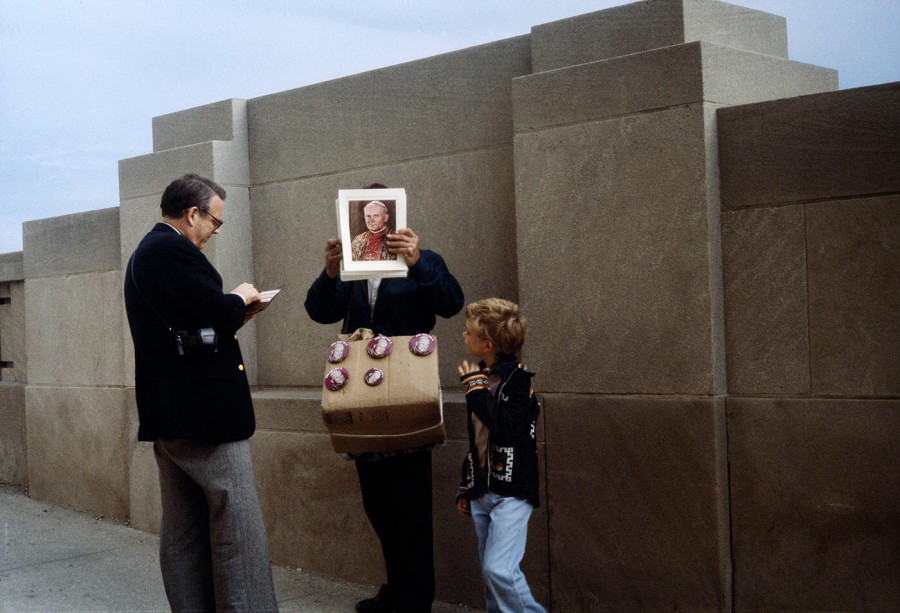
I prefer her black-and-white photos, but I add a few of her colour photos
image

image

image

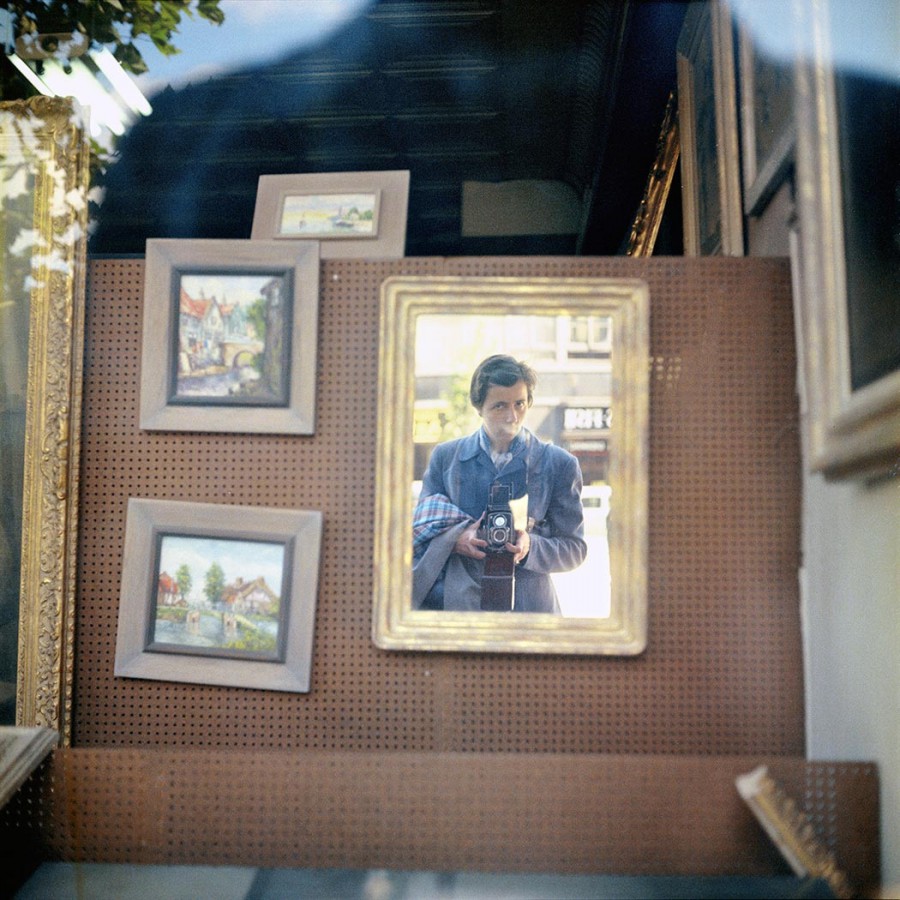
That last one, with her shadow, leads naturally to a few of her self-portraits. She took a lot of photos of herself.
image

image


image

In a sad postscriptum, I have just read that Vivian Maier’s estate has got entangled in a challenge about who owns the copyright to her photos. The result is that it will be probably harder to see her works for the next several years. If my readers get a chance to see an exhibition, on no account miss it. It might be a long time before you get another chance.


COLOURING POLITICS

Bangkok, 9 December 2014

We have just finished celebrating H.M. the King’s birthday here in Bangkok. Truth to tell, “celebrating” may be a little of an overstatement. My wife and I found it quite a muted affair. For instance, the fireworks in the evening were really quite brief and modest, while a drive-by of high officials, which we just happened to find ourselves witnesses to, was greeted with silence by the folk lining the road side. What was out in full force, though, were the yellow shirts. They had already been popping up with greater and greater insistence in the days running up to the great day. But on the birthday itself the pavements were a sea of yellow.
image
Many were wearing yellow T-shirts made specifically for the purpose, but many others (who didn’t get included in the official photos) gave the impression of having grabbed the first yellow, or near-yellow, shirt or blouse they could find in their wardrobe. So the palette of yellows went all the way from pastel yellow through to citrine. Given the recent history of Thailand, one began to wonder if the choice of hue was a political statement of some sort. That man with the orange shirt, for instance, was it just the closest thing he had to yellow in his drawer, or was it actually the closest he dared get to the dreaded colour red? Or that woman over there with the pastel yellow blouse, had she simply been caught short without anything really yellow in her closet, or was she actually signalling her lack of enthusiasm for the whole exercise? Or what about the few people without yellow shirts? What, if anything, was their message? That student, for example, with the green shirt, what was he trying to tell us?

Thus are the seeds of paranoia sown ….

(By the way, for those of you who may be interested, the King’s colour is yellow because he was born on a Monday. Based on Hindu mythology, Thai (and Khmer) tradition assigns different colours to each day. For those of you who may be fascinated by this arcane point, I recommend you visit the following site on Wikipedia)

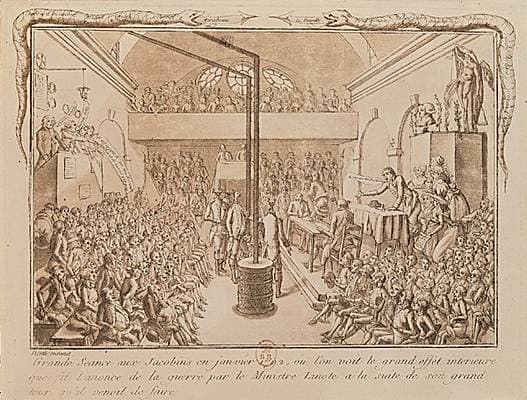
Colours have been recruited to support political quarrels since time immemorial. When I was young, red was the colour of Marxism in all its forms (Social-Democratic, Socialist, Marxist-Leninist, Maoist, Vietminh, Khmer Rouge, …). We have the French Jacobins
image
to thank for this association of red with the left of the political spectrum. For reasons which are too complicated to explain here, the Jacobins adopted the red flag as their own during the French Revolution, and the tradition continued in the European Left thereafter. I suppose we are all aware of the red symbols of the Left: the flags, the official art, the scarves, the buttons. But my preferred symbol of redness are the Garibaldini, those 1,000 or so red-shirted volunteers who, led by Giuseppe Garibaldi, sailed away in 1860 from Genoa to Sicily and in a few short months of fighting completed the unification of Italy.
image
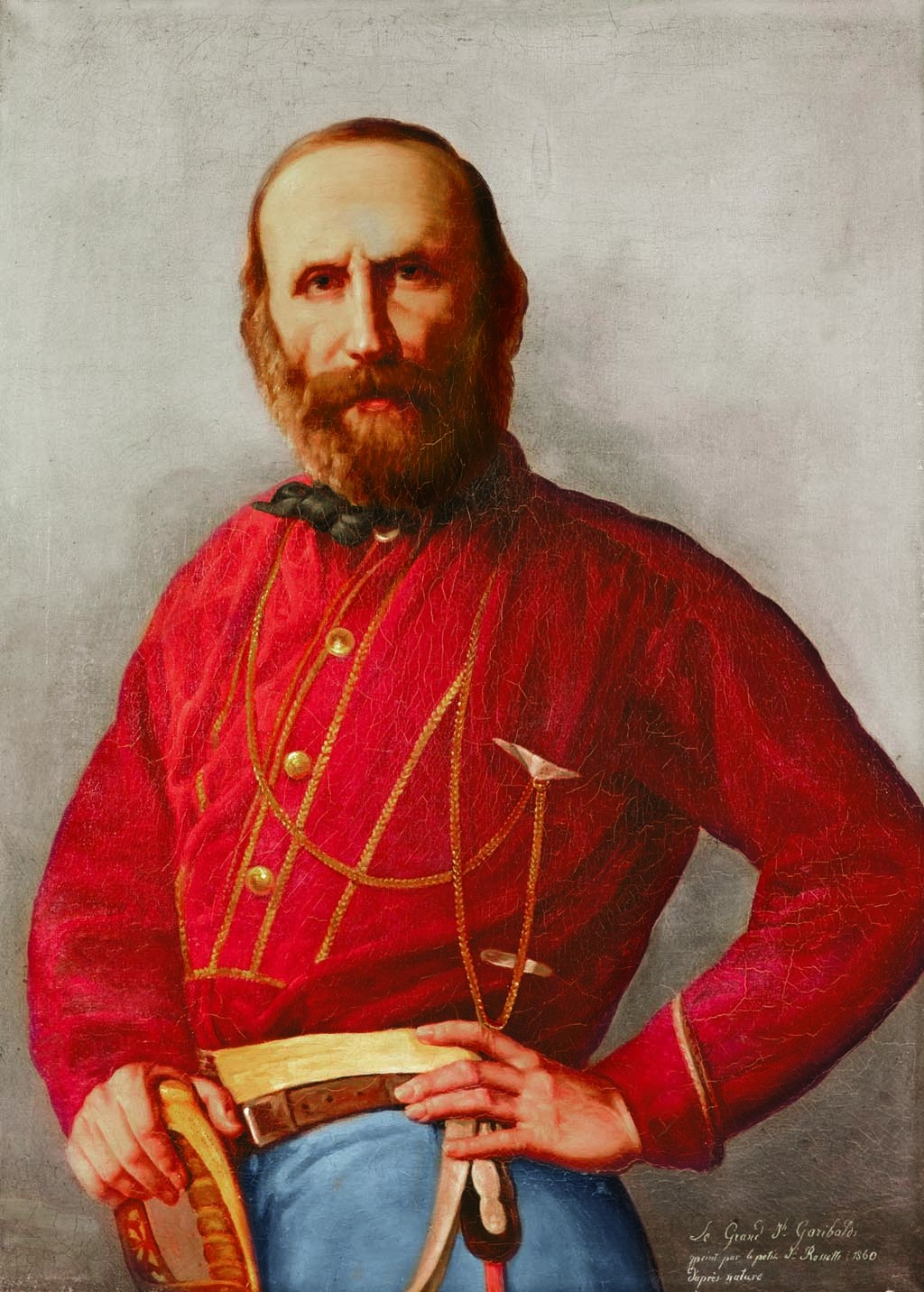
I have to add here a painting of the Great Man himself, whose statue graces at least one square, and whose name graces at least one street, in every village, town, and city of Italy.

image

I like Garibaldi, I’ve liked him ever since as a teenager I studied the unification of Italy for my O level History. By way of introduction to Garibaldi, our teacher told us about his earlier exploits in South America. The only thing that sticks in my mind about these worthy endeavors is our teacher’s description of how Garibaldi met his wife. He was on a boat on the Río de la Plata, where he was inspecting something or other through a telescope. He noticed his future wife on the bank, washing clothes or some such. After one look at her, he said (and here the teacher put on a thick Italian accent and struck an operatic pose), “Brring me to herr!”

But back to colours and politics. In the interwar years the red of the Socialists and Communists was violently opposed by various other colours. It was the black-shirted Fascists in Italy, seen here in the March on Rome in 1922
image
and the black-shirted Fascists in Spain, seen here jubilating at the fall of Irun during the Spanish Civil War.
image
In Germany, it was the brown-shirted Nazis.
image
From here my memory leaves coloured shirts and vaults back some 500 years or so to the gardens at the Inner Temple in London, where – at least, according to Shakespeare in Henry VI, Part I – the Lords of Court chose which side to be on in the upcoming War of the Roses, by plucking either a white rose (the Yorkists) or a red rose (the Lancastrians) from rose bushes growing in the garden. Colours again, defining which side you would be taking in the looming political struggle. The scene is caught in this much romanticized painting from the 1870s.

image
The Lancastrian Red Roses and the Yorkist White Roses fought it out for 30 years until Richard III was unhorsed and killed at the Battle of Bosworth Field, and Henry VII was crowned in his place. As a symbol of a once-more unified country, Henry devised a new badge for his dynasty, a mixed red-and-white rose now called the Tudor Rose.
image
A very clever piece of political manipulation through colour …

Talking of using colours for political purposes, we can fast-forward 300 years to the French Revolution and watch the storming of the Bastille.
image
The Paris militia played a prominent role in the attack. To distinguish themselves from other groups taking part, they wore a blue and red cockade in their hats, Paris’s traditional colours.

image

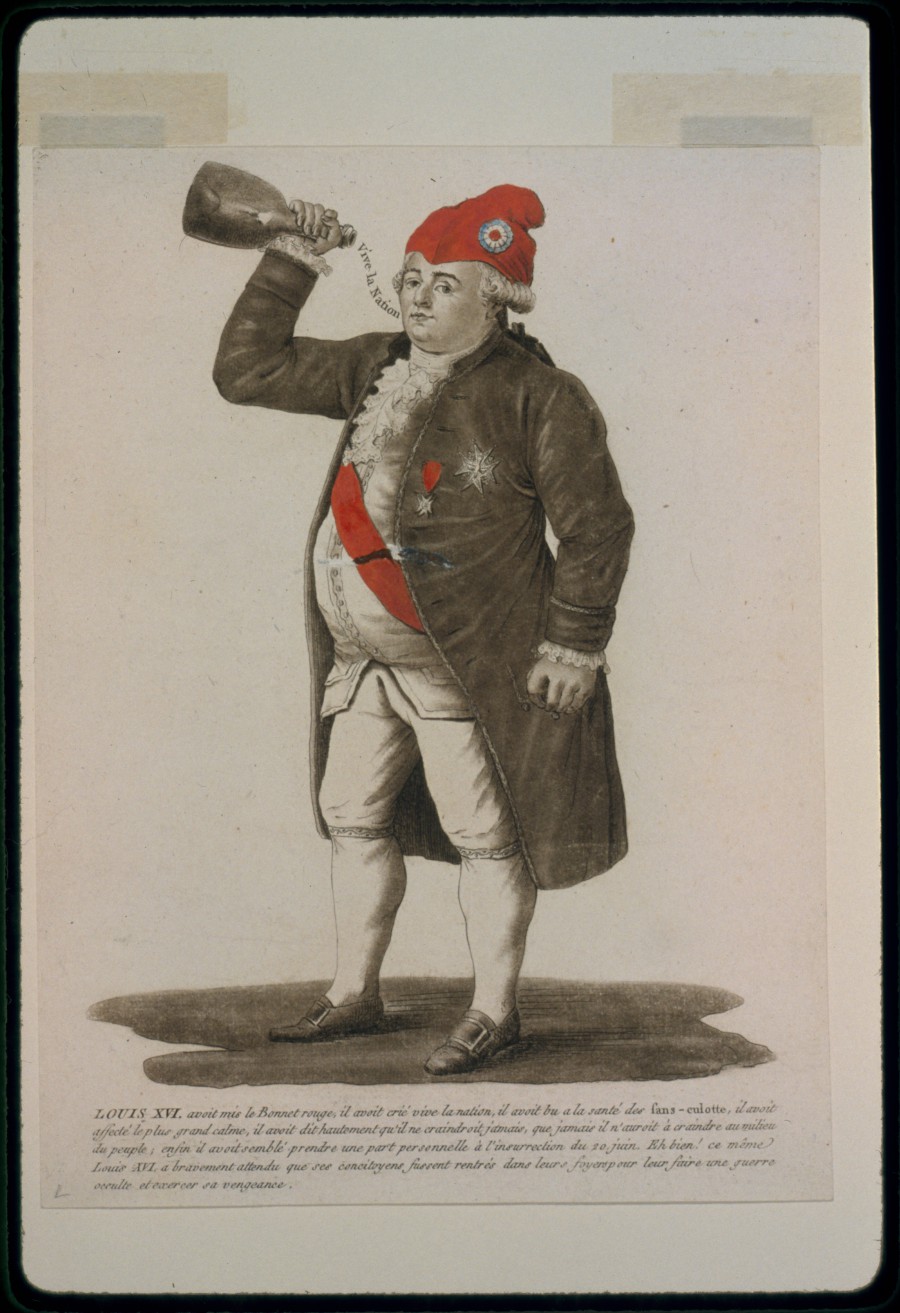
The people of Paris were elated by this victory. But the more moderate – more aristocratic – elements of the revolutionary camp were alarmed by what they saw as rampaging – and armed – mobs. It was decided to create a National Guard out of the Paris militia under the command of the Marquis de Lafayette, a moderate revolutionary with military experience (gained during the American Revolution) and with the trust of King Louis XVI. Lafayette proposed to add white to the militia’s blue and red cockade. His argument was that this would turn what was mainly a Parisian militia into a national force: white was then the national colour.
imageBut in a political system where all things national were the King’s, this was also a way of saying “revolutionaries yes, but still loyal to the King”. Well, things didn’t quite work out that way, but thus was born the red, white, and blue cockade, which even King Louis gracefully accepted to wear – at least for a little while.

image

The cockade morphed into the flag, which became a symbol of hope for some

image
and the dread of many more as French troops unfurled like a tsunami over much of Europe.

image

Rampaging mobs makes my mind spin back more than a thousand years to Constantinople and to its hippodrome, home of the city’s chariot races. Chariot racing was to the Romans and the Byzantines what soccer is today to many people the world over, a mania, a fixation. All over the Roman world, there were four factions, the Greens, the Blues, the Whites, and the Reds, and all chariots in a race belonged to one of these four factions. The charioteers, as well as the fans, wore the colours of their faction, like in this mosaic in Lyon.

image

Like soccer players today, charioteers could and did change faction, but like soccer fans today the fans never did. If you chose to follow the Greens, you were a Green for life. Like soccer today, the enthusiasm of the fans inside the hippodrome often turned into hooliganism and gang warfare outside it. Like soccer today in some parts of the world where there is no recognized outlet for political and social frustrations, factional fighting became a way to vent political anger and score political points.

So it was in Constantinople in 532 AD, when Justinian I was Emperor. By now, there were only really two chariot factions that counted, the Blues and the Greens. Justinian supported the Blues so his enemies at court naturally supported the Greens. Justinian was in the midst of negotiating a badly-needed peace settlement with the Persians, and he had to have peace on the home front. But the people of Constantinople were angry: taxes were crushingly high. There had been politically motivated rioting after some earlier chariot races and a number of rioters had been hanged. But this did not calm excited spirits. For some strange reason, Justinian thought another day of chariot races would pour oil over troubled waters. The races started alright, with Blues and Greens vociferously supporting their teams, even though they also hurled insults at the Emperor, sitting – no doubt a bit nervously – in the imperial box. By the end, though, the two factions united in a common roar of “Nika! Conquer!” With that, the spectators burst out of the hippodrome and assaulted the palace, which conveniently abutted the hippodrome. For the next five days, they laid siege to it, demanding reductions in taxes and the dismissal of the prefect responsible for collecting the taxes and the quaestor responsible for rewriting the tax code. For good measure, they declared Justinian deposed and raised a new Emperor in his place. In the resulting mayhem, fires broke out which eventually burned down half the city.

Initially, Justinian panicked and was looking to scarper. But his wife Theodora was made of sterner stuff and stiffened his spine. Once his funk had passed, Justinian reverted to a true-and-tried method: gold. He got his eunuch Narses to go into the hippodrome, where the Greens and Blues were about to crown the new Emperor, with a large bag of gold. Narses quietly joined the heads of the Blue faction. He reminded them that Justinian was a Blue and that he had always supported them, he pointed out that the new Emperor was a Green and they could surely imagine what would happen to them under him, and then he distributed the gold. The faction leaders held a quiet conference, then spread the word among their followers. In the middle of the coronation, the Blues suddenly all stormed out of the hippodrome, leaving the Greens sitting stunned in their seats. At which point, imperial troops under trusted generals burst into the hippodrome and massacred all and sundry. It is reported that thirty thousand people died that day.

All in the name of colours …

Colours have been hitched to the wagon of many other political causes. Green has morphed from the colour of Byzantine charioteering factions to the colour of modern environmental factions, and we now hear of Deep Green and Light Green factions, each trading barbed – and not so barbed – insults about the depth of their commitment to the cause. We have Hindu fanatics cladding themselves in the colour saffron, a colour with deep religious connotations in Hinduism, and going on rampages against non-Hindus. And on and on … Readers who are interested in the topic can do no worse than go to this Wikipedia site.

But, misquoting Elton John, all I want to say is “Don’t shoot me, I’m only a colour”.

_______________
Yellow-shirts celebrating the King’s birthday: http://www.bangkokpost.com/multimedia/photo/447447/king-birthday
Meeting of a Jacobin club: http://www.larousse.fr/encyclopedie/data/images/1004994-Club_des_Jacobins.jpg (in http://www.larousse.fr/encyclopedie/divers/club_des_Jacobins/125450)
Garibaldini fighting: http://www.ondadelsud.it/wp-content/uploads/2011/04/Marsala-1860-Sbarco-dei-Mille.jpg (in http://www.ondadelsud.it/?p=4664)
Garibaldi: http://www.museotorino.it/images/86/94/ce/b0/8694ceb03de848108691d55482fd1c40-1.jpg?VSCL=100 (in http://www.museotorino.it/view/s/238dcc0376d444d2b6decf0378c13e6c)
The March on Rome: http://www.history.com/news/wp-content/uploads/2012/10/mussolini-march-on-rome.jpg (in http://www.history.com/news/9-things-you-may-not-know-about-mussolini)
Spanish fascists in Irun: http://pix.avaxnews.com/avaxnews/6a/1d/00001d6a_medium.jpeg (in http://avaxnews.net/educative/Spanish_Civil_War_2.html)
Brown shirts marching: http://img2.blog.zdn.vn/37516513.jpg (in http://me.zing.vn/zb/dt/toyotasolara/17039283?from=my)
Scene in the Temple Garden: http://ichef.bbci.co.uk/arts/yourpaintings/images/paintings/warg/large/nml_warg_wag_2712_large.jpg (in http://www.bbc.co.uk/arts/yourpaintings/paintings/scene-in-the-temple-garden-98909)
Henry VII and Tudor rose: http://static.guim.co.uk/sys-images/Admin/BkFill/Default_image_group/2012/3/1/1330616510280/Henry-VII-001.jpg (in http://www.theguardian.com/books/2012/mar/02/tudors-henry-vii-wars-roses)
Storming of the Bastille: http://media-1.web.britannica.com/eb-media/98/90498-004-CEB880DC.jpg (in http://global.britannica.com/EBchecked/topic/55622/Bastille)
Arms of Paris: http://upload.wikimedia.org/wikipedia/commons/thumb/c/ca/Blason_paris_75.svg/931px-Blason_paris_75.svg.png ( in http://en.m.wikipedia.org/wiki/File:Blason_paris_75.svg)
Royal standard of France: http://en.m.wikipedia.org/wiki/Royal_Standard_of_France#/image/File:Pavillon_royal_de_France.svg (in http://en.m.wikipedia.org/wiki/Royal_Standard_of_France#Middle_Ages)
Louis XVI: http://upload.wikimedia.org/wikipedia/commons/7/74/Louis_le_dernier.jpg (in http://commons.m.wikimedia.org/wiki/File:Louis_le_dernier.jpg)
Liberty guiding the People: http://upload.wikimedia.org/wikipedia/commons/thumb/c/cc/Eugène_Delacroix_-_La_liberté_guidant_le_peuple-2.jpg/967px-Eugène_Delacroix_-_La_liberté_guidant_le_peuple-2.jpg (in http://commons.m.wikimedia.org/wiki/File:Eugène_Delacroix_-_La_liberté_guidant_le_peuple-2.jpg)
Revolution as ogre: http://goodcomics.comicbookresources.com/wp-content/uploads/2008/10/cruikshank14.jpg (in http://pixgood.com/french-revolution-political-cartoon.html)
Mosaic of chariot race: http://travellingman.jalbum.net/Lyon%202011/slides/P1120092.JPG (in http://travellingman.jalbum.net/Lyon%202011/slides/P1120092.html)

FOUR FACES

Bangkok, 5 December 2014

I’ve just come back from a trip to Phnom Penh. My wife accompanied me, so for a couple of days, while I was doing the official rounds and meeting the official people, she was nosing around the city enjoying herself. She regaled me every evening with her discoveries, making me green with jealousy. But we had decided that I would take a day off at the end of my official rounds and spend a long weekend together being tourists, so I told myself to be patient and bide my time. On Friday, Andy (not his real name, but tour guides in this part of the world will often adopt a Western name to make it easier for us dumb Westerners), Andy as I say, was waiting for for us at the door of the hotel with his tuk-tuk

image

in which he swept us off (well, “swept off” may be exaggerated, given the venerable speed at which tuk-tuks go) for a visit to Oudong, Cambodia’s capital prior to Phnom Penh. After puttering across the flat plain surrounding Phnom Penh for a while, we finally sighted in the distance the phnom (“hill” in Khmer) which had been the centre of Oudong.
image
After some more puttering, we arrived at the base of this hill, and were immediately surrounded by a cloud of boys shouting greetings, asking us where we came from, and directing us to the loo (after nearly two hours of puttering, we were both more than ready to answer calls of nature).

Following this pit stop, we made for the steps which would carry us to the top of the phnom. We huffed and we puffed slowly up the steps – all 509 of themimage
accompanied by a charming little boy, one of the cloud, who went by the name of Monette. His English was approximate, but he used it bravely to explain to us the sights we passed, the first of which was some exceedingly cheeky monkeys who hung around the steps like a pack of bad boys, ready to snatch lotus flowers from the unwary passer-by and snack on their stamens (or do I mean their pistils?)

image

One did just that to a group of young women in front of us, who came running back down the stairs screaming and clutching at each other. I moved forward bravely towards the insolent monkey as he sat on the steps munching the stamens (or do I mean pistils?). He looked me in the eye, and calmly walked off into the surrounding bushes holding his booty and showing me his bum. I mustered as much of my dignity as I could and Carried On.

With one final heaving huff and one further ragged puff, we staggered to the top. With the excuse of admiring the view

image
we took a break. But soon we turned around and took in the first of five stupas which crown the hill.

image

After walking around it, we wended our way along the crest, from one stupa to the next, with Monette scampering along and giving us fractured, splintered explanations, until we got to the last, a stupa with four faces.

image

Well! This was a pleasant discovery! Those four faces staring benevolently out to the four cardinal points were intriguing indeed.

image

I must confess, my first – wholly irreverent – thought was that they reminded me of Thomas the Tank Engine of my youth.

image

But then another memory floated to the surface, from several years ago when my wife and I visited Angkor Wat, several hundred kilometers upriver from where we were currently standing, on the edges of Tonle Sap lake: Prasat Bayon, the shrine to Mahayana Buddhism, the temple of the 200 faces of Lokesvara, the bodhisattva of compassion. Yes, this must have been the model of the stupa before me.

image

image

image

Ah, what a lovely, lovely temple is Prasat Bayon! The bodhisattva who embodies the compassion of all Buddhas smiling at you wherever you stand, wherever you look. A thousand rays of compassion sweeping us visitors and what had been the surrounding city.

But King Jayavarman VII, who built the temple and who replaced the Khmers’ state religion of Hinduism with Mahayana Buddhism (and whose face, many think, was the model of the bodhisattvas at Prasat Bayon)

image

merely copied from a previous model for his design, that of Brahma, the Hindu god of creation. Brahma is very often represented with four heads, each reading one of the four Vedas. Temples dedicated to him are rare, but there was one close to Angkor Wat, on Phnom Bok. The quadruple-headed bust below, from that temple, is now in the Musée Guimet in Paris, no doubt “taken in for its protection” (or do I mean filched?) by the-then French colonial masters.

image

There is also a regionally famous Brahma-derived statue here in Bangkok, down the road (as it were) from where we live: Phra Phrom (a Thai rendition of Brahma).

image

He is considered the deity of good fortune and protection. Since he has a solid following among the Chinese of Singapore, Hong Kong and Taiwan, and knowing the proclivity of the Chinese to gamble, I rather suspect that Brahma has gone from being the god of creation to the god of gamblers. How the mighty have fallen …

And on this melancholy note, it was time to leave my reveries and move on. My wife and I made our way back down the hill, at the bottom of which we gave Monette 10 dollars for his services, enjoining him to use it for his schooling (he had informed us that he was going to a paying school) but fearing that it might end up instead in the pockets of his “minders”. We picked our way past the rubbish left by previous visitors and a monkey snacking on the boiled rice thrown away by one of them, we climbed into Andy’s tuk-tuk, and we puttered our way back to Phnom Penh.

____________________
Andy’ tuk-tuk: https://www.facebook.com/AndyFriendlyTukTukPhnomPenh/photos/pcb.290625764427281/290625417760649/?type=1&theater (in https://www.facebook.com/AndyFriendlyTukTukPhnomPenh)
Oudong from a distance: http://static.panoramio.com/photos/large/32298005.jpg (in http://www.panoramio.com/m/photo/32298005)
Stairs at Oudong: http://farm3.staticflickr.com/2825/10724616273_e3e9cf04b7_z.jpg (in http://iwandered.net/2013/11/07/day-trip-to-oudong-cambodia/)
Monkey: https://c2.staticflickr.com/8/7420/8993459951_7619376cd4_b.jpg (in https://www.flickr.com/photos/kamimura4401/8993459951/)
View from the top: http://1.bp.blogspot.com/-Yk57J-xzt4Y/UFLx1bIbIrI/AAAAAAAABPA/Mdq0Z5_DBuM/s1600/Oudong6.png (in http://www.camtravel.info/2012/09/oudong-mountain-cambodia.html#.VIB9hGIaySM)
First stupa: http://upload.wikimedia.org/wikipedia/commons/3/30/Sanchak_Mony_Chedei.jpg (in http://en.m.wikipedia.org/wiki/Oudong)
Stupa with faces: https://c2.staticflickr.com/4/3018/3087092115_26ee767788_b.jpg (in https://www.flickr.com/photos/zapata_k/3087092115/)
Stupa with faces – close up: http://1.bp.blogspot.com/-aAJEmmCf6h8/Um5lWw9rdxI/AAAAAAAAxbg/FBPq3MXQ0_U/s1600/23+Close+Up+of+Four-faced+Top+Cambodia+Oudong+Temple+Cycling-358.jpg (in http://jotarofootsteps.blogspot.com/2013/10/sites-oudong-temple-cambodia.html)
Thomas the tank engine: http://3.bp.blogspot.com/-KiFNIBZmqPI/TxKoxis-FrI/AAAAAAAAAJY/sVCzG4VTLd0/s1600/ThomastheTankEngine.jpg (in http://latestnewsfromtpandt.blogspot.com/2012/01/thomas-tank-engine-review.html)
Bayon temple-1: http://www.rickmann-uk.com/wp-content/uploads/Bayon-three-faces.jpg (in http://www.rickmann-uk.com/index.php/2007/06/05/angkor-temples-cambodia/)
Bayon temple-2: http://jcinnamonphotography.files.wordpress.com/2011/10/bayon-temple-faces-2.jpg (in http://jcinnamonphotography.wordpress.com)
Bayon temple-3: http://en.m.wikipedia.org/wiki/Bayon#/image/File:Das_Lächeln_von_Angkor.jpg (in http://en.m.wikipedia.org/wiki/Bayon)
King Jayavarman VII: http://en.m.wikipedia.org/wiki/Bayon#/image/File:JayavarmanVII.jpg (in http://en.m.wikipedia.org/wiki/Bayon)
Brahma: http://en.m.wikipedia.org/wiki/Brahma#/image/File:Brahma_Musée_Guimet_1197_1.jpg (in http://en.m.wikipedia.org/wiki/Brahma#Temples)
Phra Phrom: http://en.m.wikipedia.org/wiki/Brahma#/image/File:Thai_4_Buddies.jpg (in http://en.m.wikipedia.org/wiki/Brahma#Temples)

TOM YUM SOUP – WITHOUT THE CHILLIES!

Bangkok, 23 November 2014

I must say, I am feeling very pleased with myself. When my wife and I first arrived in Bangkok, we did the time-honored thing of scouting out local culinary delicacies to taste. One that intrigued me was Tom Yum soup. It is described as a “clear spicy and sour soup”. It was the sour part that interested me. Sour soup …. What a fascinating concept, I had to try that. But the spicy part made me hesitate. As I have pointed out forcefully in a previous post, I hate spices, or at least hot spices like chilli. But my desire to experience the sour part trumped my distaste of the spicy part. And so I tried it.

Delicious, absolutely delicious! OK, with every spoonful I was making strange rasping sounds at the back of my throat to counteract the chillies, which after a while had my wife drumming her fingers on the table, and I had to drink iced water by the gallon to calm the fires in my mouth. But behind all this mayhem, I could sense the wonderful sourness of the soup. How was this done? I started scouring the web. The answer is: fish sauce meets lime (fruit and leaf), supported by lemongrass. As usual, different recipes add various other bits and pieces, the most common of which are shrimps, tomatoes, mushrooms, galangal (a sort of root like ginger), and coriander (as a final garnish). And of course, always, without fail, chillies.

I took a momentous decision. I was going to make Tom Yum soup WITHOUT chillies. I was going to show the correctness of a fundamental belief of mine, that hot spices actually add nothing to dishes, that food can be enjoyed quite as much without these terrible ingredients.

Today was the day. Yesterday, my wife took me to an upscale supermarket to find the necessary ingredients. I knew I was on the right track when we found that the supermarket helpfully offered packets of the core ingredients. The remaining ingredients were quickly rounded up.

This morning, after a good night’s rest, I got to work. After reviewing a number of recipes again, I decided on the course I would take, to whit:
1. Boil the water.
2. Cut several stalks of lemongrass into short segments. Bruise them so that they more easily exuded their lemony oils. Cut a few slices of galangal. Destalk the lime leaves and cut them up a bit. Squeeze the limes and collect the juice.
3. Ostentatiously throw away the chillies, the ones that the supermarket had added to the pre-packed set of ingredients.
4. Add 2 tablespoons of fish sauce to the boiling water. Add the juice of 2 squeezed limes. Add the lemongrass segments, the slices of galangal, the lime leaves. Bring to a boil. let simmer for a while.
5. Add the mushrooms and the tomatoes. Bring back to a boil and let simmer a bit.
6. Taste. Feel the panic rise because the soup is not nearly sour enough. Add 3 more tablespoons of fish sauce and the juice of 2 more limes. Let simmer. Taste again. Better, but not there yet. Add 2 tablespoons of fish sauce and 1 more lime. Simmer. Taste. That’s better! Now we have that sourness!
7. Add half a dozen shrimps, cook briefly.
8. Serve, spreading chopped coriander on the surface as garnish.

We ate it with a side-dish of rice my wife made.

My wife was the official taster. She pronounced the soup to be absolutely delicious, and declared that the chillies weren’t missed at all. She concluded that henceforth I could be considered the official family provider of (chilliless) Tom Yum soup, along with mashed potatoes (my speciality). My breast swelled with pride.

Now that a few hours have passed and I have reflected on the experience, I would say a few things. First and foremost, I was right: you don’t need chillies! I will now attack various other dishes which I would like very much were it not for the spices that cooks insist on adding (maybe I should make a web-site of this culinary crusade of mine). Second, I think I panicked and made the soup too sour. It was really good at the first spoonful but beginning to get too much by the last. A lighter touch would have carried me through effortlessly to the end. Third, I wonder if something other than shrimps could be used. Their taste really gets lost in the sourness. I have to think about this one a bit. Fourth, I think I have to adopt the European habit of putting the ingredients you won’t eat in a muslin bag. It kind of takes away from the pleasure of eating to have to pile up the lemongrass segments, galangal slices, and lime leaves on the table cloth as you go along. Fifth, I think I should go easy on the coriander the next time. In fact, I might try parsley instead. Sixth and lastly, when I get back to Europe what am I going to use instead of limes? Lemon? Mandarin? Orange? I’m going to have to think about this one too.

Oh, in all the excitement, I haven’t added a photo of the soup. In our haste to try it, neither my wife nor I took a photo of my creation. And I hesitate to take one from the web, because they all are of soups made with chillies. But what the hell, here is a photo.

image

Also, one day I will write a post on how I make mashed potatoes. Promised.

_________________

Tom Yum soup: http://2.bp.blogspot.com/-oRNilG7HYh8/T7-q1Kg0suI/AAAAAAAAA_k/Z8gykr2ZYtU/s1600/tom-yam-soup-chef-duminda-2012.jpg (in http://cook-with-chef-duminda.blogspot.com/2012/05/tom-yam-soup.html)