Vienna, 10 September 2026
When my wife and I are in Vienna, we always find time to go to one of my favourite haunts, the Dorotheum auction house. As I’ve explained elsewhere, the Dorotheum has a whole floor where you can buy pieces at a fixed price, and I like to wander through that floor to see what’s on offer. When I see a piece that pleases me, I dream of where I might place it in the apartment. My wife is strictly rationing my purchases – she thinks our walls are too cluttered as it is – and I can only really buy something as a birthday gift to myself. So it was that for my birthday last year I bought for myself a lovely Japanese coloured woodblock print.
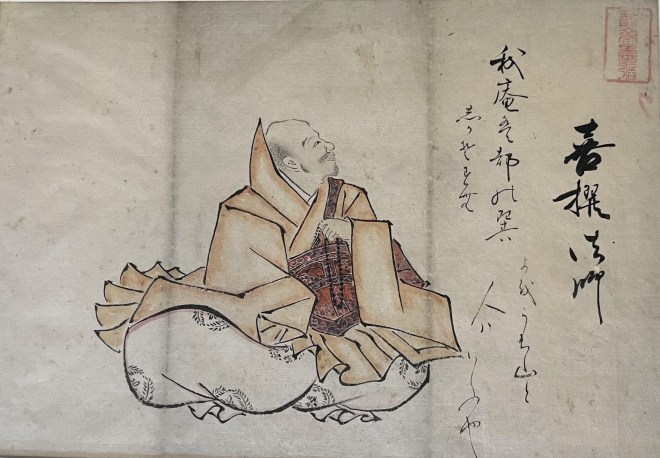
I liked the bold strokes of the man’s clothes, contrasting as they do with the delicate handling of his face and one exposed hand. I loved the way the colouring is delicately suggested. And I was really intrigued by his gaze: what was he looking up at so intently, I wondered?
The brief description given by the Dorotheum told me that this is a portrait of Kisen Hōshi, a Buddhist monk and poet who lived in the 9th Century CE. He is considered one of Japan’s six poetic sages, although only two short poems have been confidently attributed to him.
The writing on the right of course excited my curiosity. I learned later that this kind of calligraphy is known as sosho, or grass script, and it certainly looks like blades of grass scattered down the page. I initially tried using Google Translate to give me a translation, but the grassy calligraphy defeated the software. I turned to an old colleague of mine as well as to my brother’s wife, both of whom are Japanese, to see if they could decipher it. They both confessed to finding the calligraphy quite difficult to read, although they were able to read enough to make me understand that the bolder writing was the poet’s name, Kisen Hoshi, while the remainder was one of his poems. I looked around for translations of it and was astonished to find a good many quite different translations. I have to assume that the text is somewhat hermetic and can be read in many different ways. I have plumped for this translation, because it recognises the pun at the poem’s heart:
My hermitage is southeast of the capital [Kyoto], and thus I live peacefully;
Yet people call it ‘The Mountain of Worldly Sorrows’
(the poet’s hermitage was located on Mount Uji, and the poem relies on a pun playing on “Uji”, the place name, and “Ushi”, meaning gloomy or sorrowful.)
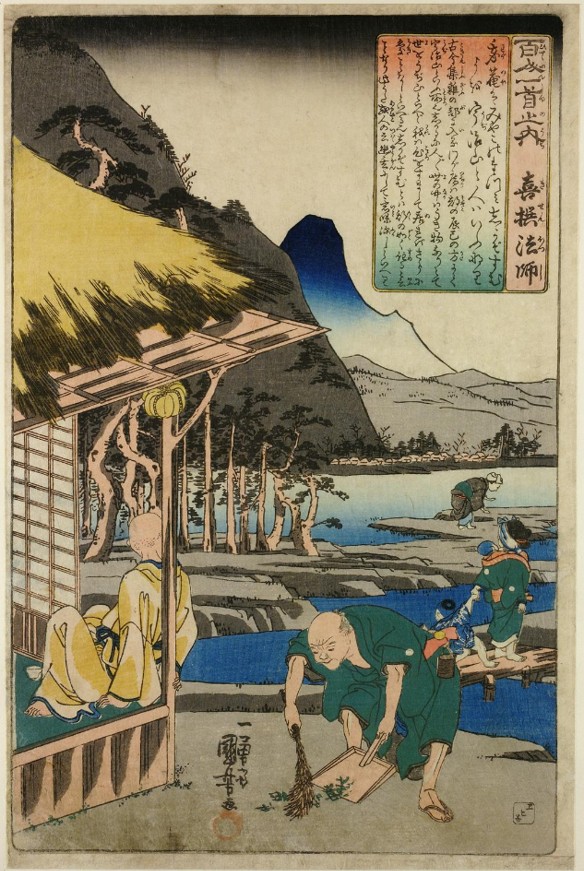
I throw in another early 19th-Century woodcut print, by the artist Utagawa Kuniyoshi, depicting the hermitage and our monk-poet sitting peacefully on its verandah.
And this woodcut print, by Katsushika Hokusai (he of the “Great Wave off Kanagawa“), also from the early 19th Century, is of the same scene as my print.
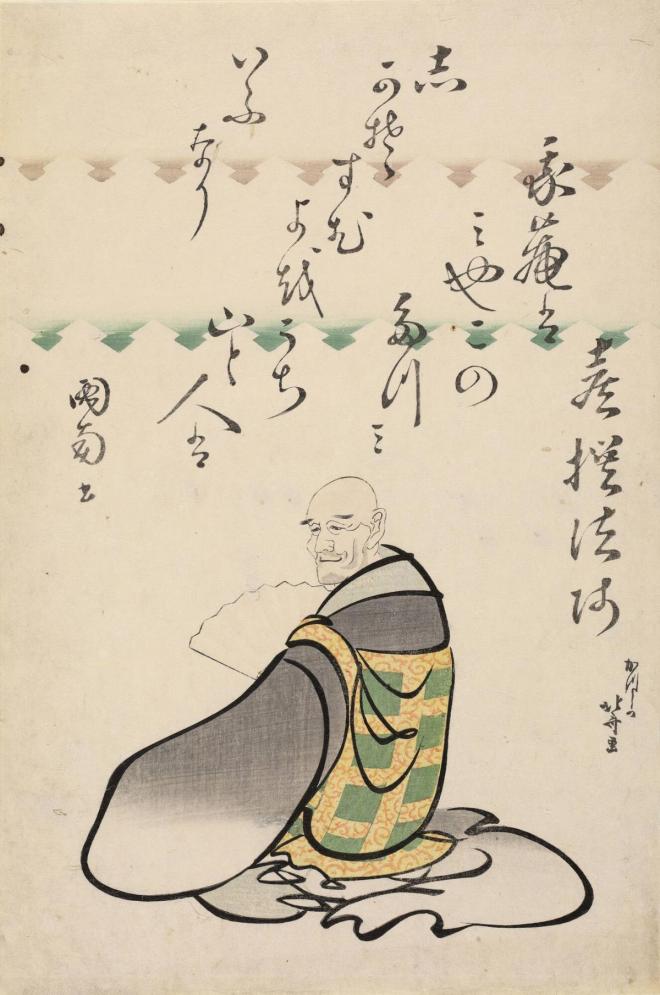
I have to say, Hokusai’s version seems to fit the poem’s theme better, of someone living peacefully far away from the madding crowd. Why is the monk in my version looking up so insistently? My Japanese colleague thought that he was actually lonely and hoping to see some friends walk through the door, but that doesn’t really fit with the sense of the poem. I have my own theory, but before I propose it I will focus on who the artist of my version was.
All the Dorotheum allowed itself to say on the subject was that the piece is a product of the Katsukawa school. This is a school of artists which flourished for about a hundred years, from the 1750s to the 1840s. I certainly can see a relationship to other woodcut prints created by exponents of the school, particularly by Katsukawa Shunshō, probably its most well-known exponent. In 1775, he created a woodblock-printed illustrated book, “The Hundred Poets Brocaded in the Eastern Weave”, which as the title suggests illustrates one hundred famous poets, along with one of their poems. Here is one page out of a copy of the book in the British Museum.
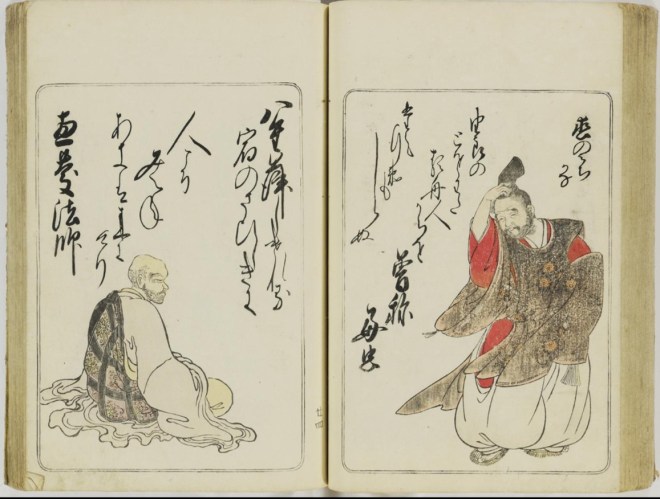
The print on the left is of the monk Ekei Hōshi, the poem floating above him being one of his most celebrated poems:
In the loneliness of this desolate dwelling overgrown with thick, tangled weeds – where no human face is ever seen – autumn has arrived.
The print on the right, meanwhile, is Katsukawa Shunshō’s take on our friend Kisen Hōshi, with the same poem as before raining down gently around him.
I can be braver than the Dorotheum and give the artist of my print a name, because he stamped his chop mark in red in the top right-hand corner of the print. The name in the stamp reads Shaku Sessō. “Shaku” translates literally as Shakyamuni, an honorific title of the Buddha. In Buddhist art and calligraphy, Buddhist monks traditionally drop their secular family surnames and adopt “Shaku” as their spiritual surname to denote that they are followers or “children” of the Buddha. So our artist was a Buddhist monk. His name “Sessō” literally translates as “Snow and Frost.” In Zen Buddhist philosophy and classical art, snow and frost are powerful metaphors representing purity, mental clarity, resilience, and the transient, impermanent nature of life. I’m afraid that is as far as I have been able to go. I have found no information on the internet about an artist-Buddhist monk going by the name Sessō. Where and when he lived will probably remain forever a mystery.
And now back to that insistent stare. If readers look closely at the photo of my print, they will see that the figure seems to be looking straight at the chop mark. So my theory is that what we have here is a self-portrait by the monk Shaku Sessō! I will in all probability never be able to prove it, but I find it a neat explanation.
In any event, I don’t really care that I’ll probably never know who the artist is. And I don’t care that, according to the Dorotheum, the print is heavily stained (yes, there are some stains, and what also look like scuff marks), it has two folds (yes, you can’t miss those; for some strange reason a previous owner had folded it in two, as if to put it in an envelope) and the top corner is restored (I see no sign of that). I just take great pleasure in looking at him while I eat my meals (we’ve hung him close to our dining table), and that is enough.

