MY PSYCHEDELIC TIES

New York, 1 January 2013

My last post has brought back a memory from when I was a teenager. I went to a boarding school that was located some twenty miles from the nearest major train station, so at the beginning and end of each term buses would bring us to and from the station. The bus ride back to school at the beginning of the term was a staid affair, everyone quietly talking or just meditating. The bus ride back home at the end of term was an altogether more riotous event. Bawdy rugby songs were sung at high volume, starting from the back of the bus where the bad boys sat, and what in a different era were called “off-colour” jokes were retold loudly and with relish. This album cover conveys the general idea, although we did keep our clothes on.

rugby songs

One element of the journey home was that we would all wear the loudest possible ties. I should explain that while we did not wear uniforms as such at our school, sports jackets were de rigeur along with a tie. Not just any old tie; a black tie. All of us, all term, wore a black tie.

black-tie-2

The only exceptions were school and house monitors as well as the sporty types who won their cricket, rugby or other colours for exceptional gamesmanship.  We had many theories about why we all had to wear ties of such a lugubrious colour; the one I remember has to do with commemorating the deaths of several boys in a fire decades ago in one of the school houses (no girls; this was a boys’ school).

Whatever the reason, on the last day of term we threw off that horrible black tie and marched onto the bus each with a tie louder and – given the times – more psychedelic than the last. These photos give an idea of the sudden blast of colour we offered each other:

sixties-ties-3

sixties-ties-2

Getting onto the bus was to take part in a fashion cat walk, with comments about each tie and loud cheers for the brightest. We all came back to school with a secret hoard of bright ties, from which we selected one to parade that last morning in front of our peers. And then off we went, singing our bawdy rugby songs.

What happened to my psychedelic ties? Gone, I think, with other mementos of my youth when my sister, tired of seeing me not collect that suitcase which I had asked her to store in her attic, threw it and its contents out.

suitcase in trash

So goes life.

____________________
Rugby songs album: http://farm4.static.flickr.com/3126/3086393712_13bffb7baa.jpg
Black-tie: http://100days100ties.files.wordpress.com/2011/01/black-tie.jpg
Sixties-ties-1: http://img.ehowcdn.com/article-new/ehow/images/a06/q3/of/men_s-fashion-60s-1.1-800×800.jpg
Sixties-ties-2: http://t1.gstatic.com/images?q=tbn:ANd9GcSLL3ymfg76pRMQkN79f7YMTuTYx8Ftz4I_Srr46O7eIhIHs48IAxr5HDgs
Suitcase in a trash can: http://hilariousnyc.com/wp-content/uploads/2010/12/Suitcase-Trash-Can.jpg

A COLOURFUL MAN IMPRISONED IN A GREY MAN, WILDLY SIGNALLING TO BE LET OUT

New York, 31 December 2012

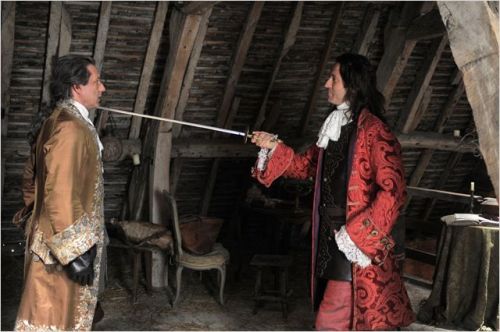
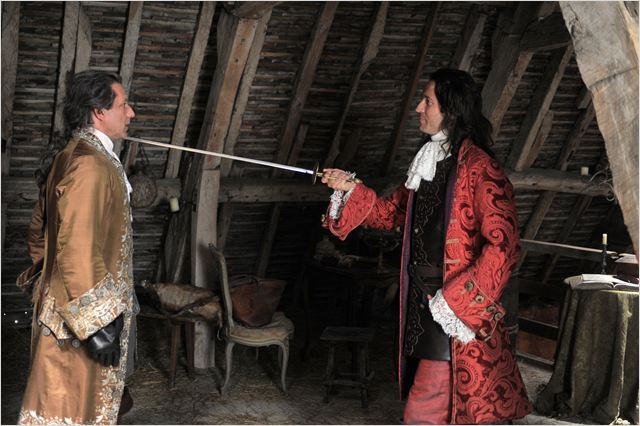
A few weeks ago, I was watching a French TV show in Beijing called Nicolas Le Floch. This is a detective series set in France in the late 1700’s. It’s really quite amusing to see the detective genre unfolding in such an incongruous setting. But actually I mention the show for an altogether different reason: as I followed the tortuous plot, I was struck en route by how colourful the men’s clothes were in that period, as this still from one of the shows attests

floch-colourful clothes

Just to make the point, I throw in a few photos of portrait paintings from the period:

17thC-1

17thC-2

17thC-3

17thC-4

And to top it all, in France at least the men wore make-up! This still is of Le Floch’s boss, the chief of police:

floch-made-up-man

Quite a change from Inspector Japp of the Poirot series …

inspector japp

This blaze of bright men’s clothing made me reflect on the dullness of my own wardrobe. All my official clothes – those I wear for work – are of subdued colouration: grey or discrete browns, greens and dark blues. The vast majority of my shirts are white, with one or two blue ones. The only way I can exhibit my love of colour in an official setting is through my ties, of which I have collected a large assortment over my career. Even the clothes I wear in my private life are modest in their colouration; I can boast of a few brightly coloured T-shirts and that’s it.

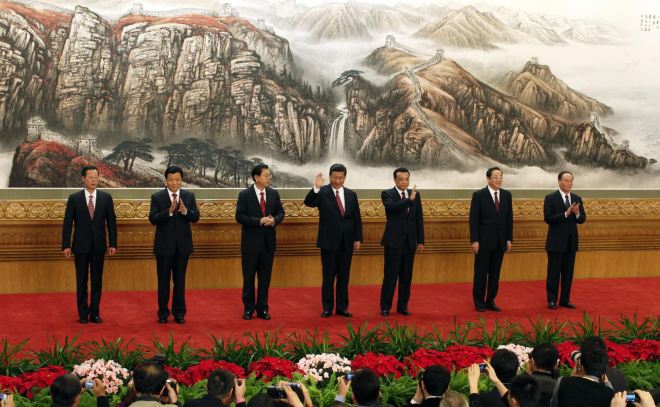
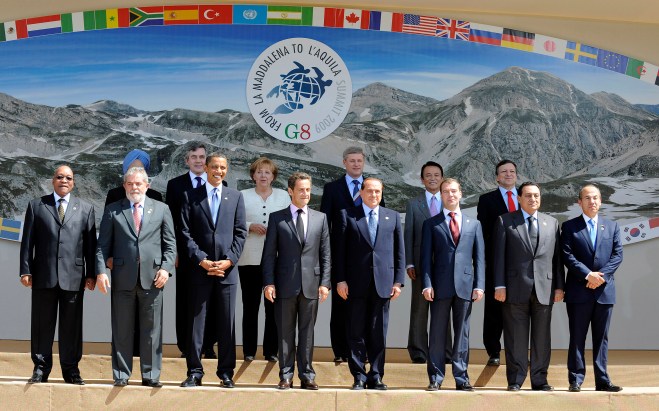
I merely reflect the sartorial conventions of our times. Today’s serious men do not wear colours, as these pictures of the powerful bear out.

The new Chinese leadership (although note the discrete dash of colour in the ties):

Politburo

A lineup of the G8:

G8: TUTTI LEADER A COPPITO, VERTICE L'AQUILA

A lineup of the EU heads of state:

EU

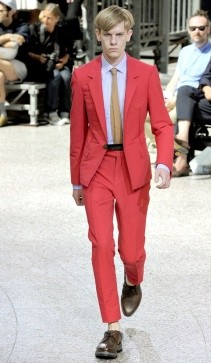
Why this greyness, this dullness, this soberness? I am no historian of fashion, but I am sure that the answer lies in this: serious men, the thinking goes, do not wear colours. Brightly coloured clothes denote ditziness, frivolity and general silliness. A man in brightly coloured clothes cannot possibly balance a budget or write a piece of legislation or do any of those other serious things required of him. I mean, can you imagine these men running a company or a government? Please!

red suit

light blue suit

indian colourful jacket

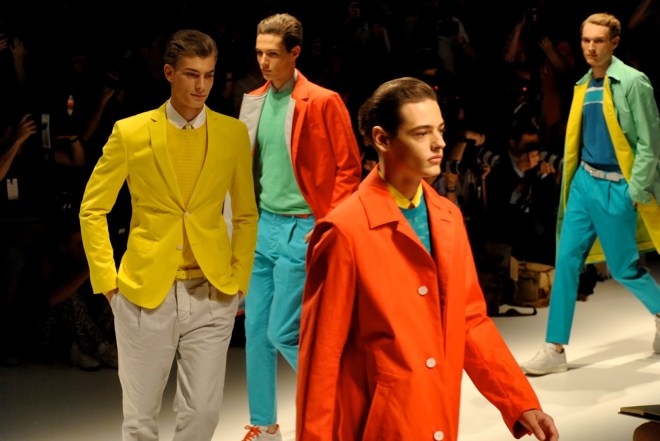
coloured clothes

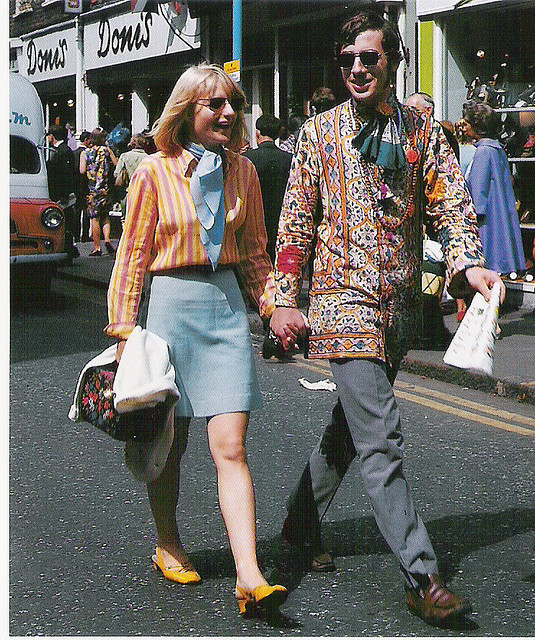
The only time I can think of in my lifetime when men went around in clothes vaguely resembling those of the eighteenth century was the 1960s when flower power burst upon the scene:

carnaby street-1

carnaby street-2

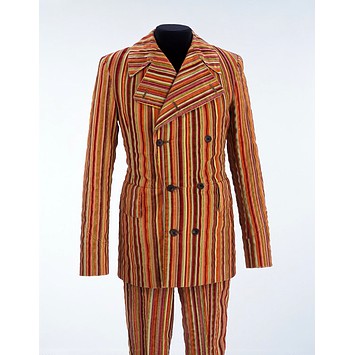
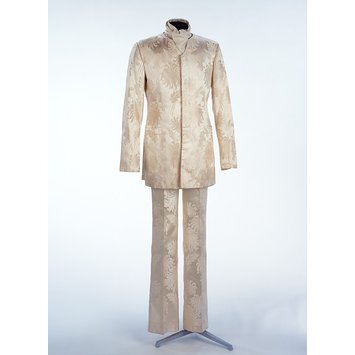
These two suits come from the Victoria and Albert’s collections:

sixties-suit-2

sixties-suit-4

But the people who wore these clothes were completely unserious people, people who were into drugs, sex, and rock and roll, as the album covers of the time amply demonstrate:

beatles-sgt pepper album cover

beatles-yellow submarine

rolling stones

Jimi Hendrix

PinkFloyd-album-piperatthegatesofdawn

So I suppose in my lifetime, if I want to be taken seriously, which I do, I will be condemned to wearing dull coloured clothes, with only a dash of colour in my ties. I will, paraphrasing Cyril Connolly’s famous phrase, be a colourful man imprisoned in a grey man, wildly signalling to be let out.

___________________
Floch colourful clothes: http://images.allocine.fr/r_640_600/b_1_d6d6d6/medias/nmedia/18/81/96/02/19955662.JPG
18thC-1: http://i47.tinypic.com/2j4tvl0.jpg
18thC-2: http://i47.tinypic.com/mwz14n.jpg
18thC-3: http://i48.tinypic.com/atp6l2.jpg
18thC-4: http://i50.tinypic.com/e6q1d1.jpg
Floch made-up face: http://cdn.static.ovimg.com/episode/3270971.jpg
Inspector Japp: http://ic.pics.livejournal.com/phantomphan1990/11963571/118817/118817_original.gif
Politburo: http://l2.yimg.com/bt/api/res/1.2/afKIpJHhH4TpWmLewt8S6A–/YXBwaWQ9eW5ld3M7Zmk9aW5zZXQ7aD0xMDI0O3E9Nzk7dz0xNjYw/http://media.zenfs.com/en_us/News/Reuters/2012-11-15T044703Z_283609896_GM1E8BF0ZB101_RTRMADP_3_CHINA-CONGRESS.JPG
G8: http://www.google.com/imgres?q=G8+photo&hl=en&tbo=d&biw=1280&bih=683&tbm=isch&tbnid=SPoOXwx3iorBWM:&imgrefurl=http://www.g8italia2009.it/G8/Home/Media/Foto/G8-G8_Layout_locale-1199882116809_1246708086733.htm&docid=_9F5adpgS1UWjM&imgurl=http://www.g8italia2009.it/static/G8_Foto/_MB24968.jpg&w=3000&h=1870&ei=z1rgUM6-LNO40AHFtIC4Ag&zoom=1&iact=hc&vpx=161&vpy=295&dur=8059&hovh=177&hovw=284&tx=173&ty=111&sig=109352013111727269517&page=1&tbnh=141&tbnw=215&start=0&ndsp=24&ved=1t:429,r:7,s:0,i:108
EU: http://i.dailymail.co.uk/i/pix/2012/05/24/article-2149193-13413A49000005DC-413_634x252.jpg
Red suit: http://kontraplan.com/site/wp-content/uploads/2012/04/Lanvin-Mens-SS12-Collection-kontraPLAN-magazine-6.jpg
Light blue suit: http://www.thestyleking.com/wp-content/uploads/2011/07/Coloured-Suits.jpg
Indian colourful jacket: http://timesofindia.indiatimes.com/photo/10019988.cms
Coloured clothes: http://4.bp.blogspot.com/-QuyZgxyFQ70/T-xNoZ-tloI/AAAAAAABK3M/5orvLpQt_0o/s1600/Milan+Mens+Fashion+Week+Salvatore+Ferragamo+Spring:Summer+2013+Runway+Show_0143.JPG
Carnaby street-1: http://media.vam.ac.uk/media/website/uploads/images/2006BE8980_carnaby_street.jpg
Carnaby street-2: http://farm3.staticflickr.com/2082/2128638387_ae4fb5b36a_z.jpg?zz=1
Sixties suit VA-2: http://media.vam.ac.uk/media/thira/collection_images/2006AW/2006AW4489_jpg_ds.jpg
Sixties suit VA-4: http://media.vam.ac.uk/media/thira/collection_images/2006AB/2006AB6007_jpg_ds.jpg
Sgt Pepper album cover: http://greatalbumcovers.files.wordpress.com/2012/02/album-covers-bealtes-1.jpg
Yellow submarine album cover: http://3.bp.blogspot.com/-YgGhq-2XQ8E/T9kztOsJPwI/AAAAAAAAC4k/VeHN6M72Tqg/s1600/The+Beatles+-+Yellow+Submarine.jpg
Rolling stones: http://pokingsmot.net/wp-content/uploads/2012/02/The-Rolling-Stones-Their-Satanic-Majesties-Request-Album-Art-468×411.jpg
Jimi Hendrix: http://www.rockstargallery.net/wp-content/uploads/2011/12/Hendrix-AYE-Front-Cover.jpg
Pink Floyd: http://upload.wikimedia.org/wikipedia/en/3/3c/PinkFloyd-album-piperatthegatesofdawn_300.jpg

VIBRAM FIVEFINGER SHOES AND FLAYING

New York, 28 December 2012

My daughter has recently bought herself a pair of Vibram FiveFinger running shoes. For those of you who might not be familiar with this latest cool product, I add here a picture of my daughter’s pair.

giusti shoes

I was not aware of the existence of these shoes until my daughter announced their purchase to me and my wife. In our university days, back in the 1970s, we had come across the-then cool new product, socks with toes, when the sister of one our roommates came to visit and turned up at breakfast time sporting them. For those of my readers who are in the Stone Age of coolness and have never even seen this product, I append a picture.

socks with toes

Intrigued by these strange-looking – but utterly cool – shoes, I visited the web site of the company which designed them, which as an Italophile I am proud to say is Italian. Only Italians could possibly have designed such a shoe. The company in question is Vibram, and I quote here part of the blurb on the shoe from the web site:

“Industrial Designer, Robert Fliri, first proposed the idea of FiveFingers footwear to Marco Bramani, grandson of Vibram founder Vitale Bramani, who immediately embraced the concept. Bramani and Fliri developed the first barefoot shoes, then showed the concept to Vibram USA president & CEO, Tony Post. As a former collegiate runner, Post quickly became a firm believer in the benefits of natural running* and fitness training. He discovered that Vibram FiveFingers were the unique solution to the knee pain and soreness he was experiencing when running.

Soon, they collaborated with the full Vibram team to position Vibram FiveFingers® as a performance product for running, fitness and outdoor sports. FiveFingers not only encouraged a more natural forefoot strike during running, but also allowed the foot to move and work in a completely natural way, while providing grip and protection over a variety of surfaces.

*Running in Vibram FiveFingers requires a significant increase in lower leg and foot strength. A gradual transition is critical to avoid overuse injuries. For more information on making a safe transition please refer to our Barefoot Running page.” (1)

The site has this picture, which shows the ample delights awaiting the purchaser of these shoes when running in them:

woman running in vibram shoes

Yet, in all this wash of coolness and delight, I have to tell you that I find these shoes rather creepy, because they remind me of Saint Bartholomew. For those of my readers who are not well versed in Catholic martyrology, Saint Bartholomew, mentioned as one of the Twelve Apostles in the three Synoptic gospels and in the Acts of the Apostles, is reputed to have been martyred in Armenia by being flayed alive and crucified upside down. Since flaying is not a common practice any more, I should further elucidate that flaying is the act of stripping the skin off a person, preferably when still alive so as to make the experience of dying all that much more excruciatingly painful.

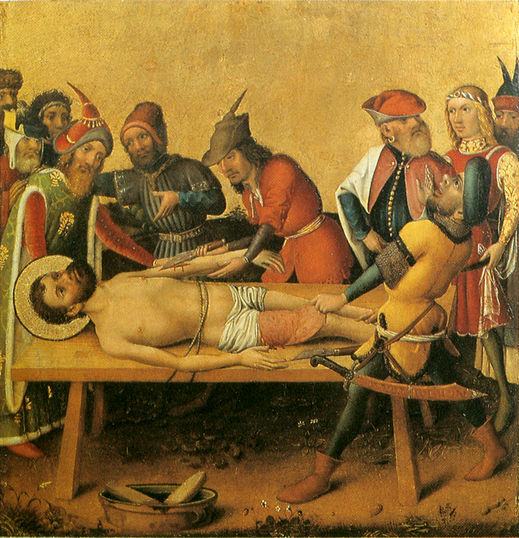
As anyone who has ever walked through the European medieval section of a good art museum will know, Medieval painters – no doubt responding to popular demand – took a morbid delight in showing in clinical detail the varied torments to which the Christian martyrs were subjected; given Saint Bartholomew’s particularly grisly end, he was a popular subject of such paintings. I show here such an example.

saint-bartholomew-painting-3

Please note the stoicism with which Saint Bartholomew is taking it all. Personally, I would have been screaming and begging and pleading and blubbering and generally carrying on. But then I am not a Christian martyr.

Usually, representations of Saint Bartholomew will show the poor man, stoic to the last, carrying his flayed skin as well as one of the knives used to flay him.

saint-bartholomew-painting-2

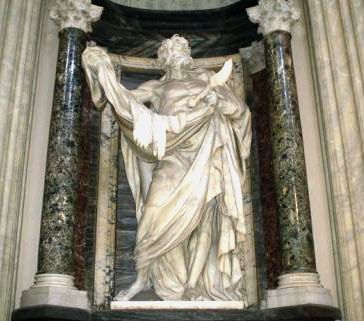
This particular representation I find quite realistic since the – hopefully – corpse at the end of a flaying presumably must be a bloody mess, although in this particular painting the bloodiness looks more like a body stocking. Indeed, as time passed the gory details tended to be dropped in favour of a more romantic representation, such as this one in St. John Lateran in Rome.

saint-bartholomew statue-5-Rome

I am particularly mystified by the fact that the Saint has recovered his skin in this representation, but presumably when one goes to heaven one becomes whole again.

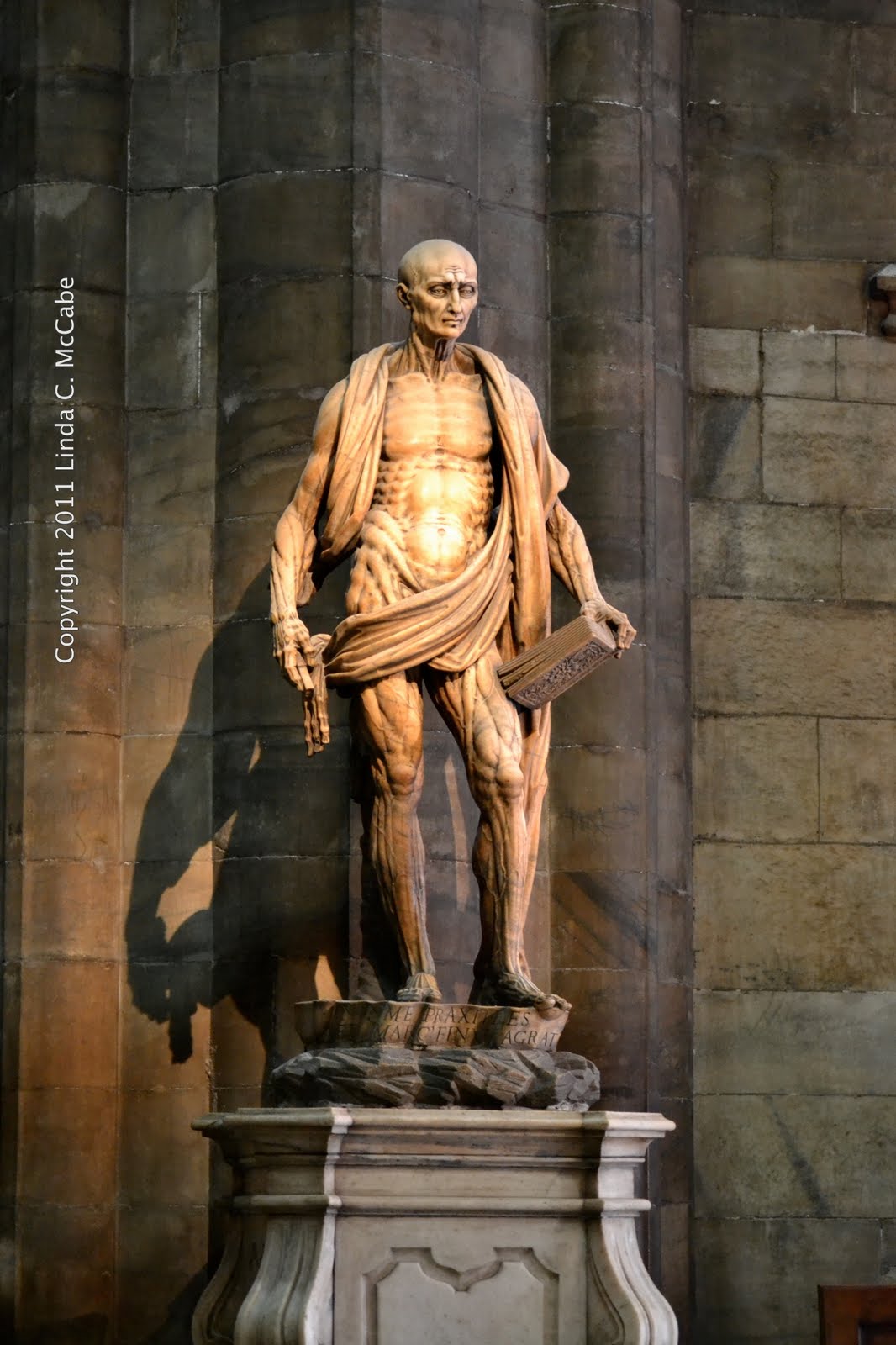
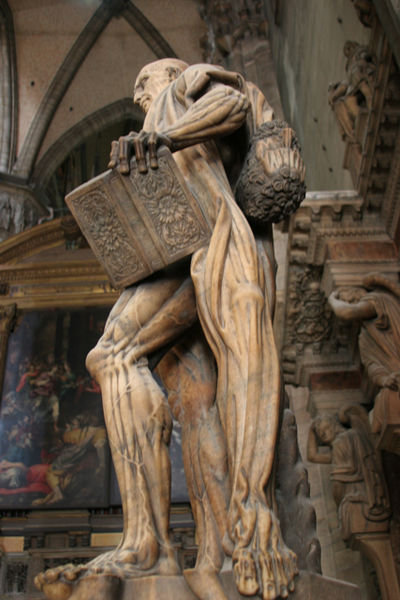
This trend towards the sucrose was spectacularly bucked by one Marco d’Agrate, who in 1562 created a gruesomely realistic statue of Saint Bartholomew which now resides in the Duomo of Milan. I happen to know the Duomo well since my wife is Milanese and as a patriotic duty we always visit the Duomo every time we go back. As this photo shows, Signor d’Agrate has benefited from the vivisections of human bodies that Renaissance scientists had managed to carry out in the face of the Church’s disapproval and he has created a good representation of the muscles and sinews of a human body after the skin has been stripped off. He has of course maintained the tradition of having the Saint hold his flayed skin but has made more of a fashion statement of it, draping it artistically around the Saint’s shoulders.

saint-bartholomew statue-1

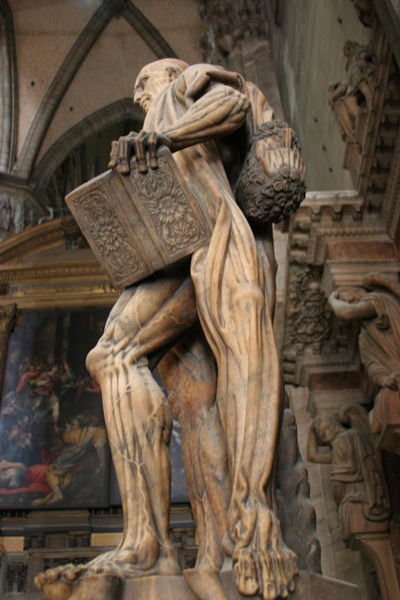
And it is now that we come to the connection with the Vibram FiveFingers shoe. This photo, taken from another angle, shows very clearly the feet of the flayed skin. I see an uncanny resemblance in these with the Vibram shoe. Hence my feeling of creepiness.

saint-bartholomew statue-3b

Happy holidays!

____________________
1. http://www.vibramfivefingers.com/about_vibram_fivefingers/

socks with toes: http://screaminglywonderful.files.wordpress.com/2011/03/26-270d242b-4a17-46e5-af00-642d212561ac1.jpg
St. Bartholomew being flayed-painting: http://tomperna.files.wordpress.com/2012/08/martyrdom-of-st-bartholomew.jpg
St. Bartholomew standing-painting: http://medievalmilanetc.files.wordpress.com/2012/07/1330-0824the-apostle-st-bartholomew-matteo-di-giovanni-about-1480-tempera-on-wood-budapest4.jpg
St. Bartholomew statue Duomo: http://1.bp.blogspot.com/-e4KglOQz_YY/TpSZV147dJI/AAAAAAAAFww/NlApP8L0T-I/s1600/Flayed%2Bsaint.jpg
St. Bartholomew statue-the feet: http://2.bp.blogspot.com/-DgRk_bNF1uQ/TgTtgrB10RI/AAAAAAAADMI/QxIB4yOl-Dc/s1600/00%2B1520978-The-statue-of-a-flayed-St-Bartholomew-wearing-his-skin-0.jpg

CHRISTMAS AFTERTHOUGHTS

New York, 27 December 2012

By common accord, we didn’t give each other presents this year. It was present enough to be all together as a family for the first time in a year. We also didn’t have a Christmas tree, since we had gone to New York to celebrate Christmas, because that was where the children’s lives have happened to bring them, and were staying in a rented apartment. And we didn’t go to church, because my wife and I are no longer religious and our children never were. For me, that is a relief; my childhood memories of Christmas are scarred by the dread of having to go to church. Christmas always fell during the week so I was subjected to the torment of church on the Sunday before, church on Christmas, church on the Sunday after, church on New Year’s, and church on the Sunday after that …

But what we did have was good cheer – it’s so wonderful for my wife and I to be with our children – supplemented by a good meal cooked by our daughter who is growing to be a master cook, washed down by a tolerable Argentinean wine. Afterwards, we all together went to see a film that my wife and I would never have seen in Beijing, which by chance brought us to Times Square, tawdry by day but magic by night with all its brilliantly lit advertisements: the high temple of consumption.

And so now, the morning after, with the children sleeping in next door and the plates of yesterday’s meal washed up, I can sit in bed and reflect on Christmas, doing a little web surfing to understand better this feast which has regularly punctuated the whole of my life.

For my wife and I, imprinted as we are with a Christian upbringing, it is of course the celebration of the birth of Jesus of Nazareth, the Risen Christ, Saviour of the World. But why 25 December?After all, no date is given in the New Testament for the birth of Jesus. When I was younger, I had read that the Church Fathers had chosen December 25 to compete with, to overlay, and finally to smother, the flourishing pagan feasts celebrating the winter solstice, the shortest day of the year, which falls on 21 or 22 December. But that seems to have been too simplistic. It looks more like December 25 was chosen because it was nine months after March 25, which in turn was believed to be the day on which Christ died. For the mystically inclined early Christians, there must have been a pleasing harmony in this equivalence of dates of conception – the start of life – and of death, but also of resurrection – the start of everlasting life. The unintended consequence – that Christ was therefore born on December 25, more or less at the winter solstice, a time of many pagan feasts – was seen “as a providential sign, as natural proof that God had selected Jesus over the false pagan gods” (1): Jesus, the “Sun of righteousness” prophesied in the Old Testament. As Christianity spread out of the Roman heartlands, and as the Christian missionaries came up against manifold feasts celebrating the winter solstice they used the latter argument more than the former to win hearts and minds and to overlay and snuff out those feasts.

What a pity those old feasts were suppressed! Not because I am a fan of the rites and rituals that surrounded them; they were distractions from the real event, the fact that the sun has reached its lowest point and is now starting its slow ascent again to summer. That’s what we should all be celebrating in the northern hemisphere, because the sun is probably our only common heritage. Our creeds, our races, our languages, our cultures all divide us. But the sun brings us together. Without it, we would not exist and our planet would be just a dark cold cinder whirling through space.

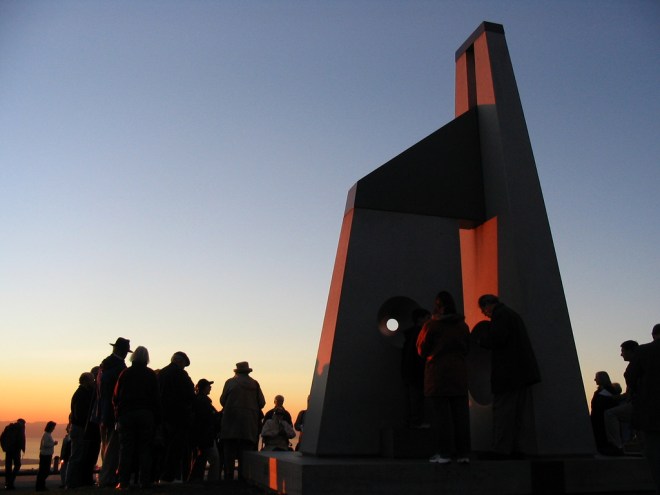
So next year let’s head on down to one of those monuments built millennia ago to mark solstices and other moments in the solar cycle, like Stonehenge

stonehenge-2

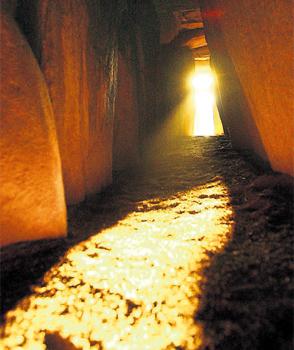
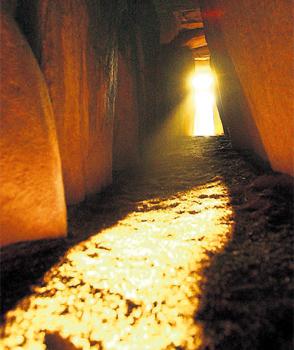
Newgrange in Ireland

newgrange-2

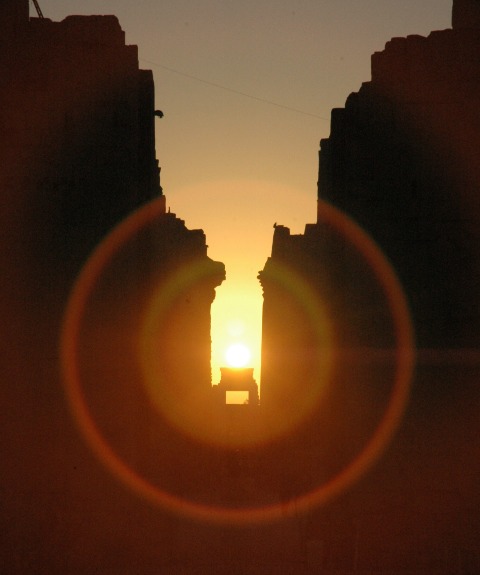
Karnak in Egypt

Karnak

Chankillo in Peru (the oldest solar observatory in the Americas)

chankillo

Palenque in Mexico

palenque

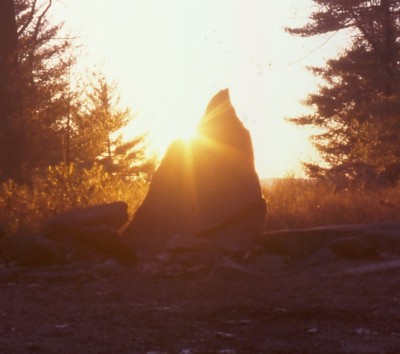
North Salem in New Hampshire (the “Stonehenge of North America”)

north salem

Denfeng in China

denfeng

Jaipur in India

Jaipur

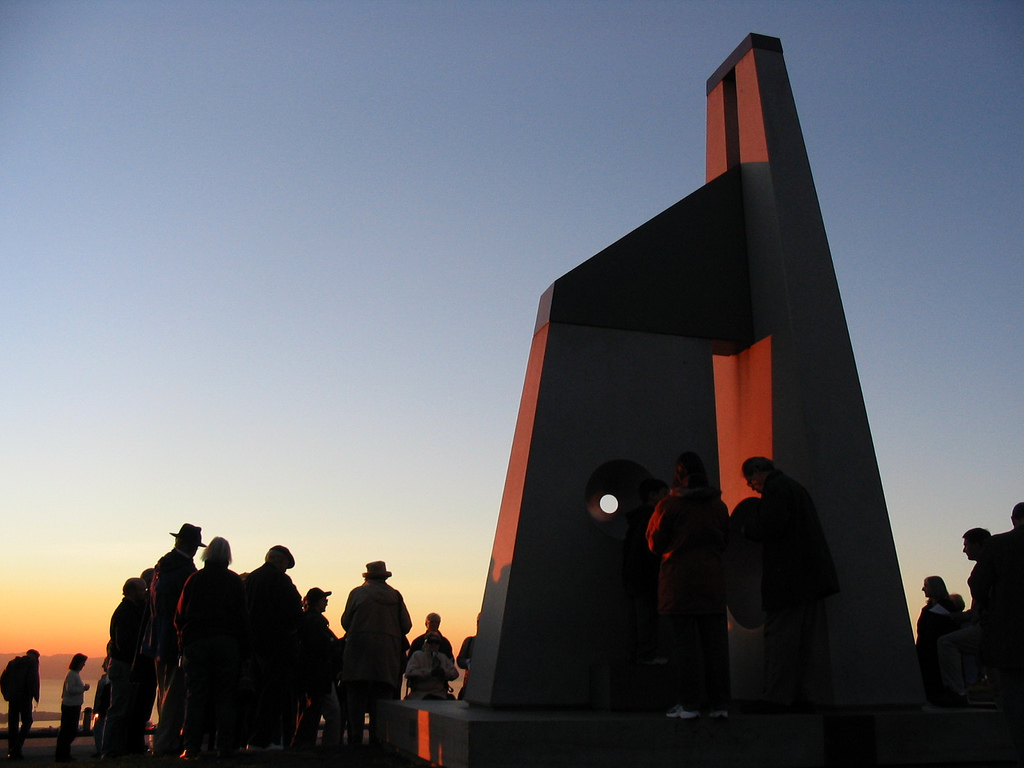
or to more modern places like the Lawrence Hall of Science in California

lawrence hall of science

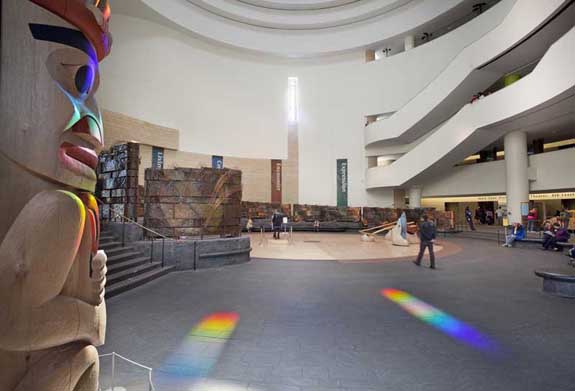
or, for the summer solstice, the Native American museum in Washington

Brief description of overall shoot

and let’s have ourselves a celebration! Let’s connect again, if only for a few moments in our busy schedules, with the most fundamental of all natural cycles of the world, the solar cycle.

________________
(1)McGowan, Andrew. “How December 25 Became Christmas”, http://www.biblicalarchaeology.org/daily/biblical-topics/new-testament/how-december-25-became-christmas/

Stonehenge: http://www.juliamccutchen.com/uploads/blog//wintersolstice_stonehenge.jpg
Newgrange: http://www.newgrange.com/newgrange/new_grange_solstice.jpg
Karnak: http://blogs.smithsonianmag.com/adventure/files/2012/12/SolsticeKarnakBIG.jpg
Chankillo: http://0.tqn.com/d/archaeology/1/0/k/u/Thirteen_Towers_sm.jpg
Palenque: http://pcdn.500px.net/13198007/7eb491e6b4f1ac429dd6f932c0e41f56dfad312b/4.jpg
North Salem: http://www.stonestructures.org/assets/images/Winter-Solstice-Sunset.jpg
Denfeng: http://history.cultural-china.com/chinaWH/images/arbigimages/9a7d45ff336ffda1702e4ab4d11110e2.jpg
Jaipur: http://museumsrajasthan.gov.in/images/Virhat%20Samrat%20Yantra%20%288%29.JPG
Lawrence hall of science: http://upload.wikimedia.org/wikipedia/commons/c/c1/LHS_sunstones.jpg
Native American museum: http://blogs.smithsonianmag.com/aroundthemall/files/2012/06/prism-575.jpg

0 + 0 0 0 km

Beijing, 21 December 2012

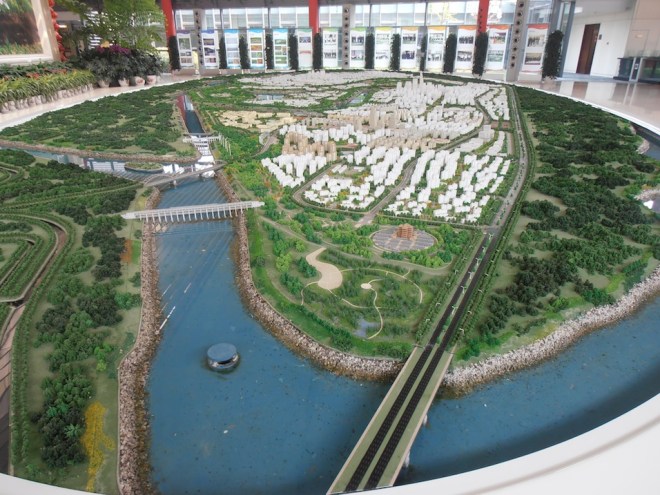
Model builders in China must be very busy people – and very rich. I am referring to the models of new city quarters, new industrial zones, and similar which are being developed all over China. Here are a few examples of what I mean, from the large:

model-EDZ-6

To the more modest:

OLYMPUS DIGITAL CAMERA

To the very modest:

model-EDZ-2

There must be literally millions of these all around the country – hence my feeling that model making must be a thriving business in China.

I have just come back from Lianyungang, a modest (by Chinese standards) port in the province of Jiangsu, opposite Japan and South Korea. Over the arc of one day, I saw three such models, which went from big, to very big, to huge. The pictures above don’t really give justice to what I saw. The pattern of my visit was always the same. First, I was taken to a temporary building, most times in the middle of a construction site, where an official of some sort was on hand to warmly welcome me. The official, usually with a number of hangers-on, first escorted me down a corridor with photos of various high-level worthies beaming their appreciation about this latest development. Then he brought me to a platform from which I could admire from on high a panoramic view of the model of what was to come in the sea of mud outside. With a flick of a switch, he turned on a son et lumière and I was bombarded with a high-tech video show on the wall of the future to come, with coloured searchlights racing back and forth across the model below me and triumphant voices describing the glories before me. At the end, befuddled by all the loud noise and flashing lights I murmured my appreciation of this vision of the future and everyone beamed. Then we headed for the door and after more warm handshakes I was on my way to the next model and the next son et lumière.

What actually caught my attention was something altogether different. At some moment in my itinerary, I was taken down to the docks to watch the containers being loaded and unloaded by their hundreds. Then the van pulled up in front of this:

port-2a

This is point zero for the New Eurasian Land Bridge, or the New Silk Road, a skein of rail lines that will run from Lianyungang across China to the Kazakh border, unreel across Kazakhstan, then after a short skip across southern Russia on through Ukraine, into Poland, then Germany, and finally come to a halt in the Netherlands at the port of Amsterdam. And suddenly in my mind’s eye I’m off along that rail line, with the train wheels clickety-clacking in my ears, whirling across the rice bowl of China all the way to Xi’an, home of the terracotta army, then whooshing along the Hexi corridor of Gansu, hemmed in by the Gobi desert on one side and the Qilian mountains on the other, barreling through the northern reaches of Xinjiang along the far edges of the Taklamakan desert … then suddenly I’m called back to reality. So with a sigh, I move on to the next son et lumière.

__________________________
the big model: http://www.thenational.ae/deployedfiles/Assets/Richmedia/Image/AD200810523775761AR.gif
the middle-sized model: http://wanderinggaia.files.wordpress.com/2012/05/scale-model-of-tianjin-e-c.jpg
the small model: http://www.saintcairon.com/en/webedit/UploadFile/20085895920773.jpg

ANGEL VOICES

Beijing, 19 December 2012

It was an official dinner like so many I attend, perhaps more significant than most since it was with our main partner in China. I sat to the right of the banquet’s host, in the position of honour. As usual, I checked nervously what alcohol would be served; it’s either red wine – good – or “Chinese wine”, aka Maotai or Baizhou, which is actually an extremely strong, sickly tasting liquor – very bad; the Chinese profess to love it,  I refer to it outside of Chinese earshot as biofuel. Luckily, it was wine; I could relax. We started with the usual speech by the host and then moved to the first of the toasts. My host and I clinked glasses and bottomed-up, before turning to those around us to toast, our glasses having miraculously refilled in the meantime. The Lazy Mary began to turn as we picked at the various delicacies before us and as more arrived. The host got up and began to toast those at other tables, others got up and toasted the host, and me, and everyone else. I was soon standing up and sitting down like a yo-yo as the various guests arrived thick and fast and made me little speeches to which I had to find a suitable response. As usual, I was beginning to run out of platitudes, and when I found myself saying sillier and sillier things I knew it was time for me to escape and do my rounds of the other tables.

One thing was different at this banquet. The host had invited younger members of his staff with a musical skill to show it off. So we had players of the traditional Chinese flute, of the traditional Chinese violin, and of the guitar strutting their stuff. We also had a singer who sang in the operatic mode O sole mio and some Austrian yodeling song set to Chinese words – the last was a surreal interlude. Initially, we listened appreciatively, but as the guests moved around, toasting with all and sundry and chatting ever more animatedly in small clusters, the players were reduced to background musack. Then, uncharacteristically, the host called us to order and invited us to sit down. Two children took to the floor, the son and daughter of staff members, and they began to sing. It was in that moment that I understood why angels must be children. There is a purity, a crystalline clarity, a simplicity, in a child’s voice as it soars into the upper registers and floats above your head that can bring a hushed, attentive silence to even the most unruly crowd, and will always fill my heart with an intimation of the divine.

two-angels-singing

_____________

http://artemisdreaming.tumblr.com/page/69

PLEASE SAVE THE TREES

Beijing, 17 December 2012

I’m a sucker for a fine tree, as any reader of these postings will know. So it was with increasing depression that I read an article recently in Science Daily (www.sciencedaily.com) which said that large old trees – trees that are centuries old – are dying at alarming rates. The die-off seems to be happening in all types of forests worldwide and to be caused by many things: land clearance, changes in agricultural practices and in fire regimes, logging and timber gathering, insect attack, climate change, and I don’t know what else.

I suppose I should recite the critical ecological roles which large old trees play. For instance, they provide nesting or shelter for up to 30 percent of all birds and animals in some ecosystems. They store huge amounts of carbon. They recycle soil nutrients. They create rich patches for other life to thrive in. They influence local flows of water and the local climate. They supply lots of food for many animals with their fruits, their flowers, their leaves, their nectar. In agricultural landscapes, they can be focal points for restoration of vegetation. They help connect the landscape by acting as stepping stones for many animals that disperse seeds and pollen.

So large old trees are very useful. But ultimately they are beautiful.

baobab_tree

C

elm tree

oak tree

plane tree

Angkor-wat-Tree

I’ve said it before, but my life has been punctuated by a number of beautiful large old trees. Let me tell you about one of them. My maternal grandmother had a sequoia, Sequoiadendron giganteum, standing in magnificent splendour in the corner of her garden. There must have been a fad for planting sequoias in the late 19th century in this part of France because a number of older properties in the surroundings had sequoias – you could see them towering over garden walls as you drove by. I loved that sequoia. My cousins and I used to spend all our summers in that tree, or so it seems to me as I gaze back through the golden haze of more than four decades of memories. Our grandmother tried to stop us climbing it by sawing off the lower branches. But we just cut steps into the soft bark and climbed. And climbed. All the way to the top, where we would sit, talk, and look out over the pastures, woods and vineyards that surrounded us as the breeze rustled through the branches and the tree swayed slightly. We were lords of all that we surveyed.

I don’t have a photo of my grandmother’s sequoia, but here is a photo of another sequoia in a French garden somewhere. It gives you a great idea of what awaited us in the far corner of my grandmother’s garden.

sequioa-in-france

That tree seemed so huge to us, but nearly two decades ago, when the children were young, we took our summer holiday in California and visited Sequoia National Park. My God, what truly magnificent trees those were! My sequoia was a laughable midget compared to these giants. But I couldn’t climb these trees.

giant-sequoia-tree-pv

My wife has just old me that she never climbed trees when she was young. And I don’t remember our children every really climbing trees – we have become so conscious of dangers for children in the intervening decades (it is true that my younger brother and cousin fell out of a tree when a branch broke; my cousin cushioned my brother’s fall but fractured his collar bone in the process). But I think my family missed something. There is something magic about being up in a tree. Suddenly you are back to being a four-limbed creature as you have to use your arms as much as your legs. The world concentrates down to just a few branches. And the noise levels change; there is a quietness in a tree which you do not have on the ground, but also you hear noises you don’t hear so much on the ground, like the rustling of leaves. And your lines of sight change; suddenly you are a giant able to see much further around you than you normally can. And if the tree is a fruit tree, ahh … you can sit on a branch, pluck the fruit around you, and munch on them in quiet contentedness.

My memories of trees are nearly all from rural areas, although I do have some memories of beautiful trees from city parks – one of the earlier postings testifies to this. So many of us live in cities now and I’m worried we are getting cut off from trees – and this can only get worse as more and more of us live in cities. Cities and trees do not seem to mix well. As I look around Beijing streets, for instance, I do not see many great trees. The majority of the specimens look malingering. And yet … My wife and I visited Singapore recently. For her, it was the first time. For me, it was the first time in fifteen years. And the city struck me the way it had always struck me: it is so green. Not grass green, although there is certainly a lot of that. No, tree green.

01-rain-tree-06

There’s a huge number of trees in Singapore – and not small trees, either, but big, mature trees. The city always gives me the impression of the planners having carefully inserted the buildings between and around the trees which already grew there. Of course, it’s silly; it was obviously the other way round. I mean, the trees grow along the sides of straight roads … And the older parts of the city, like Little India and Chinatown, show the bare and treeless Singapore of the past, the kind of city we’re used to seeing elsewhere. But still, the impression is of a city inserted into a forest. According to National Parks Singapore there are something like 2 million trees planted in the city-state, which works out to be about one tree for every two and half people. I don’t know of any other city with such a high tree-to-citizen ratio.

So it is possible to live in close harmony with great trees. We must do it, because I think we lose part of our humanity if we don’t live near trees, if we cannot have this view every day of our lives.

01-rain-tree-04

_______________
Baobab tree: http://www.louisianagardenclubs.org/live_oak_society/photos_files/AngelOak.jpg
Copper beech tree: http://www.visualphotos.com/photo/2×4003896/copper_beech_tree_1811714.jpg
Elm tree: http://i.istockimg.com/file_thumbview_approve/1678381/2/stock-photo-1678381-elm-trees.jpg
Oak tree: http://www.louisianagardenclubs.org/live_oak_society/photos_files/AngelOak.jpg
Plane tree: http://mw2.google.com/mw-panoramio/photos/medium/14963960.jpg
Angkor wat tree: http://www.davestravelcorner.com/photos/cambodia/Angkor-Crooked-Tree.jpg
Sequoia in France: http://ts2.cn.mm.bing.net/th?id=H.4582357281933013&pid=1.9
Giant sequoia: http://www.nunukphotos.com/images/giant-sequoia-tree-pv.jpg
National Parks Singapore: http://www.nparks.gov.sg/cms/index.php?option=com_content&view=article&id=173&Itemid=161

LITTLE LAMB

Beijing, 15 December 2012

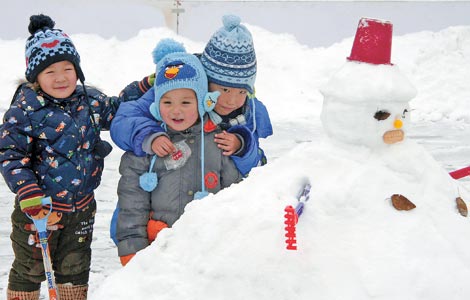
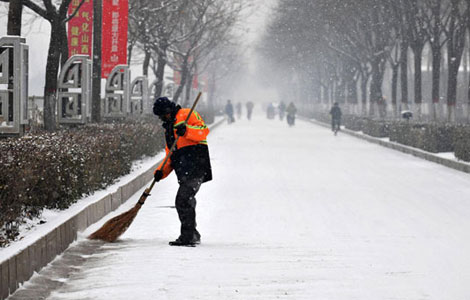
Yesterday, we had the first heavy snowfall of the year in Beijing – there had been some earlier flurries, but no more than that. I don’t want to exaggerate; there wasn’t really a huge amount of snow, which was just as well because Beijing drivers have no idea how to drive in snow and their cars are not equipped for it. But for Beijing it was significant. As the snow began to pile up, people – and not just children – were out on the streets making snowmen and throwing snowballs, while some of the more responsible ones were clearing the pavements; I even saw a snowblower for the first time here!

children and snowman road cleaning

It was all quite picturesque, so I was moved to haul out our old CD “The Essential Carols Collection” which we always played at this time of the year when the children were with us, and gave it a whirl.

carols CD

Out floated those hoary old favourites, “Once in Royal David’s City”, “The Holly and the Ivy”, “Silent Night”, “O Come All Ye Faithful”, and on and on, while the odd tear or two formed in the corner of my eye.

But squeezed in between “O Tannenbaum” and “Ding Dong Merrily on High”, comes John Tavener’s “The Lamb”, an ethereally, achingly beautiful modern carol. Every time I get to this part of the CD, I have stop whatever I’m doing and sit down and just let the music flow through me. Tavener uses the words of William Blake’s The Lamb for the carol:

Little Lamb who made thee
Dost thou know who made thee
Gave thee life and bid thee feed.
By the stream and o’er the mead;
Gave thee clothing of delight,
Softest clothing wooly bright;
Gave thee such a tender voice,
Making all the vales rejoice!
Little Lamb who made thee
Dost thou know who made thee

Little Lamb I’ll tell thee,
Little Lamb I’ll tell thee!
He is called by thy name,
For he calls himself a Lamb:
He is meek and he is mild,
He became a little child:
I a child and thou a lamb,
We are called by his name.
Little Lamb God bless thee.

I always wanted my mother to hear this carol, she loved William Blake. But this will join that long list of regrets, things we wished we had done but left until it was to too late.

_________________

Children with snowman: https://usa.chinadaily.com.cn/

Man sweeping snow in street: https://usa.chinadaily.com.cn

MELANCHOLY

Beijing airport, 7 December 2012

Perhaps it is the tiredness that is seeping into my bones as I wait at the airport to take my third flight this week, or perhaps it is the piercing cold that has descended on the north of China these last few days, but I find myself in a melancholy mood. My last post on red hair is making my mind wander off to a sad tale of a young woman who lived and died long ago, decades before I was born.

My mother was the source of the tale, which she in turn had received from her mother. The events took place in the early 1900s, when my grandmother was in her early twenties. It was that moment in the lives of young women of a certain class – to which my grandmother firmly belonged – when their attention was increasingly taken up by their matrimonial prospects. If a woman was not married by her mid-twenties, she was considered an old maid and condemned to spinsterhood, which meant living with her parents for the rest of their lives and eking out a modest living thereafter off the kindness of her family; working was of course unthinkable. It was a fate to be avoided at all costs.

My grandmother was very friendly with the girl next door, who was close to her in age. This girl’s main claim to beauty was her wonderfully long, auburn, hair. The girl’s father was a wine merchant, as were many in that region. Perhaps too many, because he went out of business and was bankrupted. This was a catastrophe for the whole family, never more so than for the girl. For now there was no money for her dowry, and in those days a girl without a dowry simply could not marry (or could only marry beneath her station, which was unthinkable). The father compounded the calamity by committing suicide, to save his honour it was said.

A solution was found for the girl’s younger brother. He was placed with an uncle who was working in Romania, in the wine industry. But as I said, work was not a solution for the girl. She was faced with the prospect of passing the rest of her life with her mother, with no likelihood of ever marrying, living off some miserable amount of money.

But in this dark time, she met a man, who made promises. And she succumbed to his blandishments. He got what he wanted, but he reneged on his promises. She came to see my grandmother one evening to tell her all this. She stood in front of the mirror and looked at her hair, and said “No-one will ever be able to enjoy this hair after all.” My grandmother tried to comfort her, telling her that things would look better in the morning. The girl thanked her, hugged her and left. She was found a few days later floating in the river than ran through town.

I think of her every time I see the painting of Ophelia drowned, by the pre-Raphaelite Millais.

ophelia-drowned

But I don’t suppose the girl looked nearly so nice when they hauled her out of the river.

Ah, they’re calling the flight. I might get to bed before midnight.

_________________

Ophelia drowned: http://2.bp.blogspot.com/-NsRjraTWfLI/TmDuDyK05LI/AAAAAAAAATs/XzybC5ru9uk/s1600/Drowning%253F.jpg

FLAMING RED HAIR!

Beijing, 30 November 2012

edited in Bangkok, 29 February 2015

I said in my previous post that I currently lived in a country where everyone had black hair. That is not strictly true. Like everywhere else, Chinese women, young and old, as well as young men, have a fondness for dyeing their hair. The great majority of them have wisely settled for adding reddish tints. This gives them hair-dos with varying shades of red-brown, which goes well with the natural colour of their skin. An unfortunate few have dyed their hair blonde which, with the yellow hues of their skin, simply makes them look ill.

In their colour preferences, Chinese hair-dyers are following what seems to me a broader trend worldwide to add more red to one’s hair. My memory tells me that when I was young, the dyeing colour of choice – at least in Europe – was blonde, but some fifteen years ago the shades definitely shifted into the redder part of the spectrum.

And why not? Naturally red hair is a magnificent sight, and the rarest natural colour in us humans. On average, no more than one or two people in every 100 have red hair. Scotland has the highest proportion, with a little more than one every ten Scotsmen or women having red hair. I remember well being struck by the amount of red-heads around me when I first moved to Edinburgh for University.  Ireland follows close behind. And then there is a scattering of red-heads throughout the rest of Europe.

Let me insert here a little photo gallery of some European read heads (probably Scottish or Irish, at least of descent), a young woman

ginger girla young man with a magnificent red beard

red header with bearda baby, readying himself or herself for a life on the red side

red headed baby

a slightly older man, looking back at a life spent on the red side.

ginger haired old man

I feel I have to complete this photo gallery with a picture of the Fair Prince Harry, who has given redness of hair a good name.

The observant reader will have noticed that most of these wonderful red-heads have blue eyes. The gene mutation which leads to red hair is closely linked to the one which gives rise to blue eyes. Fair, non-tanning skin almost always accompanies red hair, to the distress of red-heads when visiting countries with fierce sunlight:

Freckles are also often their lot:

Europe is not the only place to harbour red-heads. Here, in no particular order, are some red-heads from other parts of the world:

Syria:

Turkey:

The Berbers of North Africa, represented here by Morocco’s queen (who is a Berber):

and a small child:

Udmurtia, a small provincial backwater in the Ural mountains of Russia famous for its red-heads:

Afghanistan:

India:

and even Polynesia – this girl is from Tahiti:

Ashkenazi Jews are also well known for their redheads. My representative of this group is Woody Allen; this is a clip from one of his best films, Sleeper:

Nearer to me but also much further back in time are the Tochtarian people who inhabited the Tarim basin of Xingjian Autonomous Region some 4,000 years ago. The bodies of their dead were dessicated and mummified in the desert conditions of the Tarim basin, so many mummies have been unearthed. At least one these, the so-called Beauty of Xiaohe, had what looks like red hair.

Dessicating deserts in Peru have also given the world a share of mummies, some of these being red-heads. These red-headed mummies have had certain archaeologists (notably Thor Heyerdahl) afroth with fancy (and relatively racist) theories of Nordic whites somehow arriving in South America to take the natives in hand. This particular mummy also seems to have been subjected to skull lengthening.

peruvian mummy

Going back even further, from studies of fossil DNA it seems that some of our Neanderthal cousins were also red-heads:

So come join Edinburgh’s annual Ginger Pride Parade! Immerse yourself in a sea of red hair!

ginger pride parade

___________________
Ginger girl: http://i.telegraph.co.uk/multimedia/archive/02510/ginger-girl-13_2510537k.jpg (in http://www.telegraph.co.uk/culture/culturepicturegalleries/9932654/I-Collect-Gingers-artist-Anthea-Pokroy-photographs-500-red-haired-people.html?frame=2510537)
Red header with beard: https://s-media-cache-ak0.pinimg.com/736x/96/d0/17/96d017f4374dbd877396ca77e2baf638.jpg (in https://www.pinterest.com/bridgeemelling/bearded-boss/)
Red headed baby: http://3.bp.blogspot.com/-rQ0mt43F_48/UXqtfoVyvGI/AAAAAAAAPow/zK3OEOiHiFI/s1600/150421_343259622462322_454686503_n.jpg (in http://klubkotajasna8.blogspot.com/2013_06_01_archive.html)
Ginger haired old man: https://s-media-cache-ak0.pinimg.com/564x/02/36/0b/02360b9c030976e4bc871f810ac4aba7.jpg (in https://br.pinterest.com/pin/499899627364000820/)
Prince Harry: http://4.bp.blogspot.com/_tR4bYTcAqeQ/SvI-Hwpk8NI/AAAAAAAABsM/OBj6T465Dlc/s400/princeh.bmp
sunburned boy: http://25.media.tumblr.com/tumblr_ld4t18EDYN1qfs58no1_500.png
freckled boy: http://25.media.tumblr.com/tumblr_mbjiv5TNfp1qer9yuo1_1280.jpg
Syrian baby: http://i45.tinypic.com/260x2xu.jpg
Turkish young man: http://t2.gstatic.com/images?q=tbn:ANd9GcSBd3GBpDXFhzwdCW99RLJk_znIncX8Uaory6HOjMPNSpP6n1Kvag
Moroccan Queen: http://badrhariboxer.com/wp-content/uploads/2012/05/moroccan-queen.jpg
Berber girl: http://looklex.com/e.o/slides/berbers02.jpg
Udmurt girls: http://russianpickle.files.wordpress.com/2010/03/udmurt_people_red.jpg
Afghan boy: http://fc04.deviantart.net/fs16/f/2007/122/1/a/Afghan_Redhead_and_boy_by_xerquina.jpg
Indian boy: http://mathildasanthropologyblog.files.wordpress.com/2008/06/light-indian.jpg
Polynesian girl: http://t0.gstatic.com/images?q=tbn:ANd9GcS9dYzPU1dcELZO1dZOJTMta43zg-fJO2tGxOcwAqHJ7XKp0iIpTAJGjDAAnA
Woody Allen: http://www.nerve.com/files/uploads/scanner/sleeper_0.jpg
Tochtarian mummy: http://images.mirror.co.uk/upl/dailyrecord3/feb2011/0/7/mummy-image-2-601127141.jpg
Peruvian mummy: https://s-media-cache-ak0.pinimg.com/736x/2d/43/e4/2d43e4c46a67385e964b409fe38e229a.jpg (in https://www.pinterest.com/aprildherbert/creepy-cool/)
Neanderthal: http://images.nationalgeographic.com/wpf/media-live/photos/000/601/cache/neanderthal-genome_60159_600x450.jpg
Ginger pride parade: http://scrapetv.com/News/News%20Pages/Health/images-3/ginger-rally-uk-support.jpg (in http://scrapetv.com/News/News%20Pages/Health/pages-3/World-misses-prime-opportunity-to-eliminate-gingers-during-pride-parade-Scrape-TV-The-World-on-your-side-2013-08-12.html#.VtRaZEAppEN)