Beijing, 8 May 2013
May is a good time to be in the Mediterranean. The weather is good, the temperatures not too high, the vegetation still green, and the flowers blooming. I feel restless, I want to be there. But it cannot be; the rent must be paid, as must the gas and electricity, not to mention the food, the occasional bottle of wine and other sundries. I must earn my living.
The internet is a wonderful thing though. Sitting on my living room couch in the evenings, navigating with my little black mouse and clicking my way through hundreds of internet pages, I can visit all the places I want to be in but cannot. So I have decided. Riding the surf of the web, my wife and I will take a trip I have long wanted to make: a visit to a string of sites around the northern rim of the Mediterranean which are known for their early Christian mosaics. In an earlier post I have alluded to my fascination with this art form.
It’s time to start. As I sit in front of my computer screen, I have to first wrestle with the question of what car my wife and I will travel in on this virtual trip we are about to make. With the freedom that comes from a trip in my imagination – no cost considerations, no considerations of practicality (is the boot big enough?) – I first think of taking a Smart; I like its cheerfully odd shape and I have never driven one.

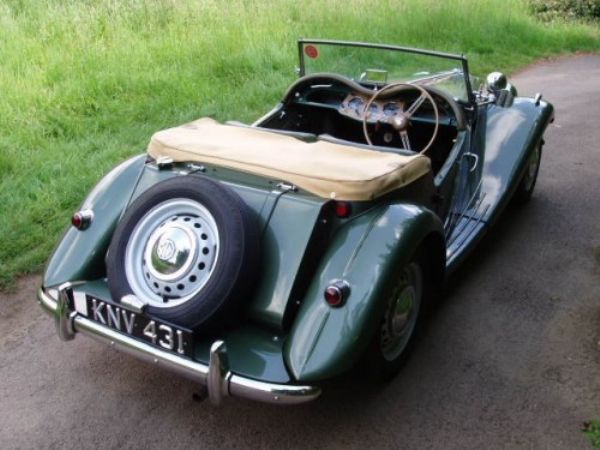
But on further consideration, I plump for an MG convertible, and specifically a model which is as old as we are.

In my imagination we can have the roof down and enjoy the sun on our faces and the wind in our hair (although the only time we ever drove such a car in the real world it started raining and we had no idea how to put the roof back in position).
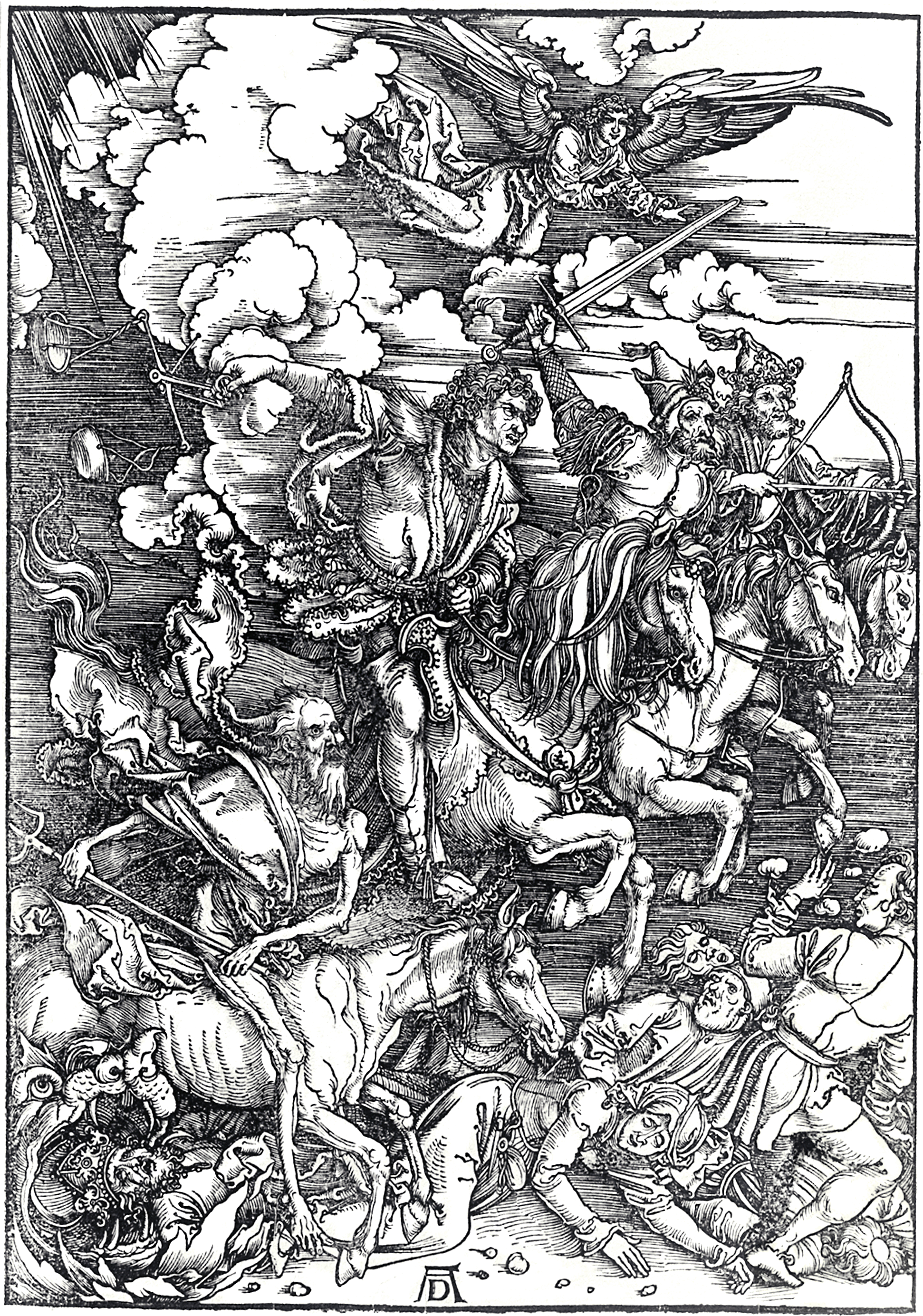
So here we are, comfortably ensconced in our little MG. Where do we start our journey? I pick Ravenna, because the city has one of the finest collections of early mosaics still extant. Actually, it’s a small miracle that there are any mosaics left at all, either in Ravenna or anywhere else. Over the millennium and a half that separates us from their creation, they have suffered from the ravages of religion: from outright hostility towards their symbolic potency, to their neglect through changes in artistic fashion. They have suffered from natural catastrophes like earthquakes and fires. And last but not least, they have suffered from the four horsemen of the Apocalypse – Conquest, War, Famine, and Death – sweeping repeatedly across the face of the land; every time the horsemen passed, not only did people die but the beautiful things they had created were destroyed. You only have to see what is happening to Syria’s irreplaceable cultural heritage in this time of civil war to know what I mean.
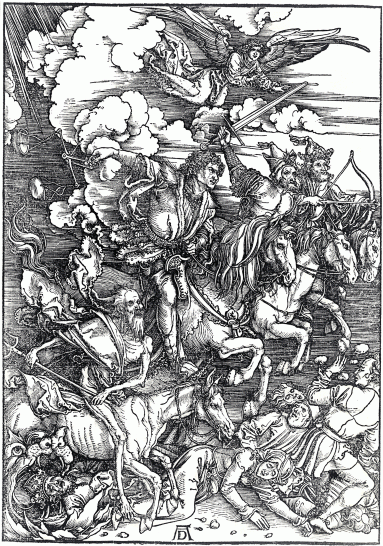
Ravenna sadly exemplifies what I’ve just described. It became the capital of the Western Roman Empire in 402 AD, when everything was beginning to fall apart there. In 490, it was put under siege for three years and finally captured by the Ostrogothic King Theoderic. In 540, it was captured by the Byzantines after a war with the Ostrogoths. In 751, it was captured by the Longobards after a long war of attrition between them and the Byzantines. In 774, to thank Charlemagne for taking Ravenna away from the Longobards and giving it to him, Pope Adrian I allowed Charlemagne to take away anything he liked from the city to enrich his capital in Aachen. Lord knows how much Ravenna lost, but it must have been a lot. Over the following centuries, lordship over Ravenna swapped hands many times as the papacy’s claim to Ravenna was contested by local families. Finally, in 1275 a local family, the De Polenta, made Ravenna their long-lasting seigniory, which gave the city some stability for nearly 200 years. Then from 1440 to 1527, Venice ruled Ravenna, although in 1512, during one phase of the Italian wars, Ravenna was sacked by the French. Thereafter, Ravenna again became part of the Papal States and stayed there, except for a short interlude during the French Revolution and Napoleonic Empire, until 1859, when it became part of the new Italian State. After that, apart from some bombing by the Austrians during the First World War, Ravenna knew peace. Truly, it is a minor miracle that we have any mosaics left after all this mayhem. And I haven’t even included the natural disasters which the city suffered along the way.
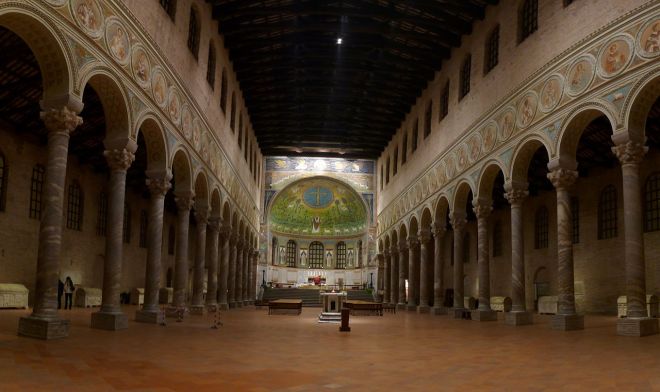
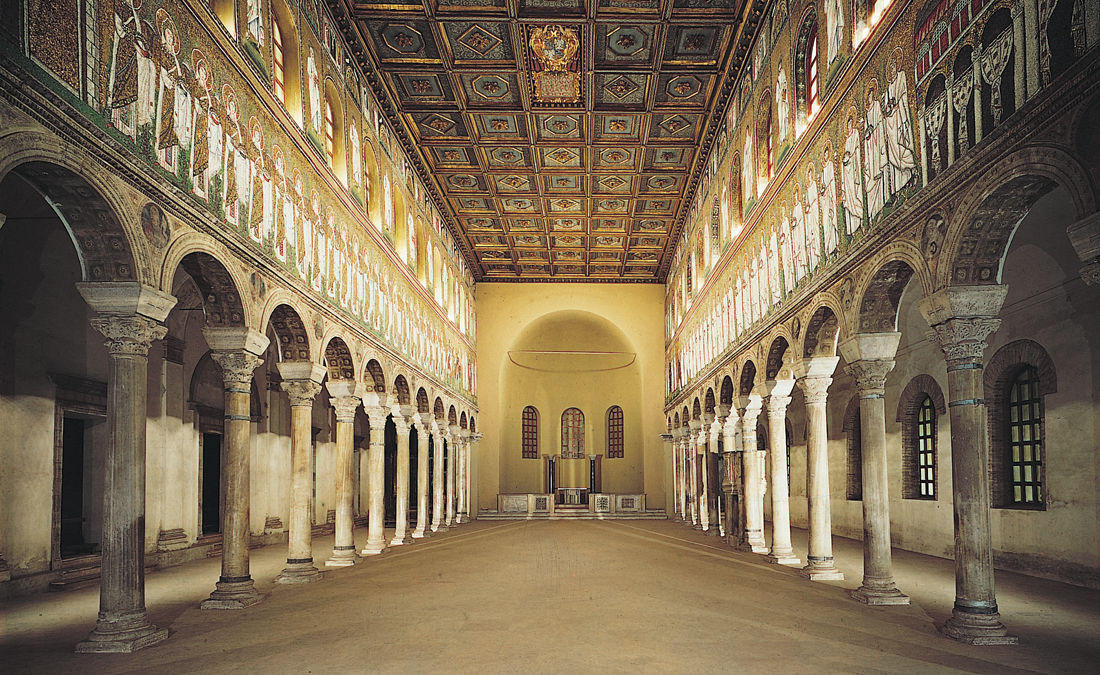
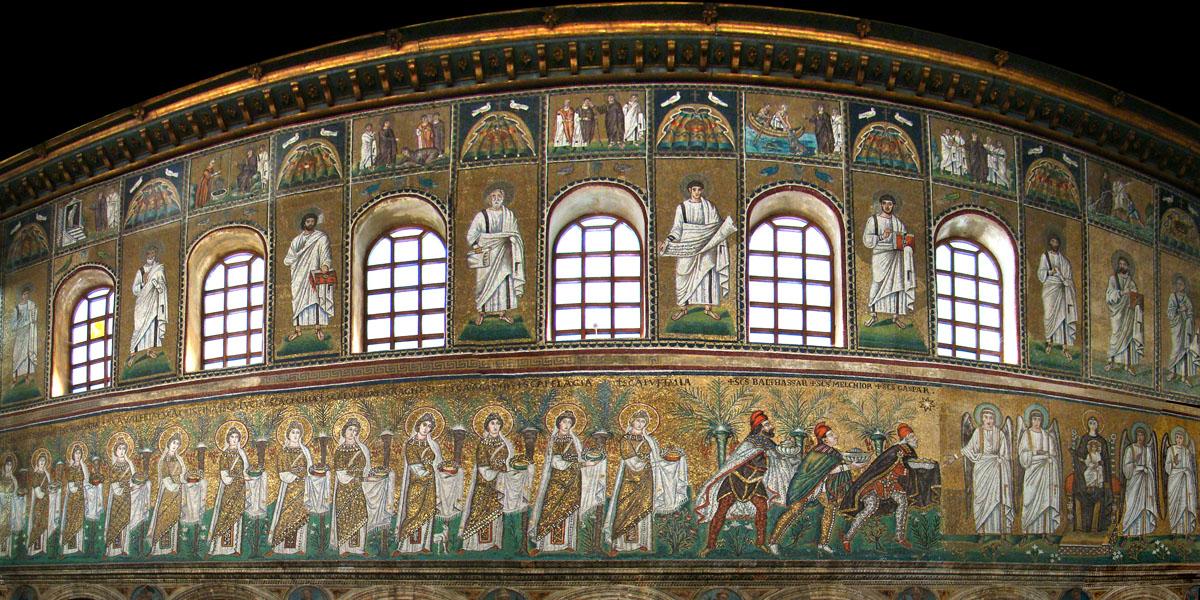
It’s time to start our journey and visit some of what is left. After clicking around a bit, I choose for us to drive up and park in front of the church of Sant’Apollinare Nuovo, where the mosaics date from the 6th Century. Here’s what greets us when we enter the church.

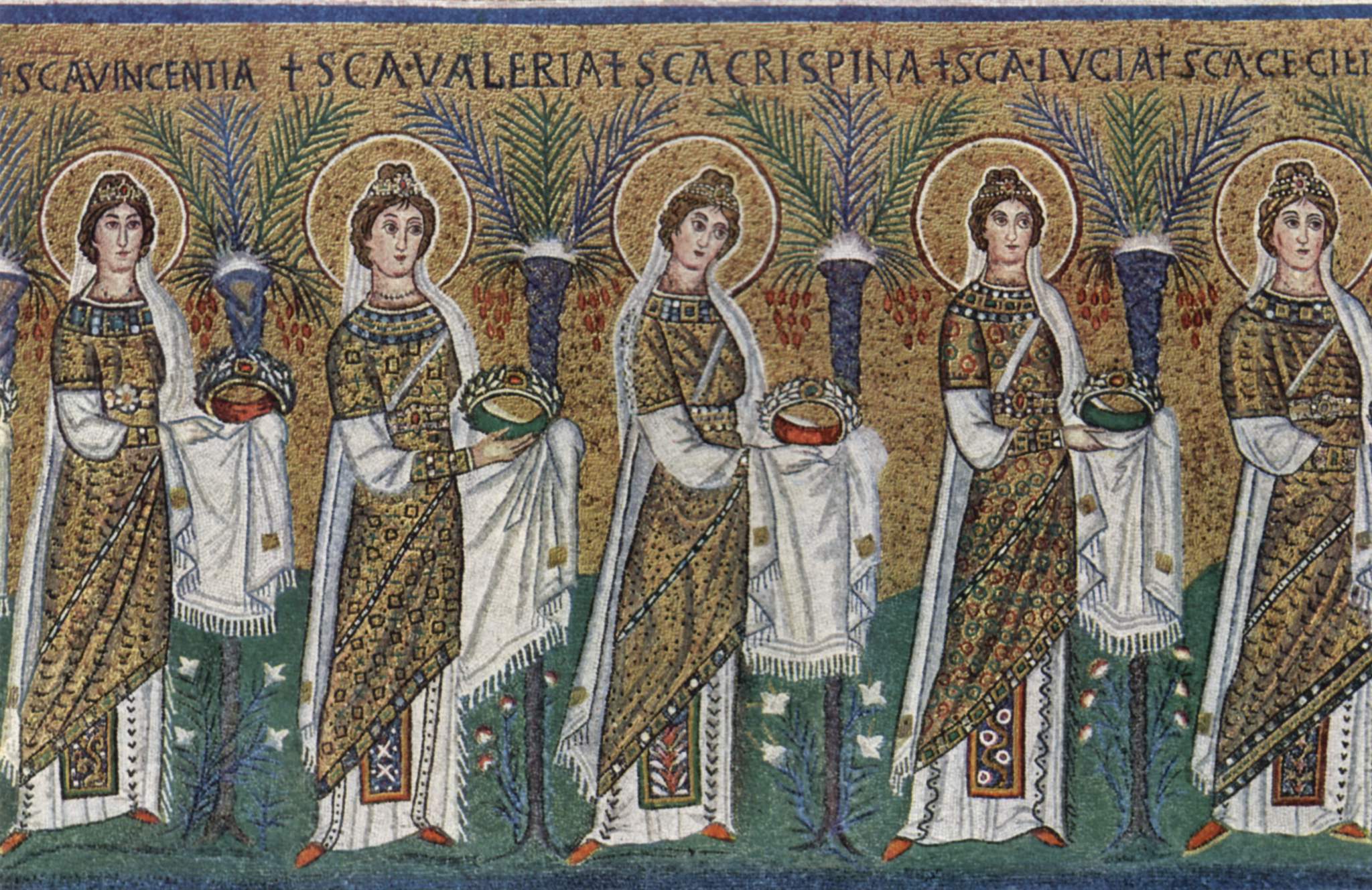
On either wall of the nave, runs a line of men and women, saints and martyrs, processing solemnly towards the altar. My wife and I prefer to focus on the women principally because among them is the martyr who has our daughter’s name. It gives us a comforting sense of connection.
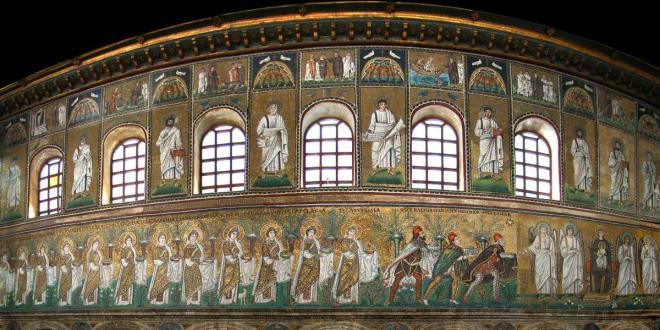
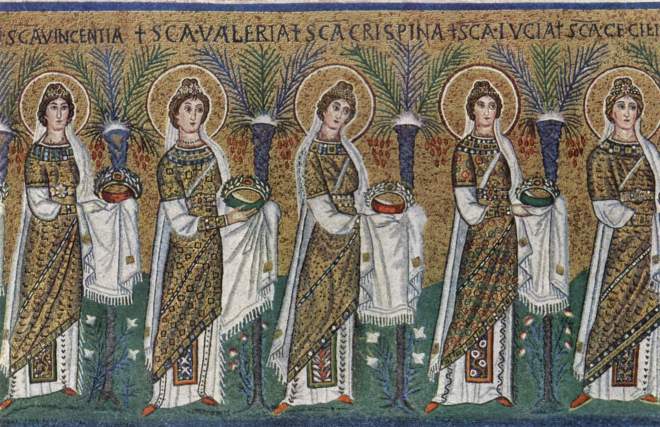
Originally, the two lines were processing towards a scene of stately splendour in the apse. But it is gone, victim to a desire to modernize; it was removed during renovations in the 16th Century. The apse itself was so badly damaged by Austrian bombing during the First World War that it had to be rebuilt.
Time to move on to the church of Sant’Apollinare in Classe, and in a couple of clicks we’re there. With much the same layout as the other Sant’Apollinare, and with mosaics from the same period, it is its mirror image: the mosaics in the nave have disappeared, victim to the depredations of the Venetians in the 15th Century, but the apse glows with a magnificent mosaic, where the colour of grass dominates: a green and pleasant land for the Christian faithful.

This great expanse of mosaic colour makes me decide to visit the Mausoleum of Galla Placidia. So with a click, a hop and a jump we’ve gone from church to mausoleum and are gazing up at the wonderfully dark blue ceiling

There are other early mosaics in Ravenna, but it’s time to leave. We’ll see them another time.
Next stop: Venice.
As I gaze at Google Map trying to choose which road to take, I decide all of a sudden that it would be in keeping to follow the trace of the old Roman roads. To do this, I will rely on the Peutinger map. This is the only existing example of a Roman map of the Empire’s road network. It now resides in the Austrian National Library. It is actually a 13th Century copy, made by an anonymous monk in Colmar in Alsace, of what was probably a 5th Century original, itself a distant descendant of the original made by one Marcus Vipsanius Agrippa for the Emperor Augustus in the last years BC. It is so rare that it has been placed on UNESCO’s Memory of the World Register. This photo shows one section of the map, showing Italy from Rome to Sicily

Actually, I find the map very difficult to read; it is not to scale, it is not oriented the way modern maps are, and many of the place names mean nothing to me. So it is with considerable relief that I discover that someone has transcribed the Peutinger map onto a modern map. Studying this map, I decide we will follow the trace of the old Via Popillia, which once connected Rimini with Adria and the Via Annia. My intermediary objective is Fusina, just south of Mestre. I’m driving there because in this trip of my imagination I want to enter Venice the way it was meant to be entered before they built the causeway, by sea. And Fusina is the only place where you can catch a ferry into Venice from the mainland.
So we motor up to Fusina, and in my zeal to follow the trace of the old Roman road (I can already see my wife tapping her fingers impatiently at these signs of anal behaviour on my part) we do so through a complicated series of back roads which take us through a number of small towns and villages and finally along the SP (Strada Provinciale) 53, with us cutting down to the right at some point to get to Fusina. In my defence, the coastline between Ravenna and Venice has changed a lot since Roman times; the silt brought down by the River Po and a number of other rivers in this area has pushed the coastline out quite a distance. As a result, the road network in the area has changed considerably over the centuries. In any event, we’ve arrived; by the way, the website I just used informs me that we have travelled about LXXV Milia Passuum (75 thousand paces, or 75 Roman miles), which in Roman times would have taken us about VI dies (6 days) to walk. We park the car and wait for the next ferry; the timetable available online helpfully informs me that there is a ferry every hour on the hour, so I don’t suppose we need wait too long. No doubt there is a bar where we can sit down and have a cappuccino.
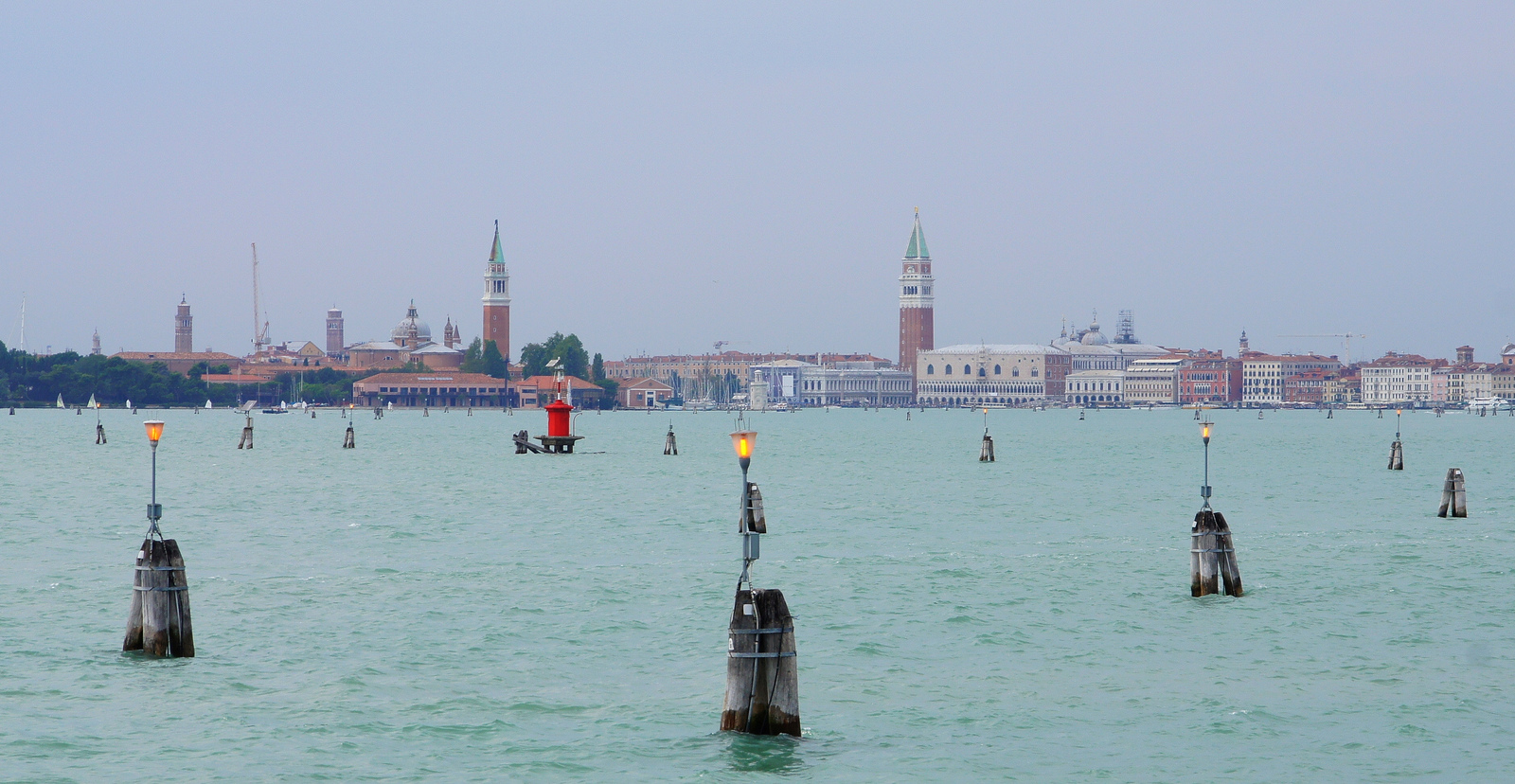
With a click we are on the ferry heading across the lagoon. As we get closer, we see this incomparable picture of Venice before us.

All too soon, it is time to get off at Zattere, to the south of the Canal Grande. We start threading our way through Venice’s maze of alleyways, crossing the Canal Grande at the Ponte dell’Accademia, and then after a sharp right in Campo Santo Stefano walking on to Piazza San Marco. Here, I stop and reveal to the reader that Venice is not actually our destination; we are going instead to the small island of Torcello to the north of the main island. It is true that the Basilica of San Marco is full of mosaics, but most of them are relatively modern, pale copies of the paintings of the time – and the church is always so horribly crowded with tourists! So we turn left in Piazza San Marco and head up to the north side of the island, to Fondamente Nova, where the municipality’s website helpfully informs me that I should catch the N9 aquatic bus. In my mind’s eye, when it arrives the bus is crowded with people going to the small nearby island of San Michele, the city’s graveyard. My wife and I squeeze on, and we wait patiently until after the stop at the graveyard and possibly also the following stop at Murano to be able to sit down. Then there’s a stop in the island of Burano before we finally get to Torcello.
Torcello was a place of refuge in the troubled centuries after the collapse of the Western Roman Empire. It was here and in the other islands of the Venetian lagoon that people came to escape from the depredations of the passing waves of various barbarian tribes. Until the 12th Century or so, it was a vibrant place with a significant population, but gradual silting of this part of the lagoon not only killed off the island’s more important economic activities but brought malaria to its inhabitants. So everyone left for Venice itself and now hardly anyone lives here. It is very peaceful, with just the church surrounded by vineyards.

This abandonment might well have saved the mosaics which we are about to see. We walk up the path from the aquatic bus stop to the church, go in, and find this in front of us

And turning around, this behind us
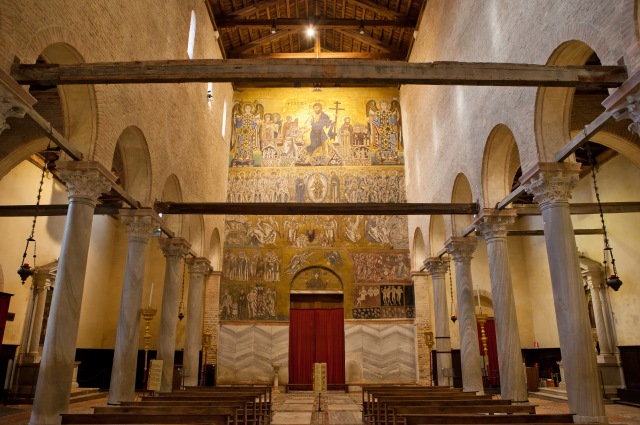
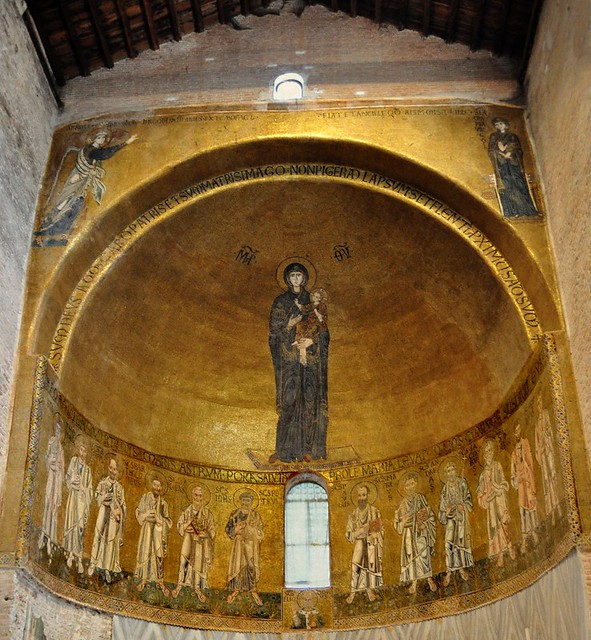
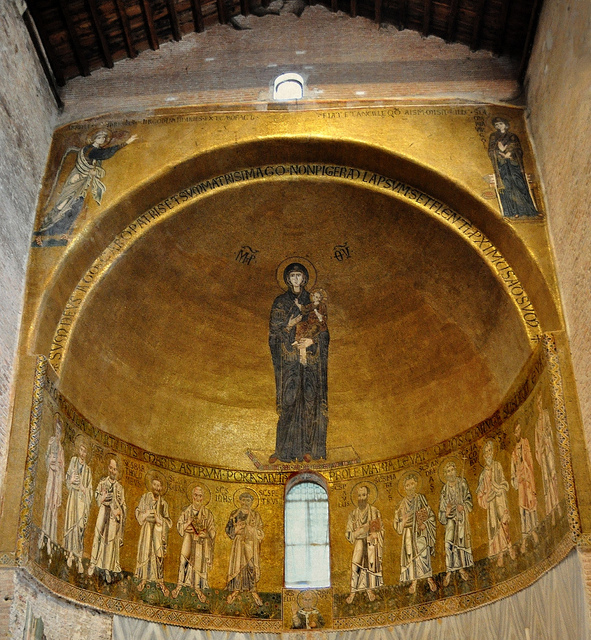
We have leapt forward some six centuries from Ravenna, with these mosaics being from the 11th and 12th Centuries. The style has changed, from one which in Ravenna still echoed the Roman styles to one which is much closer to that rigid style we call “Byzantine” as well as to what was later to become the medieval style. We walk forward to get closer to the mosaic in the apse, which is of the Virgin Mary with the infant Jesus.

I love this mosaic, with its gentle Madonna floating in a huge field of gold. I still remember well the impact it had on me the first time I saw it, a decade ago, on a late Autumn afternoon. The memory of that gentle face in its sea of gold has stayed with me ever since.
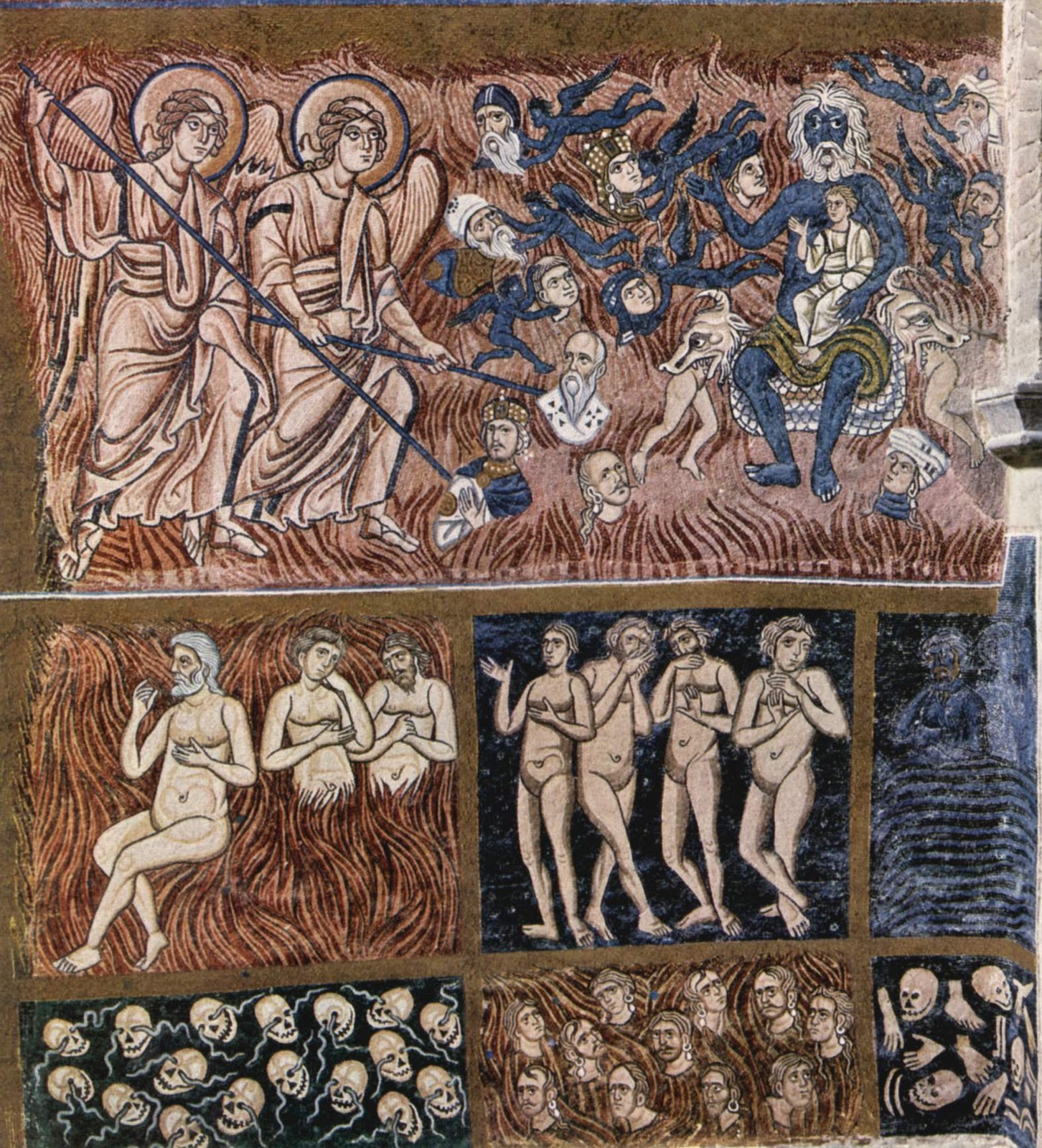
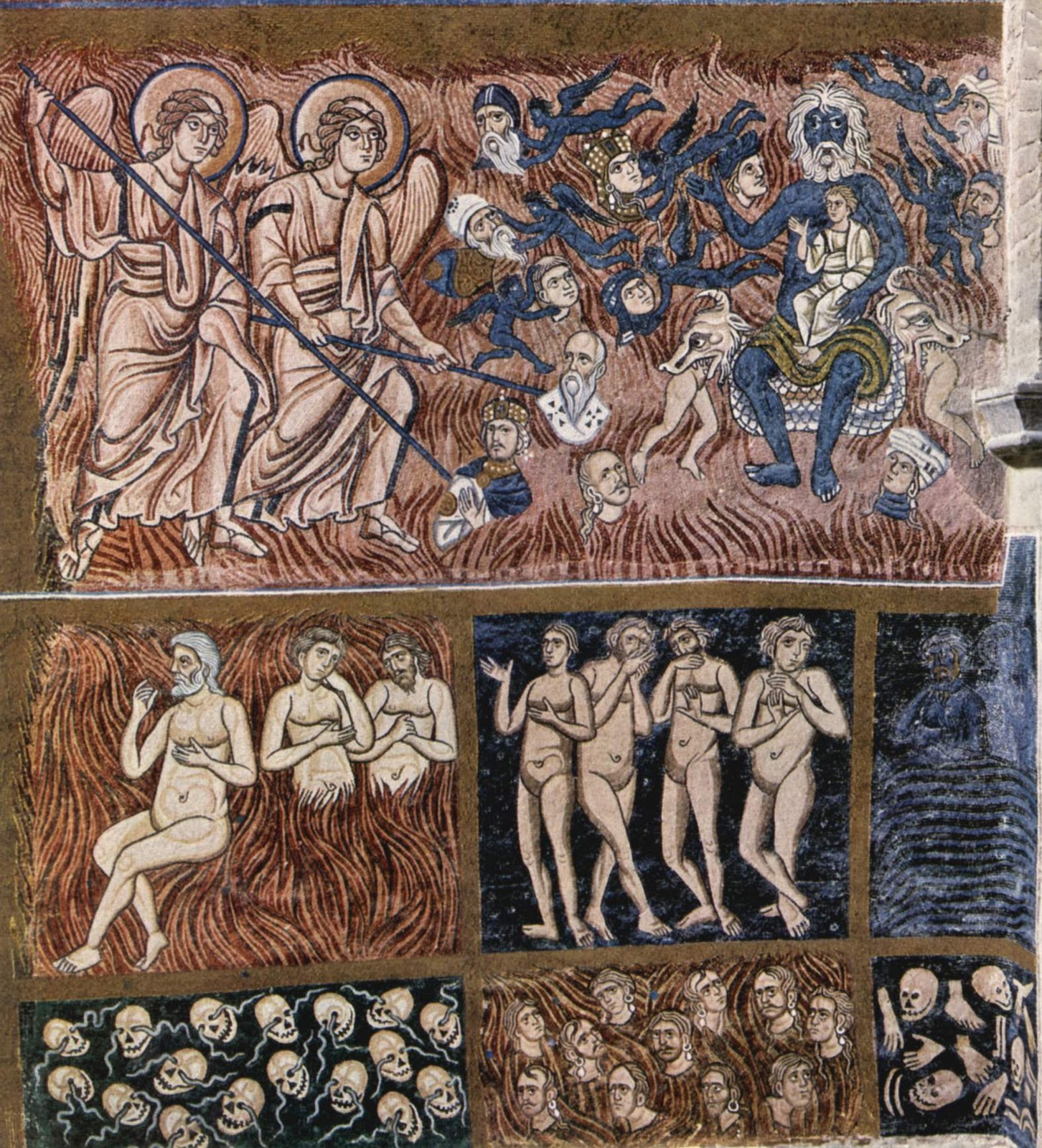
The mosaic on the back wall, a Last Judgement, is also spectacular, no doubt about it, but it doesn’t hold me as much. There are the usual scenes of naughty people being punished for their sins

The Middle Ages had a morbid fascination for this kind of stuff. But I find it all rather puerile. It always reminds me of the scary stories we used to tell each other in the dormitories at school after lights out, to give ourselves a delicious thrill of fright.
Onwards!
With a click of my mouse, my wife and I are back in Fusina, driving out of the car park in the little MG. We are now heading to Aquileia (79 Roman miles; 6 days’ marching). True to my promise to myself to follow the old Roman roads, I want to pick up the Via Annia, a major Roman road which linked Padova with Aquileia. We pick our way across the main road into Venice along the causeway and take the SS (Strada Statale) 14, which pretty much follows the trace of Via Annia. We bowl along, with the sun in our faces and the wind in our hair, passing Venice’s airport, and maybe catching sight to our right of Torcello’s tall campanile in the distance. We pass through Concordia Saggitaria, where we meet the Via Postumia, which ran across the whole of northern Italy from Genova to Aquileia, and on to Cervignano del Friuli. At Cervignano, we turn right onto the SR (Strada Regionale) 352 and a few Roman miles later arrive in Aquileia.
Poor Aquileia. During the Roman period it was an important city, guarding the eastern marches of Italy, which was the core of the Empire. A look at a map shows that any tribe from Central and Eastern Europe and beyond necessarily had to pass this way to enter the Italian lands, whether with peaceful intentions or not. When the Empire had its borders along the Danube River, Aquileia was the gateway to the rougher provinces of Illyricum, Dacia and Thrace that backed the frontier. As such, it was the starting-point of several important roads leading to this north-eastern portion of the Empire.
As the Empire’s western half collapsed and its borders were breached, the tribes did come, along those roads so helpfully built by the Romans. And the roads led to Aquileia, which was such a tempting target. It was first besieged by Alaric and his Visigoths in 401, who attacked it again and sacked it in 408 on his way to sacking Rome. Then it was attacked by Attila and his Huns in 452, who so utterly destroyed it that it was afterwards hard to recognize the original site. It rose again, a pale shadow of its former self, but was once more destroyed, by the Longobards this time, in 590. Today, it is just a quiet little village.
Aquileia’s loss was Venice’s gain. After each barbarian invasion, more of its inhabitants, along with those of smaller towns around it, fled to safety in the lagoon’s islands nearby, and so laid the foundations of Venice, but also of Torcello which we just visited, and of other lagoon towns.
We have come to visit the Basilica. From the outside it has all the look of a Romanesque church, and indeed it was built in 1031.

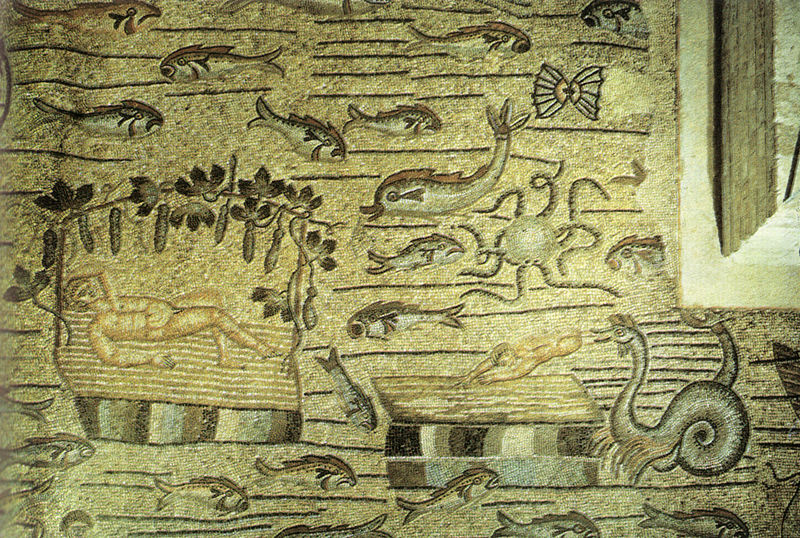
But when you go in, you find yourself in front of a vast mosaic floor, which quite takes your breath away
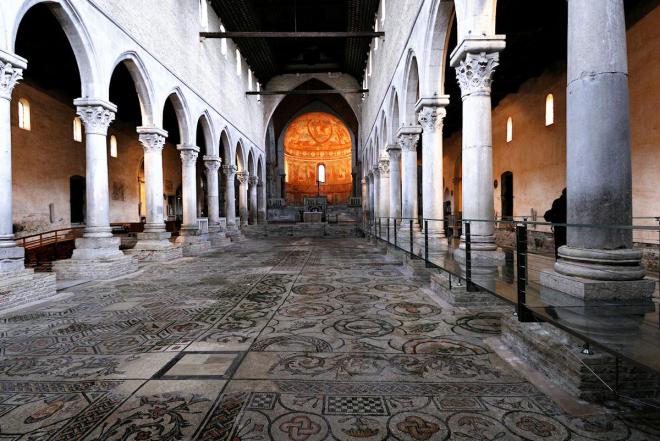

It was laid down in the 4th Century in a building which was destroyed by Attila’s Huns and around which a new church was built six centuries later. In fact, the builders covered up the mosaic with a new floor, and it wasn’t until 1909, when this floor was removed, that the mosaics once more saw the light of day. The subjects depicted include symbolic subjects, portraits of donors, scenes from the Gospels and dedicatory inscriptions. I show just one detail of it.

These are even earlier than the mosaics we saw in Ravenna, and the Roman influence is clear. We could almost be looking at the mosaic floor of some vast Roman villa.
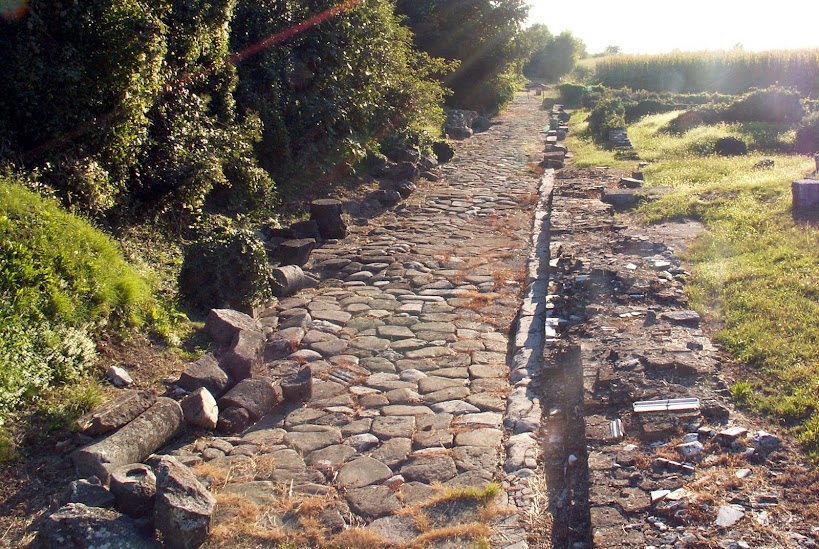
After admiring the mosaic floor and visiting other mosaics in the baptistery, my wife and I leave and walk around the ruins of the Roman town. As I click around, I am in a melancholy mood. So much destroyed, and for no purpose. We see the remains of one of the Roman roads that led out of the city.
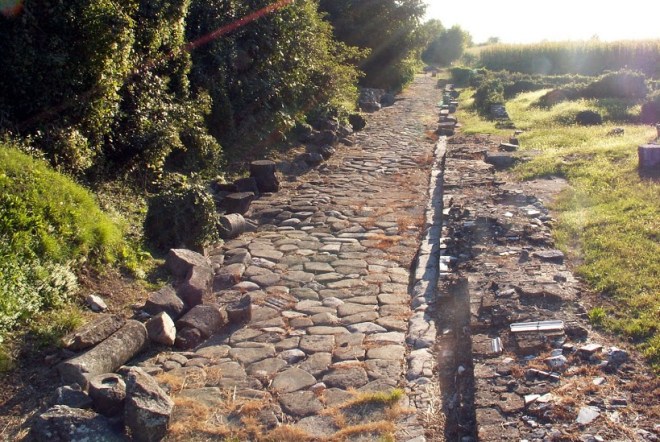
The road beckons. After a rest, we’ll continue our journey north-eastward, from whence came the tribes which destroyed Aquileia.
(Readers who are curious to know how this dream trip continues can hyperlink here to the next leg of the journey)
______________________
Smart car: http://www.kinghdwallpaper.com/wp-content/uploads/2013/03/Smart-Car.jpg
MG car: http://www.msmclassifieds.co.uk/autoclass/stock-images/fliw8myjsf/oilhekvry4/fb173nj5q1.jpg
4 horsemen apocalypse-Durer: http://mcalmont.files.wordpress.com/2013/01/dur_4horse.gif
Sant’Apollinare Nuovo-1: http://apah.lakegeneva.badger.groupfusion.net/modules/groups/homepagefiles/49961-87537-58717-18.jpg
Sant’Apollinare Nuovo-2: http://classconnection.s3.amazonaws.com/256/flashcards/1016256/jpg/22early_christian_and_byzantine_%28student%291351736386614.jpg
Sant’Apollinare Nuovo-3: http://upload.wikimedia.org/wikipedia/commons/f/fd/Meister_von_San_Apollinare_Nuovo_in_Ravenna_002.jpg
Sant’Apollinare in Classe-1: http://upload.wikimedia.org/wikipedia/commons/thumb/f/fd/Sant%27Apollinare_in_Classe,_Ravenna.jpg/1280px-Sant%27Apollinare_in_Classe,_Ravenna.jpg
Sant’Apollinare in Classe-2: http://pixdaus.com/files/items/pics/9/49/73949_68edee7b4d49d43caa20681b9709f5bd_large.jpg
Mausoleum Galla Placidia: http://www.cittadarte.emilia-romagna.it/images/galleries/ravennaintro/ra-mausoleo-galla-placidia-mosaico-volta-celeste.jpg
Peutinger map segment: http://libweb5.princeton.edu/visual_materials/maps/websites/thematic-maps/qualitative/peutinger-table-map-1619.jpg
View from the ferry: http://farm9.staticflickr.com/8149/7667954390_2eafc258f6_h.jpg
Torcello aerial view: http://www.venicenews.info/Resource/TorcelloAerial.jpg
Torcello-1-front: http://venezia.myblog.it/media/00/00/1215490241.jpg
Torcello-2-backwall: http://d1ezg6ep0f8pmf.cloudfront.net/images/slides/a2/8812-torcello-cathedral-nave-looking-west.jpg
Torcello-3: http://farm7.staticflickr.com/6094/6362159351_0d3fe8a136_z.jpg
Torcello-4-last judgement detail: http://4.bp.blogspot.com/-wKvqFMTU-O8/TuyBuW4hnqI/AAAAAAAAAg8/-L3J_V80UC4/s1600/Last+Judgment+Torcello+Tweede+plaatje.jpg
Aquileia Basilica exterior: http://upload.wikimedia.org/wikipedia/commons/8/87/Basilica_Aquileia_1.JPG
Aquileia Basilica floor-1: http://img11.rajce.idnes.cz/d1102/7/7156/7156708_b33224f9e53bf0956558a717bbf58ec8/images/Aquileia_-_Basilica.jpg
Aquileia Basilica floor-2: http://static.turistipercaso.it/image/f/friuli/friuli_qhjf9.T0.jpg
Aquileia Basilica floor particular: https://upload.wikimedia.org/wikipedia/commons/thumb/8/8c/Aquileia,_storia_di_giona,_pavimento_della_basilica,_1a_met%C3%A0_del_IV_secolo.jpg/800px-Aquileia,_storia_di_giona,_pavimento_della_basilica,_1a_met%C3%A0_del_IV_secolo.jpg
Aquileia Roman Road: https://lh5.googleusercontent.com/-QkR-yVgM57g/SOy7HQQg_OI/AAAAAAAAYB4/7b6E9opcEuo/w819-h549/Aquileia+-+Roman+road.jpg
























































 the heart thrills