TULIPS AND MANDARINS

Beijing, 2 February 2013

The last week has been dreadful for air quality in Beijing. The brief break we had which I wrote about a few posts ago was but a temporary remission and we soon plunged back into the murk. My wife was a little more philosophical about it than I. She remarked that it reminded her of her childhood in Milan, when smog was frequent, and reminisced about having to cross the road to go to primary school and not being able to see if the light had changed. But still, we both suffered.

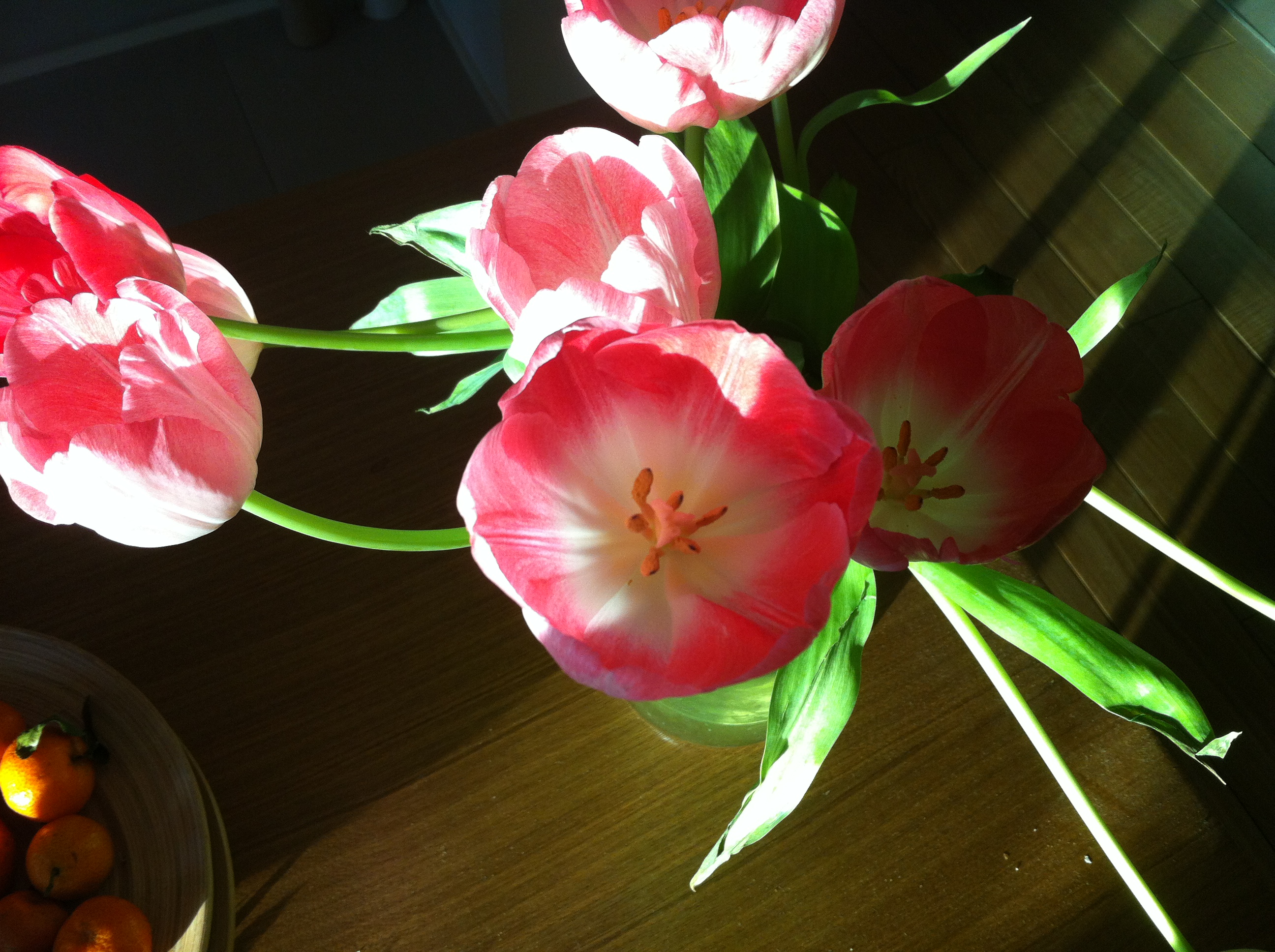
To cheer us up, my wife bought a bunch of tulips. They were still closed when she brought them home, but she placed them in a jar and we watched them slowly open over the following few days. Yesterday morning, we woke up to a gloriously bright and clear day. Thanking all the spirits I could think of, I stepped humming into the dining room, only to be greeted by the tulips which had fully opened over night. The sunlight pouring in through the windows was picking out their delicate pinks, whites and greens. I just had to memorialize the occasion.

   tulips 003

tulips 002

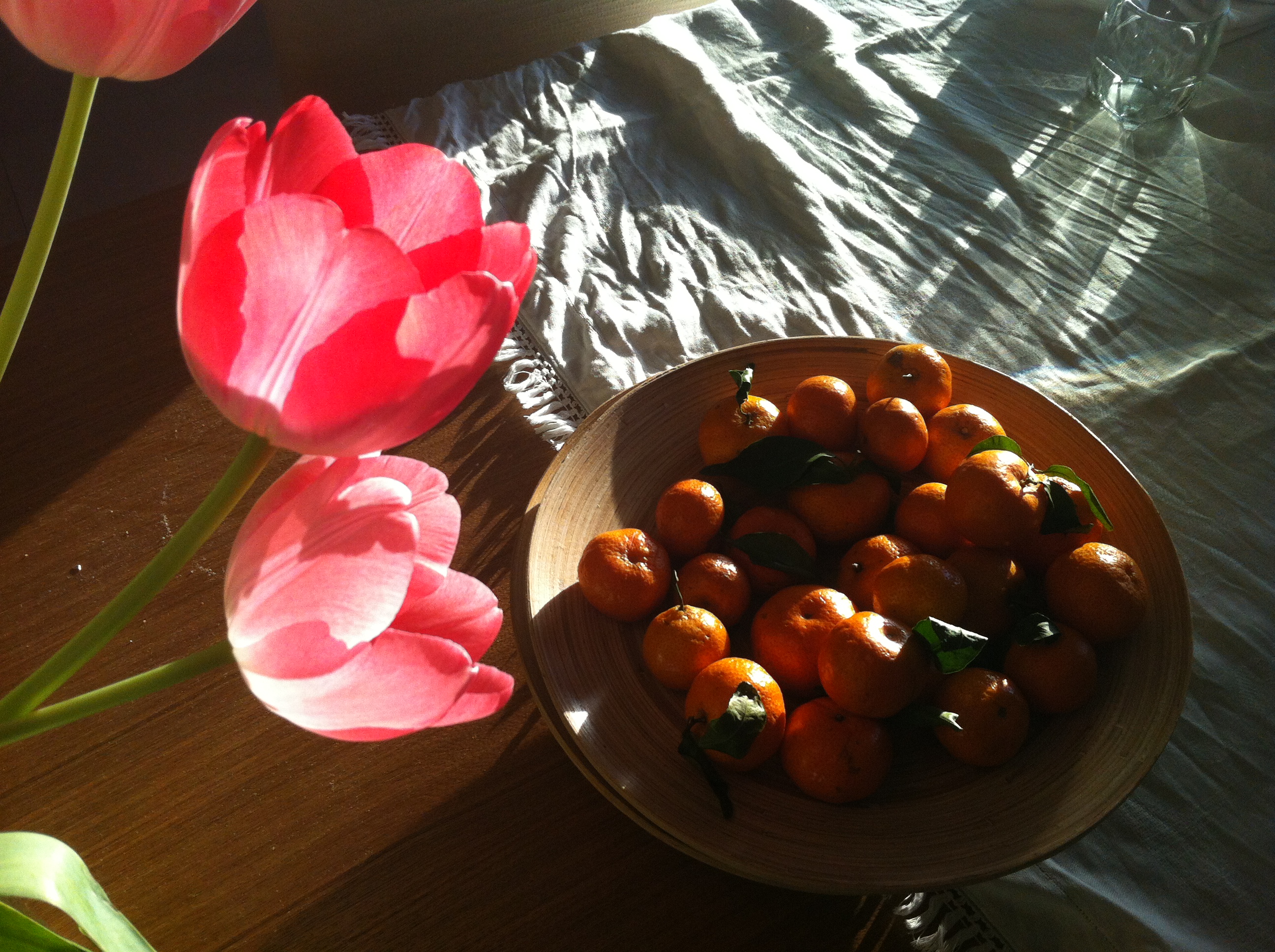
The mandarins which were also on the table kept nudging themselves into the frame, so eventually, I brought them in too.

tulips 005

Wonderful, wonderful fruit, those! They don’t look up to much, but aah the taste, my friends! First comes the delicate mandarin aroma which breaks out as you begin to peel the fruit and prepares you for what lies ahead. Then comes the citrically acidic taste with sharp mandarin overtones which hits your taste buds as you pop one segment in after the other. They are completely addictive; between my wife and I, that plate of mandarins lasted but one breakfast. She has found a greengrocers up the road which sells them. Sorry, the address will remain a secret.

TRICYCLE, WORKHORSE OF CHINA

Beijing, 29 January 2013

There was a time when China was famous the world over for its bicycles. To the few who were able to get into China, it seemed that the roads were just a torrent of bicycles.

File photo of people pushing their bicycles across a railway track during rush hour in Shanghai

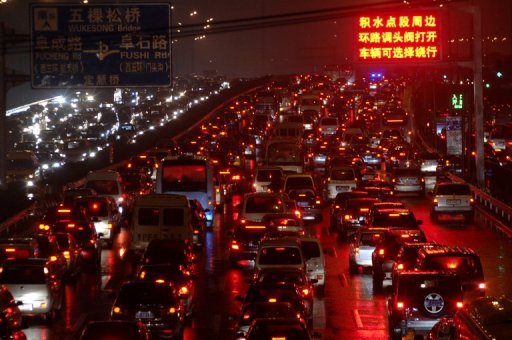
That torrent has dried up to a mere trickle. Some of the older expats whom I meet talk with a certain wistfulness of the bicycle culture that still existed when they first arrived in China ten-fifteen years ago, a culture where it seemed that every able-bodied Chinese had a bike. Now, there is just a torrent of cars, a torrent which is growing exponentially with every passing year and fast becoming a flood.

car jam-2

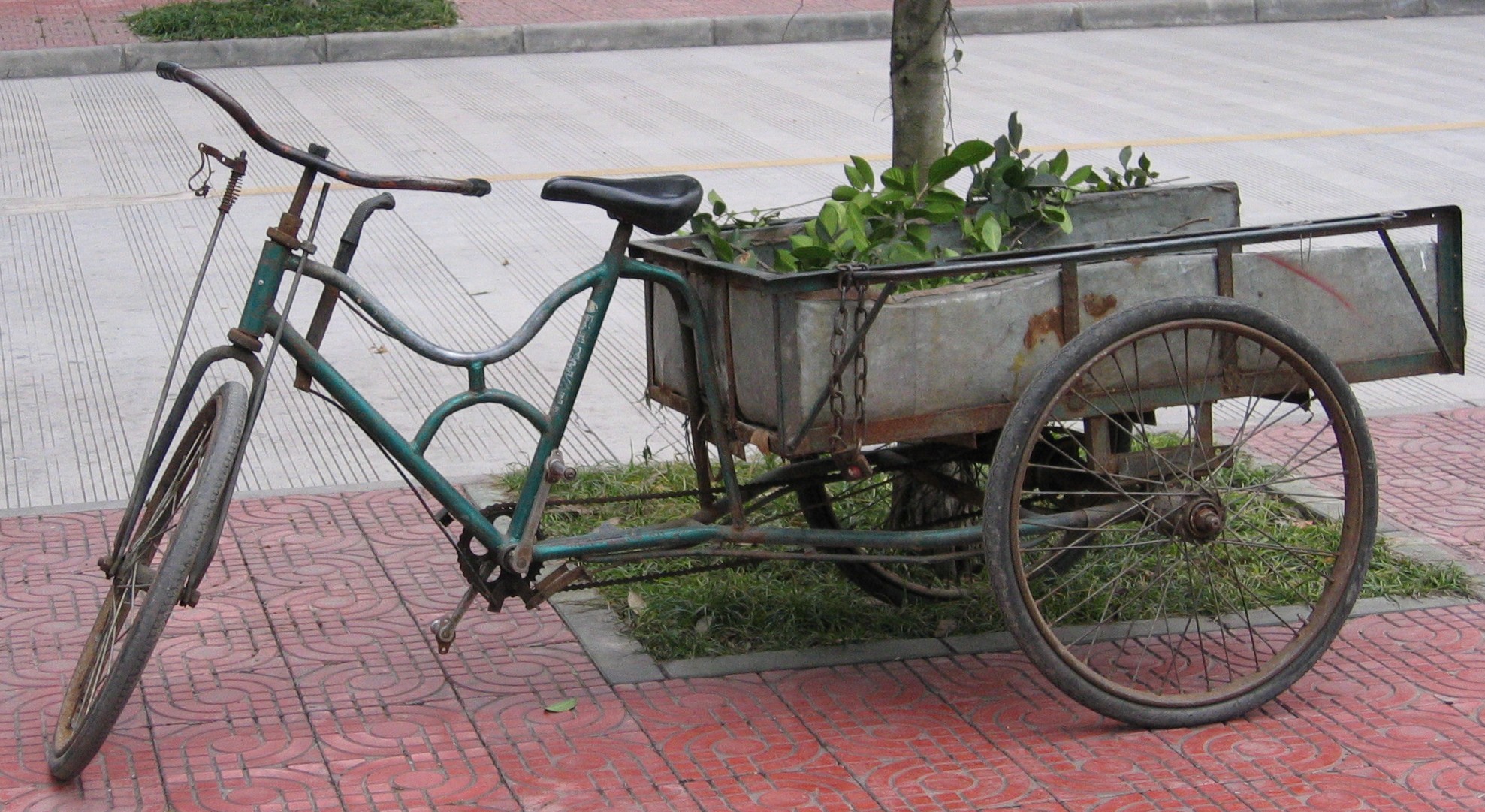
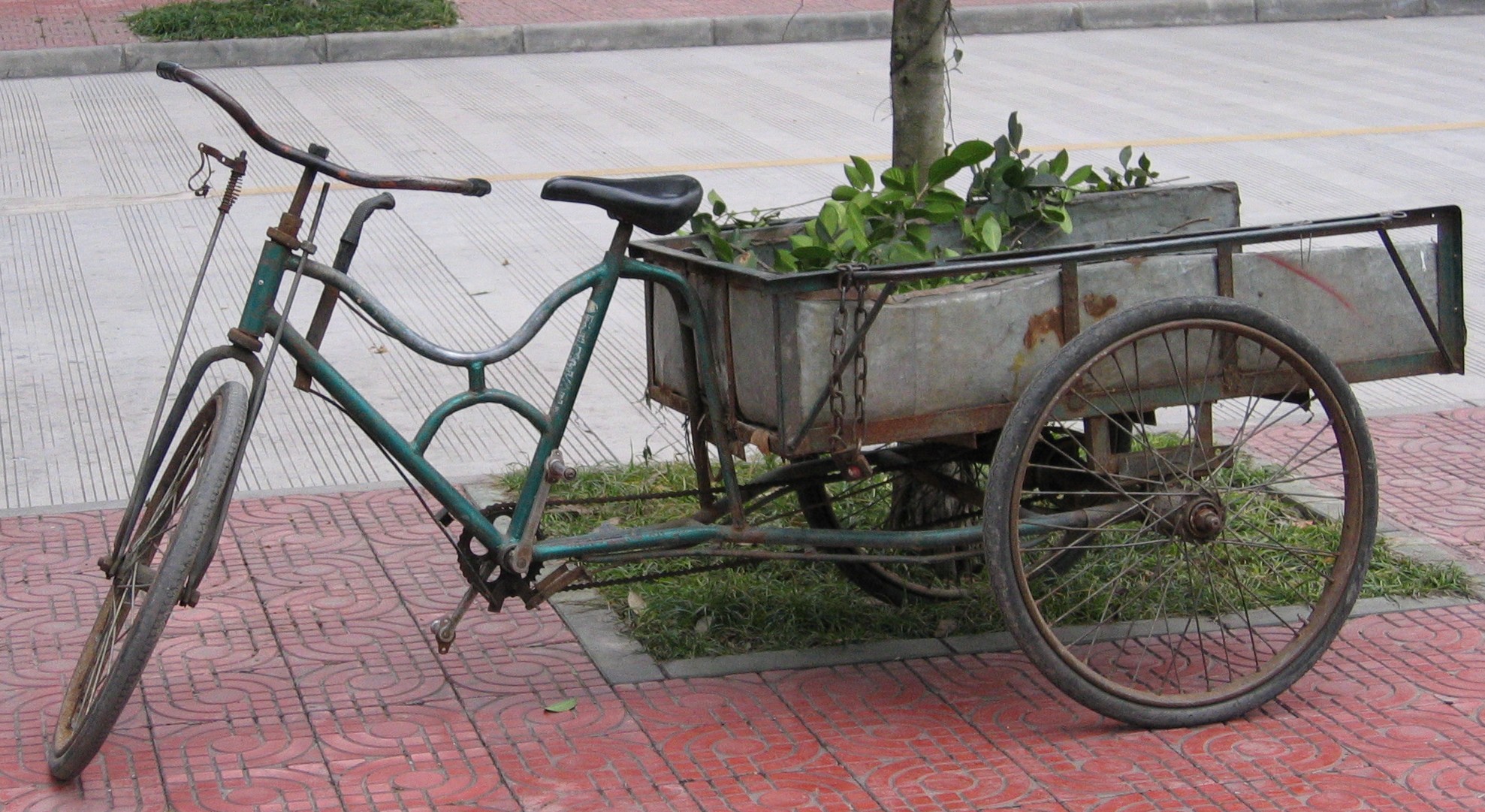
So it looks like China’s bike culture has effectively vanished. But there is one sub-species of bicycle, if I may put it that way, which still flourishes in China, in the form of a tricycle which I have only ever seen here in China.

tricycle-traditional

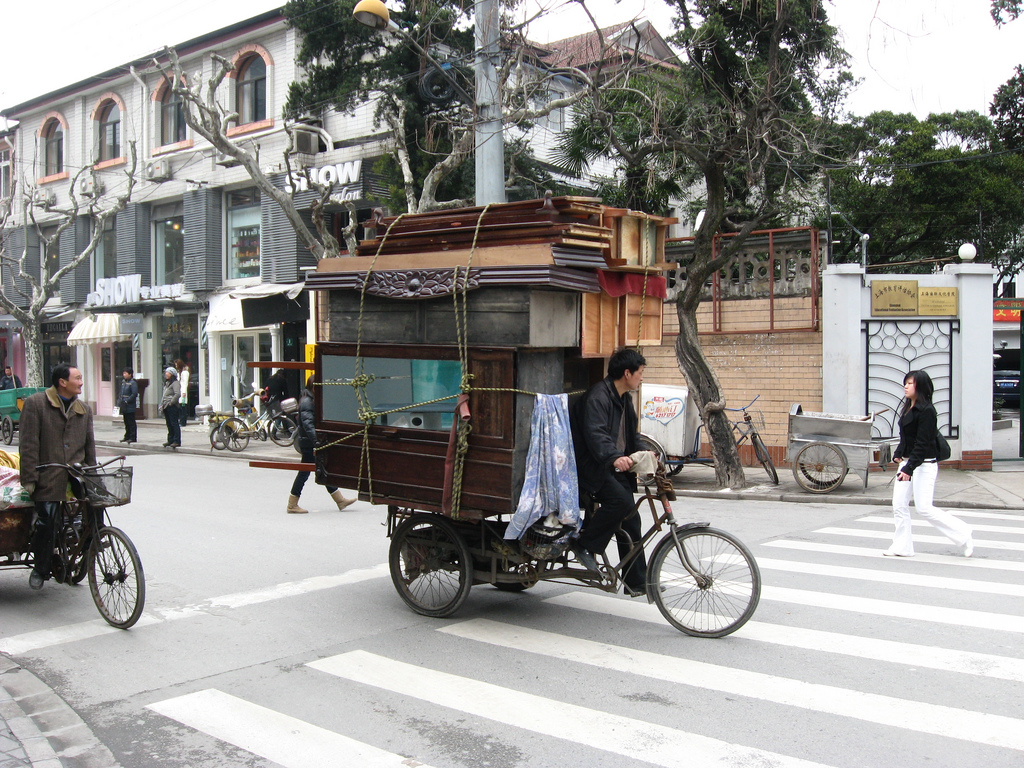
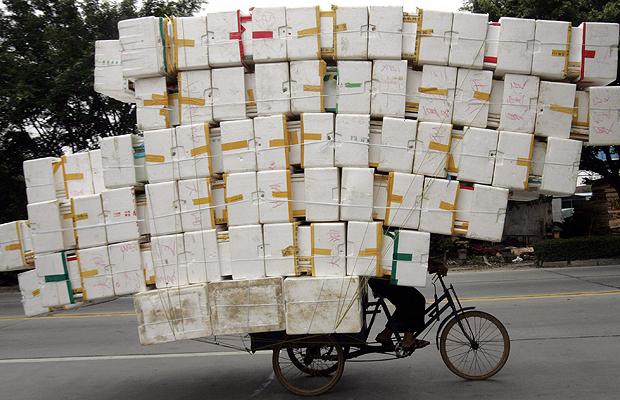
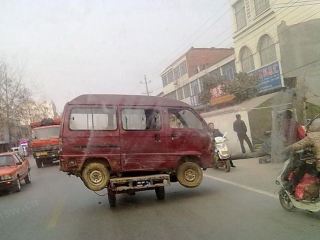
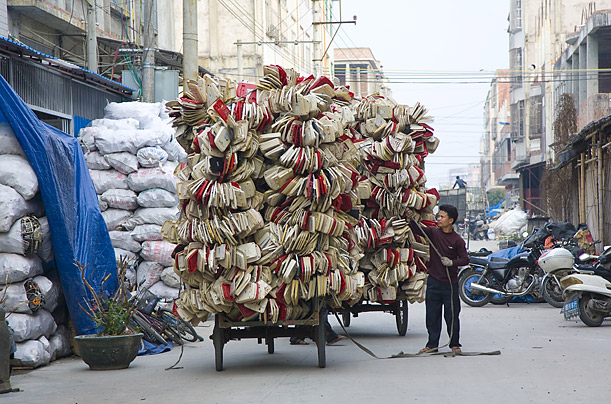
The design is really very basic. Absolutely nothing fancy here, one has the feeling that a series of pipes have been soldered together and three bicycle wheels have been added. As you can see, the key to this bicycle is the barrow at the back, which is used to carry. And boy, does this humble machine carry! All day, every day, you will see hundreds if not thousands of these tricycles criss-crossing every city of China, most often being pedalled by one of China’s army of migrant workers, carrying every blessed item you could possibly imagine. And sometimes, the volumes being carried are awesomely ginormous, from furniture:

furnituretrike

to cardboard:

tricycle carrying cardboard

to polystyrene:

tricycle carrying polystyrene

To old telephone casings:

tricycle carrying phone casings

To car parts:

tricycle carrying car pieces

to a whole van, for Lord’s sake!

tricycle carrying minivan

Inanimate objects aren’t the only things carried. Farmers use them to carry their pigs:

tricycle carrying pig

their ducks:

tricycle carrying ducks

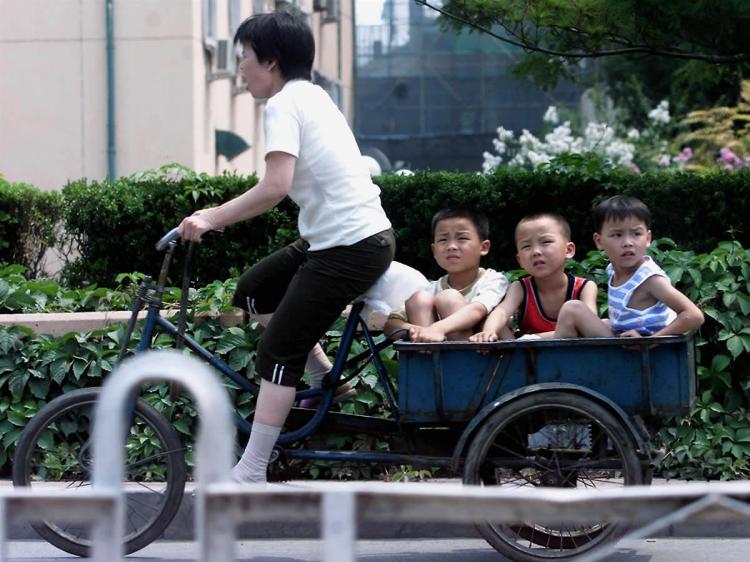
and who knows what else, while this woman is using it to carry kids

tricycle carrying children

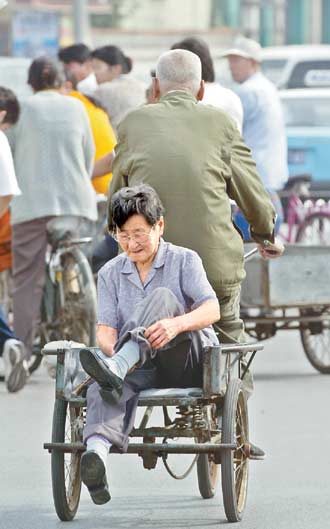
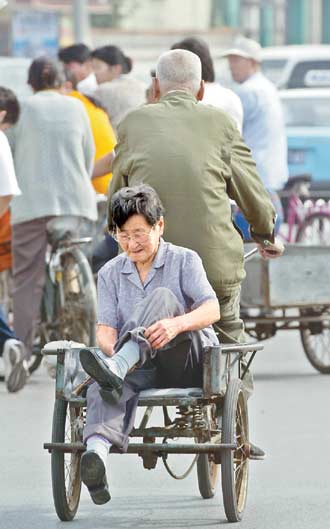
and this husband his wife.

tricycle old couple

I have to say, I do find that this particular husband is treating his wife rather cavalierly. There is a version of this mode of travel where the wife rides as would a queen, sitting regally on a throne-like armchair while her husband pedals slowly in front of her.

tricycle old couple-7

I’ve noticed that the couples always seem to be retirees. Young Chinese don’t go around like this. But that’s fine by me; I’m almost retired. I have decided that I will buy one of these throne-tricycles and bring it back to Milan. Like that, when my wife and I have finally joined the ranks of the retirees, I will be able to slowly pedal my lady wife around Milan in the style that she deserves and is accustomed to.

________________________

Bicycles in Beijing: http://heckeranddecker.files.wordpress.com/2011/04/bicycles-in-beijing.jpg
Car traffic jam: http://www.intellasia.net/en/wp-content/uploads/2012/11/china.car-market201211afp.jpg
Tricycle: http://www.tariksaleh.com/moscaline/chinabike/cargobig.jpg
Tricycle with furniture: http://cargocycling.org/wp-content/uploads/2009/09/furnituretrike.jpg
Tricycle carrying cardboard: http://ph.cdn.photos.upi.com/collection/upi/sb/2870/a5da8edd413c5f72aba13e80f2d0dc3a/Trash-trawling-as-a-career-in-China_2.jpg
Tricycle carrying polystyrene: http://i.telegraph.co.uk/multimedia/archive/01410/tricycle-polystyre_1410326i.jpg
Tricycle carrying phone parts: http://www.mutanteggplant.com/vitro-nasu/wp-content/uploads/2009/05/ewaste.jpg
Tricycle carrying car parts: http://i.telegraph.co.uk/telegraph/multimedia/archive/01410/Tricycle-car-bumpe_1410335i.jpg
Tricycle carrying minivan: http://bitcast-a.v1.dfw1.bitgravity.com/nightmobile/cars/images2/120000/1000/800/121834.jpg
Tricycle carrying pig: http://i.telegraph.co.uk/multimedia/archive/01551/pig-tricycle_1551633i.jpg
Tricycle carrying ducks: http://i.telegraph.co.uk/multimedia/archive/01410/Tricycle-ducks_1410329i.jpg
Tricycle carrying children: http://www.theepochtimes.com/n2/images/stories/large/2009/08/31/abortions-china-51343014-small.jpg
Tricycle husband carrying wife: http://www.chinadaily.com.cn/en/focus/xin_7c24924aea7a11d7b21c0001030784d9_bike.jpg
Tricycle old couple in fine style: my photo

THEM PEARLY WHITES!

Beijing, 27 January 2013

In earlier postings I have already mentioned my natural inclination to notice the physical characteristics of people, as opposed to my wife’s inclination to notice people’s characters. Teeth fall into the category of things that I notice about people.  And boy, do I notice Chinese people’s teeth! In the politespeak of today, they do have some “challenges” here …

This fact was brought home to me forcefully by my recent trip to the US, which I suppose could be considered the Nirvana of Pearly Whites. It seems that everywhere one looks there are only straight, white, gleaming teeth. I throw in here some random photos I found on the internet as examples of the American Look.

American beautiful teeth-2

FNC-FAN2028543 - © - Oliver Rossi

American beautiful teeth-1

In what I suppose could be considered the optimal natural condition – that is to say, no smoking, no eating of sugared foods or of heavily processed foods, youth not yet subject to too many of life’s sorrows – teeth in China can be pearly white but often will not approach the currently accepted ideal of straightness. Again, here are some random photos from the internet.

crooked teeth china

crooked teeth china-3

crooked teeth china-6

Given the way middle-class Chinese parents dote on their single children, if I had Chinese children today I would be encouraging them to become orthodontists, not doctors or lawyers. I’m sure it is a sector that will be seeing explosive growth in the future, with huge amounts of clients willing to pay top money.

chinese dentist

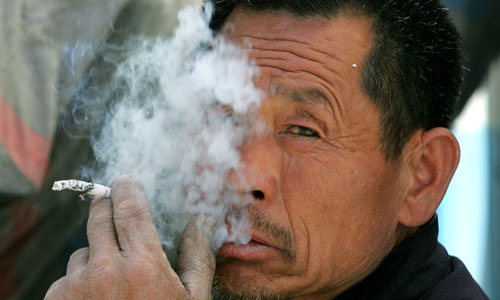
If that were the only problem plaguing Chinese teeth! But alas, it is not. Smoking is taking a terrible toll, as I see all too often in the various officials whom I meet and who readily whip out a fag to puff at all hours of the day – and probably night. So many, so, so many, have badly stained and discoloured teeth and diseased gums. As they blatter on about all the great things they are doing, I sit there trying not to stare too obviously at their teeth. Smoking is a terrible problem for men in this country. 60% – 6 out of every 10! – Chinese men over the age of 15 smoke.

chinese man smoking-5

chinese man smoking-4

China Tobacco

Blind old man smoking a cigarette in a street of Shanghai, China

Apart from the lung cancer, the emphysema, the heart attacks, apart from all of that, smoking is destroying Chinese men’s mouths.

Luckily, only a small proportion of women smoke – for the moment …No doubt it will grow, as it has in other countries.

chinese woman smoking-2

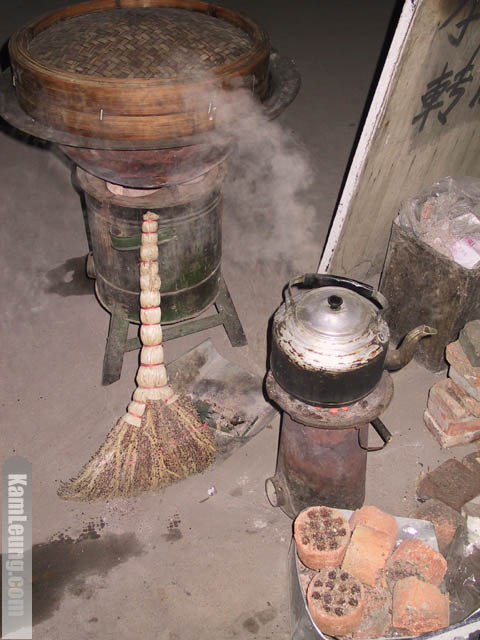
And then a very large number of Chinese have grey teeth. I was told by a doctor that a lot of this has to do with the burning of coal indoors. Chinese coal has quite high levels of fluoride in it. When people burn it in their houses, the leaky stoves emit smoke – and fluorides – into the homes. High intake of fluoride when you are children leads to permanent discolouration of teeth.

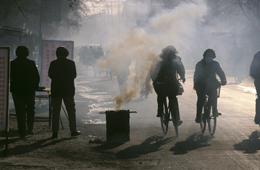
This photo is an extreme example of the problem of smoky stoves:

stoves china-4

In houses, this is more the norm.

stoves china-1

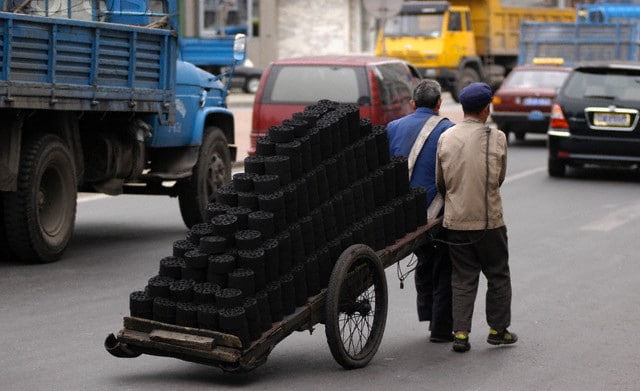
Note the round things in the bottom right-hand corner of this photo. This is the way coal is sold to households in China, coal dust pressed together with a clay matrix into cylinder slices with a set of holes drilled through them. There are thousands of itinerant sellers in all cities selling them.

stoves china-3-coal

Of course, poverty is also a major cause of bad teeth. Bad diets, little if any access to dentists, lack of money to pay for dental care anyway, ignorance about how to look after their teeth – all these take a terrible toll on Chinese teeth. Foreigners are often dazzled by the glitter of big cities like Beijing and Shanghai, but they are really just facades. In the countryside, there is still a huge amount of dire poverty, of a type that I have never seen in Europe. When I was a child, there were poor people in Europe, but not as poor as the poorest in China.

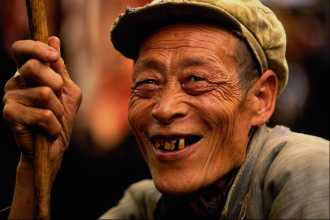
And so I see lots of older people who have terrible, terrible teeth.

old Chinese man with missing teeth-3

if they have teeth at all

Old man with crooked and missing teeth in the 11th century village of Xidi, Anhui Province China

old Chinese man with missing teeth-2

But I am optimistic. It will eventually change, and everyone in this country – more or less – will have beautiful, beautiful teeth, like these.

chinese beautiful teeth

chinese beautiful teeth-2

Which reminds me, I need to go and brush my not-so Pearly Whites.

_____________________

American beautiful teeth-girls: http://www.xtcian.com/4GirlsPickupsApr03e%28bg%29.jpg
American beautiful teeth-boys: http://previews.agefotostock.com/previewimage/bajaage/c526f975894aefa5e91ae07607b0529f/FNC-FAN2028543.jpg
American beautiful teeth-boy and girl: https://studentnet.kp.org/snet/static/common/images/pplLaughing.jpg
Crooked teeth China-woman 1: http://www.whatsonxiamen.com/ent_images/87ee2cfde9b7689ecf4efdf9_yaeba1.jpg
Crooked teeth China-woman 2: http://www.tofugu.com/wp-content/uploads/2012/04/yaeba-header.jpg
Crooked teeth China-man: http://thumbs.dreamstime.com/thumblarge_400/1242791240jCjI3E.jpg
Chinese dentist: http://www.gzdentist.com/images/ys.jpg
Chinese boys smoking: http://golivechina.com/wp-content/uploads/2011/05/smokingchina2.jpg
Chinese young men smoking: http://i.i.com.com/cnwk.1d/i/tim/2011/04/30/en_hatton0430_480x360.jpg
Chinese middle-aged man smoking: http://diepresse.com/images/uploads/8/e/9/420073/china20081005202611.jpg
Chinese old man smoking: http://cdn.c.photoshelter.com/img-get/I00009J1awSe4ZOI/s/900/900/Shanghai-China-2011-blind-old-man-smoking.jpg
Chinese woman smoking: http://cdn.ph.upi.com/ol/upi/059db3fe9ab24ab031764d837a371ffe/CHINESE-WOMAN-SMOKES.jpg
Smoking stove-interior: http://funtier.net/kamleung/0111hs/img_2179.jpg
Smoking stoves-exterior: http://www.nature.com/news/2011/110718/images/news423-i1.0.jpg
coal sellers: http://www.china-mike.com/wp-content/uploads/2011/03/china-heating-coal-vendors-cart.jpg
Old Chinese man with missing teeth-1: http://4.bp.blogspot.com/_hJREGwPF6vQ/SIiAn9oiQrI/AAAAAAAACHM/df8mUsQ5-dE/s400/oldchina.jpg
Old Chinese man with missing teeth-2: http://www.alamy.com/thumbs/6/%7BA835226E-4F95-4DB1-9C53-1FB840FB1C06%7D/AEHE89.jpg
Old Chinese man with no teeth-2: http://trackme7.files.wordpress.com/2010/09/old-chinese-man.jpg
Chinese woman with beautiful teeth-1: http://thewomanlife.info/wp-content/uploads/2010/01/white-Teeth.jpg
Chinese woman with beautiful teeth-2: http://www.divaasia.com/action/PageImage/5666.jpg

BLUE SKY DAY!

Beijing, 24 January 2013

The air is clear, the sky is blue! Finally, the grey murk of the last week or so has gone! I don’t know where it’s gone and I don’t care. All I know is it’s gone. When I walked out into the street this morning, my heart jumped on seeing the blue, blue sky. I’d almost forgotten what a blue sky looked like.

As I walked along my piece of canal, a man on the other side burst into song. If I’d known the tune I would have hummed along. As it is, I smiled benignly at the lady who was walking her dog and she smiled benignly back. I didn’t even mind the very uneven paving stones in the canal path which threaten to trip me up every day.

As I walked into my secretary’s office, she cried out “it’s only 62!” She had already checked the PM 2.5 readings on the US Embassy’s twitter feed and was preparing her daily air quality report to all staff. We laughed in sheer pleasure.

The air is clear, the sky is blue, hallelujah!

blue sky 002

blue sky 003

A JOURNEY BY TRAIN

Shanghai, 24 January 2013

The bullet train pulled out of Beijing South Station forty minutes late, starting its five-hour trip to Shanghai. After a gentle canter through the outskirts of Beijing, the train powered off when it reached the countryside, reaching peaks of 300 km/hour – small screens over the doors helpfully clocked the speed. It was quiet in the train, disturbed only by the sudden jerk to the left caused by trains whooshing past in the opposite direction – and by certain passengers talking very loudly on their phones.

After reading a few pages of a dense report, I gave up and stared mournfully out of the window. The weather was cloudy and foggy, throwing a bleak and bleary light over everything. The land was flat, flat as the Po River plain in northern Italy. There was a thin covering of snow, not enough to make the scene beautiful. The field strips were small, reminding me of the fields around Neusidlersee to the south of Vienna. Some had been planted in corn – the stalks were still standing, some had fruit trees, but most were bare of anything. Copses of poplars broke the horizontal monotony. A few villages flashed by, a group of houses huddled together in no particular order, some proudly bearing a solar water heater on their roofs. Often, the country’s modern development would intrude, with bare, broken, worked-over ground waiting for the concrete and asphalt to arrive.

The countryside was empty save for shepherds leading small groups of sheep through the bare fields, particularly the corn fields, where the sheep were stripping the standing stalks of some nourishment. The shepherds were probably Muslim Chinese who had migrated centuries ago from the west of China and are now scattered throughout China’s eastern seaboard. They brought back memories of northern Italy, where you can also see shepherds who have come down from the mountains and are feeding their herds in bare winter fields.

The only other presence was the dead. Countless gravesites dotted the landscape. You can tell a Chinese grave by the way the earth is heaped up in a conical mound over the deceased. Groups of four or five of these mounds were visible at the corner of almost every field, or so it seemed. There was no wall around them like we would have in Europe, nothing to separate them from the world of the living. Often, there would be dark trees, pines perhaps, planted nearby to keep the dead company. They reminded me so much of the cypress trees that flourish in the graveyards of Italy.

Darkness slowly set in and everything outside my window dissolved in the murk. As we started slowing down to pull into our first stop, I sighed, put on my reading glasses, and hauled out the dense report again.

CLEAR, PURE, CLEAN, PEACEFUL

Beijing, 18 January 2013

Readers of my posts will know that I walk along a piece of canal on my way to and from the office. During these walks, I watch how the change of seasons are reflected – literally and figuratively – in the waters of the canal and the willows that grow along its edge. This year, winter came flurrying in with a blustery storm in late November which damaged a number of the willows along the canal.

Winter-2012 005

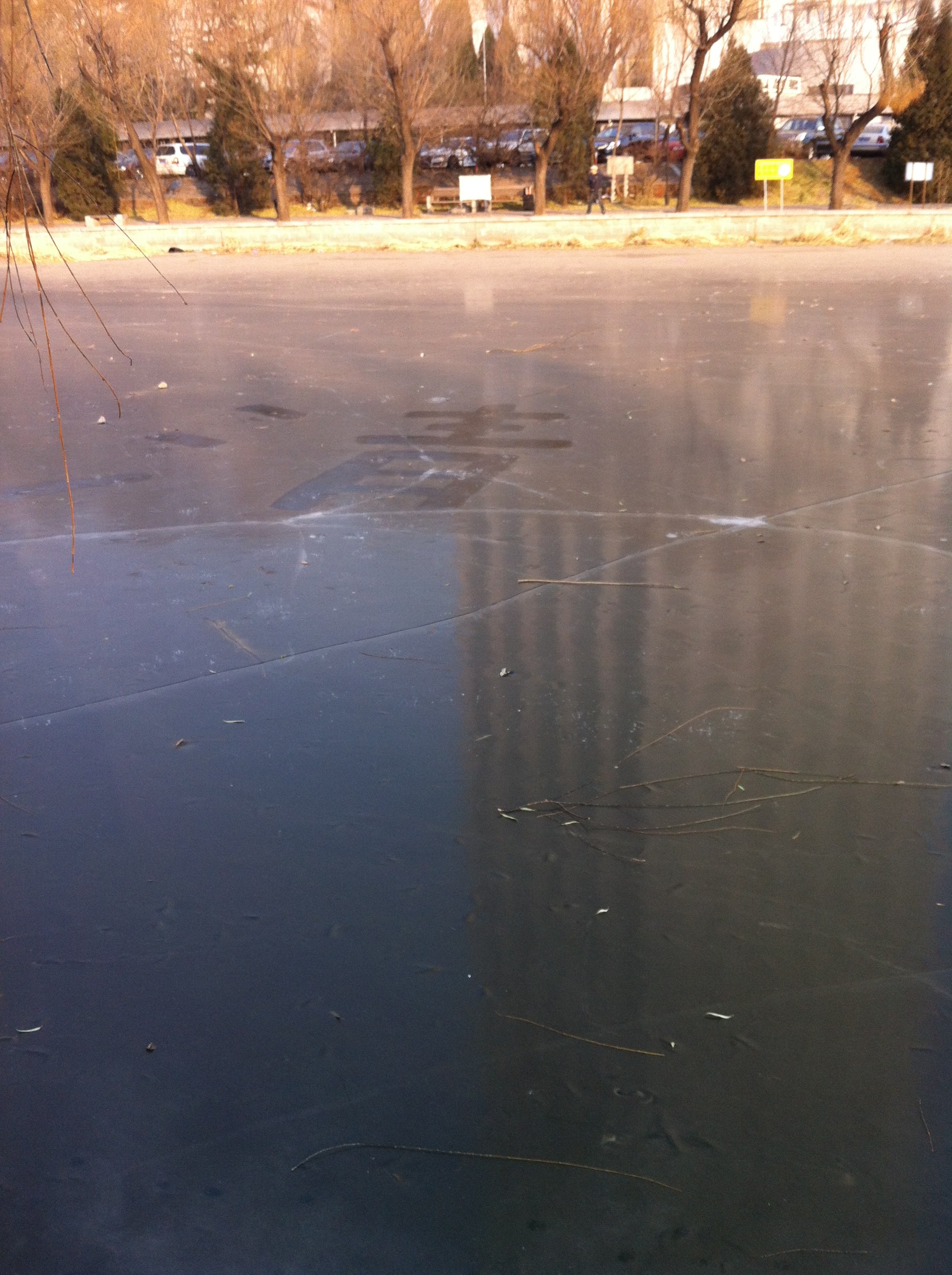
Then came a snowstorm, which left a modest covering of snow and which quickly disappeared. Thereafter, the temperatures plunged and the canal froze over. With no snow, the ice was initially buffed clean by the wind, but the wind soon died down and over a period of a week or so a thin layer of dust settled on the ice’s surface; winter is very dry in Beijing. One morning, as I turned off the bridge to start my walk along the canal, I noticed faintly etched in the dust a Chinese character. I was intrigued. What had been written? A name? Two names, united in love? Or something stupid like “Wash me”? Or worse?! Given my illiteracy in Chinese, I had no idea. So I took a photo.

qing

I showed it to my Chinese secretary. She studied the photo a minute and said “it says, qīng.”

And what does it mean, I asked?

Clear, pure, clean, she told me. Peaceful, also.

Clear, pure, clean, peaceful … The writer must have been feeling good when he wrote it. Was it love? Just a happy moment? Whatever it was, I thank him. Later wind has effaced the character, but every time I walk past the spot I get a warm feeling.

POSTSCRIPT 28/1/13

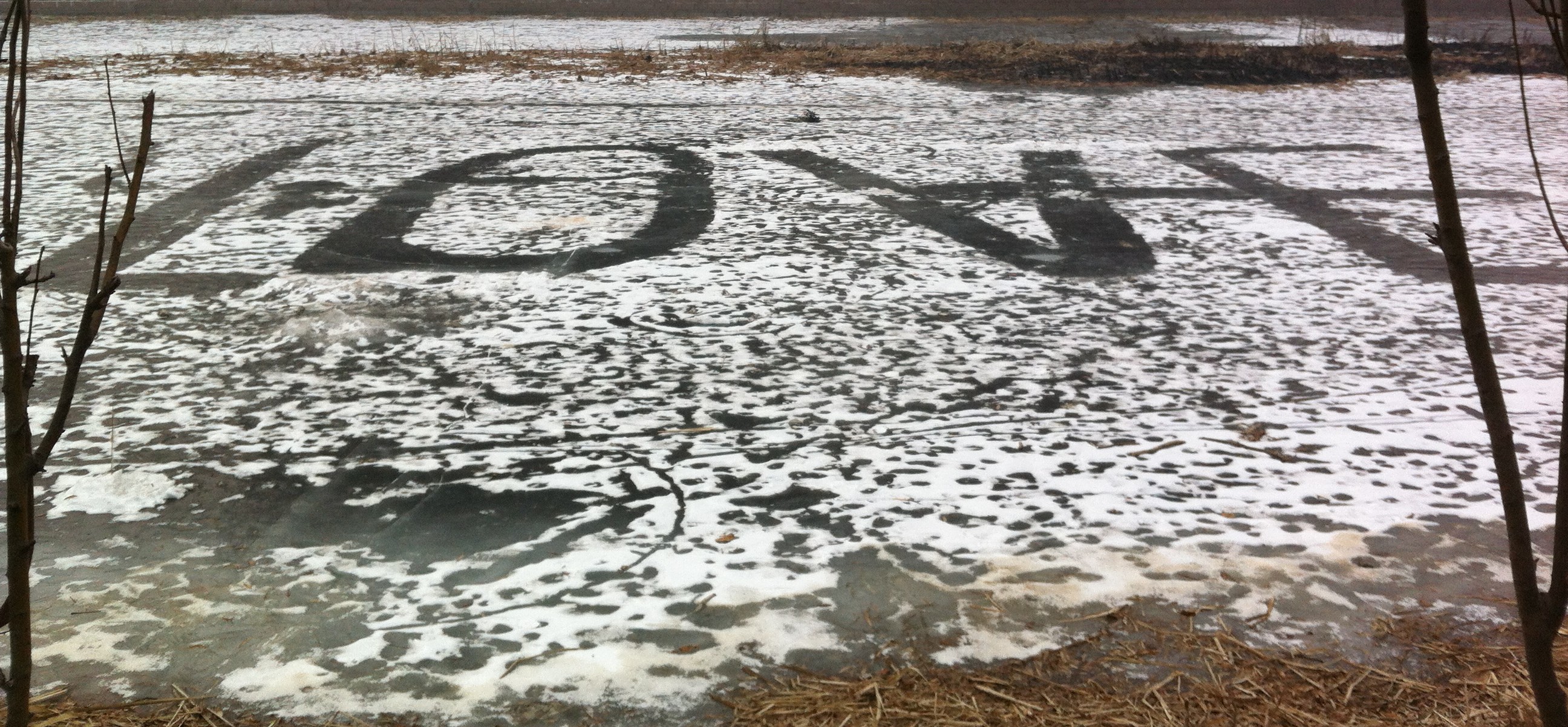
Since writing this, snow has fallen and has covered the canal’s ice with a thin coating of snow.  Someone went out and wrote in the snow. This one I could read:

love 002

RIVER POEMS

Beijing, 17 January 2013

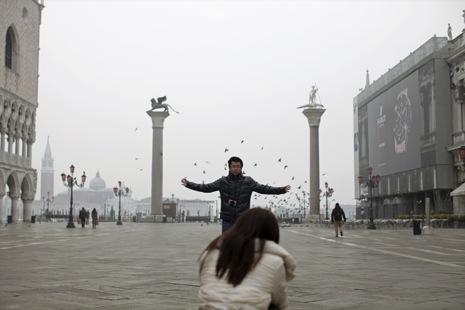
There are only a few weeks to go to the Chinese New Year and the Chinese newspapers are full of articles on people’s plans for the festive period and on the country’s transportation infrastructure bracing itself for the onslaught of Chinese who will be travelling home or – more frequently now as they get richer and move into the middle classes – travelling abroad for package tour holidays. As I read, I was reminded of a wonderful piece in the New Yorker written by the magazine’s Man in Beijing, Evan Osnos. Two Chinese New Years ago, Osnos decided to join one of these package tours, the “Classic European,” a bus tour visiting five countries in ten days.  It’s a sympathetically amusing article and I would urge any of my readers with an interest in social trends in China to read it. It can be accessed at http://www.newyorker.com/reporting/2011/04/18/110418fa_fact_osnos. Here is a photo from the article.

chinese tourists-8

Osnos’s piece reminded me rather of a 1969 film, If It’s Tuesday, This Must Be Belgium, a romantic comedy about a group of American tourists doing a bus tour of nine European countries in 18 days.

If_It's_Tuesday

Osnos mentions in passing a sub-trend in Chinese tourism, that of Chinese lovers of poetry who go on a pilgrimage to Cambridge (the Cambridge in the UK) to gaze reverently at a clump of willow trees growing on the banks of the River Cam. The reason for all this is a poem which is wildly popular in China: 再别康桥 “Saying Goodbye to Cambridge Again”. It was written by Xu Zhimo, a famous romantic poet of the early twentieth-century.

Xu Zhimo

Xu travelled in the West for a number of years. He spent a year in Cambridge in 1921 and on a second trip there in 1928 wrote the poem. He died a few years later in a plane crash in China.

I don’t read (or speak) Chinese, so I’m afraid the poem in its original form is closed to me. However, there is what seems to be a standard translation (every Chinese website that I looked at carried the same one) which is really quite pleasant on the ear. But before I quote it here, I am moved to first cite the poem in its pinyin form (without tonal marks, which I find confusing and quite unhelpful since I don’t hear the language’s tones), to give other Chinese-illiterate readers like myself a small taste of its rhythm and rhyme.

Qingqing de wo zou le, zhengru wo qingqing de lai;
wo qinqing de zhaoshou, zuobie xi tian de yuncai.

Na hepan de jin liu, shi xiyang zhong de xinniang;
boguang li de yan ying, zai wo de xintou dangyang.

Ruanni shang de qing xing, youyou de zai shuidi zhaoyao;
zai Kang he rou bo li, wo ganxin zuo yi tiao shuicao!

Na yu yin xia de yi tan, bus hi qingquan,
shi tianshang hong rousi zai fu zao jian, chendianzhe caihong shide meng.

Xunmeng? Cheng yi zhi chang gao, xiang qingcao gen qing chu man su,
manzai yi chuan xing hui, zai xing hui banlan li fangge.

Dan wo buneng fangge, qiaoqiao shi bieli de shengxiao;
xiachong ye wei wo chenmo, chenmo shi jinwan de Kangqiao.

Qiaqiao de wo zou le, zhengru wo qiaoqiao de lai;
wo hui yi hui yixiu, bu daizou yi pian yuncai.

And now for the translation:

Very quietly I take my leave
As quietly as I came here
Quietly I wave good-bye
To the rosy clouds in the western sky

The golden willows by the riverside
Are young brides in the setting sun
Their reflections on the shimmering waves
Always linger in the depth of my heart

The floating heart growing in the sludge
Sways leisurely under the water
In the gentle waves of Cambridge
I would be a water plant!

That pool under the shade of elm trees
Holds not water but the rainbow from the sky
Shattered to pieces among the duckweeds
Is the sediment of a rainbow-like dream

To seek a dream? Just to pole a boat upstream
To where the green grass is more verdant
Or to have the boat fully loaded with starlight
And sing aloud in the splendour of starlight

But I cannot sing aloud
Quietness is my farewell music
Even summer insects keep silence for me
Silent is Cambridge tonight

Very quietly I take my leave
As quietly as I came here
Gently I flick my sleeves
Not even a wisp of cloud will I bring away

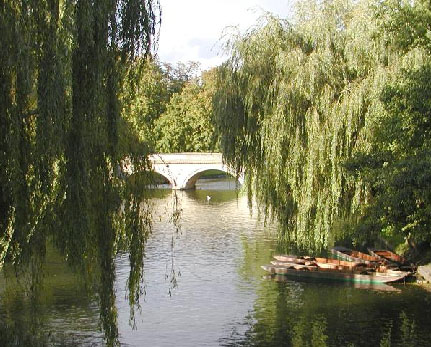
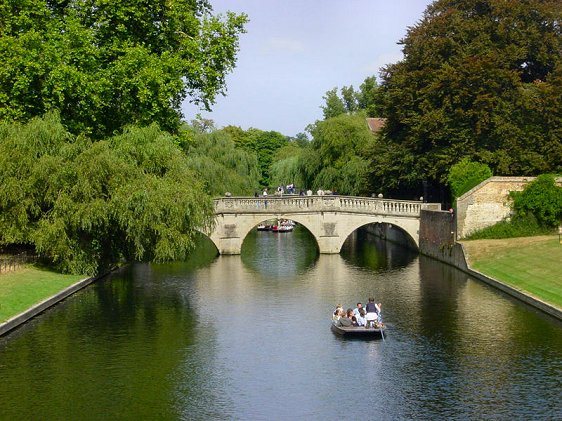
I can’t resist adding a few pictures here of the river Cam. It is a river that flows quietly through Cambridge, as quietly as the poem itself flows across the page.

Cam with willows

Henry VIII chapel and Cam

Cam-1

I came across the text of the poem for the first time through an English Lit class I held with a Chinese student (class is a big word; it was more a pleasant discussion around English literature every Saturday morning, over a cup of hot sweet soya milk). After we had gone through a few English poems he brought me this translation of  “Saying Goodbye to Cambridge Again”. I was touched and wanted to give him in return an English poem with a river as its theme. But what?

I went on a search and came across the poem “The River” by Sara Teasdale.

sara-teasdale

Teasdale, an American poet, was more or less a contemporary of Xu. She died in 1933.

I came from the sunny valleys
And sought for the open sea,
For I thought in its gray expanses
My peace would come to me.

I came at last to the ocean
And found it wild and black,
And I cried to the windless valleys,
“Be kind and take me back!”

But the thirsty tide ran inland,
And the salt waves drank of me,
And I who was fresh as the rainfall
Am bitter as the sea.

I had never heard of Teasdale, and a look at her other poems did not impress me, but this poem, at this time in my life, spoke to me. Who doesn’t reach my age and sometimes wish he could slough off the pessimism which comes with the passing years and be young again, fresh and optimistic?

____________________________

Chinese tourists: http://www.newyorker.com/online/blogs/books/assets_c/2011/04/110418_osnoschinese01_p465-thumb-465×310-68686.jpg

Film poster: http://upload.wikimedia.org/wikipedia/en/9/9f/If_It%27s_Tuesday.jpeg
Xu Zhimo: http://cfile25.uf.tistory.com/image/1768563E4F8F1F6C23B5BE
Cam with willows: http://www.baihuisoft.com/Uploads/201179154340875.jpg

Henry VIII chapel and Cam: http://ts1.mm.bing.net/th?id=H.4921582377371804&pid=1.9
Cam and Clare college: http://anyluckypeny.files.wordpress.com/2012/05/clare-college-bridge-university-of-cambridge.jpg?w=870
Sara Teasdale: http://www.poetryfoundation.org/uploads/authors/sara-teasdale/448x/sara-teasdale.jpg

MESSAGE IN A BOTTLE

Beijing, 12 January 2013

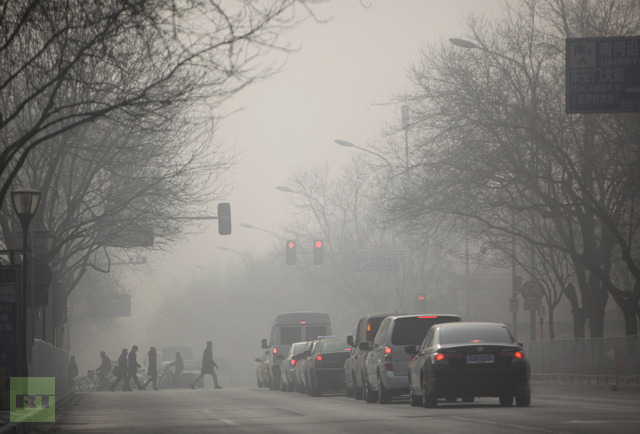
We arrived back in Beijing a few hours ago and found ourselves landing in a real pea soup – perhaps carrot soup would be more appropriate since the colour was a dull red; dust from the Gobi desert had blown in. Visibility was really very bad; my wife and I thanked God and radar for having got the plane down safely. As I write, the sun, which was glaring weakly through the fog when we arrived, has disappeared completely to leave behind a grey miasma.
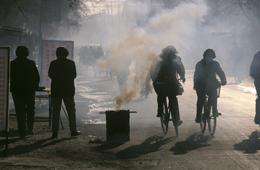
people-walk-heavily-hazy

Electronic visibility seems just as bad. Our internet connection is still acting up; it’s very difficult to get through the Great Firewall that surrounds China.

Great-Firewall

It started getting bad a month or so before the 18th Congress of the Communist Party. Everyone in the expat community agreed that the Powers that Be were tightening their grip on the electronic chatter to make sure that nothing embarrassing or destabilizing got out (the Bo Xilai case was uppermost in everyone’s minds). Everyone also agreed that surely they would relax their grip after the Party Congress and things would go back to where they were (I won’t say normal). But that didn’t happen. So now the expats are saying that internet will be controlled until March when the new leadership takes over, and then surely after that they will relax their grip.

I’m not so sure. Control is a drug; once you get a taste for it, you can’t give up, you want more. I’m afraid that my little tunnels through the Great Firewall will all be blocked up and that my voice will no longer get through to the outside world. These last few weeks in New York have given me a heady taste of what freedom of speech can be like. I published my posts and researched my materials on the internet with ease and speed, without the constant worry that I would lose the connection and everything would crash.
I don’t want to lose my voice. Paraphrasing Langston Hughes, the African American poet, “now do I wonder at this thing, that I am old but I can sing”.  I want to keep singing, to keep sending out my little messages in their bottles.

message in a bottle

_______________
air pollution Beijing: http://rt.com/files/news/china-pollution-851/people-walk-heavily-hazy.jpg (Reuters / Jason Lee)
cartoon great firewall: http://www.thetelecomblog.com/wp-content/uploads/2012/12/Great-Firewall2.jpg
message in a bottle: http://1.bp.blogspot.com/_-C_ejcKBFWo/TEnq5dYUa3I/AAAAAAAAJbc/DI29YiFyC-Q/s1600/MIAB.jpg

0 + 0 0 0 km

Beijing, 21 December 2012

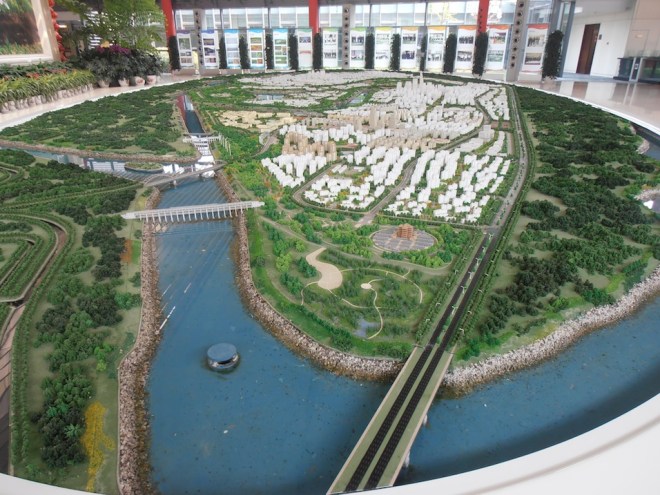
Model builders in China must be very busy people – and very rich. I am referring to the models of new city quarters, new industrial zones, and similar which are being developed all over China. Here are a few examples of what I mean, from the large:

model-EDZ-6

To the more modest:

OLYMPUS DIGITAL CAMERA

To the very modest:

model-EDZ-2

There must be literally millions of these all around the country – hence my feeling that model making must be a thriving business in China.

I have just come back from Lianyungang, a modest (by Chinese standards) port in the province of Jiangsu, opposite Japan and South Korea. Over the arc of one day, I saw three such models, which went from big, to very big, to huge. The pictures above don’t really give justice to what I saw. The pattern of my visit was always the same. First, I was taken to a temporary building, most times in the middle of a construction site, where an official of some sort was on hand to warmly welcome me. The official, usually with a number of hangers-on, first escorted me down a corridor with photos of various high-level worthies beaming their appreciation about this latest development. Then he brought me to a platform from which I could admire from on high a panoramic view of the model of what was to come in the sea of mud outside. With a flick of a switch, he turned on a son et lumière and I was bombarded with a high-tech video show on the wall of the future to come, with coloured searchlights racing back and forth across the model below me and triumphant voices describing the glories before me. At the end, befuddled by all the loud noise and flashing lights I murmured my appreciation of this vision of the future and everyone beamed. Then we headed for the door and after more warm handshakes I was on my way to the next model and the next son et lumière.

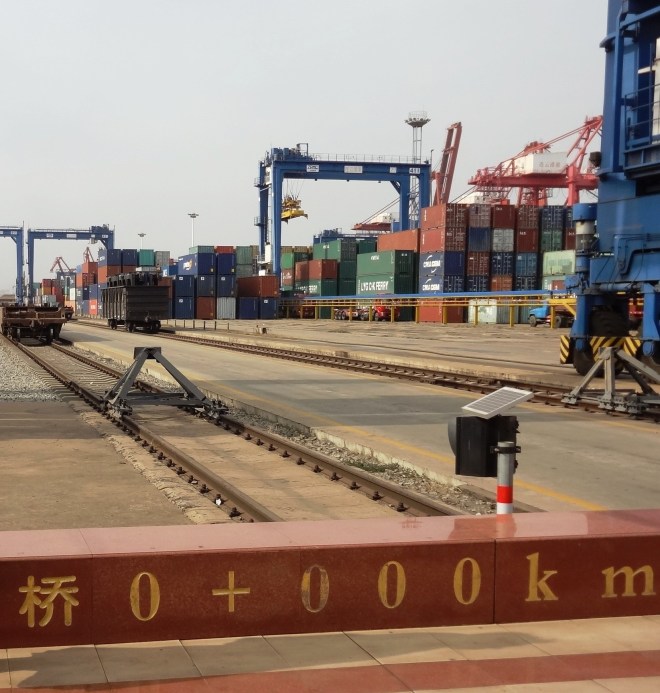
What actually caught my attention was something altogether different. At some moment in my itinerary, I was taken down to the docks to watch the containers being loaded and unloaded by their hundreds. Then the van pulled up in front of this:

port-2a

This is point zero for the New Eurasian Land Bridge, or the New Silk Road, a skein of rail lines that will run from Lianyungang across China to the Kazakh border, unreel across Kazakhstan, then after a short skip across southern Russia on through Ukraine, into Poland, then Germany, and finally come to a halt in the Netherlands at the port of Amsterdam. And suddenly in my mind’s eye I’m off along that rail line, with the train wheels clickety-clacking in my ears, whirling across the rice bowl of China all the way to Xi’an, home of the terracotta army, then whooshing along the Hexi corridor of Gansu, hemmed in by the Gobi desert on one side and the Qilian mountains on the other, barreling through the northern reaches of Xinjiang along the far edges of the Taklamakan desert … then suddenly I’m called back to reality. So with a sigh, I move on to the next son et lumière.

__________________________
the big model: http://www.thenational.ae/deployedfiles/Assets/Richmedia/Image/AD200810523775761AR.gif
the middle-sized model: http://wanderinggaia.files.wordpress.com/2012/05/scale-model-of-tianjin-e-c.jpg
the small model: http://www.saintcairon.com/en/webedit/UploadFile/20085895920773.jpg

ANGEL VOICES

Beijing, 19 December 2012

It was an official dinner like so many I attend, perhaps more significant than most since it was with our main partner in China. I sat to the right of the banquet’s host, in the position of honour. As usual, I checked nervously what alcohol would be served; it’s either red wine – good – or “Chinese wine”, aka Maotai or Baizhou, which is actually an extremely strong, sickly tasting liquor – very bad; the Chinese profess to love it,  I refer to it outside of Chinese earshot as biofuel. Luckily, it was wine; I could relax. We started with the usual speech by the host and then moved to the first of the toasts. My host and I clinked glasses and bottomed-up, before turning to those around us to toast, our glasses having miraculously refilled in the meantime. The Lazy Mary began to turn as we picked at the various delicacies before us and as more arrived. The host got up and began to toast those at other tables, others got up and toasted the host, and me, and everyone else. I was soon standing up and sitting down like a yo-yo as the various guests arrived thick and fast and made me little speeches to which I had to find a suitable response. As usual, I was beginning to run out of platitudes, and when I found myself saying sillier and sillier things I knew it was time for me to escape and do my rounds of the other tables.

One thing was different at this banquet. The host had invited younger members of his staff with a musical skill to show it off. So we had players of the traditional Chinese flute, of the traditional Chinese violin, and of the guitar strutting their stuff. We also had a singer who sang in the operatic mode O sole mio and some Austrian yodeling song set to Chinese words – the last was a surreal interlude. Initially, we listened appreciatively, but as the guests moved around, toasting with all and sundry and chatting ever more animatedly in small clusters, the players were reduced to background musack. Then, uncharacteristically, the host called us to order and invited us to sit down. Two children took to the floor, the son and daughter of staff members, and they began to sing. It was in that moment that I understood why angels must be children. There is a purity, a crystalline clarity, a simplicity, in a child’s voice as it soars into the upper registers and floats above your head that can bring a hushed, attentive silence to even the most unruly crowd, and will always fill my heart with an intimation of the divine.

two-angels-singing

_____________

http://artemisdreaming.tumblr.com/page/69