THEY HAVE TOO MANY SEEDS

Beijing, 26 August 2014

Suddenly, there are vendors on every street corner of Beijing hawking pomegranate juice.

pomegranate pressers 004

As certainly as the appearance of vendors selling pineapples on Beijing’s streets is a signal that Spring is coming, so this new apparition is a sign that Summer is drawing to a close, with the pomegranate trees now heavy with fruit.

pomegranate orchard

My wife and I have bought our cup of pomegranate juice. Peering down into that dark red liquid

pommegranate-juice

I have as usual begun to ask myself questions about this fruit. It’s not from my basket of inherited foods. I never remember eating it as a child. Which is not surprising, really. It doesn’t grow well in the UK or France – certainly, my French grandmother had no pomegranate trees in her garden; peaches, plums, apples and pears, but no pomegranates. I have never eaten them in Italy either, even though they were brought to Italy during Roman times; their cultivation is limited to the far south.

That’s the thing, pomegranates are not a European fruit. I thought for a moment – given my previous discoveries – that they originated in China. But actually their historical tap root is sunk in Persia (today’s Iran), and the Himalayan foothills of the Indian subcontinent.

It’s been cultivated as a fruit for an awfully long time; they say it’s probably one of the very first fruits which we humans cultivated. And it caught on, being carried enthusiastically along the ancient trade routes. It was already being eaten in Jericho in 3,000 BC or thereabouts and in Cyprus some while later (in both cases, archaeologists found remains of the fruit in the cities’ ancient garbage dumps).

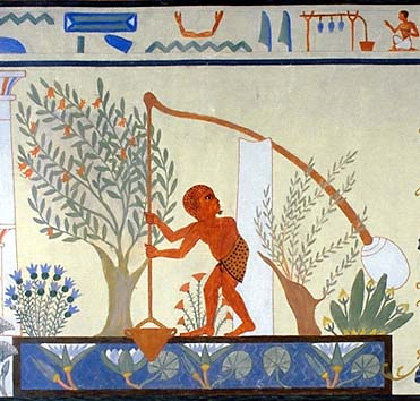
From the Middle East, it was but a hop, skip and a jump to bring the pomegranate to Greece in one direction and to Egypt in the other. This piece of fresco from a tomb painting in Egypt shows the delights of a private garden, with a pomegranate tree tucked away in one corner, no doubt a prelude of the delights which awaited Nebamun, the owner of this particular tomb, in the after-life.

Egyptian wall painting 'Pond_in_a_Garden'

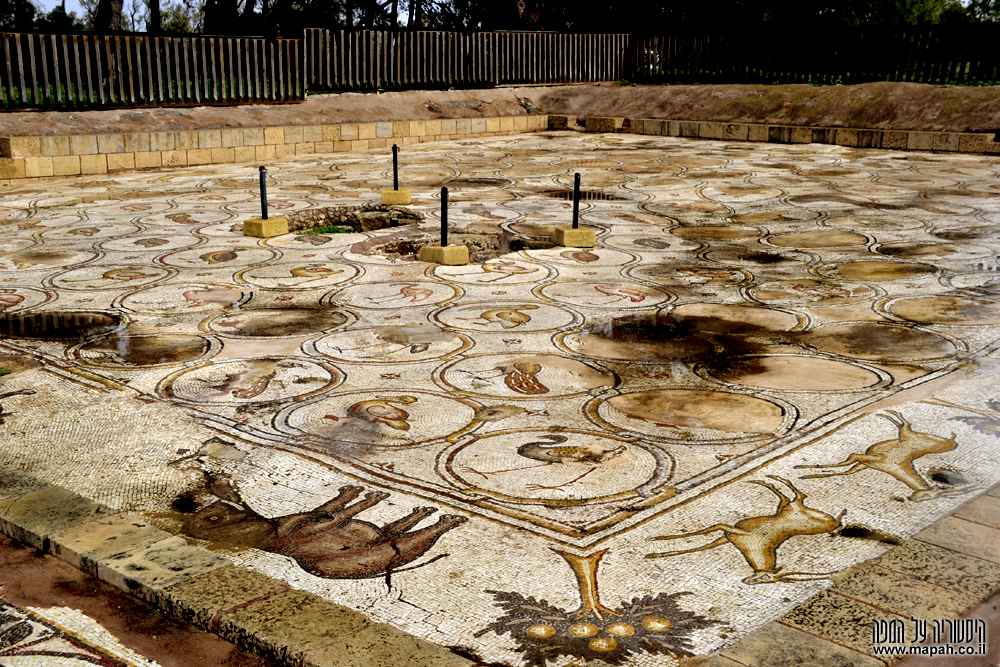
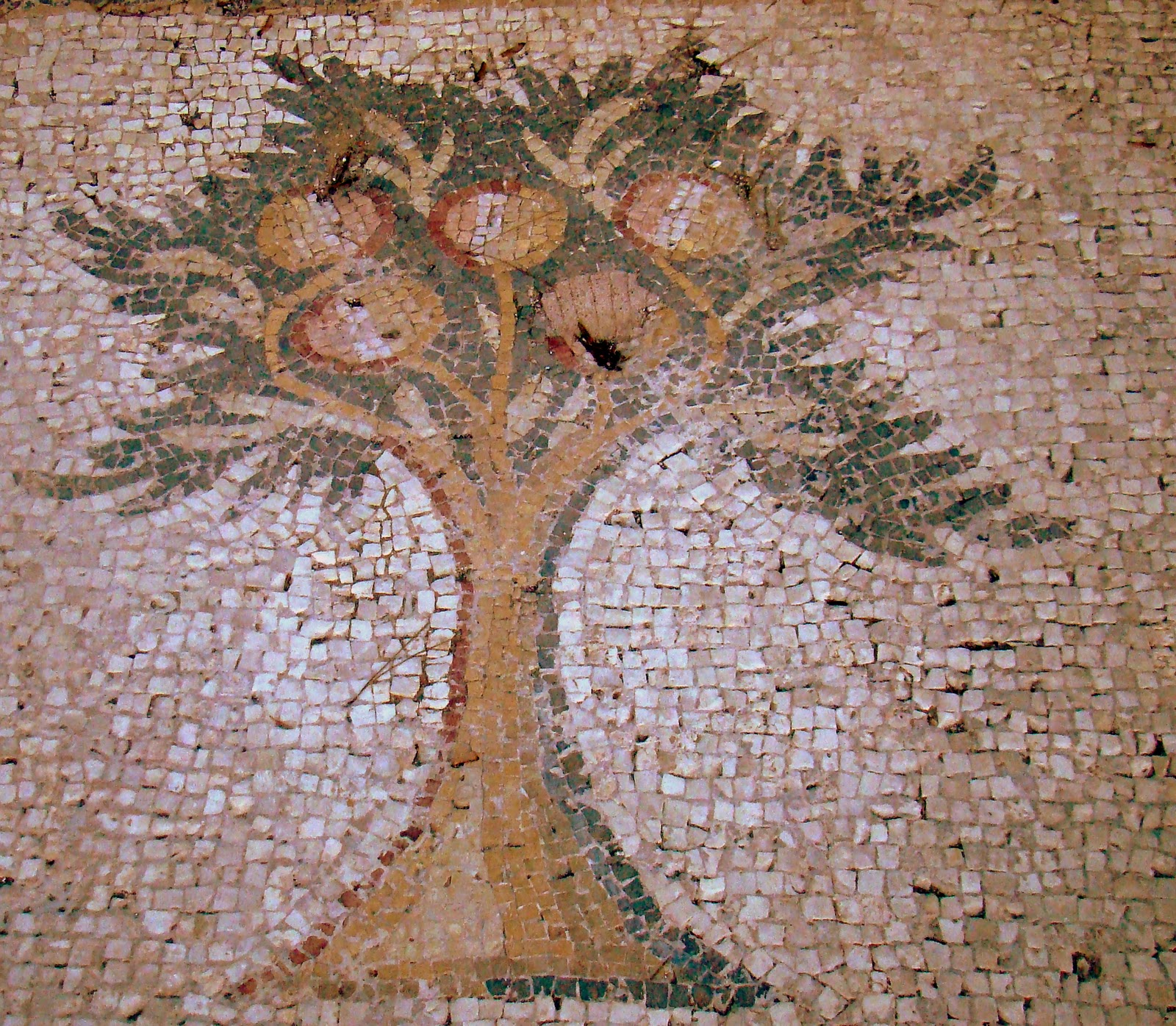
Meanwhile, from their base in Lebanon, the Phoenicians carried the fruit to their overseas territories, notably Carthage. And it was from Carthage that the pomegranate arrived in Rome. Everything comes full circle in this picture, where a mosaic in the Roman style, laid down in the city of Caesarea in Rome’s near eastern province of Judaea (in what is now Israel)

Roman Bird-Mosaic-in-Caesarea

depicts among other delights a pomegranate tree.

Roman Bird-Mosaic-detail

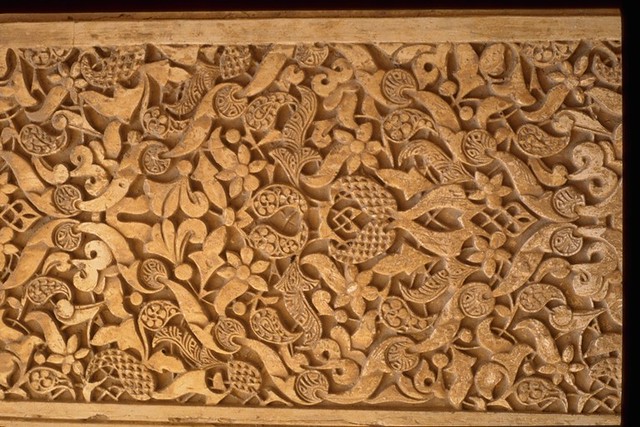
For their part, having welcomed the pomegranate into the homeland – the delights of the pomegranate are mentioned no less than three times in the Quran – the Arabs carried the pomegranate with them in their conquests of North Africa. Later on, the Muslimised Berbers of North Africa brought it to Spain. And it is in their palace of Alhambra in the city of Grenada, the last Muslim stronghold in Spain, that we find, weaved into the intricate designs on the walls, this pomegranate

alhambra-detail

To be found in the palace’s Golden chamber.

alhambra-cuarto dorado

Perhaps it comes as no surprise to know that Spain is now Europe’s biggest producer of pomegranates.

Meanwhile, the pomegranate also travelled east from Persia, along the fabled Silk Road, through Central Asia and finally entered China through Xinjian. But after becoming one of the three blessed fruits of Buddhism, it also tumbled off the Himalayas and travelled into the heart of India, and probably from there it sailed, via the Maritime Silk Route, to south China and Southeast Asia. And from China it was but another hop, skip, and a jump for the pomegranate to be carried to Japan and Korea, where in truth it was appreciated more as a good candidate for bonsai-ism than for its fruit.

bonsai pomegranate

In passing, we should acknowledge that the pomegranate tree does have beautiful flowers

OLYMPUS DIGITAL CAMERA

another reason that the ancients loved the tree, as evidenced by this other wall painting from Egypt

Egyptian wall painting pomegranate in flower

To be honest, I’m not sure I understand what all the enthusiasm is about. I mean, the juice is OK, but what I really like about a fruit is to sink my teeth into it. And all those seeds in the pomegranate

pomegranate-seeds

make that an unpleasant experience – bits of seeds getting stuck in my teeth, a sort of gritty munching experience, that sort of thing … I know the seeds are edible, but psychologically I’m not ready to crunch my way through a whole bunch of seeds. I’ll pick up a peach instead, thank you.

In my opinion, though, it’s precisely those seeds that made it so popular in the old days and encouraged its dissemination out of its Persian-Himalayan homeland. Not, I should clarify, because people liked to crunch their way through a pile of seeds 5,000 years ago (although maybe they did), but because those seeds were a potent symbol of fertility to those eaters. Remember one of the cardinal principles of sympathetic magic, which was potent then: if I eat something (or spread it on my skin, or wear it), I will absorb its powers. Clearly, all those seeds meant that the pomegranate was suffused with fertility. So it would be good to eat it, for instance, if I wanted to have lots of children. This old, old idea has been continued as a quaint custom played out in Greek and Armenian weddings

greek wedding

where at some point the bride breaks open a pomegranate and the seeds spill out (I’m sure I do not need to explain the symbolism of this). But this wish for fertility can be more generalized, and in this guise the pomegranate tree has been cast in the role of Tree of Life. Here, for instance, on this ancient Assyrian seal we see priests standing before a pomegranate as the tree of life, with the sun – another symbol of life – gently beaming down

Assyrian priests with pomegranate tree

And here we see the same symbolism woven into this carpet, made several thousand years later and several thousand kilometres away in the southern corner of the Chinese province of Xinjian.

Khotan carpet

Good ideas have staying power.

The fertility attributed to the pomegranate led to even more abstruse symbolism. Already in Egypt the pomegranate’s fertility transmuted it into a symbol of life after death: eternal fertility – which is why they liked having it represented in their tombs. Somehow, somewhere along the line, the pomegranate took on a similar symbolism for Christians, becoming a representation of Christ’s resurrection and promise of life after death. So here we have a pomegranate along with Christ in a Roman mosaic (again) from the 4th Century AD, from, of all places, a small village in Dorset.

Christian mosaic hinton st mary-detail

Christian mosaic hinton st mary

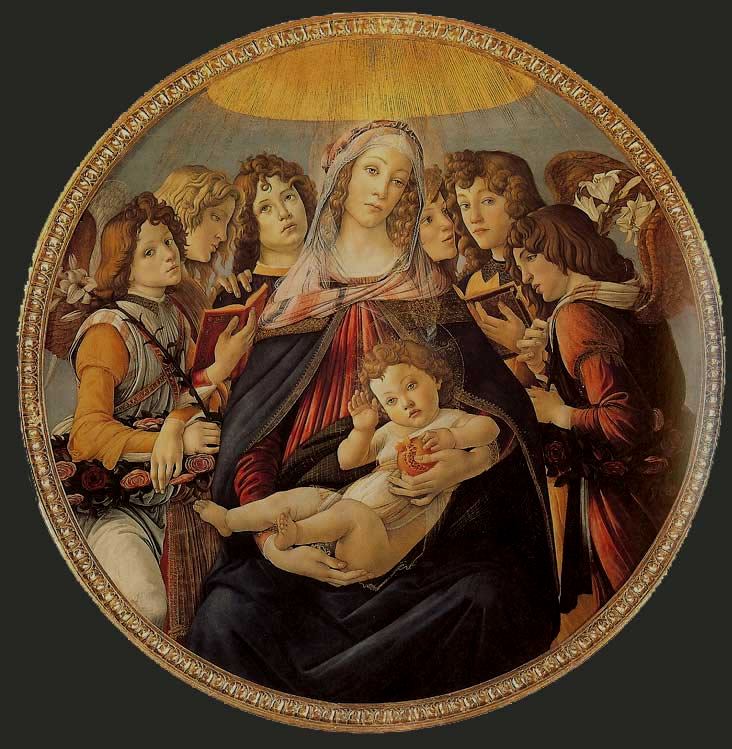
And here we have an incomparably more beautiful version from 1487 by Sandro Botticelli

Botticelli

Botticelli-detail

Botticelli is telling us that both the Madonna and her child know of the suffering to come, but the pomegranate tells us that it will not have been in vain.

All of this doesn’t change the fact that pomegranates have too many seeds in them to make them a nice eat.

________________

Pomegranate presser: my picture
Pomegranate orchard: http://www.agritay.com/pomegranate2.JPG [in http://www.agritay.com/ie3.htm%5D
Pomegranate juice: http://www.simplecomfortfood.com/wp-content/uploads/2011/12/fresh-pommegranite-juice.jpg [in http://www.simplecomfortfood.com/2011/12/04/fresh-pomegranate-juice/%5D
Egyptian wall painting “Pond in a garden”: http://upload.wikimedia.org/wikipedia/commons/5/51/”Pond_in_a_Garden”_(fresco_from_the_Tomb_of_Nebamun).jpg [in http://en.wikipedia.org/wiki/Gardens_of_ancient_Egypt%5D (fresco from the Tomb of Nebamun, Thebes, 18th Dynasty).jpg
Roman bird mosaic: http://www.mapah.co.il/wp-content/uploads/2013/01/Bird-Mosaic-in-Caesarea-DSC-3039.jpg
Roman bird mosaic-pomegranate: http://1.bp.blogspot.com/_V0EJcthPaew/TPtykNgTYNI/AAAAAAAAHtM/FDksj7TzZA0/s1600/DSC00340.JPG [in http://pazzapazza2.blogspot.com/2010/12/bird-mosaic.html%5D
Alhambra-detail: https://c2.staticflickr.com/6/5178/5533757498_c68f320ab9_z.jpg [in https://www.flickr.com/photos/psulibscollections/5533757498/%5D (Alhambra: Cuarto Dorado, detail of stucco decoration, Date: 14th century, Alhambra: Cuarto Dorado (Golden Chamber), detail of carved stucco decoration with pomegranate motifs, 14th century, Nasrid period.)
Alhambra-cuarto dorado: http://myspanishadventures.com/wp-content/uploads/2012/08/IMG_4741.jpg [in http://myspanishadventures.com/the-alhambra/%5D
Bonsai pomegranate: http://1.bp.blogspot.com/_nruXh-jwU5o/S_nWTS_IdSI/AAAAAAAAWB8/L1sJwhwiWVA/s1600/pomegranate5222010.jpg [in http://bonsaibeginnings.blogspot.com/2011_07_01_archive.html%5D
Pomegranate flower: http://ladyofthecakes.files.wordpress.com/2013/06/p1010002.jpg [in http://ladyofthecakes.wordpress.com/2013/06/22/pomegranates-in-the-making/%5D
Egyptian wall painting pomegranate tree in flower: http://www.vashsad.ua/downloads/image/7396/main3.jpg [in http://www.vashsad.ua/landscape-design/styles/articles/show/7396/%5D
Pomegranate seeds: http://m.cdn.blog.hu/ga/gasztrobakancslista/image/pomegranate-photos-5111.jpg [in http://gasztrobakancslista.blog.hu/2014/02/27/20_granatalma%5D
Greek wedding: http://simerini.com.cy/files/imagecache/full_image/files/node_images/6/5/5/329655/1_______________________________________.JPG [in http://www.simerini.com.cy/simerini/politismos/agenda/329655%5D
Assyrian priests with pomegranate tree: http://tabloidenoticias.files.wordpress.com/2014/02/sumerio.jpg [in http://tabloidenoticias.wordpress.com/%5D
Khotan carpet: http://www.metropolitancarpet.com/assets/images/Khotan7.jpg [in http://www.metropolitancarpet.com/html/body_pomegranate__antique_oriental_rugs.html%5D
Christian mosaic Hinton St Mary: http://upload.wikimedia.org/wikipedia/commons/6/60/Mosaic2_-_plw.jpg [in http://en.wikipedia.org/wiki/Hinton_St_Mary_Mosaic%5D
Christian mosaic Hinton St Mary-detail: http://www.vanderbilt.edu/AnS/Classics/roman_provinces/britain/hintonst.marymosiac.JPG [in http://www.vanderbilt.edu/AnS/Classics/roman_provinces/britain/image16.htm%5D
Botticelli: http://4.bp.blogspot.com/-b-2sXs3aQeo/T-Yv5SWbaEI/AAAAAAAAAc4/tLnT8Advf0c/s1600/Botticelli.jpg [in http://aggiehorticulturegoestoitaly.blogspot.com/2012_06_01_archive.html%5D
Botticelli-detail: http://www.backtoclassics.com/images/pics/sandrobotticelli/sandrobotticelli_madonnaofthepomegranatedetail.jpg [in http://www.backtoclassics.com/gallery/sandrobotticelli/madonnaofthepomegranatedetail/%5D

CHEESE, GLORIOUS CHEESE!

Beijing, 24 June 2014

My wife and I were having our usual chat with our daughter via FaceTime when she announced that she and her flat mate had been discussing the vital question of why cheeses were different from each other.

Well! That was more than enough bait for a nerd like myself to rise to. With eyes a-shinin’ and lips a-lickin’, I started to research the topic. It was actually a question I had also often posed myself: how on earth did you get so many different-tasting products out of the same rather bland starting material, milk?

I am proud to announce the results of my research. The answer is …. “The most important agents include the four following elements: rennet, starter bacteria and associated enzymes, milk enzymes, second starter bacteria and associated enzymes, and non-starter bacteria”. OK, that’s not very clear, so let me expand a little.

The first step in cheese making is curdling. In fresh, unpasteurized milk, curdling happens naturally. Attack by bacteria floating around in the air and settling on the milk leads to the formation of lactic acid, and it is heightened acidity that causes milk to curdle, separating out into solid curds and liquid whey. But we humans have learned to help the process along. Rennet, which is a complex of enzymes, seems to have been an early favourite for inducing curdling. An interesting theory I read is that our ancestors discovered the milk-curdling properties of rennet when they used animal stomachs as storage vessels for milk. FYI, mammalian stomachs naturally contain rennet as an evolutionary response to milk drinking (which is what makes a mammal a mammal rather than, say, a bird or a reptile). It allows young mammals to digest their mothers’ milk.

Or you can use acids. Given that you want to eat the result, you probably don’t want to use sulphuric acid or hydrochloric acid, even though I’m sure they would do the trick. Naturally-occurring (and edible) acids like vinegar and lemon juice will do nicely.

Or you don’t wait for some random bacteria floating around to attack the milk. Instead, you deliberately inoculate milk with so-called starter bacteria (often adding rennet in a second step). Presumably from previous trials and errors which occurred who knows how many centuries ago in monastery cellars or elsewhere

monks in cellar

these various strains of bacteria are known to give specific tastes to the final cheese. They will chemically attack the milk, and later the curds, in differing ways, giving rise to chemical products with different tastes.

In any event, one way or the other you will end up with curds

curds

and whey

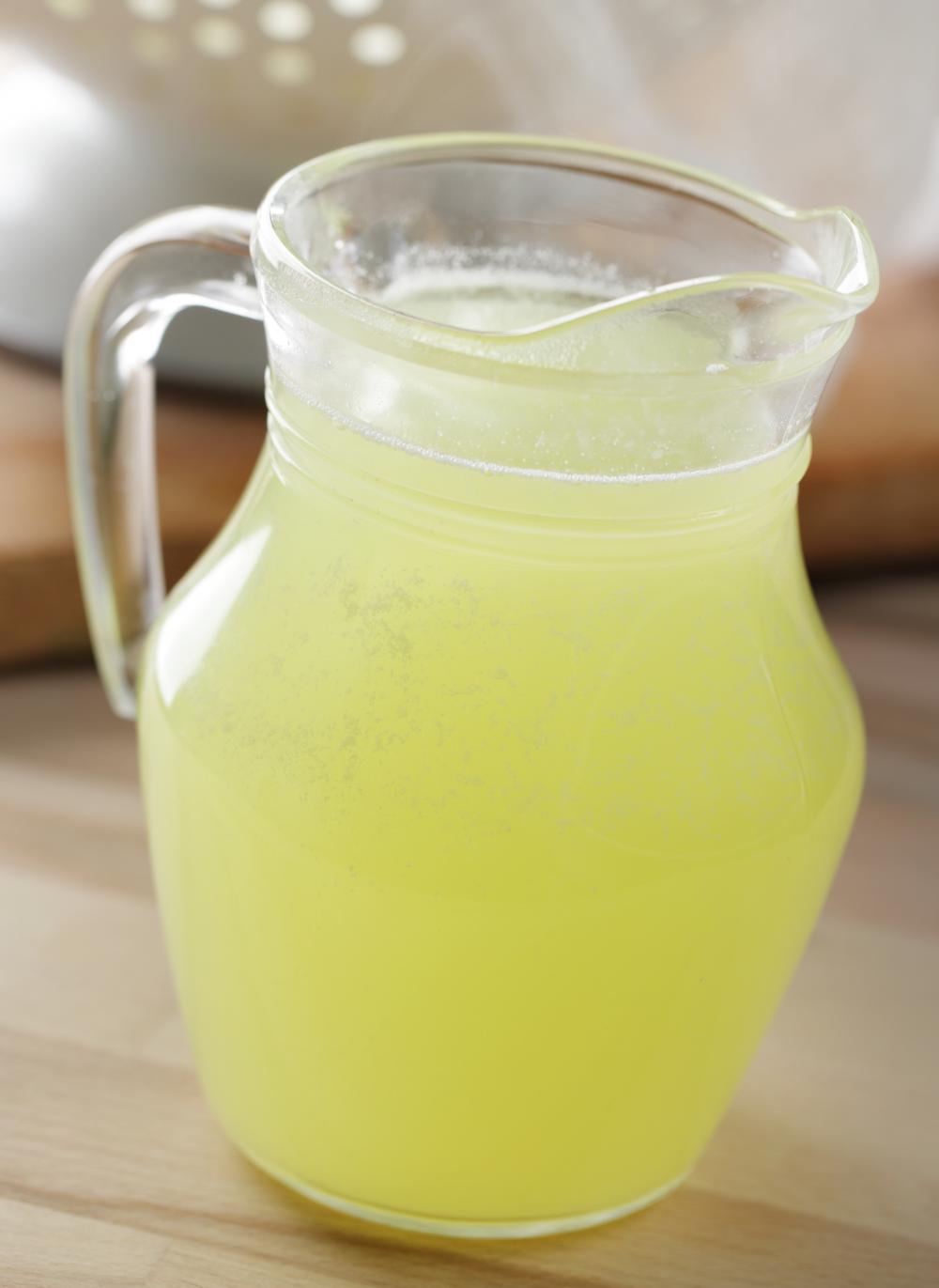
Whey

Like little Miss Muffet who sat on a tuffet, you can already eat the curds and whey if you so wish, preferably before a spider turns up and spoils your appetite.

little miss muffet

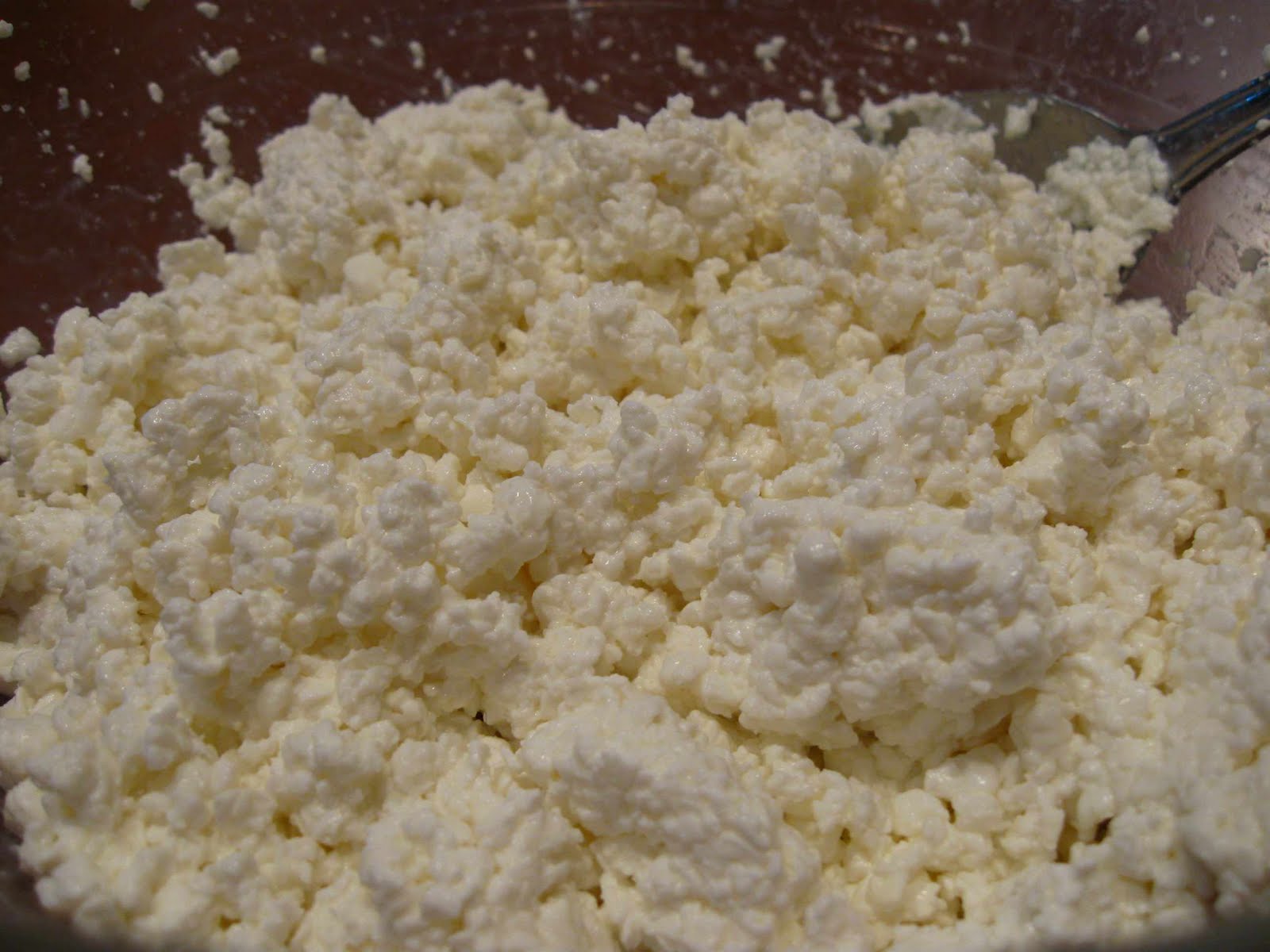
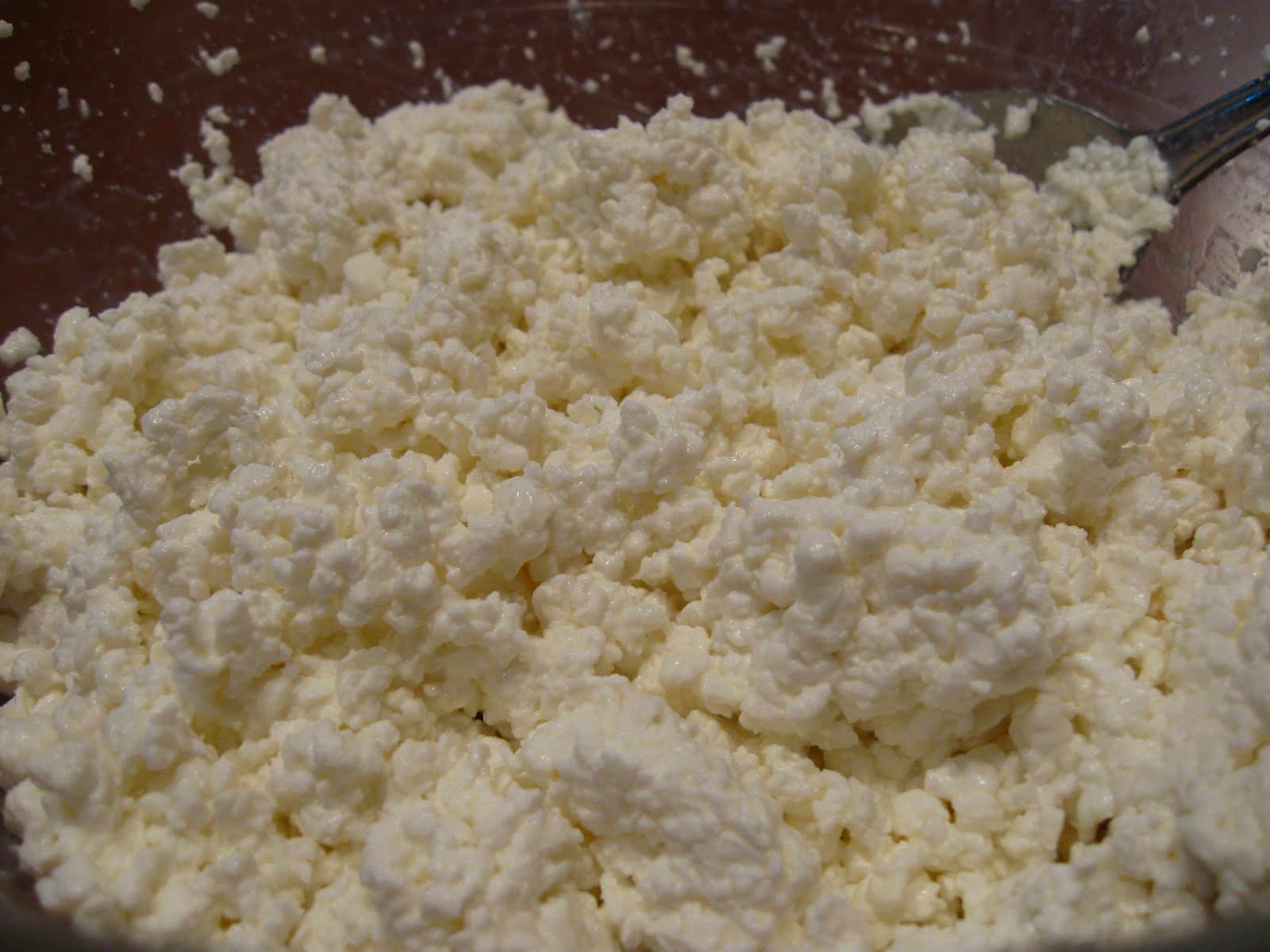
That is basically what cottage cheese is, loose curds

cottage cheese

while after a period when whey was considered only good for poor peasants, whey-based drinks are gaining a certain popularity with the health conscious.

whey-based drink

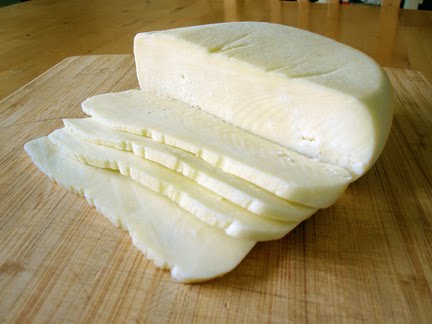
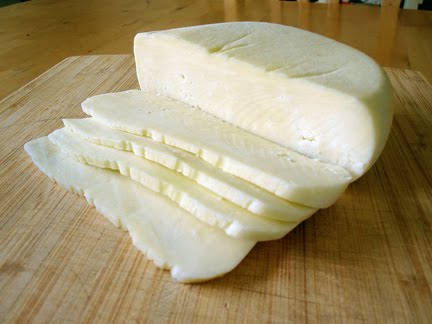
Alternatively, you can take the curds and start pressing them to get rid of liquid. Depending on how much you press them and process them thereafter, you’ll get a whole series of fresh cheeses: pot cheese, farmer’s cheese, hoop cheese, sour milk cheese, curd cheese, cream cheese, and a thousand others made in non-English cultures. I will mention three of these, the Italian mozzarella (where the curds are actually stretched and kneaded), the French fromage blanc, and the Austrian topfen: mozzarella, because it has to be the best cheese in the world; fromage blanc, because my French grandmother used to serve it when I was young and I always have it when I go back to France; topfen, because I discovered this cheese in the form of the dish topfenstrudel when we moved to Vienna. I will let this photo of farmer’s cheese stand for the whole class of fresh cheeses.

Farmer Cheese

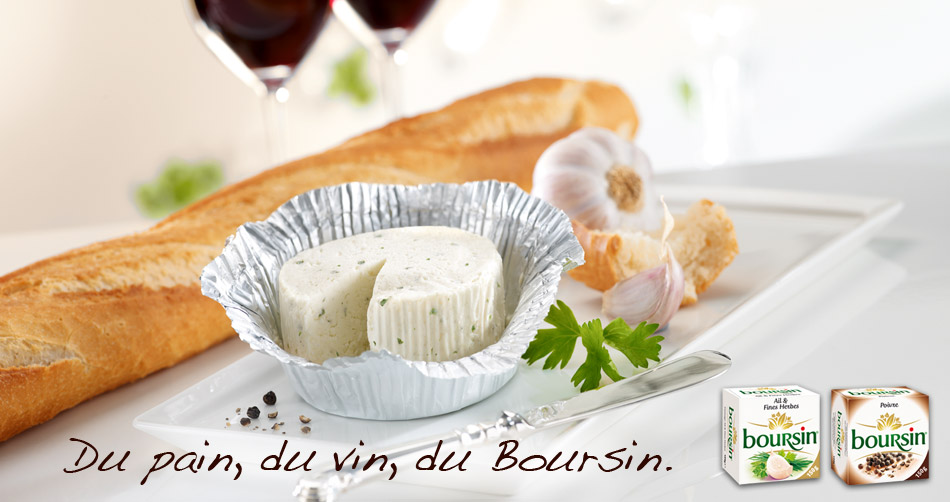
Let me also mention boursin cheese, because (a) my daughter, who set me off on this posting, likes it, (b) it is a good example of the mixing of other ingredients – in this case garlic and fines herbes – with fresh cheese to make a new product (walnuts is another popular ingredient in this category) and (c) when I was young it had a really cool advertising line, “Du pain, du vin, du boursin”

boursin pub

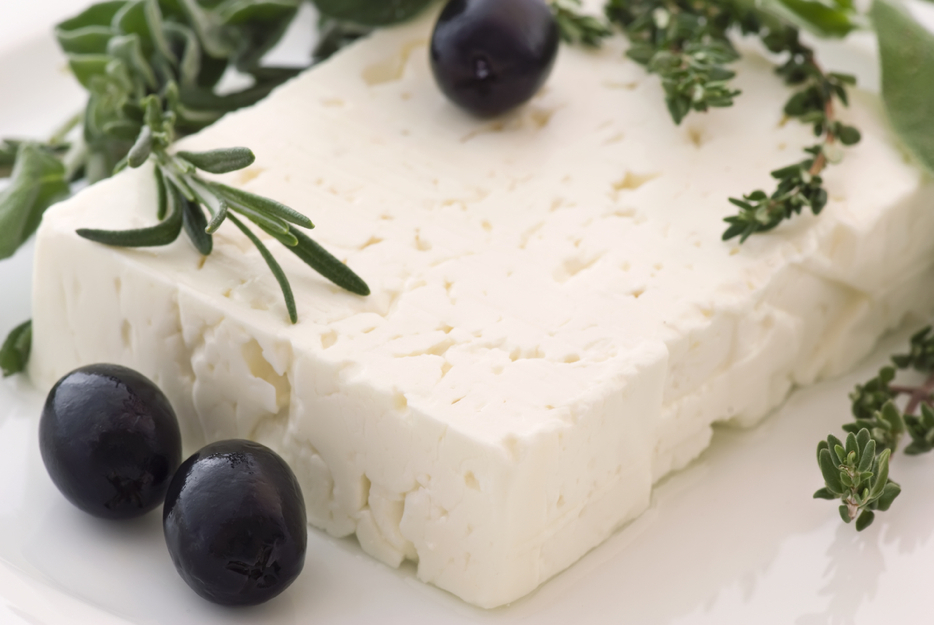
Fresh cheese is just that, fresh. If you don’t process it further, it will spoil. The most basic preserver of cheese is salt, which has been used for millennia to preserve all sorts of food (salt also firms up the texture of cheese, by the way). So as a salute to salt, let me first deal with brined cheeses, which are cheeses that are matured in a brine solution. This is the main type of cheese produced in the Middle East and the Mediterranean areas: Greek feta, Cypriot halloumi, South-Eastern European sirene, Romanian telemea, Middle Eastern akkawi, Egyptian mish (which is also pickled), …. I will let a photo of feta cheese stand in for the class of brined cheeses.

feta

In other cases, … well, the pressed curds seem to be processed in a bewilderingly different number of ways. They will always be salted (to put off spoilage). Some will be heated (which will kill off some, but not all, bacteria). Others will be washed (getting rid of acid and so making them milder to eat). Some are gently set in moulds (soft cheeses), others have the curds ruthlessly crumbled before being subject to moulding (hard cheeses). Then the cheeses are left to ripen for anything from three weeks to several years. But they aren’t left alone, oh no! Many are regularly washed, which helps to form the rinds and keep the cheese moist and no doubt to impart specific tastes. Brine is a common washing solution. In some cases, just to complicate things, the brine is aromatized with herbs. Alcoholic beverages are also popular rinses: wine, cider, beer, and just about any other alcoholic drink known to man. Or the cheeses are sprayed or injected with molds, or smeared with bacteria or molds or yeasts. Or some are smoked. And after all of this, cheese makers still keep fiddling: with humidity levels, with temperature, and with I don’t know what else. All of which gives rise to a dizzying variety of cheeses: they can be soft, or semi-soft, or medium-firm, or firm, or hard; their texture can be brittle, chalky, chewy, creamy, crumbly, flaky, grainy, runny, sticky; they can taste ammoniated, buttery, clean, complex, fermented, herbal, mild, musty, nutty, ripe, robust, salty, smoky, sour, spicy, sweet, tangy, tart, yeasty.

And I haven’t mentioned the effect on taste and texture of what is really the very, very first step in cheese-making, the choice of milk. I think you can make cheese from any mammalian milk (some clever fellows have even made cheese from human milk), but in practice cow’s milk dominates. Goat’s milk is also popular in many parts of the world, while sheep’s milk gets an honourable mention. Water buffalo’s milk is a must for mozzarella. Yak’s milk is used by the Mongolians and Tibetans. The Mongolians also use horse mare’s milk, while Afghanis and Pakistanis use camel’s milk. The Finns use reindeer’s milk, while Serbians have a tradition of making cheese with donkey’s milk. As anyone knows who has eaten goat’s cheese, for instance, the choice of milk sure changes the taste of the cheese. And of course milk isn’t just milk! There are those who insist that what the animals ate – hay versus grass versus any old crap – will affect the milk and therefore the taste of the cheese, so there are cheeses where – it is claimed – only milk from cows eating grass is used. And the time of the year in which the milk is produced, others say, affects its biochemical makeup, so there are cheeses which, I read, should only be made in March, or October, or …

All of this is enough to give one a strong headache …

Out of all of this seeming chaos, I have managed to extract a few categories of ripened cheeses to describe in more detail. Let me start with those cheeses which have molds sprayed onto them, principally of the penicillin family, and which give rise to rinds with white blooms on them. The best known of these has to be the French Camembert, whose surface is sprayed with a mold that is so linked to the cheese that it is named after it, Penicillium camemberti.

Camembert

After years of eating it too, I feel I should also mention the French Brie.

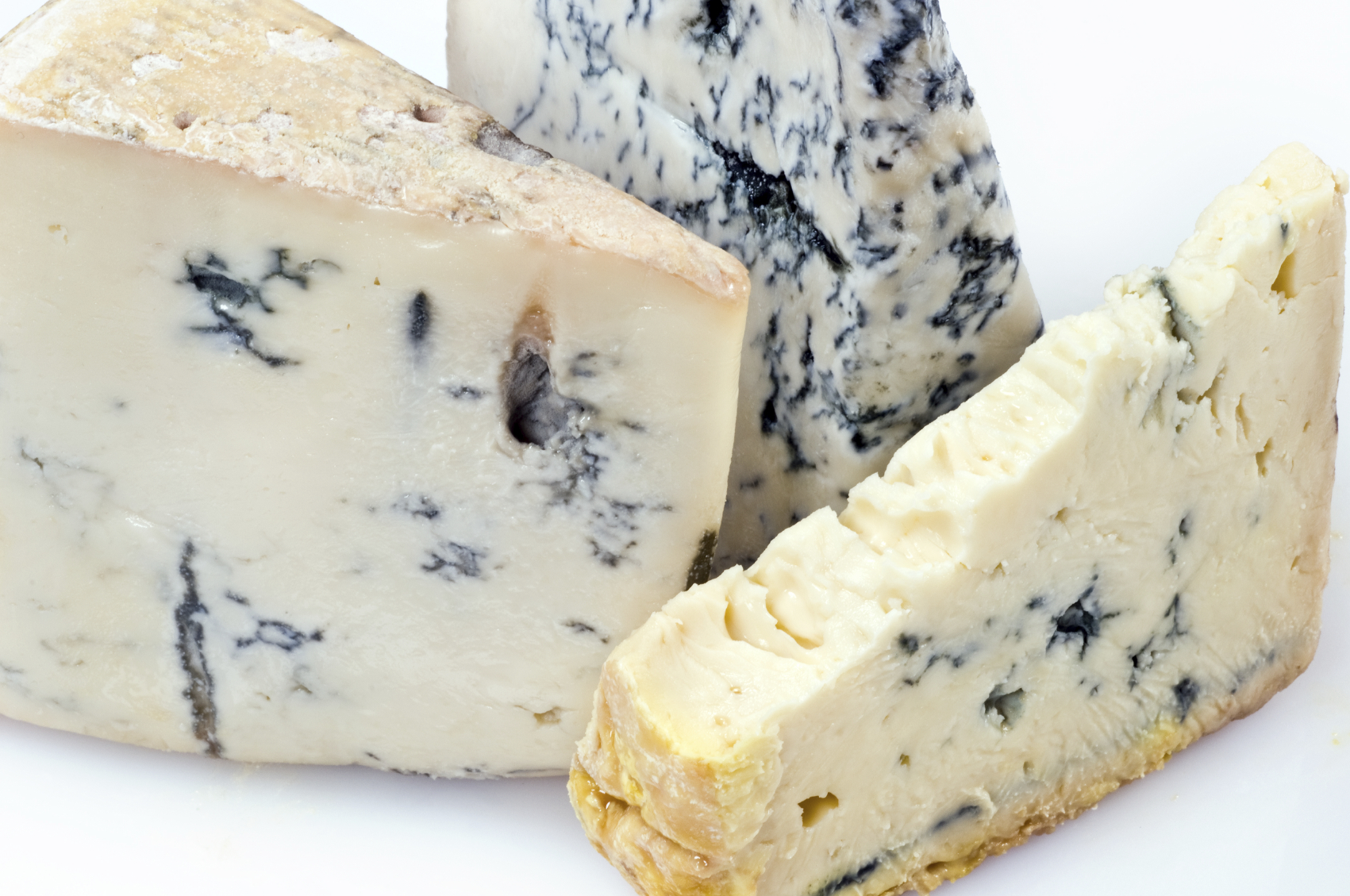
Then there are the cheeses where the mold is injected into them. The French Roquefort and English Stilton fall into this category, although I will have a picture of the Italian Gorgonzola stand in for this group

gorgonzola

for the completely trivial reason that when I drove through the village of Gorgonzola (which is near Milan) for the first time, I belatedly realized that actually the cheese was named after a real place.

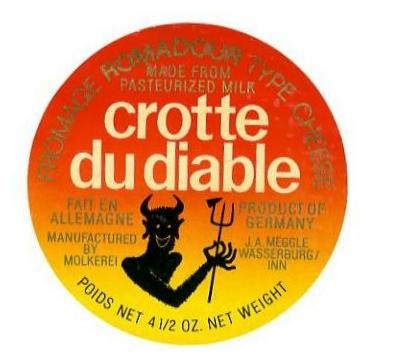
Then there are the cheeses whose rinses encourage the growth on the rinds of another bacterium, Brevibacterium linens, which gives these cheeses their characteristic pinkish-reddish tint. This bacterium is ubiquitous on the human skin, so no prizes for guessing how it ended up on the cheeses. It is also why our feet smell when sweaty, which no doubt explains why the cheeses in this category tend to stink (it looks like we weren’t so wrong when as boys at school we accused each other of having socks which smelled of old cheese). There are some well-known cheeses in this category like Munster, Limburger, and Port-du-Salut, but I will use as a stand-in for this group a cheese that sadly no longer seems to exists but was a family favourite when I was young: crotte du diable, devil’s droppings (I have mentioned this cheese in a previous post).

crotte du diable

The cheese was very aptly named, having an incredibly foul-smelling rind, so foul that you had to wash your hands very thoroughly after eating it. But the cheese itself was wonderfully smooth.

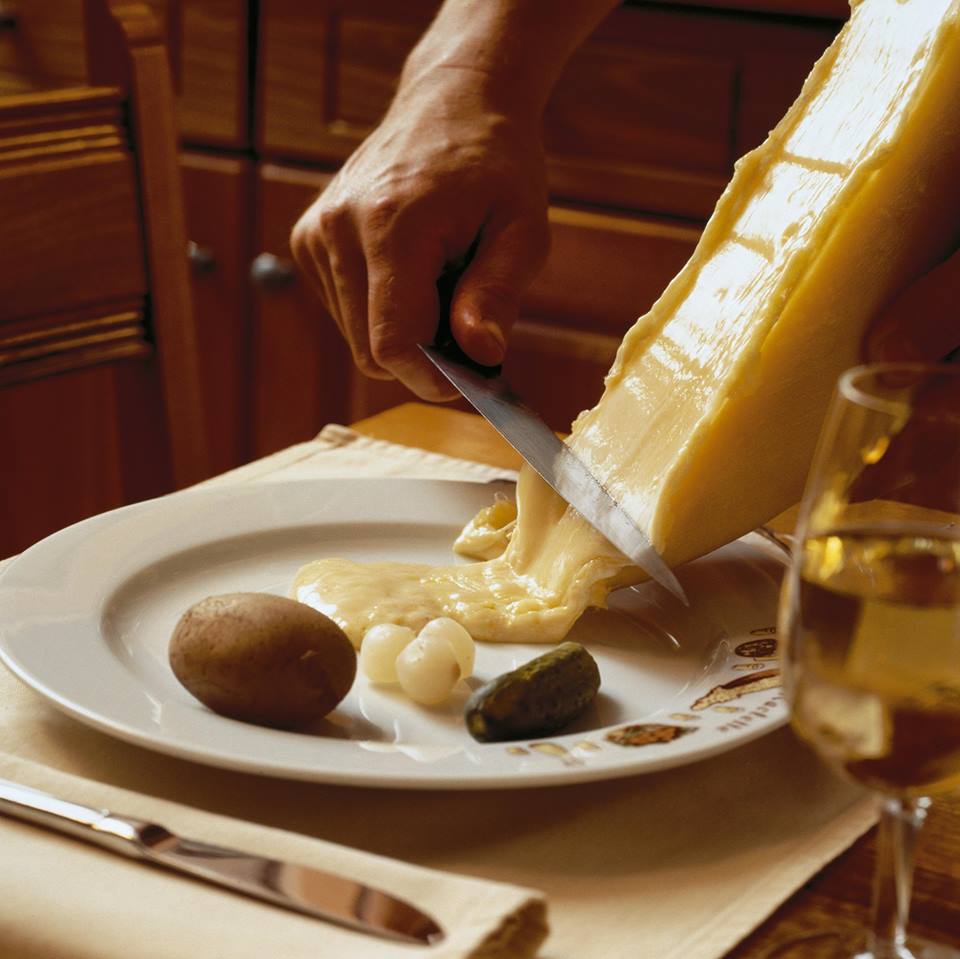
I have to mention another cheese in this category, the Swiss Raclette. My wife introduced me to this cheese. She had got to know it well during her skiing days in the Alps. During our time in Paris, in the early 1980s, we discovered a little restaurant just off the Champs Elysées where you could get a glorious raclette, served just the way it should be, scraped (raclé) onto your plate and served with gherkins, pickled onions, and potatoes in their jacket.

Raclette

When we went back to Paris many years later, we homed in on the place for lunch like bees for their hive. Alas! the restaurant was gone. Glumly, we wandered into a nearby restaurant and had ourselves a totally non-descript lunch. Sic transit gloria mundi.

I can’t think what other categories to extract from this mass of cheeses (over 700 of them according to www.cheese.com). So I’ll just salute a few cheeses which I personally consider deserve special mention:

The great, the glorious, the incomparable, Parmigiano Reggiano

Parmigiano reggiano

not to be grated onto some anonymous pasta, and not to be shaved onto some anonymous salad, but to be eaten alone, flake by grainy flake, slowly and with hushed reverence. When, a few years ago, my wife and I saw that a rare earthquake in Emilia Romagna had wrecked a couple of Parmigiano Reggiano storehouses, we briefly toyed with the idea of jumping onto the first airplane back to Italy and picking up some slightly damaged wheels of the cheese on the cheap. Good sense eventually prevailed.

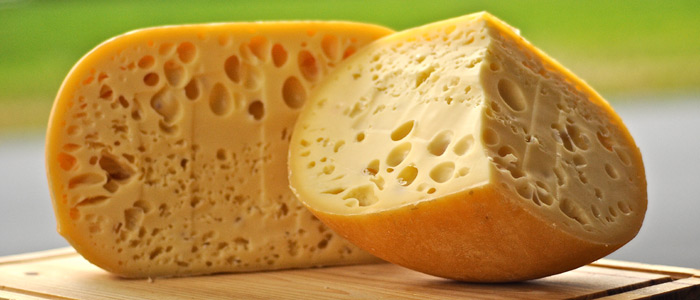
Emmental

Emmental

which for me somehow is my youth (my mother was a generous purchaser of the cheese), and whose holes (which I have just learned are called “eyes” in the trade) fascinated me. With old age, I have become boringly scientific and now know that the eyes are caused by the use in the starter bacteria of the bacterium Propionibacterium freudenreichii, which consumes lactic acid and excretes CO2; the latter creates bubbles, which we see as eyes (if you get my drift). In the old days, these eyes were considered defects to be avoided, but no doubt after seeing how the eyes made the cheese popular with children and therefore with their parents, emmental makers began to encourage their presence.

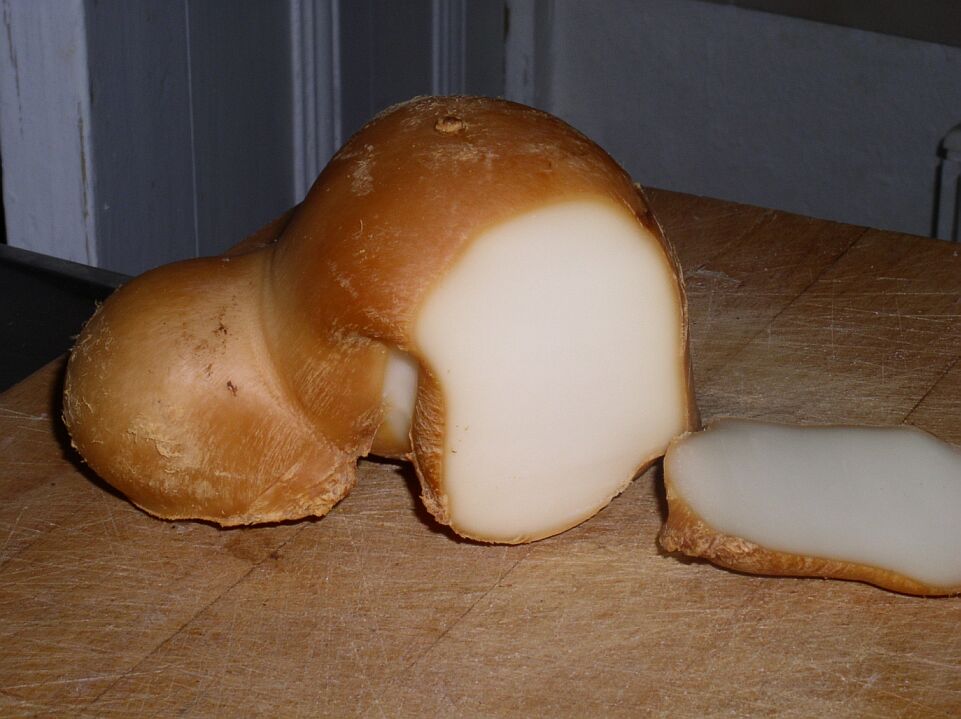
Then I pass on to scamorza affumicata, which is not that well-known outside of Italy. Like mozzarella, it’s a stretched curd cheese which is then allowed to ripen. Makers form a ball and then tie a string around it to hang up in the store room, which explains its “strangled” shape.

scamorza

It looks like this inside.

OLYMPUS DIGITAL CAMERA

It is best when smoked, and best eaten grilled on bread. It was one of the Italian foodstuffs which my wife introduced me to when we first met.

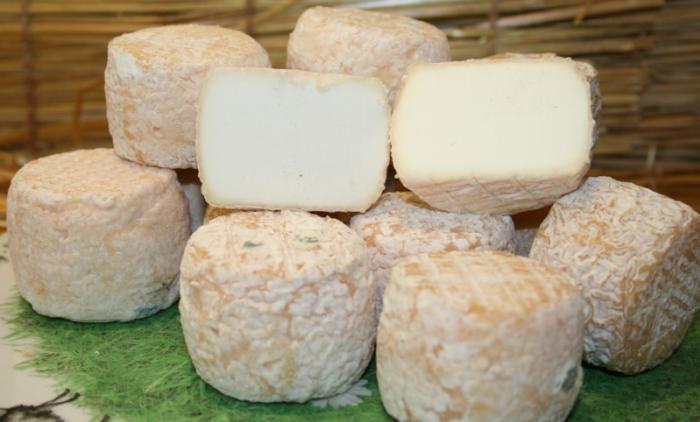
And finally, goat’s cheese. Not those fussy little rolls you find in upscale shops, often covered in herbs or pepper or some other thing. No, I mean the goat’s cheese which I would eat at my grandmother’s house in France, which looked like this

fromage de chevre

The ones I ate were made by the farmer’s wife down the road. When we needed some, my mother or grandmother would give me the money, I would hop on my Solex and speed over to the farm, and after a little chit-chat – “how are you? how are the children?’ – she would take me out to the yard, where in an old bird cage sat a number of goat cheeses of differing ages. After some thoughtful discussion, I would choose a few, ranging from the fresh to the somewhat aged. Ah, those cheeses were soooo good!

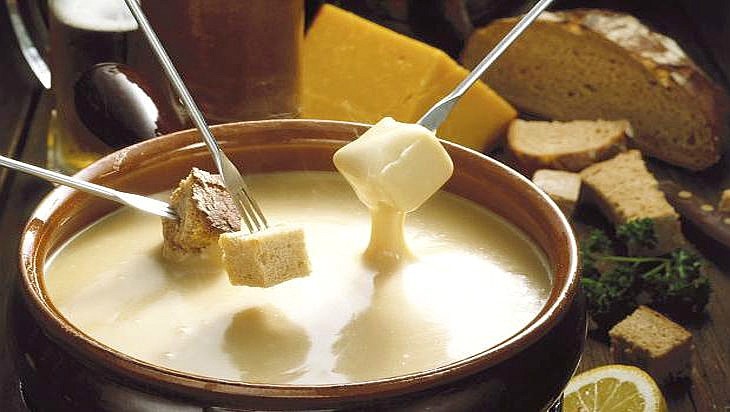
I cannot end without a mention of Fondue, even though it’s a cheese dish rather than a cheese, because it’s just so … damned … good. It can be made from quite a number of cheeses, often mixed together, produced in the Alps or in the nearby Jura mountains: the Swiss Gruyère, Emmental, Vacherin, Sbrinz, and Appenzeller; the French Comté, Beaufort, and Reblochon; or the Italian Fontina. The key, of course, is the white wine. Here’s how you prepare a fondue: (1) Rub the inside of the pot with garlic. (2) Lightly heat the white wine with cornstarch (used to prevent separation of wine and cheese). (3) Add the grated cheese or cheeses and stir until it is all melted. (4) Top off with a bit of kirsch. Start eating, dipping chunks of bread into the pot.

fondue

Fondue has become so linked with Switzerland that Astérix, that bellwether of popular European culture, has fondue playing a prominent part in the album Astérix chez les Hélvètes. But in a bout of creative delirium the writer, Goscinny, and the illustrator, Uderzo, laced this most Swiss of traditions with debauchery borrowed from Federico Fellini’s much-discussed film Satyricon, which came out a year before the Asterix album was published and scandalized many. Satyricon included a series of Roman orgies, full of painted faces, feelings of ennui, mechanical gorging of elaborate food, and sado-masochistic punishments. So the fondue parties organized by Goscinny-Uderzo’s Roman governor of Helvetia take the form of orgies – although, to the governor’s great irritation, they are much too clean; this is Switzerland, after all.

asterix and fondue

The scenes pick up on a tradition that if you lose your bread in the fondue pot, you are punished in some way: for instance, a man has to buy a round of drinks, while a woman has to kiss her neighbours. In the case of Asterix, the young fool is thrown into Lake Geneva with weights attached to his feet, another nod to the casual brutality which filled Satyricon.

Anyway, these are my choices. I’m sure each one of my readers has his or her own list of favourites. I earnestly suggest that they immediately rush out, buy one or more of their favourites, and gorge themselves in a wild bout of cheese-eating.

And I hope I’ve answered my daughter’s question about how cheese is made.

_________________________

Monks in a cellar: http://p9.storage.canalblog.com/95/74/180464/28709536.jpg [in http://toutinfrimage.canalblog.com/archives/2008/08/07/10163569.html%5D
Curds: http://3.bp.blogspot.com/-e_yg4m7wR4g/Toy0E_DhaOI/AAAAAAAAChs/Qmjyg7II6Gw/s1600/salting_curds.jpg [in http://cooking-from-scratch.blogspot.com/2011/10/cottage-cheese.html
Whey: http://4.bp.blogspot.com/-n-UC59ZGNzg/T7sTeo1GtWI/AAAAAAAABCM/9qzvn0wQ3U0/s1600/Whey.jpg [in http://www.hybridrastamama.com/2012/05/making-whey-protein-and-cream-cheese-try-these-unique-food-products.html%5D
Little Miss Muffet: http://bloximages.chicago2.vip.townnews.com/nwitimes.com/content/tncms/assets/v3/editorial/e/b6/eb652bda-d380-5344-a681-06a4de4af8d6/52e7fed631b22.preview-699.jpg [in http://www.nwitimes.com/lifestyles/food-and-cooking/from-the-farm-reader-looking-for-healthy-blender-drink-recipe/article_e8c2a9b9-4658-54a3-9d24-8f00640a8484.html%5D
Cottage cheese: http://uptownmagazine.com/files/2014/05/uptown-kraft-cottage-cheese-recall.jpe [in http://uptownmagazine.com/2014/05/kraft-recall-cottage-cheese/%5D
Whey-based drink: http://www.ebperformance.com/wp-content/uploads/2011/05/proteinjuice-bottles.png [in http://www.ebperformance.com/products/protein-drinks/%5D
Farmer’s cheese: http://3.bp.blogspot.com/_a-oLImtGrzM/S_Mpn-DOErI/AAAAAAAAAr0/ivqGKz6av4s/s1600/Blog+Raw+Milk+Farmer+Cheese+8.jpg [in http://artistta.blogspot.com/2010/05/homemade-raw-milk-farmer-cheese.html%5D
Feta cheese: http://www.yiannislucacos.gr/sites/default/files/ingredient318_feta2.jpg [in http://www.yiannislucacos.gr/en/ingredient/2404/feta-cheese%5D
Boursin publicity: http://www.boursin.ch/uploads/pics/Indexbild_ganze_Breite_2011_01.jpg [in http://www.boursin.ch/%5D
Camembert: http://upload.wikimedia.org/wikipedia/commons/8/88/Camembert.JPG [in http://en.wikipedia.org/wiki/Camembert%5D
Gorgonzola: http://blog.fairwaymarket.com/wp-content/uploads/2011/10/GorgonzolaCheese.jpg [in http://blog.fairwaymarket.com/2011/10/blue-cheese-moldy-cheese-day/%5D
Crotte du diable: http://p1.storage.canalblog.com/18/34/180464/7469035.jpg [in http://toutinfrimage.canalblog.com/archives/2006/10/15/2911082.html
Raclette: http://www.gentlemansgazette.com/wp-content/uploads/2013/12/Traditional-Raclette.jpg [in http://www.gentlemansgazette.com/dinner-party-ideas-how-to-host/%5D
Parmigiano Reggiano: http://upload.wikimedia.org/wikipedia/commons/5/5b/Parmigiano_reggiano_piece.jpg [in http://en.wikipedia.org/wiki/Parmigiano-Reggiano%5D
Emmental: http://cheesecrafters.ca/wp/wp-content/uploads/2012/06/full_Emmental.jpg [in http://cheesecrafters.ca/products/emmental/%5D
Scamorza affumicata: http://www.lascelta.com/media/catalog/product/cache/1/image/700×477/9df78eab33525d08d6e5fb8d27136e95/f/o/for022aff.jpg [in http://www.lascelta.com/formaggi/semi-stagionati/scamorza-bianca-1.html%5D
Scamorza-inside: http://upload.wikimedia.org/wikipedia/commons/8/85/Scamorza.jpg [in http://en.wikipedia.org/wiki/Scamorza%5D
Goat’s cheese: http://www.fromagerie-martin.com/photos/crottindechevre_23071.jpg [in http://www.fromagerie-martin.com/fiche_produit.php?id=23071%5D
Fondue: http://postfiles15.naver.net/20140430_30/cheesemarket_1398825823552cruRM_JPEG/%C6%FE%B5%E04.JPG?type=w2 [in http://blog.naver.com/PostView.nhn?blogId=cheesemarket&logNo=90194981830&categoryNo=0&parentCategoryNo=21&viewDate=&currentPage=1&postListTopCurrentPage=1%5D
Asterix and fondue: http://3.bp.blogspot.com/-94znst74TRI/TwEM1x4890I/AAAAAAAAPzA/OoSEUFiQkN0/s1600/asterix+chez+les+helvetes.jpg [in http://heavenlypalate.blogspot.com/2012/01/cheese-fondue-great-cheesy-meal-during.html%5D

CAPERS

Beijing, 7 June 2014

It never ceases to amaze me that there are certain ingredients which one adds to recipes in small quantities but which make a huge difference to the final taste. Spices are the obvious example – although I often wish that the hot spices had never existed – but there are others. Parsley, for instance, or coriander, or anise. Or capers.

Capers are a particular favourite of mine ever since a business trip I made many years ago to Malta. I was there to do an environmental audit of a factory. After a long day of inspecting the wastewater treatment plant, the waste segregation area, the toxic chemicals storage area, and I don’t know what else, my colleagues and I were finally free for dinner. We left the hotel and wandered around, but it was a dead time of the year and there wasn’t much available. We finally came across a modest restaurant, which proclaimed itself to be a fish restaurant. Why not? we said, after all, we were in an island, presumably the fish would be good. And it was, it was! We all ordered Orata al cartoccio, where a bream is cooked – steamed in its own juices, really – in a closed aluminium foil package together with cherry tomatoes, capers, and olives. It’s really a very simple recipe. Having washed and cleaned the bream, you lay it on a big piece of aluminium foil, you place a little rosemary inside the fish, drizzle it with olive oil, place the sliced cherry tomatoes, rinsed capers, and olives around the bream, wet the whole with a little white wine, wrap up the foil and close it well (so that none of the juices escape), and cook it in the oven at 200°C for about 45 minutes. Voilà!

orata pomodorini capperi olive

Simple, but absolutely delicious. The capers in particular impart a taste to the fish’s flesh which even to this day, after all these years, I can summon up at will for my private delectation.

The marvelous effect of the capers was actually quite a surprise to me. I had first come across capers as a young boy, at my English grandmother’s house. At some earlier moment, my elder brother had evinced a love of capers, so every time he came to stay with her she bought a small jar of them. This time, I was in tow so I got to try some. Salty! So salty! How could anyone like these tiny balls of salt? I made sure to steer clear of them after that, pushing them carefully aside if I came across them in a salade Niçoise, for instance. Until that fateful encounter in a modest fish restaurant in Malta. Such is life …

After that gastronomic epiphany in Malta, I feel that I owe it to the caper to write its hagiography, which like all good hagiographies should start from its birth. The caper comes from a bush, the caper bush to be precise, capparis spinosa. The bush is not much to write home about. Here is an example from the island of Salina, one of the Eolian Islands off the north-west coast of Sicily

caper bush-1

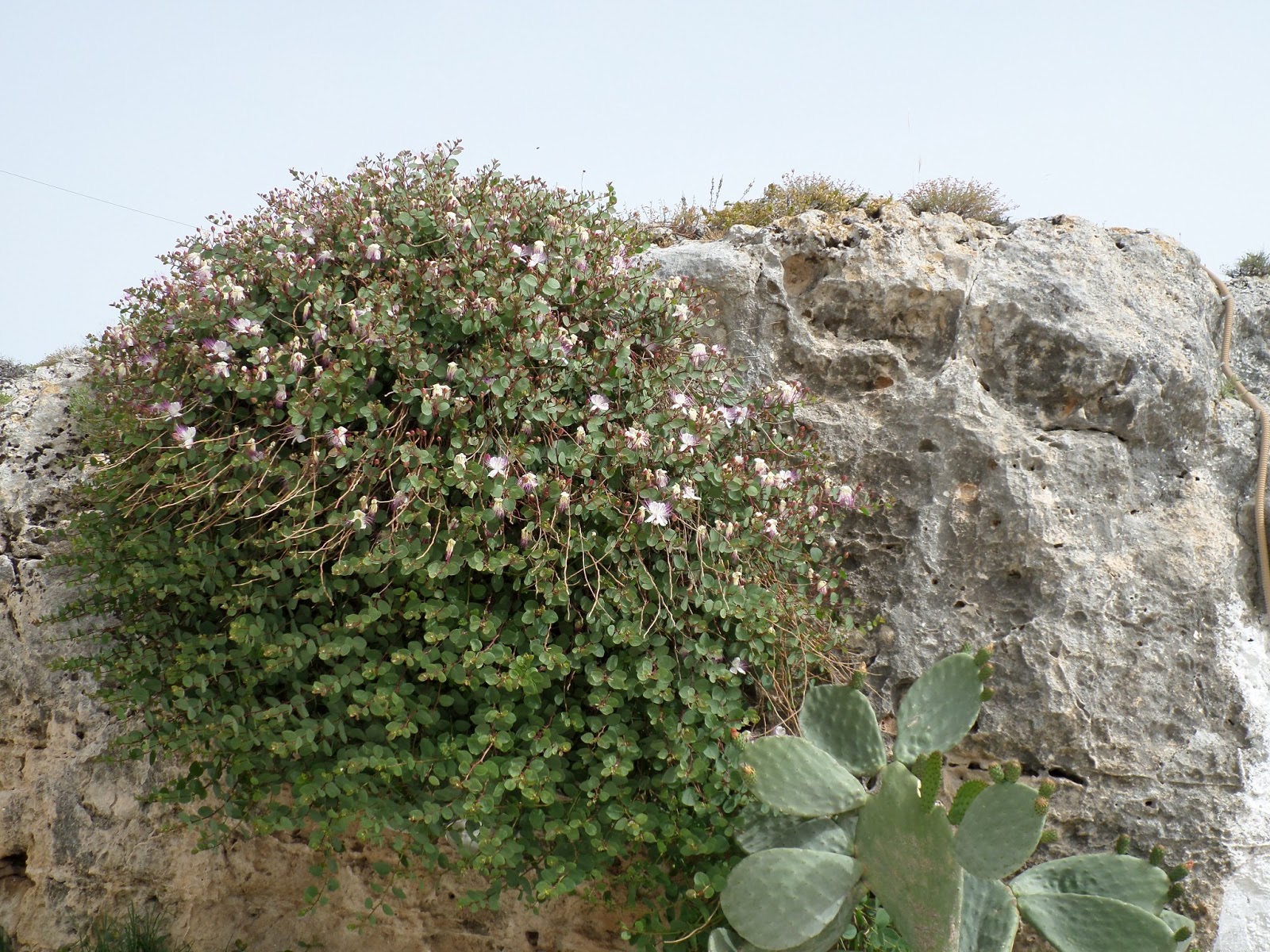
and here’s another from near Brindisi in southern Italy

caper bush-2

Both pictures admirably depict the poor, rocky soils and harsh environments that the bush grows well in. They also tell us that you find the bush around the Mediterranean. But that’s not only place you find C. spinosa; the bush has quite a wide range, down through eastern Africa, across central, southern, and southeastern Asia, all the way out to the Pacific Islands and Australia. But as far as I know, and I’m very willing to be corrected, the caper is not used in the local cuisine in any of these areas.

The last picture also tells us that the bush sports flowers. Small, but actually very lovely, with a cluster of long mauve stamens reaching out to the world (this is one of many beautiful photos of the caper flower on the internet; the efforts of my photographic e-friends have turned me quite poetic).

caper flowers-2

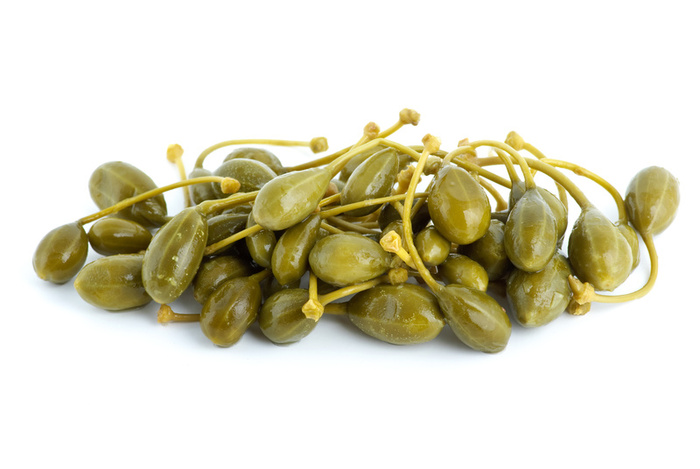
This last picture also modestly introduces us to the hero our story. Because the caper is that green flower bud behind. It gets picked, salted, and pickled for our delight. I think it deserves a picture of its own

caper buds

I have to say, I always marvel at things like this. How did the women in some far-off time think of picking the flower buds of this bush to eat? (I’m sure it was the women; the men were just lazing around the camp fire cracking stupid jokes and farting.) Maybe desperation, to stave off starvation. Or maybe … but I’m getting ahead of myself.

Capers are sold sorted by size. Either because the French got into the game of commercializing capers before anyone else, or because some canny marketer thought French names would sell better, or for some other reason unknown to me, the grades mostly have French names. From smallest to biggest we have: “non-pareil”, incomparable; “surfine”, very delicate (those hideously salty little balls which my grandmother bought for my brother must have been either surfines or non-pareils); “capucine”, which is a little pointed cowl, like the ones worn by Franciscans nuns – looking at the photo below and squinting a little, I suppose you could say that the capers in question look cowl-like; “capote”, which is a rather bigger cowl with a definite point (it is also French slang for a condom for reasons which I’m sure the readers can divine after a little bit of thought); “fine”, delicate (like the oysters). And at the very end of the grades we have “grusas”, which is not a French word. My guess is that it’s Provençal and has a meaning similar to the Spanish “gruesos”, fatty. Of course, the French were not going to use their delicate language for such a coarse member of the caper family. As one could guess from the grading nomenclature, the smallest sizes are considered to be the most desirable; I’m sure it is no coincidence that the smallest sizes come from southern France …

graded capers

Malta brought me my culinary epiphany with the caper. It also introduced me to the caper berry, which I find to be a much more delicious product of the caper bush. My Italian colleague, whom I have had cause to mention in an earlier post as the person who introduced me to durian, was with me on this Maltese environmental audit. Rather than asking the staff of the wastewater treatment plant to see the data on wastewater treatment efficiency he asked them to get him several jars of pickled Maltese caper berries. On the promise of my not revealing this professional faux-pas of his he shared one of the jars with me, which I took home to my wife. We have been hooked ever since.

caper berries-2

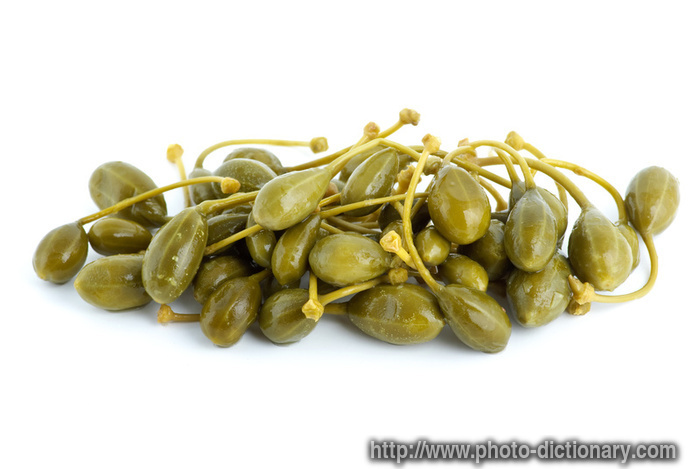
As the name suggest, caper berries are the fruit of the caper bush. This photo shows the berry in its natural state.

caper berries-natural state

I understand they are perfectly edible, although I have never seen them sold in a shop. I’ve only eaten the pickled variety. They are much bigger than capers, less salty, more crunchy (because of the seeds they contain) and can be eaten as a snack – and my wife and I have indeed snacked happily and often on them, in front of the TV or other such snack-happy locations.

Coming back to my meditation on how anyone ever came up with the idea of pickling flower buds to eat, I suspect the path was through the berry: step 1 – eat the berries; step 2 – salt the berries to preserve the excedent harvest before they rot; step 3 – hang on, why don’t we try the same thing with the flower buds?

My in-depth research (i.e., Wikipedia) has revealed to me that in Greece and Cyprus they also eat the pickled leaves of the caper bush.

caper leaves

This I have never tried. I read that they are particularly used in salads and fish dishes. A web-site called Good Greek Stuff proclaims that “these tangy cured leaves of the caper plant are less salty than the buds, and lend a citrusy undertone to such foods as Greek country salad, dakos (barley rusks with tomato, olive oil and feta), fish sauces, and cabbage slaws. It gives an astringent, piquant note to herb pestos and pasta dishes. And you’ll be amazed at what it does to the humble spaghetti aglio, olio e peperoncino or how well it works as a garnish to fried squid.”

I have another culinary epiphany awaiting me in some Greek island.
__________________
Orata, pomodorini, capperi, olive: http://www.cucinanonnapapera.it/wp-content/uploads/2011/07/PICT1017.jpg [in http://www.cucinanonnapapera.it/?p=464%5D
Caper bush Salina: http://atasteoftravel.files.wordpress.com/2011/07/20110717-082956.jpg [in http://atasteoftravelblog.com/2011/capers-on-salina/%5D
Caper bush Brindisi: http://2.bp.blogspot.com/-2Nr_U2AWCUs/Uaid3mGYgqI/AAAAAAAAASM/NBQh22nv_Rk/s1600/Caper+Bush+growing+from+Rocks.jpg [in http://lisainitalymay2013.blogspot.com/%5D
Caper flower: http://kojikisans2.files.wordpress.com/2013/01/caper11.jpg?w=1008 [in http://kojikisans2.wordpress.com/%5D
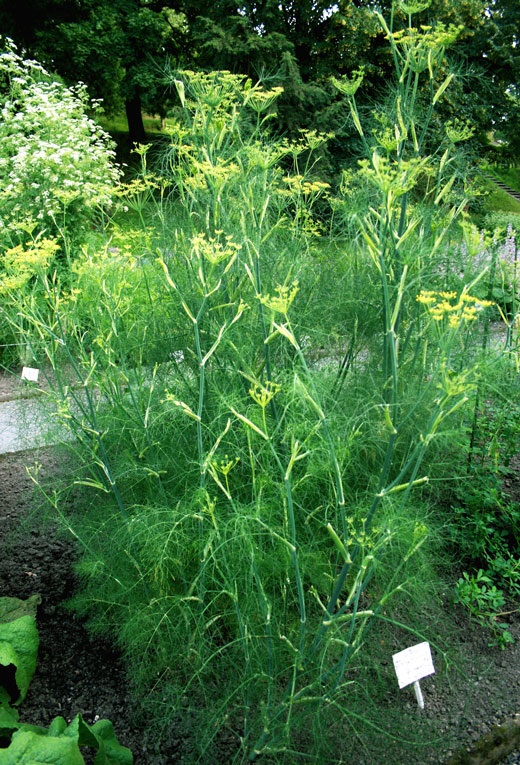
Caper flower buds: http://en.wikipedia.org/wiki/Caper#mediaviewer/File:%E1%83%99%E1%83%90%E1%83%9E%E1%83%90%E1%83%A0%E1%83%98_Capparis_spinosa_Kapernstrauch.JPG [in http://en.wikipedia.org/wiki/Caper%5D
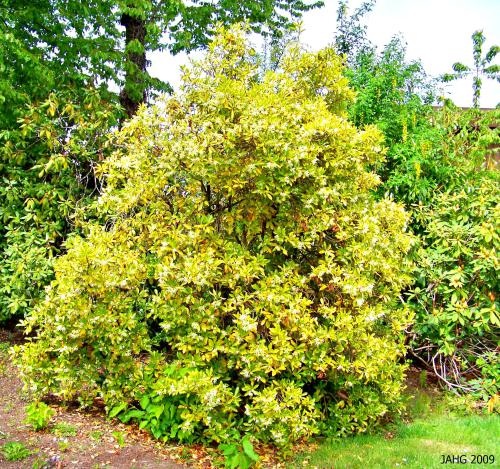
Graded capers: http://www.asofood.com/aso_images/capers.gif [in http://www.asofood.com/capers.html%5D
Caper berries: http://www.photo-dictionary.com/photofiles/list/1401/4818marinated_capers.jpg [in http://www.photo-dictionary.com/phrase/1401/marinated-capers.html%5D
Caper berries-natural state: http://2.bp.blogspot.com/_Okhm7AjHzv8/R1kZdfwxBCI/AAAAAAAAAac/Eu8RWxYi6f4/s320/e-caperberries.jpg [in http://medcookingalaska.blogspot.com/2007/12/recipes-caper-tart-capers-and-eggs.html%5D
Caper leaves: http://eshop-santorini.gr/media/catalog/product/cache/1/image/9df78eab33525d08d6e5fb8d27136e95/k/a/kaparofilla-caper-leaves.jpg [in http://eshop-santorini.gr/index.php/authentic-food-1/more/santorini-wild-capers-1.html%5D

SCENT OF ANISE

Beijing, 16 May 2014

Several scents have followed me through my life. I wrote earlier of the scent of water. Another scent which has been a lifelong companion, gladly greeted when met, is the scent of anise.

I first became aware of the scent of anise during those long summer holidays of my youth which I spent at my grandmother’s house in France. To while away the summer days, my cousins and I would go for long bike rides through the surrounding countryside. We would often stop at bistrots in the villages we passed through, to have a break and slake our thirst. Given our young age, we would ask for soft drinks: a lemonade for me, while my cousins would opt for a sirop à la menthe, a peculiar French drink, violently green in colour and based on mint. Propping up the bar, meanwhile, there would always be a couple of locals, drinking, regardless of the time of day, un petit rouge (a glass of red wine), or un petit blanc (ditto, but white), or a beer, or a pastis.
image
They were normally also enveloped in a thick cloud of cigarette smoke which emanated from the unfiltered Gauloises cigarettes hanging from a corner of their mouths.

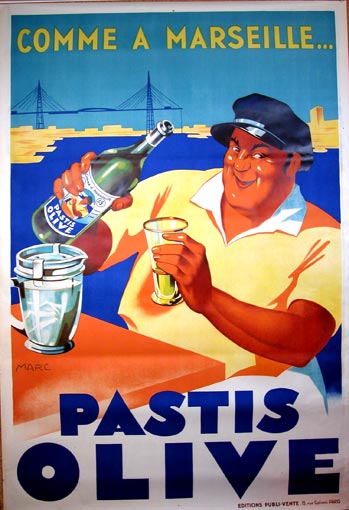
I was particularly fascinated by the pastis. For those of my readers who are not familiar with this drink, pastis is a typically French liquor very much associated with the south of France.
image
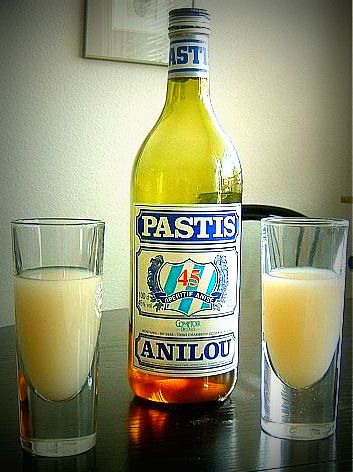
It gives off this wonderful aroma, being flavoured with aniseed (as well as licorice). It is strong (40-45% alcohol by volume), but it is never drunk neat. The drinker will add a fair amount of cold water before drinking it, at which point the liquor’s original dark transparent yellow colour clouds to a milky soft yellow.
image
As a boy, I would never tire of watching this wondrous, almost alchemical, change take place before me and breathe in the sweet scent of anise.

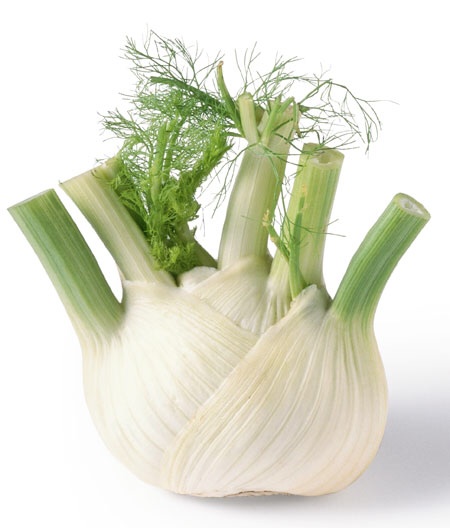
Since my family never used anise or the closely related fennel in cooking, I only next stumbled across the scent of anise when I came to Italy for the first time, nearly forty years ago. My wife to-be (as it turned out, although I didn’t know it then) introduced me to finocchio, or Florence fennel, a special cultivar of the fennel which was developed in Italy.
image
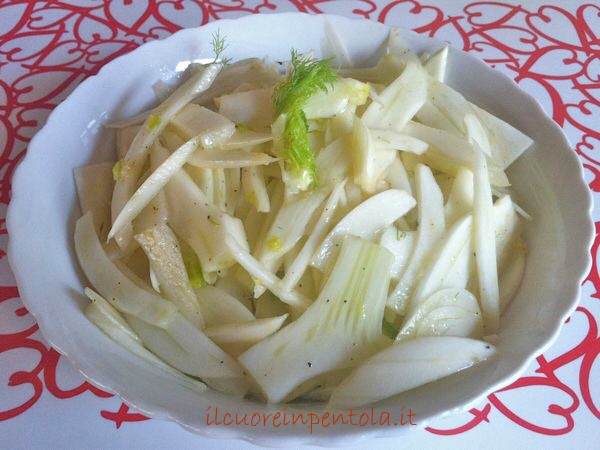
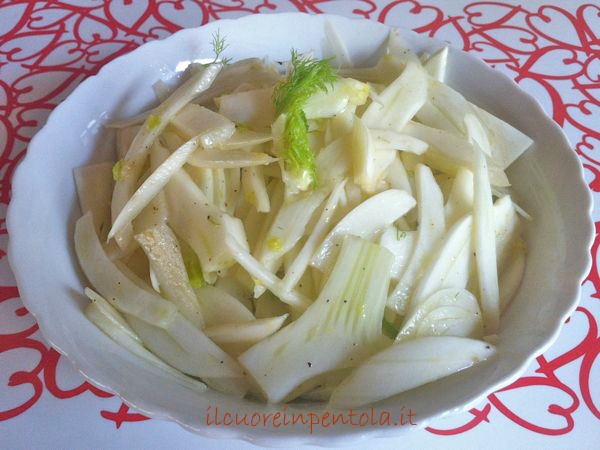
Many people (my late mother-in-law for one) eat finocchio cooked or braised but I prefer it raw, sliced very thin, almost shaved, with a simple oil and vinegar dressing.
image
Like that, it maintains the scent of anise, which begins to waft out as you prepare it in the kitchen, rises appetizingly from the plate as you spear the fennel slices, and is liberated in your mouth as you crunch down on them. Whenever I’m in Italy, and if it’s the right time of year, I will eat finocchio. In fact, it was my having a finocchio in salad last night that moved me to write this post.

Years later, just after coming to China, I stumbled across the scent of anise in another guise. During one of the early banquets to which I was invited, I noticed a star-shaped thing sitting in my dish.
image
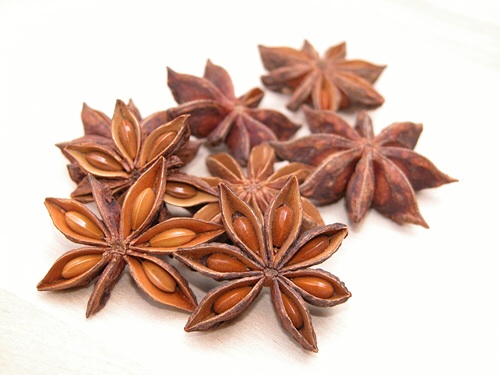
Intrigued, I asked what it was. Star anise, I was told, a spice which is commonly used in Chinese cooking (and actually in the cuisine of much of Asia, as I later discovered). It’s actually a very pretty spice:
image
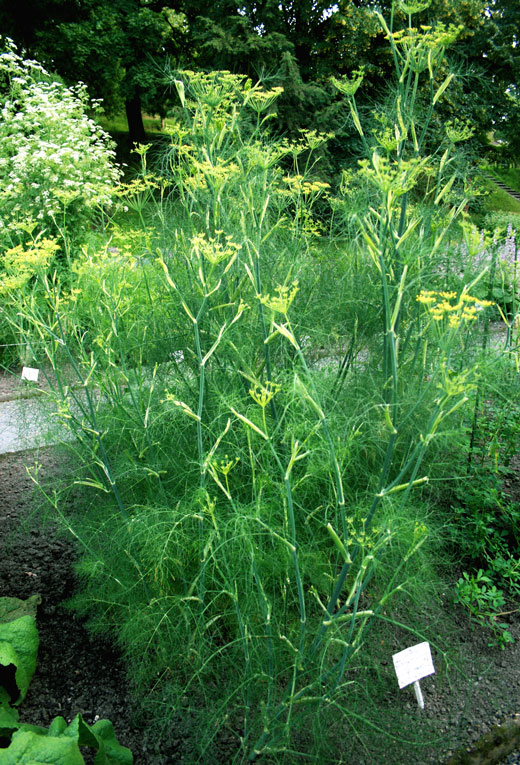
In any event, even more intrigued, I took a tentative bite and suck, and it did indeed taste of anise. But later research showed me that similar taste and scent do not a botanical relationship make. Anise, Pimpinella anisum, and Fennel, Foeniculum vulgare, are flowering plants which are both members of the Apiaceae family, and in fact look quite similar:
Anise:
image
Fennel:
image
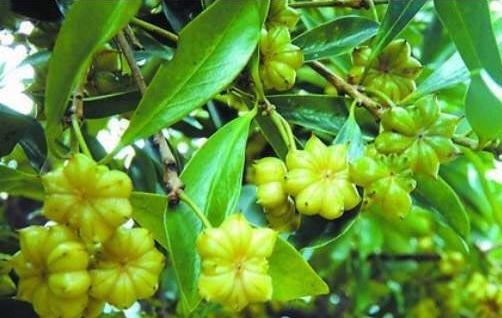
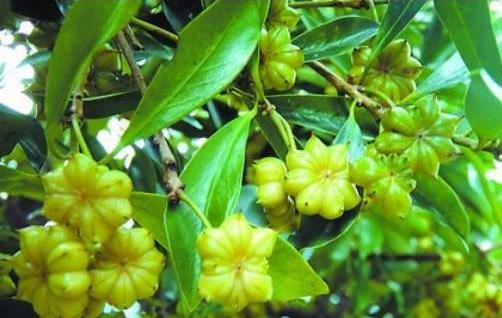
Star anise, on the other hand, is the fruit of a medium-sized tree or big bush, Illicium verum, of the Schisandraceae family:
image
image
The same-scentedness arises from the happy chance that all three plants (as well as licorice to some degree) contain the organic chemical anethole – and here I get distinctly nerdy and add a diagram of this chemical
image
Why these unrelated plants should all contain anethole I don’t know – and why we smell it and taste it as pleasant I don’t know either. Somewhere out there in the ether there may be papers which explain. But I have neither the patience nor the energy to trawl through the depths of the internet to find them.

But what I have found out is that there is at least one other plant out there whose leaves contain anethole. This is the rare tree from the Australian rainforest, the ringwood or (appropriately) aniseed tree, Syzygium anisatum – although confusingly, the leaf, which contains the anethole, is called anise myrtle.
image
image
Feeling rather like one of those birders who will travel to the ends of the Earth to sight a bird which they have never seen, I am thinking (although I have not yet told my wife this) that she and I should travel to Australia again, this time to try this new, exotic source of anise scent. I read with interest that anise myrtle is considered a bush tucker spice in Australia, that is to say a spice from a native plant which can be used to spice a dish of native fauna and flora. Anyone for a stew of kangaroo and warrigal greens spiced with anise myrtle, followed by a couple of quandong fruit for dessert?

_____________________
A village café: http://wwwdotgretagarburedotcom.files.wordpress.com/2013/04/les-vieux-de-la-vieille-jean-gabin-noc3ablnoc3abl-pierre-fresnay-via-pkcine-com.jpg (in http://gretagarbure.com/tag/comptoir/)
Pastis poster: http://www.posterclassics.com/Images-Drinks-French/bigPastisOlive.jpg (in http://journals.worldnomads.com/theglobetrottingtexan/story/69164/France/Marseille-Pastis-Capital-of-the-World#axzz31oe3iEng)
Pastis going cloudy: http://www.frenchmoments.eu/wp-content/uploads/2013/04/Pastis-©-Peng-CC3.0.jpg (in http://www.frenchmoments.eu/pastis-from-provence/)
Finocchio: http://www.dietagratis.com/wp-content/uploads/2014/01/Finocchi08-450RCS.jpg (in http://www.dietagratis.com/ricette-light/3552-insalata-di-finocchi/)
Finocchio salad: http://www.ilcuoreinpentola.it/images/stories/ricette/2013/maggio/insalata-finocchi.jpg (in http://www.ilcuoreinpentola.it/ricette/contorni/insalata-di-finocchi/)
Star anise in a dish: http://www.withaglass.com/wp-content/uploads/2013/10/tenderloinsoyp.jpg (in http://www.withaglass.com/?p=15273)
Star anise alone: http://foodie-isms.com/wp-content/uploads/2011/04/star-anise1.jpg (in http://foodie-isms.com/?p=5085)
Anise plant:http://herbgardening.com/HerbGardeningImages/AnisePimpinellaanisum.jpg (in http://herbgardening.com/growinganise.htm)
Fennel plant: http://herbgardening.com/HerbGardeningImages/Foeniculum_vulgare520.jpg (in http://herbgardening.com/growinganise.htm)
Illicium verum: http://thegardenpalette.files.wordpress.com/2009/06/watermark_303.jpg?w=500&h=468 (in http://thegardenpalette.wordpress.com/tag/star-anise/)
Star anise on tree: http://www.cnseed.org/wp-content/uploads/Star%20Anise%20seed%20Illicium%20verum.jpg (in http://www.cnseed.org/star-anise-seed-illicium-verum.html)
Anethole structure: http://structuresearch.merck-chemicals.com/cgi-bin/getStructureImage.pl?owner=MDA&unit=CHEM&product=800429 (in http://www.merckmillipore.com/chemicals/trans-anethole/MDA_CHEM-800429/p_BwWb.s1L3_sAAAEWfeEfVhTl)
Aniseed tree: http://floragreatlakes.info/rfsimages/ringwood1.jpg (in http://floragreatlakes.info/html/rfspecies/ringwood.html)
Anise myrtle: http://www.anfil.org.au/wp-content/uploads//flushing-tree.bmp (in http://www.anfil.org.au/key-native-species/flavour-of-the-month-february/)

I LOVE ITALY

Milan, 13 May 2014

My wife and I have finally arrived in Italy. On our way home from the station last night we dropped into our local supermarket to buy stuff for supper. We chose simple fare which required no cooking. We started with mozzarella di bufala, mozzarella made in the south of Italy from the milk of water buffaloes

image

My wife pours a teaspoonful of extra virgin olive oil on her mozzarella, but I like it on its own. Like that you can really appreciate the delicate milky juices oozing from the cheese when you put a slice of it in your mouth.

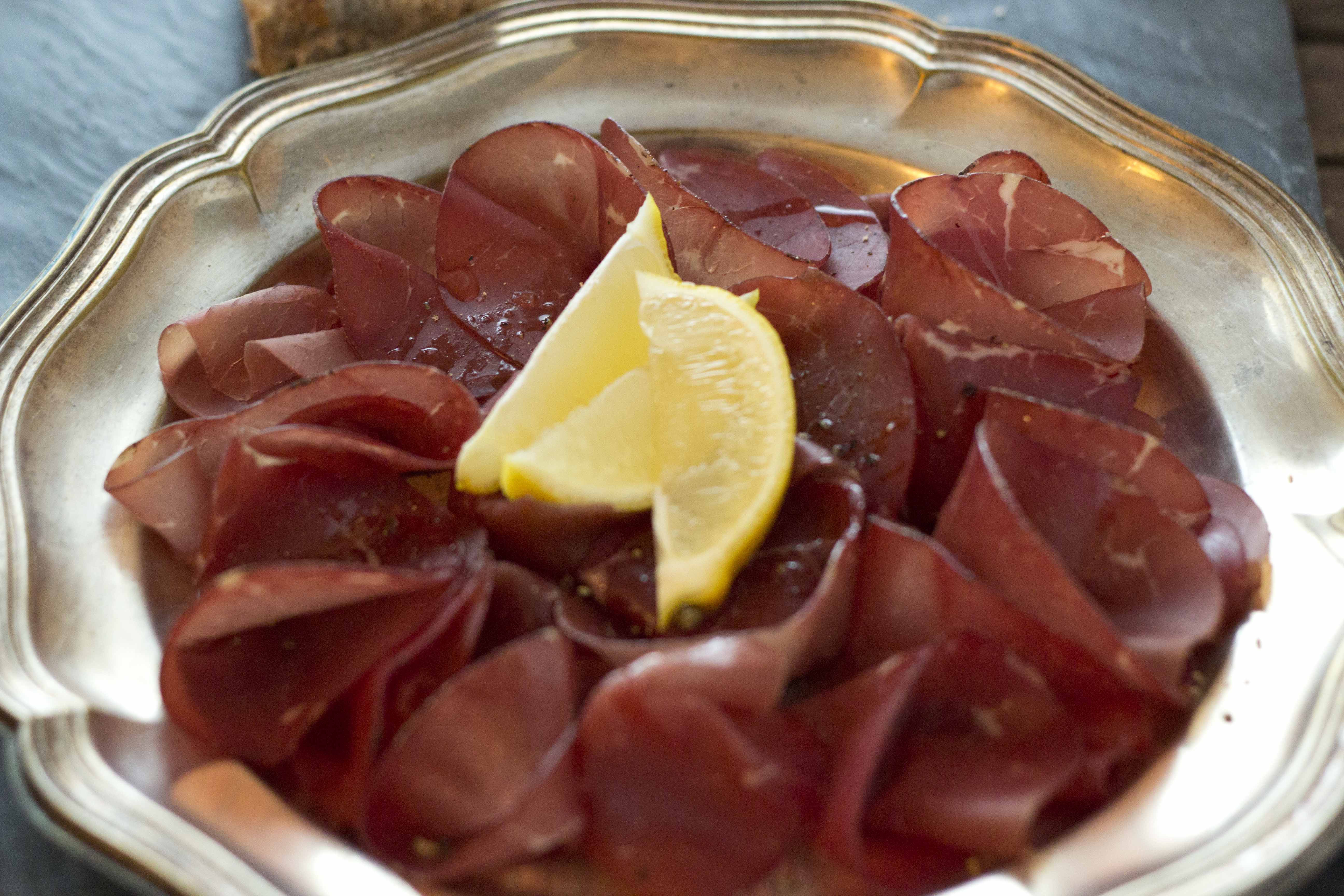
We then had a plate of bresaola, air-dried beef from the Valtellina, an Alpine valley to the north of Milan. It is at its best with a drizzle of lemon juice and olive oil.
image
We followed this up with a plate of cooked ham and cantaloupe melon. Italians will normally eat their melon with raw ham
image
but I prefer it with cooked. That was always the way I ate it in France.

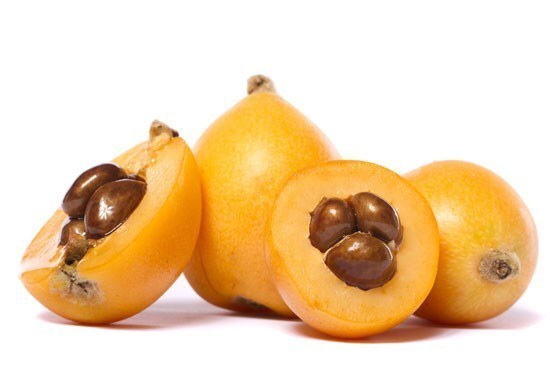
Our dessert consisted of nespole (loquat in English), a fruit I had never tried before coming to Italy thirty years ago.
image
Its yellow flesh is succulent and quite tart, and it contains very beautiful large, brown, glistening stones.

We washed this all down with a Dolcetto red wine from the Langhe region in Piedmont.
image
That’s all. Quite simple, as I said. And all from the local supermarket.

I love Italy.

____________________

Mozzarella di bufala: http://giacomoleopardi.provincia.venezia.it/trasformazioni%20alimentari/IMMAGINI/Formaggi%20Alberto,%20Alessio%20&%20Mattia/mozzarella%20di%20bufala.bmp (in http://giacomoleopardi.provincia.venezia.it/trasformazioni%20alimentari/mozzarella_di_bufala.htm)
Bresaola, lemon, oil: http://www.livingalifeincolour.com/wp-content/uploads/2013/09/meimanrensheng.com-bresaola.jpg (in http://www.livingalifeincolour.com/recipes/bresaola-air-dried-beef-with-olive-oil-and-lemon-lombardia/)
Melon and ham: http://www.cookingwithpatty.com/italian/wp-content/uploads/2009/11/prosciuttomelone.jpg (in http://www.cookingwithpatty.com/italian/recipe/cantaloupe-with-ham-prosciutto/)
Nespole: http://casabenessere.files.wordpress.com/2013/06/nespole.jpg (in http://casabenessere.wordpress.com/2013/06/11/nespole/)
Langhe region: http://blog.wineowine.com/wp-content/uploads/2014/04/le-langhe.jpg (in http://blog.wineowine.com/le-langhe/)

PEKING DUCK LIKE OPIUM

Beijing, 30 April 2014

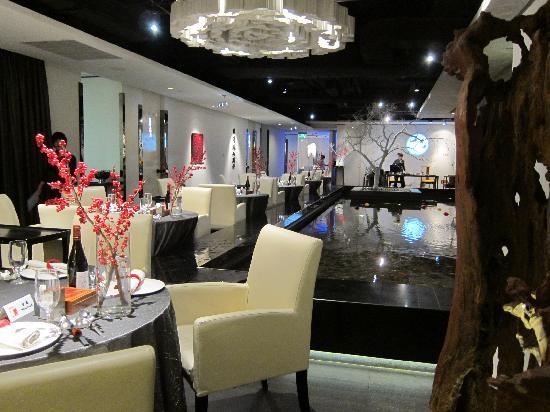
One of the first things my wife and I did when we arrived in Beijing was to eat Peking Duck. Well, not quite the first thing. We waited until the children came a few months later to visit us at Christmas before trying this Beijing delicacy. It was worth the wait. We went to the Dadong restaurant, which in the meantime has grown exponentially into a chain of really quite swanky restaurants scattered throughout the city.

dadong restaurant

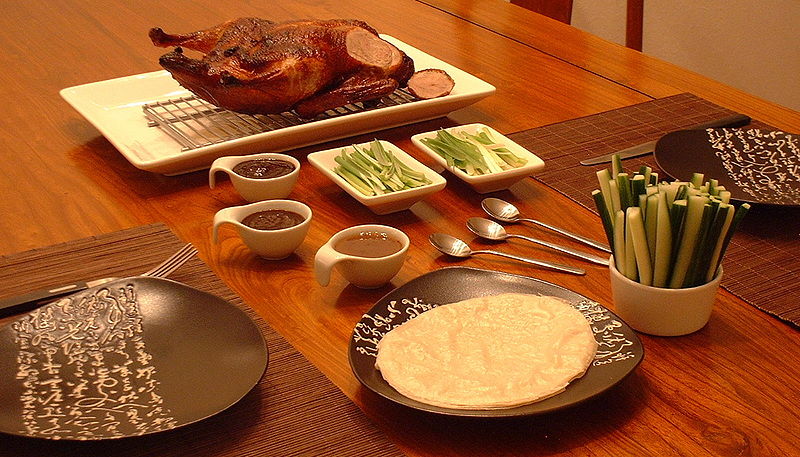
For readers who have not tried this dish, it presents itself so:

Peking Duck complete dish-3

As you can see, we don’t just have duck. Many other ingredients are part of the package. Eating Peking Duck requires one to follow a certain, very specific procedure, to bring together all these ingredients in the right order. Allow me to walk readers through the Standard Operating Procedure (SOP) for eating Peking Duck.

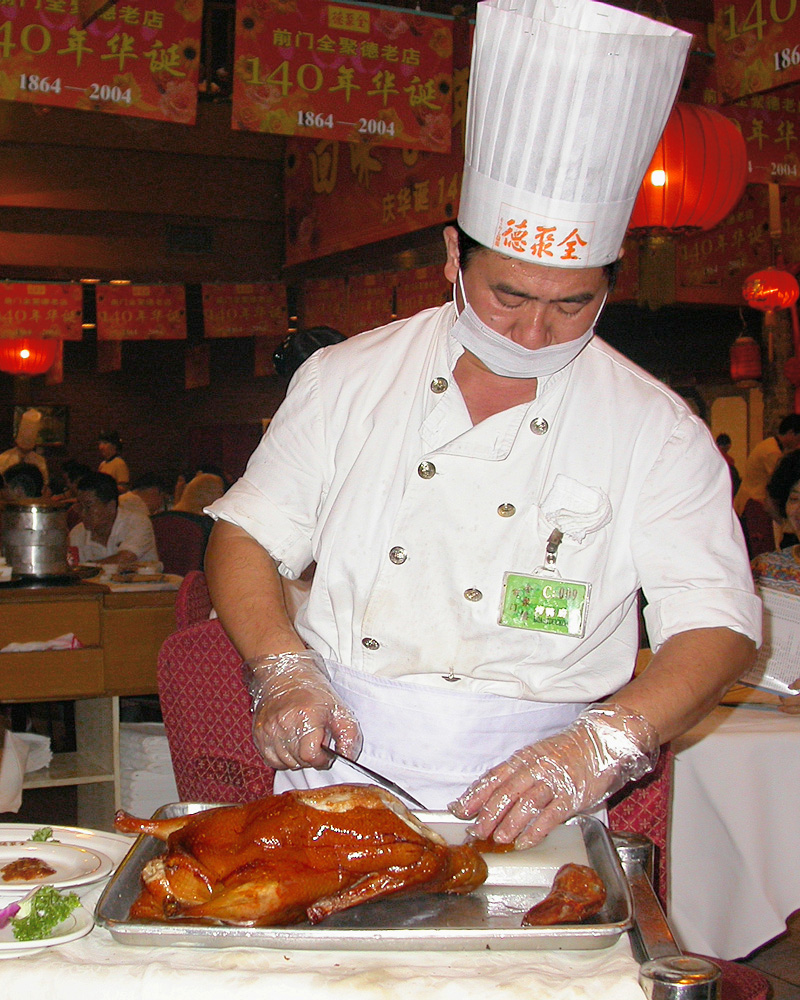
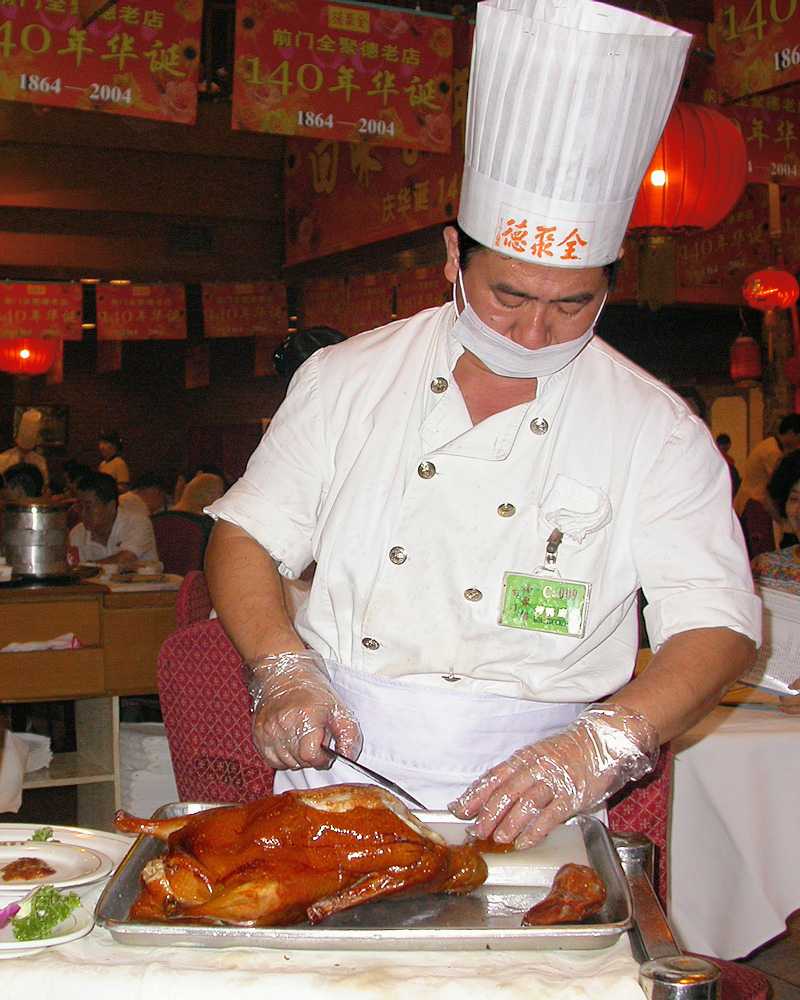
1. Look on respectfully as a chef comes to your table and slices up the bird in front of you.

cook slicing the duck

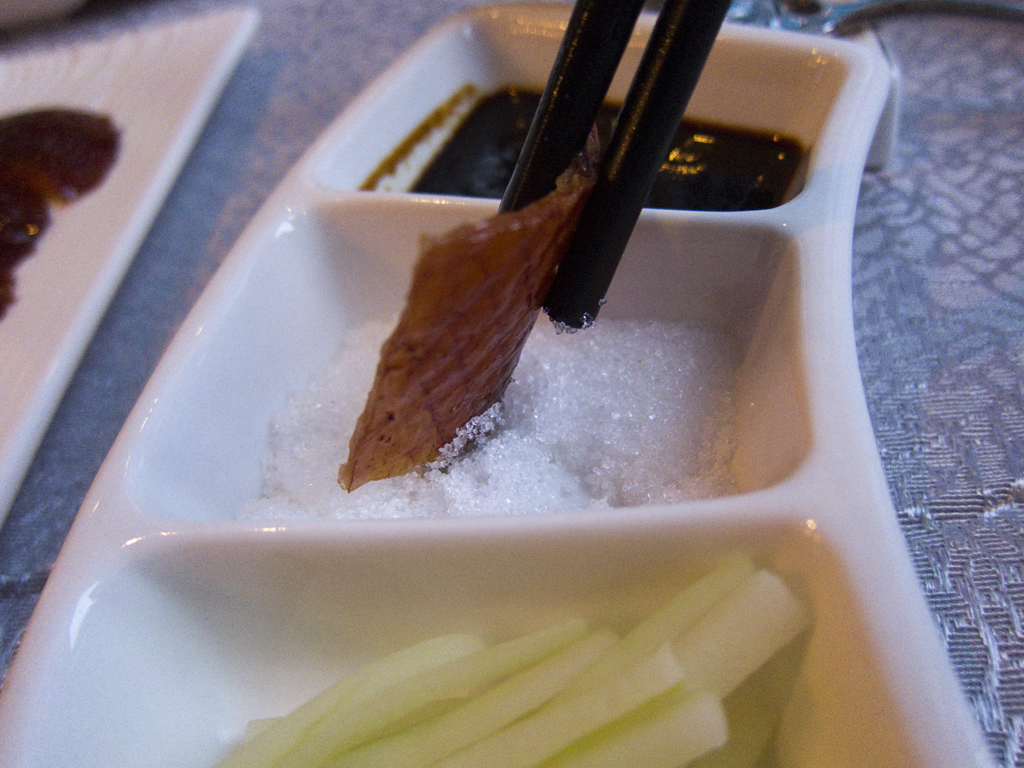
2. Start with the crispy skin. Take a piece or two, dip into sugar, and eat.

dipping skin in sugar

Personally, I find that one piece is enough for me; it’s just too fatty.

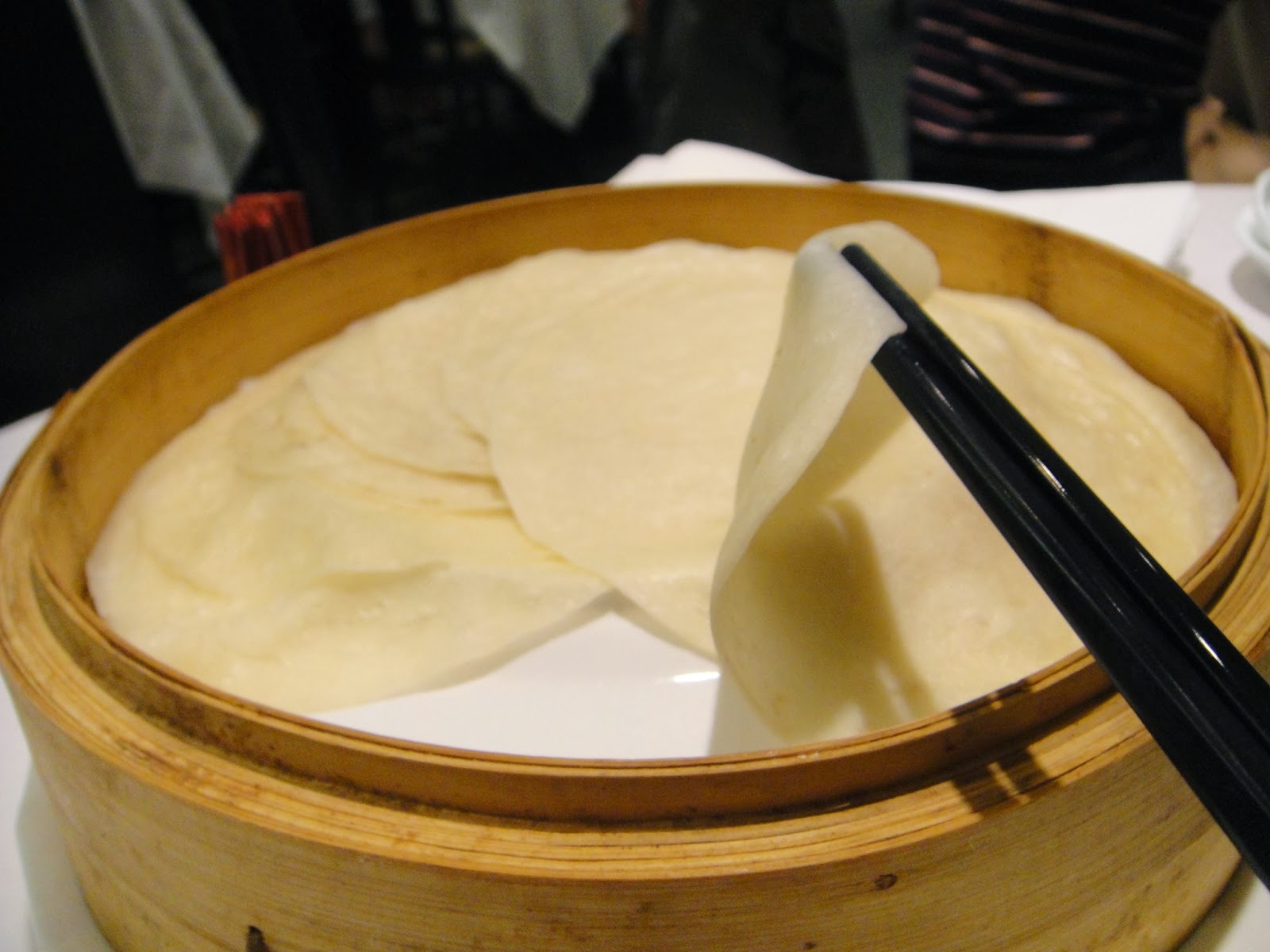
3. Start in on the duck meat proper. Pick up a wafer-thin circular crepe. For neophytes in the use of chopsticks, this can be an immense challenge.
picking up crepes
4. Use the chopsticks to smear dollops of the various sauces onto the bread wrap. The usual menu of sauces include sweet bean sauce or hoisin sauce, which is a thick, pungent sauce usually including soy, red chilies, garlic, vinegar and sugar.
hoisin sauce
5. Place the slices of roast duck on the bed of sauce. A mix of crackling skin and meat is the optimal choice. More sauce can be smeared on the meat if so desired. Place on top of the duck a couple of thinly sliced scallions.

duck and spring onions on crepe

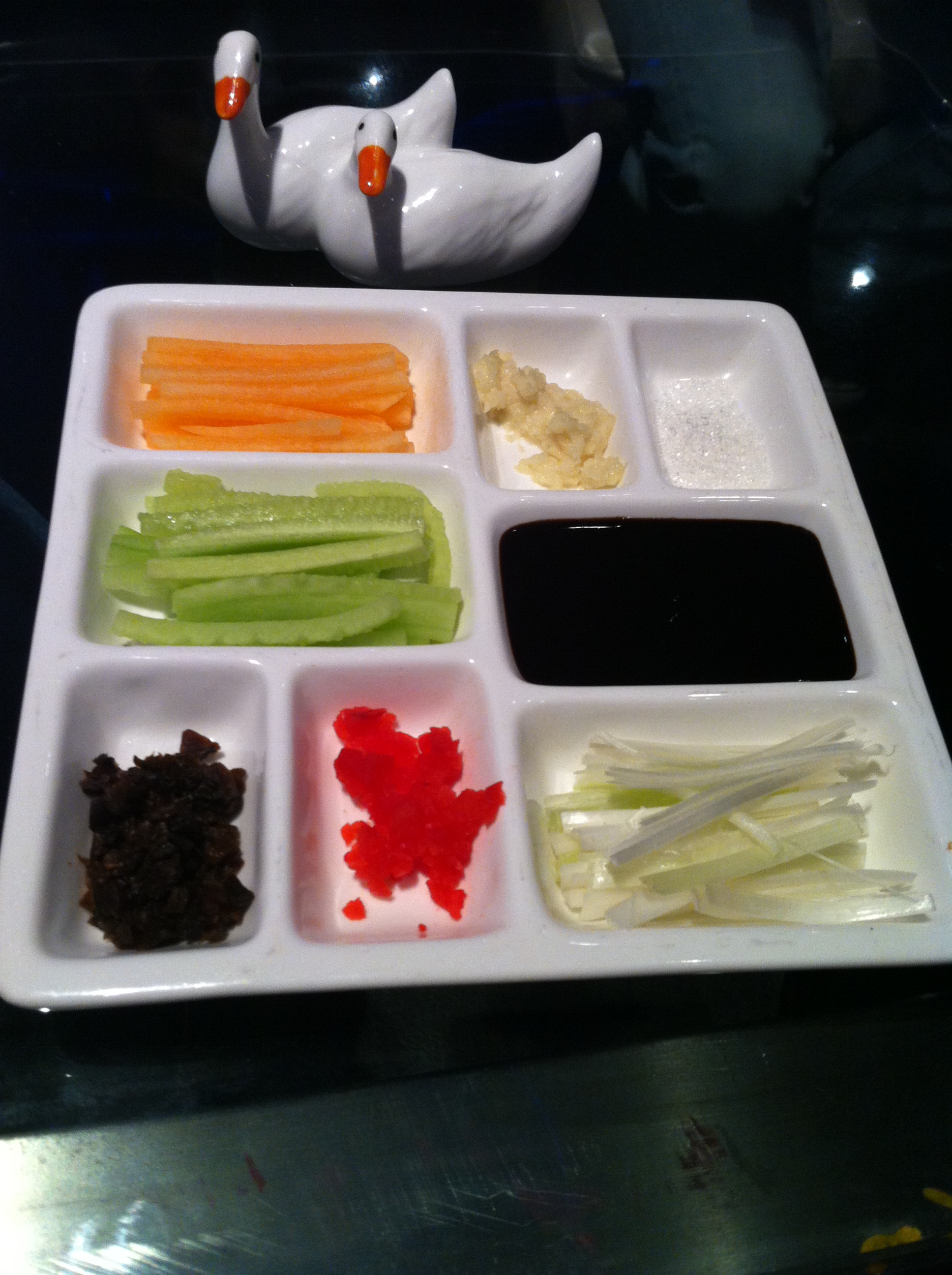
Various other ingredients can also be added: thinly chopped cucumber is popular, at Dadon they also offer thinly chopped melon and some other stuff whose identity is a mystery.

beijing duck ancillaries 002
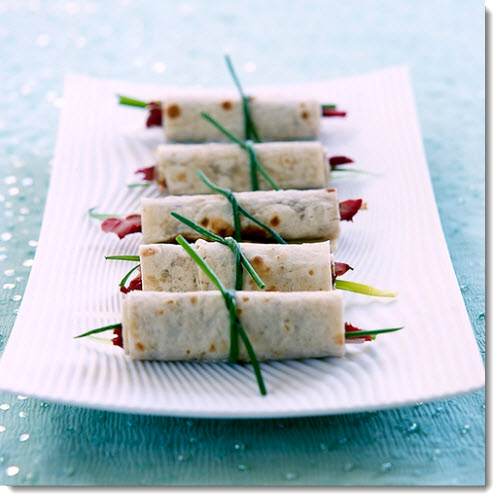
6. Roll the whole into a tubular sandwich.

rolled up crepes

These look far fancier than the ones I produce. It’s rather like comparing the product of someone who has spent a life rolling his own cigarettes to that of the fellow who is just starting out in this bad habit.

7. Eat, making loud noises of appreciation if you have been invited by Chinese hosts, who are always glad to know that you’re liking it.

8. Repeat from step 3 (or step 2 if you have a mind to), making small variations if you wish, until all the duck has been consumed.

9. As a finale, slurp down the duck soup which they will bring, made with all the leftovers of the carved ducks.

duck soup

This must really be one of the most Chinese of dishes. Some even call it China’s national dish (I’m not sure what the Cantonese think of that, but we’ll let it pass).

So it’s a bit of a shock to know that the ducks consumed in China aren’t all that Chinese.

I was informed of this fact last week during a talk in Shanghai by a very respected Academician, who revealed to the stunned audience the whole sorry story.

There was a time, before 1873, when the duck was Chinese. It had evolved and prospered on the Grand Canal, where it had grown fat on the grain that fell off the barges going north towards the capital. The Chinese, never ones to leave anything go to waste, had recycled this lost grain by domesticating the ducks and eating them. In Beijing, the SOP described above evolved as the way to consume the ducks. This culture of duck rearing was beautifully captured in the children’s book The Story about Ping, which I loved to read to my children (although I don’t know if they loved hearing me read it …)

the-story-about-ping

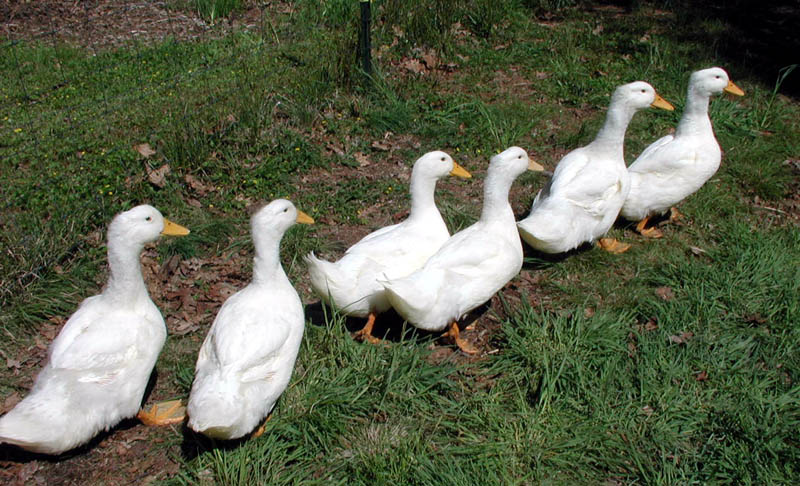
Then, in 1873, 25 of these Pekin ducks (note: no final g on Pekin) were exported to Long Island – most of them didn’t make it, eaten no doubt by the hungry voyagers on the same ship as them. The few that made it through went on to become the progenitors of the most successful domesticated breed of duck in Europe and the US. Those nice white ducks waddling around the farmyards of my youth were in all probability children of Chinese immigrants.

OLYMPUS DIGITAL CAMERA

Except that European and American farmers and agronomists were not content with just taking this Chinese duck and breeding it. They started playing with its DNA through selective breeding to make bigger, fatter, and I know not what.

In the meantime, the Chinese had slipped into anarchy, had been eviscerated by the war imposed on them by the Japanese, and – after the Revolution and the creation of the new China – had gone through the disasters of the Great Leap Forward and Cultural Revolution. So by the time the 1970s rolled in, the original Pekin Duck and its rearing were in as sorry a state as the rest of the country.

Well, the economy picked up and so did the Chinese appetite for Peking Duck. But for some reason, national production remained stagnant, or at least didn’t grow as fast. The result was that China, the biggest exporting country in the world, began to import the Pekin Ducks to turn into Peking Ducks. And began to import them in vast quantities. According to the Respected Academician in Shanghai, 70% of the Peking Ducks which are consumed in China were born and bred … in the UK. In fact, for the most part they come from one farm in Lincolnshire, the Cherry Valley Farm.

Supra

Unbelievable. It’s the opium wars all over again, except that this time the UK is flooding China with Pekin Ducks …

______________________

Dadong restaurant: http://media-cdn.tripadvisor.com/media/photo-s/01/e4/55/6e/beautiful-room.jpg [in http://www.tripadvisor.com/members-citypage/msyolee/g294212%5D
Peking duck-complete dish: http://img.cits.net/images/2011/9/27/151515157efde4e3-d.jpg [in http://www.cits.net/china-guide/china-traditions/peking-roast-duck.html%5D
Cook slicing the duck: http://upload.wikimedia.org/wikipedia/commons/e/e5/Quanjude_roastduck.JPG [in http://en.wikipedia.org/wiki/Peking_duck%5D
Dipping skin in sugar: [in http://theavidphotographer.wordpress.com/tag/paradise-pavilion/%5D
Picking up crepes: http://2.bp.blogspot.com/-T1E6blAnjAY/Up5-R7KL_bI/AAAAAAAAAtw/J3kRodTOSdc/s1600/DSC05471.JPG [in http://missvancouverpiggy.blogspot.com/2013/12/red-star-seafood-vancouver-location.html%5D
Hoisin sauce: http://www.seriouseats.com/images/2012/01/20120116-188016-hoisin-sauce-small.jpg [in http://www.seriouseats.com/2012/01/sauced-hoisin-sauce.html%5D
Duck and spring onions on crepe: http://finedininglovers.cdn.crosscast-system.com/BlogPost/l_1859_pancake-duck-00244258-CUT1.jpg [in http://www.finedininglovers.com/recipes/main-course/peking-duck-recipe-pancakes/%5D
Peking duck ancillaries: our photo
Rolled up crepes: http://www.frugal-cafe.com/public_html/frugal-blog/frugal-cafe-blogzone/wp-content/uploads/2011/01/peking-duck-pancake-rolls-loua-flickr.jpg [in http://www.frugal-cafe.com/public_html/frugal-blog/frugal-cafe-blogzone/2011/01/28/fab-food-friday-fotos-chinese-style-stewed-meatballs-easy-tartlets-twinkie%5D
Duck soup: http://chompchowchew.typepad.com/.a/6a01156f88f5ce970b015431e280cc970c-800wi [in http://chompchowchew.typepad.com/blog/2011/04/peking-duck-house-nyc.html%5D
The story about Ping: http://laughingstars66.files.wordpress.com/2010/05/the-story-about-ping.jpg [in http://www.momto3feistykids.com/2010/05/rowing-story-about-ping.html%5D
Pekin ducks: http://www.rocketroberts.com/farm/images/ducks_in_row.jpg [in http://www.rocketroberts.com/farm/farm.htm%5D
Cherry Hill farm-1: http://upload.wikimedia.org/wikipedia/commons/7/7b/Cherry_Valley_-_geograph.org.uk_-_373257.jpg [in http://commons.wikimedia.org/wiki/File:Cherry_Valley_-_geograph.org.uk_-_373257.jpg%5D

KAHWA, OR ARABIC COFFEE

Beijing, 14 March 2014

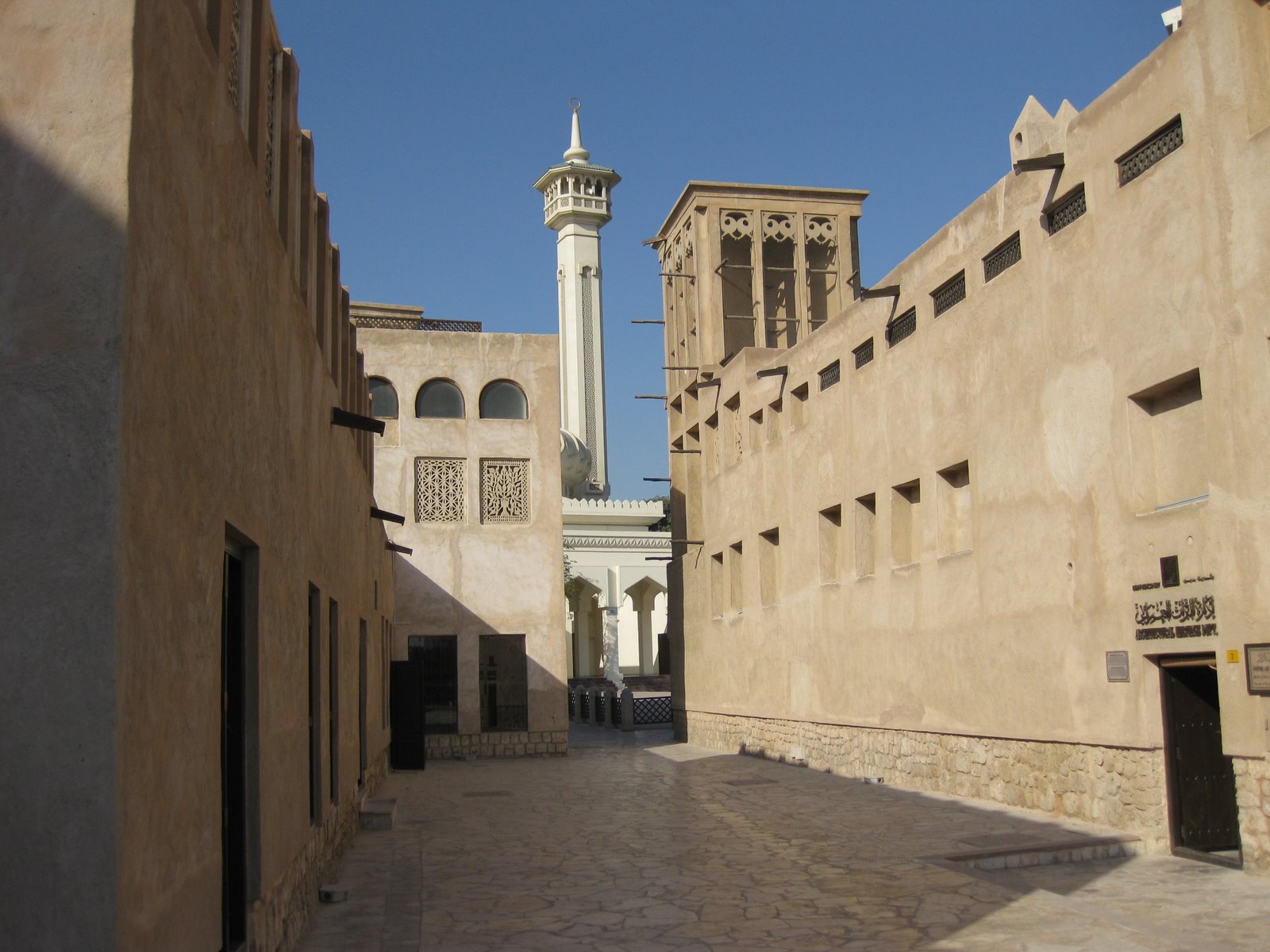
As I mentioned in my last posting, during our stay in Dubai my wife and I visited a small remnant of the old town saved for the tourist trade. Bastakia, it’s called. Though small, it’s a pleasant quarter, worth a couple of hours of strolling.

Bastakia Quarter

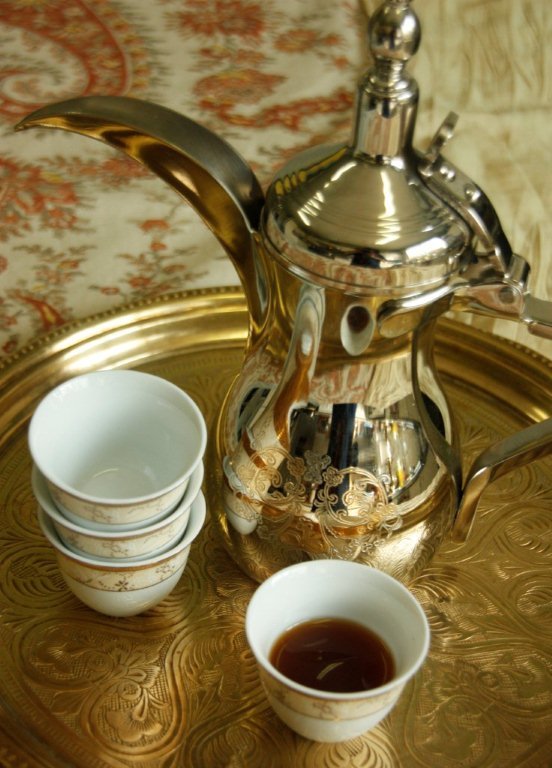
As we sauntered from lane to lane, we stumbled across the Sheikh Mohammed Centre for Cultural Understanding, housed in said Sheikh’s old residence. The Centre was about to hold a talk and guided tour of the quarter, so we decided on the spot to sign up. We were led upstairs and invited to take a seat on divans. We then had a discussion with a pleasant young Emirati woman, during which she invited us to ask her any questions we might have about life and culture in Dubai. As we talked, a young fellow silently padded around filling little cups for each of us with a small amount of a clear brown liquid

coffee pot and cups

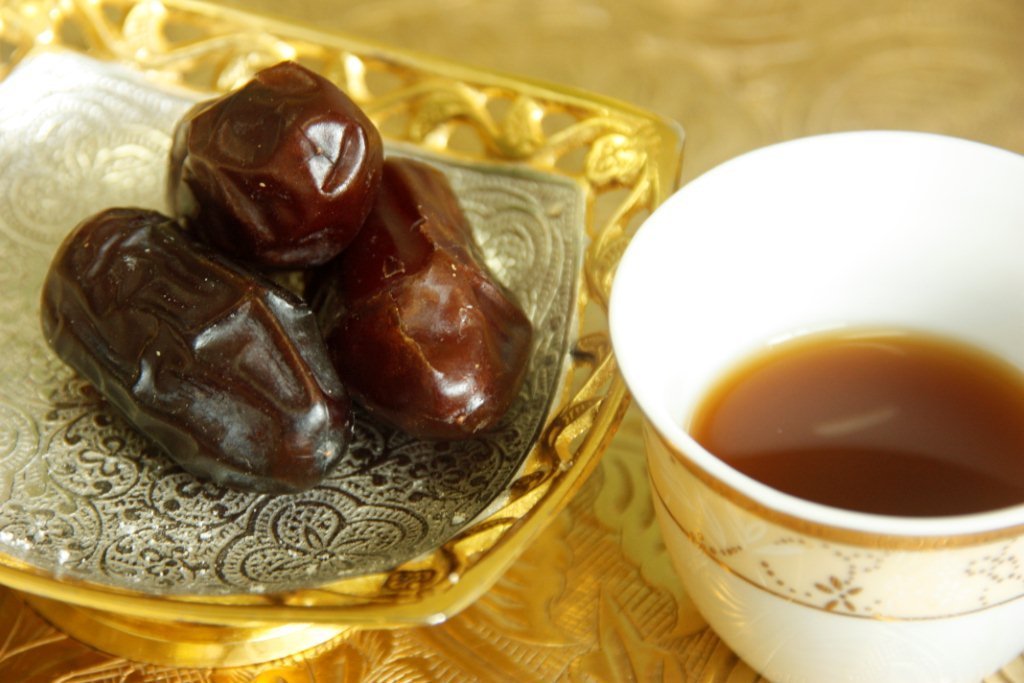
and offering dried dates to go with it.

dates and coffee cup

While the others talked, I took a sip of the liquid. It was … strange. OK, let me be frank, it was unpleasant, tart and bitter. It reminded me of the cough medicines which Matron would give us in the school dispensary as we queued up, coughing and hacking, on winter mornings. I always thought that she suspected us of malingering and trying to skive classes, so made the experience of coming to the dispensary as disagreeable as possible. The drink could also have been the non-alcoholic version of one of those herbal liqueurs which Italians imbibe after a copious meal to help digestion and which are aptly named Amari, Bitter drinks: Fernet Branca, Amaro Meletti, Ferro-China Bisleri, Ramazzotti, … I’ve always been amazed that Italians actually enjoy drinking this stuff. I silently thanked the Lord that the dates were being served. Their sweetness helped offset the drink’s bitterness.

I finally could contain my curiosity no longer and asked our hostess what it was that we were drinking. Kahwa, she said, Arabic coffee.

Coffee??! I’ve drunk coffee in many forms,

espressoespresso-coffeecappuccino

Cappuccino

Viennese coffee, with its dollop of cream and its glass of water (I have really come to appreciate a glass of water with my coffee)

viennese coffee

café au lait served, as my French grandmother used to serve it, in a nice big bowl, with a croissant to dunk in it

cafe-au-lait-with-croissant

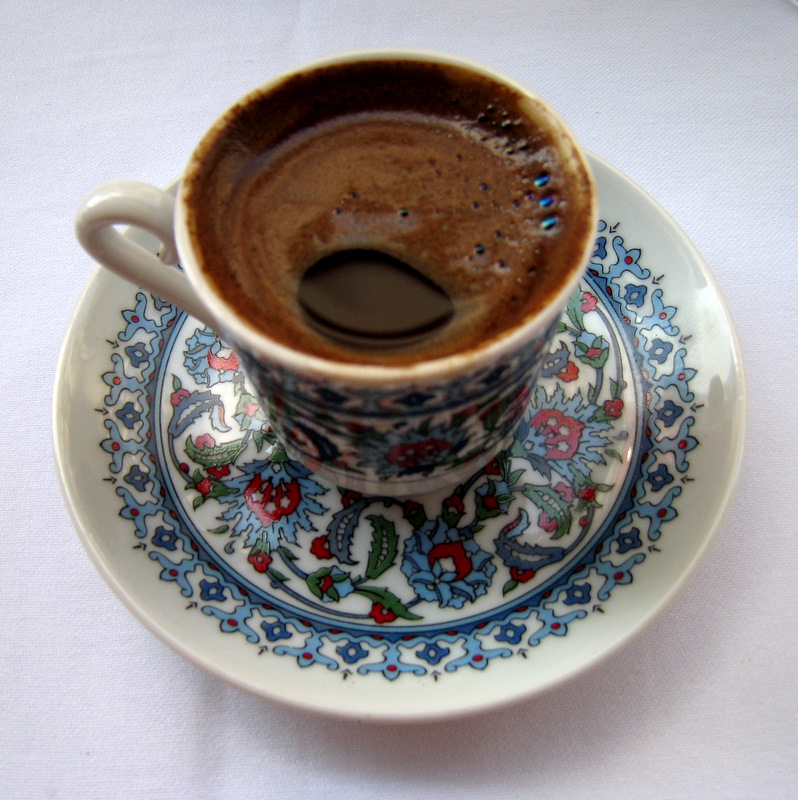
Turkish coffee, which always gives me the impression of drinking liquid mud

turkish-coffee-istanbul

Nescafé or other instant coffees (I’m not fussy), which in my youth seemed to be the only way the English drank their coffee

nescafe

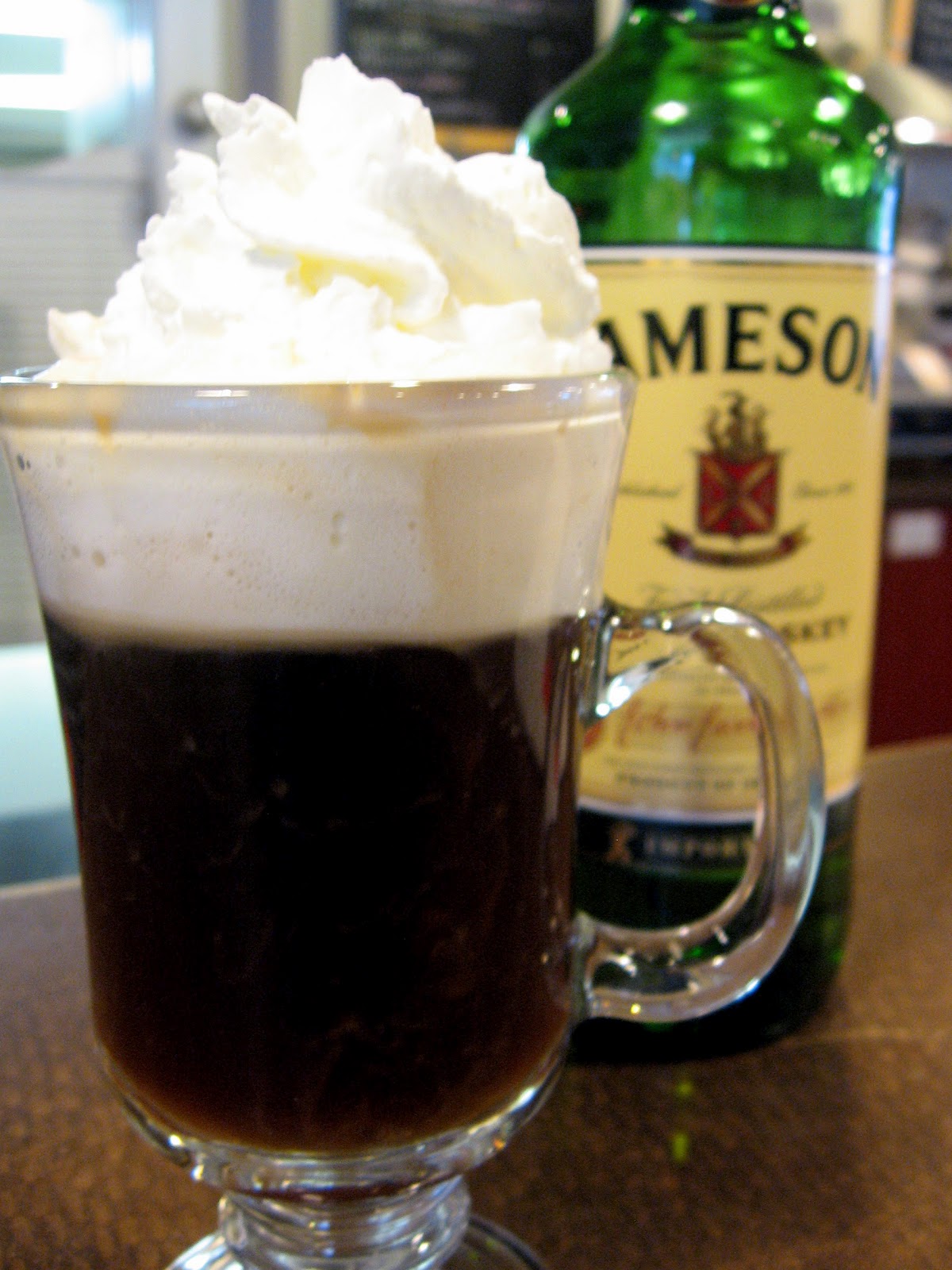
Irish coffee, which seems a sad ending for a good whiskey

Irish Coffee

of course the variety of coffees (well, more milk than coffee) that one comes across in Starbucks, Costa Coffee and places of that ilk – who can avoid the global invasion of these coffee shops?

Caffe-Nero-and-Starbucks

I have even stooped so low as to drink this Chinese version of Nescafé, which is a pre-mix of white, sugared, instant coffee to which you just add hot water.

nescafe ready mix

All in all, these coffees were good, or at least palatable. Kahwa is most definitely neither. A little more discussion brought to light the fact that cardamom is added. Cardamom … I have only the vaguest notion of this spice. Wikipedia states that it “has a strong, unique taste, with an intensely aromatic, resinous fragrance”. That’s certainly true.  Its origins are Indian, Wikipedia continues, and in fact I can’t think of a single European dish which I’ve tried to which it is added (I understand that the Scandinavians use it in some of their breads, but who – apart from Scandinavians – eats Scandinavian bread?). A little research has unearthed the fact that sometimes saffron is also added to kahwa, presumably to colour it, as are cloves or cinnamon or even rose water, but cardamom is the main spice that is used.

flavourings

A little bit more research suggests that cardamom was added because it was so expensive. At first glance, that seems a strange reason to turn a perfectly good drink into an undrinkable one. But I read somewhere else that in traditional Bedouin cultures (which of course Dubai originally was) it was de rigeur to always serve kahwa to your guests.

bedouin and coffee

So of course you could show them that you had money in your pockets by putting cardamom in the coffee. Still not really a good reason to ruin a perfectly good coffee.

For those of you who might be tempted to try it, here’s a recipe which I picked up on the web:

1) Bring 3 cups of water to boil in a saucepan.  When the water boils, add 3 tablespoons of ground coffee.  Boil for 10 to 12 minutes.

2) Add 1 tablespoon of crushed cardamom, along with 5-6 whole cloves if you are using them. Stir once and boil for another 5 minutes.

3) Remove the saucepan from heat, cover, and let the coffee grounds settle to the bottom for a minute. Do not stir.

4) If you use them, add 1 teaspoon of rose water and small pinch of saffron to a coffee pot. Strain and pour the coffee into the pot. Allow to seep for 5 to 10 minutes before serving.

As for me, I left my kahwa undrunk, nibbled at some more of the dates, slipped on my shoes, and joined my wife as she followed our guide for the tour of Bastakia.

___________

Bastakia: http://4.bp.blogspot.com/-BaNjm0Vd1YE/Uc2SsmcHlfI/AAAAAAAAAFM/LibNtSVNXQQ/s1600/Bastakia+Quarter.JPG [in http://junishadama.blogspot.com/%5D
Coffee pot and cups: http://arabiczeal.com/wp-content/uploads/2011/08/ARABIC-COFFEE-How-to-make.jpg [in http://arabiczeal.com/prepare-enjoy-arabic-coffee/%5D
Dates and coffee cup: http://arabiczeal.com/wp-content/uploads/2011/08/ARABIC-COFFEE-with-dates.jpg [in http://arabiczeal.com/prepare-enjoy-arabic-coffee/%5D
Espresso: http://gotgelato.com/wp-content/uploads/2013/01/espresso-coffee.jpg [in http://gotgelato.com/espresso/%5D
Cappuccino: http://thelittlebirdbakeshop.com/wp-content/uploads/2011/01/Cappuccino.jpg [in http://thelittlebirdbakeshop.com/gallery/cappuccino-2/%5D
Viennese coffee: http://flaneriefeminine.com/wp-content/uploads/2012/11/img_4591.jpg [in http://flaneriefeminine.com/2012/11/09/viennese-coffee-specialtie/%5D
Café au lait et croissant: http://us.123rf.com/400wm/400/400/shawnhempel/shawnhempel1005/shawnhempel100500087/7075391-cafe-au-lait-with-butter-croissant-over-white-background.jpg [in http://www.123rf.com/photo_7075391_cafe-au-lait-with-butter-croissant-over-white-background.html%5D
Turkish coffee: http://www.poweredbytofu.com/wp-content/uploads/2008/08/turkish-coffee-istanbul.jpg [in http://www.poweredbytofu.com/overnight-on-the-orient-express-to-istanbul/%5D
Nescafé: http://rithuset.com/files/large/Rithuset%20new%20nescafe%20logo%20illustration.jpg [in http://rithuset.com/illustration/new%20nescafe%20logo%20illustration.jpg/%5D
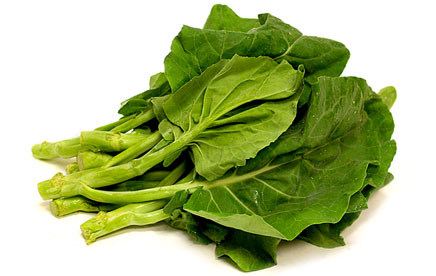
Irish coffee: http://1.bp.blogspot.com/-ZOmE04kKHEs/T2NnO6j9FlI/AAAAAAAAAJ8/e7fBLQoIO3c/s1600/Irish+Coffee.jpg [in http://harvestmooncafe.blogspot.com/2012/03/st-patricks-day-deal.html%5D
Caffé Nero and Starbucks: http://static.guim.co.uk/sys-images/Money/Pix/pictures/2011/9/22/1316705313267/Caffe-Nero-and-Starbucks–005.jpg [in http://www.theguardian.com/money/blog/poll/2011/sep/23/store-wars-caffe-nero-starbucks%5D
Nescafe ready-mix: my picture
Bedouins and coffee: http://www.bedawi.com/Odl%20picture%20Coffee%20making%20ritual.jpg-for-web.jpg [in http://www.bedawi.com/Hospitality_EN.html%5D

INDONESIA – CHICKEN

Beijing, 25 February 2014

Within five minutes of moving into our hotel cabin, we had our first visitor: a chicken.
chicken becassine 003
Naively, I thought the chicken was a friendly thing and wanted company. I decided to call her Bécassine. For those readers who may not know her, Bécassine is the heroine of an old French comic strip. She is what Parisians of the early 1900s would have considered the typically foolish girl from the remote French provinces.
Becassine-2
The name fits my chicken well; it’s gross racial typing, of course, but I’ve always thought that chickens are rather foolish birds.

In any event, I was soon disabused of the comforting thought that Bécassine was searching out my company. The way she set her beady eye on anything I was putting in my mouth made me realize that she was just there for the food scraps. I suspect that previous guests staying at the cabin had spoiled Bécassine by feeding her yummy things like bread crumbs. She rushed at the mandarin pips I threw to her but spat them out immediately, fixing me reprovingly with that beady eye of hers.

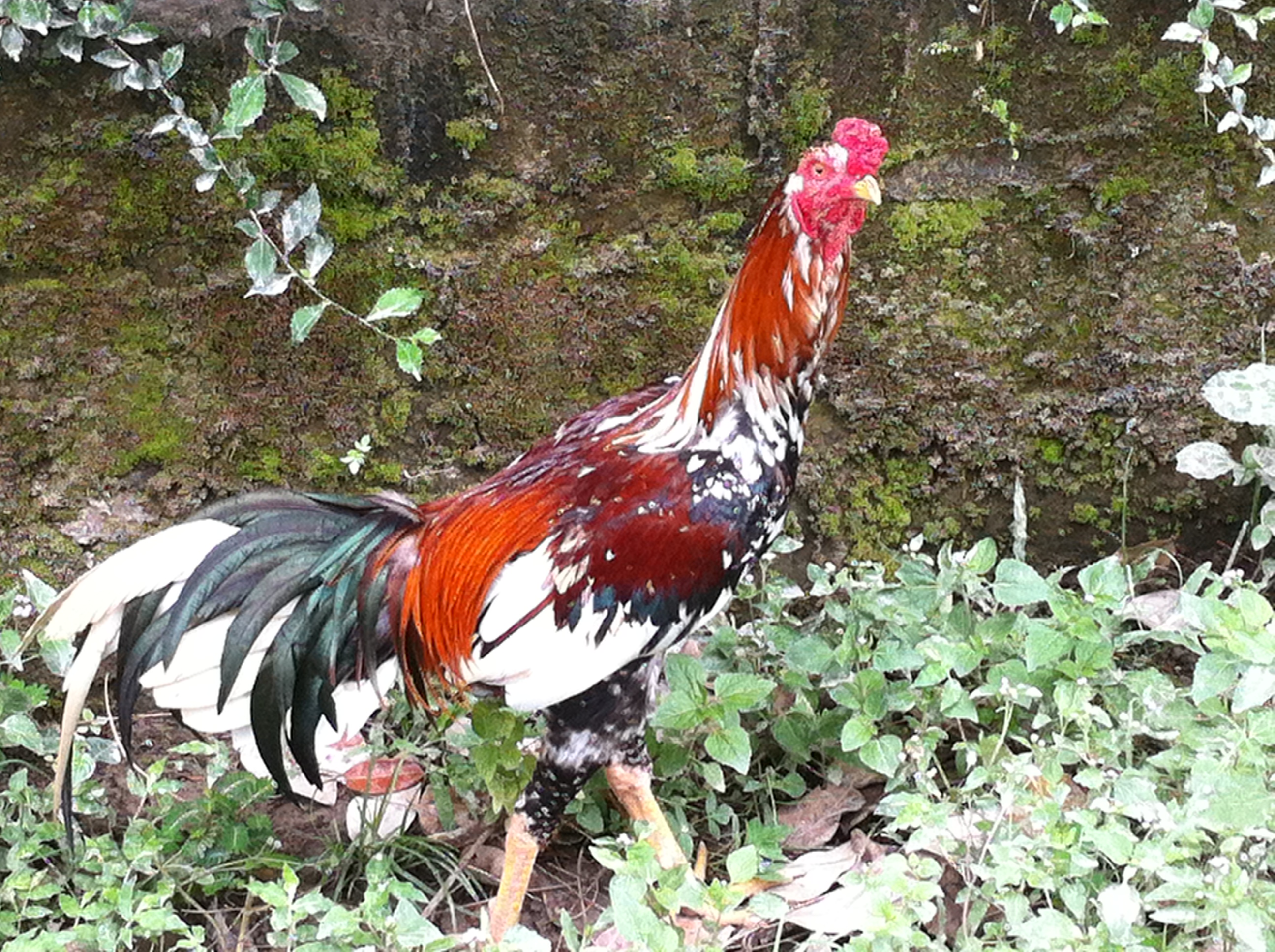
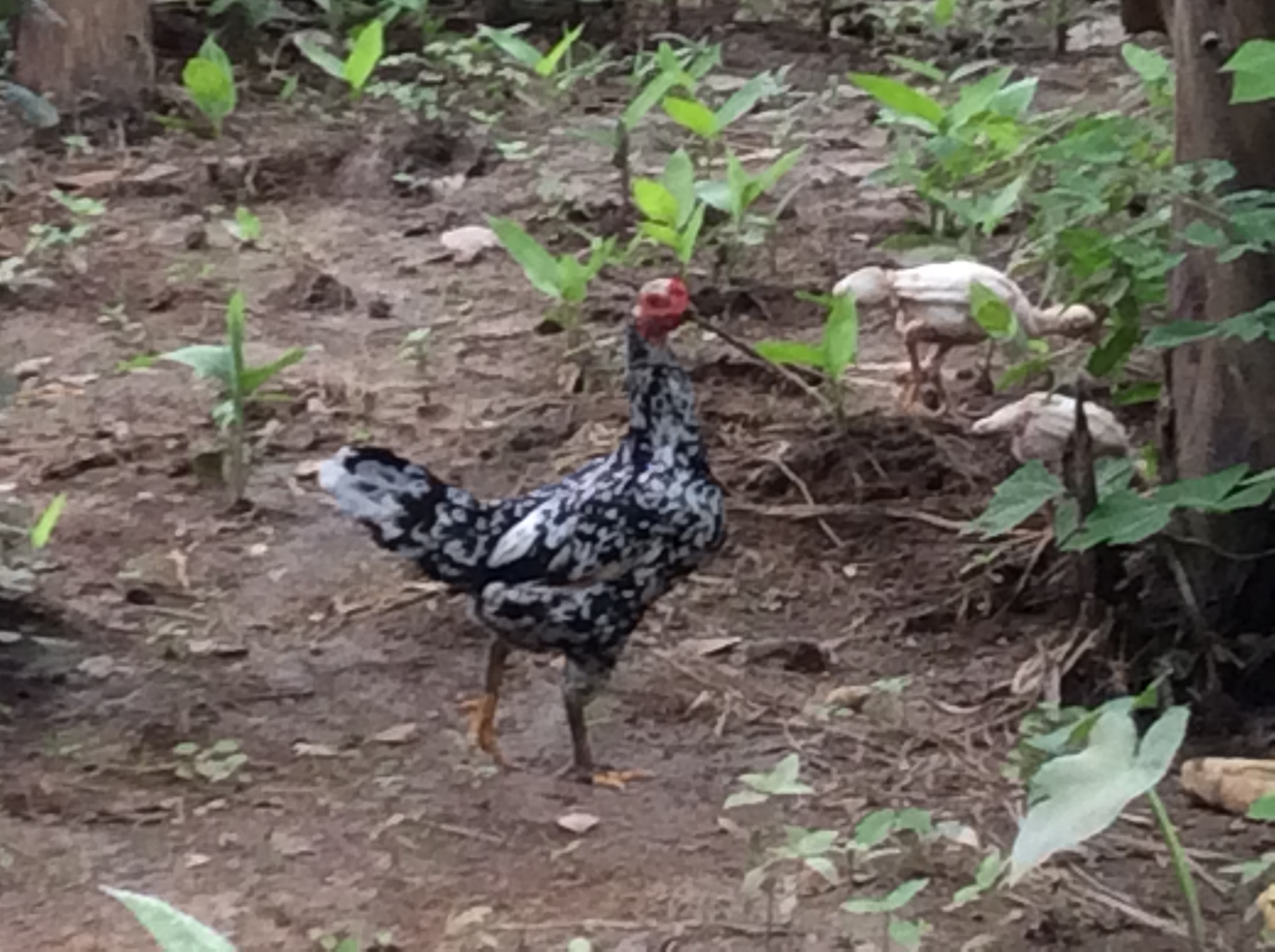
Apart from these character issues, Bécassine was really a very handsome chicken. One thing I particularly admired about her were her long, graceful legs. Really quite model-like, I felt. And her plumage, though modest compared to some other chickens we saw in the surrounding villages:

kampong chicken 001

chickens on walk 003
(this one reminds me of Audrey Hepburn in My Fair Lady)
audrey hepburn
her plumage, as I say, was sleek and smooth. A very far cry indeed from the battery chickens which we have been reduced to breeding in the richer countries
battery chicken
so that we can have dirt-cheap eggs and dirt-cheap chicken meat and eventually all look like this.
obese couple
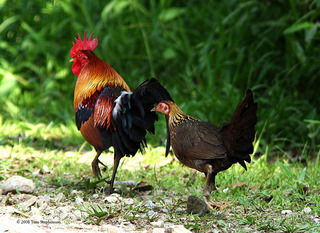
In fact, Bécassine is a free-range chicken, what they call here a kampong, or village, chicken. And indeed every village we walked through had dozens of kampong chickens, many of the hens with a brood of chicks in tow, ranging through the village and into the fields beyond. With their long legs and rich plumage, they really were very handsome. I do believe that they are not very distant genetically from their wild progenitor, the Red Junglefowl, whose range extends from northern India through South-East Asia and into southern China.
red junglefowl-1
Indeed, the domestication of the chicken took place somewhere around here about 5,000 years ago.

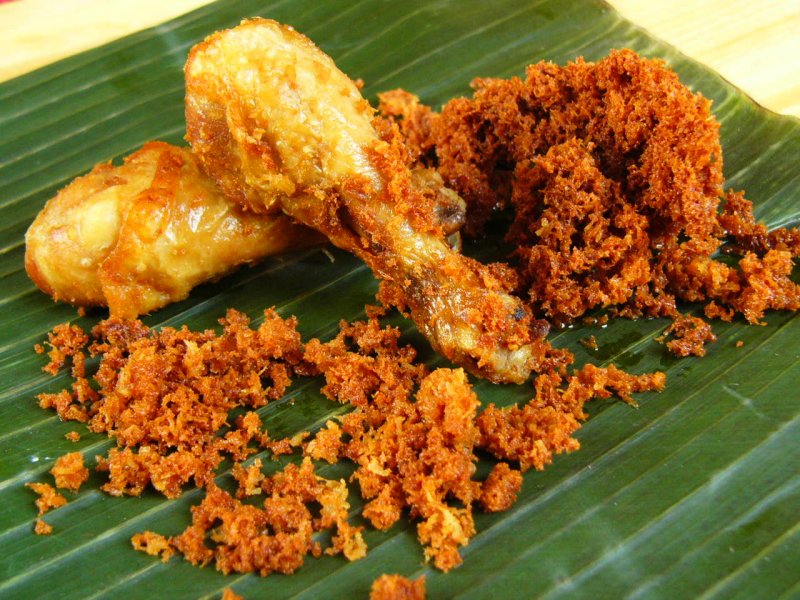
Being free range, Bécassine will no doubt be very good to eat. We didn’t eat her, but in Yogyakarta we had lunch at a restaurant which served typical Indonesian food. One of these was Ayam Goreng Kremes, a fried kampong chicken with fried, flaked salam leaves.

ayam goreng kremes

Fingurr-lickin’ good, as the Colonel would say!

Sorry, Bécassine, it’s been good to know you, but you have to follow your destiny. Someone, some day, will have the great pleasure of eating you.

________________________

Becassine hen: our picture
Becassine: http://madameshackelford.wikispaces.com/file/view/blppxije.jpg/35302825/blppxije.jpg [in http://madameshackelford.wikispaces.com/Bécassine%5D
kampong chickens: our pictures
Audrey Hepburn: http://i.dailymail.co.uk/i/pix/2011/12/05/article-0-0F1123D000000578-117_634x792.jpg [in http://www.dailymail.co.uk/femail/article-2070449/Marilyn-Monroe-Kate-Middleton-The-unforgettable-dresses-time.html%5D
Battery chicken: http://lifewiththeexbatts.files.wordpress.com/2011/08/audrey-1.jpg [in http://lifewiththeexbatts.wordpress.com/2011/08/23/hello-world/%5D
Obese people: http://www.themobilityresource.com/wp-content/uploads/2014/01/morbidly_obese_091026_main.jpg [in http://www.themobilityresource.com/disabesity-should-morbidly-obese-people-be-considered-disabled/%5D
Red junglefowl: http://www.discoverlife.org/IM/I_TS/0006/320/Gallus_gallus,_red_jungle_fowl,I_TS604.jpg [in http://www.discoverlife.org/mp/20q?search=Gallus+gallus%5D
Ayam Goreng Kremes: http://1.bp.blogspot.com/-76_gBdFsH_8/UCS8hAh77bI/AAAAAAAAAHA/eZYM1EQnGh0/s1600/resep-ayam-kremes.jpg [in http://foodiefod.blogspot.com/2012/08/tips-membuat-ayam-goreng-kremes.html%5D

OF CABBAGES AND KINGS

New York, 5 January 2014

Kale is king of culinary cool this year in New York. Or so it would appear from a cursory glance at the offerings in the city’s food emporia: every restaurant seems to have a dish with kale in it, every supermarket a ready-made salad containing kale.  Several articles tracking the growing popularity of kale have appeared in the New York Times, while a very recent article in the New York Daily News, reporting on a survey of 500 dieticians, has these worthy people predicting that kale (along with ancient grains and gluten-free diets) will be the top nutrition trends of 2014. Why, even a celebrity chef like Gordon Ramsey has weighed in, making lots of approving noises about kale. He went so far as to propose that a National Kale Day be instituted!

Which is all rather surprising to me, since I have always associated kale with something that you feed to cows.  I don’t think I had ever intentionally eaten kale until a week or so ago when I picked up a take-away tomato and kale soup from a Hale & Hearty Soup outlet somewhere near Park Avenue and 45th Street.

Quite what is so remarkable about kale is not clear to me. It is purported to help you fight various cancers, lower your cholesterol, detoxify yourself, and I know not what else. Having been around a while, I am, like this reporter in the Huffington Post, somewhat skeptical of all these claims. How many foodstuffs have I seen over the years for which extravagant health claims have been made!  It is true that kale is stuffed with vitamins K, A and C.  So if you need those, kale might be your thing. But as for the rest …

To my mind, all the froth and frenzy about kale is nothing compared to the wonderful story behind its very existence. Around the northern and eastern rim of the Mediterranean, in what are now Italy, Greece, Turkey, and maybe further south along the Lebanese and Israeli coast, there lives a humble member of the large family of mustards. This species is known to science as Brassica oleracea, but we can call it cole (a name rooted in the Celtic-Germanic-Greek word for “stem”). With time and I presume human interference it spread from its original homeland and now can be found further north in Europe. Since it tolerates salt well and likes a limey soil, it tends to be found on limestone sea cliffs, as attested by this picture, taken on the chalk cliffs in the UK (I didn’t find a picture of the plant in its original homeland):

Cabbage-wild

Anyone familiar with mustard plants will immediately see the family resemblance. And those long stems are what gives the plant its generic name of cole.

At some point, humans found that the plant was edible and presumably added it to their list of plants to gather. Some 3-4,000 years ago, maybe more, as part of the slow move to agriculture, humans began to domesticate the cole, and as they have done with just about every species which they have domesticated they began a forced process of natural selection to encourage desirable traits in their domesticates and eliminate undesirable ones. So far, so good.  But the cole must have a very flexible DNA because over the millennia farmers were able to coax out of this one plant an astonishingly different array of vegetables. From the plant we see above waving on the cliff top, they managed to obtain our friend kale:

Kale-Bundle

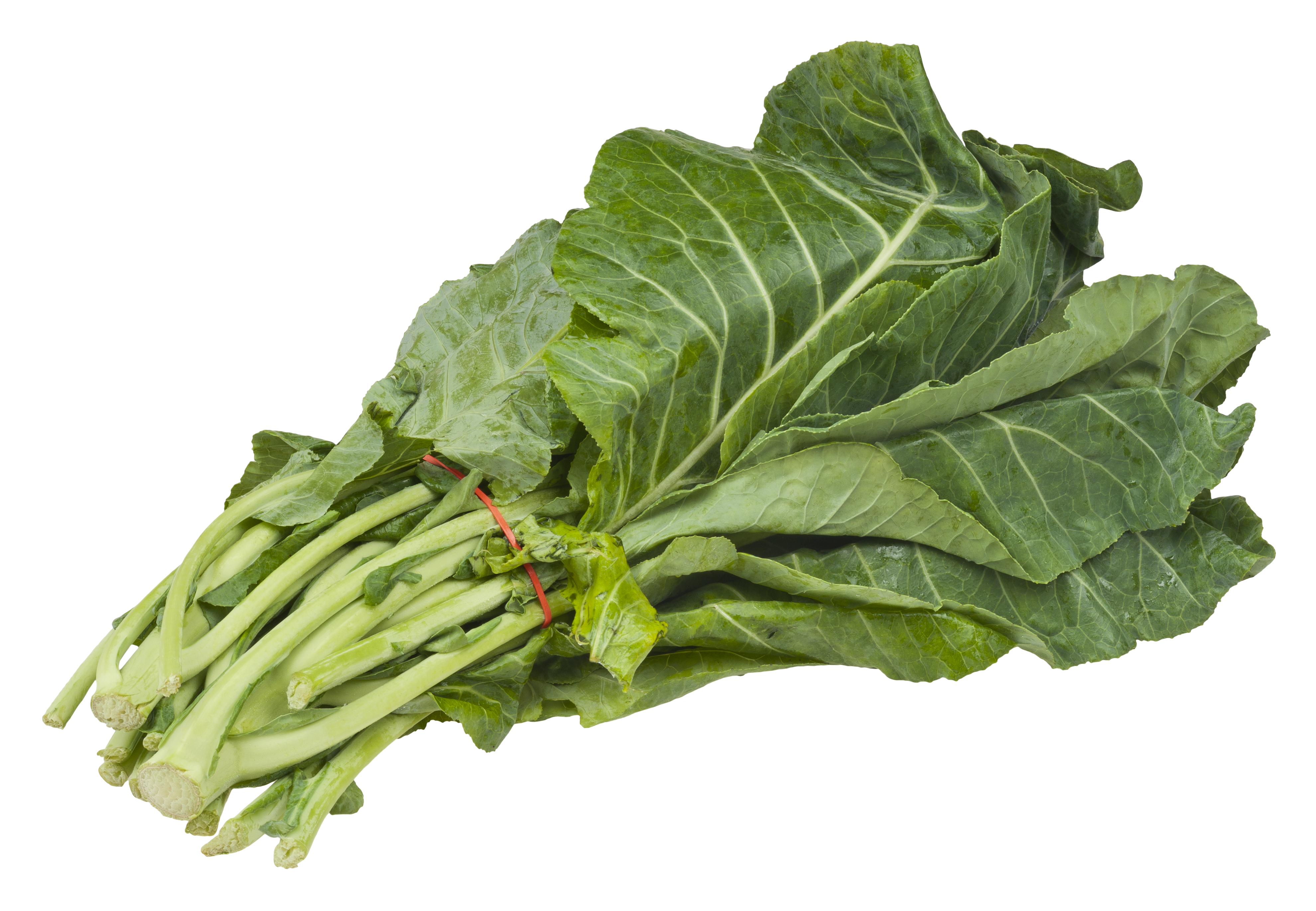
Its close cousin, collard greens:

SONY DSC

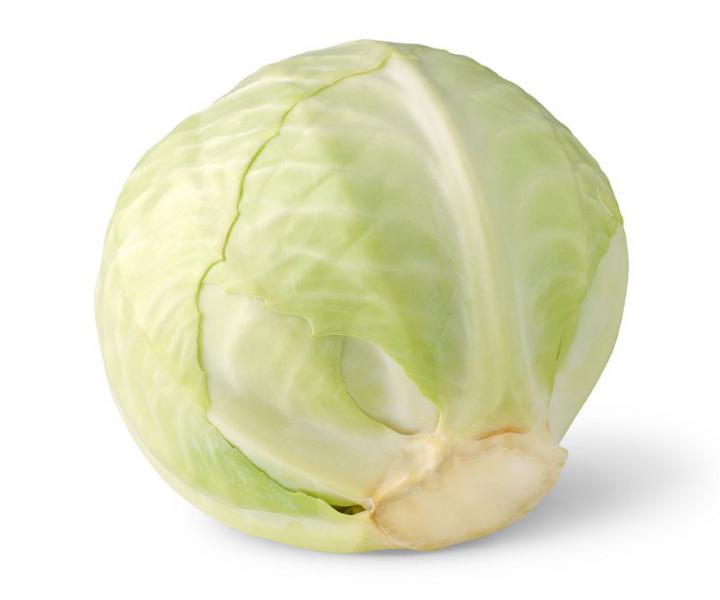
The cabbage, which itself comes in several varieties, the common white cabbage:

Cabbage isolated on white

the red cabbage, seen here with the green cabbage:

cabbage-green and purple

the Savoy cabbage:

cabbage-savoy 2

Then we have broccoli:

Fresh green vegetable, isolated over white

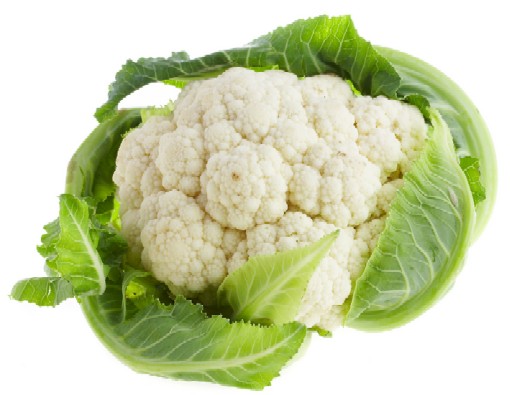
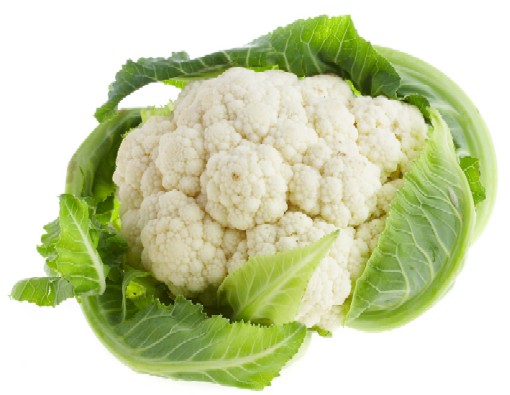
Cauliflower:

Cauliflower

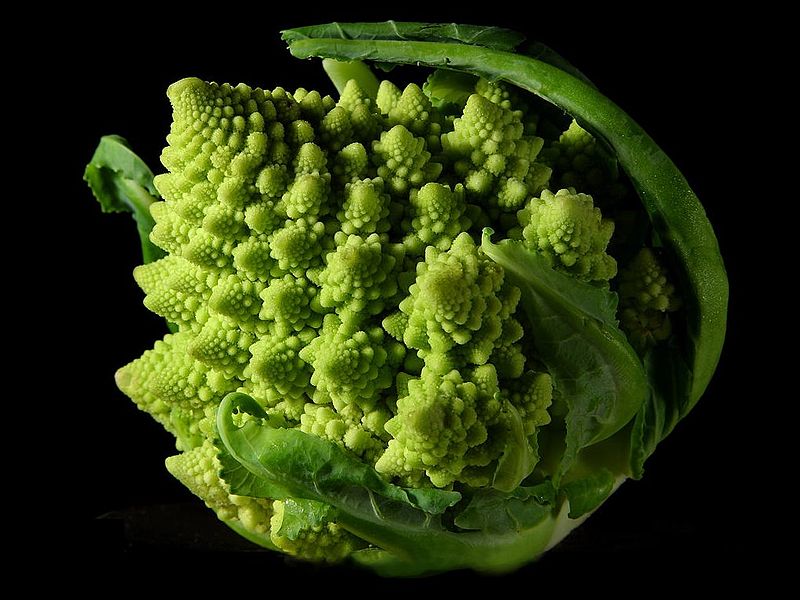
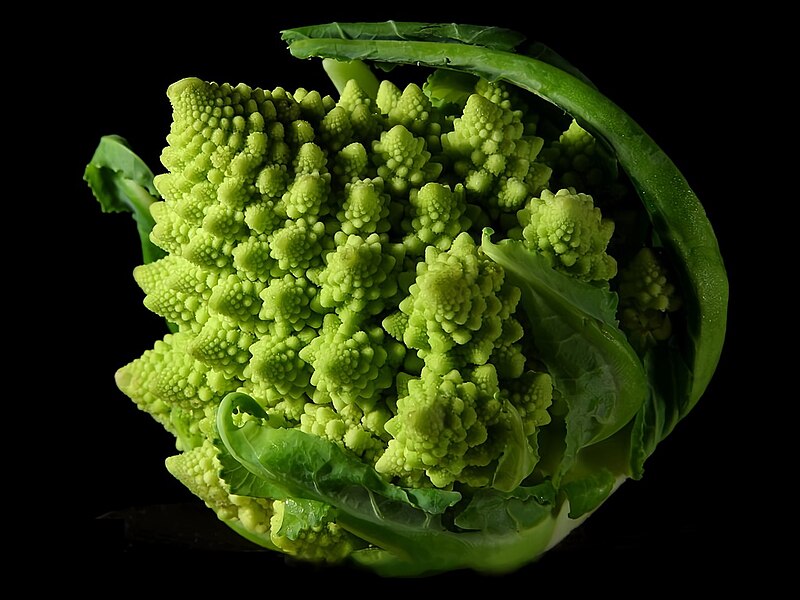
and its close cousin the strange-looking romanesco broccoli:

romanesco broccoli 2

Brussels sprouts:

brussels sprouts

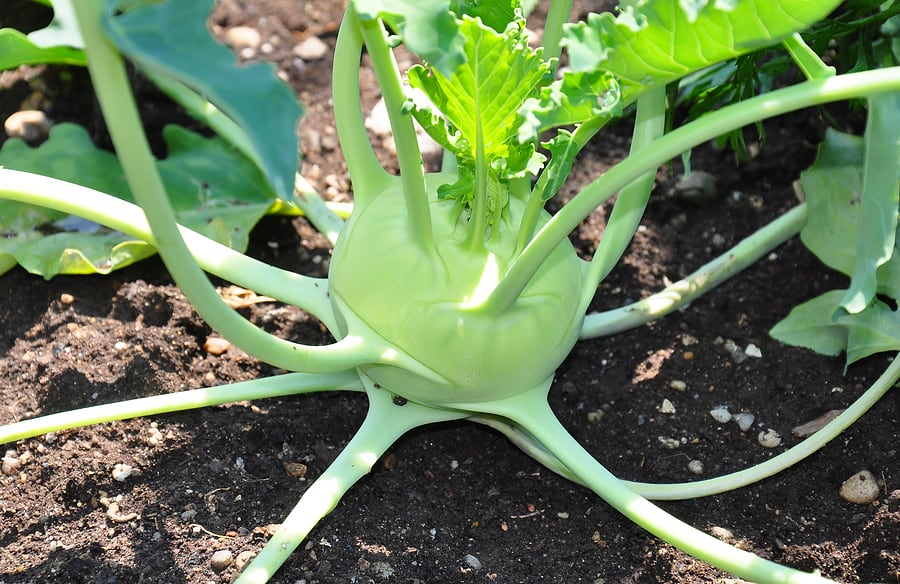
Kohlrabi:

kohlrabi

And last but not least, the Chinese kai-lan, also known as Chinese broccoli:

Chinese_Broccoli 2

Pretty amazing …

The following picture shows which bits in the original cole plant all those generations of farmers fiddled with to get these massively different vegetables:

brassica oleracea-evolution 4

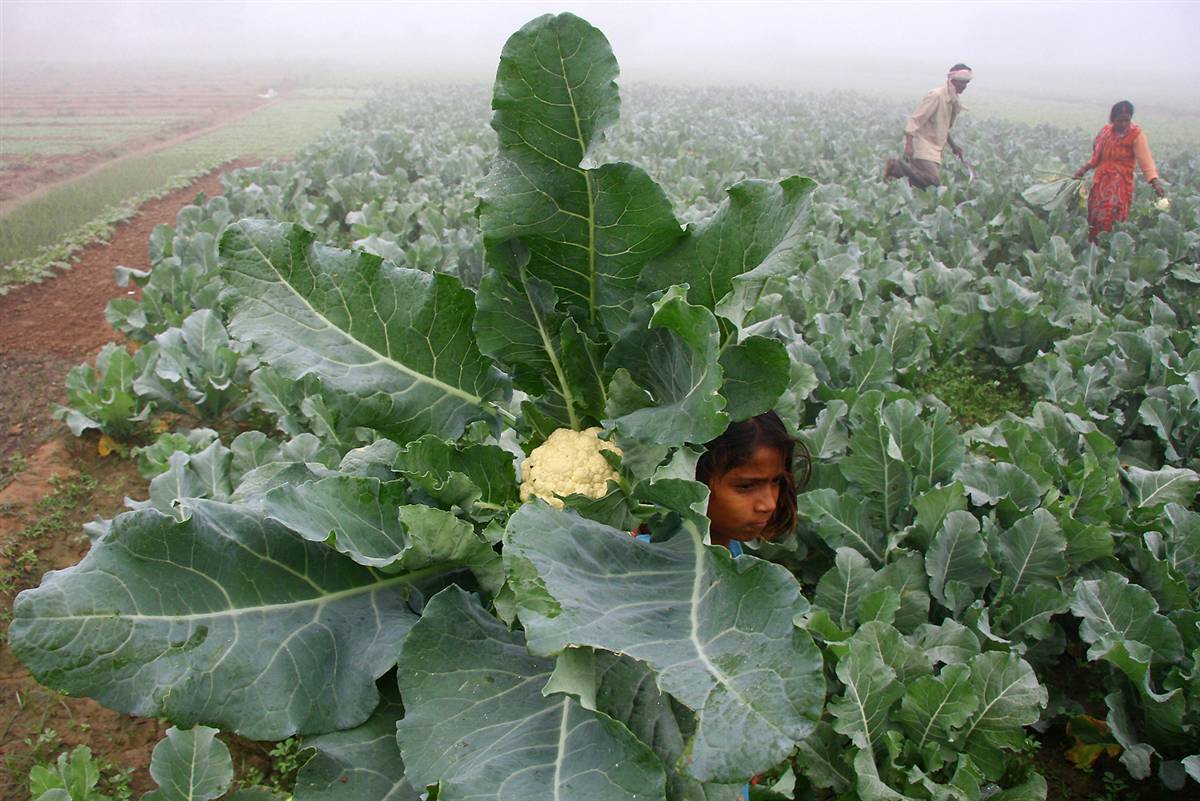
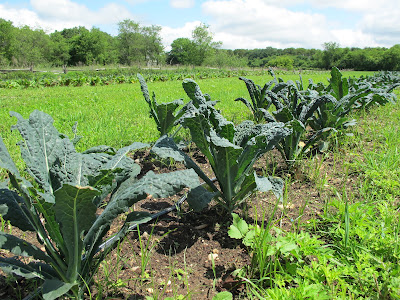
When seeing all these vegetables sitting next to each other on a supermarket shelf, it might be difficult to believe that they are actually the same plant, but when you see them still in the field the family resemblance is more easily recognized.

Kale:

kale in field

Collards:

OLYMPUS DIGITAL CAMERA

Cabbage:

cabbage-white

Cauliflower:

cauliflower in the field

Broccoli:

broccoli plant

Brussels sprouts:

brussels-sprouts plants

Kohlrabi:

Kohlrabi-plant

And when these vegetables flower, which they should not, then you see the mustard-like flower coming through, as in this case of a red cabbage gone to seed:

cabbage-red-bolted

and of broccoli gone to seed:

broccoli bolted

The early history of all these cole vegetables is shrouded in uncertainty. The Greeks and Romans wrote about one or more vegetables which sound like a cousin of kale and collards. The cabbage seems to have been developed in the colder parts of Europe some time in the early Middle Ages. Southern Italians seem to have developed broccoli quite early on, perhaps already during the Roman period, but it was many centuries before it migrated to other parts of Europe. It is generally thought that the cauliflower came to Europe from the Middle East, possibly via Cyprus and then Italy. As the name suggests, Brussels sprouts seem to have been developed somewhere in the Low Countries around the 15th Century, possibly earlier, but didn’t migrate to other parts of Europe until several centuries later. Kohlrabi seems to have been developed at about the same time, although quite where in Europe is unclear. And then there is kai-lan. Quite how this vegetable, the descendant of a Mediterranean plant, ended up being developed in China is a bit of a mystery. It is theorized that when the Portuguese came to China, they brought with them the cabbage. Chinese farmers then did a second cycle of selection to bring about something which looks and tastes more like broccoli.

Little is known of the history of these vegetables because early European chroniclers didn’t deign to follow the experiments in genetic engineering that the humble farmers were undertaking. In his poem “the Walrus and the Carpenter”, Lewis Carroll has the walrus say at some point:

“The time has come,
To talk of many things:
Of shoes–and ships–and sealing-wax–
Of cabbages–and kings”

But those who recorded history were interested in kings and not cabbages and their ilk, so we will never know who were those legions of farmers who patiently developed this cornucopia of cole vegetables which we have available to us today. I take this occasion to salute these nameless heroes and to thank them for putting such wonderful vegetables on my table.

_____________________

Cabbage-wild: http://i.telegraph.co.uk/multimedia/archive/01810/Cabbage_1810864c.jpg [in http://www.telegraph.co.uk/earth/earthnews/8281088/Britains-wild-plants-make-a-comeback.html%5D
Kale bunch: http://upload.wikimedia.org/wikipedia/commons/thumb/4/4b/Kale-Bundle.jpg/640px-Kale-Bundle.jpg [in http://en.wikipedia.org/wiki/Kale%5D
Collard greens-bundle: http://upload.wikimedia.org/wikipedia/commons/e/e9/Collard-Greens-Bundle.jpg [in http://en.wikipedia.org/wiki/Collard_greens%5D
Cabbage-white: http://www.realfoods.co.uk/ProductImagesID/2559_1.jpg [in http://www.realfoods.co.uk/product/2559/real-foods-organic-white-cabbage-uk-kg%5D
Cabbage-green and red: http://upload.wikimedia.org/wikipedia/commons/thumb/f/fa/Cabbages_Green_and_Purple_2120px.jpg/451px-Cabbages_Green_and_Purple_2120px.jpg [in http://en.wikipedia.org/wiki/Cabbage#History%5D
Cabbage-savoy: http://www.rivieraproduce.eu/wp-content/uploads/2011/06/image_riviera_savoy_cabbage.jpg [in http://www.rivieraproduce.eu/savoy-cabbage%5D
Broccoli: http://livelovefruit.com/wp-content/uploads/2013/06/977599_375755671.jpg [in http://livelovefruit.com/2013/06/benefits-of-broccoli/%5D
Cauliflower: http://blogs.kcrw.com/goodfood/wp-content/uploads/2012/10/Cauliflowerimage.jpg [in http://blogs.kcrw.com/goodfood/2012/11/recipe-braised-cauliflower-with-capers-toasted-bread-crumbs/%5D
Romanesco broccoli: http://upload.wikimedia.org/wikipedia/commons/thumb/4/4f/Fractal_Broccoli.jpg/800px-Fractal_Broccoli.jpg [in http://en.wikipedia.org/wiki/Romanesco_broccoli%5D
Brussels sprouts: http://ourtinyearth.files.wordpress.com/2013/01/12065713-brussels-sprouts-pile-on-white-background.jpg [in http://ourtinyearth.com/2013/01/08/stories-of-the-misunderstood-brussels-sprouts/%5D
Kohlrabi: http://www.chowlocally.com/blog/wp-content/uploads/2012/03/kohlrabithroat2.jpg [in http://www.chowlocally.com/blog/2012/03/21/kohlrabi-the-loneliest-vegetable-in-the-world-of-healthy-eating/%5D
Chinese broccoli: http://www.specialtyproduce.com/ProdPics/467.jpg [in http://www.specialtyproduce.com/produce/Gai_Lan_467.php%5D
B. Oleracea-evolution: http://www.doctortee.com/dsu/tiftickjian/cse-img/biology/evolution/mustard-selection.jpg [in https://sites.google.com/site/selectivebreedingofplants/%5D
Kale in field: http://1.bp.blogspot.com/-f5RKQQQaduk/T9Fcpear0DI/AAAAAAAAG24/YIJgodBwji0/s400/IMG_4096.JPG [in http://culinarytypes.blogspot.com/2012_07_01_archive.html%5D
Collard plants: http://img691.imageshack.us/img691/1158/collards2.jpg [in http://www.homesteadingtoday.com/country-living-forums/gardening-plant-propagation/397580-ok-collard-greens-growing%85-now-what.html%5D
Cabbage plant: http://upload.wikimedia.org/wikipedia/commons/7/70/Cabbage.jpg [in http://en.wikipedia.org/wiki/Cabbage#cite_ref-8%5D
Cauliflower in field: http://4photos.net/photosv5/cauliflower_field_india_1342111345.jpg [in http://4photos.net/en/image:105-216983-Cauliflower_field_India_images%5D
Broccoli plant: http://www.ferta-lawn.com/userfiles/image/Broccoli.jpeg [in http://www.ferta-lawn.com/blog-post/Fall-Gardening-Peas-Broccoli%5D
Brussels sprouts plant: http://www.gardeningcarolina.com/veggies/images/brussels-sproutsfull.jpg [in http://www.gardeningcarolina.com/veggies/brusselsprouts.html%5D
Kohlrabi plant: http://www.harvesttotable.com/wp-content/uploads/2007/03/Kohlrabi-plant.jpg [in http://www.harvesttotable.com/2007/03/kohlrabi_kohlrabi_tastes_like/kohlrabi-plant/%5D
Cabbage-red-bolted: http://goodlifegarden.ucdavis.edu/blog/wp-content/uploads/2011/04/bolted-red-cabbage.jpg [in http://goodlifegarden.ucdavis.edu/blog/2011/04/%5D
Broccoli-bolted: http://botanistinthekitchen.files.wordpress.com/2012/11/broccoli_flowers1.jpg [in http://botanistinthekitchen.wordpress.com/tag/kohlrabi/%5D

TROPICAL FRUITS

Beijing, 11 December 2013

I’ve just come back to China from a business trip abroad. As is my habit on these trips, I picked up whatever English-language newspapers were being proffered at the plane door. On the return leg, I found myself with the International New York Times (until recently the International Herald Tribune). Once we had taken off, I settled into my usual reading routine, which is to start with the cartoons, have a stab at the Sudoku and sometimes the crossword (depending on how easy it is), then meander through the rest of the newspaper, settling on whatever articles catch my eye. In this particular edition, I came across an article entitled “Letting the Nose Lead the Way”, about the durian. The article was a paean to the durian, the author an unashamed fan. So much of a fan that I decided to write this post in protest and to right the balance.

For those of you who may not be familiar with the durian, this is it:

durian on tree

It is a tropical fruit common throughout Southeast Asia and southern China. A huge fruit which can weigh up to three kilogrammes and whose husk is covered with large nasty spikes. Which two facts together lead some to wear safety helmets if they venture into durian orchards when the fruit is ripe and ready to fall. I kid you not:

safety helmets under durian trees

When you split open the husk you find these squishy pods inside

durian inside

Durian inside-2

which smell and taste absolutely … disgusting.

The first – and last – time I ate durian was in Malaysia in the mid-1990s. I was with a Moroccan colleague. It was the first time for both of us in the country. We were with a third colleague, an Italian, who had been many times to Malaysia. We were driving through some village when he suddenly ordered the driver to stop and us to get out. We were confronted by a roadside vendor behind a pile of these large spiky fruits. We absolutely had to try one, our Italian colleague declared, it was rightly called the king of fruits. The vendor split open the husk, and a nauseous smell hit us.  We hesitated, but he urged us on; get beyond the smell, he cried, the taste is sublime. And all my life I will remember the face of my Moroccan colleague as he bit into that yellow guck, a look of pure horror and utter revulsion. A look which was mirrored in my face as I too bit into the guck. This photo, of a poor kid who has just tried durian for the first time in Indonesia, sums up the experience well.

Kids-Feel-Sick-After-Eating-Durian

Never, ever, again.

You don’t have to open the husk to get the smell. It spreads around the unopened fruit like a sickening miasma. So strong is the smell that durians are often prohibited from enclosed public spaces.  I disovered this in Singapore after my trip to Malaysia, where there were prominent signs banning durian from the subway system.

no_durian-singapore

The long list of things you can’t do in Singapore has now become something of a joke, but the ban of durians on the subway is one which I completely and heartily approve of.

If this had been my only experience with tropical fruit in Malaysia, I would have left the country with a permanently bad impression. Luckily, though, my Italian colleague redeemed himself by introducing us to three other tropical fruits (or froo-wits as he called them): the jackfruit, the mangosteen, and the rambutan.

The jackfruit looks uncannily like the durian. The fruit is also large – huge, sometimes – and has a spiky exterior, although nothing like as spiky as the durian

Jacfruit at Nunem

The pods inside are also yellow and squishy

jackfruit inside

jackfruit pulp

But the taste is a universe away from the durian: a delicate sweetness which lingers in the mouth and urges you on to take the next morsel.

As for the mangosteen, ah, what a fruit! From the outside, it looks something like a large plum but with a hard rind.

Mangosteen on tree

When you crack open the rind, you find that it harbours soft, dazzlingly white segments

mangosteen inside-3

which literally taste divine, something surely that was invented by nature only for the gods to eat: juicy, supremely sweet, yet with an acid overtone that holds the sweetness in check, preventing it from becoming cloying.

And finally the rambutan, a wonderfully hairy looking fruit (reminding me always of a certain part of the male anatomy), growing in clusters on the tree

rambutan on tree

When the rind is opened, a glistening small white globe is uncovered

rambutan inside-2

with a taste very much like fresh lychee; not surprising, since the two are relatives. I smuggled a batch of rambutans back to my wife (I’m sure I was not allowed to import them), and they tasted as good at our kitchen table in Italy as they had in the market in Malaysia.

There comes a time of year, in autumn, when street vendors in Beijing begin to sell durian. When that sickening smell wafts over me again, I make a wide detour and occupy my mind’s eye, nose and mouth with the wonders of jackfruit, mangosteen and rambutan.

______________________

Durian on tree: http://bizzarrobazar.files.wordpress.com/2012/03/cd81e7e027f4cae2c94959b42b6797f6.jpg [in http://bizzarrobazar.com/tag/durian/%5D
Safety helmets under the durian tree: http://3.bp.blogspot.com/_fVVBfNE7dsI/SBawmCQGfsI/AAAAAAAAAdA/T1oJ-Rm8IfE/s400/109-0970_IMG.JPG [in http://dusundurian2002.blogspot.com/%5D
Durian inside: http://farm4.staticflickr.com/3782/9372567678_1077e89202_b.jpg [in http://www.sgfoodonfoot.com/2013/07/rws-invites-durian-fest-2013.html%5D
Durian inside-2: http://hype.my/wp-content/uploads/2013/05/Durian.jpg [in http://hype.my/2013/05/durian-pizza-anyone/%5D
Kid feeling sick after eating durian: http://www.indoboom.com/wp-content/uploads/2013/08/Kids-Feel-Sick-After-Eating-Durian.jpg [in http://www.indoboom.com/2013/videos/americans-taste-durian-for-the-first-time-indonesian-reactions.html%5D
No Durians-Singapore: http://dodontdontdo.files.wordpress.com/2011/05/singapore_several_2011_transtation.png [in http://dodontdontdo.wordpress.com/2011/05/20/no-bombs-no-no-durians/%5D
Jackfruit tree: http://www.parrikar.com/blog/wp-content/uploads/2012/01/jackfruit-tree-nundem-goa.jpg [in http://www.parrikar.com/blog/2012/01/16/jackfruit/%5D
Jackfruit inside: http://www.envygfx.com/wp-content/uploads/2013/09/jackfruit-picture-kerala.jpg [in http://www.envygfx.com/yellow-flowers/jackfruit-picture-kerala.html
Jackfruit pulp: http://3.bp.blogspot.com/-eJb31wThfh8/TzQyJZbTraI/AAAAAAAABlY/8xRgGyoUPNI/s1600/jackfruit+pulp.jpg [in http://www.skinny-vegan-food.com/2012/02/what-is-jackfruit.html#.UqcyWielrnQ%5D
Mangosteen on tree: http://0.tqn.com/d/treesandshrubs/1/0/K/3/-/-/MangosteenFlickrgoosmurf.jpg [in http://treesandshrubs.about.com/od/fruitsnuts/ig/Tropical-Fruit-Photo-Gallery/Mangosteen.htm%5D
Mangosteen inside: http://2.bp.blogspot.com/_B2KRqsfacXY/TPauKjqVJ2I/AAAAAAAAAD8/47vgd8Q51Dg/s1600/Fruit+%25282%2529.jpg [in http://mastryone.blogspot.com/2010/12/mangosteen-juice.html%5D
Rambutan on tree: http://www.panoramicfruit.com/P1000481Copy2cropped.jpg [in http://imagejuicy.com/images/fruits/d/durian/5/%5D
Rambutan inside: http://www.baldorfood.com/media/catalog/product/cache/1/image/9df78eab33525d08d6e5fb8d27136e95/r/a/rambutan.jpg [in http://www.baldorfood.com/rambutan%5D