INDONESIA – CHICKEN

Beijing, 25 February 2014

Within five minutes of moving into our hotel cabin, we had our first visitor: a chicken.
chicken becassine 003
Naively, I thought the chicken was a friendly thing and wanted company. I decided to call her Bécassine. For those readers who may not know her, Bécassine is the heroine of an old French comic strip. She is what Parisians of the early 1900s would have considered the typically foolish girl from the remote French provinces.
Becassine-2
The name fits my chicken well; it’s gross racial typing, of course, but I’ve always thought that chickens are rather foolish birds.

In any event, I was soon disabused of the comforting thought that Bécassine was searching out my company. The way she set her beady eye on anything I was putting in my mouth made me realize that she was just there for the food scraps. I suspect that previous guests staying at the cabin had spoiled Bécassine by feeding her yummy things like bread crumbs. She rushed at the mandarin pips I threw to her but spat them out immediately, fixing me reprovingly with that beady eye of hers.

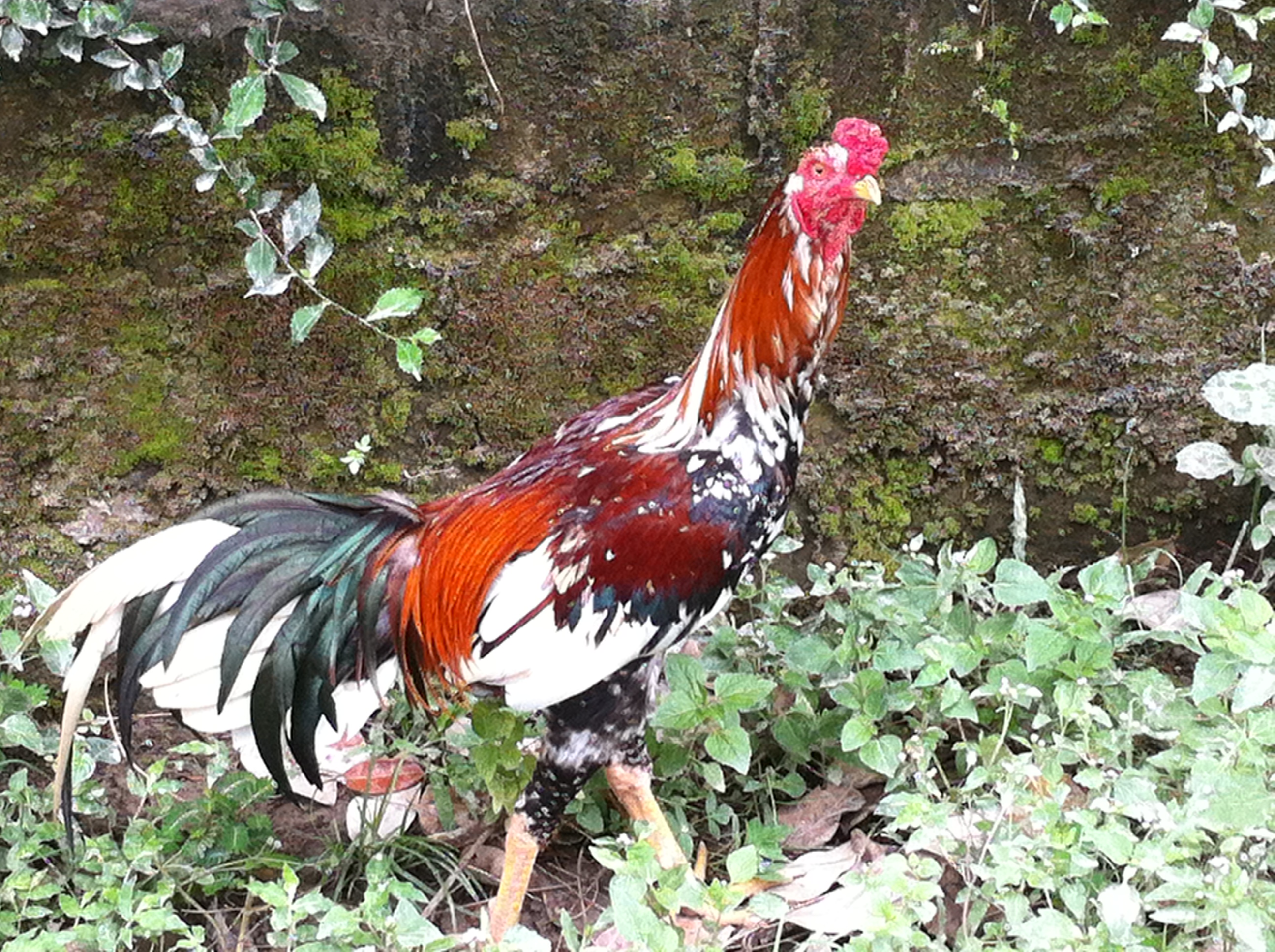
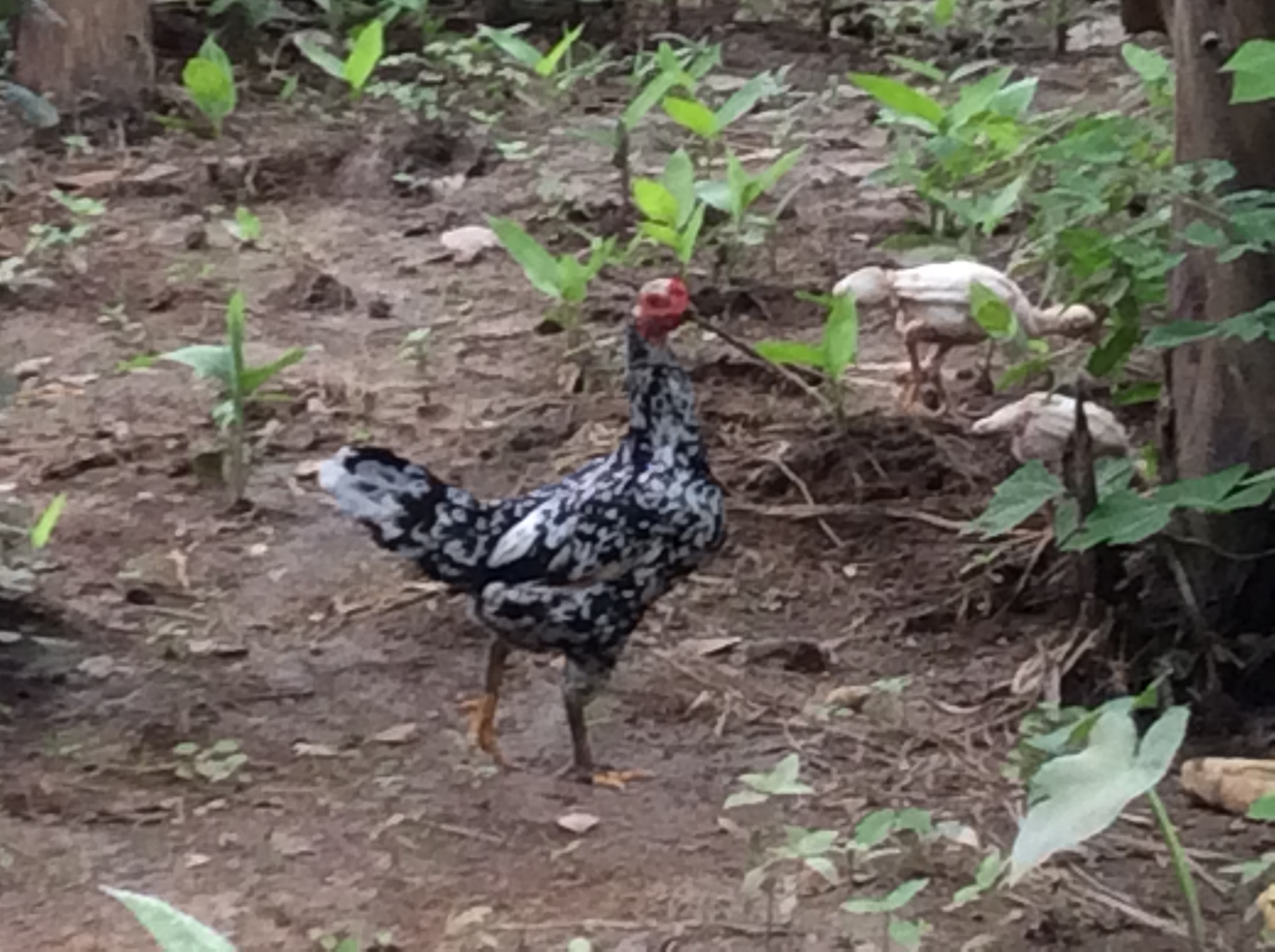
Apart from these character issues, Bécassine was really a very handsome chicken. One thing I particularly admired about her were her long, graceful legs. Really quite model-like, I felt. And her plumage, though modest compared to some other chickens we saw in the surrounding villages:

kampong chicken 001

chickens on walk 003
(this one reminds me of Audrey Hepburn in My Fair Lady)
audrey hepburn
her plumage, as I say, was sleek and smooth. A very far cry indeed from the battery chickens which we have been reduced to breeding in the richer countries
battery chicken
so that we can have dirt-cheap eggs and dirt-cheap chicken meat and eventually all look like this.
obese couple
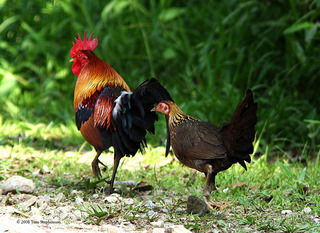
In fact, Bécassine is a free-range chicken, what they call here a kampong, or village, chicken. And indeed every village we walked through had dozens of kampong chickens, many of the hens with a brood of chicks in tow, ranging through the village and into the fields beyond. With their long legs and rich plumage, they really were very handsome. I do believe that they are not very distant genetically from their wild progenitor, the Red Junglefowl, whose range extends from northern India through South-East Asia and into southern China.
red junglefowl-1
Indeed, the domestication of the chicken took place somewhere around here about 5,000 years ago.

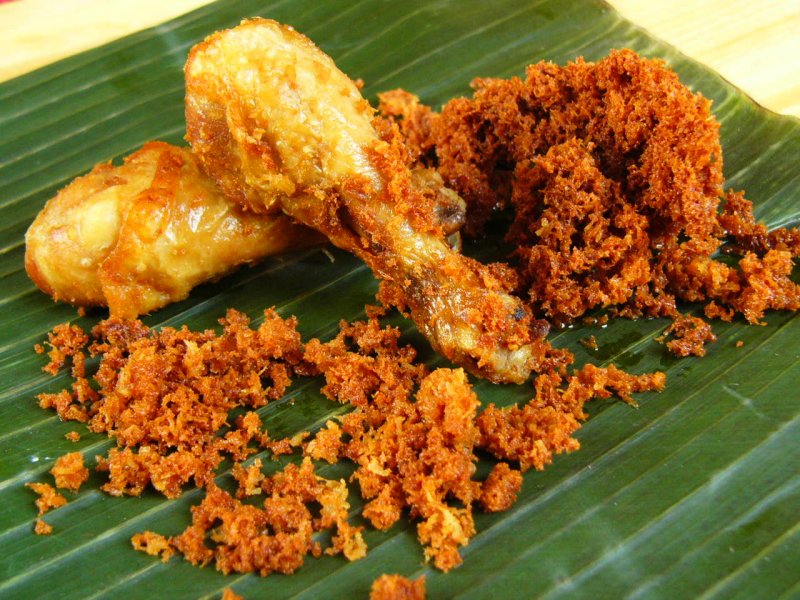
Being free range, Bécassine will no doubt be very good to eat. We didn’t eat her, but in Yogyakarta we had lunch at a restaurant which served typical Indonesian food. One of these was Ayam Goreng Kremes, a fried kampong chicken with fried, flaked salam leaves.

ayam goreng kremes

Fingurr-lickin’ good, as the Colonel would say!

Sorry, Bécassine, it’s been good to know you, but you have to follow your destiny. Someone, some day, will have the great pleasure of eating you.

________________________

Becassine hen: our picture
Becassine: http://madameshackelford.wikispaces.com/file/view/blppxije.jpg/35302825/blppxije.jpg [in http://madameshackelford.wikispaces.com/Bécassine%5D
kampong chickens: our pictures
Audrey Hepburn: http://i.dailymail.co.uk/i/pix/2011/12/05/article-0-0F1123D000000578-117_634x792.jpg [in http://www.dailymail.co.uk/femail/article-2070449/Marilyn-Monroe-Kate-Middleton-The-unforgettable-dresses-time.html%5D
Battery chicken: http://lifewiththeexbatts.files.wordpress.com/2011/08/audrey-1.jpg [in http://lifewiththeexbatts.wordpress.com/2011/08/23/hello-world/%5D
Obese people: http://www.themobilityresource.com/wp-content/uploads/2014/01/morbidly_obese_091026_main.jpg [in http://www.themobilityresource.com/disabesity-should-morbidly-obese-people-be-considered-disabled/%5D
Red junglefowl: http://www.discoverlife.org/IM/I_TS/0006/320/Gallus_gallus,_red_jungle_fowl,I_TS604.jpg [in http://www.discoverlife.org/mp/20q?search=Gallus+gallus%5D
Ayam Goreng Kremes: http://1.bp.blogspot.com/-76_gBdFsH_8/UCS8hAh77bI/AAAAAAAAAHA/eZYM1EQnGh0/s1600/resep-ayam-kremes.jpg [in http://foodiefod.blogspot.com/2012/08/tips-membuat-ayam-goreng-kremes.html%5D
INDONESIA – VOLCANIC ERUPTIONS

Beijing, 23 February 2014

Our trip to Indonesia to celebrate my wife’s birthday started with a bang – literally. Two days before we were leaving, Mt. Kelud erupted

Mount Kelud eruption-1

Mount Kelud eruption-2

covering a good portion of Central Java with a fine layer of ash.

ash covering village

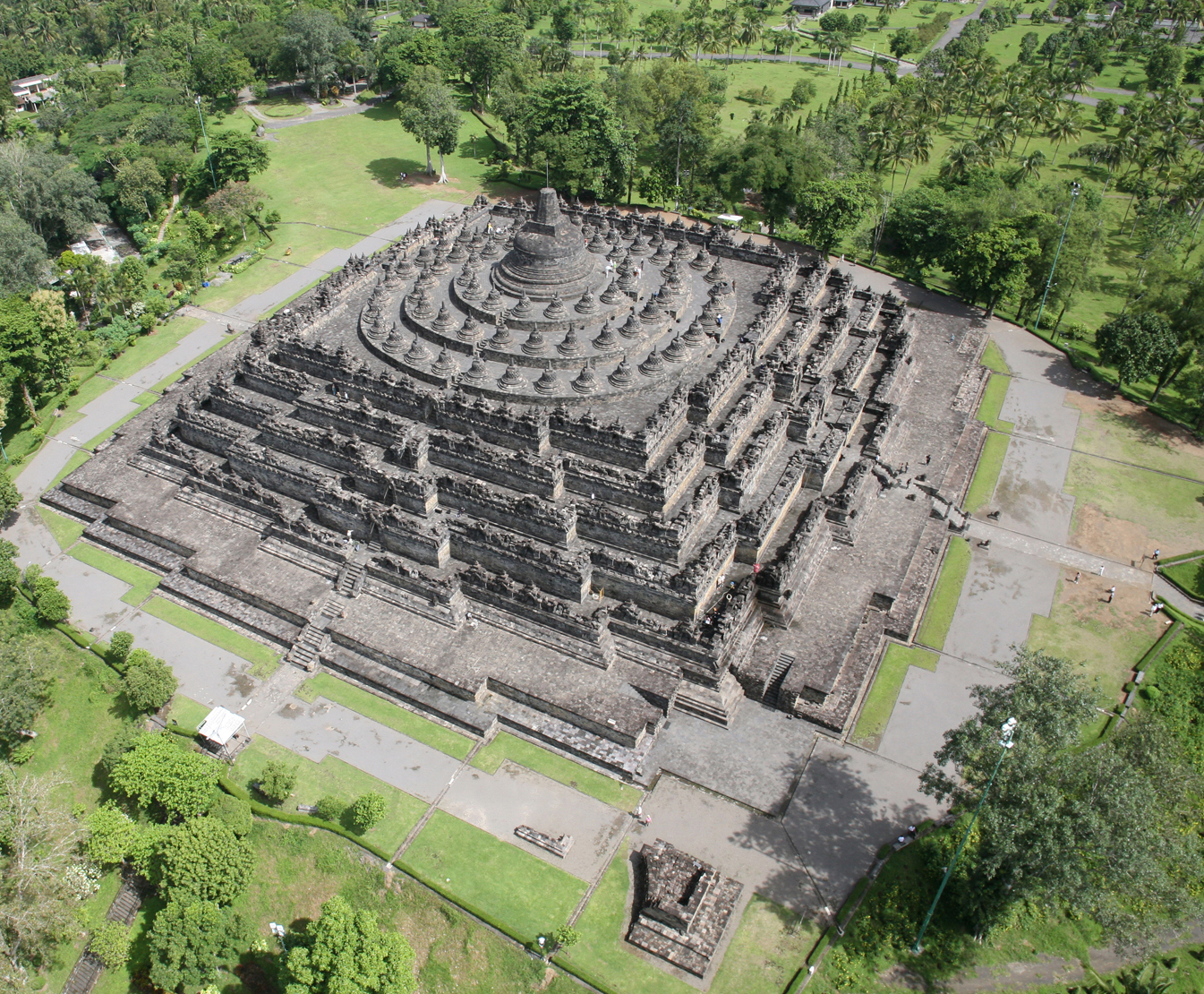
My wife and I were stunned. This was where we were meant to be going! Our plan was to visit the Buddhist temple Borobudur, a UNESCO World Heritage site
borobudur temple
and other old temples dotting the landscape north of Yogyakarta. From the moment we heard about the eruption to the minute our flight took off from Beijing for Jakarta, we anxiously scanned the net for the latest news. Our immediate concern was the onward flight to Yogyakarta. We read that the airport there, along with two other airports in the region, had been closed because of the ash-fall.
yogyakarta airport-1
But surely, we said to each other, the airport will be open by the time we arrive in Jakarta. Surely it will.

It was not. In fact, ground staff at Jakarta told us that it would be a couple of days before they could clear the ash enough for it to reopen. The only way to get to Yogyakarta was by rail (7 hours) or by road (15 hours). We were marooned …

Luckily, though, one of the ground staff mentioned that Semarang’s airport had been re-opened. It had also suffered from ash-fall, but they had managed to clean it up quite quickly. We had only the haziest notion of where Semarang was but if the ground staff thought it was a good alternative that was good enough for us. We got the ticket changed to a flight to Semarang which left very early the next morning. Since the thought of spending the night at Jakarta airport didn’t appeal, we also put ourselves down on the waiting list for a flight leaving that evening for Semarang. We were warned that there was very, very little chance, but in the end we got on the flight and there were still free seats behind us. The local guide who was meant to pick us up at Yogyakarta recommended a hotel in Semarang, and we agreed with him that he would come to get us there the next day.

So, by the afternoon, but 24 hours late, we were sitting on the terrace of our hotel, on chairs and at a table which had been vigorously scrubbed to get rid of the insidious volcanic ash, sipping a ginger-lemon grass welcoming drink, and looking over at Borobodur temple faintly picked out on the horizon, framed by trees whose leaves were all still thickly covered in ash.
Borobodur from hotel terrace-1
The hazards of travel … although this is the first time for us that a volcano has got in the way.

Surely Yogyakarta airport will be open again by the time we leave. Surely it will.

-oOo-

PS: It was. I am posting this from the comfort of my dining room table in Beijing, where we got in this morning.

___________________

Mount Kelud eruption-1: http://en.es-static.us/upl/2014/02/volcano-Kelud-Indonesia-2-13-2014-Asthadi-Setyawan-1.jpg [in http://earthsky.org/earth/kelud-volcano-in-indonesia-is-erupting-thousands-evacuating%5D
Mount Kelud eruption-2: http://www.independent.co.uk/incoming/article9128319.ece/ALTERNATES/w620/MountKelud.jpg [in http://www.independent.co.uk/news/world/asia/mount-kelud-eruption-why-is-indonesia-the-hottest-spot-on-the-ring-of-fire-9128148.html%5D
Ash covering village: http://cdn.rt.com/files/news/22/6a/20/00/vulkano.si.jpg [in http://rt.com/news/kelud-volcano-erupts-indonesia-962/%5D
Yogyakarta airport: http://media.npr.org/assets/img/2014/02/14/20185022_h27297760-d0ed011f5a27f5721c964017a41959be91678c94-s6-c30.jpg [in http://www.npr.org/blogs/thetwo-way/2014/02/14/276836240/massive-volcanic-eruption-in-indonesia-blankets-region-in-ash%5D
Borobudur temple: http://townsofusa.com/travels/wp-content/uploads/2013/07/borobudur-0222.jpg [in http://townsofusa.com/travels/2013/07/borobudur-temple-in-indonesia/%5D
Borobudur temple from the hotel terrace: our picture

SNOWY MOUNTAINS

Beijing, 8 February 2014

It was snowing when we got up yesterday, the first snowfall of the season – in fact, the first time there has been any precipitation, rain or snow, in the last four months in Beijing. The city was still quiet after the Chinese New Year, so it was with pleasure that I crunched my way to work through the deserted streets and along my piece of canal, with the small, grainy snowflakes floating down around me.
canal-before
And dimly through the flakes and mist, I perceived a man on the other bank of the canal slowly going through the balletic moves of tai-chi. Magic …

It kept snowing fitfully all day and into the evening, becoming greyer and foggier by the hour. So I just hurried home after work, looking forward to a welcoming wife, a cheerfully lit apartment, a glass of wine, and a plate of pasta. We closed out the world and enjoyed two French detective thrillers before retiring to bed.

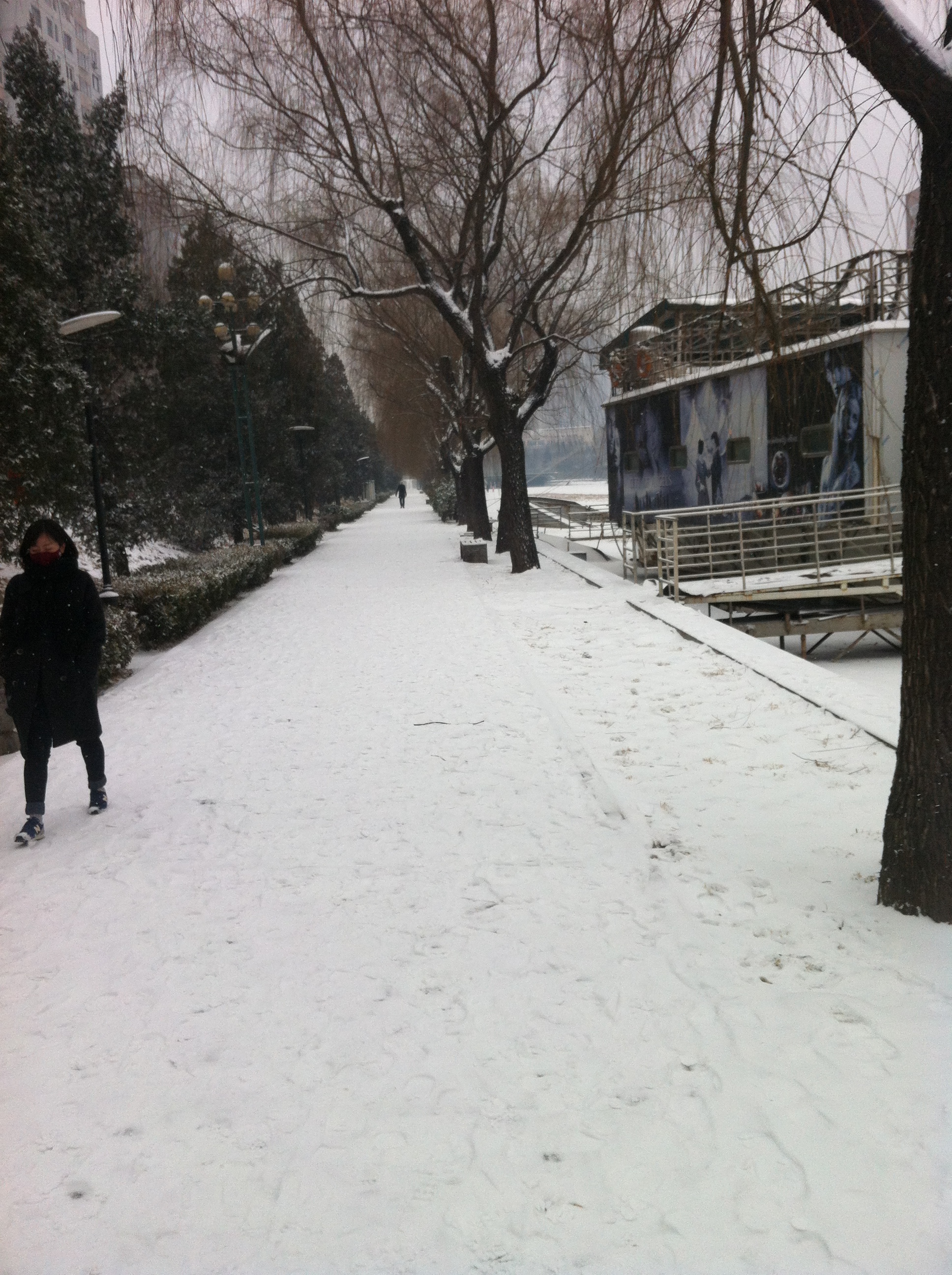
This morning, the clouds had been chased away along with the fog, and the sun shone down brightly. How different the world looked! There is nothing like a coating of snow under a bright sun and a clear blue sky to make even the most squalid cityscape look inviting. On our way to morning coffee and lunch, I took a couple of photos of the canal to record the event.
canal-after 004
OK, let’s not get carried away here. Quite soon, all that fresh snow will turn into muddy slush, making a misery for us pedestrians as we pick our way round large puddles, warily avoid being splashed by passing cars, and stay ever alert for a hidden piece of ice under our feet . And even when the snow is still fresh, the view simply cannot beat a snowscape in the mountains. My wife is a good and enthusiastic skier, and when the children were young she liked to take them skiing in the Alps. I, on the other hand, dislike skiing, so it was always with a certain grouchiness that I accompanied them on these skiing expeditions. The traffic jams to get there! The crowds at the shop to hire the gear! The astronomic cost of the ski passes! The kilometric lines to get on the ski lifts! All those peacocks parading their latest ski gear! The morons who skied far too fast down the crowded slopes! The icy wind turning my face into a piece of numb codfish! But even grouchy old me could not avoid a smile when suddenly confronted at the turning of a path with vistas of virgin white snow softly pillowing rocky hill and dale and gathering protectively around the pine trees, while the mountains glittered behind against a backdrop of a deep blue sky.

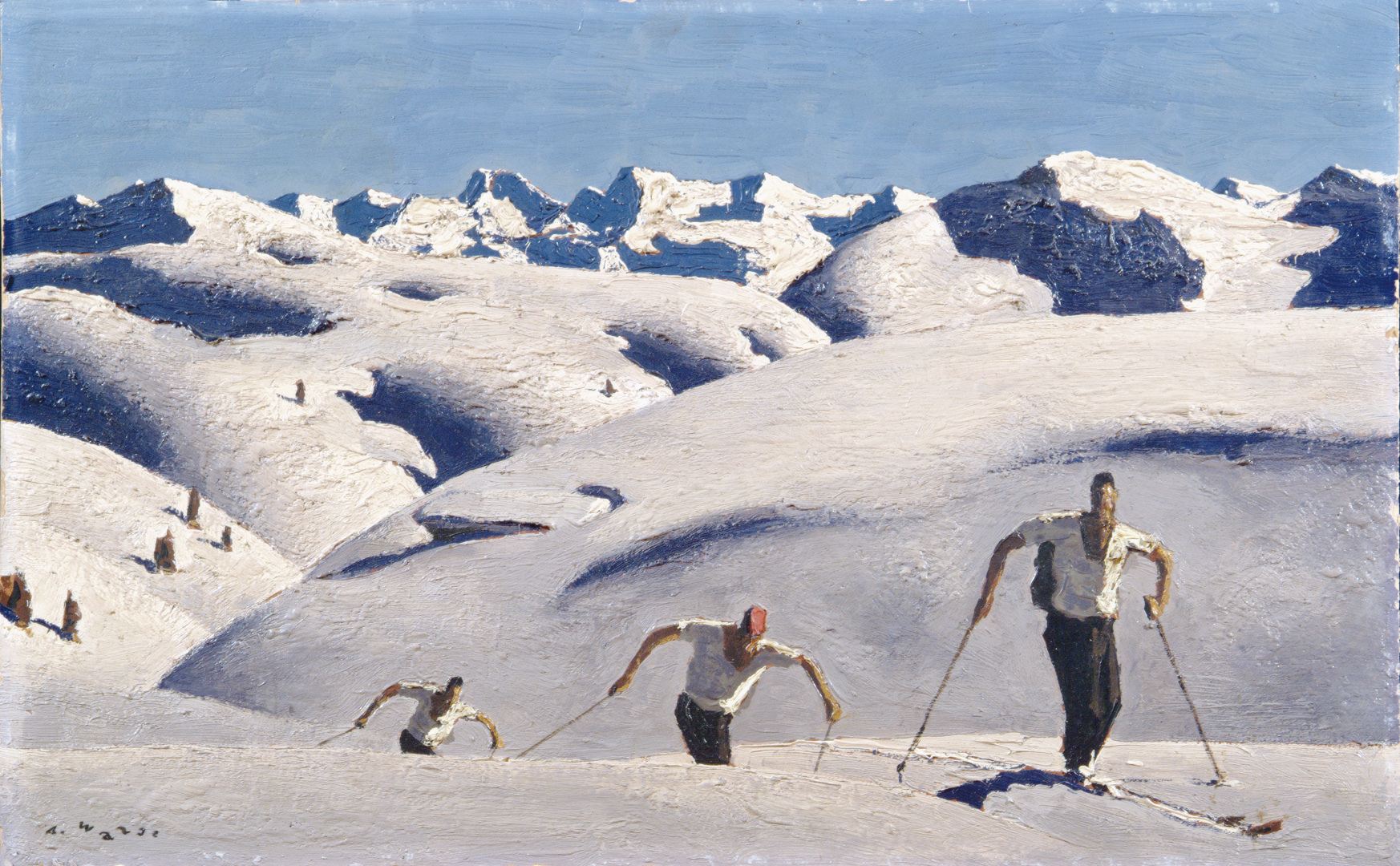
The only artist I know who has ever captured the beauty of mountains in the winter is the Austrian painter Alfons Walde. Walde was from Kitzbühel in the Tyrol, so he knew the Alps well.  From the mid 1920s onwards, he painted a series of pictures of the Tyrolian Alps during winter. I show here a selection, starting with the first of his paintings I ever came across, in the form of a poster advertising a show of his works in Vienna. I still have that poster somewhere. It is his “Ascent of the Skiers”, 1931

alfons walde-Der Aufstieg der Schifahrer-1931

Here we have “Steinbergkogel”, 1926

Alfons Walde-Steinbergkogel-1926

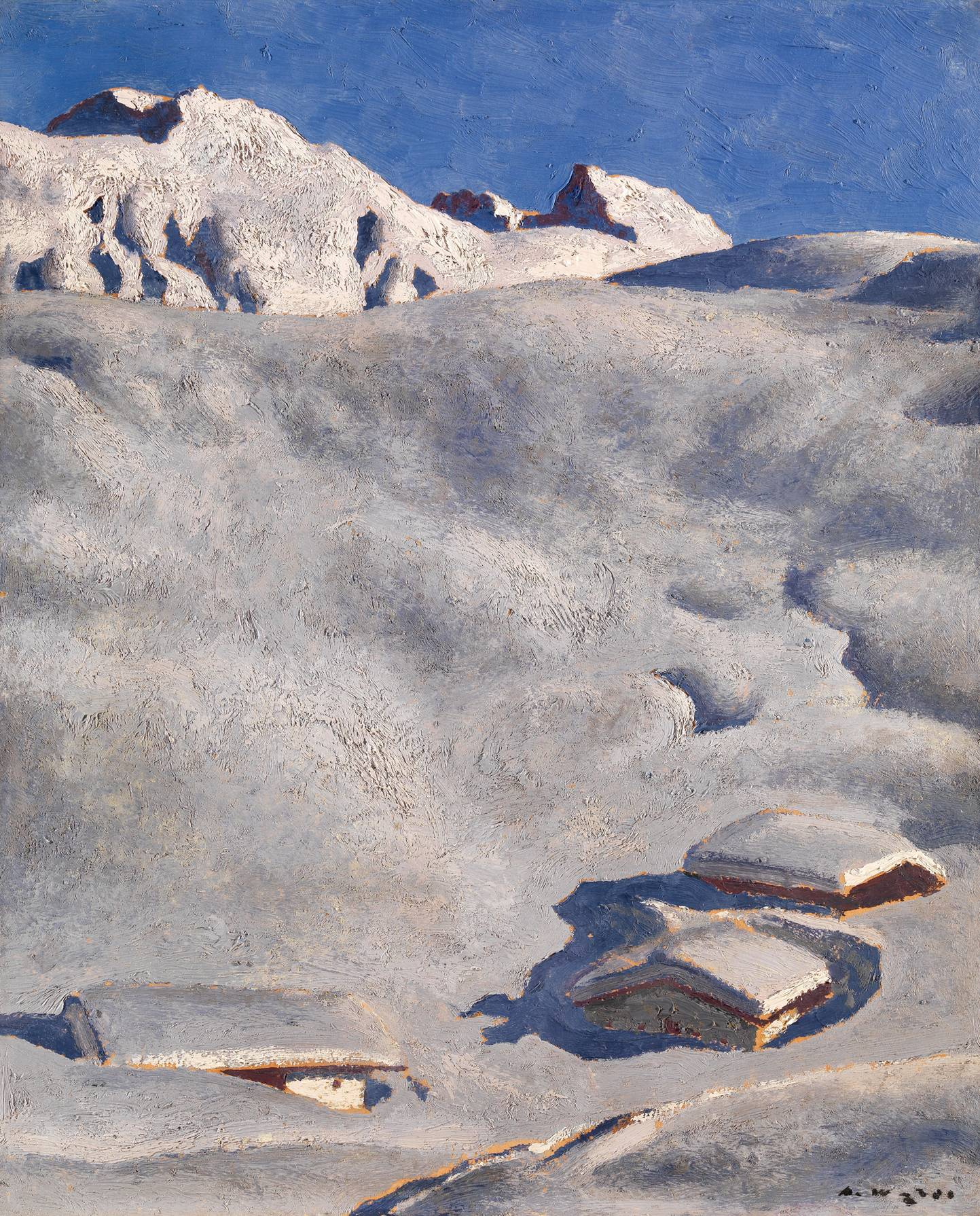
And here his “Meadows under Snow”, 1926

alfons walde-Almen im Schnee-1926

Walde also liked to paint the inhabitants of the Tyrolian villages. They still wore their traditional costumes back then. There’s still a faint echo of this in Austria’s traditional jackets for men and the dirndls the women wear. This is his “Auracher Church”, 1927-30

Alfons Walde-Auracher Kircherl-1927-30

And this is his “Meeting”, about 1924

Alfons Walde-begegnung

I will be frank. I wouldn’t mind owning one of Walde’s paintings.  But I’m not a millionaire. The best I’ve managed is a print by another Austrian artist

general photos 008

But hope springs eternal. You never know, I may find a Walde in my attic one day.

______________________

pix in Beijing: mine
“Ascent of the Skiers”: Alfons Walde- Der Aufstieg der Schifahrer-1931: http://shop.alfonswalde.com/WebRoot/Store/Shops/es268867/50B4/8486/F7AD/8B37/3A2E/50ED/8962/9095/Aufstieg_der_Schifahrer_1080.jpg [in http://shop.alfonswalde.com/epages/es268867.sf/de_DE/?ObjectPath=/Shops/es268867/Products/PLW35%5D
“Steinbergkogel”:  http://shop.alfonswalde.com/WebRoot/Store/Shops/es268867/50B4/CA47/6775/F975/A744/50ED/8962/CB5B/PLWT36-Steinbergkogel_1080.jpg [in http://shop.alfonswalde.com/epages/es268867.sf/de_DE/?ObjectPath=/Shops/es268867/Products/PLW36%5D
“Meadows under Snow”: Alfons Walde- Almen im Schnee: https://myartmap.com/sites/default/files/walde_2.png [in https://myartmap.com/user/5189/shop%5D
“Aucherl Church”: Alfons Walder-Auracher Kircherl-1927-30: http://www.austrianfineart.at/images/largeorig/Walde-Auracher%20Kircherl-Kat.%202001.jpg [in http://www.austrianfineart.at/detailtest.php?cid=297&lang=%5D
“Meeting”: Alfons Walde-begegnung: http://alfonswalde.com/cms/wp-content/uploads/2013/05/begegnung_1080_WZ.jpg [in http://alfonswalde.com/cms/?cat=16%5D
pic of the barn in the snow: mine

LANDSCAPES

Beijing, 26 January 2014

Last week, I went to visit a factory on the outskirts of Beijing which recycles waste equipment.  They take old TVs, old computer monitors, refrigerators, air conditioners, and washing machines; if the regulatory conditions become right, they will also start taking mobile phones. They disassemble these old products and recycle the various components, having first properly separated them. It’s fascinating to watch the disassembly, which is the exact mirror image of normal manufacturing: the process starts with the whole product, which as it moves down the (dis)assembly line slowly comes apart, ending up back as its individual components.  This is the future, my friends. All the products we make should be collected at the end of their useful lives, brought to factories like this one, and taken apart so that their component materials can be reused: “Circular Economy” is the tag for this.

But actually, I want to write about something completely different. After visiting the disassembly line and talking with the company management about its plans for the future, we were invited to lunch in the company’s canteen. As is customary, we were taken to a separate room, which contained one large round table and the usual Lazy Mary languidly turning in the middle. As we sat and chatted and picked at the dishes going by, my eyes wandered around the room. They fastened on this painting on the wall:

canteen photo 002

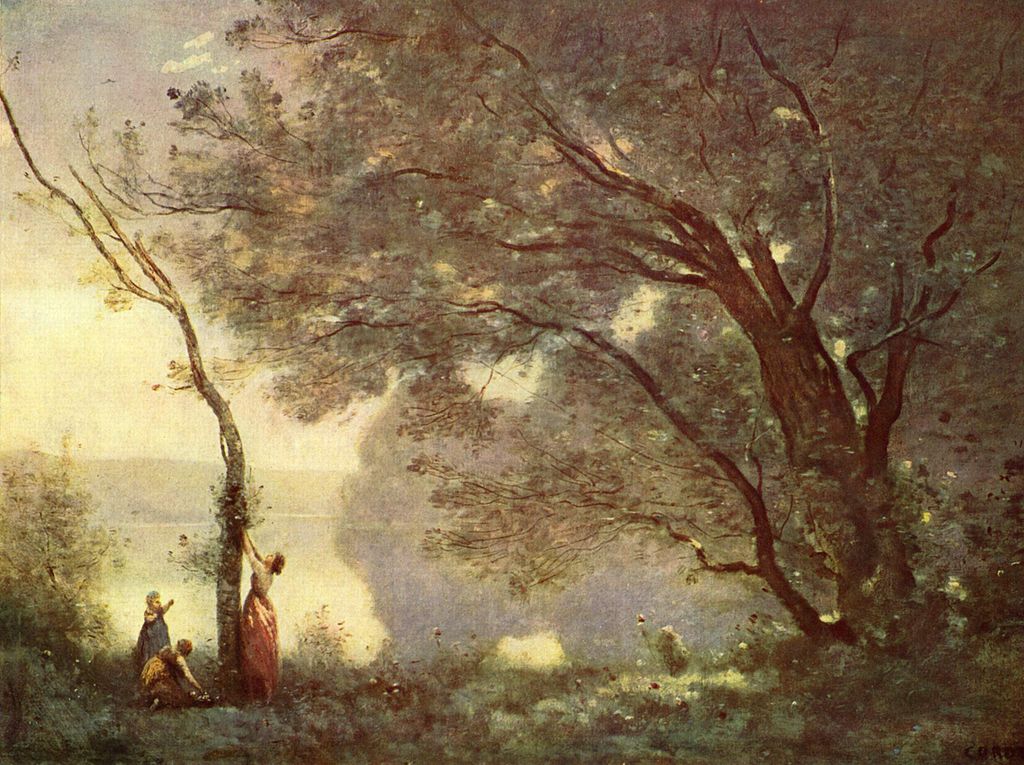
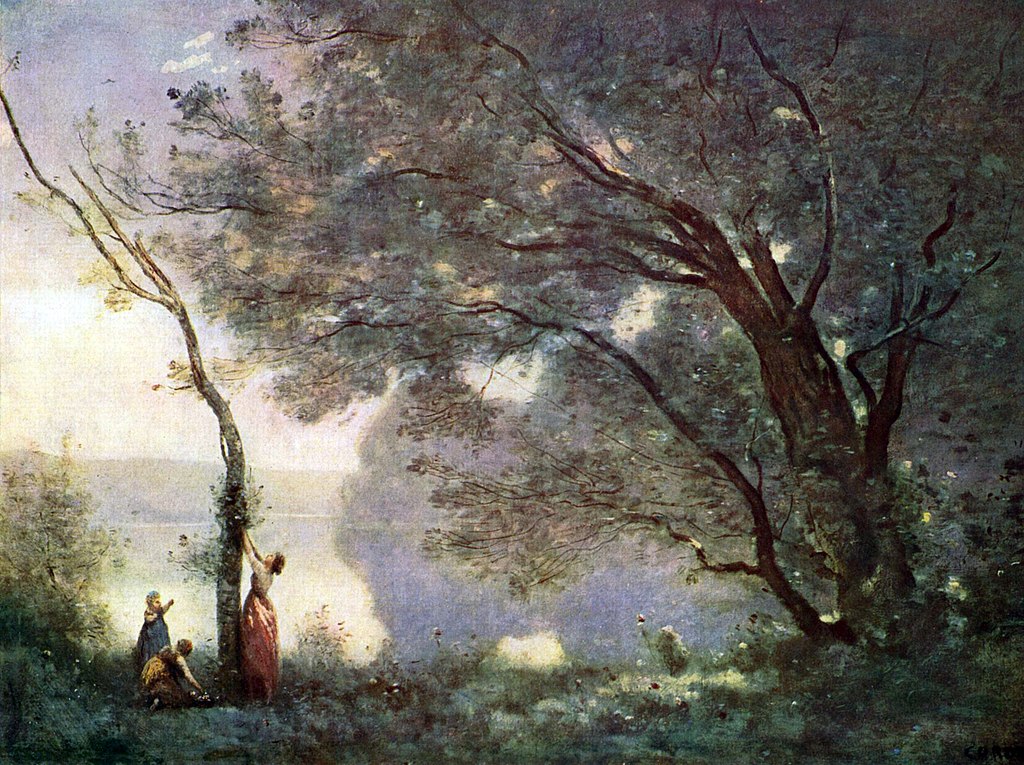
It was a welcome dash of cheerful green on what were otherwise rather drab walls. That being said, it was not much to write home about, a clearly amateur rendering of the scene, the sort of thing one could pick up for 1 euro at any flea market. And yet … there was something about it which sparked a faint memory. The memory fluttered indistinctly around in my mind as we said our goodbyes at the end of the lunch and headed back to the office. It was like having a grain of sand in one’s shoe, softly but insistently irritating. There was nothing for it, I was going to have to do some research when I got back to the office. Luckily, it didn’t take long to pin down the memory. What I had been looking at was a copy – or a copy of a copy of a copy … – of a famous painting by the French painter Camille Corot, Souvenir de Mortefontaine, painted in 1864 and now hanging in the Louvre Museum:

Corot-souvenir de Mortefontaine

But that’s not where I had seen it first. That memory which I had been vainly chasing through the corridors of my brain was set in my grandmother’s house in London.  She had a copy of the painting hanging on her drawing room wall, from where it would look down on me as I sat on the couch drinking my grandmother’s lapsang souchong tea. Strange how life is … an invisible thread loops through time and space, linking my grandmother’s drawing room in the 1960s, cluttered with family memories, to a rather drab factory canteen on the outskirts of Beijing in 2014.

For all the warm, fuzzy memories it evokes, I would not put this particular painting, in original or in copy, on my wall. Memories are one thing, taste another. I remember my grandmother saying once how much she loved Corot. Me, I find him cloyingly sentimental, his feathery trees irritate me, and the grey-green palette he used in this particular series of paintings – he did a number of such Souvenirs – grates on my senses.  If I were going to have a landscape on my wall by a famous painter, I would much prefer any one of a host painted in the last five hundred years.  I could easily live with one of Bruegel’s paintings of the seasons, his Corn Harvest say:

Bruegel-The Corn Harvest (August)-

or why not a Constable, for instance his Wivenhoe Park:

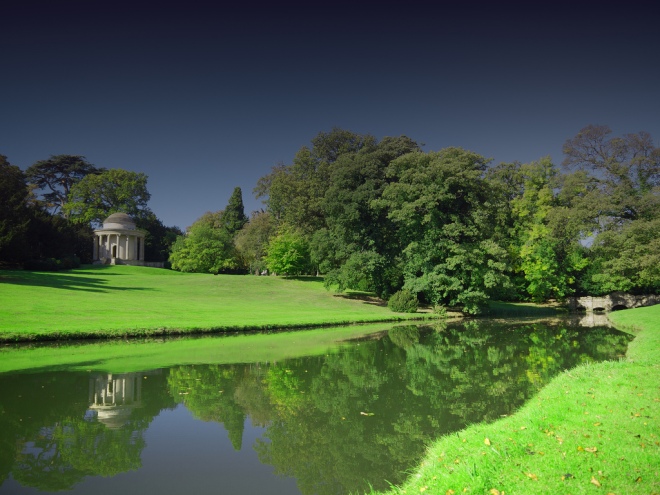
Constable - Wivenhoe Park

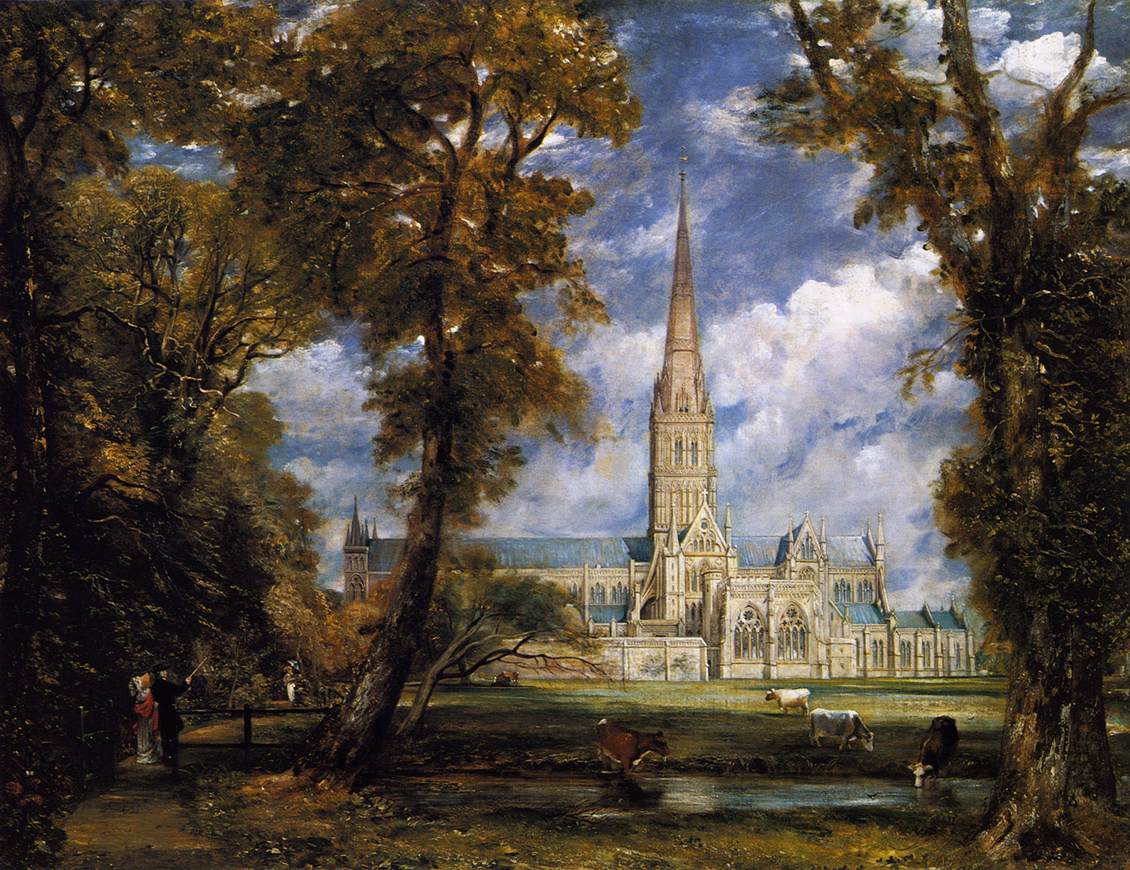
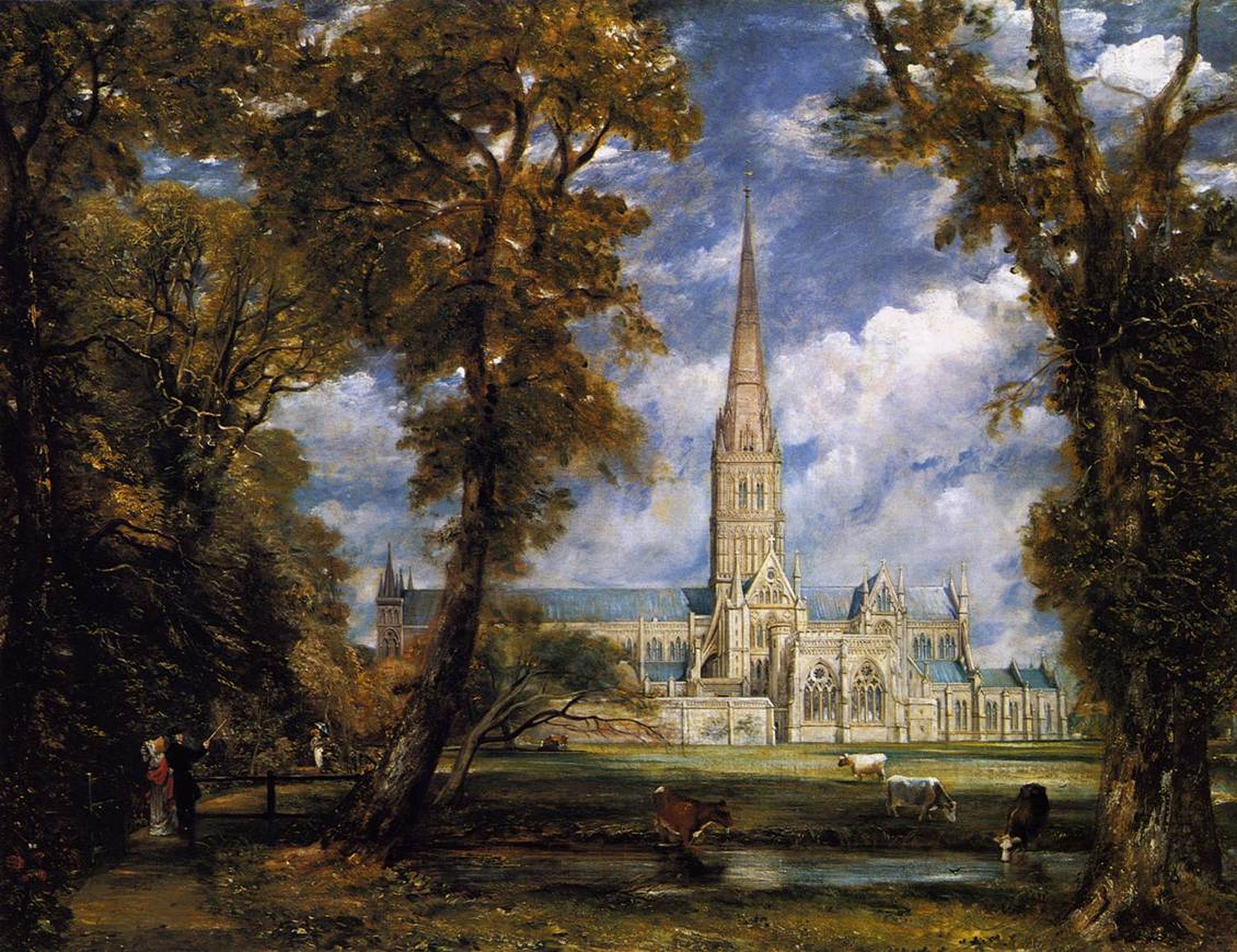
or his Salisbury Cathedral (although calling this a landscape may be a bit of a stretch)

Constable-Salisbury Cathedral-1825

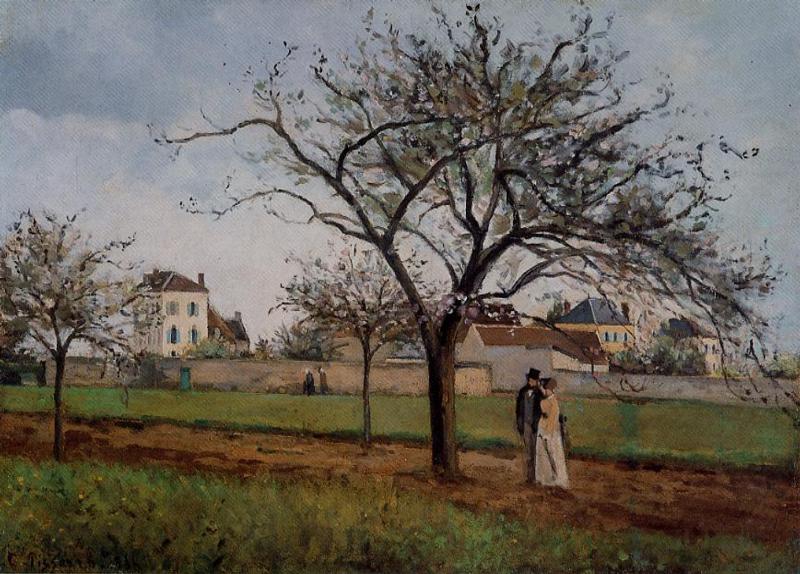
I could also happily live with one of the pre-impressionist works which were already being painted when Corot was painting Souvenirs de Mortefontaine, like this Pissarro, La Maison de Père Gallien à Pointoise, painted just two years after the Corot, but which already shows a more real, more vibrant world than Corot’s honeyed one

Pissaro-Pere galliens house at Pontoise-1866

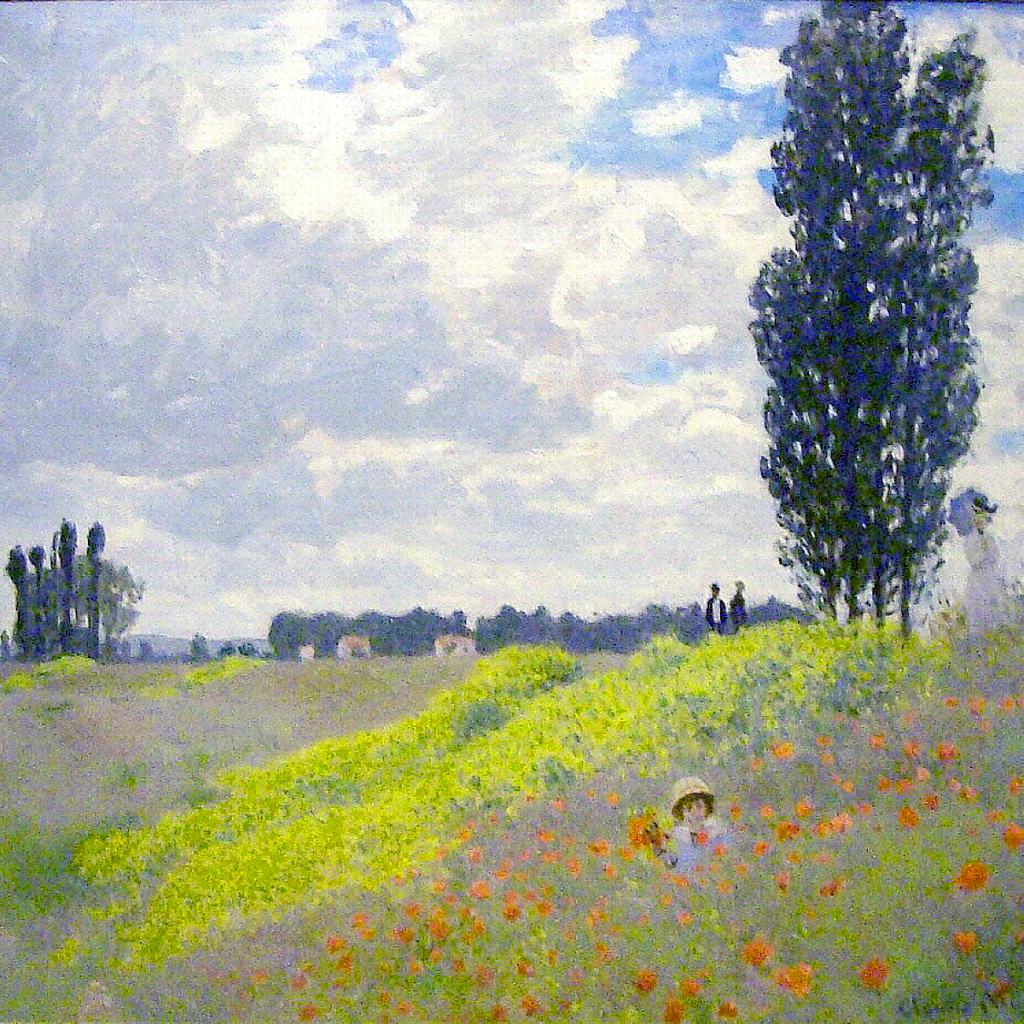
From the impressionist period, I could take a Monet landscape, like this one from a series he made of the fields around Argenteuil, Walk in the meadows around Argenteuil:

Monet-walk-in-the-meadows-at-argenteuil

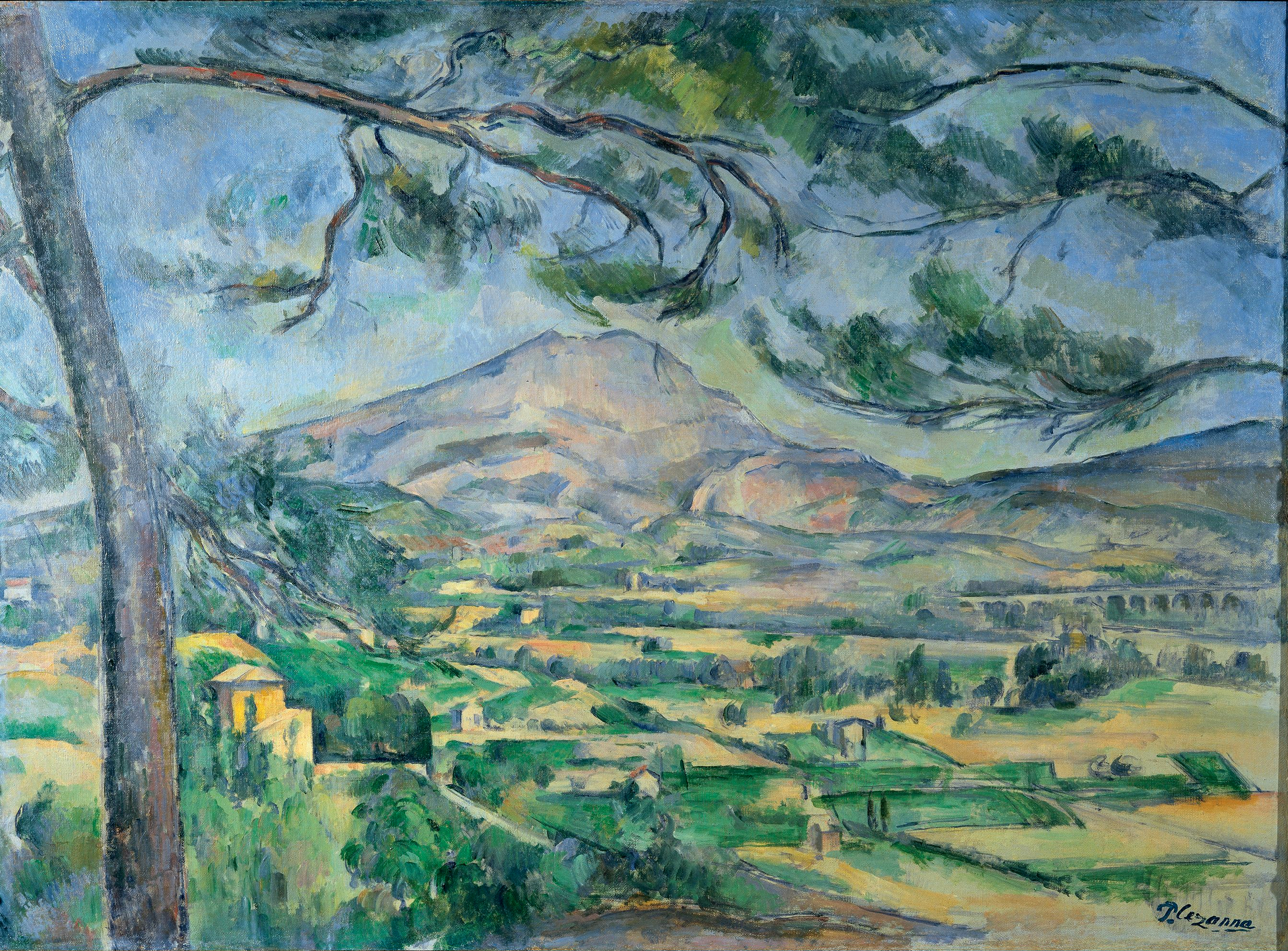
From a little bit later, one of Cézanne’s many proto-cubist paintings of Mont Saint Victoire in the south of France would be lovely:

Cézanne-Mont St Victoire

as would one of Van Gogh’s whirling wheat fields like this one, Wheat field with cypresses

Van Gogh-Wheatfield with cypresses-1889

A pointillist landscape would do nicely too, like this Signac, Comblat Castle and the Pré:

Signac-comblat-castle-the-pre-1886

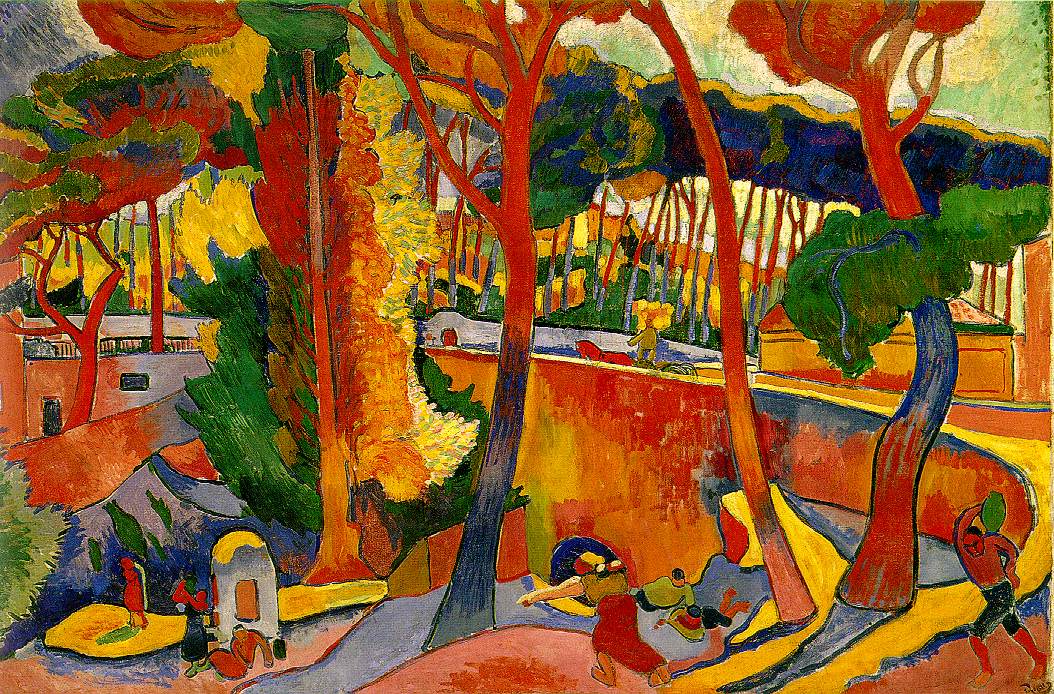
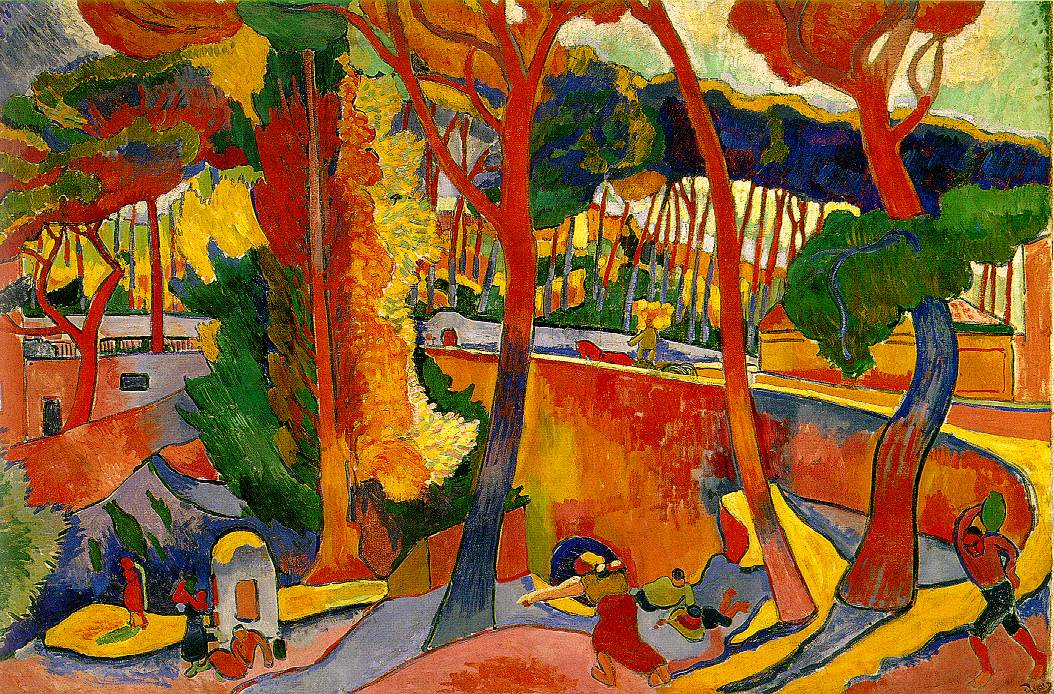
I could even hang a fauvist landscape on my wall, like this one, The Turning Road, l’Estaques, by Derain:

Derain-The Turning Road lEstaques

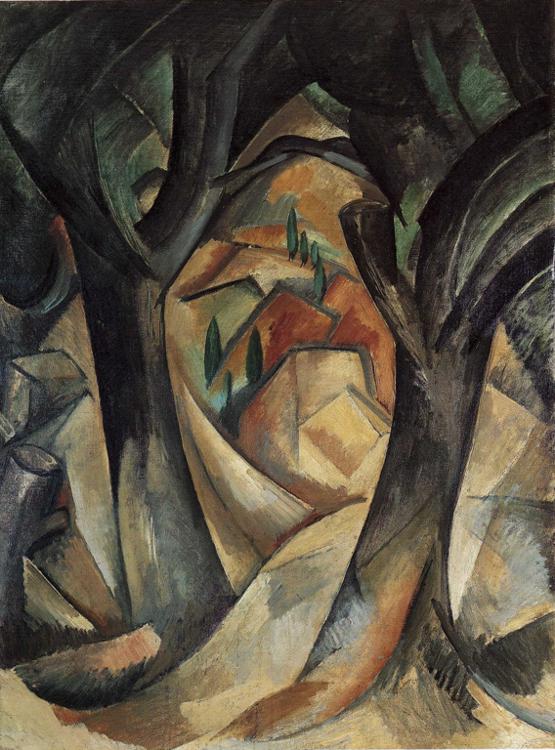
or even, at a pinch, a cubist landscape like this one by Braque, Big Trees at Estaques:

Braque-big-trees-at-estaque-1908

But maybe I would eschew the modernist trends which I have been following up to now, and go for one of the paintings by the American artist Grant Wood, like this Young Corn, painted in 1931:

Grant Wood-young-corn-1931

There are certain similarities to the Bruegel I started with, no?

But in the end, I wouldn’t need to put any of these paintings on my walls, because I already have my landscape painting, purchased in the Dorotheum, the Viennese auction house.

general photos 002

Maybe one day I will have grandchildren who will drink lapsang souchong tea with me, look at the painting, and ask themselves what on earth Grandpa sees in it.

_____________________________

Pic in the canteen: mine
Corot-Souvenir de Mortefontaine: http://upload.wikimedia.org/wikipedia/commons/thumb/7/74/Jean-Baptiste-Camille_Corot_012.jpg/1024px-Jean-Baptiste-Camille_Corot_012.jpg [in http://fr.wikipedia.org/wiki/Jean-Baptiste_Corot%5D
Constable-Wivenhoe Park: http://upload.wikimedia.org/wikipedia/commons/thumb/1/15/John_Constable_-_Wivenhoe_Park%2C_Essex_-_Google_Art_Project.jpg/1280px-John_Constable_-_Wivenhoe_Park%2C_Essex_-_Google_Art_Project.jpg [in http://commons.wikimedia.org/wiki/File:John_Constable_-_Wivenhoe_Park,_Essex_-_Google_Art_Project.jpg%5D
Constable-Salisbury Cathedral: http://upload.wikimedia.org/wikipedia/commons/4/46/Salisbury_Cathedral_from_the_Bishop_Grounds_c.1825.jpg [in http://en.wikipedia.org/wiki/Salisbury_Cathedral%5D
Pissaro-Père Gallien’s house at Pontoise: http://uploads6.wikipaintings.org/images/camille-pissarro/pere-gallien-s-house-at-pontoise-1866.jpg [in http://www.wikipaintings.org/en/camille-pissarro/pere-gallien-s-house-at-pontoise-1866%5D
Monet-the Promenade Argenteuil: http://uploads7.wikipaintings.org/images/claude-monet/the-promenade-argenteuil.jpg [in http://www.wikipaintings.org/en/claude-monet/the-promenade-argenteuil%5D
Cezanne-Mont St Victoire-1887: http://upload.wikimedia.org/wikipedia/commons/d/d2/Paul_C%C3%A9zanne_107.jpg [in http://en.wikipedia.org/wiki/Mont_Sainte-Victoire_%28C%C3%A9zanne%29%5D
Van Gogh-Wheatfield with cypresses-1889: http://upload.wikimedia.org/wikipedia/commons/e/e8/1889_van_Gogh_Wheatfield_with_cypresses_anagoria.JPG [in http://en.wikipedia.org/wiki/Wheat_Field_with_Cypresses%5D
Signac-Comblat Castle and the Pré-1886: http://uploads3.wikipaintings.org/images/paul-signac/comblat-castle-the-pre-1886%281%29.jpg [in http://www.wikipaintings.org/en/paul-signac/comblat-castle-the-pre-1886%5D
Derain-The turning road: http://4.bp.blogspot.com/_0n9IExEpmh8/S_DnuJ6ZT8I/AAAAAAAAVk4/JCfVk6QJNws/s1600/The_Turning_Road_L_Estaque.jpg [in http://www.artistsandart.org/2010/05/andre.html%5D
Braque-Big trees at Estaques-1908: http://uploads1.wikipaintings.org/images/georges-braque/big-trees-at-estaque-1908.jpg [in http://www.wikipaintings.org/en/georges-braque/big-trees-at-estaque-1908%5D
Grant Wood-Young Corn-1931: http://uploads5.wikipaintings.org/images/grant-wood/young-corn-1931.jpg [in http://www.wikipaintings.org/en/grant-wood/young-corn-1931%5D
Pic of my landscape: mine

ME, I TOOK THE TRAIN TO GO TO NEW JERSEY

New York, 11 January 2014

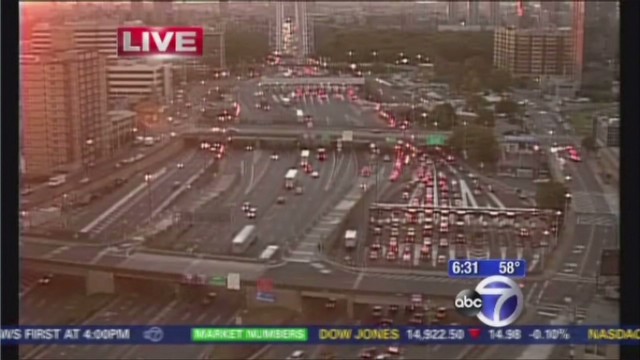
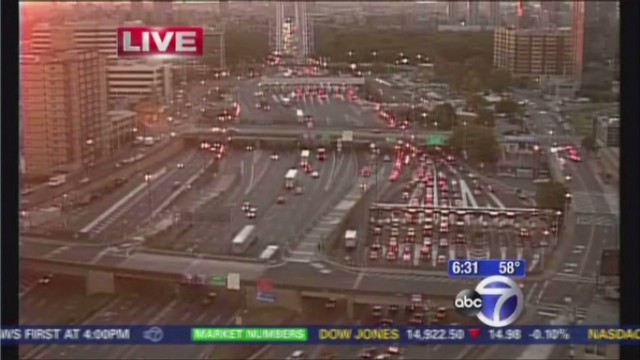
I’ve been reading about the political storm whirling around New Jersey’s Governor Chris Christie and his possible role in the partial closure back in September of several lanes of the George Washington Bridge causing mammoth traffic jams, all as a mean-minded act of revenge against a mayor who chose not to back him.

George Washington Bridge traffic jam

As I read and watch the TV commentaries, I smugly remind myself of the fact that 25 years ago, when I lived in New York and for a period had to travel frequently to Trenton, I did NOT drive and so was never at the mercy of tyrannical politicians and their staff. I took the train (the golden haze of history makes me forget that the trains sometimes ran chaotically).

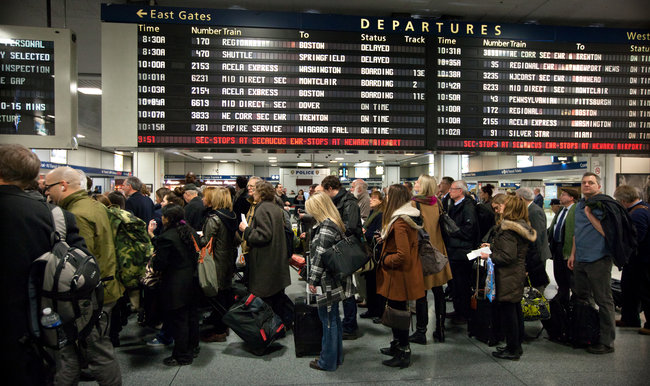
I would catch the train at Penn Station, as miserable then as it is now (although I read somewhere that they might tear it down and replace it with something nicer … hope springs eternal).

Penn Station

But at that time, there was an employee of the railways, announcer of departing trains, who would always end his litany of stops on these trains with a sonorously chanted “All abooo-aard!” He started high on the “All”, dropped to low note on “aboo”, and then rose to triumphant high finale on “aard”. It always put a smile on my lips and sent me off with the sun in my heart.

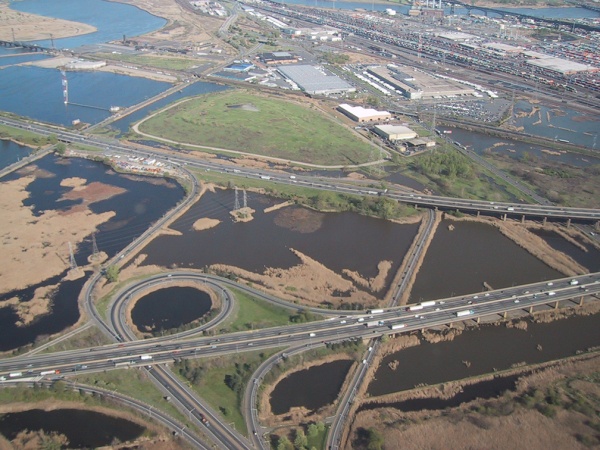
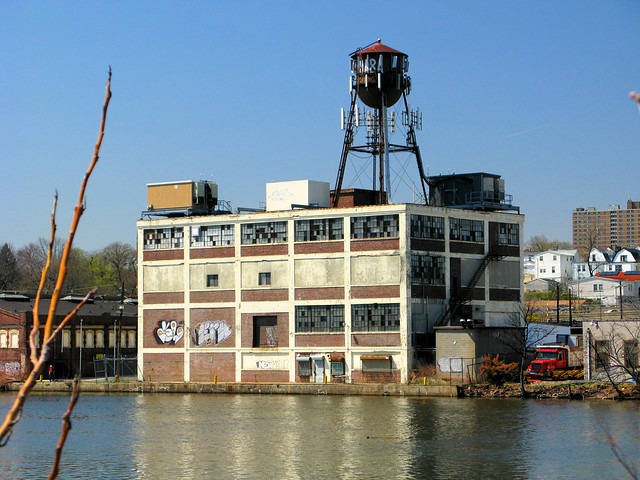
I needed it. After lurching through the tunnel under the Hudson River, we would emerge, blinking, in New Jersey on the other side. There then followed an urban and peri-urban bleakness. After passing through Hoboken and Secaucus, we crossed wastelands of what must have once been lovely marshes and wetlands around the Hackensack and Passaic rivers, as this small remaining wetland near Secaucus attests

wetlands Secaucus

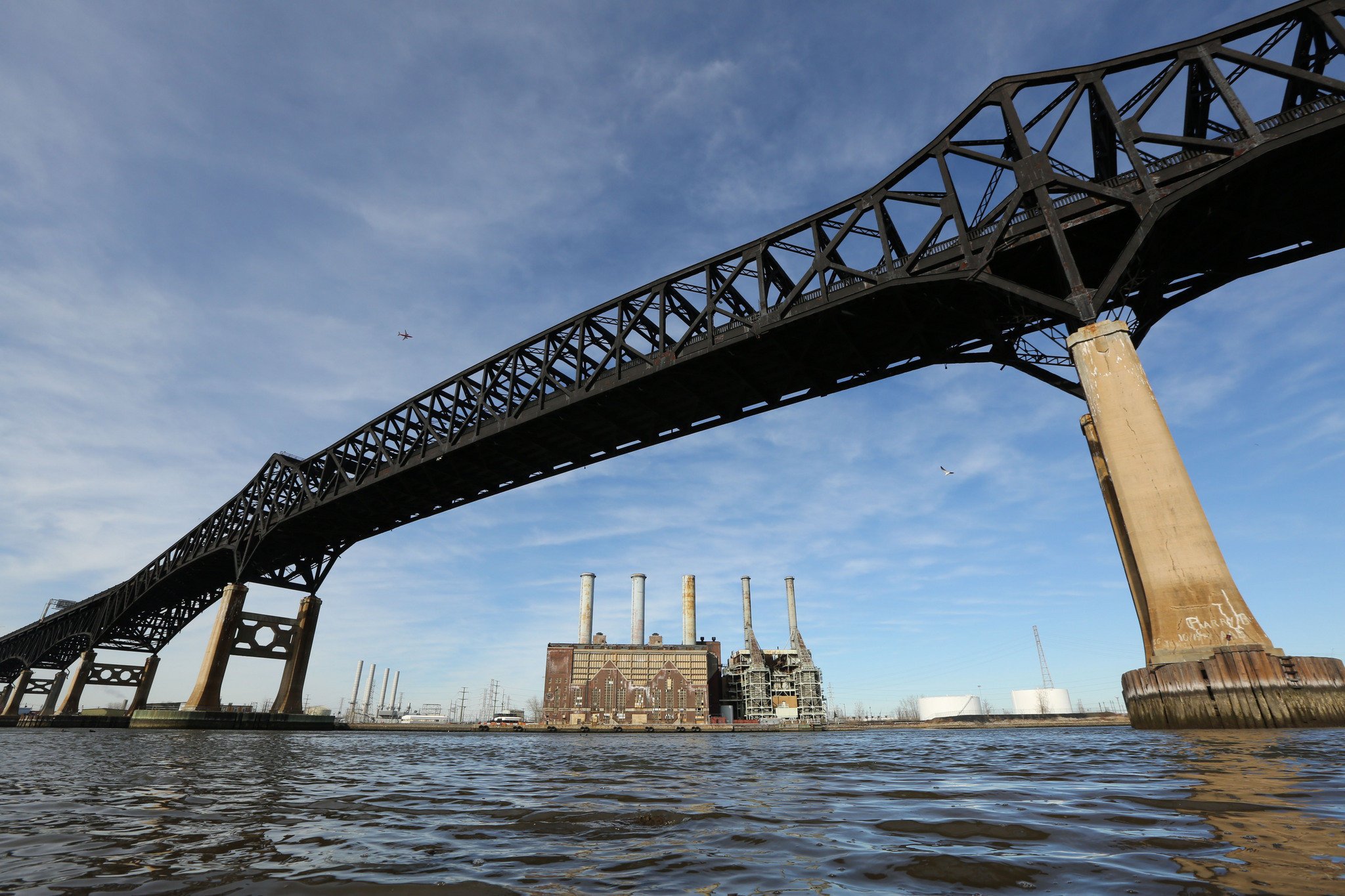
but were now a tangle of roads and studded with industrial estates

roads through the wetlands

pulaski skyway

many of them abandoned, evidence of the collapse of the manufacturing sector in the US.

old industrial site passaic river

I redid this journey recently, taking the train to Washington DC, and it hasn’t got much better.

Every time I sat in that train 25 years ago, watching the bleakness roll by, I silently lamented that way of thinking which saw wetlands as something useless. Here is what a journalist had to say when describing the Meadowlands in 1867:

“Swamp-lands are blurs upon the fair face of Nature; they are fever-breeding places; scourges of humanity; which, instead of yielding the fruits of the earth and adding wealth to the general community, only supply the neighboring places poisonous exhalations and torturing mosquitos. They are, for all practical purposes, worthless; and the imperative necessity for their reclamation is obvious to all, and is universally conceded.” [1]

So they had filled them in and turned them over to some useful economic activity. But now all I could see was that much of that useful economic activity had upped sticks and moved to China or somewhere else, leaving behind only a blighted landscape. And no doubt as I write, that useful economic activity is upping sticks again, moving to somewhere even cheaper, leaving another blighted landscape behind it.

What of those wetlands around the Hackensack and Passaic Rivers? Perhaps sea level rise, coupled with more frequent and more severe storms, both caused by climate change, itself caused by the carbon emissions from all those useful economic activities, will wipe away all our intrusions and chase us off to higher ground. A revenge which will dwarf Governor Christie’s mean-spirited attempt at revenge – if indeed he was involved, of course. Of course …

_____________________

1. The new system of reclaiming lands. (1867, November 16). Frank Leslie’s Illustrated Newspaper, pp. 36–37.

Traffic jam on George Washington Bridge: http://i2.cdn.turner.com/cnn/dam/assets/140109121541-vo-gwb-traffic-september-2013-00000427-story-top.jpg [in http://www.cnn.com/2014/01/09/us/christie-traffic-react/%5D
Penn Station: http://graphics8.nytimes.com/images/2012/02/12/arts/12JPWEST2/12JPWEST2-popup.jpg [in http://www.nytimes.com/2012/02/12/arts/design/a-proposal-for-penn-station-and-madison-square-garden.html?pagewanted=all&_r=0%5D
Wetlands Secaucus: http://www.njmeadowlands.gov/images/environment/mill_air.gif [in http://www.njmeadowlands.gov/environment/parks/mcm.html%5D
Roads through the wetlands: http://www.clui.org/sites/default/files/imagecache/clui-image/clui/post_images/135-3516_img_0.jpg [in http://www.clui.org/newsletter/winter-2013/new-jersey-meadowlands%5D
Pulaski Skyway: http://media.nj.com/jjournal-news/photo/ga0111skyway-11-munsonjpg-f015d680e2f7d239.jpg [in http://www.nj.com/hudson/voices/index.ssf/2013/02/sen_stacks_letter_praises_gov.html%5D
Old industrial site Passaic River: http://farm5.staticflickr.com/4062/4488489938_631d825d01_z.jpg [in http://www.flickr.com/photos/jeffs4653/4488489938/%5D

I ADMIRE THEM, THE CHINESE EAT THEM

Beijing, 22 November 2013

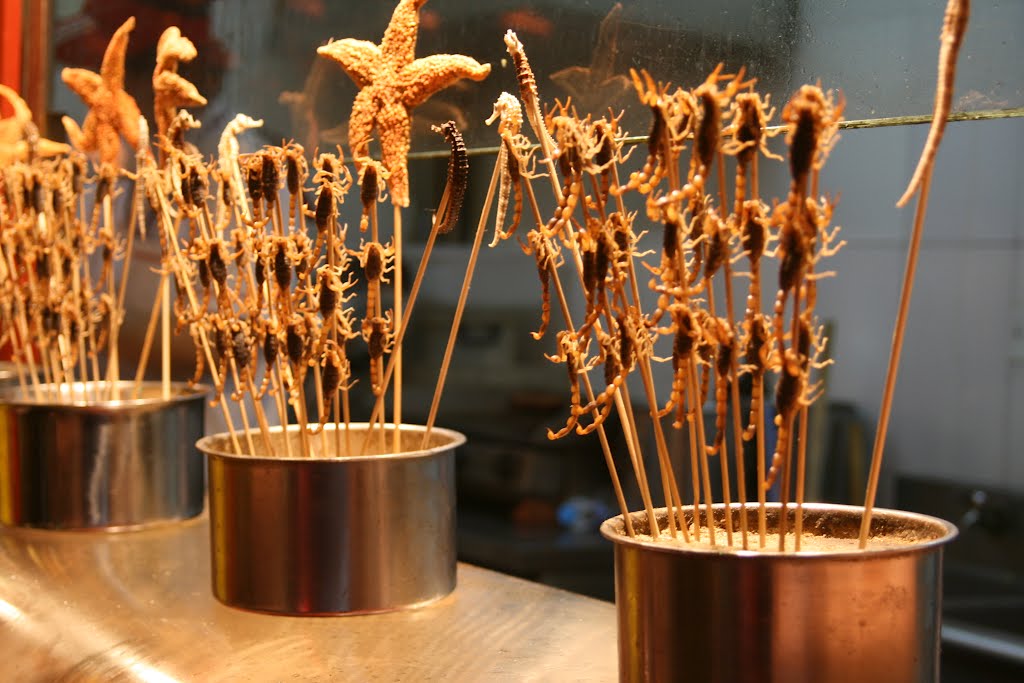
There is a joke that northern Chinese crack about their cousins in the south, to the effect that southerners eat everything on four legs except the table they are sitting at. When they tell this joke to foreigners they will helpfully go on to explain that southerners eat absolutely everything. I think many foreigners are bemused by this distinction which northerners make between themselves and their southern cousins, since it seems to most of us that northerners will also eat everything. I mean, which tourist in Beijing has not visited the food night market in Wanfujing road and seen scorpions and other insects being offered as delicacies to nibble?

scorpions on wanfujing road

And what about the disgusting stinky tofu which all Chinese – northerners and southerners alike – delight to eat?

eating stinky tofu-3

Looking beyond these extremes of eating behaviour, it is true to say that the Chinese have a very deep and intense relationship with food. I have been told that this is because hunger and starvation is still a recent experience for many. One of my staff, for instance, who is my age, once told me that her sister, who is five-six years younger than her, is smaller because she was born in a time of intense hunger. I don’t disagree with this; hunger can certainly make you focus obsessively on food. Nevertheless, I think the Chinese’s intense love of food goes beyond lingering memories of hungry times; they have an existential relationship with their food. Whenever I see a group of Chinese about to sit down to eat, they remind me of a group of Englishmen about to enter a pub. They suddenly all brighten up, start talking and laughing loudly, and generally behave as if this was the most wonderful moment of their lives.

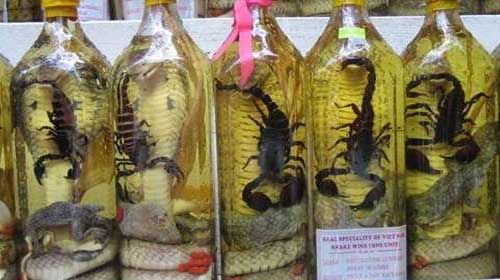
I was reminded of all this recently when my wife and I were nosing around a Chinese chemist (drug store to my North American friends), looking at the weird and wonderful things which the Chinese are willing to eat or drink for their supposed medicinal value.

Snake-Wine

As I poked around in the various cases, I stumbled across this.

chuan-bei-mu-bulbs

It was marked as “chuan bei”.  After some research, I discovered that these odd things were the bulbs of a species of fritillary, fritillaria cirrhosa. The Chinese take it as a cough medicine, along with “zhe bei”, the bulbs of another species of fritillary, fritillaria verticillata.

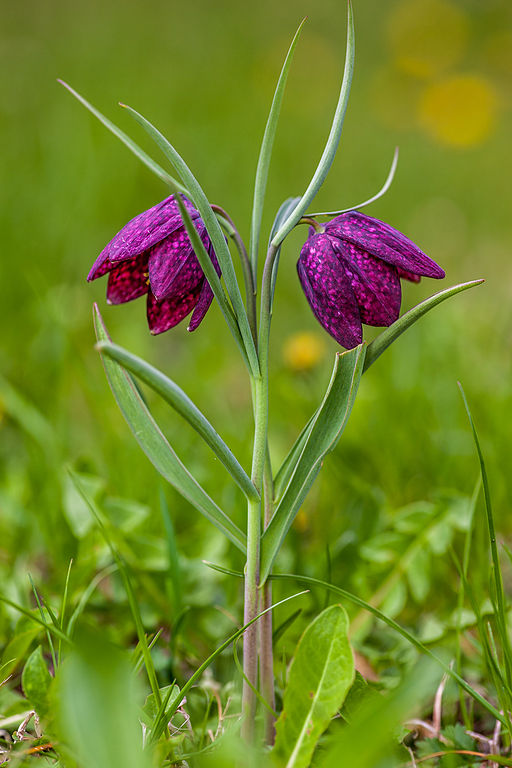
Some of you may be asking yourselves what a fritillary is. It’s a flower, a beautiful bell-shaped flower. The commonest European variety is the snake’s head,  fritillaria meleagris

snakes head fritillary

The common name probably derives from the flower’s somewhat snakelike appearance when it nods in the wind on its long stem.

As for the name fritillary, it derives from the Latin term for a dice-box (fritillus), probably because of the checkered pattern on the petals of many of the fritillary species.

fritillus

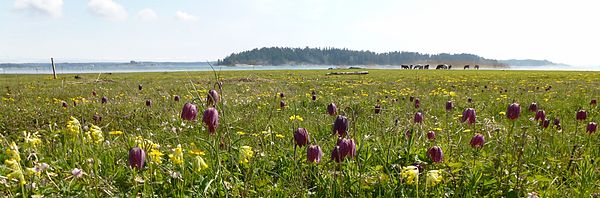
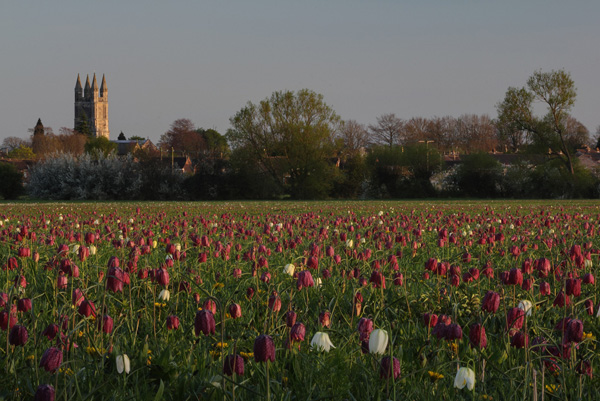
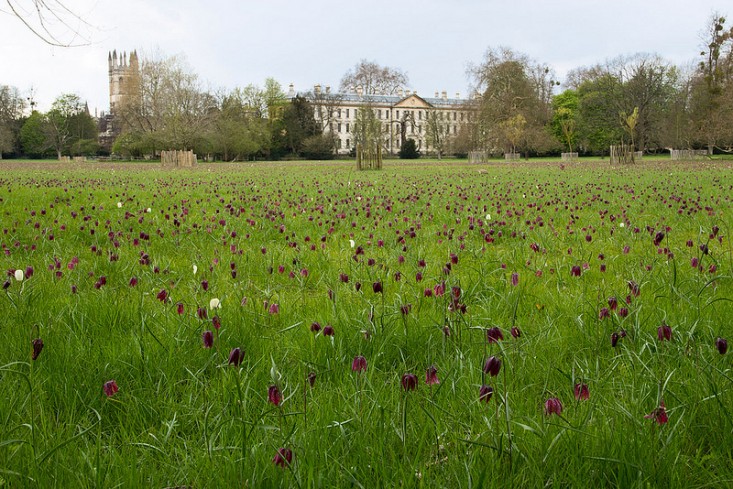
I must confess that I’ve never seen the snake’s head in the flesh. I first came across it in a book with absolutely lovely photos; the book is now slumbering along with all of my other books in a storage depot in Vienna. There was a photo of snake’s head fritillaries in the meadow of Magdalen College, Oxford. The following picture is not as beautiful but it does give a sense of how wonderful that meadow must be when the snake’s heads are in bloom.

magdalen meadow

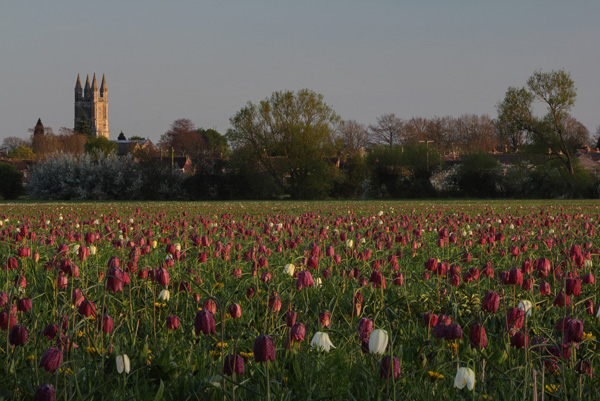
A visit to Magdalen meadow is one of the things on my bucket list, along with visits to other ancient hay meadows in England which have retained their annual crop of snake’s heads: Fox Fritillary Meadow:

Fox Fritillary meadow

North Meadow in Crickdale:

North_Meadow_Cricklade_Wiltshire

and no doubt others. I also have to travel to Sweden to see it there:

kungsängslilja

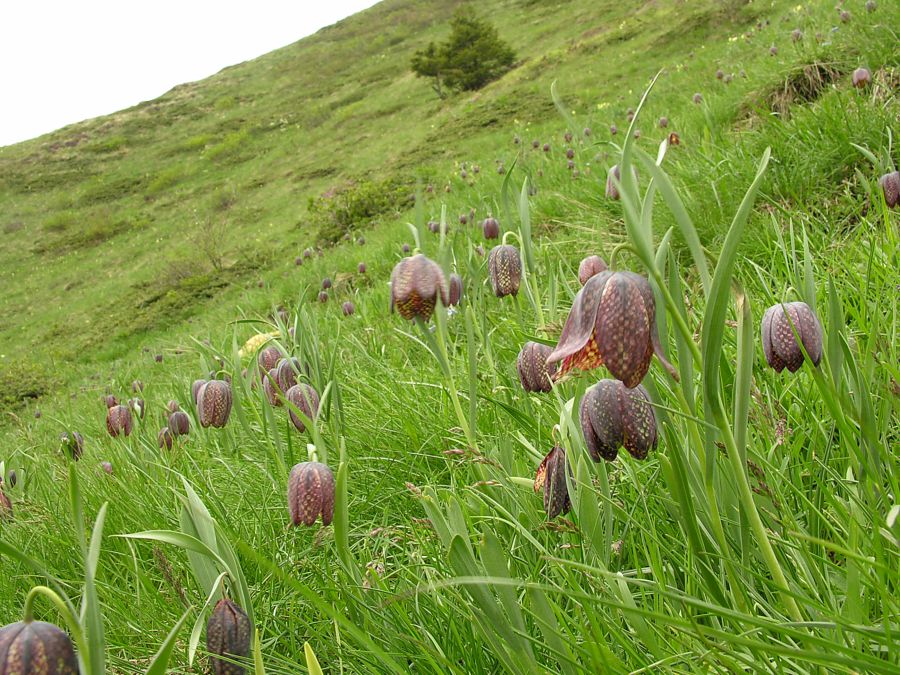
as well as to the high Alpine meadows to see a cousin, the meleagride alpino, or fritillaria tubiformis:

fritillaries in the alps

I have to hurry up. There was a time when snake’s heads were plentiful in the UK. They grow best in heavy, marshy soils, the same soils which make the best hay meadows. When we rode horses, hay was a valuable commodity and hay meadows – and the snake’s heads – were to be found everywhere. But cars came, horses disappeared, and then – the final blow – during World War II many of the meadows were ploughed under for food production. Now the flower is endangered.

So as I sit here and look at these beautiful flowers and mourn their passing glory, I see a fundamental difference between me and the Chinese. I say “how beautiful!”, they say “what’s it taste like?”

____________

scorpions on Wanfujing Road: http://static.panoramio.com/photos/large/72103761.jpg [in http://www.panoramio.com/photo/72103761%5D
Eating stinky tofu: http://aningredientaday.files.wordpress.com/2012/07/stinky.jpg
Chinese medicine: http://www.funcage.com/blog/wp-content/uploads/2011/03/Snake-Wine.jpg [in http://www.funcage.com/blog/8-strange-foods-that-will-make-you-cringe/%5D
Chuan Bei Mu bulbs: http://www.ioffer.com/img/item/198/952/678/2lb-bulbus-fritillariae-cirrhosae-chuan-bei-mu-ceba5.jpg [in http://www.ioffer.com/i/2lb-bulbus-fritillariae-cirrhosae-chuan-bei-mu-198952678%5D
Snakes head fritillary: http://upload.wikimedia.org/wikipedia/commons/thumb/6/60/Fritillaria_meleagris_MichaD.jpg/512px-Fritillaria_meleagris_MichaD.jpg [in http://en.wikipedia.org/wiki/F._meleagris%5D
Fritullus: https://www.uni-erfurt.de/imgs/7944 [in https://www.uni-erfurt.de/max-weber-kolleg/personen/wolfgangspickermann/roemische-inschriften-in-germanien/kleininschriften/%5D
Magdalen meadow: http://www.gardenista.com/files/styles/733_0s/public/fields/magdalen%20meadow%20by%20Andrew%20Johnson.jpg [in http://www.gardenista.com/posts/how-to-make-a-fritillary-meadow%5D
Fox fritillary meadow: http://squeezyboy.blogs.com/photos/fox_fritillary_meadow/framsden_fritilliary_meadow_009.jpg [in http://squeezyboy.blogs.com/photos/fox_fritillary_meadow/framsden_fritilliary_meadow_009.html%5D
North Meadow Crickdale: http://www7.clikpic.com/RobertHarvey/images/UK11-176_Snakes_head_fritillaries_Fritillaria_meleagris_North_Meadow_Cricklade_Wiltshire.jpg [in http://www.robert-harvey.co.uk/articles_177296.html%5D
Kungsängslilja: http://upload.wikimedia.org/wikipedia/commons/thumb/b/b2/Sandemar_f%C3%A5gelseservat_2012a.jpg/600px-Sandemar_f%C3%A5gelseservat_2012a.jpg [in http://sv.wikipedia.org/wiki/Kungs%C3%A4ngslilja%5D
Fritillaries in the Alps: http://www.actaplantarum.org/floraitaliae/download/file.php?id=67858 [in http://www.actaplantarum.org/floraitaliae/viewtopic.php?t=2255%5D

KAKI

Beijing, 3 November 2013

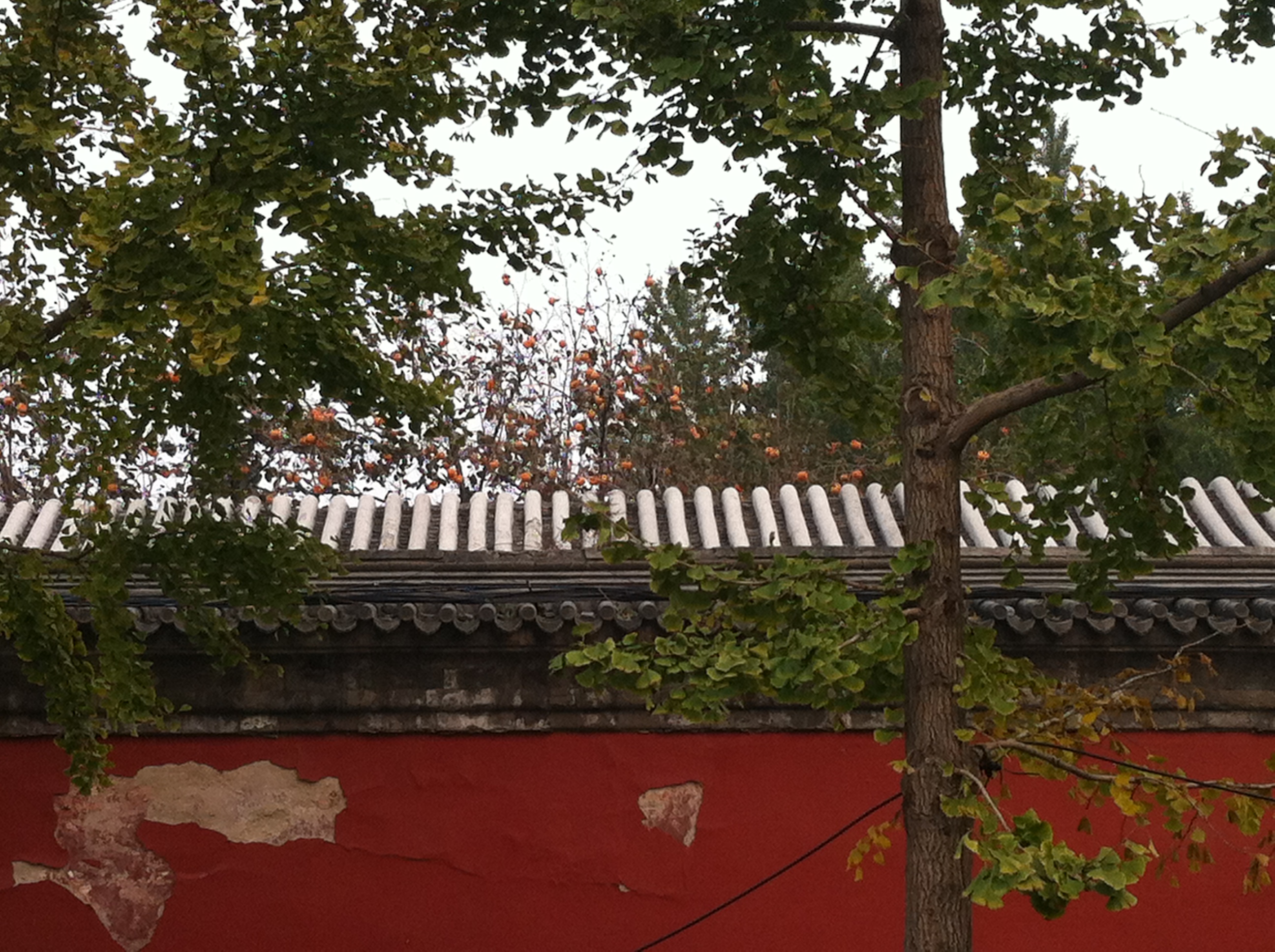
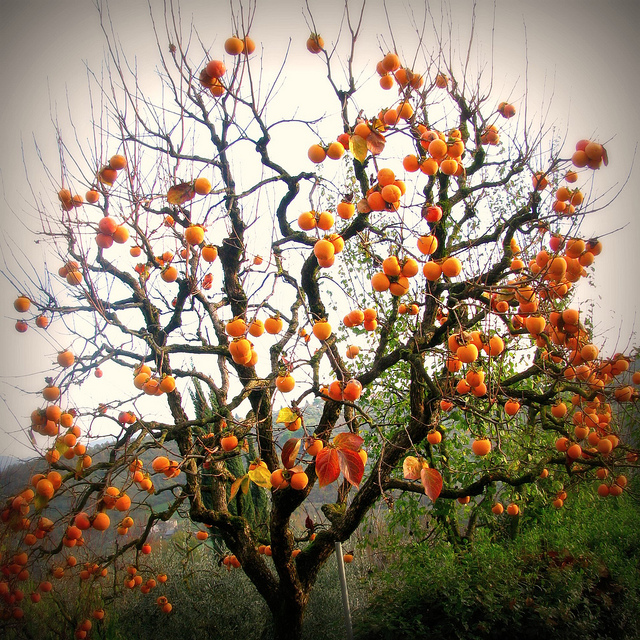
My wife and I went to an art show last weekend in an old temple located somewhere in the hutongs behind Beijing’s old drum tower (as a friend whom we met there said, “great space, great mulled wine, average art”). We went for a walk around the area afterwards, and I spied this kaki tree in full fruit peeping over a high wall.

kaki over temple wall 002

For those of my readers who can’t quite make out the tree in my picture, here is a much better take of the same species.

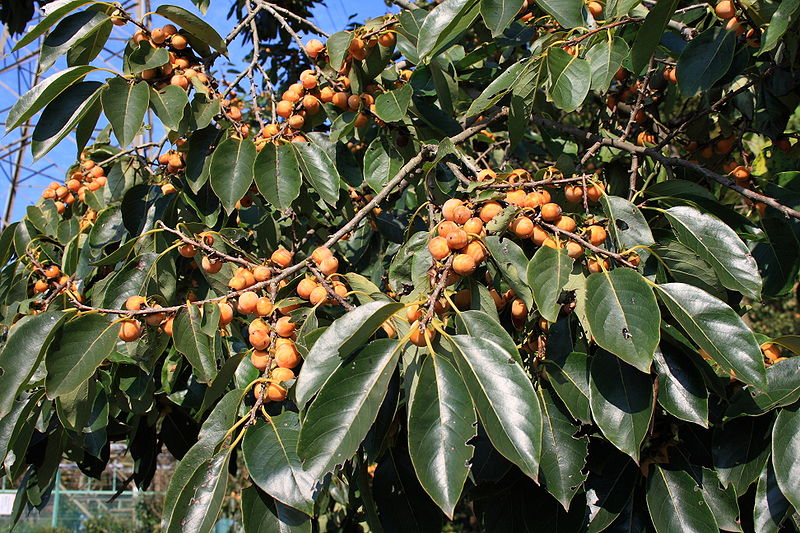
kaki

I realized that it was that time of the year again, when the kaki are fully ripened and ready to eat. And I suddenly noticed that all the Chinese grocers were filled with kaki.

I’ve noted in a much earlier posting that my wife brought much more food and culinary novelty to our marriage than I did. One of these was the kaki, which I first saw in Liguria during one of our trips out to the sea in the late months of the year.

cachi in liguria

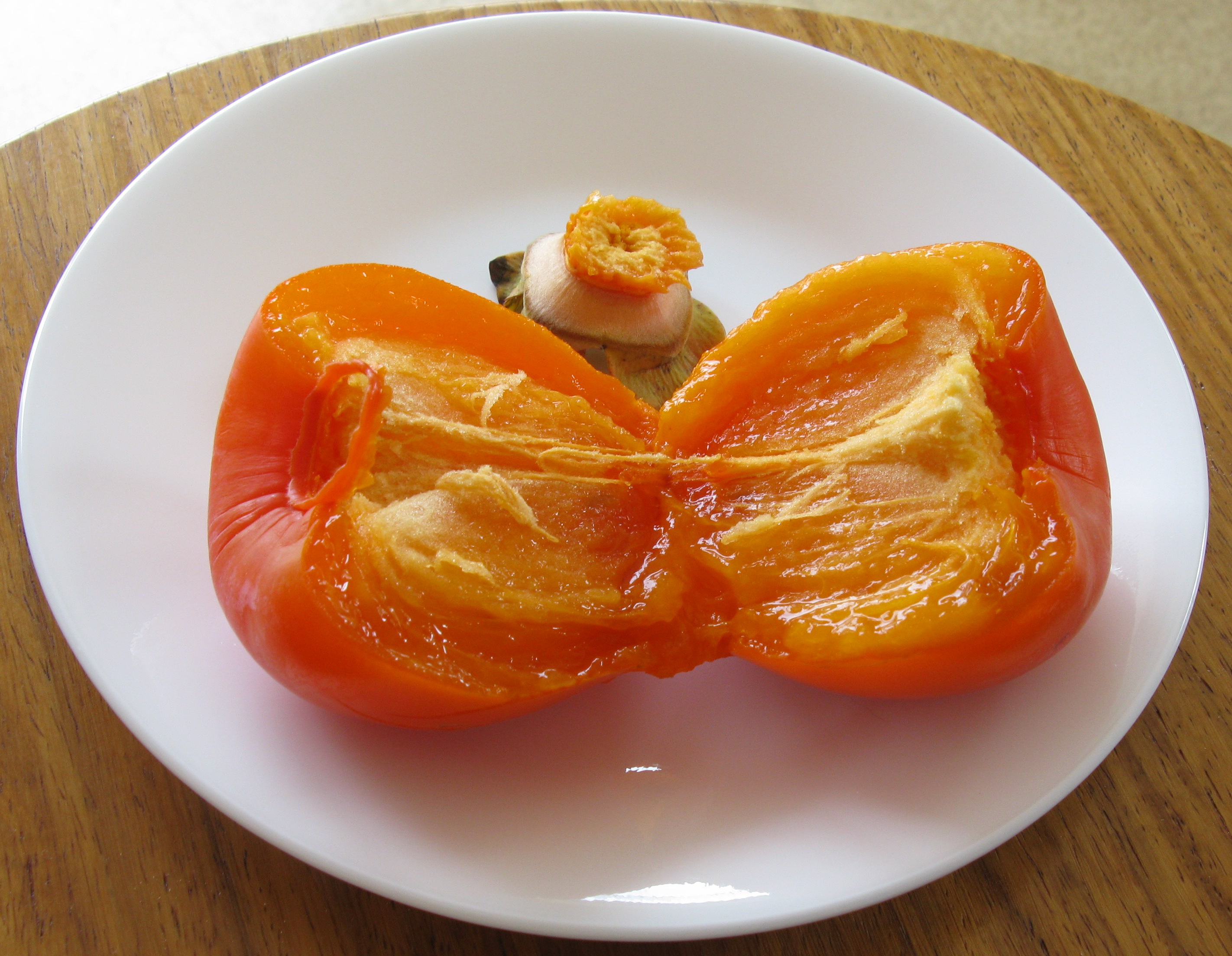
My mother-in-law was very fond of this fruit, but I must say I have never been convinced by it. I appreciate neither its mushiness nor its sweetness. I’ve eaten it but rarely during the years since I first discovered it, and every time I have been reinforced in my lack of enthusiasm for the fruit.

kaki fruit

Without really thinking about it much, I assumed that this tree and its fruit were native to the Mediterranean. I adopted the Italian spelling cachi as the original spelling. Imagine my surprise, then, when several years after my initial discovery of the fruit, we came across the tree laden with fruit during the trip which my wife and I made to Japan, and our Japanese companion informed us that it was called kaki. Kaki! The scales fell from my eyes. This must have originally been a Japanese tree, which was brought to Italy at some point – back in the 1800’s, I have since discovered. Another botanical species, like the ginkgo which I’ve written about earlier, which was trekked back to Europe during the first era of globalization.

Actually, I was wrong again! Because, like the ginkgo, the kaki is actually native to China and at some point got transported over to Japan – along with Buddhism perhaps? So if I were a linguistic purist I should switch to calling it shizi, which is its Chinese name. But I’m getting old and set in my habits. Kaki it will remain.

Talking of names, English-speaking readers may be asking themselves what the English name of the tree and fruit is. It was years before I asked myself that question and looked up cachi in an Italian-English dictionary. Persimmon, that’s what it is! Persimmon … that was a word which had hovered on the far horizons of my linguistic knowledge. I’d heard it spoken or maybe seen it written, I knew vaguely it was a fruit, but that was it. It sounds such an upper-class English name, don’t you think? Like Fitzwilliam or the Duke of Buccleuch. So it was another surprise to me to discover that persimmon is actually an English transliteration of the word pasiminan or pessamin, an Algonquian word from the eastern United States. Another result of the first era of globalization, in this case the colonization of North America. Because there is also a species of kaki that is native to Eastern North America, the American Persimmon.

American persimmon-tree

American persimmon-fruit

I prefer the formal Latin name Diospyros virginiana, which suggests to me that it was in the British colony of Virginia that the Brits first came across the tree.

By the way, there is actually a species of Diospyros which is native to the Mediterranean; actually, its range is somewhat broader, stretching from Southeast Europe to Southwest Asia. In English, it’s called the date-plum tree. Apparently, the fruit’s taste reminds one of both plums and dates.

date plum diospyros lotos-tree

Maybe I’m pushing this globalization thing too far, but I see another strand of globalization in that name. It is a literal translation of the Persian name for the tree and its fruit: khormaloo. In the earlier period of globalization, American colonists were content to simply anglicize the Native American name. But in a later, more learned period of globalization, when some more academic Brits actually learned the foreign languages which the expanding British Empire was coming into contact with, rather than call the tree, say, cormalew, they preferred to translate the original name.

Actually, the Latin name of this species of kaki, Diospyros lotos, is even more interesting. It refers to a belief in Greece that this fruit could have been the lotus fruit mentioned in Homer’s Odyssey. According to that story, the lotus fruit was so delicious that those of Odysseus’s men who ate it forgot about returning home and wanted to stay and eat lotus with the native lotus-eaters. I throw in here a screenshot from an electronic game based on Odysseus’s story; the fruit looks vaguely kaki-like (amazing what they will make electronic games about …)

lotus eaters-2

Personally, I can’t think that kaki is the lotus-fruit. All that squishiness and mushiness would definitely not make me stick around.

______________

Kaki over the wall: my picture
Kaki: http://www.flickr.com/photos/giagir/5185254421/sizes/z/in/photostream/ [in http://www.flickriver.com/photos/giagir/5185254421/%5D
Cachi in liguria: http://www.flickr.com/photos/ciric/3032113542/sizes/z/in/photostream/ in [http://www.flickr.com/photos/ciric/3031273027/]
Kaki fruit: http://upload.wikimedia.org/wikipedia/commons/0/01/Diospiros_kaki_Fruit_IMG_5472s.JPG [in http://en.wikipedia.org/wiki/Persimmon%5D
American persimmon tree: http://3.bp.blogspot.com/-hroimehTRQk/TlPhN7euB8I/AAAAAAAAAds/lBlwEER714k/s1600/persimmon4.jpg [in http://tcpermaculture.blogspot.com/2011/08/permaculture-plants-persimmons.html%5D
American persimmon fruit: http://4.bp.blogspot.com/-b3lVcZ8FOnw/TlPgCINg7VI/AAAAAAAAAdk/LQCyiQYUw2c/s1600/Persimmon3.png [in http://tcpermaculture.blogspot.com/2011/08/permaculture-plants-persimmons.html%5D
Date plum-tree: http://upload.wikimedia.org/wikipedia/commons/thumb/6/63/Diospyros_lotus_01.jpg/800px-Diospyros_lotus_01.jpg [in http://en.wikipedia.org/wiki/Date-plum%5D
Odysseus and the lotus eaters: https://lh5.googleusercontent.com/-2uTp30FUU4E/UaHOcmkRBwI/AAAAAAAACsY/UU21szj7LBk/s1280/013_Lotus_Eaters.jpg  [in http://www.gamrgrl.com/2013/05/walkthrough-odyssey-hd.html%5D

AUTUMN LEAVES

Beijing, 23 October 2013

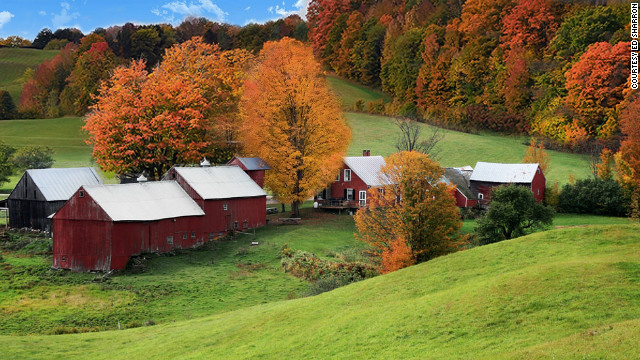
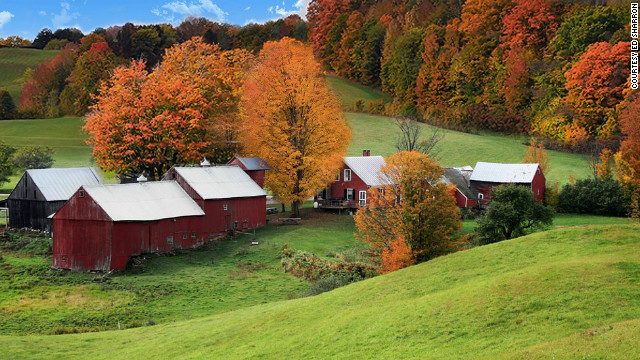
It’s that time of the year in the northern hemisphere when the trees begin to lose their leaves. If we’re lucky, depending on where we’re perched on that hemisphere, we can witness the glorious spectacle of leaves turning intensely red, orange or yellow before they expire and finally float to the ground. My wife and I had such luck some thirty years ago, when we went “leaf peeping” in Vermont.

vermont fall foliage

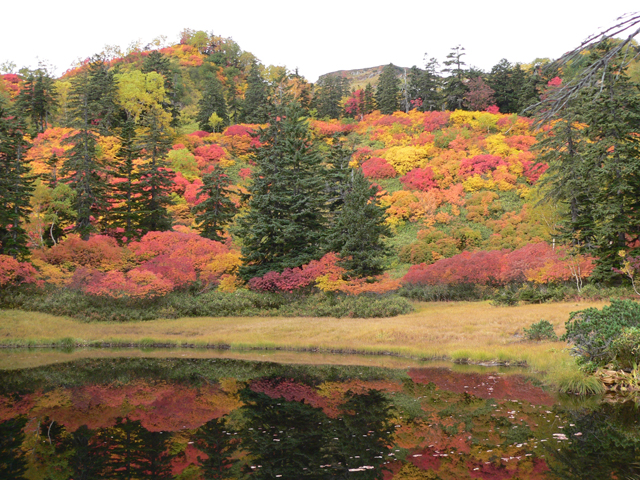
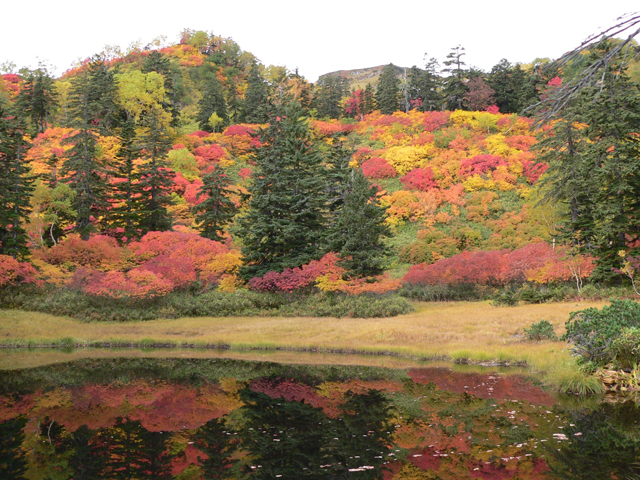
We had such luck an equally long time ago in Hokkaido, the northern island of Japan

hokkaido fall foliage

And I had such luck, alone this time, on my recent trip to Qinghai province, where the poplars were turning bright, golden yellow.

trees in fall

Alas, we have no such luck in dirty, dusty, smoggy Beijing. The leaves here go a little bit yellow, or just plain brown, before dropping miserably to the ground.

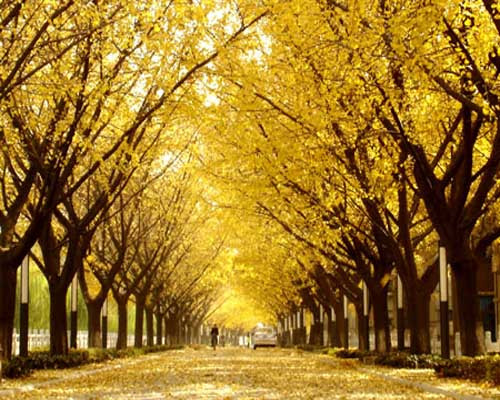
The partial exception is the ginkgo.  Ginkgos are popular trees to plant along streets. They tolerate well pollution and confined soil space, admirable traits for a tree growing in Beijing. And they look handsome, in the summer

ginkos 001

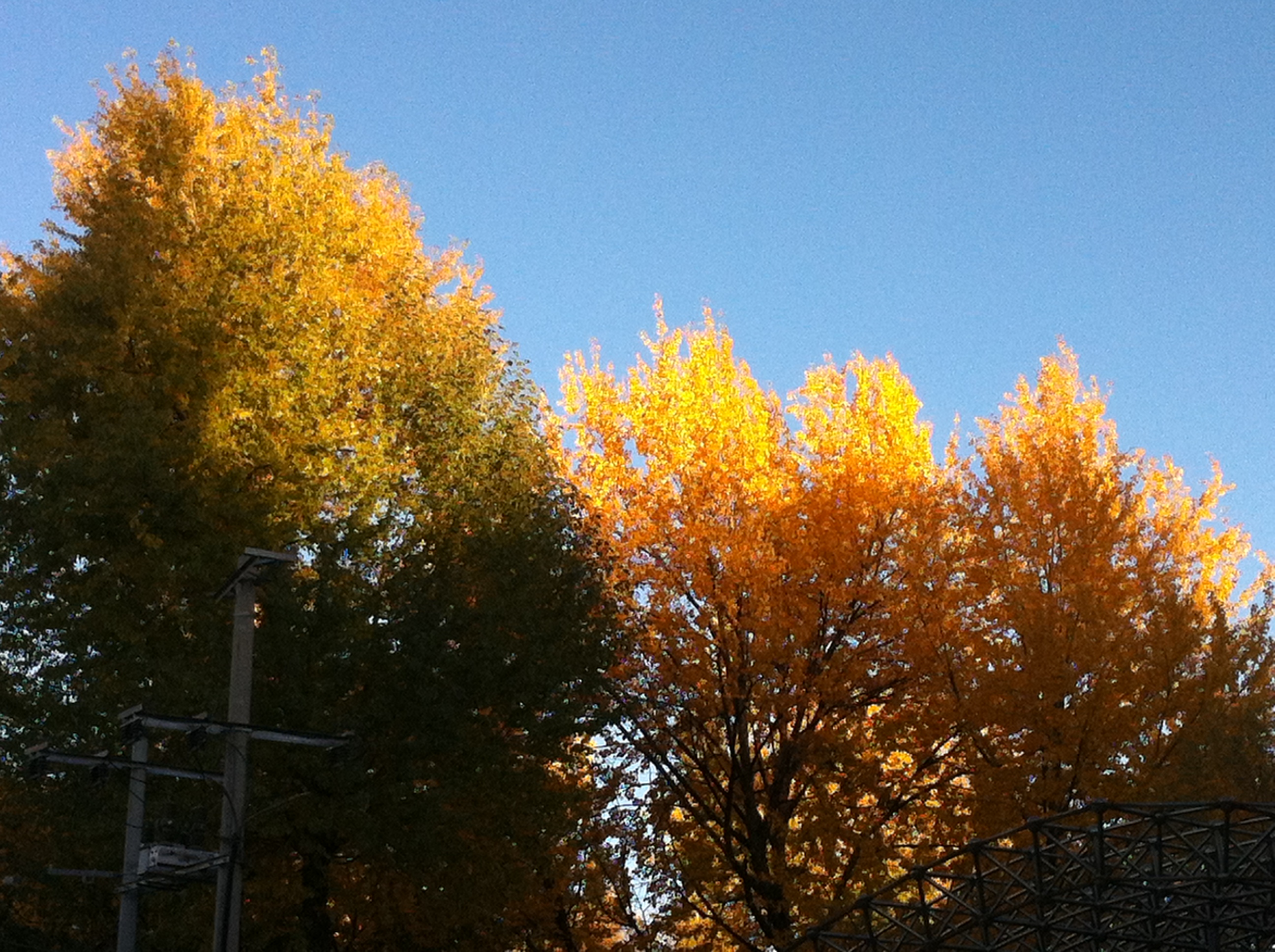
but even more so in the autumn

gingkgo trees autumn

Strange trees, ginkgos. The name already is odd. It was years before I realised that the “k” actually comes before the “g”. Who on earth came up with that spelling? A Dutchman called Engelbert Kaempfer, that’s who, back in the late 17th Century. He was the first European to see a gingko – sorry, ginkgo – in Japan. When he reported it to the European world, he seems to have stumbled over his transcription of the Japanese name ginkyō: what should have been written “ginkio” or “ginkjo” somehow got written as ginkgo.

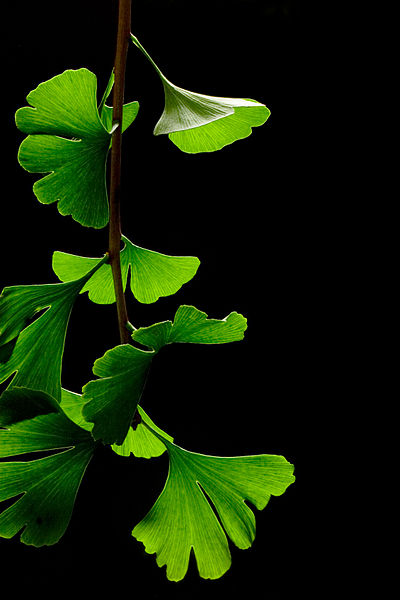
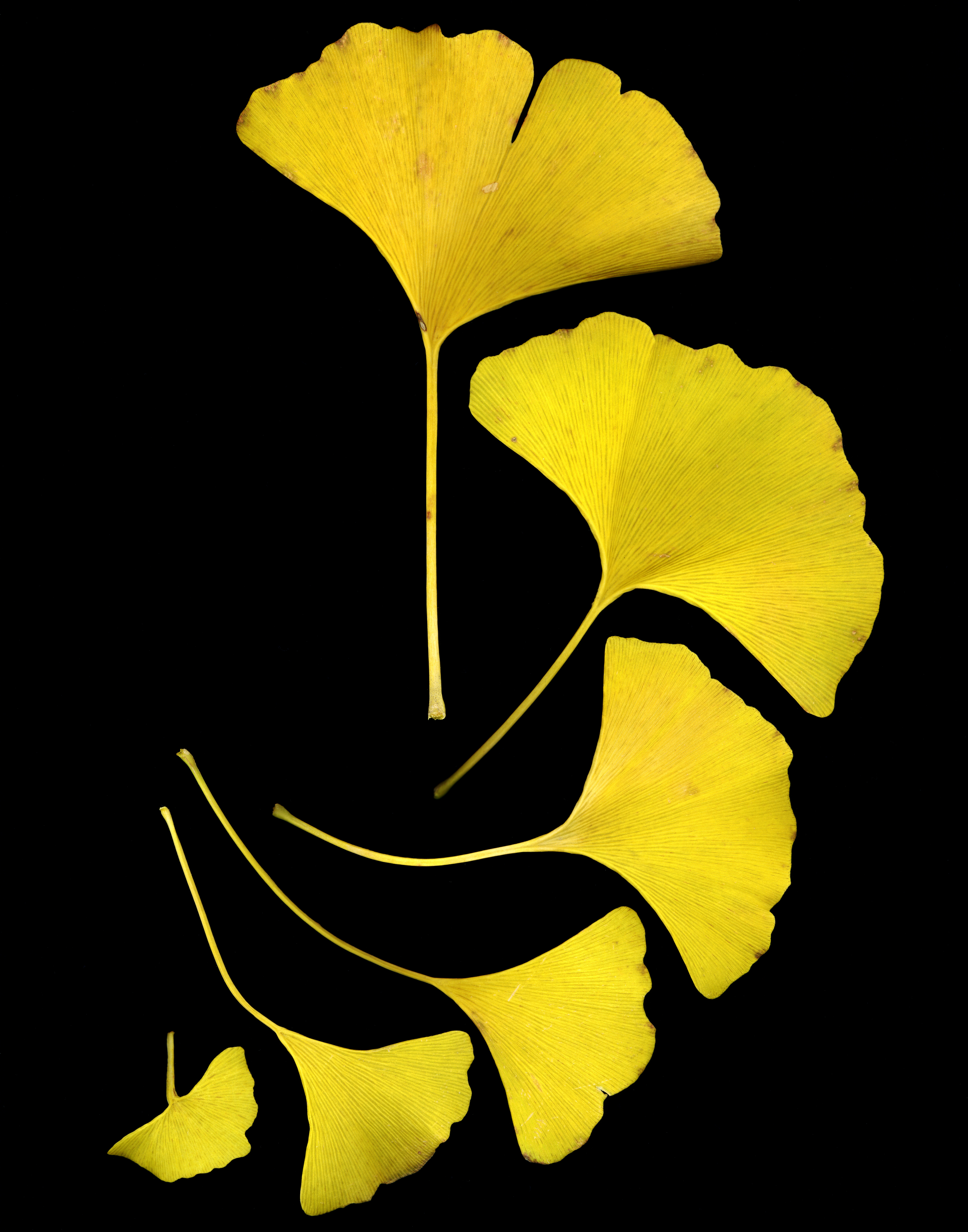
That double-lobed leaf is odd, too.

Ginkgo Leaves summer

In fact, it’s unique among seed plants. Unique, because the ginkgo is a living fossil. This fossilized ginkgo leaf

fossil ginkgo leaf

is 40 million year old, although the ginkgo is far older. It first appears in the fossil record some 200 million years ago. It did nicely for the first 100 million years or so but then it went into terminal decline. Its range shrank and shrank, the various ginkgo species disappeared, until only ginkgo biloba survived, and survived only in China.

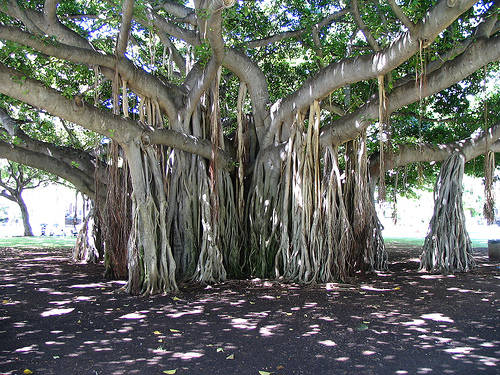
In fact, even the ginkgo biloba probably wouldn’t have survived if it hadn’t been for Buddhism coming to China. There’s a lot of debate about whether or not the ginkgo trees currently found in the wild in China are truly wild or simply feral, that is, grown from seeds that wafted away from domesticated trees. What is sure is that Buddhist monks took to planting ginkgos in their temples as their local version of the bo-tree, the sacred fig tree under which it is said that the Buddha attained enlightenment.

sacred fig

and of course the ginkgo then got included in the Chinese Buddhist iconography – look at those ginkgo leaves peeping behind the buddha:

maitreya buddha under ginkgo

The ginkgo, having thus gained enormously in stature as a sacred tree, was carefully nurtured by all and sundry and survived – and got carried by Buddhism to Korea and Japan, where our friend Engelbert saw it.

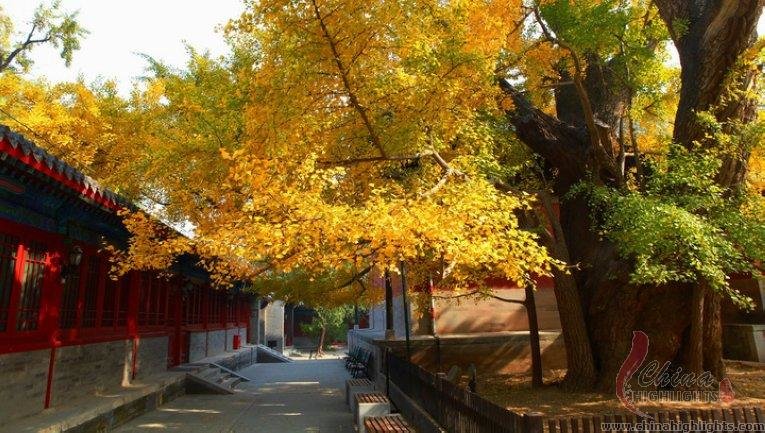
So I suppose it’s really best to admire the ginkgo in the environment which saved it from probable extinction, a Buddhist temple like this one, Dajue temple in the western hills near Beijing.

ginkgo fall dajue temple

___________________

Vermont fall foliage: http://i2.cdn.turner.com/cnn/dam/assets/120911072551-leaf-peeping-vt-jenne-farm-ed-sharron-story-top.jpg [in http://www.cnn.com/2012/09/21/travel/fall-leaf-peeping-autumn/%5D
Hokkaido fall foliage: http://4.bp.blogspot.com/-HK-XCKr055I/UGvr1pwda3I/AAAAAAAAGc8/oe2ckytpNRk/s1600/%E7%A7%8B%E3%81%AE%E9%AB%98%E5%8E%9F%E6%B8%A9%E6%B3%892.jpg [in http://talk-hokkaido.blogspot.com/2012/10/autumnal-foliage-around-daisetsu.html%5D
Qinghai fall foliage: my picture
Ginkgo trees along the street: my picture
Ginkgo trees autumn: http://chinatour.net/member/wp-content/uploads/2012/09/gingkgo.jpg [in http://chinatour.net/beijing/tour/autumn/%5D
Ginkgo leaves summer: http://upload.wikimedia.org/wikipedia/commons/thumb/f/f5/Ginkgo_Biloba_Leaves_-_Black_Background.jpg/400px-Ginkgo_Biloba_Leaves_-_Black_Background.jpg [in http://en.wikipedia.org/wiki/Ginkgo_biloba%5D
Ginkgo leaves autumn: http://upload.wikimedia.org/wikipedia/commons/7/78/GinkgoLeaves.jpg [in http://en.wikipedia.org/wiki/Ginkgo_biloba%5D
Fossil gingko leaf: http://upload.wikimedia.org/wikipedia/commons/c/c5/Ginkgo_biloba_MacAbee_BC.jpg [in http://en.wikipedia.org/wiki/Ginkgo%5D
Sacred fig: http://img.xcitefun.net/users/2009/09/117740,xcitefun-sri-maha-bodhi-tree-2.jpg [in http://forum.xcitefun.net/sri-maha-bodhi-sacred-fig-tree-sri-lanka-t38289.html%5D
Maitreya Buddha sitting under ginkgo: http://www.asia.si.edu/collections/zoom/F1911.411.jpg
Ginkgo Dajue temple: http://images.chinahighlights.com/2012/11/4c1ed9eaebda4d74a20d96f4.jpg [in http://www.chinahighlights.com/beijing/article-see-golden-ginkgoes.htm%5D

BACK OF BEYOND

Beijing, 15 October 2013

I’m just back from a business trip to Haixi prefecture, which is the remotest prefecture of that remote Chinese province, Qinghai. Squeezed between its better-known neighbours Xinjian, Gansu, Sichuan, and Tibet, Qinghai doesn’t get much press, which is a pity. To my mind, it’s one of China’s most beautiful provinces. Here’s a picture we took out on the grasslands when my wife and I, together with our son, went there a couple of years ago.

IMG00095-20110712-1113

As for Haixi prefecture, it hardly gets a mention at all in the world’s press. This is a great pity, because it’s a seriously beautiful part of the world; on the desertic side, but I like that kind of landscape.

landscapes 002

landscapes 007

My colleague and I were there to study what we could do to help the prefectural authorities build up a local brand in the organic production of wolfberries (we seem to be getting a reputation for agro-processing). I can perfectly understand it if my readers have never heard of wolfberries. Neither had I until I came to China and found them floating in various soups during banquets. But our ignorance is our loss. Wolfberries have had an honourable place in Chinese cuisine – and traditional medicine – for the last 2,000 years.

If one has seen them at all, it’s probably as dry berries

wolfberry-dry

although this is how we saw them during our trip, fresh

Wolfberry-fresh

on bushes in plantations

wolfberry-bush and fresh berry

OK, I probably shouldn’t say this, since one of the things the Haixi authorities would like us to help them with is to get fresh wolfberries into supermarkets, but I can’t say that I’m particularly impressed by the wolfberry. If I were standing in the fruit aisle of my local supermarket and had to choose between wolfberries and, say, blueberries, I would choose the latter every time. But hey, I’m not Chinese; they would probably make the opposite decision.

In any case, I will not dwell on the wolfberry, because my attention was captured by something else altogether. Haixi has a lot of sun – 300 days of sun a year, we were told. So quite sensibly, the government has bet on a solar power future for Qinghai. As we drove from wolfberry plantation to wolfberry plantation, and after passing several large photovoltaic arrays, we drew up here:

CSP 006

This, my friends, is a concentrated solar power plant (or at least one version of such). The hundreds of mirrors on the ground focus the sun’s rays on the luminous white spot at the top of the column. That spot is a boiler where the heat of the sun turns water into steam, which is then used to generate electricity. I tried to capture the beauty of that ethereally, whitely glowing spot of concentrated solar rays, but my iPhone camera simply wasn’t up to it. So I’ve added the  only other photo I’ve found on the web of this plant.

CHINA-QINGHAI-SOLAR THERMAL POWER PLANT (CN)

And I add photos of similar plants in other parts of the world. This one is near Seville in Spain

CSP spain

While this is one was in California’s Mojave desert (it was demolished a few years ago).

CSP US

Not clear if this approach will ever generate electricity cheaply enough. But who cares, like Concord, another technological has-been

concorde

it’s beautiful.

Soon after this brush with the ultra-modern, we came across a picture as ancient as China itself, a line of camels padding slowly into the setting sun. I didn’t get a photo, not with my iPhone, but I show a picture of camels taken elsewhere in Qinghai.

camels

I could have been in Tang China. I am moved to throw in a photo I took back in May in the Museum of the University of Philadelphia of Tang era sculptures of camels.

philly museum 004

Minutes after this close encounter with the age-old, we drew up at a freshwater lake for a dinner of locally caught crabs. To whet our appetite, we were taken on a short cruise across a magically still mirror of water

lake-fresh 002

as the sun dipped below the hills behind us.

lake-fresh 010

___________________________

Qinghai grasslands: my son’s picture
Wolfberry-dry: http://soni.monovee.com/wp-content/uploads/2012/05/wolfberry.jpg
Wolfberry-fresh: http://mingmingtea.com/wp-content/uploads/2012/01/Wolfberry_extract.jpg
Wolfberry-bush and fresh berry: http://images04.olx.com/ui/2/98/54/13309454_2.jpg
CSP-1: my photo
CSP-2 : http://res.heraldm.com/content/image/2013/08/01/20130801000653_0.jpg
CSP Spain: http://www.finetubes.co.uk/uploads/images/gemasolar-2011-2_low_res.jpg
CSP California: http://www.trec-uk.org.uk/images/solar_two_barstow.jpg
Concord: http://s1.cdn.autoevolution.com/images/news/concorde-will-take-to-the-skies-again-21839_1.jpg
Camels: http://m1.i.pbase.com/g1/62/942562/2/146679881.nWrkycH7.jpg
Tang camels: my photo
Lake views: my photo

NOTES ON AUSTRALIA – UPPER MURRAY RIVER

Beijing, 8 October 2013

After a quick visit to Canberra and its museums, which I covered in my last post, we were on our way to the Snowy Mountains and beyond. Since I want to focus on the beyond, I’ll quickly slip through the mountains part. It wasn’t quite that easy in practice. Our plan was to drive along the Alpine Way, but when we got to Jindabyne, we discovered that the Way was closed after Thredbo because of a massive landslide.  What to do? After poring over the map, we decided to loop through the mountains to the north and rejoin the Alpine Way just before Corryong.

And so we found ourselves, without really planning it, in the upper reaches of the Murray River. I have to tell you, it was absolutely, absolutely lovely.  Maybe we were lucky with the season, with spring being in full swing. It certainly helped that we had clear, sunny days. Here’s a series of photos I took with my iPhone. Hopefully, they can give readers a sense of the sheer beauty of the landscape that we had wandered into.

upper murray river valley-corryong 020

upper murray river valley-corryong 019

upper murray river valley-corryong 017

upper murray river valley-corryong 016

upper murray river valley-corryong 015

You can see the Snowy Mountains in the distance, while the river in the foreground is the Murray River and the ponds are the famous billabongs which I mentioned in my first Australian post.

When I saw this landscape after our drive through the relatively dry eastern side of the Snowy Mountains and the forests of Kosciuszko National Park, I could not stop myself from thinking biblically. Up popped the Old Testament story of the Israelites who come back to Moses after exploring Canaan and exclaim, “We went into the land to which you sent us, and it does flow with milk and honey!” Milk and honey … that certainly describes the land we saw before us. William Blake’s Jerusalem also came to mind:
And did those feet in ancient time,
Walk upon England’s mountains green:
And was the holy Lamb of God,
On England’s pleasant pastures seen!

My wife’s first thought had instead a whiff of the pagan. It reminded her, she said, of Lord of the Rings or the Hobbit.

the-hobbit-movie

Whatever the reference, it was certainly very beautiful.

After spending a night in Corryong, and getting some good advice on which road to take from a very nice lady at the local information centre (I have to say, these information centres gave us excellent service everywhere we went), we set off along a small road which hugged the Murray River. It was all very peaceful.

upper murray river valley-corryong 050

We watched a local farmer and his family herd in cows and their calves for marking, as they bellowed mightily against this corralling, and had a long chat with them about the future of farming. We watched Australian white ibises, which we had last seen in Sydney as scavengers, fly regally over our heads, while sulphur-crested cockatoos crossed our path with a slow and sensuous flap of their wings.

sulphur-crest-cockatoo

We finally reached Lake Hume. At first, it was the drowned trees which struck us

upper murray river valley-corryong 021

then it was the pelicans, which were swimming among the trees

upper murray river valley-corryong 024

The last time I had seen pelicans was as a child in St. James’s park

Then the lake broadened out.

upper murray river valley-corryong 036

We followed the lakeshore until Albury. Thereafter, the landscape got drier, flatter and less interesting so I’ll skip the final day.

Finally, it was time to drive back to Sydney. We decided to pass through Corryong again; we had liked it so much. We had one last vision of wondrous drifts of wildflowers in the fields

upper murray river valley-corryong 038

upper murray river valley-corryong 051

before we headed up through Tumbarumba and Tumut to the Hume Highway. Next stop, Sydney Airport and then Beijing. Sigh!

_____________________________

Hobbit: http://www.digitaltrends.com/wp-content/uploads/2013/02/the-hobbit-movie-48-fps.jpg
Sulphur-crested cockatoo: http://www.zoo.org.au/sites/default/files/styles/zv_carousel_large/public/sulphur-crest-cockatoo-animal-profile-web620.jpg?itok=dXPfOmk5
all other photos: mine