POSTS

THE CHERRY, SWEET AND SOUR

Vienna, 20 July 2018

In one of my wanderings through the Vienna woods with my wife, I noticed a tree like this one growing along the side of the path.

The bark, with those typical striations, almost scarifications, suggested strongly to me that it was a cherry tree.

The leaves looked cherry-like too. There was a cherry-like fruits hanging on the branches, but they were really small.
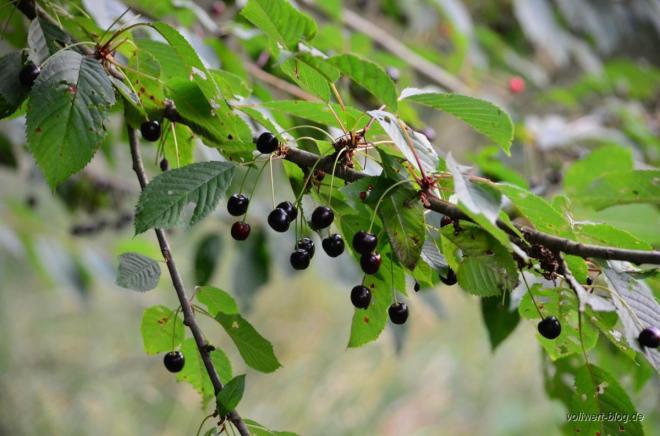
Was this a cherry tree gone feral, I wondered?

Cautiously, oh so cautiously, I tried one of the fruits. There was hardly any pulp, although what there was tasted cherry-like. And the small seed looked cherry-like too. I pronounced to my wife, who was standing anxiously by, waiting for me to keel over from eating some deadly poison, that in my opinion we were standing before a wild cherry tree.

Now that I had noticed the tree, I began to see them everywhere along our walks – a nice change from the drifts of wild garlic. Later on, one of the entries along a little “Nature Walk” at Hermesvilla (a large country house built by Emperor Franz-Josef for his beloved Sissi on the outskirts of Vienna) informed me that these were indeed wild cherry trees. In German, they have a charming name, Vogel Kirsche, a name that Linnaeus echoed in the Latin name he gave it, Prunus avium. I say charming, because I can indeed imagine birds feasting on these small fruit. What a lovely banquet Nature has given them! Here, a clever photographer has caught one in the act.

I have since read that small mammals also eat them, spreading – like the birds – the seeds far and wide, this no doubt explaining why I was discovering the trees far and wide in the woods around Vienna.

When I was a much smaller mammal than I am now, I distinctly remember climbing into the cherry tree which my French grandmother had in a corner of her garden – a big, stately old tree which had been there many a-year – and scarfing down its plump purple cherries, spitting out the cherry seeds far and wide. Ah, how sweet those cherries were! Even now, fifty and more years later, I can remember their taste. So I salute the Lords of the Universe, who in their infinite wisdom created the Vogel Kirsche for the delectation of the Vogels and small mammals!

Well, after that flight of poetic fancy, let me return to earth and to a more sober turn of phrase. For those among my readers who are as interested as I am in etymology, it may interest them to know that the English word “cherry” derives from the Old Northern French or Norman word for the tree and fruit “cherise”, which itself is derived from the Latin word “cerasum”, which in turn is a derivation of the ancient Greek word “kerasous”. The etymology tracks the journey of the domesticated cherry tree into Europe.

Kerasous was actually the name of one of the Pontic Greek provinces lying on the southern shores of the Black Sea, east of Trebizond. It was here that the Greek world got to know the domesticated cherry tree that we are familiar with, with its much larger cherries than the tiny fruit of the wild cherry tree which I had nibbled at cautiously. Somewhere in the Anatolian highlands behind Kerasous, farmers had domesticated the wild cherry tree, patiently coaxing it over generations to deliver up bigger fruits more on the scale of us big mammals, and sweeter and juicier into the bargain.

I would assume that Ancient Greeks brought back some trees and planted them in the Greek heartlands. From there, I would have thought it no great flight of the imagination to think that the cherry tree spread to Magna Graecia, Greater Greece, that string of Greek colonies that ran along the insole and heel of the Italian boot and the southern coasts of Sicily, and from there a skip, hop, and a jump would have brought the tree to the expanding Roman world.

Not so, according to Gaius Plinius Secundus, known to us as Pliny the Elder. In his Natural History

written in the late 70s AD, he holds that the cherry tree entered the Roman world in a much more Roman way, as spoils of war. In his words (translated, I hasten to add, by someone much more learned in Latin than I), “before the victory of L. Lucullus in the war against Mithridates, that is down to 74 BC, there were no cherry trees in Italy. Lucullus first imported them from Pontus”. Lucius Licinius Lucullus (to give the man his full name) was a Roman consul in the sunset years of the Roman Republic.

He was, it seems, a brilliant general. Among his other accomplishments, he comprehensively thrashed Mithridates, king of Pontus. In the process, he gained for himself untold riches in loot, which, along with the domesticated cherry tree, he brought back to Rome. He used his riches to live a life of luxury, something which was still frowned upon in Republican Rome but was to become the norm in Imperial Rome. Apart conspicuous consumerism (which included that typical expense of the Roman rich and powerful, the organization of extravagant games), Lucullus created a number of gardens, a fragment of one of which still exists in the Villa Borghese gardens in Rome.
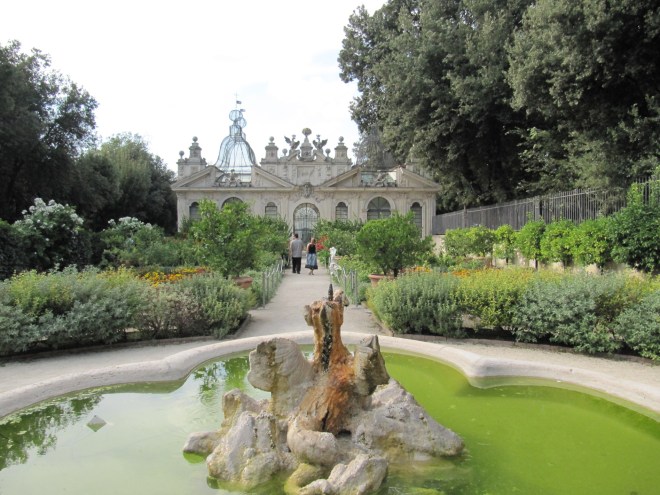
This was another “spoil” of war – Lucullus had picked up the Persian love of gardens during his Eastern campaigns; I have had cause to mention Persian gardens in an earlier post, in quite another context. No doubt it was in his gardens that he planted his imported cherry trees and invited the Roman rich and powerful to partake of its fruit. As might be expected, the fruit became incredibly popular and plantings of the cherry tree grew apace. As the Roman legions moved north carrying the Pax Romana and civitas with them, the administrators who followed carried along cherry trees to plant in the conquered lands. Citing Pliny again, “in 120 years they have crossed the ocean and got as far as Britain”.

Of course, strictly speaking Pliny was wrong when he said that there were no cherry trees in Italy before Lucullus brought them. There were, but of the type which I had come across in the Vienna woods. The natural habitat of Prunus avium stretches from Ireland to the Iranian Plateau.

Our ancestors were eating their little fruits at least two thousands years before Pliny wrote his Natural History – we know this because various Bronze Age sites across Europe have yielded up the tiny little stones – and no doubt Italian peasants were still eating them. But aristocrats like Pliny would surely not have deigned to touch such poor food – much as I do not touch the elderberries which currently weigh purple and heavy on their bushes here in Vienna but whose weak and watery taste I came to despise when I picked them as a schoolboy in the English hedgerows.

Coming back to Lucullus, he was also known for his eating habits. His over-the-top banquets in particular were to become legendary, giving rise to the English word “lucullan”, as in “that dinner was lucullan” meaning that it was particularly large, lavish, and ostentatious (I add this etymological factoid because my wife is fond of using the equivalent Italian word “luculliano” of certain meals; it might interest her to know its provenance). If I mention this aspect of Lucullus’s lifestyle it is because of a recent lunch – not lucullan but definitely many notches above the ordinary – which I shared with an old colleague. After a starter of marinaded char with beer radish, apple and woodruff, followed by a main dish of grilled sturgeon with baby kohlrabi, Risina beans, Meyer lemon and stewed onions, all washed down with a glass of white wine, we both took for dessert a curd-sour cherry tart with hay milk ice cream. It was actually that delicious sour cherry tart that precipitated this post, not my meeting in the woods with the wild cherry.

I must admit to having been a bit sneaky with my readers, having written up to now as if there were only one type of edible cherry. In fact, as all cherry lovers will know, there are two: the sweet cherry, Prunus avium, and the sour cherry, Prunus cerasus.

For the biologically-minded among my readers, it might interest them to know that P. cerasus is actually a hybrid between our friend P. avium and another species of cherry tree, P. fruticosa, or dwarf cherry. This friendly intermingling of genes must have occurred on the Iranian Plateau or in Eastern Europe where the two species’s natural habitats overlap. As its common name suggests, P. fruticosa is believed to have provided the sour cherry tree its smaller size, but it is also thought to be responsible for its tarter tasting fruit. It seems that the hybrids took on a life of their own (“stabilised”, I believe is the scientific word for this) and interbred to form a new, distinct species. The wonders of biology …

I can personally vouch to the smaller stature of the sour cherry tree and to the greater tartness of its fruit. As a young boy, staying at my French grandmother’s house over a summer holiday, it came to pass that my grandmother decided to visit a first cousin of hers who was staying in her country house some kilometers away. She took me and my sister along with her. It was a delightfully faded house with furnishings that were rather threadbare and old fashioned: my mother rather reluctantly inherited it many years later, commenting that it would be more work than it was worth. Having politely pecked the old lady on the cheek and suffered through comments about how much we had grown since last we had met, we were allowed to run off into the garden, leaving the two old biddies to settle down to a nice cup of tea and a gossip. In that garden, tucked away in a corner, we discovered this small tree covered with bright red cherries, all very easy to reach – no clambering up ladders into this tree. Alas! A couple of cherries were enough to dissuade me from going further. They were too sour for my little mouth. I was disconsolate, although when my grandmother took a large bag of the cherries back home with her, I realized that I had stumbled across the source of those fabulous cherries that filled glass jars such as this one which stood in serried ranks on a shelf in the cellar.

My grandmother made assiduous use of those cherries, baking tarts such as the one I had eaten in my non-lucullan but still exceedingly yummy lunch. Memories, memories …

Of course, we love cherries not just for their fruit but also for their flowers in Spring.

Here, the Chinese, Koreans, and Japanese have surpassed us all. They have taken their local species of cherry tree (I should note in passing that there are at least 60 species of cherry worldwide) and over the ages have coaxed them into giving fabulous blooms in Spring.

In turn, cherry blossoms have coaxed wonderful poems out of Asian poets. Here, for instance, is a short poem by the late 9th century Japanese poet Otomo no Juronushi.

Everyone feels grief
when cherry blossoms scatter.
Might they then be tears –
those drops of moisture falling
in the gentle rains of spring?

While here we have Li Yu, terrible ruler (he was the last ruler of the Southern Tang dynasty in the late 10th century) but wonderful poet.

Beneath the moon, before the steps, all cherry blossom has fallen,
Enwreathed in smoke, she looks sorrowful lying in bed.
She feels the same regret today as one long year ago.
Both braids like cloud in disarray, her face is wan and sallow,
The crimson corset wet from wiping tears.
But what’s the reason why she suffers so?
She lies in a drunken dream before the window.

These biological wonders have been carried all over the world to amaze and delight. Many years ago, when we lived in Washington DC, we tried to see the cherry trees in bloom there.

But the crowds were so impossibly large that we beat a hasty retreat. I have a more intimate memory from my university days in Edinburgh. There was a little square, Nicolson Square, just across from the University Drama Society’s theatre space which I used to haunt. I would often pass through the square on my way to and from the other university buildings. It was densely planted along its sides with cherry trees which had an intensely pink flower. In the Spring it was a delight, as you walked first under sprays, then, as the petals fell, through drifts, of pink. This photo, from those years, gives a small idea of the loveliness.

That brief blaze of pink was a harbinger of the (weak) sun and (relative) warmth to come after the long, long, dark, dark, cold, cold months of the Scottish winter. And it always happened just when we had to hole up in the library to study for our end-of-year exams! Such is life …

__________________________

wild cherry tree: https://www.waldwissen.net/waldwirtschaft/waldbau/pflege/lwf_waldbau_vogelkirsche/index_DE
wild cherry tree bark: https://www1.wdr.de/verbraucher/wohnen/service-garten-borken-100.html
wild cherry fruit: https://vollwert-blog.de/wilde-vogelkirschen/
bird eating cherries: https://www.fotocommunity.de/photo/kirschen-essen-vogel-chrisi-online/17347944
wild versus domesticated cherry: https://vollwert-blog.de/wilde-vogelkirschen/
Pliny’s Natural History: https://en.wikipedia.org/wiki/Natural_History_(Pliny)
Lucullus: https://www.istockphoto.com/at/vektor/lucius-licinius-lucullus-gm686730586-126174385
Villa Borghese gardens: http://www.garden.it/chicotti/i-giardini-segreti-di-villa-borghese-giardino-dei-fiori
Prunus avium range: https://en.wikipedia.org/wiki/Prunus_avium
Sour cherry: https://gourmandistan.com/2012/05/20/short-sour-cho-chweet-cherry-season/
Glass jar full of cherries: http://lesgourmandesastucieuses.blogspot.com/2011/07/comment-conserver-vos-cerises-2eme.html
Cherry tree in bloom: https://www.istockphoto.com/at/fotos/wild-cherry-tree
Cherry trees blooming in Japan: https://www.redduckpost.com/cherry-blossoms-in-japan-can-you-rely-on-the-forecast/
Cherry trees blooming in Washington DC: https://washington.org/DC-guide-to/national-cherry-blossom-festival
Nicolson square: https://www.facebook.com/lostedinburgh/posts/nicolson-square-spring-1972-lovely/1530993553624989/

GUILDS AND THEIR PAINTINGS

Vienna, 14 July 2018

In our recent rapid tour of Belgium, our little group (my wife and I, a cousin of mine and his wife) visited Antwerp’s cathedral.

I suppose I could go on about it being “a masterpiece of Gothic architecture”, about its tower, “jewel of the monument, light, thin and beautifully sculpted”, about its “exceptionally large” interior whose “majestic coldness is warmed gently by numerous works of art”.

But that’s not really what caught my eye during the visit. That distinction goes to an exhibition which the cathedral was hosting of paintings from the late 16th-early 17th centuries. These paintings had for the most part been commissioned by Antwerp’s guilds and were to be mounted in side-chapels of the cathedral dedicated to these guilds. For obvious reasons, the painters had chosen scenes from the Bible that in some way reflected the work of the guilds. A straightforward example is the “Multiplication of the Loaves”, by Ambrosius Francken, commissioned by the city’s Guild of Bakers and Millers.
Here, obviously, the loaves – the backbone of the bakers’ and millers’ business – play a star role in this story from the New Testament. Guild members must have been proud to bathe in the reflected glory of the Lord through their humble product, the loaf of bread.

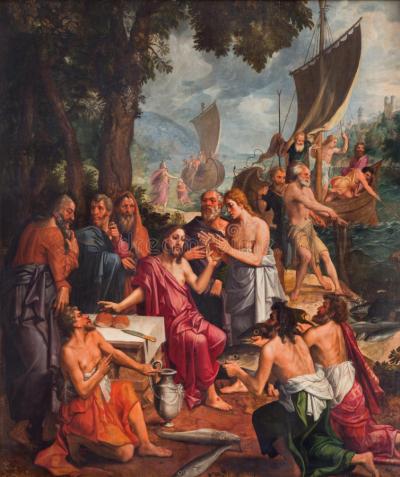
The same can be said of the “Miraculous Draught of Fishes”, by Hans van Elburcht, commissioned by the Guild of Fishmongers.
Here, too, the fishmongers’ product plays a star role in another story from the New Testament. No doubt, guild members were pleased to remind non-guild members of the holiness of their product because of its close relationship to the Lord.

A rather straightforward, though more racy, connection between guild and subject matter is also made in the “Wedding at Cana”, by Maerten de Vos.
The commissioning guild in this case was the Guild of Innkeepers, who of course would be selling large quantities of wine (and other alcoholic drinks) on their premises (just to remind those readers who may not be too familiar with biblical stories, this is the story where Jesus turned water into wine). Perhaps this was a way for inn-keepers to gently suggest that their business was nothing if not holy.

A pretty straightforward relationship also exists between the subject and the commissioning guild in the next painting, the “Fall of the Rebel Angels” by Frans Floris.
Look at that mass of writhing flesh! So thrilling. It must have been very difficult for church goers to concentrate on the mass with this painting to look at. It was commissioned by the Guild of Fencers, whose job it was to maintain public order and defend the city. So the painter has chosen as his subject the Archangel Michael and his men, arch-defender of Good, beating back the arch-representatives of Evil, Satan and his hordes, using, of course, the arms which the fencers themselves would be using. In this case, the painter had to stray from the Old and New Testaments into the Book of Revelation for his subject matter; no matter, it was part of the accepted Canon. I mean, didn’t Milton use this story for his poem “Paradise Lost”?

The painting by Frans Francken, “Christ among the scribes”, highlights another issue: what to do if you wanted a painter to paint a nice painting for your guild but you weren’t rich enough to afford him, and you weren’t rich enough to support a side-chapel? The answer, obviously, was for a couple of guilds to share the costs. This is exactly what the Guilds of Schoolmasters and Soap Makers did. They shared a side-chapel in the cathedral and they shared the cost of the painting. To make sure that each guild was represented in the painting, they had a triptych painted.  Since the schoolmasters were willing to pay a greater share of the painter’s fee, they got more square centimetres of painted surface for their subject matter.
More specifically, the schoolmasters got the centre panel and the right-hand panel, while the soap makers only got the left-hand panel. The scene in the centre panel is Jesus as a young boy instructing the teachers in the temple – no doubt the dream of every schoolboy and girl, and a rather strange subject for schoolmasters I have to say, unless Antwerp’s schoolmasters were a very humble lot. The scene in the right-hand panel is Saint Ambrose, patron saint of teachers and one of the Doctors of the Church (doctor as in PhD rather than in MD), baptising Saint Augustine, another of the Doctors of the Church.

The poor old soap makers had to make do with a very obscure story from the First Book of Kings (obscure at least to me). It has to do with the prophet Elijah, who miraculously ensured that the poor widow Sarepta was able to fill numerous pitchers of oil from the small jar that she had, thus allowing her to pay off her debts. For those of my readers who may not immediately see the connection to soap making, I should remind them that soap is made from boiling lye with oil (at least, it used to; God knows how chemists make it nowadays).

After that, the relationship between the subject of the paintings we saw in the cathedral and the guild commissioning it got a little more tenuous. For instance, we have the “Adoration of the Magi”, by Artus Wolffort.
This was commissioned by the Guild of Tailors. What does this subject have to do with tailors, readers may be asking.  Well, through the expensive clothes that the painter can have the Magi wearing! Viewers could be reminded of the wonderful (and expensive) clothes the city’s tailors could make. And perhaps the tailors, admiring the painting during a particularly boring mass, could find in it a confirmation of their skills.

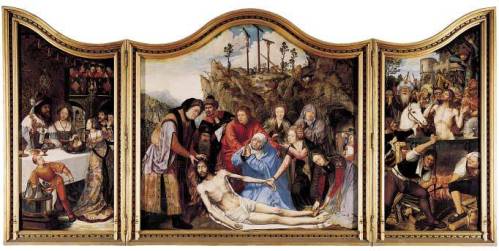
A painting with what seems to me an even more tenuous connection between subject matter and commissioning guild is the “Lamentation” by Quinten Metsijs.
The painting was commissioned by the Guild of Carpenters. I puzzled over this one for a while, and concluded that the only connection with carpentry and wood working were the three crosses far away in the background. I guess it is a carpenter who have sawed the wood from which the crosses were made. But why not simply a painting of Saint Joseph? He was a carpenter. Maybe that was too banal a topic. Interestingly enough, he doesn’t even seem to have been the patron saint of the guild. That honour went Saint John the Baptist and Saint John the Evangelist, who are the subjects of the two side-panels.

Having done the tour of the exhibition, I wondered out loud to my cousin what could have been a suitable biblical theme for the guild he would have been a member of had he lived and worked in Antwerp in the 16th-17th Centuries. I should explain that until he retired my cousin had worked for many years for a company that makes trucks like these.

Of course, this particular mode of transport did not exist in biblical times (or indeed even in 16th century Antwerp) but I think we can all agree that the equivalent would have been the cart, rather like the one we have in that famous Constable painting, the “Hay Wain”.

And I’m sure there was a guild for cart-makers (or maybe carriage and cart makers).

Nothing came to our minds on the spot, but in my spare moments in Vienna I have returned to the question. What biblical scene has carts in it, which could have been a suitable subject for some famous Antwerp painter to paint? Not knowing the bible by heart, I have done the next best thing, which is to search on-line versions of it put there by various Christian associations earnestly hoping that you will dip into the Good Book. Dip I did, using “cart” as the search word. And I came up trumps! Not in the New Testament, where the word cart doesn’t appear once (no doubt a reflection of Jesus’s poverty; he walked everywhere and owned nothing to speak of), but in the Old Testament, specifically in the First Book of Samuel. The story is part of the eternal wars between the Israelites and the Philistines. The Philistines have captured the Ark of the Covenant and have borne it back in triumph to the temple of their god Dagon. But strange things happen in the temple, horrible diseases and other calamities strike the Philistines. The Philistine rulers decide to send the Ark back to the Israelites. Their diviners tell them to put the Ark on a cart drawn by two cows, add a chest of treasure as a guilt offering, and let the cows go free. If the cows go back towards Israelite territory, then all their troubles have indeed been caused by the Israelites’ God. And of course that is exactly what the cows do. The story more or less finishes as follows (I quote this for reasons which will become clear in a minute): “Now the people of Beth Shemesh were harvesting their wheat in the valley, and when they looked up and saw the ark, they rejoiced at the sight. The cart came to the field of Joshua of Beth Shemesh, and there it stopped beside a large rock. The people chopped up the wood of the cart and sacrificed the cows as a burnt offering to the Lord [poor cows!]. The Levites took down the ark of the Lord, together with the chest containing the gold objects, and placed them on the large rock. The large rock on which the Levites set the ark of the Lord is a witness to this day in the field of Joshua of Beth Shemesh.”

Unfortunately, I could find no painter of the 16th or 17th centuries who depicted this scene. The best I could come up with was this depiction by a 19th century American folk artist who goes by the wonderful name of Erastus Salisbury Field.

From the short piece of text I cited above, I think readers will immediately see that Erastus was depicting the moment when the cart arrived in Beth Shemeth.

Well, after this success at finding a painting to fit my cousin’s presumed guild, what about me? First of all, what could have been my guild? Well, my last job was for the UN, and that certainly didn’t exist in the golden age of guilds, so that couldn’t be an entry point for me. I suppose UN work could be associated to government work. But government workers didn’t get a guild either – they did (and still do) nothing practical, just write and file documents of one form or another. My job before that – as a consultant – doesn’t help either. Consultants just advise, with the real work being done by others. As I wrote in my home page, I suppose the one thing which has run like a thread through all my jobs is that I had to write. So maybe I could have been a member of the Guild of Scriveners!

So now the question is, what could have been a suitable biblical scene to have painted for this guild? Scriveners are the same as scribes, and the New Testament is full of stories of scribes. But they are all negative stories, scribes being depicted as nasty people on the same level as the Pharisees. I don’t want negative publicity for my guild! So I turned once more to the on-line bible and did a search in the Old Testament. The best I could come up with is another obscure story in the Second Book of Kings involving King Josiah. Josiah instructs that the money which has been collected in the Temple be used for the Temple’s maintenance. While gathering the money, the High Priest finds the Book of Law (presumably the book had fallen out of use and this particular copy was gathering dust in some corner of the Temple). He gives it to Shaphan the scribe along with a report on how much money has been given to the maintenance crew. Shaphan comes before Joshua and reads the report but also reads him the Book of Law. Josiah tears his clothes because he realises that the Israelites haven’t been following the Law and “great is the wrath of the Lord that is kindled against us because our fathers have not obeyed the words of this book by doing according to all that is written concerning us.” I presume Josiah does something about this but I didn’t read any further. As my painting, I came up with this one, painted by the 17th Century Dutch painter Leonaert Bramer, showing Shaphan humbly reading the Book to a rather concerned-looking Josiah.
Well, this painting certainly fits with the period in which the other paintings in Antwerp cathedral were painted. Frankly, though, I prefer the painting I found for my cousin. But there you go.

Oh, and the rest of Antwerp was very nice.

POSTSCRIPT, 22 July 2018

After reading this post, a good friend of mine gave me some excellent suggestions for alternative paintings, both for my cousin’s guild as well as for my own. He was kind enough not to say it, but the key was to “think out of the box”, to put aside the straitjacket of finding a story in the Bible and to allow more creative ideas in. His suggestion for my cousin was Hieronymus Bosch’s “The Haywain Triptych”.
Pride of place in this triptych goes to a magnificent cart full of hay, the haywain, in the centre panel. The whole work is a rather delirious take – typical of Bosch – on the rather sad story of Man. On the left, after the rebel angels have been cast out of heaven (also the subject of that muscular painting above for the Guild of Fencers) we have Adam and Eve in the Garden of Eden, with them eventually being thrown out for having disobeyed God’s instructions. Then, in the middle, as the haywain of our lives trundles inexorably along towards death on the right, we have people enacting out every possible sin of which we are capable, busily ignoring Christ our Saviour up in the clouds. The result of all this is shown on the right, where we are all burning in Hell. I suppose you could say that this is the Medieval version of “Life’s a bitch and then you die”. I will leave it to my cousin to decide if he wants his guild to be represented by such a pessimistic vision of life.

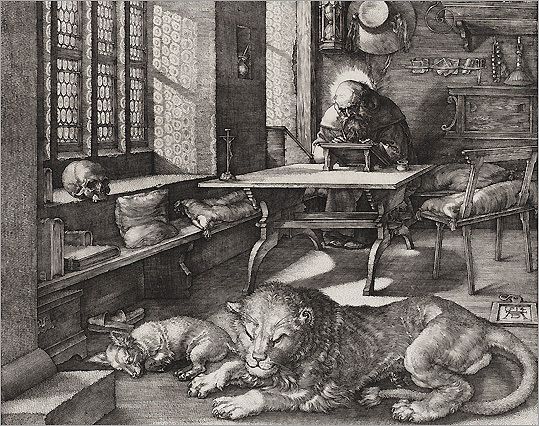
As to my guild, my friend suggested Dürer’s “St. Jerome in his Study”.

This is an excellent suggestion! St. Jerome’s main claim to fame these days is his translation of the Bible into Latin, which he spent years over in the Holy Land, busily scribbling away. I think I can definitely live with Dürer’s vision of learned and saintly paper scratching in a library-like environment as the image that my guild would want to project in its side-chapel in Antwerp cathedral. It’s a pity that Dürer only did an engraving, a painting would have been better. I could of course go for one of the hundreds of paintings on this theme which litter every self-respecting museum, but they all rather irritatingly show St. Jerome half-naked. I understand this is due to a confusion: this Saint Jerome has been conflated with another saint of the same name who did indeed go around half naked and who spent his time beating himself as penitence. To show what I’m talking about, I show a take by on the topic by Caravaggio, where the painter at least had the decency to pretty much cover Saint Jerome up.

But writing semi-naked is definitely not my style.

This mention of Caravaggio has suddenly made me think of another exciting possibility! I had quite forgotten that there are other very saintly acts of writing in the Christian Story, namely the writing of the four gospels by the Evangelists Mark, Matthew, Luke and John. Caravaggio did an excellent painting of St. Matthew writing his gospel. Actually, he did two. The first was unfortunately destroyed in Berlin during the Second World War.

The patrons who commissioned the painting rejected it because it made St. Matthew look too stupid. It is certainly true that the St. Matthew in this painting looks completely befuddled as the young angel pretty much takes his hand and writes the story for him. So Caravaggio painted another version, still to be seen in all its glory in the chapel dedicated to Saint Matthew in the church of San Luigi dei Francesi in Rome.

As a caravaggiophile, I would love to have a Caravaggio represent my Guild of Scriveners! I have a feeling that my guild would have chosen the second Caravaggio for the same reasons as the original patrons, although personally I would have preferred the first. I love that completely confused look on St. Matthew’s face – writing is such a difficult task, you never know where your hand (left hand in my case) will lead you.
_____________________

Antwerp cathedral exterior: http://www.visitflanders.com/en/things-to-do/attractions/top/the-cathedral-of-our-lady.jsp
Antwerp cathedral interior: http://www.medievalists.net/2011/01/medieval-origins-of-the-cathedral-of-our-lady-in-antwerp-belgium/
Ambrosius Francken, “Multiplication of the Loaves”: https://commons.wikimedia.org/wiki/ File:Multiplication_of_the_Loaves_(Ambrosius_Francken)_July_2015-1a.jpg
Hans van Elburcht and School of Ambrosius Francken, “Miraculous Draught of Fishes”: https://www.dreamstime.com/stock-photo-antwerp-belgium-paint-miracle-fishing-scene-hans-van-elburcht-abbrosius-francken-year-september-cathedral-image77028241
Maerten de Vos, “Wedding at Cana”: https://www.gettyimages.at/detail/nachrichtenfoto/the-wedding-at-cana-oil-on-canvas-after-maarten-de-vos-nachrichtenfoto/526962934#/the-wedding-at-cana-oil-on-canvas-after-maarten-de-vos-kadriorg-art-picture-id526962934
Frans Floris, “Fall of the Rebel Angels”: https://commons.wikimedia.org/wiki/ File:Fall_of_rebel_Angels_(Frans_Floris)_September_2015-1a.jpg
Frans Francken, “Christ among the scribes”: https://commons.wikimedia.org/wiki/ File:Christ_among_scribes_(Frans_Francken)_September_2015-5.jpg
Artus Wolffort, “Adoration of the Magi”: https://commons.wikimedia.org/wiki/ File:Adoration_of_the_Magi_(Artus_Wolffort)_July_2015-1a.jpg
Quinten Metsijs, “Lamentation”: https://www.kmska.be/en/collectie/highlights/Schrijnwerkers.html
Truck: https://www.abrbuzz.co.za/mobility-beat/5689-volvo-trucks-retains-top-position-in-sales-service-and-parts-according-to-q4-scott-byers-results
John Constable, “The Hay Wain”: https://www.planet-puzzles.com/grafika-john-constable-la-charette-de-foin-1821-puzzle-1000-pieces.p46141.html
Erastus Salisbury Field, “The Ark of the Covenant”: https://fineartamerica.com/featured/ark-of-the-covenant-erastus-salisbury-field.html
Leonaert Bramer, “The Scribe Shaphan Reading the Book of Law to King Josiah”: https://www.passionforpaintings.com/en/art-gallery/leonaert-bramer-painter/the-scribe-shaphan-reading-the-book-of-law-to-king-josiah-oil-painting-reproduction

POSTSCRIPT
Hieronymus Bosch, “the Haywain Triptych”: https://www.museodelprado.es/en/the-collection/art-work/the-haywain-triptych/7673843a-d2b6-497a-ac80-16242b36c3ce
Albrecht Dürer, “St. Jerome in his Study”: https://www.pinterest.at/pin/208995238931007942/?lp=true
Caravaggio, “St. Jerome writing”: https://commons.wikimedia.org/wiki/File:Saint_Jerome_Writing-Caravaggio_(1605-6).jpg
Caravaggio, “Saint Matthew and the Angel”: https://en.wikipedia.org/wiki/Saint_Matthew_and_the_Angel#/media/File:Caravaggio_MatthewAndTheAngel_byMikeyAngels.jpg
Caravaggio, “The Inspiration of Saint Matthew”: https://commons.wikimedia.org/w/index.php?curid=136502

BRUGES AND BRICKS

Vienna, 5 July 2018

My wife and I have just returned from a whirlwind tour of Belgium with a cousin of mine and his wife – the battlefield of Waterloo, Tournai, Bruges, Ghent, Antwerp, Louvain (or Brugge, Gent, Antwerpen, Leuven, to give them their Flemish names), all in a mere six days. (in case any reader asks himself or herself, we left Brussels out because we had all been there before). I think the next couple of posts will be about various aspects of our trip (the exact number depending on how strongly my creative juices flow).

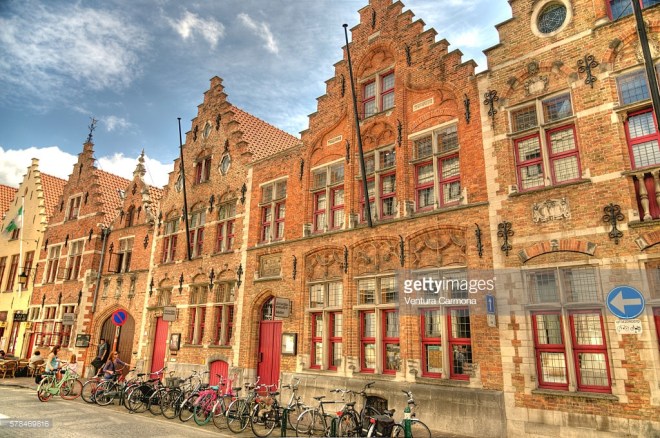
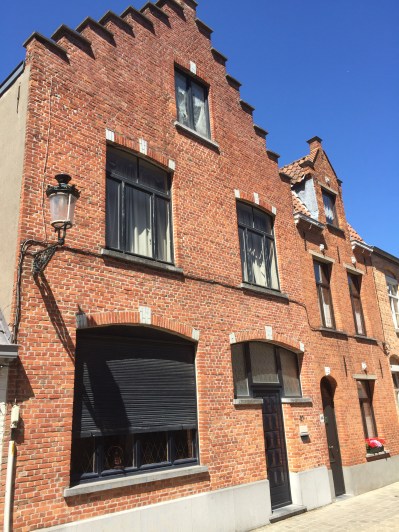
In this post, I want to focus on bricks. These became a source of fascination for me in Bruges. For those of my readers who haven’t yet been to Bruges, I should state that Bruges is a brick city par excellence. Much of it has been built in what is called the brick Gothic style, of which this – a picture of some street in Bruges – is a typical example.

Actually, I would call it the Dutch style. I know I’m entering a minefield here, since many Flemings would be indignant at having something of theirs called Dutch, but I’m afraid to say that I visited Amsterdam before I visited the lands of Flanders so for me the style is indelibly linked with the Netherlands. Perhaps, to try to avoid landing myself in the middle of local quarrels, I could call the style the Hanseatic style since our brief forays into other Hanseatic towns suggest that this is a style common to them all. (In passing, I should say that I was surprised to learn that Bruges was part of the Hanseatic league. I hadn’t known that it had extended this far south. I have made a mental note to buy myself a book on the Hanseatic league).

But actually it’s not the style of brick building that fascinated me in Bruges. It was the colour of the bricks. To put this in context, I should say that my feelings about brick colour have been very much shaped by the brick buildings in the UK, where bricks first impinged themselves on my retinae. Although it’s no doubt a gross exaggeration, I would classify British brick colours as pleasant, unpleasant, and frankly awful. In the pleasant category, I would put the country’s older brick buildings. Christchurch Mansion near Ipswich in Suffolk is a fine example.

Readers will note that the brick is not too red, you could almost say it has pink overtones, and the colour is pleasingly non-uniform.

In the unpleasant category, I would put just about every brick building put up in the UK since the Industrial Revolution. This picture of an old brick chimney – icon, I would say, of the industrial revolution – can stand in for this type of brick.

To make the point even more strongly, though, I also throw in a picture of an old factory

of one of the buildings in the original red brick universities (in this case Sheffield)

and of a row of normal houses.

Readers will note that the red is harsh, strong, crude, and that the bricks are much more uniform in colour than the older bricks. As far as I can make out, the much stronger red colour comes mainly from the bricks having been fired at higher temperatures, although it could also be due to the original clay holding more haematite (the iron mineral which mostly turn bricks red, although nowadays dyes – rather depressingly – are increasingly being used). As I understand from the little bit of technical literature I have boned up on, higher firing temperatures were used to make the bricks stronger and so more usable in larger structures. But I also read – though can scarce believe it – that at least in London redder bricks were used to make the buildings more visible in the fog (Peter Ackroyd’s Biography of London is given as the source of this nugget of information. I shall check it in my copy in Milan).

As for the frankly awful category, I would put all those bricks which are an unpleasant off-white. My grandmother’s old house in London can stand in for the genre.

But this brick was used extensively throughout London. Here’s a part of Waterloo Station.

It’s not just yesteryear that they used this brick. I throw in a picture of a modern use of bricks with this sickly colour.

I know there are readers out there who will indignantly tell me that it’s a beautiful colour, but as they say, “beauty is in the eye of the beholder” and in my eye that’s sick colour.

Now, after my trip to Bruges, I can add another brick hue to my pleasant category – indeed, perhaps I should create a new category, “very pleasant”, for this hue. This picture is an example of the type.

As I hope readers can see, the buildings in this case give off a very definite orange “glow”. A somewhat hasty study of such buildings as we moved from one place to another has led me to conclude that the colouring comes from a brick which indeed has more orange than pink hues but also from a savant mix of this brick with bricks of the hideous sick colour the effect of which is to give rise to a paler orange than might otherwise be the case. I throw in pictures which I took of some other buildings with the same light orange hue.


Very nice …

And oh, by the way, Bruges is a very pleasant place to visit. A bit overrun by tourists, perhaps, but at least in June still acceptable. Don’t be fooled by such idiot titles as “the Venice of Flanders”. The place has a few canals but in no way do they compare to Venice.

___________________

Bruges street: https://www.gettyimages.at/detail/foto/old-street-with-crow-stepped-gable-houses-in-bruges-stock-fotografie/578469816
Christchurch mansion: https://www.tripadvisor.co.uk/LocationPhotoDirectLink-g190725-d1575683-i74779233-Christchurch_Mansion-Ipswich_Suffolk_East_Anglia_England.html
Old factory chimney: https://www.istockphoto.com/at/foto/alte-industrielle-gemauerten-schornstein-gm932649592-255603992
Old factory: http://www.antiqueslink.com/antiques/antique-archaeology-492420.html
Firth Court, University of Sheffield: http://www.geograph.org.uk/photo/2889648
Brick houses: https://en.wikipedia.org/wiki/Accrington_brick
My grandmother’s house: https://www.buildington.co.uk/london-sw7/40-montpelier-square/40-montpelier-square/id/3544
Waterloo station: By Alex.muller – Own work, CC BY-SA 3.0, https://commons.wikimedia.org/w/index.php?curid=4350988
modern use of london yellow stock: https://wienerberger.co.uk/inspiration/tower-bridge
Bruges houses: my photos

HEIDI HORTEN’S COLLECTION

Vienna, 20 June 2018

This is the second posting where I write with wistful envy about a person who was rich enough to build up an art collection and who had enough taste to build up a great art collection. The first posting was about Ms. Kröller-Müller, whose museum we will visit in a few weeks’ time when we go to the Netherlands. This second posting is about Ms. Heidi Horten, a selection of whose collection my wife and I recently visited at Vienna’s Leopold Museum. (In passing, Mr and Mrs Leopold are another couple who used their riches to build up a ravishing collection now housed in this same museum.)

A few words about Ms Horten. As a 19 year-old, this Austrian girl married the much older Mr Helmut Horten, a German who had made his fortune after the war with a chain of department stores (I will skitter delicately over the fact that the start of his business empire was his purchase – I would assume on the cheap – of a department store owned by two Jewish partners who were forced to give it up in the wake of the Nazis’ antisemitic policies and prior to their emigration to the US). Here, we have the Horten couple.

As a couple, they did some collecting but nothing major. The serious collecting only really started when Mr Horten went the way of all flesh in 1987 and Ms Horten inherited the bulk of his fortune – some $ 1 billion, it is reported. Here is a photo of her in those years: quite a glamorous lady, I would say.

And what a collection Ms Horten has amassed! Like Ms Kröller-Müller and the Leopolds, she has focused her purchases on modern and contemporary art. I presume that the exhibition at the Leopold Museum is only a portion of her collection, but what they are showing is impressive. After doing a round of the exhibition, I went around again, taking pictures of the pieces which had particularly struck me. I post them below, in the order of their creation.

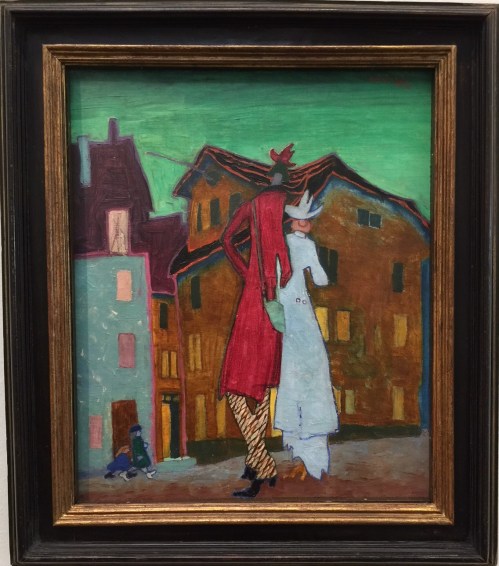
Lyonel Feininger’s The Honeymooners, from 1908.

Wonderful expression of the happiness of two honeymooners, dressed in bright clothes and towering over their surroundings.

Egon Schiele’s aquarelle of Seated Male Nude from Behind, painted in 1910.

Schiele painted a whole series of these aquarelles, a number of which I was fortunate enough to see several years ago on one of my periodic visits back to Vienna from China.

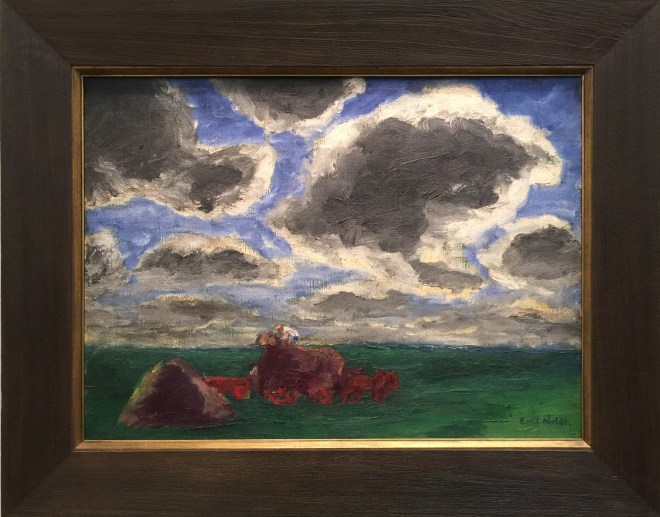
Emile Nolde’s Red Evening Sun, painted in 1913.

My wife was particularly struck by the painting’s dark, dark sea.

Gustav Klimt’s Church in Unterach am Attersee, painted in 1916.

Klimt painted a number of these views, which he saw, it is said, through a telescope to get that foreshortening effect.

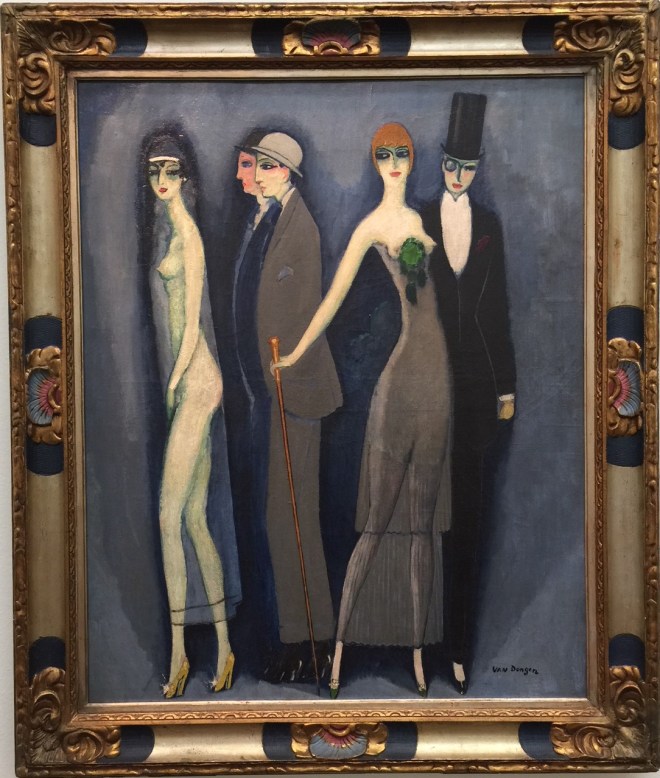
Kees van Dongen’s Commedia (Montparnasse Blues), painted in 1925.


Emile Nolde again, Summer Day with Hay Cart, painted in 1926, more than ten years after the earlier painting.

Chaim Soutine’s Doorkeeper – Woman in Blue, from 1935.


Soutine captured perfectly the sour look which all the French doorkeepers of my youth constantly displayed.

After that, things begin to get grim. I’ve often complained (the latest time last December) that as Western modern art gets ever more modern it slips off into irrelevance and silliness. I feel that the rest of the exhibition demonstrates this pattern all too well. Nevertheless, I show here pictures of some of these later pieces, often for no better reason than they amused me.

Alexander Calder’s Untitled (Toy Train) from around 1946. A fine way to reuse old tins and cans.


Michelangelo Pistoletto’s Nurse and Girl from 1965.

What, I wonder, were the two discussing?

Pablo Picasso’s Bust of a Man, from 1969.

As I’ve commented elsewhere, among the dreariness of abstract art Picasso shines out as having stayed true to representational art.

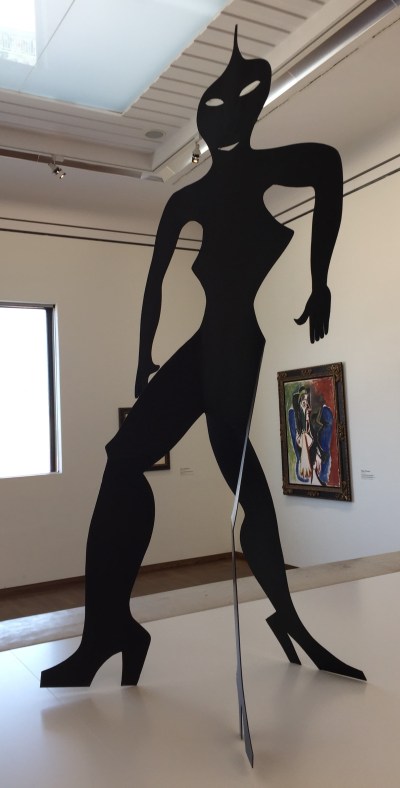
Another Alexander Calder, Critter with Peaked Head, from 1974.

Funny title, and interesting change of view as one goes around the critter and as one of her three legs disappears (I assume the critter is feminine since she is wearing high heels; but perhaps male critters also wear heels).

Roy Lichtenstein’s Forest Scene, painted in 1980.


Andy Warhol’s Lenin, from 1986.

Normally, I find Warhol’s portraits wearisome and repetitive, but I found these two portraits of Lenin quite arresting.

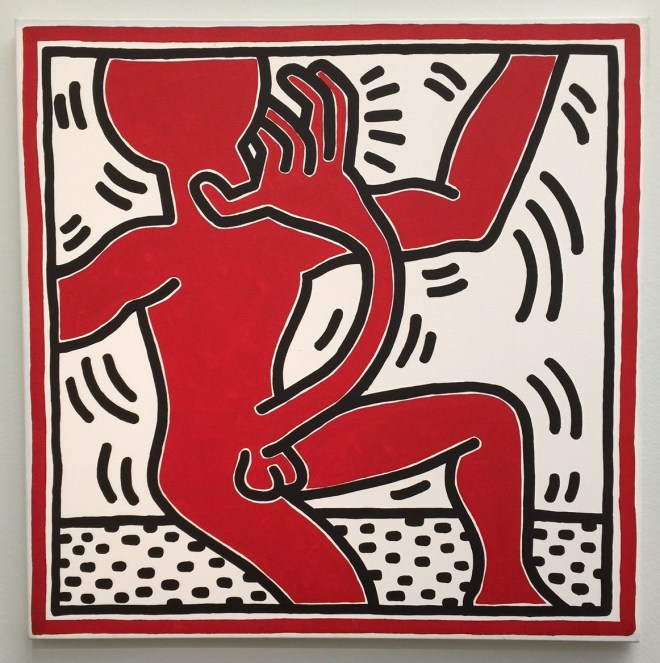
Keith Haring’s Untitled, painted in the same year as Warhol’s Lenins.

Untitled, but I presume a commentary on the AIDS epidemic that was then sweeping through the US’s gay community and which counted him as one of its victims four years after he completed this painting.

Not Vital’s Untitled (Fuck You), from 1991-2.

I don’t know if this is what Vital intended, but I see this piece as a commentary on those awful collections of deer antlers which you see in many conservative Austrian homes, testimony to the enthusiasm with which the home owner and his ancestors have hunted deer.

If I were a deer, I too would want to have those seven letters dangling from my horns as I faced my hunter.

Maurizio Cattelan’s Untitled (Zorro) from 1997.

I’m assuming that Cattelan was taking the piss out of Lucio Fontana, he of the cut canvases. I feel this ever more strongly given that this painting was hung beside some four or five Fontanas.

Cattelan, by the way, is the same artist who sculpted that hand with its finger raised in front of Milan’s stock exchange; it was the subject of an earlier posting of mine. He seems to be quite a joker.

And finally, Erwin Wurm’s Kastenmann, or Box Man, from 2010.

I don’t know what Mr. Wurm is trying to tell us, it just looks amusing.

I now invite my readers to scroll through all these pictures again. Did something not go wrong with the art we produced in the developed countries some time after the Second World War? Is all that’s left to our art is whether it’s a good joke or not?

_______________________________

Pictures: all mine except:
Horten couple: https://www.falter.at/archiv/wp/das-maerchen-von-helmut-und-heidi
Heidi Horten: https://www.vindobona.org/article/heidi-horten-collection-leopold-museum-vienna
Deer antlers: https://www.alamy.com/stock-photo-trophies-of-deer-hanging-on-a-wall-in-a-hunting-lodge-styria-austria-18704002.html

GARLIC

Manila, 6 June 2018

A few days ago, my wife and I went for a walk in the Wiener Wald, those woods which drape the hills ringing Vienna on its northern and western sides. It was a public holiday, the Feast of Corpus Christi, so it seemed an excellent excuse to go for a ramble in the woods. On top of it, it was a beautiful day, bright, sunny, with a slight breeze.

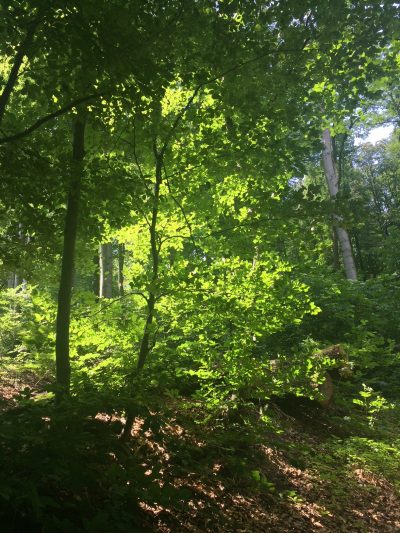
We were not disappointed. We found surprisingly few people. The beech trees were splendid

with sunlight filtering through their leaves.

Wildflowers peeped out from the undergrowth

Deer crossed our path …

In a word, it was perfect.

Except for one thing: the fetid smell that periodically wafted up from the forest floor.

The source of the smell was these plants, which carpeted the ground in many parts of the woods.

They are wild garlic, Allium ursinum, so readers will not be surprised if I say that the smell they emanated made me think of rancid garlic cloves. It was quite similar to the nauseous smell given off by some of the hole-in-the-wall kebab joints in Vienna, where garlic powder is used with wild abandon.

Our walk was too late in the season for us to at least enjoy the delicate white flower they display.

For that, you need to go into the woods in April, early May. But it was just as well we had come late: previous experience had shown me that when the plant is flowering the smell is even more penetrating.

I remember talking with a German colleague of mine about my first brush with wild garlic’s exhalations in the Viennese woods. He sympathized, but waxed eloquent about the soup which can be made from its leaves. As previous postings record, I am no fan of garlic and so have never tried this soup. But for readers who are better disposed to garlic than I am and who happen to have a wood nearby in which wild garlic grows, I throw in an Austrian version of the soup’s recipe (the amounts cited here should serve four people). Pick 200 grams of wild garlic leaves (one source suggests picking them young and tender, even before the plant flowers, to get the most delicate taste). Wash, drain, and chop finely. Melt 50 grams of butter in a saucepan, stir in 3 tablespoons of flour, and slowly add 1 litre of vegetable stock. Bring to a boil. Stir in the chopped wild garlic leaves. Bring to a boil again. Simmer gently, all the while seasoning with salt, pepper, a shot of lemon juice, and a pinch of anchovy paste. Finally, stir in 1/8 litre of sour cream and two tablespoons of whipped cream, season to taste with a pinch of nutmeg. The soup should look something like this.

I should note that a number of recipes from the German-speaking world suggest adding some cubed potatoes rather than flour and cream, but I feel that the recipe I’ve cited sounds more authentic (a number of recipes also suggest adding onions and/or shallots and/or garlic cloves, but this really seems to be exaggerating the presence of this malodorous family!).

My favourite source of information – Wikipedia – tells me that wild garlic is native to the temperate regions of Europe, from Britain in the west to the Caucasus in the east. Wikipedia also informs me that we Europeans have been munching on wild garlic leaves in one form or another for the last 10,000 years or so – an impression of a wild garlic leaf was found in a Mesolithic settlement in Denmark. Did our European forebears also munch on the bulb? Perhaps only if they were very hungry, because the bulb of wild garlic is very small.

No, it’s not Allium ursinum which gave us the garlic cloves that we are so – unfortunately – familiar with today. We have to thank a Central Asian cousin, Allium longicuspis, for that.

Early farmers in Central Asia cultivated the wild variety, and as has happened so many times with other plants they played around with it and slowly turned it into the plant we know today, with that pungent – oh, so pungent! – bulb.

It seems that garlic was one of the very first plants that our farming ancestors tinkered with. Their tinkering was so successful that the plant got carried out of Central Asia along the Silk Road and other trade routes, east to China and south-east Asia, south to the Indian subcontinent, west to the kingdoms of the Near East, followed by Egypt and later Greece and Rome. As the plant was moved out of its homeland, farmers kept tinkering so that today there is a bewildering number of sub-variants.

Now, I know this will raise hackles among garlic lovers, but really, what on earth possessed those early farmers to spend their precious time in developing this bulb?! It tastes really strong (“pungent” is the word used in the garlic literature), it leaves a metallic taste in your mouth after you’ve eaten it (well, in mine at least), it makes your breath – indeed, your whole person – smell “pungently” after partaking of it, and it – hmm, let me see how best to put this – it disrupts your digestive system resulting in odorous wind and other unpleasant side effects in the bathroom (at least, it does so in my case).

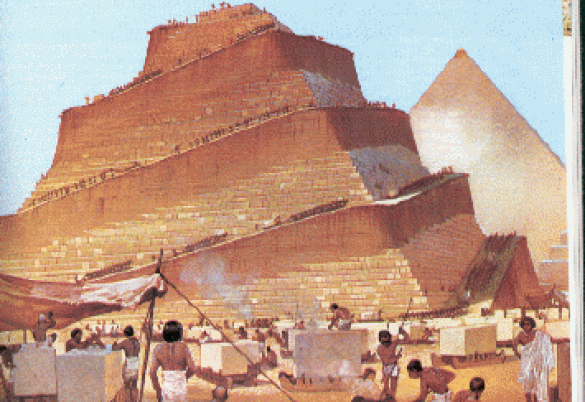
But develop it they did. And they found enthusiastic consumers far and wide. The ancient Egyptians consumed particularly enthusiastically. The poor buggers who slaved away to put these up

were, it seems, paid with the stuff – garlic was believed to give one strength, and what did these guys need but strength, and a lot of it? It’s not as if the workers were forced to eat it, either. It seems they loved it. One of the only two known slave revolts in Egypt occurred after the failure of the annual garlic harvest.

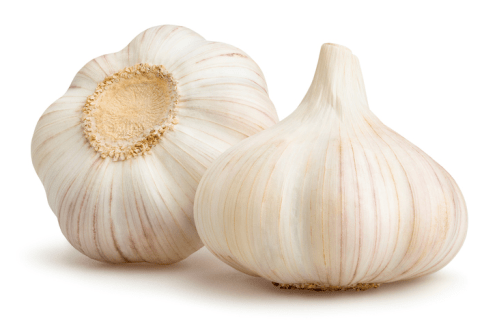
Generally speaking, in all places and at all times garlic was believed to be good for your health and a cure for all sorts of maladies, from the plague to the pox. In fact, this may have been why garlic was originally developed – for its supposed health effects rather than as a food additive. There must be people who still believe in garlic’s curative powers; why else would companies offer these sorts of over-the-counter products for sale?

One persistent belief is that garlic has antiseptic properties. It seems that garlic was used during both World Wars as an antiseptic and a cure for dysentery. I can hardly believe it; doctors in the mid-20th Century had no better medicine than that?! What I do know is that until very recently the Chinese were using garlic as a sort of antiseptic mouthwash. A friend of ours who had been already living in China for some years before we arrived told me that in the early noughties it was common for people to rub their gums with a garlic clove in the morning before going to work. He said that taking the bus in the morning was not for the faint of heart. I shudder inwardly every time I think of his story.

Talking of shuddering, in ancient Greek and Roman times (and probably even before) it was believed that garlic was a powerful aphrodisiac. Quite how anyone could have come to this conclusion is beyond me. But then the human mind has an infinite capacity for self-delusion. And of course it must have been men who believed this. I can imagine the scene: a randy old goat who munches on the ancient world’s equivalent of a little blue pill and then rushes off to bed to perform. Pity the poor woman who is the recipient of his performance!

In fact, smelling of garlic has always been associated with being uncouth. Those Egyptian priests who eagerly fed their workers garlic never touched the stuff themselves. Upper caste Indians never let garlic pass their lips in case it made them smell like their lower caste compatriots. In ancient Greece, it was generally believed that the gods disliked the smell of garlic. In temples dedicated to the goddess Cybele, this was taken to extremes. Those who wished to enter one of her temples had to pass the garlic breath test. King Alfonso of Castille ruled that any gentle person coming into court smelling of garlic was banished for a week. In the US until the 1940s the reek of garlic was used as an ethnic slur, being called such things ‘Italian perfume’.

I suppose that the thinking which led Greeks to conclude that the gods disliked the smell of garlic also led to the belief that garlic could ward off witches, evil spirits and the like. Which belief no doubt underlies the use of garlic to ward off vampires. All this tells me is that vampires have good taste.

Readers may protest and say that garlic’s main role is surely now in the kitchen. True. And to show that even with garlic I can be broadminded let me throw in here a famous recipe where garlic plays the main role, for the garlic lovers out there to try if they have not done so already. It is the recipe for another soup, Sopa de Ajo, Garlic Soup, which is eaten throughout Spain. Once again, the amounts cited here will serve four. Heat 4 tablespoons of olive oil in a saucepan over a low heat. Add 4 to 5 large garlic bulbs (yes, four to five), broken into the cloves – do not remove their skin. Fry gently, stirring often, for 15-20 minutes, until the skins are golden brown and the flesh is soft. Remove them from the hot oil. Wait until they have cooled a little, then squeeze out the garlic flesh, discarding the skins. Puree and set aside. Meanwhile, add 100g of cooking chorizo, cut into little pieces, to the pan and fry until crisp and caramelized. Add 1 teaspoon of fresh thyme leaves, fry for a few seconds. Then add the pureed garlic and stir it in well. Add ½ teaspoon of sweet smoked Spanish paprika, and pour on 1 litre of chicken stock. Bring to a boil, gently simmer, and season to taste. About two minutes before serving, poach four eggs in the soup and add 8 slices of ciabatta, toasted and torn into rough pieces. The finished product should look something like this.

Four to five garlic bulbs … For all my broadmindedness, I cannot suppress yet another inward shudder. What the consumers of this soup must smell like when they rise from the dining table! Quite possibly, it was this soup which had been eaten by the Spanish gentlemen who plays the lead role in my most searing memory of garlic breath. I invite my readers to dip into the post where I write about this painful episode in my life. In the meantime, once I am back from my travels my wife and I will go for other long and pleasant walks in the Wiener Wald. The wild garlic plants were already wilting when we took our walk on Corpus Christi Day. Hopefully, they will all soon be dead and I can enjoy the woods without my nostrils being assailed by the smell of rancid garlic.

___________________

Woods photos: ours, except:
Deer in woods: https://viennalife.wordpress.com/tag/vienna-woods/

Kebab shop, Vienna: https://commons.wikimedia.org/wiki/File:Wien_Bellaria_Kebab_Pizza_Dez2006.jpg
Wild garlic in flower: https://www.flickr.com/photos/sarfrazh/26388112004
Wild garlic soup: https://www.chefkoch.de/rezepte/25941006183503/Baerlauchsuppe.html
Wild garlic plant with bulb: https://scottishforestgarden.wordpress.com/2013/04/19/growing-and-eating-wild-garlic/
Allium longicuspis: https://thebetter.wiki/en/Garlic
Garlic: https://www.shopevoo.com/products/infused-garlic-1
Building the pyramids: https://exploredia.com/top-10-shocking-facts-ancient-egypt/
Garlic pills: https://www.amazon.com/Natures-Bounty-Extract-Release-Softgels/dp/B002Y27JD8
Garlic breath: https://dailykale.com/2011/09/16/foods-that-heal-garlic/garlic-cartoon/
Garlic and vampires: https://horror.media/four-theories-about-why-vampires-hate-garlic
Sopa de Ajo: https://www.theguardian.com/lifeandstyle/2013/may/04/10-best-garlic-recipes

BIKERS AND CENTAURS

Milan, 26 May 2018

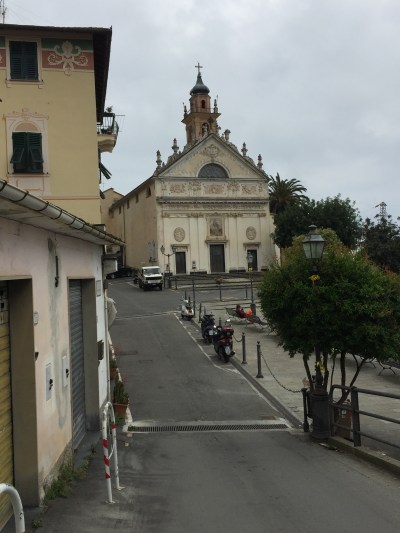
A week or so ago, my wife and I were at our place at the seaside near Genova; my next to last post was about one of the walks we did in the hills while we were there. One morning, being sore of leg from our walks and uncertain as to what walk to do next, we decided to go down into the village centre instead to have ourselves our morning cappuccino. Being in no hurry, we dawdled along looking in shop windows and at anything else that caught our attention. One such thing was the door of the local police station, which was festooned with various notices about Important Local Things. As I idly scanned the notices, one caught my attention in particular. It stated, in Italian of course, something to the effect that the part of the main road lying between km X and km Y was particularly risky for centaurs, and that the public authorities were devoting their attention to how to minimize the risks.

Centaurs??

Puzzled, I turned to my wife to ask for elucidations, and she informed me that this was a term used in Italian to describe motorcyclists. What a wonderful idea! What, I wondered, had led an Italian at some point in recent history to make this connection? I mean, early motorcyclists didn’t really much look like centaurs, although with a bit of poetic fancy once could sort of see a human torso on top of a beast on wheels.

For once, the internet was not of great help. One thread suggested that it had to do with the huge amounts of horsepower in the engines, allowing the rider to roar off much as a horseman could gallop off. Another thread claimed it had to do with fanatical motorcyclists hardly ever getting off their bikes and thus being seemingly welded to them much as centaurs were human torsos welded to a horse’s body.

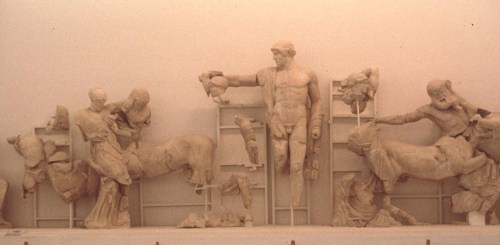
Of course, either or both of these explanations could be correct. I can think of another, which has to do with the Bad Boy reputation of both motorcyclists and centaurs. For most Ancient Greeks, who invented centaurs, these creatures were the epitome of barbarism. They were wild, lusty, overly indulgent drinkers and carousers, violent when intoxicated, and generally uncultured delinquents, living on the edges of the civilized world and needing to be kept under control. Greek myths were replete with stories of heroic warriors taking on centaurs and beating the shit out of them. Greek sculpture and painting naturally followed suit. Here, from a pediment of the temple of Zeus at Olympia, we have a representation of the story of the centaurs fighting with the Lapiths (a popular story in which centaurs are invited to a wedding, get drunk, and one of them tries to rape the bride, with – as may be expected – mayhem ensuing). The calm fellow in the middle is the god Apollo.

Here, we see the right hand part of the pediment showing more clearly the naughty centaur carrying off a woman and a noble Greek warrior about to make him pay for it.

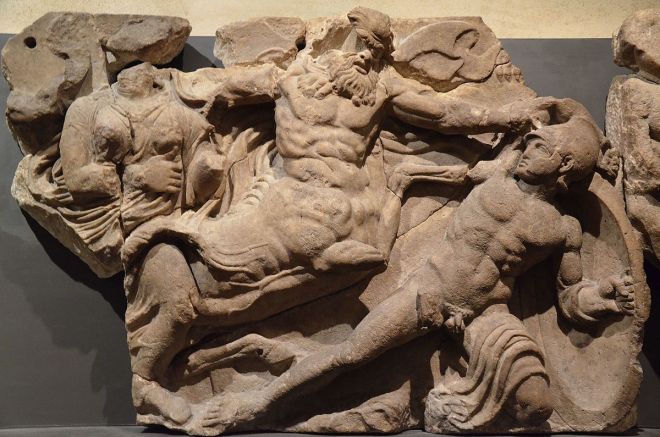
Here, to equal things up a bit, we have the same story from a frieze at the temple of Apollo in Bassae, with the centaur seemingly the one winning.

Here, we have a more humble piece of Ancient Greek art, a painting on a vase, showing the same story.

Here again, to equal things up, is a painting on another vase where the centaur seems to be besting his opponent.

Just in case readers are thinking that the fight between centaurs and the Lapiths is the only Greek story about the centaurs, I throw in here a picture of a vase painting showing Hercules fighting with a centaur (the centaur was a certain Nessus, who carried away Hercules’s wife Deianeira, and Hercules killed him).

In any event, whatever the medium, I think we can all agree that the centaurs are made to look fairly rough types. The centaurs’ bad reputation and the need to beat the shit out of them pursued the poor beasts into the Roman period and on into Europe’s medieval period and beyond. This sculpture from the early 1800s by Antonio Canova greets us every time my wife and I climb up the grand staircase at Vienna’s Kunst Historisches Museum. It shows Theseus about to brain a centaur – for some reason, Theseus was at the Lapith wedding feast.

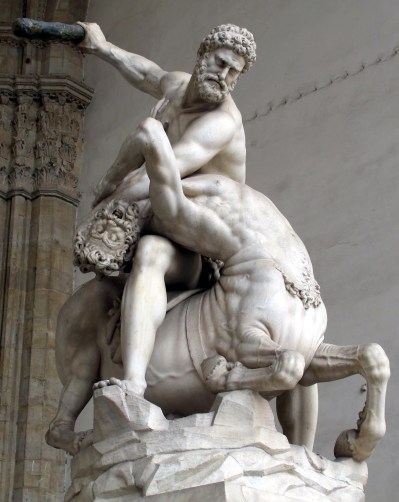
This sculpture, on the other hand, depicts Hercules about to brain Nessus.

It was sculpted in 1599 by the Flemish Jean Boulogne, known to the world as Giambologna. It graces the Loggia dei Lanzi in Florence.

Painting also got into the act. Here, we have a painting by Sebastiano Ricci from 1705 showing the brawl at the Lapith wedding.

Perhaps some classics-loving Italian saw similarities between these badly behaved centaurs and the badly behaving modern bikers – at least as they were often represented in popular culture. Think of the 1953 film “The Wild One”, in which Marlon Brando is the leader of a motorcycle gang terrorizing a small town.

Or consider the 1966 film “The Wild Angels”, in which Peter Fonda is the nihilistic leader of a chapter of the Hell’s Angels causing mayhem in some small town.

Or more extremely, we have the 1973 film “Psychomania”, where a gang of bikers kill themselves, only to become alive again as zombies and go around wreaking havoc on the living.

Personally, and without a shred of evidence to back me up, I prefer to think that the Italian who gave bikers the new title of centaurs made quite another connection between the two: the fact that both are gentle, peaceful souls. On the centaur side, there was a view, an admittedly minority view, in Classical times that centaurs – at least some of them – were wise and noble creatures. The centaur Chiron was particularly famous in this regard. It was said that he was so wise that had taught great heroes like Achilles, Ajax, and Jason. This fresco from Hercolaneum, destroyed like Pompeii by the eruption of Vesuvius in AD 79, shows him teaching Achilles how to play the lyre.

This strand of thinking which saw centaurs as wise and gentle beasts was taken up with enthusiasm by C.S. Lewis in his children’s books about Narnia, and it was in my reading of these books as a child that I first got to know of centaurs. I still remember with fondness the wise and noble centaurs which peppered the Narnia books. Here, for instance, is Roonwit, who graces the pages of “The Last Battle”, talking strategy with Prince Tirian and the unicorn Jewel.

Given my age, I think it no shame to admit that I have never read any of the Harry Potter books (although I did accompany my daughter to a few of the films when she was young). I understand, though, that J.K. Rowling also included wise and gentle centaurs in her books (confirmed through WhatsApp by my daughter). This is the centaur Firenze with Harry in (I think) the Forbidden Forest.


As for bikers, there are those who argue forcefully for a gentle, peaceful, soulful side to motorcycling. Many is the motorcycling writer who has written lyrically about the joy of being out on the open road, with the wind in your hair and your thoughts your only company. My most recent read in this vein was Oliver Sack’s autobiography, “On The Move: A Life”, where he writes about the long motorcycle rides he took in the American West in his early days in California. Appropriately enough, the cover photo is the author on his beloved bike.

There is even a semi-serious book of philosophy, “Zen and the Art of Motorcycle Maintenance” which, according to Wikipedia, “is a fictionalized autobiography of a 17-day journey the narrator made on a motorcycle from Minnesota to Northern California along with his son. … The trip is punctuated by numerous philosophical discussions on topics including epistemology, ethical emotivism and the philosophy of science”.

(I must confess that although I have started the book a couple of times I have never finished it).

Films, too, have played their part in depicting the lyrical side of motorbiking. We have the 1969 film “Easy Rider”, in which Peter Fonda stars once again, but this time accompanied by Dennis Hopper. The two set out from Los Angeles to New Orleans on Harley Davidsons to discover America (and get killed by rednecks in the process).


Or there is the 2004 film “The Motorcycle Diaries”, about the bike journey which Che Guevara and a friend made in the 1950s across Latin America, and which opened his eyes to the poverty, hardship, and political oppression experienced by many on that continent.

As I said, I have not a shred of evidence that gentleness, nobility, peacefulness, wisdom, etc. etc. were the common threads that some Italian of yesteryear saw between bikers and mythical centaurs. But it pleases my contrarian spirit for it to be so, and so it shall be.

_________________

Early biker: https://rocket-garage.blogspot.com/2011/08/pionieri-del-xx-secolo.html
Centaur fighting Lapith – Bassae: https://commons.wikimedia.org/wiki/File:The_Bassai_sculptures,_marble_block_from_the_frieze_of_the_Temple_of_Apollo_Epikourios_at_Bassae_(Greece),_Lapiths_fight_Centaurs,_about_420-400_BC,_British_Museum_(14073581678).jpg
Centaur fighting Lapith – Olympia: http://dtcox.com/report-on-ancient-corinth-ancient-olympia-ancient-sparta-byzantine-mystra-monemvasia-greece-oct-30-2015/centaur-lapith-woman-west-pediment-temple-of-zeus-battle-be/
Centaur fighting Lapith – Olympia-2: https://www.oneonta.edu/faculty/farberas/arth/arth200/politics/images_authority_2_greek.html
Centaur fighting Lapith-vase-1: https://www.myartprints.co.uk/a/red-figurevasedepictingth.html
Centaur fighting Lapith-vase-2: http://www.theoi.com/Gallery/O12.10.html
Hercules fighting Centaur: https://www.pinterest.com/pin/423268064950273744/
Canova-Theseus fighting the centaur: https://it.wikipedia.org/wiki/File:Canova_-_Theseus_defeats_the_centaur_-_close.jpg
Giambologna-Hercules fighting Nessus: https://www.tuttartpitturasculturapoesiamusica.com/2015/09/Giambologna-Sculpture.html
Sebastiano Ricci-Lapiths and Centaurs: By The Yorck Project (2002) 10.000 Meisterwerke der Malerei (DVD-ROM), distributed by DIRECTMEDIA Publishing GmbH. ISBN: 3936122202., Public Domain, https://commons.wikimedia.org/w/index.php?curid=158347
“The Wild One”: https://www.jpcycles.com/product/712-685/the-wild-one-fight-poster
“The Wild Angels”: https://www.pinterest.co.uk/pin/112308584430632278/
“Psychomania”: http://theggtmc.blogspot.it/2011/09/psychomania-1972.html
Chiron and Achilles: By upload by muesse – http://www.focus.de, Public Domain, https://commons.wikimedia.org/w/index.php?curid=8328492
Roonwit: http://narnia.wikia.com/wiki/File:Tirian,_Jewel_and_Roonwit.jpg
Firenze: http://harrypotter.wikia.com/wiki/File:Firenze_harry_ps.jpg
Oliver Sacks, “On the Move; A Life”: https://medium.com/@PunkChameleon/book-review-on-the-move-a-life-by-oliver-sacks-93bb828fb85b
“Zen and the Art of Motorcycle Maintenance”: https://www.harpercollins.com/9780061907999/zen-and-the-art-of-motorcycle-maintenance
“Easy Rider”: http://flavorwire.com/472622/boomer-audit-despite-the-self-indulgence-and-the-cliches-easy-rider-retains-its-pulse
“The Motorcycle Diaries”: http://www.moviepostershop.com/the-motorcycle-diaries-movie-poster-2004

GERANIUMS – SORRY, PELARGONIUMS

Sori, 14 May 2018

I’ve written about cacti in an earlier post. In that case it was in a plug for more cactus growing in LA. The micro (really micro) climate on the balcony of our apartment at the sea, coupled with the long periods when no-one is here to water plants, also makes this an ideal space for cactus growing. My mother-in-law introduced cacti to the balcony several decades ago, and my wife expanded the collection by borrowing a few cacti from our next-door neighbour. However, I am saddened to report that a particularly harsh winter this year, when Jack Frost managed to lay his bony fingers on the balcony, has put paid to some of the cacti. We were faced with blackened cacti corpses when we arrived a few days ago and have been mournfully wondering what to do ever since. As part of this wondering, we visited the local flower shop, to see if they had any suggestions about how we might be able to breathe some life back into our blackened cacti – and to see if they sold any cacti should we decide that there was nothing for it but to replace them. The answer was negative in both cases.

In any event, as is usual in these cases the discussion went off on several tangents. For reasons which I can no longer remember now, one of these tangents was geraniums. I’m rather fond of geraniums. My mother had large beds (or what I remember as large beds) of geraniums in her garden in Eritrea, which the memory bank of my mind suggests looked something like this.

The bright red of the flowers pleased me no end – I suppose bright primary colours appeal to five and six year-olds – and I really liked the scent which emanated from broken leaves and stems. I must confess to having been a terror in the garden. I was not above decapitating flowers or casually tearing off leaves and stems. I must have driven my mother wild with my antics.

But coming back to our local flower shop: the lady in charge said that geraniums had a hard time in this climate because it was too humid. This rather surprised me, I thought that all geraniums needed was a lot of sun. I started looking around, and I discovered that it was indeed rare to see geraniums around here. Her comments also got me to engage in my favourite pastime: surfing the web to find out more about geraniums. I am ready to report back.

The first thing I discovered is that geraniums should not actually be called geraniums. Their correct name is pelargoniums. It seems that when the first pelargoniums were brought back to Europe in the 17th Century, gardeners thought they were cousins to the geraniums already present here. By the time botanists realized their mistake, it was too late. The name geranium has stuck. To make up for this mistake, let me throw in a picture here of one of the many real geraniums, the Geranium platypetalum.

The introduction of pelargoniums to Europe is the story of European colonization of the rest of the world. It was the Dutch who first brought pelargoniums back to Europe, after they had established themselves in what was to become Cape Town.

They, like European colonizers everywhere, looked around to see what plants they could find that might have a utility back home – and this included selling them to wealthy individuals who cultivated large gardens full of exotic plants. Over the years, they and the English who came after them found many different species of pelargonium in South Africa – some 90% of the 300 or so species in the family are to be found in South Africa. But I will concentrate here on the three pelargoniums which are the ancestors of pretty much all the pelargoniums we grow today.

There is Pelargonium inquinans, seen here in the wild

and here somewhat closer up.

There is Pelargonium zonale.

These two, hybridized together, have formed all the “common geraniums” or “zonal geraniums” which you will find in flower beds. My mother’s geraniums must have been of this type.

Then there is Pelargonium peltatum

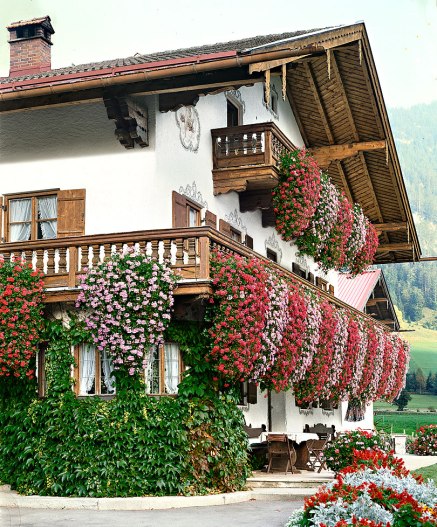
which is the ancestor of all those “ivy-leaved geraniums” which trail delightfully from balconies such as the ones we shall shortly be seeing in Vienna and in every Austrian town and village.

As I said earlier, it was wealthy individuals with a passion for gardening who in the early decades of European colonization drove the domestication and spread of the myriad foreign plants which poured into Europe from every corner of the globe. In the pelargonium story, two in particular stand out. The first is the Right Reverend Henry Compton, Bishop of London.

Compton was born in 1632 into an aristocratic family, being the sixth and youngest son of the 2nd Earl of Northampton. At the age of 43 he was appointed, in short order, Lord Bishop of London, Dean of the Chapel Royal, and member of the Privy Council, and he was entrusted with the education of the two royal princesses, Mary and Anne, nieces of the King, Charles II. He clearly moved in high circles! His career suffered a dip when, ten years later, Charles’s brother, James II, acceded to the throne. Compton was strongly opposed to Roman Catholicism. Consequently, James, a Catholic convert, relieved him of all his political positions. Luckily for him, James II lasted a mere six years before being ousted during the “Glorious Revolution” by James’s daughter Mary and her Dutch husband William of Orange (great-grandson of William the Silent, Prince of Orange, whom I mentioned in an earlier post). As might be expected, Compton fervently embraced the cause of William and Mary; in fact, he was one of the “Immortal Seven” who invited William to invade England. In recognition of his support, he got to perform the ceremony of their coronation (normally, this duty falls to the Primate, the Archbishop of Canterbury, but the-then Archbishop refused to take the oath to the new monarchs, so he was “deprived of his office”, i.e., was kicked out). The new monarchs also restored Compton to all his old political positions. And so Compton lived out the remaining 24 years of his life holding high religious and political offices (although, to his bitter disappointment, his hopes to become the Archbishop Canterbury were twice dashed). He died in 1713 at the ripe old age of 81.

Throughout all this political ferment, Compton managed to maintain a 36-acre garden at Fulham Palace, the country home of the Bishops of London, which stood on the edges of the Thames River.

The building still exists. The garden also still exists, though much reduced, and is a lovely corner of London.

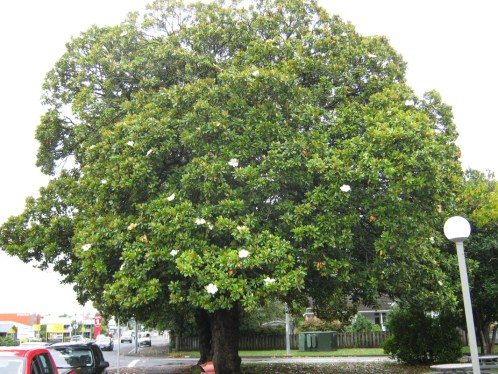
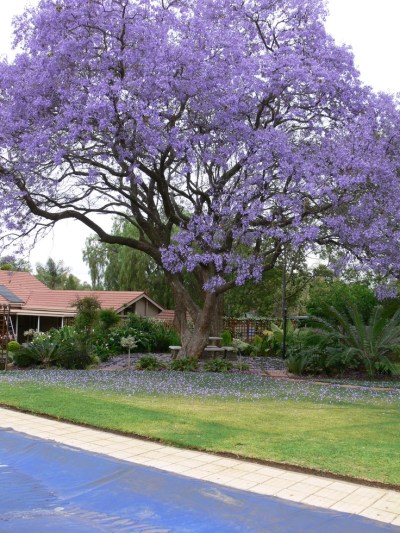
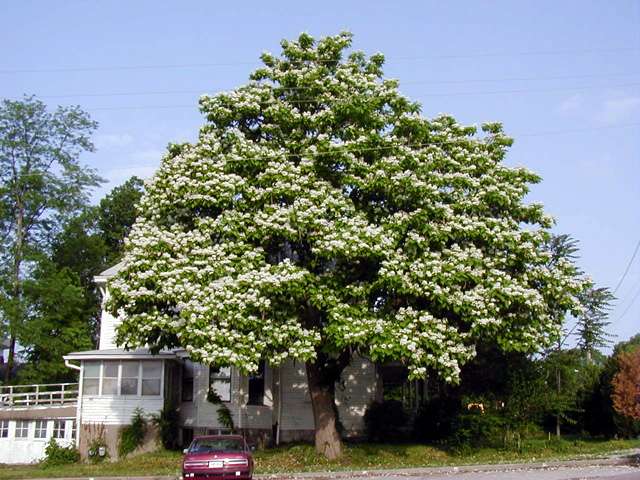
Compton was an avid plant collector and was the first in Britain to grow many imported species. Because his diocese included the American colonies, his focus was very much on North America. He used his parish priests and missionaries in the colonies to send home seeds. Among other North American plants, he was the first in Europe to grow the Virginia Magnolia

the jacaranda

and the catalpa.

But Compton also built up a large collection of the-then rare pelargoniums, including Pelargonium inquinans pictured above. He probably was able to do this because through his support for William and Mary he had built up a good network of contacts in the Netherlands – remember that it was the Dutch, first settlers in Cape Town, who had sent the first pelargonium species back to Europe.

The second important early cultivator of pelargoniums was Mary Capell, daughter of Sir Arthur Capell, 1st Baron Capell of Hadham, who through marriage became first Mary Seymour, Lady Beauchamp, and then, after her husband’s death and her remarriage, Mary Somerset, Duchess of Beaufort. She was born two years before Henry Compton, in 1630. Here we have her with her sister Elizabeth – Mary is on the left of the painting.

Mary’s political vicissitudes started somewhat earlier than Henry Compton’s. Her father supported Charles I and lost his head for it, while her first husband, also a Royalist, was imprisoned. Her second husband successfully navigated the politically choppy waters of Cromwell’s Protectorate, during which he lost his titles, and ended up supporting the successful restoration of Charles II. The King eventually rewarded him with a Dukedom. He loyally supported James II but managed to avoid exile for this when William and Mary took the throne. He died in 1700 with his head still on his shoulders and none of his estates forfeited, which was pretty good going for a highly political man such as he. Mary was a loyal wife throughout all this, following him through all the twists and turns of his political fortunes and all the while bearing him six children. She survived her husband by fifteen years, dying in 1715 at the seriously old age of 84.

Mary began serious plant collection some ten years before her second husband died, and her interest in gardening intensified in her widowhood. She gradually accumulated one of the largest collections of exotic plants in England, with the support, it must be said, of some well-known gardeners. Through her aristocratic circles she traded and swapped in seeds (much like I did, in far less hallowed circles at primary school, in stamps). For instance, Compton sent specimens to his sister-in-law, Mary Compton, Countess of Dorset, who passed them on to Mary. But she also managed to have seeds sent to her from all the corners of Britain’s growing empire and trading interests: the West Indies, South Africa, India, Sri Lanka, China, Japan. In the specific case of pelargoniums, she too, like Compton, built up a large collection of them. She is credited with introducing into British gardens the other two pelargoniums of major interest which I mentioned above, Pelargonium zonale and Pelargonium peltatum. She did her plantings in the gardens of two houses owned by the Duke, Badminton House in Gloucestershire and Beaufort House in Chelsea. The Duke was rich enough and high enough in the aristocratic hierarchy to have Badminton House painted by Canaletto

although this more humble picture shows the all-important gardens as well as the house.

Badminton House still exists. Beaufort House does not. It was a large property in Chelsea, right on the Thames River – no doubt Mary could have gone to visit Henry’s garden by boat if she had wanted to (and maybe she did, for all I know).

Later urban developments wiped out the house and gardens, although Mary might be pleased to know that the Chelsea flower show takes place not too far from where she was – with the help of her gardeners – busily growing wondrous plants come from far and wide.

Well, while I have been whiling away my time researching this post, my wife has been busy and pulled out the dead cacti which started this post. We now have to decide what to put in the gaping holes which have been left. Not geraniums –  sorry, pelargoniums – dear! It’s too damp.

_____________________________

Red “geraniums”: http://www.parkswholesaleplants.com/spring-plants/annuals-ai/geranium-zonal-americana-dark-red/
Geranium platypetalum: https://en.wikipedia.org/wiki/Geranium#/media/File:Geranium_platypetalum1.jpg
Cape Town 1790s: http://www.artvalue.com/auctionresult–english-school-18-united-kingd-view-of-cape-town-with-table-m-1538907.htm
Pelargonium inquinans: http://natureswow2.blogspot.it/2013/10/scarlet-pelargonium-pelargonium.html
Pelargonium zonale: http://www.africanbulbs.com/page67.html
Pelargonium peltatum: https://kumbulanursery.co.za/plants/pelargonium-peltatum
Ivy-leaf “geraniums”: https://www.pinterest.com/pin/226094843769770841/
Henry Compton: https://en.wikipedia.org/wiki/Henry_Compton_(bishop)
Fulham Palace: http://www.fulhampalace.org/palace/history/
Fulham Palace Gardens: https://sequinsandcherryblossom.com/2016/05/15/five-fabulous-london-gardens-to-visit-this-spring/
Virginia Magnolia: https://www.pinterest.com/pin/413627547007792612/
Jacaranda: https://www.pinterest.com/royaljewel36/jacaranda-trees/
Catalpa: http://www.7arth.com/?product=50-%D8%A8%D8%B0%D9%88%D8%B1-%D8%B4%D8%AC%D8%B1%D8%A9-%D8%A7%D9%84%D9%83%D8%AA%D8%A7%D9%84%D8%A8%D8%A7
Mary and Elizabeth Capell: https://commons.wikimedia.org/wiki/File:Peter_Lely_portrait_of_Mary_and_Elizabeth_Capel.jpg
Badminton House by Canaletto: https://commons.wikimedia.org/wiki/File:Canaletto_-_Badminton_House,_Gloucestershire.jpg
Badminton House: https://landscapenotes.com/2015/10/31/book-review-a-natural-history-of-english-gardening-by-mark-laird/
Beaufort House: https://www.pinterest.com/pin/463518986626622713/

WALK THROUGH THE FIVE SORROWFUL MYSTERIES

Sori, 12 May 2018

As we usually do when we go down to the sea from Milan, we went for a walk yesterday up into the hills which in this part of the coast fall precipitously into the sea. This time, we decided to follow in our son’s footsteps who, when he had been here a couple of weeks ago, had climbed the hill behind the apartment up to the Chapel of the Holy Cross perched at its top. The chapel itself is not much to write home about, it’s actually closed most of the time. But from the little piazza in front of it one has a magnificent view over the sea, from Genova to the right to the Monte di Portofino on the left.

Suitably prepared, we made for the path which runs behind our apartment and takes the walker up to the small village of Pieve Ligure. After a last backward look down to our village

we headed up along the well-kept path that wended its way among houses

and small olive groves hugging the hill’s countours

(and, sadly, abandoned olive groves as well, one of which was the subject of a previous post)

to arrive finally in Pieve Ligure, whose little church with its baroque façade is always a pleasure to contemplate.

There, we had ourselves a well-earned cappuccino before heading on out of the village, past the butcher

and the baker

past the memorial to a Resistance fighter, who was captured near here by the Nazis and who died in a concentration camp (these hills crawled with Resistance fighters in the last years of the war).

Up to now, the walk had been a stroll, with the path only rising gradually as it snaked along the side of the hill. But now it was time to head pretty much straight up the hill. Up we toiled, as the houses alongside slowly disappeared to give way to olive groves. Finally, we left even these behind. We entered woods and the path finally became a real path of the hills, rocky, muddy, difficult to navigate.

As I’ve noted in a previous post, once upon a time in Italy paths like this leading to tops of hills, especially if chapels crowned them, were turned into Vie Crucis, Ways of the Cross. Pious villagers, with their parish priest at their head, would have climbed the paths at certain opportune moments in the liturgical calendar, like during Lent before Easter, and stopped to offer prayers at each of the fourteen Stations of the Cross built along the path (they would normally have enjoyed a nice picnic once they had reached the top of the hill). In this case, the path had been dedicated to the five Sorrowful Mysteries of the Rosary, and five memorials had been duly erected along the path. This is one of them.

At each of these, the parish priest would have announced the mystery to be contemplated and then led his parishioners in reciting the “Our Father”, ten “Hail Marys” and the “Glory be to the Father”, before moving on to the next memorial.

In my previous post on this topic, I had been happy to insert photos of the scenes beautifying the stations, prepared in ceramic in a slightly naïve style. But the scenes tacked onto these five memorials were horrible: plasticized posters of sucrose paintings. I will therefore replace them with five paintings by various Italian painters:

The Agony of Jesus in the Garden, here painted by Giovanni Bellini

The Scourging of Jesus, painted by Caravaggio

Jesus is Crowned with Thorns, painted by Orazio Gentileschi

Jesus Carries the Cross, painted by Tintoretto

Jesus Dies on the Cross, painted by Andrea Mantegna.

On we toiled up the hill

taking in the views across the valley

until we finally reached Santa Croce, the Chapel of the Holy Cross.

Having enjoyed the view

we settled down to a picnic. After which, we headed down the path on the other side of the hill

this time decorated with a standard stations of the cross (in this case the eleventh)

until we reached the even smaller village of San Bernardo, where we had a well-earned café macchiato.

______________________

Photos: mine (and one our son), except for:

Agony in the Garden, by Giovanni Bellini: https://www.nationalgallery.org.uk/paintings/giovanni-bellini-the-agony-in-the-garden
Scourging of Jesus, by Caravaggio: http://www.patheos.com/blogs/badcatholic/2012/04/the-scourging-at-the-pillar.html
Crowning with Thorns, by Orazio Gentileschi: http://www.artfixdaily.com/artwire/release/6811-with-new-partners-and-expanded-purview-master-drawings-new-york-r
Jesus carries the Cross, by Tintoretto: https://www.awesomestories.com/asset/view/Trial-of-Jesus-Carrying-the-Cross
Jesus dies on the Cross, by Andrea Mantegna: https://en.wikipedia.org/wiki/Crucifixion_(Mantegna)

ORANGE CARROTS

Istanbul airport, 5 May 2018

I was in the capital of Kyrgyzstan, Bishkek, over the last few days, working with some old colleagues on supporting the government to develop a national action plan to minimize the effects on the population of the country’s pollution. Fascinating stuff, but not the subject of this post.

As part of the work, it was necessary to schmooze with the local diplomatic community, preparing the ground for future requests of assistance to deal with the country’s pollution. I therefore found myself one evening attending the event put on by the Dutch to celebrate the King’s National Day. As is customary on such occasions, the Dutch Ambassador made a speech, thanking us for coming, listing the important Dutch-Kyrgyz partnerships, and of course – given the occasion – mentioning the Royal family. He did so in an interesting way. Having mentioned partnerships in the agricultural field, he segued smoothly from this to inform those of us who didn’t know it that carrots were orange because patriotic Dutch farmers had selectively bred this root crop to turn it orange, in honor of William the Silent, Prince of Orange, patriarch of the Dutch Royal family.

Well! This was interesting indeed. As anyone who has even a passing interest in sporting events knows, the Dutch national color is indeed orange.


And this patriotic show of orange is indeed linked to William the Silent’s feudal title of Prince of Orange, although the orange in this case is the pretty little town of Orange in southern France, which was William’s fiefdom (and an old Roman city).

But to say that Dutch farmers had turned carrots orange as a patriotic gesture … Such is the dominance of orange carrots in our supermarkets, groceries, and farmers’ markets that it had never, ever occurred to me that carrots could have been anything but orange!

In other posts, I have demonstrated my interest in the humble history of vegetables. The Ambassador had now given me a wonderful opportunity to study the history of the carrot. So these last few days I have been spending time which I should have been more usefully devoting to the pollution problems of Kyrgyzstan to happily digging into the carrot’s history instead. I am now ready to report back.

The first thing I have to say is that the Ambassador was indeed correct in his basic contention, that Dutch farmers had turned the carrot orange. This happened in the 17th Century and, for reasons that I shall explain in a minute, the orange carrot took over the carrot world. But first let me throw in some pictures of different colored carrots:
Purple carrots


Yellow carrots

Red carrots

White carrots

Black carrots, even!

Here we can see all these different carrots in glorious technicolour.

Personally, I have never seen any of these. I suppose they are like heirloom tomatoes: there are some enthusiastic aficionados out there who are growing these in their vegetable plots and trading seeds with other carrot enthusiasts. Perhaps one day, like I’ve seen in upscale Californian supermarkets, there will be a corner of the vegetable section devoted to these – to my eye – strange and wonderful carrots.

But why did the Dutch farmers breed these orange carrots? Here, I have to say that, with all due respect to his august person, the Ambassador seems to have got it wrong (along with 99% of the Dutch population). The farmers did not do it to honor William the Silent and his House of Orange. They were looking to breed carrots which were sweeter and whose core was smaller and less woody. The root of wild carrot is actually quite bitter, so since time immemorial farmers had been trying to breed the bitterness out of the root, and as anyone knows who has eaten a big and mature carrot, its core can take up a good part of the carrot and be disagreeably tough to eat.

It just so happened that the carrot they bred was orange. I suppose the carotene which gives the carrot its color also gives it its sweetness. It was only later generations of Dutch who saw the political dimension of the carrot’s color, and actually saw it in a negative sense. Dutch burghers of strong Republican sentiment frowned upon carrots because of their too Royal orangeness – in their Republican zeal they also went after other orange plants, discouraging the planting of marigolds for instance.

Another example of the politics of color.

Before I leave orange carrots, I should report that analysis of carrot genomes strongly suggest that the Chinese independently bred orange carrots. It pleases me no end to know this, because in my years in China I was always puzzled by Chinese carrots. They somehow seemed different from the European carrots that I was familiar with. I throw in a picture of Chinese carrots to show what I mean.

They are a darker orange – the fact that the Chinese obtained the orange color by changing different genes from the ones which give European carrots their orange color probably explains this. And they were much stockier than European carrots, a fact that I put down to the Chinese breeding carrots more as animal feed (like the wonderfully named mangelwurzels) than as human food.

I could not resist the temptation of using this research into the orangeness of carrots to carry out research into the broader history of the carrot. It turns out that the wild carrot is at home in Central Asia – so it is indeed apposite that this little piece of research was kicked off by a chance remark made in Kyrgyzstan, which happens to be one of the homes of the wild carrot. For those of my readers who, like me, have never seen a wild carrot, I throw in a picture.

It seems that its root is bitter and woody, but I suppose that hunger makes one tolerant of not-so-tasty food – better than having nothing in one’s stomach. The wild carrot, perhaps in some domesticated form, was carried far and wide from its Central Asian homeland. Carrot seeds have turned up in archaeological digs of prehistoric lake dwellings in Switzerland.

The Babylonians knew of it; it is mentioned in a cuneiform tablet listing the plants growing in the garden of King Marduk-apla-iddina (King Merodach-baladan in the Old Testament).

Seemingly, the Egyptians knew of it, although the evidence is rather weak. The Greeks and the Romans knew of it. But in all these cases, it seems that it was the leaves and seeds which they were interested in; the root was too bitter. They used the root or the seeds for medicinal purposes and ate the leaves much as we would eat spinach (I am reminded of a story my mother used to tell us young children, of how during the War, when she was trapped in occupied France, one could not find carrots in the market. Only the leaves were on sale. She and her mother made do and ate those – better than having nothing in one’s stomach).

All this time, our ancestors were tinkering with this foodstuff as they were tinkering with all their foodstuffs. Finally, possibly as early as the 6th Century, one or more farmers somewhere in today’s Iran and Afghanistan bred a carrot with a sweeter, less woody, more edible root. This plant was destined to become the ancestor of all modern carrots. From there, the seeds were carried by passing traders and travelers both east and west, no doubt along the Silk Roads which I have had cause to mention in earlier posts. In the case of its carriage to the west, Arab traders seem to have been the vector after the Arab conquest of Persia in the 7th Century, much as was the case for the lilac bush, the subject of an earlier post. More tinkering and crossbreeding took place in today’s Turkey before a carrot with an even more edible root continued on its journey to Europe. It arrived there in the 10th Century, eventually ending up in Northern Europe in the 13th Century. It came in two colours, yellow and purple, with a rarer white variety thrown in. For some reason, the Dutch got heavily into carrot production and the rest is orange history.

Since the Dutch started this post, let me finish by throwing in some of those still lives so beloved by the Dutch, of kitchens full of vegetables and fruit. Normally, I pass these over with a yawn (I have never understood our ancestors’ fascination with this type of paintings), but it seems appropriate to admire them in this case. I invite my readers to locate the carrot in each of the paintings.


_____________________

William the Silent: https://owlcation.com/humanities/The-Death-of-William-the-Silent
Dutch football players: http://www.football-oranje.com/sweden-v-netherlands-match-preview/
Dutch fans: http://www.newsweek.com/dutch-men-latvian-women-are-tallest-world-study-483868
The city of Orange: http://be.france.fr/fr/a-decouvrir/orange
orange carrots: https://www.well-beingsecrets.com/health-benefits-of-carrots/
purple carrots: https://www.youtube.com/watch?v=HU03lczH6mk
yellow carrots: https://www.bukalapak.com/p/hobi-koleksi/berkebun/benih-tanaman/fs8sg5-jual-biji-2-benih-wortel-kuning-yellow-carrot
Red carrots: http://www.gardenpicsandtips.com/18-vegetables-that-are-colorful-and-worth-eating/2/
White carrots: http://blue-myhanh.blogspot.com.tr/2014/08/khi-trai-cay-co-mau-khac-voi-chung-ta.html
Black carrots: https://www.amazon.co.jp/%E8%BE%B2%E6%A5%AD%E5%B1%8B-%E3%81%AB%E3%82%93%E3%81%98%E3%82%93-%E7%A8%AE-%E3%83%96%E3%83%A9%E3%83%83%E3%82%AF%E3%82%AD%E3%83%A3%E3%83%AD%E3%83%83%E3%83%88-%E5%B0%8F%E8%A2%8B%EF%BC%88%E7%B4%84300%E7%B2%92%EF%BC%89/dp/B00NHD5BCY
Carrot spectrum: http://sezahrana.tumblr.com/page/130
Split carrot: http://www.thesweetbeet.com/carrot-recipes/
Marigold: http://www.thesweetbeet.com/carrot-recipes/
Chinese carrot: https://www.pinterest.com/kurskinlab/spa-men/
Wild carrot: https://myediblebackyard.net/2014/05/02/wild-carrot/
Swiss prehistoric lake dwellings: https://commons.wikimedia.org/wiki/File:Swiss_prehistoric_lake_dwellings._Wellcome_M0015374.jpg
Cuneiform tablet: http://www.britishmuseum.org/research/collection_online/collection_object_details.aspx?objectId=3066115&partId=1&searchText=Merodach-Baladan+II&view=list&page=1
Pieter Aersten, Christ in the House of Martha and Mary: https://www.tumblr.com/search/christ%20in%20the%20house%20of%20mary%20and%20martha
Anonymous, Kitchen scene in Parable of Rich Man and Lazarus: http://www.carrotmuseum.co.uk/art1.html
Pieter Cornelizs. Van Rijk, Kitchen Scene: http://www.carrotmuseum.co.uk/art1.html

SPARKLING MINERAL WATERS

Milan, April 24 2018

When I first lived in Italy, in 1980, a wonderful ad campaign was launched for the Italian mineral water Ferrarelle. This poster greeted us all over Milan:

To understand the joke, readers must understand that “liscia” has a double meaning in Italian: flat, as in water, but also straight, as in hair. Thus, through the medium of Mona Lisa’s hair-do, passers-by were invited to decide if they preferred her hair straight, frizzy, or just slightly curled as in the original painting. By inference, it was being suggested that mineral waters such as Ferrarelle with modest amounts of gas were surely better than those which were either flat or strongly carbonated.

After the success of this ad campaign, Ferrarelle introduced another, based this time on a second great Italian icon, Garibaldi.

In this case, we were asked if we preferred the Hero of Two Worlds smooth-chinned, bushy-bearded, or with the sensible beard and mustache which he had in real life. And again, it was suggested that a mineral water like Ferrarelle with modest amounts of sparkle was surely preferable to its competitors with either no or too much sparkle.

I believe Ferrarelle followed up these very successful ads with a couple more in the same series, although at that point my wife and I left Italy for some eight years and so we never experienced them.

Cleverness aside, these ads spoke to a profound truth: that mineral water, like most things in life, should follow Aristotle’s rule of the Golden Mean. It should be neither flat nor highly carbonated but just somewhat effervescent. Like that, the sparkle enhances taste without giving the unpleasant, almost painful, prickles of tongue and mouth which come from strong carbonation.

This was brought home to me again a few days ago when our daughter took us to an Ethiopian restaurant in LA (Ethiopian food being an eminent subject for a post, but not this time). We were served a mineral water whose name I will not utter (although I will give a hint: two words make up the name, the first starts with an S, the second with a P) and which seems to have a monopoly on sparkling mineral waters in American restaurants. There was nothing for it but to dilute the mineral water with flat water to arrive at the correct levels of carbonation, an experience which is becoming distressingly common for us.

In our lives, my wife and I have come across only one other mineral water with the right level of sparkle: the French mineral water Badoit. Since I celebrated Ferrarelle with some ads, I will do the same with Badoit:

These too focus around a play on words, although somewhat more difficult to explain in English. Nevertheless, I will endeavour to do so. There is a French expression “et patati et patata” which can be roughly translated “etc., etc.” or “and so on and so forth”. The ads take this phrase and modify it to “et badadi et badadoit”. Cute, but not as clever as the Ferrarelle ads.

I’m sure there are other mineral waters out there with only mild levels of carbonation. We just haven’t come across them yet. Feedback from readers on this point will be gratefully received (but please do not tell us about that dreadful, but dreadfully popular, French mineral water whose levels of carbonation are so high that I cannot even bear to pronounce its name although I will say that it begins with a P). In the meantime, we will continue to mix our waters in those restaurants we frequent which offer us neither Ferrarelle nor Badoit.