POSTS

ODD STATUES

Milan, 3 October 2018

When my wife and I are in Vienna, we very often walk down our road into the centre of the city. It is a very pleasant walk, down a historical high street with little shops lining it, in the shade of linden trees much of the way. At about the halfway point, we pass a very nice little square, with a café-restaurant on one side and a fountain in the middle. In the summer, when the weather is good, the restaurant puts tables out in the square around the fountain.

It is this fountain that interests us here. At first glance, it looks quite unremarkable. It seems a typical product of its time, which is late 19th Century. It is composed of three statues, two of which spout water. The composition illustrates some tale, which I suppose was once well known in Vienna, of a bright young girl called Elspeth who through some cleverness or other managed to outwit two infamous robbers. So, we have Elspeth, Goddess-like, standing on a column

while at her feet crouch the two robbers with their hands tied behind their back, looking disconsolate and spouting water from their mouths.

So far, so good. But actually there is something definitely odd about the composition. The pose of one of the robbers is such that it looks like he’s vomiting the water he’s spouting. Already that is a bit strange, but it takes on a surreal quality when you see people merrily eating and drinking at the tables while the statue behind them seems to be puking his guts out.

We’ve been walking past this fountain very often over the last several years, and its oddness strikes me afresh every time we pass (who knows, though? maybe I’m the only person who finds it odd). This frequent mental pause, this little stone in my mental shoe, has had the effect of making me start to think about other odd statues which I have seen over my lifetime. And I’m thinking here of statues where the oddity is unintentional; I’m not interested in statues such as this one where the oddity is very, in-your-face, intentional.

Well, there are these odd statues which my wife and I came across in Salzburg during a little trip we made there during this past summer. They are statues of pickles, or gherkins if you prefer.

The fact that anyone would spend his or her time making statues of pickles is odd enough. What I found even odder was the way the pickle statues were aligned with a very normal statue of Schiller in the middle distance.

But it seems that this was the point. The blurb which accompanied the statues helpfully explained:

A gherkin is a gherkin is a gherkin – or then again, perhaps not? …. “I find the diversity of forms, which by virtue of their uniqueness are inexhaustible, compelling” explains Erwin Wurm [the sculptor] “Although individually different,  each gherkin is immediately identifiable as a gherkin, and generically classifiable as such … analogous to man”. The forms are as different as gherkins and people tend to be: tall and short, thick and thin, rough and smooth, slender and stocky. By scaling his gherkins up to human dimensions and by creating the impression that they are sprouting from the tarmac, Wurm confers upon them the status of creatures, possessed of an intrinsic individuality. The artist leaves his work open to interpretation, hovering as it does between critical irony and playful teasing.

Indeed … Well, my take on the composition is that it looked very Star-Wars like. I could imagine that after a long journey through intergalactic space I was being brought into the presence of the (human-looking) ruler of some distant planet, whose court consisted of pickle-like creatures. In my mind’s eye, I can see them wave gently as I walk past on my way to pay my respects to the ruler, creaking a little perhaps and perhaps oozing some pickling liquid, murmuring in some incomprehensible far-galaxy language as I pass them. I would guess that they stay upright as a result of having suckers on their base. But how would they move around, I wonder?

Leaving this rather feverish daydream and coming back to earth, how about this statue?

It is of a young man, naked but for some sort of loin cloth, purposefully striding along. Its oddness comes from its location, which is in the vestibule of Milan’s main post office. The inference is clear. When he was installed, which must have been some time during the Fascist era, he was meant to be representing those thousands of postmen who stepped out every morning to do their rounds. It’s already odd enough that he’s nearly starkers. I’ve never seen any postman doing his rounds in the state in which Adam found himself in the Garden of Eden. But apart from that, the statue clashed mightily with the dominant image I had of postmen in the mid-1970s, which is when I first saw it. That image was shaped by the husband of the lady who looked after my French grandmother and who lived in one part of her house. He was the postman for the surrounding rural district. He looked something like this.

I would see him ride off on his bike early in the morning. I would also sometimes spy him delivering his letters, which invariably seemed to involve a chat, a Gauloise cigarette (unfiltered), and a glass of red plonk. By the time he wobbled home in the early afternoon, his face would be several shades redder than when he left. He would proceed to have lunch and demolish another half bottle of plonk, at which point he would put his head on his arms and pass out.

But I think first prize for oddity goes to a statue I saw on my first ever trip to Italy. I was traveling with a rail pass and staying in youth hostels. The youth hostel in Rome was near the headquarters of the Italian Olympic Committee. In the early 1930s, during the first decade of Fascism, a stadium had been built next to the headquarters, where Italian athletes could strut their stuff for the Committee. To make it look suitably Roman and imperial, the Italian provinces had been invited to send in statues in white Carrara marble of men intent on various athletic pursuits. Some sixty such statues duly arrived and were placed around the stadium in Hellenic style. I would look over these statues as I went by on my way to and from the youth hostel. There was one which struck me in particular, representing the noble sport of skiing.

Who on earth, I would ask myself bemusedly, would ever go skiing naked?? Because, of course, as befitted statues echoing their worthy Greek and Roman predecessors, most of them were carved strictly in the buff. I don’t remember now any of the other statues but in preparing this post I looked at some of them and found a couple which are nearly as odd:
The Naked Mountaineer

The Naked Footballer

The Naked Tennis Player

Somehow, I find that these statues represent beautifully Italy’s Fascist era: a time of bombast and chest-thumping which, though, was all rather comical.

That is what I have to date in my gallery of statuary oddities. But I will keep a weather eye out for other specimens. If readers have any suggestions to make, I will be more than happy to hear about them.

____________________________

Photos: mine, except for:

Silly statue: http://forumodua.com/showthread.php?t=318155&page=56
French postman: http://kenhtruyen.info/?i=Ann%C3%A9es+1970+en+France++Wikip%C3%A9dia
Naked skier: http://roma-nonpertutti.com/en/article/66/foro-italico-an-enclave-of-the-cult-of-mussolini-and-his-empire
Naked mountaineer: http://stadio.dei.marmi.dalbiez.eu/Stadio%20dei%20Marmi%202006.htm
Naked footballer: https://www.pinterest.at/?show_error=true
Naked tennis player: https://www.gettyimages.co.nz/search/2/image?events=50786504&family=editorial&sort=best

AUTUMN CROCUSES

Milan, 1 October 2018

We’ve had a hot, hot summer this year in Vienna, with very little rain. It seemed as if the summer was never going to end. But then, quite suddenly, it did. We had three days of heavy rain in the first week of September and summer’s back was broken. Temperatures tumbled overnight, as they can in this part of the world, by 10-15 degrees. The rains passed, the sun shone again, but now there was an autumnal chill in the air.

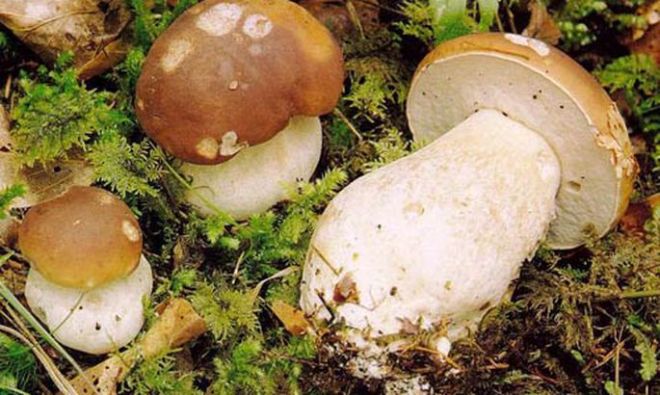
This weather pattern has been a godsend to mushroom pickers. I had lunch with an old colleague a week or so after the rains. He and his wife are dedicated mushroom pickers. As we tucked into our Wiener schnitzels, he told me that this year it was like manna from heaven: mushrooms were popping up everywhere. They had picked and pickled enough steinpilze to last them through to next September, he exclaimed, with a dreamy look in his eye. For those of my readers who are also into eating mushrooms, steinpilze are penny buns in English, although nowadays I suspect many people know them by their Italian name porcini. I throw in a picture of this delicacy in its natural state.

Even my wife and I, who like the occasional mushroom but are definitely not aficionados, had noticed on our last walks in the Vienna woods a sudden profusion of mushrooms everywhere we looked. But since neither of us would know a steinpilz from a eierschwammerl (chanterelle in English – actually French, but the Brits seem to have adopted the name), we did not dare to collect any: stories from our youth of whole families wiped out from eating the wrong mushrooms continue to resonate.

What my wife and I really noticed on our late-September walks were the Autumn crocuses. The Vienna woods are dotted with meadows large and small.

I think most of them were created for a very utilitarian purpose. During the hunting season, they allowed a clear shot of any poor beast which made the mistake of breaking cover, and in fact many of the meadows have a hide at one end.

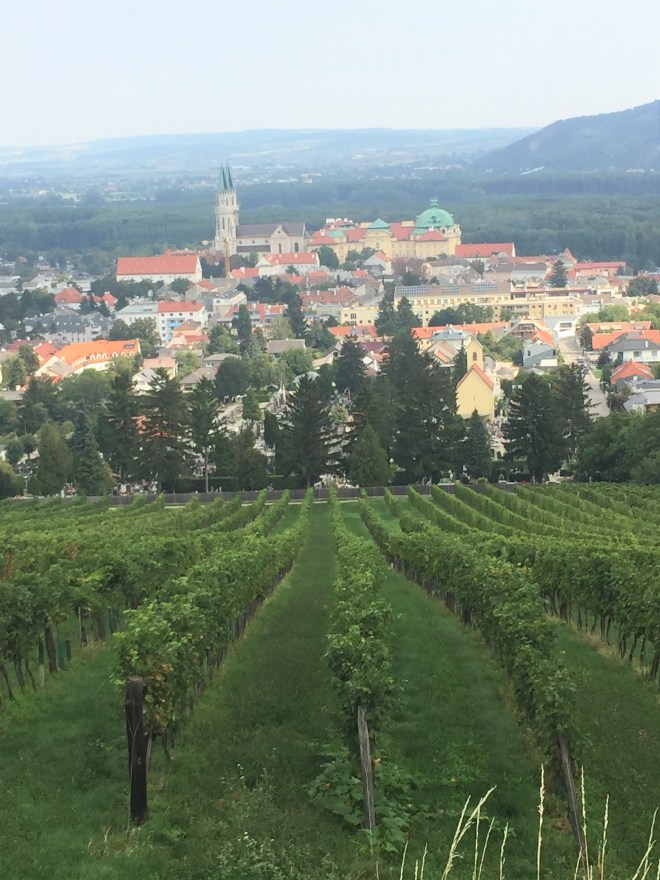
But at this time of the year, a good number of the meadows are speckled with Autumn crocuses. We came across a particularly lovely display on a walk we did behind Klosterneuburg, the little town on the Danube to the north of Vienna clustered around its venerable monastery. We climbed the ridge which abuts the town, pausing to catch our breath, admire the surrounding vineyards, and take this photo of the monastery below us.

We then walked a long way along the ridge, on the suitably named Lange Gasse, Long Lane.

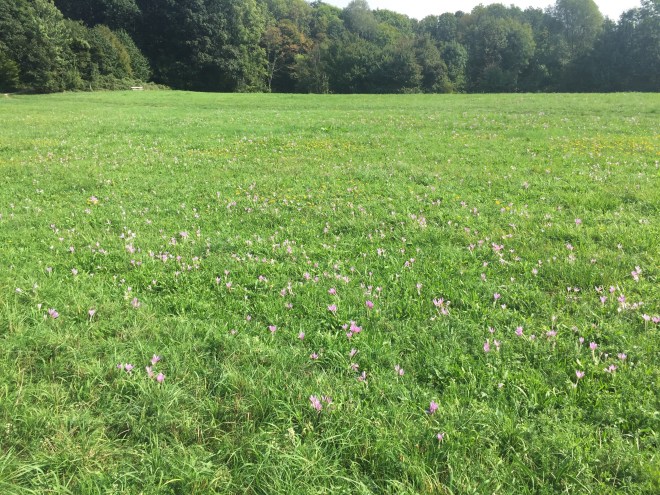
We ambled on through some woods, and then suddenly found ourselves in this meadow. It was carpeted with Autumn crocuses.

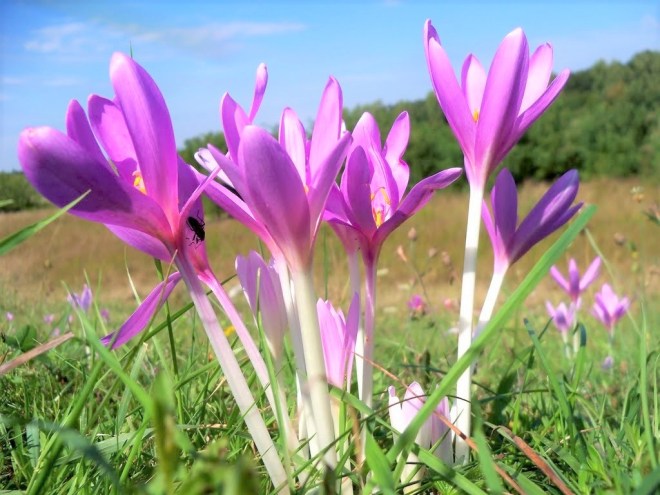
Crocuses are really lovely little flowers, so delicate, so tender. A much better photographer than I posted this close-up photo of an Autumn crocus, which shows off to perfection its subtle traits.

When I was growing up in the UK, Spring crocuses were my delight, beautiful in and of themselves but also a harbinger of the Spring and daffodils to come, banishing the grey cold of Winter. But in Vienna, it is the Autumn crocus which dominates, a last extravagant splurge by Nature before Winter starts closing in.

Like the birds whose inner clock tells them in August that it is time to fly south

the Autumn crocuses told my wife and I that the moment had come for us to migrate down to Italy. And so we have packed our bags, flown across the Alps, and are now ensconced in Milan for the winter.

___________________________

Steinpilze: https://apollo.tvnet.lv/5095184/senu-trakums
Meadow in wood: https://www.bundesforste.at/nc/produkte-leistungen/jagd/jagdreviere/detail.html?tx_jagd_dfb%5Brevier%5D=3&tx_jagd_dfb%5Baction%5D=show&tx_jagd_dfb%5Bcontroller%5D=Revier&cHash=36e512ac3435f6026d5490ce7c4e6882
Klosterneuburg: our pic
Lange Gasse: our pic
Autumn crocuses in a meadow: our pic
Autumn crocus close up: https://www.gardeningexpress.co.uk/colchicum-autumnale-autumn-crocus
Birds heading south: http://www.nhpr.org/post/heading-south-bird-migration-and-human-impact#stream/0

NETTLES

Vienna, 25 September 2018

On the walks which my wife I have been enjoying this summer in the Wiener Wald, Vienna’s woods, we have from time to time come across nettles along the side of the path. Here’s a picture of one large patch which we came across recently.

Whenever I see nettles, I instinctively move to one side and slow to a deliberate pace to make sure that I don’t get stung by the little bastards. I suppose that those of us who live in parts of the world where stinging nettles flourish – and that’s pretty much everywhere except sub-Saharan Africa – have learned the necessary defensive tactics to adopt in order to avoid being stung, probably learned the hard way after ill-fated encounters with the plant when we were young and innocent of the evil ways of the world. To be fair to the nettle, I should note in passing that not all nettles sting; there is one species, the fen nettle, which is stingless. I read that it is a European species. I suppose I have never been to those parts of Europe where it grows, which is a great pity.

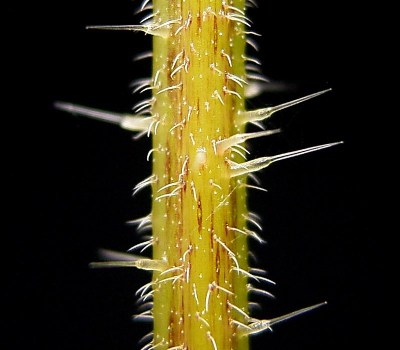
The stinging sensation comes from the plant lathering biochemical irritants on your skin, such as histamine, serotonin, and choline, and from its tiny sharp hairs piercing your skin – look at those nasty little buggers, glitteringly evil and just waiting to slice into you!

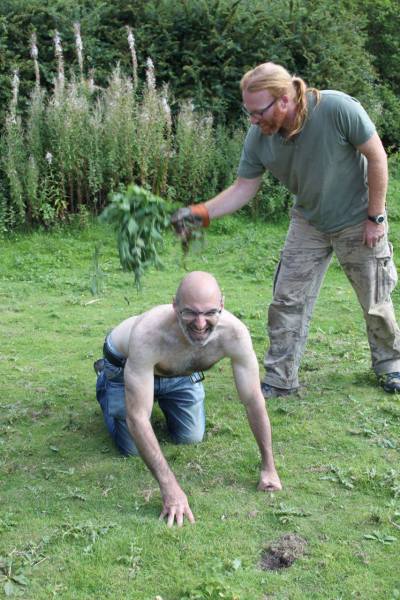
The result is, of course, those horribly itchy, hot, blotches on your skin.

Poor kid, I feel so much for him! I say this because I have a particularly painful memory from when I was a Boy Scout; I must have been 11 or 12. We had gone off on our annual week’s camp, and two groups of us found ourselves one afternoon at the bottom of a hill thickly covered with bushes, long grass, brambles – and large swathes of nettles. We made a bet as to who could arrive at the top first. For some reason, I found myself at the head of our group and so had the task of hacking a path through the wilderness. At some point, taken by a sort of frenzy, I charged ahead with minimal covering of my exposed limbs. We arrived first at the top, but by then my arms were covered with nettle welts. At first, the congratulations of my group members made up for the pain, but after a while the pain dominated my thinking. I stiffened my trembling upper lip, though, and carried on. I was a Boy Scout, after all. But the memory of the pain has lingered on all these years.

Well, I was a boy then and my behaviour can be put down to juvenility. But in preparing this post I have learned that there are actually adults who run through nettles! There is a race in the UK, called the Tough Guy Nettle Warrior contest, where the contestants not only run through nettle patches but also through fire, and through wires delivering electric shocks. They also do more mundane things like race up and down steep hillsides, run in and out of muddy ditches, clamber up 15ft rope nets, and worm their way under barbed wire perilously close to their face. Here we have them running through the nettles.

Well, all I can say is, there is one born every day.

The nettle doesn’t even have a nice flower or yummy fruit to offset its nasty stinging habits. The bramble, for instance, which is also a mean son-of-a-bitch to fall into or to traverse, has both. Does the nettle have any redeeming features? Well, it seems it does have one or two, none of which, I have to say, I have experienced personally. So I can only pass on what I’ve read.

You can eat nettles. If you’re a masochist, you can eat them by entering the World Nettle Eating Championships, another competition held annually in the UK. Competitors are served 2-foot long stalks of stinging nettles from which they pluck and eat the leaves. After an hour the bare stalks are measured and the winner is the competitor with the greatest accumulated length of stripped nettle stalks. Here we see the competitors at work.

The men’s champion in 2017 munched his way through 70 feet of nettles …

It takes all sorts to make the world, they say.

If, like me, you are not into self-harm, you can cook the nettles first; that takes their sting away. I’ve often heard of nettle soup, although not only have I never tried it but I’ve never met anyone who has. Here is a Swedish recipe for this soup (nässelsoppa in Swedish, in case readers visiting the country want to ask for it). For some reason, I sense that the Swedes make a “purer” version of it than others; I mean, isn’t Noma, the Michelin-starred restaurant where you are served pickings from field and forest, just across the waters, in Copenhagen? (and they serve nettles in various forms, according to one blogger who ate there)

  1. Pick the nettle leaves – WITH GLOVES! Pick the top four or six leaves on each spear, they are the most tender.
  2. Clean the leaves well of any grass and beasties which you might have unintentionally picked up as well.
  3. Blanch the nettle leaves, and then strain them from the liquid. Don’t throw away the liquid!
  4. Make a roux with butter and flour. Pour the water in which the nettles were blanched onto the roux.
  5. Chop the blanched nettle leaves very finely, along with the other ingredients, which typically include chives (or ramson or garlic), and chervil or fennel. Or you purée them, although this must be a modern alternative, born with the advent of mechanical blenders.
  6. Put the chopped (or puréed) nettles and herbs into the nettle water-roux mixture. Bring to a boil and then leave to simmer for a few minutes.
  7. Serve, with a sliced boiled egg and/or a dollop of fresh cream.

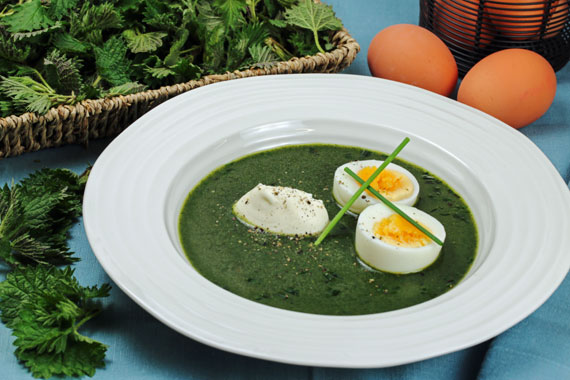
The result should look something like this.

Njut av! (which, if Google Translate got it right, is the Swedish for “Enjoy!” – although if Bergman’s films are anything to go by, the Swedes don’t enjoy much of anything)

I read that nettle leaves can also be consumed as a spinach-like vegetable, puréed, or added to things like frittate or vegetable and herb tarts (the latter being a Yotam Ottolenghi recipe; not a word about nettles in Jamie Oliver’s recipes). It is also an ingredient in herbal teas. And of course – but here we are drifting into Medieval beliefs (literally) – nettles have been used as traditional medicine to treat a wide spectrum of disorders: disorders of the kidneys and urinary tract, gastrointestinal tract, locomotor system, skin, cardiovascular system, hemorrhage, influenza, and gout. Take your pick. Or if you have rheumatism you can have someone flog you with nettles. In preparing this post, I came across a report by someone in the UK who had himself flogged with nettles for his bad back.

Whatever takes your fancy … (my country is full of some really strange people – no wonder it voted for Brexit).

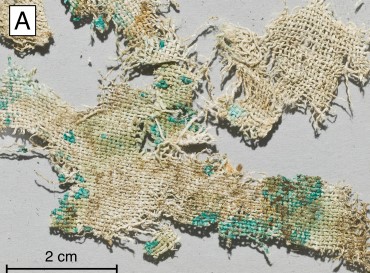
You can also make a linen-like textile with nettles; the plant’s fibres have very similar properties to flax and hemp (and I need hardly mention that the processing of nettles into textiles eliminates their stinging properties). In fact, in Europe, our ancestors were making nettle textiles at least 2,800 years ago. A piece of textile from a Bronze Age burial in Denmark, a photo of which I insert here, has been identified as made of nettles.

The clever scientists involved in the research have gone one step further and figured out that these particular nettles came from Steiermark, which in today’s political geography is in southern Austria, just down the road from where I am sitting writing this. They argue, with some justification it seems to me, that if this textile made its way from southern Austria to Denmark it must mean that nettle textiles were considered a luxury item in the Bronze Age. Quite why this is so is not clear to me, however. Nettles grow in Denmark too, so what was so extraordinary about nettle textiles made in southern Austria? I guess we will never know.

After the advent of cotton, nettles fell out of favour, along with flax and hemp. There were moments, when wars made access to cotton difficult, when the use of nettle textiles was revived. It seems that one such moment was in France during the Napoleonic wars, when the UK’s maritime blockade meant that France’s access to cotton was restricted. So perhaps La Vieille Garde, Napoleon’s elite troops, about which we heard so much during our visit to the battlefield of Waterloo, wore uniforms made from nettles?

The Germans too, it seems, made use of nettle textiles in their soldiers’ uniforms during World War I, again because the UK’s blockade cut off the country’s supplies of cotton.

Nowadays, it’s niche designers who are making clothes from nettles, promoting their greenness and sustainability. Here are a couple photos of such clothes which I found during a random surf of the web.


There seems to be a whiff of the alternative lifestyle here. We appear to still be a long way from mainstream clothes being made of nettles. But the EU, I read, is deadly serious about trying to promote a greater use of nettles, as well as of flax and hemp, as an alternative to cotton, both as a stab at greater sustainability and as a way of getting farmers to grow more non-agricultural crops, thus reducing Europe’s over-production of food while still maintaining farmers’ incomes. Perhaps fields of nettles like this will soon become common.

As an environmentalist, I of course would welcome this move towards more local production – but I would agitate for a law making signs like this a legal requirement, upon pain of the farmer being flogged with his produce if he fails to put them up.

28/9/2108: POSTSCRIPTUM

After I had posted this, an old friend of mine quickly reminded me that nettles also play a very important role in supporting butterflies, or rather the caterpillars which will become butterflies; these critters will happily feed on the leaves. Suitably chastened, I did a quick search and found a page on the Woodland Trust site which explained this important nettle-butterfly nexus. To make amends, I add here pictures of those butterflies most commonly associated with nettles.

The small tortoiseshell:

The peacock:

The red admiral:

The comma:

The painted lady:

The Woodland Trust exhorts gardeners to keep that patch of nettles which they have in their gardens, to help the butterflies. Hmm, I wonder if the fen nettle would support these butterflies? If yes, I’m all in favour of it. We would have a win-win situation here: supporting our beleaguered butterfly populations but not risking getting stung in our own gardens.
_______________________

Nettles on our walks: my pic
Nettle hairs: https://en.wikipedia.org/wiki/Urtica_dioica
Nettle rash: http://blog.shopprice.co.nz/10-health-benefits-of-stinging-nettle/
Running though nettles: https://www.dailymail.co.uk/news/article-2021411/Tough-Guy-Nettle-Warrior-4-000-endure-cross-country-hell-Britains-bizarre-races.html
Nettle eating championship: https://www.mirror.co.uk/news/weird-news/world-nettle-eating-championships-held-8246974
Nettle soup: http://www.swedishfood.com/swedish-food-recipes-starters/92-nettle-soup
Flogging with nettles: https://wildfoxwildfire.wordpress.com/2015/09/08/how-i-fixed-my-bad-back-using-stinging-nettles/
Bronze Age textile from Denmark: https://www.ncbi.nlm.nih.gov/pmc/articles/PMC3460533/
Member of the Vieille Garde: http://www.wikiwand.com/hr/Grenadir
German soldier WWI: https://www.quora.com/Why-were-Germans-called-Jerry-in-WWI
Nettle wrap: https://www.etsy.com/listing/590489032/grounding-nettle-wrap?ga_order=most_relevant&ga_search_type=all&ga_view_type=gallery&ga_search_query=nettle%20clothing&ref=sr_gallery-1-7
Nettle man’s vest: https://www.etsy.com/listing/280624084/mens-vest-handwoven-nettle-fabric?ga_order=most_relevant&ga_search_type=all&ga_view_type=gallery&ga_search_query=nettle%20clothing&ref=sr_gallery-1-13
Field of nettles: https://herbaloo.org/experimence/the-nettles-experiment/
Stinging nettle sign: https://tmagazine.blogs.nytimes.com/2014/05/21/nettle-dandelion-greens-mint-soup-recipe-nettle-tea/
Butterflies: https://www.woodlandtrust.org.uk/blog/2016/05/butterflies-need-nettles/

BATTLE OF VIENNA, 1683

Vienna, 23 September 2018

My wife and I have spent much of the summer crisscrossing the Wiener Wald, that mantle of woods draped over the hills to the north and west of Vienna, sampling the myriad paths that meander through the cool green of its beech and oak trees.

But one place I’ve tended to avoid if at all possible in our wanderings is Kahlenberg. For those of my readers who are not familiar with Vienna, this is a spot on the northern ridge of the hills where you get a magnificent view over Vienna.
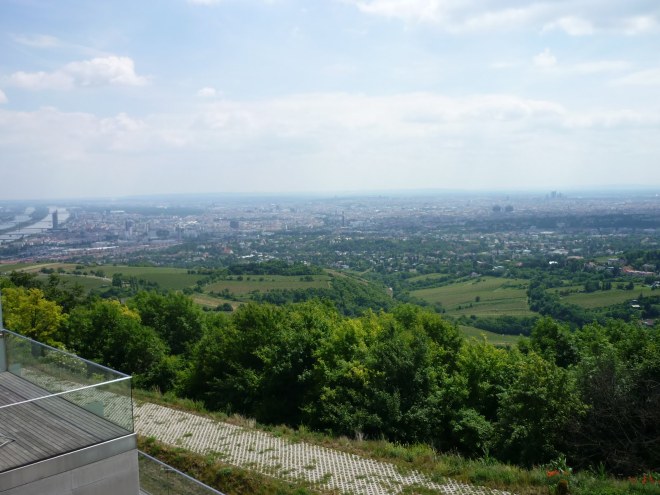
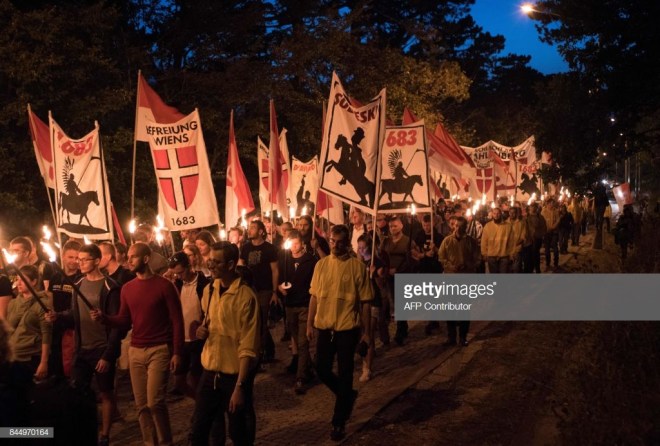
But precisely because of that, and because it is easy to access by car, Kahlenberg is often very crowded with urbanites who can’t be assed to walk (here speaks the militant walker) as well as with tourists brought there by the busload to gawp at the view. If that weren’t enough, the place is imbued with a rather nasty form of nationalism, due to its role in the Battle of Vienna, fought on 12 September 1683. In this battle, a combined force of Austrians, Germans and Poles, under the overall command of Jan III Sobieski, King of Poland, comprehensively trounced the Ottoman army which was besieging Vienna. In these days of anti-Islamic feeling in Europe, the place has become a magnet for far-right groups extolling the virtues of a Europe in which Islam pointedly does not have a place. Here, for instance, is a picture of a march by a group calling itself the Identitarian Movement, which took place last year on Kahlenberg a few days before the battle’s anniversary date.
Given the role which the Poles played in the battle, and the fact that Sobieski, a national hero in Poland, had overall command, Kahlenberg is also the setting for a specifically Polish form of nationalism. The Polishness of the place was given a big boost in 1983, when on the 300th anniversary of the battle the Polish Pope John Paul II met there with what were then exiles from Communist Poland. In that same year, a plaque was unveiled on the side of the church at Kahlenberg to commemorate Sobieski. Although modest in size and design, the plaque contains inflammatory words: “To the commander-in-chief of the allied army on the 300th anniversary of the relief of Vienna for the salvation of Christendom, his grateful compatriots with the congregation of the Resurrectionists” [the latter own the church]. Salvation of Christendom … big words!
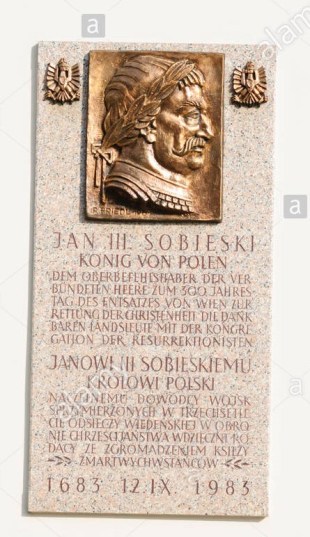
It seems that this was not enough, so at the instigation of the Poles the Vienna Municipal Council decided some years ago that a more glorious monument to Sobieski should be placed on Kahlenberg. The monument, designed and executed by a Polish sculptor, would have looked like this.
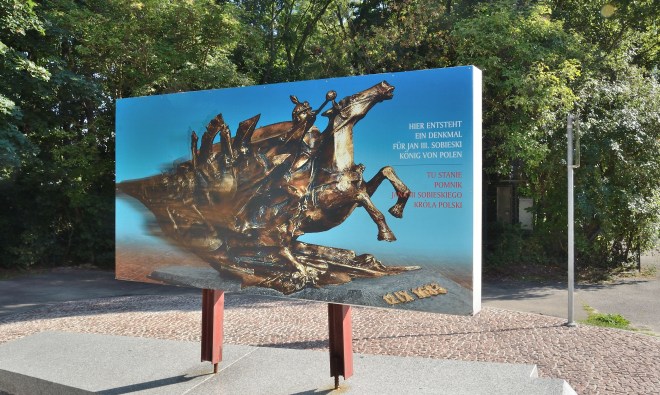
It was meant to have been unveiled this September on the anniversary of the battle.  Luckily, cooler heads prevailed and the project was cancelled at the last minute, leaving just the base. But of course this led to much gnashing of teeth in the far-right media, especially the electronic media. In this time of European history, I must say that I find this xenophobic nationalism, which we see everywhere in Europe but is the official government line in Poland, really distasteful.

So, for all these reasons, I have, as I said, been avoiding Kahlenberg on our walks. Nevertheless, it just so happened that we were walking through it on 11 September, on a walk towards Klosterneuberg. When I noticed that we there the day before the battle’s anniversary date, I began to be intrigued by this battle, about which, it must be said, I knew very little, other than its outcome and what seemed to me the strange claim that the relief forces came down from Kahlenberg to give battle. I say strange because what has always struck me at Kahlenberg is how steep the drop is down towards Vienna and how far the old city seems to be. I simply could not imagine troops careering down the hill and catching the Ottoman troops unawares. There was nothing for it, I decided; I was going to have to do some reading. Now, after a few weeks of desultory consultation of whatever I could find online. I am ready to report back (in passing, I should note that I am particularly indebted to Ludwig H. Dyck’s article on the topic which I suggest battle buffs read if they want to know more).

Vienna had been under siege since July, and by September the situation was looking increasingly desperate for the defenders. This painting gives a rather fanciful view of the besieging forces, with Vienna in the distance. Readers will note some camels in the foreground.
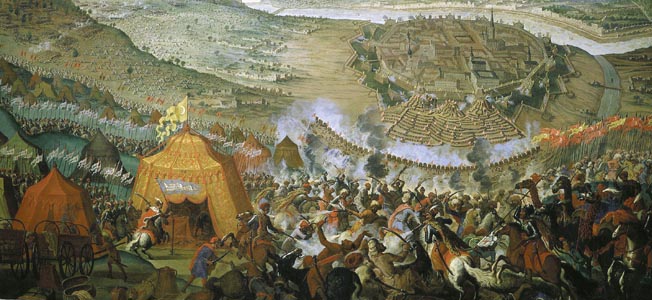
Readers should also note two other things in this picture: the hills to the left, and the small river passing to the right of Vienna, the Vienna River. These will play an important role in the upcoming drama.

Luckily for Vienna, help was on the way. On 6th September, the Polish forces under Sobieski crossed the Danube at Tulln, some 35 km upstream of Vienna, and linked up with the Austrian and German contingents. To give readers an idea of the multinationalism of this army, the Austrians, naturally enough, made up the largest contingent, with 20,000 men, under the command of Duke Charles V of Lorraine. The Poles came a close second, with 18,000 men, the great majority of whom were cavalry. Then came troops from a number of the German states: 11,000 Bavarians, under the command of their Elector Max Emanuel, 9,000 Saxons, under the command of their Elector John George III, and finally 8,000 Franconians and Swabians, under the command of Prince George Friedrich von Waldeck. With a sprinkling of other troops from here and there, the relief force was composed of close to 70,000 men. What I want to emphasize here is that the Poles were by no means in the majority on the battlefield despite their modern proclamations that it was they who saved Vienna.

The army commanders’ first order of business was deciding who should have overall command. With all these aristocratic primadonnas around, one could imagine that reaching agreement on this would have been an almost impossible task. But the Duke of Lorraine managed, through tact, diplomacy, and a certain amount of abnegation (he was well qualified to do the job himself and he was commanding the Austrians, after all), to get everyone to agree to Sobieski being given overall command. Being a King, he could pull rank on everyone else, he had charisma, and he had beaten the Ottomans in battle ten years earlier. I throw in here a Polish painting of Sobieski, which I would say falls into the realm of propaganda, painted in the days when Poland no longer existed and Poles dreamed of having a country once more.

In truth, Sobieski was well past his physical prime by this time; he was so fat that he couldn’t get into his saddle without help. But luckily his mind was still sharp. This painting from an earlier era probably gives a more faithful rendering of what he looked like, although I doubt his horses did much prancing.

In order to soothe any ruffled aristocratic feathers, it was agreed that each Prince, Elector and Duke would nevertheless lead their own men while respecting the overall battle plan. A potential recipe for disaster, I would have thought, but one which in the circumstances actually worked.

Where was the Austrian Emperor Leopold I, readers might wonder? Should he not have been leading the army on its way to relieve his capital?

Well, at the first sign of danger he had scarpered from Vienna, along with his whole court, to the safety of Passau far in the west of Austria and a long way from the Ottoman forces. Which was probably just as well, because he was a useless soldier and had an aptitude for quarreling with all and sundry, as we shall see. Since the Duke of Lorraine played such an important role in the planning and execution of the upcoming battle, I feel it is only fair to also throw in a picture of him.

Now that the issue of command structure had been sorted out, agreement was needed on the plan of battle. The Duke of Lorraine had come up with a plan, which can be understood from this old map below.
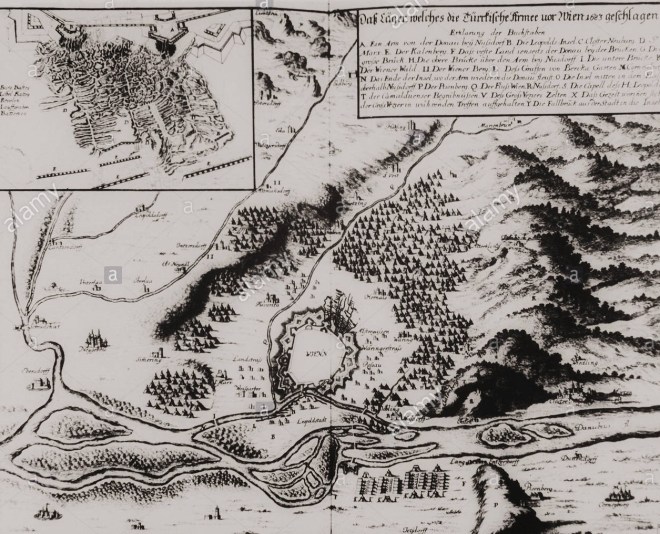
Lorraine’s idea was to have the relief force appear on the ridge of hills to the north of Vienna (to the right of this map) and give battle on the plain below, forcing the Ottomans to have at their back the Vienna River (that rather weedy stream passing to the south (left) of Vienna), the city of Vienna itself, and the Danube beyond that: caught in a vice, as it were. It was a good plan, and in the end all agreed to it. But it carried a big risk. As this next map shows, the roads from Tulln (just off to the left of this map) to Vienna all pass through the hilly country that lies to the north-west of Vienna.
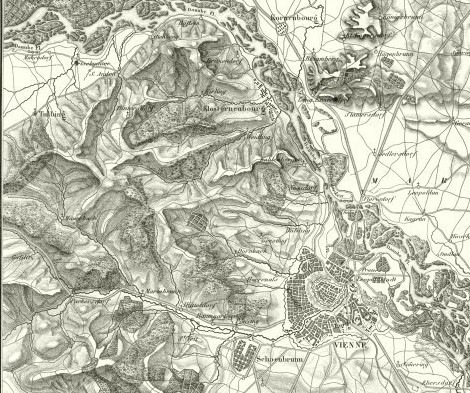
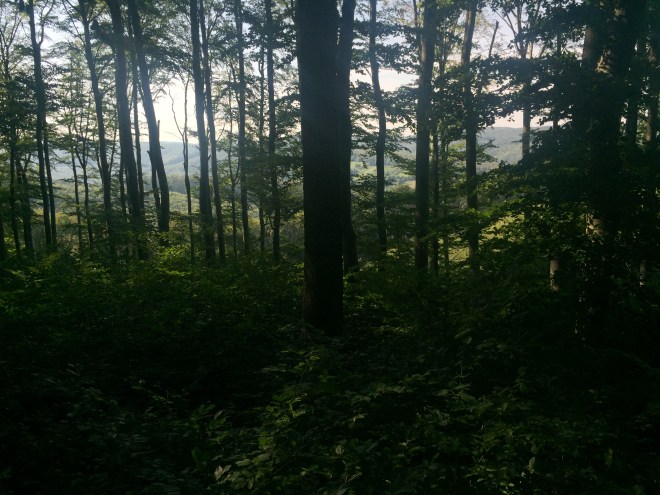
This meant that the army, all 70,000, plus all the horses of the cavalry as well as the lumbering cannons of the artillery and the baggage trains, had to cross heavily wooded, steeply hilly country intersected by numerous gullies and stream beds, along roads that were probably little more than forest roads. During walks which my wife and I have done behind Kahlenberg over the last week or so, after I had mugged up on the battle a little, I have kept marveling that the relief force had made it through this rough and rugged terrain. Here are some photos which might help readers appreciate its ruggedness.

I don’t want to pass for an armchair general but I also find it incredible that the commander of the Ottoman forces, Grand Vizier Kara Mustafa, didn’t take any steps to block their passage. He knew the Poles had crossed the Danube at Tulln and had linked up with the Austrians and Germans (I use this as a shorthand for all those troops from the German states). His scouts would surely have told him which way the relief forces were heading. It would have been easy enough to block the few roads which they would have had to take. A few well-placed cannon would have kept the relief force at bay for a considerable time. But no, no significant moves were made on the Ottoman side to bar their passage. One book I read suggests that Ottoman commanders had no experience of laying siege to a city while having a relief force threatening their rear. Well, let’s accept that. But this inactivity on the part of the Ottomans was strange indeed and was one of the factors which cost them the battle.

In any event, the relief force did make it through, although it does seem that a fair amount of muskets, cannons, and other baggage were abandoned along the way and that a good number of stragglers only managed to rejoin their regiments a few hours before the battle started.

And so it was that on 11 September, as their troops were still struggling up the flanks of the final range of hills to reach the ridge, Sobieski and his army commanders congregated on Kahlenberg to review the battlefield below them and make final arrangements. I suppose that is why Kahlenberg is host to memorials to the battle. That, plus the fact that the first inkling which the Viennese had that help was on the way was bonfires lit on Kahlenberg by an advance party.

It would be nice to think that the assembled commanders soberly reviewed plans and calmly agreed to next steps. But actually, Sobieski got into a terrible snit because he saw that the terrain below the ridge was much rougher and steeper than he had been led to believe from the rather crappy maps he had been given. He wanted to put off the attack to have more time to get his troops in position. In the event, the other commanders persuaded him to keep to the plan of attacking the next day, although at the cost of their agreeing to transfer a certain number of German regiments to his wing to screen his cavalry as they picked their way down the hill.

So it was that on 12 September the Austro-German-Polish army gave battle. I do not plan to go into excruciating detail about what happened. A brief summary will suffice, and this map should help in general understanding.

The forces under the Duke of Lorraine kicked things off on the left wing (GLW on the map) with an attack at sunrise on the village of Nussdorf, a village which I have had cause to write about in an earlier post concerning a walk we did in the Wiener Wald. The Germans in the centre (GRW) followed suit. An eyewitness on the Ottoman side, describing the soldiers coming down from the ridge, wrote that it seemed “as if an all-consuming flood of black pitch was flowing down the hills.” An arresting simile I find. This painting of the battle, while somewhat confused, does at least show this human flood down the hills (to the left).

The Ottomans fought hard and the battle went back and forth, but by noon the Turkish right wing was destroyed. Meanwhile the Poles (PLW, PC, PRW on the map) were still struggling to get down from the ridge and out of the forest. They only got in line on the right wing by about 4 in the afternoon.

By this time,the Austro-Germans were well rested from their morning exertions and eager to advance on the centre of the Ottoman line. Specifically, they wanted to capture the Ottomans’ Holy Banner, which was flying on what is now called the Türkenschanz (and where we lived for a number of years on a street called, appropriately enough, Waldeckgasse). At more or less the same time, after a few initial cavalry skirmishes, Sobieski, his armour covered by a blue, luxurious semi-oriental garb, personally led his whole cavalry in what was one of the biggest cavalry charges in history: some 14,000 cavalrymen were involved. Here’s a modern take on what the leading line of these Polish cavalrymen looked like. Readers will note those strange wing-like attachments on the riders. They were the so-called winged hussars, and were the elite of the Polish cavalry.
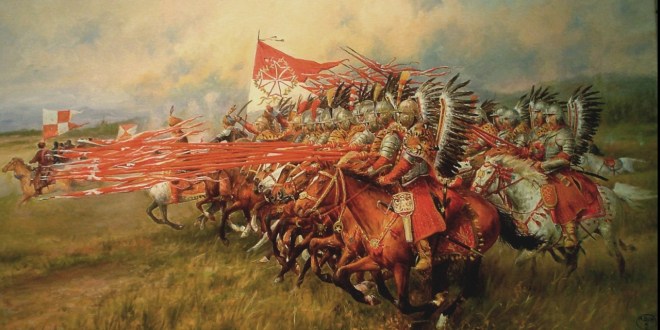
The Polish cavalry charge on one side and the renewed attacks by the Austro-Germans on the other side, broke the Ottoman forces, who took to their heels. The usual cutting down of fleeing soldiers took place. There was also wanton butchery. Before fleeing, the Ottomans had massacred hundreds of their captives. In retaliation, the commander of what remained of the Vienna garrison burned alive 3,000 sick and wounded Ottoman soldiers found in the Ottoman camp.

One would think that after such a great victory, all would be sweetness and light between the victors. Not a bit of it! By happenstance, the Poles stopped their advance right in the middle of the Ottoman encampment. An orgy of looting followed, the lion’s share of which went to Sobieski himself. The other commanders didn’t object to the looting per se – that was acceptable behaviour in those days – but they were really pissed off that the Poles hadn’t given them a chance to take part in the looting. After all, as far as they were concerned they had been as responsible as the Poles for the victory, and I can’t say I disagree with that. Then on the next day, on 13 September, Sobieski decided on holding a triumphal entry into Vienna, casting himself in the role of savior of the city. We have here a take on this event by a Polish artist from the late 1890s: another romanticized view with strong propaganda overtones.
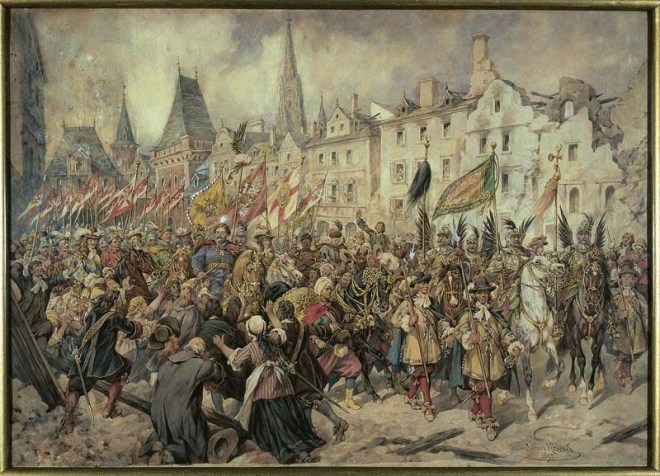
I doubt it was quite as joyous an affair, because Sobieski once more seriously pissed off all the Austrian and German grandees. They felt – quite rightly – that they had been as much saviors of Vienna as Sobieski, and should have had a strong presence in the entry into Vienna. The Austrians were also angered by what they saw as an insulting breach of protocol. In their view, it should have been Leopold I as Emperor to have headed such a triumphal entry. And the Duke of Lorraine was highly irritated that Sobieski had preferred this display of narcissism to the more sensible military objective of pursuing the demoralized Ottoman forces (to be fair, Sobieski did eventually get around to going after the Ottomans, and some two weeks later he and the Duke of Lorraine annihilated an Ottoman corps).

The next day, 14 September, Leopold I arrived back from his hiding place in Passau. He was furious when he heard about Sobieski’s triumphal entry into Vienna. He was so agitated about it that he refused to pay attention to the Duke of Lorraine’s pressing problems of how to provision the relief force. He also brushed aside the Elector of Saxony, who as a devout Protestant wanted to discuss the matter of Leopold’s treatment of Protestant Hungarians. Fed up, the Elector marched his troops back to Saxony. As Protestants, they hadn’t been treated well anyway by the other, Catholic troops.

Then, on 15 September Leopold finally got around to visiting Sobieski in his camp. The meeting did not go well. Leopold ignored the presence of Jakob, Sobieski’s son, whom Sobieski had hoped to marry off to Leopold’s daughter. Sobieski, egged on by his Francophile aristocrats (France and the Hapsburg Empire were perennially at loggerheads), took umbrage to such a degree that his relations with Leopold were strained for evermore.

So a great victory, though less because of tactical brilliance on the part of the relief force than because of stupid mistakes on the part of the Ottoman commander. I’ve already mentioned his inaction in blocking the routes through the Wiener Wald. There was also his decision to leave 15,000 crack Janissary troops in the trenches around Vienna to continue the siege. And a victory, whatever Polish propagandists might proclaim, that was due as much to the Austrian and German troops as it was to the Polish troops.

In retrospect, the battle of Vienna was the beginning of the end of the Ottoman Empire, although I doubt any observers of the time saw it that way. A great victory over the Turk for sure, the greatest since Lepanto a hundred years before. But the end of the Turk? The immediate aftermath instead showed up glaringly the fissures between Catholics and Protestants, fissures which would only really heal when most of Europe simply dechristianized last century. And contrary to what one might expect, relations between Poland and the Holy Roman Empire actually got worse rather than better, just because of the childishness of the rulers involved.

So I don’t think chest-thumping memorials on Kahlenberg are really what we need. The Municipality of Vienna have in my opinion struck the right tone by having inscribed on the pediment which was meant to hold the triumphalist monument to Sobieski the following words:

“The battle of Vienna at Kahlenberg Mountain on 12 September 1683 was the culmination and turning point of the struggle between two Empires, the Ottoman Empire striving to expand to the west, and the Hapsburg Empire forced onto the defensive. A coalition army formed to protect Cracow and Vienna, led by John III Sobieski, King of Poland, came to Vienna’s aid.

More than 50,000 men from many nations lost their lives in the battles fought to break the siege.

May this historical event be a reminder for the people of Europe to live together peacefully!”

____________________________

view of the woods: our pic
View from Kahlenberg: http://ourviewfromwien.blogspot.com/2011/05/stadtwanderweg-1.html
Far-right march on Kahlenberg: https://www.gettyimages.fr/detail/photo-d’actualit%C3%A9/some-250-members-of-the-far-right-identitarian-photo-dactualit%C3%A9/844970164#some-250-members-of-the-farright-identitarian-movement-attend-a-on-picture-id844970164
Plaque to Sobieski: https://www.alamy.com/stock-photo-wien-vienna-commemorative-table-for-the-polish-king-jan-iii-sobieski-130947975.html
Planned memorial to Sobieski: https://commons.wikimedia.org/wiki/File:Planned_John_III_Sobieski_Monument_in_Vienna,_Kahlenberg_01.jpg
Siege of Vienna: https://warfarehistorynetwork.com/daily/the-1683-battle-of-vienna-islam-at-viennas-gates/
Jan III Sobieski on his horse: https://ludwigheinrichdyck.wordpress.com/2016/03/26/the-1683-battle-of-vienna-islam-at-viennas-gates/
Jan III Sobieski: https://en.wikipedia.org/wiki/Georg_Philipp_Rugendas
Leopold I: https://www.giantbomb.com/leopold-i-holy-roman-emperor/3005-11949/
Charles Duke of Lorraine: http://backgroundimgfer.pw/Election-of-Stanisaw-August-Poniatowski-as-King-of-Polanddetail.html
Old map of Vienna and surroundings: https://www.alamy.com/stock-photo/turkish-siege-of-vienna.html
View of the woods: our pics
Battle plan: https://ludwigheinrichdyck.wordpress.com/2016/03/26/the-1683-battle-of-vienna-islam-at-viennas-gates/
Battle of Vienna: https://en.wikipedia.org/wiki/Battle_of_Vienna
Polish cavalry charge: https://about-history.com/the-battle-of-vienna-1683-and-europes-counter-attack/
Sobieski entering Vienna: https://culture.pl/en/artist/juliusz-kossak

OTTO WAGNER

Vienna, 2 September 2018

There is an Austrian architect who is spoken about in reverent tones by his compatriots: Otto Wagner, who lived from 1841 to 1918.

The Austrians claim he was a precursor of all modern architecture, his motto being that form should follow function. Now, I’m not an architect so it’s a little difficult for me to evaluate this claim, although my gut tells me it’s an exaggeration. But I’m not here to delve into the roots of modernism in architecture. I’m just interested in the buildings that Wagner designed, because as readers will see in a minute he did design some rather striking ones. Luckily, he didn’t build all that much and most of what he built is here in Vienna. So, a few weeks ago, armed with a slim book listing Wagner’s buildings and accompanied by my long-suffering wife, I crisscrossed Vienna, determined to inspect as many of his surviving buildings as possible.

What follows is an album of Wagner’s buildings. Since, apart from one exception, we were not able to visit them inside, the focus is on their exterior. As a consequence, the external decorations play a large part in my commentary. I have ordered the photos chronologically because it’s interesting to see how Wagner’s style developed over time.

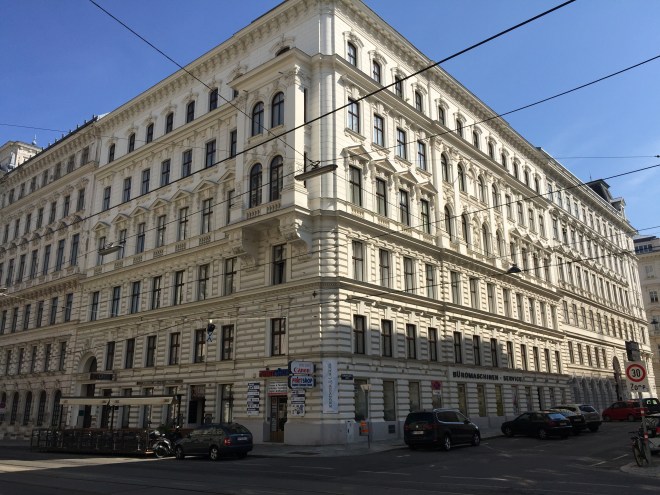
This building, an apartment building close to the town hall, was finished in 1882. I suppose apartment buildings were exciting commissions to get, these being the new palaces of the up-and-coming Viennese bourgeoisie.

I can’t say the building excites me much. It looks very similar to countless stodgy buildings that litter the city centre, for instance this one which stands on the same street.

The same is true of this building, constructed in the same years (1882-84), originally as a bank and now, I think, owned by the Ministry of Finance.

If anything, this building is even stodgier than the last, but I suppose bankers were not interested in architectural virtuosity. Something sensible, solid, and conservative was what they were after.

I have to think that these last two buildings did not reflect Wagner’s inner self, but the need to make money meant that he bowed to the desires of his clients. I say this because two years later, in 1886, he built a house for himself. This surely must reflect what he really wanted to build, and what we see here is a rather florid take on an ancient temple of some sort.

I suspect that the house may not originally have looked quite so florid as it does now. Some 45 years ago, when the house was half ruined, the prominent Austrian artist Ernst Fuchs bought the property and turned it into a museum to himself. It’s full of paintings like this.

I rather suspect, therefore, that Fuchs went overboard on his coloring scheme for the house, Wagner’s palette having been somewhat more sober.

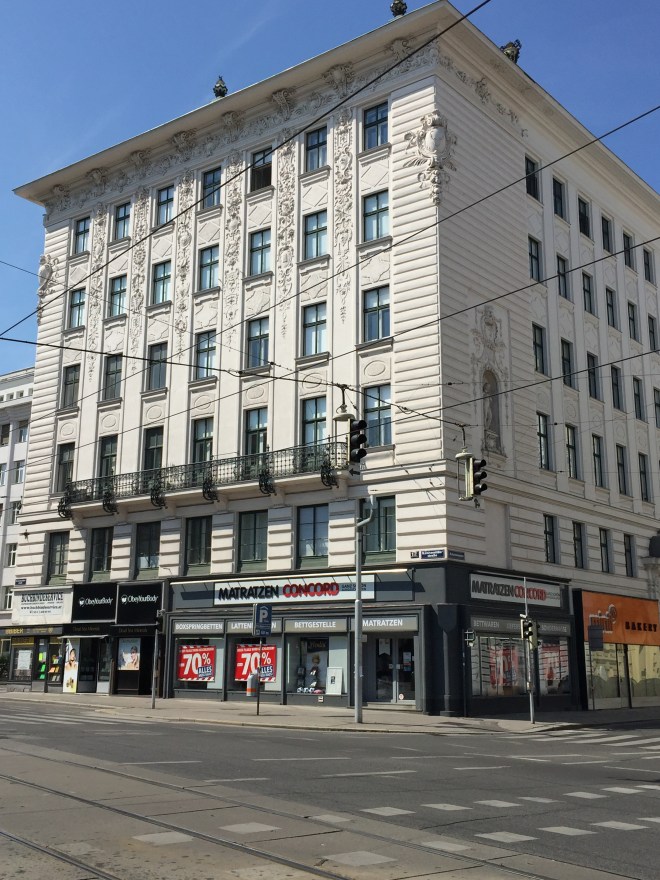
A year later Wagner was putting up another apartment building. Although it is still quite traditional-looking, it seems to be not quite as stodgy as the first one. For one thing, he’s eliminated the heavy-looking window sills and generally made the decorations “flatter” and less obtrusive.

We have to wait another seven years, to 1894, for the next building, yet another apartment block, but this time with a swank shop on the ground floor (currently a Nespresso shop). At least this was now in the chicest part of town, a stone’s throw from the cathedral. Perhaps it’s my imagination but I rather fancy that the building has further lightened up from his previous attempts in the genre. Certainly, the windows on the facade take up more of the total space than before, and the attic-like structure on the roof adds yet more glass to the whole. But all in all, same-old, same-old.

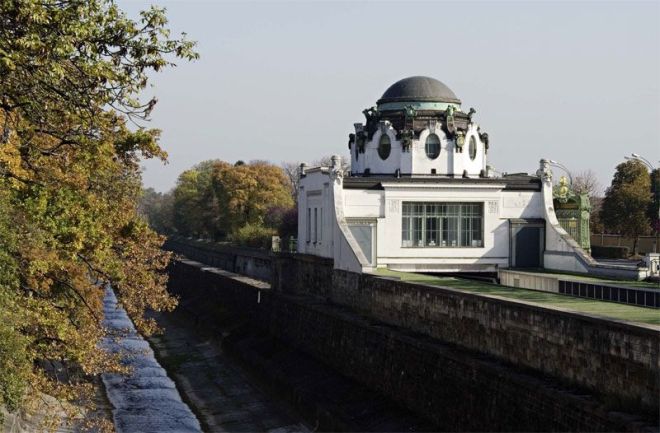
From 1894 to 1900, Wagner was busy on various stations for railway lines that were later to become part of Vienna’s subway system. These are much chattered about here, although I can’t say that I find them particularly elegant to look at. They don’t hold a candle to Hector Guimard’s Metro stops in Paris, for instance. One station in particular, actually a waiting room for the Imperial family when they were on their way to Schonbrunn palace, gets a lot of press.

So does the pavilion at Karlsplatz, where the Art Nouveau style that was coming to the fore at the time bursts forth – I rather feel that I’m in fin-de-siecle Paris or Brussels when I see this little building.

But I also want to insert here a picture of one of his other stations made for mere mortals like me.

These stations are squat and rather bare, I have to say. The dull green paint which has been used on the metalwork doesn’t help.

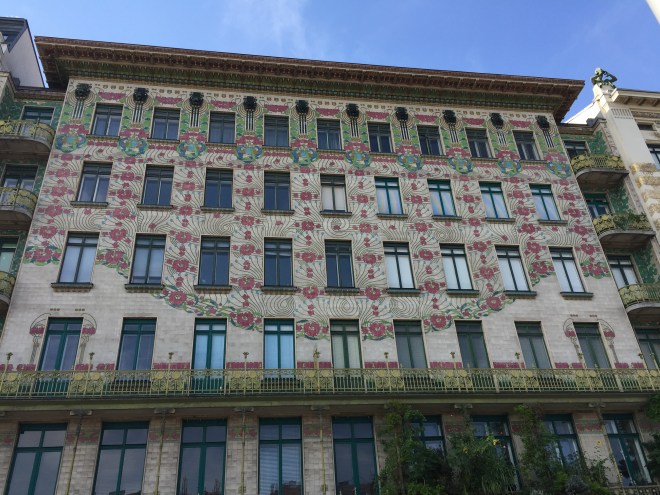
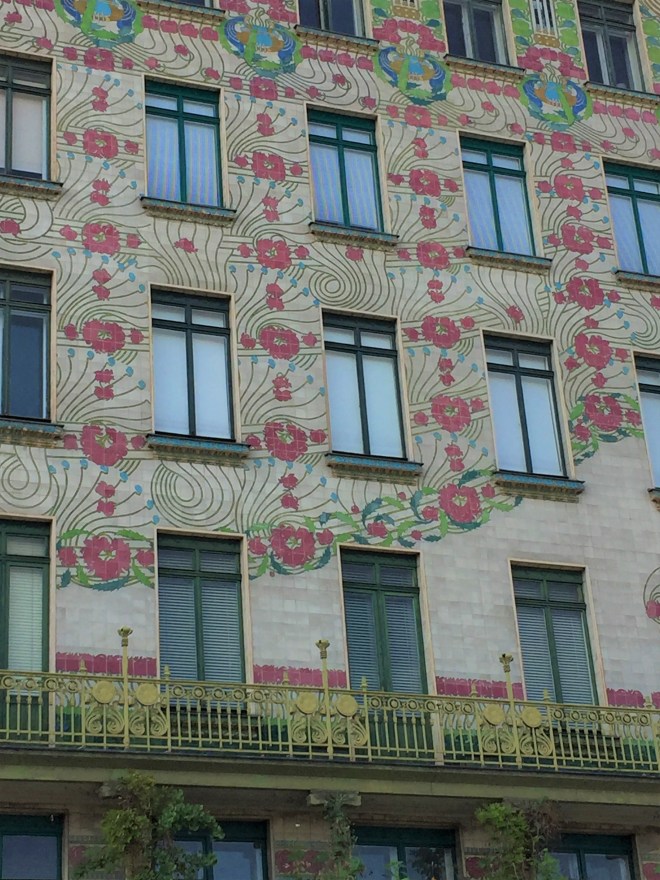
Thereafter, things begin to look up, at least from my perspective. In 1898, Wagner completed two buildings, apartment buildings again, side by side, on the quays of the river Wien which on this stretch had been covered over. On one side, we have the so-called Majolica House. As its name suggests, the facade of the building is covered by large ceramic tiles, depicting a floral pattern in the form of a vast flowering tree. I suppose we could say that this design connects to the William Morris school.


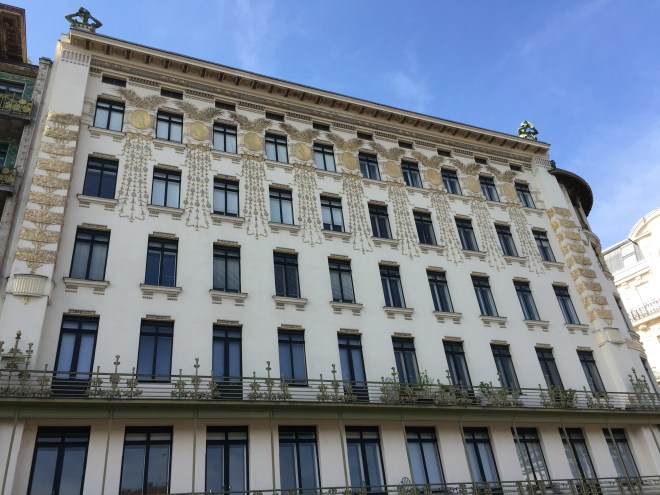
Next door, Wagner opted for what I would say is a more typical example of Vienna’s form of Jugendstil, the German world’s version of Art Nouveau: more sober floral decoration but a more extensive use of gold leaf (this style always leaves me with a slight sense of decadence, I find).


In the previous year, the most famous building in the Jugendstil style, the Secession Building, had burst onto the Viennese scene, creating much brouhaha among the chattering classes.

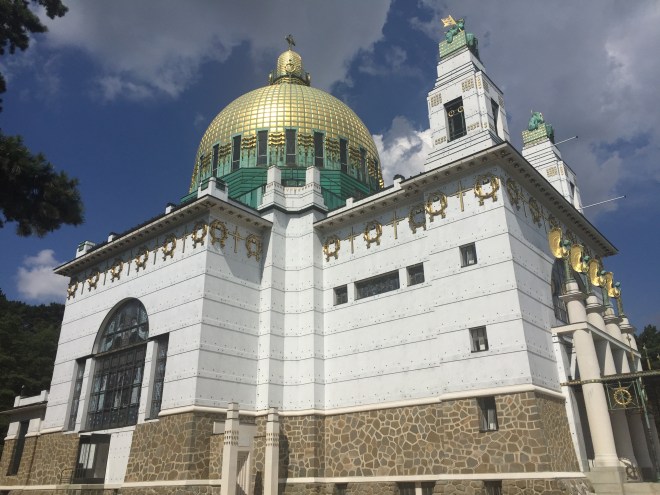
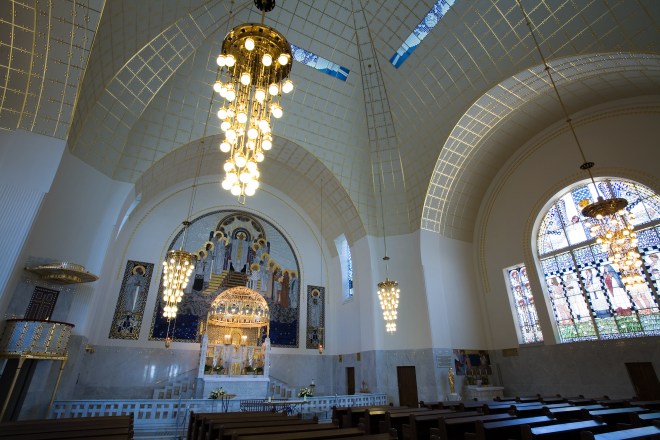
Over the next decade or so, Wagner was very busy. Following the style of his last building, between 1902 and 1907 he built the Church of St. Leopold high on a hill overlooking Vienna.


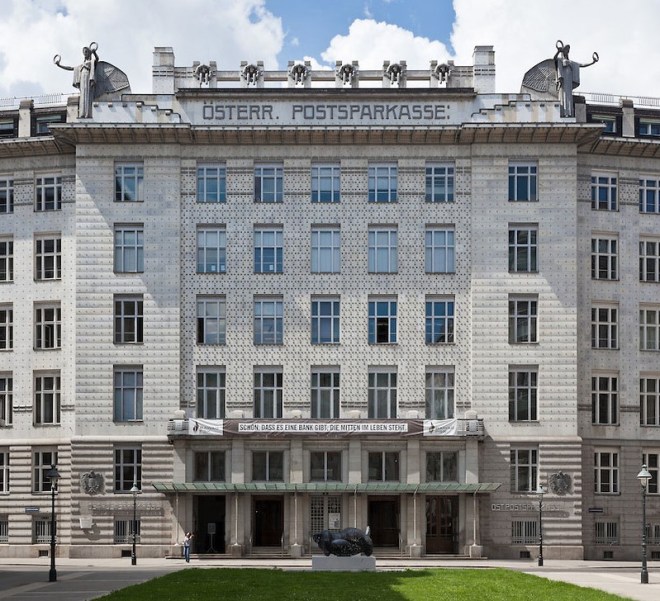
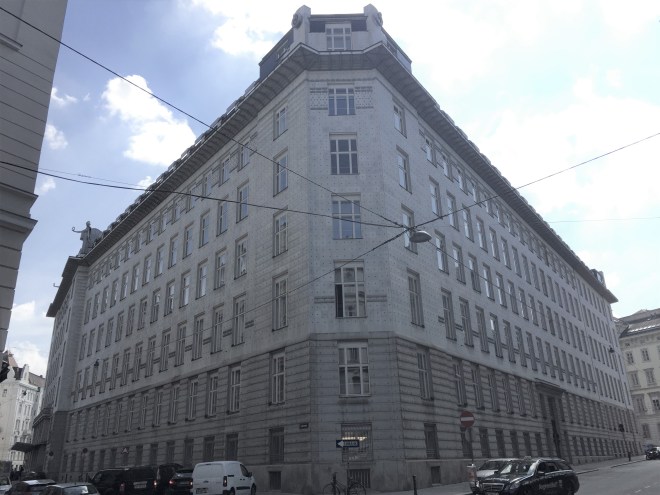
The references to the Jugendstil are strong in Wagner’s church. Not so with the Imperial and Royal Postal Savings Bank, which he built between 1903 and 1912.

Here, he cut out the curvaceous and glittering side of Jugendstil, opting for rigorously straight lines, a white-light grey colour combination, and minimal decoration.

I suppose to avoid monotony in the building’s facades he stamped every facing stone with a circle in low relief (an idea which readers can see, going back to the previous photos, he also used, although with less intensity, on the exterior surfaces of St. Leopold’s church).

The overall effect of all this is quite striking, particularly when you contemplate the facade and then turn round and look at the Ministry of War building, constructed during the same period.

The overly decorated facade of that building jars after the stripped down decoration of Wagner’s building.

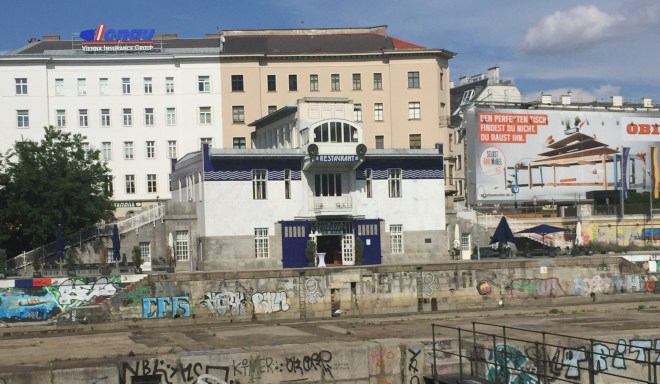
While working on his church and postal savings bank, Wagner was also commissioned to build various elements of the Vienna canal system. The most interesting of these is what was originally a bathhouse and is now a restaurant, built in 1906 or thereabouts.

It is here that we first see what I consider Wagner’s signature design: straight lines with an accent on the vertical, minimal decoration but what there is of it of an abstract nature and colored of dark blue.

The effect is really quite lovely, although here it is rather overshadowed by the nondescript buildings behind it and the overpowering graffiti that covers many of the surrounding walls.

A few years later, in 1908, Wagner built a pavilion for sufferers of Lupus disease in the grounds of the Wilhelminen Hospital (it seems that Vienna was then at the forefront of research into this disease).

I have first shown a photo from the time because when my wife and I went to have a look we found a building which seems rather down on its luck.

Lord knows what it is now used for. The fact that its original name has been clumsily covered over suggests that it is no longer used for Lupus sufferers. I have to hope that the signs of construction works around the building herald a renovation. It would be sad to lose this building. Here again we see the use of minimal decoration dominated by blue on white, or at least on pale.

Wagner returned to the apartment-building theme in 1909-11, when he again built two apartment buildings next to each other. The building that most immediately seizes the attention sits on the main road

While following the design principles of his last couple of buildings, this time Wagner opted for black on white. To my mind, the contrast is too strong. Something on the grey side would have been better. The building behind it, on the side road, is more faithful to the blue on white design but is plainer, no doubt as befits a building tucked away from view.

Perhaps the most striking detail of the two buildings is the garage door, a great nail-studded steel affair.

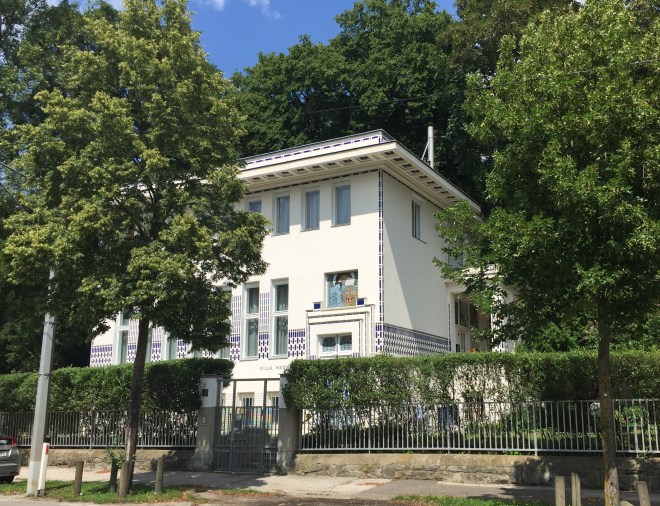
And finally we come to the last building Wagner built, in 1912-13, so a few years before his death. It was another villa for himself and his family, built right next to the first. I see in it the distillation of his latest style and is, to my mind, the most beautiful thing he built.


I would gladly live in it. Someone does – it’s still a private residence. But not visitable, as we were informed, when I tried my luck and asked someone coming out of the front door.

__________________

Photos: all mine, except for the following:

Otto Wagner photo: https://www.pamono.it/designers/otto-wagner
Ernst Fuchs painting: http://benedante.blogspot.com/2016/02/the-surreal-madhouse-of-ernst-fuchs.html
Court Pavilion Heitzing: https://www.pinterest.at/pin/450148925226765989/?lp=true
Karlsplatz pavilion: https://vivent.at/orte/otto-wagner-pavillon-karlsplatz/
Secession building: https://www.dreamstime.com/vienna-austria-august-secession-building-exhibition-hall-built-joseph-maria-olbrich-as-architectural-manifesto-image103293489
St Leopold Interior: https://commons.wikimedia.org/wiki/File:Vienna_-_Otto_Wagner%27s_St_Leopold_Church_-_6854.jpg
Postal Savings Bank: https://arthive.com/artists/5998~Otto_Wagner/works/517471~The_front_faade_of_the_Austrian_Postal_Savings_Bank_sterreichische_Postsparkasse

MARSH HORSETAIL

Vienna, 25 August 2018

I’ve always been a sucker for the underdog. Maybe it’s because I’m British – well, half British. When I was young, it used to be said that fighting for the underdog was a distinctively British trait, the prime example always given being the UK indignantly declaring war on Germany in 1914 to protect poor little Belgium. Given our history as the biggest colonialist power of all time, I find this claim a little hard to swallow. Still, I offer it as a possible explanation. Or maybe it’s because of all the years I spent working in the UN – its main job seems to be to stand up for the downtrodden of this world, as typified by the main slogan of its new Sustainable Development Goals: “No-one left behind”. Of course, there are those who would point out the rather large gap between the UN’s rhetoric and its actions … Or perhaps working for more years than I care to remember in the environmental field has made me intensely aware of the wholesale destruction that our species is raining down on every other hapless species that co-exists on this planet of ours.

Whatever the reason, I am, as I said, a sucker for the underdog. This tendency of mine to root for “your tired, your poor, your huddled masses yearning to breathe free, the wretched refuse of your teeming shore” (to cite the poem by Emma Lazarus inscribed on the base of the Statue of Liberty) extends to the biological world. Simply put, I have a soft spot for really old species which once flourished on our planet but which for various reasons have been overtaken by other species and often thrust into small niches where they eke out a continued precarious existence. I was recently reading with sadness and indignation about the coelacanth, a fish older than the dinosaurs, which has managed to hang on 400 million years but whose last known representatives in waters off South Africa are now threatened by oil and gas drilling.

I have written in the past in these posts about the ginkgo. 150 million years or so ago, it was a thriving family of some eleven species but is now represented by only one, the ginkgo biloba, which has managed to hang on, simply because of the kindness of Buddhist monks it would seem.

I have also written about dragonflies, which first appeared in the fossil record some 325 million years ago. To be fair, they seem to be in quite a healthy state, represented as they are still by some 3,000 species. But there was a time when very large dragonflies with wingspans of 70 centimeters buzzed around – shrinkage seems to be the fate of species under attack.

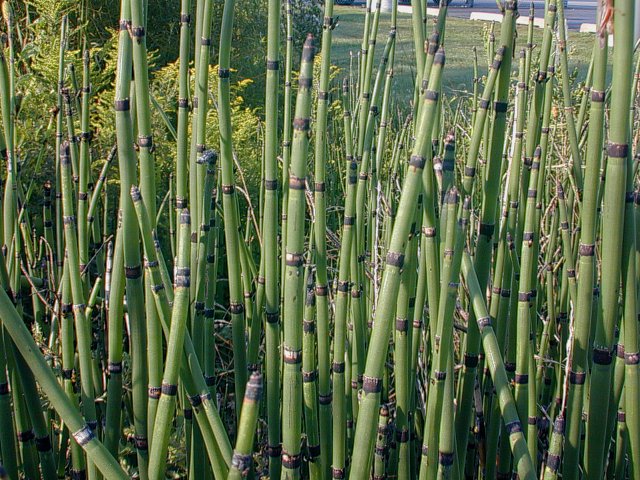
The walks which my wife and I have been taking this summer in the Vienna woods (training for a long walk we will be undertaking in Japan in November) have brought me face to face with another such biological relic, the marsh horsetail.


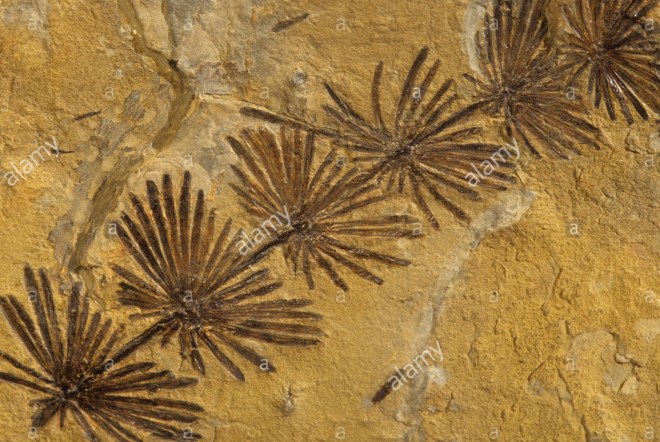
Immediately I saw it, I sensed that I was in front of something very ancient. And indeed I was. Ancestors of the marsh horsetail and its brethren (there are some fifteen species still in existence) once dominated the understory of the forests in the late Paleozoic period some 300-350 million years ago, the time when many of our coal beds were being laid down – no doubt many a kilo of coal owes its existence to horsetail ancestors ringing down the curtain in those steamy Paleozoic forests. Here is the ghost of one such ancestor, caught in the fossil record.

And I show here an artist’s illustration of what these forests might have looked like.

Sic transit gloria mundi, “Thus passes the glory of the world”, I am fond of muttering at such moments, while my wife rolls her eyes at the oft repeated phrase.

Another name, at least in English, for the marsh horse tail is bottle-brush. I think readers will agree that it does indeed have a passing resemblance to a bottle brush. I throw in a picture here of such a brush for confirmation.

There was a time when I was very familiar with the shrunken version of the bottle brush, the test-tube cleaner. That was during the years when I spent a lot of time in chemistry labs, thinking that chemistry was the life for me. But it was not to be.

While the marsh horsetail could never actually be used to clean bottles, until quite recently one of its cousins, the shaving-rush horsetail, was used as sandpaper.

As my wife and I have noticed, this particular horsetail currently is becoming popular as a plant in public spaces, along house boundaries, used almost as a fence.

But since the plant contains high levels of crystalline silica, which is what coats sandpaper, our more practical ancestors used it to sand down furniture. Given our recent museum-soaked trip to the Netherlands, where we saw numerous paintings of homely scenes hanging on various walls, I was moved to find a painting from the Dutch Golden Age of a cabinet maker at work. This is the best I could find, a painting of a still life of musical instruments on a piece of furniture, all of which would have required fine sanding in their making. The painter is Pieter Gerritsz van Roestraten.
Well, as temperatures have soared this summer in Europe, generating much anguished comment that finally we are faced with the evidence of climate change when it is too late to really do anything about it, perhaps the marsh horsetail and its brethren are cheering us stupid humans on. I’m sure that a world where average global temperatures are 2oC and more higher will be very agreeable to them and once again they will be able to flourish and kick out the upstarts, including us, which shoved them aside: he who laughs last laughs longest, as they say.

____________________

coelacanth: https://www.theguardian.com/environment/2018/aug/17/older-than-dinosaurs-last-south-african-coelacanths-threatened-by-oil-exploration
https://www.boredpanda.com/1400-old-ginkgo-tree-yellow-leaves-buddhist-temple-china/?utm_source=google&utm_medium=organic&utm_campaign=organic
ancient dragonfly: https://en.wikipedia.org/wiki/Dragonfly#/media/File:Meganeura_monyi-Museum_Toulouse.png
marsh horsetails: my photos
horsetail fossil: https://www.alamy.com/stock-photo-fossil-horsetail-equisetum-italy-10869299.html
Paleozoic forest: https://www.deviantart.com/abelov2014/art/Meganeura-Arthropleura-581872049
Scouring rush: http://www.illinoiswildflowers.info/grasses/plants/scouring_rush.htm
Scouring rush in public places: http://www.budgetplants.com/shrubs/accent/horsetail-equisetum-hyemale
Still life of musical instruments: https://pixels.com/featured/still-life-with-musical-instruments-pieter-gerritsz-van-roestraten.html

ART TOUR OF THE NETHERLANDS

Vienna, 9 August 2018

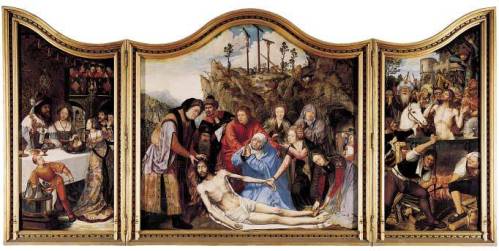
My wife and I have just finished a little holiday in the Netherlands. It was a birthday present for me, so we spent most of the time in art museums. A veritable smorgasbord of art my wife offered me! The Rijksmuseum, the Van Gogh Museum, and the Stedelijk Museum of contemporary art, all in Amsterdam; the Kröller-Müller Museum and sculpture park in Otterlo, close to Arnhem; the Mauritshuis and the Gemeente Museum in The Hague. The art we saw spanned some five centuries, from Rogier Van der Weyden’s Lamentation of Christ from about 1460

to Steven Aalders’s Phi Painting of 2016.

What this sensory overload has confirmed to me is that if I were asked the question “what of all this stuff would you want to hang on your walls?”, my very personal answer would be “pieces produced between about 1885 and the beginning of World War I”.

Don’t get me wrong, the paintings the Dutch produced during their Golden Age of the 17th Century, the kind of paintings which constitute the highlights of the Rijksmuseum and the Mauritshuis, are marvels of technique, of drama, of light effects, and I know not of what else. I mean, as you wander through the Rijksmuseum how can you not admire creations such as Rembrandt’s The Night Watch

or Jan Vermeer’s The Milkmaid

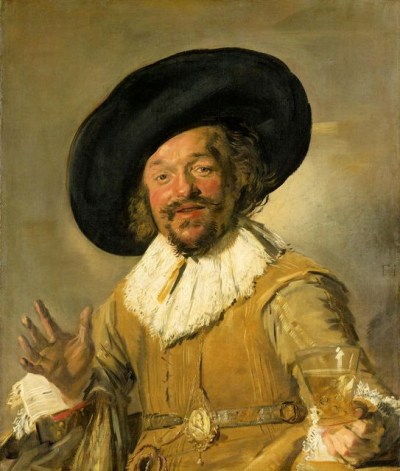
or Frans Hals’s Militiaman holding a Berkemeyer


or Adriaen Coorte’s Still Life with Asparagus?

And over at the Mauritshuis, how can you not murmur approvingly before Rembrandt’s The Anatomy Lesson of Dr. Nicolaes Tulp

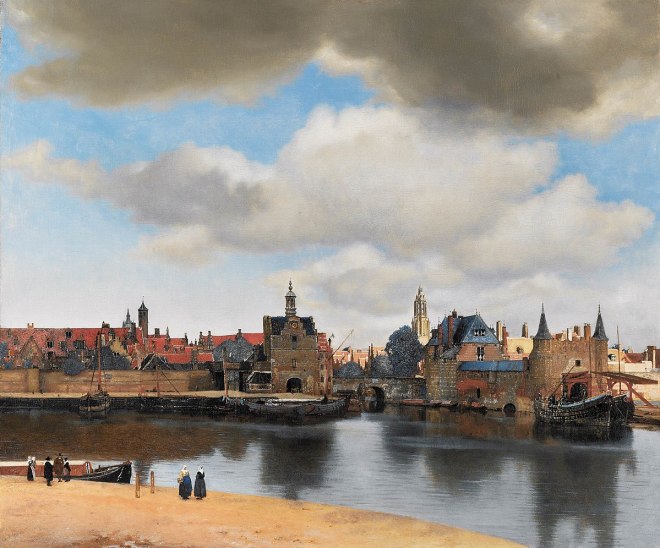
or Vermeer’s View of Delft

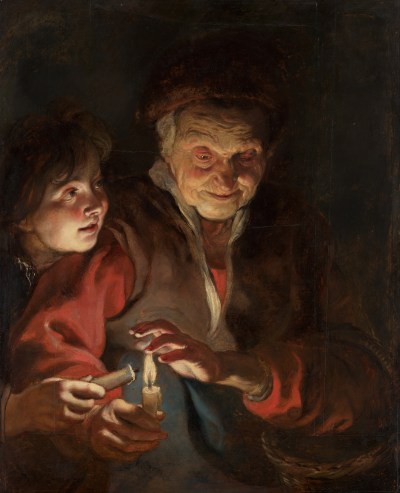
or Rubens’s Old Woman and Boy with Candles?

Yes, all very impressive.

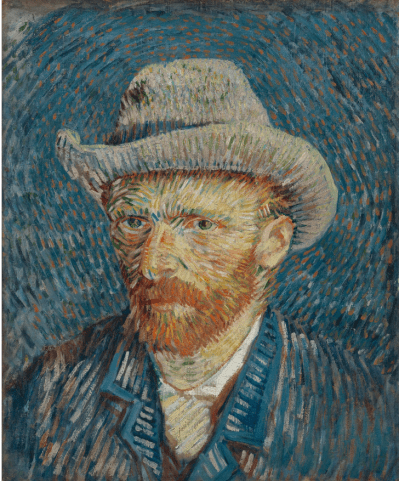
BUT, when push comes to shove I can’t say I would want any of these paintings on my wall. They just don’t make me vibrate internally. Not so with the best Van Goghs that we saw, bursting with colour and intensity! So what if the perspective wasn’t perfect, if the figures were not necessarily well-proportioned, if the finishing was rough. His paintings spoke to my soul. One of his many self-portraits, for instance, from the Van Gogh Museum, would be welcome on my wall

as would be this painting of his from the Kröller-Müller museum, of the café at Arles where he no doubt whiled away a good few hours

or this one of an olive grove somewhere around Arles, hanging in the same museum

or of this wonderful landscape hanging in the Van Gogh Museum, which he painted in the last few months of his life in Auvers-sur-Oise.

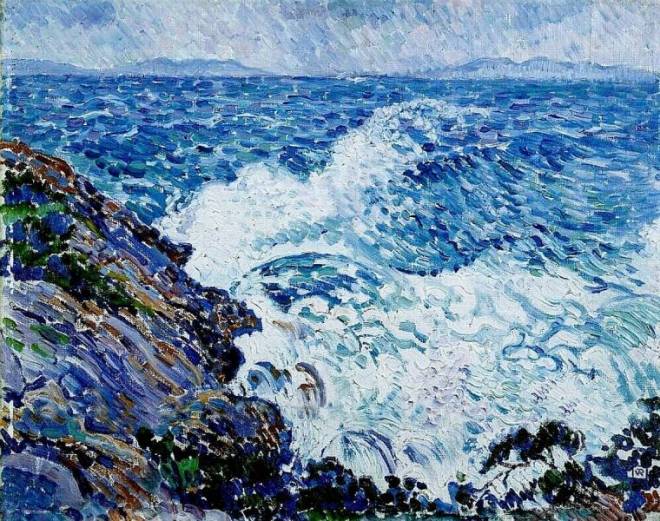
Younger painters were dazzled by Van Gogh’s use of colour and pushed through the door he opened, with some wonderful results. I could joyously put this lovely seascape on my wall; it’s Gale from the East, by Théo van Rysselberghe, and hangs in the Kröller-Müller museum

I would also willingly take this luminous Still Life with Fruits, by Leo Gestel, in the same museum

or this wonderfully brooding work by Kandinsky, exhibited in the Stedenlijk; he painted it before he went and spoiled everything by becoming an abstract artist.

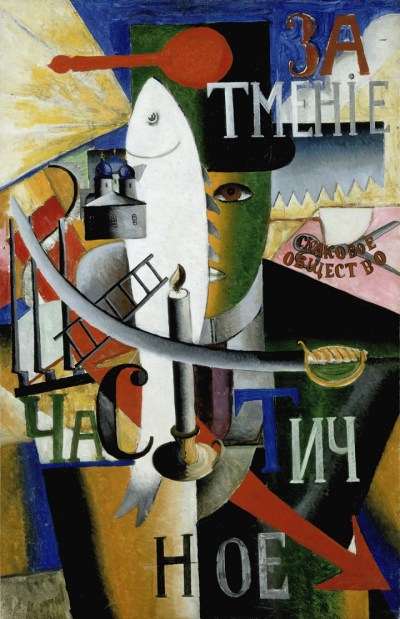
I could even welcome this painting by the Russian Constructivist artist Kazimir Malevich, from the Stedenlijk (and titled, rather bizarrely, An Englishman in Moscow).

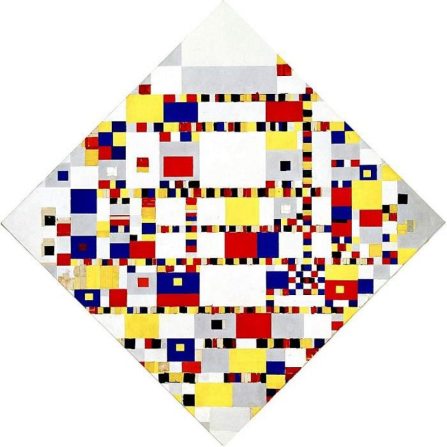
There is even a period in Mondrian’s long life when he turned out paintings which I would gladly hang on my walls. The Gemeente Museum has a particularly rich collection of Mondrians, running from his very first works like this Basket with Apples

to his very last works like this Victory Boogie-Woogie.

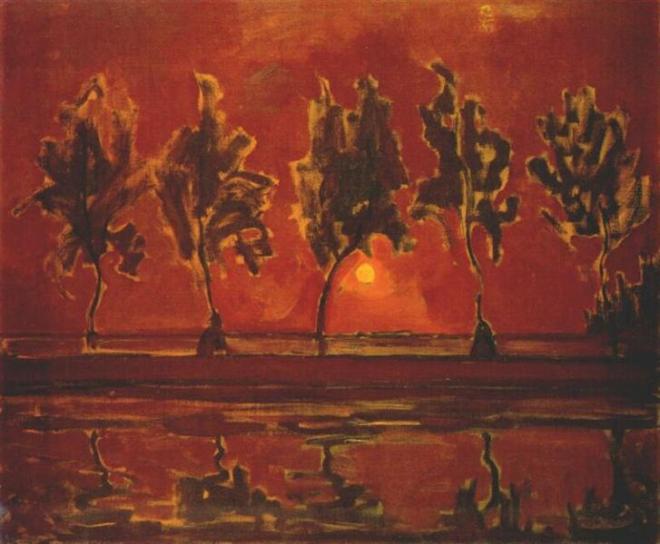
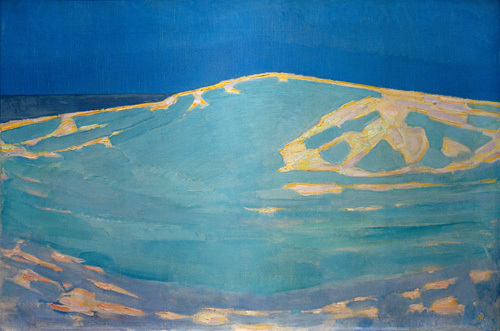
His very first paintings are quite standard and should be disregarded, while his last paintings – all those abstract works he is so famous for – should equally, in my humble opinion, be ignored. It is works like these that I would hang on my wall:
Trees on the Gein: Moonrise

Dunes near Domburg

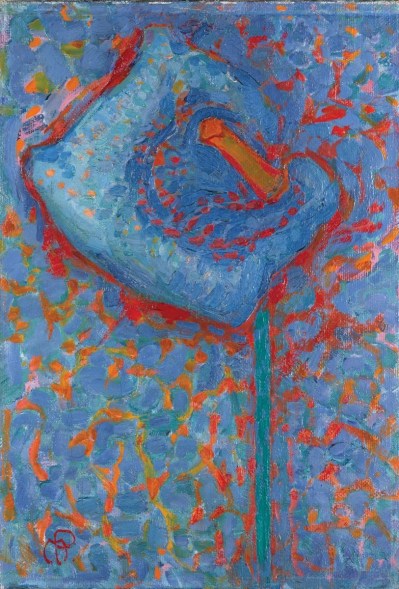
Arum, Blue Flower

Mill in Sunlight

Yes, it is that period, when artists discovered pure undiluted colour and before they tumbled into meaningless abstraction, which would have pride of place on my wall. It is a relatively narrow window of time – only thirty years or so – but many jewels of paintings were created. I could have added many other paintings which we saw in our whirlwind tour of the Netherlands, but I shall desist otherwise I risk losing my readers. I will, though, in a later post take up another theme which I am very fond of and about which I have written an earlier post: the human face in art. I think that I would have to expand my answer to the question I posed myself at the beginning of this post, to say that in addition at least one of my walls would have to be devoted to portraits. I will give my readers a taste of the art of portraiture we came across in our six-day art blitz of the Netherlands.

____________________

Roger Van der Weyden, “Descent from the Cross”: http://www.twgram.me/tag/lamentation/
Steven Aalders, “Phi Painting”: https://www.stedelijk.nl/en/collection/99578-steven-aalders-phi-painting-%28ryb%29
Rembrandt, “The Night Watch”: http://www.dutchamsterdam.nl/139-rembrandt-night-watch
Jan Vermeer, “The Milkmaid”: https://en.wikipedia.org/wiki/The_Milkmaid_(Vermeer)
Frans Hals, “Militiaman holding a Berkemeyer”: http://www.jiekley.com/product/a-militiaman-holding-a-berkemeyer-known-as-the-%C2%91merry-drinker%C2%92-karya-frans-hals-1628-1630/
Adriaen Coorte, “Still Life with Asparagus”: https://www.rijksmuseum.nl/en/collection/SK-A-2099
Rembrandt, “The Anatomy Lesson of Dr. Nicolaes Tulp”: https://www.mauritshuis.nl/en/explore/the-collection/artworks/the-anatomy-lesson-of-dr-nicolaes-tulp-146/#
Jan Vermeer, “View of Delft”: https://en.wikipedia.org/wiki/View_of_Delft
Peter Paul Rubens, “Old Woman and Boy with Candles”: https://www.mauritshuis.nl/en/explore/the-collection/artworks/old-woman-and-boy-with-candles-1150/
Van Gogh, “Self Portrait with a Grey Felt Hat”: https://vangoghmuseum.nl/en/search/collection?q=&artist=Vincent%20van%20Gogh&genre=self-portrait&_ga=2.88217629.705702266.1533842349-1924679497.1533842349
Van Gogh, “Place du Forum”: https://krollermuller.nl/en/vincent-van-gogh-terrace-of-a-cafe-at-night-place-du-forum-1
Van Gogh, “Olive Grove”: https://krollermuller.nl/en/vincent-van-gogh-olive-grove
Van Gogh, “Wheatfield under Thunderclouds”: https://vangoghmuseum.nl/en/collection/s0106V1962
Theo van Rysselberghe: https://krollermuller.nl/en/theo-van-rysselberghe-gale-from-the-east
Leo Gestel, “Still Life with Fruits”: https://krollermuller.nl/en/leo-gestel-still-life-with-fruits
Wassily Kandinsky, “Painting of Houses”: https://www.stedelijk.nl/en/collection/4540-wassily-kandinsky-bild-mit-hausern
Kazimir Malevich, “Englishman in Moscow”: https://www.tate.org.uk/whats-on/tate-modern/exhibition/malevich/malevich-room-guide/malevich-room-4
Piet Mondrian, “Basket with Apples”: https://www.gemeentemuseum.nl/en/collection/basket-apples?origin=gm
Piet Mondrian, “Victory Boogie-Woogie”: https://www.piet-mondrian.org/victory-boogie-woogie.jsp
Piet Mondrian, “Trees on the Gein: Moonrise”: https://www.wikiart.org/en/piet-mondrian/trees-by-the-gein-at-moonrise-1908
Piet Mondrian, “Dunes near Domburg”: https://www.worldgallery.co.uk/art-print/piet-mondrian-dunes-near-domburg-1910-436728
Piet Mondrian, “Arum, Blue Flower”: https://www.pinterest.co.uk/pin/424534702365855604/
Piet Mondrian, “Mill in Sunlight”: https://www.gemeentemuseum.nl/en/collection/molen-mill-mill-sunlight?origin=gm

THE CHERRY, SWEET AND SOUR

Vienna, 20 July 2018

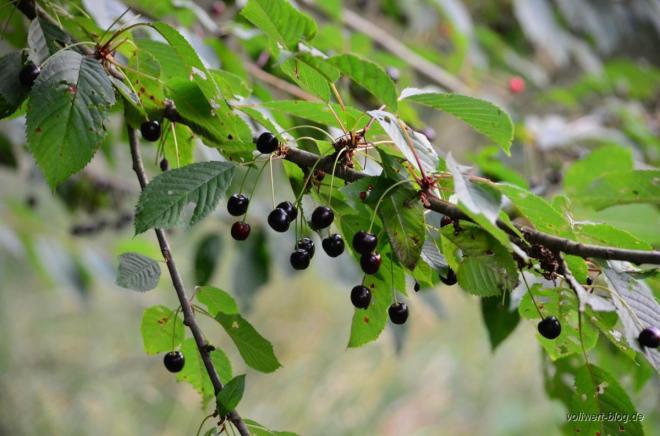
In one of my wanderings through the Vienna woods with my wife, I noticed a tree like this one growing along the side of the path.

The bark, with those typical striations, almost scarifications, suggested strongly to me that it was a cherry tree.

The leaves looked cherry-like too. There was a cherry-like fruits hanging on the branches, but they were really small.

Was this a cherry tree gone feral, I wondered?

Cautiously, oh so cautiously, I tried one of the fruits. There was hardly any pulp, although what there was tasted cherry-like. And the small seed looked cherry-like too. I pronounced to my wife, who was standing anxiously by, waiting for me to keel over from eating some deadly poison, that in my opinion we were standing before a wild cherry tree.

Now that I had noticed the tree, I began to see them everywhere along our walks – a nice change from the drifts of wild garlic. Later on, one of the entries along a little “Nature Walk” at Hermesvilla (a large country house built by Emperor Franz-Josef for his beloved Sissi on the outskirts of Vienna) informed me that these were indeed wild cherry trees. In German, they have a charming name, Vogel Kirsche, a name that Linnaeus echoed in the Latin name he gave it, Prunus avium. I say charming, because I can indeed imagine birds feasting on these small fruit. What a lovely banquet Nature has given them! Here, a clever photographer has caught one in the act.

I have since read that small mammals also eat them, spreading – like the birds – the seeds far and wide, this no doubt explaining why I was discovering the trees far and wide in the woods around Vienna.

When I was a much smaller mammal than I am now, I distinctly remember climbing into the cherry tree which my French grandmother had in a corner of her garden – a big, stately old tree which had been there many a-year – and scarfing down its plump purple cherries, spitting out the cherry seeds far and wide. Ah, how sweet those cherries were! Even now, fifty and more years later, I can remember their taste. So I salute the Lords of the Universe, who in their infinite wisdom created the Vogel Kirsche for the delectation of the Vogels and small mammals!

Well, after that flight of poetic fancy, let me return to earth and to a more sober turn of phrase. For those among my readers who are as interested as I am in etymology, it may interest them to know that the English word “cherry” derives from the Old Northern French or Norman word for the tree and fruit “cherise”, which itself is derived from the Latin word “cerasum”, which in turn is a derivation of the ancient Greek word “kerasous”. The etymology tracks the journey of the domesticated cherry tree into Europe.

Kerasous was actually the name of one of the Pontic Greek provinces lying on the southern shores of the Black Sea, east of Trebizond. It was here that the Greek world got to know the domesticated cherry tree that we are familiar with, with its much larger cherries than the tiny fruit of the wild cherry tree which I had nibbled at cautiously. Somewhere in the Anatolian highlands behind Kerasous, farmers had domesticated the wild cherry tree, patiently coaxing it over generations to deliver up bigger fruits more on the scale of us big mammals, and sweeter and juicier into the bargain.

I would assume that Ancient Greeks brought back some trees and planted them in the Greek heartlands. From there, I would have thought it no great flight of the imagination to think that the cherry tree spread to Magna Graecia, Greater Greece, that string of Greek colonies that ran along the insole and heel of the Italian boot and the southern coasts of Sicily, and from there a skip, hop, and a jump would have brought the tree to the expanding Roman world.

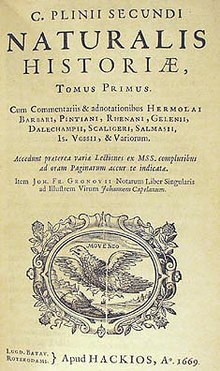
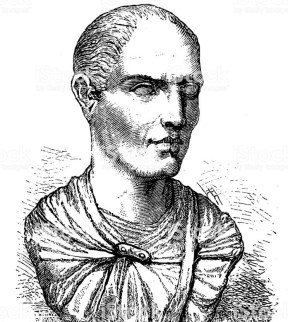
Not so, according to Gaius Plinius Secundus, known to us as Pliny the Elder. In his Natural History

written in the late 70s AD, he holds that the cherry tree entered the Roman world in a much more Roman way, as spoils of war. In his words (translated, I hasten to add, by someone much more learned in Latin than I), “before the victory of L. Lucullus in the war against Mithridates, that is down to 74 BC, there were no cherry trees in Italy. Lucullus first imported them from Pontus”. Lucius Licinius Lucullus (to give the man his full name) was a Roman consul in the sunset years of the Roman Republic.

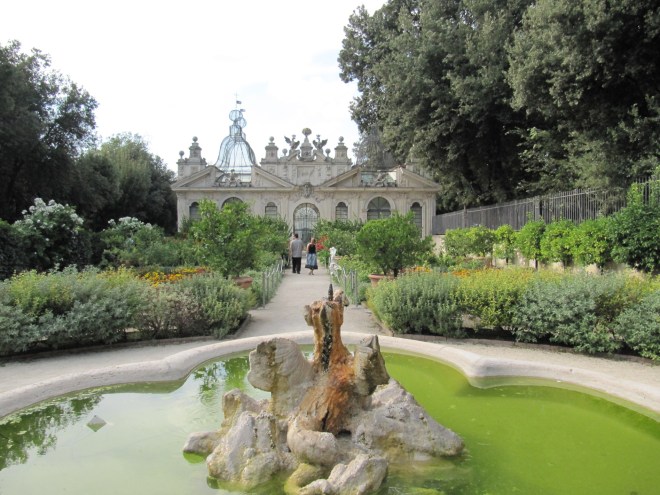
He was, it seems, a brilliant general. Among his other accomplishments, he comprehensively thrashed Mithridates, king of Pontus. In the process, he gained for himself untold riches in loot, which, along with the domesticated cherry tree, he brought back to Rome. He used his riches to live a life of luxury, something which was still frowned upon in Republican Rome but was to become the norm in Imperial Rome. Apart conspicuous consumerism (which included that typical expense of the Roman rich and powerful, the organization of extravagant games), Lucullus created a number of gardens, a fragment of one of which still exists in the Villa Borghese gardens in Rome.

This was another “spoil” of war – Lucullus had picked up the Persian love of gardens during his Eastern campaigns; I have had cause to mention Persian gardens in an earlier post, in quite another context. No doubt it was in his gardens that he planted his imported cherry trees and invited the Roman rich and powerful to partake of its fruit. As might be expected, the fruit became incredibly popular and plantings of the cherry tree grew apace. As the Roman legions moved north carrying the Pax Romana and civitas with them, the administrators who followed carried along cherry trees to plant in the conquered lands. Citing Pliny again, “in 120 years they have crossed the ocean and got as far as Britain”.

Of course, strictly speaking Pliny was wrong when he said that there were no cherry trees in Italy before Lucullus brought them. There were, but of the type which I had come across in the Vienna woods. The natural habitat of Prunus avium stretches from Ireland to the Iranian Plateau.

Our ancestors were eating their little fruits at least two thousands years before Pliny wrote his Natural History – we know this because various Bronze Age sites across Europe have yielded up the tiny little stones – and no doubt Italian peasants were still eating them. But aristocrats like Pliny would surely not have deigned to touch such poor food – much as I do not touch the elderberries which currently weigh purple and heavy on their bushes here in Vienna but whose weak and watery taste I came to despise when I picked them as a schoolboy in the English hedgerows.

Coming back to Lucullus, he was also known for his eating habits. His over-the-top banquets in particular were to become legendary, giving rise to the English word “lucullan”, as in “that dinner was lucullan” meaning that it was particularly large, lavish, and ostentatious (I add this etymological factoid because my wife is fond of using the equivalent Italian word “luculliano” of certain meals; it might interest her to know its provenance). If I mention this aspect of Lucullus’s lifestyle it is because of a recent lunch – not lucullan but definitely many notches above the ordinary – which I shared with an old colleague. After a starter of marinaded char with beer radish, apple and woodruff, followed by a main dish of grilled sturgeon with baby kohlrabi, Risina beans, Meyer lemon and stewed onions, all washed down with a glass of white wine, we both took for dessert a curd-sour cherry tart with hay milk ice cream. It was actually that delicious sour cherry tart that precipitated this post, not my meeting in the woods with the wild cherry.

I must admit to having been a bit sneaky with my readers, having written up to now as if there were only one type of edible cherry. In fact, as all cherry lovers will know, there are two: the sweet cherry, Prunus avium, and the sour cherry, Prunus cerasus.

For the biologically-minded among my readers, it might interest them to know that P. cerasus is actually a hybrid between our friend P. avium and another species of cherry tree, P. fruticosa, or dwarf cherry. This friendly intermingling of genes must have occurred on the Iranian Plateau or in Eastern Europe where the two species’s natural habitats overlap. As its common name suggests, P. fruticosa is believed to have provided the sour cherry tree its smaller size, but it is also thought to be responsible for its tarter tasting fruit. It seems that the hybrids took on a life of their own (“stabilised”, I believe is the scientific word for this) and interbred to form a new, distinct species. The wonders of biology …

I can personally vouch to the smaller stature of the sour cherry tree and to the greater tartness of its fruit. As a young boy, staying at my French grandmother’s house over a summer holiday, it came to pass that my grandmother decided to visit a first cousin of hers who was staying in her country house some kilometers away. She took me and my sister along with her. It was a delightfully faded house with furnishings that were rather threadbare and old fashioned: my mother rather reluctantly inherited it many years later, commenting that it would be more work than it was worth. Having politely pecked the old lady on the cheek and suffered through comments about how much we had grown since last we had met, we were allowed to run off into the garden, leaving the two old biddies to settle down to a nice cup of tea and a gossip. In that garden, tucked away in a corner, we discovered this small tree covered with bright red cherries, all very easy to reach – no clambering up ladders into this tree. Alas! A couple of cherries were enough to dissuade me from going further. They were too sour for my little mouth. I was disconsolate, although when my grandmother took a large bag of the cherries back home with her, I realized that I had stumbled across the source of those fabulous cherries that filled glass jars such as this one which stood in serried ranks on a shelf in the cellar.

My grandmother made assiduous use of those cherries, baking tarts such as the one I had eaten in my non-lucullan but still exceedingly yummy lunch. Memories, memories …

Of course, we love cherries not just for their fruit but also for their flowers in Spring.

Here, the Chinese, Koreans, and Japanese have surpassed us all. They have taken their local species of cherry tree (I should note in passing that there are at least 60 species of cherry worldwide) and over the ages have coaxed them into giving fabulous blooms in Spring.

In turn, cherry blossoms have coaxed wonderful poems out of Asian poets. Here, for instance, is a short poem by the late 9th century Japanese poet Otomo no Juronushi.

Everyone feels grief
when cherry blossoms scatter.
Might they then be tears –
those drops of moisture falling
in the gentle rains of spring?

While here we have Li Yu, terrible ruler (he was the last ruler of the Southern Tang dynasty in the late 10th century) but wonderful poet.

Beneath the moon, before the steps, all cherry blossom has fallen,
Enwreathed in smoke, she looks sorrowful lying in bed.
She feels the same regret today as one long year ago.
Both braids like cloud in disarray, her face is wan and sallow,
The crimson corset wet from wiping tears.
But what’s the reason why she suffers so?
She lies in a drunken dream before the window.

These biological wonders have been carried all over the world to amaze and delight. Many years ago, when we lived in Washington DC, we tried to see the cherry trees in bloom there.

But the crowds were so impossibly large that we beat a hasty retreat. I have a more intimate memory from my university days in Edinburgh. There was a little square, Nicolson Square, just across from the University Drama Society’s theatre space which I used to haunt. I would often pass through the square on my way to and from the other university buildings. It was densely planted along its sides with cherry trees which had an intensely pink flower. In the Spring it was a delight, as you walked first under sprays, then, as the petals fell, through drifts, of pink. This photo, from those years, gives a small idea of the loveliness.

That brief blaze of pink was a harbinger of the (weak) sun and (relative) warmth to come after the long, long, dark, dark, cold, cold months of the Scottish winter. And it always happened just when we had to hole up in the library to study for our end-of-year exams! Such is life …

__________________________

wild cherry tree: https://www.waldwissen.net/waldwirtschaft/waldbau/pflege/lwf_waldbau_vogelkirsche/index_DE
wild cherry tree bark: https://www1.wdr.de/verbraucher/wohnen/service-garten-borken-100.html
wild cherry fruit: https://vollwert-blog.de/wilde-vogelkirschen/
bird eating cherries: https://www.fotocommunity.de/photo/kirschen-essen-vogel-chrisi-online/17347944
wild versus domesticated cherry: https://vollwert-blog.de/wilde-vogelkirschen/
Pliny’s Natural History: https://en.wikipedia.org/wiki/Natural_History_(Pliny)
Lucullus: https://www.istockphoto.com/at/vektor/lucius-licinius-lucullus-gm686730586-126174385
Villa Borghese gardens: http://www.garden.it/chicotti/i-giardini-segreti-di-villa-borghese-giardino-dei-fiori
Prunus avium range: https://en.wikipedia.org/wiki/Prunus_avium
Sour cherry: https://gourmandistan.com/2012/05/20/short-sour-cho-chweet-cherry-season/
Glass jar full of cherries: http://lesgourmandesastucieuses.blogspot.com/2011/07/comment-conserver-vos-cerises-2eme.html
Cherry tree in bloom: https://www.istockphoto.com/at/fotos/wild-cherry-tree
Cherry trees blooming in Japan: https://www.redduckpost.com/cherry-blossoms-in-japan-can-you-rely-on-the-forecast/
Cherry trees blooming in Washington DC: https://washington.org/DC-guide-to/national-cherry-blossom-festival
Nicolson square: https://www.facebook.com/lostedinburgh/posts/nicolson-square-spring-1972-lovely/1530993553624989/

GUILDS AND THEIR PAINTINGS

Vienna, 14 July 2018

In our recent rapid tour of Belgium, our little group (my wife and I, a cousin of mine and his wife) visited Antwerp’s cathedral.

I suppose I could go on about it being “a masterpiece of Gothic architecture”, about its tower, “jewel of the monument, light, thin and beautifully sculpted”, about its “exceptionally large” interior whose “majestic coldness is warmed gently by numerous works of art”.

But that’s not really what caught my eye during the visit. That distinction goes to an exhibition which the cathedral was hosting of paintings from the late 16th-early 17th centuries. These paintings had for the most part been commissioned by Antwerp’s guilds and were to be mounted in side-chapels of the cathedral dedicated to these guilds. For obvious reasons, the painters had chosen scenes from the Bible that in some way reflected the work of the guilds. A straightforward example is the “Multiplication of the Loaves”, by Ambrosius Francken, commissioned by the city’s Guild of Bakers and Millers.
Here, obviously, the loaves – the backbone of the bakers’ and millers’ business – play a star role in this story from the New Testament. Guild members must have been proud to bathe in the reflected glory of the Lord through their humble product, the loaf of bread.

The same can be said of the “Miraculous Draught of Fishes”, by Hans van Elburcht, commissioned by the Guild of Fishmongers.
Here, too, the fishmongers’ product plays a star role in another story from the New Testament. No doubt, guild members were pleased to remind non-guild members of the holiness of their product because of its close relationship to the Lord.

A rather straightforward, though more racy, connection between guild and subject matter is also made in the “Wedding at Cana”, by Maerten de Vos.
The commissioning guild in this case was the Guild of Innkeepers, who of course would be selling large quantities of wine (and other alcoholic drinks) on their premises (just to remind those readers who may not be too familiar with biblical stories, this is the story where Jesus turned water into wine). Perhaps this was a way for inn-keepers to gently suggest that their business was nothing if not holy.

A pretty straightforward relationship also exists between the subject and the commissioning guild in the next painting, the “Fall of the Rebel Angels” by Frans Floris.
Look at that mass of writhing flesh! So thrilling. It must have been very difficult for church goers to concentrate on the mass with this painting to look at. It was commissioned by the Guild of Fencers, whose job it was to maintain public order and defend the city. So the painter has chosen as his subject the Archangel Michael and his men, arch-defender of Good, beating back the arch-representatives of Evil, Satan and his hordes, using, of course, the arms which the fencers themselves would be using. In this case, the painter had to stray from the Old and New Testaments into the Book of Revelation for his subject matter; no matter, it was part of the accepted Canon. I mean, didn’t Milton use this story for his poem “Paradise Lost”?

The painting by Frans Francken, “Christ among the scribes”, highlights another issue: what to do if you wanted a painter to paint a nice painting for your guild but you weren’t rich enough to afford him, and you weren’t rich enough to support a side-chapel? The answer, obviously, was for a couple of guilds to share the costs. This is exactly what the Guilds of Schoolmasters and Soap Makers did. They shared a side-chapel in the cathedral and they shared the cost of the painting. To make sure that each guild was represented in the painting, they had a triptych painted.  Since the schoolmasters were willing to pay a greater share of the painter’s fee, they got more square centimetres of painted surface for their subject matter.
More specifically, the schoolmasters got the centre panel and the right-hand panel, while the soap makers only got the left-hand panel. The scene in the centre panel is Jesus as a young boy instructing the teachers in the temple – no doubt the dream of every schoolboy and girl, and a rather strange subject for schoolmasters I have to say, unless Antwerp’s schoolmasters were a very humble lot. The scene in the right-hand panel is Saint Ambrose, patron saint of teachers and one of the Doctors of the Church (doctor as in PhD rather than in MD), baptising Saint Augustine, another of the Doctors of the Church.

The poor old soap makers had to make do with a very obscure story from the First Book of Kings (obscure at least to me). It has to do with the prophet Elijah, who miraculously ensured that the poor widow Sarepta was able to fill numerous pitchers of oil from the small jar that she had, thus allowing her to pay off her debts. For those of my readers who may not immediately see the connection to soap making, I should remind them that soap is made from boiling lye with oil (at least, it used to; God knows how chemists make it nowadays).

After that, the relationship between the subject of the paintings we saw in the cathedral and the guild commissioning it got a little more tenuous. For instance, we have the “Adoration of the Magi”, by Artus Wolffort.
This was commissioned by the Guild of Tailors. What does this subject have to do with tailors, readers may be asking.  Well, through the expensive clothes that the painter can have the Magi wearing! Viewers could be reminded of the wonderful (and expensive) clothes the city’s tailors could make. And perhaps the tailors, admiring the painting during a particularly boring mass, could find in it a confirmation of their skills.

A painting with what seems to me an even more tenuous connection between subject matter and commissioning guild is the “Lamentation” by Quinten Metsijs.
The painting was commissioned by the Guild of Carpenters. I puzzled over this one for a while, and concluded that the only connection with carpentry and wood working were the three crosses far away in the background. I guess it is a carpenter who have sawed the wood from which the crosses were made. But why not simply a painting of Saint Joseph? He was a carpenter. Maybe that was too banal a topic. Interestingly enough, he doesn’t even seem to have been the patron saint of the guild. That honour went Saint John the Baptist and Saint John the Evangelist, who are the subjects of the two side-panels.

Having done the tour of the exhibition, I wondered out loud to my cousin what could have been a suitable biblical theme for the guild he would have been a member of had he lived and worked in Antwerp in the 16th-17th Centuries. I should explain that until he retired my cousin had worked for many years for a company that makes trucks like these.

Of course, this particular mode of transport did not exist in biblical times (or indeed even in 16th century Antwerp) but I think we can all agree that the equivalent would have been the cart, rather like the one we have in that famous Constable painting, the “Hay Wain”.

And I’m sure there was a guild for cart-makers (or maybe carriage and cart makers).

Nothing came to our minds on the spot, but in my spare moments in Vienna I have returned to the question. What biblical scene has carts in it, which could have been a suitable subject for some famous Antwerp painter to paint? Not knowing the bible by heart, I have done the next best thing, which is to search on-line versions of it put there by various Christian associations earnestly hoping that you will dip into the Good Book. Dip I did, using “cart” as the search word. And I came up trumps! Not in the New Testament, where the word cart doesn’t appear once (no doubt a reflection of Jesus’s poverty; he walked everywhere and owned nothing to speak of), but in the Old Testament, specifically in the First Book of Samuel. The story is part of the eternal wars between the Israelites and the Philistines. The Philistines have captured the Ark of the Covenant and have borne it back in triumph to the temple of their god Dagon. But strange things happen in the temple, horrible diseases and other calamities strike the Philistines. The Philistine rulers decide to send the Ark back to the Israelites. Their diviners tell them to put the Ark on a cart drawn by two cows, add a chest of treasure as a guilt offering, and let the cows go free. If the cows go back towards Israelite territory, then all their troubles have indeed been caused by the Israelites’ God. And of course that is exactly what the cows do. The story more or less finishes as follows (I quote this for reasons which will become clear in a minute): “Now the people of Beth Shemesh were harvesting their wheat in the valley, and when they looked up and saw the ark, they rejoiced at the sight. The cart came to the field of Joshua of Beth Shemesh, and there it stopped beside a large rock. The people chopped up the wood of the cart and sacrificed the cows as a burnt offering to the Lord [poor cows!]. The Levites took down the ark of the Lord, together with the chest containing the gold objects, and placed them on the large rock. The large rock on which the Levites set the ark of the Lord is a witness to this day in the field of Joshua of Beth Shemesh.”
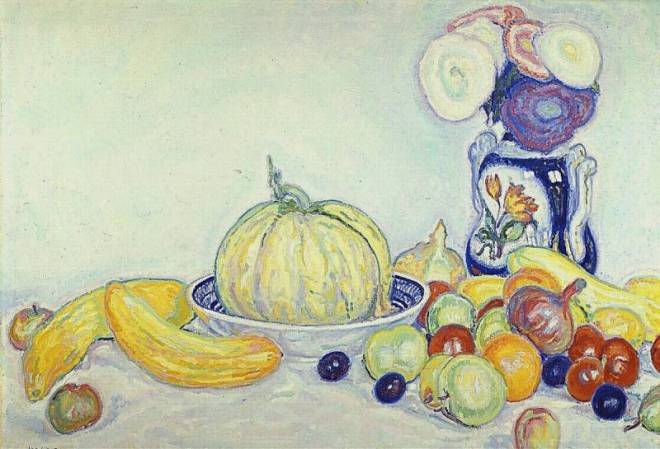
Unfortunately, I could find no painter of the 16th or 17th centuries who depicted this scene. The best I could come up with was this depiction by a 19th century American folk artist who goes by the wonderful name of Erastus Salisbury Field.

From the short piece of text I cited above, I think readers will immediately see that Erastus was depicting the moment when the cart arrived in Beth Shemeth.

Well, after this success at finding a painting to fit my cousin’s presumed guild, what about me? First of all, what could have been my guild? Well, my last job was for the UN, and that certainly didn’t exist in the golden age of guilds, so that couldn’t be an entry point for me. I suppose UN work could be associated to government work. But government workers didn’t get a guild either – they did (and still do) nothing practical, just write and file documents of one form or another. My job before that – as a consultant – doesn’t help either. Consultants just advise, with the real work being done by others. As I wrote in my home page, I suppose the one thing which has run like a thread through all my jobs is that I had to write. So maybe I could have been a member of the Guild of Scriveners!

So now the question is, what could have been a suitable biblical scene to have painted for this guild? Scriveners are the same as scribes, and the New Testament is full of stories of scribes. But they are all negative stories, scribes being depicted as nasty people on the same level as the Pharisees. I don’t want negative publicity for my guild! So I turned once more to the on-line bible and did a search in the Old Testament. The best I could come up with is another obscure story in the Second Book of Kings involving King Josiah. Josiah instructs that the money which has been collected in the Temple be used for the Temple’s maintenance. While gathering the money, the High Priest finds the Book of Law (presumably the book had fallen out of use and this particular copy was gathering dust in some corner of the Temple). He gives it to Shaphan the scribe along with a report on how much money has been given to the maintenance crew. Shaphan comes before Joshua and reads the report but also reads him the Book of Law. Josiah tears his clothes because he realises that the Israelites haven’t been following the Law and “great is the wrath of the Lord that is kindled against us because our fathers have not obeyed the words of this book by doing according to all that is written concerning us.” I presume Josiah does something about this but I didn’t read any further. As my painting, I came up with this one, painted by the 17th Century Dutch painter Leonaert Bramer, showing Shaphan humbly reading the Book to a rather concerned-looking Josiah.
Well, this painting certainly fits with the period in which the other paintings in Antwerp cathedral were painted. Frankly, though, I prefer the painting I found for my cousin. But there you go.

Oh, and the rest of Antwerp was very nice.

POSTSCRIPT, 22 July 2018

After reading this post, a good friend of mine gave me some excellent suggestions for alternative paintings, both for my cousin’s guild as well as for my own. He was kind enough not to say it, but the key was to “think out of the box”, to put aside the straitjacket of finding a story in the Bible and to allow more creative ideas in. His suggestion for my cousin was Hieronymus Bosch’s “The Haywain Triptych”.
Pride of place in this triptych goes to a magnificent cart full of hay, the haywain, in the centre panel. The whole work is a rather delirious take – typical of Bosch – on the rather sad story of Man. On the left, after the rebel angels have been cast out of heaven (also the subject of that muscular painting above for the Guild of Fencers) we have Adam and Eve in the Garden of Eden, with them eventually being thrown out for having disobeyed God’s instructions. Then, in the middle, as the haywain of our lives trundles inexorably along towards death on the right, we have people enacting out every possible sin of which we are capable, busily ignoring Christ our Saviour up in the clouds. The result of all this is shown on the right, where we are all burning in Hell. I suppose you could say that this is the Medieval version of “Life’s a bitch and then you die”. I will leave it to my cousin to decide if he wants his guild to be represented by such a pessimistic vision of life.

As to my guild, my friend suggested Dürer’s “St. Jerome in his Study”.

This is an excellent suggestion! St. Jerome’s main claim to fame these days is his translation of the Bible into Latin, which he spent years over in the Holy Land, busily scribbling away. I think I can definitely live with Dürer’s vision of learned and saintly paper scratching in a library-like environment as the image that my guild would want to project in its side-chapel in Antwerp cathedral. It’s a pity that Dürer only did an engraving, a painting would have been better. I could of course go for one of the hundreds of paintings on this theme which litter every self-respecting museum, but they all rather irritatingly show St. Jerome half-naked. I understand this is due to a confusion: this Saint Jerome has been conflated with another saint of the same name who did indeed go around half naked and who spent his time beating himself as penitence. To show what I’m talking about, I show a take by on the topic by Caravaggio, where the painter at least had the decency to pretty much cover Saint Jerome up.

But writing semi-naked is definitely not my style.

This mention of Caravaggio has suddenly made me think of another exciting possibility! I had quite forgotten that there are other very saintly acts of writing in the Christian Story, namely the writing of the four gospels by the Evangelists Mark, Matthew, Luke and John. Caravaggio did an excellent painting of St. Matthew writing his gospel. Actually, he did two. The first was unfortunately destroyed in Berlin during the Second World War.

The patrons who commissioned the painting rejected it because it made St. Matthew look too stupid. It is certainly true that the St. Matthew in this painting looks completely befuddled as the young angel pretty much takes his hand and writes the story for him. So Caravaggio painted another version, still to be seen in all its glory in the chapel dedicated to Saint Matthew in the church of San Luigi dei Francesi in Rome.

As a caravaggiophile, I would love to have a Caravaggio represent my Guild of Scriveners! I have a feeling that my guild would have chosen the second Caravaggio for the same reasons as the original patrons, although personally I would have preferred the first. I love that completely confused look on St. Matthew’s face – writing is such a difficult task, you never know where your hand (left hand in my case) will lead you.
_____________________

Antwerp cathedral exterior: http://www.visitflanders.com/en/things-to-do/attractions/top/the-cathedral-of-our-lady.jsp
Antwerp cathedral interior: http://www.medievalists.net/2011/01/medieval-origins-of-the-cathedral-of-our-lady-in-antwerp-belgium/
Ambrosius Francken, “Multiplication of the Loaves”: https://commons.wikimedia.org/wiki/ File:Multiplication_of_the_Loaves_(Ambrosius_Francken)_July_2015-1a.jpg
Hans van Elburcht and School of Ambrosius Francken, “Miraculous Draught of Fishes”: https://www.dreamstime.com/stock-photo-antwerp-belgium-paint-miracle-fishing-scene-hans-van-elburcht-abbrosius-francken-year-september-cathedral-image77028241
Maerten de Vos, “Wedding at Cana”: https://www.gettyimages.at/detail/nachrichtenfoto/the-wedding-at-cana-oil-on-canvas-after-maarten-de-vos-nachrichtenfoto/526962934#/the-wedding-at-cana-oil-on-canvas-after-maarten-de-vos-kadriorg-art-picture-id526962934
Frans Floris, “Fall of the Rebel Angels”: https://commons.wikimedia.org/wiki/ File:Fall_of_rebel_Angels_(Frans_Floris)_September_2015-1a.jpg
Frans Francken, “Christ among the scribes”: https://commons.wikimedia.org/wiki/ File:Christ_among_scribes_(Frans_Francken)_September_2015-5.jpg
Artus Wolffort, “Adoration of the Magi”: https://commons.wikimedia.org/wiki/ File:Adoration_of_the_Magi_(Artus_Wolffort)_July_2015-1a.jpg
Quinten Metsijs, “Lamentation”: https://www.kmska.be/en/collectie/highlights/Schrijnwerkers.html
Truck: https://www.abrbuzz.co.za/mobility-beat/5689-volvo-trucks-retains-top-position-in-sales-service-and-parts-according-to-q4-scott-byers-results
John Constable, “The Hay Wain”: https://www.planet-puzzles.com/grafika-john-constable-la-charette-de-foin-1821-puzzle-1000-pieces.p46141.html
Erastus Salisbury Field, “The Ark of the Covenant”: https://fineartamerica.com/featured/ark-of-the-covenant-erastus-salisbury-field.html
Leonaert Bramer, “The Scribe Shaphan Reading the Book of Law to King Josiah”: https://www.passionforpaintings.com/en/art-gallery/leonaert-bramer-painter/the-scribe-shaphan-reading-the-book-of-law-to-king-josiah-oil-painting-reproduction

POSTSCRIPT
Hieronymus Bosch, “the Haywain Triptych”: https://www.museodelprado.es/en/the-collection/art-work/the-haywain-triptych/7673843a-d2b6-497a-ac80-16242b36c3ce
Albrecht Dürer, “St. Jerome in his Study”: https://www.pinterest.at/pin/208995238931007942/?lp=true
Caravaggio, “St. Jerome writing”: https://commons.wikimedia.org/wiki/File:Saint_Jerome_Writing-Caravaggio_(1605-6).jpg
Caravaggio, “Saint Matthew and the Angel”: https://en.wikipedia.org/wiki/Saint_Matthew_and_the_Angel#/media/File:Caravaggio_MatthewAndTheAngel_byMikeyAngels.jpg
Caravaggio, “The Inspiration of Saint Matthew”: https://commons.wikimedia.org/w/index.php?curid=136502

BRUGES AND BRICKS

Vienna, 5 July 2018

My wife and I have just returned from a whirlwind tour of Belgium with a cousin of mine and his wife – the battlefield of Waterloo, Tournai, Bruges, Ghent, Antwerp, Louvain (or Brugge, Gent, Antwerpen, Leuven, to give them their Flemish names), all in a mere six days. (in case any reader asks himself or herself, we left Brussels out because we had all been there before). I think the next couple of posts will be about various aspects of our trip (the exact number depending on how strongly my creative juices flow).

In this post, I want to focus on bricks. These became a source of fascination for me in Bruges. For those of my readers who haven’t yet been to Bruges, I should state that Bruges is a brick city par excellence. Much of it has been built in what is called the brick Gothic style, of which this – a picture of some street in Bruges – is a typical example.

Actually, I would call it the Dutch style. I know I’m entering a minefield here, since many Flemings would be indignant at having something of theirs called Dutch, but I’m afraid to say that I visited Amsterdam before I visited the lands of Flanders so for me the style is indelibly linked with the Netherlands. Perhaps, to try to avoid landing myself in the middle of local quarrels, I could call the style the Hanseatic style since our brief forays into other Hanseatic towns suggest that this is a style common to them all. (In passing, I should say that I was surprised to learn that Bruges was part of the Hanseatic league. I hadn’t known that it had extended this far south. I have made a mental note to buy myself a book on the Hanseatic league).

But actually it’s not the style of brick building that fascinated me in Bruges. It was the colour of the bricks. To put this in context, I should say that my feelings about brick colour have been very much shaped by the brick buildings in the UK, where bricks first impinged themselves on my retinae. Although it’s no doubt a gross exaggeration, I would classify British brick colours as pleasant, unpleasant, and frankly awful. In the pleasant category, I would put the country’s older brick buildings. Christchurch Mansion near Ipswich in Suffolk is a fine example.

Readers will note that the brick is not too red, you could almost say it has pink overtones, and the colour is pleasingly non-uniform.

In the unpleasant category, I would put just about every brick building put up in the UK since the Industrial Revolution. This picture of an old brick chimney – icon, I would say, of the industrial revolution – can stand in for this type of brick.

To make the point even more strongly, though, I also throw in a picture of an old factory

of one of the buildings in the original red brick universities (in this case Sheffield)

and of a row of normal houses.

Readers will note that the red is harsh, strong, crude, and that the bricks are much more uniform in colour than the older bricks. As far as I can make out, the much stronger red colour comes mainly from the bricks having been fired at higher temperatures, although it could also be due to the original clay holding more haematite (the iron mineral which mostly turn bricks red, although nowadays dyes – rather depressingly – are increasingly being used). As I understand from the little bit of technical literature I have boned up on, higher firing temperatures were used to make the bricks stronger and so more usable in larger structures. But I also read – though can scarce believe it – that at least in London redder bricks were used to make the buildings more visible in the fog (Peter Ackroyd’s Biography of London is given as the source of this nugget of information. I shall check it in my copy in Milan).

As for the frankly awful category, I would put all those bricks which are an unpleasant off-white. My grandmother’s old house in London can stand in for the genre.

But this brick was used extensively throughout London. Here’s a part of Waterloo Station.

It’s not just yesteryear that they used this brick. I throw in a picture of a modern use of bricks with this sickly colour.

I know there are readers out there who will indignantly tell me that it’s a beautiful colour, but as they say, “beauty is in the eye of the beholder” and in my eye that’s sick colour.

Now, after my trip to Bruges, I can add another brick hue to my pleasant category – indeed, perhaps I should create a new category, “very pleasant”, for this hue. This picture is an example of the type.

As I hope readers can see, the buildings in this case give off a very definite orange “glow”. A somewhat hasty study of such buildings as we moved from one place to another has led me to conclude that the colouring comes from a brick which indeed has more orange than pink hues but also from a savant mix of this brick with bricks of the hideous sick colour the effect of which is to give rise to a paler orange than might otherwise be the case. I throw in pictures which I took of some other buildings with the same light orange hue.


Very nice …

And oh, by the way, Bruges is a very pleasant place to visit. A bit overrun by tourists, perhaps, but at least in June still acceptable. Don’t be fooled by such idiot titles as “the Venice of Flanders”. The place has a few canals but in no way do they compare to Venice.

___________________

Bruges street: https://www.gettyimages.at/detail/foto/old-street-with-crow-stepped-gable-houses-in-bruges-stock-fotografie/578469816
Christchurch mansion: https://www.tripadvisor.co.uk/LocationPhotoDirectLink-g190725-d1575683-i74779233-Christchurch_Mansion-Ipswich_Suffolk_East_Anglia_England.html
Old factory chimney: https://www.istockphoto.com/at/foto/alte-industrielle-gemauerten-schornstein-gm932649592-255603992
Old factory: http://www.antiqueslink.com/antiques/antique-archaeology-492420.html
Firth Court, University of Sheffield: http://www.geograph.org.uk/photo/2889648
Brick houses: https://en.wikipedia.org/wiki/Accrington_brick
My grandmother’s house: https://www.buildington.co.uk/london-sw7/40-montpelier-square/40-montpelier-square/id/3544
Waterloo station: By Alex.muller – Own work, CC BY-SA 3.0, https://commons.wikimedia.org/w/index.php?curid=4350988
modern use of london yellow stock: https://wienerberger.co.uk/inspiration/tower-bridge
Bruges houses: my photos