POSTS

CACTUS RULES, OK!

Los Angeles, 19 April 2018

As we did last year, during our latest stay in Los Angeles my wife and I visited the old house and grounds of Arabella and Henry Huntington, now the grandly-named Huntington Library, Arts Collection, and Botanical Gardens. The arts collection, which we visited thoroughly last year, is well worth a visit. It holds some very famous pieces of European art, such as the Blue Boy by Thomas Gainsborough.

It also has a really great collection of American art, especially early American art, holding this piece for instance.

But this year we ignored the art and headed for the gardens. Because the gardens are equally wonderful. During their lifetimes, the Huntingtons had already laid out several gardens around the house. One was a traditional rose garden (primarily so that Arabella Huntington could fill the house with cut roses). Henry Huntington also started a camellia garden along the edges of the Vista which the couple created in front of the house. He also surfed what was then a popular trend and created a Japanese garden. He was also an admirer of palm trees, so he started a palm garden. And after some prodding from his head gardener, he agreed to start a desert garden. The same head gardener, presumably with Mr. Huntington’s approval, also installed lily ponds in an unsightly corner of the garden.

Some of these original gardens have been expanded over the years, while new gardens have been added: a Chinese garden, a semi-tropical garden, a tropical (“jungle”) garden, and an Australian garden (along with a couple of much smaller gardens: a herb garden and a Shakespeare garden, the latter housing all the plants mentioned in one way or another in Shakespeare’s works). All in all, this complex of gardens give the visitor a taste of the sights and scents of many of the world’s biomes (they also give people a lovely scenography for picnics and general lazing around on lawns).

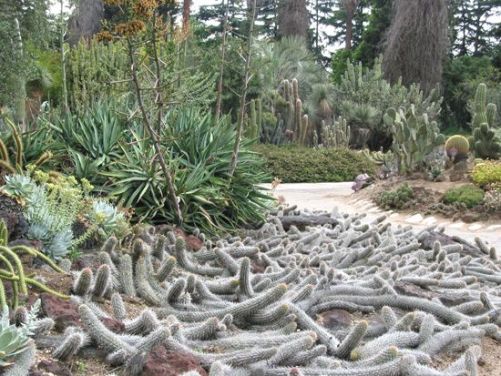
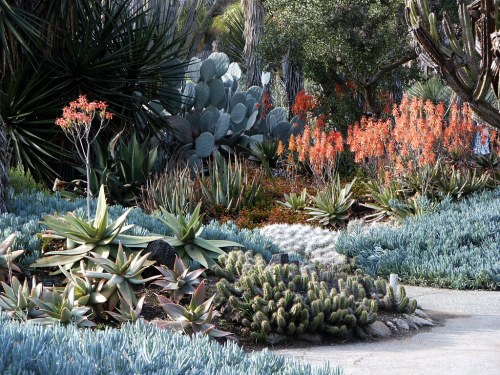
The desert garden is what interests me today. As we wandered the paths which crisscross it, we marveled at the wonderful cacti and succulents which populate this garden. We are not the only ones to have been struck by them. I throw in here some of the better pictures which other visitors have posted on-line.


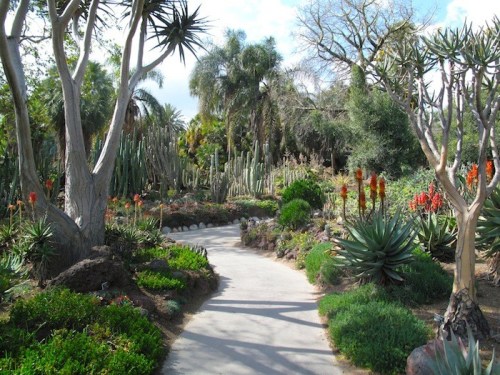
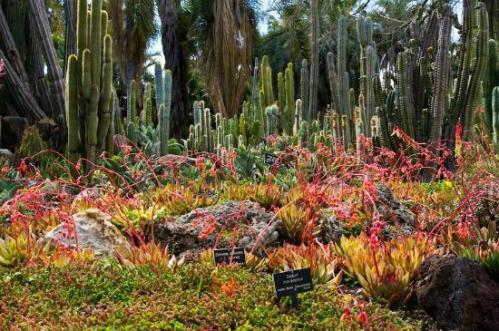
If I focus on the desert garden rather than on any of the other gardens at the Huntington it is because of water, or rather – in this part of the world – the lack of it. As most people probably know, Los Angeles and southern California in general is a semi-desert; in fact, the region wouldn’t have been able to develop nearly as much as it has if its politicians hadn’t managed to filch large amounts of water from the northern part of the State. But this grand water larceny has only put off the day of reckoning. Southern California is running out of water. Something must be done to contain water use.

Under the circumstances, it makes eminent sense for everyone in this city who has a garden to stop planting water-thirsty plants, especially those lawns so beloved by Americans. Here are a few prime examples from the swank properties surrounding the Huntington.
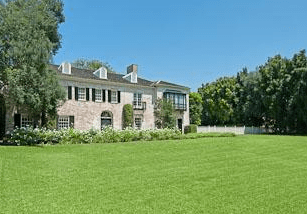

The Huntington itself has its fair share of thirsty lawns.
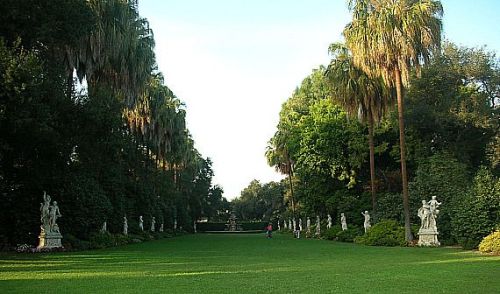
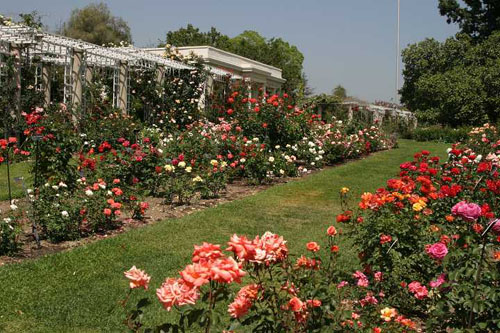
To their credit, the people running the Huntington are now pushing the idea that Angeleno gardeners should opt for water tolerant plants in their gardens. And what the desert garden shows is that a garden of cacti and succulents can be every bit as beautiful as a traditional garden. These poor plants get a lot of bad press, probably because of the spines which most cacti sport and perhaps because they can often look somewhat bedraggled. Certainly, it seems that Mr. Huntington’s initial reluctance to have a desert garden had to do with unspecified bad memories of run-ins with prickly pear cacti from the days when he was building his uncle’s railroads across the country. My guess is that his horse threw him into a patch of prickly pear – but that’s only a guess.

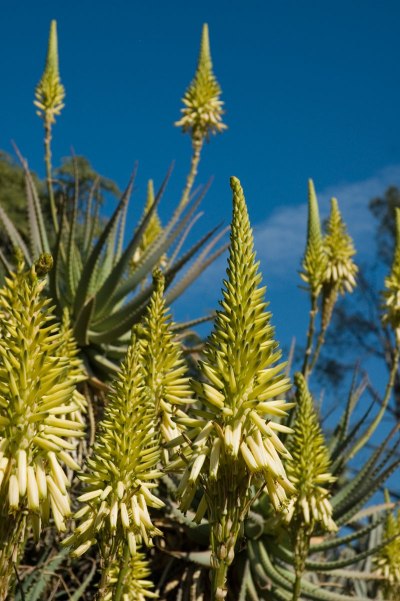
As we walk around the city, my wife and I notice an encouraging trend towards more cacti and succulents in gardens and public spaces.


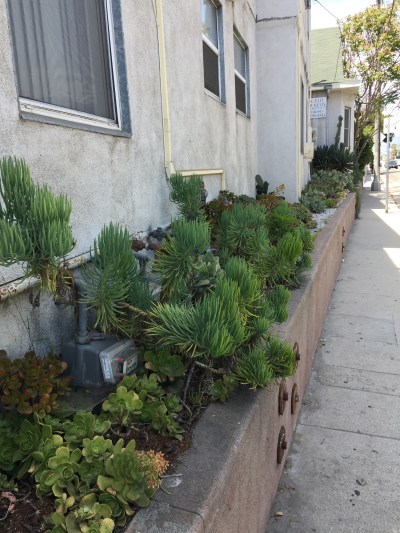
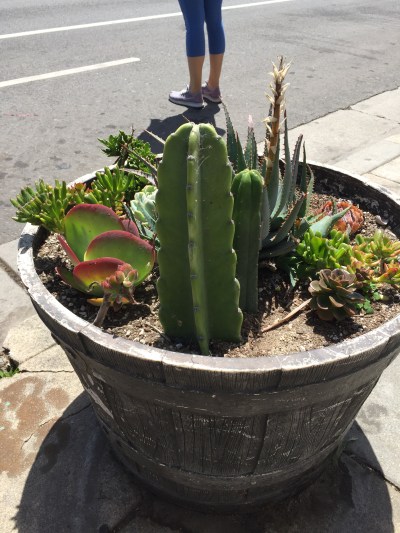
Among all the drought-tolerant plants on show, the one I am most fond of is this one, which I have been seeing a good deal of this year.  This example, for instance, graced a space near a bus stop which we were waiting at.
These examples, instead, are part of a more general planting of cacti and succulents which we have often been walking by as we stroll along the boardwalk at Venice Beach.

It is called, I have discovered, firesticks (or variations thereon: sticks-of-fire, sticks-on-fire, and probably others). The name obviously refers to the plant’s crown of very pretty red, pink, and orange stick-like twigs. It’s really very lovely. But beware! The white sap which oozes from a twig when broken can irritate the skin and is especially dangerous if rubbed into the eyes. I should know. The firestick is a direct descendant of the pencil tree.

This tree can be found throughout East and South Africa. And in fact it grew in our garden in Eritrea. I still remember my mother’s frantic screams when she realized that my little fingers one day had broken a twig and I was busily spreading the sap on the palm of my little hand.

Even though they don’t have a garden, my daughter and her boyfriend are moving towards cacti and succulents on their balcony. They have planted a bunch of flower pots with them. I’m pleased to see that the firestick is one of their choices.
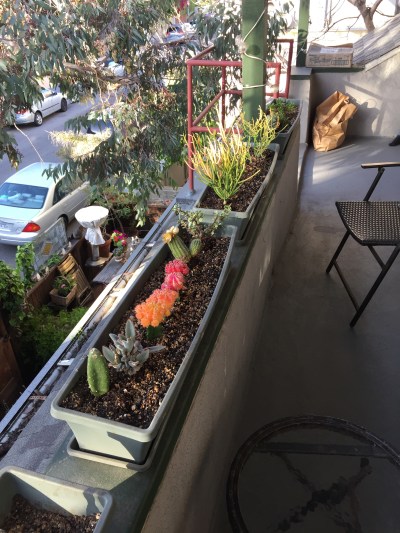
Truth to tell, they have chosen these plants not so much as a commitment to a more sustainable lifestyle but rather for their low maintenance requirements. Neither of them are particularly diligent in watering and previous planting attempts ended badly because of this. Let’s hope that when we come back next year, they are still flourishing: cacti and succulents rule, OK! (at least in Los Angeles)

__________________
The Blue Boy: http://huntington.org/webassets/templates/general.aspx?id=14392
Early American art: http://www.huntington.org/WebAssets/Templates/content.aspx?id=22779
Picnicking, Huntington gardens: https://www.facebook.com/HuntingtonLibrary/photos/a.70860174880.63671.51018909880/10156013615919881/?type=3
Desert garden-1: http://www.huntington.org/desertgarden/
Desert garden-2: http://fr.gde-fon.com/download/huntington_jardin-botanique-de-San-Marino/433151/2395×1590
Desert garden-3: https://www.google.co.uk/amp/s/www.gardenista.com/posts/escape-to-a-desert-garden-in-pasadena-huntington-library-garden/amp/?source=images
Desert garden-4: https://www.tripadvisor.com/LocationPhotoDirectLink-g33029-d110203-i41542481-The_Huntington_Library_Art_Collections_and_Botanical_Gardens-San_Marino_Cal.html
Desert garden-5: https://www.pinterest.com/amp/pin/107875353549586117/
Desert garden-6: https://www.flickr.com/photos/27398485@N08/3280510696
Desert garden-7: https://www.google.co.uk/amp/s/www.pinterest.com/amp/pin/561331541042981128/?source=images
Desert garden-8: https://www.visitpasadena.com/businesses/the-huntington/
Desert garden-9: https://www.google.co.uk/amp/s/christophvi.wordpress.com/2015/08/30/more-than-reading-at-the-huntington-library/amp/?source=images
Desert garden-10: https://commons.m.wikimedia.org/wiki/File:Golden_Barrels_%26_Senecio_mandraliscae_Blue_Chalk_Stick_succulents,_Huntington.jpg
Desert garden-11: https://www.google.co.uk/amp/s/www.gardenista.com/posts/escape-to-a-desert-garden-in-pasadena-huntington-library-garden/amp/?source=images
Desert garden-12: http://huntingtonblogs.org/2014/01/torch-bearers-of-the-desert-garden/
Desert garden-13: https://www.google.co.uk/amp/s/christophvi.wordpress.com/2015/08/30/more-than-reading-at-the-huntington-library/amp/?source=images
Desert garden-14: https://www.google.co.uk/amp/s/christophvi.wordpress.com/2015/08/30/more-than-reading-at-the-huntington-library/amp/?source=images
San Marino property-1: http://www.pasadenacarealestatehomes.com/blog/san-marino-ca-real-estate-market-reports/
San Marino property-2: http://activerain.com/blogsview/4681118/san-marino-ca-homes-for-sale-and-recent-market-activity-june-7–2015
Northern vista: https://www.google.co.uk/amp/s/www.pinterest.com/amp/pin/280278776779445390/?source=images
Rose garden: http://www.huntington.org/webassets/templates/general.aspx?id=15523
Gardens around LA with cacti and succulents: my photos
Firesticks: my photos
Pencil tree: http://patioplants.com/product/pencil-tree-cactus-euphorbia-tirucallii-big-7-deep-plug/
My daughter’s cacti: my photo

THE LATE AFTERNOON OF ONE’S LIFE

Los Angeles, 10 April 2018

A few days ago, my wife and I joined our daughter and her boyfriend at a concert being given at Los Angeles’s Walt Disney Concert Hall. The piece we heard was das Lied von der Erde, the Song of the Earth, by Gustav Mahler. As its name suggests, the piece is composed of six songs. The word “songs” risks to simplify the nature of what we heard. Perhaps musical meditations might describe it better. Mahler built his music around the texts of several Chinese poems from the Tang dynasty. He wove the music and words together to tell us a story of ineffable sadness, of regret of things not done, of memories of youth, of premonitions of one’s mortality, all things which I, at the age of 64, occasionally suffer from; who doesn’t, in the late afternoon of their lives? Aged 48 when he wrote it, Mahler was younger than I am today, but had recently suffered grievous blows: his eldest daughter had died of scarlet fever and diphtheria, he had been diagnosed with a potentially fatal congenital heart defect, and he was being forced out of his position as Director of the Vienna Court Opera by the antisemitic element in Viennese society.

I cite here an English translation of the first and last of these songs, the two which spoke to me most.

The drinking song of earth’s sorrow

The wine beckons in golden goblets
but drink not yet; I’ll sing you first a song.
The song of sorrow shall ring laughing in your soul.
When the sorrow comes, blasted lie the gardens of the soul, wither and perish joy and singing.
Dark is life, dark is death!

Master of this house,
your cellar o’erflows with golden wine!
Here, this lute I call mine.
A lute to strike and glasses to drain,
these things go well together.
A full glass of wine at the right time is worth more than all the realms of this earth.
Dark is life, dark is death!

The heavens are ever blue and the Earth
shall stand sure, and blossom in the spring.
But you O man, how long your life?
Not one hundred years may you delight
in all the rotten baubles of this earth.
See down there! In the moonlight, on the graves squats a wild ghostly shape;
an ape it is! Hear you his howl go out
in the sweet fragrance of life.
Now! Drink the wine! Now ‘tis time, friends.
Drain your golden goblets to the last.
Dark is life, dark is death!

The farewell

The sun drops down behind the mountains.
In every valley evening descends,
Bringing its shadows, full of coolness.
Look! like a silver bark
The moon floats in heaven’s blue lake.
I sense a delicate breeze stirring
Behind the dark fir trees.

The brook sings out clear through the darkness.
The flowers pale in the twilight.
The earth breathes, in full rest and sleep;
All desire now turns to dreaming.
Weary folk turn homewards,
So that, in sleep, they may learn anew
Forgotten joy and youth.
The birds huddle silent on their branches.
The world falls asleep.

A cool breeze blows in the shadow of my fir trees.
I stand here and wait for my friend.
I wait for him to take a last farewell.
I yearn, my friend, at your side,
To enjoy the beauty of this evening.
Where are you? You leave me long alone!
I wander to and fro with my lute
On pathways which billow with soft grass.
O beauty! O eternal-love-and-life-intoxicated world!

He dismounted and I handed him the drink of farewell.
I asked him where he was going,
And also why it had to be.
He spoke, his voice was veiled:
‘Ah! my friend – Fortune was not kind to me in this world!
Where am I going? I will wander in the mountains,
I seek rest for my lonely heart!
I journey to the homeland, to my resting place;
I shall never again go seeking the far distance.
My heart is still and awaits its hour!’

The dear earth everywhere
Blossoms in spring and grows green again!
Everywhere and forever the distance shines bright and blue!

Forever . . . forever . . .

As I bathed in the music and the words, another poem about the consciousness of time passing and of regret at things not done floated into my mind, A.E. Housman’s How Clear, How Lovely Bright.

How clear, how lovely bright,
How beautiful to sight
Those beams of morning play;
How heaven laughs out with glee
Where, like a bird set free,
Up from the eastern sea
Soars the delightful day.

To-day I shall be strong,
No more shall yield to wrong,
Shall squander life no more;
Days lost, I know not how,
I shall retrieve them now;
Now I shall keep the vow
I never kept before.

Ensanguining the skies
How heavily it dies
Into the west away;
Past touch and sight and sound
Not further to be found,
How hopeless under ground
Falls the remorseful day.

I only recently learnt of this poem, through Morse, that most intellectual of police chief inspectors on British television, who cites the last stanza in the very last episode of the series. He speaks it as the sun goes down over the Meadows at Oxford and as he faces the bleakness of his imminent retirement, little knowing that death awaits him the next day.

Housman’s metaphor of the sun rising and setting is echoed in a poem by Sara Teasdale, which I quoted in an earlier post, The River

I came from the sunny valleys
And sought for the open sea,
For I thought in its gray expanses
My peace would come to me.

I came at last to the ocean
And found it wild and black,
And I cried to the windless valleys,
“Be kind and take me back!”

But the thirsty tide ran inland,
And the salt waves drank of me,
And I who was fresh as the rainfall
Am bitter as the sea.

My discovery of this poem several years ago resulted from a student giving me a modern Chinese poem, a poem on departures, in this case from Cambridge. Funny that. In that roundabout way so typical of life, Tang Dynasty poems a thousand years old have been connected by way of Vienna, Los Angeles, and two ancient English university towns back to a modern Chinese poem.

Come on, old man, time to have another glass of wine.

CARLSBAD CAVERNS

Los Angeles, 7 April 2018

Alert readers of my previous posting may have been asking themselves what was the origin of the gypsum strata in the San Andres and Sacramento mountain ranges, which had played such a crucial role in the creation of the White Sands dunes (because, of course, they had not been magically created out of nothing, nor had they been lying there since the birth of the Earth). I’m not sure I can give a categorical answer to this question, but our visit to the nearby Carslbad caverns suggested one possible answer.

A little bit of background is in order here for the uninitiated. Carlsbad caverns constitute a very large underground limestone cave system in the Guadalupe Mountains of New Mexico. This little diagram gives an idea of the extent of the caves. As one can see, it is a series of large chambers connected by passageways.

Videos in the Visitors’ Centre helpfully inform the interested viewer that these chambers were formed by our friend gypsum! Many millions of years ago, as the Guadalupe Mountains were being uplifted, the limestone strata making them up cracked and fissured as the rocks twisted and turned. Rainwater percolated downwards through the cracks until it reached the water table, while hydrogen sulphide percolated upwards, given off by the crude oil and natural gas lying far below (and which we saw being pumped out on our way to the caverns).

When the hydrogen sulphide met the groundwater, it reacted with the oxygen in the water to form sulphur dioxide which then reacted with the water to form sulphuric acid. So the limestone cracks and fissures now found themselves bathing in sulphuric acid. This unforgiving acid attacked the limestone and turned it into calcium sulphate, which is none other than our friend gypsum. The gypsum washed away, leaving fresh limestone to be attacked by the sulphuric acid. And then the cycle repeated itself until the small cracks and fissures had turned into huge caverns. I imagine a similar process created the gypsum strata with which I started this post: hydrogen sulphide bubbling up into a sea above, the sulphuric acid so created attacking coral formations and turning the sea into a vast pool of dissolved gypsum, the sea drying out thereby creating beds of crystallized gypsum. Something along those lines.

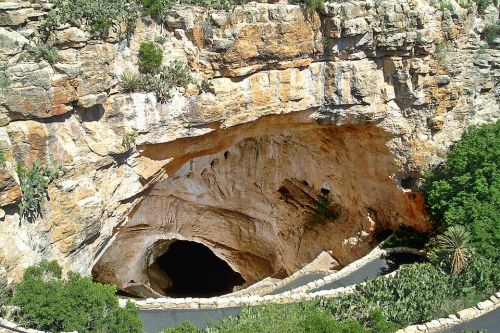
Coming back to the Carlsbad caverns, as the uplifting of the Guadalupe Mountains continued the caverns were raised out of the water table and drained of their acid. The caverns would no longer grow. But the rainwater kept percolating down, and in so doing filled the caverns with those formations which make such caves a wonder: the stalagmites and stalactites of course, but also the sheets, the draperies, the ribbons, the flowstones, … Carlsbad caverns have their share of these wonders. But first one has to get to them. The caves have a natural opening at the surface

through which Mexican free-tail bats stream in and out at night

as do cave swallows during the day.

But so do human visitors, who walk down, down, down


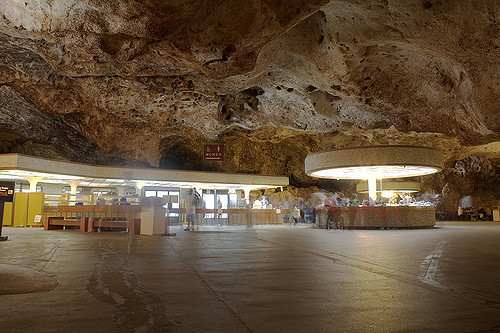
into the central chamber of the cave system, the Lunch Room, a huge cavern rather oddly decked out as a cafeteria.

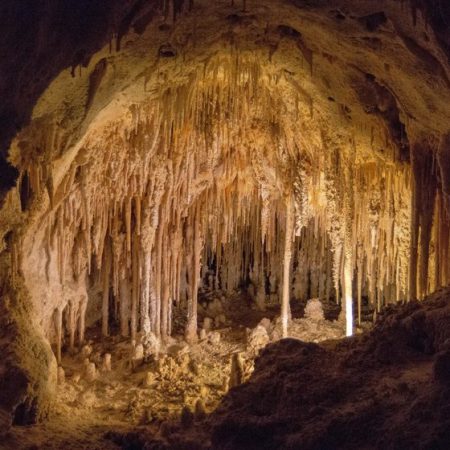
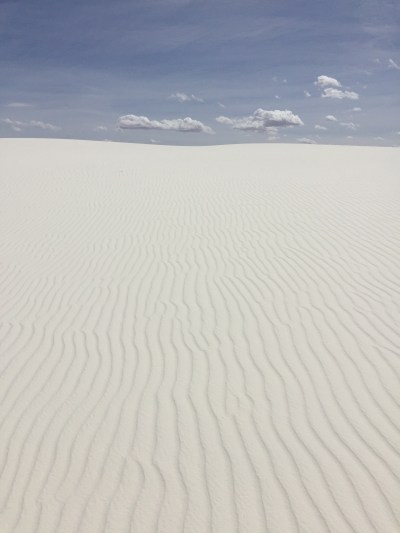
From there, visitors can explore – guided or unguided – other chambers. We chose to take the tour of the King’s Palace, which offered us these views.

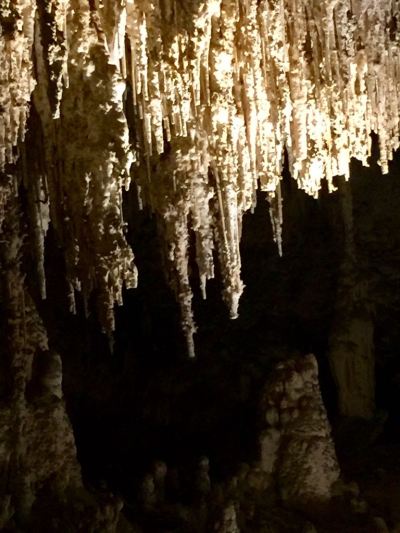
This cavern was also home to some strange-looking formations, which I had never seen before. The formations looked somehow gnarled and knotty.

It seems that these proturbances have been formed by convective patterns in the cavern’s air streams gently pushing the drops of water in directions other than down.

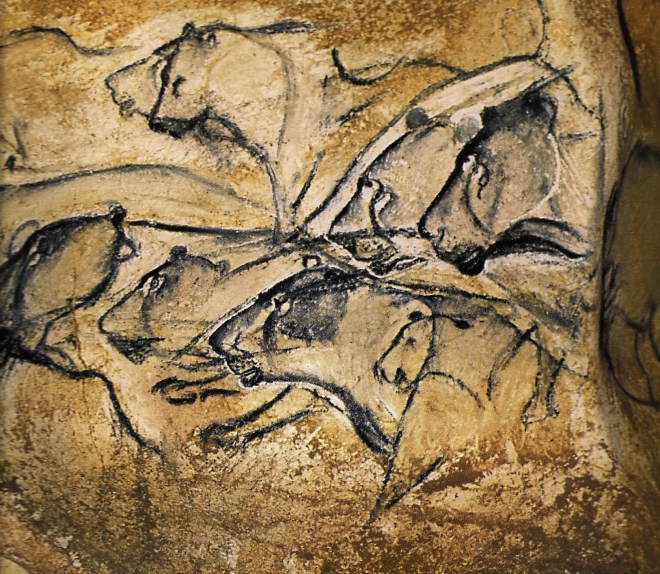
I hope I haven’t bored my readers with all this science. I find it fascinating, although I recognize that others may find it tedious or, even worse, that it may bring back bad memories of sitting benumbed in chemistry classes at school. To make it up to them, let me talk about art, or more specifically prehistoric cave art. Of which, unfortunately, there is hardly any at Carlsbad caverns. There is no prehistoric art in the caves themselves. It seems that the Native Americans were afraid of entering the cave, from which they believed their ancestors had originated. There are reports of Native American pictographs around the natural opening, although I didn’t see them and found no photos of them on the web. No matter! I’ll transport ourselves thousands of kilometers eastward to the caves in France and Spain on whose walls our Paleolithic ancestors painted some 40,000 years ago, and I’ll throw in some pictures of the cave art one can find there.


These paintings are very interesting, no doubt about it, but what impresses me even more is that the artists ventured so deep into the earth to paint them. At some point during our tour of the King’s Palace, our guide turned off all the lights. The resulting darkness was absolute. Your eyes never accustomed themselves to the dark as they would outside, allowing your eyes to eventually see something, even if only indistinctly. It was instead unremittingly pitch black, an extremely disagreeable sensation. Of course, our Paleolithic ancestors would not have painted in the dark, they would have taken torches down. But even a torch would have given off precious little light; our guide lit a lantern powered by a candle and such light is faint indeed.

How did our ancestors create such lovely sketches in such a tremulous light? And how did they overcome their fear in going so deep into the inky blackness of these caves? Questions without answers.

________________
Map of Carlsbad caverns: http://carlsbadnewmexico.com/places/carlsbad-caverns-maps/
Oil derrick in New Mexico: https://fronterasdesk.org/content/9902/new-mexico-lawmaker-faces-challenge-strengthening-oil-regulation
Natural opening: https://www.tripsavvy.com/new-mexico-honeymoon-activities-1863221
Bats at natural opening: https://miraimages.photoshelter.com/image/I0000Zbbmp9jYDCc
Cave swallows at natural opening: https://www.tripadvisor.com/LocationPhotoDirectLink-g60761-i23159610-Carlsbad_New_Mexico.html
Path down through natural opening: https://www.google.co.uk/amp/s/www.pinterest.com/amp/pin/138556126016751944/?source=images
Main Corridor: https://www.nps.gov/cave/planyourvisit/fees.htm
Lunch Room: https://www.flickr.com/photos/46062921@N00/442216196
King’s Palace-1: my wife’s photo
King’s Palace-2: http://rv-dreams.typepad.com/rvdreams_journal/2007/06/carlsbad_cavern.html
King’s Palace-3: http://traveltips.usatoday.com/rv-parks-carlsbad-caverns-52061.html
Gnarled, knotty formations: my wife’s photo
Prehistoric art-1: https://www.archaeological.org/tours/europe/25009
Prehistoric art-2: https://www.atlasobscura.com/places/cave-of-lascaux
Prehistoric art-3: https://www.google.co.uk/amp/s/phys.org/news/2011-11-ancient-dna-insights-cave-horses.amp?source=images
Prehistoric art-4: https://www.google.co.uk/amp/s/www.pinterest.com/amp/pin/513551163733767543/?source=images
Candle in a cave: https://www.dragonsdawn.org/nmtCaver/El_Malpais_Feb_2017/index.html

WHITE SANDS NATIONAL MONUMENT

Los Angeles, 30 March 2018

Like most children who have spent holidays on a beach somewhere, both my wife and I have memories of playing in sand dunes, I in Norfolk

she along Italy’s Adriatic coast.

Then, after we met and started traveling the world we visited a number of large-scale sand dune systems, far away from any sea. The first we saw, at the start of our lives together, were the sand dunes of Death Valley.

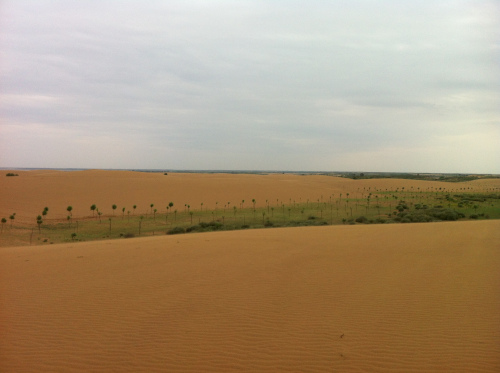
On a business trip a few years ago, I visited the sand dunes of Inner Mongolia which are remorselessly engulfing farmland; I commented on these in an earlier post.

And then there were the sand dunes of Namibia, which we visited one Christmas some ten years ago with our children.

The most awesome of these dunes were a dull red, with the biggest towering over us.

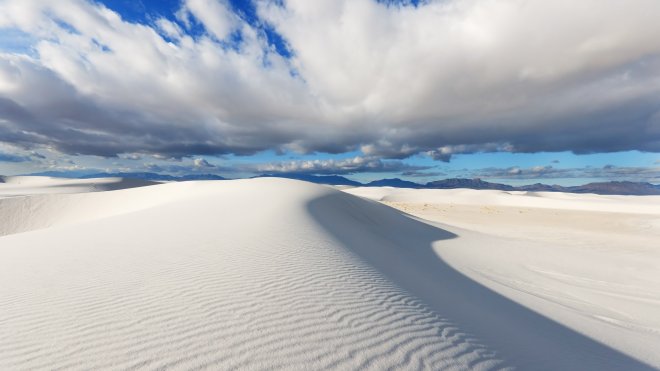
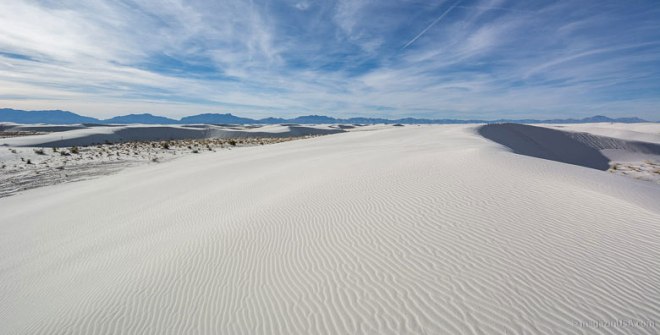
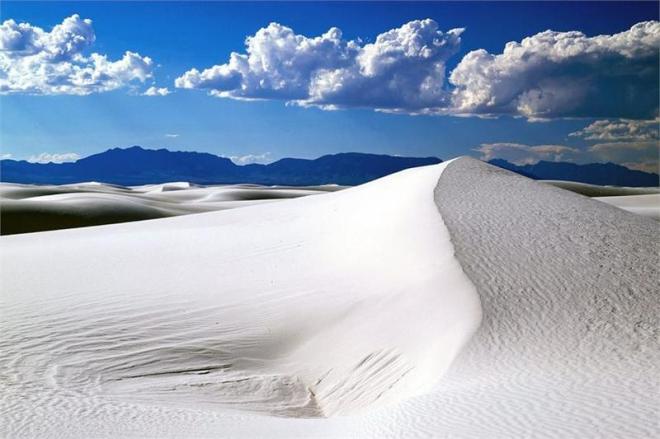
But the blindingly white dunes of the White Sands National Monument in New Mexico, which we visited last week with our daughter and her boyfriend, are in a class of their own. The eerie beauty of these dunes has led better photographers than I to surpass themselves, and I have shamelessly pinched some of the best of their photos to insert here.


We walked in a big circle, from dune crest to dune crest, marveling at the vistas before us of undulating whiteness, all the way, so it seemed, to the surrounding mountain ranges.

I’ve been careful not to refer to these dunes as sand dunes, because they are not sand as we normally understand that term, that is to say silicate. These are dunes of gypsum (calcium sulphate to the chemically inclined of my readers).

In the morning, we had visited Lake Lucero, which lies to the southwest of the dunes. It is an evanescent lake; it appears during the rainy season in late summer and is gone by the time the windy season in the spring rolls around. When we visited it, there was no sign of any water.

Here we could see how the gypsum “sand” had been created. It all started 24,000 years ago, when a new ice age started and the climate in this corner of New Mexico began to be much wetter than it is today. For nigh on 14,000 years frequent rains lashed the nearby San Andres and Sacramento mountain ranges. The rainwater nibbled away at strata of gypsum which had been exposed by the mountains’ uplifting, and streams carried the dissolved gypsum into a lake at the foot of the mountains. This lake has been named Lake Otero. The lake had no exit, so it grew in size until the water evaporating balanced the stream water entering. But the gypsum (and other salts) carried into the lake remained and slowly concentrated. Then, some 10,000 years ago, the ice age came to an end, and the climate here became dryer. Less rainwater fell on the mountains, streams got smaller or disappeared, and Lake Otero began to shrink. As it shrunk, the dissolved gypsum became ever more concentrated until finally the lake water was saturated. The gypsum started precipitating out of the lake water, forming huge crystals of selenite in the process, which then settled onto the lake’s bed. This picture shows a very pure crystal of selenite, which is colourless.


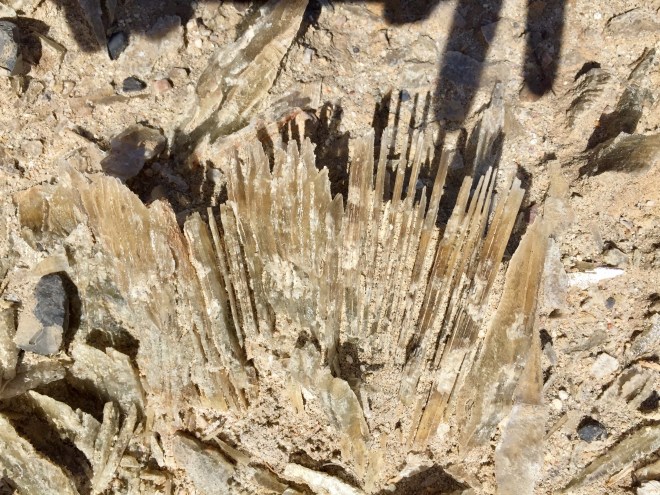
But during our ramble along the shores of Lake Lucero we saw selenite crystals in their more natural state, jutting out of the ground. They were various shades of brown; other substances that were present in the lake water have colored the crystals.


And still Lake Otero kept shrinking, until nothing but Lake Lucero – sometimes there, often not – was left.

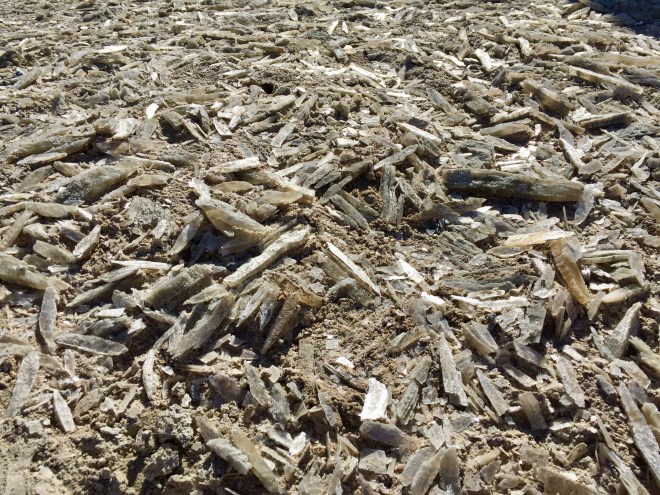
With the climate change of 10,000 years ago came strong winds. For the last 10,000 years they have been scouring the alkaline flats left bare when Lake Otero disappeared. They first carried away the thin crust of clay and fine particles, which exposed the selenite. Freezing and thawing cycles went to work on the crystals, breaking them along their weakest plane. The process continues to this day. We saw these crystals of selenite down at Lake Lucero being slowly split open.


The shores of Lake Lucero are littered with fragments of selenite crystals, broken up by wind, frost and heat.

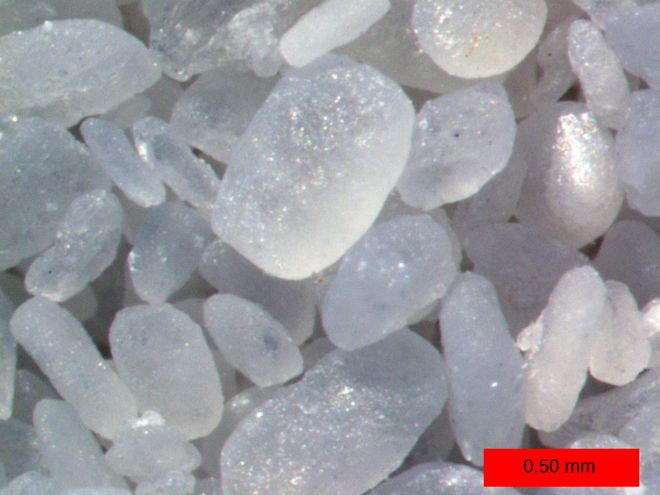
On and on went the work of breaking down the crystals until they had become flakes light enough to be carried along by the prevailing southwesterly winds. As the flakes bowled along over the alkaline flats, tumbling over and over, they cracked and crumbled further until only small sand-like grains were left.

The winds have pushed the grains up into the dunes that we see today. And all that tumbling has so scratched and scarred and pitted the surface of the grains that they reflect back sunlight in all its wavelengths so that we see them as intensely white.

Unbeknownst to us, my wife and I have been living with selenite around us in the apartment in Milan, although in this case in the form of desert roses.

My mother-in-law picked them up in Algeria, where she visited some of the oases south of the Atlas Mountains and walked the dunes of the Saharan desert, like these at the Biskra oasis.

Another dune system for my wife and I to visit – once Isis no longer roams the Sahara desert, kidnapping and beheading hapless tourists.

____________________

Norfolk dunes: http://www.bringingtheoutsidein.co.uk/landscape_photography/holkham.html
Dunes Adriatic coast: https://www.rentbyowner.com/property/hotel-le-dune/BC-268102
Sand dunes Death Valley: https://www.tripadvisor.com/LocationPhotoDirectLink-g143021-d2255762-i116167540-Mesquite_Flat_Sand_Dunes-Death_Valley_National_Park_California.html
Sand dunes Inner Mongolia: my picture
Sand dunes Namibia-1: https://it.pinterest.com/pin/6685099420949300/?lp=true
Sand dunes Namibia-2: https://travelservice.tips/attractions/africa/sossusvlei-dunes.html
White sands-1: https://www.nationalparks.org/connect/blog/wave-dunes-white-sands
White sands-2: http://www.magazinusa.com/us/states/show.aspx?state=nm&doc=10&dsc=White_Sands_National_Monument
White sands-3: http://www.bbc.com/earth/story/20160517-the-beautiful-white-sand-dunes-that-should-not-exist
White sands-4: https://www.newmexico.org/listing/white-sands-national-monument/218/
Lake Lucero: my wife’s picture
Selenite-pure: http://www.crystallinephoenix.com
Selenite crystals in the ground: my pictures
Selenite crystals on Lake Lucero shore: my picture
Gypsum grains: https://en.m.wikipedia.org/wiki/White_Sands_National_Monument#/media/File%3AWhiteSandsGypsum.jpg
White sands-5: my picture
Desert rose: https://www.feelcrystals.com.au/product-category/crystal-meanings/desert-rose-crystal/
Tadrart, Algeria: https://www.tripadvisor.com/LocationPhotoDirectLink-g293717-d504734-i300952025-Algerian_Sahara-Algeria.html
Biskra oasis, Algeria: https://plus.google.com/105463517722617181754

THE ODYSSEY: DAYDREAMS OF MY YOUTH

Milan, 10 March 2018

A couple of days ago, my wife declared that I needed to buy some books since my supply of unread books was running low. No sooner said than done: we popped down into the basement of the large bookshop in the Galleria Vittorio Emanuele in Piazza Duomo and I spent a happy half hour perusing their shelves of English books. As I walked off with five or six new volumes to read, I spied a book whose title was “Odyssey”.

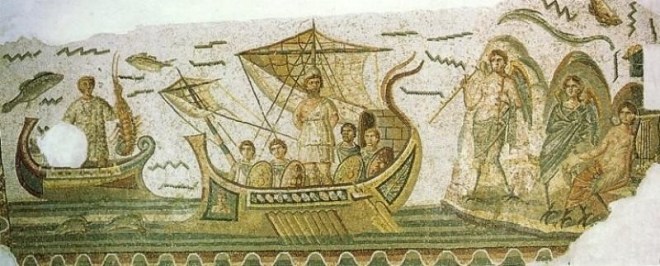
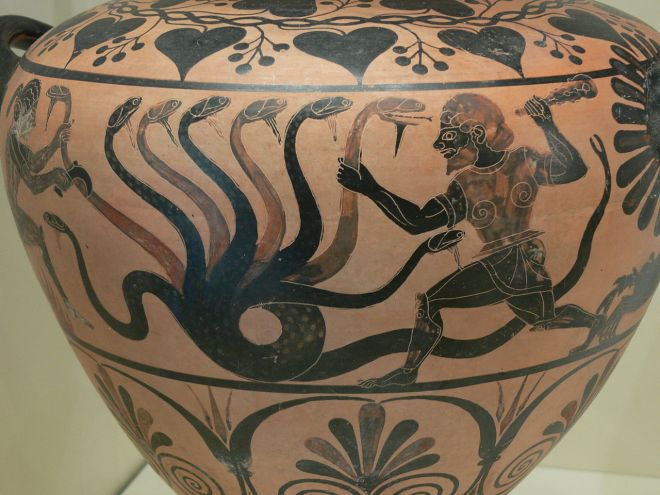
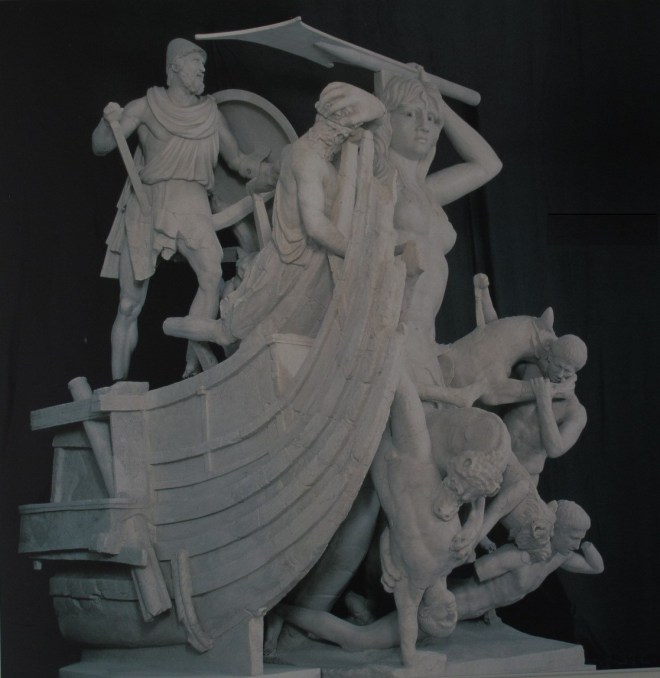
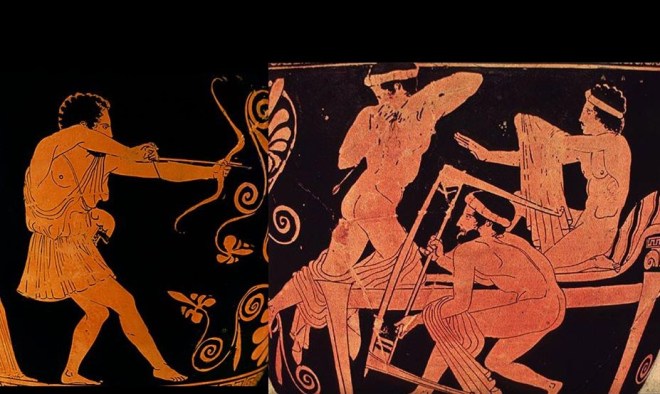
And suddenly I was 10-11 years old again, sitting in the school library, breathlessly reading a simplified version of the Odyssey which was written in installments in some boys’ weekly magazine. Week by week, I followed the crafty Odysseus as he and his men sailed away from the still smouldering ruins of Troy in his “racing warships across the wine-dark sea”, bound for Ithaca and his wife Penelope and son Telemachus. I absorbed his adventures, some of which I illustrate here with Greek pottery or Roman mosaics or sculpture (and in one case with a much more recent print because I couldn’t find an example from the Classical period); I accompany the illustrations with passages from the text of the Odyssey translated by Robert Fagles:

In the land of the Lotus Eaters

Any crewmen who ate the lotus, the honey-sweet fruit,
their only wish was to linger there with the Lotus-eaters,
grazing on lotus, all memory of the journey home
dissolved forever. But I brought them back—I forced them,
hauled them under the rowing benches, lashed them fast
and shouted out commands to my other, steady comrades:
‘Quick, no time to lose, embark in the racing ships!’—
so none could eat the lotus, forget the voyage home.

In the cave of the cyclops Polyphemus, who is now in a drunken sleep after tossing down several large bowls of wine given to him by Odysseus

Now, at last, I thrust our stake in a bed of embers
to get it red-hot and rallied all my comrades:
‘Courage—no panic, no one hang back now!’
And green as it was, just as the olive stake
was about to catch fire—the glow terrific, yes—
I dragged it from the flames, my men clustering round
as some god breathed enormous courage through us all.
Hoisting high that olive stake with its stabbing point,
straight into the monster’s eye they rammed it hard—
and bored it round and round in the giant’s eye
till blood came boiling up around that smoking shaft
and the hot blast singed his brow and eyelids round the core
and the broiling eyeball burst—its crackling roots blazed
and hissed. He loosed a hideous roar, the rock walls echoed round
and we scuttled back in terror. The monster wrenched the spike
from his eye and out it came with a red geyser of blood —
he flung it aside with frantic hands, and mad with pain.

On Circe’s enchanted island

She opened her gleaming doors at once and stepped forth,
inviting them all in, and in they went, all innocence.
She ushered them in to sit on high-backed chairs,
then she mixed them a potion—cheese, barley
and pale honey mulled in Pramnian wine—
but into the brew she stirred her wicked drugs
to wipe from their memories any thought of home.
Once they’d drained the bowls she filled, suddenly
she struck with her wand, drove them into her pigsties,
all of them bristling into swine—with grunts,
snouts—even their bodies, yes, and only
the men’s minds stayed steadfast as before.
So off they went to their pens, sobbing, squealing
as Circe flung them acorns, cornel nuts and mast,
common fodder for hogs that root and roll in mud.

Sailing by the sirens

I stopped the ears of my comrades one by one.
They bound me hand and foot in the tight ship—
erect at the mast-block, lashed by ropes to the mast—
We were just offshore as far as a man’s shout can carry,
scudding close, when the Sirens sensed at once a ship
was racing past and burst into their high, thrilling song:
‘Come closer, famous Odysseus—Achaea’s pride and glory—
moor your ship on our coast so you can hear our song!’
So they sent their ravishing voices out across the air
and the heart inside me throbbed to listen longer.
I signaled the crew with frowns to set me free—
they flung themselves at the oars and rowed on harder.
But once we’d left the Sirens fading in our wake,
once we could hear their song no more, their urgent call—
my steadfast crew was quick to remove the wax I’d used
to seal their ears and loosed the bonds that lashed me.

Sailing between Scylla and Charybdis

Now wailing in fear, we rowed on up those straits,
Scylla to starboard, dreaded Charybdis off to port,
her horrible whirlpool gulping the sea-surge down, down
the whole abyss lay bare and the rocks around her roared,
terrible, deafening— bedrock showed down deep, boiling
black with sand— and ashen terror gripped the men.
But now, fearing death, all eyes fixed on Charybdis—
now Scylla snatched six men from our hollow ship,
the toughest, strongest hands I had, and glancing
backward over the decks, searching for my crew
I could see their hands and feet already hoisted,
flailing, high, higher, over my head, look—
wailing down at me, comrades riven in agony,
shrieking out my name for one last time!

Odysseus killing the suitors

With that he trained a stabbing arrow on Antinous …
just lifting a gorgeous golden loving-cup in his hands,
just tilting the two-handled goblet back to his lips,
about to drain the wine—and slaughter the last thing
on the suitor’s mind: who could dream that one foe
in that crowd of feasters, however great his power,
would bring down death on himself, and black doom?
But Odysseus aimed and shot Antinous square in the throat
and the point went stabbing clean through the soft neck and out—
and off to the side he pitched, the cup dropped from his grasp
as the shaft sank home, and the man’s life-blood came spurting
out his nostrils— thick red jets— a sudden thrust of his foot—
he kicked away the table— food showered across the floor,
the bread and meats soaked in a swirl of bloody filth.

Ah, what stories, what stories!

Then, a few years later, when I was 13-14 years old, I caught the bug of trying to figure out the route which Odysseus had taken in the ten years he wandered the seas trying to reach home: just where were the land of the Lotus Easters, the cave of Polyphemus the Cyclops, the rocks on which the Sirens sat and sang, Scylla and Charybdis? Sitting in the quiet school library

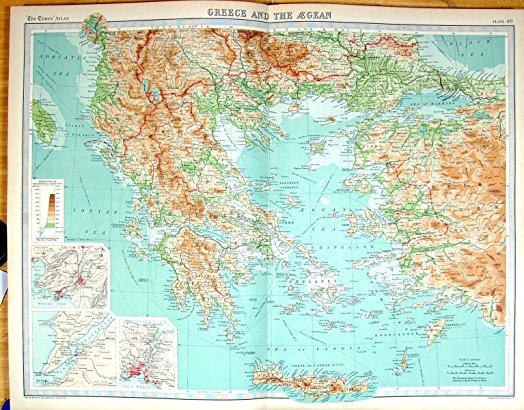
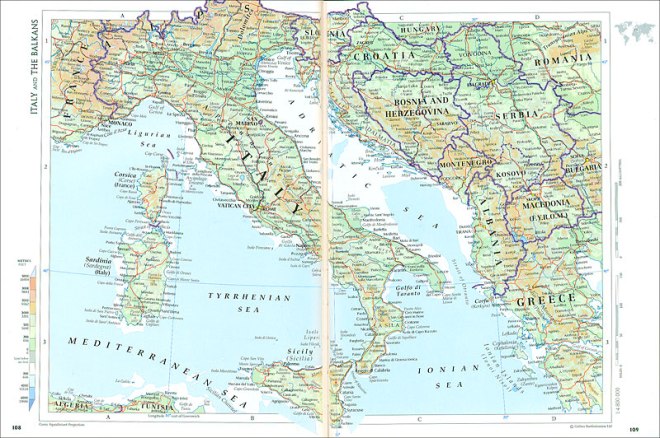
I would surreptitiously shove my homework aside – Latin, Greek, French, History, whatever it was – and go get myself the Times Atlas. This was a very large atlas with a lovely dark blue cover. It had maps of every corner of the world, but I zeroed in on the maps of the Mediterranean: the Aegean Sea

the North African coast up to Tunisia

Italy, especially the area around Sicily

and a glance or two across the western Mediterranean to Spain.

I pored over a translation of the Odyssey, which I found in some corner of the library, trying to tease out clues as to travel time and direction. Then, having got some information somewhere about how fast a sailing ship could go, I would examine the maps with furrowed brow, trying to turn this information into travel distance and direction. I read up on competing theories of Odysseus’s itinerary, which had maps looking like this.

I spent hours on this. But eventually reality stepped in. Either my grades were slipping or I realized that it was impossible to work out Odysseus’s itinerary with any level of certainty; I was slipping into the world of cranks. But it wasn’t all for naught: I was left with a love of maps and of the Mediterranean. And from time to time, when I have a chance encounter such as that in the bookshop, good memories flood back of this brief passion of mine.

____________
Escaping the Lotus Eaters: https://art.famsf.org/theodore-van-thulden/ulysses-and-his-companions-land-lotus-eaters-no-5-labors-ulysses-19633015206
Odysseus blinding the Cyclops: https://it.pinterest.com/pin/498914464951224721/?lp=true
Odysseus blinding the Cyclops: https://trecancelle.wordpress.com/2013/04/22/153-sperlongas-archaeological-museum-and-tiberius-grotto/
Circe turning Odysseus’s men into swine: http://www.theoi.com/Gallery/T35.7.html
Odysseus and the Sirens: https://en.wikipedia.org/wiki/Odyssey
Odysseus and the Sirens-mosaics: http://marmor-mosaike.de/FK035.html
Odysseus and Scylla: https://releaseyourkraken.com/blog-3-kraken-mythology/
Odysseus and Scylla (reconstruction): https://ontravelwriting.com/places-and-people/sperlonga-sculptures-group-ulysses-national-archaeology-museum/
Odysseus kills suitors: http://slideplayer.fr/slide/3720241/
Times Atlas Greece: https://www.amazon.co.uk/Original-Antique-Victorian-Greece-Scutari/dp/B0088WNU8Q
Times Atlas Italy: http://www.stanfords.co.uk/The-Times-Desktop-Atlas-of-the-World_9780008104986
Times Atlas Libya and Egypt: https://www.davidrumsey.com/luna/servlet/detail/RUMSEY~8~1~225480~5506188:Egypt-and-Libya,-Plate-85,-V–IV
Map with journey: https://it.pinterest.com/pin/74379831324150781/?lp=true

PIAZZA DUOMO, MILAN

Milan, 7 March 2018

My wife and I frequently have to go up to Piazza Duomo, Cathedral Square, in Milan, where we visit a little store in the underground station to do our printing. We can’t be bothered to buy a home printer, and anyway we need excuses to leave the house – one of the early lessons of retirement.

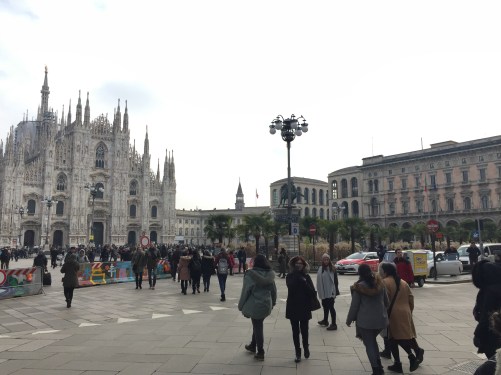
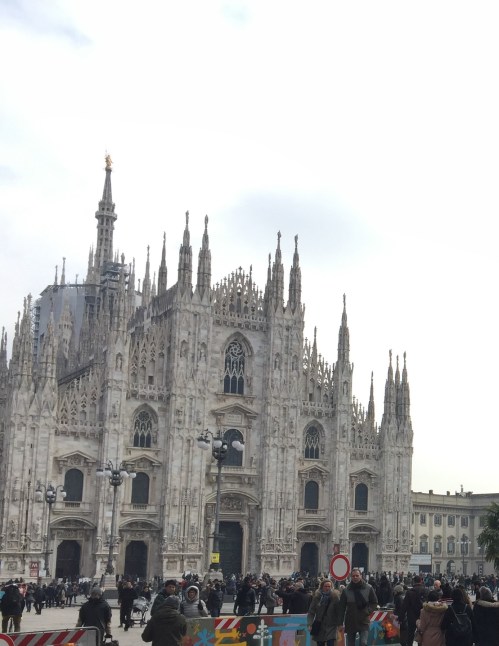
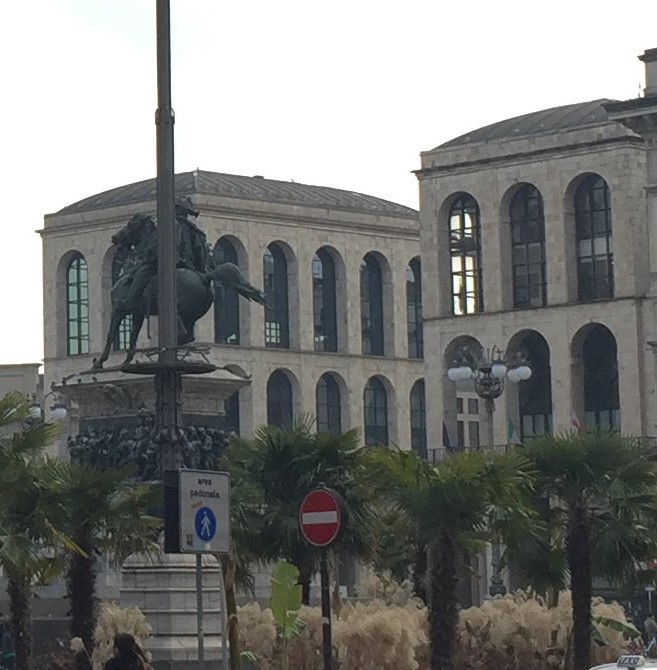
Our usual route takes us through the back streets, coming out at the piazza’s north-east corner. This is the sight that greets us:

I’m very fond of this view, because it encapsulates something like a thousand years of Milan’s architectural history. There are some even older bits of architecture scattered around the centre of the city, but at this point in time they really are just bits – some mosaic-covered arches here and there, from Milan’s early Christian period, tucked away at the back of what were once 3rd-4th century basilicas; short stretches of the city’s Roman streets, preserved in odd corners of underground stations; that sort of thing. Milan’s visible architecture really only starts in the early 1000’s AD.

Which is more or less where I want to start unpicking my photo. I invite my readers to zoom in on the campanile poking up at the back of the photo.

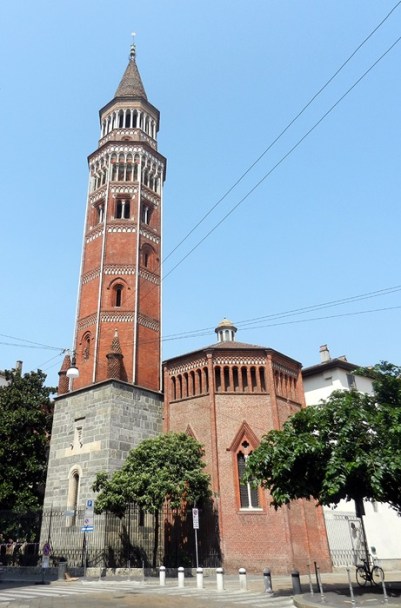
This is the campanile of the church of San Gottardo, built around 1336 by order of Azzone Visconti, then Lord of Milan. Azzone dedicated the church to Saint Gotthard because this saint was invoked by those who suffered from gout and stones, and poor Azzone suffered from both. The campanile shows the typical details of the Gothic-Lombard style: red brick combined with white marble, the latter often used in a series of small columns at the top of the tower, but also used to pick out details. Here is the campanile from behind, where this lovely combination of red brick and white stone is seen clearly.

The campanile is particular in another way, in being octagonal. It is not unknown for campanili to take this shape, but the campanile of San Gottardo, in its slimness and height, is a particularly elegant example of the form. In its current format, the campanile has no clock, which is a pity because at Azzone’s orders it originally carried Milan’s (and probably Italy’s) first public clock. This caused so much excitement at the time that for centuries afterwards the area around the church was known as Quarter of the Hours.

Next in time is the massive white Duomo, the city’s cathedral, to the left in my photo.

Actually, the building took centuries to complete, so it’s a little difficult to know what century to assign it to. Going by overall style, we can say that it belongs to the late 14th, early 15th Century. And in fact the decision to build the Duomo was taken in 1386 – so some 50 years after San Gottardo was built – by the-then archbishop Antonio da Saluzzo. It was to take the place of a baptistery and two existing cathedrals – the “winter” cathedral of Santa Maria Maggiore and the “summer” cathedral of Santa Tecla (a combination I have never heard of before). Antonio da Saluzzo was thinking big; he wanted a very large church worthy of the great city of Milan. But he was still thinking traditional; he had in mind a brick and marble church along the lines of San Gottardo. But that idea was nixed by Gian Galeazzo Visconti, who had just taken over the lordship of Milan (through a treacherous attack on his uncle Barnabò, who died shortly thereafter in prison; poisoned, it was whispered, by his nephew). Milan, ever since the Roman Empire, when it became the capital city for a while, looked north across the Alps towards the Empire’s border on the Rhine as well as south. Gian Galeazzo wanted to use the new cathedral to firmly anchor Milan to northern Europe through the use of its architectural styles, which at this point meant late gothic in the Rhenish-Bohemian style. Not only did that mean a different architectural style to the ones then in vogue in Italy, it meant a stone-faced building. So the Duomo that we see today is at its core Lombard, made essentially out of brick, but northern European in look because it is faced with stone. And what a lovely stone it is! A white marble with pinkish hues from the quarries of Candoglia close to Lake Maggiore.

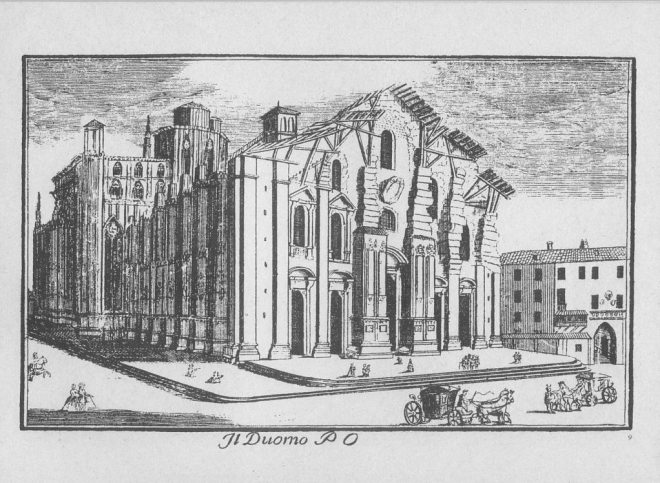
To get the style he wanted, Gian Galeazzo imported French architects, who already then behaved in that typically French manner, poo-pooing on the building techniques of their Lombard masons and generally pissing them off. Neverthless, things moved along, and by the time Gian Galeazzo died in 1402 (but not before becoming the first duke of Milan by paying Wenceslaus IV of Bohemia, King of the Romans, 1,000 florins for the privilege), half the church was complete. At that point, the whole building programme ran out of steam. Things crawled along for another century and a half, until Cardinal Carlo Borromeo took over the archbishopric. There was a spurt of activity for several decades until his death, at which point worked slowed to a crawl again. There were endless arguments about what style the facade should have, and numerous designs were proposed, accepted, then abandoned (something which seems to have been a general problem in Italy, as an earlier post of mine attests). This photo shows what the Duomo looked like in about 1745.

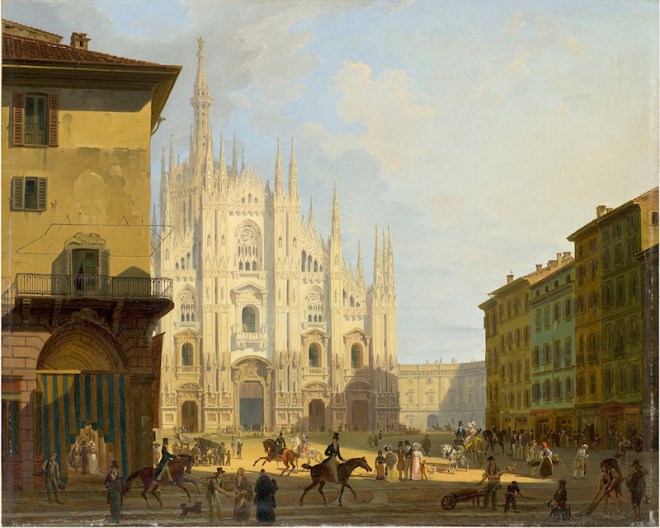
As readers can see, not only was the facade of the Duomo a mess, the cathedral itself didn’t yet have that forest of spires which give the building its distinctive look today. It took Napoleon to get the city to make the final push to get over the finish line. In 1805, he wanted to be crowned King of Italy in the cathedral and he wanted it to look worthy of this solemn ceremony. He made the rash promise that the French State would pay for the final works. This never actually happened, but the promise that someone else would pay galvanized the community and by 1819, when this painting was made, the Duomo looked pretty much how it is today.

Work still continued, and strictly speaking even today it is not finished; there are places where statues are still missing. But when the final door in the facade was installed in 1965, a mere 600 years after work was started, the Duomo was officially declared to be finished. Oof!

Next in time, we have the building standing in front of the campanile of San Gottardo.

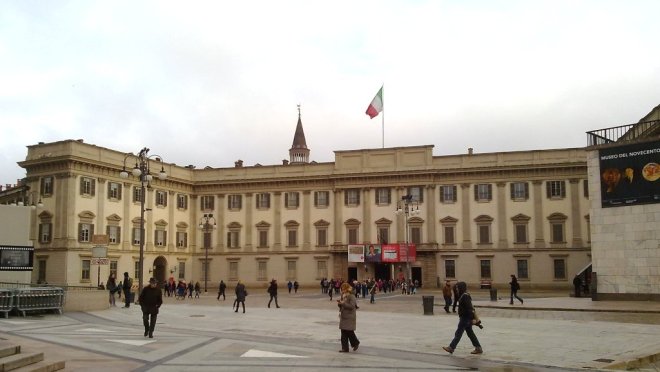
Unfortunately, because of the city government’s bizarre idea of planting palm trees in the piazza, one can now hardly see the building in question from where I took my photo, so let me insert here another photo which I lifted from the internet.

This is the so-called Palazzo Reale, the Royal Palace, although it almost never had royalty staying there. Since the earliest times, this was the area where the government buildings of the Comune and then the Duchy stood. As rulers of Milan and the surrounding territories succeeded each other – the Viscontis, the Sforzas, the French, the Spaniards, the Austrians, the French again under Napoleon, back to the Austrians once Napoleon was safely locked away on St. Helena – they or the Governors they sent added, demolished, changed, extended, and remodeled the government buildings and the lodgings they inherited to fit their needs and their egos. You would think that the result would be a hodgepodge, but actually a remodeling carried out in the 1760s gave the building its defining characteristics both inside and out. The facade that we see in my photo, the first example of the neoclassical style in Milan, is the fruit of that remodeling. Its architect, Giuseppe Piermarini, had a really hard time with the work. His purported client was Archduke Ferdinand of Austria-Este, a younger son of Empress Maria Theresa of Austria (and brother to Marie-Antoinette, who lost her head in the French Revolution). Maria Theresa had packed him off to Milan to marry Beatrice d’Este and to be Vienna’s governor of Lombardy. Ferdinand had dreams of Piermarini building him a residence worthy of his status (at least as he saw it) and a building that would rival the other stately piles going up around Europe (he particularly wanted to compete with his elder brother’s Schönbrunn summer palace in Vienna). But Piermarini’s real client, because she was paying the bills, was Maria Theresa. She was famously cheeseparing and anyway didn’t see her younger son’s position in quite as grand a light as he did. She just wanted him to suitably represent the Austrian Empire in Lombardy and to leave all the decision-making to Vienna. Somehow Piermarini managed to satisfy everyone without getting the sack or having a nervous breakdown and came up with the austerely elegant building that we see today.
The building experienced numerous further vicissitudes. Its moment of greatest glory was under Napoleon, when Milan was the capital of the Kingdom of northern Italy. After the Austrians came back in 1815, Milan went back to being capital of just Lombardy. With Italian unification, the building was handed over to the House of Savoy, but they rarely used it and eventually sold it to the municipality. It got badly damaged during a bombing raid in World War II. It now houses various museums and exhibition spaces.

Then we go to the building on the far right of my photo.

This was part of a rebuilding campaign decided on in 1860 in the wake of Italian unification. In their enthusiasm, the city fathers proclaimed their intention of radically redesigning the piazza in front of the Duomo, making it bigger and grander, and of creating a new major avenue to celebrate King Victor Emmanuel II, first king of the newly-united Italy. I suspect this urban remodeling plan was also seen as a way of cleaning up some embarrassingly leprous zones of the city centre. For instance, putting up the building in my photo, the southern Palazzo dei Portici, allowed the municipality to clear away a whole neigbourhood located there which went by the name of Rebecchino and which was full of petty criminals and other louche types who preyed on the pilgrims and other assorted tourists who visited the Duomo. The remodeling of the piazza in front of the Duomo took from 1865 to 1873. Its most famous element, which you can’t see in my photo, is the Galleria Vittorio Emanuele, which runs from Piazza del Duomo to the piazza in front of the Scala theatre.

But more significantly, I think, the whole piazza in front of the Duomo now has a harmony and elegance which it definitely lacked.

For once, a rebuilding programme decided by a municipal government has left us with something better than what it replaced, especially after a much later municipal government decided to ban advertising billboards on the building opposite the Duomo, Palazzo Carmini.

Which brings us to the final building in my photo, the one squeezed in between the Palazzo Reale and the Palazzo dei Portici.

Again, I think readers need another photo from closer by and without those silly palm trees in the way to appreciate the building.

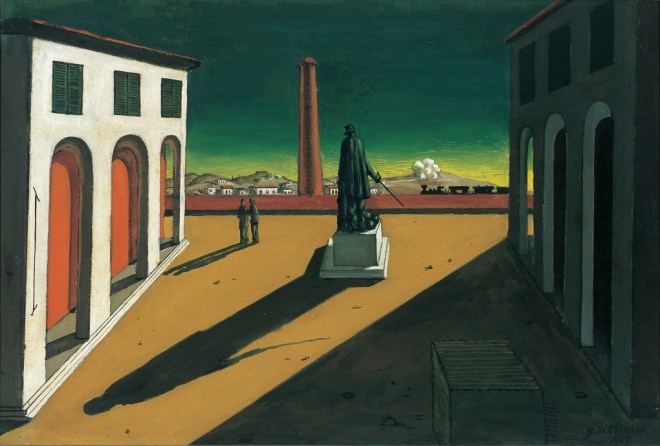
It is a building in the Fascist style, the competition for its design being held in 1937 and construction of the winning design starting in 1938. I don’t know if there is a formal definition of the Fascist style, but these buildings tend to have a “Roman” look to them: the use of white stone facing and of semi-circular arches. They also tend to have little external decoration other than massive, heroic-looking statues and bas reliefs. I don’t know if De Chirico was a Fascist, but many of his paintings have such building in them.

This particular building goes by the name of Arengario, which is an old Italian word first used in the Middle Ages to describe municipal buildings. The root of the word, “aringare”, is the same as the English word “harangue”, and in fact Arengari were buildings from which the municipal authorities addressed (or perhaps harangued) the local citizenry. In later centuries, the term Arengario fell out of use, presumably because municipal authorities couldn’t be bothered any more with the direct democracy of addressing the people. But since the Fascists, Mussolini in the lead, liked to harangue the luckless populace, they brought the word back into use. As a result, a number of Facist-built Arengari, Milan being one of them, are to be found throughout Italy. I presume the idea was that the Fascist cadre would adress Milan’s citizenry drawn up in the piazza below.

The winning design actually had as its overall objective to balance the triumphal arch at the beginning of the Galleria Vittorio Emanuele directly across the piazza, which is why there are two more-or-less identical buildings flanking the road which passes through them, rather than just the one you would need if all you were interested in was haranguing the crowds. The idea was that the road between the buildings would lead to another piazza (today Piazza Diaz) where the country’s modern (Fascist) companies would build their headquarters.

In the event, World War II intervened, construction was halted, what had been built was damaged during the bombing raid that damaged the Palazzo Reale next door, and the municipal authorities found themselves after the war with a damaged, unfinished Fascist building on their hands. The balcony from which the Fascist haranguing was meant to have taken place was quietly demolished and the rest of the buildings were completed by 1956. After various uses, the building next to the Palazzo Reale now houses Milan’s museum of 20th Century art. I highly recommend this museum to any of my readers who happen to be passing though Milan.

Well, that finishes my little tour of Piazza Duomo. Without wanting to sound too much like the local tourism office (which used to be housed in the Arengario), I highly recommend my readers who come to Italy to stop off in Milan before they hasten on to Florence, Rome, and Venice. A stop in Milan can be highly rewarding – in my case, it got me my wife.

________________

Overview and zoom-in photos: mine
San Gottardo: https://it.wikipedia.org/wiki/Chiesa_di_San_Gottardo_in_Corte
Duomo 1745 circa: https://it.wikipedia.org/wiki/Duomo_di_Milano#Contesto_urbanistico
Duomo 1819: https://it.wikipedia.org/wiki/Piazza_del_Duomo_(Milano)
Palazzo Reale: http://ciaomilano.it/e/sights/preale.asp
Galleria Vittorio Emanuele II: https://it.wikipedia.org/wiki/Galleria_Vittorio_Emanuele_II
Piazza del Duomo: https://www.youtube.com/watch?v=SRUXl0wyvLY
Palazzo Carmini, 1970s: https://it.wikipedia.org/wiki/Palazzo_Carminati
Arengario: https://www.pinterest.co.uk/pin/339177415661775996/?lp=true
De Chirico painting: https://www.arteallimite.com/backup_2017/en/2016/07/la-pintura-metafisica-de-giorgio-de-chirico/

SPARKLING RED ITALIAN WINES

Milan, 1 March 2018

Many, many years ago, when I first came to Italy, my wife to-be introduced me to a wine from the Oltrepo’ Pavese, that tongue of land in the south of Lombardy wedged between its sister regions of Piedmont, Liguria, and Emilia-Romagna. It was a Bonarda, a red wine. A sparkling red wine, to be precise.

This was a revelation to me. I had never known that red wines could be sparkling. Certainly, in France, land of my mother, I had never come across such a wine. It seemed to me almost a heresy to have red bubbly. But I was made to understand that Italy had a long tradition of sparkling red wines, so I tried it.

I can’t say I was bowled over. But I think that was simply an extension of my distaste for sparkling white wine. My New Year’s Eves have never been made jollier by having to quaff bubbly, and I try to avoid the stuff whenever I can. Over the years, I’ve experimented with various sparkling Italian reds, and it’s always been the same. The one exception is the sparkling sweet red wines, good as dessert wines. Lambrusco is probably the most well-known of these, its vineyards clustered around the town of Modena in Reggio-Emilia.

But there is also Brachetto d’Acqui from around Acqui Terme in Piedmont, a town known also for its thermal baths.

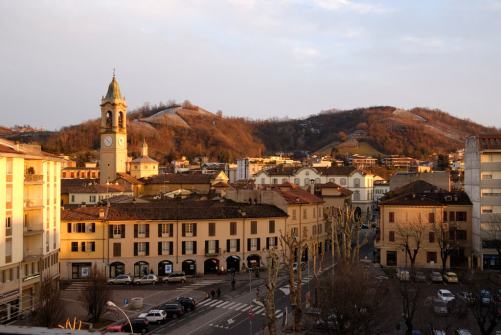
And then there is Sangue di Giuda, the Blood of Judas, made on the hills around Broni, a fairly nondescript place in the Oltrepo’ Pavese.

It was trying a bottle of Sangue di Giuda recently that set me off onto writing this post. As I sat there rolling this sweet wine around my mouth, I couldn’t understand how it could possibly have been given this name. I mean, the man who sold Christ to his enemies for thirty silver talents, who betrayed him with a kiss, the man whom early European artists depicted like so:

this man’s blood must have been dark, bitter, acidic, thoroughly undrinkable! In contrast, Sangue di Giuda tastes sweet and happy, and like all the sweet sparkling red wines, has a lovely dark red colour and a wonderfully dark pink foam.

The locals have come up with a thoroughly preposterous story to explain the name. According to them, Christ in his immense goodness resurrected Judas after he’d committed suicide by hanging himself, to give him a chance to redeem himself. Judas turned up – what a coincidence! – in Broni. The townspeople recognized him and wanted to kill him. Judas saved himself by curing the surrounding vineyards of some disease they had, and the Bronians, in their joy, named the wine after his blood. A completely silly story! I prefer an alternative explanation, which has it that the name was given to the wine by local monks, who believed that drinking the wine would lead you to betray yourself and do naughty things, especially of a sexual nature.

Or perhaps the name can be linked to a similar idea that floated around in Champagne, at a time when no-one had any idea of the chemistry behind wine-making. The seemingly random process by which bottles of wine sometimes turned out sparkling and, worse, could blow up, often in a chain reaction with one bottle setting off the others, was seen as the work of the devil. It’s no great step to go from devil to Judas.

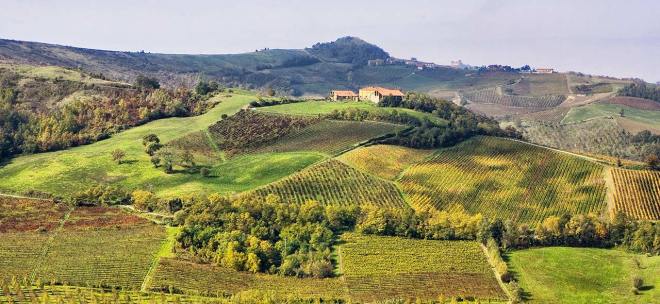
Whatever the explanation, Sangue di Giuda is a delicious wine, and its grapes grow in a zone visible from the train line and motorway which lead from Milan to Genoa. Over the years, as we have sped by on our way to the sea, I have gazed at those vine-covered hills, thinking to myself that one day, one day, my wife and I would go for a nice little trip into those hills which so remind me of the vine-draped hills of the Beaujolais, home to my French ancestors, where I spent many a happy summer a-roaming. I have made a mental itinerary for this trip, and I insert here a map with its trace.

As readers can see, after starting in the Piedmontese pre-Alps, it would meander along the northern face of the Apennines. Taking sparkling red wines as our guide, we could start in Piedmont, at Alto Monferrato, whose surrounding vines make Barbera del Monferrato DOC frizzante.

After a glass of this Barbera (it would seem that Monferrato is the birthplace of the Barbera grape), we would move on to Acqui Terme.

I’m sure we could find a nice cafè on whose terrace we could dreamily sip on a glass of Brachetto d’Acqui.

After which, we would curve into the Oltrepo’ Pavese, home to Sangue di Giuda, but also to that Oltrepo’ Pavese Bonarda which I first tried so many years ago.

We would loop back around into the Colli Piacentini, the hills behind Piacenza.

We could find somewhere there a welcoming taverna and settle down to a nice glass of Colli Piacentini Gutturnio DOC frizzante.

After which, we would make our way along to the zone behind Modena.

There, we could ease ourselves into seats at a bar and order ourselves a glass or two of Lambrusco. Which one to try? Lambrusco di Sorbara? Or Lambrusco Salamino di Santa Croce, perhaps. Or, why not?, Lambrusco Grasparossa di Castelvetro.

Finally, we would wend our way, unsteadily no doubt by this point and hoping not to meet a police patrol with breathalyzer at the ready, to the Colli Bolognesi, the hills behind Bologna.

There, we could sink down onto a banquette in a restaurant and while we eat we could finish with a Barbera just as we started with one, trying a Barbera Colli Bolognesi frizzante.

Yes, I think this will do nicely. I will work on my wife to turn this little trip into reality. We can think of doing it in May perhaps, when the weather is good but not too hot.

________________

Modena: http://misure2017.ing.unimore.it/Modena.html
Acqui Terme: https://www.gogoterme.com/terme-di-acqui.html
Broni: http://ilpattodeibuongustai.it/broni-il-re-dei-paesi
Judas: http://www.patheos.com/blogs/biteintheapple/judas/
Sparkling red wine with foam: https://culturecheesemag.com/cheese-pairings/great-28-pairings-cheese-sparkling-red-wines
Medieval love-making: https://it.pinterest.com/jamieadairwrite/medieval-love-making/?lp=true
Northern Italy: https://commons.wikimedia.org/wiki/File:Northern_Italy_topographic_map-blank.png
Alto Monferrato: http://www.terredavino.it/en/il-territorio/lalto-monferrato-acqui-terme/
Acqui Terme vitigni: https://www.vinook.it/uva-e-vitigni/vitigni-rossi/brachetto-d-acqui.asp
Oltrepo’ Pavese: https://www.contevistarino.it/en/the-vineyards/
Colli Piacentini: http://www.rgvini.it/it/colli-piacentini
Lambrusco: https://www.vinook.it/vino-rosso/vino-rosso-emiliano-romagnolo/lambrusco-grasparossa-di-castelvetro.asp
Colli Bolognesi: http://www.spreafotografia.it/photo-7724-ma-come-bello-andare-in-giro-sui-colli-bolognesi.html

WORKERS OF THE WORLD, UNITE!

Milan, 25 February 2018

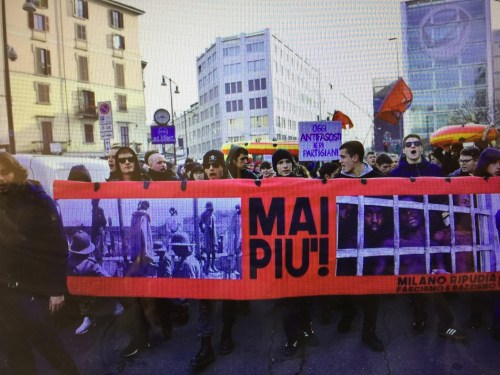
Yesterday was a day of political excitement in Milan. With the elections only a week away, things are hotting up. There was a large gathering in Piazza Duomo of the Lega, a much smaller gathering of left-wingers in Largo La Foppa, and an even smaller gathering of anarchists of various stripes somewhere else. Below, I show a picture of the leftwing gathering in Largo La Foppa.

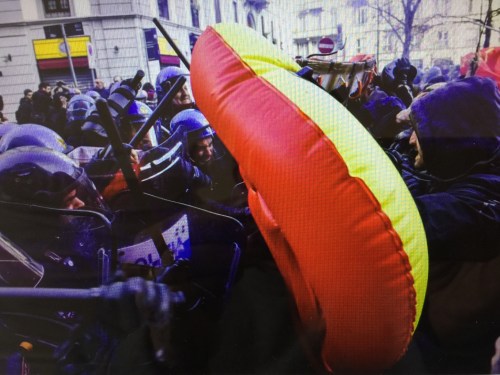
The police barred their way as the marchers tried to leave Largo La Foppa, the temperature was mounting, and at some point the police charged – or maybe the marchers charged, or pushed forward. Anyway, the police started wielding their batons, while the marchers protected themselves, somewhat bizzarely, with inflatable boats – taken to remind the world of the plight of the refugees, according to the newspapers, but it seems to me also an excellent way of protecting oneself from the police batons.

At the same time, the police shot off a couple of canisters of tear gas, that white smoke one sees behind the marchers.

Meanwhile, my wife and I were sitting down having tea and cannoncini (a puff pastry stuffed with vanilla cream) under those large white umbrellas one can see to the left in this last photo. We were there quite by chance, being on our way to see Daniel Day-Lewis in his last film, “The Phantom Thread”. We were early and those large umbrellas belong to a good pastry shop, so we decided to treat ourselves. We made our way round what seemed to us quite a small crowd (the papers talk of 1,500 but in my opinion it was no more than 200), got our tea and canoncini, and sat down. It was fun to watch all the flag waving going on in front of us and reminisce about our youth. Suddenly, the noise levels rose, there were sounds of shots, and two little smoking canisters landed almost at our feet. My wife, a veteran of Milan’s 1968 riots, leaped up in alarm and urged me to move. But I saw no need for panic, I thought they were crackers thrown by some of the marchers. I rapidly changed my mind when I breathed in the smoke. It immediately caught you terribly in the throat and made your eyes burn and weep. This was tear gas, for God’s sake!! I grabbed my cup of tea and the remainder of my cannoncino and shouted to my wife to move. Together with other customers, we blundered into the pastry shop and stood there gasping and wheezing and coughing. According to my wife, who had had a whiff or two of tear gas in her youth, technology has improved in the last fifty years; she didn’t remember it catching you so strongly in the throat. I wouldn’t know, this was my first exposure to the stuff. Eventually, we were shepherded out to a back yard, from which we exited into a side street and made our escape to the cinema.

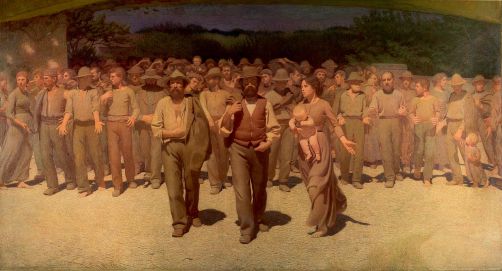
All this excitement has led me to reminisce about marches and protests in the arts. The most well-known painting on the topic of marches must be Giuseppe Pellizza da Volpedo’s “The Fourth Estate”, which gives the working man a wonderful dignity

while “Liberty Guiding the People”, by Eugène Delacroix, must be the most famous painting on the topic of insurrections, in this case the insurrections of 1848.

Once the October Revolution rolled around, revolution and the working class became respectable subjects of art. Staying with marches, where I started this post, we have, for example, “The Bolshevik”, by Boris Kustodiev.

And, of course, we have the start of that wonderful art form, the propaganda poster, where marches of the proletariat were a popular subject. Here we have a Soviet propaganda poster.

The Chinese picked up on the art form with a vengeance. They made some great paintings, which I mentioned in an earlier post about a new museum we visited in Shanghai, but their propaganda art was fantastic. Here’s one with the Chinese people walking towards a bright future.

The caption declares: “Smash the imperialist war conspiracy, forge ahead courageously to build our peaceful and happy life!” Change that to “the 1%” and we have a message for our times …

I have to say, though, I always preferred the type of Chinese propaganda poster which has smiling, muscular workers:

The North Koreans were still making these type of poster when I made an official visit there with my wife in 2009. We asked if they could give us a copy of one of these posters, but the best they could come up with was one urging people to wash their hands to reduce the spread of illnesses…

The Mexican muralists also painted some great revolutionary art, especially Diego Rivera. We have here his “Uprising”

and this is his “Distribution of Arms”

I posted photos of some of his other revolutionary murals earlier, after our last visit to Mexico.

Wonderful stuff. But who paints it anymore? Revolution is out of fashion, at least for the moment.

Ah well … In the meantime, we will be passing through Largo La Foppa again today, to go and see another film. That gives my wife the opportunity to have another cannoncino; while I saved mine, hers got lost in the confusion of running away from the tear gas.

____________

March in Milan: http://milano.corriere.it/foto-gallery/cronaca/18_febbraio_24/scontri-corteo-milano-largo-foppa-polizia-antagonisti-moscova-1d7e8c1a-1974-11e8-9cdc-0f9bea8569f6.shtml
Quarto Stato: By Giuseppe Pellizza da Volpedo – Associazione Pellizza da Volpedo, Public Domain, https://commons.wikimedia.org/w/index.php?curid=2588195
Liberté Guidant le Peuple: https://en.wikipedia.org/wiki/Liberty_Leading_the_People
Boris Kustodiev, The Bolshevik: http://www.rusartist.org/boris-mikhailovich-kustodiev-1878-1927/#.WpKLb6inFPY
Soviet propaganda poster: https://www.huffingtonpost.com/2014/12/26/communist-propaganda-post_n_6377336.html
Chinese propaganda poster: https://chineseposters.net/gallery/e16-266.php
Chinese propaganda poster2: http://www.businessinsider.com/chinese-propaganda-posters-2012-9?IR=T
Diego Rivera, the Uprising: http://bigthink.com/Picture-This/occupy-moma-diego-riveras-populist-murals-reunited
Diego Rivera Distribution of Arms: http:// http://www.leninimports.com/diego_rivera_distribution_arms_canvas_print_9a.html

SPRING IS COMING!

Sori, 14th February 2018

Once, after I’d made a speech in Bangkok about how the world was going to hell in a hand basket, with multiple environmental disasters awaiting us, I was asked by the MC (who clearly had no idea what to say to me) what I most missed in Thailand. The seasons, I replied: winter, spring, summer, autumn. It was indeed one of the few things I missed in Bangkok from my European heritage; I always felt that South-East Asia was seasonal monotony. It was either hot or hotter, with rain added from time to time.

Now that I’m back in Europe, I can enjoy the four seasons again. Right now, in a masochistic sort of way, I’m enjoying the tail-end of the winter season: ah, that cold north wind which causes you to pull your head and shoulders into your coat like a turtle into its shell … But here on the Ligurian coast, located in its own warm microclimate, we already have signs that spring is on its way! As we have been walking the hills, there have been signs all around us that Nature is getting ready to burst forth again, like in Botticelli’s Spring.

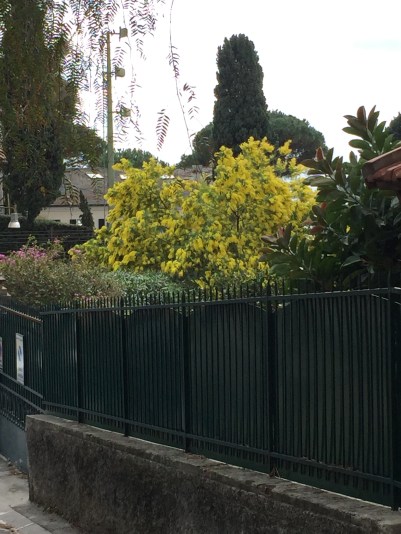
We have the mimosa trees, whose festival it will soon be

the almond trees, seen here on a walk in the Cinque Terre

the crocuses, in the shady underforest

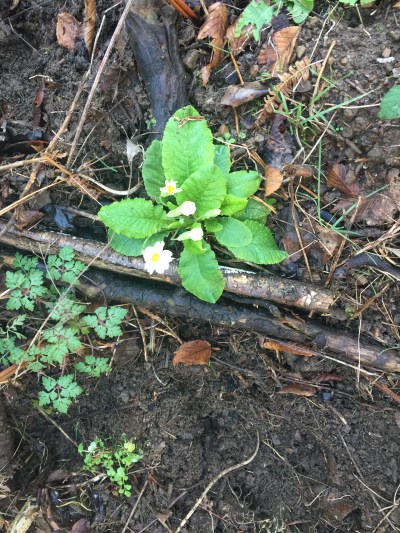
a lone primrose, also spied on the sun-speckled forest floor

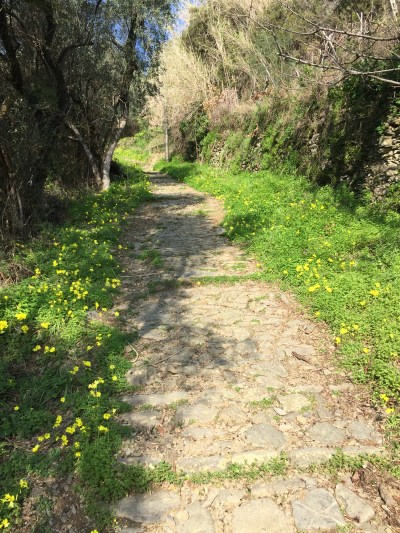
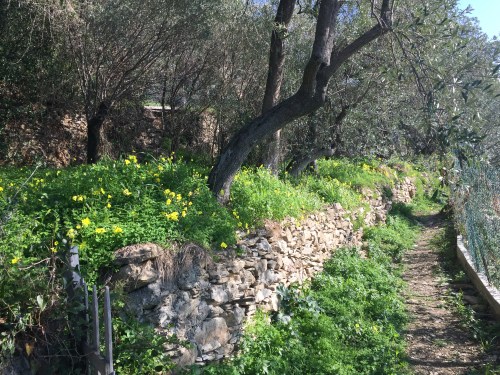
carpets of a yellow flower, to me unknown, bedecking the sides of the paths open to the sun


bushes of rosemary growing from out of the rocks

purple irises, not a flower I connect with early spring

a humble little mauve flower, growing at the foot of olive trees

even a bright yellow fungus, returning a dead log to the earth from whence it came.

Yes, nothing so lovely as the Earth bursting into life. No wonder the poets have often sung about spring! Here’s a poem by Gerald Manley Hopkins, entitled simply Spring:

Nothing is so beautiful as Spring –
When weeds, in wheels, shoot long and lovely and lush;
Thrush’s eggs look little low heavens, and thrush
Through the echoing timber does so rinse and wring
The ear, it strikes like lightnings to hear him sing;
The glassy peartree leaves and blooms, they brush
The descending blue; that blue is all in a rush
With richness; the racing lambs too have fair their fling.

What is all this juice and all this joy?
A strain of the earth’s sweet being in the beginning
In Eden garden. – Have, get, before it cloy,
Before it cloud, Christ, lord, and sour with sinning,
Innocent mind and Mayday in girl and boy,
Most, O maid’s child, thy choice and worthy the winning.

Happy Saint Valentine’s!

_____________

Boticelli’s Primavera: https://en.m.wikipedia.org/wiki/Primavera_(painting)
All other pics: all ours

RUBALDO MERELLO

Sori, 10th February 2018

My wife and I were recently in Genoa. Since it was a rainy day, we had decided that our usual excursions along the coast were out, and had opted to visit a couple of exhibitions at the Palazzo Ducale, the Ducal Palace. The Palazzo Ducale was recently the scene of much brou-ha-ha. It had hosted an exhibition of Modigliani’s paintings. Some Modigliani experts had claimed that half the paintings were fakes (apparently Modigliani is very easy to fake), the organizer retorted that all the paintings had certificates of authenticity emitted by various other experts and that very respectable institutions had already hosted the exhibition, the Carabinieri had nevertheless moved in and confiscated the whole exhibition and were pressing charges for fraud, the organizer in turn was suing person or persons unknown for making false claims … in a word, there was a right royal mess.

Luckily, the exhibitions we were visiting were not the subject of such polemics. One was an exhibition of works by Picasso from the Picasso Museum in Paris. Although interesting, I will not comment on it (although I should note in passing that Picasso has also been widely faked: organizers beware!). The other was an exhibition of works by Rubaldo Merello.

I will perfectly understand if readers have never heard of Merello. I had not heard of him either until we saw this exhibition advertised. He is, to be honest, a minor Italian painter and sculptor, and his story is quickly told. Born in 1872, he worked at the turn of the last century, dying in 1922 at the relatively young age of 50. He was a local son, learning his trade at Genoa’s Accademia Ligustica delle Belli Arti. After a bit of to-ing and fro-ing, he tied his colours to the movement known as divisionismo, Italy’s answer to France’s pointillisme. For some reason which is not completely clear but which may have had to do with his paintings being rejected by the 1st Venice Biennale, he started isolating himself from the art world, eventually holing up, in 1906, in San Fruttuoso, a small fishing hamlet on the promontory of Monte di Portofino.


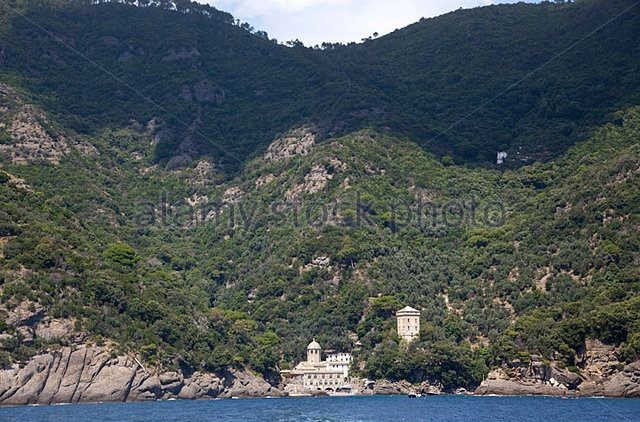
I have already written about San Fruttuoso in an earlier post, but it’s worth repeating here that while charming San Fruttuoso is very remote. The only ways to reach it are by boat from Camogli, which even today can be impossible if the sea is too rough, or by foot up and around the mountain and then down a steep track to the shore – in Merello’s days either your own feet or mules’ feet. But Merello buried himself and his family here for eight years, despite many calls from his friends to return to civilization. He paid the price for his isolationism. In 1913, his younger son died of diphtheria because medical help couldn’t arrive quickly enough. His wife had a breakdown after her son’s death (poor woman, who can blame her after the hermit’s life her husband had imposed on her), and Merello himself was never quite the same. He moved the remaining family to Santa Margherita Ligure in 1914 and worked there, mostly on sculptures, until he died.

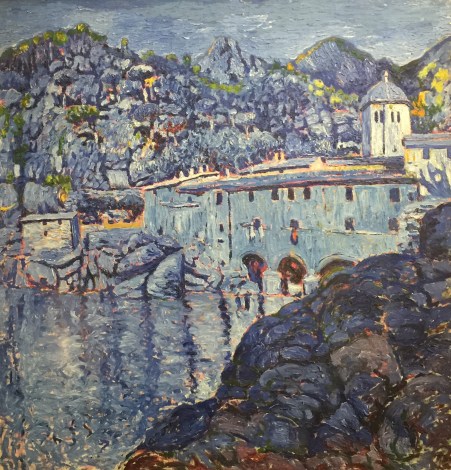
Because Merello chose to stay in San Fruttuoso, most of his paintings are of the hamlet and its surroundings. His paintings of the hamlet itself are interesting but no more than that.


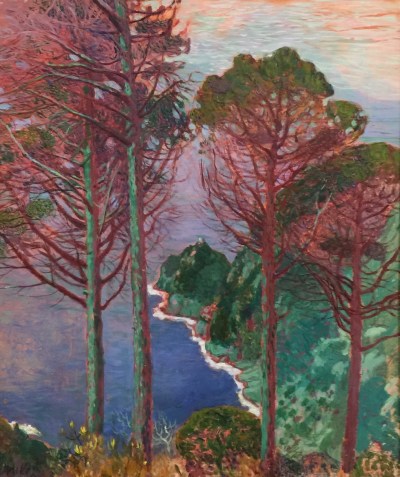
It’s when Merello clambered up the mule track behind San Fruttuoso to be high up above the village that his paintings begin to grip me. There was one view in particular which he painted again and again, almost obsessively it would seem, a view of the small bay of San Fruttuoso from the Monte di Portofino, which I have been always fond of. It is a plunging view, from high up the mountain down to the lapis lazuli sea far below, seen through a screen of trees. It is a view much photographed.

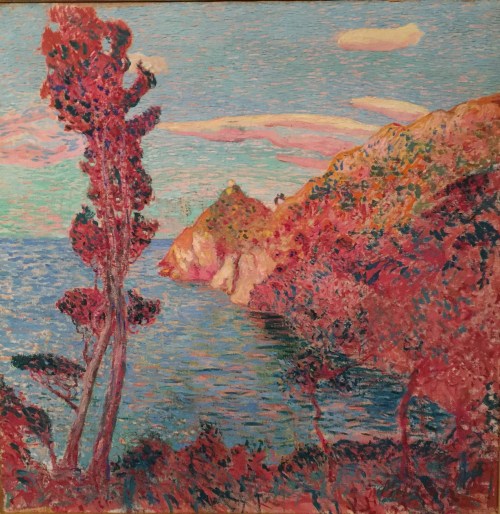
Merello tried a number of colour combinations for the view, resulting in a fascinating array of paintings.


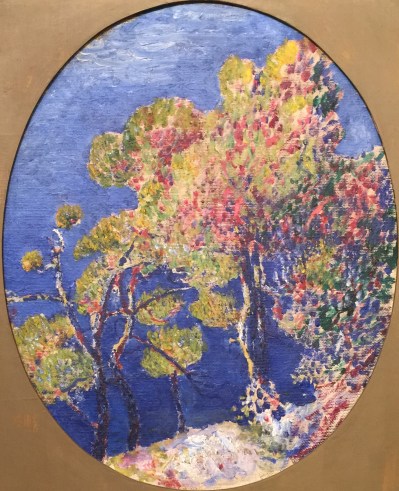
Even more striking, though, were his paintings still from high on the mountain but now focusing just on pines and the sea in the far distance.

He arrived finally at an almost abstract composition of pine against water.

If this last painting had fallen off the back of a truck, I would not have hesitated to keep it, on the basis of the morally dubious saying “Finders keepers, losers weepers”. Out of a somewhat masochistic curiosity, I checked auction prices for Merello’s paintings. While many orders of magnitude below what you need in your bank account to buy a (real) Picasso, at around €40,000 a painting they are way out of my league. Well, I guess I’ll never have a Merello on my wall – unless it falls off the back of a truck.

_______________

Rubaldo Merello: http://www.palazzoducale.genova.it/rubaldo-merello-la-vita/
San Fruttuoso: http://www.alamy.com/stock-photo/san-fruttuoso-bay.html
San Fruttuoso: https://www.fondoambiente.it/luoghi/abbazia-di-san-fruttuoso
The bay of San Fruttuoso from above: https://www.tripadvisor.it/LocationPhotoDirectLink-g227888-d4569424-i112196609-Camogli_San_Rocco_Batterie_San_Fruttuoso_Trail-Camogli_Italian_Riviera_L.html
Other photos: my pics