TITAN ARUM

Los Angeles, 18 July 2026

Serendipity has struck again!

I was perusing the Guardian newspaper a few days ago when my eye fell on the following title: “Thousands flock to see brief and rare blooming of corpse flowers in California”. Corpse flowers?! What on earth are they? It had me diving into the article to discover more.

It turns out that the corpse flower is the titan arum, or Amorphophallus titanum, which translates as the Giant Misshapen Phallus. This photo of the plant explains its scientific name.
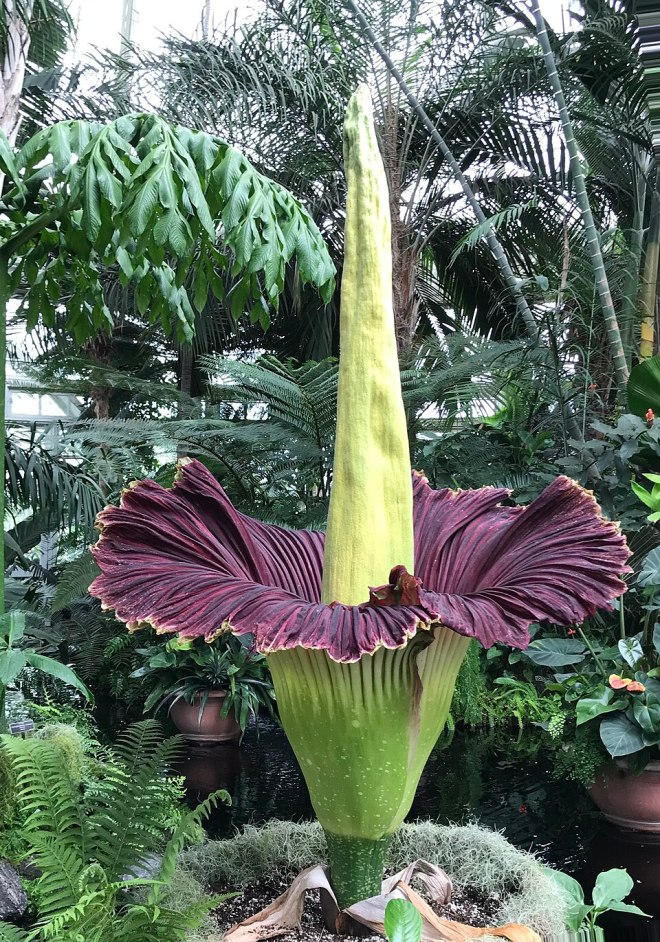
Source

This is a bit of a naughty name, and one of course that immediately brought out my extremely childish side. Readers might be interested to know that the plant’s English name, titan arum, is said to have been coined during the filming of David Attenborough’s 1995 documentary “The Private Life of Plants” because the genera’s name Amorphophallus was considered to be “too rude” for prim British TV audiences …

But why corpse flower? Well, that’s what the locals in Sumatra, which is where the plant comes from, call it. And they call it that because when the plant flowers, it emits a veritable stench. Scientists have analysed the stench and found it to contain dimethyl trisulfide (a component of the stink given off by the very smelly limburger cheese), dimethyl disulfide (garlic; anyone who has walked through a field of flowering garlic knows how pungent that smell can be), trimethylamine (rotting fish), isovaleric acid (sweaty socks), and indole (faeces). Eew!

Source

The plant has evolved the ability to give off this stink so as to attract its main pollinators, carrion beetles and flesh flies; they lay their eggs in rotting meat. What a mean trick! When these insects arrive, expecting to find a nice chunk of putrid flesh they run into a bunch of boring flowers. It must be really frustrating for them.

The titan arum is in good company. Several plants worldwide have come up with the same smelly strategy: the South African carrion plant (“flowers that smell like roadkill”)
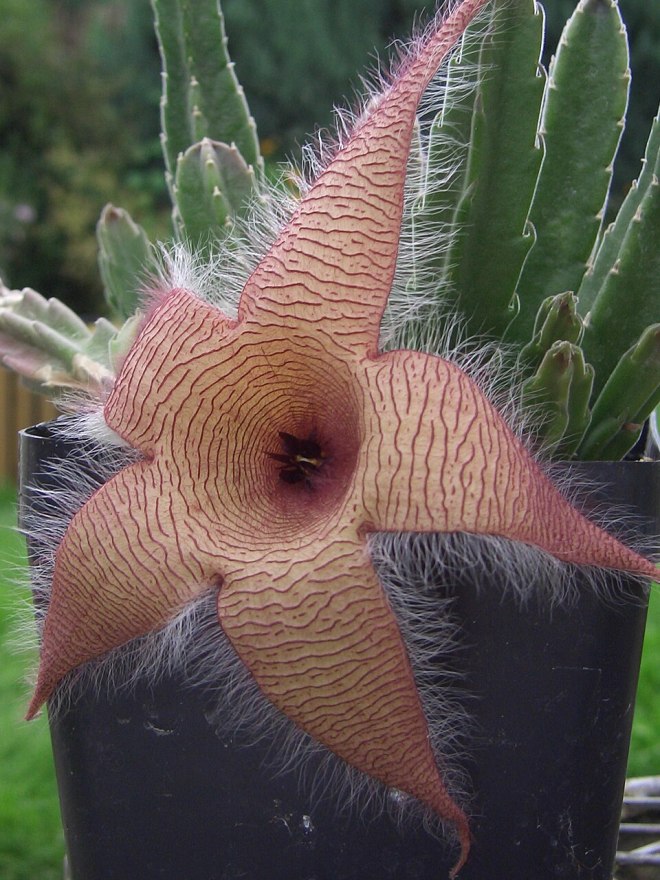
Source

the Indonesian monster flower (“releases a highly pungent smell of rotting meat”)
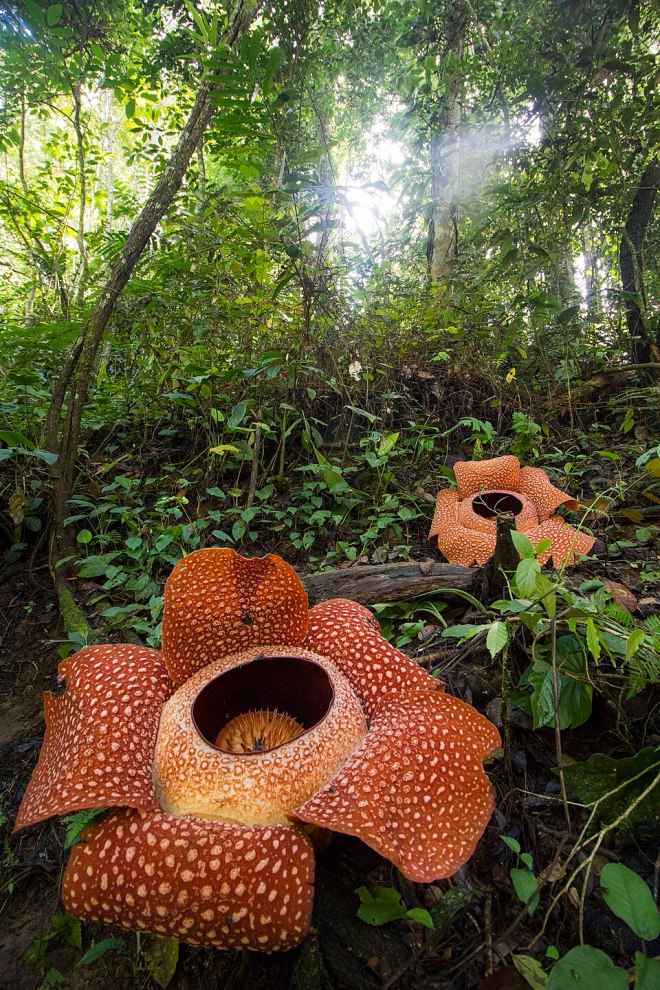
Source

the Mediterranean dead horse arum (“foul scent”)
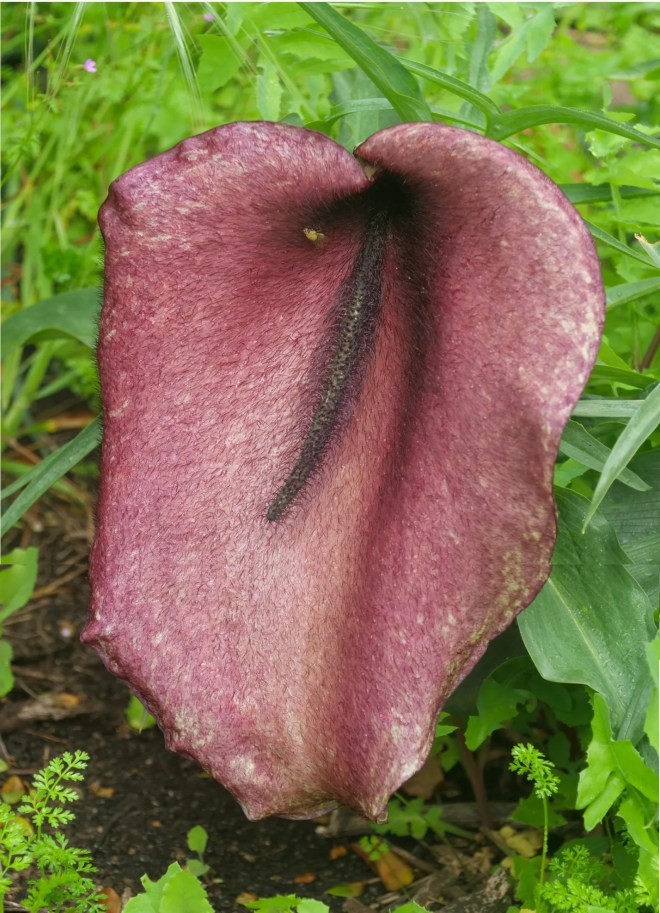
Source

the North American eastern skunk cabbage (“emits a strong skunk-like odour”)
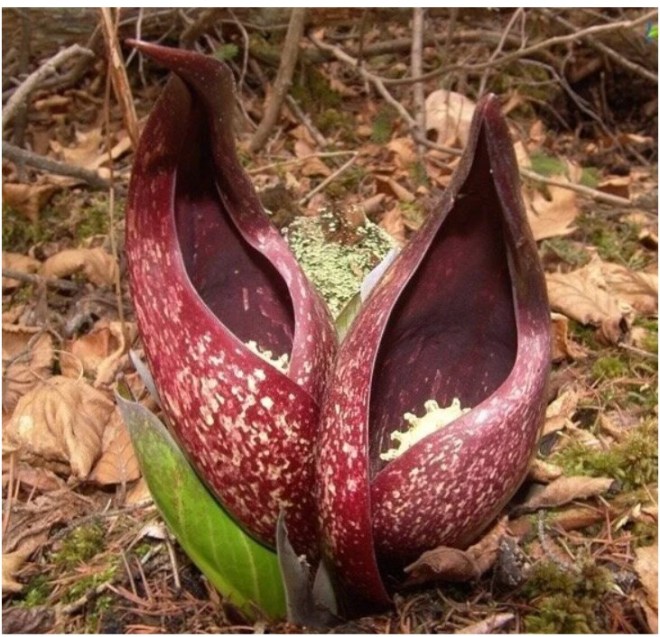
Source

Well! A must-see (and must-smell) plant! And it’s a once-in-a-lifetime experience! The plant only flowers every five years or so and the flowers last just a few days. I read further into the Guardian article. It so happened that two of the plants were flowering at the Huntington Library, Art Museum, and Botanical Gardens. Fantastic! My wife and I had been wanting to visit the Huntington again on this trip, but had never quite got around to it. Now we had our excuse. And our daughter wanted to come too! Time being of the essence (that short flowering period …), we decided to go the next day. Our little grandson would be coming with us – he needs to feed and sleep on a strict schedule.

And so the next day, we set off – a little behind schedule, but hey! the baby takes precedence. Once arrived, we hurried to the greenhouse where the two Giant Misshapen Phalluses were being exhibited. Luckily, there were no lines. So we were able to inspect the plants at our ease. The staff had named one Odora and the other Odorysseus (no doubt in honour of the film The Odyssey which has just come out and which we will be seeing next weekend). Odorysseus stood tall and proud waiting for its spathe to open up
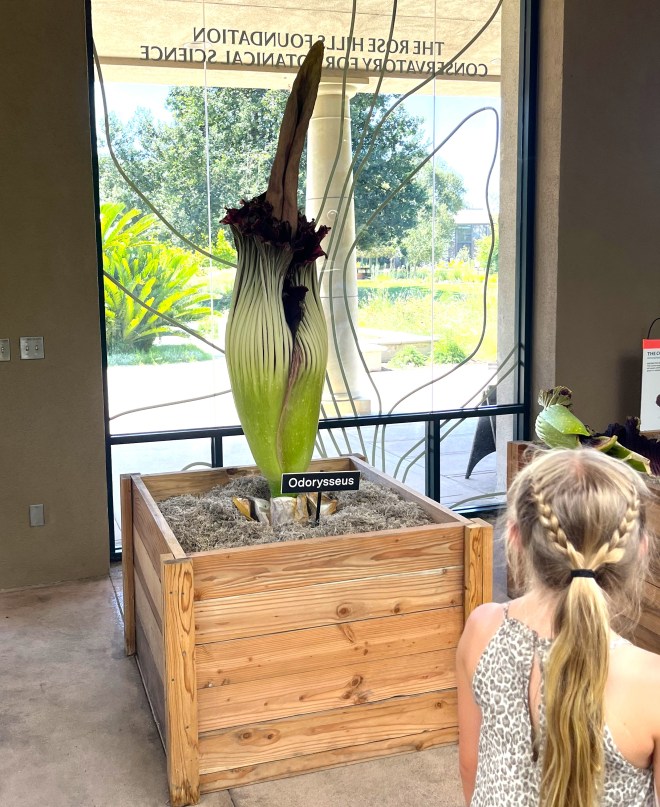
My photo

while Odora’s spathe had fallen off, exposing the rows of flowers at the very bottom of the spadix (all terms I have since learned from the plant’s Wikipedia entry).
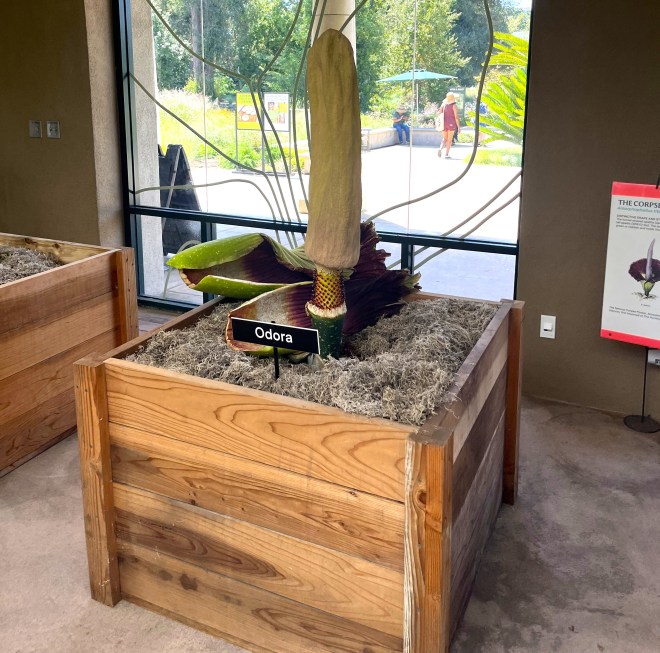
My photo

But wait! Something was missing, where was the foul smell? Alas, to my consternation, I discovered that the plant gives off its noxious scent only at night, because that is when its pollinators, the carrion insects, are active. So, short of ducking behind one of the greenhouse’s palms and staying hidden until after the museum had closed and night had fallen, I wasn’t going to experience its revolting odour. Sad! as the current inhabitant of the White House might say.

And our grandson in all this kerfuffle? He slept serenely through it all …

CACTUS RULES, OK!

Los Angeles, 19 April 2018

As we did last year, during our latest stay in Los Angeles my wife and I visited the old house and grounds of Arabella and Henry Huntington, now the grandly-named Huntington Library, Arts Collection, and Botanical Gardens. The arts collection, which we visited thoroughly last year, is well worth a visit. It holds some very famous pieces of European art, such as the Blue Boy by Thomas Gainsborough.

It also has a really great collection of American art, especially early American art, holding this piece for instance.

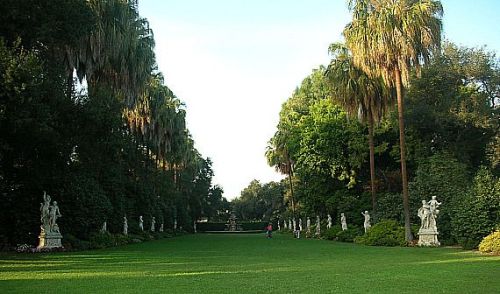
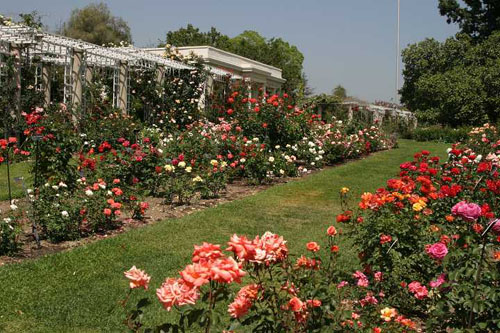
But this year we ignored the art and headed for the gardens. Because the gardens are equally wonderful. During their lifetimes, the Huntingtons had already laid out several gardens around the house. One was a traditional rose garden (primarily so that Arabella Huntington could fill the house with cut roses). Henry Huntington also started a camellia garden along the edges of the Vista which the couple created in front of the house. He also surfed what was then a popular trend and created a Japanese garden. He was also an admirer of palm trees, so he started a palm garden. And after some prodding from his head gardener, he agreed to start a desert garden. The same head gardener, presumably with Mr. Huntington’s approval, also installed lily ponds in an unsightly corner of the garden.

Some of these original gardens have been expanded over the years, while new gardens have been added: a Chinese garden, a semi-tropical garden, a tropical (“jungle”) garden, and an Australian garden (along with a couple of much smaller gardens: a herb garden and a Shakespeare garden, the latter housing all the plants mentioned in one way or another in Shakespeare’s works). All in all, this complex of gardens give the visitor a taste of the sights and scents of many of the world’s biomes (they also give people a lovely scenography for picnics and general lazing around on lawns).

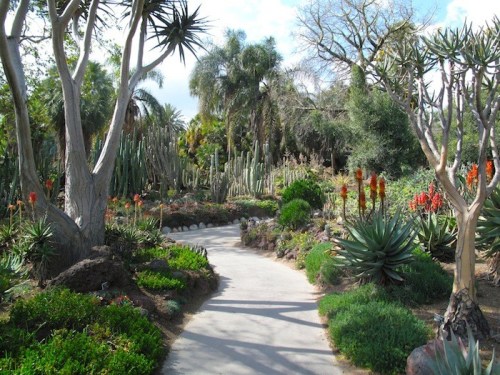
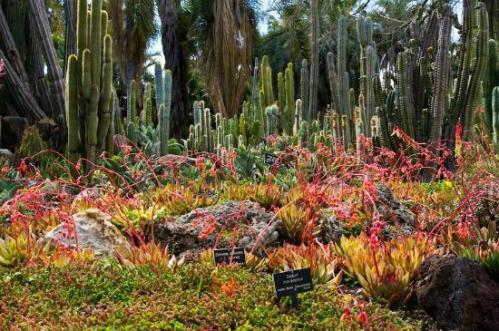
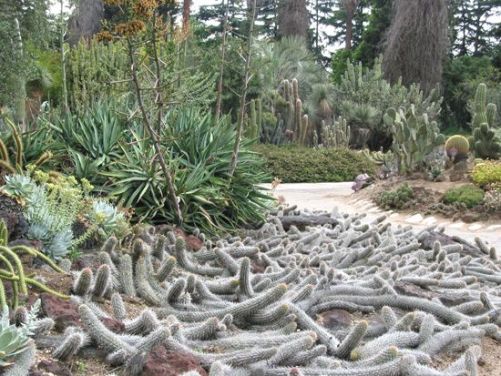
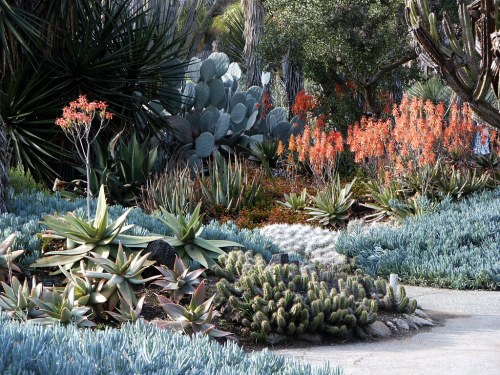
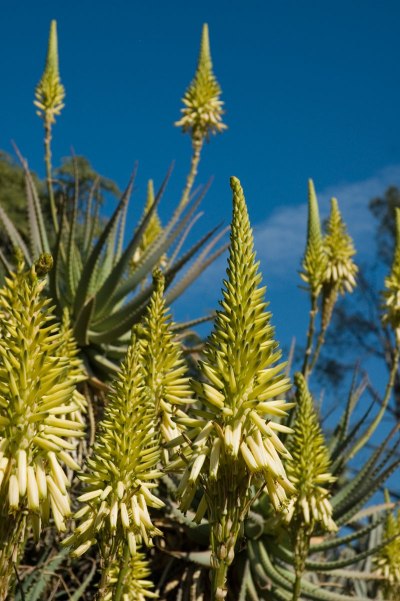
The desert garden is what interests me today. As we wandered the paths which crisscross it, we marveled at the wonderful cacti and succulents which populate this garden. We are not the only ones to have been struck by them. I throw in here some of the better pictures which other visitors have posted on-line.


If I focus on the desert garden rather than on any of the other gardens at the Huntington it is because of water, or rather – in this part of the world – the lack of it. As most people probably know, Los Angeles and southern California in general is a semi-desert; in fact, the region wouldn’t have been able to develop nearly as much as it has if its politicians hadn’t managed to filch large amounts of water from the northern part of the State. But this grand water larceny has only put off the day of reckoning. Southern California is running out of water. Something must be done to contain water use.

Under the circumstances, it makes eminent sense for everyone in this city who has a garden to stop planting water-thirsty plants, especially those lawns so beloved by Americans. Here are a few prime examples from the swank properties surrounding the Huntington.


The Huntington itself has its fair share of thirsty lawns.


To their credit, the people running the Huntington are now pushing the idea that Angeleno gardeners should opt for water tolerant plants in their gardens. And what the desert garden shows is that a garden of cacti and succulents can be every bit as beautiful as a traditional garden. These poor plants get a lot of bad press, probably because of the spines which most cacti sport and perhaps because they can often look somewhat bedraggled. Certainly, it seems that Mr. Huntington’s initial reluctance to have a desert garden had to do with unspecified bad memories of run-ins with prickly pear cacti from the days when he was building his uncle’s railroads across the country. My guess is that his horse threw him into a patch of prickly pear – but that’s only a guess.

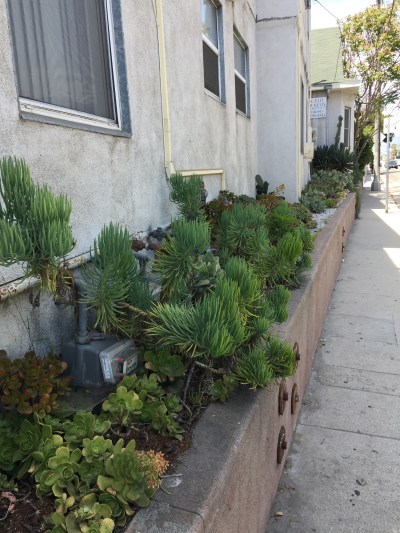
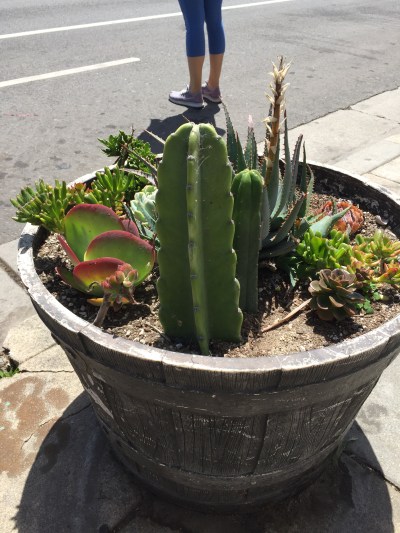
As we walk around the city, my wife and I notice an encouraging trend towards more cacti and succulents in gardens and public spaces.


Among all the drought-tolerant plants on show, the one I am most fond of is this one, which I have been seeing a good deal of this year.  This example, for instance, graced a space near a bus stop which we were waiting at.
These examples, instead, are part of a more general planting of cacti and succulents which we have often been walking by as we stroll along the boardwalk at Venice Beach.

It is called, I have discovered, firesticks (or variations thereon: sticks-of-fire, sticks-on-fire, and probably others). The name obviously refers to the plant’s crown of very pretty red, pink, and orange stick-like twigs. It’s really very lovely. But beware! The white sap which oozes from a twig when broken can irritate the skin and is especially dangerous if rubbed into the eyes. I should know. The firestick is a direct descendant of the pencil tree.

This tree can be found throughout East and South Africa. And in fact it grew in our garden in Eritrea. I still remember my mother’s frantic screams when she realized that my little fingers one day had broken a twig and I was busily spreading the sap on the palm of my little hand.

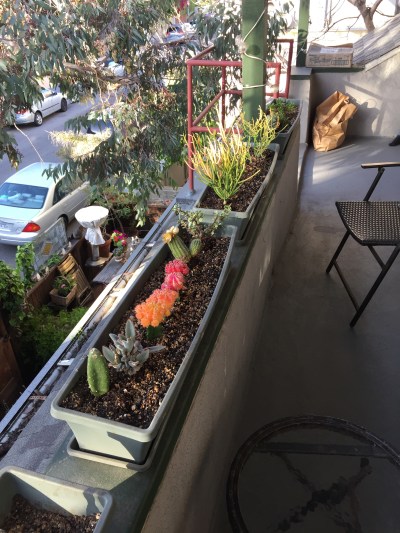
Even though they don’t have a garden, my daughter and her boyfriend are moving towards cacti and succulents on their balcony. They have planted a bunch of flower pots with them. I’m pleased to see that the firestick is one of their choices.

Truth to tell, they have chosen these plants not so much as a commitment to a more sustainable lifestyle but rather for their low maintenance requirements. Neither of them are particularly diligent in watering and previous planting attempts ended badly because of this. Let’s hope that when we come back next year, they are still flourishing: cacti and succulents rule, OK! (at least in Los Angeles)

__________________
The Blue Boy: http://huntington.org/webassets/templates/general.aspx?id=14392
Early American art: http://www.huntington.org/WebAssets/Templates/content.aspx?id=22779
Picnicking, Huntington gardens: https://www.facebook.com/HuntingtonLibrary/photos/a.70860174880.63671.51018909880/10156013615919881/?type=3
Desert garden-1: http://www.huntington.org/desertgarden/
Desert garden-2: http://fr.gde-fon.com/download/huntington_jardin-botanique-de-San-Marino/433151/2395×1590
Desert garden-3: https://www.google.co.uk/amp/s/www.gardenista.com/posts/escape-to-a-desert-garden-in-pasadena-huntington-library-garden/amp/?source=images
Desert garden-4: https://www.tripadvisor.com/LocationPhotoDirectLink-g33029-d110203-i41542481-The_Huntington_Library_Art_Collections_and_Botanical_Gardens-San_Marino_Cal.html
Desert garden-5: https://www.pinterest.com/amp/pin/107875353549586117/
Desert garden-6: https://www.flickr.com/photos/27398485@N08/3280510696
Desert garden-7: https://www.google.co.uk/amp/s/www.pinterest.com/amp/pin/561331541042981128/?source=images
Desert garden-8: https://www.visitpasadena.com/businesses/the-huntington/
Desert garden-9: https://www.google.co.uk/amp/s/christophvi.wordpress.com/2015/08/30/more-than-reading-at-the-huntington-library/amp/?source=images
Desert garden-10: https://commons.m.wikimedia.org/wiki/File:Golden_Barrels_%26_Senecio_mandraliscae_Blue_Chalk_Stick_succulents,_Huntington.jpg
Desert garden-11: https://www.google.co.uk/amp/s/www.gardenista.com/posts/escape-to-a-desert-garden-in-pasadena-huntington-library-garden/amp/?source=images
Desert garden-12: http://huntingtonblogs.org/2014/01/torch-bearers-of-the-desert-garden/
Desert garden-13: https://www.google.co.uk/amp/s/christophvi.wordpress.com/2015/08/30/more-than-reading-at-the-huntington-library/amp/?source=images
Desert garden-14: https://www.google.co.uk/amp/s/christophvi.wordpress.com/2015/08/30/more-than-reading-at-the-huntington-library/amp/?source=images
San Marino property-1: http://www.pasadenacarealestatehomes.com/blog/san-marino-ca-real-estate-market-reports/
San Marino property-2: http://activerain.com/blogsview/4681118/san-marino-ca-homes-for-sale-and-recent-market-activity-june-7–2015
Northern vista: https://www.google.co.uk/amp/s/www.pinterest.com/amp/pin/280278776779445390/?source=images
Rose garden: http://www.huntington.org/webassets/templates/general.aspx?id=15523
Gardens around LA with cacti and succulents: my photos
Firesticks: my photos
Pencil tree: http://patioplants.com/product/pencil-tree-cactus-euphorbia-tirucallii-big-7-deep-plug/
My daughter’s cacti: my photo