POSTS

THE AUSTRALIAN BOAB TREE

Bangkok, 11 June 2016

One of the first things which struck me as my wife and I started our tour of the Kimberley in Australia was the presence of this tree, which we frequently saw, both in leaf
image
and bare
image
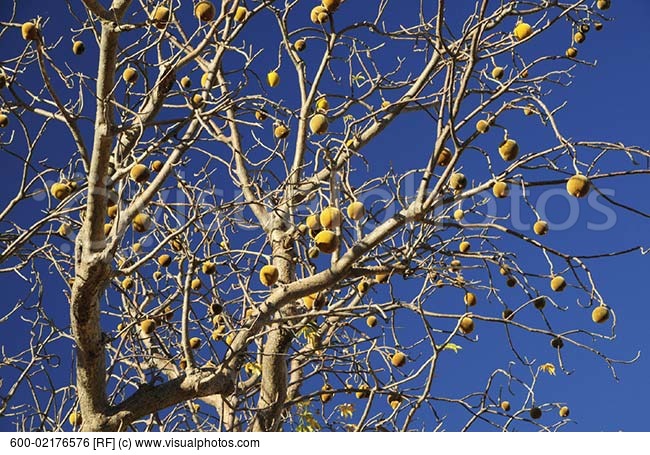
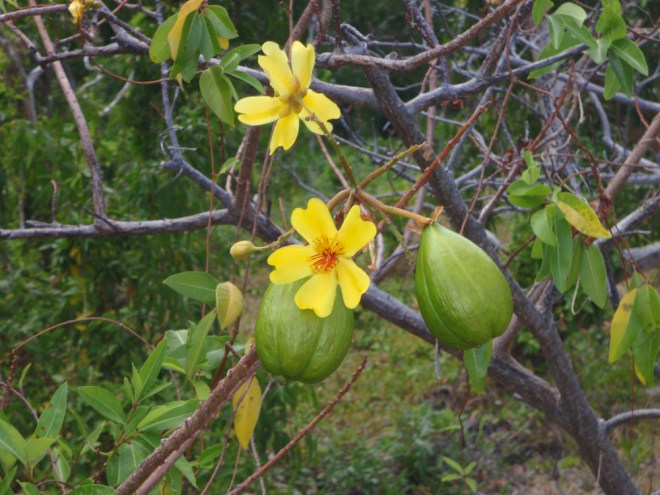
and many of them with fruit.

image
I kept saying, “Aren’t those baobab trees?” For they looked amazingly like African baobabs.
image
Well, the fact is, they are baobabs (although Australians insist on calling them boabs). These trees are to be found in sub-Saharan Africa (two species) as well as in Madagascar (six species, of which these, subjects of a previous post of mine, are magnificent specimens)
image
and there is this one species in Australia – actually, the tree is found only in the Kimberley and nowhere else in Australia.

How did the baobab tree end up in the Kimberley? I mean, it’s quite some distance, some 8,000 km to be precise, between the east coast of Africa and the west coast of Australia.

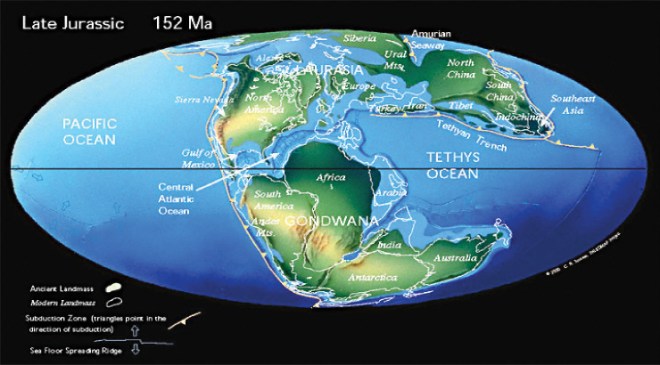
A first hypothesis was that this was a left-over from the break-up hundreds of millions of years ago of the supercontinent Gondwana into its constituent pieces of South America, Africa and Madagascar, Antarctica, India, and Australia
image
which then proceeded, through continental drift, to arrive where they are now. The ancestors of the baobab had existed on Gondwana, so the thinking went, and were carried along for the ride on the drifting continents.

Apart from the fact that this hypothesis doesn’t explain why there aren’t baobabs in India or South America, modern DNA analysis has nixed it. Comparison of DNAs has shown that the African and Australian varieties of the baobab separated a “mere” 100,000 years or so ago, when (by my calculation) Africa and Australia were 7 km closer (continental plates drift slowly).

So how did the baobab make it to Australia?

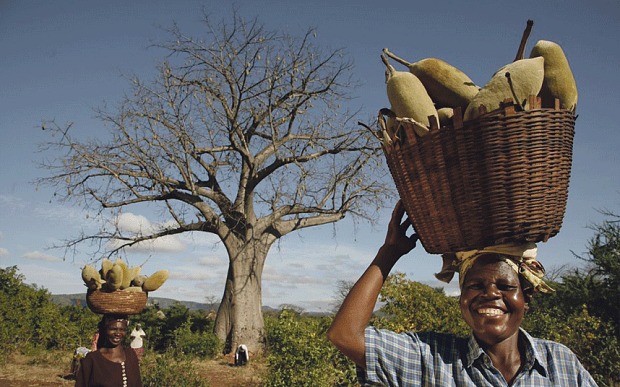
Well, the next most obvious hypothesis is that an African baobab nut or two (of which the smiling ladies in the photo above are holding a basketful) was carried out to sea and then carried along by surface currents to its new home in Northwestern Australia. But the experts are hesitant, and I understand why. A study of this map of surface currents
image
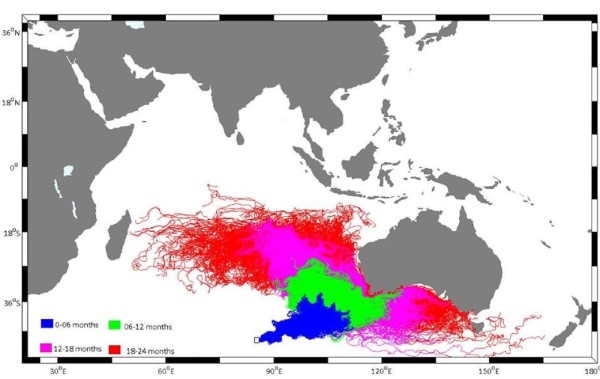
shows that to make it to the Kimberley region, a nut would have had to fall into the Somali current and been carried northward, then it would have had to get taken eastward by the northern branch of the Indian Ocean’s Equatorial current, all the way to the island of Sumatra. At that point, our bobbing baobab nut would have had to hug the southern coastlines of Sumatra and Java, to then, somewhere around Bali or Timor, change course, coming southward and westward, finally making a landing in the Kimberley. As the sad fate of the Malaysian flight MH370 has shown, anything floating further south in the Indian Ocean would tend to be carried westward rather than eastward. The map below is a computer-generated estimate of where debris of the plane could have drifted from the original hypothesized crash point (the square point on the border of the blue area); the red area is where debris might have been 18 to 24 months after the crash.
image
If this ocean voyage of the baobab nut occurred at all, it would have taken place during the last ice age. This started 110,000 years ago, which is pretty much when the two baobab lines separated, and finished 12,000 years ago. Among other things, the ice age caused sea levels to drop, which modified coastlines in certain parts of the world. In turn, these modifications could have affected the direction of surface currents. So to be really correct, one should look at a map of someone’s best guess of surface ocean currents during the ice age. Unfortunately, I didn’t come across any such map. This map, however, shows where the coastlines were at the time.

image
It seems there were no big changes in the area we’re interested in except around the islands of Indonesia and New Guinea, where the lower sea levels connected up a lot of the islands (and, en passant, made that last hop of human beings into Australia 50,000 or so years ago a good deal easier). I’m no ocean currentologist, but I rather think that the blocking up of the straits between these islands might actually have made the last leg of the baobab nut’s journey, that right turn from Bali to Australia, somewhat easier.

How long would such a trip have taken? Well, it took debris from MH370 about two years to wash up on the coast of Mozambique, so I would imagine that it would take just as long, if not longer, for a baobab nut to travel in the opposite direction. Could a baobab nut soak that long in the ocean and still be able to germinate upon arrival? We can look to the coconut for an answer; a coconut, at least the original version before human beings started messing around with it, was designed to be dispersed by sea.
image
There happens to be a lot of argument on this point, but no-one has ever claimed that a coconut can last two years in seawater. A maximum seems about three months, and even that has been challenged. So I seriously doubt that a baobab nut, even if it had managed to make it to the Kimberley by sea, would have been in a fit state to germinate.

So, how else could the baobab have arrived in the Kimberley?

The next most obvious hypothesis is that human beings brought the baobab with them, because they too originated in Africa. Could the ancestors of the Aboriginal people, who are currently thought to have arrived in Australia 50,000 years ago (plus or minus 10,000 years), have carried the baobab nut with them? Well, since they left Africa about 120,000 years ago and took 70,000 years to reach Australia, that would have meant planting the baobab as they went along. This is not actually as crazy as it sounds. Both in Africa and in the Kimberley there is strong evidence that the local hunter-gathering groups deliberately carried the baobab with them and planted it in new areas – the tree is a great source of many things other than the nut. But if this really did happen, then shouldn’t we find baobabs along their most probable migration route?
image
Yet, apart from southern Arabia, none of the places between Africa and Australia have baobabs, or even baobab remains. Of course, it could be that climate changes in these places after the end of the ice age killed off the baobabs, or it could be that they were killed off by the after-effects of the absolutely gigantic volcanic eruption of Mount Toba in the island of Sumatra about 70,000 years ago
image
the ash from which fell over a huge area, much of it on the migration route to Australia, which could have choked plant life.
image
It has also been argued that many years of permanent darkness set in after this event, a sort of “nuclear winter”, which of course would have affected the ability of plants to photosynthesize.

But still, all in all, the chances of the baobab having gotten to Australia via this long, long migration route seem very slim.

So how, then, could the baobab have gotten to the Kimberley?

And here, gentle readers, we step into a wasps’ nest. One Australian scientist has made the radical suggestion that tribes sailed from the east coast of Africa to the Kimberley, carrying baobab nuts as food. He claims that the rock art of the Kimberley (which I will cover in a future post) is (a) far older than is generally thought, maybe 50,000 years old, and (b) shows that 50,000 years ago the painters knew the use of boats.

OLYMPUS DIGITAL CAMERA
He suggests that the nuclear winter caused by Mount Toba led them to sail east, to the source of the sun, to find it again, which coincidentally would have brought them to the Kimberley (and he argues that there are strong connections between Kimberley’s rock art and the rock art of East Africa).

Well, as readers can imagine, such views have the Australian archaeological community in a tizzy. It certainly is a pretty far fetched theory. But somehow we have to explain how the baobabs got to the Kimberley, right? Anyone of my readers have any ideas?

_____________________
Boab tree in leaf: https://en.m.wikipedia.org/wiki/Adansonia_gregorii
Boab tree bare: http://www.alamy.com/stock-photo/boab-tree-kimberly.html
Boab tree in fruit: http://www.visualphotos.com/image/1×10636003/australia-western-australia-broome-roebuck-bay-a-faint-banded-sea-snake-caught-on-the-mud-flats-at-low-tide
African baobab tree: http://www.telegraph.co.uk/foodanddrink/11328252/Baobab-the-superfood-of-2015.html
Grove of baobab trees, Madagascar: https://www.pinterest.com/pin/1618549836269760/
Gondwana: http://www.earthsciences.hku.hk/shmuseum/earth_evo_07_01.php
Ocean surface currents: http://www.cruiserswiki.org/wiki/Indian_Ocean
Debris path of MH 370: http://www.deepseanews.com/2015/07/how-currents-pushed-debris-from-the-missing-malaysian-air-flight-across-the-indian-ocean-to-reunion/
Coastlines last ice age: http://maxworldhistory.weebly.com/map-exercise.html
Coconut in the sea: http://www.allposters.com/-sp/Coconut-Floating-on-Water-Indo-Pacific-Split-Level-Dispersal-of-Seed-Posters_i2634256_.htm
Migration out of Africa: http://cogweb.ucla.edu/ep/Paleoanthropology.html
Mount Toba eruption: http://www.thedailysheeple.com/yellowstone-super-volcano-is-far-bigger-than-previously-thought_122013
Mount Toba ash coverage: http://news.berkeley.edu/2015/03/31/200th-anniversary-of-tambora-eruption-a-reminder-of-volcanic-perils/
Bradshaw art boat: http://forum.woodenboat.com/showthread.php?169983-Primitive-Depictions-of-Medieval-Ships-Seen-from-Above

I’VE EATEN THE GREEN BUMS OF ANTS

Bangkok, 7 June 2016

Yes, I did that. On our recent tour of the Kimberley in Australia. The ant in question was the Green Tree ant or Weaver ant.
image
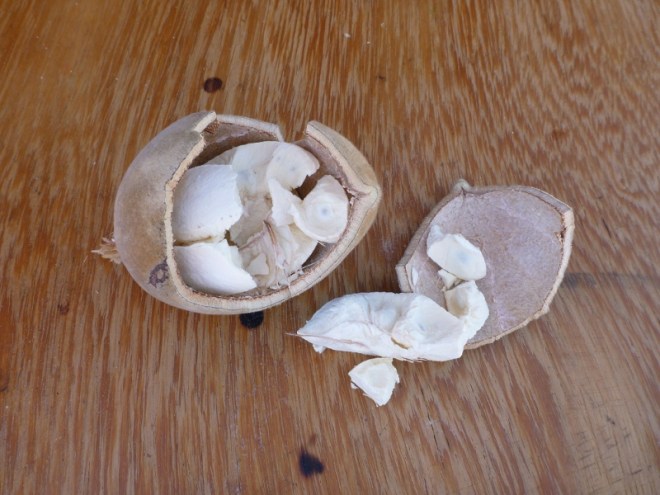
As readers can see, the ant has a bright green bum. The driver-cum-guide of our tour was a passionate advocate of the country’s Aboriginal population, of which there are still many in this little corner of Australia (it was the last part of the continent to be penetrated by white settlers, back in the 1870s). Among other things, on our walks through the bush he would point out various bush tucker (for non-Australians, that’s wild food which can be harvested in the bush), which he always claimed were bursting with proteins, Vitamin C, and other goodies, and which he would then invite us to try. So apart from Green Tree ants, I dutifully ate the petals of Australia’s kapok tree

the “petals” of the rosella “flower”
image
and the inside of the “nut” of the Australian boab tree (on which hangs a fascinating tale, which I will write up in a later post).
image
His partner, who was our cook, also fed us camel burghers (camels can now be found in the wild in Australia by their millions)

image

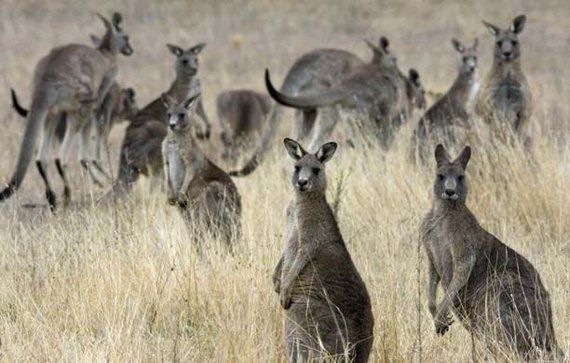
and kangaroo stew (also to be found in their millions throughout Australia, but of which we saw surprisingly few on this trip).
image
My conclusion: I really hope I don’t need to be a vegetarian in the Australian bush.

But actually, further research on my part since we returned from Australia suggests that the range of bush tucker we tried on our tour was rather limited. One article in Wikipedia has quite a long list of bush tucker to be found in the top end of Australia where we found ourselves, only one of which – the boab nut – we tried. So I really shouldn’t give up on bush tucker just yet.

_____________________
Green tree ant: http://www.alexanderwild.com/Ants/Making-a-Living/Arboreal-Ants/i-wpGjWZ8
Kapok tree flower: http://www.crystalchannelers.com/blog/plantology—aboriginal-healing-recipes—reduce-a-fever
Rosella: https://cnesgreen.wordpress.com/2010/04/19/roselle-flower-tea-hibiscus/
Open boab nut: https://outbackjoe.com/macho-divertissement/bush-tucker-plants-and-animals/boab-tree/
Wild camels in Australia: https://www.dpaw.wa.gov.au/management/pests-diseases/202-camels-in-western-australia?showall=1
Kangaroos: http://notallowedto.com/the-feral-child-a-boy-raised-by-kangaroos-discovered-in-australia/

AUSTRALIA – KIMBERLEY TOUR HIGHLIGHTS

Bangkok, 5 June 2016

My wife and I both agree that without a doubt the Bungle Bungle National Park was the highlight of our recent tour of the Kimberley (I suppose I should use its proper name, Purnululu National Park, but Bungle Bungle is such a delightfully silly name that I shall stick to that). It has been chosen as a World Heritage Site and for once I agree with this. What we have here is a deeply eroded range, and I think the best way to appreciate the unique geology of the Bungle Bungle is through an aerial photo
image
or two
image
or three.
image
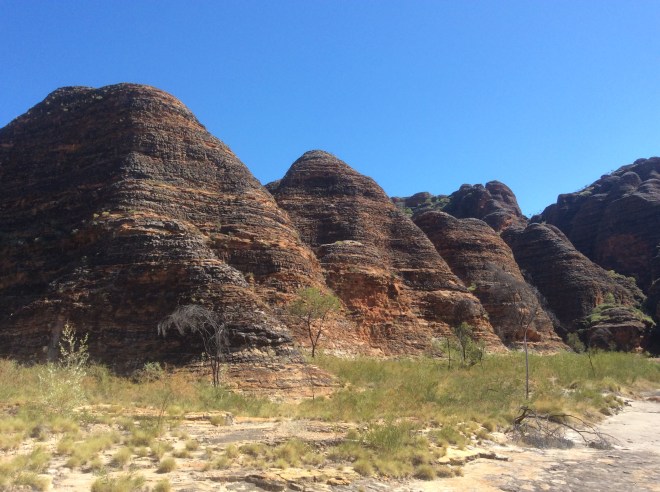
Readers will immediately notice the smooth rounded shapes into which the rocks have weathered – beehives is a commonly used descriptor and seems very apt. The guidebook with which we were thoughtfully supplied on our coach stated that this type of formation is very rare – only a few other places on Earth have it, and not nearly as extensively as in the Bungle Bungle Range. UNESCO, in its World Heritage Site write-up, notes approvingly that “the Bungle Bungles are, by far, the most outstanding example of cone karst in sandstones anywhere in the world.” Without going too much into the geological whys and wherefores, the fact that the rock has eroded into these smooth rounded shapes seems to have to do with the bands in the rock, seen quite well in the third photo above and even better in this photo taken by my wife from ground level.
image
The key to the bands’ existence is the clay content of the rock. The darker bands have more clay, which means they hold moisture better, which in turn allows a very thin film of cyanobacteria to grow on the rock. It is this film which gives the rock its darker colour. The red bands, on the other hand, having less or no clay, dry out quicker and so cannot support a colony of bacteria. Instead, they have been stained orange-red by iron and manganese deposits. The bacterial film protects the rock from too rapid an erosion, which allows the rounded shapes to form.

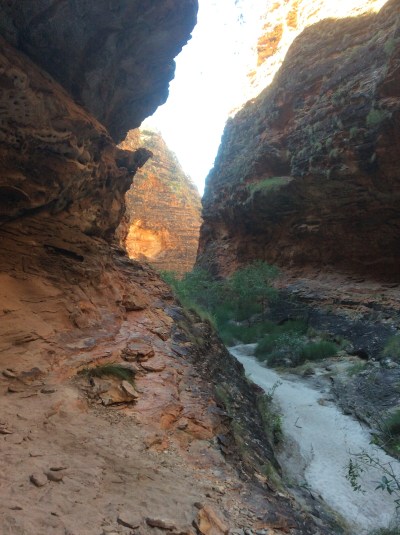
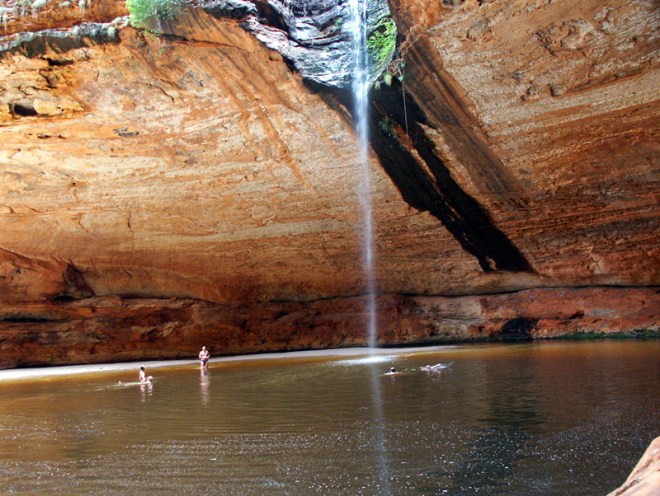
Geological considerations aside, it’s a delight to walk through these humped and rounded rocks, which are split by numerous gorges and chasms, a number of them having trails laid along them. We walked just two, the Cathedral Gorge and the Echidna Chasm. The Cathedral Gorge narrows slowly
image
image
image

image

to finally finish in a pool partially covered by deep overhangs.

DCF 1.0

image
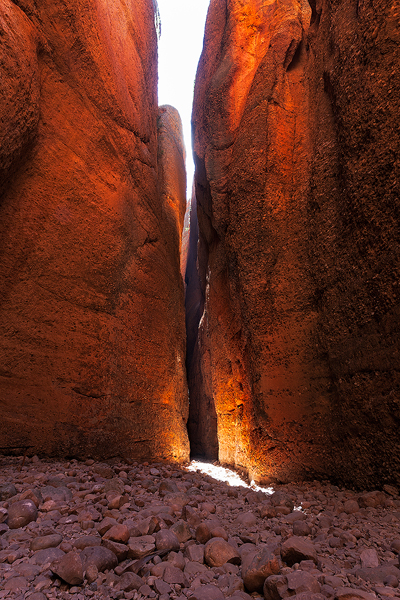
The Echidna Chasm, on the other hand, is a deep, narrow gash in the rock, at times so narrow that it is hard to get through. After the surprise of coming across Livistona fan palm trees at its mouth (palms are not the first trees that come to mind in this hot and arid landscape)
image
one edges into the chasm itself. There is a certain fun in threading one’s way through, at some points having to climb and clamber over huge boulders, sections of the walls which have come crashing down; one keeps looking nervously up to see if others might not be about to give way and squash one like a beetle. But there is also an ethereal beauty in this chasm. At certain times of the day, the sun catches the rocks and makes them literally glow. Our iPad cameras were too feeble to catch this wonderful light, but this photographer has managed beautifully.
image
We would gladly have stayed longer in this Park and done more of the trails. But that is the downside of organized tours: the tyranny of The Schedule.

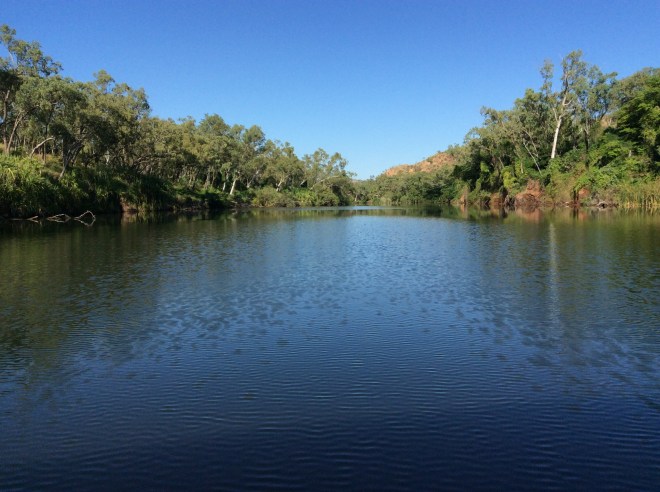
After detailed discussions, my wife and I have agreed on two more modest scheduled highlights, both, interestingly enough, having to do with water. One was the boat ride on a section of the Ord River near Kununurra, which has been dammed for irrigation purposes. From such utilitarian objectives has come a very pleasant body of water, in the form of several kilometers of the river which are filled year-round with water (a rarity in Australia).

image

image
“Water is life” our driver-cum-guide would constantly intone, and this stretch of river was the living proof of this. Apart from several well-fed freshwater crocodiles which we spied along the banks with a twittering of excitement, we saw a large number of birds, the most majestic of which was undoubtedly the white-breasted sea eagle
image
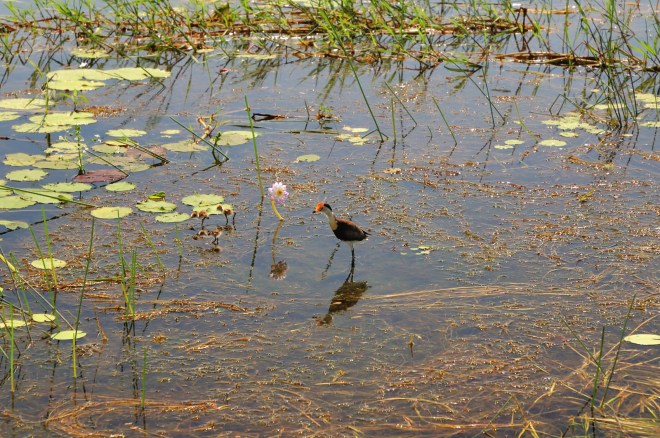
and the sweetest of which was the Jesus bird (aptly named since it seems to walk on water).
image
The mother hatches the chicks, the father is then solely responsible for their upbringing (many of the ladies on board noted this division of labour with approval; the men said nothing). But perhaps the most interesting wildlife we came across was a colony of fruit bats hanging out (literally) in a couple of trees along the bank, making quite a noise as they yelped and barked – when do they sleep, I wonder?

SONY DSC

From the mutterings of disapproval among our Australian companions and the spirited defense of the bats put up by our guide, we surmise that they are considered a nuisance in more urban settings, no doubt because they sink their fangs into the fruit of your garden which you had been looking forward to eating.

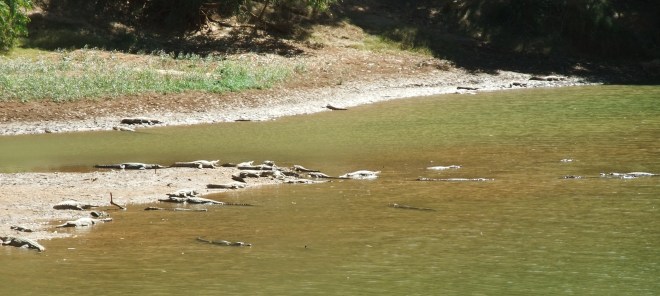
The second modest scheduled highlight was Windjana gorge, in the King Leopold Ranges (why the British explorer who first came across these ranges named them after the King of the Belgians is a bit of a mystery to me; my guess is he was hoping the guy would fork out for his next expedition). Apart from the frisson we got from seeing twenty or more freshwater crocodiles all in one place waiting in complete stillness on the banks or in the water for their next meal to go by
image
the gorge itself was very pretty
image
and once again the rocks glowed orange-red in the setting sun.
image

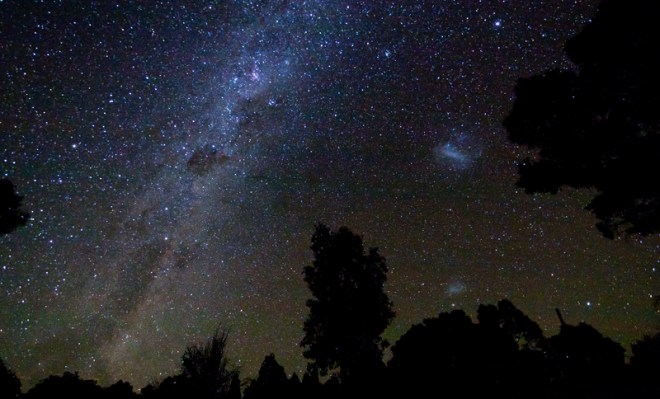
There was one other highlight, which wasn’t marked in The Schedule, and that was the night sky. In many places, we camped far, far away from any polluting light sources. This, combined with the normally clear skies, meant that when the moon didn’t get in the way we had glorious views of the night sky. It was a sky without the constellations of the Northern Hemisphere with which my wife and I are familiar, but nevertheless a magnificent site to behold, especially on the nightly walks to the toilet to which I alluded in the previous post.
image
Our last night out, we dragged our camp beds out of our tent, and as we dozed we watched the Milky Way wheel across the sky. Wonderful. But as they say, there is no gain without pain. I am still spreading anti-histamine cream on the dozen or so bites I got from the accursed Australian mosquitoes that night, may they rot in Hell.

____________

Bungle Bungle aerial view-1: http://www.kimberleywilderness.com.ccd. dau/the-apt-experience/photos-and-videos/photo-gallery
Bungle Bungle aerial view-2: http://www.ryanphotographic.com/Essay.htm
Bungle Bungle aerial view-3: http://kimberleymedia.photoshelter.com/gallery/Bungle-Bungles-Purnululu/G0000GcT6t3sRLPw/C0000uv7H8rn8We0
Cathedral Gorge trail: my wife’s photos
Cathedral Gorge pool-1: http://studyperth.com.au/about/news-feeds/2015/10/top-10-walking-tracks-and-bike-trails
Cathedral Gorge-2: my wife’s photo
Livistona palm trees: my wife’s photo
Echidna chasm: http://www.wildroad.com.au/galleries/australia-photos/echidna-chasm-purnululu-national-park-australia/
Ord River: my wife’s photos
White breasted sea eagle: http://thelife-animal.blogspot.com/2012/07/white-bellied-sea-eagle.html
Jesus bird: https://well.smugmug.com/keyword/WadingBirds;birds
Fruit bats: https://drivedownunder.wordpress.com/2013/06/14/its-a-bungle-out-there/sony-dsc-138/
Crocodiles, Windjana Gorge: https://flamingoing.wordpress.com/2013/08/19/the-devonian-reef-national-parks/
Windjana Gorge: http://www.broomeandthekimberley.com.au/gibb-river-road-and-gorges/
Night sky: http://www.3rf.com.au/gallery.asp

OUR TOUR OF THE KIMBERLEY, AUSTRALIA

Bangkok, 5 June 2016

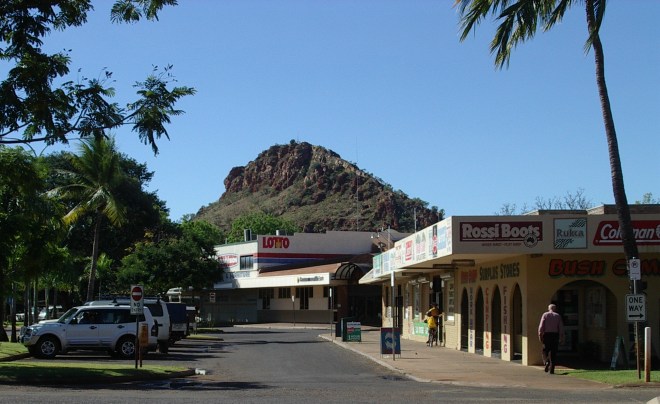
I must excuse myself to my readers for the long gap in my posts, but my wife and I have just come back from a two-week holiday. We were visiting the Kimberley region in Australia, which for those not familiar with Australian geography is the region tucked away into the continent’s northwest corner.

It’s Australian outback country par excellence: a poor, red, stony earth with rocky outcrops, lightly covered by a varying mix of grasses and eucalypts

image

and dotted, sometimes thickly, with termite mounds
image
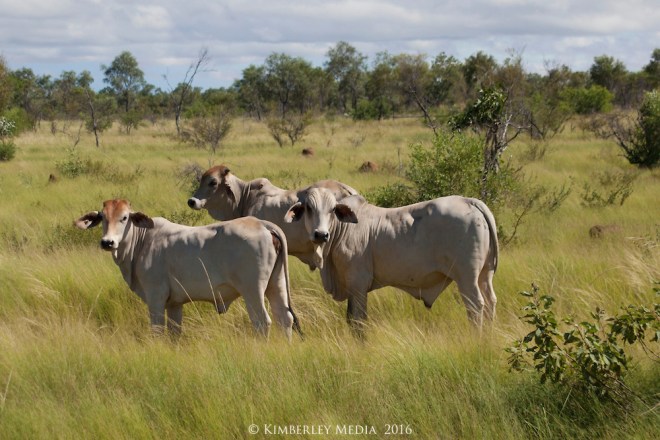
sparsely populated, with huge cattle stations whose cattle is almost wild
Young Brahman cattle enjoy the lush grasslands in the Kimberley wet season.
and small, nondescript towns
image
with significant Aboriginal populations.

image
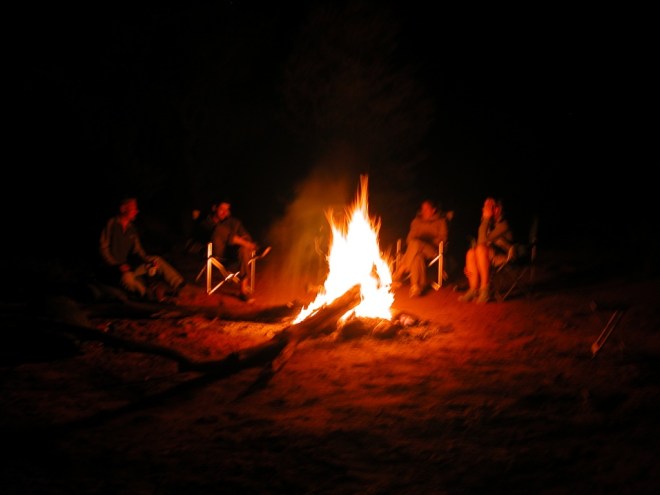
We chose to go with an organized tour, and so we found ourselves, the rather exotic foreigners, traveling with 22 Australians and a New Zealander (I don’t think New Zealanders really count as foreigners in Australia). It was a fascinating mix of people. Nearly all of them were from Australia’s east coast, escaping their “cold” winter. Most of them were retirees; at 62, we were among the youngest (there were two outliers, girls in their early twenties – we all stared at them in surprise when they first got on the coach; what on earth were they doing with us old fogies?). Two couples had been dairy farmers, a number had been teachers, a number had been social workers of one form or another, one had worked in the prison system, one had been an architect and another a house builder, one had been a bureaucrat in the Ministry of Finance, one of the young girls drove coal trucks out of a coal mine while studying part-time to be a nurse, the other was a receptionist. As behoves an immigrant country, several of our group were first-generation immigrants: there was a woman who hailed originally from Malaysia, another from France, a couple from the Netherlands, and another couple from what had once been Rhodesia and is now Zimbabwe. All this diversity made for interesting discussions as we opened up to each other at meals and around camp fires in the evening.
image
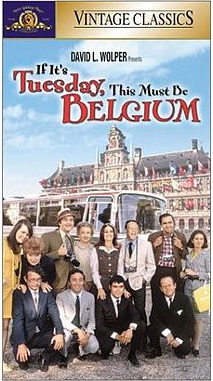
And of course, we touched upon the more intimate things of life: children, deaths of or separations from spouses, and, as we settled into the trip and admitted several trips a night to the toilet, the state of our prostates. It was somewhat akin to that film of long ago “If It’s Tuesday, This Must Be Belgium”
image
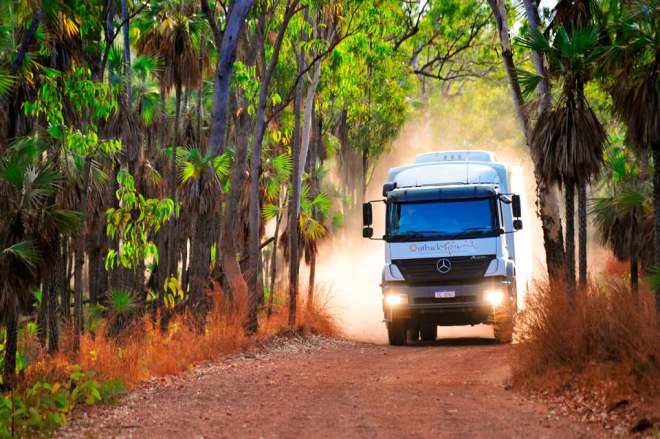
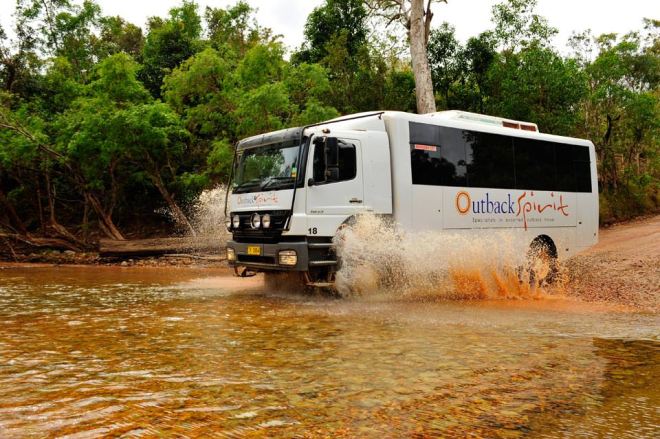
although in our case we only toured one small part of one country (but still managed to clock up 2,600 km; just to put things in perspective, the Kimberley is twice as big as the UK), the coach we rode in was technologically very sophisticated, custom-built on a Mercedes chassis to take anything the rugged unpaved roads of the outback could throw at it
image

image

and we slept in tents – I was strongly reminded of my Boy Scout days.
image
The tour started in Broome, a small town on the Indian Ocean and once a pearling station, went east along the paved Great Northern Highway for a thousand kilometers or so, to the even smaller town of Kununurra, and then looped back to Broome along the unpaved Gibb River Road, with a detour north at some point along the Kalumburu Road to visit the Mitchell Falls situated very nearly on the northern coast. I do not intend to bore my readers with a detailed travel diary. I will just touch upon some highlights in the next posts. So cheerio, mates!

_________________

map: https://en.m.wikipedia.org/wiki/Kimberley_(Western_Australia)
Kimberley vista: my wife’s photo
Termite mounds: https://www.birdwatch.co.uk/categories/articleitem.asp?item=643
Cattle: http://kimberleymedia.photoshelter.com/gallery/Cattle-Kimberley-Images/G0000RM6HcfEh3fE/
Kununurra: http://www.avalook.com/newsite/?page_id=13
Old Aborigine: my wife’s photo
Around the campfire: http://sacreddestinations.org/sacred-destinations-spiritual-tours-meditation-retreats.html
“If It’s Tuesday, This Must Be Belgium” film poster: https://en.m.wikipedia.org/wiki/If_It%27s_Tuesday,_This_Must_Be_Belgium
Coach: http://www.outbackspirittours.com.au/tours/cape-york-wilderness-adventure
Tents: my wife’s photo

THE BEAUTY OF MATHEMATICS?

Bangkok, 15 May 2016

My wife and I have just seen the film “The Man Who Knew Infinity”. For those of my readers who are not up on the latest offerings from Hollywood, this is a film about two real-life mathematicians, Srinivasa Ramanujan, a brilliant, self-taught, Indian mathematician from Tamil Nadu, and G.H. Hardy, a great English mathematician, Fellow of Trinity College, Cambridge. I will not bore readers with a summary of the plot or my analysis of the story. My point is, it’s a story about mathematicians who love mathematics. The film is full of allusions to the beauty of mathematics, and indeed Hardy is known to the general public (if known at all) for a book he wrote on the beauty of mathematics, A Mathematician’s Apology.

The beauty of mathematics …

Neither my wife nor I are good at maths. In fact, we stink. And as can be readily imagined, we both have bad memories of maths at school. My wife still talks with dread about her last maths teacher, Mrs. Poggi. She was, according to my wife’s recounting, old, single, small, and very, very mean. She had an uncanny ability to know when my wife didn’t understand what was going on, and with a loud voice would command her to stand up and explain.

For my part, the name of my maths nemesis is now mercifully expunged from my memory. All I remember is having been moved up two classes in primary school, and finding myself going from arithmetic to geometry. There I was, staring helplessly at a triangle while my nemesis was flaying me verbally in front of the whole class, saying it was obvious that a squared plus b squared equaled c squared.
image
(There was also, later, the ex-colonel, who used to fling pieces of chalk at those who, like me, failed to comprehend the mathematical complexities on the board quickly enough. His name I remember: Colonel Yule)

My wife never recovered from her run-ins with maths. Even now, she begins to get nervous whenever even simple arithmetic operations are required – although she has a much better grasp of numbers in the real world than I do; she instinctively knows what the price of anything should be, whereas I have no idea: 1 euro, 10 euros for a bag of tomatoes? don’t know. For my part, I was partially salvaged in secondary school by the kindly Fr. George (my secondary school was a religious school). Fr. George took the class of the maths duds, the maths brain-dead. His job was to get us to pass Maths O-level – minimum pass was all that was required. His method was simple: to do exercises again and again, until the fear of the mathematical operation in question had passed. (he also gave very sensible advice like write your name on the answer sheet before starting, to calm your nerves, remember to turn over the exam paper to see all the questions before you start, and don’t do the questions in order – start with the questions you know you can answer). His recipe worked for me; I passed with minimum grade. (I thought I was done with maths at that point; alas not! I wanted to do science, and maths comes with science. So I struggled on with maths all the way to first year in University).

With this baggage, it’s not surprising that neither my wife nor I see any beauty in mathematics. I suppose towards the last years of my interactions with maths I faintly saw the possibilities of beauty, when the complexities which started at the top of the blackboard would resolve themselves neatly, and indeed beautifully, by the bottom of the board, but that was as near as I ever got.

I suppose, like Moses before the Promised Land, we are told that there lies before us a land flowing with milk and honey but we know we will never enter it. That will be left to the likes of Ramanujan and Hardy to enjoy.
image
Well, you can’t have everything in life.

_____________________

Mean Italian maths teacher: http://spoki.tvnet.lv/tribine/Tavas-dzives-galvenas-sievietes/683494
Teacher shouting at pupil: http://www.illustrationsource.com/stock/image/640/an-irate-teacher-shouting-at-a-boy-in-a-classroom/?&results_per_page=1&detail=TRUE&page=3
Moses before the Promised Land: http://www.politicaltheology.com/blog/the-politics-of-being-replaced-deuteronomy-341-12/

WATER

Bangkok, 7 May 2016

It’s hot here in Bangkok at the moment, very hot.

And it’s humid, very humid.

We drag ourselves through the day, stumbling from one air-conditioned space to another.

We scout the horizon for clouds. Will the cooling rains ever come?

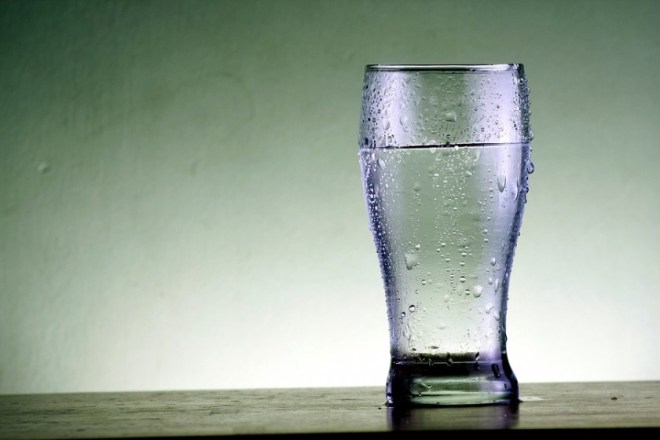
We sweat, we’re thirsty. We go to the fridge to get that bottle of cold, cold water. We pour ourselves a glass. A film of water immediately forms on it.

We drink. Aaaah, sooooo good …

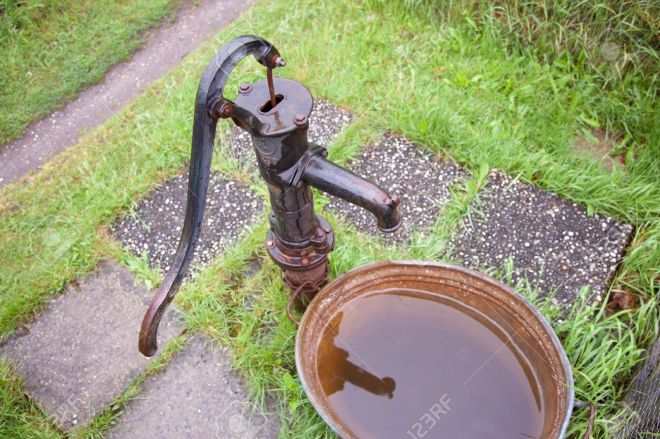
In her garden, my French grandmother had a water pump which looked like this.
image
When we were children, half a century ago, my cousins and I would amuse ourselves by pumping the handle vigorously till the water poured out. Watching us one day, my mother told us that when she had been a child our age, so some time in the late 1920s, early 1930s, before refrigerators were common, on hot summer days she was sent out by various uncles and aunts who were visiting to get a glass of water from that pump. But she was not to take the first water to gush out, no, she was to pump and pump until the water was “bien frappé”, well chilled, enough to form a film on the glass …

That pump stopped pumping 30 years ago. As ever more water was sucked from the aquifer the level dropped, until one day it dropped so far that the pump ran dry. It never pumped a drop of water again.

At my old primary school in Somerset, whose halls I graced half a century ago, there was a bubbling little stream that ran along the edge of the playing fields. We played for hours on it, floating sticks and leaves, building dams, and generally mucking about. It looked like this, minus the horses.
image
30 years ago, when I visited one summer, it was gone, dried up. The aquifer had dropped too far.

A larger stream ran along the valley floor not too far from my French grandmother’s house. It was a quick bike ride away, and my cousins and I would often go there to catch freshwater crayfish in its clean, clear waters and bathe in a deep, blue pool that had formed in the middle reaches. 20 years later, when I visited, it was turgid and scummy, with froth floating on it.

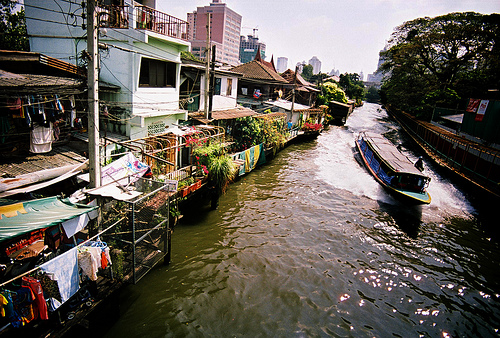
Bangkok is a water city. It sits on a river and is laced with canals. It should be lovely to travel on its waterways. Instead, it’s like cruising along stinking, fetid sewers. We take a water bus from time to time, when the traffic is really bad, from the Golden Mount Temple to the modern downtown.
image
Instead of enjoying the passing scenery, I live in dread of spray from the canal landing on my face; God knows what viruses and bacteria populate the water. I always scrub my face vigorously when I get off. As for the river, from our apartment terrace we look down on the rubbish of the city which floats by every day.
image
Recently, we visited Halong Bay, in Viet Nam, a World Heritage Site. We gazed on the unutterable beauty of the surroundings. But we also gazed at the rubbish floating around us and at the locals’ pathetic attempts to get rid of it.
image
Are we mad? We guzzle water like there was no tomorrow and treat it like a rubbish dump. Yet we need water, it’s vital to our lives. How can we treat so badly something we absolutely cannot do without?

________________
Glass of water: http://www.healthydietbase.com/does-drinking-ice-cold-water-help-you-lose-weight/
Old water pump: http://fr.123rf.com/photo_20440985_fonte-ancienne-pompe-a-eau-de-fer-humide-dans-le-jardin.html
Small stream: http://www.gettyimages.com/image/photo-2-tarpan-horses-crossing-a-small-brook/508354517
Bangkok canal: http://aspiringwriter.ca/tag=bangkok
Rubbish in Chao Praya River: https://bangkok2birmingham.org/2013/05/30/deteriorated-water-so-what/
collecting rubbish in Halong bay: https://www.pinterest.com/pin/27725353931017487/

WILL AND I

Bangkok, 30 April 2016

One of the problems of living abroad is that issues of great moment back home have little if any echo here in Bangkok. So it was with the 400th anniversary of Will Shakespeare’s death, which fell on 23rd April last week. It was only when I was catching up with news from home (to Brexit or not to Brexit?) that I saw the huge amount of chatter on line and realized this.

Well! I cannot let this anniversary go by, even though I am already a week late in celebrating it. I mean, Will and I go back a long way! Before I start my breathless recollections, though, let me throw in a picture of one of the few portraits of Shakespeare which are thought to probably be a good likeness, from his funerary monument in his home town, Stratford-upon-Avon.
image
(my alert readers will have noticed much circumspection in that last phrase; so little is known about the real-life Will)

I saw my first piece of Shakespeare – a mere snippet – when I was a seven-year old. My parents had taken me along to visit my elder brother at his school’s Sports Day. As the name suggests, the day was primarily about sports, but to show some high-browsedness among all this low-browsedness the Headmaster also put on a few scenes from Shakespeare, played by the boys. One of these boys was my brother, who played a scene from Henry VIII. Although I don’t know which scene it was exactly, I do remember sitting next to him afterwards and – pesky child that I was – pulling off strands of his stuck-on beard.

A year later, I was packed off to the same school, and at one of the next Sports Days I got my first role, a walk-on part as a page of Macbeth’s. My moment in the spotlight was short. I preceded Macbeth onto the stage, who then ordered me off to do something. I bowed with dignity and exited left. After which Macbeth launched into that great soliloquy:

“Is this a dagger which I see before me,
The handle toward my hand? Come, let me clutch thee.
I have thee not, and yet I see thee still.
Art thou not, fatal vision, sensible
To feeling as to sight? or art thou but
A dagger of the mind, a false creation,
Proceeding from the heat-oppressed brain?”

It goes on for several more fevered lines, but we’ll leave it at that.

In later years, I was a regular at these theatrical events on Sports Days, but I never got to do any more Shakespeare. The best I managed was the lead role, as a waiter, in some farce to do with a coconut being mistaken for a bomb. No matter! I was hooked on the acting life.

My school might have been buried in the wilds of Somerset, but that did not stop the Headmaster from trying to expose us to Culture. One way he did this was by taking us to theatrical events. Thus it was that one beautiful summer’s day (“Shall I compare thee to a summer’s day?”) we were bussed off to a local Stately Home and watched the Winter’s Tale on its manicured gardens. I can’t say I was terribly impressed by the play, certainly none of the text has remained with me. I appreciated more the strawberries and cream served at the interval. I was probably too young to appreciate the play (I must have been all of eleven at the time). But I did very much appreciate the al fresco setting, and so a number of years later, when I was at high school, I was an enthusiastic member of a small audience watching Waiting for Godot, sitting on the grass watching as Vladimir and Estragon acted out their empty lives on a lonely dirt road.

At that same high school, I acted in my first full-length Shakespeare play, Richard II, as the Duke of York. I’ve mentioned this in an earlier post, so will not elaborate. What has stayed with me all these years, though, apart from dying John of Gaunt’s paeon to England (“This other Eden, demi-paradise … this precious stone set in the silver sea … this blessed plot, this earth, this realm, this England”) is Henry Bolingbroke’s icy remark to the captive Richard II, who is wallowing in self-pity: “The shadow of your sorrows hath destroyed the shadow of your face”.

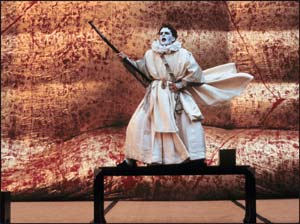
If I’m to be honest, our Richard II was no great shakes. It was a good attempt by amateurs, no more. To prep us, our Director had hired a van and taken us down to Stratford, to see the Royal Shakespeare Company put on Richard II. It was certainly better than what we did, but it was no more than workmanlike, I would say. I had to wait some ten years to see a truly splendid production of Richard II, directed by Ariane Mnouchkine in a large space in the Bois de Vincennes in Paris. Ah, what a wonderful production that was! Mnouchkine used a style that mixed Japanese theatrical traditions with mime, on a large set uncluttered by any of the traditional theatrical props. It was truly magic, one of those theatrical experiences that stays with you forever.
image
Back to my own theatrical career at high school! It reached its zenith when I acted in Tom Stoppard’s brilliant comedy Rosencrantz and Guildenstern are Dead. I played Rosencrantz (or maybe Guildenstern, I forget; the characters themselves were always getting confused about who they were). This hilarious play is a riff on Shakespeare’s Hamlet, in which R&G play minor and totally inglorious roles. To my great regret, I never acted in Hamlet itself. The closest I got was playing a few scenes on the portico of the Scottish National Gallery in Edinburgh, during the University’s charity week. I played Polonius as a completely senile old twerp, unashamedly hamming it up for the audience: a disgraceful exhibition – but fun!

In truth, my days treading the theatre boards were even then numbered. I quickly realized at University that I was a mediocre actor and it was time for me to get serious. But before my final curtain call, I did manage get a modest part in Measure for Measure, playing Claudio, a young man sentenced to death for getting his girlfriend pregnant. It’s a strange play, aptly titled a “problem play”, categorized as a comedy but being no such thing. None of the characters are that nice either, so it’s difficult to feel much sympathy for anyone. My character Claudio gets some wonderful lines as he sits in gaol, bathed in a total funk at the idea of dying:

“Ay, but to die, and go we know not where;
To lie in cold obstruction, and to rot;
This sensible warm motion to become
A kneaded clod; and the delighted spirit
To bathe in fiery floods, or to reside
In thrilling region of thick-ribbed ice;
To be imprisoned in the viewless winds
And blown with restless violence round about
The pendant world; or to be worse than worst
Of those that lawless and incertain thought
Imagine howling – ’tis too horrible!
The weariest and most loathed worldly life
That age, ache, penury, and imprisonment
Can lay on nature is a paradise
To what we fear of death.”

And as I grow older, the lines of Duke Vincentio, spoken in his disguise as a monk to Claudio in prison, resonate ever more strongly with me: “when thou art old and rich, thou hast neither heat, affection, limb, nor beauty to make thy riches pleasant”. So true, alas!

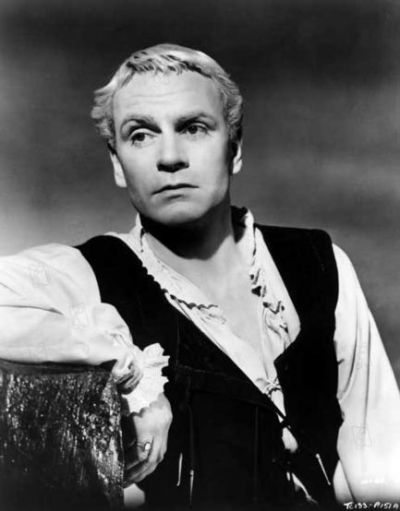
And that was the end of my days on the proscenium. From then on, my engagement with Shakespeare was through films and other people’s theatrical productions. The most vivid of my recollections centre around Laurence Olivier. There was a poky little cinema on the Left Bank of Paris which one year when we lived there held a festival of Olivier’s Shakespeare films. My wife and I first watched Olivier’s film version of Hamlet, the first proper Hamlet I had ever seen. Olivier started with his voiced-over summary of Hamlet: “This is the tragedy of a man who could not make up his mind”.

Hamlet 1948 rŽal : Laurence Olivier Laurence Olivier Collection Christophel

It was masterly, no doubt about it. Of course, there were all the hoary Hamlet quotes: “Alas, poor Yorrick, I knew him”, “get thee to a nunnery”, “neither a borrower nor a lender be”, and of course probably the hoariest of all hoary Shakespeare quotes, “To be or not to be, that is the question”. Actually, behind all that hoariness lies one of Shakespeare’s most profound, and profoundly beautiful, soliloquies, of which I cite here only some lines, those which have always resonated with me the most:

“………..To die: to sleep;
No more; and, by a sleep to say we end
The heart-ache and the thousand natural shocks
That flesh is heir to, ’tis a consummation
Devoutly to be wish’d. To die, to sleep;
To sleep: perchance to dream: ay, there’s the rub.
For in this sleep of death what dreams may come
When we have shuffled off this mortal coil,
Must give us pause …”

In that same poky little cinema on the Left Bank, we got to see Olivier’s wonderful Richard III, which I have commented on in an earlier post, but also his sublime Henry V, a wonderful propaganda piece made in 1944 as a morale booster and dedicated to the “Commandos and Airborne Troops of Great Britain, the spirit of whose ancestors it has been humbly attempted to recapture”. So it is that we have great, reverberating lines like these:

“Once more unto the breach, dear friends, once more;
Or close the wall up with our English dead!

I see you stand like greyhounds in the slips,
Straining upon the start. The game’s afoot:
Follow your spirit; and, upon this charge
Cry ‘God for Harry! England and Saint George!'”

“We few, we happy few, we band of brothers;
For he to-day that sheds his blood with me
Shall be my brother; be he ne’er so vile
This day shall gentle his condition:
And gentlemen in England, now a-bed
Shall think themselves accursed they were not here,
And hold their manhoods cheap whiles any speaks
That fought with us upon Saint Crispin’s day.”

image
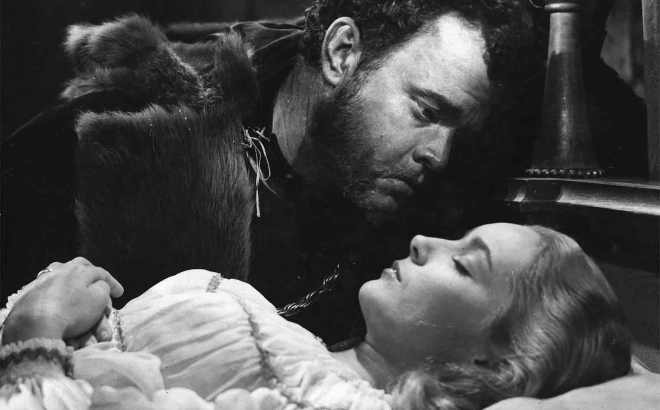
To my great regret, we missed the showing of Olivier’s film of Othello. But we did later see, in an equally poky cinema somewhere else, Orson Welle’s Othello, filmed in some exotic castle in Morocco. Ah, the terrible torments of jealousy! “beware, my lord, of jealousy; It is the green-ey’d monster which doth mock the meat it feeds on”.
image
“I kissed thee ere I killed thee, no way but this, killing myself, to die upon a kiss.”

And then there was Orson Welles as Macbeth! Rather over the top – a cross, as Welles himself put it, between Wuthering Heights and Bride of Frankenstein
image
but home of some of the most sublime of Shakespeare’s lines, uttered by Macbeth as the power he has sold his soul for crumbles away around him.

“To-morrow, and to-morrow, and to-morrow,
Creeps in this petty pace from day to day,
To the last syllable of recorded time;
And all our yesterdays have lighted fools
The way to dusty death. Out, out, brief candle!
Life’s but a walking shadow, a poor player
That struts and frets his hour upon the stage
And then is heard no more: it is a tale
Told by an idiot, full of sound and fury,
Signifying nothing.”

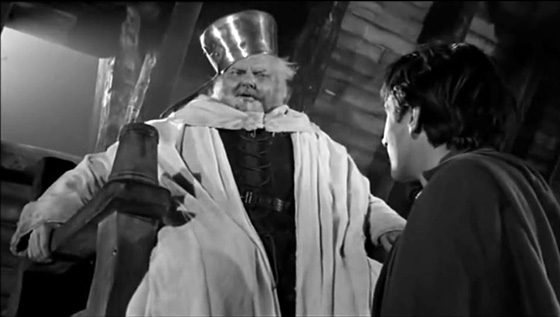
Orson Welles did another great Shakespeare film, The Chimes at Midnight, a medley from Henry IV Parts I and II, Henry V, Richard II, and even The Merry Wives of Windsor, and focusing on Sir John Falstaff, to my mind the only Shakespearean character who is really comic in the modern sense.

image
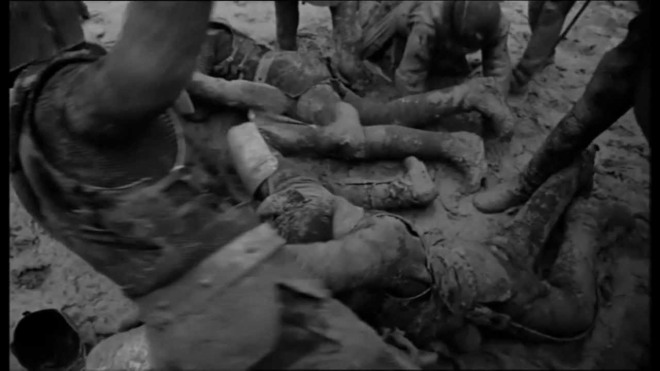
It’s a truly funny film. It’s also the film which brought home to me how Medieval battles were just brutal slugfests, with men bludgeoning each other to death with heavy, and sharp, pieces of metal.
image
But it’s ultimately a film about betrayal. Prince Hal, a Crown Prince who cannot bear to take his responsibilities seriously, strings Falstaff along, making him believe that they are fast friends. But when Prince Hal becomes Henry V and Falstaff thinks he is now in the clover (“My King! My Jove! I speak to thee my heart”), the newly crowned King rejects him, literally turning his back on him (“I know thee not, old man; fall to thy prayers! How ill white hairs become a fool and jester!”).

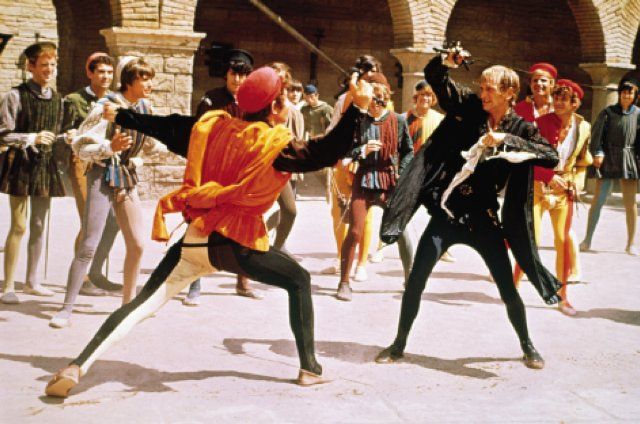
Over the years, my wife and I have seen a number of other Shakespeare plays in film or theatre. Most, alas, have left little or no mark. Two, though, have stayed with me. One is a stage production of The Tempest directed by Giorgio Strehler, which was visually absolutely stunning. The other is Franco Zefirelli’s lush Romeo and Juliet. I don’t remember it so much for the love story – to my modern, cynical, ear, it all sounds very twee – as for the way Zeffirelli beautifully captured the edgy, ultimately tragic, banter between Mercutio and the Capulets.

image
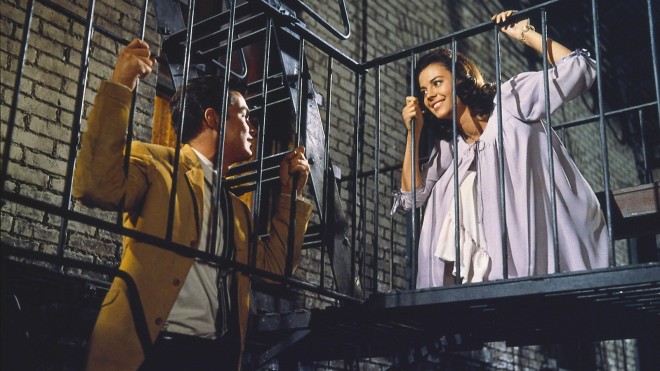
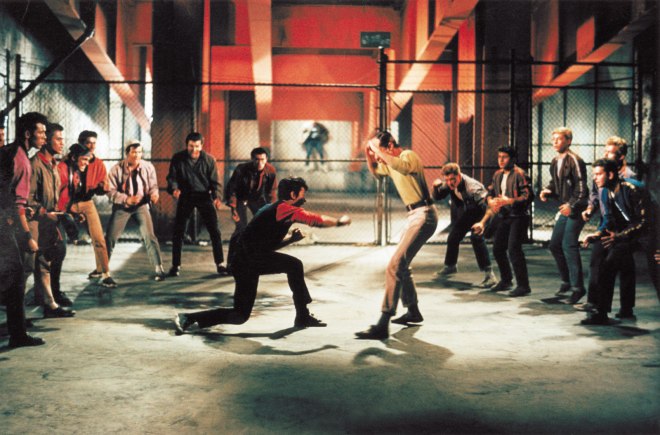
I may be a cynical old fart, but it’s undeniable that the drama of love across forbidden barriers resonates. There’s Leonard Bernstein’s West Side Story, an adaptation of Romeo and Juliet to New York’s gangs
image
image
and just recently I was watching an Al Jazeera show following the production of a Romeo and Juliet adaptation in Mali, a country where it is still the norm for parents to decide whom you marry; the, mostly female, audience were captivated. 400 years on, Shakespeare is still relevant.

I’ve focused on Shakespeare the dramatist. There is also Shakespeare the writer of the sonnets. One sonnet in particular is close to my heart at this time of my life:

“That time of year thou may’st in me behold
When yellow leaves, or none, or few, do hang
Upon those boughs which shake against the cold,
Bare ruin’d choirs, where late the sweet birds sang.
In me thou see’st the twilight of such day,
As after sunset fadeth in the west,
Which by-and-by black night doth take away,
Death’s second self, that seals up all in rest.
In me thou see’st the glowing of such fire
That on the ashes of his youth doth lie,
As the death-bed whereon it must expire
Consum’d with that which it was nourish’d by.
This thou perceivest, which makes thy love more strong,
To love that well which thou must leave ere long.”

Like I said, Shakespeare still speaks to us 400 years on. I just hope to have a few more goose-bump moments with Will before the sixth and seventh ages of man which he clinically describes kick in:

“The sixth age shifts
Into the lean and slippered pantaloon,
With spectacles on nose and pouch on side;
His youthful hose, well saved, a world too wide
For his shrunk shank, and his big manly voice,
Turning again toward childish treble, pipes
And whistles in his sound. Last scene of all,
That ends this strange eventful history,
Is second childishness and mere oblivion,
Sans teeth, sans eyes, sans taste, sans everything.”

___________________________
Shakespeare’s funerary monument: http://www.hollowaypages.com/Shakespearemonument.htm
Théatre du Soleil, Richard II: https://jeffberryman.com/2009/07/20/finishing-the-story-le-theatre-du-soleil/
Olivier Hamlet: http://www.fanpop.com/clubs/laurence-olivier/images/5111432/title/hamlet-photo
Olivier Henry V: http://hayhistorygroup.co.uk/new-events/2015/9/11/hay-history-weekend-henry-v-at-booths-cinema-olivier-version
Welles Othello: http://filmforum.org/film/othello-welles-film
Welles Macbeth: http://filmforum.org/film/macbeth-scottish-version-welles-film
Welles Chimes at Midnight: http://www.midnightonly.com/2015/04/12/chimes-at-midnight-1965/
Battle Chimes at Midnight: https://www.youtube.com/watch?v=3bWraOy6Kw4
Romeo and Juliet: https://www.pinterest.com/pin/186125397070342206/
West Side Story love: https://www.filmlinc.org/events/west-side-story/
West Side Story fight: http://cityartsonline.com/blog/2010/06/siff-review-seeing-west-side-story-first-time

SOÑAR NADA CUESTA

Bangkok, 23 April 2016

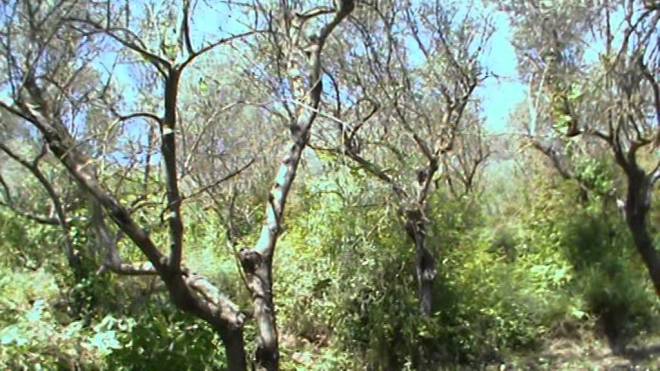
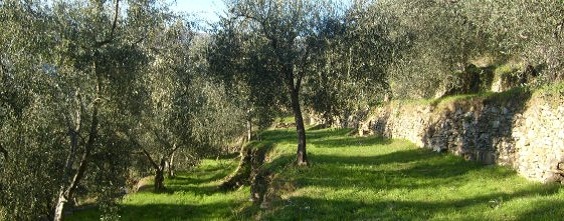
There is a small olive orchard abutting the path that runs behind our apartment in Liguria. It’s in a sorry state, seemingly sorrier every time my wife and I pass it on our way into the hills. I’ve never taken a picture of it, but it looks something like this, only worse.
image
It’s the sad fate of many of the terraced olive orchards in Liguria. It makes no economic sense any more to harvest olives in this part of Italy, and as the peasant-farmers who own them die off their children and grandchildren abandon the orchards to their fate. And so the brambles and nettles and vines and finally maybe some scrubby oaks recolonize the land. Harvesting Ligurian olives is now a labour of love.

My wife and I could lavish that love on that derelict olive orchard, once I’m retired. I have a dream of us identifying the owners and making a deal with them. Let us clear the orchard, I tell them, let us give those poor olive trees a bit of TLC, so that they can once again shake out their branches and drink in the Mediterranean sun.
image
In return, I say in this dream dialogue with the owners, let us have the olives which those trees, in their gratitude, will give birth to.
image
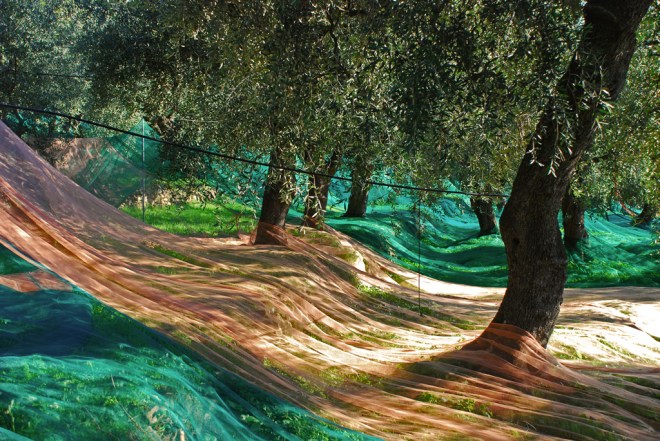
Neither my wife nor I have ever picked an olive in our lives, but in my dream this is not a problem. My wife and I would extend under the spreading olive branches those orange and green nets I’ve seen so often in Liguria to catch the olives as they fall (would we have to shake the branches, I wonder?)
image
And then, arm-in-arm, we would bring our harvest of olives to the local olive press.
image
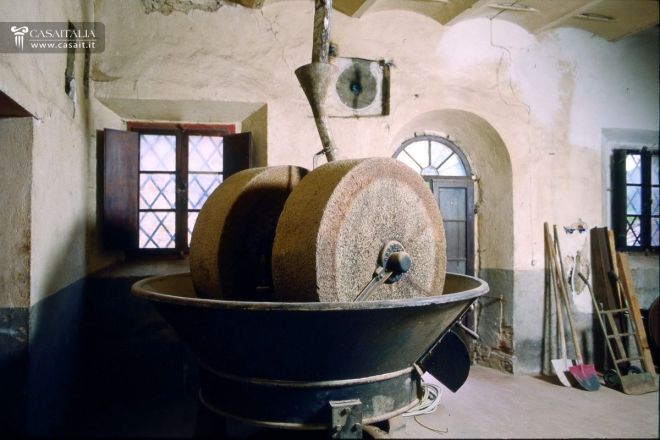
Actually, an internet search has informed me that the nearest local olive press is 10 km away, so a car ride rather than a stroll would be in order. Also, it doesn’t use stone presses, that is passé; something along these lines is used – more modern, more sterile, but, the internet assures me, more efficient.

image
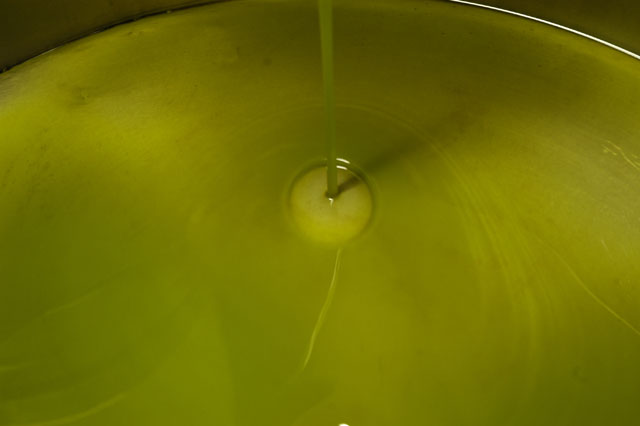
No matter, one way or another the oil from our olives would be squeezed out

image

and after some filtering, some racking, and some other things (I’m going to have to learn the olive oil lingo), we would become the proud owners of several bottles like these of cold-pressed, organic, extra-virgin olive oil.image
We would drizzle this nectar of the gods on our salads for a year, until the next harvest was brought in.
image
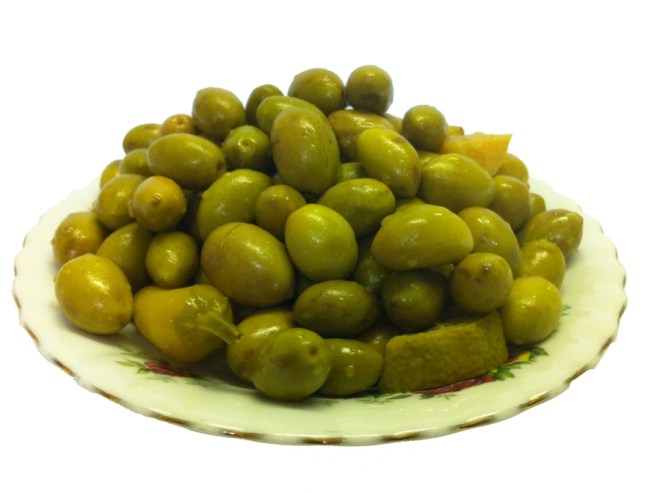
Or might we want to pickle the olives? A quick whip around the internet persuades me that it’s not that difficult to pickle olives; you just need time and brine.

image

OK, it’s decided: we will follow what happens in the global olive market, we will pickle 10% of our olive harvest and use the rest to make our very own olive oil.

Lovely dream. Of course, there might be a few snags in the real world. We may never find the owners, the owners may tell us to bugger off, the trees may be too old or too sick to fruit any more, the fruit or even the trees themselves may be attacked and destroyed by what seems on cursory reading to be a vast army of animalcules just waiting to sink their fangs or similar organs into fruit, leaf, or bark. But like a colleague of mine in Colombia recently wrote to me, “soñar nada cuesta”, to dream costs nothing.
_______________________
Abandoned olive orchard: https://m.youtube.com/watch?v=6n7eBKRLQ80
Clean olive orchard: http://www.vinoemozioni.com/blog/tag/anfosso/
Olives on olive tree: http://www.tavoladautore.it/contenuti/id/22/Gli-ulivi-di-Liguria–cultivar-e-caratteristiche.html
Nets under olive trees: http://www.casalefiliberto.com/gallery/gallery_oliveto/index.html
Old olive press: http://www.casait.it/it/toscana-grande-villa-vendita-vigneto-uliveto-S96J/
Modern olive press: http://www.oliofrantoioamoretticarlo.it/frantoio-da-olive.html
First press oil: http://novellaevignolo.com
Bottled olive oil: http://www.mraxani.it/prodotto/olio-extravergine-di-oliva-agrintec/
Olive oil on salad: http://www.foodinitaly.com/news/fotogallery/OLIO_EXTRAVERGINE_D’OLIVA_LE_REGOLE_D’ORO_PER_SCEGLIERLO-2527.html?start=4
Pickled olives: http://www.yaffa.co.uk/product_p/ogt1.htm

CORAL REEFS AROUND SURIN ISLAND

Kuraburi, 18 April 2016

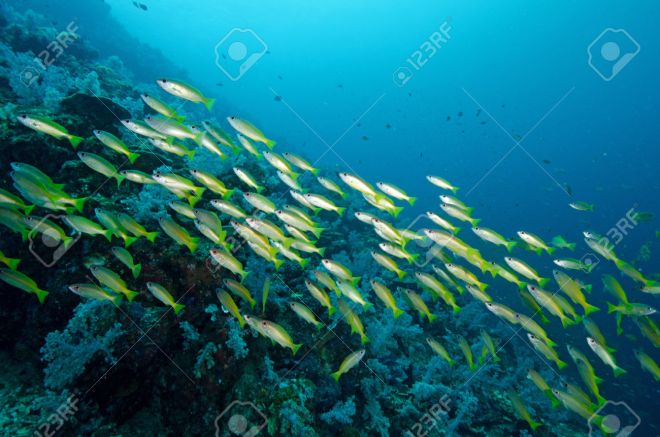
It was a few minutes before we turned back to the boat that my wife and I spotted them, a school of pale lemon yellow fish, browsing on the bottom of the reef. Much internet surfing suggests that we saw yellow runner fish.

Yellow runner school fish in Similan, Thailand

As we watched, another school of fish, light blue this time, floated by, pulled by some unseen current. They were fusilier fish, I think
image
During our two-day snorkeling trip to the Surin Islands National Park, just north of Phuket, we saw much more besides on the four or five reefs we visited.

The last time I’d snorkeled was half a century ago, in the shallow waters of a bay near Buea, Cameroon. My father had some work to do there, and he had brought me along. An English family living in Buea had taken me with them on an afternoon outing, and so it was that after a merry hour spent sinking up to my thighs in the micro-quicksands which dotted the bay, I spent another hour floating on my stomach, watching with fascination the tiny, brilliantly coloured fish darting back and forth across the black sand, fruit of the nearby volcano, Mt. Cameroon. A badly burned back was the result of this excessive curiosity. Still remembering the pain of that red and peeling back, I snorkeled this time with a shirt on. Alas! In the intervening five decades, my hair has thinned so I found afterwards that my scalp was burned from floating face down in the water (my wife instead got burned just below her swimsuit, on what our personal trainer calls the glutes).

All of which has not taken away one jot from the pleasure we derived from the wonderful sights we took in as we paddled slowly hand-in-hand along the reefs, with no sound but our breathing, witnessing a riot of colour as fish swam into our line of sight and then disappeared, intent on their business. Below is an incomplete catalogue of our sightings:

Powder blue surgeonfish
imageRainbow parrotfish
image
The wonderfully named Moorish idol

image

Lined surgeonfish
image
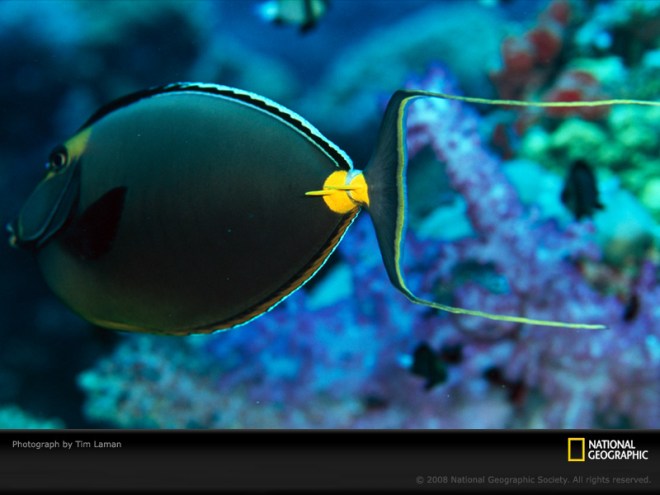
Black surgeonfish
image
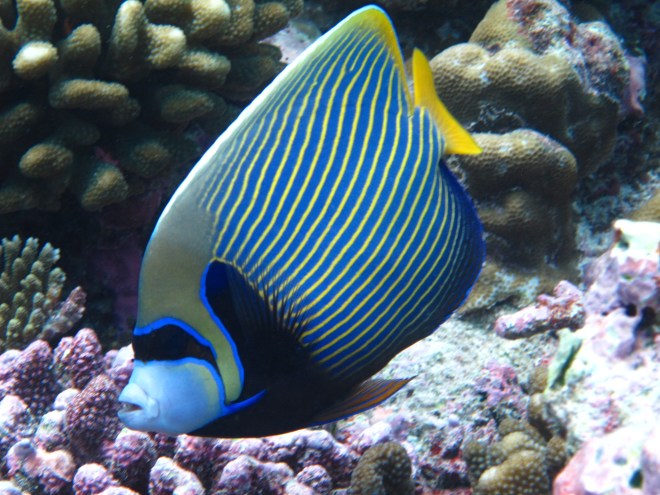
Emperor angelfish
image
Triggerfish
image
Melon butterfly fish

image

Blue lined grouper

image
We saw other denizens of the reefs too:

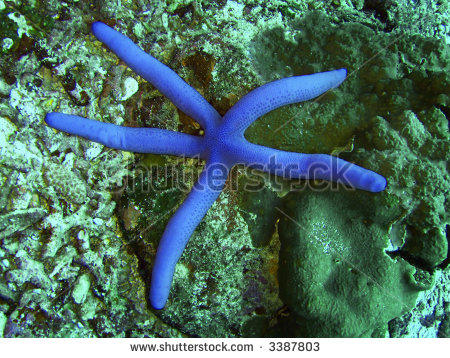
A powder-blue starfish

image
The aptly named crown-of-thorns starfish

image

Squamose giant clams, which would snap shut as we floated over them
image
Magnificent sea anemone, whose green tentacles would wave this way and that, revealing a wonderful blue-mauve body beneath

image

And of course there were the corals, around which all these other species revolved:
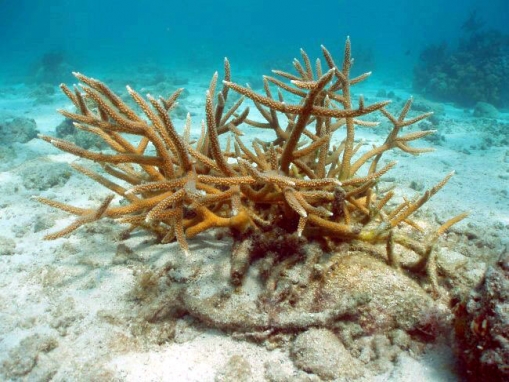
Staghorn coral, whose tips seemed to glow phosphorescently
image
Table coral

image

Mushroom coral
image

But really, although it was fun to point out to each other new species that we spotted, it was the reef communities as a whole that were most fascinating

image

those tens of species all working in and around a coral mount which surged up from the bottom towards the light.

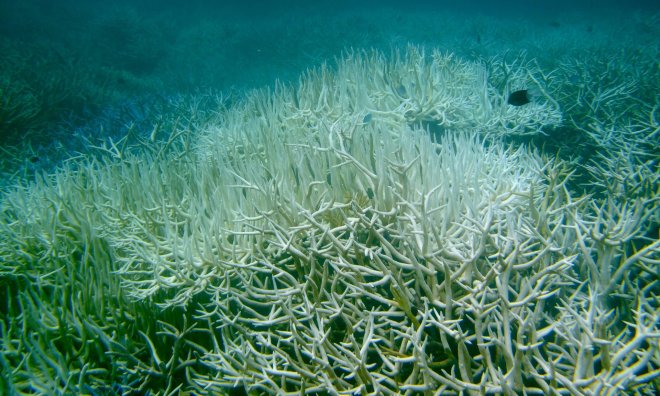
I suppose we’re lucky to have seen this. As we were floating over the reefs around Surin Island, an article appeared in the Guardian about massive coral bleaching going on at the Australian Great Barrier Reef. The immediate cause is El Niño, which is leading to much warmer waters than usual; coral dies if the water is too warm, and all you are left with are the bleached bones of coral, devoid of that blizzard of life with which it would normally be surrounded.

image

But behind this latest episode is climate change, which is making El Niño events ever longer and more intense. Two days before this article appeared, the Guardian had another announcing that the month of March had been the hottest on record.
image
But so had February. And so had January. And so had 2015 as a whole.

One of the many, many – many – impacts of climate change will be the die-off of coral reefs the world over. Coral reefs everywhere are showing signs of increasing strain. And with that die-off will come a steep decline in fish species: coral reefs are home to an astonishing 25 percent of the world’s fish species. That favourite cartoon character, Nemo, will lose his real-life counterpart.
image
Can we really let this happen? Surely we humans can collectively take on our responsibilities for controlling climate change. Let’s not destroy this beautiful planet we inhabit.

_________________
Yellow runner fish: http://www.123rf.com/photo_24661711_yellow-runner-school-fish-in-similan-thailand.html
Fusilier fish: http://www.123rf.com/photo_16881582_blue-and-gold-fusilier-fish-at-surin-national-park.html
Powder blue surgeonfish: http://www.alamy.com/stock-photo/acanthurus.html
Rainbow parrotfish: https://www.pinterest.com/pin/303922674822811295/
Moorish idol: http://diveadvisor.com/sub2o/the-moorish-idol
Lined surgeonfish: https://en.m.wikipedia.org/wiki/Acanthurus_lineatus
Black surgeonfish: http://photography.nationalgeographic.com/photography/wallpaper/surgeonfish-laman_pod_image.html
Emperor angelfish: https://cococares.wordpress.com/2012/11/14/maldives-emperor-angelfish-at-3-different-stages-of-life/
Triggerfish: http://www.seafocus.com/species_triggerfish.html
Melon butterfly fish: https://www.flickr.com/photos/thailandbeach/3568555120
Blue lined grouper: http://www.aquariumdomain.com/viewSpeciesMarine.php?id=49
Blue starfish: http://www.shutterstock.com/pic-3387803/stock-photo-blue-starfish-close-up-similan-islands.html
Crown of thorns starfish: http://www.bubblevision.com/underwater-pictures/racha-noi/pages/crown-of-thorns.htm
Squamose giant clam: http://forum.scubatoys.com/showthread.php?t=9755
Magnificent sea anemone: http://www.shutterstock.com/video/search/heteractis
Magnificent sea anemone: http://forum.scubatoys.com/showthread.php?t=9755
Staghorn coral: https://www.fau.edu/facilities/ehs/info/elkhorn_staghorn_corals.php
Table coral: http://adamjadhav.com/2010/
Mushroom coral: http://www.messersmith.name/wordpress/tag/mushroom-coral/
Reef life: https://www.govoyagin.com/activities/thailand-phuket-snorkel-and-see-sea-turtles-and-sharks-in-phi-phi/2039
Bleached coral reef: http://www.theguardian.com/environment/2016/apr/17/great-barrier-reef-worst-destruction
March global temperatures: http://www.theguardian.com/environment/2016/apr/15/march-temperature-smashes-100-year-global-record
Clownfish: https://prezi.com/m/m7zrpx-gkdqs/life-cycle-of-a-clown-fish/

KIMCHI AND SAUERKRAUT

Seoul, 13 April 2016

I’m in South Korea at the moment, giving a training on green industry. It is Spring here. In Bangkok, I’ve forgotten what Spring is like and the delights it brings to the heart of the first signs of new growth. There are wonderful, wonderful cherry trees in bloom just outside the training room, which makes it difficult for me to focus on my presentations.

But I don’t want to talk about any of that. I want to talk about kimchi, which I was confronted with last night at an otherwise perfectly respectable Korean meal. For those readers who have not heard of this foodstuff, it is without doubt the national dish of Korea – both Koreas, actually, North and South (on this deeply divided peninsula, there are two things that unite its peoples: their love of kimchi, and their deep dislike of the Japanese). South Koreans eat it at breakfast, lunch, and dinner (as I’m sure would the North Koreans had they any kimchi to eat and any rice to eat it with). There is a museum of kimchi in Seoul. It has been listed with UNESCO as an intangible cultural heritage, by both North and South Korea – separately, of course. It is said – but I wonder if this is not an urban legend – that during the Vietnam War, the-then South Korean President begged President Johnson to urgently help get kimchi to the South Korean troops who were fighting alongside their American comrades; without it, their morale was sagging badly. More believably, when the SARS crisis hit in 2003, kimchi sales in South Korea soared 40%, on the back of people’s belief that it would surely help ward off the evil disease.

As one might expect from a dish which is the subject of such national adulation, there are many regional variations and no doubt noisy arguments about which variant is the best. That being said, the most common type of kimchi – and certainly the one I have seen in Korean restaurants and eateries – is based on cabbage, napa cabbage to be precise. To make this kimchi is very easy, and if I’m not mistaken any self-respecting Korean housewife (not housespouse; this is still a very male dominated society) can make her own. Take the cabbage, cut it in pieces, thoroughly coat the pieces with salt, let them stand in their own briny juice for several hours, pressing them down from time to time. In the meantime, chop up some Asian radish and scallions, and prepare a paste of finely chopped garlic and ginger with fish sauce or salted shrimp and crushed dried paprika (this is the basic paste recipe, to which I’m sure can be added other ingredients whose identity are the jealously guarded secrets of individual kimchi makers). Thoroughly rinse the cabbage pieces of their brine, mix them well with the radish and scallions, and coat the whole with the paste. Let this mixture stand in some suitable container for several days at a cool temperature – in the old days, Korean housewives used beautiful pots like these and buried them in the earth during winter.
image
What is happening behind all these manipulations is that the cabbage is being subjected to fermentation by lactobacillus bacteria. The results look like this.
image
Depending on tastes and needs, the kimchi can be eaten “fresh” or left to continue to ferment and eaten months later.

It is sad to report that while the Korean populations love this stuff, I hate it. Well, “hate” may be a strong word: “thoroughly dislike it” may be the better term. During my first-ever trip to South Korea, while my credit with my hosts soared after I ate dog and declared it to be most delicious (and I wasn’t being polite), it crashed when I made it also very clear that kimchi was revolting. What to do, the perils of cultural exchanges.

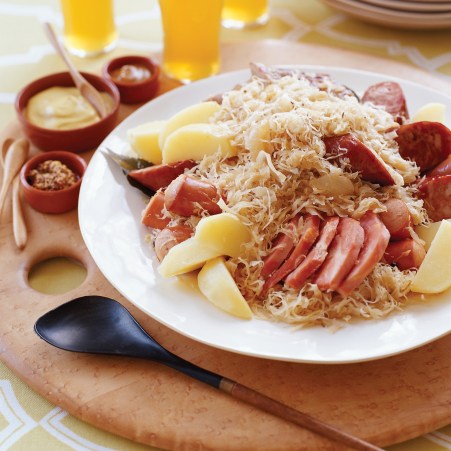
It’s actually puzzling that I don’t like kimchi, because I looooove sauerkraut or, to give it its French name under which I first got to know it decades and decades ago, choucroute. Aah, those most magnificent choucroutes garnies of my youth, sauerkraut served with pork chops and various sausages, with boiled potatoes on the side!
image
If I close my eyes, I can still remember, still taste in my mouth, a truly wonderful sauerkraut which I had on a German ferry boat carrying a bunch of us from school to Germany (we were on our way to do two weeks of “military service”, required of all of us by our high school, with a British tank regiment stationed near Hannover; but I digress, these fond memories being triggered no doubt by the lingering taste of that truly epochal sauerkraut).

As I say, it is indeed puzzling that I don’t like kimchi, because sauerkraut is also cabbage-based and is subjected to exactly the same procedure of brining followed by a fermentation at the hands (as it were) of lactobacilli. What is going on here?

After some thought, I have concluded that the paste is to blame. Actually, I think this is a no-brainer. I mean, what else is different between the two? My problem with kimchi has to reside in the paste. My first thought was that the paprika was the culprit. As I have written in no uncertain terms in an earlier post, I can’t stand hot spices, and the paprika in the kimchi certainly doesn’t endear me to the dish. But my problem with kimchi goes deeper than the burnt-out mouth it gives me. Below that lurks another problem, a problem of bitterness. One or more of the other ingredients in the kimchi is changing the taste from the sour of sauerkraut to the bitter of kimchi. I’m afraid I will never know which it is until I do some scientific experiments in the kitchen, making fermented cabbage and varying the ingredients it is pasted with. I can therefore cheerfully add sauerkraut/kimchi to the list of foodstuffs which I will try making when I have retired, and I will report back if and when I find the solution.

In the meantime, all this writing about sauerkraut has given me a serious desire to eat some. I need to send an urgent message to my wife, who is excellent at searching the Internet, asking her to identify a restaurant where we can eat a half-decent choucroute garnie in Bangkok.

____________________
Kimchi pots: http://www.lovethatkimchi.com/Kimchi_Pots/Onggi.html
Kimchi: http://www.surakoreancuisine.com/koreas-greatest-food-kimchi/
Choucroute garnie: http://www.foodandwine.com/recipes/choucroute-garnie