POSTS

FADO

Bangkok, 11 June 2015

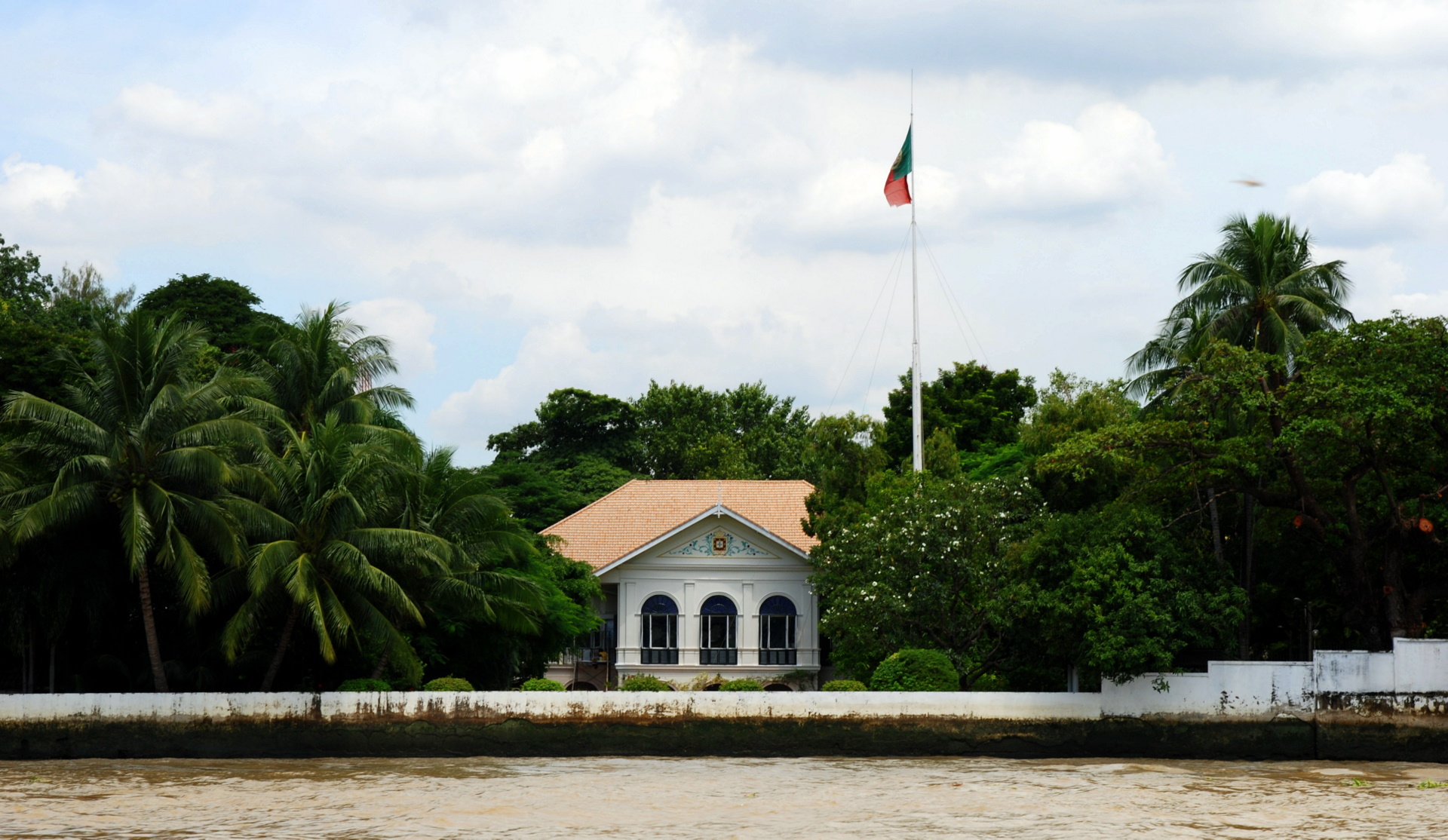
I get many invitations to diplomatic dos. I almost always bin them, but when I received one from the Embassy of Portugal to celebrate the country’s National Day, I hesitated. They do have the most wonderful Embassy here, right on the Chaophraya River.

embassy from river

My wife and I pass it very time we take the water bus down to Sathorn, and as we pass I always feel a twinge of nostalgia, to see this lovely villa from the 1870s, with its lawn sweeping down to the river, squeezed now between modern buildings of concrete, glass and steel. Ah, the Bangkok that once was …

It was decided.  I would accept the Ambassador’s invitation, to give us a chance to see this wonderful property up close.

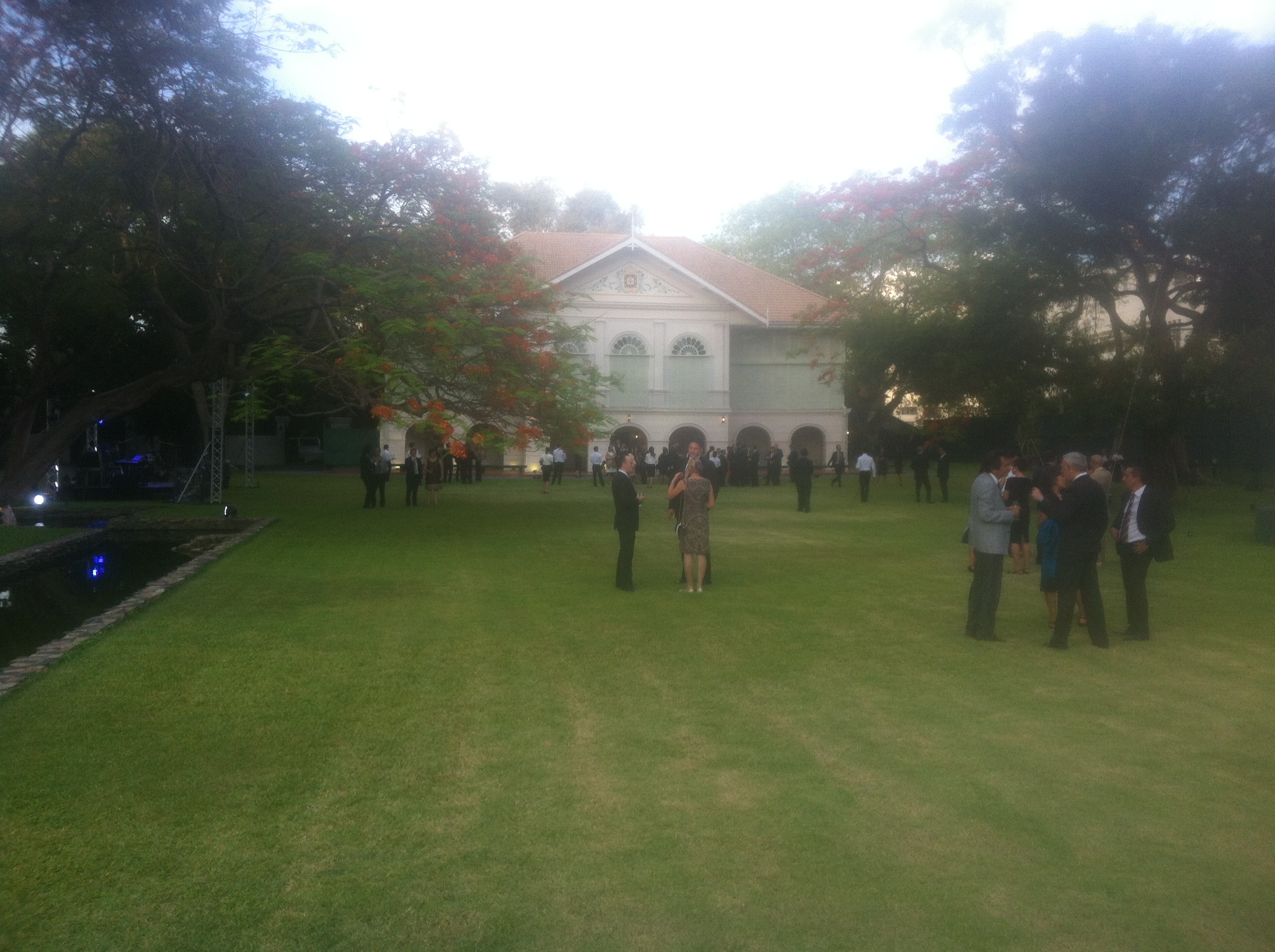
So it was that last night, as dusk was falling, we joined a line of guests to shake the Ambassador warmly by the hand, and then were left free to wander around the lawn, with a white wine in hand. We walked over to the river, turned around, and admired the scene.

lawn of embassy 002

As we stood there, sipping our wine, from under the flame tree came the unmistakable lilting lament of fado. Song after song floated across the lawn

É meu e vosso este fado
destino que nos amarra
por mais que seja negado
às cordas de uma guitarra

Sempre que se ouve um gemido
duma guitarra a cantar
fica-se logo perdido
com vontade de chorar

Ó gente da minha terra
agora é que eu percebi
esta tristeza que trago
foi de vós que a recebi

E pareceria ternura
se eu me deixasse embalar
era maior a amargura
menos triste o meu cantar

Ó gente da minha terra

This fado is mine and yours,
A destiny that binds us,
No matter how much denied,
To the strings of a guitar

When we hear the lament
Of a guitar in song
We are instantly lost
In a desire to weep

Oh people of my land,
Now is it that I understand
This sadness which I carry.
I received it from you

And it would seem a tenderness
To allow myself to be soothed.
The bitterness would be greater
My singing less sad.

Oh people of my land

And so filled with saudade, that indefinable existential melancholy which we are told pervades the Portuguese soul, as well as with several glasses of excellent Portuguese wine, we slowly made our way inside the villa, to eat bacalhau à Gomes de Sá.

___________

Embassy from River: http://upload.wikimedia.org/wikipedia/commons/2/2a/Embassy_of_Portugal_Bangkok.JPG (in http://commons.wikimedia.org/wiki/File:Embassy_of_Portugal_Bangkok.JPG)

The other picture: mine

COQ AU VIN

Bangkok, 8 June 2015

Yesterday evening, my wife and I went over to the Central World mall to see a film (“Spy”, a hilarious film, well worth seeing). Afterwards, feeling peckish, we decided to stay and have dinner in the mall – at least it was well refrigerated there, a decided plus in this hot season when the promised rains are failing to come to cool us. The problem is, most of the restaurants in the mall are of Asian extraction – Japanese is a definite favourite, followed by Korean, and then trailing far behind a few Chinese, Thai, and “international” (i.e., mixed Asian) – and that’s not what I felt like eating. I wanted something “different”, although I wasn’t quite sure what that “different” might be. We made a bee line for a French restaurant advertised on the information board, but it had disappeared since they had last updated the board. We sighted an Italian restaurant, although something called “Spaghetti Factory” surely is to be avoided like the plague. We got a fleeting glimpse of a Mexican restaurant tucked away in a corner, but Mexican food didn’t entice me … You get the picture. I was being finicky, and time was passing. Eventually, we saw a bar-cum-restaurant called “1881”, which looked nice enough. We rapidly checked the menu, and since it looked suitably international we went for it.

Ensconced at our table, we scanned the menu more closely. For the main course, we both happily plumped for the coq au vin. It had been an age since we had eaten this, we both exclaimed. To keep us going while we waited, we ordered some starters, and of course a glass of red wine. The starters were delicious, the wine was good, everything looked set for a memorable dinner. Alas! it was not to be. When the coq au vin arrived, we found ourselves faced with a chicken leg, deep fried à la manière KFC, sitting on some sort of thick tomato-based sauce peppered with carrots and onions, maybe something which had been recycled from an osso buco dish, and which had obviously never seen a drop of vin. We glumly ate our poulet à une sauce indéfinie, agreeing with each other that something had definitely got lost in translation. The dessert, a great pannacotta with some sort of balsamic-strawberry gelée, partially made up for the very disappointing main dish, but it was undeniable that the coq au vin had been a black hole in our sensory experiences of the evening.

I feel I owe it to my genes, to my heritage, to right the balance, to advertise from the rooftops the greatness of coq au vin. At least describing how the dish is made might allow me to partially enjoy, if only in my imagination, the taste of the Real Thing.

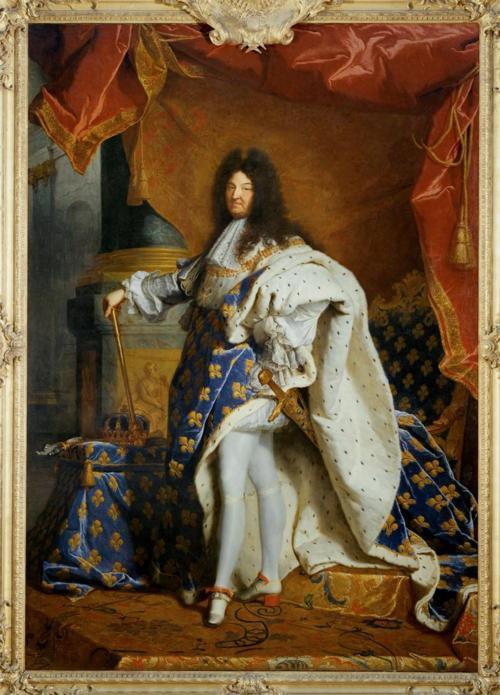
Let me start by saying that in the olden days coq au vin was not a dish that would have been served to the Great Sun King, Louis XIV

Louis_XIV_of_France

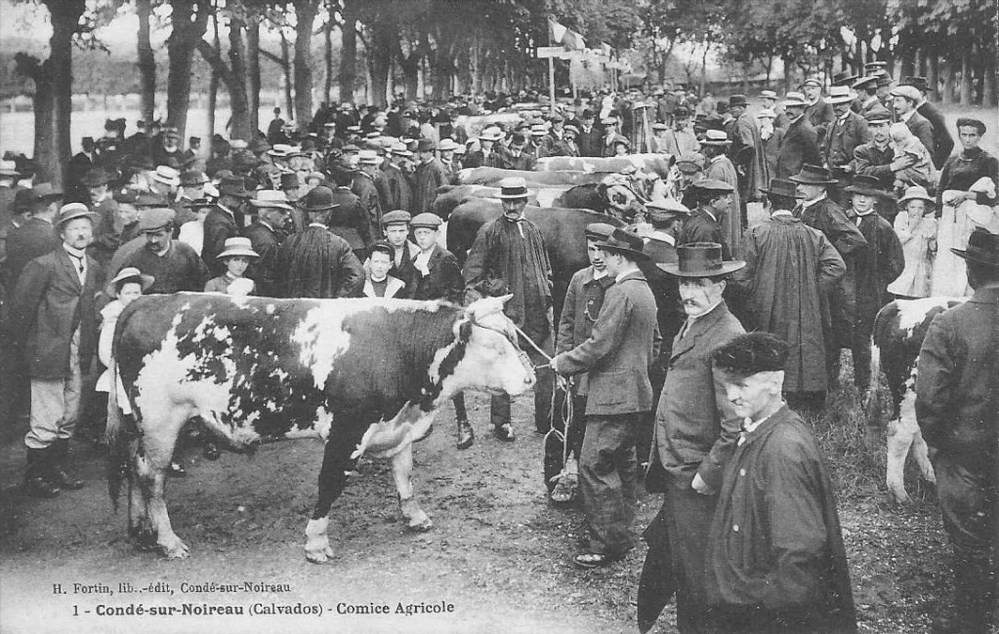
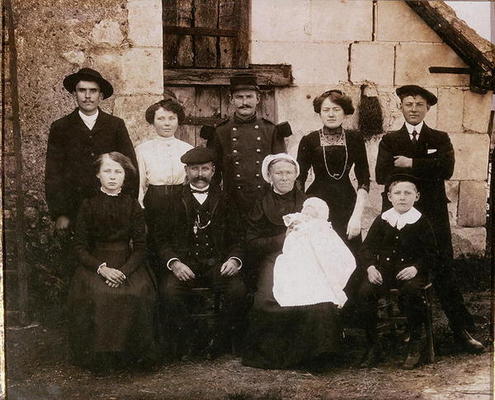
or some other such august personage, unless of course you wanted to be sent to the Mediterranean galleys or to rot away on L’île du Diable. The great French chef of the mid-19th Century, Marie-Antoine Carême, author of the encyclopedic L’Art de la Cuisine Française and other works, never mentioned it, nor did the even greater French chef of the late 19th-early 20th Century, Auguste Escoffier, in his various publications. No, this was above all a peasant’s dish, a way of recycling that rooster in the yard which had reached the end of the rooster road. It was people like these who created coq au vin, making a virtue out of necessity.

french peasants-2

french peasants-3

CHT216766 Peasant family of the Sarthe area at a baptism, late 19th century (photo); by French Photographer, (19th century); photograph; Private Collection; Archives Charmet; French, out of copyright

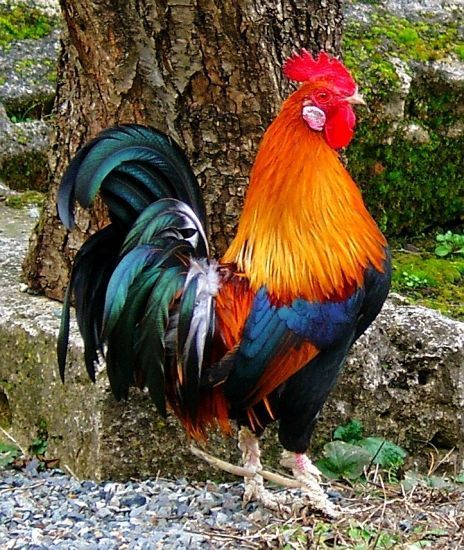
So now let us see how this wonderful dish is made. The paysan (or paysanne) will first have laid his (or her) hands on a rooster like this one

https://i0.wp.com/monia2009.m.o.pic.centerblog.net/gg7spkhz.jpg

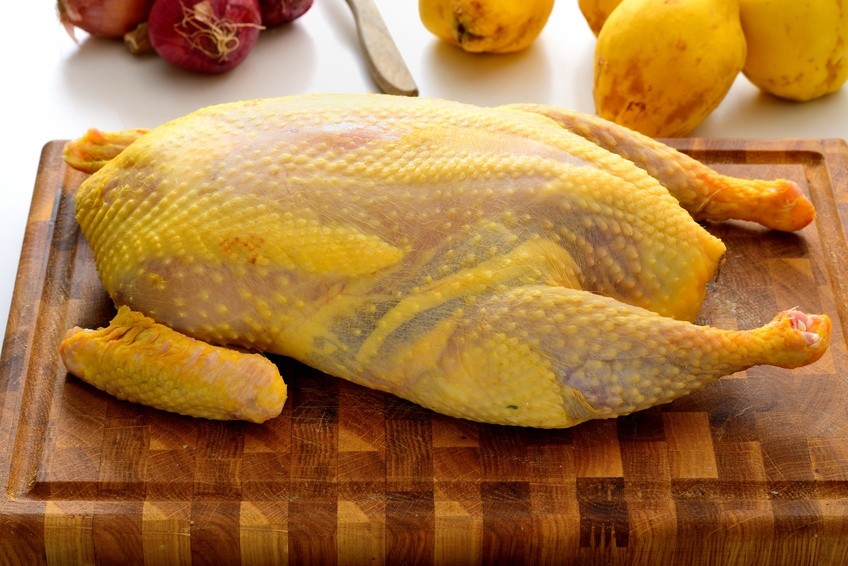
and wrung its neck. We modern men and women are squeamish about killing to eat, but what to do: unless you hang around prides of hunting lions and scavenge what they are kind enough to leave behind, to eat meat you need to kill; simple as that. Oh, and by the way, it’s good to slit the rooster’s throat and drain its blood, which you will use later in making the dish. If you can’t bring yourself to do all this, you can subcontract the task to a butcher. You can also subcontract him the task of plucking the bird, which the paysanne would have done herself (I remember my French grandmother doing this, while she sat on the balcony discussing this, that, and the other with my mother). The wonderful feathers of the rooster should be conserved, although I’m not quite sure what to do with them. In any event, in one way or another you should end up with something like this:

coq-fermier-pret-a-cuire

Personally, to support the Home Team, that is to say Burgundy, where the French side of me comes from, I would want a rooster from Bresse, which is on the other side of the River Saône from Burgundy: the Burgundians gave the people of Bresse their wine and in return got farm products like chickens.

Now we can start the cooking.

First, you will cut up the rooster. Place the pieces in some container, to which you will add diced carrots, onions, and shallots, and – if you really must – chopped garlic (personally, I would drop the garlic; I’m not a fan of this particular bulb). The paysan would have collected these from his vegetable garden like the one my French grandmother had hidden behind her lilac bushes, but I recognize that in our modern, highly urbanized society most of us do not have access to vegetable gardens, so we will have to make do with the local grocery store, or even the local supermarket. Add laurel, thyme and parsley. Add a little stock. Salt and pepper. And now we come to the wine.

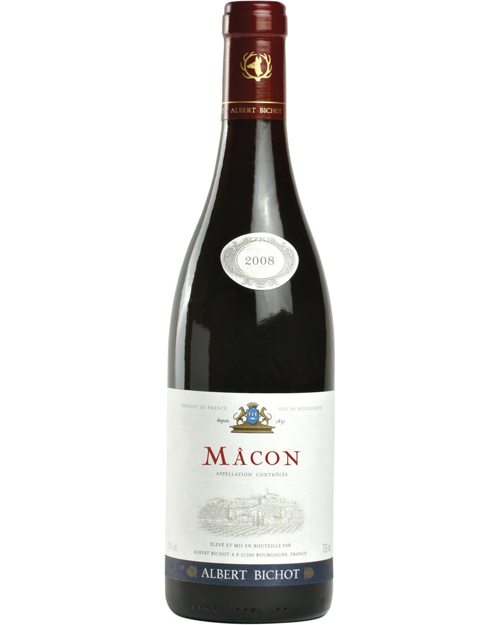
Obviously, this is a key ingredient, so some thought needs to go into its choice. Nothing too fancy, of course – not going to waste a $100 bottle of wine to cook our rooster. Something with a good body but not too tannic should do the trick. I would go for a red wine, although there are parts of France (Alsace, for instance, or the Jura) where the dish is made with white. Since, as I’ve mentioned, I’m batting for the Home Team, I would personally go for a red Burgundy, maybe shading into a Beaujolais, something just down the road from where my Grandmother lived.

macon rouge

Our paysanne would have gone down into the cellar of the kind my Grandmother had and taken a bottle of wine made from grapes growing in one of the surrounding vineyards and bottled in that very cellar or at least locally. But we – with a sigh – will make do with what we find at our local wine store.

In any event, pour in enough wine to just cover the rooster. Cover the container and leave it in a cool place. You will let the rooster and the vegetables marinate for a full 24 hours.

The next day, fresh from a good night’s sleep, you will begin the next phase.

As a first step, fish the rooster pieces out of the marinade, draining them well. Do the same for the vegetables. Do not throw away the marinade! Very important.

Put all these aside, and take a large skillet, in which you will heat a little butter and oil. Frankly, I don’t think the paysanne would have used oil, at least not in Burgundy. Traditionally, Burgundy was not an oil country. I would guess, from a perusal of an old French cookery book from 1651, that she would have used butter and/or lard. Nevertheless, we will go with butter and oil since nowadays oil you find in shops but lard only with difficulty.

Once the butter-cum-oil is hot enough, slide in the rooster pieces, together with some chunks of bacon, and let the whole brown nicely. Throw in the vegetables from the marinade and let them colour a bit. Sprinkle with flour and let it all cook a moment. Move the skillet off any open flame, take a small glass of cognac, sprinkle it over the rooster pieces, and light it up with a match – taking care, of course, that your face is not too close; the last thing you need is to find yourself eating the final product without eyebrows. In Burgundy, the paysanne would probably have used a Marc de Bourgogne, which is a brandy made with the solid leftovers from the grape presses. But unless you actually live in Burgundy, you probably do not have this at hand, so go with cognac. Once the flames have died down, add in the marinade, and bring the whole back to a boil for a few minutes.

You will now let the mix simmer slowly for a long, long time: aim for six hours. Let it fill your kitchen with a gorgeous aroma, but don’t hang around there because otherwise you will soon no longer be able to stand it and you will throw yourself on the cooking rooster and wolf it down. As would have done the paysanne, go and busy yourself in the garden, in the studio, anywhere that is some distance from the kitchen. Keep your mind and hands busy with other things, just popping in from time to time to check. As the hours pass, the meat softens and falls off the bone, it absorbs the wonderful aromas it is basting in, and the sauce itself slowly thickens. Towards the end of this long simmering period, you will take the blood you collected when you killed the rooster (remember that?) and add it to the sauce to thicken it. You will also prepare boiled potatoes a little while before the end, to accompany the coq au vin.

The coq au vin is now ready to eat. Lay out the pieces of coq in a serving plate, pour the sauce au vin over them.

coq au vin

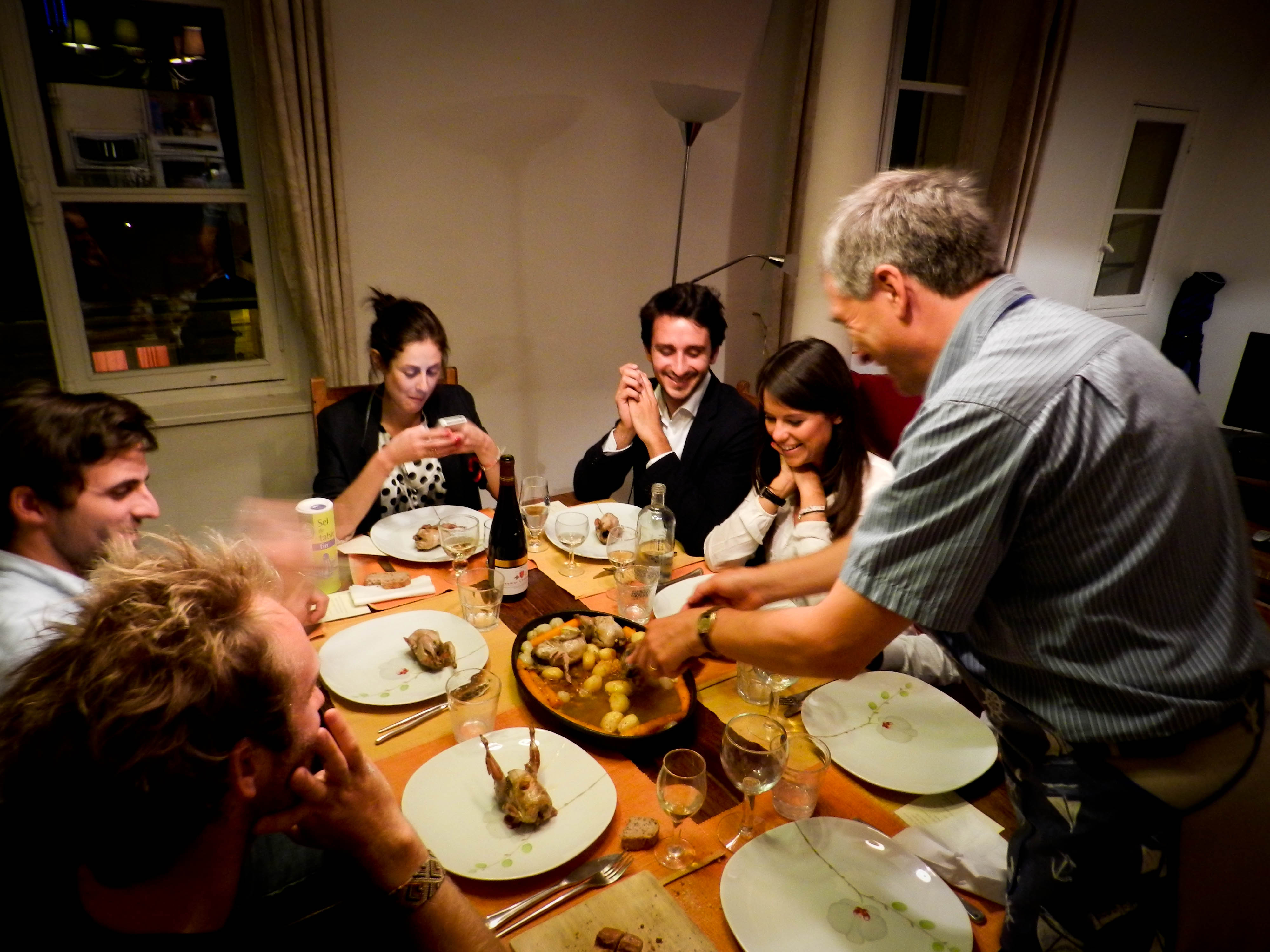
Place the potatoes on the side, bring out that special bottle of Burgundy you’ve been keeping for an exceptional moment, call in the family and your special friends, and enjoy!

meal-2

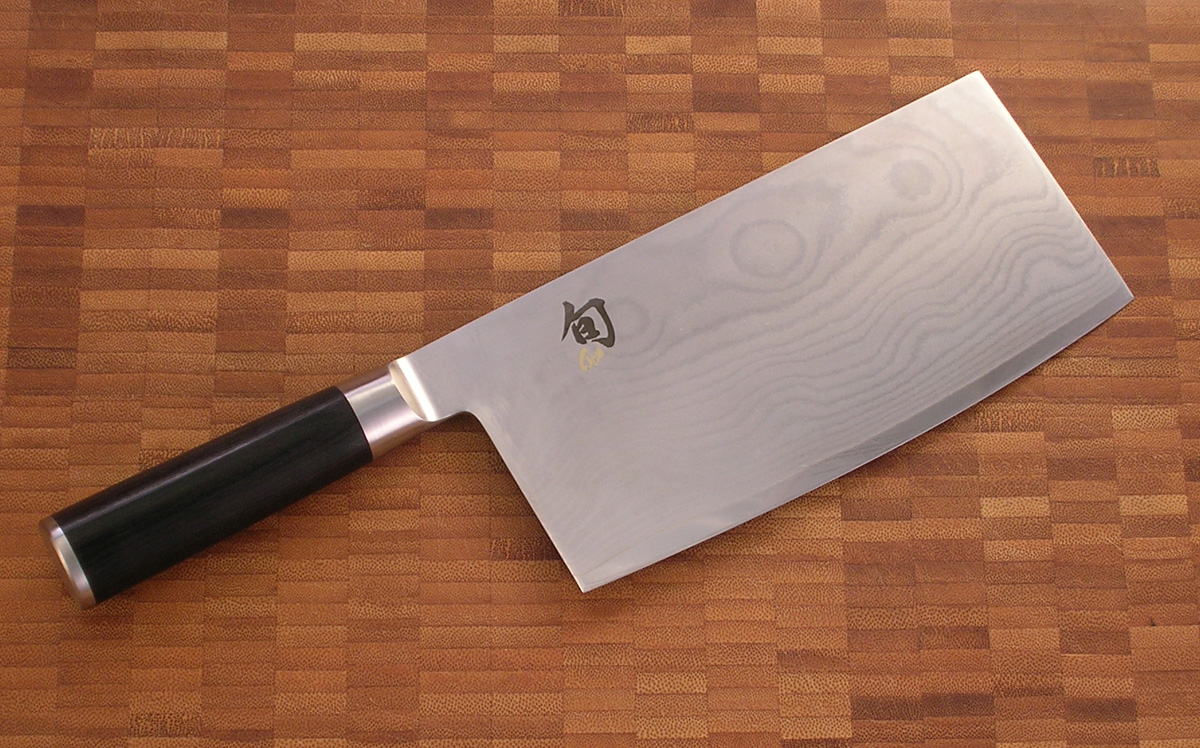
Mmm, there’s a rooster I keep hearing over the other side of the lane, in a building site. Maybe tonight, I’ll go out with this cleaver which we bought in China

cleaver

And find me a rooster for a nice coq au vin

______________________

Louis XIV: http://media.tumblr.com/tumblr_lkzid3Jvkb1qggdq1.jpg (in http://wtfarthistory.com/post/5361387982/red-high-heels-for-him)
French peasants-1: http://www.myartprints.co.uk/kunst/french_photographer_19th_century/peasant_family_of_the_sarthe_a_hi.jpg (in http://www.myartprints.co.uk/a/frenchphotographer19thcen/peasantfamilyofthesarthea.html)
French peasants-2: http://img.over-blog-kiwi.com/0/81/05/67/201311/ob_9bbe36_conde-sur-noireau-calvados-comice-agricole.jpg (in http://stephane.guillard.over-blog.com/2013/11/l-histoire-des-comices-agricoles-en-france-xixe-xxe-si%C3%A8cles.html)
French peasants-3: http://tnhistoirexix.tableau-noir.net/images/scene-de-moissons.jpg (in http://tnhistoirexix.tableau-noir.net/pages/campagnes-xix-siecle.html)
Rooster: http://monia2009.m.o.pic.centerblog.net/gg7spkhz.jpg (in http://lenissa.musicblog.fr/3467011/France-Allemagne-C-est-fini/
Rooster ready to cook: http://www.lesplaisirsdegargantua.com/419/coq-fermier-pret-a-cuire.jpg (in http://www.lesplaisirsdegargantua.com/sitemap.xml)
Mâcon rouge: http://sohowine.co.uk/import/images/B-MACON.jpg (in http://sohowine.co.uk/?c=products&deptno=2&country=France&region=Burgundy&page=2)
Coq au vin: http://www.joyce-farms.com/topics/wp-content/uploads/2014/09/coqauvin.jpg (in http://www.mairie-reffannes.fr/news/soireecoqauvinaumuguet)
Meal: https://labelleassiette.fr/blog/wp-content/uploads/2012/09/DSCN0568.jpg (in https://labelleassiette.fr/blog/diner-lba-3-avec-philippe-engammare/)
Cleaver: http://img92.imageshack.us/img92/7854/shun9wy.jpg (in http://www.knifeforums.com/forums/showtopic.php?tid/771029/)

JOHAN ET PIRLOUIT

Bangkok, 26 May 2015

A week or so ago, I was in Cambodia for some official business relating to a project we are about to start there to reduce dioxin emissions. But actually, that is irrelevant to this post. What is relevant is that I was staying in a hotel room half of whose lights were blue. Why, is a mystery. Perhaps it has something to do with the fact that the hotel claimed to also be a spa; perhaps people in spas like the rather cold light that blue creates. Or perhaps it had something to do with the modern furniture that graced the room; it was Nordic-looking in its design, cool, remote, and the blue light made it all that much cooler. But I’m just hazarding guesses here; perhaps blue bulbs were simply the cheapest on the market at the time the hotel was purchasing its light bulbs.

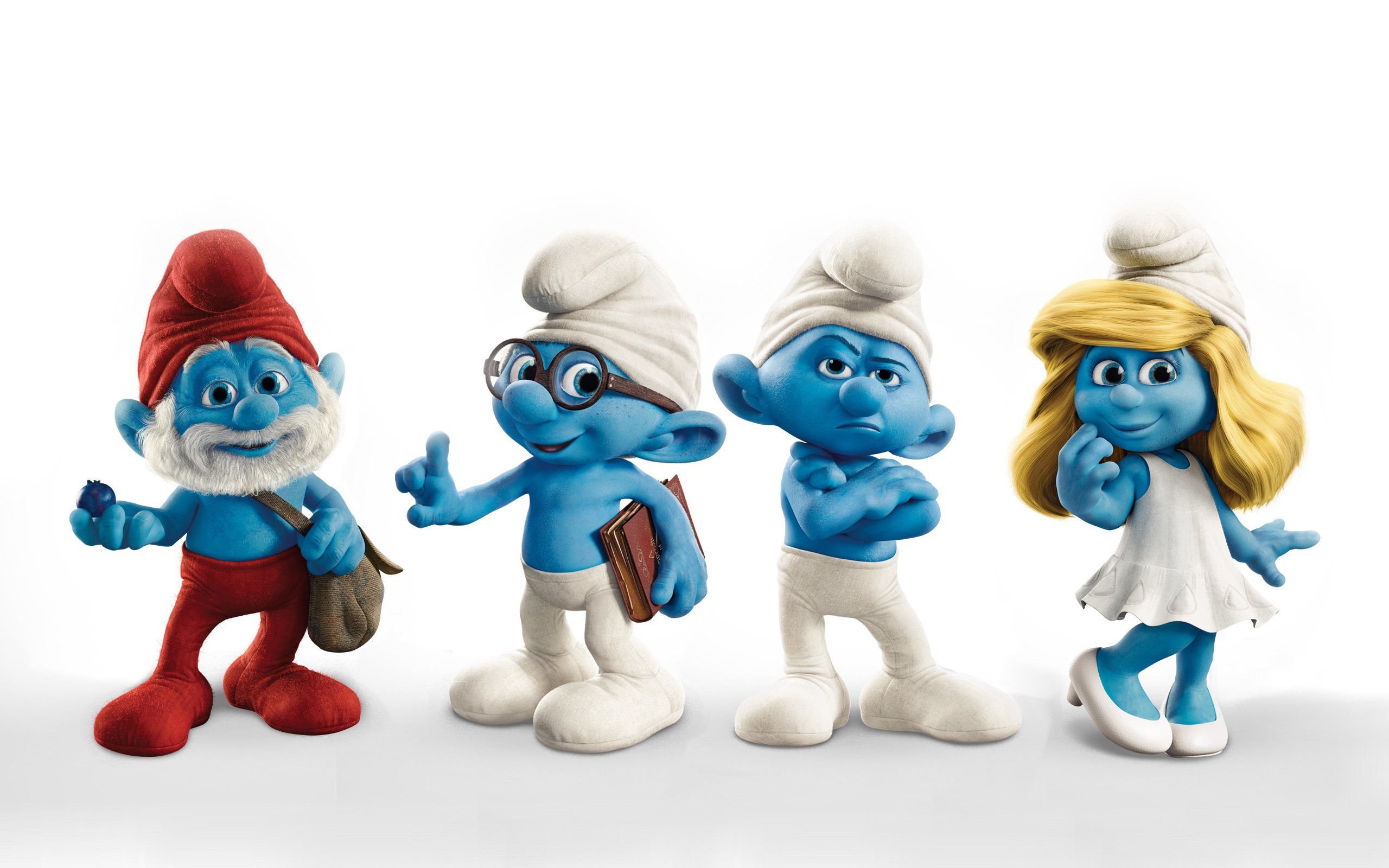
Whatever the reason, this blue light turned me blue. I only realised it when, skyping my wife, I noticed with astonishment that in the small icon which held my image I was a lovely blue hue. Basically, I looked like this fellow:

schtroumpfThe very youngest amongst us will immediately tell us that he is a Smurf. They are wrong – well, not quite right. He is a Schtroumpf; Smurf is the Dutch translation, adopted later by the English-speaking world.

Aah, the Schtroumpfs …they are my youth! This fellow may look young, but actually I am just a few years older than him. I burst onto the scene in 1954, the Schtroumpfs burst onto the cartoon scene in 1957, invented by the Belgian cartoonist Peyo.

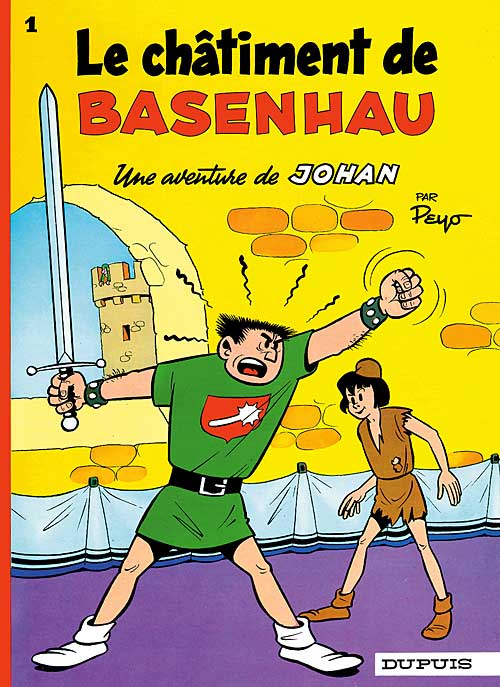
But here I have to clarify something. My real love was not the Schtroumpfs. It was Johan and Pirlouit, invented some years earlier by Peyo. Johan came first, hustling into the lives of little fellows like me in 1952, before I was even a gleam in my parent’s eyes, in the story Le Châtiment de Basenhau, The Punishment of Basenhau. This was the cover of the album (Johan is the young fellow dressed in ragged brown).

01-chatiment de basenhau

The details of the story are irrelevant. The important point is that Johan lived in the Middle Ages and that he was a dashing young fellow. After Le Châtiment de Basenhau came Le Maître de Roucybeuf, The Master of Roucybeuf, in 1953

02-maitre de roucybeuf

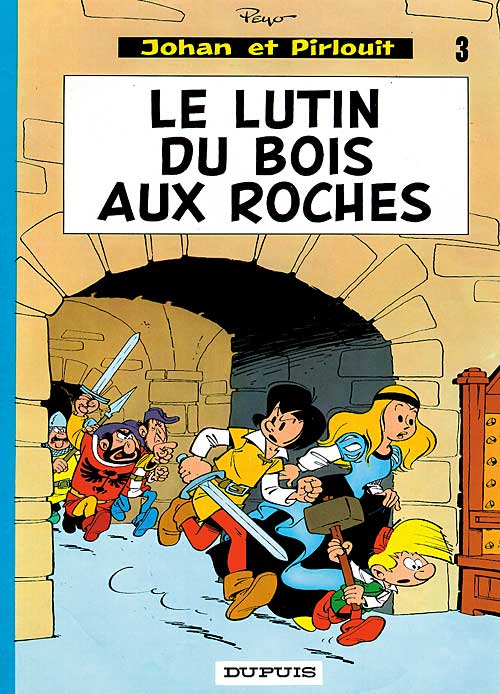
and then in 1954, when my mother was heavily pregnant with me, came Le Lutin du Bois aux Roches, The Imp of Rocks’ Wood, in which Peyo introduced us to Pirlouit, who was to become Johan’s bosom buddy.

03-lutin du bois aux roches

Pirlouit is the little blond-haired fellow holding the very large hammer. While Johan was the serious, Boy Scout type, straight as an arrow, Pirlouit was the joker, a hilarious guy who was always doing silly things. But when push came to shove, he was there by Johan’s side, as they fought off the assorted Medieval baddies they had to deal with. From now on, the two were to be inseparable.

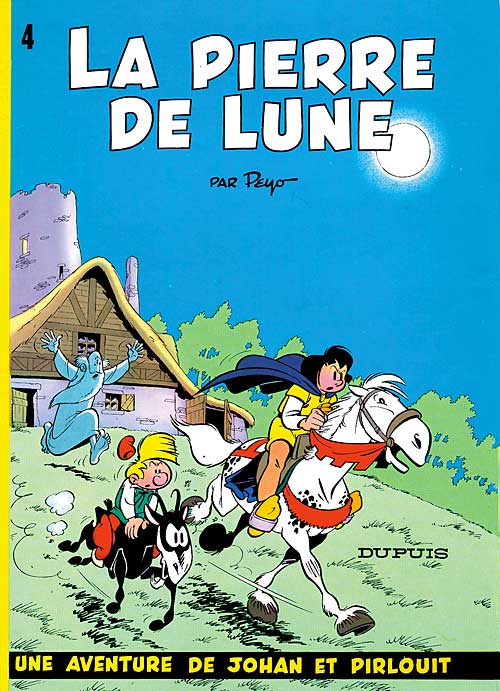
Their stories of derring-do, wielding sword, shield, bow, and other assorted medieval weaponry, galloping through dark, forbidding forests – Johan on a horse, Pirlouit on a goat (he was a little person, remember), dealing with sorcerers and their potions, … these were so thrilling to that young me – I was, what? ten-eleven years old when I discovered these albums, when Peyo was already famous throughout the length and breadth of France. I whiled away many a wonderful summer afternoon at my cousins’ house, tearing my way through the collection:

La Pierre de Lune, The Moonstone

04-pierre de lune

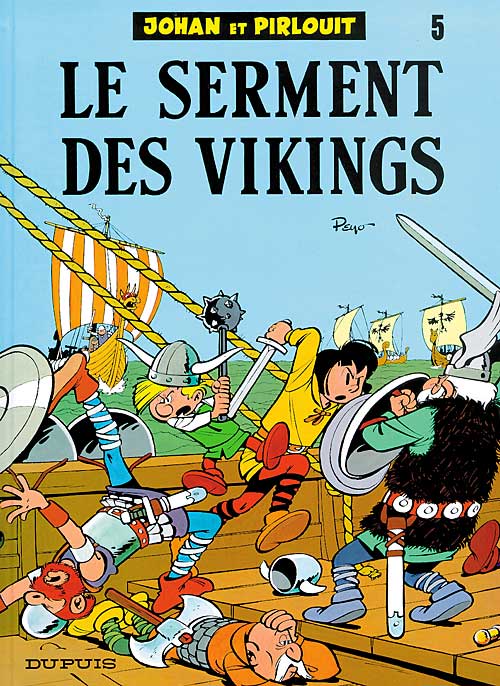
Le Serment des Vikings, The Oath of the Vikings

05-serment des vikings

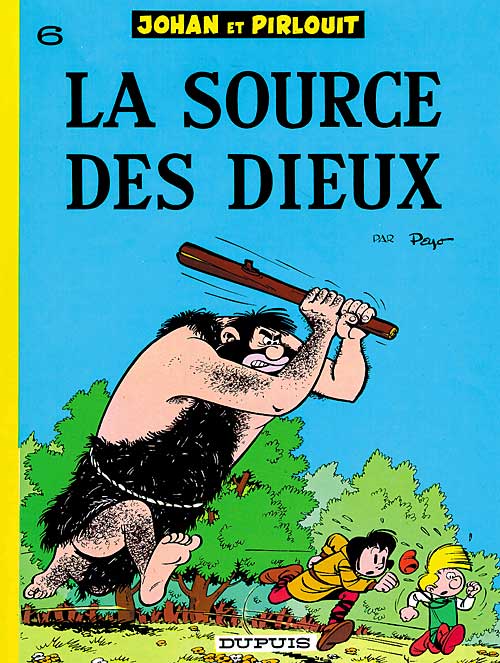
La Source des Dieux, The Spring of the Gods

06-source des dieux

La Fleche Noire, The Black Arrow

08-fleche noire

Le Sire de Montrésor, The Lord of Montresor

08-sire de montresor

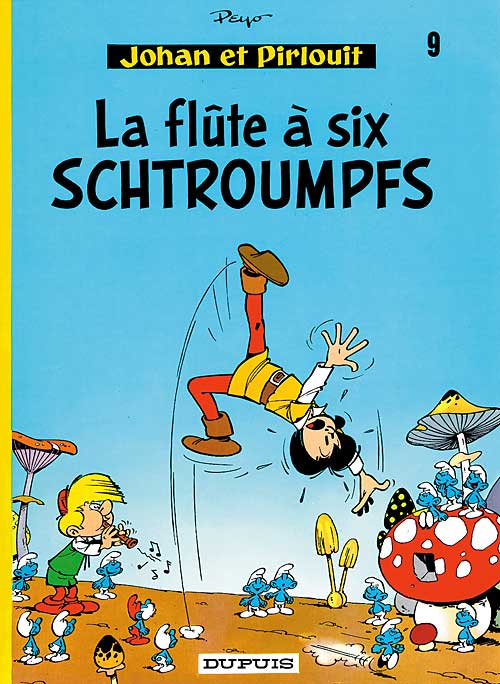
to arrive at La Flûte à Six Schtroumpfs, The Flute with Six Schtroumpfs

09-flute a six schtroumpfs

This is where the Schtroumpfs first made their entry onto the world stage. And this is where I start to cry.

Understand me, the Schtroumpfs were nice enough, they added a fun element to the story. But in my view they were minor characters. It was Johan and Pirlouit who were firmly centre stage.

Alas! I was in a minority. The junior readers of Spirou magazine – the stories originally came out in serialized format – wrote letters to the magazine enthusing about the little Schtroumpfs. The editors of the magazine, and Peyo himself, saw the commercial possibilities. And so Peyo took the first steps down the slippery slope. He started with minor albums of Schtroumpf stories. He graduated to major albums. He got involved in animated films. First, in Belgium. Then in the US. Then the breakfast cereal companies came knocking on the door: they wanted Schtroumpf statuettes in the Cornflake packages.schtroumpf statuettes

And after that the advertising firms came knocking at the door, asking to use the Schtroumpfs in various advertising campaigns. As this photo shows, the demand from advertizers continues unabated.

schtroumpf advertisement-1

Peyo always said yes. And John and Pirlouit disappeared; he was too busy with the Schtroumpfs. Peyo managed one more great album, La Guerre des 7 Fontaines, the War of the 7 Fountains.

10-guerre des sept fontaines

To me, it was his best, a wonderful story of Fall and Redemption. After that, he managed only a few more albums, pale copies of what had come before. The Schtroumpfs had eaten up his life. He had his first heart attack when he was 41, his last when he was 64.

And I am left with the memories of my youth, those golden afternoons in the France of the early ’60s, with medieval jousts and battles echoing faintly across the fields.

______________________

Schtroumpf: http://www.tattoo-kids.com/581-1284-thickbox/tatouages-schtroumpfs-pack.jpg (in http://www.tattoo-kids.com/pochette-de-tattoos/581-tatouages-schtroumpfs-pack.html)
Chatiment de Basenhau: http://www.bdzone.com/images/tout/9782800100951g1.jpg (in http://www.bdzone.com/chop/couvranteswap.php?serie=JOHA&debut=0&fin=9)
Maitre de Roucybeuf: http://www.bdzone.com/images/tout/9782800100968g1.jpg (in http://www.bdzone.com/chop/couvranteswap.php?serie=JOHA&debut=0&fin=9)
Lutin du Bois aux Roches : http://www.bdzone.com/images/tout/9782800100975g1.jpg (in http://www.bdzone.com/chop/couvranteswap.php?serie=JOHA&debut=0&fin=9)
Pierre de Lune : http://www.bdzone.com/images/tout/9782800100982g1.jpg (in http://www.bdzone.com/chop/couvranteswap.php?serie=JOHA&debut=0&fin=9)
Serment des Vikings : http://www.bdzone.com/images/tout/9782800100999g1.jpg (in http://www.bdzone.com/chop/couvranteswap.php?serie=JOHA&debut=0&fin=9)
Source des Dieux : http://www.bdzone.com/images/tout/9782800101002g1.jpg (in http://www.bdzone.com/chop/couvranteswap.php?serie=JOHA&debut=0&fin=9)
Fleche Noire : http://www.bdzone.com/images/tout/9782800101019g1.jpg (in http://www.bdzone.com/chop/couvranteswap.php?serie=JOHA&debut=0&fin=9)
Sire de Montresor : http://www.bdzone.com/images/tout/9782800101026g1.jpg (in http://www.bdzone.com/chop/couvranteswap.php?serie=JOHA&debut=0&fin=9)
Flute a Six Schtroumpfs: http://www.bdzone.com/images/tout/9782800101033g1.jpg ((in http://www.bdzone.com/chop/couvranteswap.php?serie=JOHA&debut=0&fin=9)
Guerre des 7 Fontaines: http://www.bdzone.com/images/tout/9782800101040g1.jpg (oin http://www.bdzone.com/chop/couvranteswap.php?serie=JOHA&debut=9&fin=9#)
Schtroumpf statuettes: http://img0.ndsstatic.com/wallpapers/e40969b9033ccdd352337e6494a54def_large.jpeg (in http://www.ohmymag.com/les-schtroumpfs/wallpaper)
Schtroumpf advertisement: http://img.xooimage.com/files51/2/4/e/lg-optimus-01-22e2217.jpg (in http://schtroumpfmania.soforums.com/t1518-Smartphone-LG.htm)

DREAM JOURNEY: PART IV

Bangkok, 22 May 2015

Normally, we would be rather groggy as we drive our MG off the ferry in Bari at 8 am in the morning, coming in from Dürres and the previous post. I certainly would be; I never sleep well on ships. But this is a dream, so I decree that we are bright-eyed and bushy-tailed as we roar off the ferry. Our goal is Otranto, very near the end of Italy’s high heel. We head down the old Via Traiana, now more boringly called the Strada Statale 16, as far as Brindisi. There we take the SS 613, which follows the trace of a previous local Roman road that was too modest to have a name. We pass through Lecce, where we pause. Lecce is known for its plentiful baroque buildings constructed in the 1600s, all using a beautiful local white stone, so I throw in a picture of a square there as a visual memorial to this city.

Lecce

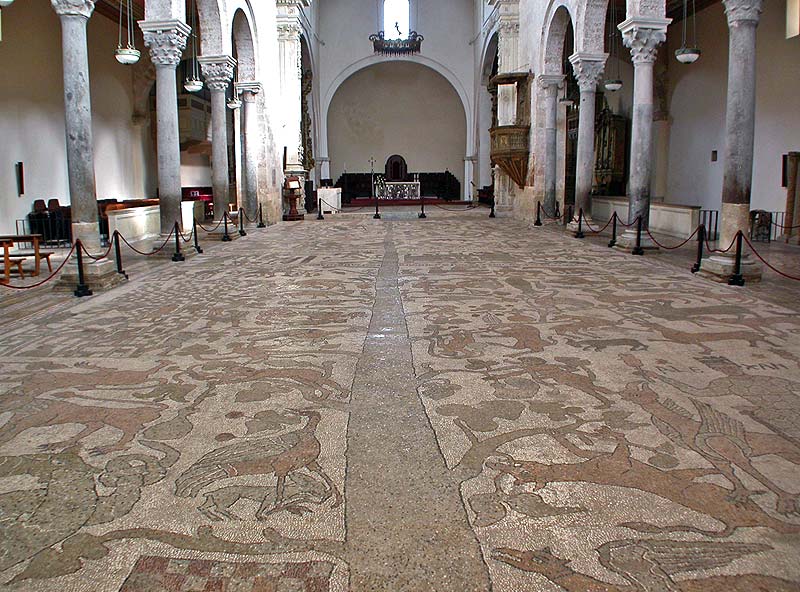
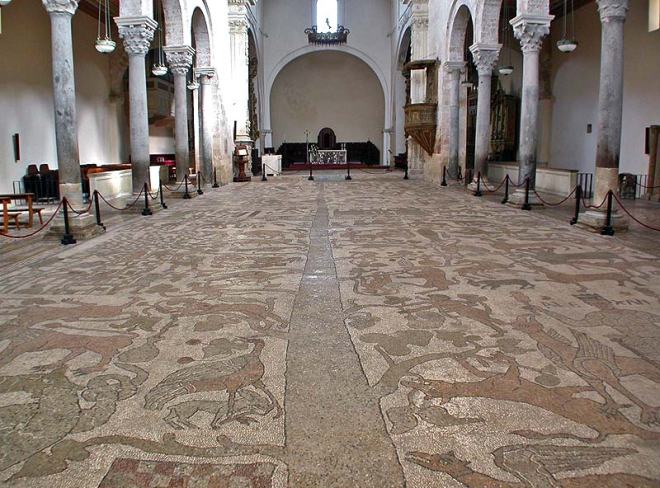
We continue on to Otranto, and drive straight up to the Cathedral. For this is the objective of our visit to Otranto – or rather the floor of the church is. When visitors enter the church, they are greeted by this magnificent floor.
otranto-mosaic-1

It is the largest floor mosaic in Europe. It brings me back to that other floor mosaic which we visited in the first leg of our trip in Aquileia, although eight centuries separate them. Some clever fellow took this photo from the ceiling, showing more or less the full extent of the mosaic.

otranto-mosaic-2

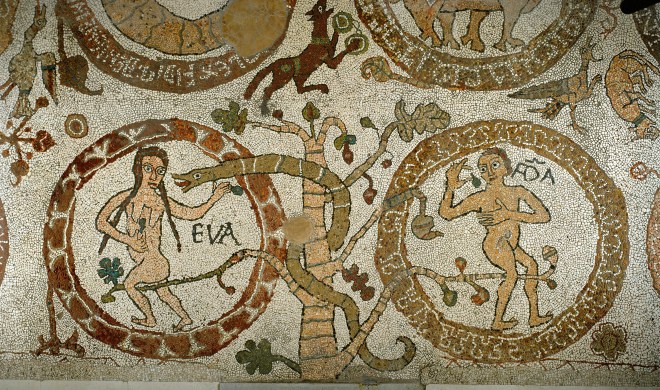
The subject of the mosaic is a Tree of Life, and you can indeed see the trunk of the tree working its way up the nave. Strangely enough, the narrative of this tree flows from the top down, and so near the high altar we have various scenes from the story of Adam and Eve, of which I throw in one photo.
otranto-mosaic-3-adam eve snake

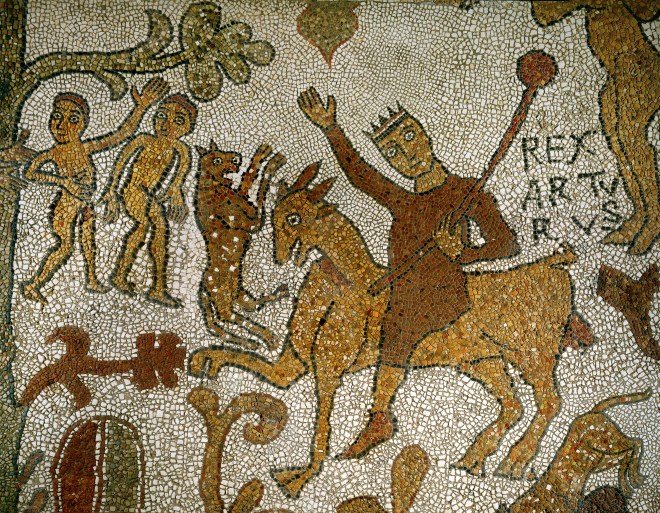
Honestly speaking, the story is difficult to read, so I shall just insert a couple of photos of other parts of the floor. This is King Arthur
otranto-mosaic-4-King Arthur

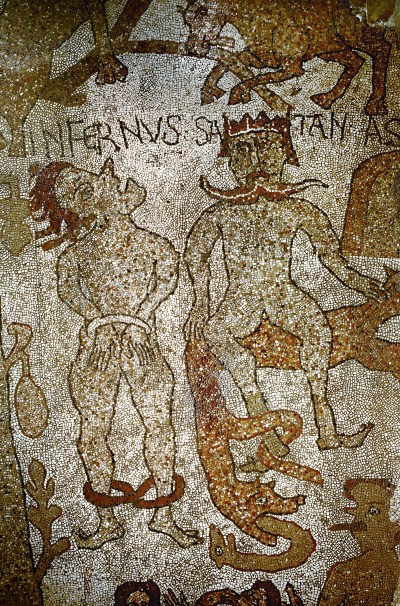
and this, Satan

otranto-mosaic-5-Great Satan

while this is said to be a self-portrait of the floor’s designer, a monk by the name of Pantaleone who hailed from the monastery of San Nicola di Casole, a little to the south of Otranto.

otranto-mosaic-6-Pantaleone_ self-portrait

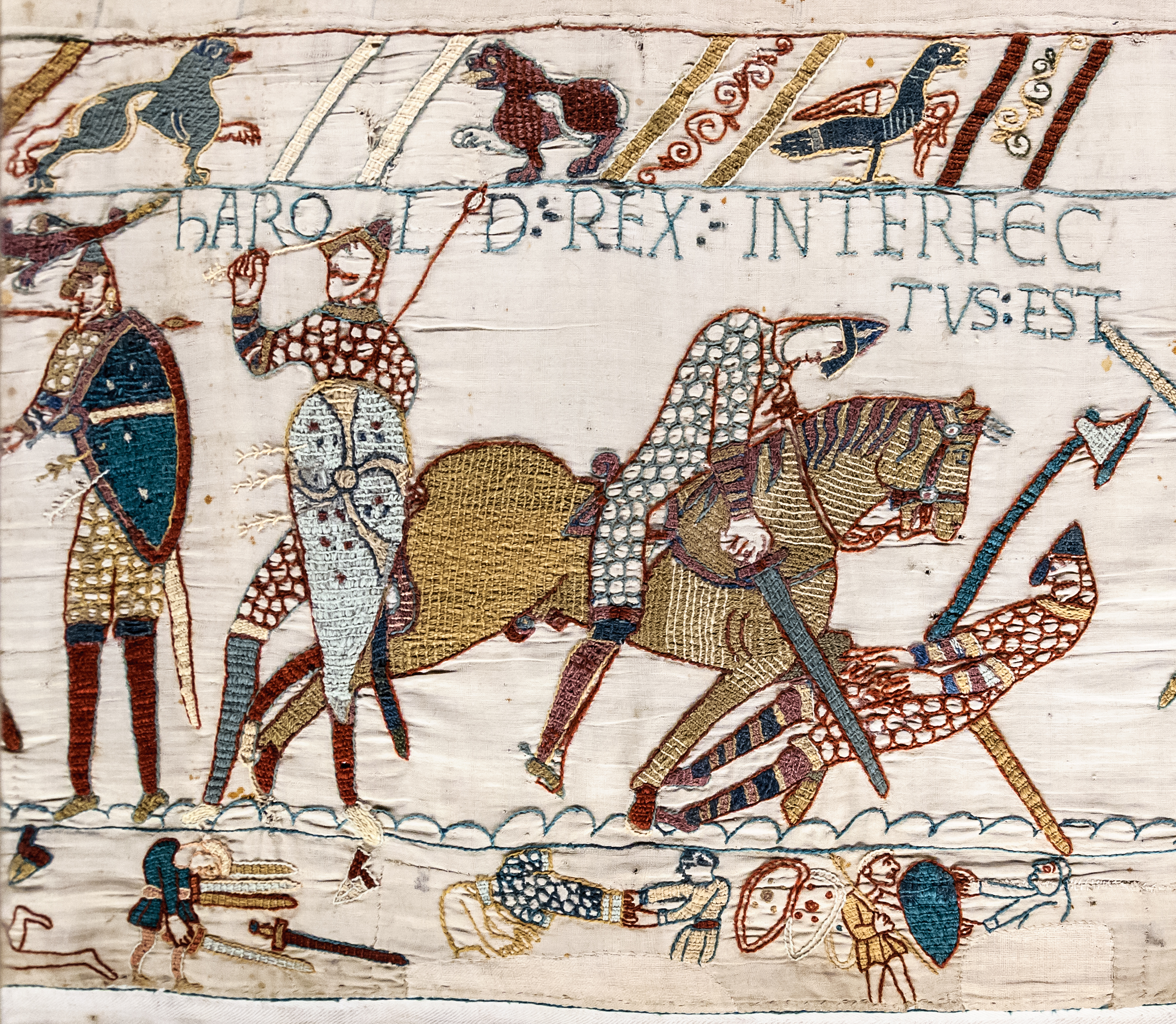
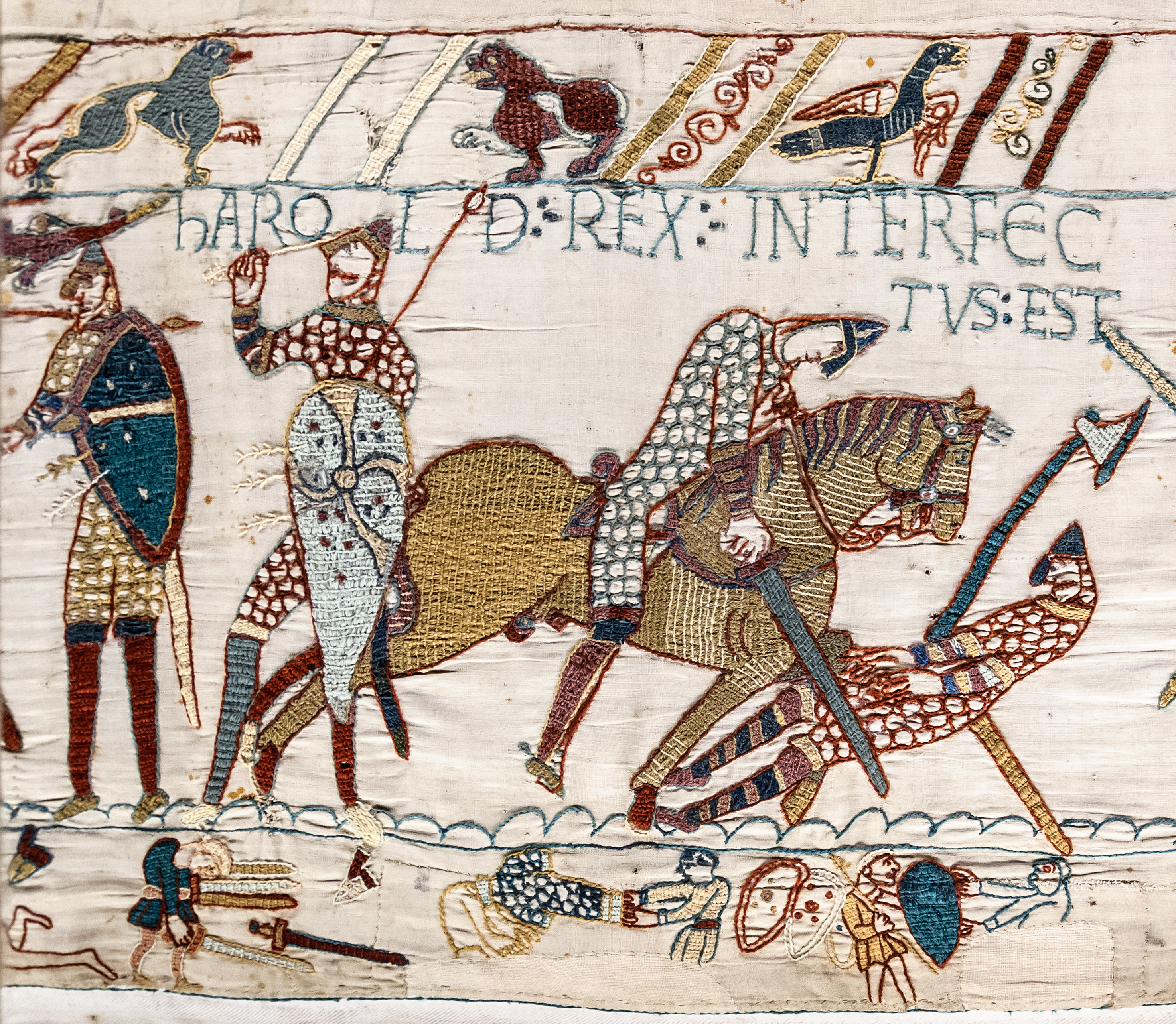
The mosaic was laid down in the 12th Century when this part of Italy was Norman, along with Sicily. In fact, the design of the floor rather reminds me of that other great masterpiece of Norman art, the Bayeux tapestry. I include here one photo of that tapestry, the famous scene where Harold Godwinson is killed by a Norman arrow through his eye.

Tapisserie de Bayeux - Scène 57 : La mort d'Harold

Next stop: Palermo in Sicily. We’ll get there by cutting across Italy’s heel to Taranto and then along the instep and sole of the Italian boot all the way to Reggio Calabria, where we’ll catch the ferry over to Sicily. I take the back roads to get to Taranto, because I want to drive through the small town of Copertino. As far as I know, this town is known for nothing special except a large castle and a saint. But to us, it has a great importance: my wife’s maternal grandfather came from Copertino and so it is the source of one-eighth of my children’s DNA. He emigrated to Milan in the early 1900’s, part of the massive migrations out of the south of Italy at the turn of the 20th Century. In typical migratory fashion, his departure eventually brought all his brothers and sisters up north. Family lore has it that his father ruined the family by taking the new Italian State to court over the expropriation of some of his land. He took the case all the way to the Court of Cassation, where he eventually lost the case, by which time he had also burned through all his money. Even though this is a very modest place with nothing special to write home about, I feel I must throw in a photo to commemorate it.

copertino

Onwards to Taranto, although in truth as we approach the city we turn our heads away and drive on. Taranto has been devastated by the plans of successive Italian government in the post-war period to develop the south of Italy through the implantation of heavy industry (I’ve already mentioned this in another post on Sicily). What were then the biggest steel works in Europe were plonked down here in the 1960s, and other heavy industry followed. By the 1980s, when my wife and I went to Taranto for the first time, the investment was in trouble. But the government couldn’t let it go down the tubes, it was politically too important. So money – half of it wasted through corruption and graft – was poured in to prop everything up. It’s stayed propped up – just – but in the meantime the industrial complex has poisoned half the population. Talk about sustainable development …

taranto

We are now driving through what was once Magna Graecia, Greater Greece, that string of Greek colonies which dotted the underside of the Italian boot as well as the coasts of Sicily (and even the shin and calf of that shapely Italian boot). The glittering stone in this string of cities was undoubtedly Syracuse in Sicily, where Archimedes – he of the original eureka moment – was born and was killed. But all the cities along here, from Taranto in the East to Selinunte in the West, were once flourishing and prosperous city-states. One of them, Sybaris, even became a byword for self-indulgent opulence – it was said of one of its citizens that he slept on a bed of rose petals, and if even one of them was folded over he could not sleep. The town’s name has entered the English language, a sybarite being a voluptuary or a sensualist. Now, Sybaris lies under four meters of mud. The only claim to fame of the surviving Calabrian towns is that they are infested by the ‘Ndrangheta, Calabria’s answer to Sicily’s mafia. It is said that John Paul Getty III, kidnapped in Rome back in 1973, was kept hidden in these parts. He was returned after his family forked over a ransom of $3 million – paid a good deal reluctantly (his grandfather is reported to have said, “I have 14 grandchildren. If I pay one penny now, I’ll have 14 kidnapped grandchildren”) and only after one of his ears had been cut off and sent to a newspaper. It is whispered that many a new house around here was built with Getty money.

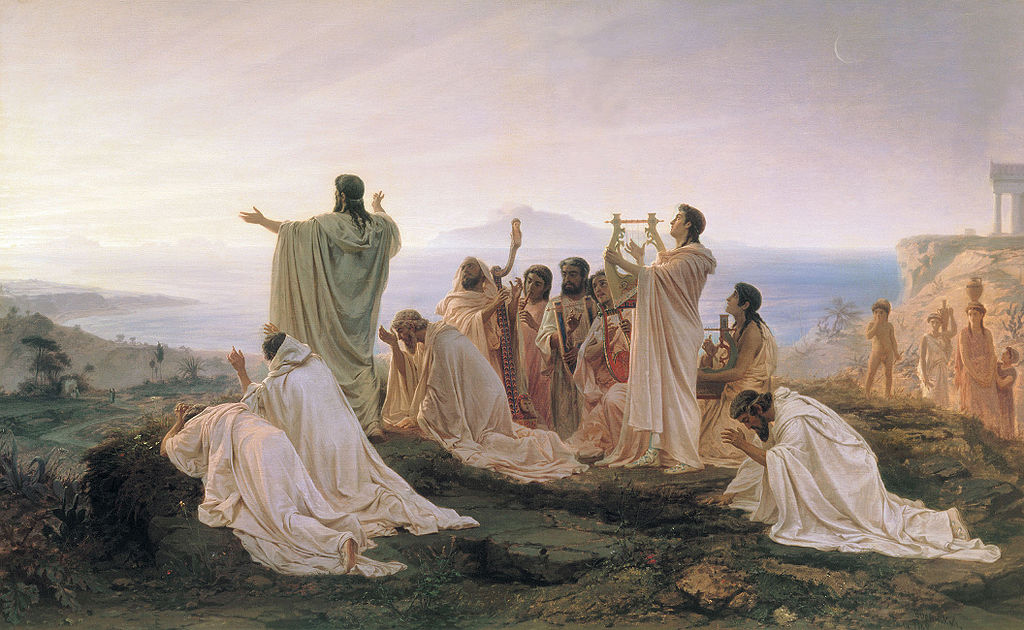
We stop for a moment in Crotone, on the ball of Italy’s foot, not because it’s any less dreary than the other towns we’ve passed through, but because something momentous happened here: Pythagoras set up his first school and came up with all those clever mathematics, among which was his theorem which I, like every child of 11 or so, learned in geometry class: “a2 + b2 = c2“, or in plain English, “in a right triangle, the square of the hypotenuse is equal to the sum of the square of the other two sides”. At least, that’s what I was told by proud Crotonesi when I was here 20 years ago to do an environmental audit. Alas! It was not so. Pythagoras did indeed come to Crotone, but all he did was to set up some sort of mystical, esoteric sect which dabbled in the quasi-magic of whole numbers. It’s very unlikely that he personally came up with any of the mathematical cleverness attributed to him; his disciples did, but later. I think this painting, by a 19th Century Russian painter, captures nicely the strongly mystical (and to my way of thinking, rather weird) overtones of the initial Pythagorean movement.

pythagoreans celebrating sunrise

What Pythagoras and his sect did do in Crotone was to eventually take over the city’s government, and it was during his time in office that Crotone destroyed Sybaris. Several other cities in the area also espoused Pythagorean forms of government, but after a while there was a backlash. Back in Crotone Pythagoras was chased out, to end his days in nearby Metapontum, another city now lying under meters of mud. But Pythagorean schools continued, although they restricted themselves to maths and “natural philosophy” and left politics to others. Probably better that way …

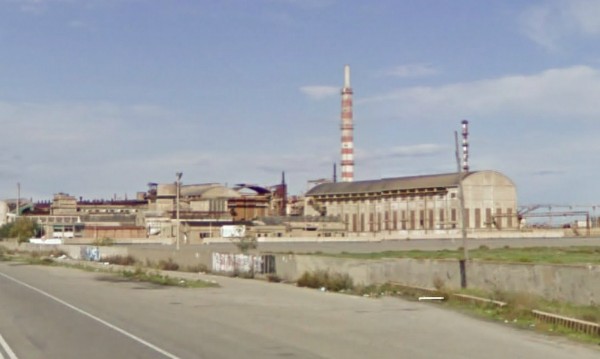
I take one last look at the industrial plant I audited all those years ago – another industrial works plonked down here, and another one that has closed, leaving nothing but bitterness in its wake.

pertusola

It’s time to move on.

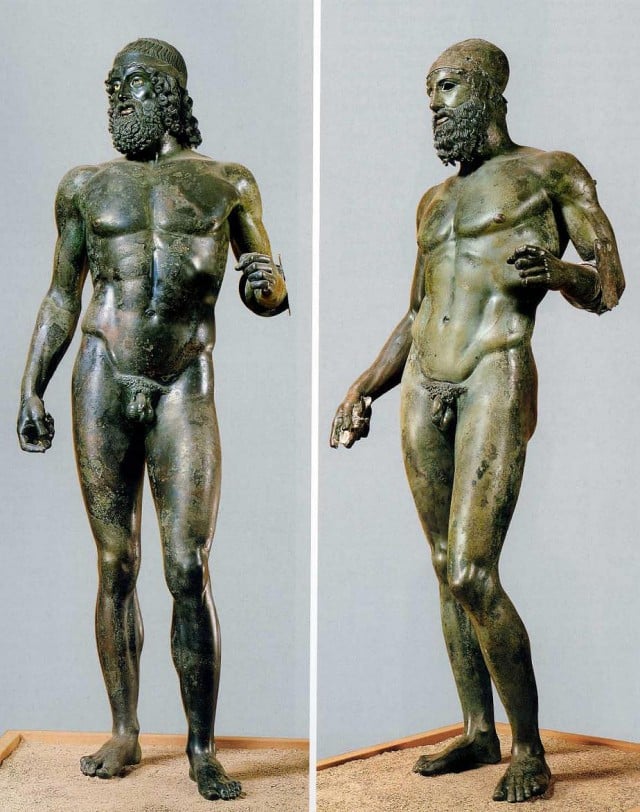
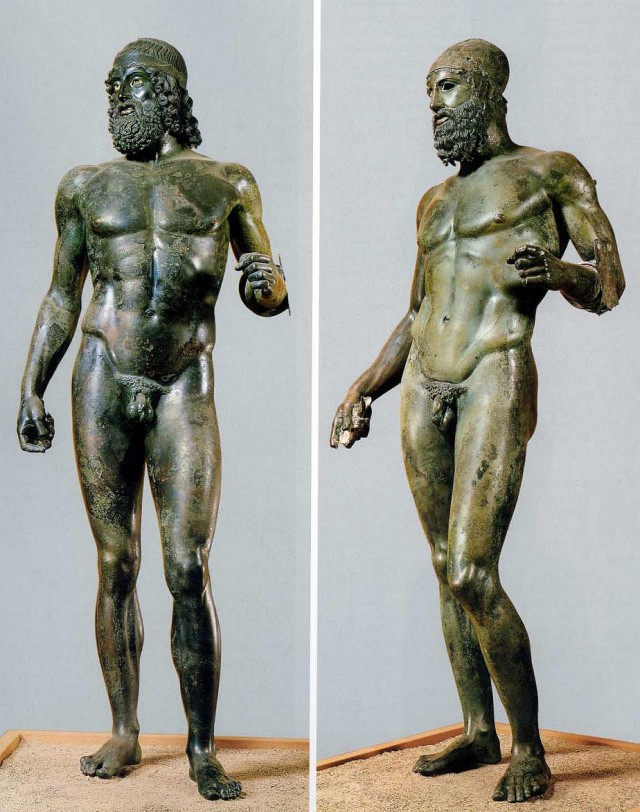
When we reach Reggio Calabria, although my wife is reluctant I insist: we must go to the Museum of Magna Graecia to see the two Bronzes of Riace. Neither of us have ever seen them, and it would be a pity not to take advantage of our passing through Reggio to have a peek. I know the objective of our trip is early Christian mosaics, but other wonders along the way should not be ignored. No sooner said than done! With a click of the mouse, I have us parked in front of the museum and magically transported past the queues of people waiting to enter the climate-controlled, earthquake-proofed room where they stand.
bronzi di riace

What magnificence! And what we see today are stripped down versions of the original. Each would have been coiffed with a Corinthian-style helmet, would have carried a shield on that raised left arm, and would have held a lance in the other. The latest theories hypothesize that they represent two of the Seven Heroes who set off from Argos to fight against Eteocles, king of Thebes and son of Oedipus (he of the complex), and died at the city’s seven gates. One expert suggests that they were originally part of a group of seven statues which stood in the Agora of the city of Argos. How they ended up on the sea bed off the coast of Calabria is anyone’s guess. My guess, for what it’s worth, is that during Roman times Argos was hard up, and rich Romans, avid for Greek art, came along and offered to buy the statues. Why not … In later centuries hard-up Italians sold their Renaissance treasures to rich Englishmen, avid for Italian art, and later still these Englishmen, hard up in their turn, sold these same treasures to rich Americans. In any event, they were being shipped to Rome, but when the ship was off the coast of Calabria a violent storm blew up, and the captain, rather than losing his ship and his life, tossed the heavy stuff overboard.

Time to catch the ferry over to Sicily, home to some of the most beautiful Byzantine-style mosaics still extant, created when the Normans controlled Sicily. The web helpfully informs us that there is a ferry over to Messina every hour or so. In this dream trip, we will not have any difficulty in catching the ferry, unlike real life 30 years ago when my wife and I decided to take her mother to spend Christmas and the New Year in Sicily. We arrived in Reggio Calabria on the evening of 23 December, along with a horde of Sicilian migrant workers returning home from Northern Europe for the holidays. We discovered to our horror that the ferry boat crews had just decided to strike for more pay. Those bastards had chosen this particular time to strike because they knew it put the owners under huge pressure to settle. Settle they did, but not before we had spent a miserable night in the ferry car park. When those ferry boat crews arrive, as they assuredly will one day, before the Pearly Gates, I hope they will be kicked off down to Hell, to roast in its fires for Eternity (anyone curious to know what that might look like can refer back to the posting with which I started this dream journey and study the photo I inserted there from the back wall of the church on the island of Torcello).

Once on the other side,  we set off for Palermo. I firmly decide that we will take the normal roads to get there. In this dream we’re in no hurry, and I prefer by far the “reeling roads”, the “rolling roads”, that “ramble round the shire”, as G.K. Chesterton wrote in his most famous poem “The Rolling English Road”. Yes, I prefer by far his “merry roads” and his “mazy roads” to the smooth monotony of sterile highways. We pass Milazzo, where you can catch the boat to the Aeolian Islands – a trip for another day – and where I did yet another environmental audit 20 years ago for another struggling industrial complex, which mercifully has not closed – yet. We hum along until we arrive at the small town of Cefalù, nestling under the mighty headland which gives it its (Greek) name. We head, yet again, for the Cathedral, constructed by the Normans in the first half of the 1100s. There, some beautiful mosaics still cling to the apse and the last bay of the choir.

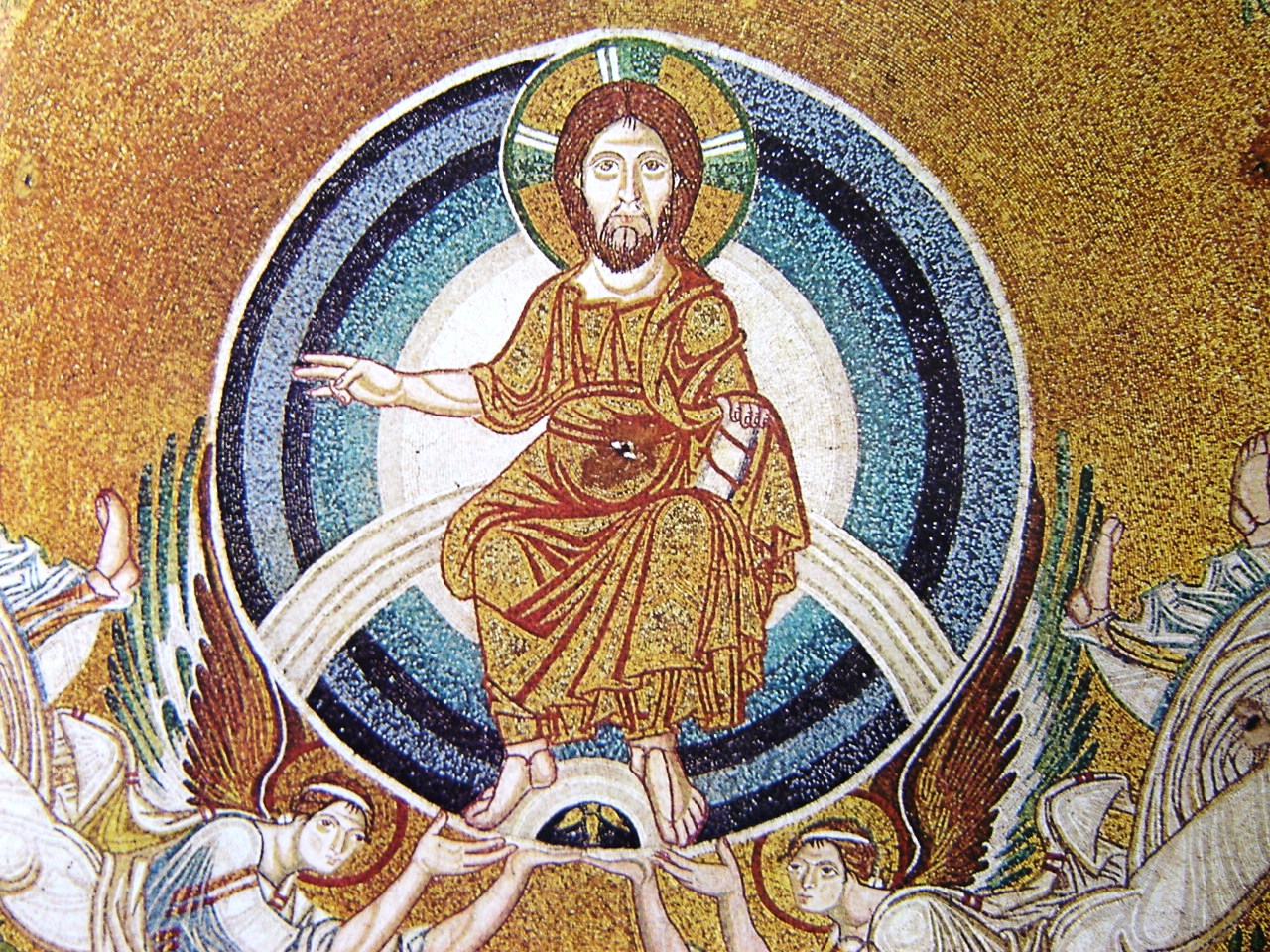
cefalu-duomo-1

The Pantocrator gracing the apse is “for many the greatest portrait of Christ in all Christian art”, in the words of John Julius Norwich (I am quoting from his history of Sicily).

cefalu-duomo-2

The style is clearly mature Byzantine, a style we’ve already seen in Istanbul as well as in the lagoons of Venice, and would have seen in Daphni and Saint Luke in Greece had we made the detour from Thessaloniki. The Normans got Byzantine artists, or artists trained in Byzantine workshops, to make the mosaics.

It’s time to go on to Palermo, which is our final destination on this leg of the journey. We hug the coast, coming into the city on its seaward side. Once we reach the port, we swing up Via Vittorio Emanuele (there’s one of these in every village, town, and city in Italy, along with a Via Garibaldi), which is the main thoroughfare through the city’s old center. When we get near the Martorana church, we miraculously find – free! – parking (this is a dream, after all) for our little MG and head over to the church.

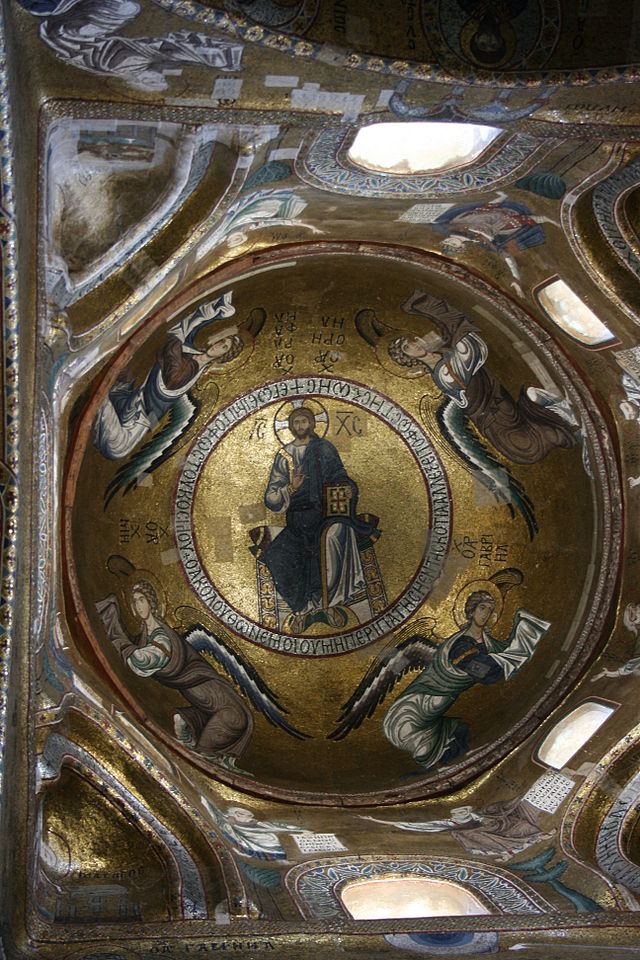
The church has been much modified over the centuries, not least of which by a brutal Baroque make-over in the front part of the nave in the 17th Century. But once we get past these horrors and enter the upper nave, we are greeted by some lovely mosaics: Christ in majesty in the dome of the church

palermo-martorana-1

the annunciation

palermo-martorana-4

the nativity

palerno-martorana-7

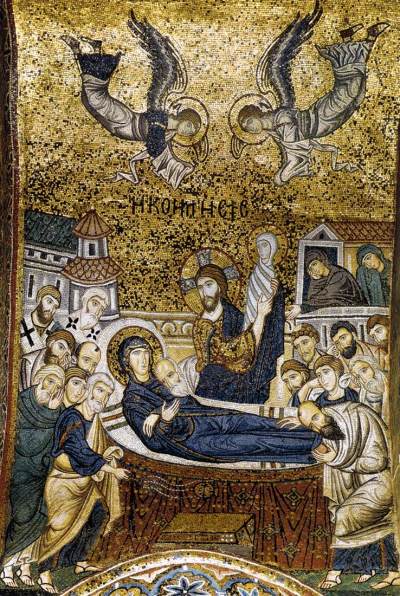
the dormition of the Virgin Mary

palerno-martorana-6

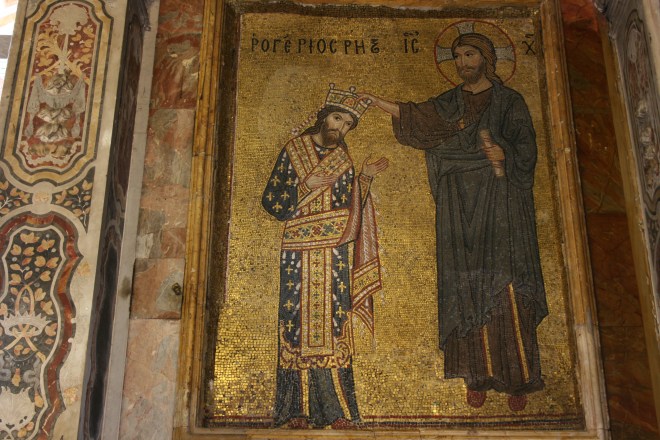
As we leave, I want particularly to see these two mosaics. In this first one, we have the greatest of all the Norman kings of Sicily, Roger II, having himself cheekily crowned by Christ himself, as if he were a Byzantine emperor
palermo-martorana-2

It was he who first brought this Byzantine art form to Sicily.

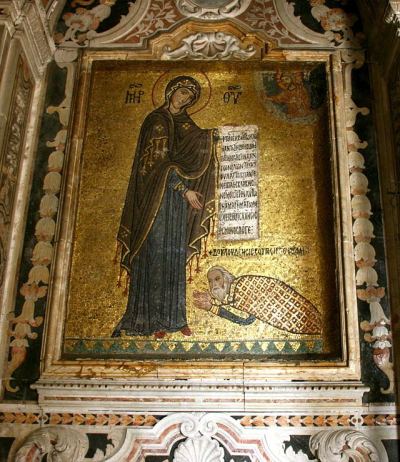
And here we have the original donor of the church, George of Antioch, Roger II’s admiral, humbly offering his church to the Virgin Mary (much like we saw in Cariye Kamii in Istanbul)
palermo-martorana-5

A final note about this church: it belongs to the Italian-Albanian community in Sicily, the remnants of the Albanians who fled to Italy in the 15th and later Centuries as the Ottomans methodically went about conquering their home country. So it is not just geographical proximity which led the modern Albanians back in late 1990s to escape by their thousands to Italy as Albania imploded after the collapse of Communism (with many of these new arrivals squatting in and around Otranto, as it so happens).

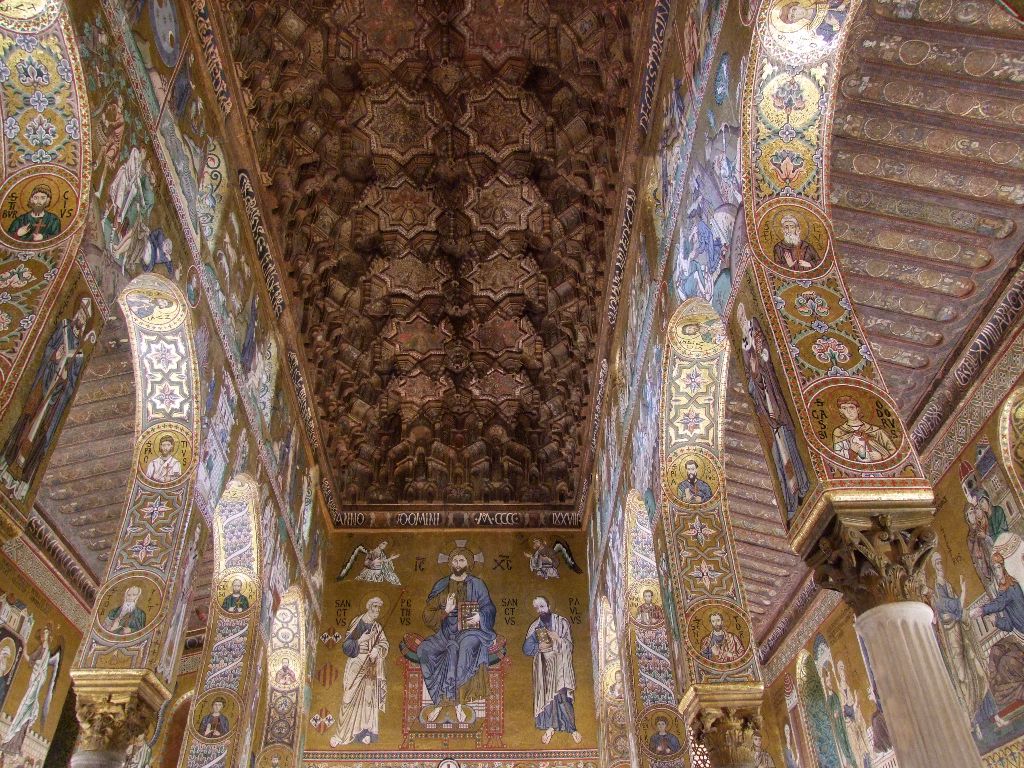
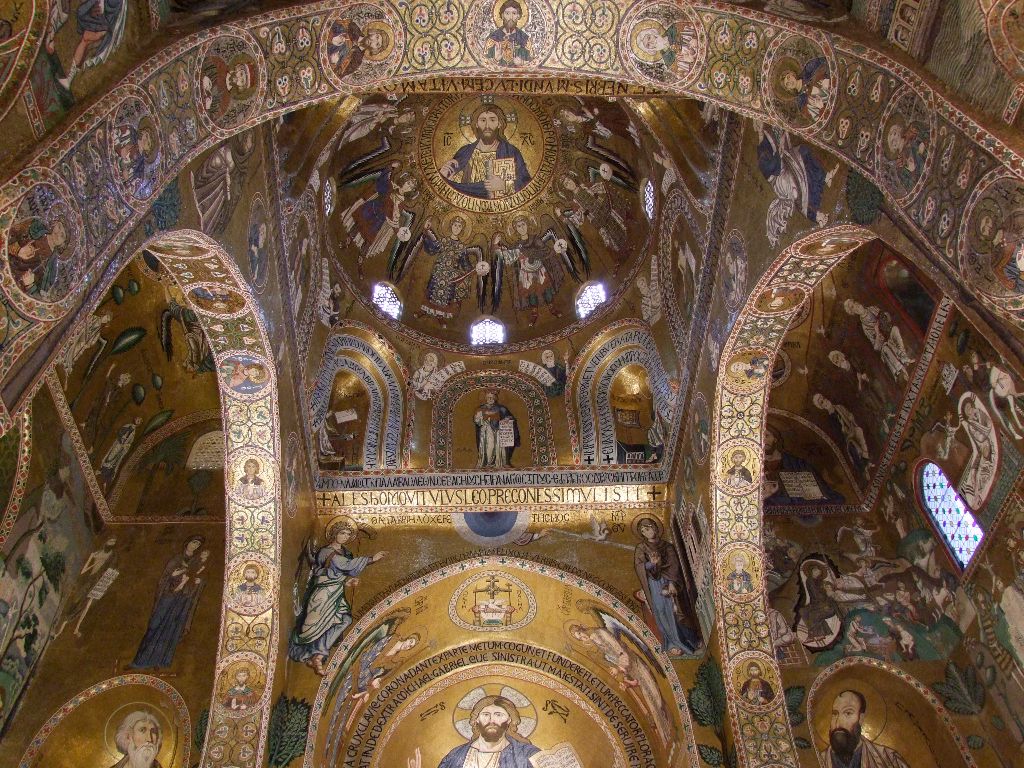
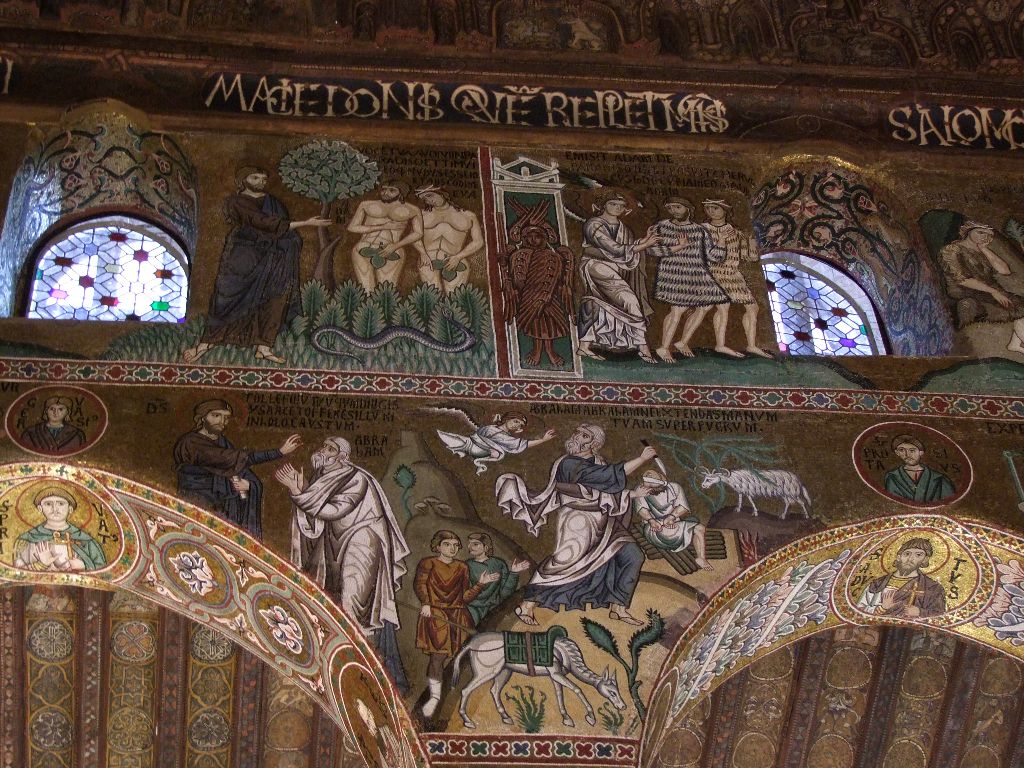
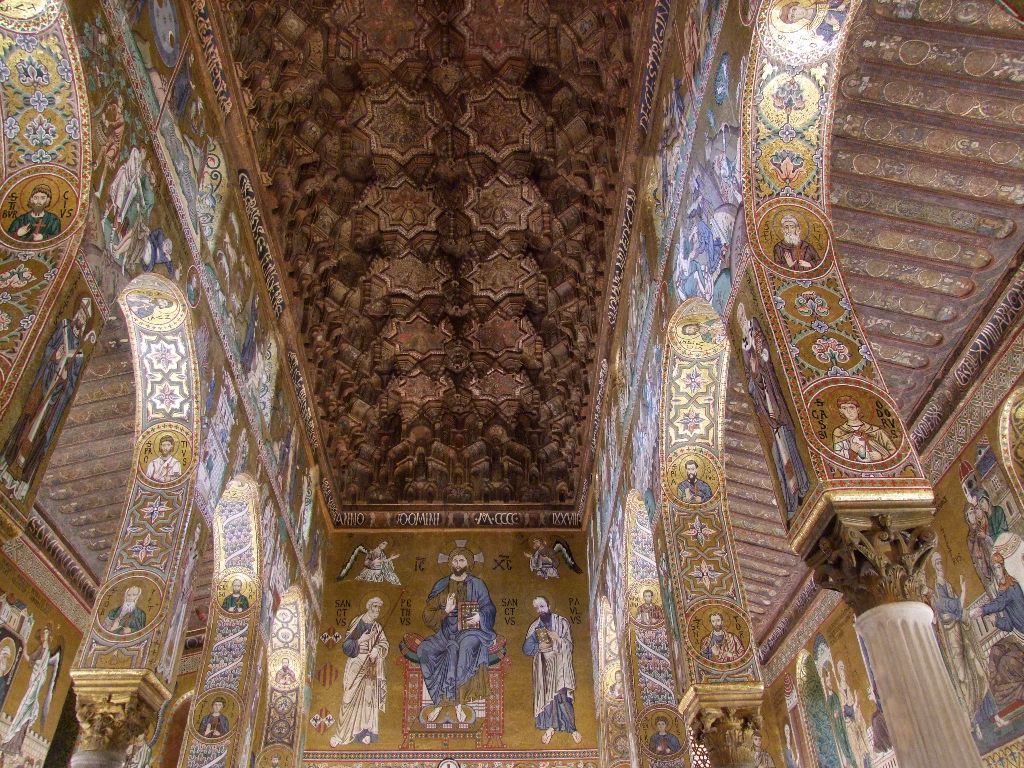
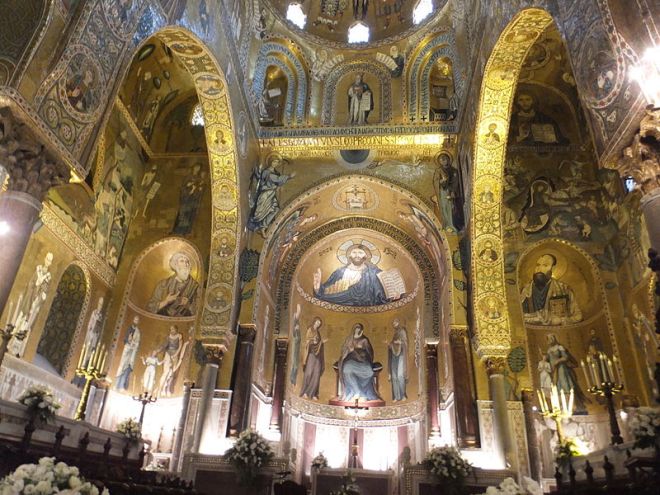
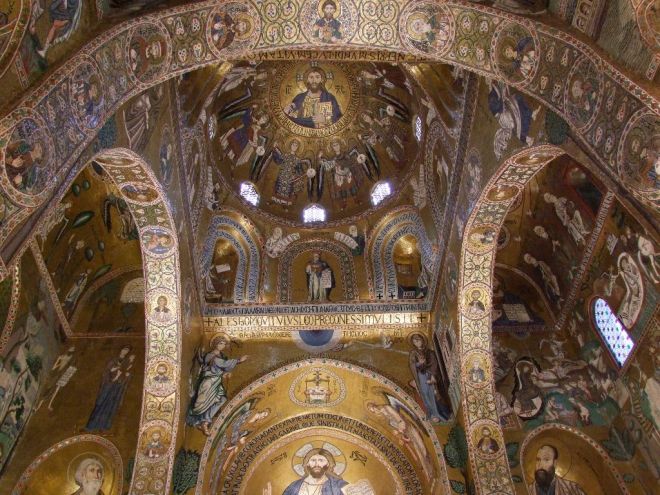
We go back to the car and continue up Via Vittorio Emanuele to the Palazzo dei Normanni, the Palace of the Normans, which actually was originally built by the Arabs. This rather severe building houses the Cappella Palatina, which was built by Roger II as the King’s private chapel. It houses some magnificent 12th Century mosaics.
palermo-cap-palatina-1

palermo-cap-palatina-6

palermo-cap-palatina-5

This last one shows also the ceiling, a wonderful piece of Arab carpentry work, an example of which we last saw in the Alhambra palace in Granada.

palermo-cap-palatina-4

Roger II understood that in this island with large Greek and Arab populations, he had to be open to their cultures if he was going to maintain the peace. Indeed, he welcomed this mixing of cultures. It is part of Sicily’s tragedy that later rulers did not continue this practice of toleration and openness.

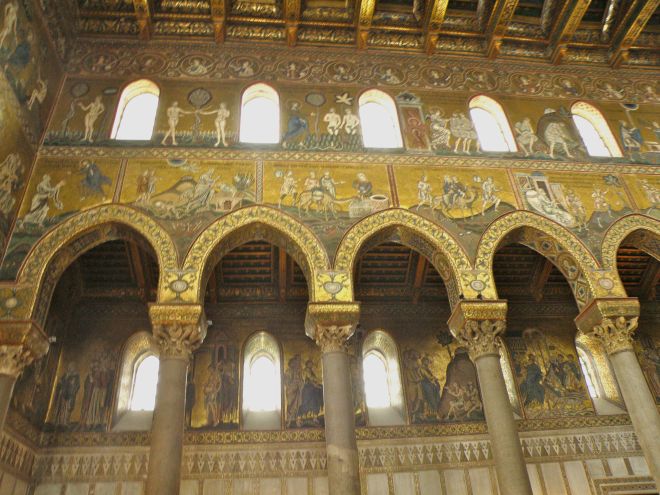
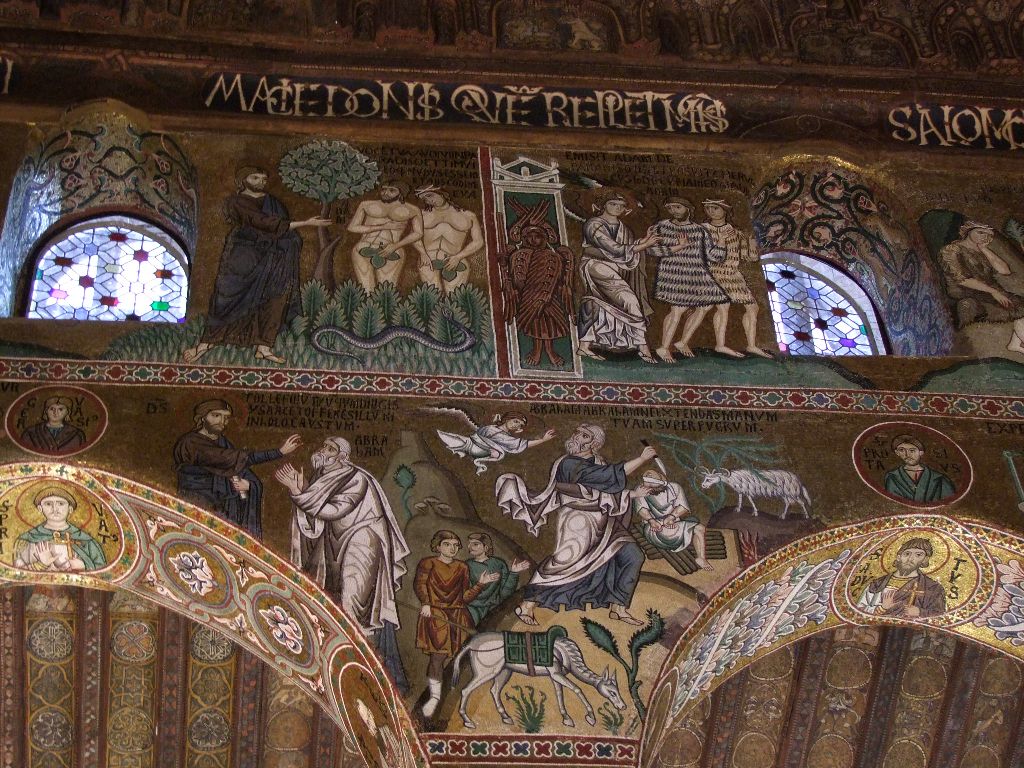
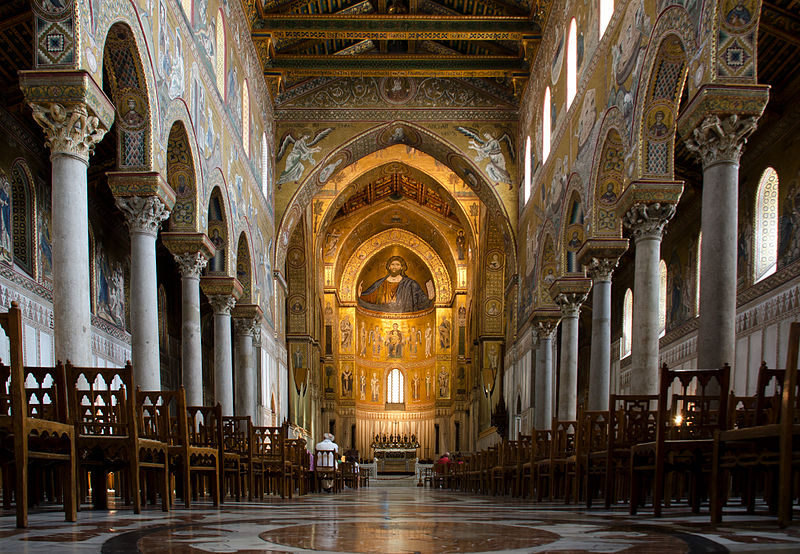
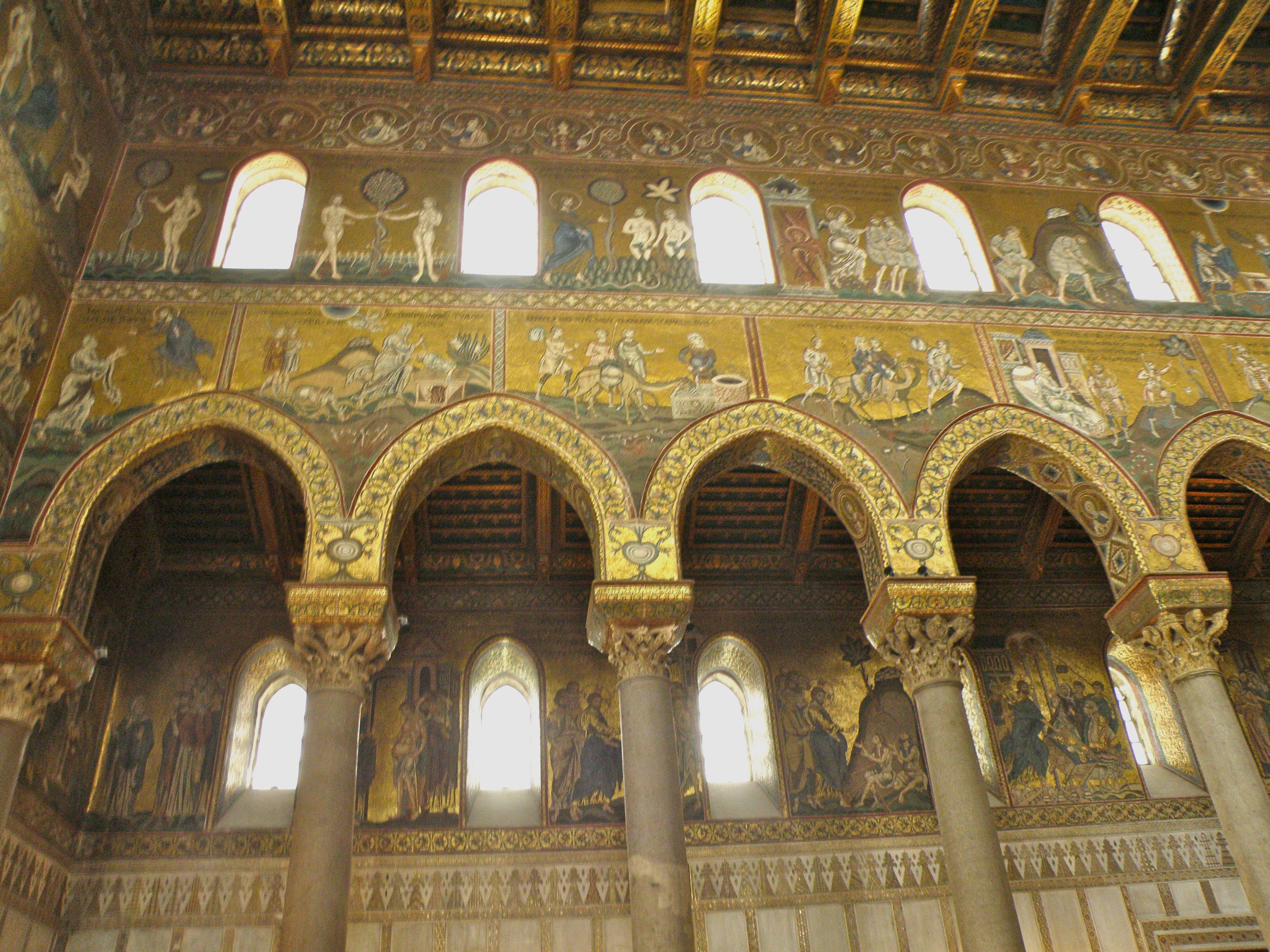
We are not finished yet! We vault into the car (after constant badgering by our children we’ve taken to doing a lot of exercise recently, so I can imagine ourselves vaulting jauntily over the doors and dropping into our seats) and we keep on going up Via Vittorio Emanuele, which has now morphed into Via Calatafimi. We go on and on until we hit the hills behind Palermo, at which point we start climbing and finally find ourselves in Monreale, once a village on the outskirts of Palermo but now a suburb. We head – of course – for the cathedral and casually park the car in front of the cathedral. We walk into this late 12th Century church and I suddenly feel that I am back in the church of Sant’Apollinare in Ravenna, where we started our dream journey.

monreale-duomo-1

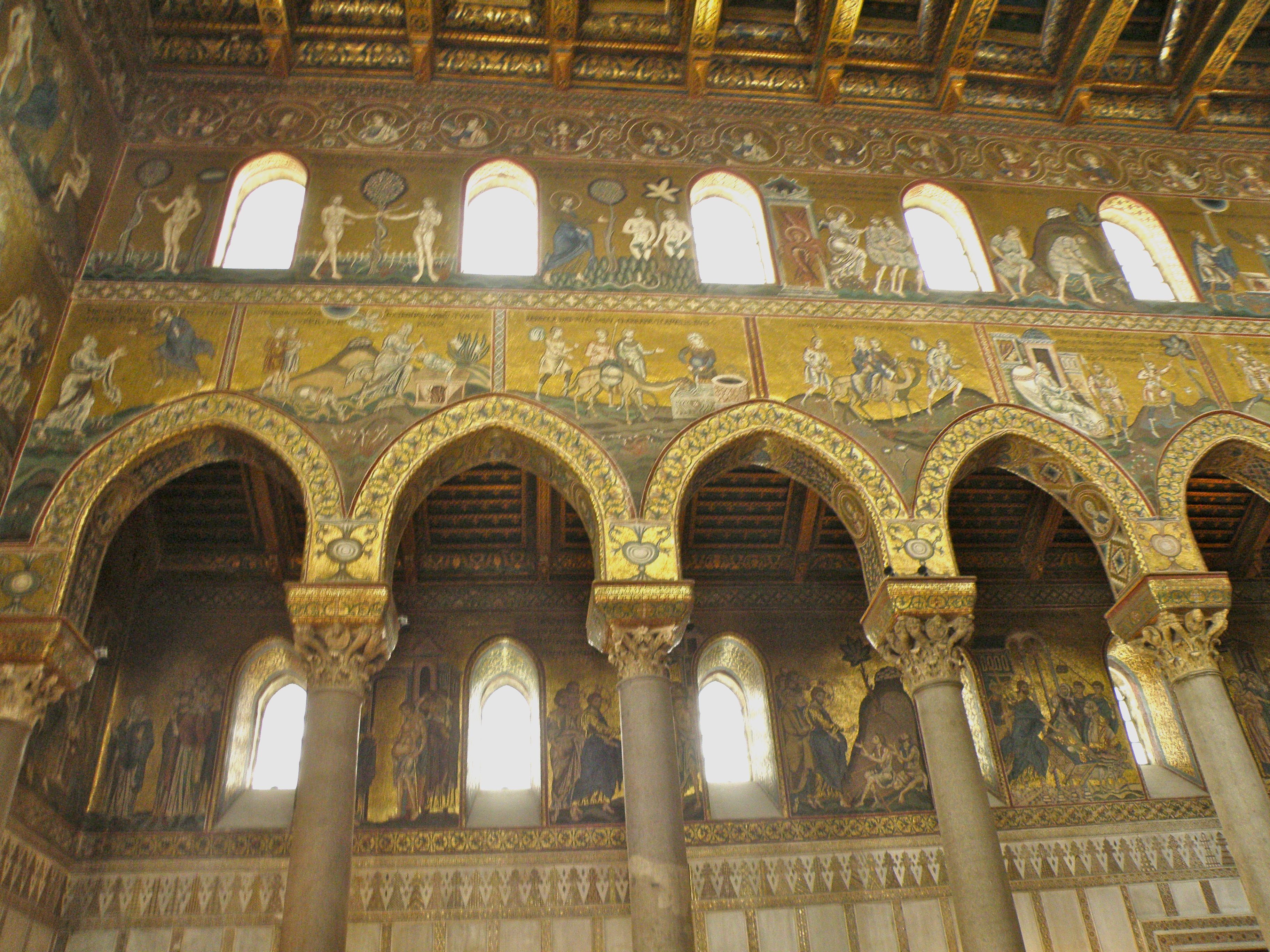
Biblical scenes on fields of gold unfurl along upper tiers of the nave
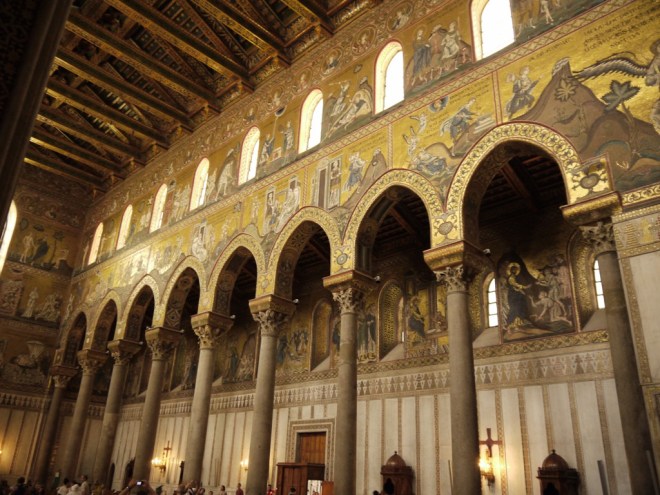
monreale-duomo-6

OLYMPUS DIGITAL CAMERA

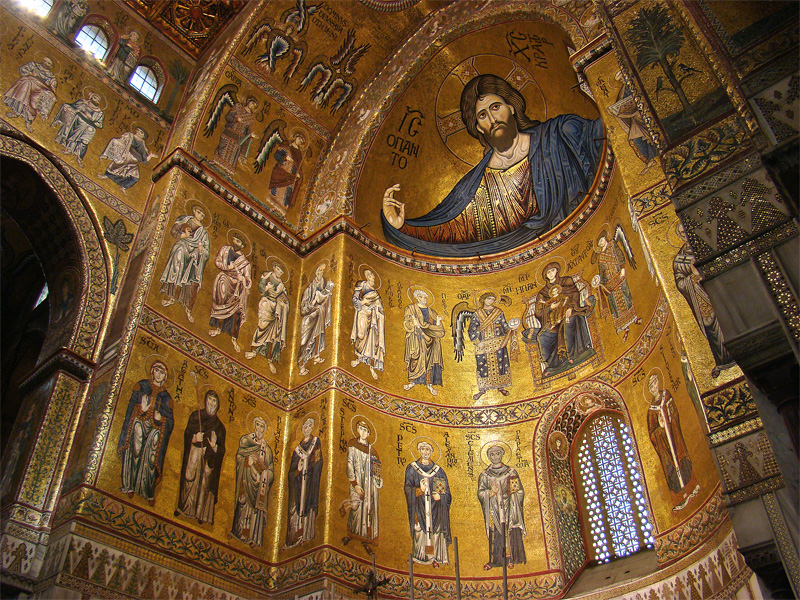
to reach the theological high point in the apse, with its assembled saints and angels presided over by a rather severe Pantocrator.

monreale-duomo-2

But how the styles have changed in the intervening six centuries! Then, it was still Roman art, although of a rough-and-ready sort. Now, it is early medieval art in all its stiff, hieratic splendour.

After all that gold, we go up on the roof of the church and drink in the astringent blue of the sky, which is rather like eating a lemon sorbet after a heavy main course so as to cleanse the mouth of all that richness. We gaze out across Palermo and over the “wine-dark” Tyrrhenian Sea beyond (to borrow Homer’s rather strange description of the sea’s colour).
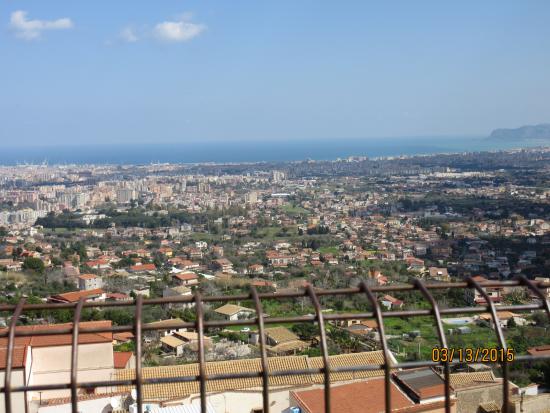
monreale-panoramic-view

Tonight, we will catch the ferry and cross that sea to Naples – another Greek colony long, long ago – and from there drive up to Rome, our last stop on this exhaustive, and mentally exhausting, tour of early Christian mosaics.

_________________

Lecce: https://youthfullyyoursgr.files.wordpress.com/2013/05/lecce-it.jpg (in https://youthfullyyoursgr.wordpress.com/%CF%80%CF%81%CE%BF%CE%B3%CF%81%CE%AC%CE%BC%CE%BC%CE%B1%CF%84%CE%B1/get-up-stand-up-be-healthy-guys-youth-exchange-lecce-%CE%B9%CF%84%CE%B1%CE%BB%CE%AF%CE%B1-22-29072013/)
Otranto-mosaic-1: http://www.paradoxplace.com/Perspectives/Sicily%20&%20S%20Italy/Puglia/Otranto/Cattedrale/Images_Mosaics/800/Mosaic_Floor-Nov06-DC9997sAR800.jpg (in http://www.paradoxplace.com/Perspectives/Sicily%20&%20S%20Italy/Puglia/Otranto/Otranto.htm)
Otranto mosaic-2: http://www.swide.com/wp-content/uploads/2014/06/Reasons-to-travel-puglia-apulia-italy-mosaics-Otranto.jpg (in http://www.swide.com/food-travel/reasons-to-travel-to-puglia-apulia-italy-top-20-things-to-do/2014/06/30)
https://canvas.harvard.edu/courses/305/pages/the-mosaic-of-otranto
Bayeux Tapestry: http://upload.wikimedia.org/wikipedia/commons/b/bb/Bayeux_Tapestry_scene57_Harold_death.jpg (in http://en.wikipedia.org/wiki/Bayeux_Tapestry)
Copertino: http://www.amedeominghi.info/wp-content/uploads/2014/05/PiazzaMazzini.jpg (in http://www.amedeominghi.info/nuovedate/)
Taranto: http://it.wikipedia.org/wiki/Ilva#/media/File:ILVA_-_Unit%C3%A0_produttiva_di_Taranto_-_Italy_-_25_Dec._2007.jpg (in http://it.wikipedia.org/wiki/Ilva#Unit.C3.A0_produttiva_di_Taranto)
“Pythagoreans celebrating the sunrise”, by Fyodor Bronnikov(1827–1902): http://en.wikipedia.org/wiki/Pythagoras#/media/File:Bronnikov_gimnpifagoreizev.jpg (in http://en.wikipedia.org/wiki/Pythagoras)
Pertusola: http://www.ilcirotano.it/wp-content/uploads/2012/06/Ex-Pertusola.jpg (in http://www.ilcirotano.it/2012/10/09/viaggio-nella-pertusola-sud/)
Bronzi di Riace: https://news.artnet.com/wp-content/news-upload/2014/08/Riace-bronzes-e1408562456865.jpg (in https://news.artnet.com/art-world/italy-risks-priceless-riace-bronzes-for-cash-82747)
Cefalù-duomo-1: http://commondatastorage.googleapis.com/static.panoramio.com/photos/original/74677063.jpg (in https://geolocation.ws/v/P/74677063/abside-del-duomo-di-cefal-cristo/en)
Cefalù-duomo-2: http://it.wikipedia.org/wiki/Duomo_di_Cefal%C3%B9#/media/File:Cefalu_Christus_Pantokrator_cropped.jpg (in http://it.wikipedia.org/wiki/Duomo_di_Cefalù)
Palermo-Martorana-1: http://upload.wikimedia.org/wikipedia/commons/thumb/c/c0/Chiesa_della_Martorana_cupola.jpg/640px-Chiesa_della_Martorana_cupola.jpg (in http://en.wikipedia.org/wiki/Martorana#Interior)
Palermo-Martorana-2: http://it.wikipedia.org/wiki/Chiesa_della_Martorana#/media/File:Palerme_Martorana168443.JPG (in http://it.wikipedia.org/wiki/Chiesa_della_Martorana)
Palermo-Martorana-3: https://classconnection.s3.amazonaws.com/848/flashcards/3299848/jpg/palermo_chiesa_20martorana_mosaic_nativity-13F311CF74763DF1FB7.jpg (in https://www.studyblue.com/notes/note/n/ecb-final-review/deck/8598474)
Palermo-Martorana-4: http://www.wga.hu/art/zgothic/mosaics/8/2martor2.jpg (in http://www.wga.hu/html_m/zgothic/mosaics/8/2martor2.html)
Palermo-Martorana-5: http://upload.wikimedia.org/wikipedia/commons/b/b3/Chiesa_della_Martorana_Christus_kr%C3%B6nt_Roger_II.jpg (in http://commons.wikimedia.org/wiki/File:Chiesa_della_Martorana_Christus_kr%C3%B6nt_Roger_II.jpg)
Palermo-Martorana-6: http://it.wikipedia.org/wiki/Chiesa_della_Martorana#/media/File:George_of_Antioch_and_Holy_Virgin_2009.jpg (in http://it.wikipedia.org/wiki/Chiesa_della_Martorana)
Palermo-Cappella Palatina-1: http://en.wikipedia.org/wiki/Cappella_Palatina#/media/File:Cappella_Palatina_in_Palermo_Sicily.JPG (in http://en.wikipedia.org/wiki/Cappella_Palatina)
Palermo-Cappella Palatina-2: http://www.scherminator.com/italy/sicily/cappellaPalatina/cappellaPalatina5.jpg (in http://www.scherminator.com/italy/sicily/cappellaPalatina/cappellaPalatina.html)
Palermo-Cappella Palatina-3: http://www.scherminator.com/italy/sicily/cappellaPalatina/cappellaPalatina0.jpg (in http://www.scherminator.com/italy/sicily/cappellaPalatina/cappellaPalatina.html)
Palermo-Cappella Palatina-4: http://www.scherminator.com/italy/sicily/cappellaPalatina/cappellaPalatina10.jpg (in http://www.scherminator.com/italy/sicily/cappellaPalatina/cappellaPalatina.html)
Monreale-Duomo-1: http://it.wikipedia.org/wiki/Duomo_di_Monreale#/media/File:MonrealeCathedral-pjt1.jpg (in http://it.wikipedia.org/wiki/Duomo_di_Monreale)
Monreale-duomo-2: https://ofsplendourinthegrass.files.wordpress.com/2012/08/p1110054.jpg (in https://ofsplendourinthegrass.wordpress.com/2012/08/30/monreale/)
Monreale-duomo-3: http://giazza.se/wp-content/uploads/2012/05/pal-dome-2.jpg (in http://giazza.se/?p=1506)
Monreale-duomo-4: http://it.wikipedia.org/wiki/Duomo_di_Monreale#/media/File:Sicilia_Monreale2_tango7174.jpg (in http://it.wikipedia.org/wiki/Duomo_di_Monreale)
Monreale-panoramic view: http://media-cdn.tripadvisor.com/media/photo-s/07/87/3f/dc/panoramic-view-from-the.jpg (in http://www.tripadvisor.it/LocationPhotoDirectLink-g666663-d4470498-i126304220-Norman_Cathedral_of_Monreale-Monreale_Province_of_Palermo_Sicily.html)
DREAM JOURNEY: PART III

Bangkok, 6 May 2015

May has arrived, the most beautiful month in the Mediterranean. It’s time for my wife and I to come out of our long, long hibernation in Istanbul and continue on our dream journey, the next leg of which will be Greece.

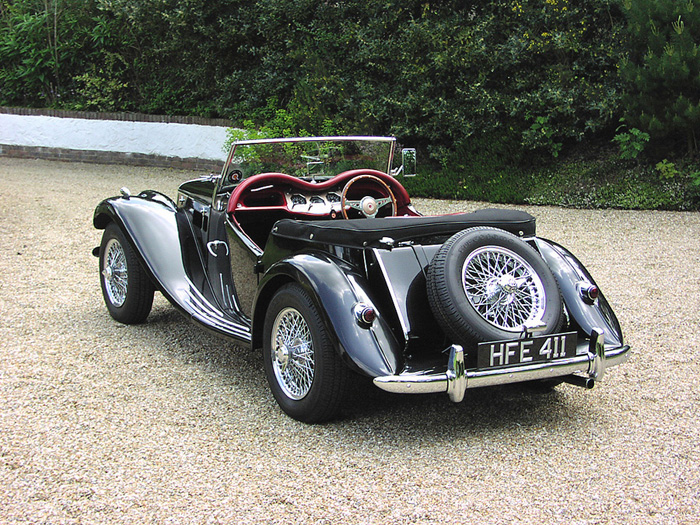
It’s warm enough now for us to travel by open-topped car again, so with a click of my mouse I materialize the little MG which carried us so long ago from Venice to Aquileia.

OLYMPUS DIGITAL CAMERA

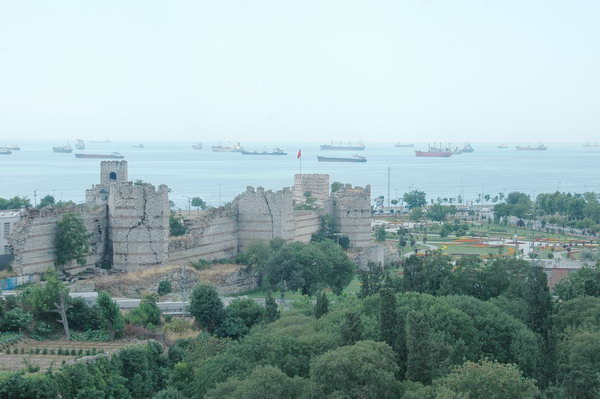
I have it pop up in front of the Hagia Sophia (probably not possible in real life but hey, this is a dream). We hop in and drive off. We will be following the trace of the Via Egnatia, the Roman road which once linked Constantinople to Dyrrachium (now Durrës in Albania) on the Adriatic coast, from whence a short ship ride could bring Roman legions and you to Bari in Italy. As always where map reading is required, my wife is driving. I have her take Divanyolu Avenue, which overlies the trace of the Mese, the main Roman street of Constantinople. Like the Mese, the Divanyolu Avenue starts just in front of Hagia Sophia. When we reach Murat Pasha Mosque, at what was once Constantinople’s Forum of the Ox, and where the Mese angled south-west, I have my wife turn left down Cerrapasha Avenue (never mind that the web informs me that the street is one way against us: this is a dream). The traffic is heavy I would imagine, we are inching along. At Koca Mustafa Pasha Mosque, things get complicated. The modern street plan no longer follows the old streets. Looking at the city map on the web, I muse on what to do next. The cars are beeping behind us, my wife is asking urgently, “which way?” I decide: go left, keep going until you somehow manage to reach Imrahor Ilyas Bey Avenue, turn right and keep going until you come to the old Theodosian city walls, which protected the city until its fall to the Ottomans. There, pass through a break in the walls, leaving to our left the remains of the Golden Gate, through which the Via Egnatia once entered the city.

golden gate theodosian walls istanbul

We are now at the official starting point of the Via Egnatia. But I must say everything is very confused. The recent huge, jumbled expansion of the city has completely effaced any traces of the ancient road. What the hell, I know where I want to go, so I tell my wife to hang a left and head down to John Kennedy Avenue, which runs along the Sea of Marmara. After a while we pick up the trace of the Via Egnatia, and so we bowl along to Tegirdağ, where we regretfully leave the sea’s edge and cut across to Ipsala at the border with Greece (a border which has only existed a hundred years or so and whose creation left much bitterness behind). Now in Greece, we go on through Komotini and Kavala (close to which, at the Battle of Philippi, in 42 BC, Mark Antony and Octavian beat the assassins of Julius Caesar, Brutus and Longinus, thus starting the process which destroyed the Roman Republic and put in its place the Roman Empire). Finally, we arrive at our destination, Thessaloniki.

Thessaloniki … Thessalonica to the Roman and Byzantine elites, just plain old Salonika to the locals, Selânik to the Ottomans. Its nascent Christian community the recipient in the first decades of the Christian era of two of St. Paul’s most famous Epistles, the First and Second Epistles to the Thessalonians. Birthplace in the 9th Century of Saints Cyril and Methodius, who converted Eastern Europe to Orthodox Christianity, but also in the 19th Century of Mustafa Kemal Atatürk, the founding father of modern Turkey.

Like Ravenna and Aquileia where I started this dream journey, Thessaloniki has suffered from the ravages of man and nature ever since it was founded by King Cassander of Macedon in 315 BC. Its history under the Romans and early Byzantines was relatively peaceful, apart from some raiding by Thracian tribes in the 50s BC, and a terrible incident in 390 AD, when some 10,000 of its citizens were massacred in the hippodrome as a punishment for starting a revolt. Its troubles really started when the Roman Empire weakened and the Barbarian tribes from the north began their incursions. Like Aquileia, it suffered from repeated attacks in the 7th Century by Barbarian tribes, Slavs in this case, but unlike Aquileia it managed to hold them off. As if the Slavs were not enough, the city suffered a catastrophic earthquake in 620, which did much damage. There followed a few centuries of respite, but after the Byzantines lost control of the Aegean Sea, Saracens seized the city in 904. After a ten day sack they left, but not before freeing thousands of Muslim prisoners while enslaving thousands of Christians and carrying off huge amounts of booty. In 1185, at another moment of Byzantine weakness, it was the turn of the Normans of Sicily to attack and take the city. Their rule, though short, led to considerable destruction. After Constantinople was captured by the Fourth Crusade in 1204, the city became the centre of one of the feudal fiefs which the Crusaders created. It was short-lived. The city and its territory were seized in 1224 by the Greek Despot of Epirus (who in turn was subjugated by the Tsar of Bulgaria). In 1246, a reinvigorated Byzantine Empire recovered the city. After a century and a half, the Byzantines lost it again, this time to the new regional power, the Ottomans. The Ottomans’ tenure was initially short-lived. They were forced to hand the city back to the Byzantines after their disastrous defeat by Tamerlane the Lame in 1402 at the gates of Ankara. But too weak by now to hold it, the Byzantines sold the city to Venice in 1423. Seven years later, in 1430, the Ottomans definitively recaptured the city.

There followed nearly five centuries of relative tranquility, during which the city became one of the great emporia of the Mediterranean and a melting pot of different ethnicities: Greeks of course, but also Turks, as well as Jews – the Ottomans welcomed the Sephardic Jews fleeing from Spain and Portugal – and later Bulgarians. Then, as Ottoman power went into terminal decline, irredentist feelings in Greece and Bulgaria grew. Both felt the city and its surrounding territory was theirs. After various acts of provocation and terrorism, matters came to a head in the two Balkan Wars of 1912 and 1913. For a while, things hung in the balance but the city finally went to Greece. In 1917, during the First World War, a huge fire, accidentally started in a kitchen, destroyed almost the entire city. This led to an exodus of the city’s Jewish population, many of whom lost everything in the conflagration. They were soon followed by the Moslem, Turkish population as a result of the massive exchange of populations which followed the end of the Greco-Turkish War in 1922. In their place came Greeks expelled from Asia Minor, making the city once again a predominantly Greek city. During the Second World War, the Germans occupied it. As a result, its port facilities were heavily if haphazardly bombed by the Allies. For their part, the SS rounded up what was left of the city’s ancient Jewish population and shipped them all off to the gas chambers. After two millennia of presence (Jews had chased St. Paul out of the city after he had preached there), the Jews effectively vanished from Thessaloniki. The city had not finished to suffer. In 1978, it was hit by a powerful earthquake, which did considerable damage to its structures, both old and new.

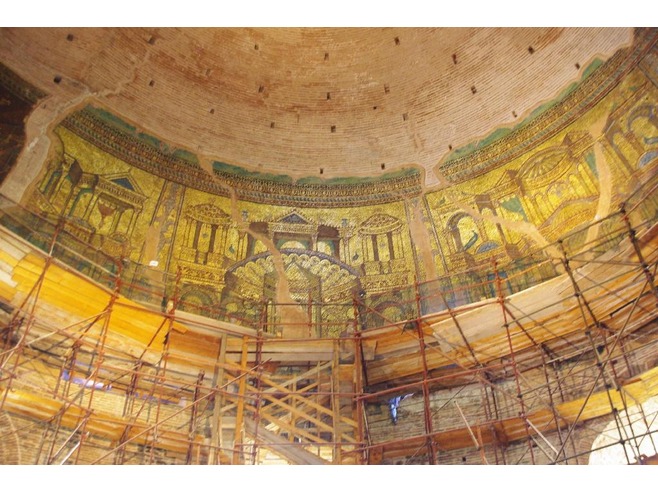
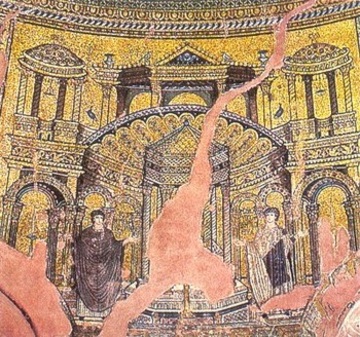
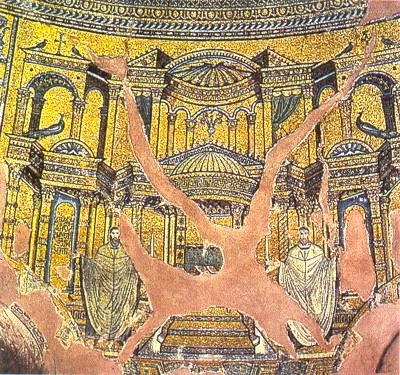
With this history, it’s little short of a miracle if any of the city’s early Christian mosaics are left at all. I direct my wife to enter the city along the trace of the Via Egnatia, which leads us straight to the Arch of Galerius and the Rotunda of St. George. Google Maps doesn’t show any parking lots around there, but this is a dream, so we easily find a little parking spot in one of the side streets for our MG. We enter the Rotunda, and walk through to the main cupola. This is what greets us: a badly damaged band of mosaics in its upper registry.

St. George-0St. George-1a

St. George-2

Sad. But what can you expect, these mosaics were installed 1700 years old, in the late 300s AD. Funnily enough, the little that there is left of them may have been saved by the church becoming a mosque. The Turks just whitewashed over mosaics and frescoes, after pilfering whatever gold tesserae there still were.

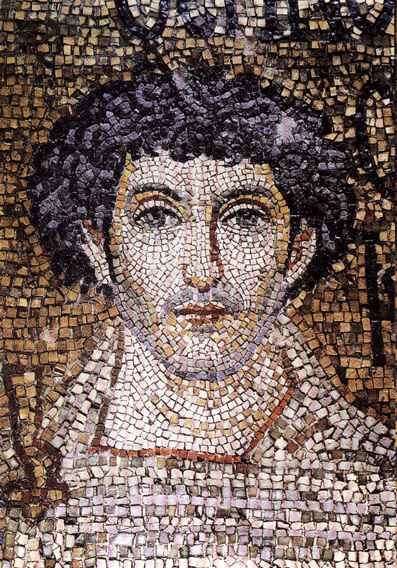
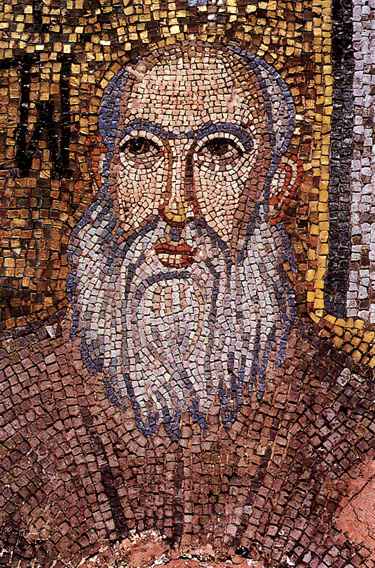
But let’s get up close – which we can, since this is a dream, we can just float up there. Look at the faces!

St. George-5

St. George-3

St. George-4

Here, we still have Roman art, but with Christian characteristics.

The internet warns me that traffic is terrible in Thessaloniki, so I decide that we will walk to the other churches. On strictly chronological grounds, I further decide that the next church we will visit is St. David’s, built in the late 4th Century. I open Google Maps’ Street View and find that we are walking through a modern, really quite pleasant city, the product of the Great Fire of 1917 and modern planning for the city’s reconstruction. Anyway, we plunge into St. David’s. It has one remarkable mosaic left, tucked away in a lunette in a corner, depicting the vision of Ezekiel

St David-1

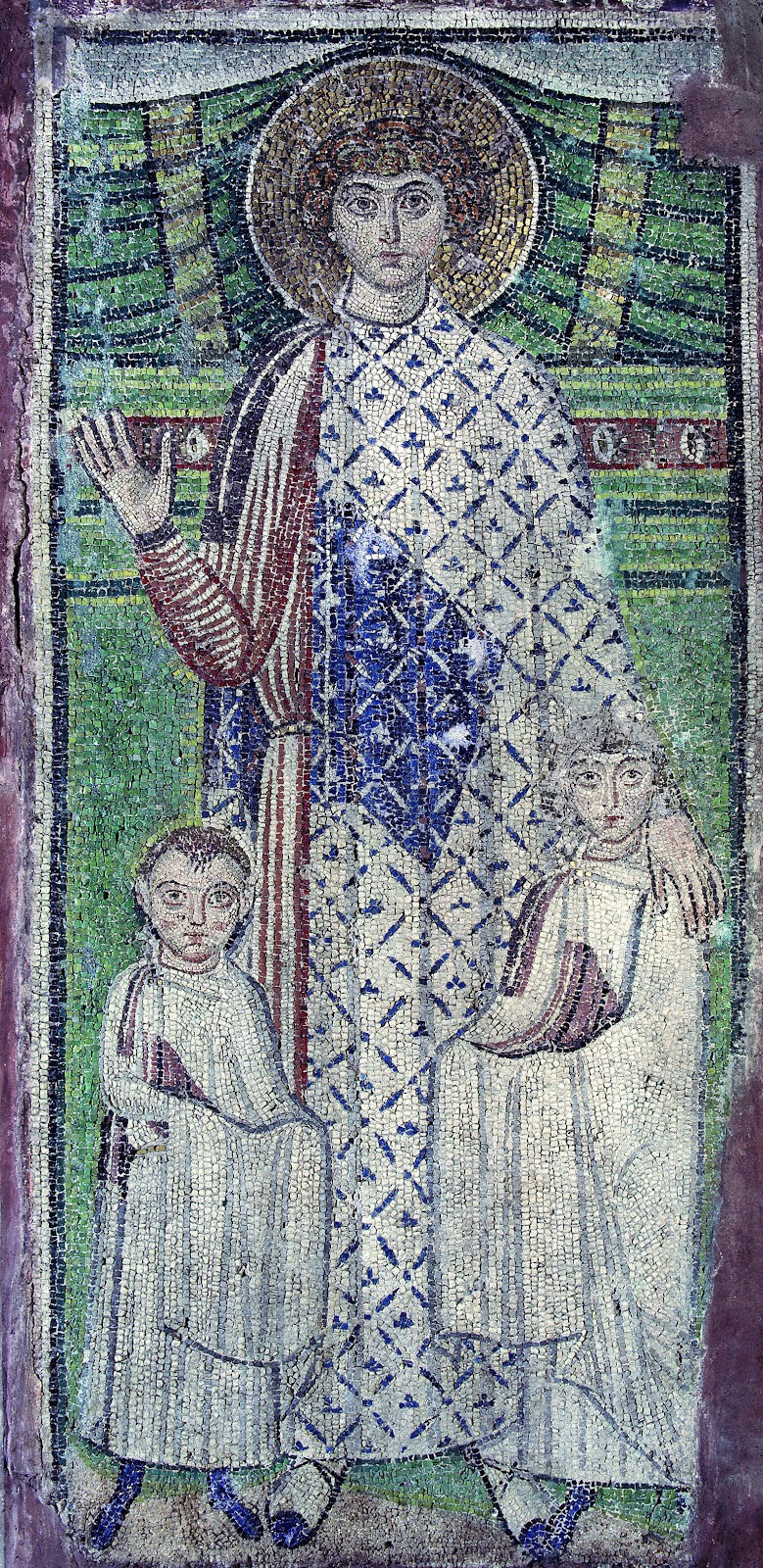
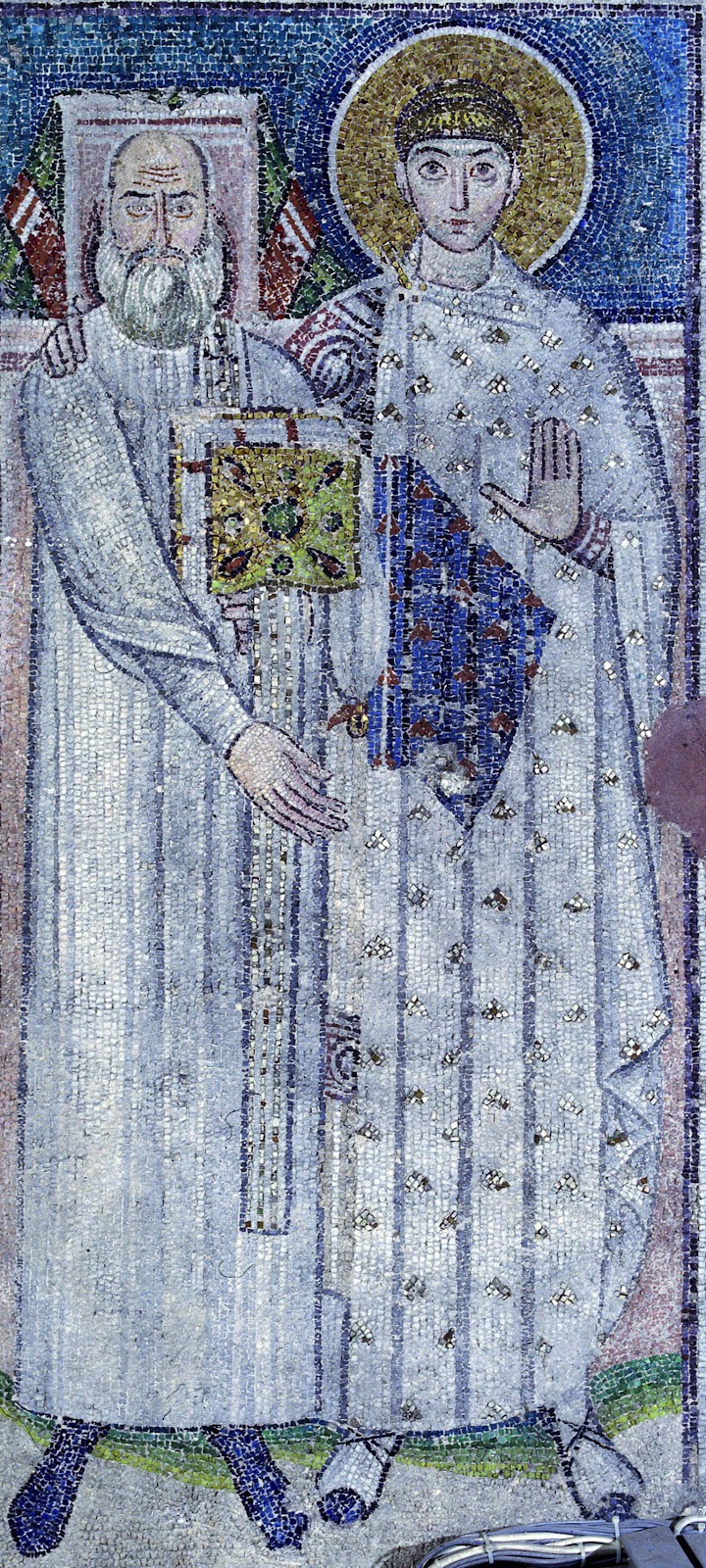
After admiring it for a while, we head on to St. Demetrius, which celebrates the city’s patron saint. The church has just a few, rather wonderful mosaic panels left, probably installed in the late 600s, early 700s, just after the Slavs had given up trying to sack the city.

St. Demetrios-2

St. Demetrios-4

St. Demetrios-3

The first is still Roman art, while the other two are beginning to look Byzantine.

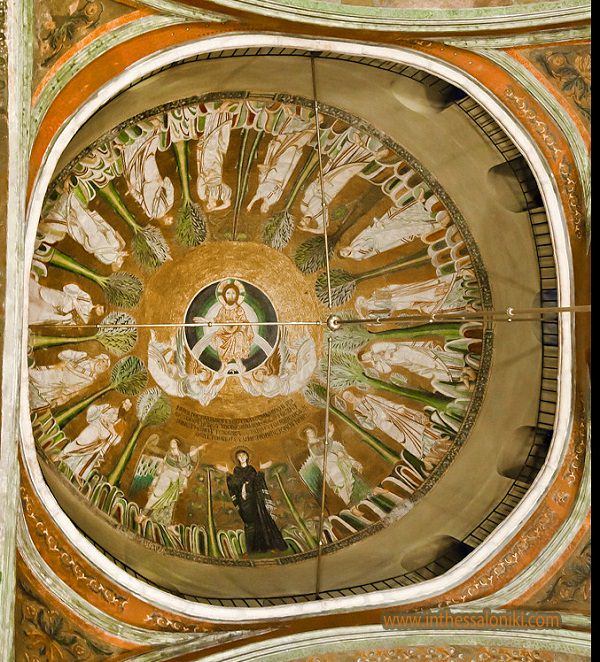
Next stop: Hagia Sophia, Thessaloniki’s not Istanbul’s (although it seems that the design of the Thessalonian version was based on its Constantinopolitan namesake). On the way, we pop into the early 5th Century Church of Acheiropoietos, but there are really only shreds of mosaics left. Discouraged, we go on. And so we come to Hagia Sophia, built in the 8th Century, and whose glory is the late 8th Century mosaic in the cupola.

Hagia Sofia-1

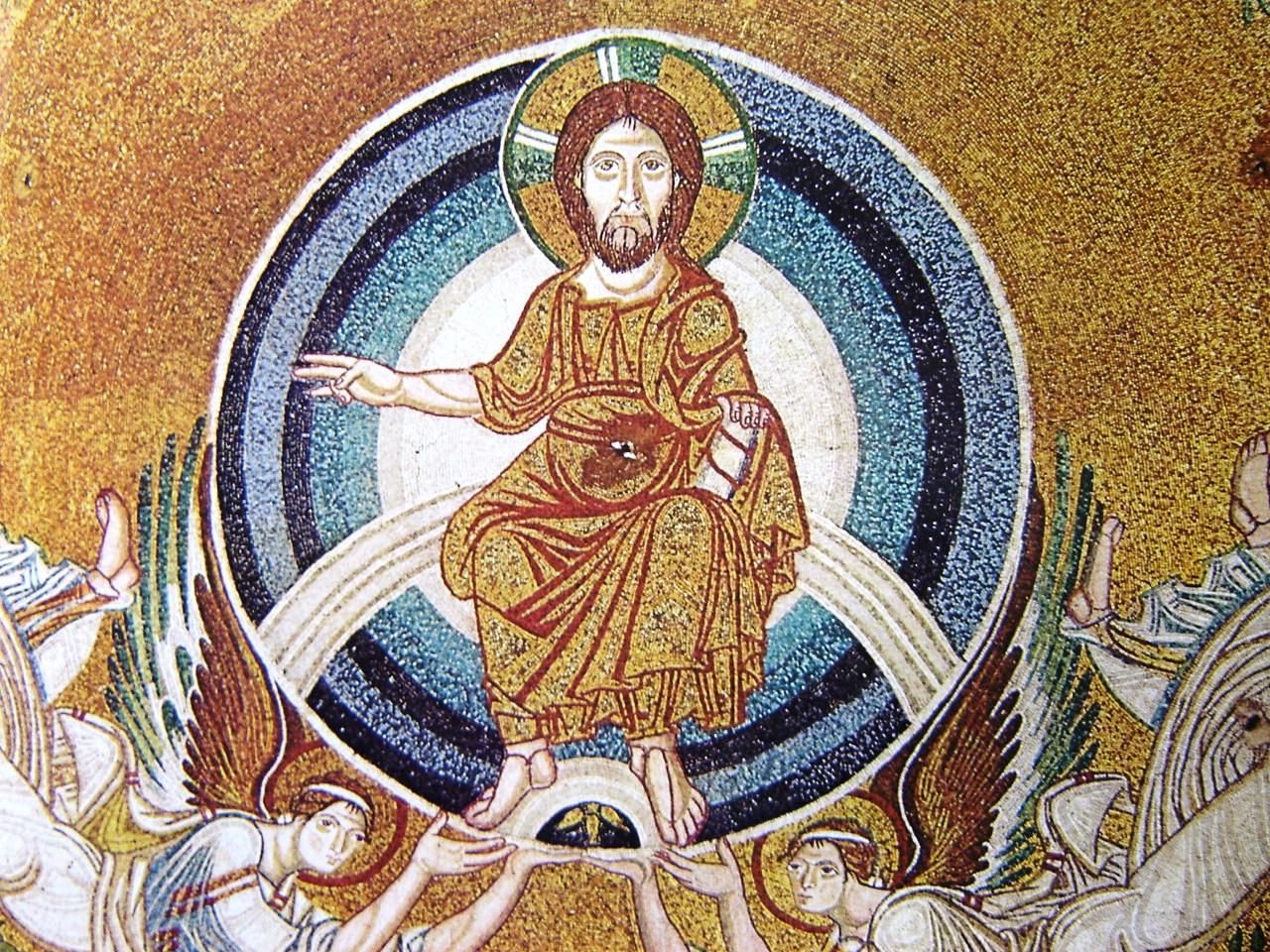
As we can in dreams, my wife and I drift up to see the Christ up close.

Hagia Sofia-2

And we see a Christ who is becoming ever more Byzantine in his look and posture. The glories of Rome seem to be becoming a distant memory. This is even more apparent in this Virgin Mary, which reminds me of that other Virgin Mary we visited on the island of Torcello in the lagoons of Venice on the first leg of this dream trip.

Hagia Sofia-3

At this point, I have to make a decision. My original idea for this dream trip was for my wife and I to go south and visit the walled monastery of St. Luke in Boeotia and further south still to the convent of Daphni, close to Athens. They have lovely, if late-style, mosaics, this one an example from St. Luke’s, a rendering of the Pentecost

OLYMPUS DIGITAL CAMERA

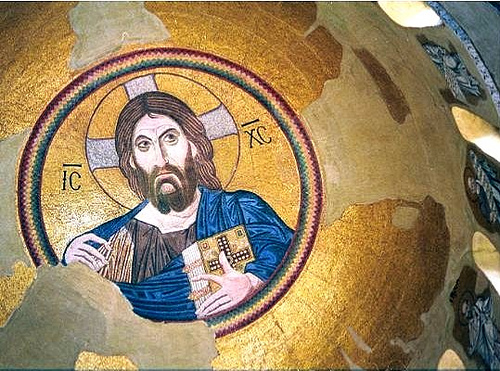
and this one from Daphni, of Christos Pantocrator, Christ the All-Powerful

Daphni-Christ Pantrocrator

I also wanted to take this road to follow a little in the footsteps, or rather the tyre marks, of my father. In 1937, when still a university student, he spent the Easter holidays driving his Ford, in company of a cousin, all the way from Cambridge to Athens and on to Sparta, and then back. To get there, he drove through the old lands of the Austro-Hungarian Empire, across Bulgaria, and down to Thessaloniki. I feel his young shadow passing by us and want to follow it a little while. But it’s too much of a detour, and I want to get to Italy before it gets too hot. So I choose. We will continue along the trace of the Via Egnatia, to the Adriatic, and pick up the ferry to Bari.

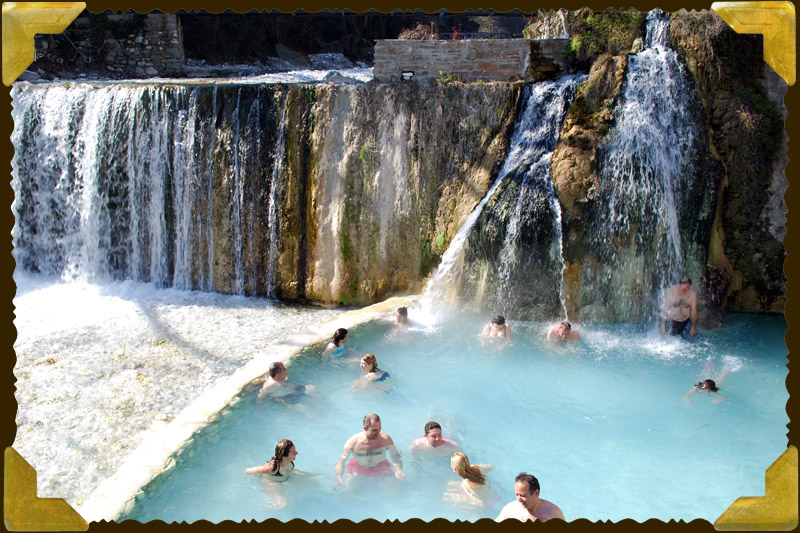
No sooner said than done. We are whisked over to the car and are now heading out of the Thessaloniki. Studying Google maps in conjunction with Omnes Viae (“The Roman Route Planner”, which I had occasion to use in the first leg of this dream journey), I get my wife to make for Edessa, which in ancient times guarded the entrance of the Via Egnatia to the Pindus mountains but is now known more picturesquely as the “city of waters”. On the web, I watch people cavort in the city’s waters (highly mineralized by the look of it)

Edessa

before continuing on. We skirt the pretty lakes of Vegoritida and Petron

lake Vegoritida

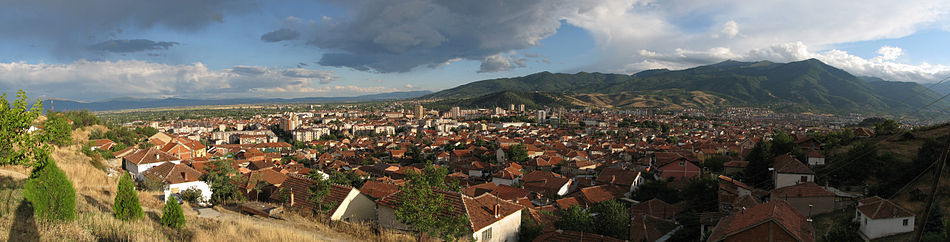
and veer northwards. We cross the border into Macedonia (sorry, “the Former Yugolsav Republic of Macedonia”; political tempers run high in this region), a border which only came into existence in 1918, and we arrive at the city once called Heraclea Lyncestis but now known more prosaically as Bitola. It was an important way station on the Via Egnatia, so I take a pause and look at a panoramic view

Bitola Panorama

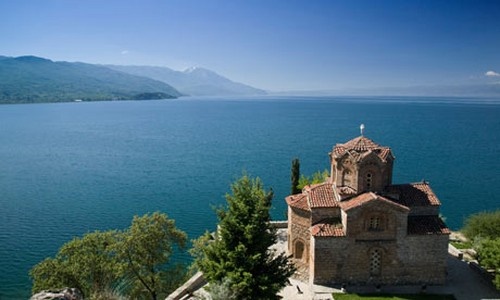
before moving on. We’re heading west now, towards the Adriatic Sea. We skirt the beautiful Lake Ohrid

Lake Ohrid

passing through the city of Ohrid, once Lychnidos, another important stop on the Via Egnatia. I’m tempted to visit the 5th Century Polyconch Basilica to see the remains of its mosaic floor, but everything I read suggests that the remains are too fragmentary. We take to the road again and soon find ourselves crossing yet another border that only came into existence in 1918, this one into Albania.

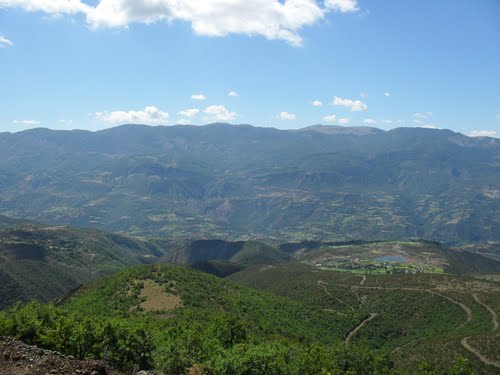
We pass over gloriously wild mountains

Librazhad

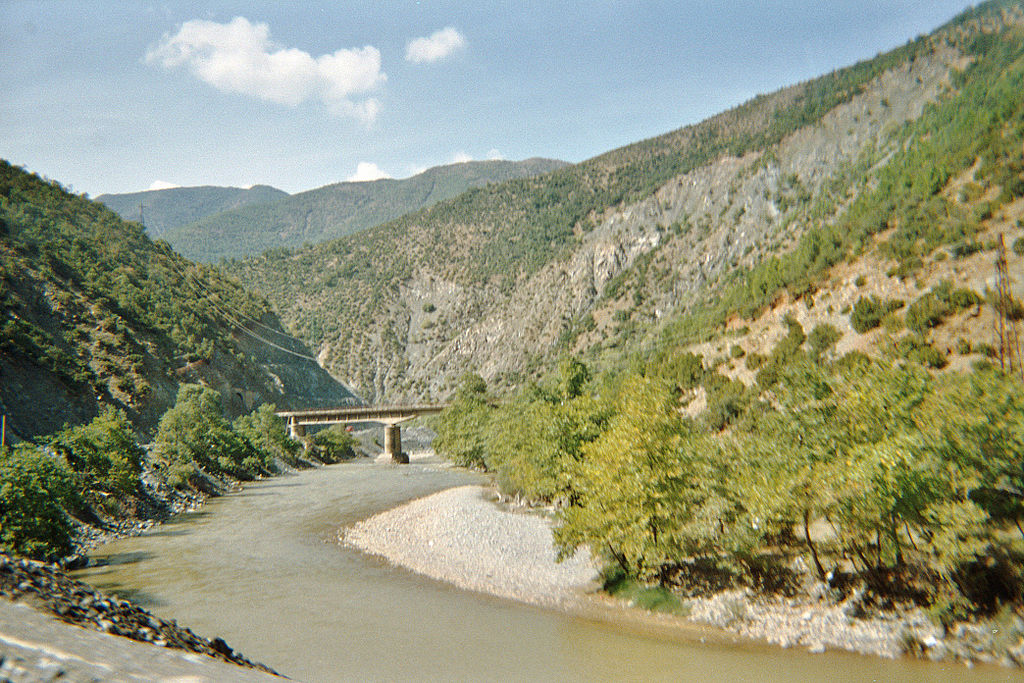
before dropping into the narrow valley of the Shkumbin River, known to the Romans as the Flumen Genusus.

Shkumbin river

We follow the river as it hurries down to the sea, but shortly before getting there we turn sharp right and head for the port of Durrës. In the summer, the place is submerged in beach-goers

Durres

but luckily there aren’t so many people yet. We drive to the ferry port. The web helpfully informs me that there is a ferry leaving tonight at 10 pm, which gets into Bari at 8 am tomorrow morning. Ferrying my wife, me, and our little MG over to Italy will cost us the princely sum of £131.72 (for some reason, the site I visited quotes the prices in pounds sterling). We have time for a bite to eat before we leave. But what do you eat in Albania?

_____________________

MG: http://www.mgownersclub.co.uk/sites/default/files/member-images/1105377623_27223.jpg (in http://www.mgownersclub.co.uk/member-images/mg-t-series/1954-tf-0)
Golden gate Istanbul: http://www.livius.org/a/turkey/istanbul/walls/istanbul_wall_theodosius_s_of_golden_gate.JPG (in http://www.livius.org/cn-cs/constantinople/constantinople_land_walls.html)
St. George Rotunda-1: http://cdn1.vtourist.com/4/5034576-St_Georges_Rotunda_Thessaloniki.jpg
St. George Rotunda-2: http://www.sacred-destinations.com/greece/thessaloniki-rotunda/photos/mosaic-sts-onesiphoros-and-porphyrios-c5-wc-pd)
St. George Rotunda-3: http://dic.academic.ru/pictures/wiki/files/84/ThessHagGeorgMosCosDamien.jpg
St. George Rotunda-4-Saint Cosmas: http://www.ics.forth.gr/isl/fayum/images/image_59.jpg
St. George Rotunda-5-Saint Therinos: http://www.ics.forth.gr/isl/fayum/images/image_60.jpg
St. George Rotunda-6-Saint Philip Bishop: http://www.ics.forth.gr/isl/fayum/images/image_57.jpg
St David: https://yameee.files.wordpress.com/2014/09/hd1.jpg (in https://yameee.wordpress.com/2014/09/20/сравнительный-анализ-мозаик-церквей/
St Demetrios-1-dedicating children to Demetrios: http://4.bp.blogspot.com/-EYa9zdAwg9w/Ty_EdArv9MI/AAAAAAAAAJM/Bgpaw1ttHAU/s1600/03.jpg
St. Demetrios-2-Demetrios and children: http://1.bp.blogspot.com/-i536vAoKGRc/Ty_FkFneuOI/AAAAAAAAAJs/I68I0jWcfxU/s1600/07.jpg
St. Demetrios-3-Demetrios and donor: http://1.bp.blogspot.com/-0C51ycpEZKQ/Ty_FNdSgPEI/AAAAAAAAAJk/rl66Pq0HZlA/s1600/06.jpg
Hagia Sophia-1: http://www.inthessaloniki.com/images/Churches/AgiasSofias/Inthessaloniki_Hagia_Sofia_C.jpg (in http://www.inthessaloniki.com/en/agia-sofia)
Hagia Sophia-2-cupola-christ detail: http://2.bp.blogspot.com/-TgUH5cPxxv0/T3i6LzYE-TI/AAAAAAAABj8/5B_CxlT_GcM/s1600/%CE%91%CE%93%CE%99%CE%91+%CE%A3%CE%9F%CE%A6%CE%99%CE%91+%CE%A8%CE%99%CE%A6%CE%97%CE%94.8.JPG
Hagia Sophia-3-catino-Virgin: http://farm6.staticflickr.com/5104/5737609091_a1ff106e1b_z.jpg
Convent of Daphni: Cupola-2-detail: http://farm4.static.flickr.com/3131/2618506302_de85e9decf.jpg
St. Luke-cupola-pentecost: http://users.sch.gr/geioanni/sel-ekpaideusi/sxolikes_ergasies/TRITH-GYMNASIOY-THRHSKEYTIKA/EIKONES_ENOTHTA_1/PENTHKOSTH_8.jpg
Edessa: http://2.bp.blogspot.com/-R7o-WczsSEk/UT85DRLhV2I/AAAAAAAAUPs/X5W2oHAFcLs/s1600/lydialith.jpg (in http://paspartounews.blogspot.com/2013/03/blog-post_8742.html)
Lake Vegoritida: http://en.wikipedia.org/wiki/Lake_Vegoritida#/media/File:Ostrovskoto_ezero.JPG (in http://en.wikipedia.org/wiki/Lake_Vegoritida)
Bitola: http://upload.wikimedia.org/wikipedia/commons/thumb/4/4e/BitolaPanorama.jpg/950px-BitolaPanorama.jpg (in http://en.wikipedia.org/wiki/Bitola)
Lake Ohrid: http://www.rego-bis.pl/bin/images/c77bd7ecc_d95f83717734355.jpeg (in http://www.rego-bis.pl/hotel,hotelcaliforniaresortpobytobjazd2w1,ALBCALR.html?ofrid=0e04c3c867866ee4b5a8f79f6b760f260257028d331141b288f4e709ba8a3720)
Librazhd: http://mw2.google.com/mw-panoramio/photos/medium/40520594.jpg (in http://www.panoramio.com/user/4935966/tags/Shebenik%20National%20Park)
Shkumbin river: http://en.wikipedia.org/wiki/Shkumbin#/media/File:Shkumbin.jpg (in http://en.wikipedia.org/wiki/Shkumbin)
Durrës beach: http://www.shkendijatravel.com/wp-content/uploads/2014/12/durres_albania_plaze.jpeg (in http://www.shkendijatravel.com/durres-port/)

SONGKRAN

Bangkok, 15 April 2015

Call me a sourpuss, a killjoy, a party-pooper, even an old fart, but I really cannot find anything positive to say about the Songkran festival which is in full swing at the moment here in Thailand. For those of my readers who may not be familiar with Songkran, it is Thailand’s festival of the new year. Actually, Myanmar, Laos, and Cambodia all celebrate the same festival, even if it has a different name in Myanmar and Cambodia (Thingyan and Chaul Chnam Thmey) – not surprising really, since all these countries follow more or less the same traditional Buddhist calendar.

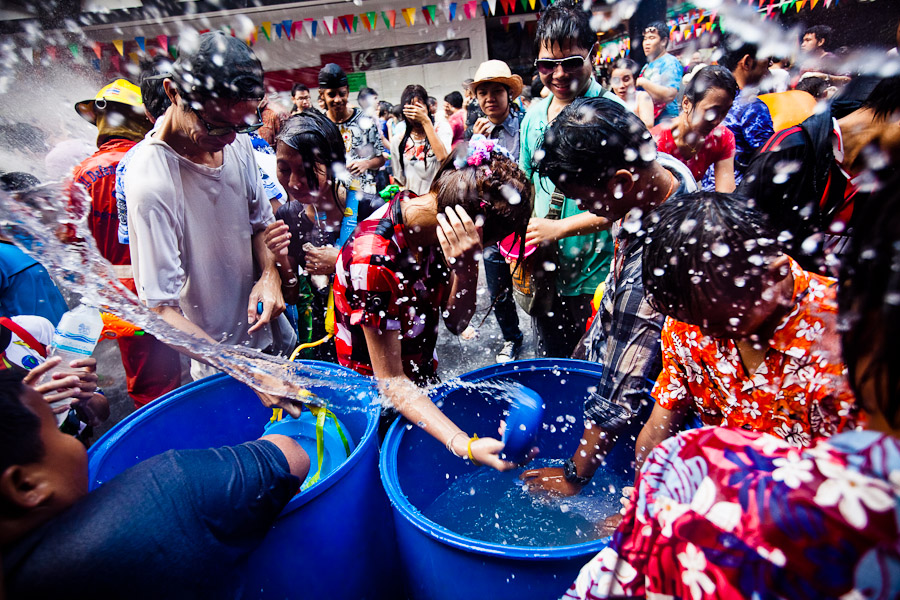
Thais celebrate Songkran by squirting, spraying, and generally throwing water on everyone and everything, in one vast water party.

Songkran water festival in Bangkok, Thailand

water-festival-in-thailand-5

water-festival-in-thailand-4

Songkran in Bangkok, Thailand

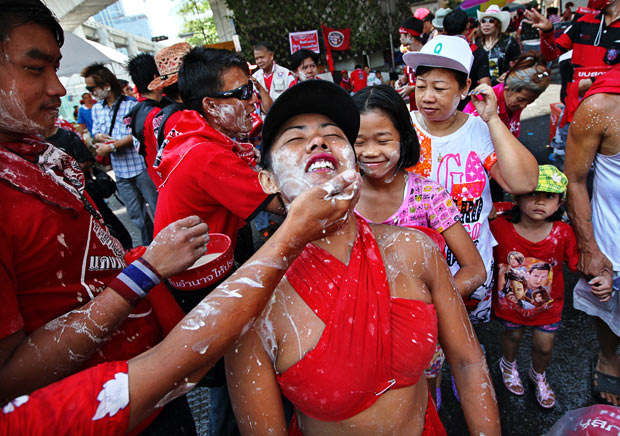
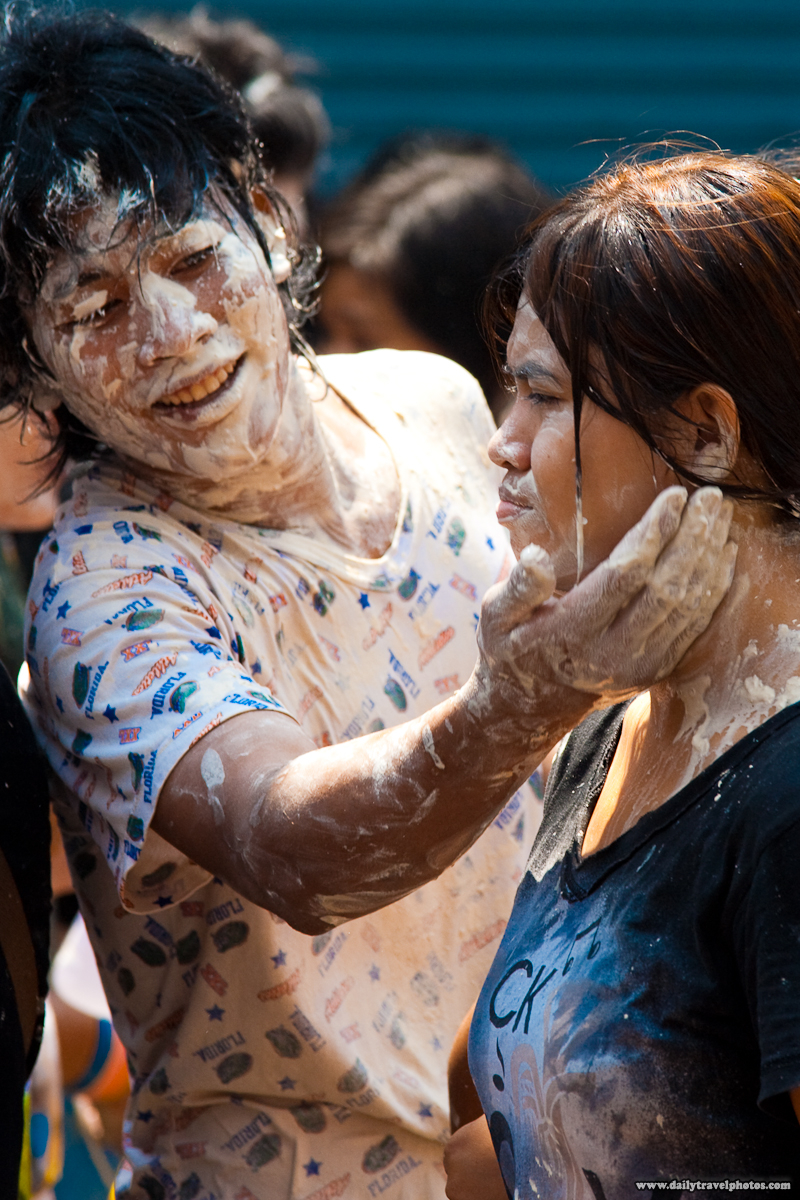
To cap it all, people slather themselves – and others – with a white paste (shades of Myanmar).

white paste on face-1

white paste on face-2

Those who are young, or who have an infantile sense of humour (aïe, my sourpussedness is coming to the surface), find all this hugely entertaining. Shrieks and laughter echo up and down the streets. Clothes are soaked, but no matter, it’s the hottest time of the year, they will dry out in a flash. And off goes another bucket of water!

Of course, for sourpusses like me, who have to get to meetings with officials in nice clothes or have to go to the office to work and who would prefer not to sit in a puddle at their desk, it is a trial to navigate the streets and dodge the pails of water, the hoses, the water guns. And anyway, it’s just so … damned childish to enjoy throwing water at people! (aïe, my party-poopery is coming to the fore: “I grow old, I grow old, I shall wear the bottoms of my trousers rolled”)

What I find really irritating is that all this water throwing is a stupid, facile, totally post-modern corruption of the original festival. Water has a very important role in Thai society, as it does in many cultures. Clean water is the symbol of purity and peace. At the new year, it is used to wash away the dirt of the old year and allow one to start the new year clean and fresh. During the three days of the festival, clean water is poured over statues of the Buddha to clean them. That same water, in some way sanctified by its contact with the Buddha, is sprinkled over family and friends, again as a symbol of cleansing oneself for the year to come. Part of the tradition has younger people sprinkling water on their elders.

In a variation on this last tradition, yesterday in the office my secretary shyly asked me if I would be willing to take part in a ceremony where my colleagues would sprinkle water on my hands, in my role as the head or “elder” of the office. I was glad to, I announced, feeling that this at least gave some meaning to the silly goings-on outside my window. So at the appointed time, my colleagues solemnly – if somewhat self-consciously – processed into my office. A silver bowl filled with clean water strewn with petals was placed on the table, and one by one – eldest first – they came up, knelt in the Thai fashion, and poured a small cup of water over my hands, while wishing me a happy new year. I wished them and their families a happy and prosperous new year in return.

When I came home for lunch, I noticed that a statue of the Buddha had been set up in the lobby, with a bowl of water nearby. Why not? I thought. I might as well go the whole hog. So I offered the statue a traditional if rather awkward namaste and poured a cupful of water over him.

___________________

Water festival-1: http://cdn.c.photoshelter.com/img-get/I0000SR1YiamyV8Y/s/750/750/Water-Festival-in-Bangkok-Thailand-29.jpg (in http://aaronjoelsantos.photoshelter.com/image/I0000SR1YiamyV8Y)
Water festival-2: http://www.chiangmai-alacarte.com/sites/default/files/styles/main_col/public/images/songkran_festival_and_tour_in_chiang_mai_thailand2.jpg?itok=KUnw68jO (in http://detaykibris.com/taylandda-su-bayrami-coskuyla-kutlaniyor-191-olu.html)
Water festival-3: http://www.journeymart.com/gifs/holidays-ideas/festivals/songkran-thailand-water-festival.jpg (in http://www.journeymart.com/holidays-ideas/festivals/songkran-thailands-water-festival.aspx)
Water festival-4: http://cdn.lightgalleries.net/4bd5ec1013294/images/Songkran_Water_Festival_Bangkok-2-1.jpg (in http://www.aaronjoelsantos.com/contents/Stories/Waterworld/image-Songkran_Water_Festival_Bangkok-2/)
White paste on face-1: http://i.telegraph.co.uk/multimedia/archive/01615/red-shirts-white-p_1615328i.jpg (in http://www.telegraph.co.uk/travel/picturegalleries/7586439/Songkran-tourists-and-Thais-splash-each-other-with-water-to-celebrate-new-year-in-Thailand.html)
White paste on face-2: http://www.dailytravelphotos.com/images/2011/110425_songkran_white_powder_paste_faces_thai_festival_day_applied_IMG_9676.jpg (in http://www.dailytravelphotos.com/archive/2011/04/25/)

SOUNDSCAPES OF BRITAIN

Bangkok, 12 April 2015

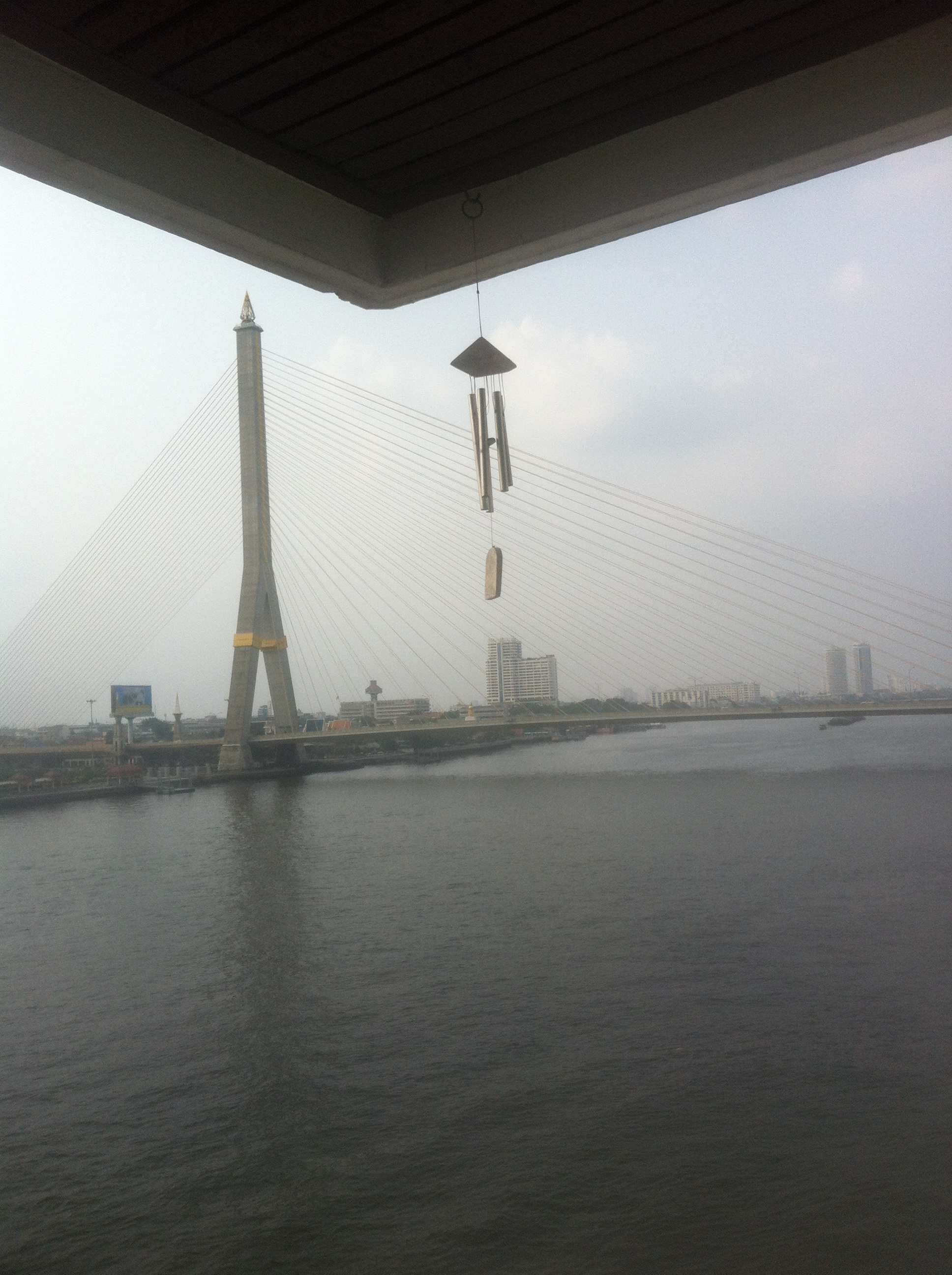
When we moved into our apartment here in Bangkok, we found that a previous tenant had left a wind chime hanging on the balcony, in front of the living room, ready to tinkle with every passing breeze – and since many breezes pass up and down the river which flows by our building, it tinkled quite a lot.

I was charmed, my wife less so. It is true that its more-or-less constant tinkling became rather intrusive to our life in the living room. My wife was for removing it completely. As a compromise, I moved it to the end of the balcony, keeping company to the King Rama VII Bridge (about which I’ve written earlier). From there, its chimes would be less sonically importunate, and it might, I hoped, keep the pesky pigeons from resting on the balcony railing.
wind chime bangkok 001
The former worked, the latter didn’t; true to form, the pigeons simply ignore the chimes and continue to land – and poop – on the railing.

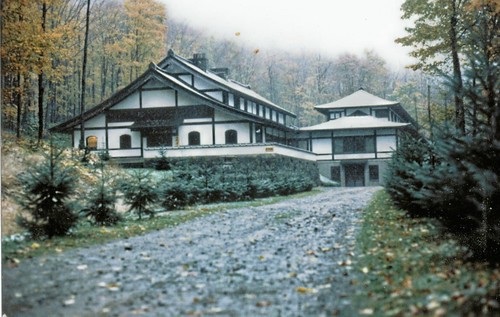
My wife and I had first come across wind chimes some 35 years ago, during a visit we made to a Buddhist temple situated in the Catskill mountains to the north of New York City. We were spending a few days in the Catskills, getting our small children out of the city and into some fresh air. By chance, during a drive around the countryside, we came across a sign indicating the way to the temple. Intrigued, we followed the sign and found ourselves with this before us.
buddhist temple catskills
A very nice (American) Buddhist nun took us on a tour, and afterwards, while wandering around the temple’s outhouses, we came across the wind chime, tinkling quietly in the wind.

We recently came across a more religious version of wind chimes in Myanmar, where almost universally stupas are topped with a complicated crown that includes, among other things, a circle of little bells at its base which nod with every passing breeze.
07-kakku 007
In consequence, our visits to the stupa forests around Inle lake were accompanied by an almost constant quiet background tinkle whose level rose and fell as breezes snaked their way languidly between the stupas. Their purpose, I read, is to ward off evil spirits. This seems to be the primary raison-d’être of wind chimes in this part of the world, another example of something beautiful inspired by fear. Sad, really.

As I read around for this post, I discovered that a certain set of wind chimes – at Mizusawa railway station in Ōshū, Japan, to be precise – were one of the 100 soundscapes of Japan officially designated as such by the Ministry of Environment. Soundscapes! Now, that is something I had never heard of. And my research – and consequently this post – went off on a tangent. I’ve been like a dog who while following the scent of a fox, suddenly comes across the scent of a boar and races off in a different direction.

Soundscapes, I read, are sounds that “describe a place, a sonic identity, a sonic memory, but always a sound that is pertinent to a place”.  I’ve scanned the list of official 100 soundscapes of Japan (chosen, by the way, very democratically from a pool of candidates created after the Ministry of Environment called on the citizenry to submit their favourite soundscapes). Apart from the wind chimes in Mizusawa station, I see drift ice in the Sea of Okhotsk, the Japanese crane sanctuary in Tsurui, singing frogs and wild birds of the Hirose River, ship whistles for the New Year at Yokohama Port, reed fields at the mouth of the Kitakami River, pinewoods sighing in the wind in Noshiro, the approach to Kawasaki Daishi Temple, a cicada chorus in Honda-no-Mori Forest, sand eel fishing at Tarumi port, and on and on. Any reader who is interested in the whole list can go to the Wikipedia entry.

Wow … 100 soundscapes that somehow define a country … Well, I guess Mynamarians might choose the tinkle of bells in their stupa forests as one of their soundscapes. But I can’t decide their soundscapes for them. As an Englishman, though (OK, half an Englishman but let’s not quibble), I could have a go at choosing some soundscapes for the UK.

So what sounds define the UK? Well, the national psyche is very much defined by its being an island, so soundscapes of the sea are an obvious choice. There’s the sound of the water itself: the quiet hiss of seawater running over a shingle beach like the one my grandmother used to take us grandchildren to in Norfolk, or the splintering of waves against sea-cliffs which my wife and I heard in the Orkneys, or even the howl of the wind racing inland on the back of a big winter storm. But there’s also the cries of the innumerable seabirds and other wildlife which inhabit the UK’s coasts. And then there are the human-related noises linked to the sea: the sharp orders of the skipper followed by the thunderous clap of sails resetting on a sail boat as it turns about, the blast of a siren and the churning of water as a ship moves out of port, the lugubrious sound of a fog horn, but also the chatter on a crowded beach on a summer’s day.

Staying with water, rain is also definitely part of the British psyche, so a soundscape of falling rain seems called for: not the hard, dense tropical rain we have here in Bangkok, but a softer rain that goes on and on (and on …). And then there is the sound of all those brooks and streams which criss-cross the country as they hurry down over rock and fallen log: I have a particularly vivid sonic memory from my childhood of the brook which bordered our school’s playing fields.

Talking of playing fields, these evoke for me countless sonic memories: the crack of cricket bat against ball (such an English sound! although Americans may have a cousin in baseball’s bat against ball), the thud of foot against ball, the encouraging cheers of onlookers, which in football and other commercially organized sporting events has now swelled into the chanting of the stadium (this must be one of the few truly international soundscapes), and, strangely enough because I’m not really into horses, the thunder of hooves on soft turf as race horses come round the bend into the final straight. Horse racing also evokes in me a very specific sonic memory of the TV commentator: “and it’s Blue Blazes in the lead!, and Desperate Straights is coming hard up on the inside!!, but Blue Blazes is holding the lead!!!, …” and so the voice would continue to rise to a crescendo until the finishing line was crossed, when it would fall away to normal levels. Probably not specifically an English soundscape but to me always a memory of my English youth: Saturday afternoon in front of the telly.

Going back to nature, wind is a constant in the British Isles, so we must have wind soundscapes in the collection: trees soughing in the wind; wind rustling grass, sedges, heather; the dry clacking of leafless branch on leafless branch in a strong wind. Trees lead me to birds, which hold a special place in the British heart. A dawn chorus in summer would be a definite entry, but so could the songs of any number of birds. I would definitely want to have a lake soundscape with a loon calling out – I have such a strong childhood memory of that.

The Japanese Ministry held its competition for the 100 soundscapes of Japan as a way of reminding the Japanese of their country’s natural sounds. I have sympathy for that: we are so surrounded in our daily, highly urbanized, lives with a cacophony of artificial sounds that we no longer hear Nature. But still, there are soundscapes made up of man-made sounds which so “describe a place, a sonic identity, a sonic memory”, to requote the definition, that they cannot be left out from this compendium of national sounds which I am sketching out. My personal entries would be two. One is the sound which London Underground trains make when they are halted, waiting to go. The electric engine goes into some sort of standby mode, emitting a very particular sound which I have never heard anywhere else. When I hear that noise, I know I’m back in London. The second such sound is from the diesel engine of the old double decker buses. These emitted a particular throaty rasp which I would immediately recognize anywhere. Alas, I think this soundscape now belongs to history. Today’s double deckers must have a newer engine, for I hear that throaty rasp no longer.

I cannot finish my list without mentioning the UK’s regional accents. I’ve always loved the wide variety of accents you find in the UK. It just fascinates me that the same language can be pronounced in so many different ways. I don’t know if regional accents count as soundscapes, but you certainly can’t find a more British sound than a Yorkshire accent, or a Somerset accent, or a Welsh accent, or one of the Scottish accents, just to cite the ones I am most familiar with. Whenever I hear a British regional accent on the streets or in the shopping malls of Bangkok, I turn around and smile. That’s home …

My wife has been telling me that we should think of spending six months in the UK after I retire. I’m inclined to agree. It would allow me to reconnect not only with the sights but also the sounds of my once-native land.

___________________________

Buddhist temple Catskills: https://c1.staticflickr.com/3/2162/2092854607_e6f4aa3d32.jpg (in https://www.flickr.com/photos/shoshin-seishu/2092854607/)

Other photos: mine

PAINTED CHEEKS

Bangkok, 5 April 2015

Picking up on the theme of my last post, the application of cosmetics to certain parts of the face (eyebrows in that case), I feel that I should also comment on one fashion statement which I have come across in this part of the world and which, contrary to the fashion of strong eyebrows that seems to be sweeping the world, I hardly see being adopted any time soon away from its place of birth. The part of the world in question is Myanmar, and the fashion statement in question is the daubing by women (but not only) of their cheeks with a beige-coloured paste.
Yangon, Burma, Myanmar. Streets.It really is something that foreigners cannot fail to notice the moment they arrive in Myanmar, and indeed the internet is full of comments along the lines of “what on earth is that stuff on the women’s faces?”  The last time my wife and I were in the country, I finally got around to asking what this stuff was exactly. Thanatka, I was told (or thanat-ka, or thanaka, or thanakha; transliteration of Burmese words into English is quite approximate, rather like Shakespeare spelling his own name in three or four different ways – but I digress). Our hotel had a little exhibition on thanatka in the lobby, which frankly didn’t explain anything at all. Time to scour the internet, and as is normally the case Wikipedia threw up some useful material.

First, the why: why are women (and children to some degree) putting thanatka on? The answer seems to be primarily for beauty, rather like Amerindians paint their faces as decoration.
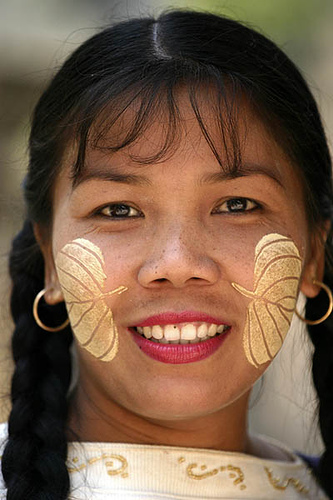
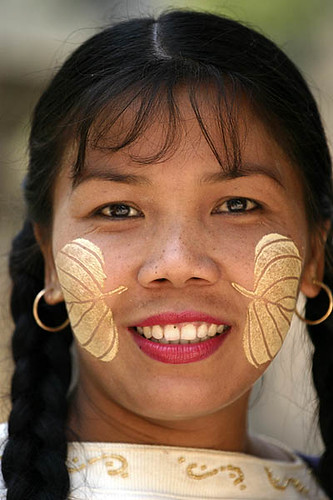
amerindian with painted faceIndeed, while the photo which starts this post has the lady in question just giving herself a brushstroke’s worth of thanatka on each cheek, others seem far more creative. Painted leaves seem popular (although I wonder if this is simply catering to the tourist trade?)
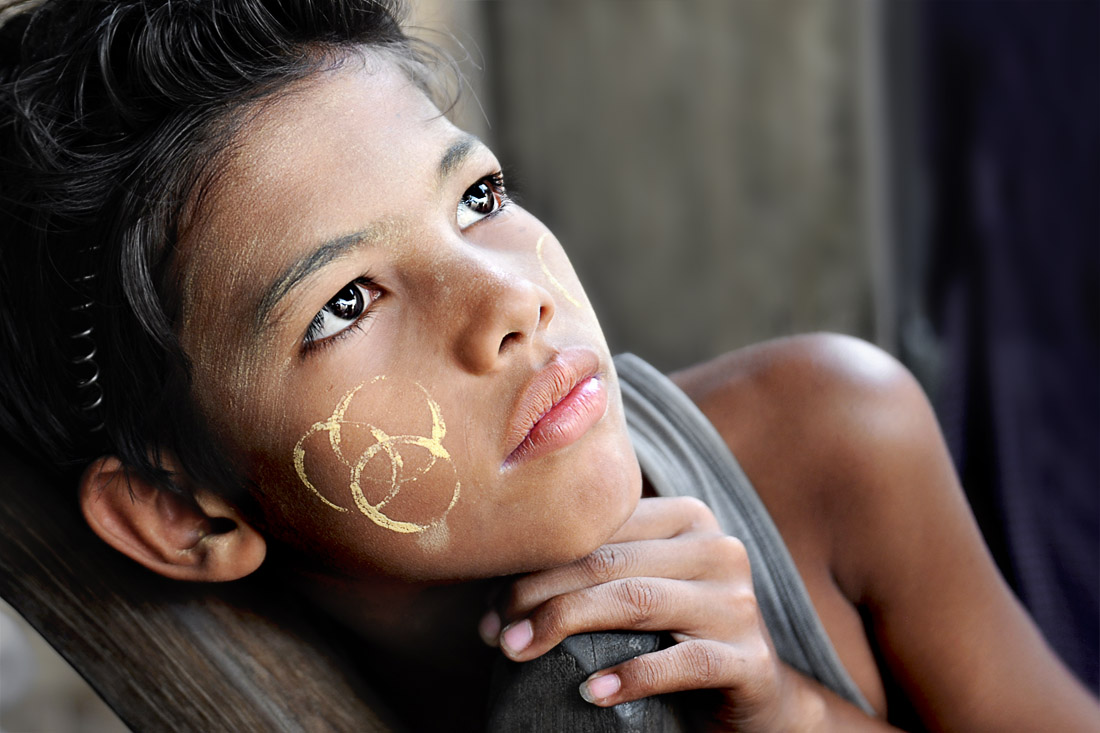
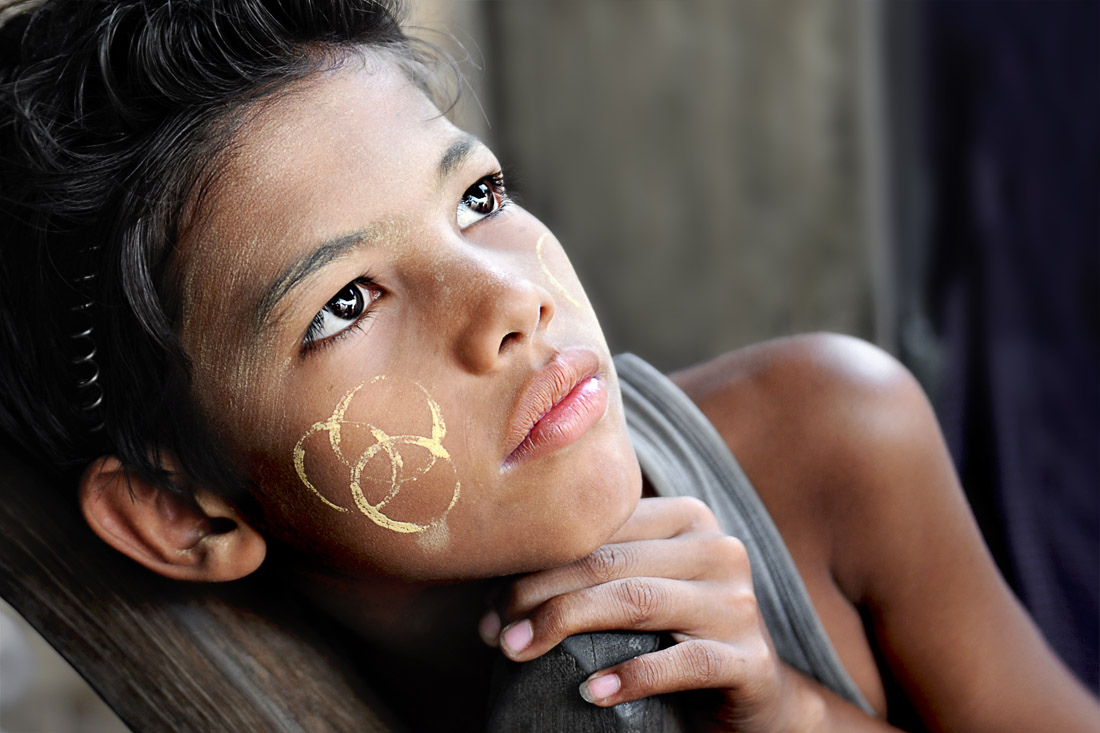
painted leaveswhile simple whorls
whorlsor circles also appear frequently in the cannon.
circlesIt seems that thanatka is not only about beauty. It is also said to provide protection from sunburn. But then I would have thought that application to the whole face would be more appropriate, the way I slathered sunscreen on every piece of my exposed skin during our recent trip to Myanmar. Claims are also made that it removes acne, and there are “before and after” photos to that effect on the net – although, rather strangely, of white people only. It is also claimed to have anti-fungal properties, although luckily there are no “before and after” pictures of that.

“Beauty is in the eye of the beholder”, they say, and I have to assume that Myanmar men find this wash of beige on their women’s cheeks attractive. After all, Myanmar women have been pasting themselves in this way for at least 700 years. Personally, though, I find it difficult to see anything beautiful in the habit. Every time I see one of these ladies, my instinctive reaction is to think “Ooh, they need to wash their faces”.  Of course, it’s not as if European women don’t paint (or powder) their faces. Rouging one’s cheeks is a fashion that goes back centuries, as attested by all those portrait paintings hanging in various museums of Europe of aristocratic ladies or royal mistresses (or both) with nicely rouged cheeks. For instance, this slightly racy painting of Nell Gwynn, mistress to Charles II of England, shows her with lovely red cheeks (and strong eyebrows, I am pleased to see, given my last post!)
nell gwynn(as I mentioned in an earlier post, there was a time when European aristocratic men also liberally rouged their cheeks)

The fashion statement has continued. For instance, I still remember from my youth those little powder cases which every woman had in their handbag, and which they would whip out from time to time to rouge their cheeks or generally give their face a powdering over.
powder caseAnd as far as I can make out, the fashion still goes strong. Women with cosmetically highlighted cheeks are a dime a dozen on any street in the world (except Myanmar …), although the powder case has given way to other delivery mechanisms.

But there is a difference, no? These women were and are highlighting the natural colouring of their cheeks. Myanmar women, on the other hand, are just daubing themselves. I wonder if the original idea was not simply to make the skin look paler, that universal obsession of women in all Asian countries.

Now for the what: what exactly is thanatka? It is an exceedingly natural cosmetic, made from grinding the bark, wood, or roots of a tree together with a small amount of water.
thanatka preparation 003As modernism marches through the country, a Myanmar lady can go to her supermarket and buy a jar of ready-made product. But she can also still go out and buy the wood (with this particular seller advertising her wares)
wood for saleas well as the stone grinder, and make it at home. No doubt the artisanal aspects of the trade will die out soon.

I finish by saluting the humble trees at the start of the chain: the thanatka tree (a species of Murraya)
thanakta treewith these particular individuals standing in front of some venerable temple, as well as the theethee tree (Limonia acidissima)
theethee treeI just hope that in the rush to slather their faces with paste, the Myanmarians are not chopping these trees down with wild abandon, thus denuding the landscape in the process. Beauty, however defined, is not worth that.

________________________

Woman with painted cheeks: http://www.ellensenisi.com/wp-content/uploads/AN-SEA_2655.jpg (in http://www.ellensenisi.com/2014/blog/burma-post-2/)
Woman Amerindian: http://s13.postimg.org/xu96358hju/24_Matses_Woman_Painted.jpg (in http://www.forumbiodiversity.com/showthread.php/36659-White-Dominican-VS-White-Puerto-Rican/page64)
Thanatka painted leaves: https://c1.staticflickr.com/3/2289/1557809911_2eafe27e17.jpg (in https://www.flickr.com/photos/peace-on-earth_org/1557809911/)
Thanatka whorls: http://www.birmanieresponsable.com/wp-content/uploads/2014/08/thanaka-beauté-birmanie.jpg (in http://www.birmanieresponsable.com/thanaka-beaute-birmane/)
Thanatka circles: http://davidlazarphoto.com/amp/wp-content/uploads/2012/07/19-David-Lazar-Thanaka-Circles.jpg (in http://davidlazarphoto.com/galleries/visions-of-myanmar/19-david-lazar-thanaka-circles/)
Nell Gwynn: http://3.bp.blogspot.com/-bw3i2CA0H8s/TqCFCy51a5I/AAAAAAAABCI/HkYzk9PmrtQ/s1600/NPG_536_883_EleanorNellGwy.jpg (in http://historicalideals.tumblr.com)
Woman with powder case: http://www.cosmeticsandskin.com/companies.images/1951-yardley.jpg (in http://www.cosmeticsandskin.com/companies/yardley.php)
Thanatka preparation: http://www.southeastasiabackpacker.com/wpsite/wp-content/uploads/2012/09/Thanaka-bark.jpg?4928e4 (in http://www.southeastasiabackpacker.com/20-tips-for-travellers-to-myanmar-burma)
Thanatka wood: http://www.ecoburma.com/wp-content/uploads/2013/08/Th1.jpg (in http://www.ecoburma.com/2013/08/photo-essay-thanaka-the-make-up-of-burma/)
Murraya tree: http://image.slidesharecdn.com/myanmar23bagan-140117021821-phpapp02/95/myanmar23-bagan-47-638.jpg?cb=1389946826 (in http://www.slideshare.net/mobile/michaelasanda/myanmar23-bagan)
Theethee tree: http://en.m.wikipedia.org/wiki/Limonia_acidissima#/media/File:Wood-apple_tree.JPG (in http://en.m.wikipedia.org/wiki/Limonia_acidissima)

THICK EYEBROWS

Bangkok, 29 March 2015

In an earlier post, in which I wrote about a short trip my wife and I made to Dubai, I mentioned that we had visited the Sheikh Mohammed Centre for Cultural Understanding. What I didn’t mention – because not pertinent to the subject of that post – was that our guide had exceedingly strong, straight eyebrows. I tried not to stare at her too insistently because that is rude, and I would imagine that staring at women in Muslim countries can also be a dangerous habit. But I did find it quite striking. My surreptitious peeking allowed me to conclude that this was not a gift of nature but a gift of the cosmetics industry. Something like mascara had been applied to our guide’s eyebrows. They looked something like this, although our guide wasn’t quite as glamorous as this lady.
middle eastern lady
In any event, as our guide talked about this, that, and the other, I wondered to myself if this was some sort of new fashion statement in the Middle East. After the tour was over, I was pleased to hear that my wife had also noticed it; I wasn’t imagining things, then.

Our trip completed, we went back to Beijing and I forgot about the eyebrows thing. But I was suddenly confronted again with this fashion statement the moment we arrived in Bangkok. It seemed that every young woman in the city had these exaggeratedly strong eyebrows. I’ve not found a photo on the internet and I haven’t dared to openly take a photo myself of one of these young women, but I guess that advertising on the street is a good indicator of trends. Here’s a photo that I took of billboards in one of the smarter shopping areas of a Bangkok.
bangkok billboard-1
What my internet searches did show up is that the Thai consider such eyebrows to be Korean eyebrows, and this photo of a Korean lady actually nicely captures what I am confronted with every day on the streets of Bangkok.
korean lady
Whose eyebrows the Koreans believe these are is unknown to me – certainly not Japanese; the web-site from which I borrowed the photo above makes a distinction between Korean and Japanese eyebrows, the latter being more arched if I understood correctly. My daughter, who knows more about these things than I do, puts a famous model as the ultimate source.That sounds reasonable. In the old days, Queens and their aristocratic hangers-on were arbiters of fashion; in this more democratic age of ours, models are.

bangkok billboard-3

(the comment below suggests that the model Cara Delevingne is the Ultimate Source – no doubt those below the age of 30 know who this Ms. Delevingne is, and no doubt she is as rich as Queens once used to be)

Talking of Queens, my trawls through the internet also snagged a couple of sites which discussed the history of female eyebrow fashion, one starting from as far back as Nefertiti, who was Queen of Egypt three thousand years ago, and who – if this bust of her in a Berlin museum is to be believed – seems to have favoured more pronounced eyebrows.
queen nefertiti
My own recollection of female eyebrow fashion starts with a time when quite a number of women favoured instead pencil-thin eyebrows, the time in question being, I suppose, the fifties and sixties (although as this photo shows, these eyebrows were already popular several decades earlier).
greta garbo
My wife, I have to say, was among this group when I first met her. Luckily, I managed to dissuade her from continuing the habit, and she has spent the rest of our marriage sporting a fine set of no-nonsense eyebrows.

My wife’s abandonment of pencil-thinness coincided with a general return to thicker eyebrows, but sculpting of the eyebrow was still common. I still remember how much chatter was generated in the late seventies-early eighties by the young Brooke Shields’s thick, apparently unsculpted, eyebrows.
brooke shields
They caused quite some emulation for a while (any reader who is younger than 30 and therefore who probably has never heard of Brooke Shields can go the Wikipedia site on her to read more). I feel that what I am seeing now on the streets of Bangkok is really that style, helped along with a pencil or, if I am to believe the internet, some sort of felt pen. Well, styles go in and out of fashion like Swiss trains go in and out of Alpine tunnels. But I hope never to live to see pencil-thinness again.

_________________

Middle-eastern lady with drawn in eyebrows: http://machicon-akihabara.info/2017mimage-middle-eastern-eye-makeup.awp
Billboards in Bangkok: my photos
Korean eyebrows: http://www.tunwalai.com/story/19251/got7-%E2%84%ACad-mafia-%E0%B9%81%E0%B8%AB%E0%B8%81%E0%B8%81%E0%B8%8E%E0%B8%A3%E0%B8%B1%E0%B8%81-%E0%B8%97%E0%B8%94%E0%B8%AA%E0%B8%AD%E0%B8%9A%E0%B9%83%E0%B8%88%E0%B8%A5%E0%B8%B9%E0%B8%81%E0%B8%8A%E0%B8%B2%E0%B8%A2%E0%B8%A1%E0%B8%B2%E0%B9%80%E0%B8%9F%E0%B8%B5%E0%B8%A2-mb
Queen Nefertiti: http://keywordsuggest.org/gallery/18971.html
Pencil thin eyebrows: http://anastil.blogspot.it/
Brooke Shields: https://fashionista.com/2010/10/the-power-brow-is-here-to-stay-we-round-up-the-best-and-boldest

BEAUTIFUL BRIDGES

Bangkok, 19 March 2015

Every morning, when my wife and I have breakfast on the balcony, I am faced with this.

Rama VIII bridge

“This” is Rama VII Bridge, which crosses the Chao Phraya River, linking Thonburi with the more central parts of Bangkok. It was opened in 2002.

I don’t like this bridge. I don’t exactly know why. After discussions with my wife, I have come to the conclusion that I find the number of cables excessive, the colour scheme – sickly yellow on grey concrete – quite off-putting, and that conical thing on top of the bridge’s single pylon – seemingly a lotus bud – faintly ridiculous.

My meditations on what I didn’t like about the bridge led me to ask myself what I did like in bridges. After surfing through any number of sites claiming to list the 10, or 20, or 30, most beautiful bridges in the world, I have concluded that what gets me going in a bridge’s design is the play between simple geometric forms. Not any forms, mind you: the circle – or rather the semicircle – and its interplay with the line, preferably curved, is the best. And balance is required.

Let me start with the semicircle and shallow trianglesemicircle and triangleor shallow parabolasemicircle and wide parabola(Please excuse my rather basic sketches. I’m not an expert in the use of Paint)

The most beautiful bridge in this class must be the Rakotz Brücke in Germany

rakotz bridge

But this bridge, the Ponte della Maddalena in Italy, is a near second.

ponte del diavolo

I particularly like the three little skips which the bridge makes before it makes the final jump across the river. And it’s a real bridge, built to bring people and their goods and animals from one side to the other, rather than the Rackotz Brücke, which was just built for show.

I really feel I should add a picture of the Mostar Bridge.

mostar bridge

It looks a bit heavy, especially because of the building accretions on either end. But the bridge itself is a very nice example of the semi-circle-plus-triangle genre, and the white stone it is made of is really lovely. It’s also highly symbolic of the wars in ex-Yugoslavia. The bridge is in what is now the country of Bosnia-Herzegovina. During the wars, it was fought over repeatedly, and this beautiful bridge was among the many old buildings in the city which were destroyed. After the wars, it was rebuilt exactly as it has been, a triumph of hope over hate.

The Chinese also liked to build such bridges. They call them moon bridges. This one, the Jade Belt Bridge in the Summer Palace Park in Beijing, must be the best-known of this type.

jade belt bridge

But like the Rakotz Brücke it’s just for show. I prefer this bridge, the Liija Bridge, thrown over a canal in Jiangsu province, because it is a real working bridge – or at least it was.

liija bridge

Alas, in this day and age where the car reigns supreme over our roads, humped bridges like these are not “user friendly”. That curved line needs to be straightened so that cars can cross without a second thought.semicircle and lineA very pretty bridge in this class, opened in 1932, is Bixby Creek Bridge on California State Road 1 through the Big Sur, although the semicircle has become a parabola, no doubt to make the bridge stronger.

Bixby Bridge

I guess we must have passed over it 20 years ago – without a second thought – when we drove down this road from San Francisco to Los Angeles on a wonderful summer holiday we had with the kids … But I digress.

A lovely bridge in the same class, opened only six years ago, is the Hoover Dam Bypass Bridge, which spans the Colorado River.

Hoover Dam bypass bridge

I normally dislike bridges or anything else made of metal trusses. They look so much like the clunky awkward things I used to make with my Meccano set when I was young: all engineering and no beauty. But this train viaduct, the Garabit Viaduct in France, opened in 1884, has great visual appeal.

garabit viaduct

It may come as no surprise to the reader to know that the bridge was built by Gustave Eiffel, he of the Eiffel tower in Paris (I think the family resemblance between the two constructions is obvious).

That straight line sitting atop the parabola can also float downwards and lie across it, like so, with the parabola getting shallower.

parabola cut by lineThis bridge, the Lupu Bridge in Shanghai, is a nice example of the type.

Lupu Bridge

The line can float all the way down

parabola on lineas it has with this bridge, the Apollo Bridge in Slovakia’s capital, Bratislava.

apollo-bridge Bratislava

Now that the line has floated all the way down we can flip the parabola, like so

suspensionand we have the suspension bridge!

I have a very soft spot for suspension bridges, as I’ve mentioned in a previous post. It has something to do with the sheer etherealness of these bridges, the feeling they give of just a few strands thrown over a wide, empty, normally watery space. My favourite in this class has to be the Verazzano Narrows Bridge in New York.

Verazzano Narrows Bridge

Many people – and many web sites – say the Golden Gate Bridge is a beautiful suspension bridge. But I’ve always found it clunky, and I have to say I dislike its colour scheme.

I also want to throw in a picture of the Humber Bridge in northern England. It seems to be the most stripped down of all suspension-bridge designs I’ve ever seen. I can hardly believe it stays up.

Humber Bridge

And now I have to come full circle, as it were, back to the King Rama VII Bridge with which I started this post. I’ve learned as I’ve researched on bridges that the fundamentally triangular design of this bridgetrianglesis popular in many modern bridge designs. Studying these, I have grudgingly come to the conclusion that the design is not bad looking as long as equal-sided triangles are used. Looking back at the picture which started this post, the reader will see that in the case of the King Rama VII Bridge, the triangle is not equal-sided, which gives me a displeasing sense of imbalance; I add this to my list of dislikes about the bridge. Imbalance is also the reason why I do not like the Puente del Alamillo in Seville, Spain, even though this is a great favourite in posts dedicated to beautiful bridges.

Puente del Alamillo

All that straining backwards makes me feel quite exhausted.

After these harrumphs of disapproval, it’s time for me to throw in a few pictures of bridges that are stars in this class. The Millau viaduct, which soars over the river Tarn in southern France, must surely be the superstar in the category

millau viaduct

but I think this bridge, the Cooper River Bridge in South Carolina, is just as graceful on a more modest scale.

cooper river bridge

Well, that was a pleasant tour of the internet. I must say, it’s nice to see that those painful classes of geometry which I endured when I was young have finally come in useful after 50 years.

____________________

Rakotz Bridge: http://static.boredpanda.com/blog/wp-content/uploads/2014/10/old-bridges-26__880.jpg (in http://www.boredpanda.com/old-mysterious-bridges/#post5)
Ponte della Maddalena: http://static.boredpanda.com/blog/wp-content/uploads/2014/10/Il-Famoso-Ponte-del-Diavolo-Fiume-Serchio-Lucca-a21756847__880.jpg [in http://www.boredpanda.com/ponte-del-diavolo-sul-serchio-garfagnana-italia/%5D
Mostar Bridge: http://9.thumbs.scribol.com/10/sites/default/files/images/800px-StariMost22jpg.jpg?v=1 (in http://scribol.com/anthropology-and-history/13-most-beautiful-bridges-on-earth)
Jade Belt Bridge: http://upload.wikimedia.org/wikipedia/commons/thumb/e/e1/Gaoliang_Bridge.JPG/800px-Gaoliang_Bridge.JPG (in http://en.wikipedia.org/wiki/Jade_Belt_Bridge)
Liija Bridge: https://c1.staticflickr.com/1/107/292647611_8f55820571.jpg (in https://www.flickr.com/photos/bridgink/292647611/)
Bixby Bridge: http://www.scotttanseyphoto.com/img/panorama/cacoastaerialsmanmade/Bixby-Bridge.jpg (in http://www.scotttanseyphoto.com/CalCoastAerialsManmade.html)
Hoover dam bypass bridge: http://www.dealba.net/wp-content/uploads/2012/05/Hoover_C-FHWA-003-1978_cc.jpg (in http://www.dealba.net/industries-served/media-outreach/hoover-dam-bypass-bridge/)
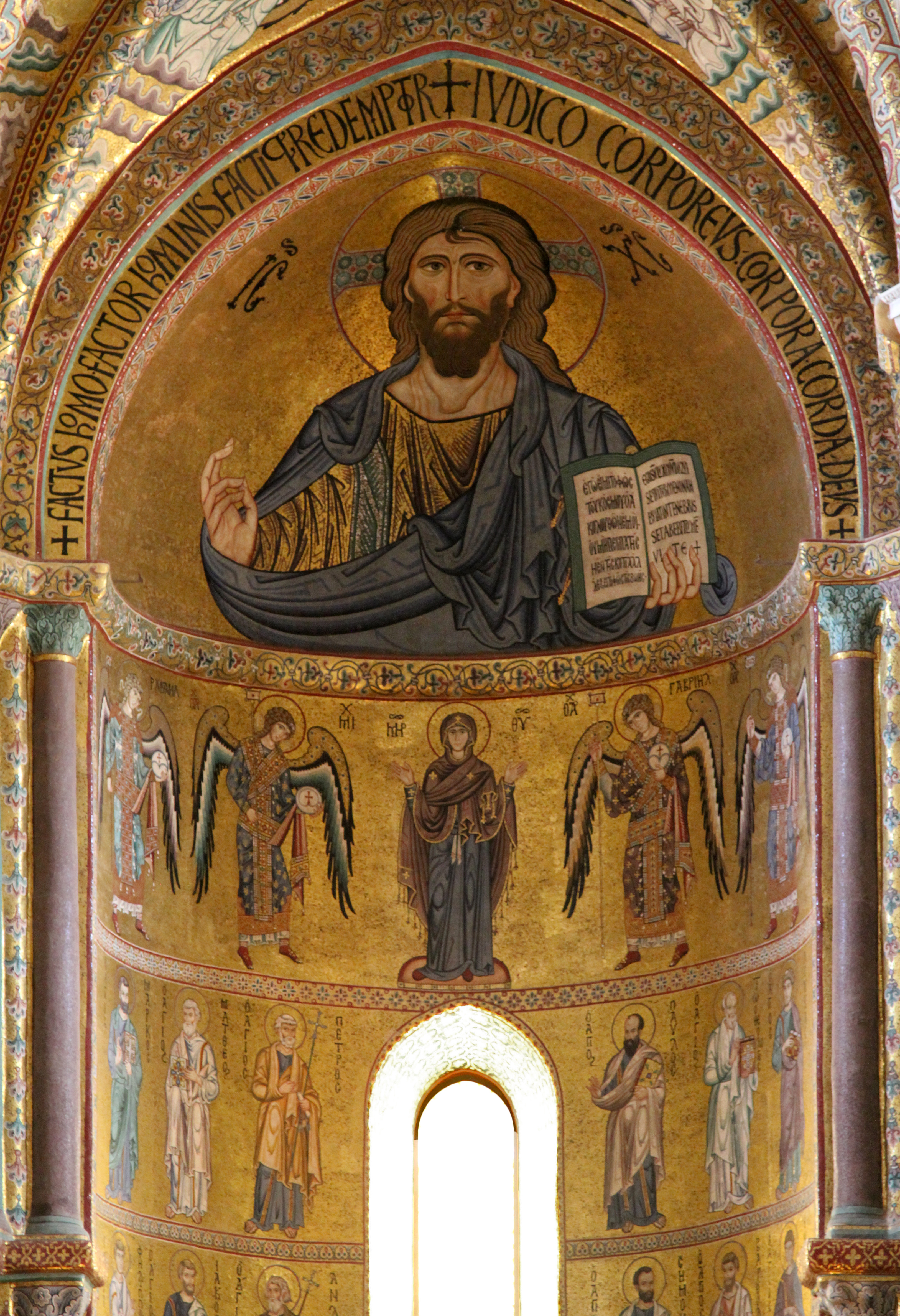
Garabit Viaduct: http://u.jimdo.com/www70/o/sa6549607c78f5c11/img/id3aa3a1f81738f2e/1416666799/std/copyright-whisky-co.jpg (in http://www.europeanbestdestinations.com/top/most-beautiful-bridges-in-europe/)
Lupu Bridge: http://www.globalsalesgrowth.com/wp-content/uploads/2013/02/Lupu-Bridge.jpg (in http://www.globalsalesgrowth.com/shanghais-lupu-bridge)
Apollo Bridge Bratislava: http://www.52insk.com/wp-content/uploads/2011/04/apollo-bridge-by-Karol-Vaclavik.jpg (in http://www.52insk.com/2011/first-slovak-state/)
Verrazano Narrows Bridge: http://michaelminn.net/newyork/infrastructure/verrazanno-narrows_bridge/2008-07-25_16-38-30.jpg (in http://michaelminn.net/newyork/infrastructure/verrazanno-narrows_bridge/)
Humber Bridge: http://upload.wikimedia.org/wikipedia/commons/4/4b/Humber_Bridge.jpg (in http://commons.wikimedia.org/wiki/File:Humber_Bridge.jpg)
Puente del Alamillo: http://upload.wikimedia.org/wikipedia/commons/a/a1/Puente_del_Alamillo_en_Sevilla.jpg (in http://commons.wikimedia.org/wiki/File:Puente_del_Alamillo_en_Sevilla.jpg)
Millau viaduct: http://u.jimdo.com/www70/o/sa6549607c78f5c11/img/i7521c17c35fcc549/1417528244/std/cpakmoi.jpg (in http://www.europeanbestdestinations.com/top/most-beautiful-bridges-in-europe/)
Cooper River bridge: http://library.sc.edu/blogs/mirc/files/2012/07/New-CRB.jpg (in http://library.sc.edu/blogs/mirc/feature-video-july-24th-old-cooper-river-bridge/)
All other photos are mine