WALK THROUGH THE FIVE SORROWFUL MYSTERIES

Sori, 12 May 2018

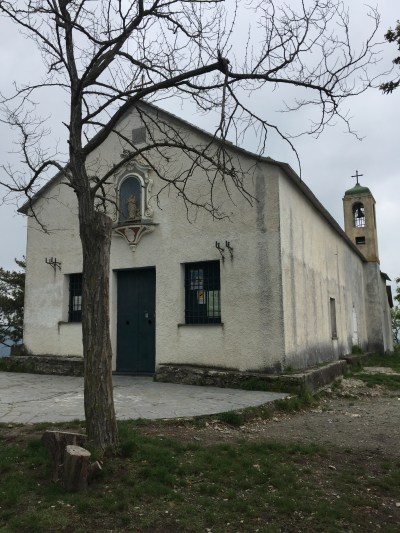
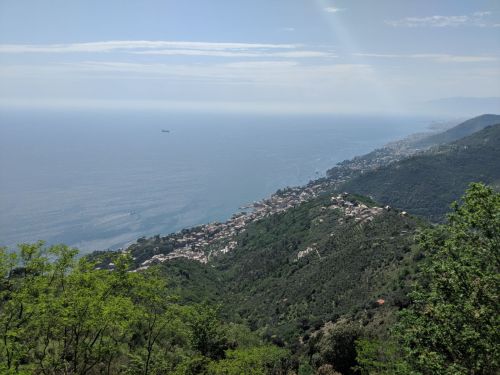
As we usually do when we go down to the sea from Milan, we went for a walk yesterday up into the hills which in this part of the coast fall precipitously into the sea. This time, we decided to follow in our son’s footsteps who, when he had been here a couple of weeks ago, had climbed the hill behind the apartment up to the Chapel of the Holy Cross perched at its top. The chapel itself is not much to write home about, it’s actually closed most of the time. But from the little piazza in front of it one has a magnificent view over the sea, from Genova to the right to the Monte di Portofino on the left.

Suitably prepared, we made for the path which runs behind our apartment and takes the walker up to the small village of Pieve Ligure. After a last backward look down to our village

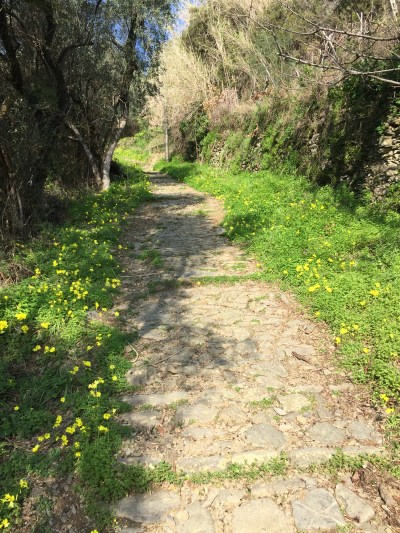
we headed up along the well-kept path that wended its way among houses

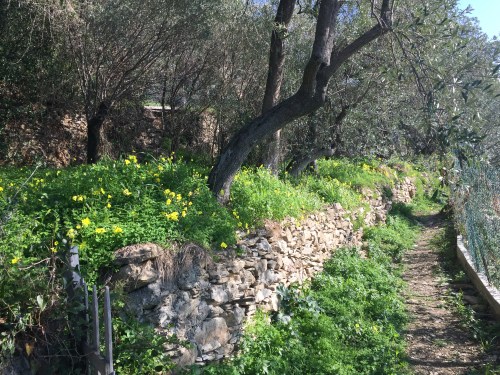
and small olive groves hugging the hill’s countours

(and, sadly, abandoned olive groves as well, one of which was the subject of a previous post)

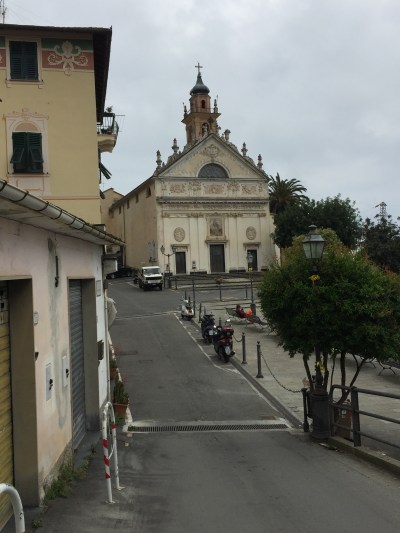
to arrive finally in Pieve Ligure, whose little church with its baroque façade is always a pleasure to contemplate.

There, we had ourselves a well-earned cappuccino before heading on out of the village, past the butcher

and the baker

past the memorial to a Resistance fighter, who was captured near here by the Nazis and who died in a concentration camp (these hills crawled with Resistance fighters in the last years of the war).

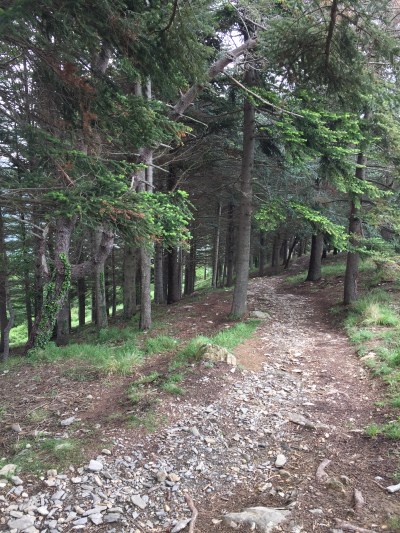
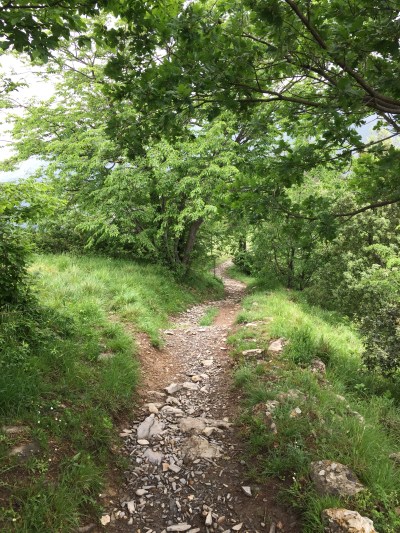
Up to now, the walk had been a stroll, with the path only rising gradually as it snaked along the side of the hill. But now it was time to head pretty much straight up the hill. Up we toiled, as the houses alongside slowly disappeared to give way to olive groves. Finally, we left even these behind. We entered woods and the path finally became a real path of the hills, rocky, muddy, difficult to navigate.

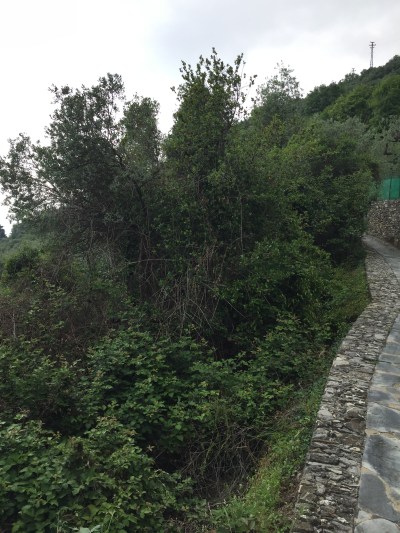
As I’ve noted in a previous post, once upon a time in Italy paths like this leading to tops of hills, especially if chapels crowned them, were turned into Vie Crucis, Ways of the Cross. Pious villagers, with their parish priest at their head, would have climbed the paths at certain opportune moments in the liturgical calendar, like during Lent before Easter, and stopped to offer prayers at each of the fourteen Stations of the Cross built along the path (they would normally have enjoyed a nice picnic once they had reached the top of the hill). In this case, the path had been dedicated to the five Sorrowful Mysteries of the Rosary, and five memorials had been duly erected along the path. This is one of them.

At each of these, the parish priest would have announced the mystery to be contemplated and then led his parishioners in reciting the “Our Father”, ten “Hail Marys” and the “Glory be to the Father”, before moving on to the next memorial.

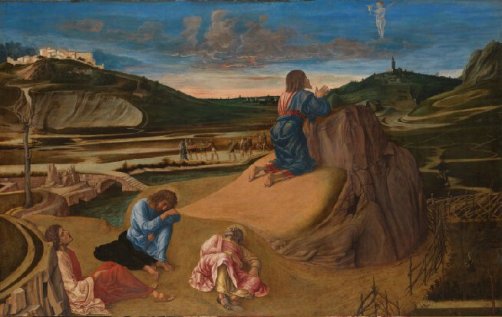
In my previous post on this topic, I had been happy to insert photos of the scenes beautifying the stations, prepared in ceramic in a slightly naïve style. But the scenes tacked onto these five memorials were horrible: plasticized posters of sucrose paintings. I will therefore replace them with five paintings by various Italian painters:

The Agony of Jesus in the Garden, here painted by Giovanni Bellini

The Scourging of Jesus, painted by Caravaggio

Jesus is Crowned with Thorns, painted by Orazio Gentileschi

Jesus Carries the Cross, painted by Tintoretto

Jesus Dies on the Cross, painted by Andrea Mantegna.

On we toiled up the hill

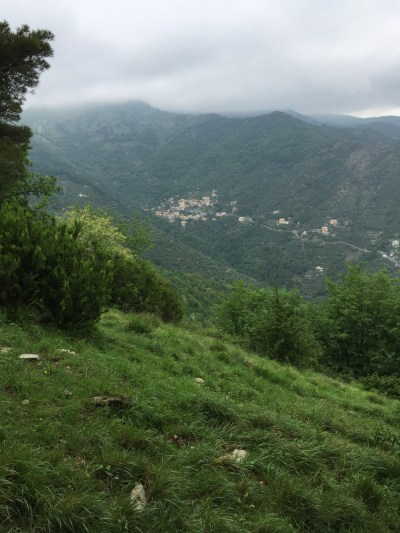
taking in the views across the valley

until we finally reached Santa Croce, the Chapel of the Holy Cross.

Having enjoyed the view

we settled down to a picnic. After which, we headed down the path on the other side of the hill

this time decorated with a standard stations of the cross (in this case the eleventh)

until we reached the even smaller village of San Bernardo, where we had a well-earned café macchiato.

______________________

Photos: mine (and one our son), except for:

Agony in the Garden, by Giovanni Bellini: https://www.nationalgallery.org.uk/paintings/giovanni-bellini-the-agony-in-the-garden
Scourging of Jesus, by Caravaggio: http://www.patheos.com/blogs/badcatholic/2012/04/the-scourging-at-the-pillar.html
Crowning with Thorns, by Orazio Gentileschi: http://www.artfixdaily.com/artwire/release/6811-with-new-partners-and-expanded-purview-master-drawings-new-york-r
Jesus carries the Cross, by Tintoretto: https://www.awesomestories.com/asset/view/Trial-of-Jesus-Carrying-the-Cross
Jesus dies on the Cross, by Andrea Mantegna: https://en.wikipedia.org/wiki/Crucifixion_(Mantegna)

ORANGE CARROTS

Istanbul airport, 5 May 2018

I was in the capital of Kyrgyzstan, Bishkek, over the last few days, working with some old colleagues on supporting the government to develop a national action plan to minimize the effects on the population of the country’s pollution. Fascinating stuff, but not the subject of this post.

As part of the work, it was necessary to schmooze with the local diplomatic community, preparing the ground for future requests of assistance to deal with the country’s pollution. I therefore found myself one evening attending the event put on by the Dutch to celebrate the King’s National Day. As is customary on such occasions, the Dutch Ambassador made a speech, thanking us for coming, listing the important Dutch-Kyrgyz partnerships, and of course – given the occasion – mentioning the Royal family. He did so in an interesting way. Having mentioned partnerships in the agricultural field, he segued smoothly from this to inform those of us who didn’t know it that carrots were orange because patriotic Dutch farmers had selectively bred this root crop to turn it orange, in honor of William the Silent, Prince of Orange, patriarch of the Dutch Royal family.

Well! This was interesting indeed. As anyone who has even a passing interest in sporting events knows, the Dutch national color is indeed orange.


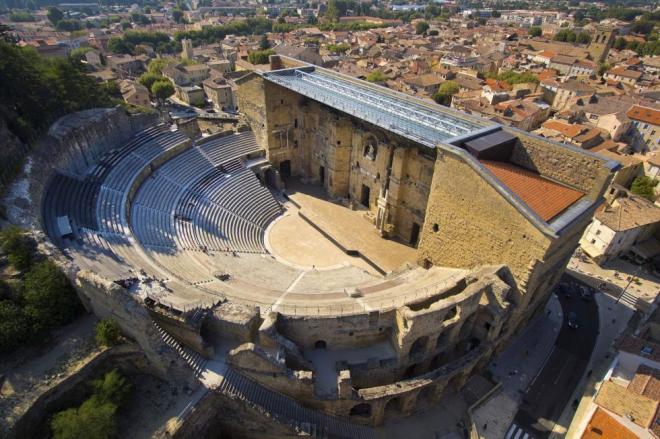
And this patriotic show of orange is indeed linked to William the Silent’s feudal title of Prince of Orange, although the orange in this case is the pretty little town of Orange in southern France, which was William’s fiefdom (and an old Roman city).

But to say that Dutch farmers had turned carrots orange as a patriotic gesture … Such is the dominance of orange carrots in our supermarkets, groceries, and farmers’ markets that it had never, ever occurred to me that carrots could have been anything but orange!

In other posts, I have demonstrated my interest in the humble history of vegetables. The Ambassador had now given me a wonderful opportunity to study the history of the carrot. So these last few days I have been spending time which I should have been more usefully devoting to the pollution problems of Kyrgyzstan to happily digging into the carrot’s history instead. I am now ready to report back.

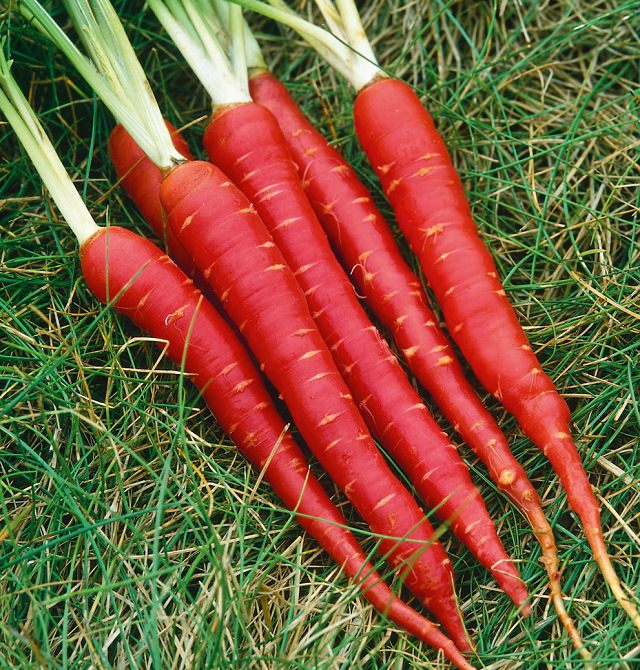
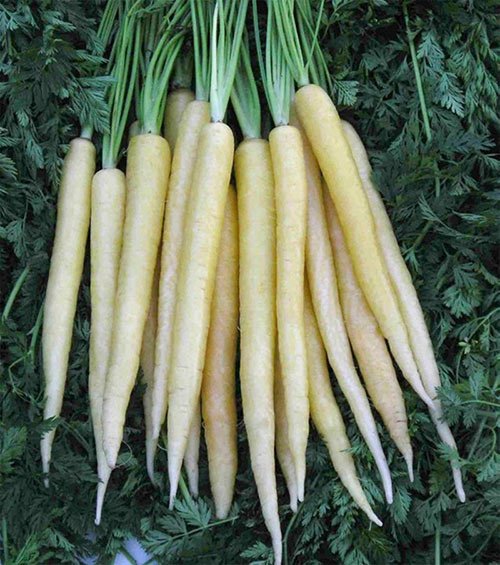
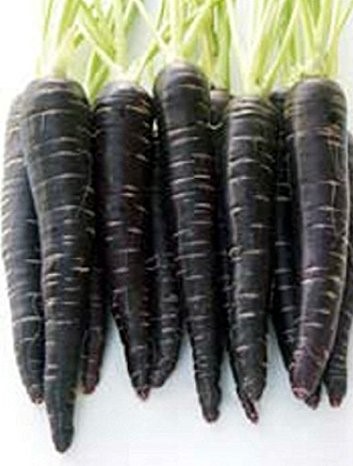
The first thing I have to say is that the Ambassador was indeed correct in his basic contention, that Dutch farmers had turned the carrot orange. This happened in the 17th Century and, for reasons that I shall explain in a minute, the orange carrot took over the carrot world. But first let me throw in some pictures of different colored carrots:
Purple carrots


Yellow carrots

Red carrots

White carrots

Black carrots, even!

Here we can see all these different carrots in glorious technicolour.

Personally, I have never seen any of these. I suppose they are like heirloom tomatoes: there are some enthusiastic aficionados out there who are growing these in their vegetable plots and trading seeds with other carrot enthusiasts. Perhaps one day, like I’ve seen in upscale Californian supermarkets, there will be a corner of the vegetable section devoted to these – to my eye – strange and wonderful carrots.

But why did the Dutch farmers breed these orange carrots? Here, I have to say that, with all due respect to his august person, the Ambassador seems to have got it wrong (along with 99% of the Dutch population). The farmers did not do it to honor William the Silent and his House of Orange. They were looking to breed carrots which were sweeter and whose core was smaller and less woody. The root of wild carrot is actually quite bitter, so since time immemorial farmers had been trying to breed the bitterness out of the root, and as anyone knows who has eaten a big and mature carrot, its core can take up a good part of the carrot and be disagreeably tough to eat.

It just so happened that the carrot they bred was orange. I suppose the carotene which gives the carrot its color also gives it its sweetness. It was only later generations of Dutch who saw the political dimension of the carrot’s color, and actually saw it in a negative sense. Dutch burghers of strong Republican sentiment frowned upon carrots because of their too Royal orangeness – in their Republican zeal they also went after other orange plants, discouraging the planting of marigolds for instance.

Another example of the politics of color.

Before I leave orange carrots, I should report that analysis of carrot genomes strongly suggest that the Chinese independently bred orange carrots. It pleases me no end to know this, because in my years in China I was always puzzled by Chinese carrots. They somehow seemed different from the European carrots that I was familiar with. I throw in a picture of Chinese carrots to show what I mean.

They are a darker orange – the fact that the Chinese obtained the orange color by changing different genes from the ones which give European carrots their orange color probably explains this. And they were much stockier than European carrots, a fact that I put down to the Chinese breeding carrots more as animal feed (like the wonderfully named mangelwurzels) than as human food.

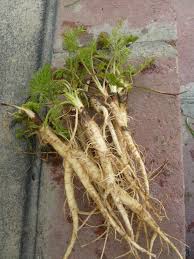
I could not resist the temptation of using this research into the orangeness of carrots to carry out research into the broader history of the carrot. It turns out that the wild carrot is at home in Central Asia – so it is indeed apposite that this little piece of research was kicked off by a chance remark made in Kyrgyzstan, which happens to be one of the homes of the wild carrot. For those of my readers who, like me, have never seen a wild carrot, I throw in a picture.

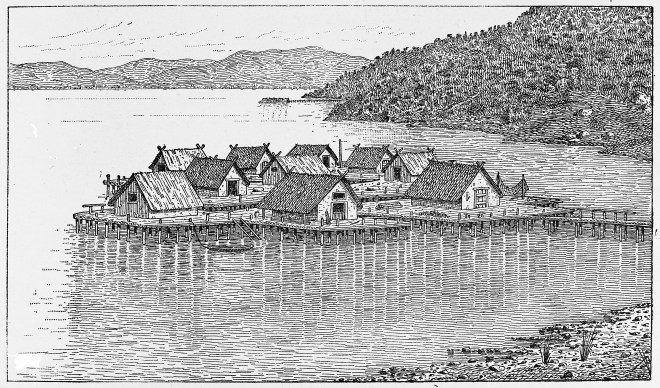
It seems that its root is bitter and woody, but I suppose that hunger makes one tolerant of not-so-tasty food – better than having nothing in one’s stomach. The wild carrot, perhaps in some domesticated form, was carried far and wide from its Central Asian homeland. Carrot seeds have turned up in archaeological digs of prehistoric lake dwellings in Switzerland.

The Babylonians knew of it; it is mentioned in a cuneiform tablet listing the plants growing in the garden of King Marduk-apla-iddina (King Merodach-baladan in the Old Testament).

Seemingly, the Egyptians knew of it, although the evidence is rather weak. The Greeks and the Romans knew of it. But in all these cases, it seems that it was the leaves and seeds which they were interested in; the root was too bitter. They used the root or the seeds for medicinal purposes and ate the leaves much as we would eat spinach (I am reminded of a story my mother used to tell us young children, of how during the War, when she was trapped in occupied France, one could not find carrots in the market. Only the leaves were on sale. She and her mother made do and ate those – better than having nothing in one’s stomach).

All this time, our ancestors were tinkering with this foodstuff as they were tinkering with all their foodstuffs. Finally, possibly as early as the 6th Century, one or more farmers somewhere in today’s Iran and Afghanistan bred a carrot with a sweeter, less woody, more edible root. This plant was destined to become the ancestor of all modern carrots. From there, the seeds were carried by passing traders and travelers both east and west, no doubt along the Silk Roads which I have had cause to mention in earlier posts. In the case of its carriage to the west, Arab traders seem to have been the vector after the Arab conquest of Persia in the 7th Century, much as was the case for the lilac bush, the subject of an earlier post. More tinkering and crossbreeding took place in today’s Turkey before a carrot with an even more edible root continued on its journey to Europe. It arrived there in the 10th Century, eventually ending up in Northern Europe in the 13th Century. It came in two colours, yellow and purple, with a rarer white variety thrown in. For some reason, the Dutch got heavily into carrot production and the rest is orange history.

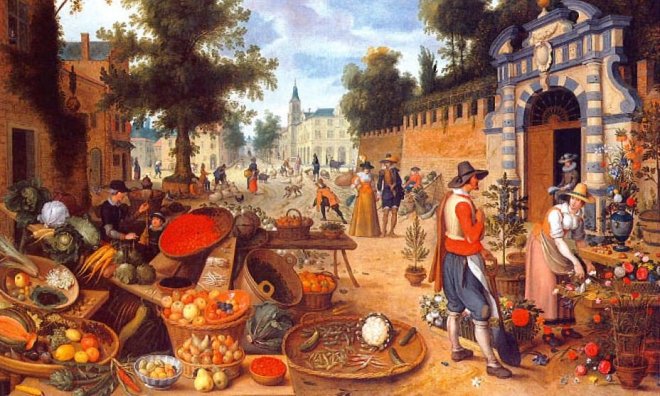
Since the Dutch started this post, let me finish by throwing in some of those still lives so beloved by the Dutch, of kitchens full of vegetables and fruit. Normally, I pass these over with a yawn (I have never understood our ancestors’ fascination with this type of paintings), but it seems appropriate to admire them in this case. I invite my readers to locate the carrot in each of the paintings.


_____________________

William the Silent: https://owlcation.com/humanities/The-Death-of-William-the-Silent
Dutch football players: http://www.football-oranje.com/sweden-v-netherlands-match-preview/

Dutch fans: http://www.newsweek.com/dutch-men-latvian-women-are-tallest-world-study-483868
The city of Orange: http://be.france.fr/fr/a-decouvrir/orange
orange carrots: https://www.well-beingsecrets.com/health-benefits-of-carrots/
purple carrots: https://www.youtube.com/watch?v=HU03lczH6mk
yellow carrots: https://www.bukalapak.com/p/hobi-koleksi/berkebun/benih-tanaman/fs8sg5-jual-biji-2-benih-wortel-kuning-yellow-carrot
Red carrots: http://www.gardenpicsandtips.com/18-vegetables-that-are-colorful-and-worth-eating/2/
White carrots: http://blue-myhanh.blogspot.com.tr/2014/08/khi-trai-cay-co-mau-khac-voi-chung-ta.html
Black carrots: https://www.amazon.co.jp/%E8%BE%B2%E6%A5%AD%E5%B1%8B-%E3%81%AB%E3%82%93%E3%81%98%E3%82%93-%E7%A8%AE-%E3%83%96%E3%83%A9%E3%83%83%E3%82%AF%E3%82%AD%E3%83%A3%E3%83%AD%E3%83%83%E3%83%88-%E5%B0%8F%E8%A2%8B%EF%BC%88%E7%B4%84300%E7%B2%92%EF%BC%89/dp/B00NHD5BCY
Carrot spectrum: http://sezahrana.tumblr.com/page/130
Split carrot: http://www.thesweetbeet.com/carrot-recipes/
Marigold: http://www.thesweetbeet.com/carrot-recipes/
Chinese carrot: https://www.pinterest.com/kurskinlab/spa-men/
Wild carrot: https://myediblebackyard.net/2014/05/02/wild-carrot/
Swiss prehistoric lake dwellings: https://commons.wikimedia.org/wiki/File:Swiss_prehistoric_lake_dwellings._Wellcome_M0015374.jpg
Cuneiform tablet: http://www.britishmuseum.org/research/collection_online/collection_object_details.aspx?objectId=3066115&partId=1&searchText=Merodach-Baladan+II&view=list&page=1
Pieter Aersten, Christ in the House of Martha and Mary: https://www.tumblr.com/search/christ%20in%20the%20house%20of%20mary%20and%20martha
Anonymous, Kitchen scene in Parable of Rich Man and Lazarus: http://www.carrotmuseum.co.uk/art1.html
Pieter Cornelizs. Van Rijk, Kitchen Scene: http://www.carrotmuseum.co.uk/art1.html

CACTUS RULES, OK!

Los Angeles, 19 April 2018

As we did last year, during our latest stay in Los Angeles my wife and I visited the old house and grounds of Arabella and Henry Huntington, now the grandly-named Huntington Library, Arts Collection, and Botanical Gardens. The arts collection, which we visited thoroughly last year, is well worth a visit. It holds some very famous pieces of European art, such as the Blue Boy by Thomas Gainsborough.

It also has a really great collection of American art, especially early American art, holding this piece for instance.

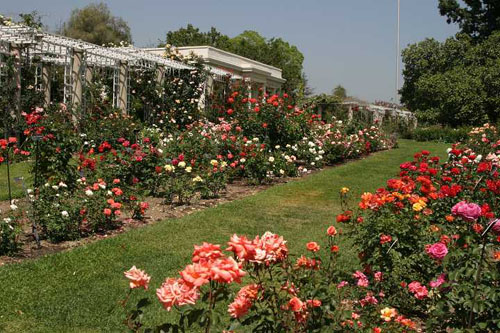
But this year we ignored the art and headed for the gardens. Because the gardens are equally wonderful. During their lifetimes, the Huntingtons had already laid out several gardens around the house. One was a traditional rose garden (primarily so that Arabella Huntington could fill the house with cut roses). Henry Huntington also started a camellia garden along the edges of the Vista which the couple created in front of the house. He also surfed what was then a popular trend and created a Japanese garden. He was also an admirer of palm trees, so he started a palm garden. And after some prodding from his head gardener, he agreed to start a desert garden. The same head gardener, presumably with Mr. Huntington’s approval, also installed lily ponds in an unsightly corner of the garden.

Some of these original gardens have been expanded over the years, while new gardens have been added: a Chinese garden, a semi-tropical garden, a tropical (“jungle”) garden, and an Australian garden (along with a couple of much smaller gardens: a herb garden and a Shakespeare garden, the latter housing all the plants mentioned in one way or another in Shakespeare’s works). All in all, this complex of gardens give the visitor a taste of the sights and scents of many of the world’s biomes (they also give people a lovely scenography for picnics and general lazing around on lawns).

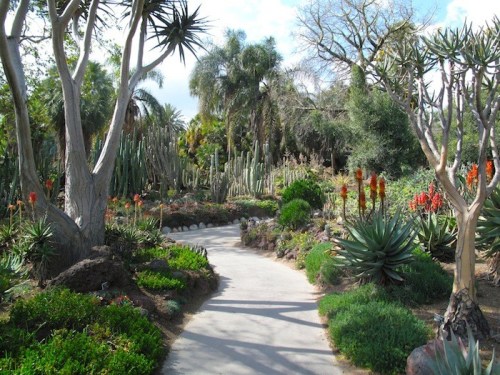
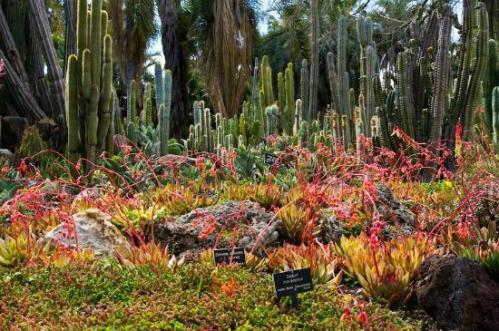
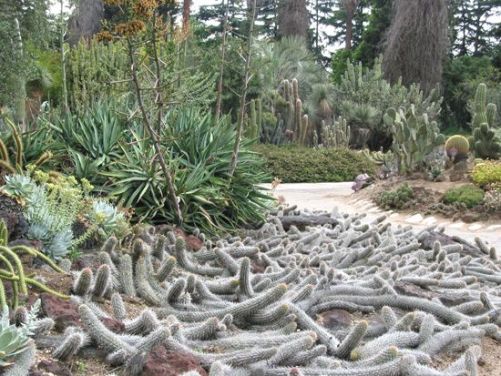
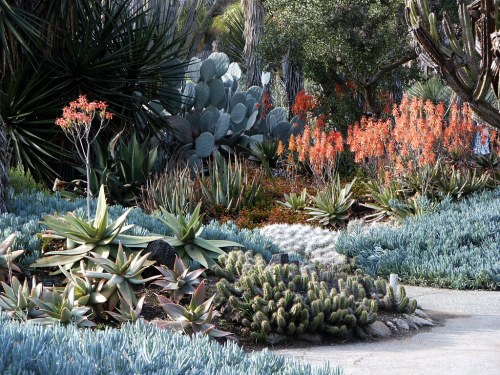
The desert garden is what interests me today. As we wandered the paths which crisscross it, we marveled at the wonderful cacti and succulents which populate this garden. We are not the only ones to have been struck by them. I throw in here some of the better pictures which other visitors have posted on-line.


If I focus on the desert garden rather than on any of the other gardens at the Huntington it is because of water, or rather – in this part of the world – the lack of it. As most people probably know, Los Angeles and southern California in general is a semi-desert; in fact, the region wouldn’t have been able to develop nearly as much as it has if its politicians hadn’t managed to filch large amounts of water from the northern part of the State. But this grand water larceny has only put off the day of reckoning. Southern California is running out of water. Something must be done to contain water use.

Under the circumstances, it makes eminent sense for everyone in this city who has a garden to stop planting water-thirsty plants, especially those lawns so beloved by Americans. Here are a few prime examples from the swank properties surrounding the Huntington.


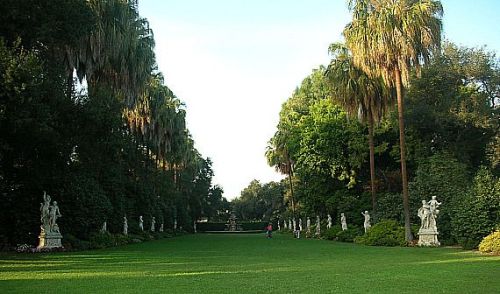
The Huntington itself has its fair share of thirsty lawns.


To their credit, the people running the Huntington are now pushing the idea that Angeleno gardeners should opt for water tolerant plants in their gardens. And what the desert garden shows is that a garden of cacti and succulents can be every bit as beautiful as a traditional garden. These poor plants get a lot of bad press, probably because of the spines which most cacti sport and perhaps because they can often look somewhat bedraggled. Certainly, it seems that Mr. Huntington’s initial reluctance to have a desert garden had to do with unspecified bad memories of run-ins with prickly pear cacti from the days when he was building his uncle’s railroads across the country. My guess is that his horse threw him into a patch of prickly pear – but that’s only a guess.

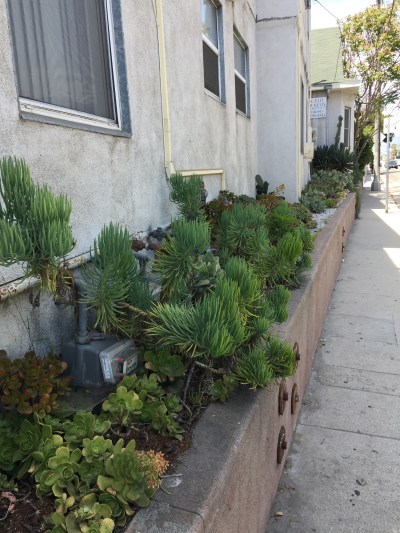
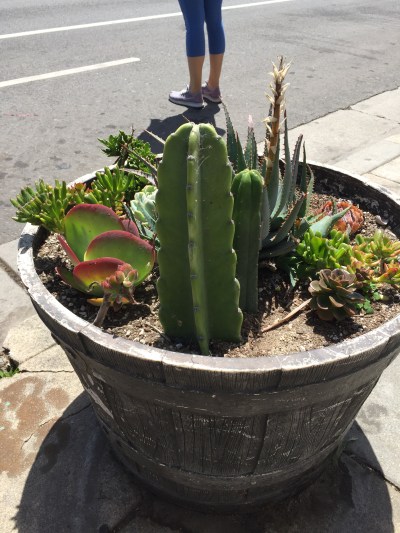
As we walk around the city, my wife and I notice an encouraging trend towards more cacti and succulents in gardens and public spaces.


Among all the drought-tolerant plants on show, the one I am most fond of is this one, which I have been seeing a good deal of this year.  This example, for instance, graced a space near a bus stop which we were waiting at.
These examples, instead, are part of a more general planting of cacti and succulents which we have often been walking by as we stroll along the boardwalk at Venice Beach.

It is called, I have discovered, firesticks (or variations thereon: sticks-of-fire, sticks-on-fire, and probably others). The name obviously refers to the plant’s crown of very pretty red, pink, and orange stick-like twigs. It’s really very lovely. But beware! The white sap which oozes from a twig when broken can irritate the skin and is especially dangerous if rubbed into the eyes. I should know. The firestick is a direct descendant of the pencil tree.

This tree can be found throughout East and South Africa. And in fact it grew in our garden in Eritrea. I still remember my mother’s frantic screams when she realized that my little fingers one day had broken a twig and I was busily spreading the sap on the palm of my little hand.

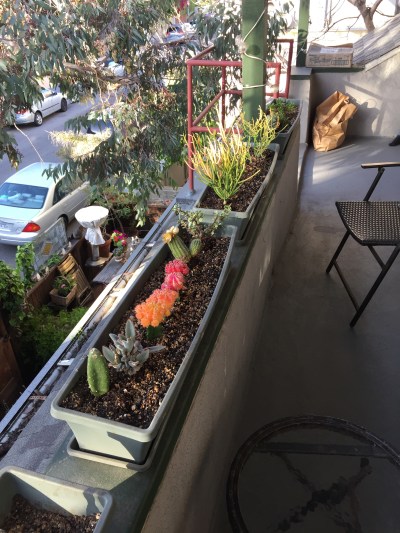
Even though they don’t have a garden, my daughter and her boyfriend are moving towards cacti and succulents on their balcony. They have planted a bunch of flower pots with them. I’m pleased to see that the firestick is one of their choices.

Truth to tell, they have chosen these plants not so much as a commitment to a more sustainable lifestyle but rather for their low maintenance requirements. Neither of them are particularly diligent in watering and previous planting attempts ended badly because of this. Let’s hope that when we come back next year, they are still flourishing: cacti and succulents rule, OK! (at least in Los Angeles)

__________________
The Blue Boy: http://huntington.org/webassets/templates/general.aspx?id=14392
Early American art: http://www.huntington.org/WebAssets/Templates/content.aspx?id=22779
Picnicking, Huntington gardens: https://www.facebook.com/HuntingtonLibrary/photos/a.70860174880.63671.51018909880/10156013615919881/?type=3
Desert garden-1: http://www.huntington.org/desertgarden/
Desert garden-2: http://fr.gde-fon.com/download/huntington_jardin-botanique-de-San-Marino/433151/2395×1590
Desert garden-3: https://www.google.co.uk/amp/s/www.gardenista.com/posts/escape-to-a-desert-garden-in-pasadena-huntington-library-garden/amp/?source=images
Desert garden-4: https://www.tripadvisor.com/LocationPhotoDirectLink-g33029-d110203-i41542481-The_Huntington_Library_Art_Collections_and_Botanical_Gardens-San_Marino_Cal.html
Desert garden-5: https://www.pinterest.com/amp/pin/107875353549586117/
Desert garden-6: https://www.flickr.com/photos/27398485@N08/3280510696
Desert garden-7: https://www.google.co.uk/amp/s/www.pinterest.com/amp/pin/561331541042981128/?source=images
Desert garden-8: https://www.visitpasadena.com/businesses/the-huntington/
Desert garden-9: https://www.google.co.uk/amp/s/christophvi.wordpress.com/2015/08/30/more-than-reading-at-the-huntington-library/amp/?source=images
Desert garden-10: https://commons.m.wikimedia.org/wiki/File:Golden_Barrels_%26_Senecio_mandraliscae_Blue_Chalk_Stick_succulents,_Huntington.jpg
Desert garden-11: https://www.google.co.uk/amp/s/www.gardenista.com/posts/escape-to-a-desert-garden-in-pasadena-huntington-library-garden/amp/?source=images
Desert garden-12: http://huntingtonblogs.org/2014/01/torch-bearers-of-the-desert-garden/
Desert garden-13: https://www.google.co.uk/amp/s/christophvi.wordpress.com/2015/08/30/more-than-reading-at-the-huntington-library/amp/?source=images
Desert garden-14: https://www.google.co.uk/amp/s/christophvi.wordpress.com/2015/08/30/more-than-reading-at-the-huntington-library/amp/?source=images
San Marino property-1: http://www.pasadenacarealestatehomes.com/blog/san-marino-ca-real-estate-market-reports/
San Marino property-2: http://activerain.com/blogsview/4681118/san-marino-ca-homes-for-sale-and-recent-market-activity-june-7–2015
Northern vista: https://www.google.co.uk/amp/s/www.pinterest.com/amp/pin/280278776779445390/?source=images
Rose garden: http://www.huntington.org/webassets/templates/general.aspx?id=15523
Gardens around LA with cacti and succulents: my photos
Firesticks: my photos
Pencil tree: http://patioplants.com/product/pencil-tree-cactus-euphorbia-tirucallii-big-7-deep-plug/
My daughter’s cacti: my photo

CARLSBAD CAVERNS

Los Angeles, 7 April 2018

Alert readers of my previous posting may have been asking themselves what was the origin of the gypsum strata in the San Andres and Sacramento mountain ranges, which had played such a crucial role in the creation of the White Sands dunes (because, of course, they had not been magically created out of nothing, nor had they been lying there since the birth of the Earth). I’m not sure I can give a categorical answer to this question, but our visit to the nearby Carslbad caverns suggested one possible answer.

A little bit of background is in order here for the uninitiated. Carlsbad caverns constitute a very large underground limestone cave system in the Guadalupe Mountains of New Mexico. This little diagram gives an idea of the extent of the caves. As one can see, it is a series of large chambers connected by passageways.

Videos in the Visitors’ Centre helpfully inform the interested viewer that these chambers were formed by our friend gypsum! Many millions of years ago, as the Guadalupe Mountains were being uplifted, the limestone strata making them up cracked and fissured as the rocks twisted and turned. Rainwater percolated downwards through the cracks until it reached the water table, while hydrogen sulphide percolated upwards, given off by the crude oil and natural gas lying far below (and which we saw being pumped out on our way to the caverns).

When the hydrogen sulphide met the groundwater, it reacted with the oxygen in the water to form sulphur dioxide which then reacted with the water to form sulphuric acid. So the limestone cracks and fissures now found themselves bathing in sulphuric acid. This unforgiving acid attacked the limestone and turned it into calcium sulphate, which is none other than our friend gypsum. The gypsum washed away, leaving fresh limestone to be attacked by the sulphuric acid. And then the cycle repeated itself until the small cracks and fissures had turned into huge caverns. I imagine a similar process created the gypsum strata with which I started this post: hydrogen sulphide bubbling up into a sea above, the sulphuric acid so created attacking coral formations and turning the sea into a vast pool of dissolved gypsum, the sea drying out thereby creating beds of crystallized gypsum. Something along those lines.

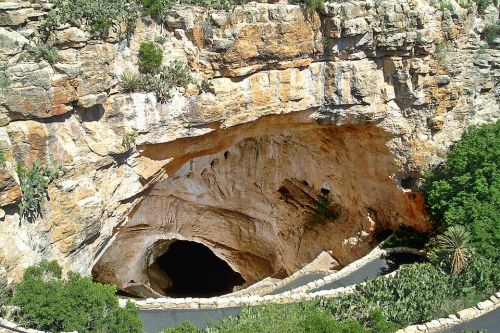
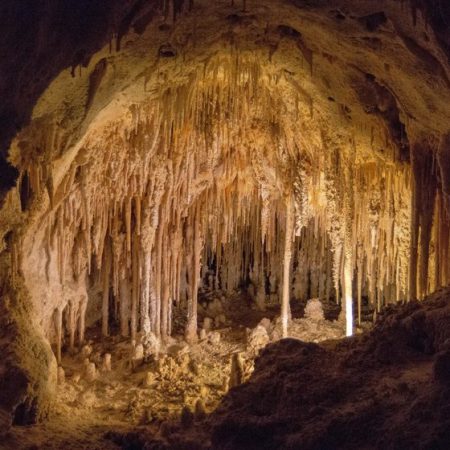
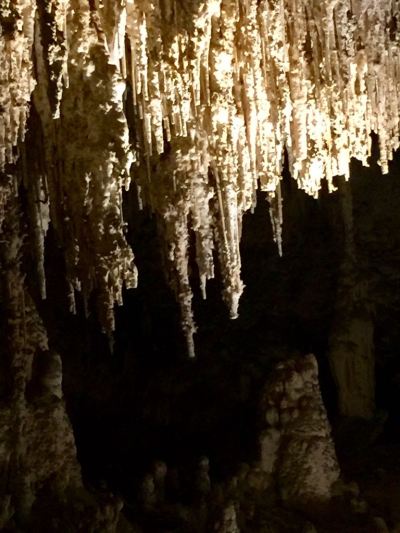
Coming back to the Carlsbad caverns, as the uplifting of the Guadalupe Mountains continued the caverns were raised out of the water table and drained of their acid. The caverns would no longer grow. But the rainwater kept percolating down, and in so doing filled the caverns with those formations which make such caves a wonder: the stalagmites and stalactites of course, but also the sheets, the draperies, the ribbons, the flowstones, … Carlsbad caverns have their share of these wonders. But first one has to get to them. The caves have a natural opening at the surface

through which Mexican free-tail bats stream in and out at night

as do cave swallows during the day.

But so do human visitors, who walk down, down, down


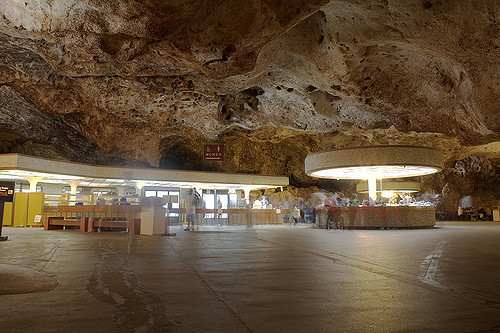
into the central chamber of the cave system, the Lunch Room, a huge cavern rather oddly decked out as a cafeteria.

From there, visitors can explore – guided or unguided – other chambers. We chose to take the tour of the King’s Palace, which offered us these views.

This cavern was also home to some strange-looking formations, which I had never seen before. The formations looked somehow gnarled and knotty.

It seems that these proturbances have been formed by convective patterns in the cavern’s air streams gently pushing the drops of water in directions other than down.

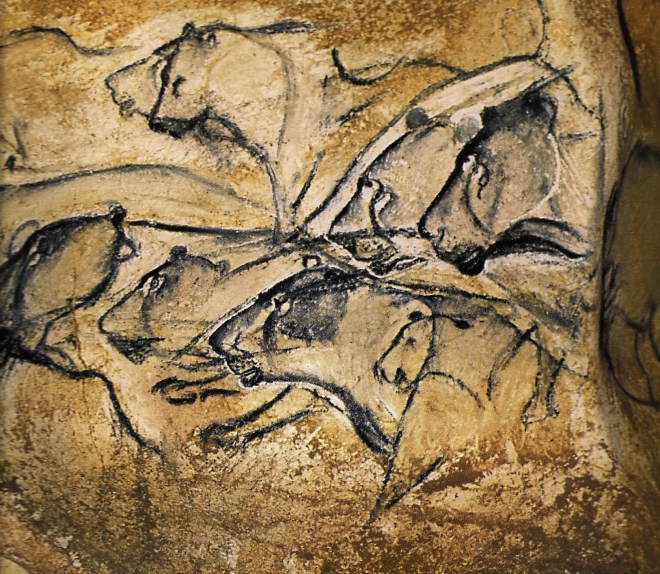
I hope I haven’t bored my readers with all this science. I find it fascinating, although I recognize that others may find it tedious or, even worse, that it may bring back bad memories of sitting benumbed in chemistry classes at school. To make it up to them, let me talk about art, or more specifically prehistoric cave art. Of which, unfortunately, there is hardly any at Carlsbad caverns. There is no prehistoric art in the caves themselves. It seems that the Native Americans were afraid of entering the cave, from which they believed their ancestors had originated. There are reports of Native American pictographs around the natural opening, although I didn’t see them and found no photos of them on the web. No matter! I’ll transport ourselves thousands of kilometers eastward to the caves in France and Spain on whose walls our Paleolithic ancestors painted some 40,000 years ago, and I’ll throw in some pictures of the cave art one can find there.


These paintings are very interesting, no doubt about it, but what impresses me even more is that the artists ventured so deep into the earth to paint them. At some point during our tour of the King’s Palace, our guide turned off all the lights. The resulting darkness was absolute. Your eyes never accustomed themselves to the dark as they would outside, allowing your eyes to eventually see something, even if only indistinctly. It was instead unremittingly pitch black, an extremely disagreeable sensation. Of course, our Paleolithic ancestors would not have painted in the dark, they would have taken torches down. But even a torch would have given off precious little light; our guide lit a lantern powered by a candle and such light is faint indeed.

How did our ancestors create such lovely sketches in such a tremulous light? And how did they overcome their fear in going so deep into the inky blackness of these caves? Questions without answers.

________________
Map of Carlsbad caverns: http://carlsbadnewmexico.com/places/carlsbad-caverns-maps/
Oil derrick in New Mexico: https://fronterasdesk.org/content/9902/new-mexico-lawmaker-faces-challenge-strengthening-oil-regulation
Natural opening: https://www.tripsavvy.com/new-mexico-honeymoon-activities-1863221
Bats at natural opening: https://miraimages.photoshelter.com/image/I0000Zbbmp9jYDCc
Cave swallows at natural opening: https://www.tripadvisor.com/LocationPhotoDirectLink-g60761-i23159610-Carlsbad_New_Mexico.html
Path down through natural opening: https://www.google.co.uk/amp/s/www.pinterest.com/amp/pin/138556126016751944/?source=images
Main Corridor: https://www.nps.gov/cave/planyourvisit/fees.htm
Lunch Room: https://www.flickr.com/photos/46062921@N00/442216196
King’s Palace-1: my wife’s photo
King’s Palace-2: http://rv-dreams.typepad.com/rvdreams_journal/2007/06/carlsbad_cavern.html
King’s Palace-3: http://traveltips.usatoday.com/rv-parks-carlsbad-caverns-52061.html
Gnarled, knotty formations: my wife’s photo
Prehistoric art-1: https://www.archaeological.org/tours/europe/25009
Prehistoric art-2: https://www.atlasobscura.com/places/cave-of-lascaux
Prehistoric art-3: https://www.google.co.uk/amp/s/phys.org/news/2011-11-ancient-dna-insights-cave-horses.amp?source=images
Prehistoric art-4: https://www.google.co.uk/amp/s/www.pinterest.com/amp/pin/513551163733767543/?source=images
Candle in a cave: https://www.dragonsdawn.org/nmtCaver/El_Malpais_Feb_2017/index.html

WHITE SANDS NATIONAL MONUMENT

Los Angeles, 30 March 2018

Like most children who have spent holidays on a beach somewhere, both my wife and I have memories of playing in sand dunes, I in Norfolk

she along Italy’s Adriatic coast.

Then, after we met and started traveling the world we visited a number of large-scale sand dune systems, far away from any sea. The first we saw, at the start of our lives together, were the sand dunes of Death Valley.

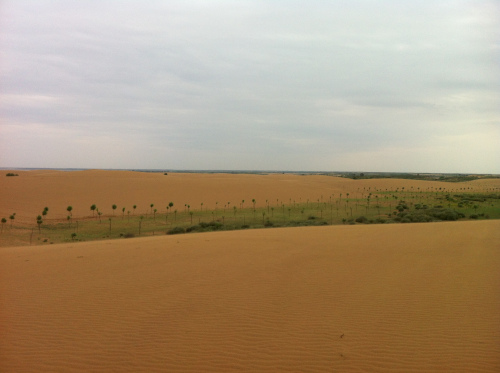
On a business trip a few years ago, I visited the sand dunes of Inner Mongolia which are remorselessly engulfing farmland; I commented on these in an earlier post.

And then there were the sand dunes of Namibia, which we visited one Christmas some ten years ago with our children.

The most awesome of these dunes were a dull red, with the biggest towering over us.

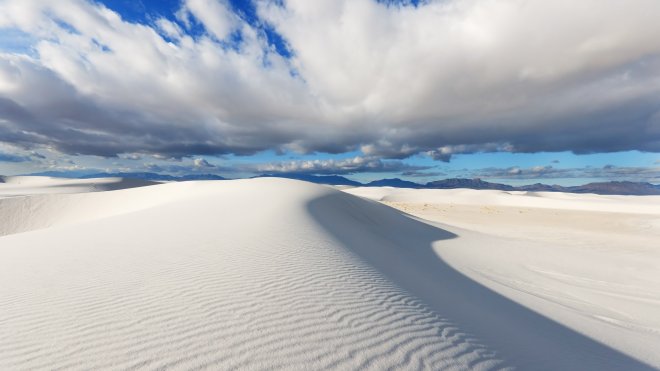
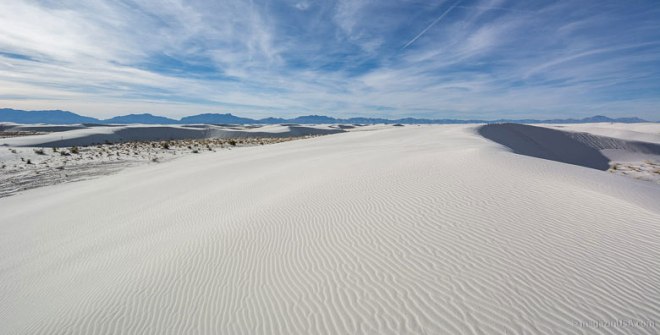
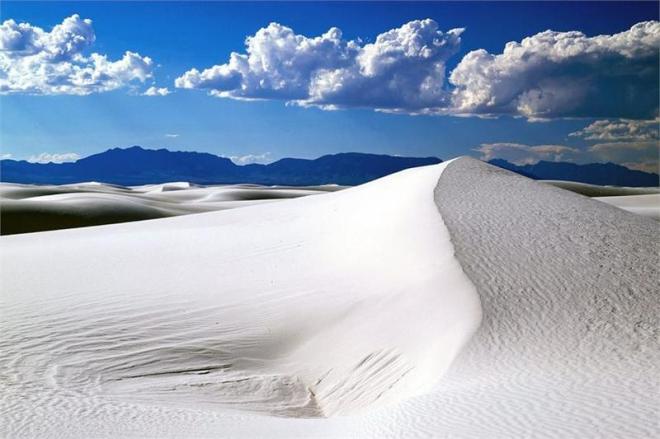
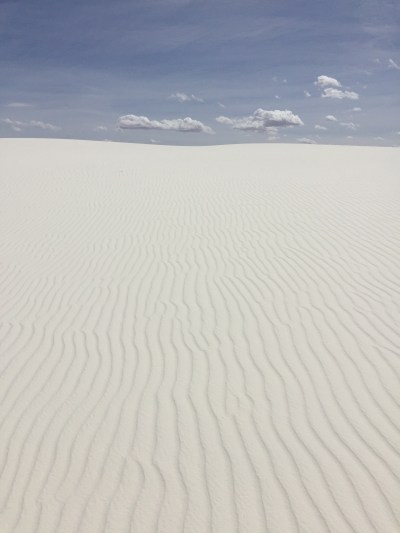
But the blindingly white dunes of the White Sands National Monument in New Mexico, which we visited last week with our daughter and her boyfriend, are in a class of their own. The eerie beauty of these dunes has led better photographers than I to surpass themselves, and I have shamelessly pinched some of the best of their photos to insert here.


We walked in a big circle, from dune crest to dune crest, marveling at the vistas before us of undulating whiteness, all the way, so it seemed, to the surrounding mountain ranges.

I’ve been careful not to refer to these dunes as sand dunes, because they are not sand as we normally understand that term, that is to say silicate. These are dunes of gypsum (calcium sulphate to the chemically inclined of my readers).

In the morning, we had visited Lake Lucero, which lies to the southwest of the dunes. It is an evanescent lake; it appears during the rainy season in late summer and is gone by the time the windy season in the spring rolls around. When we visited it, there was no sign of any water.

Here we could see how the gypsum “sand” had been created. It all started 24,000 years ago, when a new ice age started and the climate in this corner of New Mexico began to be much wetter than it is today. For nigh on 14,000 years frequent rains lashed the nearby San Andres and Sacramento mountain ranges. The rainwater nibbled away at strata of gypsum which had been exposed by the mountains’ uplifting, and streams carried the dissolved gypsum into a lake at the foot of the mountains. This lake has been named Lake Otero. The lake had no exit, so it grew in size until the water evaporating balanced the stream water entering. But the gypsum (and other salts) carried into the lake remained and slowly concentrated. Then, some 10,000 years ago, the ice age came to an end, and the climate here became dryer. Less rainwater fell on the mountains, streams got smaller or disappeared, and Lake Otero began to shrink. As it shrunk, the dissolved gypsum became ever more concentrated until finally the lake water was saturated. The gypsum started precipitating out of the lake water, forming huge crystals of selenite in the process, which then settled onto the lake’s bed. This picture shows a very pure crystal of selenite, which is colourless.


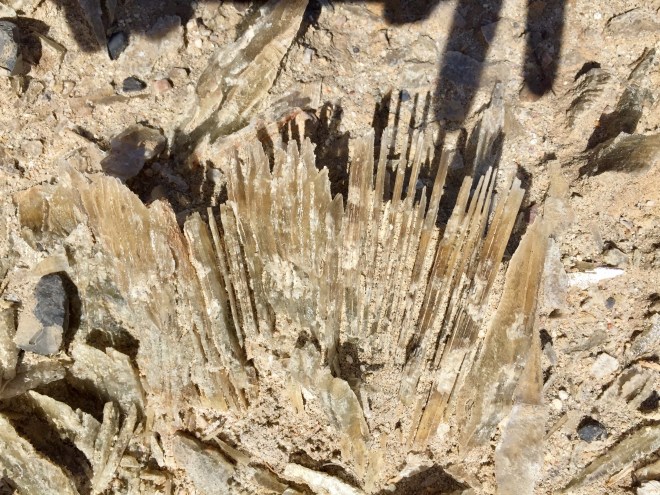
But during our ramble along the shores of Lake Lucero we saw selenite crystals in their more natural state, jutting out of the ground. They were various shades of brown; other substances that were present in the lake water have colored the crystals.


And still Lake Otero kept shrinking, until nothing but Lake Lucero – sometimes there, often not – was left.

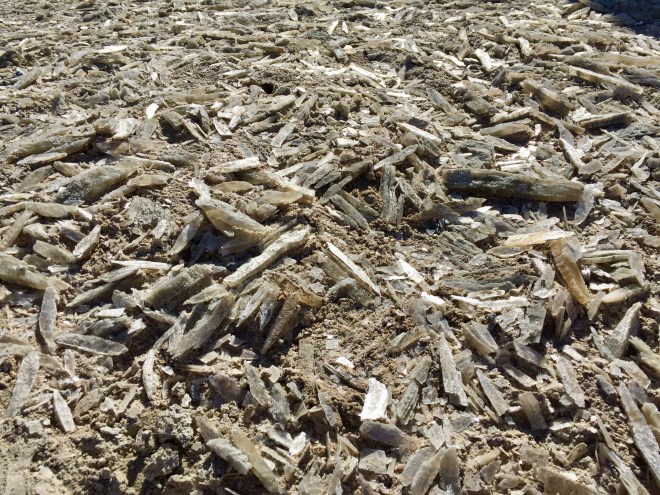
With the climate change of 10,000 years ago came strong winds. For the last 10,000 years they have been scouring the alkaline flats left bare when Lake Otero disappeared. They first carried away the thin crust of clay and fine particles, which exposed the selenite. Freezing and thawing cycles went to work on the crystals, breaking them along their weakest plane. The process continues to this day. We saw these crystals of selenite down at Lake Lucero being slowly split open.


The shores of Lake Lucero are littered with fragments of selenite crystals, broken up by wind, frost and heat.

On and on went the work of breaking down the crystals until they had become flakes light enough to be carried along by the prevailing southwesterly winds. As the flakes bowled along over the alkaline flats, tumbling over and over, they cracked and crumbled further until only small sand-like grains were left.

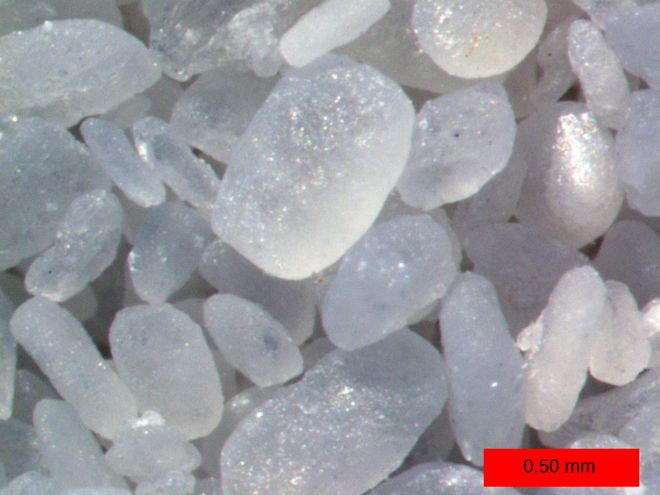
The winds have pushed the grains up into the dunes that we see today. And all that tumbling has so scratched and scarred and pitted the surface of the grains that they reflect back sunlight in all its wavelengths so that we see them as intensely white.

Unbeknownst to us, my wife and I have been living with selenite around us in the apartment in Milan, although in this case in the form of desert roses.

My mother-in-law picked them up in Algeria, where she visited some of the oases south of the Atlas Mountains and walked the dunes of the Saharan desert, like these at the Biskra oasis.

Another dune system for my wife and I to visit – once Isis no longer roams the Sahara desert, kidnapping and beheading hapless tourists.

____________________

Norfolk dunes: http://www.bringingtheoutsidein.co.uk/landscape_photography/holkham.html
Dunes Adriatic coast: https://www.rentbyowner.com/property/hotel-le-dune/BC-268102
Sand dunes Death Valley: https://www.tripadvisor.com/LocationPhotoDirectLink-g143021-d2255762-i116167540-Mesquite_Flat_Sand_Dunes-Death_Valley_National_Park_California.html
Sand dunes Inner Mongolia: my picture
Sand dunes Namibia-1: https://it.pinterest.com/pin/6685099420949300/?lp=true
Sand dunes Namibia-2: https://travelservice.tips/attractions/africa/sossusvlei-dunes.html
White sands-1: https://www.nationalparks.org/connect/blog/wave-dunes-white-sands
White sands-2: http://www.magazinusa.com/us/states/show.aspx?state=nm&doc=10&dsc=White_Sands_National_Monument
White sands-3: http://www.bbc.com/earth/story/20160517-the-beautiful-white-sand-dunes-that-should-not-exist
White sands-4: https://www.newmexico.org/listing/white-sands-national-monument/218/
Lake Lucero: my wife’s picture
Selenite-pure: http://www.crystallinephoenix.com
Selenite crystals in the ground: my pictures
Selenite crystals on Lake Lucero shore: my picture
Gypsum grains: https://en.m.wikipedia.org/wiki/White_Sands_National_Monument#/media/File%3AWhiteSandsGypsum.jpg
White sands-5: my picture
Desert rose: https://www.feelcrystals.com.au/product-category/crystal-meanings/desert-rose-crystal/
Tadrart, Algeria: https://www.tripadvisor.com/LocationPhotoDirectLink-g293717-d504734-i300952025-Algerian_Sahara-Algeria.html
Biskra oasis, Algeria: https://plus.google.com/105463517722617181754

SPRING IS COMING!

Sori, 14th February 2018

Once, after I’d made a speech in Bangkok about how the world was going to hell in a hand basket, with multiple environmental disasters awaiting us, I was asked by the MC (who clearly had no idea what to say to me) what I most missed in Thailand. The seasons, I replied: winter, spring, summer, autumn. It was indeed one of the few things I missed in Bangkok from my European heritage; I always felt that South-East Asia was seasonal monotony. It was either hot or hotter, with rain added from time to time.

Now that I’m back in Europe, I can enjoy the four seasons again. Right now, in a masochistic sort of way, I’m enjoying the tail-end of the winter season: ah, that cold north wind which causes you to pull your head and shoulders into your coat like a turtle into its shell … But here on the Ligurian coast, located in its own warm microclimate, we already have signs that spring is on its way! As we have been walking the hills, there have been signs all around us that Nature is getting ready to burst forth again, like in Botticelli’s Spring.

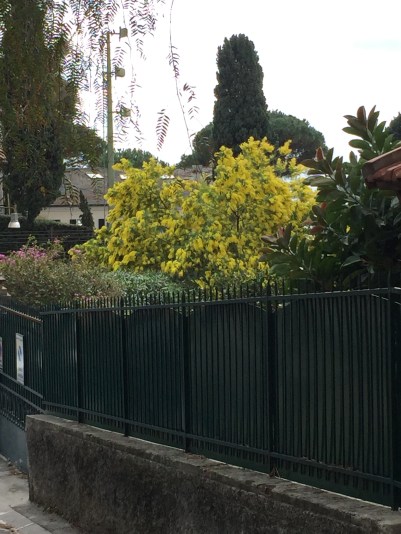
We have the mimosa trees, whose festival it will soon be

the almond trees, seen here on a walk in the Cinque Terre

the crocuses, in the shady underforest

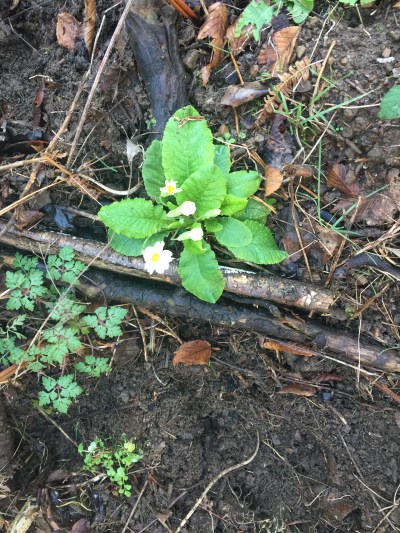
a lone primrose, also spied on the sun-speckled forest floor

carpets of a yellow flower, to me unknown, bedecking the sides of the paths open to the sun


bushes of rosemary growing from out of the rocks

purple irises, not a flower I connect with early spring

a humble little mauve flower, growing at the foot of olive trees

even a bright yellow fungus, returning a dead log to the earth from whence it came.

Yes, nothing so lovely as the Earth bursting into life. No wonder the poets have often sung about spring! Here’s a poem by Gerald Manley Hopkins, entitled simply Spring:

Nothing is so beautiful as Spring –
When weeds, in wheels, shoot long and lovely and lush;
Thrush’s eggs look little low heavens, and thrush
Through the echoing timber does so rinse and wring
The ear, it strikes like lightnings to hear him sing;
The glassy peartree leaves and blooms, they brush
The descending blue; that blue is all in a rush
With richness; the racing lambs too have fair their fling.

What is all this juice and all this joy?
A strain of the earth’s sweet being in the beginning
In Eden garden. – Have, get, before it cloy,
Before it cloud, Christ, lord, and sour with sinning,
Innocent mind and Mayday in girl and boy,
Most, O maid’s child, thy choice and worthy the winning.

Happy Saint Valentine’s!

_____________

Boticelli’s Primavera: https://en.m.wikipedia.org/wiki/Primavera_(painting)
All other pics: all ours

RUBALDO MERELLO

Sori, 10th February 2018

My wife and I were recently in Genoa. Since it was a rainy day, we had decided that our usual excursions along the coast were out, and had opted to visit a couple of exhibitions at the Palazzo Ducale, the Ducal Palace. The Palazzo Ducale was recently the scene of much brou-ha-ha. It had hosted an exhibition of Modigliani’s paintings. Some Modigliani experts had claimed that half the paintings were fakes (apparently Modigliani is very easy to fake), the organizer retorted that all the paintings had certificates of authenticity emitted by various other experts and that very respectable institutions had already hosted the exhibition, the Carabinieri had nevertheless moved in and confiscated the whole exhibition and were pressing charges for fraud, the organizer in turn was suing person or persons unknown for making false claims … in a word, there was a right royal mess.

Luckily, the exhibitions we were visiting were not the subject of such polemics. One was an exhibition of works by Picasso from the Picasso Museum in Paris. Although interesting, I will not comment on it (although I should note in passing that Picasso has also been widely faked: organizers beware!). The other was an exhibition of works by Rubaldo Merello.

I will perfectly understand if readers have never heard of Merello. I had not heard of him either until we saw this exhibition advertised. He is, to be honest, a minor Italian painter and sculptor, and his story is quickly told. Born in 1872, he worked at the turn of the last century, dying in 1922 at the relatively young age of 50. He was a local son, learning his trade at Genoa’s Accademia Ligustica delle Belli Arti. After a bit of to-ing and fro-ing, he tied his colours to the movement known as divisionismo, Italy’s answer to France’s pointillisme. For some reason which is not completely clear but which may have had to do with his paintings being rejected by the 1st Venice Biennale, he started isolating himself from the art world, eventually holing up, in 1906, in San Fruttuoso, a small fishing hamlet on the promontory of Monte di Portofino.


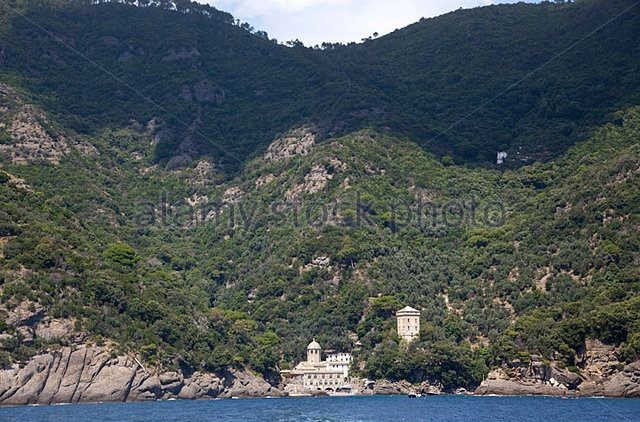
I have already written about San Fruttuoso in an earlier post, but it’s worth repeating here that while charming San Fruttuoso is very remote. The only ways to reach it are by boat from Camogli, which even today can be impossible if the sea is too rough, or by foot up and around the mountain and then down a steep track to the shore – in Merello’s days either your own feet or mules’ feet. But Merello buried himself and his family here for eight years, despite many calls from his friends to return to civilization. He paid the price for his isolationism. In 1913, his younger son died of diphtheria because medical help couldn’t arrive quickly enough. His wife had a breakdown after her son’s death (poor woman, who can blame her after the hermit’s life her husband had imposed on her), and Merello himself was never quite the same. He moved the remaining family to Santa Margherita Ligure in 1914 and worked there, mostly on sculptures, until he died.

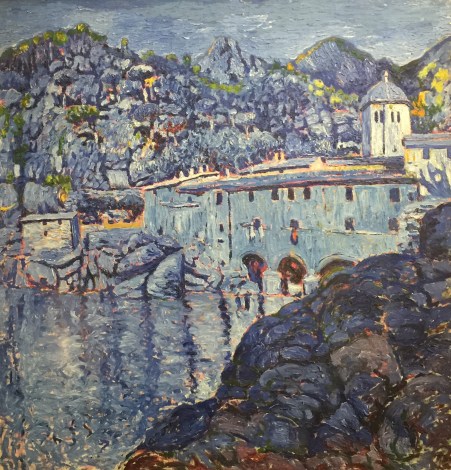
Because Merello chose to stay in San Fruttuoso, most of his paintings are of the hamlet and its surroundings. His paintings of the hamlet itself are interesting but no more than that.


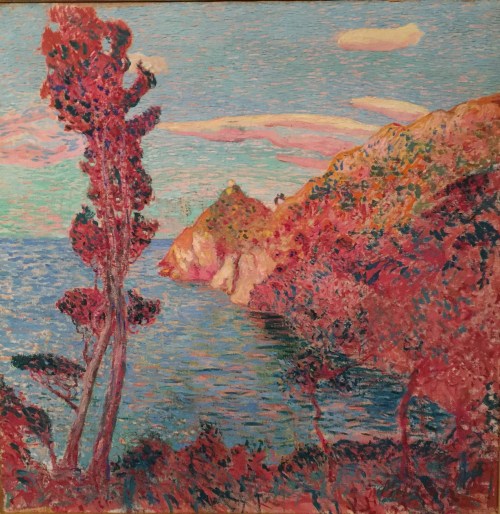
It’s when Merello clambered up the mule track behind San Fruttuoso to be high up above the village that his paintings begin to grip me. There was one view in particular which he painted again and again, almost obsessively it would seem, a view of the small bay of San Fruttuoso from the Monte di Portofino, which I have been always fond of. It is a plunging view, from high up the mountain down to the lapis lazuli sea far below, seen through a screen of trees. It is a view much photographed.

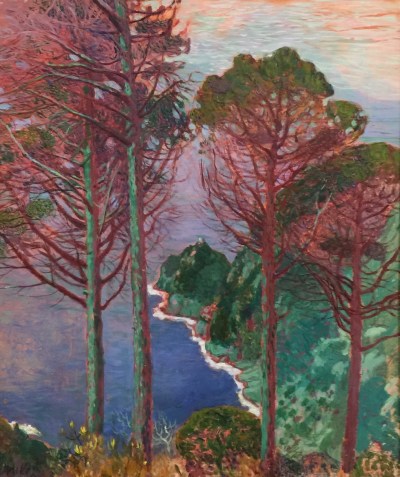
Merello tried a number of colour combinations for the view, resulting in a fascinating array of paintings.


Even more striking, though, were his paintings still from high on the mountain but now focusing just on pines and the sea in the far distance.

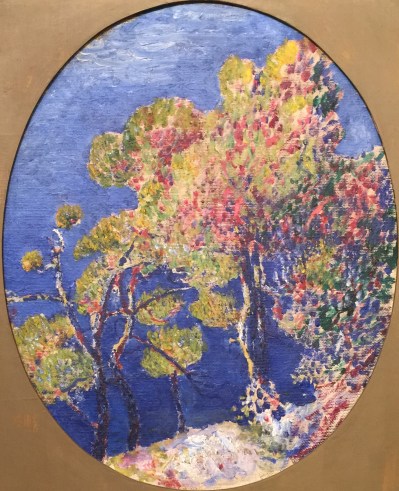
He arrived finally at an almost abstract composition of pine against water.

If this last painting had fallen off the back of a truck, I would not have hesitated to keep it, on the basis of the morally dubious saying “Finders keepers, losers weepers”. Out of a somewhat masochistic curiosity, I checked auction prices for Merello’s paintings. While many orders of magnitude below what you need in your bank account to buy a (real) Picasso, at around €40,000 a painting they are way out of my league. Well, I guess I’ll never have a Merello on my wall – unless it falls off the back of a truck.

_______________

Rubaldo Merello: http://www.palazzoducale.genova.it/rubaldo-merello-la-vita/
San Fruttuoso: http://www.alamy.com/stock-photo/san-fruttuoso-bay.html
San Fruttuoso: https://www.fondoambiente.it/luoghi/abbazia-di-san-fruttuoso
The bay of San Fruttuoso from above: https://www.tripadvisor.it/LocationPhotoDirectLink-g227888-d4569424-i112196609-Camogli_San_Rocco_Batterie_San_Fruttuoso_Trail-Camogli_Italian_Riviera_L.html
Other photos: my pics

OSMANTHUS FRAGRANS

Osaka Airport, 22 October 2017

My wife and I have been in Kyoto these last three weeks. I was here to once again give my course on sustainable industrial development at the university. But I don’t want to discuss that, I want to talk about a scent wafting on the breeze.

As we walked around the quiet neighborhood where we had taken an AirBnB, I found my nose suddenly being assailed by a very sweet smelling scent. The first few times it happened, I couldn’t locate an obvious source around me and I began to fear that I was suffering from olfactory hallucinations, that a tumor was growing in my brain and was beginning to press against whichever bit it is that controls one’s sense of smell. What made me particularly susceptible to this theory was that the scent was distinctly similar to the one most toilet cleaning products emit; you know, the scent which wafts off that bright blue or pink stuff you squeeze into the toilet bowl, leaving your toilet smelling like heaven.


Maybe the tumor was triggering olfactory memories of my toilet … Luckily for my growing levels of paranoia, the third or fourth time it happened I located the source. It was an unprepossessing tree on the corner of the road.

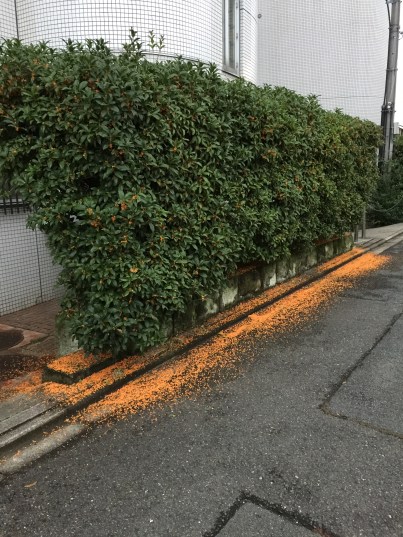
It was covered in small orange flowers.

Relieved that the scent was not a figment of a diseased brain, I set to work trying to figure out what plant it was. A google search quickly revealed its Japanese name to be kinmokusei, and that in the month of October it fills the air with its sweet scent. A further search revealed that its official name is osmanthus fragrans, with its English names being sweet olive, tea olive, or fragrant olive (the reference to olive apparently having to do with a similarity in leaf shape to the olive tree).

According to its Wikipedia entry, the several varieties of osmanthus are “native to Asia, from the Himalayas through southern China to Taiwan and southern Japan and southeast Asia as far south as Cambodia and Thailand”. The mention of China rang a bell somewhere in my (non-diseased) brain, something I had read once, while living in China, about osmanthus jam. Sure enough, the Wikipedia article revealed that the Chinese make an osmanthus-scented jam, but also osmanthus-scented tea, dumplings, cakes, soups, wine, and liquor. My wife and I never tasted any of these delicacies when we lived in China, but that was Beijing, in northern China, outside the osmanthus’s range.

The China connection and the nostalgia it evoked in me made me dig a little more. I discovered that the plant’s relationship with China is long; the Chinese have been cultivating it for some two and a half thousand years – its sweet scent saw to that. As might be expected, the Chinese poets weaved it into their work. Here is Wang Wei, an 8th Century Tang Dynasty poet:

I’m quiet, osmanthus flowers fall,
Tranquil is this spring night, empty the hill,
The rising moon startles mountain birds,
Which call awhile in the spring stream.

Or here we have the 12th Century Song Dynasty female poet, Li Qingzhao:

I recover from illness,
My temples have turned grey.
I lie down to rest and watch the waning moon
Climb up my screen.
Tender lips meet sweet mace, boiled in water,
Aromatic as tea.
Books and poems are so dear to me
While I sit idle against a pillow.
The outside scene freshens when rain falls.
All day long, facing me lovingly
Is the sweet osmanthus.

Things have come to a pretty pass when a flower’s scent, which made the Chinese poets sing, only makes me think of toilet fresheners! What a dumbing down we are witnessing …

Luckily for me, the Chinese themselves have made a connection between the flower’s sweet scent and more malodorous things. Osmanthus flowers bloom more or less in the eighth lunar month, which is when the Imperial civil service examinations were originally held.

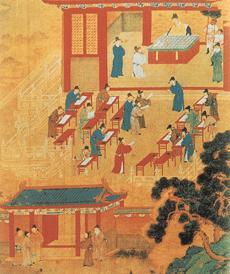
This temporal connection gave rise to a phrase in late Imperial China which was used to euphemistically indicate that a candidate had successfully passed the exam: “pluck osmanthus in the Toad Palace”. Passing the exams would now open up to the successful candidate positions in the administration where myriad possibilities would exist for him to conclude sweet deals to his advantage during the rest of his no doubt illustrious career. Imperial examinations have vanished, only to have their place taken by the gaokao, the university entrance exams.

This is the first critical step to defining how successful a career you can have in China and how much of a life of preferment and sweet deals you will enjoy. “Plus ça change et plus c’est la même chose”, the more things change and the more they stay the same, as the French writer Jean-Baptiste Karr once observed.

While I have been reading up on all this, Typhoon Lan has been brewing in the Pacific to the east of the Philippines. Now it is moving ponderously northward towards Japan. The rain that’s been falling as a prelude to its arrival has stripped the Osmanthus bushes of their flowers.

Their scent is finished for this year. It’s time for us to fly home, hopefully before Typhoon Lan makes a landfall and closes the airport.

_____________

Toilet cleaner: https://wifinowevents.com/news-and-blog/22000-agree-clean-toilets-wi-fi/
osmanthus fragrans: my pictures
Chinese Imperial exams: https://m.youtube.com/watch?v=AXGQt7Ts1wo
Gaokao exam: http://blog.tutorming.com/expats/what-is-gaokao-chinese-college-entrance-exam
Fallen osmanthus flowers: my picture

CONKERS AND CHESTNUTS

Milan, 26 September 2017

A few days ago, my wife and I decided that for our usual afternoon walk we would take the subway up towards the northwest of Milan and then walk back home. This strategy had us walk through a small park that was once part of the grounds of the royal palace. As we walked down one of the park’s shady avenues, conkers started raining down on us. Well, that may be a bit of an exaggeration. Let’s say that two or three seed balls came cannoning down from above our heads and landed with a thump on the gravel, releasing their conkers which rolled around our feet. I picked one up and rubbed it gently with my fingers. Fresh conkers are really lovely, with their brown, lustrous skin and their smooth velvety feel.

Their seed casing is also very pretty, bright green with soft spikes all over it.

More than anything, though, conkers bring back happy memories from my childhood. I still distinctly remember during the breaks in the schoolyard fishing out my conker from my pocket and squaring off for conker duels with my friends. For those of my readers who are not familiar with this playground game, let me quickly explain how it works.
– Find a conker.
– Drill a hole through it with a nail.
– Thread a shoelace or other such string through the hole, and make a strong knot at the end.
– Face your opponent.
– One of you lets his conker dangle, let’s say your opponent.
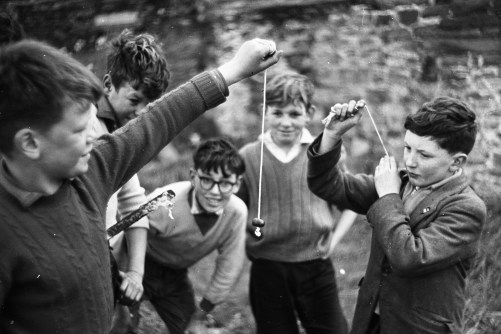
– You swing your conker at his conker in a rather special way – see the photo below, which looks to have been taken during my boyhood years.

– If your opponent’s conker breaks, you win. If not, you dangle your conker and your opponent takes a swing at it.
And so on, until either one of the conkers breaks or the bell rings and it’s time to go back to those boring classes.

Conkers was, of course, a game of Autumn, played in the first month or so of the school term until the conkers stopped dropping off the trees and the conker supply dried up. Other games then took over the schoolyard until it was mid-September again and time to prepare that monster conker which would surely smash all other opponents in the schoolyard.

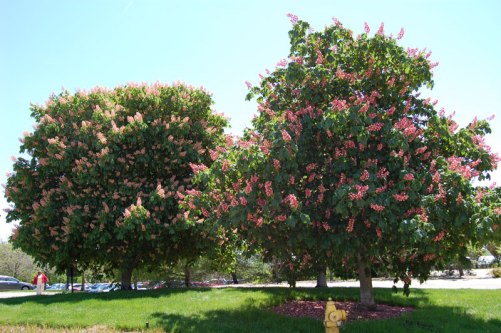
In case any of my readers are wondering, conkers come from the horse chestnut, that tree which gives lovely white or pink flowers in the Spring


and which in the last several decades have often looked distressingly mangy by summer time

the result of attack by the leaf miner moth. It seems that this disease was first noticed in Macedonia and has been marching across the globe ever since.

Perhaps, like I used to, some of my readers think that chestnut trees and horse chestnut trees are related. I mean, the nuts in both cases are so similar, as are their casings!

Yet they are not. They each belong to quite different families. I suppose this must be a case of convergent evolution.

One thing which very definitely distinguishes them is that conkers are not edible, but chestnuts very much are. And in fact in this Autumn season, Milan’s shops and markets are putting out piles of chestnuts to entice you.

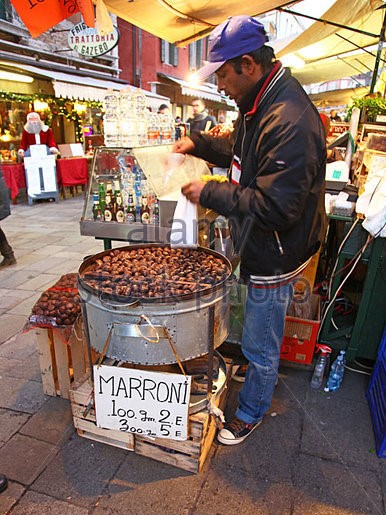
I haven’t yet seen chestnut roasters on street corners, though.

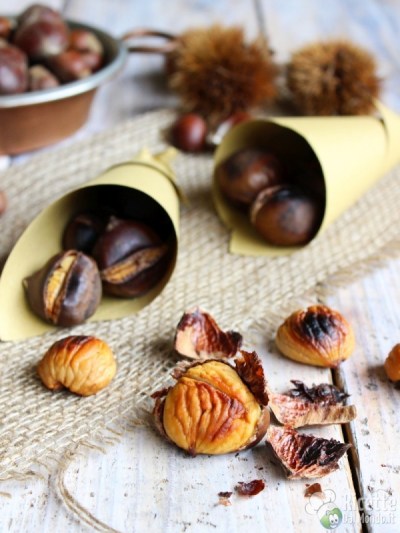
Maybe they only appear when the weather turns cooler. I await them with anticipation, so that I can buy my paper cone full of roasted chestnuts.

________________

Conkers: https://www.google.co.uk/amp/s/www.collinsdictionary.com/amp/english/conker
Conker seed case: https://www.google.co.uk/amp/www.dailymail.co.uk/sciencetech/article-3838298/amp/The-end-conker-Playground-staple-vanish-15-years-horse-chestnut-trees-felled-pests-disease.html
Playing conkers: https://www.google.co.uk/amp/s/www.pinterest.com/amp/pin/437834394994706958/
White horse chestnut tree in flower: http://www.davekilbeyphotography.co.uk/index.php/plants-landscapes/species-trees/horse-chestnut-05/
Pink horse chestnut in flower: https://ag.purdue.edu/btny/ppdl/Pages/POTW_old/6-10-13.html
Horse chestnut attacked by leaf miner: http://www.alamy.com/stock-photo-common-horse-chestnut-tree-damaged-by-the-leaf-miner-moth-cameraria-39467824.html
Chestnut and casing: http://tcpermaculture.blogspot.it/2012/09/permaculture-plants-chestnuts.html?m=1
Chestnuts in an Italian market: http://mercatidiroma.com/mercato-trionfale/trionfale
Chestnut roaster, Italy: http://www.alamy.com/stock-photo/chestnut-street.html
Cone of roast chestnuts: http://www.ricettedalmondo.it/caldarroste.html

STORM CLOUDS OVER VENICE

Milan, 5 September 2017

We had come to Venice to celebrate the 65th birthday of two dear friends. They had invited a number of us from their past to share in this celebration. So there we were, some twenty in all, all slightly geriatric, stepping off the bus-boat onto the island of la Giudecca and gathering at a restaurant by the edge of the wide canal which separates this island from the rest of Venice.

As we sipped our aperitifs and later seated ourselves around two tables ranged along the edge of the canal, vast cumulo-nimbus clouds hovered to the north of us.

By the time we had finished the entrées (tris of raw fish, chopped fine, with sauces) and were tucking into the risotto cooked in a shellfish sauce, the sky had turned dark and menacing and the restaurant owner was worried that gusts of wind would carry his shade umbrellas away.


By the time we finished the main course (tuna seared briefly in the pan), the epicenter of the rain clouds sat above the campanile in St. Mark’s Square.

Once coffee was served, after a pannacotta for dessert, the clouds were dissipating and sunshine was breaking out again over Venice.

We said our goodbyes, promising, as has been the custom with these birthday parties, to meet again in five years’ time (and ignoring the little voice inside us emitting the hope that we would all still be of this world then), and went our separate ways. Ours took us through St. Mark’s Square, where the rain clouds to the west still looked menacing

but no rain fell on us as we threaded our way through the alleys back to our hotel.
__________________
Photos: all ours