DREAM JOURNEY: PART I

Beijing, 8 May 2013

May is a good time to be in the Mediterranean. The weather is good, the temperatures not too high, the vegetation still green, and the flowers blooming. I feel restless, I want to be there. But it cannot be; the rent must be paid, as must the gas and electricity, not to mention the food, the occasional bottle of wine and other sundries. I must earn my living.

The internet is a wonderful thing though. Sitting on my living room couch in the evenings, navigating with my little black mouse and clicking my way through hundreds of internet pages, I can visit all the places I want to be in but cannot. So I have decided.  Riding the surf of the web, my wife and I will take a trip I have long wanted to make: a visit to a string of sites around the northern rim of the Mediterranean which are known for their early Christian mosaics. In an earlier post I have alluded to my fascination with this art form.

It’s time to start. As I sit in front of my computer screen, I have to first wrestle with the question of what car my wife and I will travel in on this virtual trip we are about to make. With the freedom that comes from a trip in my imagination – no cost considerations, no considerations of practicality (is the boot big enough?) – I first think of taking a Smart; I like its cheerfully odd shape and I have never driven one.

Smart-Car

But on further consideration, I plump for an MG convertible, and specifically a model which is as old as we are.
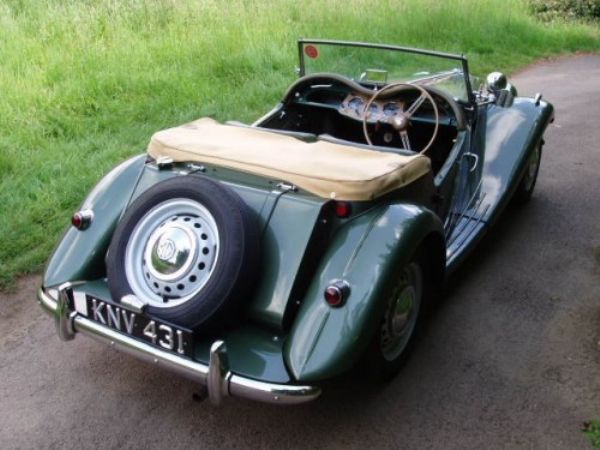
MG car

In my imagination we can have the roof down and enjoy the sun on our faces and the wind in our hair (although the only time we ever drove such a car in the real world it started raining and we had no idea how to put the roof back in position).

So here we are, comfortably ensconced in our little MG. Where do we start our journey? I pick Ravenna, because the city has one of the finest collections of early mosaics still extant. Actually, it’s a small miracle that there are any mosaics left at all, either in Ravenna or anywhere else. Over the millennium and a half that separates us from their creation, they have suffered from the ravages of religion: from outright hostility towards their symbolic potency, to their neglect through changes in artistic fashion. They have suffered from natural catastrophes like earthquakes and fires. And last but not least, they have suffered from the four horsemen of the Apocalypse – Conquest, War, Famine, and Death – sweeping repeatedly across the face of the land; every time the horsemen passed, not only did people die but the beautiful things they had created were destroyed. You only have to see what is happening to Syria’s irreplaceable cultural heritage in this time of civil war to know what I mean.
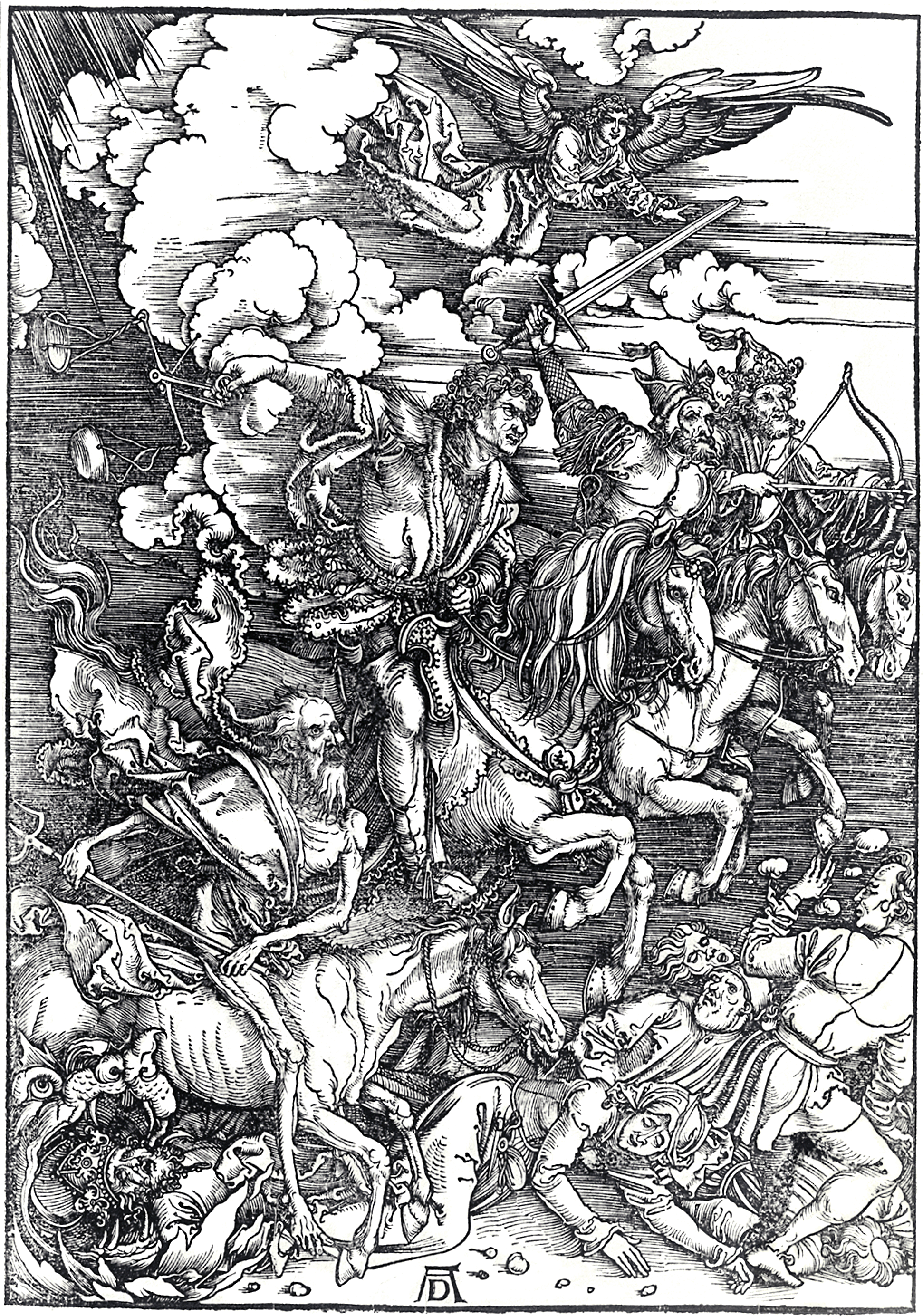
4-horsemen-apocalypse-1-durer

Ravenna sadly exemplifies what I’ve just described. It became the capital of the Western Roman Empire in 402 AD, when everything was beginning to fall apart there. In 490, it was put under siege for three years and finally captured by the Ostrogothic King Theoderic. In 540, it was captured by the Byzantines after a war with the Ostrogoths. In 751, it was captured by the Longobards after a long war of attrition between them and the Byzantines. In 774, to thank Charlemagne for taking Ravenna away from the Longobards and giving it to him, Pope Adrian I allowed Charlemagne to take away anything he liked from the city to enrich his capital in Aachen. Lord knows how much Ravenna lost, but it must have been a lot. Over the following centuries, lordship over Ravenna swapped hands many times as the papacy’s claim to Ravenna was contested by local families. Finally, in 1275 a local family, the De Polenta, made Ravenna their long-lasting seigniory, which gave the city some stability for nearly 200 years. Then from 1440 to 1527, Venice ruled Ravenna, although in 1512, during one phase of the Italian wars, Ravenna was sacked by the French. Thereafter, Ravenna again became part of the Papal States and stayed there, except for a short interlude during the French Revolution and Napoleonic Empire, until 1859, when it became part of the new Italian State. After that, apart from some bombing by the Austrians during the First World War, Ravenna knew peace. Truly, it is a minor miracle that we have any mosaics left after all this mayhem. And I haven’t even included the natural disasters which the city suffered along the way.

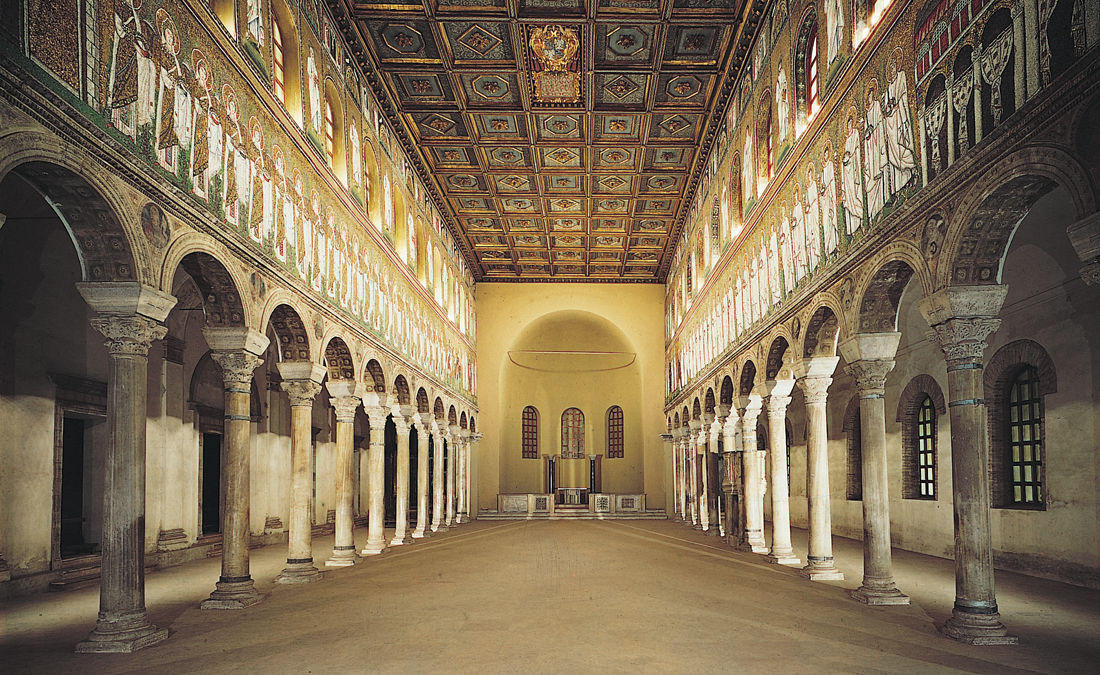
It’s time to start our journey and visit some of what is left. After clicking around a bit, I choose for us to drive up and park in front of the church of Sant’Apollinare Nuovo, where the mosaics date from the 6th Century. Here’s what greets us when we enter the church.
sant'apollinare nuovo-2

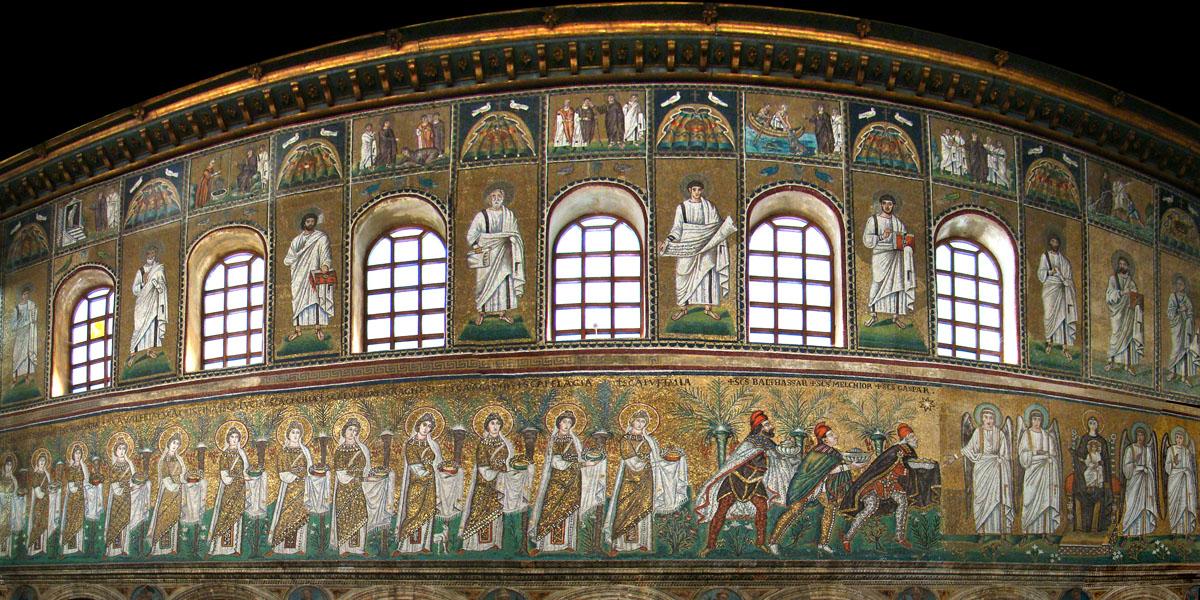
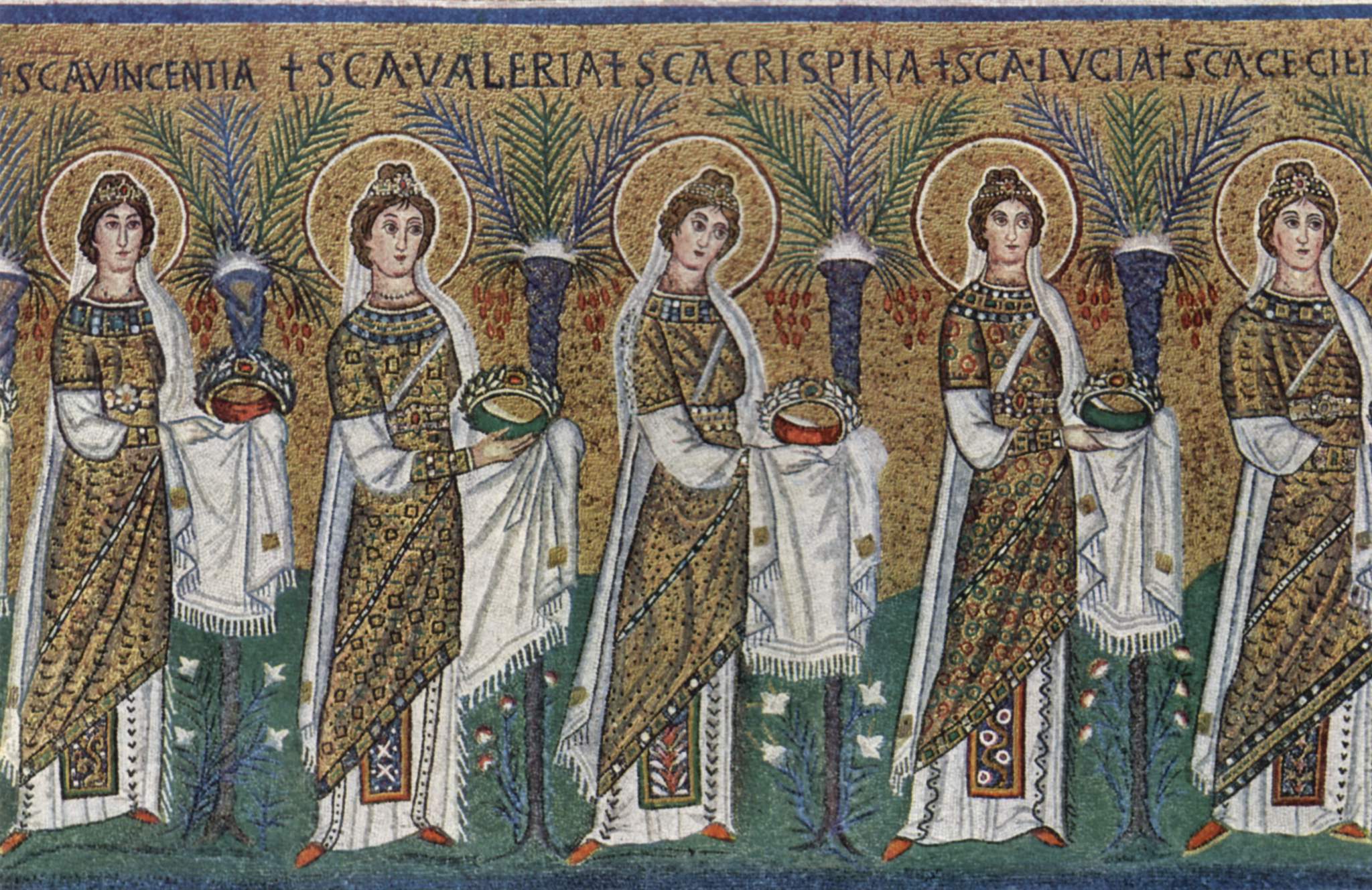
On either wall of the nave, runs a line of men and women, saints and martyrs, processing solemnly towards the altar.  My wife and I prefer to focus on the women principally because among them is the martyr who has our daughter’s name. It gives us a comforting sense of connection.
sant'apollinare nuovo-5

sant'apollinare nuovo-4

Originally, the two lines were processing towards a scene of stately splendour in the apse. But it is gone, victim to a desire to modernize; it was removed during renovations in the 16th Century. The apse itself was so badly damaged by Austrian bombing during the First World War that it had to be rebuilt.

Time to move on to the church of Sant’Apollinare in Classe, and in a couple of clicks we’re there. With much the same layout as the other Sant’Apollinare, and with mosaics from the same period, it is its mirror image: the mosaics in the nave have disappeared, victim to the depredations of the Venetians in the 15th Century, but the apse glows with a magnificent mosaic, where the colour of grass dominates: a green and pleasant land for the Christian faithful.

sant'apollinare in classe-3

sant'apollinare in classe-1

This great expanse of mosaic colour makes me decide to visit the Mausoleum of Galla Placidia. So with a click, a hop and a jump we’ve gone from church to mausoleum and are gazing up at the wonderfully dark blue ceiling

mausoleum galla placidia-2

There are other early mosaics in Ravenna, but it’s time to leave. We’ll see them another time.

Next stop: Venice.

As I gaze at Google Map trying to choose which road to take, I decide all of a sudden that it would be in keeping to follow the trace of the old Roman roads. To do this, I will rely on the Peutinger map. This is the only existing example of a Roman map of the Empire’s road network. It now resides in the Austrian National Library. It is actually a 13th Century copy, made by an anonymous monk in Colmar in Alsace, of what was probably a 5th Century original, itself a distant descendant of the original made by one Marcus Vipsanius Agrippa for the Emperor Augustus in the last years BC. It is so rare that it has been placed on UNESCO’s Memory of the World Register. This photo shows one section of the map, showing Italy from Rome to Sicily

peutinger map segment IV

Actually, I find the map very difficult to read; it is not to scale, it is not oriented the way modern maps are, and many of the place names mean nothing to me. So it is with considerable relief that I discover that someone has transcribed the Peutinger map onto a modern map. Studying this map, I decide we will follow the trace of the old Via Popillia, which once connected Rimini with Adria and the Via Annia. My intermediary objective is Fusina, just south of Mestre. I’m driving there because in this trip of my imagination I want to enter Venice the way it was meant to be entered before they built the causeway, by sea. And Fusina is the only place where you can catch a ferry into Venice from the mainland.

So we motor up to Fusina, and in my zeal to follow the trace of the old Roman road (I can already see my wife tapping her fingers impatiently at these signs of anal behaviour on my part) we do so through a complicated series of back roads which take us through a number of small towns and villages and finally along the SP (Strada Provinciale) 53, with us cutting down to the right at some point to get to Fusina. In my defence, the coastline between Ravenna and Venice has changed a lot since Roman times; the silt brought down by the River Po and a number of other rivers in this area has pushed the coastline out quite a distance. As a result, the road network in the area has changed considerably over the centuries. In any event, we’ve arrived; by the way, the website I just used informs me that we have travelled about LXXV Milia Passuum (75 thousand paces, or 75 Roman miles), which in Roman times would have taken us about VI dies (6 days) to walk. We park the car and wait for the next ferry; the timetable available online helpfully informs me that there is a ferry every hour on the hour, so I don’t suppose we need wait too long. No doubt there is a bar where we can sit down and have a cappuccino.

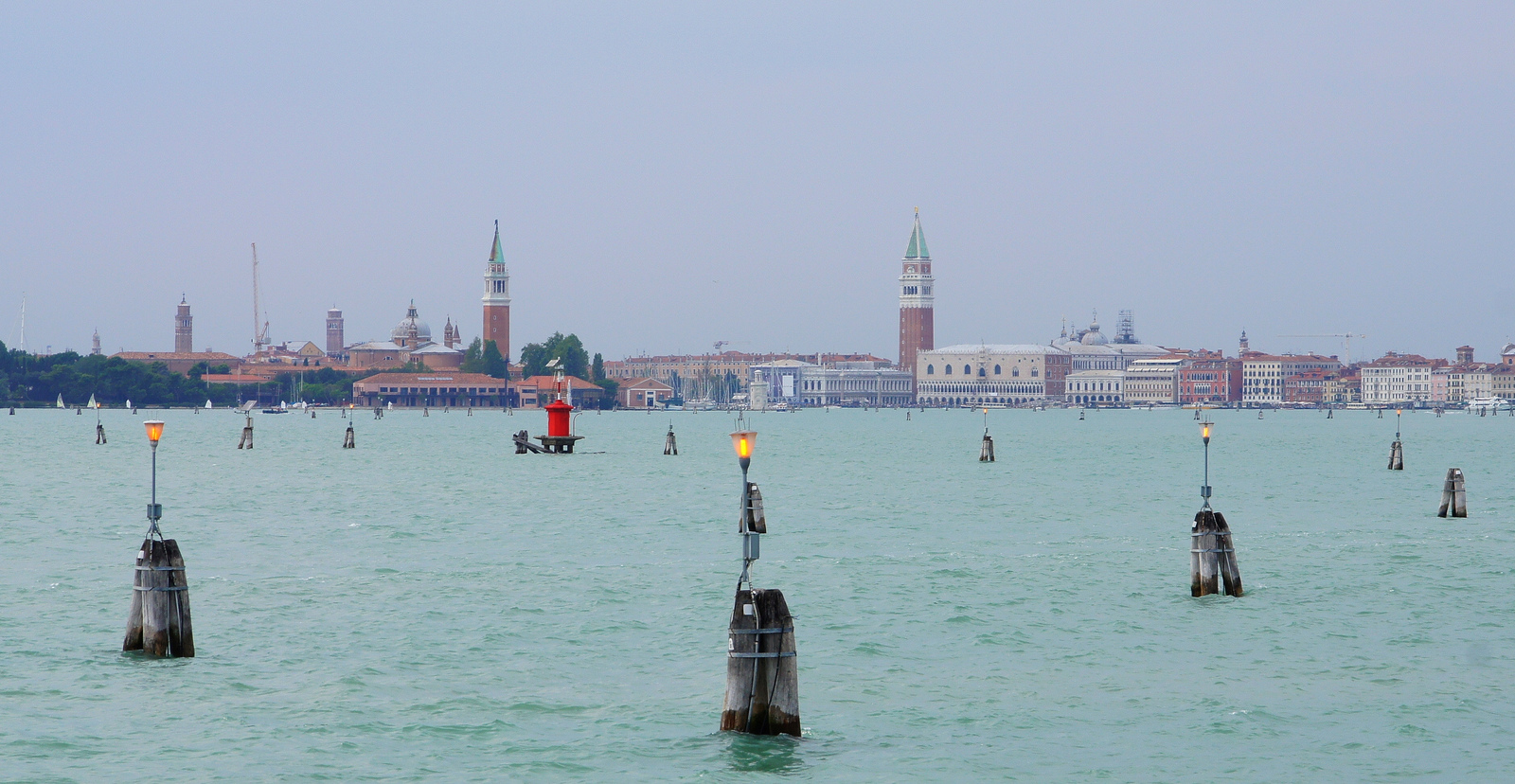
With a click we are on the ferry heading across the lagoon. As we get closer, we see this incomparable picture of Venice before us.
view from ferry

All too soon, it is time to get off at Zattere, to the south of the Canal Grande. We start threading our way through Venice’s maze of alleyways, crossing the Canal Grande at the Ponte dell’Accademia, and then after a sharp right in Campo Santo Stefano walking on to Piazza San Marco. Here, I stop and reveal to the reader that Venice is not actually our destination; we are going instead to the small island of Torcello to the north of the main island. It is true that the Basilica of San Marco is full of mosaics, but most of them are relatively modern, pale copies of the paintings of the time – and the church is always so horribly crowded with tourists! So we turn left in Piazza San Marco and head up to the north side of the island, to Fondamente Nova, where the municipality’s website helpfully informs me that I should catch the N9 aquatic bus. In my mind’s eye, when it arrives the bus is crowded with people going to the small nearby island of San Michele, the city’s graveyard. My wife and I squeeze on, and we wait patiently until after the stop at the graveyard and possibly also the following stop at Murano to be able to sit down. Then there’s a stop in the island of Burano before we finally get to Torcello.

Torcello was a place of refuge in the troubled centuries after the collapse of the Western Roman Empire. It was here and in the other islands of the Venetian lagoon that people came to escape from the depredations of the passing waves of various barbarian tribes. Until the 12th Century or so, it was a vibrant place with a significant population, but gradual silting of this part of the lagoon not only killed off the island’s more important economic activities but brought malaria to its inhabitants. So everyone left for Venice itself and now hardly anyone lives here. It is very peaceful, with just the church surrounded by vineyards.

Torcello Aerial view

This abandonment might well have saved the mosaics which we are about to see. We walk up the path from the aquatic bus stop to the church, go in, and find this in front of us

torcello-8-front

And turning around, this behind us

torcello-6-back wall

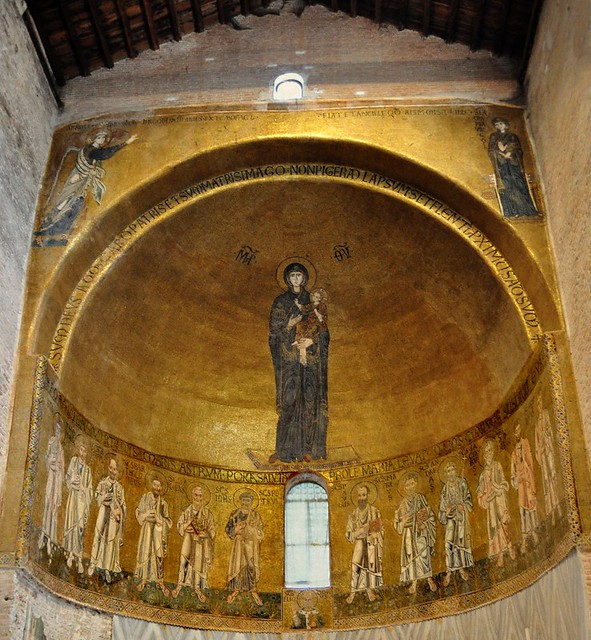
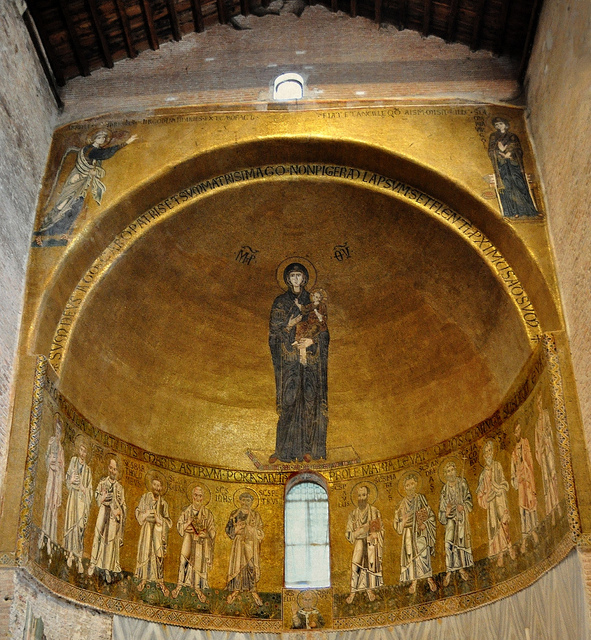
We have leapt forward some six centuries from Ravenna, with these mosaics being from the 11th and 12th Centuries. The style has changed, from one which in Ravenna still echoed the Roman styles to one which is much closer to that rigid style we call “Byzantine” as well as to what was later to become the medieval style. We walk forward to get closer to the mosaic in the apse, which is of the Virgin Mary with the infant Jesus.
torcello-5

I love this mosaic, with its gentle Madonna floating in a huge field of gold. I still remember well the impact it had on me the first time I saw it, a decade ago, on a late Autumn afternoon. The memory of that gentle face in its sea of gold has stayed with me ever since.

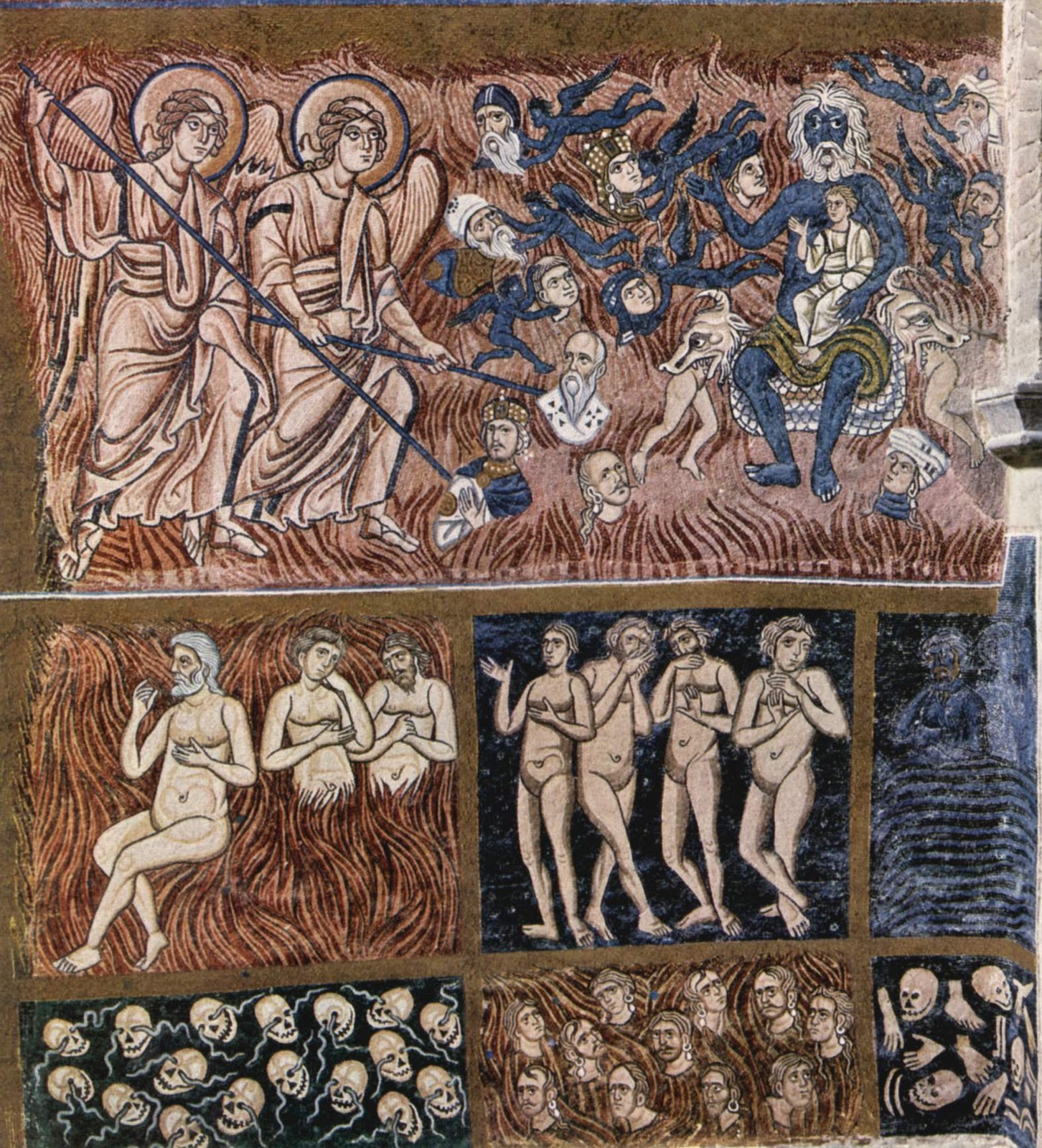
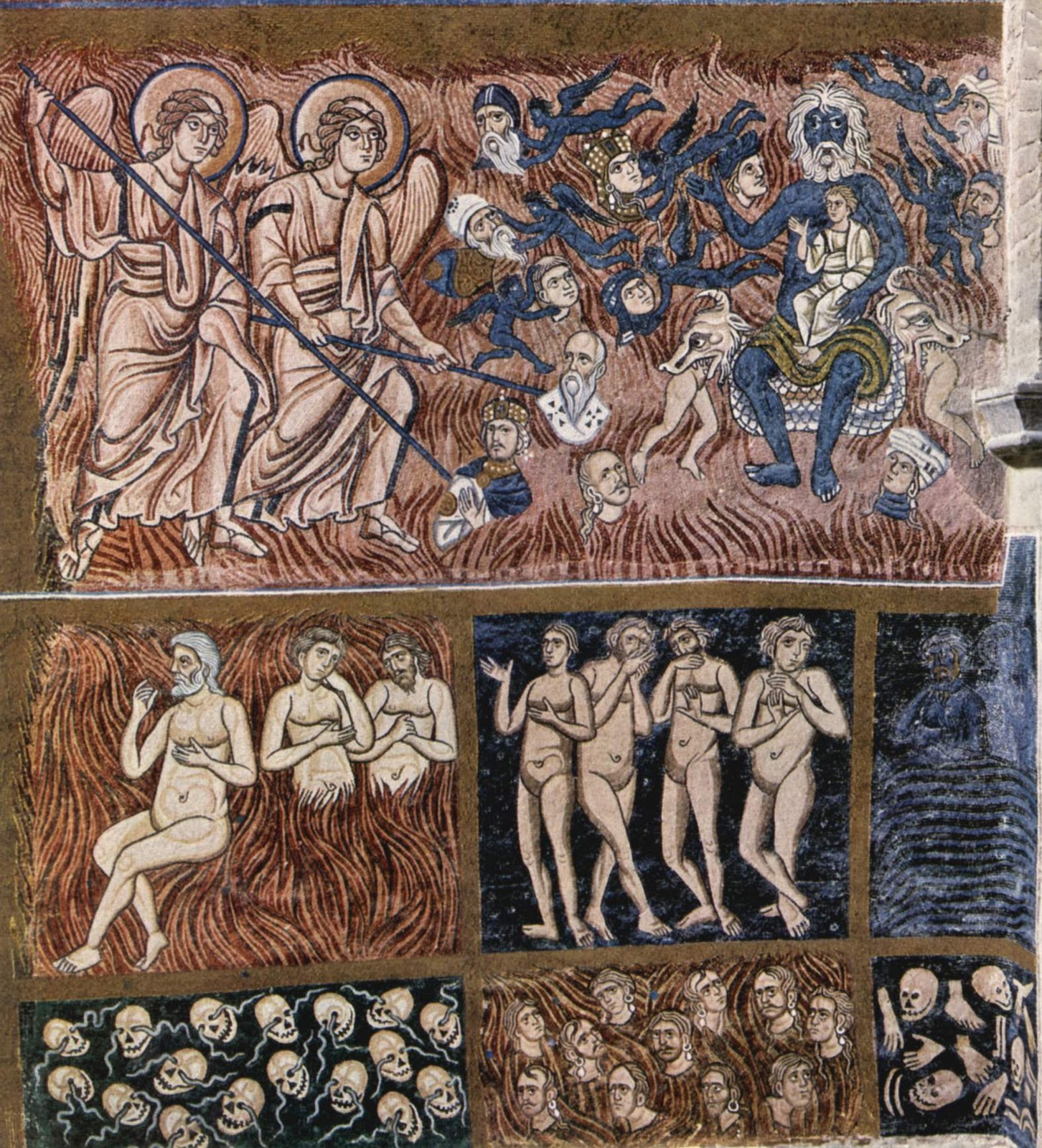
The mosaic on the back wall, a Last Judgement, is also spectacular, no doubt about it, but it doesn’t hold me as much. There are the usual scenes of naughty people being punished for their sins
Torcello-9-Last Judgment detail

The Middle Ages had a morbid fascination for this kind of stuff. But I find it all rather puerile. It always reminds me of the scary stories we used to tell each other in the dormitories at school after lights out, to give ourselves a delicious thrill of fright.

Onwards!

With a click of my mouse, my wife and I are back in Fusina, driving out of the car park in the little MG. We are now heading to Aquileia (79 Roman miles; 6 days’ marching). True to my promise to myself to follow the old Roman roads, I want to pick up the Via Annia, a major Roman road which linked Padova with Aquileia. We pick our way across the main road into Venice along the causeway and take the SS (Strada Statale) 14, which pretty much follows the trace of Via Annia. We bowl along, with the sun in our faces and the wind in our hair, passing Venice’s airport, and maybe catching sight to our right of Torcello’s tall campanile in the distance. We pass through Concordia Saggitaria, where we meet the Via Postumia, which ran across the whole of northern Italy from Genova to Aquileia, and on to Cervignano del Friuli. At Cervignano, we turn right onto the SR (Strada Regionale) 352 and a few Roman miles later arrive in Aquileia.

Poor Aquileia. During the Roman period it was an important city, guarding the eastern marches of Italy, which was the core of the Empire. A look at a map shows that any tribe from Central and Eastern Europe and beyond necessarily had to pass this way to enter the Italian lands, whether with peaceful intentions or not. When the Empire had its borders along the Danube River, Aquileia was the gateway to the rougher provinces of Illyricum, Dacia and Thrace that backed the frontier. As such, it was the starting-point of several important roads leading to this north-eastern portion of the Empire.

As the Empire’s western half collapsed and its borders were breached, the tribes did come, along those roads so helpfully built by the Romans. And the roads led to Aquileia, which was such a tempting target. It was first besieged by Alaric and his Visigoths in 401, who attacked it again and sacked it in 408 on his way to sacking Rome. Then it was attacked by Attila and his Huns in 452, who so utterly destroyed it that it was afterwards hard to recognize the original site. It rose again, a pale shadow of its former self, but was once more destroyed, by the Longobards this time, in 590. Today, it is just a quiet little village.

Aquileia’s loss was Venice’s gain. After each barbarian invasion, more of its inhabitants, along with those of smaller towns around it, fled to safety in the lagoon’s islands nearby, and so laid the foundations of Venice, but also of Torcello which we just visited, and of other lagoon towns.

We have come to visit the Basilica. From the outside it has all the look of a Romanesque church, and indeed it was built in 1031.

Basilica exterior

But when you go in, you find yourself in front of a vast mosaic floor, which quite takes your breath away

basilica floor-5

basilica floor-6

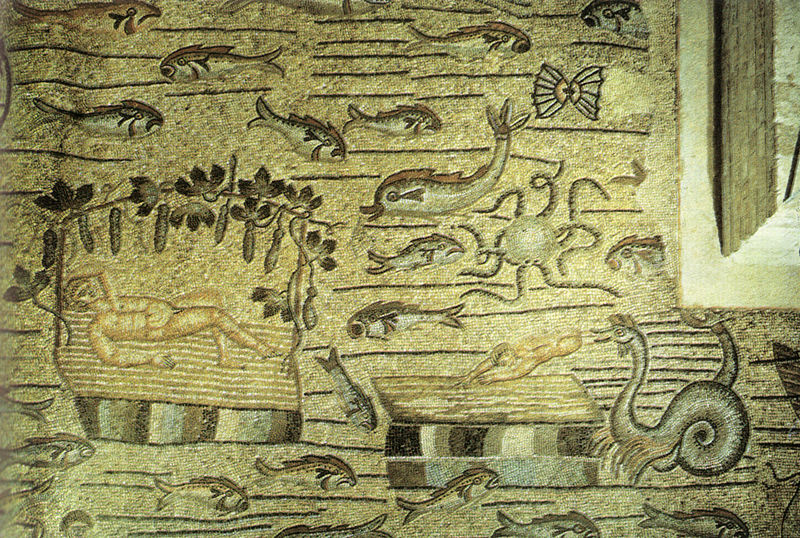
It was laid down in the 4th Century in a building which was destroyed by Attila’s Huns and around which a new church was built six centuries later. In fact, the builders covered up the mosaic with a new floor, and it wasn’t until 1909, when this floor was removed, that the mosaics once more saw the light of day. The subjects depicted include symbolic subjects, portraits of donors, scenes from the Gospels and dedicatory inscriptions. I show just one detail of it.
basilica floor-particular

These are even earlier than the mosaics we saw in Ravenna, and the Roman influence is clear. We could almost be looking at the mosaic floor of some vast Roman villa.

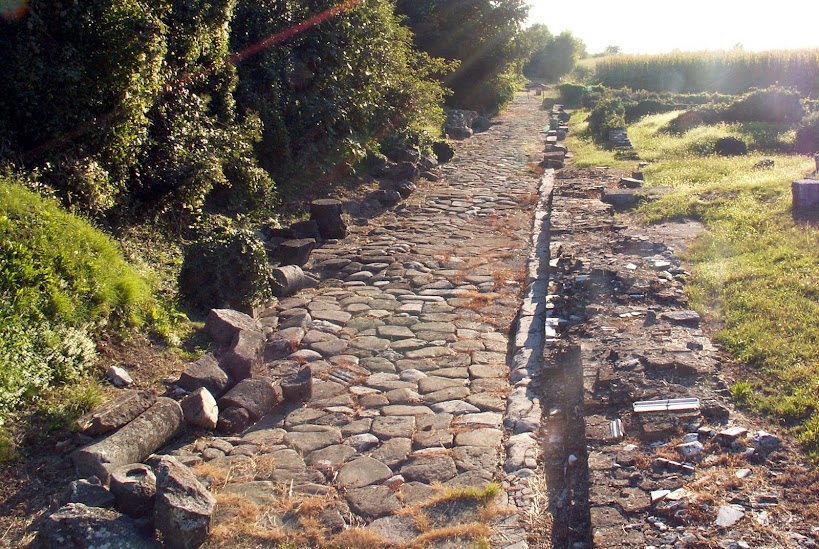
After admiring the mosaic floor and visiting other mosaics in the baptistery, my wife and I leave and walk around the ruins of the Roman town. As I click around, I am in a melancholy mood. So much destroyed, and for no purpose. We see the remains of one of the Roman roads that led out of the city.

roman road-3

The road beckons. After a rest, we’ll continue our journey north-eastward, from whence came the tribes which destroyed Aquileia.

(Readers who are curious to know how this dream trip continues can hyperlink here to the next leg of the journey)

______________________

Smart car: http://www.kinghdwallpaper.com/wp-content/uploads/2013/03/Smart-Car.jpg
MG car: http://www.msmclassifieds.co.uk/autoclass/stock-images/fliw8myjsf/oilhekvry4/fb173nj5q1.jpg
4 horsemen apocalypse-Durer: http://mcalmont.files.wordpress.com/2013/01/dur_4horse.gif
Sant’Apollinare Nuovo-1: http://apah.lakegeneva.badger.groupfusion.net/modules/groups/homepagefiles/49961-87537-58717-18.jpg
Sant’Apollinare Nuovo-2: http://classconnection.s3.amazonaws.com/256/flashcards/1016256/jpg/22early_christian_and_byzantine_%28student%291351736386614.jpg
Sant’Apollinare Nuovo-3: http://upload.wikimedia.org/wikipedia/commons/f/fd/Meister_von_San_Apollinare_Nuovo_in_Ravenna_002.jpg
Sant’Apollinare in Classe-1: http://upload.wikimedia.org/wikipedia/commons/thumb/f/fd/Sant%27Apollinare_in_Classe,_Ravenna.jpg/1280px-Sant%27Apollinare_in_Classe,_Ravenna.jpg
Sant’Apollinare in Classe-2: http://pixdaus.com/files/items/pics/9/49/73949_68edee7b4d49d43caa20681b9709f5bd_large.jpg
Mausoleum Galla Placidia: http://www.cittadarte.emilia-romagna.it/images/galleries/ravennaintro/ra-mausoleo-galla-placidia-mosaico-volta-celeste.jpg
Peutinger map segment: http://libweb5.princeton.edu/visual_materials/maps/websites/thematic-maps/qualitative/peutinger-table-map-1619.jpg
View from the ferry: http://farm9.staticflickr.com/8149/7667954390_2eafc258f6_h.jpg
Torcello aerial view: http://www.venicenews.info/Resource/TorcelloAerial.jpg
Torcello-1-front: http://venezia.myblog.it/media/00/00/1215490241.jpg
Torcello-2-backwall: http://d1ezg6ep0f8pmf.cloudfront.net/images/slides/a2/8812-torcello-cathedral-nave-looking-west.jpg
Torcello-3: http://farm7.staticflickr.com/6094/6362159351_0d3fe8a136_z.jpg
Torcello-4-last judgement detail: http://4.bp.blogspot.com/-wKvqFMTU-O8/TuyBuW4hnqI/AAAAAAAAAg8/-L3J_V80UC4/s1600/Last+Judgment+Torcello+Tweede+plaatje.jpg
Aquileia Basilica exterior: http://upload.wikimedia.org/wikipedia/commons/8/87/Basilica_Aquileia_1.JPG
Aquileia Basilica floor-1: http://img11.rajce.idnes.cz/d1102/7/7156/7156708_b33224f9e53bf0956558a717bbf58ec8/images/Aquileia_-_Basilica.jpg
Aquileia Basilica floor-2: http://static.turistipercaso.it/image/f/friuli/friuli_qhjf9.T0.jpg
Aquileia Basilica floor particular: https://upload.wikimedia.org/wikipedia/commons/thumb/8/8c/Aquileia,_storia_di_giona,_pavimento_della_basilica,_1a_met%C3%A0_del_IV_secolo.jpg/800px-Aquileia,_storia_di_giona,_pavimento_della_basilica,_1a_met%C3%A0_del_IV_secolo.jpg
Aquileia Roman Road: https://lh5.googleusercontent.com/-QkR-yVgM57g/SOy7HQQg_OI/AAAAAAAAYB4/7b6E9opcEuo/w819-h549/Aquileia+-+Roman+road.jpg

NORTH KOREAN TRAFFIC POLICE

Beijing, 8 April 2013

My older brother, whom I mentioned in my previous posting, sent me an email yesterday asking me if I would join the lengthening list of foreigners who, according to the Financial Times, are leaving Beijing because of the pollution but also more recently because of the sharp increase in the levels of bellicosity emanating from North Korea. I should explain that I have the dubious privilege of also covering North Korea for my organization and in this guise I have visited the country a few times. My personal view, for what it’s worth, is that all the shouting and bawling by the North Korean leadership has more to do with solidifying support for a young, callow leader than with an actual desire for war. So it is with a certain complacency that I watch footage on the world’s TV programmes of Kim Jong Un showing off his military skills in front of admiring generals.

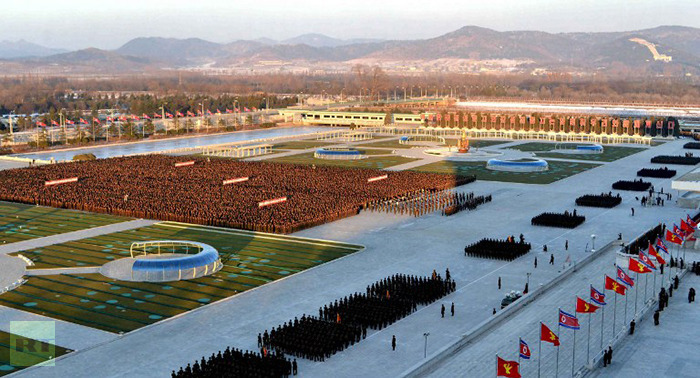
On the other hand, I am particularly taken by TV footage showing North Korean soldiers marching around Pyongyang’s central square; I am a great admirer of their drilling skills. When I was a boy at school we had to play at soldiers once a week (on Monday afternoons to be precise), and part of the play was learning to drill. So I have a keen appreciation, born from many miserable hours marching about the school parking lot, of how complicated it is to get a bunch of men – and women – to walk in step, goose-step at that, stiff as robots, and have them wheel and turn in precise unison around a square.

north korean soldiers drilling-2

TOPSHOTS-NKOREA-POLITICS-KIM

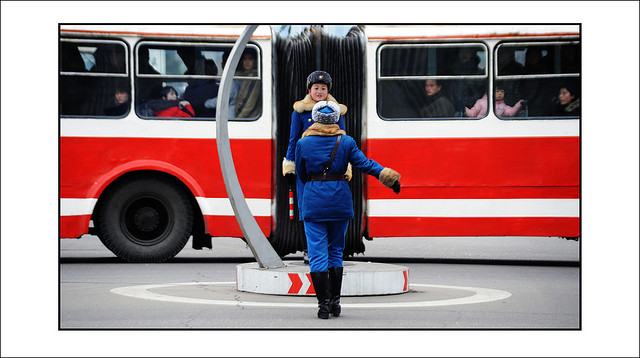
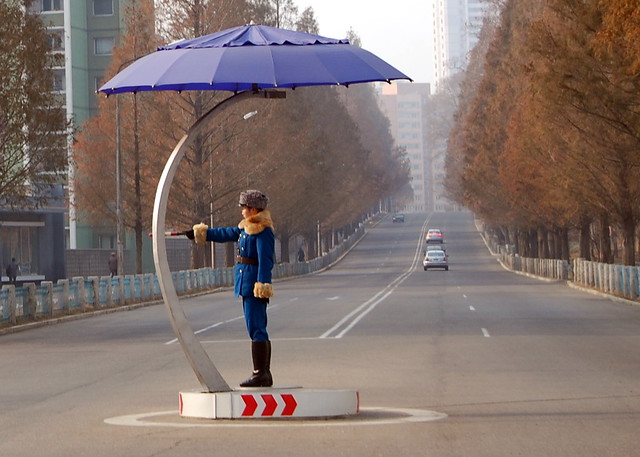
All this marching around makes me think of one thing which particularly struck me and my wife during my first visit, and her only visit, to Pyongyang: the traffic police. At the time of that first visit, Pyongyang didn’t have any traffic lights and what little traffic there was at road crossings was regulated by women police officers (they were all women). And let me tell you, these ladies were no slouches! They were most military in style. It started when they took up their shift, which saw them marching briskly to their spot in the middle of the crossroads.

traffic police girl-marching into position-1

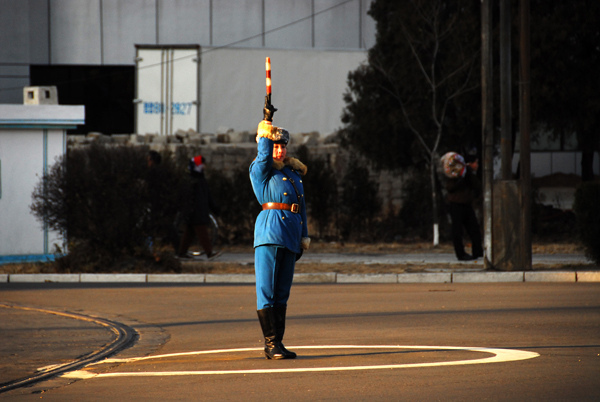
Once in place, they regulated traffic with a baton, very visible arm signals, and a stern face. My wife and I watched them for a while and we came to the conclusion that this was the code:

“Change in flow patterns about to take place!”

traffic police girl-pointing up-3

“Traffic from my right [or left] can turn left [or right]!”

traffic police girl-pointing forward-3

“Traffic coming from my left [or right] can go straight past me”

traffic police girl-pointing across chest-1

After warning of a change, the policewoman would wheel smartly on her heel to face in the right direction.

It was a fascinating militaristic ballet to watch.

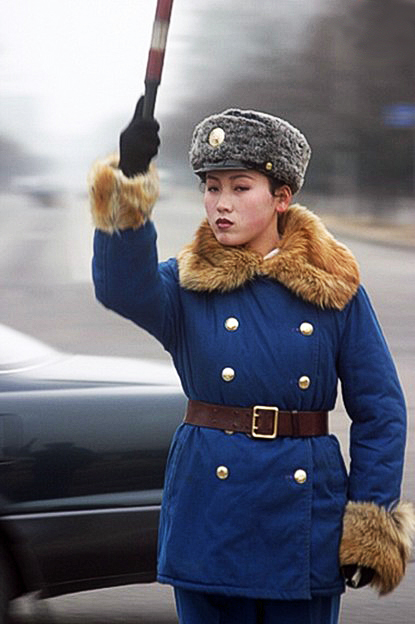
There is also a fashion element in all of this. The first three photos show the ladies in their winter uniform, the last in their summer uniform. Personally, I prefer the winter uniform.

We are not the only ones to have found the traffic policewomen fascinating. There is a whole website dedicated to them! I admire all the photos that were taken. We were told not to take photos, and I meekly complied. But others clearly ignored the interdict. As you can see, the policewomen were Not Amused by these law-breakers.

traffic police girl-pointing up-2

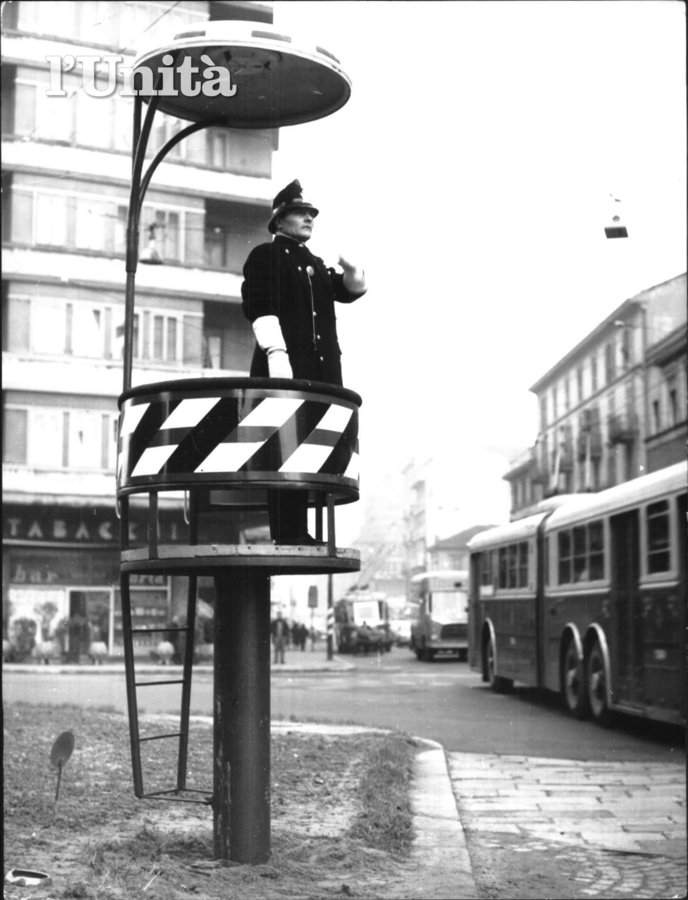
Before boring traffic lights were introduced, I suspect all countries had these traffic police. Italy certainly did. My wife remembers them well from her youth, and I have found a few old photographs of them on the web.

traffic police italy-7

traffic police italy-9

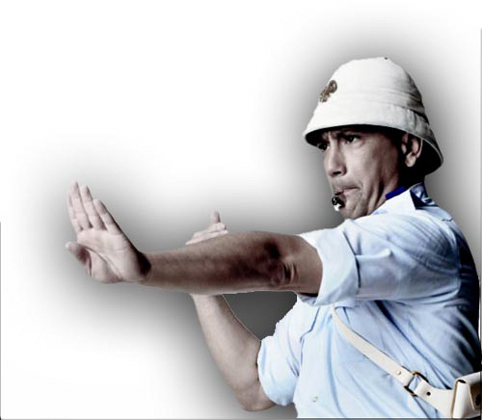
From the makes of the cars, we reckon the photos were taken in the late ‘50s, early ‘60s. I’ve seen the Italian police in action a few times when traffic lights have gone on the blink (or perhaps I should say off the blink). I must say, they were very theatrical: step 1, gaze intensely at the oncoming cars; step 2, raise the hand slowly and very obviously; step 3, snap it into place and accompany it with a short, shrill blow on the whistle.

traffic police italy-4

I am reminded of a story my elder brother told me many years ago – the same brother with whom I started this post. In the late ‘60s, he was staying in Rome for a few months, in the Trastevere district. He recounted that there was a policeman who was particularly well known by the district’s locals for his elegant style in directing traffic. When it was time for his shift, an admiring crowd would gather to watch him in action, and at the end of his shift they would clap – at least, so claimed my brother; but this last part I doubt.

Sadly, I saw during my last visit to Pyongyang that traffic lights have arrived there. As for the traffic police ladies, they were left to slouch about in a most unmilitary fashion at their road crossings, playing no obvious role that I could see. Sic transit gloria mundi.

________________________

N. Korean soldiers drilling-2: http://l2.yimg.com/bt/api/res/1.2/bEb._9Przkk9QLPFPdhNsQ–/YXBwaWQ9eW5ld3M7Y2g9MTk2OTtjcj0xO2N3PTMwMDA7ZHg9MDtkeT0wO2ZpPXVsY3JvcDtoPTQxNDtxPTg1O3c9NjMw/http://media.zenfs.com/en_us/News/ap_webfeeds/b886bb1bad68ea0a0c0f6a706700c977.jpg
N. Korean soldiers drilling-3: http://rt.com/files/online-exclusive/galleries/north-korea/army-plaza-soldiers-marching/i182d25fd3712d679f42df606bce13c57_000_hkg-639412.jpg
Traffic policewoman taking up her shift: http://farm3.staticflickr.com/2754/4380470489_8189781b65_z.jpg
Traffic policewoman pointing up: http://farm3.staticflickr.com/2531/5758279854_5b5d42c09c_z.jpg
Traffic policewoman pointing forward: http://farm3.staticflickr.com/2737/4166260885_fbca4d5637_z.jpg
Traffic policewoman pointing across: http://cfile217.uf.daum.net/image/194F2C234B98B8423417CE
Traffic police Italy-1: http://desk.unita.it/cgi-bin/showimg2.cgi?file=F_NAT_L2_0701/00000029/0000400F.c28b7356.jpg&t=big
Traffic police Italy-2: http://desk.unita.it/cgi-bin/showimg2.cgi?file=F_NAT_L2_0701/00000029/0000396F.1280fd16.jpg&t=big
Traffic police Italy-3: http://termoli.files.wordpress.com/2009/09/vigile.jpg

MY CRUISE OF FIRSTS

Beijing, 5 April 2013

My previous post about chocolate Easter eggs led me to take a page from Charles Dickens and I allowed myself to be visited by the ghost of Easters past. He took me back through memories of previous Easters, some very pleasant and others not so much. One in particular has stayed with me, the Easter I passed on a cruise in the Mediterranean when I was 14.

My English grandmother had decided that she would like to go on a cruise but wanted company. So she took me and my older brother along with her. It was a wonderful trip, one of those golden-hued memories that each one of us has. Easter itself was celebrated without much fuss and bother in Brindisi, in southern Italy – we were just a few Catholics among a sea of Anglicans and so were packed off to a small room on the ship and a local priest was brought in for the occasion.  A surf through the web tells me that Easter occurred on April 14, two weeks later than this year. We were already towards the end of the cruise. There were a couple more stops in what was then Yugoslavia and is now Croatia, at Split and Dubrovnik, and then it was back to Venice where we had boarded ship. Before Brindisi, we had visited Olympia, Crete, Athens, Istanbul, Ephesus, and then finally Rhodes before starting back (there was also a visit to one of the smaller Ionian islands but I no longer remember which one).

For me, this was a trip of many firsts (well, the whole trip was a first but there were certain things which were more first than others, if you get my drift).

It was my first trip to Venice, one which my wife and I have repeated many, many times, sometimes with the children, first from Milan when we lived there and then later from Vienna. What I fell in love with that first time and keep going back to is not the grand theatricality of St. Mark’s Square

venice-st marks square

or of the laguna, which the cruise ship sailed down as we left Venicevenice-the lagoon

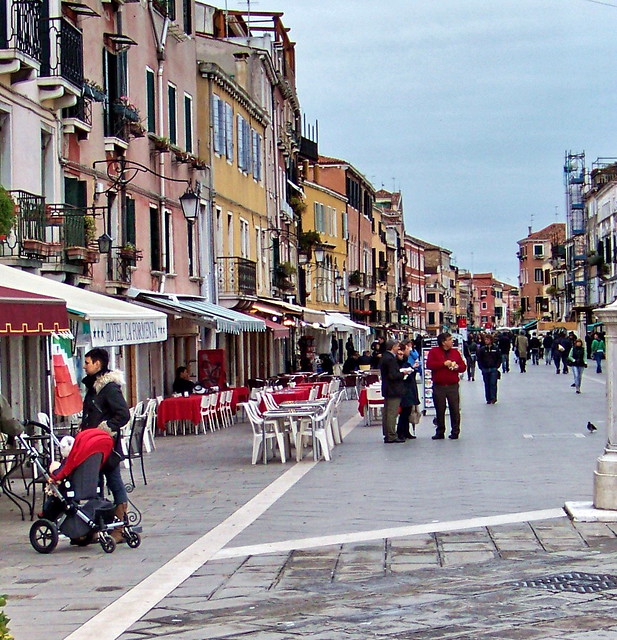
No, what always bring us back is the humbler Venice, the alleys and lanes (it’s hard to talk of streets when there are no cars) far away from the tourist haunts, which widen and narrow with no apparent rhyme or reason, which loop and re-loop over narrow canals, which suddenly bring you, blinking in the light, into small piazzas teeming with life.

venice-calle-1

venice-calle-2

venice-calle-3

venice-calle-4

We spent the afternoon before setting sail wandering around, map in hand – a map is always necessary in Venice, although my wife is not really of that opinion: ask people the way, that’s her motto.

The cruise also took me on my first visit to classical ruins. England and the parts of France I was then familiar with don’t have any Roman ruins to speak of; an odd crumbling wall here and there is about the sum of it. Here, we had a feast!

Olympia

olympia-column-2

Knossos

Knossos-palace-1

Mycenae

mycenae-lion-gate-4

The Acropolis in Athens

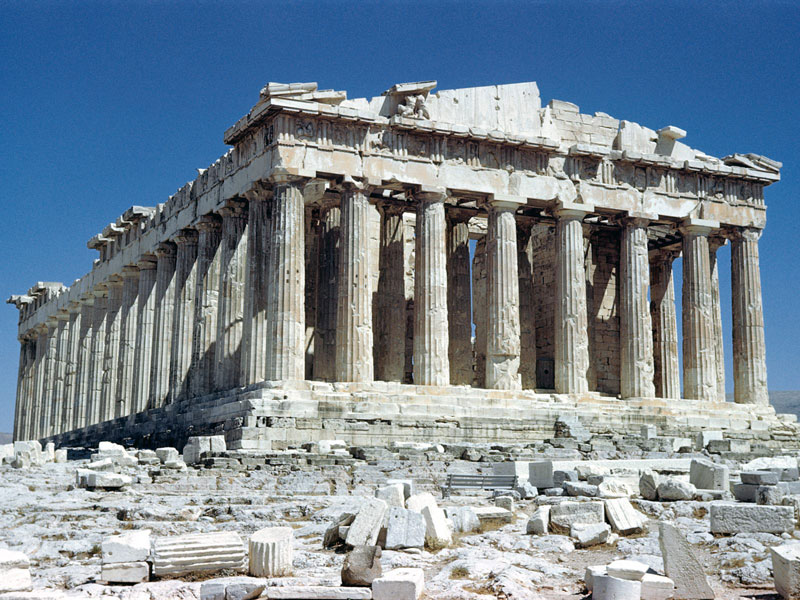
athens-acropolis-1

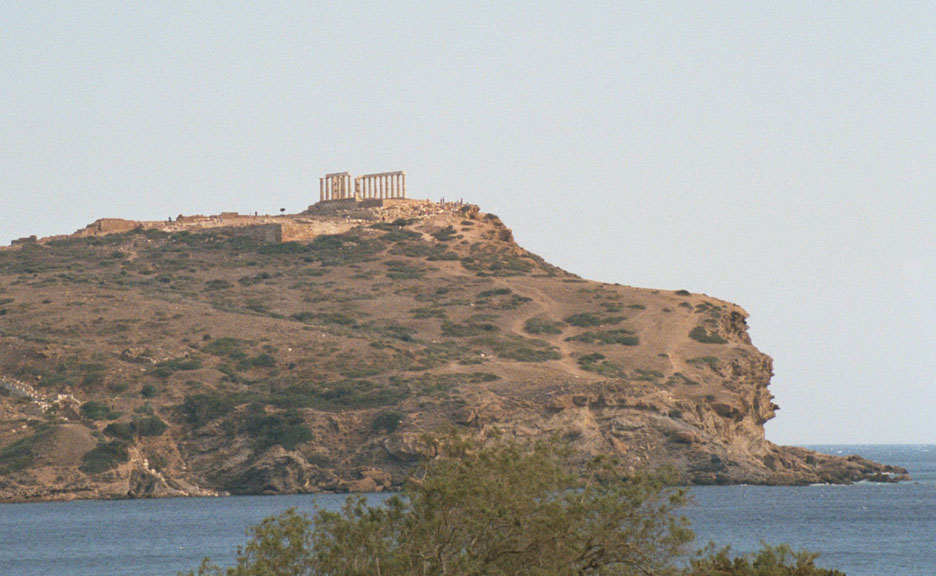
Cape Sounion

cape-sounion

Ephesus

ephesus

Actually, it was more a surfeit than a feast. To be very honest, after I’ve seen three broken columns and five fallen walls the experience begins to pall. Many decades later, when I got to know Shelley’s poem Ozymandias I could relate to all these ruins and many others I have seen since all over the world in a different way:

I met a traveller from an antique land
Who said: Two vast and trunkless legs of stone
Stand in the desert. Near them, on the sand,
Half sunk, a shattered visage lies, whose frown,
And wrinkled lip, and sneer of cold command,
Tell that its sculptor well those passions read
Which yet survive, stamped on these lifeless things,
The hand that mocked them and the heart that fed:
And on the pedestal these words appear:
“My name is Ozymandias, king of kings:
Look on my works, ye Mighty, and despair!”
Nothing beside remains. Round the decay
Of that colossal wreck, boundless and bare
The lone and level sands stretch far away

But, in all this blur of broken stone one memory stands out, etched for ever more in my mind: wildflowers growing in profusion among the ruins of Olympia. A search of the web shows that I am not the only traveler to Olympia who has been struck by the flowers there:

olympia-wildflowers-6

olympia-wildflowers-5

SANYO DIGITAL CAMERA

The trip was also my first real exposure to Greek sculpture. My grandmother had taken me a few times to the British Museum but somehow we always seemed to end up in the section of the Egyptian mummies – at least, that’s all I remember of those early visits. But the visit to the National Archaeological Museum in Athens was a real eye-opener for me. Two pieces I remember particularly well. One was the statue of Zeus (or is it Poseidon?):

Athense-bronze_statue_of_Zeus_or_Poseidon-1

Look at that face!

Athense-bronze_statue_of_Zeus_or_Poseidon-3

Speaking of faces, the other piece that impressed itself on me was the gold mask which Schliemann dug up in Mycenae (our Greek and Latin teacher had often quoted the phrase “I have gazed upon the face of Agamemnon”, said to have been uttered by Schliemann when he first set eyes on the mask)

agamemnon-1

Another notable first on this trip was my exposure to Byzantine mosaics, in the cavernous interior of Hagia Sophia in Istanbul.

istanbul-hagia sophia-interior-1

istanbul-hagia sophia-mosaics-1

istanbul-hagia sophia-mosaics-4

istanbul-hagia sophia-mosaics-5

This started an interest – an obsessive interest, my wife might observe – in early Christian mosaics, which I have tracked down in various parts of the Mediterranean basin since then.

Istanbul was the site of yet another first, my first exposure to Muslim architecture, in the form of the incomparably beautiful Sultan Ahmed Mosque.

istanbul-sultan ahmed mosque-exterior-2

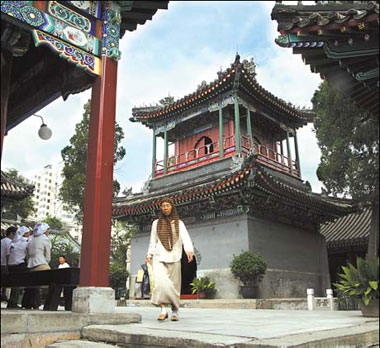
Since then, I have been lucky enough to admire Muslim architecture in all its wonderfully different variations in many parts of the world – even here in Beijing, where it has taken on decidedly Chinese characteristics.

beijing mosque

Iran and Central Asia await me still …

On a lighter note, the cruise was the first – and probably last – time I saw the foxtrot being danced. Every evening a three-man band played in the dance room. It started with oldies, and a retired English Major and his wife were assiduous dancers. As the band started up, they would step out, glide through a number of foxtrot numbers, and then retire to the bar.

foxtrot-1

They looked surprisingly like this picture, just somewhat longer in the tooth.

After they had left, the tempo changed and us young things would take over the dance floor and dance the night away. Well, I didn’t. I was far too shy. I would look on enviously at the elder young things. At last, one took pity on me and led me to the floor to dance my first modern dance. Another first …

Last, but definitely not least, it was on that cruise that I first set eyes on the Mediterranean. It was love at first sight.

mediterranean sea-3

______________________

Venice-St Mark’s square: http://www.instablogsimages.com/1/2012/04/25/sunset_on_st_marks_square_image_title_upyro.jpg
Venice-Lagoon: http://cdn2.vtourist.com/4/3990973-looking_back_from_the_water_bus_Venice.jpg
Venice-calle-1: http://renaissancerules.files.wordpress.com/2011/01/venice-2009-294.jpg
Venice-calle-2: http://picasaweb.google.com/lh/photo/Vx_htYT8ClwJ1DwCpMcy1A
Venice-calle-3: http://www.cepolina.com/photo/Europe/Italy/Venice/Venice-mix/3/Venice-street-narrow-calle-rill.jpg
Venice-calle-4: http://farm2.staticflickr.com/1265/5186001188_065ec8a290_z.jpg
Olympia: http://images.fanpop.com/images/image_uploads/Olympia-greece-585497_1024_768.jpg
Knossos-palace: http://ant3145crete.wikispaces.com/file/view/Knossos_1.jpg/68392549/Knossos_1.jpg
Mycenae-lion-gate: http://www.civilization.org.uk/wp-content/uploads/2012/02/Mycenae-Lion-gate-028.jpg
Athens-acropolis: http://www.limotaxi.gr/wp-content/uploads/2010/10/athens1.jpg
Cape Sounion: http://www.grisel.net/images/greece/sounion11.JPG
Ephesus: http://historyoftheancientworld.files.wordpress.com/2012/09/theatre2.jpg
Olympia-wildflowers-1: http://farm3.staticflickr.com/2245/2331955314_1629efb4ab_z.jpg
Olympia-wildflowers-2: http://farm3.staticflickr.com/2380/2331125289_93eb068ca2_z.jpg
Olympia-wildflowers-3: http://www.touringtykes.com/wp-content/uploads/2010/02/olymipia-flowers.jpg
Athens-statue of Zeus/Poseidon-1: http://upload.wikimedia.org/wikipedia/commons/6/67/Bronze_statue_of_Zeus_or_Poseidon.jpg
Athens-statue of Zeus/Poseidon-2: http://cdn.arstechnica.net/wp-content/uploads/2011/11/zeus_or_poseidon_national_archaeological_museum_athens-4ecd0b1-intro.jpg
Athens- Gold Mask “Agamemnon”: http://hernandopages.com/agamemnon.jpg
Istanbul Hagia Sophia-interior: http://hansmast.com/images/istanbul/hagia_sophia/IMG_1846_Enhancer-IMG_1857_Enhancer-2.jpg
Istanbul-Hagia Sophia-mosaics-1: http://www.mosaicartsource.com/Assets/html/artists/lilian/mosaic_hagia_sophia.jpg
Istanbul-Hagia Sophia-mosaics-2: http://www.sacred-destinations.com/turkey/istanbul-hagia-sophia-photos/slides/imperial-entrance-mosaic-c-hbetts.jpg
Istanbul-Hagia Sophia-mosaics-3: http://www.turkey4travel.com/wp-content/uploads/2009/05/hagia-sofia-mosaic.jpg
Istanbul-sultan ahmed mosque: http://www.viitoaremireasa.ro/images/articole/large/2084/Istanbul-Orasul-care-se-intinde-pe-doua-continente-5.jpg
Beijing mosque: http://www.chinadaily.com.cn/cndy/attachement/jpg/site1/20080815/000802ab80450a0f185656.jpg
Foxtrot: http://ssqq.com/archive/images/foxtrot.jpg
Mediterranean Sea-3: http://1.bp.blogspot.com/-4O6DVn4JTeQ/UG6WCS6K7yI/AAAAAAAAFaQ/NHquXzafTsA/s1600/43923144.jpg

WALNUTS IN DALI

Beijing, 24 March 2013

I mentioned in a recent posting that I had just come back from a business trip. This was to Dali, in the province of Yunnan, or to give it its full name the Dali Bai Autonomous Prefecture. My first day was spent in the city of Dali, which sits on the southern shore of Lake Erhai. I was there to hold discussions with the local government. I was pleased to be back in Dali, which is a pleasant city, in contrast to most Chinese cities. For one thing, the site is really quite spectacular.

Erhai Lake-3

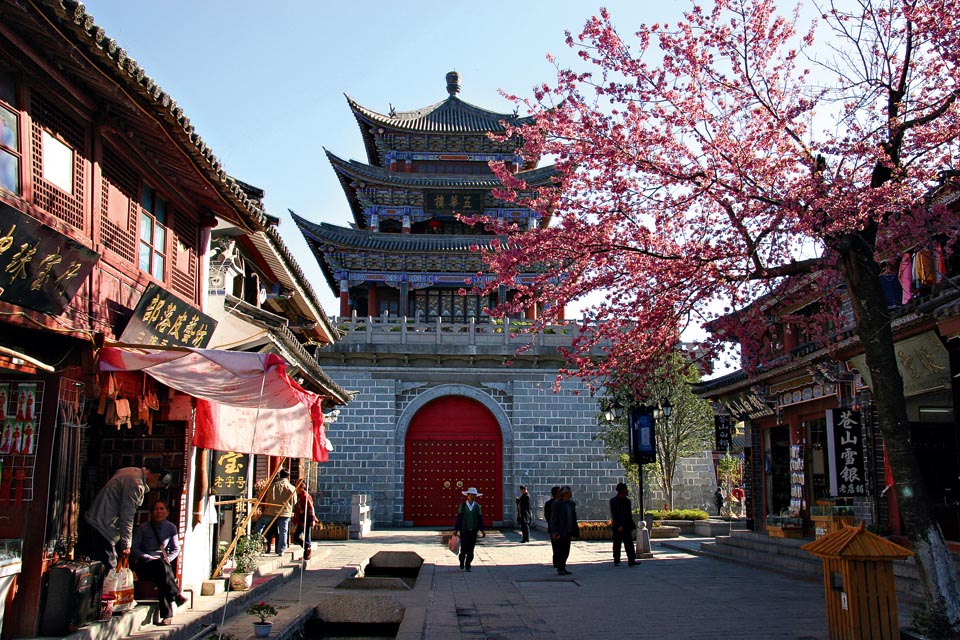
There’s also a nice old city, which hasn’t been swept away by revolution or later by capitalism. It’s been considerably prettified for the tourists, but it’s still a nice place to walk around. I didn’t go there this time, but I had seen it during my last visit to Dali. There are some well-known old pagodas

Dali-three-pagodas

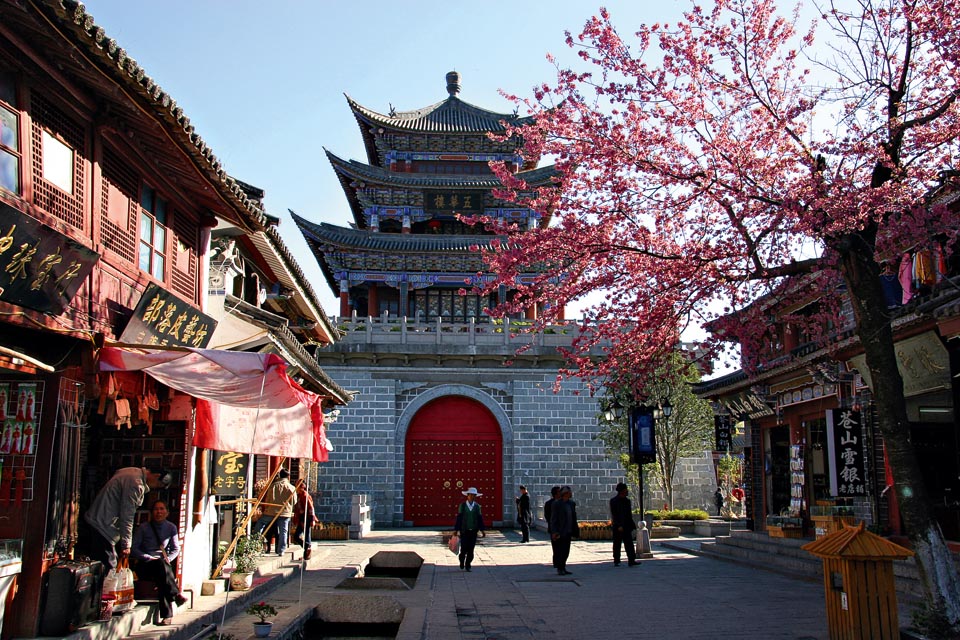
and nice “old” roads and buildings – with, of course, lots of shops for tourists.

Dali-old-town-2

Dali-old-town-1

What was really nice this time was that, like in this photo, the fruit trees were in bloom: a sight for sore eyes after cold and dreary Beijing. It will be at least a month, possibly a month and a half, before we see the same thing in Beijing.

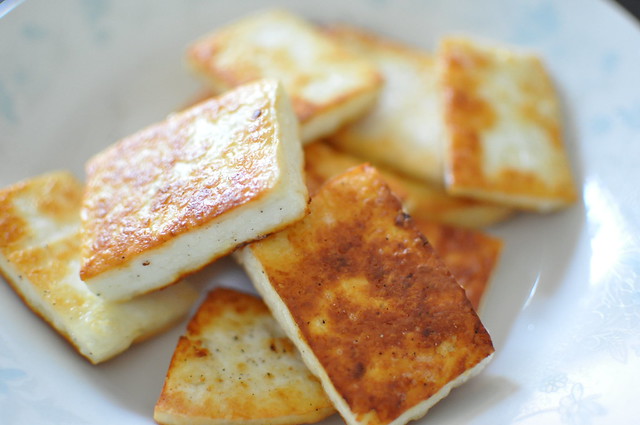
Last, but not least, this area of China is one of the few, perhaps the only one, where there is a local tradition of eating cheese! They have always had cow and goat herds here and they routinely drink and eat dairy products. The cheese is a bit odd, and they tend to eat it fried, but it is still cheese.

cheese-2

The local government has a good eye for location. They built the prefecture’s government complex on top of a hill which drops steeply into the lake. So the buildings have a beautiful view of the lake. This is what you see from the car park in front of the buildings.

Dali-visit-march 002

It was the same view I had sitting in the government banquet hall that evening. The hall has been built with a huge window giving onto the lake, and so as I and my host carried on a stilted conversation I could watch the night slowly steal over the lake.

But I had not gone down to Yunnan to admire Erhai lake and Dali. I was there to talk … walnuts. It may surprise the reader to know that China is the largest producer of walnuts in the world. A good portion of these are grown in Yunnan, and a good portion of these are grown in Dali prefecture. So the next day, I was driven to a valley on the other side of these mountains

Erhai Lake-1

to visit a walnut orchard and a walnut processing facility. From the discussions I had held the previous day and from further explanations I received on the way, I had a handle on the basic problem. The government had encouraged the local farmers to plant walnut trees, as a way to increase their incomes but also to reforest the prefecture’s hills.

walnut orchards-1

Now, as more and more trees reached maturity – it takes about ten years for a tree to produce walnuts – the government realized they had to find something to do with all the walnuts which were about to flood on the market and depress prices. They were asking our help to find markets outside China.

To reach the walnut orchard, we climbed up, up, up the steep hills enclosing the valley, through one switchback after another. When we reached the top, I gazed around me and was terribly reminded of Liguria in Italy. I was seeing walnut trees rather than olive trees, and instead of the glint of the Mediterranean Sea far down below me I was seeing rich valley bottomland planted in vegetables. But the feel was very much the same, the feeling of being perched on an edge and risking to tumble down at any moment.

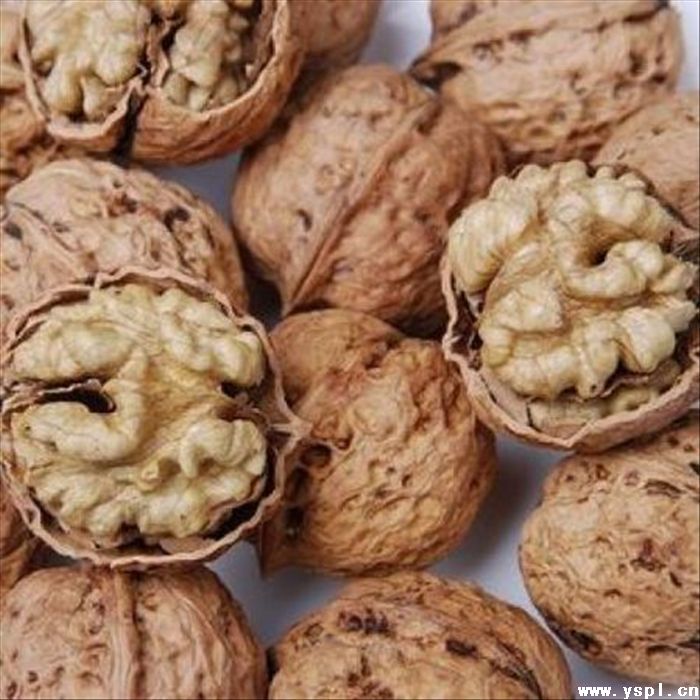
After a few moments, Farmer Liu arrived. He immediately opened a red packet of cigarettes – still the official sign of welcome in rural China – and offered a cigarette to all and sundry. I felt rather bad for him that all us city slickers, Chinese included, politely refused. Before coming, and knowing roughly what the Dali authorities wanted to talk to me about, I had phoned a colleague who knew about walnuts and had him coach me. So I was now able to pepper Farmer Liu with some not-too-stupid questions and understand his answers. After some ten minutes of this, Farmer Liu invited us to enter a small show room where we sat down and ate some of his walnuts. I was struck by how much more pitted the walnut shells were, almost as if they had been dunked in acid

walnuts in shell-1

I think this will be a problem outside of China, where people are used to relatively smooth shells. But the flesh was delicious.

walnuts partially unshelled-1

As I ate, I looked around at the various products on show, wondering which of these could find larger markets if suitably produced. I mentally nixed this product made from sliced walnut shells.

walnut-handicraft-2

I don’t see this catching on outside of China, or even outside of Yunnan …

Walnut oil?

walnut oil-2

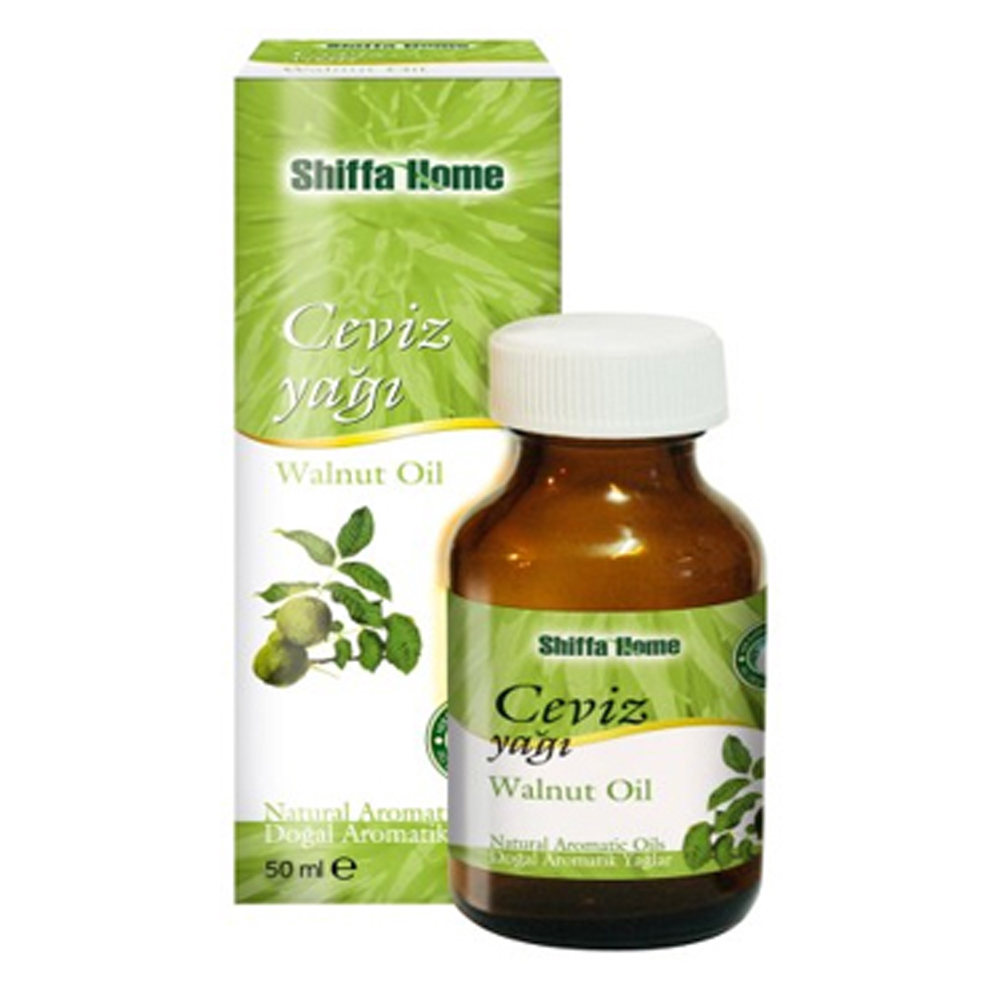
Possible, although it can’t be used for cooking, which would be the big market; when heated it takes on a slightly bitter taste. It can be used in cosmetics, though, which could be a good market

walnut-cosmetic-1

or in suntanning agents

walnut-tanning agent

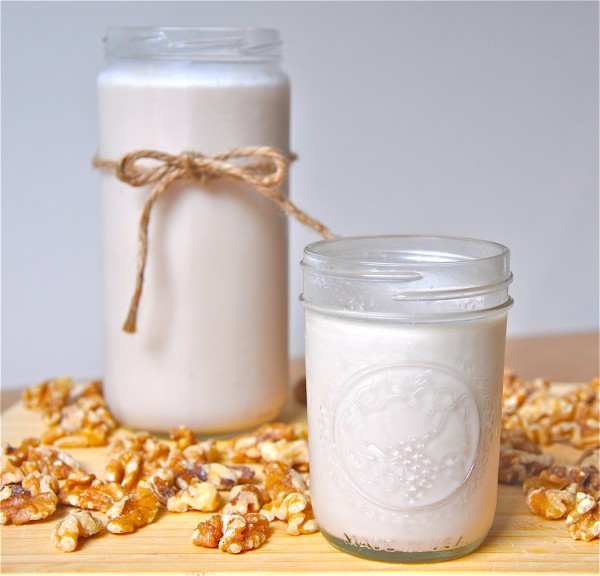
There’s also walnut milk, which – like almond milk – is really a mix of very finely ground walnut and water.

walnut-milk-1

Maybe this should be left to the national market. It’s becoming increasingly popular here, and I’m not sure how easily exportable it is.

How about walnut butter, cousin to the better-known peanut butter?walnut-butter-1

Definitely for the export markets. The Chinese don’t eat nut butters.

And so my eyes wandered around the shelves, while my hand dipped the walnut pieces into a delicious honey dip. The honey was creamy thick and pale yellow, really, really lovely. And then my mind began to wander, as I sat there enjoying the spring sun and the blossoming fruit trees outside the showroom.

We’ll find solutions, but not right now.

walnuts-on-trees-1

_____________________________

Erhai Lake-1: http://upload.wikimedia.org/wikipedia/commons/thumb/9/97/Erhai_Lake_Dali_07.JPG/1280px-Erhai_Lake_Dali_07.JPG
Dali-three-pagodas: http://i1.trekearth.com/photos/5043/three-pagodas-in-dali.jpg
Dali-old-town-1: http://media-cdn.tripadvisor.com/media/photo-s/03/4e/7d/14/dali-gucheng-the-old.jpg
Dali-old-town-2: http://www.interasia.com.au/wp-content/uploads/2011/08/China-yunnan.jpg
Cheese: http://farm8.staticflickr.com/7169/6430350689_80c3790afb_z.jpg
Erhai Lake-2: my photo
Erhai Lake-3: http://www.chinamaps.info/images/Attraction/Dali/Erhai%20Lake.jpg
Walnut orchard: http://en.kunming.cn/index/image/attachement/jpg/site162/20110609/001f29dcfe6f0f5acab506.jpg
Walnuts in shell: http://www.justeasy.com.cn/img/upload/20120312/051416082793.jpg
Walnuts partially unshelled: http://www.yspl.cn/UploadFiles/2011-12/yspl3/2011122009130516038.jpg
Walnut handicraft: http://www.gd-wholesale.com/userimg/23/3568i1/walnut-vase-331.jpg
Walnut oil: http://masvidaquenunca.files.wordpress.com/2013/01/mas_vida_que_nunca_stop_al_catarro_aceites_vegetales_y_frutos_secos.jpg
Walnut-cosmetics: http://www.buycosmo.com/images/products/04/79/59/47959_buyuk_zoom.jpg
Walnut tanning oil: http://www.adoretanning.com/images/detailed/1/Summer-Tan-Self-Tanning-Lotion—Dark.jpg
Walnut milk: http://3.bp.blogspot.com/-Y5j66WGE3zk/UGpSGSLThjI/AAAAAAAAJ1g/9zblIgnPBzg/s1600/milk1-600×576.jpg
Walnut butter: http://cdn.livesuperfoods.com/media/catalog/product/cache/1/thumbnail/9df78eab33525d08d6e5fb8d27136e95/p/r/pre-walnut-butter_1.jpg
Walnut on the tree: http://cdn.livesuperfoods.com/media/catalog/product/cache/1/thumbnail/9df78eab33525d08d6e5fb8d27136e95/w/a/walnuts_30.jpg

LISA

Beijing, 16 March 2013

Let me tell you about Lisa.

That’s not her real name, by the way, it’s her Western name. Like many Chinese, she has adopted a Western name for her interactions with laowai, or foreigners, like us. Which is just as well, frankly, because I personally never remember Chinese names and always mispronounce them dreadfully, which must be trying for the person being mispronounced.

Lisa is one of the army of young people who act as receptionists in our building. My wife and I are not entirely sure what any of these people do. Part of the day they sit at the desk by the entry door, monitoring who comes in and out. Then they disappear to do who knows what somewhere else in the building. They are perched at a somewhat higher level in the building’s management hierarchy than the doormen. They get to sit at the desk in the entry hall, while the doormen (always men, by the way) only get to stand by the door swinging it open for anyone who goes in or out. The two worker categories are distinguished by their uniforms. Lisa and her cohorts wear a white shirt, dark suit (men and women; no tailleurs here), and a dark coat during the winter months. The doormen, on the other hand, wear what looks like army fatigues and a red beret (although we have noticed that one doorman seems to have moved up the ranks and now wears an outfit more akin to the receptionists; but he still opens the doors).

Lisa is a godsend to us, because she speaks pretty good English. Whenever the electricity stops, or the hot water cuts off (which has happened to me twice when I was well soaped under the shower), or the TV mysteriously loses half of its channels, or the air conditioning system doesn’t blow any air out, my wife knows whose mobile number to call to explain what the problem is. In no time at all, Lisa will marshal the right buildings management crew or add some more Yuan to our electricity card, or water card, or hot water card (they have a rather bewildering system here for utilities; money gets credited onto a card, which then is used to credit an account we have somewhere in the building, and the utility magically works again). We always know which are her days off, and we anxiously hope that nothing will happen during those days; dealing with the other young men and women at the reception desk is hard going since they speak hardly any English. Some six months ago, we were also very afraid – as was Lisa herself – that she would be rotated out of the building to another of the host of buildings owned by our real estate company, but luckily this did not come to pass.

Over the year we’ve been in this building, my wife has struck up a good relationship with Lisa. She is a very friendly person and loves to chat. In the process my wife has found out a few things about her. She lives far away on the outskirts of Beijing, with her parents and twin sister. Given her miserable wages (real exploitation; I don’t know what Karl Marx would have said about it), and the fact that real estate in central Beijing now costs the same as in Manhattan, there is no way she can afford to live alone closer to work. And I think there is still an expectation that as an unmarried woman she should live with her parents. She went to a second-tier university to study languages, so it’s a bit depressing to see that the only job she could get was as a building receptionist, admittedly in one of Beijing’s tonier buildings. But the press often has articles about the army of young Chinese whose parents struggled to send them to university – but, crucially, one of the second-tier universities – and who haven’t managed to land a job (or at least a job that fits their expectations after a university degree). They live like ants (the term used in a study of this phenomenon), jammed together in colonies on the outskirts of Beijing and other big cities, as squatters in buildings condemned to demolition, eking out a living with small jobs here and there, often not daring to tell their parents what the true condition of their lives are.  So I suppose Lisa can consider herself lucky to have a regular job, even though she’s paid miserably, works long hours, and hardly gets any time off.

One thing about Lisa that warms the cockles of our hearts is that she has an enthusiastic curiosity about the rest of the world. I think her dream would be to travel all over the world if she could. She took her first small step in this direction some six months ago, when she left the country for the first time in her life and visited Thailand. She had managed to scrape together a week of holidays. She went with a group, of course, and they didn’t do anything very adventurous – Bangkok and a beach somewhere was the sum total of the trip. But she was so happy. She emailed us a photo of her standing somewhat awkwardly next to a guard at the King’s palace in Bangkok, beaming at the camera. And when we met her after she got back she told us all about the trip with a big smile on her face. She said she was looking forward to her next trip, once she had scraped together some more holiday time (she was on duty during the Chinese new year, when most of the receptionists took time off). My wife persuaded her to think of traveling alone, telling her that her English was good enough for her to manage without a group. She showed Lisa where she could buy her own flight tickets on-line and book her own hotels. Lisa was a little hesitant but seemed game to try. She was thinking of going to Viet Nam, she told us.

Yesterday, when my wife was leaving the building, Lisa came running over, beaming with joy. She announced to my wife that she had found a travel companion – traveling alone was too much for her. It was one of the other women at the reception. They were going to Viet Nam, Lisa announced, she had chosen the flights using the websites my wife had given her, everything was going swimmingly. But when my wife came back that afternoon, Lisa was completely crushed; my wife told me she had never seen her so down. When her travel companion had announced to her parents the plan of going to Viet Nam, her mother had nixed the idea: too dangerous, she had pronounced. It is true that China and Viet Nam had had a little war back in the late 1970s and that there is a certain amount of animosity at the moment because of disputes over islands in the South China Sea, but to say that Viet Nam is dangerous is ridiculous. But the parental veto had been cast and that was that. My wife urged Lisa to reconsider the destination. Lisa mournfully said she had thought of Malaysia; China wasn’t having any fights with them. But she had really set her heart on Viet Nam. It’s Lisa’s day off today. Let’s see if the night has brought her counsel, as the Italians say.

GLOBALIZATION BY MANNEQUINS

Beijing, 12 March 2013

My wife and I often lament the homogenizing effect globalization is having on our world. One of our common comments here in Beijing is: “Look at those young people. They dress just like our children!” [or children from the UK, or Italy, or the US, depending on the context]. We have an Ikea just up the road, which is thronged with young – and not so young – Chinese families buying the exact same things we were buying from our local Ikea in Vienna. And of course we can dine, if we wish to (which we sometimes do, I will admit), in that icon of globalization MacDonalds, which serves the same burger absolutely everywhere – it is so uniform that the Economist has created the Big Mac Index, which uses the cost of the Big Mac worldwide to check if currencies are at their right exchange level. And we can wash down our burger with a cappuccino in a Starbucks which looks and tastes exactly like a cappuccino in the Starbucks round the corner from our daughter’s place.

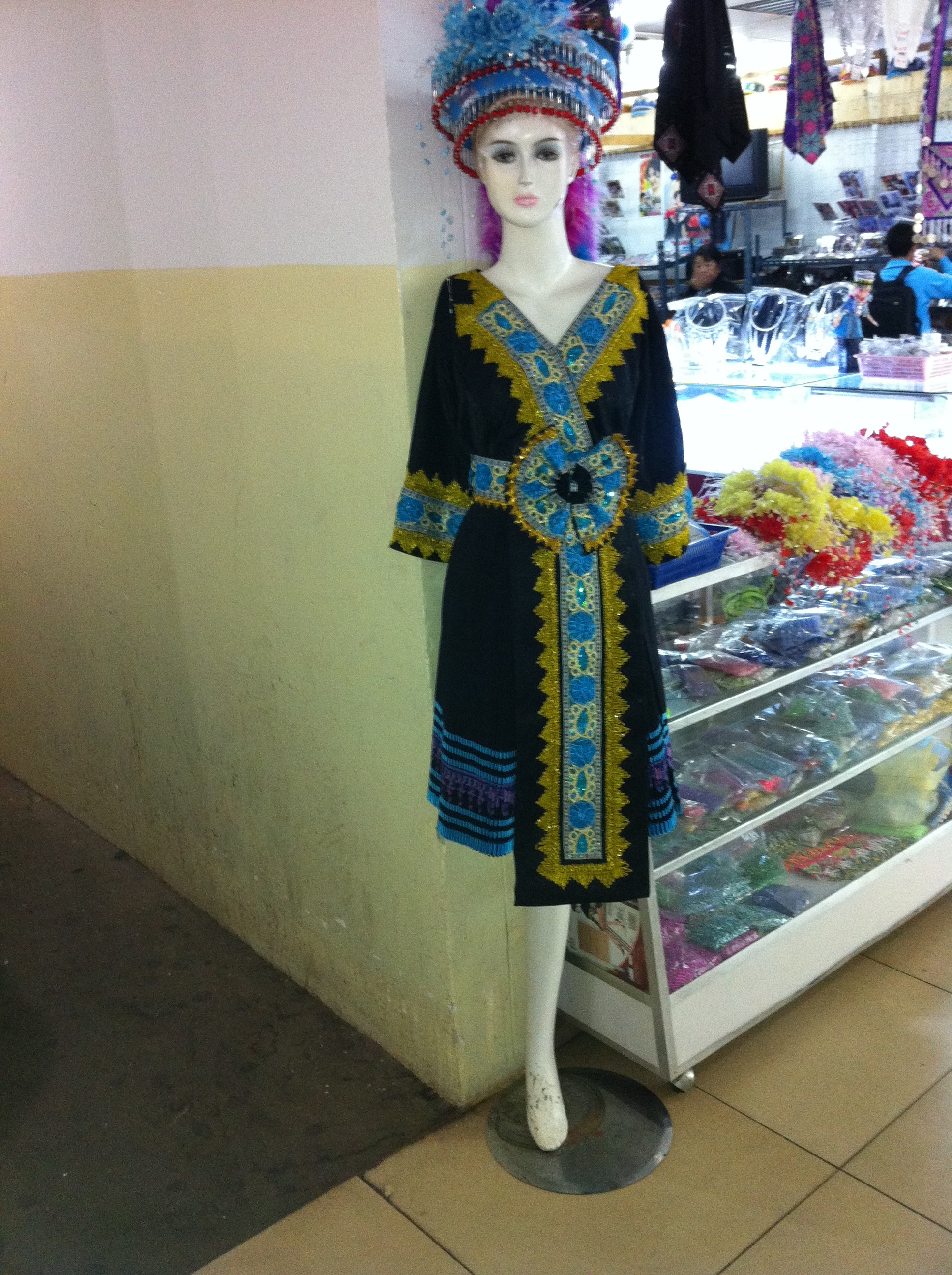
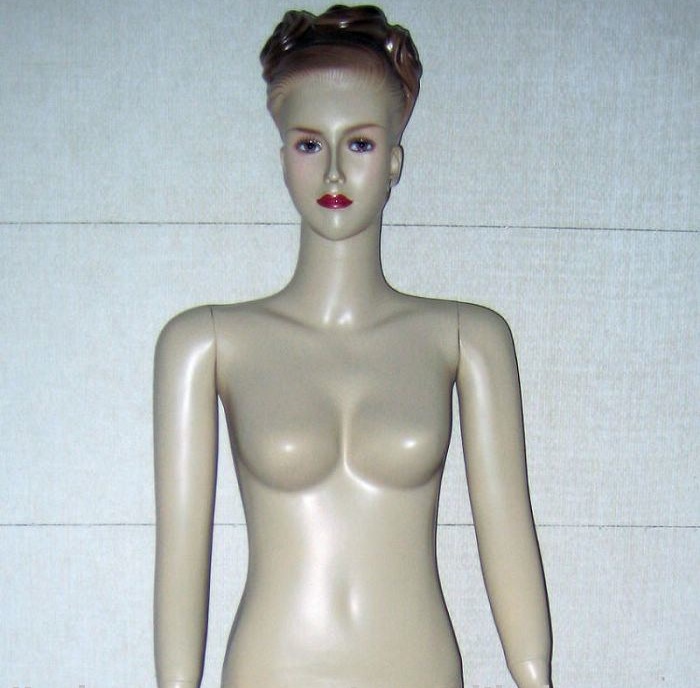
But for me the strangest aspect of globalization is … store mannequins. Often, when we are walking around in Beijing or anywhere else in China, I will come nose-to-nose with a store mannequin which is obviously European.

mannequin-beijing

Why on earth would Chinese women (I presume they are the ones who are targeted) be more inclined to buy clothes they see on a European mannequin than on a Chinese mannequin? (By the way, I have never seen a Chinese mannequin). I have to assume that the globalization of US movies, of TV shows, of magazines and so on give European women a greater glamour. Either that, or a Chinese company bought (or perhaps “borrowed”) the rights to a mannequin designed in the West somewhere and is turning them out by the millions.

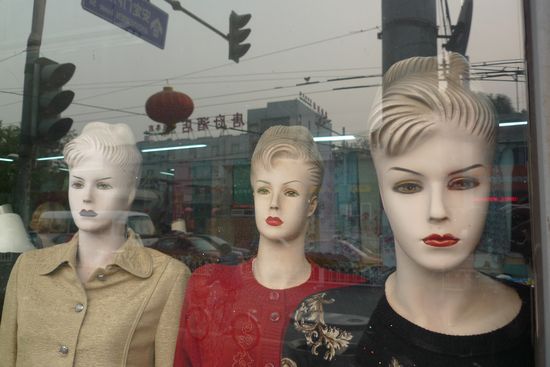
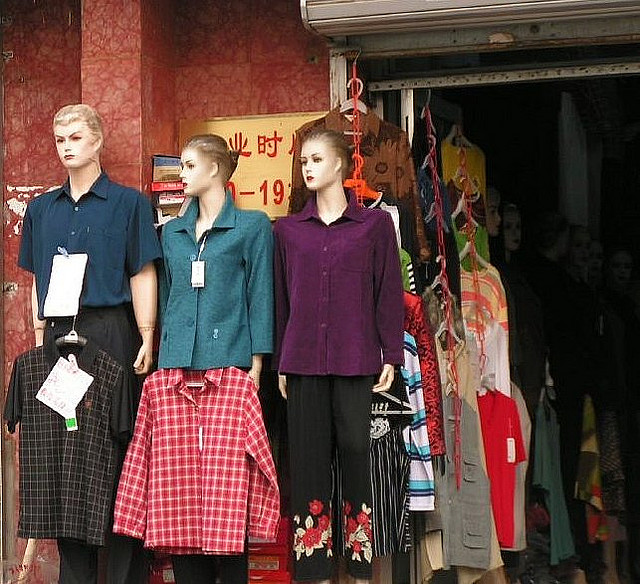
I’m not the only one who has been struck by these European mannequins in China. Here are some photos taken by others which I found after a trawl through the internet.

mannequins-china-2

mannequins-china-3

mannequins-china-5

mannequins-china-1

And it’s not just in China that you find these European mannequins. Here’s one I stumbled across in Laos, rather worse for wear and covered in pseudo-ethnic bling.

laos 068

The internet threw up these photos from other Asian countries.

The Philippines:

mannequins-philippines-1

Malaysia:

mannequins-malaysia-1

India:

Mannequins-india-2

Even Iran!:

mannequins-iran-1

This presence is so strange that a quilt maker, Robin Schwalb, made this quilt about it (and got a prize for it, too!)

mannequins-china-quilt

Here’s what Mr. Schwalb has to say about his creation:

“That suit, that hair, that mole; you immediately recognize Chairman Mao. But who – or what – are those pouty women, with their Western features, retro hairdos, and dead-eyed stares? They’re store mannequins, manufactured in China for the Chinese market, never appearing solo, but always arrayed in chorus lines. Perhaps the discordantly comical images have a darker point – if you have that system of government, you get this kind of dehumanized citizen.” [1]

I will pass over the political comment, which is disputable. Let me tell you the strangest thing about all this. This “pouty woman” looks exactly like a colleague of mine in Vienna. It is so odd to suddenly see her staring at me out of a shop window in some corner of China. I have never dared tell her. I don’t think she would appreciate being compared to a store mannequin.

______________________________

[1] http://www.dairybarn.org/quilt/index.php?section=226&page=280

Mannequin-china-1: my photo
Mannequin-china-2: http://dianepernet.typepad.com/.a/6a00d8341c76e453ef0153927b5e38970b-550wi
Mannequin-china-3: http://farm5.staticflickr.com/4024/4448484644_653a40a274_z.jpg?zz=1
Mannequin-china-4: http://www.dvafoto.com/wp-content/0011.jpg
Mannequin-china-5: http://farm3.staticflickr.com/2243/2129603065_45eaf9420e_z.jpg?zz=1
Mannequin-laos: my photo
Mannequin-philippines: http://2.bp.blogspot.com/-IqILwlOYkz4/TqYJjLcRMkI/AAAAAAAAERw/kdYvkh71BvM/s1600/retro_mannequin.jpg
Mannequin-malaysia: http://www.lemonicks.com/photos/Kuala%20Lumpur/P1000852.2.jpg
Mannequin-india: http://www.bminusc.com/wp-content/uploads/2013/02/Store-Mannequins1.png
Mannequin-iran: http://latimesblogs.latimes.com/.a/6a00d8341c630a53ef0120a59ffcee970b-pi
Mannequin-china-quilt: http://www.dairybarn.org/upload_files/images/QN07-Schwalb.jpg

TEMPLES IN LAOS

Luang Prabang, 20 February 2013

I must confess to a certain weakness for the Buddhist temples in this part of the world. I first came across them nearly thirty years ago (Good Lord, is it really that long ago?) when my wife and I visited Japan. My photos of that trip are packed away with all the rest of our stuff in Vienna, so I’ve borrowed a few pictures from the web to refresh my memory, all from Kyoto, a wonderful place. This is Kiyomizu-ji.

kyoto-temple-1

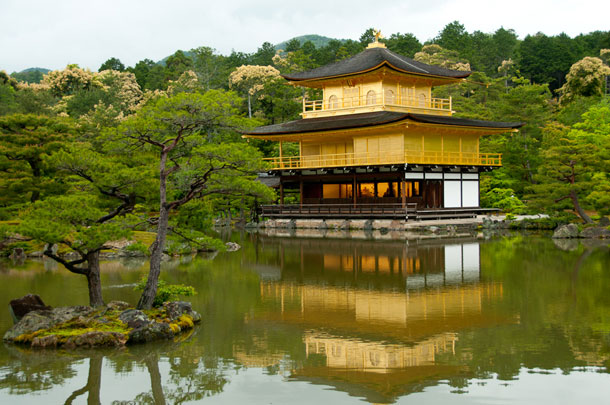
But probably the most iconic temple of them all in Kyoto is Kinkaku-ji, the Temple of the Golden Pavilion.

kyoto-temple-2

Look at that delicate architectural tracery embedded so naturally, so lightly, in the surrounding greenery.

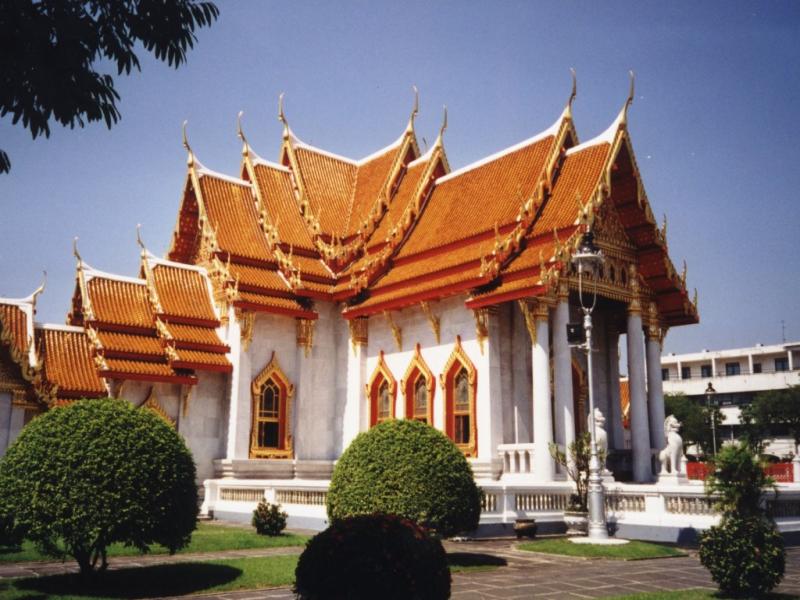
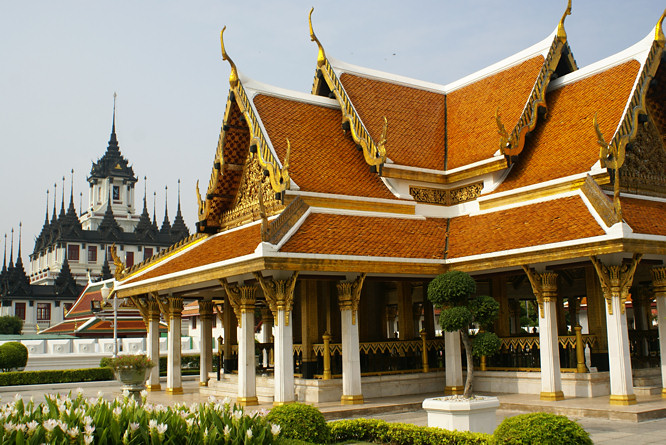
Many years later, my wife and I saw another style of Buddhist temple in Bangkok during a brief stay there on our way to Angkor Wat. This is Wat Benchamabophit:

bangkok-temple-1

And this Wat Ratchanatdaram:

bangkok-temple-2

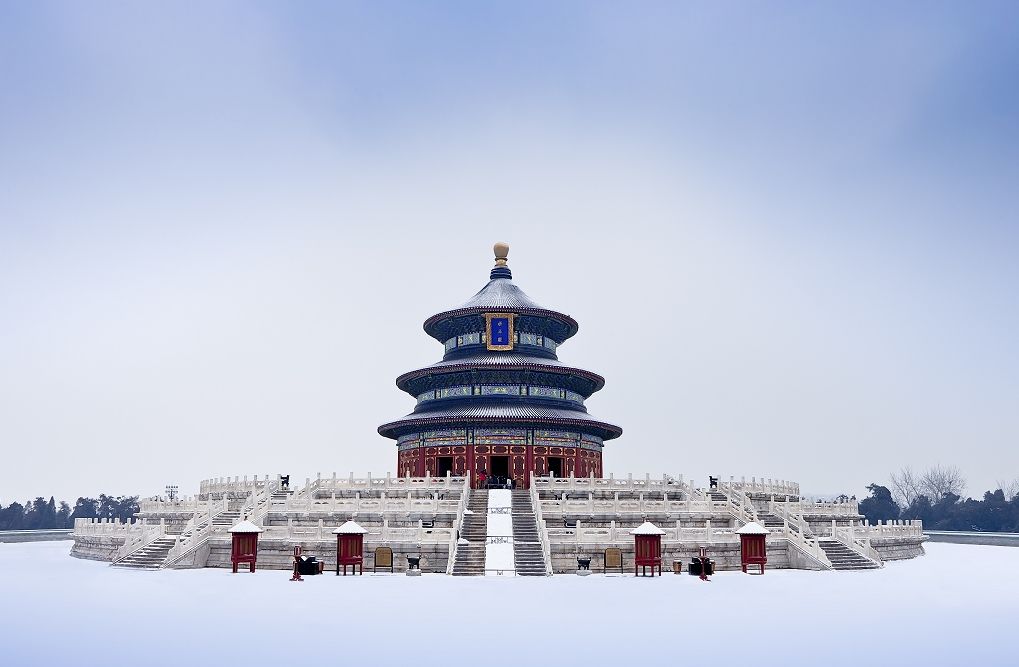
And then, once here in China, we saw yet another style, a heavier, more “imperial” style. The Temple of Heaven in Beijing is one of the nicer examples.

Temple-of-heaven-3

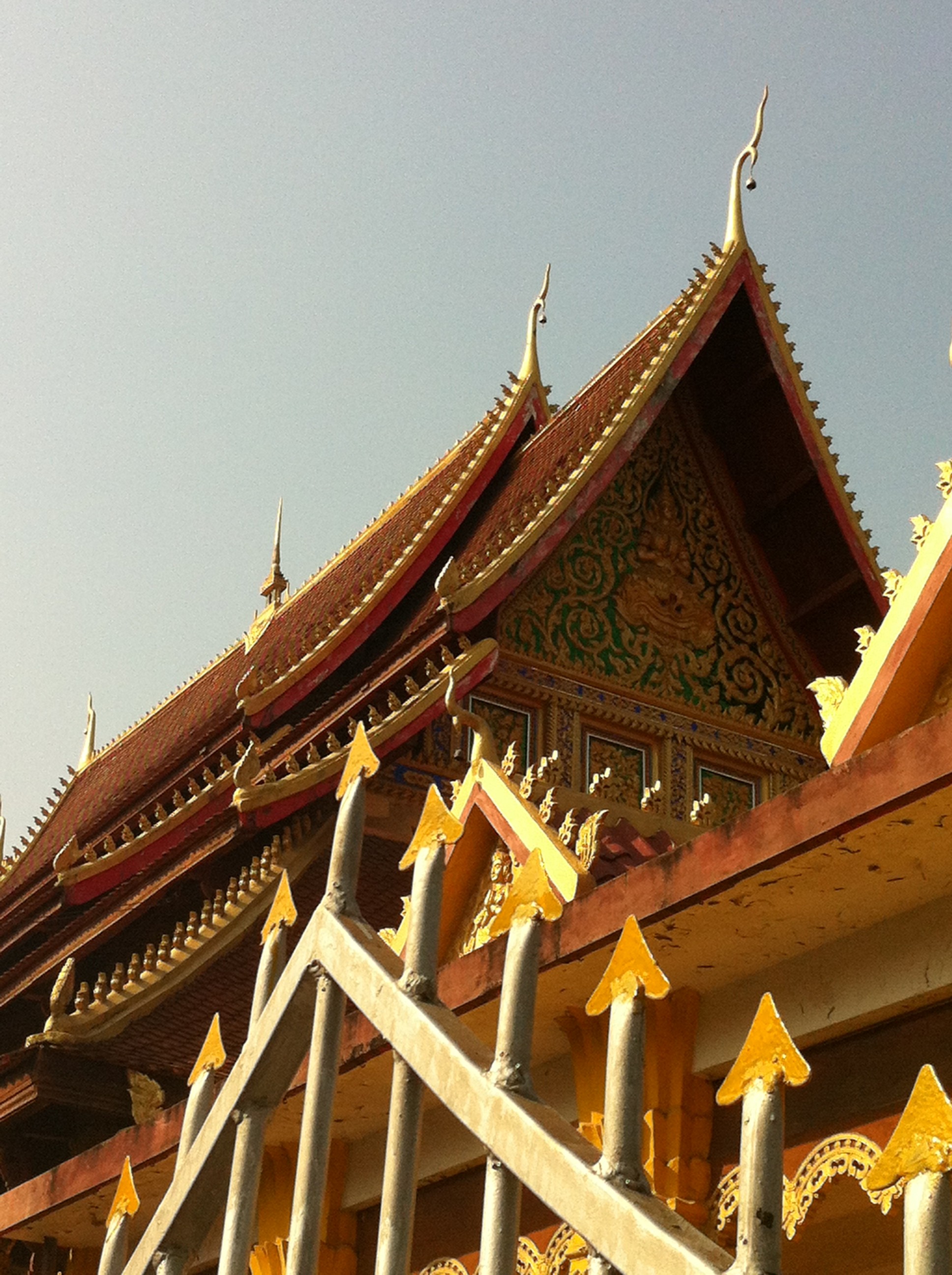
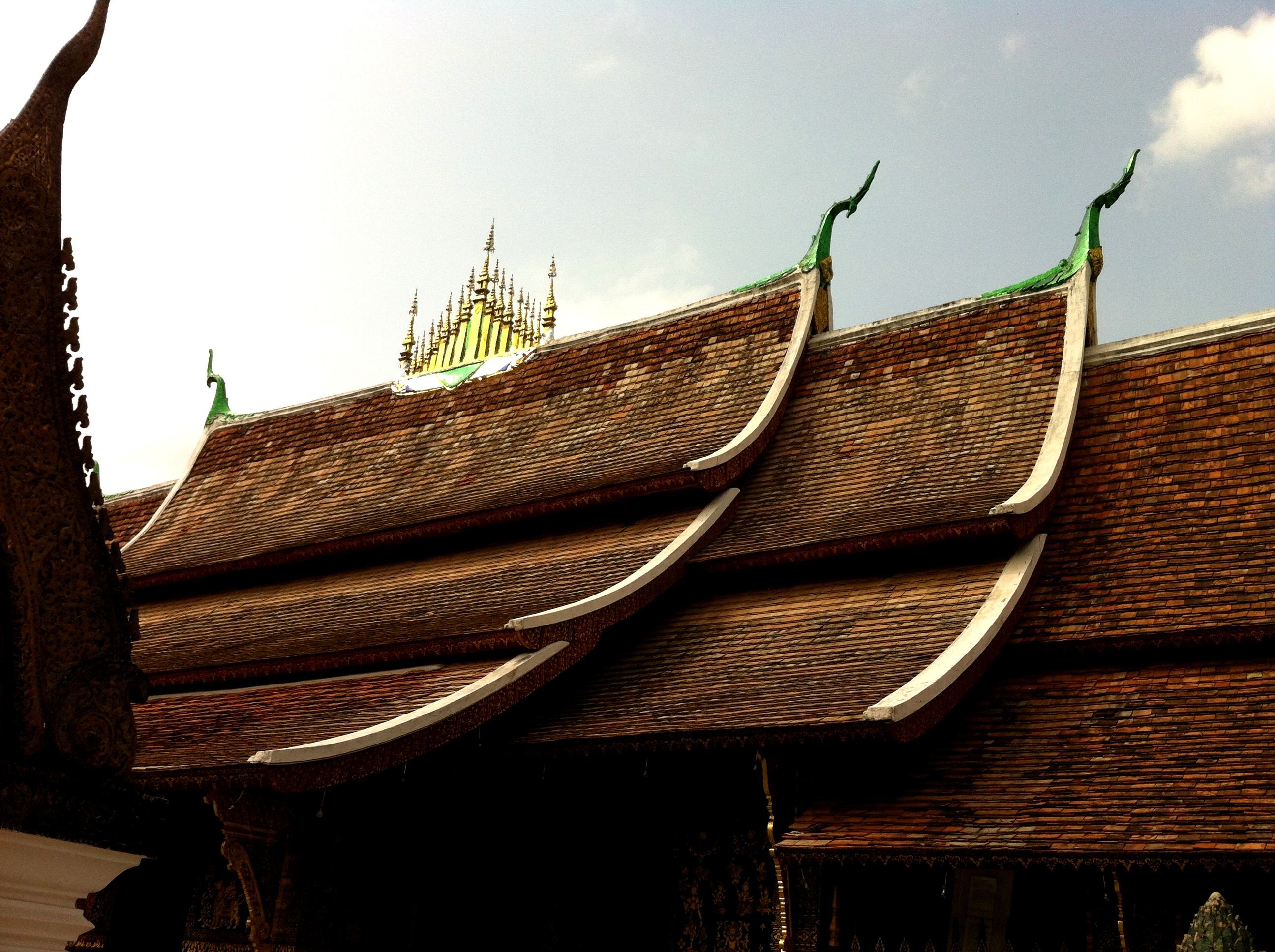
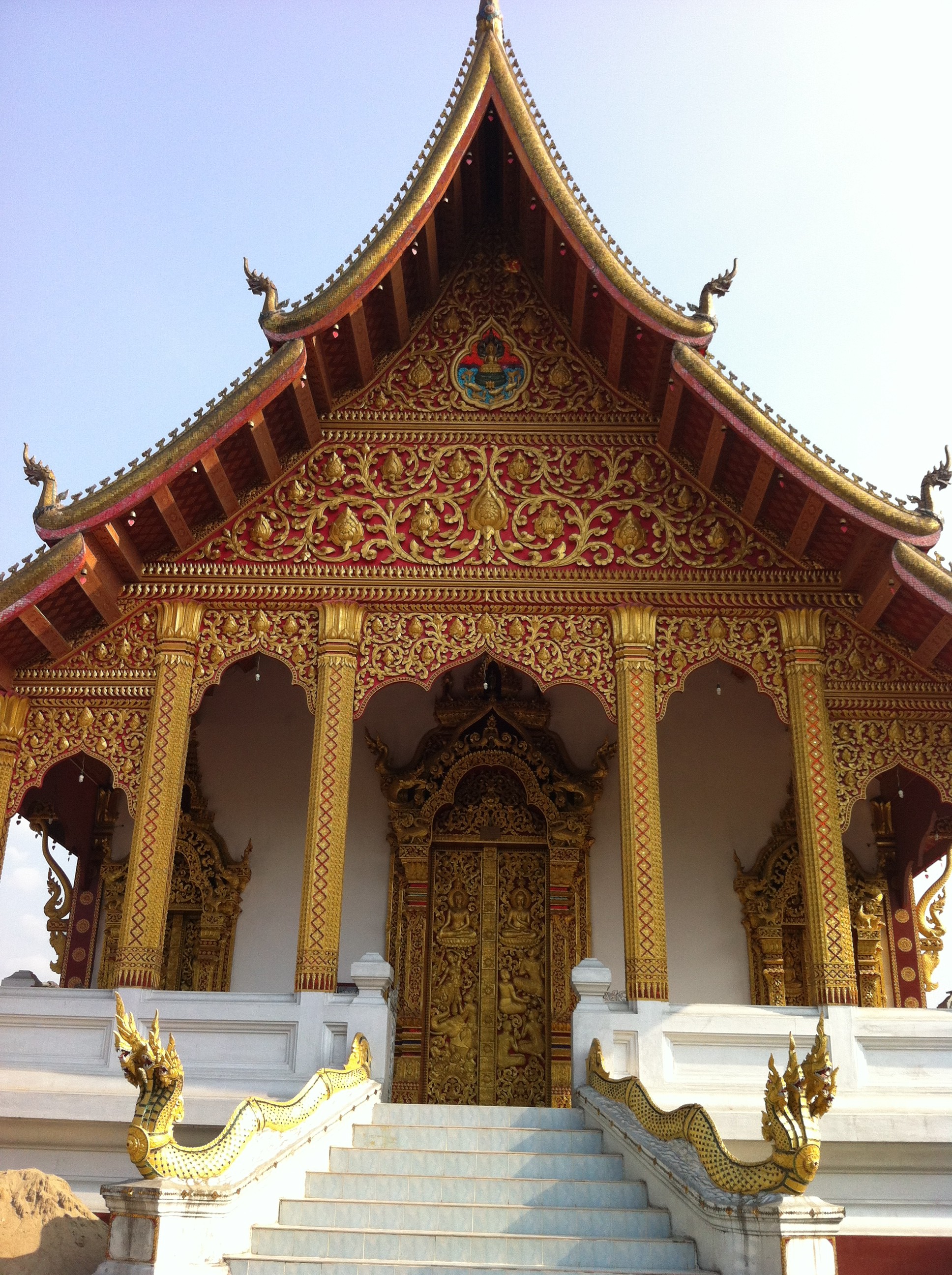
All quite different. But I think you will agree that there is a common thread: the raking of the roofs. I don’t know what it is, but this lift of a roof at its tip really gives a wonderful grace to a building, even a rather heavy, stodgy building like the Temple of Heaven.

So it was with pleasure that we saw this again in Laos, first in Vientiane:

laos 076

laos 103

Then in Luang Prabang:

laos 287

laos 319

I saw other things that warmed the cockles of my heart, like this for instance:

laos 412

laos 405

This is where I can refer the reader back to my previous post. What we’re seeing is the similar use of paintings to educate the faithful in two places that are nearly 9,000 kilometres apart. The Italians have an expression for this, tutto il mondo è paese, the whole world is but a village; in the end, we’re all the same wherever we live. In the previous post, it was my young daughter who was illiterate. In this case, it was me – and alas, I had no-one who could explain the story which the paintings were telling.

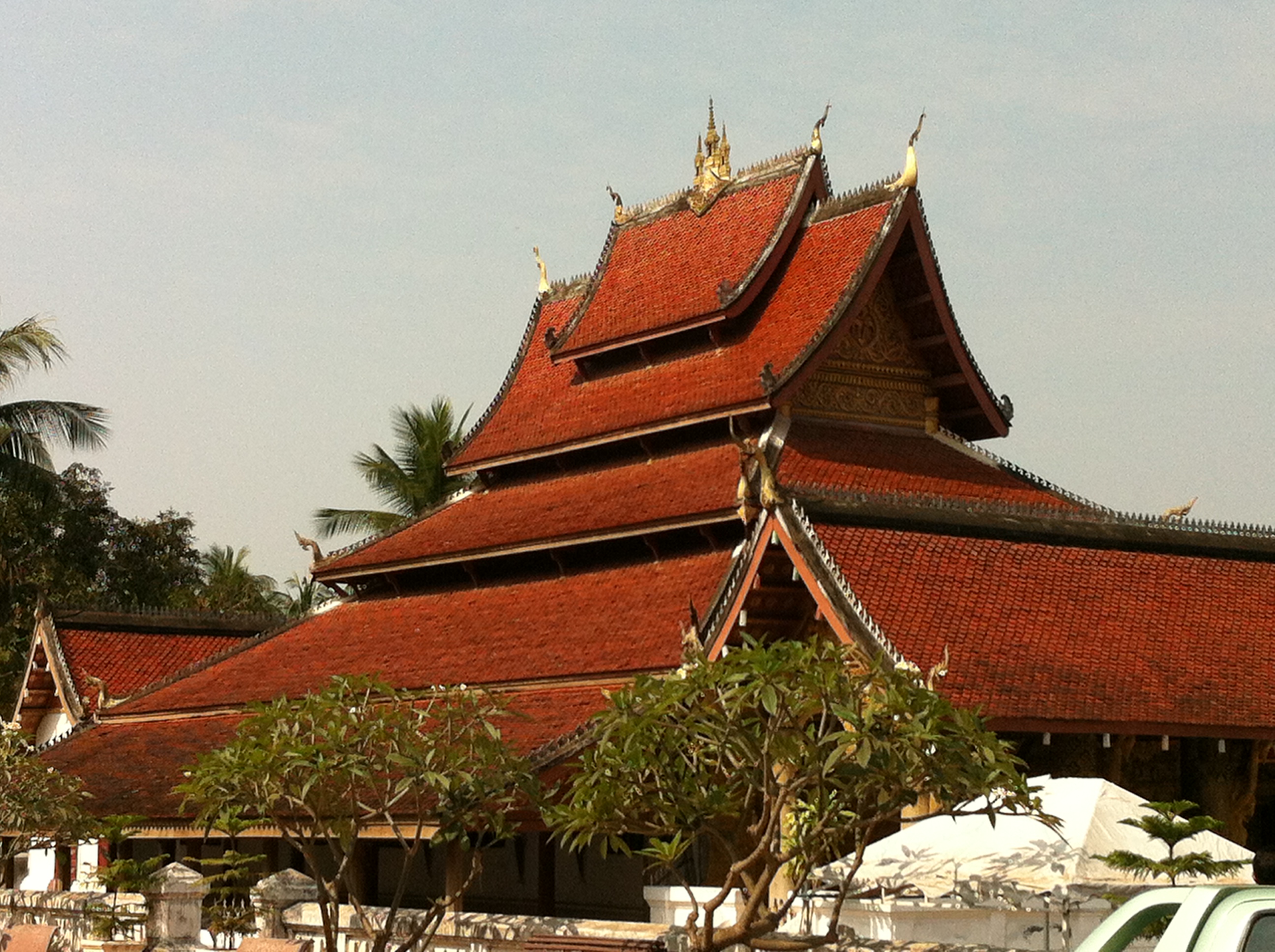
We also liked the way that the temples had different roofs piled one on the other.

laos 365

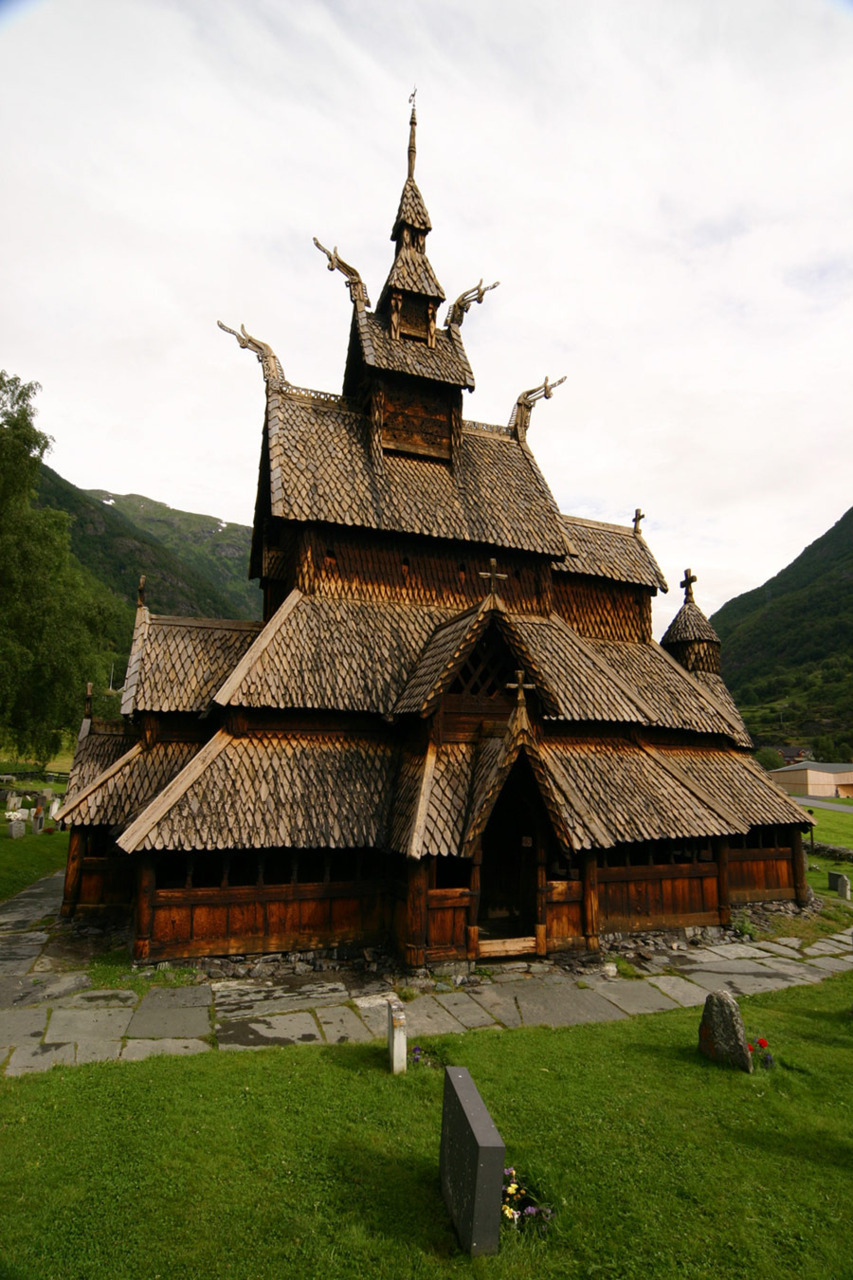
It quite reminded us of the stave churches in Norway, several of which we had visited some five years ago:

norwegian-stave-church

Tutto il mondo è paese.

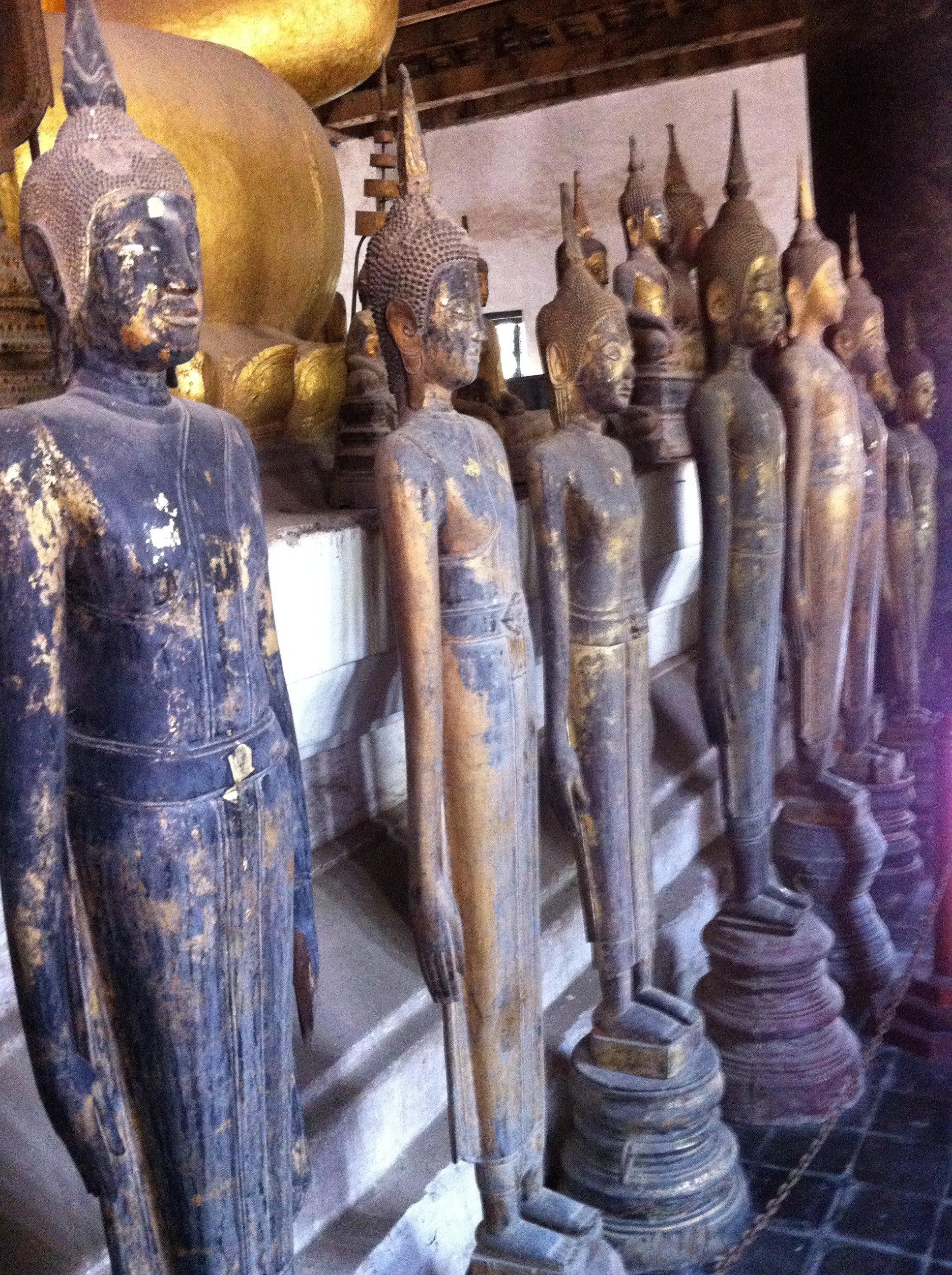
We also liked a certain set of Buddha statues that we came across. These are in the “praying for rain” position:

laos 382

And these are in the “no war” position:

laos 390

Well, I suppose that’s what we all want, isn’t it? We want to eat our fill and live in peace.

Tutto il mondo è paese.

_______________________________

Kyoto-temple-1: http://anime.aplus.by/uploads/posts/2011-01/1293979203_xigasiyama.jpg
Kyoto-temple-2: http://www.gadventures.com/blog/wp-content/uploads/2012/07/Kyoto_GoldenTemple.jpg
Bangkok-temple-1: http://misto-market.com.ua/turizm/images/interestplace/98/1.jpg
Bangkok-temple-2: http://travel-tips.s3-website-eu-west-1.amazonaws.com/holidays-Bangkok-Thailand-hotel-package-deal-travel-tips-guide-Wat-Ratchanatdaram-Temple.jpg
Temple of heaven: http://templeofheavenbeijing.com/wp-content/uploads/2011/11/Temple-of-Heaven.jpg
Norwegian stave church: http://25.media.tumblr.com/tumblr_llqkm5GrsA1qzxqgco1_1280.jpg

the other pictures: mine

SUNSET OVER THE MEKONG

Luang Prabang, 16 February 2013

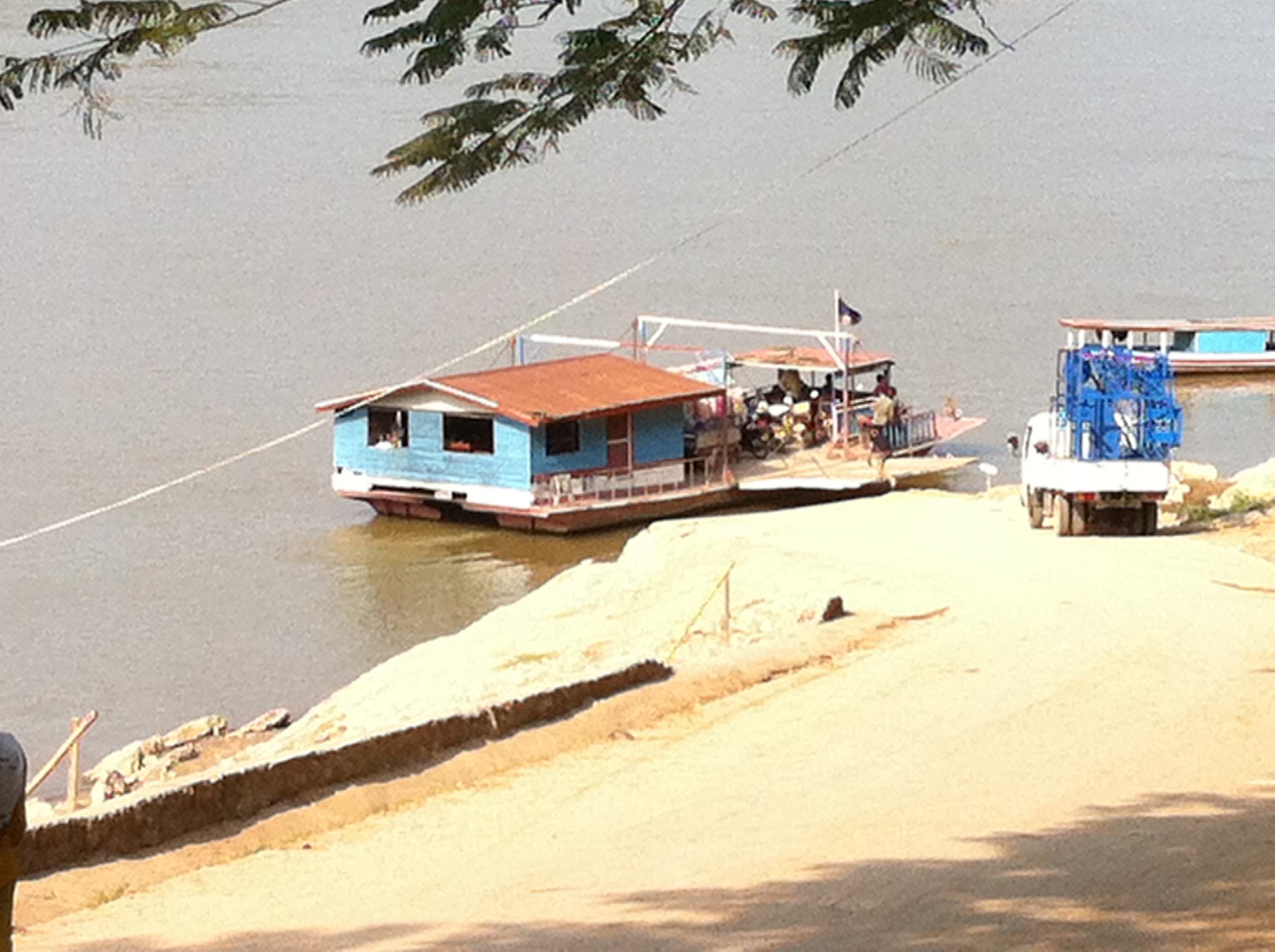
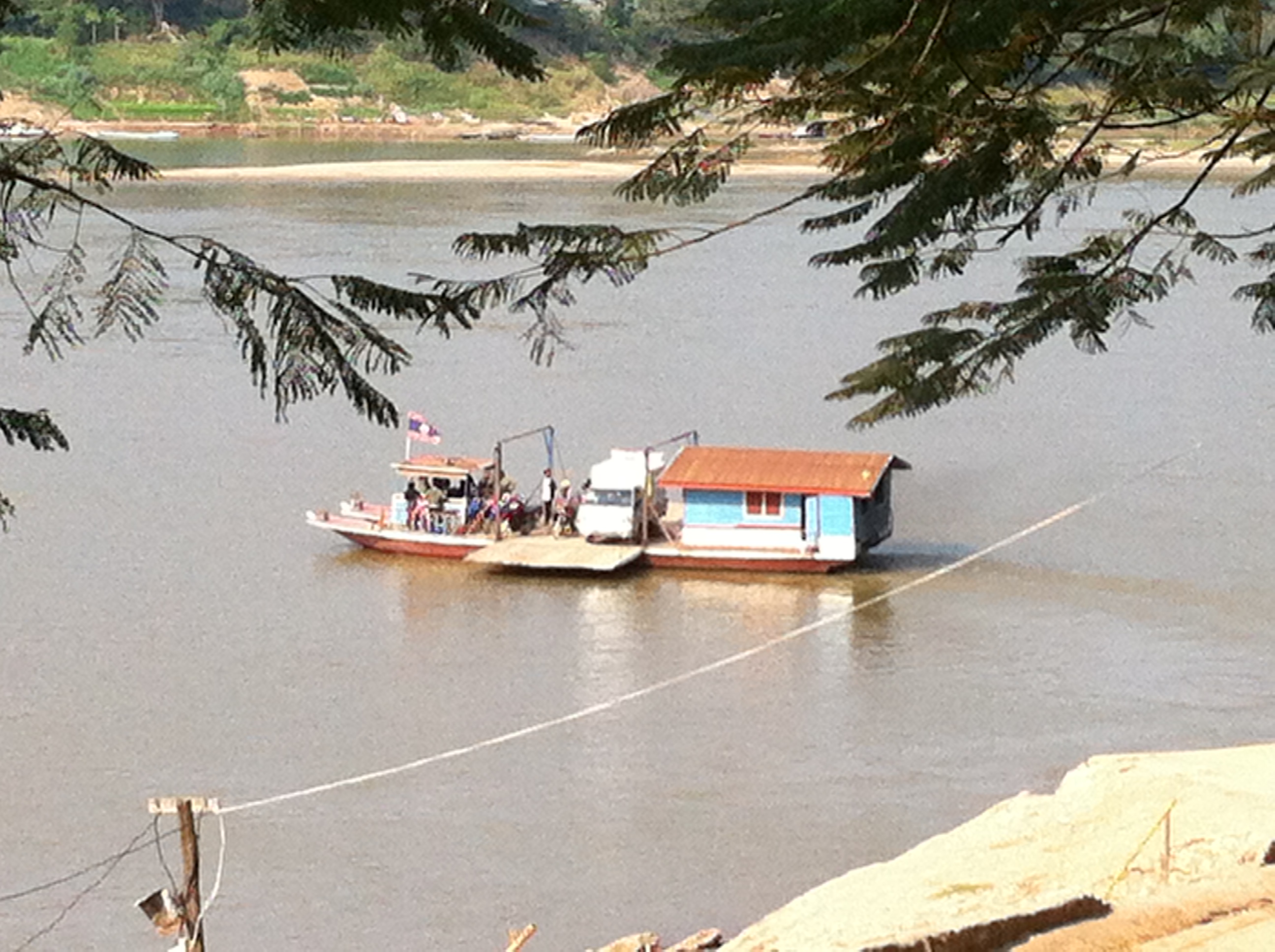
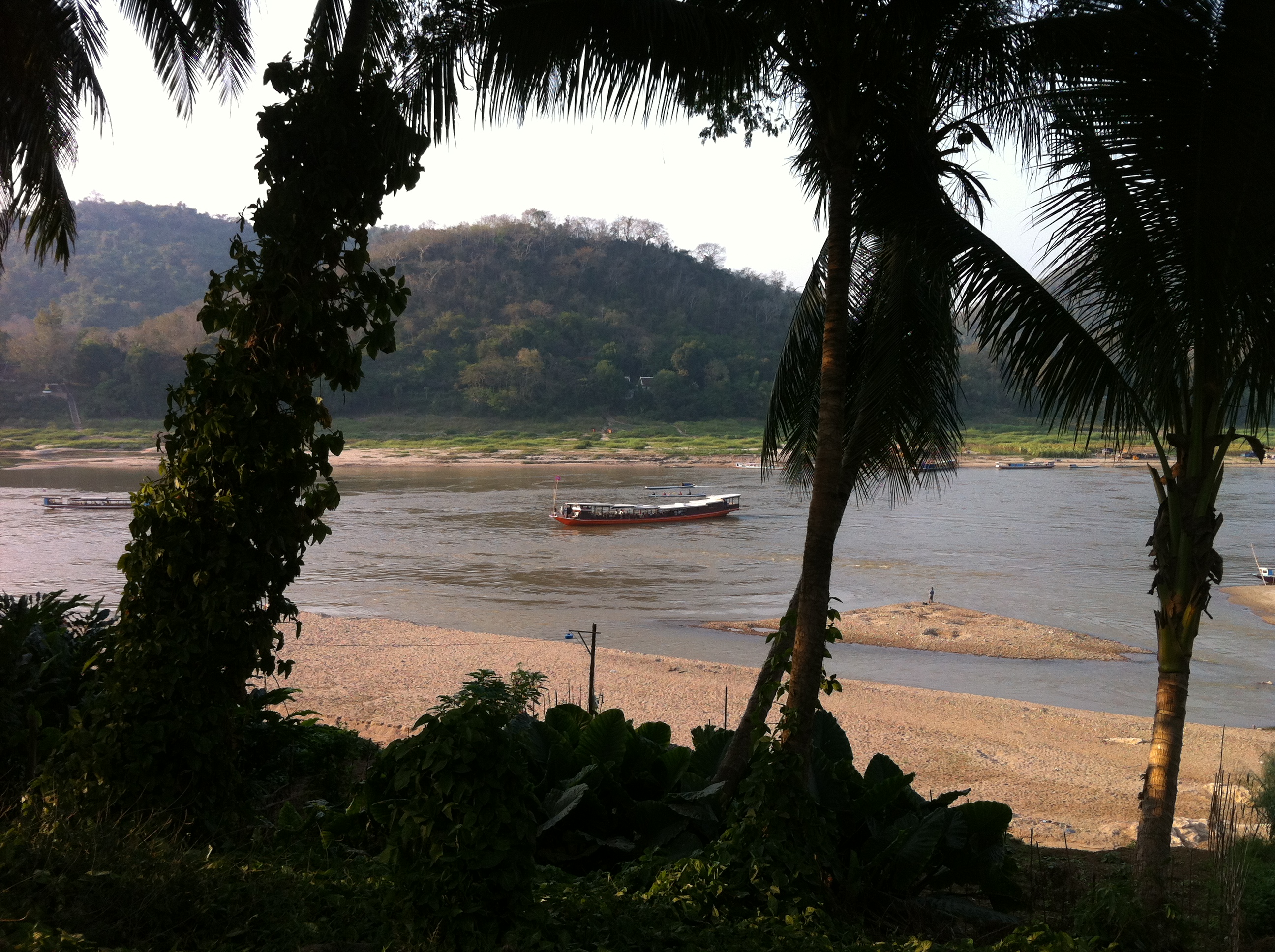
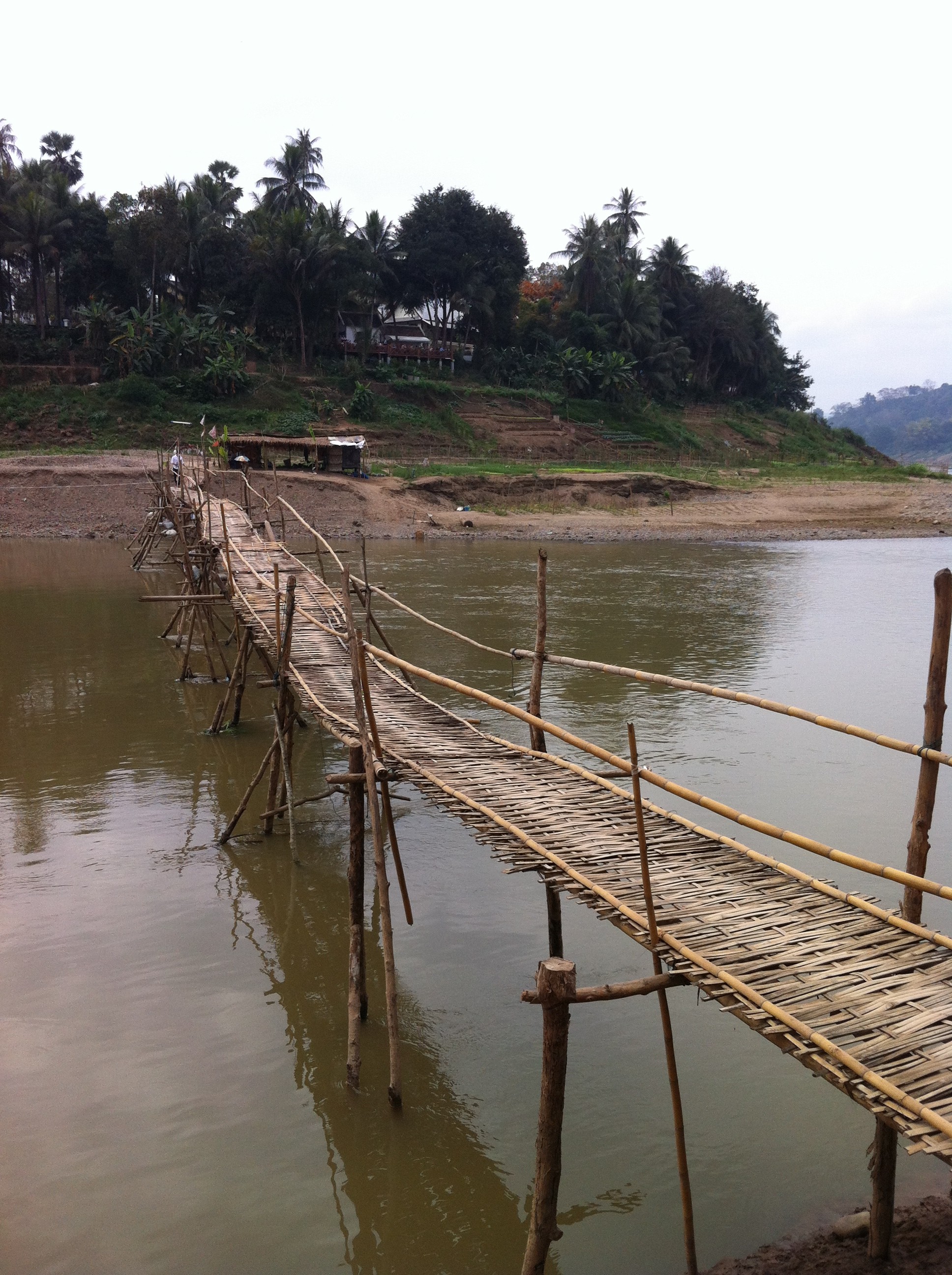
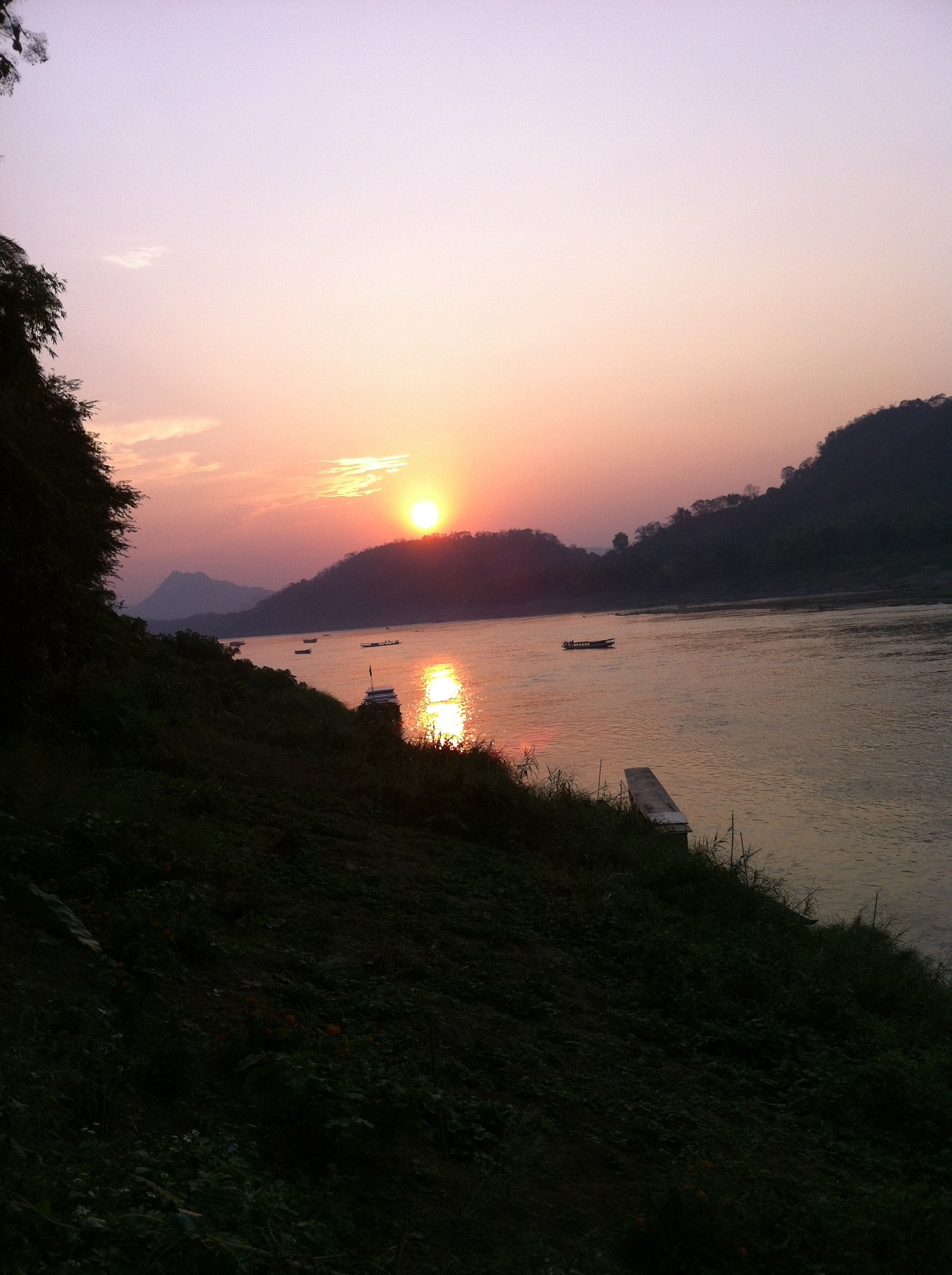
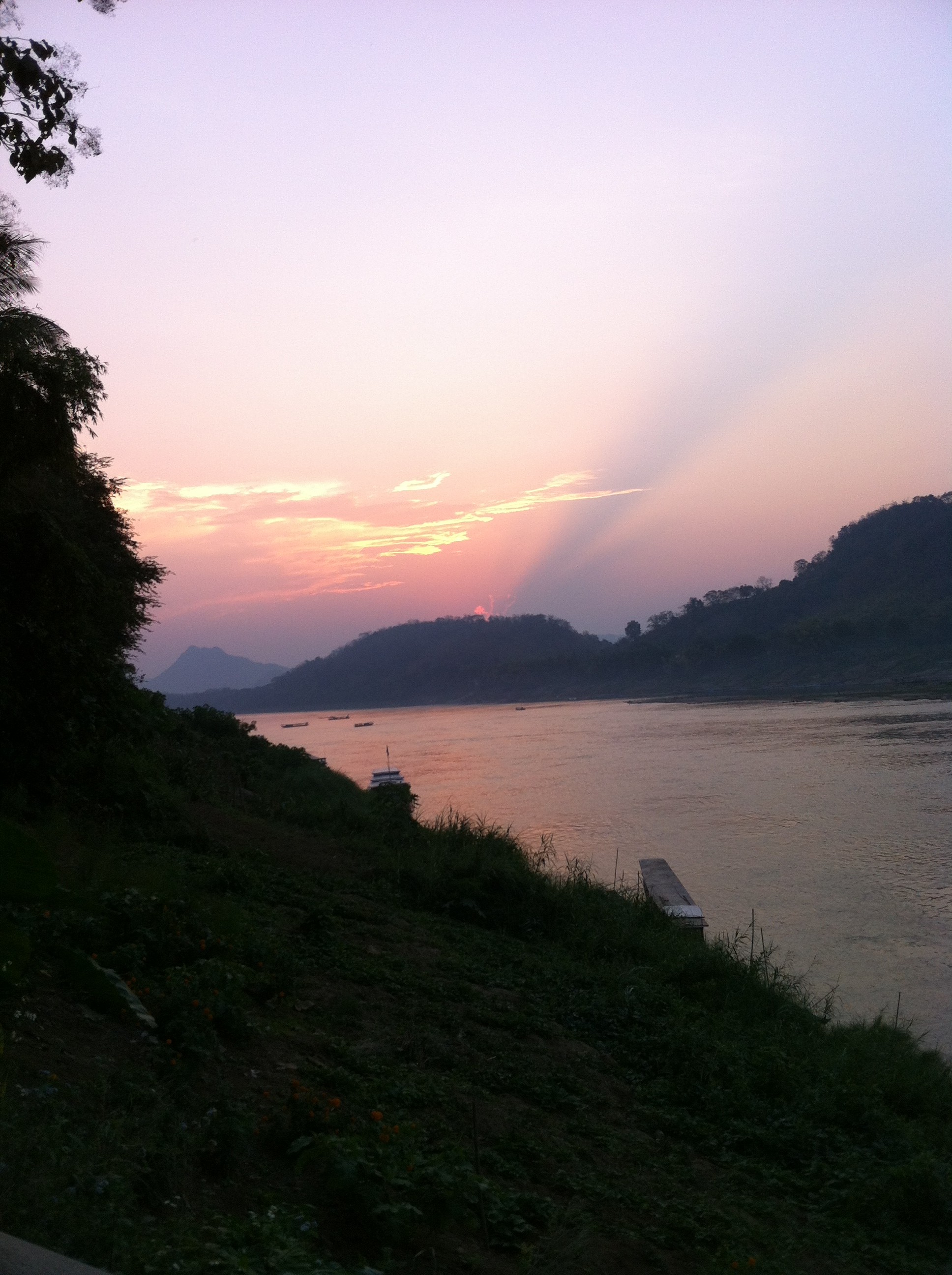
I first came into contact with the Mekong some ten years ago, in Phnom Penh, Cambodia. I remember looking in awe at this hugely wide river and planning some day to take a boat down it to Vietnam; a plan still waiting to be executed. In the meantime, our lives have crossed the Mekong many times. Several years ago, my wife and I had a close brush with it when we cruised on Tonle Sap Lake while we were visiting Angkor Wat. This lake has a strange relationship with the Mekong: during the dry season it drains into the Mekong, but during the rainy season the Mekong’s current is so strong that the flow reverses and it is the river that runs into the lake.  Two years ago, in September, we came across the Mekong again, red-brown and very silty, at Xishuangbanna in the far south of Yunnan province, down by the border with Myanmar, Thailand and Laos. While we were there, a story broke of the captain and crew of a Chinese ship plying the Mekong being executed by shooting one night under mysterious circumstances; a story of drug running, it turned out, in that wild part of the world. And now we were in Laos, a country traversed by the Mekong and much of whose borders are defined by the river. While we were in Vientiane a few days ago, we walked along its bank and looked over to Thailand on the other shore.  And we have spent the last two days in Luang Prabang, the country’s ancient royal capital, which lies at the confluence of the Nam Khan River and the Mekong. As we have criss-crossed the narrow tongue of land between the two rivers on which the old town was founded, we have found ourselves gazing down on the Mekong many times.  We have watched the ferry crossing it:

laos 428

laos 430

We have watched ships taking tourists up and down the river:

laos 476

laos 475

We have crossed a spindly bamboo bridge spanning the Nam Khan:

laos 258

to gaze down on the confluence of the two rivers:

laos 263

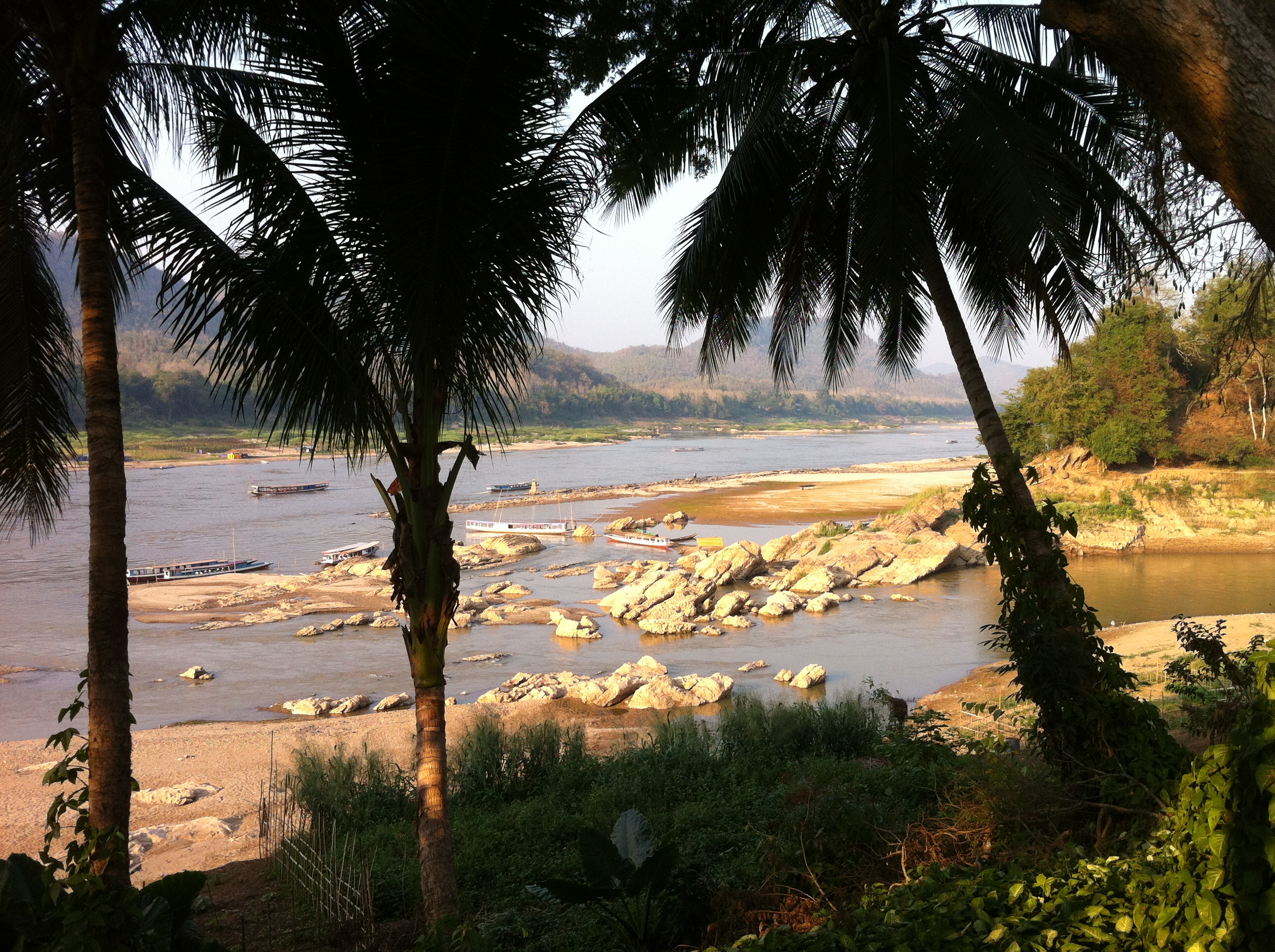
And now, on our last evening, we have been sitting on steps leading down to the river and have been watching the sun set behind the hills on the far shore.

laos 480
laos 485

laos 491

laos 497

And with that last flash of light there has floated into my mind some lines from a hymn we used to sing at school when I was young, sung to a serenely tranquil tune:

Lord of all gentleness, Lord of all calm,
Whose voice is contentment, whose presence is balm,
Be there at our sleeping, and give us, we pray,
Your peace in our hearts, Lord, at the end of the day.

FLOWERS IN LAOS

Vientiane, 12 February 2013

If there is one thing that my wife and I really regretted leaving in Vienna, that was our little garden. With our last apartment we had been really lucky in getting a small roof garden. We loved that garden. My wife tended it with tender care and the summer evenings spent enveloped in flowers were magical. Of course, winters were dreary but there was always the next summer to look forward to with its new crop of flowers.

When we moved to Beijing, we guessed we would never find an apartment with even a small balcony on which to put some flower pots, at least not at prices we could afford. And so it was. We couldn’t be completely plantless so my wife bought some house plants. They give a tinge of green to the apartment, but they are meagre consolation for our roof garden in Vienna.

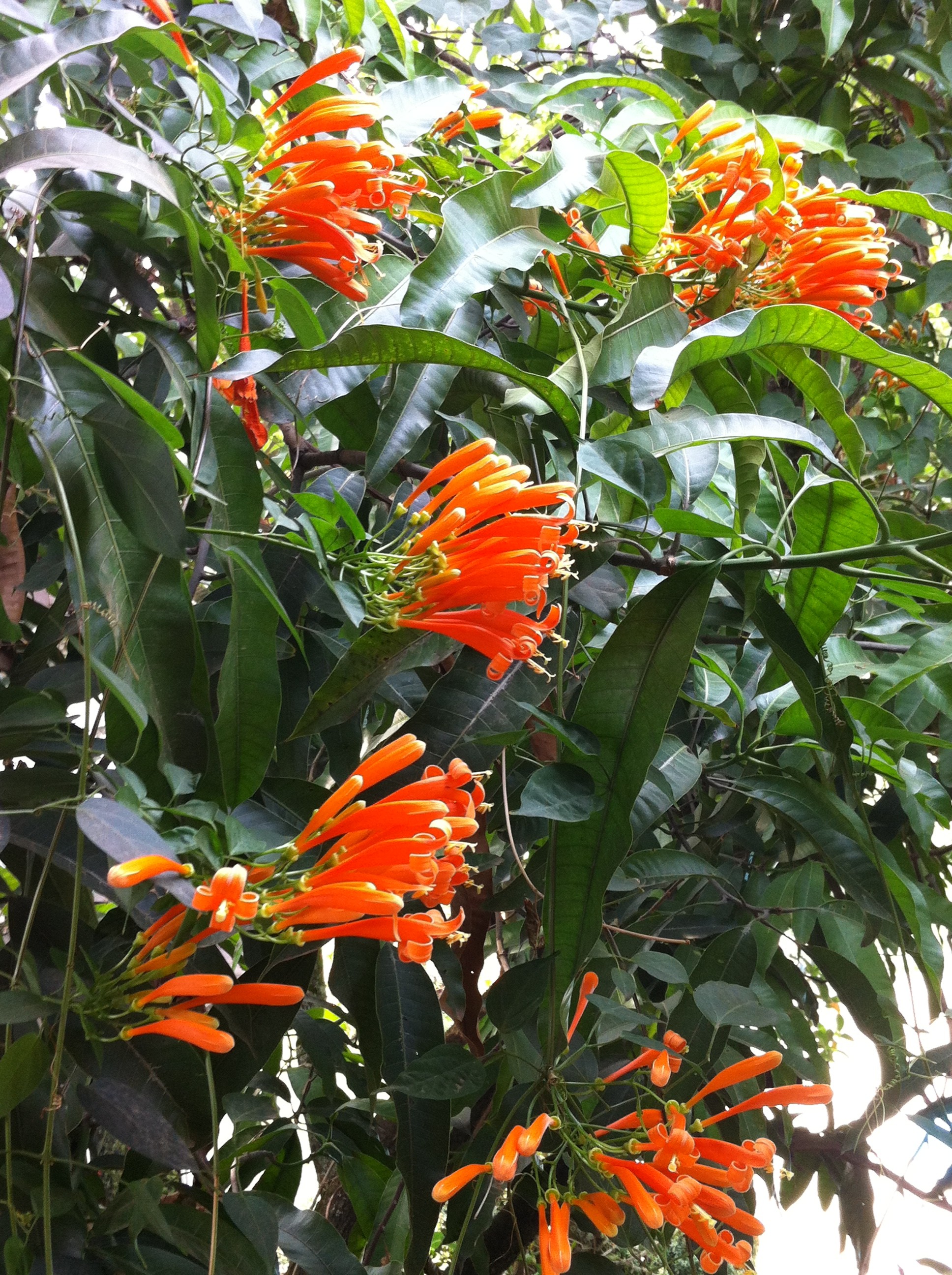
Imagine, then, our delight when after a seven-hour journey from cold and snowy Beijing we opened the window of our hotel in Vientiane, Laos, and we found this before us.

flowers and trees 004

It was a flowering vine, thrown carelessly, or so it seemed, over the mango tree at our window. Five steps down, peering down from our common balcony we saw this, the flower of a banana tree.

flowers and trees 006

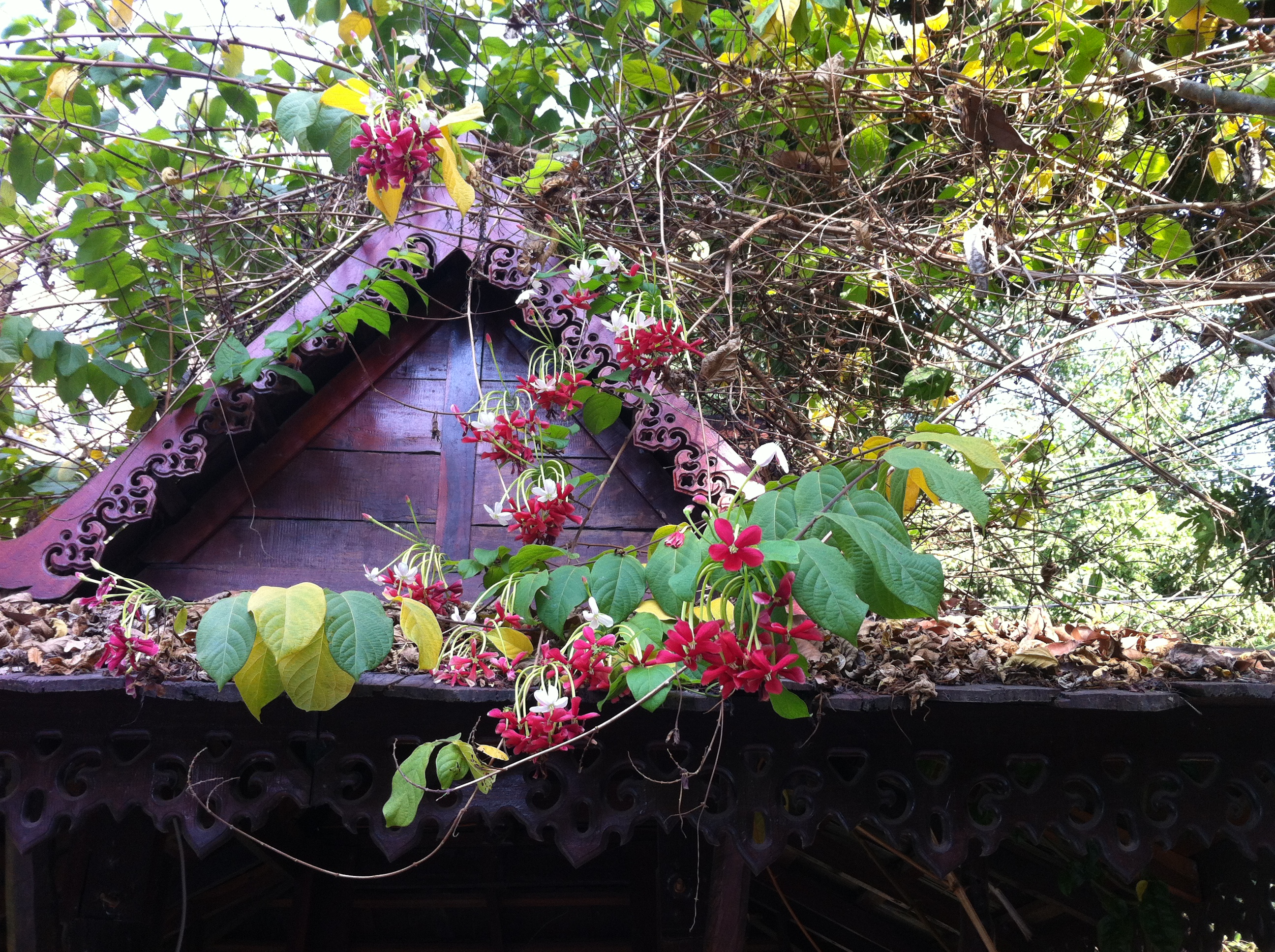
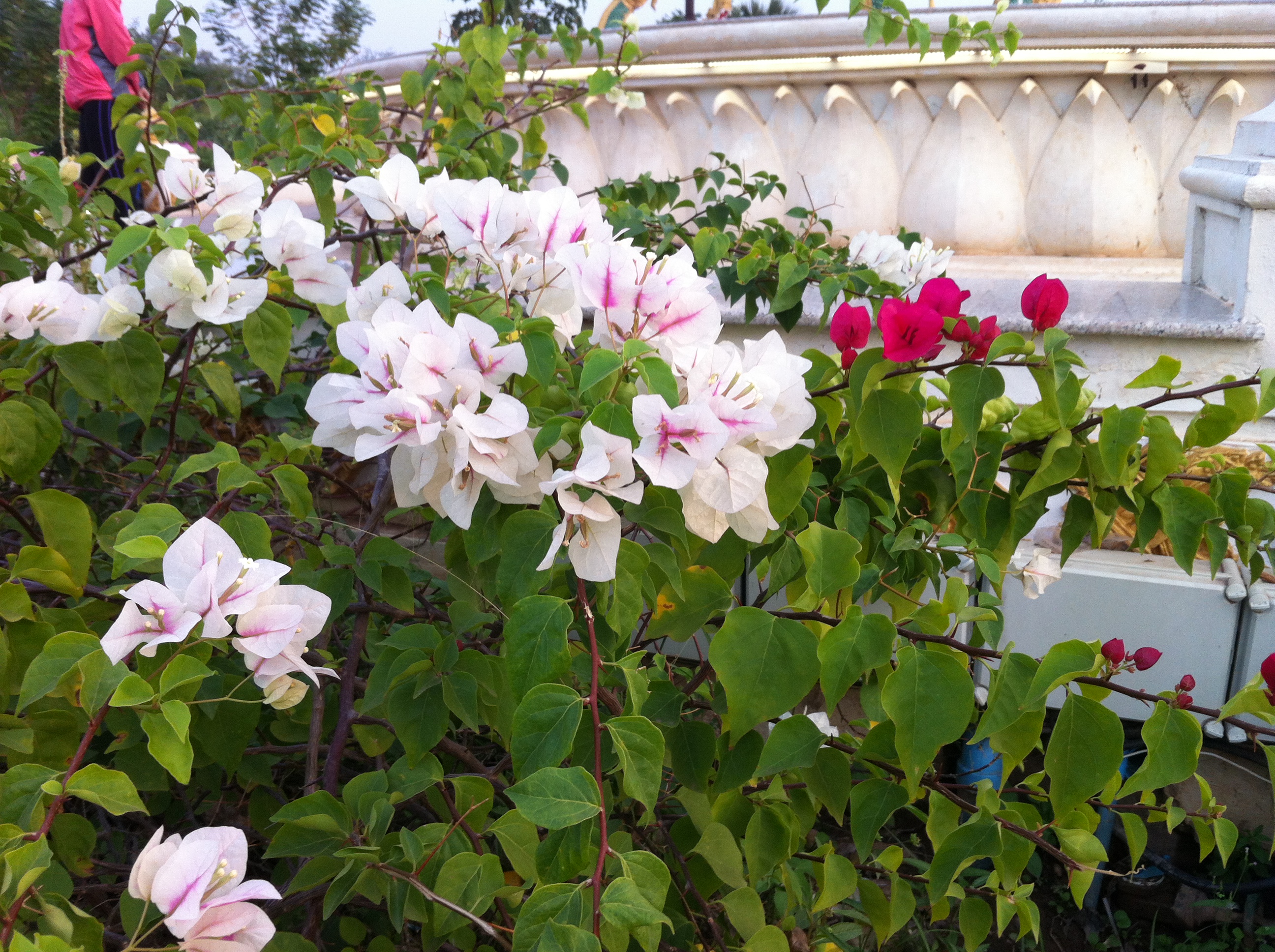
I have to say that this burst of botanical colour made me feel rather light-headed, and I started rushing about the hotel’s garden snapping pictures with my phone. I show you here just a few of the photos I took:

flowers and trees 007

flowers and trees 029

flowers and trees 032

flowers and trees 034

flowers and trees 035

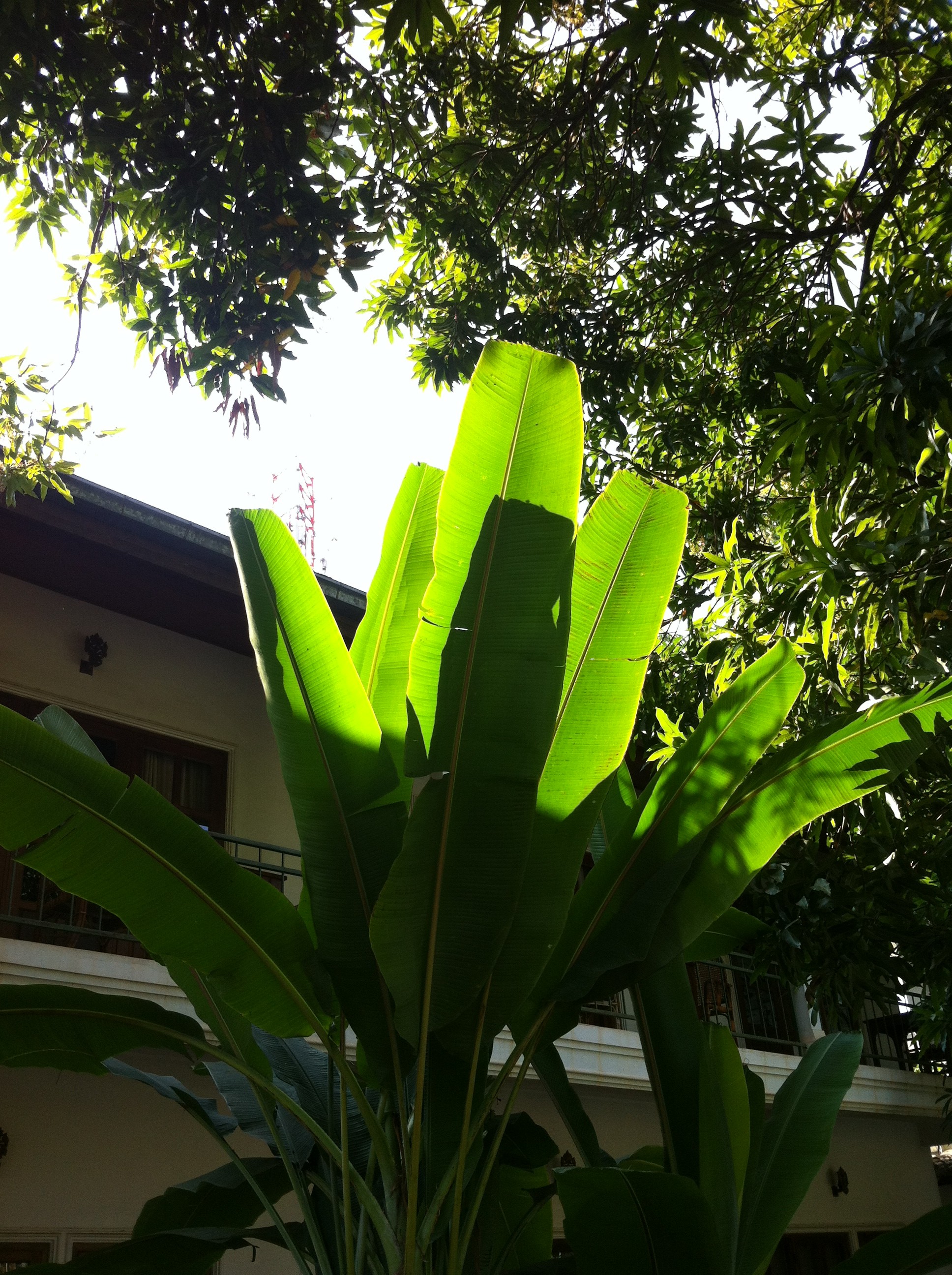
I’ve always been fond of the colour of light through banana tree leaves …

The loveliness didn’t stop at the gates of the hotel. Walking through the streets of Vientiane was like walking though a garden, as flowering plants and trees popped up everywhere.

flowers and trees 013

flowers and trees 024

flowers and trees 025

flowers and trees 048

flowers and trees 051

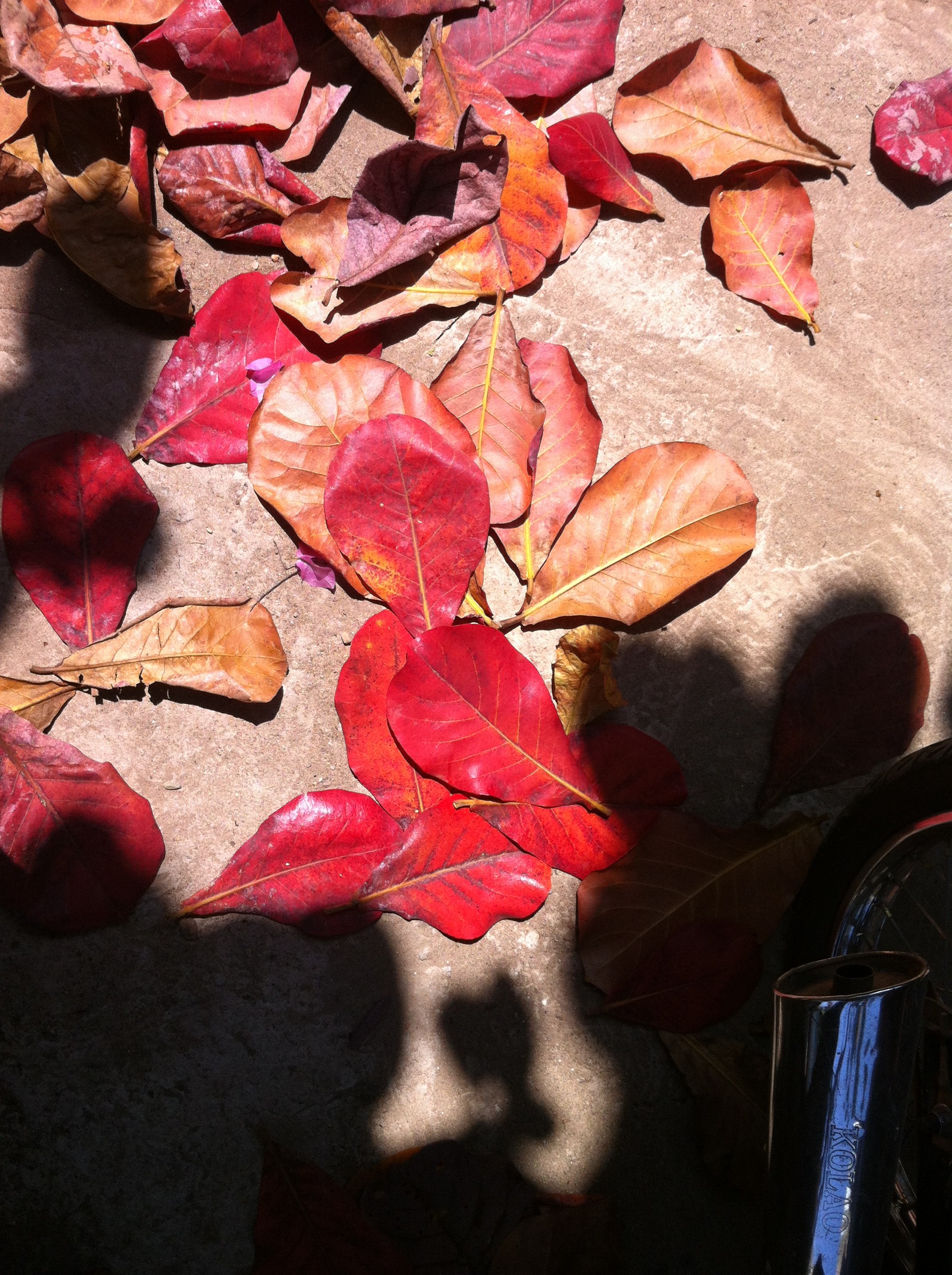
Even the non-flowering trees were magnificent, especially along the road skirting the Mekong River where there were huge banyan and eucalyptus trees. But the tree that took my heart is a tree called the Deer’s Ear (wonderful name …), whose leaves are going red and shedding at this time of year.

flowers and trees 012

This tree is all over town, and each one has reached a different level of redness, so you go from bright green all the way to a deep vermilion. It’s rather like being in Vermont in the Fall.

flowers and trees 052

As I recall, many learned men in the Middle Ages spent much time trying to pinpoint where exactly the Garden of Eden had been. For me, it’s obvious; it must have been somewhere in a tropical or subtropical country like Laos.

I suppose the damned mosquitoes were added by God afterwards as part of Adam and Eve’s punishment …

I, TOO, WAS AT DAVOS

Beijing, 31 January 2013

OK, my meeting in Davos was a little more humble than the one that just finished. We didn’t talk of global trends or the next big crisis, nor were television newscasters knocking at our doors begging for an interview. No, we were talking about e-waste and what to do with the growing mountains of broken computers and discarded mobile phones that we generate.

It was still summer, or so I thought. After all, the meeting was taking place in the first week of September. But the morning after I arrived it snowed. I could NOT believe it! My wife and I had made plans that after the meeting she would join me and we would visit the area. But we weren’t about to go visiting in the snow. That was the end of that little holiday.

Perhaps because of this, or perhaps because I realized that the meeting was actually a waste of time, whatever it was, I was not in a receptive mood.  I found Davos to be a pretty nothing place. There was no part of the town that I found worth looking at, no building worth admiring, no vista to stop in front of … nothing. Just a series of anonymous-looking modern buildings along anonymous-looking streets.

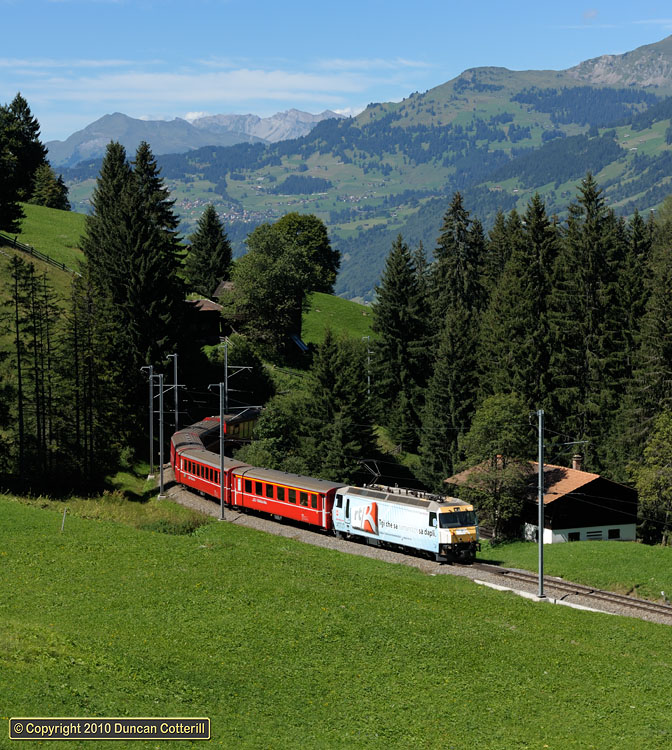
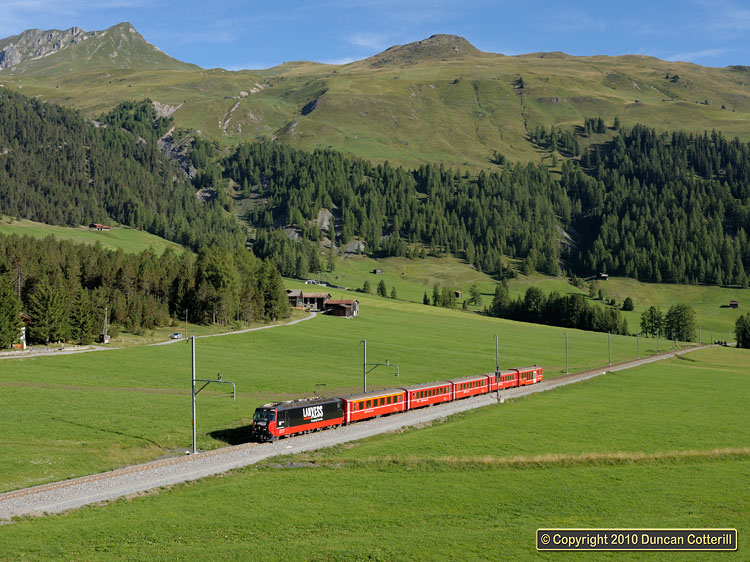
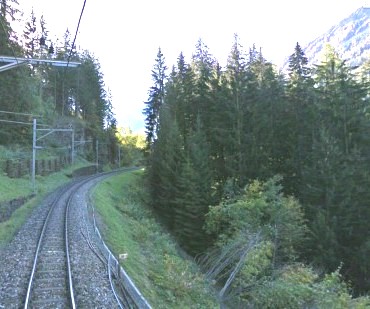
Well, to be fair, there was one thing that has stayed with me and that was the train ride up to Davos. At Zurich airport, I took a train to the small town of Landquart, which stands astride the point where river Landquart meets river Rhine, still a modest river at this point on its journey to the sea. There, I changed to a narrow gauge train, which took me up to Davos. This line is part of the Rhaetian railway network (lovely name, that; it comes from the original inhabitants of the high mountain valleys of these parts, the Rhaetians). The train runs up the valley of the river Landquart to Klosters, where it turns off and begins to climb up to Davos, 10 km away and 400 metres higher. It is a truly lovely ride, reminiscent to me of the ride in the Micheline about which I wrote a post recently. Maybe it’s because the train doesn’t go too fast, or maybe it’s the narrower gauge or the single line, or maybe it’s because the trees are allowed to grow up close to the train, or maybe it’s the way the train twists and turns through the very peaceful fields and woods … but somehow in this train you feel so close to nature.

Camera : NIKON D700 . . . Focal Len : 70.0 mm . . . Shutter : 1/640sec . . . Aperture : f/9.0 . . . ISO : 200 . . . Original : Digital 12MP NEF

davos train-2-Küblis-Saas

Camera : NIKON D700 . . . Focal Len : 42.0 mm . . . Shutter : 1/640sec . . . Aperture : f/9.0 . . . ISO : 200 . . . Original : Digital 12MP NEF

Camera : NIKON D700 . . . Focal Len : 40.0 mm . . . Shutter : 1/500sec . . . Aperture : f/8.0 . . . ISO : 200 . . . Original : Digital 12MP NEF

When I took it, I was alone in my compartment, so I pulled down the window (in itself a small miracle in modern trains), stuck my head out of the window, and just let the hayfields and pine trees whoosh past me, all the way to Davos.

davos train-9

Pity Davos and the meeting were such a let-down.

_____________________________

Davos train-1: http://www.railography.co.uk/photos/schweiz/910/files/10-D-1857.jpg
Davos train-2: http://upload.wikimedia.org/wikipedia/commons/thumb/a/aa/RhB_K%C3%BCblis-Saas.jpg/640px-RhB_K%C3%BCblis-Saas.jpg
Davos train-3: http://www.railography.co.uk/photos/schweiz/910/files/10-D-1840.htm
Davos train-4: http://www.railography.co.uk/photos/schweiz/910/files/10-D-1833.jpg
Davos train-5: http://www.streetviewfun.com/wp-content/uploads/2012/03/googletrainview-550×309.jpg