I left readers at the end of my last post promising to cover the rest of our stay in Munich as well as our stay in Bregenz in another post. Well, I am a man of his word, here is that post!
In truth, the post will be more of a showing of photos than anything else, the e-equivalent of having your friends round for dinner after your latest holiday and boring them with your holiday snaps. I hope my readers will not be too bored and slip away early from this post …
With that, let us begin!
Munich
Well, I can’t say that I was carried away by the overall look and feel of the city. Pleasant enough, but Vienna for instance is a much more striking city overall. So what follows is a string of individual things that stuck in my mind as we criss-crossed the city.
The Nymphenburg Palace, the little summer pad of the Dukes-Kings-Electors of Bavaria.
It was once out in the countryside but is now in the suburbs of Munich. Considerably more dramatic than the Hapsburgs’ little summer pad at Schönbrunn (now also marooned in Vienna’s suburbs).
The outside may have been dramatic, but the palace’s interiors weren’t up to much. On the other hand, the interior of Amalienburg, a little hunting lodge hidden among the trees of the Palace’s park, was quite something.
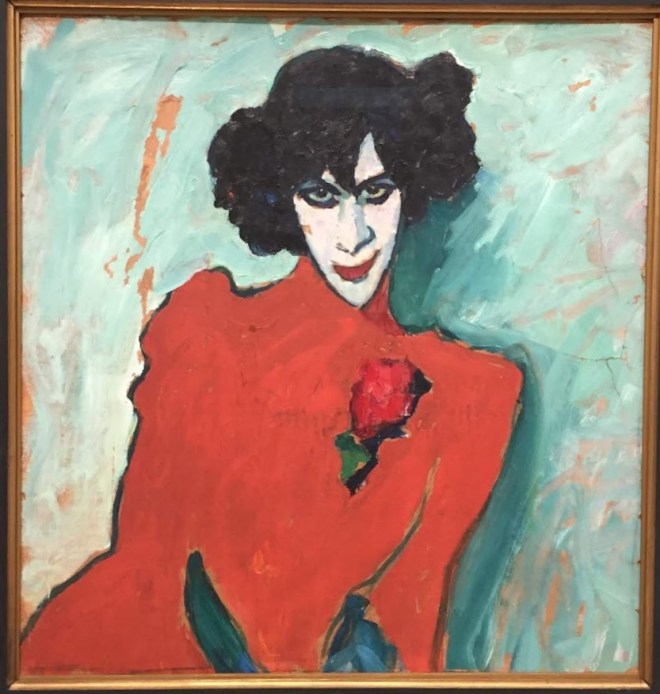
The museum has a whole section devoted to members of the Blaue Reiter group. A worthy collection indeed, but nothing other than this painting grabbed me.
Villa Lenbach also had a room devoted to paintings from after 1945, which is where I saw this one.
The Seated Man, by Jean Hélion, a French painter whom I had never, ever heard of prior to entering the Villa Lenbach. Well, you learn something new every day …
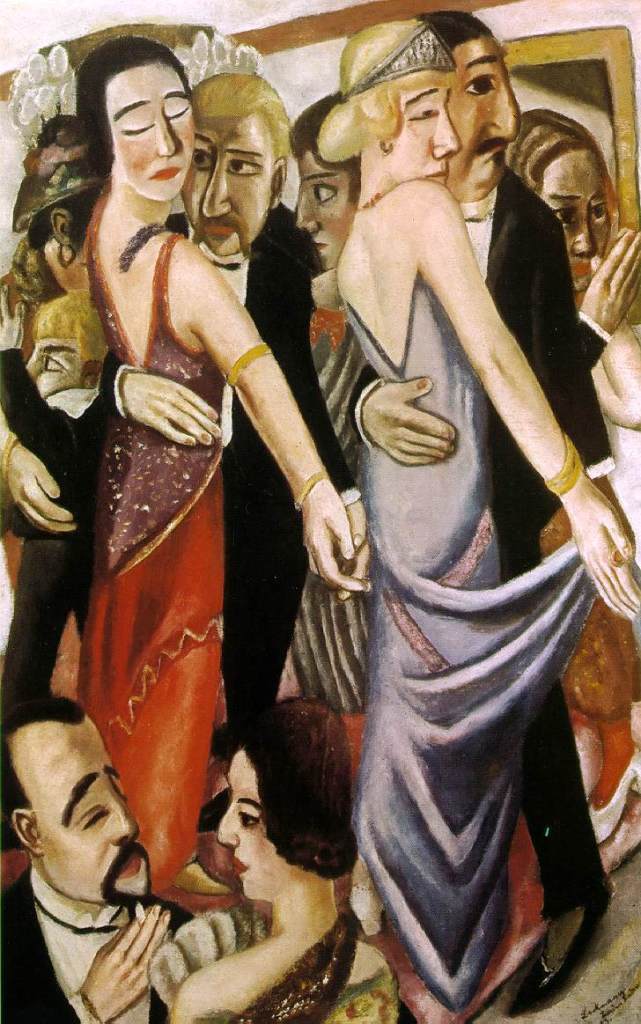
We also visited the Modern Art Gallery (Pinakothek der Moderne). Again, a very worthy collection, but only this painting by Max Beckmann (Dance in Baden-Baden) has stayed with me.
On our wanderings, we entered the Burgersaal church by mistake (I misread the map and thought we were visiting St. Michael’s church, “the first Renaissance church built north of the Alps” the Michelin Green Guide dixit – the serendipity of tourism).
our photo
The paintings on the ceiling were a pleasingly modernized take on an old art form.
our photo
The church is dedicated to Blessed Rupert Mayer (kneeling to the left on that ceiling painting), a priest who stood up to the Nazis. He was one of the very few German Catholics who did so …
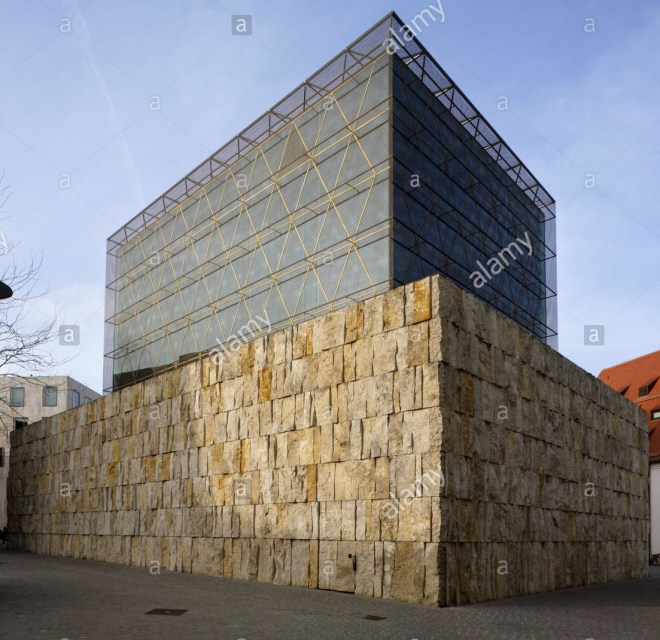
The new main Jewish synagogue in St. Jakobs Platz in the old town.
The previous main synagogue was pulled down by the Nazis in 1938. We didn’t get to visit inside, but the brooding, rugged exterior was impressive enough. It reminded me of the Wailing Wall in Jerusalem. The Jewish Museum next door was interesting, too, but more as a collection of memories of a community scythed down by the Nazis. Many were sent to Dachau, a mere 20 km to the north of Munich.
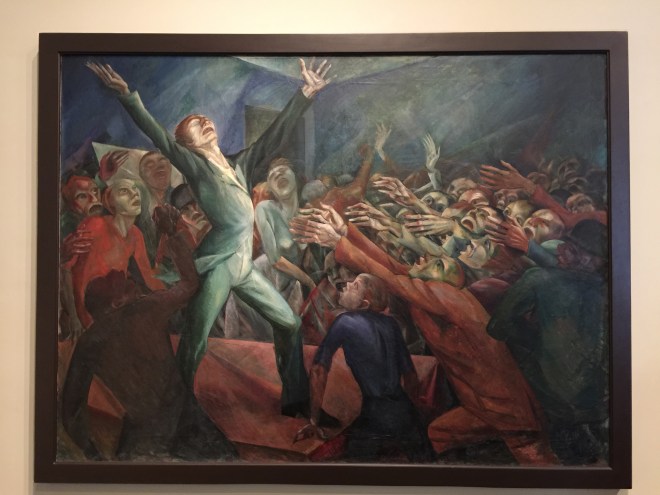
This was one of several such halls in Munich in which Hitler used to speak in the early days of his political career. I don’t know what I was expecting; a sense of menace or of dread in the air? No doubt I was influenced by a painting I had seen in Los Angeles’s County Museum of Art: The Orator, by Magnus Zeller.
our photo
The location of that painting could easily have been the Hofbräuhaus.
But all I saw were a lot of people enjoying a beer, and all I heard was a lot of cheerful babble.
And that’s it for Munich! Next stop:
Bregenz
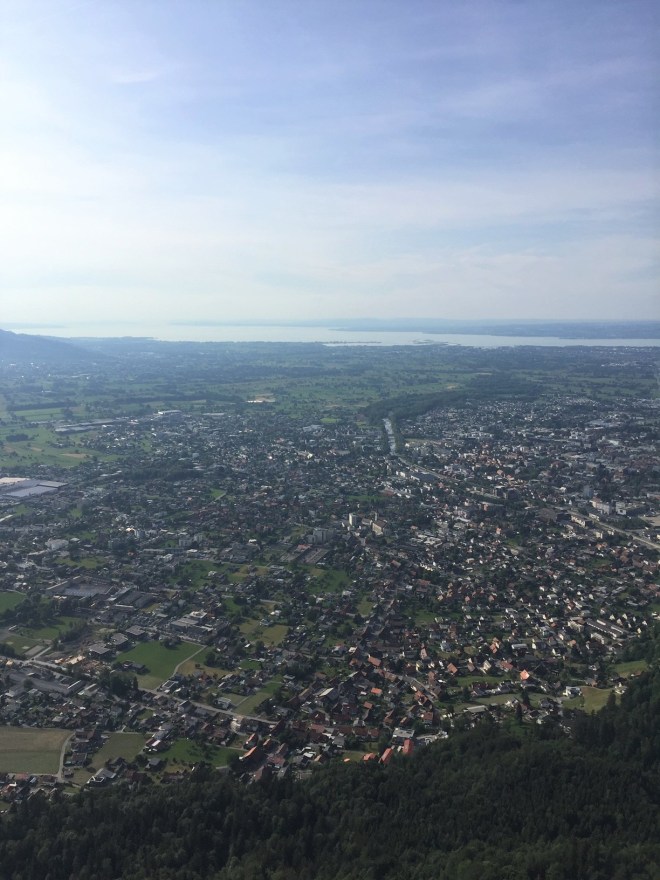
I must confess that I was expecting more. Its location on Lake Constance, its venerable and ancient past (it was originally a Roman town by the name of Brigantium), all led me to think it would be an interesting place to visit. But no, there really wasn’t much to it, and what there was, was ruined by bad town planning: the railway station and a busy through road effectively cut the city off from the lake. So again, just a few photos of some individual places.
A view of the upper town, a charming and quiet little corner of the city.
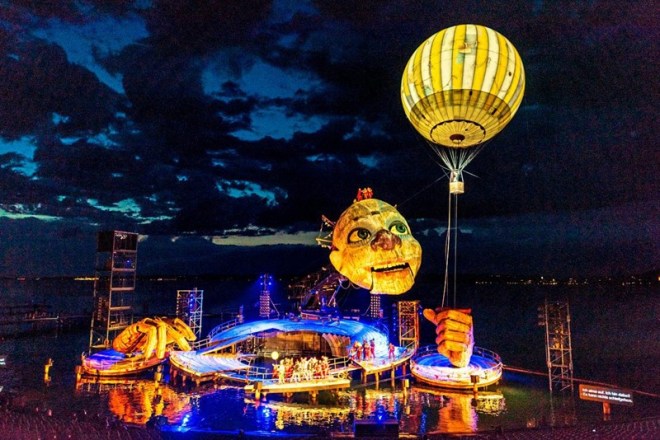
The stage is a little way out in the lake, just off the shore, and the audience takes its place on seating put up along the shore. We were seeing Verdi’s Rigoletto, but the opera itself was completely overshadowed by the set. That giant head went up and down and turned this way and that, the eyes opened and closed, as did the mouth, people entered and exited the mouth, the hands moved, fluttering here and there, the tethered balloon went up and down … All this while the sun was setting over the lake and darkness came creeping up on us. It was jaw-dropping. Was the singing good? I don’t know, I was so concentrated on that head and its next move.
And that’s it for Bregenz!
I hope you’re still with me and that you enjoyed our holiday snaps. See you next time!
A couple of months ago, a friend of ours told us that he had two spare tickets for the Bregenz Opera festival and asked us if would we like to take them. It so happens that I had been meaning to go and check Bregenz out ever since, many years ago, we had driven through it one wintry day on our way to visit my parents. So my wife and I gladly took him up in his offer. A write-up on that trip, though, will have to wait for another day. What I want to write about today is our little pre-trip to Munich.
It just so happens that a couple of days after we accepted our friend’s offer to go to Bregenz we read about an exhibition in Munich of the works of the Ghanaian-Nigerian artist El Anatsui.
We had come across his work in New York’s Metropolitan Museum of Art some five years ago, and had been hankering to see more of his stuff ever since. It also so happens that we had passed through Munich as well as Bregenz that wintry day of many years ago – as readers will ascertain looking at a map, Munich and Bregenz are in the same general direction from Vienna. There too, I had promised myself to return some day to visit the city.
So after a little discussion and a study of bus and train timetables, my wife and I decided that we would visit Munich for a few days before going on to Bregenz for another couple of days. Thus it was that two weeks ago we disembarked from the bus at Munich’s bus station to start our visit.
Since it was the primary reason for our visiting Munich, I will focus in this post on the exhibition of El Anatui’s work. I’ll deal with the rest of Munich and Bregenz in a later post.
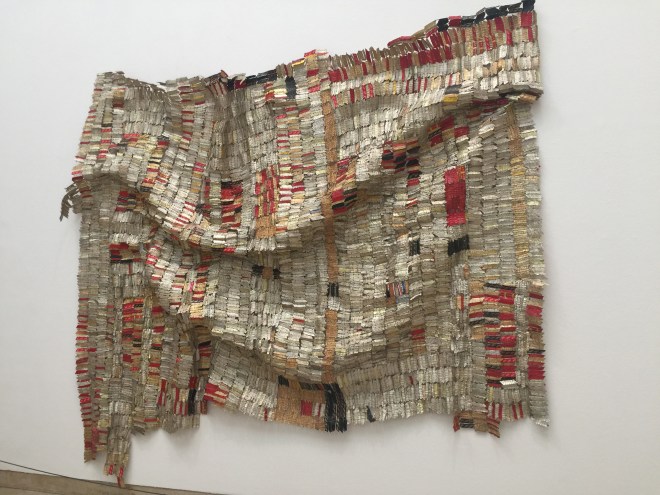
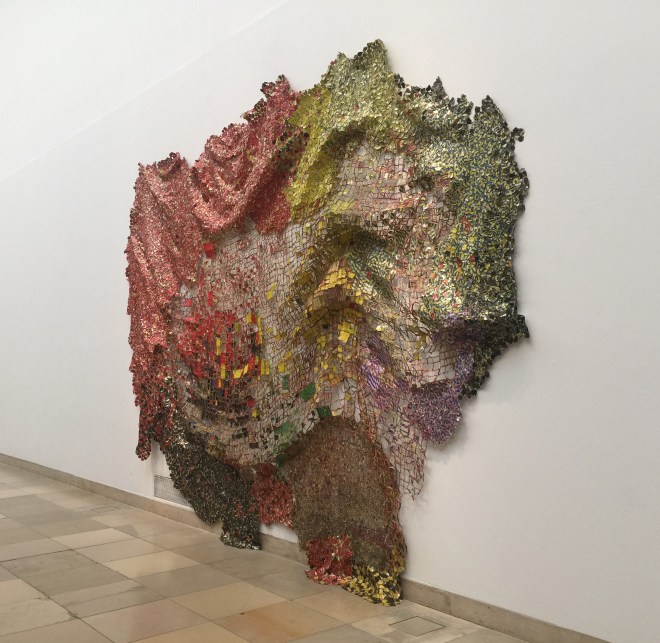
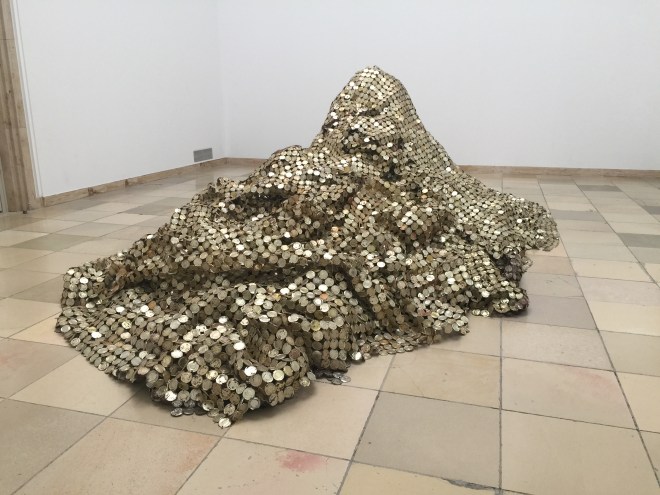
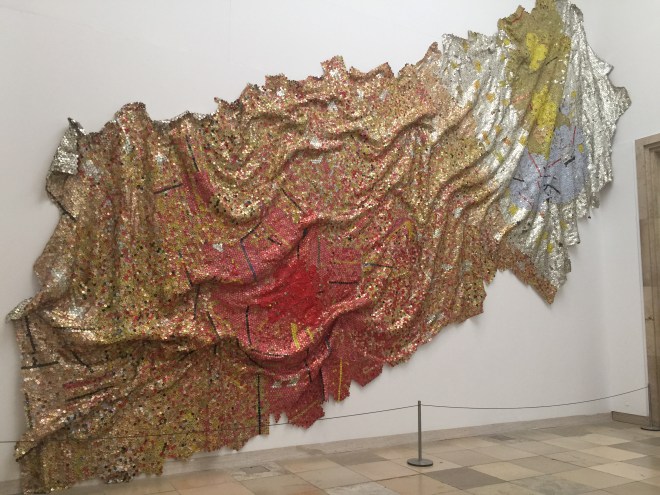
Anatsui is best known for these kinds of works. At first glance, they appear to be large sheets of textiles of some sort, draped on the wall. But actually, the sheets are made up of thousands of aluminum bottle tops, from bottled drinks, as well as of the aluminum bands or sheaths to which the unopened tops are attached. Anatsui was driven to experiment with these waste objects by a principle he lives by: artists should use what they have around them to create their art. He buys these discarded pieces of aluminum from the informal recyclers who collect them. His large crew of assistants then flatten them, after which Anatsui has them lay the pieces on the ground, where he shuffles them around, using the brand colours of the aluminum pieces to produce an overall large-scale abstract design. Once he is satisfied with the design, his assistants “sew” the pieces together with copper wire. When Anatsui is setting up an exhibition, he will spend much time in “draping” the sheets on the wall until he is satisfied with the effect. Here are some other pieces in the exhibition. Sometimes, Anatsui uses the aluminum pieces differently. He will have his assistants twist them into circles, which they will then sew together. This gives him semi-transparent sheets with a gauze-like effect. He had one very large work of this type in the exhibition, filling up a whole room. While Anatsui has mostly used aluminum bottle tops and their sheaths in these kinds of works, he has also used other metallic discards. This work, for instance, is made with the “Easy Open” can tops, the ones you can just pull off the cans. Personally, I find his work with the aluminum caps and sheathes more interesting. Can tops are too big, so the textile-like effect of his other works is not really there. The brand colours are absent too, so he can’t get the abstract designs he creates with the bottle tops.
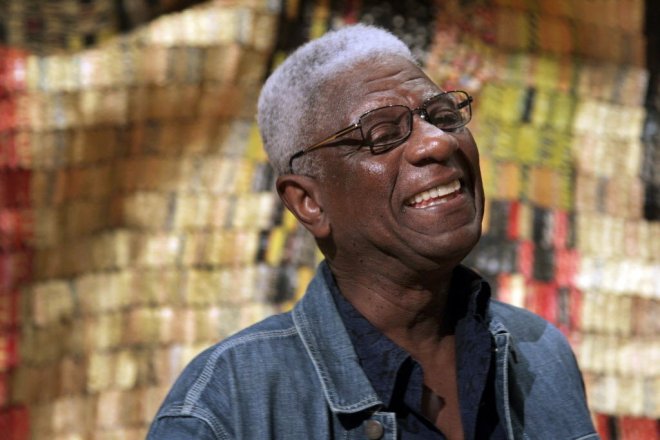
I have to say, I find these pieces fascinating. Not only are they beautiful to look at, they are also a wonderful example of how, with some thought and dedication, a waste can be given a new life. And what a new life they have been given by Anatsui! His works remind me of another African artist whom I have written a post about earlier, Abdoulaye Konaté. He also takes small coloured pieces of material, in his case pieces of textile, and creates beautiful abstract designs out of them.
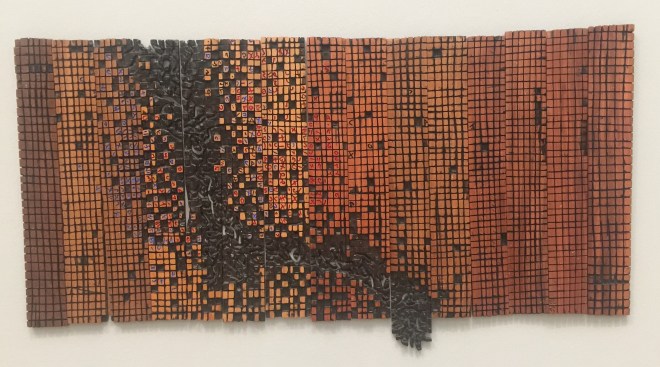
Although Anatsui is best known for his work with aluminum bottle caps, he actually arrived at this quite late in his career. Before that, he worked, and continues to work, with wood. His basic approach is to first take a chain-saw to the wood, gouging out lines, often criss-crossing and of varying depths and orientation, and then taking a blow torch to the surface to selectively blacken it. He may then add touches of colour. The effect can be quite striking. Here are photos of a couple of his works in the exhibition. Before that, he worked in clay. We are now at the start of his career, and as is perhaps often the case with artists this early work is good but not great. I include only one of these works here.
As I say, a really great artist. I’ve said it before, and I say it again: I think the best art today is coming out of the developing countries; In Europe especially, our art is dying on its feet. I’m afraid any readers who are interested in seeing this exhibition will no longer be able to see it in Munich. It closed at the end of July. But I think there is a chance it will go on to other places. Keep a lookout for it!
Well, it’s taken me quite a while to get around to this post. We completed our hike in the Dolomites three weeks ago, but it’s only now that I’ve managed to put all our photos in order – there were three sets of photos to arrange, my wife’s, my daughter’s, and my own. But the work of electronic filing and folderizing is over and I can finally write this post.
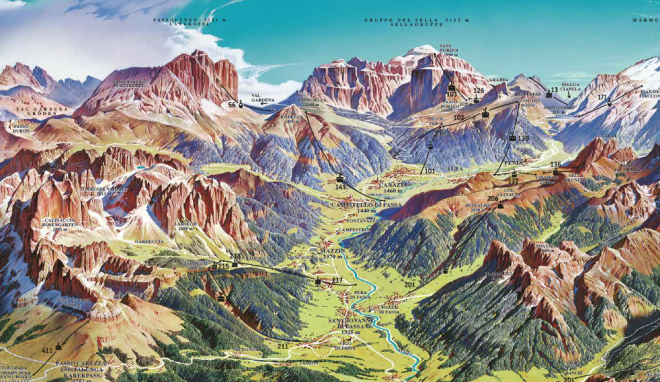
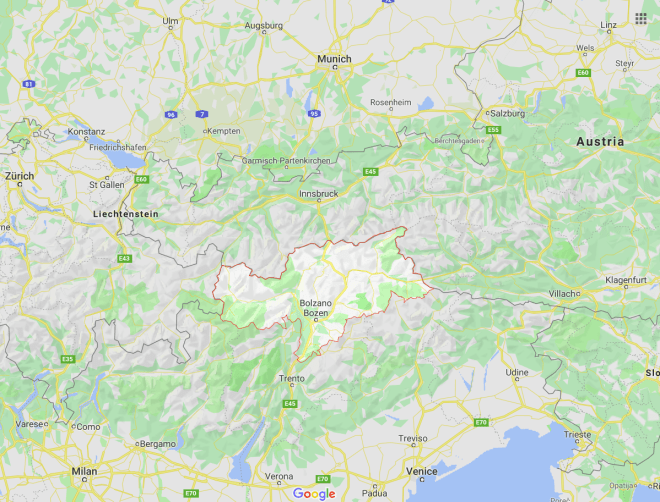
My last post had us in Bolzano, visiting Ötzi the Iceman. From there, we took the bus over to the next valley, the Val di Fassa. Just to give readers an idea of this valley, here is one of those bird’s-eye-view maps that clever cartographers come up with. And here is the same map with a rather wonky red line put in by me showing our itinerary. We hiked for six days, staying for the most part in mountain huts. We had the pleasure of being joined by our daughter and her partner for three of those days.
The itinerary didn’t quite turn out as planned. The area had got hit by a terrible storm in October of last year, which brought down thousands of trees and blocked a good number of the paths. The authorities’ plan had been to start clean-up in May, but the valley suffered from unusually heavy late-season snowfalls that month, which meant that when we arrived not only many of the paths blocked by trees hadn’t been cleared but other paths were now blocked because of snow. The result was that we didn’t walk quite as long at high altitude as had originally been planned. But it was wonderful nevertheless.
I’ve done writing. I shall let our photos speak for themselves.
June 16th:
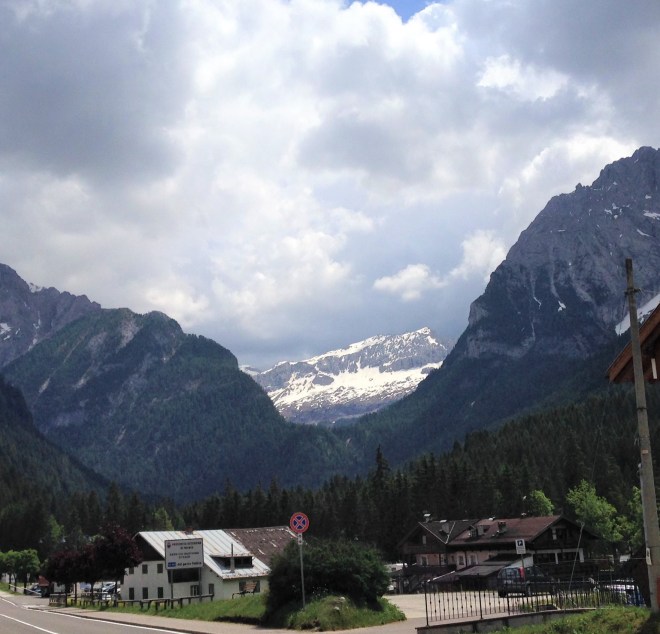
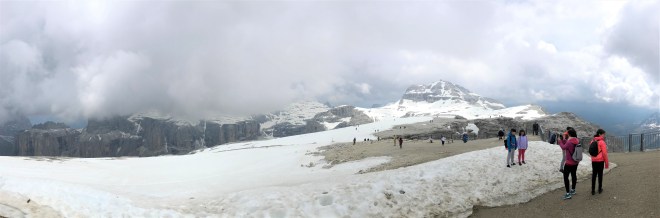
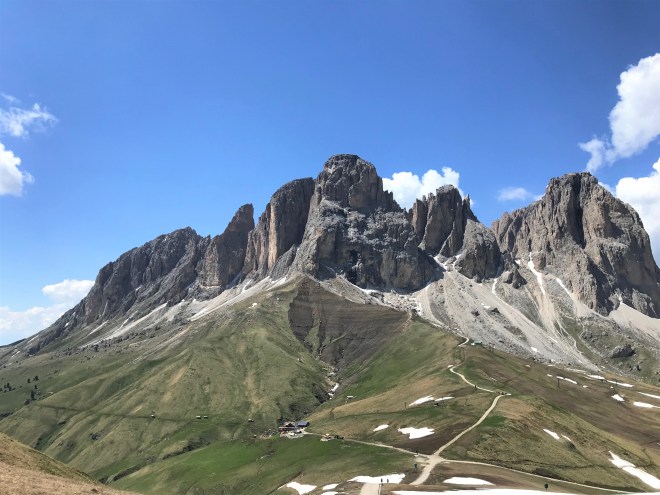
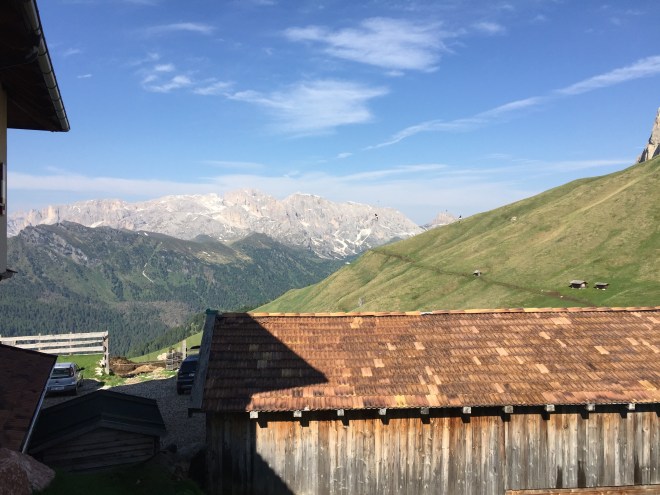
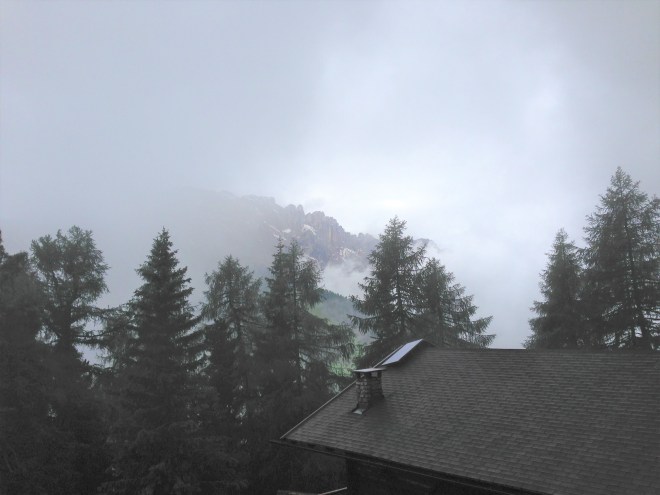
Our first sight of the mountains bathed in the evening rays of the sun
June 17th:
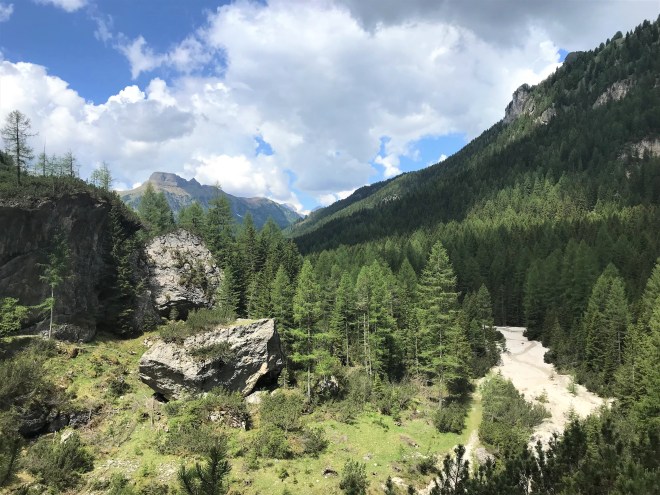
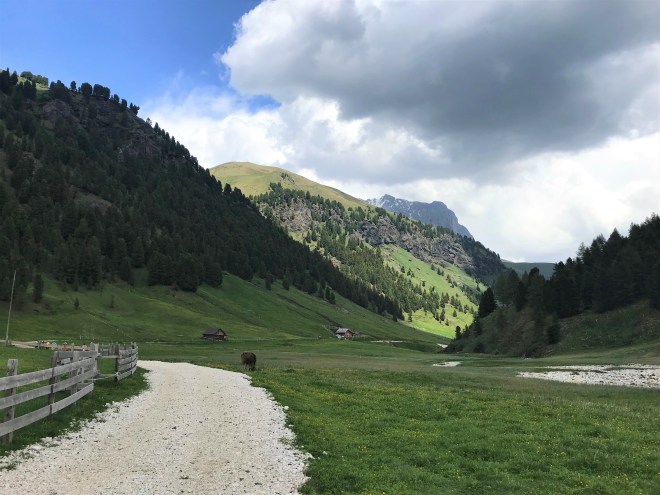
Walking by meadows in flower as we followed the river upstreamThe mountains beckoning, at the end of the day’s hike. Our daughter and her partner are waiting for us at the hotel
June 18th:
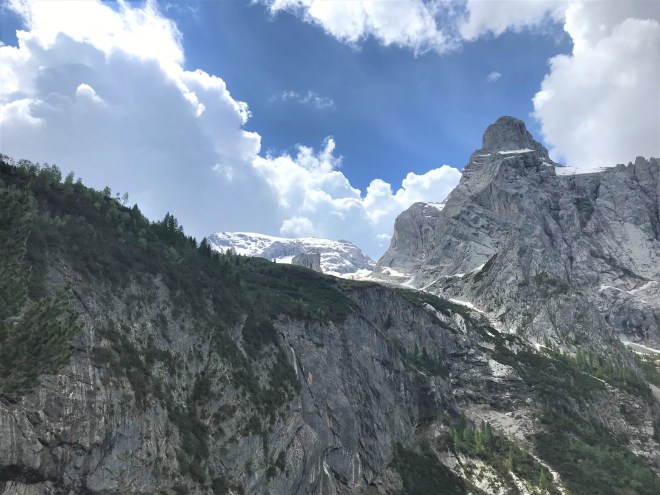
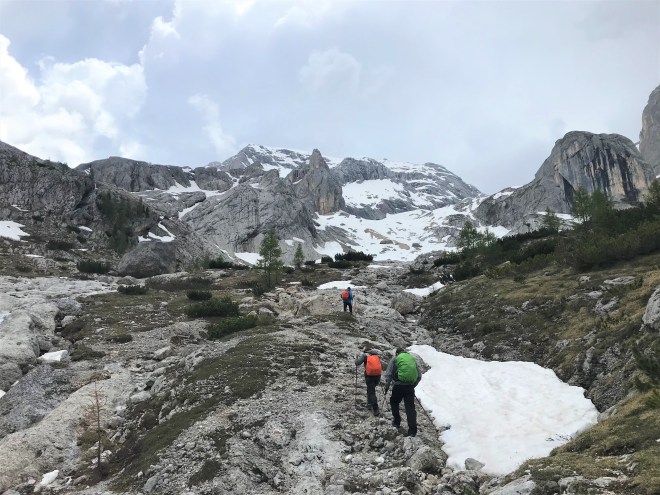
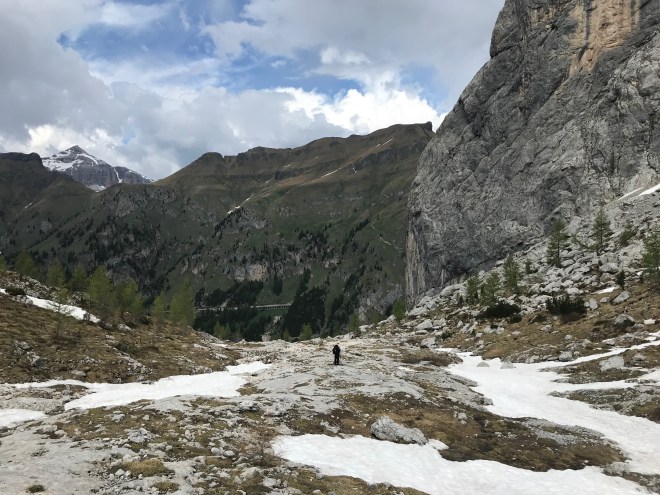
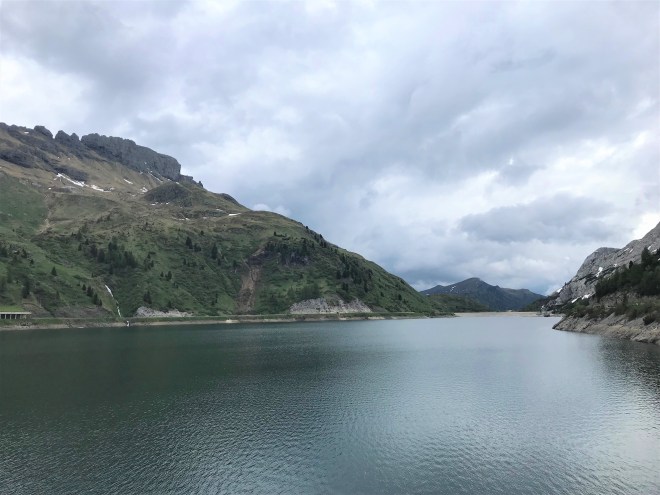
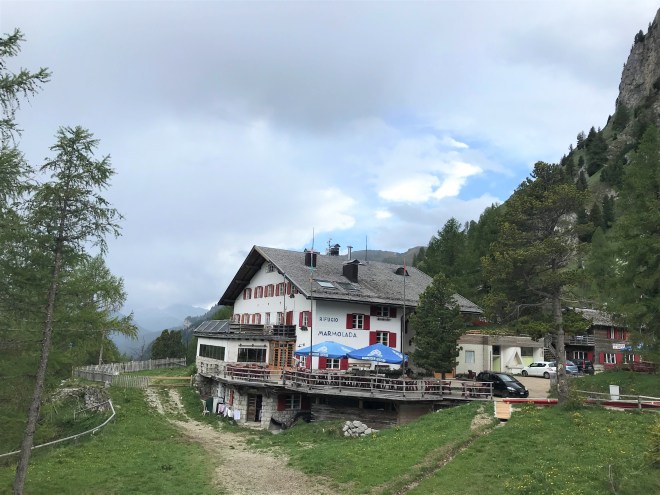
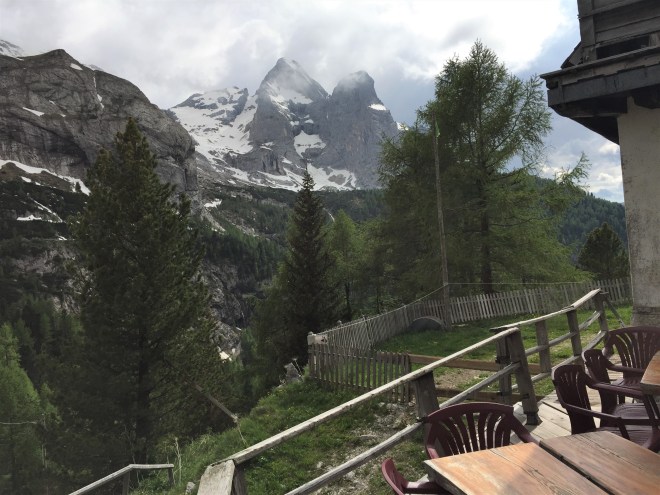
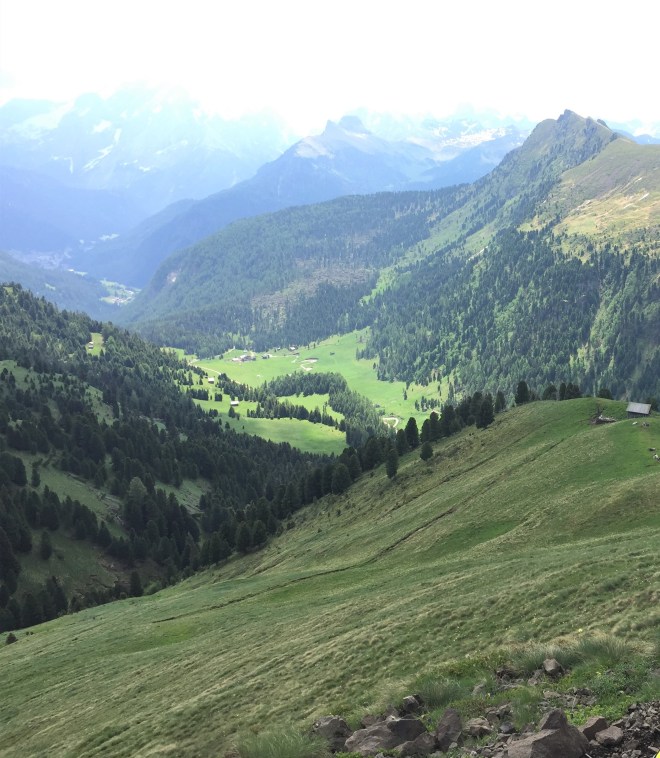
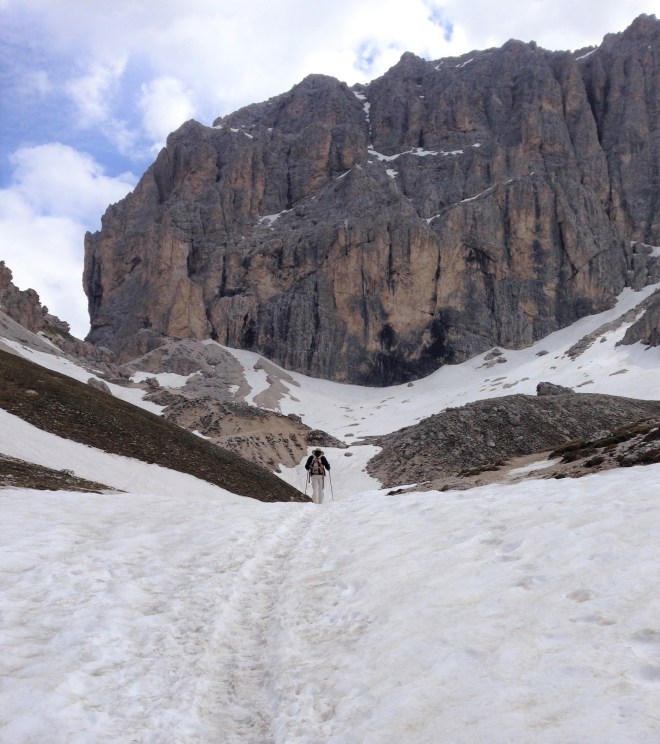
In the early morning sunshine, crossing the river which we will follow for an hour or soWe’ve begun our climb off the valley floorWe’re now far above the valley floorWe’re getting above the treeline, into the rock and snowAmong the rock and snow, and the weather is closing inThose heavy May snowfalls! Where is the path?Path found! On our way down to the mountain hut where we’ll be spending the nightThe dam we have to crossWe’ve reached the damThe mountain hut “Marmolada”, where we will spend the nightFrom the terrace of the hut, looking back at the snowfields we crossed
June 19th:
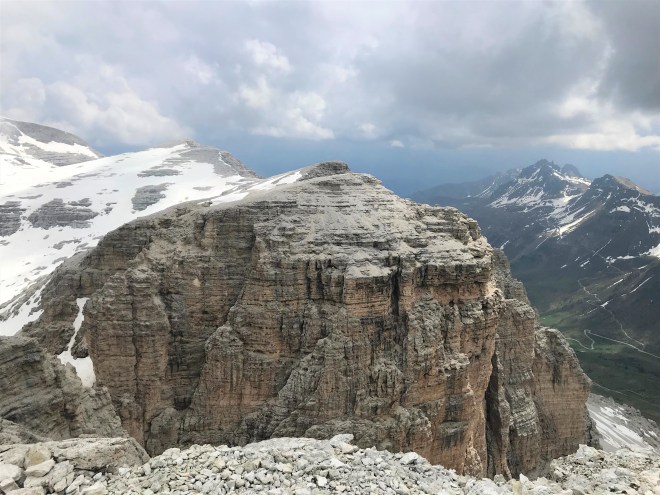
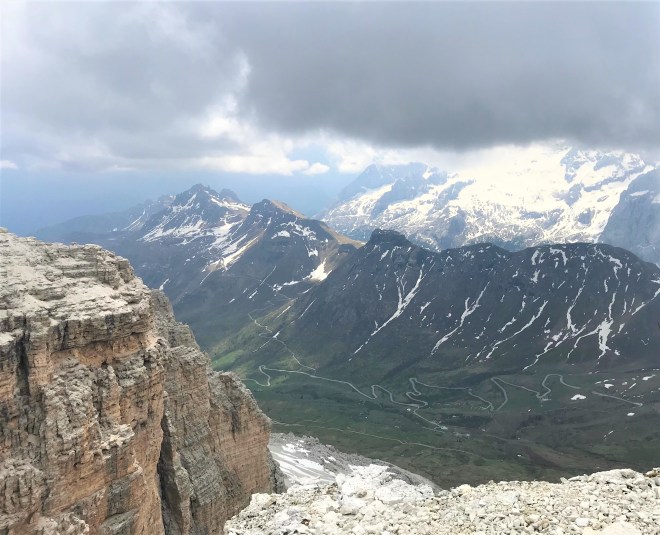
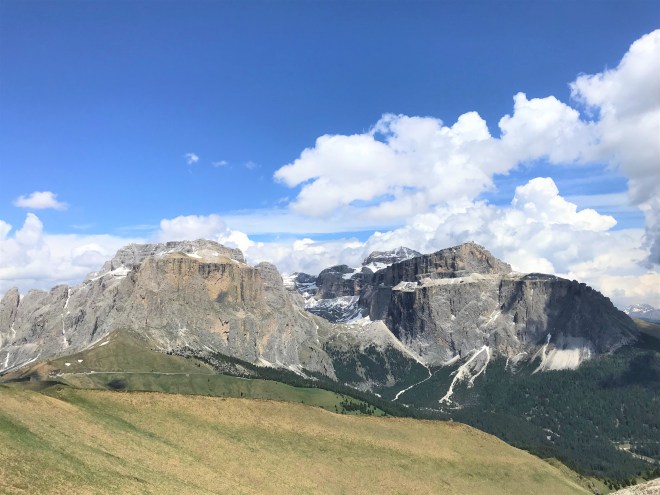
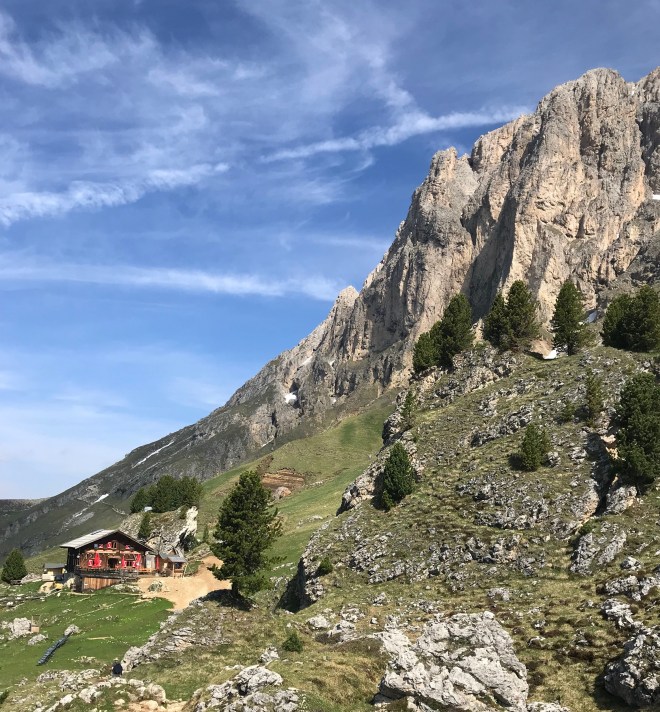
We’ll be going (by cablecar) to that black dot on the edge of the mountain range straight ahead – the Sass PordoiThe mountains on the other side of the Val di FassaView from the top of Sass PordoiThe walls of Sass Pordoi …… and the valley floor far belowWalking down from Sass Pordoi. Our next objective is that dot on top of the small pyramid to the far left. The Sasso Lungo group towers over it.We’ve reached the top of that pyramid (by cable car). Looking back at Sass Pordoi and the Gruppo del Sella behind it.Looking down at our final destination for the day, the mountain hut “Friedrich August”, cowering under the Sasso LungoThe hut’s dog, standing guard on the roofEvening has drawn in
June 20th:
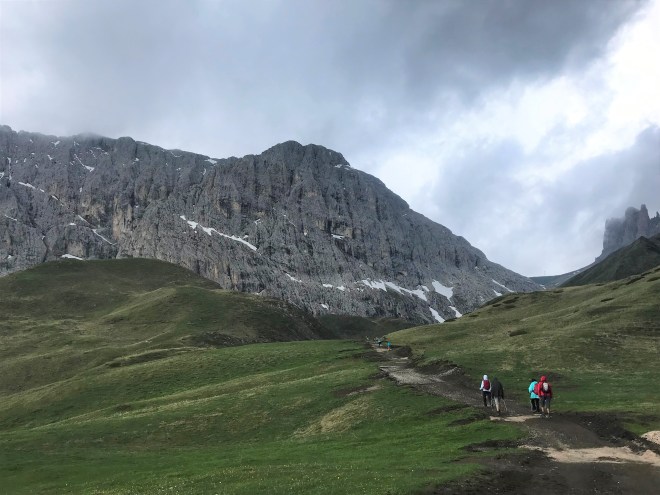
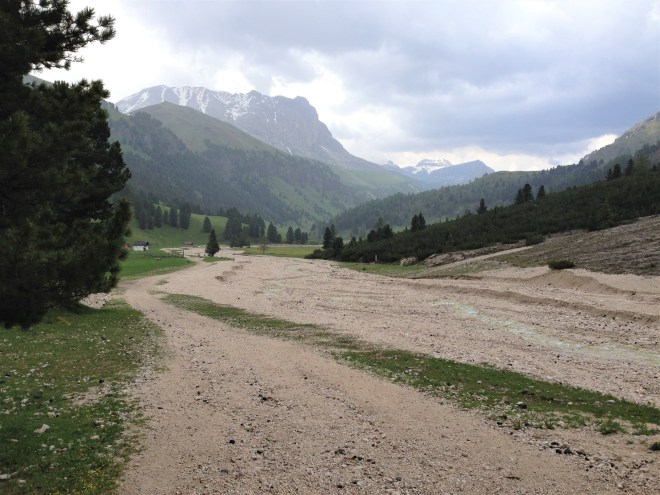
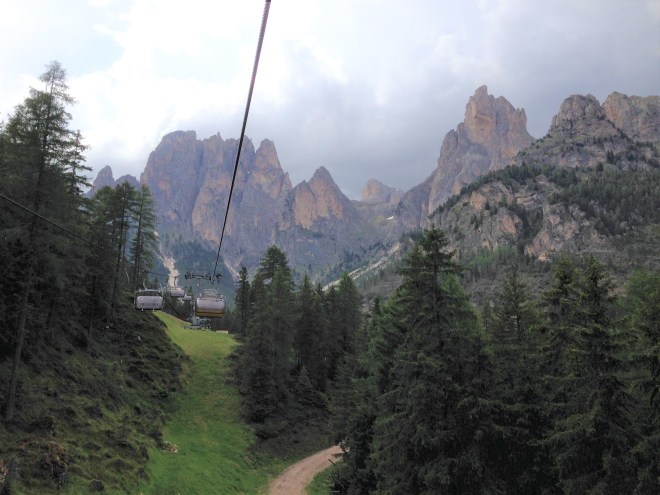
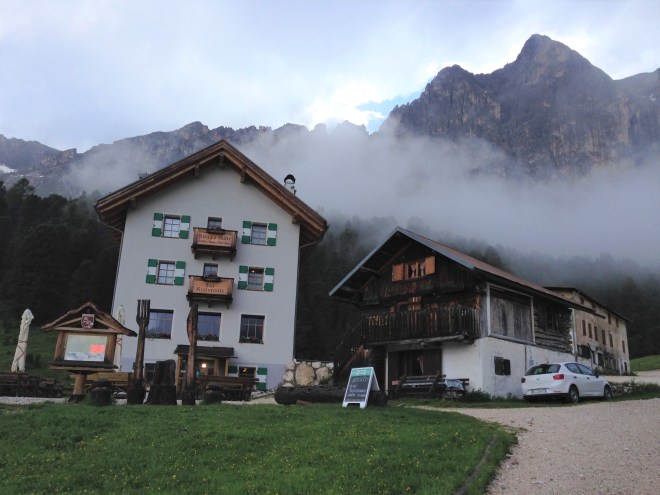
The path we’ll be taking today, snaking away across the mountainsideThe Mountain hut “Sandro Pertini”, first break of the day.Looking back along the path we’ve just walkedLooking down into the Val di Fassa. We have to reach that town at the very bottom.The mountain hut “Sasso Piatto”, our next resting point. Afterwards, we’ll go on to the base of those mountains in the far distance.Looking down into the valleys to the north.Dark clouds have suddenly swept in. It’s hailing! Down below is the valley, the Val Duron, we will eventually be walking down.The Val Duron, now bathed in sunshineThe weather is closing in again. Time to put the rain gear back on.Walking down off the ridge into the head of the Val DuronThe Val Duron beckonsA local inhabitant of the valley nuzzling up to usThe backdrop to the valley …… and the road ahead of usLocal wood carvers have been at work along the wayTaking the chairlift to tonight’s mountain hut. The Larsech group towers up in the distanceEvidence of the catastrophic storm of last OctoberThe mountain hut “Stella Alpina”, where my wife and I will stay for two nights but my daughter and her partner only one
June 21st:
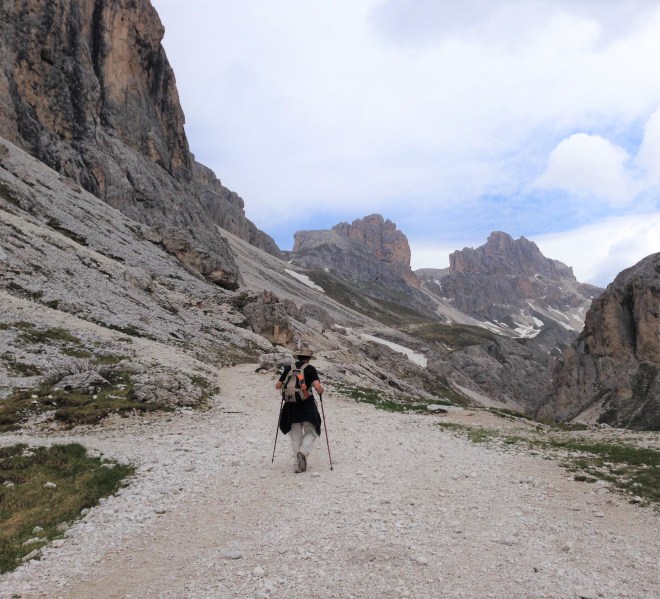
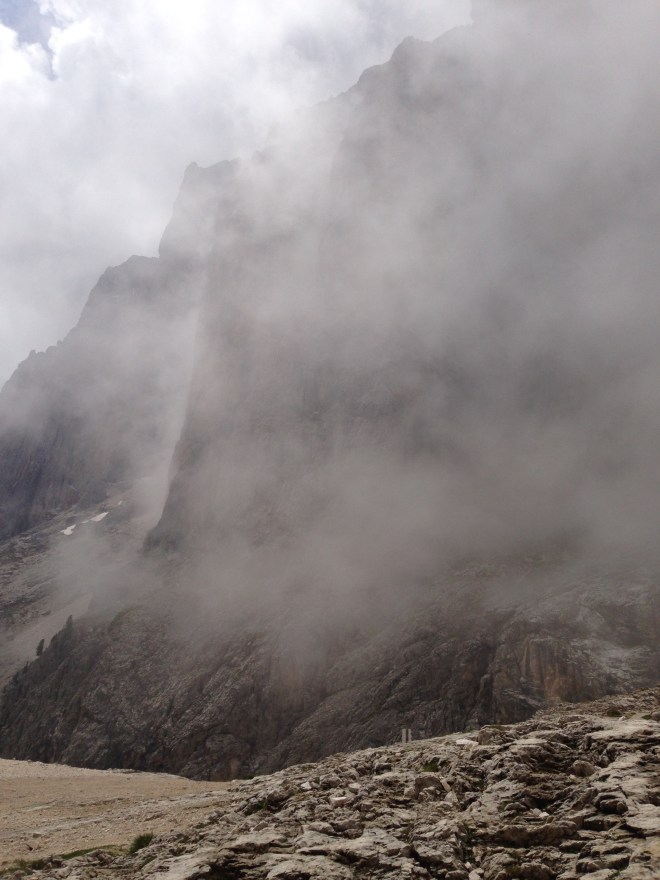
After fond farewells to our daughter and her partner, who are leaving us today, we start walking up through stony detritus towards the Torri del Vajolet, in the shadow of the Catinaccio groupThe mountain hut “Paul Preuss”, our first stop for a breather, sitting precariously on its cliffOnwards through the stone fieldsNow it’s through snowWe stopped for lunch in the Mountain hut ” Passo Principe” (not our photo – source). Braver souls were climbing higher but there was too much snow for us.On our way back down to the “Stella Alpina”, the weather started closing in, wreathing the cliffs around us in cloudsOne last walk before dinnerAs we walk back to the mountain hut, a glimpse of the path we’ll be taking tomorrow morning
June 22nd:
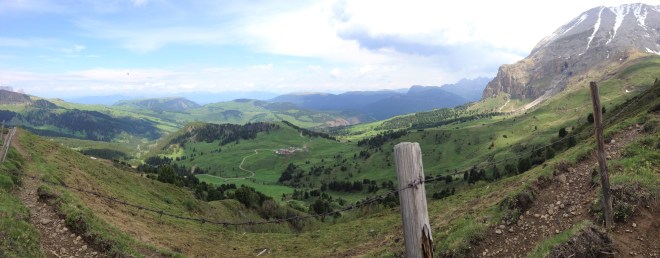
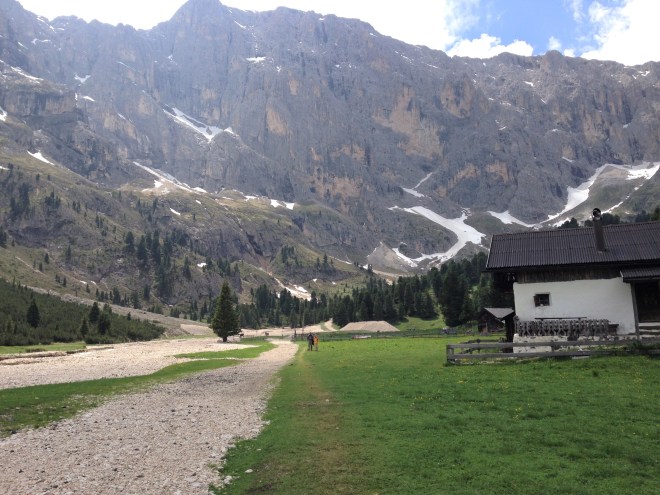
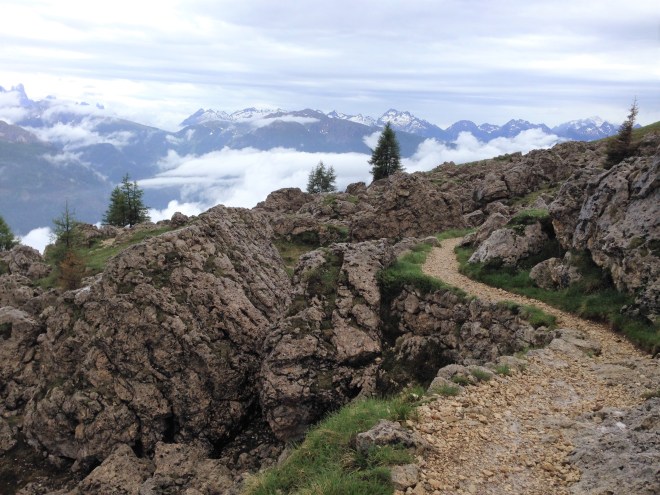
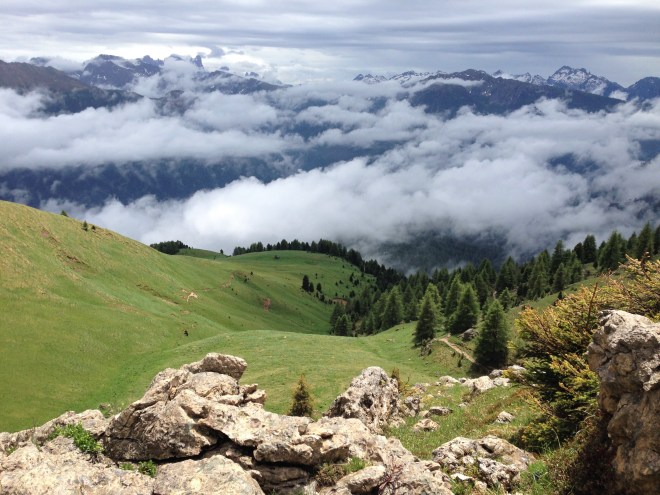
About to plunge into the woodsThe path wends its way through the woods …… to come out into this lovely natural amphitheatreThe mountain hut “Roda de Vael” sits perched on the ridge of the amphitheatre – it’s where we plan to have lunchBut we first have to climb this long, long flight of stepsThe view back from top of the stairs – and evidence of having reached nearly 2,300 metresWe make it into the hut just before it starts raining hardAfter lunch, and after the rain has slackened, we set off again, making for the Passo di Carezza, the end of our hikePlunging views into the Val di Fassa, wreathed in cloudsAs we re-enter civilization, the weather closes in again
At the Passo di Carezza, we took refuge from the rain in a hotel’s restaurant, and drank a cup of tea while waiting for the bus to take us down to the Val di Fassa. The next day, we took the bus back to Bolzano, and from there made our way back to Milan.
We’ll be back in the Dolomites. It’s just too beautiful to pass up. We are still discussing where in the Dolomites to go next. Readers will have to wait with bated breath until next year’s post on the topic to know what we decided.
My wife and I were in Bolzano two weeks ago. For readers who are not familiar with Italy’s geography, that’s the main city of the Autonomous Province of Bolzano. This is a mainly German-speaking region of Italy in the Alps, wedged up against Austria.
Italians call it Alto Adige but many of its inhabitants call it South Tyrol, it having been part of the County of Tyrol since time immemorial; it was only prised away from the Austro-Hungarian Empire and given to Italy after the former collapsed at the end of the First World War. Over the last hundred years this fateful decision has led to much agitation, repression by the Italian State, and consequent acts of terrorism, although all the brouhaha has pretty much died down by now.
Fascinating as it is, the region’s history was not what brought us to Bolzano. It was Ötzi, the Stone Age mummy discovered in a glacier high up in the Ötzal Alps (hence the mummy’s nickname) nearly thirty years ago. Ever since a museum dedicated to him opened in Bolzano in 1998, I have been hankering to visit it. Our planned hiking trip to the valley next door (which will be the subject of my next post) gave me my chance to drop by Bolzano to look over Ötzi, and my wife – although not an Ötzi fan like me – was willing to come along.
Some words of introduction. Ötzi was discovered in September 1991 by a German couple who were hiking up in the Ötzal Alps. They were crossing the Tisenjoch Pass (Giogo di Tisa in Italian), where a small glacier is located. Climate change and a particularly hot summer had led to much shrinkage in the glacier and the couple spotted a body poking out through the ice.
They reported the matter to the owners of a mountain hut close by, who in turn reported it to the authorities – the initial assumption was that it must be the body of someone who had perished on a climb or hike. The man – as he turned out to be – died very close to the Italian-Austrian border. Initially, it was thought that the body’s location was in Austria and he was therefore taken down to Innsbruck (capital of the Austrian province of [northern] Tyrol) for examination. Later, after some careful measurements were made, it was concluded that he had actually been found within Italy, some 95 metres south of the border.
Under normal circumstances, if it had just been some poor bastard who had died on a hike or climb, this problem of which country he had actually been recovered in would not have been such a big deal. But it rapidly became apparent that the mummy was actually very, very old; it has since been calculated that Ötzi is some 5,000 years old. At that point, everyone began to see the dollar (or euro) signs
and the question about which country “owned” the mummy became vitally important. Luckily for the rest of the world, the issue was resolved by people who were actually “cousins”, whatever modern borders might say. The Governors of (Italian) Alto Adige/South Tyrol and (Austrian) Tyrol sat down around a table and (in German) hammered out an agreement. The scientists at Innsbruck (who were much better equipped anyway to study such an ancient mummy) would take the lead on all the scientific studies while the authorities in Bolzano would prepare the museum to house it. And so it was. In 1998, Ötzi was solemnly brought back from Innsbruck to his new home in Bolzano.
While all this had been going on, and in fact ever since Ötzi has been back in Bolzano, scientists from a multitude of disciplines have been busily at work on Ötzi as well as on all the things he was wearing or carrying. I have to say, these scientists seem to have squeezed poor old Ötzi and the tattered remnants of his clothes and equipment like a lemon; squeezed him so hard that his pips have squeaked as they say. But they have come up with an astonishing amount of information. Let me start, though, with a scientific work of art: a statue of what scientists believe Ötzi looked like, which now stands at the very end of the museum tour.
This work is scientific in that it has used the latest technology to measure Ötzi very precisely, to rebuild his bones, to cover those bones with muscles and skin, and then cover those with reconstitutions of his leggings and his shoes; it is artistic in that its creators have made Ötzi look incredibly human. They have given him an expression of someone you might just have met on the street and who is not completely sure who you are.
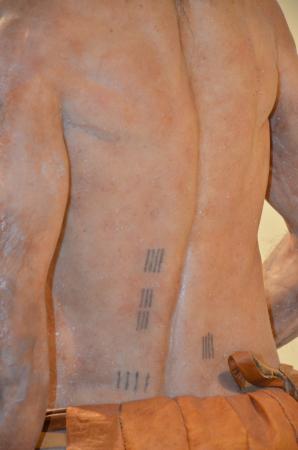
A few words about what we would have noticed about Ötzi if we had met him 5,000 years ago just before he died. He was about 160 cm (5 ft 3 in) tall (small by today’s standards, perhaps big by the standards of the day). His shoe size would have been an EU 38 (I will let readers translate that into whatever shoe size system they are familiar with; they can use this site, for instance, to do this). He weighed about 50 kilos (110 lbs), nicely within his BMI. He had brown eyes. He had dark hair. He was gap-toothed. His teeth in general were not in particularly good condition, badly worn down and with cavities (probably due to a diet based on heavily processed grains). As to his age when he died: about 45 – young by today’s standards, old by the standards of his time; the makers of the statue have made him look weatherbeaten, which he probably was. And he was tattooed; in all, he carried 61 tattoos on his body! This photo of the rear of the statue shows where he had some of them on his back.
As readers can see, they are not really decorative tattoos. From where they are found on Ötzi’s body, scientists believe that they probably had a therapeutic function; they were a way for Ötzi to deal with the aches and pains in his joints, an early form of acupuncture, especially since the tattoos are located along acupuncture lines still used today. For instance, scientists can see that his knee joints were well worn; I’m sure his knees ached as a result (something I can deeply sympathize with given the current state of my knees). So he had a good number of tattoos around his knees; I generally disapprove of tattoos but maybe I should try these kinds of tattoos around my knees …
From their high-tech prodding and probing, scientists have also discovered a number of things about Ötzi which you can’t see. The poor man had been sick several times in the last six months of his life; scientists can tell this from the Beau’s lines on his three remaining nails which they found (any readers who are doctors will no doubt understand this; it’s gibberish to me). He had worms – whipworms to be precise. This would have given him frequent bouts of painful diarrhea. He also had Lyme disease, while his clothes carried fleas. He had broken several ribs and his nose some time during his lifetime. His blood group was O positive. He was lactose intolerant. By rights, we should all be; it’s the “natural” default position for us humans in adulthood. But in Europe our herding culture and its dependence on milk products led to some of us eventually becoming lactose tolerant through a genetic mutation. Talking of mutations, Ötzi carried a rare genetic trait which meant that he was missing two ribs. His DNA links him to small populations of people living in remote parts of Sardinia and Corsica: testimony to his being part of the earlier populations of Europe which were later pushed aside by later immigrants.
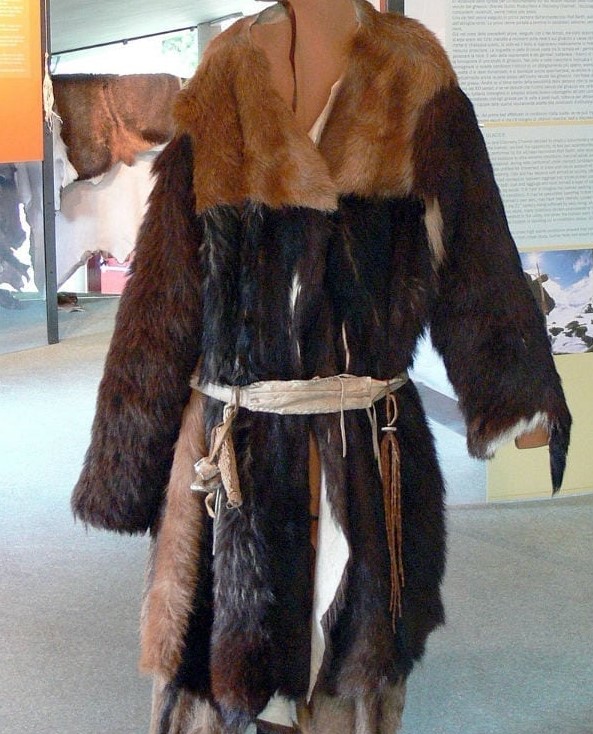
It’s not just the man who has been thoroughly investigated, it’s also his clothes and equipment. What mainly transpires for me was that in today’s language, Ötzi was a completely sustainable guy. He relied heavily on animal hides for all his needs; scientists have identified bear skin, deer skin, goat skin. These were used not only for his clothes but also parts of his equipment (fascinating factoid: at least one of the hides which he used was tanned with bear brains and fat; better than the human carcinogen Chromium VI which is almost universally used nowadays). Animal sinews were used to sew the pieces of hide together (I’m no expert on sewing, but for those who are interested there are sites, e.g., this one, which explain the kind of sewing that was used). Grasses of various kinds were used to both make twine and as a thermal stuffing. Here is a close-up of the reconstituted leggings and shoes on the statue of Ötzi
I’ll skip the weapons Ötzi was carrying except for one – his axe – which I will come back to in a minute. I find more fascinating the stuff he was carrying to make himself a fire: a fungus called tinder fungus. I’ve diligently read explanations of how to light a fire with a flint and some tinder fungus. It sounds easy, but I very much doubt it is. Unfortunately, making fires without matches is something they never taught me to do in the Scouts, and I am always fascinated by the apparent magic of people making fire from nothing. In such situations, I always think of Tom Hanks in the film Cast Away when he managed to start his first fire without matches: I can empathize with his sense of triumph at having cracked this problem.
And so we come to the great mystery of Ötzi’s death, the first murder that we know of. For it was murder: scientists discovered that an arrow had penetrated Ötzi just below his left shoulder. Someone shot him from behind. The arrowhead sliced through his subclavian artery, so medics have concluded that he would have bled out quite quickly. We can surmise that he dropped face down on his left arm (which was the position the mummy was found in) and died. From the depth of penetration, scientists estimate that the arrow was shot from 30 m (or 100 ft) away. That sounds to me like a pretty lucky shot. But then I’ve never tried killing anyone with a bow and arrow; maybe 30 m is no big deal for someone who is adept at using a bow and arrow. The fatal arrowhead is still in the mummy, but there was no sign of the arrow shaft, from which the scientists conclude that Ötzi’s killer pulled it out.
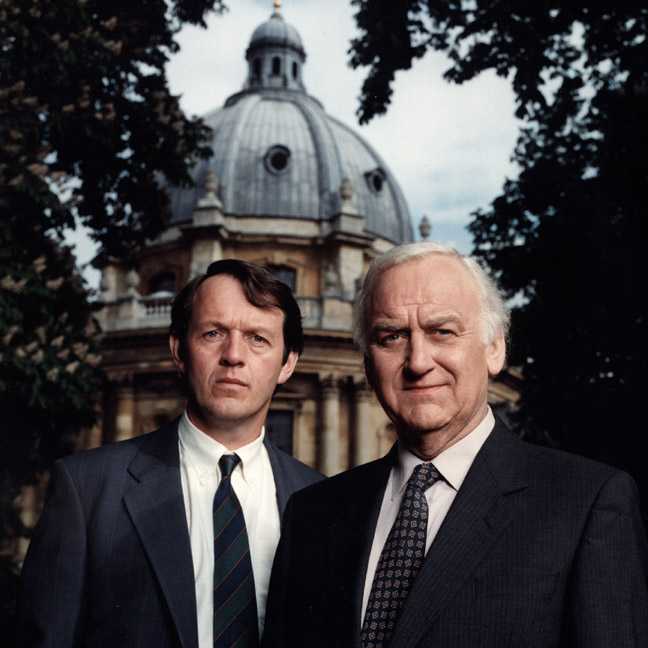
And now to the big question: Why? Why was Ötzi killed? Towards the end of the museum tour, visitors are invited to write down and submit their own theory about the reasons surrounding Ötzi’s death. My wife and I have been watching a lot of episodes from the British TV show Inspector Morse recently, whom we see here with his faithful sidekick Sergeant Lewis.
So I decided that this was an excellent opportunity to Think like Morse. Having sieved through the available facts, I have come up with the following story line:
A day or so before his death, Ötzi was involved in a vicious fracas with someone. We know this because scientists discovered a very deep cut between his thumb and forefinger as well as other cuts on his hands. These are typical of someone trying to protect themselves during a close-in fight involving weapons with a cutting edge, a knife attack for instance. I surmise that he successfully defended himself and in the process killed his assailant.
What was this deadly fracas about? “Cherchez la femme”, that’s what I say! As I already mentioned, Ötzi’s knee joints were well worn, indicating a lifestyle that required a lot of walking. This has led some scientists to suggest that he was a shepherd and so spent much of his time moving his flocks around the area’s Alpine pastures. I’m not convinced. The reason for that is his axe. The axe has a copper head; at the time of his death, this would have been a very rare, and therefore very valuable, item: until it was found it was thought that the Age of Metals had not yet started in Italy. So I conclude that he must have been a VIP of some sort. That in itself is not important to his murder, I believe. What is important is that his position required a lot of time away from home walking the mountains. My guess is that he returned home unexpectedly to find his wife canoodling with another man – or maybe his daughter. He got into a fight with the man and killed him. In the language of our time, it was an honour killing.
What next? There has been speculation that Ötzi was escaping when he was killed. That certainly could fit my story; it is not unusual in cases of honour killing for the murderer to quickly go into hiding until passions have subsided. But Ötzi doesn’t seem to have been in a hurry on his last journey. Scientists can tell that Ötzi’s deep cut to his hand occurred a day or so before his death, so he clearly hung around for a while before leaving. They also have figured out that he had quite a heavy meal about an hour before he died: not the behaviour one would expect from a man on the run. So I surmise that after putting his house in order Ötzi headed out again calmly, without a sense that his life was in danger. How wrong he was!
In my scenario, the family of the man he killed vowed revenge. I also posit that they didn’t live in the same village as Ötzi, so it took a while for the news to reach them, which explains why there wasn’t an immediate reaction. I also think that they couldn’t be too open about wanting revenge because of Ötzi’s VIP position. So they hurried over in secret, discovered that he had already left, and hurried after him. They caught up with him at the Pass. Maybe he saw them coming, realized what was happening, and started running, which would explain the decision to take a long bow shot before he disappeared over the horizon. After checking he was dead and pulling out the arrow shaft from where it was buried below his left shoulder, Ötzi’s killers then hurried back to their village, leaving him where he fell. If Ötzi was always traveling, it could have been a while before his family realized something was wrong, by which time early summer snows had already covered the body and hidden it from view – and started the long, slow process of mummification (by the way, scientists know it was early summer when he died because of the types of pollen that he swallowed with his last meal: such clever fellows, these scientists …).
There you have it, ladies and gentlemen, my theory on Ötzi’s untimely death! If you are not convinced, I suggest you find time one day to visit his museum in Bolzano to come up with your own theories. Or you can just read the wealth of stuff on the net about it all – Ötzi has created a veritable cottage industry around his life and death.
Whatever you do, though, spare a thought for poor old Ötzi, who is now hardly visible anymore in his own museum, lying as he is in a specially-created cold cell recreating the conditions he lay in for 5,000 years in the Tisenjoch Glacier, visible only through a small window.
During the month of March, my wife and I went to Bologna for a short visit (I should have written up this post quite a while back; but hey, as they say, better late than never). It’s a nice little town, somewhat off the tourists’ beaten track, which makes it all the nicer. It had been decades since either of us had been back – my wife studied there for a year in the late 1970s, and I had visited her one Christmas before we went off for a little jaunt to Puglia. So it was nice to visit a few old haunts, although in truth her memories of the town were somewhat hazy and mine were almost non-existent.
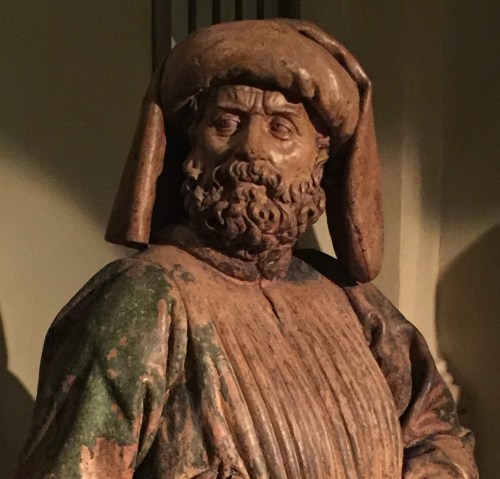
But actually, what I had really been looking forward to visit was a Lamentation over the Dead Christ, by Niccolò dell’Arca from 1463, which is located in the Church of Santa Maria della Vita (tucked away behind Piazza del Nettuno). I had come across it a decade or so ago when I was methodically leafing through the 1,000 pages of the book 30,000 Years of Art: the story of human creativity across time and space.
This very – very – thick book purports to summarize the best art that we humans have created ever since we started making things: the first entry in the book is from c. 28000 BC, the last is from the mid-1990s. Its entry for the year 1463 is Niccolò dell’Arca’s Lamentation (on page 685, if anyone is interested). When I saw it, I said to myself, “One day, I must go to Bologna to see this!”
The Lamentation in question is not a painting. Rather, it is a collection of terracotta statues making up a sort of “tableau vivant” of the scene of sorrow around Jesus’s dead body, after he has been taken down from the cross and before he has been deposed in his tomb. It seems that Lamentations of this kind were quite common, at least in Italy (and not just in terracotta; I recently saw the remains of two other Lamentations made of wood, in the Pinacoteca of Milan’s castle). The statues represent a set of stock characters: Jesus, of course, lying on the ground after being taken down from the cross; Mary, the mother of Jesus (whom I shall henceforth refer to as the Madonna, to avoid confusion with the three other Marys); St. John the Evangelist; the three other Marys – Mary Magdalene, Mary of Cleophas, Mary Salome; Joseph of Arimathea; and Nicodemus. Here is a typical example of the form, which we also saw in Bologna, in the cathedral, made by the artist Alfonso Lombardi between 1522 and 1526.
our photo
Very nice, very dignified, very composed.
But now consider the Lamentation which I wanted to see.
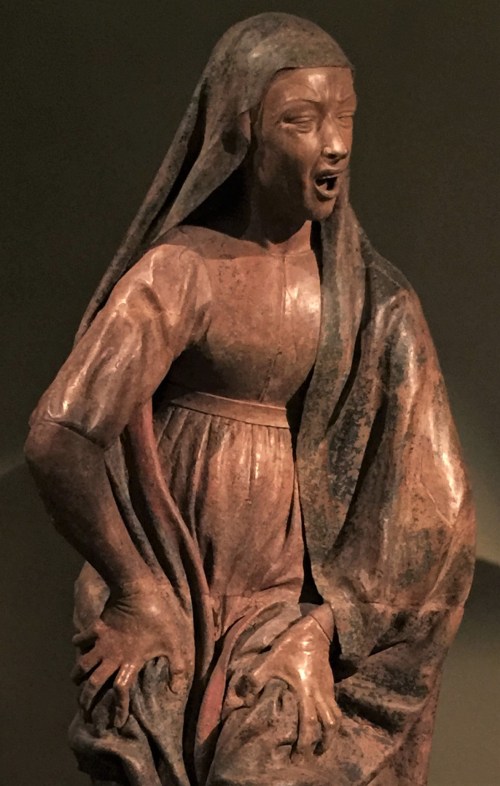
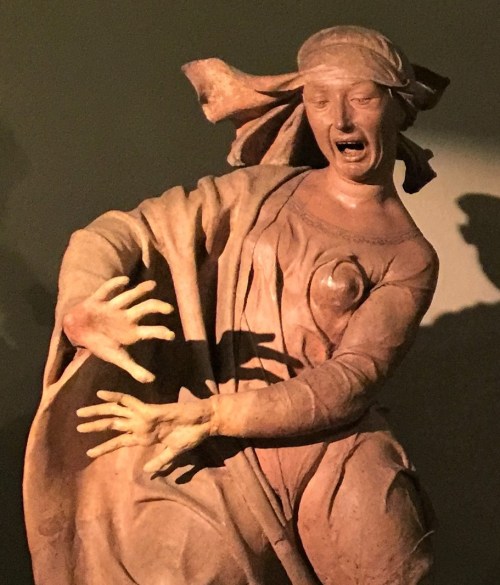
Talk about lamentation! Look at the faces of the women!
Mary, mother of Jesus, first of all
our photo
Next to her, Mary Salome, gripping her thighs frenetically in her anguish
our photo
At the feet of Jesus, Mary of Cleophas, trying to shield herself from the awful truth
our photo
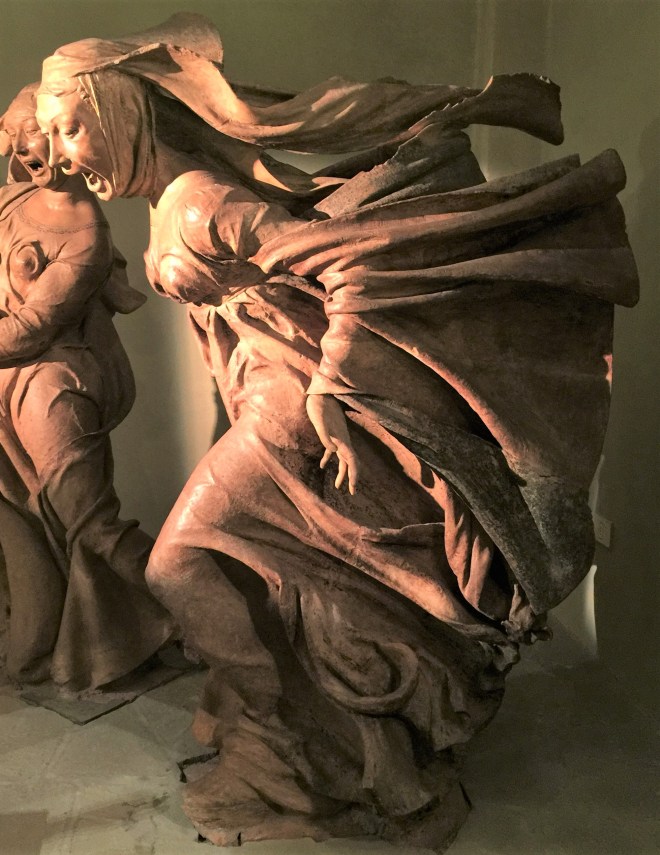
Finally, next to her, Mary Magdalene, shrieking out her horror at what she sees.
our photo
The weeping, the wailing – the shrieking – going on in that circle of people is all heightened by Mary Magdalene’s clothes streaming behind her in a most dramatic fashion.
our photo
The explanation given in the church is that she was running to the scene and the artist caught her – as if in a cinematic still – at the moment when she burst into the circle around the body and saw with horror that Jesus was dead.
In contrast, the two men in the group are quite subdued. St. John’s expression can only be described as that of someone who is feeling somewhat miserable
our photo
while Joseph of Arimathea simply looks phlegmatic.
our photo
(for those of my readers who might be asking themselves this, Nicodemus was either not part of this particular group or he disappeared in the intervening 400 years)
This male-female contrast in emotions brings to mind an exchange we as a family had on WhatsApp about Theresa May’s resignation speech in late May. Our son commented that it was somewhat embarrassing to see her cry, at which our daughter leaped to her defence. I quote: “I thought her speech was pretty good. She got emotional when talking about the honour of the job and the fact that she was the second ever female UK prime minister (and not the last) – I think it’s fair to get emotional at that stage! We need to stop vilifying emotional releases such as tears. Women are physiologically more prone to crying – our tear ducts open more easily. If we see tears as a sign of weakness we are inherently disadvantaging women. Anyway, the premise that being “strong” means being unemotional I also think should be changed. We don’t need to go to the opposite extreme but her release was very appropriate.”
Well, Nicolò dell’Arca certainly seemed to think that grown men don’t cry, but that women do, and copiously!
It struck me that I could use the various Lamentations paintings created over the centuries to explore how painters felt about this gender difference in the showing of emotions, or simply about the showing of emotions at all. I should add a warning here that my personal take on this is that in real life the scene at the centre of the Lamentations would have been highly emotional: your son, or your leader, who has had you believing that he is heralding the arrival of the end of time and the start of the reign of Yahweh, has instead been shamefully put to death by the colonial authorities and now lies before you, dead. All your hopes, all your beliefs, smashed to smithereens. If I had been there I would have been a total puddle, even if I am a man. But let’s see what painters thought.
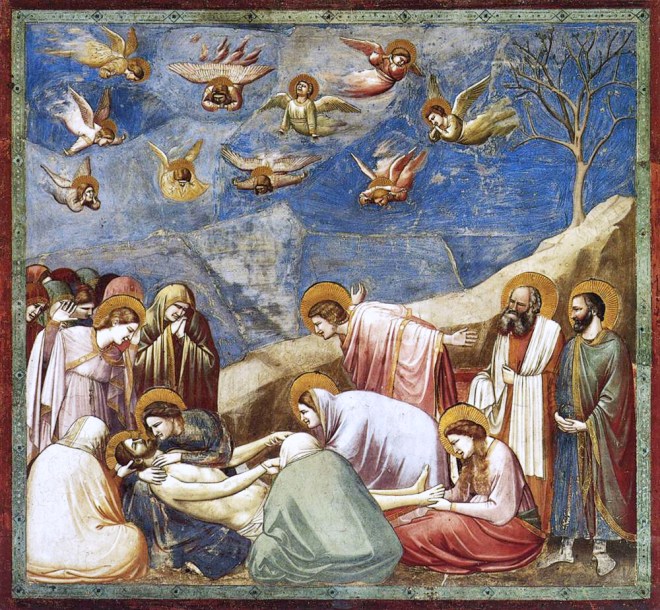
We can start this exploration some two centuries before dell’Arca’s composition, with Giotto’s Lamentation of 1303, which is to be found in the Scrovegni chapel in Padova (and on page 615 of the Very, Very Thick Book).
Here, everyone who is gathered around the dead Jesus is crying – not wailing as the women are in dell’Arco’s composition, but definitely crying. Even St. John – the person standing over the women huddled around Jesus – is crying. In fact, I would say that St. John is in transports of sorrow, more so than the women. Even the angels are in anguish. It is true that the two fellows to the right – believed to be Joseph of Arimathea and Nicodemus – are quite composed, but one could argue that they were not close companions of Jesus and so not as committed to the cause that he represented. It could also show that Giotto thought it was OK for young men like St. John to show their emotions, but that older men should keep their upper lip well stiffened.
Jumping forward to 1440-42, we have a Lamentation by the Dominican monk Fra’ Angelico, in the Monastery of San Marco in Florence.
Here, no crying, just a gentle preparation of the body for the tomb behind, by the women and St. John (who has his back to us) (the fellow in the background is St. Dominic, seeing all this in a trance). A typical work of Fra’ Angelico, I would say, as gentle as the man himself. Maybe strong emotions frightened him. Maybe he preferred to choose a moment slightly after the tears and the wailing, when practical considerations kicked in: the dead body needed to be prepared for the grave.
We can go forward another fifty years, to Mantegna’s Lamentation of 1489, hanging on the walls of Milan’s Pinacoteca di Brera just up the road from where I write this (and which can be viewed on page 707 of the VVThB, by the way).
Looking at the painting, readers can see that next to Jesus there are three people – the Madonna, St. John next to her, and a third person you can just make out over the Madonna’s shoulder. They are all crying copiously. It seems that Mantegna, rather like Giotto, believed in everyone showing their emotions.
On the other hand, in Botticelli’s Lamentation of almost the same period (1490-92), now in Munich’s Alte Pinakothek, the artist only has the women lamenting (although in a very stylized way, it seems to me; shades of things to come). St. John simply looks grim. So Boticcelli appears to be with dell’Arco on this one: women show emotions, men don’t.
The painting also has that stock situation, common in later times, and which I must confess to find most irritating, of the Madonna fainting from the emotion of it all. This really is the male assumption about the weakness and frailty of women: when the going gets tough, women faint. The other men, saints of various kinds, are simply there to witness the scene, like St. Dominic in Fra’ Angelico’s version, so do not show much emotion (I do think, though, that Botticelli had some cheek in including St. Peter – the fellow to the right, clutching a big key – since according to the Gospels while Jesus was being taken down from the cross and being buried he and the other – male – disciples were all cowering in a room somewhere, in fear of imminent arrest).
This next Lamentation is by Bellini, executed at the same time as Botticelli’s (1485-95). It is one of many Lamentations which he painted. This particular one is in the Uffizi in Florence. Here, everyone is even more composed: the Madonna, Mary Magdalene, and St. John seem to be sniffling a little while everyone else is looking calmly noble. Bellini does not believe in showing emotions, it would seem (although in fairness to him, some of his other Lamentations seem somewhat more emotionally charged).
On the other hand, in this Lamentation by the Venetian painter Carlo Crivelli, from exactly the same period (1485) (and now in Boston’s Museum of Fine Arts), both the Madonna and St. John are in absolute agony, with the latter literally howling (it is true to say, though, that Mary Magdalene is more contained).
I mean, everyone, man and woman, looks ridiculously calm and noble! (there is one half-hearted attempt at gesticulation, by the lady in red at the back, but it’s very unconvincing). Perugino must have thought that emotions weren’t necessary to the scene.
From 50 years later, 1547, we have this Lamentation by Paolo Veronese (it seems that every artist worth his salt had a go at this theme), now in the Castelvecchio Museum in Verona.
Again, everyone looks calm and dignified. The Madonna looks a trifle pale, but that’s about it. No emotions please!
A decade on, 1560 or thereabouts, Tintoretto painted this Removal from the Cross bleeding into a Lamentation, now in the Galleria dell’Accademia in Venice.
This is best described as baroque, although it’s a bit early for that. We have a fainting Madonna, dramatic gesticulation, contorted clothing – but not a single tear. Drama is required, but not emotions.
The same message comes through 45 years later in Caravaggio’s Deposition of 1603-1604 (which also contains some Lamentation in it), now in the Pinacoteca Vaticana.
The drama here comes from the play of light and dark and the angle from which it was painted. But the women seem quite composed in their sorrow; the gesticulation of the girl at the back feels contrived.
If real emotions seem to have drained away from the Lamentations painted in Italy, to be replaced first by Olympian calm and then by drama, there never seems to have been any real emotions at all in the Lamentations painted north of the Alps. The genre crossed the Alps at about the time that Giotto painted his Lamentation in Padova and became very popular. I have not been able to find any tears, or even much emotion, in these Northern European versions of the genre. For instance, this Lamentation from 1455-60, by the Early Netherlandish painter Petrus Christus (and now in Brussel’s Royal Museum of Fine Art) has the Madonna in a tasteful swoon, a lady to the right possibly wiping away a tear, and a woman to the left meekly wringing her hands. But everyone else is quietly going about their business.
This Lamentation by the Burgundian Early Netherlandish painter Simon Marmion is from a little later, about 1476 (and now in New York’s Metropolitan Museum).
Not a shred of emotion here. No drama, either. “Oh dear, he’s dead” is all I get from it.
Dürer, a few decades later (c. 1500), managed to include one person in his Lamentation who is gesticulating, although in a quite contained manner (you almost feel that Dürer included her because it was the done thing to do). The other women just look a little sad, while all the men are simply standing around. (This is another painting in Munich’s Alte Pinakothek)
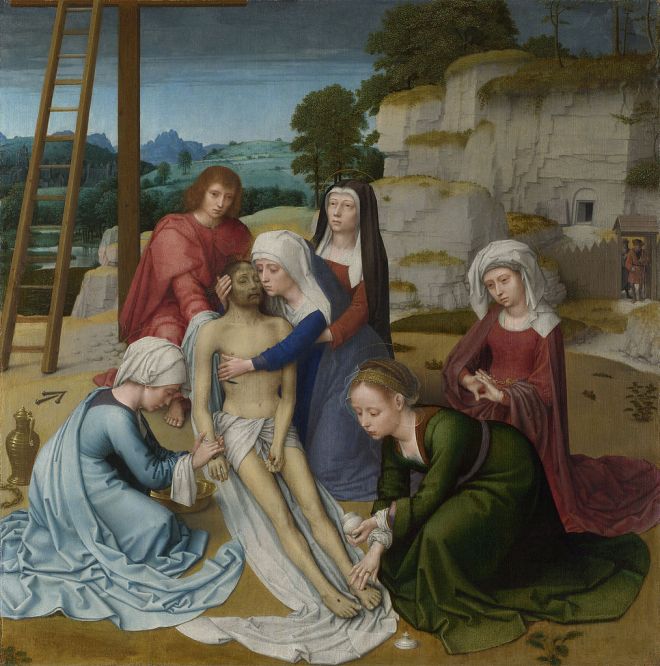
This next Lamentation, in London’s National Gallery, is by Gerard David, another Early Netherlandish painter, and is from a few decades later still, 1515-1523.
It looks a polished work, but I still see very little emotion. A certain quiet sadness is all I get from the painting, from everyone involved.
I could add more paintings – like I say, every painter worth his salt seems to have had a crack at this one – but I think we get the gist. If there is any trend in later paintings, it’s towards the dramatic – exaggerated gestures, contorted clothing – but with only the women showing – theatrical – emotion; the men simply look stolid.
So what conclusions can we draw? – because we have to draw some conclusion. I have to say that I agree with my daughter on this one. Perhaps it is physiologically easier for women to cry than men, but I also think that European culture (and possibly all cultures) have evolved and now strongly suggest that men should have stiff upper lips while it’s OK for women’s (and children’s, male and female) upper lips to tremble. I also think that it is expected for our leaders not to cry – stern anger, for instance against the enemy is OK, but no tears. Tears imply weakness, and our leaders must not be weak. Which is why the Renaissance painters stopped showing these ordinary people around Jesus, which Christianity had turned into leaders, crying – and why our son felt a certain embarrassment at seeing May crack up at her podium in front of No. 10. But I think we men should stop trying to look strong and weep and wail when we feel the need to, especially when we have lost someone very near and dear to us.
Oh, and do go to Bologna to see dell’Arco’s Lamentation. it’s really worth the visit – and Bologna is a nice place, with very good food.
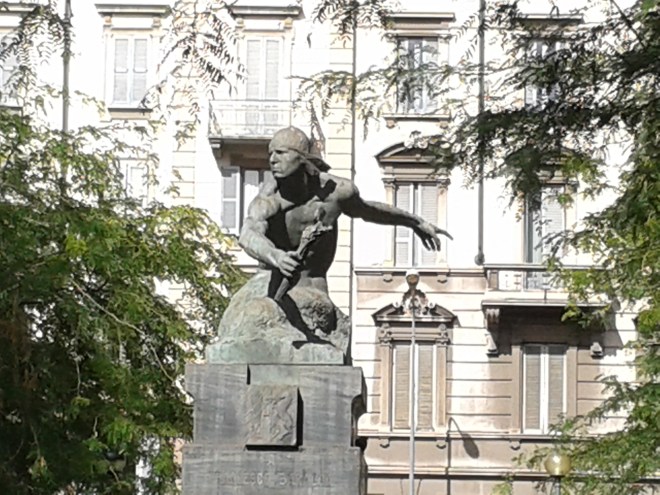
My wife and I were recently walking to the library of the Italian Alpine Club, with the idea of looking at some guide books on a walk in the Dolomites which we will be doing in a few weeks (and on which I hope to write a post or two). The walk took us through a part of Milan with which I’m not familiar, and so it was that I found myself walking for the first time through a little square. In the middle of it was this very intriguing statue.
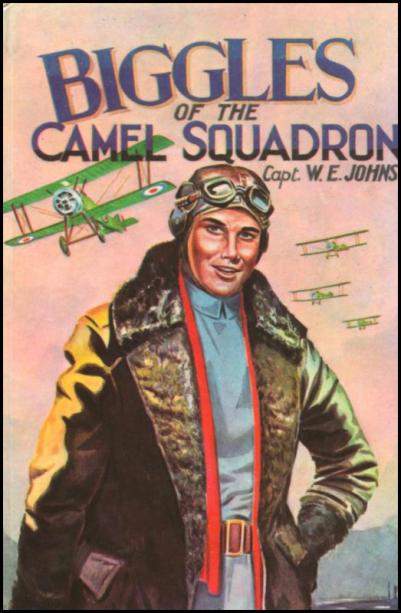
As readers can see, it consists of a man emerging from a stone plinth, naked but for some sort of cap with ear flaps on his head, holding a lit torch in one hand, and wearing a heroic expression. The name carved into the base of the plinth was Francesco Baracca. I asked my wife who it was. She wasn’t sure – a First World War general, she hazarded? But I wasn’t convinced. The cap looked too much like those leather caps worn by the early aviators. I mean, who doesn’t remember Snoopy on his way to fight the Red Baron?
No-one who is not British and not my age or older will know who this Biggles is. He was a fictional World War I fighter pilot about whom a series of exciting books were written. He was a very heroic figure and a Jolly Good Chap.
A bit more seriously, here is a photo of Charles Lindbergh, the first person to manage a solo crossing of the Atlantic non-stop, which he did in 1927.
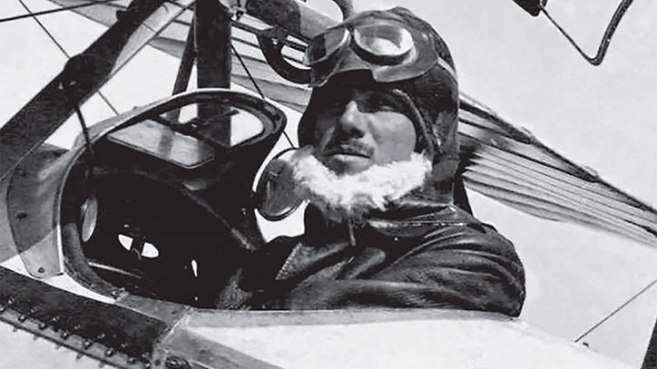
Well, it turned out I was right. Francesco Baracca had indeed been an aviator. And not just any old aviator! He was Italy’s Ace of Aces during the First World War, racking up 34 recognized victories, the highest score for any Italian fighter pilot. Here we have him sitting in his plane with his flying cap on (and, contrary to his statue, with his clothes on; very sensible, it’s cold up there), ready to go and let the enemy have it.
Of course the government squeezed all the propaganda benefits they could out of his exploits. Anything heroic that could take the public’s mind off the bloody and ineffectual meat grinder of trench warfare was to be welcomed. And anyway, there was something terribly dashing about these aerial duels; it was the modern equivalent of Medieval knights jousting. As a result, he was lionized by the Italian public, who followed his every victory with enthusiasm.
It wasn’t just Italians who were enthused by the new forms of warfare in the air. On all sides of the war, the exploits of these new heroes of the air were followed avidly. But perhaps the Italians had a particular penchant for the exploits of aerial warfare. After all, it was in Italy that the Futurismo art movement was born, which had a total commitment to modern technology. To make the point, here are some key excerpts from two of the Futurist Manifestos that were published in 1910.
This is from the Futurist Painters Manifesto:
We want to fight with all our might the fanatical, senseless and snobbish worship of the past … We rebel against that spineless worshipping of old canvases, old statues and old bric-a-brac, against everything which is filthy and worm-ridden and corroded by time … Comrades! We declare to you that the triumphant progress of science has brought about such profound changes in humanity as to excavate an abyss between those docile slaves of past tradition and us, free, and confident in the radiant splendour of the future. … In the eyes of other countries, Italy is still a land of the dead, a vast Pompeii, whitened with sepulchres. But Italy is being reborn … In this land of illiterates, schools are multiplying; in this land of “dolce far niente” innumerable workshops now roar; in this land of traditional aesthetics are today taking flight inspirations dazzling in their novelty. Only art which draws its elements from the world around it is alive. Just as our forebears drew their artistic inspiration from a religious atmosphere which fed their souls, so must we inspire ourselves from the tangible miracles of contemporary life: the iron network of speedy communications which envelops the earth, the transatlantic liners, the dreadnoughts, those marvelous flights which furrow our skies, the profound courage of our submarine navigators and the spasmodic struggle to conquer the unknown.
And this is from the Futurism Manifesto penned by the poet Marinetti, the “Father of Futurism”, who laid out a decalogue of futurist thought.
1. We want to sing of a love of danger, and the practice of energy and rashness.
…
3. Literature has up to now magnified pensive immobility, ecstasy and slumber. We want to exalt aggressive movement, feverish sleeplessness, the double march, the perilous leap, the slap and the punch.
4. We affirm that the splendor of the world has been enriched by a new beauty: the beauty of speed. A racing car, its bonnet adorned with great tubes like serpents with explosive breath … a roaring motor car, which seems to run on machine-gun fire, is more beautiful than the Victory of Samothrace.
…
9. We want to glorify war – the only cleanser of the world – militarism, patriotism, the destructive gesture of liberals, beautiful ideas for which one dies, and contempt for women.
10. We want to destroy the museums and libraries, the academies of every type, and combat moralism, feminism, and against every opportunistic and utilitarian vileness.
11. We will sing of the great crowds agitated by work, pleasure and revolt; we will sing of the multi-colored and polyphonic tide of revolutions in the modern capitals; we will sing of the vibrant nocturnal fervour of the arsenals and construction sites, enflamed by violent electric moons; the ravenous railway stations, devourers of smoking serpents; the workshops suspended from the clouds by the twisted threads of their smoke; the bridges which, like giant gymnasts, leap across rivers, flashing in the sun with the glitter of knives; the adventurous steamers sniffing at the horizon, and the great-breasted locomotives, pawing at the rails like enormous steel horses harnessed with pipes, and the gliding flight of aeroplanes whose propellers flutter in the wind like a flag and seem to applaud like an enthusiastic crowd.
Pretty incendiary stuff …
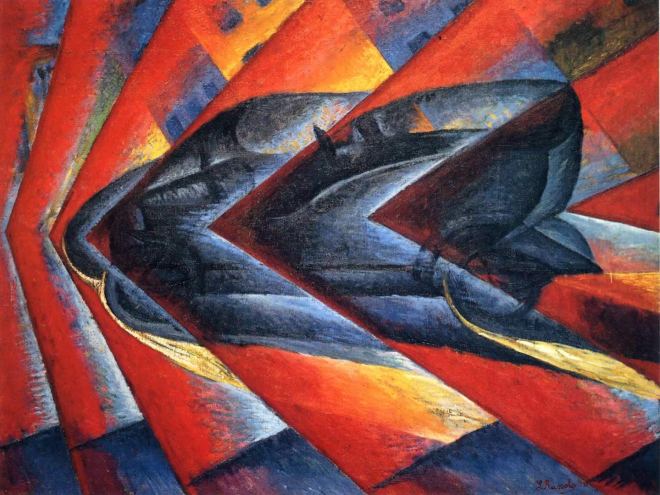
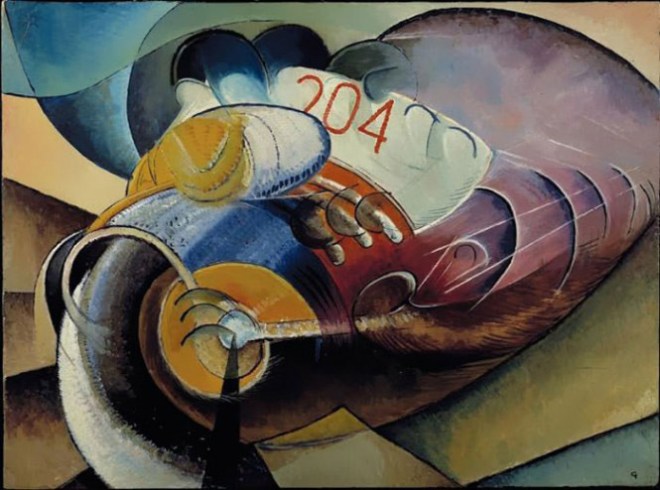
Right from the start, Futurist paintings reflected this adoration of speed and power, although initially the focus was on terrestrial technology. For instance, from 1912-1913, we have Luigi Russolo’s Dynamism of an Automobile.
It was only in the 1930s that Futurist painter’s started painting airplanes. For instance, from 1930 we have Tato’s Flying Over the Colosseum in Spirals.
Perhaps it took a while for the painters to get into a cockpit and experience the sensation of flying.
Coming back to Baracca, he was eventually shot down, in June 1918. For propaganda purposes, the Italian government put it out that he had been hit by ground fire (to perpetuate the myth that no other aviator could shoot him down), although the Austrians claimed with good evidence that he was taken out by one of their planes. However it happened, his body was recovered and he was given a hero’s funeral. He was finally laid to rest in his home town of Lugo in Emilia-Romagna. Several decades later, the Fascists erected a large statue of him in the main square (this time with his clothes on)
while his co-citizens opened a museum about him – might as well make some money off the town’s most famous son …
This story has a fascinating coda, which was really why I wrote this post. To explain it properly, I have to go back a bit and give readers a thumbnail biography of Baracca. He was, as I said, a citizen of Lugo, a small town located close to Ravenna. His parents were well-off and to some degree aristocratic – his mother was a countess. After his schooling, he chose to join the army. After studying at a military academy, in 1909 he was assigned a regiment. Given his social status, this was a cavalry regiment, the 2nd “Royal Piedmont”, a regiment created in 1692 by Duke Vittorio Amedeo II of Savoy. Because of its importance to my story, I insert here the regiment’s traditional banner: a silver prancing horse on a red field.
In 1912, after watching an aerial exhibition in Rome, Baracca became wildly enthusiastic about the future of military aviation. He asked to join the newly-created aviation arm of the army, a request that was granted. He went for training in France and by the time Italy joined the War in 1915, he was trained and ready to go.
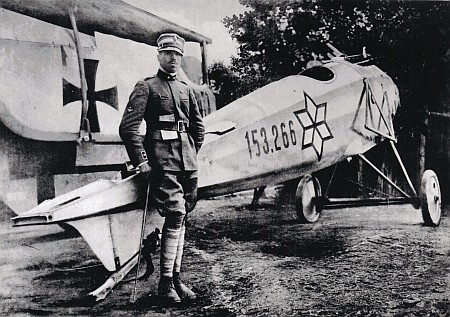
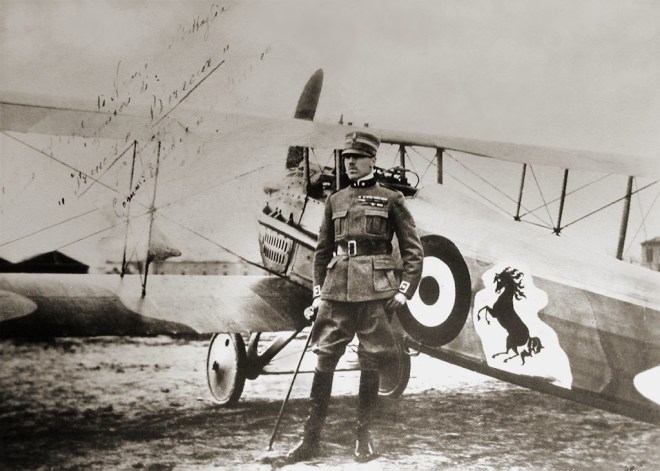
As his number of victories climbed, the High Command fawned over him. In 1917, he was given his own squadron, the 91st, and allowed to choose his own pilots. He took all the other Italian aces, so the squadron became known as “the squadron of the aces”. On the right side of his plane’s fuselage, he placed the squadron’s insignia, a rampant griffin. On the left side, he placed his personal insignia. For this, in recognition of his earlier affiliation with the 2nd cavalry regiment, he chose its prancing horse. He changed the colour scheme, though, making the horse black on a silver background. Here we see him standing in front of his plane on which we see plainly his personal insignia.
The insignia was an instant hit with the public, especially when the pilots of his squadron all adopted it in his honour after his death.
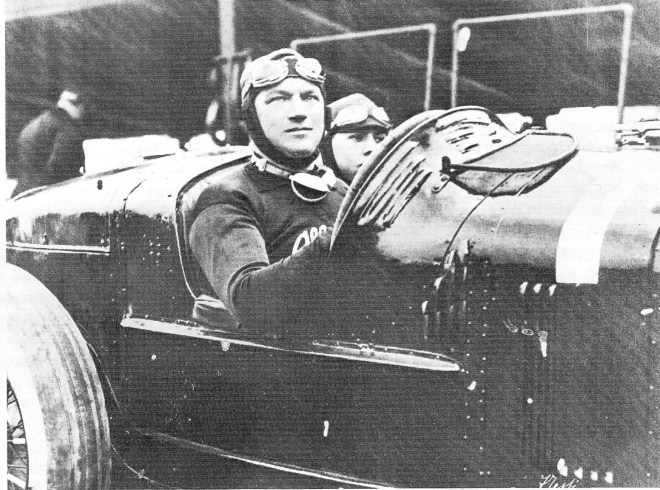
Fast forward a few years after the war, 1923 to be exact. I now introduce another character to this story, that of Enzo Ferrari, the fabled creator of the Ferrari racing team and car manufacturer. In 1923, he was just a driver for Alfa Romeo, racing their cars on various circuits. Racing was very popular in Italy, and the successful drivers were stars, rather like Baracca had been – and they wore the same leather caps as aviators.
In any event, in that year Ferrari won a race near Ravenna. On the race’s edges, he met Baracca’s father. This led to a second meeting, this time with Baracca’s mother. He must have told them how much he had admired their son. And maybe they saw the racing of cars as an honourable descendant of what their son had been doing with planes. Whatever the reason, Baracca’s mother uttered these fateful words: “Ferrari, put my son’s horse on your cars. It will bring you good luck.” And that is exactly what Ferrari did seven years later in 1930, when he created his own racing team. From then on, his cars sported Baracca’s prancing horse. The only changes he brought were to make the field behind the horse canary yellow, to honour his home town, Modena, whose coat of arms has the same yellow field, and to raise the horse’s tail.
I suspect that many of my readers will have no idea of what I’m talking about, especially if they hail from the northern latitudes. I certainly didn’t until I first came to Italy a lifetime ago. Loquats were one of a long list of new food items my wife introduced me to. Except that she didn’t call them loquats, she called them by their Italian name, nespole, and it took me at least thirty years and the internet to figure out their English name.
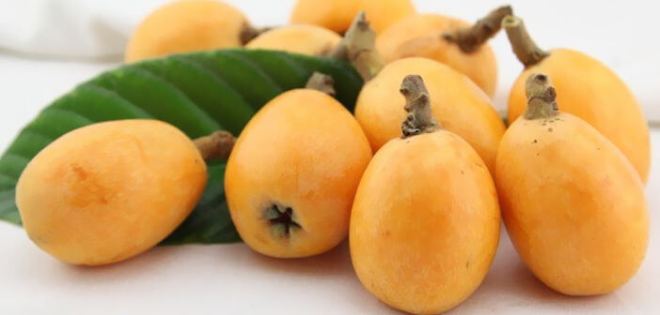
Loquats are a fruit. They look like this when unopened.
They’re a bit fussy to prepare. You have to first peel off their thin skin, which tends to break and tear easily, complicating removal. Once you’ve done that, you slice them open, only to find three or four large stones inside.
The stones are quite beautiful really – warm brown, smooth, glistening – but they take up a lot of the internal space, which of course means less flesh to eat. In any case, once you flip the stones out the fruit is ready to eat. Ah, my friends, such taste! Sweet, but with a slightly tart, acidic note, a very juicy but firm flesh. To die for …
When we lived in Italy, I always looked forward to the month of May as loquat season. Then we went away for some twenty years and loquats remained but a dream. Even in retirement, when we spend a good amount of time here, we tend to leave before loquats come on the market – we have been in the habit of migrating up to Vienna by mid-May. As luck would have it, though, this year we’ve stayed longer than usual, so I’ve had the joy of once again eating loquats.
The fruit’s English name gives us a clue as to where the loquat hails from. “Loquat” is the English rendering of the Cantonese name for the fruit, lou4gwat1 (I believe those numbers are indications of the tones – good luck with that; in my five years in China, I never managed to “hear” a single tone). The fruit’s ancestral homeland is indeed southern China – more strictly the middle and lower valley of the Daduhe River. I throw in a satellite map from Google Maps, where the red pin is stuck in the river’s valley.
Readers will see that Daduhe River is in the far south-west of China, in Yunnan province. It lies north of Xishuangbanna, which sits on the Mekong River (and which we had the pleasure to visit when we lived in China), and to the south of Pu’er, the location of a rather particular Chinese tea (which I must confess to not liking very much). It doesn’t surprise me that the loquat originates from this part of the world. Yunnan is a globally famous “hot spot” of biodiversity, hosting thousands of different species.
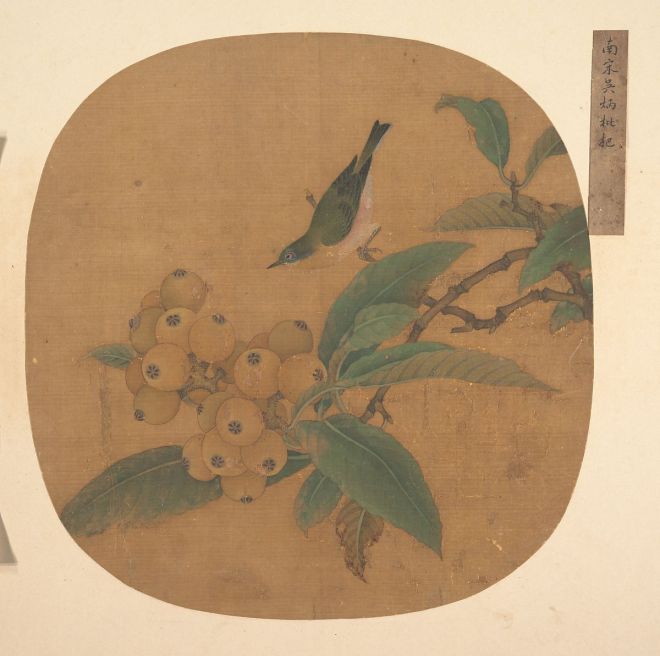
This Chinese connection delighted me when I found it out since over the years I have written a number of posts about various plants which have been carried out of China and spread to the rest of the world. To date, I have written about the Ginkgo tree, Kaki fruit, the Magnolia, the Peking Willow, Wisteria, the Pauwlonia tree, and Osmanthus. As always, Chinese poets and artists celebrated the fruit. We have here a painting from the mid to late Ming dynasty.
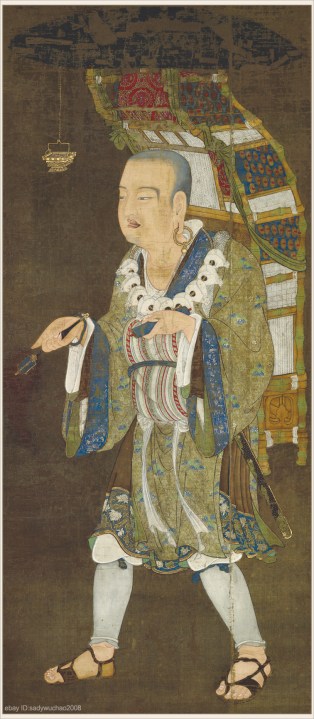
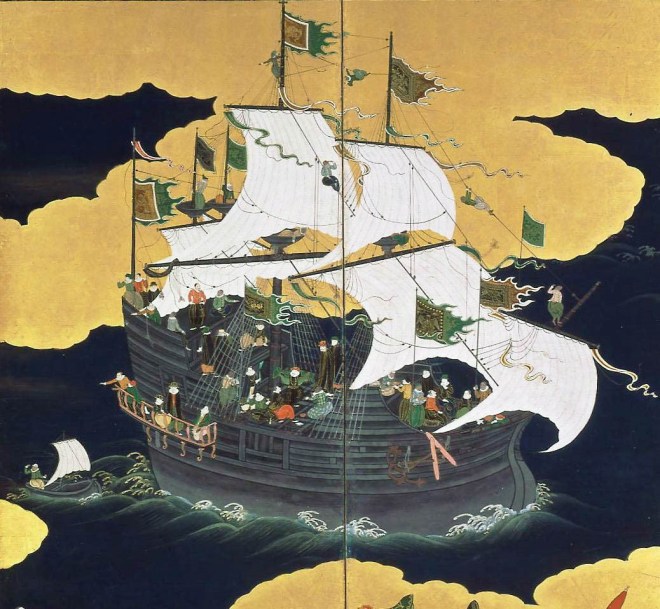
The fruit’s English name may be Cantonese but it was not through the port of Canton that it was first transferred to Europe. Like a number of other Chinese plants that reached Europe (from just among the ones I’ve written posts about: the ginkgo tree, kaki fruit, and the magnolia), the transfer occurred via Japan. It seems that the Portuguese, the first Europeans to reach Japan, were also the first to bring the loquat back to Europe. By the time they first set eyes on the fruit and its tree, probably very soon after they arrived in Japan in 1543, it had been growing there for 500 years or so. In all likelihood, it was brought to Japan by Buddhist monks, either Chinese monks going to proselytize in Japan or by Japanese monks returning home after a period of study in China.
The modern varieties of loquats owe a lot to the patient work by Japanese farmers to develop fruits that were bigger, juicier and sweeter than their wild ancestors. I salute all those anonymous Japanese farmers for their efforts! I throw in here a woodblock by Katsushiga Hokusai of Japanese farmers at work on their more traditional crop, rice.
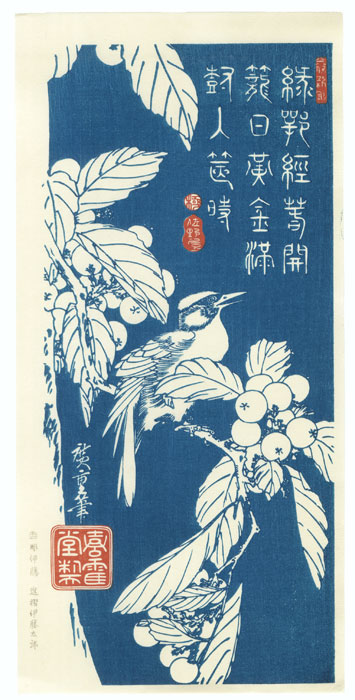
Of course, like the Chinese, the Japanese celebrated the loquat in their art. Here is a woodblock by Utagawa Hiroshige (whom I’ve had cause to discuss at length in a previous post) with the same subject of bird and loquats as the Ming-era Chinese painting above.
The Portuguese didn’t call this new fruit “loquat”, nor did they even call it by some Lusitanian derivation of its Japanese name “biwa”. Instead, like a good number of other countries in Europe, they thought they had to do with a Japanese cousin of an already well-known fruit in Europe, the medlar, whose Portuguese name is nêspera (closely related to its Spanish name, níspero, and more distantly related to its Italian name, nespola – for those interested in linguistics, in all three languages the word derives from the Latin name for the medlar, mespilus, although at some point the “m” drifted to an “n” and the “l” further drifted into an “r” in the Iberian peninsula). The medlar was once quite a well-known fruit in Europe although it has since fallen into obscurity. I certainly had no idea what it looked like when I started this post, and I suspect this to be the case for many of my readers, so I throw in here a photo of this antique fruit.
Comparing this photo to my first photo of the loquat, I think readers will understand why this confusion arose. By the early 1800s, botanists had understood that it was actually a different plant but by then the damage was done and the Chinese upstart had linguistically dethroned the venerable medlar in about half the European languages.
Loquats have an interesting life-cycle. Like the strawberry tree, which I wrote an earlier post about, the flowers appear in the late autumn or early winter. It seems that the flowers have a sweet, heady aroma that can be smelled at quite a distance; personally, I have never experienced this even though the loquat tree grows in Liguria (from where I am writing this post). The sweet-smelling flowers were also a reason why the tree was a favourite among Chinese and Japanese poets.
But from a botanical point of view, what is more interesting is that to obtain fruits from these flowers you have to grow the trees in a region where pollinating insects are around at that late time of the year. That is why I never saw the fruit in either the UK or France when I was growing up and had to wait till I came to Italy, where the tree can fruit in the south and along the Ligurian coast, for me to discover it. An advantage of this life-cycle is that the fruit ripens at any time from spring to early summer. It is the first fresh fruit to be available naturally in Italy (i.e., not ripened artificially in some greenhouse somewhere, nor flown in from some remote part of the world), and so can have the monopoly of the fresh-fruit market before the cherries and other fruits appear. Which is why for me the month of May is loquat time.
And now it’s time for me to gorge myself on some more loquats!
That was the thought which crossed my mind when in our last AirBnB my wife and I were going through the kitchen cupboards to see what had been left behind by previous occupants. I looked at the bottle glumly. I like having my vegetables in salad, and my sauce of choice is a simple vinaigrette: olive oil, vinegar, salt. I dislike having to use balsamic vinegar. I don’t care for the sweet taste it imparts. Salads, in my humble opinion, require astringency, not sweetness. I hasten to add that I am not against the mixing of sweet and salt per se on my plate, as this previous post attests to. I’m just against sweet sauces on salads. So, as I say, I stared at the bottle glumly. It looked like I was going to have to use balsamic vinegar on my salads during our stay; who wants to buy a whole bottle of vinegar for a short AirBnB stay? Luckily, our daughter, whom we were visiting, came to the rescue, lending us some of her vinegar, the real stuff, made from red wine.
Where did all the real vinegar go to? There was a time, not so long ago – we’re talking 15-20 years ago – when waiters brought you real vinegar when you asked for “oil and vinegar” for your salad. Then, mysteriously, balsamic vinegar appeared out of nowhere, and the waiters would start asking: “balsamic or normal?” Then, after a bit, the waiters simply brought you balsamic; if you wanted real vinegar, you had to beg for it and they would bring it with evident ill-will if they had it at all. I think I know what the pagans in the Roman Empire must have felt like, just after Christianity became the State religion. One moment, your religion is mainstream, then along comes this upstart religion and suddenly everyone is looking at you askance, your favourite temple is being torn down or turned into a church, and you can’t get a job in government anymore! (an experience well described by Stephen Greenblatt in his book The Swerve).
I’ve always had a love for vinegar, ever since I tasted my French grandmother’s homemade brew. Down in her cellar – its earth-packed floor exuding a special scent of centuries-old dry dust and its dark corners packed with the fascinating flotsam and jetsam from the many generations who had lived in the house – there was a long wooden table, on which she kept her store of little round local goat’s cheeses as well as a small wooden barrel in which she made her vinegar. When the vinegar in the dining room was finished my grandmother would send me down to the cellar (which has already been the subject of a previous post) to fill the little vinegar pitcher. Of course, I never took a picture of her vinegar barrel. After a search on the web, though, I found this image which gives an idea of what I would find before me after I had walked down the old stone steps and opened the heavy cellar door.
As I would open the tap in the barrel, a lovely winey but slightly acidic scent would rise to my nostrils as the vinegar ran into the pitcher. Ah, that lovely, lovely smell! Never forgotten, even though half a century and more has passed. How can it be that people prefer balsamic vinegar to this elixir of the gods?!
After much thought on the matter, I have put it down to the fact that, contrary to my preferences, most people like a sweet sauce on their salads. I still remember with a shudder the sickly white, creamy, sweet sauces that the Brits spread with wild abandon on their salads. I see the same types of sauces in the Germanic and Nordic lands of Europe. In my youth, I had this theory that there was a salad-sauce border that ran across Europe, between the countries or parts thereof which spoke Romance languages plus Greece – all oil-and-vinegar salad sauce countries – and the remaining Germanic and Slavic speaking countries – all sweet creamy salad sauce countries. The US and Canada, reflecting their immigration history, have always seemed to me to be mixed in their tastes in salad sauce although I feel that the sweet creamy salad sauces predominate; even the non-creamy sauces are horribly sweet. Here is a picture of an array of such sauces in the posh supermarket that was up the road from our AirBnB. But the tsunami of balsamic vinegar which has flooded over bastions of the oil-and-vinegar salad sauce countries like Italy has led me to bitterly conclude that even most Italians – and probably most French and most Iberians – like their salad sauces sweet. I am the old 4th Century pagan left bewildered and embittered by the mass conversion of my compatriots to Christianity …
The ridiculous thing is, I’m sure that most people who liberally drizzle their salads with balsamic vinegar don’t realize that they are actually consuming a FAKE. We have all read and heard that balsamic vinegar has its roots in the Italian towns of Modena and Reggio-Emilia (I throw in here a photo of Modena’s main square).
It does indeed, but the original is hugely different from the vast majority of the stuff people call balsamic vinegar. First of all, it is not made from wine in the way vinegar is. Instead, a must of (locally grown) crushed grapes – pulp, seeds, skin, stems and all – is slowly reduced to a thick syrup over an open flame. This is then allowed to ferment to create some alcohol, at which point the acetic acid bacteria are allowed to get to work to turn that alcohol into acetic acid. After which, the acetified syrup goes through a long, long aging process, during which the acid levels rise. A series of at least five progressively smaller barrels (each made of different woods) are used for this.
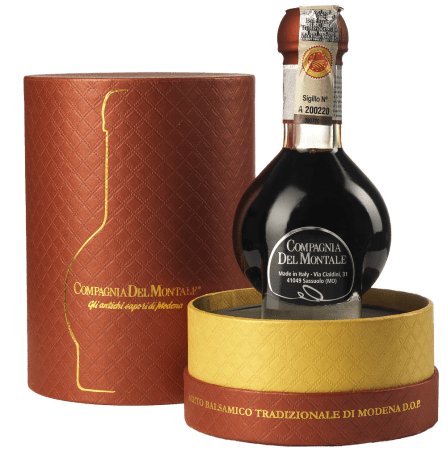
Once a year, part of the syrupy vinegar in the smallest barrel is withdrawn as final product. The barrel is topped up with vinegar from the next largest barrel, and so on, in a cascade mode; at the end, the latest batch of acetified syrup is used to top up the biggest barrel. The procession of syrupy vinegar from largest to smallest barrel can take anywhere from 12 to 25 years or more to complete. All this is now regulated by a Protected Designation of Origin certification (DOP in Italian) for “Traditional Balsamic Vinegar” (Aceto Balsamico Tradizionale). If readers would like to pick up the product in a shop (or online), it looks something like this.
Such smart-looking (and very small!) bottles come with a correspondingly high price tag. They can be yours for no less than 150€ and for as much as 300€! At those prices, do readers think it gets drizzled on salads? No way José!! Discerning Modenese and Reggio-Emilians will place a few drops on shards of Parmesan cheese as an appetizer, or on a plate of simple pasta like tortelli di zucca, or on a grilled fish, or on fresh fruit such as strawberries, or on a dessert like panna cotta. They will even drink it from a tiny glass to conclude a meal as an after-meal digestive, especially on special occasions such as weddings. But they will definitely not waste a single drop of this precious liquid on a vulgar salad.
As readers might appreciate, a product which takes this long to make doesn’t have a huge annual production. But when, after what I suspect was a canny global marketing campaign, balsamic vinegar became the thing to have in your home and at the restaurant, demand grew hugely. How to satisfy this voracious – and highly profit-making – demand? Very simple. Make grape must from any old grape variety, reduce it a bit (or maybe not), add any old normal vinegar to give the vinegary taste, add caramel to give it the dark look, and corn starch to give it the syrupy look, of the real thing, slap on a label proclaiming it to be balsamic vinegar, et voilà! I’ve simplified a bit, but that is more or less what happened in the heady days of the late 20th Century when demand for balsamic vinegar shot up.
Some order was brought into all of this by the EU creating two certifications: the highly prestigious DOP, which I’ve already mentioned, and a Protected Geographic Indication (IGP in Italian) for “Balsamic Vinegar of Modena” (Aceto Balsamico di Modena), which in its name recognizes the origin of all this balsamic vinegar. In fact, when people buy “high-end” balsamic vinegar, they normally buy the IGP variety. If readers refer back to the first photo in this post, they will see that the bottle I stared at glumly is IGP certified. And I took this photo in the condiment aisle of the same posh supermarket I mentioned earlier. All the balsamic vinegars were, without exception, IGP-certified “Balsamic Vinegar of Modena”.
But I’m afraid this product is also rather a fake. You see, to get this certification all the producer really needs to do is to make sure that one stage of production occurs in or around Modena. So the must could be made in California with Californian grapes, and the vinegar could be made in Australia using Australian wine, but as long as the last required step – aging the resulting mixture for a minimum of 60 days – is carried out in a warehouse in an industrial park on the outskirts of Modena, the producer can quite legally claim it to be a “Balsamic Vinegar of Modena” and use the mark of IGP certification on the label. (Oh, and the product would have to have at least 20% by volume of must, and at least 10% of vinegar, and at least 6% acidity, and no more than 2% of caramel for colouring.) And of course I leave it to my readers’ imaginations to think where any other product with just the words “balsamic vinegar” came from and what it contains (and doesn’t contain).
Well, with a bit of luck, this exposé of the nefarious ways of the world of balsamic vinegar producers may have persuaded some of my readers to abandon balsamic vinegar and go back to the one true faith of real vinegar on their salads. I can hear readers objecting that much of what passes for “wine vinegar” is also the product of some chemical refinery somewhere. I cannot deny this; my only answer is “caveat emptor and read the label” – and I make a mental note to myself to write a post in the future on how to make your very own, real, vinegar at home.
Yesterday, by sheer happenstance, my wife and I took in an exhibition entitled “Soul of a Nation: Art in the Age of Black Power 1963-1983)” at the Broad museum in Los Angeles. In one section, this was written on the wall: “During this period, centering the Black figure – historically marginalized in Western painting – was radical. Many artists created powerful images of Black Americans, including portraits of writers, artists, and everyday people.” It is true that the non-whites in almost all the paintings I showed in the last two posts are not centre-stage. So as a follow-up to my last two posts, I have decided to do some centering of my own, extracting the portraits of non-whites which are to be found in Art UK’s database. Here is the result: not quite all the ones I found; I chose the best.
Interesting fellow, Ira Frederick Aldridge, whose portrait this almost certainly is. An African American, he found himself constantly discriminated against as an actor in New York and so came to the UK in 1825. Thereafter, he had a very successful acting career, both in the UK as well as in the rest of Europe. There was of course a dearth of black characters in plays, so occasionally he took on roles as white European characters, for which he would be appropriately made up with greasepaint and wig. I love the idea: blackface in reverse …
After this, we have a number of portraits of anonymous people who sat as models.
Portrait of an African (c. 1861), by George Harrison (1840-1910). Photo credit: Royal Cambrian Academy of Art
Even though the model’s face is hidden in this next portrait, I thought of including it because it is the first portrait of a woman.
Female Figure Seated (1898), by Evelyn Cheston (1875-1929). Photo credit: UCL Art MuseumNegro in White (c. 1922), by Francis Campbell Boileau Cadell (1887-1937). Photo credit: Dundee Art Galleries and Museums Collection (Dundee City Council)
The next portrait is the first I found of a South Asian.
Intriguing woman, Bapsybanoo Pavry. She was born in Bombay, daughter of a Parsi Zoroastrian “Head Priest”. She came to the UK at a young age, determined to use her great beauty (and presumably great riches) to break into high society. She was about 30 when Augustus John painted her portrait. 20 years later, aged 51, she managed what she thought was a great coup: she married the Marquess of Winchester. Admittedly, he was marrying for the third time, was 90 years old, impotent, and bankrupt. But he was la crème de la crème of British aristocracy. Alas! Within weeks of marrying her, he eloped with his former fiancée Eve Fleming, mother of Ian Fleming (of James Bond fame), first to Monte Carlo and then to the Bahamas. Bapsybanoo followed them there, but was reduced to pacing up and down in front of their house and shaking her fist at them. Of course, she became a figure of ridicule in British high society, who no doubt felt that this Indian parvenue had got what she deserved. She eventually returned to India and died in 1995.
The artist who painted this last picture, Glyn Philpot, spent most of his career in the UK as a pretty conventional Edwardian portrait painter. Then in his last five years or so, he moved to Paris, his palette lightened and his style became more modern. He painted numerous paintings of people of African origin in this period, a good number of which are in Art UK’s database. This painting is of a young Jamaican, Henry Thomas, who was his lover.
I include the next painting, of Nurse Brown, to remind ourselves of the huge role non-whites played, and continue to play, in the UK’s health service. Although the painting is undated, I’m guessing it is from the immediate post-World War II period.
I include the next two paintings because they intrigue me. They are both set in what we could consider an iconic UK context, Trafalgar Square. One shows three Indian women and the other Caribbean family in the square, with white families forming a background. I wonder what the artist was trying to tell us? That non-whites were now a part of the UK landscape?
It’s in this period that we see the first non-white councillor, the first step on the political ladder. It is David Pitt, who was councillor, the first non-white councillor ever, and later chairman of the Greater London Council. He was later made a member of the House of Lords, the pinnacle, one might say, of the British political establishment.
David Pitt tried twice to be elected as an MP. It seems that the British population was not ready for that. More or less overt racism seems to have been behind his loss both times.
As we enter the 1980s, the pace picks up, and non-white artists begin to make an appearance.
This next portrait is the first in this series to celebrate a sportsman, in this case the boxer Randy Turpin. Interestingly enough, it was painted some 40 years after his triumphs and 30 years after his death: British Middleweight champion 1950-54, World Middleweight champion 1951 and 1953. Why did it take so long to get around to painting his portrait, I wonder? I rather suspect that Warwick Town Council rather tardily remembered one of its more famous local sons.
This next painting certainly brings back memories for me, of the corner shops that were suddenly being run by South Asians. But we’re talking of the 1970s, while this portrait was only painted in 2000.
And here we arrive at the pinnacle the British political elites. Paul Boateng was able to be elected MP, he became the first non-white member of the Cabinet, and after a spell as High Commissioner to South Africa he became a member of the House of Lords.
There is another elite, the military elite, which we have not had examples of yet. As of 2016, there wasn’t a single non-white in the British army’s top 133 positions. Perhaps it’s improved slightly since then although I doubt it. But there is also an elite of courage. Here, we have Johnson Beharry, who I believe is the first black British recipient of the Victoria Cross, the UK’s highest award for gallantry in the face of the enemy. He won it during the Iraq war (there have been a good number of non-white recipients of the Victoria Cross, but they have all been Commonwealth troops).
In this post, I’ll continue looking at how non-white people were represented in British art, covering the period from the early 1800s, which more or less coincides with the formal abolition of slavery throughout the British Empire, to the present day. I want to focus on group paintings, that is, paintings where a number of people are present, because I feel that these more than anything else tell us how much non-white people were “visible” in society; if the paintings show them, it means that the painters – presumably as a reflection of those who commissioned the paintings – noticed that non-white people were present in British society. These types of paintings also show the “power relationships” between the people in the paintings. In the previous post, for example, I showed mostly group paintings, where the non-white participants – young black pages for the most part – were clearly in a subsidiary position to the whites in the painting. When do the paintings in Art UK’s database show that these power relations change, and how do they change?
In the previous post, the last of the group paintings with a non-white person in it was from 1794. There is then a big gap in the Art UK database; the next group painting in which I identified some non-whites was from 1875, some 80 years later. They were in what I would call a society painting entitled “Hush!”.
Hush! (1875), by James Tissot (1836-1902). Photo credit: Manchester Art Gallery. Distributed under a CC BY-NC-ND 4.0 licence
The sharp-eyed reader will notice two Indians sitting on the sofa to the right. From their dress (and the fact that they were even at this type of high-society gathering), they must have been high-class Indians, Maharajahs or such-like. Like the little black pages of the previous post, they were no doubt an exotic addition to the gathering, but their presence in the UK also suggests that they were presumably part of the British elite’s attempts, throughout the Empire, of co-opting the traditional ruling classes of the colonised countries and turning them into philo-Britishers. There is a similar painting in Art UK’s database, from some forty years later – similar in the sense of celebrating a high-society occasion and including a sprinkling of ethnic exotica. It is a painting celebrating a formal luncheon in London’s Guildhall in honour of King George V’s coronation.
Straining a bit, readers can see a group of Indian grandees, dressed in their colourful ethnic costumes, to the left and towards the back (of course). I presume they are there to remind readers that ever since Queen Victoria British monarchs had appropriated to themselves the title of Emperors of India; the Indian grandees were there, then, to celebrate “their” Emperor.
What about group paintings of normal people? Well, the very first I could find after the “black page period” is this one, from 1880 – once again, some 80 to 90 years after the “black page period” petered out.
This is actually a very intriguing painting, since it positively bursts with ethnic pluralism. Three of the main figures – the old man, the man with an injured arm, and the boy – are white, but the young man on whom the old man is leaning is Middle Eastern, while immediately behind the injured man are an East Asian man and an African, there is another African on the second flight of stairs on the top left, while some of the other characters at the back could also be of Middle Eastern or South Asian origin. Of course, the artist is stressing the Christmas angel’s message of “On earth, peace and goodwill to all men” but I cannot believe that he merely invented this ethnic diversity. I have to think that this Old Sailors’ Home in Greenwich really did look after sailors with very diverse ethnic backgrounds. As I highlighted in the previous post, life on the high seas seems to have been a place where ethnic diversity was common.
Thereafter, there is another gap of 90 years in Art UK’s database until I find the next group painting with a non-white person in it. This painting is from 1971. By this time, the immigration of non-whites into the UK to fill low-class jobs that white British people didn’t want to take anymore or to fill gaps in the growing labour market had been going on for some 20 years. The West Indians first started to arrive in the 1950s, followed by the South Asians (Indians and Pakistanis) in the 1960s and ’70s. This particular painting is not very flattering, as it turns out.
It seems sad that the first group painting with non-whites in it that I could find in the modern, post-War, post British Empire era should be about prostitution. But perhaps it is an apt if somewhat harsh descriptor of the position in British society of non-whites at the time. And perhaps it continues to reflect the old idea of non-whites as exotic: the exotic is a popular selling point in the sex trade.
Thereafter, things get more normal. In 1985, for instance, we have this painting of a South Asian family walking down a road, with a white couple behind them.
It is a scene showing equality among the painting’s participants – although perhaps the artist, in having the adults in the South Asian family wearing traditional dress and the children in “British” dress, is making a point about integration? I certainly see integration as the issue in this next, undated, painting by the same artist.
White children are using the slide. The South Asian children are looking on. Do they want to go on the slide? Is the little fair-haired girl at the bottom of the slide inviting the smaller South Asian girl to join in? What about the mother? Is she urging her children to get on the slide?
As we get into the 1990s, the presence of different ethnicities in the UK becomes more recognized in Art UK’s database. For instance, we have this painting from 1990 shows the mix of ethnicities in football.
This next two paintings show the presence of different ethnicities in the political process. This painting, from 1993-94, shows what we might call the politics of the street.
I suppose this last painting represents a key moment in the integration of non-whites into British society. I started this series of posts with paintings from the mid 1600s to the early 1800s where non-whites were clearly in a subordinate – actually, a subjugated – position. This painting shows that by the 1990s non-whites were entering the British elites. It is not enough to have racial integration “on the street”, as this next painting from 2001 would suggest.
Only when non-whites are consistently present at the elite levels, as suggested by this 2008 painting, can one say that racial integration is truly occurring.
It has certainly been a long journey from subjugation to equality for non-whites in the UK. After a presence as slave-servants in the mid-1600s to early 1800s, non-whites disappear from British art, apart from brief appearances as upper-class exotica, until the 1970s. Thereafter, their presence becomes more felt and a steady progression up the social ladder is apparent. The process is not yet complete; it would be nice, for instance, in the last painting to have more non-whites in the front rows rather than finding them all in the back rows. But it is happening, which is heartening.