POSTS

LAGO D’ORTA

Milan, 29 November 2019

My wife and I recently accompanied our son on a short business trip he was making to a small place to the north of Milan, near Lake Maggiore. He was going there to look over a company. We went along to share the driving and visit the local area. The company he was visiting happened to be very close to the point where a few weeks previously we had given up a walk in the area (the one where we had stumbled across several very lovely varieties of mushrooms), so we decided that we would use the occasion to visit what would have been the end point of our walk had we finished it.

That end point was the village of Orta San Giulio, which sits on a peninsula jutting out into Lake Orta. This is a small lake, the most westward of that series of lakes which form a necklace at the base of the Alps, between Verona to the east and Novara to the west. Readers with good eyes will see Lake Orta, marked with a red pin, to the far left on the map below.
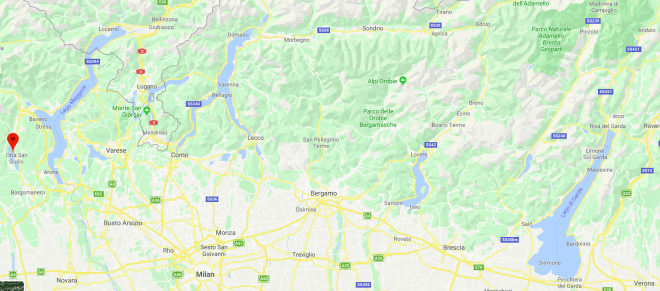
Google maps

Once we had deposited our son at the gates of the company he was visiting, we set off to Orta San Giulio. It was not, truth be told, the best day to visit anything: it was grey and drizzly, the kind of day that in my mind will be forever linked to the UK. But that didn’t stop us appreciating the scene that unfolded before our eyes as we arrived at the lake’s southernmost tip and took the road which hugged its eastern coast. My wife and I took no photos during our little tour, and the lake under the rain seems to have no fans among the legions of persons who post photos on the internet, so I can only describe to readers what we saw.

As we wound our way along the coast, with the wipers sweeping regularly across the windscreen, the trees covering the slopes which fell steeply into the lake’s waters – trees vested in their brown and reds of late autumn – began to give way to large estates with equally steep but more manicured grounds, the kinds of estates which I associate with the late 19th Century. Out on the water, dimly at first but ever more visible as we got closer to the village of Orta San Giulio, we discerned through the drizzle an island, the Isola San Giulio. The road began to climb to the top of the ridge of the peninsula along whose outer edge Orta San Giulio is built. Once we reached the top, we turned off the main road and made our way down to the village itself, passing as we did other, smaller estates climbing the side of the hill. When the road reached the water’s edge, it turned cobbled and narrowed into a single lane. We found a place to park and continued on foot, huddling under our umbrellas. Apart from a cat or two, we had the place to ourselves. Soon we were walking between rows of old houses on both sides of the street and only got an occasional glimpse of the lake down a side alley. But all at once, we entered the village’s main square, Piazza Motta, and there had a full view, across the square’s wet and windswept flagstones, of the lake and Isola San Giulio hovering on its waters in the middle distance. We could now make out the buildings on the island, in particular a Romanesque campanile on the water’s edge and a big hulking building, looking in all respects like an army barracks, which dominated the island’s centre point. We admired the view, looked curiously at an old hotel, now very much worse for wear, which occupied one whole side of the square, noted the street at the back of the square which, the signposts informed us, took one up to the Sacro Monte d’Orta, the Sacred Mountain of Orta, and then headed back to the car. It was time to go and pick up our son, and anyway it really was too wet and cold to explore any further. “For another time!” we promised each other. Maybe this Spring; there is a train we can take from Novara to Orta San Giulio.

In the meantime, though, I feel I must give my readers some idea of what we saw, or perhaps more accurately what we might be seeing when we come back in better weather. As is my habit, I’ve also been mugging up on the lake’s history and so can use this occasion to tell my wife – faithful reader of my posts – and any other interested readers about what I’ve learned.

So here is a photo album which I’ve cobbled together with other people’s pictures posted on the internet.

This is what the lake looks like on a good day from its south end, the end that we first saw it from.
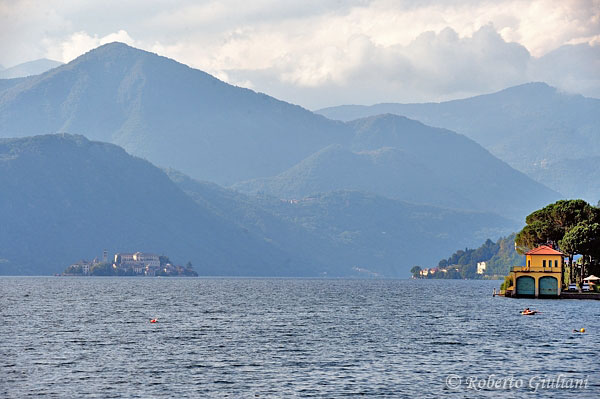
Source

Isola San Giulio is visible, along with a few houses of Orta San Giulio to the right. The pre-Alps rise up in the background.

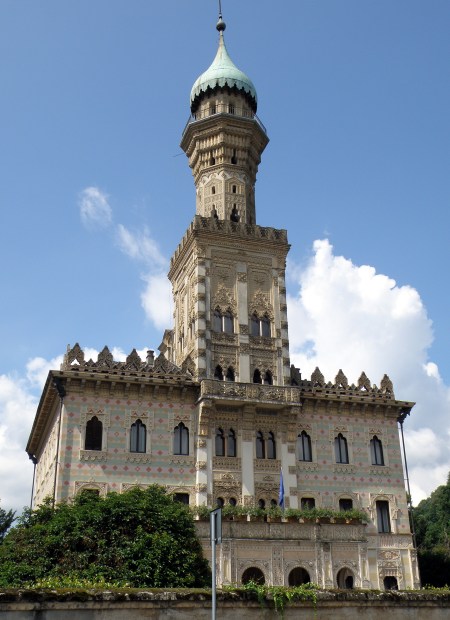
As we turned off the main road down to Orta San Giulio, we passed this frothy building.
Source

It is Villa Crespi. It was commissioned in 1879 by a wealthy cotton merchant by the name of Cristoforo Crespi and built in the Moorish Revival style. I suppose it is a somewhat outlandish example of what was happening around all of northern Italy’s lakes during that period: rich (or enriched) industrialists and bourgeois joined the aristocracy in building summer homes on the lakes. The same phenomenon certainly happened on Lakes Como and Maggiore (we see those villas every time we walk around those two lakes) and no doubt on Lake Garda (which still awaits a visit from us). Quite frankly, this particular building reminds me of some of the cinemas which dotted British cities when I was young, but at least this one continues to serve a decent purpose: it is a luxury hotel and home to the restaurant of one Antonino Cannavacciuolo (a well-known chef on Italian TV, I have read).

Certainly Lake Orta must have been a popular playground for the wealthier classes of the late 19th Century. It hosted the first ever European Rowing Championship in 1893 (rowing in Italy being considered a very aristocratic sport) and various national rowing championships thereafter, as this poster of 1909 attests (for an event, readers will note, “under the patronage of HM the King” [of Italy, of course]).

Source

What happened in the following decades is a classic example of how not to manage a lake – but we will get to that later.

This was the narrow street we walked down after parking the car: Via Giovanetti.

Source

It was pleasant to walk along under the rain; it looks even more pleasant on a sunny day.

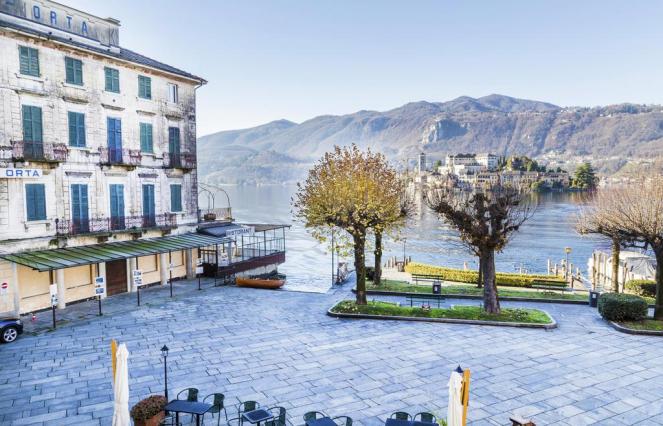
And this is the village’s main square, Piazza Motta.

Source

I’m not an expert on real estate but it does seem strange to me that the old hotel we see across the square in the photo (called, rather prosaically, Hotel Orta) has not been snapped up by someone and refurbished. There cannot be many places which have this nice a view when one steps out of the lobby onto the street:
Source

Down by the lakeside at the foot of the square one catches the boat to go over to the Isola San Giulio, which, as we get closer, will look like this,

Source

while we leave Orta San Giulio literally in our wake.

Source

I think a little bit of history is in order here, because Isola San Giuglio has always been at the centre of the lake’s story.

The island gets its name from St. Julius, a possibly legendary saint who is said to have christianized the area around the end of the 4th Century AD. It is narrated that Julius and his brother Julian were two Greeks who somehow made it to Italy and were instructed by Emperor Theodosius I to destroy pagan altars and sacred woods and to build Christian churches. Which they did with a vengeance. The little church which Julius built on the island is said to have been the hundredth – and last – church he built. There are the usual colourful stories of his doings like, for instance, this one: having decided that he would build his last church on the island but finding no-one willing to take him there he laid his mantle on the water and miraculously sailed over to the island. As a final aside on this saint, he made it to sainthood, but – rather unfairly, I think, since the two worked hand-in-hand in their proselytizing mission – his brother Julian did not.

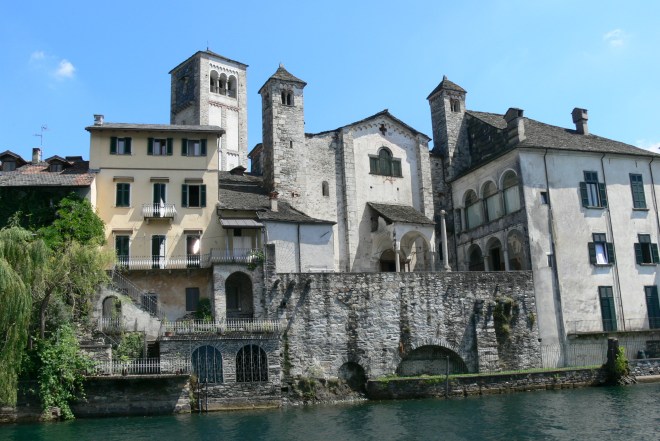
In any event, the first little church was succeeded by a larger one built in the 6th Century, which itself was succeeded by an even larger one built in the 12th Century; it was later nominated a basilica. That is the building we see today (although it has been much remodelled inside, as we will see, and squeezed in between houses built in later centuries). It is its campanile which we noticed when we were standing in Piazza Motta that cold and rainy day gazing out towards the island.
Source

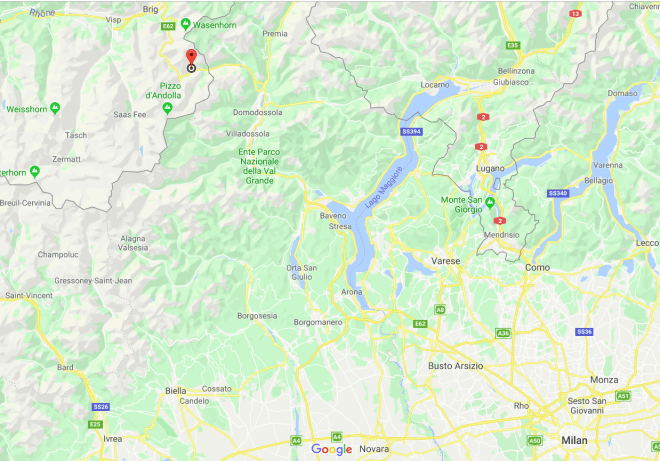
The island’s religious vocation was always in conflict with its obvious military importance. As this map shows, Lake Orta was one of two natural passageways for anyone crossing the Alps at the Simplon Pass to get down into the Po River plain and all its riches – the other was along the shores of Lake Maggiore. The red pin shows the location of the Simplon Pass in the map.
Google maps

Having crossed the Simplon, armies would march down (or peaceful merchant trains would lumber down) the valley of the River Ossola and then either go along Lake Maggiore or march up to Lake Orta and then pass through the valley at the other end. A Frankish army did that in 590 AD, marching into territory that was claimed by the Longobards. A Longobard Duke, Mimulfo by name, who was entrenched in the island, seems to have just let the Franks through. For this betrayal, the Longobard King Childebert had Mimulfo beheaded on the island. (A French Corps also crossed the Simplon in 1800, as part of Napoleon’s campaign in Italy; I have no idea which of the two routes they used to get to Milan)

The island was also a useful place to hole up if hostile armies were around. To this end, a castle was built there as early as the 900s AD, reconverting some of the church buildings to military use and generally constricting how the church and its buildings could be expanded. By then, the Longobards had been defeated by the Carolingian Franks and northern Italy had become part of the Holy Roman Empire. The Emperors were traditionally also Kings of Italy, and northern Italy was therefore impacted by Imperial policies and politics. Around the turn of the first millennium, a struggle started in northern Italy between the smaller noble houses, many of Longobard origin, and the larger noble houses and the bishops, who owed their positions and land to the Emperors. The smaller nobles wanted – not unsurprisingly – to have their own, local king, while the bigger nobles and bishops wanted to continue to be beholden to an Emperor far away on the other side of the Alps who left them to pretty much run the show as they wanted. In 945, at a time of Imperial weakness, the smaller nobles got the upper hand and elected one their own, Lothair, as King of Italy. He was quickly replaced by Berengar, whose family was powerful in the region around Lake Orta. By this time, the Empire was back on an even keel and, at the request of the Northern Italian bishops, the new Emperor Otto I sent his son Liudolf with a large army over the Alps to deal with this upstart.  Berengar’s family split up and holed up in various castles which the family controlled. Berengar, together with one of his sons, chose the castle on Isola San Giuglio. There, he was besieged by Liudolf and eventually surrendered. For some reason, Liudolf let both Berengar and his son go free. They went off and holed up in another castle of theirs in Romagna. Several months later, Liudolf died, officially of a fever although it was whispered that Berengar’s people had got to him and poisoned him. With Liudolf’s death his army melted away, and Berengar came out of his castle in Romagna to proclaim himself King of Italy once more. More Italian bishops headed north over the Alps, besieging Otto to come personally to deal with Berengar. This he did in 961, but first he went to Rome to have the Pope proclaim him Emperor and then to Pavia to have himself proclaimed King of Italy. By 962 he was ready to deal with Berengar, who adopted the same strategy: split up the family and hole up in various castles, except that this time it was his wife Willa who got to be in the castle on Isola san Giuglio (together with the family treasure) while Berengar headed for the castle in Romagna. Otto decided to go after Willa and history repeated itself: a siege of several months of the castle on Isola San Giulio followed by its capitulation. Again, Willa was allowed to go free (but not the family treasure) and she joined her husband. This time, though, Otto made sure that the castle stayed under Imperial control. As for Berengar, he died four years later and none of his sons seem to have made any attempts to retake the throne. There was another revolt by the small nobles some 40 years later, when Berengar’s grand-nephew, Arduin, was proclaimed King of Italy, and Northern Italy was put through the same circus: The Emperor (this time Henry II) came over the Alps with a large army and put Arduin in his place; he went back to Germany with his army and Arduin came out of whatever castle he was hiding in and proclaimed himself King again; Henry II came back over the Alps with another large army and dealt with Arduin again, this time for good (without, though, putting him to death; I think the Longobard king Childebert had the right approach: off with their heads!) Italy was not to have an independent King again until Italian unification nearly 900 years later.

After that, Isola San Giulio seems to have been pivoted away from its martial use back to its religious vocation and the whole area became a bit of a rural backwater. Over the next two hundred years, the successive bishops of Novara maneuvered to gradually have the Emperor give over to them the southern part of the lake as a feudal principality, which they then ruled with what seems to have been distant benevolence for some five hundred years; the local notables were generally allowed to rule themselves as long as they paid the necessary tithes and taxes to the prince-bishop. I don’t know if the prince-bishops used any of these funds to make life better for the peoples of their little principality. They certainly did use some of their funds, as did pious pilgrims, to make the basilica ever more beautiful. From the 14th to the 18th centuries, the church’s look was “modernized”, with the latest Baroque additions giving the inside of the basilica its current look, and frescoes were added on every available surface, with the later ones sometimes obliterating the earlier ones. We have here the “modern” frescoes in the vault and dome (the picture also shows the baroque “scarification”).

Source

while here we have one of the earlier frescoes, which are now tucked away out of sight in the lateral aisles.

Source

I have already made my feelings abundantly clear about baroque and later religious art in earlier posts, so I need hardly say that I prefer the earlier frescoes.

While all this religiosity was going on, life was not completely trouble-free in Isola San Giorgio and the surrounding principality. The end of the 15th, beginning of the 16th Centuries were agitated times in Italy and while this quiet corner of northern Italy was largely able to avoid the troubles, for a decade or so, 1520-30, the troubles came to it. In 1523, the plague broke out, in all likelihood brought to the area by refugees from Novara which had been sacked and pillaged by French troops fighting the Spaniards. But worse were the predations by the neighbouring lordlets, many of them from the Visconti family, who were attracted by the relative prosperity of the principality. Although officially the Duke of Milan was exhorting the lordlets to be good boys – these were church lands, after all – he probably unofficially supported them in their rapine, because he had his own quarrel with the Bishop of Novara over the ownership of this little principality: Novara and its province had come under Milanese dominion some two hundred years earlier. On some excuse, Orta San Giulio was sacked in 1524 by one Visconti lordlet and prisoners taken for ransom. In 1526 and ’27, the principality was forced by another Visconti lordlet to put up, for free, a company of Imperial soldiers. In 1528, the same Visconti lordlet decided to become Governor of the principality and moved into the castle on Isola San Giulio. When the locals besieged him there, a third Visconti lordlet came to his rescue and sacked Orta San Giulio a second time. In early 1529, a random Imperial army invaded the principality and demanded a huge payment to leave. The locals refused to pay and escaped to the island and the relative safety of its castle. After trying to take the castle a few times, the army gave up and left, sacking and pillaging as it went. A few months later, the third Visconti lordlet decided it was time to pillage some more and marched into the principality at the head of a band of soldiers. This time, the locals were “mad as hell and weren’t going to take it anymore”, as the saying goes; they were determined to resist. Grabbing what arms they had, they met the invaders and brought them to battle. The invaders made the classic mistake of thinking that these were just a bunch of peasants who would run away when the going got tough. But they didn’t; they fought like madmen. They were helped, it has to be said, by the marshy ground they had chosen, which meant that the invaders’ horsemen were neutralized. The result was that the Visconti lordlet and a good portion of his men were massacred. The other lordlets of the area took heed and desisted in their predations (probably aided by the fact that a general peace was finally brokered between the Great Powers fighting over Italy).

Thereafter, Isola San Giorgio and the rest of the principality slipped back into its state of feudal somnolence for another two hundred years. In 1735, Novara and its province were handed over by the Austrians to the House of Savoy. The-then Duke of Savoy (and King of Sardinia) Charles-Emmanuel III had no patience with quaint feudal relics in his lands like the Bishop of Novara’s principality around Lake Orta. Pressure was brought to bear and slowly, slowly the bishops divested themselves of their feudal rights to the principality in favour of the House of Savoy. By 1819, the deed was done: the principality was no more. It was just one more district in the lands of Piedmont and, after 1861, in the newly-unified kingdom of Italy.

As a sign of the changes, the remains of the castle on the island were dismantled completely in 1841 and in their place a huge seminary was built – it is that big blockhouse of a building which I thought were old army barracks.  We have here an old postcard celebrating the seminarists.
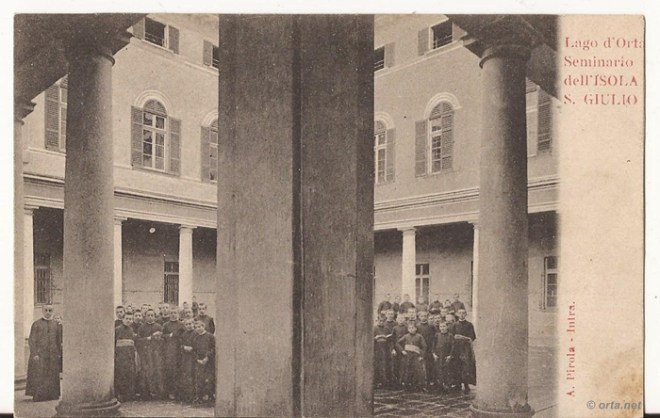
Source

The seminary is no more; it lasted a little less than a hundred years. But the religious vocation of the island continues. The basilica and seminary have been handed over to a congregation of Benedictine nuns – we have one here going through the rite of becoming a Bride of Christ.
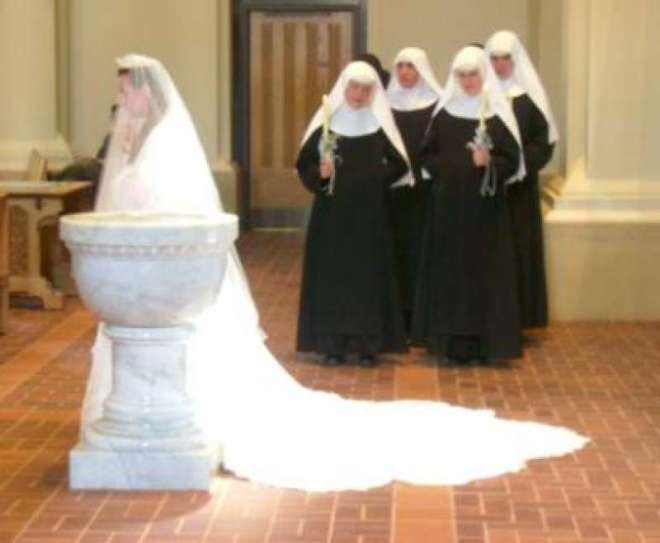
Source

The nuns have an interesting vocation. They study and translate ancient texts, and restore ancient fabrics and tapestries.

It is time to go back to Orta San Giulio and take that street at the back of Piazza Motta which we had noticed that cold and drizzly day, and which carries one up past this church to the Sacred Mountain of Orta.
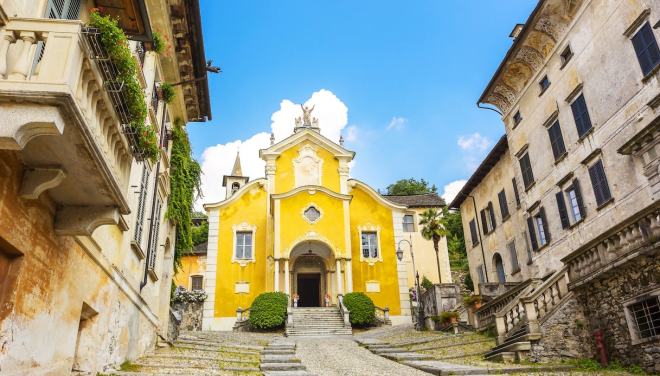
Source

The Sacred Mountain of Orta is one of a number of Sacred Mountains which were created in the late 16th, early 17th Centuries in Northern Italy. They were very much promoted by San Carlo Borromeo, Cardinal of Milan (whose very large nose I have mentioned in an earlier post). The original idea was to create places of pilgrimage which could stand in for the Medieval pilgrimages to the Holy Land, which was becoming harder and harder for pilgrims to reach. For San Carlo Borromeo, the Sacred Mountains were also to be a way to teach the little people, who had not had the benefit of an education, in an easily understandable way such mysteries as the Trinity but also the lives of Christ, the Virgin Mary, and great saints. To this end, the Sacred Mountains were made up of a series of chapels containing life-sized models in terracotta, backed up by frescoes on the chapel walls, each telling a story in a holy person’s life or making a point about some tricky theological concept: little theatrical pieces, if you will. I have mentioned the use of art to teach illiterate people about religion in an earlier post. With the growth of Protestantism, the Sacred Mountains took on a third purpose, that of combating these horrible heresies. That no doubt explains why there are so many Sacred Mountains in Northern Italy, where they were created as bulwarks against the tide of Protestantism that could be washing over the Alps at any minute. In fact, the Sacred Mountain of Orta is part of nine such Sacred Mountains in northern Italy which are now inscribed in UNESCO’s list of World Heritage Sites. In September, my wife and I visited another of these nine sites, at Varallo in Piedmont (where, coincidentally, we were once again accompanying our son on one of his business trips). I mentioned another of these sites, at Varese, in an earlier post I wrote about the fondness of religions around the world for sacrilizing mountains.

The Sacred Mountain of Orta is dedicated to the life of St. Francis, which pleases me no end since he must be my favourite saint, as I have mentioned in an earlier post. There are 20 chapels, laid out in a wooded landscape.

Source

I don’t propose to show readers photos of them all. Just two can give readers a sense of what would await them were they to visit this Sacred Mountain (or any of the other Sacred Mountains for that matter).

Source
Source

I hope these scenes are in better shape than the ones we saw at Varallo, which were really rather tatty. Luckily, they were in the midst of being restored when we visited.

You get beautiful views over the lake from the Sacro Monte.

Source

As you gaze down on this sunny scene, it’s hard to believe that a mere thirty years ago the lake was dead. Everything in it had been killed off by industries which were discharging their crap into the lake, turning it into the most acidic lake in the world. It started back in 1927, when the German company Bemberg, which was making rayon fibre using the cuprammonium process, set itself up on the lakeside. The plant’s copper and ammonium discharges quickly acidified the lake, killing all life in it in about two years. Bemberg made limp efforts to control the discharges, which did begin to finally show noticeable reductions in the late 1950s. But by then Bemberg had been joined by a host of small plants making metal consumer products; two of these companies, incidentally, went on to become global brands: Bialetti and Alessi.

Sources

Many of these plants included electroplating in their processes (that Alessi kettle is heavily chromed, for instance) and consequently toxic heavy metals such as chromium, zinc, copper and nickel were added to the filthy mix being discharged into the lake. As if that weren’t enough, the acidic waters of the lake released aluminium from the natural and normally harmless imissions of aluminosilicate into the lake, adding yet another toxic metal to the stew. Things only got better when the legislators eventually banged their fist on the table and passed Italy’s first water protection law in 1976 (the Legge Merli; I know it well, I referred to it countless times when as an environmental consultant I would tell Italian companies they needed to control their water discharges). Suddenly, companies which had claimed for years that it was impossible to control their discharges and remain in business found – surprise, surprise – that actually it was possible to control them and stay in business. But it took more than just forcing companies to properly control their discharges to get the lake’s pH back to normal. A massive liming operation was required, where calcium carbonate was added to the lake. A boat was specially made for the purpose. Lime was first sprayed on the surface.
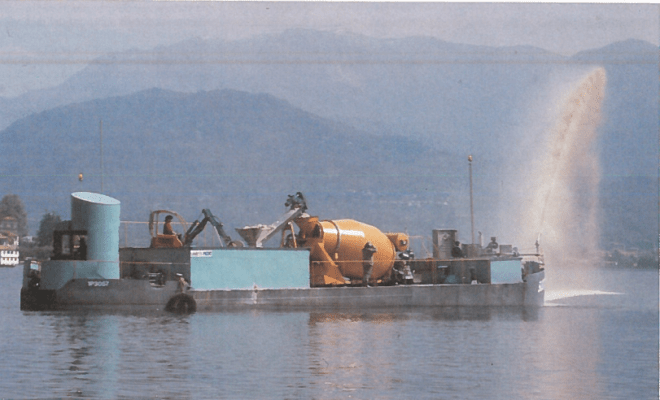
Source

But that wasn’t enough. Lime had to be injected deep into the lake, below the thermocline. It took twenty years to restore what had taken a mere two to destroy. The lake is now more or less OK: “fishable, swimmable”, in the catchy phrase of the US’s first water protection law, although the planctonic populations are not quite right yet.

Well, on that somewhat hopeful note, I leave my readers. Maybe some of them will make it to Lake Orta one day. My wife and I certainly will, when Spring comes rolling round again.

JERUSALEM ARTICHOKES

Milan, 18 November 2019

A few days ago, my wife entered a greengrocer’s to get some fruit and came out with fruit but also with a gleam in her eye. “I have bought some Jerusalem artichokes”, she announced, and I was delighted to hear it.

It was a University flatmate who many, many (many …) years ago introduced us to this tuber. One evening, it must have been about this time of the year, he appeared in the kitchen with these strange-looking things.

Source

As we looked at them curiously, he asked us if we had ever tried them. When we confessed that we had not, he promised us a plateful. He was as good as his word. I cannot remember now how he cooked them – more on this later – but it allowed us to appreciate that delicate artichoke taste which is the hallmark of this tuber.

Its name in English recognizes this gustatory affinity to the artichoke. And it is that artichoke taste which drew me to this lumpy, knobbly little tuber; as I have written in a previous post, I am very partial to artichokes.

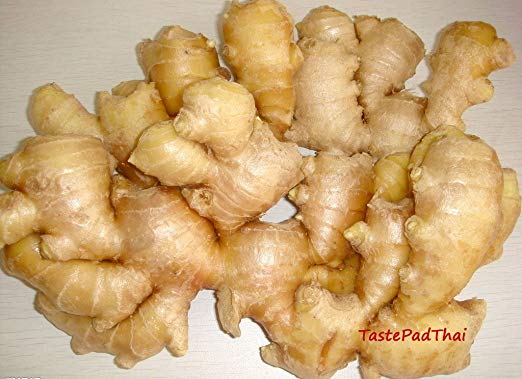
Not that we’ve eaten Jerusalem artichokes all that often since that first tasting 40-plus years ago. It is one of the few foodstuffs that is still only found seasonally – it’s available from late Autumn to late Winter, and very difficult to keep once out of the earth – so unless you maintain a sharp lookout, you’re liable to miss it. Because of that, and because, frankly, of a bad press – it has a reputation of being something you feed to animals and only eat if you’re literally starving – it’s not grown in large quantities and supermarkets rarely stock it. Once, I bought a whole load of ginger because I thought they were Jerusalem artichokes. They really do look quite similar, as I think this photo shows; the resemblance between the two has often been noted.

Source

I cannot remember where it was that I bought this ginger, but it must have been somewhere where I couldn’t read the labels – Thailand, maybe? I also cannot remember what we did with all the ginger: probably, after a few half-hearted attempts to drink tea with a lot of ginger in it, we threw it away.

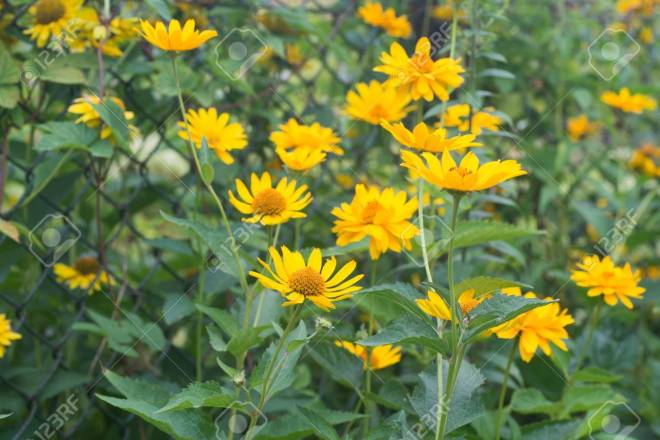
I must confess to also rather liking the name, which I find satisfyingly quirky. I initially thought that the “Jerusalem” part of the name indicated a Levantine origin for the tuber; maybe, I romantically mused, it was a foodstuff brought to Europe by returning Crusaders. But no, I discovered, North America is its place of origin. It is actually the tuber to a rather lovely flower, the Helianthus tuberosus.

Source

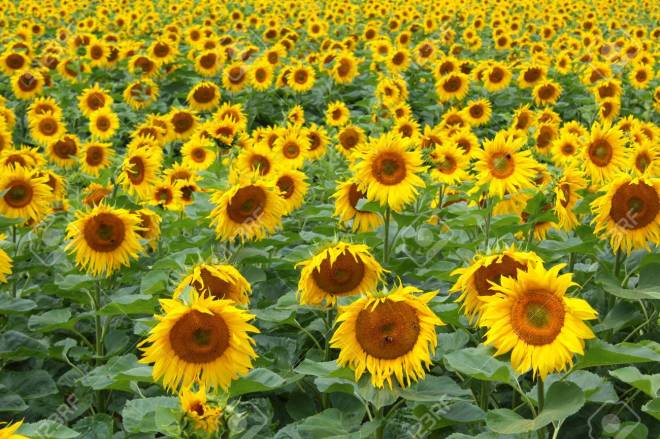
It is part of the Great Columbian Exchange, that massive intercontinental move of plants and animals (and diseases … and people) which took place after we Europeans discovered the Americas: plants and animals mostly travelling from the Americas to Europe and the rest of the world, and vice versa for diseases and people. I’ve written an earlier post about a minor representative of this exchange, the prickly pear. The Jerusalem artichoke is another minor representative. It is the relative of a much more important representative, also an emigrant from North America, the common sunflower, planted in vast quantities for its oil-bearing seeds.

Source

The French explorers of North America seem to have been the first Europeans to report on this tuber, and French colonists the first to send exemplars back to Europe. Samuel de Champlain, the explorer of the Saint Lawrence River and the Great Lakes, first came across it on Cape Cod.  As related on the US National Park Service website, “after rounding the headlands of Cape Cod in 1605, the French explorers sailed south along the ocean side of the outer Cape. Avoiding shoals and sandbanks, they managed to enter the first embayment they encountered. They called the place Malle Barre and left the ship to go onshore to inspect the Native American settlement. Champlain described the scene:

Before reaching their wigwams we entered a field planted with Indian corn … The corn was in flower and some five and a half feet in height. There was some less advanced, which they sow later. We saw an abundance of Brazilian beans, many edible squashes of various sizes, tobacco, and roots which they cultivate, the latter having the taste of artichoke. The woods are full of oaks, nut-trees, and very fine cypresses, which are of reddish colour and have a very pleasant smell. There were also several fields not cultivated, for the reason that the Indians let them lie fallow … Their wigwams are round, and covered with heavy thatch made of reeds. In the middle of the roof is an opening, about a foot and a half wide, through which issues the smoke of their fire.”

Champlain helpfully included a map of the embayment in his printed report.

Source

Another Frenchman, Marc Lescarbot, met Champlain soon after this in Port-Royal, a new settlement on the coast of what is now Nova Scotia. I throw in here a map of Port-Royal which Lescarbot included in the book he wrote some years later.

Source

Among other things, Champlain introduced him to the tuber. Lescarbot described it as follows: “a sort of root, as big as a beet or truffle, tasting rather like chard but more agreeable”. Chard is a vegetable which I’m fond of, fond enough to have written a post about it a little while back. Lescarbot was onto something, I think: the two share a similarly delicate taste. Nevertheless, in the end I would plump for the artichoke connection, so Jerusalem artichoke it should be, not Jerusalem chard.

Europeans were responsible for the global redistribution of the Jerusalem artichoke, but in truth humans had already started to move the plant out of its natural range before Europeans discovered the Americas. When Champlain, Lescarbot, and all the other anonymous European colonists came across the native plantations of the Jerusalem artichoke on the East coast, it looked to them like the plant had always been there. But actually that was not so. The plant’s natural range is somewhere in central North America, straddling the modern US-Canada border. However, the American Indians, recognizing the tuber’s value as a foodstuff, and especially its availability during the winter months when other food is often scarce, had centuries earlier carried it out of its natural range, all the way to the east and west coasts of North America, and down south into Mexico too.

Fascinating stuff, but none of it explains that “Jerusalem” bit of the name. Unfortunately, the chroniclers of the 17th century – the time when the Jerusalem artichoke arrived in Europe and was diffusing across the Continent – were more interested in the Great Men (and possibly Great Women) as well as the Great Events of their time rather than in the names being given to new vegetables. So it has been left to modern historians and etymologists to make some educated guesses. I give two of these guesses here, the two that seem to me the most likely – or perhaps the least unlikely. The first guess has it that the tuber made its way to Rome, as a foodstuff which had miraculously saved the French (Catholic) colonists of North America from starvation. It was planted in the Vatican gardens, whose gardeners gave the plant the name girasole articiocco – “girasole” being the Italian name for the sunflower (readers will recall that the plant is a cousin to the sunflower). The usual mangling of foreign words in British mouths meant that girasole articiocco became Jerusalem artichoke. This is quite neat and is the guess I would normally lay my money on, but I can’t explain to myself how Protestant Britain would have picked up a name being bandied about in the Catholic Vatican. The second guess has it that the tuber originally entered the UK from the Netherlands and more specifically from the town of Terneuzen (the Dutch botanist Petrus Hondius, who lived there, reported in the early 1600s on having successfully planted a shriveled tuber which he had received, no doubt from Dutch colonists in North America). In British mouths, Terneuzen artisjokken got mangled into Jerusalem artichokes. Trade between the two countries was brisk, so a transfer such as this of a new foodstuff sounds quite reasonable to me. But a mangling of Terneuzen into Jerusalem seems a bit of a stretch.

One of the rare places where my wife and I came across the Jerusalem artichoke was in Paris. The French name for the tuber is equally quirky: topinambour. Here again the mists of time have veiled over the origin of the name. The best guess is that the tuber began to appear on Parisian plates at around the time that a delegation of three Amerindians from the Tupinambá tribe, which had settled on the Brazilian coastline, were paraded before King Louis XIII and his court in the Tuileries (three others had died en route). They were sent there by some missionaries, who were competing with the Portuguese for the souls of the local “savages”.  No doubt the idea was to get the king interested in defending French interests in Brazil. I’m not sure they succeeded in that, but the Tupinambá created a sensation. One of the missionaries commented enthusiastically: “Who would have thought that Paris, used to the strange and the exotic, would go so wild over these Indians?”. After being paraded before the king and his court, no doubt in their “savage” state, the three Tupinambá were taken off to a church, baptized, and dressed in more “civilized” garb.

Source

Parisians, being vague about the geography of this New World that was being discovered before their very eyes but knowing that the tuber came from somewhere over there, simply decided that the Topinambá had brought the tuber with them and began to call it the topinambour.

Helianthus tuberosus grows extremely well in Europe, it is very easy to grow, and as I said earlier its tuber is available in the winter months when other foods can be scarce. As a result, the plant’s popularity grew, especially in France, where it saw its heyday in the 18th Century. Not only were people eating it, but it was given as feed to livestock. It was so widespread in France that one of the days in the Revolutionary calendar – the thirteenth day in the month of Brumaire, to be precise – was dedicated to it. But by then, its days were numbered. The potato (another representative of the Great Columbian Exchange), after facing a century or so of hostility in France, finally won wide acceptance. It eventually completely eclipsed the topinambour.

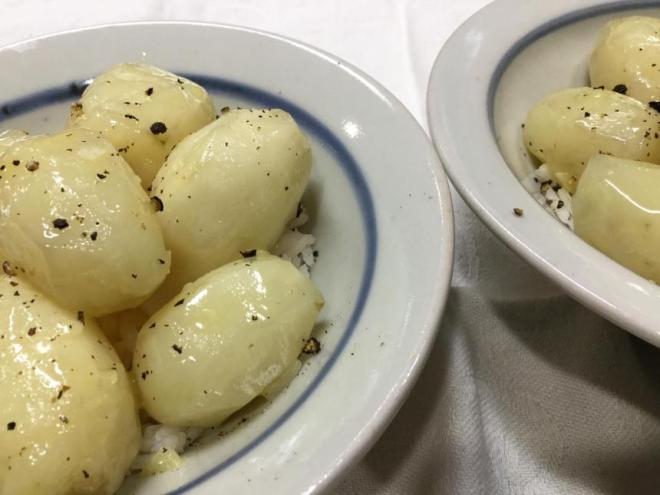
Which is sad really, because the Jerusalem artichoke/topinambour is really quite good to eat. I personally prefer the tubers steamed (they can be boiled, too, but they risk crumbling in the water).

Source

There’s Jerusalem artichoke soup, too, which I have yet to try.

Source

Then they can be roasted

Source

fried

Source

or prepared in just about any other way one can think of – there are recipes out there for all tastes.

I feel that I cannot in all fairness finish this post without mentioning one negative thing about the Jerusalem artichoke: the plant has a tendency to be invasive, a problem I’ve written about several times. It’s the tubers – if you leave just one little piece in the ground, they will proliferate. This is fine if you have them planted in your garden or in a field; it means you don’t have a problem getting another harvest next year. But it is not fine if the tuber somehow jumps the garden fence or the field boundary. Like another invasive species which I recently wrote about, the Himalayan balsam, Helianthus tuberosus is particularly troublesome if the plant colonizes river banks, for the same reason. It dies back during winter, leaving the river banks much more exposed to the danger of erosion during winter and spring floods.

So, dear readers, bon appetit! But if you want to grow these tubers please make sure they don’t escape from your garden!

MUSHROOMS A-FRUITING!

Milan, 3 November 2019

Our son has gone on a “tartufata” today with some of his friends to a place called Ovada, a town in southern Piedmont. I’m not sure if this word really exists in Italian, but what it means is that they have gone to a restaurant in Ovada, where they will order various dishes seasoned with tartufo, or truffle in English. ‘Tis the truffle season! Many an Italian is fanning out over the country where truffles grow to taste this delicacy. Alas! neither my wife nor I are terribly fond of the use of truffle in cooking. I’m sure some readers will gasp in horror at this admission. Our son certainly shook his head sadly when we admitted this to him – he, of course, is a great fan. My beef with truffle is that its taste is very intense, far too intense for me; even my son, fan though he is, admits that he can only eat a small number of dishes seasoned with truffle before it’s too much for him.

For those of my readers who have never seen a truffle, they grow in the ground, normally around the roots of certain trees.

Source

They are not at all handsome-looking. They resemble pebbles, with a roughly roundish shape and rather knobbly. Normally, a number of them will fit into the palm of one’s hand. This next photo shows the two most common species of truffle, the white and the black (there are number of other types of truffles, but we’ll keep it simple).

Source

An enduring image from my youth is the use of pigs to find truffles. It was one of those stories I heard, about French farmers – a pig on a leash in one hand, a basket in the other (and no doubt a smoldering gitane in the side of the mouth) – wandering the woods of the Perigord (a region of France famous for its truffles) looking for this culinary delicacy.

Source

With their fine sense of smell, pigs are exceedingly good at locating the truffles buried in the soil. I don’t suppose pigs are used much any more. Clever people have figured out how to farm truffles, so I presume the foraging for wild truffles is mostly a thing of the past.

For those of a biological turn of mind the truffle is a fungus, one of perhaps 2 to 4 million fungi species (this is an estimate; only some 120,000 species have been formally described). It belongs to the Ascomycota phylum of the fungi kingdom, along with “good” fungi like morels, brewer’s and baker’s yeasts, and the penicillins, as well as “bad” fungi like the Candida fungi and ringworm, which infect us humans, as well various plant pathogens with colourful names like black mold, apple scab, rice blast, black knot and powdery mildews.

What actually set me off on this post was not truffles; it just so happened that our son went off on his gastronomic adventures at this time. It was actually mushrooms, which are members of another phylum of the fungi kingdom, the Basidiomycota, that got me to pick up my pen, figuratively speaking. As is our habit when we are in Milan, we’ve been walking the woods around Lake Como, and in recent days we’ve stumbled across a good number of very striking mushrooms.  Perhaps the weather conditions have been particularly propitious, perhaps we have just happened to walk across mushroom-rich grounds. I have no idea if any of the mushrooms we’ve seen are edible; I’m certain that one of them definitely is not. They just struck me as being particularly handsome. Seeing handsome mushrooms actually started on our walk along the Kumano Kodo trail in Japan. Here is a lovely one we almost tripped over, growing as it was right along the path we were following.

our photo

Aren’t they just beautiful?!

We also saw a very nice species of bracket fungus on a large cypress tree on our last day.

Our photo

Passersby had put 10-yen coins on the bracket fungus; this was the entryway to a large Shinto shrine, so I presume they play a role in animistic religions. I took the coins off, feeling that the fungus looked much better without them (and I hastily add that I put them back once I had taken my photo).

I’m very fond of bracket fungi. Years ago, when we were living in Washington D.C., my wife and I came across a lovely set of bracket fungi growing on a dead branch, during a walk in the woods. We brought the branch back to our apartment, where it brightened up the place. With great regret, when we left for Europe, we gave the branch and its fungi to a friend. I’ve always wondered what became of them.

But coming back to Lake Como, the first set of mushrooms we saw were these, growing under a pine tree.

Our photo

Unfortunately, since they were in someone’s garden I couldn’t get any close-up photos. I rather suspect, though, that at least some of them – the ones to the left – were the fly agaric  mushroom. This is a truly beautiful mushroom – but a hallucinogen if eaten in small amounts, and deadly if eaten in larger amounts.

Source

These are the mushrooms that gnomes will often be pictured sitting under or on.

Source

A little later, when we had entered the woods, we were lucky enough to come across a fly agaric in its mature stage on the side of the path.

our photo

It looks like something took a bite out of it; I hope it had nice hallucinations.

After that, we saw a number of other mushrooms peeking out from the forest floor as we walked along.

our photo
our photo
our photo

Lovely … But I have no idea what their names are (or their toxic or hallucinogenic properties) – I welcome any reader who knows them to tell me. In the meantime, my wife and I will continue traipsing through the woods and perhaps we’ll see a few more species of mushrooms to admire.

LAND OF WATER, LAND OF MOSS

Milan, 30 October 2019

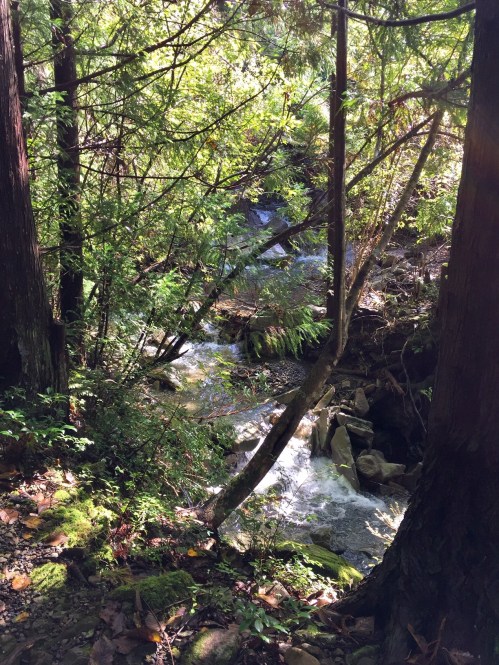
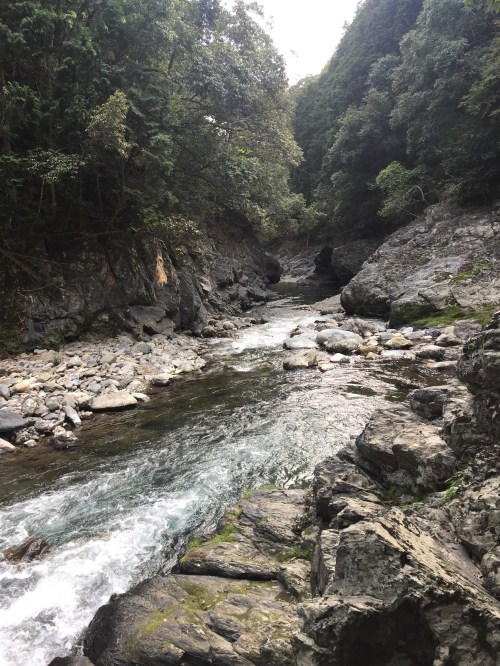
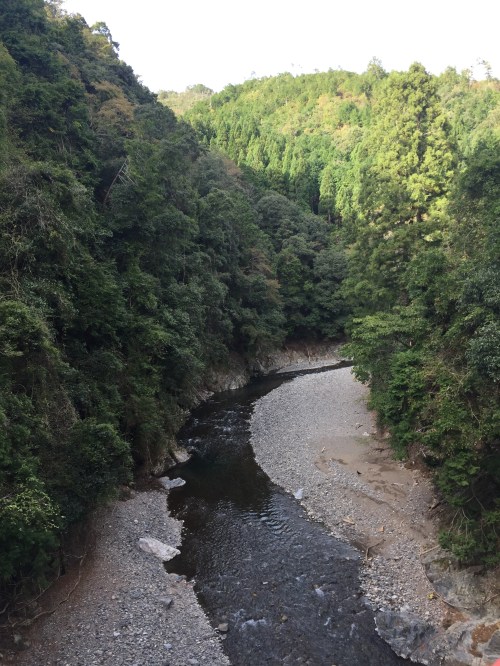
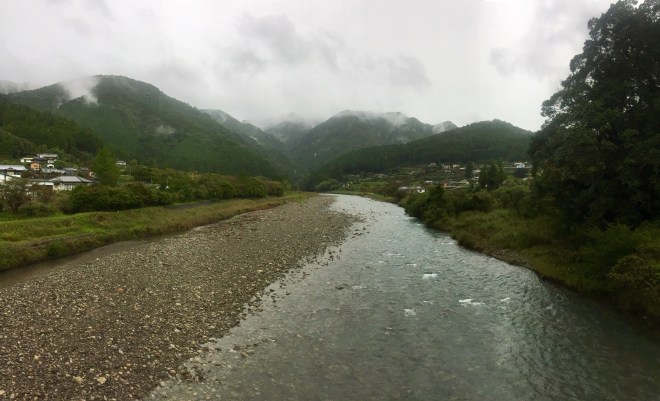
After I had finished giving my course on sustainable industrial development at Kyoto University, my wife and I took a week off to walk the woods of Japan. Last year, we walked the Nakasendo Way. This year, we hiked along the old Kumano Kodo pilgrim trail. Just as had been the case when we walked the Nakasendo Way, we were struck by just how much water Japan has. In all its forms – rills, brooks, streams, rivers, waterfalls – the water welled out of the mountains we traversed and trickled, ran, poured off their flanks. The noise of water running across rock and stone was our constant companion.

our photo
our photo
our photo
our photo
Our photo

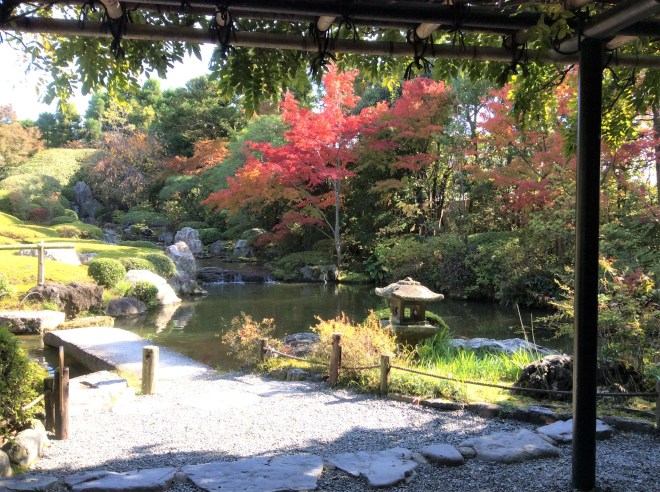
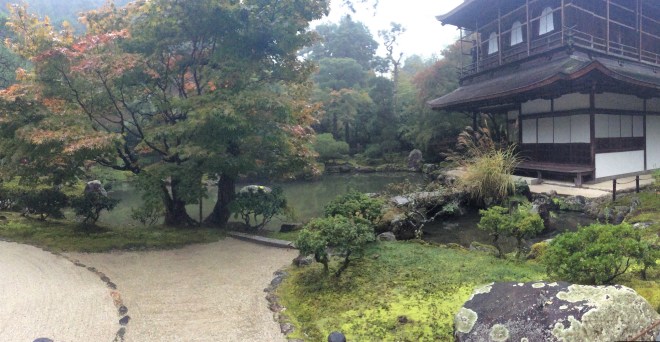
No wonder water is such an integral part of Japanese gardens, from falls

source

to streams and ponds

our photo

to small water elements.

our photo

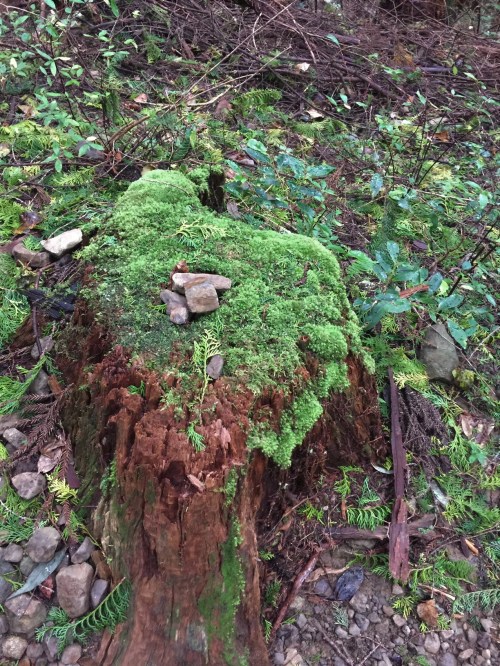
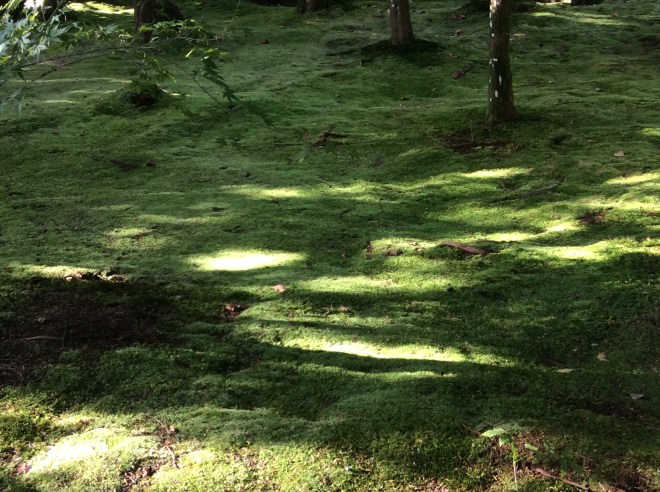
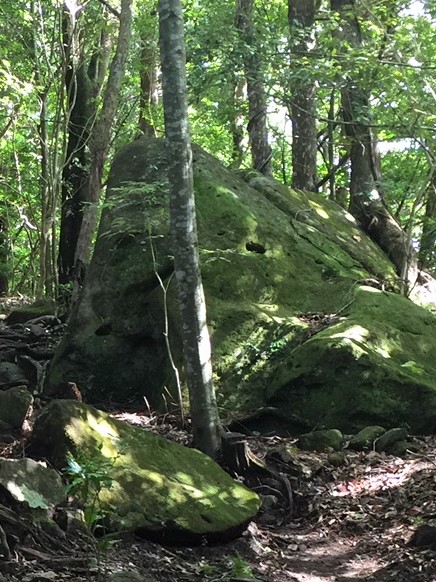
All this water, and the rain which is the source of it, means that there are high levels of humidity in Japan, excellent conditions for the growing of moss. I have read that of the roughly 12,000 species of moss known worldwide, some 2,500 varieties are found in Japan alone: one-fifth! That’s pretty good going. And they certainly beautify Japan. Moss casts a lovely green sheen on everything it touches. This is true everywhere but it is particularly true in Japan. On our walks there, we’ve seen it growing luxuriantly on felled trees and tree stumps.

our photo
our photo

We’ve seen it clustering thickly around the base of standing trees.

our photo

and throwing a gauzy veil over their trunks.

our photo

We’ve seen it throw a light mantle over rocks.

our photo

It doesn’t stay in the forests. It will colonize the artifacts created by man.

Our photo

We’ve even seen it make the ugly concrete edges of a road look lovely!

Our photo

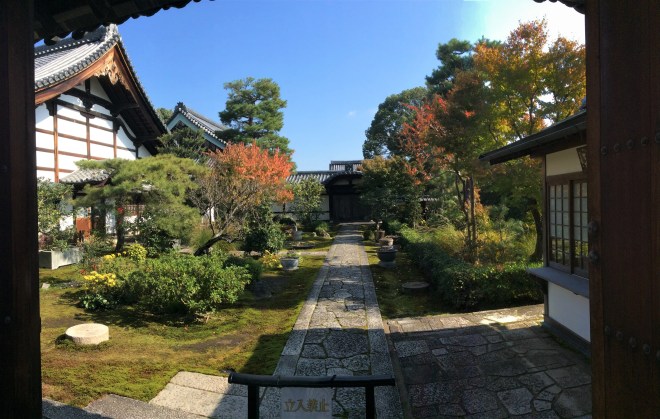
The genius of Japanese garden designers is to have fought off the instinct, which we seem to have in the West, of banishing moss from their gardens. Instead, they have welcomed it in with open arms and integrated it into their designs. As a result, no self-respecting Japanese garden is without its moss.

Our photo
our photo

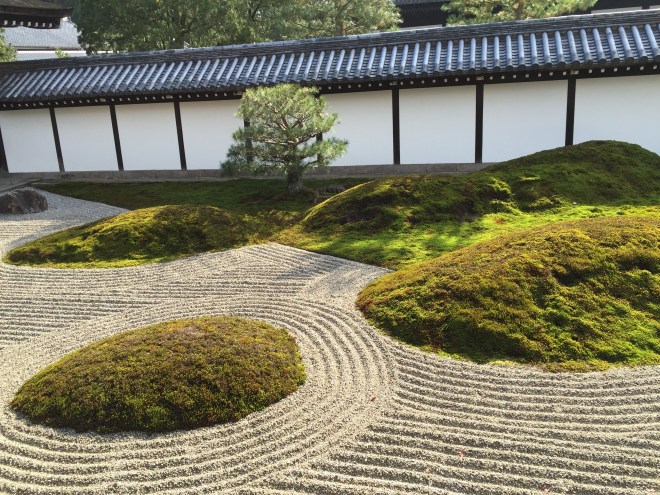
Given my weakness for Zen gardens, I love the way the designers of these gardens have incorporated moss into their designs.

our photo
our photo
our photo

Some gardens use moss the way we would use grass, creating “lawns” of moss.

our photo
our photo

If the light is right, the effect can be quite magical.

our photo

A good number of temples have extensive moss gardens, where moss covers the floor of the whole garden. The most famous of these is Saiho-ji temple in the western outskirts of Kyoto. It’s become a UNESCO World Heritage Site. It’s difficult to visit. You have to book months in advance, using a system of return postcards, which is really primitive in this day and age and very difficult to do if you don’t live in the country. But we managed it this time.

our photo

A good number of years ago, as I relate in a previous post, I built my own Zen garden in a corner of our balcony. I had no moss, though, in that garden. The micro-climate on the balcony was too dry and harsh. But maybe, one day, somewhere, I’ll make myself another Zen garden, and this time I will try to incorporate moss.

A STRIKINGLY HANDSOME SPIDER

Milan, 26 October 2019

My wife and I have just come back from our annual trip to Kyoto, where I teach a two-week intensive course on sustainable industrial development. As usual, when I was not giving classes we were either visiting Kyoto or walking the ring of hills which surround the city. And as usual, we’ve been coming across a good many examples of this representative of the insect world.

Source

This, dear readers, is the Nephila clavata, or the Joro spider. It is found throughout most of Japan, as well as in Korea, China and Taiwan. And this is the time of year when they spin their webs. They are everywhere! If you’re not careful, you will walk into the webs as you walk along, getting those silky threads all over your face. Here is an especially dense set of webs which we had to navigate.

my photo

I have to say, this species of spider is really quite striking. Look at those green and black markings!  And that dark red stripe around its abdomen!  I am definitely not a fan of the spider family, but even I have to admit that the Joro spider is beautiful, even if in a rather sinister sort of way. And it does spin lovely webs, the classic ones, a series of concentric circles with radiating spokes. My wife and I were lucky enough to catch this one in the morning sunlight when it was still wet with dew.

my photo

The Joro spider is a champion for matriarchal societies. The female is much bigger than the male, and it is she who sits, in deathly stillness, at the centre of the web, waiting for hapless insects to blunder into it and become her next meal.

As for the males, a couple of them will be found on the edges of the web, waiting anxiously for their chance to copulate with the female. After copulation, the female will spin an egg sack, fill it with anything from 400 to 1500 eggs, and then attach it to a tree or other suitable surface. After which, with the onset of winter, all the adults die, leaving the eggs to hatch the following May. The juveniles scatter through the underbrush and the cycle starts again.

And that’s all there is to say, really, about the Joro spider. I’m sure arachnothologists could natter on excitedly for hours about various aspects of the spider’s life cycle and behaviour but I’m assuming my readers are, like me, just ordinary folk with no more than a passing interest in spiders. So I will say no more about the Joro spider – except for one thing.

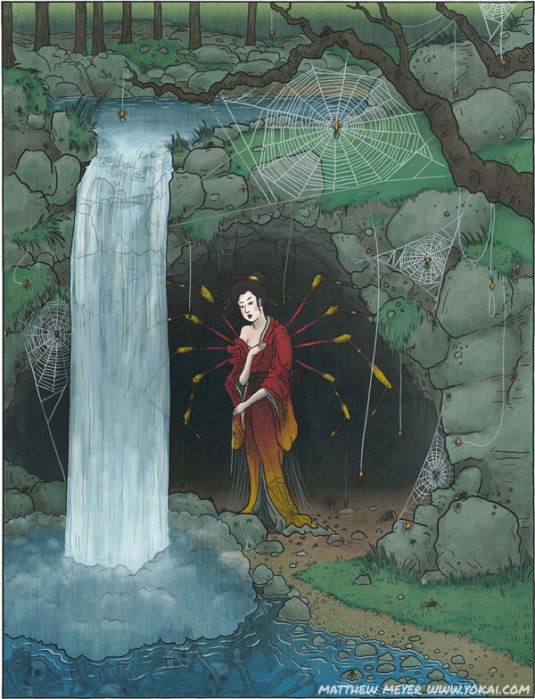
Readers may be interested to know that the Joro spider has over the centuries become one of Japan’s many yokai – these are the supernatural monsters, spirits, and demons that haunt Japanese folklore. I have this theory that it is the dominance of the female over the male along with her vivid colouration that has led to the Joro spider being turned into a yokai. The name in Japanese, Jorogumo, actually means “woman spider”. The name can also be written to mean more negatively “entangling bride” or even “whore spider”. The common role of the Jorogumo yokai in folk tales is to shapeshift into a beautiful woman who will set herself up in a cave, in the forest, or in an empty house in town, and will wait there for unwary men to pass by. She will seduce them, tie them up in her silken web, and then devour them. We have here several modern takes on these ancient storylines, with the second bordering on the pornographic.

Source
Source

A common finale to these folk tales is that one young man, more astute than the rest, will figure out that the beautiful woman who is trying to inveigle him is actually the dreaded entangling woman/whore spider and will take her out with a sword or other suitable weapon. Here we have a strapping samurai doing just that, in a 19th century woodblock by Utagawa Kuniyoshi.

Source

It is interesting that a number of folk tales from other parts of the world include wicked seducing women from the supernatural world, ready to kill or otherwise neuter healthy young men. Just off the top of my head, I can think of the enchantress Circe in the Odyssey, who turned Odysseus’s men into pigs and whose plot to visit the same fate on Odysseus was foiled by the hero.

Source

Or in the same Odyssey, we have the (female) Sirens whose beautiful songs drove (male) sailors mad and incited them to smash their ships onto the rocks.

Source

Without getting too anthropological about it, I have to assume that these tales are a product of the patriarchal societies in which they were developed. In a strongly male-dominated society, the worst thing that can happen to a man is to find himself dominated by a woman. The best excuse a man can give to explain why this happened is for him to say that the woman seduced him. To make it an even better excuse, give the woman supernatural powers of seduction – “if she’d been a normal woman, I could have resisted her female lures”.

As I walked along, ducking out of the way of the Joro spiders’ webs, I found myself wondering how one of these tales would have been told in a matriarchal society.

AUTUMN GOLDEN CUP

Sori, 30 September 2019

Last year, I marked the annual migration which my wife and I make from Austria to Italy with a post celebrating the autumn crocuses which we saw sprinkled across the meadows we were crossing on our last walks around Vienna.

So this year, when on our first walk back in Italy – we came down from Austria a few days ago – I spotted a profusion of yellow crocuses it seemed to me that they would be an excellent topic for my first post of the winter season in Italy.

my photo

As it turned out, there was a slight hiccup in this plan. I have just discovered that the plants are not crocuses. They look terribly like them, as this photo demonstrates (the purple plant is a real crocus). But they are not.

Source

A number of the plant’s common names make the same mistake. For instance, one of the plant’s common names in English is yellow autumn crocus, as it is in French (crocus jaune d’automne). But actually the plant is more closely related to the daffodil than it is to the crocus. And in fact a couple of the common English names refer to the daffodil – autumn daffodil, winter daffodil – although I suspect that this has more to do with the plant’s daffodil-yellow colour than with any botanical relationships. I don’t want to use these names because I really see nothing daffodil-like in the plant (apart from the colour). The plant’s official name is Sternbergia lutea, but I don’t want to use that, it makes me sound like a stuffy old bore. After looking around at what various (European) languages call the plant, I think I shall plump for the German Herbst-Goldbecher, Autumn Golden Cup.

So now let me celebrate the Autumn Golden Cup with a couple of photos of it by  photographers who are way better than me at taking photos.

Source
Source

For anyone who might be interested, this map shows the geographic distribution of the Autumn Golden Cup.

Source

The plant is native from Spain through to the southern shores of the Caspian Sea (and it’s been naturalized for quite a while in France, Morocco and Algeria). These photos of the Autumn Golden Cup show it in a rather more natural setting, the first in an old olive grove in southern Greece, the second on some stony ground in southern Italy.

Source
Source

There is only one dark cloud in all of this. The Autumn Golden Cup is one of a handful of plants whose bulbs are made commercially available mostly through collection in the wild rather than through artificial propagation. This has put terrible pressure on wild populations. In my last post, I wrote about the problem of species being moved to new ecosystems and running amok. Here we have the problem of over-exploitation of native populations, leading – if we are not careful – to their extinction in the wild. The situation for the Autumn Golden Cup is sufficiently worrisome that it has been listed in the global Convention on International Trade in Endangered Species (CITES) as a species that can only be traded internationally with the proper permits. The problem is that many of the countries where this bulb harvesting is going on have weak enforcement authorities, so the trade is not being managed as it should.

What I don’t understand in all of this is why the Autumn Golden Cup cannot be propagated, as happens with the great majority of bulbous plants. Some efforts are being made to teach farmers in Turkey, for instance, to do just this. But why don’t Italian farmers, where the species is native, also do it? My rather uncharitable thought is that everyone has pretty much left bulb propagation and sale to the Netherlands (those tulips, you know …), which as a result controls the great majority of the trade in flower bulbs. It so happens, my thinking continues, that since the Netherlands falls outside the geographic range of the Autumn Golden Cup it has never bothered to get into the business of propagating this particular plant. And so we are left with harvesting in the wild.

Well, I just hope that we can change this situation before it’s too late.

BEAUTIFUL FLOWER, DEADLY PLANT

Vienna, 27 September 2019

Picking up where I left off at the end of my last post, my wife and I were on our way back to our hotel from our little tour of Traunkirchen when I spied on the side of the road these beds of wild flowers.

my photo

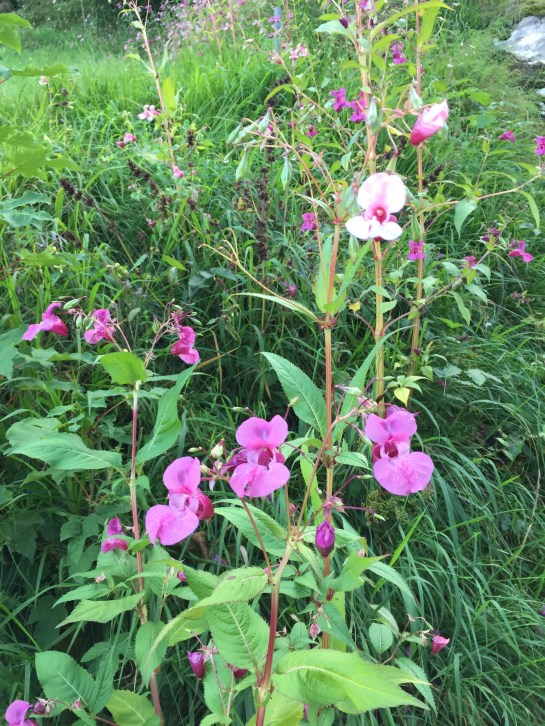
They were really very pretty, with the flowers going from magenta to almost white, passing through a candy pink. Even as I admired and took a couple of photos I had to admit to myself that I no idea what they were.

The next day, at breakfast, I showed our host the pictures. Ah, she said, that’s a Drüsige Springkraut. She had no idea what its English name was, but the German name was enough for my wife. A few clicks later, she handed me her iPad and I was reading a Wikipedia entry on the flower.

Its official name is Impatiens glandulifera. It has many colourful names in English. Three – Policeman’s Helmet, Bobby Tops, Copper Tops – reflect the flower’s apparent resemblance to British policemen’s helmets. Here’s a close-up of the flower itself.

Source

I leave my readers to decide, but I really don’t see this resemblance – unless the helmets have changed considerably since I last lived in the UK. Another name, Gnome’s Hatstand, makes more sense to me. It presumably harks back to the decidedly florid hats which some gnomes in children’s books sometimes sport, and I definitely can see a florid hat in the flower’s shape. And of course the plant then becomes the hatstand for these florid hats. Two other names, Himalayan Balsam and Kiss-me-on-the-mountain, refer to the mountainous origin of the plant; more on this later. Another name listed in Wikipedia is Ornamental jewelweed. I’m guessing this was inspired by the fact that we have a beautiful flower grafted onto a decidedly weedy-looking stem.

The English-speaking world seems to have been particularly poetic in its choice of names. The names in German and French (the only other two languages I checked) are decidedly more prosaic and seem mostly variations on balsam and glands (the latter being also found in the official name). I read that the plant does indeed carry glands, under the leaf stem, which produce a sticky, sweet-smelling, and edible nectar (the latter presumably being the origin of the balsam names). Eager to try this nectar, I poked around under various leaf stems the next time we walked past the flowers but failed to detect anything; a puzzle to be solved another day. The only exception to the list of prosaic Franco-German names is the German Bauernorchidee, Farmer’s orchid. We’ll come back to this link to orchids in a minute.

A beautiful flower – but alas an invasive species! Invasive species are a terrible problem; they have been the subject of an earlier post of mine. The flower’s original home is the Himalayas, specifically to the areas between Kashmir and Uttarakhand. I am ashamed to say that it was an Englishman who unleashed this particular botanical scourge on the rest of the world in 1839. He was no doubt part of that legion of Europeans who followed in the footsteps of conquering European armies, scouring the newly-colonized lands for plants. Initially, they were looking for plants from which some monetarily useful product could be extracted but later they also looked for pretty plants which they could sell to the growing ranks of gardeners looking for an extra splash of colour or texture in their gardens.

Source

The Himalayan Balsam, to use one of its many names, was thus first grown outside of its natural range in the UK but eventually spread to many other parts of the world. Coming back to that German name, Farmer’s orchid, it seems that its popularity was at least in part due to it allowing gardeners of modest income to have a flower that looked very orchid-like; I throw in here a photo of an orchid, to allow readers to see the resemblance.

Source

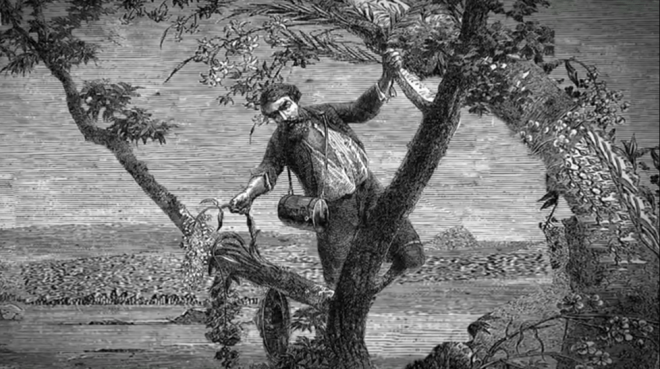
Real orchids were the playthings of the rich, who could afford not only the stiff purchase price but also the high maintenance costs (and by the way, the picture above is actually of a Victorian orchid hunter; orchids commanded prices which allowed serious expeditions to be funded).

As with water hyacinth which I wrote about in that earlier post on invasive species, the Himalayan balsam eventually escaped from the confines of gardens and began to spread through the countryside. As far as the UK is concerned, it has become one of the country’s most invasive species. It colonizes damp woodlands (which is where we came across it in Traunkirchen, although in beds that were not nearly as thick as this).

Source

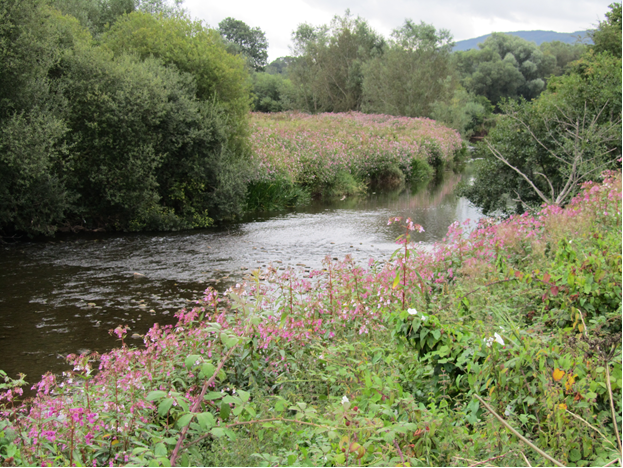
It also colonizes the banks of waterways – this is a view of the River Monnow, which makes up part of the England-Wales border.

Source

The flower’s crowding along the banks of rivers is particularly problematical. When the plants die back in autumn they leave the banks bare and subject to erosion from winter and spring floods. I read that the plant is a terrible pest in the Norfolk Broads. That gives me pause; I used to go there as a young boy – 50+ years ago – and I never remember seeing it. The Himalayan balsam is marching across the landscape …

People are trying to do what they can to stop the plant. In some places, there are regular “balsam bashes”, where volunteers go out and physically pull up the plant. Here, for instance, we have a group of volunteers in Yorkshire, who by the size of the pile in front of them have had a hard day’s work.

Source

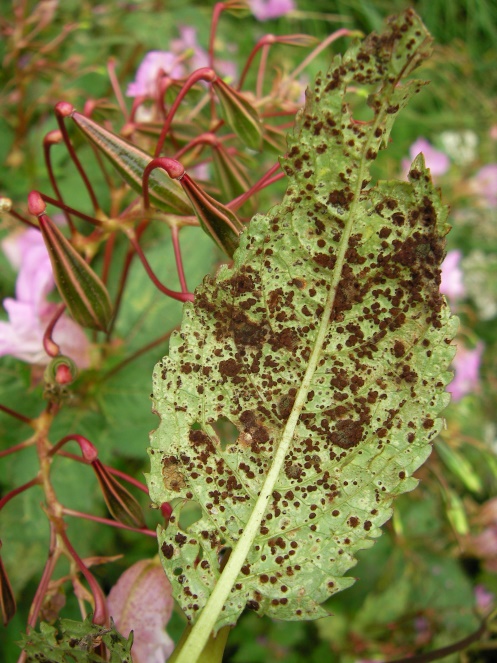
More extreme measures are required, though, if the invasion is truly to be stopped. The basic problem is that the plant has escaped from all those predators which back home in the Himalayas keep it in check, and none have taken their place in the rest of the world. Researchers in the UK have gone off to the  Himalayas to see if they can’t bring at least one of the original predators back to the UK. They have found a very promising candidate: the Himalayan balsam rust. It attacks the plant at various points: the stem, the leaves, the seedlings. This is what the leaves look like once they are under attack.

Source

The scientists are currently conducting field tests. I wish them the best of luck. And I really pray that they will not unwittingly release into the British environment a rust that will find other, native species much more to their liking and which will then forget about attacking the Himalayan balsam. As I pointed out in my previous post on invasive species, this has happened before, and you end up with two invasive species instead of one!

While we wait for the results of the tests to come in, I invite readers to locate their nearest “balsam bash”, or whatever they might be called in the local language, and take part. You will be doing us all a favour and getting a breath of fresh air at the same time.

A beautiful flower, but to be admired in its native habitat and not in our gardens.

TRAUNKIRCHEN

Vienna, 25 September 2019

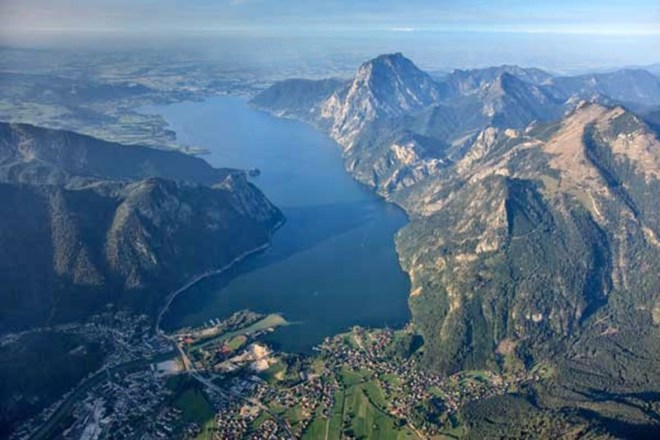
My wife and I recently spent a long weekend on Traunsee (Lake Traun), which is one of several lakes which sprinkle the Salzkammergut region of Austria. Here is an aerial photo of the lake, looking from south to north.

Source

Readers will notice that the topography around the lake is generally mountainous other than a section of relatively gentle hills on the lake’s northwestern shore. We were staying on the edges of the village of Traunkirchen, down south on the western shore, where gentle hill meets steep mountain. This gave us the opportunity to try out both topographies for our hikes, these being the main purpose of our visit.

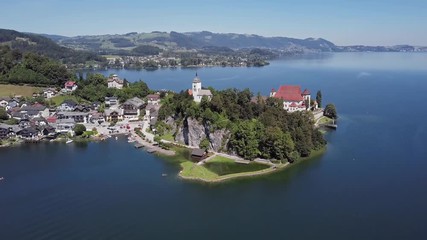
Traunkirchen is wonderfully located, clustered as it is around a rocky spit perched on the edge of the lake – readers with sharp eyes may notice that spit in the photo above. I add in here a closer aerial view of the village.

Source

On the afternoon we arrived, we took advantage of a pedal boat, which our hotel kept moored at its little piece of beachfront, to pedal slowly over to the spit and admire the church built on it from the water.

my wife’s photo

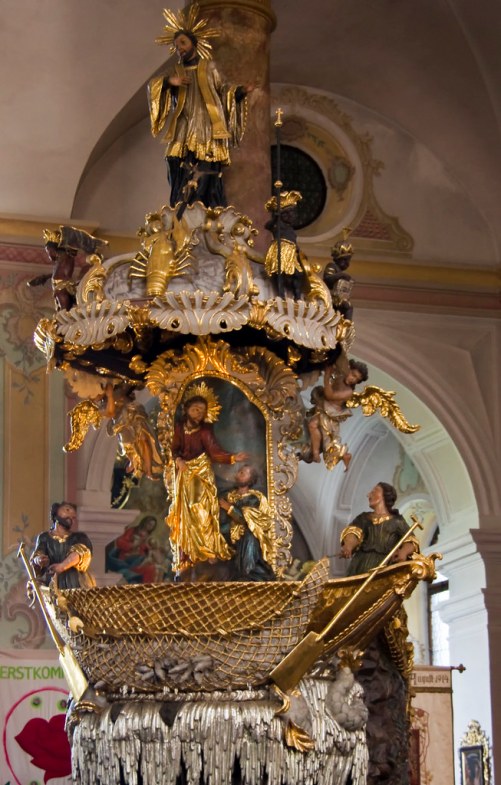
We later visited the church, whose interior was the usual Baroque confection. As I have frequently mentioned, the last time no later than my last post, I am no great fan of the Baroque. But this church does have one splendid piece, the pulpit. It is built in the form a boat, into which fishermen are hauling their catch.

Source

An apt iconography for a village by a lake, but also no doubt the artist was recalling the words of Jesus on Lake Galilee: “As he was going along by the Sea of Galilee, he saw Simon and Andrew, the brother of Simon, casting a net in the sea; for they were fishermen. And Jesus said to them, ‘Follow me, and I will make you become fishers of men.’ Immediately they left their nets and followed Him.”

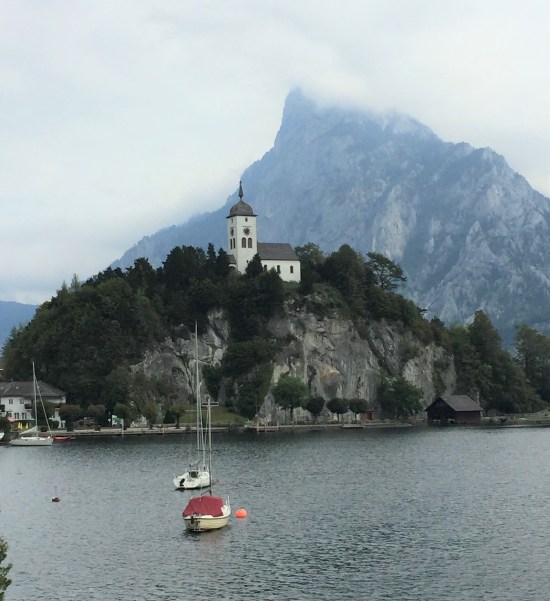
Our visit to the church was part of a longer itinerary thoughtfully provided by the local tourist office to explore the village. Our next port of call was a small chapel on the highest point of the spit. Up close the chapel was no great shakes, but from afar it made for a wonderful view, as we saw the next day at the start of one of our hikes.

my photo

The local tourist office’s itinerary then carried us away from the water front and up the hill that backed the village. There, perched on a ridge, was a large house built in the early 1850s and known by the locals as the Russian Villa.

Source

The house got its nickname from its first owner. She was the daughter of a Russian prince and went by the delightful name of Sophie Baroness Pantschoulidzeff. The name immediately evokes in me pictures of a languid lady with a Slavic cut to the cheekbones, toying with an enormously long cigarette holder and calling everyone “Daahlingh”. Despite my best efforts, I have been unable to discover anything about this Baroness on the internet. But she kept good company in her villa. Many of Vienna’s artistic elites spent time with her there.

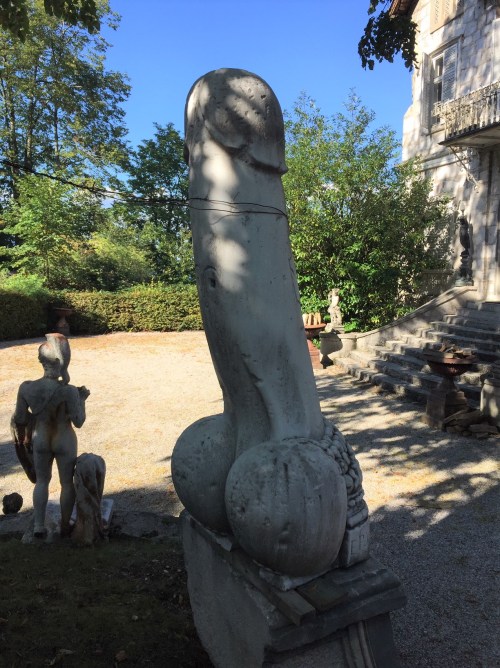
After Baroness Pantschoulidzeff’s death, the villa passed through various hands. Whoever owns it now has a collection of Ancient Greek or Roman statues (or copies thereof) in the garden. Among these, there is one which is – how shall I put it? – particularly intriguing: it is a huge phallus. Of course I had to take a photo.

my photo

From writing which I glimpsed carved into its base, I think it also was of Graeco-Roman origin (or a copy of one such).

We saw it because the itinerary recommended by the tourist office took us along a path which passed by the gate to the villa’s garden. The path then went on to become Traunkirchen’s Via Crucis. I can only hope that anyone walking the path for religious purposes, and not – like us – to follow a tourist itinerary, will keep their eyes firmly fixed on the horizon and ignore that giant male member as they pass the villa’s garden gate.

After this glimpse of the surreal, we went on to follow the Via Crucis, which led us eventually to its final chapel in the woods.

Source

After a look at the crucifixion scene in the chapel, we wended our way back down to the waterfront, where we sat down at the cafe outside the Hotel Post.

Source

While we rested, we enjoyed a good cup of Earl Grey tea served to us by a very friendly waiter dressed in lederhosen – we were in Austria, after all – before we heaved ourselves back on our feet and headed back to our Pension.

SAINT JOHN OF NEPOMUK

Vienna, 17 September, 2019

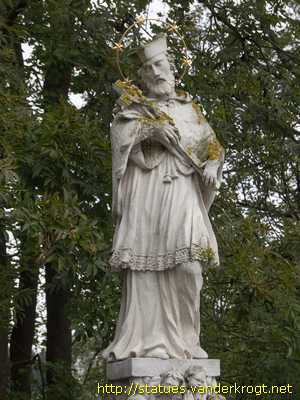
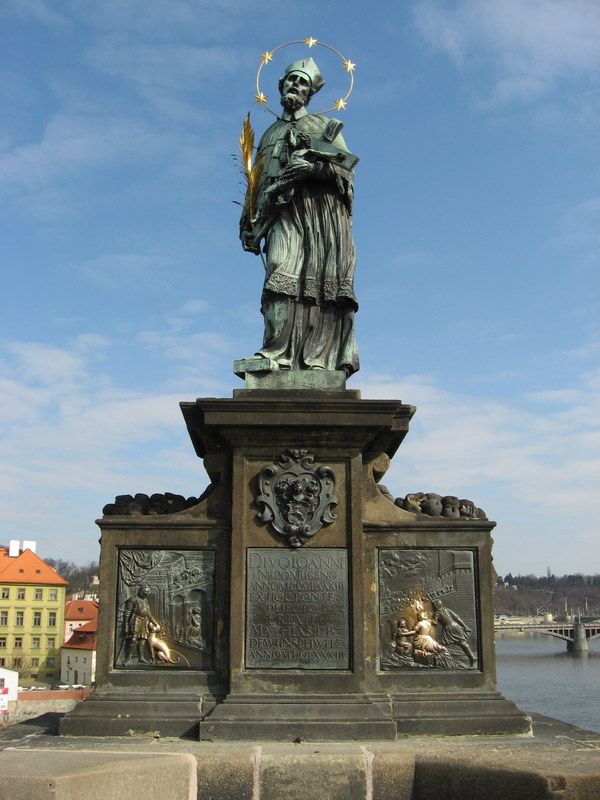
I had never heard of this particular saint until my wife and I came to this part of the world, but once here we saw him repeatedly, not only in Austria but also in the Czech Republic, in Slovakia, and in Hungary (and Wikipedia informs me that we could come across statues of his in Germany, Poland, Lithuania, and even further afield). Here is a photo of a typical statue of him.

Source

This particular photo comes from a web site devoted to statues. The site has listed a little over 200 photos of statues of John of Nepomuk, mostly from the catholic lands of Central Europe but with a smattering from elsewhere, which gives some idea of the saint’s popularity in this part of Europe. The photo shows a “typical” statue of John: bearded, clothed as a priest, wearing the priest’s three-peaked biretta, holding a cross, and with a halo of five stars around his head (what is also often found, but is missing from this particular statue, is a martyr’s palm). The statues are often found on bridges or close to them, for reasons which will become clear in a moment. They often look lost and forlorn, engulfed by modern expansions of what were once little villages.

I suppose John of Nepomuk really came into focus for me when, relatively soon after our move to Vienna, my wife and I decided to visit Prague with the children. As anyone who has been to that city knows, no visit is complete without a crossing of the Charles Bridge.

Source

The most striking thing about the bridge (apart from the fine views it affords of both the old and the less old parts of the city) is the thirty or so statues which line both parapets.

Source

For the most part, they are of various saints who presumably were important to the city – or to the donors who paid for them. One of them – actually, the oldest of them all – is a statue of St. John of Nepomuk.

Source

The reasons why some of the other saints got a privileged position on the bridge may not be entirely clear, but in John’s case it is crystal clear. He is the patron saint of the Czech Republic (and, before the Czech Republic existed, of Bohemia). As if that weren’t enough he was killed by being thrown off this very same bridge, which was nearing the end of its construction when he was summarily tipped over the parapet.

Well! It’s not every day that you stand on the very same spot (more or less) from which a saint was dispatched to his death. And such an interesting death! I don’t want to sound too morbid, but the way he was killed – according to my guide-book, sewn into a goatskin bag before being heaved into the river below – was considerably more quirky than most run-of-the mill deaths of saints I’ve come across. Thoroughly intrigued, I began asking myself what John of Nepomuk had done to deserve being declared a saint (being killed isn’t enough, otherwise we would have millions if not billions of saints).

After reading various accounts of his life, I’m afraid I have to conclude that he did nothing to deserve his title of saint. His sainthood was an act of pure politics.

Perhaps it is time for me to give a thumbnail sketch of John’s life and times. He was born in the 1340s in the Czech (Bohemian) town of Pomuk (later renamed Nepomuk). I would guess that his father – a burgher of the town – decided that his son should make his career in the Church. John must have been a bright lad because after the usual schooling he was sent to the University of Prague, completing his studies of theology and jurisprudence in 1374. Somehow he caught the eye of John of Jesentein, who later became archbishop of Prague. Here is a statue of the good Archbishop on the cathedral of St. Vitus in Prague (if this is a true likeness, he seems to have been a merry fellow).

Source

John of Jesenstein became Archbishop in 1378 and made John his first secretary. Presumably the Archbishop decided that John needed to further his studies and he went off to the University of Padua in 1383, returning home in 1387 with a doctorate in canon law in his pocket. Upon his return, he received – no doubt from the Archbishop – various positions: canon in the church of St. Ægidius in Prague, canon of the cathedral in Wyschehrad in 1389, Archdeacon of Sasz and canon of the Cathedral of St. Vitus in Prague in 1390, president of the ecclesiastical court shortly afterwards, and finally the Archbishop’s vicar-general (a sort of deputy for administrative matters) in 1393. It all sounds like the very rapid ascent of a very able fellow in the Church hierarchy. No doubt a brilliant career beckoned.

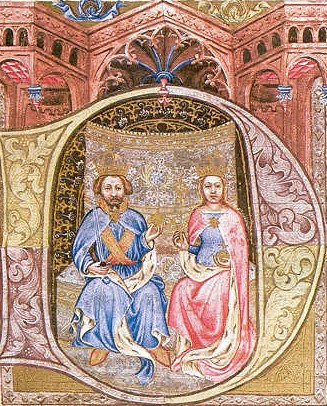
All this was taking place against a turbulent political background. Wenceslaus IV was King of Bohemia at the time. We see him here with his wife Sophia (more of her later), in a miniature from his bible.

Source

From what I read, he was a rather weak man. He certainly didn’t seem able to control his overweening family members, who were constantly undercutting him. His nobles, perhaps already restive but perhaps sensing his weakness, spent their time being obstreperous. He made matters worse by relying on favourites, something which nobles everywhere have always disliked; they feel that by reason of their birth they should be getting the positions being doled out to lower-born favourites. I have to say, Wencelsaus reminds me a lot of Richard II of England.

It was Wenceslaus wanting to reward a favourite which brought him on a collision course with the Church. The crisis came to a head pretty much immediately after John took up his post as the Archbishop’s vicar-general. Wenceslaus wanted to found a new bishopric for one of his favourites. His eyes fell on the rich and powerful Benedictine Abbey of Kladruby, an abbey which still exists. This picture gives us an idea of what a juicy piece of real estate it must have been.

Source

It so happened that its abbot was dying. Wenceslaus ordered that upon his death no new abbot was to be elected. Instead, the abbey’s territories were to be turned into a bishopric and his favourite installed as its bishop (his idea was that the bishop could then return the favour, using the abbey’s resources to support the King in his struggles with family and aristocracy). Now, if there was one thing the Church hierarchy really objected to, that was having Kings telling them who should fill what Church posts, especially when those posts carried with them rich benefices which would be lost to the Church. So when the old abbot finally copped it, the monks of Kladruby held an election post haste and chose one of their own monks to be the new abbot; John, as vicar-general, promptly confirmed the election.

When he heard the news, Wenceslaus blew his top; I am reminded of Henry II of England who, driven to distraction by his Archbishop Thomas à Becket, cried out “Will no-one rid me of this turbulent priest?”, a cry which led four knights to travel to Canterbury and slaughter Thomas on the steps of the cathedral’s high altar. In this case, Wenceslaus had John and three other top Church officials who had played some role in the decision arrested and thrown into gaol. In good medieval fashion, they were all tortured to get them to change the decision. The three others cracked and agreed. But John of Nepomuk held firm. So finally Wenceslaus ordered that he be placed in chains, paraded through the city with a block of wood in his mouth, and thrown from the Charles Bridge into the river. His executioners added the bit about being sewn into a goatskin bag. This fateful final event in John’s story occurred in March of 1393.

I’m not quite sure what the fall-out of all this was. The Archbishop certainly hot-footed it down to Rome, accompanied by the new abbot of Kladruby, to make a formal exposition of all that had happened (thus giving us the earliest written account of John’s death). In that exposition, he wrote of John being a martyr, presumably wanting to clothe in holiness a death that was really about quarrels between Church and State and who was more powerful, swirling around what was – let’s face it – a nice juicy piece of real-estate.

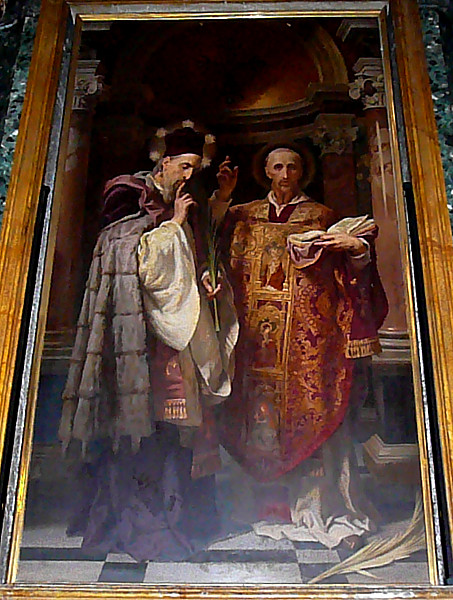
Regardless of what went on in the corridors of power, John’s death caught the imagination of the “little people” of Bohemia. A cult gradually grew up around him. By 1459, so some 70 years after John’s death, a more fanciful – and somewhat more holy – story appeared about the reason for his death; I suppose grubby little arguments about power and money didn’t seem suitable. It was now said that John had been Queen Sophia’s father confessor, that Wenceslaus had pressured him to tell if the Queen had confessed to having a lover, that John had refused to spill the beans citing the secrecy of the confessional, and that the King had lost it, leading to John being tossed into the river. This story is why John is quite often shown with his finger on his lips, as in this painting in the Church of Santa Maria Anima in Rome.

Source

When, after Emperor Ferdinand II smashed the Protestant forces of Bohemia at the Battle of White Mountain in 1620 and the forces of the Counter-Reformation were in full flow to forcibly turn Bohemia back into a Catholic state, it was decided to build on John’s popularity with the little people and push for his canonization. A very thick report was put together which emphasized the fanciful story of his death over the real reason for his death, and it was forwarded to the relevant authorities in Rome. The Roman Curia was happy to comply, so John was beatified in 1721 and canonized in 1729.

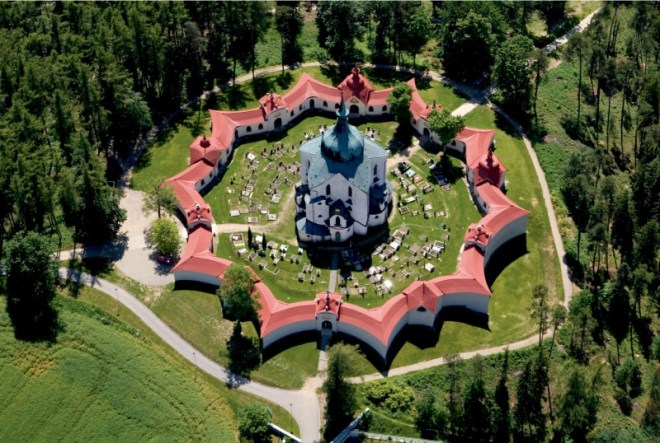
John’s sainthood of course drove the creation of art. Some of this was what we could call High Art. For instance, the years between his beatification and canonization saw the building of the Pilgrimage Church of St John of Nepomuk, a church that is famous in the Czech Republic and is now a UNESCO World Heritage Site (its rather fanciful shape is apparently based on an interpretation of the Cabbala).

Source

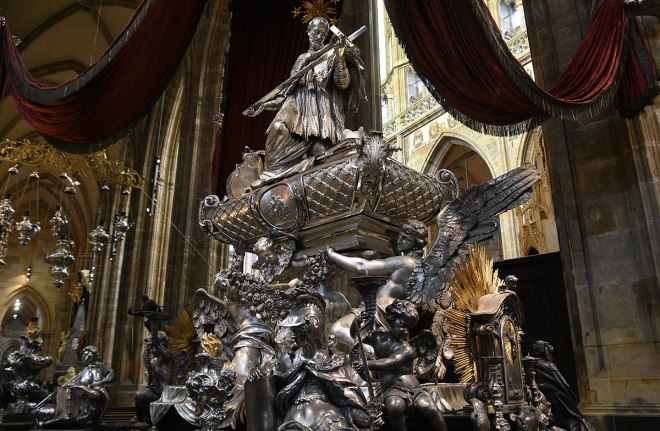
My wife and I have never seen this church, although it looks like a good candidate for a visit; I shall talk to her about it. On the other hand, I am firmly of the opinion that John’s Baroque tomb in the cathedral of Saint Vitus in Prague can be skipped.

Source

Not only does it have in spadefuls all that I dislike about Baroque art – all flash and no substance – I really disapprove of the fact that two tonnes of silver were used to make the tomb; the money used to purchase the silver should have been distributed to the poor.

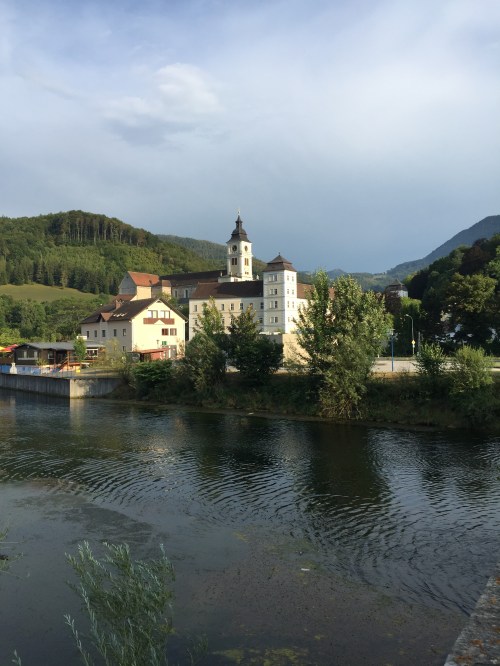
That’s the High Art. The Low Art generated by John are all those thousands of statues of him scattered around Central Europe and beyond. As readers can imagine, based on the fanciful explanation of his death, John of Nepomuk is the patron saint of good confession, confessors and penitents. But – more interestingly, to my mind – because of the way he died, he is also believed to protect against floods and troubled waters, and so is considered a patron saint of bridges and fords. Certainly the latest statue of him that my wife and I came across was in Lilienfeld during our walk along the so-called Via Sacra between Vienna and Mariazell. The statue was situated on the bank of a river, next to a bridge.

my photo

This statue is somewhat more exciting than most statues of this type, showing John in the act of being thrown over the bridge’s parapet by a fellow who looks quite mean and nasty.

The river itself flowed quite placidly when we crossed the bridge.

my photo

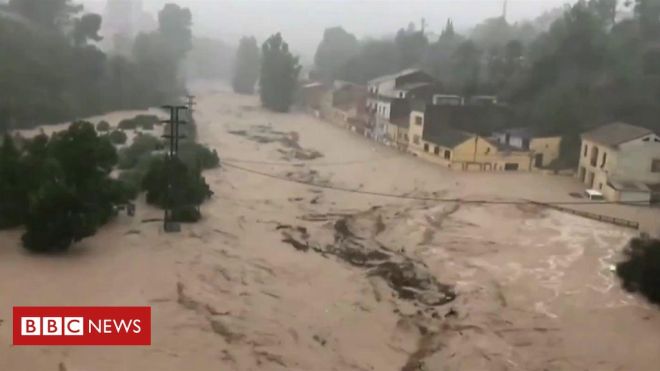
But the news is often filled with stories of rivers which have flooded and killed tens or hundreds of people. Why, only a few days ago we were treated to pictures of extreme flooding in Spain.
Source

I can imagine that the little, humble people have always had great respect for the power of rivers. They bring life-saving water to the crops, but they also unleash death and destruction when angry. I’m sure rites to propitiate the river gods are as old as civilization itself. The Greeks and Romans had their river gods and goddesses. So did the Celts. In fact, so did just about every other culture: Wikipedia has an entry on all these deities. I’m sure that the medieval Bohemians used John as a way of christianizing their age-old river gods.

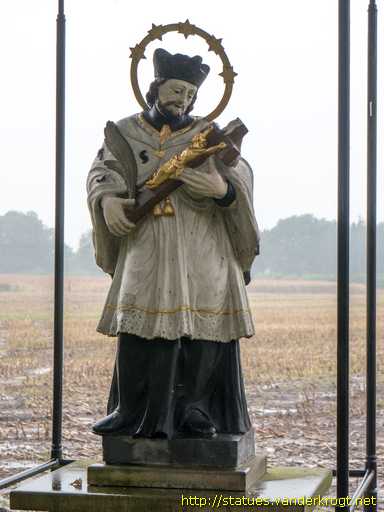
Of course, if you have a saint to whom you pray to stop floods and the heavy rain which creates them, it is not a great step to also ask him to intercede in the opposite case, the case of drought. That’s why you will also find statues of John in the middle of farmland, like this one from a place called Burlo in Germany (although the field behind looks rather sodden in this case).

Source

So there we have it. An actor in a Shakespearean drama of power and money who was, over the centuries and for various political reasons, turned into a saint. But below the official Catholic radar, a man who by chance became the means for a mostly rural population to officialize their magic to try to manage water, one of their most precious resources.

P.S. After reading this post, my wife began to see statues of John of Nepomuk everywhere we hiked. They really are common in this part of the world!

BATLINER COLLECTION, ALBERTINA MUSEUM

Vienna, 11 September 2019

I should have written this post a long time ago, when I first went to see the Batliner collection at the Albertina Museum here in Vienna. But somehow it got left behind. I have been jogged along by the death in June of Mr. Batliner, although even then I am several months late. But hey, better late than never!

A little bit of background is in order. Herbert Batliner was a hideously rich Liechensteiner banker (he was actually half Liechensteiner, half Austrian; his mother was Austrian). It will probably come as no surprise to readers to know that his Liechensteiner father was a banker and that he himself followed his father into banking. He made millions helping seriously rich people stash their wealth away from pesky tax collectors (and others) in “family foundations”. Some of these people had iffy reputations – the son of an African dictator, the partner of an Ecuadorian drug baron, a pardoned fugitive US financier, that sort of thing. Some of his replies when he was asked about these rather grey financial dealings were quite instructive: “I’m not a Father Confessor who has to ask his clients if they have obeyed the laws of their homelands”,  and “We don’t take unannounced clients, or those that show up with suitcases full of cash”. At one point, the German tax authorities started investigating him for possible involvement in illegal financial transactions by one of the country’s political parties, but he saw the danger off with the payment of a rather hefty fine. All this assistance to the filthy rich made him rich too. In 2006, his assets were estimated at about 200 million Swiss Francs.

On the plus side, Mr. Batliner, together with his wife Rita, used his millions to build up a remarkable collection of modern and contemporary art. In 2007, he transferred his collection (in the form of a foundation, of course) to the Albertina Museum as a permanent loan. The Museum was, of course, exceedingly grateful. The Director Klaus Albrecht Schröder called the donation a “key event in the history of the Albertina”. We see here Herbert and Rita, together with a beaming Schröder, in front of one of the paintings in their collection, a Monet painting of the water lilies in the pond of his garden at Giverny.
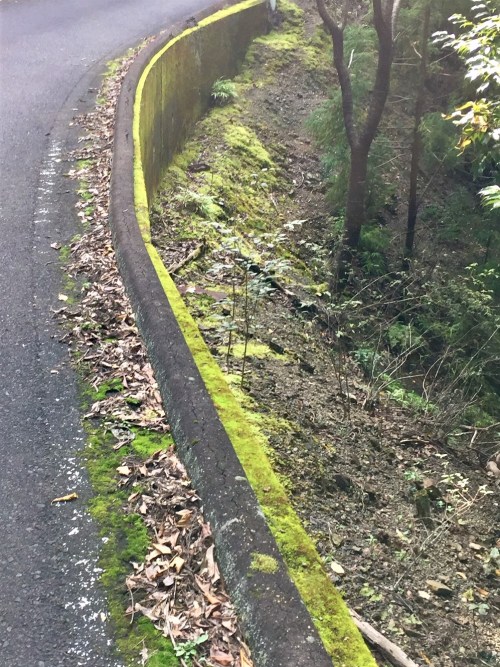
Source

This same painting make up the background to the Albertina’s poster which publicizes the permanent exhibition.

Source

The Albertina then cannily transferred this poster to the long flight of steps leading up to the entrance to the museum.

my photo

It has become quite a hit with the public, being a popular spot for photos and selfies.

The poster, and other material related to the exhibition, highlight the presence of paintings by Monet and Picasso, but in truth these were not the paintings that struck me the most when I visited the exhibition. I show here, in the order in which I came across them, the works that caught my attention.

Peace (1915) by Augusto Giacometti.

My photo

This Giacometti was related to the more well-known Alberto Giacometti, being a cousin of Alberto’s father. This is the only time I’ve ever come across any of his work. Wikpedia informs me that “he was prominent as a painter in the Art Nouveau and Symbolism movements, for his work in stained glass, as a proponent of murals and a designer of popular posters.”

Forest (1909) by Emil Nolde.

my photo

Nolde was German-Danish, being born in Schleswig. He was one of the first Expressionists, a member of the Die Brücke movement.

Moonlit Night (1914), again by Emil Nolde.

my photo

Unfortunately, Nolde is a prime example of the fact that being a great painter doesn’t mean that you are a nice person. Already in the early 1920s Nolde was a supporter of the Nazi party, expressing anti-semitic opinions about Jewish artists and considering Expressionism to be a distinctively Germanic style. But he was hoist on his own petard. Hitler rejected all forms of modern art as “degenerate”, and the Nazi regime officially condemned Nolde’s work.  Over a thousand of his works were removed from museums, more than those of any other artist, and some were included in the 1937 Degenerate Art exhibition.  He was not allowed to paint – even in private – after 1941.

Irises in the Evening Shadows (1925) by Max Pechstein.

my photo

Like Nolde, Pechstein was German and a member of the Die Brücke movement. He fell out with his fellow members, though, in 1912 and went it alone. He too fell foul of the Nazis and had a number of his works exhibited in the Degenerate Art exhibition.
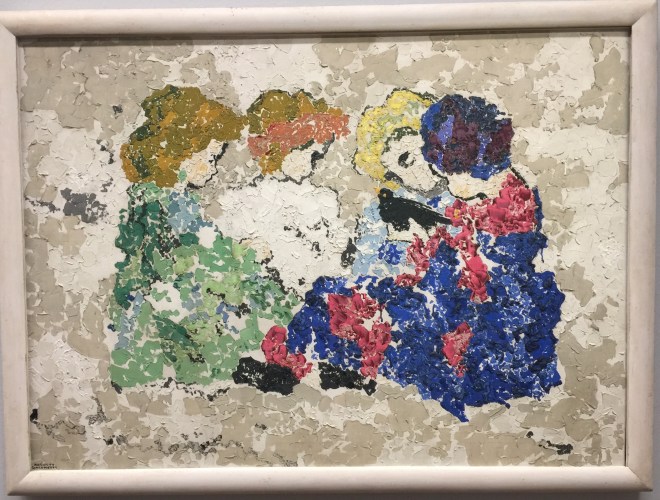
Approach to Löbau Train Station (1911) by Ernst Ludwig Kirchner.
my photo

Also German, also an Expressionist painter, also a member of the Die Brücke movement, also branded as “degenerate” and had a number of his paintings exhibited in the Degenerate Art Exhibition. He committed suicide in 1938.

Yachting on Lake Tegern (1910) by August Macke.

my photo

Macke was another German Expressionist painter, but he was a founder member of another movement, the Blaue Reiter, which was based in the outskirts of Munich. He died in the first weeks of the First World War, in Champagne.

The Blue Cow (c. 1911) by Natalia Goncharova.

my photo

A Russian, Goncharova was, according to her Wikipedia entry, “a founding member of both the Jack of Diamonds (1909–1911), Moscow’s first radical independent exhibiting group, the more radical Donkey’s Tail (1912–1913), and with her lifelong partner, Mikhail Larionov, invented Rayonism (1912–1914). She was also a member of the German based art movement known as Der Blaue Reiter.”

Young Girl with a Flowered Hat (1910) by Alexej Jawlensky.

my photo

Another Russian, Jawlensky moved to Germany, joined the Expressionist trend, and was another founder member of the Blaue Reiter movement. I recently saw a wonderful painting of his in Munich.

Another gorgeous painting by Jawlensky, Cornfield near Carantec, from a bit earlier: 1905.

my photo

Very different from the “typical” Jawlensky painting, of which the Young Girl with a Flowered Hat is an example.

A third Jawlensky, Abstract Head, from 1928/29.

my photo

I suppose he felt the need to move with the times. But the colouring is still lovely.

Jawlensky is another example of a great painter but not a very nice man. Early on in his career, he shacked up with a rich woman, Marianne von Werefkin, who gave up her painting to look after him and ensure he could paint without having to work, then at some point he dumped her and married another woman, by whom he had already had a child. Marianne died alone, in poverty and obscurity in 1938.

Hungarian Fields (1919) by László Moholy-Nagy.

my photo

Moholy-Nagy is not normally an artist that I warm to, but this painting stopped me dead in my tracks. I had noticed this same pattern of small strips of fields in Austria around Lake Neusidl, on the border with Hungary.

Source

On the Hungarian side of the lake, the fields were much larger. I’m sure they were just as small as the fields in Austria until World War II, but collective farming during the Communist period wiped them out.

The exhibition had a number of examples of Austrian painters who adhered to the New Objectivity movement which sprang up after World War I, as a reaction to Expressionism. One strand of New Objectivity was a return to classicism. After the horrors of the war, throughout Europe there was a “return to order” in the arts, which resulted in a turn away from abstraction by many artists towards neoclassicism. I include here one example from the exhibition, The Big Port of 1928 by Herbert von Reyel-Hanisch.

my photo

I started with Augusto Giacometti, I finish with his more famous cousin once-removed, Alberto Giacometti.

my photo
my photo

One photo doesn’t do justice to this remarkable statuette, Slender Bust on Plinth (Amenophis) from 1954. I suspect that when Giacometti refers to Amenophis he has in mind the pharaoh Akhenaten. Akhenaten started reigning as Amenhotep IV, a name which the Greeks translated as Amenophis. As this photo attests, he did have a long thin face with pronounced features like Giacometti’s statuette.

Source

I was certainly much struck by the statues of Akhenaten which we saw during a recent visit to Egypt. I could well imagine that Giacometti would have found his face fascinating.

Well, those were my take-aways from this exhibition. If any of my readers come to Vienna, they should really make time for this exhibition and see what they think. The rest of the Albertina Museum is also worth visiting, they normally have excellent temporary exhibitions.