We’d climbed up the 173 steps to the Surprise Grotto, we had politely looked at the stalactites and stalagmites (“stalagTites from the Top, stalagMites like a Mountain” had helpfully intoned our guide) and been quite taken by the cave’s ceiling, a tracery of dimples formed by wind and water, a natural flamboyant gothic.
We had climbed back down the 215 steps to the dock, we had puttered back to the boat, and now we were lying on the sunless sun deck waiting to be ferried to our next activity, a bicycle trip to a small village on the island of Cat Ba followed by lunch. All around me, rising sheer out of the water, were cliffs of greying limestone, topped with vegetation which tumbled down to the water’s edge.
I spotted, high above me, a black kite, hovering, scrutinizing the water’s surface. With a slight trim of its tail feathers, it wheeled out over the little bay, waiting. A quick flap of its wings and it made up for lost height. Again it circled, and glided, waiting and looking. In an instant, it plummeted down to the water, grasped its prey with its talons, and soared upwards again. And there rose unbidden in my mind the lines by Tennyson:
He clasps the crag with crooked hands;
Close to the sun in lonely lands,
Ring’d with the azure world, he stands.
The wrinkled sea beneath him crawls;
He watches from his mountain walls,
And like a thunderbolt he falls.
I said in my last post that beauty is in the eye of the beholder. In that case, I was talking about citrons. But this homey dictum is that much truer about the subject of this post, betel chewing. To explain what I mean, consider this picture of a betel chewer.
Now, if I were to meet such a fellow, I would be nervously looking for an escape route, half expecting the man to make a lunge with his pointed canines at my jugular. But in the village where he comes from, where no doubt half the population have red goo drooling from their lips, this man would be seen as a nice, friendly village elder. Perhaps a little less on the extreme side of things, if I were to meet this smiling Indian gentleman
my earlier post on teeth would come to mind and I would make a mental note that he badly needed to see a dentist rather than thinking what a lovely smile he had and what a nice man he must be. As I said, beauty is in the eye of the beholder.
I first came across the habit of betel chewing in Delhi. I was there for a meeting of some sort, and after it was over and I was being walked back to my hotel my colleague stopped at a betel stand such as this one
and ordered himself a betel quid to chew. He asked me if I wished to try one, but I politely declined. I watched with curiosity to see what might happen to him, but nothing untoward did. I did realize, though, that this habit explained his somewhat orange teeth.
I was reminded of this scene from long ago when I was in Myanmar recently and saw the tell-tale signs of betel chewing all around me in Yangon – the orange teeth, the betel stands, and – most revolting of all – these bright red splotches on the pavements.
Betel chewing generates a lot of saliva, which the chewers either swallow or spit out (which if not done vigorously enough no doubt leads to dribbles on the chin as in the case of the old gentleman with whom we started this post). The fact that these are spit is revolting enough, but their bright red colour further gives the impression that half the population have advanced cases of TB and are coughing their lungs out (my childhood memories have retained stories of older generations with consumption coughing hard into their handkerchiefs and seeing with horror that the handkerchiefs were stained by bright red blood from their lungs; the end was nigh for them).
For those – I hope – many readers who have no idea what is in a betel quid, allow me to elucidate. At its most basic, the betel consists of slices of the “nut” (actually fruit) of the Areca palm
wrapped in leaves of the betel vine
which have been liberally smeared beforehand with slaked lime. Depending on your fancy and which part of the world you come from, your local betel stand holder can add tobacco, spices, and various other ingredients – note the various little pots which our betel stand holder in the picture above has spread out before him.
Since I had first come across the betel chewing habit in India, and since every betel stand holder in Yangon seemed to be of Indian extraction, I sort of assumed that this was an Indian tradition which had been exported elsewhere. Not a bit of it! It’s actually the other way around. Although it’s not yet clear where the Areca palm and the betel vine originated from exactly, there is general agreement that it was in South-East Asia somewhere. But they didn’t originate in the same place. Evidence points to the betel vine and Areca nut being initially consumed separately, their use spreading out from their point of origin until they overlapped, at which point some bright spark had the idea of putting the two together. Early trade between South-East Asia and India brought betel chewing and then the plants to the subcontinent – and migration brought them out to New Guinea and the Pacific Islands, where the dreaded signs of betel chewing are to be found.
But why, some readers may be asking themselves, does anyone bother to chew betel quids in the first place? Because both plants contain mild stimulants: arecoline in the case of the Areca nut, eugenol in the case of the betel leaf. So chewing the quid gives the chewer a mild high. It joins a number of other plants which are chewed for their stimulating (in some cases very stimulating) effects: coca leaves in the Andes,
khat leaves in the Horn of Africa and the Arabian peninsula (I remember a colleague once telling me that Djibouti came to a halt on Fridays as everyone waited for the weekly supply of khat to be flown in from Ethiopia)
kola nuts in West Africa.
And then there are the plants that are smoked, those that are swallowed, those that are made into infusions and drunk … Early humans were exceedingly resourceful in figuring out how to get a high from the plants which surrounded them. I wonder, though, how they ever figured out which of the thousands of plants around them gave them highs.
Luckily, the practice of betel chewing seems to be dying out. For instance, Thailand was once a hot-spot of betel chewing, but I have never seen anyone in Bangkok, or anywhere else for that matter, chewing it. Nor have I ever seen anyone chewing betel quids in Cambodia or Laos. I say “luckily”, even though this perhaps betrays a cultural imperialism. I mean, one could argue that if people want to chew betel why shouldn’t they, as long as they don’t kill me or their family or themselves in the process, and don’t become a burden on the public purse because of it. Normally, I would indeed be tolerant of cultural diversity, but for this particular practice I draw the line: people with red mouths and teeth à la Dracula generating bright red spit marks all over pavements are beyond the civilized pale. This should be the new normal, everywhere.
Bangkok, 19 March 2016
updated Vienna, 5 February 2025
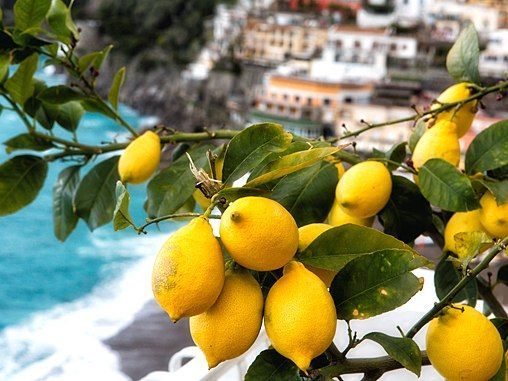
In the recent trip which my wife and I made to Italy, we managed to squeeze in a visit to our apartment near Genoa, where I was particularly delighted to see so many lemon trees in fruit. It’s wonderful to see trees heavy with lemons peeping over a wall or hanging over a garden fence.
Once back in Bangkok, I decided to do some research on the lemon and its history: how did this lovely yellow fruit end up in Liguria? But delving into the lemon’s history inevitably dragged me into the history of the citrus family. It turns out that the lemon does not have a long or distinguished pedigree. It is the citrus equivalent to a mutt, a fairly recent hybrid. In fact, most citrus fruits with which we are familiar are fairly recent hybrids. It seems that the members of this family love to hybridize, and of course humans – being intrusive busybodies by nature – have been only too willing to assist them. The result is a family tree of bewildering complexity.
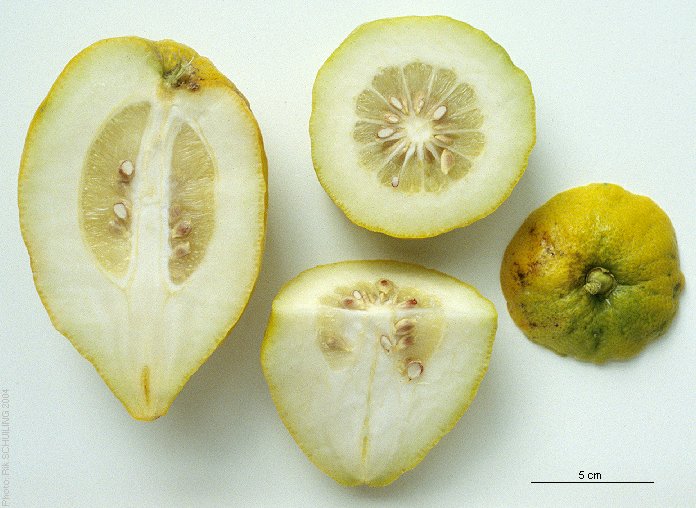
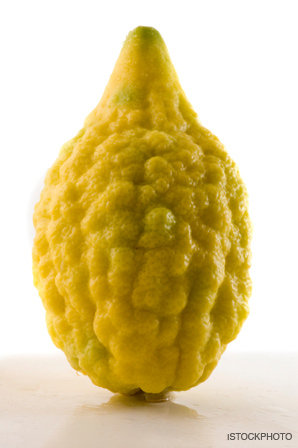
As I tried to make sense of all this, my attention was diverted by something I read about the citron. I think I need to insert here a few words about the citron, since I’m sure there are many readers who are not familiar with this citrus fruit. It is relatively difficult to find these days since it has little use – except for one very special one, which I will come to in a minute. It looks like a large, warty, lemon.
Coming to what I read, it seems that during a ceremony in the Temple of Jerusalem marking the Feast of the Tabernacles, or Sukkot, in one of the years around 100 BC, the Jews pelted the High Priest with citrons and got massacred for doing so. Now that was something worth finding more about! How I would have loved to use citrons, rotten tomatoes, eggs, dog-eared hymn books – anything, really – to pelt the priests with for subjecting me to excruciatingly boring sermons during the Sunday Masses of my childhood! It turns out, though, that the Jews were not horribly bored with what the High Priest was saying, but horrified by what he was doing. It is reported that he deliberately poured the water of libation over his feet rather than over the sacrificial animals. I can’t say that I can get quite as excited about this action as the Jews did, but the fact is that they did, and satisfyingly peppered the High Priest with citrons.
Of course, it does come spontaneously to ask oneself why on earth the Jews were carrying citrons around in the Temple in the first place. It’s certainly not the item that would immediately come to my mind as expecting to see in the hands of Jews within the sacred precincts of the Temple. It turns out that the citron plays an extremely important role in the ceremonies of Sukkot. Every morning of this seven-day Feast, Jews are required to ceremoniously wave the “four species”. Citron is one of these, the other three being the date palm, the myrtle, and the willow. We see here the Tosher Rabbi of Montreal waving the four species.
One can therefore assume that the Jews were carrying their four species when the High Priest poured the water of libation over his feet, and in the horror of the moment they blindly grabbed their citrons and threw them at the impious prelate. It seems that they must have also thrown something harder – stones, no doubt – since it is reported that the stone altar was damaged. I can’t really see citrons doing damage to a stone altar.
It’s a bit of a mystery to me why the citron ever became one of the four species, because it is not native to the Near East, whereas the other three species are. The citron, like all the original citrus fruits, originated somewhere in the region of South-East Asia-Yunnan in southern China-the Himalayan slopes of India. So how did it end up in the Near East? There is general agreement that the fruit was first cultivated in northern India. From there, it migrated, presumably along trade routes, to Persia. What happened next is a hotly debated issue – at least, in certain circles. One hypothesis has the citron migrating to Egypt, where its essential oils were used in embalming, and from whence the Jews brought it with them to the Promised Land when they escaped from bondage in Egypt. A second hypothesis has the citron being carried from Persia to the Mediterranean basin in the baggage of Alexander the Great’s returning soldiers, who somewhere along the way dropped it off in the Levant. Yet another hypothesis has the citron migrating from Persia to Babylonia, where the Jews came across it during their Babylonian captivity and brought it with them when they came back to Israel.
These are all suppositions, with no real evidence to back them up. A very clever piece of archaeological sleuthing suggests a more concrete hypothesis. We need to first recall that after the Persians defeated the Babylonians and allowed the exiled Jews to return home, Israel was a Persian province for several hundred years. Israeli archaeologists have been excavating a site quite close to Jerusalem which turns out to have been a Persian palace with an extensive garden around it. Here is a reconstruction of the site.
The archaeologists wanted to see if they could find evidence of what was planted in this garden. They therefore looked for traces of ancient pollen. None could be found in the earth of the garden – whatever had been there had decomposed long ago. So they decided to try their luck in the plaster with which the walls of an ancient pool in the garden had been coated. The thinking was that pollen grains could have got stuck in the plaster while it was drying and been preserved. They were right – and one of the types of pollen they found was that of the citron. From the other types of pollen found – a number from species not present in Israel – the archaeologists deduced that this was a garden planted with rare plants, designed to show off the wealth and power of the palace’s resident, either a Persian satrap or a Babylonian Jew close to the Persians and sent there to keep an eye on the locals. Perhaps it was here that the Jerusalem Temple elites, coming to pay their respects to the Palace’s resident, first saw the citron and admired this strange and exotic fruit. Maybe it became the rage to have a citron tree in one’s garden in emulation of the Persian masters.
Assuming this is somewhere near correct, how did the chicness of the citron eventually segue into its strong religious symbolism? Here, I shall hazard an explanation which I found written nowhere but which satisfies my fertile imagination. One has to know that the adoption by the Jews of the four species in the rituals of Sukkot derives from a text in the Book of Leviticus, where it is said (in the English translation):
“And you shall take on the first day the fruit of beautiful trees, branches of palm trees and boughs of leafy trees and willows of the brook, and you shall rejoice before the Lord your God for seven days.”
The text specifically names two of the plants: the palm tree and the willow. For the other two, though, it is quite vague. Talmudic tradition eventually settled on the citron as the “fruit of beautiful trees” and on myrtle as “boughs of leafy trees”.
The choice of myrtle makes sense to me – it is satisfyingly leafy.
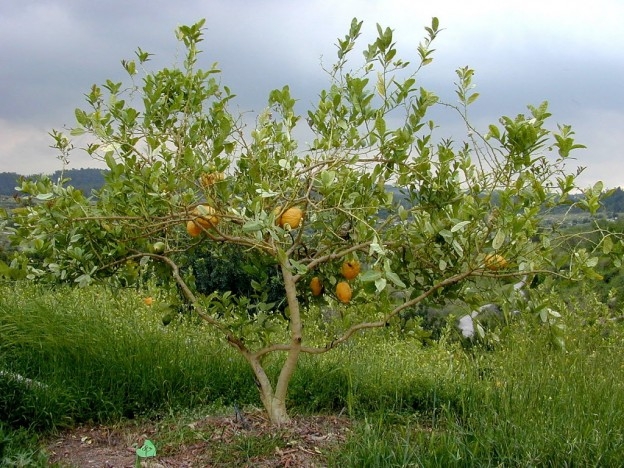
But the choice of citron as the fruit of a beautiful tree? That is really quite odd. In no way can the citron tree be considered a beautiful tree. It is low and scrubby, more bush-like.
It seems, though, that the Hebrew text is grammatically ambiguous. Although the phrase in Leviticus is typically translated as “fruit of a beautiful tree”, it can also be rendered as “a beautiful fruit of a tree.” At first sight, this doesn’t seem to fit the citron either. As the picture above shows only too well, it is warty and knobbly, really quite ungraceful. But beauty, as they say, is in the eye of the beholder. The citron’s name in Persian, turunj, derives from the Sanskrit suranga, “beautifully coloured”. In today’s world, our lives are so saturated in bright colours that it is difficult for us to appreciate the impact on our ancestors of the few naturally brightly coloured things. As the photo above also reveals, the citron does indeed have a lovely yellow colour, and there really aren’t that many fruits that are so beautifully yellow (lemons come to mind, but that doesn’t count because they are a hybrid of the citron). Maybe the Persians, and the Indians before them, and the Jews after them, found the citron’s colour captivating.
If that explanation doesn’t satisfy my readers, let me suggest another reason. Under proper conditions, the citron is the only tree that can flower and bear fruit throughout the year. Even more distinctively, it can retain its fruit from one year to the next. So the citron tree can have buds, blossoms, and mature fruit all at the same time. This is a unique property, and one which may have aroused awe and reverence in our ancestors.
If that explanation doesn’t satisfy my readers, how about this one? Both the Greek philosopher, Theophrastos, and the Roman natural philosopher, Pliny the Elder, mention the citron in their botanical writings. And both stress the fact that the citron, fruit and leaves, has a very strong scent, that typical scent which you also get from the zest of the lemon. It is so strong, they say, that if the fruit is put among clothes it acts as a moth-repellent. This seems a little weak as a reason for nominating the citron as a “beautiful fruit”, although as every woman knows scent can be an important ingredient in beauty. And maybe the elites of India, Persia, and Israel were particularly receptive to the idea that their magnificent – and expensive – clothes could be protected from those pesky moths by the citron.
Either one of these explanations, or all three, must explain not only why the Jews adopted the citron as a religious symbol but also why anyone bothered to cultivate the citron in the first place and then bothered to carry it along to different parts of the world. From a utilitarian point of view, and our ancestors were nothing if not supremely utilitarian when it came to their natural environment, the citron really does seem a singularly useless plant. As I’ve said, the tree is low, scrubby, and bush-like, so it cannot be used as a shade tree. It is sickly and prone to disease, so is difficult to cultivate. The wood is no good for timber. Even the fruit is not much good to eat. It is mostly pith with hardly any flesh, and what flesh there is, is dry with relatively little juice.
Whatever the reason, by the time the High Priest poured the water of libation over his feet (no doubt with a sneer on his lips) the practice of using the citron as one of the four species in the ceremonies of Sukkot was fixed.
It was this deliberately offensive act at the altar of the Temple which set me off on this quest to know more about the citron. But I can’t stop here, because the continuing history of the citron is equally fascinating. So I hope my readers will bear with me if I take them on a journey into the fruit’s more recent history.
From the fall of Jerusalem in AD 70, the European history of the citron has been indissolubly bound up with that of the Jewish communities in Europe, so let me switch to using its Hebrew name, etrog (which, by the way, derives from the citron’s Persian name, turunj, via Aramaic, strengthening the idea that somehow it was the Persians who brought it into the lives of the Jews). The Romans’ destruction of Jerusalem, which ended Temple-centred worship for the Jews, meant that the feast of Sukkot began to be celebrated wherever the Jews happened to live. Since the citron was now indispensable in the celebrations of Sukkot, it followed the Jewish diaspora as the latter spread out through the Roman Empire into Greece, Italy, and Spain. With time, more and more attention was given to ensuring that the etrogim used in Sukkot were the most beautiful: after all, they were offerings to the Lord our God and nothing but the most beautiful should be offered. Detailed guidelines were issued about what constituted a “perfect” etrog, and considerable sums of money were paid for the most perfect ones.
All was under control until the Diaspora began to move northwards into parts of Europe where the climate was too cool for the citron to grow. These more northerly Jewish communities therefore urgently needed etrogim to be brought to them from lands further to the south – no other fruit would do since the four species had been prescribed in the Talmud. This brings us back to where this post started, Genoa. Because of its climate, but also presumably because of its flourishing, and ancient, Jewish community, there were citron orchards around Genoa. It also happened to be a dynamic trading port, so it wasn’t long before Genoa dominated the trade in etrogim to northern Europe. With time, Genoa seems to have gotten out of the business of actually growing etrogim. Instead, it picked up etrogim as far south as Calabria, still a source of etrogim for some Jewish communities, and all points in between, as well as in Corsica, a Genoese colony, and shipped them north. Here we have a painting by Chagall from 1914, of a rabbi, presumably from Vitebsk in Bielorussia, where Chagall grew up, carrying his etrog to the synagogue (and clutching what looks like the local version of myrtle).
my photo
Genoa’s monopoly on the etrog trade began to be undermined when the Sephardic Jews, expelled from Spain, filtered eastward across the Mediterranean to Italy, Greece, and Turkey, and discovered the etrogim being grown in Corfu and other Ionian islands, presumably for the very ancient Jewish communities of Greece. These were very beautiful as defined by the guidelines on etrog beauty, and they began to seriously compete with the Genoese etrogim. At first, there was resistance in some of the Ashkenazic communities in northern Europe. To explain why, I have to go back to what started me on this post initially, the lemon. The first substantial cultivation of the lemon in Europe only occurred in the mid-15th Century, in Genoa – Genoa again (the sour or bitter orange arrived earlier, in the 11th Century, while the sweet orange arrived somewhat later, in the early 16th Century). European growers of citrons discovered – or maybe they picked it up from the Arabs – that grafting citrons onto lemon stock gave plants which were much hardier than pure citron trees. But grafting created an enormous problem for the Jews because the mixing of species was non-kosher, and etrogim used in a religious Feast had to be kosher. We now know that grafting doesn’t actually lead to a mixing of genes, or hybridization, although 400 years ago it was quite easy to think that it did; after all, everyone knew that if you crossed a horse and a donkey, you got a hybrid, the mule. Many in the Ashkenazic communities suspected that the Greek etrogim were actually so beautiful because they were grafted onto lemon trees. Various rabbis were prepared to certify that they were not, and anyway the Napoleonic wars cut off the traditional supply of etrogim from Genoa. And the Greek etrogim really were so very beautiful …
So the Greek etrog triumphed and trade from Corfu flourished. Eventually, this got the Greek farmers greedy. They calculated that they had the Jewish communities over a barrel – they needed beautiful etrogim, the etrogim from Corfu were the most beautiful, hence they would pay whatever it took to get them. In 1875, they therefore created a cartel and jacked up the price. They turned out to be wrong. The Jewish communities reacted vigorously and successfully boycotted the Greek etrogim. They bought from Calabria, from Corsica, and more importantly from Israel, to where we now turn.
As more and more European Jews immigrated to Palestine in the 1800s, they discovered a local variety of etrogim. They surmised that these must be descended from the etrogim used in Temple worship before the Temple’s destruction. A number of rabbis therefore decided to promote these etrogim from Palestine, which were surely more authentic than etrogim grown elsewhere. They also thought it would help the poverty-stricken economy of Palestine to be able to export high-priced etrogim to Jewish communities in Europe. The problem was that although these etrogim might be more authentic they weren’t nearly as beautiful as the Greek etrogim. On top of it, Sephardic communities which had immigrated to Palestine brought in seeds of Greek citron trees and started planting orchards of the beautiful Greek etrog there. The stand-off with Corfu helped boost sales in Palestine, both of the original as well as of the Greek etrogim transferred there. However, authentic Palestinian etrogim were suffering from the competition.
Coming back to Corfu, the Greek farmers eventually backed down and brought their prices down again. But they didn’t forget or forgive. Some 15 years later, when the body of an unknown woman was found just outside the Jewish quarter in Corfu, the local etrog growers claimed that the woman had been murdered by Jews. This sparked off a pogrom against the local Jewish community, which left 139 people dead. And then it was discovered that the dead woman was actually Jewish. That finished off the etrogim trade from Corfu.
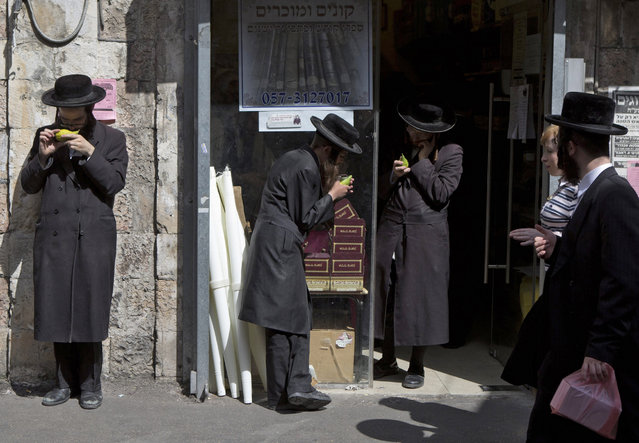
Meanwhile, back in Palestine, the transplanted Greek etrog was pushing the local variety off the market. Eventually, the Greek etrog, which did not adapt very well to the climate in Israel, began to be grafted onto stock of the original etrog, a graft which is kosher. This was a marriage made in heaven: the beautiful Greek etrog with the original, Temple-era etrog. It is this variety which now dominates the modern etrog market, and is no doubt the one being intensely studied by these Orthodox Jews prior to an eventual purchase.
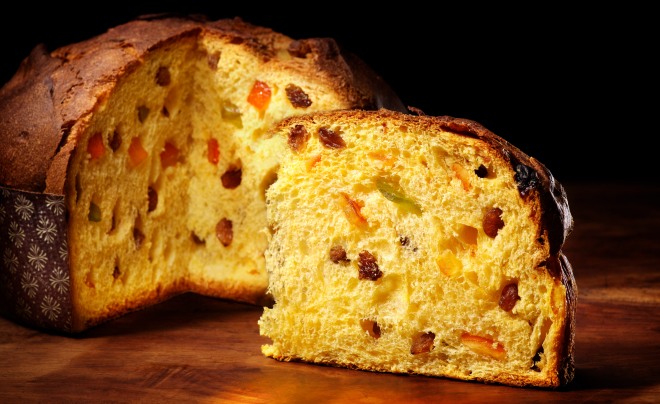
I cannot finish my story of the citron without mentioning the one way of usefully consuming it that was eventually discovered. For this, I have to back up a little and say a few words about the history of cane sugar. Cane sugar, brought west from India by, once again, Alexander the Great’s troops (they seem to have been great collectors of plants …), was first exploited in the Near East. It was the Crusaders, who came across caravans of this “sweet salt”, and who brought sugar to the attention of Europe. Until then, Europeans had only had honey as a sweetener. Genoa’s fiercest rival, Venice, was the first to make sugar available in Europe. It also brought another Arab invention, candying of fruit, to Europe. Not to be outdone by its hated rivals, the Genoese also finally got into the candying business. Somewhere along the line, someone had the idea of candying the citron, or rather its pith, of which there is so much, as the photo above shows. Leghorn (Livorno) became the centre of production: citrons from the south all the way to Sicily, from Corfu and the other Ionian islands in the east, and from Corsica in the west, were sent, de-pulped and brined, to Leghorn. There, the citron pith was de-brined and steeped in progressively more concentrated solutions of cane sugar. Once dried and chopped into small pieces, it was shipped, no doubt in Genoese ships, all over Europe to be added to cakes, sweet bread loaves, and other patisseries. I have a particular reason to mention all this because the panettone, that glory of my wife’s home town, Milan, was originally made with candied citron pith (as well as candied orange and sultana raisins).
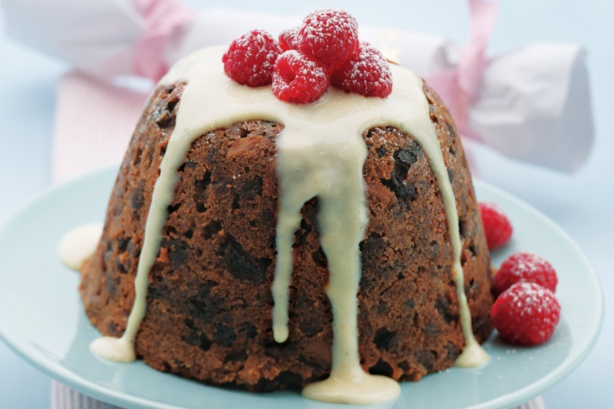
More humbly, the original recipes of the English plum pudding of my youth also called for candied citron from Leghorn.
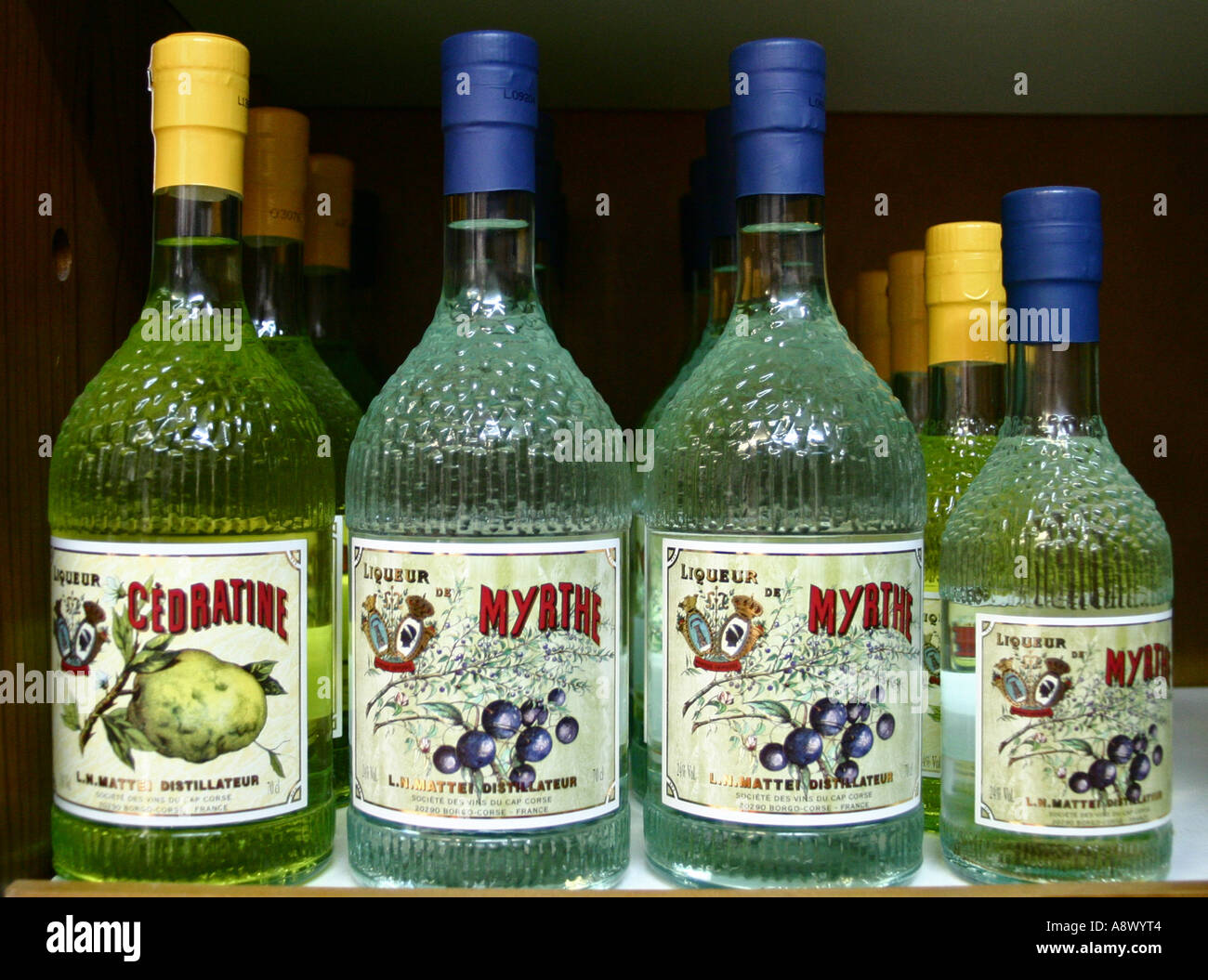
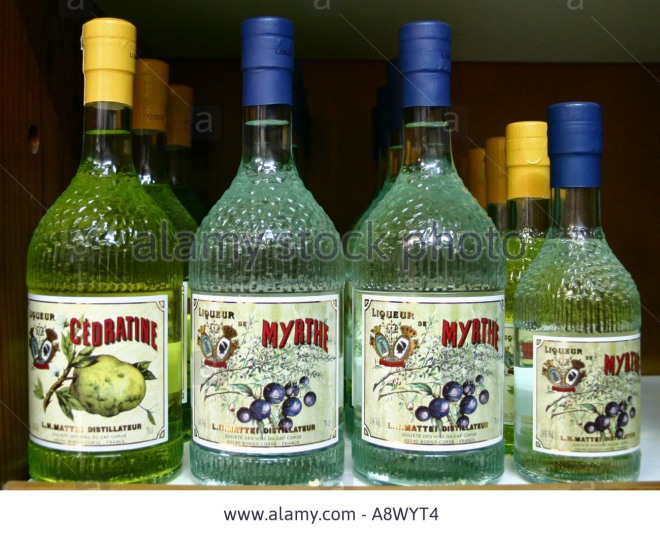
Alas! I believe this market has declined drastically – or perhaps citrons from elsewhere have cornered the candying market. The fact is, Leghorn is no longer a centre for candied citron production, the Calabrian citron hangs on by managing to keep a foot in the etrog market, while the Corsican and Corfu citron production is down almost to nothing; the few which are grown there are only used to make a local liqueur. Here’s the Corsican variety. Somehow, it seems apt that the bottle stands next to one made with myrtle, another of the four species.
Let’s lift a glass to the citron a.k.a. the etrog! Cin-Cin!
Every morning, I stare at myself in the mirror as I shave, a ritual which has enslaved me these past forty odd years. And I stare at myself in the mirror as I brush my hair, or brush my teeth, or – more lately – inspect that suspicious mark on my face (is it melanoma?). And I watch as the face which stares back at me grows rounder and more creased, as the hairline recedes and the temples grow greyer, as the lips thin with the loss of back teeth, as the skin begins to sag under my chin.
I grow old, the mirror remorselessly reminds me every day.
I can’t escape my reflection. It follows me everywhere I go, staring back at me from all the mirrors which we have scattered with wild abandon over our urban landscapes: the bars, the restaurants, the public toilets, the elevators, the shops, the lobbies, … My reflection even beckons to me from the smooth, shiny sheathing and coated windows of our fancy modern buildings.
It was not always so. There was a time, not so long ago in the great arc of human history, when we hardly ever saw our own faces. We saw the faces of others: our mothers, our fathers, our siblings, our tribe, our village, and the few strangers who came from the other side of the mountain and passed through. From time to time, when drinking in a still pool, we would have seen a tremulous reflection staring back at us. But it’s not easy to see one’s reflection in water. Water bodies have this infuriating habit of giving a beautiful reflection of things far away but of being blankly clear at one’s feet.
This young girl has managed to capture her watery reflection quite well
but I think this picture is more typical of what most of us see when we peer into water.
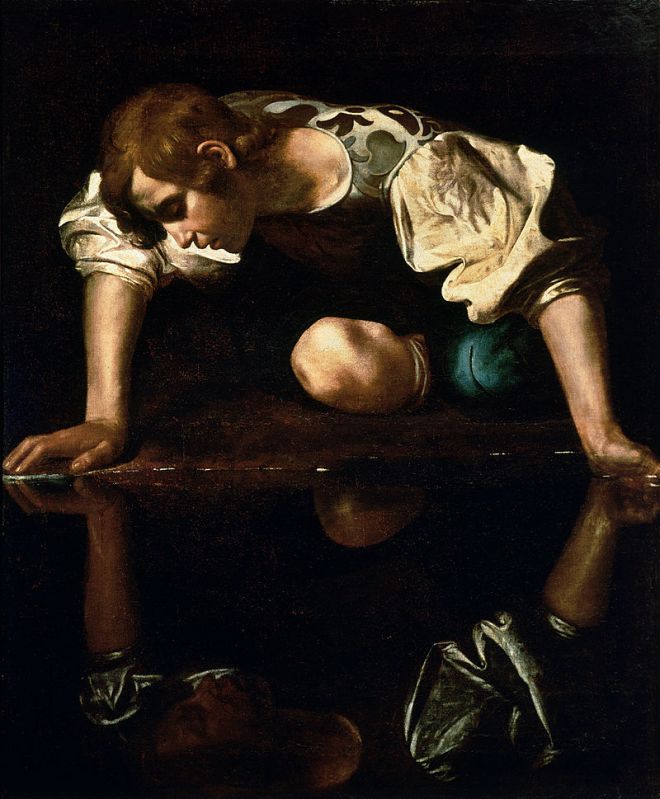
That’s why I’ve never really understood the legend of Narcissus, the beautiful boy who caught sight of his reflection in a pool, fell in love with it, and died at the pool’s edge unable to drag himself away.
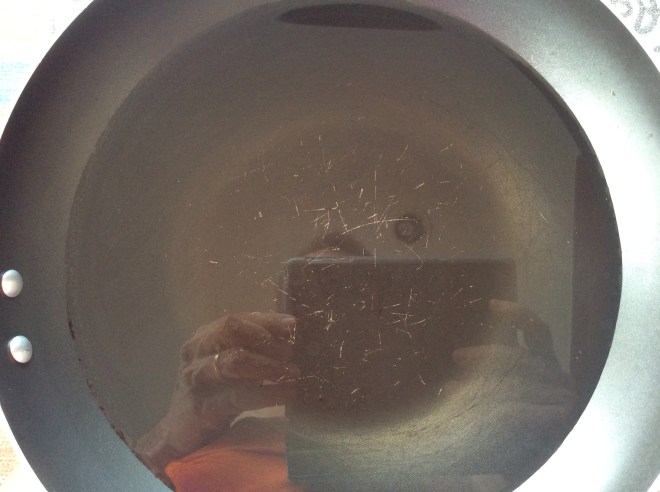
What reflection could he possibly have been so enamoured with? In my experiments in the kitchen with various pots and pans of different colours, the best reflection I got was from a black frying pan
and even that reflection was, as readers can see, murky in the extreme. How could anyone, however beautiful he or she may have been, have fallen in love with this evanescent reflection? Perhaps the original teller of the tale had seen a reflection of a person in a dark pool or vase from a distance, like this photographer has
and invented the story around that.
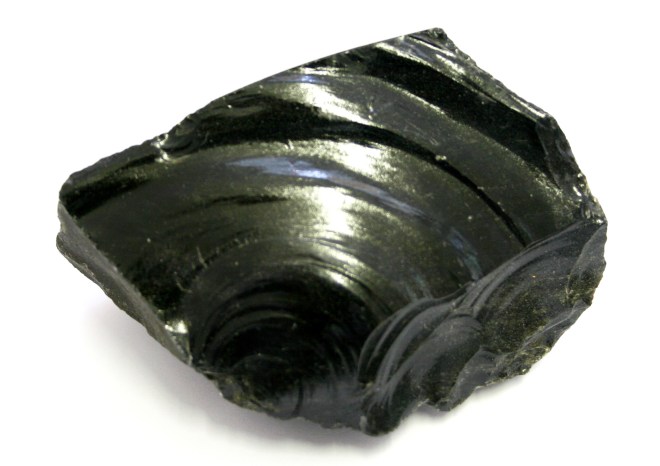
Be that as it may, eventually our ancestors found other ways to see themselves. Obsidian, that beautiful, black, glassy material, product of volcanic activity
was used in the first attempts at non-aqueous mirrors, in Turkey. The country was famous in the pre-metallurgical era for its obsidian, which could be used to make razor-sharp arrow heads – such arrow heads have been found hundreds if not thousands of kilometres away from the mother lode in Anatolia. But large obsidian pieces could also be split open and the faces given a high polish to act as a mirror.
Obsidian may be beautiful, but it gives a dark reflection, almost as dark as the water in my frying pan. I am reminded of St. Paul’s famous phrase in his first letter to the Corinthians, “For now we see through a glass, darkly”.
The metallurgical age brought us one step closer to seeing ourselves, in polished copper or bronze mirrors, like this Egyptian copper mirror.
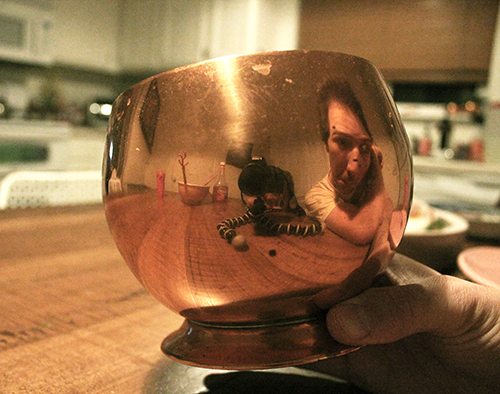
Copper mirrors would have given reddish reflections like those we see in highly polished copper pans, such as this
or this.
(If nothing else, both photos show the need for a uniformly flat surface for a good result …)
The Chinese especially made mirrors out of polished bronze. These would have given yellowish reflections, like this one
or this one, from a Japanese bronze mirror.
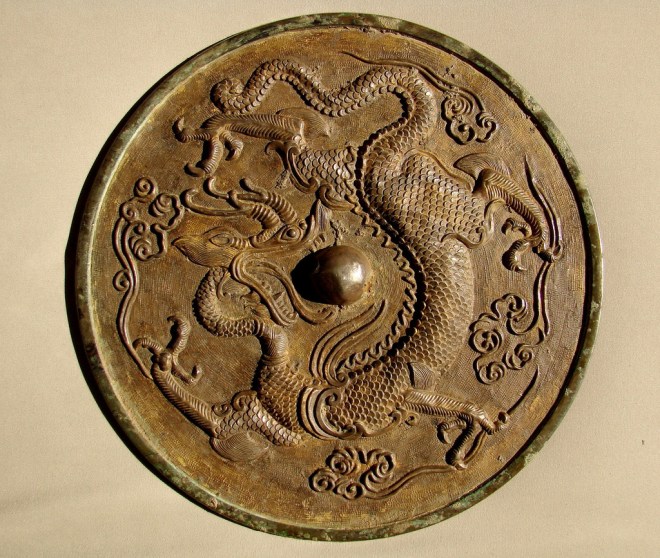
Mirrors such as these were very expensive – indeed, the Chinese turned the backs of their mirrors into admirable works of art, such as this 9th Century one from the Tang Dynasty with its admirably carved dragon.
So only the rich, the ancient world’s one-percenters, could afford to peer – curiously, vainly, or dolefully – at their reflection. The man and woman on the street still could only see their reflection in water.
It seems that it was the Egyptians who first thought of coating glass with metal to make glass mirrors, but their reflectivity was poor. As for the Romans, Pliny the Elder mentioned mirrors where gold leaf was applied to glass. I don’t know if any such mirror has survived the ravages of time, I certainly didn’t find a trace of one on the Internet. But very fancy gold-plated mirrors such as the one in this photo are now made, for high-tech applications.
I suppose a bleary-eyed Roman plutocrat staring at himself in his gold-plated glass mirror after a night of orgies would have caught such a yellowing reflection as this of his face.
It is the Venetians we have to thank – or curse – for bringing us the modern silvered mirror, which finally allowed humanity to see its own reflection in glorious, embarrassing, or painful technicolour. The glass-makers of Murano figured out a way of making flat – and clear – glass as well as depositing a thin coating of silver on the back of it (my professional self cannot but help notice that they used a silver-mercury amalgam to do this; the mercury inevitably sickened and killed off a good number of Murano mirror-makers – an interesting twist to the French saying “il faut souffrir pour être belle”, “one must suffer to be beautiful”, which here becomes “you suffer, and I admire my beauty”). Once again, it was initially the one-percenters of the European courts who enjoyed – or suffered from – a much clearer reflection of themselves. Venetian glass mirrors such as this one were worth a king’s ransom.
The French one-percenters couldn’t stand the idea that they were sending so much of their wealth southwards to the misbegotten Venetians for glass mirrors. They tried mightily to worm the secrets of mirror-making out of Murano. But La Serenissima, fully appreciating the gold mine they were sitting on, passed draconian laws forbidding these secrets from leaving the lagoon. Eventually, though, the French suborned a group of Venetian mirror-makers, persuading them to bolt from the lagoon and set up shop in the St. Gobain works. Among many other things, this gave us the Hall of Mirrors at the palace at Versailles.
This hall has impassively reflected the fun and games of the French monarchy, but also two crucial moments in recent European history: the declaration of the German Empire in 1871 after the Prussians trounced the French in the Franco-Prussian War
and the signing of the Treaty of Versailles in 1919 between the Allies and the new-born German democracy
that humiliating “diktat of Versailles” which Hitler used to such good effect in his rise to power.
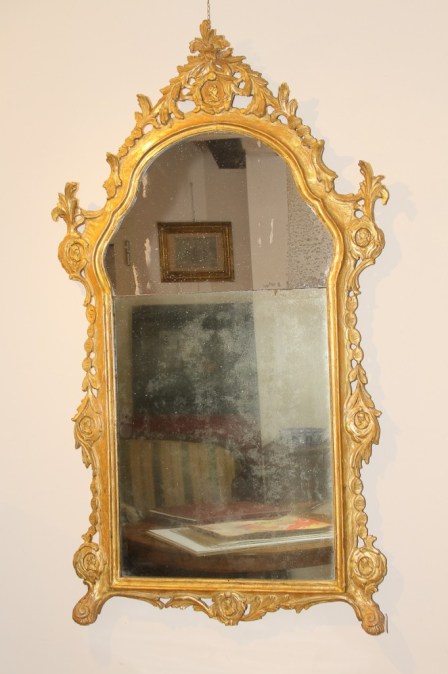
Alas! The silvering process which the Venetians invented, and the French copied, did not last forever. With time, it would crack, it would peel, it would dull, so that reflections would become evanescent once more. How many old houses contain mirrors like this one!
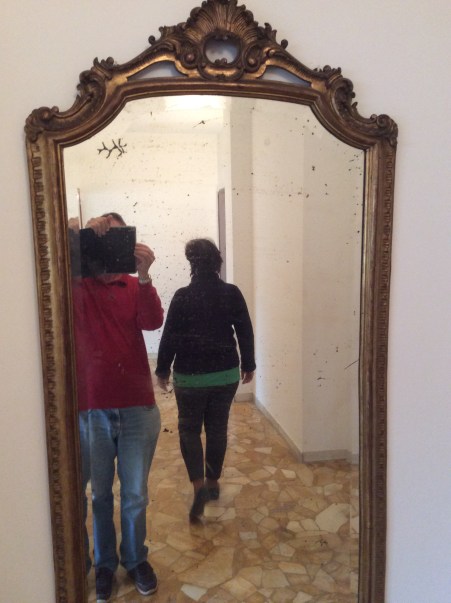
Even our apartment in Milan holds a mirror where Time has inserted its bony fingers into the silvering and has started to strip pieces off.
Like my face, mirrors age. But as men have found ways of making faces last longer, so have they found ways to make silvered mirrors that last longer and reflect better. And through the genius of industrialization they have found ways to make these much better mirrors much cheaper, so that 99-percenters like me can also stare, once vainly and now despairingly, at the reflection of our crumbling selves.
I need to escape from my reflection. My wife and I could have ourselves shipwrecked on some remote islet in the Pacific Ocean. Yet even there, I fear that I would find a shard of mirror on the beach, washed up together with all the plastic bottles and other flotsam and jetsam of our consumeristic life that now fill up our oceans.
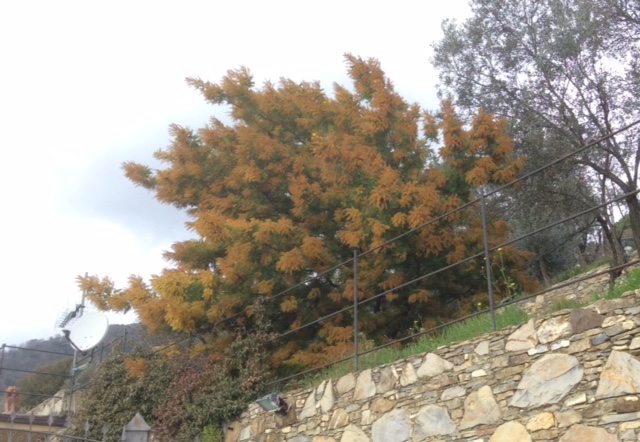
We’re in Italy at the moment, spending a week here to get things in order for my impending retirement. We decided to make a quick visit to our apartment on the sea, by Genova, to check if all was well but also to see the mimosa in flower. The flowering of mimosa on the Ligurian coast is a wondrous sight to behold
especially when you’re toiling up a hill like these hikers are and find yourself in front of a flash of canary yellow, a harbinger of the Spring to come.
All was well with the apartment but alas! we were too late for the mimosa. It had reached its peak some two weeks before and the flowers were already very much past their best.
Disconsolate, I decided to do the next best thing, a little internet surfing to learn more about mimosa.
I had half expected to discover that mimosa originally came from China. After all, that had already been my experience with several plants, from wisteria to the willow. But no! I was delighted to learn that mimosa comes from south-eastern Australia. Here is a photo of it in the State of Victoria, in what is probably its natural state, cohabiting in this case with mountain gums.
Mimosa is actually a bit of a misnomer, for which it seems we have to thank Carl Linnaeus, the inventor of the modern system for giving scientific names to living things.
What I call mimosa is actually an acacia (or perhaps was an acacia; more on that in a moment). For some reason, Linnaeus decided to also give the genus acacia the name mimosa. The confusion was cleared up later, but not before this particular type of acacia got stuck with the name mimosa. Confusion on nomenclature doesn’t stop there, for it seems that acacia is also a misnomer in this case. I don’t follow taxonomic decisions with bated breath, but Australian acacias should apparently now be called racosperma. The august scientific body which makes these kinds of decisions decided so back in the late 1990s or thereabouts, but the Australian botanists, indignant at the thought of having to change the name of their cherished acacias, managed to get the vote reversed in 2005. However, I now understand that the vote was re-reversed. In all of this confusion, I think we should just go with the common name, the wattle. Since there are nearly 1,000 species of wattle in Australia, I have to be a little more specific and say that the “mimosa” planted here in Liguria is the silver wattle.
How mimosa got to this part of the world is not that clear – at least, I didn’t find any clear description of that journey. Another distinguished botanist, Joseph Banks
who accompanied James Cook on his first voyage to the Pacific and whom I have had cause to mention in an earlier post on kangaroos, brought the wattles to the attention of the Western world. But who actually brought the living plant back, or its seeds, and propagated it I don’t know. Whoever it was, the peoples from Portugal to the west all around the rim of the Mediterranean and up into the Aegean Sea and on into the Black Sea to the east have a huge debt to him (or, who knows? her). Every spring, they can enjoy magnificent bursts of yellow, like this one in Odessa in the Ukraine.
Actually, given that the golden wattle, another member of the large wattle tribe, is now the floral emblem of Australia, I was expecting to find a photo on the net of a mimosa in flower in the ANZAC cemeteries of Gallipoli. But no. Photos there are of the cemeteries
but none with a flowering mimosa. Perhaps no-one visits the cemeteries in the early Spring. But if instead it’s because mimosas are not planted in Gallipoli, I think a move in this direction is in order. Should not an earlier immigrant to Europe from Australia welcome the Spring every year in that corner of the Mediterranean where Australians lie in their eternal sleep?
I saw my doctor recently, for my annual check-up. After all the tests and probings were over, we sat down and talked over the results. Then came the awful verdict: I had to cut out coffee, tea, Coke, anything with caffeine in it. So here I am, sitting at the breakfast table, mournfully sipping water. My body has let me down. It is getting old. It needs maintenance but there are no spare parts. As T.S. Elliot’s Alfred J. Prufrock lamented, “I grow old, I grow old, I shall wear the bottoms of my trousers rolled”. The grave yawns ahead of me!
Sitting here, bathed in an existential funk, I am reminded of another poet, Chinese this time, by the name of Tao Yuanming, who wrote this poem in the year 409 AD, during the Double Ninth Festival, so called because it falls on the ninth day of the ninth lunar month.
Slowly, slowly,
the autumn draws to its close.
Cruelly cold
the wind congeals the dew.
Vines and grasses
will not be green again—
The trees in my garden
are withering forlorn.
The pure air
is cleansed of lingering lees
And mysteriously,
Heaven’s realms are high.
Nothing is left
of the spent cicada’s song,
A flock of geese
goes crying down the sky.
The myriad transformations
unravel one another.
And human life
how should it not be hard?
From ancient times
there was none but had to die,
Remembering this
scorches my very heart.
What is there I can do
to assuage this mood?
Only enjoy myself
drinking my unstrained wine.
I do not know
about a thousand years,
Rather let me make
this morning last forever
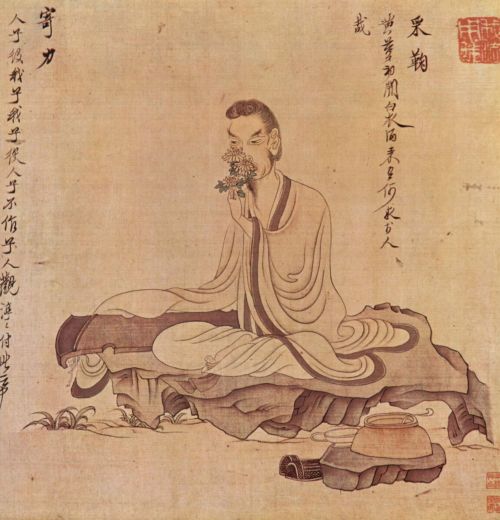
The wine Tao Yuanming is alluding to is chrysanthemum wine, made by blending chrysanthemum – flower, leaves, stalks and all – with millet and letting it ferment. It was made during the Double Ninth Festival, with chrysanthemums picked that day. It was left to sit for a whole year, to be drunk at the next Double Ninth Festival.
“Chrysanthemum” in Chinese is pronounced “ju”, which sounds similar to the word for “long”, “jiu”. By that strange Chinese habit of giving deep meaning to homophony, the chrysanthemum was therefore believed to be imbued with the spirit of longevity, and thus – through an animistic belief in sympathetic magic – its consumption would help the consumer live longer. It helped that the chrysanthemum is a flower of the autumn, a flower which blooms when other flowers are withering. Surely such a flower, which defies the dying of nature all around it, must be imbued with the spirit of longevity? “Chrysanthemum” also sounds like the number “nine”, “jiu”, therefore it seemed divinely ordained that this flower should play a central role in the Double Ninth Festival. Drinking chrysanthemum wine at the Festival was an affirmation that, even as winter started to close in, Death did not yet have us in its grip.
I suppose, then, that at this moment when my body betrays me, when I have doubts about my own longevity, I should drink long drafts of chrysanthemum wine. But even in my current brown mood, I don’t think I could drink this brew. It sounds distinctly unappetizing. I shall plump instead for chrysanthemum tea, which can happily take the place of my coffee and tea. In a coincidence which I’m sure the Chinese would find significant, my wife and I recently bought – in Bangkok’s Chinatown – a packet of dried chrysanthemum flowers: not the big, showy chrysanthemums you see in flowerbeds, but small, almost daisy-like, flowers.
I will use these flowers to prepare myself infusions of a very delicate taste.
And I will peer deep into my cup, drowning my existential sorrows in that lovely pale yellow liquid. Who knows? Maybe the Chinese were right, maybe I will live longer, and, like Tao Yuanming, “I will pluck chrysanthemums under the eastern hedge / And gaze afar towards the southern mountains.”
Or maybe, as my wife and daughter have very sensibly suggested, I should start drinking decaffeinated coffee and tea instead …
After reading my last post, my wife asked me a very simple but very penetrating question: “But why are jeans blue?”
One can of course be nit-picking and respond that actually not all jeans are blue. This is undoubtedly true but let’s face it, the huge majority of jeans are dyed some shade of blue. Jeans are not called blue jeans for nothing.
One can also give the trivial answer “because blue dye is used”, which rightfully elicits the riposte “Ha-ha, very funny”. But actually, an interesting tale does hang on the dye used, which I learned while preparing the previous post and which I can’t resist recounting here.
We have to go to Europe for an answer to my wife’s question, because it was from there that the denim material used for blue jeans came to America. So what is the history of blue dye in Europe?
I was delighted to learn that the original blue dye of choice in Europe was extracted from woad. For those – I’m sure many – readers who have no idea what woad is, it is a plant native to many parts of Europe from whose leaves indigo dye can be extracted. I throw in a picture here in case any of my readers might wish to go searching for it.
Personally, I must admit that I only knew woad as the stuff which Julius Caesar, in his De Bello Gallico, tells us the Britons smeared themselves with: “Omnes vero se Britanni vitro inficiunt, quod caeruleum efficit colorem, atque hoc horridiores sunt in pugna aspectu”, “In truth, all the Britons stain themselves with woad that occasions a bluish colour, and thereby they have a more terrible appearance in battle”. But I prefer the way it is put in that sublime history of Great Britain, 1066 And All That: “Julius Caesar advanced energetically, throwing his cavalry several thousand paces over the River Flumen; but the Ancient Britons, although all well over military age, painted themselves true blue, or woad, and fought heroically under their dashing queen, Woadicea, as they did later in thin red lines under their good queen, Victoria.” Mel Gibson in Braveheart shows us how it should be done.
Trivia aside, woad was actually economically a very important crop in many parts of Medieval Europe and made some communities very wealthy. In France, for instance, the trade in the dye from woad built many of the more beautiful buildings in Toulouse
while in Germany woad paid for the University of Erfurt, established back in 1389.
The indigo from woad coloured the best of medieval tapestries.
In sum, all seemed to be going swimmingly for the woad sector!
But there was a worm in the rose: the same indigo dye, but extracted from the leaves of another plant, in much larger quantities per leaf, in India.
This stuff was already arriving in small and very costly amounts onto Greek, and later Roman, markets, along those same trade routes which I’ve had cause to mention in earlier posts. Because it was so expensive it was used primarily as a pigment in paint and not as a dye of fabrics. The Greeks called it indikon, the Indian dye. The Romans latinized this to indicum, which eventually gave us our indigo. Once the Europeans rounded the Cape of Good Hope and made it safely across the Indian Ocean, they could buy the stuff directly from the producers and cut out all the middle men. Nice packets like this began to arrive in Europe in the hold of European ships.
The price in the European market places duly dropped, woad producers saw their livelihoods threatened, and they resorted to the classic weapons of getting pliant governments to forbid its use (it’s called anti-dumping these days) and putting around rumours that using indigo from India severely affected the quality of the fabric. All to no avail. The higher transportation costs from India were more than offset by the much higher productivity of the Indian plant. Transportation and production costs were then further slashed when the Spaniards started growing the Indian plant in their Latin American colonies and the British in their southern American colonies (Carolina and Georgia), both with slave labour.
The British then went on to use their early stranglehold on Bengal to create vast indigo estates, turning the local farmers into de facto slaves in the process, which further reduced costs.
Woad was doomed and disappeared from the scene.
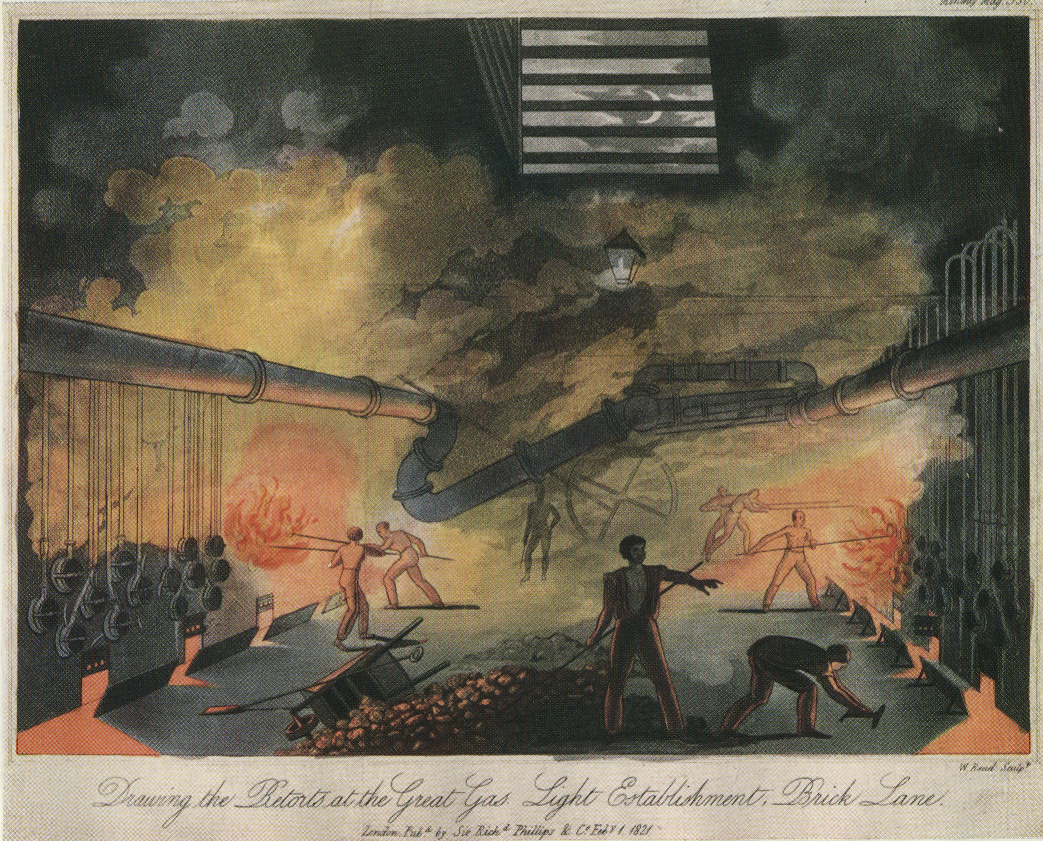
But at this moment of triumph for Asian indigo, there was another worm in the rose, this time in the form of the nascent organic chemical industry. In the early 1800s, when woad was fighting its final rearguard actions against Asian indigo, Europe and North America were starting to adopt town gas to light and later heat homes and businesses. Town gas was produced from coal.
Its production also created various very nasty wastes, some of which I have stumbled across in my professional career buried in old gasworks sites. One of these wastes was coal tar, a nasty, gooey, stinking waste which looks like this.
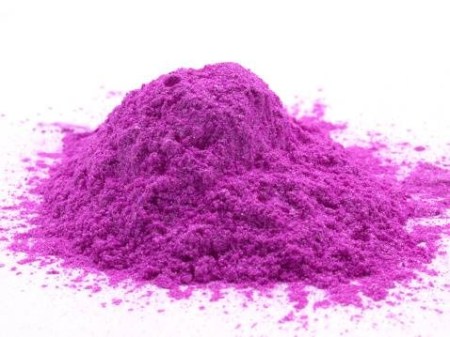
Chemists started dabbling with coal tar to see what they could extract from it. The breakthrough occurred in 1856 when a young British chemist by the name of Henry Perkin, while trying to make quinine from coal tar, serendipitously produced a purple dye that he later commercialized under the name mauveine.
It must have been so thrilling, almost magic, for Mr. Perkin to extract this beautiful colour from that horrible, nasty black gunk. For sure, in the chemistry lab as a boy I found those moments when the liquid in my test tube turned a beautiful colour to be the most memorable. But perhaps Mr. Perkins only saw the commercial possibilities in this lovely mauve.
In any event, the race was on! Chemists piled in to see what other dyes (and later other organic products) they could make by fiddling around with coal tar. The Germans soon dominated the field, accounting for almost 90% of synthetic dye production at the outbreak of World War I. It took a while for synthetic indigo to be produced, because coal tar didn’t contain a suitable “carbon skeleton”. Finally, in the late 1870s, early 1880s, the German chemist Adolf Baeyer managed to find several routes to synthetic indigo. His Nobel Prize for chemistry in 1905 was partially based on this work. Chemists at the Badische Anilin und Soda-Fabrick (better known to us as BASF) came up with yet another, commercially more viable, route, and BASF marketed its first synthetic indigo in 1897. By the way, just to close the circle, BASF was created in 1865 by one Friedrich Engelhorn, who had established the gasworks for the town of Mannheim in 1861 and saw in Perkin’s discovery of mauveine a way of turning this damned coal tar waste into something useful. As BASF’s name suggests, the company initially focused on aniline-based dyes. This is the original BASF plant at Ludwigshafen in 1866.
Natural indigo was doomed. Synthetic indigo’s better quality, the greater reliability of its supplies, and its lower cost all drove natural indigo off the market, despite the usual attempts, which we’ve seen already with woad, by sympathetic governments to try and block the use of synthetic indigo by fair means or foul. In 1897, the year that synthetic indigo first came onto the market, 19,000 tons of natural indigo were produced. By 1914, this had plummeted to 1,000 tons and the free fall was not over. Asian indigo followed woad-based indigo into oblivion.
At this moment of triumph for synthetic indigo, there lurked yet another worm ready to devour the rose’s heart: other blue synthetic dyes. Indanthrene Blue RS was patented in 1901, Hydron Blue was developed in 1908, and maybe there were others – the world of textile dyes is bewilderingly complex. I’m not quite sure how these various dyes fought it out for the denim market, but in the 1950s BASF and other indigo producers seriously considered promoting other blue dyes for denim because of indigo’s poor fastness properties. This is jargon for meaning that textiles dyed with indigo tend to fade rather easily. What stopped them was the fact that this very property of fading was what was so earnestly desired by the young owners of blue jeans, the product in which indigo was most used. So indigo was saved and the worm crawled off to devour other roses. Because of the popularity of jeans, indigo is in fact king of the heap. It is the textile dye with the highest production volumes in the world, some 30,000 tons a year (when you think that most of it is used to dye jeans and that it only takes 10 grams of indigo to dye one pair of jeans, readers with good mathematical skills will quickly figure out that literally billions of jeans must be made every year).
But after that tour through the world of dyes and its cut-throat competition, I am afraid to say that I still haven’t properly answered my wife’s question: “why are jeans blue?” Why are they not red or green or black or yellow? Well I think we have established why they are blue today: because of indigo’s quirk of fading in interesting patterns. But why did the Amoskeag Mills in New Hampshire, which initially supplied Levi Strauss with his denim, use indigo dye? Despite my best efforts, I have not been able to find a satisfactory answer. I suspect it was because by the 1860s, when the mill started supplying Mr. Strauss with his denim, this particular fabric had “always” been dyed with indigo or woad or some other blue dye. “Always” seems to mean at least since the 16th Century. One article I came across says that it was at this time that blue in the UK became the poor’s colour of choice for their clothing. Judging by the paintings of the Master of the Blue Jeans, it was the colour of choice for the poor in Europe more generally.
Why? I don’t know. I have to assume that cost was a factor, but it could also have been simply a fashion trend.
So I’m afraid that I have failed to answer my wife’s question at the deepest level. But I shall keep an eye out, and maybe one day I will come across the answer and be able to update this post. Any leads will be welcome. In the meantime, I invite my readers to enjoy some blue.
I have a wonderful pair of jeans. I bought them God knows how many years ago and ever since, through a constant cycle of wearing and washing, they have softened, whitened, shredded, and micro-ripped. They are the very epitome of distressed jeans (“Distressed (of fabric): visibly aged and worn, from long, steady use, but still intact and functional”).
I laugh scornfully at those half-starved ladies who mince around in what are obviously fake distressed jeans, jeans that have been subjected to Lord knows what processes (stone washing, sand blasting, chemical bleaching, cutting, slashing, and on and on) in some sweat shop in a poverty-stricken part of the planet.
This pair of jeans are still relatively OK. The next pair seems to have been subjected to the tender mercies of Edward Scissorhands.
Using a metaphor, my jeans are comparable to a great wine, aged over years in a cool cellar
while theirs are just alcopop.
And the funniest thing is that my jeans cost me little, while theirs cost hundreds of dollars. Ha!
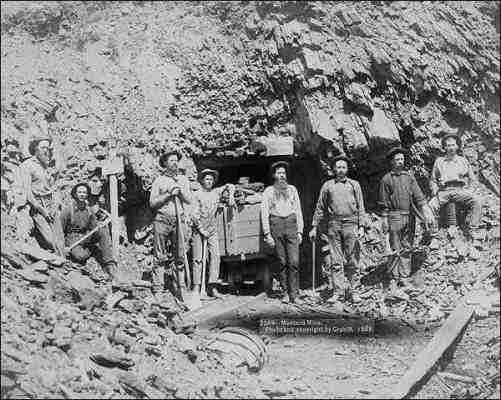
Actually, this business of cost, as well as the deliberate mutilation of the fabric that we see in the previous pictures, both give me pause. Let’s remind ourselves that until relatively recently the denim of my trousers, along with the closely related jean fabric, were almost entirely used to make work clothes for working people. Levi Strauss made his fortune manufacturing tough, long-lasting, affordable denim trousers for men like this: gold panners caught up in the California gold rush (the forty-niners, “was a miner, forty-niner, and his daughter Clementine”)
or for the miners in the gold and silver mines out in Colorado, Arizona, and Nevada
as well as, of course, for the cowboys who roamed the Western range.
In a word, jeans were made for tough men who worked in the great outdoors.
The original ads for Levi jeans gloried in this toughness. The company was making trousers that even horses couldn’t tear apart!
How did this tough, no-nonsense, affordable piece of clothing morph into expensive rags clinging to the legs of elegant, half-starved women? Tasteful rags, I grant you, and clean, but still rags.
Step 1 in this transformation, it would seem, was the dude ranch phenomenon. For those of my readers who don’t know what dude ranches were, they were working ranches in the American West, where city people from the East (called dudes by the locals) would come for a vacation to enjoy a romantic outing to cowboy land without having to suffer the discomforts and dangers of the original immigrants. The popularity of dude ranches soared after the First World War with the advent of the car and easier travel. Here’s the cover of a popular magazine from the early 1940s, which shows what most people probably thought of dudes (notice the laughing cowboys in the back). But what is of even greater interest to us is what this fashionable young lady is wearing – undoubtedly a pair of blue jeans.
When on the ranch, these city slickers (another term used for dudes, along with greenhorns and tenderfoots) clearly wanted to dress like the cowboys which they met there, and then they started bringing these exotic clothes back East: most readers probably don’t know that Levi jeans were not sold east of the Mississippi until maybe the 1930s or even 1940s. Presumably, though, it was still a small minority of Easterners who wore jeans and then only out in the countryside.
Step 2 in the transformation from a good, honest piece of clothing to an expensive rag was the adoption of blue jeans by Bad Boys – bikers and such, of which Marlon Brando in the 1953 film The Wild One became the epitome. Please note the scruffy jeans he is wearing.
James Dean, in the 1955 film Rebel Without A Cause upped the ante, in an equally scruffy pair of jeans but looking cuddlier than Brando.
(You see the jeans rather more clearly in this poster of the film)
Middle class parents hated everything about these films, including the jeans, therefore of course their teenage children loved them. It didn’t help that righteous school principals, cinema managers, and the like were banning jeans from their premises. That just added fuel to the fire.
The wearing of jeans as a sign of youthful rebellion, and of being youthful generally, culminated in the 1960s with the surfing, the flower power, the anti-Vietnam War movement of that decade. Here, for instance, is a hippie couple getting hitched – “married” would not be the correct word I think. I throw the photo in because the officiator is wearing a fine pair of jeans.
And here’s one of the gigs at Woodstock, where most of the band members seem to be wearing jeans. Note the serious flare on the jeans in the back of the photo – my very first pair of jeans, which I must have bought in the early ’70s, were so flared.
Even when things turned ugly, as they did in Kent State a year after Woodstock, jeans were being worn. I think everyone in this photo, including the Dead Student, is wearing jeans.
Note also how the Mourner has adorned her jeans with graffiti (art work is too big a word) – something which jeans wearers of the ’60s liked doing and something which the fashion world caught on to quite quickly. Already in the latter half of the ’60s, a New York boutique called Limbo hired impoverished, out-of-work East Village artists to embellish its jeans with patches, decals, and other touches, and sold them for the-then princely sum of $200. Jeans wearing was on the way to becoming trivialized.
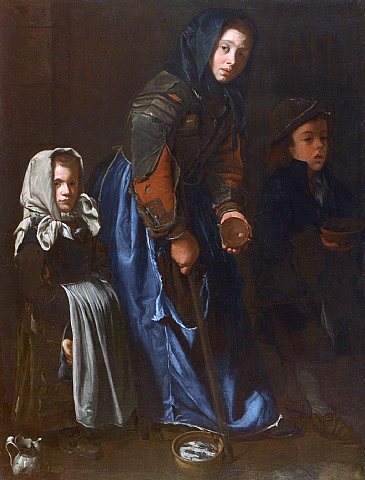
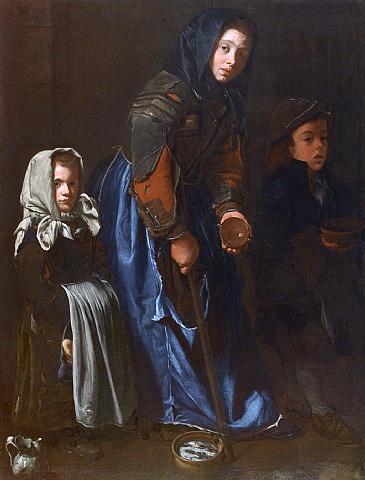
By this point, I think it’s safe to say that jeans had pretty much entered the mainstream. The definitive proof of that is that I, who was never that alternative, was wearing them. They were still casual wear rather than formal wear, but they had “arrived”. There was, however, still an important step to take, namely the wearing of ripped jeans. I suppose we’re so used to wearing anything nowadays that the sight of ragged clothes on obviously well-off people doesn’t shock us. But not all that long ago, and by that I mean in my lifetime, wearing ripped and ragged jeans would have meant only one thing: you were poor, if not downright down-and-out. To stress this point, let me throw in here a picture of a painting by an unknown Italian artist of the late 17th Century, who goes by the soubriquet of “The Master of the Blue Jeans”. He is so known because of the ten or so paintings which are known to be from his hand, and which all have as their subjects people (poor people I should add) wearing blue jean fabric.
As readers can see, the child in this painting is very obviously poor, and the jean jacket which he is wearing is ripped. In today’s world, this child could probably sell this garment for a good price (after a strong fumigation and a good wash I would think). But in his day, and indeed even today in many parts of the world, ragged clothes meant poverty. Which is why my grandmothers obsessively darned and mended every hole they found in our clothes. And which is why there are many paintings recording this part of a woman’s work.
Yet in some mysterious way, some two-three decades ago it started to become chic, at least in certain circles, to wear ragged denim. Why?
It seems that we have the punks to thank for this. It was they, with their anti-conformist, anti-establishment, anti-everything attitudes who popularized the slashing of jeans. This picture gives a good example of the genre – both punks and slashed jeans.
I suppose slashing one’s jeans was just another, very obvious, way of giving the finger to our social conventions, in this case that rags were shameful; no doubt punks’ mums were horrified to see their children going around in rags and were mortified by what the neighbours might think.
But why didn’t this fashion statement just remain in the shadows of the sub-culture of punk? To answer that, I think we must acknowledge a modern trend in the fashion world. For centuries, the trend setters in fashion were the social elites, people like Louis XIV
or Beau Brummell, intimate of the Prince Regent, later George IV
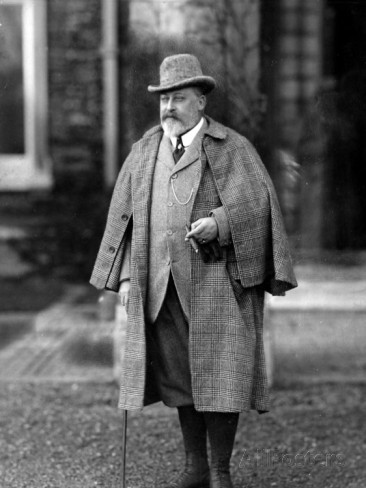
or Edward VII, inventor of, among other things, the Homburg hat
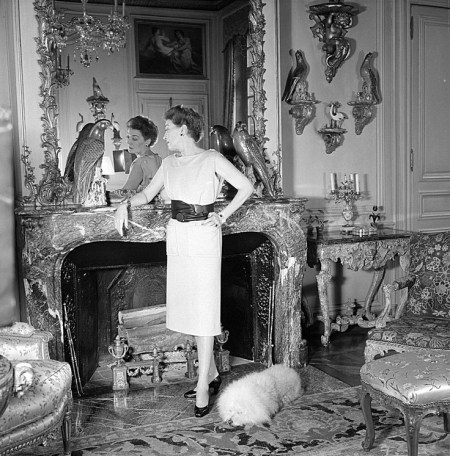
or even someone like Mona Bismarck, American socialite of the 1930s
Beginning in the 1930s, though, we can see a shift towards a less elitist view, with film stars, for instance, becoming fashion trendsetters. By the 1960s, the shift seems to have been complete. The fashion trendsetters are now people on the street, like the punks, who are pushing fashion boundaries. Which has brought not just rag-wearing but also body-piercing and tattooing into the mainstream.
Personally, I think an important but overlooked element in the road of rags to riches is the introduction of an elastic component like spandex into the denim, which has allowed jeans to become very tight around the leg. Let’s face it, while the punks may have been giving us all the finger, the fashion industry doesn’t want to do that. It wants slashed jeans to send a nice message, and what’s nice about slashed jeans is that it allows one a sight of the shapely legs of the half-starved women inserted in those jeans. And one doesn’t get a good sight of the legs unless the jeans adhere tightly to them.
That, I think, concludes the journey of jeans from serious work clothing to chi-chi vestment. What can be next, I wonder? Well, there is talk of jeans disappearing altogether. Many young things, it seems, are opting more and more for the cute sounding athleisure, which is cutting into jeans’s traditional markets. If this goes on, everyone will be dressed like this
or this
or other variations, and Levi Strauss will either be making these or will have gone out of business.
I must keep my jeans for another 30 years. They will probably be a very rare piece by then and be worth a fortune.
In a previous post, I sketched out a rough agenda for my retirement. I think my wife was pleased with it. But she does have certain anxieties about this upcoming event. She has recently been reading about some Japanese syndrome called Retired Husbands Syndrome which attacks Japanese housewives. Suddenly, this guy whom you’ve hardly seen in the last 40 years – being a good Salaryman, he’s been leaving the house at 6 am and not getting home till midnight – is now constantly hanging around, getting in your way, messing up your routines, and expecting you to do things for him. Not unnaturally, the stress levels rocket up. While we’ve maintained a more balanced lifestyle, she does have fears of me moping around the house, lounging around on the sofa, eating natchos and watching TV all day. This dystopian view of hers is not helped by a number of films we’ve seen recently, describing exactly this situation. Nor is it helped by my fondness (my wife thinks more obsession) for playing Spider Solitaire on my iPad. She’s afraid that come retirement all I’ll do all day is compulsively play Spider Solitaire, with a little Freecell on the side.
It is true that I tend to play the game whenever I have a spare moment. I do admit that it can get a little out of hand. But I’m sure it’s good for my aging brain to carefully plot my strategy for getting the cards out. And those little electronic cards, with their glossy black spades and clubs and glowing red diamonds and hearts, and kingly Kings and queenly Queens and knavish Jacks, are really very pretty.
I was thinking about their prettiness the other day during a Spider Solitaire game, and when it became clear that I was dribbling towards defeat I decided to quit and do a little research on the history of playing cards, principally to understand where the suit design of hearts, diamonds, spades, and clubs originally came from. I was very pleased that I did so, because I discovered that what we have here is yet another example of the Great East-West Exchange which took place along the Silk Road and other trade routes that once criss-crossed the Eurasian continent. Of course, most of what was exchanged was traditional goods, but ideas also flowed along these routes. So did less obvious things, like the the willow tree and the pomegranate, both of which I’ve had occasion to write about in the past. Now I can with pleasure write about a third such item, playing cards.
Our story starts in China. Some time in the Tang Dynasty, around the 7th-8th Century, it seems that someone in the Imperial Court came up with the idea of a pack of playing cards, divided into four suits. The suits were Coins, Strings of (1,000) coins, Myriads of strings (10,000), and Tens of myriads. Like our modern cards, each suit contained cards with different numbers of pips. Here we have a Three of Coins and a Three of Strings-of-coins.
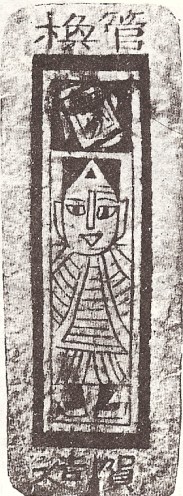
These packs also included face cards, like this one from the Ming dynasty.
These ‘chi-pai’, which is Chinese for playing cards, are still in use. This next photo shows the cards from a three-suited variant. Note how the design of the suits became highly stylized – this is important for our story.
I’ve no idea what games exactly were played with these cards back in Tang Dynasty times, I’m not sure anyone knows, and actually it’s not important for our story. What is important is that the use of cards spread westward. This could have happened through trade; I can imagine Chinese merchants whipping out a pack of cards to while away their down time in the caravanserai that dotted the Silk Road.
Alternatively, it could have happened through conquest, with conquering soldiers picking up new habits from the conquered. In this case, the Mongols, who conquered China in the 13th Century, seem a very good candidate. At its height, the Mongol Empire stretched from Korea to Ukraine.
Any new fads picked up by Mongol troops in China could have spread, through many an evening around soldiers’ camp fires, all the way to Kiev.
I don’t think the two diffusion mechanisms are necessarily exclusive. I could imagine that the Mongol conquest also amplified diffusion of card playing through trade. The two maps above superimpose quite well, and in fact the period of the Mongol Empire brought political stability to Asia which in turn encouraged a surge of trade along the Silk Road.
Whichever way, Chinese playing cards diffused westward. Some time in the 13th-14th Century, maybe earlier, so-called Ganjifa playing cards started being used in Persia. The etymology of the word Ganjifa is uncertain. Some see its root in the Persian word gunj, which connotes treasure, treasury, or money, and suggest that this connects them to the money-suited Chinese playing cards. Others see a more elaborate etymology, proposing that Ganjifa is actually a corruption of ‘han-chi-pai’, or ‘Chinese playing cards’. In this case, there would be a very clear line of descent from China. In any event, variants of Ganjifa playing cards began to be used throughout the Muslim world, as well as in India (brought there in the saddle bags of the Mughal conquerors). What interests us most is the variant used by the Mamluk in Egypt.
The Egyptian Mamluk were an interesting bunch of people. Initially, they were slave soldiers recruited by the Ayyubid dynasty. For the most part, they were drawn from the Cumans-Kipchaks, a nomadic group who controlled the steppes north of the Black Sea. They were conquered by the Mongols and then absorbed into the Mongol Empire as the Golden Horde. Some time in the 13th Century, the Mamluk slave-soldiers kicked the Ayyubids out and reigned in their place. This happy state of affairs continued until they were in turn defeated by the Ottomans and their territories subsumed into the Ottoman Empire. Luckily for them, the Ottomans kept them on as governors of Egypt.
Perhaps because of their Mongol connection, or in some other way, the Mamluk picked up this new fad of card playing and brought it to Egypt some time in the 14th Century. What is of interest to us here is the fact that Mamluk packs of cards had four suits: Coins, Polo-sticks (the Mamluks were great polo players), Cups, and Swords. In addition, each suit had three face cards, the king, the first vizir, and the second vizir. Some clever people, who know more about the history of playing cards than I do, see a link between these four suits and those used in Chinese playing cards. Their thinking goes as follows. There is no problem in seeing the Mamluk Coin suit being derived from the Chinese Coin suit, that’s an easy equivalence to envisage. After that, it gets trickier. The clever people propose that the Chinese String-of-coins suit was transformed into the Mamluk Polo-stick suit, on the grounds that a String-of-coins pip could easily be misinterpreted as a stick to those unfamiliar with this very Chinese way of dealing with coins. It is true that the String-of-coins suit in the photo of Chinese playing cards above has been so stylized as to look stick-like. Then the clever people suggest that the Chinese Myriad-of-strings suit became the Mamluk cup suit, on the grounds that the Chinese character for myriad, 万, which was often used as a sort of pip, was simply inverted by the Mamluks, at which point it does indeed look cup-like. Finally, the clever people suggest that the Chinese Tens-of-myriads suit, where the Chinese numeral for ten, 十, was often used as the pip, was simply interpreted as a sword by the Mamluk and so gave rise to their suit of Swords. The ice over which we have been scrabbling these last few sentences is indeed thin, but the romantic in me is willing to believe this wonderful story of Central Asians scratching their heads over these strange-looking cards which had come all the way from China and giving their own interpretations to the drawings on them. To enliven all this text, I throw in here a photo of one of the rare Mamluk playing cards to have survived, a Six of Coins, found in Istanbul’s Topkapi palace.
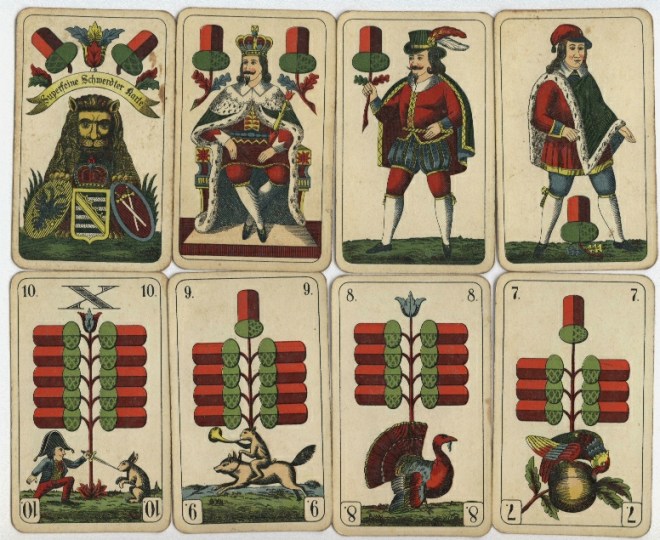
The next leg of our journey is somewhat easier to envisage, the transit of the Mamluk playing cards to Italy. I’m guessing that Venice was the entry point, although there could have been more than one. Until the Portuguese rounded the Cape of Good Hope and made for the Spice Islands, most of the spices which Europeans lusted for entered Europe through Venice, which in turn picked them up in Egypt. In addition to picking up spices, I can imagine Venetian sailors and merchants picking up packs of Mamluk playing cards to while away the long journeys back to Venice. Once in Italy, the use of playing cards spread rapidly, with each region having its own particularities. Here, for instance, is a pack of cards from Bergamo.
Italian playing cards basically adopted the Mamluk suits, except that they changed Polo-sticks to Clubs – the game of polo was unknown in Europe at that time and I suppose the polo-sticks looked club-like to the Italians. They also adopted the idea of three face cards per suit but Europeanized them into king, upper marshal, and lower marshal.
There followed a fairly rapid diffusion of playing cards throughout Europe as the craze for card playing caught on. The Southern Europeans – Spain and Portugal – kept to the Italian design for their suits, with some minor modifications. The Northern Europeans instead experimented with a lot of different suit designs. Given the aristocratic background of many players, the suits were often hunting-themed like this pack from Flanders.
Through the newfangled technology of printing, in which they were leaders, and through which they were the first to produce cheap packs of cards, the German lands popularized the use of the following suits:
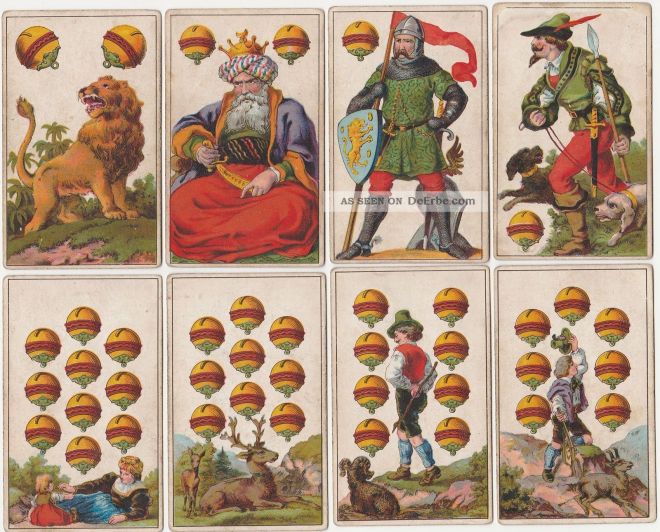
Personally, I don’t see much connection between these suits and the Italian versions. I think the Germans just used their fantasy. In any event, here are some old German playing cards with suits of Bells and of Acorns.
Not to be outdone, the French came up with a somewhat different set of suits.
The Hearts suit was taken as-is from the German suits. The Spades suit seems to be a slight modification of the German Leaf suit. The Clubs suit could be considered a geometric transformation of the Acorns suit – the sides of the acorn shell pulled out, the acorn itself shortened. The circular Bells suit of the Germans was replaced by a different shape, the diamond. As the cards above show, the French also introduced Queens, who displaced the upper marshal.
The French suits have since become those most used worldwide. Why that should be is not completely clear to me. I think it probably has something to do with the fact that the French suits are easier to read; I would have got really confused using those German cards I show above – “wait, is that an Eight of Acorns I have in my hand, or a Nine?” Or perhaps it was because the French were the arbiters of good taste in Europe until World War I. Or perhaps it was because the British adopted the French suits and happened to become the most powerful country in the world with the biggest colonial Empire, which allowed them to impose their choice of card suits and card games on their colonial subjects. Or perhaps it was because the Americans, who took over the title of the most powerful nation, followed the British in choosing French suits for their playing cards. For any or all of these reasons, or maybe others again, French suits now stare up at me from my games of Spider Solitaire and Freecell.
Well, now that I’ve figured all that out, I can go back to what I was doing and actually win my Spider Solitaire game.
There was a habit in China that I always found strange – dissonant perhaps is the better word – and that was the locals’ enthusiastic adoption of typical Christmas decorations. One would enter any self-respecting mall at the end of the year and there, standing proudly in the foyer, would be a resplendent Christmas tree. A tree was sort of OK. Pine trees grow in China, right? and one could imagine the Chinese covering them with colorful baubles. I could even live with the muzaked Christmas carols that invariably were being played in the malls. Seeing Father Christmases in China, though, that was really strange to me.
I mean, Santa Claus has his roots deep in Northern Europe, in some place like this
and not in the arid plains of northern China.
Luckily, I never saw any Santa elves while in China. That would really have been too much, I would have had to take to my bed.
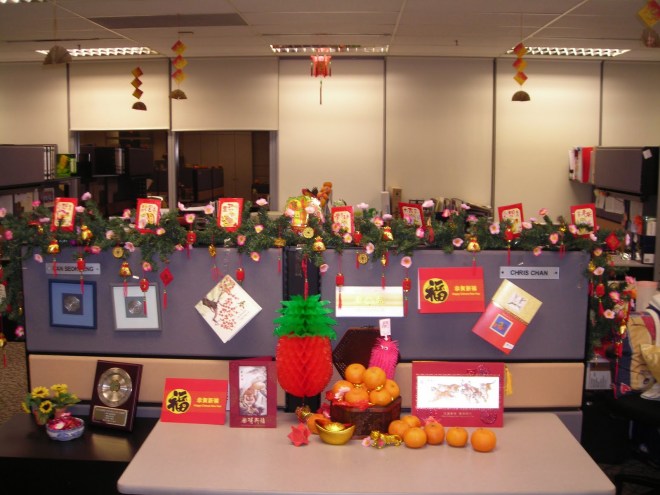
My Chinese office staff always got enthusiastically into the swing of things in the first weeks of December, sprinkling the walls and other surfaces with Christmas decorations.
I tolerated all this Yuletide good cheer à la chinoise, although the first year I found it somewhat disconcerting that one of the secretaries kept her decorations up around her workspace way after Christmas: a cheerful Santa ho-hoing away and a couple of reindeer-drawn sleighs as I recall.
In July, I finally got around to asking her why she kept them up. They were cheerful, she replied. OK, why not? My role in running the office did not extend to policing the interior decorations, so long as they didn’t offend public morals.
Luckily, now that we no longer live in China I don’t get this weird feeling of something not quite right around Christmas time. In fact, this year, in Brooklyn, I get the feeling that everything is absolutely right. In this part of Brooklyn (Carroll Gardens), many of the brownstones have small gardens in front of them. Their owners have enthusiastically filled them with various Christmas-themed stuff, many of them lit up at night. The result is a very pleasant walk for me and my wife from the subway stop down to our daughter’s apartment. I throw in here a gallery of the community’s efforts in Christmas son et lumière (actually lumière only; there was no son except for the wind rattling the branches of the trees above our heads).
Here we have a bare-bones offering, although the lights do give off a cheerful glow.
In these next few photos, the owners have created somewhat more complex tableaux
whereas in the next cases the owners have made some serious efforts
All these efforts culminate in a wonderful series of tableaux where compressed air (I guess) has been used to create large and exceedingly cheerful balloon-like sculptures, which wave gently with every passing breeze.
But a whip around the web shows that all these efforts are nothing compared to what some people have done. Here, for instance, is an unutterably cool house somewhere in Queens.
The owners should get a medal for their efforts.
All things considered, my feelings of discomfort about seeing such cheery Christmas scenes in China are silly. In this highly globalized world of ours, where we all dress the same, eat the same, buy the same furniture and furnishings, see the same movies, and play the same videogames, where’s the harm in the Chinese decorating their apartments, houses, offices, and malls with Christmas paraphernalia? Especially since it’s all made in China.



















































































 the heart thrills