POSTS

BLOODY WIRES!

Bangkok, 10 August 2016

There was a time, not that long ago it seems to me, when we did not have all these electronic gizmos lying around the house. Now we suffocate in them. Between the two of us, my wife and I have two phones, one smart and one not smart at all, two tablets, one portable computer, one thingy that gives my wife her wifi (I use my phone’s hot spot), one power pack, one flat-screen TV, and one radio-cum-CD player. I’ll also throw in our two electric toothbrushes. I’m sure we are quite modest in our e-outlay. For instance, neither of us has ever had an iPod or equivalent blasting music in our ears through those tiny ear phones which are squeezed into your ears and guaranteed to make them ache after five minutes (mine certainly do). Nor have we ever had a game console with which to pulverize, mutilate, and generally annihilate the human race. Nevertheless, even with this very modest e-inventory, we suffer from a terrible problems: wires.

The biggest problem with all these e-products is that their batteries need recharging. So our living room floor is festooned with electric wires snaking this way and that, plugged into every available socket. In fact, since we don’t have that many sockets, we have to use several power strips, which add more wires to the confusion. And the worst of is that, since all these damned products seem to need recharging all the damned time, we drag a handful of wires and one or two power strips behind us when we move from the table to the couch.
image
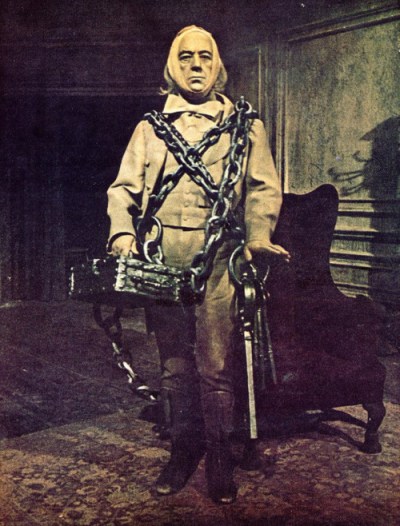
I have to say, when I’m dragging my wires and their attached e-products around I feel like Marley’s ghost when he comes to frighten the bejeezus out of Scrooge on Christmas Eve.
image
“The bells ceased as they had begun, together. They were succeeded by a clanking noise, deep down below; as if some person were dragging a heavy chain over the casks in the wine merchant’s cellar. … The cellar-door flew open with a booming sound, and then he heard the noise much louder, on the floors below; then coming up the stairs; then coming straight towards his door. … “It’s humbug still!” said Scrooge. “I won’t believe it.” His colour changed though, when, without a pause, it came on through the heavy door, and passed into the room before his eyes. … The same face: the very same. Marley in his pigtail, usual waistcoat, tights and boots; … The chain he drew was clasped about his middle. It was long, and wound about him like a tail; and it was made (for Scrooge observed it closely) of cash-boxes, keys, padlocks, ledgers, deeds, and heavy purses wrought in steel.”

Well, as you might imagine, I am not the only one to be irritated by this bloody nuisance of wires. Some of my readers may well feel the same wire-induced irritation. And of course the private sector, ever alert to new markets, has moved in. Companies have designed wireless chargers, which use induction coils to produce an electromagnetic field, which in turn can charge batteries. Don’t ask me anything more; I never understood electro stuff. Luckily, these new products can look pretty cool

image
although I do note that while there may be no wire between charger and e-product, there must be a wire between charger and wall socket – otherwise, how does it get the electricity which it so generously passes to the mobile, tablet, or what have you?

So other companies have come up with the idea of inserting the wireless charger into products which already have wires. Clever, no? For instance, take my favourite furniture shop, IKEA. “Our range of wireless chargers blend in beautifully with your home” their catalogue proclaims, “and can be placed where you need them the most. All without having to chase after outlets or hide messy cables.” Words after my heart! See, for instance, this clever lamp, which has a charger built into its base. And which has won some design award to boot.

image
IKEA has various other lamps as well as what I take to be bedside tables with these built-in chargers.

image
In case my readers suspect me of having shares in IKEA, I hastily add that there are many other furniture companies out there offering similar solutions. My crystal ball tells me that this is the future.

But then there is one thing that’s worrying me. Aren’t all these wireless chargers using the same technology as microwave ovens? Like I said, I don’t understand all this electro stuff, but it seems to me to be more or less the same. In which case, a houseful of wireless chargers will slowly be cooking us. My phone is already cooking my brain.

image

______________________
Marley’s ghost, by Alec Guinness: http://dickensblog.typepad.com/dickensblog/2013/07/picspam-sir-alec-guinness-dickensian.html
RIGGAD lamp: http://www.ikea.com/us/en/catalog/categories/departments/wireless_charging/
Other furniture with chargers: http://www.ikea.com/us/en/catalog/categories/departments/wireless_charging/
Phone cooking brain: http://www.popsci.com/science/article/2010-02/disconnected
GOLD

Mandalay, 3 August 2016

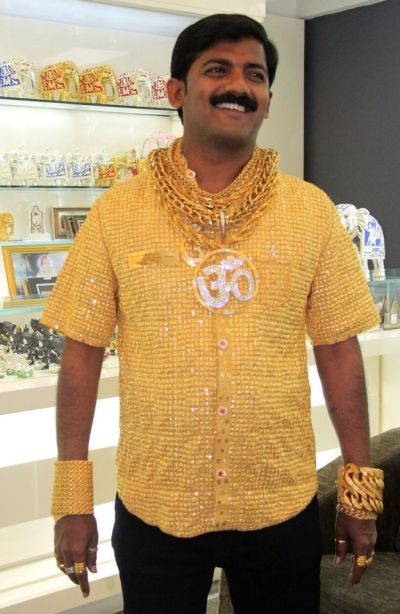
A few weeks ago, I read of the death of an Indian money-lender, murdered by a couple of people to whom he owed money. It was a banal and sordid murder, no different from the hundreds of banal and sordid murders which occur every day the world over. If this particular one was splashed all over the front pages of many newspapers, it was because the unfortunate victim had earlier shot to global fame for purchasing … a shirt made of gold (an idea, I have to say, which I find pretty bling).
image
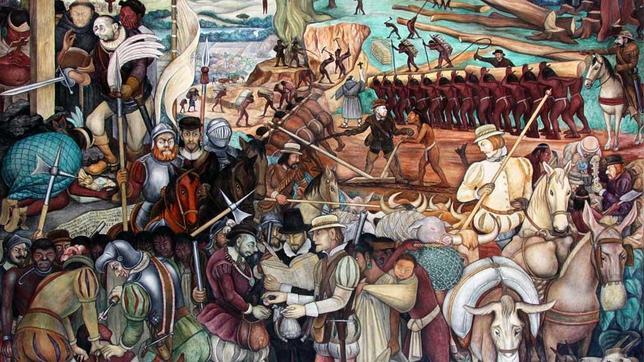
Ah, gold! That lovely, soft, malleable metal, which never rusts, which glows yellow like the sun. Which has been lusted after by so many through the ages. It sent the Conquistadors sailing half way round the globe to an unknown world, not to understand it but to rip the gold out of its heart.

image
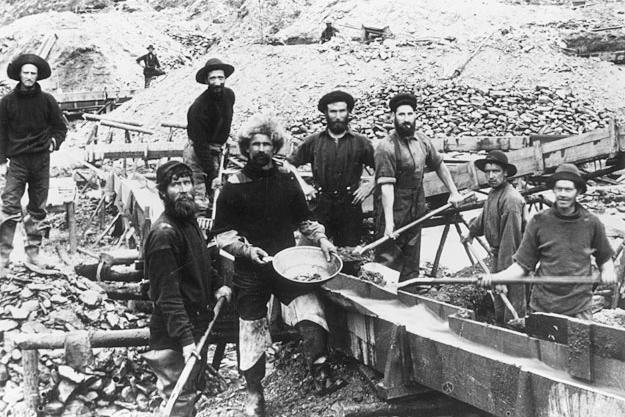
It has sent hundred of thousands running to the ends of the world to feverishly pan it out of water or to hack it out of the ground
image
a gold fever which even today strikes men (but also now women).


But gold has also inspired artisans for at least six thousand years to make beautiful, beautiful objects. It is these lovely creations which I wish to celebrate today, not the ugly side of gold.

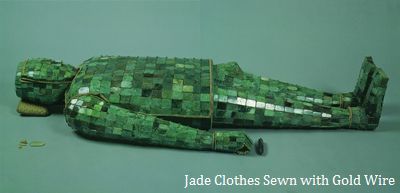
Given where this post started, my first inclination was to search on the Internet for examples of powerful potentates from the past who were discovered by archaeologists buried in shirts or tunics of gold. Alas, I found none, whether because my surfing skills are not up to the task or because even kings of old found this idea really too bling, or because archaeologists simply haven’t stumbled across such cases yet. The closest I got to it was jade burial suits used during China’s Han dynasty by members of the royal family; in some cases, the jade pieces of the suit were sewn together with gold wire.
image
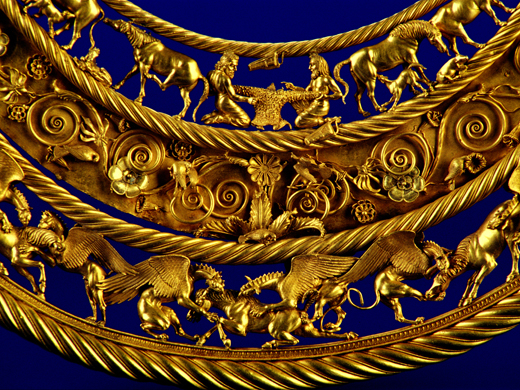
But as I surfed the internet, looking for gold shirts from faraway times, I stumbled across a treasure hoard of ancient gold pieces, some found buried with kings, princes, and their consorts, others buried for safekeeping by their owners who, for some reason, never returned to reclaim them. For instance, I was completely smitten by some of the gold work that archaeologists have found in various Scythian royal tombs in Southern Russia, Ukraine, and the Caucasus region more generally. Look at this pectoral, from the 4th C BC!
image
Here’s a detail – see how fine the work is!
image
Or how about these two vessels, also from the 4th C BC. They were apparently a pair, with this one
image
sitting on top of the other.
image
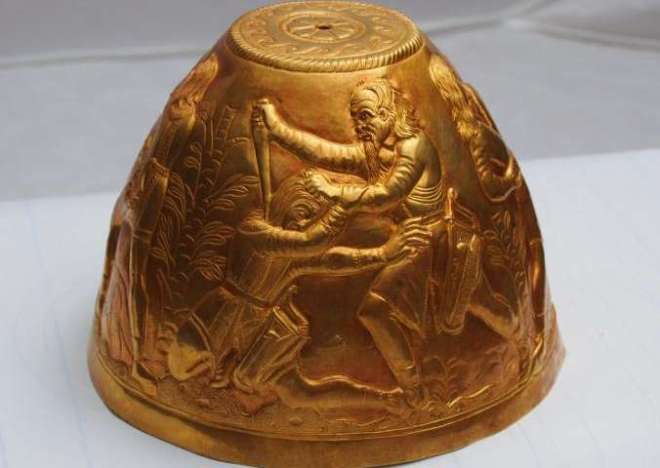
Or this bowl, from more or less the same period.
image
Or this comb, from slightly earlier, late 4th C BC, early 5th C BC.
image
The articles I’ve read about these pieces suggest that they were not actually made by the Scythians but by Greeks, living perhaps in the Crimean region. Fair enough, but this Scythian deer plaque, from the 7th C BC, was surely locally made
image
as was this belt buckle from the same period.
image
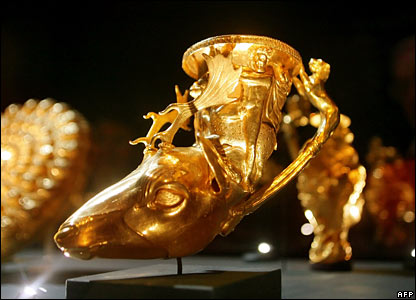
Thracian kings, it seems, were also desirous to be surrounded by fine gold objects. Consider, for instance, Bulgaria’s Panagyurishte gold treasure, thought to have been owned by King Seuthes III and buried to hide them from marauding Celts or Macedonians. I show three pieces from the hoard, all from the 3rd or 4th C BC: two rhytons, or drinking horns
image
image
and a plate.
image
Again, the detail on these pieces is exquisite.

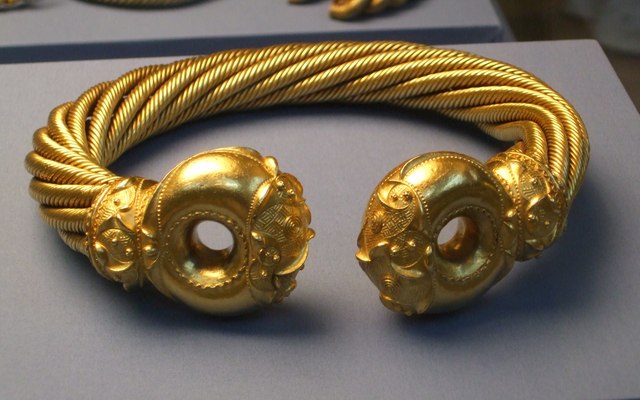
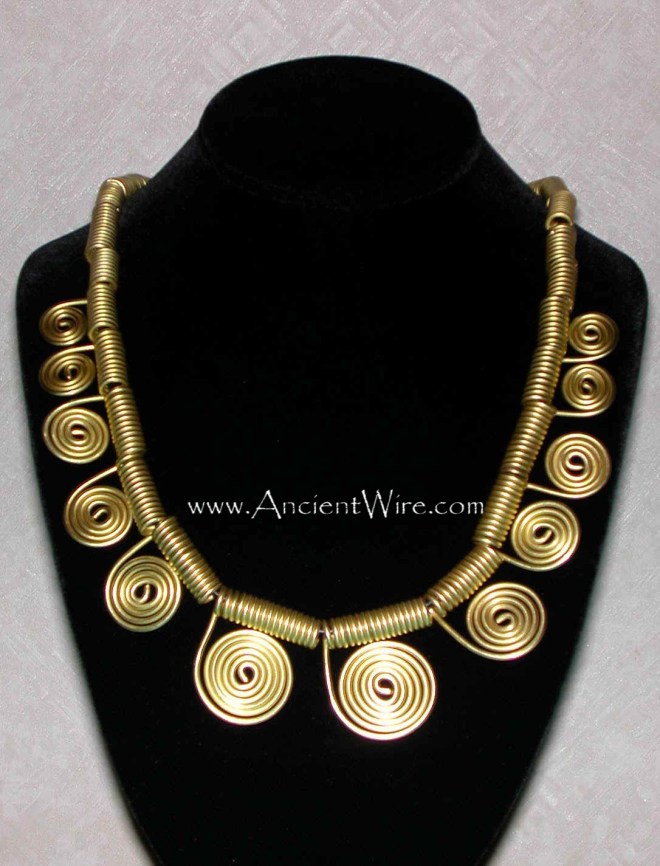
Mention of marauding Celts makes me look in the direction of the Northern European lands, where Celts were also known to hurriedly bury hoards of gold objects at the sound of approaching marauders. This beautiful spiral torc from 1st-4th C BC
image
was part of a cache of torcs found near Stirling in Scotland. This 70 BC torc instead was part of a hoard discovered at Snettisham in Norfolk, England.
image
This necklace, on the other hand, is a copy of a 6th-7th C BC original that was buried in Lorup, Germany.
image
I have to say, while I greatly admire the artistry that went into the Thracian and Scythian pieces, I instinctively empathize with the geometric simplicity of these Celtic pieces. “Keep It Simple, Stupid!” has always been my motto.

But that didn’t stop me from whistling when I saw some of the pieces that were made in what is now Iran. Look at this 8th-10th C BC cup, for instance, with its row of wild goats walking primly around it.
image
This must have been a popular design, because this cup from a later period (4th-5th C BC) has instead lions or tigers walking round it.
image
This 4th-5th C BC drinking cup holds its own to the two Thracian rhytons I show above
image
while this 3rd-4th C BC Janus-faced cup is a marvel to behold.
image

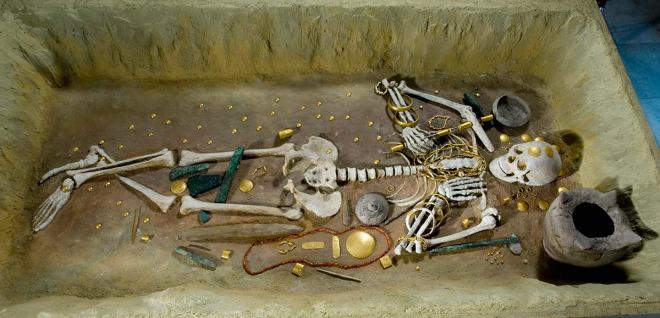
There are many, many other beautiful ancient gold objects out there, but I have to bring this little essay to a close. Let me finish with the oldest gold objects so far found. These are datable to the period 4,200-4,600 BC, and come from a necropolis in Varna, now Bulgaria’s largest city on the Black Sea. Compared to the pieces I show above, the objects in these tombs are quite modest in their design. What caught my attention was this reconstruction of one of the burials in the necropolis.
image
I suppose the man to whom this skeleton belonged was a grandee, and was laid to rest surrounded by all his worldly riches. But as I gaze at this skeleton, I cannot help but remember the dialogue between Hamlet and Horatio in the graveyard. After musing over Yorick’s skull (“Alas, poor Yorick! I knew him, Horatio, a fellow of infinite jest, of most excellent fancy …”), Hamlet turns to Horatio.

Hamlet: Prithee, Horatio, tell me one thing.

Horatio: What’s that, my lord?

Hamlet: Dost thou think Alexander looked o’ this fashion i’ the earth?

Horatio: E’en so.

Hamlet: And smelt so? pah!

Puts down the skull

Horatio: E’en so, my lord.

Hamlet: To what base uses we may return, Horatio! Why may
not imagination trace the noble dust of Alexander,
till he find it stopping a bung-hole?

Horatio: ‘Twere to consider too curiously, to consider.

Hamlet: No, faith, not a jot; but to follow him thither with
modesty enough, and likelihood to lead it: as
thus: Alexander died, Alexander was buried,
Alexander returneth into dust; the dust is earth; of
earth we make loam; and why of that loam, whereto he
was converted, might they not stop a beer-barrel?
Imperious Caesar, dead and turn’d to clay,
Might stop a hole to keep the wind away;
O, that that earth, which kept the world in awe,
Should patch a wall to expel the winter flaw!

___________________
India’s “gold man”: http://www.bbc.com/news/world-asia-india-36804209
“Conquista de Mexico”, Diego Rivera: http://www.abc.es/fotonoticias/fotos-espana/20150428/mural-diego-rivera-sobre-162891744561.html
Gold prospectors, Klondike: http://www.discovery.com/tv-shows/gold-rush/photos/klondike-gold-rush-pictures/
Modern gold prospectors, Colombia: http://www.jansochor.com/photo-blog/gold-mining-colombia
Jade burial suit: https://hu.pinterest.com/pin/454159943647748843/
Scythian pectoral, Ukraine, 4th C BC: http://www.craftycristian.com/tag/artifact/
Scythian pectoral-detail: https://en.m.wikipedia.org/wiki/Scythians
Scythian vessel-top, 4th C BC: http://phys.org/news/2015-06-archeologists-gold-artifacts-scythian-grave.html
Scythian vessel-bottom, 4th C BC: http://www.archaeology.org/issues/220-1607/features/4560-rites-of-the-scythians
Scythian bowl, 2nd half 4th C BC: http://www.metmuseum.org/exhibitions/listings/2000/golden-deer/photo-gallery
Scythian gold comb, Ukraine, late 5th-early 4th BC: http://museum-of-artifacts.eu/post/100759193962/scythian-golden-comb-5th-century-bc
Scythian deer, end 7th C BC: http://www.metmuseum.org/exhibitions/listings/2000/golden-deer/photo-gallery
Scythian belt buckle, 7th C BC: https://en.m.wikipedia.org/wiki/Scythians#/media/File%3AGold_scythian_belt_title_from_Mingachevir%2C_Azerbaijan.JPG
Thracian drinking horn-goat: https://www.pinterest.com/pin/174444185537354589/
Thracian drinking horn-deer: https://www.pinterest.com/pin/492510909227090261/
Ancient Greek plate (phiale): http://www.artlex.com/ArtLex/g/gold.html
Spiral torc, Scotland, 300-100 BC: http://www.nms.ac.uk/explore/stories/scottish-history-and-archaeology/iron-age-gold-torcs/
Celtic torc, Snettisham hoard: http://www.geograph.org.uk/photo/2395380
Ancient wire necklace (copy), Lorup hoard, Germany, late Bronze Age, 700-600 BC: http://www.ancientwire.com/spiralnecklace.htm
Achaemenid cup-wild goats, 1000-1200 BC: http://www.metmuseum.org/art/collection/search/325511?high=on&rpp=50&pg=22&rndkey=20120709&ft=*&pos=1095
Achaemenid gold cup, Kalardasht, 800 BC: https://commons.m.wikimedia.org/wiki/File:Gold_cup_kalardasht.jpg
Achaemenid drinking cup: http://www.daftarche.com/تاریخ،-فرهنگ،-همبود-13/persian-mythology-543-چاپ/برگه-3.html
Achaemenid Janus cup: http://www.iransara.info/main-previous%20post.htm
Varna man: http://edition.cnn.com/interactive/2015/07/style/gold/

TAKING THE D TRAM TO NUSSDORF

Vienna, 24 July 2016

We’re in Vienna briefly, on our way back to Bangkok from the annual training course I give in Budapest and using the occasion to visit the warehouse where our stuff has been stored away these last seven years to agree on when to start moving it, and to where, when I retire in a month’s time. We’ve used the occasion to spend the weekend here.

On Saturday morning, we visited an exhibition of Ai Wei Wei’s work, my wife’s favourite modern artist, which is spread between the 21er Haus and the Upper Belvedere. While we were at it, we also had a quick zip around the Upper Belvedere’s permanent collection – there is a lovely set of Schieles and Klimts. Then, footsore and thirsty, we took a D tram back into the city centre and headed for a café to have a drink and a rest.

Once revivified, we pondered where to go next. I suggested the Leopold Museum, which is holding an exhibition of a rather minor Austrian painter of the 19th Century, and so we dragged ourselves rather slowly in that direction. But on the way, we saw another D tram clank past, and since it was a glorious day we decided on the spur of the moment to hop on and ride to the end of the line, to Nussdorf, which lies at the foot of the hills that overlook the city. As the name suggests, Nussdorf, Nut Village, was indeed once an independent village but is now a suburb of Vienna. Presumably it once was known for its walnuts or hazelnuts, but several hundred years ago it planted vineyards on the slopes above it and thereby made its fortune selling thirsty Viennese Grüner Veltliner wines.

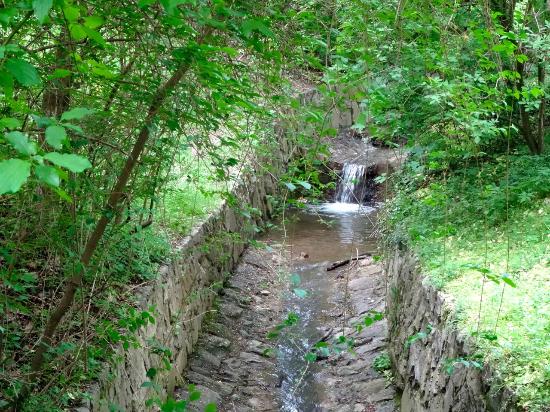
Now, as we got off the tram at the final stop, we trailed after our fellow passengers, all ramblers, who were making their way determinedly towards those vineyards and the woods beyond them, the Wienerwald. We found a path which followed a stream
image
and started ambling slowly upwards – the walk was in no way strenuous.

The path first coasted houses buried at this time of year in luxuriant vegetation
image
image
but then it became more solitary.
image
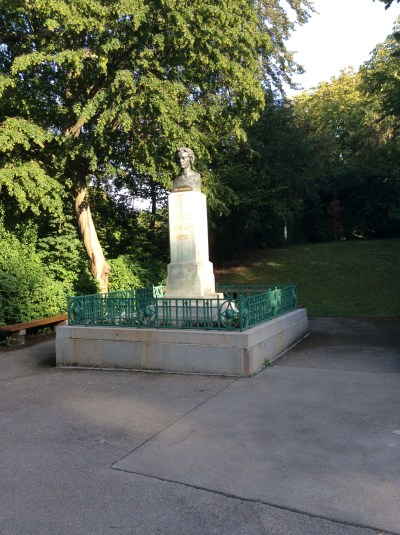
At one point, we passed a little park dedicated to Beethoven.
image
It is said that he used to come over from nearby Heiligenstadt, where he spent many summers in his later years, to walk along this same path, which of course the marketing-savvy locals have named Beethovengasse, Beethoven Lane.

Further on, we passed the dead of Nussdorf, sleeping their eternal sleep at the foot of the vineyards
image
and now finally we were among the vineyards.
image
A few yards further on, we arrived at our destination, a heuriger
image
(a buschenschank in Styria; the owner of this heuriger must be a Styrian immigrant)

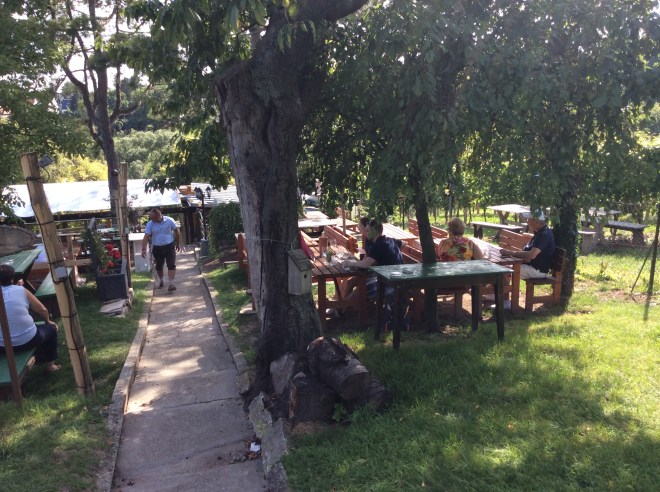
Heurigers, or wine taverns, dot the countryside around Vienna, selling the local wine, as well as simple food so that their patrons do not drink on an empty stomach. We had chosen this one from a map thoughtfully provided along the path by the local authorities, anxious to ensure that a good time was had by all.
image
We settled down in the tavern’s garden
image
and pleasantly whiled a way an hour or so, sipping on our wine-water mixes (it was a bit early for straight wine), nibbling at our dried sausages, cheese plate, and Greek salad, gazing out over the neighbouring vineyards
image
and generally enjoying that sense of gemütlichkeit – warmth, friendliness, and good cheer – which is the trademark of heurigers.

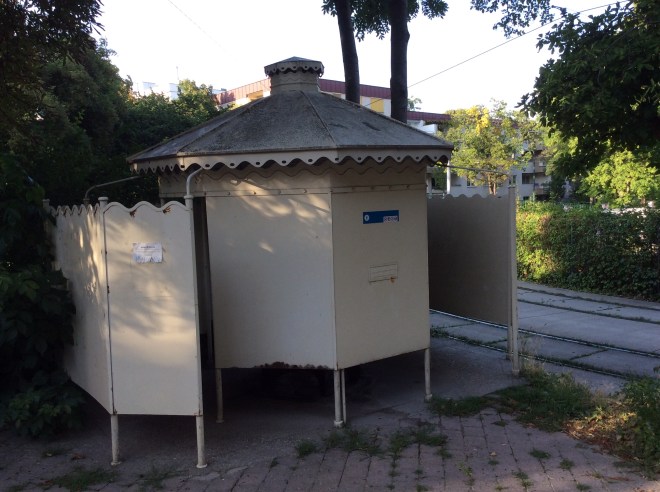
Suitably refreshed, and full of good cheer, we ambled slowly down the hill again, where I for one took advantage of the old-fashioned toilets, or pissoirs as the Austrians so picturesquely call them, helpfully provided at the tram stop by the local authorities
image
before climbing back into the D tram

image

and clanking slowly back into the city centre.

__________________
The stream Schreiberbach: https://www.tripadvisor.co.za/LocationPhotoDirectLink-g190454-d260626-i134059629-Vienna_Woods-Vienna.html
All other photos: ours

BAGAN, MYANMAR

Bangkok, 13 July 2016

My wife and I have just returned from a short visit to Bagan, in Myanmar. Back when Harold Godwinson received an arrow in his eye, losing his life and his English throne to William, Duke of Normandy
image
the kings of Pagan (as the kingdom was then known) had consolidated their hold on the valley of the Irrawaddy River, swallowing up their neighbouring city-states, and had created the first Burmese kingdom. The kingdom grew rich on trade but also on agriculture, harnessing irrigation for the first time in this dry region of Myanmar. As befits the capital of a prosperous kingdom, the population of Pagan swelled. The kings and the richer citizens, anxious to gain merit for their next reincarnation, used their wealth to heavily sprinkle the city and the surrounding plain with stupas, temples, monasteries, and other religious edifices. At the height of this building frenzy, more than 10,000 such edifices covered an area of some 100 square kilometres.

Alas, this well-meaning search for merit undermined the edifice of state. More and more land was donated to the Buddhist monkhood, land which then became exempt from tax, thereby gradually emptying the state coffers. The resulting internal strife weakened the kingdom, and invasions of its borderlands by the Mongol dynasty of China finished her off. By 1287, the kingdom of Pagan was no more, and its capital city had shrunk to the size of a very modest town. Sun, wind, and rain began their work. The plaster moldings with which all the religious edifices had been covered peeled off, and the exposed brick began crumbling away to mud and dust. Trees and bushes did their part, inserting roots between brick and brick and slowly leveraging them apart. Earthquakes played their part too, toppling walls and cracking open stupas. And so the religious edifices so lovingly erected by earlier generations slowly slumped back into the earth from whence they had sprung.

A score of temples and stupas, which continued to be sites of pilgrimage, were maintained, often with infelicitous results as frescoes were painted or whitewashed over and badly crafted statues took the place of the originals. In the last century, conservation work was carried out – haphazardly – under successive military regimes. This has halted, or at least slowed, the dissolution, but even so only some 2,000 edifices remain standing, more or less, today.

But 2,000 is still a big number. Climb, as we did, the Shwesandaw stupa, and you will find yourself gazing out over flat, wooded farmland thickly sprinkled with red-brick stupas and temples of every size and state of disrepair.
image

image

image

image

Get off the paved roads, as we did, and take the dirt roads and paths which crisscross this farmland, and you will come across lonely stupas brooding by the side of fields
image
where the lines of the Persian poet Ferdowsi come to mind:

The spider spins his web in the Palace of the Caesars
An owl hoots in the towers of Samarkand

(it is said that the Ottoman sultan Mehmet II murmured these lines as he visited the desolate ruins of the imperial palace after his conquest of Constantinople in 1453)

It comes spontaneous to compare Bagan to other places. Angkor Wat in neighbouring Cambodia is often cited, but the comparison doesn’t hold. Angkor has edifices which are splendid in their art and architecture.
image

image
image
The edifices of Bagan, on the other hand, now have little if any intrinsic merit. My wife and I saw nothing superlative in any of the stupas or temples we visited. Pleasant, yes, interesting sometimes, but nothing to take one’s breath away.
image
image

image

image
No, it is the overall landscape that makes Bagan noteworthy, and it is to landscapes that we must turn for comparisons. Since many of the edifices in Bagan are funerary in nature, my wife felt a certain affinity between the Italian cemeteries of her youth and Bagan, with the latter of course being on a much larger scale.
image
In such a comparison, I would perhaps lean towards the abandoned part of Vienna’s biggest cemetery, the Wiener Zentralfriedhof, which contains many of the tombs of Vienna’s Jewish community, wiped out in the Nazi concentration camps.
image
I myself favour a comparison with Ancient Rome, not the Ancient Rome of today, swallowed up in the concrete and bitumen of the modern city, but the Ancient Rome that was the subject of many a painting in the 17th to 19th centuries. This is Claude Lorrain
image

this, Piranesi
image
this, Palmer
image
and this, Lear
image
In these paintings I see an echo of the Bagan I looked out on from the heights of the Shwesandaw stupa.

As the lines I cite above show, the melancholy of ruins has always excited the imagination of poets. Rome’s ruins are no exception, with reams of poems written about them. I quote one here, by Alexander Pope.

See the wild waste of all-devouring years!
How Rome her own sad sepulchre appears,
With nodding arches, broken temples spread!
The very tombs now vanished like their dead!
Imperial wonders raised on nations spoiled,
Where mixed with slaves the groaning martyr toiled:
Huge theatres, that now unpeopled woods,
Now drained a distant country of her floods:
Fanes, which admiring gods with pride survey,
Statues of men, scarce less alive than they!
Some felt the silent stroke of mouldering age,
Some hostile fury, some religious rage.
Barbarian blindness, Christian zeal conspire,
And papal piety, and Gothic fire.
Perhaps, by its own ruins saved from flame,
Some buried marble half preserves a name;
That name the learned with fierce dispute pursue,
And give to Titus old Vespasian’s Due.

But this poem is far too frothy, as are all the poems about Rome’s ruins. I prefer the fragments of an Anglo-Saxon poem of the 8th Century, part of an anthology of Anglo-Saxon poems in the library of Exeter Cathedral, whose subject is not Rome but the Roman ruins of Bath.

Wrætlic is þes wealstan, wyrde gebræcon;
burgstede burston, brosnað enta geweorc.
Hrofas sind gehrorene, hreorge torras,
hrungeat berofen, hrim on lime,

For those of my no doubt many readers who, like me, are not conversant with Anglo-Saxon, let me continue with a translation by Siân Echard, of the University of British Columbia, with some modifications on my part.

Wondrous is this wall-stead, wasted by fate.
Battlements broken, giant’s work shattered.
Roofs are in ruin, towers destroyed,
Broken the barred gate, rime on the plaster,

Walls gape, torn up, destroyed, consumed by age.
A hundred generations have passed.
Earth-grip holds the proud builders, departed, long lost,
In the hard grasp of the grave. How often has this wall,

Hoary with lichen, red-stained, outlasted the passing reigns,
Withstanding the storms; the high arch now has fallen …

(At this point, there is a gap, for the parchment itself has suffered badly from the passage of time)

Indeed, the high arches, now fallen, of Bagan have witnessed the passing of many reigns, the last being but a few months ago, when the decades-long military government in Myanmar finally gave way to a democratically-elected civilian government. Knowing the history of neighbouring Thailand, where military meddling is a way of life, I offered a silent prayer in the Ananda temple
image
that this would be the last of the military governments in this beautiful country, which has suffered so much and deserves so much better.

________________
Photos of Bagan: ours
Harold hit by the arrow: http://www.dot-domesday.me.uk/arrow.htm
Angkor Wat-1: https://artmundus.wordpress.com/2010/05/28/the-wonder-that-is-angkor-wat/
Angkor Wat-2: https://artmundus.wordpress.com/2010/05/28/the-wonder-that-is-angkor-wat/
Angkor Wat-3: http://rwethereyetrwethereyet.typepad.com/arewethereyet/2008/04/take-your-kids.html
Cimitero monumentale, Milan: https://www.tripadvisor.it/LocationPhotoDirectLink-g187849-d243431-i28163413-Monumental_Cemetery-Milan_Lombardy.html
Jewish section, Vienna Zentralfriedhof: http://www.flickriver.com/photos/lastingimages/2924629401/
Roman ruins:http://www.bobforrestweb.co.uk/The_Rubaiyat/Galleries/Gallery_5/g5notes.htm
– Claude Lorrain
– Giovanni Battista Piranesi
– Samuel Palmer
– Edward Lear

THUNDER

Bangkok, 4 July 2016

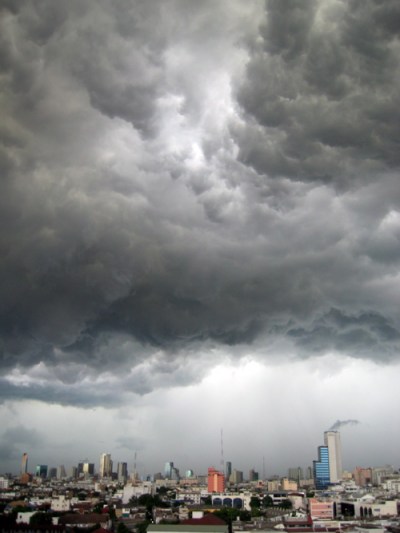
It’s the rainy season in Bangkok. The normal schedule sees the day start dry with perhaps some cloud cover, which then builds up into impressively nasty-looking, black, whorly cloud piles by late afternoon.

image
image
At that point, lightning rips the sky from cloud to ground
image
followed moments later by thunder. And what thunder it is! The air itself seems to crack and splinter, the clouds angrily boom and hammer, over and over again as lightning keeps bursting out of the clouds. Instinctively, my wife and I step back, retreating into the safety of the apartment, and murmur comments to each other about the elemental son et lumière playing outside our windows. And then the rain starts, so dense that the other side of Chaophraya River, normally perfectly visible from our terrace, is blotted out.

At moments like these, I feel pity for our early ancestors cowering in their rock caves or flimsy huts watching the same grand spectacle. With the benefit of science, I can rationalize what I am seeing: why, thunder is just the noise of the sonic shock wave created by the very sudden expansion of air caused by the almost instant increase in pressure and temperature brought about by the passage of a lightning bolt! That’s all … But they did not have this intellectual crutch to lean on. They must have found such dramatic displays by nature very frightening. So I suppose it’s not very surprising that all the early religions had a god of thunder, who no doubt had to be ritually appeased.

What I do find surprising, though, after a quick zip around the Internet, is how decorously many of these gods of thunder have been portrayed in art. If I were cowering in my cave 50,000 years ago, or even in my flimsy hut 5,000 years ago, listening to all that tearing, splintering, and booming mayhem going on outside, I think it would come naturally to me to depict the god of thunder as a mean, nasty, angry son of a bitch. Some portrayals do seem to go in this direction. For instance, those of Tawhirimatea, the Maori’s god of thunder

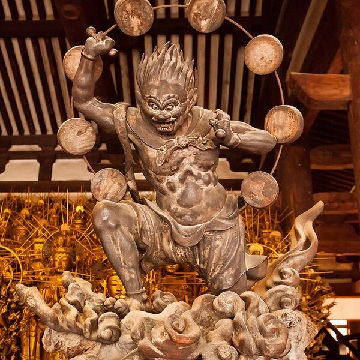
make him look satisfyingly nasty. So do portrayals of Raijin, Japan’s god of thunder
image
who to my eyes looks apoplectic. Chaac, the Mayan god of thunder also looks suitably nasty
image
although as in so much Mesoamerican art he looks gruesomely nasty – they really seemed to have a need for downright disgusting-looking gods, the Mesoamericans did. I think Thailand’s own god of thunder, Ramasura, could perhaps be added to the list. I suspect he has a nasty monster’s face, but the nastiness of it is offset by the graceful balletic poses he is depicted in, a pose common to any flying spirit in Thai art.
image
After that, it gets difficult to find angry-looking gods of thunder. Take Zeus, for instance, the Greek god of thunder and lightning. The angriest depiction I could find was this one, on a vase, where frankly he just looks a little snippy rather than rip-roaring mad.
image
His usual mode of representation seems to be that typically Greek one of Olympian calm and good muscle tone, like this magnificent statue of him in the National Archaeological Museum in Athens (the lightning bolt which he is, calmly, throwing has gone missing).
image
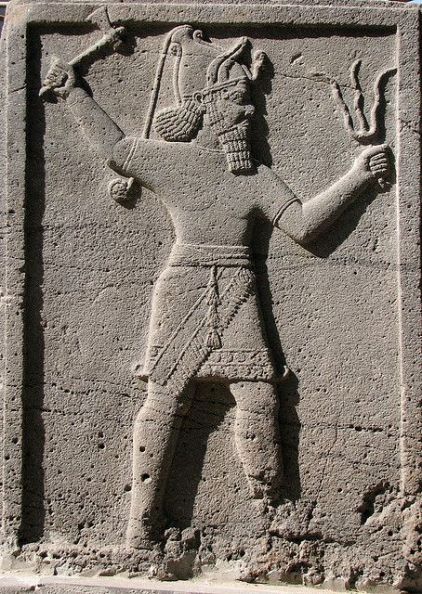
A rapid whizz through the pantheon of thunder gods in the Middle East gave me nothing better than this representation of Teshub, the Assyrian and Babylonian god of thunder
image
who, let’s face it, is looking petulant rather than angry as he wields his axe and lightning bolt.

I was hoping that the Norsemen, who after all seemed to spend most of their time stoving in their enemies’ skulls and drinking mead from those they hadn’t stoved in, would come up with a suitably horrible portrayal of Thor, their god of thunder. Not a bit of it! The best I could find was this
image
which, let’s face it, is a really pathetic representation of this god, who, if I’m to believe the Icelandic sagas, was testosterone-fueled and badly in need of anger management classes. Marvel Comics have done a much better job at depicting him
image
(and, by the way, have done a much better job of depicting Zeus too)
image
What to make of all this? Perhaps that the trick of our ancestors was to personalize these frightening phenomena. By personalizing them, they could clothe them with known and understandable personality traits, thus rendering the unfamiliar familiar. And/or maybe the ruling classes who arose out of the early agrarian societies and needed the acquiescence of the masses to their rule, if necessary through force, rather liked the idea of the masses equating their power to that of natural forces like thunder and lightning – but also wanted that power to look regal rather than just plain nasty; the fist of iron in the velvet glove, as it were.

Well, that’s my two-cent’s worth of pop-anthropological musings. My wife and I can now go back to watching the spectacle through our apartment windows – but from two steps back; you never know.

____________________
Thunder clouds over Bangkok: https://paulandsarahinthailand.wordpress.com/author/artyfooty/page/5/
Thunder clouds over Bangkok-2: http://2bangkok.com/2bangkok-weather-index.html
Lightning over Bangkok: http://www.digitalphotographytipsonline.com/my-image-gallery.html
Tawhirimatea, NZ: http://auckland-west.co.nz/2011/08/09/twhirimatea/
Raijin, Japan: http://www.esamskriti.com/print.aspx?topicid=969&chapter=1
Chaac, Mayan God of rain: http://archaeology.about.com/od/mayaarchaeology/a/Mayan-Rain-God-Chaac.htm
Ramasura: http://www.thaifolk.com/doc/mekkala_e.htm
Zeus on pottery: http://www.theoi.com/Gallery/K1.1.html
Artemisium Zeus statue: http://www.crystalinks.com/zeus.html
Teshub, Assyrian-Babylonian: https://www.pinterest.com/pin/12525705192076524/
Thor: https://en.m.wikipedia.org/wiki/Eyrarland_Statue
Thor comic book: https://en.m.wikipedia.org/wiki/Thor_(Marvel_Comics)
Thor and Zeus comic book: https://en.m.wikipedia.org/wiki/Zeus_(Marvel_Comics)

LET’S NOT LEAVE THE EU

Bangkok, 18 June 2016

As my country of citizenship moves inexorably towards a historic referendum on whether or not to leave the EU, with there being a damned good chance that a majority will vote yes, my thoughts turn towards what it means to be British. And of course, the first thing that comes to my mind is … cricket (although you can’t really say it’s a British game; it’s the English who developed it while the Scots, for one, hardly play the game at all).

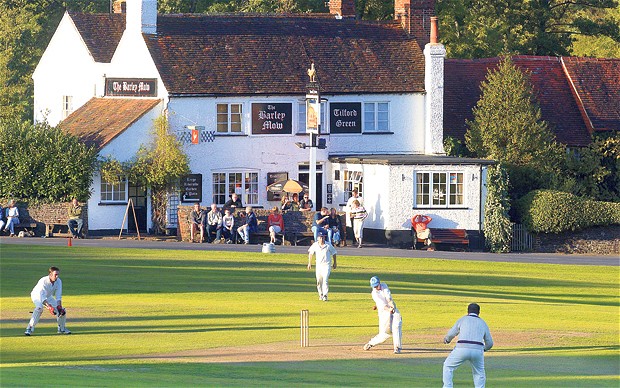
I started playing cricket, at school, in the summer of 1963, and played my last game, at school, in the summer of 1972. I stopped playing with no regret (and anyway went to University in Scotland, where, as I have just mentioned, hardly anyone plays cricket). Truth to tell, I was never very good at the game. I never could get over my nervousness of having someone throw a hard – very hard – ball straight at me, and pretty damned fast at that. In the years I played, batters protected their shins with pads and their testicles with a cup. The rest was naked, unprotected, at the mercy of nasty, vicious hits from the ball. That being said, when I was far out of the line of fire, standing in the far reaches of the field waiting idly for the odd ball to come my way, I could not help but admire the simple beauty of it all: lovely green grass sweeping off into the distance, framed by a venerable tree or two, the field dotted with people kitted out in impeccably white attire, and with luck a beautiful summer sky crowning the whole.
ab39073.jpg
It’s even better if there is a quaint old pub in the background to which one can retire for a refreshing draught of the local ale.
image

And when batsmen were good, it really was a pleasure to the eye to watch them taking clean, easy swings, knocking the ball this way and that, twisting their body elegantly as they followed through their shots.

image

Yes, elegant is the word for the best of cricket.

I still remember with great pleasure a match we played when I was 12-13 years old, against the local village. It was an annual affair, where we fielded a side of mixed Masters and boys. For some reason, I was included – someone must have been sick. In any event, I have this memory of politely playing against the local farmers on the village green, a beautiful oval surrounded by great beeches. I batted way down the list and was out pretty quick. Then I watched from the edge of the playing field as we got convincingly trounced. No matter, we were English, and the winners and the losers mingled in good cheer at the end:
“For when the One Great Scorer comes
To mark against your name,
He writes – not that you won or lost –
But HOW you played the Game.”

As the summer sun slowly set and the shadows grew longer across that village green, we ate home-made cakes and quaffed the local cider – we boys quaffing with special permission from the Headmaster.

Well, as much as I have changed, so has cricket. The commercial diktats of TV required that the achingly long Test matches be shortened to much shorter one day-and-night matches. The result is far more exciting to the uninitiated, as slugging has become the norm for batters rather than the patient, incremental build-up of runs of yesteryear; anyone can appreciate slugging. Taking a leaf out of football, all that uniform white in the kits has given way to a rainbow of colours as each national side now goes out in its own distinct colour. I suppose like that it’s easy to tell who is batting and who fielding. To get the evening viewers, matches go on into the night under the glare of lights. No doubt players get paid much more. And cheating during play, so as to make money on the betting, has begun. I’ve not heard of doping scandals in cricket, but if it isn’t happening yet I’m sure it eventually will.
image
Sometimes, when I look at a modern match of cricket, I wish we could go back to the old ways. Cricket seemed so much nicer back then.

image

Of course, my memory has quietly deleted those much less pleasant memories of cricket, on a nasty windy day, for instance, or under the rain; it really was not as wonderful as I’d sometimes like to think it was.

image

And anyway we can’t go back. The world has changed, and so must cricket.

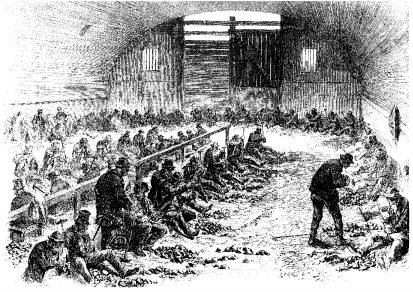
I’m sure much the same nostalgia drives many of my countrymen and women who want to vote to leave the EU. They want to go back to the past, to a time when Britain was great, was self-reliant … and was white. But paraphrasing Karl Marx, history repeats itself, the first time as tragedy, the second time as farce. Britain’s past history was not necessarily a tragedy, but it wasn’t as glorious as some people might think. My family did well out of Britain’s industrial revolution and later imperial ambitions, but there are many, many, many British families who suffered enormously from the industrial revolution

image

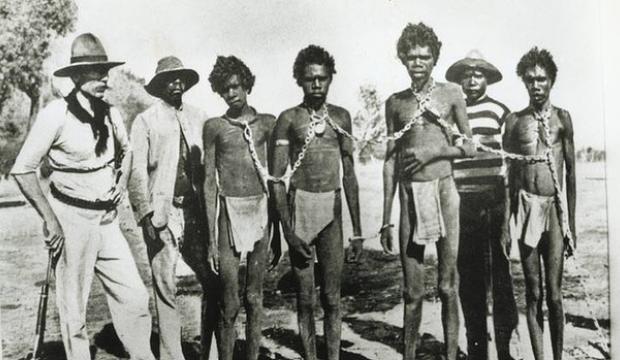
and there are a multitude of families in the countries we colonized who suffered enormously from our imperial ambitions.

image

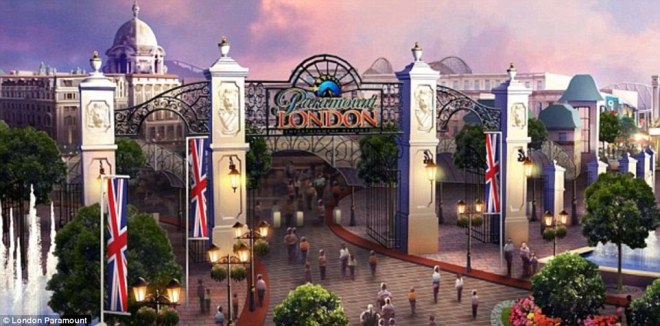
As for Britain’s future, trying to go back to its, largely mythical, past will simply condemn the country to be a poor, foggy little island on the outer edges of Europe, which itself is turning into the frazzled outer edge of a renascent Eurasian continent. Britain’s future history will not necessarily turn into a farce, but it will be trivial. With no manufacturing sector to speak of, sacrificed decades ago to the financial services sector, and with no financial services sector to speak of, since an exit from the EU will all make them emigrate to Frankfurt, Britain, like Italy, will have to rely more and more on tourism to make ends meet. It will become one vast Disneyworld
image
welcoming hordes of foreign tourists to its shores, to watch – for five minutes – its quaint games of cricket, visit a quaint pub, watch the Queen or King inspect all those nice toy soldiers with their lovely scarlet tunics and tall, funny hats

image

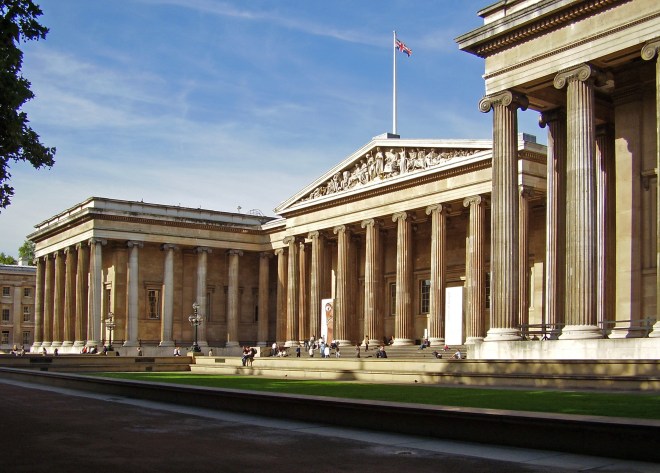
visit its majestic museums (while muttering to themselves about how much stuff was stolen from them)

OLYMPUS DIGITAL CAMERA

and send their children to spend a year in one of its quaint universities getting a costly but ultimately meaningless Master’s degrees.

image

Let’s not make this our future.

POSTSCIPT 24 June 2016

Well, my (very modest) call to remain fell on deaf ears. By midday today (Bangkok time), it was clear that a majority of my country men and women had decided to leave the EU. A pity.

________________
Cricket on local field: http://blog.acis.com/2013/08/
Cricket in front of the local pub: http://www.telegraph.co.uk/news/earth/countryside/8695840/The-village-green-is-crickets-soul.html
hitting a six: http://www.gettyimages.com/event/first-test-india-v-south-africa-day-3-51766051#robin-peterson-of-south-africa-hits-a-six-off-harbharjan-news-photo-id51774798
One day international at night: http://colorlibrary.blogspot.com/2012/07/stadium-which-hosted-most-number-of-one.html
Old painting of cricket: http://www.antiquemapsandprints.com/chelmsford-1934-old-vintage-print-nice-view-cricket-match-essex-l-b-bruhl-185061-p.asp
Cricket under the rain: http://www.alamy.com/stock-photo-a-set-of-stumps-at-an-abandoned-village-cricket-match-due-to-the-rain-9630656.html
Social consequences of industrial revolution: http://economistsview.typepad.com/economistsview/2007/08/social-conseque.html
Aborigines in chains: http://nationalunitygovernment.org/content/prisoners-frontier-wars-blackbirding-chain-gangs
British Disneyland: http://www.dailymail.co.uk
Trooping of the colours: http://www.zimbio.com/pictures/GChQyMYbIXr/Trooping+The+Colour
British Museum: https://en.m.wikipedia.org/wiki/British_Museum
Cambridge University students: http://www.theguardian.com/education/2016/feb/02/cambridge-university-to-introduce-written-admissions-tests

ROCK ART

Bangkok, 18 June 2016

As readers of this blog cannot have failed to notice, I’m a bit of a history buff. I suppose it runs in the family. My father had an extensive collection of history books, which as I grew up I filched for a quiet read in bed, and my elder brother actually teaches the subject.

As perhaps we all do, my interest in history started with the grand events, the Kings, the Queens, the battles. But with age, I became more interested in the history of the voiceless: the poorer segments of society, the goods and chattel which we humans have enslaved and used for our own material comforts, and – the topic of this post – our forefathers from the time when there were no written records: pre-history. Precisely because they have no written history, the latter can only talk to us through the material remains they have left behind, and through the chemical and biological tracers they have scattered about, from our genetic codes to such mundane things as pollen records. This post is about a particular material remain left to us by the voiceless, rock art.

My first meeting nearly half a century ago with this art form was not very propitious. They were rock paintings, in the middle of Lake of the Woods, on the US-Canadian border, where I was spending a week canoeing. They were painted on a small overhang on the water’s edge of one of the many small islands that dot the lake, so that we could bring the canoe alongside to study them. They looked something like this.
image
If I’m to be honest, I didn’t think much of them. They were pretty crude drawings, and awfully faded. I was far more excited by the very old man we met on another island, who told us that he remembered as a child being hurriedly bundled off into a hiding place because the local Indians had gone on the warpath. Wow! Indians on the warpath! To a boy of 15, that was something to talk about, not those crude, faded rock paintings.

At about the same time as I was gazing with a certain skepticism at the rock paintings on Lake of the Woods, I came across my first rock engraving. It was the White Horse, carved in the mid-19th Century into the escarpment of the Yorkshire Moors near my high school.
image
I have to say, though, that I was more taken by the gliders soaring silently on the updrafts created by the escarpment than the White Horse carved into it.

Well, time passed, I grew up, and I became wiser (I hope). My growing fascination with pre-history meant that I became more interested in rock art. Not that I saw that much rock art in the flesh, as it were. For instance, I have never managed to see the rock engravings in Valcamonica up in the Alps, not that far from my wife’s home town of Milan, even though it was one of the first places to be declared a UNESCO World Heritage Site.
image
image
On the other hand, when my wife and I visited Canyon de Chelly National Monument in Arizona early on in our marriage
image
we came across some rock engravings among the old American Indian pueblos.
image
image
I may not have been seeing much rock art, but I was reading up on whatever new finds were being made. For instance, new caves were being found in France and Spain with art from the Paleolithic era, adding to what was already known. I give here just a few examples from some of the better-known caves:
Lascaux
image
image
Altamira
image
image

Chauvet
image
image
image
Now this is really art! Visiting these caves is on my retirement bucket list – if we can manage to get in. Many of them are closed, or access to them is severely restricted, to protect the paintings. Forget the problem of stray fingers touching where they shouldn’t. Even our innocent breath deteriorates the artwork.

Several of the articles I read were about rock art in Australia. For instance, there was much excitement several years ago when it was announced that some rock art in the Northern Territories had been dated to 28,000 years ago, which made it Australia’s oldest dated rock art, and some of the earliest in the world.
image
Then there were articles a few years before that about the fascinating rock art in Kakadu National Park, also in the Northern Territories, which goes from the ancient
image
image

to the modern – Australian rock art didn’t stop tens of thousands of years ago.
image

All this meant that I approached the rock art which we visited on our recent tour of the Kimberley with a lively interest. We found ourselves confronted with two quite different styles of painting. The more recent, Wandjina art, is dominated by these alien-like faces.
image
To my mind, these paintings were only mildly interesting. Of much greater interest was the considerably older Gwion Gwion art, which is peopled with stencil-like figures like these.
image
image
image
In contrast to many of the representations of people in rock art, where they tend to be reduced to mere stick figures, Gwion Gwion art shows them dressed and coiffed. I don’t think it’s too fanciful to say that one can get an idea of what the painters of this art might have looked like if we had met them.

There are very recent articles reporting scientific analyses which suggest that these paintings could be 50,000 years old. This very much favors the theory which I mentioned in my previous post, the author of which argues not only that African peoples sailed to the Kimberley and brought the baobab tree with them but also that they were the authors of the Gwion Gwion art. He claims similarities between this art and the rock art of the Sandawe people, hunter-gatherers from Tanzania.
image

image
Personally, I’m not convinced. But hey, I’m no expert. In any event, reporting this claim has allowed me to segue smoothly to Africa, a major storehouse of rock art. And here I will leave my readers with some remarkable rock art from the Sahara, once a green and verdant land full of game and peopled by the humans who hunted them and who recorded their lives on the rock.
image
image
image
image
image

____________________
Lake of the Woods rock painting: http://www.panoramio.com/m/photo/8653359
White Horse, Kilburn: http://www.jdw-fitness.co.uk/ben-campbell-5k-10k-trail-races/
Rock engraving Valcamonica: http://www.italia.it/it/idee-di-viaggio/siti-unesco/valcamonica-larte-rupestre.html
Rock engraving Valcamonica: http://www.invasionealiena.com/misteri/articoli-misteri/963-arte-rupestre-delle-alpi-la-valcamonica.html
Canyon de Chelly: http://www.thousandwonders.net/Canyon+de+Chelly+National+Monument
Canyon de Chelly pictographs: http://www.inn-california.com/arizona/apacheC/canyondechelly/rockart.html
Cave wall, Lascaux: https://www.reddit.com/r/Showerthoughts/comments/2xfe1z/what_if_cave_drawings_are_done_by_cavechildren/
Hunters, Lascaux: https://hartogsohn.com/category/טכנופוביה/
Bisons, Altamira: https://www.pinterest.com/gfrilli/prehistoric-art-altamira/
Horses, Chauvet: http://popular-archaeology.com/issue/september-2011/article/prehistoric-cave-paintings-of-horses-were-spot-on-say-scientists
Bears, Chauvet: http://www.ancient-wisdom.com/francechauvet.htm
Rhinoceros, Chauvet: http://www.telegraph.co.uk/news/worldnews/europe/france/10920920/French-cave-paintings-inscribed-on-Unesco-World-Heritage-list.html
Reindeer, Font-de-Gaume: http://artdiscovery.info/rotations/rotation-1/packet-1/
Nawarla Gabarnmang: http://www.sundayobserver.lk/2012/06/24/spe31.asp
Kakadu woman: http://fr.123rf.com/photo_10231459_aboriginal-rock-art-namondjok-at-nourlangie-kakadu-national-park-northern-territory-australia.html
Kakadu kangaroo: https://www.pinterest.com/pin/521502831831829461/
Kakadu boat: http://news.nationalgeographic.com/news/2008/10/photogalleries/australia-aboriginal-art-photos/photo4.html
Wandjina art: https://www.pinterest.com/rosadevaux/wandjina/
Gwion Gwion 1: our photo
Gwion Gwion 2: http://www.bradshawfoundation.com/bradshaws/bradshaw_paintings.php
Gwion Gwion 3: http://www.bradshawfoundation.com/bradshaws/photographs/
Sandawe rock art: http://africanrockart.org
Giraffe, Dabous, Algeria: http://www.bradshawfoundation.com/giraffe/
Cattle, Djanet, Algeria: http://africanrockart.org/rock-art-gallery/algeria/
Antelope, Oued Dider, Algeria: http://africanrockart.org/rock-art-gallery/algeria/
Man and dog, Djanet, Algeria: http://africanrockart.org/rock-art-gallery/algeria/
Archer, Oued Djaret, Algeria: http://africanrockart.org/rock-art-gallery/algeria/

THE AUSTRALIAN BOAB TREE

Bangkok, 11 June 2016

One of the first things which struck me as my wife and I started our tour of the Kimberley in Australia was the presence of this tree, which we frequently saw, both in leaf
image
and bare
image
and many of them with fruit.

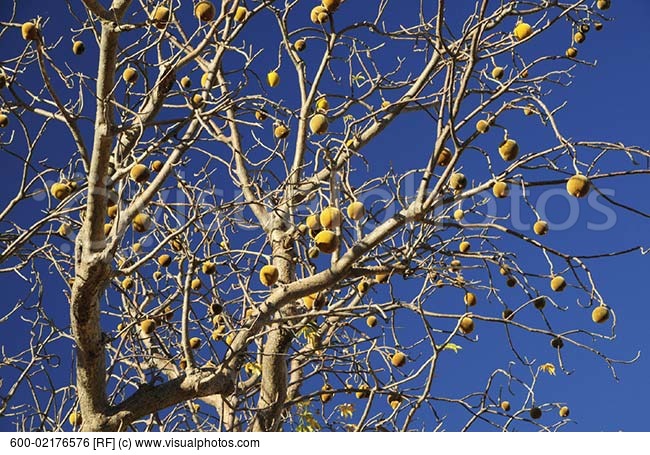
image
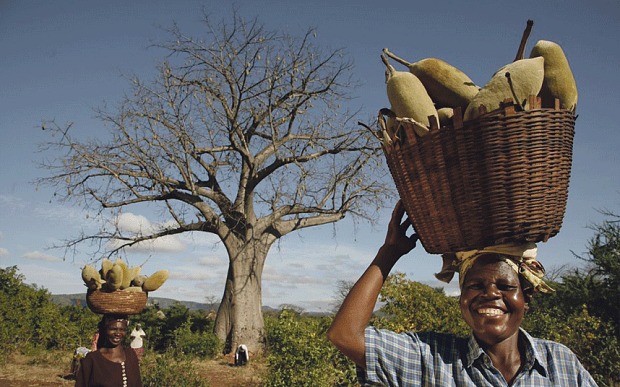
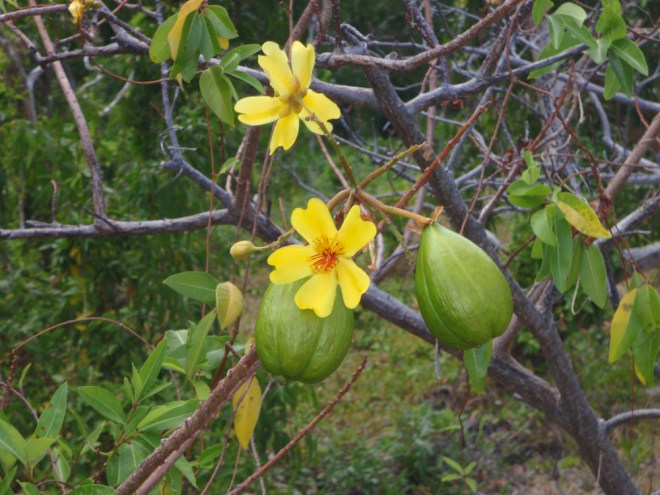
I kept saying, “Aren’t those baobab trees?” For they looked amazingly like African baobabs.
image
Well, the fact is, they are baobabs (although Australians insist on calling them boabs). These trees are to be found in sub-Saharan Africa (two species) as well as in Madagascar (six species, of which these, subjects of a previous post of mine, are magnificent specimens)
image
and there is this one species in Australia – actually, the tree is found only in the Kimberley and nowhere else in Australia.

How did the baobab tree end up in the Kimberley? I mean, it’s quite some distance, some 8,000 km to be precise, between the east coast of Africa and the west coast of Australia.

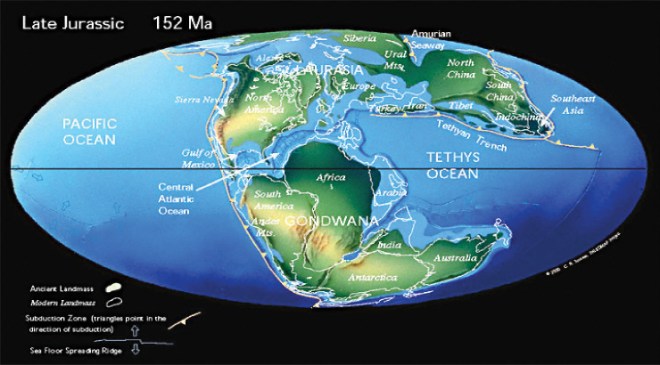
A first hypothesis was that this was a left-over from the break-up hundreds of millions of years ago of the supercontinent Gondwana into its constituent pieces of South America, Africa and Madagascar, Antarctica, India, and Australia
image
which then proceeded, through continental drift, to arrive where they are now. The ancestors of the baobab had existed on Gondwana, so the thinking went, and were carried along for the ride on the drifting continents.

Apart from the fact that this hypothesis doesn’t explain why there aren’t baobabs in India or South America, modern DNA analysis has nixed it. Comparison of DNAs has shown that the African and Australian varieties of the baobab separated a “mere” 100,000 years or so ago, when (by my calculation) Africa and Australia were 7 km closer (continental plates drift slowly).

So how did the baobab make it to Australia?

Well, the next most obvious hypothesis is that an African baobab nut or two (of which the smiling ladies in the photo above are holding a basketful) was carried out to sea and then carried along by surface currents to its new home in Northwestern Australia. But the experts are hesitant, and I understand why. A study of this map of surface currents
image
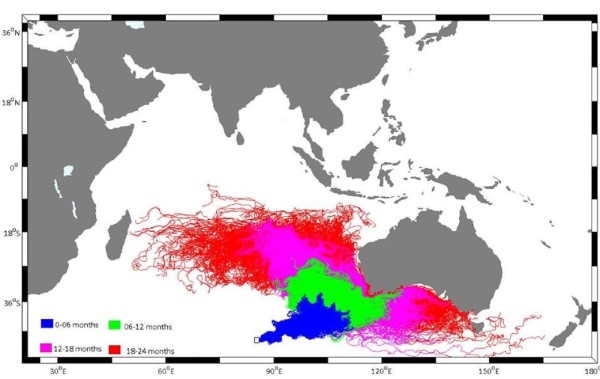
shows that to make it to the Kimberley region, a nut would have had to fall into the Somali current and been carried northward, then it would have had to get taken eastward by the northern branch of the Indian Ocean’s Equatorial current, all the way to the island of Sumatra. At that point, our bobbing baobab nut would have had to hug the southern coastlines of Sumatra and Java, to then, somewhere around Bali or Timor, change course, coming southward and westward, finally making a landing in the Kimberley. As the sad fate of the Malaysian flight MH370 has shown, anything floating further south in the Indian Ocean would tend to be carried westward rather than eastward. The map below is a computer-generated estimate of where debris of the plane could have drifted from the original hypothesized crash point (the square point on the border of the blue area); the red area is where debris might have been 18 to 24 months after the crash.
image
If this ocean voyage of the baobab nut occurred at all, it would have taken place during the last ice age. This started 110,000 years ago, which is pretty much when the two baobab lines separated, and finished 12,000 years ago. Among other things, the ice age caused sea levels to drop, which modified coastlines in certain parts of the world. In turn, these modifications could have affected the direction of surface currents. So to be really correct, one should look at a map of someone’s best guess of surface ocean currents during the ice age. Unfortunately, I didn’t come across any such map. This map, however, shows where the coastlines were at the time.

image
It seems there were no big changes in the area we’re interested in except around the islands of Indonesia and New Guinea, where the lower sea levels connected up a lot of the islands (and, en passant, made that last hop of human beings into Australia 50,000 or so years ago a good deal easier). I’m no ocean currentologist, but I rather think that the blocking up of the straits between these islands might actually have made the last leg of the baobab nut’s journey, that right turn from Bali to Australia, somewhat easier.
How long would such a trip have taken? Well, it took debris from MH370 about two years to wash up on the coast of Mozambique, so I would imagine that it would take just as long, if not longer, for a baobab nut to travel in the opposite direction. Could a baobab nut soak that long in the ocean and still be able to germinate upon arrival? We can look to the coconut for an answer; a coconut, at least the original version before human beings started messing around with it, was designed to be dispersed by sea.
image
There happens to be a lot of argument on this point, but no-one has ever claimed that a coconut can last two years in seawater. A maximum seems about three months, and even that has been challenged. So I seriously doubt that a baobab nut, even if it had managed to make it to the Kimberley by sea, would have been in a fit state to germinate.

So, how else could the baobab have arrived in the Kimberley?

The next most obvious hypothesis is that human beings brought the baobab with them, because they too originated in Africa. Could the ancestors of the Aboriginal people, who are currently thought to have arrived in Australia 50,000 years ago (plus or minus 10,000 years), have carried the baobab nut with them? Well, since they left Africa about 120,000 years ago and took 70,000 years to reach Australia, that would have meant planting the baobab as they went along. This is not actually as crazy as it sounds. Both in Africa and in the Kimberley there is strong evidence that the local hunter-gathering groups deliberately carried the baobab with them and planted it in new areas – the tree is a great source of many things other than the nut. But if this really did happen, then shouldn’t we find baobabs along their most probable migration route?
image
Yet, apart from southern Arabia, none of the places between Africa and Australia have baobabs, or even baobab remains. Of course, it could be that climate changes in these places after the end of the ice age killed off the baobabs, or it could be that they were killed off by the after-effects of the absolutely gigantic volcanic eruption of Mount Toba in the island of Sumatra about 70,000 years ago
image
the ash from which fell over a huge area, much of it on the migration route to Australia, which could have choked plant life.
image
It has also been argued that many years of permanent darkness set in after this event, a sort of “nuclear winter”, which of course would have affected the ability of plants to photosynthesize.

But still, all in all, the chances of the baobab having gotten to Australia via this long, long migration route seem very slim.

So how, then, could the baobab have gotten to the Kimberley?

And here, gentle readers, we step into a wasps’ nest. One Australian scientist has made the radical suggestion that tribes sailed from the east coast of Africa to the Kimberley, carrying baobab nuts as food. He claims that the rock art of the Kimberley (which I will cover in a future post) is (a) far older than is generally thought, maybe 50,000 years old, and (b) shows that 50,000 years ago the painters knew the use of boats.

OLYMPUS DIGITAL CAMERA
He suggests that the nuclear winter caused by Mount Toba led them to sail east, to the source of the sun, to find it again, which coincidentally would have brought them to the Kimberley (and he argues that there are strong connections between Kimberley’s rock art and the rock art of East Africa).

Well, as readers can imagine, such views have the Australian archaeological community in a tizzy. It certainly is a pretty far fetched theory. But somehow we have to explain how the baobabs got to the Kimberley, right? Anyone of my readers have any ideas?

_____________________
Boab tree in leaf: https://en.m.wikipedia.org/wiki/Adansonia_gregorii
Boab tree bare: http://www.alamy.com/stock-photo/boab-tree-kimberly.html
Boab tree in fruit: http://www.visualphotos.com/image/1×10636003/australia-western-australia-broome-roebuck-bay-a-faint-banded-sea-snake-caught-on-the-mud-flats-at-low-tide
African baobab tree: http://www.telegraph.co.uk/foodanddrink/11328252/Baobab-the-superfood-of-2015.html
Grove of baobab trees, Madagascar: https://www.pinterest.com/pin/1618549836269760/
Gondwana: http://www.earthsciences.hku.hk/shmuseum/earth_evo_07_01.php
Ocean surface currents: http://www.cruiserswiki.org/wiki/Indian_Ocean
Debris path of MH 370: http://www.deepseanews.com/2015/07/how-currents-pushed-debris-from-the-missing-malaysian-air-flight-across-the-indian-ocean-to-reunion/
Coastlines last ice age: http://maxworldhistory.weebly.com/map-exercise.html
Coconut in the sea: http://www.allposters.com/-sp/Coconut-Floating-on-Water-Indo-Pacific-Split-Level-Dispersal-of-Seed-Posters_i2634256_.htm
Migration out of Africa: http://cogweb.ucla.edu/ep/Paleoanthropology.html
Mount Toba eruption: http://www.thedailysheeple.com/yellowstone-super-volcano-is-far-bigger-than-previously-thought_122013
Mount Toba ash coverage: http://news.berkeley.edu/2015/03/31/200th-anniversary-of-tambora-eruption-a-reminder-of-volcanic-perils/
Bradshaw art boat: http://forum.woodenboat.com/showthread.php?169983-Primitive-Depictions-of-Medieval-Ships-Seen-from-Above

I’VE EATEN THE GREEN BUMS OF ANTS

Bangkok, 7 June 2016

Yes, I did that. On our recent tour of the Kimberley in Australia. The ant in question was the Green Tree ant or Weaver ant.
image
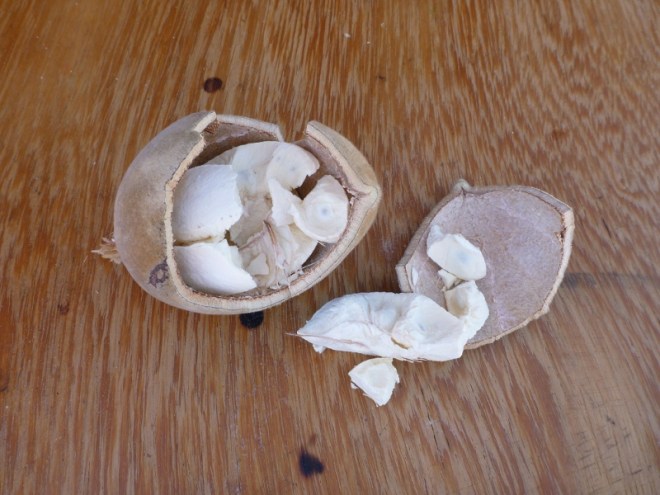
As readers can see, the ant has a bright green bum. The driver-cum-guide of our tour was a passionate advocate of the country’s Aboriginal population, of which there are still many in this little corner of Australia (it was the last part of the continent to be penetrated by white settlers, back in the 1870s). Among other things, on our walks through the bush he would point out various bush tucker (for non-Australians, that’s wild food which can be harvested in the bush), which he always claimed were bursting with proteins, Vitamin C, and other goodies, and which he would then invite us to try. So apart from Green Tree ants, I dutifully ate the petals of Australia’s kapok tree

the “petals” of the rosella “flower”
image
and the inside of the “nut” of the Australian boab tree (on which hangs a fascinating tale, which I will write up in a later post).
image
His partner, who was our cook, also fed us camel burghers (camels can now be found in the wild in Australia by their millions)

image

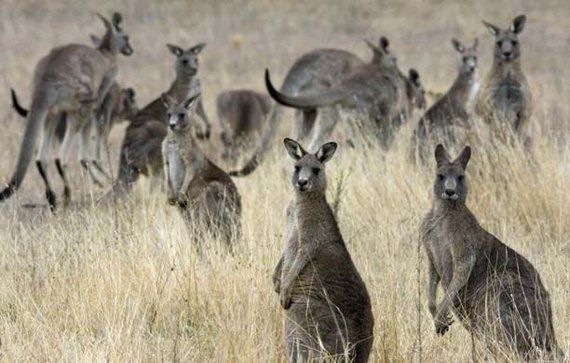
and kangaroo stew (also to be found in their millions throughout Australia, but of which we saw surprisingly few on this trip).
image
My conclusion: I really hope I don’t need to be a vegetarian in the Australian bush.

But actually, further research on my part since we returned from Australia suggests that the range of bush tucker we tried on our tour was rather limited. One article in Wikipedia has quite a long list of bush tucker to be found in the top end of Australia where we found ourselves, only one of which – the boab nut – we tried. So I really shouldn’t give up on bush tucker just yet.

_____________________
Green tree ant: http://www.alexanderwild.com/Ants/Making-a-Living/Arboreal-Ants/i-wpGjWZ8
Kapok tree flower: http://www.crystalchannelers.com/blog/plantology—aboriginal-healing-recipes—reduce-a-fever
Rosella: https://cnesgreen.wordpress.com/2010/04/19/roselle-flower-tea-hibiscus/
Open boab nut: https://outbackjoe.com/macho-divertissement/bush-tucker-plants-and-animals/boab-tree/
Wild camels in Australia: https://www.dpaw.wa.gov.au/management/pests-diseases/202-camels-in-western-australia?showall=1
Kangaroos: http://notallowedto.com/the-feral-child-a-boy-raised-by-kangaroos-discovered-in-australia/

AUSTRALIA – KIMBERLEY TOUR HIGHLIGHTS

Bangkok, 5 June 2016

My wife and I both agree that without a doubt the Bungle Bungle National Park was the highlight of our recent tour of the Kimberley (I suppose I should use its proper name, Purnululu National Park, but Bungle Bungle is such a delightfully silly name that I shall stick to that). It has been chosen as a World Heritage Site and for once I agree with this. What we have here is a deeply eroded range, and I think the best way to appreciate the unique geology of the Bungle Bungle is through an aerial photo
image
or two
image
or three.
image
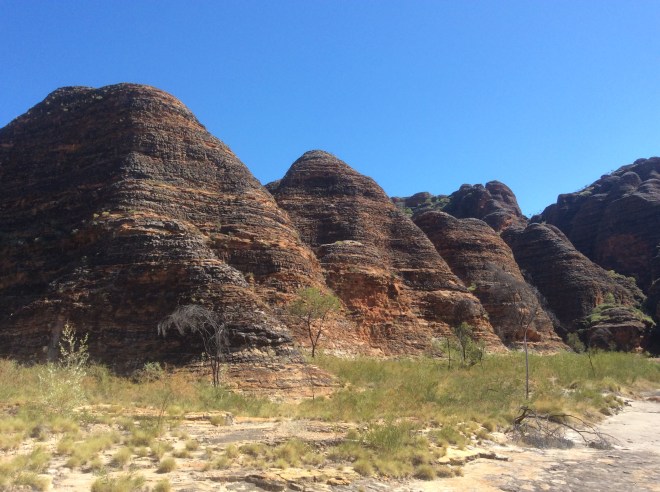
Readers will immediately notice the smooth rounded shapes into which the rocks have weathered – beehives is a commonly used descriptor and seems very apt. The guidebook with which we were thoughtfully supplied on our coach stated that this type of formation is very rare – only a few other places on Earth have it, and not nearly as extensively as in the Bungle Bungle Range. UNESCO, in its World Heritage Site write-up, notes approvingly that “the Bungle Bungles are, by far, the most outstanding example of cone karst in sandstones anywhere in the world.” Without going too much into the geological whys and wherefores, the fact that the rock has eroded into these smooth rounded shapes seems to have to do with the bands in the rock, seen quite well in the third photo above and even better in this photo taken by my wife from ground level.
image
The key to the bands’ existence is the clay content of the rock. The darker bands have more clay, which means they hold moisture better, which in turn allows a very thin film of cyanobacteria to grow on the rock. It is this film which gives the rock its darker colour. The red bands, on the other hand, having less or no clay, dry out quicker and so cannot support a colony of bacteria. Instead, they have been stained orange-red by iron and manganese deposits. The bacterial film protects the rock from too rapid an erosion, which allows the rounded shapes to form.

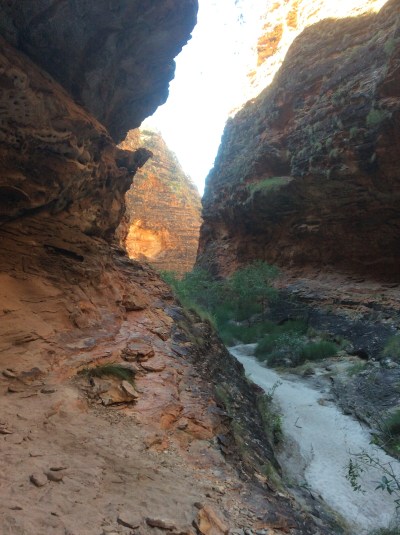
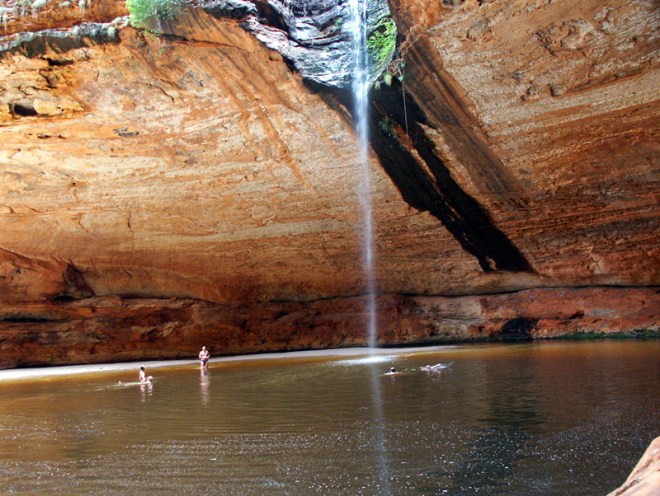
Geological considerations aside, it’s a delight to walk through these humped and rounded rocks, which are split by numerous gorges and chasms, a number of them having trails laid along them. We walked just two, the Cathedral Gorge and the Echidna Chasm. The Cathedral Gorge narrows slowly
image
image
image

image

to finally finish in a pool partially covered by deep overhangs.

DCF 1.0

image
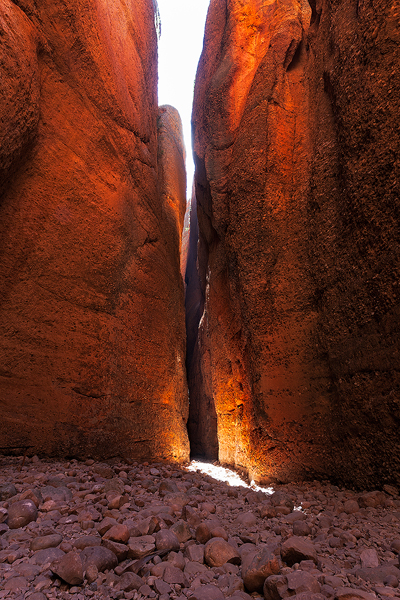
The Echidna Chasm, on the other hand, is a deep, narrow gash in the rock, at times so narrow that it is hard to get through. After the surprise of coming across Livistona fan palm trees at its mouth (palms are not the first trees that come to mind in this hot and arid landscape)
image
one edges into the chasm itself. There is a certain fun in threading one’s way through, at some points having to climb and clamber over huge boulders, sections of the walls which have come crashing down; one keeps looking nervously up to see if others might not be about to give way and squash one like a beetle. But there is also an ethereal beauty in this chasm. At certain times of the day, the sun catches the rocks and makes them literally glow. Our iPad cameras were too feeble to catch this wonderful light, but this photographer has managed beautifully.
image
We would gladly have stayed longer in this Park and done more of the trails. But that is the downside of organized tours: the tyranny of The Schedule.

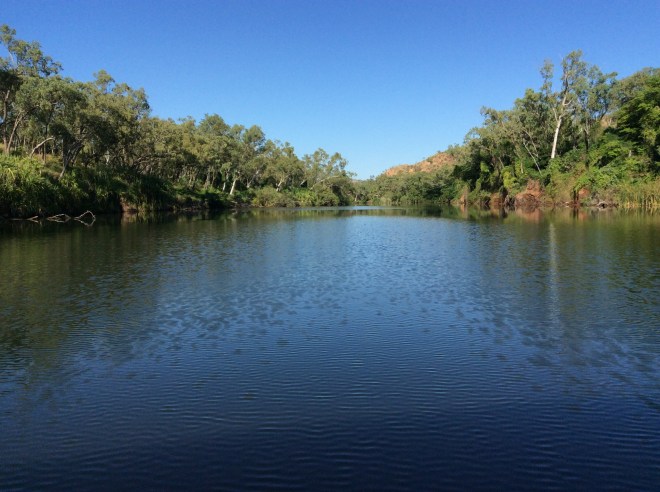
After detailed discussions, my wife and I have agreed on two more modest scheduled highlights, both, interestingly enough, having to do with water. One was the boat ride on a section of the Ord River near Kununurra, which has been dammed for irrigation purposes. From such utilitarian objectives has come a very pleasant body of water, in the form of several kilometers of the river which are filled year-round with water (a rarity in Australia).

image

image
“Water is life” our driver-cum-guide would constantly intone, and this stretch of river was the living proof of this. Apart from several well-fed freshwater crocodiles which we spied along the banks with a twittering of excitement, we saw a large number of birds, the most majestic of which was undoubtedly the white-breasted sea eagle
image
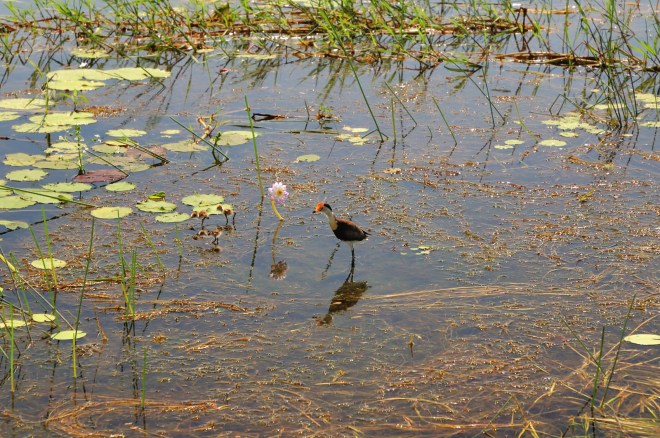
and the sweetest of which was the Jesus bird (aptly named since it seems to walk on water).
image
The mother hatches the chicks, the father is then solely responsible for their upbringing (many of the ladies on board noted this division of labour with approval; the men said nothing). But perhaps the most interesting wildlife we came across was a colony of fruit bats hanging out (literally) in a couple of trees along the bank, making quite a noise as they yelped and barked – when do they sleep, I wonder?

SONY DSC

From the mutterings of disapproval among our Australian companions and the spirited defense of the bats put up by our guide, we surmise that they are considered a nuisance in more urban settings, no doubt because they sink their fangs into the fruit of your garden which you had been looking forward to eating.

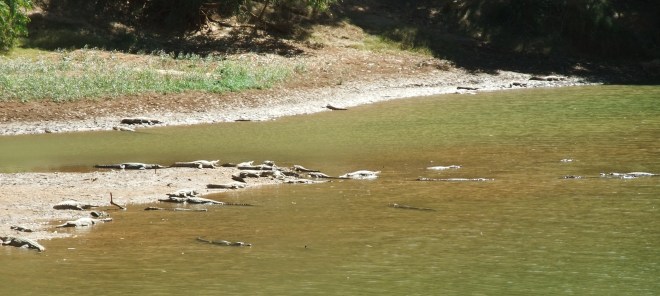
The second modest scheduled highlight was Windjana gorge, in the King Leopold Ranges (why the British explorer who first came across these ranges named them after the King of the Belgians is a bit of a mystery to me; my guess is he was hoping the guy would fork out for his next expedition). Apart from the frisson we got from seeing twenty or more freshwater crocodiles all in one place waiting in complete stillness on the banks or in the water for their next meal to go by
image
the gorge itself was very pretty
image
and once again the rocks glowed orange-red in the setting sun.
image

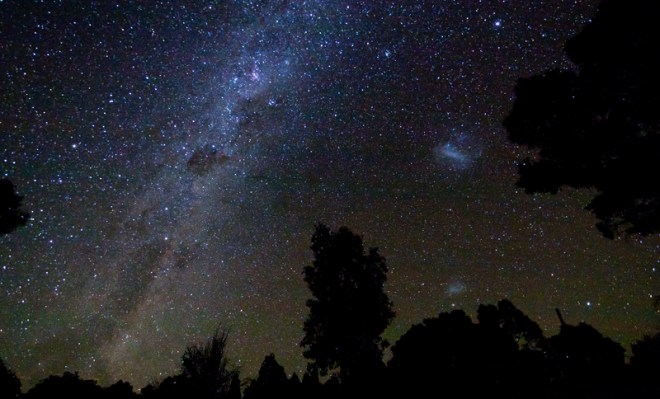
There was one other highlight, which wasn’t marked in The Schedule, and that was the night sky. In many places, we camped far, far away from any polluting light sources. This, combined with the normally clear skies, meant that when the moon didn’t get in the way we had glorious views of the night sky. It was a sky without the constellations of the Northern Hemisphere with which my wife and I are familiar, but nevertheless a magnificent site to behold, especially on the nightly walks to the toilet to which I alluded in the previous post.
image
Our last night out, we dragged our camp beds out of our tent, and as we dozed we watched the Milky Way wheel across the sky. Wonderful. But as they say, there is no gain without pain. I am still spreading anti-histamine cream on the dozen or so bites I got from the accursed Australian mosquitoes that night, may they rot in Hell.

____________

Bungle Bungle aerial view-1: http://www.kimberleywilderness.com.ccd. dau/the-apt-experience/photos-and-videos/photo-gallery
Bungle Bungle aerial view-2: http://www.ryanphotographic.com/Essay.htm
Bungle Bungle aerial view-3: http://kimberleymedia.photoshelter.com/gallery/Bungle-Bungles-Purnululu/G0000GcT6t3sRLPw/C0000uv7H8rn8We0
Cathedral Gorge trail: my wife’s photos
Cathedral Gorge pool-1: http://studyperth.com.au/about/news-feeds/2015/10/top-10-walking-tracks-and-bike-trails
Cathedral Gorge-2: my wife’s photo
Livistona palm trees: my wife’s photo
Echidna chasm: http://www.wildroad.com.au/galleries/australia-photos/echidna-chasm-purnululu-national-park-australia/
Ord River: my wife’s photos
White breasted sea eagle: http://thelife-animal.blogspot.com/2012/07/white-bellied-sea-eagle.html
Jesus bird: https://well.smugmug.com/keyword/WadingBirds;birds
Fruit bats: https://drivedownunder.wordpress.com/2013/06/14/its-a-bungle-out-there/sony-dsc-138/
Crocodiles, Windjana Gorge: https://flamingoing.wordpress.com/2013/08/19/the-devonian-reef-national-parks/
Windjana Gorge: http://www.broomeandthekimberley.com.au/gibb-river-road-and-gorges/
Night sky: http://www.3rf.com.au/gallery.asp